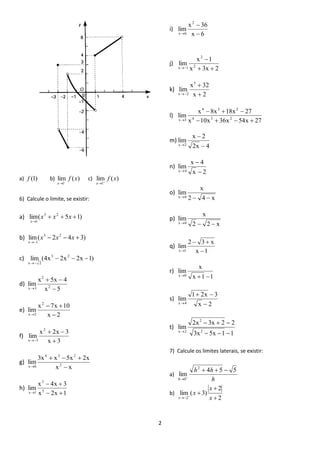
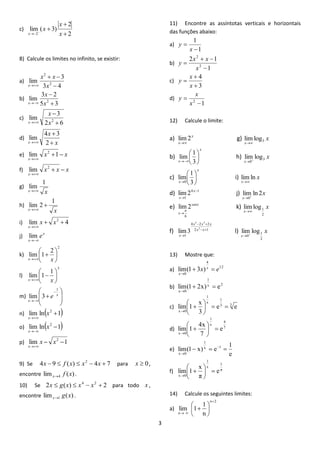
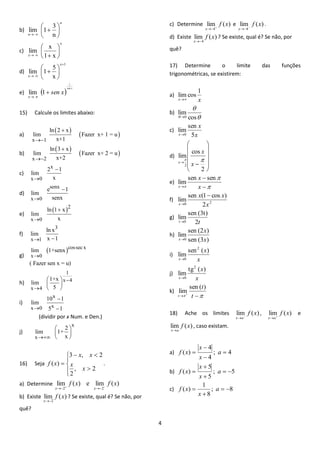
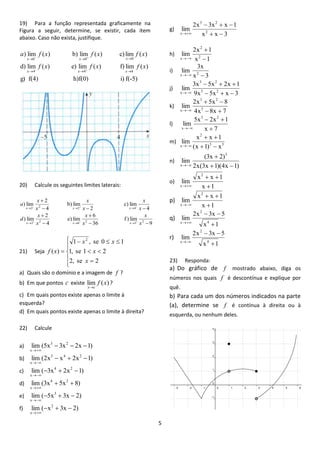
1 
MINISTÉRIO DA EDUCAÇÃO 
UNIVERSIDADE TECNOLÓGICA FEDERAL DO PARANÁ 
CAMPUS PATO BRANCO 
Lista de Exercícios de Calculo I – Limites e Continuidade 
1) O gráfico a seguir representa uma função f de 
[6, 9] em . Determine: 
a) f (2) b) lim ( ) 
2 
f x 
x   
c) lim ( ) 
2 
f x 
x   
d) lim ( ) 
2 
f x 
x 
e) f (2) f) f (7) 
2) Um gás (vapor d’água) é mantido à temperatura 
constante. A medida que o gás é comprimido, o 
volume V decresce até que atinja uma certa 
pressão (P) crítica. Além dessa pressão, o gás 
assume forma líquida. Observando a figura a 
seguir, determine: 
a) V 
p  100 
lim b) V 
p  100 
lim c) V 
p 100 
lim 
 
3) Dada a função f definida por: 
 
 
 
  
 
  
 
2 , 1 
2, 1 
4 , 1 
( ) 
2 
2 
x se x 
se x 
x se x 
f x . 
Esboce o gráfico de f e calcule o seu limite quando x 
tende a 1. 
4) Um paciente em um hospital recebe uma dose 
inicial de 200 miligramas de um medicamento. A 
cada 4 horas recebe uma dose adicional de 100 mg. 
A quantidade f(t) do medicamento presente na 
corrente sangüínea após t horas é exibida na figura a 
seguir. Determine e interprete: 
a) lim ( ) 
8 
f t 
t   
b) lim ( ) 
8 
f t 
p   
5) O gráfico a seguir representa uma função f de 
[3, 4[ em . Determine: 
UNIVERSIDADE TECNOLÓGICA FEDERAL DO PARANÁ PR
2 
a) f (1) b) lim ( ) 
1 
f x 
x   
c) lim ( ) 
1 
f x 
x   
6) Calcule o limite, se existir: 
a) lim( 5 1) 3 2 
1 
   
 
x x x 
x 
b) lim( 2 4 3) 3 2 
1 
   
 
x x x 
x 
c) lim (4x 2x 2x 1) 3 2 
x 2 
   
 
d) 
x 5 
x 5x 4 
lim 2 
2 
x 3  
  
 
e) 
x 2 
x 7x 10 
lim 
2 
x 2  
  
 
f) 
x 3 
x 2x 3 
lim 
2 
x 3  
  
 
g) 
x x 
3x x 5x 2x 
lim 2 
4 3 2 
x 0  
   
 
h) 
x 2x 1 
x 4x 3 
lim 5 
3 
x 1   
  
 
i) 
x 6 
x 36 
lim 
2 
x 6  
 
 
j) 
x 3x 2 
x 1 
lim 2 
2 
x 1   
 
 
k) 
x 2 
x 32 
lim 
5 
x 2  
 
 
l) 
x 10x 36x 54x 27 
x 8x 18x 27 
lim 4 3 2 
4 3 2 
x 3     
   
 
m) 
2x 4 
x 2 
lim 
x 2  
 
 
n) 
x 2 
x 4 
lim 
x 4  
 
 
o) 
2 4 x 
x 
lim 
x0   
p) 
2 2 x 
x 
lim 
x0   
q) 
x 1 
2 3 x 
lim 
x 1  
  
 
r) 
x 1 1 
x 
lim 
x0   
s) 
x 2 
1 2x 3 
lim 
x 4  
  
 
t) 
3x 5x 1 1 
2x 3x 2 2 
lim 
2 
2 
x 2    
   
 
7) Calcule os limites laterais, se existir: 
a) 
h 
h h 
h 
4 5 5 
lim 
2 
0 
   
  
b) 
2 
2 
lim ( 3) 
2  
 
 
  x 
x 
x 
x
3 
c) 
2 
2 
lim ( 3) 
2  
 
 
  x 
x 
x 
x 
8) Calcule os limites no infinito, se existir: 
a) 
3 4 
3 
lim 2 
2 
 
  
 x 
x x 
x 
b) 
5 3 
3 2 
lim 2  
 
 x 
x 
x 
c) 
2 6 
3 
lim 2  
 
 x 
x 
x 
d) 
x 
x 
x  
 
 2 
4 3 
lim 
e) x x 
x 
  
 
lim 1 2 
f) x x x 
x 
  
 
2 lim 
g) 
x x 
1 
lim 
 
h) 
x x 
1 
lim 2  
 
i) lim 4 2   
 
x x 
x 
j) x 
x 
e 
 
lim 
k) 
2 
2 
1 lim  
 
 
 
 
x x 
l) 
3 
1 
1 lim  
 
 
 
 
x x 
m) 
  
 
 
  
 
 
 
 
 
x 
x 
e 
1 
lim 3 
n) lim ln 1 2  
 
x 
x 
o) lim ln 1 2  
 
x 
x 
p) lim 1 2   
 
x x 
x 
9) Se 4 9 ( ) 4 7 2 x   f x  x  x  para x  0, 
encontre lim ( ) 4 f x x . 
10) Se 2 ( ) 2 4 2 x  g x  x  x  para todo x , 
encontre lim ( ) 1 g x x . 
11) Encontre as assíntotas verticais e horizontais 
das funções abaixo: 
a) 
1 
1 
 
 
x 
y 
b) 
1 
2 1 
2 
2 
 
  
 
x 
x x 
y 
c) 
3 
4 
 
 
 
x 
x 
y 
d) 
1 2  
 
x 
x 
y 
12) Calcule o limite: 
a) x 
x 
lim2 
 
g) x 
x 
3 limlog 
 
b) 
x 
x 
 
 
 
 
 3 
1 
lim h) x 
x 
3 
0 
lim log 
  
c) 
x 
x 
 
 
 
 
 3 
1 
lim 
0 
i) x 
x 
limln 
 
d) 4 1 
1 
lim2  
 
x 
x 
j) x 
x 
lim ln 2 
0  
e) senx 
x 
lim2 
6 
 
 
k) x 
x 
2 
1 limlog 
 
f) 2 1 
4 2 2 
1 
3 
5 3 
lim3   
  
 
x x 
x x x 
x 
l) x 
x 
2 
1 
0 
lim log 
  
13) Mostre que: 
a) 12 
4 
0 
lim(1 3x) x e 
x 
  
 
b) x 2 
1 
x 0 
lim(1 2x)  e 
 
c) 3 3 
1 
x 
1 
x 0 
e e 
3 
x 
1 lim    
 
 
 
 
 
d) 7 
4 
x 
1 
x 0 
e 
7 
4x 
1 lim   
 
 
 
 
 
e) 
e 
1 
lim(1 x) e x 1 
1 
x 0 
    
 
f) π 
1 
x 
1 
x 0 
e 
π 
x 
1 lim   
 
 
 
 
 
14) Calcule os seguintes limites: 
a) 
2 
n 
1 
lim 1 
 
  
 
 
 
 
 
n 
n
4 
b) 
n 
3 
lim 1 
n 
n 
 
 
 
 
 
  
c) 
1 x 
x 
lim 
x 
x 
 
 
 
 
   
d) 
x 
5 
lim 1 
1 
 
  
 
 
 
 
 
x 
x 
e)   sen x 
sen x 
x 
1 
lim 1 
 
  
15) Calcule os limites abaixo: 
a) 
  
  
x 1 
ln 2 x 
lim Fazer x+ 1 = u 
 x+1 
 
b) 
  
  
x 2 
ln 3 x 
lim Fazer x+ 2 = u 
 x+2 
 
c) 
x 
x 0 
2 1 
lim 
 x 
 
d) 
senx 
x 0 
e 1 
lim 
 senx 
 
e) 
 2 
x 0 
ln 1 x 
lim 
 x 
 
f) 
3 
x 1 
ln x 
lim 
 x 1 
g) 
 cossec x 
x 0 
lim 1+senx 
( Fazer sen x = u) 
 
h) 
1 
x 4 
x 4 
1+x 
lim 
5 
 
 
  
  
  
i) 
x 
x 0 x 
10 1 
lim 
 5 1 
 
 
(dividir por x Num. e Den.) 
j) 
x 
x 
2 
lim 1+ 
 x 
  
  
  
16) Seja 
 
 
 
 
  
 
, 2 
2 
3 , 2 
( ) 
x 
x 
x x 
f x . 
a) Determine lim ( ) e lim ( ) 
2 2 
f x f x 
x x     
b) Existe lim ( ) 
2 
f x 
x 
? Se existe, qual é? Se não, por 
quê? 
c) Determine lim ( ) 
4 
f x 
x   
e lim ( ) 
4 
f x 
x   
. 
d) Existe lim ( ) 
4 
f x 
x 
? Se existe, qual é? Se não, por 
quê? 
17) Determine o limite das funções 
trigonométricas, se existirem: 
a) 
x x 
1 
limcos 
 
b) 
 
 
 cos 
lim 
0 
c) 
x 
x 
x 5 
sen 
lim 
0 
d) 
  
 
 
 
 
  
 
 
 
 
  
2 
cos 
lim 
2 
  
x 
x 
x 
e) 
 
 
  
 
 x 
x 
x 
sen sen 
lim 
f) 
0 2 2 
sen (1 cos ) 
lim 
x 
x x 
x 
 
 
g) 
t 2t 
sen (3t) 
lim 
0 
h) 
sen (3 ) 
sen (2 ) 
lim 
0 x 
x 
x 
i) 
x 
x 
x 
sen ( ) 
lim 
2 
0 
j) 
x 
x 
x 
tg ( ) 
lim 
2 
0 
k) 
    t 
t 
t 
sen ( ) 
lim 
18) Ache os limites lim f (x) 
x a  
, lim f (x) 
x a  
e 
lim f (x) 
xa 
, caso existam. 
a) ; 4 
4 
4 
( )  
 
 
 a 
x 
x 
f x 
b) ; 5 
5 
5 
( )   
 
 
 a 
x 
x 
f x 
c) ; 8 
8 
1 
( )   
 
 a 
x 
f x
5 
19) Para a função representada graficamente na 
Figura a seguir, determine, se existir, cada item 
abaixo. Caso não exista, justifique. 
g) f(4) h)f(0) i) f(-5) 
d) lim ( ) e) lim ( ) f) lim ( ) 
) lim ( ) b) lim ( ) c) lim ( ) 
x 4 4 4 
0 0 0 
- 
f x f x f x 
a f x f x f x 
x x 
x x x 
   
   
 
  
20) Calcule os seguintes limites laterais: 
9 
f ) lim 
36 
6 
e) lim 
4 
2 
) lim 
4 
c) lim 
2 
b) lim 
4 
2 
) lim 
2 
3 
2 
6 
2 
2 
2 4 
2 
2 
  
 
 
 
   
 
   
   
   
   
x 
x 
x 
x 
x 
x 
d 
x 
x 
x 
x 
x 
x 
a 
x x x 
x x x 
21) Seja 
  
 
 
 
 
 
  
   
 
2, se 2 
1, se 1 2 
1 , se 0 1 
( ) 
2 
x 
x 
x x 
f x 
a) Quais são o domínio e a imagem de f ? 
b) Em que pontos c existe lim f (x) 
xc 
? 
c) Em quais pontos existe apenas o limite à 
esquerda? 
d) Em quais pontos existe apenas o limite à direita? 
22) Calcule 
a) lim (5x 3x 2x 1) 3 2 
x 
   
 
b) lim (2x x 2x 1) 5 4 2 
x 
   
 
c) lim ( 3x 2x 1) 4 2 
x 
   
 
d) lim (3x 5x 8) 4 2 
x 
  
 
e) lim ( 5x 3x 2) 3 
x 
   
 
f) lim ( x 3x 2) 2 
x 
   
 
g) 
x x 3 
2x 3x x 1 
lim 2 
3 2 
x   
   
 
h) 
x 1 
2x 1 
lim 2 
2 
x  
 
 
i) 
x 3 
3x 
lim x 2  
j) 
9x 5x x 3 
3x 5x 2x 1 
lim 3 2 
3 2 
x    
   
 
k) 
4x 8x 7 
2x 5x 8 
lim 5 
3 2 
x   
  
 
l) 
x 7 
5x 2x 1 
lim 
3 2 
x  
  
 
m) 
3 3 
2 
x (x 1) x 
x x 1 
lim 
  
  
 
n) 
2x(3x 1)(4x 1) 
(3x 2) 
lim 
3 
x   
 
 
o) 
x 1 
x x 1 
lim 
2 
x  
  
 
p) 
x 1 
x x 1 
lim 
2 
x  
  
 
q) 
x 1 
2x 3x 5 
lim 
4 
2 
x  
  
 
r) 
x 1 
2x 3x 5 
lim 
4 
2 
x  
  
 
23) Responda: 
a) Do gráfico de f mostrado abaixo, diga os 
números nos quais f é descontínua e explique por 
quê. 
b) Para cada um dos números indicados na parte 
(a), determine se f é contínua à direita ou à 
esquerda, ou nenhum deles.
6 
24) Esboce o gráfico de uma função que é contínua 
em toda parte, exceto em x  3 e é contínua à 
esquerda em x  3. 
25) Esboce o gráfico de uma função que tenha 
descontinuidade de salto em x  2 e um 
descontinuidade removível em x  4 , mas seja 
contínua no restante. 
26) Se f e g forem contínuas, com f (3)  5 e 
lim[2 ( ) ( )] 4 
3 
  
 
f x g x 
x 
, encontre g(3) . 
27) Use a definição de continuidade e propriedades 
dos limites para demonstrar que cada uma das 
funções abaixo é contínua em um dado número a. 
a) ( ) 7 , 4 2 f x  x   x a  
b) ( ) ( 2 ) , 1 3 4 f x  x  x a   
c) , 1 
1 
2 3 
( ) 3 
2 
 
 
 
 a 
x 
x x 
f x 
28) Explique por que a função é descontínua no 
número dado a. Esboce o gráfico da função. 
a) f (x)  ln x  2, a  2 
b) , 1 
2, se 1 
, se 1 
1 
1 
( )  
 
 
 
 
 
  a 
x 
x 
f x x 
c) , 0 
, se 0 
, se 0 
( ) 
2 
 
 
 
 
 
 
 a 
x x 
e x 
f x 
x 
d) , 1 
1, se 1 
, se 1 
( ) 2 1 
2 
 
 
 
 
 
 
 
 
 a 
x 
x 
x 
x x 
f x 
e) , 0 
1 , se 0 
0, se 0 
cos , se 0 
( ) 
2 
 
 
 
 
  
 
 
 a 
x x 
x 
x x 
f x 
29) Para quais valores da constante c a função f 
é contínua em (,) ? 
 
 
 
  
  
 
, se 2 
2 , se 2 
( ) 
3 
2 
x cx x 
cx x x 
f x 
30) Encontre os valores de a e b que tornam f 
contínua em toda parte. 
  
 
 
  
 
 
 
   
    
 
 
 
 
2 , se 3 
3, se 2 3 
, se 2 
2 
4 
( ) 2 
2 
x a b x 
ax bx x 
x 
x 
x 
f x
7 
Respostas 
1) a) 3 b) 2 c) 5 d) não existe e) 0 f) 0 
2) a) 0,8 b) 0,4 c) não existe 
3) 
lim ( ) 3 
1 
 
 
f x 
x 
4) a) 150 b) 250 
5) a) 4 b) -2 c) 4 
6) a) 8 b) 4 c) -5-6 2 d) 5 
e) -3 f) -6 g) -2 h) -1/3 
i) 12 j) -2 k) 80 l) 2 
m) 0 n) 4 o) 4 p) 2 2 
q) -1/4 r) 2 s) 4/ 3 t) 5/ 14 
7) a) 
5 
2 
b) 1 c) -1 
8) a)1/3 b)0 c)0 d) 2 e)0 
f) 1 g) 0 h)2 i) + j) 0 
k)1 l) 1 m) 4 n) + o) + 
p) 0 
9) 7 10) 2 
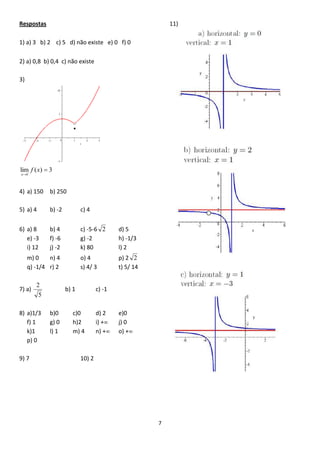
11)
8 
d) Verticais: x = 1 e x = -1 
12) a)  b)  c) 1 d) 8 
e) 2 f) 6 g)  h)  
i)  j)  k)  l)  
14) a) e b) e3 c) e-1 d) e5 e) e 
15) a) 1 b) 1 c) 1/ e 2 log d) 1 e) 2 
f) 3 g) e h) 5 e i) 1/ log5 
j) e2 
16) a) lim ( ) 2 
2 
 
  
f x 
x 
e lim ( ) 1 
2 
 
  
f x 
x 
b) Não existe lim ( ) 
2 
f x 
x 
, pois os limites 
laterais são diferentes 
c) lim ( ) 3 
4 
 
  
f x 
x 
e lim ( ) 3 
4 
 
  
f x 
x 
d) lim ( ) 3 
4 
 
 
f x 
x 
, pois os limites laterais são 
iguais. 
17) a) 1 b) 0 c) 1/5 d) 1 e)-1 
f) 0 g) 3/2 h) 2/3 i) 0 j) 0 
k) -1 
18) a) lim ( ) 1 
4 
 
  
f x 
x 
, lim ( ) 1 
4 
  
  
f x 
x 
e lim ( ) 
4 
f x 
x 
 
b) lim ( ) 1 
5 
 
  
f x 
x 
, lim ( ) 1 
5 
  
  
f x 
x 
e lim ( ) 
5 
f x 
x 
 
c)   
  
lim ( ) 
8 
f x 
x 
,   
  
lim ( ) 
8 
f x 
x 
e lim ( ) 
8 
f x 
x 
 
19) a) +  b) -  c) não existe 
d) -  e) -  f) não existe 
g) não existe h) não existe 
i) não existe j) não existe 
20) a) - b)  c) - 
d)  e)  f)  
21) a) D(f) = [0,2] e Im(f) = [0,1] U{ 2} 
b) 0 < c < 1 e 1 < c < 2 
c) c = 2 
d) c = 0 
22) a)  b)  c)  d)  
e)  f)  g)  h)2 
i) 0 j)1/3 k)0 l)  
m) 1/3 n) 9/8 o)1 p) 1 
q) 2 r) 2 
24) 
26) g(3) = 6 
28) a) c) 
e) 
29) c = 2/3 30) a = b = 1/2

Limites exercicios

  • 1.
    1 MINISTÉRIO DAEDUCAÇÃO UNIVERSIDADE TECNOLÓGICA FEDERAL DO PARANÁ CAMPUS PATO BRANCO Lista de Exercícios de Calculo I – Limites e Continuidade 1) O gráfico a seguir representa uma função f de [6, 9] em . Determine: a) f (2) b) lim ( ) 2 f x x   c) lim ( ) 2 f x x   d) lim ( ) 2 f x x e) f (2) f) f (7) 2) Um gás (vapor d’água) é mantido à temperatura constante. A medida que o gás é comprimido, o volume V decresce até que atinja uma certa pressão (P) crítica. Além dessa pressão, o gás assume forma líquida. Observando a figura a seguir, determine: a) V p  100 lim b) V p  100 lim c) V p 100 lim  3) Dada a função f definida por:          2 , 1 2, 1 4 , 1 ( ) 2 2 x se x se x x se x f x . Esboce o gráfico de f e calcule o seu limite quando x tende a 1. 4) Um paciente em um hospital recebe uma dose inicial de 200 miligramas de um medicamento. A cada 4 horas recebe uma dose adicional de 100 mg. A quantidade f(t) do medicamento presente na corrente sangüínea após t horas é exibida na figura a seguir. Determine e interprete: a) lim ( ) 8 f t t   b) lim ( ) 8 f t p   5) O gráfico a seguir representa uma função f de [3, 4[ em . Determine: UNIVERSIDADE TECNOLÓGICA FEDERAL DO PARANÁ PR
  • 2.
    2 a) f(1) b) lim ( ) 1 f x x   c) lim ( ) 1 f x x   6) Calcule o limite, se existir: a) lim( 5 1) 3 2 1     x x x x b) lim( 2 4 3) 3 2 1     x x x x c) lim (4x 2x 2x 1) 3 2 x 2     d) x 5 x 5x 4 lim 2 2 x 3     e) x 2 x 7x 10 lim 2 x 2     f) x 3 x 2x 3 lim 2 x 3     g) x x 3x x 5x 2x lim 2 4 3 2 x 0      h) x 2x 1 x 4x 3 lim 5 3 x 1      i) x 6 x 36 lim 2 x 6    j) x 3x 2 x 1 lim 2 2 x 1     k) x 2 x 32 lim 5 x 2    l) x 10x 36x 54x 27 x 8x 18x 27 lim 4 3 2 4 3 2 x 3         m) 2x 4 x 2 lim x 2    n) x 2 x 4 lim x 4    o) 2 4 x x lim x0   p) 2 2 x x lim x0   q) x 1 2 3 x lim x 1     r) x 1 1 x lim x0   s) x 2 1 2x 3 lim x 4     t) 3x 5x 1 1 2x 3x 2 2 lim 2 2 x 2        7) Calcule os limites laterais, se existir: a) h h h h 4 5 5 lim 2 0      b) 2 2 lim ( 3) 2      x x x x
  • 3.
    3 c) 2 2 lim ( 3) 2      x x x x 8) Calcule os limites no infinito, se existir: a) 3 4 3 lim 2 2     x x x x b) 5 3 3 2 lim 2    x x x c) 2 6 3 lim 2    x x x d) x x x    2 4 3 lim e) x x x    lim 1 2 f) x x x x    2 lim g) x x 1 lim  h) x x 1 lim 2   i) lim 4 2    x x x j) x x e  lim k) 2 2 1 lim      x x l) 3 1 1 lim      x x m)            x x e 1 lim 3 n) lim ln 1 2   x x o) lim ln 1 2   x x p) lim 1 2    x x x 9) Se 4 9 ( ) 4 7 2 x   f x  x  x  para x  0, encontre lim ( ) 4 f x x . 10) Se 2 ( ) 2 4 2 x  g x  x  x  para todo x , encontre lim ( ) 1 g x x . 11) Encontre as assíntotas verticais e horizontais das funções abaixo: a) 1 1   x y b) 1 2 1 2 2     x x x y c) 3 4    x x y d) 1 2   x x y 12) Calcule o limite: a) x x lim2  g) x x 3 limlog  b) x x      3 1 lim h) x x 3 0 lim log   c) x x      3 1 lim 0 i) x x limln  d) 4 1 1 lim2   x x j) x x lim ln 2 0  e) senx x lim2 6   k) x x 2 1 limlog  f) 2 1 4 2 2 1 3 5 3 lim3      x x x x x x l) x x 2 1 0 lim log   13) Mostre que: a) 12 4 0 lim(1 3x) x e x    b) x 2 1 x 0 lim(1 2x)  e  c) 3 3 1 x 1 x 0 e e 3 x 1 lim         d) 7 4 x 1 x 0 e 7 4x 1 lim        e) e 1 lim(1 x) e x 1 1 x 0      f) π 1 x 1 x 0 e π x 1 lim        14) Calcule os seguintes limites: a) 2 n 1 lim 1         n n
  • 4.
    4 b) n 3 lim 1 n n        c) 1 x x lim x x        d) x 5 lim 1 1         x x e)   sen x sen x x 1 lim 1    15) Calcule os limites abaixo: a)     x 1 ln 2 x lim Fazer x+ 1 = u  x+1  b)     x 2 ln 3 x lim Fazer x+ 2 = u  x+2  c) x x 0 2 1 lim  x  d) senx x 0 e 1 lim  senx  e)  2 x 0 ln 1 x lim  x  f) 3 x 1 ln x lim  x 1 g)  cossec x x 0 lim 1+senx ( Fazer sen x = u)  h) 1 x 4 x 4 1+x lim 5         i) x x 0 x 10 1 lim  5 1   (dividir por x Num. e Den.) j) x x 2 lim 1+  x       16) Seja        , 2 2 3 , 2 ( ) x x x x f x . a) Determine lim ( ) e lim ( ) 2 2 f x f x x x     b) Existe lim ( ) 2 f x x ? Se existe, qual é? Se não, por quê? c) Determine lim ( ) 4 f x x   e lim ( ) 4 f x x   . d) Existe lim ( ) 4 f x x ? Se existe, qual é? Se não, por quê? 17) Determine o limite das funções trigonométricas, se existirem: a) x x 1 limcos  b)    cos lim 0 c) x x x 5 sen lim 0 d)               2 cos lim 2   x x x e)       x x x sen sen lim f) 0 2 2 sen (1 cos ) lim x x x x   g) t 2t sen (3t) lim 0 h) sen (3 ) sen (2 ) lim 0 x x x i) x x x sen ( ) lim 2 0 j) x x x tg ( ) lim 2 0 k)     t t t sen ( ) lim 18) Ache os limites lim f (x) x a  , lim f (x) x a  e lim f (x) xa , caso existam. a) ; 4 4 4 ( )     a x x f x b) ; 5 5 5 ( )      a x x f x c) ; 8 8 1 ( )     a x f x
  • 5.
    5 19) Paraa função representada graficamente na Figura a seguir, determine, se existir, cada item abaixo. Caso não exista, justifique. g) f(4) h)f(0) i) f(-5) d) lim ( ) e) lim ( ) f) lim ( ) ) lim ( ) b) lim ( ) c) lim ( ) x 4 4 4 0 0 0 - f x f x f x a f x f x f x x x x x x          20) Calcule os seguintes limites laterais: 9 f ) lim 36 6 e) lim 4 2 ) lim 4 c) lim 2 b) lim 4 2 ) lim 2 3 2 6 2 2 2 4 2 2                      x x x x x x d x x x x x x a x x x x x x 21) Seja              2, se 2 1, se 1 2 1 , se 0 1 ( ) 2 x x x x f x a) Quais são o domínio e a imagem de f ? b) Em que pontos c existe lim f (x) xc ? c) Em quais pontos existe apenas o limite à esquerda? d) Em quais pontos existe apenas o limite à direita? 22) Calcule a) lim (5x 3x 2x 1) 3 2 x     b) lim (2x x 2x 1) 5 4 2 x     c) lim ( 3x 2x 1) 4 2 x     d) lim (3x 5x 8) 4 2 x    e) lim ( 5x 3x 2) 3 x     f) lim ( x 3x 2) 2 x     g) x x 3 2x 3x x 1 lim 2 3 2 x       h) x 1 2x 1 lim 2 2 x    i) x 3 3x lim x 2  j) 9x 5x x 3 3x 5x 2x 1 lim 3 2 3 2 x        k) 4x 8x 7 2x 5x 8 lim 5 3 2 x      l) x 7 5x 2x 1 lim 3 2 x     m) 3 3 2 x (x 1) x x x 1 lim      n) 2x(3x 1)(4x 1) (3x 2) lim 3 x     o) x 1 x x 1 lim 2 x     p) x 1 x x 1 lim 2 x     q) x 1 2x 3x 5 lim 4 2 x     r) x 1 2x 3x 5 lim 4 2 x     23) Responda: a) Do gráfico de f mostrado abaixo, diga os números nos quais f é descontínua e explique por quê. b) Para cada um dos números indicados na parte (a), determine se f é contínua à direita ou à esquerda, ou nenhum deles.
  • 6.
    6 24) Esboceo gráfico de uma função que é contínua em toda parte, exceto em x  3 e é contínua à esquerda em x  3. 25) Esboce o gráfico de uma função que tenha descontinuidade de salto em x  2 e um descontinuidade removível em x  4 , mas seja contínua no restante. 26) Se f e g forem contínuas, com f (3)  5 e lim[2 ( ) ( )] 4 3    f x g x x , encontre g(3) . 27) Use a definição de continuidade e propriedades dos limites para demonstrar que cada uma das funções abaixo é contínua em um dado número a. a) ( ) 7 , 4 2 f x  x   x a  b) ( ) ( 2 ) , 1 3 4 f x  x  x a   c) , 1 1 2 3 ( ) 3 2     a x x x f x 28) Explique por que a função é descontínua no número dado a. Esboce o gráfico da função. a) f (x)  ln x  2, a  2 b) , 1 2, se 1 , se 1 1 1 ( )         a x x f x x c) , 0 , se 0 , se 0 ( ) 2        a x x e x f x x d) , 1 1, se 1 , se 1 ( ) 2 1 2          a x x x x x f x e) , 0 1 , se 0 0, se 0 cos , se 0 ( ) 2          a x x x x x f x 29) Para quais valores da constante c a função f é contínua em (,) ?         , se 2 2 , se 2 ( ) 3 2 x cx x cx x x f x 30) Encontre os valores de a e b que tornam f contínua em toda parte.                     2 , se 3 3, se 2 3 , se 2 2 4 ( ) 2 2 x a b x ax bx x x x x f x
  • 7.
    7 Respostas 1)a) 3 b) 2 c) 5 d) não existe e) 0 f) 0 2) a) 0,8 b) 0,4 c) não existe 3) lim ( ) 3 1   f x x 4) a) 150 b) 250 5) a) 4 b) -2 c) 4 6) a) 8 b) 4 c) -5-6 2 d) 5 e) -3 f) -6 g) -2 h) -1/3 i) 12 j) -2 k) 80 l) 2 m) 0 n) 4 o) 4 p) 2 2 q) -1/4 r) 2 s) 4/ 3 t) 5/ 14 7) a) 5 2 b) 1 c) -1 8) a)1/3 b)0 c)0 d) 2 e)0 f) 1 g) 0 h)2 i) + j) 0 k)1 l) 1 m) 4 n) + o) + p) 0 9) 7 10) 2 11)
  • 8.
    8 d) Verticais:x = 1 e x = -1 12) a)  b)  c) 1 d) 8 e) 2 f) 6 g)  h)  i)  j)  k)  l)  14) a) e b) e3 c) e-1 d) e5 e) e 15) a) 1 b) 1 c) 1/ e 2 log d) 1 e) 2 f) 3 g) e h) 5 e i) 1/ log5 j) e2 16) a) lim ( ) 2 2    f x x e lim ( ) 1 2    f x x b) Não existe lim ( ) 2 f x x , pois os limites laterais são diferentes c) lim ( ) 3 4    f x x e lim ( ) 3 4    f x x d) lim ( ) 3 4   f x x , pois os limites laterais são iguais. 17) a) 1 b) 0 c) 1/5 d) 1 e)-1 f) 0 g) 3/2 h) 2/3 i) 0 j) 0 k) -1 18) a) lim ( ) 1 4    f x x , lim ( ) 1 4     f x x e lim ( ) 4 f x x  b) lim ( ) 1 5    f x x , lim ( ) 1 5     f x x e lim ( ) 5 f x x  c)     lim ( ) 8 f x x ,     lim ( ) 8 f x x e lim ( ) 8 f x x  19) a) +  b) -  c) não existe d) -  e) -  f) não existe g) não existe h) não existe i) não existe j) não existe 20) a) - b)  c) - d)  e)  f)  21) a) D(f) = [0,2] e Im(f) = [0,1] U{ 2} b) 0 < c < 1 e 1 < c < 2 c) c = 2 d) c = 0 22) a)  b)  c)  d)  e)  f)  g)  h)2 i) 0 j)1/3 k)0 l)  m) 1/3 n) 9/8 o)1 p) 1 q) 2 r) 2 24) 26) g(3) = 6 28) a) c) e) 29) c = 2/3 30) a = b = 1/2