Aula 10


Regras de Derivação:
Produto e quociente
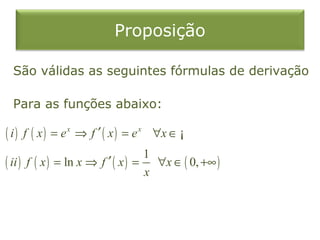
Proposição

 São válidas as seguintes fórmulas de derivação

 Para as funções abaixo:

( i) f ( x) = e ⇒ f
              x
                    ′ ( x ) = e x ∀x ∈ ¡
                                   1
( ii ) f ( x ) = ln x ⇒ f ′ ( x ) = ∀x ∈ ( 0, +∞ )
                                   x
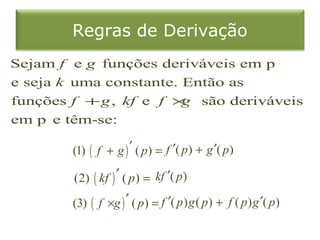
Regras de Derivação
Sejam f e g funções deriváveis em p
e seja k uma constante. Então as
funções f + g , kf e f × são deriváveis
                        g
em p e têm-se:

        (1) ( f + g ) ′ ( p ) = f ′( p ) + g ′( p )

        (2) ( kf ) ′ ( p ) = kf ′( p )

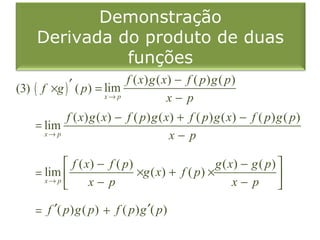
        (3) ( f ×g ) ′ ( p ) = f ′( p ) g ( p ) + f ( p ) g ′( p )
Demonstração
        Derivada da soma de suas
                            funções
(1) ( f + g ) ′ ( p ) =lim [ f ( x) + g ( x) ] − [ f ( p ) + g ( p ) ]
                       x→ p                      x− p
                             f ( x) − f ( p) g ( x) − g ( p) 
                     = lim                  +
                       x→ p
                                  x− p            x− p      
                             f ( x) − f ( p)          g ( x) − g ( p) 
                     = lim                    + lim                   
                       x→ p
                                  x− p          x→ p
                                                             x− p 

                      =    f ′( p ) + g ′( p )
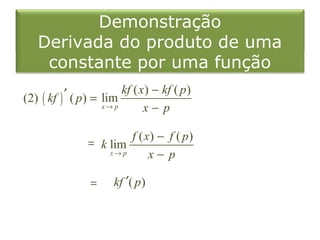
Demonstração
   Derivada do produto de uma
    constante por uma função

(2) ( kf ) ′ ( p) = lim kf ( x) − kf ( p )
                    x→ p      x− p

                         f ( x) − f ( p)
                = k lim
                    x→ p      x− p

                =     kf ′( p )
Demonstração
     Derivada do produto de duas
               funções
(3) ( f ×g ) ′ ( p ) = lim f ( x) g ( x) − f ( p ) g ( p )
                       x→ p            x− p
            f ( x) g ( x) − f ( p ) g ( x) + f ( p ) g ( x) − f ( p ) g ( p )
     = lim
       x→ p                              x− p

             f ( x) − f ( p)                     g ( x) − g ( p) 
     = lim                   ×g ( x) + f ( p ) ×
       x→ p
                  x− p                                x− p      

     = f ′( p ) g ( p ) + f ( p ) g ′( p )
Regra do Quociente
      Função Injetora
Se f e g forem deriváveis em p
                               f
e se g(p) ≠0, então a função
                               g
 será derivável em p e têm-se:


         f ′     f ′( p ) g ( p ) − f ( p ) g ′( p )
    (4)  ÷ ( p) =
                               [ g ( p)]
                                         2
         g
Demonstração Regra do quociente
                       f ( x) f ( p)
            ′                −
        f            g ( x) g ( p)
   (4)  ÷ ( p) = lim
       g        x→ p      x− p
        f ( x) g ( p) − f ( p) g ( x)        1
 = lim                                ×
   x→ p             x− p                g ( x) g ( p )
  Somando e subtraindo f ( p) g ( p) ao numerador resulta
        f ( x) − f ( p)                       g ( x) − g ( p)        1        
= lim                      ×g ( p) − f ( p) ×                 ×               
  x→ p
              x− p                                 x− p         g ( x) g ( p) 
  =   f ′( p ) g ( p ) − f ( p ) g ′( p )
                [ g ( p)]
                            2
Exemplo
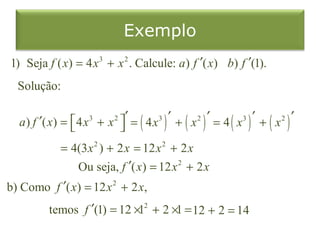
1) Seja f ( x) = 4 x 3 + x 2 . Calcule: a) f ′( x) b) f ′(1).
  Solução:

  a ) f ′( x) =  4 x 3 + x 2 ′ = ( 4x3 ) ′ + ( x 2 ) ′ = 4 ( x 3 ) ′ + ( x 2 ) ′
                             
              = 4(3 x 2 ) + 2 x = 12 x 2 + 2 x
                 Ou seja, f    ′( x) = 12 x 2 + 2 x
b) Como f ′( x) = 12 x 2 + 2 x,
          temos f ′(1) = 12 ×12 + 2 ×1 = 12 + 2 = 14
Exemplo
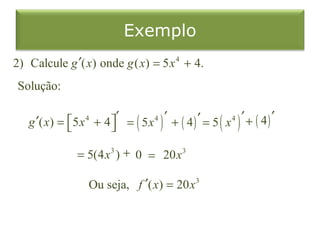
2) Calcule g ′( x) onde g ( x) = 5 x 4 + 4.
 Solução:

   g ′( x) = 5 x 4 + 4 ′ = ( 5 x 4 ) ′ + ( 4 ) ′ = 5 ( x 4 ) ′ + ( 4 ) ′
                       

                 = 5(4 x3 ) + 0 = 20x 3

                    Ou seja, f ′( x) = 20 x 3
Exemplo
                                2x + 3
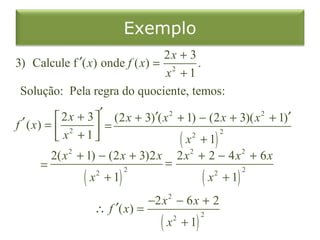
3) Calcule f ′( x) onde f ( x) = 2     .
                                 x +1
 Solução: Pela regra do quociente, temos:

            2 x + 3 ′ (2 x + 3)′( x 2 + 1) − (2 x + 3)( x 2 + 1)′
f ′ ( x) =  2        =
            x +1                      ( x2 + 1) 2
                                            2      2


          2( x 2 + 1) − (2 x + 3)2 x 2 x + 2 − 4 x + 6 x
        =                           =
                  ( x + 1)                    ( x + 1)
                     2      2                    2     2


                                 −2 x 2 − 6 x + 2
                   ∴ f ′( x) =
                                   (x       + 1)
                                        2          2
Exemplo
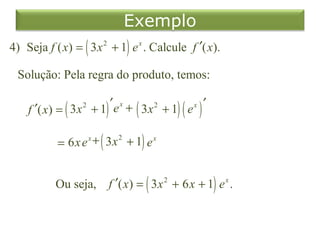
4) Seja f ( x) = ( 3 x 2 + 1) e x . Calcule f ′( x).

  Solução: Pela regra do produto, temos:

                         ′e x + 3x 2 + 1 e x ′
    f ′( x) = ( 3 x + 1)       (        )( )
                  2


           = 6x e + ( 3 x 2 + 1) e x
                      x


           Ou seja,       f ′( x) = ( 3 x 2 + 6 x + 1) e x .
Exemplo
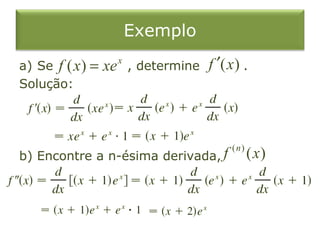
a) Se f ( x ) =   xe   x
                           , determine   f ′( x) .
Solução:


                                              (n)
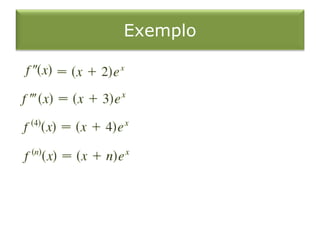
b) Encontre a n-ésima derivada, f                   ( x)
Exemplo
Exemplo
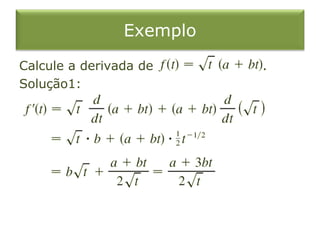
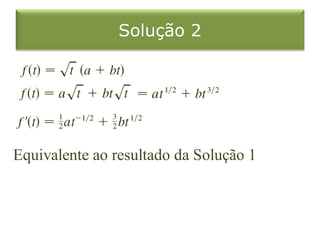
Calcule a derivada de     .
Solução1:
Solução 2


Equivalente ao resultado da Solução 1
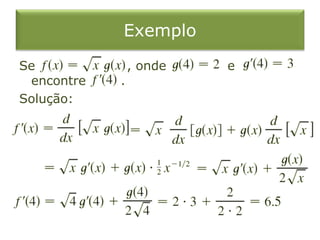
Exemplo
Se              , onde   e
 encontre   .
Solução:
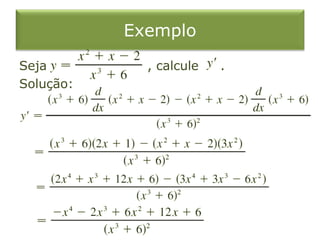
Exemplo
Seja         , calcule   .
Solução:
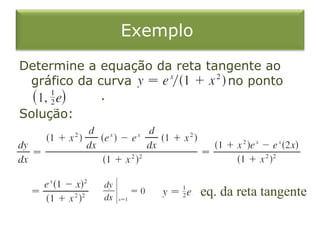
Exemplo
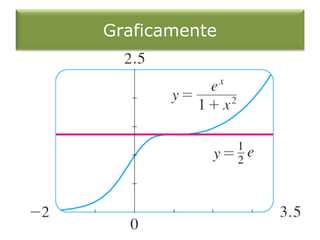
Determine a equação da reta tangente ao
 gráfico da curva              no ponto
             .
Solução:


                          eq. da reta tangente
Graficamente
Obrigado !


Esta aula está disponível em

http://www.mat.ufam.edu.br/

10 regras de derivação (parte 2)

  • 1.
    Aula 10 Regras deDerivação: Produto e quociente
  • 2.
    Proposição São válidasas seguintes fórmulas de derivação Para as funções abaixo: ( i) f ( x) = e ⇒ f x ′ ( x ) = e x ∀x ∈ ¡ 1 ( ii ) f ( x ) = ln x ⇒ f ′ ( x ) = ∀x ∈ ( 0, +∞ ) x
  • 3.
    Regras de Derivação Sejamf e g funções deriváveis em p e seja k uma constante. Então as funções f + g , kf e f × são deriváveis g em p e têm-se: (1) ( f + g ) ′ ( p ) = f ′( p ) + g ′( p ) (2) ( kf ) ′ ( p ) = kf ′( p ) (3) ( f ×g ) ′ ( p ) = f ′( p ) g ( p ) + f ( p ) g ′( p )
  • 4.
    Demonstração Derivada da soma de suas funções (1) ( f + g ) ′ ( p ) =lim [ f ( x) + g ( x) ] − [ f ( p ) + g ( p ) ] x→ p x− p  f ( x) − f ( p) g ( x) − g ( p)  = lim  + x→ p  x− p x− p    f ( x) − f ( p)   g ( x) − g ( p)  = lim   + lim   x→ p  x− p  x→ p  x− p  = f ′( p ) + g ′( p )
  • 5.
    Demonstração Derivada do produto de uma constante por uma função (2) ( kf ) ′ ( p) = lim kf ( x) − kf ( p ) x→ p x− p f ( x) − f ( p) = k lim x→ p x− p = kf ′( p )
  • 6.
    Demonstração Derivada do produto de duas funções (3) ( f ×g ) ′ ( p ) = lim f ( x) g ( x) − f ( p ) g ( p ) x→ p x− p f ( x) g ( x) − f ( p ) g ( x) + f ( p ) g ( x) − f ( p ) g ( p ) = lim x→ p x− p  f ( x) − f ( p) g ( x) − g ( p)  = lim  ×g ( x) + f ( p ) × x→ p  x− p x− p   = f ′( p ) g ( p ) + f ( p ) g ′( p )
  • 7.
    Regra do Quociente Função Injetora Se f e g forem deriváveis em p f e se g(p) ≠0, então a função g será derivável em p e têm-se:  f ′ f ′( p ) g ( p ) − f ( p ) g ′( p ) (4)  ÷ ( p) = [ g ( p)] 2  g
  • 8.
    Demonstração Regra doquociente f ( x) f ( p) ′ −  f  g ( x) g ( p) (4)  ÷ ( p) = lim g x→ p x− p f ( x) g ( p) − f ( p) g ( x) 1 = lim × x→ p x− p g ( x) g ( p ) Somando e subtraindo f ( p) g ( p) ao numerador resulta  f ( x) − f ( p) g ( x) − g ( p) 1  = lim  ×g ( p) − f ( p) × ×  x→ p  x− p x− p g ( x) g ( p)  = f ′( p ) g ( p ) − f ( p ) g ′( p ) [ g ( p)] 2
  • 9.
    Exemplo 1) Seja f( x) = 4 x 3 + x 2 . Calcule: a) f ′( x) b) f ′(1). Solução: a ) f ′( x) =  4 x 3 + x 2 ′ = ( 4x3 ) ′ + ( x 2 ) ′ = 4 ( x 3 ) ′ + ( x 2 ) ′   = 4(3 x 2 ) + 2 x = 12 x 2 + 2 x Ou seja, f ′( x) = 12 x 2 + 2 x b) Como f ′( x) = 12 x 2 + 2 x, temos f ′(1) = 12 ×12 + 2 ×1 = 12 + 2 = 14
  • 10.
    Exemplo 2) Calcule g′( x) onde g ( x) = 5 x 4 + 4. Solução: g ′( x) = 5 x 4 + 4 ′ = ( 5 x 4 ) ′ + ( 4 ) ′ = 5 ( x 4 ) ′ + ( 4 ) ′   = 5(4 x3 ) + 0 = 20x 3 Ou seja, f ′( x) = 20 x 3
  • 11.
    Exemplo 2x + 3 3) Calcule f ′( x) onde f ( x) = 2 . x +1 Solução: Pela regra do quociente, temos:  2 x + 3 ′ (2 x + 3)′( x 2 + 1) − (2 x + 3)( x 2 + 1)′ f ′ ( x) =  2  =  x +1 ( x2 + 1) 2 2 2 2( x 2 + 1) − (2 x + 3)2 x 2 x + 2 − 4 x + 6 x = = ( x + 1) ( x + 1) 2 2 2 2 −2 x 2 − 6 x + 2 ∴ f ′( x) = (x + 1) 2 2
  • 12.
    Exemplo 4) Seja f( x) = ( 3 x 2 + 1) e x . Calcule f ′( x). Solução: Pela regra do produto, temos: ′e x + 3x 2 + 1 e x ′ f ′( x) = ( 3 x + 1) ( )( ) 2 = 6x e + ( 3 x 2 + 1) e x x Ou seja, f ′( x) = ( 3 x 2 + 6 x + 1) e x .
  • 13.
    Exemplo a) Se f( x ) = xe x , determine f ′( x) . Solução: (n) b) Encontre a n-ésima derivada, f ( x)
  • 14.
  • 15.
  • 16.
    Solução 2 Equivalente aoresultado da Solução 1
  • 17.
    Exemplo Se , onde e encontre . Solução:
  • 18.
    Exemplo Seja , calcule . Solução:
  • 19.
    Exemplo Determine a equaçãoda reta tangente ao gráfico da curva no ponto . Solução: eq. da reta tangente
  • 20.
  • 21.
    Obrigado ! Esta aulaestá disponível em http://www.mat.ufam.edu.br/