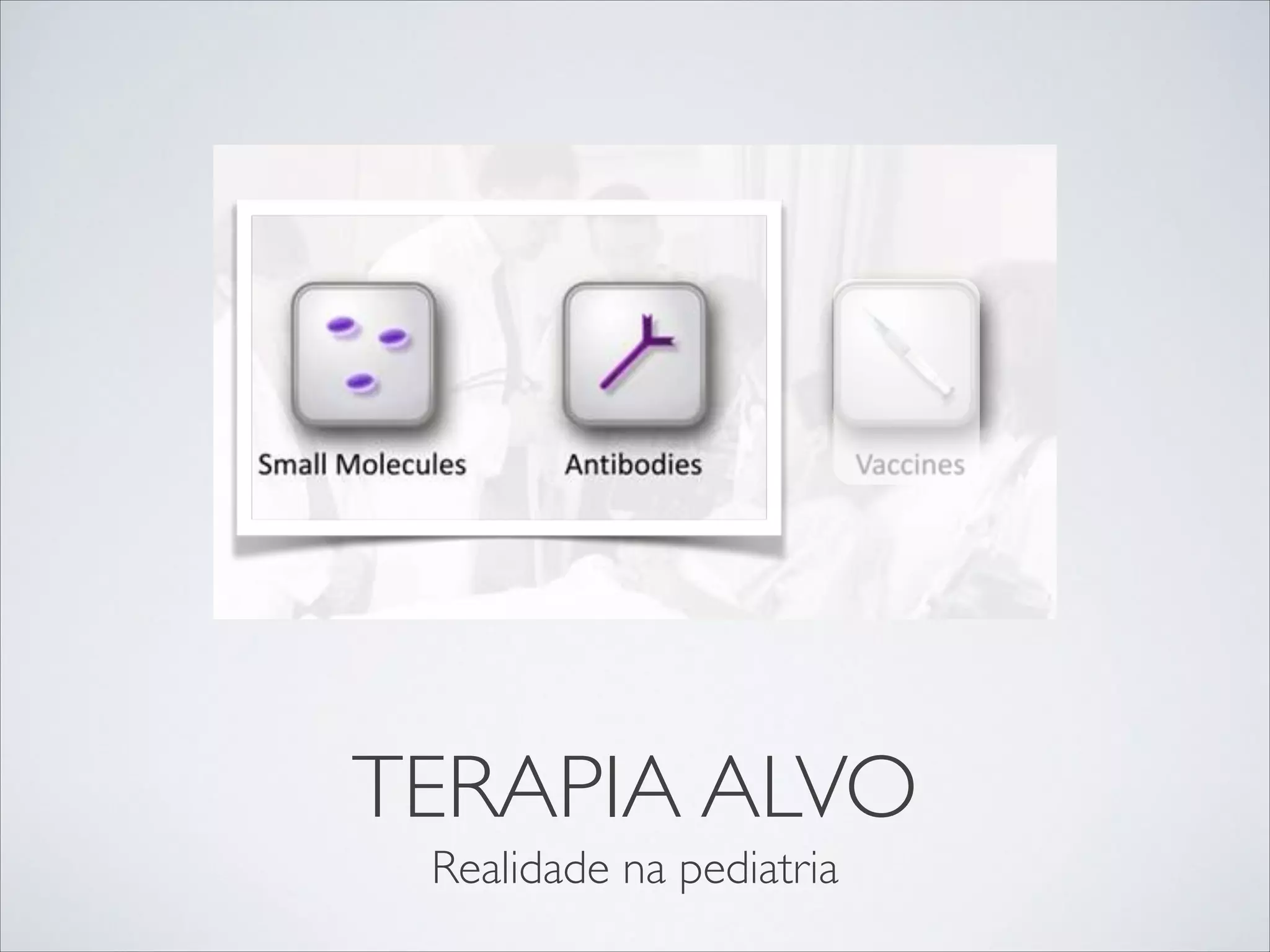
TERAPIA ALVO
Realidade na pediatria
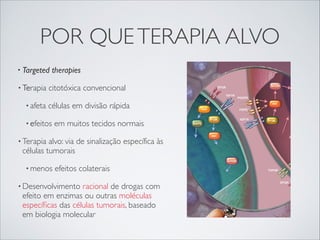
POR QUE TERAPIA ALVO
•

Targeted therapies

• Terapia
• afeta

citotóxica convencional
células em divisão rápida

• efeitos

em muitos tecidos normais

• Terapia

alvo: via de sinalização específica às
células tumorais
• menos

efeitos colaterais

• Desenvolvimento

racional de drogas com
efeito em enzimas ou outras moléculas
específicas das células tumorais, baseado
em biologia molecular
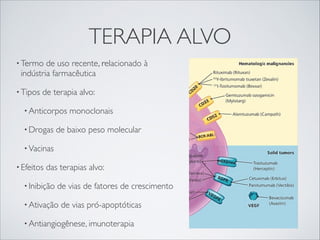
TERAPIA ALVO
• Termo

de uso recente, relacionado à
indústria farmacêutica

• Tipos

de terapia alvo:

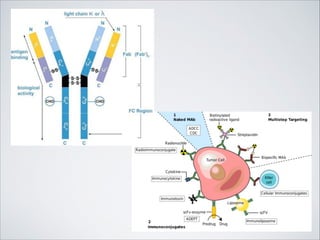
• Anticorpos
• Drogas

monoclonais

de baixo peso molecular

• Vacinas
• Efeitos

das terapias alvo:

• Inibição

de vias de fatores de crescimento

• Ativação

de vias pró-apoptóticas

• Antiangiogênese, imunoterapia
ANTICORPOS MONOCLONAIS 
BIOLOGICALS - MABS

• Kohler

& Milstein, 1975 - produção de anticorpos monoclonais por hibridomas

• Koprowski, 1978
• Busca

- anticorpos contra melanoma

de uma terapia imunológica

• Ritz, Blood, 1981

- anticorpo anti-CD10 em pacientes com LLA

• Drebin, PNAS, 1986
• Células

- oncogene neu, inibido por um anticorpo monoclonal

NIH 3T3 transformadas por neu - crescimento inibido em nude

mice
• Células

NIH 3T3 transformadas por Ha-ras - crescimento contínuo
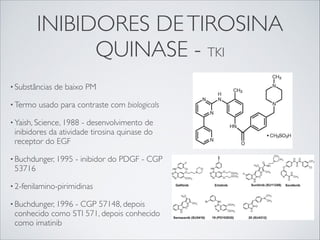
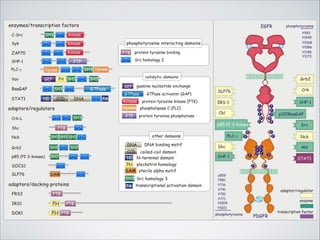
INIBIDORES DE TIROSINA
QUINASE - TKI
• Substâncias
• Termo

de baixo PM

usado para contraste com biologicals

• Yaish, Science, 1988

- desenvolvimento de
inibidores da atividade tirosina quinase do
receptor do EGF

• Buchdunger, 1995

53716

- inibidor do PDGF - CGP

• 2-fenilamino-pirimidinas
• Buchdunger, 1996

- CGP 57148, depois
conhecido como STI 571, depois conhecido
como imatinib
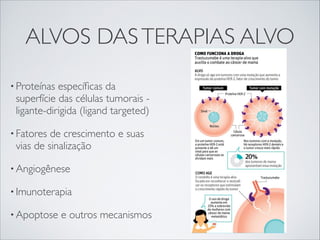
ALVOS DAS TERAPIAS ALVO
• Proteínas

específicas da
superfície das células tumorais ligante-dirigida (ligand targeted)
• Fatores

de crescimento e suas
vias de sinalização

• Angiogênese
• Imunoterapia
• Apoptose

e outros mecanismos
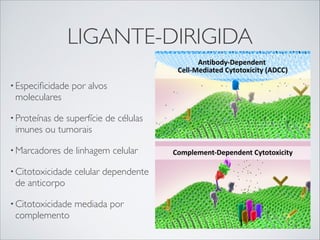
LIGANTE-DIRIGIDA
• Especificidade

por alvos

moleculares
• Proteínas

de superfície de células
imunes ou tumorais

• Marcadores

de linhagem celular

• Citotoxicidade

celular dependente

de anticorpo
• Citotoxicidade

complemento

mediada por
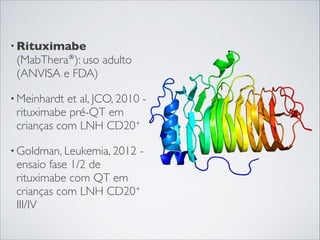
• Rituximabe

(MabThera®): uso adulto
(ANVISA e FDA)
• Meinhardt

et al, JCO, 2010 rituximabe pré-QT em
crianças com LNH CD20+ 

• Goldman, Leukemia, 2012

-

ensaio fase 1/2 de
rituximabe com QT em
crianças com LNH CD20+
III/IV
0.6
0.4
0.0

0.2

Probability

0.8

1.0

were unknown in that cohort [3]. In the Children’s Cancer Group however, and long-term outcomes were not r
study 5912, the DECAL regimen was given to 68 patients with theless, perhaps in part because of the encour
recurrent NHL with a 50% response rate, which was independent of studies ICE has become a commonly employe
A study of rituximab histologic subtype. OS carboplatin, and etoposide chemotherapy in children with
and ifosfamide, was 33% at 2 years but only 2/13 patients pediatric patients with relapsed NHL.
recurrent/refractory B‐celldescribed as non‐Hodgkin lymphoma and mature B‐cell acutepatients enrolled
The small number of
with BL were (CD20+) long-term survivors [5]. Kung et al.
lymphoblastic a 71% CR/PR A report fromOncology Group trial Oncology Group conclusions regarding the t
reported leukemia: rate in a Pediatric the Children's of preclude definitive
the combination of rituximab and ICE chemo
the response rate observed (60%) appears to b
to previous reports of other salvage regime
impressive in view of the prior, intensive con
received by the patients. Many with OR we
consolidative therapy with SCT, and the prop
alive and free of disease at last follow-up
previously published series of such patients
DLBCL group, two of the survivors did n
consolidation therapy with SCT.
Patients enrolled in this trial had a very sho
not respond to salvage therapy, while those w
disease had a chance at successful retrieval
perhaps more effective relapse therapy, the
response to initial retrieval therapy and su
diseases such as Hodgkin lymphoma, may
high-grade B-cell malignancies as well.
The commercial availability of rituxim
opportunity to combine it with chemotherapy
0.0
0.5
1.0
1.5
2.0
2.5
3.0
ICE, for use in relapsed or refractory high-gr
Years
outside the setting of a clinical trial. The curr
Survival
Number Number Number
because it provides controlled data regardin
Time interval Estimate SE failed Censored at risk
regimen as well as some response data.
0-1 year
0.4286 0.1145
11
1
20
rituximab and ICE chemotherapy was delivere
1-2 years
0.3750 0.2096
1
5
8
or excessive toxicity. Infusion-related toxicit
2-3 years
0.3750
.
0
2
2
but manageable, and no patient experienc
Fig. 1. Overall survival: All eligible patients.
reactions that have been reported in patients w
Pediatr Blood Cancer DOI 10.1002/pbc

Pediatric Blood & Cancer

Volume 52, Issue 2, pages 177-181, 24 SEP 2008 DOI: 10.1002/pbc.21753

http://onlinelibrary.wiley.com/doi/10.1002/pbc.21753/full#fig1
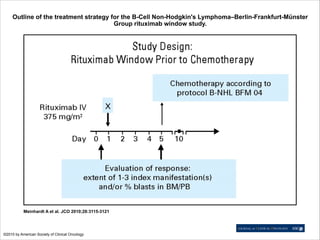
Outline of the treatment strategy for the B-Cell Non-Hodgkin's Lymphoma–Berlin-Frankfurt-Münster
Group rituximab window study.

Meinhardt A et al. JCO 2010;28:3115-3121

©2010 by American Society of Clinical Oncology
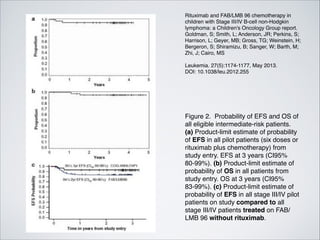
Rituximab and FAB/LMB 96 chemotherapy in
children with Stage III/IV B-cell non-Hodgkin
lymphoma: a Children's Oncology Group report.
Goldman, S; Smith, L; Anderson, JR; Perkins, S;
Harrison, L; Geyer, MB; Gross, TG; Weinstein, H;
Bergeron, S; Shiramizu, B; Sanger, W; Barth, M;
Zhi, J; Cairo, MS


Leukemia. 27(5):1174-1177, May 2013.
DOI: 10.1038/leu.2012.255

Figure 2. Probability of EFS and OS of
all eligible intermediate-risk patients.
(a) Product-limit estimate of probability
of EFS in all pilot patients (six doses or
rituximab plus chemotherapy) from
study entry. EFS at 3 years (CI95%
80-99%). (b) Product-limit estimate of
probability of OS in all patients from
study entry. OS at 3 years (CI95%
83-99%). (c) Product-limit estimate of
probability of EFS in all stage III/IV pilot
patients on study compared to all
stage III/IV patients treated on FAB/
LMB 96 without rituximab.
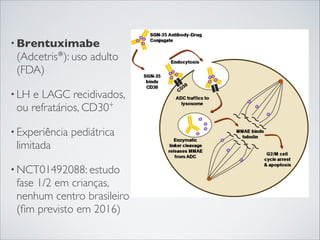
• Brentuximabe

(Adcetris®): uso adulto
(FDA)
• LH

e LAGC recidivados,
ou refratários, CD30+

• Experiência

pediátrica

limitada
• NCT01492088: estudo

fase 1/2 em crianças,
nenhum centro brasileiro
(fim previsto em 2016)
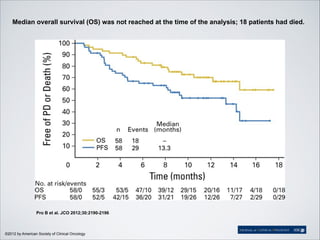
Median overall survival (OS) was not reached at the time of the analysis; 18 patients had died.

Pro B et al. JCO 2012;30:2190-2196

©2012 by American Society of Clinical Oncology
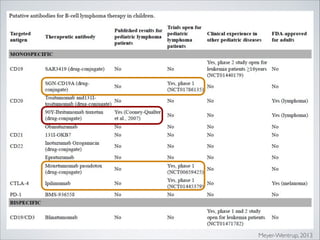
Meyer-Wentrup, 2013
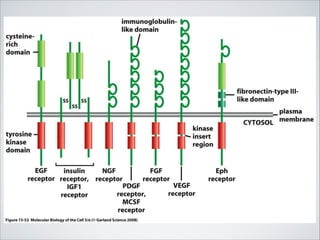
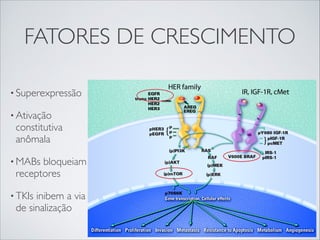
FATORES DE CRESCIMENTO
• Superexpressão
• Ativação

constitutiva
anômala

• MABs

bloqueiam
receptores

• TKIs

inibem a via
de sinalização
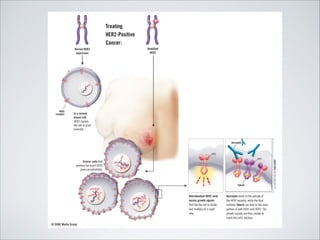
• Trastuzumab

- HERCEPTIN® - alvo: Her2/neu ou Erb2

• Aprovado

para câncer de mama avançado: prolonga a
sobrevida em 20 a 30% pacientes

• Resistência

comum

• Ebb, JCO, 2012

- fase II, trastuzumab e QT em
osteossarcoma, aparentemente sem vantagem
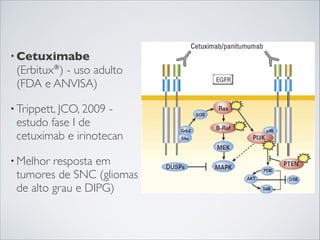
• Cetuximabe

(Erbitux®) - uso adulto
(FDA e ANVISA)
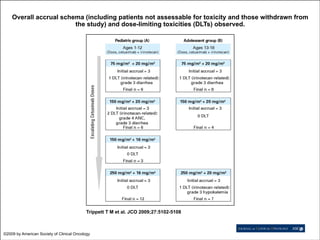
• Trippett, JCO, 2009

-

estudo fase I de
cetuximab e irinotecan

• Melhor

resposta em
tumores de SNC (gliomas
de alto grau e DIPG)
Overall accrual schema (including patients not assessable for toxicity and those withdrawn from
the study) and dose-limiting toxicities (DLTs) observed.

Trippett T M et al. JCO 2009;27:5102-5108

©2009 by American Society of Clinical Oncology
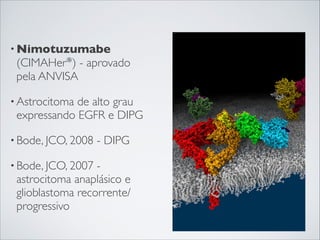
• Nimotuzumabe

(CIMAHer®) - aprovado
pela ANVISA
• Astrocitoma

de alto grau
expressando EGFR e DIPG

• Bode, JCO, 2008
• Bode, JCO, 2007

- DIPG

astrocitoma anaplásico e
glioblastoma recorrente/
progressivo
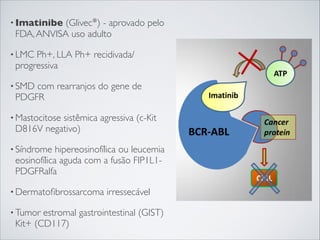
• Imatinibe

(Glivec®) - aprovado pelo
FDA, ANVISA uso adulto

• LMC

Ph+, LLA Ph+ recidivada/
progressiva

• SMD

com rearranjos do gene de
PDGFR

• Mastocitose

sistêmica agressiva (c-Kit
D816V negativo)

• Síndrome

hipereosinofílica ou leucemia
eosinofílica aguda com a fusão FIP1L1PDGFRalfa

• Dermatofibrossarcoma
• Tumor

irressecável

estromal gastrointestinal (GIST)
Kit+ (CD117)
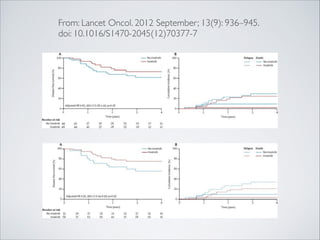
From: Lancet Oncol. 2012 September; 13(9): 936–945.
doi: 10.1016/S1470-2045(12)70377-7
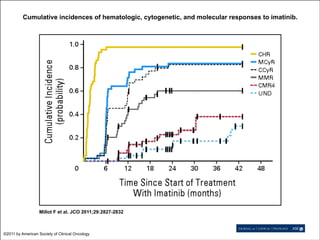
Cumulative incidences of hematologic, cytogenetic, and molecular responses to imatinib.

Millot F et al. JCO 2011;29:2827-2832

©2011 by American Society of Clinical Oncology
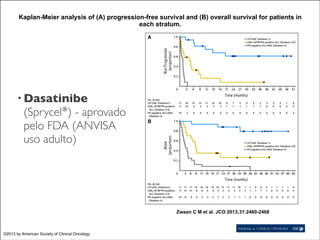
Kaplan-Meier analysis of (A) progression-free survival and (B) overall survival for patients in
each stratum.

• Dasatinibe

(Sprycel®) - aprovado
pelo FDA (ANVISA
uso adulto)

Zwaan C M et al. JCO 2013;31:2460-2468

©2013 by American Society of Clinical Oncology
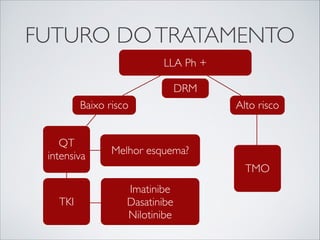
FUTURO DO TRATAMENTO
LLA Ph +
DRM

Baixo risco
QT
intensiva

Melhor esquema?

TKI

Imatinibe
Dasatinibe
Nilotinibe

Alto risco

TMO
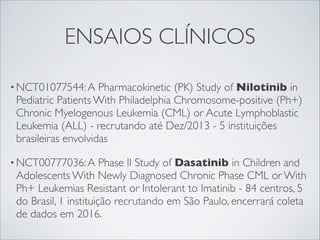
ENSAIOS CLÍNICOS
Pharmacokinetic (PK) Study of Nilotinib in
Pediatric Patients With Philadelphia Chromosome-positive (Ph+)
Chronic Myelogenous Leukemia (CML) or Acute Lymphoblastic
Leukemia (ALL) - recrutando até Dez/2013 - 5 instituições
brasileiras envolvidas

• NCT01077544: A

Phase II Study of Dasatinib in Children and
Adolescents With Newly Diagnosed Chronic Phase CML or With
Ph+ Leukemias Resistant or Intolerant to Imatinib - 84 centros, 5
do Brasil, 1 instituição recrutando em São Paulo, encerrará coleta
de dados em 2016.

• NCT00777036: A
PERSPECTIVAS
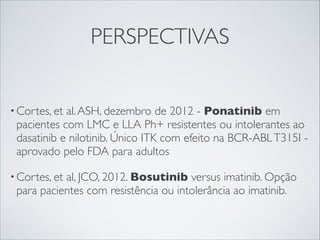
al. ASH, dezembro de 2012 - Ponatinib em
pacientes com LMC e LLA Ph+ resistentes ou intolerantes ao
dasatinib e nilotinib. Único ITK com efeito na BCR-ABL T315I aprovado pelo FDA para adultos

• Cortes, et

al, JCO, 2012. Bosutinib versus imatinib. Opção
para pacientes com resistência ou intolerância ao imatinib.

• Cortes, et
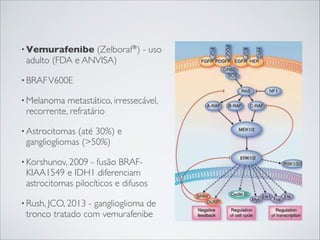
• Vemurafenibe

(Zelboraf®) - uso
adulto (FDA e ANVISA)

• BRAF V600E
• Melanoma

metastático, irressecável,
recorrente, refratário

• Astrocitomas

(até 30%) e
gangliogliomas (>50%)

• Korshunov, 2009

- fusão BRAFKIAA1549 e IDH1 diferenciam
astrocitomas pilocíticos e difusos

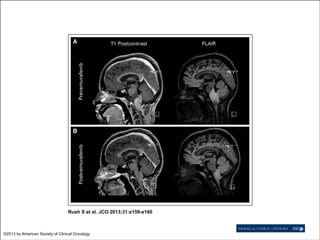
• Rush, JCO, 2013

- ganglioglioma de
tronco tratado com vemurafenibe
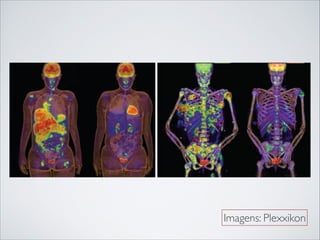
Imagens: Plexxikon
Rush S et al. JCO 2013;31:e159-e160

©2013 by American Society of Clinical Oncology
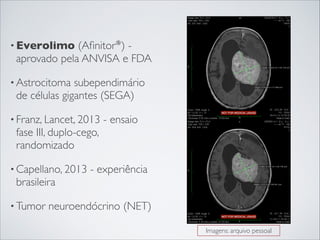
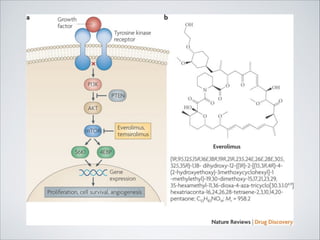
• Everolimo

(Afinitor®) aprovado pela ANVISA e FDA

• Astrocitoma

subependimário
de células gigantes (SEGA)

• Franz, Lancet, 2013

fase III, duplo-cego,
randomizado

• Capellano, 2013

brasileira

• Tumor

- ensaio

- experiência

neuroendócrino (NET)
Imagens: arquivo pessoal
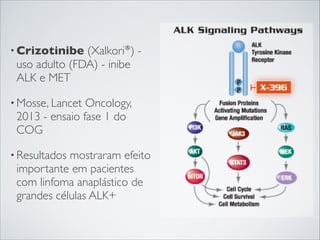
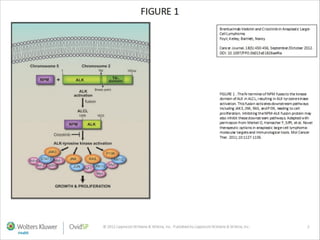
• Crizotinibe

(Xalkori®) uso adulto (FDA) - inibe
ALK e MET

• Mosse, Lancet

Oncology,
2013 - ensaio fase 1 do
COG

• Resultados

mostraram efeito
importante em pacientes
com linfoma anaplástico de
grandes células ALK+
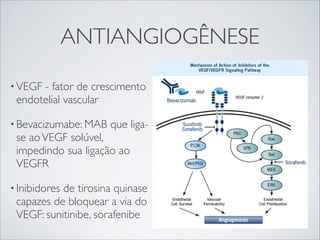
ANTIANGIOGÊNESE
• VEGF

- fator de crescimento
endotelial vascular

• Bevacizumabe: MAB

que liga-

se ao VEGF solúvel,
impedindo sua ligação ao
VEGFR
• Inibidores

de tirosina quinase
capazes de bloquear a via do
VEGF: sunitinibe, sorafenibe
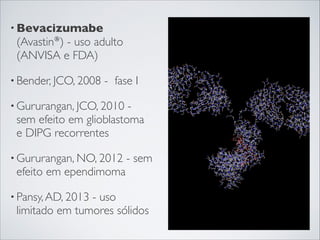
• Bevacizumabe

(Avastin®) - uso adulto
(ANVISA e FDA)
• Bender, JCO, 2008

- fase I

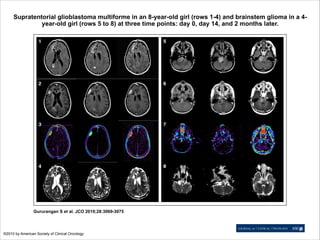
• Gururangan, JCO, 2010

sem efeito em glioblastoma
e DIPG recorrentes

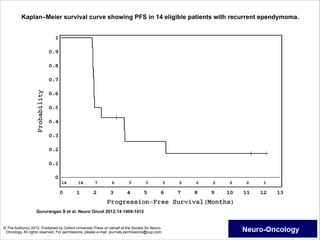
• Gururangan, NO, 2012

- sem
efeito em ependimoma

• Pansy, AD, 2013

- uso
limitado em tumores sólidos
Supratentorial glioblastoma multiforme in an 8-year-old girl (rows 1-4) and brainstem glioma in a 4year-old girl (rows 5 to 8) at three time points: day 0, day 14, and 2 months later.

Gururangan S et al. JCO 2010;28:3069-3075

©2010 by American Society of Clinical Oncology
Kaplan–Meier survival curve showing PFS in 14 eligible patients with recurrent ependymoma.

Gururangan S et al. Neuro Oncol 2012;14:1404-1412

© The Author(s) 2012. Published by Oxford University Press on behalf of the Society for NeuroOncology. All rights reserved. For permissions, please e-mail: journals.permissions@oup.com.
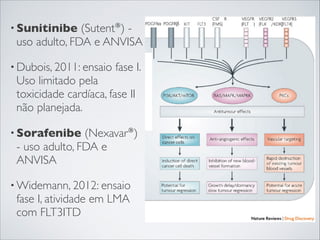
• Sunitinibe

(Sutent®) uso adulto, FDA e ANVISA

• Dubois, 2011: ensaio

fase I.

Uso limitado pela
toxicidade cardíaca, fase II
não planejada.

• Sorafenibe

(Nexavar®)
- uso adulto, FDA e
ANVISA

• Widemann, 2012: ensaio

fase I, atividade em LMA
com FLT3ITD
IMUNOTERAPIA
• Neoplasias

imunogênicas:
melanoma, neuroblastoma

• "Treinar"

o sistema imune para
uma resposta anti-tumoral eficaz

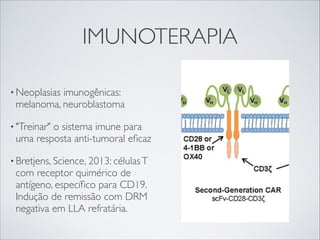
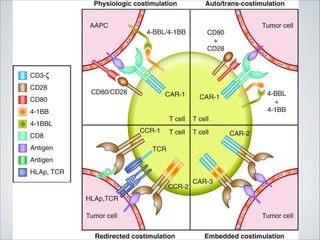
• Bretjens, Science, 2013: células T

com receptor quimérico de
antígeno, específico para CD19.
Indução de remissão com DRM
negativa em LLA refratária.
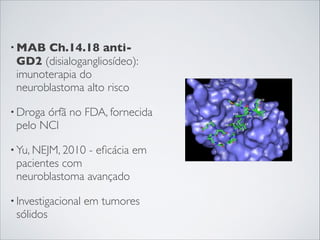
• MAB

Ch.14.18 antiGD2 (disialogangliosídeo):
imunoterapia do
neuroblastoma alto risco

• Droga

órfã no FDA, fornecida
pelo NCI

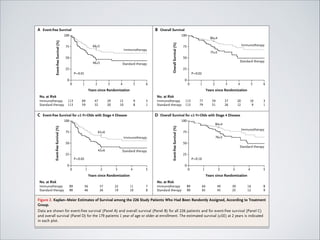
• Yu, NEJM, 2010

- eficácia em

pacientes com
neuroblastoma avançado

• Investigacional

sólidos

em tumores
The

n e w e ng l a n d j o u r na l

A Event-free Survival

100
66±5

75

Immunotherapy

50
46±5

Standard therapy

25
P=0.01
0

1

2

3

4

5

Overall Survival (%)

Event-free Survival (%)

m e dic i n e

B Overall Survival

100

0

of

86±4
Immunotherapy

75
75±5
50

Standard therapy

25
P=0.02
0

6

0

1

2

Years since Randomization

3

4

5

6

10
9

3
1

Years since Randomization

No. at Risk

No. at Risk

Immunotherapy
Standard therapy

113
113

69
59

47
32

29
20

15
10

9
8

3
1

C Event-free Survival for ≥1-Yr-Olds with Stage 4 Disease

Immunotherapy
Standard therapy

100

75

63±6
Immunotherapy

50
42±6

Standard therapy

25
P=0.02
0

1

2

3

4

Event-free Survival (%)

Event-free Survival (%)

77
79

37
26

20
12

Immunotherapy

75
76±5
50

Standard therapy

25
P=0.10
0

5

84±4

0

1

Years since Randomization

2

3

4

5

16
12

8
9

Years since Randomization

No. at Risk
Immunotherapy
Standard therapy

59
51

D Overall Survival for ≥1-Yr-Olds with Stage 4 Disease

100

0

113
113

No. at Risk
89
90

56
46

37
26

22
19

11
10

7
8

Immunotherapy
Standard therapy

89
90

64
65

49
45

30
25

Figure 2. Kaplan–Meier Estimates of Survival among the 226 Study Patients Who Had Been Randomly Assigned, According to Treatment
Group.
Data are shown for event-free survival (Panel A) and overall survival (Panel B) for all 226 patients and for event-free survival (Panel C)
and overall survival (Panel D) for the 179 patients 1 year of age or older at enrollment. The estimated survival (±SE) at 2 years is indicated
in each plot.
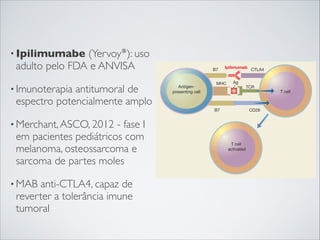
• Ipilimumabe

(Yervoy®): uso
adulto pelo FDA e ANVISA

• Imunoterapia

antitumoral de
espectro potencialmente amplo

• Merchant, ASCO, 2012

- fase I
em pacientes pediátricos com
melanoma, osteossarcoma e
sarcoma de partes moles

• MAB

anti-CTLA4, capaz de
reverter a tolerância imune
tumoral
OUTRAS TERAPIAS-ALVO
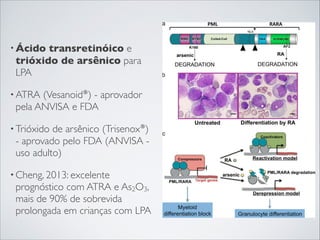
• Ácido

transretinóico e
trióxido de arsênico para
LPA

• ATRA

(Vesanoid®) - aprovador
pela ANVISA e FDA

• Trióxido

de arsênico (Trisenox®)
- aprovado pelo FDA (ANVISA uso adulto)

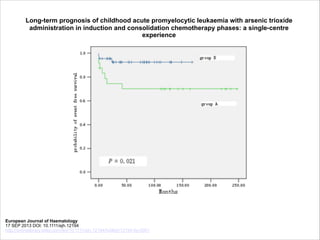
• Cheng, 2013: excelente

prognóstico com ATRA e As2O3,
mais de 90% de sobrevida
prolongada em crianças com LPA
Long‐term prognosis of childhood acute promyelocytic leukaemia with arsenic trioxide
administration in induction and consolidation chemotherapy phases: a single‐centre
experience

European Journal of Haematology

17 SEP 2013 DOI: 10.1111/ejh.12194

http://onlinelibrary.wiley.com/doi/10.1111/ejh.12194/full#ejh12194-fig-0001
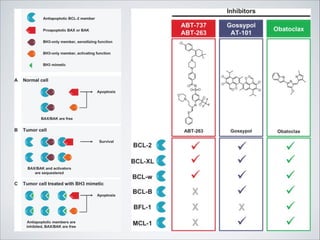
INIBIDORES DE BCL-2
• Indução

de apoptose - via mitocondrial intrínseca

• BCL-2: primeiro
• Amplificação
• Proteínas

oncogene anti-apoptótico descoberto

de BCL-2 é comum em leucemias/linfomas

com domínio BH3: inibidores endógenos

• BH3-miméticos: drogas

BCL-2

com atividade inibidora da família
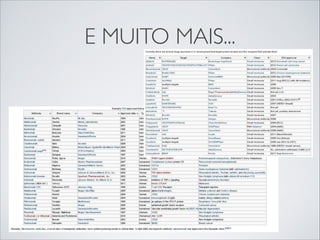
E MUITO MAIS...
A obra Terapia Alvo - Realidade na Pediatria de Francisco Helder Cavalcante Felix foi licenciada com
uma Licença Creative Commons - Atribuição - Uso Não Comercial - Obras Derivadas Proibidas 3.0
Não Adaptada.
Exceções a esta licença devem ser atribuídas ao material oriundo de publicações científicas, as quais têm
seus direitos reservados - Atribuição - Compartilhamento pela mesma licença

Terapia alvo na cancerologia pediátrica

  • 1.
  • 2.
    POR QUE TERAPIAALVO • Targeted therapies • Terapia • afeta citotóxica convencional células em divisão rápida • efeitos em muitos tecidos normais • Terapia alvo: via de sinalização específica às células tumorais • menos efeitos colaterais • Desenvolvimento racional de drogas com efeito em enzimas ou outras moléculas específicas das células tumorais, baseado em biologia molecular
  • 3.
    TERAPIA ALVO • Termo deuso recente, relacionado à indústria farmacêutica • Tipos de terapia alvo: • Anticorpos • Drogas monoclonais de baixo peso molecular • Vacinas • Efeitos das terapias alvo: • Inibição de vias de fatores de crescimento • Ativação de vias pró-apoptóticas • Antiangiogênese, imunoterapia
  • 4.
    ANTICORPOS MONOCLONAIS BIOLOGICALS- MABS • Kohler & Milstein, 1975 - produção de anticorpos monoclonais por hibridomas • Koprowski, 1978 • Busca - anticorpos contra melanoma de uma terapia imunológica • Ritz, Blood, 1981 - anticorpo anti-CD10 em pacientes com LLA • Drebin, PNAS, 1986 • Células - oncogene neu, inibido por um anticorpo monoclonal NIH 3T3 transformadas por neu - crescimento inibido em nude mice • Células NIH 3T3 transformadas por Ha-ras - crescimento contínuo
  • 6.
    INIBIDORES DE TIROSINA QUINASE- TKI • Substâncias • Termo de baixo PM usado para contraste com biologicals • Yaish, Science, 1988 - desenvolvimento de inibidores da atividade tirosina quinase do receptor do EGF • Buchdunger, 1995 53716 - inibidor do PDGF - CGP • 2-fenilamino-pirimidinas • Buchdunger, 1996 - CGP 57148, depois conhecido como STI 571, depois conhecido como imatinib
  • 9.
    ALVOS DAS TERAPIASALVO • Proteínas específicas da superfície das células tumorais ligante-dirigida (ligand targeted) • Fatores de crescimento e suas vias de sinalização • Angiogênese • Imunoterapia • Apoptose e outros mecanismos
  • 10.
    LIGANTE-DIRIGIDA • Especificidade por alvos moleculares •Proteínas de superfície de células imunes ou tumorais • Marcadores de linhagem celular • Citotoxicidade celular dependente de anticorpo • Citotoxicidade complemento mediada por
  • 11.
    • Rituximabe (MabThera®): usoadulto (ANVISA e FDA) • Meinhardt et al, JCO, 2010 rituximabe pré-QT em crianças com LNH CD20+ • Goldman, Leukemia, 2012 - ensaio fase 1/2 de rituximabe com QT em crianças com LNH CD20+ III/IV
  • 12.
    0.6 0.4 0.0 0.2 Probability 0.8 1.0 were unknown inthat cohort [3]. In the Children’s Cancer Group however, and long-term outcomes were not r study 5912, the DECAL regimen was given to 68 patients with theless, perhaps in part because of the encour recurrent NHL with a 50% response rate, which was independent of studies ICE has become a commonly employe A study of rituximab histologic subtype. OS carboplatin, and etoposide chemotherapy in children with and ifosfamide, was 33% at 2 years but only 2/13 patients pediatric patients with relapsed NHL. recurrent/refractory B‐celldescribed as non‐Hodgkin lymphoma and mature B‐cell acutepatients enrolled The small number of with BL were (CD20+) long-term survivors [5]. Kung et al. lymphoblastic a 71% CR/PR A report fromOncology Group trial Oncology Group conclusions regarding the t reported leukemia: rate in a Pediatric the Children's of preclude definitive the combination of rituximab and ICE chemo the response rate observed (60%) appears to b to previous reports of other salvage regime impressive in view of the prior, intensive con received by the patients. Many with OR we consolidative therapy with SCT, and the prop alive and free of disease at last follow-up previously published series of such patients DLBCL group, two of the survivors did n consolidation therapy with SCT. Patients enrolled in this trial had a very sho not respond to salvage therapy, while those w disease had a chance at successful retrieval perhaps more effective relapse therapy, the response to initial retrieval therapy and su diseases such as Hodgkin lymphoma, may high-grade B-cell malignancies as well. The commercial availability of rituxim opportunity to combine it with chemotherapy 0.0 0.5 1.0 1.5 2.0 2.5 3.0 ICE, for use in relapsed or refractory high-gr Years outside the setting of a clinical trial. The curr Survival Number Number Number because it provides controlled data regardin Time interval Estimate SE failed Censored at risk regimen as well as some response data. 0-1 year 0.4286 0.1145 11 1 20 rituximab and ICE chemotherapy was delivere 1-2 years 0.3750 0.2096 1 5 8 or excessive toxicity. Infusion-related toxicit 2-3 years 0.3750 . 0 2 2 but manageable, and no patient experienc Fig. 1. Overall survival: All eligible patients. reactions that have been reported in patients w Pediatr Blood Cancer DOI 10.1002/pbc Pediatric Blood & Cancer
 Volume 52, Issue 2, pages 177-181, 24 SEP 2008 DOI: 10.1002/pbc.21753
 http://onlinelibrary.wiley.com/doi/10.1002/pbc.21753/full#fig1
  • 13.
    Outline of thetreatment strategy for the B-Cell Non-Hodgkin's Lymphoma–Berlin-Frankfurt-Münster Group rituximab window study. Meinhardt A et al. JCO 2010;28:3115-3121 ©2010 by American Society of Clinical Oncology
  • 14.
    Rituximab and FAB/LMB96 chemotherapy in children with Stage III/IV B-cell non-Hodgkin lymphoma: a Children's Oncology Group report. Goldman, S; Smith, L; Anderson, JR; Perkins, S; Harrison, L; Geyer, MB; Gross, TG; Weinstein, H; Bergeron, S; Shiramizu, B; Sanger, W; Barth, M; Zhi, J; Cairo, MS Leukemia. 27(5):1174-1177, May 2013. DOI: 10.1038/leu.2012.255 Figure 2. Probability of EFS and OS of all eligible intermediate-risk patients. (a) Product-limit estimate of probability of EFS in all pilot patients (six doses or rituximab plus chemotherapy) from study entry. EFS at 3 years (CI95% 80-99%). (b) Product-limit estimate of probability of OS in all patients from study entry. OS at 3 years (CI95% 83-99%). (c) Product-limit estimate of probability of EFS in all stage III/IV pilot patients on study compared to all stage III/IV patients treated on FAB/ LMB 96 without rituximab.
  • 15.
    • Brentuximabe (Adcetris®): usoadulto (FDA) • LH e LAGC recidivados, ou refratários, CD30+ • Experiência pediátrica limitada • NCT01492088: estudo fase 1/2 em crianças, nenhum centro brasileiro (fim previsto em 2016)
  • 16.
    Median overall survival(OS) was not reached at the time of the analysis; 18 patients had died. Pro B et al. JCO 2012;30:2190-2196 ©2012 by American Society of Clinical Oncology
  • 17.
  • 18.
    FATORES DE CRESCIMENTO •Superexpressão • Ativação constitutiva anômala • MABs bloqueiam receptores • TKIs inibem a via de sinalização
  • 19.
    • Trastuzumab - HERCEPTIN®- alvo: Her2/neu ou Erb2 • Aprovado para câncer de mama avançado: prolonga a sobrevida em 20 a 30% pacientes • Resistência comum • Ebb, JCO, 2012 - fase II, trastuzumab e QT em osteossarcoma, aparentemente sem vantagem
  • 21.
    • Cetuximabe (Erbitux®) -uso adulto (FDA e ANVISA) • Trippett, JCO, 2009 - estudo fase I de cetuximab e irinotecan • Melhor resposta em tumores de SNC (gliomas de alto grau e DIPG)
  • 22.
    Overall accrual schema(including patients not assessable for toxicity and those withdrawn from the study) and dose-limiting toxicities (DLTs) observed. Trippett T M et al. JCO 2009;27:5102-5108 ©2009 by American Society of Clinical Oncology
  • 23.
    • Nimotuzumabe (CIMAHer®) -aprovado pela ANVISA • Astrocitoma de alto grau expressando EGFR e DIPG • Bode, JCO, 2008 • Bode, JCO, 2007 - DIPG astrocitoma anaplásico e glioblastoma recorrente/ progressivo
  • 24.
    • Imatinibe (Glivec®) -aprovado pelo FDA, ANVISA uso adulto • LMC Ph+, LLA Ph+ recidivada/ progressiva • SMD com rearranjos do gene de PDGFR • Mastocitose sistêmica agressiva (c-Kit D816V negativo) • Síndrome hipereosinofílica ou leucemia eosinofílica aguda com a fusão FIP1L1PDGFRalfa • Dermatofibrossarcoma • Tumor irressecável estromal gastrointestinal (GIST) Kit+ (CD117)
  • 25.
    From: Lancet Oncol.2012 September; 13(9): 936–945. doi: 10.1016/S1470-2045(12)70377-7
  • 26.
    Cumulative incidences ofhematologic, cytogenetic, and molecular responses to imatinib. Millot F et al. JCO 2011;29:2827-2832 ©2011 by American Society of Clinical Oncology
  • 27.
    Kaplan-Meier analysis of(A) progression-free survival and (B) overall survival for patients in each stratum. • Dasatinibe (Sprycel®) - aprovado pelo FDA (ANVISA uso adulto) Zwaan C M et al. JCO 2013;31:2460-2468 ©2013 by American Society of Clinical Oncology
  • 28.
    FUTURO DO TRATAMENTO LLAPh + DRM Baixo risco QT intensiva Melhor esquema? TKI Imatinibe Dasatinibe Nilotinibe Alto risco TMO
  • 29.
    ENSAIOS CLÍNICOS Pharmacokinetic (PK)Study of Nilotinib in Pediatric Patients With Philadelphia Chromosome-positive (Ph+) Chronic Myelogenous Leukemia (CML) or Acute Lymphoblastic Leukemia (ALL) - recrutando até Dez/2013 - 5 instituições brasileiras envolvidas • NCT01077544: A Phase II Study of Dasatinib in Children and Adolescents With Newly Diagnosed Chronic Phase CML or With Ph+ Leukemias Resistant or Intolerant to Imatinib - 84 centros, 5 do Brasil, 1 instituição recrutando em São Paulo, encerrará coleta de dados em 2016. • NCT00777036: A
  • 30.
    PERSPECTIVAS al. ASH, dezembrode 2012 - Ponatinib em pacientes com LMC e LLA Ph+ resistentes ou intolerantes ao dasatinib e nilotinib. Único ITK com efeito na BCR-ABL T315I aprovado pelo FDA para adultos • Cortes, et al, JCO, 2012. Bosutinib versus imatinib. Opção para pacientes com resistência ou intolerância ao imatinib. • Cortes, et
  • 31.
    • Vemurafenibe (Zelboraf®) -uso adulto (FDA e ANVISA) • BRAF V600E • Melanoma metastático, irressecável, recorrente, refratário • Astrocitomas (até 30%) e gangliogliomas (>50%) • Korshunov, 2009 - fusão BRAFKIAA1549 e IDH1 diferenciam astrocitomas pilocíticos e difusos • Rush, JCO, 2013 - ganglioglioma de tronco tratado com vemurafenibe
  • 32.
  • 33.
    Rush S etal. JCO 2013;31:e159-e160 ©2013 by American Society of Clinical Oncology
  • 34.
    • Everolimo (Afinitor®) aprovadopela ANVISA e FDA • Astrocitoma subependimário de células gigantes (SEGA) • Franz, Lancet, 2013 fase III, duplo-cego, randomizado • Capellano, 2013 brasileira • Tumor - ensaio - experiência neuroendócrino (NET) Imagens: arquivo pessoal
  • 36.
    • Crizotinibe (Xalkori®) usoadulto (FDA) - inibe ALK e MET • Mosse, Lancet Oncology, 2013 - ensaio fase 1 do COG • Resultados mostraram efeito importante em pacientes com linfoma anaplástico de grandes células ALK+
  • 38.
    ANTIANGIOGÊNESE • VEGF - fatorde crescimento endotelial vascular • Bevacizumabe: MAB que liga- se ao VEGF solúvel, impedindo sua ligação ao VEGFR • Inibidores de tirosina quinase capazes de bloquear a via do VEGF: sunitinibe, sorafenibe
  • 39.
    • Bevacizumabe (Avastin®) -uso adulto (ANVISA e FDA) • Bender, JCO, 2008 - fase I • Gururangan, JCO, 2010 sem efeito em glioblastoma e DIPG recorrentes • Gururangan, NO, 2012 - sem efeito em ependimoma • Pansy, AD, 2013 - uso limitado em tumores sólidos
  • 40.
    Supratentorial glioblastoma multiformein an 8-year-old girl (rows 1-4) and brainstem glioma in a 4year-old girl (rows 5 to 8) at three time points: day 0, day 14, and 2 months later. Gururangan S et al. JCO 2010;28:3069-3075 ©2010 by American Society of Clinical Oncology
  • 41.
    Kaplan–Meier survival curveshowing PFS in 14 eligible patients with recurrent ependymoma. Gururangan S et al. Neuro Oncol 2012;14:1404-1412 © The Author(s) 2012. Published by Oxford University Press on behalf of the Society for NeuroOncology. All rights reserved. For permissions, please e-mail: journals.permissions@oup.com.
  • 42.
    • Sunitinibe (Sutent®) usoadulto, FDA e ANVISA • Dubois, 2011: ensaio fase I. Uso limitado pela toxicidade cardíaca, fase II não planejada. • Sorafenibe (Nexavar®) - uso adulto, FDA e ANVISA • Widemann, 2012: ensaio fase I, atividade em LMA com FLT3ITD
  • 43.
    IMUNOTERAPIA • Neoplasias imunogênicas: melanoma, neuroblastoma •"Treinar" o sistema imune para uma resposta anti-tumoral eficaz • Bretjens, Science, 2013: células T com receptor quimérico de antígeno, específico para CD19. Indução de remissão com DRM negativa em LLA refratária.
  • 45.
    • MAB Ch.14.18 antiGD2(disialogangliosídeo): imunoterapia do neuroblastoma alto risco • Droga órfã no FDA, fornecida pelo NCI • Yu, NEJM, 2010 - eficácia em pacientes com neuroblastoma avançado • Investigacional sólidos em tumores
  • 46.
    The n e we ng l a n d j o u r na l A Event-free Survival 100 66±5 75 Immunotherapy 50 46±5 Standard therapy 25 P=0.01 0 1 2 3 4 5 Overall Survival (%) Event-free Survival (%) m e dic i n e B Overall Survival 100 0 of 86±4 Immunotherapy 75 75±5 50 Standard therapy 25 P=0.02 0 6 0 1 2 Years since Randomization 3 4 5 6 10 9 3 1 Years since Randomization No. at Risk No. at Risk Immunotherapy Standard therapy 113 113 69 59 47 32 29 20 15 10 9 8 3 1 C Event-free Survival for ≥1-Yr-Olds with Stage 4 Disease Immunotherapy Standard therapy 100 75 63±6 Immunotherapy 50 42±6 Standard therapy 25 P=0.02 0 1 2 3 4 Event-free Survival (%) Event-free Survival (%) 77 79 37 26 20 12 Immunotherapy 75 76±5 50 Standard therapy 25 P=0.10 0 5 84±4 0 1 Years since Randomization 2 3 4 5 16 12 8 9 Years since Randomization No. at Risk Immunotherapy Standard therapy 59 51 D Overall Survival for ≥1-Yr-Olds with Stage 4 Disease 100 0 113 113 No. at Risk 89 90 56 46 37 26 22 19 11 10 7 8 Immunotherapy Standard therapy 89 90 64 65 49 45 30 25 Figure 2. Kaplan–Meier Estimates of Survival among the 226 Study Patients Who Had Been Randomly Assigned, According to Treatment Group. Data are shown for event-free survival (Panel A) and overall survival (Panel B) for all 226 patients and for event-free survival (Panel C) and overall survival (Panel D) for the 179 patients 1 year of age or older at enrollment. The estimated survival (±SE) at 2 years is indicated in each plot.
  • 47.
    • Ipilimumabe (Yervoy®): uso adultopelo FDA e ANVISA • Imunoterapia antitumoral de espectro potencialmente amplo • Merchant, ASCO, 2012 - fase I em pacientes pediátricos com melanoma, osteossarcoma e sarcoma de partes moles • MAB anti-CTLA4, capaz de reverter a tolerância imune tumoral
  • 48.
  • 49.
    • Ácido transretinóico e trióxidode arsênico para LPA • ATRA (Vesanoid®) - aprovador pela ANVISA e FDA • Trióxido de arsênico (Trisenox®) - aprovado pelo FDA (ANVISA uso adulto) • Cheng, 2013: excelente prognóstico com ATRA e As2O3, mais de 90% de sobrevida prolongada em crianças com LPA
  • 50.
    Long‐term prognosis ofchildhood acute promyelocytic leukaemia with arsenic trioxide administration in induction and consolidation chemotherapy phases: a single‐centre experience European Journal of Haematology
 17 SEP 2013 DOI: 10.1111/ejh.12194
 http://onlinelibrary.wiley.com/doi/10.1111/ejh.12194/full#ejh12194-fig-0001
  • 51.
    INIBIDORES DE BCL-2 •Indução de apoptose - via mitocondrial intrínseca • BCL-2: primeiro • Amplificação • Proteínas oncogene anti-apoptótico descoberto de BCL-2 é comum em leucemias/linfomas com domínio BH3: inibidores endógenos • BH3-miméticos: drogas BCL-2 com atividade inibidora da família
  • 53.
  • 54.
    A obra TerapiaAlvo - Realidade na Pediatria de Francisco Helder Cavalcante Felix foi licenciada com uma Licença Creative Commons - Atribuição - Uso Não Comercial - Obras Derivadas Proibidas 3.0 Não Adaptada. Exceções a esta licença devem ser atribuídas ao material oriundo de publicações científicas, as quais têm seus direitos reservados - Atribuição - Compartilhamento pela mesma licença