


SECREÇÕES DIGESTIVAS SALIVAR  GÁSTRICA PANCREÁTICA BILIAR INTESTINAL DELGADO INTESTINAL CÓLON
EXÓCRINA  (mucosa, serosa e/ou hidroeleletrolítica) Tipos de secreções do TGI ENDÓCRINA (hormônios) NEURÓCRINA (neurotransmissores e/ou  neuromoduladores)
There are several pairs of salivary glands in different locations: a major pair in front of the ears (parotid glands); two major pair on the floor of the mouth (sublingual and submaxillary glands); and several minor pairs within the lips, cheeks, and tongue.   http://www.nlm.nih.gov/medlineplus/ency/imagepages/9654.htm  As glândulas salivares
Veja mais em: http://mcb.berkeley.edu/courses/mcb136/topic/Gastrointestinal/Secretion_in_GI-Tract/
A secreção salivar
Enzima ou muco A secreção salivar
A secreção serosa salivar: alfa-amilase ( ptialina ) Amilopectina (amido) de batata
Produção e secreção de saliva 24 horas/dia Tônus PS
PS: Sistema Nervoso Parassimpático; SP: Sistema Nervoso Simpático;   GCS: gânglio cervival superior. (+) ou ( - )
Regulação da secreção salivar (PS e SP)
 
SECREÇÕES DIGESTIVAS SALIVAR  GÁSTRICA PANCREÁTICA BILIAR INTESTINAL DELGADO INTESTINAL CÓLON
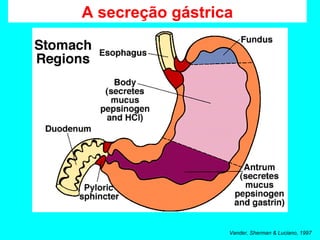
A secreção gástrica Vander, Sherman & Luciano, 1997
 
 
Células “G” secretoras de GASTRINA http://calloso.med.mun.ca/~tscott/digest/digtut.htm
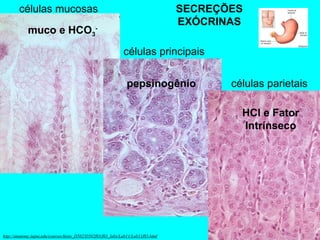
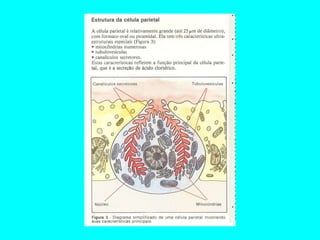
http://anatomy.iupui.edu/courses/histo_D502/D502f03/f03_labs/Lab11/Lab11f03.html células mucosas células principais células parietais muco e HCO 3 - pepsinogênio HCl e Fator Intrínseco SECREÇÕES EXÓCRINAS
 
 
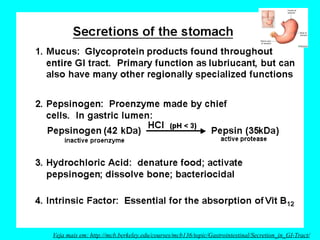
Veja mais em: http://mcb.berkeley.edu/courses/mcb136/topic/Gastrointestinal/Secretion_in_GI-Tract/
Resumo das secreções gástricas Vander, Sherman & Luciano, 1997
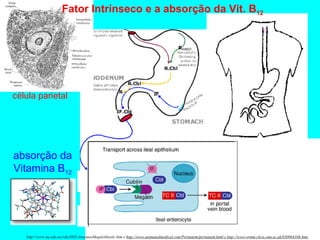
célula parietal absorção da Vitamina B 12                                                <> http://www.uq.edu.au/vdu/HDUAnaemiaMegaloblastic.htm  e  http://www.animatedmedical.com/Pernanem/pernanem.html  e  http://www-ermm.cbcu.cam.ac.uk/03006434h.htm   Fator Intrínseco e a absorção da Vit. B 12
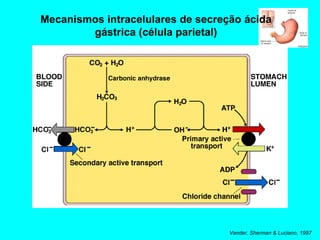
Vander, Sherman & Luciano, 1997 Mecanismos intracelulares de secreção ácida gástrica (célula parietal)
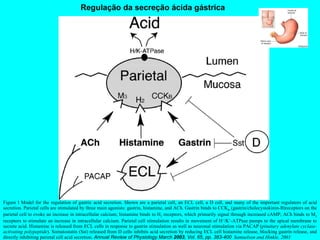
Figure 1 Model for the regulation of gastric acid secretion. Shown are a parietal cell, an ECL cell, a D cell, and many of the important regulators of acid secretion. Parietal cells are stimulated by three main agonists: gastrin, histamine, and ACh. Gastrin binds to CCK B  (gastrin/cholecystokinin-B)receptors on the parietal cell to evoke an increase in intracellular calcium; histamine binds to H 2  receptors, which primarily signal through increased cAMP; ACh binds to M 3  receptors to stimulate an increase in intracellular calcium. Parietal cell stimulation results in movement of H + /K + -ATPase pumps to the apical membrane to secrete acid. Histamine is released from ECL cells in response to gastrin stimulation as well as neuronal stimulation via PACAP ( pituitary adenylate cyclase-activating polypeptide ). Somatostatin (Sst) released from D cells inhibits acid secretion by reducing ECL cell histamine release, blocking gastrin release, and directly inhibiting parietal cell acid secretion.  Annual Review of Physiology March  2003 , Vol. 65, pp. 383-400  Samuelson and Hinkle, 2003 Regulação da secreção ácida gástrica
Olbe, Carlsson & Lindberg, 2003. Nature Reviews Drug Discovery 2, 132-139 (2003) http://www.nature.com/cgi-taf/DynaPage.taf?file=/nrd/journal/v2/n2/full/nrd1010_r.html   Regulação da secreção ácida gástrica e ações de drogas anti-ácidas:
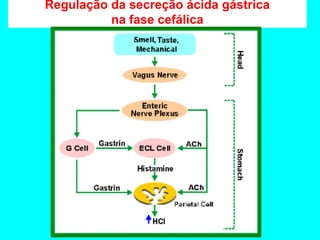
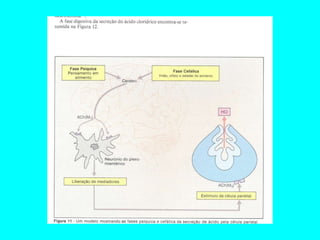
Regulação da secreção ácida gástrica na fase cefálica
 
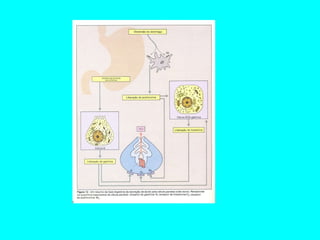
Regulação da secreção ácida gástrica na fase gástrica
 
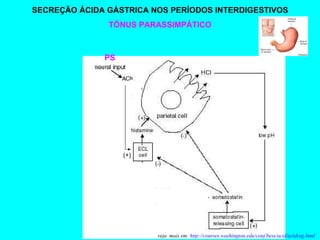
veja  mais em:  http://courses.washington.edu/conj/bess/acid/acidreg.html   SECREÇÃO ÁCIDA GÁSTRICA NOS PERÍODOS INTERDIGESTIVOS TÔNUS PARASSIMPÁTICO (+) PS
Regulação da secreção ácida gástrica na fase intestinal
SECREÇÕES DIGESTIVAS SALIVAR  GÁSTRICA PANCREÁTICA BILIAR INTESTINAL DELGADO INTESTINAL CÓLON
SECREÇÕES EXÓCRINAS PANCREÁTICA E HEPÁTICA
Pancreas Exocrine: Acini:   Secrete pancreatic juice. Endocrine: Islets of Langerhans: Secrete insulin and glucagon. Insert fig. 18.26
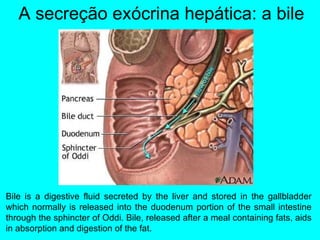
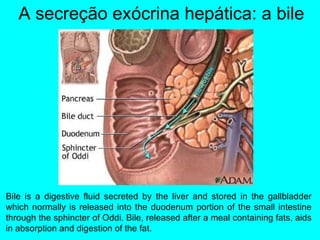
Bile is a digestive fluid secreted by the liver and stored in the gallbladder which normally is released into the duodenum portion of the small intestine through the sphincter of Oddi. Bile, released after a meal containing fats, aids in absorption and digestion of the fat.  A secreção exócrina hepática: a bile
Vander, Sherman & Luciano, 1997
Exocrine  function of the pancreas is served by the  acinar cells ,  centroacinar cells , and  intercalated ducts . The acinar cells secrete digestive enzymes and the duct cells supply an alkaline buffer solution. The  endocrine  portion is composed of the  islets of Langerhans , richely vascularized spherical aggregates of cells encased by reticular fibers. The islets are composed of five types of cells, which can be differentiated from each other only with special stains.  http://www.mayo.edu/research/giresearch/topic_258.html
CARBOHIDRATOS Dieta – polissacarídeos: amido (amilopectina e amilose)   Glicogênio Dissacarídeos: sacarose, lactose e maltose Monossacarídeos: glicose, galactose e frutose. ENZIMAS Alfa-amilase salivar Alfa-amilase pancreática Oligossacaridases (na borda em escova): alfa- dextrinases, glicoamilase, lactase e sucrase  
PROTEÍNAS Porque da necessidade de digestão de proteínas: proteína estranha; perfil enzimático individual. ENZIMAS Estômago: pepsinas (I, II e III); gelatinase e renina. Pâncreas: tripsina; quimiotripsina; carboxipeptidase A e B; elastase. Intestino: enteroquinase, aminopeptidases; dipeptidases.   GORDURAS Triglicerídeos e fosfolipídeos (lecitina) Ação emulsificante dos sais biliares Lipase pancreática Fosfolipase pancreática (lecitina) Lipase intestinal (monoglicerídeos)   ÁCIDOS NUCLEICOS Pâncreas: Ribonuclease e Desoxirribonuclease
AS SECREÇÕES EXÓCRINAS PANCREÁTICAS
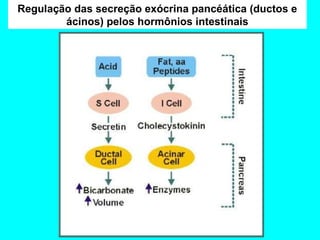
Regulação das secreção exócrina pancéática (ductos e ácinos) pelos hormônios intestinais
Lipase pancreática A secreção serosa pancreática:  lipase pancreática
A secreção serosa pancreática:  alfa-amilase Amilopectina (amido) da batata OBS: você reparou que é a mesma ação da alfa-amilase salivar?
A secreção serosa pancreática: a ativação das  pró-proteases  pancreáticas no intestino delgado pela  enteroquinase  (da borda-em-escova)
SECREÇÕES DIGESTIVAS SALIVAR  GÁSTRICA PANCREÁTICA BILIAR INTESTINAL DELGADO INTESTINAL CÓLON
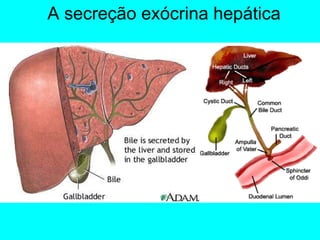
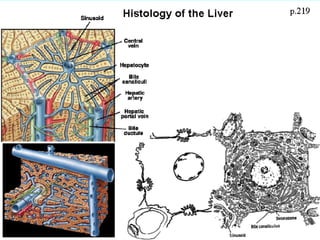
A secreção exócrina hepática
Bile is a digestive fluid secreted by the liver and stored in the gallbladder which normally is released into the duodenum portion of the small intestine through the sphincter of Oddi. Bile, released after a meal containing fats, aids in absorption and digestion of the fat.  A secreção exócrina hepática: a bile
 
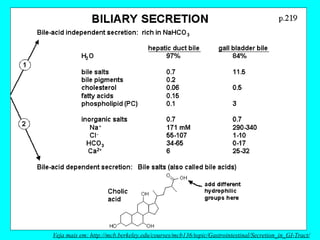
A secreção exócrina hepática: a bile
Veja mais em: http://mcb.berkeley.edu/courses/mcb136/topic/Gastrointestinal/Secretion_in_GI-Tract/
Função digestiva da bile: sais biliares
Sais biliares e a emulsificação das gorduras Vander, Sherman & Luciano, 1997;  http://people.bu.edu/fgarcia/lectures/gi/index.htm
Sais biliares e a emulsificação das gorduras: a formação das micelas para a  digestão pela lipase pancreática Vander, Sherman & Luciano, 1997 MICELA
Resumo da emulsificação, digestão e absorção de gordura Vander, Sherman & Luciano, 1997
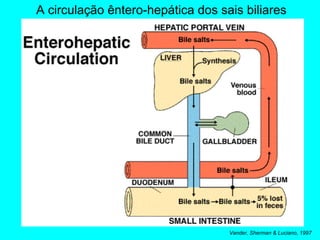
A circulação êntero-hepática dos sais biliares Vander, Sherman & Luciano, 1997
REGULAÇÃO DA SECREÇÃO BILIAR Produção de bile+circulação êntero-hepática dos sais biliares e esvaziamento da vesícula biliar e relaxamento de Oddi pela CCK ? ?
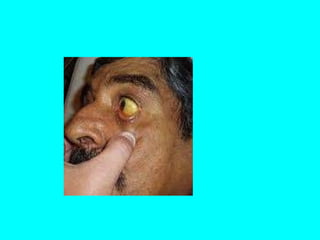
ICTERÍCIAS
 
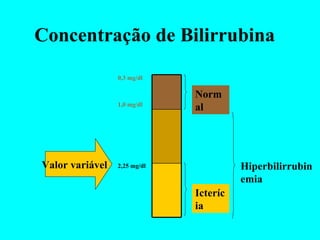
Concentração de Bilirrubina Normal Hiperbilirrubinemia 0,3 mg/dl 1,0 mg/dl 2,25   mg/dl Icterícia Valor variável
 
 
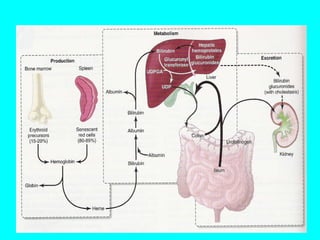
Metabolismo da Bilirrubina 1- PRODUÇÃO E CAPTAÇÃO 2- CONJUGAÇÃO 3- EXCREÇÃO
Tipos de Bilirrubina Não-conjugada / indirecta Conjugada / directa Lipofílica Hidrofílica Circula no plasma ligada à albumina (ligação reversível e não-covalente) Resulta da glicuronoconjugação da bilirrubina não-conjugada Passa a BHE Não é captada pelo rim Não passa a BHE Captada pelo rim (encontrada na urina em situações patológicas)
Icterícia pré-hepática ou hemolítica Predomina bilirrubina não-conjugada Icterícia hepática ou por lesão hepatocelular Predomina bilirrubina conjugada Icterícia pós-hepática ou colestática
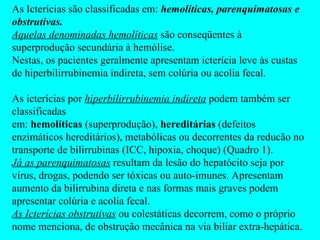
As Icterícias são classificadas em:  hemolíticas, parenquimatosas e obstrutivas. Aquelas denominadas hemolíticas  são conseqüentes à superprodução secundária à hemólise. Nestas, os pacientes geralmente apresentam icterícia leve às custas de hiperbilirrubinemia indireta, sem colúria ou acolia fecal.  As icterícias por  hiperbilirrubinemia indireta  podem também ser classificadas em:  hemolíticas  (superprodução),  hereditárias  (defeitos enzimáticos hereditários), metabólicas ou decorrentes da reducão no transporte de bilirrubinas (ICC, hipoxia, choque) (Quadro 1). Já as parenquimatosas  resultam da lesão do hepatócito seja por vírus, drogas, podendo ser tóxicas ou auto-imunes. Apresentam aumento da bilirrubina direta e nas formas mais graves podem apresentar colúria e acolia fecal. As Icterícias obstrutivas  ou colestáticas decorrem, como o próprio nome menciona, de obstrução mecânica na via biliar extra-hepática. 
 
SECREÇÕES DIGESTIVAS SALIVAR  GÁSTRICA PANCREÁTICA BILIAR INTESTINAL- DELGADO INTESTINAL- CÓLON
A secreção exócrina intestinal: mucosa e hidroeletrolítica
Secreções do Intestino Delgado Duodeno: Muco   Glândulas de Brünner- secreção alcalina Jejuno-Íleo: Muco   Enteroquinase Secreções do Intestino Grosso Muco- alcalino (neutraliza pH fecal)
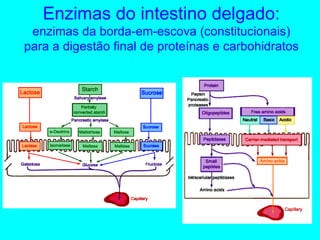
Enzimas do intestino delgado: enzimas da borda-em-escova (constitucionais) para a digestão final de proteínas e carbohidratos
A secreção exócrina intestinal: mucosa e hidroeletrolítica LARGE INTESTINE
Secreções do Intestino Delgado Duodeno: Muco   Glândulas de Brünner- secreção alcalina Jejuno-Íleo: Muco   Enteroquinase Secreções do Intestino Grosso Muco- alcalino (neutraliza pH fecal)


Secreções digestivas

  • 1.
    SECREÇÕES DIGESTIVAS SALIVAR GÁSTRICA PANCREÁTICA BILIAR INTESTINAL DELGADO INTESTINAL CÓLON
  • 2.
    SECREÇÕES DIGESTIVAS SALIVAR GÁSTRICA PANCREÁTICA BILIAR INTESTINAL DELGADO INTESTINAL CÓLON
  • 3.
    EXÓCRINA (mucosa,serosa e/ou hidroeleletrolítica) Tipos de secreções do TGI ENDÓCRINA (hormônios) NEURÓCRINA (neurotransmissores e/ou neuromoduladores)
  • 4.
    There are severalpairs of salivary glands in different locations: a major pair in front of the ears (parotid glands); two major pair on the floor of the mouth (sublingual and submaxillary glands); and several minor pairs within the lips, cheeks, and tongue. http://www.nlm.nih.gov/medlineplus/ency/imagepages/9654.htm As glândulas salivares
  • 5.
    Veja mais em:http://mcb.berkeley.edu/courses/mcb136/topic/Gastrointestinal/Secretion_in_GI-Tract/
  • 6.
  • 7.
    Enzima ou mucoA secreção salivar
  • 8.
    A secreção serosasalivar: alfa-amilase ( ptialina ) Amilopectina (amido) de batata
  • 9.
    Produção e secreçãode saliva 24 horas/dia Tônus PS
  • 10.
    PS: Sistema NervosoParassimpático; SP: Sistema Nervoso Simpático; GCS: gânglio cervival superior. (+) ou ( - )
  • 11.
    Regulação da secreçãosalivar (PS e SP)
  • 12.
  • 13.
    SECREÇÕES DIGESTIVAS SALIVAR GÁSTRICA PANCREÁTICA BILIAR INTESTINAL DELGADO INTESTINAL CÓLON
  • 14.
    A secreção gástricaVander, Sherman & Luciano, 1997
  • 15.
  • 16.
  • 17.
    Células “G” secretorasde GASTRINA http://calloso.med.mun.ca/~tscott/digest/digtut.htm
  • 18.
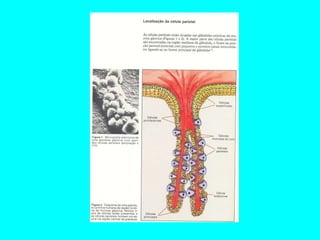
    http://anatomy.iupui.edu/courses/histo_D502/D502f03/f03_labs/Lab11/Lab11f03.html células mucosascélulas principais células parietais muco e HCO 3 - pepsinogênio HCl e Fator Intrínseco SECREÇÕES EXÓCRINAS
  • 19.
  • 20.
  • 21.
    Veja mais em:http://mcb.berkeley.edu/courses/mcb136/topic/Gastrointestinal/Secretion_in_GI-Tract/
  • 22.
    Veja mais em:http://mcb.berkeley.edu/courses/mcb136/topic/Gastrointestinal/Secretion_in_GI-Tract/
  • 23.
    Resumo das secreçõesgástricas Vander, Sherman & Luciano, 1997
  • 24.
    célula parietal absorçãoda Vitamina B 12                                                <> http://www.uq.edu.au/vdu/HDUAnaemiaMegaloblastic.htm e http://www.animatedmedical.com/Pernanem/pernanem.html e http://www-ermm.cbcu.cam.ac.uk/03006434h.htm Fator Intrínseco e a absorção da Vit. B 12
  • 25.
    Vander, Sherman &Luciano, 1997 Mecanismos intracelulares de secreção ácida gástrica (célula parietal)
  • 26.
    Figure 1 Model for theregulation of gastric acid secretion. Shown are a parietal cell, an ECL cell, a D cell, and many of the important regulators of acid secretion. Parietal cells are stimulated by three main agonists: gastrin, histamine, and ACh. Gastrin binds to CCK B (gastrin/cholecystokinin-B)receptors on the parietal cell to evoke an increase in intracellular calcium; histamine binds to H 2 receptors, which primarily signal through increased cAMP; ACh binds to M 3 receptors to stimulate an increase in intracellular calcium. Parietal cell stimulation results in movement of H + /K + -ATPase pumps to the apical membrane to secrete acid. Histamine is released from ECL cells in response to gastrin stimulation as well as neuronal stimulation via PACAP ( pituitary adenylate cyclase-activating polypeptide ). Somatostatin (Sst) released from D cells inhibits acid secretion by reducing ECL cell histamine release, blocking gastrin release, and directly inhibiting parietal cell acid secretion. Annual Review of Physiology March 2003 , Vol. 65, pp. 383-400 Samuelson and Hinkle, 2003 Regulação da secreção ácida gástrica
  • 27.
    Olbe, Carlsson &Lindberg, 2003. Nature Reviews Drug Discovery 2, 132-139 (2003) http://www.nature.com/cgi-taf/DynaPage.taf?file=/nrd/journal/v2/n2/full/nrd1010_r.html Regulação da secreção ácida gástrica e ações de drogas anti-ácidas:
  • 28.
    Regulação da secreçãoácida gástrica na fase cefálica
  • 29.
  • 30.
    Regulação da secreçãoácida gástrica na fase gástrica
  • 31.
  • 32.
    veja maisem: http://courses.washington.edu/conj/bess/acid/acidreg.html SECREÇÃO ÁCIDA GÁSTRICA NOS PERÍODOS INTERDIGESTIVOS TÔNUS PARASSIMPÁTICO (+) PS
  • 33.
    Regulação da secreçãoácida gástrica na fase intestinal
  • 34.
    SECREÇÕES DIGESTIVAS SALIVAR GÁSTRICA PANCREÁTICA BILIAR INTESTINAL DELGADO INTESTINAL CÓLON
  • 35.
  • 36.
    Pancreas Exocrine: Acini: Secrete pancreatic juice. Endocrine: Islets of Langerhans: Secrete insulin and glucagon. Insert fig. 18.26
  • 37.
    Bile is adigestive fluid secreted by the liver and stored in the gallbladder which normally is released into the duodenum portion of the small intestine through the sphincter of Oddi. Bile, released after a meal containing fats, aids in absorption and digestion of the fat. A secreção exócrina hepática: a bile
  • 38.
    Vander, Sherman &Luciano, 1997
  • 39.
    Exocrine functionof the pancreas is served by the acinar cells , centroacinar cells , and intercalated ducts . The acinar cells secrete digestive enzymes and the duct cells supply an alkaline buffer solution. The endocrine portion is composed of the islets of Langerhans , richely vascularized spherical aggregates of cells encased by reticular fibers. The islets are composed of five types of cells, which can be differentiated from each other only with special stains. http://www.mayo.edu/research/giresearch/topic_258.html
  • 40.
    CARBOHIDRATOS Dieta –polissacarídeos: amido (amilopectina e amilose) Glicogênio Dissacarídeos: sacarose, lactose e maltose Monossacarídeos: glicose, galactose e frutose. ENZIMAS Alfa-amilase salivar Alfa-amilase pancreática Oligossacaridases (na borda em escova): alfa- dextrinases, glicoamilase, lactase e sucrase  
  • 41.
    PROTEÍNAS Porque danecessidade de digestão de proteínas: proteína estranha; perfil enzimático individual. ENZIMAS Estômago: pepsinas (I, II e III); gelatinase e renina. Pâncreas: tripsina; quimiotripsina; carboxipeptidase A e B; elastase. Intestino: enteroquinase, aminopeptidases; dipeptidases.   GORDURAS Triglicerídeos e fosfolipídeos (lecitina) Ação emulsificante dos sais biliares Lipase pancreática Fosfolipase pancreática (lecitina) Lipase intestinal (monoglicerídeos)   ÁCIDOS NUCLEICOS Pâncreas: Ribonuclease e Desoxirribonuclease
  • 42.
  • 43.
    Regulação das secreçãoexócrina pancéática (ductos e ácinos) pelos hormônios intestinais
  • 44.
    Lipase pancreática Asecreção serosa pancreática: lipase pancreática
  • 45.
    A secreção serosapancreática: alfa-amilase Amilopectina (amido) da batata OBS: você reparou que é a mesma ação da alfa-amilase salivar?
  • 46.
    A secreção serosapancreática: a ativação das pró-proteases pancreáticas no intestino delgado pela enteroquinase (da borda-em-escova)
  • 47.
    A secreção serosapancreática: a ativação das pró-proteases pancreáticas no intestino delgado pela enteroquinase (da borda-em-escova)
  • 48.
    SECREÇÕES DIGESTIVAS SALIVAR GÁSTRICA PANCREÁTICA BILIAR INTESTINAL DELGADO INTESTINAL CÓLON
  • 49.
  • 50.
    Bile is adigestive fluid secreted by the liver and stored in the gallbladder which normally is released into the duodenum portion of the small intestine through the sphincter of Oddi. Bile, released after a meal containing fats, aids in absorption and digestion of the fat. A secreção exócrina hepática: a bile
  • 51.
  • 52.
    A secreção exócrinahepática: a bile
  • 53.
    Veja mais em:http://mcb.berkeley.edu/courses/mcb136/topic/Gastrointestinal/Secretion_in_GI-Tract/
  • 54.
    Função digestiva dabile: sais biliares
  • 55.
    Sais biliares ea emulsificação das gorduras Vander, Sherman & Luciano, 1997; http://people.bu.edu/fgarcia/lectures/gi/index.htm
  • 56.
    Sais biliares ea emulsificação das gorduras: a formação das micelas para a digestão pela lipase pancreática Vander, Sherman & Luciano, 1997 MICELA
  • 57.
    Resumo da emulsificação,digestão e absorção de gordura Vander, Sherman & Luciano, 1997
  • 58.
    A circulação êntero-hepáticados sais biliares Vander, Sherman & Luciano, 1997
  • 59.
    REGULAÇÃO DA SECREÇÃOBILIAR Produção de bile+circulação êntero-hepática dos sais biliares e esvaziamento da vesícula biliar e relaxamento de Oddi pela CCK ? ?
  • 60.
  • 61.
  • 62.
    Concentração de BilirrubinaNormal Hiperbilirrubinemia 0,3 mg/dl 1,0 mg/dl 2,25 mg/dl Icterícia Valor variável
  • 63.
  • 64.
  • 65.
    Metabolismo da Bilirrubina1- PRODUÇÃO E CAPTAÇÃO 2- CONJUGAÇÃO 3- EXCREÇÃO
  • 66.
    Tipos de BilirrubinaNão-conjugada / indirecta Conjugada / directa Lipofílica Hidrofílica Circula no plasma ligada à albumina (ligação reversível e não-covalente) Resulta da glicuronoconjugação da bilirrubina não-conjugada Passa a BHE Não é captada pelo rim Não passa a BHE Captada pelo rim (encontrada na urina em situações patológicas)
  • 67.
    Icterícia pré-hepática ouhemolítica Predomina bilirrubina não-conjugada Icterícia hepática ou por lesão hepatocelular Predomina bilirrubina conjugada Icterícia pós-hepática ou colestática
  • 68.
    As Icterícias sãoclassificadas em:  hemolíticas, parenquimatosas e obstrutivas. Aquelas denominadas hemolíticas  são conseqüentes à superprodução secundária à hemólise. Nestas, os pacientes geralmente apresentam icterícia leve às custas de hiperbilirrubinemia indireta, sem colúria ou acolia fecal.  As icterícias por  hiperbilirrubinemia indireta  podem também ser classificadas em:  hemolíticas  (superprodução),  hereditárias  (defeitos enzimáticos hereditários), metabólicas ou decorrentes da reducão no transporte de bilirrubinas (ICC, hipoxia, choque) (Quadro 1). Já as parenquimatosas  resultam da lesão do hepatócito seja por vírus, drogas, podendo ser tóxicas ou auto-imunes. Apresentam aumento da bilirrubina direta e nas formas mais graves podem apresentar colúria e acolia fecal. As Icterícias obstrutivas  ou colestáticas decorrem, como o próprio nome menciona, de obstrução mecânica na via biliar extra-hepática. 
  • 69.
  • 70.
    SECREÇÕES DIGESTIVAS SALIVAR GÁSTRICA PANCREÁTICA BILIAR INTESTINAL- DELGADO INTESTINAL- CÓLON
  • 71.
    A secreção exócrinaintestinal: mucosa e hidroeletrolítica
  • 72.
    Secreções do IntestinoDelgado Duodeno: Muco Glândulas de Brünner- secreção alcalina Jejuno-Íleo: Muco Enteroquinase Secreções do Intestino Grosso Muco- alcalino (neutraliza pH fecal)
  • 73.
    Enzimas do intestinodelgado: enzimas da borda-em-escova (constitucionais) para a digestão final de proteínas e carbohidratos
  • 74.
    Enzimas do intestinodelgado: enzimas da borda-em-escova (constitucionais) para a digestão final de proteínas e carbohidratos
  • 75.
    A secreção exócrinaintestinal: mucosa e hidroeletrolítica LARGE INTESTINE
  • 76.
    Secreções do IntestinoDelgado Duodeno: Muco Glândulas de Brünner- secreção alcalina Jejuno-Íleo: Muco Enteroquinase Secreções do Intestino Grosso Muco- alcalino (neutraliza pH fecal)
  • 77.
  • 78.
  • 79.
  • 80.
  • 81.
  • 82.

Notas do Editor

  • #63 Falar que o valor é variável