Neuza Pedro, Instituto de Educação - ULisboa
•
•
•
“According to recent reports from
government agencies, foundations,
survey firms, and scholarly
institutions, most young people in
the United States neither read
literature (or fully know how), work
reliably (just ask employers), visit
cultural institutions (of any sort),
nor vote . They cannot explain basic
scientific methods, recount
foundations of history, or name any
of their local political
representatives.”
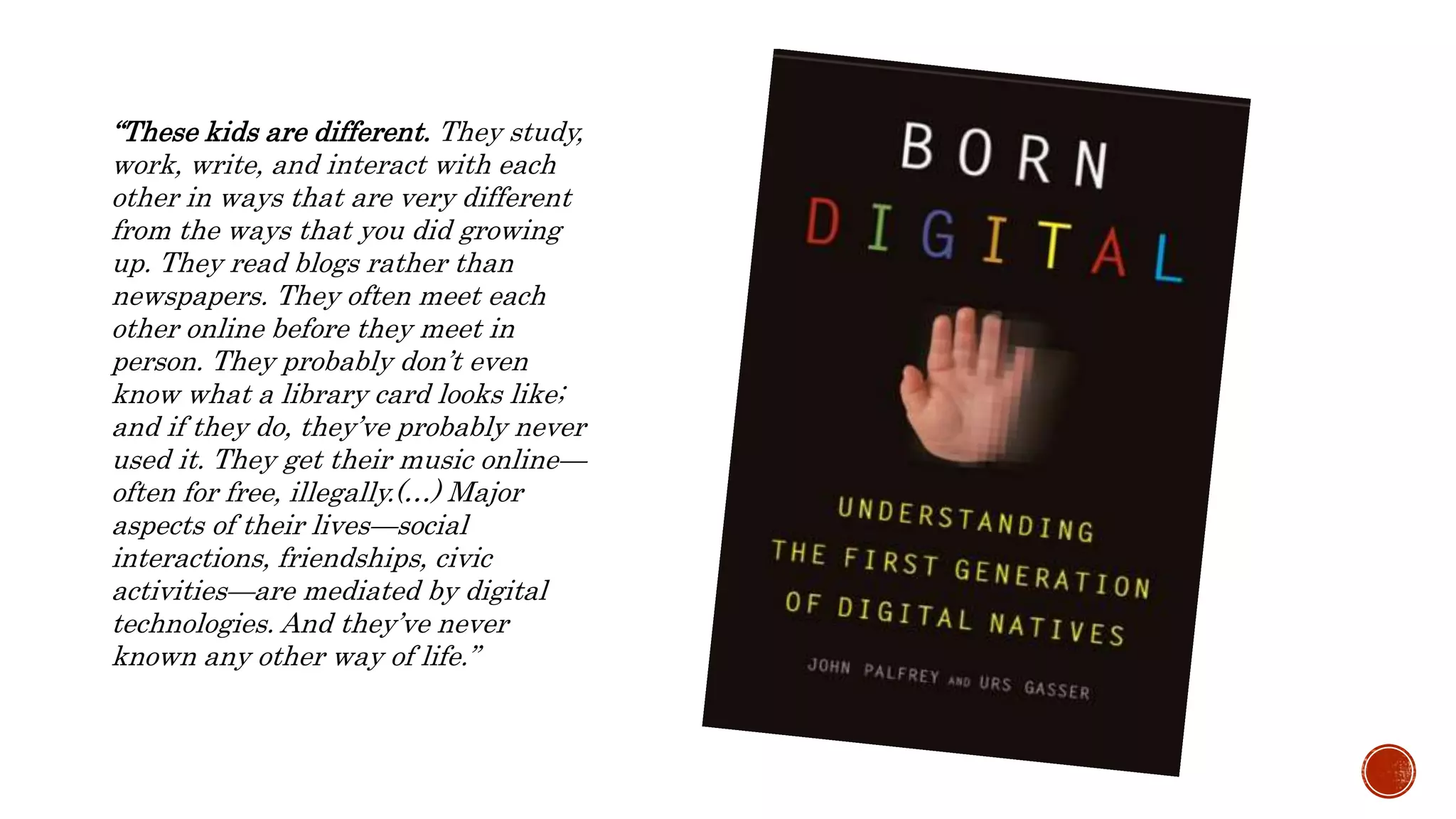
“These kids are different. They study,
work, write, and interact with each
other in ways that are very different
from the ways that you did growing
up. They read blogs rather than
newspapers. They often meet each
other online before they meet in
person. They probably don’t even
know what a library card looks like;
and if they do, they’ve probably never
used it. They get their music online—
often for free, illegally.(…) Major
aspects of their lives—social
interactions, friendships, civic
activities—are mediated by digital
technologies. And they’ve never
known any other way of life.”
“Existe hoje uma nova geração no mundo que foi a
primeira a crescer nesta era digital. Estas crianças
são diferentes e não existirá força maior para
mudar a economia e a sociedade do que estas
centenas de milhões de jovens “media savvy”’
(Tapscott, 1999)
Crianças/JovensAdultos
. melhor competência na tomada de
decisões rápidas face a um número elevado
de opções, decorrentes de estímulos
sensoriais diversos.
. Compreensão de representação gráfica e
interativo
. Desenvolvem várias atividades em
simultâneo.
. Memorização: Factos vs Percursos
. melhores capacidades na interpretação de
expressões faciais
. Maior capacidade de reflexão
(generalização da aprendizagem)
. Informação em formato textual e estático
. Desenvolvem actividades de forma mais
metódica e precisa.
. Memorização: Processamento linear e
sequência lógica
(Small & Moody, 2009; Swingle, 2016)
Conhecimento Tecnológico
Modelação 3D
(Pesquisa online em repositórios de
modelos 3D)
Conhecimento Cientifico
Metas:
14.2 Identificar os constituintes do
microscópio ótico composto.
14.3.Realizar observações diversas
usando o microscópio ótico
15.3. Identificar os principais
constituintes da célula, com base na
observação microscópica de material
biológico
Exemplo: Metas curriculares
5º ano, Ciências Naturais:
“ Célula: unidade básica de vida”
Conhecimento Pedagógico
Desenvolvimento cognitivo das crianças,
contexto socio-cultural das famílias, etc.
ex. estádio das operações formais,
conhecimentos prévios, ...
 IBL
 PbL
 Peer-Inst.
 PjbL
 Flipped Classroom
 GbL
 Gamification
…
Active Learning
Participatory Design Research Method
 Sessões & toolkits
Sessão O
Sessão 1
Sessão 2
Sessão 3
WP2: Design of Future (Teacher)
Education Lab
Em súmula…
• Novas configurações de sala de
aula
• Layout flexível e adaptável
• Equilíbrio entre individual e
coletivo
• Multiplicidade (espaços de) de
atividades
• Feedback
• Acústica, iluminação e
aquecimento
• Tecnologia
Novos espaços
• Com uma organização espacial promotora de uma
aprendizagem ativa e de múltiplas dinâmicas de atividade;
• Com uma multiplicidade de ferramentas (tecnológicas) e
mobiliário flexível;
• Com qualidade e conforto, em particular no que respeita à
temperatura, luminosidade e acústica.
Não são luxos; são fatores relevantes que impactam
diretamente o desempenho escolar dos alunos!
(Barrett, Zhang, Davies & Barrett, 2015)
Item 1 Item 2 Item 3 Item 4
MUDANÇAS
COGNITIVAS
MUDANÇAS
TECNOLÓGICAS
MUDANÇAS
METODOLÓGICAS
MUDANÇAS
AMBIENTAIS
Referências
Barrett, P. Zhang, Y., Davies, F., & Barrett, L. (2015). The impact of classroom design on pupil’s learning: Final
results of a holistic multi-level analysis. Building and Environment, 89,118-133.
Pedro, N. (2017). Ambientes educativos inovadores: o estudo do fator espaço nas ‘salas de aula do futuro’
portuguesas. Revista Tempos e Espaços em Educação, 10, 23, 99-108. Disponível em
https://seer.ufs.br/index.php/revtee/article/view/7448/pdf
Pedro, N., Matos, J. F., Pedro, A., & Abrantes, P. (2011). Teacher skills and competence development for
classrooms of the future_Annex 1. Disponível em
http://itec.eun.org/c/document_library/get_file?p_l_id=10307&folderId=37321&name=DLFE-2213.pdf
Prensky, M. (2001). Digital natives, digital immigrants. Disponivel em
http://www.marcprensky.com/writing/Prensky%20%20Digital%20Natives,%20Digital%20Immigr
ants%20-%20Part1.pdf
Small, G., & Moody, T. (2009). Your Brain on Google: Patterns of cerebral activation during Internet Searching.
American Journal of Geriatric Psychiatry, 17 (2), 116-126.
Swingle, M. (2016). i-Minds: How Cell Phones, Computers, Gaming, and Social Media are Changing our Brains,
our Behavior, and the Evolution of our Species. Portland: Inkwater.
White, D. S., & Le Cornu, A. (2011). Visitors and Residents: A new typology for online engagement. First
Monday, 16 (9), 5 Sept 2011. Disponível em
http://www.uic.edu/htbin/cgiwrap/bin/ojs/index.php/fm/article/viewArticle/3171/3049
Neuza Pedro, Instituto de Educação - ULisboa

Netgeneration: novas tecnologias, novas metodologias, novos espaços

  • 1.
    Neuza Pedro, Institutode Educação - ULisboa
  • 2.
  • 5.
    “According to recentreports from government agencies, foundations, survey firms, and scholarly institutions, most young people in the United States neither read literature (or fully know how), work reliably (just ask employers), visit cultural institutions (of any sort), nor vote . They cannot explain basic scientific methods, recount foundations of history, or name any of their local political representatives.”
  • 6.
    “These kids aredifferent. They study, work, write, and interact with each other in ways that are very different from the ways that you did growing up. They read blogs rather than newspapers. They often meet each other online before they meet in person. They probably don’t even know what a library card looks like; and if they do, they’ve probably never used it. They get their music online— often for free, illegally.(…) Major aspects of their lives—social interactions, friendships, civic activities—are mediated by digital technologies. And they’ve never known any other way of life.”
  • 7.
    “Existe hoje umanova geração no mundo que foi a primeira a crescer nesta era digital. Estas crianças são diferentes e não existirá força maior para mudar a economia e a sociedade do que estas centenas de milhões de jovens “media savvy”’ (Tapscott, 1999)
  • 12.
    Crianças/JovensAdultos . melhor competênciana tomada de decisões rápidas face a um número elevado de opções, decorrentes de estímulos sensoriais diversos. . Compreensão de representação gráfica e interativo . Desenvolvem várias atividades em simultâneo. . Memorização: Factos vs Percursos . melhores capacidades na interpretação de expressões faciais . Maior capacidade de reflexão (generalização da aprendizagem) . Informação em formato textual e estático . Desenvolvem actividades de forma mais metódica e precisa. . Memorização: Processamento linear e sequência lógica (Small & Moody, 2009; Swingle, 2016)
  • 19.
    Conhecimento Tecnológico Modelação 3D (Pesquisaonline em repositórios de modelos 3D) Conhecimento Cientifico Metas: 14.2 Identificar os constituintes do microscópio ótico composto. 14.3.Realizar observações diversas usando o microscópio ótico 15.3. Identificar os principais constituintes da célula, com base na observação microscópica de material biológico Exemplo: Metas curriculares 5º ano, Ciências Naturais: “ Célula: unidade básica de vida” Conhecimento Pedagógico Desenvolvimento cognitivo das crianças, contexto socio-cultural das famílias, etc. ex. estádio das operações formais, conhecimentos prévios, ...
  • 22.
     IBL  PbL Peer-Inst.  PjbL  Flipped Classroom  GbL  Gamification …
  • 23.
  • 31.
    Participatory Design ResearchMethod  Sessões & toolkits Sessão O Sessão 1 Sessão 2 Sessão 3 WP2: Design of Future (Teacher) Education Lab
  • 32.
    Em súmula… • Novasconfigurações de sala de aula • Layout flexível e adaptável • Equilíbrio entre individual e coletivo • Multiplicidade (espaços de) de atividades • Feedback • Acústica, iluminação e aquecimento • Tecnologia
  • 33.
    Novos espaços • Comuma organização espacial promotora de uma aprendizagem ativa e de múltiplas dinâmicas de atividade; • Com uma multiplicidade de ferramentas (tecnológicas) e mobiliário flexível; • Com qualidade e conforto, em particular no que respeita à temperatura, luminosidade e acústica. Não são luxos; são fatores relevantes que impactam diretamente o desempenho escolar dos alunos! (Barrett, Zhang, Davies & Barrett, 2015)
  • 34.
    Item 1 Item2 Item 3 Item 4 MUDANÇAS COGNITIVAS MUDANÇAS TECNOLÓGICAS MUDANÇAS METODOLÓGICAS MUDANÇAS AMBIENTAIS
  • 35.
    Referências Barrett, P. Zhang,Y., Davies, F., & Barrett, L. (2015). The impact of classroom design on pupil’s learning: Final results of a holistic multi-level analysis. Building and Environment, 89,118-133. Pedro, N. (2017). Ambientes educativos inovadores: o estudo do fator espaço nas ‘salas de aula do futuro’ portuguesas. Revista Tempos e Espaços em Educação, 10, 23, 99-108. Disponível em https://seer.ufs.br/index.php/revtee/article/view/7448/pdf Pedro, N., Matos, J. F., Pedro, A., & Abrantes, P. (2011). Teacher skills and competence development for classrooms of the future_Annex 1. Disponível em http://itec.eun.org/c/document_library/get_file?p_l_id=10307&folderId=37321&name=DLFE-2213.pdf Prensky, M. (2001). Digital natives, digital immigrants. Disponivel em http://www.marcprensky.com/writing/Prensky%20%20Digital%20Natives,%20Digital%20Immigr ants%20-%20Part1.pdf Small, G., & Moody, T. (2009). Your Brain on Google: Patterns of cerebral activation during Internet Searching. American Journal of Geriatric Psychiatry, 17 (2), 116-126. Swingle, M. (2016). i-Minds: How Cell Phones, Computers, Gaming, and Social Media are Changing our Brains, our Behavior, and the Evolution of our Species. Portland: Inkwater. White, D. S., & Le Cornu, A. (2011). Visitors and Residents: A new typology for online engagement. First Monday, 16 (9), 5 Sept 2011. Disponível em http://www.uic.edu/htbin/cgiwrap/bin/ojs/index.php/fm/article/viewArticle/3171/3049
  • 36.
    Neuza Pedro, Institutode Educação - ULisboa