Inglês TécnicoInglês Técnico
Aula 2Aula 2
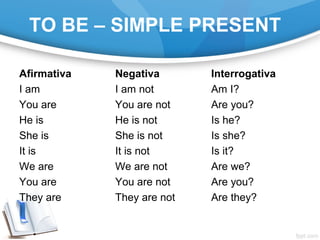
TO BE – SIMPLE PRESENT
Afirmativa Negativa Interrogativa
I am I am not Am I?
You are You are not Are you?
He is He is not Is he?
She is She is not Is she?
It is It is not Is it?
We are We are not Are we?
You are You are not Are you?
They are They are not Are they?
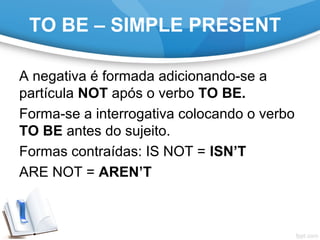
TO BE – SIMPLE PRESENT
A negativa é formada adicionando-se a
partícula NOT após o verbo TO BE.
Forma-se a interrogativa colocando o verbo
TO BE antes do sujeito.
Formas contraídas: IS NOT = ISN’T
ARE NOT = AREN’T
DEMONSTRATIVE PRONOUNS
THIS (este, esta, isto) refere-se a algo que está
próximo de quem fala. O plural de THIS é THESE.
Ex.: This system is an electrical unit. / These
systems are electrical units.
THAT (esse, essa, isso, aquele, aquela, aquilo)
refere-se a algo que está longe de quem fala. O
plural de THAT é THOSE.
Ex.: That is a circuit board. / Those are circuits
boards.
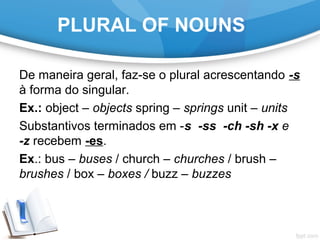
PLURAL OF NOUNS
De maneira geral, faz-se o plural acrescentando -s
à forma do singular.
Ex.: object – objects spring – springs unit – units
Substantivos terminados em -s -ss -ch -sh -x e
-z recebem -es.
Ex.: bus – buses / church – churches / brush –
brushes / box – boxes / buzz – buzzes
PLURAL OF NOUNS
Substantivos terminados em y:
quando o y for precedido por vogal  apenas
acrescenta-se s
Ex.: boy – boys / key – keys / bay – bays
quando o y for precedido por consoante  retira-
se o y e acrescenta-se ies.
Ex.: lady – ladies / sky – skies / city – cities
PLURAL OF NOUNS
Plurais irregulares: man – men / woman – women / mouse
– mice / fish – fish
Ex.: foot – feet / tooth – teeth / child – children
Alguns substantivos terminados em -f ou -fe mudam o -f
ou -fe para -v e recebem -es.
Ex.: life – lives / shelf – shelves / half – halves / self –
selves
Palavras terminadas em -o podem fazer o plural em -s ou
-es.
Ex.: casino – casinos / hippo – hippos / photo – photos
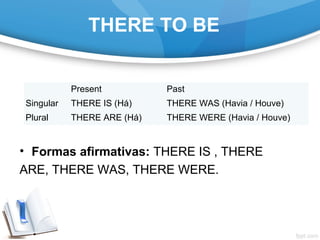
THERE TO BE
• Formas afirmativas: THERE IS , THERE
ARE, THERE WAS, THERE WERE.
Present Past
Singular THERE IS (Há) THERE WAS (Havia / Houve)
Plural THERE ARE (Há) THERE WERE (Havia / Houve)
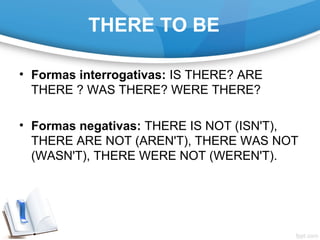
THERE TO BE
• Formas interrogativas: IS THERE? ARE
THERE ? WAS THERE? WERE THERE?
• Formas negativas: THERE IS NOT (ISN'T),
THERE ARE NOT (AREN'T), THERE WAS NOT
(WASN'T), THERE WERE NOT (WEREN'T).
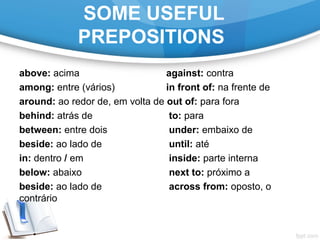
SOME USEFUL
PREPOSITIONS
above: acima against: contra
among: entre (vários) in front of: na frente de
around: ao redor de, em volta de out of: para fora
behind: atrás de to: para
between: entre dois under: embaixo de
beside: ao lado de until: até
in: dentro / em inside: parte interna
below: abaixo next to: próximo a
beside: ao lado de across from: oposto, o
contrário
SOME USEFUL
PREPOSITIONS
across: de um lado e outro opposite: oposto, o contrário
from: de among: entre, no meio, dentre
up: para cima along: ao longo, avante
down: para baixo into: para dentro de
towards: em direção a out of: para fora de
through: através de around: ao redor de
with: com on: em, sobre
without: sem for: por / para
of: de by: por
into: para dentro within: dentro
SOME USEFUL
PREPOSITIONS
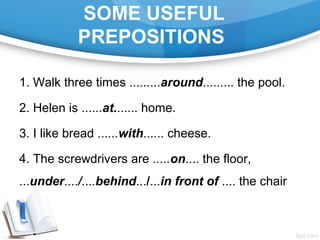
1. Walk three times .........around......... the pool.
2. Helen is ......at....... home.
3. I like bread ......with...... cheese.
4. The screwdrivers are .....on.... the floor,
...under..../....behind.../...in front of .... the chair
SOME USEFUL
PREPOSITIONS
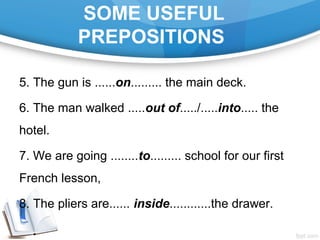
5. The gun is ......on......... the main deck.
6. The man walked .....out of...../.....into..... the
hotel.
7. We are going ........to......... school for our first
French lesson,
8. The pliers are...... inside............the drawer.
INGLÊS TÉCNICOINGLÊS TÉCNICO
FIM DA
AULA 2

Inglês técnico - Aula 2

  • 1.
  • 2.
    TO BE –SIMPLE PRESENT Afirmativa Negativa Interrogativa I am I am not Am I? You are You are not Are you? He is He is not Is he? She is She is not Is she? It is It is not Is it? We are We are not Are we? You are You are not Are you? They are They are not Are they?
  • 3.
    TO BE –SIMPLE PRESENT A negativa é formada adicionando-se a partícula NOT após o verbo TO BE. Forma-se a interrogativa colocando o verbo TO BE antes do sujeito. Formas contraídas: IS NOT = ISN’T ARE NOT = AREN’T
  • 4.
    DEMONSTRATIVE PRONOUNS THIS (este,esta, isto) refere-se a algo que está próximo de quem fala. O plural de THIS é THESE. Ex.: This system is an electrical unit. / These systems are electrical units. THAT (esse, essa, isso, aquele, aquela, aquilo) refere-se a algo que está longe de quem fala. O plural de THAT é THOSE. Ex.: That is a circuit board. / Those are circuits boards.
  • 5.
    PLURAL OF NOUNS Demaneira geral, faz-se o plural acrescentando -s à forma do singular. Ex.: object – objects spring – springs unit – units Substantivos terminados em -s -ss -ch -sh -x e -z recebem -es. Ex.: bus – buses / church – churches / brush – brushes / box – boxes / buzz – buzzes
  • 6.
    PLURAL OF NOUNS Substantivosterminados em y: quando o y for precedido por vogal  apenas acrescenta-se s Ex.: boy – boys / key – keys / bay – bays quando o y for precedido por consoante  retira- se o y e acrescenta-se ies. Ex.: lady – ladies / sky – skies / city – cities
  • 7.
    PLURAL OF NOUNS Pluraisirregulares: man – men / woman – women / mouse – mice / fish – fish Ex.: foot – feet / tooth – teeth / child – children Alguns substantivos terminados em -f ou -fe mudam o -f ou -fe para -v e recebem -es. Ex.: life – lives / shelf – shelves / half – halves / self – selves Palavras terminadas em -o podem fazer o plural em -s ou -es. Ex.: casino – casinos / hippo – hippos / photo – photos
  • 8.
    THERE TO BE •Formas afirmativas: THERE IS , THERE ARE, THERE WAS, THERE WERE. Present Past Singular THERE IS (Há) THERE WAS (Havia / Houve) Plural THERE ARE (Há) THERE WERE (Havia / Houve)
  • 9.
    THERE TO BE •Formas interrogativas: IS THERE? ARE THERE ? WAS THERE? WERE THERE? • Formas negativas: THERE IS NOT (ISN'T), THERE ARE NOT (AREN'T), THERE WAS NOT (WASN'T), THERE WERE NOT (WEREN'T).
  • 10.
    SOME USEFUL PREPOSITIONS above: acimaagainst: contra among: entre (vários) in front of: na frente de around: ao redor de, em volta de out of: para fora behind: atrás de to: para between: entre dois under: embaixo de beside: ao lado de until: até in: dentro / em inside: parte interna below: abaixo next to: próximo a beside: ao lado de across from: oposto, o contrário
  • 11.
    SOME USEFUL PREPOSITIONS across: deum lado e outro opposite: oposto, o contrário from: de among: entre, no meio, dentre up: para cima along: ao longo, avante down: para baixo into: para dentro de towards: em direção a out of: para fora de through: através de around: ao redor de with: com on: em, sobre without: sem for: por / para of: de by: por into: para dentro within: dentro
  • 12.
    SOME USEFUL PREPOSITIONS 1. Walkthree times .........around......... the pool. 2. Helen is ......at....... home. 3. I like bread ......with...... cheese. 4. The screwdrivers are .....on.... the floor, ...under..../....behind.../...in front of .... the chair
  • 13.
    SOME USEFUL PREPOSITIONS 5. Thegun is ......on......... the main deck. 6. The man walked .....out of...../.....into..... the hotel. 7. We are going ........to......... school for our first French lesson, 8. The pliers are...... inside............the drawer.
  • 14.