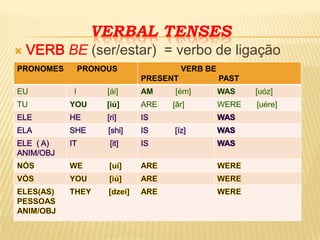
VERBAL TENSESVERBBE (ser/estar)  = verbo de ligação
 VERBAL TENSESDICA: I amhappy.[ sou / estou] I am at home.[ estou ]                           * quem detém o sentido do verbo é o PREDICADO
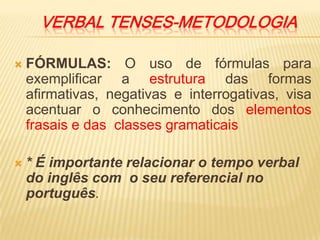
      VERBAL TENSES-metodologiaFÓRMULAS: O uso de fórmulas para exemplificar a estrutura das formas afirmativas, negativas e interrogativas, visa acentuar o conhecimento dos elementos frasais e das  classes gramaticais* É importante relacionar o tempo verbal do inglês com  o seu referencial no português.
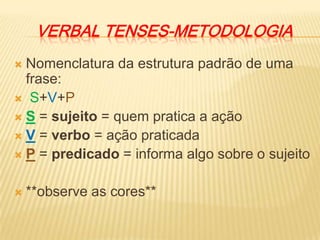
     VERBAL TENSES-metodologiaNomenclatura da estrutura padrão de uma frase:S+V+PS = sujeito = quem pratica a açãoV= verbo = ação praticadaP = predicado = informa algo sobre o sujeito**observe as cores**
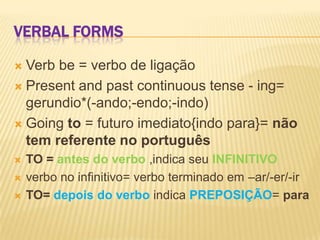
Verbal formsVerbbe = verbo de ligaçãoPresentandpastcontinuous tense - ing= gerundio*(-ando;-endo;-indo)Goingto = futuro imediato{indo para}= não tem referente no portuguêsTO = antes do verbo,indica seu INFINITIVOverbo no infinitivo= verbo terminado em –ar/-er/-irTO= depois do verboindica PREPOSIÇÃO= para
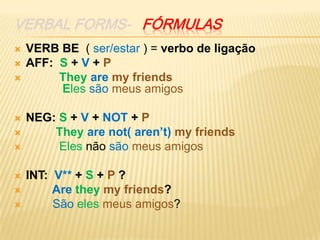
VERBAL forms-   fórmulasVERB BE  ( ser/estar ) = verbo de ligação AFF:  S + V + PTheyaremy friends                         Elessãomeus amigos	NEG: S + V + NOT + P They arenot( aren’t) my friends Elesnãosãomeus amigosINT: V** + S + P ?  Aretheymy friends?Sãoelesmeus amigos?
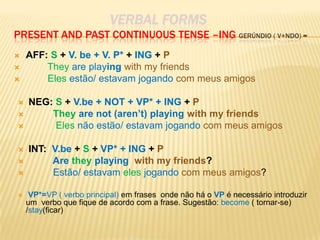
			Verbal formsPRESENT and PAST CONTINUOUS TENSE –ING GERÚNDIO ( V+ndo) = AFF: S + V. be + V. P* + ING + P        Theyare playing with my friendsElesestão/ estavamjogandocom meus amigos NEG: S + V.be + NOT + VP* + ING + PTheyare not (aren’t) playing with my friends Elesnãoestão/ estavamjogandocom meus amigos INT:  V.be + S + VP* + ING + P          Aretheyplayingwith my friends? Estão/ estavameles jogando com meus amigos?VP*=VP ( verbo principal) em frases  onde não há o VPé necessário introduzir um  verbo que fique de acordo com a frase. Sugestão: become( tornar-se) /stay(ficar)
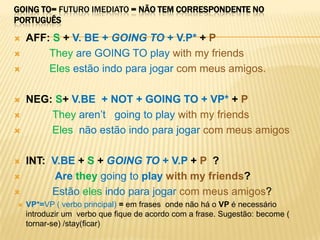
GOING TO= Futuro imediato = não tem correspondente no português AFF: S + V. BE + GOING TO + V.P* + PTheyare GOING TO play with my friends Elesestão indo parajogarcom meus amigos.NEG: S+ V.BE  + NOT + GOING TO + VP* + PThey aren’t   going to play with my friends Elesnãoestão indo parajogarcom meus amigosINT:  V.BE + S + GOING TO + V.P + P  ?           Aretheygoing to play withmyfriends?          Estãoelesindo para jogar com meus amigos?VP*=VP ( verbo principal) = em frases  onde não há o VP é necessário introduzir um  verbo que fique de acordo com a frase. Sugestão: become ( tornar-se) /stay(ficar)
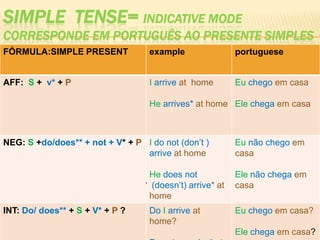
Simple  tense= indicativemodeCORRESPONDE EM PORTUGUÊS AO presente simples.
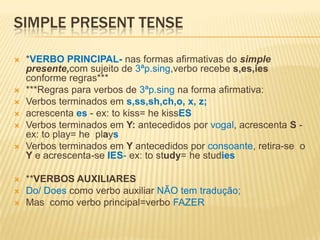
SIMPLE PRESENT TENSE*VERBO PRINCIPAL- nas formas afirmativas do simple presente,comsujeito de 3ªp.sing,verbo recebe s,es,ies conforme regras******Regras para verbos de 3ªp.sing na forma afirmativa:Verbos terminados em s,ss,sh,ch,o, x, z;acrescenta es- ex: to kiss= hekissESVerbos terminados em Y: antecedidos por vogal, acrescenta S - ex: to play= he  playsVerbos terminados em Y antecedidos por consoante, retira-se  o Y e acrescenta-seIES- ex: to study= hestudies**VERBOS AUXILIARES Do/ Does como verbo auxiliar NÃO tem tradução;Mas  como verbo principal=verbo FAZER
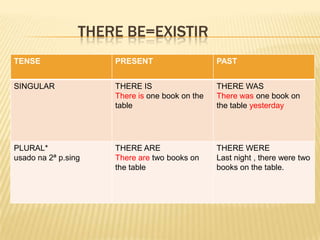
		THERE BE=EXISTIR
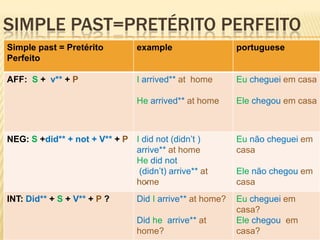
Simplepast=pretérito perfeito.
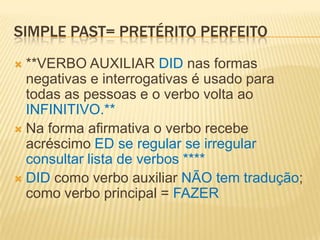
Simplepast= pretérito perfeito**VERBO AUXILIAR DID nas formas negativas e interrogativas é usado para todas as pessoas e o verbo volta ao INFINITIVO.**Na forma afirmativa o verbo recebe acréscimo ED se regular se irregular consultar lista de verbos ****DID como verbo auxiliar NÃO tem tradução; como verbo principal = FAZER
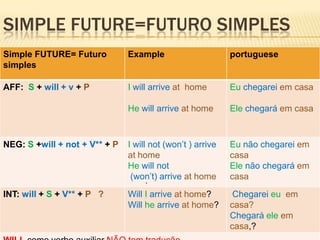
Simple FUTURE=FUTURO SIMPLES.
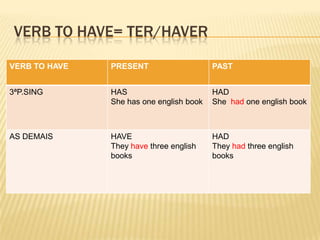
VERB TO HAVE= TER/HAVER
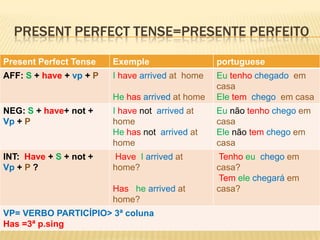
PRESENT perfect tense=presente perfeito
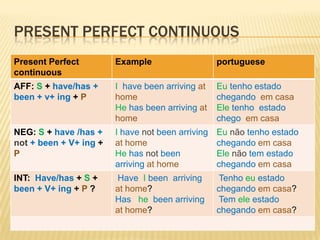
Presentperfectcontinuous
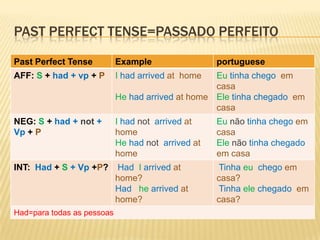
Pastperfect tense=passado perfeito
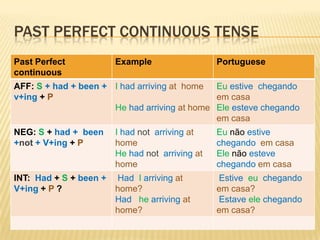
Pastperfectcontinuous tense
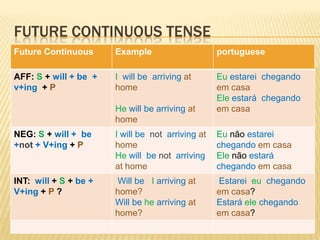
Future continuous tense
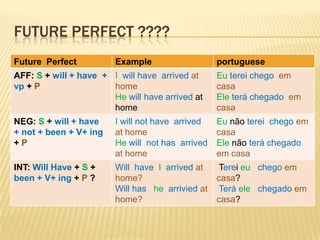
Future perfect ????
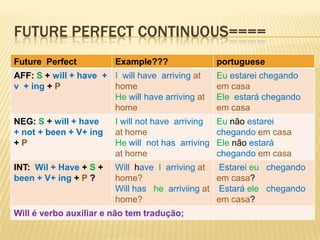
Future perfectcontinuous====
Fonte:http://www.englishpage.com/verbpage/futureinpast.htmlConsulte o site acima
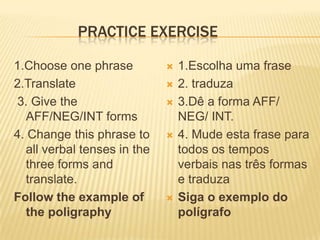
Practiceexercise1.Chooseonephrase2.Translate 3. Givethe AFF/NEG/INT forms4. Changethisphrase to all verbal tenses in thethreeformsandtranslate.Followtheexampleofthepoligraphy1.Escolha uma frase2. traduza3.Dê a forma AFF/ NEG/ INT.4. Mude esta frase para todos os tempos verbais nas três formas e traduzaSiga o exemplo do polígrafo
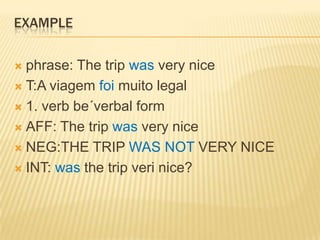
Examplephrase: ThetripwasveryniceT:A viagemfoimuito legal1. verbbe´verbalformAFF: ThetripwasveryniceNEG:THE TRIP WAS NOT VERY NICEINT: wasthetripverinice?
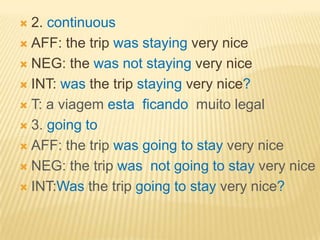
2. continuousAFF: thetripwasstayingveryniceNEG: thewasnotstayingveryniceINT: wasthetripstayingverynice?T: a viagem esta  ficando  muito legal3. going toAFF: thetripwasgoing to stayveryniceNEG: thetripwasnotgoing to stayveryniceINT:Wasthetripgoing to stayverynice?
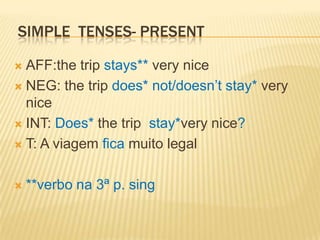
Simple  tenses- presentAFF:thetripstays** veryniceNEG: thetripdoes* not/doesn’tstay* veryniceINT: Does*thetripstay*verynice?T: A viagem fica muito legal**verbo na 3ª p. sing
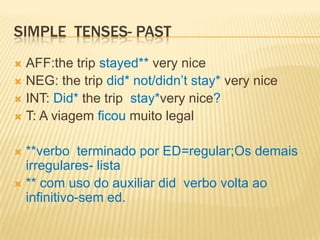
Simple  tenses- pastAFF:thetripstayed** veryniceNEG: thetripdid* not/didn’tstay* veryniceINT: Did*thetripstay*verynice?T: A viagem ficou muito legal**verbo  terminado por ED=regular;Os demais irregulares- lista** com uso do auxiliar did  verbo volta ao infinitivo-sem ed.
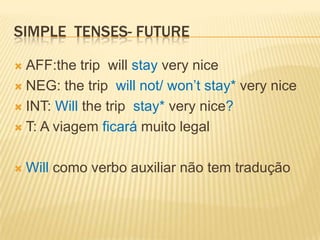
Simple  tenses- futureAFF:thetripwillstayveryniceNEG: thetripwillnot/ won’tstay* veryniceINT: Willthetripstay* verynice?T: A viagem ficará muito legalWill como verbo auxiliar não tem tradução
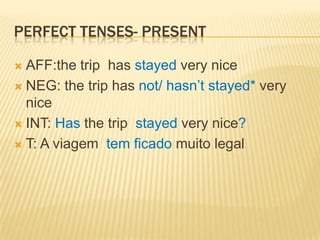
Perfect tenses- presentAFF:thetriphasstayedveryniceNEG: thetriphasnot/ hasn’tstayed* veryniceINT: Hasthetripstayedverynice?T: A viagem  temficado muito legal
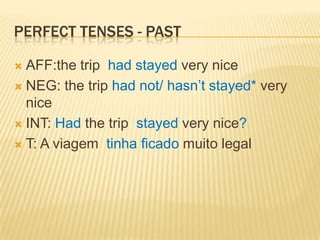
Perfect tenses - pastAFF:thetriphadstayedveryniceNEG: thetriphadnot/ hasn’tstayed* veryniceINT: Hadthetripstayedverynice?T: A viagem  tinha ficado muito legal
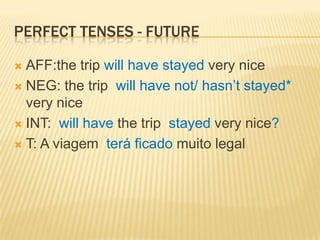
Perfect tenses - futureAFF:thetripwillhavestayedveryniceNEG: thetripwillhavenot/ hasn’tstayed* veryniceINT:  willhavethetripstayedverynice?T: A viagem  terá ficado muito legal
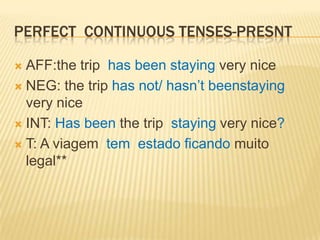
Perfectcontinuoustenses-presntAFF:thetriphasbeenstayingveryniceNEG: thetriphasnot/ hasn’tbeenstayingveryniceINT: Hasbeenthetripstayingverynice?T: A viagem  tem  estado ficando muito legal**
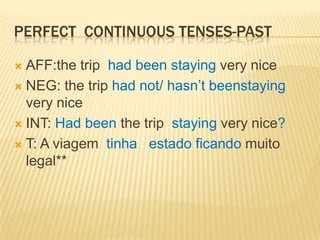
Perfectcontinuoustenses-pastAFF:thetriphadbeenstayingveryniceNEG: thetriphadnot/ hasn’tbeenstayingveryniceINT: Hadbeenthetripstayingverynice?T: A viagem  tinha   estado ficando muito legal**

Verbal tense

  • 1.
    VERBAL TENSESVERBBE (ser/estar) = verbo de ligação
  • 2.
    VERBAL TENSESDICA:I amhappy.[ sou / estou] I am at home.[ estou ]  * quem detém o sentido do verbo é o PREDICADO
  • 3.
    VERBAL TENSES-metodologiaFÓRMULAS: O uso de fórmulas para exemplificar a estrutura das formas afirmativas, negativas e interrogativas, visa acentuar o conhecimento dos elementos frasais e das classes gramaticais* É importante relacionar o tempo verbal do inglês com o seu referencial no português.
  • 4.
    VERBAL TENSES-metodologiaNomenclatura da estrutura padrão de uma frase:S+V+PS = sujeito = quem pratica a açãoV= verbo = ação praticadaP = predicado = informa algo sobre o sujeito**observe as cores**
  • 5.
    Verbal formsVerbbe =verbo de ligaçãoPresentandpastcontinuous tense - ing= gerundio*(-ando;-endo;-indo)Goingto = futuro imediato{indo para}= não tem referente no portuguêsTO = antes do verbo,indica seu INFINITIVOverbo no infinitivo= verbo terminado em –ar/-er/-irTO= depois do verboindica PREPOSIÇÃO= para
  • 6.
    VERBAL forms- fórmulasVERB BE ( ser/estar ) = verbo de ligação AFF: S + V + PTheyaremy friends Elessãomeus amigos NEG: S + V + NOT + P They arenot( aren’t) my friends Elesnãosãomeus amigosINT: V** + S + P ? Aretheymy friends?Sãoelesmeus amigos?
  • 7.
    Verbal formsPRESENT andPAST CONTINUOUS TENSE –ING GERÚNDIO ( V+ndo) = AFF: S + V. be + V. P* + ING + P Theyare playing with my friendsElesestão/ estavamjogandocom meus amigos NEG: S + V.be + NOT + VP* + ING + PTheyare not (aren’t) playing with my friends Elesnãoestão/ estavamjogandocom meus amigos INT: V.be + S + VP* + ING + P Aretheyplayingwith my friends? Estão/ estavameles jogando com meus amigos?VP*=VP ( verbo principal) em frases onde não há o VPé necessário introduzir um verbo que fique de acordo com a frase. Sugestão: become( tornar-se) /stay(ficar)
  • 8.
    GOING TO= Futuroimediato = não tem correspondente no português AFF: S + V. BE + GOING TO + V.P* + PTheyare GOING TO play with my friends Elesestão indo parajogarcom meus amigos.NEG: S+ V.BE + NOT + GOING TO + VP* + PThey aren’t going to play with my friends Elesnãoestão indo parajogarcom meus amigosINT: V.BE + S + GOING TO + V.P + P ? Aretheygoing to play withmyfriends? Estãoelesindo para jogar com meus amigos?VP*=VP ( verbo principal) = em frases onde não há o VP é necessário introduzir um verbo que fique de acordo com a frase. Sugestão: become ( tornar-se) /stay(ficar)
  • 9.
    Simple tense=indicativemodeCORRESPONDE EM PORTUGUÊS AO presente simples.
  • 10.
    SIMPLE PRESENT TENSE*VERBOPRINCIPAL- nas formas afirmativas do simple presente,comsujeito de 3ªp.sing,verbo recebe s,es,ies conforme regras******Regras para verbos de 3ªp.sing na forma afirmativa:Verbos terminados em s,ss,sh,ch,o, x, z;acrescenta es- ex: to kiss= hekissESVerbos terminados em Y: antecedidos por vogal, acrescenta S - ex: to play= he playsVerbos terminados em Y antecedidos por consoante, retira-se o Y e acrescenta-seIES- ex: to study= hestudies**VERBOS AUXILIARES Do/ Does como verbo auxiliar NÃO tem tradução;Mas como verbo principal=verbo FAZER
  • 11.
  • 12.
  • 13.
    Simplepast= pretérito perfeito**VERBOAUXILIAR DID nas formas negativas e interrogativas é usado para todas as pessoas e o verbo volta ao INFINITIVO.**Na forma afirmativa o verbo recebe acréscimo ED se regular se irregular consultar lista de verbos ****DID como verbo auxiliar NÃO tem tradução; como verbo principal = FAZER
  • 14.
  • 15.
    VERB TO HAVE=TER/HAVER
  • 16.
  • 17.
  • 18.
  • 19.
  • 20.
  • 21.
  • 22.
  • 23.
  • 24.
    Practiceexercise1.Chooseonephrase2.Translate 3. GivetheAFF/NEG/INT forms4. Changethisphrase to all verbal tenses in thethreeformsandtranslate.Followtheexampleofthepoligraphy1.Escolha uma frase2. traduza3.Dê a forma AFF/ NEG/ INT.4. Mude esta frase para todos os tempos verbais nas três formas e traduzaSiga o exemplo do polígrafo
  • 25.
    Examplephrase: ThetripwasveryniceT:A viagemfoimuitolegal1. verbbe´verbalformAFF: ThetripwasveryniceNEG:THE TRIP WAS NOT VERY NICEINT: wasthetripverinice?
  • 26.
    2. continuousAFF: thetripwasstayingveryniceNEG:thewasnotstayingveryniceINT: wasthetripstayingverynice?T: a viagem esta ficando muito legal3. going toAFF: thetripwasgoing to stayveryniceNEG: thetripwasnotgoing to stayveryniceINT:Wasthetripgoing to stayverynice?
  • 27.
    Simple tenses-presentAFF:thetripstays** veryniceNEG: thetripdoes* not/doesn’tstay* veryniceINT: Does*thetripstay*verynice?T: A viagem fica muito legal**verbo na 3ª p. sing
  • 28.
    Simple tenses-pastAFF:thetripstayed** veryniceNEG: thetripdid* not/didn’tstay* veryniceINT: Did*thetripstay*verynice?T: A viagem ficou muito legal**verbo terminado por ED=regular;Os demais irregulares- lista** com uso do auxiliar did verbo volta ao infinitivo-sem ed.
  • 29.
    Simple tenses-futureAFF:thetripwillstayveryniceNEG: thetripwillnot/ won’tstay* veryniceINT: Willthetripstay* verynice?T: A viagem ficará muito legalWill como verbo auxiliar não tem tradução
  • 30.
    Perfect tenses- presentAFF:thetriphasstayedveryniceNEG:thetriphasnot/ hasn’tstayed* veryniceINT: Hasthetripstayedverynice?T: A viagem temficado muito legal
  • 31.
    Perfect tenses -pastAFF:thetriphadstayedveryniceNEG: thetriphadnot/ hasn’tstayed* veryniceINT: Hadthetripstayedverynice?T: A viagem tinha ficado muito legal
  • 32.
    Perfect tenses -futureAFF:thetripwillhavestayedveryniceNEG: thetripwillhavenot/ hasn’tstayed* veryniceINT: willhavethetripstayedverynice?T: A viagem terá ficado muito legal
  • 33.
  • 34.
    Perfectcontinuoustenses-pastAFF:thetriphadbeenstayingveryniceNEG: thetriphadnot/ hasn’tbeenstayingveryniceINT:Hadbeenthetripstayingverynice?T: A viagem tinha estado ficando muito legal**