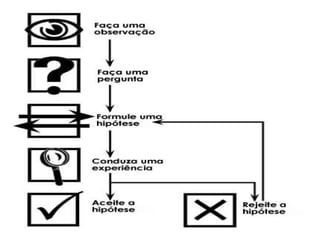
O documento descreve as principais etapas do método científico, incluindo observação, formulação de perguntas e hipóteses, experimentação controlada, análise de dados e aceitação pela comunidade científica.
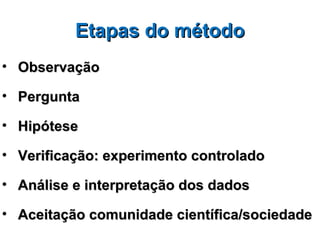
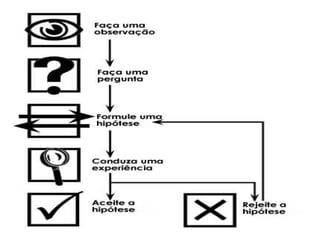
Etapas do método
•Observação
• Pergunta
• Hipótese
• Verificação: experimento controlado
• Análise e interpretação dos dados
• Aceitação comunidade científica/sociedade
Pergunta
• Dividir oproblema
• Foco
• Permitir isolar todas as outras variáveis que
podem influenciar esta pergunta
• PARTE CRUCIAL DO TRABALHO CIENTÍFICO
5.
Pergunta
• Dividir oproblema
• Foco
• Permitir isolar todas as outras variáveis que
podem influenciar esta pergunta
Elaboração da hipótese
•Possível resposta a sua pergunta
• Baseado no conhecimento e sua observação
• Não precisa estar certo
• A ser testado através da experimentação proposta
8.
Verificação da hipótese
•experimento controlado
• Comparar com algo (grupo controle)
• Amostra (numero de observações)
adequados
• Focado em uma (ou poucas) perguntas
• Procura resposta a uma (ou poucas)
perguntas
9.
Análise e interpretaçãodos dados
• Números
• Gráficos, tabelas e figuras
• Testes estatísticos que confirmem ou não a
Hipótese
• Ideal que se demonstre em mais de um
Experimento o mesmo achado
11.
DA IDÉIA AOINÍCIO DA PESQUISA
(Planejamento e projeto de pesquisa)
• Observa fenômeno
• Revisão da literatura (RL)
• Qual PERGUNTA RELEVANTE ainda não foi
totalmente respondida
• Baseado no conhecimento vigente e na
observação: HIPÓTESE
• Testar hípótese: Desenho da pesquisa
12.
DA IDÉIA AOINÍCIO DA PESQUISA
• Observa infecção cirúrgica com seus
pacientes operados
• RL
• PERGUNTA RELEVANTE
• HIPÓTESE
• Testar hípótese: Desenho da pesquisa
13.
DA IDÉIA AOINÍCIO DA PESQUISA
• Percebe que num hospital novo tem pior
resultado com pacientes infartados no PA
• RL
• PERGUNTA RELEVANTE
• HIPÓTESE
• Testar hípótese: Desenho da pesquisa
14.
DA IDÉIA AOINÍCIO DA PESQUISA
• Grande incidência de gemelares em uma
regiâo
• RL
• PERGUNTA RELEVANTE
• HIPÓTESE
• Testar hípótese: Desenho da pesquisa
15.
DA IDÉIA AOINÍCIO DA PESQUISA
• Nota um comportamento diferente em uma
parte da célula
• RL
• PERGUNTA RELEVANTE
• HIPÓTESE
• Testar hípótese: Desenho da pesquisa
16.
DA IDÉIA AOINÍCIO DA PESQUISA
• Novo remédio a ser testado
• RL
• PERGUNTA RELEVANTE
• HIPÓTESE
• Testar hípótese: Desenho da pesquisa
17.
Construção de evidênciamédico-
científica
• Publicação
• Aceitação comunidade científica
• Conjuntos de hipóteses geram TEORIAS
• Sociedade aceita este conhecimento como
verdade
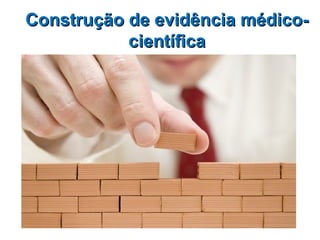
Construção de evidênciamédico-
científica
• Publicação inicial
• Gera novas perguntas novos testes
publicações subsequentes mais tijolos pra
parede!!!
• Aceitação comunidade científica verdades
para sociedade
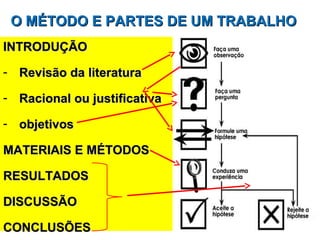
O MÉTODO EPARTES DE UM TRABALHO
INTRODUÇÃO
- Revisão da literatura
- Racional ou justificativa
- objetivos
MATERIAIS E MÉTODOS
RESULTADOS
DISCUSSÃO
CONCLUSÕES
23.
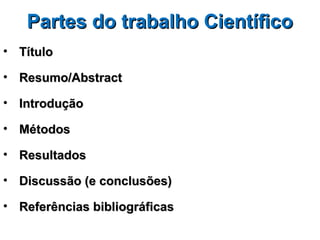
Partes do trabalhoCientífico
• Título
• Resumo/Abstract
• Introdução
• Métodos
• Resultados
• Discussão (e conclusões)
• Referências bibliográficas
24.
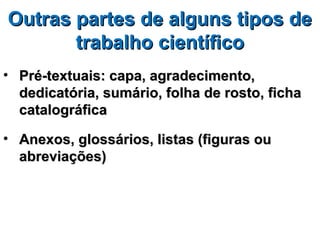
Outras partes dealguns tipos de
trabalho científico
• Pré-textuais: capa, agradecimento,
dedicatória, sumário, folha de rosto, ficha
catalográfica
• Anexos, glossários, listas (figuras ou
abreviações)
25.
A primeira página
•Título
• Autores, títulação e afiliações
• Autor para correspondência
• Palavras-chave e contagem de palavras
• abreviações
26.
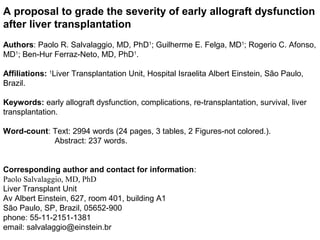
A proposal tograde the severity of early allograft dysfunction
after liver transplantation
Authors: Paolo R. Salvalaggio, MD, PhD1; Guilherme E. Felga, MD1; Rogerio C. Afonso,
MD1; Ben-Hur Ferraz-Neto, MD, PhD1.
Affiliations: 1Liver Transplantation Unit, Hospital Israelita Albert Einstein, São Paulo,
Brazil.
Keywords: early allograft dysfunction, complications, re-transplantation, survival, liver
transplantation.
Word-count: Text: 2994 words (24 pages, 3 tables, 2 Figures-not colored.).
Abstract: 237 words.
Corresponding author and contact for information:
Paolo Salvalaggio, MD, PhD
Liver Transplant Unit
Av Albert Einstein, 627, room 401, building A1
São Paulo, SP, Brazil, 05652-900
phone: 55-11-2151-1381
email: salvalaggio@einstein.br
27.
Título
• Estilos variados
•Curto, claro e chamativo!!!
• TODO MUNDO LÊ (as vezes só lêem isto!!!)
• Tem que ter tema
• O que se propõe: ou pergunta ou resposta
• Pista sobre tipo de estudo
28.
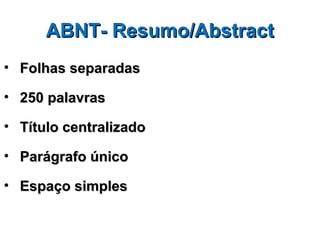
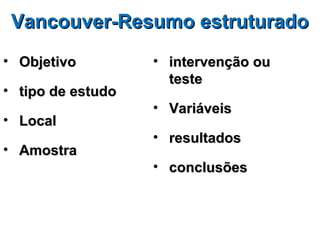
Resumo
• Claro edentro das normas
• Tem que ler, entender e ficar interessado
• As vezes só lê até aqui!!!
• Introdução/Racional; objetivos, método,
resultados e conclusões
• Principal parte: RESULTADOS
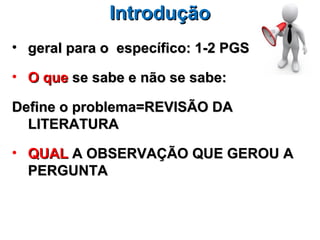
Introdução
• geral parao específico: 1-2 PGS
• O que se sabe e não se sabe:
Define o problema=REVISÃO DA
LITERATURA
• QUAL A OBSERVAÇÃO QUE GEROU A
PERGUNTA
32.
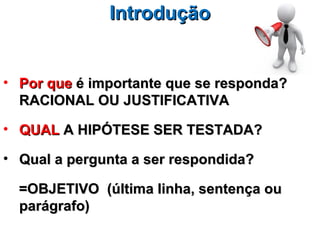
Introdução
• Por queé importante que se responda?
RACIONAL OU JUSTIFICATIVA
• QUAL A HIPÓTESE SER TESTADA?
• Qual a pergunta a ser respondida?
=OBJETIVO (última linha, sentença ou
parágrafo)
34.
Objetivo=Pergunta
• O QUEVOCE QUER FAZER?
• O QUE QUER TESTAR?
• O QUE QUER RESPONDER?
PRECISA SER RESPONDIDO
DESEJA OBTER RESPOSTA
NOVO, CRIATIVO, IMPORTANTE, RELEVANTE
ADICIONA AO CONHECIMENTO VIGENTE
36.
Método (COMO?)
• Materiale métodos ou pacientes e
métodos: 1-3pgs
• Normas que se seguiram e
aprovações
• Documentos e consentimentos
37.
Método (COMO?)
• Tipode estudo
• Onde e quando se fez estudo?
• Como se obtiveram os dados?
• Materiais e maquinários:
“ingredientes”
38.
Método (DESENHO EXPERIMENTAL)
•Grupos e controles (números)
• População (inclusão e exclusão)
• Variáveis (chave ou principal e
secundárias)
• estatística
39.
Resultados
• O quefoi achado?
• Contar uma história ao descrever as
figuras
• Provar o mesmo ponto mais de uma vez
• Sequencia lógica de achados de um
experimento que gerou nova pergunta e
outros achados
40.
QUALIDADE DE TRABALHO
•Método rigoroso
• Pergunta relevante, inovadora, importante
• Resultados convincentes
41.
Discussão
• 3-4 pgs:mais longa, complicada
• Reitera o racional e a pergunta
• Discute os achados do trabalho:
INTERPRETAR OS DADOS!!!
42.
Discussão
• Um parágrafopara cada achado
importante
• Do mais importante para o menos
• Quais seriam os próximos estudos?
• Quais as deficiência/limitações?
• Qual aplicabilidade?
43.
Conclusão
• Separada ouparte da discussão
• RESPONDE OBJETIVO
• O que o leitor tem que gravar!!!
• “Take home message”
• Semelhante as conclusões do resumo
44.
ABNT- Referências Bibliográficas
•ABNT 6023
• Referência de 1, 2, 3, 4 ou mais autores
• Autor em maiúsculo
• Título em negrito
• Edição, local, editora, ano, páginas
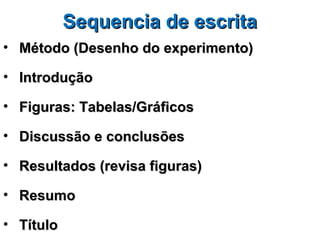
Sequencia de escrita
•Método (Desenho do experimento)
• Introdução
• Figuras: Tabelas/Gráficos
• Discussão e conclusões
• Resultados (revisa figuras)
• Resumo
• Título
49.
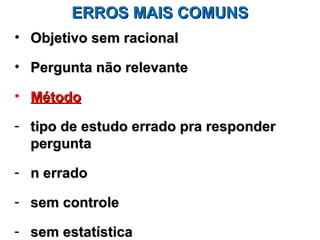
ERROS MAIS COMUNS
•Objetivo sem racional
• Pergunta não relevante
• Método
- tipo de estudo errado pra responder
pergunta
- n errado
- sem controle
- sem estatística
50.
ERROS MAIS COMUNS
•População nos resultados
• Resultados não respondem a pergunta: má
interpretação
• Conclusão diferente resultados ou do
objetivo
CONHECIMENTO NA ÁREAMÉDICA
• Como se produz conhecimento
• Como se transmite o conhecimento
• Velocidade de transmissão do
conhecimento
• TERMO: Evidência médica
• Como se acha informação sobre
conhecimento?
Pra que servea pesquisa na web?
• Localizar conhecimento disponível
• Achar informação relevante
• Revisar assunto
• Manter-se informado
58.
O que sepesquisa?
• Revisão (múltiplos artigos)
• Conhecimento específico (tratamento de
doença rara)
• Artigo específico (noticiado na imprensa
leiga)
• Publicações de um pesquisador ou
Departamento
ACHEI ARTIGO(S) EAGORA?
• Download (e-journals)
• Biblioteca e ler/pedir
69.
E-journals
Biblioteca: Menu>recursos
virtuais>periódicos digitais e online>setor de
ciências da saúde
http://biblioteca.up.com.br/conteudo/
3664/periodicos---ciencias-da-
saude.aspx
70.
Bibliotecas e E-journalsmundo afora
• Yale Harvey Cushing Medical Library
• Galter Health Sciences Medical Library
• SLU Medical Center Library
• UW Medical Center Library
http://hsl.uw.edu/
www.nejm.orgc
#3 Overall center follow-up reporting often inadequate -> reliance on select reports Single center studies - limited by power, bias from subject loss-to-follow-up
#4 Overall center follow-up reporting often inadequate -> reliance on select reports Single center studies - limited by power, bias from subject loss-to-follow-up
#5 Overall center follow-up reporting often inadequate -> reliance on select reports Single center studies - limited by power, bias from subject loss-to-follow-up
#6 Overall center follow-up reporting often inadequate -> reliance on select reports Single center studies - limited by power, bias from subject loss-to-follow-up
#7 Overall center follow-up reporting often inadequate -> reliance on select reports Single center studies - limited by power, bias from subject loss-to-follow-up
#8 Overall center follow-up reporting often inadequate -> reliance on select reports Single center studies - limited by power, bias from subject loss-to-follow-up
#9 Overall center follow-up reporting often inadequate -> reliance on select reports Single center studies - limited by power, bias from subject loss-to-follow-up
#10 Overall center follow-up reporting often inadequate -> reliance on select reports Single center studies - limited by power, bias from subject loss-to-follow-up
#11 Overall center follow-up reporting often inadequate -> reliance on select reports Single center studies - limited by power, bias from subject loss-to-follow-up
#12 Overall center follow-up reporting often inadequate -> reliance on select reports Single center studies - limited by power, bias from subject loss-to-follow-up
#13 Overall center follow-up reporting often inadequate -> reliance on select reports Single center studies - limited by power, bias from subject loss-to-follow-up
#14 Overall center follow-up reporting often inadequate -> reliance on select reports Single center studies - limited by power, bias from subject loss-to-follow-up
#15 Overall center follow-up reporting often inadequate -> reliance on select reports Single center studies - limited by power, bias from subject loss-to-follow-up
#16 Overall center follow-up reporting often inadequate -> reliance on select reports Single center studies - limited by power, bias from subject loss-to-follow-up
#17 Overall center follow-up reporting often inadequate -> reliance on select reports Single center studies - limited by power, bias from subject loss-to-follow-up
#18 Overall center follow-up reporting often inadequate -> reliance on select reports Single center studies - limited by power, bias from subject loss-to-follow-up
#19 Overall center follow-up reporting often inadequate -> reliance on select reports Single center studies - limited by power, bias from subject loss-to-follow-up
#20 Overall center follow-up reporting often inadequate -> reliance on select reports Single center studies - limited by power, bias from subject loss-to-follow-up
#22 Overall center follow-up reporting often inadequate -> reliance on select reports Single center studies - limited by power, bias from subject loss-to-follow-up
#23 Overall center follow-up reporting often inadequate -> reliance on select reports Single center studies - limited by power, bias from subject loss-to-follow-up
#24 Overall center follow-up reporting often inadequate -> reliance on select reports Single center studies - limited by power, bias from subject loss-to-follow-up
#25 Overall center follow-up reporting often inadequate -> reliance on select reports Single center studies - limited by power, bias from subject loss-to-follow-up
#26 Overall center follow-up reporting often inadequate -> reliance on select reports Single center studies - limited by power, bias from subject loss-to-follow-up
#28 Overall center follow-up reporting often inadequate -> reliance on select reports Single center studies - limited by power, bias from subject loss-to-follow-up
#29 Overall center follow-up reporting often inadequate -> reliance on select reports Single center studies - limited by power, bias from subject loss-to-follow-up
#30 Overall center follow-up reporting often inadequate -> reliance on select reports Single center studies - limited by power, bias from subject loss-to-follow-up
#31 Overall center follow-up reporting often inadequate -> reliance on select reports Single center studies - limited by power, bias from subject loss-to-follow-up
#32 Overall center follow-up reporting often inadequate -> reliance on select reports Single center studies - limited by power, bias from subject loss-to-follow-up
#33 Overall center follow-up reporting often inadequate -> reliance on select reports Single center studies - limited by power, bias from subject loss-to-follow-up
#35 Overall center follow-up reporting often inadequate -> reliance on select reports Single center studies - limited by power, bias from subject loss-to-follow-up
#36 Overall center follow-up reporting often inadequate -> reliance on select reports Single center studies - limited by power, bias from subject loss-to-follow-up
#37 Overall center follow-up reporting often inadequate -> reliance on select reports Single center studies - limited by power, bias from subject loss-to-follow-up
#38 Overall center follow-up reporting often inadequate -> reliance on select reports Single center studies - limited by power, bias from subject loss-to-follow-up
#39 Overall center follow-up reporting often inadequate -> reliance on select reports Single center studies - limited by power, bias from subject loss-to-follow-up
#40 Overall center follow-up reporting often inadequate -> reliance on select reports Single center studies - limited by power, bias from subject loss-to-follow-up
#41 Overall center follow-up reporting often inadequate -> reliance on select reports Single center studies - limited by power, bias from subject loss-to-follow-up
#42 Overall center follow-up reporting often inadequate -> reliance on select reports Single center studies - limited by power, bias from subject loss-to-follow-up
#43 Overall center follow-up reporting often inadequate -> reliance on select reports Single center studies - limited by power, bias from subject loss-to-follow-up
#44 Overall center follow-up reporting often inadequate -> reliance on select reports Single center studies - limited by power, bias from subject loss-to-follow-up
#45 Overall center follow-up reporting often inadequate -> reliance on select reports Single center studies - limited by power, bias from subject loss-to-follow-up
#46 Overall center follow-up reporting often inadequate -> reliance on select reports Single center studies - limited by power, bias from subject loss-to-follow-up
#49 Overall center follow-up reporting often inadequate -> reliance on select reports Single center studies - limited by power, bias from subject loss-to-follow-up
#50 Overall center follow-up reporting often inadequate -> reliance on select reports Single center studies - limited by power, bias from subject loss-to-follow-up
#51 Overall center follow-up reporting often inadequate -> reliance on select reports Single center studies - limited by power, bias from subject loss-to-follow-up
#52 Overall center follow-up reporting often inadequate -> reliance on select reports Single center studies - limited by power, bias from subject loss-to-follow-up
#56 Overall center follow-up reporting often inadequate -> reliance on select reports Single center studies - limited by power, bias from subject loss-to-follow-up
#57 Overall center follow-up reporting often inadequate -> reliance on select reports Single center studies - limited by power, bias from subject loss-to-follow-up
#58 Overall center follow-up reporting often inadequate -> reliance on select reports Single center studies - limited by power, bias from subject loss-to-follow-up
#59 Overall center follow-up reporting often inadequate -> reliance on select reports Single center studies - limited by power, bias from subject loss-to-follow-up
#60 Overall center follow-up reporting often inadequate -> reliance on select reports Single center studies - limited by power, bias from subject loss-to-follow-up
#61 Overall center follow-up reporting often inadequate -> reliance on select reports Single center studies - limited by power, bias from subject loss-to-follow-up
#62 Overall center follow-up reporting often inadequate -> reliance on select reports Single center studies - limited by power, bias from subject loss-to-follow-up
#63 Overall center follow-up reporting often inadequate -> reliance on select reports Single center studies - limited by power, bias from subject loss-to-follow-up
#64 Overall center follow-up reporting often inadequate -> reliance on select reports Single center studies - limited by power, bias from subject loss-to-follow-up
#65 Overall center follow-up reporting often inadequate -> reliance on select reports Single center studies - limited by power, bias from subject loss-to-follow-up
#66 Overall center follow-up reporting often inadequate -> reliance on select reports Single center studies - limited by power, bias from subject loss-to-follow-up
#67 Overall center follow-up reporting often inadequate -> reliance on select reports Single center studies - limited by power, bias from subject loss-to-follow-up
#68 Overall center follow-up reporting often inadequate -> reliance on select reports Single center studies - limited by power, bias from subject loss-to-follow-up
#69 Overall center follow-up reporting often inadequate -> reliance on select reports Single center studies - limited by power, bias from subject loss-to-follow-up
#70 Overall center follow-up reporting often inadequate -> reliance on select reports Single center studies - limited by power, bias from subject loss-to-follow-up
#71 Overall center follow-up reporting often inadequate -> reliance on select reports Single center studies - limited by power, bias from subject loss-to-follow-up
#73 Overall center follow-up reporting often inadequate -> reliance on select reports Single center studies - limited by power, bias from subject loss-to-follow-up