EXERCÍCIOS DE MATEMÁTICA A 12.° ANO

PROPOSTAS DE RESOLUÇÃO
Capítulo 6
Pág. 136

1.

Atendendo à definição de limite de uma função (de Heine) e dado
que lim un = lim (1 + œn ) = +?, lim g(un) = lim g(x) = 2.
nS +?

1

-5
2

6
-6

1 n
=e
n
lim yn = lim [ 4 + ln (xn) ]
= 4 + lim ln (xn)
= 4 + lim ln x

1

-3

0

=4+1=5

1

5x(x - 2)
5x
(x - 2) = lim
lim 2
xS2 x - 5x + 6
xS2 (x - 3)(x - 2)

3

4

2

Resposta: (B)

5
5x(œx + x)
lim x *
= lim
xS0
xS0
x-x
x - x)(œx + x)
(œ
œ

1

2

= lim
xS0

=

5x(œx + x)
5x(œx + x)
= lim
xS0
x - x2
x(1 - x)

Como lim

5*0
=0
1

1.1 lim
xS4

(x - 1)2
x2 - 2x + 1
x-1
= lim
= lim
=0
2
xS1 (x - 1)(x + 1)
xS1 x + 1
x -1

1.3 lim
aS2

(a - 2)(a + 2)
a2 - 4
= lim
=4
a - 2 aS2
(a - 2)

1.4 lim
bS0

b(b2 - b)
b3 - b 2
0
= lim
=
=0
2
bS0 b(3b - 1)
3b - b
-1

1.5 tS -1
lim

4.1 D = {x å R: x 0 0 ‹ 1 - x > 0}

x-4
x-4
1
= lim
=
x2 - 16 xS 4 (x - 4)(x + 4) 8

1.2 lim
xS1

2

(t 2 - 1)(t 2 + 1)
(t - 1)(t + 1)(t 2 + 1)
t4 - 1
= lim
= lim
tS -1
t + 1 tS -1
t+1
t+1
= (-1 - 1)(1 + 1) = -4

1 - x2 = 0 § x = -1 › x = 1
D = ] -1, 0[ ∂ ]0, 1[
Como A ƒ D, A só pode ser ]-1, 1[  {0}.
Resposta: (A)
-

-

1
ln(1 - x2) = 1 * ln 0 + = -?
x

Resposta: (C)

5.

lim

xS0 +

ln x
-?
= + = -?
ex - 1
0

6.

(x + 2)(x3 - 2x2 + 4x - 8)
x4 - 16
= lim
xS -2
x3 + 8
(x + 2)(x2 - 2x + 4)
-8 - 8 - 8 - 8
32
8
=
==4+4+4
12
3
Cálculo auxiliar:
1
0
0
0 -16
0
1
-2
-2
4 -8
16
-2
-2
0
1 -2 4 -8
1 -2

2x x2
2 -x
3x 3x
lim
lim
x = xS + ?
xS + ? x * 3
x
2 x x2
- x
3
3
0-0
= lim
=
=0
xS + ?
x
+?
Resposta: (D)

Pág. 137

2

12

7.

e3x x
- x
e3x - x
ex
e
lim
= lim
x
xS + ?
xS + ?
2e
2
x
e2x - x
e
+? - 0
= lim
=
= +?
xS + ?
2
2

2.

5

f(x) - 2
h(x) = f(x)
f(x) + 2

ekx - 1
se x < 0
3x
f(x) =
3x + 2 se x ≥ 0

5

+

CEXMA12 © Porto Editora

xS0

-

ekx - 1 k
ekx - 1
= lim
xS0
3x
3 xS0 kx
k
k
= *1=
3
3
-

-

lim f(x) = lim (3x + 2) = 2

xS0 +

xS0

-

xS0

+

k
=2 § k=6
3

; lim f(x) = b
xSa

+

-

-

5

1
se x > -1
x2 + 1
-

1
2x

se x ≤ -1

1

lim h(x) = lim -

xS -1-

xS -1-

lim h(x) = lim

xS -1 +

xS -1 +

2

1
1
=
2x
2

1x

2

lim h(x) = lim h(x) =

xS -1-

xS -1+

2

1
1
=
+1
2

xS0 +

lim f(x) = lim f(x) §

8
-8
0

lim
lim
2.2 xSa f(x) = xSa (f(x) - 2) = b - 2

3.1 h(x) =

lim f(x) = lim

se x < a
se x = a
se x > a

0
4
4

2.1 xSa h(x) = xSa (f(x) + 2) = b + 2
lim
lim

Resposta: (A)

8.

Pág. 138

1.6 xS -2
lim

Resposta: (C)

x

1
1
= 0, se xn = 2 , lim h(xn) = 1.
n2
n

Resposta: (B)

1
ln(1 - x2)
x

4.2 xS1 f(x) = xS1
lim
lim

ex - 1
=1
x

11. lim h(x) = lim
xS0
xS0

Resposta: (B)
f(x) =

2

x"e

Resposta: (A)

4.

xS0

10. lim xn = lim 1 +

10
= -10
=
-1

3.

2x
x
= 2 lim
=2*1=2
xS0 ln(x + 1)
ln(x + 1)

lim

Resposta: (C)

xS +?

Resposta: (B)

2.

9.

1
1
§ lim h(x) =
xS -1
2
2

Resposta: (D)

43
EXERCÍCIOS DE MATEMÁTICA A 12.° ANO

PROPOSTAS DE RESOLUÇÃO
3.2 i(x) = (3x + 2) *

x
;
x|

CAPÍTULO 6

se x ≥ 0
se x < 0

5- x
x

lim
lim
8.1 xS - ?(-x + x3) = xS - ? x3 = -?

lim i(x) = lim (3x + 2) *

x
= (0 + 2) * (-1) = -2
-x

lim i(x) = lim (3x + 2) *

x
= (0 + 2) * 1 = 2
x

xS0 -

xS0 -

xS0+

xS0+

8.2 xS + ?(-x + x2) = xS + ? x2 = +?
lim
lim
8.3 xS + ?(œx + x4) = +? + ? = +?
lim
8.4 xS + ?(-x2 - œx ) = -? - ? = -?
lim
3
8.5 xS + ?(œ-x - x2) = -? - ? = -?
lim

Não existe lim i(x).
xS0

4.

h(x) =

x + 2a
2
- ax + 1

5x

se x < -1
se x ≥ -1

8.6 xS - ?(x2 + œ-x ) = +? + ? = +?
lim

lim h(x) = lim (x + 2a) = -1 + 2a

8.7 x " + ?[(x2 + x)(2x3 + 5x)] = 1? * (1?) = 1?
lim

lim h(x) = lim (x2 - ax + 1) = 1 + a + 1 = a + 2

8.8 xS + ?
lim

lim h(x) = lim h(x) § -1 + 2a = a + 2 § a = 3

lim
lim
lim
8.9 x " + ?œx3 - 3x + 1 = œx " + ? (x3 - 3x + 1) = œx " +? x3 = + ?

xS -1-

xS -1-

xS -1 +

xS -1+

xS -1-

5.

xS -1 +

8.10

Por exemplo:

3
3
=
=0
x3 + 5x + 1 +?

lim

x" -?

-1

œ3 - x

=

lim f(x) = lim

xS - ?

lim f(x) = lim

6.1 xS + ?[f(x) + 2] = xS + ? f(x) + 2 = 1 + 2 = 3
lim
lim
lim
6.2 xS0 [f(x) + g(x)] = -? + 0 = -?

Pag. 139

-2
=0
x
-2x2 + 5
-2x2
= lim
= -2
xS + ?
x2 + 3x
x2

9.2 xS + ? f(x) = xS + ?
lim
lim
xS - ?

xS - ?

9.3 xS + ? f(x) = xS + ?
lim
lim

-2x2
= -2
x2
x3 + 5x + 2
x3
= lim
= lim x2 = +?
xS + ? x
xS + ?
x-1

lim f(x) = lim x2 = +?

+

xS - ?

g(x)
g(1)
1
6.3 lim
=
=
= -1
xS1 h(x - 1)
h(0) -1

xS - ?

lim
lim
9.4 xS + ? f(x) = xS + ?

lim
6.4 xS0

h(x)
-1
=
=0
f(x) -?

lim
6.5 xS1

g(x)
1
=
= -?
f(x) 0-

lim
6.6 xS0

g(x)
0=
=0
f(x) +?

lim f(x) =

6.7 xS0
lim

f(x)
-?
= + = -?
h(x) + 1
0

105x + 2000
105x
105
= lim
=0
lim
2
2 = xS + ?
xS + ? 0,3x
0,3x + 0,1
0,3x

9.5 xS + ? f(x) = xS + ?
lim
lim

+

-

-

+

lim f(x) = lim

xS - ?

7.

xS - ?

105
=0
0,3x
x+1

3

1 lim

xS - ?

x
-x

3

2

(?- ?)

lim
lim
10.1 x " +? f(x) = x " + ?(œx + 1 - œx ) =

lim g(x) = lim

1x - 2 + x - 42 = 0

CEXMA12 © Porto Editora

xS2 -

1

x

1

x

+

1
-

- 1 = +?

44

x " 2+

2= lim

Não existe lim g(x) , já que lim g (x) 0 lim g (x) .
x"2

2x - œx ?
lim
lim
= lim
10.2 xS + ? f(x) = xS + ?
xS + ?
x+1

- 1 = -?

x " 2-

xS + ?

1
x

1+0

œx + 1 + œx
x+1-x

œx + 1 + œx

2-

œx

x
1
1+
x

Œ1 = 2 - 0 = 2
x

1+

(œx + 1 - œx )(œx + 1 + œx)

lim

x " +?

xS + ?

1x - 2 + x - 42 = 0

xS2 -

= (-1)3 = -1

xS - ?

= lim

lim g(x) = lim

1

3

lim f(x) = lim 2 = 2

xS - ?

1
x
+
x-2 x-4

xS2 +

2

= (-1)3 = -1

?

xS2 +

x
-x

xS + ?

lim
lim
9.6 xS + ? f(x) = xS + ? x2 = +?

f(x)
1
= lim =
=0
g(x) xS + ? +?

g(x) =

xS - ?

1 -x - 3 2 = 1 lim

g(x)
mx + b
mx
m
= lim
= lim
lim
= lim
=0
6.8 xS + ?
h(x) xS + ? ax2 + c xS +? ax2 xS +? ax

6.9 xS + ?
lim

Pag. 140

-2x + 1
-2x
-2
= lim
= lim
=0
xS + ? x
x2 + 3x xS + ? x2

9.1 xS + ? f(x) = xS + ?
lim
lim
xS - ?

-1
=0
+?

=

1
=0
+?
EXERCÍCIOS DE MATEMÁTICA A 12.° ANO

PROPOSTAS DE RESOLUÇÃO

CAPÍTULO 6

lim
lim
10.3 xS + ? f(x) = xS + ?(œx2 + 1 - œx )
(? - ?)

=

(œx2 + 1 - œx )(œx2 + 1 + œx )

lim

x " +?

xS + ?

lim

lim

x " +?

=

x - 2|
x-2
= lim
=1
xS2 x - 2
x-2

xS2 -

-

œx + 1 + œx
1
1
x2 x
1
1
1
+
+
x2 x4
x3

Œ

xS2 +

Œ

3

= lim

2 œx

x " +?

x " +?

1
2

6

xS1

2

12.8 x " -1
lim

3

-

1x + 1 - x
3

2

x-1

2

= lim

x " -1-

1
1
lim 6
2 x " +? œx
1
1
1
*
= *0=0
2 +? 2

13.

f(x) - f(2)
x2 + 1 - 5
x2 - 4
= lim
= lim
xS2
xS2 x - 2
x-2
x-2

lim
xS2

= lim
xS2

§ -m = 5 § m = -5

14.

3x
-3
=
= -?
(x + 1)2 0 +

f(x) = -

(x - 2)(x + 2)
=4
x-2
Pág. 141

1
x

f (œ3 + h) - f (œ3)
= lim
lim
hS0
hS0
h

(x - 3)(x - 5)
x2 - 8x + 15 (0)
12.2 lim
= lim
xS3
xS3 (x - 3)(x + 3)
x2 - 9
0

Cálculo auxiliar:
1 -8
15
3
3 -15
1 -5
0

-2
1
=6
3

= lim

h"0

-4
4

1 -2

12.4 xlim1
"

6
-8

4

-2

0

1

0

12

-4

6

-12

2 -3

6

0

(x + 1)(x2 - x + 1)
x3 + 1 ( )
12.5 xlim
= lim
" -1 x + 1
xS -1
(x + 1)
=1+1+1=3

Cálculo auxiliar:
1
0 0
-1

f(x) =

ex + x

h * œ3(œ3 + h)

œ3(œ3 + 0)

=

1
3

se x ≤ 0

5ln(x + 1) se x > 0

15.1 xS + ? f(x) = xS + ?ln(x + 1) = +?
lim
lim
lim
lim
15.2 xS0 f(x) = xS0 (ex + x) = 1
-

0
(x - 1)
0
œx - 1 (=) lim (œx - 1)(œx + 1) = lim
1
=
x"1
x-1
(œx + 1) x " 1 (x - 1)(œx + 1) 2
(x - 1)
0
0

CEXMA12 © Porto Editora

2
-2

œ3

h
h
1

=

15.

4

1

+

œ3(œ3 + h)

h"0

13
-26
= 20
10

-2

œ3 + h
h

= lim

0

-2

1

-

-œ 3 + œ3 + h

(x + 2)(x3 - 2x2 + 4x - 2)
x4 + 6x - 4 (0)
12.3 xS -2 3
lim
= lim
2
x " -2
2x + x + 12
(x + 2)(2x2 - 3x + 6)

Cálculo auxiliar:
0 0
1

3x - 7 -10
= + = -?
x2 - 1
0

f(x) = x2 + 1

(2 - mx)(x + 1)
-mx2
lim
= 5 § lim
=5
xS + ?
xS +?
x2 - 4
x2

=

1
4

-

6

=

=

(x - 1)(œx + 3 + 2)

4
3x - 3 - 4
(?-?)
= lim
x " -1
-1
x2 - 1

x " +?

=

12.1 xS -1
lim

x+3-4
(x - 1)(œx + 3 + 2)

(x - 1)

=

11.

= lim

Œx
x
1
lim Œ
x
1
2

= lim
=

xS1

3
1 œx
*
2 œx

= lim

se x ≥ 2
se x < 2

0
0
œx + 3 - 2 (=) lim (œx + 3 - 2)(œx + 3 + 2)
x"1
x-1
(x - 1)(œx + 3 + 2)

lim
lim
10.4 x " + ? f(x) = x " + ? œx

1 ?2
?

x-2

5-(x - 2)

x - 2|
.
x-2

xS2

12.7 xlim1
"

x - 2|=

+

Não existe lim

1
=+?
0+

Nota auxiliar:

x - 2|
-(x - 2)
= lim
= -1
xS2
x-2
(x - 2)

2

1+

= lim

12

Calculemos os limites laterais:

œx2 + 1 + œx
x2 + 1 - x

= lim

x - 2|
0
=
x-2
0

12.6 xlim2
"

1

-1

1
1

0

xS0 +

xS0 +

Não existe lim f(x).
xS0

31

24

= lim

ln x
+
x

1
?
ln x 1 +
x
f(x)
ln(x + 1) 1 ? 2
15.3 xS + ?
lim
= lim
= lim
xS + ?
xS + ?
x
x
x

1

ln x + ln 1 +

-1

1 -1

-

lim f(x) = lim ln(x + 1) = ln1 = 0

= lim

xS + ?

x

1
x

2

xS + ?

1

ln 1 +

1
x

2

x

=0+0=0

45
EXERCÍCIOS DE MATEMÁTICA A 12.° ANO

PROPOSTAS DE RESOLUÇÃO

15.4 xS - ?
lim

CAPÍTULO 6

f(x)
ex + x
ex
= lim
= lim
+1 =0+1=1
xS - ?
xS -? x
x
x

1

2

y
x-3
= lim
=1
yS0 ln(y + 1)
ln(x - 2)

16.15 lim
xS3

Mudança de variável:
x-2=y+1

f(x)
ln(x + 1)
15.5 xS0
lim
= lim
=1
xS0
x
x
+

lim
15.6 xS0

-

§ y=x-3
x"3± y"0

+

f(x) - 1
ex + x - 1
ex - 1 x
= lim
= lim
+
xS0
xS0
x
x
x
x
-

-

= lim

xS0 -

1

2

e -1
+1=1+1=2
x
x

16.1 xlim0
"

e(ex - 1)
ex+1 - e
ex - 1
= lim
= e * lim
=e*1=e
x"0
x"0
x
x
x

16.3 xlim0
"

e3 - e x+3
-e3
ex - 1
e3
-e3
=
* lim
*1= =
x"0
x
2x
2
2
2

ln(-1 - x)
ln(y + 1)
= lim
yS0 -2 - y + 2
x+2

e2x - 1
e2x - 1
= 2 * lim
=2*1=2
x"0
x
2x

16.2 xlim0
"

16.16 xlim
" -2

16.4 xlim0
"

yS0

16.6
16.7

17.1

1

= lim
xS0

17.2

xS0

f(x) - f(0)
xex - 0
= lim
= lim ex = 1
xS0
xS0
x
x

18.

f(x) = x ln x
lim
hS0

f(1 + h) - f(1)
(1 + h) ln(1 + h) - 1 ln 1
= lim
hS0
h
h
= lim

ax
a
bx
a
a
= * lim
= *1=
e - 1 b xS0 ebx - 1 b
b

hS0

bx

xS0

?

16.9

lim

x " +?

hS0

19.1
19.2

lim

20
20
=0
=
1 + 4e -0,1x 1 + ?

lim

20
20
= 20
=
1 + 4e -0,1x 1 + 0

xS - ?

xS + ?

lim

e3x - x2 - 1 (0)
e3x - 1
x2
= lim
- lim
x"0
x " 0 2x
2x
2x

x"0

=

3
e3x - 1
3
3
* lim
-0= *1=
2 x " 0 3x
2
2

2(ex-1 - 1)
2ex-1 - 2 (0)
= lim
2
x " 1 (x - 1)(x + 1)
x -1
0

19.4

lim

x"1

= lim

x"1

4

lim

x"0

2
ex-1 - 1
* lim
=1*1=1
x + 1 x"1 x - 1

2x - 1 (0)
eln 2 - 1
ex ln 2 - 1
= lim
= lim
xS0
xS0
x
x
x
0

19.5

ln(x + 1)
1 ln(x + 1)
=?
= lim
*
x"0 x
x
x2

3

x

= ln 2 * lim
xS0

Calculemos os limites laterais:
1 ln(x + 1)
*
= -? * 1 = -?
x
x

lim

3

lim

1 ln(x + 1)
*
= +? * 1 = +?
x
x

CEXMA12 © Porto Editora

xS0 +

4

Não existe lim
xS0

16.14 lim
xS0

46

19.6

ln(x + 1)
ln (x + 1)
ln (x + 1)
0 lim
, já que lim
.
x"0
x"0
x2
x2
x2
+

ln(x + 1)
ln(x + 1)
x
= lim
* lim x
=1*1=1
xS0
xS0 e - 1
x
ex - 1

-

2x = eln 2

ex ln 2 - 1
= ln 2 * 1 = ln 2
x ln 2

ln(x + a) - ln a (0)
lim
= lim
x"0
x"0
x
0

x " 0-

ln(1 + h)
h

0

19.3

ln(2x + 1) 2
ln(2x + 1) 2
2
= * lim
= *1=
3x
3 x"0
2x
3
3

16.13 xlim0
"

hS0

=1*1=1

ln(x + 1) 1
ln(x + 1) 1
1
= * lim
= *1=
x
3x
3 x"0
3
3

16.12 xlim0
"

(1 + h) * ln(h + 1) - 0
h

= lim(1 + h) * lim

e2x -1
e2x * e -1 ?
e -1
= lim
= lim
3x
x " +? 1 - e3x
x " +? 1
1-e
e3x
e2x e2x
e -1
e -1
e -1
=
= lim
=
=0
x " +? 1
0-? -?
- ex
e2x

eax - 1
eax - 1
* ax
lim
eax - 1
ax
a xS0 ax
16.10 lim bx
= lim
= *
xS0 e
- 1 xS0 ebx - 1
b
ebx - 1
* bx
lim
xS0
bx
bx
a 1 a
= * =
b 1 b

16.11 xlim0
"

x
e -1
+ lim
=1+1=2
x xS0 x

Pág. 142

x3
x2 * x
x2
x
= lim
lim x +3
= lim
* lim
xS0 e
- e3 xS0 e3(ex - 1) xS0 e3 xS0 ex - 1

lim

2

x

f(x) = xex
lim

=0*1=0

16.8

f(x) - f(0)
x + ex - 1
x ex - 1
= lim
= lim
+
xS0
xS0 x
x
x
x

x

ex-3 - 1 1
ex-3 - 1 1
1
= * lim
= *1=
2x - 6
2 x"3 x - 3
2
2

lim

§ x = -2 - y

f(x) = x + ex
xS0

2x
2
5x
2
2
=
* lim 5x
= *1=
x"0 e
e -1 5
-1 5
5

x"3

§ y = -2 - x
x " -2 § y " 0

lim

ex(ex - 1)
e -e
ex
ex - 1
= lim
16.5 lim
= lim
* lim
xS0 -5x
xS0
xS0 -5
xS0
x
-5x
1
1
=- *1=5
5

-1 - x = y + 1

ln(y + 1)
= -1
y

= - lim

5x

2x

Mudança de variável:

1

ln

1
= * lim
a x"0

x+a
x
ln + 1
a
a
= lim
xS0
x
x

2

1 a + 12

ln

1

2

x

x
a

=

1
1
*1=
a
a

x
EXERCÍCIOS DE MATEMÁTICA A 12.° ANO

PROPOSTAS DE RESOLUÇÃO

CAPÍTULO 6

ln(x + 3) (0 )
ln(x + 3)
lim
= lim
xS -2 2x2 + 3x - 2
xS -2 (x + 2)(2x - 1)

Cálculo auxiliar:

0

19.7

= lim

xS -2

19.8
19.9

-2

-4

0

-2

y+1=x+3
§ y=x+2
§ x= y-2

1
1
*1=5
5

ln(3x + 1)

Mudança de variável:
y=x-1

œx + 9 - 3

xS + ?

ln(3x + 1)
= lim(œx + 9 + 3) * lim
xS0
xS0 x + 9 - 9

24 = +? * (+? - 1) = +?

-1

= 2 + 2 * lim

2

ln x
=2+2*0=2
x

31

lim
lim
=
19.20 xS + ?(3x - 2 ln x) (?- ?) xS + ? x 3 -

2 ln x
x

24
1porque

= +? * (3 - 0)
= +?

(0*?)

lim
19.22 xS0 x ln x =

lim e -y(-y)

Mudança de variável:
y = -ln x

y
1
= - lim y
yS + ? e
ey
y

= - lim

1
==0
+?

ln(x + 1)
log2(x + 1)
ln(x + 1)
ln 2
1
19.11 xlim0
= lim
=
* lim
"
x"0
x
x
x
ln 2 x " 0
=

1
1
*1=
ln 2
ln 2

(

]

(?- ?)

=

§ -y = ln x
§ x = e-y
x " 0+ ± y " +?

3 1

lim n * 1 -

n " +?

ln(n)
n

24 = +? * (1 - 0) = +?
1

(?* ?)

lim (2n + 1) *

nS + ?

1 en - 1
*
n
1
n

2n + 1
en - 1
* lim
nS + ?
nS + ?
n
1
n
2n
1
= lim
*1
se n S +?, S 0
n
nS + ? n
1

ln(x + 1)
1
= lim
* lim
1
x"0
x"0
x
1 - ex
-

1
1
=
=1
1 - e-? 1 - 0

=1*

[

lim n - ln(n)

n " +?

1

)

-

20.1

lim
20.2 nS + ?(2n + 1)(en - 1) =

ln(x + 1) (0)
ln(x + 1)
0
= xlim
1
1
"0
x - ex x
x 1 - ex
-

yS + ?

2

ln x
=0
x

ln x
1+0
x
=
=1
1+0
1
1+
x

yS + ?

+

lim

xS + ?

1+

x + ln x
19.21 xS + ?
lim
= lim
xS + ?
x+1

= 6 * 3 * 1 = 18

-

5

1

ln(3x + 1)
ln(3x + 1)
= 6 * lim
= 6 * 3 * lim
x"0
x"0
x
3x

19.12 xlim
"0

2x

x " -? ± y " +?

2x 2 ln x
2x + ln x2
= lim
+
xS + ? x
x
x

§ x=y+1

(œx + 9 - 3)(œx + 9 + 3)

xS0

lim
19.19 xS + ?

3 1x

lim x5

x"1±y"0

ln(3x + 1) * (œx + 9 + 3)

= lim

y = -x § x = -y

x " +?

=2*1=2

19.10 lim
xS0

(?-?)

lim
19.18 xS + ?(2x - x5) =

x " -2 ± y " 0

x-1
x-1
x-1
= lim
= lim
=
1
lnœx xS1 ln x 2 xS1 1
ln x
2
x-1
= 2 * lim
x " 1 ln x
y
= 2 * lim
y " 0 ln(y + 1)

xS1

Mudança de variável:

lim (-y)2e -y

yS + ?

y2
1
= lim y = lim y
yS + ? e
yS + ? e
y2
1
=0
=
+?

Mudança de variável:

ln(x + 1) + 2x
ln(x + 1)
2x
lim
= lim
+ lim
=1+2=3
xS0
xS0
xS0 x
x
x
lim

lim
19.17 xS - ? x2ex =

2

2 -1

ln(x + 3)
1
* lim
2x - 1 xS -2 x + 2

ln(y + 1)
1
* lim
=
y
-5 yS0
=-

(?*0)

3

2

= lim

1

2

x

e
+x
ex + x3
x2
+?
19.13 xS + ? 2
lim
= lim
=
= +?
x + 1 xS +?
1+0
1
1+ 2
x

=2*1=2
1
1
ln(n)
lnœn (? )
ln n 2
2
?
lim
= lim
= lim
20.3 nS + ?
nS + ?
nS + ?
n
n
n
ln(n) 1
1
= * lim
= *0=0
2 n " +? n
2

( )

e -x
x3
1
1
19.14 xS + ? -3 = xS + ? x = xS +? x =
lim
lim
lim
=0
x
e
+?
e
3
x
2 (0*?)

19.15 xS0 x3 * e x =
lim

lim

1y2

yS +?

+

2

3

* ey

8
* ey
y3
ey
= 8 * lim 3
yS +? y
= lim

yS +?

Mudança de variável:
2
2
y=
§ x=
x
y
x " 0+ ± y " +?

CEXMA12 © Porto Editora

= 8 * (+?) = +?

2n
*2-1
?
2n +1 - 3n (? )
2n * 2 - 3n
3n
lim
lim n
lim
20.4 nS + ? n +1
n = nS + ?
n = nS + ?
3 +2
3 *3+2
2n
3+ n
3
2 n
*2-1
3
0*2-1
1
= lim
=
=nS + ?
3+0
3
2 n
3+
3

12

12

x5
1
1
= lim x = lim x =
=0
xS +? e
xS +? e
+?
x5

5 -x (? *0)

lim
19.16 xS + ? x e

47
EXERCÍCIOS DE MATEMÁTICA A 12.° ANO

PROPOSTAS DE RESOLUÇÃO

CAPÍTULO 6

1.

T(t) = Ta + (T0 - Ta)e -kt

1.1

2.4 A(t) = 200 §

T0 = 90 8C; T = 60 8C; Ta = 20 8C; t = 10 min

Pág. 143

§ 300 = 200 + 3800e -0,1t ‹ twwuwwv
1 + 19e- 0,1t 0 0
condição universal
100
§ 3800e -0,1t = 100 § e -0,1t =
3800

60 = 20 + (90 - 20)e -k *10 § 40 = 70e -10k
40
4
§ e -10k =
§ -10k = ln
70
7
4
ln
7
§ k=
§ k ) 0,056
-10

12

12

1.2

T(t) = 20 + (90 - 20)e

-0,056 t

§ 35 = 20 + 70e

1 2

1 2

27,5 - 10 = 17,5

1990 + 36,4 = 2026,4
Se o modelo se mantiver válido o número de águias ultrapassará
200 no ano de 2026.

2.5 Dado que C(t) é em milhares, o número de coelhos é dado por
1000 C(t).
1000 C(t)
< 20.
A(t)

1 21 2
10

§ 50 C(t) < A(t)

1 2

§ 50 *

25
300
<
1 + 1,5e0,1t 1 + 19e -0,1t

§ 1250(1 + 19e -0,1t) < 300(1 + 1,5e0,1t)
§ 25(1 + 19e -0,1t) < 6(1 + 1,5e0,1t)

T(t) = 22 + 60e -0,056t, t ≥ 0

§ 25 + 475e -0,1t < 6 + 9 * e0,1t

a) T(0) = 22 + 60e0 = 22 + 60 = 82

§ 9e0,1t - 475e -0,1t - 19 > 0
2

§ 9(e0,1t) - 475 - 19e0,1t > 0

O leite foi servido a uma temperatura de 82 °C.

§ 9y - 19y - 475 > 0
2

b) lim T(t) = lim (22 + 60e -0,056 t) = 22 + 60 * 0 = 22
tS + ?

tS + ?

22 8C. Com o decorrer do tempo a temperatura do leite aproxima-se de 22 8C (provavelmente a temperatura ambiente).

2.

A(t) =

N
25
; C(t) =
1 + 19e -0,1t
1 + 1,5e0,1t

Pág. 144

lim

tS + ?

300
= 30
1 + 19e -0,1t
- 0,1t

-0,1t

1 2 § t=

CEXMA12 © Porto Editora

ln(8,397)
§ t > 21
0,1

lim C(t) = lim

‹ 1 + 19e
00
twwuwwv
condição universal
270
§ 570e -0,1t = 270 § e -0,1t =
570

1192

ln

9

-0,1

± t ) 7,5
1990 + 7,5 = 1997,5
A população de águias duplicou no ano de 1997.

48

§ t>

t " +?

No início de 2005 existiam 57 águias.

9
§ -0,1t = ln
19

2
y = e0,1t 9y - 19y - 475 = 0
§ y ) -6,286 › y ) 8,397
y>0

§ e0,1t > 8,397 § 0,1t > ln (8,397)

2.6 tS + ? A(t) = tS + ?
lim
lim

300
) 57
1 + 19e -0,1*15

§ 300 = 30 + 570e

Cálculo auxiliar:

A partir do ano de 2011 a razão entre o número de coelhos e o
número de águias é inferior a 20.

2.2 2005; t = 2005 - 1990 = 15

2.3 A(t) = 30 §

§ y > 8,397

* e0,1t

1990 + 21 = 2011

N
= 15
1 + 19e0
N
§
= 15 § N = 300
20

2.1 A(0) = 15 §

A(15) =

! !!

Deve ser colocado durante 13,2 min.

1.4

-0,1

1000 C(t)
< 20 § 1000 C(t) < 20 A(t)
A(t)

10
21
§ t=
± t ) 13,2
-0,056
ln

1

+
Como A(t) > 0, A t å R0 , vem:

35 = -15 + (90 + 15)e -0,056 t § 50 = 105e -0,056 t
50
§ e -0,056t =
105
§ -0,056t = ln

1 38 2

ln

± t ) 36,4

Pretende-se resolver a inequação

O copo de leite deve permanecer no local mais 17,5 min.

1.3

1 2 § t=

1
§ -0,1t = ln
38

-0,056 t

§ 15 = 70e -0,056 t
15
§ -0,056t = ln
70
15
ln
70
§ t=
± t ) 27,5
-0,056

300
= 200
1 + 19e -0,1t

300
300
=
= 300
1 + 19e -0,1t 1 + 19 * 0

t " +?

25
25
=
=0
1 + 1,5e0,1t +?

C(t)
0
=
=0
A(t) 300

Com o decorrer do tempo o número de águias tenderá a estabilizar
em 300 unidades.
Como a população de coelhos tende a extinguir-se, se não forem
tomadas medidas poderá estar em causa a base da alimentação da
colónia de águias que, assim, poderá entrar em declínio.

Cexma12 res cp06p04304820052609

  • 1.
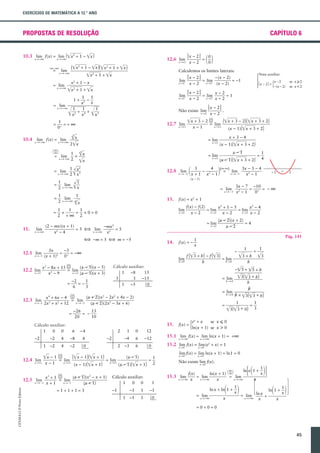
    EXERCÍCIOS DE MATEMÁTICAA 12.° ANO PROPOSTAS DE RESOLUÇÃO Capítulo 6 Pág. 136 1. Atendendo à definição de limite de uma função (de Heine) e dado que lim un = lim (1 + œn ) = +?, lim g(un) = lim g(x) = 2. nS +? 1 -5 2 6 -6 1 n =e n lim yn = lim [ 4 + ln (xn) ] = 4 + lim ln (xn) = 4 + lim ln x 1 -3 0 =4+1=5 1 5x(x - 2) 5x (x - 2) = lim lim 2 xS2 x - 5x + 6 xS2 (x - 3)(x - 2) 3 4 2 Resposta: (B) 5 5x(œx + x) lim x * = lim xS0 xS0 x-x x - x)(œx + x) (œ œ 1 2 = lim xS0 = 5x(œx + x) 5x(œx + x) = lim xS0 x - x2 x(1 - x) Como lim 5*0 =0 1 1.1 lim xS4 (x - 1)2 x2 - 2x + 1 x-1 = lim = lim =0 2 xS1 (x - 1)(x + 1) xS1 x + 1 x -1 1.3 lim aS2 (a - 2)(a + 2) a2 - 4 = lim =4 a - 2 aS2 (a - 2) 1.4 lim bS0 b(b2 - b) b3 - b 2 0 = lim = =0 2 bS0 b(3b - 1) 3b - b -1 1.5 tS -1 lim 4.1 D = {x å R: x 0 0 ‹ 1 - x > 0} x-4 x-4 1 = lim = x2 - 16 xS 4 (x - 4)(x + 4) 8 1.2 lim xS1 2 (t 2 - 1)(t 2 + 1) (t - 1)(t + 1)(t 2 + 1) t4 - 1 = lim = lim tS -1 t + 1 tS -1 t+1 t+1 = (-1 - 1)(1 + 1) = -4 1 - x2 = 0 § x = -1 › x = 1 D = ] -1, 0[ ∂ ]0, 1[ Como A ƒ D, A só pode ser ]-1, 1[ {0}. Resposta: (A) - - 1 ln(1 - x2) = 1 * ln 0 + = -? x Resposta: (C) 5. lim xS0 + ln x -? = + = -? ex - 1 0 6. (x + 2)(x3 - 2x2 + 4x - 8) x4 - 16 = lim xS -2 x3 + 8 (x + 2)(x2 - 2x + 4) -8 - 8 - 8 - 8 32 8 = ==4+4+4 12 3 Cálculo auxiliar: 1 0 0 0 -16 0 1 -2 -2 4 -8 16 -2 -2 0 1 -2 4 -8 1 -2 2x x2 2 -x 3x 3x lim lim x = xS + ? xS + ? x * 3 x 2 x x2 - x 3 3 0-0 = lim = =0 xS + ? x +? Resposta: (D) Pág. 137 2 12 7. e3x x - x e3x - x ex e lim = lim x xS + ? xS + ? 2e 2 x e2x - x e +? - 0 = lim = = +? xS + ? 2 2 2. 5 f(x) - 2 h(x) = f(x) f(x) + 2 ekx - 1 se x < 0 3x f(x) = 3x + 2 se x ≥ 0 5 + CEXMA12 © Porto Editora xS0 - ekx - 1 k ekx - 1 = lim xS0 3x 3 xS0 kx k k = *1= 3 3 - - lim f(x) = lim (3x + 2) = 2 xS0 + xS0 - xS0 + k =2 § k=6 3 ; lim f(x) = b xSa + - - 5 1 se x > -1 x2 + 1 - 1 2x se x ≤ -1 1 lim h(x) = lim - xS -1- xS -1- lim h(x) = lim xS -1 + xS -1 + 2 1 1 = 2x 2 1x 2 lim h(x) = lim h(x) = xS -1- xS -1+ 2 1 1 = +1 2 xS0 + lim f(x) = lim f(x) § 8 -8 0 lim lim 2.2 xSa f(x) = xSa (f(x) - 2) = b - 2 3.1 h(x) = lim f(x) = lim se x < a se x = a se x > a 0 4 4 2.1 xSa h(x) = xSa (f(x) + 2) = b + 2 lim lim Resposta: (A) 8. Pág. 138 1.6 xS -2 lim Resposta: (C) x 1 1 = 0, se xn = 2 , lim h(xn) = 1. n2 n Resposta: (B) 1 ln(1 - x2) x 4.2 xS1 f(x) = xS1 lim lim ex - 1 =1 x 11. lim h(x) = lim xS0 xS0 Resposta: (B) f(x) = 2 x"e Resposta: (A) 4. xS0 10. lim xn = lim 1 + 10 = -10 = -1 3. 2x x = 2 lim =2*1=2 xS0 ln(x + 1) ln(x + 1) lim Resposta: (C) xS +? Resposta: (B) 2. 9. 1 1 § lim h(x) = xS -1 2 2 Resposta: (D) 43
  • 2.
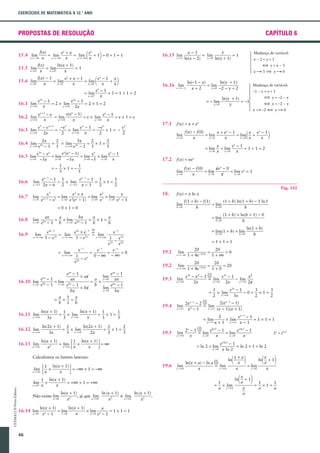
    EXERCÍCIOS DE MATEMÁTICAA 12.° ANO PROPOSTAS DE RESOLUÇÃO 3.2 i(x) = (3x + 2) * x ; x| CAPÍTULO 6 se x ≥ 0 se x < 0 5- x x lim lim 8.1 xS - ?(-x + x3) = xS - ? x3 = -? lim i(x) = lim (3x + 2) * x = (0 + 2) * (-1) = -2 -x lim i(x) = lim (3x + 2) * x = (0 + 2) * 1 = 2 x xS0 - xS0 - xS0+ xS0+ 8.2 xS + ?(-x + x2) = xS + ? x2 = +? lim lim 8.3 xS + ?(œx + x4) = +? + ? = +? lim 8.4 xS + ?(-x2 - œx ) = -? - ? = -? lim 3 8.5 xS + ?(œ-x - x2) = -? - ? = -? lim Não existe lim i(x). xS0 4. h(x) = x + 2a 2 - ax + 1 5x se x < -1 se x ≥ -1 8.6 xS - ?(x2 + œ-x ) = +? + ? = +? lim lim h(x) = lim (x + 2a) = -1 + 2a 8.7 x " + ?[(x2 + x)(2x3 + 5x)] = 1? * (1?) = 1? lim lim h(x) = lim (x2 - ax + 1) = 1 + a + 1 = a + 2 8.8 xS + ? lim lim h(x) = lim h(x) § -1 + 2a = a + 2 § a = 3 lim lim lim 8.9 x " + ?œx3 - 3x + 1 = œx " + ? (x3 - 3x + 1) = œx " +? x3 = + ? xS -1- xS -1- xS -1 + xS -1+ xS -1- 5. xS -1 + 8.10 Por exemplo: 3 3 = =0 x3 + 5x + 1 +? lim x" -? -1 œ3 - x = lim f(x) = lim xS - ? lim f(x) = lim 6.1 xS + ?[f(x) + 2] = xS + ? f(x) + 2 = 1 + 2 = 3 lim lim lim 6.2 xS0 [f(x) + g(x)] = -? + 0 = -? Pag. 139 -2 =0 x -2x2 + 5 -2x2 = lim = -2 xS + ? x2 + 3x x2 9.2 xS + ? f(x) = xS + ? lim lim xS - ? xS - ? 9.3 xS + ? f(x) = xS + ? lim lim -2x2 = -2 x2 x3 + 5x + 2 x3 = lim = lim x2 = +? xS + ? x xS + ? x-1 lim f(x) = lim x2 = +? + xS - ? g(x) g(1) 1 6.3 lim = = = -1 xS1 h(x - 1) h(0) -1 xS - ? lim lim 9.4 xS + ? f(x) = xS + ? lim 6.4 xS0 h(x) -1 = =0 f(x) -? lim 6.5 xS1 g(x) 1 = = -? f(x) 0- lim 6.6 xS0 g(x) 0= =0 f(x) +? lim f(x) = 6.7 xS0 lim f(x) -? = + = -? h(x) + 1 0 105x + 2000 105x 105 = lim =0 lim 2 2 = xS + ? xS + ? 0,3x 0,3x + 0,1 0,3x 9.5 xS + ? f(x) = xS + ? lim lim + - - + lim f(x) = lim xS - ? 7. xS - ? 105 =0 0,3x x+1 3 1 lim xS - ? x -x 3 2 (?- ?) lim lim 10.1 x " +? f(x) = x " + ?(œx + 1 - œx ) = lim g(x) = lim 1x - 2 + x - 42 = 0 CEXMA12 © Porto Editora xS2 - 1 x 1 x + 1 - - 1 = +? 44 x " 2+ 2= lim Não existe lim g(x) , já que lim g (x) 0 lim g (x) . x"2 2x - œx ? lim lim = lim 10.2 xS + ? f(x) = xS + ? xS + ? x+1 - 1 = -? x " 2- xS + ? 1 x 1+0 œx + 1 + œx x+1-x œx + 1 + œx 2- œx x 1 1+ x Œ1 = 2 - 0 = 2 x 1+ (œx + 1 - œx )(œx + 1 + œx) lim x " +? xS + ? 1x - 2 + x - 42 = 0 xS2 - = (-1)3 = -1 xS - ? = lim lim g(x) = lim 1 3 lim f(x) = lim 2 = 2 xS - ? 1 x + x-2 x-4 xS2 + 2 = (-1)3 = -1 ? xS2 + x -x xS + ? lim lim 9.6 xS + ? f(x) = xS + ? x2 = +? f(x) 1 = lim = =0 g(x) xS + ? +? g(x) = xS - ? 1 -x - 3 2 = 1 lim g(x) mx + b mx m = lim = lim lim = lim =0 6.8 xS + ? h(x) xS + ? ax2 + c xS +? ax2 xS +? ax 6.9 xS + ? lim Pag. 140 -2x + 1 -2x -2 = lim = lim =0 xS + ? x x2 + 3x xS + ? x2 9.1 xS + ? f(x) = xS + ? lim lim xS - ? -1 =0 +? = 1 =0 +?
  • 3.
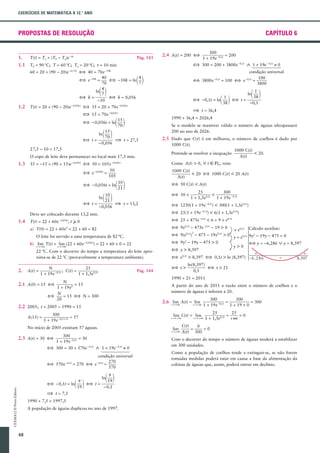
    EXERCÍCIOS DE MATEMÁTICAA 12.° ANO PROPOSTAS DE RESOLUÇÃO CAPÍTULO 6 lim lim 10.3 xS + ? f(x) = xS + ?(œx2 + 1 - œx ) (? - ?) = (œx2 + 1 - œx )(œx2 + 1 + œx ) lim x " +? xS + ? lim lim x " +? = x - 2| x-2 = lim =1 xS2 x - 2 x-2 xS2 - - œx + 1 + œx 1 1 x2 x 1 1 1 + + x2 x4 x3 Œ xS2 + Œ 3 = lim 2 œx x " +? x " +? 1 2 6 xS1 2 12.8 x " -1 lim 3 - 1x + 1 - x 3 2 x-1 2 = lim x " -1- 1 1 lim 6 2 x " +? œx 1 1 1 * = *0=0 2 +? 2 13. f(x) - f(2) x2 + 1 - 5 x2 - 4 = lim = lim xS2 xS2 x - 2 x-2 x-2 lim xS2 = lim xS2 § -m = 5 § m = -5 14. 3x -3 = = -? (x + 1)2 0 + f(x) = - (x - 2)(x + 2) =4 x-2 Pág. 141 1 x f (œ3 + h) - f (œ3) = lim lim hS0 hS0 h (x - 3)(x - 5) x2 - 8x + 15 (0) 12.2 lim = lim xS3 xS3 (x - 3)(x + 3) x2 - 9 0 Cálculo auxiliar: 1 -8 15 3 3 -15 1 -5 0 -2 1 =6 3 = lim h"0 -4 4 1 -2 12.4 xlim1 " 6 -8 4 -2 0 1 0 12 -4 6 -12 2 -3 6 0 (x + 1)(x2 - x + 1) x3 + 1 ( ) 12.5 xlim = lim " -1 x + 1 xS -1 (x + 1) =1+1+1=3 Cálculo auxiliar: 1 0 0 -1 f(x) = ex + x h * œ3(œ3 + h) œ3(œ3 + 0) = 1 3 se x ≤ 0 5ln(x + 1) se x > 0 15.1 xS + ? f(x) = xS + ?ln(x + 1) = +? lim lim lim lim 15.2 xS0 f(x) = xS0 (ex + x) = 1 - 0 (x - 1) 0 œx - 1 (=) lim (œx - 1)(œx + 1) = lim 1 = x"1 x-1 (œx + 1) x " 1 (x - 1)(œx + 1) 2 (x - 1) 0 0 CEXMA12 © Porto Editora 2 -2 œ3 h h 1 = 15. 4 1 + œ3(œ3 + h) h"0 13 -26 = 20 10 -2 œ3 + h h = lim 0 -2 1 - -œ 3 + œ3 + h (x + 2)(x3 - 2x2 + 4x - 2) x4 + 6x - 4 (0) 12.3 xS -2 3 lim = lim 2 x " -2 2x + x + 12 (x + 2)(2x2 - 3x + 6) Cálculo auxiliar: 0 0 1 3x - 7 -10 = + = -? x2 - 1 0 f(x) = x2 + 1 (2 - mx)(x + 1) -mx2 lim = 5 § lim =5 xS + ? xS +? x2 - 4 x2 = 1 4 - 6 = = (x - 1)(œx + 3 + 2) 4 3x - 3 - 4 (?-?) = lim x " -1 -1 x2 - 1 x " +? = 12.1 xS -1 lim x+3-4 (x - 1)(œx + 3 + 2) (x - 1) = 11. = lim Œx x 1 lim Œ x 1 2 = lim = xS1 3 1 œx * 2 œx = lim se x ≥ 2 se x < 2 0 0 œx + 3 - 2 (=) lim (œx + 3 - 2)(œx + 3 + 2) x"1 x-1 (x - 1)(œx + 3 + 2) lim lim 10.4 x " + ? f(x) = x " + ? œx 1 ?2 ? x-2 5-(x - 2) x - 2| . x-2 xS2 12.7 xlim1 " x - 2|= + Não existe lim 1 =+? 0+ Nota auxiliar: x - 2| -(x - 2) = lim = -1 xS2 x-2 (x - 2) 2 1+ = lim 12 Calculemos os limites laterais: œx2 + 1 + œx x2 + 1 - x = lim x - 2| 0 = x-2 0 12.6 xlim2 " 1 -1 1 1 0 xS0 + xS0 + Não existe lim f(x). xS0 31 24 = lim ln x + x 1 ? ln x 1 + x f(x) ln(x + 1) 1 ? 2 15.3 xS + ? lim = lim = lim xS + ? xS + ? x x x 1 ln x + ln 1 + -1 1 -1 - lim f(x) = lim ln(x + 1) = ln1 = 0 = lim xS + ? x 1 x 2 xS + ? 1 ln 1 + 1 x 2 x =0+0=0 45
  • 4.
    EXERCÍCIOS DE MATEMÁTICAA 12.° ANO PROPOSTAS DE RESOLUÇÃO 15.4 xS - ? lim CAPÍTULO 6 f(x) ex + x ex = lim = lim +1 =0+1=1 xS - ? xS -? x x x 1 2 y x-3 = lim =1 yS0 ln(y + 1) ln(x - 2) 16.15 lim xS3 Mudança de variável: x-2=y+1 f(x) ln(x + 1) 15.5 xS0 lim = lim =1 xS0 x x + lim 15.6 xS0 - § y=x-3 x"3± y"0 + f(x) - 1 ex + x - 1 ex - 1 x = lim = lim + xS0 xS0 x x x x - - = lim xS0 - 1 2 e -1 +1=1+1=2 x x 16.1 xlim0 " e(ex - 1) ex+1 - e ex - 1 = lim = e * lim =e*1=e x"0 x"0 x x x 16.3 xlim0 " e3 - e x+3 -e3 ex - 1 e3 -e3 = * lim *1= = x"0 x 2x 2 2 2 ln(-1 - x) ln(y + 1) = lim yS0 -2 - y + 2 x+2 e2x - 1 e2x - 1 = 2 * lim =2*1=2 x"0 x 2x 16.2 xlim0 " 16.16 xlim " -2 16.4 xlim0 " yS0 16.6 16.7 17.1 1 = lim xS0 17.2 xS0 f(x) - f(0) xex - 0 = lim = lim ex = 1 xS0 xS0 x x 18. f(x) = x ln x lim hS0 f(1 + h) - f(1) (1 + h) ln(1 + h) - 1 ln 1 = lim hS0 h h = lim ax a bx a a = * lim = *1= e - 1 b xS0 ebx - 1 b b hS0 bx xS0 ? 16.9 lim x " +? hS0 19.1 19.2 lim 20 20 =0 = 1 + 4e -0,1x 1 + ? lim 20 20 = 20 = 1 + 4e -0,1x 1 + 0 xS - ? xS + ? lim e3x - x2 - 1 (0) e3x - 1 x2 = lim - lim x"0 x " 0 2x 2x 2x x"0 = 3 e3x - 1 3 3 * lim -0= *1= 2 x " 0 3x 2 2 2(ex-1 - 1) 2ex-1 - 2 (0) = lim 2 x " 1 (x - 1)(x + 1) x -1 0 19.4 lim x"1 = lim x"1 4 lim x"0 2 ex-1 - 1 * lim =1*1=1 x + 1 x"1 x - 1 2x - 1 (0) eln 2 - 1 ex ln 2 - 1 = lim = lim xS0 xS0 x x x 0 19.5 ln(x + 1) 1 ln(x + 1) =? = lim * x"0 x x x2 3 x = ln 2 * lim xS0 Calculemos os limites laterais: 1 ln(x + 1) * = -? * 1 = -? x x lim 3 lim 1 ln(x + 1) * = +? * 1 = +? x x CEXMA12 © Porto Editora xS0 + 4 Não existe lim xS0 16.14 lim xS0 46 19.6 ln(x + 1) ln (x + 1) ln (x + 1) 0 lim , já que lim . x"0 x"0 x2 x2 x2 + ln(x + 1) ln(x + 1) x = lim * lim x =1*1=1 xS0 xS0 e - 1 x ex - 1 - 2x = eln 2 ex ln 2 - 1 = ln 2 * 1 = ln 2 x ln 2 ln(x + a) - ln a (0) lim = lim x"0 x"0 x 0 x " 0- ln(1 + h) h 0 19.3 ln(2x + 1) 2 ln(2x + 1) 2 2 = * lim = *1= 3x 3 x"0 2x 3 3 16.13 xlim0 " hS0 =1*1=1 ln(x + 1) 1 ln(x + 1) 1 1 = * lim = *1= x 3x 3 x"0 3 3 16.12 xlim0 " (1 + h) * ln(h + 1) - 0 h = lim(1 + h) * lim e2x -1 e2x * e -1 ? e -1 = lim = lim 3x x " +? 1 - e3x x " +? 1 1-e e3x e2x e2x e -1 e -1 e -1 = = lim = =0 x " +? 1 0-? -? - ex e2x eax - 1 eax - 1 * ax lim eax - 1 ax a xS0 ax 16.10 lim bx = lim = * xS0 e - 1 xS0 ebx - 1 b ebx - 1 * bx lim xS0 bx bx a 1 a = * = b 1 b 16.11 xlim0 " x e -1 + lim =1+1=2 x xS0 x Pág. 142 x3 x2 * x x2 x = lim lim x +3 = lim * lim xS0 e - e3 xS0 e3(ex - 1) xS0 e3 xS0 ex - 1 lim 2 x f(x) = xex lim =0*1=0 16.8 f(x) - f(0) x + ex - 1 x ex - 1 = lim = lim + xS0 xS0 x x x x x ex-3 - 1 1 ex-3 - 1 1 1 = * lim = *1= 2x - 6 2 x"3 x - 3 2 2 lim § x = -2 - y f(x) = x + ex xS0 2x 2 5x 2 2 = * lim 5x = *1= x"0 e e -1 5 -1 5 5 x"3 § y = -2 - x x " -2 § y " 0 lim ex(ex - 1) e -e ex ex - 1 = lim 16.5 lim = lim * lim xS0 -5x xS0 xS0 -5 xS0 x -5x 1 1 =- *1=5 5 -1 - x = y + 1 ln(y + 1) = -1 y = - lim 5x 2x Mudança de variável: 1 ln 1 = * lim a x"0 x+a x ln + 1 a a = lim xS0 x x 2 1 a + 12 ln 1 2 x x a = 1 1 *1= a a x
  • 5.
    EXERCÍCIOS DE MATEMÁTICAA 12.° ANO PROPOSTAS DE RESOLUÇÃO CAPÍTULO 6 ln(x + 3) (0 ) ln(x + 3) lim = lim xS -2 2x2 + 3x - 2 xS -2 (x + 2)(2x - 1) Cálculo auxiliar: 0 19.7 = lim xS -2 19.8 19.9 -2 -4 0 -2 y+1=x+3 § y=x+2 § x= y-2 1 1 *1=5 5 ln(3x + 1) Mudança de variável: y=x-1 œx + 9 - 3 xS + ? ln(3x + 1) = lim(œx + 9 + 3) * lim xS0 xS0 x + 9 - 9 24 = +? * (+? - 1) = +? -1 = 2 + 2 * lim 2 ln x =2+2*0=2 x 31 lim lim = 19.20 xS + ?(3x - 2 ln x) (?- ?) xS + ? x 3 - 2 ln x x 24 1porque = +? * (3 - 0) = +? (0*?) lim 19.22 xS0 x ln x = lim e -y(-y) Mudança de variável: y = -ln x y 1 = - lim y yS + ? e ey y = - lim 1 ==0 +? ln(x + 1) log2(x + 1) ln(x + 1) ln 2 1 19.11 xlim0 = lim = * lim " x"0 x x x ln 2 x " 0 = 1 1 *1= ln 2 ln 2 ( ] (?- ?) = § -y = ln x § x = e-y x " 0+ ± y " +? 3 1 lim n * 1 - n " +? ln(n) n 24 = +? * (1 - 0) = +? 1 (?* ?) lim (2n + 1) * nS + ? 1 en - 1 * n 1 n 2n + 1 en - 1 * lim nS + ? nS + ? n 1 n 2n 1 = lim *1 se n S +?, S 0 n nS + ? n 1 ln(x + 1) 1 = lim * lim 1 x"0 x"0 x 1 - ex - 1 1 = =1 1 - e-? 1 - 0 =1* [ lim n - ln(n) n " +? 1 ) - 20.1 lim 20.2 nS + ?(2n + 1)(en - 1) = ln(x + 1) (0) ln(x + 1) 0 = xlim 1 1 "0 x - ex x x 1 - ex - yS + ? 2 ln x =0 x ln x 1+0 x = =1 1+0 1 1+ x yS + ? + lim xS + ? 1+ x + ln x 19.21 xS + ? lim = lim xS + ? x+1 = 6 * 3 * 1 = 18 - 5 1 ln(3x + 1) ln(3x + 1) = 6 * lim = 6 * 3 * lim x"0 x"0 x 3x 19.12 xlim "0 2x x " -? ± y " +? 2x 2 ln x 2x + ln x2 = lim + xS + ? x x x § x=y+1 (œx + 9 - 3)(œx + 9 + 3) xS0 lim 19.19 xS + ? 3 1x lim x5 x"1±y"0 ln(3x + 1) * (œx + 9 + 3) = lim y = -x § x = -y x " +? =2*1=2 19.10 lim xS0 (?-?) lim 19.18 xS + ?(2x - x5) = x " -2 ± y " 0 x-1 x-1 x-1 = lim = lim = 1 lnœx xS1 ln x 2 xS1 1 ln x 2 x-1 = 2 * lim x " 1 ln x y = 2 * lim y " 0 ln(y + 1) xS1 Mudança de variável: lim (-y)2e -y yS + ? y2 1 = lim y = lim y yS + ? e yS + ? e y2 1 =0 = +? Mudança de variável: ln(x + 1) + 2x ln(x + 1) 2x lim = lim + lim =1+2=3 xS0 xS0 xS0 x x x lim lim 19.17 xS - ? x2ex = 2 2 -1 ln(x + 3) 1 * lim 2x - 1 xS -2 x + 2 ln(y + 1) 1 * lim = y -5 yS0 =- (?*0) 3 2 = lim 1 2 x e +x ex + x3 x2 +? 19.13 xS + ? 2 lim = lim = = +? x + 1 xS +? 1+0 1 1+ 2 x =2*1=2 1 1 ln(n) lnœn (? ) ln n 2 2 ? lim = lim = lim 20.3 nS + ? nS + ? nS + ? n n n ln(n) 1 1 = * lim = *0=0 2 n " +? n 2 ( ) e -x x3 1 1 19.14 xS + ? -3 = xS + ? x = xS +? x = lim lim lim =0 x e +? e 3 x 2 (0*?) 19.15 xS0 x3 * e x = lim lim 1y2 yS +? + 2 3 * ey 8 * ey y3 ey = 8 * lim 3 yS +? y = lim yS +? Mudança de variável: 2 2 y= § x= x y x " 0+ ± y " +? CEXMA12 © Porto Editora = 8 * (+?) = +? 2n *2-1 ? 2n +1 - 3n (? ) 2n * 2 - 3n 3n lim lim n lim 20.4 nS + ? n +1 n = nS + ? n = nS + ? 3 +2 3 *3+2 2n 3+ n 3 2 n *2-1 3 0*2-1 1 = lim = =nS + ? 3+0 3 2 n 3+ 3 12 12 x5 1 1 = lim x = lim x = =0 xS +? e xS +? e +? x5 5 -x (? *0) lim 19.16 xS + ? x e 47
  • 6.
    EXERCÍCIOS DE MATEMÁTICAA 12.° ANO PROPOSTAS DE RESOLUÇÃO CAPÍTULO 6 1. T(t) = Ta + (T0 - Ta)e -kt 1.1 2.4 A(t) = 200 § T0 = 90 8C; T = 60 8C; Ta = 20 8C; t = 10 min Pág. 143 § 300 = 200 + 3800e -0,1t ‹ twwuwwv 1 + 19e- 0,1t 0 0 condição universal 100 § 3800e -0,1t = 100 § e -0,1t = 3800 60 = 20 + (90 - 20)e -k *10 § 40 = 70e -10k 40 4 § e -10k = § -10k = ln 70 7 4 ln 7 § k= § k ) 0,056 -10 12 12 1.2 T(t) = 20 + (90 - 20)e -0,056 t § 35 = 20 + 70e 1 2 1 2 27,5 - 10 = 17,5 1990 + 36,4 = 2026,4 Se o modelo se mantiver válido o número de águias ultrapassará 200 no ano de 2026. 2.5 Dado que C(t) é em milhares, o número de coelhos é dado por 1000 C(t). 1000 C(t) < 20. A(t) 1 21 2 10 § 50 C(t) < A(t) 1 2 § 50 * 25 300 < 1 + 1,5e0,1t 1 + 19e -0,1t § 1250(1 + 19e -0,1t) < 300(1 + 1,5e0,1t) § 25(1 + 19e -0,1t) < 6(1 + 1,5e0,1t) T(t) = 22 + 60e -0,056t, t ≥ 0 § 25 + 475e -0,1t < 6 + 9 * e0,1t a) T(0) = 22 + 60e0 = 22 + 60 = 82 § 9e0,1t - 475e -0,1t - 19 > 0 2 § 9(e0,1t) - 475 - 19e0,1t > 0 O leite foi servido a uma temperatura de 82 °C. § 9y - 19y - 475 > 0 2 b) lim T(t) = lim (22 + 60e -0,056 t) = 22 + 60 * 0 = 22 tS + ? tS + ? 22 8C. Com o decorrer do tempo a temperatura do leite aproxima-se de 22 8C (provavelmente a temperatura ambiente). 2. A(t) = N 25 ; C(t) = 1 + 19e -0,1t 1 + 1,5e0,1t Pág. 144 lim tS + ? 300 = 30 1 + 19e -0,1t - 0,1t -0,1t 1 2 § t= CEXMA12 © Porto Editora ln(8,397) § t > 21 0,1 lim C(t) = lim ‹ 1 + 19e 00 twwuwwv condição universal 270 § 570e -0,1t = 270 § e -0,1t = 570 1192 ln 9 -0,1 ± t ) 7,5 1990 + 7,5 = 1997,5 A população de águias duplicou no ano de 1997. 48 § t> t " +? No início de 2005 existiam 57 águias. 9 § -0,1t = ln 19 2 y = e0,1t 9y - 19y - 475 = 0 § y ) -6,286 › y ) 8,397 y>0 § e0,1t > 8,397 § 0,1t > ln (8,397) 2.6 tS + ? A(t) = tS + ? lim lim 300 ) 57 1 + 19e -0,1*15 § 300 = 30 + 570e Cálculo auxiliar: A partir do ano de 2011 a razão entre o número de coelhos e o número de águias é inferior a 20. 2.2 2005; t = 2005 - 1990 = 15 2.3 A(t) = 30 § § y > 8,397 * e0,1t 1990 + 21 = 2011 N = 15 1 + 19e0 N § = 15 § N = 300 20 2.1 A(0) = 15 § A(15) = ! !! Deve ser colocado durante 13,2 min. 1.4 -0,1 1000 C(t) < 20 § 1000 C(t) < 20 A(t) A(t) 10 21 § t= ± t ) 13,2 -0,056 ln 1 + Como A(t) > 0, A t å R0 , vem: 35 = -15 + (90 + 15)e -0,056 t § 50 = 105e -0,056 t 50 § e -0,056t = 105 § -0,056t = ln 1 38 2 ln ± t ) 36,4 Pretende-se resolver a inequação O copo de leite deve permanecer no local mais 17,5 min. 1.3 1 2 § t= 1 § -0,1t = ln 38 -0,056 t § 15 = 70e -0,056 t 15 § -0,056t = ln 70 15 ln 70 § t= ± t ) 27,5 -0,056 300 = 200 1 + 19e -0,1t 300 300 = = 300 1 + 19e -0,1t 1 + 19 * 0 t " +? 25 25 = =0 1 + 1,5e0,1t +? C(t) 0 = =0 A(t) 300 Com o decorrer do tempo o número de águias tenderá a estabilizar em 300 unidades. Como a população de coelhos tende a extinguir-se, se não forem tomadas medidas poderá estar em causa a base da alimentação da colónia de águias que, assim, poderá entrar em declínio.