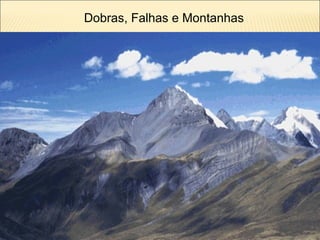
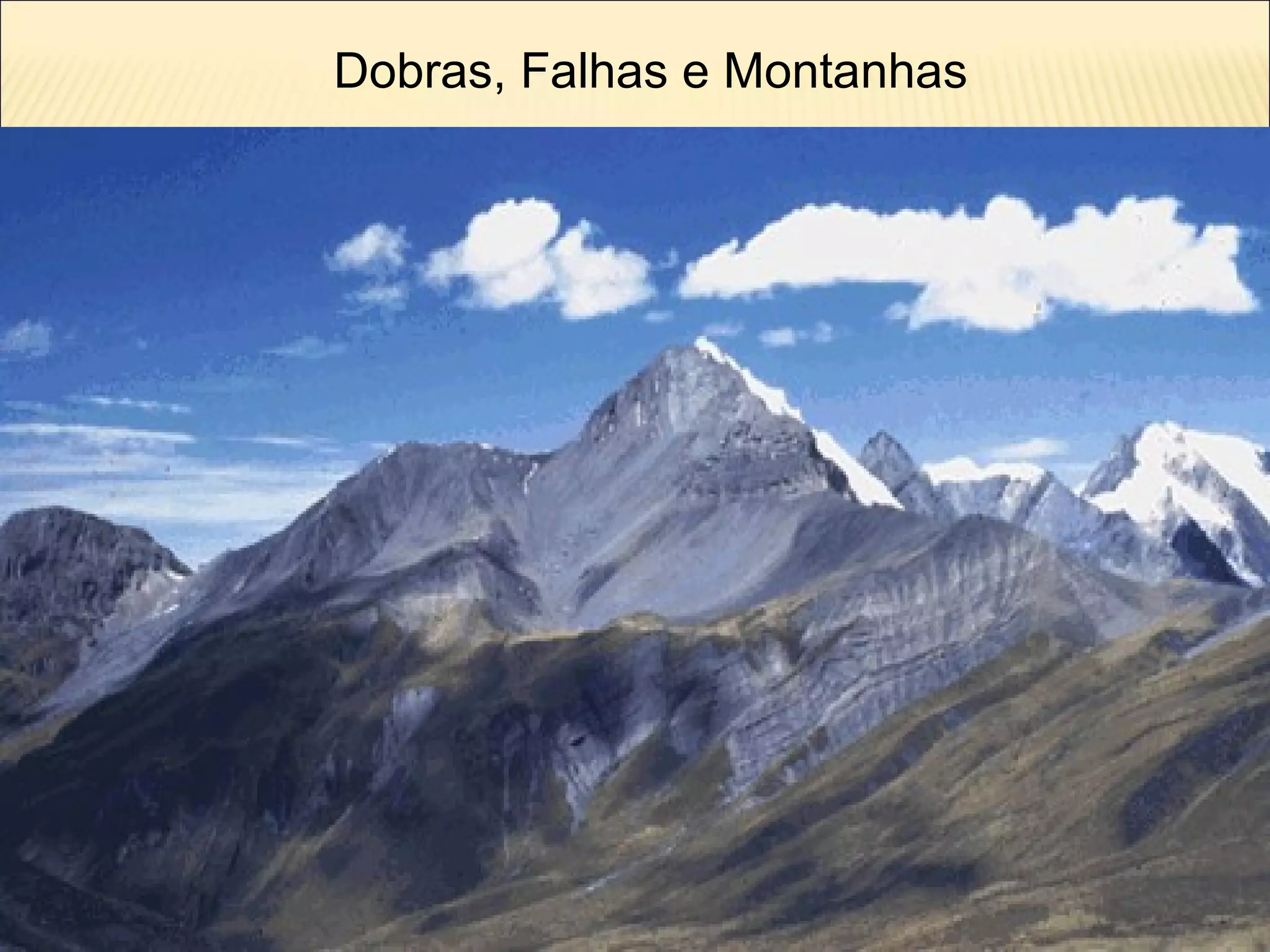
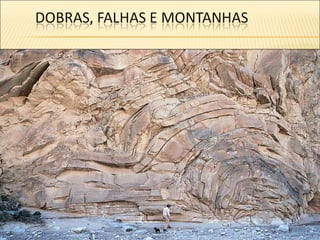
Dobras, Falhas e Montanhas
   Enormes cadeias de montanhas se formam
    quando placas convergem.

   Rochas Contorcidas mostram a força da
    tectônica de placas.
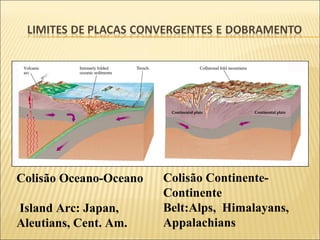
Colisão Oceano-Oceano   Colisão Continente-
                        Continente
Island Arc: Japan,      Belt:Alps, Himalayans,
Aleutians, Cent. Am.    Appalachians
   Camadas inicialmente horizontais são
    dobradas, quebradas e deslocadas.
   Muitas rochas dobradas são colocadas lado
    a lado ou uma sobre as outras.
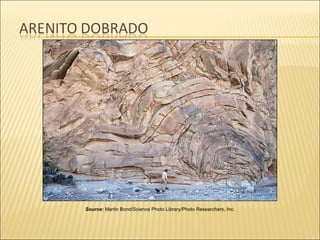
Source: Martin Bond/Science Photo Library/Photo Researchers, Inc.
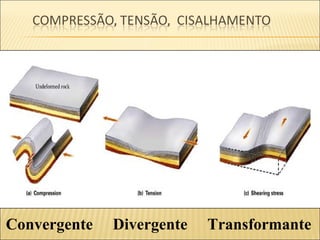
Convergente   Divergente   Transformante
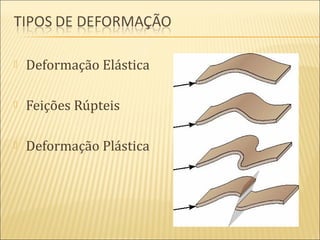
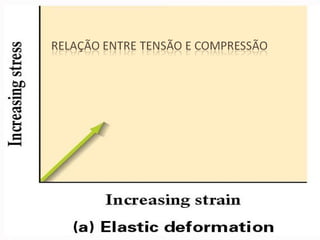
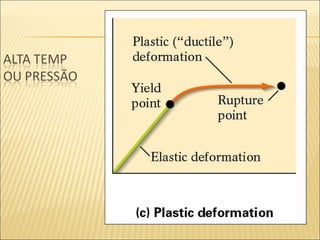
   Deformação Elástica

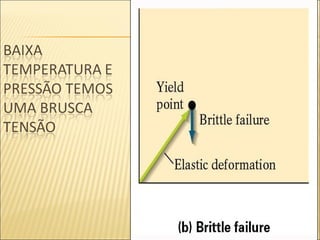
   Feições Rúpteis

   Deformação Plástica
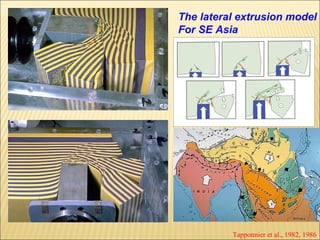
The lateral extrusion model
For SE Asia


          Tapponnier et al., 1982, 1986
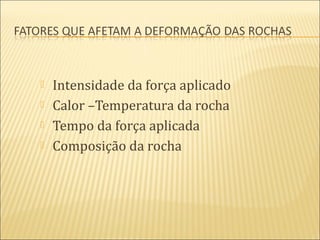
   Intensidade da força aplicado
   Calor –Temperatura da rocha
   Tempo da força aplicada
   Composição da rocha
   Mais efetiva em rochas sedimentares
   Importância da deformação
       Indica o passado do movimento das placas
       Indica antigos eventos geológicos
       Localização de recursos naturais
   O MAIS IMPORTANTE
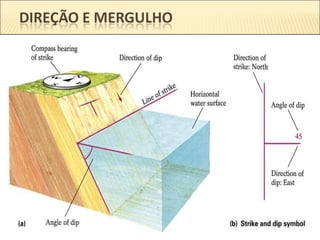
   Mapeamento
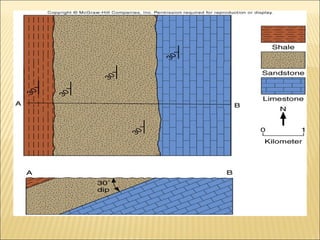
   : Orientação das rochas: direção e mergulho
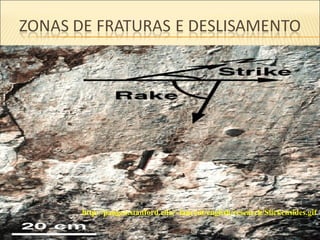
http://pangea.stanford.edu/~laurent/english/research/Slickensides.gif
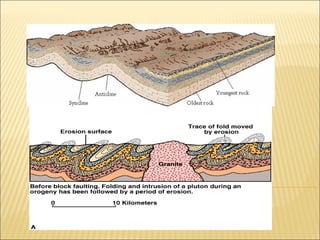
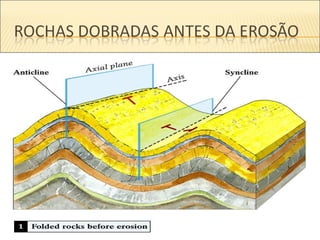
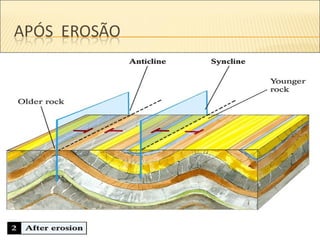
 Dobras definição: Curvaturas em camadas de rochas
 Tipos: sinclinais e anticlinais
  Sinclinal (dobrada para baixo) Parte mais interna são
  rochas mais jovens
  Anticlinal (Dobrada para cima) Parte mais interna
  dado por rochas mais antigas
Partes de uma dobras (Flacos, Plano axial, Eixo)

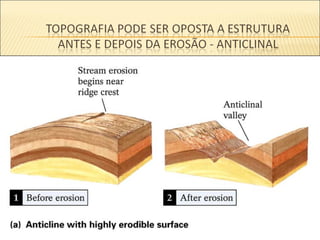
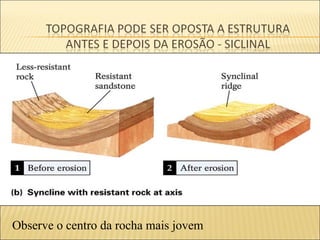
    Nota: Anticlinais e sinclinais são estruturas em
          rochas e não superfícies da paisagem
Source: Breck P. Kent

Anticlinais e Sinclinais
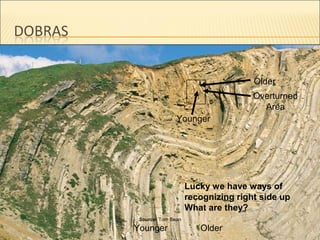
Older
                                    Overturned
                                      Area
               Younger


                    Lucky we have ways of
                    recognizing right side up
                    What are they?
 Source: Tom Bean

Younger                Older
Observe o centro da rocha mais jovem
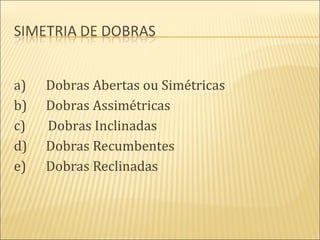
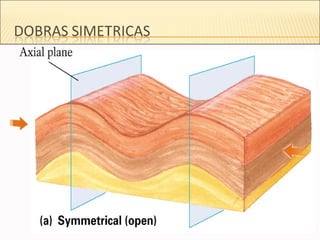
a)   Dobras Abertas ou Simétricas
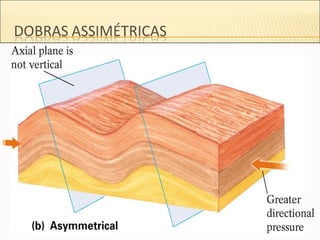
b)   Dobras Assimétricas
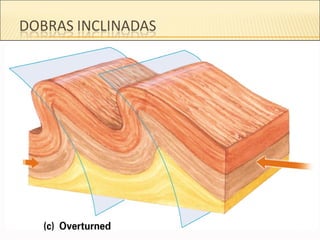
c)   Dobras Inclinadas
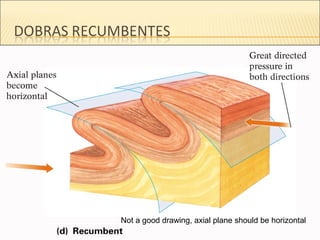
d)   Dobras Recumbentes
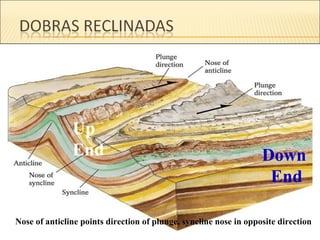
e)   Dobras Reclinadas
Not a good drawing, axial plane should be horizontal
Up
               End                                                 Down
                                                                    End

Nose of anticline points direction of plunge, syncline nose in opposite direction
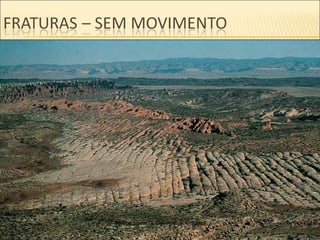
- Juntas: fraturas SEM movimento relativo
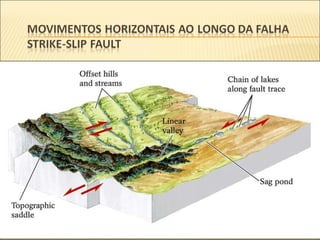
- Falhas: fraturas com movimento relativo
Source: Martin G. Miller/Visuals Unlimited
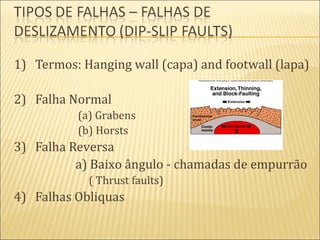
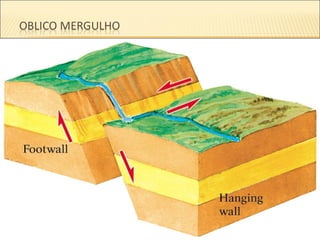
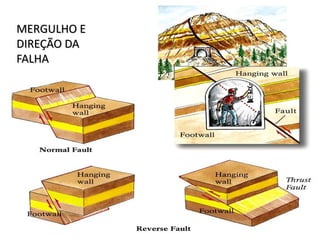
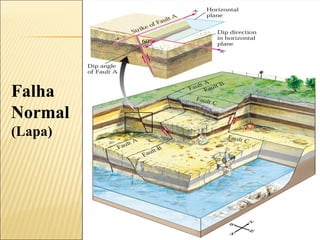
1) Termos: Hanging wall (capa) and footwall (lapa)

2) Falha Normal
          (a) Grabens
          (b) Horsts
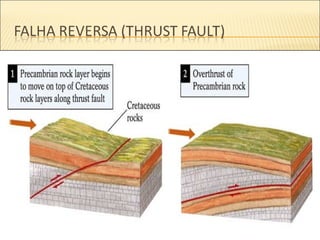
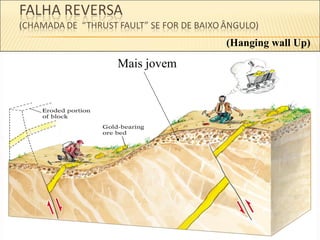
3) Falha Reversa
          a) Baixo ângulo - chamadas de empurrão
            ( Thrust faults)
4) Falhas Obliquas
MERGULHO E
DIREÇÃO DA
FALHA
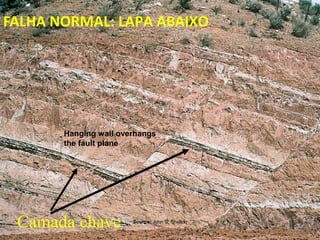
FALHA NORMAL: LAPA ABAIXO


       Hanging wall overhangs
       the fault plane


 Camada chave          Source: John S. Shelton
Falha
Normal
(Lapa)
(Hanging wall Up)
Mais jovem
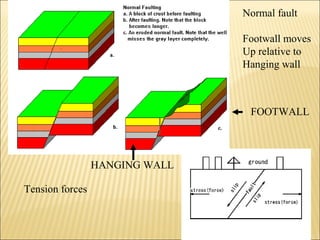
Normal fault

                                Footwall moves
                                Up relative to
                                Hanging wall


                                 FOOTWALL


                 HANGING WALL

Tension forces
a) Deslocamento visivel das rochas
b) Rochas Pulverizadas e “Slickensides”

c) Camadas-chaves cortadas por falhas
   reaparecem em qualquer lugar
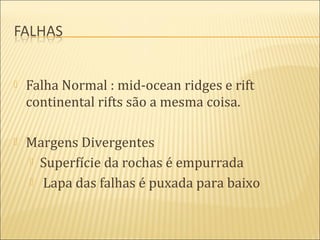
   Falha Normal : mid-ocean ridges e rift
    continental rifts são a mesma coisa.

   Margens Divergentes
     Superfície da rochas é empurrada

     Lapa das falhas é puxada para baixo
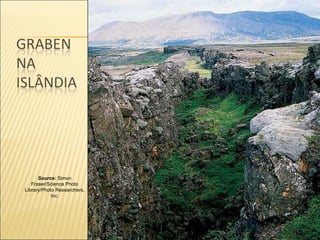
Source: Simon
   Fraser/Science Photo
Library/Photo Researchers,
            Inc.
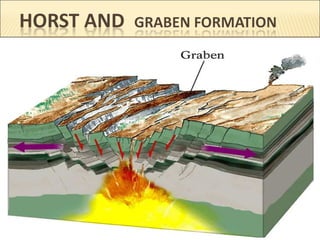
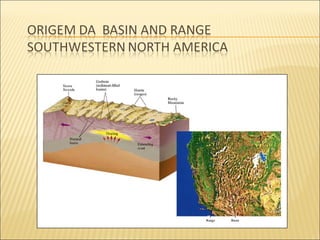
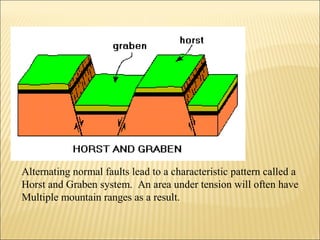
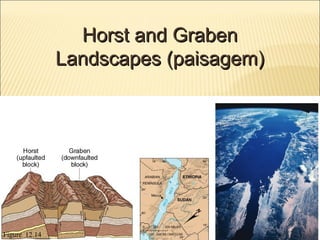
Alternating normal faults lead to a characteristic pattern called a
Horst and Graben system. An area under tension will often have
Multiple mountain ranges as a result.
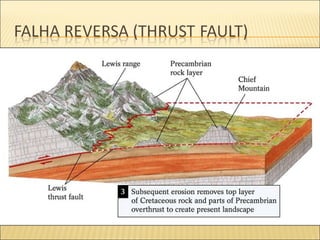
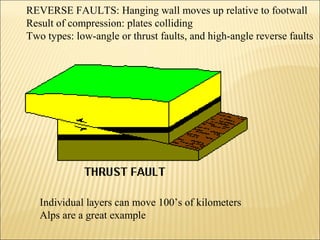
REVERSE FAULTS: Hanging wall moves up relative to footwall
Result of compression: plates colliding
Two types: low-angle or thrust faults, and high-angle reverse faults


   Individual layers can move 100’s of kilometers
   Alps are a great example
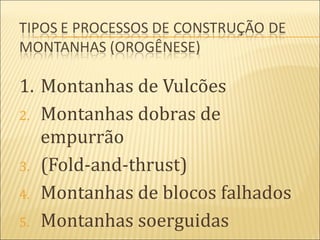
1. Montanhas de Vulcões
2. Montanhas dobras de
   empurrão
3. (Fold-and-thrust)

4. Montanhas de blocos falhados

5. Montanhas soerguidas
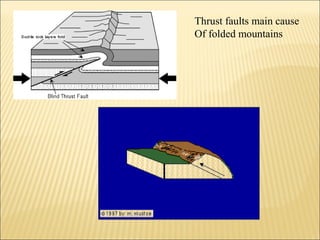
Thrust faults main cause
Of folded mountains
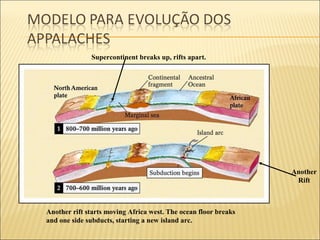
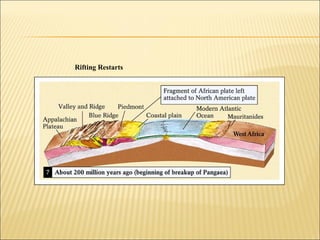
Supercontinent breaks up, rifts apart.


                                                                 Another
                                                                  Rift


Another rift starts moving Africa west. The ocean floor breaks
and one side subducts, starting a new island arc.
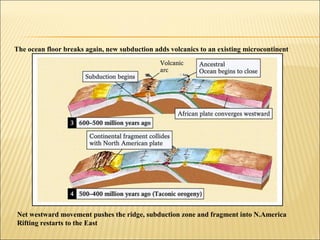
The ocean floor breaks again, new subduction adds volcanics to an existing microcontinent


Net westward movement pushes the ridge, subduction zone and fragment into N.America
Rifting restarts to the East
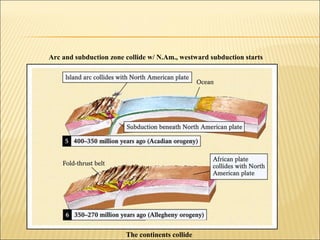
Arc and subduction zone collide w/ N.Am., westward subduction starts


                        The continents collide
Rifting Restarts
Source: Peter French/DRK Photo
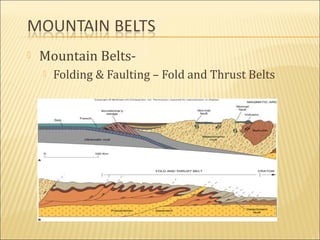
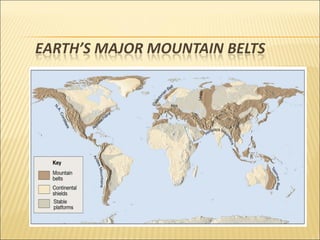
   Mountain Belts-
       Folding & Faulting – Fold and Thrust Belts
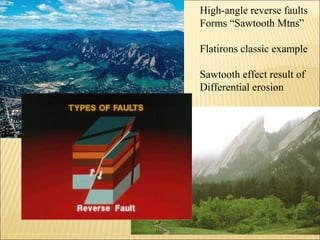
High-angle reverse faults
Forms “Sawtooth Mtns”

Flatirons classic example

Sawtooth effect result of
Differential erosion
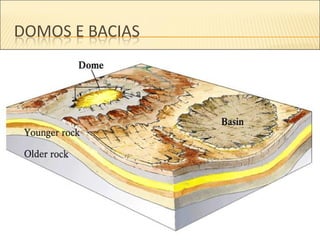
Horst and Graben
               Landscapes (paisagem)


Figure 12.14
Deformação
Dobramento e falhas de empurrão
  Metamorfismo
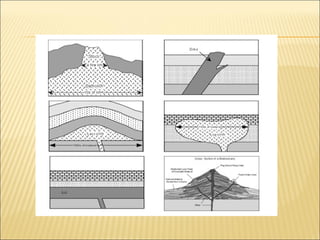
Intrusões : batólitos etc
Atividade Vulcânica
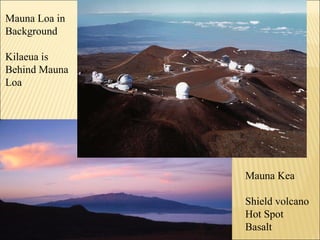
Mauna Loa in
Background

Kilaeua is
Behind Mauna
Loa


               Mauna Kea

               Shield volcano
               Hot Spot
               Basalt
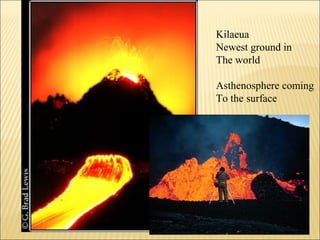
Kilaeua
Newest ground in
The world

Asthenosphere coming
To the surface
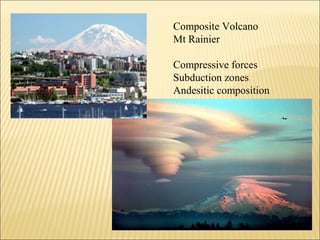
Composite Volcano
Mt Rainier

Compressive forces
Subduction zones
Andesitic composition
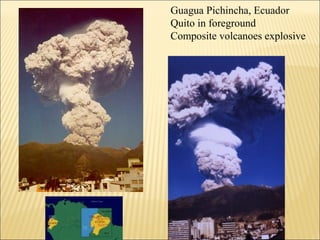
Guagua Pichincha, Ecuador
Quito in foreground
Composite volcanoes explosive
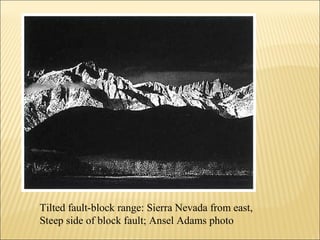
Tilted fault-block range: Sierra Nevada from east,
Steep side of block fault; Ansel Adams photo
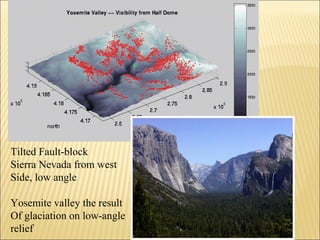
Tilted Fault-block
Sierra Nevada from west
Side, low angle

Yosemite valley the result
Of glaciation on low-angle
relief
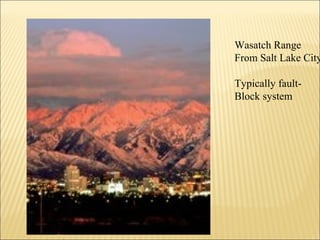
Wasatch Range
From Salt Lake City

Typically fault-
Block system
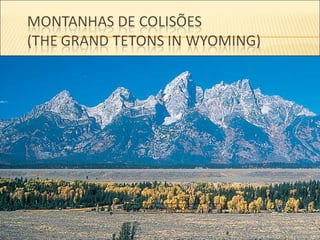
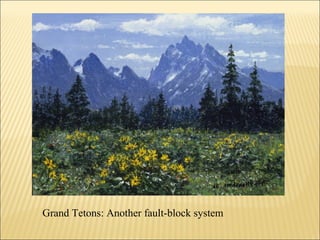
Grand Tetons: Another fault-block system
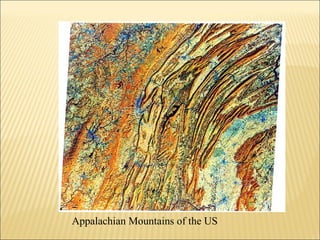
Appalachian Mountains of the US
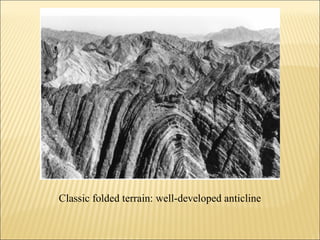
Classic folded terrain: well-developed anticline

Dobras falhas montanhas 2

  • 1.
  • 4.
    Enormes cadeias de montanhas se formam quando placas convergem.  Rochas Contorcidas mostram a força da tectônica de placas.
  • 5.
    Colisão Oceano-Oceano Colisão Continente- Continente Island Arc: Japan, Belt:Alps, Himalayans, Aleutians, Cent. Am. Appalachians
  • 6.
    Camadas inicialmente horizontais são dobradas, quebradas e deslocadas.  Muitas rochas dobradas são colocadas lado a lado ou uma sobre as outras.
  • 7.
    Source: Martin Bond/SciencePhoto Library/Photo Researchers, Inc.
  • 8.
    Convergente Divergente Transformante
  • 9.
    Deformação Elástica  Feições Rúpteis  Deformação Plástica
  • 13.
    The lateral extrusionmodel For SE Asia Tapponnier et al., 1982, 1986
  • 14.
    Intensidade da força aplicado  Calor –Temperatura da rocha  Tempo da força aplicada  Composição da rocha
  • 15.
    Mais efetiva em rochas sedimentares  Importância da deformação  Indica o passado do movimento das placas  Indica antigos eventos geológicos  Localização de recursos naturais  O MAIS IMPORTANTE  Mapeamento  : Orientação das rochas: direção e mergulho
  • 17.
  • 18.
     Dobras definição:Curvaturas em camadas de rochas  Tipos: sinclinais e anticlinais Sinclinal (dobrada para baixo) Parte mais interna são rochas mais jovens Anticlinal (Dobrada para cima) Parte mais interna dado por rochas mais antigas Partes de uma dobras (Flacos, Plano axial, Eixo) Nota: Anticlinais e sinclinais são estruturas em rochas e não superfícies da paisagem
  • 19.
    Source: Breck P.Kent Anticlinais e Sinclinais
  • 20.
    Older Overturned Area Younger Lucky we have ways of recognizing right side up What are they? Source: Tom Bean Younger Older
  • 24.
    Observe o centroda rocha mais jovem
  • 25.
    a) Dobras Abertas ou Simétricas b) Dobras Assimétricas c) Dobras Inclinadas d) Dobras Recumbentes e) Dobras Reclinadas
  • 29.
    Not a gooddrawing, axial plane should be horizontal
  • 30.
    Up End Down End Nose of anticline points direction of plunge, syncline nose in opposite direction
  • 32.
    - Juntas: fraturasSEM movimento relativo - Falhas: fraturas com movimento relativo
  • 33.
    Source: Martin G.Miller/Visuals Unlimited
  • 34.
    1) Termos: Hangingwall (capa) and footwall (lapa) 2) Falha Normal (a) Grabens (b) Horsts 3) Falha Reversa a) Baixo ângulo - chamadas de empurrão ( Thrust faults) 4) Falhas Obliquas
  • 35.
  • 36.
    FALHA NORMAL: LAPAABAIXO Hanging wall overhangs the fault plane Camada chave Source: John S. Shelton
  • 37.
  • 38.
  • 41.
    Normal fault Footwall moves Up relative to Hanging wall FOOTWALL HANGING WALL Tension forces
  • 44.
    a) Deslocamento visiveldas rochas b) Rochas Pulverizadas e “Slickensides” c) Camadas-chaves cortadas por falhas reaparecem em qualquer lugar
  • 46.
    Falha Normal : mid-ocean ridges e rift continental rifts são a mesma coisa.  Margens Divergentes  Superfície da rochas é empurrada  Lapa das falhas é puxada para baixo
  • 48.
    Source: Simon Fraser/Science Photo Library/Photo Researchers, Inc.
  • 51.
    Alternating normal faultslead to a characteristic pattern called a Horst and Graben system. An area under tension will often have Multiple mountain ranges as a result.
  • 52.
    REVERSE FAULTS: Hangingwall moves up relative to footwall Result of compression: plates colliding Two types: low-angle or thrust faults, and high-angle reverse faults Individual layers can move 100’s of kilometers Alps are a great example
  • 54.
    1. Montanhas deVulcões 2. Montanhas dobras de empurrão 3. (Fold-and-thrust) 4. Montanhas de blocos falhados 5. Montanhas soerguidas
  • 55.
    Thrust faults maincause Of folded mountains
  • 56.
    Supercontinent breaks up,rifts apart. Another Rift Another rift starts moving Africa west. The ocean floor breaks and one side subducts, starting a new island arc.
  • 57.
    The ocean floorbreaks again, new subduction adds volcanics to an existing microcontinent Net westward movement pushes the ridge, subduction zone and fragment into N.America Rifting restarts to the East
  • 58.
    Arc and subductionzone collide w/ N.Am., westward subduction starts The continents collide
  • 59.
  • 60.
  • 61.
    Mountain Belts-  Folding & Faulting – Fold and Thrust Belts
  • 62.
    High-angle reverse faults Forms“Sawtooth Mtns” Flatirons classic example Sawtooth effect result of Differential erosion
  • 63.
    Horst and Graben Landscapes (paisagem) Figure 12.14
  • 64.
    Deformação Dobramento e falhasde empurrão Metamorfismo Intrusões : batólitos etc Atividade Vulcânica
  • 65.
    Mauna Loa in Background Kilaeuais Behind Mauna Loa Mauna Kea Shield volcano Hot Spot Basalt
  • 67.
    Kilaeua Newest ground in Theworld Asthenosphere coming To the surface
  • 68.
    Composite Volcano Mt Rainier Compressiveforces Subduction zones Andesitic composition
  • 69.
    Guagua Pichincha, Ecuador Quitoin foreground Composite volcanoes explosive
  • 70.
    Tilted fault-block range:Sierra Nevada from east, Steep side of block fault; Ansel Adams photo
  • 71.
    Tilted Fault-block Sierra Nevadafrom west Side, low angle Yosemite valley the result Of glaciation on low-angle relief
  • 72.
    Wasatch Range From SaltLake City Typically fault- Block system
  • 73.
    Grand Tetons: Anotherfault-block system
  • 74.
  • 75.
    Classic folded terrain:well-developed anticline