Acute Kidney Injury André Lopes  R2 – Clínica Médica EPM UTI / PS - HSP
“ Azotemia and oliguria represent not only disease but normal responses of the kidney  to extracellular volume depletion or decreased renal blood flow” Crit Care Med 2008 Vol. 36, No. 4 (Suppl.)
RIFLE criteria Time for consensus   Intensive Care Med  2001 Acute renal failure. The Second International Consensus Conference of the AcuteDialysis Quality Initiative (ADQI) Group.  Crit Care  2004 Necessidade : - Definir critérios diagnósticos - Injúria com alto VPP de mortaildade - Classificação em severidade
Crit Care Med 2008 Vol. 36, No. 4 (Suppl.)
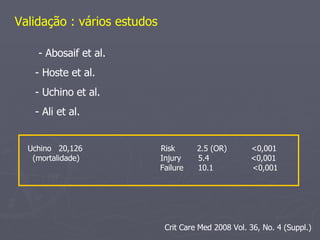
  - Abosaif et al. - Hoste et al. - Uchino et al. - Ali et al. Uchino  20,126  Risk  2.5 (OR)  <0,001 (mortalidade)  Injury  5.4  <0,001 Failure  10.1  <0,001 Validação : vários estudos Crit Care Med 2008 Vol. 36, No. 4 (Suppl.)
Ostermann and Chang - 41.972 pacientes admitidos em UTI na Alemanha e Inglaterra - 10 anos de seguimento - Injúria Renal Aguda : 15.019 pacientes – 35,8 %   R 17,2 % 20,9 %   I 11,0 % 45,6 %   F  7,6 % 56,8 % - Mortalidade sem AKI : 8,4 % - Terapia de substituição renal : não se mostrou fator independente de mortalidade Ostermann M, Chang RW:  Acute kidney injury in the intensive care unit according to RIFLE. Crit Care Med 2007 ; 35:1837–1843
Crit Care Med 2008 Vol. 36, No. 4 (Suppl.)
Crit Care Med 2008 Vol. 36, No. 4 (Suppl.) - Aproximadamente 60 – 70 % dos pacientes admitidos em UTI apresentam AKI seguindo os critérios do escore RIFLE; - Cinco por cento ( 5 % ) de todos pacientes em UTI necessitam de TRS; - Incidência aumentando progressivamente; - AKI tem forte relação com tempo de permanência em UTI;  -  AKI é fator independente de mortalidade  ; - AKI com TRS – mortalidade de 50-60 %, sendo que de 5 a 20 % dos sobreviventes necessitam de TRS.
Crit Care Med 2008 Vol. 36, No. 4 (Suppl.)
Crit Care Med 2008 Vol. 36, No. 4 (Suppl.) Mais usados : creatinina, uréia e bioquímica urinária; Têm grandes limitações quando usados isoladamente, e mesmo associados no intuito de diagnosticar “the real-time changes in the GFR “; Consequência : atraso no diagnóstico e no suporte terapêutico ;  Necessidade imediata de novos exames.
Crit Care Med 2008 Vol. 36, No. 4 (Suppl.)
Crit Care Med 2008 Vol. 36, No. 4 (Suppl
Troponin – like ??? A multinational, multicenter study.  JAMA  2005; 294:813–818
Cystatin C - Proteína endógena de baixo peso molecular produzida por células nucleadas; - Produção constante ;  - 99 % tem filtração glomerular, com degradação tubular proximal ;  - Não secretada ou reabsorvida; - Relação inversa com a TFG ;  -  Grande vantagem : Detecção precoce da queda na TFG; - Atualmente sendo testada em múltiplos estudos clínicos ; - Melhores indicações : idosos, crianças, transplantados, cirróticos e desnutridos. Cystatin C-based calculation of glomerular filtration rate in kidney transplant recipients. Kidney Int  2006.
Crit Care Med 2008 Vol. 36, No. 4 (Suppl.)
Neutrophil gelatinase-associated lipocalin “ Tremendous potential for early diagnosis” Produção epitelial ( rins, pulmões e TGI ) Elevação muito precoce – 2 a 3 horas após início da injúria Atualmente dois grandes estudes multicêntricos em andamento Identification of neutrophil gelatinase-associated lipocalin as a novel early urinary biomarker for ischemic renal injury.  J Am Soc Nephrol  2003 ; 14:2534–2543
Crit Care Med 2008 Vol. 36, No. 4 (Suppl.)
Ostermann M, Chang RWS:  Acute kidney injury in the intensive care unit according to RIFLE.  Crit Care Med  2007 ; 35:1837–1843
Septic acute kidney injury accounts for close to 50% of all cases of acute kidney injury in the intensive care unit and, in its various forms, affects between 15% and 20% of intensive care unit patients Etiologia Multifatorial :  - fatores hemodinâmicos : ischemia x hyperemic acute renal failure - Mecanismos não hemodinâmicos : injúria celular Combination of immunologic, toxic, and inflammatory factors that may affect the microvasculature and the tubular cells. .   Crit Care Med 2008 Vol. 36, No. 4 (Suppl.)
Crit Care Med 2008 Vol. 36, No. 4 (Suppl.)
NECROSE TUBULAR AGUDA APOPTOSE TUBULAR Crit Care Med 2008; 36[Suppl.]:S198–S203
McCullough PA, Adam A, Becker CR, et al: Risk prediction of contrast-induced nephropathy. Am J Cardiol  2006; 98:27K–36K
“  Risk marker  ” : - Mais importante :  baseline renal filtration ( TFG < 60 mL/min ) - Outros fatores contributivos : Diabetes mellitus Insuficiência Cardíaca Drogas nefrotóxicas Instabilidade hemodinâmica / Hipovolemia Anemia – independentemente da etiologia - Fatores são ADITIVOS - Risk scoring in the ICU  :  ainda não validado Até o momento : DRC – risco de 50 % de AKI   Crit Care Med 2008 Vol. 36, No. 4 (Suppl.)
A meta-analysis of the renal safety of isosmolar iodixanol compared with low-osmolar contrast media.  J Am Coll Cardiol  2006; 48: 692–699
Crit Care Med 2008 Vol. 36, No. 4 (Suppl.) S205
Crit Care Med 2008 Vol. 36, No. 4 (Suppl.) S219
Management of renal replacement therapy in acute kidney injury:  A survey of practitioner prescribing practices .  Clin J Am Soc Nephrol 2007; 2:623–630
Crit Care Med 2008 Vol. 36, No. 4 (Suppl.)
Acute Dialysis Quality Initiative Web site.  www.adqi.net . Accessed January 2008
 
Tian ZM, Miranda DR: Quality of life after intensive care with the sickness impact profile.  Intensive Care Med  1995; 21:422–428
pt.wikipedia.org

Acute Kidney Injury

  • 1.
    Acute Kidney InjuryAndré Lopes R2 – Clínica Médica EPM UTI / PS - HSP
  • 2.
    “ Azotemia andoliguria represent not only disease but normal responses of the kidney to extracellular volume depletion or decreased renal blood flow” Crit Care Med 2008 Vol. 36, No. 4 (Suppl.)
  • 3.
    RIFLE criteria Timefor consensus Intensive Care Med 2001 Acute renal failure. The Second International Consensus Conference of the AcuteDialysis Quality Initiative (ADQI) Group. Crit Care 2004 Necessidade : - Definir critérios diagnósticos - Injúria com alto VPP de mortaildade - Classificação em severidade
  • 4.
    Crit Care Med2008 Vol. 36, No. 4 (Suppl.)
  • 5.
    -Abosaif et al. - Hoste et al. - Uchino et al. - Ali et al. Uchino 20,126 Risk 2.5 (OR) <0,001 (mortalidade) Injury 5.4 <0,001 Failure 10.1 <0,001 Validação : vários estudos Crit Care Med 2008 Vol. 36, No. 4 (Suppl.)
  • 6.
    Ostermann and Chang- 41.972 pacientes admitidos em UTI na Alemanha e Inglaterra - 10 anos de seguimento - Injúria Renal Aguda : 15.019 pacientes – 35,8 % R 17,2 % 20,9 % I 11,0 % 45,6 % F 7,6 % 56,8 % - Mortalidade sem AKI : 8,4 % - Terapia de substituição renal : não se mostrou fator independente de mortalidade Ostermann M, Chang RW: Acute kidney injury in the intensive care unit according to RIFLE. Crit Care Med 2007 ; 35:1837–1843
  • 7.
    Crit Care Med2008 Vol. 36, No. 4 (Suppl.)
  • 8.
    Crit Care Med2008 Vol. 36, No. 4 (Suppl.) - Aproximadamente 60 – 70 % dos pacientes admitidos em UTI apresentam AKI seguindo os critérios do escore RIFLE; - Cinco por cento ( 5 % ) de todos pacientes em UTI necessitam de TRS; - Incidência aumentando progressivamente; - AKI tem forte relação com tempo de permanência em UTI; - AKI é fator independente de mortalidade ; - AKI com TRS – mortalidade de 50-60 %, sendo que de 5 a 20 % dos sobreviventes necessitam de TRS.
  • 9.
    Crit Care Med2008 Vol. 36, No. 4 (Suppl.)
  • 10.
    Crit Care Med2008 Vol. 36, No. 4 (Suppl.)
  • 11.
    Crit Care Med2008 Vol. 36, No. 4 (Suppl.) Mais usados : creatinina, uréia e bioquímica urinária; Têm grandes limitações quando usados isoladamente, e mesmo associados no intuito de diagnosticar “the real-time changes in the GFR “; Consequência : atraso no diagnóstico e no suporte terapêutico ; Necessidade imediata de novos exames.
  • 12.
    Crit Care Med2008 Vol. 36, No. 4 (Suppl.)
  • 13.
    Crit Care Med2008 Vol. 36, No. 4 (Suppl
  • 14.
    Troponin – like??? A multinational, multicenter study. JAMA 2005; 294:813–818
  • 15.
    Cystatin C -Proteína endógena de baixo peso molecular produzida por células nucleadas; - Produção constante ; - 99 % tem filtração glomerular, com degradação tubular proximal ; - Não secretada ou reabsorvida; - Relação inversa com a TFG ; - Grande vantagem : Detecção precoce da queda na TFG; - Atualmente sendo testada em múltiplos estudos clínicos ; - Melhores indicações : idosos, crianças, transplantados, cirróticos e desnutridos. Cystatin C-based calculation of glomerular filtration rate in kidney transplant recipients. Kidney Int 2006.
  • 16.
    Crit Care Med2008 Vol. 36, No. 4 (Suppl.)
  • 17.
    Neutrophil gelatinase-associated lipocalin“ Tremendous potential for early diagnosis” Produção epitelial ( rins, pulmões e TGI ) Elevação muito precoce – 2 a 3 horas após início da injúria Atualmente dois grandes estudes multicêntricos em andamento Identification of neutrophil gelatinase-associated lipocalin as a novel early urinary biomarker for ischemic renal injury. J Am Soc Nephrol 2003 ; 14:2534–2543
  • 18.
    Crit Care Med2008 Vol. 36, No. 4 (Suppl.)
  • 19.
    Crit Care Med2008 Vol. 36, No. 4 (Suppl.)
  • 20.
    Crit Care Med2008 Vol. 36, No. 4 (Suppl.)
  • 21.
    Ostermann M, ChangRWS: Acute kidney injury in the intensive care unit according to RIFLE. Crit Care Med 2007 ; 35:1837–1843
  • 22.
    Septic acute kidneyinjury accounts for close to 50% of all cases of acute kidney injury in the intensive care unit and, in its various forms, affects between 15% and 20% of intensive care unit patients Etiologia Multifatorial : - fatores hemodinâmicos : ischemia x hyperemic acute renal failure - Mecanismos não hemodinâmicos : injúria celular Combination of immunologic, toxic, and inflammatory factors that may affect the microvasculature and the tubular cells. . Crit Care Med 2008 Vol. 36, No. 4 (Suppl.)
  • 23.
    Crit Care Med2008 Vol. 36, No. 4 (Suppl.)
  • 24.
    NECROSE TUBULAR AGUDAAPOPTOSE TUBULAR Crit Care Med 2008; 36[Suppl.]:S198–S203
  • 25.
    McCullough PA, AdamA, Becker CR, et al: Risk prediction of contrast-induced nephropathy. Am J Cardiol 2006; 98:27K–36K
  • 26.
    “ Riskmarker ” : - Mais importante : baseline renal filtration ( TFG < 60 mL/min ) - Outros fatores contributivos : Diabetes mellitus Insuficiência Cardíaca Drogas nefrotóxicas Instabilidade hemodinâmica / Hipovolemia Anemia – independentemente da etiologia - Fatores são ADITIVOS - Risk scoring in the ICU : ainda não validado Até o momento : DRC – risco de 50 % de AKI Crit Care Med 2008 Vol. 36, No. 4 (Suppl.)
  • 27.
    A meta-analysis ofthe renal safety of isosmolar iodixanol compared with low-osmolar contrast media. J Am Coll Cardiol 2006; 48: 692–699
  • 28.
    Crit Care Med2008 Vol. 36, No. 4 (Suppl.) S205
  • 29.
    Crit Care Med2008 Vol. 36, No. 4 (Suppl.) S219
  • 30.
    Management of renalreplacement therapy in acute kidney injury: A survey of practitioner prescribing practices . Clin J Am Soc Nephrol 2007; 2:623–630
  • 31.
    Crit Care Med2008 Vol. 36, No. 4 (Suppl.)
  • 32.
    Acute Dialysis QualityInitiative Web site. www.adqi.net . Accessed January 2008
  • 33.
  • 34.
    Tian ZM, MirandaDR: Quality of life after intensive care with the sickness impact profile. Intensive Care Med 1995; 21:422–428
  • 35.