






Técnicas e
Melhores
Práticas de
Apresentação
Dicas
Apresentador
Fale devagar
não coloque
as mãos nos
bolsos
não cruze
os braços
Não coloque
os braços
para trás
Utilize a
linguagem
do corpo
Não passe
pela frente do
datashow
Não leia a
apresentação
Decore os
primeiros
slides
Falar
devagar
Faça a platéia
pensar
Falar
devagar
Pergunte
?
Falar
devagar
Não fale
sempre no
mesmo tom
Falar
devagar
Crie empatia
com o público
Falar
devagarFaça testes
antes da
apresentação
http://www.presentationzen.com/
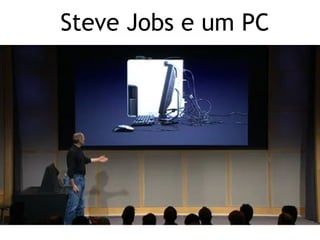
Steve Jobs e um PC
http://www.presentationzen.com/
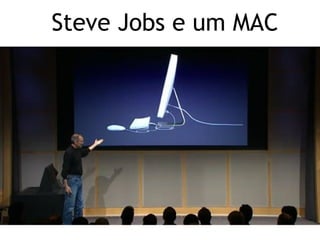
Steve Jobs e um MAC
http://www.presentationzen.com/
Surpreenda
a platéia
http://www.presentationzen.com/
Use exemplos reais,
não abstratos.
Os provérbios são bons,
dizem os autores, em
reduzir conceitos abstratos
à língua concreta, simples.
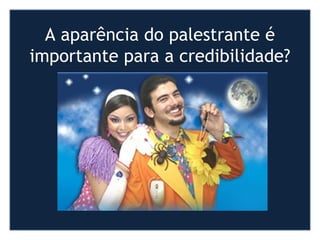
A aparência do palestrante é
importante para a credibilidade?
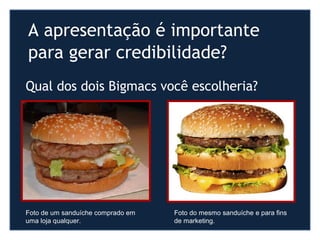
A apresentação é importante
para gerar credibilidade?
Foto de um sanduíche comprado em
uma loja qualquer.
Foto do mesmo sanduíche e para fins
de marketing.
Qual dos dois Bigmacs você escolheria?
http://www.presentationzen.com/
As pessoas são
seres emocionais.
Existem muitas
formas de levar
emoção através de
conteúdo.
Imagens
Citações
Palavras
Texto
Gráficos
Vídeo, som, etc.
É através das histórias que as
pessoas se comunicam.
Nós:
Ensinamos
Aprendemos
Crescemos
Histórias chamam nossa
atenção e são mais fáceis
de lembrar do que listas
de regras.
Regras para
um design
simples e atraente
Um ponto
por slide
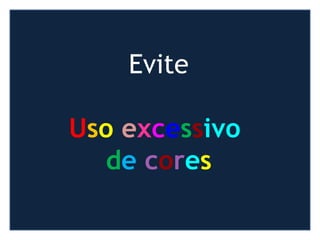
Evite
Uso excessivo
de cores
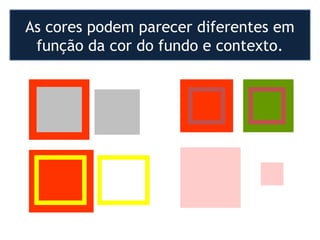
As cores podem parecer diferentes em
função da cor do fundo e contexto.
Exagero
de informações
por slide
Poluição
textos, imagens, fundo.
Inacessibilidade
Deixe espaços
para a informação
respirar e
se destacar
Evite
O uso excessivo
de diferentes
fontes
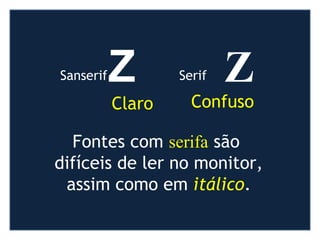
Z ZSanserif Serif
Claro Confuso
Fontes com serifa são
difíceis de ler no monitor,
assim como em itálico.
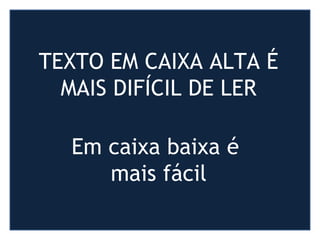
TEXTO EM CAIXA ALTA É
MAIS DIFÍCIL DE LER
Em caixa baixa é
mais fácil
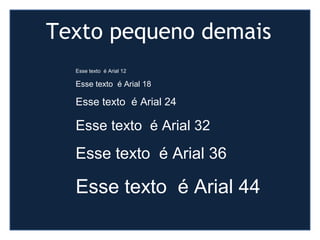
Esse texto é Arial 12
Esse texto é Arial 18
Esse texto é Arial 24
Esse texto é Arial 32
Esse texto é Arial 36
Esse texto é Arial 44
Texto pequeno demais
Menos texto
http://www.presentationzen.com/
Você se lembra da regra:
7 linhas por slide ou menos
 7 palavras por linha ou menos?
Será que esse é um bom plano?
Se você seguir essa regra
Você terá um slide como esse
Livre-se dela,
ou então…
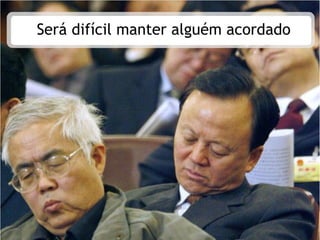
Será difícil manter alguém acordado
A leitura é
mais rápida do
que a fala
Quanto custa
um slide
extra?
R$0,00.
Zero.
Menos
textos e
mais
imagens…
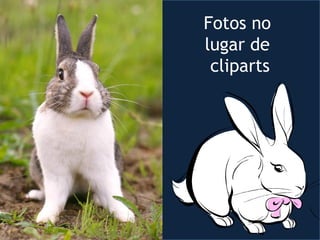
Fotos no
lugar de
cliparts
http://www.presentationzen.com/
Slide
Tradicional
Antes
http://www.presentationzen.com/
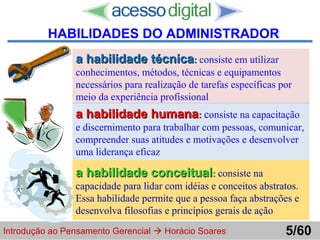
a habilidade técnicaa habilidade técnica:: consiste em utilizar
conhecimentos, métodos, técnicas e equipamentos
necessários para realização de tarefas específicas por
meio da experiência profissional
a habilidade humanaa habilidade humana:: consiste na capacitação
e discernimento para trabalhar com pessoas, comunicar,
compreender suas atitudes e motivações e desenvolver
uma liderança eficaz
a habilidade conceituala habilidade conceitual:: consiste na
capacidade para lidar com idéias e conceitos abstratos.
Essa habilidade permite que a pessoa faça abstrações e
desenvolva filosofias e princípios gerais de ação
Introdução ao Pensamento Gerencial  Horácio Soares 5/60
HABILIDADES DO ADMINISTRADOR
http://www.presentationzen.com/
Nova
Proposta
http://www.presentationzen.com/
Habilidades do
Administrador?
http://www.presentationzen.com/
Técnica
http://www.presentationzen.com/
Humana
Técnica
+
http://www.presentationzen.com/
Conceitual
Técnica
+
Humana
+
http://www.presentationzen.com/
a habilidade técnicaa habilidade técnica:: consiste em utilizar
conhecimentos, métodos, técnicas e equipamentos
necessários para realização de tarefas específicas por
meio da experiência profissional
a habilidade humanaa habilidade humana:: consiste na capacitação
e discernimento para trabalhar com pessoas, comunicar,
compreender suas atitudes e motivações e desenvolver
uma liderança eficaz
a habilidade conceituala habilidade conceitual:: consiste na
capacidade para lidar com idéias e conceitos abstratos.
Essa habilidade permite que a pessoa faça abstrações e
desenvolva filosofias e princípios gerais de ação
Introdução ao Pensamento Gerencial  Horácio Soares 5/60
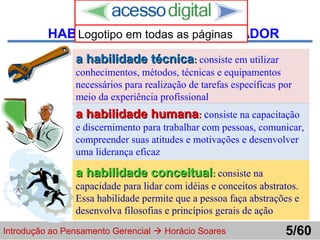
HABILIDADES DO ADMINISTRADORLogotipo em todas as páginas
http://www.presentationzen.com/
a habilidade técnicaa habilidade técnica:: consiste em utilizar
conhecimentos, métodos, técnicas e equipamentos
necessários para realização de tarefas específicas por
meio da experiência profissional
a habilidade humanaa habilidade humana:: consiste na capacitação
e discernimento para trabalhar com pessoas, comunicar,
compreender suas atitudes e motivações e desenvolver
uma liderança eficaz
a habilidade conceituala habilidade conceitual:: consiste na
capacidade para lidar com idéias e conceitos abstratos.
Essa habilidade permite que a pessoa faça abstrações e
desenvolva filosofias e princípios gerais de ação
Introdução ao Pensamento Gerencial  Horácio Soares 5/60
HABILIDADES DO ADMINISTRADOR
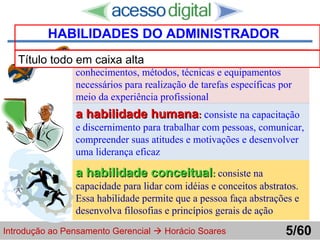
Título todo em caixa alta
http://www.presentationzen.com/
a habilidade técnicaa habilidade técnica:: consiste em utilizar
conhecimentos, métodos, técnicas e equipamentos
necessários para realização de tarefas específicas por
meio da experiência profissional
a habilidade humanaa habilidade humana:: consiste na capacitação
e discernimento para trabalhar com pessoas, comunicar,
compreender suas atitudes e motivações e desenvolver
uma liderança eficaz
a habilidade conceituala habilidade conceitual:: consiste na
capacidade para lidar com idéias e conceitos abstratos.
Essa habilidade permite que a pessoa faça abstrações e
desenvolva filosofias e princípios gerais de ação
Introdução ao Pensamento Gerencial  Horácio Soares 5/30
HABILIDADES DO ADMINISTRADOR
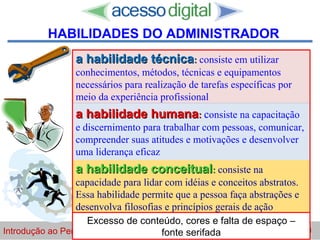
Excesso de conteúdo, cores e falta de espaço –
fonte serifada
http://www.presentationzen.com/
a habilidade técnicaa habilidade técnica:: consiste em utilizar
conhecimentos, métodos, técnicas e equipamentos
necessários para realização de tarefas específicas por
meio da experiência profissional
a habilidade humanaa habilidade humana:: consiste na capacitação
e discernimento para trabalhar com pessoas, comunicar,
compreender suas atitudes e motivações e desenvolver
uma liderança eficaz
a habilidade conceituala habilidade conceitual:: consiste na
capacidade para lidar com idéias e conceitos abstratos.
Essa habilidade permite que a pessoa faça abstrações e
desenvolva filosofias e princípios gerais de ação
Introdução ao Pensamento Gerencial  Horácio Soares 5/60
HABILIDADES DO ADMINISTRADOR
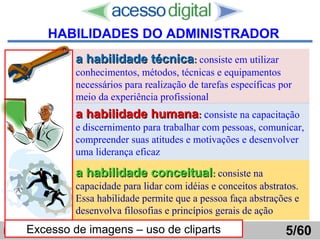
Excesso de imagens – uso de cliparts
http://www.presentationzen.com/
a habilidade técnicaa habilidade técnica:: consiste em utilizar
conhecimentos, métodos, técnicas e equipamentos
necessários para realização de tarefas específicas por
meio da experiência profissional
a habilidade humanaa habilidade humana:: consiste na capacitação
e discernimento para trabalhar com pessoas, comunicar,
compreender suas atitudes e motivações e desenvolver
uma liderança eficaz
a habilidade conceituala habilidade conceitual:: consiste na
capacidade para lidar com idéias e conceitos abstratos.
Essa habilidade permite que a pessoa faça abstrações e
desenvolva filosofias e princípios gerais de ação
Introdução ao Pensamento Gerencial  Horácio Soares 5/60
HABILIDADES DO ADMINISTRADOR
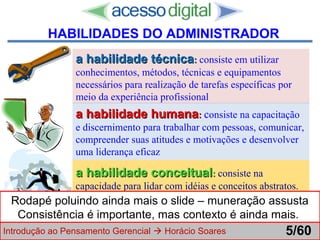
Rodapé poluindo ainda mais o slide – muneração assusta
Consistência é importante, mas contexto é ainda mais.
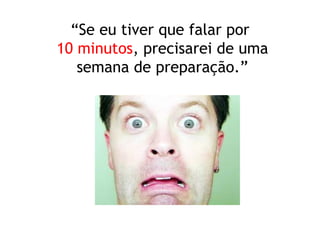
Prepare-se
“Se eu tiver que falar por
10 minutos, precisarei de uma
semana de preparação.”
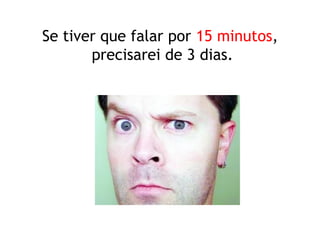
Se tiver que falar por 15 minutos,
precisarei de 3 dias.
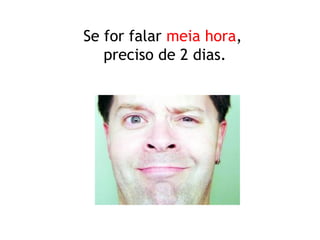
Se for falar meia hora,
preciso de 2 dias.
Se for falar por uma hora,
estou pronto para começar”.
“Woodraw Wilson”

TÉCNICAS DE APRESENTAÇÃO

Notas do Editor

  • #19 Unexpectedness. You can get people’s interest by violating their expectations. Surprise people. Surprise will get their interest. But to sustain their interest you have to stimulate their curiosity. The best way to do that is to pose questions or open up holes in people’s knowledge and then fill those holes, say the authors. Make the audience aware that they have a gap in their knowledge and then fill that gap with the answers to the puzzle (or guide them to the answers). Take people on a journey of discovery. (The Discovery Channel’s MythBusters is about the only thing I can watch on the virtually unwatchable boob-tube these days as the TV program does a wonderful job of posing questions and then answering them, often in quite unexpected ways.) http://www.presentationzen.com/presentationzen/2007/07/make.html
  • #20 Concrete. Use natural speech and give real examples with real things, not abstractions. Speak of concrete images not of vague notions. Proverbs are good, say the authors, at reducing abstract concepts to concrete, simple, but powerful (and memorable) language. For example, here in Japan we say “ii seki ni cho” or “kill two birds with one stone.” Easier than saying something like “…let’s work toward maximizing our productivity by increasing efficiency across departments,” etc. And the phrase “…go to the moon and back” by JFK (and Ralph Kramden before him)? That’s concrete. You can visualize that. http://www.presentationzen.com/presentationzen/2007/07/make.html
  • #21 Concrete. Use natural speech and give real examples with real things, not abstractions. Speak of concrete images not of vague notions. Proverbs are good, say the authors, at reducing abstract concepts to concrete, simple, but powerful (and memorable) language. For example, here in Japan we say “ii seki ni cho” or “kill two birds with one stone.” Easier than saying something like “…let’s work toward maximizing our productivity by increasing efficiency across departments,” etc. And the phrase “…go to the moon and back” by JFK (and Ralph Kramden before him)? That’s concrete. You can visualize that. http://www.presentationzen.com/presentationzen/2007/07/make.html
  • #22 Credible. If you are famous in your field you may have built-in credibility (but even that doesn’t go as far as it used to). Most of us, however, do not have that kind of credibility so we reach for numbers and cold hard data to support our claims as market leaders and so on. Statistics, say the Heath brothers, are not inherently helpful. What’s important is the context and the meaning of those statistics. Put it in terms people can visualize. “66 grams of fat” or “the equivalent of three Big Macs”? And if you showed a photo of the burgers, wouldn’t that stick? There are many ways to establish credibility, a quote from a client or the press may help, for example. But a long-winded account of your company’s history won’t help. In Japan especially, having a well-known trusted business partner or some big-name customers help establish credibility. The Heath brothers outline many good examples of credibility in their book.. http://www.presentationzen.com/presentationzen/2007/07/make.html
  • #23 Credible. If you are famous in your field you may have built-in credibility (but even that doesn’t go as far as it used to). Most of us, however, do not have that kind of credibility so we reach for numbers and cold hard data to support our claims as market leaders and so on. Statistics, say the Heath brothers, are not inherently helpful. What’s important is the context and the meaning of those statistics. Put it in terms people can visualize. “66 grams of fat” or “the equivalent of three Big Macs”? And if you showed a photo of the burgers, wouldn’t that stick? There are many ways to establish credibility, a quote from a client or the press may help, for example. But a long-winded account of your company’s history won’t help. In Japan especially, having a well-known trusted business partner or some big-name customers help establish credibility. The Heath brothers outline many good examples of credibility in their book.. http://www.presentationzen.com/presentationzen/2007/07/make.html
  • #24 Emotional. People are emotional beings. It is not enough to take people through a laundry list of talking points and information on your slides, you must make them feel something. There are a million ways to help people feel something about your content. Images, of course, are one way to have audiences not only understand your point better but also to feel and to have a more visceral and emotional connection to your idea. Explaining the devastation of the Katrina hurricane and flood in the US, for example, could be done with bulletpoints, data, and talking points, but  images of the aftermath and the pictures of the human suffering that occurred told the story in ways words alone never could. Just the words “Hurricane Katrina” conjure up vivid images in your mind today no doubt. We make emotional connections with people not abstractions. When possible put your ideas in human terms. “90 grams of fat” may seem concrete to you, but for others it's an abstraction. A picture (or verbal description) of an enormous plate of greasy French fries stacked high, a double cheese burger (extra cheese), and a large chocolate shake (extra whip cream) is visceral and sticky. http://www.presentationzen.com/presentationzen/2007/07/make.html
  • #25 Stories. We tell stories all day long. It’s how humans have always communicated. We tell stories with our words and even with our art. We express ourselves through the stories we share. We teach, we learn, and we grow through stories. Why is it that when the majority of smart, talented people have the chance to present we usually get streams of information rather than story from them? Great ideas and great presentations have an element of story to them. But you see storytelling everywhere in the workplace. In Japan, for example, it’s a custom for a senior worker (sempai) to mentor a younger worker (kohai) on various issues concerning the company history and culture, and of course on how to do the job. The sempai does much of his informal teaching trough storytelling, though nobody calls it that. But that’s what it is. Once a younger worker hears the “story” of what happened to the poor guy who didn’t wear his hardhat on the factory floor one day he never forgets the lesson (and he never forgets to wear his hardhat). Stories get our attention and are easier to remember than lists of rules. http://www.presentationzen.com/presentationzen/2007/07/make.html
  • #26 Stories. We tell stories all day long. It’s how humans have always communicated. We tell stories with our words and even with our art. We express ourselves through the stories we share. We teach, we learn, and we grow through stories. Why is it that when the majority of smart, talented people have the chance to present we usually get streams of information rather than story from them? Great ideas and great presentations have an element of story to them. But you see storytelling everywhere in the workplace. In Japan, for example, it’s a custom for a senior worker (sempai) to mentor a younger worker (kohai) on various issues concerning the company history and culture, and of course on how to do the job. The sempai does much of his informal teaching trough storytelling, though nobody calls it that. But that’s what it is. Once a younger worker hears the “story” of what happened to the poor guy who didn’t wear his hardhat on the factory floor one day he never forgets the lesson (and he never forgets to wear his hardhat). Stories get our attention and are easier to remember than lists of rules. http://www.presentationzen.com/presentationzen/2007/07/make.html
  • #31 Stories. We tell stories all day long. It’s how humans have always communicated. We tell stories with our words and even with our art. We express ourselves through the stories we share. We teach, we learn, and we grow through stories. Why is it that when the majority of smart, talented people have the chance to present we usually get streams of information rather than story from them? Great ideas and great presentations have an element of story to them. But you see storytelling everywhere in the workplace. In Japan, for example, it’s a custom for a senior worker (sempai) to mentor a younger worker (kohai) on various issues concerning the company history and culture, and of course on how to do the job. The sempai does much of his informal teaching trough storytelling, though nobody calls it that. But that’s what it is. Once a younger worker hears the “story” of what happened to the poor guy who didn’t wear his hardhat on the factory floor one day he never forgets the lesson (and he never forgets to wear his hardhat). Stories get our attention and are easier to remember than lists of rules. http://www.presentationzen.com/presentationzen/2007/07/make.html
  • #39 Stories. We tell stories all day long. It’s how humans have always communicated. We tell stories with our words and even with our art. We express ourselves through the stories we share. We teach, we learn, and we grow through stories. Why is it that when the majority of smart, talented people have the chance to present we usually get streams of information rather than story from them? Great ideas and great presentations have an element of story to them. But you see storytelling everywhere in the workplace. In Japan, for example, it’s a custom for a senior worker (sempai) to mentor a younger worker (kohai) on various issues concerning the company history and culture, and of course on how to do the job. The sempai does much of his informal teaching trough storytelling, though nobody calls it that. But that’s what it is. Once a younger worker hears the “story” of what happened to the poor guy who didn’t wear his hardhat on the factory floor one day he never forgets the lesson (and he never forgets to wear his hardhat). Stories get our attention and are easier to remember than lists of rules. http://www.presentationzen.com/presentationzen/2007/07/make.html
  • #65 http://www.slideshare.net/thecroaker/death-by-powerpoint