You Cannot Build Open Policy Without People
          The OER Brazil Case and Beyond


                    The Open Education Movement in Brazil
                                                    Carolina Rossini
                        Director for International Intellectual Property
                                                                  @EFF
                                                        @carolinarossini
“Information is an activity; information is a life form;
                       and information is a relation.”
                                       John. P. Barlow
1. Open systems and open networks can create
new modes of innovation and collaboration

2. New modes of innovation can be helped, or hurt,
by institutional and government policies and design

3. Brazil and Brazilian (and many countries around
the world) institutions are experimenting with
openness, but it is just in the beginning
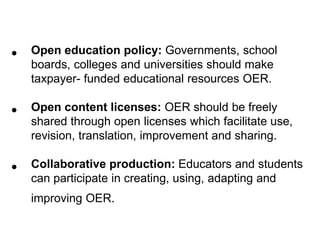
•   Open education policy: Governments, school
    boards, colleges and universities should make
    taxpayer- funded educational resources OER.

•   Open content licenses: OER should be freely
    shared through open licenses which facilitate use,
    revision, translation, improvement and sharing.

•   Collaborative production: Educators and students
    can participate in creating, using, adapting and
    improving OER.
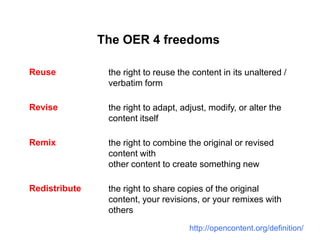
The OER 4 freedoms

Reuse           the right to reuse the content in its unaltered /
                verbatim form

Revise          the right to adapt, adjust, modify, or alter the
                content itself

Remix           the right to combine the original or revised
                content with
                other content to create something new

Redistribute    the right to share copies of the original
                content, your revisions, or your remixes with
                others
                                      http://opencontent.org/definition/
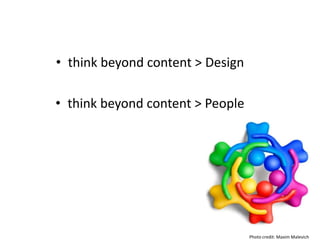
• think beyond content > Design

• think beyond content > People


                                  Photo credit: Maxim Malevich
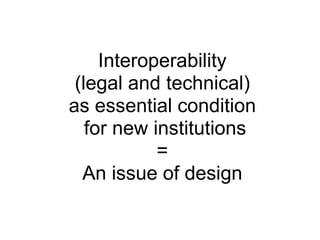
Interoperability
 (legal and technical)
as essential condition
   for new institutions
            =
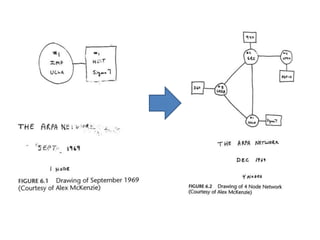
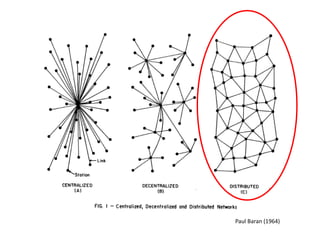
  An issue of design
Paul Baran (1964)
GNU General Public License:
The use of IPs to create freedom
Open Science
the opposite of open isn’t “closed”
the opposite of open is “broken”
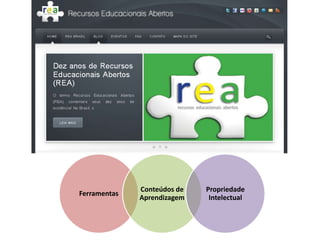
Conteúdos de   Propriedade
Ferramentas
              Aprendizagem    Intelectual
People > empowerment + engagement
Who are our people?

    Everybody!
Partner with Legislators

                      who care about:

• efficient use of national / state money coming from taxes;
• saving students money;

• increasing access to education;

• Understand the need to innovate in educational
  methodology.
• Efficient use of public funds to
  increase student success and
  access to quality educational
  materials.
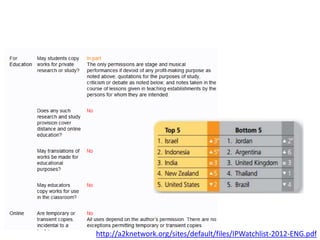
http://a2knetwork.org/sites/default/files/IPWatchlist-2012-ENG.pdf
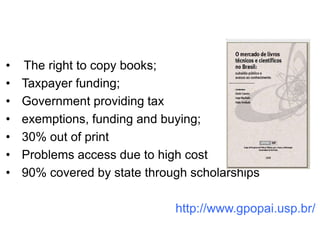
•   The right to copy books;
•   Taxpayer funding;
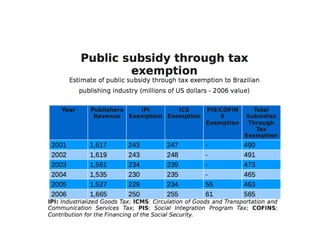
•   Government providing tax
•   exemptions, funding and buying;
•   30% out of print
•   Problems access due to high cost
•   90% covered by state through scholarships

                              http://www.gpopai.usp.br/
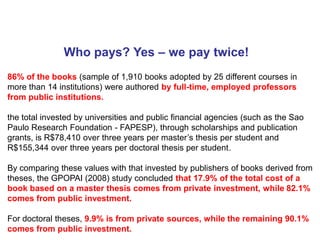
Who pays? Yes – we pay twice!
86% of the books (sample of 1,910 books adopted by 25 different courses in
more than 14 institutions) were authored by full-time, employed professors
from public institutions.

the total invested by universities and public financial agencies (such as the Sao
Paulo Research Foundation - FAPESP), through scholarships and publication
grants, is R$78,410 over three years per master’s thesis per student and
R$155,344 over three years per doctoral thesis per student.

By comparing these values with that invested by publishers of books derived from
theses, the GPOPAI (2008) study concluded that 17.9% of the total cost of a
book based on a master thesis comes from private investment, while 82.1%
comes from public investment.

For doctoral theses, 9.9% is from private sources, while the remaining 90.1%
comes from public investment.
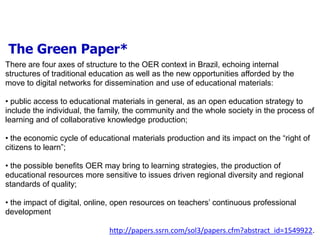
The Green Paper*
There are four axes of structure to the OER context in Brazil, echoing internal
structures of traditional education as well as the new opportunities afforded by the
move to digital networks for dissemination and use of educational materials:

• public access to educational materials in general, as an open education strategy to
include the individual, the family, the community and the whole society in the process of
learning and of collaborative knowledge production;

• the economic cycle of educational materials production and its impact on the “right of
citizens to learn”;

• the possible benefits OER may bring to learning strategies, the production of
educational resources more sensitive to issues driven regional diversity and regional
standards of quality;

• the impact of digital, online, open resources on teachers’ continuous professional
development

                              http://papers.ssrn.com/sol3/papers.cfm?abstract_id=1549922.
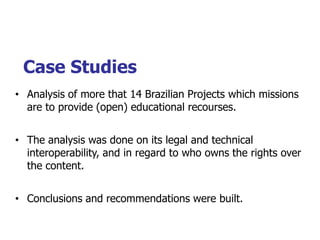
Case Studies
• Analysis of more that 14 Brazilian Projects which missions
  are to provide (open) educational recourses.


• The analysis was done on its legal and technical
  interoperability, and in regard to who owns the rights over
  the content.


• Conclusions and recommendations were built.
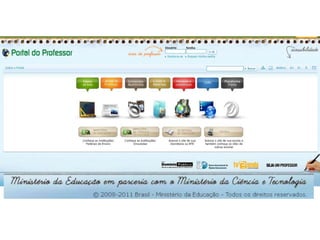
Portal do Professor
• Licenciamento: Cada objeto educacional depositado no
  Portal do Professor tem sua própria norma em relação a
  direitos autorais. Alguns adotam alguma licença do
  Creative Commons, mas outros apresentam nota dizendo
  que todos os direitos estão reservados. A política do
  Portal do Professor autoriza que os conteúdos lá criados
  ou depositados possam ser lidos, baixados, gravados ou
  copiados desde que sem fins lucrativos. Lembre que se
  você encontrar um objeto educacional licenciado com
  uma licença mais flexível do CC, aquela licença é a
  política válida para aquele recurso específico.
BIOE
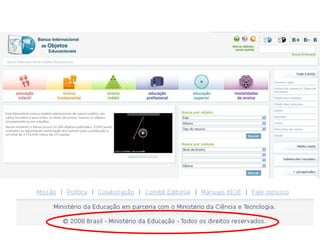
• O BIOE contém objetos educacionais
  construídos a partir de conteúdo de vários
  níveis do processo educacional, desde a
  educação infantil até a educação superior.

• Licenciamento: A política de uso desse
  repositório permite visualização, cópia,
  distribuição e tradução. Este projeto não
  adota Creative Commons.
Domínio Público
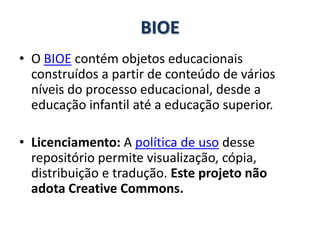
• O portal Domínio Público contém obras que já
  tiveram seus direitos autorais expirados, ou
  seja, já em domínio público, disponibilizadas
  gratuitamente.

• Licenciamento: o acervo possui política de
  licenciamento mista sendo parte das obras em
  domínio publico, parte com licenças próprias e
  parte protegida por direito autoral (como o
  banco de teses e dissertações).
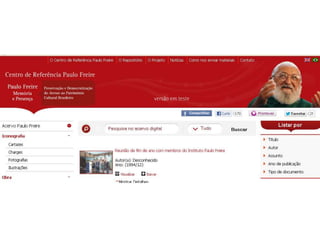
• Repositório Digital Centro de Referência Paulo
  Freire foi constituído com a missão de
  armazenar, preservar, estimular, disseminar e
  compartilhar a produção intelectual do
  educador Paulo Freire, além de saberes,
  reflexões, estudos e pesquisas sobre o
  pensamento freiriano em formato digital junto
  a diversos atores sociais.
• Possui textos, áudios, vídeos e imagens,
  cedidos pelos proprietários, possibilitando
  acesso e download gratuitos das obras, sendo
  que alguns possuem licenças CC.
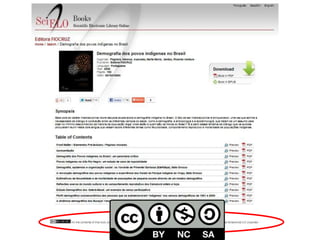
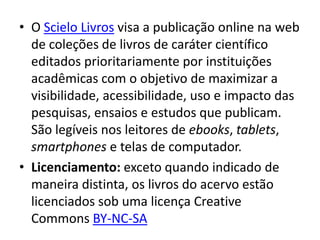
• O Scielo Livros visa a publicação online na web
  de coleções de livros de caráter científico
  editados prioritariamente por instituições
  acadêmicas com o objetivo de maximizar a
  visibilidade, acessibilidade, uso e impacto das
  pesquisas, ensaios e estudos que publicam.
  São legíveis nos leitores de ebooks, tablets,
  smartphones e telas de computador.
• Licenciamento: exceto quando indicado de
  maneira distinta, os livros do acervo estão
  licenciados sob uma licença Creative
  Commons BY-NC-SA
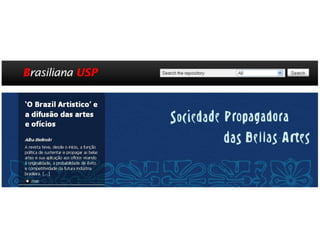
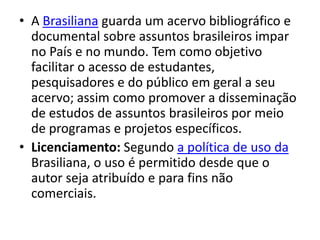
• A Brasiliana guarda um acervo bibliográfico e
  documental sobre assuntos brasileiros impar
  no País e no mundo. Tem como objetivo
  facilitar o acesso de estudantes,
  pesquisadores e do público em geral a seu
  acervo; assim como promover a disseminação
  de estudos de assuntos brasileiros por meio
  de programas e projetos específicos.
• Licenciamento: Segundo a política de uso da
  Brasiliana, o uso é permitido desde que o
  autor seja atribuído e para fins não
  comerciais.
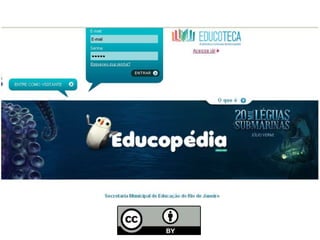
• A Educopédia é uma plataforma online
  colaborativa de aulas digitais, onde alunos e
  professores podem acessar atividades
  autoexplicativas de forma lúdica e prática, de
  qualquer lugar e a qualquer hora. As
  atividades incluem vídeos, animações,
  imagens, textos, podcasts, mini-testes e jogos,
  seguindo um roteiro pré-definido que
  obedece a teorias de metacognição.

• Licenciamento: a plataforma está licenciada
  pelo Creative Commons CC-BY.
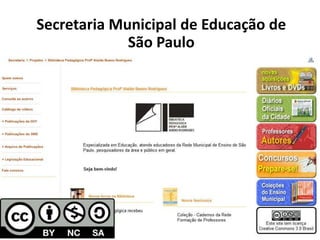
Secretaria Municipal de Educação de
             São Paulo
• A Secretaria de Educação do Município de
  São Paulo, dispõe de obras intelectuais
  produzidas com objetivos educacionais,
  pedagógicos e afins, no âmbito da rede
  pública municipal de ensino.

• Licenciamento: Conforme site e Decreto
  52.681/2011, todos os materiais e livros
  didáticos disponibilizados pela SME estão
  licenciados sob CC-BY-NC-SA
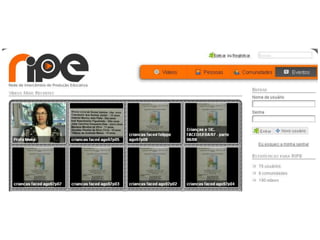
• A Rede de Intercâmbio de Produção Educativa
  promove a troca de imagens e sons para uso
  educacional, produzidos colaborativamente.

• Licenciamento: Seus conteúdos estão
  licenciados sob CC-BY-NC-SA.
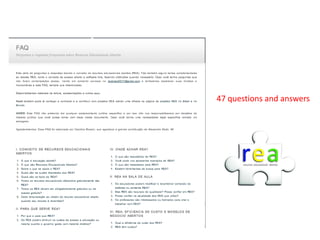
47 questions and answers
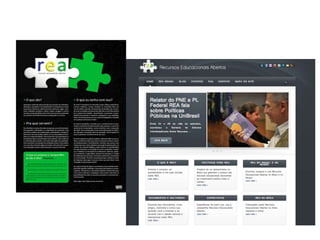
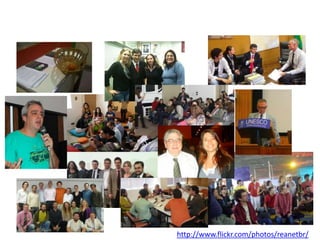
http://www.flickr.com/photos/reanetbr/
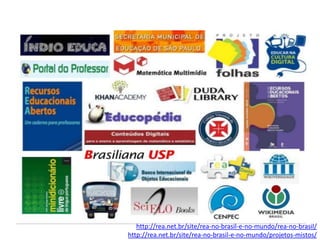
http://rea.net.br/site/rea-no-brasil-e-no-mundo/rea-no-brasil/
http://rea.net.br/site/rea-no-brasil-e-no-mundo/projetos-mistos/
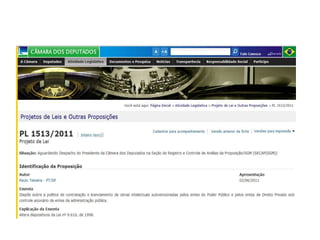
The National Plan of Education (PNE) represents the
highest level of educational policy in Brazil.

Discussions to include OER in the PNE directives started in
2008.

More than 3,000 changes until now, the Plan sets
guidelines, goals, and priorities to be implemented by
2020.

OER is mentioned in two guidelines (7.10 and 7.12)
http://www.camara.gov.br/proposicoesWeb/fichadetramitacao?idProposicao=490116
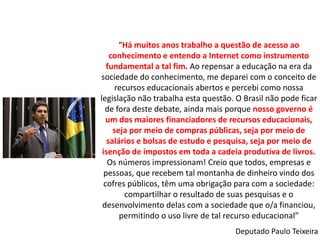
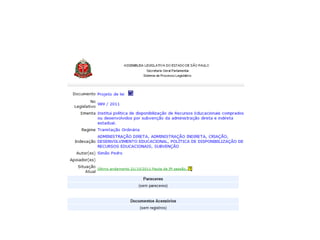
“Há muitos anos trabalho a questão de acesso ao
    conhecimento e entendo a Internet como instrumento
   fundamental a tal fim. Ao repensar a educação na era da
sociedade do conhecimento, me deparei com o conceito de
      recursos educacionais abertos e percebi como nossa
legislação não trabalha esta questão. O Brasil não pode ficar
  de fora deste debate, ainda mais porque nosso governo é
   um dos maiores financiadores de recursos educacionais,
     seja por meio de compras públicas, seja por meio de
   salários e bolsas de estudo e pesquisa, seja por meio de
 isenção de impostos em toda a cadeia produtiva de livros.
   Os números impressionam! Creio que todos, empresas e
  pessoas, que recebem tal montanha de dinheiro vindo dos
  cofres públicos, têm uma obrigação para com a sociedade:
         compartilhar o resultado de suas pesquisas e o
 desenvolvimento delas com a sociedade que o/a financiou,
       permitindo o uso livre de tal recurso educacional”
                                     Deputado Paulo Teixeira
2010 – The Federal Government spent R$1.077.805.377,28 to buy, evaluate
and distribute texbooks

2011 – Government spent R$ 1,2 billions to buy textbooks
 - introductions of the “consumable texbook” : the student use it for one year
and trow it away, in oposition of many books that one student have to give
back at the end of the year and it is used for up to 3 years
(http://www.fnde.gov.br/index.php/programas-livro-didatico)

2011/2012 – Government debats the use of e-readers in public schools
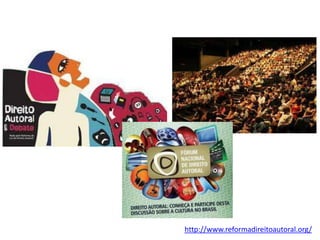
http://www.reformadireitoautoral.org/
Conclusions
if you care about the emergence of
knowledge federation systems that
      allow broader access to
 knowledge) you may have to have
some kind of intervention…and not
     wait for organic emergence.
Inclusion/cooperation
Wide dissemination of education contributes to
  more inclusive and cohesive societies, fosters
  equal opportunities and innovation in line with
     the priorities of a renewed social agenda
focused on the knowledge society. In this sense,
this study brings a series of recommendations to
                 foster this dialogue.
“Social inclusion has today a new and important dimension:
            digital inclusion. Digital inclusion is an attribute of
   citizenship: a new right in itself and a way to ensure basic
       rights to people, such as free expression and access to
culture and education. For Brazil, digital inclusion is a tool to
     ensure that citizens and institutions have the means to
          access, use, produce and distribute information and
         knowledge through Information and Communication
    Technologies (ICT) so that they can participate actively in
            Information Society, as receivers and providers of
                                                      knowledge.”

   Brazilian Ministry of Foreign Affairs at UNECO OER@Paris
                                                  Conference
1. Open systems and open networks can create
new modes of innovation and collaboration

2. New modes of innovation can be helped, or hurt,
by institutional and government policies and design

3. Brazil and Brazilian (and many countries around
the world) institutions are experimenting with
openness, but it is just in the beginning
“It just takes all of some of us!”
                       @wilbanks
Thank you!
            Carolina@eff.org

                 @EFF
Defending your rights in the Digital World!

Cr4ocwcbr 121030145301-phpapp02

  • 1.
    You Cannot BuildOpen Policy Without People The OER Brazil Case and Beyond The Open Education Movement in Brazil Carolina Rossini Director for International Intellectual Property @EFF @carolinarossini
  • 2.
    “Information is anactivity; information is a life form; and information is a relation.” John. P. Barlow
  • 3.
    1. Open systemsand open networks can create new modes of innovation and collaboration 2. New modes of innovation can be helped, or hurt, by institutional and government policies and design 3. Brazil and Brazilian (and many countries around the world) institutions are experimenting with openness, but it is just in the beginning
  • 5.
    Open education policy: Governments, school boards, colleges and universities should make taxpayer- funded educational resources OER. • Open content licenses: OER should be freely shared through open licenses which facilitate use, revision, translation, improvement and sharing. • Collaborative production: Educators and students can participate in creating, using, adapting and improving OER.
  • 6.
    The OER 4freedoms Reuse the right to reuse the content in its unaltered / verbatim form Revise the right to adapt, adjust, modify, or alter the content itself Remix the right to combine the original or revised content with other content to create something new Redistribute the right to share copies of the original content, your revisions, or your remixes with others http://opencontent.org/definition/
  • 7.
    • think beyondcontent > Design • think beyond content > People Photo credit: Maxim Malevich
  • 8.
    Interoperability (legal andtechnical) as essential condition for new institutions = An issue of design
  • 10.
  • 13.
    GNU General PublicLicense: The use of IPs to create freedom
  • 16.
  • 17.
    the opposite ofopen isn’t “closed”
  • 18.
    the opposite ofopen is “broken”
  • 19.
    Conteúdos de Propriedade Ferramentas Aprendizagem Intelectual
  • 21.
  • 22.
    Who are ourpeople? Everybody!
  • 24.
    Partner with Legislators who care about: • efficient use of national / state money coming from taxes; • saving students money; • increasing access to education; • Understand the need to innovate in educational methodology.
  • 25.
    • Efficient useof public funds to increase student success and access to quality educational materials.
  • 26.
  • 27.
    The right to copy books; • Taxpayer funding; • Government providing tax • exemptions, funding and buying; • 30% out of print • Problems access due to high cost • 90% covered by state through scholarships http://www.gpopai.usp.br/
  • 29.
    Who pays? Yes– we pay twice! 86% of the books (sample of 1,910 books adopted by 25 different courses in more than 14 institutions) were authored by full-time, employed professors from public institutions. the total invested by universities and public financial agencies (such as the Sao Paulo Research Foundation - FAPESP), through scholarships and publication grants, is R$78,410 over three years per master’s thesis per student and R$155,344 over three years per doctoral thesis per student. By comparing these values with that invested by publishers of books derived from theses, the GPOPAI (2008) study concluded that 17.9% of the total cost of a book based on a master thesis comes from private investment, while 82.1% comes from public investment. For doctoral theses, 9.9% is from private sources, while the remaining 90.1% comes from public investment.
  • 31.
    The Green Paper* Thereare four axes of structure to the OER context in Brazil, echoing internal structures of traditional education as well as the new opportunities afforded by the move to digital networks for dissemination and use of educational materials: • public access to educational materials in general, as an open education strategy to include the individual, the family, the community and the whole society in the process of learning and of collaborative knowledge production; • the economic cycle of educational materials production and its impact on the “right of citizens to learn”; • the possible benefits OER may bring to learning strategies, the production of educational resources more sensitive to issues driven regional diversity and regional standards of quality; • the impact of digital, online, open resources on teachers’ continuous professional development http://papers.ssrn.com/sol3/papers.cfm?abstract_id=1549922.
  • 32.
    Case Studies • Analysisof more that 14 Brazilian Projects which missions are to provide (open) educational recourses. • The analysis was done on its legal and technical interoperability, and in regard to who owns the rights over the content. • Conclusions and recommendations were built.
  • 34.
    Portal do Professor •Licenciamento: Cada objeto educacional depositado no Portal do Professor tem sua própria norma em relação a direitos autorais. Alguns adotam alguma licença do Creative Commons, mas outros apresentam nota dizendo que todos os direitos estão reservados. A política do Portal do Professor autoriza que os conteúdos lá criados ou depositados possam ser lidos, baixados, gravados ou copiados desde que sem fins lucrativos. Lembre que se você encontrar um objeto educacional licenciado com uma licença mais flexível do CC, aquela licença é a política válida para aquele recurso específico.
  • 36.
    BIOE • O BIOEcontém objetos educacionais construídos a partir de conteúdo de vários níveis do processo educacional, desde a educação infantil até a educação superior. • Licenciamento: A política de uso desse repositório permite visualização, cópia, distribuição e tradução. Este projeto não adota Creative Commons.
  • 38.
    Domínio Público • Oportal Domínio Público contém obras que já tiveram seus direitos autorais expirados, ou seja, já em domínio público, disponibilizadas gratuitamente. • Licenciamento: o acervo possui política de licenciamento mista sendo parte das obras em domínio publico, parte com licenças próprias e parte protegida por direito autoral (como o banco de teses e dissertações).
  • 40.
    • Repositório DigitalCentro de Referência Paulo Freire foi constituído com a missão de armazenar, preservar, estimular, disseminar e compartilhar a produção intelectual do educador Paulo Freire, além de saberes, reflexões, estudos e pesquisas sobre o pensamento freiriano em formato digital junto a diversos atores sociais. • Possui textos, áudios, vídeos e imagens, cedidos pelos proprietários, possibilitando acesso e download gratuitos das obras, sendo que alguns possuem licenças CC.
  • 42.
    • O ScieloLivros visa a publicação online na web de coleções de livros de caráter científico editados prioritariamente por instituições acadêmicas com o objetivo de maximizar a visibilidade, acessibilidade, uso e impacto das pesquisas, ensaios e estudos que publicam. São legíveis nos leitores de ebooks, tablets, smartphones e telas de computador. • Licenciamento: exceto quando indicado de maneira distinta, os livros do acervo estão licenciados sob uma licença Creative Commons BY-NC-SA
  • 44.
    • A Brasilianaguarda um acervo bibliográfico e documental sobre assuntos brasileiros impar no País e no mundo. Tem como objetivo facilitar o acesso de estudantes, pesquisadores e do público em geral a seu acervo; assim como promover a disseminação de estudos de assuntos brasileiros por meio de programas e projetos específicos. • Licenciamento: Segundo a política de uso da Brasiliana, o uso é permitido desde que o autor seja atribuído e para fins não comerciais.
  • 46.
    • A Educopédiaé uma plataforma online colaborativa de aulas digitais, onde alunos e professores podem acessar atividades autoexplicativas de forma lúdica e prática, de qualquer lugar e a qualquer hora. As atividades incluem vídeos, animações, imagens, textos, podcasts, mini-testes e jogos, seguindo um roteiro pré-definido que obedece a teorias de metacognição. • Licenciamento: a plataforma está licenciada pelo Creative Commons CC-BY.
  • 47.
    Secretaria Municipal deEducação de São Paulo
  • 48.
    • A Secretariade Educação do Município de São Paulo, dispõe de obras intelectuais produzidas com objetivos educacionais, pedagógicos e afins, no âmbito da rede pública municipal de ensino. • Licenciamento: Conforme site e Decreto 52.681/2011, todos os materiais e livros didáticos disponibilizados pela SME estão licenciados sob CC-BY-NC-SA
  • 50.
    • A Redede Intercâmbio de Produção Educativa promove a troca de imagens e sons para uso educacional, produzidos colaborativamente. • Licenciamento: Seus conteúdos estão licenciados sob CC-BY-NC-SA.
  • 52.
  • 54.
  • 55.
  • 57.
    The National Planof Education (PNE) represents the highest level of educational policy in Brazil. Discussions to include OER in the PNE directives started in 2008. More than 3,000 changes until now, the Plan sets guidelines, goals, and priorities to be implemented by 2020. OER is mentioned in two guidelines (7.10 and 7.12) http://www.camara.gov.br/proposicoesWeb/fichadetramitacao?idProposicao=490116
  • 59.
    “Há muitos anostrabalho a questão de acesso ao conhecimento e entendo a Internet como instrumento fundamental a tal fim. Ao repensar a educação na era da sociedade do conhecimento, me deparei com o conceito de recursos educacionais abertos e percebi como nossa legislação não trabalha esta questão. O Brasil não pode ficar de fora deste debate, ainda mais porque nosso governo é um dos maiores financiadores de recursos educacionais, seja por meio de compras públicas, seja por meio de salários e bolsas de estudo e pesquisa, seja por meio de isenção de impostos em toda a cadeia produtiva de livros. Os números impressionam! Creio que todos, empresas e pessoas, que recebem tal montanha de dinheiro vindo dos cofres públicos, têm uma obrigação para com a sociedade: compartilhar o resultado de suas pesquisas e o desenvolvimento delas com a sociedade que o/a financiou, permitindo o uso livre de tal recurso educacional” Deputado Paulo Teixeira
  • 60.
    2010 – TheFederal Government spent R$1.077.805.377,28 to buy, evaluate and distribute texbooks 2011 – Government spent R$ 1,2 billions to buy textbooks - introductions of the “consumable texbook” : the student use it for one year and trow it away, in oposition of many books that one student have to give back at the end of the year and it is used for up to 3 years (http://www.fnde.gov.br/index.php/programas-livro-didatico) 2011/2012 – Government debats the use of e-readers in public schools
  • 64.
  • 65.
  • 66.
    if you careabout the emergence of knowledge federation systems that allow broader access to knowledge) you may have to have some kind of intervention…and not wait for organic emergence.
  • 67.
    Inclusion/cooperation Wide dissemination ofeducation contributes to more inclusive and cohesive societies, fosters equal opportunities and innovation in line with the priorities of a renewed social agenda focused on the knowledge society. In this sense, this study brings a series of recommendations to foster this dialogue.
  • 68.
    “Social inclusion hastoday a new and important dimension: digital inclusion. Digital inclusion is an attribute of citizenship: a new right in itself and a way to ensure basic rights to people, such as free expression and access to culture and education. For Brazil, digital inclusion is a tool to ensure that citizens and institutions have the means to access, use, produce and distribute information and knowledge through Information and Communication Technologies (ICT) so that they can participate actively in Information Society, as receivers and providers of knowledge.” Brazilian Ministry of Foreign Affairs at UNECO OER@Paris Conference
  • 70.
    1. Open systemsand open networks can create new modes of innovation and collaboration 2. New modes of innovation can be helped, or hurt, by institutional and government policies and design 3. Brazil and Brazilian (and many countries around the world) institutions are experimenting with openness, but it is just in the beginning
  • 71.
    “It just takesall of some of us!” @wilbanks
  • 73.
    Thank you! Carolina@eff.org @EFF Defending your rights in the Digital World!

Notas do Editor

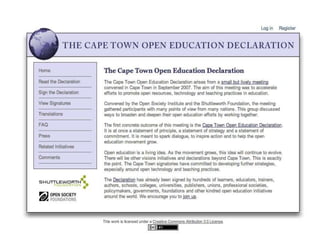
  • #5 The Cape Town Declaration begins:We are on the cusp of a global revolution in teaching and learning. Educators worldwide are developing a vast pool of educational resources on the Internet, open and free for all to use. These educators are creating a world where each and every person on earth can access and contribute to the sum of all human knowledge.
  • #18 A closing thought, in the 21st century…
  • #26 Most important, take Policy makers back to first principles…