
Novidades do Elasticsearch 2.0 e
como usá-lo com PHP
Luiz Henrique Zambom Santana
https://github.com/lhzsantana
Meetup - PHPSC
13 de Fevereiro de 2016
Florianópolis/SC
Agenda
Visão geral
Arquitetura de soluções
Desenvolvimento com o Elasticsearch
Elasticsearch com PHP
Novas possibilidades
Conclusões
• Doutorando na UFSC
• Consultor e programador
• Trabalhando com Elasticsearch desde 2013 (versão 0.9.x)
• Autor de artigos, Blog (luizsantana.info) e livros
Apresentação
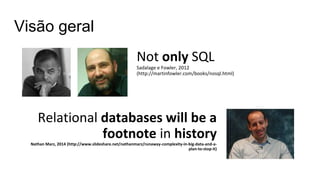
Not only SQL
Sadalage e Fowler, 2012
(http://martinfowler.com/books/nosql.html)
Relational databases will be a
footnote in history
Nathan Marz, 2014 (http://www.slideshare.net/nathanmarz/runaway-complexity-in-big-data-and-a-
plan-to-stop-it)
Visão geral
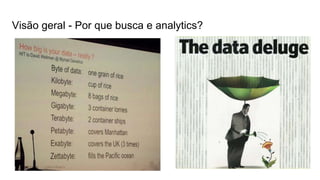
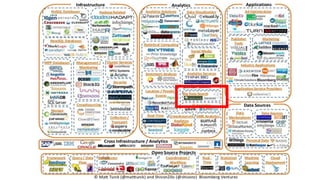
Visão geral - Por que busca e analytics?
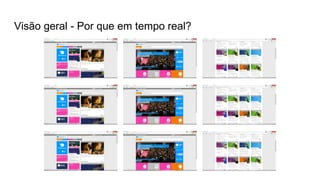
Visão geral - Por que em tempo real?
Visão geral - Elasticsearch buzz
Visão geral - Por que Elasticsearch?
• Tempo real
• Flexível
• Livre de esquema e muito escalável
• Iniciado por Shay Banon em 2010
• Desenvolvido pela comunidade
• Código aberto em:
• https://github.com/elastic/elasticsearch
• Atualmente apoiado pela Elastic
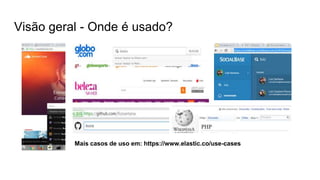
Visão geral - Onde é usado?
Mais casos de uso em: https://www.elastic.co/use-cases
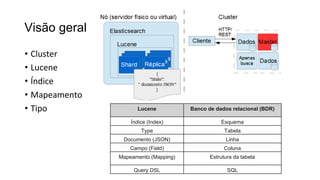
Visão geral
• Cluster
• Lucene
• Índice
• Mapeamento
• Tipo Lucene Banco de dados relacional (BDR)
Índice (Index) Esquema
Type Tabela
Documento (JSON) Linha
Campo (Field) Coluna
Mapeamento (Mapping) Estrutura da tabela
Query DSL SQL
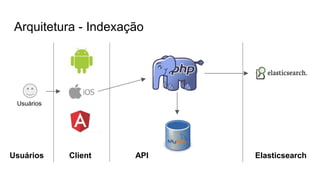
Arquitetura - Indexação
Client API ElasticsearchUsuários
Usuários
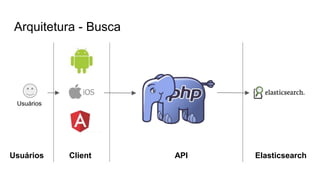
Arquitetura - Busca
Client API ElasticsearchUsuários
Usuários
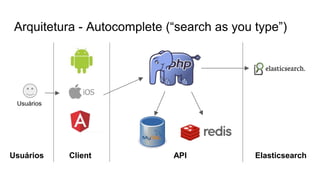
Arquitetura - Autocomplete (“search as you type”)
Client API ElasticsearchUsuários
Usuários
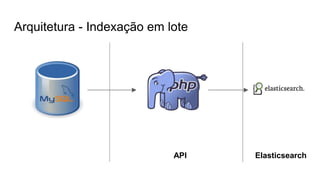
Arquitetura - Indexação em lote
ElasticsearchAPI
Desenvolvimento com o Elasticsearch - Pontos importantes
Gerenciamento dos dados
Backup do Elasticsearch?
Geralmente o Elasticsearch é usado como um repositório volátil
Backup:
https://www.elastic.co/guide/en/elasticsearch/reference/current/modules-
snapshots.html
Segurança:
https://www.elastic.co/products/shield
Mapeamento
Desenvolvimento com o Elasticsearch - Instalação
•Simplesmente baixar e desempacotar
•Elasticsearch
•https://www.elastic.co/downloads/elasticsearch
•Versão 2.2.0
•Iniciar:
•/bin/elasticsearch
•Em produção não é tão simples:
•http://logz.io/blog/deploy-elk-production/
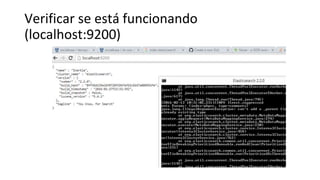
Verificar se está funcionando
(localhost:9200)
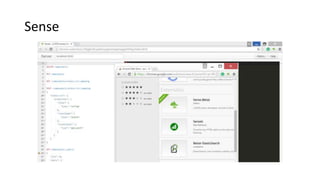
Sense
Criar índice e mapeamento no Elasticsearch
• Exemplo simples “Post” e “Comentário” para o site do PHPSC
• Criar um índice seria tão simples como:
• PUT phpsc
• O mapeamento no Elasticsearch é flat
• O Elasticsearch está configurado para buscar palavras em Inglês
• Usar um analisador para português
• GIST:
• https://gist.github.com/lhzsantana/4f940684075ce115d799
• ES 2.0
• Os campos multifields (como o author) devem ser definidos com a
palavra “fields” no lugar de “properties”
• Ao contrário do ES 1.* em uma relação parent/child o filho deve ser
criado antes do pai
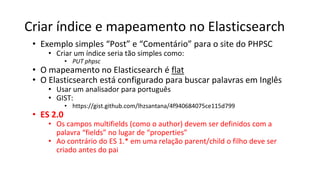
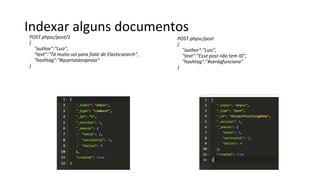
Indexar alguns documentos
POST phpsc/post/1
{
"author":"Luiz",
"text":"Tá muito sol para falar de Elasticsearch",
"hashtag":"#queriatánapraia"
}
POST phpsc/post
{
"author":"Luiz",
"text":"Esse post não tem ID",
"hashtag":"#seráqfunciona"
}
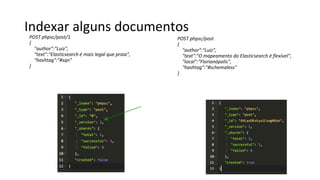
Indexar alguns documentos
POST phpsc/post/1
{
"author":"Luiz",
"text":"Elasticsearch é mais legal que praia",
"hashtag":"#sqn"
}
POST phpsc/post
{
"author":"Luiz",
"text":"O mapeamento do Elasticsearch é flexível",
"local":"Florianópolis",
"hashtag":"#schemaless"
}
Indexar alguns documentos
POST phpsc/comments/1
{
"author":"Anônimo",
"text": "Até agora não vi nada de
PHP",
"hashtag":"#taenrolando"
}
POST phpsc/comment/1?parent=1
{
"author":"Anônimo",
"text": "Jurerê ou PHP?",
"hashtag":"#queriatánapraia"
}
Indexar alguns documentos
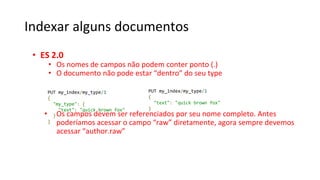
• ES 2.0
• Os nomes de campos não podem conter ponto (.)
• O documento não pode estar “dentro” do seu type
• Os campos devem ser referenciados por seu nome completo. Antes
poderíamos acessar o campo “raw” diretamente, agora sempre devemos
acessar “author.raw”
PUT my_index/my_type/1
{
"my_type": {
"text": "quick brown fox"
}
}
PUT my_index/my_type/1
{
"text": "quick brown fox"
}
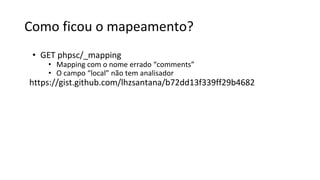
Como ficou o mapeamento?
• GET phpsc/_mapping
• Mapping com o nome errado “comments”
• O campo “local” não tem analisador
https://gist.github.com/lhzsantana/b72dd13f339ff29b4682
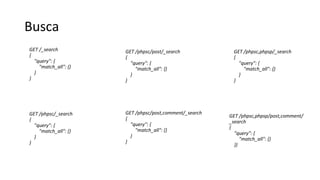
Busca
GET /_search
{
"query": {
"match_all": {}
}
}
GET /phpsc/_search
{
"query": {
"match_all": {}
}
}
GET /phpsc/post/_search
{
"query": {
"match_all": {}
}
}
GET /phpsc/post,comment/_search
{
"query": {
"match_all": {}
}
}
GET /phpsc,phpsp/_search
{
"query": {
"match_all": {}
}
}
GET /phpsc,phpsp/post,comment/
_search
{
"query": {
"match_all": {}
}}
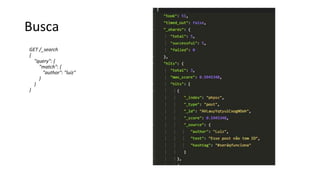
Busca
GET /_search
{
"query": {
"match": {
"author": "luiz"
}
}
}
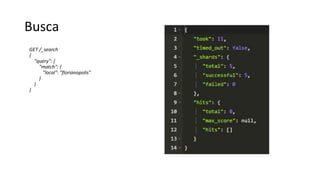
Busca
GET /_search
{
"query": {
"match": {
"local": "florianopolis"
}
}
}
Busca - bool, boost e agregações
GET /phpsc/post,comment
/_search
{
"sort": [
{
"author": {
"order": "desc"
}
}
],
"size": 100,
"query": {
"bool": {
"should": [{
"match": {
"author": "anônimo"
}}, {
"match": {
"local": "Florianópolis"
}
}
]
} ,
"aggs" : {
"hashtags" : {
"terms" : { "field" : "author.raw"
}
}
https://gist.github.com/lhzsantana/f552751d
a153741657
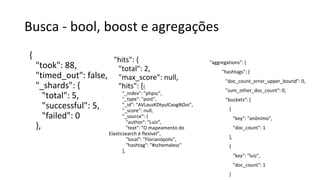
Busca - bool, boost e agregações
{
"took": 88,
"timed_out": false,
"_shards": {
"total": 5,
"successful": 5,
"failed": 0
},
"hits": {
"total": 2,
"max_score": null,
"hits": [{
"_index": "phpsc",
"_type": "post",
"_id": "AVLauzKDtyulCxogNOoi",
"_score": null,
"_source": {
"author": "Luiz",
"text": "O mapeamento do
Elasticsearch é flexível",
"local": "Florianópolis",
"hashtag": "#schemaless"
},
"aggregations": {
"hashtags": {
"doc_count_error_upper_bound": 0,
"sum_other_doc_count": 0,
"buckets": [
{
"key": "anônimo",
"doc_count": 1
},
{
"key": "luiz",
"doc_count": 1
}
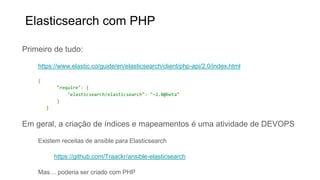
Primeiro de tudo:
https://www.elastic.co/guide/en/elasticsearch/client/php-api/2.0/index.html
{
"require": {
"elasticsearch/elasticsearch": "~2.0@beta"
}
}
Em geral, a criação de índices e mapeamentos é uma atividade de DEVOPS
Existem receitas de ansible para Elasticsearch
https://github.com/Traackr/ansible-elasticsearch
Mas… poderia ser criado com PHP
Elasticsearch com PHP
Elasticsearch com PHP - Criar o cliente
$hosts = [
'192.168.1.1:9200', // IP + Port
'192.168.1.2', // Just IP
'mydomain.server.com:9201', // Domain + Port
'mydomain2.server.com', // Just Domain
'https://localhost', // SSL to localhost
'https://192.168.1.3:9200' // SSL to IP + Port
];
$client = ClientBuilder::create() // Instantiate a new ClientBuilder
->setHosts($hosts) // Set the hosts
->build(); // Build the client object
Num cluster, todos IPs
devem estar entre os
hosts. O cliente irá
acessar em round-
robin.
Elasticsearch com PHP - Indexação
$params = [
'index' => phpsc,
'type' => 'post',
'body' =>
[
'author' => 'Luiz',
'text' => 'Ufaaa finalmente PHP :)'
]
];
$response = $client->index($params);
Elasticsearch com PHP - Recuperar com ID
$params = [
'index' => 'phpsc',
'type' => 'post',
'id' => '1'
];
$response = $client->get($params);
Elasticsearch com PHP - Buscar
$params = [
'index' => phpsc,
'type' => 'post',
'body' => [
'query' => [
'match' => [
'author' => 'Luiz'
]
]
]
];
$results = $client->search($params);
//resultados
$milliseconds = $results['took'];
$maxScore = $results['hits']['max_score'];
$score = $results['hits']['hits'][0]['_score'];
$docs = $results['hits']['hits'];
Elasticsearch com PHP - Filtros já não existem no ES 2.0!
$params = [
'index' => phpsc,
'type' => 'post',
'body' => [
'query' => [
'match' => [
'author' => 'Luiz'
]
],
'filter' => [
'match' => [
'local' => 'Florianópolis'
]
]
]
];
$results = $client->search($params);
USE
QUERY
Elasticsearch com PHP - Boolean
$params = [
'index' => 'phpsc',
'type' => 'post',
'body' => [
'query' => [
'bool' => [
'should' => [
[ 'match' => [ 'author' => 'luiz' ] ],
[ 'match' => [ 'local' => 'florianópolis' ] ],
]
]
]
]
];
$results = $client->search($params);
Elasticsearch com PHP - Desafio
$params = [
'index' => 'phpsc',
'type' => 'post',
//sort
'body' => [
'query' => [
],
//aggregations
]
];
$results = $client->search($params);
Elasticsearch com PHP - Pontos importantes
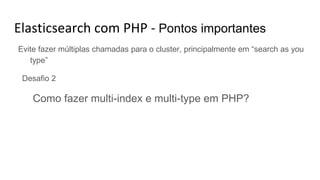
Evite fazer múltiplas chamadas para o cluster, principalmente em “search as you
type”
Desafio 2
Como fazer multi-index e multi-type em PHP?
Elasticsearch com PHP - Pontos importantes
MSearch
$params = [
'index' => 'phpsc',
'body' => [
['type' => 'post'],
['query' => ['match_all' => []]],
['type' => 'comment'],
['query' => ['match_all' => []]]
]
];
$results = $client->msearch($params);
//resultados
$responses = $results['responses']['hits']['hits'];
$posts = $responses[0]['hits']['hits'];
$comments = $responses[1]['hits']['hits'];
Elasticsearch com PHP
Bulk no lugar de Rivers para o ES 2.0!
if (!is_string($type) || !is_string($operation)) {
throw new InvalidArgumentException();
}
$response = [];
if (!empty($json)) {
$params = [];
for ($i = 0; $i < count($json); $i++) {
$params['body'][] = [
'index' => $index,
'type' => $type
];
$params['body'][] = [
$json [$i]
];
}
$response = $this->elasticsearchClient->bulk($params);
{ "index" : { "_index" : "test", "_type" : "type1", "_id" : "1" }
}
{ "field1" : "value1" }
{ "delete" : { "_index" : "test", "_type" : "type1", "_id" : "2" }
}
{ "create" : { "_index" : "test", "_type" : "type1", "_id" : "3" }
}
{ "field1" : "value3" }
{ "update" : {"_id" : "1", "_type" : "type1", "_index" : "index1"}
}
{ "doc" : {"field2" : "value2"} }
$ curl -s -XPOST localhost:9200/_bulk --data-binary "@requests";
echo
{"took":7,"items":[
{"create":{"_index":"test","_type":"type1","_id":"1","_version":1}
}]}
Elasticsearch com PHP - Suggestion
params = [
'hashtag-suggest' => [
"text" => “#qu”,
"completion" => [
"field" =>
"hashtags.suggest"
]
]
];
$response = $this->client-
>suggest(params);
//resultados
if (!isset($response['hashtag-suggest'])) {
return ['items' => []];
}
$items = [];
foreach ($response['hashtag-suggest'] as $item) {
foreach ($item['options'] as $option) {
$items[] = $option['text'];
}
}
return ['items' => $items];
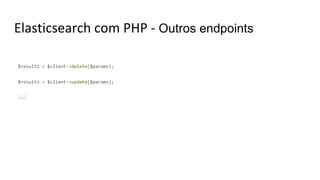
Elasticsearch com PHP - Outros endpoints
$results = $client->delete($params);
$results = $client->update($params);
...
Elasticsearch com PHP - Array x JSON
$json = '{
"query" : {
"match" : {
"author" : "Luiz"
}
}
}';
$params = [
'index' => 'phpsc',
'type' => 'post',
'body' => $json
];
$results = $client->search($params);
$params = [
'index' =>'phpsc',
'type' => 'post',
'body' => [
'query' => [
'match' => [
'author' => 'Luiz'
]
]
]
];
$results = $client->search($params);
$params = ['index'] = 'phpsc';
$params = ['my_type'] = 'post';
$params = ['body']['query']['match']
['author' ] = 'Luiz';
$results = $client->search($params);
Conclusões - O que não fazer...
Não use Guzzle, o Elasticsearch oferece o cliente PHP que já empacota o
Guzzle e adiciona outras ferramentas
Bulk e Msearch já encapsulado
Tratamento de valores máximos
Uso do cluster
Não faça buscas em chamadas separadas (aumenta muito a latência). Prefira
msearch ou buscas multi-índice
Mescar busca no Elasticsearch com buscas em MySQL
Normalizar
Conclusões - Elasticsearch 2.0
Na verdade já estamos no 2.2
Grandes novidades:
Fim dos filtros
Pipeline de agregações
Groovy para script no lugar de MVEL
Features removidas:
RIVERS já não existem! Muito blogs ainda estão por aí falando disso…
Cuidado com o mapeamento
Conclusões
Sem dúvida a melhor opção para busca textual
Interessante também para analytics e dados
georeferenciados
O cliente PHP é maduro e deve ser usado
Muitas outras features podem ser exploradas:
Highlight, outras agregações, script ...
Cuidado com os blogs, apresentações e artigos
antigos, a evolução do Elasticseach é muito
rápida
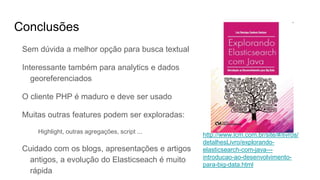
http://www.lcm.com.br/site/#/livros/
detalhesLivro/explorando-
elasticsearch-com-java---
introducao-ao-desenvolvimento-
para-big-data.html
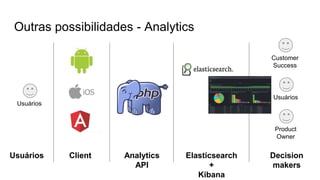
Outras possibilidades - Analytics
Client Analytics
API
Elasticsearch
+
Kibana
Customer
Success
Usuários Decision
makers
Usuários
Product
Owner
Usuários
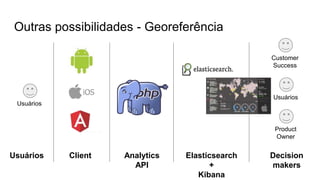
Outras possibilidades - Georeferência
Client Analytics
API
Elasticsearch
+
Kibana
Customer
Success
Usuários Decision
makers
Usuários
Product
Owner
Usuários
Temos vagas :)
Desenvolvedor PHP Senior
https://socialbase.workable.com/jobs/175261

Novidades do elasticsearch 2.0 e como usá-lo com PHP

  • 1.
    Novidades do Elasticsearch2.0 e como usá-lo com PHP Luiz Henrique Zambom Santana https://github.com/lhzsantana Meetup - PHPSC 13 de Fevereiro de 2016 Florianópolis/SC
  • 2.
    Agenda Visão geral Arquitetura desoluções Desenvolvimento com o Elasticsearch Elasticsearch com PHP Novas possibilidades Conclusões
  • 3.
    • Doutorando naUFSC • Consultor e programador • Trabalhando com Elasticsearch desde 2013 (versão 0.9.x) • Autor de artigos, Blog (luizsantana.info) e livros Apresentação
  • 4.
    Not only SQL Sadalagee Fowler, 2012 (http://martinfowler.com/books/nosql.html) Relational databases will be a footnote in history Nathan Marz, 2014 (http://www.slideshare.net/nathanmarz/runaway-complexity-in-big-data-and-a- plan-to-stop-it) Visão geral
  • 5.
    Visão geral -Por que busca e analytics?
  • 7.
    Visão geral -Por que em tempo real?
  • 8.
    Visão geral -Elasticsearch buzz
  • 9.
    Visão geral -Por que Elasticsearch? • Tempo real • Flexível • Livre de esquema e muito escalável • Iniciado por Shay Banon em 2010 • Desenvolvido pela comunidade • Código aberto em: • https://github.com/elastic/elasticsearch • Atualmente apoiado pela Elastic
  • 10.
    Visão geral -Onde é usado? Mais casos de uso em: https://www.elastic.co/use-cases
  • 11.
    Visão geral • Cluster •Lucene • Índice • Mapeamento • Tipo Lucene Banco de dados relacional (BDR) Índice (Index) Esquema Type Tabela Documento (JSON) Linha Campo (Field) Coluna Mapeamento (Mapping) Estrutura da tabela Query DSL SQL
  • 12.
    Arquitetura - Indexação ClientAPI ElasticsearchUsuários Usuários
  • 13.
    Arquitetura - Busca ClientAPI ElasticsearchUsuários Usuários
  • 14.
    Arquitetura - Autocomplete(“search as you type”) Client API ElasticsearchUsuários Usuários
  • 15.
    Arquitetura - Indexaçãoem lote ElasticsearchAPI
  • 16.
    Desenvolvimento com oElasticsearch - Pontos importantes Gerenciamento dos dados Backup do Elasticsearch? Geralmente o Elasticsearch é usado como um repositório volátil Backup: https://www.elastic.co/guide/en/elasticsearch/reference/current/modules- snapshots.html Segurança: https://www.elastic.co/products/shield Mapeamento
  • 17.
    Desenvolvimento com oElasticsearch - Instalação •Simplesmente baixar e desempacotar •Elasticsearch •https://www.elastic.co/downloads/elasticsearch •Versão 2.2.0 •Iniciar: •/bin/elasticsearch •Em produção não é tão simples: •http://logz.io/blog/deploy-elk-production/
  • 18.
    Verificar se estáfuncionando (localhost:9200)
  • 19.
  • 20.
    Criar índice emapeamento no Elasticsearch • Exemplo simples “Post” e “Comentário” para o site do PHPSC • Criar um índice seria tão simples como: • PUT phpsc • O mapeamento no Elasticsearch é flat • O Elasticsearch está configurado para buscar palavras em Inglês • Usar um analisador para português • GIST: • https://gist.github.com/lhzsantana/4f940684075ce115d799 • ES 2.0 • Os campos multifields (como o author) devem ser definidos com a palavra “fields” no lugar de “properties” • Ao contrário do ES 1.* em uma relação parent/child o filho deve ser criado antes do pai
  • 21.
    Indexar alguns documentos POSTphpsc/post/1 { "author":"Luiz", "text":"Tá muito sol para falar de Elasticsearch", "hashtag":"#queriatánapraia" } POST phpsc/post { "author":"Luiz", "text":"Esse post não tem ID", "hashtag":"#seráqfunciona" }
  • 22.
    Indexar alguns documentos POSTphpsc/post/1 { "author":"Luiz", "text":"Elasticsearch é mais legal que praia", "hashtag":"#sqn" } POST phpsc/post { "author":"Luiz", "text":"O mapeamento do Elasticsearch é flexível", "local":"Florianópolis", "hashtag":"#schemaless" }
  • 23.
    Indexar alguns documentos POSTphpsc/comments/1 { "author":"Anônimo", "text": "Até agora não vi nada de PHP", "hashtag":"#taenrolando" } POST phpsc/comment/1?parent=1 { "author":"Anônimo", "text": "Jurerê ou PHP?", "hashtag":"#queriatánapraia" }
  • 24.
    Indexar alguns documentos •ES 2.0 • Os nomes de campos não podem conter ponto (.) • O documento não pode estar “dentro” do seu type • Os campos devem ser referenciados por seu nome completo. Antes poderíamos acessar o campo “raw” diretamente, agora sempre devemos acessar “author.raw” PUT my_index/my_type/1 { "my_type": { "text": "quick brown fox" } } PUT my_index/my_type/1 { "text": "quick brown fox" }
  • 25.
    Como ficou omapeamento? • GET phpsc/_mapping • Mapping com o nome errado “comments” • O campo “local” não tem analisador https://gist.github.com/lhzsantana/b72dd13f339ff29b4682
  • 26.
    Busca GET /_search { "query": { "match_all":{} } } GET /phpsc/_search { "query": { "match_all": {} } } GET /phpsc/post/_search { "query": { "match_all": {} } } GET /phpsc/post,comment/_search { "query": { "match_all": {} } } GET /phpsc,phpsp/_search { "query": { "match_all": {} } } GET /phpsc,phpsp/post,comment/ _search { "query": { "match_all": {} }}
  • 27.
  • 28.
    Busca GET /_search { "query": { "match":{ "local": "florianopolis" } } }
  • 29.
    Busca - bool,boost e agregações GET /phpsc/post,comment /_search { "sort": [ { "author": { "order": "desc" } } ], "size": 100, "query": { "bool": { "should": [{ "match": { "author": "anônimo" }}, { "match": { "local": "Florianópolis" } } ] } , "aggs" : { "hashtags" : { "terms" : { "field" : "author.raw" } } https://gist.github.com/lhzsantana/f552751d a153741657
  • 30.
    Busca - bool,boost e agregações { "took": 88, "timed_out": false, "_shards": { "total": 5, "successful": 5, "failed": 0 }, "hits": { "total": 2, "max_score": null, "hits": [{ "_index": "phpsc", "_type": "post", "_id": "AVLauzKDtyulCxogNOoi", "_score": null, "_source": { "author": "Luiz", "text": "O mapeamento do Elasticsearch é flexível", "local": "Florianópolis", "hashtag": "#schemaless" }, "aggregations": { "hashtags": { "doc_count_error_upper_bound": 0, "sum_other_doc_count": 0, "buckets": [ { "key": "anônimo", "doc_count": 1 }, { "key": "luiz", "doc_count": 1 }
  • 31.
    Primeiro de tudo: https://www.elastic.co/guide/en/elasticsearch/client/php-api/2.0/index.html { "require":{ "elasticsearch/elasticsearch": "~2.0@beta" } } Em geral, a criação de índices e mapeamentos é uma atividade de DEVOPS Existem receitas de ansible para Elasticsearch https://github.com/Traackr/ansible-elasticsearch Mas… poderia ser criado com PHP Elasticsearch com PHP
  • 32.
    Elasticsearch com PHP- Criar o cliente $hosts = [ '192.168.1.1:9200', // IP + Port '192.168.1.2', // Just IP 'mydomain.server.com:9201', // Domain + Port 'mydomain2.server.com', // Just Domain 'https://localhost', // SSL to localhost 'https://192.168.1.3:9200' // SSL to IP + Port ]; $client = ClientBuilder::create() // Instantiate a new ClientBuilder ->setHosts($hosts) // Set the hosts ->build(); // Build the client object Num cluster, todos IPs devem estar entre os hosts. O cliente irá acessar em round- robin.
  • 33.
    Elasticsearch com PHP- Indexação $params = [ 'index' => phpsc, 'type' => 'post', 'body' => [ 'author' => 'Luiz', 'text' => 'Ufaaa finalmente PHP :)' ] ]; $response = $client->index($params);
  • 34.
    Elasticsearch com PHP- Recuperar com ID $params = [ 'index' => 'phpsc', 'type' => 'post', 'id' => '1' ]; $response = $client->get($params);
  • 35.
    Elasticsearch com PHP- Buscar $params = [ 'index' => phpsc, 'type' => 'post', 'body' => [ 'query' => [ 'match' => [ 'author' => 'Luiz' ] ] ] ]; $results = $client->search($params); //resultados $milliseconds = $results['took']; $maxScore = $results['hits']['max_score']; $score = $results['hits']['hits'][0]['_score']; $docs = $results['hits']['hits'];
  • 36.
    Elasticsearch com PHP- Filtros já não existem no ES 2.0! $params = [ 'index' => phpsc, 'type' => 'post', 'body' => [ 'query' => [ 'match' => [ 'author' => 'Luiz' ] ], 'filter' => [ 'match' => [ 'local' => 'Florianópolis' ] ] ] ]; $results = $client->search($params); USE QUERY
  • 37.
    Elasticsearch com PHP- Boolean $params = [ 'index' => 'phpsc', 'type' => 'post', 'body' => [ 'query' => [ 'bool' => [ 'should' => [ [ 'match' => [ 'author' => 'luiz' ] ], [ 'match' => [ 'local' => 'florianópolis' ] ], ] ] ] ] ]; $results = $client->search($params);
  • 38.
    Elasticsearch com PHP- Desafio $params = [ 'index' => 'phpsc', 'type' => 'post', //sort 'body' => [ 'query' => [ ], //aggregations ] ]; $results = $client->search($params);
  • 39.
    Elasticsearch com PHP- Pontos importantes Evite fazer múltiplas chamadas para o cluster, principalmente em “search as you type” Desafio 2 Como fazer multi-index e multi-type em PHP?
  • 40.
    Elasticsearch com PHP- Pontos importantes MSearch $params = [ 'index' => 'phpsc', 'body' => [ ['type' => 'post'], ['query' => ['match_all' => []]], ['type' => 'comment'], ['query' => ['match_all' => []]] ] ]; $results = $client->msearch($params); //resultados $responses = $results['responses']['hits']['hits']; $posts = $responses[0]['hits']['hits']; $comments = $responses[1]['hits']['hits'];
  • 41.
    Elasticsearch com PHP Bulkno lugar de Rivers para o ES 2.0! if (!is_string($type) || !is_string($operation)) { throw new InvalidArgumentException(); } $response = []; if (!empty($json)) { $params = []; for ($i = 0; $i < count($json); $i++) { $params['body'][] = [ 'index' => $index, 'type' => $type ]; $params['body'][] = [ $json [$i] ]; } $response = $this->elasticsearchClient->bulk($params); { "index" : { "_index" : "test", "_type" : "type1", "_id" : "1" } } { "field1" : "value1" } { "delete" : { "_index" : "test", "_type" : "type1", "_id" : "2" } } { "create" : { "_index" : "test", "_type" : "type1", "_id" : "3" } } { "field1" : "value3" } { "update" : {"_id" : "1", "_type" : "type1", "_index" : "index1"} } { "doc" : {"field2" : "value2"} } $ curl -s -XPOST localhost:9200/_bulk --data-binary "@requests"; echo {"took":7,"items":[ {"create":{"_index":"test","_type":"type1","_id":"1","_version":1} }]}
  • 42.
    Elasticsearch com PHP- Suggestion params = [ 'hashtag-suggest' => [ "text" => “#qu”, "completion" => [ "field" => "hashtags.suggest" ] ] ]; $response = $this->client- >suggest(params); //resultados if (!isset($response['hashtag-suggest'])) { return ['items' => []]; } $items = []; foreach ($response['hashtag-suggest'] as $item) { foreach ($item['options'] as $option) { $items[] = $option['text']; } } return ['items' => $items];
  • 43.
    Elasticsearch com PHP- Outros endpoints $results = $client->delete($params); $results = $client->update($params); ...
  • 44.
    Elasticsearch com PHP- Array x JSON $json = '{ "query" : { "match" : { "author" : "Luiz" } } }'; $params = [ 'index' => 'phpsc', 'type' => 'post', 'body' => $json ]; $results = $client->search($params); $params = [ 'index' =>'phpsc', 'type' => 'post', 'body' => [ 'query' => [ 'match' => [ 'author' => 'Luiz' ] ] ] ]; $results = $client->search($params); $params = ['index'] = 'phpsc'; $params = ['my_type'] = 'post'; $params = ['body']['query']['match'] ['author' ] = 'Luiz'; $results = $client->search($params);
  • 45.
    Conclusões - Oque não fazer... Não use Guzzle, o Elasticsearch oferece o cliente PHP que já empacota o Guzzle e adiciona outras ferramentas Bulk e Msearch já encapsulado Tratamento de valores máximos Uso do cluster Não faça buscas em chamadas separadas (aumenta muito a latência). Prefira msearch ou buscas multi-índice Mescar busca no Elasticsearch com buscas em MySQL Normalizar
  • 46.
    Conclusões - Elasticsearch2.0 Na verdade já estamos no 2.2 Grandes novidades: Fim dos filtros Pipeline de agregações Groovy para script no lugar de MVEL Features removidas: RIVERS já não existem! Muito blogs ainda estão por aí falando disso… Cuidado com o mapeamento
  • 47.
    Conclusões Sem dúvida amelhor opção para busca textual Interessante também para analytics e dados georeferenciados O cliente PHP é maduro e deve ser usado Muitas outras features podem ser exploradas: Highlight, outras agregações, script ... Cuidado com os blogs, apresentações e artigos antigos, a evolução do Elasticseach é muito rápida http://www.lcm.com.br/site/#/livros/ detalhesLivro/explorando- elasticsearch-com-java--- introducao-ao-desenvolvimento- para-big-data.html
  • 48.
    Outras possibilidades -Analytics Client Analytics API Elasticsearch + Kibana Customer Success Usuários Decision makers Usuários Product Owner Usuários
  • 49.
    Outras possibilidades -Georeferência Client Analytics API Elasticsearch + Kibana Customer Success Usuários Decision makers Usuários Product Owner Usuários
  • 50.
    Temos vagas :) DesenvolvedorPHP Senior https://socialbase.workable.com/jobs/175261