



Convergência  – algumas notas António Granado, Julho 2010
Tipos de convergência nos media Convergência entre empresas Convergência entre meios Convergência de dispositivos Convergência entre produtores e consumidores de informação
Convergência entre empresas Fusão entre grandes conglomerados de média Sinergias a todos os níveis Maior permeabilidade a pressões externas Menor independência jornalística Menor diversidade informativa Jornalistas multi-tarefas
EPIC 2015   (Jan.2005)
Convergência entre meios Integração de redacções breaking / normal Integração de redacções papel / web Integração de redacções rádio / TV / web Integração de fotografia / vídeo Integração de edição - multiplataformas
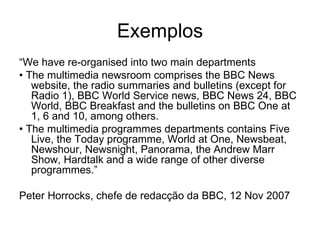
Exemplos “ We have re-organised into two main departments  •  The multimedia newsroom comprises the BBC News website, the radio summaries and bulletins (except for Radio 1), BBC World Service news, BBC News 24, BBC World, BBC Breakfast and the bulletins on BBC One at 1, 6 and 10, among others. •  The multimedia programmes departments contains Five Live, the Today programme, World at One, Newsbeat, Newshour, Newsnight, Panorama, the Andrew Marr Show, Hardtalk and a wide range of other diverse programmes.” Peter Horrocks, chefe de redacção da BBC, 12 Nov 2007
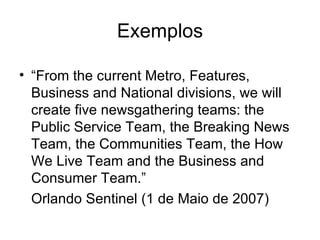
Exemplos “ From the current Metro, Features, Business and National divisions, we will create five newsgathering teams: the Public Service Team, the Breaking News Team, the Communities Team, the How We Live Team and the Business and Consumer Team.” Orlando Sentinel (1 de Maio de 2007)
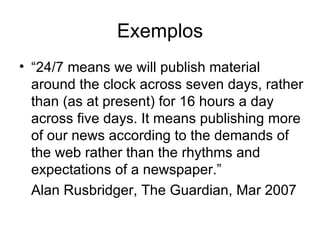
Exemplos “ 24/7 means we will publish material around the clock across seven days, rather than (as at present) for 16 hours a day across five days. It means publishing more of our news according to the demands of the web rather than the rhythms and expectations of a newspaper.”  Alan Rusbridger, The Guardian, Mar 2007
Exemplos Jornais fazem noticiários televisivos Jornais fazem programas televisivos Revistas fazem canais de rádio
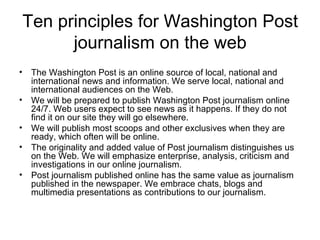
Ten principles for Washington Post journalism on the web The Washington Post is an online source of local, national and international news and information. We serve local, national and international audiences on the Web.  We will be prepared to publish Washington Post journalism online 24/7. Web users expect to see news as it happens. If they do not find it on our site they will go elsewhere.  We will publish most scoops and other exclusives when they are ready, which often will be online.  The originality and added value of Post journalism distinguishes us on the Web. We will emphasize enterprise, analysis, criticism and investigations in our online journalism.  Post journalism published online has the same value as journalism published in the newspaper. We embrace chats, blogs and multimedia presentations as contributions to our journalism.
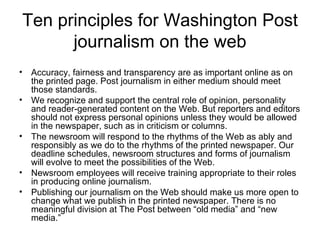
Ten principles for Washington Post journalism on the web Accuracy, fairness and transparency are as important online as on the printed page. Post journalism in either medium should meet those standards.  We recognize and support the central role of opinion, personality and reader-generated content on the Web. But reporters and editors should not express personal opinions unless they would be allowed in the newspaper, such as in criticism or columns.  The newsroom will respond to the rhythms of the Web as ably and responsibly as we do to the rhythms of the printed newspaper. Our deadline schedules, newsroom structures and forms of journalism will evolve to meet the possibilities of the Web.  Newsroom employees will receive training appropriate to their roles in producing online journalism.  Publishing our journalism on the Web should make us more open to change what we publish in the printed newspaper. There is no meaningful division at The Post between “old media” and “new media.”
Exemplos A nova redacção do NY Times A redacção multimédia do Daily Telegraph O vídeo no WSJ  O novo ABC
Convergência de dispositivos Os diversos meios convergem na Internet Ao mesmo tempo, os meios tradicionais enfraquecem A convergência acontece agora nos telemóveis
Jornais Tiragens caem em todo o mundo Dificuldade em conquistar novos leitores Renovações delapidam leitores antigos Notícias de ontem deixaram de interessar Gratuitos ajudaram à festa
Rádio Audiências fragmentam-se Esboça-se o DAB, que fracassa Concorrência aperta Receitas publicitárias baixam
Televisão Audiências fragmentam-se Desaparecem os 18-34 Publicidade baixa muito de preço Internet aparece e faz enorme concorrência
 
Convergência de dispositivos Nokia N95 / iPhone A experiência moblogging da Reuters Desenho de sites para telemóveis As notícias onde e quando quero
Eric Schmidt, CEO Google, Abr 2010 “ It’s important to understand that three things are coming together: the powerful mobile devices, the tremendous performance of computers and the capabilities and the technologies that will exploit the sum of that, that will define the next ten or twenty years. So when I say “Internet first,” I mean “mobile first.””
Exemplos Kindle / iPhone Ecrãs flexíveis -  Sony Leitor da Philips Outside Magazine Ipad  ou  Ipad NYTimes na TV Etc.
Convergência produtores/consumidores Audiência não está disposta a aceitar passivamente o que lhe dão  Quer participar na discussão Tem poder de publicação independente  Tem acesso aos meios para o fazer Nasce o jornalismo participativo
Outros nomes Citizen journalism Participatory journalism Jornalismo-cidadão Não confundir com Jornalismo cívico que é feito por jornalistas (Os jornalistas e as suas audiências não podem continuar a ser espectadores nos processos políticos e sociais, têm de se transformar em participantes)
O que é? Cidadãos ganham um papel activo na recolha, interpretação, análise e difusão das notícias. Definição de Jay Rosen
Momentos-chave 1999 - Nascimento do Blogger 1999 – Indymedia, durante o encontro da Organização Mundial do Comércio, em Seattle.  2000 – OhMyNews fundado na Coreia do Sul 2003 - Shayne Bowman e Chris Willis escrevem “We Media”  2004 – Bloggers participam nas convenções 2004 – Dan Gilmor escreve “We the Media”
Exemplos Blogger/WordPress Flickr YouTube Qik Flixwagon Ustream
Mitos da convergência Myths and Realities of Convergence ( http://www.nieman.harvard.edu/reportsitem.aspx?id=100299 )
Mitos da convergência Convergence is just a nice way of saying the organization wants to cut costs.  The truth is convergence costs money because usually it requires additional staff and more technology. Efficiencies are associated with convergence, but organizations that approach convergence as a way of saving money invariably are disappointed. Convergence needs to be undertaken as a growth strategy, not a cost-cutting measure.
Mitos da convergência News organizations are full of creative people with great ideas who will figure this out.  Sorry, a successful convergence strategy requires a strong vision and commitment from the top. Providing news and information seven days a week, 24 hours each day, across delivery platforms requires a different kind of newsroom structure.
 
Mitos da convergência Every reporter should be a backpack journalist.  The premise certainly is alluring, but in our hearts we all know that not everyone is going to be successful working across formats in different media.  The reporter who has the governor's private phone number and can get a return call in the middle of the night remains just as valuable, regardless of whether he or she is podcasting or doing slide shows. However, if no one on your staff is working across a range of media, an opportunity is being missed.
Desafios da convergência Interessa-te pelo mundo que te rodeia; Não te envergonhes nunca de fazer perguntas; Aprende a detectar e a contar uma estória; Domina a Internet, as suas ferramentas e os seus espaços; Escolhe uma área e torna-te especialista;
Desafios da convergência 6. Não tenhas medo de experimentar; 7. As regras deontológicas são para cumprir – sempre; 8. Cuida da tua reputação na Web e fora dela; 9. Presta atenção aos teus leitores /ouvintes/ espectadores; 10. Diversifica a tua formação.
O que não podem perder
O que não podem perder http://www.poynter.org/ http://www.233grados.com/ http://infotendencias.com/ Myths and Realities of Convergence
Obrigado [email_address] ciberjornalismo.com/pontomedia

Convergência

  • 1.
    Convergência –algumas notas António Granado, Julho 2010
  • 2.
    Tipos de convergêncianos media Convergência entre empresas Convergência entre meios Convergência de dispositivos Convergência entre produtores e consumidores de informação
  • 3.
    Convergência entre empresasFusão entre grandes conglomerados de média Sinergias a todos os níveis Maior permeabilidade a pressões externas Menor independência jornalística Menor diversidade informativa Jornalistas multi-tarefas
  • 4.
    EPIC 2015 (Jan.2005)
  • 5.
    Convergência entre meiosIntegração de redacções breaking / normal Integração de redacções papel / web Integração de redacções rádio / TV / web Integração de fotografia / vídeo Integração de edição - multiplataformas
  • 6.
    Exemplos “ Wehave re-organised into two main departments • The multimedia newsroom comprises the BBC News website, the radio summaries and bulletins (except for Radio 1), BBC World Service news, BBC News 24, BBC World, BBC Breakfast and the bulletins on BBC One at 1, 6 and 10, among others. • The multimedia programmes departments contains Five Live, the Today programme, World at One, Newsbeat, Newshour, Newsnight, Panorama, the Andrew Marr Show, Hardtalk and a wide range of other diverse programmes.” Peter Horrocks, chefe de redacção da BBC, 12 Nov 2007
  • 7.
    Exemplos “ Fromthe current Metro, Features, Business and National divisions, we will create five newsgathering teams: the Public Service Team, the Breaking News Team, the Communities Team, the How We Live Team and the Business and Consumer Team.” Orlando Sentinel (1 de Maio de 2007)
  • 8.
    Exemplos “ 24/7means we will publish material around the clock across seven days, rather than (as at present) for 16 hours a day across five days. It means publishing more of our news according to the demands of the web rather than the rhythms and expectations of a newspaper.” Alan Rusbridger, The Guardian, Mar 2007
  • 9.
    Exemplos Jornais fazemnoticiários televisivos Jornais fazem programas televisivos Revistas fazem canais de rádio
  • 10.
    Ten principles forWashington Post journalism on the web The Washington Post is an online source of local, national and international news and information. We serve local, national and international audiences on the Web. We will be prepared to publish Washington Post journalism online 24/7. Web users expect to see news as it happens. If they do not find it on our site they will go elsewhere. We will publish most scoops and other exclusives when they are ready, which often will be online. The originality and added value of Post journalism distinguishes us on the Web. We will emphasize enterprise, analysis, criticism and investigations in our online journalism. Post journalism published online has the same value as journalism published in the newspaper. We embrace chats, blogs and multimedia presentations as contributions to our journalism.
  • 11.
    Ten principles forWashington Post journalism on the web Accuracy, fairness and transparency are as important online as on the printed page. Post journalism in either medium should meet those standards. We recognize and support the central role of opinion, personality and reader-generated content on the Web. But reporters and editors should not express personal opinions unless they would be allowed in the newspaper, such as in criticism or columns. The newsroom will respond to the rhythms of the Web as ably and responsibly as we do to the rhythms of the printed newspaper. Our deadline schedules, newsroom structures and forms of journalism will evolve to meet the possibilities of the Web. Newsroom employees will receive training appropriate to their roles in producing online journalism. Publishing our journalism on the Web should make us more open to change what we publish in the printed newspaper. There is no meaningful division at The Post between “old media” and “new media.”
  • 12.
    Exemplos A novaredacção do NY Times A redacção multimédia do Daily Telegraph O vídeo no WSJ O novo ABC
  • 13.
    Convergência de dispositivosOs diversos meios convergem na Internet Ao mesmo tempo, os meios tradicionais enfraquecem A convergência acontece agora nos telemóveis
  • 14.
    Jornais Tiragens caemem todo o mundo Dificuldade em conquistar novos leitores Renovações delapidam leitores antigos Notícias de ontem deixaram de interessar Gratuitos ajudaram à festa
  • 15.
    Rádio Audiências fragmentam-seEsboça-se o DAB, que fracassa Concorrência aperta Receitas publicitárias baixam
  • 16.
    Televisão Audiências fragmentam-seDesaparecem os 18-34 Publicidade baixa muito de preço Internet aparece e faz enorme concorrência
  • 17.
  • 18.
    Convergência de dispositivosNokia N95 / iPhone A experiência moblogging da Reuters Desenho de sites para telemóveis As notícias onde e quando quero
  • 19.
    Eric Schmidt, CEOGoogle, Abr 2010 “ It’s important to understand that three things are coming together: the powerful mobile devices, the tremendous performance of computers and the capabilities and the technologies that will exploit the sum of that, that will define the next ten or twenty years. So when I say “Internet first,” I mean “mobile first.””
  • 20.
    Exemplos Kindle /iPhone Ecrãs flexíveis - Sony Leitor da Philips Outside Magazine Ipad ou Ipad NYTimes na TV Etc.
  • 21.
    Convergência produtores/consumidores Audiêncianão está disposta a aceitar passivamente o que lhe dão Quer participar na discussão Tem poder de publicação independente Tem acesso aos meios para o fazer Nasce o jornalismo participativo
  • 22.
    Outros nomes Citizenjournalism Participatory journalism Jornalismo-cidadão Não confundir com Jornalismo cívico que é feito por jornalistas (Os jornalistas e as suas audiências não podem continuar a ser espectadores nos processos políticos e sociais, têm de se transformar em participantes)
  • 23.
    O que é?Cidadãos ganham um papel activo na recolha, interpretação, análise e difusão das notícias. Definição de Jay Rosen
  • 24.
    Momentos-chave 1999 -Nascimento do Blogger 1999 – Indymedia, durante o encontro da Organização Mundial do Comércio, em Seattle. 2000 – OhMyNews fundado na Coreia do Sul 2003 - Shayne Bowman e Chris Willis escrevem “We Media” 2004 – Bloggers participam nas convenções 2004 – Dan Gilmor escreve “We the Media”
  • 25.
    Exemplos Blogger/WordPress FlickrYouTube Qik Flixwagon Ustream
  • 26.
    Mitos da convergênciaMyths and Realities of Convergence ( http://www.nieman.harvard.edu/reportsitem.aspx?id=100299 )
  • 27.
    Mitos da convergênciaConvergence is just a nice way of saying the organization wants to cut costs. The truth is convergence costs money because usually it requires additional staff and more technology. Efficiencies are associated with convergence, but organizations that approach convergence as a way of saving money invariably are disappointed. Convergence needs to be undertaken as a growth strategy, not a cost-cutting measure.
  • 28.
    Mitos da convergênciaNews organizations are full of creative people with great ideas who will figure this out. Sorry, a successful convergence strategy requires a strong vision and commitment from the top. Providing news and information seven days a week, 24 hours each day, across delivery platforms requires a different kind of newsroom structure.
  • 29.
  • 30.
    Mitos da convergênciaEvery reporter should be a backpack journalist. The premise certainly is alluring, but in our hearts we all know that not everyone is going to be successful working across formats in different media. The reporter who has the governor's private phone number and can get a return call in the middle of the night remains just as valuable, regardless of whether he or she is podcasting or doing slide shows. However, if no one on your staff is working across a range of media, an opportunity is being missed.
  • 31.
    Desafios da convergênciaInteressa-te pelo mundo que te rodeia; Não te envergonhes nunca de fazer perguntas; Aprende a detectar e a contar uma estória; Domina a Internet, as suas ferramentas e os seus espaços; Escolhe uma área e torna-te especialista;
  • 32.
    Desafios da convergência6. Não tenhas medo de experimentar; 7. As regras deontológicas são para cumprir – sempre; 8. Cuida da tua reputação na Web e fora dela; 9. Presta atenção aos teus leitores /ouvintes/ espectadores; 10. Diversifica a tua formação.
  • 33.
    O que nãopodem perder
  • 34.
    O que nãopodem perder http://www.poynter.org/ http://www.233grados.com/ http://infotendencias.com/ Myths and Realities of Convergence
  • 35.