Ø SIMPLE PRESENT
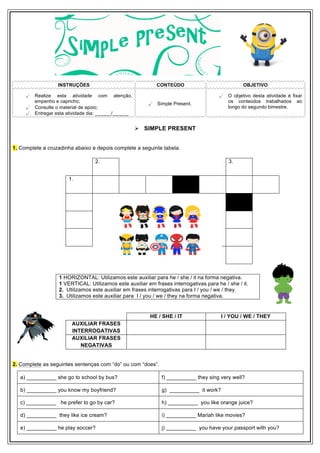
1. Complete a cruzadinha abaixo e depois complete a seguinte tabela.
2. Complete as seguintes sentenças com “do” ou com “does”.
INSTRUÇÕES CONTEÚDO OBJETIVO
√ Realize esta atividade com atenção,
empenho e capricho;
√ Consulte o material de apoio;
√ Entregar esta atividade dia: ______/______
√ Simple Present.
√ O objetivo desta atividade é fixar
os conteúdos trabalhados ao
longo do segundo bimestre.
2. 3.
1.
1 HORIZONTAL: Utilizamos este auxiliar para he / she / it na forma negativa.
1 VERTICAL: Utilizamos este auxiliar em frases interrogativas para he / she / it.
2. Utilizamos este auxiliar em frases interrogativas para I / you / we / they.
3. Utilizamos este auxiliar para I / you / we / they na forma negativa.
HE / SHE / IT I / YOU / WE / THEY
AUXILIAR FRASES
INTERROGATIVAS
AUXILIAR FRASES
NEGATIVAS
a) __________ she go to school by bus? f) __________ they sing very well?
b) __________ you know my boyfriend? g) __________ it work?
c) __________ he prefer to go by car? h) __________ you like orange juice?
d) __________ they like ice cream? i) __________ Mariah like movies?
e) __________ he play soccer? j) __________ you have your passport with you?
3. Traduza as sentenças do exercício anterior.
4. Reescreva as frases do exercício 2 no modo negativo.
5. No Simple Present, quando temos sentenças afirmativas na terceira pessoa do singular (he/she/it), existem algumas
regras, como o acréscimo do S/ES/IES nos verbos principais. Sabendo disso, pinte o grupo de palavras com a mesma cor
da regra utilizada.
a) She doesn’t go to school by bus. f)
b) You don’t know my boyfriend. g)
c) h)
d) i)
e) j)
a) f)
b) g)
c) h)
d) i)
e) j)
REGRA GERAL: APENAS ACRESCENTA-SE O “S”.
VERBOS TERMINADOS EM
CH / SH/ S / O / X / Z, DEVE-SE ACRESCENTAR O
“ES” .
VERBOS TERMINADOS EM CONSOANTE + “Y”,
DEVE-SE TIRAR O “Y” E ACRESCENTAR “IES”.
VERBOS TERMINADOS EM CONSOANTE + “Y”,
DEVE-SE ACRESCENTAR A REGRA GERAL (+S)”.
GO – GOES
MISS – MISSES
WASH – WASHES
WATCH - WATCHES
TRY – TRIES
HURRY – HURRIES
CRY – CRIES
STUDY – STUDIES
READ – READS
SING – SINGS
RUN – RUNS
WRITE – WRITES
STAY – STAYS
PRAY – PRAYS
PLAY – PLAYS
ENJOY – ENJOYS
6. Complete os seguintes verbos com “s / es / ies” e realize a tradução.
VERBO S / ES / IES TRADUÇÃO
STUDY
THINK
UNDERSTAND
SLEEP
GET
KNOW
WORK
KISS
FLY
PLAY
MIX
TRY
TALK
GO
7. Passe as frases abaixo para o modo que se pede e realize a tradução (T).
a) I work hard.
T: ____________________________________________
NEG: __________________________________________
INT: ___________________________________________
e) They don’t run.
T: ____________________________________________
AFF: __________________________________________
INT: ___________________________________________
b) She studies English.
T: ____________________________________________
NEG: __________________________________________
INT: ___________________________________________
f) He doesn’t dance.
T: ____________________________________________
AFF: __________________________________________
INT: ___________________________________________
c) We travel every weekend.
T: ____________________________________________
NEG: __________________________________________
INT: ___________________________________________
g) Do you cry?
T: ____________________________________________
AFF: __________________________________________
NEG: __________________________________________
d) It barks a lot.
T: ____________________________________________
NEG: __________________________________________
INT: ___________________________________________
h) Does she fly?
T: ____________________________________________
AFF: __________________________________________
NEG: __________________________________________
8. Com base nas seguintes imagens, faça o que se pede.
a) Qual o tempo verbal das frases? ______________________________________________________________________
b) Quando utilizamos este tempo verbal? _________________________________________________________________
c) Por que na frase A, não foi utilizado o s/es/ies ao final do verbo principal, enquanto na frasse B essa regra foi utilizada?
__________________________________________________________________________________________________
__________________________________________________________________________________________________
d) Qual a tradução das sentenças?
FRASE A: __________________________________________________________________________________________
FRASE B: __________________________________________________________________________________________
e) Passe a frase A para o modo negativo e interrogativo.
NEGATIVO: ________________________________________________________________________________________
INTERROGATIVO: __________________________________________________________________________________
f) Passe a frase B para o modo negativo e interrogativo.
NEGATIVO: ________________________________________________________________________________________
INTERROGATIVO: __________________________________________________________________________________
g) Substitua o pronome “they” por “she” e realize frases no modo afirmativo, negativo e interrogativo.
AFIRMATIVO: ______________________________________________________________________________________
NEGATIVO: ________________________________________________________________________________________
INTERROGATIVO: __________________________________________________________________________________
h) Substitua o pronome “he” por “I” e realize frases no modo afirmativo, negativo e interrogativo.
AFIRMATIVO: ______________________________________________________________________________________
NEGATIVO: ________________________________________________________________________________________
INTERROGATIVO: __________________________________________________________________________________
GOOD JOB!
TEACHER PAULA MEYER
FRASE A
THEY DRINK WATER EVERY TIME.
FRASE B
HE WACHES TV EVERY MONDAY.
RECOMENDAÇÕES
CONTINUE ASSIM!
REESCREVA OS EXERCÍCIOS
QUE ERROU NO CADERNO
REESCREVA TODOS OS
EXERCÍCIOS NO CADERNO
Lista de exercícios de Inglês (Simple Present)

Lista de exercícios de Inglês (Simple Present)

  • 1.
    Ø SIMPLE PRESENT 1.Complete a cruzadinha abaixo e depois complete a seguinte tabela. 2. Complete as seguintes sentenças com “do” ou com “does”. INSTRUÇÕES CONTEÚDO OBJETIVO √ Realize esta atividade com atenção, empenho e capricho; √ Consulte o material de apoio; √ Entregar esta atividade dia: ______/______ √ Simple Present. √ O objetivo desta atividade é fixar os conteúdos trabalhados ao longo do segundo bimestre. 2. 3. 1. 1 HORIZONTAL: Utilizamos este auxiliar para he / she / it na forma negativa. 1 VERTICAL: Utilizamos este auxiliar em frases interrogativas para he / she / it. 2. Utilizamos este auxiliar em frases interrogativas para I / you / we / they. 3. Utilizamos este auxiliar para I / you / we / they na forma negativa. HE / SHE / IT I / YOU / WE / THEY AUXILIAR FRASES INTERROGATIVAS AUXILIAR FRASES NEGATIVAS a) __________ she go to school by bus? f) __________ they sing very well? b) __________ you know my boyfriend? g) __________ it work? c) __________ he prefer to go by car? h) __________ you like orange juice? d) __________ they like ice cream? i) __________ Mariah like movies? e) __________ he play soccer? j) __________ you have your passport with you?
  • 2.
    3. Traduza assentenças do exercício anterior. 4. Reescreva as frases do exercício 2 no modo negativo. 5. No Simple Present, quando temos sentenças afirmativas na terceira pessoa do singular (he/she/it), existem algumas regras, como o acréscimo do S/ES/IES nos verbos principais. Sabendo disso, pinte o grupo de palavras com a mesma cor da regra utilizada. a) She doesn’t go to school by bus. f) b) You don’t know my boyfriend. g) c) h) d) i) e) j) a) f) b) g) c) h) d) i) e) j) REGRA GERAL: APENAS ACRESCENTA-SE O “S”. VERBOS TERMINADOS EM CH / SH/ S / O / X / Z, DEVE-SE ACRESCENTAR O “ES” . VERBOS TERMINADOS EM CONSOANTE + “Y”, DEVE-SE TIRAR O “Y” E ACRESCENTAR “IES”. VERBOS TERMINADOS EM CONSOANTE + “Y”, DEVE-SE ACRESCENTAR A REGRA GERAL (+S)”. GO – GOES MISS – MISSES WASH – WASHES WATCH - WATCHES TRY – TRIES HURRY – HURRIES CRY – CRIES STUDY – STUDIES READ – READS SING – SINGS RUN – RUNS WRITE – WRITES STAY – STAYS PRAY – PRAYS PLAY – PLAYS ENJOY – ENJOYS
  • 3.
    6. Complete osseguintes verbos com “s / es / ies” e realize a tradução. VERBO S / ES / IES TRADUÇÃO STUDY THINK UNDERSTAND SLEEP GET KNOW WORK KISS FLY PLAY MIX TRY TALK GO 7. Passe as frases abaixo para o modo que se pede e realize a tradução (T). a) I work hard. T: ____________________________________________ NEG: __________________________________________ INT: ___________________________________________ e) They don’t run. T: ____________________________________________ AFF: __________________________________________ INT: ___________________________________________ b) She studies English. T: ____________________________________________ NEG: __________________________________________ INT: ___________________________________________ f) He doesn’t dance. T: ____________________________________________ AFF: __________________________________________ INT: ___________________________________________ c) We travel every weekend. T: ____________________________________________ NEG: __________________________________________ INT: ___________________________________________ g) Do you cry? T: ____________________________________________ AFF: __________________________________________ NEG: __________________________________________ d) It barks a lot. T: ____________________________________________ NEG: __________________________________________ INT: ___________________________________________ h) Does she fly? T: ____________________________________________ AFF: __________________________________________ NEG: __________________________________________
  • 4.
    8. Com basenas seguintes imagens, faça o que se pede. a) Qual o tempo verbal das frases? ______________________________________________________________________ b) Quando utilizamos este tempo verbal? _________________________________________________________________ c) Por que na frase A, não foi utilizado o s/es/ies ao final do verbo principal, enquanto na frasse B essa regra foi utilizada? __________________________________________________________________________________________________ __________________________________________________________________________________________________ d) Qual a tradução das sentenças? FRASE A: __________________________________________________________________________________________ FRASE B: __________________________________________________________________________________________ e) Passe a frase A para o modo negativo e interrogativo. NEGATIVO: ________________________________________________________________________________________ INTERROGATIVO: __________________________________________________________________________________ f) Passe a frase B para o modo negativo e interrogativo. NEGATIVO: ________________________________________________________________________________________ INTERROGATIVO: __________________________________________________________________________________ g) Substitua o pronome “they” por “she” e realize frases no modo afirmativo, negativo e interrogativo. AFIRMATIVO: ______________________________________________________________________________________ NEGATIVO: ________________________________________________________________________________________ INTERROGATIVO: __________________________________________________________________________________ h) Substitua o pronome “he” por “I” e realize frases no modo afirmativo, negativo e interrogativo. AFIRMATIVO: ______________________________________________________________________________________ NEGATIVO: ________________________________________________________________________________________ INTERROGATIVO: __________________________________________________________________________________ GOOD JOB! TEACHER PAULA MEYER FRASE A THEY DRINK WATER EVERY TIME. FRASE B HE WACHES TV EVERY MONDAY. RECOMENDAÇÕES CONTINUE ASSIM! REESCREVA OS EXERCÍCIOS QUE ERROU NO CADERNO REESCREVA TODOS OS EXERCÍCIOS NO CADERNO