
Profª:


Francine Gomes
      Equipe

    Augusto
      Elton
     Liliene
     Luana
     Magna
Índice

1. Scanning
2. Texto: Google Campaign to Build Up Its Display Ads
3. Ideia principal do texto
4. Cognatos, falsos cognatos e palavras familiares
5. Verbos
6. Conclusão
Introdução

       Inglês Instrumental possui o objetivo de desenvolver a
habilidade de leitura, isto é, de compreensão de textos de
diversas áreas do conhecimento escritos em língua inglesa,
utilizando para isso estratégias de leitura, a fim de tornar o
aluno capaz de compreender um texto da sua área de estudo.
Nesse enfoque, a compreensão do texto conta com as técnicas
de leitura propostas pelo inglês instrumental, como o
scanning.
       No qual o leitor irá fazer uma varredura completa,
procurando      pontos significantes e essenciais para a
compreensão do texto.
Assunto: Scanning
TEXTO:
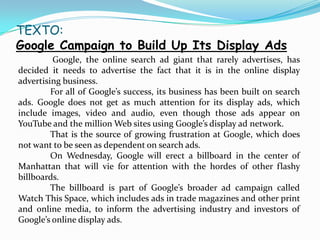
Google Campaign to Build Up Its Display Ads
          Google, the online search ad giant that rarely advertises, has
decided it needs to advertise the fact that it is in the online display
advertising business.
         For all of Google’s success, its business has been built on search
ads. Google does not get as much attention for its display ads, which
include images, video and audio, even though those ads appear on
YouTube and the million Web sites using Google’s display ad network.
         That is the source of growing frustration at Google, which does
not want to be seen as dependent on search ads.
         On Wednesday, Google will erect a billboard in the center of
Manhattan that will vie for attention with the hordes of other flashy
billboards.
         The billboard is part of Google’s broader ad campaign called
Watch This Space, which includes ads in trade magazines and other print
and online media, to inform the advertising industry and investors of
Google’s online display ads.
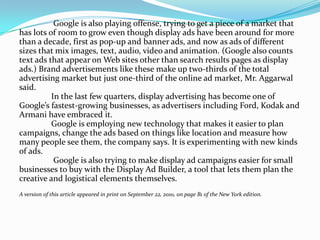
Google is also playing offense, trying to get a piece of a market that
has lots of room to grow even though display ads have been around for more
than a decade, first as pop-up and banner ads, and now as ads of different
sizes that mix images, text, audio, video and animation. (Google also counts
text ads that appear on Web sites other than search results pages as display
ads.) Brand advertisements like these make up two-thirds of the total
advertising market but just one-third of the online ad market, Mr. Aggarwal
said.
          In the last few quarters, display advertising has become one of
Google’s fastest-growing businesses, as advertisers including Ford, Kodak and
Armani have embraced it.
          Google is employing new technology that makes it easier to plan
campaigns, change the ads based on things like location and measure how
many people see them, the company says. It is experimenting with new kinds
of ads.
           Google is also trying to make display ad campaigns easier for small
businesses to buy with the Display Ad Builder, a tool that lets them plan the
creative and logistical elements themselves.
A version of this article appeared in print on September 22, 2010, on page B1 of the New York edition.
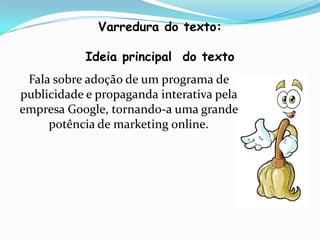
Varredura do texto:

            Ideia principal do texto
 Fala sobre adoção de um programa de
publicidade e propaganda interativa pela
empresa Google, tornando-a uma grande
     potência de marketing online.
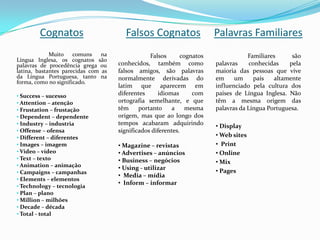
Cognatos                       Falsos Cognatos                  Palavras Familiares
             Muito    comuns    na               Falsos      cognatos               Familiares     são
Língua Inglesa, os cognatos são
palavras de procedência grega ou     conhecidos, também como            palavras     conhecidas   pela
latina, bastantes parecidas com as   falsos amigos, são palavras        maioria das pessoas que vive
da Língua Portuguesa, tanto na       normalmente derivadas do           em     um     país   altamente
forma, como no significado.
                                     latim que aparecem em              influenciado pela cultura dos
• Success – sucesso                  diferentes     idiomas      com    países de Língua Inglesa. Não
• Attention – atenção                ortografia semelhante, e que       têm a mesma origem das
• Frustation – frustação             têm     portanto     a    mesma    palavras da Língua Portuguesa.
• Dependent – dependente             origem, mas que ao longo dos
• Industry – industria               tempos acabaram adquirindo         • Display
• Offense – ofensa                   significados diferentes.
• Different – diferentes                                                • Web sites
• Images – imagem                    • Magazine – revistas              • Print
• Video – vídeo                      • Advertises – anúncios            • Online
• Text – texto                       • Business – negócios              • Mix
• Animation – animação               • Using - utilizar
• Campaigns – campanhas                                                 • Pages
                                     • Media – mídia
• Elements – elementos
                                     • Inform – informar
• Technology – tecnologia
• Plan – plano
• Million – milhões
• Decade – década
• Total - total
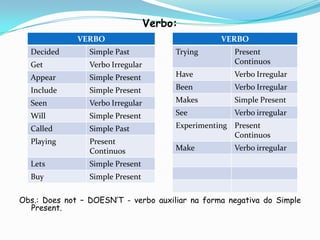
Verbo:
              VERBO                                VERBO
  Decided        Simple Past            Trying        Present
  Get            Verbo Irregular                      Continuos

  Appear         Simple Present         Have          Verbo Irregular

  Include        Simple Present         Been          Verbo Irregular

  Seen           Verbo Irregular        Makes         Simple Present

  Will           Simple Present         See           Verbo irregular
  Called         Simple Past            Experimenting Present
                                                      Continuos
  Playing        Present
                 Continuos              Make          Verbo irregular
  Lets           Simple Present
  Buy            Simple Present

Obs.: Does not – DOESN’T - verbo auxiliar na forma negativa do Simple
  Present.
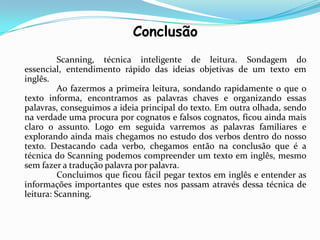
Conclusão
          Scanning, técnica inteligente de leitura. Sondagem do
essencial, entendimento rápido das ideias objetivas de um texto em
inglês.
          Ao fazermos a primeira leitura, sondando rapidamente o que o
texto informa, encontramos as palavras chaves e organizando essas
palavras, conseguimos a ideia principal do texto. Em outra olhada, sendo
na verdade uma procura por cognatos e falsos cognatos, ficou ainda mais
claro o assunto. Logo em seguida varremos as palavras familiares e
explorando ainda mais chegamos no estudo dos verbos dentro do nosso
texto. Destacando cada verbo, chegamos então na conclusão que é a
técnica do Scanning podemos compreender um texto em inglês, mesmo
sem fazer a tradução palavra por palavra.
          Concluimos que ficou fácil pegar textos em inglês e entender as
informações importantes que estes nos passam através dessa técnica de
leitura: Scanning.
Bibliografia

        Texto retirado do site New York Times
http://www.nytimes.com/2010/09/22/business/media/22adco.html?ref=techonology

Inglês instrumental

  • 1.
    Profª: Francine Gomes Equipe Augusto Elton Liliene Luana Magna
  • 2.
    Índice 1. Scanning 2. Texto:Google Campaign to Build Up Its Display Ads 3. Ideia principal do texto 4. Cognatos, falsos cognatos e palavras familiares 5. Verbos 6. Conclusão
  • 3.
    Introdução Inglês Instrumental possui o objetivo de desenvolver a habilidade de leitura, isto é, de compreensão de textos de diversas áreas do conhecimento escritos em língua inglesa, utilizando para isso estratégias de leitura, a fim de tornar o aluno capaz de compreender um texto da sua área de estudo. Nesse enfoque, a compreensão do texto conta com as técnicas de leitura propostas pelo inglês instrumental, como o scanning. No qual o leitor irá fazer uma varredura completa, procurando pontos significantes e essenciais para a compreensão do texto.
  • 4.
  • 6.
    TEXTO: Google Campaign toBuild Up Its Display Ads Google, the online search ad giant that rarely advertises, has decided it needs to advertise the fact that it is in the online display advertising business. For all of Google’s success, its business has been built on search ads. Google does not get as much attention for its display ads, which include images, video and audio, even though those ads appear on YouTube and the million Web sites using Google’s display ad network. That is the source of growing frustration at Google, which does not want to be seen as dependent on search ads. On Wednesday, Google will erect a billboard in the center of Manhattan that will vie for attention with the hordes of other flashy billboards. The billboard is part of Google’s broader ad campaign called Watch This Space, which includes ads in trade magazines and other print and online media, to inform the advertising industry and investors of Google’s online display ads.
  • 7.
    Google is alsoplaying offense, trying to get a piece of a market that has lots of room to grow even though display ads have been around for more than a decade, first as pop-up and banner ads, and now as ads of different sizes that mix images, text, audio, video and animation. (Google also counts text ads that appear on Web sites other than search results pages as display ads.) Brand advertisements like these make up two-thirds of the total advertising market but just one-third of the online ad market, Mr. Aggarwal said. In the last few quarters, display advertising has become one of Google’s fastest-growing businesses, as advertisers including Ford, Kodak and Armani have embraced it. Google is employing new technology that makes it easier to plan campaigns, change the ads based on things like location and measure how many people see them, the company says. It is experimenting with new kinds of ads. Google is also trying to make display ad campaigns easier for small businesses to buy with the Display Ad Builder, a tool that lets them plan the creative and logistical elements themselves. A version of this article appeared in print on September 22, 2010, on page B1 of the New York edition.
  • 8.
    Varredura do texto: Ideia principal do texto Fala sobre adoção de um programa de publicidade e propaganda interativa pela empresa Google, tornando-a uma grande potência de marketing online.
  • 9.
    Cognatos Falsos Cognatos Palavras Familiares Muito comuns na Falsos cognatos Familiares são Língua Inglesa, os cognatos são palavras de procedência grega ou conhecidos, também como palavras conhecidas pela latina, bastantes parecidas com as falsos amigos, são palavras maioria das pessoas que vive da Língua Portuguesa, tanto na normalmente derivadas do em um país altamente forma, como no significado. latim que aparecem em influenciado pela cultura dos • Success – sucesso diferentes idiomas com países de Língua Inglesa. Não • Attention – atenção ortografia semelhante, e que têm a mesma origem das • Frustation – frustação têm portanto a mesma palavras da Língua Portuguesa. • Dependent – dependente origem, mas que ao longo dos • Industry – industria tempos acabaram adquirindo • Display • Offense – ofensa significados diferentes. • Different – diferentes • Web sites • Images – imagem • Magazine – revistas • Print • Video – vídeo • Advertises – anúncios • Online • Text – texto • Business – negócios • Mix • Animation – animação • Using - utilizar • Campaigns – campanhas • Pages • Media – mídia • Elements – elementos • Inform – informar • Technology – tecnologia • Plan – plano • Million – milhões • Decade – década • Total - total
  • 10.
    Verbo: VERBO VERBO Decided Simple Past Trying Present Get Verbo Irregular Continuos Appear Simple Present Have Verbo Irregular Include Simple Present Been Verbo Irregular Seen Verbo Irregular Makes Simple Present Will Simple Present See Verbo irregular Called Simple Past Experimenting Present Continuos Playing Present Continuos Make Verbo irregular Lets Simple Present Buy Simple Present Obs.: Does not – DOESN’T - verbo auxiliar na forma negativa do Simple Present.
  • 11.
    Conclusão Scanning, técnica inteligente de leitura. Sondagem do essencial, entendimento rápido das ideias objetivas de um texto em inglês. Ao fazermos a primeira leitura, sondando rapidamente o que o texto informa, encontramos as palavras chaves e organizando essas palavras, conseguimos a ideia principal do texto. Em outra olhada, sendo na verdade uma procura por cognatos e falsos cognatos, ficou ainda mais claro o assunto. Logo em seguida varremos as palavras familiares e explorando ainda mais chegamos no estudo dos verbos dentro do nosso texto. Destacando cada verbo, chegamos então na conclusão que é a técnica do Scanning podemos compreender um texto em inglês, mesmo sem fazer a tradução palavra por palavra. Concluimos que ficou fácil pegar textos em inglês e entender as informações importantes que estes nos passam através dessa técnica de leitura: Scanning.
  • 12.
    Bibliografia Texto retirado do site New York Times http://www.nytimes.com/2010/09/22/business/media/22adco.html?ref=techonology