COMPARATIVE AND SUPERLATIVE
ADJECTIVES
“Pensamos demasiadamente, sentimos muito pouco.
Necessitamos mais de humildade que de máquinas.
Mais de bondade e ternura que de inteligência.
Sem isso, a vida se tornará violenta e tudo se perderá”.
(Charles Chaplin)
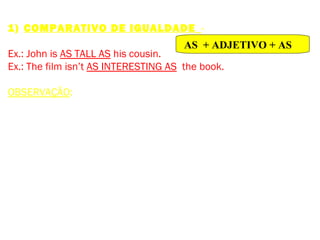
1) COMPARATIVO DE IGUALDADE -
Ex.: John is AS TALL AS his cousin.
Ex.: The film isn’t AS INTERESTING AS the book.
OBSERVAÇÃO:
A) Quando o primeiro termo da comparação estiver na forma nega-
tiva pode-se usar NOT SO ... AS, em vez de NOT AS ... AS.
Ex.: John is NOT SO TALL AS his cousin.
B) Ao compararmos características de pessoas, utilizamos NOMES
ou PRONOMES.
AS + ADJETIVO + AS
B1) Quando utilizamos NOMES, podemos repetir ou não o verbo
TO BE na segunda parte da comparação.
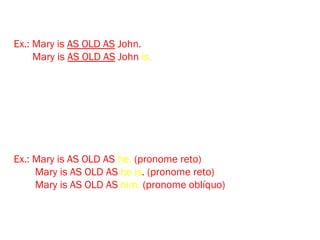
Ex.: Mary is AS OLD AS John.
Mary is AS OLD AS John is.
B2) Quando utilizamos PRONOME na segunda parte da compara –
cão, podemos fazê-lo com um pronome reto ou um pronome oblí –
quo. Com o pronome reto, pode-se repetir ou não o verbo TO BE.
Com o pronome oblíquo (gramaticalmente incorreto, porém bas -
tante usado na linguagem informal), não se repete o verbo TO BE.
Ex.: Mary is AS OLD AS he. (pronome reto)
Mary is AS OLD AS he is. (pronome reto)
Mary is AS OLD AS him. (pronome oblíquo)
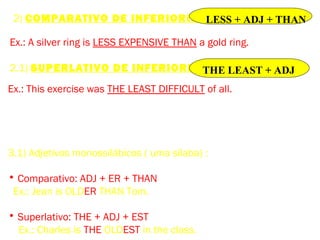
2) COMPARATIVO DE INFERIORIDADE:LESS + ADJ + THAN
Ex.: A silver ring is LESS EXPENSIVE THAN a gold ring.
2.1) SUPERLATIVO DE INFERIORIDADE:THE LEAST + ADJ
Ex.: This exercise was THE LEAST DIFFICULT of all.
3) Para formar o Comparativo de Superioridade e o Superlativo de
Superioridade deve-se considerar o número de sílabas do adjetivo.
3.1) Adjetivos monossilábicos ( uma sílaba) :
• Comparativo: ADJ + ER + THAN
Ex.: Jean is OLDER THAN Tom.
• Superlativo: THE + ADJ + EST
Ex.: Charles is THE OLDEST in the class.
OBS: Quando um adjetivo monossilábico termina em uma consoan-
te única, precedida de uma só vogal, a consoante final é duplicada
antes de se acrescentar – ER ou – EST.
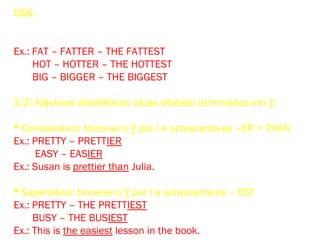
Ex.: FAT – FATTER – THE FATTEST
HOT – HOTTER – THE HOTTEST
BIG – BIGGER – THE BIGGEST
3.2) Adjetivos dissilábicos (duas sílabas) terminados em Y:
 Comparativo: troca-se o Y por I e acrescenta-se –ER + THAN
Ex.: PRETTY – PRETTIER
EASY – EASIER
Ex.: Susan is prettier than Julia.
 Superlativo: troca-se o Y por I e acrescenta-se – EST
Ex.: PRETTY – THE PRETTIEST
BUSY – THE BUSIEST
Ex.: This is the easiest lesson in the book.
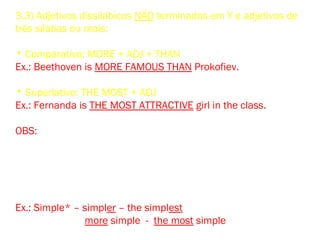
3.3) Adjetivos dissilábicos NÃO terminados em Y e adjetivos de
três sílabas ou mais:
• Comparativo: MORE + ADJ + THAN
Ex.: Beethoven is MORE FAMOUS THAN Prokofiev.
• Superlativo: THE MOST + ADJ
Ex.: Fernanda is THE MOST ATTRACTIVE girl in the class.
OBS: Existem adjetivos de duas sílabas não terminados em Y que
admitem as duas formas para o comparativo (-ER e MORE) e as
duas formas para o superlativo (-EST e THE MOST), embora as
formas em – ER e – EST devam ser preferidas nos adjetivos assi –
nalados com asterisco. Entre eles vale a pena destacar:
Ex.: Simple* – simpler – the simplest
more simple - the most simple
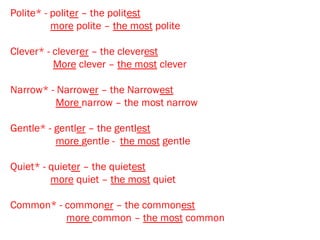
Polite* - politer – the politest
more polite – the most polite
Clever* - cleverer – the cleverest
More clever – the most clever
Narrow* - Narrower – the Narrowest
More narrow – the most narrow
Gentle* - gentler – the gentlest
more gentle - the most gentle
Quiet* - quieter – the quietest
more quiet – the most quiet
Common* - commoner – the commonest
more common – the most common
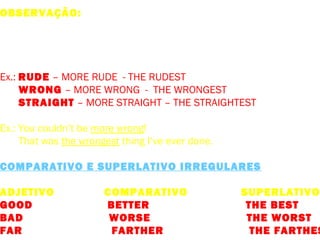
OBSERVAÇÃO: Existem poucos adjetivos monossilábicos aos quais
não se costuma acrescentar –ER para formar o comparativo, em –
bora o superlativo seja formado mediante o acréscimo de –EST.
São usados em circunstâncias muito raras.
Ex.: RUDE – MORE RUDE - THE RUDEST
WRONG – MORE WRONG - THE WRONGEST
STRAIGHT – MORE STRAIGHT – THE STRAIGHTEST
Ex.: You couldn’t be more wrong!
That was the wrongest thing I’ve ever done.
COMPARATIVO E SUPERLATIVO IRREGULARES
ADJETIVO COMPARATIVO SUPERLATIVO
GOOD BETTER THE BEST
BAD WORSE THE WORST
FAR FARTHER THE FARTHES
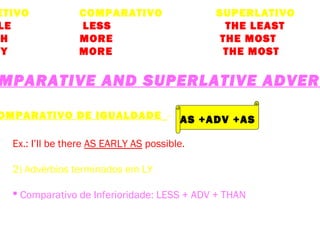
ETIVO COMPARATIVO SUPERLATIVO
LE LESS THE LEAST
H MORE THE MOST
NY MORE THE MOST
MPARATIVE AND SUPERLATIVE ADVERB
OMPARATIVO DE IGUALDADE - AS +ADV +AS
Ex.: I’ll be there AS EARLY AS possible.
2) Advérbios terminados em LY
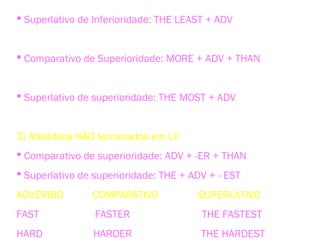
 Comparativo de Inferioridade: LESS + ADV + THAN
Ex.: Lúcia drives LESS CAREFULLY THAN Suely.
 Superlativo de Inferioridade: THE LEAST + ADV
Ex.: Peter speaks THE LEAST CLEARLY.
 Comparativo de Superioridade: MORE + ADV + THAN
Ex.: Henry works MORE SLOWLY THAN Bruno.
 Superlativo de superioridade: THE MOST + ADV
Ex.: Maria dances THE MOST GRACEFULLY.
3) Advérbios NÃO terminados em LY
 Comparativo de superioridade: ADV + -ER + THAN
 Superlativo de superioridade: THE + ADV + - EST
ADVÉRBIO COMPARATIVO SUPERLATIVO
FAST FASTER THE FASTEST
HARD HARDER THE HARDEST
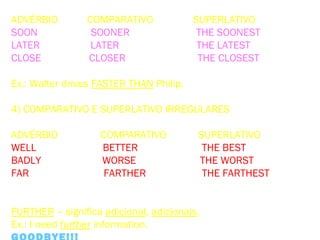
ADVÉRBIO COMPARATIVO SUPERLATIVO
SOON SOONER THE SOONEST
LATER LATER THE LATEST
CLOSE CLOSER THE CLOSEST
Ex.: Walter drives FASTER THAN Philip.
4) COMPARATIVO E SUPERLATIVO IRREGULARES
ADVÉRBIO COMPARATIVO SUPERLATIVO
WELL BETTER THE BEST
BADLY WORSE THE WORST
FAR FARTHER THE FARTHEST
OBS: FARTHER – é usado para expressar distância física
Ex.: I walked farther than my friend.
FURTHER – significa adicional, adicionais.
Ex.: I need further information.

Aula de Inglês - Comparative and Superlative

  • 1.
    COMPARATIVE AND SUPERLATIVE ADJECTIVES “Pensamosdemasiadamente, sentimos muito pouco. Necessitamos mais de humildade que de máquinas. Mais de bondade e ternura que de inteligência. Sem isso, a vida se tornará violenta e tudo se perderá”. (Charles Chaplin)
  • 2.
    1) COMPARATIVO DEIGUALDADE - Ex.: John is AS TALL AS his cousin. Ex.: The film isn’t AS INTERESTING AS the book. OBSERVAÇÃO: A) Quando o primeiro termo da comparação estiver na forma nega- tiva pode-se usar NOT SO ... AS, em vez de NOT AS ... AS. Ex.: John is NOT SO TALL AS his cousin. B) Ao compararmos características de pessoas, utilizamos NOMES ou PRONOMES. AS + ADJETIVO + AS
  • 3.
    B1) Quando utilizamosNOMES, podemos repetir ou não o verbo TO BE na segunda parte da comparação. Ex.: Mary is AS OLD AS John. Mary is AS OLD AS John is. B2) Quando utilizamos PRONOME na segunda parte da compara – cão, podemos fazê-lo com um pronome reto ou um pronome oblí – quo. Com o pronome reto, pode-se repetir ou não o verbo TO BE. Com o pronome oblíquo (gramaticalmente incorreto, porém bas - tante usado na linguagem informal), não se repete o verbo TO BE. Ex.: Mary is AS OLD AS he. (pronome reto) Mary is AS OLD AS he is. (pronome reto) Mary is AS OLD AS him. (pronome oblíquo)
  • 4.
    2) COMPARATIVO DEINFERIORIDADE:LESS + ADJ + THAN Ex.: A silver ring is LESS EXPENSIVE THAN a gold ring. 2.1) SUPERLATIVO DE INFERIORIDADE:THE LEAST + ADJ Ex.: This exercise was THE LEAST DIFFICULT of all. 3) Para formar o Comparativo de Superioridade e o Superlativo de Superioridade deve-se considerar o número de sílabas do adjetivo. 3.1) Adjetivos monossilábicos ( uma sílaba) : • Comparativo: ADJ + ER + THAN Ex.: Jean is OLDER THAN Tom. • Superlativo: THE + ADJ + EST Ex.: Charles is THE OLDEST in the class.
  • 5.
    OBS: Quando umadjetivo monossilábico termina em uma consoan- te única, precedida de uma só vogal, a consoante final é duplicada antes de se acrescentar – ER ou – EST. Ex.: FAT – FATTER – THE FATTEST HOT – HOTTER – THE HOTTEST BIG – BIGGER – THE BIGGEST 3.2) Adjetivos dissilábicos (duas sílabas) terminados em Y:  Comparativo: troca-se o Y por I e acrescenta-se –ER + THAN Ex.: PRETTY – PRETTIER EASY – EASIER Ex.: Susan is prettier than Julia.  Superlativo: troca-se o Y por I e acrescenta-se – EST Ex.: PRETTY – THE PRETTIEST BUSY – THE BUSIEST Ex.: This is the easiest lesson in the book.
  • 6.
    3.3) Adjetivos dissilábicosNÃO terminados em Y e adjetivos de três sílabas ou mais: • Comparativo: MORE + ADJ + THAN Ex.: Beethoven is MORE FAMOUS THAN Prokofiev. • Superlativo: THE MOST + ADJ Ex.: Fernanda is THE MOST ATTRACTIVE girl in the class. OBS: Existem adjetivos de duas sílabas não terminados em Y que admitem as duas formas para o comparativo (-ER e MORE) e as duas formas para o superlativo (-EST e THE MOST), embora as formas em – ER e – EST devam ser preferidas nos adjetivos assi – nalados com asterisco. Entre eles vale a pena destacar: Ex.: Simple* – simpler – the simplest more simple - the most simple
  • 7.
    Polite* - politer– the politest more polite – the most polite Clever* - cleverer – the cleverest More clever – the most clever Narrow* - Narrower – the Narrowest More narrow – the most narrow Gentle* - gentler – the gentlest more gentle - the most gentle Quiet* - quieter – the quietest more quiet – the most quiet Common* - commoner – the commonest more common – the most common
  • 8.
    OBSERVAÇÃO: Existem poucosadjetivos monossilábicos aos quais não se costuma acrescentar –ER para formar o comparativo, em – bora o superlativo seja formado mediante o acréscimo de –EST. São usados em circunstâncias muito raras. Ex.: RUDE – MORE RUDE - THE RUDEST WRONG – MORE WRONG - THE WRONGEST STRAIGHT – MORE STRAIGHT – THE STRAIGHTEST Ex.: You couldn’t be more wrong! That was the wrongest thing I’ve ever done. COMPARATIVO E SUPERLATIVO IRREGULARES ADJETIVO COMPARATIVO SUPERLATIVO GOOD BETTER THE BEST BAD WORSE THE WORST FAR FARTHER THE FARTHES
  • 9.
    ETIVO COMPARATIVO SUPERLATIVO LELESS THE LEAST H MORE THE MOST NY MORE THE MOST MPARATIVE AND SUPERLATIVE ADVERB OMPARATIVO DE IGUALDADE - AS +ADV +AS Ex.: I’ll be there AS EARLY AS possible. 2) Advérbios terminados em LY  Comparativo de Inferioridade: LESS + ADV + THAN Ex.: Lúcia drives LESS CAREFULLY THAN Suely.
  • 10.
     Superlativo deInferioridade: THE LEAST + ADV Ex.: Peter speaks THE LEAST CLEARLY.  Comparativo de Superioridade: MORE + ADV + THAN Ex.: Henry works MORE SLOWLY THAN Bruno.  Superlativo de superioridade: THE MOST + ADV Ex.: Maria dances THE MOST GRACEFULLY. 3) Advérbios NÃO terminados em LY  Comparativo de superioridade: ADV + -ER + THAN  Superlativo de superioridade: THE + ADV + - EST ADVÉRBIO COMPARATIVO SUPERLATIVO FAST FASTER THE FASTEST HARD HARDER THE HARDEST
  • 11.
    ADVÉRBIO COMPARATIVO SUPERLATIVO SOONSOONER THE SOONEST LATER LATER THE LATEST CLOSE CLOSER THE CLOSEST Ex.: Walter drives FASTER THAN Philip. 4) COMPARATIVO E SUPERLATIVO IRREGULARES ADVÉRBIO COMPARATIVO SUPERLATIVO WELL BETTER THE BEST BADLY WORSE THE WORST FAR FARTHER THE FARTHEST OBS: FARTHER – é usado para expressar distância física Ex.: I walked farther than my friend. FURTHER – significa adicional, adicionais. Ex.: I need further information.