Indefinite
Pronouns
Pronomes indefinidos
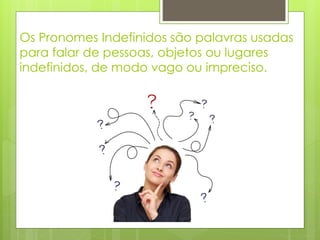
Os Pronomes Indefinidos são palavras usadas
para falar de pessoas, objetos ou lugares
indefinidos, de modo vago ou impreciso.
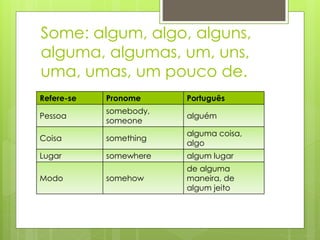
Some: algum, algo, alguns,
alguma, algumas, um, uns,
uma, umas, um pouco de.
Refere-se Pronome Português
Pessoa
somebody,
someone
alguém
Coisa something
alguma coisa,
algo
Lugar somewhere algum lugar
Modo somehow
de alguma
maneira, de
algum jeito
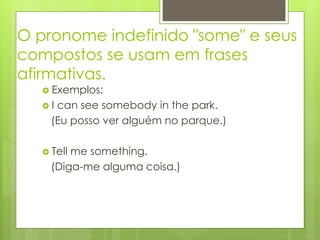
O pronome indefinido "some" e seus
compostos se usam em frases
afirmativas.
 Exemplos:
 I can see somebody in the park.
(Eu posso ver alguém no parque.)
 Tell me something.
(Diga-me alguma coisa.)
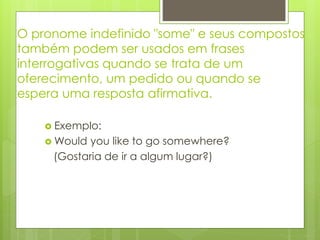
O pronome indefinido "some" e seus compostos
também podem ser usados em frases
interrogativas quando se trata de um
oferecimento, um pedido ou quando se
espera uma resposta afirmativa.
 Exemplo:
 Would you like to go somewhere?
(Gostaria de ir a algum lugar?)
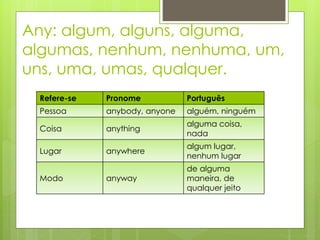
Any: algum, alguns, alguma,
algumas, nenhum, nenhuma, um,
uns, uma, umas, qualquer.
Refere-se Pronome Português
Pessoa anybody, anyone alguém, ninguém
Coisa anything
alguma coisa,
nada
Lugar anywhere
algum lugar,
nenhum lugar
Modo anyway
de alguma
maneira, de
qualquer jeito
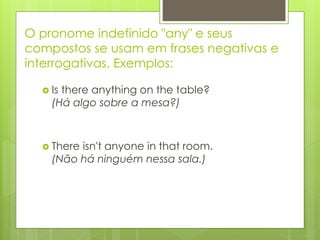
O pronome indefinido "any" e seus
compostos se usam em frases negativas e
interrogativas. Exemplos:
 Is there anything on the table?
(Há algo sobre a mesa?)
 There isn't anyone in that room.
(Não há ninguém nessa sala.)
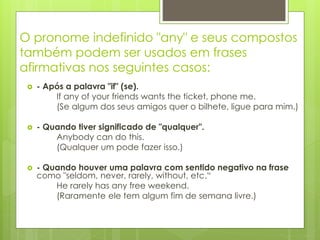
O pronome indefinido "any" e seus compostos
também podem ser usados em frases
afirmativas nos seguintes casos:
 - Após a palavra "if" (se).
If any of your friends wants the ticket, phone me.
(Se algum dos seus amigos quer o bilhete, ligue para mim.)
 - Quando tiver significado de "qualquer".
Anybody can do this.
(Qualquer um pode fazer isso.)
 - Quando houver uma palavra com sentido negativo na frase
como "seldom, never, rarely, without, etc.“
He rarely has any free weekend.
(Raramente ele tem algum fim de semana livre.)
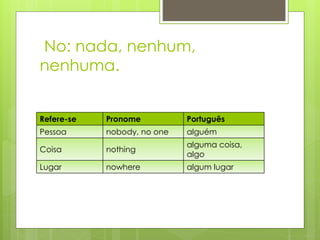
No: nada, nenhum,
nenhuma.
Refere-se Pronome Português
Pessoa nobody, no one alguém
Coisa nothing
alguma coisa,
algo
Lugar nowhere algum lugar
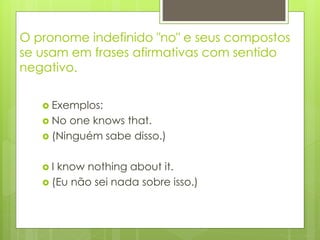
O pronome indefinido "no" e seus compostos
se usam em frases afirmativas com sentido
negativo.
 Exemplos:
 No one knows that.
 (Ninguém sabe disso.)
 I know nothing about it.
 (Eu não sei nada sobre isso.)
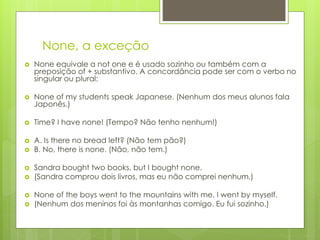
None, a exceção
 None equivale a not one e é usado sozinho ou também com a
preposição of + substantivo. A concordância pode ser com o verbo no
singular ou plural:
 None of my students speak Japanese. (Nenhum dos meus alunos fala
Japonês.)
 Time? I have none! (Tempo? Não tenho nenhum!)
 A. Is there no bread left? (Não tem pão?)
 B. No, there is none. (Não, não tem.)
 Sandra bought two books, but I bought none.
 (Sandra comprou dois livros, mas eu não comprei nenhum.)
 None of the boys went to the mountains with me. I went by myself.
 (Nenhum dos meninos foi às montanhas comigo. Eu fui sozinho.)
No x None: Como utilizar?
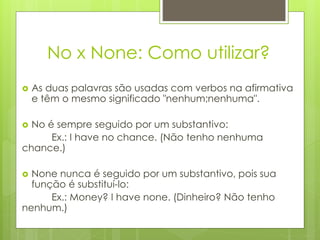
 As duas palavras são usadas com verbos na afirmativa
e têm o mesmo significado "nenhum;nenhuma".
 No é sempre seguido por um substantivo:
Ex.: I have no chance. (Não tenho nenhuma
chance.)
 None nunca é seguido por um substantivo, pois sua
função é substituí-lo:
Ex.: Money? I have none. (Dinheiro? Não tenho
nenhum.)
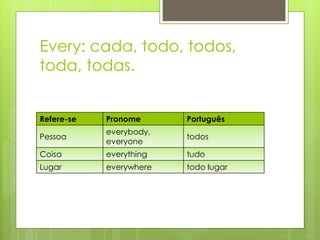
Every: cada, todo, todos,
toda, todas.
Refere-se Pronome Português
Pessoa
everybody,
everyone
todos
Coisa everything tudo
Lugar everywhere todo lugar
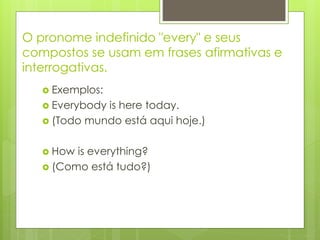
O pronome indefinido "every" e seus
compostos se usam em frases afirmativas e
interrogativas.
 Exemplos:
 Everybody is here today.
 (Todo mundo está aqui hoje.)
 How is everything?
 (Como está tudo?)
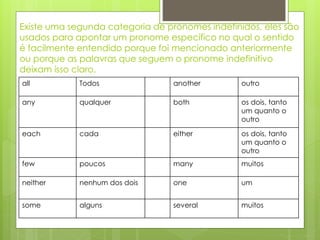
Existe uma segunda categoria de pronomes indefinidos, eles são
usados para apontar um pronome específico no qual o sentido
é facilmente entendido porque foi mencionado anteriormente
ou porque as palavras que seguem o pronome indefinitivo
deixam isso claro.
all Todos another outro
any qualquer both os dois, tanto
um quanto o
outro
each cada either os dois, tanto
um quanto o
outro
few poucos many muitos
neither nenhum dos dois one um
some alguns several muitos
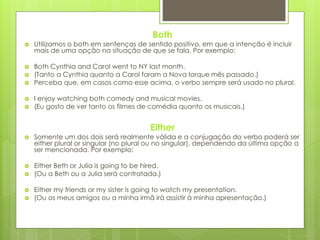
Both
 Utilizamos o both em sentenças de sentido positivo, em que a intenção é incluir
mais de uma opção na situação de que se fala. Por exemplo:
 Both Cynthia and Carol went to NY last month.
 (Tanto a Cynthia quanto a Carol foram a Nova Iorque mês passado.)
 Perceba que, em casos como esse acima, o verbo sempre será usado no plural.
 I enjoy watching both comedy and musical movies.
 (Eu gosto de ver tanto os filmes de comédia quanto os musicais.)
Either
 Somente um dos dois será realmente válida e a conjugação do verbo poderá ser
either plural or singular (no plural ou no singular), dependendo da última opção a
ser mencionada. Por exemplo:
 Either Beth or Julia is going to be hired.
 (Ou a Beth ou a Julia será contratada.)
 Either my friends or my sister is going to watch my presentation.
 (Ou os meus amigos ou a minha irmã irá assistir à minha apresentação.)
 http://www.bomingles.com.br/gramatica
/pronomes/indefinidos
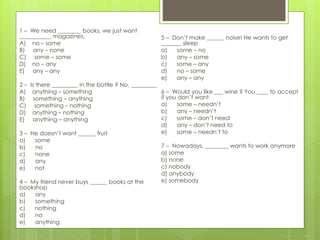
1 – We need ________ books, we just want
___________ magazines.
A) no – some
B) any – none
C) some – some
D) no – any
E) any – any
2 – Is there _________ in the bottle ? No, _________
A) anything – something
B) something – anything
C) something – nothing
D) anything – nothing
E) anything – anything
3 – He doesn’t want ______ fruit
a) some
b) no
c) none
d) any
e) not
4 – My friend never buys ______ books at the
bookshop
a) any
b) something
c) nothing
d) no
e) anything
5 – Don’t make ______ noise! He wants to get
_______ sleep
a) some – no
b) any – some
c) some – any
d) no – some
e) any – any
6 – Would you like ___ wine ? You ____ to accept
if you don’t want
a) some – needn’t
b) any – needn’t
c) some – don’t need
d) any – don’t need to
e) some – needn’t to
7 – Nowadays, ________ wants to work anymore
a) some
b) none
c) nobody
d) anybody
e) somebody
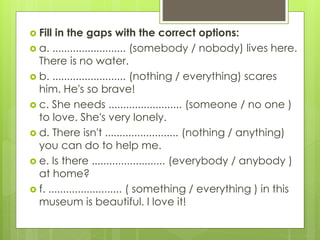
 Fill in the gaps with the correct options:
 a. ......................... (somebody / nobody) lives here.
There is no water.
 b. ......................... (nothing / everything) scares
him. He's so brave!
 c. She needs ......................... (someone / no one )
to love. She's very lonely.
 d. There isn't ......................... (nothing / anything)
you can do to help me.
 e. Is there ......................... (everybody / anybody )
at home?
 f. ......................... ( something / everything ) in this
museum is beautiful. I love it!
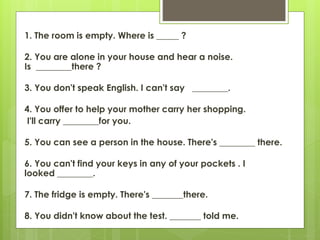
1. The room is empty. Where is _____ ?
2. You are alone in your house and hear a noise.
Is ________there ?
3. You don't speak English. I can't say ________.
4. You offer to help your mother carry her shopping.
I'll carry ________for you.
5. You can see a person in the house. There's ________ there.
6. You can't find your keys in any of your pockets . I
looked ________.
7. The fridge is empty. There's _______there.
8. You didn't know about the test. _______ told me.
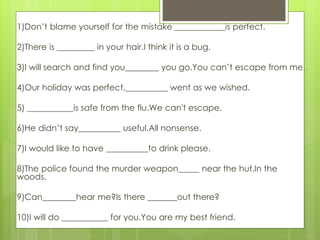
1)Don’t blame yourself for the mistake ____________is perfect.
2)There is _________ in your hair.I think it is a bug.
3)I will search and find you________ you go.You can’t escape from me.
4)Our holiday was perfect.__________ went as we wished.
5) ___________is safe from the flu.We can't escape.
6)He didn’t say__________ useful.All nonsense.
7)I would like to have __________to drink please.
8)The police found the murder weapon_____ near the hut.In the
woods.
9)Can________hear me?Is there _______out there?
10)I will do ___________ for you.You are my best friend.
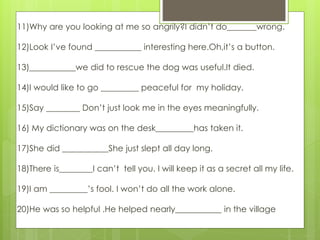
11)Why are you looking at me so angrily?I didn’t do_______wrong.
12)Look I’ve found ___________ interesting here.Oh,it’s a button.
13)___________we did to rescue the dog was useful.It died.
14)I would like to go _________ peaceful for my holiday.
15)Say ________ Don’t just look me in the eyes meaningfully.
16) My dictionary was on the desk_________has taken it.
17)She did ___________She just slept all day long.
18)There is________I can’t tell you. I will keep it as a secret all my life.
19)I am _________’s fool. I won’t do all the work alone.
20)He was so helpful .He helped nearly___________ in the village
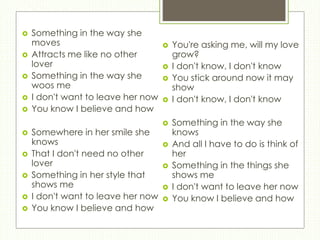
 Something in the way she
moves
 Attracts me like no other
lover
 Something in the way she
woos me
 I don't want to leave her now
 You know I believe and how
 Somewhere in her smile she
knows
 That I don't need no other
lover
 Something in her style that
shows me
 I don't want to leave her now
 You know I believe and how
 You're asking me, will my love
grow?
 I don't know, I don't know
 You stick around now it may
show
 I don't know, I don't know
 Something in the way she
knows
 And all I have to do is think of
her
 Something in the things she
shows me
 I don't want to leave her now
 You know I believe and how

Indefinite pronouns

  • 1.
  • 2.
    Os Pronomes Indefinidossão palavras usadas para falar de pessoas, objetos ou lugares indefinidos, de modo vago ou impreciso.
  • 3.
    Some: algum, algo,alguns, alguma, algumas, um, uns, uma, umas, um pouco de. Refere-se Pronome Português Pessoa somebody, someone alguém Coisa something alguma coisa, algo Lugar somewhere algum lugar Modo somehow de alguma maneira, de algum jeito
  • 4.
    O pronome indefinido"some" e seus compostos se usam em frases afirmativas.  Exemplos:  I can see somebody in the park. (Eu posso ver alguém no parque.)  Tell me something. (Diga-me alguma coisa.)
  • 5.
    O pronome indefinido"some" e seus compostos também podem ser usados em frases interrogativas quando se trata de um oferecimento, um pedido ou quando se espera uma resposta afirmativa.  Exemplo:  Would you like to go somewhere? (Gostaria de ir a algum lugar?)
  • 6.
    Any: algum, alguns,alguma, algumas, nenhum, nenhuma, um, uns, uma, umas, qualquer. Refere-se Pronome Português Pessoa anybody, anyone alguém, ninguém Coisa anything alguma coisa, nada Lugar anywhere algum lugar, nenhum lugar Modo anyway de alguma maneira, de qualquer jeito
  • 7.
    O pronome indefinido"any" e seus compostos se usam em frases negativas e interrogativas. Exemplos:  Is there anything on the table? (Há algo sobre a mesa?)  There isn't anyone in that room. (Não há ninguém nessa sala.)
  • 8.
    O pronome indefinido"any" e seus compostos também podem ser usados em frases afirmativas nos seguintes casos:  - Após a palavra "if" (se). If any of your friends wants the ticket, phone me. (Se algum dos seus amigos quer o bilhete, ligue para mim.)  - Quando tiver significado de "qualquer". Anybody can do this. (Qualquer um pode fazer isso.)  - Quando houver uma palavra com sentido negativo na frase como "seldom, never, rarely, without, etc.“ He rarely has any free weekend. (Raramente ele tem algum fim de semana livre.)
  • 9.
    No: nada, nenhum, nenhuma. Refere-sePronome Português Pessoa nobody, no one alguém Coisa nothing alguma coisa, algo Lugar nowhere algum lugar
  • 10.
    O pronome indefinido"no" e seus compostos se usam em frases afirmativas com sentido negativo.  Exemplos:  No one knows that.  (Ninguém sabe disso.)  I know nothing about it.  (Eu não sei nada sobre isso.)
  • 11.
    None, a exceção None equivale a not one e é usado sozinho ou também com a preposição of + substantivo. A concordância pode ser com o verbo no singular ou plural:  None of my students speak Japanese. (Nenhum dos meus alunos fala Japonês.)  Time? I have none! (Tempo? Não tenho nenhum!)  A. Is there no bread left? (Não tem pão?)  B. No, there is none. (Não, não tem.)  Sandra bought two books, but I bought none.  (Sandra comprou dois livros, mas eu não comprei nenhum.)  None of the boys went to the mountains with me. I went by myself.  (Nenhum dos meninos foi às montanhas comigo. Eu fui sozinho.)
  • 12.
    No x None:Como utilizar?  As duas palavras são usadas com verbos na afirmativa e têm o mesmo significado "nenhum;nenhuma".  No é sempre seguido por um substantivo: Ex.: I have no chance. (Não tenho nenhuma chance.)  None nunca é seguido por um substantivo, pois sua função é substituí-lo: Ex.: Money? I have none. (Dinheiro? Não tenho nenhum.)
  • 13.
    Every: cada, todo,todos, toda, todas. Refere-se Pronome Português Pessoa everybody, everyone todos Coisa everything tudo Lugar everywhere todo lugar
  • 14.
    O pronome indefinido"every" e seus compostos se usam em frases afirmativas e interrogativas.  Exemplos:  Everybody is here today.  (Todo mundo está aqui hoje.)  How is everything?  (Como está tudo?)
  • 15.
    Existe uma segundacategoria de pronomes indefinidos, eles são usados para apontar um pronome específico no qual o sentido é facilmente entendido porque foi mencionado anteriormente ou porque as palavras que seguem o pronome indefinitivo deixam isso claro. all Todos another outro any qualquer both os dois, tanto um quanto o outro each cada either os dois, tanto um quanto o outro few poucos many muitos neither nenhum dos dois one um some alguns several muitos
  • 16.
    Both  Utilizamos oboth em sentenças de sentido positivo, em que a intenção é incluir mais de uma opção na situação de que se fala. Por exemplo:  Both Cynthia and Carol went to NY last month.  (Tanto a Cynthia quanto a Carol foram a Nova Iorque mês passado.)  Perceba que, em casos como esse acima, o verbo sempre será usado no plural.  I enjoy watching both comedy and musical movies.  (Eu gosto de ver tanto os filmes de comédia quanto os musicais.) Either  Somente um dos dois será realmente válida e a conjugação do verbo poderá ser either plural or singular (no plural ou no singular), dependendo da última opção a ser mencionada. Por exemplo:  Either Beth or Julia is going to be hired.  (Ou a Beth ou a Julia será contratada.)  Either my friends or my sister is going to watch my presentation.  (Ou os meus amigos ou a minha irmã irá assistir à minha apresentação.)
  • 17.
  • 18.
    1 – Weneed ________ books, we just want ___________ magazines. A) no – some B) any – none C) some – some D) no – any E) any – any 2 – Is there _________ in the bottle ? No, _________ A) anything – something B) something – anything C) something – nothing D) anything – nothing E) anything – anything 3 – He doesn’t want ______ fruit a) some b) no c) none d) any e) not 4 – My friend never buys ______ books at the bookshop a) any b) something c) nothing d) no e) anything 5 – Don’t make ______ noise! He wants to get _______ sleep a) some – no b) any – some c) some – any d) no – some e) any – any 6 – Would you like ___ wine ? You ____ to accept if you don’t want a) some – needn’t b) any – needn’t c) some – don’t need d) any – don’t need to e) some – needn’t to 7 – Nowadays, ________ wants to work anymore a) some b) none c) nobody d) anybody e) somebody
  • 19.
     Fill inthe gaps with the correct options:  a. ......................... (somebody / nobody) lives here. There is no water.  b. ......................... (nothing / everything) scares him. He's so brave!  c. She needs ......................... (someone / no one ) to love. She's very lonely.  d. There isn't ......................... (nothing / anything) you can do to help me.  e. Is there ......................... (everybody / anybody ) at home?  f. ......................... ( something / everything ) in this museum is beautiful. I love it!
  • 20.
    1. The roomis empty. Where is _____ ? 2. You are alone in your house and hear a noise. Is ________there ? 3. You don't speak English. I can't say ________. 4. You offer to help your mother carry her shopping. I'll carry ________for you. 5. You can see a person in the house. There's ________ there. 6. You can't find your keys in any of your pockets . I looked ________. 7. The fridge is empty. There's _______there. 8. You didn't know about the test. _______ told me.
  • 21.
    1)Don’t blame yourselffor the mistake ____________is perfect. 2)There is _________ in your hair.I think it is a bug. 3)I will search and find you________ you go.You can’t escape from me. 4)Our holiday was perfect.__________ went as we wished. 5) ___________is safe from the flu.We can't escape. 6)He didn’t say__________ useful.All nonsense. 7)I would like to have __________to drink please. 8)The police found the murder weapon_____ near the hut.In the woods. 9)Can________hear me?Is there _______out there? 10)I will do ___________ for you.You are my best friend.
  • 22.
    11)Why are youlooking at me so angrily?I didn’t do_______wrong. 12)Look I’ve found ___________ interesting here.Oh,it’s a button. 13)___________we did to rescue the dog was useful.It died. 14)I would like to go _________ peaceful for my holiday. 15)Say ________ Don’t just look me in the eyes meaningfully. 16) My dictionary was on the desk_________has taken it. 17)She did ___________She just slept all day long. 18)There is________I can’t tell you. I will keep it as a secret all my life. 19)I am _________’s fool. I won’t do all the work alone. 20)He was so helpful .He helped nearly___________ in the village
  • 23.
     Something inthe way she moves  Attracts me like no other lover  Something in the way she woos me  I don't want to leave her now  You know I believe and how  Somewhere in her smile she knows  That I don't need no other lover  Something in her style that shows me  I don't want to leave her now  You know I believe and how  You're asking me, will my love grow?  I don't know, I don't know  You stick around now it may show  I don't know, I don't know  Something in the way she knows  And all I have to do is think of her  Something in the things she shows me  I don't want to leave her now  You know I believe and how