DESMISTIFICANDO A CIÊNCIA
DE DADOS
NAUBER GOIS
Aluno de Doutorado em Informática Aplicada da Unifor
Área de Estudo: Reinforcement Learning e
metaheurísticas aplicadas a testes de performance.
Analista de Desenvolvimento do Serpro
AGENDA
DEFINIÇÃO DE DATA SCIENCE
TIPOS DE MODELOS
EXEMPLOS DE APLICAÇÃO
RELATÓRIOS
TESTES A/B
O QUE É CIÊNCIA
DE DADOS?
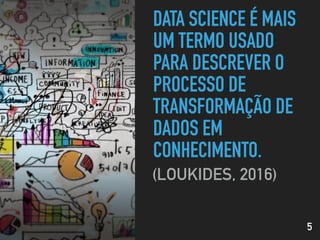
DATA SCIENCE É MAIS
UM TERMO USADO
PARA DESCREVER O
PROCESSO DE
TRANSFORMAÇÃO DE
DADOS EM
CONHECIMENTO.
(LOUKIDES, 2016)
5
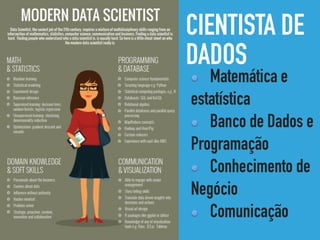
CIENTISTA DE
DADOS
Matemática e
estatística
Banco de Dados e
Programação
Conhecimento de
Negócio
Comunicação
Data scientist: Person who is better at statistics than any
software engineer and better at software engineering than
any statistician – Josh Wills
Data scientist: Pessoa que é melhor em
estatística que quaisquer engenheiros de
software e melhor em engenharia de
software que quaisquer estatístico – Josh
Wills
Usar (coletar, armazenar, publicar) dados
não é data science. É preciso agregar
valor aos dados e permitir novas formas
de uso.
7
DESMISTIFICANDO A CIÊNCIA DE DADOS
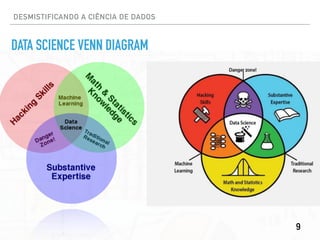
DATA SCIENCE VENN DIAGRAM
9
DESMISTIFICANDO A CIÊNCIA DE DADOS
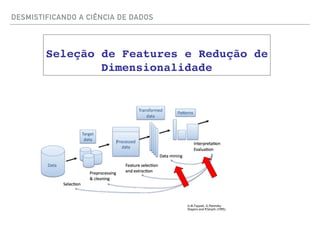
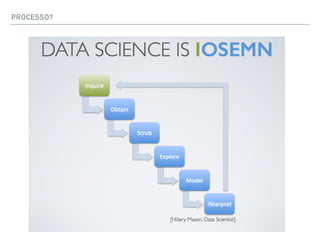
U.M.Fayyad, G.Patetsky-
Shapiro and P.Smyth (1995)
Seleção de Features e Redução de
Dimensionalidade
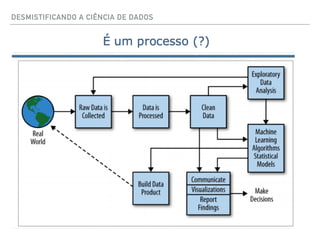
PROCESSO?
DESMISTIFICANDO A CIÊNCIA DE DADOS
COLETAR E PROCESSAR OS DADOS
Conduzir experimento de pesquisa.
Coletar amostras de uma população.
Transformar , filtrar e sumarizar os dados.
Preparar os dados para o modelo escolhido
13
DESMISTIFICANDO A CIÊNCIA DE DADOS
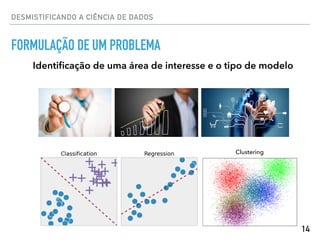
FORMULAÇÃO DE UM PROBLEMA
Identificação de uma área de interesse e o tipo de modelo
Clustering
14
DESMISTIFICANDO A CIÊNCIA DE DADOS
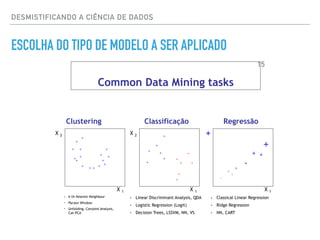
ESCOLHA DO TIPO DE MODELO A SER APLICADO
15
■ k-th Nearest Neighbour
■ Parzen Window
■ Unfolding, Conjoint Analysis,
Cat-PCA
Clustering Classificação Regressão
■ Linear Discriminant Analysis, QDA
■ Logistic Regression (Logit)
■ Decision Trees, LSSVM, NN, VS
■ Classical Linear Regression
■ Ridge Regression
■ NN, CART
+
+
+
+ ++
+
+
++
+
++
+
+
+
+
+
+
+
+
+
-
-
-
-
-
-
+
+
+
+
+
++
+
+
X 1X 1X 1
X 2 X 2
Common Data Mining tasks
TIPOS DE
MODELOS
19
REGRESSÃO
CLASSIFICAÇÃO
AGRUPAMENTO
DESMISTIFICANDO A CIÊNCIA DE DADOS
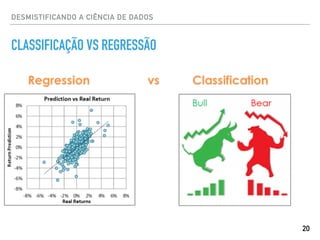
CLASSIFICAÇÃO VS REGRESSÃO
20
O QUE É
REGRESSÃO
?
21
DESMISTIFICANDO A CIÊNCIA DE DADOS
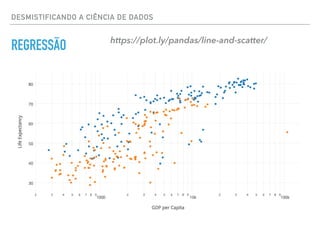
REGRESSÃO https://plot.ly/pandas/line-and-scatter/
DESMISTIFICANDO A CIÊNCIA DE DADOS
REGRESSÃO https://plot.ly ('Coefficients: n', array([ 0.00118801]))
Mean squared error: 9.71
Variance score: -2.38
DESMISTIFICANDO A CIÊNCIA DE DADOS
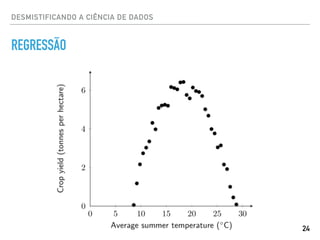
REGRESSÃO
24
DESMISTIFICANDO A CIÊNCIA DE DADOS
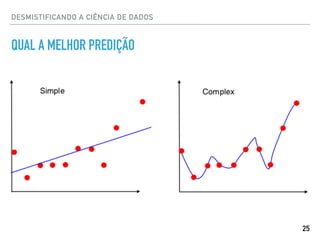
QUAL A MELHOR PREDIÇÃO
25
DESMISTIFICANDO A CIÊNCIA DE DADOS
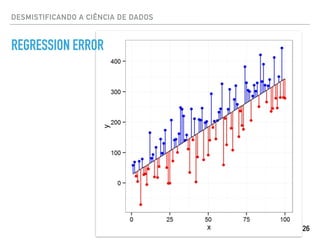
REGRESSION ERROR
26
DESMISTIFICANDO A CIÊNCIA DE DADOS
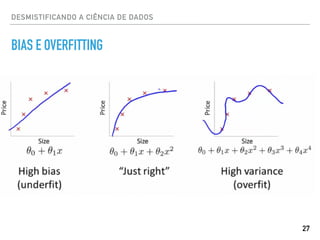
BIAS E OVERFITTING
27
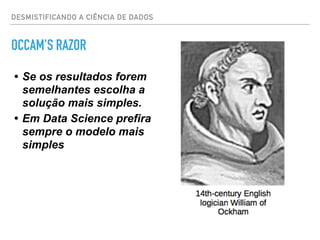
OCCAM'S RAZOR
DESMISTIFICANDO A CIÊNCIA DE DADOS
• Se os resultados forem
semelhantes escolha a
solução mais simples.
• Em Data Science prefira
sempre o modelo mais
simples
DESMISTIFICANDO A CIÊNCIA DE DADOS
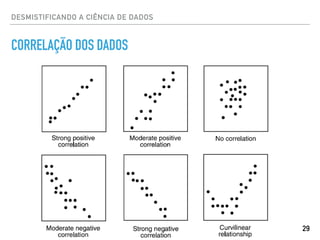
CORRELAÇÃO DOS DADOS
29
O QUE É
CLASSIFICAÇÃO
?
30
DESMISTIFICANDO A CIÊNCIA DE DADOS
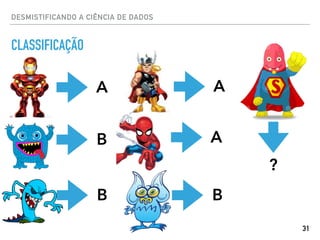
CLASSIFICAÇÃO
A
B
B
A
A
B
?
31
DESMISTIFICANDO A CIÊNCIA DE DADOS
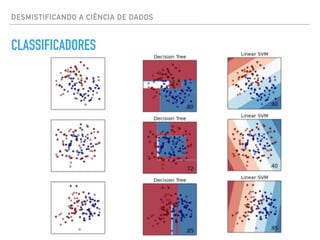
CLASSIFICADORES
DESMISTIFICANDO A CIÊNCIA DE DADOS
?
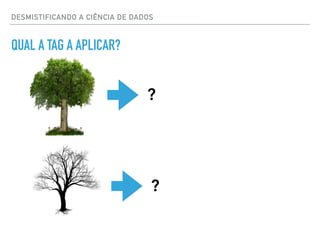
QUAL A TAG A APLICAR?
?
DESMISTIFICANDO A CIÊNCIA DE DADOS
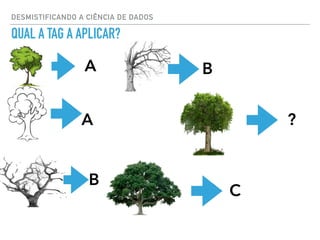
QUAL A TAG A APLICAR?
A
A
B
B
C
?
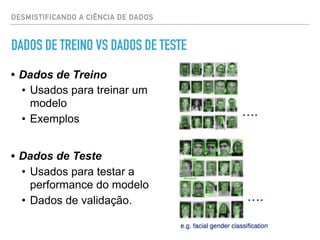
DADOS DE TREINO VS DADOS DE TESTE
• Dados de Treino
• Usados para treinar um
modelo
• Exemplos
• Dados de Teste
• Usados para testar a
performance do modelo
• Dados de validação.
DESMISTIFICANDO A CIÊNCIA DE DADOS
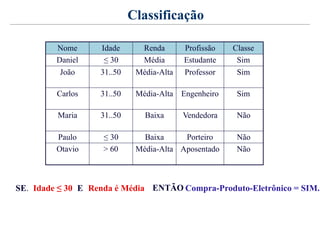
Classificação
Nome Idade Renda Profissão Classe
Daniel ≤ 30 Média Estudante Sim
João 31..50 Média-Alta Professor Sim
Carlos 31..50 Média-Alta Engenheiro Sim
Maria 31..50 Baixa Vendedora Não
Paulo ≤ 30 Baixa Porteiro Não
Otavio > 60 Média-Alta Aposentado Não
SE. Idade ≤ 30 Renda é Média Compra-Produto-Eletrônico = SIM.E ENTÃO
DESMISTIFICANDO A CIÊNCIA DE DADOS
APRENDIZADO
SUPERVISIONADO
VS
NÃO
SUPERVISIONADO
38
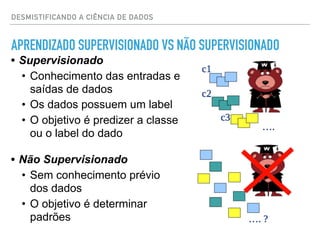
APRENDIZADO SUPERVISIONADO VS NÃO SUPERVISIONADO
• Supervisionado
• Conhecimento das entradas e
saídas de dados
• Os dados possuem um label
• O objetivo é predizer a classe
ou o label do dado
• Não Supervisionado
• Sem conhecimento prévio
dos dados
• O objetivo é determinar
padrões
DESMISTIFICANDO A CIÊNCIA DE DADOS
O QUE É
AGRUPAMENTO
?
40
DESMISTIFICANDO A CIÊNCIA DE DADOS
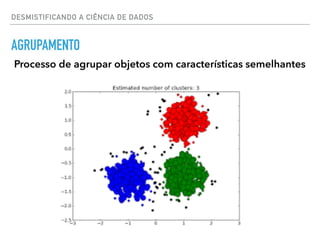
AGRUPAMENTO
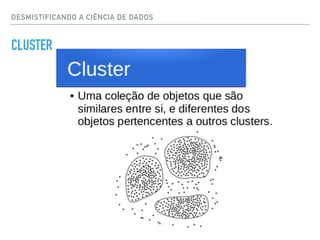
Processo de agrupar objetos com características semelhantes
CLUSTER
DESMISTIFICANDO A CIÊNCIA DE DADOS
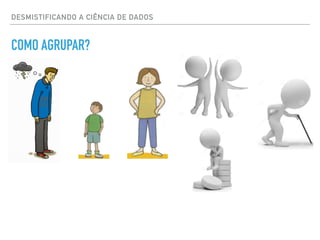
COMO AGRUPAR?
DESMISTIFICANDO A CIÊNCIA DE DADOS
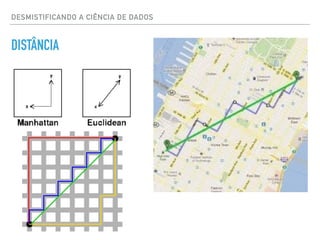
DISTÂNCIA
DESMISTIFICANDO A CIÊNCIA DE DADOS
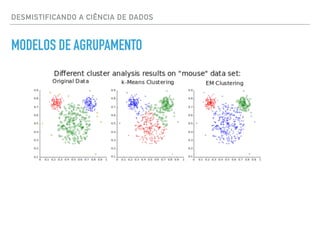
MODELOS DE AGRUPAMENTO
DESMISTIFICANDO A CIÊNCIA DE DADOS
ANÁLISE
DE
TEXTO
47
DESMISTIFICANDO A CIÊNCIA DE DADOS
ANALISANDO TEXTO
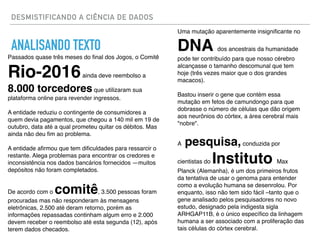
Passados quase três meses do final dos Jogos, o Comitê
Rio-2016ainda deve reembolso a
8.000 torcedores que utilizaram sua
plataforma online para revender ingressos.
A entidade reduziu o contingente de consumidores a
quem devia pagamentos, que chegou a 140 mil em 19 de
outubro, data até a qual prometeu quitar os débitos. Mas
ainda não deu fim ao problema.
A entidade afirmou que tem dificuldades para ressarcir o
restante. Alega problemas para encontrar os credores e
inconsistência nos dados bancários fornecidos —muitos
depósitos não foram completados.
De acordo com o comitê, 3.500 pessoas foram
procuradas mas não responderam às mensagens
eletrônicas, 2.500 até deram retorno, porém as
informações repassadas continham algum erro e 2.000
devem receber o reembolso até esta segunda (12), após
terem dados checados.
Uma mutação aparentemente insignificante no
DNA dos ancestrais da humanidade
pode ter contribuído para que nosso cérebro
alcançasse o tamanho descomunal que tem
hoje (três vezes maior que o dos grandes
macacos).
Bastou inserir o gene que contém essa
mutação em fetos de camundongo para que
dobrasse o número de células que dão origem
aos neurônios do córtex, a área cerebral mais
"nobre".
A pesquisa,conduzida por
cientistas do Instituto Max
Planck (Alemanha), é um dos primeiros frutos
da tentativa de usar o genoma para entender
como a evolução humana se desenrolou. Por
enquanto, isso não tem sido fácil –tanto que o
gene analisado pelos pesquisadores no novo
estudo, designado pela indigesta sigla
ARHGAP11B, é o único específico da linhagem
humana a ser associado com a proliferação das
tais células do córtex cerebral.
DESMISTIFICANDO A CIÊNCIA DE DADOS
ANÁLISE DE SENTIMENTO
>>> docs_new = ['God is love', 'OpenGL on the GPU is fast']
>>> X_new_counts = count_vect.transform(docs_new)
>>> X_new_tfidf = tfidf_transformer.transform(X_new_counts)
>>> predicted = clf.predict(X_new_tfidf)
>>> for doc, category in zip(docs_new, predicted):
... print('%r => %s' % (doc, twenty_train.target_names[category]))
...
'God is love' => soc.religion.christian
'OpenGL on the GPU is fast' => comp.graphics
DESMISTIFICANDO A CIÊNCIA DE DADOS
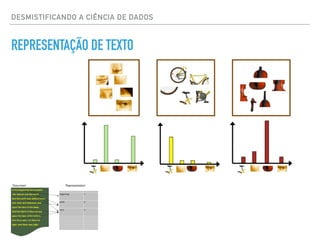
REPRESENTAÇÃO DE TEXTO
ANALISANDO A
PERFORMANCE
DE UM MODELO
51
DESMISTIFICANDO A CIÊNCIA DE DADOS
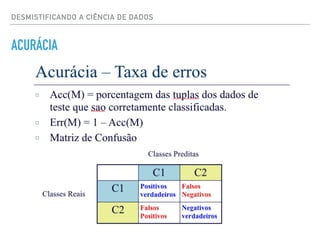
ACURÁCIA
DESMISTIFICANDO A CIÊNCIA DE DADOS
PERFORMANCE DE UM CLASSIFICADOR
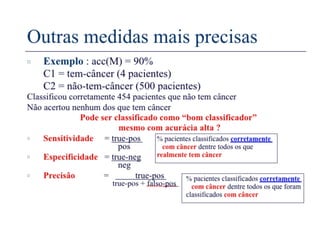
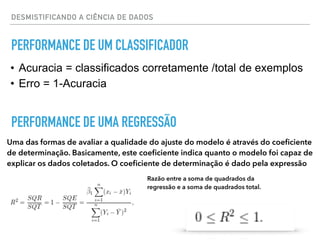
• Acuracia = classificados corretamente /total de exemplos
• Erro = 1-Acuracia
PERFORMANCE DE UMA REGRESSÃO
Uma das formas de avaliar a qualidade do ajuste do modelo é através do coeficiente
de determinação. Basicamente, este coeficiente indica quanto o modelo foi capaz de
explicar os dados coletados. O coeficiente de determinação é dado pela expressão
Razão entre a soma de quadrados da
regressão e a soma de quadrados total.
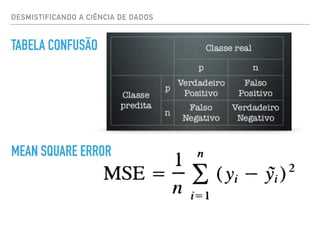
TABELA CONFUSÃO
DESMISTIFICANDO A CIÊNCIA DE DADOS
MEAN SQUARE ERROR
FERRAMENTAS
E LINGUAGENS
56
NUMPY
PANDAS
SKLEARN
R STUDIO
NUMPY
Biblioteca em python para
manipulação de arrays e
matrizes
PANDAS
Biblioteca de Manipulação
de dados e analise em
python
DESMISTIFICANDO A CIÊNCIA DE DADOS
NUMPY E PANDAS- LENDO ARQUIVO CSV
import numpy as np
import pandas as pd
import visuals as vs # Supplementary code
from sklearn.cross_validation import ShuffleSplit
# Load the Boston housing dataset
data = pd.read_csv('housing.csv')
prices = data['MEDV']
features = data.drop('MEDV', axis = 1)
DESMISTIFICANDO A CIÊNCIA DE DADOS
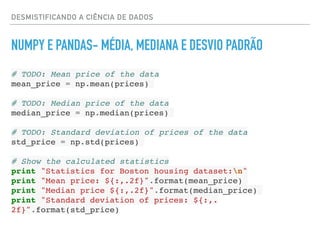
NUMPY E PANDAS- MÉDIA, MEDIANA E DESVIO PADRÃO
# TODO: Mean price of the data
mean_price = np.mean(prices)
# TODO: Median price of the data
median_price = np.median(prices)
# TODO: Standard deviation of prices of the data
std_price = np.std(prices)
# Show the calculated statistics
print "Statistics for Boston housing dataset:n"
print "Mean price: ${:,.2f}".format(mean_price)
print "Median price ${:,.2f}".format(median_price)
print "Standard deviation of prices: ${:,.
2f}".format(std_price)
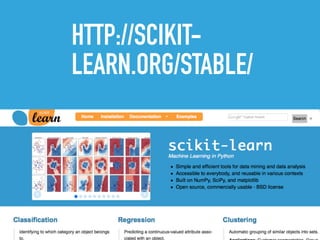
SKLEARN
•Aplicação simples e
eficiente para data mining e
data analysis
•Feito com NumPy, SciPy,
e matplotlib
•Open source,
commercially usable - BSD
license
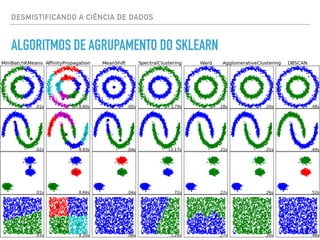
ALGORITMOS DE AGRUPAMENTO DO SKLEARN
DESMISTIFICANDO A CIÊNCIA DE DADOS
CLASSIFICAÇÃO NO SKLEARN
# Create a classifier: a support vector classifier
classifier = svm.SVC(gamma=0.001)
# We learn the digits on the first half of the digits
classifier.fit(data[:n_samples / 2], digits.target[:n_samples /
2])
DESMISTIFICANDO A CIÊNCIA DE DADOS
CLASSIFICANDO EMAILS
DESMISTIFICANDO A CIÊNCIA DE DADOS
from sklearn.naive_bayes import MultinomialNB
classifier = MultinomialNB()
…
classifier.fit(counts, targets)
examples = ['Free Viagra call today!', "I'm going to
attend the Linux users group tomorrow."]
….
predictions = classifier.predict(example_counts)
predictions # [1, 0]
HTTP://SCIKIT-
LEARN.ORG/STABLE/
LINGUAGEM R
R é uma linguagem e também
um ambiente de
desenvolvimento integrado
para cálculos estatísticos e
gráficos.
Foi criada originalmente por
Ross Ihaka e por Robert
Gentleman no departamento de
Estatística da universidade de
Auckland, Nova Zelândia.
EXEMPLOS
DE APLICAÇÃO
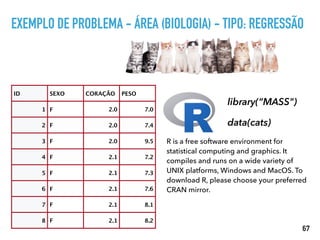
ID SEXO CORAÇÃO PESO
1 F 2.0 7.0
2 F 2.0 7.4
3 F 2.0 9.5
4 F 2.1 7.2
5 F 2.1 7.3
6 F 2.1 7.6
7 F 2.1 8.1
8 F 2.1 8.2
library(“MASS")
data(cats)
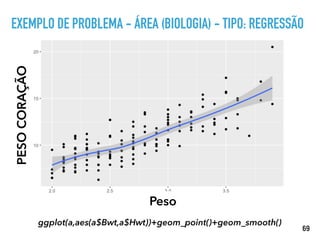
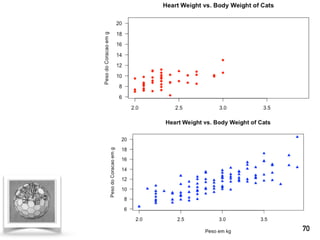
EXEMPLO DE PROBLEMA - ÁREA (BIOLOGIA) - TIPO: REGRESSÃO
R is a free software environment for
statistical computing and graphics. It
compiles and runs on a wide variety of
UNIX platforms, Windows and MacOS. To
download R, please choose your preferred
CRAN mirror.
67
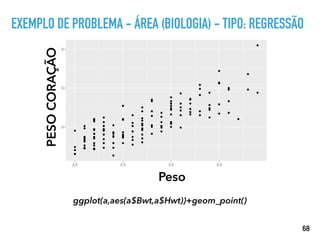
PESOCORAÇÃO
Peso
ggplot(a,aes(a$Bwt,a$Hwt))+geom_point()
EXEMPLO DE PROBLEMA - ÁREA (BIOLOGIA) - TIPO: REGRESSÃO
68
Peso
PESOCORAÇÃOEXEMPLO DE PROBLEMA - ÁREA (BIOLOGIA) - TIPO: REGRESSÃO
69
ggplot(a,aes(a$Bwt,a$Hwt))+geom_point()+geom_smooth()
70
EXEMPLO
PREDIZER
PREÇOS DE
CASAS EM
BOSTON
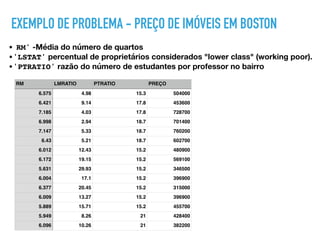
RM LMRATIO PTRATIO PREÇO
6.575 4.98 15.3 504000
6.421 9.14 17.8 453600
7.185 4.03 17.8 728700
6.998 2.94 18.7 701400
7.147 5.33 18.7 760200
6.43 5.21 18.7 602700
6.012 12.43 15.2 480900
6.172 19.15 15.2 569100
5.631 29.93 15.2 346500
6.004 17.1 15.2 396900
6.377 20.45 15.2 315000
6.009 13.27 15.2 396900
5.889 15.71 15.2 455700
5.949 8.26 21 428400
6.096 10.26 21 382200
• RM' -Média do número de quartos
•'LSTAT' percentual de proprietários considerados "lower class" (working poor).
•'PTRATIO' razão do número de estudantes por professor no bairro
EXEMPLO DE PROBLEMA - PREÇO DE IMÓVEIS EM BOSTON
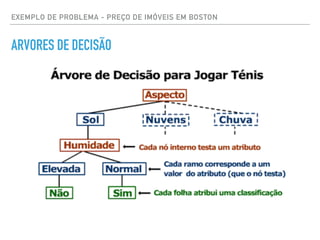
ARVORES DE DECISÃO
EXEMPLO DE PROBLEMA - PREÇO DE IMÓVEIS EM BOSTON
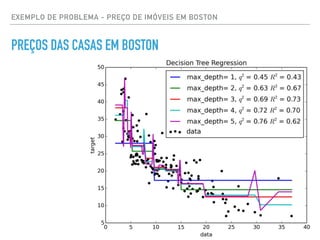
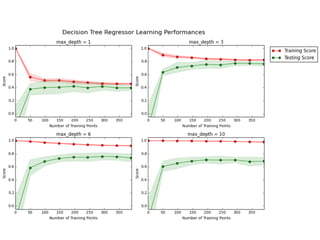
PREÇOS DAS CASAS EM BOSTON
EXEMPLO DE PROBLEMA - PREÇO DE IMÓVEIS EM BOSTON
CÓDIGO DE REGRESSÃO NO SKLEARN
regressor = DecisionTreeRegressor(random_state=42)
params = {"max_depth": [1,2,3,4,5,6,7,8,9,10]}
# TODO: Create the grid search object
grid = GridSearchCV(regressor,
param_grid=params, scoring =
scoring_fnc, cv = cv_sets)
# Fit the grid search object to the data to compute the optimal
model
grid = grid.fit(X, y)
EXEMPLO DE PROBLEMA - PREÇO DE IMÓVEIS EM BOSTON
PREDICTING
# Produce a matrix for client data
client_data = [[5, 17, 15], # Client 1
[4, 32, 22], # Client 2
[8, 3, 12]] # Client 3
# Show predictions
for i, price in
enumerate(reg.predict(client_data)):
Predicted selling price for Client 1's home: $414,473.68
Predicted selling price for Client 2's home: $214,302.44
Predicted selling price for Client 3's home: $910,700.00
EXEMPLO
INTERVENÇÃO
DE
ESTUDANTES
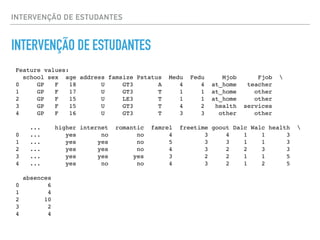
INTERVENÇÃO DE ESTUDANTES
Feature values:
school sex age address famsize Pstatus Medu Fedu Mjob Fjob 
0 GP F 18 U GT3 A 4 4 at_home teacher
1 GP F 17 U GT3 T 1 1 at_home other
2 GP F 15 U LE3 T 1 1 at_home other
3 GP F 15 U GT3 T 4 2 health services
4 GP F 16 U GT3 T 3 3 other other
... higher internet romantic famrel freetime goout Dalc Walc health 
0 ... yes no no 4 3 4 1 1 3
1 ... yes yes no 5 3 3 1 1 3
2 ... yes yes no 4 3 2 2 3 3
3 ... yes yes yes 3 2 2 1 1 5
4 ... yes no no 4 3 2 1 2 5
absences
0 6
1 4
2 10
3 2
4 4
INTERVENÇÃO DE ESTUDANTES
PREPARANDO OS DADOS
# If data type is non-numeric, replace all yes/no values with 1/0
if col_data.dtype == object:
col_data = col_data.replace(['yes', 'no'], [1, 0])
X_train, X_test, y_train, y_test = train_test_split(X_all, y_all,
stratify=y_all, train_size=train_size,test_size=0.24)
SEPARANDO DADOS DE TREINO E TESTE
INTERVENÇÃO DE ESTUDANTES
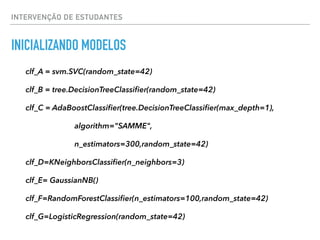
INICIALIZANDO MODELOS
clf_A = svm.SVC(random_state=42)
clf_B = tree.DecisionTreeClassifier(random_state=42)
clf_C = AdaBoostClassifier(tree.DecisionTreeClassifier(max_depth=1),
algorithm="SAMME",
n_estimators=300,random_state=42)
clf_D=KNeighborsClassifier(n_neighbors=3)
clf_E= GaussianNB()
clf_F=RandomForestClassifier(n_estimators=100,random_state=42)
clf_G=LogisticRegression(random_state=42)
INTERVENÇÃO DE ESTUDANTES
COMPARAÇÃO DE MODELOS
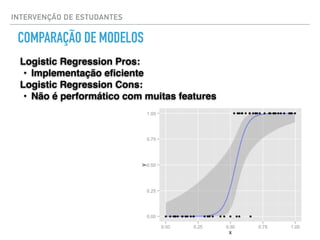
Logistic Regression Pros:
• Implementação eficiente
Logistic Regression Cons:
• Não é performático com muitas features
Decision Trees Pros:
• Regras de decisão intuitivas
• Pode utilizar campos não lineares
Decision Trees Cons:
• Alto Bias [Random Forests pode ser a solução]
• Sem ranking score
COMPARAÇÃO DE MODELOS
INTERVENÇÃO DE ESTUDANTES
COMPARAÇÃO DE MODELOS
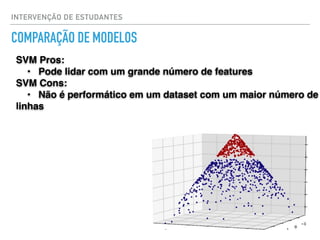
SVM Pros:
• Pode lidar com um grande número de features
SVM Cons:
• Não é performático em um dataset com um maior número de
linhas
INTERVENÇÃO DE ESTUDANTES
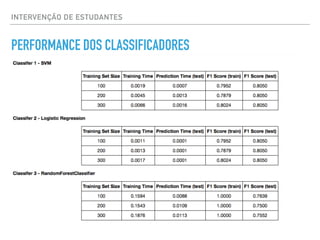
PERFORMANCE DOS CLASSIFICADORES
INTERVENÇÃO DE ESTUDANTES
SEGMENTANDO
FORNECEDORES
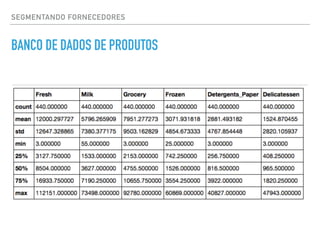
BANCO DE DADOS DE PRODUTOS
SEGMENTANDO FORNECEDORES
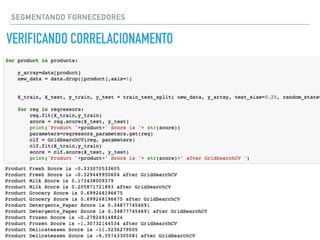
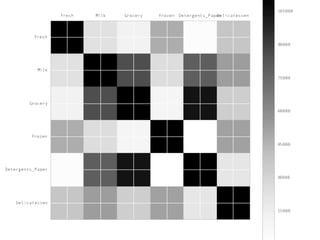
VERIFICANDO CORRELACIONAMENTO
SEGMENTANDO FORNECEDORES
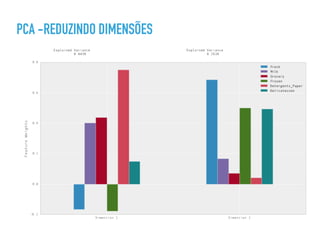
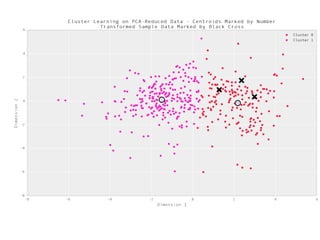
PCA -REDUZINDO DIMENSÕES
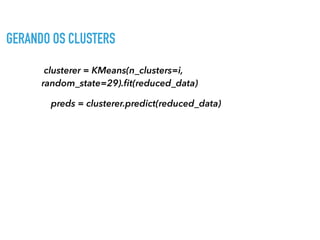
clusterer = KMeans(n_clusters=i,
random_state=29).fit(reduced_data)
preds = clusterer.predict(reduced_data)
GERANDO OS CLUSTERS
SITES
ONDE
CONSEGUIR
INFORMAÇÃO
DESMISTIFICANDO A CIÊNCIA DE DADOS
HTTPS://ENSINANDOMAQUINASBLOG.WORDPRESS.COM
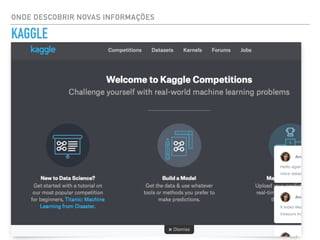
ONDE DESCOBRIR NOVAS INFORMAÇÕES
KAGGLE
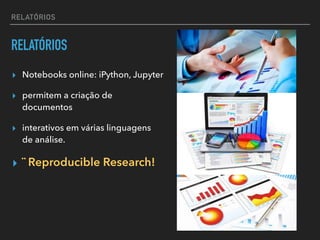
RELATÓRIOS
RELATÓRIOS
▸ Notebooks online: iPython, Jupyter
▸ permitem a criação de
documentos
▸ interativos em várias linguagens
de análise.
▸ ¨ Reproducible Research!
TESTE A/B
TESTE A/B
TESTE A/B
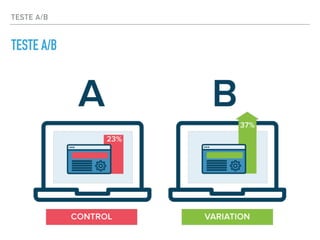
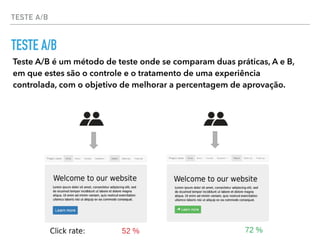
Teste A/B é um método de teste onde se comparam duas práticas, A e B,
em que estes são o controle e o tratamento de uma experiência
controlada, com o objetivo de melhorar a percentagem de aprovação.
TESTE A/B
LIVROS
Dúvidas:
naubergois@gmail.com

Data science

  • 1.
  • 2.
    NAUBER GOIS Aluno deDoutorado em Informática Aplicada da Unifor Área de Estudo: Reinforcement Learning e metaheurísticas aplicadas a testes de performance. Analista de Desenvolvimento do Serpro
  • 3.
    AGENDA DEFINIÇÃO DE DATASCIENCE TIPOS DE MODELOS EXEMPLOS DE APLICAÇÃO RELATÓRIOS TESTES A/B
  • 4.
    O QUE ÉCIÊNCIA DE DADOS?
  • 5.
    DATA SCIENCE ÉMAIS UM TERMO USADO PARA DESCREVER O PROCESSO DE TRANSFORMAÇÃO DE DADOS EM CONHECIMENTO. (LOUKIDES, 2016) 5
  • 6.
    CIENTISTA DE DADOS Matemática e estatística Bancode Dados e Programação Conhecimento de Negócio Comunicação
  • 7.
    Data scientist: Personwho is better at statistics than any software engineer and better at software engineering than any statistician – Josh Wills Data scientist: Pessoa que é melhor em estatística que quaisquer engenheiros de software e melhor em engenharia de software que quaisquer estatístico – Josh Wills Usar (coletar, armazenar, publicar) dados não é data science. É preciso agregar valor aos dados e permitir novas formas de uso. 7
  • 9.
    DESMISTIFICANDO A CIÊNCIADE DADOS DATA SCIENCE VENN DIAGRAM 9
  • 10.
  • 11.
    DESMISTIFICANDO A CIÊNCIADE DADOS U.M.Fayyad, G.Patetsky- Shapiro and P.Smyth (1995) Seleção de Features e Redução de Dimensionalidade
  • 12.
  • 13.
    DESMISTIFICANDO A CIÊNCIADE DADOS COLETAR E PROCESSAR OS DADOS Conduzir experimento de pesquisa. Coletar amostras de uma população. Transformar , filtrar e sumarizar os dados. Preparar os dados para o modelo escolhido 13
  • 14.
    DESMISTIFICANDO A CIÊNCIADE DADOS FORMULAÇÃO DE UM PROBLEMA Identificação de uma área de interesse e o tipo de modelo Clustering 14
  • 15.
    DESMISTIFICANDO A CIÊNCIADE DADOS ESCOLHA DO TIPO DE MODELO A SER APLICADO 15 ■ k-th Nearest Neighbour ■ Parzen Window ■ Unfolding, Conjoint Analysis, Cat-PCA Clustering Classificação Regressão ■ Linear Discriminant Analysis, QDA ■ Logistic Regression (Logit) ■ Decision Trees, LSSVM, NN, VS ■ Classical Linear Regression ■ Ridge Regression ■ NN, CART + + + + ++ + + ++ + ++ + + + + + + + + + - - - - - - + + + + + ++ + + X 1X 1X 1 X 2 X 2 Common Data Mining tasks
  • 19.
  • 20.
    DESMISTIFICANDO A CIÊNCIADE DADOS CLASSIFICAÇÃO VS REGRESSÃO 20
  • 21.
  • 22.
    DESMISTIFICANDO A CIÊNCIADE DADOS REGRESSÃO https://plot.ly/pandas/line-and-scatter/
  • 23.
    DESMISTIFICANDO A CIÊNCIADE DADOS REGRESSÃO https://plot.ly ('Coefficients: n', array([ 0.00118801])) Mean squared error: 9.71 Variance score: -2.38
  • 24.
    DESMISTIFICANDO A CIÊNCIADE DADOS REGRESSÃO 24
  • 25.
    DESMISTIFICANDO A CIÊNCIADE DADOS QUAL A MELHOR PREDIÇÃO 25
  • 26.
    DESMISTIFICANDO A CIÊNCIADE DADOS REGRESSION ERROR 26
  • 27.
    DESMISTIFICANDO A CIÊNCIADE DADOS BIAS E OVERFITTING 27
  • 28.
    OCCAM'S RAZOR DESMISTIFICANDO ACIÊNCIA DE DADOS • Se os resultados forem semelhantes escolha a solução mais simples. • Em Data Science prefira sempre o modelo mais simples
  • 29.
    DESMISTIFICANDO A CIÊNCIADE DADOS CORRELAÇÃO DOS DADOS 29
  • 30.
  • 31.
    DESMISTIFICANDO A CIÊNCIADE DADOS CLASSIFICAÇÃO A B B A A B ? 31
  • 32.
    DESMISTIFICANDO A CIÊNCIADE DADOS CLASSIFICADORES
  • 33.
    DESMISTIFICANDO A CIÊNCIADE DADOS ? QUAL A TAG A APLICAR? ?
  • 34.
    DESMISTIFICANDO A CIÊNCIADE DADOS QUAL A TAG A APLICAR? A A B B C ?
  • 35.
    DADOS DE TREINOVS DADOS DE TESTE • Dados de Treino • Usados para treinar um modelo • Exemplos • Dados de Teste • Usados para testar a performance do modelo • Dados de validação. DESMISTIFICANDO A CIÊNCIA DE DADOS
  • 36.
    Classificação Nome Idade RendaProfissão Classe Daniel ≤ 30 Média Estudante Sim João 31..50 Média-Alta Professor Sim Carlos 31..50 Média-Alta Engenheiro Sim Maria 31..50 Baixa Vendedora Não Paulo ≤ 30 Baixa Porteiro Não Otavio > 60 Média-Alta Aposentado Não SE. Idade ≤ 30 Renda é Média Compra-Produto-Eletrônico = SIM.E ENTÃO
  • 37.
  • 38.
  • 39.
    APRENDIZADO SUPERVISIONADO VSNÃO SUPERVISIONADO • Supervisionado • Conhecimento das entradas e saídas de dados • Os dados possuem um label • O objetivo é predizer a classe ou o label do dado • Não Supervisionado • Sem conhecimento prévio dos dados • O objetivo é determinar padrões DESMISTIFICANDO A CIÊNCIA DE DADOS
  • 40.
  • 42.
    DESMISTIFICANDO A CIÊNCIADE DADOS AGRUPAMENTO Processo de agrupar objetos com características semelhantes
  • 43.
  • 44.
  • 45.
  • 46.
  • 47.
  • 48.
    DESMISTIFICANDO A CIÊNCIADE DADOS ANALISANDO TEXTO Passados quase três meses do final dos Jogos, o Comitê Rio-2016ainda deve reembolso a 8.000 torcedores que utilizaram sua plataforma online para revender ingressos. A entidade reduziu o contingente de consumidores a quem devia pagamentos, que chegou a 140 mil em 19 de outubro, data até a qual prometeu quitar os débitos. Mas ainda não deu fim ao problema. A entidade afirmou que tem dificuldades para ressarcir o restante. Alega problemas para encontrar os credores e inconsistência nos dados bancários fornecidos —muitos depósitos não foram completados. De acordo com o comitê, 3.500 pessoas foram procuradas mas não responderam às mensagens eletrônicas, 2.500 até deram retorno, porém as informações repassadas continham algum erro e 2.000 devem receber o reembolso até esta segunda (12), após terem dados checados. Uma mutação aparentemente insignificante no DNA dos ancestrais da humanidade pode ter contribuído para que nosso cérebro alcançasse o tamanho descomunal que tem hoje (três vezes maior que o dos grandes macacos). Bastou inserir o gene que contém essa mutação em fetos de camundongo para que dobrasse o número de células que dão origem aos neurônios do córtex, a área cerebral mais "nobre". A pesquisa,conduzida por cientistas do Instituto Max Planck (Alemanha), é um dos primeiros frutos da tentativa de usar o genoma para entender como a evolução humana se desenrolou. Por enquanto, isso não tem sido fácil –tanto que o gene analisado pelos pesquisadores no novo estudo, designado pela indigesta sigla ARHGAP11B, é o único específico da linhagem humana a ser associado com a proliferação das tais células do córtex cerebral.
  • 49.
    DESMISTIFICANDO A CIÊNCIADE DADOS ANÁLISE DE SENTIMENTO >>> docs_new = ['God is love', 'OpenGL on the GPU is fast'] >>> X_new_counts = count_vect.transform(docs_new) >>> X_new_tfidf = tfidf_transformer.transform(X_new_counts) >>> predicted = clf.predict(X_new_tfidf) >>> for doc, category in zip(docs_new, predicted): ... print('%r => %s' % (doc, twenty_train.target_names[category])) ... 'God is love' => soc.religion.christian 'OpenGL on the GPU is fast' => comp.graphics
  • 50.
    DESMISTIFICANDO A CIÊNCIADE DADOS REPRESENTAÇÃO DE TEXTO
  • 51.
  • 52.
    DESMISTIFICANDO A CIÊNCIADE DADOS ACURÁCIA
  • 54.
    DESMISTIFICANDO A CIÊNCIADE DADOS PERFORMANCE DE UM CLASSIFICADOR • Acuracia = classificados corretamente /total de exemplos • Erro = 1-Acuracia PERFORMANCE DE UMA REGRESSÃO Uma das formas de avaliar a qualidade do ajuste do modelo é através do coeficiente de determinação. Basicamente, este coeficiente indica quanto o modelo foi capaz de explicar os dados coletados. O coeficiente de determinação é dado pela expressão Razão entre a soma de quadrados da regressão e a soma de quadrados total.
  • 55.
    TABELA CONFUSÃO DESMISTIFICANDO ACIÊNCIA DE DADOS MEAN SQUARE ERROR
  • 56.
  • 57.
    NUMPY Biblioteca em pythonpara manipulação de arrays e matrizes PANDAS Biblioteca de Manipulação de dados e analise em python
  • 58.
    DESMISTIFICANDO A CIÊNCIADE DADOS NUMPY E PANDAS- LENDO ARQUIVO CSV import numpy as np import pandas as pd import visuals as vs # Supplementary code from sklearn.cross_validation import ShuffleSplit # Load the Boston housing dataset data = pd.read_csv('housing.csv') prices = data['MEDV'] features = data.drop('MEDV', axis = 1)
  • 59.
    DESMISTIFICANDO A CIÊNCIADE DADOS NUMPY E PANDAS- MÉDIA, MEDIANA E DESVIO PADRÃO # TODO: Mean price of the data mean_price = np.mean(prices) # TODO: Median price of the data median_price = np.median(prices) # TODO: Standard deviation of prices of the data std_price = np.std(prices) # Show the calculated statistics print "Statistics for Boston housing dataset:n" print "Mean price: ${:,.2f}".format(mean_price) print "Median price ${:,.2f}".format(median_price) print "Standard deviation of prices: ${:,. 2f}".format(std_price)
  • 60.
    SKLEARN •Aplicação simples e eficientepara data mining e data analysis •Feito com NumPy, SciPy, e matplotlib •Open source, commercially usable - BSD license
  • 61.
    ALGORITMOS DE AGRUPAMENTODO SKLEARN DESMISTIFICANDO A CIÊNCIA DE DADOS
  • 62.
    CLASSIFICAÇÃO NO SKLEARN #Create a classifier: a support vector classifier classifier = svm.SVC(gamma=0.001) # We learn the digits on the first half of the digits classifier.fit(data[:n_samples / 2], digits.target[:n_samples / 2]) DESMISTIFICANDO A CIÊNCIA DE DADOS
  • 63.
    CLASSIFICANDO EMAILS DESMISTIFICANDO ACIÊNCIA DE DADOS from sklearn.naive_bayes import MultinomialNB classifier = MultinomialNB() … classifier.fit(counts, targets) examples = ['Free Viagra call today!', "I'm going to attend the Linux users group tomorrow."] …. predictions = classifier.predict(example_counts) predictions # [1, 0]
  • 64.
  • 65.
    LINGUAGEM R R éuma linguagem e também um ambiente de desenvolvimento integrado para cálculos estatísticos e gráficos. Foi criada originalmente por Ross Ihaka e por Robert Gentleman no departamento de Estatística da universidade de Auckland, Nova Zelândia.
  • 66.
  • 67.
    ID SEXO CORAÇÃOPESO 1 F 2.0 7.0 2 F 2.0 7.4 3 F 2.0 9.5 4 F 2.1 7.2 5 F 2.1 7.3 6 F 2.1 7.6 7 F 2.1 8.1 8 F 2.1 8.2 library(“MASS") data(cats) EXEMPLO DE PROBLEMA - ÁREA (BIOLOGIA) - TIPO: REGRESSÃO R is a free software environment for statistical computing and graphics. It compiles and runs on a wide variety of UNIX platforms, Windows and MacOS. To download R, please choose your preferred CRAN mirror. 67
  • 68.
  • 69.
    Peso PESOCORAÇÃOEXEMPLO DE PROBLEMA- ÁREA (BIOLOGIA) - TIPO: REGRESSÃO 69 ggplot(a,aes(a$Bwt,a$Hwt))+geom_point()+geom_smooth()
  • 70.
  • 71.
  • 72.
    RM LMRATIO PTRATIOPREÇO 6.575 4.98 15.3 504000 6.421 9.14 17.8 453600 7.185 4.03 17.8 728700 6.998 2.94 18.7 701400 7.147 5.33 18.7 760200 6.43 5.21 18.7 602700 6.012 12.43 15.2 480900 6.172 19.15 15.2 569100 5.631 29.93 15.2 346500 6.004 17.1 15.2 396900 6.377 20.45 15.2 315000 6.009 13.27 15.2 396900 5.889 15.71 15.2 455700 5.949 8.26 21 428400 6.096 10.26 21 382200 • RM' -Média do número de quartos •'LSTAT' percentual de proprietários considerados "lower class" (working poor). •'PTRATIO' razão do número de estudantes por professor no bairro EXEMPLO DE PROBLEMA - PREÇO DE IMÓVEIS EM BOSTON
  • 73.
    EXEMPLO DE PROBLEMA- PREÇO DE IMÓVEIS EM BOSTON ARVORES DE DECISÃO
  • 74.
    EXEMPLO DE PROBLEMA- PREÇO DE IMÓVEIS EM BOSTON PREÇOS DAS CASAS EM BOSTON
  • 76.
    EXEMPLO DE PROBLEMA- PREÇO DE IMÓVEIS EM BOSTON CÓDIGO DE REGRESSÃO NO SKLEARN regressor = DecisionTreeRegressor(random_state=42) params = {"max_depth": [1,2,3,4,5,6,7,8,9,10]} # TODO: Create the grid search object grid = GridSearchCV(regressor, param_grid=params, scoring = scoring_fnc, cv = cv_sets) # Fit the grid search object to the data to compute the optimal model grid = grid.fit(X, y)
  • 77.
    EXEMPLO DE PROBLEMA- PREÇO DE IMÓVEIS EM BOSTON PREDICTING # Produce a matrix for client data client_data = [[5, 17, 15], # Client 1 [4, 32, 22], # Client 2 [8, 3, 12]] # Client 3 # Show predictions for i, price in enumerate(reg.predict(client_data)): Predicted selling price for Client 1's home: $414,473.68 Predicted selling price for Client 2's home: $214,302.44 Predicted selling price for Client 3's home: $910,700.00
  • 78.
  • 79.
    INTERVENÇÃO DE ESTUDANTES INTERVENÇÃODE ESTUDANTES Feature values: school sex age address famsize Pstatus Medu Fedu Mjob Fjob 0 GP F 18 U GT3 A 4 4 at_home teacher 1 GP F 17 U GT3 T 1 1 at_home other 2 GP F 15 U LE3 T 1 1 at_home other 3 GP F 15 U GT3 T 4 2 health services 4 GP F 16 U GT3 T 3 3 other other ... higher internet romantic famrel freetime goout Dalc Walc health 0 ... yes no no 4 3 4 1 1 3 1 ... yes yes no 5 3 3 1 1 3 2 ... yes yes no 4 3 2 2 3 3 3 ... yes yes yes 3 2 2 1 1 5 4 ... yes no no 4 3 2 1 2 5 absences 0 6 1 4 2 10 3 2 4 4
  • 80.
    INTERVENÇÃO DE ESTUDANTES PREPARANDOOS DADOS # If data type is non-numeric, replace all yes/no values with 1/0 if col_data.dtype == object: col_data = col_data.replace(['yes', 'no'], [1, 0]) X_train, X_test, y_train, y_test = train_test_split(X_all, y_all, stratify=y_all, train_size=train_size,test_size=0.24) SEPARANDO DADOS DE TREINO E TESTE
  • 81.
    INTERVENÇÃO DE ESTUDANTES INICIALIZANDOMODELOS clf_A = svm.SVC(random_state=42) clf_B = tree.DecisionTreeClassifier(random_state=42) clf_C = AdaBoostClassifier(tree.DecisionTreeClassifier(max_depth=1), algorithm="SAMME", n_estimators=300,random_state=42) clf_D=KNeighborsClassifier(n_neighbors=3) clf_E= GaussianNB() clf_F=RandomForestClassifier(n_estimators=100,random_state=42) clf_G=LogisticRegression(random_state=42)
  • 82.
    INTERVENÇÃO DE ESTUDANTES COMPARAÇÃODE MODELOS Logistic Regression Pros: • Implementação eficiente Logistic Regression Cons: • Não é performático com muitas features
  • 83.
    Decision Trees Pros: •Regras de decisão intuitivas • Pode utilizar campos não lineares Decision Trees Cons: • Alto Bias [Random Forests pode ser a solução] • Sem ranking score COMPARAÇÃO DE MODELOS INTERVENÇÃO DE ESTUDANTES
  • 84.
    COMPARAÇÃO DE MODELOS SVMPros: • Pode lidar com um grande número de features SVM Cons: • Não é performático em um dataset com um maior número de linhas INTERVENÇÃO DE ESTUDANTES
  • 85.
  • 86.
  • 87.
    BANCO DE DADOSDE PRODUTOS SEGMENTANDO FORNECEDORES
  • 88.
  • 90.
  • 91.
    clusterer = KMeans(n_clusters=i, random_state=29).fit(reduced_data) preds= clusterer.predict(reduced_data) GERANDO OS CLUSTERS
  • 93.
  • 94.
    DESMISTIFICANDO A CIÊNCIADE DADOS HTTPS://ENSINANDOMAQUINASBLOG.WORDPRESS.COM
  • 95.
    ONDE DESCOBRIR NOVASINFORMAÇÕES KAGGLE
  • 96.
    RELATÓRIOS RELATÓRIOS ▸ Notebooks online:iPython, Jupyter ▸ permitem a criação de documentos ▸ interativos em várias linguagens de análise. ▸ ¨ Reproducible Research!
  • 97.
  • 98.
    TESTE A/B Teste A/Bé um método de teste onde se comparam duas práticas, A e B, em que estes são o controle e o tratamento de uma experiência controlada, com o objetivo de melhorar a percentagem de aprovação. TESTE A/B
  • 99.
  • 100.