Profª. Dálgima Toneli de Sá
FAMILY MEMBERS
A partir de agora, você vai começar a conhecer um pouco da vida de um
amiguinho que mora nos Estados Unidos, mas está passeando aqui no Brasil.
O nome dele é Jonathan Rice. Ele é muito esperto, curioso e tem uma família não
muito tradicional, da mesma forma que muitos brasileiros.
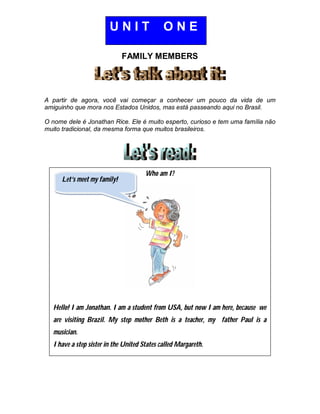
Who am I?
Hello! I am Jonathan. I am a student from USA, but now I am here, because we
are visiting Brazil. My step mother Beth is a teacher, my father Paul is a
musician.
I have a step sister in the United States called Margareth.
U N I T O N E
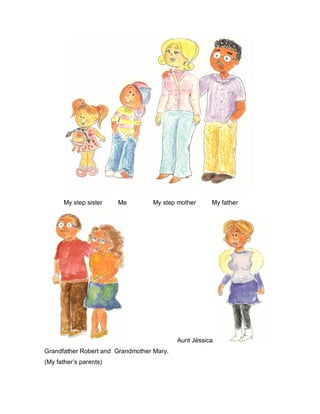
Let’s meet my family!
My step sister Me My step mother My father
Aunt Jéssica
Grandfather Robert and Grandmother Mary.
(My father’s parents)
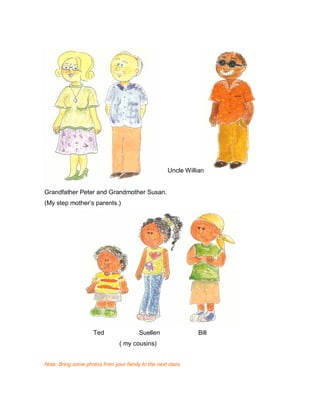
Uncle Willian
Grandfather Peter and Grandmother Susan.
(My step mother’s parents.)
Ted Suellen Bill
( my cousins)
Note: Bring some photos from your family to the next class.
1) We will make a big circle and sit around. The teacher will shuffle the
photos everyone bring to school, and distribute them, one to each
student. You will try to discover who is who in the photos. If nobody
identifies who you are in the photo, say aloud: It is my photo.
2) Now we will make an album with the photos of your family and you.
Glue the photos on the paper and put under it their names;
3) In pairs paint the pictures of Jonathan’s family that the teacher will give
you and glue them on the card. Put all the cards on the desk. Try to
memorize where the pairs are. The winner is who discover all the pairs
first.
(Para realizar esta atividade a professora deverá distribuir aos alunos uma folha com os
desenhos de pessoas da família de Jonathan. Os alunos colorirão os desenhos e os colarão
nos cartões que receberão já cortados no tamanho de cada foto).
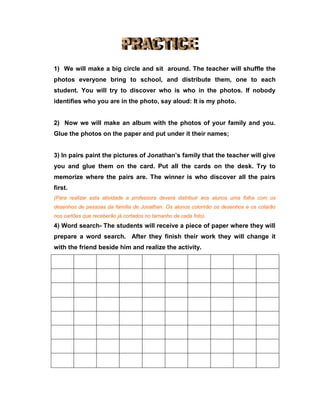
4) Word search- The students will receive a piece of paper where they will
prepare a word search. After they finish their work they will change it
with the friend beside him and realize the activity.
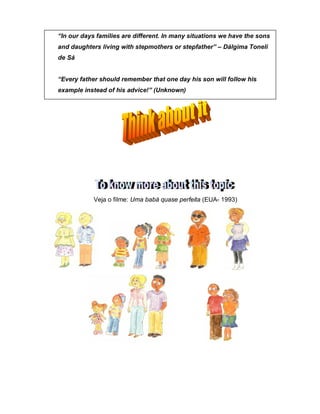
Veja o filme: Uma babá quase perfeita (EUA- 1993)
“In our days families are different. In many situations we have the sons
and daughters living with stepmothers or stepfather” – Dálgima Toneli
de Sá
“Every father should remember that one day his son will follow his
example instead of his advice!” (Unknown)
JOBS – OCCUPATIONS
1. Alguém já lhe perguntou: “O que você quer ser quando crescer?”
2. Fale algumas profissões que você conhece.
UNIT TWO
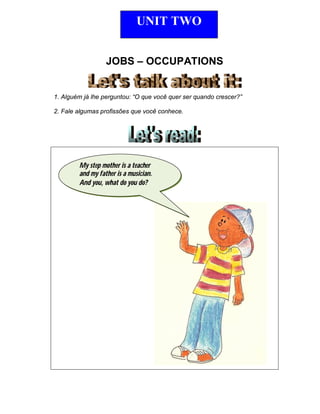
My step mother is a teacher
and my father is a musician.
And you, what do you do?
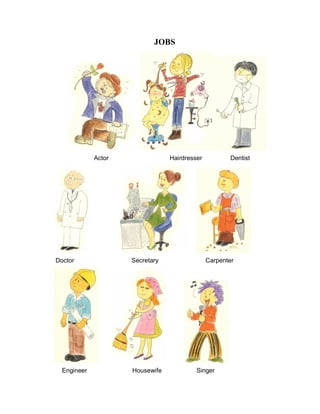
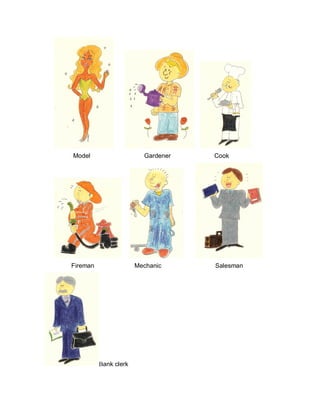
JOBS
Actor Hairdresser Dentist
Doctor Secretary Carpenter
Engineer Housewife Singer
Model Gardener Cook
Fireman Mechanic Salesman
Bank clerk
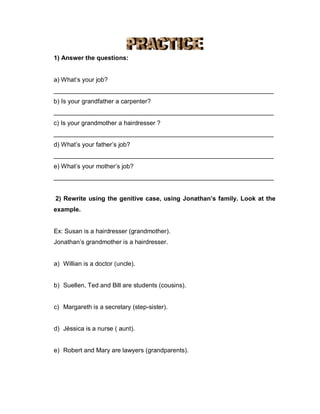
1) Answer the questions:
a) What’s your job?
_______________________________________________________________
b) Is your grandfather a carpenter?
_______________________________________________________________
c) Is your grandmother a hairdresser ?
_______________________________________________________________
d) What’s your father’s job?
_______________________________________________________________
e) What’s your mother’s job?
_______________________________________________________________
2) Rewrite using the genitive case, using Jonathan’s family. Look at the
example.
Ex: Susan is a hairdresser (grandmother).
Jonathan’s grandmother is a hairdresser.
a) Willian is a doctor (uncle).
b) Suellen, Ted and Bill are students (cousins).
c) Margareth is a secretary (step-sister).
d) Jéssica is a nurse ( aunt).
e) Robert and Mary are lawyers (grandparents).
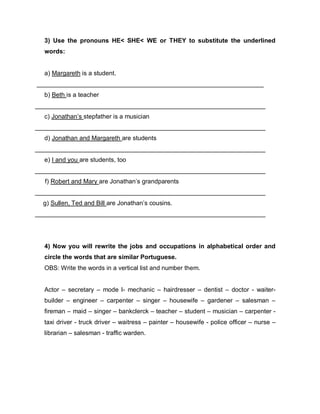
3) Use the pronouns HE< SHE< WE or THEY to substitute the underlined
words:
a) Margareth is a student.
_________________________________________________________________
b) Beth is a teacher
__________________________________________________________________
c) Jonathan’s stepfather is a musician
__________________________________________________________________
d) Jonathan and Margareth are students
__________________________________________________________________
e) I and you are students, too
__________________________________________________________________
f) Robert and Mary are Jonathan’s grandparents
__________________________________________________________________
g) Sullen, Ted and Bill are Jonathan’s cousins.
__________________________________________________________________
4) Now you will rewrite the jobs and occupations in alphabetical order and
circle the words that are similar Portuguese.
OBS: Write the words in a vertical list and number them.
Actor – secretary – mode l- mechanic – hairdresser – dentist – doctor - waiter-
builder – engineer – carpenter – singer – housewife – gardener – salesman –
fireman – maid – singer – bankclerck – teacher – student – musician – carpenter -
taxi driver - truck driver – waitress – painter – housewife - police officer – nurse –
librarian – salesman - traffic warden.
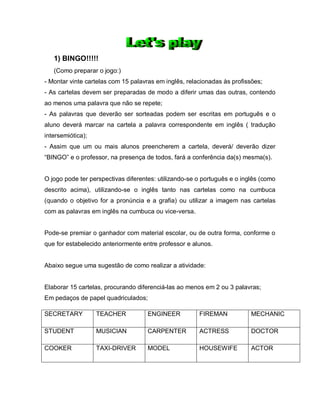
1) BINGO!!!!!
(Como preparar o jogo:)
- Montar vinte cartelas com 15 palavras em inglês, relacionadas às profissões;
- As cartelas devem ser preparadas de modo a diferir umas das outras, contendo
ao menos uma palavra que não se repete;
- As palavras que deverão ser sorteadas podem ser escritas em português e o
aluno deverá marcar na cartela a palavra correspondente em inglês ( tradução
intersemiótica);
- Assim que um ou mais alunos preencherem a cartela, deverá/ deverão dizer
“BINGO” e o professor, na presença de todos, fará a conferência da(s) mesma(s).
O jogo pode ter perspectivas diferentes: utilizando-se o português e o inglês (como
descrito acima), utilizando-se o inglês tanto nas cartelas como na cumbuca
(quando o objetivo for a pronúncia e a grafia) ou utilizar a imagem nas cartelas
com as palavras em inglês na cumbuca ou vice-versa.
Pode-se premiar o ganhador com material escolar, ou de outra forma, conforme o
que for estabelecido anteriormente entre professor e alunos.
Abaixo segue uma sugestão de como realizar a atividade:
Elaborar 15 cartelas, procurando diferenciá-las ao menos em 2 ou 3 palavras;
Em pedaços de papel quadriculados;
SECRETARY TEACHER ENGINEER FIREMAN MECHANIC
STUDENT MUSICIAN CARPENTER ACTRESS DOCTOR
COOKER TAXI-DRIVER MODEL HOUSEWIFE ACTOR
Numa caixa (cumbuca) colocar todas as profissões que aparecem nas
cartelas, em português;
O professor sorteia o papel que tem a profissão e os alunos, sentados em
pares vão marcando as cartelas com grãos de feijão, até que um ou mais alunos
complete a cartela e faça BINGO. Então, o professor fará a conferência
juntamente com a turma toda e se for o caso, premiará o vencedor.
Obs: o jogo pode ser repetido mais vezes da mesma forma ou pode-se somente
trocar os papéis da cumbuca pelas mesmas profissões, só que agora em inglês
para verificar o listening and writing; Pode-se também usar as figuras
representantes das profissões( na cumbuca) para que os alunos façam a tradução
intersemiótica, utilizando-se as mesmas cartelas.
2) REVIEW GAME!
Distribuir aos alunos papéis quadriculados de modo a possibilitar a escrita
de 15 palavras sobre o vocabulário estudado ( família e profissões);
Cada aluno faz a sua cartela e o professor, que previamente deve ter
escrito todo o vocabulário referente à família e às profissões em tiras de papel,
fará o sorteio das mesmas;
Quando algum aluno fizer BINGO, a conferência da cartela deverá ser
rigorosa, tanto na verificação das palavras cantadas, como na grafia efetuada pelo
aluno. Se houver erro na conferência ou na escrita, o jogo continua até que o
próximo aluno faça BINGO e se confirme a correção da cartela do mesmo modo.
“The best way to appreciate your job is to imagine yourself without one.”
Oscar Wilde
Veja as entrevistas no site: http://www.youtube.com/watch?v=VgRd7BnBnBA
COUNTRIES AND NATIONALITIES
1) Você sabe onde se localizam os Estados Unidos ?
2) É longe ou perto do Brasil ?
3) Você tem idéia de quantas horas de vôo se gasta dos Estados Unidos para cá
ou vice- versa.
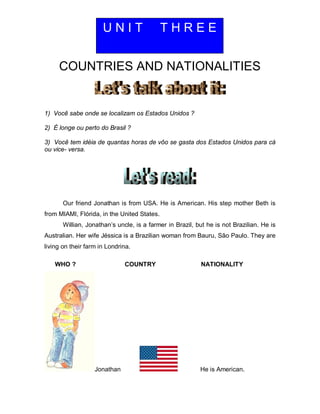
Our friend Jonathan is from USA. He is American. His step mother Beth is
from MIAMI, Flórida, in the United States.
Willian, Jonathan’s uncle, is a farmer in Brazil, but he is not Brazilian. He is
Australian. Her wife Jéssica is a Brazilian woman from Bauru, São Paulo. They are
living on their farm in Londrina.
WHO ? COUNTRY NATIONALITY
Jonathan He is American.
U N I T T H R E E
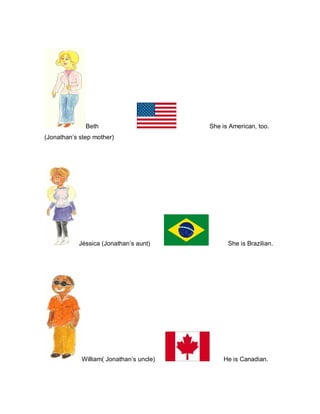
Beth She is American, too.
(Jonathan’s step mother)
Jéssica (Jonathan’s aunt) She is Brazilian.
William( Jonathan’s uncle) He is Canadian.
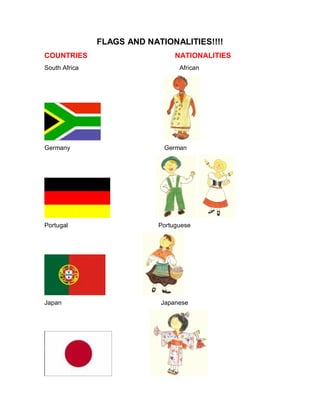
FLAGS AND NATIONALITIES!!!!
COUNTRIES NATIONALITIES
South Africa African
Germany German
Portugal Portuguese
Japan Japanese
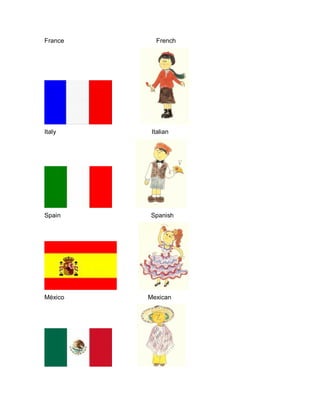
France French
Italy Italian
Spain Spanish
México Mexican
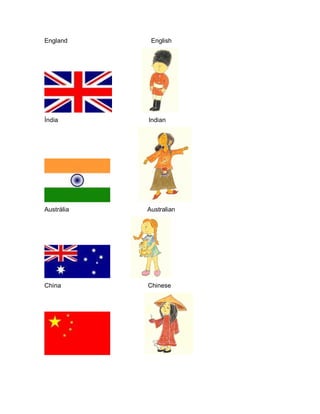
England English
Índia Indian
Austrália Australian
China Chinese
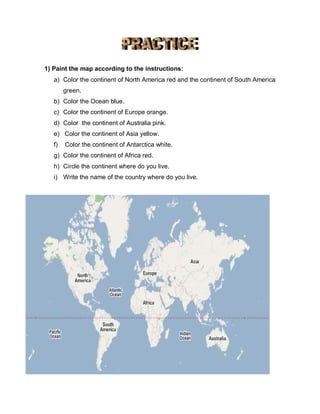
1) Paint the map according to the instructions:
a) Color the continent of North America red and the continent of South America
green.
b) Color the Ocean blue.
c) Color the continent of Europe orange.
d) Color the continent of Australia pink.
e) Color the continent of Asia yellow.
f) Color the continent of Antarctica white.
g) Color the continent of Africa red.
h) Circle the continent where do you live.
i) Write the name of the country where do you live.
2) Now you will complete the phrases with the countries or nationalities:
a) I am from Brazil, so I am......................................................
b) My grandfather is from ..................................., so he is Italian.
c) Yoko is from Japan. She is........................................
d) Jacques Costeau is not Spanish. He is from France, so he is.........................
e) Barak Obama is not South African. He is.....................................................
f) Felipe Massa is from................................. He is............................................
g) Gisele Bündchen is not German. She is.......................................
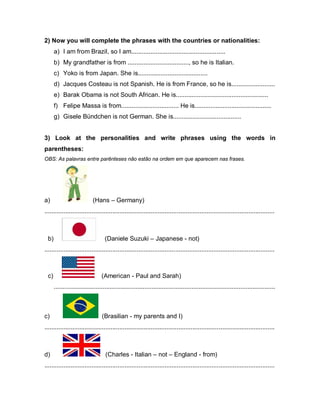
3) Look at the personalities and write phrases using the words in
parentheses:
OBS: As palavras entre parênteses não estão na ordem em que aparecem nas frases.
a) (Hans – Germany)
....................................................................................................................................
b) (Daniele Suzuki – Japanese - not)
....................................................................................................................................
c) (American - Paul and Sarah)
...............................................................................................................................
c) (Brasilian - my parents and I)
....................................................................................................................................
d) (Charles - Italian – not – England - from)
....................................................................................................................................
1) GAME IN PAIRS!!
(Material: pedaços de papel quadriculados- jogo da velha)
Sentados em duplas, os alunos jogam PAR ou IMPAR?
PAR - vai jogar com os nomes dos países em inglês.
IMPAR – vai jogar com os adjetivos pátrios.
OBS: não podem repetir as nacionalidades ou os nomes dos países.
Quem fizer o trio na horizontal/ vertical/ diagonal vence o jogo
Ex: três nacionalidades ou três nomes de países diferentes.
“Imagine all the people living life in peace” – John Lennon
www.esprintables.com
BIBLIOGRAFIA
ANDREOTTI, V. JORDÃO, C. M. GIMENEZ, J. (org). Perspectivas educacionais e
ensino de inglês na escola pública. Pelotas: Educat, 2005. In: ANTUNES, I. Muito
da Gramática: por um ensino de línguas sem pedras no caminho. São Paulo:
Parábola Editorial, 2007.
ANTUNES, Celso. Jogos para a estimulação as múltiplas inteligências. Rio de
Janeiro: Vozes, 1998.
BAKHTIN, M. Estética da Criação Verbal. São Paulo: Martins Fontes, 1992.
BOHN, Hilário I. Investigações: Lingüística Aplicada e Teoria Literária. Recife:
UPPE. V. 17, n. 2, p. 97-113, 2005.
HEDGE, Iricia. Teaching and Learning in the Language Classroom. Oxford
University Press, 2000 – UK.
KRASHEN, S. D. Principles and Practice in Second Language Aquistion
Prentice. Hall International, 1987.
MOITA LOPES, L. P. Oficina de Linguagem Aplicada: A natureza social e
educacional dos processos de ensino/aprendizagem de Línguas. Campinas, SP:
Mercado das Letras, 1996.
MORETO, Vasco Pedro. Prova – Um momento privilegiado de Estudo – não um
acerto de contas. 3 ed. Rio de Janeiro, 2003.
NUNAN, David. Research Methodo in Language Learning. Cambridge
University Press, 1992.
PARANÁ. Diretrizes Curriculares de Língua Estrangeira Moderna do Estado
do Paraná. Paraná, 2008.
SCHMITT, Norbert. Vocabulary in Language Teaching. Cambridge University
Press, 2000.
SCHMITT, Norbert. CARTHY, Michael. Vocabulary Description: Acquisition and
Pedagogy. Cambridge University Press, 1997 – U K.
TEIXEIRA, Carlos G. J. A ludicidade na escola. São Paulo: Loyola, 1995.
VYGOTSKY, L. S. A formação social da mente. São Paulo: Martins Fontes,
1994.
______. Pensamento e Linguagem. 2 ed. São Paulo: Martins Fontes, 1989a.
______. Play its role in the mental development of the child. Soviet Isychology
Original Work Published, 1933.
http://www.youtube.com/watch?v=VgRd7BnBnBA. Acesso em 18/12/2008
www.esprintables.com. Acesso em 19/12/2008

atividades- nacionalidades,profissoes.pdf

  • 1.
  • 2.
    FAMILY MEMBERS A partirde agora, você vai começar a conhecer um pouco da vida de um amiguinho que mora nos Estados Unidos, mas está passeando aqui no Brasil. O nome dele é Jonathan Rice. Ele é muito esperto, curioso e tem uma família não muito tradicional, da mesma forma que muitos brasileiros. Who am I? Hello! I am Jonathan. I am a student from USA, but now I am here, because we are visiting Brazil. My step mother Beth is a teacher, my father Paul is a musician. I have a step sister in the United States called Margareth. U N I T O N E Let’s meet my family!
  • 3.
    My step sisterMe My step mother My father Aunt Jéssica Grandfather Robert and Grandmother Mary. (My father’s parents)
  • 4.
    Uncle Willian Grandfather Peterand Grandmother Susan. (My step mother’s parents.) Ted Suellen Bill ( my cousins) Note: Bring some photos from your family to the next class.
  • 5.
    1) We willmake a big circle and sit around. The teacher will shuffle the photos everyone bring to school, and distribute them, one to each student. You will try to discover who is who in the photos. If nobody identifies who you are in the photo, say aloud: It is my photo. 2) Now we will make an album with the photos of your family and you. Glue the photos on the paper and put under it their names; 3) In pairs paint the pictures of Jonathan’s family that the teacher will give you and glue them on the card. Put all the cards on the desk. Try to memorize where the pairs are. The winner is who discover all the pairs first. (Para realizar esta atividade a professora deverá distribuir aos alunos uma folha com os desenhos de pessoas da família de Jonathan. Os alunos colorirão os desenhos e os colarão nos cartões que receberão já cortados no tamanho de cada foto). 4) Word search- The students will receive a piece of paper where they will prepare a word search. After they finish their work they will change it with the friend beside him and realize the activity.
  • 6.
    Veja o filme:Uma babá quase perfeita (EUA- 1993) “In our days families are different. In many situations we have the sons and daughters living with stepmothers or stepfather” – Dálgima Toneli de Sá “Every father should remember that one day his son will follow his example instead of his advice!” (Unknown)
  • 7.
    JOBS – OCCUPATIONS 1.Alguém já lhe perguntou: “O que você quer ser quando crescer?” 2. Fale algumas profissões que você conhece. UNIT TWO My step mother is a teacher and my father is a musician. And you, what do you do?
  • 8.
    JOBS Actor Hairdresser Dentist DoctorSecretary Carpenter Engineer Housewife Singer
  • 9.
    Model Gardener Cook FiremanMechanic Salesman Bank clerk
  • 10.
    1) Answer thequestions: a) What’s your job? _______________________________________________________________ b) Is your grandfather a carpenter? _______________________________________________________________ c) Is your grandmother a hairdresser ? _______________________________________________________________ d) What’s your father’s job? _______________________________________________________________ e) What’s your mother’s job? _______________________________________________________________ 2) Rewrite using the genitive case, using Jonathan’s family. Look at the example. Ex: Susan is a hairdresser (grandmother). Jonathan’s grandmother is a hairdresser. a) Willian is a doctor (uncle). b) Suellen, Ted and Bill are students (cousins). c) Margareth is a secretary (step-sister). d) Jéssica is a nurse ( aunt). e) Robert and Mary are lawyers (grandparents).
  • 11.
    3) Use thepronouns HE< SHE< WE or THEY to substitute the underlined words: a) Margareth is a student. _________________________________________________________________ b) Beth is a teacher __________________________________________________________________ c) Jonathan’s stepfather is a musician __________________________________________________________________ d) Jonathan and Margareth are students __________________________________________________________________ e) I and you are students, too __________________________________________________________________ f) Robert and Mary are Jonathan’s grandparents __________________________________________________________________ g) Sullen, Ted and Bill are Jonathan’s cousins. __________________________________________________________________ 4) Now you will rewrite the jobs and occupations in alphabetical order and circle the words that are similar Portuguese. OBS: Write the words in a vertical list and number them. Actor – secretary – mode l- mechanic – hairdresser – dentist – doctor - waiter- builder – engineer – carpenter – singer – housewife – gardener – salesman – fireman – maid – singer – bankclerck – teacher – student – musician – carpenter - taxi driver - truck driver – waitress – painter – housewife - police officer – nurse – librarian – salesman - traffic warden.
  • 12.
    1) BINGO!!!!! (Como prepararo jogo:) - Montar vinte cartelas com 15 palavras em inglês, relacionadas às profissões; - As cartelas devem ser preparadas de modo a diferir umas das outras, contendo ao menos uma palavra que não se repete; - As palavras que deverão ser sorteadas podem ser escritas em português e o aluno deverá marcar na cartela a palavra correspondente em inglês ( tradução intersemiótica); - Assim que um ou mais alunos preencherem a cartela, deverá/ deverão dizer “BINGO” e o professor, na presença de todos, fará a conferência da(s) mesma(s). O jogo pode ter perspectivas diferentes: utilizando-se o português e o inglês (como descrito acima), utilizando-se o inglês tanto nas cartelas como na cumbuca (quando o objetivo for a pronúncia e a grafia) ou utilizar a imagem nas cartelas com as palavras em inglês na cumbuca ou vice-versa. Pode-se premiar o ganhador com material escolar, ou de outra forma, conforme o que for estabelecido anteriormente entre professor e alunos. Abaixo segue uma sugestão de como realizar a atividade: Elaborar 15 cartelas, procurando diferenciá-las ao menos em 2 ou 3 palavras; Em pedaços de papel quadriculados; SECRETARY TEACHER ENGINEER FIREMAN MECHANIC STUDENT MUSICIAN CARPENTER ACTRESS DOCTOR COOKER TAXI-DRIVER MODEL HOUSEWIFE ACTOR
  • 13.
    Numa caixa (cumbuca)colocar todas as profissões que aparecem nas cartelas, em português; O professor sorteia o papel que tem a profissão e os alunos, sentados em pares vão marcando as cartelas com grãos de feijão, até que um ou mais alunos complete a cartela e faça BINGO. Então, o professor fará a conferência juntamente com a turma toda e se for o caso, premiará o vencedor. Obs: o jogo pode ser repetido mais vezes da mesma forma ou pode-se somente trocar os papéis da cumbuca pelas mesmas profissões, só que agora em inglês para verificar o listening and writing; Pode-se também usar as figuras representantes das profissões( na cumbuca) para que os alunos façam a tradução intersemiótica, utilizando-se as mesmas cartelas. 2) REVIEW GAME! Distribuir aos alunos papéis quadriculados de modo a possibilitar a escrita de 15 palavras sobre o vocabulário estudado ( família e profissões); Cada aluno faz a sua cartela e o professor, que previamente deve ter escrito todo o vocabulário referente à família e às profissões em tiras de papel, fará o sorteio das mesmas; Quando algum aluno fizer BINGO, a conferência da cartela deverá ser rigorosa, tanto na verificação das palavras cantadas, como na grafia efetuada pelo aluno. Se houver erro na conferência ou na escrita, o jogo continua até que o próximo aluno faça BINGO e se confirme a correção da cartela do mesmo modo. “The best way to appreciate your job is to imagine yourself without one.” Oscar Wilde Veja as entrevistas no site: http://www.youtube.com/watch?v=VgRd7BnBnBA
  • 14.
    COUNTRIES AND NATIONALITIES 1)Você sabe onde se localizam os Estados Unidos ? 2) É longe ou perto do Brasil ? 3) Você tem idéia de quantas horas de vôo se gasta dos Estados Unidos para cá ou vice- versa. Our friend Jonathan is from USA. He is American. His step mother Beth is from MIAMI, Flórida, in the United States. Willian, Jonathan’s uncle, is a farmer in Brazil, but he is not Brazilian. He is Australian. Her wife Jéssica is a Brazilian woman from Bauru, São Paulo. They are living on their farm in Londrina. WHO ? COUNTRY NATIONALITY Jonathan He is American. U N I T T H R E E
  • 15.
    Beth She isAmerican, too. (Jonathan’s step mother) Jéssica (Jonathan’s aunt) She is Brazilian. William( Jonathan’s uncle) He is Canadian.
  • 16.
    FLAGS AND NATIONALITIES!!!! COUNTRIESNATIONALITIES South Africa African Germany German Portugal Portuguese Japan Japanese
  • 17.
    France French Italy Italian SpainSpanish México Mexican
  • 18.
  • 19.
    1) Paint themap according to the instructions: a) Color the continent of North America red and the continent of South America green. b) Color the Ocean blue. c) Color the continent of Europe orange. d) Color the continent of Australia pink. e) Color the continent of Asia yellow. f) Color the continent of Antarctica white. g) Color the continent of Africa red. h) Circle the continent where do you live. i) Write the name of the country where do you live.
  • 20.
    2) Now youwill complete the phrases with the countries or nationalities: a) I am from Brazil, so I am...................................................... b) My grandfather is from ..................................., so he is Italian. c) Yoko is from Japan. She is........................................ d) Jacques Costeau is not Spanish. He is from France, so he is......................... e) Barak Obama is not South African. He is..................................................... f) Felipe Massa is from................................. He is............................................ g) Gisele Bündchen is not German. She is....................................... 3) Look at the personalities and write phrases using the words in parentheses: OBS: As palavras entre parênteses não estão na ordem em que aparecem nas frases. a) (Hans – Germany) .................................................................................................................................... b) (Daniele Suzuki – Japanese - not) .................................................................................................................................... c) (American - Paul and Sarah) ............................................................................................................................... c) (Brasilian - my parents and I) .................................................................................................................................... d) (Charles - Italian – not – England - from) ....................................................................................................................................
  • 21.
    1) GAME INPAIRS!! (Material: pedaços de papel quadriculados- jogo da velha) Sentados em duplas, os alunos jogam PAR ou IMPAR? PAR - vai jogar com os nomes dos países em inglês. IMPAR – vai jogar com os adjetivos pátrios. OBS: não podem repetir as nacionalidades ou os nomes dos países. Quem fizer o trio na horizontal/ vertical/ diagonal vence o jogo Ex: três nacionalidades ou três nomes de países diferentes. “Imagine all the people living life in peace” – John Lennon www.esprintables.com
  • 22.
    BIBLIOGRAFIA ANDREOTTI, V. JORDÃO,C. M. GIMENEZ, J. (org). Perspectivas educacionais e ensino de inglês na escola pública. Pelotas: Educat, 2005. In: ANTUNES, I. Muito da Gramática: por um ensino de línguas sem pedras no caminho. São Paulo: Parábola Editorial, 2007. ANTUNES, Celso. Jogos para a estimulação as múltiplas inteligências. Rio de Janeiro: Vozes, 1998. BAKHTIN, M. Estética da Criação Verbal. São Paulo: Martins Fontes, 1992. BOHN, Hilário I. Investigações: Lingüística Aplicada e Teoria Literária. Recife: UPPE. V. 17, n. 2, p. 97-113, 2005. HEDGE, Iricia. Teaching and Learning in the Language Classroom. Oxford University Press, 2000 – UK. KRASHEN, S. D. Principles and Practice in Second Language Aquistion Prentice. Hall International, 1987. MOITA LOPES, L. P. Oficina de Linguagem Aplicada: A natureza social e educacional dos processos de ensino/aprendizagem de Línguas. Campinas, SP: Mercado das Letras, 1996.
  • 23.
    MORETO, Vasco Pedro.Prova – Um momento privilegiado de Estudo – não um acerto de contas. 3 ed. Rio de Janeiro, 2003. NUNAN, David. Research Methodo in Language Learning. Cambridge University Press, 1992. PARANÁ. Diretrizes Curriculares de Língua Estrangeira Moderna do Estado do Paraná. Paraná, 2008. SCHMITT, Norbert. Vocabulary in Language Teaching. Cambridge University Press, 2000. SCHMITT, Norbert. CARTHY, Michael. Vocabulary Description: Acquisition and Pedagogy. Cambridge University Press, 1997 – U K. TEIXEIRA, Carlos G. J. A ludicidade na escola. São Paulo: Loyola, 1995. VYGOTSKY, L. S. A formação social da mente. São Paulo: Martins Fontes, 1994. ______. Pensamento e Linguagem. 2 ed. São Paulo: Martins Fontes, 1989a.
  • 24.
    ______. Play itsrole in the mental development of the child. Soviet Isychology Original Work Published, 1933. http://www.youtube.com/watch?v=VgRd7BnBnBA. Acesso em 18/12/2008 www.esprintables.com. Acesso em 19/12/2008