ORGANIZAÇÃO DE SISTEMAS DE 
DEFESA SANITÁRIA VEGETAL EM 
OUTROS PAÍSES 
ALDO MALAVASI 
Moscamed Brasil
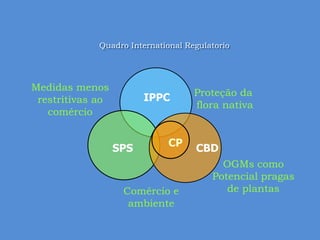
SPS 
IPPC Proteção da 
flora nativa 
Medidas menos 
restritivas ao 
comércio 
Quadro International Regulatorio 
Comércio e 
ambiente 
OGMs como 
Potencial pragas 
de plantas 
CP 
CBD
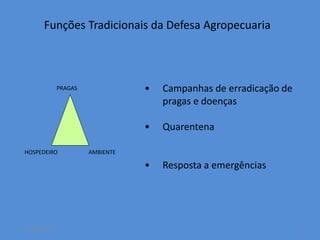
Funções Tradicionais da Defesa Agropecuaria 
PRAGAS 
HOSPEDEIRO AMBIENTE 
• Campanhas de erradicação de 
pragas e doenças 
• Quarentena 
• Resposta a emergências 
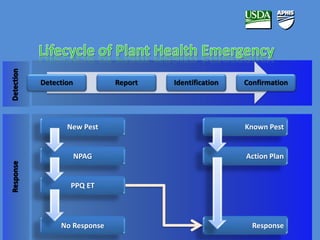
14 October 2014 3
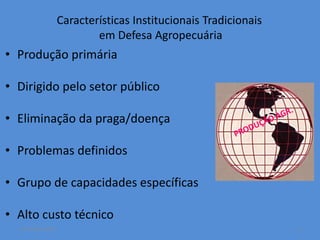
Características Institucionais Tradicionais 
em Defesa Agropecuária 
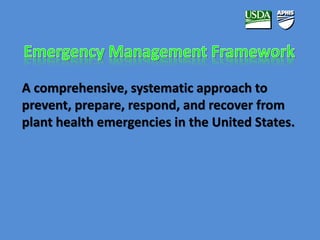
• Produção primária 
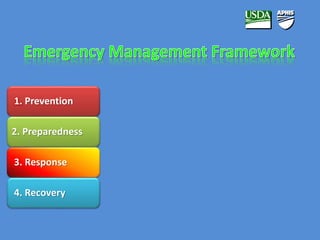
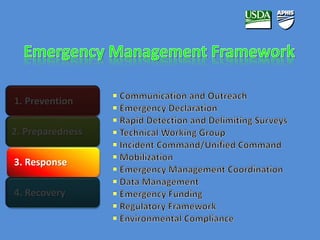
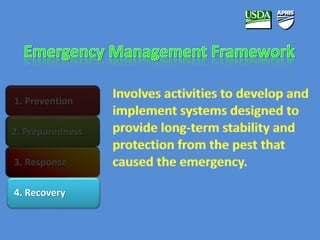
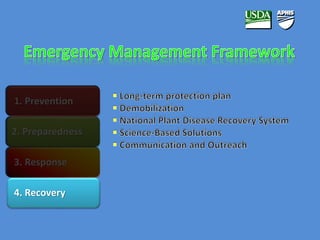
• Dirigido pelo setor público 
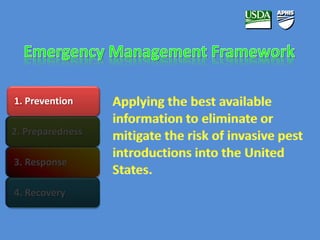
• Eliminação da praga/doença 
• Problemas definidos 
• Grupo de capacidades específicas 
• Alto custo técnico 
14 October 2014 4
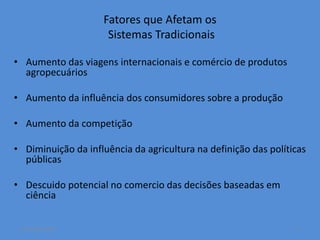
Fatores que Afetam os 
Sistemas Tradicionais 
• Aumento das viagens internacionais e comércio de produtos 
agropecuários 
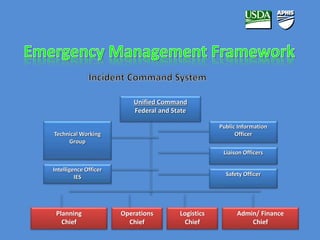
• Aumento da influência dos consumidores sobre a produção 
• Aumento da competição 
• Diminuição da influência da agricultura na definição das políticas 
públicas 
• Descuido potencial no comercio das decisões baseadas em 
ciência 
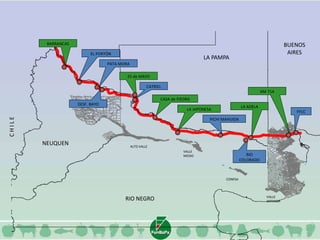
14 October 2014 5
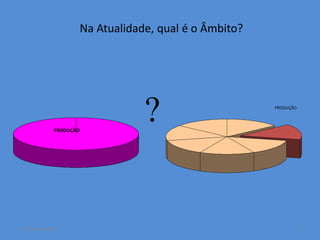
Na Atualidade, qual é o Âmbito? 
PRODUÇÃO 
PRODUÇÃO 
? 
14 October 2014 6
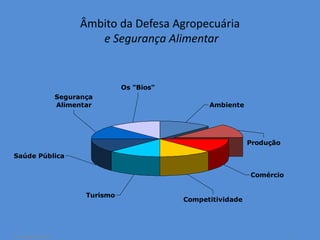
Âmbito da Defesa Agropecuária 
e Segurança Alimentar 
Segurança 
Alimentar 
Produção 
Ambiente 
Comércio 
Competitividade 
Turismo 
Saúde Pública 
Os "Bios" 
14 October 2014 7
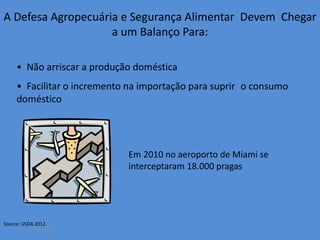
A Defesa Agropecuária e Segurança Alimentar Devem Chegar 
a um Balanço Para: 
• Não arriscar a produção doméstica 
• Facilitar o incremento na importação para suprir o consumo 
doméstico 
Em 2010 no aeroporto de Miami se 
interceptaram 18.000 pragas 
Source: USDA 2012. 
14 October 2014 8
Desenvolvimento de Capacidades – Prévia Identificação das 
Necesidades em Defesa Agropecuária 
 “Orçamento adequado” 
 “Infraestrutura estável” 
 “Sentido de urgência” 
 “Compromisso nacional e internacional” 
 “Capacitação técnica dos fiscais” 
 “Programas de vigilância permanentes” 
 “Estabelecimento de um sistema de informação” 
 “Incentivos e progressão funcional” 
14 October 2014 9
Papéis Específicos dos Setores Público e Privado nos Sistemas de Defesa 
Setor Público 
Agropecuária e Segurança Alimentar 
• Estabelece a legislação 
• Define os estándares 
• Assegura cumprimento 
• Representa o país 
Setor Privado 
• “Dono” dos produtos 
• Financiador 
14 October 2014 10
Características do Sistema de Defesa Agropecuária e 
Segurança Alimentar 
PASSADO 
• Produção 
• Setor público 
• Pragas e doenças 
• Erradicação 
• Sistema nacional 
PRESENTE 
• Cadeia alimentar 
• Articulação público/público 
público/privado 
• Fatores de risco 
• Fixar e aplicar normas 
• Sistema nacional com componentes 
regionais 
14 October 2014 11
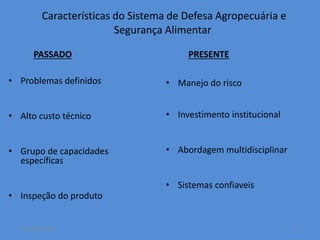
Características do Sistema de Defesa Agropecuária e 
PASSADO 
• Problemas definidos 
• Alto custo técnico 
• Grupo de capacidades 
específicas 
• Inspeção do produto 
Segurança Alimentar 
PRESENTE 
• Manejo do risco 
• Investimento institucional 
• Abordagem multidisciplinar 
• Sistemas confiaveis 
14 October 2014 12
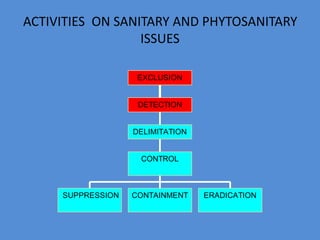
ACTIVITIES ON SANITARY AND PHYTOSANITARY 
ISSUES 
EXCLUSION 
DETECTION 
DELIMITATION 
CONTROL 
SUPPRESSION CONTAINMENT ERADICATION
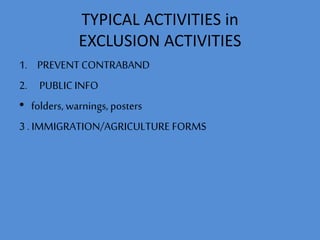
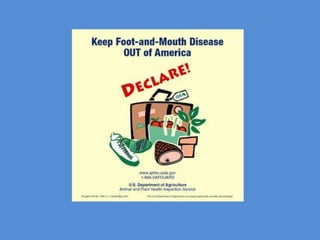
TYPICAL ACTIVITIES in 
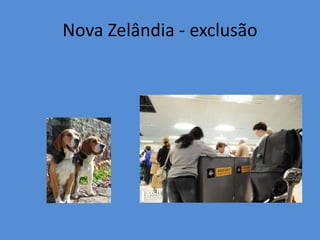
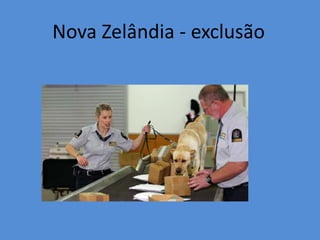
EXCLUSION ACTIVITIES 
1. PREVENT CONTRABAND 
2. PUBLIC INFO 
• folders, warnings, posters 
3 . IMMIGRATION/AGRICULTURE FORMS
TYPICAL ACTIVITIES 
• 1. MONITORING: 
use of traps (ex.: fruit flies) 
• 2. SURVEY: regular inspection (ex. FMD, BSE, 
brucelosis, medfly)
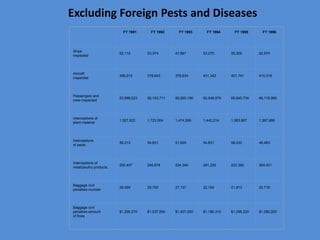
Excluding Foreign Pests and Diseases 
FY 1991 FY 1992 FY 1993 FY 1994 FY 1995 FY 1996 
Ships 
inspected 
52,119 53,374 47,887 53,270 55,205 52,974 
Aircraft 
inspected 
356,915 378,643 378,634 451,342 401,741 410,318 
Passengers and 
crew inspected 
53,999,523 58,103,711 56,920,156 62,548,979 65,645,734 66,119,960 
Interceptions of 
plant material 
1,527,922 1,723,004 1,474,569 1,442,214 1,583,687 1,567,886 
Interceptions 
of pests 
56,213 54,831 51,829 54,831 58,032 48,483 
Interceptions of 
meat/poultry products 
205,407 246,878 224,340 281,230 223,392 264.001 
Baggage civil 
penalties-number 
29,089 29,700 27,137 22,164 21,813 20,716 
Baggage civil 
penalties-amount 
of fines 
$1,299,270 $1,537,590 $1,407,000 $1,186,310 $1,098,220 $1,080,000
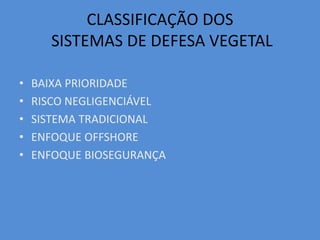
CLASSIFICAÇÃO DOS 
SISTEMAS DE DEFESA VEGETAL 
• BAIXA PRIORIDADE 
• RISCO NEGLIGENCIÁVEL 
• SISTEMA TRADICIONAL 
• ENFOQUE OFFSHORE 
• ENFOQUE BIOSEGURANÇA
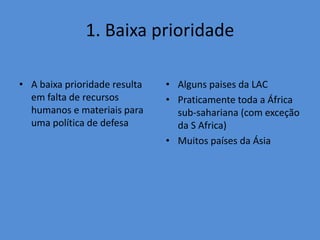
1. Baixa prioridade 
• A baixa prioridade resulta 
em falta de recursos 
humanos e materiais para 
uma política de defesa 
• Alguns paises da LAC 
• Praticamente toda a África 
sub-sahariana (com exceção 
da S Africa) 
• Muitos países da Ásia
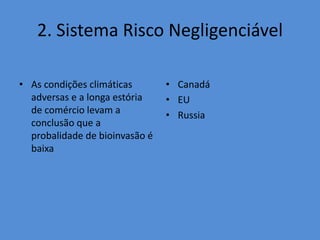
2. Sistema Risco Negligenciável 
• As condições climáticas 
adversas e a longa estória 
de comércio levam a 
conclusão que a 
probalidade de bioinvasão é 
baixa 
• Canadá 
• EU 
• Russia
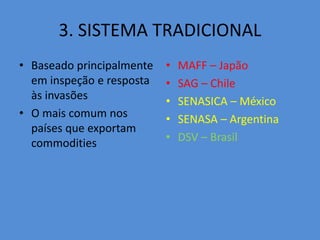
3. SISTEMA TRADICIONAL 
• Baseado principalmente 
em inspeção e resposta 
às invasões 
• O mais comum nos 
países que exportam 
commodities 
• MAFF – Japão 
• SAG – Chile 
• SENASICA – México 
• SENASA – Argentina 
• DSV – Brasil
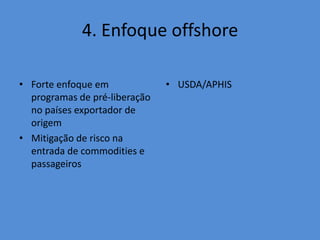
4. Enfoque offshore 
• Forte enfoque em 
programas de pré-liberação 
no países exportador de 
origem 
• Mitigação de risco na 
entrada de commodities e 
passageiros 
• USDA/APHIS
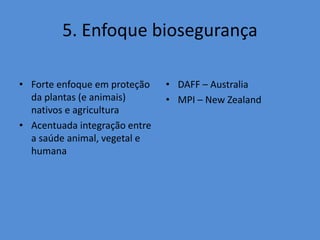
5. Enfoque biosegurança 
• Forte enfoque em proteção 
da plantas (e animais) 
nativos e agricultura 
• Acentuada integração entre 
a saúde animal, vegetal e 
humana 
• DAFF – Australia 
• MPI – New Zealand
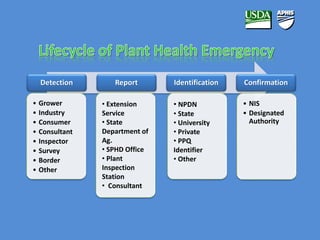
Detection Report Identification Confirmation 
• Grower 
• Industry 
• Consumer 
• Consultant 
• Inspector 
• Survey 
• Border 
• Other 
• Extension 
Service 
• State 
Department of 
Ag. 
• SPHD Office 
• Plant 
Inspection 
Station 
• Consultant 
• NPDN 
• State 
• University 
• Private 
• PPQ 
Identifier 
• Other 
• NIS 
• Designated 
Authority
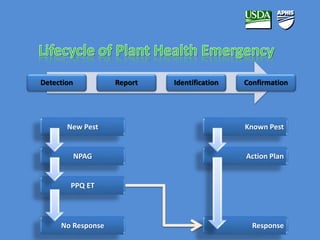
Detection Report Identification Confirmation 
Known Pest 
Action Plan 
Response 
New Pest 
NPAG 
PPQ ET 
No Response
Response 
Detection Report Identification Confirmation 
Known Pest 
Action Plan 
Response 
New Pest 
NPAG 
PPQ ET 
No Response 
Detection
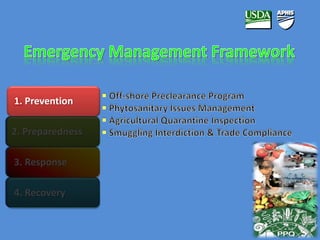
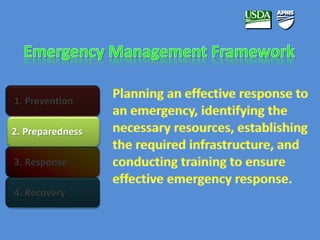
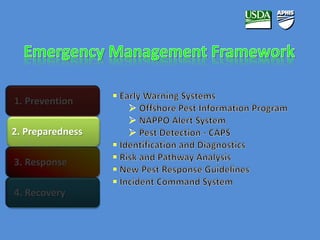
A comprehensive, systematic approach to 
prevent, prepare, respond, and recover from 
plant health emergencies in the United States.
1. Prevention 
2. Preparedness 
3. Response 
4. Recovery
1. Prevention 
2. Preparedness 
3. Response 
4. Recovery
1. Prevention 
2. Preparedness 
3. Response 
4. Recovery
1. Prevention 
2. Preparedness 
3. Response 
4. Recovery 
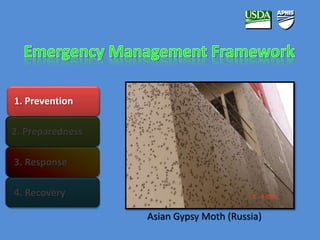
Asian Gypsy Moth (Russia)
1. Prevention 
2. Preparedness 
3. Response 
4. Recovery
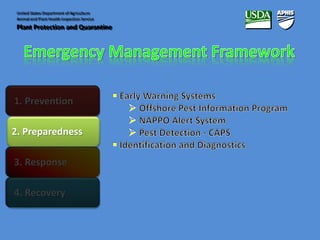
United States Department of Agriculture 
Animal and Plant Health Inspection Service 
Plant Protection and Quarantine 
1. Prevention 
2. Preparedness 
3. Response 
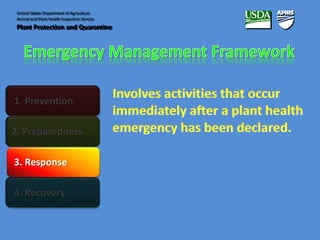
4. Recovery
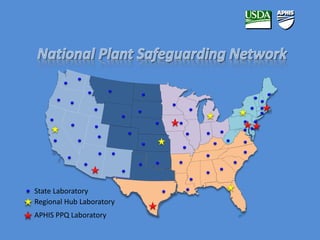
State Laboratory 
Regional Hub Laboratory 
APHIS PPQ Laboratory
1. Prevention 
2. Preparedness 
3. Response 
4. Recovery
United States Department of Agriculture 
Animal and Plant Health Inspection Service 
Plant Protection and Quarantine 
1. Prevention 
2. Preparedness 
3. Response 
4. Recovery
1. Prevention 
2. Preparedness 
3. Response 
4. Recovery
Unified Command 
Federal and State 
Planning 
Chief 
Operations 
Chief 
Logistics 
Chief 
Public Information 
Liaison Officers 
Admin/ Finance 
Chief 
Officer 
Safety Officer 
Technical Working 
Group 
Intelligence Officer 
IES
1. Prevention 
2. Preparedness 
3. Response 
4. Recovery
1. Prevention 
2. Preparedness 
3. Response 
4. Recovery
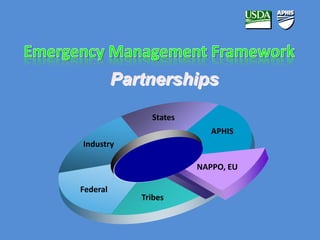
Partnerships 
APHIS 
States 
Industry 
Federal 
Tribes 
NAPPO, EU
AR 
ARGENTINA: O SISTEMA FUNBAPA
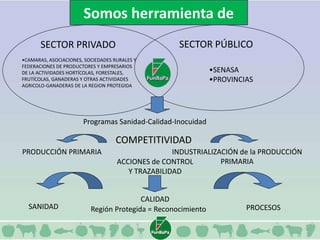
Somos herramienta de 
SECTOR PRIVADO SECTOR PÚBLICO 
Programas Sanidad-Calidad-Inocuidad 
INDUSTRIALIZACIÓN de la PRODUCCIÓN 
PRIMARIA 
•CAMARAS, ASOCIACIONES, SOCIEDADES RURALES Y 
FEDERACIONES DE PRODUCTORES Y EMPRESARIOS 
DE LA ACTIVIDADES HORTÍCOLAS, FORESTALES, 
FRUTÍCOLAS, GANADERAS Y OTRAS ACTIVIDADES 
AGRICOLO-GANADERAS DE LA REGION PROTEGIDA 
•SENASA 
•PROVINCIAS 
COMPETITIVIDAD 
PRODUCCIÓN PRIMARIA 
ACCIONES de CONTROL 
Y TRAZABILIDAD 
CALIDAD 
SANIDAD PROCESOS 
Región Protegida = Reconocimiento
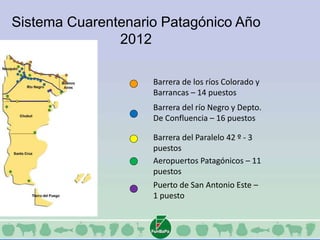
Sistema Cuarentenario Patagónico Año 
2012 
Barrera de los ríos Colorado y 
Barrancas – 14 puestos 
Barrera del río Negro y Depto. 
De Confluencia – 16 puestos 
Barrera del Paralelo 42 º - 3 
puestos 
Aeropuertos Patagónicos – 11 
puestos 
Puerto de San Antonio Este – 
1 puesto
BARRANCAS 
EL PORTÓN 
PATA MORA 
LA JAPONESA 
PICHI MAHUIDA 
LA ADELA 
RIO 
COLORADO 
KM 714 
FFCC 
DESF. BAYO 
25 de MAYO 
CATRIEL 
CASA de PIEDRA 
RIO NEGRO 
NEUQUEN 
LA PAMPA 
BUENOS 
AIRES 
ALTO VALLE 
VALLE 
MEDIO 
CONESA 
VALLE 
INFERIOR 
C H I L E
PROCEDIMIENTOS 
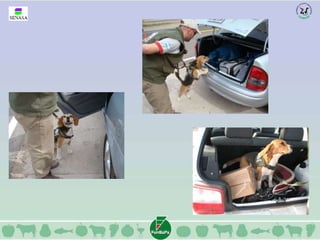
INSPECCIÓN EN INGRESO
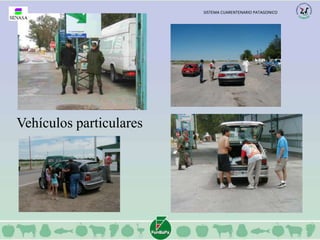
Vehículos particulares 
SISTEMA CUARENTENARIO PATAGONICO
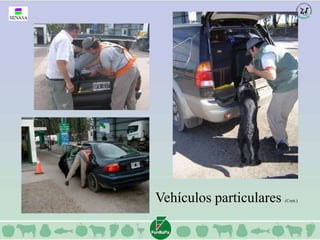
Vehículos particulares (Cont.)
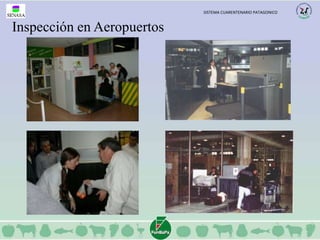
Inspección en Aeropuertos 
SISTEMA CUARENTENARIO PATAGONICO
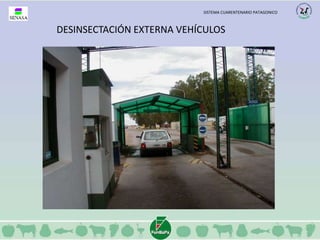
SISTEMA CUARENTENARIO PATAGONICO 
DESINSECTACIÓN EXTERNA VEHÍCULOS
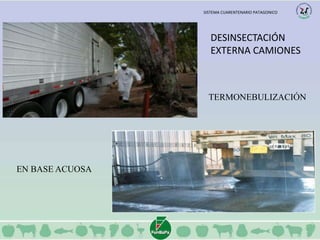
DESINSECTACIÓN 
EXTERNA CAMIONES 
TERMONEBULIZACIÓN 
EN BASE ACUOSA 
SISTEMA CUARENTENARIO PATAGONICO
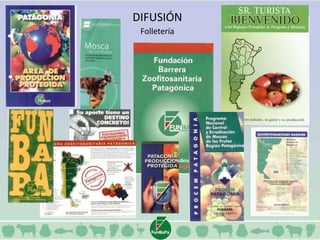
DIFUSIÓN 
Folletería
GUATEMALA
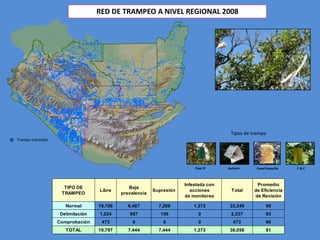
RED DE TRAMPEO A NIVEL REGIONAL 2008 
TIPO DE 
TRAMPEO 
Libre 
Baja 
prevalencia 
Supresión 
Infestada con 
acciones 
de monitoreo 
Tipos de trampa 
Total 
Promedio 
de Eficiencia 
de Revisión 
Normal 18,100 6,487 7,288 1,373 33,248 90 
Delimitación 1,224 957 156 0 2,337 93 
Comprobación 473 0 0 0 473 96 
TOTAL 19,797 7,444 7,444 1,373 36,058 91 
Trampa instalada 
Fase IV Jackson Panel Amarillo C & C
SAG - CHILE
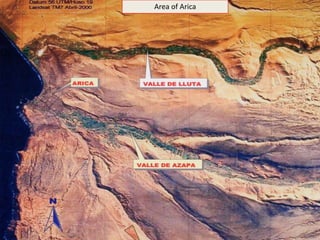
Area of Arica
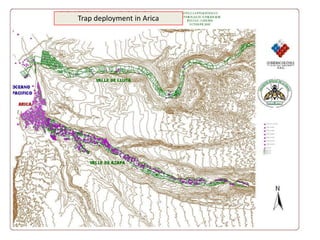
Trap deployment in Arica
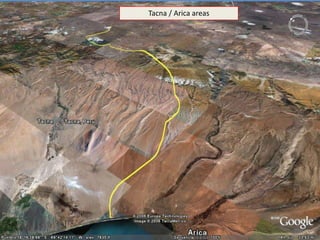
Tacna / Arica areas
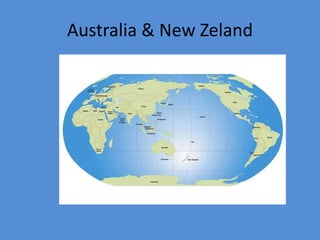
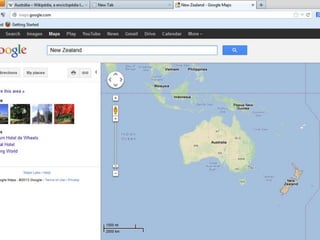
Australia & New Zeland
Bactrocera 
tryoni 
Fruit Fly 
Exclusion 
Zone 
Distribution
DAFF – Department of Agriculture, 
Fisheries and Forest 
AUSTRALIA 
What is biosecurity? 
'Biosecurity' is protecting the economy, environment and 
people's health from pests and diseases. It includes trying to 
prevent new pests and diseases from arriving, and helping to 
control outbreaks when they do occur. While robust 
response arrangements are in place to combat outbreaks, 
preventing pest, disease and weed incursions in the first 
place, remains a national priority.
ESTRATÉGIAS DO DAFF 
• Strategy 1 Adopt nationally consistent plant biosecurity legislation, 
regulations and approaches where possible within each state and territory 
government’s overarching legislative framework 
• Strategy 2 Establish a nationally coordinated surveillance system 
• Strategy 3 Build Australia’s ability to prepare for, and respond to, pest 
incursions 
• Strategy 4 Expand Australia’s biosecurity training capacity and capability 
• Strategy 5 Create a nationally integrated diagnostic network 
• Strategy 6 Enhance national management systems for established pests 
• Strategy 7 Establish an integrated national approach to plant biosecurity 
education and awareness 
• Strategy 8 Develop a national framework for plant biosecurity research 
• Strategy 9 Adopt systems and mechanisms for the efficient and effective 
distribution, communication and uptake of plant biosecurity information 
• Strategy 10 Monitor the integrity of the plant biosecurity system
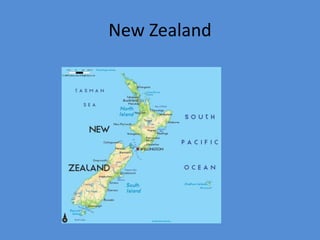
New Zealand
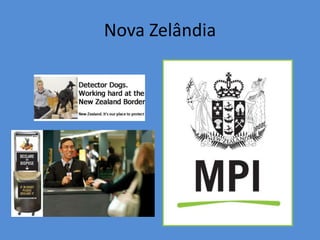
NEW ZEALAND 
Biosecurity system is much more than just 
border controls: involves multiple layers of 
protection including government agencies, 
local councils, industry and community 
groups.
MPI statement 
• Pests and diseases pose serious threats to our 
economy, environment, health and cultural 
identity.
The defense teams 
• Surveillance teams are constantly on the 
lookout for recent breaches in the borders. 
• Response staff are ready to swing into action 
once a new threat has been spotted and to 
determine initial plans for action. 
• The Pest Management group looks after 
longer term programs for controlling and 
eradicating established pests and diseases.
Nova Zelândia
Nova Zelândia - exclusão
CONCLUSÃO 
• Há enorme variação entre as ONPFs ao redor 
do mundo, quanto a estrutura, sistemas de 
funcionamento e eficiência. 
• O volume da produção agrícola e seu valor e 
os impactos economicos e ambientais 
estimados do estabelecimento de espécies 
invasivas são as forças que dirigem os sistemas 
de defesa.

II WSF, São Paulo - Aldo Malavasi - Organização de sistemas de defesa sanitária vegetal em outros países

  • 1.
    ORGANIZAÇÃO DE SISTEMASDE DEFESA SANITÁRIA VEGETAL EM OUTROS PAÍSES ALDO MALAVASI Moscamed Brasil
  • 2.
    SPS IPPC Proteçãoda flora nativa Medidas menos restritivas ao comércio Quadro International Regulatorio Comércio e ambiente OGMs como Potencial pragas de plantas CP CBD
  • 3.
    Funções Tradicionais daDefesa Agropecuaria PRAGAS HOSPEDEIRO AMBIENTE • Campanhas de erradicação de pragas e doenças • Quarentena • Resposta a emergências 14 October 2014 3
  • 4.
    Características Institucionais Tradicionais em Defesa Agropecuária • Produção primária • Dirigido pelo setor público • Eliminação da praga/doença • Problemas definidos • Grupo de capacidades específicas • Alto custo técnico 14 October 2014 4
  • 5.
    Fatores que Afetamos Sistemas Tradicionais • Aumento das viagens internacionais e comércio de produtos agropecuários • Aumento da influência dos consumidores sobre a produção • Aumento da competição • Diminuição da influência da agricultura na definição das políticas públicas • Descuido potencial no comercio das decisões baseadas em ciência 14 October 2014 5
  • 6.
    Na Atualidade, qualé o Âmbito? PRODUÇÃO PRODUÇÃO ? 14 October 2014 6
  • 7.
    Âmbito da DefesaAgropecuária e Segurança Alimentar Segurança Alimentar Produção Ambiente Comércio Competitividade Turismo Saúde Pública Os "Bios" 14 October 2014 7
  • 8.
    A Defesa Agropecuáriae Segurança Alimentar Devem Chegar a um Balanço Para: • Não arriscar a produção doméstica • Facilitar o incremento na importação para suprir o consumo doméstico Em 2010 no aeroporto de Miami se interceptaram 18.000 pragas Source: USDA 2012. 14 October 2014 8
  • 9.
    Desenvolvimento de Capacidades– Prévia Identificação das Necesidades em Defesa Agropecuária  “Orçamento adequado”  “Infraestrutura estável”  “Sentido de urgência”  “Compromisso nacional e internacional”  “Capacitação técnica dos fiscais”  “Programas de vigilância permanentes”  “Estabelecimento de um sistema de informação”  “Incentivos e progressão funcional” 14 October 2014 9
  • 10.
    Papéis Específicos dosSetores Público e Privado nos Sistemas de Defesa Setor Público Agropecuária e Segurança Alimentar • Estabelece a legislação • Define os estándares • Assegura cumprimento • Representa o país Setor Privado • “Dono” dos produtos • Financiador 14 October 2014 10
  • 11.
    Características do Sistemade Defesa Agropecuária e Segurança Alimentar PASSADO • Produção • Setor público • Pragas e doenças • Erradicação • Sistema nacional PRESENTE • Cadeia alimentar • Articulação público/público público/privado • Fatores de risco • Fixar e aplicar normas • Sistema nacional com componentes regionais 14 October 2014 11
  • 12.
    Características do Sistemade Defesa Agropecuária e PASSADO • Problemas definidos • Alto custo técnico • Grupo de capacidades específicas • Inspeção do produto Segurança Alimentar PRESENTE • Manejo do risco • Investimento institucional • Abordagem multidisciplinar • Sistemas confiaveis 14 October 2014 12
  • 13.
    ACTIVITIES ON SANITARYAND PHYTOSANITARY ISSUES EXCLUSION DETECTION DELIMITATION CONTROL SUPPRESSION CONTAINMENT ERADICATION
  • 14.
    TYPICAL ACTIVITIES in EXCLUSION ACTIVITIES 1. PREVENT CONTRABAND 2. PUBLIC INFO • folders, warnings, posters 3 . IMMIGRATION/AGRICULTURE FORMS
  • 17.
    TYPICAL ACTIVITIES •1. MONITORING: use of traps (ex.: fruit flies) • 2. SURVEY: regular inspection (ex. FMD, BSE, brucelosis, medfly)
  • 19.
    Excluding Foreign Pestsand Diseases FY 1991 FY 1992 FY 1993 FY 1994 FY 1995 FY 1996 Ships inspected 52,119 53,374 47,887 53,270 55,205 52,974 Aircraft inspected 356,915 378,643 378,634 451,342 401,741 410,318 Passengers and crew inspected 53,999,523 58,103,711 56,920,156 62,548,979 65,645,734 66,119,960 Interceptions of plant material 1,527,922 1,723,004 1,474,569 1,442,214 1,583,687 1,567,886 Interceptions of pests 56,213 54,831 51,829 54,831 58,032 48,483 Interceptions of meat/poultry products 205,407 246,878 224,340 281,230 223,392 264.001 Baggage civil penalties-number 29,089 29,700 27,137 22,164 21,813 20,716 Baggage civil penalties-amount of fines $1,299,270 $1,537,590 $1,407,000 $1,186,310 $1,098,220 $1,080,000
  • 20.
    CLASSIFICAÇÃO DOS SISTEMASDE DEFESA VEGETAL • BAIXA PRIORIDADE • RISCO NEGLIGENCIÁVEL • SISTEMA TRADICIONAL • ENFOQUE OFFSHORE • ENFOQUE BIOSEGURANÇA
  • 21.
    1. Baixa prioridade • A baixa prioridade resulta em falta de recursos humanos e materiais para uma política de defesa • Alguns paises da LAC • Praticamente toda a África sub-sahariana (com exceção da S Africa) • Muitos países da Ásia
  • 22.
    2. Sistema RiscoNegligenciável • As condições climáticas adversas e a longa estória de comércio levam a conclusão que a probalidade de bioinvasão é baixa • Canadá • EU • Russia
  • 23.
    3. SISTEMA TRADICIONAL • Baseado principalmente em inspeção e resposta às invasões • O mais comum nos países que exportam commodities • MAFF – Japão • SAG – Chile • SENASICA – México • SENASA – Argentina • DSV – Brasil
  • 24.
    4. Enfoque offshore • Forte enfoque em programas de pré-liberação no países exportador de origem • Mitigação de risco na entrada de commodities e passageiros • USDA/APHIS
  • 25.
    5. Enfoque biosegurança • Forte enfoque em proteção da plantas (e animais) nativos e agricultura • Acentuada integração entre a saúde animal, vegetal e humana • DAFF – Australia • MPI – New Zealand
  • 26.
    Detection Report IdentificationConfirmation • Grower • Industry • Consumer • Consultant • Inspector • Survey • Border • Other • Extension Service • State Department of Ag. • SPHD Office • Plant Inspection Station • Consultant • NPDN • State • University • Private • PPQ Identifier • Other • NIS • Designated Authority
  • 27.
    Detection Report IdentificationConfirmation Known Pest Action Plan Response New Pest NPAG PPQ ET No Response
  • 28.
    Response Detection ReportIdentification Confirmation Known Pest Action Plan Response New Pest NPAG PPQ ET No Response Detection
  • 29.
    A comprehensive, systematicapproach to prevent, prepare, respond, and recover from plant health emergencies in the United States.
  • 30.
    1. Prevention 2.Preparedness 3. Response 4. Recovery
  • 31.
    1. Prevention 2.Preparedness 3. Response 4. Recovery
  • 32.
    1. Prevention 2.Preparedness 3. Response 4. Recovery
  • 33.
    1. Prevention 2.Preparedness 3. Response 4. Recovery Asian Gypsy Moth (Russia)
  • 34.
    1. Prevention 2.Preparedness 3. Response 4. Recovery
  • 35.
    United States Departmentof Agriculture Animal and Plant Health Inspection Service Plant Protection and Quarantine 1. Prevention 2. Preparedness 3. Response 4. Recovery
  • 36.
    State Laboratory RegionalHub Laboratory APHIS PPQ Laboratory
  • 37.
    1. Prevention 2.Preparedness 3. Response 4. Recovery
  • 38.
    United States Departmentof Agriculture Animal and Plant Health Inspection Service Plant Protection and Quarantine 1. Prevention 2. Preparedness 3. Response 4. Recovery
  • 39.
    1. Prevention 2.Preparedness 3. Response 4. Recovery
  • 40.
    Unified Command Federaland State Planning Chief Operations Chief Logistics Chief Public Information Liaison Officers Admin/ Finance Chief Officer Safety Officer Technical Working Group Intelligence Officer IES
  • 41.
    1. Prevention 2.Preparedness 3. Response 4. Recovery
  • 42.
    1. Prevention 2.Preparedness 3. Response 4. Recovery
  • 43.
    Partnerships APHIS States Industry Federal Tribes NAPPO, EU
  • 44.
    AR ARGENTINA: OSISTEMA FUNBAPA
  • 45.
    Somos herramienta de SECTOR PRIVADO SECTOR PÚBLICO Programas Sanidad-Calidad-Inocuidad INDUSTRIALIZACIÓN de la PRODUCCIÓN PRIMARIA •CAMARAS, ASOCIACIONES, SOCIEDADES RURALES Y FEDERACIONES DE PRODUCTORES Y EMPRESARIOS DE LA ACTIVIDADES HORTÍCOLAS, FORESTALES, FRUTÍCOLAS, GANADERAS Y OTRAS ACTIVIDADES AGRICOLO-GANADERAS DE LA REGION PROTEGIDA •SENASA •PROVINCIAS COMPETITIVIDAD PRODUCCIÓN PRIMARIA ACCIONES de CONTROL Y TRAZABILIDAD CALIDAD SANIDAD PROCESOS Región Protegida = Reconocimiento
  • 46.
    Sistema Cuarentenario PatagónicoAño 2012 Barrera de los ríos Colorado y Barrancas – 14 puestos Barrera del río Negro y Depto. De Confluencia – 16 puestos Barrera del Paralelo 42 º - 3 puestos Aeropuertos Patagónicos – 11 puestos Puerto de San Antonio Este – 1 puesto
  • 47.
    BARRANCAS EL PORTÓN PATA MORA LA JAPONESA PICHI MAHUIDA LA ADELA RIO COLORADO KM 714 FFCC DESF. BAYO 25 de MAYO CATRIEL CASA de PIEDRA RIO NEGRO NEUQUEN LA PAMPA BUENOS AIRES ALTO VALLE VALLE MEDIO CONESA VALLE INFERIOR C H I L E
  • 48.
  • 49.
    Vehículos particulares SISTEMACUARENTENARIO PATAGONICO
  • 50.
  • 52.
    Inspección en Aeropuertos SISTEMA CUARENTENARIO PATAGONICO
  • 53.
    SISTEMA CUARENTENARIO PATAGONICO DESINSECTACIÓN EXTERNA VEHÍCULOS
  • 54.
    DESINSECTACIÓN EXTERNA CAMIONES TERMONEBULIZACIÓN EN BASE ACUOSA SISTEMA CUARENTENARIO PATAGONICO
  • 55.
  • 56.
  • 57.
    RED DE TRAMPEOA NIVEL REGIONAL 2008 TIPO DE TRAMPEO Libre Baja prevalencia Supresión Infestada con acciones de monitoreo Tipos de trampa Total Promedio de Eficiencia de Revisión Normal 18,100 6,487 7,288 1,373 33,248 90 Delimitación 1,224 957 156 0 2,337 93 Comprobación 473 0 0 0 473 96 TOTAL 19,797 7,444 7,444 1,373 36,058 91 Trampa instalada Fase IV Jackson Panel Amarillo C & C
  • 58.
  • 59.
  • 60.
  • 61.
  • 62.
  • 63.
    Bactrocera tryoni FruitFly Exclusion Zone Distribution
  • 64.
    DAFF – Departmentof Agriculture, Fisheries and Forest AUSTRALIA What is biosecurity? 'Biosecurity' is protecting the economy, environment and people's health from pests and diseases. It includes trying to prevent new pests and diseases from arriving, and helping to control outbreaks when they do occur. While robust response arrangements are in place to combat outbreaks, preventing pest, disease and weed incursions in the first place, remains a national priority.
  • 65.
    ESTRATÉGIAS DO DAFF • Strategy 1 Adopt nationally consistent plant biosecurity legislation, regulations and approaches where possible within each state and territory government’s overarching legislative framework • Strategy 2 Establish a nationally coordinated surveillance system • Strategy 3 Build Australia’s ability to prepare for, and respond to, pest incursions • Strategy 4 Expand Australia’s biosecurity training capacity and capability • Strategy 5 Create a nationally integrated diagnostic network • Strategy 6 Enhance national management systems for established pests • Strategy 7 Establish an integrated national approach to plant biosecurity education and awareness • Strategy 8 Develop a national framework for plant biosecurity research • Strategy 9 Adopt systems and mechanisms for the efficient and effective distribution, communication and uptake of plant biosecurity information • Strategy 10 Monitor the integrity of the plant biosecurity system
  • 66.
  • 67.
    NEW ZEALAND Biosecuritysystem is much more than just border controls: involves multiple layers of protection including government agencies, local councils, industry and community groups.
  • 69.
    MPI statement •Pests and diseases pose serious threats to our economy, environment, health and cultural identity.
  • 70.
    The defense teams • Surveillance teams are constantly on the lookout for recent breaches in the borders. • Response staff are ready to swing into action once a new threat has been spotted and to determine initial plans for action. • The Pest Management group looks after longer term programs for controlling and eradicating established pests and diseases.
  • 71.
  • 72.
  • 73.
  • 75.
    CONCLUSÃO • Háenorme variação entre as ONPFs ao redor do mundo, quanto a estrutura, sistemas de funcionamento e eficiência. • O volume da produção agrícola e seu valor e os impactos economicos e ambientais estimados do estabelecimento de espécies invasivas são as forças que dirigem os sistemas de defesa.