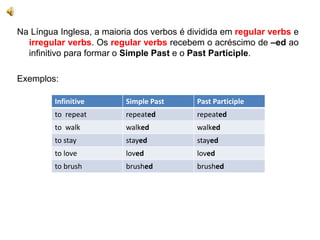
Na Língua Inglesa, a maioria dos verbos é dividida em regular verbs e
irregular verbs. Os regular verbs recebem o acréscimo de –ed ao
infinitivo para formar o Simple Past e o Past Participle.
Exemplos:
Infinitive Simple Past Past Participle
to repeat repeated repeated
to walk walked walked
to stay stayed stayed
to love loved loved
to brush brushed brushed
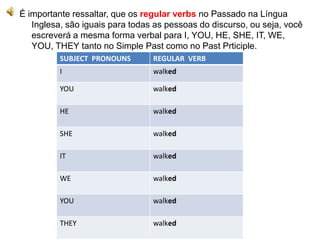
É importante ressaltar, que os regular verbs no Passado na Língua
Inglesa, são iguais para todas as pessoas do discurso, ou seja, você
escreverá a mesma forma verbal para I, YOU, HE, SHE, IT, WE,
YOU, THEY tanto no Simple Past como no Past Prticiple.
SUBJECT PRONOUNS REGULAR VERB
I walked
YOU walked
HE walked
SHE walked
IT walked
WE walked
YOU walked
THEY walked
REGRAS DE ORTOGRAFIA DOS REGULAR VERBS
Quando usamos os regular verbs, devemos observar as seguintes
regras:
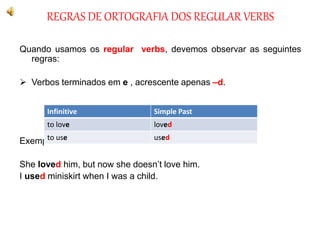
 Verbos terminados em e , acrescente apenas –d.
Exemplos:
She loved him, but now she doesn’t love him.
I used miniskirt when I was a child.
Infinitive Simple Past
to love loved
to use used
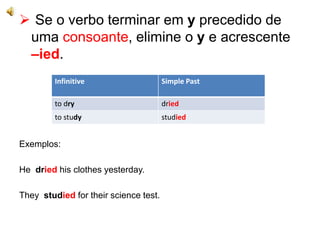
 Se o verbo terminar em y precedido de
uma consoante, elimine o y e acrescente
–ied.
Exemplos:
He dried his clothes yesterday.
They studied for their science test.
Infinitive Simple Past
to dry dried
to study studied
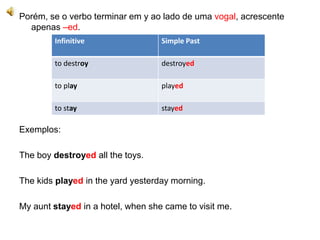
Porém, se o verbo terminar em y ao lado de uma vogal, acrescente
apenas –ed.
Exemplos:
The boy destroyed all the toys.
The kids played in the yard yesterday morning.
My aunt stayed in a hotel, when she came to visit me.
Infinitive Simple Past
to destroy destroyed
to play played
to stay stayed
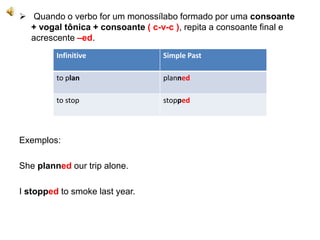
 Quando o verbo for um monossílabo formado por uma consoante
+ vogal tônica + consoante ( c-v-c ), repita a consoante final e
acrescente –ed.
Exemplos:
She planned our trip alone.
I stopped to smoke last year.
Infinitive Simple Past
to plan planned
to stop stopped
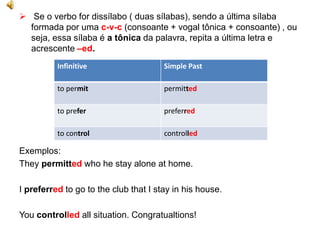
 Se o verbo for dissílabo ( duas sílabas), sendo a última sílaba
formada por uma c-v-c (consoante + vogal tônica + consoante) , ou
seja, essa sílaba é a tônica da palavra, repita a última letra e
acrescente –ed.
Exemplos:
They permitted who he stay alone at home.
I preferred to go to the club that I stay in his house.
You controlled all situation. Congratualtions!
Infinitive Simple Past
to permit permitted
to prefer preferred
to control controlled
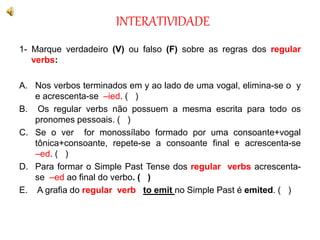
INTERATIVIDADE
1- Marque verdadeiro (V) ou falso (F) sobre as regras dos regular
verbs:
A. Nos verbos terminados em y ao lado de uma vogal, elimina-se o y
e acrescenta-se –ied. ( )
B. Os regular verbs não possuem a mesma escrita para todo os
pronomes pessoais. ( )
C. Se o ver for monossílabo formado por uma consoante+vogal
tônica+consoante, repete-se a consoante final e acrescenta-se
–ed. ( )
D. Para formar o Simple Past Tense dos regular verbs acrescenta-
se –ed ao final do verbo. ( )
E. A grafia do regular verb to emit no Simple Past é emited. ( )

Regular Verbs in the Simple Past Tense

  • 2.
    Na Língua Inglesa,a maioria dos verbos é dividida em regular verbs e irregular verbs. Os regular verbs recebem o acréscimo de –ed ao infinitivo para formar o Simple Past e o Past Participle. Exemplos: Infinitive Simple Past Past Participle to repeat repeated repeated to walk walked walked to stay stayed stayed to love loved loved to brush brushed brushed
  • 3.
    É importante ressaltar,que os regular verbs no Passado na Língua Inglesa, são iguais para todas as pessoas do discurso, ou seja, você escreverá a mesma forma verbal para I, YOU, HE, SHE, IT, WE, YOU, THEY tanto no Simple Past como no Past Prticiple. SUBJECT PRONOUNS REGULAR VERB I walked YOU walked HE walked SHE walked IT walked WE walked YOU walked THEY walked
  • 4.
    REGRAS DE ORTOGRAFIADOS REGULAR VERBS Quando usamos os regular verbs, devemos observar as seguintes regras:  Verbos terminados em e , acrescente apenas –d. Exemplos: She loved him, but now she doesn’t love him. I used miniskirt when I was a child. Infinitive Simple Past to love loved to use used
  • 5.
     Se overbo terminar em y precedido de uma consoante, elimine o y e acrescente –ied. Exemplos: He dried his clothes yesterday. They studied for their science test. Infinitive Simple Past to dry dried to study studied
  • 6.
    Porém, se overbo terminar em y ao lado de uma vogal, acrescente apenas –ed. Exemplos: The boy destroyed all the toys. The kids played in the yard yesterday morning. My aunt stayed in a hotel, when she came to visit me. Infinitive Simple Past to destroy destroyed to play played to stay stayed
  • 7.
     Quando overbo for um monossílabo formado por uma consoante + vogal tônica + consoante ( c-v-c ), repita a consoante final e acrescente –ed. Exemplos: She planned our trip alone. I stopped to smoke last year. Infinitive Simple Past to plan planned to stop stopped
  • 8.
     Se overbo for dissílabo ( duas sílabas), sendo a última sílaba formada por uma c-v-c (consoante + vogal tônica + consoante) , ou seja, essa sílaba é a tônica da palavra, repita a última letra e acrescente –ed. Exemplos: They permitted who he stay alone at home. I preferred to go to the club that I stay in his house. You controlled all situation. Congratualtions! Infinitive Simple Past to permit permitted to prefer preferred to control controlled
  • 9.
    INTERATIVIDADE 1- Marque verdadeiro(V) ou falso (F) sobre as regras dos regular verbs: A. Nos verbos terminados em y ao lado de uma vogal, elimina-se o y e acrescenta-se –ied. ( ) B. Os regular verbs não possuem a mesma escrita para todo os pronomes pessoais. ( ) C. Se o ver for monossílabo formado por uma consoante+vogal tônica+consoante, repete-se a consoante final e acrescenta-se –ed. ( ) D. Para formar o Simple Past Tense dos regular verbs acrescenta- se –ed ao final do verbo. ( ) E. A grafia do regular verb to emit no Simple Past é emited. ( )