Baixado 99 vezes
![EXAME DE EQUIVALÊNCIA À FREQUÊNCIA
Cursos Científico-Humanísticos e Cursos Tecnológicos aprovados pelo Decreto - Lei
nº74/2004, de 26 de Março (Código 358)
Duração da Prova: 25 minutos
Ano Lectivo: 2009/2010 1ªFase
Prova Oral de Inglês 12ºAno– LE I/II
Domínio de Referência: Cidadania e Multiculturalismo
Guião para a Avaliação da Expressão Oral em Inglês
1º Momento
Intervenientes e
Descrição das actividades
Tempos
Examinador Hello, A and B.
For about five minutes, I would like you both to answer some
questions so that I can learn a bit more about you.
Answer the questions, please, but do not interrupt your partner.
[1. O examinador usa a lista que se segue, escolhendo o número de
estímulos adequados ao tempo. 2. As perguntas serão colocadas em
ziguezague (entrevistando simultaneamente os dois examinandos).]
A B
1. A, where were you born?
Examinador e
2. And you B, were you born in
Examinandos
Madeira/here?
3. What about your parents, A?
4. And yours, B?
5. A, do you have any relatives
living abroad? If so, where? If
not, would you like to live in or
visit a foreign country? Why?
6. What about you B, would you
like to live abroad? Why / why
not?
Total: 7. A, would it be easy for you to
+/- 5 minutos adapt to a different country?
Explain.
8. And you B, would it be easy for
you to adapt to a different
country? Explain.
1](https://image.slidesharecdn.com/guiaoprovaoral1fase3582010-100721025036-phpapp02/85/Guiao-prova-oral_1_fase_358_2010-1-320.jpg)
![EXAME DE EQUIVALÊNCIA À FREQUÊNCIA
Cursos Científico-Humanísticos e Cursos Tecnológicos aprovados pelo Decreto - Lei
nº74/2004, de 26 de Março (Código 358)
Duração da Prova: 25 minutos
Ano Lectivo: 2009/2010 1ªFase
Prova Oral de Inglês 12ºAno– LE I/II
Domínio de Referência: Cidadania e Multiculturalismo
Guião para a Avaliação da Expressão Oral em Inglês
1º Momento
Intervenientes e
Descrição das actividades
Tempos
Examinador Hello, A and B.
For about five minutes, I would like you both to answer some
questions so that I can learn a bit more about you.
Answer the questions, please, but do not interrupt your partner.
[1. O examinador usa a lista que se segue, escolhendo o número de
estímulos adequados ao tempo. 2. As perguntas serão colocadas em
ziguezague (entrevistando simultaneamente os dois examinandos).]
A B
1. A, where were you born?
Examinador e
2. And you B, were you born in
Examinandos
Madeira/here?
3. What about your parents, A?
4. And yours, B?
5. A, do you have any relatives
living abroad? If so, where? If
not, would you like to live in or
visit a foreign country? Why?
6. What about you B, would you
like to live abroad? Why / why
not?
Total: 7. A, would it be easy for you to
+/- 5 minutos adapt to a different country?
Explain.
8. And you B, would it be easy for
you to adapt to a different
country? Explain.
1](https://image.slidesharecdn.com/guiaoprovaoral1fase3582010-100721025036-phpapp02/75/Guiao-prova-oral_1_fase_358_2010-1-2048.jpg)
![ 2º Momento
Intervenientes
Descrição das actividades
e Tempos
Examinador Right, now each of you will have to talk on your own for about three
minutes, but you will have about two minutes to prepare.
You must not interrupt your partner while he/she is speaking.
Here is some paper and a pen, in case you want to make some brief
notes. Please, do not write a text!
[O examinador entrega a caneta e o papel aos dois examinandos.]
Could you speak first, A?
[O examinador entrega o material: Picture 1]
Look at the picture and talk about it.
Besides the picture, you have some prompts to help you.
I‟ll ask you to start talking in two minutes.
Examinando A [O aluno prepara o seu discurso.]
2 minutos
Examinador Begin now A, please.
[Prestação do aluno. Caso o discurso do examinando seja
Examinando A insuficiente, revele pouco conteúdo ou o examinando tenha
+/- 3 minutos dificuldade em começar a falar, o examinador poderá ajudá-lo com
algumas perguntas, por exemplo:]
What can you see in the picture?
Why do you think people are intolerant to other peoples?
Is cultural diversity well accepted in our society?
Would you feel offended if someone did the same to your
country‟s flag?
[O examinador pode ainda ajudar o examinando a expandir o seu
Examinador discurso, por exemplo usando:]
Could you be more specific?
What do you mean by…?
Thank you, A.
2](https://image.slidesharecdn.com/guiaoprovaoral1fase3582010-100721025036-phpapp02/85/Guiao-prova-oral_1_fase_358_2010-2-320.jpg)
![ 2º Momento (continuação)
Intervenientes
Descrição das actividades
e Tempos
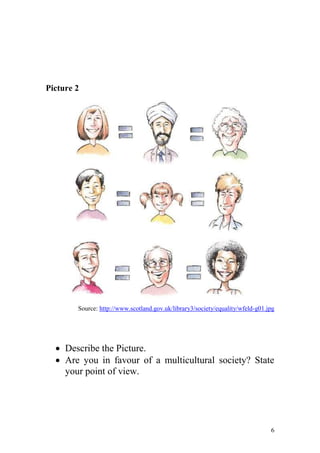
Examinador Now it‟s your turn, B.
[O examinador entrega o material: Picture 2]
Look at the picture and talk about it.
Besides the picture, you have some prompts to help you.
I‟ll ask you to start talking in two minutes.
Examinando B
2 minutos [O aluno prepara o seu discurso.]
Examinador Please begin now, B.
[Prestação do aluno. Caso o discurso do examinando seja
Examinando B insuficiente, revele pouco conteúdo ou o examinando tenha
+/- 3 minutos dificuldade em começar a falar, o examinador poderá ajudá-lo com
algumas perguntas, por exemplo:]
What can you see in the Picture?
To what extent can the expression „All different, all equal‟ be
applied to this image?
Do men and women have the same opportunities in society?
Explain.
…
Examinador
[O examinador pode ainda ajudar o examinando a expandir o seu
discurso, por exemplo usando:]
Can you give more details?
Can you expand on that?
Thank you, B.
Total:
+/- 10 minutos
3](https://image.slidesharecdn.com/guiaoprovaoral1fase3582010-100721025036-phpapp02/85/Guiao-prova-oral_1_fase_358_2010-3-320.jpg)
![ 3º Momento
Intervenientes
Descrição das actividades
e Tempos
Now I‟d like you to have a conversation for about three/four minutes,
Examinador while I listen.
You have to speak clearly and loud enough so that I can listen to you
both.
I will ask you some questions in the last two/three minutes.
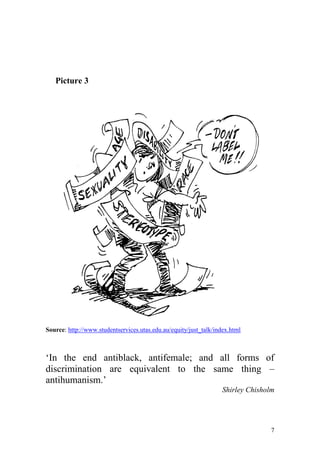
A and B, here is a sheet of paper with a picture and some words on it.
[O examinador entrega o material: Picture 3]
Look at the picture and statement and discuss the ideas conveyed.
+/- 30 [Prestação dos alunos. Os alunos podem analisar a imagem. Caso
segundos nenhum dos examinandos tome a iniciativa, ou tenha decorrido mais
+ de meio minuto, o examinador poderá dizer “Why don’t you start,
Examinandos A?” Se for necessário, o examinador deve repetir as instruções.]
+/- 6 minutos
Thank you!
Examinador A, how can we find ways to fight against different types of
e discrimination?
Examinandos …
+/- 4 minutos
B, do you agree with A?
[Caso o examinando A não tenha fornecido um discurso susceptível
de ser comentado, devido à pouca qualidade ou extensão, a pergunta
inicial poderá ser adaptada e dirigida ao aluno B, substituindo aquela
que pede a sua reacção. Por exemplo, o examinador poderá dizer “B,
is it possible to fight discrimination in our society?”]
And B, can the interaction of cultures be a positive process?
Explain.
…
A, do you share B‟s point of view?
[Caso o examinando B não tenha fornecido um discurso susceptível
de ser comentado, devido à pouca qualidade ou extensão, a pergunta
inicial poderá ser adaptada e dirigida ao aluno A, substituindo aquela
que pede a sua reacção. Por exemplo, o examinador poderá dizer “A,
can the interaction of cultures be a positive process? Explain.”]
Examinador
Thank you both. That is the end of your test.
Total:
+/- 10
minutos
Total final:
+/- 25 FIM DA PROVA
minutos
4](https://image.slidesharecdn.com/guiaoprovaoral1fase3582010-100721025036-phpapp02/85/Guiao-prova-oral_1_fase_358_2010-4-320.jpg)


Este documento fornece instruções para um exame oral de Inglês em três partes: (1) perguntas para os candidatos, (2) discursos individuais sobre imagens, (3) conversa entre os candidatos sobre outra imagem. O objetivo é avaliar a capacidade de expressão oral dos candidatos em Inglês.


