ALSO – TOO – EITHER – NEITHER – EACH
– EVERY – ALL – BOTH
“O desejo dos justos é somente o bem, porém a
expectativa dos ímpios é a ira.” (Prov. 11:23)
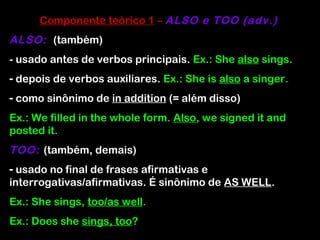
Componente teórico 1 – ALSO e TOO (adv.)
ALSO: (também)
- usado antes de verbos principais. Ex.: She also sings.
- depois de verbos auxiliares. Ex.: She is also a singer.
- como sinônimo de in addition (= além disso)
Ex.: We filled in the whole form. Also, we signed it and
posted it.
TOO: (também, demais)
- usado no final de frases afirmativas e
interrogativas/afirmativas. É sinônimo de AS WELL.
Ex.: She sings, too/as well.
Ex.: Does she sings, too?
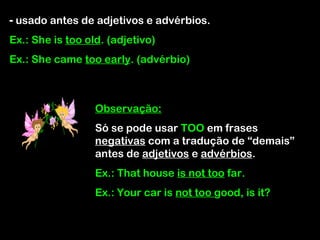
- usado antes de adjetivos e advérbios.
Ex.: She is too old. (adjetivo)
Ex.: She came too early. (advérbio)
Observação:
Só se pode usar TOOTOO em frases
negativas com a tradução de “demais”
antes de adjetivos e advérbios.
Ex.: That house is not too far.
Ex.: Your car is not too good, is it?
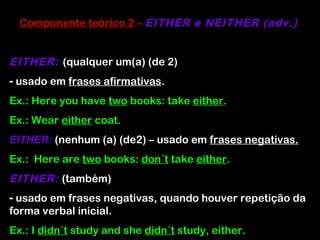
Componente teórico 2 – EITHER e NEITHER (adv.)
EITHER: (qualquer um(a) (de 2)
- usado em frases afirmativas.
Ex.: Here you have two books: take either.
Ex.: Wear either coat.
EITHER: (nenhum (a) (de2) – usado em frases negativas.
Ex.: Here are two books: don´t take either.
EITHER: (também)
- usado em frases negativas, quando houver repetição da
forma verbal inicial.
Ex.: I didn´t study and she didn´t study, either.
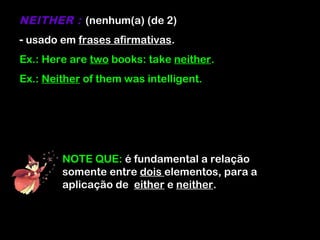
NEITHER : (nenhum(a) (de 2)
- usado em frases afirmativas.
Ex.: Here are two books: take neither.
Ex.: Neither of them was intelligent.
NOTE QUE: é fundamental a relação
somente entre dois elementos, para a
aplicação de either e neither.
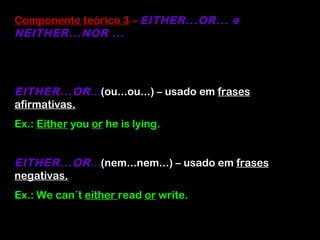
Componente teórico 3 – EITHER...OR... e
NEITHER...NOR ...
EITHER...OR...(ou...ou...) – usado em frases
afirmativas.
Ex.: Either you or he is lying.
EITHER...OR...(nem...nem...) – usado em frases
negativas.
Ex.: We can´t either read or write.
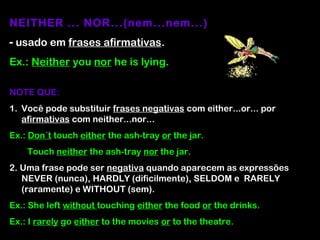
NEITHER ... NOR...(nem...nem...)
- usado em frases afirmativas.
Ex.: Neither you nor he is lying.
NOTE QUE:
1. Você pode substituir frases negativas com either...or... por
afirmativas com neither...nor...
Ex.: Don´t touch either the ash-tray or the jar.
Touch neither the ash-tray nor the jar.
2. Uma frase pode ser negativa quando aparecem as expressões
NEVER (nunca), HARDLY (dificilmente), SELDOM e RARELY
(raramente) e WITHOUT (sem).
Ex.: She left without touching either the food or the drinks.
Ex.: I rarely go either to the movies or to the theatre.
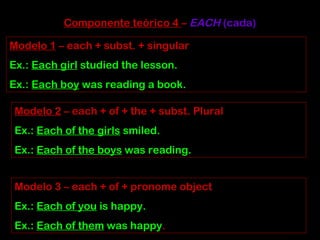
Componente teórico 4 – EACH (cada)
Modelo 1 – each + subst. + singular
Ex.: Each girl studied the lesson.
Ex.: Each boy was reading a book.
Modelo 2 – each + of + the + subst. Plural
Ex.: Each of the girls smiled.
Ex.: Each of the boys was reading.
Modelo 3 – each + of + pronome object
Ex.: Each of you is happy.
Ex.: Each of them was happy.
Usa-se EACH após preços ou quantidades, indicando
individualidade.
Ex.: These ties cost US$ 35 each.
Ex.: Those blocks are 300kg heavy each.
Usa-se EACH seguido de OTHER, indicando
reciprocidade entre dois elementos (um ao outro). Para
indicar reciprocidade entre mais de dois elemrntos, a
expressão é ONE ANOTHER (uns aos outros).
Ex.: Ricardo and Claudia love each other.
Ex.: If we want a better world, we must love one
another.
LEMBRAR: EACH – tem sempre sua concordância
verbal em 3ª pessoa do singular.
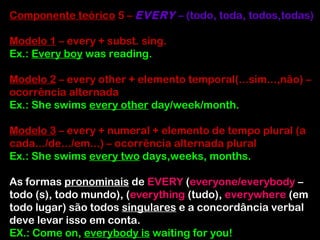
Componente teórico 5 – EVERY – (todo, toda, todos,todas)
Modelo 1 – every + subst. sing.
Ex.: Every boy was reading.
Modelo 2 – every other + elemento temporal(...sim...,não) –
ocorrência alternada
Ex.: She swims every other day/week/month.
Modelo 3 – every + numeral + elemento de tempo plural (a
cada.../de.../em...) – ocorrência alternada plural
Ex.: She swims every two days,weeks, months.
As formas pronominais de EVERY (everyone/everybody –
todo (s), todo mundo), (everything (tudo), everywhere (em
todo lugar) são todos singulares e a concordância verbal
deve levar isso em conta.
EX.: Come on, everybody is waiting for you!
OBSERVAÇÕES:
1- Forma pronominal é aquela que pode ter função
de sujeito ou objeto de frases.
2 – A concordância verbal para everybody/everyone
é de 3ª pessoa do singular = HE e seu possessivo é
HIS. A concordância com THEIR é muito formal.
Ex.: Everybody must bring his books.
3 – Everyone só é usado com referência a pessoas,
mas every one inclui também referências a coisas:
Ex.: She greeted everyone at the party.
Ex.: She has kept every one of my letters.
Componente teórico 6 - ALL (tudo,
todo,toda,todos,todas)
Modelo 1 – all + verbo na 3ª singular (= everything)
Ex.: All was perfectly arranged.
Modelo 2 – all + verbo na 3ª plural (todos, todas)
Ex.: All were expecting you to come
Modelo 3 – all + substantivo plural
ou
all + the + subst.plural
ou
all + of + the + subst. Plural
Ex.: All girls were singing.
All the girls were singing.
All of the girls were singing.
Modelo 4 – all + of + pronome object
Ex.: All of them worked a lot.
OBSERVAÇÃO:
Se o sujeito da frase for um pronome, all deve
vir depois dele; se for um substantivo, a
posição de all é optativa.
Ex.: They all want to see you.
Ex.: All the students were outside.
Ex.: The students all were outside.
Componente teórico 7 – BOTH (ambos, os dois, as duas)
1 – Usa – se para referir-se a dois elementos e expressar inclusão,
antes de verbos ou no final de frases.
Ex.: I have two dogs, and both are very young.
EX.: I have two dogs, and I love them both.
2 – Usa-se seguido de OF + THE + SUBST. PLURAL, adjetivado ou
não, ou de OF + OBJECT PRONOUN, também para referir-se a dois
elementos e indicar inclusão.
Ex.: Both of the young ladies wrote their names down on the paper.
Ex.: These are Peter and Kurt. Both of them are German.
3 – Usa-se seguido de AND, numa estrutura que significa
“tanto...quanto” (inclusão).
Ex.: Both the teacher and the students had to wait for the school gate
to be opened.
Você é curioso?
Então o que significa a expressão “apple – polisher”? Significa
bajulador, puxa-saco.
Em 1928, nos Estados Unidos, começou uma nova prática
que virou tradição. Os alunos nas escolas levavam uma
maçã bonita e brilhante para os professores para tentar
ganhar favores e tratamentos especiais.
Existem outras expressões em inglês para pessoas que tentam
ganhar vantagens com bajulação. Tais termos se referem a práticas
bem menos “polidas” e higiênicas, como por exemplo: bootlicker ou
brown-noser!
Ex.: The boss expects his workers to be apple-polishers!

Also, too...

  • 1.
    ALSO – TOO– EITHER – NEITHER – EACH – EVERY – ALL – BOTH “O desejo dos justos é somente o bem, porém a expectativa dos ímpios é a ira.” (Prov. 11:23)
  • 2.
    Componente teórico 1– ALSO e TOO (adv.) ALSO: (também) - usado antes de verbos principais. Ex.: She also sings. - depois de verbos auxiliares. Ex.: She is also a singer. - como sinônimo de in addition (= além disso) Ex.: We filled in the whole form. Also, we signed it and posted it. TOO: (também, demais) - usado no final de frases afirmativas e interrogativas/afirmativas. É sinônimo de AS WELL. Ex.: She sings, too/as well. Ex.: Does she sings, too?
  • 3.
    - usado antesde adjetivos e advérbios. Ex.: She is too old. (adjetivo) Ex.: She came too early. (advérbio) Observação: Só se pode usar TOOTOO em frases negativas com a tradução de “demais” antes de adjetivos e advérbios. Ex.: That house is not too far. Ex.: Your car is not too good, is it?
  • 4.
    Componente teórico 2– EITHER e NEITHER (adv.) EITHER: (qualquer um(a) (de 2) - usado em frases afirmativas. Ex.: Here you have two books: take either. Ex.: Wear either coat. EITHER: (nenhum (a) (de2) – usado em frases negativas. Ex.: Here are two books: don´t take either. EITHER: (também) - usado em frases negativas, quando houver repetição da forma verbal inicial. Ex.: I didn´t study and she didn´t study, either.
  • 5.
    NEITHER : (nenhum(a)(de 2) - usado em frases afirmativas. Ex.: Here are two books: take neither. Ex.: Neither of them was intelligent. NOTE QUE: é fundamental a relação somente entre dois elementos, para a aplicação de either e neither.
  • 6.
    Componente teórico 3– EITHER...OR... e NEITHER...NOR ... EITHER...OR...(ou...ou...) – usado em frases afirmativas. Ex.: Either you or he is lying. EITHER...OR...(nem...nem...) – usado em frases negativas. Ex.: We can´t either read or write.
  • 7.
    NEITHER ... NOR...(nem...nem...) -usado em frases afirmativas. Ex.: Neither you nor he is lying. NOTE QUE: 1. Você pode substituir frases negativas com either...or... por afirmativas com neither...nor... Ex.: Don´t touch either the ash-tray or the jar. Touch neither the ash-tray nor the jar. 2. Uma frase pode ser negativa quando aparecem as expressões NEVER (nunca), HARDLY (dificilmente), SELDOM e RARELY (raramente) e WITHOUT (sem). Ex.: She left without touching either the food or the drinks. Ex.: I rarely go either to the movies or to the theatre.
  • 8.
    Componente teórico 4– EACH (cada) Modelo 1 – each + subst. + singular Ex.: Each girl studied the lesson. Ex.: Each boy was reading a book. Modelo 2 – each + of + the + subst. Plural Ex.: Each of the girls smiled. Ex.: Each of the boys was reading. Modelo 3 – each + of + pronome object Ex.: Each of you is happy. Ex.: Each of them was happy.
  • 9.
    Usa-se EACH apóspreços ou quantidades, indicando individualidade. Ex.: These ties cost US$ 35 each. Ex.: Those blocks are 300kg heavy each. Usa-se EACH seguido de OTHER, indicando reciprocidade entre dois elementos (um ao outro). Para indicar reciprocidade entre mais de dois elemrntos, a expressão é ONE ANOTHER (uns aos outros). Ex.: Ricardo and Claudia love each other. Ex.: If we want a better world, we must love one another. LEMBRAR: EACH – tem sempre sua concordância verbal em 3ª pessoa do singular.
  • 10.
    Componente teórico 5– EVERY – (todo, toda, todos,todas) Modelo 1 – every + subst. sing. Ex.: Every boy was reading. Modelo 2 – every other + elemento temporal(...sim...,não) – ocorrência alternada Ex.: She swims every other day/week/month. Modelo 3 – every + numeral + elemento de tempo plural (a cada.../de.../em...) – ocorrência alternada plural Ex.: She swims every two days,weeks, months. As formas pronominais de EVERY (everyone/everybody – todo (s), todo mundo), (everything (tudo), everywhere (em todo lugar) são todos singulares e a concordância verbal deve levar isso em conta. EX.: Come on, everybody is waiting for you!
  • 11.
    OBSERVAÇÕES: 1- Forma pronominalé aquela que pode ter função de sujeito ou objeto de frases. 2 – A concordância verbal para everybody/everyone é de 3ª pessoa do singular = HE e seu possessivo é HIS. A concordância com THEIR é muito formal. Ex.: Everybody must bring his books. 3 – Everyone só é usado com referência a pessoas, mas every one inclui também referências a coisas: Ex.: She greeted everyone at the party. Ex.: She has kept every one of my letters.
  • 12.
    Componente teórico 6- ALL (tudo, todo,toda,todos,todas) Modelo 1 – all + verbo na 3ª singular (= everything) Ex.: All was perfectly arranged. Modelo 2 – all + verbo na 3ª plural (todos, todas) Ex.: All were expecting you to come Modelo 3 – all + substantivo plural ou all + the + subst.plural ou all + of + the + subst. Plural Ex.: All girls were singing. All the girls were singing. All of the girls were singing.
  • 13.
    Modelo 4 –all + of + pronome object Ex.: All of them worked a lot. OBSERVAÇÃO: Se o sujeito da frase for um pronome, all deve vir depois dele; se for um substantivo, a posição de all é optativa. Ex.: They all want to see you. Ex.: All the students were outside. Ex.: The students all were outside.
  • 14.
    Componente teórico 7– BOTH (ambos, os dois, as duas) 1 – Usa – se para referir-se a dois elementos e expressar inclusão, antes de verbos ou no final de frases. Ex.: I have two dogs, and both are very young. EX.: I have two dogs, and I love them both. 2 – Usa-se seguido de OF + THE + SUBST. PLURAL, adjetivado ou não, ou de OF + OBJECT PRONOUN, também para referir-se a dois elementos e indicar inclusão. Ex.: Both of the young ladies wrote their names down on the paper. Ex.: These are Peter and Kurt. Both of them are German. 3 – Usa-se seguido de AND, numa estrutura que significa “tanto...quanto” (inclusão). Ex.: Both the teacher and the students had to wait for the school gate to be opened.
  • 15.
    Você é curioso? Entãoo que significa a expressão “apple – polisher”? Significa bajulador, puxa-saco. Em 1928, nos Estados Unidos, começou uma nova prática que virou tradição. Os alunos nas escolas levavam uma maçã bonita e brilhante para os professores para tentar ganhar favores e tratamentos especiais. Existem outras expressões em inglês para pessoas que tentam ganhar vantagens com bajulação. Tais termos se referem a práticas bem menos “polidas” e higiênicas, como por exemplo: bootlicker ou brown-noser! Ex.: The boss expects his workers to be apple-polishers!