ESCOLA ESTADUAL “DR. JOAQUIM VILELA”
                         Trabalho de Língua Inglesa - English Test -
                         Teacher:
                         Name:                                         Number:                Class:               Data:
                         Eixo Temático:

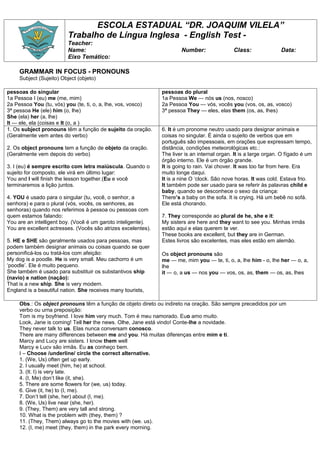
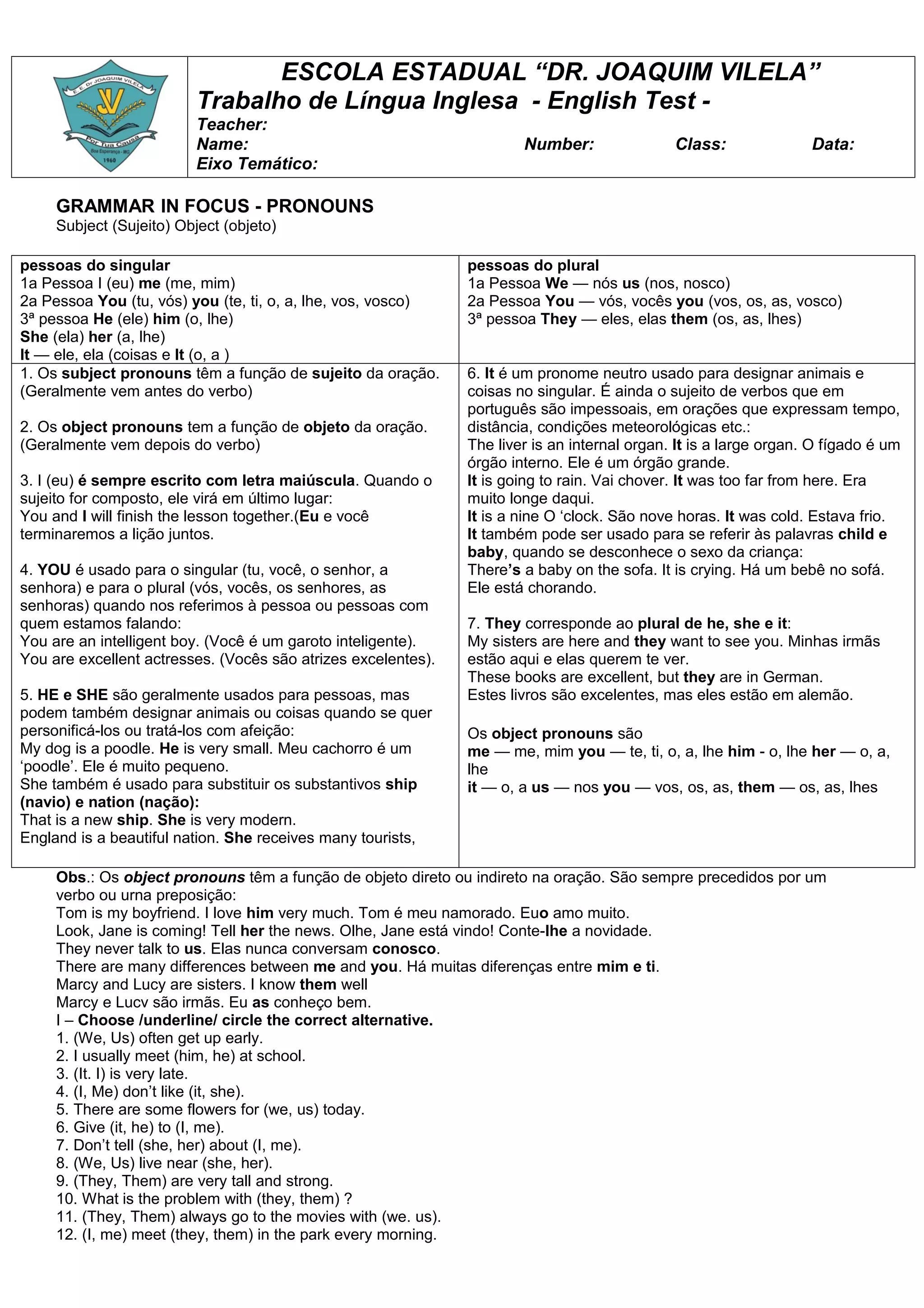
     GRAMMAR IN FOCUS - PRONOUNS
     Subject (Sujeito) Object (objeto)

pessoas do singular                                            pessoas do plural
1a Pessoa I (eu) me (me, mim)                                  1a Pessoa We — nós us (nos, nosco)
2a Pessoa You (tu, vós) you (te, ti, o, a, lhe, vos, vosco)    2a Pessoa You — vós, vocês you (vos, os, as, vosco)
3ª pessoa He (ele) him (o, lhe)                                3ª pessoa They — eles, elas them (os, as, lhes)
She (ela) her (a, lhe)
It — ele, ela (coisas e It (o, a )
1. Os subject pronouns têm a função de sujeito da oração.      6. It é um pronome neutro usado para designar animais e
(Geralmente vem antes do verbo)                                coisas no singular. É ainda o sujeito de verbos que em
                                                               português são impessoais, em orações que expressam tempo,
2. Os object pronouns tem a função de objeto da oração.        distância, condições meteorológicas etc.:
(Geralmente vem depois do verbo)                               The liver is an internal organ. It is a large organ. O fígado é um
                                                               órgão interno. Ele é um órgão grande.
3. I (eu) é sempre escrito com letra maiúscula. Quando o       It is going to rain. Vai chover. It was too far from here. Era
sujeito for composto, ele virá em último lugar:                muito longe daqui.
You and I will finish the lesson together.(Eu e você           It is a nine O ‘clock. São nove horas. It was cold. Estava frio.
terminaremos a lição juntos.                                   It também pode ser usado para se referir às palavras child e
                                                               baby, quando se desconhece o sexo da criança:
4. YOU é usado para o singular (tu, você, o senhor, a          There’s a baby on the sofa. It is crying. Há um bebê no sofá.
senhora) e para o plural (vós, vocês, os senhores, as          Ele está chorando.
senhoras) quando nos referimos à pessoa ou pessoas com
quem estamos falando:                                          7. They corresponde ao plural de he, she e it:
You are an intelligent boy. (Você é um garoto inteligente).    My sisters are here and they want to see you. Minhas irmãs
You are excellent actresses. (Vocês são atrizes excelentes).   estão aqui e elas querem te ver.
                                                               These books are excellent, but they are in German.
5. HE e SHE são geralmente usados para pessoas, mas            Estes livros são excelentes, mas eles estão em alemão.
podem também designar animais ou coisas quando se quer
personificá-los ou tratá-los com afeição:                      Os object pronouns são
My dog is a poodle. He is very small. Meu cachorro é um        me — me, mim you — te, ti, o, a, lhe him - o, lhe her — o, a,
‘poodle’. Ele é muito pequeno.                                 lhe
She também é usado para substituir os substantivos ship        it — o, a us — nos you — vos, os, as, them — os, as, lhes
(navio) e nation (nação):
That is a new ship. She is very modern.
England is a beautiful nation. She receives many tourists,

     Obs.: Os object pronouns têm a função de objeto direto ou indireto na oração. São sempre precedidos por um
     verbo ou urna preposição:
     Tom is my boyfriend. I love him very much. Tom é meu namorado. Euo amo muito.
     Look, Jane is coming! Tell her the news. Olhe, Jane está vindo! Conte-lhe a novidade.
     They never talk to us. Elas nunca conversam conosco.
     There are many differences between me and you. Há muitas diferenças entre mim e ti.
     Marcy and Lucy are sisters. I know them well
     Marcy e Lucv são irmãs. Eu as conheço bem.
     I – Choose /underline/ circle the correct alternative.
     1. (We, Us) often get up early.
     2. I usually meet (him, he) at school.
     3. (It. I) is very late.
     4. (I, Me) don’t like (it, she).
     5. There are some flowers for (we, us) today.
     6. Give (it, he) to (I, me).
     7. Don’t tell (she, her) about (I, me).
     8. (We, Us) live near (she, her).
     9. (They, Them) are very tall and strong.
     10. What is the problem with (they, them) ?
     11. (They, Them) always go to the movies with (we. us).
     12. (I, me) meet (they, them) in the park every morning.
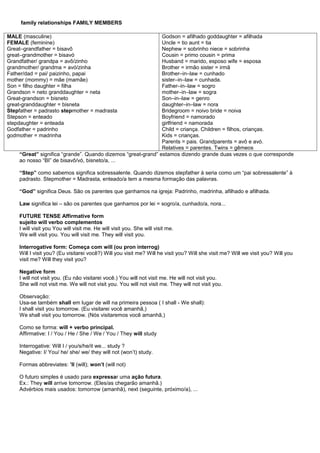
family relationships FAMILY MEMBERS

MALE (masculine)                                              Godson = afilhado goddaughter = afilhada
FEMALE (feminine)                                             Uncle = tio aunt = tia
Great–grandfather = bisavô                                    Nephew = sobrinho niece = sobrinha
great–grandmother = bisavó                                    Cousin = primo cousin = prima
Grandfather/ grandpa = avô/zinho                              Husband = marido, esposo wife = esposa
grandmother/ grandma = avó/zinha                              Brother = irmão sister = irmã
Father/dad = pai/ paizinho, papai                             Brother–in–law = cunhado
mother (mommy) = mãe (mamãe)                                  sister–in–law = cunhada.
Son = filho daughter = filha                                  Father–in–law = sogro
Grandson = neto granddaughter = neta                          mother–in–law = sogra
Great-grandson = bisneto                                      Son–in–law = genro
great-granddaughter = bisneta                                 daughter–in–law = nora
Stepfather = padrasto stepmother = madrasta                   Bridegroom = noivo bride = noiva
Stepson = enteado                                             Boyfriend = namorado
stepdaughter = enteada                                        girlfriend = namorada
Godfather = padrinho                                          Child = criança. Children = filhos, crianças.
godmother = madrinha                                          Kids = crianças.
                                                              Parents = pais. Grandparents = avô e avó.
                                                              Relatives = parentes. Twins = gêmeos
    “Great” significa “grande”. Quando dizemos “great-grand” estamos dizendo grande duas vezes o que corresponde
    ao nosso “BI” de bisavô/vó, bisneto/a, ...

    “Step” como sabemos significa sobressalente. Quando dizemos stepfather à seria como um “pai sobressalente” à
    padrasto. Stepmother = Madrasta, enteado/a tem a mesma formação das palavras.

    “God” significa Deus. São os parentes que ganhamos na igreja: Padrinho, madrinha, afilhado e afilhada.

    Law significa lei – são os parentes que ganhamos por lei = sogro/a, cunhado/a, nora...

    FUTURE TENSE Affirmative form
    sujeito will verbo complementos
    I will visit you You will visit me. He will visit you. She will visit me.
    We will visit you. You will visit me. They will visit you.

    Interrogative form: Começa com will (ou pron interrog)
    Will I visit you? (Eu visitarei você?) Will you visit me? Will he visit you? Will she visit me? Will we visit you? Will you
    visit me? Will they visit you?

    Negative form
    I will not visit you. (Eu não visitarei você.) You will not visit me. He will not visit you.
    She will not visit me. We will not visit you. You will not visit me. They will not visit you.

    Observação:
    Usa-se também shall em lugar de will na primeira pessoa ( I shall - We shall):
    I shall visit you tomorrow. (Eu visitarei você amanhã,)
    We shall visit you tomorrow. (Nós visitaremos você amanhã,)

    Como se forma: wiII + verbo principal.
    Affirmative: I / You / He / She / We / You / They will study

    Interrogative: Will I / you/s/he/it we... study ?
    Negative: I/ You/ he/ she/ we/ they will not (won’t) study.

    Formas abbreviates: ’ll (will); won’t (will not)

    O futuro simples é usado para expressar uma ação futura.
    Ex.: They wiII arrive tomorrow. (Eles/as chegarão amanhã.)
    Advérbios mais usados: tomorrow (amanhã), next (seguinte, próximo/a), ...

Trabalho de ingless

  • 1.
    ESCOLA ESTADUAL “DR.JOAQUIM VILELA” Trabalho de Língua Inglesa - English Test - Teacher: Name: Number: Class: Data: Eixo Temático: GRAMMAR IN FOCUS - PRONOUNS Subject (Sujeito) Object (objeto) pessoas do singular pessoas do plural 1a Pessoa I (eu) me (me, mim) 1a Pessoa We — nós us (nos, nosco) 2a Pessoa You (tu, vós) you (te, ti, o, a, lhe, vos, vosco) 2a Pessoa You — vós, vocês you (vos, os, as, vosco) 3ª pessoa He (ele) him (o, lhe) 3ª pessoa They — eles, elas them (os, as, lhes) She (ela) her (a, lhe) It — ele, ela (coisas e It (o, a ) 1. Os subject pronouns têm a função de sujeito da oração. 6. It é um pronome neutro usado para designar animais e (Geralmente vem antes do verbo) coisas no singular. É ainda o sujeito de verbos que em português são impessoais, em orações que expressam tempo, 2. Os object pronouns tem a função de objeto da oração. distância, condições meteorológicas etc.: (Geralmente vem depois do verbo) The liver is an internal organ. It is a large organ. O fígado é um órgão interno. Ele é um órgão grande. 3. I (eu) é sempre escrito com letra maiúscula. Quando o It is going to rain. Vai chover. It was too far from here. Era sujeito for composto, ele virá em último lugar: muito longe daqui. You and I will finish the lesson together.(Eu e você It is a nine O ‘clock. São nove horas. It was cold. Estava frio. terminaremos a lição juntos. It também pode ser usado para se referir às palavras child e baby, quando se desconhece o sexo da criança: 4. YOU é usado para o singular (tu, você, o senhor, a There’s a baby on the sofa. It is crying. Há um bebê no sofá. senhora) e para o plural (vós, vocês, os senhores, as Ele está chorando. senhoras) quando nos referimos à pessoa ou pessoas com quem estamos falando: 7. They corresponde ao plural de he, she e it: You are an intelligent boy. (Você é um garoto inteligente). My sisters are here and they want to see you. Minhas irmãs You are excellent actresses. (Vocês são atrizes excelentes). estão aqui e elas querem te ver. These books are excellent, but they are in German. 5. HE e SHE são geralmente usados para pessoas, mas Estes livros são excelentes, mas eles estão em alemão. podem também designar animais ou coisas quando se quer personificá-los ou tratá-los com afeição: Os object pronouns são My dog is a poodle. He is very small. Meu cachorro é um me — me, mim you — te, ti, o, a, lhe him - o, lhe her — o, a, ‘poodle’. Ele é muito pequeno. lhe She também é usado para substituir os substantivos ship it — o, a us — nos you — vos, os, as, them — os, as, lhes (navio) e nation (nação): That is a new ship. She is very modern. England is a beautiful nation. She receives many tourists, Obs.: Os object pronouns têm a função de objeto direto ou indireto na oração. São sempre precedidos por um verbo ou urna preposição: Tom is my boyfriend. I love him very much. Tom é meu namorado. Euo amo muito. Look, Jane is coming! Tell her the news. Olhe, Jane está vindo! Conte-lhe a novidade. They never talk to us. Elas nunca conversam conosco. There are many differences between me and you. Há muitas diferenças entre mim e ti. Marcy and Lucy are sisters. I know them well Marcy e Lucv são irmãs. Eu as conheço bem. I – Choose /underline/ circle the correct alternative. 1. (We, Us) often get up early. 2. I usually meet (him, he) at school. 3. (It. I) is very late. 4. (I, Me) don’t like (it, she). 5. There are some flowers for (we, us) today. 6. Give (it, he) to (I, me). 7. Don’t tell (she, her) about (I, me). 8. (We, Us) live near (she, her). 9. (They, Them) are very tall and strong. 10. What is the problem with (they, them) ? 11. (They, Them) always go to the movies with (we. us). 12. (I, me) meet (they, them) in the park every morning.
  • 2.
    family relationships FAMILYMEMBERS MALE (masculine) Godson = afilhado goddaughter = afilhada FEMALE (feminine) Uncle = tio aunt = tia Great–grandfather = bisavô Nephew = sobrinho niece = sobrinha great–grandmother = bisavó Cousin = primo cousin = prima Grandfather/ grandpa = avô/zinho Husband = marido, esposo wife = esposa grandmother/ grandma = avó/zinha Brother = irmão sister = irmã Father/dad = pai/ paizinho, papai Brother–in–law = cunhado mother (mommy) = mãe (mamãe) sister–in–law = cunhada. Son = filho daughter = filha Father–in–law = sogro Grandson = neto granddaughter = neta mother–in–law = sogra Great-grandson = bisneto Son–in–law = genro great-granddaughter = bisneta daughter–in–law = nora Stepfather = padrasto stepmother = madrasta Bridegroom = noivo bride = noiva Stepson = enteado Boyfriend = namorado stepdaughter = enteada girlfriend = namorada Godfather = padrinho Child = criança. Children = filhos, crianças. godmother = madrinha Kids = crianças. Parents = pais. Grandparents = avô e avó. Relatives = parentes. Twins = gêmeos “Great” significa “grande”. Quando dizemos “great-grand” estamos dizendo grande duas vezes o que corresponde ao nosso “BI” de bisavô/vó, bisneto/a, ... “Step” como sabemos significa sobressalente. Quando dizemos stepfather à seria como um “pai sobressalente” à padrasto. Stepmother = Madrasta, enteado/a tem a mesma formação das palavras. “God” significa Deus. São os parentes que ganhamos na igreja: Padrinho, madrinha, afilhado e afilhada. Law significa lei – são os parentes que ganhamos por lei = sogro/a, cunhado/a, nora... FUTURE TENSE Affirmative form sujeito will verbo complementos I will visit you You will visit me. He will visit you. She will visit me. We will visit you. You will visit me. They will visit you. Interrogative form: Começa com will (ou pron interrog) Will I visit you? (Eu visitarei você?) Will you visit me? Will he visit you? Will she visit me? Will we visit you? Will you visit me? Will they visit you? Negative form I will not visit you. (Eu não visitarei você.) You will not visit me. He will not visit you. She will not visit me. We will not visit you. You will not visit me. They will not visit you. Observação: Usa-se também shall em lugar de will na primeira pessoa ( I shall - We shall): I shall visit you tomorrow. (Eu visitarei você amanhã,) We shall visit you tomorrow. (Nós visitaremos você amanhã,) Como se forma: wiII + verbo principal. Affirmative: I / You / He / She / We / You / They will study Interrogative: Will I / you/s/he/it we... study ? Negative: I/ You/ he/ she/ we/ they will not (won’t) study. Formas abbreviates: ’ll (will); won’t (will not) O futuro simples é usado para expressar uma ação futura. Ex.: They wiII arrive tomorrow. (Eles/as chegarão amanhã.) Advérbios mais usados: tomorrow (amanhã), next (seguinte, próximo/a), ...