FP English – Flexible and Powerful


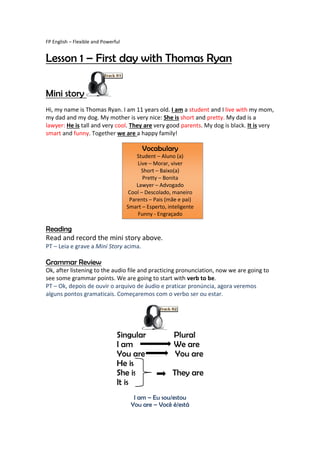
Lesson 1 – First day with Thomas Ryan

Mini story
Hi, my name is Thomas Ryan. I am 11 years old. I am a student and I live with my mom,
my dad and my dog. My mother is very nice: She is short and pretty. My dad is a
lawyer: He is tall and very cool. They are very good parents. My dog is black. It is very
smart and funny. Together we are a happy family!

                                           Vocabulary
                                         Student – Aluno (a)
                                         Live – Morar, viver
                                           Short – Baixo(a)
                                            Pretty – Bonita
                                         Lawyer – Advogado
                                      Cool – Descolado, maneiro
                                      Parents – Pais (mãe e pai)
                                     Smart – Esperto, inteligente
                                          Funny - Engraçado

Reading
Read and record the mini story above.
PT – Leia e grave a Mini Story acima.

Grammar Review
Ok, after listening to the audio file and practicing pronunciation, now we are going to
see some grammar points. We are going to start with verb to be.
PT – Ok, depois de ouvir o arquivo de áudio e praticar pronúncia, agora veremos
alguns pontos gramaticais. Começaremos com o verbo ser ou estar.


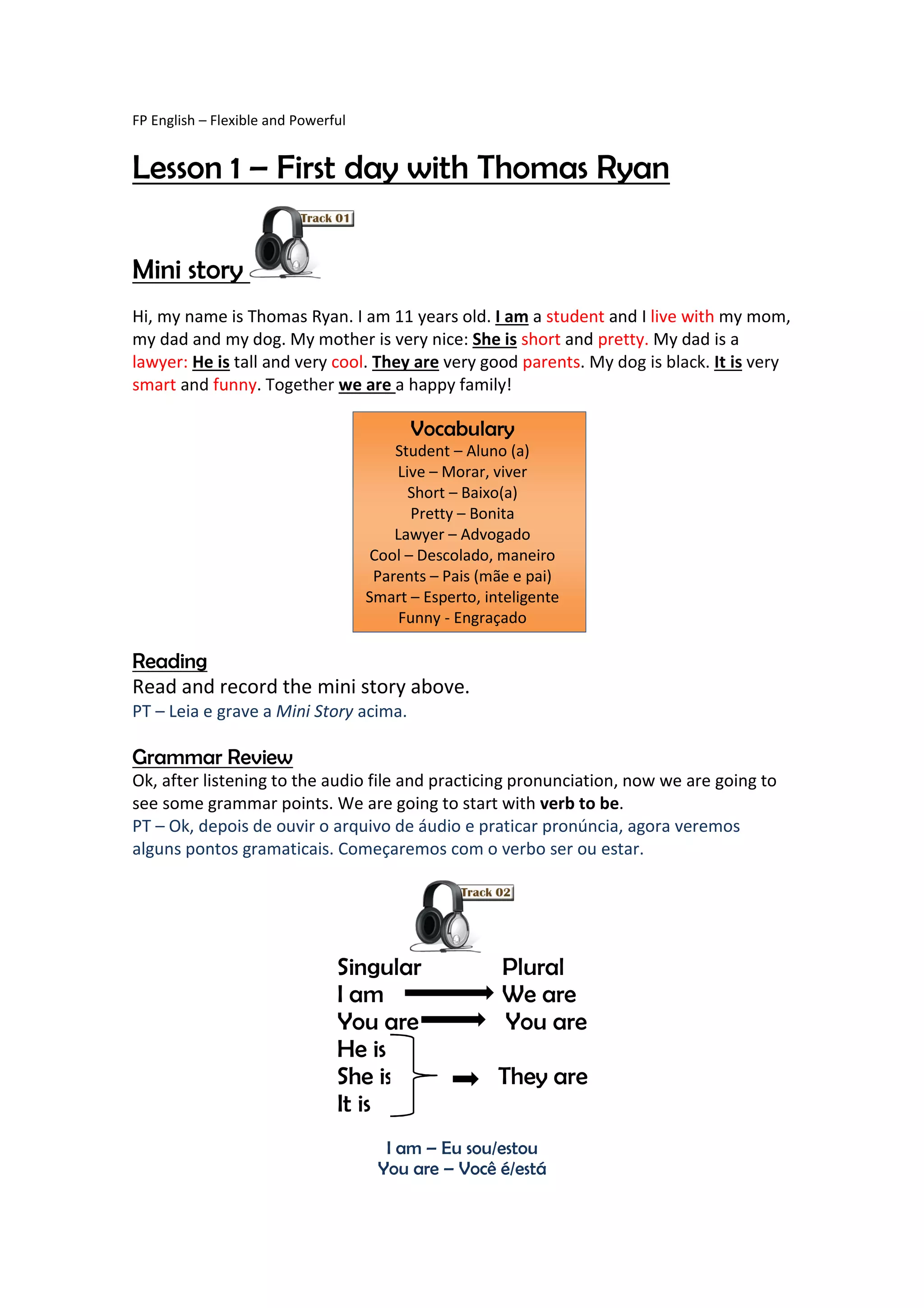
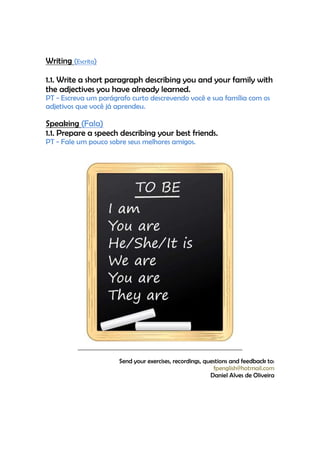
                                Singular                Plural
                                I am                    We are
                                You are                 You are
                                He is
                                She is                  They are
                                It is
                                       I am – Eu sou/estou
                                      You are – Você é/está
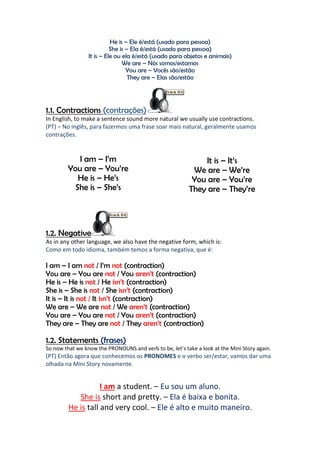
He is – Ele é/está (usado para pessoa)
                           She is – Ela é/está (usado para pessoa)
                 It is – Ele ou ela é/está (usado para objetos e animais)
                                We are – Nós somos/estamos
                                  You are – Vocês são/estão
                                   They are – Elas são/estão


1.1. Contractions (contrações)
In English, to make a sentence sound more natural we usually use contractions.
(PT) – No inglês, para fazermos uma frase soar mais natural, geralmente usamos
contrações.


            I am – I’m                                       It is – It’s
         You are – You’re                                 We are – We’re
            He is – He’s                                  You are – You’re
           She is – She’s                                They are – They’re


1.2. Negative
As in any other language, we also have the negative form, which is:
Como em todo idioma, também temos a forma negativa, que é:

I am – I am not / I’m not (contraction)
You are – You are not / You aren’t (contraction)
He is – He is not / He isn’t (contraction)
She is – She is not / She isn’t (contraction)
It is – It is not / It isn’t (contraction)
We are – We are not / We aren’t (contraction)
You are – You are not / You aren’t (contraction)
They are – They are not / They aren’t (contraction)

1.2. Statements (frases)
So now that we know the PRONOUNS and verb to be, let’s take a look at the Mini Story again.
(PT) Então agora que conhecemos os PRONOMES e o verbo ser/estar, vamos dar uma
olhada na Mini Story novamente.


                    I am a student. – Eu sou um aluno.
            She is short and pretty. – Ela é baixa e bonita.
         He is tall and very cool. – Ele é alto e muito maneiro.
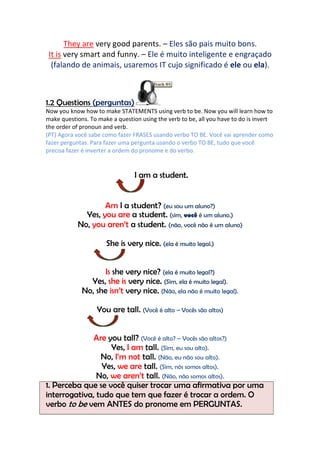
They are very good parents. – Eles são pais muito bons.
 It is very smart and funny. – Ele é muito inteligente e engraçado
  (falando de animais, usaremos IT cujo significado é ele ou ela).


1.2 Questions (perguntas)
Now you know how to make STATEMENTS using verb to be. Now you will learn how to
make questions. To make a question using the verb to be, all you have to do is invert
the order of pronoun and verb.
(PT) Agora você sabe como fazer FRASES usando verbo TO BE. Você vai aprender como
fazer perguntas. Para fazer uma pergunta usando o verbo TO BE, tudo que você
precisa fazer é inverter a ordem do pronome e do verbo.


                                 I am a student.


                   Am I a student? (eu sou um aluno?)
             Yes, you are a student. (sim, você é um aluno.)
           No, you aren’t a student. (não, você não é um aluno)

                      She is very nice. (ela é muito legal.)


                    Is she very nice? (ela é muito legal?)
               Yes, she is very nice. (Sim, ela é muito legal).
             No, she isn’t very nice. (Não, ela não é muito legal).

                   You are tall. (Você é alto – Vocês são altos)


              Are you tall? (Você é alto? – Vocês são altos?)
                   Yes, I am tall. (Sim, eu sou alto).
                No, I’m not tall. (Não, eu não sou alto).
                Yes, we are tall. (Sim, nós somos altos).
               No, we aren’t tall. (Não, não somos altos).
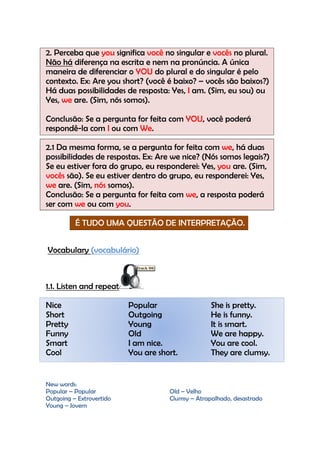
1. Perceba que se você quiser trocar uma afirmativa por uma
interrogativa, tudo que tem que fazer é trocar a ordem. O
verbo to be vem ANTES do pronome em PERGUNTAS.
2. Perceba que you significa você no singular e vocês no plural.
Não há diferença na escrita e nem na pronúncia. A única
maneira de diferenciar o YOU do plural e do singular é pelo
contexto. Ex: Are you short? (você é baixo? – vocês são baixos?)
Há duas possibilidades de resposta: Yes, I am. (Sim, eu sou) ou
Yes, we are. (Sim, nós somos).

Conclusão: Se a pergunta for feita com YOU, você poderá
respondê-la com I ou com We.

2.1 Da mesma forma, se a pergunta for feita com we, há duas
possibilidades de respostas. Ex: Are we nice? (Nós somos legais?)
Se eu estiver fora do grupo, eu responderei: Yes, you are. (Sim,
vocês são). Se eu estiver dentro do grupo, eu responderei: Yes,
we are. (Sim, nós somos).
Conclusão: Se a pergunta for feita com we, a resposta poderá
ser com we ou com you.

          É TUDO UMA QUESTÃO DE INTERPRETAÇÃO.


Vocabulary (vocabulário)


1.1. Listen and repeat

Nice                      Popular                  She is pretty.
Short                     Outgoing                 He is funny.
Pretty                    Young                    It is smart.
Funny                     Old                      We are happy.
Smart                     I am nice.               You are cool.
Cool                      You are short.           They are clumsy.


New words:
Popular – Popular                    Old – Velho
Outgoing – Extrovertido              Clumsy – Atrapalhado, desastrado
Young – Jovem
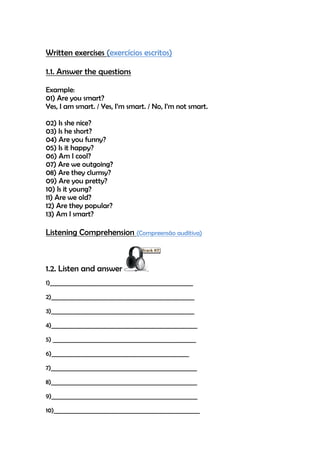
Written exercises (exercícios escritos)

1.1. Answer the questions

Example:
01) Are you smart?
Yes, I am smart. / Yes, I’m smart. / No, I’m not smart.

02) Is she nice?
03) Is he short?
04) Are you funny?
05) Is it happy?
06) Am I cool?
07) Are we outgoing?
08) Are they clumsy?
09) Are you pretty?
10) Is it young?
11) Are we old?
12) Are they popular?
13) Am I smart?

Listening Comprehension (Compreensão auditiva)


1.2. Listen and answer
1)___________________________________________________

2)___________________________________________________

3)___________________________________________________

4)____________________________________________________

5) ___________________________________________________

6)_________________________________________________

7)____________________________________________________

8)____________________________________________________

9)____________________________________________________

10)____________________________________________________
Writing (Escrita)

1.1. Write a short paragraph describing you and your family with
the adjectives you have already learned.
PT - Escreva um parágrafo curto descrevendo você e sua família com os
adjetivos que você já aprendeu.

Speaking (Fala)
1.1. Prepare a speech describing your best friends.
PT - Fale um pouco sobre seus melhores amigos.


                      Send your exercises, recordings, questions and feedback to:
                                                          fpenglish@hotmail.com
                                                         Daniel Alves de Oliveira

Fp english lesson 01- first day with thomas ryan

  • 1.
    FP English –Flexible and Powerful Lesson 1 – First day with Thomas Ryan Mini story Hi, my name is Thomas Ryan. I am 11 years old. I am a student and I live with my mom, my dad and my dog. My mother is very nice: She is short and pretty. My dad is a lawyer: He is tall and very cool. They are very good parents. My dog is black. It is very smart and funny. Together we are a happy family! Vocabulary Student – Aluno (a) Live – Morar, viver Short – Baixo(a) Pretty – Bonita Lawyer – Advogado Cool – Descolado, maneiro Parents – Pais (mãe e pai) Smart – Esperto, inteligente Funny - Engraçado Reading Read and record the mini story above. PT – Leia e grave a Mini Story acima. Grammar Review Ok, after listening to the audio file and practicing pronunciation, now we are going to see some grammar points. We are going to start with verb to be. PT – Ok, depois de ouvir o arquivo de áudio e praticar pronúncia, agora veremos alguns pontos gramaticais. Começaremos com o verbo ser ou estar. Singular Plural I am We are You are You are He is She is They are It is I am – Eu sou/estou You are – Você é/está
  • 2.
    He is –Ele é/está (usado para pessoa) She is – Ela é/está (usado para pessoa) It is – Ele ou ela é/está (usado para objetos e animais) We are – Nós somos/estamos You are – Vocês são/estão They are – Elas são/estão 1.1. Contractions (contrações) In English, to make a sentence sound more natural we usually use contractions. (PT) – No inglês, para fazermos uma frase soar mais natural, geralmente usamos contrações. I am – I’m It is – It’s You are – You’re We are – We’re He is – He’s You are – You’re She is – She’s They are – They’re 1.2. Negative As in any other language, we also have the negative form, which is: Como em todo idioma, também temos a forma negativa, que é: I am – I am not / I’m not (contraction) You are – You are not / You aren’t (contraction) He is – He is not / He isn’t (contraction) She is – She is not / She isn’t (contraction) It is – It is not / It isn’t (contraction) We are – We are not / We aren’t (contraction) You are – You are not / You aren’t (contraction) They are – They are not / They aren’t (contraction) 1.2. Statements (frases) So now that we know the PRONOUNS and verb to be, let’s take a look at the Mini Story again. (PT) Então agora que conhecemos os PRONOMES e o verbo ser/estar, vamos dar uma olhada na Mini Story novamente. I am a student. – Eu sou um aluno. She is short and pretty. – Ela é baixa e bonita. He is tall and very cool. – Ele é alto e muito maneiro.
  • 3.
    They are verygood parents. – Eles são pais muito bons. It is very smart and funny. – Ele é muito inteligente e engraçado (falando de animais, usaremos IT cujo significado é ele ou ela). 1.2 Questions (perguntas) Now you know how to make STATEMENTS using verb to be. Now you will learn how to make questions. To make a question using the verb to be, all you have to do is invert the order of pronoun and verb. (PT) Agora você sabe como fazer FRASES usando verbo TO BE. Você vai aprender como fazer perguntas. Para fazer uma pergunta usando o verbo TO BE, tudo que você precisa fazer é inverter a ordem do pronome e do verbo. I am a student. Am I a student? (eu sou um aluno?) Yes, you are a student. (sim, você é um aluno.) No, you aren’t a student. (não, você não é um aluno) She is very nice. (ela é muito legal.) Is she very nice? (ela é muito legal?) Yes, she is very nice. (Sim, ela é muito legal). No, she isn’t very nice. (Não, ela não é muito legal). You are tall. (Você é alto – Vocês são altos) Are you tall? (Você é alto? – Vocês são altos?) Yes, I am tall. (Sim, eu sou alto). No, I’m not tall. (Não, eu não sou alto). Yes, we are tall. (Sim, nós somos altos). No, we aren’t tall. (Não, não somos altos). 1. Perceba que se você quiser trocar uma afirmativa por uma interrogativa, tudo que tem que fazer é trocar a ordem. O verbo to be vem ANTES do pronome em PERGUNTAS.
  • 4.
    2. Perceba queyou significa você no singular e vocês no plural. Não há diferença na escrita e nem na pronúncia. A única maneira de diferenciar o YOU do plural e do singular é pelo contexto. Ex: Are you short? (você é baixo? – vocês são baixos?) Há duas possibilidades de resposta: Yes, I am. (Sim, eu sou) ou Yes, we are. (Sim, nós somos). Conclusão: Se a pergunta for feita com YOU, você poderá respondê-la com I ou com We. 2.1 Da mesma forma, se a pergunta for feita com we, há duas possibilidades de respostas. Ex: Are we nice? (Nós somos legais?) Se eu estiver fora do grupo, eu responderei: Yes, you are. (Sim, vocês são). Se eu estiver dentro do grupo, eu responderei: Yes, we are. (Sim, nós somos). Conclusão: Se a pergunta for feita com we, a resposta poderá ser com we ou com you. É TUDO UMA QUESTÃO DE INTERPRETAÇÃO. Vocabulary (vocabulário) 1.1. Listen and repeat Nice Popular She is pretty. Short Outgoing He is funny. Pretty Young It is smart. Funny Old We are happy. Smart I am nice. You are cool. Cool You are short. They are clumsy. New words: Popular – Popular Old – Velho Outgoing – Extrovertido Clumsy – Atrapalhado, desastrado Young – Jovem
  • 5.
    Written exercises (exercíciosescritos) 1.1. Answer the questions Example: 01) Are you smart? Yes, I am smart. / Yes, I’m smart. / No, I’m not smart. 02) Is she nice? 03) Is he short? 04) Are you funny? 05) Is it happy? 06) Am I cool? 07) Are we outgoing? 08) Are they clumsy? 09) Are you pretty? 10) Is it young? 11) Are we old? 12) Are they popular? 13) Am I smart? Listening Comprehension (Compreensão auditiva) 1.2. Listen and answer 1)___________________________________________________ 2)___________________________________________________ 3)___________________________________________________ 4)____________________________________________________ 5) ___________________________________________________ 6)_________________________________________________ 7)____________________________________________________ 8)____________________________________________________ 9)____________________________________________________ 10)____________________________________________________
  • 6.
    Writing (Escrita) 1.1. Writea short paragraph describing you and your family with the adjectives you have already learned. PT - Escreva um parágrafo curto descrevendo você e sua família com os adjetivos que você já aprendeu. Speaking (Fala) 1.1. Prepare a speech describing your best friends. PT - Fale um pouco sobre seus melhores amigos. Send your exercises, recordings, questions and feedback to: fpenglish@hotmail.com Daniel Alves de Oliveira