Baixar para ler offline
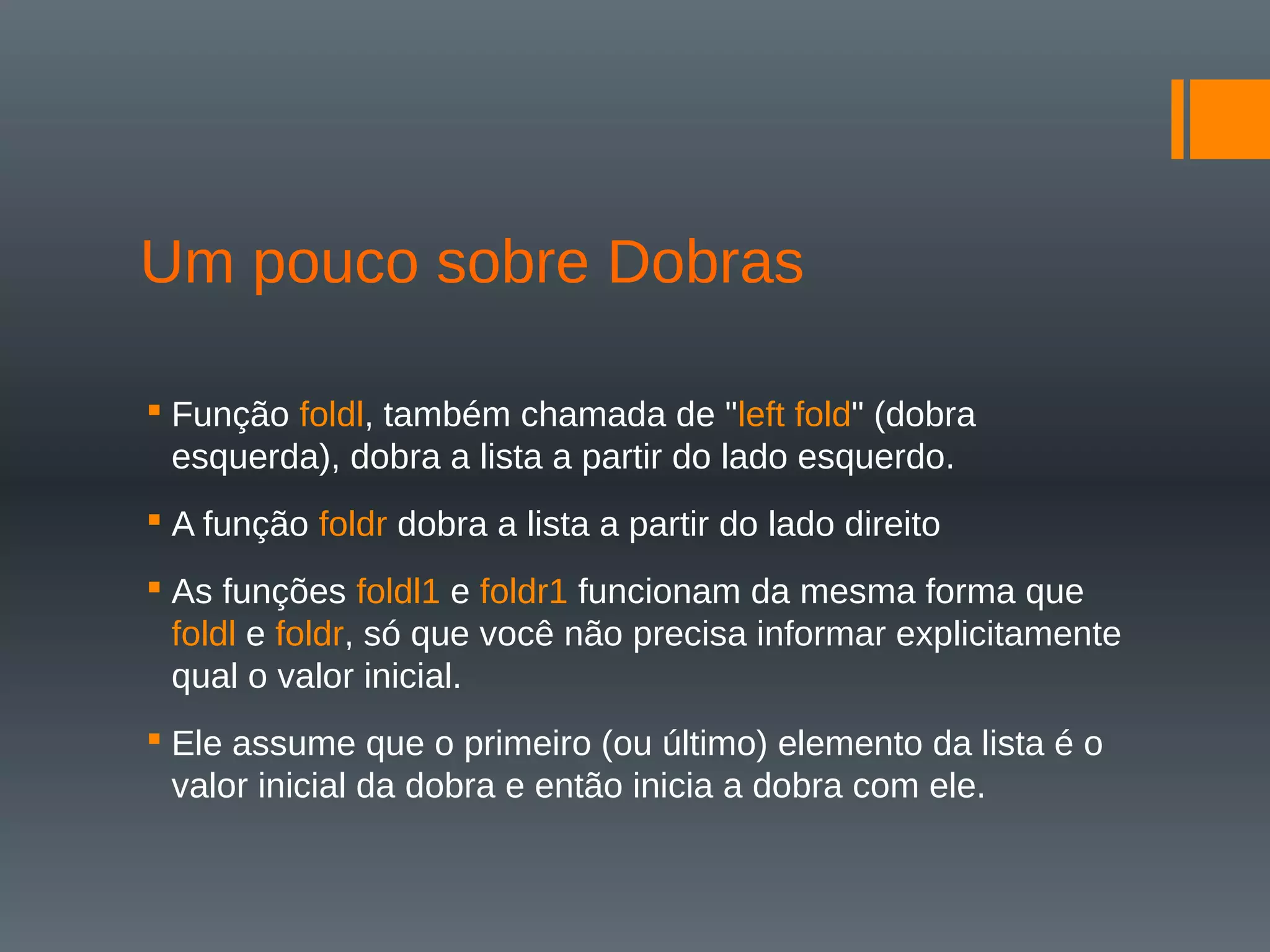
![Dobras em Haskell
foldr (+) 0 [1..10] valor inicial 0, 0 + 10 + ... 1
foldl (+) 0 [1..10] valor inicial 0, 0 + 0 + ... 10
foldr1 (+) [1..10] valor inical 10,10 + 9 + ... 1
foldl1 (+) [1..10] valor inical 1, 1 + 2 + ... 10](https://image.slidesharecdn.com/resoluolista2-150313223353-conversion-gate01/75/Resolucao-lista2-3-2048.jpg)
![Dobras em Haskell
Prelude> putStrLn $ foldr (x y -> concat ["(",x,"+",y,")"]) "0" (map show
[1..13])
(1+(2+(3+(4+(5+(6+(7+(8+(9+(10+(11+(12+(13+0)))))))))))))
Prelude> putStrLn $ foldl (x y -> concat ["(",x,"+",y,")"]) "0" (map show
[1..13])
(((((((((((((0+1)+2)+3)+4)+5)+6)+7)+8)+9)+10)+11)+12)+13)
Prelude> putStrLn $ foldr1 (x y -> concat ["(",x,"+",y,")"]) (map show [1..13])
(1+(2+(3+(4+(5+(6+(7+(8+(9+(10+(11+(12+13))))))))))))
Prelude> putStrLn $ foldl1 (x y -> concat ["(",x,"+",y,")"]) (map show [1..13])
((((((((((((1+2)+3)+4)+5)+6)+7)+8)+9)+10)+11)+12)+13)](https://image.slidesharecdn.com/resoluolista2-150313223353-conversion-gate01/75/Resolucao-lista2-4-2048.jpg)
![Dobras em Haskell
Prelude> foldr (x y->x:'.':y) "" []:"CRIS":[]
["",“CRIS"]
Prelude> foldr (x y->x:'.':y) "" "CRIS":[]
[“C.R.I.S."]
Prelude> foldr (x y->x:'.':y) "" "CRIS"
“C.R.I.S."
Prelude> foldr (x y->x:'.':y) "" [‘c']:“CRIS":[]
["a.",“CRIS"]](https://image.slidesharecdn.com/resoluolista2-150313223353-conversion-gate01/75/Resolucao-lista2-5-2048.jpg)
![1° QUESTÃO
--1° NIVEL 3
Prelude> length (filter (/='a') "banana")
3
Prelude> length (filter (/='n') "banana")
4
Prelude> length ([1,2]:[3,4]:[])
2
Prelude> length [1,3..7]
4
Prelude> length (drop 6 "abcdefg123")
4
Prelude> length ([1,2]:[3]:[])
2
Prelude> length [(x,y)| x<-"abc", y<-[0,1,2]]
9](https://image.slidesharecdn.com/resoluolista2-150313223353-conversion-gate01/75/Resolucao-lista2-6-2048.jpg)
![1° QUESTÃO
--1° NIVEL 3
Prelude> head [n | n<-[1..], n*n>15]
44
Prelude> head [n | n<-[1..], n*n>20]
5
Prelude> head([]++[1,2]++[3])
1
Prelude> [x | x<- "ab", n<-[1,2,3]]
"aaabbb"
Prelude> map (`div` 2) [1,2,3]
[0,1,1]
Prelude> (reverse [3,2])++ [4,5]
[2,3,4,5]
Prelude> reverse ([4,5]++[1,2,3])
[3,2,1,5,4]](https://image.slidesharecdn.com/resoluolista2-150313223353-conversion-gate01/75/Resolucao-lista2-7-2048.jpg)
![1° QUESTÃO
--1° NIVEL 3
Prelude> :t ([1,2,3], "banana")
([1,2,3], "banana") :: Num t => ([t], [Char])
Prelude> :t [(1,"banana"), (2,"maçã")]
[(1,"banana"), (2,"maçã")] :: Num t => [(t, [Char])]](https://image.slidesharecdn.com/resoluolista2-150313223353-conversion-gate01/75/Resolucao-lista2-8-2048.jpg)
![2° QUESTÃO
--2° NIVEL 5
Prelude> foldr (-) (-2) [1,2,3,4]
-4
Prelude> foldr (-) (2) [1,2,3,4]
0
Prelude> foldl (-) (2) [1,2,3,4]
-8
Prelude> foldl (-) (-2) [1,2,3,4]
-12](https://image.slidesharecdn.com/resoluolista2-150313223353-conversion-gate01/75/Resolucao-lista2-9-2048.jpg)
![3° QUESTÃO
--3° NIVEL 6
Prelude> foldr (+) 2 (map (+1) [1,2,3])
11
Prelude> foldl (+) 2 (map (+1) [1,2,3])
11
Prelude> foldr (-) 2 (map ((-)1) [1,2,2])
-2
Prelude> foldl (-) 2 (map ((-)1) [1,2,2])
4
Prelude> foldr(x y->x:'.':y) "" "PAULO"
"P.A.U.L.O.“
Prelude> foldl(x y->x:'.':y) "" "ITALOS"
--ERRO](https://image.slidesharecdn.com/resoluolista2-150313223353-conversion-gate01/75/Resolucao-lista2-10-2048.jpg)
![4° QUESTÃO
--4° NIVEL 7
Prelude> foldl (+) 0 (filter (>1) [sum(map ((-)1) [1,2,2])])
0
Prelude> sum(map (-1) [1,2,2])
--ERRO
Prelude> [map (>2) [1,2,3]] ++ ([]) ++ [[True]]
[[False,False,True],[True]]
Prelude> [map (>2) [1,6,6]] ++ ([]) ++ [[]]
[[False,True,True],[]]
Prelude> [map (>2) [-1, 2,4]] ++([])
[[False,False,True]]](https://image.slidesharecdn.com/resoluolista2-150313223353-conversion-gate01/75/Resolucao-lista2-11-2048.jpg)
![5° QUESTÃO
--5° NIVEL MASTER PROIBIDO PARA MENORES DE 18 ANOS.
Prelude> foldr1 (-) [4,3,2]
3
Prelude> foldl1 (-) [-2,3,4]
-9](https://image.slidesharecdn.com/resoluolista2-150313223353-conversion-gate01/75/Resolucao-lista2-12-2048.jpg)

O documento discute dobras em Haskell usando as funções foldl, foldr, foldl1 e foldr1. Explica que foldl dobra da esquerda para a direita enquanto foldr dobra da direita para a esquerda. Apresenta exemplos mostrando como essas funções dobram listas e como lidam com valores iniciais.


