HASKELL
Por quê
Haskell?
Por quê Haskell?
Programação funcional conquista a indústria
Por quê Haskell?
Haskell: exemplo mais puro de
(um certo estilo bem poderoso de)
programação funcional
Características
Linguagem funcional pura
● Variáveis imutáveis
● Definições ao invés de atribuições
● Similar à matemática
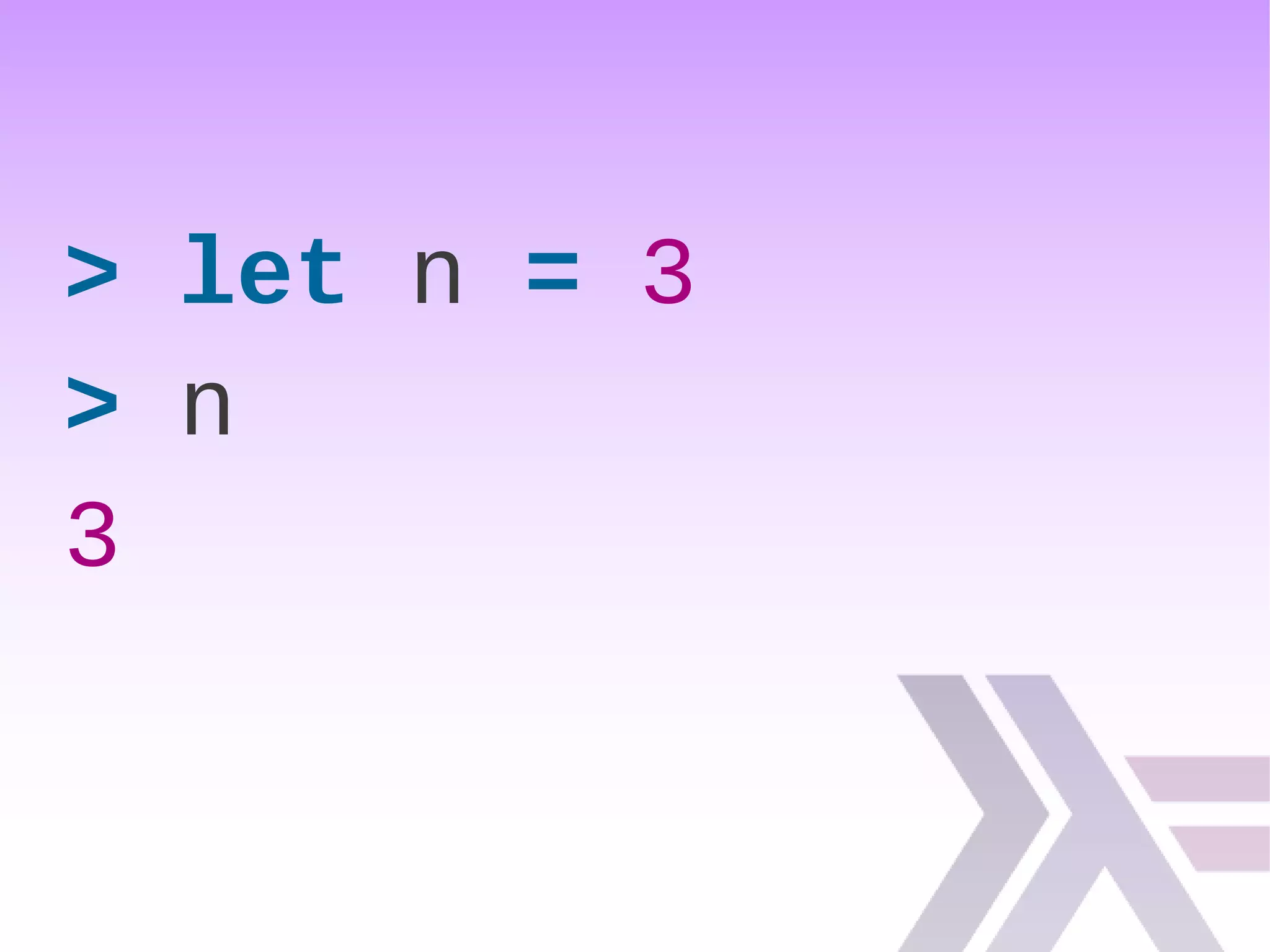
> let n = 3
> n
3
Linguagem funcional pura
● Funções são “cidadãs de primeira classe.”
● Lambdas (funções anônimas).
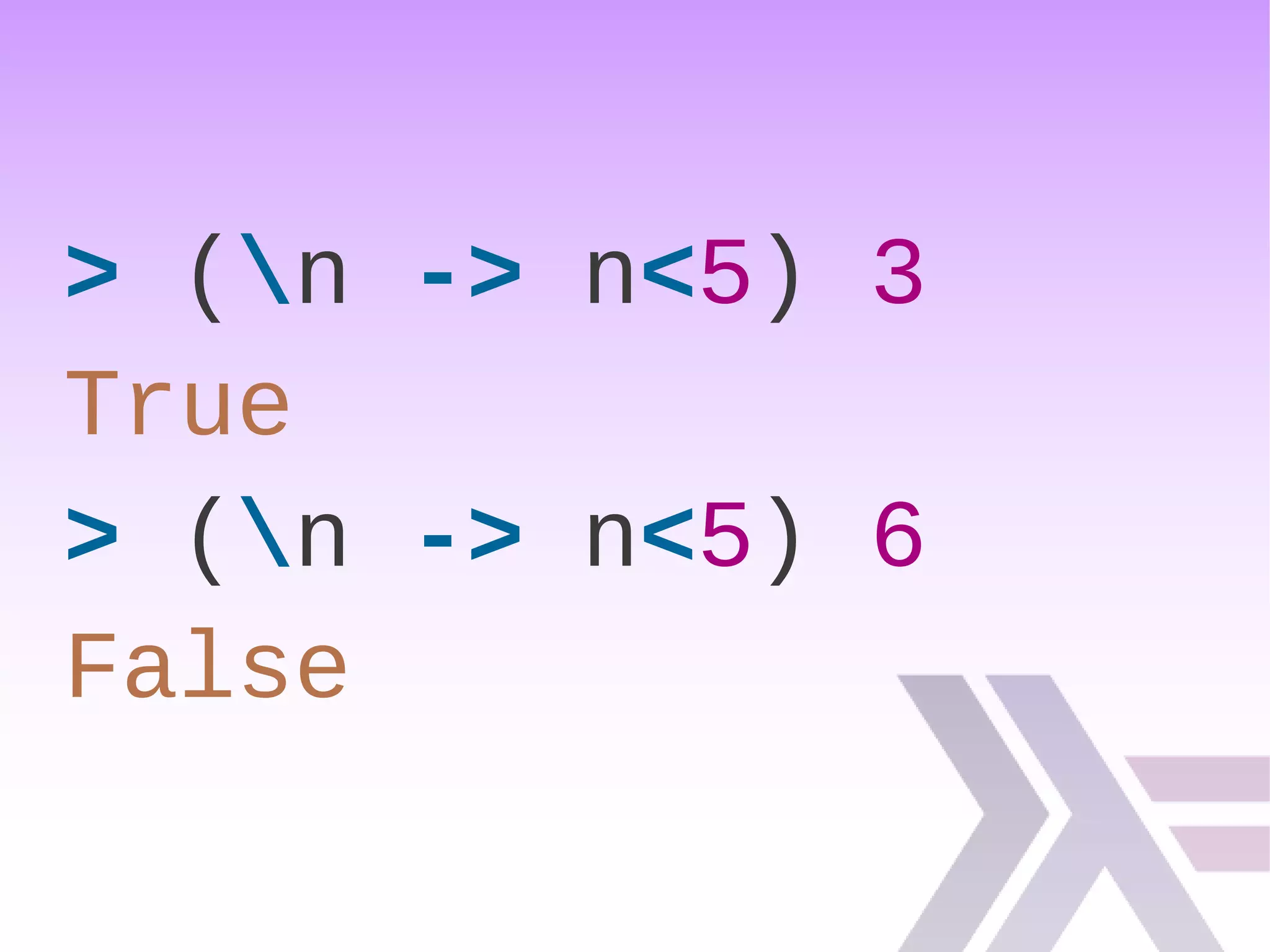
> (n -> n<5) 3
True
> (n -> n<5) 6
False
Linguagem funcional pura
● Funções podem ser passadas como
argumentos.
> let less n p = n < p
> let lessThan5 n = less n 5
> filter lessThan5 [1,2,3,4,5,6]
[1,2,3,4]
Linguagem funcional pura
● Funções podem ser retornadas… em certo
sentido.
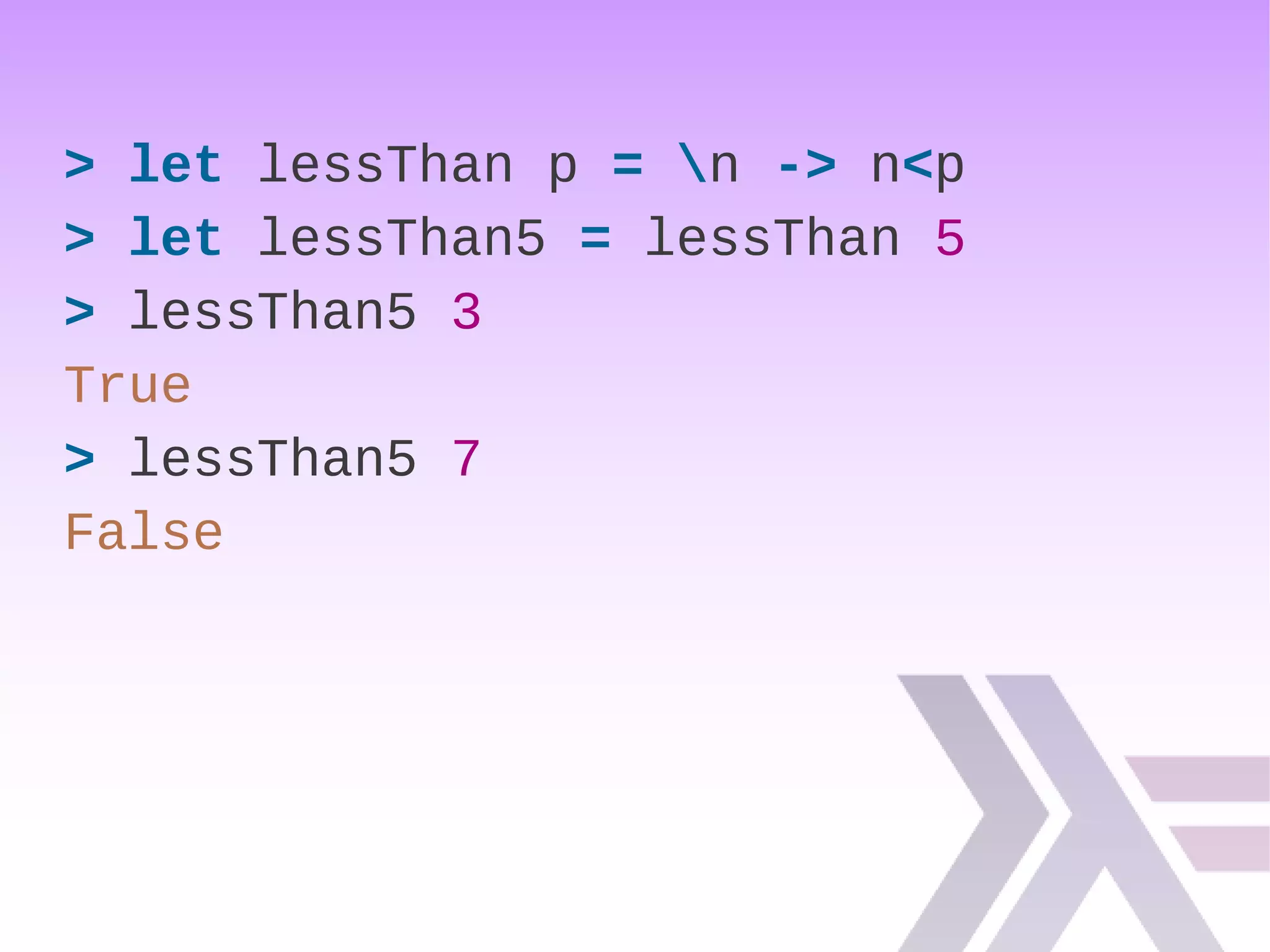
> let lessThan p = n -> n<p
> let lessThan5 = lessThan 5
> lessThan5 3
True
> lessThan5 7
False
Linguagem funcional pura
● Currying: passar menos argumentos à chamada
resulta em uma nova função.
> let isPositive = less 0
> let positives = filter isPositive
> positives [1,-1,0,-2,4,-8]
[1,4]
Linguagem funcional pura
● Operadores são funções.
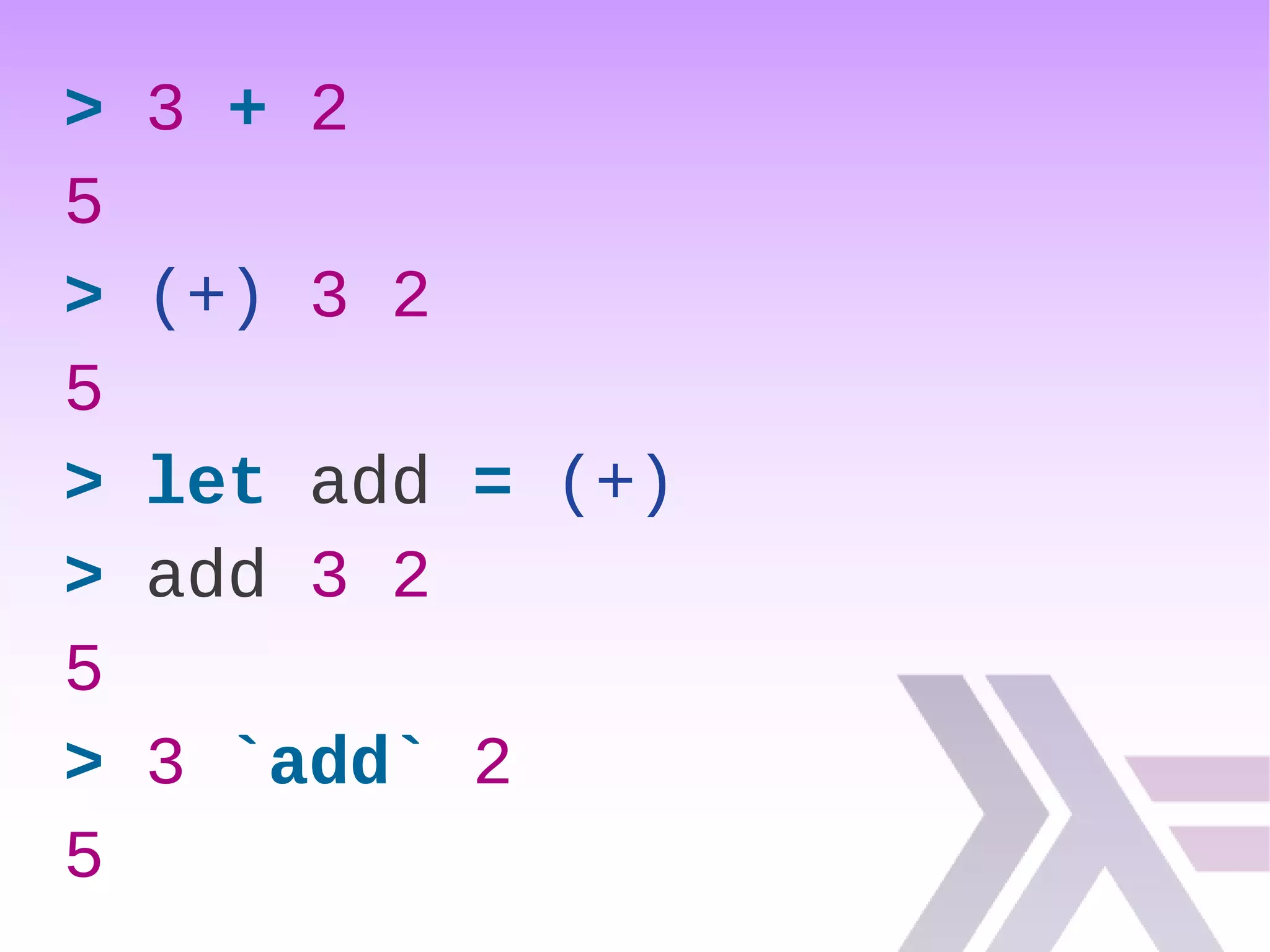
> 3 + 2
5
> (+) 3 2
5
> let add = (+)
> add 3 2
5
> 3 `add` 2
5
Linguagem funcional pura
● Sem efeitos colaterais.
● Variáveis não mudam
● Mas definições podem mudar em escopos
diferentes
● let cria escopos.
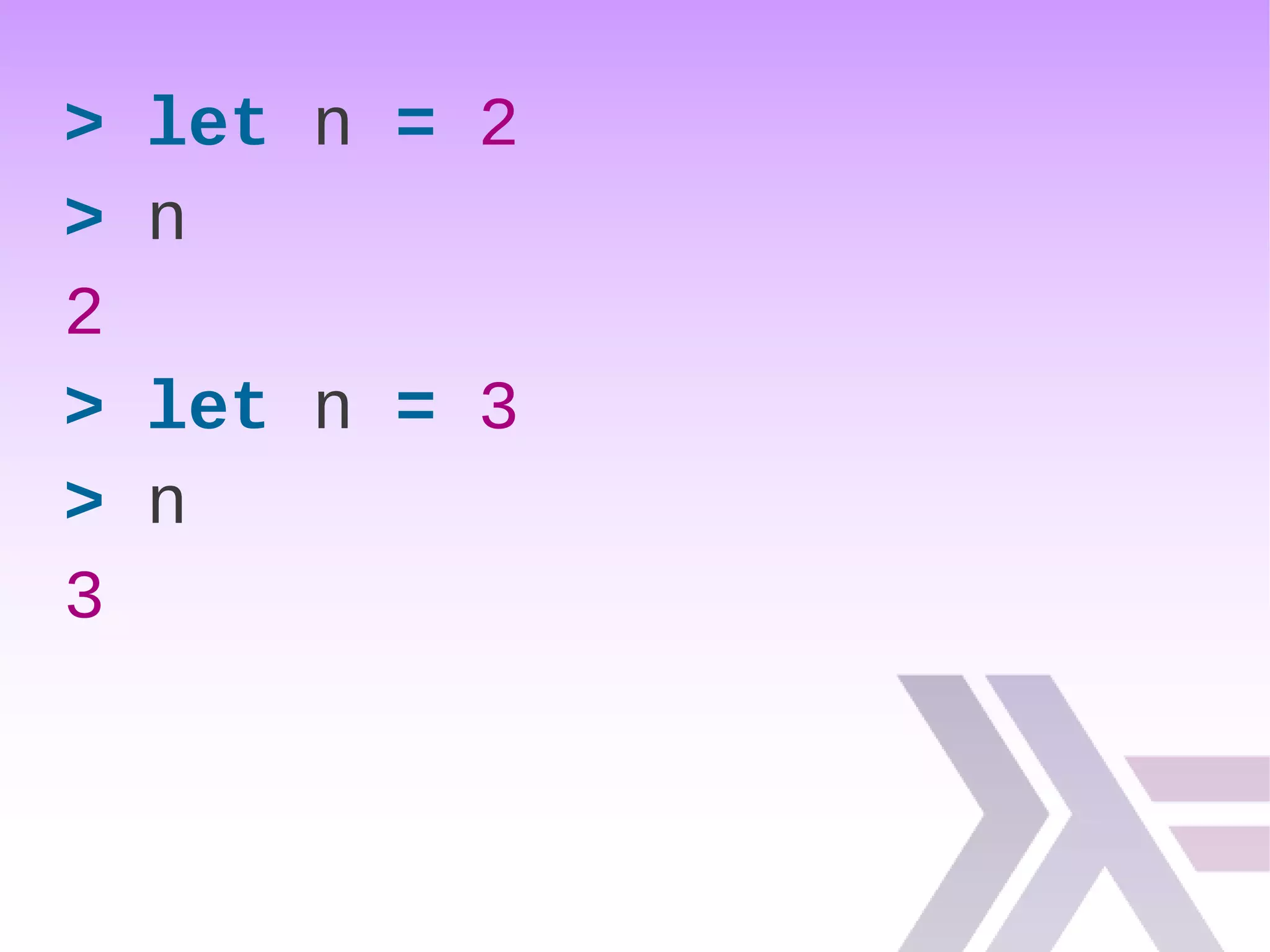
> let n = 2
> n
2
> let n = 3
> n
3
Linguagem funcional pura
● Descrição, mas não execução, de operações
entrada e saída.
● Execução de operações de entrada e saída fica
a cargo do runtime.
● Operações de entrada e saída são descritas
pelo tipo IO, que é uma...
MÔNADA
Mônadas
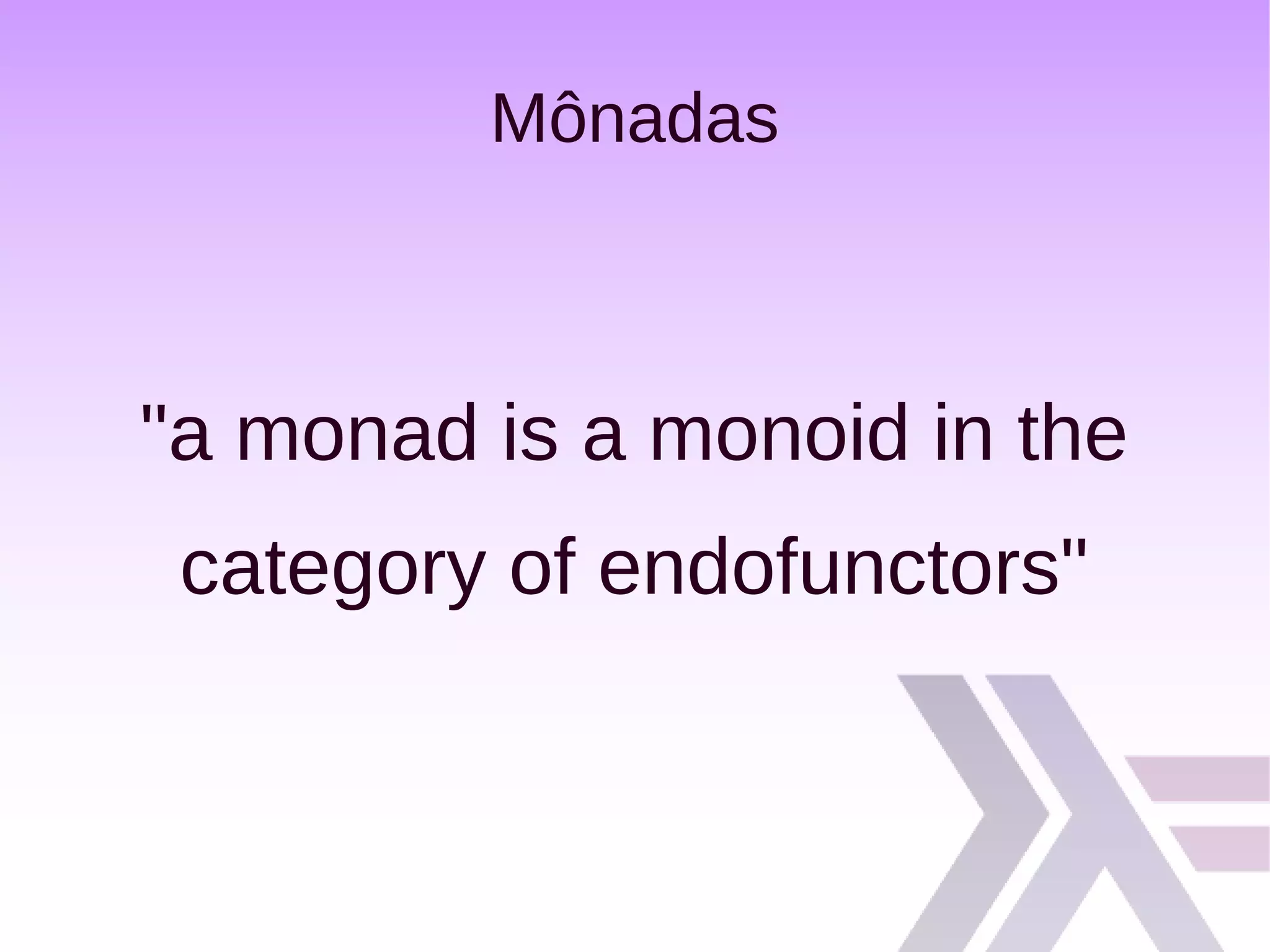
"a monad is a monoid in the
category of endofunctors"
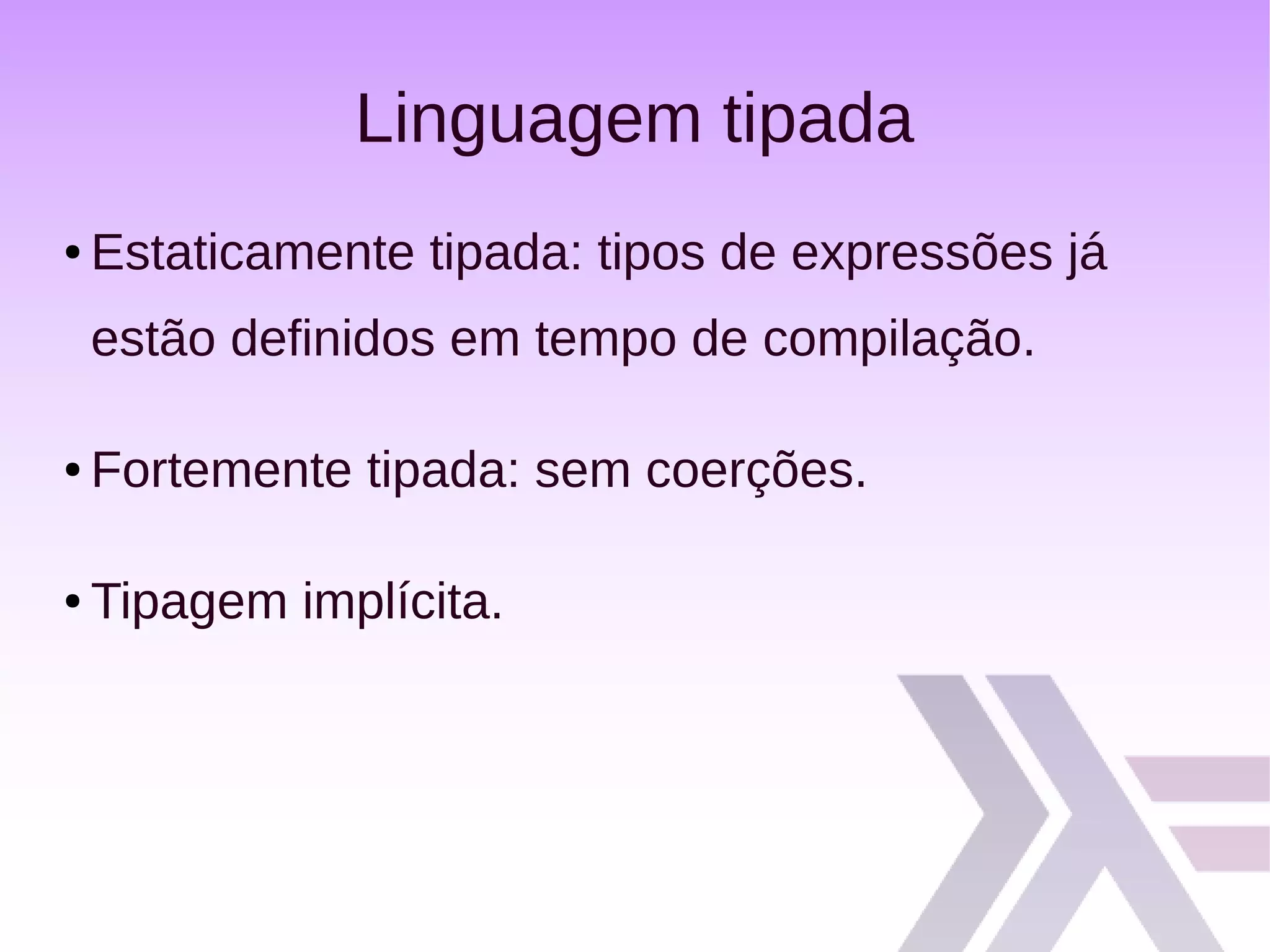
Linguagem tipada
● Estaticamente tipada: tipos de expressões já
estão definidos em tempo de compilação.
● Fortemente tipada: sem coerções.
● Tipagem implícita.
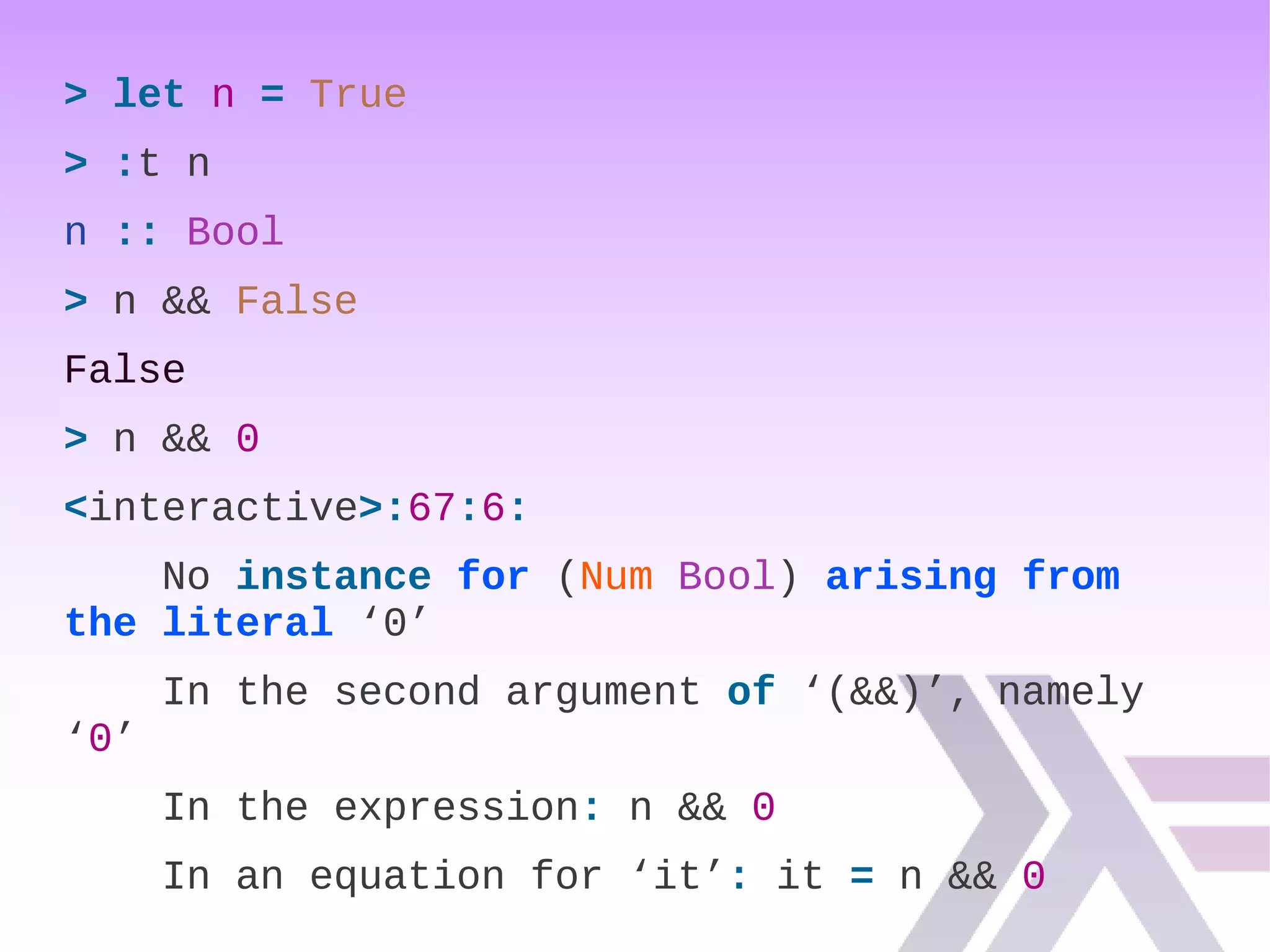
> let n = True
> :t n
n :: Bool
> n && False
False
> n && 0
<interactive>:67:6:
No instance for (Num Bool) arising from
the literal ‘0’
In the second argument of ‘(&&)’, namely
‘0’
In the expression: n && 0
In an equation for ‘it’: it = n && 0
Linguagem tipada
● Tipos de funções
● Tipos parametrizáveis
● Variáveis de tipo
> :t (&&)
(&&) :: Bool -> Bool -> Bool
> :t (&&) True
(&&) True :: Bool -> Bool
> :t filter
filter :: (a -> Bool) -> [a] -> [a]
> :t filter ((&&) True)
filter ((&&) True) :: [Bool] -> [Bool]
> let l = [True, False, False]
> :t l
l :: [Bool]
> let s = "Hello"
> :t s
s :: [Char]
> let m = Just True
> :t m
m :: Maybe Bool
> let t = (True, 'a', "one string")
> :t t
t :: (Bool, Char, [Char])
> :t [True]
[True] :: [Bool]
> :t []
[] :: [t]
> :t Just 'a'
Just 'a' :: Maybe Char
> :t Nothing
Nothing :: Maybe a
Linguagem preguiçosa
● Avaliação preguiçosa (“lazy evaluation”).
● Cálculo de valores é postergado até serem
realmente necessários.
> [1..5]
[1,2,3,4,5]
> let l = [1..]
> l !! 0
1
> l !! 5
6
> l !! 300000
300001
> length l
^CInterrupted.
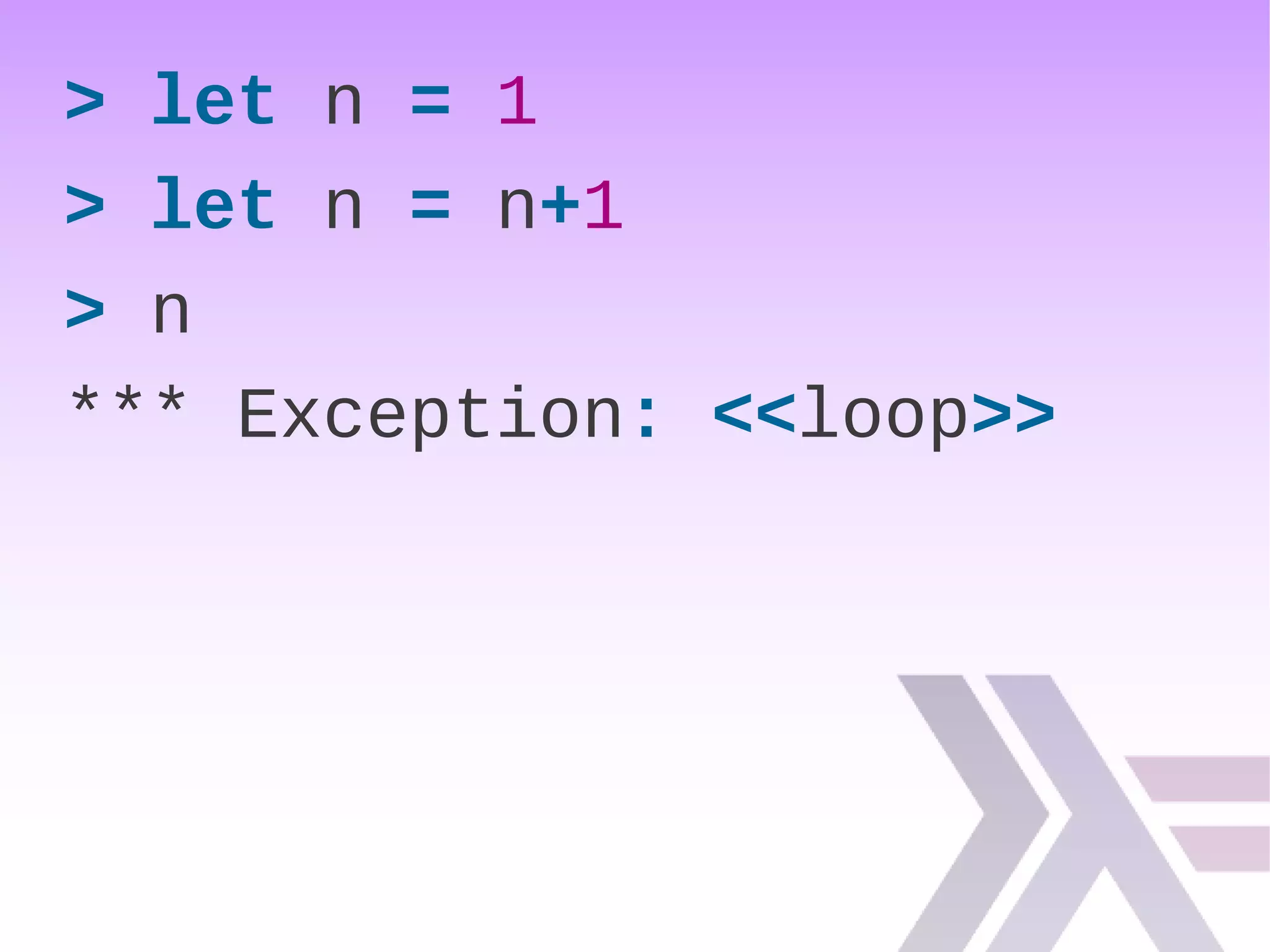
> let n = 1
> let n = n+1
> n
*** Exception: <<loop>>
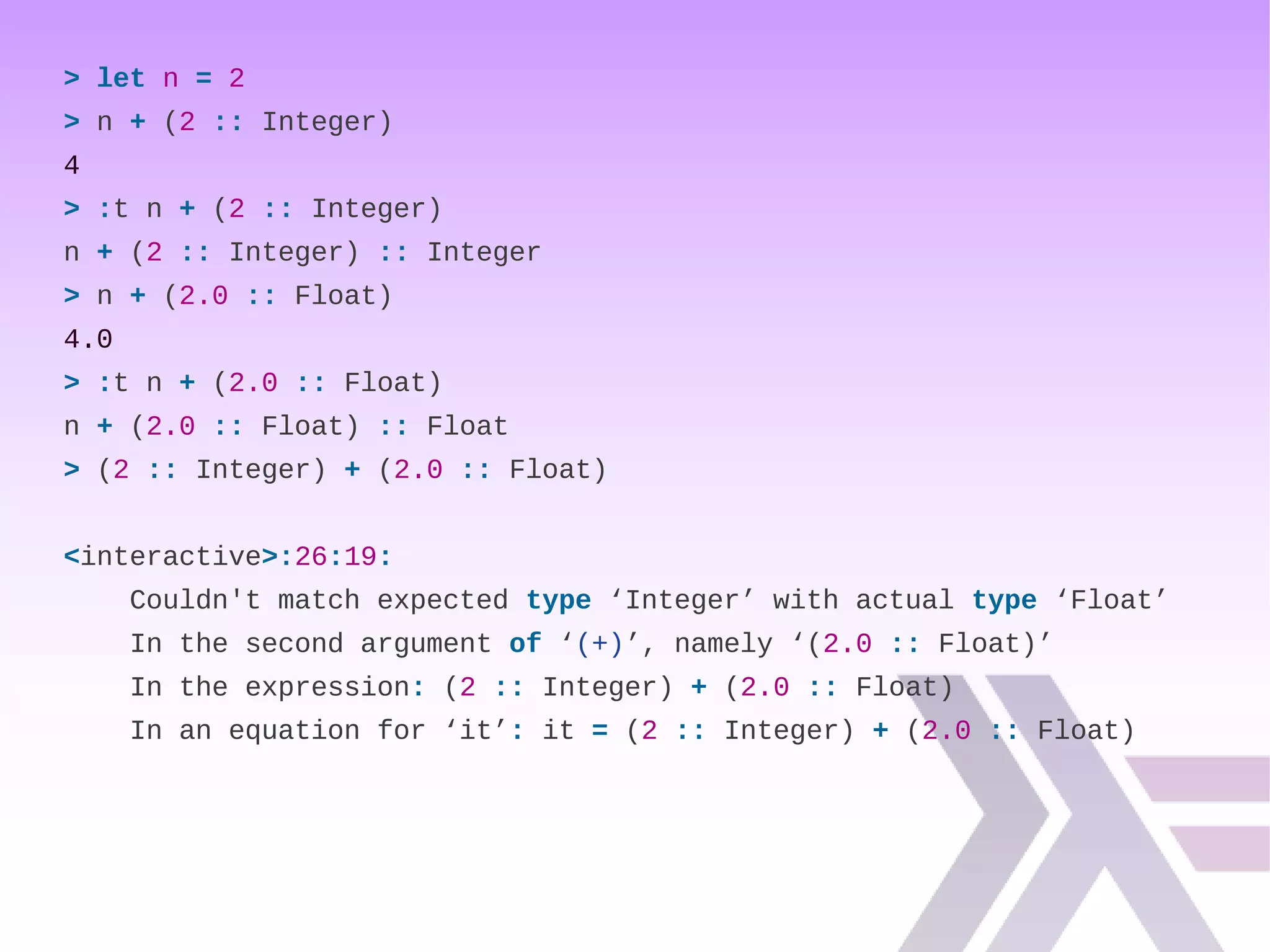
> let n = 2
> n + (2 :: Integer)
4
> :t n + (2 :: Integer)
n + (2 :: Integer) :: Integer
> n + (2.0 :: Float)
4.0
> :t n + (2.0 :: Float)
n + (2.0 :: Float) :: Float
> (2 :: Integer) + (2.0 :: Float)
<interactive>:26:19:
Couldn't match expected type ‘Integer’ with actual type ‘Float’
In the second argument of ‘(+)’, namely ‘(2.0 :: Float)’
In the expression: (2 :: Integer) + (2.0 :: Float)
In an equation for ‘it’: it = (2 :: Integer) + (2.0 :: Float)
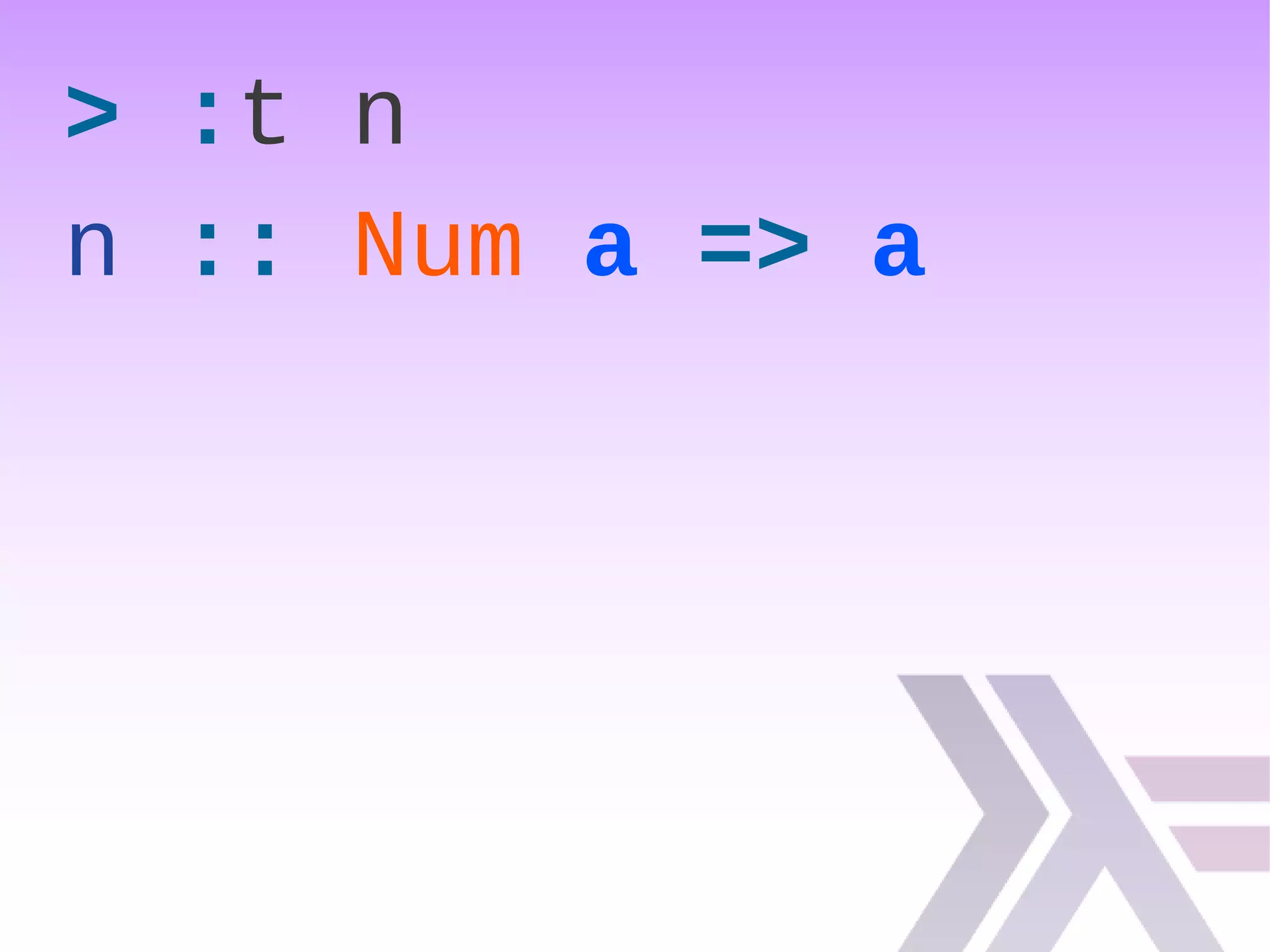
> :t n
n :: Num a => a
> [1..] !! 100
101
> zipWith (+) [1, 2, 3] [2, 4, 1]
[3,6,4]
> 1 : []
[1]
> 1 : [2, 3, 4]
[1,2,3,4]
> let what = 1 : zipWith (*) what [1..]
> what !! 0
1
> what !! 1
1
> what !! 2
2
> let what = 1 : zipWith (*) what [1..]
> what !! 0
1
> what !! 1
1
> what !! 2
2
> what !! 3
6
> what !! 4
24
> what !! 5
120
> what !! 6
720
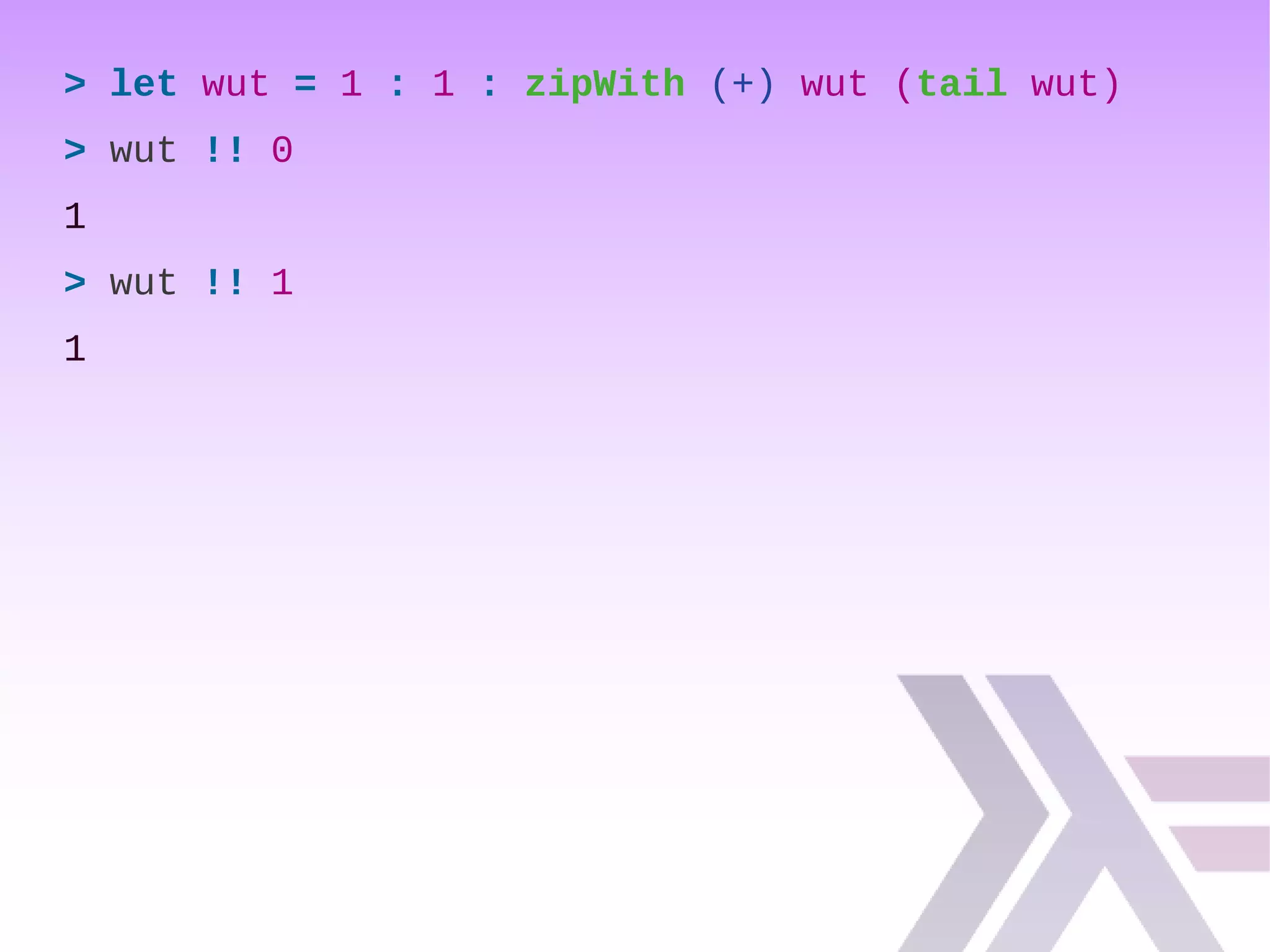
> let wut = 1 : 1 : zipWith (+) wut (tail wut)
> wut !! 0
1
> wut !! 1
1
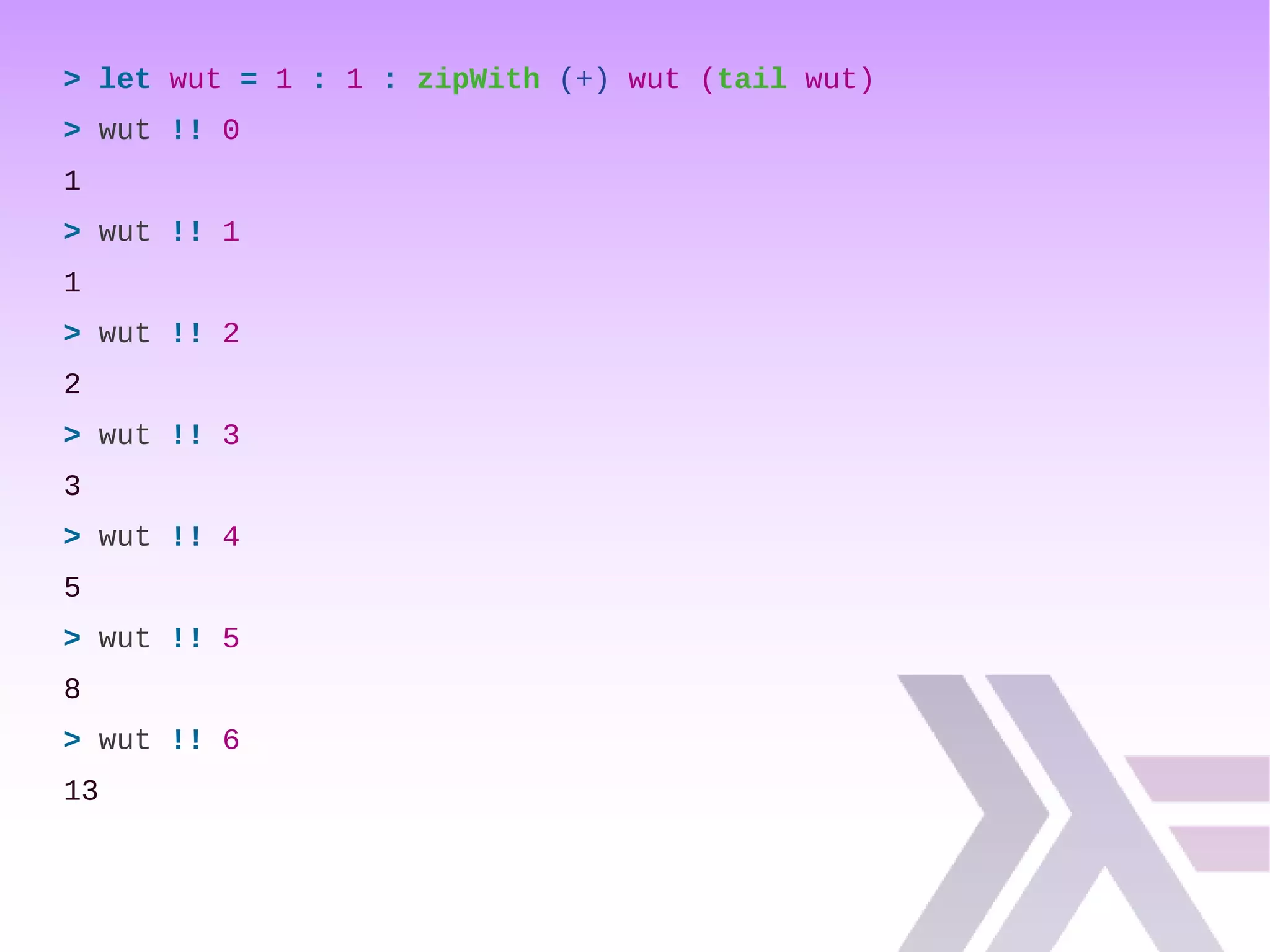
> let wut = 1 : 1 : zipWith (+) wut (tail wut)
> wut !! 0
1
> wut !! 1
1
> wut !! 2
2
> wut !! 3
3
> wut !! 4
5
> wut !! 5
8
> wut !! 6
13
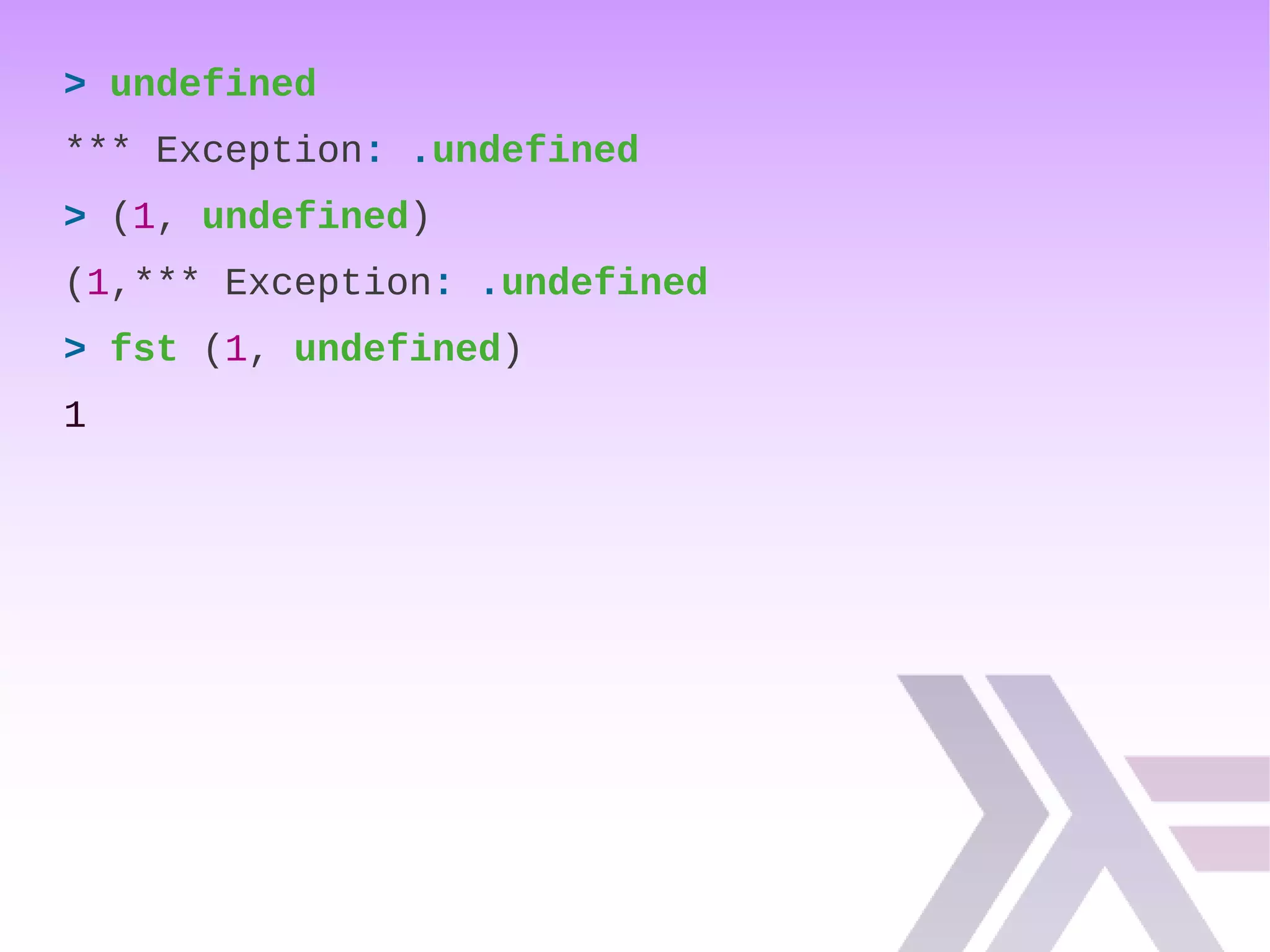
> undefined
*** Exception: .undefined
> (1, undefined)
(1,*** Exception: .undefined
> fst (1, undefined)
1
Linguagem fortemente tipada
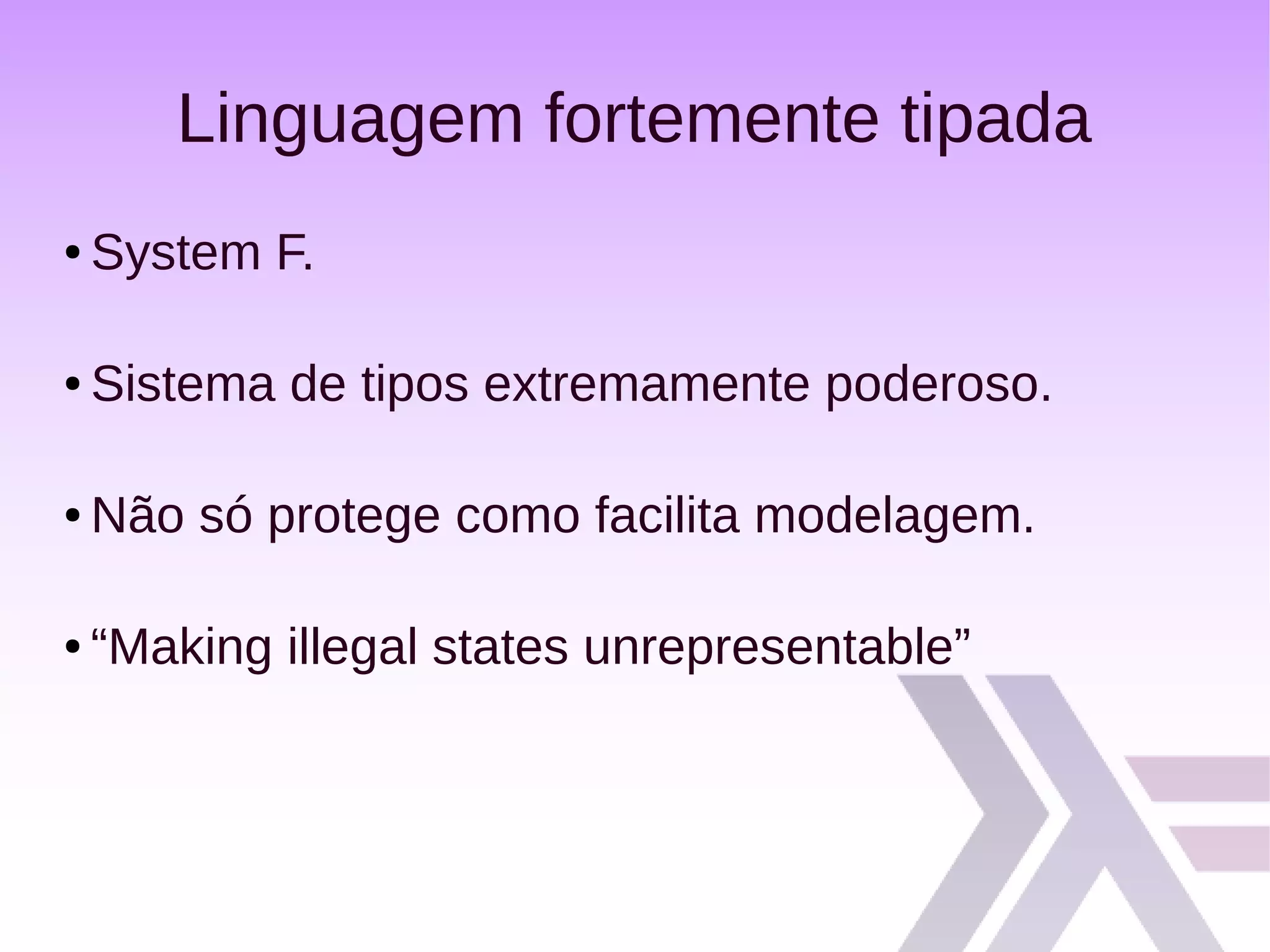
● System F.
● Sistema de tipos extremamente poderoso.
● Não só protege como facilita modelagem.
● “Making illegal states unrepresentable”
Linguagem fortemente tipada
● Sum types
● Product types
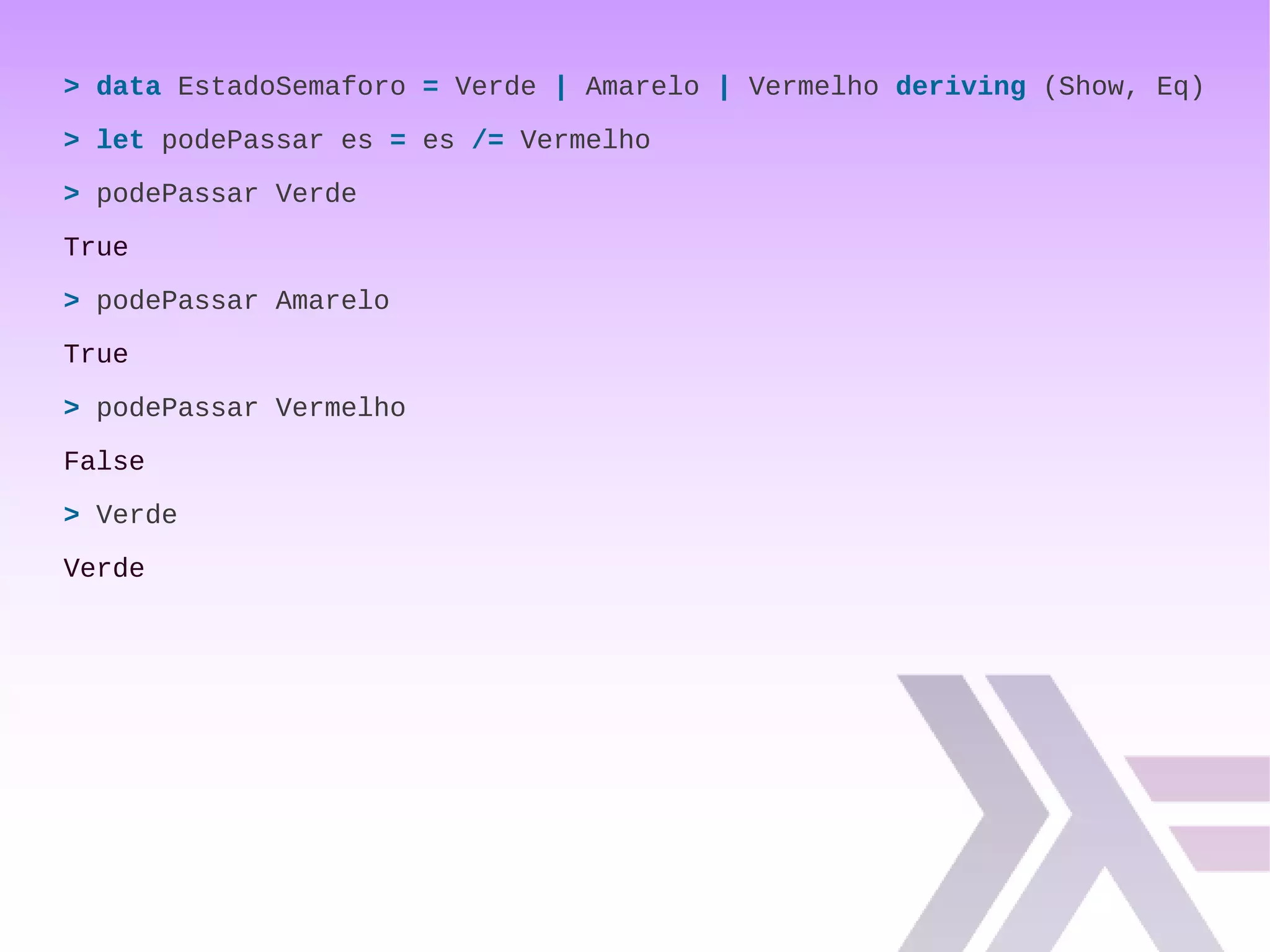
> data EstadoSemaforo = Verde | Amarelo | Vermelho deriving (Show, Eq)
> let podePassar es = es /= Vermelho
> podePassar Verde
True
> podePassar Amarelo
True
> podePassar Vermelho
False
> Verde
Verde
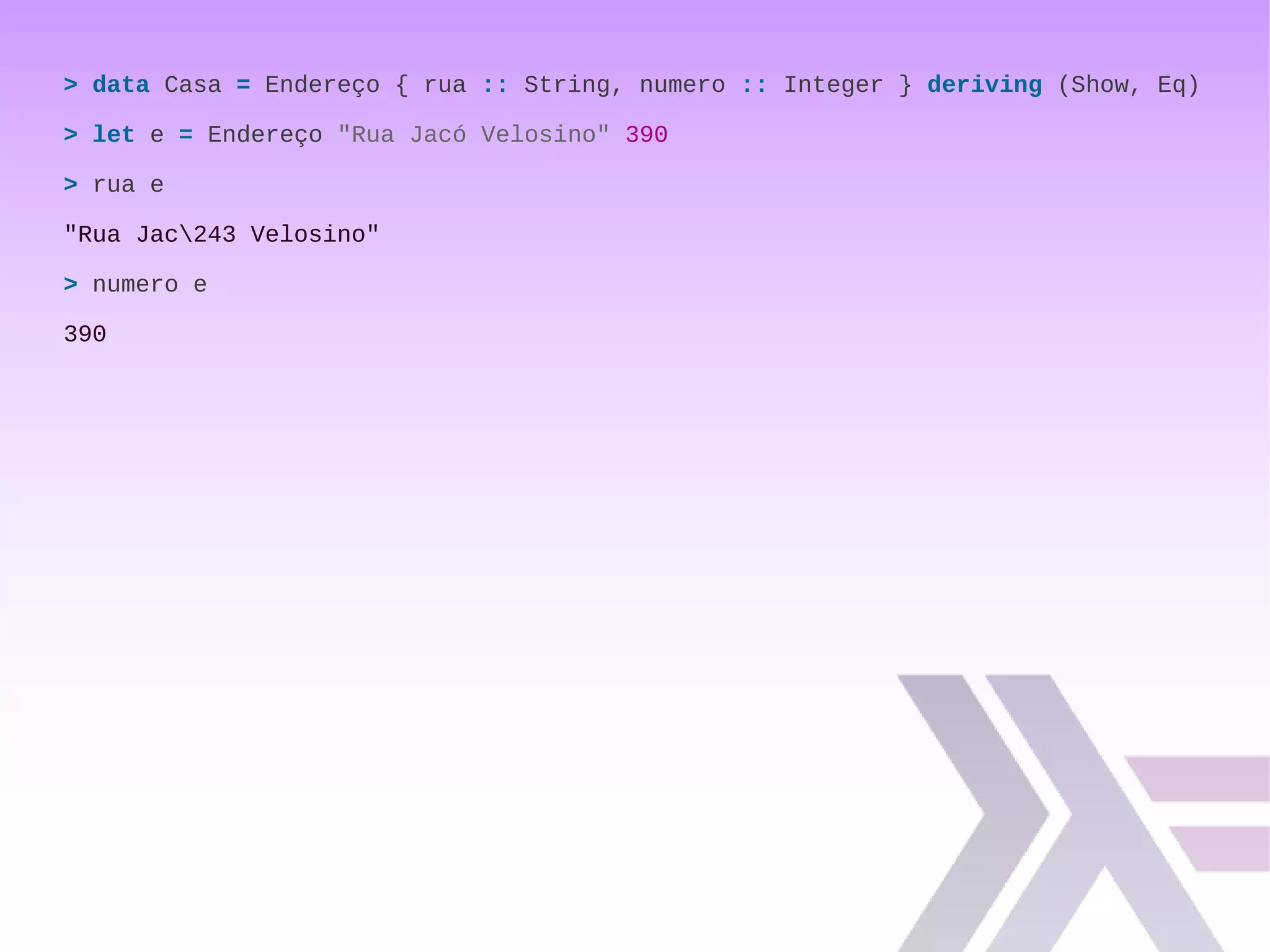
> data Casa = Endereço { rua :: String, numero :: Integer } deriving (Show, Eq)
> let e = Endereço "Rua Jacó Velosino" 390
> rua e
"Rua Jac243 Velosino"
> numero e
390
data Maybe a = Just a | Nothing
data Either a b = Left a | Right b
data [a] = [] | a : [a]
Controle de fluxo
● If then else
● Pattern matching
● Guardians
● Recursão
● Folding/mapping/filtering etc.
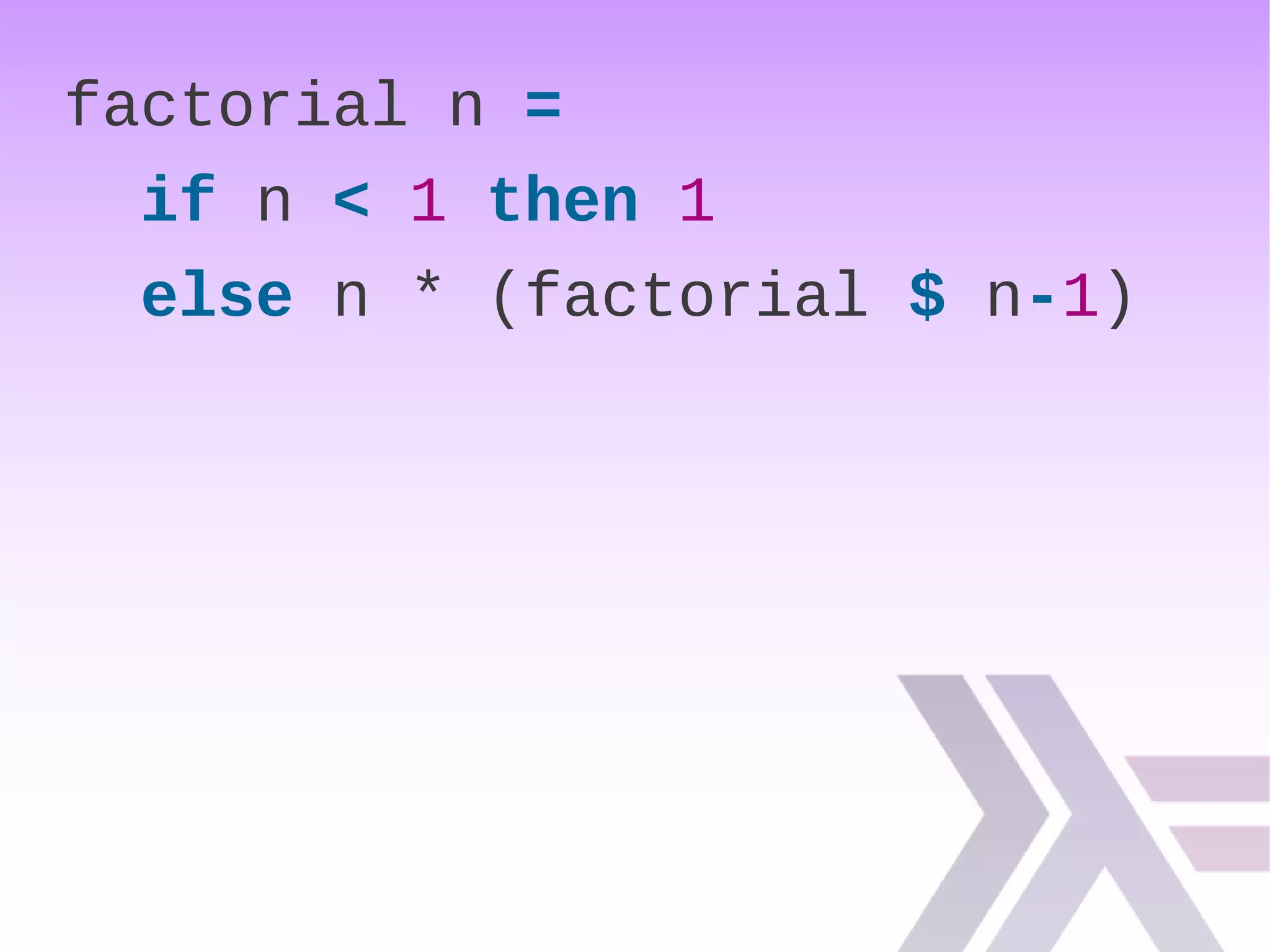
factorial n =
if n < 1 then 1
else n * (factorial $ n-1)
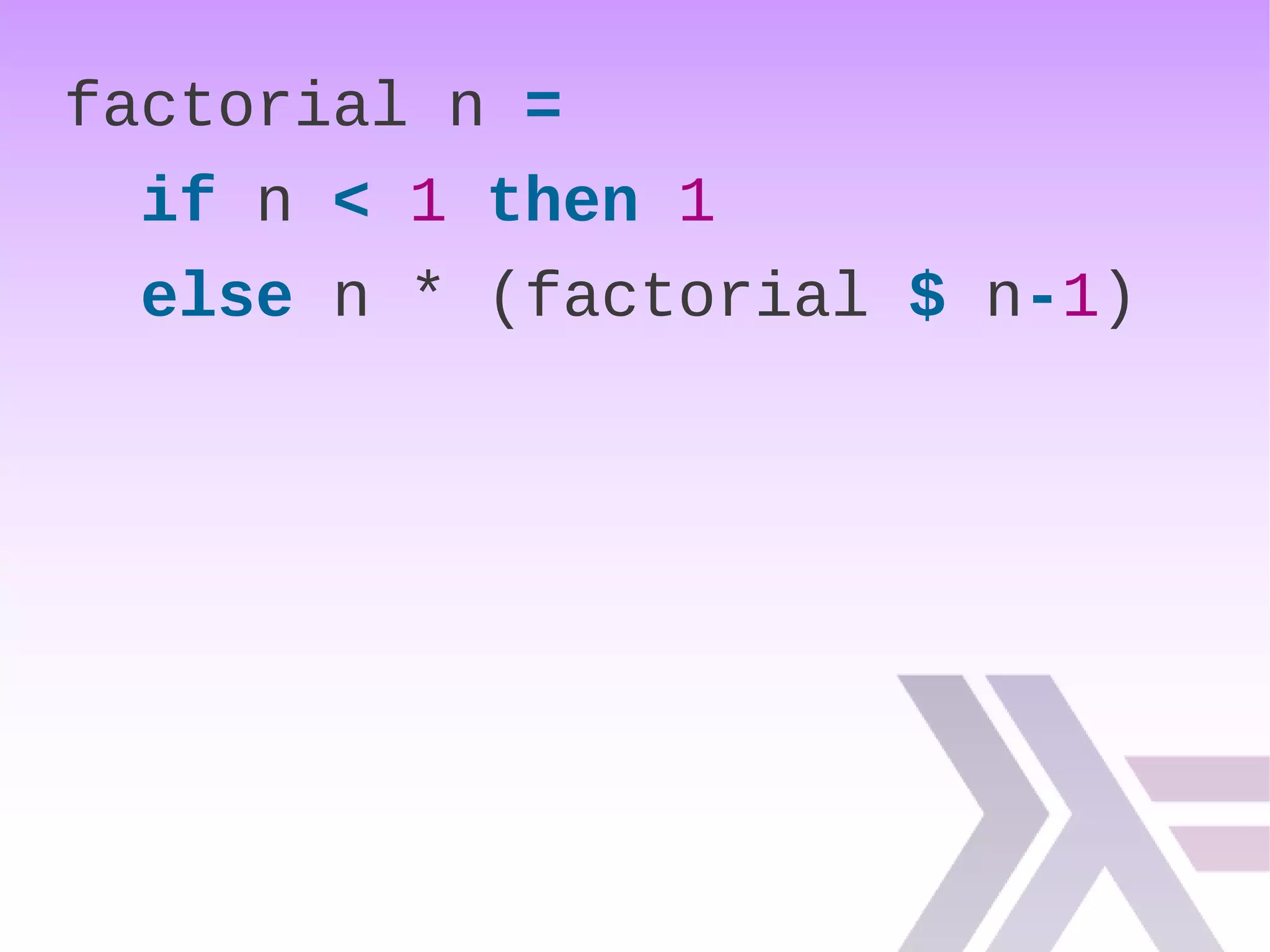
factorial n =
if n < 1 then 1
else n * (factorial $ n-1)
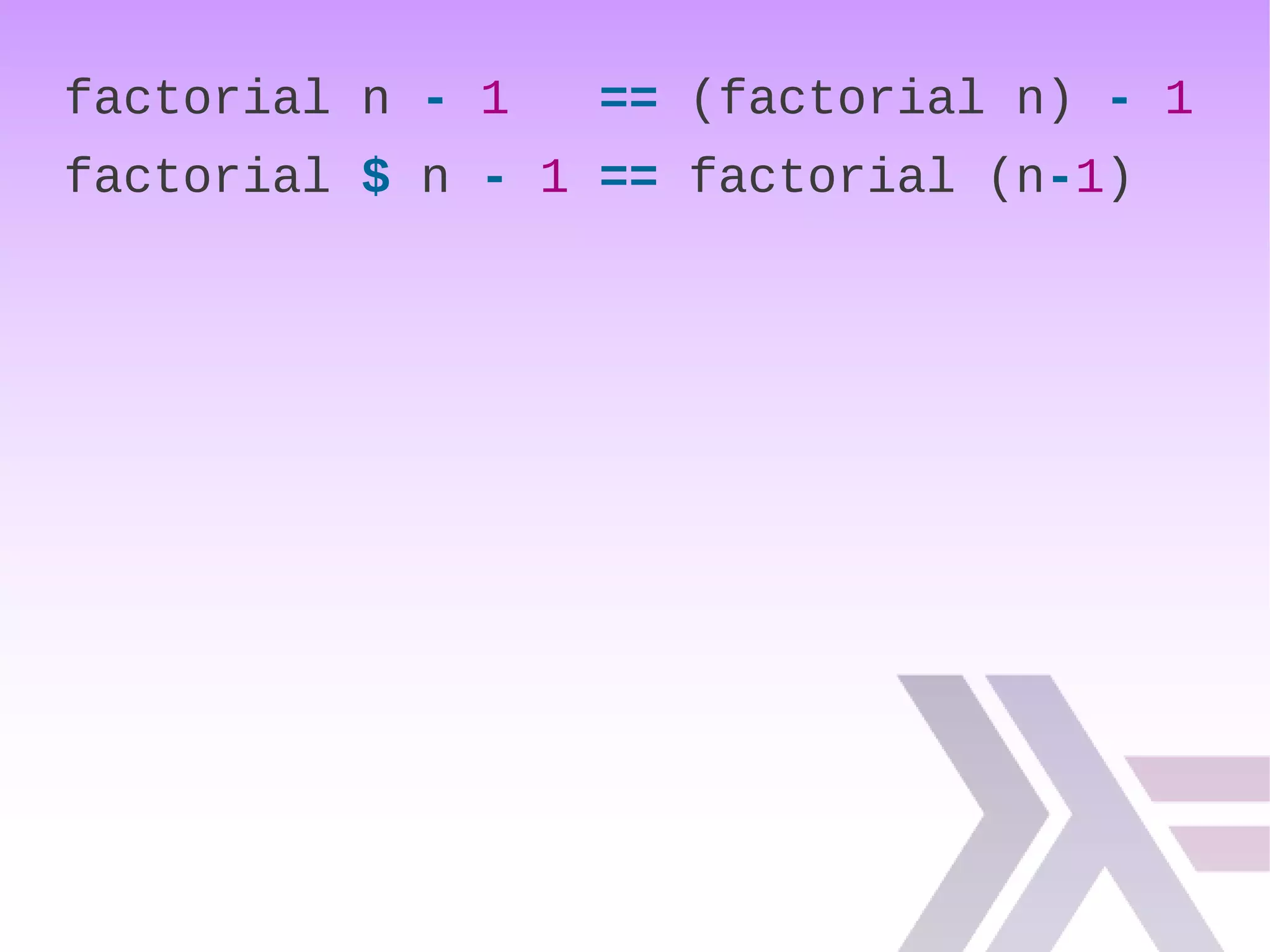
factorial n - 1 == (factorial n) - 1
factorial $ n - 1 == factorial (n-1)
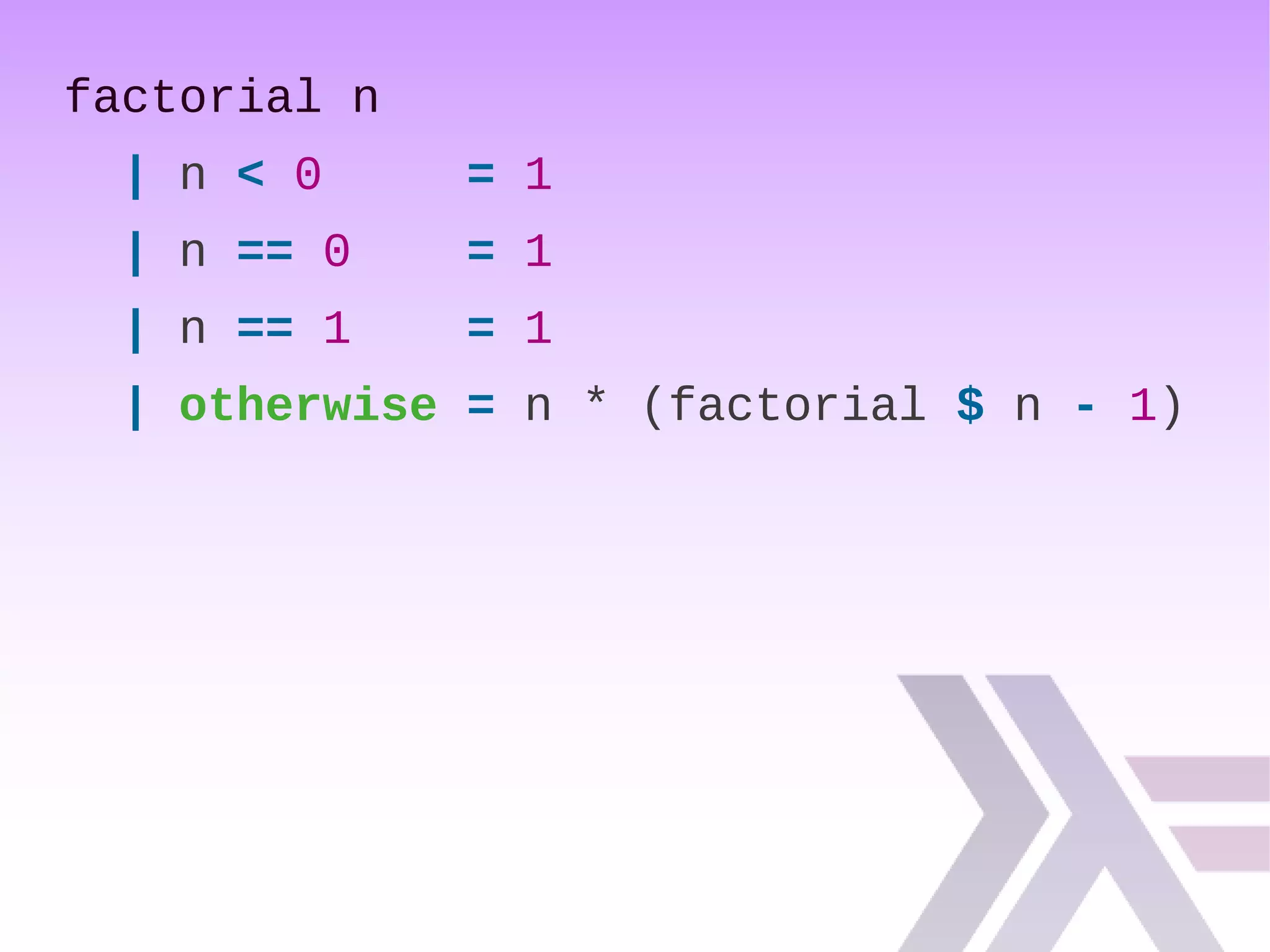
factorial n
| n < 0 = 1
| n == 0 = 1
| n == 1 = 1
| otherwise = n * (factorial $ n - 1)
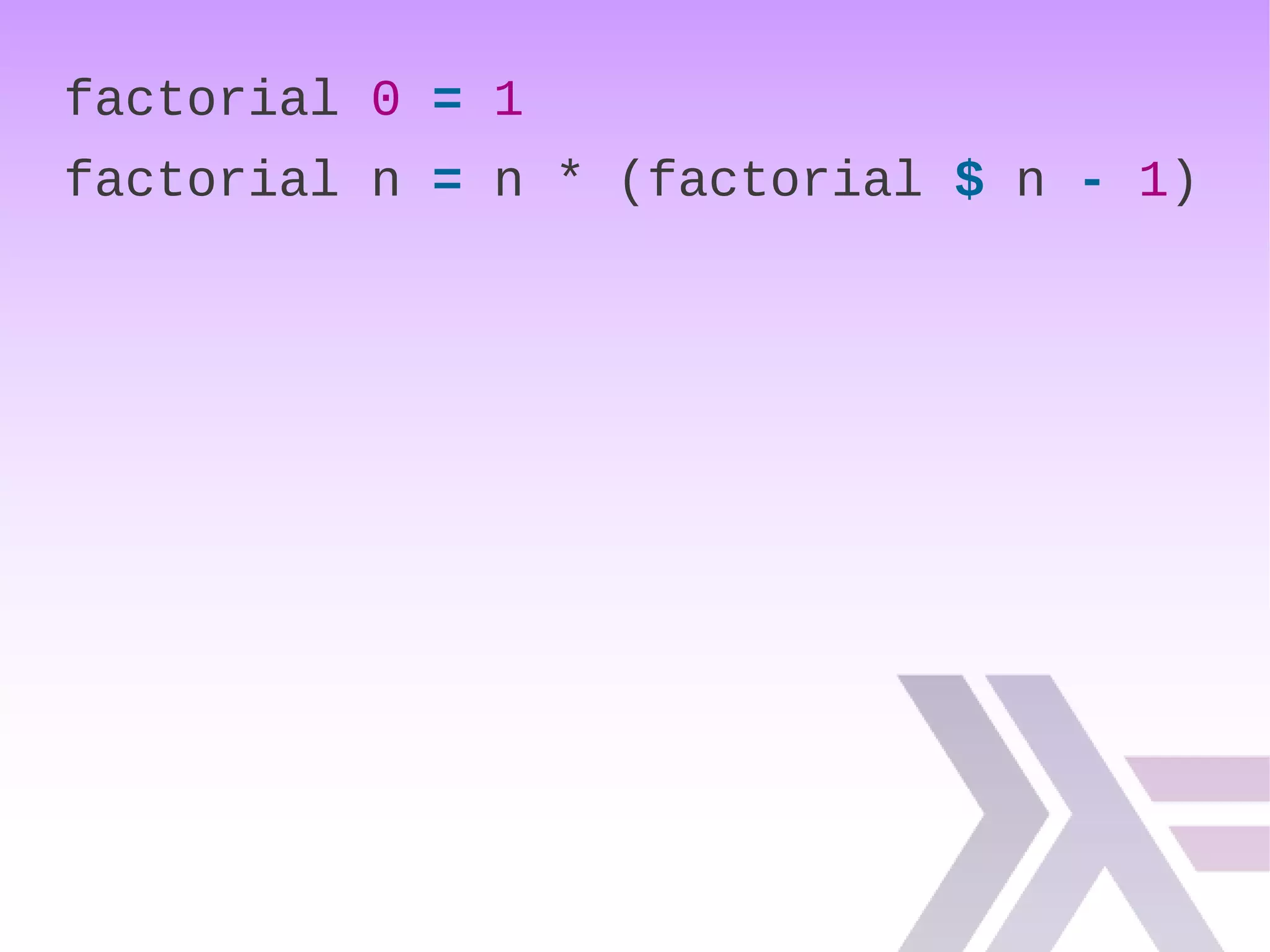
factorial 0 = 1
factorial n = n * (factorial $ n - 1)
factorial n =
foldl (*) 1 [1..n]
flist = 1 : zipWith (*) flist [1..]
factorial n = flist !! n

Haskell

  • 1.
  • 2.
  • 3.
    Por quê Haskell? Programaçãofuncional conquista a indústria
  • 4.
    Por quê Haskell? Haskell:exemplo mais puro de (um certo estilo bem poderoso de) programação funcional
  • 5.
  • 6.
    Linguagem funcional pura ●Variáveis imutáveis ● Definições ao invés de atribuições ● Similar à matemática
  • 7.
    > let n= 3 > n 3
  • 8.
    Linguagem funcional pura ●Funções são “cidadãs de primeira classe.” ● Lambdas (funções anônimas).
  • 9.
    > (n ->n<5) 3 True > (n -> n<5) 6 False
  • 10.
    Linguagem funcional pura ●Funções podem ser passadas como argumentos.
  • 11.
    > let lessn p = n < p > let lessThan5 n = less n 5 > filter lessThan5 [1,2,3,4,5,6] [1,2,3,4]
  • 12.
    Linguagem funcional pura ●Funções podem ser retornadas… em certo sentido.
  • 13.
    > let lessThanp = n -> n<p > let lessThan5 = lessThan 5 > lessThan5 3 True > lessThan5 7 False
  • 14.
    Linguagem funcional pura ●Currying: passar menos argumentos à chamada resulta em uma nova função.
  • 15.
    > let isPositive= less 0 > let positives = filter isPositive > positives [1,-1,0,-2,4,-8] [1,4]
  • 16.
    Linguagem funcional pura ●Operadores são funções.
  • 17.
    > 3 +2 5 > (+) 3 2 5 > let add = (+) > add 3 2 5 > 3 `add` 2 5
  • 18.
    Linguagem funcional pura ●Sem efeitos colaterais. ● Variáveis não mudam ● Mas definições podem mudar em escopos diferentes ● let cria escopos.
  • 19.
    > let n= 2 > n 2 > let n = 3 > n 3
  • 20.
    Linguagem funcional pura ●Descrição, mas não execução, de operações entrada e saída. ● Execução de operações de entrada e saída fica a cargo do runtime. ● Operações de entrada e saída são descritas pelo tipo IO, que é uma...
  • 21.
  • 23.
    Mônadas "a monad isa monoid in the category of endofunctors"
  • 24.
    Linguagem tipada ● Estaticamentetipada: tipos de expressões já estão definidos em tempo de compilação. ● Fortemente tipada: sem coerções. ● Tipagem implícita.
  • 25.
    > let n= True > :t n n :: Bool > n && False False > n && 0 <interactive>:67:6: No instance for (Num Bool) arising from the literal ‘0’ In the second argument of ‘(&&)’, namely ‘0’ In the expression: n && 0 In an equation for ‘it’: it = n && 0
  • 26.
    Linguagem tipada ● Tiposde funções ● Tipos parametrizáveis ● Variáveis de tipo
  • 27.
    > :t (&&) (&&):: Bool -> Bool -> Bool > :t (&&) True (&&) True :: Bool -> Bool > :t filter filter :: (a -> Bool) -> [a] -> [a] > :t filter ((&&) True) filter ((&&) True) :: [Bool] -> [Bool]
  • 28.
    > let l= [True, False, False] > :t l l :: [Bool] > let s = "Hello" > :t s s :: [Char] > let m = Just True > :t m m :: Maybe Bool > let t = (True, 'a', "one string") > :t t t :: (Bool, Char, [Char])
  • 29.
    > :t [True] [True]:: [Bool] > :t [] [] :: [t] > :t Just 'a' Just 'a' :: Maybe Char > :t Nothing Nothing :: Maybe a
  • 30.
    Linguagem preguiçosa ● Avaliaçãopreguiçosa (“lazy evaluation”). ● Cálculo de valores é postergado até serem realmente necessários.
  • 31.
    > [1..5] [1,2,3,4,5] > letl = [1..] > l !! 0 1 > l !! 5 6 > l !! 300000 300001 > length l ^CInterrupted.
  • 32.
    > let n= 1 > let n = n+1 > n *** Exception: <<loop>>
  • 33.
    > let n= 2 > n + (2 :: Integer) 4 > :t n + (2 :: Integer) n + (2 :: Integer) :: Integer > n + (2.0 :: Float) 4.0 > :t n + (2.0 :: Float) n + (2.0 :: Float) :: Float > (2 :: Integer) + (2.0 :: Float) <interactive>:26:19: Couldn't match expected type ‘Integer’ with actual type ‘Float’ In the second argument of ‘(+)’, namely ‘(2.0 :: Float)’ In the expression: (2 :: Integer) + (2.0 :: Float) In an equation for ‘it’: it = (2 :: Integer) + (2.0 :: Float)
  • 34.
    > :t n n:: Num a => a
  • 35.
    > [1..] !!100 101 > zipWith (+) [1, 2, 3] [2, 4, 1] [3,6,4] > 1 : [] [1] > 1 : [2, 3, 4] [1,2,3,4]
  • 36.
    > let what= 1 : zipWith (*) what [1..] > what !! 0 1 > what !! 1 1 > what !! 2 2
  • 37.
    > let what= 1 : zipWith (*) what [1..] > what !! 0 1 > what !! 1 1 > what !! 2 2 > what !! 3 6 > what !! 4 24 > what !! 5 120 > what !! 6 720
  • 38.
    > let wut= 1 : 1 : zipWith (+) wut (tail wut) > wut !! 0 1 > wut !! 1 1
  • 39.
    > let wut= 1 : 1 : zipWith (+) wut (tail wut) > wut !! 0 1 > wut !! 1 1 > wut !! 2 2 > wut !! 3 3 > wut !! 4 5 > wut !! 5 8 > wut !! 6 13
  • 40.
    > undefined *** Exception:.undefined > (1, undefined) (1,*** Exception: .undefined > fst (1, undefined) 1
  • 41.
    Linguagem fortemente tipada ●System F. ● Sistema de tipos extremamente poderoso. ● Não só protege como facilita modelagem. ● “Making illegal states unrepresentable”
  • 42.
    Linguagem fortemente tipada ●Sum types ● Product types
  • 43.
    > data EstadoSemaforo= Verde | Amarelo | Vermelho deriving (Show, Eq) > let podePassar es = es /= Vermelho > podePassar Verde True > podePassar Amarelo True > podePassar Vermelho False > Verde Verde
  • 44.
    > data Casa= Endereço { rua :: String, numero :: Integer } deriving (Show, Eq) > let e = Endereço "Rua Jacó Velosino" 390 > rua e "Rua Jac243 Velosino" > numero e 390
  • 45.
    data Maybe a= Just a | Nothing data Either a b = Left a | Right b data [a] = [] | a : [a]
  • 46.
    Controle de fluxo ●If then else ● Pattern matching ● Guardians ● Recursão ● Folding/mapping/filtering etc.
  • 47.
    factorial n = ifn < 1 then 1 else n * (factorial $ n-1)
  • 48.
    factorial n = ifn < 1 then 1 else n * (factorial $ n-1)
  • 49.
    factorial n -1 == (factorial n) - 1 factorial $ n - 1 == factorial (n-1)
  • 50.
    factorial n | n< 0 = 1 | n == 0 = 1 | n == 1 = 1 | otherwise = n * (factorial $ n - 1)
  • 51.
    factorial 0 =1 factorial n = n * (factorial $ n - 1)
  • 52.
    factorial n = foldl(*) 1 [1..n]
  • 53.
    flist = 1: zipWith (*) flist [1..] factorial n = flist !! n