·1	Uma	partícula	de	2,00	kg	tem	coordenadas	xy	(−1,20	m,	0,500	m),	e	uma	partícula	de	4,00	kg	tem
coordenadas	xy	(0,600	m,	−0,750	m).	Ambas	estão	em	um	plano	horizontal.	Em	que	coordenada	(a)	x	e
(b)	y	deve	ser	posicionada	uma	terceira	partícula	de	3,00	kg	para	que	o	centro	de	massa	do	sistema	de
três	partículas	tenha	coordenadas	(−0,500	m,	−0,700	m)?
(a) The x coordinate of the system’s center of mass is:
( )( ) ( ) 31 1 2 2 3 3
com
1 2 3
(2.00 kg)( 1.20 m) 4.00 kg 0.600 m 3.00 kg
2.00 kg 4.00 kg 3.00 kg
0.500 m.
xm x m x m x
x
m m m
− + ++ +
= =
+ + + +
= −
Solving the equation yields x3 = –1.50 m.
(b) The y coordinate of the system’s center of mass is:
( )( ) ( ) 31 1 2 2 3 3
com
1 2 3
(2.00 kg)(0.500 m) 4.00 kg 0.750 m 3.00 kg
2.00 kg 4.00 kg 3.00 kg
0.700 m.
ym y m y m y
y
m m m
+ − ++ +
= =
+ + + +
= −
Solving the equation yields y3 = –1.43 m.
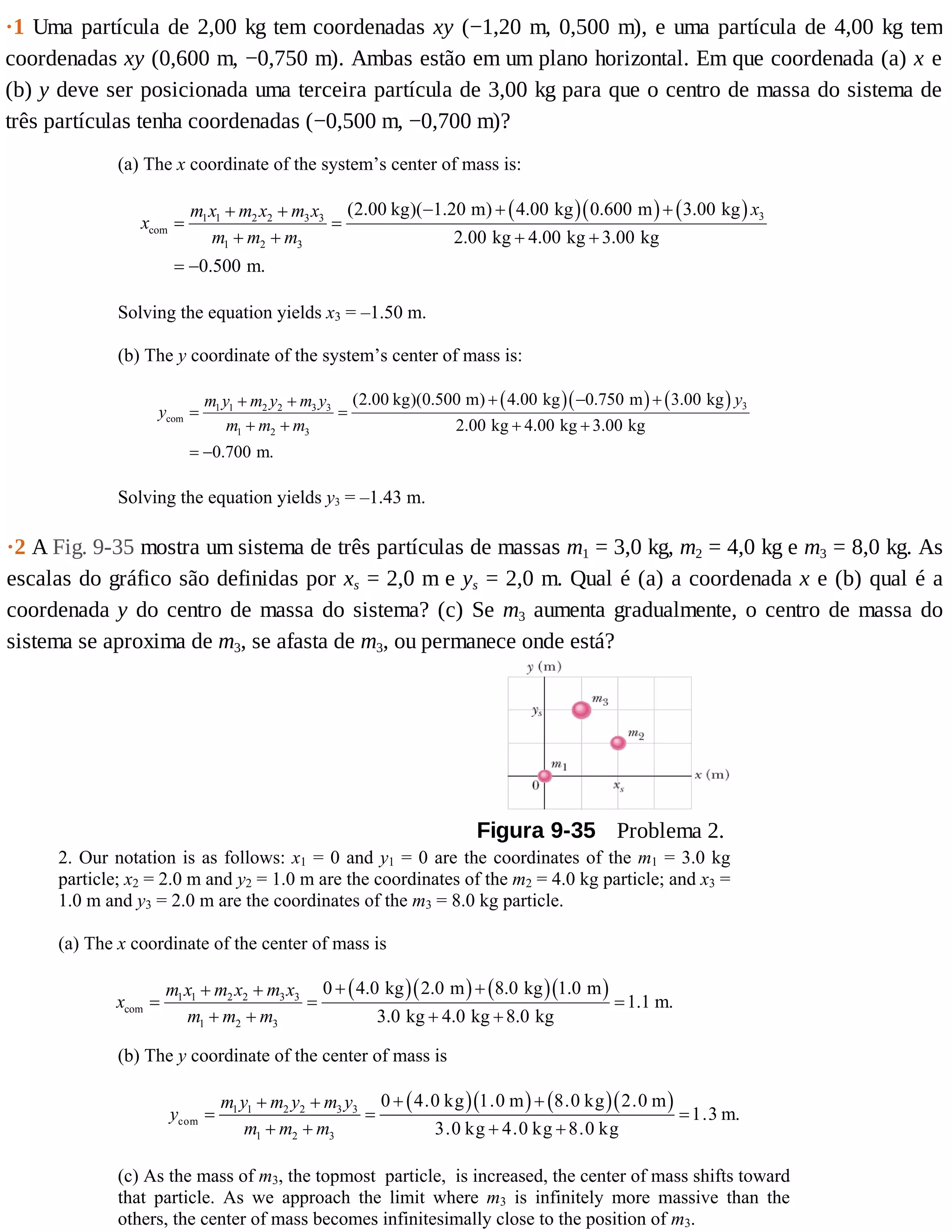
·2	A	Fig.	9-35	mostra	um	sistema	de	três	partículas	de	massas	m1	=	3,0	kg,	m2	=	4,0	kg	e	m3	=	8,0	kg.	As
escalas	do	gráfico	são	definidas	por	xs	=	2,0	m	e	ys	=	2,0	m.	Qual	é	(a)	a	coordenada	x	e	(b)	qual	é	a
coordenada	y	do	centro	de	massa	do	sistema?	(c)	Se	m3	aumenta	gradualmente,	o	centro	de	massa	do
sistema	se	aproxima	de	m3,	se	afasta	de	m3,	ou	permanece	onde	está?
Figura	9-35 	Problema	2.
2. Our notation is as follows: x1 = 0 and y1 = 0 are the coordinates of the m1 = 3.0 kg
particle; x2 = 2.0 m and y2 = 1.0 m are the coordinates of the m2 = 4.0 kg particle; and x3 =
1.0 m and y3 = 2.0 m are the coordinates of the m3 = 8.0 kg particle.
(a) The x coordinate of the center of mass is
( )( ) ( )( )1 1 2 2 3 3
com
1 2 3
0 4.0 kg 2.0 m 8.0 kg 1.0 m
1.1 m.
3.0 kg 4.0 kg 8.0 kg
m x m x m x
x
m m m
+ ++ +
= = =
+ + + +
(b) The y coordinate of the center of mass is
( )( ) ( )( )1 1 2 2 3 3
com
1 2 3
0 4.0 kg 1.0 m 8.0 kg 2.0 m
1.3 m.
3.0 kg 4.0 kg 8.0 kg
m y m y m y
y
m m m
+ ++ +
= = =
+ + + +
(c) As the mass of m3, the topmost particle, is increased, the center of mass shifts toward
that particle. As we approach the limit where m3 is infinitely more massive than the
others, the center of mass becomes infinitesimally close to the position of m3.
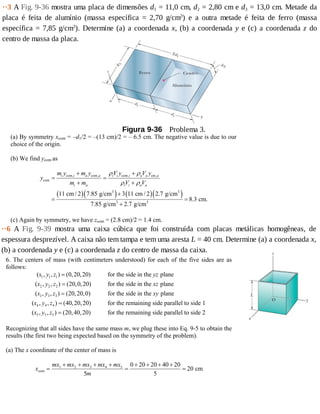
··3	A	Fig.	9-36	mostra	uma	placa	de	dimensões	d1	=	11,0	cm,	d2	=	2,80	cm	e	d3	=	13,0	cm.	Metade	da
placa	 é	 feita	 de	 alumínio	 (massa	 específica	 =	 2,70	 g/cm3
)	 e	 a	 outra	 metade	 é	 feita	 de	 ferro	 (massa
específica	=	7,85	g/cm3
).	Determine	(a)	a	coordenada	x,	(b)	a	coordenada	y	e	(c)	a	coordenada	z	 do
centro	de	massa	da	placa.
Figura	9-36 	Problema	3.
(a) By symmetry xcom = –d1/2 = –(13 cm)/2 = – 6.5 cm. The negative value is due to our
choice of the origin.
(b) We find ycom as
( )( ) ( )( )
com, com, com, cm,
com
3 3
3 3
11 cm / 2 7.85 g/cm 3 11 cm / 2 2.7 g/cm
8.3 cm.
7.85 g/cm 2.7 g/cm
i i a a i i i a a a
i a i i a a
m y m y V y V y
y
m m V V
ρ ρ
ρ ρ
+ +
= =
+ +
+
= =
+
(c) Again by symmetry, we have zcom = (2.8 cm)/2 = 1.4 cm.
··6	 A	 Fig.	 9-39	 mostra	 uma	 caixa	 cúbica	 que	 foi	 construída	 com	 placas	 metálicas	 homogêneas,	 de
espessura	desprezível.	A	caixa	não	tem	tampa	e	tem	uma	aresta	L	=	40	cm.	Determine	(a)	a	coordenada	x,
(b)	a	coordenada	y	e	(c)	a	coordenada	z	do	centro	de	massa	da	caixa.
6. The centers of mass (with centimeters understood) for each of the five sides are as
follows:
1 1 1
2 2 2
3 3 3
4 4 4
( , , ) (0,20,20) for the side in the plane
( , , ) (20,0,20) for the side in the plane
( , , ) (20,20,0) for the side in the plane
( , , ) (40,20,20) for the remaining side paral
x y z yz
x y z xz
x y z xy
x y z
=
=
=
=
5 5 5
lel to side 1
( , , ) (20,40,20) for the remaining side parallel to side 2x y z =
Recognizing that all sides have the same mass m, we plug these into Eq. 9-5 to obtain the
results (the first two being expected based on the symmetry of the problem).
(a) The x coordinate of the center of mass is
x
mx mx mx mx mx
m
com cm=
+ + + +
=
+ + + +
=1 2 3 4 5
5
0 20 20 40 20
5
20
(b) The y coordinate of the center of mass is
y
my my my my my
m
com cm=
+ + + +
=
+ + + +
=1 2 3 4 5
5
20 0 20 20 40
5
20
(c) The z coordinate of the center of mass is
z
mz mz mz mz mz
m
com cm=
+ + + +
=
+ + + +
=1 2 3 4 5
5
20 20 0 20 20
5
16
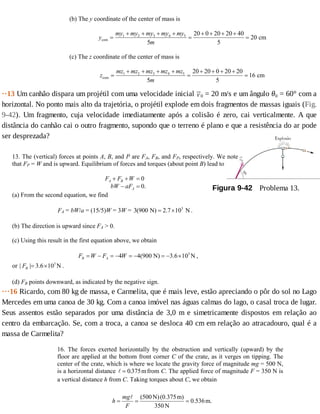
··13	Um	canhão	dispara	um	projétil	com	uma	velocidade	inicial	 0	=	20	m/s	e	um	ângulo	θ0	=	60°	com	a
horizontal.	No	ponto	mais	alto	da	trajetória,	o	projétil	explode	em	dois	fragmentos	de	massas	iguais	(Fig.
9-42).	 Um	 fragmento,	 cuja	 velocidade	 imediatamente	 após	 a	 colisão	 é	 zero,	 cai	 verticalmente.	 A	 que
distância	do	canhão	cai	o	outro	fragmento,	supondo	que	o	terreno	é	plano	e	que	a	resistência	do	ar	pode
ser	desprezada?
Figura	9-42 	Problema	13.
13. The (vertical) forces at points A, B, and P are FA, FB, and FP, respectively. We note
that FP = W and is upward. Equilibrium of forces and torques (about point B) lead to
0
0.
A B
A
F F W
bW aF
+ + =
− =
(a) From the second equation, we find
FA = bW/a = (15/5)W = 3W = 3
3(900 N) 2.7 10 N= × .
(b) The direction is upward since FA > 0.
(c) Using this result in the first equation above, we obtain
3
4 4(900 N) 3.6 10 NB AF W F W= − = − = − = − × ,
or 3
| | 3.6 10 NBF = × .
(d) FB points downward, as indicated by the negative sign.
···16	Ricardo,	com	80	kg	de	massa,	e	Carmelita,	que	é	mais	leve,	estão	apreciando	o	pôr	do	sol	no	Lago
Mercedes	em	uma	canoa	de	30	kg.	Com	a	canoa	imóvel	nas	águas	calmas	do	lago,	o	casal	troca	de	lugar.
Seus	 assentos	 estão	 separados	 por	 uma	 distância	 de	 3,0	 m	 e	 simetricamente	 dispostos	 em	 relação	 ao
centro	da	embarcação.	Se,	com	a	troca,	a	canoa	se	desloca	40	cm	em	relação	ao	atracadouro,	qual	é	a
massa	de	Carmelita?
16. The forces exerted horizontally by the obstruction and vertically (upward) by the
floor are applied at the bottom front corner C of the crate, as it verges on tipping. The
center of the crate, which is where we locate the gravity force of magnitude mg = 500 N,
is a horizontal distance = 0 375. mfrom C. The applied force of magnitude F = 350 N is
a vertical distance h from C. Taking torques about C, we obtain
(500 N)(0.375m)
0.536m.
350 N
mg
h
F
= = =
·25	Uma	bola	de	1,2	kg	cai	verticalmente	em	um	piso	com	uma	velocidade	de	25	m/s	e	ricocheteia	com
uma	velocidade	inicial	de	10	m/s.	(a)	Qual	é	o	impulso	recebido	pela	bola	durante	o	contato	com	o	piso?
(b)	Se	a	bola	fica	em	contato	com	o	piso	por	0,020	s,	qual	é	a	força	média	exercida	pela	bola	sobre	o
piso? 25. We consider the wheel as it leaves the lower floor. The floor no longer exerts a force
on the wheel, and the only forces acting are the force F applied horizontally at the axle,
the force of gravity mg acting vertically at the center of the wheel, and the force of the
step corner, shown as the two components fh and fv. If the minimum force is applied the
wheel does not accelerate, so both the total force and the total torque acting on it are zero.
We calculate the torque around the step corner. The second diagram indicates that the
distance from the line of F to the corner is r – h, where r is the radius of the wheel and h
is the height of the step.
The distance from the line of mg to the corner is r r h rh h2 2 2
2+ − = −b g . Thus,
F r h mg rh h− − − =b g 2 02
.
The solution for F is
2 2 2 22
2
2 2
2(6.00 10 m)(3.00 10 m) (3.00 10 m)2
= (0.800 kg)(9.80 m/s )
(6.00 10 m) (3.00 10 m)
13.6 N.
rh h
F mg
r h
− − −
− −
× × − ×−
=
− × − ×
=
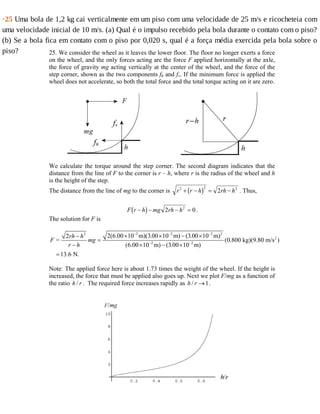
Note: The applied force here is about 1.73 times the weight of the wheel. If the height is
increased, the force that must be applied also goes up. Next we plot F/mg as a function of
the ratio /h r . The required force increases rapidly as / 1h r → .
··46	Uma	marmita	de	4	kg	que	está	deslizando	em	uma	superfície	sem	atrito	explode	em	dois	fragmentos
de	2,0	kg,	um	que	se	move	para	o	norte	a	3,0	m/s	e	outro	que	se	move	em	uma	direção	30o
	ao	norte	do
leste	a	5,0	m/s.	Qual	era	a	velocidade	escalar	da	marmita	antes	da	explosão?
46. From Eq. 13-37, we obtain v = /GM r for the speed of an object in circular orbit
(of radius r) around a planet of mass M. In this case, M = 5.98 × 1024
kg and
r = (700 + 6370)m = 7070 km = 7.07 × 10⁶
m.
The speed is found to be v = 7.51 × 10³
m/s. After multiplying by 3600 s/h and dividing
by 1000 m/km this becomes v = 2.7 × 10⁴
km/h.
(a) For a head-on collision, the relative speed of the two objects must be 2v = 5.4 × 10⁴
km/h.
(b) A perpendicular collision is possible if one satellite is, say, orbiting above the equator
and the other is following a longitudinal line. In this case, the relative speed is given by
the Pythagorean theorem: 2 2
ν ν+ = 3.8 × 10⁴
km/h.
···48	Uma	partícula	A	e	uma	partícula	B	são	empurradas	uma	contra	a	outra,	comprimindo	uma	mola
colocada	entre	as	duas.	Quando	as	partículas	são	liberadas,	a	mola	as	arremessa	em	sentidos	opostos.	A
massa	de	A	é	2,00	vezes	a	massa	de	B	e	a	energia	armazenada	na	mola	era	60	J.	Suponha	que	a	mola	tem
massa	desprezível	e	que	toda	a	energia	armazenada	é	transferida	para	as	partículas.	Depois	de	terminada
a	transferência,	qual	é	a	energia	cinética	(a)	da	partícula	A	e	(b)	da	partícula	B?
48. Kepler’s law of periods, expressed as a ratio, is
3 2 2
3
(1.52)
1y
M M M
E E
a T T
a T
⎛ ⎞ ⎛ ⎞ ⎛ ⎞
= ⇒ =⎜ ⎟ ⎜ ⎟ ⎜ ⎟
⎝ ⎠⎝ ⎠ ⎝ ⎠
where we have substituted the mean-distance (from Sun) ratio for the semi-major axis
ratio. This yields TM = 1.87 y. The value in Appendix C (1.88 y) is quite close, and the
small apparent discrepancy is not significant, since a more precise value for the semi-
major axis ratio is aM/aE = 1.523, which does lead to TM = 1.88 y using Kepler’s law. A
question can be raised regarding the use of a ratio of mean distances for the ratio of semi-
major axes, but this requires a more lengthy discussion of what is meant by a ”mean
distance” than is appropriate here.
·49	Uma	bala	com	10	g	de	massa	se	choca	com	um	pêndulo	balístico	com	2,00	kg	de	massa.	O	centro	de
massa	do	pêndulo	sobe	uma	distância	vertical	de	12	cm.	Supondo	que	a	bala	fica	alojada	no	pêndulo,
calcule	a	velocidade	inicial	da	bala.
49. (a) The period of the comet is 1420 years (and one month), which we convert to T =
4.48 × 10¹⁰
s. Since the mass of the Sun is 1.99 × 1030
kg, then Kepler’s law of periods
gives
2
10 2 3 13
11 3 2 30
4
(4.48 10 s) 1.89 10 m.
(6.67 10 m /kg s )(1.99 10 kg)
a a
π
−
⎛ ⎞
× = ⇒ = ×⎜ ⎟
× ⋅ ×⎝ ⎠
(b) Since the distance from the focus (of an ellipse) to its center is ea and the distance
from center to the aphelion is a, then the comet is at a distance of
13 13
(0.11 1) (1.89 10 m) 2.1 10 mea a+ = + × = ×
when it is farthest from the Sun. To express this in terms of Pluto’s orbital radius (found
in Appendix C), we set up a ratio:
13
12
2.1 10
3.6 .
5.9 10
P PR R
⎛ ⎞×
=⎜ ⎟
×⎝ ⎠
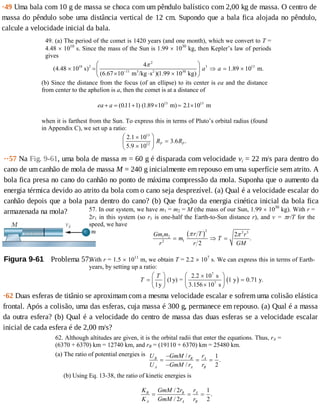
··57	Na	Fig.	9-61,	uma	bola	de	massa	m	=	60	g	é	disparada	com	velocidade	vi	=	22	m/s	para	dentro	do
cano	de	um	canhão	de	mola	de	massa	M	=	240	g	inicialmente	em	repouso	em	uma	superfície	sem	atrito.	A
bola	fica	presa	no	cano	do	canhão	no	ponto	de	máxima	compressão	da	mola.	Suponha	que	o	aumento	da
energia	térmica	devido	ao	atrito	da	bola	com	o	cano	seja	desprezível.	(a)	Qual	é	a	velocidade	escalar	do
canhão	depois	que	a	bola	para	dentro	do	cano?	(b)	Que	fração	da	energia	cinética	inicial	da	bola	fica
armazenada	na	mola?
Figura	9-61 	Problema	57.
57. In our system, we have m1 = m2 = M (the mass of our Sun, 1.99 × 1030
kg). With r =
2r1 in this system (so r1 is one-half the Earth-to-Sun distance r), and v = πr/T for the
speed, we have
( )
2 2 3
1 2
12
2
.
2
r TGm m r
m T
r r GM
π π
= ⇒ =
With r = 1.5 × 10¹¹
m, we obtain T = 2.2 × 10⁷
s. We can express this in terms of Earth-
years, by setting up a ratio:
( )
7
7
2.2 10 s
(1y) = 1 y 0.71 y.
1y 3.156 10 s
T
T
⎛ ⎞⎛ ⎞ ×
= =⎜ ⎟⎜ ⎟
×⎝ ⎠ ⎝ ⎠
·62	Duas	esferas	de	titânio	se	aproximam	com	a	mesma	velocidade	escalar	e	sofrem	uma	colisão	elástica
frontal.	Após	a	colisão,	uma	das	esferas,	cuja	massa	é	300	g,	permanece	em	repouso.	(a)	Qual	é	a	massa
da	outra	esfera?	(b)	Qual	é	a	velocidade	do	centro	de	massa	das	duas	esferas	se	a	velocidade	escalar
inicial	de	cada	esfera	é	de	2,00	m/s?
62. Although altitudes are given, it is the orbital radii that enter the equations. Thus, rA =
(6370 + 6370) km = 12740 km, and rB = (19110 + 6370) km = 25480 km.
(a) The ratio of potential energies is / 1
.
/ 2
B B A
A A B
U GmM r r
U GmM r r
−
= = =
−
(b) Using Eq. 13-38, the ratio of kinetic energies is
/ 2 1
.
/ 2 2
B B A
A A B
K GmM r r
K GmM r r
= = =
(c) From Eq. 13-40, it is clear that the satellite with the largest value of r has the smallest
value of |E| (since r is in the denominator). And since the values of E are negative, then
the smallest value of |E| corresponds to the largest energy E. Thus, satellite B has the
largest energy.
(d) The difference is
1 1
.
2
B A
B A
GmM
E E E
r r
⎛ ⎞
Δ = − = − −⎜ ⎟
⎝ ⎠
Being careful to convert the r values to meters, we obtain ΔE = 1.1 × 10⁸
J. The mass M
of Earth is found in Appendix C.

Fisica 1 cap9

  • 1.
    ·1 Uma partícula de 2,00 kg tem coordenadas xy (−1,20 m, 0,500 m), e uma partícula de 4,00 kg tem coordenadas xy (0,600 m, −0,750 m). Ambas estão em um plano horizontal. Em que coordenada (a) x e (b) y deve ser posicionada uma terceira partícula de 3,00 kg para que o centro de massa do sistema de três partículas tenha coordenadas (−0,500 m, −0,700 m)? (a) The xcoordinate of the system’s center of mass is: ( )( ) ( ) 31 1 2 2 3 3 com 1 2 3 (2.00 kg)( 1.20 m) 4.00 kg 0.600 m 3.00 kg 2.00 kg 4.00 kg 3.00 kg 0.500 m. xm x m x m x x m m m − + ++ + = = + + + + = − Solving the equation yields x3 = –1.50 m. (b) The y coordinate of the system’s center of mass is: ( )( ) ( ) 31 1 2 2 3 3 com 1 2 3 (2.00 kg)(0.500 m) 4.00 kg 0.750 m 3.00 kg 2.00 kg 4.00 kg 3.00 kg 0.700 m. ym y m y m y y m m m + − ++ + = = + + + + = − Solving the equation yields y3 = –1.43 m. ·2 A Fig. 9-35 mostra um sistema de três partículas de massas m1 = 3,0 kg, m2 = 4,0 kg e m3 = 8,0 kg. As escalas do gráfico são definidas por xs = 2,0 m e ys = 2,0 m. Qual é (a) a coordenada x e (b) qual é a coordenada y do centro de massa do sistema? (c) Se m3 aumenta gradualmente, o centro de massa do sistema se aproxima de m3, se afasta de m3, ou permanece onde está? Figura 9-35 Problema 2. 2. Our notation is as follows: x1 = 0 and y1 = 0 are the coordinates of the m1 = 3.0 kg particle; x2 = 2.0 m and y2 = 1.0 m are the coordinates of the m2 = 4.0 kg particle; and x3 = 1.0 m and y3 = 2.0 m are the coordinates of the m3 = 8.0 kg particle. (a) The x coordinate of the center of mass is ( )( ) ( )( )1 1 2 2 3 3 com 1 2 3 0 4.0 kg 2.0 m 8.0 kg 1.0 m 1.1 m. 3.0 kg 4.0 kg 8.0 kg m x m x m x x m m m + ++ + = = = + + + + (b) The y coordinate of the center of mass is ( )( ) ( )( )1 1 2 2 3 3 com 1 2 3 0 4.0 kg 1.0 m 8.0 kg 2.0 m 1.3 m. 3.0 kg 4.0 kg 8.0 kg m y m y m y y m m m + ++ + = = = + + + + (c) As the mass of m3, the topmost particle, is increased, the center of mass shifts toward that particle. As we approach the limit where m3 is infinitely more massive than the others, the center of mass becomes infinitesimally close to the position of m3.
  • 2.
    ··3 A Fig. 9-36 mostra uma placa de dimensões d1 = 11,0 cm, d2 = 2,80 cm e d3 = 13,0 cm. Metade da placa é feita de alumínio (massa específica = 2,70 g/cm3 ) e a outra metade é feita de ferro (massa específica = 7,85 g/cm3 ). Determine (a) a coordenada x, (b) a coordenada y e (c) a coordenada z do centro de massa da placa. Figura 9-36 Problema 3. (a) By symmetry xcom = –d1/2 = –(13 cm)/2 = – 6.5 cm. The negative value is due to our choice of the origin. (b) We find ycom as ( )( ) ( )( ) com, com, com, cm, com 3 3 3 3 11 cm / 2 7.85 g/cm 3 11 cm / 2 2.7 g/cm 8.3 cm. 7.85 g/cm 2.7 g/cm i i a a i i i a a a i a i i a a m y m y V y V y y m m V V ρ ρ ρ ρ + + = = + + + = = + (c) Again by symmetry, we have zcom = (2.8 cm)/2 = 1.4 cm. ··6 A Fig. 9-39 mostra uma caixa cúbica que foi construída com placas metálicas homogêneas, de espessura desprezível. A caixa não tem tampa e tem uma aresta L = 40 cm. Determine (a) a coordenada x, (b) a coordenada y e (c) a coordenada z do centro de massa da caixa. 6. The centers of mass (with centimeters understood) for each of the five sides are as follows: 1 1 1 2 2 2 3 3 3 4 4 4 ( , , ) (0,20,20) for the side in the plane ( , , ) (20,0,20) for the side in the plane ( , , ) (20,20,0) for the side in the plane ( , , ) (40,20,20) for the remaining side paral x y z yz x y z xz x y z xy x y z = = = = 5 5 5 lel to side 1 ( , , ) (20,40,20) for the remaining side parallel to side 2x y z = Recognizing that all sides have the same mass m, we plug these into Eq. 9-5 to obtain the results (the first two being expected based on the symmetry of the problem). (a) The x coordinate of the center of mass is x mx mx mx mx mx m com cm= + + + + = + + + + =1 2 3 4 5 5 0 20 20 40 20 5 20
  • 3.
    (b) The ycoordinate of the center of mass is y my my my my my m com cm= + + + + = + + + + =1 2 3 4 5 5 20 0 20 20 40 5 20 (c) The z coordinate of the center of mass is z mz mz mz mz mz m com cm= + + + + = + + + + =1 2 3 4 5 5 20 20 0 20 20 5 16 ··13 Um canhão dispara um projétil com uma velocidade inicial 0 = 20 m/s e um ângulo θ0 = 60° com a horizontal. No ponto mais alto da trajetória, o projétil explode em dois fragmentos de massas iguais (Fig. 9-42). Um fragmento, cuja velocidade imediatamente após a colisão é zero, cai verticalmente. A que distância do canhão cai o outro fragmento, supondo que o terreno é plano e que a resistência do ar pode ser desprezada? Figura 9-42 Problema 13. 13. The (vertical) forces at points A, B, and P are FA, FB, and FP, respectively. We note that FP = W and is upward. Equilibrium of forces and torques (about point B) lead to 0 0. A B A F F W bW aF + + = − = (a) From the second equation, we find FA = bW/a = (15/5)W = 3W = 3 3(900 N) 2.7 10 N= × . (b) The direction is upward since FA > 0. (c) Using this result in the first equation above, we obtain 3 4 4(900 N) 3.6 10 NB AF W F W= − = − = − = − × , or 3 | | 3.6 10 NBF = × . (d) FB points downward, as indicated by the negative sign. ···16 Ricardo, com 80 kg de massa, e Carmelita, que é mais leve, estão apreciando o pôr do sol no Lago Mercedes em uma canoa de 30 kg. Com a canoa imóvel nas águas calmas do lago, o casal troca de lugar. Seus assentos estão separados por uma distância de 3,0 m e simetricamente dispostos em relação ao centro da embarcação. Se, com a troca, a canoa se desloca 40 cm em relação ao atracadouro, qual é a massa de Carmelita? 16. The forces exerted horizontally by the obstruction and vertically (upward) by the floor are applied at the bottom front corner C of the crate, as it verges on tipping. The center of the crate, which is where we locate the gravity force of magnitude mg = 500 N, is a horizontal distance = 0 375. mfrom C. The applied force of magnitude F = 350 N is a vertical distance h from C. Taking torques about C, we obtain (500 N)(0.375m) 0.536m. 350 N mg h F = = =
  • 4.
    ·25 Uma bola de 1,2 kg cai verticalmente em um piso com uma velocidade de 25 m/s e ricocheteia com uma velocidade inicial de 10 m/s. (a) Qual é o impulso recebido pela bola durante o contato com o piso? (b) Se a bola fica em contato com o piso por 0,020 s, qual é a força média exercida pela bola sobre o piso? 25. Weconsider the wheel as it leaves the lower floor. The floor no longer exerts a force on the wheel, and the only forces acting are the force F applied horizontally at the axle, the force of gravity mg acting vertically at the center of the wheel, and the force of the step corner, shown as the two components fh and fv. If the minimum force is applied the wheel does not accelerate, so both the total force and the total torque acting on it are zero. We calculate the torque around the step corner. The second diagram indicates that the distance from the line of F to the corner is r – h, where r is the radius of the wheel and h is the height of the step. The distance from the line of mg to the corner is r r h rh h2 2 2 2+ − = −b g . Thus, F r h mg rh h− − − =b g 2 02 . The solution for F is 2 2 2 22 2 2 2 2(6.00 10 m)(3.00 10 m) (3.00 10 m)2 = (0.800 kg)(9.80 m/s ) (6.00 10 m) (3.00 10 m) 13.6 N. rh h F mg r h − − − − − × × − ×− = − × − × = Note: The applied force here is about 1.73 times the weight of the wheel. If the height is increased, the force that must be applied also goes up. Next we plot F/mg as a function of the ratio /h r . The required force increases rapidly as / 1h r → .
  • 5.
    ··46 Uma marmita de 4 kg que está deslizando em uma superfície sem atrito explode em dois fragmentos de 2,0 kg, um que se move para o norte a 3,0 m/s e outro que se move em uma direção 30o ao norte do leste a 5,0 m/s. Qual era a velocidade escalar da marmita antes da explosão? 46. From Eq.13-37, we obtain v = /GM r for the speed of an object in circular orbit (of radius r) around a planet of mass M. In this case, M = 5.98 × 1024 kg and r = (700 + 6370)m = 7070 km = 7.07 × 10⁶ m. The speed is found to be v = 7.51 × 10³ m/s. After multiplying by 3600 s/h and dividing by 1000 m/km this becomes v = 2.7 × 10⁴ km/h. (a) For a head-on collision, the relative speed of the two objects must be 2v = 5.4 × 10⁴ km/h. (b) A perpendicular collision is possible if one satellite is, say, orbiting above the equator and the other is following a longitudinal line. In this case, the relative speed is given by the Pythagorean theorem: 2 2 ν ν+ = 3.8 × 10⁴ km/h. ···48 Uma partícula A e uma partícula B são empurradas uma contra a outra, comprimindo uma mola colocada entre as duas. Quando as partículas são liberadas, a mola as arremessa em sentidos opostos. A massa de A é 2,00 vezes a massa de B e a energia armazenada na mola era 60 J. Suponha que a mola tem massa desprezível e que toda a energia armazenada é transferida para as partículas. Depois de terminada a transferência, qual é a energia cinética (a) da partícula A e (b) da partícula B? 48. Kepler’s law of periods, expressed as a ratio, is 3 2 2 3 (1.52) 1y M M M E E a T T a T ⎛ ⎞ ⎛ ⎞ ⎛ ⎞ = ⇒ =⎜ ⎟ ⎜ ⎟ ⎜ ⎟ ⎝ ⎠⎝ ⎠ ⎝ ⎠ where we have substituted the mean-distance (from Sun) ratio for the semi-major axis ratio. This yields TM = 1.87 y. The value in Appendix C (1.88 y) is quite close, and the small apparent discrepancy is not significant, since a more precise value for the semi- major axis ratio is aM/aE = 1.523, which does lead to TM = 1.88 y using Kepler’s law. A question can be raised regarding the use of a ratio of mean distances for the ratio of semi- major axes, but this requires a more lengthy discussion of what is meant by a ”mean distance” than is appropriate here.
  • 6.
    ·49 Uma bala com 10 g de massa se choca com um pêndulo balístico com 2,00 kg de massa. O centro de massa do pêndulo sobe uma distância vertical de 12 cm. Supondo que a bala fica alojada no pêndulo, calcule a velocidade inicial da bala. 49. (a) Theperiod of the comet is 1420 years (and one month), which we convert to T = 4.48 × 10¹⁰ s. Since the mass of the Sun is 1.99 × 1030 kg, then Kepler’s law of periods gives 2 10 2 3 13 11 3 2 30 4 (4.48 10 s) 1.89 10 m. (6.67 10 m /kg s )(1.99 10 kg) a a π − ⎛ ⎞ × = ⇒ = ×⎜ ⎟ × ⋅ ×⎝ ⎠ (b) Since the distance from the focus (of an ellipse) to its center is ea and the distance from center to the aphelion is a, then the comet is at a distance of 13 13 (0.11 1) (1.89 10 m) 2.1 10 mea a+ = + × = × when it is farthest from the Sun. To express this in terms of Pluto’s orbital radius (found in Appendix C), we set up a ratio: 13 12 2.1 10 3.6 . 5.9 10 P PR R ⎛ ⎞× =⎜ ⎟ ×⎝ ⎠ ··57 Na Fig. 9-61, uma bola de massa m = 60 g é disparada com velocidade vi = 22 m/s para dentro do cano de um canhão de mola de massa M = 240 g inicialmente em repouso em uma superfície sem atrito. A bola fica presa no cano do canhão no ponto de máxima compressão da mola. Suponha que o aumento da energia térmica devido ao atrito da bola com o cano seja desprezível. (a) Qual é a velocidade escalar do canhão depois que a bola para dentro do cano? (b) Que fração da energia cinética inicial da bola fica armazenada na mola? Figura 9-61 Problema 57. 57. In our system, we have m1 = m2 = M (the mass of our Sun, 1.99 × 1030 kg). With r = 2r1 in this system (so r1 is one-half the Earth-to-Sun distance r), and v = πr/T for the speed, we have ( ) 2 2 3 1 2 12 2 . 2 r TGm m r m T r r GM π π = ⇒ = With r = 1.5 × 10¹¹ m, we obtain T = 2.2 × 10⁷ s. We can express this in terms of Earth- years, by setting up a ratio: ( ) 7 7 2.2 10 s (1y) = 1 y 0.71 y. 1y 3.156 10 s T T ⎛ ⎞⎛ ⎞ × = =⎜ ⎟⎜ ⎟ ×⎝ ⎠ ⎝ ⎠ ·62 Duas esferas de titânio se aproximam com a mesma velocidade escalar e sofrem uma colisão elástica frontal. Após a colisão, uma das esferas, cuja massa é 300 g, permanece em repouso. (a) Qual é a massa da outra esfera? (b) Qual é a velocidade do centro de massa das duas esferas se a velocidade escalar inicial de cada esfera é de 2,00 m/s? 62. Although altitudes are given, it is the orbital radii that enter the equations. Thus, rA = (6370 + 6370) km = 12740 km, and rB = (19110 + 6370) km = 25480 km. (a) The ratio of potential energies is / 1 . / 2 B B A A A B U GmM r r U GmM r r − = = = − (b) Using Eq. 13-38, the ratio of kinetic energies is / 2 1 . / 2 2 B B A A A B K GmM r r K GmM r r = = =
  • 7.
    (c) From Eq.13-40, it is clear that the satellite with the largest value of r has the smallest value of |E| (since r is in the denominator). And since the values of E are negative, then the smallest value of |E| corresponds to the largest energy E. Thus, satellite B has the largest energy. (d) The difference is 1 1 . 2 B A B A GmM E E E r r ⎛ ⎞ Δ = − = − −⎜ ⎟ ⎝ ⎠ Being careful to convert the r values to meters, we obtain ΔE = 1.1 × 10⁸ J. The mass M of Earth is found in Appendix C.