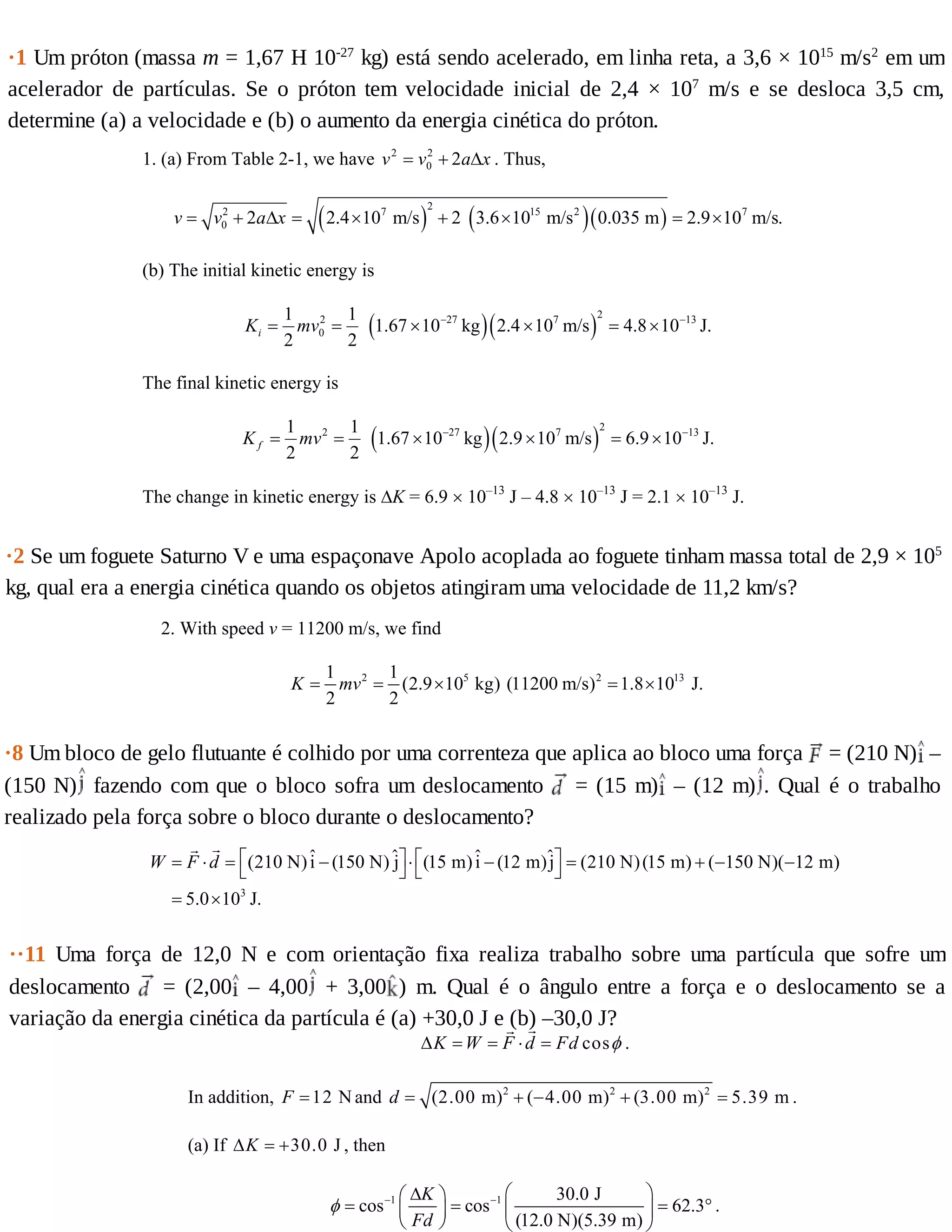
·1	Um	próton	(massa	m	=	1,67	H	10-27
	kg)	está	sendo	acelerado,	em	linha	reta,	a	3,6	×	1015
	m/s2
	em	um
acelerador	 de	 partículas.	 Se	 o	 próton	 tem	 velocidade	 inicial	 de	 2,4	 ×	 107
	 m/s	 e	 se	 desloca	 3,5	 cm,
determine	(a)	a	velocidade	e	(b)	o	aumento	da	energia	cinética	do	próton.
·2	Se	um	foguete	Saturno	V	e	uma	espaçonave	Apolo	acoplada	ao	foguete	tinham	massa	total	de	2,9	×	105
kg,	qual	era	a	energia	cinética	quando	os	objetos	atingiram	uma	velocidade	de	11,2	km/s?
1. (a) From Table 2-1, we have v v a x2
0
2
2= + Δ . Thus,
( ) ( )( )
2
2 7 15 2 7
0 2 2.4 10 m/s 2 3.6 10 m/s 0.035 m 2.9 10 m/s.v v a x= + Δ = × + × = ×
(b) The initial kinetic energy is
( )( )
22 27 7 13
0
1 1
1.67 10 kg 2.4 10 m/s 4.8 10 J.
2 2
iK mv − −
= = × × = ×
The final kinetic energy is
( )( )
22 27 7 131 1
1.67 10 kg 2.9 10 m/s 6.9 10 J.
2 2
fK mv − −
= = × × = ×
The change in kinetic energy is ΔK = 6.9 × 10⁻¹³
J – 4.8 × 10⁻¹³
J = 2.1 × 10⁻¹³
J.
2. With speed v = 11200 m/s, we find
2 5 2 131 1
(2.9 10 kg) (11200 m/s) 1.8 10 J.
2 2
K mv= = × = ×
·8	Um	bloco	de	gelo	flutuante	é	colhido	por	uma	correnteza	que	aplica	ao	bloco	uma	força	 	=	(210	N) 	–
(150	N) 	fazendo	com	que	o	bloco	sofra	um	deslocamento	 	=	(15	m) 	–	(12	m) .	Qual	é	o	trabalho
realizado	pela	força	sobre	o	bloco	durante	o	deslocamento?
3
ˆ ˆ ˆ ˆ(210 N)i (150 N) j (15 m)i (12 m)j (210 N)(15 m) ( 150 N)( 12 m)
5.0 10 J.
W F d ⎡ ⎤ ⎡ ⎤= ⋅ = − ⋅ − = + − −
⎣ ⎦ ⎣ ⎦
= ×
··11	 Uma	 força	 de	 12,0	 N	 e	 com	 orientação	 fixa	 realiza	 trabalho	 sobre	 uma	 partícula	 que	 sofre	 um
deslocamento	 	 =	 (2,00 	 –	 4,00 	 +	 3,00 )	 m.	 Qual	 é	 o	 ângulo	 entre	 a	 força	 e	 o	 deslocamento	 se	 a
variação	da	energia	cinética	da	partícula	é	(a)	+30,0	J	e	(b)	–30,0	J?
cosK W F d Fd φΔ = = ⋅ = .
In addition, 12 NF = and 2 2 2
(2.00 m) ( 4.00 m) (3.00 m) 5.39 md = + − + = .
(a) If 30.0 JKΔ = + , then
1 1 30.0 J
cos cos 62.3
(12.0 N)(5.39 m)
K
Fd
φ − − ⎛ ⎞Δ⎛ ⎞
= = = °⎜ ⎟⎜ ⎟
⎝ ⎠ ⎝ ⎠
.
(b) 30.0 JKΔ = − , then
1 1 30.0 J
cos cos 118
(12.0 N)(5.39 m)
K
Fd
φ − − ⎛ ⎞Δ −⎛ ⎞
= = = °⎜ ⎟⎜ ⎟
⎝ ⎠ ⎝ ⎠
.
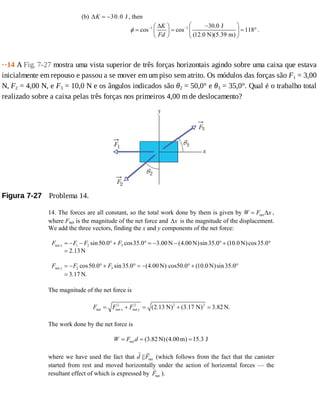
··14	A	Fig.	7-27	mostra	uma	vista	superior	de	três	forças	horizontais	agindo	sobre	uma	caixa	que	estava
inicialmente	em	repouso	e	passou	a	se	mover	em	um	piso	sem	atrito.	Os	módulos	das	forças	são	F1	=	3,00
N,	F2	=	4,00	N,	e	F3	=	10,0	N	e	os	ângulos	indicados	são	θ2	=	50,0°	e	θ3	=	35,0°.	Qual	é	o	trabalho	total
realizado	sobre	a	caixa	pelas	três	forças	nos	primeiros	4,00	m	de	deslocamento?
Figura	7-27 	Problema	14.
14. The forces are all constant, so the total work done by them is given by W F x= net Δ ,
where Fnet is the magnitude of the net force and Δx is the magnitude of the displacement.
We add the three vectors, finding the x and y components of the net force:
net 1 2 3
net 2 3
sin50.0 cos35.0 3.00 N (4.00 N)sin35.0 (10.0 N)cos35.0
2.13N
cos50.0 sin35.0 (4.00 N) cos50.0 (10.0 N)sin35.0
3.17 N.
x
y
F F F F
F F F
= − − °+ ° = − − °+ °
=
= − °+ ° = − ° + °
=
The magnitude of the net force is
2 2 2 2
net net net (2.13 N) (3.17 N) 3.82 N.x yF F F= + = + =
The work done by the net force is
net (3.82 N)(4.00m) 15.3 JW F d= = =
where we have used the fact that d Fnet|| (which follows from the fact that the canister
started from rest and moved horizontally under the action of horizontal forces — the
resultant effect of which is expressed by Fnet ).
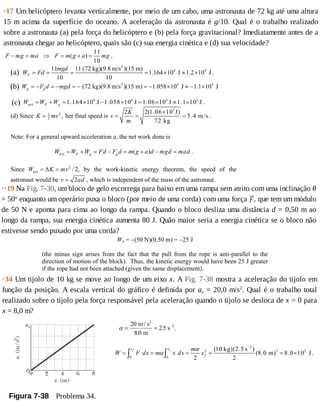
·17	Um	helicóptero	levanta	verticalmente,	por	meio	de	um	cabo,	uma	astronauta	de	72	kg	até	uma	altura
15	m	acima	da	superfície	do	oceano.	A	aceleração	da	astronauta	é	g/10.	Qual	é	o	trabalho	realizado
sobre	a	astronauta	(a)	pela	força	do	helicóptero	e	(b)	pela	força	gravitacional?	Imediatamente	antes	de	a
astronauta	chegar	ao	helicóptero,	quais	são	(c)	sua	energia	cinética	e	(d)	sua	velocidade?
Wa = −(50 N)(0.50 m) = −25 J
(the minus sign arises from the fact that the pull from the rope is anti-parallel to the
direction of motion of the block). Thus, the kinetic energy would have been 25 J greater
if the rope had not been attached (given the same displacement).
··19	Na	Fig.	7-30,	um	bloco	de	gelo	escorrega	para	baixo	em	uma	rampa	sem	atrito	com	uma	inclinação	θ
=	50o
	enquanto	um	operário	puxa	o	bloco	(por	meio	de	uma	corda)	com	uma	força	 r	que	tem	um	módulo
de	50	N	e	aponta	para	cima	ao	longo	da	rampa.	Quando	o	bloco	desliza	uma	distância	d	=	0,50	m	ao
longo	da	rampa,	sua	energia	cinética	aumenta	80	J.	Quão	maior	seria	a	energia	cinética	se	o	bloco	não
estivesse	sendo	puxado	por	uma	corda?
11
( )
10
F mg ma F m g a mg− = ⇒ = + = ,
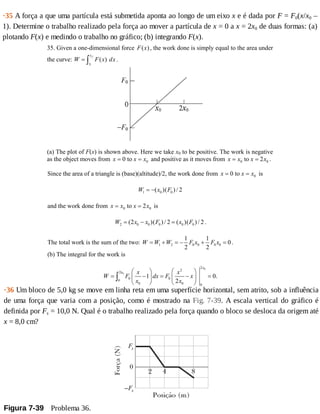
·34	Um	tijolo	de	10	kg	se	move	ao	longo	de	um	eixo	x.	A	Fig.	7-38	mostra	a	aceleração	do	tijolo	em
função	da	posição.	A	escala	vertical	do	gráfico	é	definida	por	as	=	20,0	m/s2
.	Qual	é	o	trabalho	total
realizado	sobre	o	tijolo	pela	força	responsável	pela	aceleração	quando	o	tijolo	se	desloca	de	x	=	0	para
x	=	8,0	m?
Figura	7-38 	Problema	34.
α = = −20
8 0
2 5 2m / s
m
s
2
.
. .
2
2 2 2
0 0
(10 kg)(2.5 s )
(8.0 m) 8.0 10 J.
2 2
f fx x
f
m
W F dx m x dx x
α
α
−
= = = = = ×∫ ∫
2
4 411 11 (72 kg)(9.8 m/s )(15 m)
1.164 10 J 1.2 10 J
10 10
F
mgd
W Fd= = = = × ≈ × .(a)	
	(b)	 2 4 4
(72 kg)(9.8 m/s )(15 m) 1.058 10 J 1.1 10 Jg gW F d mgd= − = − = − = − × ≈ − ×
(c)	 4 4 3 3
net 1.164 10 J 1.058 10 J 1.06 10 J 1.1 10 JF gW W W= + = × − × = × ≈ × .
(d) Since K mv= 1
2
2
, her final speed is
3
2 2(1.06 10 J)
5.4 m/s
72 kg
K
v
m
×
= = = .
Note: For a general upward acceleration a, the net work done is
net ( )F g gW W W Fd F d m g a d mgd mad= + = − = + − = .
Since 2
net / 2,W K mv= Δ = by the work-kinetic energy theorem, the speed of the
astronaut would be 2v ad= , which is independent of the mass of the astronaut.
·35	A	força	a	que	uma	partícula	está	submetida	aponta	ao	longo	de	um	eixo	x	e	é	dada	por	F	=	F0(x/x0	–
1).	Determine	o	trabalho	realizado	pela	força	ao	mover	a	partícula	de	x	=	0	a	x	=	2x0	de	duas	formas:	(a)
plotando	F(x)	e	medindo	o	trabalho	no	gráfico;	(b)	integrando	F(x).
35. Given a one-dimensional force ( )F x , the work done is simply equal to the area under
the curve: ( )
f
i
x
x
W F x dx= ∫ .
(a) The plot of F(x) is shown above. Here we take x0 to be positive. The work is negative
as the object moves from x x x= =0 0to and positive as it moves from x x x x= =0 02to .
Since the area of a triangle is (base)(altitude)/2, the work done from x x x= =0 0to is
1 0 0( )( ) / 2W x F= −
and the work done from x x x x= =0 02to is
2 0 0 0 0 0(2 )( ) / 2 ( )( ) / 2W x x F x F= − = .
The total work is the sum of the two: 1 2 0 0 0 0
1 1
0
2 2
W W W F x F x= + = − + = .
(b) The integral for the work is
0
0
2
2
2
0 00
0 0 0
1 0.
2
x
x x x
W F dx F x
x x
⎛ ⎞ ⎛ ⎞
= − = − =⎜ ⎟ ⎜ ⎟
⎝ ⎠ ⎝ ⎠
∫
·36	Um	bloco	de	5,0	kg	se	move	em	linha	reta	em	uma	superfície	horizontal,	sem	atrito,	sob	a	influência
de	uma	força	que	varia	com	a	posição,	como	é	mostrado	na	Fig.	7-39.	A	escala	vertical	do	gráfico	é
definida	por	Fs	=	10,0	N.	Qual	é	o	trabalho	realizado	pela	força	quando	o	bloco	se	desloca	da	origem	até
x	=	8,0	cm?
Figura	7-39 	Problema	36.
36. From Eq. 7-32, we see that the “area” in the graph is equivalent to the work done.
Finding that area (in terms of rectangular [length × width] and triangular
[1
2 base height]× areas) we obtain
0 2 2 4 4 6 6 8 (20 10 0 5) J 25 J.x x x xW W W W W< < < < < < < <= + + + = + + − =
·43	 Uma	 força	 de	 5,0	 N	 age	 sobre	 um	 corpo	 de	 15	 kg	 inicialmente	 em	 repouso.	 Calcule	 o	 trabalho
realizado	pela	força	(a)	no	primeiro,	(b)	no	segundo	e	(c)	no	terceiro	segundo,	assim	como	(d)	a	potência
instantânea	da	força	no	fim	do	terceiro	segundo.
43. (a) The power is given by P = Fv and the work done by F from time t1 to time t2 is
given by
2 2
1 1
t t
t t
W Pdt Fvdt= =∫ ∫ .
Since F is the net force, the magnitude of the acceleration is a = F/m, and, since the
initial velocity is v0 0= , the velocity as a function of time is given by
v v at F m t= + =0 ( ) . Thus,
2
1
2 2 2 2
2 1
1
( / ) ( / )( ).
2
t
t
W F m t dt F m t t= = −∫
For t1 0= and 2 1.0s,t =
2
21 (5.0 N)
(1.0 s) = 0.83 J.
2 15 kg
W
⎛ ⎞
= ⎜ ⎟
⎝ ⎠
(b) For 1 1.0s,t = and 2 2.0s,t =
2
2 21 (5.0 N)
[(2.0 s) (1.0 s) ] 2.5 J.
2 15 kg
W
⎛ ⎞
= − =⎜ ⎟
⎝ ⎠
(c) For 1 2.0st = and 2 3.0s,t =
2
2 21 (5.0 N)
[(3.0 s) (2.0 s) ] 4.2 J.
2 15 kg
W
⎛ ⎞
= − =⎜ ⎟
⎝ ⎠
(d) Substituting v = (F/m)t into P = Fv we obtain P F t m= 2
for the power at any time t.
At the end of the third second P
(5.0 N) (3.0 s)
15 kg
5.0 W.
2
=
F
HG I
KJ =
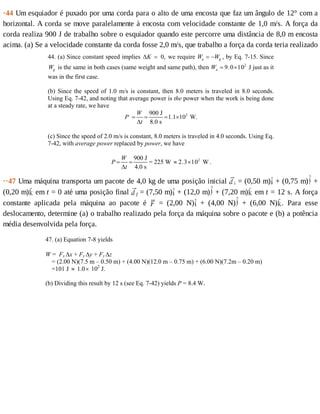
·44	Um	esquiador	é	puxado	por	uma	corda	para	o	alto	de	uma	encosta	que	faz	um	ângulo	de	12°	com	a
horizontal.	A	corda	se	move	paralelamente	à	encosta	com	velocidade	constante	de	1,0	m/s.	A	força	da
corda	realiza	900	J	de	trabalho	sobre	o	esquiador	quando	este	percorre	uma	distância	de	8,0	m	encosta
acima.	(a)	Se	a	velocidade	constante	da	corda	fosse	2,0	m/s,	que	trabalho	a	força	da	corda	teria	realizado
44. (a) Since constant speed implies ΔK 0,= we require W Wa g= − , by Eq. 7-15. Since
Wg is the same in both cases (same weight and same path), then 2
9.0 10aW = × J just as it
was in the first case.
(b) Since the speed of 1.0 m/s is constant, then 8.0 meters is traveled in 8.0 seconds.
Using Eq. 7-42, and noting that average power is the power when the work is being done
at a steady rate, we have
2900 J
1.1 10 W.
8.0 s
W
P
t
= = = ×
Δ
(c) Since the speed of 2.0 m/s is constant, 8.0 meters is traveled in 4.0 seconds. Using Eq.
7-42, with average power replaced by power, we have
900 J
4.0 s
W
P
t
= =
Δ
= 225 W 2
2.3 10 W≈ × .
··47	Uma	máquina	transporta	um	pacote	de	4,0	kg	de	uma	posição	inicial	 i	=	(0,50	m) 	+	(0,75	m) 	+
(0,20	m) 	em	t	=	0	até	uma	posição	final	 f	=	(7,50	m) 	+	(12,0	m) 	+	(7,20	m) 	em	t	=	12	s.	A	força
constante	 aplicada	 pela	 máquina	 ao	 pacote	 é	 	 =	 (2,00	 N) 	 +	 (4,00	 N) 	 +	 (6,00	 N) .	 Para	 esse
deslocamento,	determine	(a)	o	trabalho	realizado	pela	força	da	máquina	sobre	o	pacote	e	(b)	a	potência
média	desenvolvida	pela	força.
47. (a) Equation 7-8 yields
W = Fx Δx + Fy Δy + Fz Δz
= (2.00 N)(7.5 m – 0.50 m) + (4.00 N)(12.0 m – 0.75 m) + (6.00 N)(7.2m – 0.20 m)
=101 J ≈ 1.0× 10²
J.
(b) Dividing this result by 12 s (see Eq. 7-42) yields P = 8.4 W.
Fisica 1 cap7

Fisica 1 cap7

  • 1.
    ·1 Um próton (massa m = 1,67 H 10-27 kg) está sendo acelerado, em linha reta, a 3,6 × 10¹⁵ m/s2 em um acelerador de partículas. Se o próton tem velocidade inicial de 2,4 × 10⁷ m/s e se desloca 3,5 cm, determine (a) a velocidade e (b) o aumento da energia cinética do próton. ·2 Se um foguete Saturno V e uma espaçonave Apolo acoplada ao foguete tinham massa total de 2,9 × 10⁵ kg, qual era a energia cinética quando os objetos atingiram uma velocidade de 11,2 km/s? 1. (a) From Table 2-1, we have v v a x2 0 2 2= + Δ . Thus, ( ) ( )( ) 2 2 7 15 2 7 0 2 2.4 10 m/s 2 3.6 10 m/s 0.035 m 2.9 10 m/s.v v a x= + Δ = × + × = × (b) The initial kinetic energy is ( )( ) 22 27 7 13 0 1 1 1.67 10 kg 2.4 10 m/s 4.8 10 J. 2 2 iK mv − − = = × × = × The final kinetic energy is ( )( ) 22 27 7 131 1 1.67 10 kg 2.9 10 m/s 6.9 10 J. 2 2 fK mv − − = = × × = × The change in kinetic energy is ΔK = 6.9 × 10⁻¹³ J – 4.8 × 10⁻¹³ J = 2.1 × 10⁻¹³ J. 2. With speed v = 11200 m/s, we find 2 5 2 131 1 (2.9 10 kg) (11200 m/s) 1.8 10 J. 2 2 K mv= = × = × ·8 Um bloco de gelo flutuante é colhido por uma correnteza que aplica ao bloco uma força = (210 N) – (150 N) fazendo com que o bloco sofra um deslocamento = (15 m) – (12 m) . Qual é o trabalho realizado pela força sobre o bloco durante o deslocamento? 3 ˆ ˆ ˆ ˆ(210 N)i (150 N) j (15 m)i (12 m)j (210 N)(15 m) ( 150 N)( 12 m) 5.0 10 J. W F d ⎡ ⎤ ⎡ ⎤= ⋅ = − ⋅ − = + − − ⎣ ⎦ ⎣ ⎦ = × ··11 Uma força de 12,0 N e com orientação fixa realiza trabalho sobre uma partícula que sofre um deslocamento = (2,00 – 4,00 + 3,00 ) m. Qual é o ângulo entre a força e o deslocamento se a variação da energia cinética da partícula é (a) +30,0 J e (b) –30,0 J? cosK W F d Fd φΔ = = ⋅ = . In addition, 12 NF = and 2 2 2 (2.00 m) ( 4.00 m) (3.00 m) 5.39 md = + − + = . (a) If 30.0 JKΔ = + , then 1 1 30.0 J cos cos 62.3 (12.0 N)(5.39 m) K Fd φ − − ⎛ ⎞Δ⎛ ⎞ = = = °⎜ ⎟⎜ ⎟ ⎝ ⎠ ⎝ ⎠ .
  • 2.
    (b) 30.0 JKΔ= − , then 1 1 30.0 J cos cos 118 (12.0 N)(5.39 m) K Fd φ − − ⎛ ⎞Δ −⎛ ⎞ = = = °⎜ ⎟⎜ ⎟ ⎝ ⎠ ⎝ ⎠ . ··14 A Fig. 7-27 mostra uma vista superior de três forças horizontais agindo sobre uma caixa que estava inicialmente em repouso e passou a se mover em um piso sem atrito. Os módulos das forças são F1 = 3,00 N, F2 = 4,00 N, e F3 = 10,0 N e os ângulos indicados são θ2 = 50,0° e θ3 = 35,0°. Qual é o trabalho total realizado sobre a caixa pelas três forças nos primeiros 4,00 m de deslocamento? Figura 7-27 Problema 14. 14. The forces are all constant, so the total work done by them is given by W F x= net Δ , where Fnet is the magnitude of the net force and Δx is the magnitude of the displacement. We add the three vectors, finding the x and y components of the net force: net 1 2 3 net 2 3 sin50.0 cos35.0 3.00 N (4.00 N)sin35.0 (10.0 N)cos35.0 2.13N cos50.0 sin35.0 (4.00 N) cos50.0 (10.0 N)sin35.0 3.17 N. x y F F F F F F F = − − °+ ° = − − °+ ° = = − °+ ° = − ° + ° = The magnitude of the net force is 2 2 2 2 net net net (2.13 N) (3.17 N) 3.82 N.x yF F F= + = + = The work done by the net force is net (3.82 N)(4.00m) 15.3 JW F d= = = where we have used the fact that d Fnet|| (which follows from the fact that the canister started from rest and moved horizontally under the action of horizontal forces — the resultant effect of which is expressed by Fnet ).
  • 3.
    ·17 Um helicóptero levanta verticalmente, por meio de um cabo, uma astronauta de 72 kg até uma altura 15 m acima da superfície do oceano. A aceleração da astronauta é g/10. Qual é o trabalho realizado sobre a astronauta (a) pela força do helicóptero e (b) pela força gravitacional? Imediatamente antes de a astronauta chegar ao helicóptero, quais são (c) sua energia cinética e (d) sua velocidade? Wa = −(50N)(0.50 m) = −25 J (the minus sign arises from the fact that the pull from the rope is anti-parallel to the direction of motion of the block). Thus, the kinetic energy would have been 25 J greater if the rope had not been attached (given the same displacement). ··19 Na Fig. 7-30, um bloco de gelo escorrega para baixo em uma rampa sem atrito com uma inclinação θ = 50o enquanto um operário puxa o bloco (por meio de uma corda) com uma força r que tem um módulo de 50 N e aponta para cima ao longo da rampa. Quando o bloco desliza uma distância d = 0,50 m ao longo da rampa, sua energia cinética aumenta 80 J. Quão maior seria a energia cinética se o bloco não estivesse sendo puxado por uma corda? 11 ( ) 10 F mg ma F m g a mg− = ⇒ = + = , ·34 Um tijolo de 10 kg se move ao longo de um eixo x. A Fig. 7-38 mostra a aceleração do tijolo em função da posição. A escala vertical do gráfico é definida por as = 20,0 m/s2 . Qual é o trabalho total realizado sobre o tijolo pela força responsável pela aceleração quando o tijolo se desloca de x = 0 para x = 8,0 m? Figura 7-38 Problema 34. α = = −20 8 0 2 5 2m / s m s 2 . . . 2 2 2 2 0 0 (10 kg)(2.5 s ) (8.0 m) 8.0 10 J. 2 2 f fx x f m W F dx m x dx x α α − = = = = = ×∫ ∫ 2 4 411 11 (72 kg)(9.8 m/s )(15 m) 1.164 10 J 1.2 10 J 10 10 F mgd W Fd= = = = × ≈ × .(a) (b) 2 4 4 (72 kg)(9.8 m/s )(15 m) 1.058 10 J 1.1 10 Jg gW F d mgd= − = − = − = − × ≈ − × (c) 4 4 3 3 net 1.164 10 J 1.058 10 J 1.06 10 J 1.1 10 JF gW W W= + = × − × = × ≈ × . (d) Since K mv= 1 2 2 , her final speed is 3 2 2(1.06 10 J) 5.4 m/s 72 kg K v m × = = = . Note: For a general upward acceleration a, the net work done is net ( )F g gW W W Fd F d m g a d mgd mad= + = − = + − = . Since 2 net / 2,W K mv= Δ = by the work-kinetic energy theorem, the speed of the astronaut would be 2v ad= , which is independent of the mass of the astronaut.
  • 4.
    ·35 A força a que uma partícula está submetida aponta ao longo de um eixo x e é dada por F = F0(x/x0 – 1). Determine o trabalho realizado pela força ao mover a partícula de x = 0 a x = 2x0 de duas formas: (a) plotando F(x) e medindo o trabalho no gráfico; (b) integrando F(x). 35. Given aone-dimensional force ( )F x , the work done is simply equal to the area under the curve: ( ) f i x x W F x dx= ∫ . (a) The plot of F(x) is shown above. Here we take x0 to be positive. The work is negative as the object moves from x x x= =0 0to and positive as it moves from x x x x= =0 02to . Since the area of a triangle is (base)(altitude)/2, the work done from x x x= =0 0to is 1 0 0( )( ) / 2W x F= − and the work done from x x x x= =0 02to is 2 0 0 0 0 0(2 )( ) / 2 ( )( ) / 2W x x F x F= − = . The total work is the sum of the two: 1 2 0 0 0 0 1 1 0 2 2 W W W F x F x= + = − + = . (b) The integral for the work is 0 0 2 2 2 0 00 0 0 0 1 0. 2 x x x x W F dx F x x x ⎛ ⎞ ⎛ ⎞ = − = − =⎜ ⎟ ⎜ ⎟ ⎝ ⎠ ⎝ ⎠ ∫ ·36 Um bloco de 5,0 kg se move em linha reta em uma superfície horizontal, sem atrito, sob a influência de uma força que varia com a posição, como é mostrado na Fig. 7-39. A escala vertical do gráfico é definida por Fs = 10,0 N. Qual é o trabalho realizado pela força quando o bloco se desloca da origem até x = 8,0 cm? Figura 7-39 Problema 36.
  • 5.
    36. From Eq.7-32, we see that the “area” in the graph is equivalent to the work done. Finding that area (in terms of rectangular [length × width] and triangular [1 2 base height]× areas) we obtain 0 2 2 4 4 6 6 8 (20 10 0 5) J 25 J.x x x xW W W W W< < < < < < < <= + + + = + + − = ·43 Uma força de 5,0 N age sobre um corpo de 15 kg inicialmente em repouso. Calcule o trabalho realizado pela força (a) no primeiro, (b) no segundo e (c) no terceiro segundo, assim como (d) a potência instantânea da força no fim do terceiro segundo. 43. (a) The power is given by P = Fv and the work done by F from time t1 to time t2 is given by 2 2 1 1 t t t t W Pdt Fvdt= =∫ ∫ . Since F is the net force, the magnitude of the acceleration is a = F/m, and, since the initial velocity is v0 0= , the velocity as a function of time is given by v v at F m t= + =0 ( ) . Thus, 2 1 2 2 2 2 2 1 1 ( / ) ( / )( ). 2 t t W F m t dt F m t t= = −∫ For t1 0= and 2 1.0s,t = 2 21 (5.0 N) (1.0 s) = 0.83 J. 2 15 kg W ⎛ ⎞ = ⎜ ⎟ ⎝ ⎠ (b) For 1 1.0s,t = and 2 2.0s,t = 2 2 21 (5.0 N) [(2.0 s) (1.0 s) ] 2.5 J. 2 15 kg W ⎛ ⎞ = − =⎜ ⎟ ⎝ ⎠ (c) For 1 2.0st = and 2 3.0s,t = 2 2 21 (5.0 N) [(3.0 s) (2.0 s) ] 4.2 J. 2 15 kg W ⎛ ⎞ = − =⎜ ⎟ ⎝ ⎠ (d) Substituting v = (F/m)t into P = Fv we obtain P F t m= 2 for the power at any time t. At the end of the third second P (5.0 N) (3.0 s) 15 kg 5.0 W. 2 = F HG I KJ =
  • 6.
    ·44 Um esquiador é puxado por uma corda para o alto de uma encosta que faz um ângulo de 12° com a horizontal. A corda se move paralelamente à encosta com velocidade constante de 1,0 m/s. A força da corda realiza 900 J de trabalho sobre o esquiador quando este percorre uma distância de 8,0 m encosta acima. (a) Se a velocidade constante da corda fosse 2,0 m/s, que trabalho a força da corda teria realizado 44. (a) Sinceconstant speed implies ΔK 0,= we require W Wa g= − , by Eq. 7-15. Since Wg is the same in both cases (same weight and same path), then 2 9.0 10aW = × J just as it was in the first case. (b) Since the speed of 1.0 m/s is constant, then 8.0 meters is traveled in 8.0 seconds. Using Eq. 7-42, and noting that average power is the power when the work is being done at a steady rate, we have 2900 J 1.1 10 W. 8.0 s W P t = = = × Δ (c) Since the speed of 2.0 m/s is constant, 8.0 meters is traveled in 4.0 seconds. Using Eq. 7-42, with average power replaced by power, we have 900 J 4.0 s W P t = = Δ = 225 W 2 2.3 10 W≈ × . ··47 Uma máquina transporta um pacote de 4,0 kg de uma posição inicial i = (0,50 m) + (0,75 m) + (0,20 m) em t = 0 até uma posição final f = (7,50 m) + (12,0 m) + (7,20 m) em t = 12 s. A força constante aplicada pela máquina ao pacote é = (2,00 N) + (4,00 N) + (6,00 N) . Para esse deslocamento, determine (a) o trabalho realizado pela força da máquina sobre o pacote e (b) a potência média desenvolvida pela força. 47. (a) Equation 7-8 yields W = Fx Δx + Fy Δy + Fz Δz = (2.00 N)(7.5 m – 0.50 m) + (4.00 N)(12.0 m – 0.75 m) + (6.00 N)(7.2m – 0.20 m) =101 J ≈ 1.0× 10² J. (b) Dividing this result by 12 s (see Eq. 7-42) yields P = 8.4 W.