Quelônios do delta do Rio Jacuí, RS, Brasil: uso de hábitats e conservação


Quelônios do delta do Rio Jacuí, RS, Brasil:
uso de hábitats e conservação
Clóvis Souza Bujes, Dr1
• Programa de Pós-Graduação em Biologia Animal, Departamento de Zoologia - Universidade Federal do Rio
Grande do Sul
Laura Verrastro, Drª
• Programa de Pós-Graduação em Biologia Animal, Departamento de Zoologia - Universidade Federal do Rio
Grande do Sul


RESUMO. O inventário realizado no Parque Estadual Delta do Jacuí, visando conhecer a fauna de
quelônios, seus hábitats e as principais ameaças às espécies, mostrou a ocorrência de uma espécie
pertencente à família Emydidae, a tartaruga-tigre-d’água Trachemys dorbigni (Duméril & Bibron,
1835), e três espécies pertencentes à família Chelidae, o cágado-preto Acanthochelys spixii (Duméril &
Bibron, 1835), o cágado-de-pescoço-de-cobra Hydromedusa tectifera Cope, 1870 e o cágado-cinza
Phrynops hilarii (Durémil & Bibron, 1835). A tartaruga-tigre-d’água foi a mais abundante, represen-
tando mais de 66% das capturas. O cágado-cinza contribuiu com 21% das capturas, o cágado-preto,
com 8% e o cágado-de-pescoço-de-cobra com 5%. As espécies ocuparam diferentes tipos de hábitats,
aqui categorizados como banhados, canais, sacos, rios, canais de irrigação, quadras de arroz, poças
e cavas. A destruição e a fragmentação do hábitat, a poluição e a desinformação humana foram as
principais ameaças aos quelônios no Parque.

Palavras-chave: Testudines, ocupação humana, alteração antrópica, educação conservacionista


INTRODUÇÃO                                                               de Parques e Áreas de Preservação Ambiental
                                                                         (APA). Os Parques têm como objetivo básico
As unidades de conservação asseguram, num                                preservar ecossistemas naturais de grande re-
primeiro momento, a preservação das espé-                                levância ecológica e beleza cênica, possibili-
cies de seu interior, porém, estão sujeitas a in-                        tando a realização de pesquisas científicas e o
cêndios e outras ameaças difíceis de observar.                           desenvolvimento de atividades de educação e
Assim, dependendo de seu tamanho e locali-                               interpretação ambiental, de recreação em con-
zação, a extinção de pelo menos uma peque-                               tato com a natureza e de turismo ecológico.
na parte de suas espécies é inevitável                                   As APAs são áreas geralmente extensas, com
(Rodrigues, 2005). No Brasil as unidades de                              um certo grau de ocupação humana, dotadas
conservação estaduais, federais e terras indí-                           de atributos estéticos ou culturais especial-
genas cobrem, aproximadamente 23% da su-                                 mente importantes para a qualidade de vida
perfície terrestre do país (Rylands & Brandon,                           e o bem-estar das populações humanas.
2005) e são áreas de suma importância à con-                             Conforme preceitua a Lei n° 9.985, de 18 de ja-
servação de espécies da fauna e flora. A legis-                          neiro de 2000, tem como objetivos básicos
lação brasileira prevê um Sistema Nacional                               proteger a diversidade biológica, disciplinar
de Unidades de Conservação da Natureza                                   o processo de ocupação e assegurar a susten-
que, entre outras atribuições, institui a criação                        tabilidade do uso dos recursos naturais.

                                                                         Incluído na categoria parque desde 1976, o
1   chelonia_rs@hotmail.com
                                                                         Parque Estadual Delta do Jacuí historicamen-


                                   Artigos Técnico-Científicos   47        Natureza & Conservação - vol. 6 - nº2 - Outubro 2008 - pp. 47-60
Clóvis Souza Bujes - Laura Verrastro


te vem sofrendo com a ocupação irregular e a                         (Garber & Burger, 1995; Lindsay & Dorcas,
degradação ambiental. A região do Delta do                           2001) e mortalidade (e.g., através de atropela-
rio Jacuí passou por alterações profundas nos                        mento por automóveis, Gibbs & Shriver,
últimos 50 anos decorrentes do declínio eco-                         2002). Contudo, algumas espécies de quelô-
nômico da pesca, da navegação e da pequena                           nios podem ser muito resilientes às atividades
produção agrícola e leiteira. Além disso, o de-                      humanas e continuar a existir em ambientes
pósito de resíduos e efluentes provenientes                          altamente modificados, enquanto outros ani-
das indústrias de curtume do Vale do rio dos                         mais silvestres desaparecem (Mitchell, 1988).
Sinos contribuem para a poluição de grande
parte das águas que circundam as ilhas                               Dados descritivos sobre o status de popula-
(Branco-Filho & Basso, 2005).                                        ções e de comunidades podem servir como
                                                                     uma linha de partida para futuras investiga-
Situado na Região Metropolitana de Porto                             ções dos efeitos da urbanização sobre os or-
Alegre, no encontro dos rios Jacuí, Gravataí,                        ganismos, podendo-se, assim, direcionar es-
Caí e Sinos, o parque é formado por 30 ilhas e                       forços de conservação das espécies e dos am-
porções continentais com matas, banhados e                           bientes que elas ocupam (Conner et al., 2005).
campos inundados. É uma das áreas úmidas                             Diante disso, as propostas do presente estudo
mais importantes do Estado do Rio Grande                             foram: (1) conhecer as espécies de tartarugas
do Sul integrando um mosaico de ecossiste-                           que ocorrem no Parque Estadual Delta do
mas que representam um ecótono ou transi-                            Jacuí; (2) descrever os hábitats ocupados e (3)
ção entre as áreas mais altas da Depressão                           identificar as potenciais ameaças em um am-
Central e o Sistema Lagunar Costeiro                                 biente fortemente alterado pelo homem.
(Oliveira, 2002). A ocupação humana, inicia-
da a partir do século XVIII, gerou uma popu-                         MATERIAL E MÉTODOS
lação que convive com a rica diversidade bio-
lógica da área: aproximadamente 78 espécies                          O Parque Estadual Delta do Jacuí (PEDJ) é
de peixes (Koch at al. 2002), 24 espécies de                         uma unidade de conservação localizada na
anuros (Melo, 2002), 210 espécies de aves                            porção centro-oriental no estado do Rio
(Accordi, 2002), além de espécies ameaçadas,                         Grande do Sul, Brasil (29º53’ e 30º03’ S e
como o jacaré-de-papo-amarelo (Caiman                                51º28’ e 51º13’ W). O PEDJ conta com uma su-
latirostris) e o gato-do-mato (Oncifelis geoffroyi).                 perfície superior a 21 mil hectares, compreen-
                                                                     dendo terras emersas continentais e 30 ilhas
As populações de tartarugas em muitas partes                         (Oliveira, 2002). Conforme Maluf (2000), o es-
do mundo são fortemente impactadas pelas                             tado do Rio Grande do Sul localiza-se em
atividades humanas, desenvolvimento e urba-                          uma região climaticamente intermediária en-
nização. Aproximadamente dois terços das es-                         tre a região Temperada (com temperatura mé-
pécies de tartarugas terrestres e de água doce                       dia de 13°C no mês mais frio) e a Subtropical
do mundo estão listadas como ameaçadas pe-                           (com temperatura média entre 15 e 20°C no
la IUCN e mais de um terço ainda não foi ava-                        mês mais frio). Segundo o autor, a região de
liada (Turtle Conservation Fund, 2002). A ex-                        estudo apresenta um tipo climático ST UMv
ploração humana das espécies de quelônios                            (Subtropical com verões úmidos), cuja tempe-
tem por conseqüência o declínio de muitas                            ratura média anual é de 19°C, temperatura
populações, o extermínio local e mesmo a ex-                         média de 14°C no mês mais frio, precipitação
tinção de espécies (Thorbjarnarson et al.,                           pluvial anual de 1309 mm, deficiência hídrica
2000). Inúmeros trabalhos citam a ação do ho-                        anual de 50 mm e excesso hídrico anual 210
mem como principal fator na destruição e                             mm. O regime hídrico alterna períodos de es-
fragmentação de hábitats (e.g., Gibbons et al.,                      tiagem e de cheia, obrigando a vegetação a se
2000). Como efeitos negativos estão incluídas                        adaptar a essa condição. Daí a presença mar-
fragmentação da estrutura genética (Rubin et                         cante dos banhados, aqui conceituados como
al., 2001), conseqüências demográficas                               corpos d’água permanentes ou temporários,


                              Artigos Técnico-Científicos    48        Natureza & Conservação - vol. 6 - nº2 - Outubro 2008 - pp. 47-60
Quelônios do delta do Rio Jacuí, RS, Brasil: uso de hábitats e conservação


sem uma bacia bem determinada, de contor-                                              que se mantêm alagados, mesmo durante os
no e perímetro indefinido e sem sedimentos                                             períodos de seca, tais como: banhados inter-
próprios, apresentando vegetação emergente                                             nos densamente vegetados, canais (curso de
abundante e poucos espaços livres                                                      água natural ou artificial, com água em mo-
(Ringuelet, 1962 apud Oliveira, 1998). Os                                              vimento, que forma uma ligação entre duas
banhados apresentam formações vegetais                                                 linhas de água), sacos (um ambiente semife-
dominadas pelas espécies sarandi-branco                                                chado ligado ao rio através de uma estreita
Cephalanthus glabratus (Rubiaceae), aguapé-                                            comunicação) e rios. Como temporários fo-
gigante Thalia geniculata (Marantaceae), carne-                                        ram considerados todos os corpos d’água
de-vaca Psychotria carthagenensis (Rubiaceae),                                         que sofrem grandes oscilações de volume, e
espadana Zizaniopsis bonariensis (Poaceae), erva-                                      que na maioria das vezes secam totalmente,
de-bicho Polygonum stelligerum (Polygonaceae),                                         em curtos período de tempo: canais de irri-
além da abundância de macrófitas como agua-                                            gação (utilizados para transporte de água
pé Eichornia azurea (Pontederiaceae) e o capim-                                        dos canais principais para as quadras de ar-
camalote Panicum elephantipes (Poaceae) que                                            roz), quadras de arroz (ambientes similares
se desenvolvem nas margens dos sacos, dos                                              aos canais secundários em termos de fluxo de
canais entre as ilhas e às margens destas, onde                                        água, porém em geral mais rasos), poças
a correnteza não é muito pronunciada (Olivei-                                          (áreas de campo de pequena extensão que se
ra, 1998).                                                                             alagavam em períodos de chuva) e cavas
                                                                                       (áreas de extração de areia próximas aos ba-
Neste estudo, com relação aos cursos d’água,                                           nhados e rios).
foram considerados dois tipos de ambientes:
(1) permanentes e (2) temporários. Os per-                                             Os quelônios foram coletados em três locais
manentes referem-se a todos os ambientes                                               no interior do PEDJ (FIGURA 1). O primeiro,


                                                                                                                  Rio Sinos

                                                         Rio Cai


         Rio Jacui


                                                                                                                                           Rio
                                                                                                                                           Gravatai


                                                                         BRASIL

                                    Argentina
                     América
                                                     Rio Grande do Sul
                      do Sul


                                                                                                                           PORTO ALEGRE


                                           Uruguai


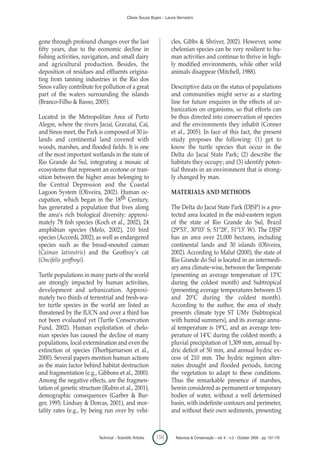
Figura 1: Localização do Parque Estadual Delta do Jacuí, RS – Brasil e os locais de coleta na Fazenda Kramm (FK), Ilha das
Flores (IF) e Ilha da Pintada (IP).


                                    Artigos Técnico-Científicos                   49    Natureza & Conservação - vol. 6 - nº2 - Outubro 2008 - pp. 47-60
Clóvis Souza Bujes - Laura Verrastro


a base do projeto, se localiza na Ilha da                          Após identificação, pesagem e coleta de da-
Pintada (IP). A área para estudo dos quelô-                        dos biométricos, cada tartaruga capturada foi
nios tinha aproximadamente três hectares,                          marcada individualmente com um entalhe
uma área urbanizada que incluía, no centro, o                      em seu escudo marginal (Cagle, 1939) e pos-
canal Mauá; ao norte do canal, um estaleiro                        teriormente solta no mesmo local da captura.
de grande porte e em pleno funcionamento;                          O sexo dos adultos foi determinado a partir
ao sul, o pátio da sede administrativa do                          das características sexuais secundárias, quais
PEDJ (local utilizado pelas tartarugas para ni-                    sejam, posição da cloaca em relação à mar-
dificação); a oeste, construções humanas (re-                      gem posterior do plastrão, existência de con-
sidências, comércio, escolas) às margens e so-                     cavidade no plastrão e ocorrência do proces-
bre as áreas de banhado; e, a leste, o rio Jacuí                   so de melanização.
(30°01’52”S, 51°15’07”W). O segundo local, a
Fazenda Kramm (FK), é uma propriedade                              As considerações acerca das ameaças às espé-
agropecuária situada nos limites do PEDJ, ao                       cies e aos seus hábitats no PEDJ, discutidas
sul do rio Jacuí, em frente às ilhas do Cravo e                    nesse trabalho foram realizadas a partir de
Cabeçudas. A área utilizada para coleta de                         observações diretas no ambiente e através de
dados foi de, aproximadamente, nove hecta-                         entrevistas informais com a população huma-
res, incluindo banhados, quadras de planta-                        na local.
ção de arroz e as cavas (crateras originadas da
extração irregular de areia) numa área de ma-                      RESULTADOS
ta de restinga, vizinha à fazenda (29°58’59”S,
51°18’58”W). O terceiro local situa-se na Ilha                     Foram capturados 208 exemplares de quatro
das Flores (IF), numa área de aproximada-                          espécies de quelônios de água doce: uma es-
mente seis ha, incluindo os banhados e a es-                       pécie pertencente à família Emydidae, a tar-
trada (cujas margens os quelônios utilizam                         taruga-tigre-d’água Trachemys dorbigni
como sítio de nidificação) a duzentos metros                       (Duméril & Bibron, 1835) (N = 137), e três
da margem leste do rio Jacuí (29°58’48”S,                          espécies pertencentes à família Chelidae, o
51°16’22”W). A área da IP está distante 8,5                        cágado-preto Acanthochelys spixii (Duméril
Km da FK, e esta a 5,3 Km da IF, que fica a 5,2                    & Bibron, 1835) (N = 16), o cágado-de-pes-
Km da IP.                                                          coço-de-cobra Hydromedusa tectifera Cope,
                                                                   1870 (N = 11) e o cágado-cinza Phrynops
As expedições ocorreram de setembro de                             hilarii (Duméril & Bibron, 1835) (N = 44)
2003 a agosto de 2004 na IP, de setembro de                        (FIGURA 2). A abundância relativa dessas
2004 a agosto de 2005 na FK, e de setembro de                      espécies foi diferente nas três áreas de cole-
2005 a agosto de 2006 na IF. O esforço amos-                       ta (FIGURA 3).
tral foi de dois a três dias consecutivos por se-
mana, entre setembro e janeiro, e de um dia                        A espécie Trachemys dorbigni foi a mais abun-
por semana, nos demais meses. Em todas as                          dante (66% das capturas). Foi encontrada nas
áreas as capturas foram realizadas manual-                         três áreas, ocupando diferentes tipos de hábi-
mente e com utilização de seis armadilhas do                       tats, desde ambientes permanente ou tempo-
tipo “box-trap” (dimensões 600Lx360Ax800P                          rariamente encharcados, até ambientes forte-
mm), iscadas com carcaça de frango. As ar-                         mente antropizados como canais de esgoto e
madilhas foram colocadas semi-submersas,                           de drenagem de água das plantações de arroz
dispostas a cerca de 40 metros de distância                        e cavas (TABELA 1).
umas das outras, ao longo das margens e per-
maneciam no local por um período mínimo                            Acanthochelys spixii representou 8% das cap-
de 24 horas. As armadilhas eram revisadas a                        turas. A espécie não foi registrada nos canais,
cada três horas e, a cada expedição, se alter-                     sacos e rios amostrados, bem como não foi
nava sua localização, visando maximizar a                          capturada na IP (TABELA 1). Este cágado foi
cobertura de cada área.                                            registrado apenas em hábitats de águas lênti-


                            Artigos Técnico-Científicos    50        Natureza & Conservação - vol. 6 - nº2 - Outubro 2008 - pp. 47-60
Quelônios do delta do Rio Jacuí, RS, Brasil: uso de hábitats e conservação


  A                                                                 B


  C                                                                 D


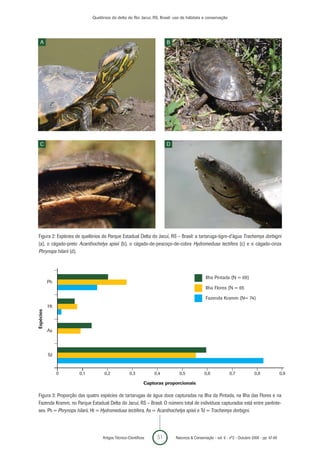
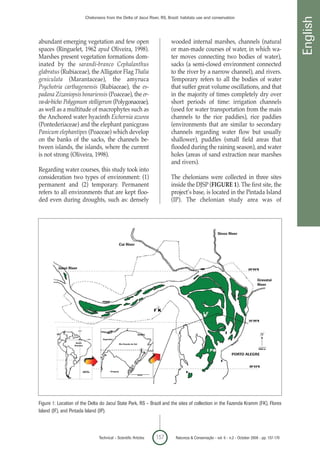
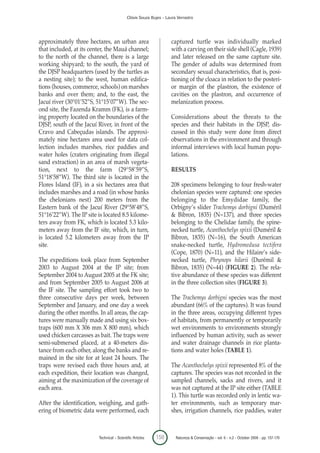
Figura 2: Espécies de quelônios do Parque Estadual Delta do Jacuí, RS – Brasil: a tartaruga-tigre-d’água Trachemys dorbigni
(a), o cágado-preto Acanthochelys spixii (b), o cágado-de-pescoço-de-cobra Hydromedusa tectifera (c) e o cágado-cinza
Phrynops hilarii (d).


                                                                                          Ilha Pintada (N = 69)
           Ph
                                                                                          Ilha Flores (N = 65

                                                                                          Fazenda Kramm (N= 74)
           Ht
Espécies


           As


           Td


                0   0,1          0,2             0,3          0,4         0,5             0,6            0,7             0,8               0,9

                                                          Capturas proporcionais

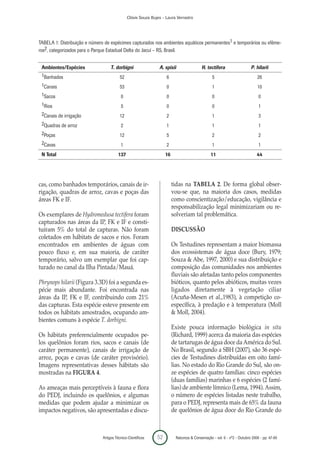
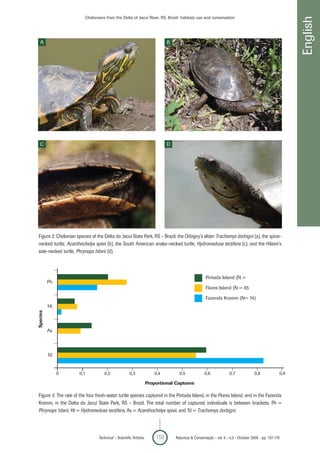
Figura 3: Proporção das quatro espécies de tartarugas de água doce capturadas na Ilha da Pintada, na Ilha das Flores e na
Fazenda Kramm, no Parque Estadual Delta do Jacuí, RS – Brasil. O número total de indivíduos capturados está entre parênte-
ses. Ph = Phrynops hilarii, Ht = Hydromedusa tectifera, As = Acanthochelys spixii e Td = Trachemys dorbigni.


                                Artigos Técnico-Científicos    51       Natureza & Conservação - vol. 6 - nº2 - Outubro 2008 - pp. 47-60
Clóvis Souza Bujes - Laura Verrastro


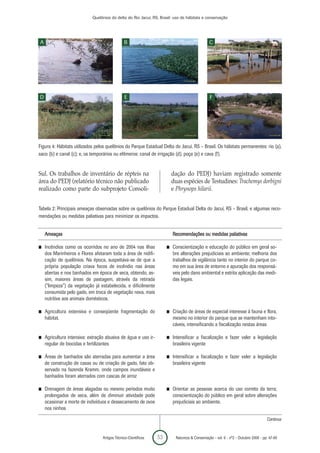
TABELA 1: Distribuição e número de espécimes capturados nos ambientes aquáticos permanentes1 e temporários ou efême-
ros2, categorizados para o Parque Estadual Delta do Jacuí – RS, Brasil.


 Ambientes/Espécies                T. dorbigni                 A. spixii                 H. tectifera                   P. hilarii
 1Banhados                               52                        6                           5                            26
 1Canais                                 53                        0                           1                            10
 1Sacos                                  0                         0                           0                             0
 1Rios                                   5                         0                           0                             1
 2Canais de irrigação                    12                        2                           1                             3
 2Quadras de arroz                       2                         1                           1                             1
 2Poças                                  12                        5                           2                             2
 2Cavas                                  1                         2                           1                             1
 N Total                               137                         16                          11                           44


cas, como banhados temporários, canais de ir-                           tidas na TABELA 2. De forma global obser-
rigação, quadras de arroz, cavas e poças das                            vou-se que, na maioria dos casos, medidas
áreas FK e IF.                                                          como conscientização/educação, vigilância e
                                                                        responsabilização legal minimizariam ou re-
Os exemplares de Hydromedusa tectifera foram                            solveriam tal problemática.
capturados nas áreas da IP, FK e IF e consti-
tuíram 5% do total de capturas. Não foram                               DISCUSSÃO
coletados em hábitats de sacos e rios. Foram
encontrados em ambientes de águas com                                   Os Testudines representam a maior biomassa
pouco fluxo e, em sua maioria, de caráter                               dos ecossistemas de água doce (Bury, 1979;
temporário, salvo um exemplar que foi cap-                              Souza & Abe, 1997, 2000) e sua distribuição e
turado no canal da Ilha Pintada/Mauá.                                   composição das comunidades nos ambientes
                                                                        fluviais são afetadas tanto pelos componentes
Phrynops hilarii (Figura 3.3D) foi a segunda es-                        bióticos, quanto pelos abióticos, muitas vezes
pécie mais abundante. Foi encontrada nas                                ligados diretamente à vegetação ciliar
áreas da IP, FK e IF, contribuindo com 21%                              (Acuña-Mesen et al.,1983), à competição co-
das capturas. Esta espécie esteve presente em                           específica, à predação e à temperatura (Moll
todos os hábitats amostrados, ocupando am-                              & Moll, 2004).
bientes comuns à espécie T. dorbigni.
                                                                        Existe pouca informação biológica in situ
Os hábitats preferencialmente ocupados pe-                              (Richard, 1999) acerca da maioria das espécies
los quelônios foram rios, sacos e canais (de                            de tartarugas de água doce da América do Sul.
caráter permanente), canais de irrigação de                             No Brasil, segundo a SBH (2007), são 36 espé-
arroz, poças e cavas (de caráter provisório).                           cies de Testudines distribuídas em oito famí-
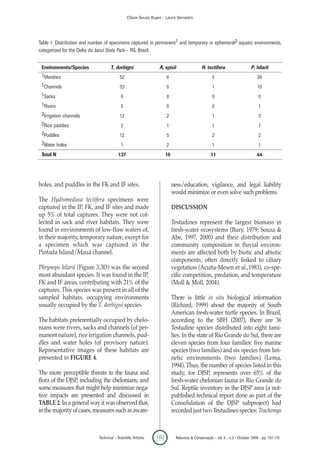
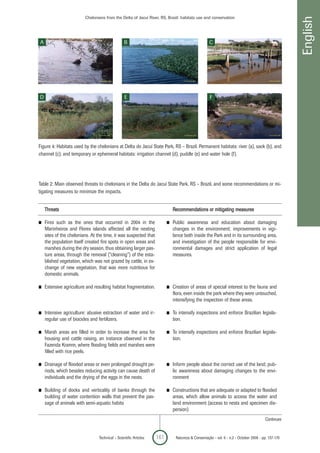
Imagens representativas desses hábitats são                             lias. No estado do Rio Grande do Sul, são on-
mostradas na FIGURA 4.                                                  ze espécies de quatro famílias: cinco espécies
                                                                        (duas famílias) marinhas e 6 espécies (2 famí-
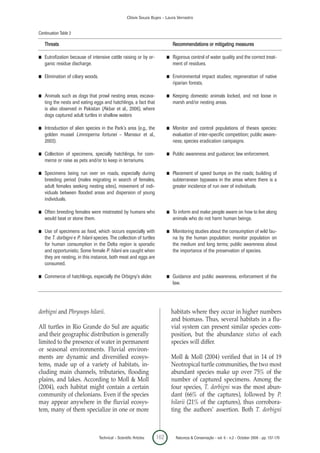
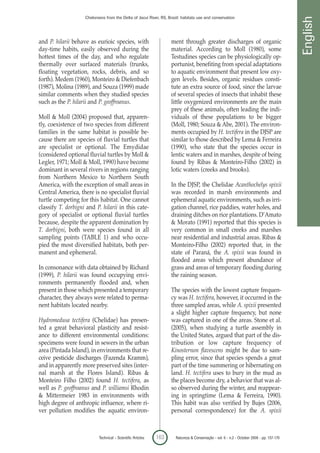
As ameaças mais perceptíveis à fauna e flora                            lias) de ambiente límnico (Lema, 1994). Assim,
do PEDJ, incluindo os quelônios, e algumas                              o número de espécies listadas neste trabalho,
medidas que podem ajudar a minimizar os                                 para o PEDJ, representa mais de 65% da fauna
impactos negativos, são apresentadas e discu-                           de quelônios de água doce do Rio Grande do


                              Artigos Técnico-Científicos     52         Natureza & Conservação - vol. 6 - nº2 - Outubro 2008 - pp. 47-60
Quelônios do delta do Rio Jacuí, RS, Brasil: uso de hábitats e conservação


A                                              B                                               C


D                                               E                                              F


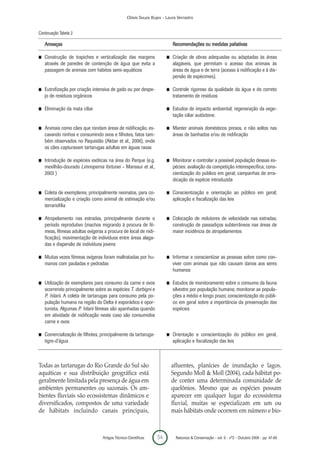
Figura 4: Hábitats utilizados pelos quelônios do Parque Estadual Delta do Jacuí, RS – Brasil. Os hábitats permanentes: rio (a),
saco (b) e canal (c); e, os temporários ou efêmeros: canal de irrigação (d), poça (e) e cava (f).


Sul. Os trabalhos de inventário de répteis na                            dação do PEDJ) haviam registrado somente
área do PEDJ (relatório técnico não publicado                            duas espécies de Testudines: Trachemys dorbigni
realizado como parte do subprojeto Consoli-                              e Phrynops hilarii.


Tabela 2: Principais ameaças observadas sobre os quelônios do Parque Estadual Delta do Jacuí, RS – Brasil, e algumas reco-
mendações ou medidas paliativas para minimizar os impactos.


    Ameaças                                                              Recomendações ou medidas paliativas

I   Incêndios como os ocorridos no ano de 2004 nas ilhas             I   Conscientização e educação do público em geral so-
    dos Marinheiros e Flores afetaram toda a área de nidifi-             bre alterações prejudiciais ao ambiente; melhoria dos
    cação de quelônios. Na época, suspeitava-se de que a                 trabalhos de vigilância tanto no interior do parque co-
    própria população criava focos de incêndio nas áreas                 mo em sua área de entorno e apuração dos responsá-
    abertas e nos banhados em época de seca, obtendo, as-                veis pelo dano ambiental e estrita aplicação das medi-
    sim, maiores áreas de pastagem, através da retirada                  das legais.
    (“limpeza”) da vegetação já estabelecida, e dificilmente
    consumida pelo gado, em troca de vegetação nova, mais
    nutritiva aos animais domésticos.

I   Agricultura extensiva e conseqüente fragmentação do              I   Criação de áreas de especial interesse à fauna e flora,
    hábitat.                                                             mesmo no interior do parque que se mantenham into-
                                                                         cáveis, intensificando a fiscalização nestas áreas

I   Agricultura intensiva: extração abusiva de água e uso ir-        I   Intensificar a fiscalização e fazer valer a legislação
    regular de biocidas e fertilizantes                                  brasileira vigente

I   Áreas de banhados são aterradas para aumentar a área             I   Intensificar a fiscalização e fazer valer a legislação
    de construção de casas ou de criação de gado, fato ob-               brasileira vigente
    servado na fazenda Kramm, onde campos inundáveis e
    banhados foram aterrados com cascas de arroz

I   Drenagem de áreas alagadas ou mesmo períodos muito               I   Orientar as pessoas acerca do uso correto da terra;
    prolongados de seca, além de diminuir atividade pode                 conscientização do público em geral sobre alterações
    ocasionar a morte de indivíduos e dessecamento de ovos               prejudiciais ao ambiente.
    nos ninhos

                                                                                                                                   Continua


                                  Artigos Técnico-Científicos   53        Natureza & Conservação - vol. 6 - nº2 - Outubro 2008 - pp. 47-60
Clóvis Souza Bujes - Laura Verrastro


Continuação Tabela 2

    Ameaças                                                               Recomendações ou medidas paliativas

I   Construção de trapiches e verticalização das margens              I   Criação de obras adequadas ou adaptadas às áreas
    através de paredes de contenção de água que evita a                   alagáveis, que permitam o acesso dos animais às
    passagem de animais com hábitos semi-aquáticos                        áreas de água e de terra (acesso à nidificação e à dis-
                                                                          persão de espécimes).

I   Eutrofização por criação intensiva de gado ou por despe-          I   Controle rigoroso da qualidade da água e do correto
    jo de resíduos orgânicos                                              tratamento de resíduos

I   Eliminação da mata ciliar                                         I   Estudos de impacto ambiental; regeneração da vege-
                                                                          tação ciliar autóctone.

I   Animais como cães que rondam áreas de nidificação, es-            I   Manter animais domésticos presos, e não soltos nas
    cavando ninhos e consumindo ovos e filhotes, fatos tam-               áreas de banhados e/ou de nidificação
    bém observados no Paquistão (Akbar et al., 2006), onde
    os cães capturavam tartarugas adultas em águas rasas

I   Introdução de espécies exóticas na área do Parque (e.g.           I   Monitorar e controlar a possível população dessas es-
    mexilhão-dourado Limnoperna fortunei – Manssur et al.,                pécies: avaliação da competição interespecífica; cons-
    2003 )                                                                cientização do público em geral; campanhas de erra-
                                                                          dicação da espécie introduzida

I   Coleta de exemplares, principalmente neonatos, para co-           I   Conscientização e orientação ao público em geral;
    mercialização e criação como animal de estimação e/ou                 aplicação e fiscalização das leis
    terrariofilia

I   Atropelamento nas estradas, principalmente durante o              I   Colocação de redutores de velocidade nas estradas;
    período reprodutivo (machos migrando à procura de fê-                 construção de passadiços subterrâneos nas áreas de
    meas, fêmeas adultas ovígeras a procura de local de nidi-             maior incidência de atropelamentos
    ficação), movimentação de indivíduos entre áreas alaga-
    das e dispersão de indivíduos jovens

I   Muitas vezes fêmeas ovígeras foram maltratadas por hu-            I   Informar e conscientizar as pessoas sobre como con-
    manos com pauladas e pedradas                                         viver com animais que não causam danos aos seres
                                                                          humanos

I   Utilização de exemplares para consumo da carne e ovos             I   Estudos de monitoramento sobre o consumo da fauna
    ocorrendo principalmente sobre as espécies T. dorbigni e              silvestre por população humana; monitorar as popula-
    P. hilarii. A coleta de tartarugas para consumo pela po-              ções a médio e longo prazo; conscientização do públi-
    pulação humana na região do Delta é esporádico e opor-                co em geral sobre a importância da preservação das
    tunista. Algumas P. hilarii fêmeas são apanhadas quando               espécies
    em atividade de nidificação neste caso são consumidos
    carne e ovos

I   Comercialização de filhotes, principalmente da tartaruga-         I   Orientação e conscientização do público em geral,
    tigre-d’água                                                          aplicação e fiscalização das leis


Todas as tartarugas do Rio Grande do Sul são                              afluentes, planícies de inundação e lagos.
aquáticas e sua distribuição geográfica está                              Segundo Moll & Moll (2004), cada hábitat po-
geralmente limitada pela presença de água em                              de conter uma determinada comunidade de
ambientes permanentes ou sazonais. Os am-                                 quelônios. Mesmo que as espécies possam
bientes fluviais são ecossistemas dinâmicos e                             aparecer em qualquer lugar do ecossistema
diversificados, compostos de uma variedade                                fluvial, muitas se especializam em um ou
de hábitats incluindo canais principais,                                  mais hábitats onde ocorrem em número e bio-


                                  Artigos Técnico-Científicos    54        Natureza & Conservação - vol. 6 - nº2 - Outubro 2008 - pp. 47-60
Quelônios do delta do Rio Jacuí, RS, Brasil: uso de hábitats e conservação


massa mais elevados. Desta forma, os vários                        permanentes localizados nas proximidades.
hábitats de um sistema fluvial podem ter com-
posição de espécies similares, mas o status de                     Hydromedusa tectifera (Chelidae) mostrou gran-
abundância de cada espécie será diferente.                         de plasticidade comportamental e resistência às
                                                                   diferentes condições ambientais: foram encon-
Moll & Moll (2004) verificaram que em 14 de                        trados exemplares nos esgotos da área urbani-
19 comunidades de tartarugas neotropicais,                         zada (Ilha da Pintada), em ambientes que rece-
as duas espécies mais abundantes compreen-                         bem aporte de agrotóxicos (Fazenda Kramm) e
dem mais de 75% do número de capturas.                             em locais aparentemente mais preservados (ba-
Entre as quatro espécies, T. dorbigni foi a mais                   nhado interno da Ilha das Flores). Ribas &
abundante (66 % das capturas) seguida de P.                        Monteiro-Filho (2002) encontraram H. tectifera,
hilarii (21% das capturas), corroborando as-                       bem como P. geoffroanus e P. williamsi Rhodin &
sim o postulado por aqueles autores. Tanto T.                      Mittermeier 1983 em ambientes com elevado
dorbigni como P. hilarii se comportam como                         grau de influência antrópica, onde a poluição
espécies eurióicas, de hábitos diurnos, facil-                     dos rios modifica o ambiente aquático através
mente observadas nos horários mais quentes                         do maior aporte de material orgânico. Segundo
do dia, termorregulando sobre materiais                            Moll (1980), algumas espécies de Testudines po-
emersos (troncos, vegetação flutuante, ro-                         dem ser fisiologicamente oportunistas, sendo
chas, entulhos, etc.). Medem (1960), Monteiro                      beneficiadas em virtude de adaptações espe-
& Diefenbach (1987), Molina (1989) e Souza                         ciais a ambientes aquáticos com reduzidos ní-
(1999) fizeram observações similares ao estu-                      veis de oxigênio. Além disso, os resíduos orgâ-
darem espécies como P. hilarii e P. geoffroanus.                   nicos constituem uma fonte de alimento extra,
                                                                   uma vez que muitas larvas de insetos que habi-
Moll & Moll (2004) propuseram que, aparen-                         tam ambientes pouco oxigenados são as princi-
temente, a coexistência entre duas espécies de                     pais presas desses animais, levando, muitas ve-
famílias diferentes no mesmo hábitat é possí-                      zes, ao maior tamanho dos indivíduos dessas
vel por haver espécies de tartarugas fluviais                      populações (Moll, 1980; Souza & Abe, 2001). Os
especialistas e facultativas. Os emidídeos                         ambientes ocupados por H. tectifera no PEDJ são
(considerados por Moll & Legler, 1971; Moll                        semelhantes aos descritos por Lema & Ferreira
& Moll, 1990 tartarugas fluviais facultativas)                     (1990), os quais citam que a espécie ocorre em
se tornaram dominantes em muitos rios das                          águas lênticas e em banhados, apesar de serem
regiões do norte do México ao norte da                             encontradas por Ribas & Monteiro-Filho (2002)
América do Sul porque, à exceção das peque-                        em águas lóticas (riachos e córregos).
nas regiões da América Central, não há ne-
nhuma tartaruga fluvial especialista compe-                        No PEDJ, o quelídeo Acanthochelys spixii foi re-
tindo por este hábitat. Não poderíamos en-                         gistrado em ambientes de banhados e am-
quadrar T. dorbigni e P. hilarii nessa classifica-                 bientes aquáticos efêmeros, como canais de ir-
ção de tartarugas fluviais especialistas ou flu-                   rigação, quadras de arroz, cavas e valas de
viais facultativas porque, apesar da visível                       drenagem das lavouras de arroz. D’Amato &
dominância de T. dorbigni, ambas foram espé-                       Morato (1991) reportaram ser bem comum a
cies encontradas em todos os pontos amos-                          ocorrência dessa espécie em pequenos riachos
trais (TABELA 1) e que ocuparam os mais di-                        e banhados próximos a áreas residenciais e in-
versificados hábitats, tanto os aquáticos per-                     dustriais. Ribas & Monteiro-Filho (2002) rela-
manentes, quanto os efêmeros.                                      taram que no estado do Paraná, A. spixii foi
                                                                   encontrada em terrenos encharcados com
Em consonância aos dados de Richard (1999),                        abundância de gramíneas e em áreas de inun-
P. hilarii foi encontrada ocupando ambientes                       dação temporária durante a época das chuvas.
permanentemente alagados e, quando presen-
tes naqueles que apresentavam caráter tempo-                       A espécie com menor freqüência de capturas
rário, estes sempre tinham relação com hábitats                    foi H. tectifera, porém sua ocorrência deu-se


                             Artigos Técnico-Científicos   55        Natureza & Conservação - vol. 6 - nº2 - Outubro 2008 - pp. 47-60
Clóvis Souza Bujes - Laura Verrastro


nas três áreas amostradas, enquanto A. spixii                     cies. As ameaças listadas e as situações obser-
apresentou freqüência de capturas um pouco                        vadas no PEDJ (TABELA 2) não afetam, obvia-
maior, mas não foi capturada em uma das                           mente, somente os quelônios, mas também as
áreas. Stone et al. (2005), estudando uma as-                     demais espécies da fauna e flora. A fragilidade
sembléia de tartarugas nos Estados Unidos,                        das populações de tartarugas está ligada às
argumentaram que parte da distribuição ou                         baixas taxas de recrutamento, baixa densidade
baixa freqüência de capturas de Kinosternon                       populacional e à fragmentação do hábitat. Sem
flavescens pode ter-se dado por um erro amos-                     dúvida, a alteração no hábitat foi a mais grave
tral, já que aquela espécie gasta boa parte de                    ameaça verificada no PEDJ, o que acarreta na
seu tempo estivando ou hibernando em terra.                       redução ou perda absoluta de ambientes ne-
H. tectifera costuma enterrar-se na lama à me-                    cessários às funções vitais essenciais de muitos
dida que os locais tornam-se secos, comporta-                     organismos, incluindo alimentação (Vickery et
mento também verificado durante o inverno,                        al., 2001), reprodução (Heckert et al., 2003) e
ressurgindo na primavera (Lema & Ferreira,                        abrigo (Ball, 2002). No PEDJ foi observada a re-
1990). Esse hábito também foi verificado por                      tirada da vegetação ciliar para construção de
Bujes (2006, comunicação pessoal) para a es-                      residências e a construção de diques (tapumes)
pécie A. spixii e pode ter colaborado com as                      nas margens, visando à contenção da água e
baixas estimativas de freqüência de ocorrência                    impedindo assim o acesso dos animais às áreas
e abundância relativa de ambas as espécies.                       de terras adjacentes para deslocamento e/ou
                                                                  nidificação. O aumento da urbanização tem se
As espécies listadas neste estudo também ocu-                     mostrado responsável por mudanças drásticas
param as cavas, um ambiente bastante pecu-                        em muitas populações animais, e.g. grandes
liar e resultante da ação antrópica. No PEDJ as                   carnívoros (Reilly et al., 2003), borboletas
cavas são verdadeiras crateras, decorrentes da                    (Collinge et al., 2003), salamandras (Willson &
extração ilegal de areia em uma área de                           Dorcas, 2003), peixes (Paul & Meyer, 2001),
Restinga vizinha à Fazenda Kramm. São am-                         bem como em comunidades vegetais, tanto de
bientes efêmeros, com água disponível apenas                      ambientes terrestres (Fransisco-Ortega et al.,
em períodos de chuvas. Esses hábitats tempo-                      2000) quanto em ambientes aquáticos (Fore &
rários parecem disponibilizar maior aporte de                     Grafe, 2002).
recursos alimentares que propiciam condições
favoráveis para o crescimento e a reprodução,                     De la Ossa-Velásquez & Fajardo (1998) consi-
fornecendo abrigo e áreas de nidificação às es-                   deraram a destruição e a alteração dos am-
pécies (Kennett & Georges, 1990).                                 bientes naturais a ameaça mais grave para a
                                                                  sobrevivência de Phrynops dahli, espécie endê-
Moll & Moll (2004) reportaram que comuni-                         mica da Colômbia, cujo hábitat desapareceu
dades de tartarugas tendem a ser relativa-                        quase que totalmente como conseqüência da
mente pobres em número de espécies e geral-                       expansão da fronteira agropecuária e desen-
mente uma ou duas espécies costumam ocor-                         volvimento urbano. O desmatamento da ve-
rer juntas num mesmo hábitat, o que também                        getação ciliar e a conseqüente alteração das
pode ser atribuído à comunidade de quelô-                         margens dos rios podem, segundo
nios do PEDJ.                                                     Hildebrand & Muñoz (1992), ter provocado a
                                                                  destruição de todo o esforço reprodutivo das
Com exceção de Acanthochelys spixii que está                      espécies de quelônios na Colômbia.
categorizada como baixo risco/quase ameaça-
da (LR/NT) na lista da IUCN (2006), os quelô-                     Gibbons et al. (2000) consideraram a destrui-
nios do PEDJ não figuram em listas nacionais                      ção/fragmentação de hábitats como a ameaça
de espécies ameaças. No entanto, os impactos                      mais grave à biodiversidade, seguida da in-
causados pelo desmatamento e pela poluição                        trodução de espécies, poluição ambiental,
na região do Delta do Jacuí podem representar                     doenças e parasitismo, uso insustentável e
sérios riscos à sobrevivência daquelas espé-                      mudanças no clima global. Conforme


                           Artigos Técnico-Científicos    56        Natureza & Conservação - vol. 6 - nº2 - Outubro 2008 - pp. 47-60
Quelônios do delta do Rio Jacuí, RS, Brasil: uso de hábitats e conservação


Tabarelli et al. (2004), o desmatamento tem                       AGRADECIMENTOS:
efeitos diretos e indiretos na redução dos há-
bitats das espécies de plantas e animais. Como                    Agradecemos à Fundação O Boticário de
exemplo de efeito direto, esses autores citam a                   Proteção à Natureza (FBPN, Projeto
eliminação de vertebrados dispersores de se-                      Chelonia–RS 0594-20032) pelo apoio financei-
mentes, comprometendo assim a germinação.                         ro; ao Instituto Gaúcho de Estudos
Quanto aos indiretos, mencionam a produção                        Ambientais (INGA), à Secretaria Estadual do
de grandes quantidades de detrito orgânico,                       Meio Ambiente (SEMA) e ao Departamento
que, combinados ao lixo e à biomassa morta,                       de Zoologia da Universidade Federal do Rio
decorrente da fragmentação, deixam certas re-                     Grande do Sul (UFRGS) pelo apoio logístico;
giões ainda mais suscetíveis aos incêndios.                       e, aos funcionários do Parque Estadual Delta
Burke et al. (1994) sugeriram que as tartarugas                   do Jacuí, em especial a Loiva e ao Clemente.
podem ser especialmente vulneráveis ao de-                        Aos colegas Dr. Flávio de Barros Molina e Dr.
clínio populacional devido as suas estratégias                    Márcio Borges Martins, pela valiosa contri-
reprodutivas incompatíveis com a exploração                       buição na revisão do manuscrito.
e significante perda de hábitat.

A educação é uma importante ferramenta pa-
ra o desenvolvimento de uma postura que
conduza aos projetos de conservação, bem co-
mo um elemento-chave no seu sucesso, à me-                        REFERÊNCIAS
dida que as pessoas envolvidas ou afetadas
pelo programa sejam informadas da necessi-                        Accordi, I.A. 2002. Asas do delta: aves entre a
dade daquela ação e dos benefícios do pro-                        terra e água. In: Fundação Zoobotânica do
grama para o seu presente e futuro. Para                          Rio Grande do Sul (ed.). Natureza em revista:
Congdon et al. (1993), os programas de ma-                        Delta do Jacuí. Pp. 54-59. Porto Alegre:
nejo e conservação de tartarugas bem sucedi-                      Fundação Zoobotânica do Rio Grande do Sul.
dos seriam aqueles que reconhecem que a
proteção se faz necessária em todos os está-                      Acuña-Mesen, R. A.; Castaing, A.; Flores, F.
gios da história de vida dos organismos.                          1983. Aspectos ecológicos de la distribución
                                                                  de las tortugas terrestres y semiacuáticas en el
CONCLUSÃO                                                         Valle Central de Costa Rica. Revista de Biologia
                                                                  Tropical, 31 (2): 181-192.
A comunidade de quelônios do PEDJ é com-
posta por quatro espécies que ocupam diferen-                     Akbar, M.; Hassan, M. M.; Nisa, Z. 2006.
tes tipos de hábitats, incluindo ambientes aquá-                  Distribution of freshwater turtles in Punjab,
ticos permanentes e efêmeros. As ameaças à so-                    Pakistan. Caspian Journal of Environmental
brevivência dessas espécies são muitas e estão                    Sciences, 4 (2): 142-146.
intimamente relacionadas à presença humana
na área do Parque. Diante das questões apre-                      Ball, L. C. 2002. A strategy for describing and
sentadas neste estudo, verifica-se a necessidade                  monitoring bat habitat. Journal Wildlife
premente de conscientização do público sobre                      Management, 66: 1148-1153.
a importância dos quelônios e o fato de que o
convívio com eles não causa danos aos seres                       Branco-Filho, C. C.; Basso, L. A. 2005.
humanos. Não obstante, deve-se intensificar a                     Ocupação irregular e degradação ambiental
fiscalização e aplicação da legislação ambiental                  no Parque Estadual Delta do Jacuí-RS.
vigente, bem como a implementação de estu-                        Geografia, 30(2): 285-302.
dos para a proteção in loco dos animais e dos
ambientes ocupados por eles.                                      Burke, V. J.; Gibbons, J. W.; Greene, J. L. 1994.
                                                                  Prolonged nesting forays by common mud


                            Artigos Técnico-Científicos   57        Natureza & Conservação - vol. 6 - nº2 - Outubro 2008 - pp. 47-60
Clóvis Souza Bujes - Laura Verrastro


turtles (Kinosternon subrubrum). American                           perspective. American Journal of Botany, 87 (7):
Midland Naturalist, 131 (1): 190-195.                               909-919.

Bury, R. B. 1979. Population ecology of fresh-                      Garber, S. D.; Burger, J. 1995. A 20-yr study
water turtles. In: Harless, M; Morlock, H.                          documenting the relationship between turtle
(ed.). Turtles: perspectives and research. Pp. 571-                 decline and human recreation. Ecological
604. New York: John Wiley.                                          Applications, 5: 1151-1162.

Cagle, F. R. 1939. A system of marking turtles                      Gibbons, J. W.; Scott, E. D.; Ryan, T. J.;
for future identification. Copeia, 1939 (3): 170-                   Buhlmann, K. A.; Tuberville, T. D.; Metts, B.
173.                                                                S.; Geene, J. L.; Mills, T.; Leiden, Y.; Poppy, S.;
                                                                    Winne, C. T. 2000. The global decline of rep-
Collinge, S. K.; Prudic, K. L.; Oliver, J. C. 2003.                 tiles, déjà vu amphibians. BioScience, 50: 653-
Effects of local habitat characteristics land-                      666.
scape context on grassland butterfly diversity.
Conservation Biology, 17: 178-187.                                  Gibbs, J. P.; Shriver, W. G. 2002. Estimating
                                                                    the effects of road mortality on turtle popula-
Congdon, J. D.; Dunham, A. E.; Van Loben                            tions. Conservation Biology, 16 (6): 1647-1652.
Sels, R.C. 1993. Delayed sexual maturity and
demographics of Blanding’s turtles                                  Heckert, J. R.; Reinking, D. L.; Wiedenfeld, D.
(Emydoidea blandingii): implications for con-                       A.; Winter, M.; Zimmerman, J. L.; Jensen, W.
servation and management of long-lived or-                          E.; Flink, E. J.; Koford, R. R.; Wolfe, D. H.;
ganisms. Conservation Biology, 7: 826-833.                          Sherrod, S. K.; Jenkins, M. A.; Faaborg, J.;
                                                                    Robinson, S.K. 2003. Effects of prairie frag-
Conner, C. A.; Douthitt, B. A.; Ryan, T. J. 2005.                   mentation on the nest success of breeding
Descriptive ecology of a turtle assemblage in                       birds in the midcontinental United States.
an urban landscape. The American Midland                            Conservation Biology, 17: 587-594.
Naturalist, 153 (2): 428-435.
                                                                    Hildebrand, P. V.; Muñoz, D. 1992.
D’Amato, A. F.; Morato, S. A. A. 1991. Notas                        Conservación y manejo sostenible de la tortu-
biológicas e localidades de registro de                             ga charapa (Podocnemis expansa) en el bajo Río
Platemys spixii (Duméril & Bibron, 1835)                            Caquetá en Colombia. Fase III. Proyecto de
(Testudines: Chelidae) para o Estado do                             Investigación. 21 pp.
Paraná, Brasil. Acta Biológica Leopoldensia, 13
(2): 119-130.                                                       IUCN. 2006. 2006 IUCN Red List of Threatened
                                                                    Species. <www.iucnredlist.org>. Downloaded
De la Ossa-Velásquez, J.; Fajardo, A. 1998.                         on 23 August 2007.
Introducción al conocimiento de algunas especies
de fauna silvestre del Departamento de Sucre-                       Kennett, R. M.; Georges, A. 1990. Habitat uti-
Colombia. Sucre: Carsucre Fundación George                          lization and its relationship to growth and re-
Dahl.                                                               production of the eastern long-necked turtle,
                                                                    Chelodina longicollis (Testudinata: Chelidae),
Fore, L. S.; Grafe, C. 2002. Using diatoms to                       from Australia. Herpetologica, 46, (1): 22-33.
assess biological condition of large rivers in
Idaho (U. S. A.). Freshwater Biology, 47 (10):                      Koch, W. R.; Milani, P. C.; Grosser, K. M. 2002.
2015-2037.                                                          Peixes das chuvas. In: Fundação Zoobotânica
                                                                    do Rio Grande do Sul (ed.). Natureza em revis-
Fransisco-Ortega, J.; Santos-Guerra, A.; Kim,                       ta: Delta do Jacuí. Pp. 52-53. Porto Alegre:
S. C.; Crawford, D. J. 2000. Plant genetic di-                      Fundação Zoobotânica do Rio Grande do Sul.
versity in the Canary Island: a conservation


                             Artigos Técnico-Científicos    58        Natureza & Conservação - vol. 6 - nº2 - Outubro 2008 - pp. 47-60
Quelônios do delta do Rio Jacuí, RS, Brasil: uso de hábitats e conservação


Lema, T. 1994. Lista comentada dos répteis                         species to a tropical environment. In:
ocorrentes no Rio Grande do Sul, Brasil.                           Gibbons, J. W. (ed.). Life history and ecology of
Comunicações do Museu de Ciências e Tecnologia                     the slider turtle. Pp. 152-161. Washington D. C.:
da PUCRS, Série Zoologia, 7: 41-150.                               Smithsoniam Institution Press.

Lema, T.; Ferreira, M. T. S. 1990. Contribuição                    Moll, D.; Moll, E. O. 2004. The ecology, ex-
ao conhecimento dos Testudines do Rio                              ploitation and conservation of river turtles. New
Grande do Sul (Brasil) – lista sistemática co-                     York: Oxford University Press. 393 p.
mentada       (Reptilia).      Acta   Biológica
Leopoldensia, 12 (1): 125-164.                                     Moll, E. O.; Legler, J. M. 1971. The life history
                                                                   of a neotropical slider turtle Pseudemys scripta
Lindsay, S. D.; Dorcas, M. E. 2001. Effects of                     (Schoepff) in Panama. Bulletin of the Los
cattle on reproduction and morphology of                           Angeles Country Museum of the Natural History
pond-dwelling turtles in North Carolina. J.                        Science, 11: 1-102.
Elisha Mitchell Scientific Society, 117: 249-257.
                                                                   Monteiro, L. P.; Diefenbach, C. O. C. 1987.
Maluf, J. R. T. 2000. Nova classificação climá-                    Thermal regime of Phrynops hilarii (Reptilia,
tica do Estado do Rio Grande do Sul. Revista                       Chelonia). Boletim de Fisiologia Animal, São
Brasileira de Agrometeorologia, 8 (1): 141-150.                    Paulo 11: 41–50.

Medem, F. 1960. Informe sobre reptiles co-                         Oliveira, M. L. A. A. 1998. Análise do padrão de
lombianos (V). Observaciones sobre la distri-                      distribuição espacial de comunidades vegetais do
bución geográfica y ecología de la tortuga                         Parque Estadual Delta do Jacuí: Mapeamento e
Phrynops geoffroana ssp. en Colombia.                              subsídios ao zoneamento da unidade de conserva-
Novedads Colombianas, 1: 291-300.                                  ção. Tese (Doutorado em Ciências) – Curso de
                                                                   Pós-graduação em Botânica, Universidade
Melo, M. T. Q. 2002. Rãs, sapos e pererecas. In:                   Federal do Rio Grande do Sul, Porto Alegre.
Fundação Zoobotânica do Rio Grande do Sul                          234 p.
(ed.). Natureza em revista: Delta do Jacuí. Pp. 54-
59. Porto Alegre: Fundação Zoobotânica do                          Oliveira, M. L. A. A. 2002. Conhecendo o
Rio Grande do Sul.                                                 Parque. In: Fundação Zoobotânica do Rio
                                                                   Grande do Sul (ed.). Natureza em revista: Delta
Mitchell, J. C. 1988. Population ecology and                       do Jacuí. Pp. 12-19. Porto Alegre: Fundação
life histories of the freshwater turtles                           Zoobotânica do Rio Grande do Sul.
Chrysemys picta and Sternotherus odoratus in
an urban lake. Herpetological Monographs, 2                        Paul, M. J.; Meyer, J. L. 2001. Streams in the
(1988): 40-61.                                                     urban landscapes. Annual Review of Ecology
                                                                   and Systematics, 32: 333-365.
Molina, F. B. 1989. Observações sobre a biologia e
o comportamento de Phrynops geoffroanus                            Reilly, S. P. D.; Sauvajot, R. M.; Fuller, T. K.;
(Schweigger, 1812) em cativeiro (Reptilia,                         York, E. C.; Kamradt, D. A.; Bromley, C.;
Testudines, Chelidae). Dissertação de Mestrado                     Wayne, R. K. 2003. Effects on urbanization
não-publicada. Universidade de São Paulo,                          and habitat fragmentation on bobcats and
Brasil.                                                            coyotes in southern California. Conservation
                                                                   Biology, 17: 566-576.
Moll, D. 1980. Dirty river turtles. Natural
History, 89 (5): 43-49.                                            Ribas, E. R.; Monteiro-Filho, E. L. A. 2002.
                                                                   Distribuição e habitat das tartarugas de água-
Moll, D.; Moll, E. 1990. The slider turtle in the                  doce (Testudines, Chelidae) do estado do
Neotropics: adaptations of a temperate                             Paraná, Brasil. Biociências, 10 (2): 15-32.


                             Artigos Técnico-Científicos   59        Natureza & Conservação - vol. 6 - nº2 - Outubro 2008 - pp. 47-60
Clóvis Souza Bujes - Laura Verrastro


Richard, E. 1999. Tortugas de las regiones áridas                   Freshwater turtles assemblages in Central
de Argentina. Buenos Aires: Literature of Latin                     Oklahoma farm ponds. The Southwestern
America (LOLA).                                                     Naturalist, 50 (2): 166-171.

Rodrigues, M. T. 2005. The Conservation of                          Tabarelli, M.; Silva, J. M. C.; Gascon, C. 2004.
Brazilian Reptiles: Challenges for a                                Forest fragmentation, synergisms and the im-
Megadiverse Country. Conservation Biology,                          poverishment of neotropical forests. Biodiver-
19 (3): 659-664.                                                    sity and Conservation, 13: 1419-1425.

Rubin, C. S.; Warner, R. E.; Bouzat, J. L.; Paige,                  Thorbjarnarson, J.; Lagueux, C. J.; Bolze, D.;
K. N. 2001. Population genetic structure of                         Klemens, M. W.; Meylan, A. B. 2000. Human
Blanding’s turtle (Emydoidea blandinggii) in an                     use of turtles: a worldwide perspective. In:
urban landscape. Biological Conservation, 99:                       M.W. Klemens (ed.). Turtle Conservation. Pp.
323-330.                                                            33-84. Washington D. C.: Smithsonian
                                                                    Institute Press.
Rylands, A. B.; Brandon, K. 2005. Brazilian
protected areas. Conservation Biology, 19: 612-                     Turtle Conservation Fund. 2002. A global ac-
618.                                                                tion plan for conservation of tortoises and
                                                                    freshwater turtles. Strategy and funding
SBH. 2007. Lista de espécies de répteis do Brasil.                  prospectus 2002-2007. Conservation International
Sociedade Brasileira de Herpetologia (SBH).                         and Chelonian Research Foundation. Washing-
Disponível em: http://www2.sbherpetologia.                          ton, D.C. 30 pp.
org.br/checklist/repteis.htm, acessado em 8
de outubro 2007.                                                    Vickery, J .A.; Tallowin, J. R.; Feber, R. E.;
                                                                    Asteraki, E. J.; Atkinson, P. W.; Fuller, R. J.;
Souza, F. L. 1999. Ecologia do cágado Phrynops                      Brown, V. K. 2001. The management of low-
geoffroanus (Schweigger, 1812) em ambiente ur-                      land neutral grassland in Britain: effects of
bano poluído (Reptilia, Testudines, Chelidae).                      agricultural practices on birds and their food
Tese de Doutorado não-publicada. Universi-                          resources. The Journal of Applied Ecology, 38:
dade Estadual Paulista, Rio Claro, Brasil.                          647-664.

Souza, F. L.; Abe, A. S. 1997. Population struc-                    Willson, J. D.; Dorcas, M. E. 2003. Effects of
ture, activity, and conservation of the                             habitat disturbance on stream salamanders:
neotropical freshwater turtle, Hydromedusa                          implications for buffer zones and watershed
maximiliani, in Brazil. Chelonian Conservation                      management. Conservation Biology, 17: 763-771.
and Biology, 2 (4): 521-525.

Souza, F. L.; Abe, A. S. 2000. Feeding ecology,
density and biomass of the freshwater turtle,
Phrynops geoffroanus, inhabiting a polluted ur-
ban river in south-eastern Brazil. Journal of
Zoology, 252: 437-446.

Souza, F. L.; Abe, A. S. 2001. Population struc-
ture and reproductive aspects of the freshwater
turtle, Phrynops geoffroanus, inhabiting an urban
river in Southeastern Brazil. Studies on
Neotropical Fauna and Environment, 36 (1): 57-62.

Stone, P. A., Powers, S. M.; Babb, M. E. 2005.


                             Artigos Técnico-Científicos    60        Natureza & Conservação - vol. 6 - nº2 - Outubro 2008 - pp. 47-60
Fabiana Cézar Félix-Hackradt - Carlos Werner Hackradt


fishes of south-central Florida. Northeast Gulf                        Houde, E. D.; Link, J.; Livingston, P. A.;
Science 2(2): 77-97.                                                   Mangel, M.; McAllister, M. K.; Pope, J.;
                                                                       Sainsbury, K. J. 2004. Ecosystem-based fish-
Hostim-Silva, M., Bertoncini, A. A.;                                   ery management. Science 305: 346–347.
Gerhardinger, L. C.; Machado, L. F. 2005. The
Lord of the Rocks conservation program in                              Porch, E. C.; Ecklund, A. M. 2003.
Brazil: the need for a new perception of ma-                           Standardized visual counts of goliath grouper off
rine fishes. Coral Reefs, 24: 74.                                      south Florida and their possible use as indices of
                                                                       abundance. SEDAR6, Review 1. Sustainable
Karmann, I.; Dias Neto, C. M.; Weber, W.                               Fisheries Division Contribution. 23p.
1999. Caracterização litológica e estrutural
das rochas sedimentares do conjunto insular                            Primack, R. B.; Rodrigues, E. 2001. Biologia da
Cardoso, sul do Estado de São Paulo. Revista                           Conservação. Editora Vozes, Curitiba. 327p.
Brasileira de Geociências, 29 (2):157-162.
                                                                       Roberts, C. M. 1995. Rapid Build-up of Fish
Koenig, C. C.; Coleman, F. C. 1998. Absolute                           Biomass in a Caribbean Marine Reserve.
abundance and survival of juvenile gags in                             Conservation Biology 9(4): 815-826.
sea grass beds of the northeastern Gulf of
Mexico. Transactions of American Fisheries                             Russ, G. R.; Stockwell, B.; Alcala, A. C. 2005
Society 127: 44–55.                                                    Inferring versus measuring rates of recovery
                                                                       in no-take marine reserves. Marine Ecology
Koenig,C. C.; Coleman, F. C.; Eklund, A. M.;                           Progress Series 292: 1-12.
Schull, J.; Ueland, J. 2007. Mangroves as es-
sential nursery hábitat for goliath groupes                            Sadovy, Y.; Eklund, A. M. 1999. Synopsis of
(Epinephelus itajara). Bulletin of Marine Science                      biological data on the Nassau grouper,
80(3): 567–586.                                                        Epinephelus striatus (Bloch, 1792), and the
                                                                       jewfish, E. itajara (Lichtenstein, 1822).
Lana, P. C.; Marone, E.; Lopes, R. M.; Machado,                        NOAA Technical Report NMFS 146. 65p.
E. C. 2001. The subtropical estuarine complex
of Paranaguá Bay, Brazil. In: Seeliger, U. &                           Sale, P. F. (ed.) 2002. Coral Reef Fishes:
Kjerfe, B. Coastal marine ecosystems of Latin                          Dynamics and Diversity in a Complex
America. Springer Verlag, Berlin. Pp. 131-145.                         Ecosystem. Academic Press, San Diego. 549p.

Lorenz, K. 1995. Os fundamentos da etologia.                           SEDAR, SouthEast Data, Assessment, and
Editora da Universidade Estadual Paulista,                             Review. 2004. Complete Stock Assessment
São Paulo. 147p.                                                       Report of SEDAR 6, Gouliath Grouper. Florida
                                                                       Fish and Wildlife Commission’s Florida
Murawski, S. A.; Wigley, S. E.; Fogarty, M. J.;                        Marine Research Institute (FWC-FMRI),
Rago, P. J.; Mountain, D. G. 2005. Effort dis-                         Charlestone. 127p.
tribution and catch patterns adjacent to tem-
perate MPAs. ICES Journal of Marine Science                            Silva, A. S. 2001. Estrutura e dinâmica de co-
62: 1150-1167.                                                         munidades epilíticas de hábitats artificiais e suas
                                                                       relações com os fatores ambientais na plataforma
NMFS. 2006. Status report on the continental                           rasa do Estado do Paraná. Tese de Doutorado,
United States distinct population segment of                           Departamento de Zoologia, Universidade
the goliath grouper (Epinephelus itajara). 49 p.                       Federal do Paraná. 166p.

Pikitch E. K.; Santora C.; Babcock E. A.;                              Smith, G. B. 1976. Ecology and distribution
Bakun A.; Bonfil, R.; Conover, D. O.; Dayton,                          of eastern Gulf of Mexico reef fishes. Florida
P.; Doukakis, P.; Fluharty, D.; Heneman, B.;                           Marine Research Publications, No. 19. 78p.


                          Technical – Scientific Articles    154          Natureza & Conservação - vol. 6 - n.2 - October 2008 - pp. 141-156
Chelonians from the Delta of Jacuí River, RS, Brazil: habitats use and conservation


                                                                                                                                                English
Chelonians from the Delta of Jacuí River, RS,
Brazil: habitats use and conservation
Clóvis Souza Bujes, Dr1
• Post-grade Program in Animal Biology – Department of Zoology, Universidade Federal do Rio Grande do Sul (UFRS)
Laura Verrastro, Drª
• Post-grade Program in Animal Biology – Department of Zoology, Universidade Federal do Rio Grande do Sul (UFRS)


ABSTRACT. The inventory performed in the Delta do Jacuí State Park, aiming at knowing the che-
lonian fauna, its habitat, and the main threats to the species, has presented the occurrence of a species
belonging to the Emydidae family, Trachemys dorbigni, the Orbigny’s slider (Duméril & Bibron, 1835),
and three species belonging to the Chelidae family: the spine-necked turtle, Acanthochelys spixii
(Duméril & Bibron, 1835), the South American snake-necked turtle, Hydromedusa tectifera (Cope,
1870), and the Hilaire’s side-necked turtle, Phrynops hilarii (Durémil & Bibron, 1835). The Orbigny’s
slider was the most abundant, making up over 66% of the captured specimens. The Hilaire’s side-
necked turtle made up 21% of the captured specimens, the spine-necked turtle 8%, and the South
American snake-necked turtle counted 5% of the captured specimens. The species occupied different
types of habitat, classified in this work as marshes, channels, sacks, rivers, irrigation channels, rice
paddies, puddles, and water holes. The destruction and fragmentation of habitat, pollution and dis-
information by human populations were the main threats to chelonians in the Park.

Keywords: Testudines, human occupation, anthropic changes, conservationist education


INTRODUCTION                                                            aim at the preservation of natural ecosystems
                                                                        of great ecological relevance and scenic beau-
Protected areas assure, at first, the preserva-                         ty, allowing the execution of scientific re-
tion of species within them; however, they are                          searches and the development of environ-
subject to wild fires and other difficult to no-                        mental education and interpretation activi-
tice threats. Thus, depending on its size and                           ties, and recreation in contact with nature and
location, the extinction of at least a small part                       ecological tourism. The EPAs are usually
of their species is inevitable (Rodrigues,                              large areas, with a certain degree of human
2005). In Brazil, state, federal, and indigenous                        occupation, endowed with esthetic and cul-
lands that are protected areas make up ap-                              tural attributes that are especially important
proximately 23% of the country’s territory                              for the quality of life and welfare of human
(Rylands & Brandon, 2005) and these areas                               populations. According to Act 9985, passed
are extremely important for the conservation                            on July 18, 2000, they basically aim at protec-
of fauna and flora species. Brazilian laws de-                          ting biological diversity, to discipline the oc-
vised a National Protected Areas System                                 cupation process and to ensure the sustain-
which, among other attributions, establishes                            ability in the use of natural resources.
the creation of Environmental Protection
Areas (EPA) and Parks. The Parks basically                              The Delta do Jacuí State Park was established
                                                                        in 1976 and has been historically suffering
                                                                        from irregular settlements and environmental
1   chelonia_rs@hotmail.com
                                                                        degradation. The Delta of the Jacuí River has


                                Technical – Scientific Articles   155      Natureza & Conservação - vol. 6 - n.2 - October 2008 - pp. 157-170
Clóvis Souza Bujes - Laura Verrastro


gone through profound changes over the last                          cles, Gibbs & Shriver, 2002). However, some
fifty years, due to the economic decline in                          chelonian species can be very resilient to hu-
fishing activities, navigation, and small dairy                      man activities and continue to thrive in high-
and agricultural production. Besides, the                            ly modified environments, while other wild
deposition of residues and effluents origina-                        animals disappear (Mitchell, 1988).
ting from tanning industries in the Rio dos
Sinos valley contribute for pollution of a great                     Descriptive data on the status of populations
part of the waters surrounding the islands                           and communities might serve as a starting
(Branco-Filho & Basso, 2005).                                        line for future enquires in the effects of ur-
                                                                     banization on organisms, so that efforts can
Located in the Metropolitan Area of Porto                            be thus directed into conservation of species
Alegre, where the rivers Jacuí, Gravataí, Caí,                       and the environments they inhabit (Conner
and Sinos meet, the Park is composed of 30 is-                       et al., 2005). In face of this fact, the present
lands and continental land covered with                              study proposes the following: (1) get to
woods, marshes, and flooded fields. It is one                        know the turtle species that occur in the
of the most important wetlands in the state of                       Delta do Jacuí State Park; (2) describe the
Rio Grande do Sul, integrating a mosaic of                           habitats they occupy; and (3) identify poten-
ecosystems that represent an ecotone or tran-                        tial threats in an environment that is strong-
sition between the higher areas belonging to                         ly changed by man.
the Central Depression and the Coastal
Lagoon System (Oliveira, 2002). Human oc-                            MATERIALS AND METHODS
cupation, which began in the 18th Century,
has generated a population that lives along                          The Delta do Jacuí State Park (DJSP) is a pro-
the area’s rich biological diversity: approxi-                       tected area located in the mid-eastern region
mately 78 fish species (Koch et al., 2002), 24                       of the state of Rio Grande do Sul, Brazil
amphibian species (Melo, 2002), 210 bird                             (29º53’, 30º03’ S; 51º28’, 51º13’ W). The DJSP
species (Accordi, 2002), as well as endangered                       has an area over 21,000 hectares, including
species such as the broad-snouted caiman                             continental lands and 30 islands (Oliveira,
(Caiman latirostris) and the Geoffroy’s cat                          2002). According to Maluf (2000), the state of
(Oncifelis geoffroyi).                                               Rio Grande do Sul is located in an intermedi-
                                                                     ary area climate-wise, between the Temperate
Turtle populations in many parts of the world                        (presenting an average temperature of 13ºC
are strongly impacted by human activities,                           during the coldest month) and Subtropical
development and urbanization. Approxi-                               (presenting average temperatures between 15
mately two thirds of terrestrial and fresh-wa-                       and 20ºC during the coldest month).
ter turtle species in the world are listed as                        According to the author, the area of study
threatened by the IUCN and over a third has                          presents climate type ST UMv (Subtropical
not been evaluated yet (Turtle Conservation                          with humid summers), and its average annu-
Fund, 2002). Human exploitation of chelo-                            al temperature is 19ºC, and an average tem-
nian species has caused the decline of many                          perature of 14ºC during the coldest month; a
populations, local extermination and even the                        pluvial precipitation of 1,309 mm, annual hy-
extinction of species (Thorbjarnarson et al.,                        dric deficit of 50 mm, and annual hydric ex-
2000). Several papers mention human actions                          cess of 210 mm. The hydric regimen alter-
as the main factor behind habitat destruction                        nates drought and flooded periods, forcing
and fragmentation (e.g., Gibbons et al., 2000).                      the vegetation to adapt to these conditions.
Among the negative effects, are the fragmen-                         Thus the remarkable presence of marshes,
tation of genetic structure (Rubin et al., 2001),                    herein considered as permanent or temporary
demographic consequences (Garber & Bur-                              bodies of water, without a well determined
ger, 1995; Lindsay & Dorcas, 2001), and mor-                         basin, with indefinite contours and perimeter,
tality rates (e.g., by being run over by vehi-                       and without their own sediments, presenting


                          Technical – Scientific Articles   156        Natureza & Conservação - vol. 6 - n.2 - October 2008 - pp. 157-170
Chelonians from the Delta of Jacuí River, RS, Brazil: habitats use and conservation


                                                                                                                                                               English
abundant emerging vegetation and few open                                                wooded internal marshes, channels (natural
spaces (Ringuelet, 1962 apud Oliveira, 1998).                                            or man-made courses of water, in which wa-
Marshes present vegetation formations dom-                                               ter moves connecting two bodies of water),
inated by the sarandi-branco Cephalanthus                                                sacks (a semi-closed environment connected
glabratus (Rubiaceae), the Alligator Flag Thalia                                         to the river by a narrow channel), and rivers.
geniculata (Marantaceae), the amyruca                                                    Temporary refers to all the bodies of water
Psychotria carthagenensis (Rubiaceae), the es-                                           that suffer great volume oscillations, and that
padana Zizaniopsis bonariensis (Poaceae), the er-                                        in the majority of times completely dry over
va-de-bicho Polygonum stelligerum (Polygonaceae),                                        short periods of time: irrigation channels
as well as a multitude of macrophytes such as                                            (used for water transportation from the main
the Anchored water hyacinth Eichornia azurea                                             channels to the rice paddies), rice paddies
(Pontederiaceae) and the elephant panicgrass                                             (environments that are similar to secondary
Panicum elephantipes (Poaceae) which develop                                             channels regarding water flow but usually
on the banks of the sacks, the channels be-                                              shallower), puddles (small field areas that
tween islands, the islands, where the current                                            flooded during the raining season), and water
is not strong (Oliveira, 1998).                                                          holes (areas of sand extraction near marshes
                                                                                         and rivers).
Regarding water courses, this study took into
consideration two types of environment: (1)                                              The chelonians were collected in three sites
permanent and (2) temporary. Permanent                                                   inside the DJSP (FIGURE 1). The first site, the
refers to all environments that are kept floo-                                           project’s base, is located in the Pintada Island
ded even during droughts, such as: densely                                               (IP). The chelonian study area was of


                                                                                                                    Sinos River

                                                      Cai River


          Jacui River


                                                                                                                                             Gravatai
                                                                                                                                             River


                                                                          BRAZIL

                                      Argentina
                    South
                                                      Rio Grande do Sul
                   America


                                                                                                                             PORTO ALEGRE


                                            Uruguay


Figure 1: Location of the Delta do Jacuí State Park, RS – Brazil and the sites of collection in the Fazenda Kramm (FK), Flores
Island (IF), and Pintada Island (IP).


                                    Technical – Scientific Articles                157    Natureza & Conservação - vol. 6 - n.2 - October 2008 - pp. 157-170
Clóvis Souza Bujes - Laura Verrastro


approximately three hectares, an urban area                         captured turtle was individually marked
that included, at its center, the Mauá channel;                     with a carving on their side shell (Cagle, 1939)
to the north of the channel, there is a large                       and later released on the same capture site.
working shipyard; to the south, the yard of                         The gender of adults was determined from
the DJSP headquarters (used by the turtles as                       secondary sexual characteristics, that is, posi-
a nesting site); to the west, human edifica-                        tioning of the cloaca in relation to the posteri-
tions (houses, commerce, schools) on marshes                        or margin of the plastron, the existence of
banks and over them; and, to the east, the                          cavities on the plastron, and occurrence of
Jacuí river (30°01’52”S, 51°15’07”W). The sec-                      melanization process.
ond site, the Fazenda Kramm (FK), is a farm-
ing property located on the boundaries of the                       Considerations about the threats to the
DJSP, south of the Jacuí River, in front of the                     species and their habitats in the DJSP, dis-
Cravo and Cabeçudas islands. The approxi-                           cussed in this study were done from direct
mately nine hectares area used for data col-                        observations in the environment and through
lection includes marshes, rice paddies and                          informal interviews with local human popu-
water holes (craters originating from illegal                       lations.
sand extraction) in an area of marsh vegeta-
tion, next to the farm (29°58’59”S,                                 RESULTS
51°18’58”W). The third site is located in the
Flores Island (IF), in a six hectares area that                     208 specimens belonging to four fresh-water
includes marshes and a road (in whose banks                         chelonian species were captured: one species
the chelonians nest) 200 meters from the                            belonging to the Emydidae family, the
Eastern bank of the Jacuí River (29°58’48”S,                        Orbigny’s slider Trachemys dorbigni (Duméril
51°16’22”W). The IP site is located 8.5 kilome-                     & Bibron, 1835) (N=137), and three species
ters away from FK, which is located 5.3 kilo-                       belonging to the Chelidae family, the spine-
meters away from the IF site, which, in turn,                       necked turtle, Acanthochelys spixii (Duméril &
is located 5.2 kilometers away from the IP                          Bibron, 1835) (N=16), the South American
site.                                                               snake-necked turtle, Hydromedusa tectifera
                                                                    (Cope, 1870) (N=11), and the Hilaire’s side-
The expeditions took place from September                           necked turtle, Phrynops hilarii (Durémil &
2003 to August 2004 at the IP site; from                            Bibron, 1835) (N=44) (FIGURE 2). The rela-
September 2004 to August 2005 at the FK site;                       tive abundance of these species was different
and from September 2005 to August 2006 at                           in the three collection sites (FIGURE 3).
the IF site. The sampling effort took two to
three consecutive days per week, between                            The Trachemys dorbigni species was the most
September and January, and one day a week                           abundant (66% of the captures). It was found
during the other months. In all areas, the cap-                     in the three areas, occupying different types
tures were manually made and using six box-                         of habitats, from permanently or temporarily
traps (600 mm X 306 mm X 800 mm), which                             wet environments to environments strongly
used chicken carcasses as bait. The traps were                      influenced by human activity, such as sewer
semi-submersed placed, at a 40-meters dis-                          and water drainage channels in rice planta-
tance from each other, along the banks and re-                      tions and water holes (TABLE 1).
mained in the site for at least 24 hours. The
traps were revised each three hours and, at                         The Acanthochelys spixii represented 8% of the
each expedition, their location was changed,                        captures. The species was not recorded in the
aiming at the maximization of the coverage of                       sampled channels, sacks and rivers, and it
each area.                                                          was not captured at the IP site either (TABLE
                                                                    1). This turtle was recorded only in lentic wa-
After the identification, weighing, and gath-                       ter environments, such as temporary mar-
ering of biometric data were performed, each                        shes, irrigation channels, rice paddies, water


                         Technical – Scientific Articles   158        Natureza & Conservação - vol. 6 - n.2 - October 2008 - pp. 157-170
Chelonians from the Delta of Jacuí River, RS, Brazil: habitats use and conservation


                                                                                                                                                         English
  A                                                                           B


  C                                                                           D


Figure 2: Chelonian species of the Delta do Jacuí State Park, RS – Brazil: the Orbigny’s slider Trachemys dorbigni (a), the spine-
necked turtle, Acanthochelys spixii (b), the South American snake-necked turtle, Hydromedusa tectifera (c), and the Hilaire’s
side-necked turtle, Phrynops hilarii (d).


                                                                                                     Pintada Island (N =
          Ph
                                                                                                     Flores Island (N = 65

                                                                                                     Fazenda Kramm (N= 74)
          Ht
Species


          As


          Td


               0     0,1             0,2              0,3              0,4          0,5             0,6             0,7             0,8            0,9

                                                                    Proportional Captures

Figure 3: The rate of the four fresh-water turtle species captured in the Pintada Island, in the Flores Island, and in the Fazenda
Kramm, in the Delta do Jacuí State Park, RS – Brazil. The total number of captured individuals is between brackets. Ph =
Phrynops hilarii, Ht = Hydromedusa tectifera, As = Acanthochelys spixii, and Td = Trachemys dorbigni.


                                  Technical – Scientific Articles       159       Natureza & Conservação - vol. 6 - n.2 - October 2008 - pp. 157-170
Clóvis Souza Bujes - Laura Verrastro


Table 1: Distribution and number of specimens captured in permanent1 and temporary or ephemeral2 aquatic environments,
categorized for the Delta do Jacuí State Park – RS, Brazil.


 Environments/Species               T. dorbigni                  A. spixii                  H. tectifera                   P. hilarii
 1Marshes                                  52                        6                             5                           26
 1Channels                                 53                        0                             1                           10
 1Sacks                                    0                         0                             0                            0
 1Rivers                                   5                         0                             0                            1
 2Irrigation channels                      12                        2                             1                            3
 2Rice paddies                             2                         1                             1                            1
 2Puddles                                  12                        5                             2                            2
 2Water holes                              1                         2                             1                            1
 Total N                                  137                        16                           11                           44


holes, and puddles in the FK and IF sites.                                ness/education, vigilance, and legal liability
                                                                          would minimize or even solve such problems.
The Hydromedusa tectifera specimens were
captured in the IP, FK, and IF sites and made                             DISCUSSION
up 5% of total captures. They were not col-
lected in sack and river habitats. They were                              Testudines represent the largest biomass in
found in environments of low-flow waters of,                              fresh-water ecosystems (Bury, 1979; Souza &
in their majority, temporary nature, except for                           Abe, 1997, 2000) and their distribution and
a specimen which was captured in the                                      community composition in fluvial environ-
Pintada Island/Mauá channel.                                              ments are affected both by biotic and abiotic
                                                                          components, often directly linked to ciliary
Phrynops hilarii (Figure 3.3D) was the second                             vegetation (Acuña-Mesen et al.,1983), co-spe-
most abundant species. It was found in the IP,                            cific competition, predation, and temperature
FK and IF areas, contributing with 21% of the                             (Moll & Moll, 2004).
captures. This species was present in all of the
sampled habitats, occupying environments                                  There is little in situ biological information
usually occupied by the T. dorbigni species.                              (Richard, 1999) about the majority of South
                                                                          American fresh-water turtle species. In Brazil,
The habitats preferentially occupied by chelo-                            according to the SBH (2007), there are 36
nians were rivers, sacks and channels (of per-                            Testudine species distributed into eight fami-
manent nature), rice irrigation channels, pud-                            lies. In the state of Rio Grande do Sul, there are
dles and water holes (of provisory nature).                               eleven species from four families: five marine
Representative images of these habitats are                               species (two families) and six species from lim-
presented in FIGURE 4.                                                    netic environments (two families) (Lema,
                                                                          1994). Thus, the number of species listed in this
The more perceptible threats to the fauna and                             study, for DJSP, represents over 65% of the
flora of the DJSP, including the chelonians, and                          fresh-water chelonian fauna in Rio Grande do
some measures that might help minimize nega-                              Sul. Reptile inventory in the DJSP area (a not-
tive impacts are presented and discussed in                               published technical report done as part of the
TABLE 2. In a general way it was observed that,                           Consolidation of the DJSP subproject) had
in the majority of cases, measures such as aware-                         recorded just two Testudines species: Trachemys


                             Technical – Scientific Articles   160          Natureza & Conservação - vol. 6 - n.2 - October 2008 - pp. 157-170
Chelonians from the Delta of Jacuí River, RS, Brazil: habitats use and conservation


                                                                                                                                                   English
A                                                 B                                                C


D                                                 E                                                F


Figure 4: Habitats used by the chelonians at Delta do Jacuí State Park, RS – Brazil. Permanent habitats: river (a), sack (b), and
channel (c); and temporary or ephemeral habitats: irrigation channel (d), puddle (e) and water hole (f).


Table 2: Main observed threats to chelonians in the Delta do Jacuí State Park, RS – Brazil, and some recommendations or mi-
tigating measures to minimize the impacts.


    Threats                                                                  Recommendations or mitigating measures

I   Fires such as the ones that occurred in 2004 in the                  I   Public awareness and education about damaging
    Marinheiros and Flores islands affected all the nesting                  changes in the environment; improvements in vigi-
    sites of the chelonians. At the time, it was suspected that              lance both inside the Park and in its surrounding area,
    the population itself created fire spots in open areas and               and investigation of the people responsible for envi-
    marshes during the dry season, thus obtaining larger pas-                ronmental damages and strict application of legal
    ture areas, through the removal (“cleaning”) of the esta-                measures.
    blished vegetation, which was not grazed by cattle, in ex-
    change of new vegetation, that was more nutritious for
    domestic animals.

I   Extensive agriculture and resulting habitat fragmentation.           I   Creation of areas of special interest to the fauna and
                                                                             flora, even inside the park where they were untouched,
                                                                             intensifying the inspection of these areas.

I   Intensive agriculture: abusive extraction of water and ir-           I   To intensify inspections and enforce Brazilian legisla-
    regular use of biocides and fertilizers.                                 tion.

I   Marsh areas are filled in order to increase the area for             I   To intensify inspections and enforce Brazilian legisla-
    housing and cattle raising, an instance observed in the                  tion.
    Fazenda Kramm, where flooding fields and marshes were
    filled with rice peels.

I   Drainage of flooded areas or even prolonged drought pe-              I   Inform people about the correct use of the land; pub-
    riods, which besides reducing activity can cause death of                lic awareness about damaging changes to the envi-
    individuals and the drying of the eggs in the nests.                     ronment

I   Building of docks and verticality of banks through the               I   Constructions that are adequate or adapted to flooded
    building of water contention walls that prevent the pas-                 areas, which allow animals to access the water and
    sage of animals with semi-aquatic habits                                 land environment (access to nests and specimen dis-
                                                                             persion)
                                                                                                                                       Continues


                                 Technical – Scientific Articles   161        Natureza & Conservação - vol. 6 - n.2 - October 2008 - pp. 157-170
Clóvis Souza Bujes - Laura Verrastro


Continuation Table 2

    Threats                                                                     Recommendations or mitigating measures

I   Eutrofization because of intensive cattle raising or by or-             I   Rigorous control of water quality and the correct treat-
    ganic residue discharge.                                                    ment of residues.

I   Elimination of ciliary woods.                                           I   Environmental impact studies; regeneration of native
                                                                                riparian forests.

I   Animals such as dogs that prowl nesting areas, excava-                  I   Keeping domestic animals locked, and not loose in
    ting the nests and eating eggs and hatchlings, a fact that                  marsh and/or nesting areas.
    is also observed in Pakistan (Akbar et al., 2006), where
    dogs captured adult turtles in shallow waters

I   Introduction of alien species in the Park’s area (e.g., the             I   Monitor and control populations of theses species:
    golden mussel Limnoperna fortunei – Manssur et al.,                         evaluation of inter-specific competition; public aware-
    2003).                                                                      ness; species eradication campaigns.

I   Collection of specimens, specially hatchlings, for com-                 I   Public awareness and guidance; law enforcement.
    merce or raise as pets and/or to keep in terrariums.

I   Specimens being run over on roads, especially during                    I   Placement of speed bumps on the roads; building of
    breeding period (males migrating in search of females,                      subterranean bypasses in the areas where there is a
    adult females seeking nesting sites), movement of indi-                     greater incidence of run over of individuals.
    viduals between flooded areas and dispersion of young
    individuals.

I   Often breeding females were mistreated by humans who                    I   To inform and make people aware on how to live along
    would beat or stone them.                                                   animals who do not harm human beings.

I   Use of specimens as food, which occurs especially with                  I   Monitoring studies about the consumption of wild fau-
    the T. dorbigni e P. hilarii species. The collection of turtles             na by the human population; monitor population on
    for human consumption in the Delta region is sporadic                       the medium and long terms; public awareness about
    and opportunistic. Some female P. hilarii are caught when                   the importance of the preservation of species.
    they are nesting, in this instance, both meat and eggs are
    consumed.

I   Commerce of hatchlings, especially the Orbigny’s slider.                I   Guidance and public awareness, enforcement of the
                                                                                law.


dorbigni and Phrynops hilarii.                                                  habitats where they occur in higher numbers
                                                                                and biomass. Thus, several habitats in a flu-
All turtles in Rio Grande do Sul are aquatic                                    vial system can present similar species com-
and their geographic distribution is generally                                  position, but the abundance status of each
limited to the presence of water in permanent                                   species will differ.
or seasonal environments. Fluvial environ-
ments are dynamic and diversified ecosys-                                       Moll & Moll (2004) verified that in 14 of 19
tems, made up of a variety of habitats, in-                                     Neotropical turtle communities, the two most
cluding main channels, tributaries, flooding                                    abundant species make up over 75% of the
plains, and lakes. According to Moll & Moll                                     number of captured specimens. Among the
(2004), each habitat might contain a certain                                    four species, T. dorbigni was the most abun-
community of chelonians. Even if the species                                    dant (66% of the captures), followed by P.
may appear anywhere in the fluvial ecosys-                                      hilarii (21% of the captures), thus corrobora-
tem, many of them specialize in one or more                                     ting the authors’ assertion. Both T. dorbigni


                                    Technical – Scientific Articles   162        Natureza & Conservação - vol. 6 - n.2 - October 2008 - pp. 157-170
Chelonians from the Delta of Jacuí River, RS, Brazil: habitats use and conservation


                                                                                                                                           English
and P. hilarii behave as eurioic species, with                     ment through greater discharges of organic
day-time habits, easily observed during the                        material. According to Moll (1980), some
hottest times of the day, and who regulate                         Testudines species can be physiologically op-
thermally over surfaced materials (trunks,                         portunist, benefiting from special adaptations
floating vegetation, rocks, debris, and so                         to aquatic environment that present low oxy-
forth). Medem (1960), Monteiro & Diefenbach                        gen levels. Besides, organic residues consti-
(1987), Molina (1989), and Souza (1999) made                       tute an extra source of food, since the larvae
similar comments when they studied species                         of several species of insects that inhabit these
such as the P. hilarii and P. geoffroanus.                         little oxygenized environments are the main
                                                                   prey of these animals, often leading the indi-
Moll & Moll (2004) proposed that, apparen-                         viduals of these populations to be bigger
tly, coexistence of two species from different                     (Moll, 1980; Souza & Abe, 2001). The environ-
families in the same habitat is possible be-                       ments occupied by H. tectifera in the DJSP are
cause there are species of fluvial turtles that                    similar to those described by Lema & Ferreira
are specialist or optional. The Emydidae                           (1990), who state that the species occur in
(considered optional fluvial turtles by Moll &                     lentic waters and in marshes, despite of being
Legler, 1971; Moll & Moll, 1990) have become                       found by Ribas & Monteiro-Filho (2002) in
dominant in several rivers in regions ranging                      lotic waters (creeks and brooks).
from Northern Mexico to Northern South
America, with the exception of small areas in                      In the DJSP, the Chelidae Acanthochelys spixii
Central America, there is no specialist fluvial                    was recorded in marsh environments and
turtle competing for this habitat. One cannot                      ephemeral aquatic environments, such as irri-
classify T. dorbigni and P. hilarii in this cate-                  gation channel, rice paddies, water holes, and
gory of specialist or optional fluvial turtles                     draining ditches on rice plantations. D’Amato
because, despite the apparent domination by                        & Morato (1991) reported that this species is
T. dorbigni, both were species found in all                        very common in small creeks and marshes
sampling points (TABLE 1) and who occu-                            near residential and industrial areas. Ribas &
pied the most diversified habitats, both per-                      Monteiro-Filho (2002) reported that, in the
manent and ephemeral.                                              state of Paraná, the A. spixii was found in
                                                                   flooded areas which present abundance of
In consonance with data obtained by Richard                        grass and areas of temporary flooding during
(1999), P. hilarii was found occupying envi-                       the raining season.
ronments permanently flooded and, when
present in those which presented a temporary                       The species with the lowest capture frequen-
character, they always were related to perma-                      cy was H. tectifera, however, it occurred in the
nent habitats located nearby.                                      three sampled areas, while A. spixii presented
                                                                   a slight higher capture frequency, but none
Hydromedusa tectifera (Chelidae) has presen-                       was captured in one of the areas. Stone et al.
ted a great behavioral plasticity and resist-                      (2005), when studying a turtle assembly in
ance to different environmental conditions:                        the United States, argued that part of the dis-
specimens were found in sewers in the urban                        tribution or low capture frequency of
area (Pintada Island), in environments that re-                    Kinosternon flavescens might be due to sam-
ceive pesticide discharges (Fazenda Kramm),                        pling error, since that species spends a great
and in apparently more preserved sites (inter-                     part of the time summering or hibernating on
nal marsh at the Flores Island). Ribas &                           land. H. tectifera uses to bury in the mud as
Monteiro Filho (2002) found H. tectifera, as                       the places become dry, a behavior that was al-
well as P. geoffroanus and P. williamsi Rhodin                     so observed during the winter, and reappear-
& Mittermeier 1983 in environments with                            ing in springtime (Lema & Ferreira, 1990).
high degree of anthropic influence, where ri-                      This habit was also verified by Bujes (2006,
ver pollution modifies the aquatic environ-                        personal correspondence) for the A. spixii


                           Technical – Scientific Articles   163      Natureza & Conservação - vol. 6 - n.2 - October 2008 - pp. 157-170
Clóvis Souza Bujes - Laura Verrastro


species and might have contributed for the                           preventing animals to access adjacent land
low frequency estimates of occurrence and                            for dislocation and/or nesting. The increase
abundance relative to both species.                                  in urbanization has shown to be responsible
                                                                     for drastic changes in many animal popula-
The species listed in this study also occupied                       tions, e.g. large carnivores (Reilly et al., 2003),
water holes, a very peculiar environment re-                         butterflies (Collinge et al., 2003), salamanders
sulting from anthropic action. At the DJSP, the                      (Willson & Dorcas, 2003), and fish (Paul &
water holes are true craters, resulting from il-                     Meyer, 2001), as well as vegetation communi-
legal extraction of sand in a marsh area next                        ties, both on land environments (Francisco-
to the Fazenda Kramm. They are ephemeral                             Ortega et al., 2000) and aquatic environments
environments, containing water only during                           (Fore & Grafe, 2002).
raining periods. These temporary habitats
seem to make available the biggest supply of                         De la Ossa-Velásquez & Fajardo (1998) con-
food resources that propitiate favorable con-                        sidered the destruction and alteration of na-
ditions for growth and breeding, offering                            tural environments the gravest threats for the
shelter and nesting areas to the species                             survival of Phrynops dahli, an endemic species
(Kennett & Georges, 1990).                                           in Colombia whose habitat almost complete-
                                                                     ly disappeared as result of the expansion of
Moll & Moll (2004) reported that turtle com-                         the agricultural frontier and urban develop-
munities tend to be relatively poor in number                        ment. Deforestation of riparian vegetation
of species and usually one or two species oc-                        and the resulting alteration on the banks of
cur together in the same habitat, which might                        rivers might, according to Hildebrand &
also be attributed to the chelonian communi-                         Muñoz (1992), have provoked the destruction
ty in the DJSP.                                                      of all reproductive efforts by chelonian
                                                                     species in Colombia.
With the exception of Acanthochelys spixii,
which is categorized as low risk/non-threa-                          Gibbons et al. (2000) considered the destruc-
tened (LR/NT) in the IUCN Red List (2006),                           tion/fragmentation of habitats as the gravest
chelonians in the DJSP are not listed in the na-                     threat to biodiversity, followed by the intro-
tional lists of endangered species. However,                         duction of alien species, environmental pollu-
impact caused by deforestation and pollution                         tion, diseases and parasitism, unsustainable
in the Delta do Jacuí region might represent                         usage, and changes in global climate.
serious risks to the survival of those species.                      According to Tabarelli et al. (2004), deforesta-
The threats mentioned and the situations ob-                         tion has direct and indirect effects on the re-
served at the DJSP (TABLE 2) do not affect,                          duction of habitats of plant and animal
for obvious reasons, just the chelonians, but                        species. As an example of direct effect, the au-
also the other species of fauna and flora. The                       thors mention the elimination of vertebrates
frailty of turtle populations is linked to the                       dispersers of seeds, thus compromising ger-
low recruiting rates, low population density,                        mination. Regarding the indirect ones, they
and habitat fragmentation. Undoubtedly,                              mention the production of large quantities of
habitat changes was the gravest threat that                          organic detritus that, combined to trash and
was verified in the DJSP, which results in the                       dead biomass, occurring due to fragmenta-
reduction or absolute loss of environments                           tion, leave certain regions even more suscep-
necessary to essential vital functions of seve-                      tible to fires. Burke et al. (1994) suggested that
ral organisms, including food (Vickery et al.,                       turtles might be especially vulnerable to po-
2001), breeding (Heckert et al., 2003) and shel-                     pulation decline because of their breeding
ter (Ball, 2002). Removal of ciliary vegetation                      strategies, which are incompatible with the
was observed at the DJSP for building of                             exploitation and significant habitat loss.
houses and the building of dikes on the
banks, aiming at water contention and thus                           Education is an important tool for the deve-


                          Technical – Scientific Articles   164        Natureza & Conservação - vol. 6 - n.2 - October 2008 - pp. 157-170
Chelonians from the Delta of Jacuí River, RS, Brazil: habitats use and conservation


                                                                                                                                            English
lopment of a posture that leads to conservation                     AKNOWLEDGEMENTS:
projects, and it also is a key-element in their
success, as people involved in, or affected by,                     We thank the Fundação O Boticário de
the programs are informed on the need for that                      Proteção à Natureza (FBPN, Projeto
action and the benefits of the program for their                    Chelonia–RS 0594-20032) for financial sup-
present and their future. For Congdon et al.                        port; the Instituto Gaúcho de Estudos
(1993), successful turtle management and con-                       Ambientais (INGA), the Secretaria Estadual
servation programs would be those that recog-                       do Meio Ambiente (SEMA), and the Zoology
nize that protection is necessary in all stages of                  Departament at the Universidade Federal do
the organisms’ life history.                                        Rio Grande do Sul (UFRGS) for logistical sup-
                                                                    port; and to the staff at the Delta do Jacuí
CONCLUSION                                                          State Park, especially Loiva and Clemente.
                                                                    And to our colleagues Flávio de Barros
The chelonian community in the DJSP is                              Molina, PhD, and Márcio Borges Martins,
made up of four species that occupy different                       PhD, for their valuable contribution in the
types of habitat, including permanent and                           proofreading of the manuscript.
ephemeral aquatic environments. Threats to
the survival of these species are many and are
intimately related to the human presence in                         REFERENCES
the Park area. In face of the matters presented
in this study, it is evident that there is a pres-                  Accordi, I.A. 2002. Asas do delta: aves entre a
sing need for public awareness about the im-                        terra e água. In: Fundação Zoobotânica do
portance of chelonians and the fact that living                     Rio Grande do Sul (ed.). Natureza em revista:
along them does not harm human beings.                              Delta do Jacuí. Pp. 54-59. Porto Alegre:
Nevertheless, control must be intensified, as                       Fundação Zoobotânica do Rio Grande do Sul.
must the enforcement of environmental legis-
lation, as well as the implementation of stu-                       Acuña-Mesen, R. A.; Castaing, A.; Flores, F.
dies for in loco protection of animals and the                      1983. Aspectos ecológicos de la distribución
environments they occupy.                                           de las tortugas terrestres y semiacuáticas en el
                                                                    Valle Central de Costa Rica. Revista de Biologia
                                                                    Tropical, 31 (2): 181-192.

                                                                    Akbar, M.; Hassan, M. M.; Nisa, Z. 2006.
                                                                    Distribution of freshwater turtles in Punjab,
                                                                    Pakistan. Caspian Journal of Environmental
                                                                    Sciences, 4 (2): 142-146.

                                                                    Ball, L. C. 2002. A strategy for describing and
                                                                    monitoring bat habitat. Journal Wildlife
                                                                    Management, 66: 1148-1153.

                                                                    Branco-Filho, C. C.; Basso, L. A. 2005.
                                                                    Ocupação irregular e degradação ambiental
                                                                    no Parque Estadual Delta do Jacuí-RS.
                                                                    Geografia, 30(2): 285-302.

                                                                    Burke, V. J.; Gibbons, J. W.; Greene, J. L. 1994.
                                                                    Prolonged nesting forays by common mud
                                                                    turtles (Kinosternon subrubrum). American
                                                                    Midland Naturalist, 131 (1): 190-195.


                            Technical – Scientific Articles   165      Natureza & Conservação - vol. 6 - n.2 - October 2008 - pp. 157-170
Clóvis Souza Bujes - Laura Verrastro


Bury, R. B. 1979. Population ecology of fresh-                         decline and human recreation. Ecological
water turtles. In: Harless, M; Morlock, H.                             Applications, 5: 1151-1162.
(ed.). Turtles: perspectives and research. Pp. 571-
604. New York: John Wiley.                                             Gibbons, J. W.; Scott, E. D.; Ryan, T. J.;
                                                                       Buhlmann, K. A.; Tuberville, T. D.; Metts, B. S.;
Cagle, F. R. 1939. A system of marking turtles                         Geene, J. L.; Mills, T.; Leiden, Y.; Poppy, S.;
for future identification. Copeia, 1939 (3): 170-                      Winne, C. T. 2000. The global decline of reptiles,
173.                                                                   déjà vu amphibians. BioScience, 50: 653-666.

Collinge, S. K.; Prudic, K. L.; Oliver, J. C. 2003.                    Gibbs, J. P.; Shriver, W. G. 2002. Estimating
Effects of local habitat characteristics land-                         the effects of road mortality on turtle popula-
scape context on grassland butterfly diversity.                        tions. Conservation Biology, 16 (6): 1647-1652.
Conservation Biology, 17: 178-187.
                                                                       Heckert, J. R.; Reinking, D. L.; Wiedenfeld, D.
Congdon, J. D.; Dunham, A. E.; Van Loben                               A.; Winter, M.; Zimmerman, J. L.; Jensen, W.
Sels, R.C. 1993. Delayed sexual maturity and                           E.; Flink, E. J.; Koford, R. R.; Wolfe, D. H.;
demographics of Blanding’s turtles                                     Sherrod, S. K.; Jenkins, M. A.; Faaborg, J.;
(Emydoidea blandingii): implications for con-                          Robinson, S.K. 2003. Effects of prairie frag-
servation and management of long-lived or-                             mentation on the nest success of breeding
ganisms. Conservation Biology, 7: 826-833.                             birds in the midcontinental United States.
                                                                       Conservation Biology, 17: 587-594.
Conner, C. A.; Douthitt, B. A.; Ryan, T. J. 2005.
Descriptive ecology of a turtle assemblage in                          Hildebrand, P. V.; Muñoz, D. 1992.
an urban landscape. The American Midland                               Conservación y manejo sostenible de la tortuga
Naturalist, 153 (2): 428-435.                                          charapa (Podocnemis expansa) en el bajo Río
                                                                       Caquetá en Colombia. Fase III. Proyecto de
D’Amato, A. F.; Morato, S. A. A. 1991. Notas                           Investigación. 21 pp.
biológicas e localidades de registro de
Platemys spixii (Duméril & Bibron, 1835)                               IUCN. 2006. 2006 IUCN Red List of Threatened
(Testudines: Chelidae) para o Estado do                                Species. <www.iucnredlist.org>. Downloaded
Paraná, Brasil. Acta Biológica Leopoldensia, 13                        on 23 August 2007.
(2): 119-130.
                                                                       Kennett, R. M.; Georges, A. 1990. Habitat uti-
De la Ossa-Velásquez, J.; Fajardo, A. 1998.                            lization and its relationship to growth and re-
Introducción al conocimiento de algunas especies de                    production of the eastern long-necked turtle,
fauna silvestre del Departamento de Sucre-Colombia.                    Chelodina longicollis (Testudinata: Chelidae),
Sucre: Carsucre Fundación George Dahl.                                 from Australia. Herpetologica, 46, (1): 22-33.

Fore, L. S.; Grafe, C. 2002. Using diatoms to                          Koch, W. R.; Milani, P. C.; Grosser, K. M. 2002.
assess biological condition of large rivers in                         Peixes das chuvas. In: Fundação Zoobotânica
Idaho (U. S. A.). Freshwater Biology, 47 (10):                         do Rio Grande do Sul (ed.). Natureza em revis-
2015-2037.                                                             ta: Delta do Jacuí. Pp. 52-53. Porto Alegre:
                                                                       Fundação Zoobotânica do Rio Grande do Sul.
Fransisco-Ortega, J.; Santos-Guerra, A.; Kim, S.
C.; Crawford, D. J. 2000. Plant genetic diversity                      Lema, T. 1994. Lista comentada dos répteis
in the Canary Island: a conservation perspec-                          ocorrentes no Rio Grande do Sul, Brasil.
tive. American Journal of Botany, 87 (7): 909-919.                     Comunicações do Museu de Ciências e Tecnologia
                                                                       da PUCRS, Série Zoologia, 7: 41-150.
Garber, S. D.; Burger, J. 1995. A 20-yr study
documenting the relationship between turtle                            Lema, T.; Ferreira, M. T. S. 1990. Contribuição


                            Technical – Scientific Articles   166        Natureza & Conservação - vol. 6 - n.2 - October 2008 - pp. 157-170
Chelonians from the Delta of Jacuí River, RS, Brazil: habitats use and conservation


                                                                                                                                            English
ao conhecimento dos Testudines do Rio                               ploitation and conservation of river turtles. New
Grande do Sul (Brasil) – lista sistemática co-                      York: Oxford University Press. 393 p.
mentada       (Reptilia).      Acta  Biologica
Leopoldensia, 12 (1): 125-164.                                      Moll, E. O.; Legler, J. M. 1971. The life history
                                                                    of a neotropical slider turtle Pseudemys scripta
Lindsay, S. D.; Dorcas, M. E. 2001. Effects of                      (Schoepff) in Panama. Bulletin of the Los
cattle on reproduction and morphology of                            Angeles Country Museum of the Natural History
pond-dwelling turtles in North Carolina. J.                         Science, 11: 1-102.
Elisha Mitchell Scientific Society, 117: 249-257.
                                                                    Monteiro, L. P.; Diefenbach, C. O. C. 1987.
Maluf, J. R. T. 2000. Nova classificação climá-                     Thermal regime of Phrynops hilarii (Reptilia,
tica do Estado do Rio Grande do Sul. Revista                        Chelonia). Boletim de Fisiologia Animal, São
Brasileira de Agrometeorologia, 8 (1): 141-150.                     Paulo 11: 41–50.

Medem, F. 1960. Informe sobre reptiles co-                          Oliveira, M. L. A. A. 1998. Análise do padrão de
lombianos (V). Observaciones sobre la distri-                       distribuição espacial de comunidades vegetais do
bución geográfica y ecología de la tortuga                          Parque Estadual Delta do Jacuí: Mapeamento e sub-
Phrynops geoffroana ssp. en Colombia.                               sídios ao zoneamento da unidade de conservação.
Novedads Colombianas, 1: 291-300.                                   Tese (Doutorado em Ciências) – Curso de Pós-
                                                                    graduação em Botânica, Universidade Federal
Melo, M. T. Q. 2002. Rãs, sapos e pererecas. In:                    do Rio Grande do Sul, Porto Alegre. 234 p.
Fundação Zoobotânica do Rio Grande do Sul
(ed.). Natureza em revista: Delta do Jacuí. Pp. 54-                 Oliveira, M. L. A. A. 2002. Conhecendo o
59. Porto Alegre: Fundação Zoobotânica do                           Parque. In: Fundação Zoobotânica do Rio
Rio Grande do Sul.                                                  Grande do Sul (ed.). Natureza em revista: Delta
                                                                    do Jacuí. Pp. 12-19. Porto Alegre: Fundação
Mitchell, J. C. 1988. Population ecology and                        Zoobotânica do Rio Grande do Sul.
life histories of the freshwater turtles
Chrysemys picta and Sternotherus odoratus in                        Paul, M. J.; Meyer, J. L. 2001. Streams in the
an urban lake. Herpetological Monographs, 2                         urban landscapes. Annual Review of Ecology
(1988): 40-61.                                                      and Systematics, 32: 333-365.

Molina, F. B. 1989. Observações sobre a biologia e                  Reilly, S. P. D.; Sauvajot, R. M.; Fuller, T. K.;
o comportamento de Phrynops geoffroanus                             York, E. C.; Kamradt, D. A.; Bromley, C.;
(Schweigger, 1812) em cativeiro (Reptilia,                          Wayne, R. K. 2003. Effects on urbanization
Testudines, Chelidae). Dissertação de Mestrado                      and habitat fragmentation on bobcats and
não-publicada. Universidade de São Paulo,                           coyotes in southern California. Conservation
Brasil.                                                             Biology, 17: 566-576.

Moll, D. 1980. Dirty river turtles. Natural                         Ribas, E. R.; Monteiro-Filho, E. L. A. 2002.
History, 89 (5): 43-49.                                             Distribuição e habitat das tartarugas de água-
                                                                    doce (Testudines, Chelidae) do estado do
Moll, D.; Moll, E. 1990. The slider turtle in the                   Paraná, Brasil. Biociências, 10 (2): 15-32.
Neotropics: adaptations of a temperate
species to a tropical environment. In:                              Richard, E. 1999. Tortugas de las regiones áridas
Gibbons, J. W. (ed.). Life history and ecology of                   de Argentina. Buenos Aires: Literature of Latin
the slider turtle. Pp. 152-161. Washington D. C.:                   America (LOLA).
Smithsoniam Institution Press.
                                                                    Rodrigues, M. T. 2005. The Conservation of
Moll, D.; Moll, E. O. 2004. The ecology, ex-                        Brazilian Reptiles: Challenges for a


                            Technical – Scientific Articles   167      Natureza & Conservação - vol. 6 - n.2 - October 2008 - pp. 157-170
Clóvis Souza Bujes - Laura Verrastro


Megadiverse Country. Conservation Biology,                            Biodiversity and Conservation, 13: 1419-1425.
19 (3): 659-664.
                                                                      Thorbjarnarson, J.; Lagueux, C. J.; Bolze, D.;
Rubin, C. S.; Warner, R. E.; Bouzat, J. L.; Paige,                    Klemens, M. W.; Meylan, A. B. 2000. Human
K. N. 2001. Population genetic structure of                           use of turtles: a worldwide perspective. In:
Blanding’s turtle (Emydoidea blandinggii) in an                       M.W. Klemens (ed.). Turtle Conservation. Pp.
urban landscape. Biological Conservation, 99:                         33-84. Washington D. C.: Smithsonian
323-330.                                                              Institute Press.

Rylands, A. B.; Brandon, K. 2005. Brazilian pro-                      Turtle Conservation Fund. 2002. A global ac-
tected areas. Conservation Biology, 19: 612-618.                      tion plan for conservation of tortoises and
                                                                      freshwater turtles. Strategy and funding
SBH. 2007. Lista de espécies de répteis do Brasil.                    prospectus      2002-2007.      Conservation
Sociedade Brasileira de Herpetologia (SBH).                           International and Chelonian Research
Disponível em: http://www2.sbherpetologia.                            Foundation. Washington, D.C. 30 pp.
org.br/checklist/repteis.htm, acessado em 8 de
outubro 2007.                                                         Vickery, J .A.; Tallowin, J. R.; Feber, R. E.;
                                                                      Asteraki, E. J.; Atkinson, P. W.; Fuller, R. J.;
Souza, F. L. 1999. Ecologia do cágado Phrynops                        Brown, V. K. 2001. The management of low-
geoffroanus (Schweigger, 1812) em ambiente ur-                        land neutral grassland in Britain: effects of
bano poluído (Reptilia, Testudines, Chelidae).                        agricultural practices on birds and their food
Tese de Doutorado não-publicada. Universi-                            resources. The Journal of Applied Ecology, 38:
dade Estadual Paulista, Rio Claro, Brasil.                            647-664.

Souza, F. L.; Abe, A. S. 1997. Population struc-                      Willson, J. D.; Dorcas, M. E. 2003. Effects of
ture, activity, and conservation of the                               habitat disturbance on stream salamanders:
neotropical freshwater turtle, Hydromedusa                            implications for buffer zones and watershed
maximiliani, in Brazil. Chelonian Conservation                        management. Conservation Biology, 17: 763-771.
and Biology, 2 (4): 521-525.

Souza, F. L.; Abe, A. S. 2000. Feeding ecology,
density and biomass of the freshwater turtle,
Phrynops geoffroanus, inhabiting a polluted ur-
ban river in south-eastern Brazil. Journal of
Zoology, 252: 437-446.

Souza, F. L.; Abe, A. S. 2001. Population struc-
ture and reproductive aspects of the freshwater
turtle, Phrynops geoffroanus, inhabiting an urban
river in Southeastern Brazil. Studies on
Neotropical Fauna and Environment, 36 (1): 57-62.

Stone, P. A., Powers, S. M.; Babb, M. E. 2005.
Freshwater turtles assemblages in Central
Oklahoma farm ponds. The Southwestern
Naturalist, 50 (2): 166-171.

Tabarelli, M.; Silva, J. M. C.; Gascon, C. 2004.
Forest fragmentation, synergisms and the im-
poverishment of neotropical forests.


                           Technical – Scientific Articles   168        Natureza & Conservação - vol. 6 - n.2 - October 2008 - pp. 157-170

2008 quelônios delta_jacui_port

  • 1.
    Quelônios do deltado Rio Jacuí, RS, Brasil: uso de hábitats e conservação Quelônios do delta do Rio Jacuí, RS, Brasil: uso de hábitats e conservação Clóvis Souza Bujes, Dr1 • Programa de Pós-Graduação em Biologia Animal, Departamento de Zoologia - Universidade Federal do Rio Grande do Sul Laura Verrastro, Drª • Programa de Pós-Graduação em Biologia Animal, Departamento de Zoologia - Universidade Federal do Rio Grande do Sul RESUMO. O inventário realizado no Parque Estadual Delta do Jacuí, visando conhecer a fauna de quelônios, seus hábitats e as principais ameaças às espécies, mostrou a ocorrência de uma espécie pertencente à família Emydidae, a tartaruga-tigre-d’água Trachemys dorbigni (Duméril & Bibron, 1835), e três espécies pertencentes à família Chelidae, o cágado-preto Acanthochelys spixii (Duméril & Bibron, 1835), o cágado-de-pescoço-de-cobra Hydromedusa tectifera Cope, 1870 e o cágado-cinza Phrynops hilarii (Durémil & Bibron, 1835). A tartaruga-tigre-d’água foi a mais abundante, represen- tando mais de 66% das capturas. O cágado-cinza contribuiu com 21% das capturas, o cágado-preto, com 8% e o cágado-de-pescoço-de-cobra com 5%. As espécies ocuparam diferentes tipos de hábitats, aqui categorizados como banhados, canais, sacos, rios, canais de irrigação, quadras de arroz, poças e cavas. A destruição e a fragmentação do hábitat, a poluição e a desinformação humana foram as principais ameaças aos quelônios no Parque. Palavras-chave: Testudines, ocupação humana, alteração antrópica, educação conservacionista INTRODUÇÃO de Parques e Áreas de Preservação Ambiental (APA). Os Parques têm como objetivo básico As unidades de conservação asseguram, num preservar ecossistemas naturais de grande re- primeiro momento, a preservação das espé- levância ecológica e beleza cênica, possibili- cies de seu interior, porém, estão sujeitas a in- tando a realização de pesquisas científicas e o cêndios e outras ameaças difíceis de observar. desenvolvimento de atividades de educação e Assim, dependendo de seu tamanho e locali- interpretação ambiental, de recreação em con- zação, a extinção de pelo menos uma peque- tato com a natureza e de turismo ecológico. na parte de suas espécies é inevitável As APAs são áreas geralmente extensas, com (Rodrigues, 2005). No Brasil as unidades de um certo grau de ocupação humana, dotadas conservação estaduais, federais e terras indí- de atributos estéticos ou culturais especial- genas cobrem, aproximadamente 23% da su- mente importantes para a qualidade de vida perfície terrestre do país (Rylands & Brandon, e o bem-estar das populações humanas. 2005) e são áreas de suma importância à con- Conforme preceitua a Lei n° 9.985, de 18 de ja- servação de espécies da fauna e flora. A legis- neiro de 2000, tem como objetivos básicos lação brasileira prevê um Sistema Nacional proteger a diversidade biológica, disciplinar de Unidades de Conservação da Natureza o processo de ocupação e assegurar a susten- que, entre outras atribuições, institui a criação tabilidade do uso dos recursos naturais. Incluído na categoria parque desde 1976, o 1 chelonia_rs@hotmail.com Parque Estadual Delta do Jacuí historicamen- Artigos Técnico-Científicos 47 Natureza & Conservação - vol. 6 - nº2 - Outubro 2008 - pp. 47-60
  • 2.
    Clóvis Souza Bujes- Laura Verrastro te vem sofrendo com a ocupação irregular e a (Garber & Burger, 1995; Lindsay & Dorcas, degradação ambiental. A região do Delta do 2001) e mortalidade (e.g., através de atropela- rio Jacuí passou por alterações profundas nos mento por automóveis, Gibbs & Shriver, últimos 50 anos decorrentes do declínio eco- 2002). Contudo, algumas espécies de quelô- nômico da pesca, da navegação e da pequena nios podem ser muito resilientes às atividades produção agrícola e leiteira. Além disso, o de- humanas e continuar a existir em ambientes pósito de resíduos e efluentes provenientes altamente modificados, enquanto outros ani- das indústrias de curtume do Vale do rio dos mais silvestres desaparecem (Mitchell, 1988). Sinos contribuem para a poluição de grande parte das águas que circundam as ilhas Dados descritivos sobre o status de popula- (Branco-Filho & Basso, 2005). ções e de comunidades podem servir como uma linha de partida para futuras investiga- Situado na Região Metropolitana de Porto ções dos efeitos da urbanização sobre os or- Alegre, no encontro dos rios Jacuí, Gravataí, ganismos, podendo-se, assim, direcionar es- Caí e Sinos, o parque é formado por 30 ilhas e forços de conservação das espécies e dos am- porções continentais com matas, banhados e bientes que elas ocupam (Conner et al., 2005). campos inundados. É uma das áreas úmidas Diante disso, as propostas do presente estudo mais importantes do Estado do Rio Grande foram: (1) conhecer as espécies de tartarugas do Sul integrando um mosaico de ecossiste- que ocorrem no Parque Estadual Delta do mas que representam um ecótono ou transi- Jacuí; (2) descrever os hábitats ocupados e (3) ção entre as áreas mais altas da Depressão identificar as potenciais ameaças em um am- Central e o Sistema Lagunar Costeiro biente fortemente alterado pelo homem. (Oliveira, 2002). A ocupação humana, inicia- da a partir do século XVIII, gerou uma popu- MATERIAL E MÉTODOS lação que convive com a rica diversidade bio- lógica da área: aproximadamente 78 espécies O Parque Estadual Delta do Jacuí (PEDJ) é de peixes (Koch at al. 2002), 24 espécies de uma unidade de conservação localizada na anuros (Melo, 2002), 210 espécies de aves porção centro-oriental no estado do Rio (Accordi, 2002), além de espécies ameaçadas, Grande do Sul, Brasil (29º53’ e 30º03’ S e como o jacaré-de-papo-amarelo (Caiman 51º28’ e 51º13’ W). O PEDJ conta com uma su- latirostris) e o gato-do-mato (Oncifelis geoffroyi). perfície superior a 21 mil hectares, compreen- dendo terras emersas continentais e 30 ilhas As populações de tartarugas em muitas partes (Oliveira, 2002). Conforme Maluf (2000), o es- do mundo são fortemente impactadas pelas tado do Rio Grande do Sul localiza-se em atividades humanas, desenvolvimento e urba- uma região climaticamente intermediária en- nização. Aproximadamente dois terços das es- tre a região Temperada (com temperatura mé- pécies de tartarugas terrestres e de água doce dia de 13°C no mês mais frio) e a Subtropical do mundo estão listadas como ameaçadas pe- (com temperatura média entre 15 e 20°C no la IUCN e mais de um terço ainda não foi ava- mês mais frio). Segundo o autor, a região de liada (Turtle Conservation Fund, 2002). A ex- estudo apresenta um tipo climático ST UMv ploração humana das espécies de quelônios (Subtropical com verões úmidos), cuja tempe- tem por conseqüência o declínio de muitas ratura média anual é de 19°C, temperatura populações, o extermínio local e mesmo a ex- média de 14°C no mês mais frio, precipitação tinção de espécies (Thorbjarnarson et al., pluvial anual de 1309 mm, deficiência hídrica 2000). Inúmeros trabalhos citam a ação do ho- anual de 50 mm e excesso hídrico anual 210 mem como principal fator na destruição e mm. O regime hídrico alterna períodos de es- fragmentação de hábitats (e.g., Gibbons et al., tiagem e de cheia, obrigando a vegetação a se 2000). Como efeitos negativos estão incluídas adaptar a essa condição. Daí a presença mar- fragmentação da estrutura genética (Rubin et cante dos banhados, aqui conceituados como al., 2001), conseqüências demográficas corpos d’água permanentes ou temporários, Artigos Técnico-Científicos 48 Natureza & Conservação - vol. 6 - nº2 - Outubro 2008 - pp. 47-60
  • 3.
    Quelônios do deltado Rio Jacuí, RS, Brasil: uso de hábitats e conservação sem uma bacia bem determinada, de contor- que se mantêm alagados, mesmo durante os no e perímetro indefinido e sem sedimentos períodos de seca, tais como: banhados inter- próprios, apresentando vegetação emergente nos densamente vegetados, canais (curso de abundante e poucos espaços livres água natural ou artificial, com água em mo- (Ringuelet, 1962 apud Oliveira, 1998). Os vimento, que forma uma ligação entre duas banhados apresentam formações vegetais linhas de água), sacos (um ambiente semife- dominadas pelas espécies sarandi-branco chado ligado ao rio através de uma estreita Cephalanthus glabratus (Rubiaceae), aguapé- comunicação) e rios. Como temporários fo- gigante Thalia geniculata (Marantaceae), carne- ram considerados todos os corpos d’água de-vaca Psychotria carthagenensis (Rubiaceae), que sofrem grandes oscilações de volume, e espadana Zizaniopsis bonariensis (Poaceae), erva- que na maioria das vezes secam totalmente, de-bicho Polygonum stelligerum (Polygonaceae), em curtos período de tempo: canais de irri- além da abundância de macrófitas como agua- gação (utilizados para transporte de água pé Eichornia azurea (Pontederiaceae) e o capim- dos canais principais para as quadras de ar- camalote Panicum elephantipes (Poaceae) que roz), quadras de arroz (ambientes similares se desenvolvem nas margens dos sacos, dos aos canais secundários em termos de fluxo de canais entre as ilhas e às margens destas, onde água, porém em geral mais rasos), poças a correnteza não é muito pronunciada (Olivei- (áreas de campo de pequena extensão que se ra, 1998). alagavam em períodos de chuva) e cavas (áreas de extração de areia próximas aos ba- Neste estudo, com relação aos cursos d’água, nhados e rios). foram considerados dois tipos de ambientes: (1) permanentes e (2) temporários. Os per- Os quelônios foram coletados em três locais manentes referem-se a todos os ambientes no interior do PEDJ (FIGURA 1). O primeiro, Rio Sinos Rio Cai Rio Jacui Rio Gravatai BRASIL Argentina América Rio Grande do Sul do Sul PORTO ALEGRE Uruguai Figura 1: Localização do Parque Estadual Delta do Jacuí, RS – Brasil e os locais de coleta na Fazenda Kramm (FK), Ilha das Flores (IF) e Ilha da Pintada (IP). Artigos Técnico-Científicos 49 Natureza & Conservação - vol. 6 - nº2 - Outubro 2008 - pp. 47-60
  • 4.
    Clóvis Souza Bujes- Laura Verrastro a base do projeto, se localiza na Ilha da Após identificação, pesagem e coleta de da- Pintada (IP). A área para estudo dos quelô- dos biométricos, cada tartaruga capturada foi nios tinha aproximadamente três hectares, marcada individualmente com um entalhe uma área urbanizada que incluía, no centro, o em seu escudo marginal (Cagle, 1939) e pos- canal Mauá; ao norte do canal, um estaleiro teriormente solta no mesmo local da captura. de grande porte e em pleno funcionamento; O sexo dos adultos foi determinado a partir ao sul, o pátio da sede administrativa do das características sexuais secundárias, quais PEDJ (local utilizado pelas tartarugas para ni- sejam, posição da cloaca em relação à mar- dificação); a oeste, construções humanas (re- gem posterior do plastrão, existência de con- sidências, comércio, escolas) às margens e so- cavidade no plastrão e ocorrência do proces- bre as áreas de banhado; e, a leste, o rio Jacuí so de melanização. (30°01’52”S, 51°15’07”W). O segundo local, a Fazenda Kramm (FK), é uma propriedade As considerações acerca das ameaças às espé- agropecuária situada nos limites do PEDJ, ao cies e aos seus hábitats no PEDJ, discutidas sul do rio Jacuí, em frente às ilhas do Cravo e nesse trabalho foram realizadas a partir de Cabeçudas. A área utilizada para coleta de observações diretas no ambiente e através de dados foi de, aproximadamente, nove hecta- entrevistas informais com a população huma- res, incluindo banhados, quadras de planta- na local. ção de arroz e as cavas (crateras originadas da extração irregular de areia) numa área de ma- RESULTADOS ta de restinga, vizinha à fazenda (29°58’59”S, 51°18’58”W). O terceiro local situa-se na Ilha Foram capturados 208 exemplares de quatro das Flores (IF), numa área de aproximada- espécies de quelônios de água doce: uma es- mente seis ha, incluindo os banhados e a es- pécie pertencente à família Emydidae, a tar- trada (cujas margens os quelônios utilizam taruga-tigre-d’água Trachemys dorbigni como sítio de nidificação) a duzentos metros (Duméril & Bibron, 1835) (N = 137), e três da margem leste do rio Jacuí (29°58’48”S, espécies pertencentes à família Chelidae, o 51°16’22”W). A área da IP está distante 8,5 cágado-preto Acanthochelys spixii (Duméril Km da FK, e esta a 5,3 Km da IF, que fica a 5,2 & Bibron, 1835) (N = 16), o cágado-de-pes- Km da IP. coço-de-cobra Hydromedusa tectifera Cope, 1870 (N = 11) e o cágado-cinza Phrynops As expedições ocorreram de setembro de hilarii (Duméril & Bibron, 1835) (N = 44) 2003 a agosto de 2004 na IP, de setembro de (FIGURA 2). A abundância relativa dessas 2004 a agosto de 2005 na FK, e de setembro de espécies foi diferente nas três áreas de cole- 2005 a agosto de 2006 na IF. O esforço amos- ta (FIGURA 3). tral foi de dois a três dias consecutivos por se- mana, entre setembro e janeiro, e de um dia A espécie Trachemys dorbigni foi a mais abun- por semana, nos demais meses. Em todas as dante (66% das capturas). Foi encontrada nas áreas as capturas foram realizadas manual- três áreas, ocupando diferentes tipos de hábi- mente e com utilização de seis armadilhas do tats, desde ambientes permanente ou tempo- tipo “box-trap” (dimensões 600Lx360Ax800P rariamente encharcados, até ambientes forte- mm), iscadas com carcaça de frango. As ar- mente antropizados como canais de esgoto e madilhas foram colocadas semi-submersas, de drenagem de água das plantações de arroz dispostas a cerca de 40 metros de distância e cavas (TABELA 1). umas das outras, ao longo das margens e per- maneciam no local por um período mínimo Acanthochelys spixii representou 8% das cap- de 24 horas. As armadilhas eram revisadas a turas. A espécie não foi registrada nos canais, cada três horas e, a cada expedição, se alter- sacos e rios amostrados, bem como não foi nava sua localização, visando maximizar a capturada na IP (TABELA 1). Este cágado foi cobertura de cada área. registrado apenas em hábitats de águas lênti- Artigos Técnico-Científicos 50 Natureza & Conservação - vol. 6 - nº2 - Outubro 2008 - pp. 47-60
  • 5.
    Quelônios do deltado Rio Jacuí, RS, Brasil: uso de hábitats e conservação A B C D Figura 2: Espécies de quelônios do Parque Estadual Delta do Jacuí, RS – Brasil: a tartaruga-tigre-d’água Trachemys dorbigni (a), o cágado-preto Acanthochelys spixii (b), o cágado-de-pescoço-de-cobra Hydromedusa tectifera (c) e o cágado-cinza Phrynops hilarii (d). Ilha Pintada (N = 69) Ph Ilha Flores (N = 65 Fazenda Kramm (N= 74) Ht Espécies As Td 0 0,1 0,2 0,3 0,4 0,5 0,6 0,7 0,8 0,9 Capturas proporcionais Figura 3: Proporção das quatro espécies de tartarugas de água doce capturadas na Ilha da Pintada, na Ilha das Flores e na Fazenda Kramm, no Parque Estadual Delta do Jacuí, RS – Brasil. O número total de indivíduos capturados está entre parênte- ses. Ph = Phrynops hilarii, Ht = Hydromedusa tectifera, As = Acanthochelys spixii e Td = Trachemys dorbigni. Artigos Técnico-Científicos 51 Natureza & Conservação - vol. 6 - nº2 - Outubro 2008 - pp. 47-60
  • 6.
    Clóvis Souza Bujes- Laura Verrastro TABELA 1: Distribuição e número de espécimes capturados nos ambientes aquáticos permanentes1 e temporários ou efême- ros2, categorizados para o Parque Estadual Delta do Jacuí – RS, Brasil. Ambientes/Espécies T. dorbigni A. spixii H. tectifera P. hilarii 1Banhados 52 6 5 26 1Canais 53 0 1 10 1Sacos 0 0 0 0 1Rios 5 0 0 1 2Canais de irrigação 12 2 1 3 2Quadras de arroz 2 1 1 1 2Poças 12 5 2 2 2Cavas 1 2 1 1 N Total 137 16 11 44 cas, como banhados temporários, canais de ir- tidas na TABELA 2. De forma global obser- rigação, quadras de arroz, cavas e poças das vou-se que, na maioria dos casos, medidas áreas FK e IF. como conscientização/educação, vigilância e responsabilização legal minimizariam ou re- Os exemplares de Hydromedusa tectifera foram solveriam tal problemática. capturados nas áreas da IP, FK e IF e consti- tuíram 5% do total de capturas. Não foram DISCUSSÃO coletados em hábitats de sacos e rios. Foram encontrados em ambientes de águas com Os Testudines representam a maior biomassa pouco fluxo e, em sua maioria, de caráter dos ecossistemas de água doce (Bury, 1979; temporário, salvo um exemplar que foi cap- Souza & Abe, 1997, 2000) e sua distribuição e turado no canal da Ilha Pintada/Mauá. composição das comunidades nos ambientes fluviais são afetadas tanto pelos componentes Phrynops hilarii (Figura 3.3D) foi a segunda es- bióticos, quanto pelos abióticos, muitas vezes pécie mais abundante. Foi encontrada nas ligados diretamente à vegetação ciliar áreas da IP, FK e IF, contribuindo com 21% (Acuña-Mesen et al.,1983), à competição co- das capturas. Esta espécie esteve presente em específica, à predação e à temperatura (Moll todos os hábitats amostrados, ocupando am- & Moll, 2004). bientes comuns à espécie T. dorbigni. Existe pouca informação biológica in situ Os hábitats preferencialmente ocupados pe- (Richard, 1999) acerca da maioria das espécies los quelônios foram rios, sacos e canais (de de tartarugas de água doce da América do Sul. caráter permanente), canais de irrigação de No Brasil, segundo a SBH (2007), são 36 espé- arroz, poças e cavas (de caráter provisório). cies de Testudines distribuídas em oito famí- Imagens representativas desses hábitats são lias. No estado do Rio Grande do Sul, são on- mostradas na FIGURA 4. ze espécies de quatro famílias: cinco espécies (duas famílias) marinhas e 6 espécies (2 famí- As ameaças mais perceptíveis à fauna e flora lias) de ambiente límnico (Lema, 1994). Assim, do PEDJ, incluindo os quelônios, e algumas o número de espécies listadas neste trabalho, medidas que podem ajudar a minimizar os para o PEDJ, representa mais de 65% da fauna impactos negativos, são apresentadas e discu- de quelônios de água doce do Rio Grande do Artigos Técnico-Científicos 52 Natureza & Conservação - vol. 6 - nº2 - Outubro 2008 - pp. 47-60
  • 7.
    Quelônios do deltado Rio Jacuí, RS, Brasil: uso de hábitats e conservação A B C D E F Figura 4: Hábitats utilizados pelos quelônios do Parque Estadual Delta do Jacuí, RS – Brasil. Os hábitats permanentes: rio (a), saco (b) e canal (c); e, os temporários ou efêmeros: canal de irrigação (d), poça (e) e cava (f). Sul. Os trabalhos de inventário de répteis na dação do PEDJ) haviam registrado somente área do PEDJ (relatório técnico não publicado duas espécies de Testudines: Trachemys dorbigni realizado como parte do subprojeto Consoli- e Phrynops hilarii. Tabela 2: Principais ameaças observadas sobre os quelônios do Parque Estadual Delta do Jacuí, RS – Brasil, e algumas reco- mendações ou medidas paliativas para minimizar os impactos. Ameaças Recomendações ou medidas paliativas I Incêndios como os ocorridos no ano de 2004 nas ilhas I Conscientização e educação do público em geral so- dos Marinheiros e Flores afetaram toda a área de nidifi- bre alterações prejudiciais ao ambiente; melhoria dos cação de quelônios. Na época, suspeitava-se de que a trabalhos de vigilância tanto no interior do parque co- própria população criava focos de incêndio nas áreas mo em sua área de entorno e apuração dos responsá- abertas e nos banhados em época de seca, obtendo, as- veis pelo dano ambiental e estrita aplicação das medi- sim, maiores áreas de pastagem, através da retirada das legais. (“limpeza”) da vegetação já estabelecida, e dificilmente consumida pelo gado, em troca de vegetação nova, mais nutritiva aos animais domésticos. I Agricultura extensiva e conseqüente fragmentação do I Criação de áreas de especial interesse à fauna e flora, hábitat. mesmo no interior do parque que se mantenham into- cáveis, intensificando a fiscalização nestas áreas I Agricultura intensiva: extração abusiva de água e uso ir- I Intensificar a fiscalização e fazer valer a legislação regular de biocidas e fertilizantes brasileira vigente I Áreas de banhados são aterradas para aumentar a área I Intensificar a fiscalização e fazer valer a legislação de construção de casas ou de criação de gado, fato ob- brasileira vigente servado na fazenda Kramm, onde campos inundáveis e banhados foram aterrados com cascas de arroz I Drenagem de áreas alagadas ou mesmo períodos muito I Orientar as pessoas acerca do uso correto da terra; prolongados de seca, além de diminuir atividade pode conscientização do público em geral sobre alterações ocasionar a morte de indivíduos e dessecamento de ovos prejudiciais ao ambiente. nos ninhos Continua Artigos Técnico-Científicos 53 Natureza & Conservação - vol. 6 - nº2 - Outubro 2008 - pp. 47-60
  • 8.
    Clóvis Souza Bujes- Laura Verrastro Continuação Tabela 2 Ameaças Recomendações ou medidas paliativas I Construção de trapiches e verticalização das margens I Criação de obras adequadas ou adaptadas às áreas através de paredes de contenção de água que evita a alagáveis, que permitam o acesso dos animais às passagem de animais com hábitos semi-aquáticos áreas de água e de terra (acesso à nidificação e à dis- persão de espécimes). I Eutrofização por criação intensiva de gado ou por despe- I Controle rigoroso da qualidade da água e do correto jo de resíduos orgânicos tratamento de resíduos I Eliminação da mata ciliar I Estudos de impacto ambiental; regeneração da vege- tação ciliar autóctone. I Animais como cães que rondam áreas de nidificação, es- I Manter animais domésticos presos, e não soltos nas cavando ninhos e consumindo ovos e filhotes, fatos tam- áreas de banhados e/ou de nidificação bém observados no Paquistão (Akbar et al., 2006), onde os cães capturavam tartarugas adultas em águas rasas I Introdução de espécies exóticas na área do Parque (e.g. I Monitorar e controlar a possível população dessas es- mexilhão-dourado Limnoperna fortunei – Manssur et al., pécies: avaliação da competição interespecífica; cons- 2003 ) cientização do público em geral; campanhas de erra- dicação da espécie introduzida I Coleta de exemplares, principalmente neonatos, para co- I Conscientização e orientação ao público em geral; mercialização e criação como animal de estimação e/ou aplicação e fiscalização das leis terrariofilia I Atropelamento nas estradas, principalmente durante o I Colocação de redutores de velocidade nas estradas; período reprodutivo (machos migrando à procura de fê- construção de passadiços subterrâneos nas áreas de meas, fêmeas adultas ovígeras a procura de local de nidi- maior incidência de atropelamentos ficação), movimentação de indivíduos entre áreas alaga- das e dispersão de indivíduos jovens I Muitas vezes fêmeas ovígeras foram maltratadas por hu- I Informar e conscientizar as pessoas sobre como con- manos com pauladas e pedradas viver com animais que não causam danos aos seres humanos I Utilização de exemplares para consumo da carne e ovos I Estudos de monitoramento sobre o consumo da fauna ocorrendo principalmente sobre as espécies T. dorbigni e silvestre por população humana; monitorar as popula- P. hilarii. A coleta de tartarugas para consumo pela po- ções a médio e longo prazo; conscientização do públi- pulação humana na região do Delta é esporádico e opor- co em geral sobre a importância da preservação das tunista. Algumas P. hilarii fêmeas são apanhadas quando espécies em atividade de nidificação neste caso são consumidos carne e ovos I Comercialização de filhotes, principalmente da tartaruga- I Orientação e conscientização do público em geral, tigre-d’água aplicação e fiscalização das leis Todas as tartarugas do Rio Grande do Sul são afluentes, planícies de inundação e lagos. aquáticas e sua distribuição geográfica está Segundo Moll & Moll (2004), cada hábitat po- geralmente limitada pela presença de água em de conter uma determinada comunidade de ambientes permanentes ou sazonais. Os am- quelônios. Mesmo que as espécies possam bientes fluviais são ecossistemas dinâmicos e aparecer em qualquer lugar do ecossistema diversificados, compostos de uma variedade fluvial, muitas se especializam em um ou de hábitats incluindo canais principais, mais hábitats onde ocorrem em número e bio- Artigos Técnico-Científicos 54 Natureza & Conservação - vol. 6 - nº2 - Outubro 2008 - pp. 47-60
  • 9.
    Quelônios do deltado Rio Jacuí, RS, Brasil: uso de hábitats e conservação massa mais elevados. Desta forma, os vários permanentes localizados nas proximidades. hábitats de um sistema fluvial podem ter com- posição de espécies similares, mas o status de Hydromedusa tectifera (Chelidae) mostrou gran- abundância de cada espécie será diferente. de plasticidade comportamental e resistência às diferentes condições ambientais: foram encon- Moll & Moll (2004) verificaram que em 14 de trados exemplares nos esgotos da área urbani- 19 comunidades de tartarugas neotropicais, zada (Ilha da Pintada), em ambientes que rece- as duas espécies mais abundantes compreen- bem aporte de agrotóxicos (Fazenda Kramm) e dem mais de 75% do número de capturas. em locais aparentemente mais preservados (ba- Entre as quatro espécies, T. dorbigni foi a mais nhado interno da Ilha das Flores). Ribas & abundante (66 % das capturas) seguida de P. Monteiro-Filho (2002) encontraram H. tectifera, hilarii (21% das capturas), corroborando as- bem como P. geoffroanus e P. williamsi Rhodin & sim o postulado por aqueles autores. Tanto T. Mittermeier 1983 em ambientes com elevado dorbigni como P. hilarii se comportam como grau de influência antrópica, onde a poluição espécies eurióicas, de hábitos diurnos, facil- dos rios modifica o ambiente aquático através mente observadas nos horários mais quentes do maior aporte de material orgânico. Segundo do dia, termorregulando sobre materiais Moll (1980), algumas espécies de Testudines po- emersos (troncos, vegetação flutuante, ro- dem ser fisiologicamente oportunistas, sendo chas, entulhos, etc.). Medem (1960), Monteiro beneficiadas em virtude de adaptações espe- & Diefenbach (1987), Molina (1989) e Souza ciais a ambientes aquáticos com reduzidos ní- (1999) fizeram observações similares ao estu- veis de oxigênio. Além disso, os resíduos orgâ- darem espécies como P. hilarii e P. geoffroanus. nicos constituem uma fonte de alimento extra, uma vez que muitas larvas de insetos que habi- Moll & Moll (2004) propuseram que, aparen- tam ambientes pouco oxigenados são as princi- temente, a coexistência entre duas espécies de pais presas desses animais, levando, muitas ve- famílias diferentes no mesmo hábitat é possí- zes, ao maior tamanho dos indivíduos dessas vel por haver espécies de tartarugas fluviais populações (Moll, 1980; Souza & Abe, 2001). Os especialistas e facultativas. Os emidídeos ambientes ocupados por H. tectifera no PEDJ são (considerados por Moll & Legler, 1971; Moll semelhantes aos descritos por Lema & Ferreira & Moll, 1990 tartarugas fluviais facultativas) (1990), os quais citam que a espécie ocorre em se tornaram dominantes em muitos rios das águas lênticas e em banhados, apesar de serem regiões do norte do México ao norte da encontradas por Ribas & Monteiro-Filho (2002) América do Sul porque, à exceção das peque- em águas lóticas (riachos e córregos). nas regiões da América Central, não há ne- nhuma tartaruga fluvial especialista compe- No PEDJ, o quelídeo Acanthochelys spixii foi re- tindo por este hábitat. Não poderíamos en- gistrado em ambientes de banhados e am- quadrar T. dorbigni e P. hilarii nessa classifica- bientes aquáticos efêmeros, como canais de ir- ção de tartarugas fluviais especialistas ou flu- rigação, quadras de arroz, cavas e valas de viais facultativas porque, apesar da visível drenagem das lavouras de arroz. D’Amato & dominância de T. dorbigni, ambas foram espé- Morato (1991) reportaram ser bem comum a cies encontradas em todos os pontos amos- ocorrência dessa espécie em pequenos riachos trais (TABELA 1) e que ocuparam os mais di- e banhados próximos a áreas residenciais e in- versificados hábitats, tanto os aquáticos per- dustriais. Ribas & Monteiro-Filho (2002) rela- manentes, quanto os efêmeros. taram que no estado do Paraná, A. spixii foi encontrada em terrenos encharcados com Em consonância aos dados de Richard (1999), abundância de gramíneas e em áreas de inun- P. hilarii foi encontrada ocupando ambientes dação temporária durante a época das chuvas. permanentemente alagados e, quando presen- tes naqueles que apresentavam caráter tempo- A espécie com menor freqüência de capturas rário, estes sempre tinham relação com hábitats foi H. tectifera, porém sua ocorrência deu-se Artigos Técnico-Científicos 55 Natureza & Conservação - vol. 6 - nº2 - Outubro 2008 - pp. 47-60
  • 10.
    Clóvis Souza Bujes- Laura Verrastro nas três áreas amostradas, enquanto A. spixii cies. As ameaças listadas e as situações obser- apresentou freqüência de capturas um pouco vadas no PEDJ (TABELA 2) não afetam, obvia- maior, mas não foi capturada em uma das mente, somente os quelônios, mas também as áreas. Stone et al. (2005), estudando uma as- demais espécies da fauna e flora. A fragilidade sembléia de tartarugas nos Estados Unidos, das populações de tartarugas está ligada às argumentaram que parte da distribuição ou baixas taxas de recrutamento, baixa densidade baixa freqüência de capturas de Kinosternon populacional e à fragmentação do hábitat. Sem flavescens pode ter-se dado por um erro amos- dúvida, a alteração no hábitat foi a mais grave tral, já que aquela espécie gasta boa parte de ameaça verificada no PEDJ, o que acarreta na seu tempo estivando ou hibernando em terra. redução ou perda absoluta de ambientes ne- H. tectifera costuma enterrar-se na lama à me- cessários às funções vitais essenciais de muitos dida que os locais tornam-se secos, comporta- organismos, incluindo alimentação (Vickery et mento também verificado durante o inverno, al., 2001), reprodução (Heckert et al., 2003) e ressurgindo na primavera (Lema & Ferreira, abrigo (Ball, 2002). No PEDJ foi observada a re- 1990). Esse hábito também foi verificado por tirada da vegetação ciliar para construção de Bujes (2006, comunicação pessoal) para a es- residências e a construção de diques (tapumes) pécie A. spixii e pode ter colaborado com as nas margens, visando à contenção da água e baixas estimativas de freqüência de ocorrência impedindo assim o acesso dos animais às áreas e abundância relativa de ambas as espécies. de terras adjacentes para deslocamento e/ou nidificação. O aumento da urbanização tem se As espécies listadas neste estudo também ocu- mostrado responsável por mudanças drásticas param as cavas, um ambiente bastante pecu- em muitas populações animais, e.g. grandes liar e resultante da ação antrópica. No PEDJ as carnívoros (Reilly et al., 2003), borboletas cavas são verdadeiras crateras, decorrentes da (Collinge et al., 2003), salamandras (Willson & extração ilegal de areia em uma área de Dorcas, 2003), peixes (Paul & Meyer, 2001), Restinga vizinha à Fazenda Kramm. São am- bem como em comunidades vegetais, tanto de bientes efêmeros, com água disponível apenas ambientes terrestres (Fransisco-Ortega et al., em períodos de chuvas. Esses hábitats tempo- 2000) quanto em ambientes aquáticos (Fore & rários parecem disponibilizar maior aporte de Grafe, 2002). recursos alimentares que propiciam condições favoráveis para o crescimento e a reprodução, De la Ossa-Velásquez & Fajardo (1998) consi- fornecendo abrigo e áreas de nidificação às es- deraram a destruição e a alteração dos am- pécies (Kennett & Georges, 1990). bientes naturais a ameaça mais grave para a sobrevivência de Phrynops dahli, espécie endê- Moll & Moll (2004) reportaram que comuni- mica da Colômbia, cujo hábitat desapareceu dades de tartarugas tendem a ser relativa- quase que totalmente como conseqüência da mente pobres em número de espécies e geral- expansão da fronteira agropecuária e desen- mente uma ou duas espécies costumam ocor- volvimento urbano. O desmatamento da ve- rer juntas num mesmo hábitat, o que também getação ciliar e a conseqüente alteração das pode ser atribuído à comunidade de quelô- margens dos rios podem, segundo nios do PEDJ. Hildebrand & Muñoz (1992), ter provocado a destruição de todo o esforço reprodutivo das Com exceção de Acanthochelys spixii que está espécies de quelônios na Colômbia. categorizada como baixo risco/quase ameaça- da (LR/NT) na lista da IUCN (2006), os quelô- Gibbons et al. (2000) consideraram a destrui- nios do PEDJ não figuram em listas nacionais ção/fragmentação de hábitats como a ameaça de espécies ameaças. No entanto, os impactos mais grave à biodiversidade, seguida da in- causados pelo desmatamento e pela poluição trodução de espécies, poluição ambiental, na região do Delta do Jacuí podem representar doenças e parasitismo, uso insustentável e sérios riscos à sobrevivência daquelas espé- mudanças no clima global. Conforme Artigos Técnico-Científicos 56 Natureza & Conservação - vol. 6 - nº2 - Outubro 2008 - pp. 47-60
  • 11.
    Quelônios do deltado Rio Jacuí, RS, Brasil: uso de hábitats e conservação Tabarelli et al. (2004), o desmatamento tem AGRADECIMENTOS: efeitos diretos e indiretos na redução dos há- bitats das espécies de plantas e animais. Como Agradecemos à Fundação O Boticário de exemplo de efeito direto, esses autores citam a Proteção à Natureza (FBPN, Projeto eliminação de vertebrados dispersores de se- Chelonia–RS 0594-20032) pelo apoio financei- mentes, comprometendo assim a germinação. ro; ao Instituto Gaúcho de Estudos Quanto aos indiretos, mencionam a produção Ambientais (INGA), à Secretaria Estadual do de grandes quantidades de detrito orgânico, Meio Ambiente (SEMA) e ao Departamento que, combinados ao lixo e à biomassa morta, de Zoologia da Universidade Federal do Rio decorrente da fragmentação, deixam certas re- Grande do Sul (UFRGS) pelo apoio logístico; giões ainda mais suscetíveis aos incêndios. e, aos funcionários do Parque Estadual Delta Burke et al. (1994) sugeriram que as tartarugas do Jacuí, em especial a Loiva e ao Clemente. podem ser especialmente vulneráveis ao de- Aos colegas Dr. Flávio de Barros Molina e Dr. clínio populacional devido as suas estratégias Márcio Borges Martins, pela valiosa contri- reprodutivas incompatíveis com a exploração buição na revisão do manuscrito. e significante perda de hábitat. A educação é uma importante ferramenta pa- ra o desenvolvimento de uma postura que conduza aos projetos de conservação, bem co- mo um elemento-chave no seu sucesso, à me- REFERÊNCIAS dida que as pessoas envolvidas ou afetadas pelo programa sejam informadas da necessi- Accordi, I.A. 2002. Asas do delta: aves entre a dade daquela ação e dos benefícios do pro- terra e água. In: Fundação Zoobotânica do grama para o seu presente e futuro. Para Rio Grande do Sul (ed.). Natureza em revista: Congdon et al. (1993), os programas de ma- Delta do Jacuí. Pp. 54-59. Porto Alegre: nejo e conservação de tartarugas bem sucedi- Fundação Zoobotânica do Rio Grande do Sul. dos seriam aqueles que reconhecem que a proteção se faz necessária em todos os está- Acuña-Mesen, R. A.; Castaing, A.; Flores, F. gios da história de vida dos organismos. 1983. Aspectos ecológicos de la distribución de las tortugas terrestres y semiacuáticas en el CONCLUSÃO Valle Central de Costa Rica. Revista de Biologia Tropical, 31 (2): 181-192. A comunidade de quelônios do PEDJ é com- posta por quatro espécies que ocupam diferen- Akbar, M.; Hassan, M. M.; Nisa, Z. 2006. tes tipos de hábitats, incluindo ambientes aquá- Distribution of freshwater turtles in Punjab, ticos permanentes e efêmeros. As ameaças à so- Pakistan. Caspian Journal of Environmental brevivência dessas espécies são muitas e estão Sciences, 4 (2): 142-146. intimamente relacionadas à presença humana na área do Parque. Diante das questões apre- Ball, L. C. 2002. A strategy for describing and sentadas neste estudo, verifica-se a necessidade monitoring bat habitat. Journal Wildlife premente de conscientização do público sobre Management, 66: 1148-1153. a importância dos quelônios e o fato de que o convívio com eles não causa danos aos seres Branco-Filho, C. C.; Basso, L. A. 2005. humanos. Não obstante, deve-se intensificar a Ocupação irregular e degradação ambiental fiscalização e aplicação da legislação ambiental no Parque Estadual Delta do Jacuí-RS. vigente, bem como a implementação de estu- Geografia, 30(2): 285-302. dos para a proteção in loco dos animais e dos ambientes ocupados por eles. Burke, V. J.; Gibbons, J. W.; Greene, J. L. 1994. Prolonged nesting forays by common mud Artigos Técnico-Científicos 57 Natureza & Conservação - vol. 6 - nº2 - Outubro 2008 - pp. 47-60
  • 12.
    Clóvis Souza Bujes- Laura Verrastro turtles (Kinosternon subrubrum). American perspective. American Journal of Botany, 87 (7): Midland Naturalist, 131 (1): 190-195. 909-919. Bury, R. B. 1979. Population ecology of fresh- Garber, S. D.; Burger, J. 1995. A 20-yr study water turtles. In: Harless, M; Morlock, H. documenting the relationship between turtle (ed.). Turtles: perspectives and research. Pp. 571- decline and human recreation. Ecological 604. New York: John Wiley. Applications, 5: 1151-1162. Cagle, F. R. 1939. A system of marking turtles Gibbons, J. W.; Scott, E. D.; Ryan, T. J.; for future identification. Copeia, 1939 (3): 170- Buhlmann, K. A.; Tuberville, T. D.; Metts, B. 173. S.; Geene, J. L.; Mills, T.; Leiden, Y.; Poppy, S.; Winne, C. T. 2000. The global decline of rep- Collinge, S. K.; Prudic, K. L.; Oliver, J. C. 2003. tiles, déjà vu amphibians. BioScience, 50: 653- Effects of local habitat characteristics land- 666. scape context on grassland butterfly diversity. Conservation Biology, 17: 178-187. Gibbs, J. P.; Shriver, W. G. 2002. Estimating the effects of road mortality on turtle popula- Congdon, J. D.; Dunham, A. E.; Van Loben tions. Conservation Biology, 16 (6): 1647-1652. Sels, R.C. 1993. Delayed sexual maturity and demographics of Blanding’s turtles Heckert, J. R.; Reinking, D. L.; Wiedenfeld, D. (Emydoidea blandingii): implications for con- A.; Winter, M.; Zimmerman, J. L.; Jensen, W. servation and management of long-lived or- E.; Flink, E. J.; Koford, R. R.; Wolfe, D. H.; ganisms. Conservation Biology, 7: 826-833. Sherrod, S. K.; Jenkins, M. A.; Faaborg, J.; Robinson, S.K. 2003. Effects of prairie frag- Conner, C. A.; Douthitt, B. A.; Ryan, T. J. 2005. mentation on the nest success of breeding Descriptive ecology of a turtle assemblage in birds in the midcontinental United States. an urban landscape. The American Midland Conservation Biology, 17: 587-594. Naturalist, 153 (2): 428-435. Hildebrand, P. V.; Muñoz, D. 1992. D’Amato, A. F.; Morato, S. A. A. 1991. Notas Conservación y manejo sostenible de la tortu- biológicas e localidades de registro de ga charapa (Podocnemis expansa) en el bajo Río Platemys spixii (Duméril & Bibron, 1835) Caquetá en Colombia. Fase III. Proyecto de (Testudines: Chelidae) para o Estado do Investigación. 21 pp. Paraná, Brasil. Acta Biológica Leopoldensia, 13 (2): 119-130. IUCN. 2006. 2006 IUCN Red List of Threatened Species. <www.iucnredlist.org>. Downloaded De la Ossa-Velásquez, J.; Fajardo, A. 1998. on 23 August 2007. Introducción al conocimiento de algunas especies de fauna silvestre del Departamento de Sucre- Kennett, R. M.; Georges, A. 1990. Habitat uti- Colombia. Sucre: Carsucre Fundación George lization and its relationship to growth and re- Dahl. production of the eastern long-necked turtle, Chelodina longicollis (Testudinata: Chelidae), Fore, L. S.; Grafe, C. 2002. Using diatoms to from Australia. Herpetologica, 46, (1): 22-33. assess biological condition of large rivers in Idaho (U. S. A.). Freshwater Biology, 47 (10): Koch, W. R.; Milani, P. C.; Grosser, K. M. 2002. 2015-2037. Peixes das chuvas. In: Fundação Zoobotânica do Rio Grande do Sul (ed.). Natureza em revis- Fransisco-Ortega, J.; Santos-Guerra, A.; Kim, ta: Delta do Jacuí. Pp. 52-53. Porto Alegre: S. C.; Crawford, D. J. 2000. Plant genetic di- Fundação Zoobotânica do Rio Grande do Sul. versity in the Canary Island: a conservation Artigos Técnico-Científicos 58 Natureza & Conservação - vol. 6 - nº2 - Outubro 2008 - pp. 47-60
  • 13.
    Quelônios do deltado Rio Jacuí, RS, Brasil: uso de hábitats e conservação Lema, T. 1994. Lista comentada dos répteis species to a tropical environment. In: ocorrentes no Rio Grande do Sul, Brasil. Gibbons, J. W. (ed.). Life history and ecology of Comunicações do Museu de Ciências e Tecnologia the slider turtle. Pp. 152-161. Washington D. C.: da PUCRS, Série Zoologia, 7: 41-150. Smithsoniam Institution Press. Lema, T.; Ferreira, M. T. S. 1990. Contribuição Moll, D.; Moll, E. O. 2004. The ecology, ex- ao conhecimento dos Testudines do Rio ploitation and conservation of river turtles. New Grande do Sul (Brasil) – lista sistemática co- York: Oxford University Press. 393 p. mentada (Reptilia). Acta Biológica Leopoldensia, 12 (1): 125-164. Moll, E. O.; Legler, J. M. 1971. The life history of a neotropical slider turtle Pseudemys scripta Lindsay, S. D.; Dorcas, M. E. 2001. Effects of (Schoepff) in Panama. Bulletin of the Los cattle on reproduction and morphology of Angeles Country Museum of the Natural History pond-dwelling turtles in North Carolina. J. Science, 11: 1-102. Elisha Mitchell Scientific Society, 117: 249-257. Monteiro, L. P.; Diefenbach, C. O. C. 1987. Maluf, J. R. T. 2000. Nova classificação climá- Thermal regime of Phrynops hilarii (Reptilia, tica do Estado do Rio Grande do Sul. Revista Chelonia). Boletim de Fisiologia Animal, São Brasileira de Agrometeorologia, 8 (1): 141-150. Paulo 11: 41–50. Medem, F. 1960. Informe sobre reptiles co- Oliveira, M. L. A. A. 1998. Análise do padrão de lombianos (V). Observaciones sobre la distri- distribuição espacial de comunidades vegetais do bución geográfica y ecología de la tortuga Parque Estadual Delta do Jacuí: Mapeamento e Phrynops geoffroana ssp. en Colombia. subsídios ao zoneamento da unidade de conserva- Novedads Colombianas, 1: 291-300. ção. Tese (Doutorado em Ciências) – Curso de Pós-graduação em Botânica, Universidade Melo, M. T. Q. 2002. Rãs, sapos e pererecas. In: Federal do Rio Grande do Sul, Porto Alegre. Fundação Zoobotânica do Rio Grande do Sul 234 p. (ed.). Natureza em revista: Delta do Jacuí. Pp. 54- 59. Porto Alegre: Fundação Zoobotânica do Oliveira, M. L. A. A. 2002. Conhecendo o Rio Grande do Sul. Parque. In: Fundação Zoobotânica do Rio Grande do Sul (ed.). Natureza em revista: Delta Mitchell, J. C. 1988. Population ecology and do Jacuí. Pp. 12-19. Porto Alegre: Fundação life histories of the freshwater turtles Zoobotânica do Rio Grande do Sul. Chrysemys picta and Sternotherus odoratus in an urban lake. Herpetological Monographs, 2 Paul, M. J.; Meyer, J. L. 2001. Streams in the (1988): 40-61. urban landscapes. Annual Review of Ecology and Systematics, 32: 333-365. Molina, F. B. 1989. Observações sobre a biologia e o comportamento de Phrynops geoffroanus Reilly, S. P. D.; Sauvajot, R. M.; Fuller, T. K.; (Schweigger, 1812) em cativeiro (Reptilia, York, E. C.; Kamradt, D. A.; Bromley, C.; Testudines, Chelidae). Dissertação de Mestrado Wayne, R. K. 2003. Effects on urbanization não-publicada. Universidade de São Paulo, and habitat fragmentation on bobcats and Brasil. coyotes in southern California. Conservation Biology, 17: 566-576. Moll, D. 1980. Dirty river turtles. Natural History, 89 (5): 43-49. Ribas, E. R.; Monteiro-Filho, E. L. A. 2002. Distribuição e habitat das tartarugas de água- Moll, D.; Moll, E. 1990. The slider turtle in the doce (Testudines, Chelidae) do estado do Neotropics: adaptations of a temperate Paraná, Brasil. Biociências, 10 (2): 15-32. Artigos Técnico-Científicos 59 Natureza & Conservação - vol. 6 - nº2 - Outubro 2008 - pp. 47-60
  • 14.
    Clóvis Souza Bujes- Laura Verrastro Richard, E. 1999. Tortugas de las regiones áridas Freshwater turtles assemblages in Central de Argentina. Buenos Aires: Literature of Latin Oklahoma farm ponds. The Southwestern America (LOLA). Naturalist, 50 (2): 166-171. Rodrigues, M. T. 2005. The Conservation of Tabarelli, M.; Silva, J. M. C.; Gascon, C. 2004. Brazilian Reptiles: Challenges for a Forest fragmentation, synergisms and the im- Megadiverse Country. Conservation Biology, poverishment of neotropical forests. Biodiver- 19 (3): 659-664. sity and Conservation, 13: 1419-1425. Rubin, C. S.; Warner, R. E.; Bouzat, J. L.; Paige, Thorbjarnarson, J.; Lagueux, C. J.; Bolze, D.; K. N. 2001. Population genetic structure of Klemens, M. W.; Meylan, A. B. 2000. Human Blanding’s turtle (Emydoidea blandinggii) in an use of turtles: a worldwide perspective. In: urban landscape. Biological Conservation, 99: M.W. Klemens (ed.). Turtle Conservation. Pp. 323-330. 33-84. Washington D. C.: Smithsonian Institute Press. Rylands, A. B.; Brandon, K. 2005. Brazilian protected areas. Conservation Biology, 19: 612- Turtle Conservation Fund. 2002. A global ac- 618. tion plan for conservation of tortoises and freshwater turtles. Strategy and funding SBH. 2007. Lista de espécies de répteis do Brasil. prospectus 2002-2007. Conservation International Sociedade Brasileira de Herpetologia (SBH). and Chelonian Research Foundation. Washing- Disponível em: http://www2.sbherpetologia. ton, D.C. 30 pp. org.br/checklist/repteis.htm, acessado em 8 de outubro 2007. Vickery, J .A.; Tallowin, J. R.; Feber, R. E.; Asteraki, E. J.; Atkinson, P. W.; Fuller, R. J.; Souza, F. L. 1999. Ecologia do cágado Phrynops Brown, V. K. 2001. The management of low- geoffroanus (Schweigger, 1812) em ambiente ur- land neutral grassland in Britain: effects of bano poluído (Reptilia, Testudines, Chelidae). agricultural practices on birds and their food Tese de Doutorado não-publicada. Universi- resources. The Journal of Applied Ecology, 38: dade Estadual Paulista, Rio Claro, Brasil. 647-664. Souza, F. L.; Abe, A. S. 1997. Population struc- Willson, J. D.; Dorcas, M. E. 2003. Effects of ture, activity, and conservation of the habitat disturbance on stream salamanders: neotropical freshwater turtle, Hydromedusa implications for buffer zones and watershed maximiliani, in Brazil. Chelonian Conservation management. Conservation Biology, 17: 763-771. and Biology, 2 (4): 521-525. Souza, F. L.; Abe, A. S. 2000. Feeding ecology, density and biomass of the freshwater turtle, Phrynops geoffroanus, inhabiting a polluted ur- ban river in south-eastern Brazil. Journal of Zoology, 252: 437-446. Souza, F. L.; Abe, A. S. 2001. Population struc- ture and reproductive aspects of the freshwater turtle, Phrynops geoffroanus, inhabiting an urban river in Southeastern Brazil. Studies on Neotropical Fauna and Environment, 36 (1): 57-62. Stone, P. A., Powers, S. M.; Babb, M. E. 2005. Artigos Técnico-Científicos 60 Natureza & Conservação - vol. 6 - nº2 - Outubro 2008 - pp. 47-60
  • 15.
    Fabiana Cézar Félix-Hackradt- Carlos Werner Hackradt fishes of south-central Florida. Northeast Gulf Houde, E. D.; Link, J.; Livingston, P. A.; Science 2(2): 77-97. Mangel, M.; McAllister, M. K.; Pope, J.; Sainsbury, K. J. 2004. Ecosystem-based fish- Hostim-Silva, M., Bertoncini, A. A.; ery management. Science 305: 346–347. Gerhardinger, L. C.; Machado, L. F. 2005. The Lord of the Rocks conservation program in Porch, E. C.; Ecklund, A. M. 2003. Brazil: the need for a new perception of ma- Standardized visual counts of goliath grouper off rine fishes. Coral Reefs, 24: 74. south Florida and their possible use as indices of abundance. SEDAR6, Review 1. Sustainable Karmann, I.; Dias Neto, C. M.; Weber, W. Fisheries Division Contribution. 23p. 1999. Caracterização litológica e estrutural das rochas sedimentares do conjunto insular Primack, R. B.; Rodrigues, E. 2001. Biologia da Cardoso, sul do Estado de São Paulo. Revista Conservação. Editora Vozes, Curitiba. 327p. Brasileira de Geociências, 29 (2):157-162. Roberts, C. M. 1995. Rapid Build-up of Fish Koenig, C. C.; Coleman, F. C. 1998. Absolute Biomass in a Caribbean Marine Reserve. abundance and survival of juvenile gags in Conservation Biology 9(4): 815-826. sea grass beds of the northeastern Gulf of Mexico. Transactions of American Fisheries Russ, G. R.; Stockwell, B.; Alcala, A. C. 2005 Society 127: 44–55. Inferring versus measuring rates of recovery in no-take marine reserves. Marine Ecology Koenig,C. C.; Coleman, F. C.; Eklund, A. M.; Progress Series 292: 1-12. Schull, J.; Ueland, J. 2007. Mangroves as es- sential nursery hábitat for goliath groupes Sadovy, Y.; Eklund, A. M. 1999. Synopsis of (Epinephelus itajara). Bulletin of Marine Science biological data on the Nassau grouper, 80(3): 567–586. Epinephelus striatus (Bloch, 1792), and the jewfish, E. itajara (Lichtenstein, 1822). Lana, P. C.; Marone, E.; Lopes, R. M.; Machado, NOAA Technical Report NMFS 146. 65p. E. C. 2001. The subtropical estuarine complex of Paranaguá Bay, Brazil. In: Seeliger, U. & Sale, P. F. (ed.) 2002. Coral Reef Fishes: Kjerfe, B. Coastal marine ecosystems of Latin Dynamics and Diversity in a Complex America. Springer Verlag, Berlin. Pp. 131-145. Ecosystem. Academic Press, San Diego. 549p. Lorenz, K. 1995. Os fundamentos da etologia. SEDAR, SouthEast Data, Assessment, and Editora da Universidade Estadual Paulista, Review. 2004. Complete Stock Assessment São Paulo. 147p. Report of SEDAR 6, Gouliath Grouper. Florida Fish and Wildlife Commission’s Florida Murawski, S. A.; Wigley, S. E.; Fogarty, M. J.; Marine Research Institute (FWC-FMRI), Rago, P. J.; Mountain, D. G. 2005. Effort dis- Charlestone. 127p. tribution and catch patterns adjacent to tem- perate MPAs. ICES Journal of Marine Science Silva, A. S. 2001. Estrutura e dinâmica de co- 62: 1150-1167. munidades epilíticas de hábitats artificiais e suas relações com os fatores ambientais na plataforma NMFS. 2006. Status report on the continental rasa do Estado do Paraná. Tese de Doutorado, United States distinct population segment of Departamento de Zoologia, Universidade the goliath grouper (Epinephelus itajara). 49 p. Federal do Paraná. 166p. Pikitch E. K.; Santora C.; Babcock E. A.; Smith, G. B. 1976. Ecology and distribution Bakun A.; Bonfil, R.; Conover, D. O.; Dayton, of eastern Gulf of Mexico reef fishes. Florida P.; Doukakis, P.; Fluharty, D.; Heneman, B.; Marine Research Publications, No. 19. 78p. Technical – Scientific Articles 154 Natureza & Conservação - vol. 6 - n.2 - October 2008 - pp. 141-156
  • 16.
    Chelonians from theDelta of Jacuí River, RS, Brazil: habitats use and conservation English Chelonians from the Delta of Jacuí River, RS, Brazil: habitats use and conservation Clóvis Souza Bujes, Dr1 • Post-grade Program in Animal Biology – Department of Zoology, Universidade Federal do Rio Grande do Sul (UFRS) Laura Verrastro, Drª • Post-grade Program in Animal Biology – Department of Zoology, Universidade Federal do Rio Grande do Sul (UFRS) ABSTRACT. The inventory performed in the Delta do Jacuí State Park, aiming at knowing the che- lonian fauna, its habitat, and the main threats to the species, has presented the occurrence of a species belonging to the Emydidae family, Trachemys dorbigni, the Orbigny’s slider (Duméril & Bibron, 1835), and three species belonging to the Chelidae family: the spine-necked turtle, Acanthochelys spixii (Duméril & Bibron, 1835), the South American snake-necked turtle, Hydromedusa tectifera (Cope, 1870), and the Hilaire’s side-necked turtle, Phrynops hilarii (Durémil & Bibron, 1835). The Orbigny’s slider was the most abundant, making up over 66% of the captured specimens. The Hilaire’s side- necked turtle made up 21% of the captured specimens, the spine-necked turtle 8%, and the South American snake-necked turtle counted 5% of the captured specimens. The species occupied different types of habitat, classified in this work as marshes, channels, sacks, rivers, irrigation channels, rice paddies, puddles, and water holes. The destruction and fragmentation of habitat, pollution and dis- information by human populations were the main threats to chelonians in the Park. Keywords: Testudines, human occupation, anthropic changes, conservationist education INTRODUCTION aim at the preservation of natural ecosystems of great ecological relevance and scenic beau- Protected areas assure, at first, the preserva- ty, allowing the execution of scientific re- tion of species within them; however, they are searches and the development of environ- subject to wild fires and other difficult to no- mental education and interpretation activi- tice threats. Thus, depending on its size and ties, and recreation in contact with nature and location, the extinction of at least a small part ecological tourism. The EPAs are usually of their species is inevitable (Rodrigues, large areas, with a certain degree of human 2005). In Brazil, state, federal, and indigenous occupation, endowed with esthetic and cul- lands that are protected areas make up ap- tural attributes that are especially important proximately 23% of the country’s territory for the quality of life and welfare of human (Rylands & Brandon, 2005) and these areas populations. According to Act 9985, passed are extremely important for the conservation on July 18, 2000, they basically aim at protec- of fauna and flora species. Brazilian laws de- ting biological diversity, to discipline the oc- vised a National Protected Areas System cupation process and to ensure the sustain- which, among other attributions, establishes ability in the use of natural resources. the creation of Environmental Protection Areas (EPA) and Parks. The Parks basically The Delta do Jacuí State Park was established in 1976 and has been historically suffering from irregular settlements and environmental 1 chelonia_rs@hotmail.com degradation. The Delta of the Jacuí River has Technical – Scientific Articles 155 Natureza & Conservação - vol. 6 - n.2 - October 2008 - pp. 157-170
  • 17.
    Clóvis Souza Bujes- Laura Verrastro gone through profound changes over the last cles, Gibbs & Shriver, 2002). However, some fifty years, due to the economic decline in chelonian species can be very resilient to hu- fishing activities, navigation, and small dairy man activities and continue to thrive in high- and agricultural production. Besides, the ly modified environments, while other wild deposition of residues and effluents origina- animals disappear (Mitchell, 1988). ting from tanning industries in the Rio dos Sinos valley contribute for pollution of a great Descriptive data on the status of populations part of the waters surrounding the islands and communities might serve as a starting (Branco-Filho & Basso, 2005). line for future enquires in the effects of ur- banization on organisms, so that efforts can Located in the Metropolitan Area of Porto be thus directed into conservation of species Alegre, where the rivers Jacuí, Gravataí, Caí, and the environments they inhabit (Conner and Sinos meet, the Park is composed of 30 is- et al., 2005). In face of this fact, the present lands and continental land covered with study proposes the following: (1) get to woods, marshes, and flooded fields. It is one know the turtle species that occur in the of the most important wetlands in the state of Delta do Jacuí State Park; (2) describe the Rio Grande do Sul, integrating a mosaic of habitats they occupy; and (3) identify poten- ecosystems that represent an ecotone or tran- tial threats in an environment that is strong- sition between the higher areas belonging to ly changed by man. the Central Depression and the Coastal Lagoon System (Oliveira, 2002). Human oc- MATERIALS AND METHODS cupation, which began in the 18th Century, has generated a population that lives along The Delta do Jacuí State Park (DJSP) is a pro- the area’s rich biological diversity: approxi- tected area located in the mid-eastern region mately 78 fish species (Koch et al., 2002), 24 of the state of Rio Grande do Sul, Brazil amphibian species (Melo, 2002), 210 bird (29º53’, 30º03’ S; 51º28’, 51º13’ W). The DJSP species (Accordi, 2002), as well as endangered has an area over 21,000 hectares, including species such as the broad-snouted caiman continental lands and 30 islands (Oliveira, (Caiman latirostris) and the Geoffroy’s cat 2002). According to Maluf (2000), the state of (Oncifelis geoffroyi). Rio Grande do Sul is located in an intermedi- ary area climate-wise, between the Temperate Turtle populations in many parts of the world (presenting an average temperature of 13ºC are strongly impacted by human activities, during the coldest month) and Subtropical development and urbanization. Approxi- (presenting average temperatures between 15 mately two thirds of terrestrial and fresh-wa- and 20ºC during the coldest month). ter turtle species in the world are listed as According to the author, the area of study threatened by the IUCN and over a third has presents climate type ST UMv (Subtropical not been evaluated yet (Turtle Conservation with humid summers), and its average annu- Fund, 2002). Human exploitation of chelo- al temperature is 19ºC, and an average tem- nian species has caused the decline of many perature of 14ºC during the coldest month; a populations, local extermination and even the pluvial precipitation of 1,309 mm, annual hy- extinction of species (Thorbjarnarson et al., dric deficit of 50 mm, and annual hydric ex- 2000). Several papers mention human actions cess of 210 mm. The hydric regimen alter- as the main factor behind habitat destruction nates drought and flooded periods, forcing and fragmentation (e.g., Gibbons et al., 2000). the vegetation to adapt to these conditions. Among the negative effects, are the fragmen- Thus the remarkable presence of marshes, tation of genetic structure (Rubin et al., 2001), herein considered as permanent or temporary demographic consequences (Garber & Bur- bodies of water, without a well determined ger, 1995; Lindsay & Dorcas, 2001), and mor- basin, with indefinite contours and perimeter, tality rates (e.g., by being run over by vehi- and without their own sediments, presenting Technical – Scientific Articles 156 Natureza & Conservação - vol. 6 - n.2 - October 2008 - pp. 157-170
  • 18.
    Chelonians from theDelta of Jacuí River, RS, Brazil: habitats use and conservation English abundant emerging vegetation and few open wooded internal marshes, channels (natural spaces (Ringuelet, 1962 apud Oliveira, 1998). or man-made courses of water, in which wa- Marshes present vegetation formations dom- ter moves connecting two bodies of water), inated by the sarandi-branco Cephalanthus sacks (a semi-closed environment connected glabratus (Rubiaceae), the Alligator Flag Thalia to the river by a narrow channel), and rivers. geniculata (Marantaceae), the amyruca Temporary refers to all the bodies of water Psychotria carthagenensis (Rubiaceae), the es- that suffer great volume oscillations, and that padana Zizaniopsis bonariensis (Poaceae), the er- in the majority of times completely dry over va-de-bicho Polygonum stelligerum (Polygonaceae), short periods of time: irrigation channels as well as a multitude of macrophytes such as (used for water transportation from the main the Anchored water hyacinth Eichornia azurea channels to the rice paddies), rice paddies (Pontederiaceae) and the elephant panicgrass (environments that are similar to secondary Panicum elephantipes (Poaceae) which develop channels regarding water flow but usually on the banks of the sacks, the channels be- shallower), puddles (small field areas that tween islands, the islands, where the current flooded during the raining season), and water is not strong (Oliveira, 1998). holes (areas of sand extraction near marshes and rivers). Regarding water courses, this study took into consideration two types of environment: (1) The chelonians were collected in three sites permanent and (2) temporary. Permanent inside the DJSP (FIGURE 1). The first site, the refers to all environments that are kept floo- project’s base, is located in the Pintada Island ded even during droughts, such as: densely (IP). The chelonian study area was of Sinos River Cai River Jacui River Gravatai River BRAZIL Argentina South Rio Grande do Sul America PORTO ALEGRE Uruguay Figure 1: Location of the Delta do Jacuí State Park, RS – Brazil and the sites of collection in the Fazenda Kramm (FK), Flores Island (IF), and Pintada Island (IP). Technical – Scientific Articles 157 Natureza & Conservação - vol. 6 - n.2 - October 2008 - pp. 157-170
  • 19.
    Clóvis Souza Bujes- Laura Verrastro approximately three hectares, an urban area captured turtle was individually marked that included, at its center, the Mauá channel; with a carving on their side shell (Cagle, 1939) to the north of the channel, there is a large and later released on the same capture site. working shipyard; to the south, the yard of The gender of adults was determined from the DJSP headquarters (used by the turtles as secondary sexual characteristics, that is, posi- a nesting site); to the west, human edifica- tioning of the cloaca in relation to the posteri- tions (houses, commerce, schools) on marshes or margin of the plastron, the existence of banks and over them; and, to the east, the cavities on the plastron, and occurrence of Jacuí river (30°01’52”S, 51°15’07”W). The sec- melanization process. ond site, the Fazenda Kramm (FK), is a farm- ing property located on the boundaries of the Considerations about the threats to the DJSP, south of the Jacuí River, in front of the species and their habitats in the DJSP, dis- Cravo and Cabeçudas islands. The approxi- cussed in this study were done from direct mately nine hectares area used for data col- observations in the environment and through lection includes marshes, rice paddies and informal interviews with local human popu- water holes (craters originating from illegal lations. sand extraction) in an area of marsh vegeta- tion, next to the farm (29°58’59”S, RESULTS 51°18’58”W). The third site is located in the Flores Island (IF), in a six hectares area that 208 specimens belonging to four fresh-water includes marshes and a road (in whose banks chelonian species were captured: one species the chelonians nest) 200 meters from the belonging to the Emydidae family, the Eastern bank of the Jacuí River (29°58’48”S, Orbigny’s slider Trachemys dorbigni (Duméril 51°16’22”W). The IP site is located 8.5 kilome- & Bibron, 1835) (N=137), and three species ters away from FK, which is located 5.3 kilo- belonging to the Chelidae family, the spine- meters away from the IF site, which, in turn, necked turtle, Acanthochelys spixii (Duméril & is located 5.2 kilometers away from the IP Bibron, 1835) (N=16), the South American site. snake-necked turtle, Hydromedusa tectifera (Cope, 1870) (N=11), and the Hilaire’s side- The expeditions took place from September necked turtle, Phrynops hilarii (Durémil & 2003 to August 2004 at the IP site; from Bibron, 1835) (N=44) (FIGURE 2). The rela- September 2004 to August 2005 at the FK site; tive abundance of these species was different and from September 2005 to August 2006 at in the three collection sites (FIGURE 3). the IF site. The sampling effort took two to three consecutive days per week, between The Trachemys dorbigni species was the most September and January, and one day a week abundant (66% of the captures). It was found during the other months. In all areas, the cap- in the three areas, occupying different types tures were manually made and using six box- of habitats, from permanently or temporarily traps (600 mm X 306 mm X 800 mm), which wet environments to environments strongly used chicken carcasses as bait. The traps were influenced by human activity, such as sewer semi-submersed placed, at a 40-meters dis- and water drainage channels in rice planta- tance from each other, along the banks and re- tions and water holes (TABLE 1). mained in the site for at least 24 hours. The traps were revised each three hours and, at The Acanthochelys spixii represented 8% of the each expedition, their location was changed, captures. The species was not recorded in the aiming at the maximization of the coverage of sampled channels, sacks and rivers, and it each area. was not captured at the IP site either (TABLE 1). This turtle was recorded only in lentic wa- After the identification, weighing, and gath- ter environments, such as temporary mar- ering of biometric data were performed, each shes, irrigation channels, rice paddies, water Technical – Scientific Articles 158 Natureza & Conservação - vol. 6 - n.2 - October 2008 - pp. 157-170
  • 20.
    Chelonians from theDelta of Jacuí River, RS, Brazil: habitats use and conservation English A B C D Figure 2: Chelonian species of the Delta do Jacuí State Park, RS – Brazil: the Orbigny’s slider Trachemys dorbigni (a), the spine- necked turtle, Acanthochelys spixii (b), the South American snake-necked turtle, Hydromedusa tectifera (c), and the Hilaire’s side-necked turtle, Phrynops hilarii (d). Pintada Island (N = Ph Flores Island (N = 65 Fazenda Kramm (N= 74) Ht Species As Td 0 0,1 0,2 0,3 0,4 0,5 0,6 0,7 0,8 0,9 Proportional Captures Figure 3: The rate of the four fresh-water turtle species captured in the Pintada Island, in the Flores Island, and in the Fazenda Kramm, in the Delta do Jacuí State Park, RS – Brazil. The total number of captured individuals is between brackets. Ph = Phrynops hilarii, Ht = Hydromedusa tectifera, As = Acanthochelys spixii, and Td = Trachemys dorbigni. Technical – Scientific Articles 159 Natureza & Conservação - vol. 6 - n.2 - October 2008 - pp. 157-170
  • 21.
    Clóvis Souza Bujes- Laura Verrastro Table 1: Distribution and number of specimens captured in permanent1 and temporary or ephemeral2 aquatic environments, categorized for the Delta do Jacuí State Park – RS, Brazil. Environments/Species T. dorbigni A. spixii H. tectifera P. hilarii 1Marshes 52 6 5 26 1Channels 53 0 1 10 1Sacks 0 0 0 0 1Rivers 5 0 0 1 2Irrigation channels 12 2 1 3 2Rice paddies 2 1 1 1 2Puddles 12 5 2 2 2Water holes 1 2 1 1 Total N 137 16 11 44 holes, and puddles in the FK and IF sites. ness/education, vigilance, and legal liability would minimize or even solve such problems. The Hydromedusa tectifera specimens were captured in the IP, FK, and IF sites and made DISCUSSION up 5% of total captures. They were not col- lected in sack and river habitats. They were Testudines represent the largest biomass in found in environments of low-flow waters of, fresh-water ecosystems (Bury, 1979; Souza & in their majority, temporary nature, except for Abe, 1997, 2000) and their distribution and a specimen which was captured in the community composition in fluvial environ- Pintada Island/Mauá channel. ments are affected both by biotic and abiotic components, often directly linked to ciliary Phrynops hilarii (Figure 3.3D) was the second vegetation (Acuña-Mesen et al.,1983), co-spe- most abundant species. It was found in the IP, cific competition, predation, and temperature FK and IF areas, contributing with 21% of the (Moll & Moll, 2004). captures. This species was present in all of the sampled habitats, occupying environments There is little in situ biological information usually occupied by the T. dorbigni species. (Richard, 1999) about the majority of South American fresh-water turtle species. In Brazil, The habitats preferentially occupied by chelo- according to the SBH (2007), there are 36 nians were rivers, sacks and channels (of per- Testudine species distributed into eight fami- manent nature), rice irrigation channels, pud- lies. In the state of Rio Grande do Sul, there are dles and water holes (of provisory nature). eleven species from four families: five marine Representative images of these habitats are species (two families) and six species from lim- presented in FIGURE 4. netic environments (two families) (Lema, 1994). Thus, the number of species listed in this The more perceptible threats to the fauna and study, for DJSP, represents over 65% of the flora of the DJSP, including the chelonians, and fresh-water chelonian fauna in Rio Grande do some measures that might help minimize nega- Sul. Reptile inventory in the DJSP area (a not- tive impacts are presented and discussed in published technical report done as part of the TABLE 2. In a general way it was observed that, Consolidation of the DJSP subproject) had in the majority of cases, measures such as aware- recorded just two Testudines species: Trachemys Technical – Scientific Articles 160 Natureza & Conservação - vol. 6 - n.2 - October 2008 - pp. 157-170
  • 22.
    Chelonians from theDelta of Jacuí River, RS, Brazil: habitats use and conservation English A B C D E F Figure 4: Habitats used by the chelonians at Delta do Jacuí State Park, RS – Brazil. Permanent habitats: river (a), sack (b), and channel (c); and temporary or ephemeral habitats: irrigation channel (d), puddle (e) and water hole (f). Table 2: Main observed threats to chelonians in the Delta do Jacuí State Park, RS – Brazil, and some recommendations or mi- tigating measures to minimize the impacts. Threats Recommendations or mitigating measures I Fires such as the ones that occurred in 2004 in the I Public awareness and education about damaging Marinheiros and Flores islands affected all the nesting changes in the environment; improvements in vigi- sites of the chelonians. At the time, it was suspected that lance both inside the Park and in its surrounding area, the population itself created fire spots in open areas and and investigation of the people responsible for envi- marshes during the dry season, thus obtaining larger pas- ronmental damages and strict application of legal ture areas, through the removal (“cleaning”) of the esta- measures. blished vegetation, which was not grazed by cattle, in ex- change of new vegetation, that was more nutritious for domestic animals. I Extensive agriculture and resulting habitat fragmentation. I Creation of areas of special interest to the fauna and flora, even inside the park where they were untouched, intensifying the inspection of these areas. I Intensive agriculture: abusive extraction of water and ir- I To intensify inspections and enforce Brazilian legisla- regular use of biocides and fertilizers. tion. I Marsh areas are filled in order to increase the area for I To intensify inspections and enforce Brazilian legisla- housing and cattle raising, an instance observed in the tion. Fazenda Kramm, where flooding fields and marshes were filled with rice peels. I Drainage of flooded areas or even prolonged drought pe- I Inform people about the correct use of the land; pub- riods, which besides reducing activity can cause death of lic awareness about damaging changes to the envi- individuals and the drying of the eggs in the nests. ronment I Building of docks and verticality of banks through the I Constructions that are adequate or adapted to flooded building of water contention walls that prevent the pas- areas, which allow animals to access the water and sage of animals with semi-aquatic habits land environment (access to nests and specimen dis- persion) Continues Technical – Scientific Articles 161 Natureza & Conservação - vol. 6 - n.2 - October 2008 - pp. 157-170
  • 23.
    Clóvis Souza Bujes- Laura Verrastro Continuation Table 2 Threats Recommendations or mitigating measures I Eutrofization because of intensive cattle raising or by or- I Rigorous control of water quality and the correct treat- ganic residue discharge. ment of residues. I Elimination of ciliary woods. I Environmental impact studies; regeneration of native riparian forests. I Animals such as dogs that prowl nesting areas, excava- I Keeping domestic animals locked, and not loose in ting the nests and eating eggs and hatchlings, a fact that marsh and/or nesting areas. is also observed in Pakistan (Akbar et al., 2006), where dogs captured adult turtles in shallow waters I Introduction of alien species in the Park’s area (e.g., the I Monitor and control populations of theses species: golden mussel Limnoperna fortunei – Manssur et al., evaluation of inter-specific competition; public aware- 2003). ness; species eradication campaigns. I Collection of specimens, specially hatchlings, for com- I Public awareness and guidance; law enforcement. merce or raise as pets and/or to keep in terrariums. I Specimens being run over on roads, especially during I Placement of speed bumps on the roads; building of breeding period (males migrating in search of females, subterranean bypasses in the areas where there is a adult females seeking nesting sites), movement of indi- greater incidence of run over of individuals. viduals between flooded areas and dispersion of young individuals. I Often breeding females were mistreated by humans who I To inform and make people aware on how to live along would beat or stone them. animals who do not harm human beings. I Use of specimens as food, which occurs especially with I Monitoring studies about the consumption of wild fau- the T. dorbigni e P. hilarii species. The collection of turtles na by the human population; monitor population on for human consumption in the Delta region is sporadic the medium and long terms; public awareness about and opportunistic. Some female P. hilarii are caught when the importance of the preservation of species. they are nesting, in this instance, both meat and eggs are consumed. I Commerce of hatchlings, especially the Orbigny’s slider. I Guidance and public awareness, enforcement of the law. dorbigni and Phrynops hilarii. habitats where they occur in higher numbers and biomass. Thus, several habitats in a flu- All turtles in Rio Grande do Sul are aquatic vial system can present similar species com- and their geographic distribution is generally position, but the abundance status of each limited to the presence of water in permanent species will differ. or seasonal environments. Fluvial environ- ments are dynamic and diversified ecosys- Moll & Moll (2004) verified that in 14 of 19 tems, made up of a variety of habitats, in- Neotropical turtle communities, the two most cluding main channels, tributaries, flooding abundant species make up over 75% of the plains, and lakes. According to Moll & Moll number of captured specimens. Among the (2004), each habitat might contain a certain four species, T. dorbigni was the most abun- community of chelonians. Even if the species dant (66% of the captures), followed by P. may appear anywhere in the fluvial ecosys- hilarii (21% of the captures), thus corrobora- tem, many of them specialize in one or more ting the authors’ assertion. Both T. dorbigni Technical – Scientific Articles 162 Natureza & Conservação - vol. 6 - n.2 - October 2008 - pp. 157-170
  • 24.
    Chelonians from theDelta of Jacuí River, RS, Brazil: habitats use and conservation English and P. hilarii behave as eurioic species, with ment through greater discharges of organic day-time habits, easily observed during the material. According to Moll (1980), some hottest times of the day, and who regulate Testudines species can be physiologically op- thermally over surfaced materials (trunks, portunist, benefiting from special adaptations floating vegetation, rocks, debris, and so to aquatic environment that present low oxy- forth). Medem (1960), Monteiro & Diefenbach gen levels. Besides, organic residues consti- (1987), Molina (1989), and Souza (1999) made tute an extra source of food, since the larvae similar comments when they studied species of several species of insects that inhabit these such as the P. hilarii and P. geoffroanus. little oxygenized environments are the main prey of these animals, often leading the indi- Moll & Moll (2004) proposed that, apparen- viduals of these populations to be bigger tly, coexistence of two species from different (Moll, 1980; Souza & Abe, 2001). The environ- families in the same habitat is possible be- ments occupied by H. tectifera in the DJSP are cause there are species of fluvial turtles that similar to those described by Lema & Ferreira are specialist or optional. The Emydidae (1990), who state that the species occur in (considered optional fluvial turtles by Moll & lentic waters and in marshes, despite of being Legler, 1971; Moll & Moll, 1990) have become found by Ribas & Monteiro-Filho (2002) in dominant in several rivers in regions ranging lotic waters (creeks and brooks). from Northern Mexico to Northern South America, with the exception of small areas in In the DJSP, the Chelidae Acanthochelys spixii Central America, there is no specialist fluvial was recorded in marsh environments and turtle competing for this habitat. One cannot ephemeral aquatic environments, such as irri- classify T. dorbigni and P. hilarii in this cate- gation channel, rice paddies, water holes, and gory of specialist or optional fluvial turtles draining ditches on rice plantations. D’Amato because, despite the apparent domination by & Morato (1991) reported that this species is T. dorbigni, both were species found in all very common in small creeks and marshes sampling points (TABLE 1) and who occu- near residential and industrial areas. Ribas & pied the most diversified habitats, both per- Monteiro-Filho (2002) reported that, in the manent and ephemeral. state of Paraná, the A. spixii was found in flooded areas which present abundance of In consonance with data obtained by Richard grass and areas of temporary flooding during (1999), P. hilarii was found occupying envi- the raining season. ronments permanently flooded and, when present in those which presented a temporary The species with the lowest capture frequen- character, they always were related to perma- cy was H. tectifera, however, it occurred in the nent habitats located nearby. three sampled areas, while A. spixii presented a slight higher capture frequency, but none Hydromedusa tectifera (Chelidae) has presen- was captured in one of the areas. Stone et al. ted a great behavioral plasticity and resist- (2005), when studying a turtle assembly in ance to different environmental conditions: the United States, argued that part of the dis- specimens were found in sewers in the urban tribution or low capture frequency of area (Pintada Island), in environments that re- Kinosternon flavescens might be due to sam- ceive pesticide discharges (Fazenda Kramm), pling error, since that species spends a great and in apparently more preserved sites (inter- part of the time summering or hibernating on nal marsh at the Flores Island). Ribas & land. H. tectifera uses to bury in the mud as Monteiro Filho (2002) found H. tectifera, as the places become dry, a behavior that was al- well as P. geoffroanus and P. williamsi Rhodin so observed during the winter, and reappear- & Mittermeier 1983 in environments with ing in springtime (Lema & Ferreira, 1990). high degree of anthropic influence, where ri- This habit was also verified by Bujes (2006, ver pollution modifies the aquatic environ- personal correspondence) for the A. spixii Technical – Scientific Articles 163 Natureza & Conservação - vol. 6 - n.2 - October 2008 - pp. 157-170
  • 25.
    Clóvis Souza Bujes- Laura Verrastro species and might have contributed for the preventing animals to access adjacent land low frequency estimates of occurrence and for dislocation and/or nesting. The increase abundance relative to both species. in urbanization has shown to be responsible for drastic changes in many animal popula- The species listed in this study also occupied tions, e.g. large carnivores (Reilly et al., 2003), water holes, a very peculiar environment re- butterflies (Collinge et al., 2003), salamanders sulting from anthropic action. At the DJSP, the (Willson & Dorcas, 2003), and fish (Paul & water holes are true craters, resulting from il- Meyer, 2001), as well as vegetation communi- legal extraction of sand in a marsh area next ties, both on land environments (Francisco- to the Fazenda Kramm. They are ephemeral Ortega et al., 2000) and aquatic environments environments, containing water only during (Fore & Grafe, 2002). raining periods. These temporary habitats seem to make available the biggest supply of De la Ossa-Velásquez & Fajardo (1998) con- food resources that propitiate favorable con- sidered the destruction and alteration of na- ditions for growth and breeding, offering tural environments the gravest threats for the shelter and nesting areas to the species survival of Phrynops dahli, an endemic species (Kennett & Georges, 1990). in Colombia whose habitat almost complete- ly disappeared as result of the expansion of Moll & Moll (2004) reported that turtle com- the agricultural frontier and urban develop- munities tend to be relatively poor in number ment. Deforestation of riparian vegetation of species and usually one or two species oc- and the resulting alteration on the banks of cur together in the same habitat, which might rivers might, according to Hildebrand & also be attributed to the chelonian communi- Muñoz (1992), have provoked the destruction ty in the DJSP. of all reproductive efforts by chelonian species in Colombia. With the exception of Acanthochelys spixii, which is categorized as low risk/non-threa- Gibbons et al. (2000) considered the destruc- tened (LR/NT) in the IUCN Red List (2006), tion/fragmentation of habitats as the gravest chelonians in the DJSP are not listed in the na- threat to biodiversity, followed by the intro- tional lists of endangered species. However, duction of alien species, environmental pollu- impact caused by deforestation and pollution tion, diseases and parasitism, unsustainable in the Delta do Jacuí region might represent usage, and changes in global climate. serious risks to the survival of those species. According to Tabarelli et al. (2004), deforesta- The threats mentioned and the situations ob- tion has direct and indirect effects on the re- served at the DJSP (TABLE 2) do not affect, duction of habitats of plant and animal for obvious reasons, just the chelonians, but species. As an example of direct effect, the au- also the other species of fauna and flora. The thors mention the elimination of vertebrates frailty of turtle populations is linked to the dispersers of seeds, thus compromising ger- low recruiting rates, low population density, mination. Regarding the indirect ones, they and habitat fragmentation. Undoubtedly, mention the production of large quantities of habitat changes was the gravest threat that organic detritus that, combined to trash and was verified in the DJSP, which results in the dead biomass, occurring due to fragmenta- reduction or absolute loss of environments tion, leave certain regions even more suscep- necessary to essential vital functions of seve- tible to fires. Burke et al. (1994) suggested that ral organisms, including food (Vickery et al., turtles might be especially vulnerable to po- 2001), breeding (Heckert et al., 2003) and shel- pulation decline because of their breeding ter (Ball, 2002). Removal of ciliary vegetation strategies, which are incompatible with the was observed at the DJSP for building of exploitation and significant habitat loss. houses and the building of dikes on the banks, aiming at water contention and thus Education is an important tool for the deve- Technical – Scientific Articles 164 Natureza & Conservação - vol. 6 - n.2 - October 2008 - pp. 157-170
  • 26.
    Chelonians from theDelta of Jacuí River, RS, Brazil: habitats use and conservation English lopment of a posture that leads to conservation AKNOWLEDGEMENTS: projects, and it also is a key-element in their success, as people involved in, or affected by, We thank the Fundação O Boticário de the programs are informed on the need for that Proteção à Natureza (FBPN, Projeto action and the benefits of the program for their Chelonia–RS 0594-20032) for financial sup- present and their future. For Congdon et al. port; the Instituto Gaúcho de Estudos (1993), successful turtle management and con- Ambientais (INGA), the Secretaria Estadual servation programs would be those that recog- do Meio Ambiente (SEMA), and the Zoology nize that protection is necessary in all stages of Departament at the Universidade Federal do the organisms’ life history. Rio Grande do Sul (UFRGS) for logistical sup- port; and to the staff at the Delta do Jacuí CONCLUSION State Park, especially Loiva and Clemente. And to our colleagues Flávio de Barros The chelonian community in the DJSP is Molina, PhD, and Márcio Borges Martins, made up of four species that occupy different PhD, for their valuable contribution in the types of habitat, including permanent and proofreading of the manuscript. ephemeral aquatic environments. Threats to the survival of these species are many and are intimately related to the human presence in REFERENCES the Park area. In face of the matters presented in this study, it is evident that there is a pres- Accordi, I.A. 2002. Asas do delta: aves entre a sing need for public awareness about the im- terra e água. In: Fundação Zoobotânica do portance of chelonians and the fact that living Rio Grande do Sul (ed.). Natureza em revista: along them does not harm human beings. Delta do Jacuí. Pp. 54-59. Porto Alegre: Nevertheless, control must be intensified, as Fundação Zoobotânica do Rio Grande do Sul. must the enforcement of environmental legis- lation, as well as the implementation of stu- Acuña-Mesen, R. A.; Castaing, A.; Flores, F. dies for in loco protection of animals and the 1983. Aspectos ecológicos de la distribución environments they occupy. de las tortugas terrestres y semiacuáticas en el Valle Central de Costa Rica. Revista de Biologia Tropical, 31 (2): 181-192. Akbar, M.; Hassan, M. M.; Nisa, Z. 2006. Distribution of freshwater turtles in Punjab, Pakistan. Caspian Journal of Environmental Sciences, 4 (2): 142-146. Ball, L. C. 2002. A strategy for describing and monitoring bat habitat. Journal Wildlife Management, 66: 1148-1153. Branco-Filho, C. C.; Basso, L. A. 2005. Ocupação irregular e degradação ambiental no Parque Estadual Delta do Jacuí-RS. Geografia, 30(2): 285-302. Burke, V. J.; Gibbons, J. W.; Greene, J. L. 1994. Prolonged nesting forays by common mud turtles (Kinosternon subrubrum). American Midland Naturalist, 131 (1): 190-195. Technical – Scientific Articles 165 Natureza & Conservação - vol. 6 - n.2 - October 2008 - pp. 157-170
  • 27.
    Clóvis Souza Bujes- Laura Verrastro Bury, R. B. 1979. Population ecology of fresh- decline and human recreation. Ecological water turtles. In: Harless, M; Morlock, H. Applications, 5: 1151-1162. (ed.). Turtles: perspectives and research. Pp. 571- 604. New York: John Wiley. Gibbons, J. W.; Scott, E. D.; Ryan, T. J.; Buhlmann, K. A.; Tuberville, T. D.; Metts, B. S.; Cagle, F. R. 1939. A system of marking turtles Geene, J. L.; Mills, T.; Leiden, Y.; Poppy, S.; for future identification. Copeia, 1939 (3): 170- Winne, C. T. 2000. The global decline of reptiles, 173. déjà vu amphibians. BioScience, 50: 653-666. Collinge, S. K.; Prudic, K. L.; Oliver, J. C. 2003. Gibbs, J. P.; Shriver, W. G. 2002. Estimating Effects of local habitat characteristics land- the effects of road mortality on turtle popula- scape context on grassland butterfly diversity. tions. Conservation Biology, 16 (6): 1647-1652. Conservation Biology, 17: 178-187. Heckert, J. R.; Reinking, D. L.; Wiedenfeld, D. Congdon, J. D.; Dunham, A. E.; Van Loben A.; Winter, M.; Zimmerman, J. L.; Jensen, W. Sels, R.C. 1993. Delayed sexual maturity and E.; Flink, E. J.; Koford, R. R.; Wolfe, D. H.; demographics of Blanding’s turtles Sherrod, S. K.; Jenkins, M. A.; Faaborg, J.; (Emydoidea blandingii): implications for con- Robinson, S.K. 2003. Effects of prairie frag- servation and management of long-lived or- mentation on the nest success of breeding ganisms. Conservation Biology, 7: 826-833. birds in the midcontinental United States. Conservation Biology, 17: 587-594. Conner, C. A.; Douthitt, B. A.; Ryan, T. J. 2005. Descriptive ecology of a turtle assemblage in Hildebrand, P. V.; Muñoz, D. 1992. an urban landscape. The American Midland Conservación y manejo sostenible de la tortuga Naturalist, 153 (2): 428-435. charapa (Podocnemis expansa) en el bajo Río Caquetá en Colombia. Fase III. Proyecto de D’Amato, A. F.; Morato, S. A. A. 1991. Notas Investigación. 21 pp. biológicas e localidades de registro de Platemys spixii (Duméril & Bibron, 1835) IUCN. 2006. 2006 IUCN Red List of Threatened (Testudines: Chelidae) para o Estado do Species. <www.iucnredlist.org>. Downloaded Paraná, Brasil. Acta Biológica Leopoldensia, 13 on 23 August 2007. (2): 119-130. Kennett, R. M.; Georges, A. 1990. Habitat uti- De la Ossa-Velásquez, J.; Fajardo, A. 1998. lization and its relationship to growth and re- Introducción al conocimiento de algunas especies de production of the eastern long-necked turtle, fauna silvestre del Departamento de Sucre-Colombia. Chelodina longicollis (Testudinata: Chelidae), Sucre: Carsucre Fundación George Dahl. from Australia. Herpetologica, 46, (1): 22-33. Fore, L. S.; Grafe, C. 2002. Using diatoms to Koch, W. R.; Milani, P. C.; Grosser, K. M. 2002. assess biological condition of large rivers in Peixes das chuvas. In: Fundação Zoobotânica Idaho (U. S. A.). Freshwater Biology, 47 (10): do Rio Grande do Sul (ed.). Natureza em revis- 2015-2037. ta: Delta do Jacuí. Pp. 52-53. Porto Alegre: Fundação Zoobotânica do Rio Grande do Sul. Fransisco-Ortega, J.; Santos-Guerra, A.; Kim, S. C.; Crawford, D. J. 2000. Plant genetic diversity Lema, T. 1994. Lista comentada dos répteis in the Canary Island: a conservation perspec- ocorrentes no Rio Grande do Sul, Brasil. tive. American Journal of Botany, 87 (7): 909-919. Comunicações do Museu de Ciências e Tecnologia da PUCRS, Série Zoologia, 7: 41-150. Garber, S. D.; Burger, J. 1995. A 20-yr study documenting the relationship between turtle Lema, T.; Ferreira, M. T. S. 1990. Contribuição Technical – Scientific Articles 166 Natureza & Conservação - vol. 6 - n.2 - October 2008 - pp. 157-170
  • 28.
    Chelonians from theDelta of Jacuí River, RS, Brazil: habitats use and conservation English ao conhecimento dos Testudines do Rio ploitation and conservation of river turtles. New Grande do Sul (Brasil) – lista sistemática co- York: Oxford University Press. 393 p. mentada (Reptilia). Acta Biologica Leopoldensia, 12 (1): 125-164. Moll, E. O.; Legler, J. M. 1971. The life history of a neotropical slider turtle Pseudemys scripta Lindsay, S. D.; Dorcas, M. E. 2001. Effects of (Schoepff) in Panama. Bulletin of the Los cattle on reproduction and morphology of Angeles Country Museum of the Natural History pond-dwelling turtles in North Carolina. J. Science, 11: 1-102. Elisha Mitchell Scientific Society, 117: 249-257. Monteiro, L. P.; Diefenbach, C. O. C. 1987. Maluf, J. R. T. 2000. Nova classificação climá- Thermal regime of Phrynops hilarii (Reptilia, tica do Estado do Rio Grande do Sul. Revista Chelonia). Boletim de Fisiologia Animal, São Brasileira de Agrometeorologia, 8 (1): 141-150. Paulo 11: 41–50. Medem, F. 1960. Informe sobre reptiles co- Oliveira, M. L. A. A. 1998. Análise do padrão de lombianos (V). Observaciones sobre la distri- distribuição espacial de comunidades vegetais do bución geográfica y ecología de la tortuga Parque Estadual Delta do Jacuí: Mapeamento e sub- Phrynops geoffroana ssp. en Colombia. sídios ao zoneamento da unidade de conservação. Novedads Colombianas, 1: 291-300. Tese (Doutorado em Ciências) – Curso de Pós- graduação em Botânica, Universidade Federal Melo, M. T. Q. 2002. Rãs, sapos e pererecas. In: do Rio Grande do Sul, Porto Alegre. 234 p. Fundação Zoobotânica do Rio Grande do Sul (ed.). Natureza em revista: Delta do Jacuí. Pp. 54- Oliveira, M. L. A. A. 2002. Conhecendo o 59. Porto Alegre: Fundação Zoobotânica do Parque. In: Fundação Zoobotânica do Rio Rio Grande do Sul. Grande do Sul (ed.). Natureza em revista: Delta do Jacuí. Pp. 12-19. Porto Alegre: Fundação Mitchell, J. C. 1988. Population ecology and Zoobotânica do Rio Grande do Sul. life histories of the freshwater turtles Chrysemys picta and Sternotherus odoratus in Paul, M. J.; Meyer, J. L. 2001. Streams in the an urban lake. Herpetological Monographs, 2 urban landscapes. Annual Review of Ecology (1988): 40-61. and Systematics, 32: 333-365. Molina, F. B. 1989. Observações sobre a biologia e Reilly, S. P. D.; Sauvajot, R. M.; Fuller, T. K.; o comportamento de Phrynops geoffroanus York, E. C.; Kamradt, D. A.; Bromley, C.; (Schweigger, 1812) em cativeiro (Reptilia, Wayne, R. K. 2003. Effects on urbanization Testudines, Chelidae). Dissertação de Mestrado and habitat fragmentation on bobcats and não-publicada. Universidade de São Paulo, coyotes in southern California. Conservation Brasil. Biology, 17: 566-576. Moll, D. 1980. Dirty river turtles. Natural Ribas, E. R.; Monteiro-Filho, E. L. A. 2002. History, 89 (5): 43-49. Distribuição e habitat das tartarugas de água- doce (Testudines, Chelidae) do estado do Moll, D.; Moll, E. 1990. The slider turtle in the Paraná, Brasil. Biociências, 10 (2): 15-32. Neotropics: adaptations of a temperate species to a tropical environment. In: Richard, E. 1999. Tortugas de las regiones áridas Gibbons, J. W. (ed.). Life history and ecology of de Argentina. Buenos Aires: Literature of Latin the slider turtle. Pp. 152-161. Washington D. C.: America (LOLA). Smithsoniam Institution Press. Rodrigues, M. T. 2005. The Conservation of Moll, D.; Moll, E. O. 2004. The ecology, ex- Brazilian Reptiles: Challenges for a Technical – Scientific Articles 167 Natureza & Conservação - vol. 6 - n.2 - October 2008 - pp. 157-170
  • 29.
    Clóvis Souza Bujes- Laura Verrastro Megadiverse Country. Conservation Biology, Biodiversity and Conservation, 13: 1419-1425. 19 (3): 659-664. Thorbjarnarson, J.; Lagueux, C. J.; Bolze, D.; Rubin, C. S.; Warner, R. E.; Bouzat, J. L.; Paige, Klemens, M. W.; Meylan, A. B. 2000. Human K. N. 2001. Population genetic structure of use of turtles: a worldwide perspective. In: Blanding’s turtle (Emydoidea blandinggii) in an M.W. Klemens (ed.). Turtle Conservation. Pp. urban landscape. Biological Conservation, 99: 33-84. Washington D. C.: Smithsonian 323-330. Institute Press. Rylands, A. B.; Brandon, K. 2005. Brazilian pro- Turtle Conservation Fund. 2002. A global ac- tected areas. Conservation Biology, 19: 612-618. tion plan for conservation of tortoises and freshwater turtles. Strategy and funding SBH. 2007. Lista de espécies de répteis do Brasil. prospectus 2002-2007. Conservation Sociedade Brasileira de Herpetologia (SBH). International and Chelonian Research Disponível em: http://www2.sbherpetologia. Foundation. Washington, D.C. 30 pp. org.br/checklist/repteis.htm, acessado em 8 de outubro 2007. Vickery, J .A.; Tallowin, J. R.; Feber, R. E.; Asteraki, E. J.; Atkinson, P. W.; Fuller, R. J.; Souza, F. L. 1999. Ecologia do cágado Phrynops Brown, V. K. 2001. The management of low- geoffroanus (Schweigger, 1812) em ambiente ur- land neutral grassland in Britain: effects of bano poluído (Reptilia, Testudines, Chelidae). agricultural practices on birds and their food Tese de Doutorado não-publicada. Universi- resources. The Journal of Applied Ecology, 38: dade Estadual Paulista, Rio Claro, Brasil. 647-664. Souza, F. L.; Abe, A. S. 1997. Population struc- Willson, J. D.; Dorcas, M. E. 2003. Effects of ture, activity, and conservation of the habitat disturbance on stream salamanders: neotropical freshwater turtle, Hydromedusa implications for buffer zones and watershed maximiliani, in Brazil. Chelonian Conservation management. Conservation Biology, 17: 763-771. and Biology, 2 (4): 521-525. Souza, F. L.; Abe, A. S. 2000. Feeding ecology, density and biomass of the freshwater turtle, Phrynops geoffroanus, inhabiting a polluted ur- ban river in south-eastern Brazil. Journal of Zoology, 252: 437-446. Souza, F. L.; Abe, A. S. 2001. Population struc- ture and reproductive aspects of the freshwater turtle, Phrynops geoffroanus, inhabiting an urban river in Southeastern Brazil. Studies on Neotropical Fauna and Environment, 36 (1): 57-62. Stone, P. A., Powers, S. M.; Babb, M. E. 2005. Freshwater turtles assemblages in Central Oklahoma farm ponds. The Southwestern Naturalist, 50 (2): 166-171. Tabarelli, M.; Silva, J. M. C.; Gascon, C. 2004. Forest fragmentation, synergisms and the im- poverishment of neotropical forests. Technical – Scientific Articles 168 Natureza & Conservação - vol. 6 - n.2 - October 2008 - pp. 157-170