Modern Web
Reatividade e React
José Barbosa | @kidchenko
@kidchenko
Fullstack na Lambda3;
Agilista;
Empreendedor digital;
Agenda
• Reatividade;
• Streams;
• React;
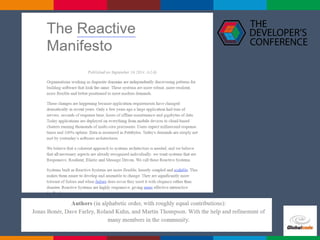
Você já viu um
manifesto?
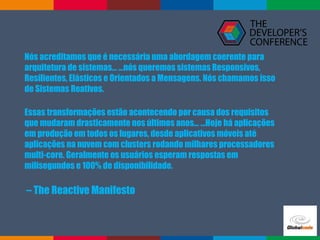
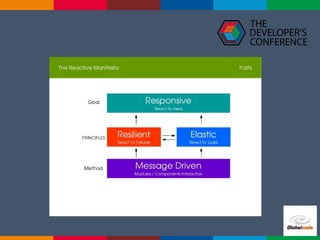
Nós acreditamos que é necessária uma abordagem coerente para
arquitetura de sistemas... ...nós queremos sistemas Responsivos,
Resilientes, Elásticos e Orientados a Mensagens. Nós chamamos isso
de Sistemas Reativos.
Essas transformações estão acontecendo por causa dos requisitos
que mudaram drasticamente nos últimos anos... ...Hoje há aplicações
em produção em todos os lugares, desde aplicativos móveis até
aplicações na nuvem com clusters rodando milhares processadores
multi-core. Geralmente os usuários esperam respostas em
milisegundos e 100% de disponibilidade.
– The Reactive Manifesto
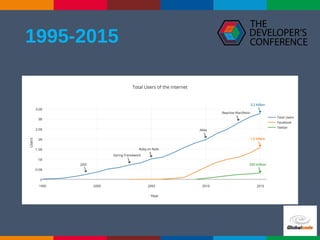
1995-2015
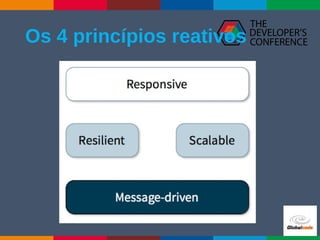
Os 4 princípios reativos
Responsive
• Que responde em tempo hábil;
• Uma aplicação responsiva é o que queremos;
• Responsividade é impossível sem escalabilidade e
resiliência;
“A responsive system is quick to react to all users 
—under blue skies and grey skies—in order to     
ensure a consistently positive user experience.”
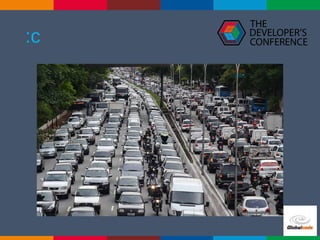
:c
Resilient
• O sistema continua respondendo em caso de falha;
• Qualquer sistema que não é resiliente ficará fora
do ar depois de uma falha;
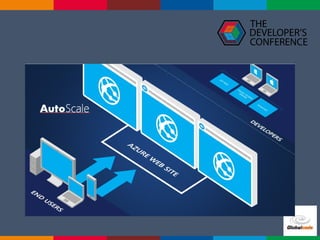
Elastic/Scale
• O sistema continua responsivo mesmo sob
variações de demanda;
• Projetos que não tenham pontos de contenção ou
gargalos centrais;
• Prove métricas relevantes e em tempo real;
Message Driven
• Não bloqueante;
• Programação Assíncronia;
• Message-driven = event-driven, actor-based, ou
combinação das duas;
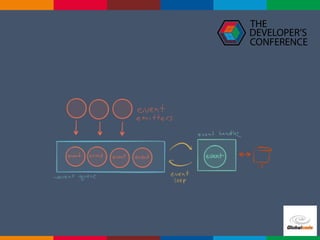
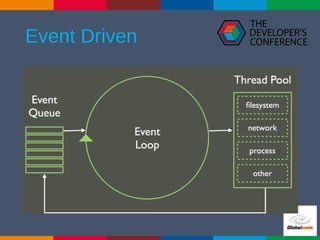
Event Driven
Programação Reativa é?
“Reactive programming is
programming with
asynchronous data streams.”
Stream?
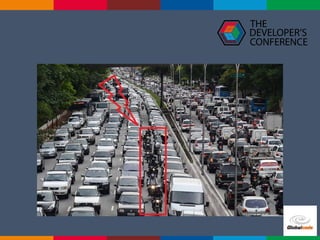
“A stream is a
sequence of ongoing
events ordered in
time”
“Anything can be a stream:
variables, user inputs,
properties, caches, data
structures, etc.”
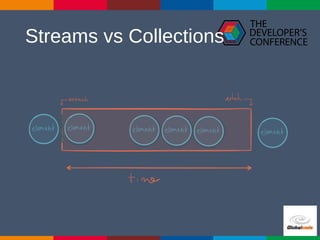
Streams e Collections
“Streams are a series of elements
emitted over time. The series
potentially has no beginning and no
end. Contrast that to arrays, which
are a series of elements arranged
in memory. Arrays have a beginning
and an end”
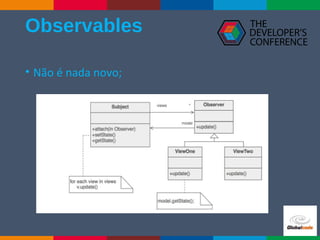
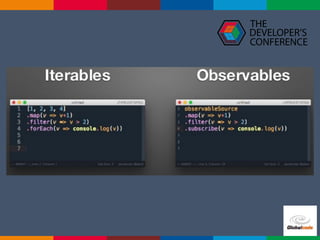
Observables
• Não é nada novo;
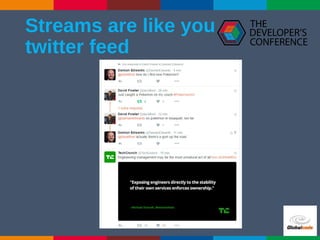
Streams are like you
twitter feed
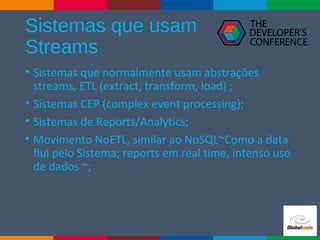
Sistemas que usam
Streams
• Sistemas que normalmente usam abstrações
streams, ETL (extract, transform, load) ;
• Sistemas CEP (complex event processing);
• Sistemas de Reports/Analytics;
• Movimento NoETL, similar ao NoSQL~Como a data
flui pelo Sistema; reports em real time, intenso uso
de dados ~;
Streams vs Collections
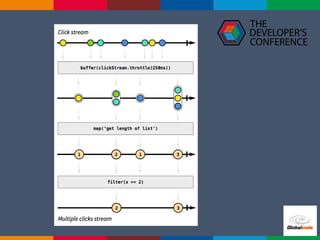
• You can merge two streams. You can filter a stream
to get another one that has only those events you
are interested in. You can map data values from
one stream to another new one.
• Streams são o centro da reatividade
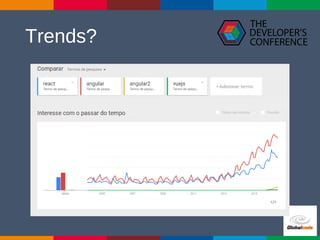
Trends?
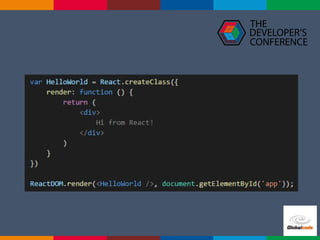
Porque react?
• Declarativo;
• V do MV*;
• Componentes!!!
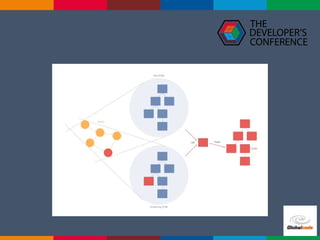
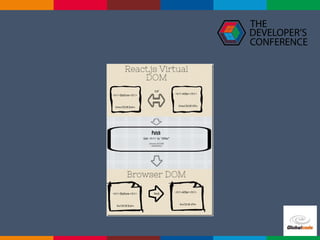
• Virtual DOM
Virtual DOM
• FAST! FAST! FAST!
• Isomorfismo;
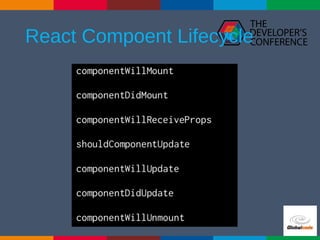
React Compoent Lifecycle
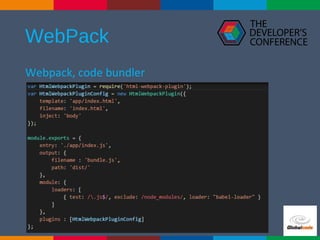
WebPack
Webpack, code bundler
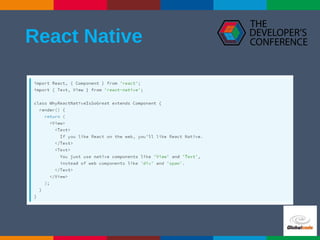
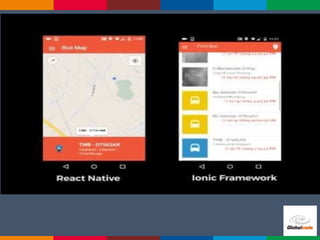
React Native
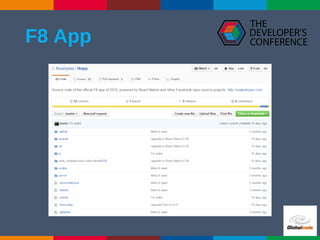
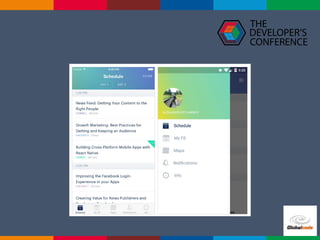
F8 App
Duvidas?
Obrigado!

TDC2016SP - Web Moderna além do Front-End com AngularJS

Notas do Editor

  • #8 Organizações que trabalham em diferentes ramos, estão independentemente descobrindo padrões aleatórios para criarem sistemas semelhantes. Esses sistemas são mais robustos, mais resistentes, mais flexíveis e melhor posicionados para sustentar as demandas modernas. Essas transformações estão acontecendo por causa dos requisitos que mudaram drasticamente nos últimos anos Roland Kuhn e Jonas Bonér => akka project
  • #12 Quickness and a positive user experience under various conditions, such as failure of an external system or a spike of traffic, depends on the two traits of a Reactive application: resilience and scalability. A message-driven architectureprovides the overall foundation for a responsive system.
  • #20 Take another example of synchrony, the single-threaded event loop. This is typical of event-based frameworks such as Node.js — events are emitted, queued, and processed by an event handler in a synchronous loop, and the recipients of those events are anonymous function callbacks. Bottlenecks occur when blocking occurs on the same thread as the event loop, such as one of the callbacks initiating a trip to the database.
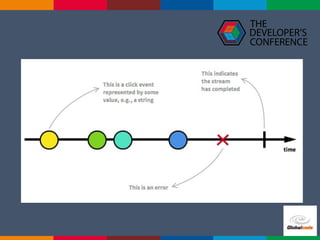
  • #25 A stream is a sequence of ongoing events ordered in time. It can emit three different things: a value (of some type), an error, or a “completed” signal.