
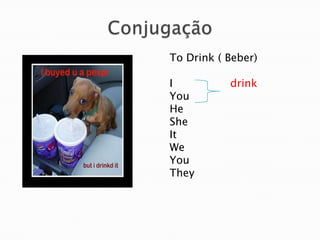
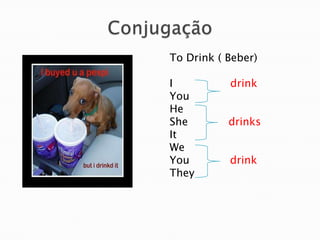




To Drink ( Beber)
I
You
He
She
It
We
You
They
To Drink ( Beber)
I
You
He
She
It
We
You
They

drink
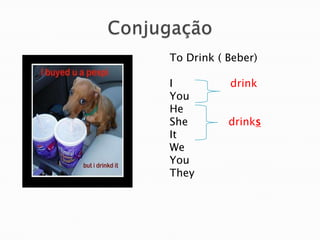
To Drink ( Beber)
I
You
He
She
It
We
You
They

drink
drinks
To Drink ( Beber)
I
You
He
She
It
We
You
They

drink
drinks

drink


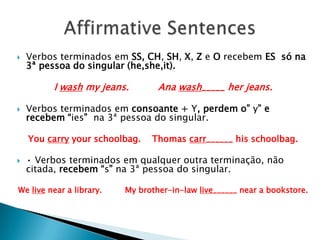
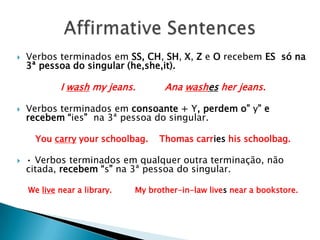
Verbos terminados em SS, CH, SH, X, Z e O recebem ES só na
3ª pessoa do singular (he,she,it).

I wash my jeans.


Verbos terminados em consoante + Y, perdem o” y” e
recebem “ies” na 3ª pessoa do singular.
You carry your schoolbag.



Ana wash_____ her jeans.

Thomas carr______ his schoolbag.

• Verbos terminados em qualquer outra terminação, não
citada, recebem “s” na 3ª pessoa do singular.

We live near a library.

My brother-in-law live______ near a bookstore.


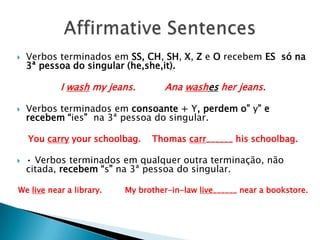
Verbos terminados em SS, CH, SH, X, Z e O recebem ES só na
3ª pessoa do singular (he,she,it).

I wash my jeans.


Verbos terminados em consoante + Y, perdem o” y” e
recebem “ies” na 3ª pessoa do singular.
You carry your schoolbag.



Ana washes her jeans.

Thomas carr______ his schoolbag.

• Verbos terminados em qualquer outra terminação, não
citada, recebem “s” na 3ª pessoa do singular.

We live near a library.

My brother-in-law live______ near a bookstore.


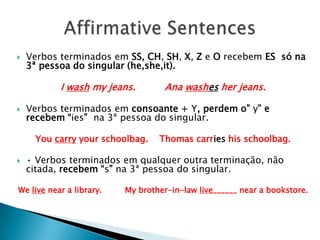
Verbos terminados em SS, CH, SH, X, Z e O recebem ES só na
3ª pessoa do singular (he,she,it).

I wash my jeans.


Verbos terminados em consoante + Y, perdem o” y” e
recebem “ies” na 3ª pessoa do singular.
You carry your schoolbag.



Ana washes her jeans.

Thomas carries his schoolbag.

• Verbos terminados em qualquer outra terminação, não
citada, recebem “s” na 3ª pessoa do singular.

We live near a library.

My brother-in-law live______ near a bookstore.


Verbos terminados em SS, CH, SH, X, Z e O recebem ES só na
3ª pessoa do singular (he,she,it).

I wash my jeans.


Verbos terminados em consoante + Y, perdem o” y” e
recebem “ies” na 3ª pessoa do singular.
You carry your schoolbag.



Ana washes her jeans.

Thomas carries his schoolbag.

• Verbos terminados em qualquer outra terminação, não
citada, recebem “s” na 3ª pessoa do singular.
We live near a library.

My brother-in-law lives near a bookstore.
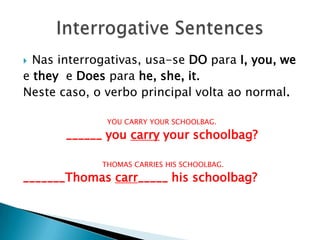
Nas interrogativas, usa-se DO para I, you, we
e they e Does para he, she, it.
Neste caso, o verbo principal volta ao normal.


YOU CARRY YOUR SCHOOLBAG.

______ you carry your schoolbag?
THOMAS CARRIES HIS SCHOOLBAG.

_______Thomas carr_____ his schoolbag?
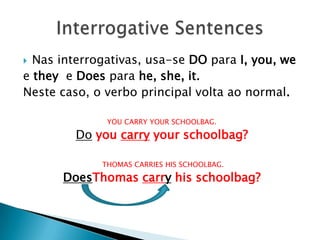
Nas interrogativas, usa-se DO para I, you, we
e they e Does para he, she, it.
Neste caso, o verbo principal volta ao normal.


YOU CARRY YOUR SCHOOLBAG.

Do you carry your schoolbag?
THOMAS CARRIES HIS SCHOOLBAG.

DoesThomas carry his schoolbag?
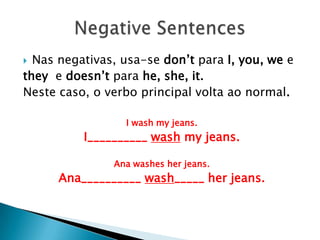
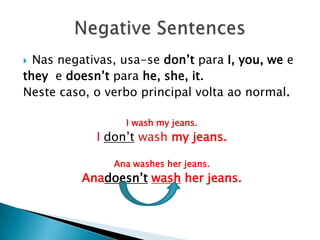
Nas negativas, usa-se don’t para I, you, we e
they e doesn’t para he, she, it.
Neste caso, o verbo principal volta ao normal.


I wash my jeans.

I__________ wash my jeans.
Ana washes her jeans.

Ana__________ wash_____ her jeans.
Nas negativas, usa-se don’t para I, you, we e
they e doesn’t para he, she, it.
Neste caso, o verbo principal volta ao normal.


I wash my jeans.

I don’t wash my jeans.
Ana washes her jeans.

Anadoesn’t wash her jeans.
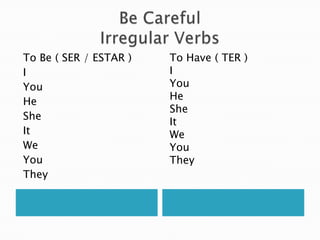
To Be ( SER / ESTAR )
I
You
He
She
It
We
You
They

To Have ( TER )
I
You
He
She
It
We
You
They
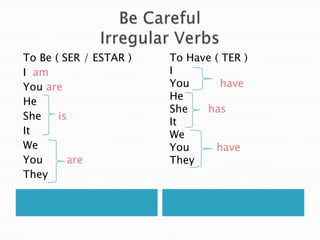
To Be ( SER / ESTAR )
I am
You are
He
She
is
It
We
You
are
They

To Have ( TER )
I
You
have
He
She
has
It
We
You
have
They
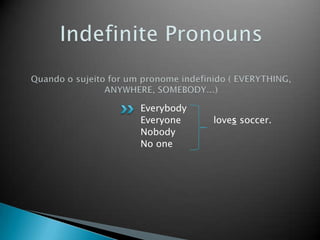
Everybody
Everyone
Nobody
No one

loves soccer.
Into the negative form is?
We don’t understand.
You don’t need a winning game plan.
Simple Present Tense

Simple Present Tense

  • 2.
    To Drink (Beber) I You He She It We You They
  • 3.
    To Drink (Beber) I You He She It We You They drink
  • 4.
    To Drink (Beber) I You He She It We You They drink drinks
  • 5.
    To Drink (Beber) I You He She It We You They drink drinks drink
  • 6.
     Verbos terminados emSS, CH, SH, X, Z e O recebem ES só na 3ª pessoa do singular (he,she,it). I wash my jeans.  Verbos terminados em consoante + Y, perdem o” y” e recebem “ies” na 3ª pessoa do singular. You carry your schoolbag.  Ana wash_____ her jeans. Thomas carr______ his schoolbag. • Verbos terminados em qualquer outra terminação, não citada, recebem “s” na 3ª pessoa do singular. We live near a library. My brother-in-law live______ near a bookstore.
  • 7.
     Verbos terminados emSS, CH, SH, X, Z e O recebem ES só na 3ª pessoa do singular (he,she,it). I wash my jeans.  Verbos terminados em consoante + Y, perdem o” y” e recebem “ies” na 3ª pessoa do singular. You carry your schoolbag.  Ana washes her jeans. Thomas carr______ his schoolbag. • Verbos terminados em qualquer outra terminação, não citada, recebem “s” na 3ª pessoa do singular. We live near a library. My brother-in-law live______ near a bookstore.
  • 8.
     Verbos terminados emSS, CH, SH, X, Z e O recebem ES só na 3ª pessoa do singular (he,she,it). I wash my jeans.  Verbos terminados em consoante + Y, perdem o” y” e recebem “ies” na 3ª pessoa do singular. You carry your schoolbag.  Ana washes her jeans. Thomas carries his schoolbag. • Verbos terminados em qualquer outra terminação, não citada, recebem “s” na 3ª pessoa do singular. We live near a library. My brother-in-law live______ near a bookstore.
  • 9.
     Verbos terminados emSS, CH, SH, X, Z e O recebem ES só na 3ª pessoa do singular (he,she,it). I wash my jeans.  Verbos terminados em consoante + Y, perdem o” y” e recebem “ies” na 3ª pessoa do singular. You carry your schoolbag.  Ana washes her jeans. Thomas carries his schoolbag. • Verbos terminados em qualquer outra terminação, não citada, recebem “s” na 3ª pessoa do singular. We live near a library. My brother-in-law lives near a bookstore.
  • 10.
    Nas interrogativas, usa-seDO para I, you, we e they e Does para he, she, it. Neste caso, o verbo principal volta ao normal.  YOU CARRY YOUR SCHOOLBAG. ______ you carry your schoolbag? THOMAS CARRIES HIS SCHOOLBAG. _______Thomas carr_____ his schoolbag?
  • 11.
    Nas interrogativas, usa-seDO para I, you, we e they e Does para he, she, it. Neste caso, o verbo principal volta ao normal.  YOU CARRY YOUR SCHOOLBAG. Do you carry your schoolbag? THOMAS CARRIES HIS SCHOOLBAG. DoesThomas carry his schoolbag?
  • 12.
    Nas negativas, usa-sedon’t para I, you, we e they e doesn’t para he, she, it. Neste caso, o verbo principal volta ao normal.  I wash my jeans. I__________ wash my jeans. Ana washes her jeans. Ana__________ wash_____ her jeans.
  • 13.
    Nas negativas, usa-sedon’t para I, you, we e they e doesn’t para he, she, it. Neste caso, o verbo principal volta ao normal.  I wash my jeans. I don’t wash my jeans. Ana washes her jeans. Anadoesn’t wash her jeans.
  • 14.
    To Be (SER / ESTAR ) I You He She It We You They To Have ( TER ) I You He She It We You They
  • 15.
    To Be (SER / ESTAR ) I am You are He She is It We You are They To Have ( TER ) I You have He She has It We You have They
  • 16.
  • 17.
  • 18.
    Into the negativeform is? We don’t understand. You don’t need a winning game plan.