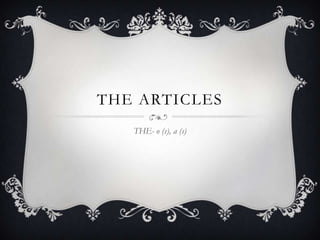


THE ARTICLES
   THE- o (s), a (s)
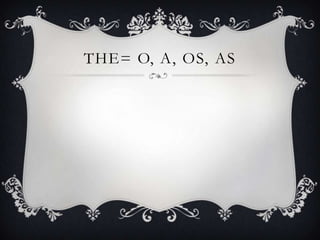
THE= O, A, OS, AS
THE= O, A, OS, AS

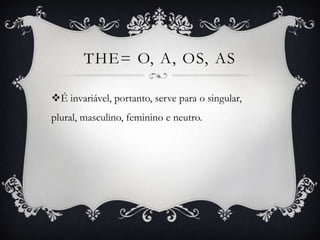
É invariável, portanto, serve para o singular,
plural, masculino, feminino e neutro.
THE= O, A, OS, AS

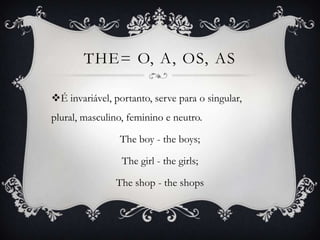
É invariável, portanto, serve para o singular,
plural, masculino, feminino e neutro.

                The boy - the boys;

                 The girl - the girls;

               The shop - the shops
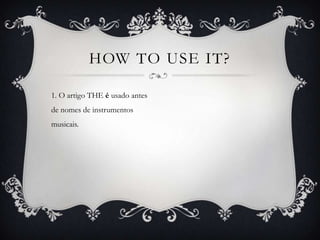
HOW TO USE IT?

1. O artigo THE é usado antes
de nomes de instrumentos
musicais.
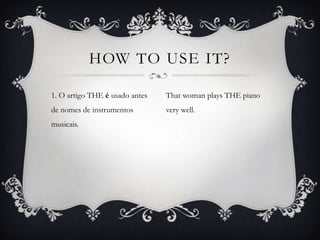
HOW TO USE IT?

1. O artigo THE é usado antes   That woman plays THE piano
de nomes de instrumentos        very well.
musicais.
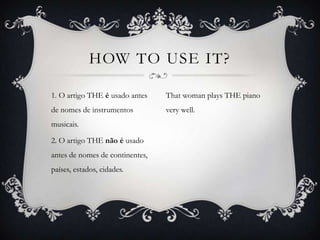
HOW TO USE IT?

1. O artigo THE é usado antes    That woman plays THE piano
de nomes de instrumentos         very well.
musicais.

2. O artigo THE não é usado
antes de nomes de continentes,
países, estados, cidades.
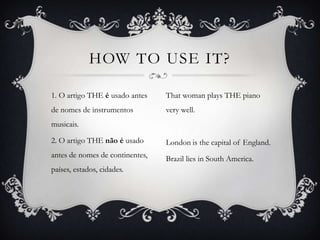
HOW TO USE IT?

1. O artigo THE é usado antes    That woman plays THE piano
de nomes de instrumentos         very well.
musicais.

2. O artigo THE não é usado      London is the capital of England.
antes de nomes de continentes,   Brazil lies in South America.
países, estados, cidades.
HOW TO USE IT?

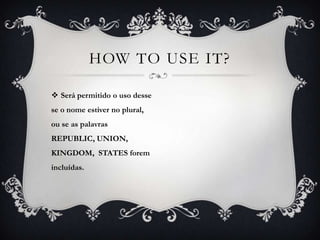
 Será permitido o uso desse
se o nome estiver no plural,
ou se as palavras
REPUBLIC, UNION,
KINGDOM, STATES forem
incluídas.
HOW TO USE IT?

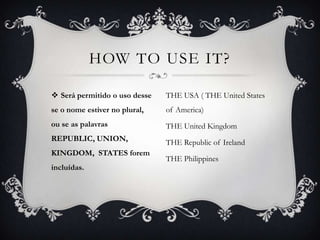
 Será permitido o uso desse   THE USA ( THE United States
se o nome estiver no plural,   of America)
ou se as palavras              THE United Kingdom
REPUBLIC, UNION,               THE Republic of Ireland
KINGDOM, STATES forem
                               THE Philippines
incluídas.
HOW TO USE IT?

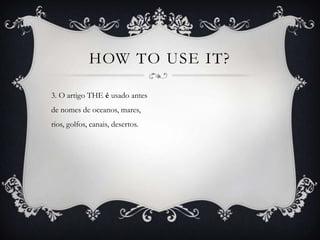
3. O artigo THE é usado antes
de nomes de oceanos, mares,
rios, golfos, canais, desertos.
HOW TO USE IT?

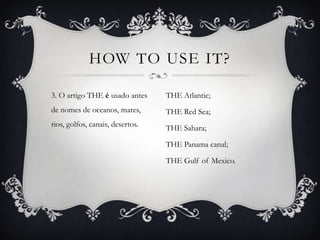
3. O artigo THE é usado antes     THE Atlantic;
de nomes de oceanos, mares,       THE Red Sea;
rios, golfos, canais, desertos.   THE Sahara;

                                  THE Panama canal;

                                  THE Gulf of Mexico.
HOW TO USE IT?

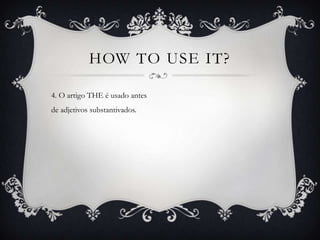
4. O artigo THE é usado antes
de adjetivos substantivados.
HOW TO USE IT?

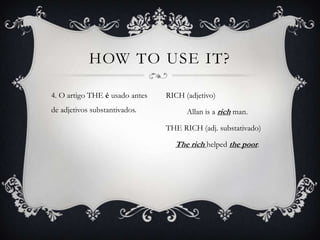
4. O artigo THE é usado antes   RICH (adjetivo)
de adjetivos substantivados.          Allan is a rich man.

                                THE RICH (adj. substativado)

                                  The rich helped the poor.
HOW TO USE IT?

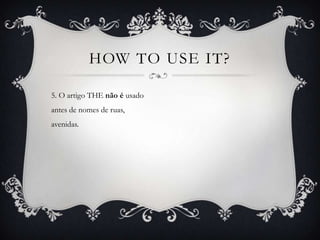
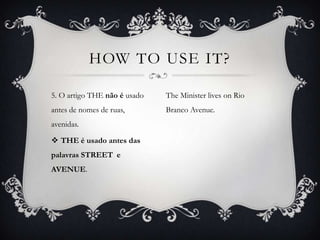
5. O artigo THE não é usado
antes de nomes de ruas,
avenidas.
HOW TO USE IT?

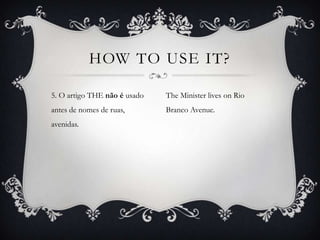
5. O artigo THE não é usado   The Minister lives on Rio
antes de nomes de ruas,       Branco Avenue.
avenidas.
HOW TO USE IT?

5. O artigo THE não é usado   The Minister lives on Rio
antes de nomes de ruas,       Branco Avenue.
avenidas.

 THE é usado antes das
palavras STREET e
AVENUE.
HOW TO USE IT?

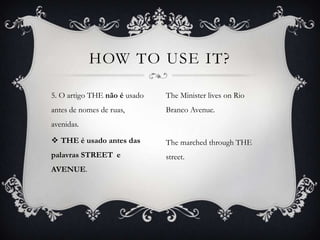
5. O artigo THE não é usado   The Minister lives on Rio
antes de nomes de ruas,       Branco Avenue.
avenidas.

 THE é usado antes das       The marched through THE
palavras STREET e             street.
AVENUE.
HOW TO USE IT?

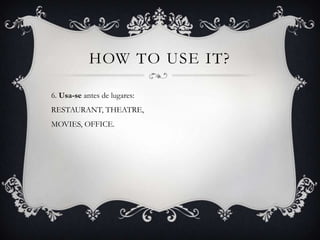
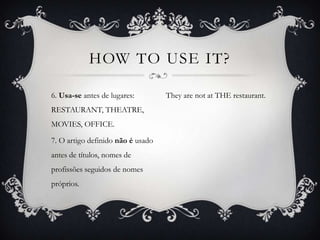
6. Usa-se antes de lugares:
RESTAURANT, THEATRE,
MOVIES, OFFICE.
HOW TO USE IT?

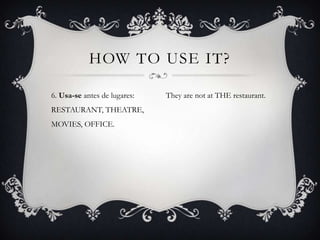
6. Usa-se antes de lugares:   They are not at THE restaurant.
RESTAURANT, THEATRE,
MOVIES, OFFICE.
HOW TO USE IT?

6. Usa-se antes de lugares:        They are not at THE restaurant.
RESTAURANT, THEATRE,
MOVIES, OFFICE.

7. O artigo definido não é usado
antes de títulos, nomes de
profissões seguidos de nomes
próprios.
HOW TO USE IT?

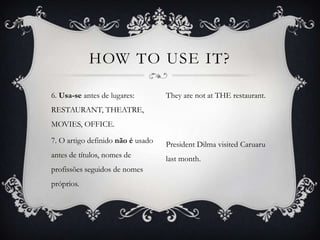
6. Usa-se antes de lugares:        They are not at THE restaurant.
RESTAURANT, THEATRE,
MOVIES, OFFICE.

7. O artigo definido não é usado   President Dilma visited Caruaru
antes de títulos, nomes de         last month.
profissões seguidos de nomes
próprios.
HOW TO USE IT?

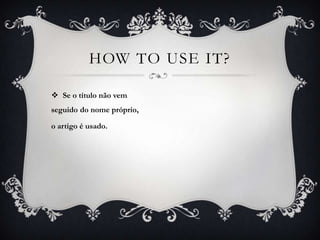
 Se o título não vem
seguido do nome próprio,

o artigo é usado.
HOW TO USE IT?

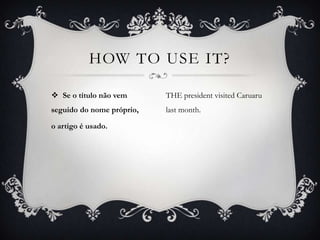
 Se o título não vem      THE president visited Caruaru
seguido do nome próprio,   last month.

o artigo é usado.
HOW TO USE IT?

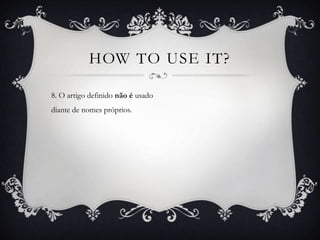
8. O artigo definido não é usado
diante de nomes próprios.
HOW TO USE IT?

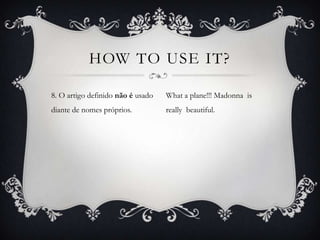
8. O artigo definido não é usado   What a plane!!! Madonna is
diante de nomes próprios.          really beautiful.
HOW TO USE IT?

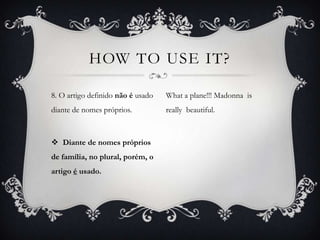
8. O artigo definido não é usado   What a plane!!! Madonna is
diante de nomes próprios.          really beautiful.


 Diante de nomes próprios
de família, no plural, porém, o
artigo é usado.
HOW TO USE IT?

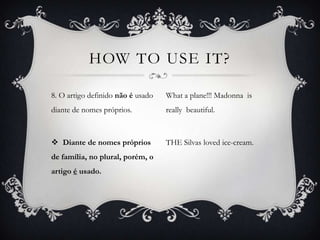
8. O artigo definido não é usado   What a plane!!! Madonna is
diante de nomes próprios.          really beautiful.


 Diante de nomes próprios         THE Silvas loved ice-cream.
de família, no plural, porém, o
artigo é usado.
HOW TO USE IT?

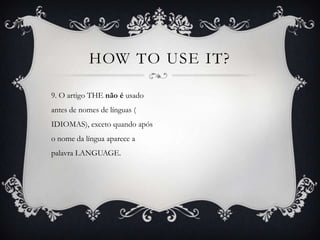
9. O artigo THE não é usado
antes de nomes de línguas (
IDIOMAS), exceto quando após
o nome da língua aparece a
palavra LANGUAGE.
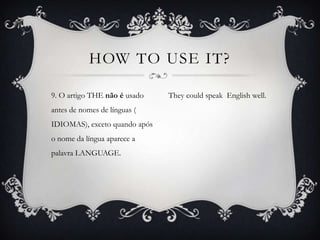
HOW TO USE IT?

9. O artigo THE não é usado    They could speak English well.
antes de nomes de línguas (
IDIOMAS), exceto quando após
o nome da língua aparece a
palavra LANGUAGE.
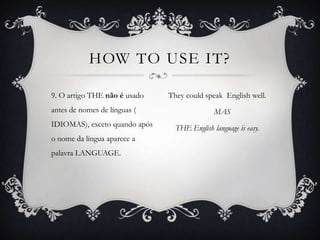
HOW TO USE IT?

9. O artigo THE não é usado    They could speak English well.
antes de nomes de línguas (                   MAS
IDIOMAS), exceto quando após     THE English language is easy.
o nome da língua aparece a
palavra LANGUAGE.
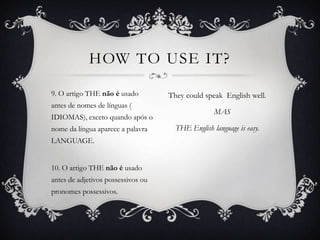
HOW TO USE IT?

9. O artigo THE não é usado         They could speak English well.
antes de nomes de línguas (
                                                   MAS
IDIOMAS), exceto quando após o
nome da língua aparece a palavra      THE English language is easy.
LANGUAGE.


10. O artigo THE não é usado
antes de adjetivos possessivos ou
pronomes possessivos.
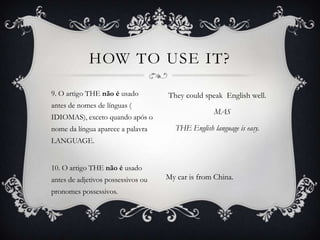
HOW TO USE IT?

9. O artigo THE não é usado         They could speak English well.
antes de nomes de línguas (
                                                   MAS
IDIOMAS), exceto quando após o
nome da língua aparece a palavra      THE English language is easy.
LANGUAGE.


10. O artigo THE não é usado
antes de adjetivos possessivos ou   My car is from China.
pronomes possessivos.
TAKE A LOOK!!!
TAKE A LOOK !!!
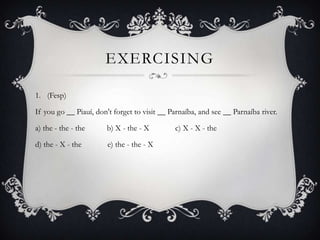
EXERCISING

1. (Fesp)

If you go __ Piauí, don't forget to visit __ Parnaíba, and see __ Parnaíba river.

a) the - the - the     b) X - the - X         c) X - X - the

d) the - X - the        e) the - the - X
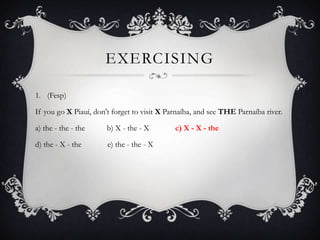
EXERCISING

1. (Fesp)

If you go X Piauí, don't forget to visit X Parnaíba, and see THE Parnaíba river.

a) the - the - the     b) X - the - X        c) X - X - the

d) the - X - the       e) the - the - X
EXERCISING

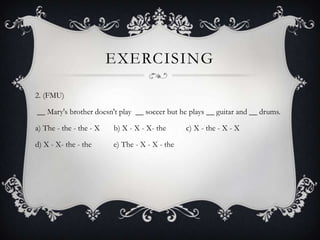
2. (FMU)

__ Mary's brother doesn't play __ soccer but he plays __ guitar and __ drums.

a) The - the - the - X   b) X - X - X- the      c) X - the - X - X

d) X - X- the - the      e) The - X - X - the
EXERCISING

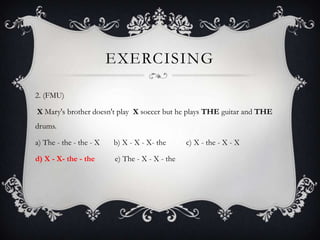
2. (FMU)

X Mary's brother doesn't play X soccer but he plays THE guitar and THE
drums.

a) The - the - the - X   b) X - X - X- the      c) X - the - X - X

d) X - X- the - the      e) The - X - X - the
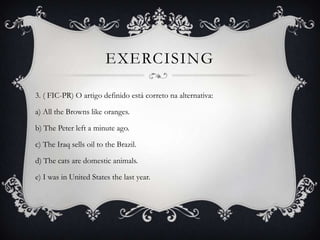
EXERCISING

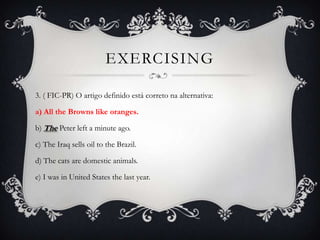
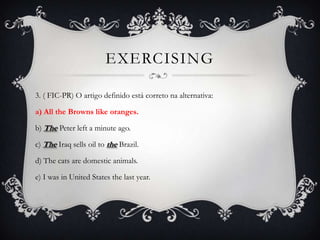
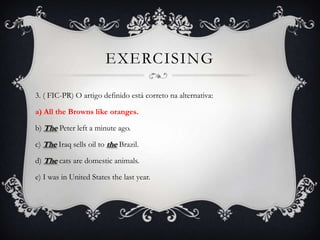
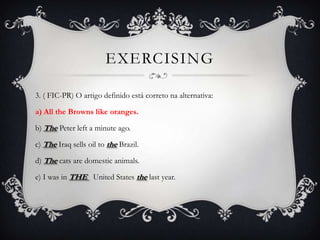
3. ( FIC-PR) O artigo definido está correto na alternativa:

a) All the Browns like oranges.

b) The Peter left a minute ago.

c) The Iraq sells oil to the Brazil.

d) The cats are domestic animals.

e) I was in United States the last year.
EXERCISING

3. ( FIC-PR) O artigo definido está correto na alternativa:

a) All the Browns like oranges.

b) The Peter left a minute ago.

c) The Iraq sells oil to the Brazil.

d) The cats are domestic animals.

e) I was in United States the last year.
EXERCISING

3. ( FIC-PR) O artigo definido está correto na alternativa:

a) All the Browns like oranges.

b) The Peter left a minute ago.

c) The Iraq sells oil to the Brazil.

d) The cats are domestic animals.

e) I was in United States the last year.
EXERCISING

3. ( FIC-PR) O artigo definido está correto na alternativa:

a) All the Browns like oranges.

b) The Peter left a minute ago.

c) The Iraq sells oil to the Brazil.

d) The cats are domestic animals.

e) I was in United States the last year.
EXERCISING

3. ( FIC-PR) O artigo definido está correto na alternativa:

a) All the Browns like oranges.

b) The Peter left a minute ago.

c) The Iraq sells oil to the Brazil.

d) The cats are domestic animals.

e) I was in United States the last year.
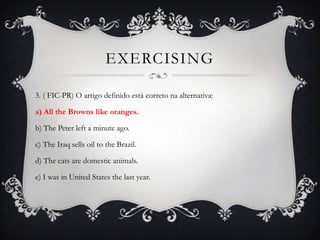
EXERCISING

3. ( FIC-PR) O artigo definido está correto na alternativa:

a) All the Browns like oranges.

b) The Peter left a minute ago.

c) The Iraq sells oil to the Brazil.

d) The cats are domestic animals.

e) I was in THE United States the last year.

The articles

  • 1.
    THE ARTICLES THE- o (s), a (s)
  • 2.
    THE= O, A,OS, AS
  • 3.
    THE= O, A,OS, AS É invariável, portanto, serve para o singular, plural, masculino, feminino e neutro.
  • 4.
    THE= O, A,OS, AS É invariável, portanto, serve para o singular, plural, masculino, feminino e neutro. The boy - the boys; The girl - the girls; The shop - the shops
  • 5.
    HOW TO USEIT? 1. O artigo THE é usado antes de nomes de instrumentos musicais.
  • 6.
    HOW TO USEIT? 1. O artigo THE é usado antes That woman plays THE piano de nomes de instrumentos very well. musicais.
  • 7.
    HOW TO USEIT? 1. O artigo THE é usado antes That woman plays THE piano de nomes de instrumentos very well. musicais. 2. O artigo THE não é usado antes de nomes de continentes, países, estados, cidades.
  • 8.
    HOW TO USEIT? 1. O artigo THE é usado antes That woman plays THE piano de nomes de instrumentos very well. musicais. 2. O artigo THE não é usado London is the capital of England. antes de nomes de continentes, Brazil lies in South America. países, estados, cidades.
  • 9.
    HOW TO USEIT?  Será permitido o uso desse se o nome estiver no plural, ou se as palavras REPUBLIC, UNION, KINGDOM, STATES forem incluídas.
  • 10.
    HOW TO USEIT?  Será permitido o uso desse THE USA ( THE United States se o nome estiver no plural, of America) ou se as palavras THE United Kingdom REPUBLIC, UNION, THE Republic of Ireland KINGDOM, STATES forem THE Philippines incluídas.
  • 11.
    HOW TO USEIT? 3. O artigo THE é usado antes de nomes de oceanos, mares, rios, golfos, canais, desertos.
  • 12.
    HOW TO USEIT? 3. O artigo THE é usado antes THE Atlantic; de nomes de oceanos, mares, THE Red Sea; rios, golfos, canais, desertos. THE Sahara; THE Panama canal; THE Gulf of Mexico.
  • 13.
    HOW TO USEIT? 4. O artigo THE é usado antes de adjetivos substantivados.
  • 14.
    HOW TO USEIT? 4. O artigo THE é usado antes RICH (adjetivo) de adjetivos substantivados. Allan is a rich man. THE RICH (adj. substativado) The rich helped the poor.
  • 15.
    HOW TO USEIT? 5. O artigo THE não é usado antes de nomes de ruas, avenidas.
  • 16.
    HOW TO USEIT? 5. O artigo THE não é usado The Minister lives on Rio antes de nomes de ruas, Branco Avenue. avenidas.
  • 17.
    HOW TO USEIT? 5. O artigo THE não é usado The Minister lives on Rio antes de nomes de ruas, Branco Avenue. avenidas.  THE é usado antes das palavras STREET e AVENUE.
  • 18.
    HOW TO USEIT? 5. O artigo THE não é usado The Minister lives on Rio antes de nomes de ruas, Branco Avenue. avenidas.  THE é usado antes das The marched through THE palavras STREET e street. AVENUE.
  • 19.
    HOW TO USEIT? 6. Usa-se antes de lugares: RESTAURANT, THEATRE, MOVIES, OFFICE.
  • 20.
    HOW TO USEIT? 6. Usa-se antes de lugares: They are not at THE restaurant. RESTAURANT, THEATRE, MOVIES, OFFICE.
  • 21.
    HOW TO USEIT? 6. Usa-se antes de lugares: They are not at THE restaurant. RESTAURANT, THEATRE, MOVIES, OFFICE. 7. O artigo definido não é usado antes de títulos, nomes de profissões seguidos de nomes próprios.
  • 22.
    HOW TO USEIT? 6. Usa-se antes de lugares: They are not at THE restaurant. RESTAURANT, THEATRE, MOVIES, OFFICE. 7. O artigo definido não é usado President Dilma visited Caruaru antes de títulos, nomes de last month. profissões seguidos de nomes próprios.
  • 23.
    HOW TO USEIT?  Se o título não vem seguido do nome próprio, o artigo é usado.
  • 24.
    HOW TO USEIT?  Se o título não vem THE president visited Caruaru seguido do nome próprio, last month. o artigo é usado.
  • 25.
    HOW TO USEIT? 8. O artigo definido não é usado diante de nomes próprios.
  • 26.
    HOW TO USEIT? 8. O artigo definido não é usado What a plane!!! Madonna is diante de nomes próprios. really beautiful.
  • 27.
    HOW TO USEIT? 8. O artigo definido não é usado What a plane!!! Madonna is diante de nomes próprios. really beautiful.  Diante de nomes próprios de família, no plural, porém, o artigo é usado.
  • 28.
    HOW TO USEIT? 8. O artigo definido não é usado What a plane!!! Madonna is diante de nomes próprios. really beautiful.  Diante de nomes próprios THE Silvas loved ice-cream. de família, no plural, porém, o artigo é usado.
  • 29.
    HOW TO USEIT? 9. O artigo THE não é usado antes de nomes de línguas ( IDIOMAS), exceto quando após o nome da língua aparece a palavra LANGUAGE.
  • 30.
    HOW TO USEIT? 9. O artigo THE não é usado They could speak English well. antes de nomes de línguas ( IDIOMAS), exceto quando após o nome da língua aparece a palavra LANGUAGE.
  • 31.
    HOW TO USEIT? 9. O artigo THE não é usado They could speak English well. antes de nomes de línguas ( MAS IDIOMAS), exceto quando após THE English language is easy. o nome da língua aparece a palavra LANGUAGE.
  • 32.
    HOW TO USEIT? 9. O artigo THE não é usado They could speak English well. antes de nomes de línguas ( MAS IDIOMAS), exceto quando após o nome da língua aparece a palavra THE English language is easy. LANGUAGE. 10. O artigo THE não é usado antes de adjetivos possessivos ou pronomes possessivos.
  • 33.
    HOW TO USEIT? 9. O artigo THE não é usado They could speak English well. antes de nomes de línguas ( MAS IDIOMAS), exceto quando após o nome da língua aparece a palavra THE English language is easy. LANGUAGE. 10. O artigo THE não é usado antes de adjetivos possessivos ou My car is from China. pronomes possessivos.
  • 34.
  • 36.
  • 37.
    EXERCISING 1. (Fesp) If yougo __ Piauí, don't forget to visit __ Parnaíba, and see __ Parnaíba river. a) the - the - the b) X - the - X c) X - X - the d) the - X - the e) the - the - X
  • 38.
    EXERCISING 1. (Fesp) If yougo X Piauí, don't forget to visit X Parnaíba, and see THE Parnaíba river. a) the - the - the b) X - the - X c) X - X - the d) the - X - the e) the - the - X
  • 39.
    EXERCISING 2. (FMU) __ Mary'sbrother doesn't play __ soccer but he plays __ guitar and __ drums. a) The - the - the - X b) X - X - X- the c) X - the - X - X d) X - X- the - the e) The - X - X - the
  • 40.
    EXERCISING 2. (FMU) X Mary'sbrother doesn't play X soccer but he plays THE guitar and THE drums. a) The - the - the - X b) X - X - X- the c) X - the - X - X d) X - X- the - the e) The - X - X - the
  • 41.
    EXERCISING 3. ( FIC-PR)O artigo definido está correto na alternativa: a) All the Browns like oranges. b) The Peter left a minute ago. c) The Iraq sells oil to the Brazil. d) The cats are domestic animals. e) I was in United States the last year.
  • 42.
    EXERCISING 3. ( FIC-PR)O artigo definido está correto na alternativa: a) All the Browns like oranges. b) The Peter left a minute ago. c) The Iraq sells oil to the Brazil. d) The cats are domestic animals. e) I was in United States the last year.
  • 43.
    EXERCISING 3. ( FIC-PR)O artigo definido está correto na alternativa: a) All the Browns like oranges. b) The Peter left a minute ago. c) The Iraq sells oil to the Brazil. d) The cats are domestic animals. e) I was in United States the last year.
  • 44.
    EXERCISING 3. ( FIC-PR)O artigo definido está correto na alternativa: a) All the Browns like oranges. b) The Peter left a minute ago. c) The Iraq sells oil to the Brazil. d) The cats are domestic animals. e) I was in United States the last year.
  • 45.
    EXERCISING 3. ( FIC-PR)O artigo definido está correto na alternativa: a) All the Browns like oranges. b) The Peter left a minute ago. c) The Iraq sells oil to the Brazil. d) The cats are domestic animals. e) I was in United States the last year.
  • 46.
    EXERCISING 3. ( FIC-PR)O artigo definido está correto na alternativa: a) All the Browns like oranges. b) The Peter left a minute ago. c) The Iraq sells oil to the Brazil. d) The cats are domestic animals. e) I was in THE United States the last year.