This book examines the persecution and resistance of Candomblé religions in the Recôncavo region of Bahia, Brazil through an analysis of newspaper articles from the early 20th century. It explores how the press promoted civilizing discourses that portrayed Candomblé practices as superstition or fetishism. The work also investigates the complex political dynamics between local politicians and Candomblé leaders in the context of the early Brazilian Republic.








![construção das edificações mais suntuosas da cidade. Viajantes europeus
como os naturalistas Spix e Martius, encantados com sua visita à vila, es-creveram:
[...] sem dúvida a mais rica, populosa e uma das mais agra-dáveis
20 / Edmar Ferreira Santos
vilas de todo o Brasil. Numerosas vendas e arma-zéns
cheios de vários artigos europeus revelam o alto grau
de movimentação do seu comércio4.
Em 1837, a Vila de Nossa Senhora do Rosário do Porto da Cachoeira
foi elevada à categoria de cidade em reconhecimento por sua participação
nas disputas emancipatórias ocorridas na Bahia5. À época, a cidade já se
caracterizava como o mais importante centro de negócios e comércio do
recôncavo baiano.
Cachoeira era considerada o segundo termo mais importante da
Bahia. Compreendia uma enorme área geográfica, populosa, com in-tensas
relações comerciais e intercâmbios culturais, vastas plantações
de fumo e cana, bem como numerosos engenhos de açúcar. A cidade
era ainda espaço de produção e distribuição de gêneros alimentícios,
passagem dos diamantes de Mucugê e Rio de Contas, gado, além de
escravos e toda sorte de produtos para as famílias da região6. Segundo
João José Reis, já na passagem do século XVIII para o XIX, Cachoeira
era “o segundo núcleo populacional da Bahia. Em 1775, seu centro ur-bano
tinha 986 casas, talvez cerca de 4.000 habitantes; em 1804, 1180
casas, cerca de 5.000 habitantes”. Um recenseamento feito pela câmara
local terminado em 1826, contaria 6 mil habitantes na vila e 60 mil em
todo o termo7.
4 SPIX, Johann Baptist von; MARTIUS, Carl Friedrich Philipp von. Viagem pelo Brasil (1817-1820). São Paulo:
Melhoramentos, 1976.
5 Refiro-me às lutas pela consolidação da independência política do Brasil entre os anos de 1822 e 1823.
6 A denominação “termo” se referia a uma circunscrição geográfica, jurídica e político-administrativa. Quando
a Vila foi criada, em 1698, o seu termo incorporava o território de mais ou menos30 atuais cidades do Estado da
Bahia. Entre elas: Maragogipe, São Félix, Muritiba, Governador Mangabeira, Cabaceiras, Cruz das Almas, São
Felipe, Conceição do Almeida, Sapeaçu, Conceição da Feira, São Gonçalo dos Campos, Feira de Santana,
Santo Estevão, Castro Alves, Irará, Ipirá, Santa Bárbara, Conceição do Jacuípe, Conde, Entre Rios, Esplanada,
Ouriçangas, D. Macedo Costa, Antônio Cardoso, Amélia Rodrigues, Tanquinho, Cardeal da Silva, Altamira,
Acajutiba, Jandaíra entre outras. Ver: Francisco José de Mello (2001, p. 34-36). Em 1832, foi criada a Vila da
Feira de Santana, que se tornou município no ano seguinte, anexando parte do território antes pertencente à
Vila de Cachoeira.
7 REIS, João José. Magia jeje na Bahia: a invasão do calundu do pasto de Cachoeira, 1785. Revista Brasileira de
História, São Paulo, v. 8, n. 16, p. 57-81, mar./ago. 1988. p. 63.](https://image.slidesharecdn.com/opoderdoscandombles-141001124209-phpapp01/85/O-poder-dos-candombles-20-320.jpg)
![quivos pessoais que, na medida em que eram apresentados, suscitavam di-ferentes
histórias. Enfim, através da tradição oral e desses documentos, foi
possível saber mais sobre as pessoas de carne e osso das quais os jornais,
algumas vezes, mencionavam apenas os nomes.
O DISCURSO CIVILIZADOR DA IMPRENSA
Mediante cuidadoso levantamento feito nos jornais da época foi pos-sível
notar um discurso elucidativo sobre o olhar de setores letrados a res-peito
das noções de civilização que informavam e justificavam suas posi-ções.
Aparentemente elaborada por representações fragmentadas, elas aca-bam
por construir um quadro mais ou menos coerente do período estuda-do,
mostrando como o discurso civilizador dissimulava o racismo que tres-passava
O Poder dos Candomblés / 25
as relações sociais:
1) Modernização urbana
Os setores letrados da cidade criticavam todo e qualquer sinal que
identificasse o cenário urbano com o atraso. Assim, preconizavam a demo-lição
das ruínas, a urgente melhoria da iluminação pública (à época, feita a
querosene) e do abastecimento de água, a reforma e arborização de jardins
e praças, o remodelamento dos prédios e bens públicos, bem como novas e
modernas edificações que visassem ao embelezamento da cidade:
É com pesar não pequeno que vemos como estão sendo
feitas as obras de melhoramento de nossa urbs.
Si se trata de arborização, ela em breve transformará a ci-dade
num bosque cerrado pela proporção em que as árvo-res
foram plantadas; si se trata do chafariz público remo-delado,
vemos que o espaço compreendido entre a grade
não está [sic] regular e nem ao menos a todo cimentado,
quando, pensamos nós, deveria ser feito de pedras de can-taria.
De tudo o pior é a empresa de abastecimento de água estar
fazendo os passeios dos projetados jardins ladrilhados.
Os tais tijolos do ladrilho não resistirão nem a ação do
tempo nem tampouco ao uso do público, pois não tem a
resistência necessária para isso.
No Calabar, hoje praça Ubaldino de Assis, já se encon-](https://image.slidesharecdn.com/opoderdoscandombles-141001124209-phpapp01/85/O-poder-dos-candombles-25-320.jpg)
![tram numerosos tijolos com os seus retângulos esboroados.
E a obra ainda não foi entregue a serventia pública!
Onde a fiscalização? Onde o interesse pelos próprios públicos?
Quanto aos passeios dos jardins públicos ainda se podem
remediar. Porque não são eles cimentados ou calçados?
O sr. major intendente interino, que, verdade seja dita, tem
vistas protetoras para as coisas da urbs, ainda pode provi-denciar
26 / Edmar Ferreira Santos
no sentido de fazer sanar este mal.21
2) A valorização do trabalho e a repressão à vadiagem
No discurso de alguns setores letrados, pobreza, ociosidade, incivili-dade
e criminalidade, parecem corresponder a características populares.
Desse modo, era necessário vigiar cuidadosamente o povo e, quando preci-so,
aplicar punições que levassem os indivíduos à disciplina do trabalho,
fazendo-os deixar de lado os vícios nos quais estavam imersos:
Continuam os braços robustos e sadios a furtar-se ao tra-balho,
e os campos, que poderiam ser cultivados, fazem
improdutivos, lembrando a monotonia de vasto cemité-rio,
onde as folhas esguias dos ciprestes vergam dóceis ao
perpassar do vento agoureiro.
Ao passo que isto se dá, povoam-se de ociosos as tabernas,
onde o copo de cachaça anda de mão em mão, desde o
alvorecer do dia até a alta hora da noite [...]
Destruamos o mal enquanto é tempo.22
3) Repressão aos divertimentos populares
Os divertimentos populares são representados na imprensa como bár-baros.
Eles feriam a moral cristã preconizada pelos jornais locais. Dessa
maneira, setores letrados da cidade reclamavam por mudanças urgentes,
capazes de disciplinar os maus costumes que a imprensa ironicamente clas-sificava
de “belezas de uma civilização indígena”:
Triste e deponente é o espetáculo que presenciamos na
exibição de certas práticas como: caretas a pé, lavagens, jogo
do sete em frente aos templos, sambas atordoadores no pe-rímetro
da cidade e outras belezas.
21 A ORDEM. 15 maio 1915. p. 1.
22 Id., 27 fev. 1901. p. 1.](https://image.slidesharecdn.com/opoderdoscandombles-141001124209-phpapp01/85/O-poder-dos-candombles-26-320.jpg)




![Mary Karasch afirma que a palavra “batuque” é originária do termo
batuco, uma dança de Angola. Segundo esta autora, a palavra batuque era
o termo mais comum na designação de danças africanas no Rio de Janeiro
antes de 1850. Ela sugere que o batuco dançado pelos povos de Ambriz,
Congo, e também pelos de língua bunda em torno de Luanda, pode ter sido
uma das danças que deu origem ao samba carioca. A autora nos oferece
uma descrição do batuco, onde identifica os ingredientes clássicos do sam-ba
O Poder dos Candomblés / 61
do Rio de Janeiro:
[...] Forma-se um círculo dos dançarinos e espectadores;
tangem-se marimbas e batem-se vigorosamente tambores,
e todos reunidos batem palmas acompanhando a batida
dos tambores, e gritam uma espécie de coro. Os dançari-nos,
tanto homens como mulheres, saltam com um grito
dentro do círculo e começam a dançar. Isso consiste quase
exclusivamente em balançar o corpo com um pequeno
movimento dos pés, cabeça e braços, mas ao mesmo tem-po
os músculos dos ombros, costas e nádegas são violenta-mente
contraídos e convulsionados.104
Por meio da correspondência policial, Karasch constatou que as dan-ças
africanas foram insistentemente perseguidas pela polícia carioca na
primeira metade do século XIX. Nesses episódios, segundo a autora, ficava
evidente a incapacidade do corpo policial em acabar com tais danças, mui-tas
vezes defendidas violentamente pelos dançarinos que, para isso, não se
furtavam a usar, literalmente, todas as armas de que dispusessem. No en-tanto,
eram as manifestações noturnas, como as de caráter religioso, que
mais preocupavam a polícia, principalmente se envolvessem grande núme-ro
de escravos. Eram festas onde os negros dançavam sem parar durante
toda a noite, geralmente aos sábados e em véspera dos dias santos.105
Pouco se sabe de fato sobre os múltiplos sentidos que os batuques
assumiam para os negros. O próprio termo constitui uma expressão “guar-da-
chuva” que, tomada dos documentos, abriga significados diversos. As-sim,
começamos a explorar um pouco mais suas dimensões recreativas e
litúrgicas, porquanto a religiosidade africana, abrigando práticas e valores
de etnias diversas e utilizando cantos, danças e atabaques, também foi cha-
104 KARASCH, M. C. A vida dos escravos no Rio de Janeiro (1808-1850), 2000. p. 330.
105 Ibid., p. 328.](https://image.slidesharecdn.com/opoderdoscandombles-141001124209-phpapp01/85/O-poder-dos-candombles-61-320.jpg)
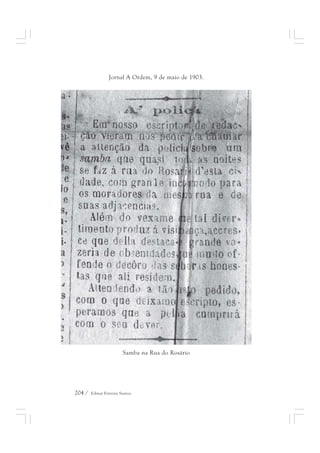
![noites se faz à rua do Rosário desta cidade, com grande incô-modo
para os moradores da mesma rua e de suas adjacências.
Além do vexame que tal divertimento produz à vizinhança,
acresce que dela destaca-se grande vozeria e obscenidades,
que muito ofende o decoro das senhoras honestas que ali re-sidem.
Atendendo a tão justo pedido, com o que deixamos
escrito, esperamos que a polícia cumprirá com o seu dever.110
O samba era representado como um “grosseiro divertimento”, ou
melhor, um “ajuntamento que deprime os bons costumes, redundando em
continuados atentados a moral”. No jornal A Ordem, o samba figura como
um “africanismo torpe” que apenas encontraria “prosélitos” nas “classes
baixas”. Apesar da retórica preconceituosa do jornalista, é possível entre-ver
nas suas palavras um pouco do referido divertimento:
[...] nas pocilgas e ambientes impuros se perpetram ao luxurioso
cansaço dos bamboleios de corpos, excitados pelas goladas fre-qüentes
da caninha, o termômetro dos espíritos fracos.
[...] o organizam os trabalhadores do cais e pessoas outras,
com mulheres do povo de ínfima espécie.
Quem por ali passa, por certo, se há de revoltar contra a
vozeria ensurdecedora dos pandeiros e palmeados,
entremeadas de chulas apimentadas, quase sempre expri-mindo
sentimentos imorais e fins altamente prejudiciais a
nossa condição de povo civilizado e amante do progresso.
De vez em vez, entre as umbigadas, uma frase impudica
fere os ares, provocando risos. 111
Buscando que “fossem lançadas vistas policiais para esse samba”112, o
articulista nos oferece uma descrição aproximada da festa. Seus partici-pantes
e instrumentos, seus gestos e danças, suas pilhérias e gracejos. Os
sambas e batuques denunciados nos jornais geralmente aconteciam perto
110 A ORDEM. 9 maio 1903. p. 1. Ver nos anexos fotografia desta notícia.
111 Id., 1 jan. 1918. p. 1.
112 A ORDEM. 1 jan. 1918. p. 1. As relações entre os policiais e os batuques figuraram nas páginas do jornal O
Alabama desde sua fundação, em 1863, na cidade do Salvador. A instituição que, aos olhos dos articulistas desse
periódico, devia acabar com os candomblés, ao contrário, permitia bem nas suas “ventas” práticas consideradas
“supersticiosas e ao mesmo tempo tenebrosas”. A julgar pelas notícias desta folha, os jornalistas notaram uma
proliferação dos candomblés, no centro urbano de Salvador, já nos primeiros anos da década de 1860. Tal
multiplicação era percebida como um consentimento da polícia que permitia tais “reuniões”, nas palavras do
jornalista, “aqui dentro da cidade”. Para uma análise da polícia no jornal O Alabama, ver: Luis Nicolau Parés
(2006, p. 138-142).
O Poder dos Candomblés / 63](https://image.slidesharecdn.com/opoderdoscandombles-141001124209-phpapp01/85/O-poder-dos-candombles-63-320.jpg)
![ção mais tolerante com as celebrações negras, a “licença para se tocar can-domblé”
podia custar “10$, 15$ ou 20$ mil réis”122.
No livro Os africanos no Brasil, Nina Rodrigues dedicou algumas pá-ginas
ao tema da perseguição da imprensa e da polícia aos cultos de matriz
africana. Ele considerou que estes cultos em África se constituíam “verda-deira
religião de Estado”, sendo essas práticas e valores “garantidos pelos
governos e pelos costumes”. Na Bahia, segundo este autor, desde os tempos
da escravidão “sofriam elas todas as violências por parte dos senhores de
escravos”. Consideradas “práticas de feitiçaria”, com o fim da escravidão
não conquistaram “proteção nas leis” e se viram “condenadas pela religião
dominante e pelo desprezo, muitas vezes apenas aparente, é verdade, das
classes influentes que, apesar de tudo, as temem”123. Nina Rodrigues viveu
a Bahia na virada para o século XX. As palavras abaixo assumem um sen-tido
documental:
Hoje, cessada a escravidão, passaram elas [as práticas
religiosas de matriz africana] à prepotência e ao arbítrio
da polícia não mais esclarecida do que os antigos
senhores e aos reclamos da opinião pública que,
pretendendo fazer de espírito forte e culto, revela a toda
hora a mais supina ignorância do fenômeno sociológico.
Não é menos para lamentar que a imprensa local revele,
entre nós, a mesma desorientação no modo de tratar o as-sunto,
66 / Edmar Ferreira Santos
pregando e propagando a crença de que o sabre do
soldado de polícia boçal e a estúpida violência de comissá-rios
policiais igualmente ignorantes hão de ter maior dose
de virtude catequista, mais eficácia como instrumento de
conversão religiosa do que teve o azorrague dos feitores.124
A imprensa aparece como uma espécie de ideóloga da repressão e a
polícia, como braço armado do Estado, era convocada a exercer a violên-cia
“legítima” contra os candomblés. Verifica-se, mediante a análise dos
textos jornalísticos da época, a existência de praças e mesmo autoridades
policiais, de maior ou menor coturno, dispensando proteção aos terreiros.
No entanto, isso não desqualificava a corporação como um importante
agente da repressão. Afinal, quem agredia brutalmente, no corpo e nos
122 A ORDEM. 9 ago. 1922. p. 1.
123 RODRIGUES, Nina. Os africanos no Brasil. 5. ed. São Paulo: Nacional, 1977. p. 238-239.
124 Ibid., p. 239.](https://image.slidesharecdn.com/opoderdoscandombles-141001124209-phpapp01/85/O-poder-dos-candombles-66-320.jpg)


![do fetiche novamente esteve presente, e como veremos, acompanharia os
discursos do jornal nos anos subsequentes. Assim, Pizarro Lima descreveu
uma festa negra:
Farfalham os arvoredos batidos pela forte nortada.
É alta noite.
Num amplo lugario colmado treme a luz da candeia como
pirilampo titubeando nas trevas.
Ouço vozeria.
Paro e escuto [...] aproximo-me...
Vejo no terreiro uma chusma de homens; aproximo-me
ainda mais e diviso, na meia escuridão, um vulto esquáli-do,
90 / Edmar Ferreira Santos
dançando, no interior do lugario, ao som do atabaque
e das coplas entoadas por vultos asquerosos.
De súbito ouvi um sussurro, que se foi acentuando num
brado potente e uníssono:
Santo! [...] Santo! [...]
Retumbou o eco nos alcantis dos cerros e se perdeu na
espessura das florestas [...]184
O cronista supostamente esteve diante de uma cerimônia religiosa
afro-baiana. A reunião de pessoas ao som de atabaques e cânticos e a ma-nifestação
alegre na chegada da divindade assim sugere. A tentativa de
expor sua verve literária não dissimula suas intenções na descrição do lu-gar
imerso “em trevas”, e das pessoas “esquálidas e asquerosas” em suas
“vozerias”. Destaco os termos utilizados pelo cronista por aparecerem re-petidas
vezes nas reportagens sobre as práticas culturais e religiosas afro-brasileiras.
Dessa maneira, parece-nos, a constante repetição objetivava a
construção de estereótipos e, também, de um discurso homogeneizador que
serviria para desqualificar todas as práticas religiosas afro-baianas sob a
égide da oposição feitiçaria versus civilização. Deste modo, prossegue o cro-nista:
Neste momento, um galo, com a cabeça pendente e ver-tendo
sangue, dançava, macabramente, no meio do infecto
tugúrio, pintalgado de preto e sangue.
Os espectadores trêmulos e espavoridos cosiam-se com as
paredes esboroadas deste novo orco, donde se escapava um
vapor nauseante.
184A ORDEM. 18 dez. 1912. p. 1.](https://image.slidesharecdn.com/opoderdoscandombles-141001124209-phpapp01/85/O-poder-dos-candombles-90-320.jpg)
![O hierofante bamboleava-se e fazia mesuras compassadas,
enquanto no coruto do luzidio crânio tremelicava um feti-che
representando um gato preto.
Uma negra entra no antro; exibe uma espécie de can-can;
bamboleia as nálgas rotundas e se roja aos pés do histrião...
Era uma cena grotesca e lúgubre.
Iscava meia-noite.
O galo, que parecia morto, ergueu-se, cantou, tremelicou,
escabujou e morreu [...]
O hierofante prostrou-se no solo... a multidão, empolgada
pela cena horrente, fugiu [...]
O templo infecto está vazio.
O negro ergueu-se; fita com arrogância os quatro ângulos
do tugúrio; dá uma gargalhada satânica, zombando dos seus
fiéis adoradores...
O negro riu-se, riu-se [...] e acendeu um pito.
E, enquanto o fumo, desprendido do pito, se enovelava no
ambiente saturado da uchaca do hirco, contava o dinheiro
que, como oferenda, lhe tinham levado os imbecis
adoradores.
Continuei minha jornada, lamentando a sorte dos ignaros,
que se lançam nos braços dos fetiches, rendendo-lhes um
culto, que bestializa a alma e desgraça o homem.185
Como se pode notar, a linguagem do cronista reclama uma erudição
pretensamente clássica, tributária das civilizações grega e romana. A retó-rica
do fetiche, como bem observou Sansi, ancorada na tradição protestan-te
européia, aparece na descrição ficcional do literato nos seus melhores
contornos. Para os protestantes europeus, os fetiches eram artifícios fabri-cados
por humanos na sua estupidez e ganância, então, a história e o en-cantamento
do feitiço se transformavam puramente num trabalho de tra-paça
de um falso sacerdote, que nada mais era senão um charlatão.
A presença da “gargalhada satânica”, simbolizando o pacto com o de-mônio,
por outro lado, nos remete à tradição católica de perseguição às bru-xas
e feiticeiras. Nessa tradição, o feitiço é um evento que, por ele mesmo,
não poderia ter nenhuma consequência; e se tem alguma, é causada pelo
Diabo. A descrição dos personagens evidencia a convergência dessas duas
tradições – católica e protestante – que edificam juntas um estereótipo da
feitiçaria vinculado aos candomblés. Apesar de a cena indicar a existência
O Poder dos Candomblés / 91
185A ORDEM. 18 dez. 1912. p. 1.](https://image.slidesharecdn.com/opoderdoscandombles-141001124209-phpapp01/85/O-poder-dos-candombles-91-320.jpg)
![dos Santos, foi noticiada no jornal O Norte, em 6 de março de 1917, como
um acidente, do qual tinha sido vítima a pobre menina quando estava as-sando
castanhas próxima a uma fogueira191. No dia seguinte, o jornal A
Ordem levantou suspeitas diante dessa versão, atribuindo à ação de João
Folgante tal acontecimento. A chamada da notícia revela a grande des-confiança
do jornal acerca da morte acidental de Roxinha. Com letras tipo
caixa alta e em negrito questionavam: “Crime?”. Logo em seguida dispara-vam
em direção ao seu alvo: “A morte misteriosa de Roxinha no ‘pigy’ de
João Folgante”192.
No mesmo diapasão das notícias mencionadas anteriormente, o jor-nalista
ataca, de início, o lugar que, segundo ele, era “suspeito”. Depois,
qualifica as pessoas como “fanáticas” e “ignorantes”. Assim, o jornal co-mentou
as reverberações do episódio que classificou como “imerso em com-pletas
e densas trevas”:
O que é certo é que o povo continua a murmurar que
Roxinha, uma pobre doidivanas de 16 anos, não foi quei-mada
94 / Edmar Ferreira Santos
pelo fogo de uma pequena fogueira em que assava
castanhas de caju, e sim vítima imbele de seu próprio pou-co
siso. Lançara, no dia anterior, 20, quando no auge as
torpes danças em louvor a baluaê, no pigy de João Folgante,
na Mata do Calado, distrito de Belém, e não no Alecrim,
como mal informados dissemos, uma invectiva, com ace-no
imoral, a esse deus da adoração dos feiticeiros. No dia
seguinte, aparecendo Roxinha com as partes pudendas,
pernas e pés completamente, horrivelmente carbonizados,
seus companheiros de culto diziam a una você: ‘Viu? Foi o
castigo de baluaê [...]’193
O terreiro de candomblé era representado como um lugar que infun-dia
suspeita. Seus frequentadores seriam envolvidos pela cegueira do fana-tismo,
resultado da fertilidade de seus espíritos sem instrução. Essa conjun-ção
de fatores, na leitura do articulista, levaria ao levantamento de dúvi-das
a respeito da morte de Roxinha, uma vez que esta teria proferido injú-rias
contra o deus Baluaê, ou Obaluaê, e bem poderia ter sido queimada por
191 Encontrei a notícia A morte de roxinha na Mata do Calado publicada na primeira página do jornal O Norte no
dia 9 mar. 1917. Nesta não aparece nenhuma menção a candomblés. O trágico acontecimento, segundo os
jornalistas da folha concorrente, foi um acidente testemunhado por várias pessoas.
192 A ORDEM. 7 mar. 1917. p. 1.
193 A ORDEM. 7 mar. 1917. p. 1.](https://image.slidesharecdn.com/opoderdoscandombles-141001124209-phpapp01/85/O-poder-dos-candombles-94-320.jpg)
![Na cruzada civilizatória do jornal A Ordem se aglutinavam valores
burgueses e cristãos, o apoio à classe médica e o desejo de derrotar adversá-rios
políticos210. Todavia, um motivo pessoal talvez impulsionasse clandes-tinamente
o dono do periódico A Ordem. Refiro-me ao assassinato no dia
12 de fevereiro de 1888, durante um jogo de entrudo, do filho de José Ramiro
das Chagas211, provavelmente por um adepto do candomblé, de nome
Cesário Avelino da Silveira. O suposto assassino teria morrido dentro de
um terreiro de candomblé no Alto do Cucuí, conforme se depreende de
mais uma tentativa de criminalização da religiosidade de matriz africana:
Os crimes, nesta cidade e adjacências, praticados pelos fei-ticeiros,
vão se multiplicando dia a dia, sem que haja, con-tra
os mesmos, um movimento de repressão por parte da
polícia.
Esquecido não está o desgraçado fim de vida que teve
Cesário Avelino da Silveira, o assassino de José Ramiro das
Chagas Filho, num lôbrego pigy, ao Alto do Cucuí; tam-bém
o assassínio bárbaro, por meio de queimaduras, da in-feliz
Roxinha, no aganjú de João Folgante, no lugar Ale-crim,
próximo ao arraial de Belém, deve estar ainda fresco
à memória de quantos nos lêem nas colunas desta folha;
outros crimes horríveis que não nos chegam ao conheci-mento
nos seus amplos detalhes, são praticados nessas ca-sas
de abjeção moral e as vítimas sepultadas clandestina-mente,
às vezes na proximidade do local em que foram
O Poder dos Candomblés / 101
encontrar a morte.212
O relato transcrito acima é o preâmbulo de mais uma investida do
periódico contra os curandeiros e os terreiros de candomblé:
Na sexta-feira última, quando já pronta a nossa edição do
dia subseqüente, chegou-nos, por pessoas fidedignas, uma
notícia arrepiante: no Corta-Jaca, ali perto da igreja dos
Remédios, um infeliz estava sendo diariamente espancado
a cacete por um outro indivíduo, que se propunha a lhe
‘tirar o diabo do corpo’[...] por meios tão bárbaros!
210 Analisamos as motivações políticas da perseguição aos candomblés em Cachoeira, no capítulo 3.
211 José Ramiro das Chagas foi fundador e era proprietário do jornal A Ordem. Sobre o assassinato do seu filho,
ver: Pedro Celestino da Silva (1925, p. 2).
212 A ORDEM. 28 nov. 1917. p. 1.](https://image.slidesharecdn.com/opoderdoscandombles-141001124209-phpapp01/85/O-poder-dos-candombles-101-320.jpg)
![O doente chamava-se José Joaquim dos Santos, era carre-gador
102 / Edmar Ferreira Santos
e ainda moço e o seu médico, João de tal, filho da
quitandeira Justiniana Carvalho.213
O curandeiro João, filho da quitandeira Justiniana, como bem acen-tuou
o jornalista, fazia mezinhas214 e com elas tentava curar aqueles que o
procuravam. O registro de óbito de José Joaquim dos Santos diz que este
faleceu devido a uma congestão215. No entanto, nas páginas do A Ordem, a
receita de cacetadas aplicadas pelo saber “médico” de João, filho da
quitandeira, teria levado José Joaquim à morte. Fica evidente a intenção
do articulista de desqualificar os saberes curativos de João. Para não perder
a oportunidade, o jornalista atira para todos os lados:
Vítima das constantes pancadas que lhe eram aplicadas,
por injunções desse mesmo Ogan que faz as delícias de
Judith Ferreira, na Terra Vermelha; mãe Paulina, no Cucuí;
Aleijadinha, sobre o túnel da Central da Bahia e tantos
outros possuidores de pigys e aganjús, o pobre José Joa-quim
veio a falecer no dia imediato ao das informações
que nos foram ministradas [...].
Registramos o horroroso fato envergonhados de ver a Ca-choeira
transformada em centro de operações dos reinci-dentes
criminosos que nela, aberta e despudoradamente
exercem a feitiçaria e certos de que o crime de que estamos
tratando ficará, como tantos outros, envoltos nas malhas
da impunidade.216
As localidades onde os curandeiros e curandeiras atuam são desenha-das
no jornal A Ordem como formadas por indivíduos entregues a diferen-tes
vícios217. Estes lugares eram representados como “antros de feitiçaria”,
onde imperavam o álcool, os jogos, as tabernas e suas reverberações de
violência e desordem, mendicância e vadiagem, temas recorrentes no peri-ódico.
Assim, o jornal dispensava considerável atenção a esses temas, sen-
213 A ORDEM. 28 nov. 1917. p. 1.
214 Preparado caseiro geralmente feito à base de folhas.
215 O jornal O Norte desmentiu o acontecimento. Apontando diversos erros na reportagem, inclusive o nome do
falecido que seria Umbelino de tal. A folha garante maiores esclarecimentos no próximo número, mas este não
foi encontrado. O NORTE. 30 nov. 1917. p. 1.
216 A ORDEM, op. cit.
217 Analisamos as territorialidades afro-baianas em Cachoeira no capítulo 4;](https://image.slidesharecdn.com/opoderdoscandombles-141001124209-phpapp01/85/O-poder-dos-candombles-102-320.jpg)
![Não é sério nem justo, o tribunal que persegue o curandei-ro
porque cura, processa-o porquê curou e condena-o por-quê
deu a vida a quem a fé matava. Os doutores em medi-cina,
quando em nome da higiene, perseguem pela multa;
que castigam pela prisão e processo que inutilizam os
indefensos curandeiros por que curam, saem do ambiente
de sua elevada e magistral profissão, e descem às
profundezas da atmosfera do ciúme e do desrespeito: antí-teses
da classe a quem pertencem, aliás mui digna dos mai-ores
encômios. [...]
Oh ciência de saúde! Se tudo isso é verdade, até onde a
vaidade, o ciúme, o orgulho e o despeito dos filhos do vos-so
nome, tentem baixar o nível do altaneiro prestígio que
vos é peculiar?!
Salvar o doente da morte, é obra de beneficência e carida-de,
a lei que vedar o exercício da caridade, seja amaldiço-ada
como atentatória à lei Divina.223
Tranquilino Bastos se refere aos injustos processos movidos contra os
curandeiros224, injustos, segundo o maestro, porque eles nada mais faziam
do que curar. O texto aborda uma cura muitas vezes espiritual, obtida pela
motivação do enfermo no sentido da inversão da sua fé, o que sugere que o
curandeiro seria alguém que conhecia os mistérios da vida. Para Tranquilino
Bastos, o curandeiro dava “a vida a quem a fé matava” e, ainda assim,
contra ele incidia o arbítrio das multas, prisões e processos. O maestro
atribuiu aos médicos a responsabilidade por tais perseguições, afirmando
que os doutores se rebaixavam “às profundezas da atmosfera do ciúme e do
desrespeito”. Já os curandeiros, nas palavras do maestro:
Os curandeiros, aptos desse título, é um desbravado arma-do
de machado e foice, que não raras vezes abrem caminho
para o trânsito seguro e certo da medicina acadêmica. São
eles, os facultativos práticos da nossa flora, herdeiros de atu-radas
experiências dos seus antepassados em matéria de cu-rar.
Porque sofrem eles tamanho ciúme desdobrado em ódio?
Será porque curam os desenganados incuráveis?225
223 PEQUENO JORNAL. 21 dez. 1924. p. 1.
224 Não encontrei processos criminais movidos contra curandeiros, mães e pais-de-santo, na cidade de Cacho-eira
nesse período. O único processo-crime contra um adepto da religiosidade afro-baiana encontrado no Ar-quivo
Regional de Cachoeira é da década de 1970. Ver: Edmar Ferreira Santos (2004, p. 51).
O Poder dos Candomblés / 105
225 Ibid.](https://image.slidesharecdn.com/opoderdoscandombles-141001124209-phpapp01/85/O-poder-dos-candombles-105-320.jpg)
![Assim, o maestro demonstrou que respirava a atmosfera em que vivia
com funda insatisfação. Tranquilino Bastos mostrou clareza na análise dos
acontecimentos que presenciava, bem como revelou inconfessáveis moti-vos
que informavam sobre as perseguições que então se processavam. O
maestro se referiu ao curandeiro como um explorador das propriedades
desconhecidas da flora, herdeiros de uma longa experiência nas artes de
curar, tornando, muitas vezes, o caminho da ciência médica mais leve e
seguro. Assim, colocou-se ao lado dos curandeiros, ao tempo em que reco-nhecia
seus inúmeros e inestimáveis serviços, defendendo aqueles “aptos
desse título”.
Em Cachoeira, no dia 5 de março de 1989, foi realizada uma reunião
na Terra Vermelha. O objetivo era fundar a Sociedade Seguidores de São
Jerônimo. O Sr. Antônio Gomes da Silva, conhecido como Seu Candola,
lembrou da fundadora do seu terreiro, Mãe Judith de Xangô Aganju, como
veremos, uma das mães-de-santo mais perseguidas pela imprensa e tam-bém
pelas forças policiais, entre os anos de 1914 e 1923226. Nas palavras do
Ogan Candola, registradas na ata daquele dia, nota-se mais uma vez as
imbricações e conflitos provocados pelas diversas atuações dos pais e mães-de-
santo nos campos “material e espiritual” da cidade:
[...] verdadeiras romarias chegavam ao seu terreiro para
receber a sua benção de Ialorixá e serem curadas das suas
enfermidades espirituais e materiais. Sim, materiais, pois
mãe Judith era naturalista e curou milhares de pessoas
usando a flora medicinal, a ponto de criar conflito com os
médicos da cidade, certa ocasião os médicos se reuniram e
mandaram a polícia prendê-la, mas Olorum e Xangô
Aganju livrou a sua rainha da prisão. Afirma o Sr. Antô-nio
Gomes da Silva, se fosse falar tudo da mãe Judith este
livro seria só para ela, e fala com muita emoção.227
Seu Candola nasceu em 1914, portanto, no ano do início da campa-nha
do jornal A Ordem contra os terreiros de candomblé da cidade de Ca-
226 As perseguições contra Mãe Judith foram analisadas no capítulo 4. da Sociedade Seguidores de São Jerônimo.
Fonte disponível no Acervo da Casa de Aganju Didè. Agradeço ao Babalaxé Antônio dos Santos da Silva,
Duda de Xangô, filho de Seu Candola, o acesso ao acervo documental da Casa de Aganju Didè. Ver nos anexos,
fotografia da Casa de Aganju Didè e família de Santo no ano de 2005.
227 ATA de Fundação da Sociedade Seguidores de São Jerônimo. 5 mar. 1989. Livro de atas da Sociedade Segui-dores
de São Jerônimo. Fonte disponível no Acervo da Casa de Aganju Didè. Agradeço ao Babalaxé Antônio dos
Santos da Silva, Duda de Xangô, filho de Seu Candola, o acesso ao acervo documental da Casa de Aganju Didè.
Ver nos anexos fotografia da Casa de Aganju Didè e família de Santo no ano de 2005.
106 / Edmar Ferreira Santos](https://image.slidesharecdn.com/opoderdoscandombles-141001124209-phpapp01/85/O-poder-dos-candombles-106-320.jpg)


![ra ele tenha utilizado o expediente então em voga nas disputas eleitorais, a
capangagem.236
As eleições municipais ocorreram em janeiro de 1908, mas desde os
últimos meses de 1907 o jornal A Ordem, ao lado de Prisco Paraíso e Inácio
Tosta, já denunciava as articulações de Ubaldino de Assis nos distritos de
Cachoeira. Este ocupava então o senado estadual. O senador era acusado
por seus opositores locais de nomear suplentes analfabetos e desordeiros,
além de enviar praças numa verdadeira “ostentação de força policial”, a
fim de organizar mesas favoráveis à candidatura de Araújo Pinho. O pleito
municipal de 1908 foi tão conturbado quanto o estadual, contudo, Ubaldino
de Assis garantiu o controle da administração local com a vitória de seu
candidato à Intendência, Virgílio Reis.237
Nessa época, marcada pelo cisma no PRB238, o jornal A Ordem, cla-ro
defensor da candidatura de Joaquim Inácio Tosta, permaneceu ao lado
do senador federal e líder do PRB, Severino Vieira. Ubaldino de Assis
esteve, desde então, sempre próximo do poder, tentando estar ao lado de
Seabra, sem com isso desagradar por completo a ala do partido liderada
pelo ex-governador José Marcelino. Na qualidade de chefe político regi-onal,
Ubaldino de Assis conseguia arregimentar lideranças de diversos
municípios do segundo distrito. Numa reunião política realizada em sua
casa no ano de 1909, concorreram representantes dos municípios e dis-tritos
de São Félix, Maragogipe, Cruz das Almas e Curralinho. Na cam-panha
presidencial daquele ano, Ubaldino de Assis se manteve ao lado
de J.J. Seabra e ofereceu apoio a candidatura Hermes–Wenceslau, diver-gindo
do governador Araújo Pinho e do então senador e ex-governador
José Marcelino. No entanto, Ubaldino de Assis dizia manter o apoio ao
governador e ao senador no nível estadual, exceto em questões referen-tes
à disputa eleitoral.239
O apoio à candidatura Hermes-Wenceslau foi fundamental para a che-gada
de Seabra ao governo baiano e Ubaldino de Assis se manteve seabrista
236 Segundo Eul-Soo Pang (1979, p. 96), o processo eleitoral iniciado em 1907 foi arduamente disputado. Assim
ele descreveu as cenas no município de Castro Alves, próximo a Cachoeira: “[...] um coronel marcelinista
armou quatrocentos homens para garantir a organização de uma mesa eleitoral favorável ao governo.”
237 A ORDEM. 21 set. 1907. p. 1, 29 jan. 1908. p. 1.
238 O cisma no Partido Republicano da Bahia pode ser caracterizado pela existência de duas facções: o grupo do
governador José Marcelino e o grupo do senador Severino Vieira. Ainda havia uma ala de oposição liderada por
José Joaquim Seabra. Ver: Eul-Soo Pang (1979). Especialmente o capítulo 3, A oligarquia coronelista no sertão e
a queda do PRB (1904-1912), p. 89-111; ver também: Consuelo Novais Sampaio (1998). Especialmente o
capítulo 3, Tensão política e ascensão de J. J. Seabra, p. 93-123.
239 O PARAGUAÇU. 21 ago. 1909. p. 1.
O Poder dos Candomblés / 113](https://image.slidesharecdn.com/opoderdoscandombles-141001124209-phpapp01/85/O-poder-dos-candombles-113-320.jpg)
![renomado escritor e político Alberto Rabelo era padrinho de Eugênio
Rodrigues da Rocha (Seu Geninho), filho do ogan Miguel. Sua outra filha,
Joana (iniciada para Azansú no Sejahundè), era afilhada de Arlindo Estre-la,
prestigiado comerciante e proprietário de terras da região. O próprio
filho do deputado Ubaldino, o advogado e promotor da comarca de Ca-choeira,
Benigno de Assis, era “compadre” do ogan Miguel, e o comercian-te
Arlindo Pereira era padrinho de sua filha Luiza245.
O senhor Miguel certamente usava de seus relacionamentos para pro-teger
sua casa e seu terreiro que, aliás, por algum tempo, era o mesmo
lugar. As lembranças que Seu Geninho tinha das festas no Sejahundè suge-rem
que era difícil tornar invisível tamanho acontecimento:
Moramos no Ventura por muito tempo. [...] Nossa casa
ficava defronte ao Peji de cima. Era uma casa de dois quar-tos,
de telhado de palha, e foi meu pai quem construiu.
[...] Aprendi a tocar atabaque aos oito anos de idade e
quem me ensinou foi o falecido Ogan Caboclo. [...] Lá,
criança não aprendia a tocar no atabaque. [...] O candom-blé
lá na Roça de Ventura amanhecia o dia. Vinham aque-las
vendedoras de Cachoeira vender aquelas bobagenzinhas
delas, a noite toda com o fifó aceso. Vendiam amendoim
cozido, cocada, pé-de-moleque... Dentro da roça, em épo-ca
de festa, havia uma birosca que vendia charutos, bola-chas...
A Roça de Ventura, em Cachoeira, não existia ou-tra
igual. Quando era o Gbòitá, nem queira saber!!! Ca-choeira
em peso subia, aqueles negociantes todos: sr.
Ricardo Pereira, sr. Luis Réis e aquelas famílias todas vi-nham
apreciar o Gbòitá. Só se viam os cavalos amarrados,
porque naquele tempo ninguém possuía automóvel em
Cachoeira. O povo alugava cavalo ou jegue com o sr.
Agêmiro, no bairro do Caquende. Era o candomblé que
abalava Cachoeira. Vinham muitas autoridades, como
Sinhá Porfíria da Terra Vermelha, Aleijadinha da Lagoa
Encantada, Zé-do-Vapor da Terra Vermelha... Sinhá Abali
sempre estava presente, ela nunca abandonou Maria
Ogorensì, assim como Kpòsúsì Romaninha. Esta só falava
em jeje, não falava em português não!246
245 Iniciada para Oyá, Luiza Franquelina da Rocha (Gaiaku Luiza) viria a se tornar uma renomada sacerdotisa
jeje mahi. Informação fornecida por Eugênio Rodrigues da Rocha (1906-2006). 1 out. 2005.
246 Depoimento de Eugênio Rodrigues da Rocha, Seu Geninho (1906-2006), à Marcos Carvalho. Ver: Marcos
Carvalho (2006, p. 40-41).
O Poder dos Candomblés / 115](https://image.slidesharecdn.com/opoderdoscandombles-141001124209-phpapp01/85/O-poder-dos-candombles-115-320.jpg)
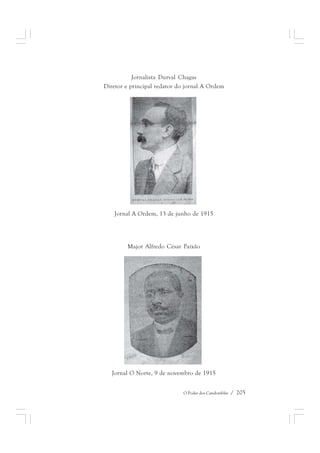
![te o major Paixão, foi um desses nomes, senão o principal deles, entre os
anos de 1914 e 1923. Em 1914, o major Paixão era colaborador do jornal O
Norte e superintendente da polícia local. Começou a se notabilizar nas pá-ginas
do jornal A Ordem por causa de uma suposta prática de conceder
licenças para a realização dos candomblés em vários pontos da cidade. To-davia,
não poderíamos descartar a hipótese de que a relação entre os can-domblés
e o major Paixão tenha sido uma construção do jornal A Ordem,
com a intenção de depreciar o diretor da folha concorrente.
Nesse sentido, seria apenas a concorrência comercial que levaria o
diretor do jornal A Ordem, o jornalista Durval Chagas, a escolher o major
Paixão como seu alvo, ou haveria outros importantes motivos para tal
empresa? Já nos referimos às disputas pela hegemonia política local ali-mentando
a campanha contra as práticas culturais e religiosas de matriz
africana: agora, procuraremos demonstrar como, principalmente os can-domblés,
foram utilizados como munição nas disputas políticas entre gru-pos
rivais na cidade de Cachoeira, entre os anos de 1914 e 1923, fase de
maior incidência de notícias sobre candomblé nas duas folhas menciona-das.
O povo-de-santo, por sua vez, também soube utilizar os acontecimen-tos
em seu proveito.
Em 1915, uma lei estadual promulgada no governo Seabra reformulou
os meios de acesso a cargos nos municípios, ou seja, os intendentes passa-ram
a ser nomeados pelo governador e podiam permanecer no cargo por
dois anos. A participação de Ubaldino de Assis nas articulações que leva-ram
Seabra ao poder em 1912 e, também, sua aliança com o governador
nas eleições legislativas e municipais de 1914, levaram o chefe do executi-vo
estadual a nomeá-lo intendente da cidade de Cachoeira em 1915258.
Ademais, o deputado já gozava de hegemonia política local desde 1909,
controlando cargos públicos e instituições como a Santa Casa de Miseri-córdia,
da qual foi provedor entre os anos de 1912 e 1918259.
O major Paixão chegou ao posto de superintendente da polícia local
sob os auspícios de Ubaldino de Assis. Fiel correligionário do deputado,
alcançou também o cargo de Coletor Estadual no município. Apesar de
uma aliança momentânea em torno do nome de Antônio Muniz para a
258 O NORTE. 29 out. 1915. p. 1. Sobre a reforma municipal de Seabra em 1915, ver: Eul-Soo Pang (1979, p.
123-126). Segundo Pang, a reforma municipal permitiu ao Partido Republicano Democrata (PRD) assegurar a
eleição para governador do candidato seabrista Antônio Muniz, através da expansão da distribuição de favores:
“[...] coletores de impostos estaduais e federais, funcionários dos correios e professores, todos esses lugares foram
dados a protegidos do coronel dominante”.
259 SILVA, P. C. da. Datas e tradições cachoeiranas, 1943. p. 346.
120 / Edmar Ferreira Santos](https://image.slidesharecdn.com/opoderdoscandombles-141001124209-phpapp01/85/O-poder-dos-candombles-120-320.jpg)
![Um deles é a praga dos candomblés, herança suja que nos
deixou o africanismo dos tempos ominosos da escravidão e
que os adoradores de Ogan realizam até em pleno coração
da cidade, ali à rua do Sabão, em épocas festivas e mesmo
em dias nos quais os descendentes dos ovampos não têm a
alma alvoroçada por uma qualquer ditosa recordação.
Ainda pelo Natal, se nos não é ingrata a memória no próprio
dia em que se comemora o nascimento do Menino Deus, o
batuque e as danças infernais que acompanham a celebração
grotesca da missa negra estavam no seu auge, numa das casas
nessa rua situada. Entraram dois policiais com a intenção de
pôr termo ao abusivo divertimento africano, segundo somos
informados. Às primeiras palavras de intimação, recuam de
seu propósito, porque [...] ‘O CANDOMBLÉ SE FAZIA
COM A LICENÇA DO MAJOR DELEGADO’.264
Ao lado da já conhecida representação dos candomblés como acon-tecimentos
execráveis, sujos e diabólicos, herdados da África, destaca-se a
referência direta ao responsável pelo policiamento da cidade, neste caso, o
major Paixão. Os apelos da redação do jornal A Ordem feitos à polícia
contra as celebrações negras, até então, jamais se referiram a uma autori-dade
específica, mas, sim, a toda corporação. A chegada do major Paixão à
superintendência da polícia local parece ter adicionado mais ingredientes
na aborrecida oposição feita pelos colaboradores do jornal A Ordem aos
partidários do deputado Ubaldino de Assis.
Nos tempos do major Alfredo Paixão, os ventos pareciam estar mais
favoráveis à difusão dos candomblés. No episódio do natal na rua do Sa-bão,
caso o major não tenha de fato permitido a celebração, certo é que
seu nome não estaria à toa na boca do povo-de-santo. Assim, ele foi bem
utilizado num momento crucial de repressão e garantiu a continuidade da
festa. Por sua vez, os articulistas do jornal A Ordem vislumbravam inten-ções
escusas nas atitudes do major:
Certo, tudo isso se pratica com a prévia anuência do Sr.
major Alfredo Paixão.
E porque os candomblés, na marcha disseminadora em que
vão, dentro em pouco tomarão conta até das principais
vias públicas da cidade, já houve quem dissesse, com a
malícia esfuziante com que pontua as suas frases de efeito,
264 A ORDEM. 13 jan. 1915. p. 1.
122 / Edmar Ferreira Santos](https://image.slidesharecdn.com/opoderdoscandombles-141001124209-phpapp01/85/O-poder-dos-candombles-122-320.jpg)
![policial e fez questão de publicar a certidão de óbito da menina na íntegra,
bem como na morte de José Joaquim dos Santos que, segundo o jornal A
Ordem, teria sido assassinado a cacetadas “para lhe ser tirado o diabo do
corpo”. Utilizando de contumaz ironia, a redação do jornal O Norte corri-giu
dados, desqualificou as reportagens da folha concorrente e sugeriu que
seus colaboradores tinham “conhecimento”, apesar de “desprevenidos”, de
feitiços e feiticeiros:
Os nossos confrades d’A Ordem estão na maré das altas
reportagens e, de guerra declarada a Ogan, “santo podero-so,
senhor dos mundos”, na frase de São Cipriano, o gran-de
feiticeiro. E, desprevenidos, de corpo aberto, como se diz,
sem ao menos tomarem umas benzeduras com vassourinha
branca embebida em azeite da Costa, vão, de pena em ris-te,
entrando portas adentro de tudo quanto é pigy e aganjú
de Deus, sem temer o castigo que é infalível em casos tais.
Se é? [...] Vejamos: Na quarta-feira última, os dignos
confrades da velha folha local, depois de um raid profanatório
pelos pigys e aganjús269 de seu VASTO conhecimento, en-tenderam
de alarmar os nervos da pacata população desta
terra com a sensacional notícia da morte de um homem
chamado José Joaquim dos Santos, cuja causa disseram ter
sido o espancamento a cacete, ‘para lhe ser tirado o diabo
do corpo’. Ogan castigou o noticiarista d’A Ordem, pois
nada disto aconteceu; nem o homem chamava-se José Jo-aquim
dos Santos, e sim Umbelino de tal, e nem foi morto
por espancamento, conforme apurou a polícia no inquéri-to
a que procedeu, cujo resultado tornaremos público no
próximo número.
E tá aí!... Não sabemos porque os nossos confrades d’A
Ordem são infelizes quando mexem em bozó [...]
Cruz! [...]270
Não podemos descartar a possibilidade de a linguagem ter sido utili-zada
em proximidade com o falar do povo-de-santo apenas para intimidar
a redação do jornal A Ordem. As últimas palavras então parecem afirmar
269 Após a publicação no jornal A Ordem de um convite de Mãe Judith para uma festa em sua casa de Aganju de
Deus, esta folha, e também o jornal O Norte, passaram a utilizar o termo “aganjú” para se referir às casas de
candomblé de uma maneira geral, tal qual foi utilizado o termo “pigy”. No capítulo 4, analisamos as notícias
sobre Mãe Judith.
270 O NORTE. 30 nov. 1917. p. 1.
O Poder dos Candomblés / 125](https://image.slidesharecdn.com/opoderdoscandombles-141001124209-phpapp01/85/O-poder-dos-candombles-125-320.jpg)
![trara o que estava procurando. Na edição de 2 de julho de 1921, o articu-lista
dirigiu um apelo ao recém-chegado delegado do termo, no qual cons-tatava
que pela cidade já tinham passado muitos encarregados pelo polici-amento
e nada havia sido feito para implantar em Cachoeira “o regime da
moralidade, dos bons costumes e das normas de povo civilizado”. Assim, o
órgão de imprensa sugeria que os antigos encarregados de polícia
compactuavam “com todos os jogos de azar e todas as crendices e todas as
misérias sociais” que infestavam a cidade. O jornalista se referia “aos cubí-culos
onde se praticam bruxarias, alto e baixo fetichismo, crendices vene-nosas
que adulteram e prejudicam manifestamente a moral pública”.
Desse modo, o tenente Paiva não poderia se abster de pôr fim aos
“antros” onde, para o redator do A Ordem, reinavam malandros, vadios e
capadócios:
[...] nós apelamos para o sr. tenente Laudelino de Paiva,
delegado de polícia, no sentido de s.s. pôr termo à
corrupção que se desenvolve, se dissemina, se alastra
medonhamente nessa pobre terra abandonada. S.s. tem os
meios necessários e próprios para quebrar os candomblés,
fechar as baiúcas, onde se jogam o monte, a ronda, as três
cartinhas, escancaradamente, frear a infância abandona-da,
proibir o pé-bola que a molecagem insólita e atrevida
pratica nos passeios largos das vias públicas, estancar o flu-xo
dos abusos imorais e manter a Cachoeira à altura do
nome de cidade culta e civilizada.
Esse o mais importante serviço que s.s., o sr. delegado Paiva,
prestará a esta terra.281
No início da campanha contra os candomblés, o discurso civilizatório
do jornal A Ordem dissimulava o racismo que alimentava suas críticas e per-plexidades.
Sobretudo nos anos que se seguiram a 1920, a preocupação do
jornalista com a mistura social, biológica, moral e dos costumes não mais
apareceu mal disfarçada, como em outro trecho da mesma notícia anterior-mente
mencionada, referindo-se aos candomblés, tabernas e casas de jogos:
“A umas e outras, dezenas de crianças acorrem, inexperientes, mesclando-se
com a indignidade, abastardando, conseqüentemente, os costumes, o que
concorre demasiado para a degeneração da família, da sociedade e da raça”282.
O Poder dos Candomblés / 131
281 A ORDEM. 2 jul. 1921. p. 1.
282 Ibid.](https://image.slidesharecdn.com/opoderdoscandombles-141001124209-phpapp01/85/O-poder-dos-candombles-131-320.jpg)
![A redação do jornal O Norte, por sua vez, não silenciava diante de
tais acusações, desmentia atos criminosos relacionados aos candomblés
publicados no jornal A Ordem e tratava com ironia a arrogância do editor
da folha concorrente, como na ocasião em que, dispondo de um cargo ofi-cial,
Durval Chagas não pareceu tão ordeiro aos olhos do redator do jornal
O Norte. Em edição de 23 de setembro de 1921, o jornal O Norte exclamou
na primeira página “Como está valente o sr. Durval Chagas!”. Era uma
terça-feira. Um boiadeiro tocava uma manada em direção à travessia da
ponte D. Pedro II, quando foi abordado pelo cobrador municipal para que
pagasse o respectivo imposto:
[...] então, o sr. Durval Chagas, que se achava por ali ban-cando
136 / Edmar Ferreira Santos
prestígio de 2.º suplente de juiz de direito gritou:
- Não paga!
- Paga!
- Não paga!
E lá fechando-se o tempo, porque dizem, o sr. Durval Cha-gas
apanhou uma pedra e se coçou para tirar do bolso... um
lenço de beirinhas bordadas.
Mas, já se viu como os tempos se mudam?
O sr. Durval Chagas, que era um moço tão pacato, tão
morigerado, tão ordeiro, (Basta dizer que é diretor d’A Or-dem)
o sr. Durval Chagas deu agora para valente!
Por favor, Yôyô, nos conheça.297
O articulista primeiro ironiza o suposto prestígio do “diretor d’A Or-dem”,
com o acanhado cargo de segundo suplente de juiz de direito. Em
seguida, zomba das atitudes do adversário político e concorrente comerci-al,
tentando apresentá-lo como um dos desordeiros que ele tanto ataca em
sua folha. Porém, um desordeiro singular, pois, apesar da pretensa violên-cia
esboçada ao pegar uma pedra, quando “se coçou”, tirou do bolso “um
lenço de beirinhas bordadas”, exibido como símbolo do seu refinamento de
homem civilizado e pusilâmine. A resposta irônica ao comportamento ar-rogante
de Durval Chagas quer lhe fazer lembrar o final da escravidão, tão
eloquentemente louvado em sua folha a cada 13 de maio, no entanto, tão
esquecido nas atitudes cotidianas: “Por favor, Yôyô, nos conheça”.298
297 O NORTE. 23 set. 1921. p. 1.
298 Neste mesmo ano, outra notícia se refere a Durval Chagas como “Yôyô” em oposição a alguém que ele teria
chamada de “meu negro”, com as palavras “negro e yôyô” em itálico. O redator do jornal O Norte, major Alfredo
Paixão, tenta deixar evidente o racismo do seu opositor. Ver: O CARA de bronze. O Norte, 2 out. 1921. p. 1.](https://image.slidesharecdn.com/opoderdoscandombles-141001124209-phpapp01/85/O-poder-dos-candombles-136-320.jpg)



![No que concerne às mulheres participantes do culto aos voduns e
orixás, na maioria das vezes o jornal as trata como prostitutas que viviam
em “pândegas e orgias com ogans e pais-de-santo”. Mulheres promíscuas
dando mau exemplo “às moças e senhoras de família”305. Os episódios em
que esteve em cena a Ialorixá Judith demonstram um pouco desse trata-mento.
Mãe Judith, como já nos referimos, foi uma das ialorixás mais per-seguidas
pelo jornal A Ordem. Entre os anos de 1914 e 1923, ela figurou
com frequência nas páginas deste periódico. Mãe Judith atuou em cenas
que o periódico classificou de “um ultraje a família cachoeirana.” 306
No jornal, ela aparecia como “pontífice” de “torpíssima miséria” que
era o “fetichismo africano”. Além disso, ela liderava “um desses covis de
degradação a que dão o nome grotesco de pygi”307. Outras mulheres, sacer-dotisas
do candomblé, figuravam nas páginas do jornal A Ordem sob a forma
do que chamei aqui de “retórica do fetiche”. Mulheres como Mãe Paulina,
Mãe Gertrudes, Mãe Porfíria ou Aleijadinha308, entre outras que aparecem
como o joio em meio ao viçoso trigal da boa sociedade cachoeirana.
Uma enorme preocupação com o crescimento e consequente aproxi-mação
das práticas religiosas de matriz africana esteve presente em cada
nova notícia contra o candomblé. Os articulistas se preocupavam, sobre-tudo,
com a participação da polícia e da “parte sã” da sociedade, principal-mente
meninas e mulheres, no que chamavam de “farras negras”. Apesar
da menor frequência, nomes de pais-de-santo também aparecem nas de-núncias
do jornal A Ordem. Junto com os ogans, são eles os que represen-tam
um perigo ainda maior para as moças, como aparece neste trecho de
um artigo sobre Mãe Judith:
[...] e muitos outros pygis, antros de ignomínias e perdi-ção,
144 / Edmar Ferreira Santos
que enxameiam a cidade e nos quais tantas incautas
donzelas, umas levadas pelas faliazes promessas dos pais de
terreiro, outras sob a ação narcotizante de estúpidas
beberagens, tem visto perdido o precioso bem de sua vir-gindade.
309
305 Para situação semelhante ocorrida em Salvador, ver : Alberto Heráclito Ferreira Filho (1994).
306 A ORDEM. 24 nov. 1017. p. 1.
307 Ibid.
308 Nas notícias de jornal dona Porfíria aparece com o cognome “Aleijadinha”. Gaiaku Luiza esclareceu que D.
Porfíria possuía uma deficiência na perna. Informação fornecida por Gaiaku Luiza Franquelina da Rocha (1909-
2005). 23 nov. 2003.
309 A ORDEM. 24 nov. 1017. p. 1.](https://image.slidesharecdn.com/opoderdoscandombles-141001124209-phpapp01/85/O-poder-dos-candombles-144-320.jpg)
![representados no sentido inverso do discurso daqueles que se
autodenominavam como a parte sã da civilizada e heróica cidade de Cacho-eira.
Esses setores reconheciam, mas não admitiam a “alta dignidade” que o
candomblé proporcionava aos seus participantes, oferecendo uma dimensão
espiritual, material e estética de vida e resistência às adversidades.
MÃE JUDITH E A RESISTÊNCIA LEGAL
“Rainha Mãe filha de Xangô, fundadora do terreiro, mãe Judith
Ferreira do Sacramento, mulher de ouro, mãe-de-santo tão perfeita ou
mais que mãe carnal, de uma espiritualidade venerada em toda a Bahia”.
Assim, Antônio Gomes da Silva, Seu Candola, ogan da Casa de Aganju
Didè, lembrava emocionado de sua ialorixá313. Judith Ferreira do Sacra-mento,
ou simplesmente Mãe Judith, comprou uma roça situada na Terra
Vermelha no ano de 1913, nas mãos do Sr. Francisco Xavier Neves, que
residia na cidade de Cachoeira. Era natural de São Gonçalo dos Campos e
adquiriu a roça pela quantia de 600$000 (seiscentos mil réis). O sítio loca-lizado
em terreno foreiro da Fábrica São Carlos, pertencia a Companhia
União Fabril da Bahia e não era modesto, como se nota a partir de sua
escritura:
[...] com uma casa de morar coberta de telhas tendo uma sala
de frente, dois quartos e cozinha. Com árvores frutíferas
constantes de 40 pés de jaqueira, 15 pés de laranjeiras, 6
cortiços de uruçú e toda mandioca existente, com parte do
terreno cercado a arame [...]314
Nesta casa, ainda hoje distante do núcleo urbano de Cachoeira, Mãe
Judith começou a realizar seus trabalhos religiosos, abrindo a casa ao pú-blico
em 1916. Para Seu Agenor, filho de criação e ogan da casa, Mãe
Judith já vinha realizando serviços religiosos desde São Gonçalo dos Cam-pos,
portanto, antes de comprar a roça em Cachoeira315. Não demorou e a
313 ATA de Fundação da Sociedade Seguidores de São Jerônimo. 5 mar. 1989. Livro de Atas da Sociedade
Seguidores de São Jerônimo. Fonte disponível no Acervo da Casa de Aganju Didè.
314 Escritura de registro de propriedade lavrada em 16 abr. 1913. Fonte disponível no Acervo da Casa de Aganju
Didè.
315 Informação fornecida por Hermógenes Cardoso Almeida, Seu Agenor (1926). 4 abr. 2006.
146 / Edmar Ferreira Santos](https://image.slidesharecdn.com/opoderdoscandombles-141001124209-phpapp01/85/O-poder-dos-candombles-146-320.jpg)
![sabia conversar direito não viu. Ele conversava, mas fala-va
coisas assim errado num sabe. Mas quem dizia a ele que
não era isso? Quem é que dizia? Grosseiro, africano mes-mo.
Ele era marido de tia Judith.336
Para Dona Lica, o marido de Mãe Judith “era tipo africano”. Muitos
descendentes de africanos forjaram e conservaram um ar mais desconfiado
e pouco aberto. Os indícios levam a crer que era esse o caso do “peguijan”
e, por isso, o jornalista do A Ordem, mas não apenas ele, identificava tio
Marcolino com a África e com as representações de degeneração e atraso
que o jornal relacionava ao continente.
O ano de 1921 marcou uma virada de mesa para os perseguidores da
religiosidade de matriz africana em Cachoeira337. Os sentidos das autorida-des
então constituídas se voltaram para o mapa dos candomblés desenha-do
pelo jornal A Ordem e os clamores de seus articulistas passaram a ser
ouvidos. Entre 1921 e 1923, Mãe Judith se constituiu no principal alvo do
noticiário deste periódico:
Chegou outra vez a época de mãe Judith. Outros tempos...
outros costumes...
Mãe Judith é uma felizarda. Seus aparelhos de candomblé
“funcionavam” a valer e era feitiço à beça, para todos os
misteres e [...] profissões. Moléstias, interesses políticos, o
diabo, tudo mãe Judith concertava e arranjava da melhor
forma, o “santo” lhe deu até sapiência para discutir pelas
colunas d’ O Norte, onde colaborou por muito tempo,
muitos artigos da Constituição Federal, bancando ciência
jurídica [...] e constituindo advogado [...]
Ora, mãe Judith continuou a bater o tabaque, a fazer mil
maravilhas. Mas agora [...] babau! - O Sr. tenente Paiva
não quer e não quer mesmo e pronto. Ontem, devia ter
ido à presença da polícia o embaixador do terreiro Judithiano,
para conferenciar com a polícia.
Muito bem. Mas tem que agora mãe Judith de tratar de
quebrar tudo aquilo e nada mais.
336 Informação fornecida por. Maria da Paz Bezerra, Dona Lica (1923). 17 ago. 2007.
337 Pesquisadores da repressão aos candomblés de Salvador identificaram, nos anos da década de 1920, o perío-do
de maior campanha da imprensa e, também, de maior ocorrência das “batidas” policiais nos terreiros. Refiro-me
a Júlio Santana Braga (1995); Ângela Luhning (1995/1996). Jorge Amado, no romance Tenda dos mila-gres,
identificou o período entre os anos de 1920 e 1926 como o de maior perseguição aos candomblés, relaci-onando-
o com o legendário delegado Pedrito. Jorge Amado (1969).
O Poder dos Candomblés / 153](https://image.slidesharecdn.com/opoderdoscandombles-141001124209-phpapp01/85/O-poder-dos-candombles-153-320.jpg)
![E, ainda, afirmou a visão geral de promiscuidade existente nos terreiros:
“são notórios os excessos e orgias que reinam nos grandes candomblés”343.
A análise de processos criminais envolvendo práticas de magia sugere
uma “circularidade” entre os discursos dos juízes e o de outras instâncias
reguladoras dos feiticeiros, ou seja, os próprios terreiros, centros e templos
das “religiões mediúnicas”. Assim, setores da classe dominante se serviam
(porque acreditavam) de concepções correntes entre os acusados de feiti-çaria
para regulá-los e os acusados, por sua vez, utilizavam de expedientes
jurídicos para se defender, todavia, não negavam a existência de feitiçari-as344.
Termos como “orgia” parecem ter feito parte dessa ampla circularidade
de conceitos, palavras e coisas.
Nesse sentido, pode-se admitir que o procurador constituído por Mãe
Judith, em que pese suas boas intenções, encontrava-se imerso num imagi-nário
que associava os candomblés a divertimentos licenciosos. Não é ne-cessário
lembrar que relacionar o candomblé a comportamentos libidino-sos,
crimes e exploração racional de indivíduos ignorantes, como vimos,
foram expedientes amplamente utilizados na construção do que chama-mos
aqui de “a retórica do fetiche”:
Não é interessante? A Constituição Federal esta sujeita,
pois, as interpretações de mais esse oráculo. Mãe Judith
doutrina que a autoridade policial não se pode arrogar o
direito de proibir abusos e farras, [...] o que equivale a di-zer
que os estatutos máximos da nossa nacionalidade fo-ram
elaborados numa hora de anarquia mental, sob as ins-truções
156 / Edmar Ferreira Santos
maravilhosas de Ogan ou sob inspiração imediata
do Baco.
Quem já ouviu dizer que a Constituição, uma lei qualquer,
mesmo nas terras menos civilizadas, outorgasse aos povos
o direito de fazer [...] farras?
[...] Porque de fato, não nos consta que, estabelecendo a
liberdade religiosa sob a inspiração de princípios essencial-mente
liberais, estivesse no pensamento dos legisladores a
idéia transcendente das orgias, do bacanal e dos festins dos
terreiros de Ogan, onde se praticavam bruxarias explora-doras
da bolsa e das crenças dos incautos, que acreditam
343 RODRIGUES, N. Os africanos no Brasil, 1977. p . 7-237-239.
344 Para a análise de processos criminais envolvendo feitiçaria no Rio de Janeiro, ver Yvonne Maggie (1992); na
Bahia, ver Júlio Braga (1995 e 1999).](https://image.slidesharecdn.com/opoderdoscandombles-141001124209-phpapp01/85/O-poder-dos-candombles-156-320.jpg)
![de candomblé, descendente, mas não era. [...] Aquelas se-nhoras
aposentadas [no sentido da idade]. Eram negoci-antes,
vendiam nas casas, negócio de venda, se a venda-gem
saía. ‘Ei Mãe Agda veja uma coisinha pra mim que eu
vou pra Bahia’, essas coisas. Sátira vendia moqueca de pei-xe
na frente da Estação. Vendia essas moquequinhas enro-ladas
na folha. Sabina vendia canjica. Maria Democrática
vendia inhame cozido pela rua, gibeira cheia!, era o amen-doim,
ela vendendo, tudo era cantando.361
Nos fragmentos acima são apresentadas algumas atividades correntes
entre os africanos e seus descendentes na Bahia das primeiras décadas do
século XX. Assinalo aqui, para os nossos objetivos, o mercado ambulante e
o trabalho na terra, “nos arrabaldes ou roças da vizinhança da cidade”,
como constatou Nina Rodrigues em Salvador. Chama-nos a atenção no
Livro de Terrenos e Propriedades da Santa Casa de Misericórdia de Cacho-eira
que, em todos os registros, apenas um indivíduo é suficiente para rea-lizar
um arrendamento, homem ou mulher, a exceção foram os africanos
Júlia Maria Guimarães e Antônio Domingues. Outro vestígio interessante
é a observação entre parênteses “africanos”, quando em nenhum outro re-gistro
aparece a origem dos arrendatários.
Esses indícios nos fazem questionar possíveis dificuldades existentes
naqueles anos para que um africano arrendasse casas e terras da Santa
Casa362. A condição estável de Júlia e Antônio, casados e com moradia
fixa, certamente os ajudava em suas relações com a sociedade envolvente.
Assim, uma possibilidade que se apresenta para o fato deles arrendarem
muitas casas na Levada do Chafariz seria a sublocação para outros africa-nos
ou descendentes, evidentemente, sem o mesmo trânsito social que eles
O Poder dos Candomblés / 163
dispunham.
No período estudado, não houve uma notícia sequer de batuques ou
festas de candomblé na Rua da Levada do Chafariz. No entanto, sabe-se
da presença e importância de Dona Júlia e da sua casa na institucionalização
do candomblé em Cachoeira363, por outro lado, não se tem notícias de can-domblés
realizados em sua residência, ao menos depois de sua morte. Na
casa onde morava, situada à Rua da Matriz n.º 41, possivelmente existia
361 Informação fornecida por Gaiaku Luiza Franquelina da Rocha (1909-2005). 23 nov. 2003.
362 A gerência da Santa Casa de Misericórdia também era objeto das disputas políticas locais. Assim, é possível
inferir que, da mesma maneira como acontecia com a perseguição aos candomblés, alternavam-se momentos
de maior tolerância com outros de intransigência com o diferente.
363 PARÉS, L. N. A formação do candomblé, 2006. p. 180-181.](https://image.slidesharecdn.com/opoderdoscandombles-141001124209-phpapp01/85/O-poder-dos-candombles-163-320.jpg)
![batas... e tinha uma igrejinha dentro do terreno. A finada
Paulina e tia Judith lá na Terra Vermelha. Tia Judith mor-reu
com 110 anos, 107 ou 110, era Aganju Didè, quer dizer
que é o santo que está levantando, Didè é que está em pé,
levantar. Nagô é muito diferente do Jeje. [...] Agora, e tinha
Aleijadinha na Lagoa Encantada, chamava Porfíria, Porfíria
de Ogum, que dizia o povo, eu não alcancei né meu filho,
agente ouve, que o Ogum dela entrava na fonte e ficava
três dias, nessa lagoa, chamava Lagoa Encantada.366
O exemplo da rua da Levada do Chafariz nos faz entrever relações
nas outras localidades onde residia a maioria da população negra da cidade
e, também, os últimos africanos. Lugares como o Alto do Cucuí, que ape-sar
de circundar o núcleo urbano não tinha a proximidade deste tal qual a
Levada do Chafariz e portanto dispensava tamanha discrição na realização
das festas religiosas ou profanas. Isso, por sua vez, levava o espaço a ocupar
com freqüência as páginas do jornal A Ordem, como local de vadiagem,
assassinatos e “torpes feitiçarias”.
Se o argumento é válido para o Alto do Cucuí, o mesmo serve para o
túnel do ramal da Estrada de Ferro Central da Bahia ou para a Terra Ver-melha,
distantes que estavam do sítio urbano de Cachoeira. Ainda sobre a
africana Júlia, mesmo depois de sua morte, ela continuou a ser lembrada e
respeitada na comunidade da Levada do Chafariz. Gaiaku Luiza e Seu
Geninho recordavam que, quando moravam nesta rua, sua mãe insistia em
lhes mandar tomar a benção das “meninas da finada Júlia”, referindo-se as
três mulheres criadas pela africana367. Sobre a casa das “meninas da finada
Júlia”, Gaiaku Luiza recordava:
Agora a casa era uma igreja, era aberta de noite a dia, as
doceiras entravam e saíam, as da Boa Morte então! Mui-tas
de dormir lá. Aquela casa você ali entrava qualquer
hora. Quando chegava a festa de São Cosme fazia a mesa
pras crianças. Sexta-feira Santa fazia mesa pros mendigos,
elas chamavam pra comer. Foi casa mesmo de africano.
Uma casa grande, uma sala de jantar, uma mesa maior do
que essa aí. E o quintal dá prá capela d’Ajuda.368
366 Informaçãofornecida por Gaiaku Luiza Franquelina da Rocha (1909-2005). 23 nov. 2003.
367 Informação fornecida por Gaiaku Luiza Franquelina da Rocha (1909-2005). 23 nov. 2003, Eugênio Rodrigues
da Rocha (1906-2006). 1 out. 2005.
368 Informação fornecida por Gaiaku Luiza Franquelina da Rocha (1909-2005). 23 nov. 2003.
O Poder dos Candomblés / 165](https://image.slidesharecdn.com/opoderdoscandombles-141001124209-phpapp01/85/O-poder-dos-candombles-165-320.jpg)
![Na década de 1920, diante do limite imposto a uma possível negoci-ação
com as “novas” autoridades que chegaram ao poder, outra saída en-contrada
pelos adeptos dos candomblés foi oferecer uma mobilidade possí-vel
às suas práticas religiosas. Deste modo, buscavam lugares cujo acesso
fosse cada vez mais difícil. O jornal A Ordem, por sua vez, insistia na perse-guição
e denunciava as estratégias do povo-de-santo, alarmando em suas
páginas que os candomblés andavam “por outras paragens, iludindo a vigi-lância”.
Assim, julgavam o candomblé “um vício quase incorrigível e difícil
de subjugar”, reconhecendo que o silêncio momentaneamente conquista-do
não significava o fim do conflito.369
O clima tenso fez calar os atabaques de muitos terreiros, que decerto
continuaram astuciosamente com as suas obrigações religiosas e atendi-mentos
terapêuticos. Alguns arriscaram reverenciar com toques e danças
os seus deuses. Esses foram violentamente reprimidos, como aconteceu no
dia 7 de agosto “sobre o túnel do ramal da Central da Bahia, a uns dois
quilômetros além da cidade”, quando um grupo de policiais acabou com a
festa ainda na primeira hora da madrugada:
[...] na ocasião lavada pela claridão de esplendido luar so-bre
a vigilância dos mantenedores da ordem pública, uma
vultosa canoa de 13 candomblezeiros, que foram os em que
a polícia pôde pôr as mãos, naquele pandemônio de feiti-ceiros
166 / Edmar Ferreira Santos
e feiticeiras.
A polícia arrecadou, no pigy invadido dezenas e dezenas
de grotescos objetos do culto negro que foram por ordem
do Sr. major delegado, exposto à curiosidade publica, e à
tarde, espatifados.
Todos, na cidade, louvam a polícia declarando guerra de
morte ao terrível cancro social, que é o fetichismo africa-no
tão protegido que foi entre nós, pelo Ubaldinismo de-caído.
370
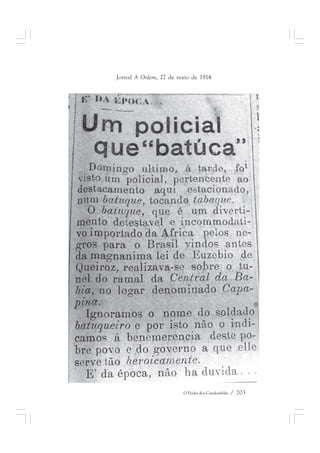
O local do episódio, sobre o túnel do ramal da Central da Bahia, é
chamado em outras notícias de morro da Capapina e fica próximo ao mor-ro
do Batedor371. Existe uma polêmica a respeito do topônimo “Batedor”.
Baseado em depoimentos do ogan Boboso, Luis Nicolau Parés nos informa
369 A ORDEM. 14 set. 1921. p. 2.
370 Id., 9 ago.1922. p. 1.
371 Id., 27 maio 1914. p. 1, 30 maio 1914. p. 1, 28 nov. 1917. p. 1.](https://image.slidesharecdn.com/opoderdoscandombles-141001124209-phpapp01/85/O-poder-dos-candombles-166-320.jpg)
![alto da Capapina”376 num “pigy há tempos existente”377. O morro da
Capapina é contíguo ao morro do Batedor ou Bitedô. No caminho entre a
Capapina e a antiga estrada de Belém teria existido um quilombo em me-ados
do século XIX. Nesta localidade teria funcionado também o candom-blé
do Bitedô, que foi dirigido por um africano de nome Quixareme de
Azansú, da nação jeje mahi378.
Outra casa que figurou nas páginas do jornal A Ordem após ter sofri-do
uma batida policial de “sucesso” foi a de Mãe Aleijadinha:
[...] quando menos esperavam a Aleijadinha e seus sequa-zes,
domingo último, a polícia penetrou nos arraiais do seu
pigy, e tudo virou ali de cambalhotas: ‘aparelhos’ quebra-dos,
168 / Edmar Ferreira Santos
os santos... sem milagres sem os devotos em número
de 11, presos e conduzidos para as cadeias desta cidade,
onde passaram calmamente algumas horas.379
Na memória do povo-de-santo em Cachoeira, a roça de Mãe Alei-jadinha
estava localizada na Lagoa Encantada380, próximo a Roça de Ven-tura,
no caminho da antiga estrada de Belém. Entre a Lagoa Encantada e
a Roça de Ventura, segundo a tradição oral, também existiu um candom-blé
de africanos que ficou conhecido como Roça de Cima. Este candom-blé,
na segunda metade do século XIX, foi liderado por Ludovina Pessoa,
Quixareme (o mesmo africano que a tradição oral relaciona ao Bitedô) e,
posteriormente, por Zé de Brechó. Quando o pai de Zé de Brechó, o afri-cano
Belchior Rodrigues de Moura, morreu em 1855, deixou para sua
mulher, Maria da Motta, e os 5 filhos, “um pedaço de terra no lugar da
Capapina o qual ocupam três sítios”. Quando Maria da Motta registrou
as terras em nome de seus filhos em 1858, especificou que elas estavam
limitadas “pelo sul com a estrada de Belém, e pelo norte com a estrada da
Capapina”381.
376 A ORDEM. 27 maio 1914. p. 1, 30 maio 1914. p. 1.
377 Id., 9 ago. 1922. p. 1.
378 PARÉS, L. N. A formação do candomblé, 2006. p. 180-181.
379 A ORDEM. 15 nov. 1922. p. 1.
380 Informação fornecida por Gaiaku Luiza Franquelina da Rocha (1909-2005). 23 nov. 2003, Dona Estelita. 6
abr. 2006, Ogan Bernardino. 6 abr. 2006, Seu Otávio. 28 jan. 2007. Em edição de 18 de abril de 1915, o jornal
A Ordem informou a seguinte localização do “pigy” de Mãe Aleijadinha: “Nas proximidades da cidade, ao túnel
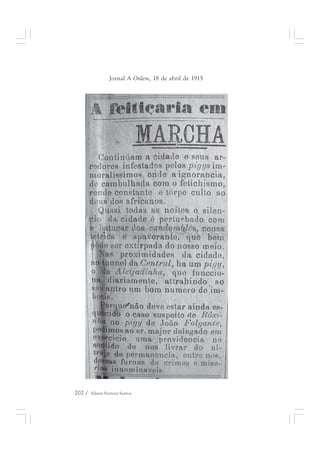
da Central, há um pigy, o da Aleijadinha, que funciona diariamente, atraindo ao seu antro um bom número de
imbecis”. A ORDEM. 18 abr. 1915. p. 2. Ver nos anexos, fotografia desta notícia..
381 Sobre a história de Zé de Brechó, ver: Luis Nicolau Parés (2006, p. 190-196).](https://image.slidesharecdn.com/opoderdoscandombles-141001124209-phpapp01/85/O-poder-dos-candombles-168-320.jpg)
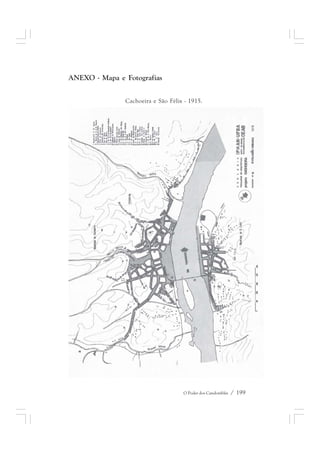
![Nas três primeiras décadas do século XX, a cadeia de morros que for-ma
uma meia elipse na cidade de Cachoeira, limitada por um lado pelo
Cucuí e Riacho da Capapina, e do lado oposto pelo Riacho do Caquende e
Terra Vermelha, tendo como vértice as nascentes do Riacho Pitanga e a
Lagoa Encantada, constituíam a complexa territorialidade do povo-de-san-to382.
Da Terra Vermelha ao Cucuí, ligados em larga medida pela antiga
estrada de Belém e a antiga estrada da Capapina, localizavam-se as roças,
terreiros, e as grandes festas de candomblé. Devido à repressão policial dos
anos 20, os caminhos que ligam esses morros devem ter possibilitado algu-ma
mobilidade espacial para as grandes festas383. Em conversa com Seu
Bernardino, ogan do Sejahundè, sobre a perseguição policial aos candom-blés,
ele revelou que “antigamente era assim, hoje estávamos aqui, ama-nhã
na Lagoa Encantada, depois pros lados de Capoeiruçu”384.
No período aqui estudado, o principal caminho para a Lagoa Encan-tada
era a ladeira (morro) da Cadeia. Segundo Seu Agenor, o povo da casa
de Mãe Judith, localizada na Terra Vermelha (cujo acesso é obtido através
de outro morro), ia para a Roça de Ventura (cuja localização é próxima a
Lagoa Encantada) “pelos matos”385. Assim, podemos considerar que os
morros aqui mencionados, Terra Vermelha, Alto da Ladeira da Cadeia (La-goa
Encantada), Bitedô, Capapina e Cucuí, eram comunicantes, e consti-tuíam,
naquele momento, o território das grandes festas de candomblé.
Muniz Sodré afirma que desde o fim do século XIX e mais especificamen-te
com a abolição, o afastamento dos descendentes de escravos era fundamen-tal
para uma sociedade que sonhava romper social, econômica e ideologica-mente
com as formas de organização herdadas da Colônia. Assim, foram in-tensificadas
as regras de segregação territorial na organização dos espaços bra-sileiros,
ou, no que aqui nos interessa especificamente, das cidades brasilei-ras386.
O fragmento a seguir, narrado por Gaiaku Luiza, é esclarecedor:
[...] mamãe que contava que era muito perseguido, era tudo
escondido. Teve uma vez que eu perguntei a mamãe, eu já
382 Ver mapa (1915) em anexo.
383 Lembremos da curandeira Arlinda e de Maria Romana (organizadoras de um candomblé no Arraial de
Almas, próximo a cidade de Feira de Santana) que, devido a perseguição da imprensa e da polícia, estavam
constantemente mudando o local de suas práticas mágico-terapêuticas, ver: Capítulo 2. A ORDEM. 3 set.
1904. p. 2. Também Mãe Aleijadinha entre a Capapina e a Lagoa Encantada.
384 Ogan Bernardino. 6 abr. 2006. O morro da Capapina é contíguo ao morro do Capoeiruçu.
385 Informação fornecida por Hermógenes Cardoso Almeida, Seu Agenor (1926). 4 abr. 2006.
386 SODRÉ, Muniz. O terreiro e a cidade: a forma social negro-brasileira. Petrópolis: Vozes, 1988. p. 21-45.
O Poder dos Candomblés / 169](https://image.slidesharecdn.com/opoderdoscandombles-141001124209-phpapp01/85/O-poder-dos-candombles-169-320.jpg)
![morava em Salvador, mamãe porque é que o candomblé
daqui é tão longe? ela disse, minha filha por que era muito
perseguido. Pra não incomodar as Rainhas no palácio, tem
que ser bem distante pra não ver a zoada. Aí Roça de Ven-tura,
170 / Edmar Ferreira Santos
Terra Vermelha, tudo distante.387
A resposta de Dona Cecília, esposa do Pejigan Miguel e mãe de Gaiaku
Luiza, demonstra a consciência da segregação espacial que as práticas reli-giosas
afro-baianas e seus integrantes estavam submetidos. Mas, se por um
lado o povo-de-santo estava coagido a festejar seus orixás e voduns longe
da cidade e, muitas vezes, morar nesses lugares, por outro lado, nesses es-paços
“distantes” a vida era reinventada. Eram criados laços de parentesco
e comunitários, eram engendradas relações de colaboração e coexistência
física e espiritual e, evidentemente, gerados diversos conflitos, que afasta-vam
e aproximavam uns e outros. Territórios habitados não apenas por
negros, mas, tendo nestes a grande maioria dos moradores. Aproveitando
as terras, os riachos e as árvores em sua sobrevivência e existência. Gaiaku
Luiza assim recordava de sua infância na roça do Ventura:
[...] eu e minhas irmãs gostavam por que, tomando banho
no riacho, comendo camarão cru, chupando nicuri, cozi-nhando
nicuri pra comer nicuri cozido, assando castanha,
pintando o diacho na roça, quem é que não gosta.
Nós corria dos santos, na época de santo que agente tinha
medo. E na minha época criança não ficava no Abassá,
além de não ficar ainda se amedrontava.388
A essa intensidade de vida infantil se somavam a construção de casas
de taipa, o trabalho na roça, a colheita das frutas e folhas, a preparação de
comidas, doces e remédios, os banhos de riacho, a pesca, as festas, os can-domblés
do lugar e as visitas a outros candomblés (“pelos matos”), as hie-rarquias,
os interesses, os amores, as brigas, os desentendimentos, as ame-aças,
os padecimentos. Muniz Sodré argumenta que são “os aspectos de
contato e comunicação nas relações funcionais de coexistência” que criam
387 Informação fornecida por Gaiaku Luiza Franquelina da Rocha (1909-2005). 23 nov. 2003. Analisando a
ocupação do espaço urbano de Salvador pelos candomblés na segunda metade do século XIX, Jocélio Teles dos
Santos afirma que o raciocínio dos grupos dominantes era o seguinte: “se não é possível acabar com os candom-blés,
que fossem deslocados para longe do centro da cidade”. Jocélio Teles dos Santos (2005, p. 207).
388 SANTOS, Jocélio Teles dos. Candomblés e espaço urbano na Bahia do século XIX. Estudos Afro-Asiáticos,
Salvador, v. 27, n. 1-2-3, p.205-226, jan./dez. 2005.](https://image.slidesharecdn.com/opoderdoscandombles-141001124209-phpapp01/85/O-poder-dos-candombles-170-320.jpg)
![indireto. O primeiro consiste na aplicação de ervas ou subs-tâncias
venenosas à comida ou à bebida; o segundo é feito
por encantação. [...]
Qualquer pessoa, indiferente aos negócios da seita, pode
conduzir o ebó ao seu destino. Com o feitiço o caso é di-verso:
para alguém se incumbir dessa diligência, necessá-rio
se faz ser entendido na matéria, a fim de que, na oca-sião
de colocar o feitiço no lugar escolhido, chamar pelo
nome da pessoa a quem ele deva atingir.399
Suponho que o nome do jornalista Durval Chagas e de muitos médi-cos
e autoridades tenham sido furtivamente chamados nas diversas encru-zilhadas
de Cachoeira. Manuel Querino nos chamou a atenção para a dife-rença
entre o ebó e o feitiço. O autor sugere que o ebó é uma oferenda ou
despacho que visa aliviar, trazer ou levar benefícios, por isso, mesmo al-guém
“despreparado” poderia arriá-lo. Já o feitiço visaria provocar a ruína
e, desta forma, não poderia ser levado ao local de destino por “qualquer
pessoa”. Em Cachoeira, nota-se que o termo “bozó” é freqüentemente uti-lizado
na rua, quando alguém ao encontrar uma oferenda exclama a pala-vra,
geralmente, em tom depreciativo e temeroso, relacionando-o a feiti-çaria.
Nas casas e terreiros de candomblé quase não se escuta esse termo,
exceto, raramente é bem verdade, para se referir a algum feitiço realizado
por alguém de fora daquele candomblé400.
Vimos o paradoxo no qual estava imerso o curandeiro e, em especial,
àqueles iniciados para Obaluaê, tanto aqui quanto na África reconhecidos
ou abominados pelo poder a eles atribuídos de curar ou castigar com doen-ças.
O feitiço descrito por Manuel Querino também revela essas duas fa-ces.
Entre os Azande, os bruxos eram considerados capazes de “embruxar”
alguém, mas, por outro lado, podiam da mesma maneira desfazer bruxari-as401.
Em Cachoeira, como já nos referimos, não foi possível notar durante
a pesquisa qualquer diferença entre bruxaria e feitiçaria, sendo que ambos
aparecem dentro de um mesmo diapasão. Por outro lado, sabe-se do poder
de mães e pais-de-santo para desfazer feitiços, embora seja raro que al-guém
aceite ser reconhecido como feiticeiro ou feiticeira, exceto nas brin-cadeiras
O Poder dos Candomblés / 175
tão comum entre o povo-de-santo.
399 QUERINO, M. Costumes africanos no Brasil, 1988. p. 54-55.
400 A palavra “bozó” talvez seja uma corruptela da locução iorubá “bó ti wu”, que significa “assim seja”. Michka
Sachnine (1997, p. 78). Agradeço a sugestão ao professor Luis Nicolau Parés; hoje, nas casas e terreiros de
candomblé em Cachoeira, as palavras mais freqüentes para designar a magia são “ebó” e “feitiço”.
401 EVANS-PRITCHARD, E. E. Bruxaria, oráculos e magia entre os azande, 1978. p. 44-45.](https://image.slidesharecdn.com/opoderdoscandombles-141001124209-phpapp01/85/O-poder-dos-candombles-175-320.jpg)
![vinos. Exu, como vimos, homem das encruzilhadas, senhor das oferendas,
do poder e dos caminhos, é o princípio que liga esses dois níveis de existên-cia.
Exu, então, tanto comunica humanos com as divindades e vice-versa,
como também comunica os seres humanos com seus ancestrais407.
As motivações do bozó, segundo a folha, podiam ser: “um namoro
encrencado”, alguma “conquista difícil”, “dificuldades de vida”, “moléstia
em casa”, “interesses políticos”, “falência no comércio”, “negócios ruins”,
ou mesmo “uma questão de ciúme”408. A partir da diversidade das causas
do bozó podemos entrever, grosso modo, a diversidade dos grupos sociais
que procuravam os serviços das mães e pais-de-santo.
A ambiguidade presente na descrição da bruxaria entre os Azande e
na exposição do feitiço de Manuel Querino, também aparece nas páginas
do jornal A Ordem. O bozó, tantas vezes denunciado como uma ameaça,
um mal para a integridade física, material e moral dos indivíduos, por ou-tro
lado, aparece também representado como capaz de fazer o bem. Para
isso, é necessário que seja feito pela pessoa certa, com encantos e uma veli-nha
O Poder dos Candomblés / 177
acesa:
[...] mais grave e mais solene a veneração aos deuses do
Olimpo fetichista, aparecem, de quando em quando, veli-nhas
acesas de ponto em ponto da Urbs, denunciando a
existência de algum bozó do bom, feito em intenção de
alguma conquista de trazer água à boca de qualquer in-cauto.
A novidade tem sua explicação, a vela acesa ilumina a in-tenção
do que esta ali em volto no mistério e no segredo
do bozó.
Dês que haja luz, a causa assume um caráter positivo e
franco e que não admite controvérsias. O autor ou a auto-ra
do trambolho pronuncia então umas palavras sagradas e
deixa o tempo correr, esperando o resultado dos seus dese-jos.
409
Nesta notícia, o bozó assume qualidades até então jamais menciona-das
no jornal. Em que pese o tom irônico, preconceituoso e hierárquico, o
jornalista admite existir “bozó do bom”. É evidente a carga irônica da ex-
407 SANTOS, J. E. dos. Os nagô e a morte, 1998. p. 102-181.
408 A ORDEM. 25 mar. 1925. p. 1, 24 ago. 1921. p. 1.
409 Id., 1 ago. 1923. p. 1.](https://image.slidesharecdn.com/opoderdoscandombles-141001124209-phpapp01/85/O-poder-dos-candombles-177-320.jpg)
![pressão. A partir de um olhar hierárquico, pressupõe uma ingenuidade na
sua preparação “feito em intenção de alguma conquista de trazer água à
boca de qualquer incauto”. O que daria positividade ao feitiço seria a vela,
iluminando os desejos levados pelo encantamento de algumas “palavras
sagradas”. A ironia do texto nos faz lembrar a tradição ibérica da magia,
onde o feitiço sempre esteve envolvido num imaginário erótico, represen-tando
encantamentos de amor e ódio, alcoviteirices e perdas de virginda-de.
Esses temas que eram tratados com graça até o século XVI na literatura
ibérica, foram amplamente demonizados pela Igreja Católica.410 No código
penal de 1890, como vimos, também aparece a crença de que os feiticeiros
eram capazes de despertar “sentimentos de amor e ódio”411.
O tom do jornalista, por incrível que pareça menos agressivo em rela-ção
ao bozó, deveu-se a quem o estava portando, como podemos ver no
correr da reportagem:
As criaturinhas, que reconhecemos depois e que os leito-res,
178 / Edmar Ferreira Santos
aqui para nós estão cansados de contemplar e cujas
graças ninguém seria capaz de julgar que fossem render
culto a Ogan, seguiam em boa marcha, olhando constan-temente
para atrás, a ver se a criadinha corria parelhas com
elas e não se atrasava na marcha de resistência.
Pararam a certa altura de certa rua e deixaram ai um em-brulho
de bom tamanho [...].
E iam para levantar acampamento, após acenderem uma
velinha de sebo, quando nos apresentamos, a ver se se tra-tava
de cousa mais seria.
Empalideceram elas. Mas, nós as consolamos, dizendo-lhes
que não reprovávamos as crenças de ninguém, máxime com
a naturalidade com que encantadoras meninas estavam.412
As meninas que “empalideceram” deviam mesmo além da beleza “en-cantadora”
pertencer a famílias da consideração do jornalista. O “embru-lho
de bom tamanho” estava sendo carregado pela “criadinha”, a quem o
diretor do jornal A Ordem, certamente, não pouparia a alcunha de feiticei-ra,
caso estivesse sozinha. Contudo, nota-se que mesmo o Sr. Durval Cha-
410 BETHENCOURT, F. O imaginário da magia, 2004.
411 BRASIL. Decreto-lei nº. 847, de 11 de outubro de 1890. Promulga o Código Penal dos Estados Unidos do
Brasil. p. 210-223.
412 A ORDEM. 1 ago. 1923. p. 1.](https://image.slidesharecdn.com/opoderdoscandombles-141001124209-phpapp01/85/O-poder-dos-candombles-178-320.jpg)



![O Poder dos Candomblés / 183
OUTRAS HISTÓRIAS
Em edição de 5 de dezembro de 1888, o jornal A Ordem discutiu com
seus leitores os rumos do trabalho no Brasil. Uma vez desarticulada a “ins-tituição
servil”, a redação do periódico tentava incentivar os “espíritos
abatidos” diante do fim daquilo “que tão fundo havia penetrado em nossos
costumes” – a escravidão negra. A solução apresentada pelo jornal para a
província da Bahia se espelhava na experiência “valentemente” empreen-dida
pelas províncias do sul – a imigração:
Carecemos, portanto, do trabalhador estrangeiro, que ve-nha
rotear nossos campos, embelezando nossas cidades
também.
[...]
A verdade é – que sem os braços estrangeiros não nos sal-varemos.
A raça preta é uma raça, que desaparecerá por
fim.413
O projeto imediatamente acolhido pela redação do jornal A Ordem,
já nos meses que se seguiram a abolição, refletia a expectativa de amplos
setores da elite brasileira naquele momento. Os letrados baianos se senti-am
protetores do passado glorioso e arautos dos tempos civilizados. Associ-ados
do Instituto Geográfico e Histórico da Bahia, por exemplo, estavam
convencidos de que o futuro civilizado dependia da profilaxia de “uma en-fermidade
que, talvez, pelo produto de raças degeneradas, se inoculam no
corpo inteiro do país e do estado principalmente”414. A campanha da elite
baiana pela imigração européia atravessou toda a primeira república, no
entanto, viu-se frustrada pelos fracos índices imigratórios em todo o perío-do.
Ao contrário de São Paulo que obteve incrementos demográficos supe-riores
a 100%415.
A campanha imigratória denunciava os anseios de setores letrados
baianos. Emergia nas suas entrelinhas a matriz cultural hegemônica que
413 A ORDEM. 5dez. 1888. p. 1.
414 REVISTA DO IGHB, 1896, p. 150 apud ALBUQUERQUE, W. Algazarra nas ruas, 1999, p. 35.
415 Mário Augusto da Silva Santos constatou que “a insignificância do crescimento populacional de Salvador na
Primeira República está ligada ao fato de ter sido quase exclusivamente vegetativo, uma vez que foi pratica-mente
nula a imigração”. Ver: Mário Augusto da Silva Santos (2001, p. 14).](https://image.slidesharecdn.com/opoderdoscandombles-141001124209-phpapp01/85/O-poder-dos-candombles-183-320.jpg)
![Candomblé que, segundo o periódico, “estava bastante animado”419. Nesta
notícia, o batuque aparece em termos não ofensivos, pois, segundo o jor-nal,
“mereceu francos elogios de todos que viu dançar a bem organizada
Batucada”420. Outro jornal que circulava em Cachoeira nesta época tam-bém
elogiou alguns componentes sociais vinculados as heranças africanas:
Amo-te, nas tuas fábricas e oficinas; nos meninos das es-colas
186 / Edmar Ferreira Santos
e nos garotos das ruas; nas tuas crenças e supersti-ções;
nas tuas igrejas e nos teus pigis, pois que tu és sempre
a tradição, o escrínio da alma remota da Bahia, vivificando o
passado.
Amo-te, nas tuas deidades esculpidas pela civilização [...]
Amo-te, na seda plissada e nos áureos louvores de tuas rapa-rigas
da Irmandade da Boa Morte, como nas nuanças das
chitas que enfeitam tuas casas de sambas e tuas macumbas [...]
Amo-te, nos teus despachos à “Mãe d’Água”, em teus “terrei-ros”
e em teus canjerês421, como em tuas missas de festas, em
tuas procissões, em tuas grandes datas cívicas.422
O escritor Flávio de Paula, provavelmente um pseudônimo, sinteti-zou
em algumas palavras uma marca, uma identidade que acompanharia a
cidade por anos a fio. O texto publicado em plena “data magna” do muni-cípio,
no dia 25 de junho, apresentava a cidade como “o escrínio da alma
remota da Bahia”. Os elogios para características antes consideradas
aviltantes por amplos setores locais sugerem outras tramas que estão além
dos limites desse trabalho. O certo é que os anos que seguiram a década de
1930 assistiram uma progressiva organização dos candomblés locais.
Em edição de 22 de junho de 1940, o jornal A Tarde noticiou a tenta-tiva
de organização de um sindicato de curandeiros em Cachoeira em meio
ao que chamou de “enérgicas providências da polícia contra os curandei-ros”.
Na matéria, em que pese a ironia e o olhar hierárquico e preconceituoso
característico no tratamento do tema, não escapou ao jornalista os objeti-vos
dos curandeiros supostamente reunidos sob os auspícios da União Afri-cana
Brasileira. Estes objetivos não eram muitos, porém, sintetizavam ex-
419 No capítulo 1, discutimos as características possíveis deste terno.
420 A ORDEM. 24 set. 1934. p. 1.
421 Segundo Yeda Pessoa de Castro (2001, P. 198) a palavra “canjerê” é de origem banto e significa “feitiço” ou
“sessão de feitiçaria”.
422 PAULA, Flávio de. Cachoeira! (canto de amor). O Eco, 25 jun. 1939. p. 1, grifo meu.](https://image.slidesharecdn.com/opoderdoscandombles-141001124209-phpapp01/85/O-poder-dos-candombles-186-320.jpg)
![pectativas de longo tempo. Segundo o articulista, a reunião visava “o livre
exercício da profissão, o direito de usar placas nas portas de seus consultó-rios
e a organização dos mesmos em sindicato, de modo que pudessem tra-balhar
sem sustos e sob as garantias dos poderes competentes”.423
No dia 29 de junho de 1943, foi fundada na cidade de Cachoeira a
Sociedade Beneficente e Recreativa União São Pedro. Nas finalidades desta
sociedade estava evidente uma nova tentativa de organização dos adeptos
dos candomblés locais. A sociedade seria composta “exclusivamente de
brasileiros natos” e seus objetivos seriam:
[...] auxiliar os seus sócios, em caso de desemprego, ou
moléstia de duração superior a trinta dias, contribuir com
um auxílio à família do sócio que falecer, praticar, em toda
sua plenitude, o culto africano, promovendo festividades na
sua sede social ou na residência do seu Diretor Perpétuo,
nos períodos de 29 de Junho a 15 de Julho e de 22 de De-zembro
a 8 de Janeiro, de cada ano, bem como autorizar
que as suas filiais efetuem festividades em certos períodos
do ano, designando previamente os períodos em que cada
filial poderá realizar seus festejos.424
Ao mesmo tempo em que se nota a tentativa de organização do “cul-to
africano” através da coordenação de um calendário de festividades, per-cebe-
se também uma tentativa de criação de mecanismos de controle da
festa, gestados no interior do povo-de-santo. Afinal, entre outras atribui-ções,
a Sociedade Beneficente e Recreativa União São Pedro vislumbrava “au-torizar”
a festa425. Talvez seja por este motivo que um dos seus associados,
Domiciano Macambira, que ocupava na União São Pedro justamente o car-go
de Fiscal, ficou na memória do povo-de-santo local como um dos mais
ativos perseguidores dos candomblés426. Os anos que seguiram a década de
423 A TARDE. 22 jun. 1940. p. 1.
424 ESTATUTO da Sociedade Beneficente e Recreativa União São Pedro, 1943. p. 4-5, grifo meu.
425 A Sociedade Beneficente e Recreativa União São Pedro também visava a instalação de uma escola na cidade
de Cachoeira que se chamaria União São Pedro. O objetivo dessa escola era “ministrar o ensino primário aos
filhos dos seus sócios e a todos aqueles que, necessitados de instrução, procurem-na”. Além disso, a Sociedade
vislumbrava a contratação de um médico “para prestar serviços clínicos aos seus sócios, quando doentes”. Esta-tuto
da Sociedade Beneficente e Recreativa União São Pedro (1943, p. 13-14).
426 Encerrando o trecho do estatuto denominado “Exposição sobre a legalidade e direitos da Sociedade Benefi-cente
e Recreativa União São Pedro e sobre casas que praticam ilegalmente o culto africano neste Estado”, lê-se
o seguinte: “Temos observado, em alguns municípios, que diretores de casas que praticam ilegalmente o
culto, vão a Delegacia Regional da Circunscrição Policial em que são situadas as suas casas ou, ainda, à Delega-
O Poder dos Candomblés / 187](https://image.slidesharecdn.com/opoderdoscandombles-141001124209-phpapp01/85/O-poder-dos-candombles-187-320.jpg)