PROVOCAÇÕESALTERNATIVAS DE ESTRATÉGIAS BOP NA EMPRESA BASFProf. Aguinaldo dos Santos, Eng. Civil, MSc, PhD, Post-doc
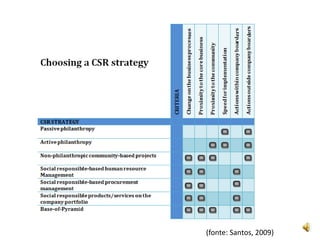
(fonte: Santos, 2009)
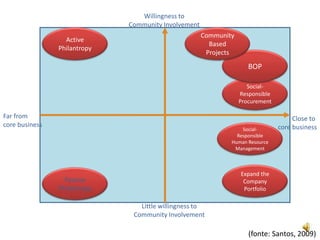
Willingness toCommunity InvolvementActivePhilantropyCommunityBasedProjectsBOPSocial-ResponsibleProcurementFar from core businessClose to core businessSocial-ResponsibleHumanResource ManagementExpand the CompanyPortfolioPassive PhilantropyLittle willingness toCommunity Involvement(fonte: Santos, 2009)
pressupostosHá uma urgente necessidade de viabilizar o leapfrog na direção da sustentabilidade na população recém ingressa no mercado de consumoEmbora tenha aumentado a renda da população BOP no Brasil há falta de produtos e serviços efetivamente desenhados para realidade desta população
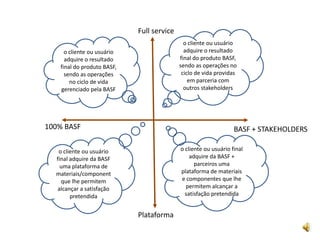
Fullserviceo cliente ou usuário adquire o resultado final do produto BASF, sendo as operações no ciclo de vida providas em parceria com outros stakeholderso cliente ou usuário adquire o resultado final do produto BASF, sendo as operações no ciclo de vida gerenciado pela BASF100% BASFBASF + STAKEHOLDERSo cliente ou usuário final adquire da BASF + parceiros uma plataforma de materiais e componentes que lhe permitem alcançar a satisfação pretendidao cliente ou usuário final adquire da BASF uma plataforma de materiais/componentque lhe permitem alcançar a satisfação pretendidaPlataforma
DIMENSÃO AMBIENTALExemplos de possibilidades de inovação voltadas ao mercado BOP
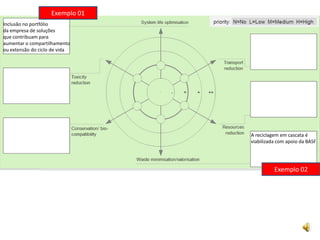
Exemplo 01Inclusão no portfólio da empresa de soluções que contribuam para aumentar o compartilhamento ou extensão do ciclo de vidaA reciclagem em cascata é viabilizada com apoio da BASFExemplo 02
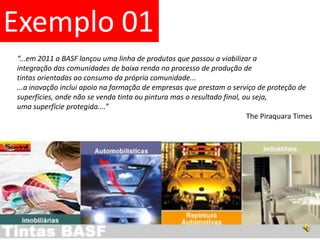
Exemplo 01“...em 2011 a BASF lançou uma linha de produtos que passou a viabilizar a integração das comunidades de baixa renda no processo de produção de tintas orientadas ao consumo da própria comunidade......a inovação inclui apoio na formação de empresas que prestam o serviço de proteção de superfícies, onde não se venda tinta ou pintura mas o resultado final, ou seja, uma superfície protegida....”ThePiraquara Times
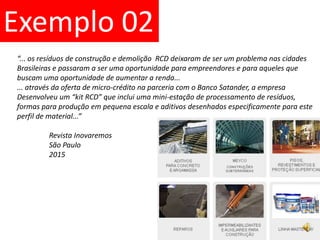
Exemplo 02“... os resíduos de construção e demolição  RCD deixaram de ser um problema nas cidades Brasileiras e passaram a ser uma oportunidade para empreendores e para aqueles que buscam uma oportunidade de aumentar a renda...... através da oferta de micro-crédito na parceria com o Banco Satander, a empresa Desenvolveu um “kit RCD” que inclui uma mini-estação de processamento de resíduos, formas para produção em pequena escala e aditivos desenhados especificamente para este perfil de material...”	Revista InovaremosSão Paulo	2015ThePiraquara Times
This is a design led project developed in the city of Curitiba, Brazil, by Albach et al. (2007) as part of a program to reduce urban solid waste, intending to instigate consumer involvement in environmental initiatives and, also, to assess people’s acceptance concerning habit change. Supermarket clients are invited to participate in the initiative by means of two actions: a) bringing their own bags to place some of their purchases on the lookout for the reduction of plastic-bag residues; and b) discarding – in appropriate containers at the side of the Ecological checkout, and according to the consumers’ free-will – packages that do not have to be necessarily brought home. The “ecological check-out” offers also green plastic bags, which distinguishes the customers’ participation from the other check-outs (ALBACH et al., 2007).Once the customer has finished his/her purchase, the number of plastic and paper packages left at the check-out is visualized by the customer at the point of sale along with the name of the charity institution that will benefit from the amount of packing collected. The first benefited institution was the school supported by the Paraná State Rehabilitation Association, which assists approximately 200 children and young adults free of charge (ALBACH et al., 2007).According to Albach et al. (2007) employees from different sectors (check-out operation, supervision, wrapping up, security, data processing, bakery, fruits and vegetables, reception, among others) were trained to fully understand the meaning of the initiative. The intention was that all employees, whether directly working in the project or not, knew and provided information about the Ecological check-out to customers who could approach with doubts. In those trainings, the employees got infoRmation on the environmental problems of our society, focusing the generation and discard of packing residues (ALBACH et al., 2007).PARA REFLETIRQUAL O PAPEL QUE A BASF PODERIA EXERCER NESTE CASO?
DIMENSÃO ECONÔMICAExemplos de possibilidades de inovação voltadas ao mercado BOP
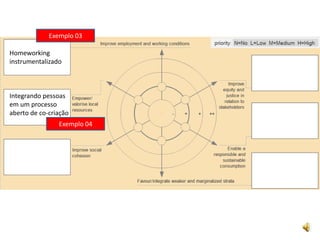
Exemplo 03HomeworkinginstrumentalizadoIntegrando pessoasem um processoaberto de co-criaçãoExemplo 04
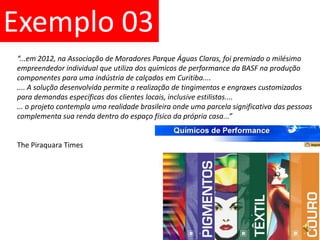
Exemplo 03“...em 2012, na Associação de Moradores Parque Águas Claras, foi premiado o milésimoempreendedor individual que utiliza dos químicos de performance da BASF na produção componentes para uma indústria de calçados em Curitiba........ A solução desenvolvida permite a realização de tingimentos e engraxes customizados para demandas específicas dos clientes locais, inclusive estilistas....... o projeto contempla uma realidade brasileira onde uma parcela significativa das pessoas complementa sua renda dentro do espaço físico da própria casa...”ThePiraquara Times
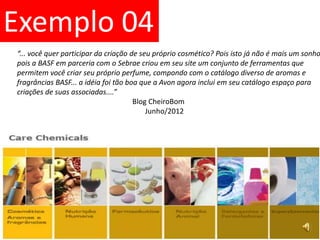
Exemplo 04“... você quer participar da criação de seu próprio cosmético? Pois isto já não é mais um sonhopois a BASF em parceria com o Sebrae criou em seu site um conjunto de ferramentas que permitem você criar seu próprio perfume, compondo com o catálogo diverso de aromas e fragrâncias BASF... a idéia foi tão boa que a Avon agora inclui em seu catálogo espaço paracriações de suas associadas....”		                            Blog CheiroBom			Junho/2012
This case study shows an initiative that brought work into a women´s jail, from which a company originated from. On the workshop organized within the jail by Arte Brazil Bijuterias & Acessórios the women produces collars, earrings and all sorts of jewelry using natural components. With the money they make on this job they are able to help their families outside the jail and, at the same time, increase their employability after their jail time.Important benefits of the Project is elevating the self esteem of the women, reducing stress and helping them to cope with the distance from their children and family. Furthermore, for each three days of work their sentence reduces in one day. Some of the former jailed women now work on shops and workshops outside the prison, with all their employment rights fully respected.PARA REFLETIRQUAL O PAPEL QUE A BASF PODERIA EXERCER NESTE CASO?
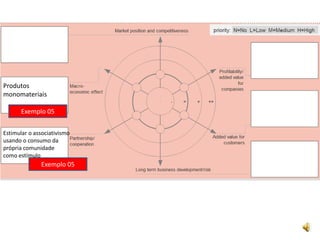
Produtos monomateriaisExemplo 05Estimular o associativismo usando o consumo da própria comunidade como estímuloExemplo 05
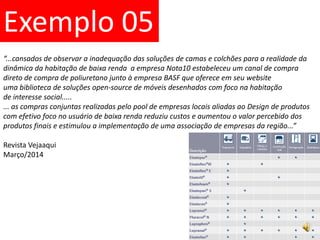
Exemplo 05“...cansados de observar a inadequação das soluções de camas e colchões para a realidade da dinâmica da habitação de baixa renda  a empresa Nota10 estabeleceu um canal de compradireto de compra de poliuretano junto à empresa BASF que oferece em seu websiteuma biblioteca de soluções open-source de móveis desenhados com foco na habitação de interesse social........ as compras conjuntas realizadas pelo pool de empresas locais aliadas ao Design de produtoscom efetivo foco no usuário de baixa renda reduziu custos e aumentou o valor percebido dos produtos finais e estimulou a implementação de uma associação de empresas da região...”Revista VejaaquiMarço/2014
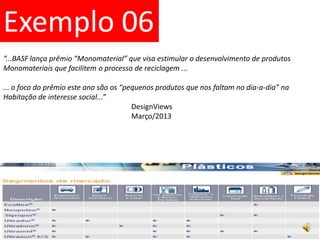
Exemplo 06“...BASF lança prêmio “Monomaterial” que visa estimular o desenvolvimento de produtosMonomateriais que facilitem o processo de reciclagem ...... o foco do prêmio este ano são os “pequenos produtos que nos faltam no dia-a-dia” na Habitação de interesse social...”DesignViews				Março/2013
In the Northeast of Brazil a large percentage of the population as the only option for income the exercise of manual and/or arts and crafts activities. According to Cavalcanti et al. (2007) this background has been aggravated by the ineffectiveness of specific public policies towards the production of handicrafts (arts and crafts, and popular art) and by the total lack of liaison between communities producing such material, and seed money agencies and entities (whether governmental or non-governmental). Brazilian arts and crafts remain culturally marginalized, allied to obsolete models of productive organization, contributing to large number of enormously talented and potently creative craftspeople and folk artists being shackled to severe poverty. Many of them have been obliged to abandon their activities to seek alternative sources of income in more developed regions, and thus they form a population of rural migrant workers who do not even manage to build other opportunities for a decent life in the large cities (CAVALCANTI et al., 2007). It was with the aim of changing such situation that, starting in 2003, this project was carried out within the municipality of Cabo de Santo Agostinho, situated on the South coast of Pernambuco, Brazil. This was called Pernambuco Imaginary Project and it was led by researchers from the Pernambuco Federal University. Craftwork in ceramics in Cabo dates back to the time of the sugar-cane plantations, a period at which the production of bricks and tiles was only targeted on consumption by the factory itself and on homes for its workers. With the passage of time and in each succeeding generation, these potteries, where ceramics were produced, became independent in order to produce and sell utilitarian artifacts such as pots, pans and drinking water containers to the population in the vicinity. Such a tradition was passed down from grandparents to parents, and from them to their children (CAVALCANTI et al., 2007).The Pernambuco Imaginary Project carried out its initial activities with a group of potters. In the municipality there are around 25 productive units but the current position is that only ten individual producers in the area known as Mauriti make a living exclusively from this activity. A full diagnosis, assembled from observations of the technicians and craftspeople involved, has permitted a better understanding of the relationship between the flow of production, the management of the space, the development of the products (see next Figure), the use of the natural resources and the commercialization of the pieces. The project involved training and the strengthening of groups, by encouraging the construction of collective agreements and the quest for autonomy. Action favored the recognition and training of community leaders, improvement of self-esteem by raising the awareness of the men and women craftspeople to the value of their work (CAVALCANTI et al., 2007).For the purposes of generating information capable of raising the awareness and mobilizing public opinion to the value of craftwork and the rights of their creators, the Pernambuco Imaginary promoted strategic communication actions. For each of the project’s partner communities, the design team has devised a visual identity which reaffirmed the history, the culture and the sense of belonging to a group. This was done by printing a seal of origin and quality on all that is produced by the community.PARA REFLETIRQUAL O PAPEL QUE A BASF PODERIA EXERCER NESTE CASO?
ConclusãoSim, há muitas oportunidades para a BASF contribuir com a melhoria da equidade social e ambiental através de seu próprio processo de negócioPara realizar atividades com impacto social e ambiental junto à população de baixa renda há um expectro de possibilidades que vão da mera introdução no portfólio de soluções que atendam necessidades específicas desta população até o estímulo ao empreendedorismo local;BOP não pode ser tratada como mais uma estratégia das vendas dos produtos da empresa

Provocações para a BASF prof dr aguinaldo dos santos - ufpr

  • 1.
    PROVOCAÇÕESALTERNATIVAS DE ESTRATÉGIASBOP NA EMPRESA BASFProf. Aguinaldo dos Santos, Eng. Civil, MSc, PhD, Post-doc
  • 2.
  • 3.
    Willingness toCommunity InvolvementActivePhilantropyCommunityBasedProjectsBOPSocial-ResponsibleProcurementFarfrom core businessClose to core businessSocial-ResponsibleHumanResource ManagementExpand the CompanyPortfolioPassive PhilantropyLittle willingness toCommunity Involvement(fonte: Santos, 2009)
  • 4.
    pressupostosHá uma urgentenecessidade de viabilizar o leapfrog na direção da sustentabilidade na população recém ingressa no mercado de consumoEmbora tenha aumentado a renda da população BOP no Brasil há falta de produtos e serviços efetivamente desenhados para realidade desta população
  • 5.
    Fullserviceo cliente ouusuário adquire o resultado final do produto BASF, sendo as operações no ciclo de vida providas em parceria com outros stakeholderso cliente ou usuário adquire o resultado final do produto BASF, sendo as operações no ciclo de vida gerenciado pela BASF100% BASFBASF + STAKEHOLDERSo cliente ou usuário final adquire da BASF + parceiros uma plataforma de materiais e componentes que lhe permitem alcançar a satisfação pretendidao cliente ou usuário final adquire da BASF uma plataforma de materiais/componentque lhe permitem alcançar a satisfação pretendidaPlataforma
  • 6.
    DIMENSÃO AMBIENTALExemplos depossibilidades de inovação voltadas ao mercado BOP
  • 7.
    Exemplo 01Inclusão noportfólio da empresa de soluções que contribuam para aumentar o compartilhamento ou extensão do ciclo de vidaA reciclagem em cascata é viabilizada com apoio da BASFExemplo 02
  • 8.
    Exemplo 01“...em 2011a BASF lançou uma linha de produtos que passou a viabilizar a integração das comunidades de baixa renda no processo de produção de tintas orientadas ao consumo da própria comunidade......a inovação inclui apoio na formação de empresas que prestam o serviço de proteção de superfícies, onde não se venda tinta ou pintura mas o resultado final, ou seja, uma superfície protegida....”ThePiraquara Times
  • 9.
    Exemplo 02“... osresíduos de construção e demolição RCD deixaram de ser um problema nas cidades Brasileiras e passaram a ser uma oportunidade para empreendores e para aqueles que buscam uma oportunidade de aumentar a renda...... através da oferta de micro-crédito na parceria com o Banco Satander, a empresa Desenvolveu um “kit RCD” que inclui uma mini-estação de processamento de resíduos, formas para produção em pequena escala e aditivos desenhados especificamente para este perfil de material...” Revista InovaremosSão Paulo 2015ThePiraquara Times
  • 10.
    This is adesign led project developed in the city of Curitiba, Brazil, by Albach et al. (2007) as part of a program to reduce urban solid waste, intending to instigate consumer involvement in environmental initiatives and, also, to assess people’s acceptance concerning habit change. Supermarket clients are invited to participate in the initiative by means of two actions: a) bringing their own bags to place some of their purchases on the lookout for the reduction of plastic-bag residues; and b) discarding – in appropriate containers at the side of the Ecological checkout, and according to the consumers’ free-will – packages that do not have to be necessarily brought home. The “ecological check-out” offers also green plastic bags, which distinguishes the customers’ participation from the other check-outs (ALBACH et al., 2007).Once the customer has finished his/her purchase, the number of plastic and paper packages left at the check-out is visualized by the customer at the point of sale along with the name of the charity institution that will benefit from the amount of packing collected. The first benefited institution was the school supported by the Paraná State Rehabilitation Association, which assists approximately 200 children and young adults free of charge (ALBACH et al., 2007).According to Albach et al. (2007) employees from different sectors (check-out operation, supervision, wrapping up, security, data processing, bakery, fruits and vegetables, reception, among others) were trained to fully understand the meaning of the initiative. The intention was that all employees, whether directly working in the project or not, knew and provided information about the Ecological check-out to customers who could approach with doubts. In those trainings, the employees got infoRmation on the environmental problems of our society, focusing the generation and discard of packing residues (ALBACH et al., 2007).PARA REFLETIRQUAL O PAPEL QUE A BASF PODERIA EXERCER NESTE CASO?
  • 11.
    DIMENSÃO ECONÔMICAExemplos depossibilidades de inovação voltadas ao mercado BOP
  • 12.
    Exemplo 03HomeworkinginstrumentalizadoIntegrando pessoasemum processoaberto de co-criaçãoExemplo 04
  • 13.
    Exemplo 03“...em 2012,na Associação de Moradores Parque Águas Claras, foi premiado o milésimoempreendedor individual que utiliza dos químicos de performance da BASF na produção componentes para uma indústria de calçados em Curitiba........ A solução desenvolvida permite a realização de tingimentos e engraxes customizados para demandas específicas dos clientes locais, inclusive estilistas....... o projeto contempla uma realidade brasileira onde uma parcela significativa das pessoas complementa sua renda dentro do espaço físico da própria casa...”ThePiraquara Times
  • 14.
    Exemplo 04“... vocêquer participar da criação de seu próprio cosmético? Pois isto já não é mais um sonhopois a BASF em parceria com o Sebrae criou em seu site um conjunto de ferramentas que permitem você criar seu próprio perfume, compondo com o catálogo diverso de aromas e fragrâncias BASF... a idéia foi tão boa que a Avon agora inclui em seu catálogo espaço paracriações de suas associadas....” Blog CheiroBom Junho/2012
  • 15.
    This case studyshows an initiative that brought work into a women´s jail, from which a company originated from. On the workshop organized within the jail by Arte Brazil Bijuterias & Acessórios the women produces collars, earrings and all sorts of jewelry using natural components. With the money they make on this job they are able to help their families outside the jail and, at the same time, increase their employability after their jail time.Important benefits of the Project is elevating the self esteem of the women, reducing stress and helping them to cope with the distance from their children and family. Furthermore, for each three days of work their sentence reduces in one day. Some of the former jailed women now work on shops and workshops outside the prison, with all their employment rights fully respected.PARA REFLETIRQUAL O PAPEL QUE A BASF PODERIA EXERCER NESTE CASO?
  • 16.
    Produtos monomateriaisExemplo 05Estimularo associativismo usando o consumo da própria comunidade como estímuloExemplo 05
  • 17.
    Exemplo 05“...cansados deobservar a inadequação das soluções de camas e colchões para a realidade da dinâmica da habitação de baixa renda a empresa Nota10 estabeleceu um canal de compradireto de compra de poliuretano junto à empresa BASF que oferece em seu websiteuma biblioteca de soluções open-source de móveis desenhados com foco na habitação de interesse social........ as compras conjuntas realizadas pelo pool de empresas locais aliadas ao Design de produtoscom efetivo foco no usuário de baixa renda reduziu custos e aumentou o valor percebido dos produtos finais e estimulou a implementação de uma associação de empresas da região...”Revista VejaaquiMarço/2014
  • 18.
    Exemplo 06“...BASF lançaprêmio “Monomaterial” que visa estimular o desenvolvimento de produtosMonomateriais que facilitem o processo de reciclagem ...... o foco do prêmio este ano são os “pequenos produtos que nos faltam no dia-a-dia” na Habitação de interesse social...”DesignViews Março/2013
  • 19.
    In the Northeastof Brazil a large percentage of the population as the only option for income the exercise of manual and/or arts and crafts activities. According to Cavalcanti et al. (2007) this background has been aggravated by the ineffectiveness of specific public policies towards the production of handicrafts (arts and crafts, and popular art) and by the total lack of liaison between communities producing such material, and seed money agencies and entities (whether governmental or non-governmental). Brazilian arts and crafts remain culturally marginalized, allied to obsolete models of productive organization, contributing to large number of enormously talented and potently creative craftspeople and folk artists being shackled to severe poverty. Many of them have been obliged to abandon their activities to seek alternative sources of income in more developed regions, and thus they form a population of rural migrant workers who do not even manage to build other opportunities for a decent life in the large cities (CAVALCANTI et al., 2007). It was with the aim of changing such situation that, starting in 2003, this project was carried out within the municipality of Cabo de Santo Agostinho, situated on the South coast of Pernambuco, Brazil. This was called Pernambuco Imaginary Project and it was led by researchers from the Pernambuco Federal University. Craftwork in ceramics in Cabo dates back to the time of the sugar-cane plantations, a period at which the production of bricks and tiles was only targeted on consumption by the factory itself and on homes for its workers. With the passage of time and in each succeeding generation, these potteries, where ceramics were produced, became independent in order to produce and sell utilitarian artifacts such as pots, pans and drinking water containers to the population in the vicinity. Such a tradition was passed down from grandparents to parents, and from them to their children (CAVALCANTI et al., 2007).The Pernambuco Imaginary Project carried out its initial activities with a group of potters. In the municipality there are around 25 productive units but the current position is that only ten individual producers in the area known as Mauriti make a living exclusively from this activity. A full diagnosis, assembled from observations of the technicians and craftspeople involved, has permitted a better understanding of the relationship between the flow of production, the management of the space, the development of the products (see next Figure), the use of the natural resources and the commercialization of the pieces. The project involved training and the strengthening of groups, by encouraging the construction of collective agreements and the quest for autonomy. Action favored the recognition and training of community leaders, improvement of self-esteem by raising the awareness of the men and women craftspeople to the value of their work (CAVALCANTI et al., 2007).For the purposes of generating information capable of raising the awareness and mobilizing public opinion to the value of craftwork and the rights of their creators, the Pernambuco Imaginary promoted strategic communication actions. For each of the project’s partner communities, the design team has devised a visual identity which reaffirmed the history, the culture and the sense of belonging to a group. This was done by printing a seal of origin and quality on all that is produced by the community.PARA REFLETIRQUAL O PAPEL QUE A BASF PODERIA EXERCER NESTE CASO?
  • 20.
    ConclusãoSim, há muitasoportunidades para a BASF contribuir com a melhoria da equidade social e ambiental através de seu próprio processo de negócioPara realizar atividades com impacto social e ambiental junto à população de baixa renda há um expectro de possibilidades que vão da mera introdução no portfólio de soluções que atendam necessidades específicas desta população até o estímulo ao empreendedorismo local;BOP não pode ser tratada como mais uma estratégia das vendas dos produtos da empresa