




Carlos Darcy Alves Bersot TSA.SBA
             MD RESPONSÁVEL PELO CET H.F.LAGOA
     Médico Anestesiologista do Hospital Federal da Lagoa-SUS
Médico Anestesiologista do Hospital Universitário Pedro Ernesto-UERJ


                                                          Ponto 9
História
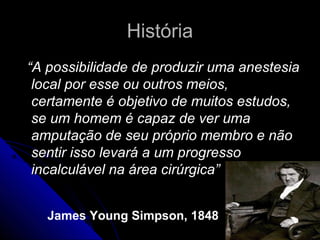
“A possibilidade de produzir uma anestesia
 local por esse ou outros meios,
 certamente é objetivo de muitos estudos,
 se um homem é capaz de ver uma
 amputação de seu próprio membro e não
 sentir isso levará a um progresso
 incalculável na área cirúrgica”


   James Young Simpson, 1848
História

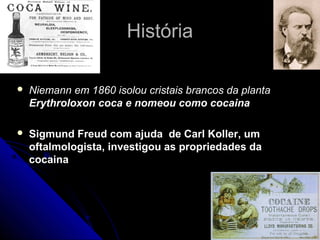
   Niemann em 1860 isolou cristais brancos da planta
    Erythroloxon coca e nomeou como cocaina

   Sigmund Freud com ajuda de Carl Koller, um
    oftalmologista, investigou as propriedades da
    cocaina
História
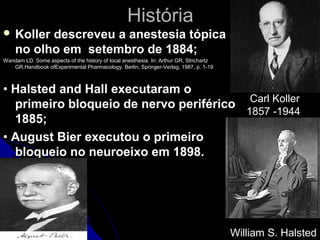
 Koller  descreveu a anestesia tópica
    no olho em setembro de 1884;
Wandam LD. Some aspects of the history of local anesthesia. In: Arthur GR, Strichartz
   GR.Handbook ofExperimental Pharmacology. Berlin, Springer-Verlag, 1987, p. 1-19


• Halsted and Hall executaram o
  primeiro bloqueio de nervo periférico Carl Koller
                                        1857 -1944
  1885;
• August Bier executou o primeiro
  bloqueio no neuroeixo em 1898.


                                                                                        William S. Halsted
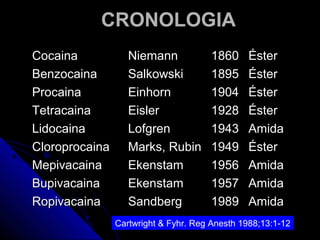
CRONOLOGIA
Cocaina            Niemann             1860    Éster
Benzocaina         Salkowski           1895    Éster
Procaina           Einhorn             1904    Éster
Tetracaina         Eisler              1928    Éster
Lidocaina          Lofgren             1943    Amida
Cloroprocaina      Marks, Rubin        1949    Éster
Mepivacaina        Ekenstam            1956    Amida
Bupivacaina        Ekenstam            1957    Amida
Ropivacaina        Sandberg            1989    Amida
                Cartwright & Fyhr. Reg Anesth 1988;13:1-12
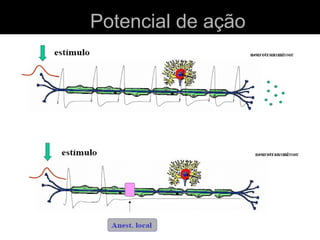
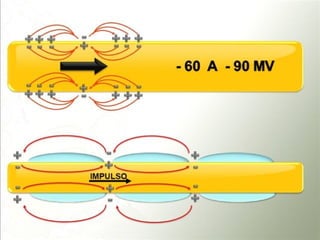
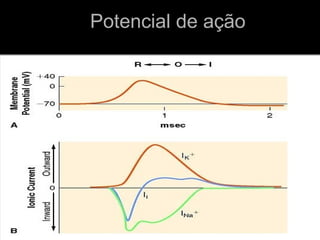
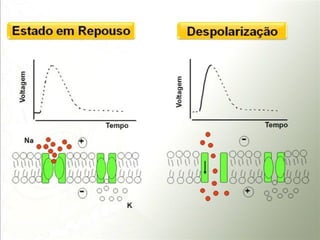
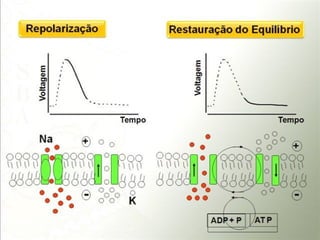
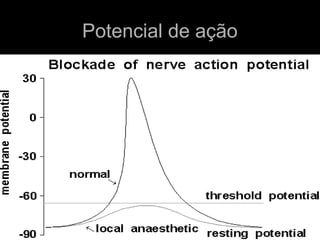
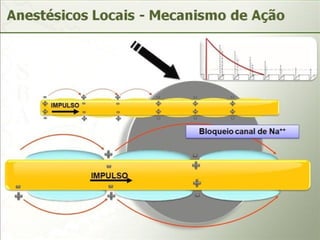
Potencial de ação


Potencial de ação
Potencial de ação

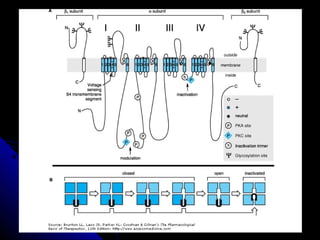
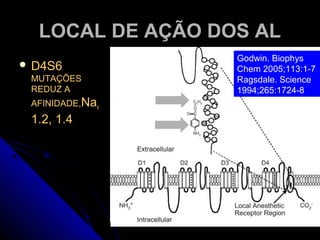
LOCAL DE AÇÃO DOS AL
                   Godwin. Biophys
 D4S6             Chem 2005;113:1-7
  MUTAÇÕES         Ragsdale. Science
  REDUZ A          1994;265:1724-8
  AFINIDADE,Nav
  1.2, 1.4
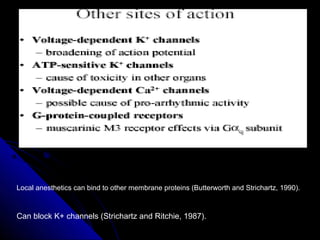
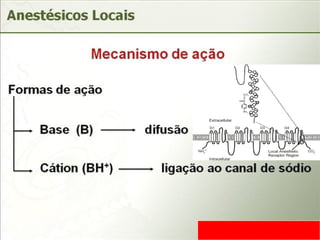
Local anesthetics can bind to other membrane proteins (Butterworth and Strichartz, 1990).


Can block K+ channels (Strichartz and Ritchie, 1987).
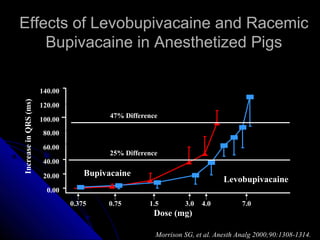
Effects of Levobupivacaine and Racemic
    Bupivacaine in Anesthetized Pigs

                       140.00
Increase in QRS (ms)


                       120.00
                                          47% Difference
                       100.00
                        80.00

                        60.00
                                          25% Difference
                        40.00

                        20.00       Bupivacaine
                                                                             Levobupivacaine
                         0.00
                                0.375    0.75        1.5        3.0   4.0          7.0
                                                      Dose (mg)

                                                       Morrison SG, et al. Anesth Analg 2000;90:1308-1314.
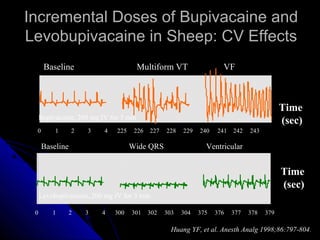
Incremental Doses of Bupivacaine and
Levobupivacaine in Sheep: CV Effects
      Baseline                          Multiform VT                 VF


                                                                                           Time
     Bupivacaine, 200 mg IV for 3 min
                                                                                           (sec)
 0        1     2    3    4   225    226   227   228   229   240   241   242   243

     Baseline                       Wide QRS                   Ventricular


                                                                                           Time
                                                                                           (sec)
     Levobupivacaine, 200 mg IV for 3 min

 0       1    2     3    4    300   301    302   303   304   375   376   377   378   379

                                                   Huang YF, et al. Anesth Analg 1998;86:797-804.
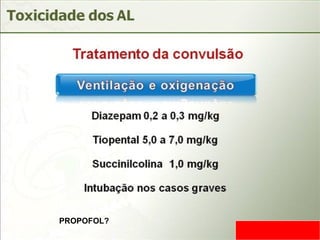
PROPOFOL?
20
       1   0


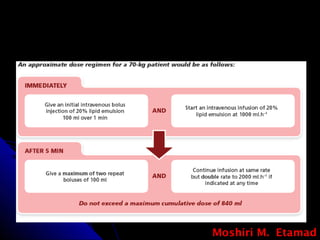
Moshiri M. Etamad
Moshiri M. Etamad
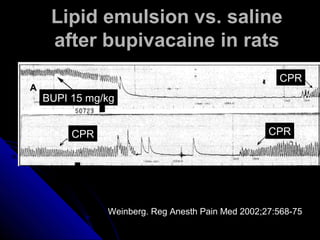
Lipid emulsion vs. saline
 after bupivacaine in rats
                                                 CPR
BUPI 15 mg/kg


     CPR                                       CPR


           Weinberg. Reg Anesth Pain Med 2002;27:568-75
Local Anesthetic
Local Anesthetic
Local Anesthetic
Local Anesthetic
Local Anesthetic
Local Anesthetic

Local Anesthetic

  • 1.
    Carlos Darcy AlvesBersot TSA.SBA MD RESPONSÁVEL PELO CET H.F.LAGOA Médico Anestesiologista do Hospital Federal da Lagoa-SUS Médico Anestesiologista do Hospital Universitário Pedro Ernesto-UERJ Ponto 9
  • 2.
    História “A possibilidade deproduzir uma anestesia local por esse ou outros meios, certamente é objetivo de muitos estudos, se um homem é capaz de ver uma amputação de seu próprio membro e não sentir isso levará a um progresso incalculável na área cirúrgica” James Young Simpson, 1848
  • 4.
    História  Niemann em 1860 isolou cristais brancos da planta Erythroloxon coca e nomeou como cocaina  Sigmund Freud com ajuda de Carl Koller, um oftalmologista, investigou as propriedades da cocaina
  • 5.
    História  Koller descreveu a anestesia tópica no olho em setembro de 1884; Wandam LD. Some aspects of the history of local anesthesia. In: Arthur GR, Strichartz GR.Handbook ofExperimental Pharmacology. Berlin, Springer-Verlag, 1987, p. 1-19 • Halsted and Hall executaram o primeiro bloqueio de nervo periférico Carl Koller 1857 -1944 1885; • August Bier executou o primeiro bloqueio no neuroeixo em 1898. William S. Halsted
  • 6.
    CRONOLOGIA Cocaina Niemann 1860 Éster Benzocaina Salkowski 1895 Éster Procaina Einhorn 1904 Éster Tetracaina Eisler 1928 Éster Lidocaina Lofgren 1943 Amida Cloroprocaina Marks, Rubin 1949 Éster Mepivacaina Ekenstam 1956 Amida Bupivacaina Ekenstam 1957 Amida Ropivacaina Sandberg 1989 Amida Cartwright & Fyhr. Reg Anesth 1988;13:1-12
  • 8.
  • 10.
  • 13.
  • 15.
    LOCAL DE AÇÃODOS AL Godwin. Biophys  D4S6 Chem 2005;113:1-7 MUTAÇÕES Ragsdale. Science REDUZ A 1994;265:1724-8 AFINIDADE,Nav 1.2, 1.4
  • 17.
    Local anesthetics canbind to other membrane proteins (Butterworth and Strichartz, 1990). Can block K+ channels (Strichartz and Ritchie, 1987).
  • 49.
    Effects of Levobupivacaineand Racemic Bupivacaine in Anesthetized Pigs 140.00 Increase in QRS (ms) 120.00 47% Difference 100.00 80.00 60.00 25% Difference 40.00 20.00 Bupivacaine Levobupivacaine 0.00 0.375 0.75 1.5 3.0 4.0 7.0 Dose (mg) Morrison SG, et al. Anesth Analg 2000;90:1308-1314.
  • 50.
    Incremental Doses ofBupivacaine and Levobupivacaine in Sheep: CV Effects Baseline Multiform VT VF Time Bupivacaine, 200 mg IV for 3 min (sec) 0 1 2 3 4 225 226 227 228 229 240 241 242 243 Baseline Wide QRS Ventricular Time (sec) Levobupivacaine, 200 mg IV for 3 min 0 1 2 3 4 300 301 302 303 304 375 376 377 378 379 Huang YF, et al. Anesth Analg 1998;86:797-804.
  • 55.
  • 59.
    20 1 0 Moshiri M. Etamad
  • 60.
  • 61.
    Lipid emulsion vs.saline after bupivacaine in rats CPR BUPI 15 mg/kg CPR CPR Weinberg. Reg Anesth Pain Med 2002;27:568-75

Notas do Editor

  • #50 Compared with bupivacaine, significantly higher doses of levobupivacaine were required to achieve the same degree of QRS prolongation. To produce 40-millisecond increase in QRS duration, a 25% higher dose of levobupivacaine was required. Similarly, to produce a 90-millisecond increase in the QRS interval, a 47% higher dose of levobupivacaine was required. The clinical significance of these data is unknown. Reference Morrison SG, Dominguez JJ, Frascarolo P, Reiz S. A comparison of the electrocardiographic cardiotoxic effects of racemic bupivacaine, levobupivacaine, and ropivacaine in anesthetized swine. Anesth Analg 2000;90:1308-1314.
  • #51 The electrocardiograms shown here illustrate the different outcomes that occur following intravenous administration of 200 milligrams of bupivacaine or levobupivacaine over 3 minutes. Bupivacaine administration resulted in a multiform ventricular tachycardia within approximately 4 minutes, which rapidly progressed to ventricular fibrillation 15 seconds thereafter. In contrast, levobupivacaine widened the QRS interval after approximately 6 minutes, with bigeminy developing prior to the spontaneous restoration of sinus rhythm. Reference Huang YF, Pryor ME, Mather LE, Veering BT. Cardiovascular and central nervous system effects of intravenous levobupivacaine and bupivacaine in sheep. Anesth Analg 1998;86:797-804.