C.E. Professor Horacio Macedo
Trabalho de Inglês 3° Bimestre 2016
Past Perfect e Past Perfect Continuos
Professora: Juddy Hoolliday
Turma: 3001
Componentes do grupo:
Ana Clara – n°02
Caroline – n°04
Deborah – n°07
Lucas Araújo – n°13
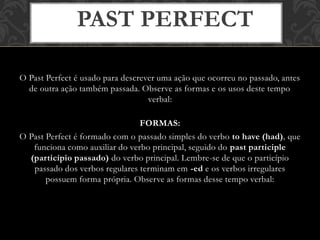
O Past Perfect é usado para descrever uma ação que ocorreu no passado, antes
de outra ação também passada. Observe as formas e os usos deste tempo
verbal:
FORMAS:
O Past Perfect é formado com o passado simples do verbo to have (had), que
funciona como auxiliar do verbo principal, seguido do past participle
(particípio passado) do verbo principal. Lembre-se de que o particípio
passado dos verbos regulares terminam em -ed e os verbos irregulares
possuem forma própria. Observe as formas desse tempo verbal:
PAST PERFECT
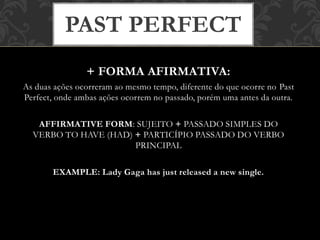
+ FORMA AFIRMATIVA:
As duas ações ocorreram ao mesmo tempo, diferente do que ocorre no Past
Perfect, onde ambas ações ocorrem no passado, porém uma antes da outra.
AFFIRMATIVE FORM: SUJEITO + PASSADO SIMPLES DO
VERBO TO HAVE (HAD) + PARTICÍPIO PASSADO DO VERBO
PRINCIPAL
EXAMPLE: Lady Gaga has just released a new single.
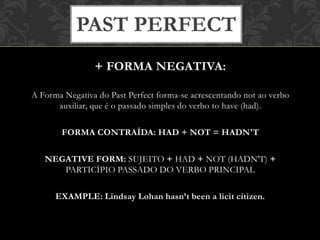
PAST PERFECT
+ FORMA NEGATIVA:
A Forma Negativa do Past Perfect forma-se acrescentando not ao verbo
auxiliar, que é o passado simples do verbo to have (had).
FORMA CONTRAÍDA: HAD + NOT = HADN'T
NEGATIVE FORM: SUJEITO + HAD + NOT (HADN'T) +
PARTICÍPIO PASSADO DO VERBO PRINCIPAL
EXAMPLE: Lindsay Lohan hasn’t been a licit citizen.
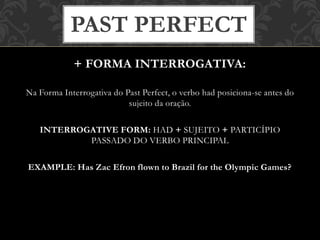
PAST PERFECT
+ FORMA INTERROGATIVA:
Na Forma Interrogativa do Past Perfect, o verbo had posiciona-se antes do
sujeito da oração.
INTERROGATIVE FORM: HAD + SUJEITO + PARTICÍPIO
PASSADO DO VERBO PRINCIPAL
EXAMPLE: Has Zac Efron flown to Brazil for the Olympic Games?
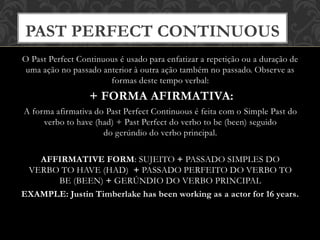
PAST PERFECT
O Past Perfect Continuous é usado para enfatizar a repetição ou a duração de
uma ação no passado anterior à outra ação também no passado. Observe as
formas deste tempo verbal:
+ FORMA AFIRMATIVA:
A forma afirmativa do Past Perfect Continuous é feita com o Simple Past do
verbo to have (had) + Past Perfect do verbo to be (been) seguido
do gerúndio do verbo principal.
AFFIRMATIVE FORM: SUJEITO + PASSADO SIMPLES DO
VERBO TO HAVE (HAD) + PASSADO PERFEITO DO VERBO TO
BE (BEEN) + GERÚNDIO DO VERBO PRINCIPAL
EXAMPLE: Justin Timberlake has been working as a actor for 16 years.
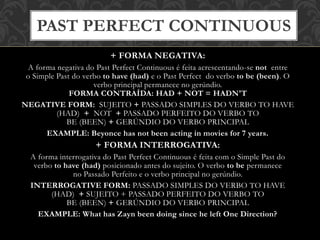
PAST PERFECT CONTINUOUS
+ FORMA NEGATIVA:
A forma negativa do Past Perfect Continuous é feita acrescentando-se not entre
o Simple Past do verbo to have (had) e o Past Perfect do verbo to be (been). O
verbo principal permanece no gerúndio.
FORMA CONTRAÍDA: HAD + NOT = HADN'T
NEGATIVE FORM: SUJEITO + PASSADO SIMPLES DO VERBO TO HAVE
(HAD) + NOT + PASSADO PERFEITO DO VERBO TO
BE (BEEN) + GERÚNDIO DO VERBO PRINCIPAL
EXAMPLE: Beyonce has not been acting in movies for 7 years.
+ FORMA INTERROGATIVA:
A forma interrogativa do Past Perfect Continuous é feita com o Simple Past do
verbo to have (had) posicionado antes do sujeito. O verbo to be permanece
no Passado Perfeito e o verbo principal no gerúndio.
INTERROGATIVE FORM: PASSADO SIMPLES DO VERBO TO HAVE
(HAD) + SUJEITO + PASSADO PERFEITO DO VERBO TO
BE (BEEN) + GERÚNDIO DO VERBO PRINCIPAL
EXAMPLE: What has Zayn been doing since he left One Direction?
PAST PERFECT CONTINUOUS
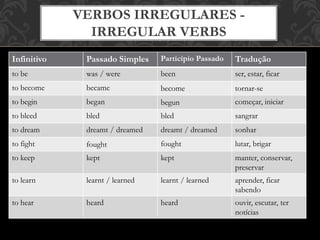
Infinitivo Passado Simples Particípio Passado Tradução
to be was / were been ser, estar, ficar
to become became become tornar-se
to begin began begun começar, iniciar
to bleed bled bled sangrar
to dream dreamt / dreamed dreamt / dreamed sonhar
to fight fought fought lutar, brigar
to keep kept kept manter, conservar,
preservar
to learn learnt / learned learnt / learned aprender, ficar
sabendo
to hear heard heard ouvir, escutar, ter
notícias
VERBOS IRREGULARES -
IRREGULAR VERBS
http://www.solinguainglesa.com.br/conteudo/verbos6.php
http://www.solinguainglesa.com.br/conteudo/verbos8.php
http://www.solinguainglesa.com.br/conteudo/irregulares1.php
FONTES

Slide inglês - É esse!

  • 1.
    C.E. Professor HoracioMacedo Trabalho de Inglês 3° Bimestre 2016 Past Perfect e Past Perfect Continuos Professora: Juddy Hoolliday Turma: 3001 Componentes do grupo: Ana Clara – n°02 Caroline – n°04 Deborah – n°07 Lucas Araújo – n°13
  • 2.
    O Past Perfecté usado para descrever uma ação que ocorreu no passado, antes de outra ação também passada. Observe as formas e os usos deste tempo verbal: FORMAS: O Past Perfect é formado com o passado simples do verbo to have (had), que funciona como auxiliar do verbo principal, seguido do past participle (particípio passado) do verbo principal. Lembre-se de que o particípio passado dos verbos regulares terminam em -ed e os verbos irregulares possuem forma própria. Observe as formas desse tempo verbal: PAST PERFECT
  • 3.
    + FORMA AFIRMATIVA: Asduas ações ocorreram ao mesmo tempo, diferente do que ocorre no Past Perfect, onde ambas ações ocorrem no passado, porém uma antes da outra. AFFIRMATIVE FORM: SUJEITO + PASSADO SIMPLES DO VERBO TO HAVE (HAD) + PARTICÍPIO PASSADO DO VERBO PRINCIPAL EXAMPLE: Lady Gaga has just released a new single. PAST PERFECT
  • 4.
    + FORMA NEGATIVA: AForma Negativa do Past Perfect forma-se acrescentando not ao verbo auxiliar, que é o passado simples do verbo to have (had). FORMA CONTRAÍDA: HAD + NOT = HADN'T NEGATIVE FORM: SUJEITO + HAD + NOT (HADN'T) + PARTICÍPIO PASSADO DO VERBO PRINCIPAL EXAMPLE: Lindsay Lohan hasn’t been a licit citizen. PAST PERFECT
  • 5.
    + FORMA INTERROGATIVA: NaForma Interrogativa do Past Perfect, o verbo had posiciona-se antes do sujeito da oração. INTERROGATIVE FORM: HAD + SUJEITO + PARTICÍPIO PASSADO DO VERBO PRINCIPAL EXAMPLE: Has Zac Efron flown to Brazil for the Olympic Games? PAST PERFECT
  • 6.
    O Past PerfectContinuous é usado para enfatizar a repetição ou a duração de uma ação no passado anterior à outra ação também no passado. Observe as formas deste tempo verbal: + FORMA AFIRMATIVA: A forma afirmativa do Past Perfect Continuous é feita com o Simple Past do verbo to have (had) + Past Perfect do verbo to be (been) seguido do gerúndio do verbo principal. AFFIRMATIVE FORM: SUJEITO + PASSADO SIMPLES DO VERBO TO HAVE (HAD) + PASSADO PERFEITO DO VERBO TO BE (BEEN) + GERÚNDIO DO VERBO PRINCIPAL EXAMPLE: Justin Timberlake has been working as a actor for 16 years. PAST PERFECT CONTINUOUS
  • 7.
    + FORMA NEGATIVA: Aforma negativa do Past Perfect Continuous é feita acrescentando-se not entre o Simple Past do verbo to have (had) e o Past Perfect do verbo to be (been). O verbo principal permanece no gerúndio. FORMA CONTRAÍDA: HAD + NOT = HADN'T NEGATIVE FORM: SUJEITO + PASSADO SIMPLES DO VERBO TO HAVE (HAD) + NOT + PASSADO PERFEITO DO VERBO TO BE (BEEN) + GERÚNDIO DO VERBO PRINCIPAL EXAMPLE: Beyonce has not been acting in movies for 7 years. + FORMA INTERROGATIVA: A forma interrogativa do Past Perfect Continuous é feita com o Simple Past do verbo to have (had) posicionado antes do sujeito. O verbo to be permanece no Passado Perfeito e o verbo principal no gerúndio. INTERROGATIVE FORM: PASSADO SIMPLES DO VERBO TO HAVE (HAD) + SUJEITO + PASSADO PERFEITO DO VERBO TO BE (BEEN) + GERÚNDIO DO VERBO PRINCIPAL EXAMPLE: What has Zayn been doing since he left One Direction? PAST PERFECT CONTINUOUS
  • 8.
    Infinitivo Passado SimplesParticípio Passado Tradução to be was / were been ser, estar, ficar to become became become tornar-se to begin began begun começar, iniciar to bleed bled bled sangrar to dream dreamt / dreamed dreamt / dreamed sonhar to fight fought fought lutar, brigar to keep kept kept manter, conservar, preservar to learn learnt / learned learnt / learned aprender, ficar sabendo to hear heard heard ouvir, escutar, ter notícias VERBOS IRREGULARES - IRREGULAR VERBS
  • 9.