
TIC
 EDUCAçãO
          2010
        Pesquisa sobre o uso das Tecnologias
de informação e comunicação nas escolas brasileiras


            ICT EDUCATION 2010
         Survey on the uSe of InformatIon and
     CommunICatIon teChnologIeS In BrazIlIan SChoolS


              Comitê Gestor da Internet no Brasil
               Brazilian Internet Steering Committee
                             www.cgi.br
Atribuição          uso Não ComerCiAl             VedAdA A CriAção de obrAs deriVAdAs 2.5 brAsil
Attribution         noncommerciAl                 no DerivAtive Works 2.5 brAzil


VoCÊ Pode:
You Are Free:

      copiar, distribuir, exibir e executar a obra sob as seguintes condições:
      to copy, distribute and transmit the work under the following conditions:

                Atribuição:
                Você deve dar crédito ao autor original, da forma especificada pelo autor ou licenciante.
                Attribution:
                You must attribute the work in the manner specified by the author or licensor (but not in any way that
                suggests that they endorse you or your use of the work).

                uso Não ComerCiAl:
                Você não pode utilizar esta obra com finalidades comerciais.
                noncommerciAl:
                You may not use this work for commercial purposes.

                VedAdA A CriAção de obrAs deriVAdAs:
                Você não pode alterar, transformar ou criar outra obra com base nesta.
                no DerivAte Works:
                You may not alter, transform, or build upon this work.
Comitê Gestor da Internet no Brasil
          Brazilian Internet Steering Committee


                TIC
 EDUCAçãO
          2010
        Pesquisa sobre o uso das Tecnologias
de informação e comunicação nas escolas brasileiras


            ICT EDUCATION 2010
         Survey oN the uSe of INformatIoN aNd
     CommuNICatIoN teChNologIeS IN BrazIlIaN SChoolS


  Núcleo de Informação e Coordenação do Ponto BR
          Brazilian Network Information Center


                      São Paulo
                        2011
Núcleo de Informação e Coordenação do Ponto BR
Brazilian Network Information Center

Diretor Presidente / CEO
Demi Getschko

Diretor Administrativo / CFO
Ricardo Narchi

Diretor de Serviços e Tecnologia / CTO
Frederico Neves

Diretor de Projetos Especiais e de Desenvolvimento / Director of Special Projects and Development
Milton Kaoru Kashiwakura

Centro de Estudos sobre as Tecnologias da Informação e da Comunicação – Cetic.br
Center of Studies on Information and Communication Technologies (Cetic.br)

Coordenação Executiva e Editorial / Executive and Editorial Coordination
Alexandre F. Barbosa

Coordenação Técnica / Technical Coordination
Juliano Cappi e Emerson Santos

Equipe técnica / Technical Team
Camila Garroux, Isabela Coelho, Suzana Alves, Tatiana Jereissati e Winston Oyadomari

Edição / Editing :
Comunicação NIC.br: Caroline D’Avo, Everton Teles Rodrigues, Fabiana Araújo

Apoio Editorial / Editorial Support
Projeto gráfico / Graphic Design : Suzana De Bonis / DB Comunicação
Preparação de texto / Proof reading : Pedro Barros
Tradução para o inglês / Translation into English : Karen Brito-Sexton
Revisão / Revision : Anthony Sean Cleaver e Leandro Rodrigues
Composição / Desktop publishing : Alvaro T. De Bonis


                     Dados Internacionais de Catalogação na Publicação (CIP)
                              (Câmara Brasileira do Livro, SP, Brasil)


    Pesquisa sobre o uso das tecnologias de informação e comunicação no Brasil : TIC Edu-
          cação 2010 = Survey on the use of information and communication technologies
          in Brazil : ICT Education 2010 / [coordenação executiva e editorial/ executive and
          editorial coordination, Alexandre F. Barbosa ; tradução/ translation Karen Brito
          Sexton]. -- São Paulo : Comitê Gestor da Internet no Brasil, 2011.

          Edição bilíngue: português/inglês.

          ISBN 978-85-60062-45-4

           1. Internet (Rede de computadores) – Brasil 2. Tecnologia da informação e da
    comunicação – Brasil – Pesquisa I. Barbosa, Alexandre F.. II. Título: Survey on the use
    of information and communication technologies in Brazil : ICT Education 2010.

          11-0823                                                               CDD- 004.6072081


                                 Índices para catálogo sistemático:
         1. Brasil : Tecnologias de informação e comunicação : Uso : Pesquisa     004.6072081
       2. Pesquisa : Tecnologia da informação e comunicação : Uso : Brasil         004.6072081


Esta publicação está disponível também em formato digital em www.cetic.br
This publication is also available in digital format at www.cetic.br
TIC Educação 2010
             Pesquisa sobre o Uso das Tecnologias de Informação
                   e Comunicação nas Escolas Brasileiras

                               ICt education 2010
Survey on the use of Information and Communication technologies in Brazilian Schools


     COMITÊ GESTOR DA INTERNET NO BRASIL – CGI.br
             BrazIlIaN INterNet SteerINg CommIttee (CgI.br)
                      (em dezembro de 2010 / in december 2010)


                        Augusto Cesar Gadelha Vieira
                             Coordenador / Coordinator


                              Conselheiros / Counselors
                              Adriano Silva Mota
                         Alexandre Annenberg Netto
                             André Barbosa Filho
                            Carlos Alberto Afonso
                                Demi Getschko
                            Ernesto Costa de Paula
                              Flávio Rech Wagner
                  Francelino José Lamy de Miranda Grando
                      Gustavo Gindre Monteiro Soares
                              Henrique Faulhaber
                            Jaime Barreiro Wagner
                          Jorge Santana de Oliveira
                      Lisandro Zambenedetti Granville
                     Marcelo Bechara de Souza Hobaika
                          Marcelo Fernandes Costa
                                Mario Luis Teza
                           Nelson Simões da Silva
                                 Nivaldo Cleto
                        Rogério Santanna dos Santos
                          Ronaldo Mota Sardenberg


                        Diretor executivo / Executive Director
                            Hartmut Richard Glaser
5


AGRAdECImENToS

Em seu primeiro ano de realização, a Pesquisa sobre o Uso das Tecnologias de Informação e
Comunicação nas Escolas Brasileiras – TIC Educação 2010 contou com o apoio e a colaboração de
pessoas renomadas pelo conhecimento em educação e tecnologias de informação e comunicação.

A importância da educação para a inclusão digital impulsionou o CGI.br a incluir esse tema fun-
damental em suas pesquisas. A compreensão dos desafios sobre a apropriação das TIC em âmbito
educacional serviu como fonte de motivação e estímulos para que um grupo de especialistas par-
ticipasse ativamente desse trabalho, colaborando voluntariamente em meio a um esforço coletivo
com críticas e contribuições.

Nesta edição, o Cetic.br agradece especialmente a:

Abril Educação                                       Pontifícia Universidade Católica
Ana Ralston e Roberta Camparini                      do Paraná (PUC-PR)
                                                     Dilmeire Vosgerau
Fundação Padre Anchieta
Neyza Furgler                                        Pontifícia Universidade Católica
                                                     de São Paulo (PUC-SP)

Instituto Paulo Montenegro                           Maria da Graça Moreira da Silva e
Ana Lucia Lima                                       Maria Elizabeth Bianconcini de Almeida

                                                     Safernet
Fundação Victor Civita
Angela Cristina Dannemann e                          Rodrigo Nejm
Mauro Morellato
                                                     Universidade Federal de Minas Gerais (UFMG)

Instituto Ayrton Senna                               Marisa Duarte
Adriana Martinelli
                                                     Universidade Federal do Rio Grande do Sul
                                                     (UFRGS)
Ministério da Educação (MEC)
                                                     Léa da Cruz Fagundes
Demerval Bruzzi e
Wellington Maciel                                    Organização das Nações Unidas para
                                                     a Educação, a Ciência e a Cultura (Unesco)
Organização dos Estados Ibero-americanos /           Claude Akpabie, Guilherme Canela e
Instituto para o Desenvolvimento e a
                                                     Maria Inês Bastos
Inovação Educativa (OEI/IDIE)
Katya Garabetti, Marcia Padilha Lotito e
                                                     Universidade de São Paulo (USP)
Solange Aguirre
                                                     Ocimar Munhoz Alavarse
6


    ACKNoWLEdGEmENTS

    In its first year, the Survey on the Use of Information and Communication Technologies in Brazilian
    Schools – ICT Education 2010 has had the support and collaboration of people who are renowned
    for their knowledge in education and information and communication technologies.

    The importance of education for digital inclusion has prompted the CGI.br to address this key theme
    in its surveys. Awareness of the challenges of embedding ICT in the educational environments has
    been the motivation and stimulus for the active involvement of a group of experts in this project,
    who voluntarily collaborated by reviewing and contributing in a collective effort.

    In this edition the CGI.br gives special thanks to:


    Abril Educação                                        Pontific Catholic University
    Ana Ralston and Roberta Camparini                     of Paraná (PUC-PR)
                                                          Dilmeire Vosgerau
    Padre Anchieta Foundation
    Neyza Furgler                                         Pontific Catholic University
                                                          of São Paulo (PUC-SP)

    Paulo Montenegro Institute                            Maria da Graça Moreira da Silva and
    Ana Lucia Lima                                        Maria Elizabeth Bianconcini de Almeida

                                                          Safernet
    Victor Civita Foundation
    Angela Cristina Dannemann and                         Rodrigo Nejm
    Mauro Morellato
                                                          Federal University of Minas Gerais (UFMG)

    Ayrton Senna Institute                                Marisa Duarte
    Adriana Martinelli
                                                          Federal University of Rio Grande do Sul
                                                          (UFRGS)
    Ministry of Education (MEC)
                                                          Léa da Cruz Fagundes
    Demerval Bruzzi and
    Wellington Maciel                                     United Nations Educational, Scientific
                                                          and Cultural Organization (Unesco)
    Organization of Iberian-American States /             Claude Akpabie, Guilherme Canela and
    Institute for Development and Educational
                                                          Maria Inês Bastos
    Innovation (OEI/IDIE)
    Katya Garabetti, Marcia Padilha Lotito and
                                                          University of São Paulo (USP)
    Solange Aguirre
                                                          Ocimar Munhoz Alavarse
7


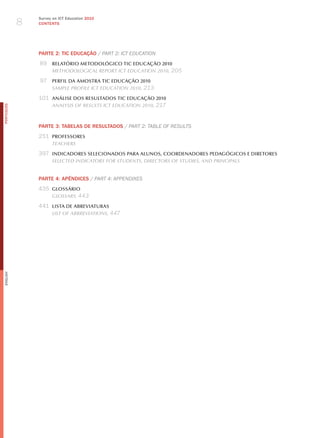
SUmÁRIo / CoNteNtS


                                                                                            PORTuGuÊS
 5 AGRADECIMENTOS / AcknowledgementS, 6
17 PREFáCIO / Foreword, 135
19 APRESENTAçãO / PreSentAtion, 137
21 INTRODUçãO / introduction, 139


PARTE 1: ARTIGOS / Part 1: artICleS
27 O CENáRIO ATUAL DO USO DE TECNOLOGIAS DIGITAIS DA INFORMAçãO E COMUNICAçãO
   overview oF the uSe oF digitAl inFormAtion And communicAtion technologieS, 145
     MARIA DA GRAçA MOREIRA DA SILVA E MARIA ELIzABETh BIANCONCINI DE ALMEIDA

35 DESAFIOS DA EDUCAçãO PARA PROMOçãO DO USO éTICO E SEGURO DA INTERNET NO BRASIL
     the chAllengeS oF educAtion in Promoting ethicAl And SAFe uSe oF the internet in
     BrAzil, 153
     RODRIGO NEjM

43 FORMAçãO DE DOCENTES PARA O USO DAS TIC NO ENSINO/APRENDIZAGEM NA AMéRICA LATINA
   teAcher trAining For the uSe oF ict in educAtion in lAtin AmericA, 161
     MARIA INêS BASTOS

51 NATIVOS DIGITAIS: A NUVEM DOS “SEM FIO”


                                                                                            English
     digitAl nAtiveS: the cloud oF the “wireleSS”, 167
     ROGéRIO DA COSTA

57 O PAPEL DA INFORMAçãO NO DESENVOLVIMENTO SOCIAL
   the role oF inFormAtion in SociAl develoPment, 173
     LADISLAU DOWBOR

65 EDUCAçãO E DESENVOLVIMENTO: MODOS DE REGULAçãO DOS SISTEMAS DE ENSINO
   educAtion And develoPment: regulAtion modeS in educAtionAl SyStemS, 181
     MARISA DUARTE

77 DESAFIOS DA PESqUISA EDUCACIONAL E AS AVALIAçõES ExTERNAS: ALGUMAS RELAçõES COM O
     CONHECIMENTO E A POLíTICA
     chAllengeS For the Study oF educAtion And externAl evAluAtionS: PArAllelS with
     knowledge And PoliticS, 193
     OCIMAR MUNhOz ALAVARSE
8
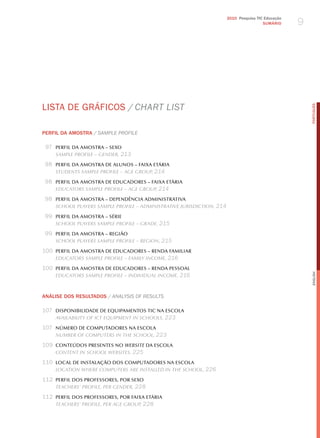
                Survey on ICT Education 2010
                CONTENTS


                PARTE 2: TIC EDuCAÇÃO / Part 2: ICt eduCatIoN
                89 RELATóRIO METODOLóGICO TIC EDUCAçãO 2010
                   methodologicAl rePort ict educAtion 2010, 205

                97 PERFIL DA AMOSTRA TIC EDUCAçãO 2010
                   SAmPle ProFile ict educAtion 2010, 213

                101 ANáLISE DOS RESULTADOS TIC EDUCAçãO 2010
                    AnAlySiS oF reSultS ict educAtion 2010, 217
PORTuGuÊS


                PARTE 3: TABELAS DE RESuLTADOS / Part 2: taBle of reSultS
                251 PROFESSORES
                      teAcherS

                397 INDICADORES SELECIONADOS PARA ALUNOS, COORDENADORES PEDAGóGICOS E DIRETORES
                      Selected indicAtorS For StudentS, directorS oF StudieS, And PrinciPAlS


                PARTE 4: APÊNDICES / Part 4: aPPeNdIXeS
                435 GLOSSáRIO
                    gloSSAry, 443

                441 LISTA DE ABREVIATURAS
                      liSt oF ABBreviAtionS, 447
English
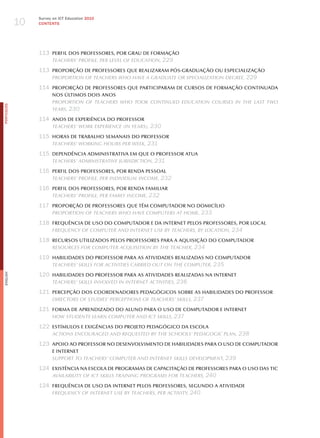
9
                                                                       2010 Pesquisa TIC Educação
                                                                                        SuMÁRIO


LISTA dE GRÁFICoS / Chart lISt


                                                                                                        PORTuGuÊS
PERFIL DA AMOSTRA / SamPle ProfIle

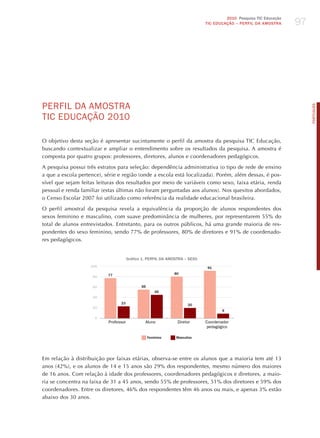
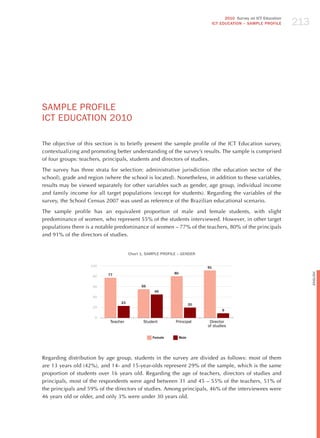
 97 PERFIL DA AMOSTRA – SExO
    SAmPle ProFile – gender, 213

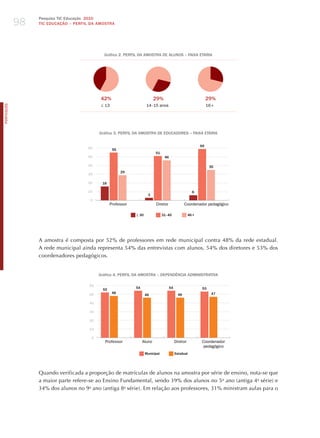
 98 PERFIL DA AMOSTRA DE ALUNOS – FAIxA ETáRIA
    StudentS SAmPle ProFile – Age grouP, 214

 98 PERFIL DA AMOSTRA DE EDUCADORES – FAIxA ETáRIA
    educAtorS SAmPle ProFile – Age grouP, 214

 98 PERFIL DA AMOSTRA – DEPENDÊNCIA ADMINISTRATIVA
    School PlAyerS SAmPle ProFile – AdminiStrAtive juriSdiction, 214

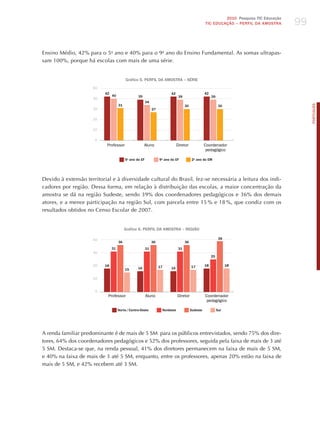
 99 PERFIL DA AMOSTRA – SéRIE
    School PlAyerS SAmPle ProFile – grAde, 215

 99 PERFIL DA AMOSTRA – REGIãO
    School PlAyerS SAmPle ProFile – region, 215

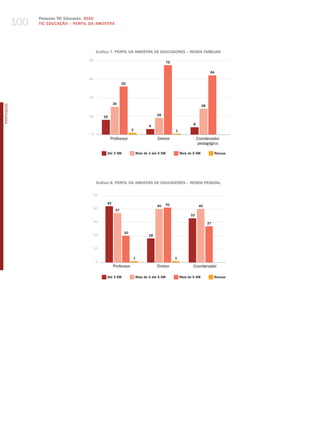
100 PERFIL DA AMOSTRA DE EDUCADORES – RENDA FAMILIAR
    educAtorS SAmPle ProFile – FAmily income, 216

100 PERFIL DA AMOSTRA DE EDUCADORES – RENDA PESSOAL
    educAtorS SAmPle ProFile – individuAl income, 216


                                                                                                        English
ANÁLISE DOS RESuLTADOS / aNalySIS of reSultS

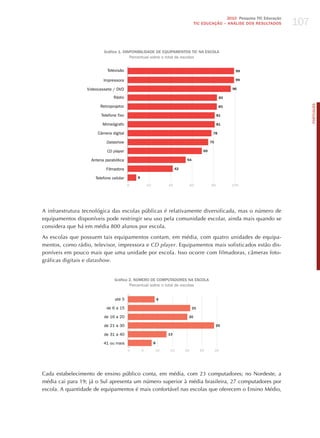
107 DISPONIBILIDADE DE EqUIPAMENTOS TIC NA ESCOLA
    AvAilABility oF ict equiPment in SchoolS, 223

107 NúMERO DE COMPUTADORES NA ESCOLA
    numBer oF comPuterS in the School, 223

109 CONTEúDOS PRESENTES NO wEBSITE DA ESCOLA
    content in School weBSiteS, 225

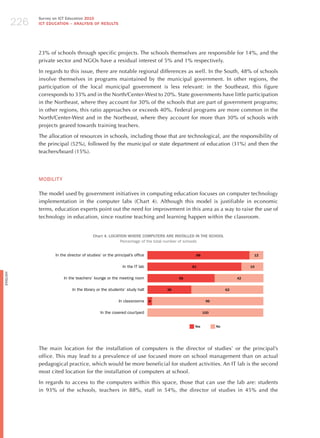
110 LOCAL DE INSTALAçãO DOS COMPUTADORES NA ESCOLA
    locAtion where comPuterS Are inStAlled in the School, 226

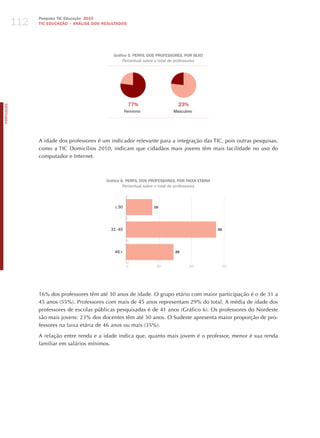
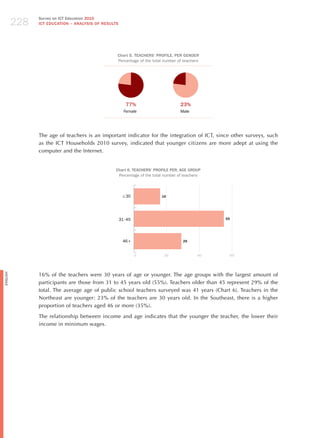
112 PERFIL DOS PROFESSORES, POR SExO
    teAcherS’ ProFile, Per gender, 228

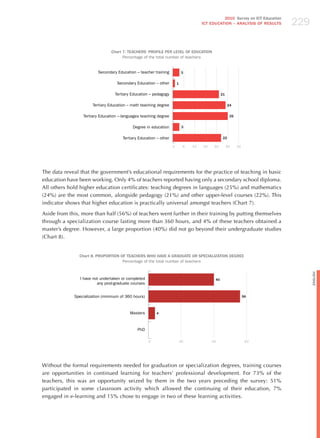
112 PERFIL DOS PROFESSORES, POR FAIxA ETáRIA
    teAcherS’ ProFile, Per Age grouP, 228
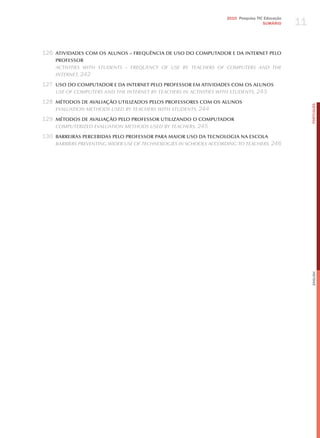
10
                 Survey on ICT Education 2010
                 CONTENTS


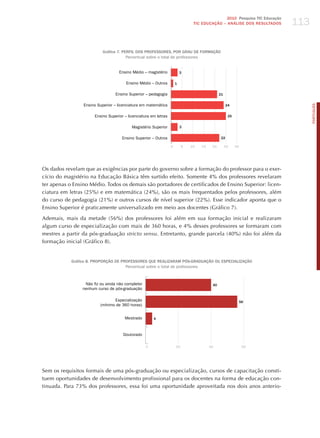
                 113 PERFIL DOS PROFESSORES, POR GRAU DE FORMAçãO
                     teAcherS’ ProFile, Per level oF educAtion, 229

                 113 PROPORçãO DE PROFESSORES qUE REALIZARAM PóS-GRADUAçãO OU ESPECIALIZAçãO
                     ProPortion oF teAcherS who hAve A grAduAte or SPeciAlizAtion degree, 229

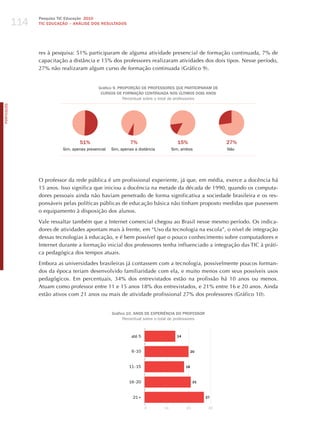
                 114 PROPORçãO DE PROFESSORES qUE PARTICIPARAM DE CURSOS DE FORMAçãO CONTINUADA
                       NOS úLTIMOS DOIS ANOS
                       ProPortion oF teAcherS who took continued educAtion courSeS in the lASt two
PORTuGuÊS


                       yeArS, 230

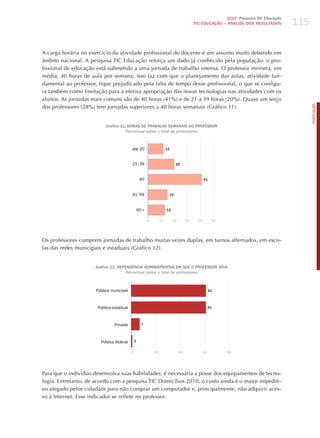
                 114 ANOS DE ExPERIÊNCIA DO PROFESSOR
                       teAcherS’ work exPerience (in yeArS), 230

                 115 HORAS DE TRABALHO SEMANAIS DO PROFESSOR
                     teAcherS’ working hourS Per week, 231

                 115 DEPENDÊNCIA ADMINISTRATIVA EM qUE O PROFESSOR ATUA
                     teAcherS’ AdminiStrAtive juriSdiction, 231

                 116 PERFIL DOS PROFESSORES, POR RENDA PESSOAL
                     teAcherS’ ProFile, Per individuAl income, 232

                 116 PERFIL DOS PROFESSORES, POR RENDA FAMILIAR
                     teAcherS’ ProFile, Per FAmily income, 232

                 117 PROPORçãO DE PROFESSORES qUE TÊM COMPUTADOR NO DOMICíLIO
                     ProPortion oF teAcherS who hAve comPuterS At home, 233

                 118 FREqUÊNCIA DE USO DO COMPUTADOR E DA INTERNET PELOS PROFESSORES, POR LOCAL
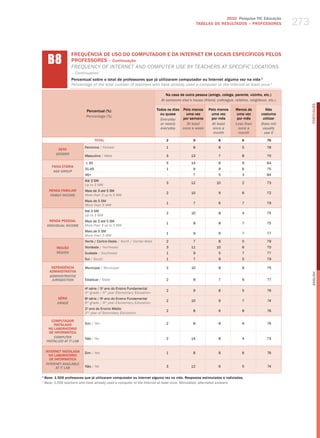
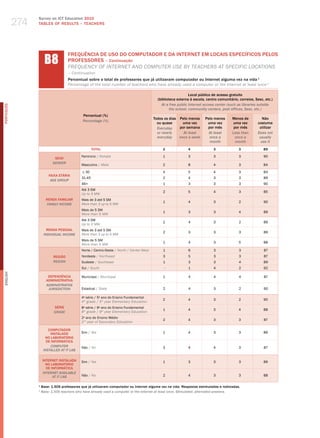
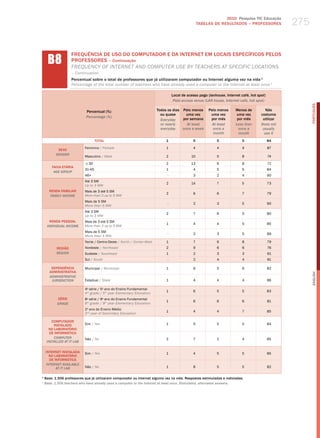
                     Frequency oF comPuter And internet uSe By teAcherS, By locAtion, 234

                 118 RECURSOS UTILIZADOS PELOS PROFESSORES PARA A AqUISIçãO DO COMPUTADOR
                     reSourceS For comPuter AcquiSition By the teAcher, 234

                 119 HABILIDADES DO PROFESSOR PARA AS ATIVIDADES REALIZADAS NO COMPUTADOR
                     teAcherS’ SkillS For ActivitieS cArried out on the comPuter, 235

                 120 HABILIDADES DO PROFESSOR PARA AS ATIVIDADES REALIZADAS NA INTERNET
English


                     teAcherS’ SkillS involved in internet ActivitieS, 236

                 121 PERCEPçãO DOS COORDENADORES PEDAGóGICOS SOBRE AS HABILIDADES DO PROFESSOR
                     directorS oF StudieS’ PercePtionS oF teAcherS’ SkillS, 237

                 121 FORMA DE APRENDIZADO DO ALUNO PARA O USO DE COMPUTADOR E INTERNET
                     how StudentS leArn comPuter And ict SkillS, 237

                 122 ESTíMULOS E ExIGÊNCIAS DO PROJETO PEDAGóGICO DA ESCOLA
                       ActionS encourAged And requeSted By the SchoolS’ PedAgogic PlAn, 238

                 123 APOIO AO PROFESSOR NO DESENVOLVIMENTO DE HABILIDADES PARA O USO DE COMPUTADOR
                       E INTERNET
                       SuPPort to teAcherS’ comPuter And internet SkillS develoPment, 239

                 124 ExISTÊNCIA NA ESCOLA DE PROGRAMAS DE CAPACITAçãO DE PROFESSORES PARA O USO DAS TIC
                     AvAilABility oF ict SkillS trAining ProgrAmS For teAcherS, 240

                 124 FREqUÊNCIA DE USO DA INTERNET PELOS PROFESSORES, SEGUNDO A ATIVIDADE
                     Frequency oF internet uSe By teAcherS, Per Activity, 240
11
                                                                   2010 Pesquisa TIC Educação
                                                                                    SuMÁRIO


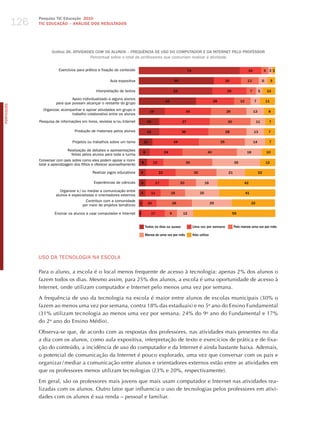
126 ATIVIDADES COM OS ALUNOS – FREqUÊNCIA DE USO DO COMPUTADOR E DA INTERNET PELO
    PROFESSOR
    ActivitieS with StudentS – Frequency oF uSe By teAcherS oF comPuterS And the
    internet, 242

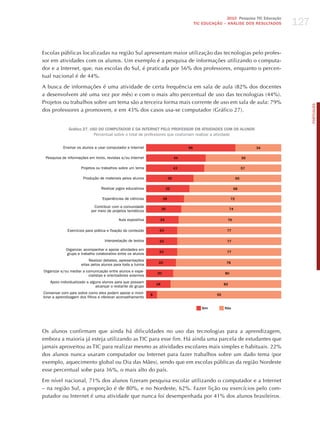
127 USO DO COMPUTADOR E DA INTERNET PELO PROFESSOR EM ATIVIDADES COM OS ALUNOS
    uSe oF comPuterS And the internet By teAcherS in ActivitieS with StudentS, 243

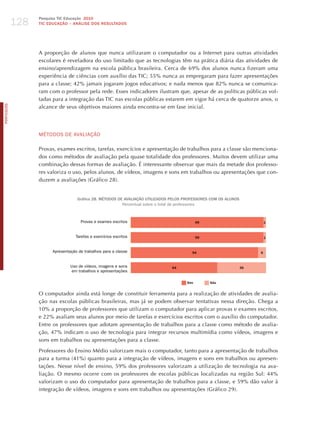
128 MéTODOS DE AVALIAçãO UTILIZADOS PELOS PROFESSORES COM OS ALUNOS


                                                                                                     PORTuGuÊS
    evAluAtion methodS uSed By teAcherS with StudentS, 244

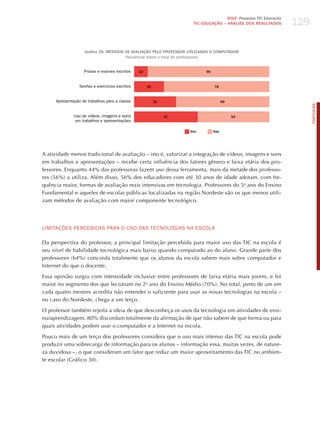
129 MéTODOS DE AVALIAçãO PELO PROFESSOR UTILIZANDO O COMPUTADOR
    comPuterized evAluAtion methodS uSed By teAcherS, 245

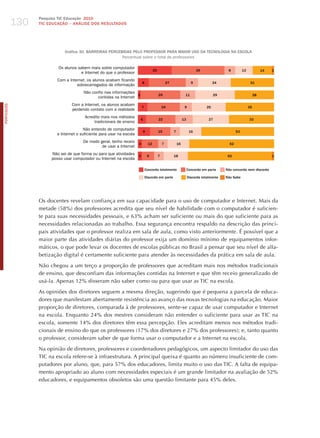
130 BARREIRAS PERCEBIDAS PELO PROFESSOR PARA MAIOR USO DA TECNOLOGIA NA ESCOLA
    BArrierS Preventing wider uSe oF technologieS in SchoolS According to teAcherS, 246


                                                                                                     English
12
                 Survey on ICT Education 2010
                 CONTENTS


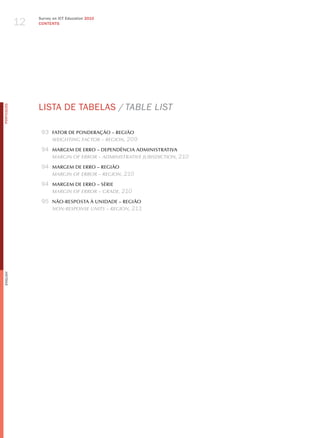
                 LISTA dE TABELAS / taBle lISt
PORTuGuÊS


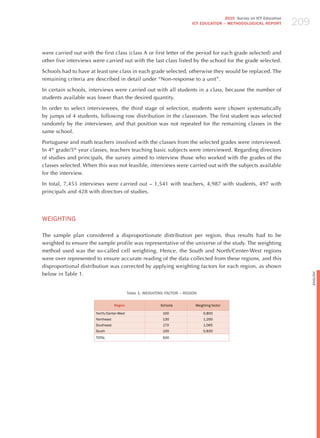
                  93 FATOR DE PONDERAçãO – REGIãO
                     weighting FActor – region, 209

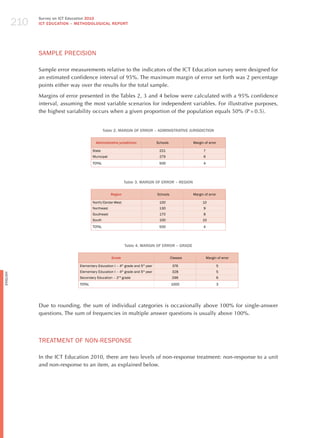
                  94 MARGEM DE ERRO – DEPENDÊNCIA ADMINISTRATIVA
                       mArgin oF error – AdminiStrAtive juriSdiction, 210

                  94 MARGEM DE ERRO – REGIãO
                       mArgin oF error – region, 210

                  94 MARGEM DE ERRO – SéRIE
                       mArgin oF error – grAde, 210

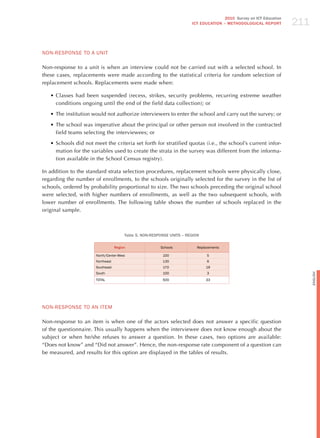
                  95 NãO-RESPOSTA à UNIDADE – REGIãO
                     non-reSPonSe unitS – region, 211
English
13
                                                                  2010 Pesquisa TIC Educação
                                                                                   SuMÁRIO


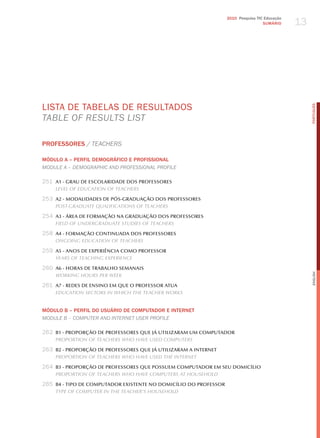
LISTA dE TABELAS dE RESULTAdoS


                                                                                                    PORTuGuÊS
taBle of reSultS lISt

PROFESSORES / teaCherS

MÓDuLO A – PERFIL DEMOGRÁFICO E PROFISSIONAL
module a – demograPhIC aNd ProfeSSIoNal ProfIle

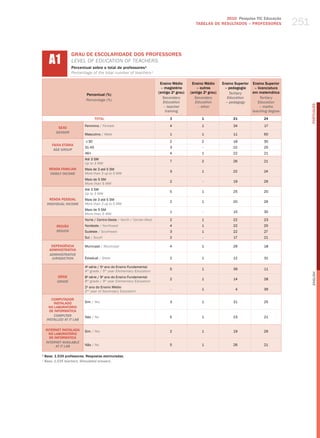
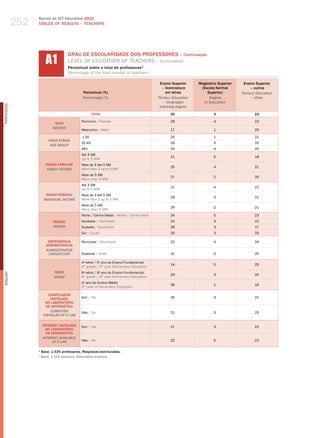
251 A1 - GRAU DE ESCOLARIDADE DOS PROFESSORES
    level oF educAtion oF teAcherS

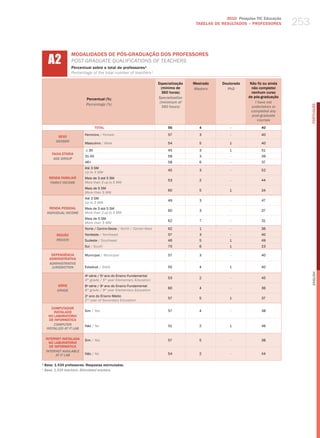
253 A2 - MODALIDADES DE PóS-GRADUAçãO DOS PROFESSORES
    PoSt-grAduAte quAliFicAtionS oF teAcherS

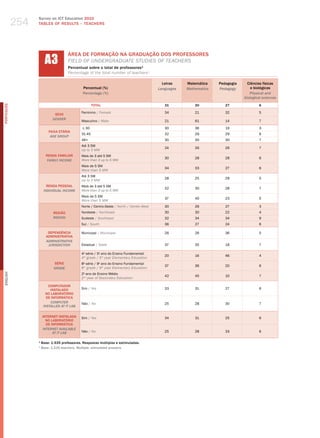
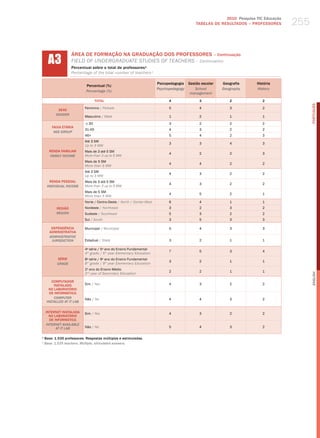
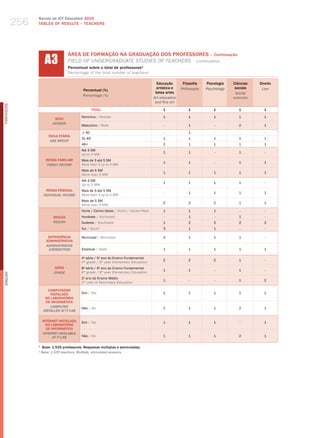
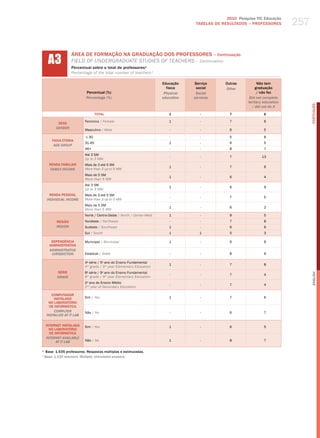
254 A3 - áREA DE FORMAçãO NA GRADUAçãO DOS PROFESSORES
    Field oF undergrAduAte StudieS oF teAcherS

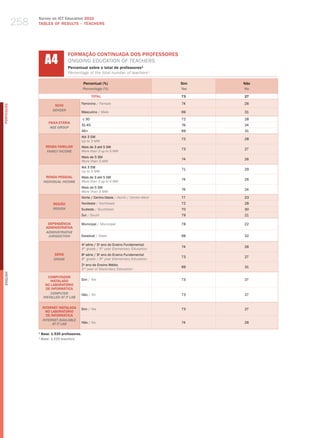
258 A4 - FORMAçãO CONTINUADA DOS PROFESSORES
    ongoing educAtion oF teAcherS

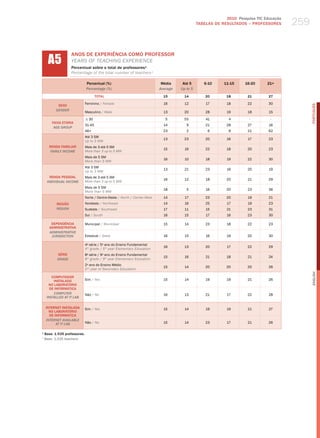
259 A5 - ANOS DE ExPERIÊNCIA COMO PROFESSOR
    yeArS oF teAching exPerience

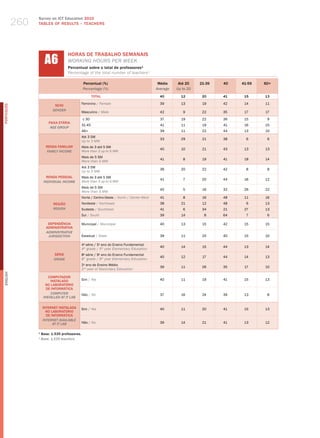
260 A6 - HORAS DE TRABALHO SEMANAIS


                                                                                                    English
    working hourS Per week

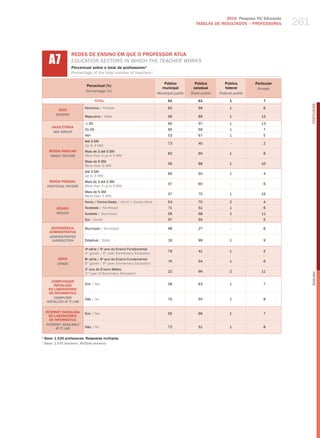
261 A7 - REDES DE ENSINO EM qUE O PROFESSOR ATUA
    educAtion SectorS in which the teAcher workS


MÓDuLO B – PERFIL DO uSuÁRIO DE COMPuTADOR E INTERNET
module B – ComPuter aNd INterNet uSer ProfIle

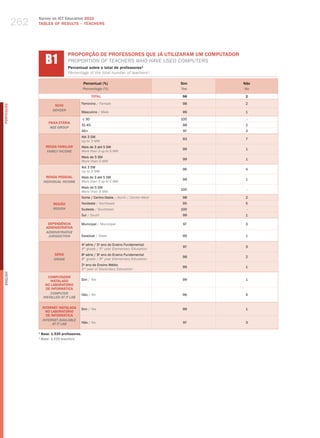
262 B1 - PROPORçãO DE PROFESSORES qUE Já UTILIZARAM UM COMPUTADOR
    ProPortion oF teAcherS who hAve uSed comPuterS

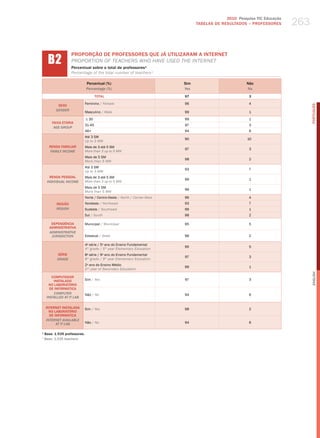
263 B2 - PROPORçãO DE PROFESSORES qUE Já UTILIZARAM A INTERNET
    ProPortion oF teAcherS who hAve uSed the internet

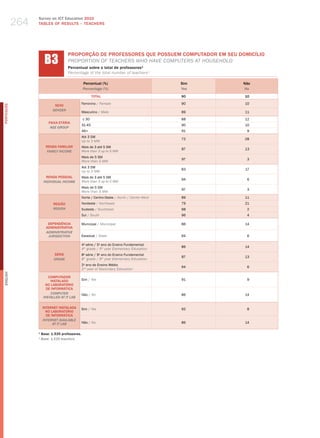
264 B3 - PROPORçãO DE PROFESSORES qUE POSSUEM COMPUTADOR EM SEU DOMICíLIO
    ProPortion oF teAcherS who hAve comPuterS At houSehold

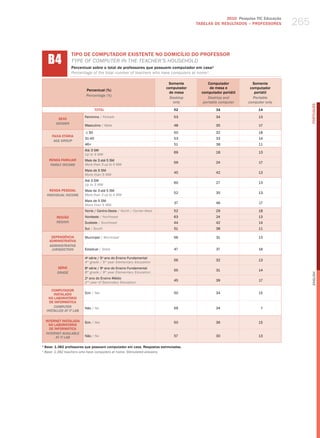
265 B4 - TIPO DE COMPUTADOR ExISTENTE NO DOMICíLIO DO PROFESSOR
    tyPe oF comPuter in the teAcher’S houSehold
14
                 Survey on ICT Education 2010
                 CONTENTS


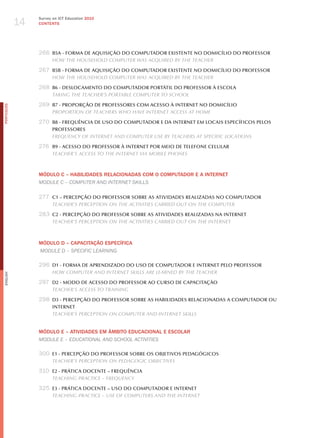
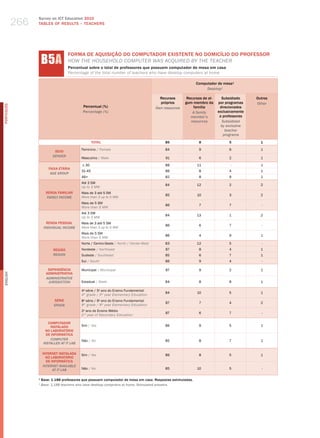
                 266 B5A - FORMA DE AqUISIçãO DO COMPUTADOR ExISTENTE NO DOMICíLIO DO PROFESSOR
                       how the houSehold comPuter wAS Acquired By the teAcher

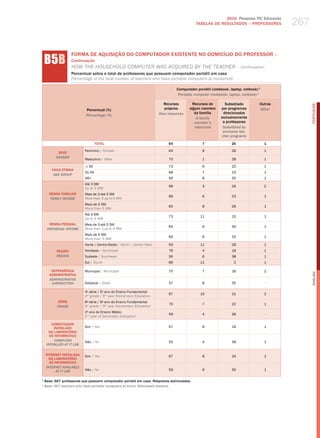
                 267 B5B - FORMA DE AqUISIçãO DO COMPUTADOR ExISTENTE NO DOMICíLIO DO PROFESSOR
                       how the houSehold comPuter wAS Acquired By the teAcher

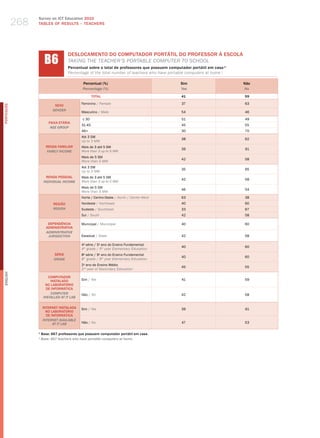
                 268 B6 - DESLOCAMENTO DO COMPUTADOR PORTáTIL DO PROFESSOR à ESCOLA
                       tAking the teAcher’S PortABle comPuter to School

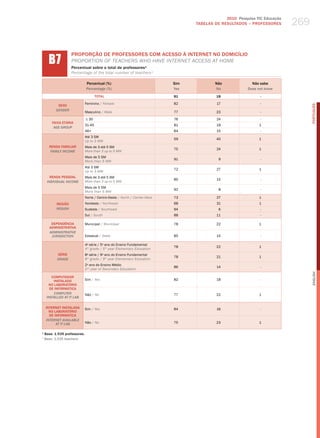
                 269 B7 - PROPORçãO DE PROFESSORES COM ACESSO à INTERNET NO DOMICíLIO
PORTuGuÊS


                       ProPortion oF teAcherS who hAve internet AcceSS At home

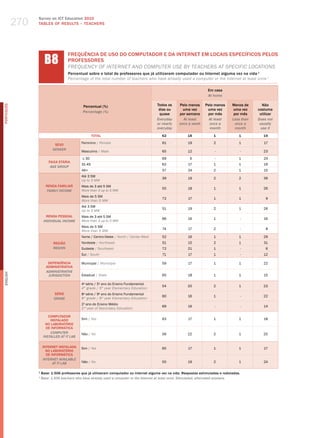
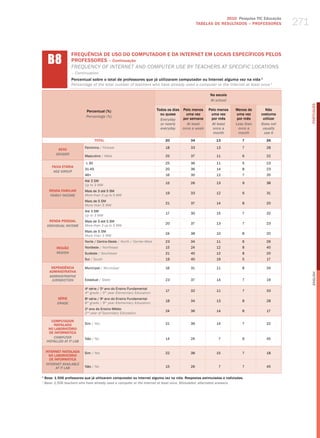
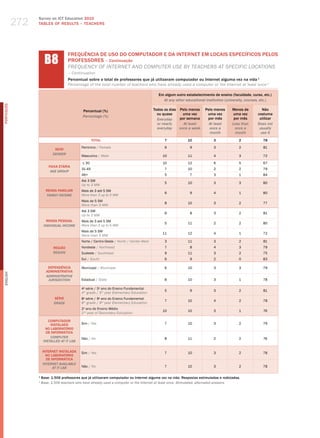
                 270 B8 - FREqUÊNCIA DE USO DO COMPUTADOR E DA INTERNET EM LOCAIS ESPECíFICOS PELOS
                       PROFESSORES
                       Frequency oF internet And comPuter uSe By teAcherS At SPeciFic locAtionS

                 276 B9 - ACESSO DO PROFESSOR à INTERNET POR MEIO DE TELEFONE CELULAR
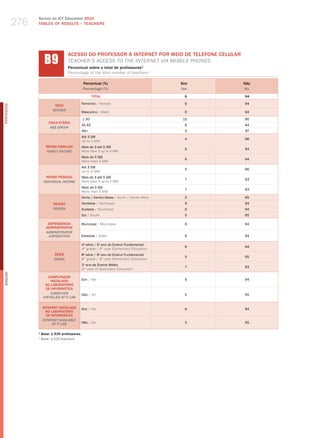
                       teAcher’S AcceSS to the internet viA moBile PhoneS


                 MÓDuLO C – HABILIDADES RELACIONADAS COM O COMPuTADOR E A INTERNET
                 module C – ComPuter aNd INterNet SkIllS

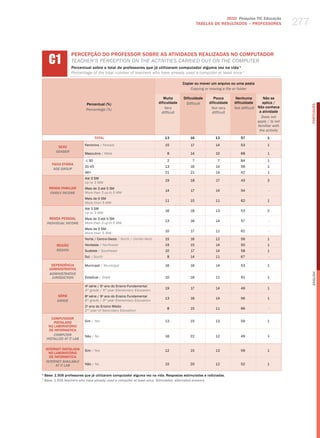
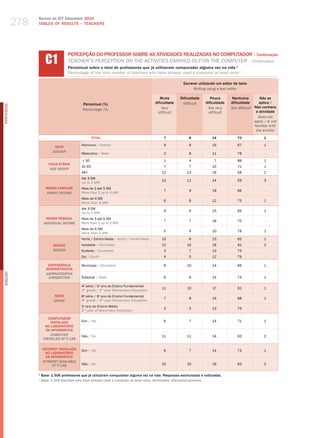
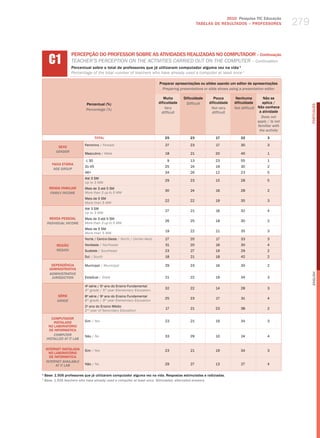
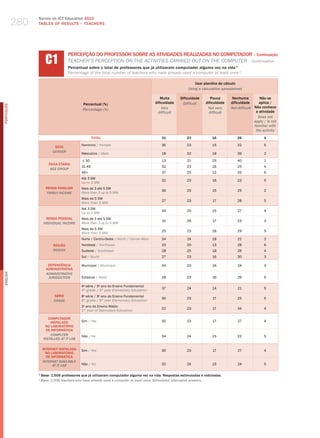
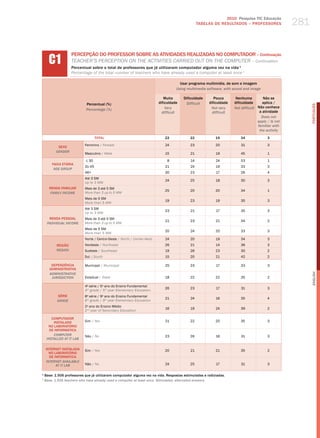
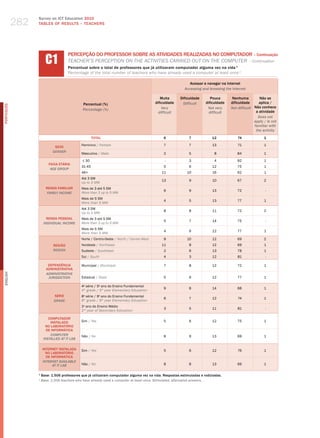
                 277 C1 – PERCEPçãO DO PROFESSOR SOBRE AS ATIVIDADES REALIZADAS NO COMPUTADOR
                       teAcher’S PercePtion on the ActivitieS cArried out on the comPuter

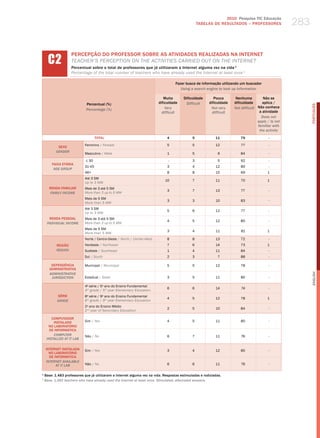
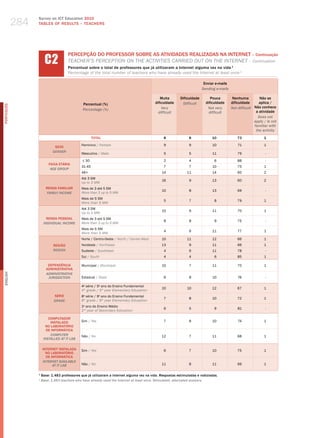
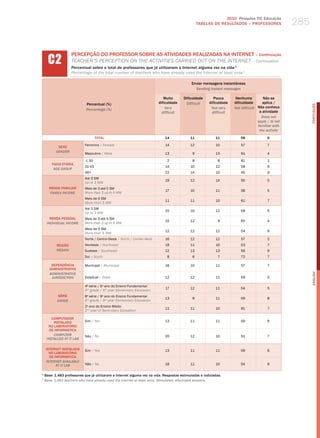
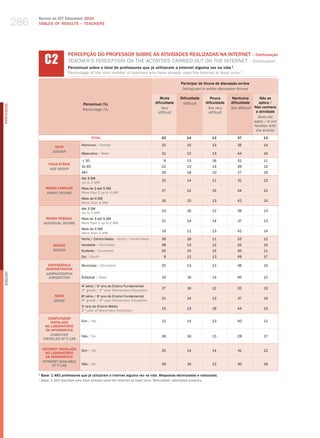
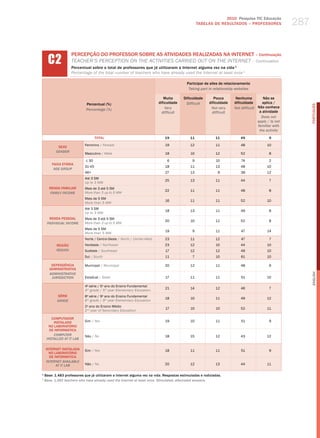
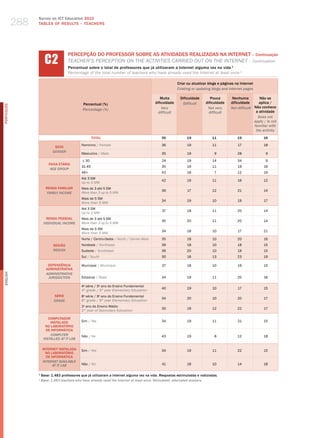
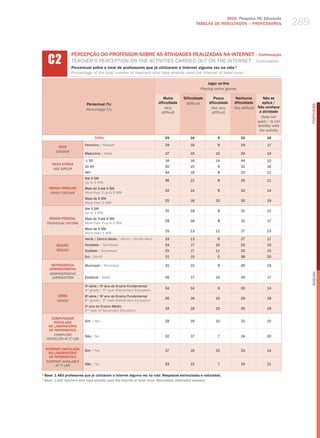
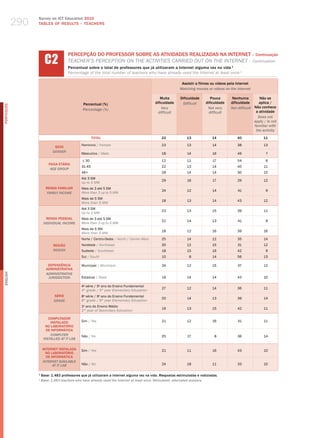
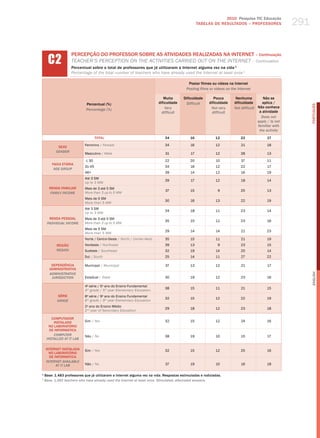
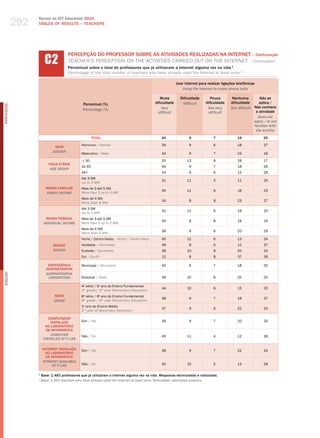
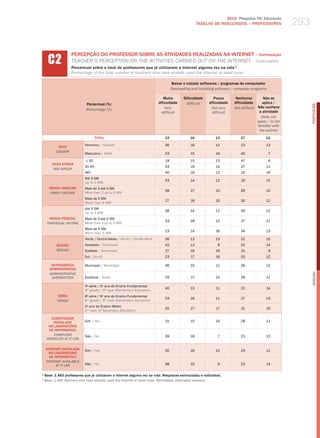
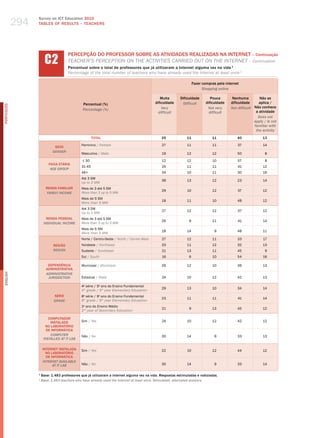
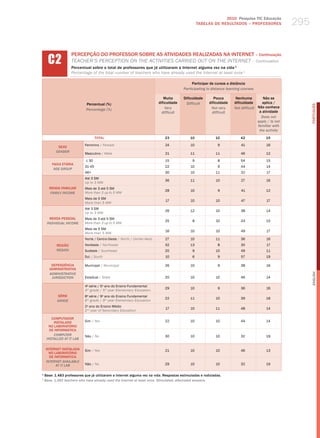
                 283 C2 - PERCEPçãO DO PROFESSOR SOBRE AS ATIVIDADES REALIZADAS NA INTERNET
                       teAcher’S PercePtion on the ActivitieS cArried out on the internet


                 MÓDuLO D – CAPACITAÇÃO ESPECíFICA
                 module d – SPeCIfIC learNINg

                 296 D1 - FORMA DE APRENDIZADO DO USO DE COMPUTADOR E INTERNET PELO PROFESSOR
                       how comPuter And internet SkillS Are leArned By the teAcher
English


                 297 D2 - MODO DE ACESSO DO PROFESSOR AO CURSO DE CAPACITAçãO
                       teAcher’S AcceSS to trAining

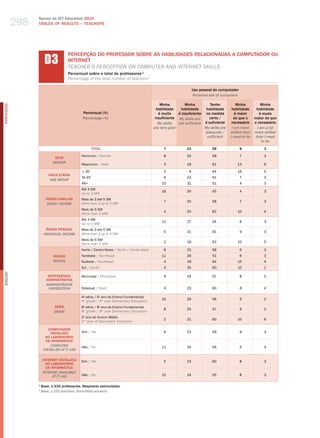
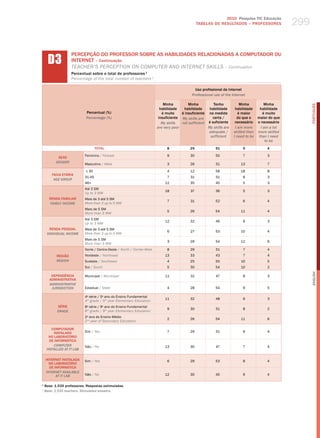
                 298 D3 - PERCEPçãO DO PROFESSOR SOBRE AS HABILIDADES RELACIONADAS A COMPUTADOR OU
                       INTERNET
                       teAcher’S PercePtion on comPuter And internet SkillS


                 MÓDuLO E – ATIvIDADES EM âMBITO EDuCACIONAL E ESCOLAR
                 module e – eduCatIoNal aNd SChool aCtIvItIeS

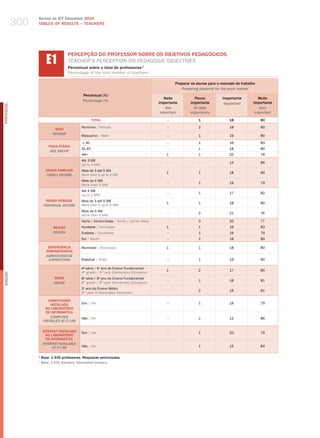
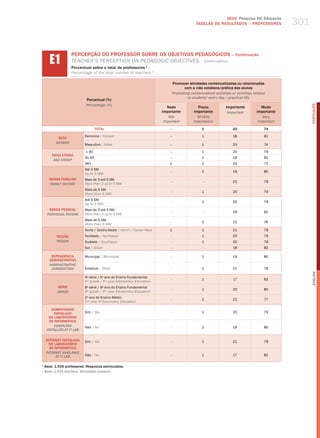
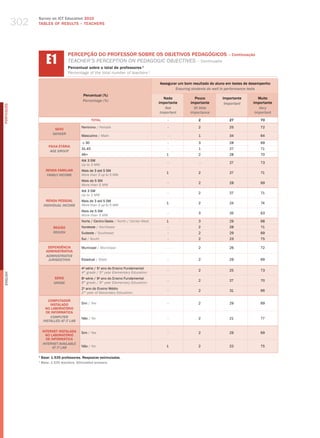
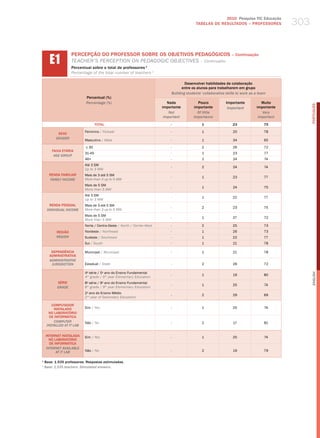
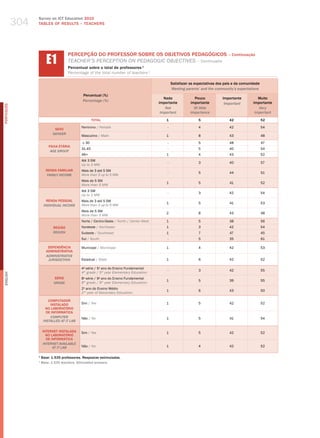
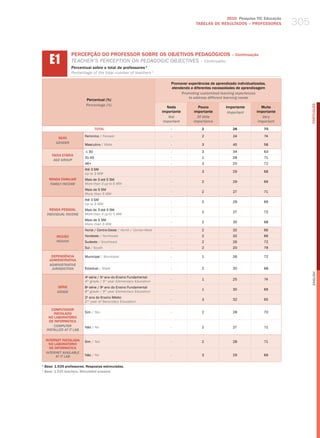
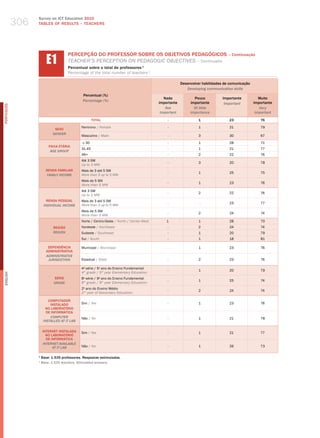
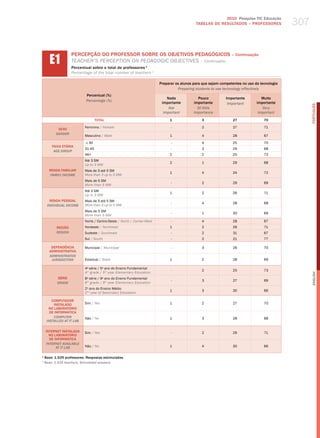
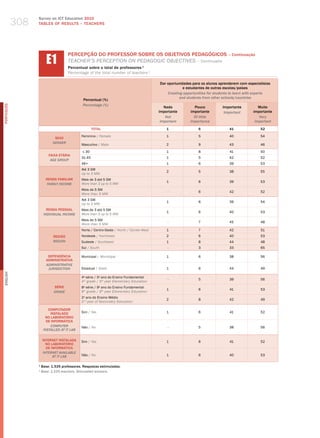
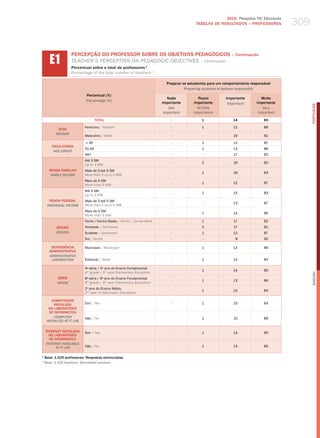
                 300 E1 - PERCEPçãO DO PROFESSOR SOBRE OS OBJETIVOS PEDAGóGICOS
                       teAcher’S PercePtion on PedAgogic oBjectiveS

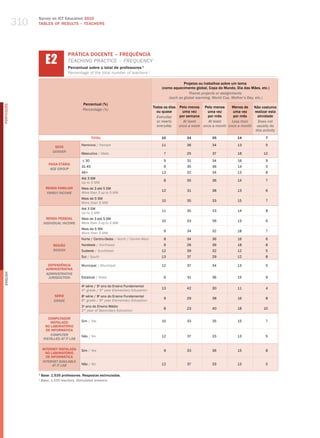
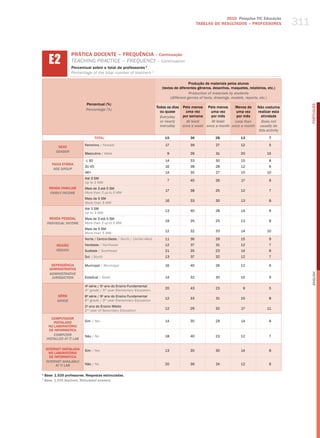
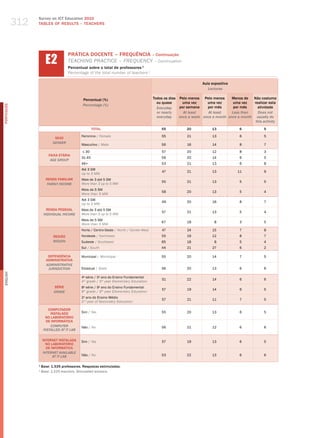
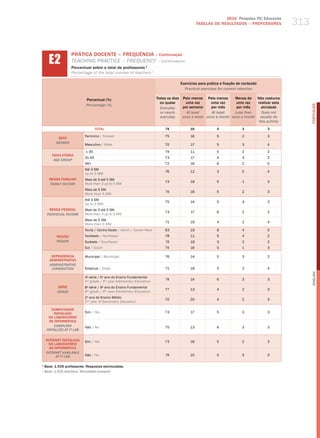
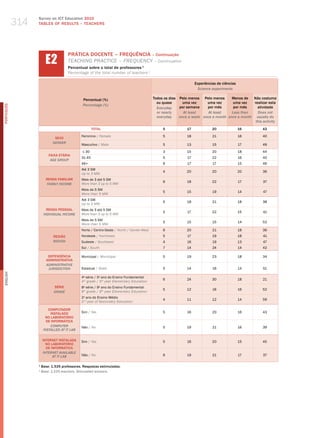
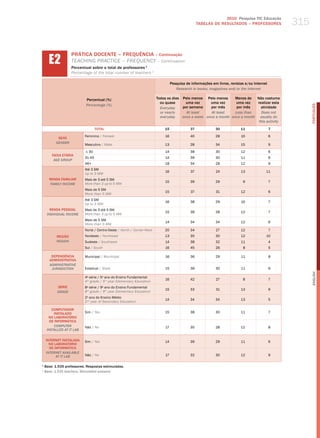
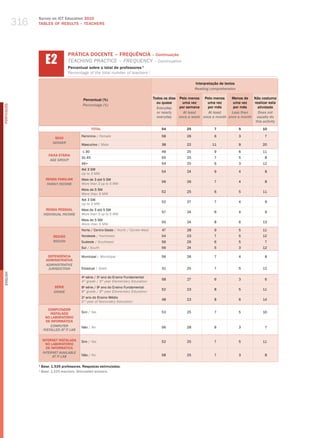
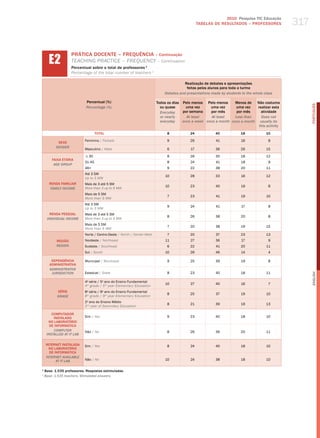
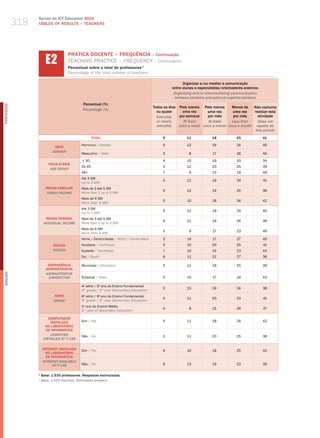
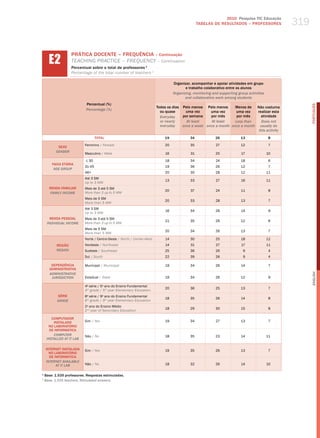
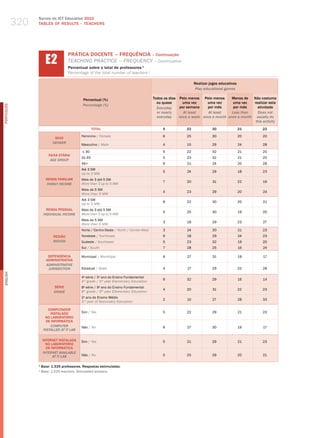
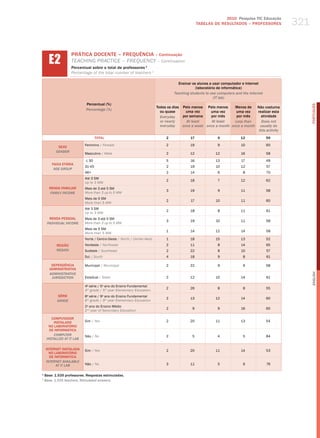
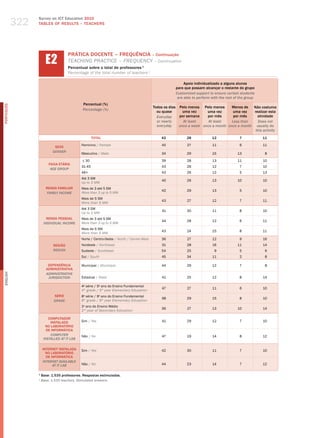
                 310 E2 - PRáTICA DOCENTE – FREqUÊNCIA
                       teAching PrActice – Frequency

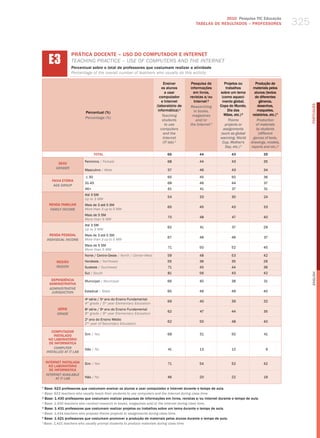
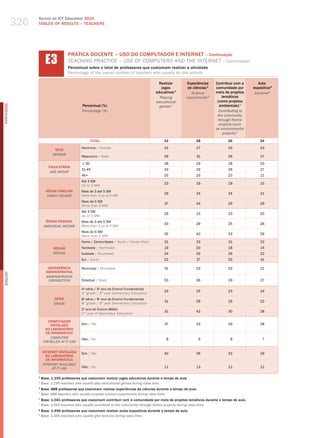
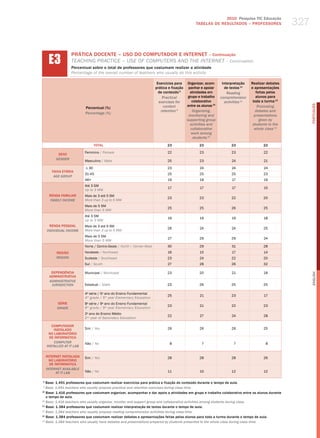
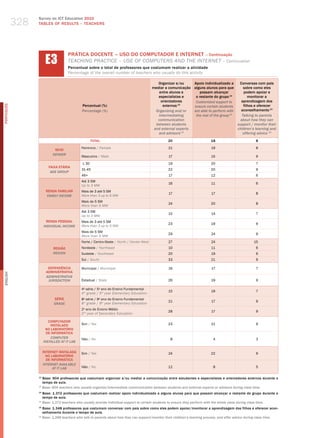
                 325 E3 - PRáTICA DOCENTE – USO DO COMPUTADOR E INTERNET
                       teAching PrActice – uSe oF comPuterS And the internet
15
                                                                     2010 Pesquisa TIC Educação
                                                                                      SuMÁRIO


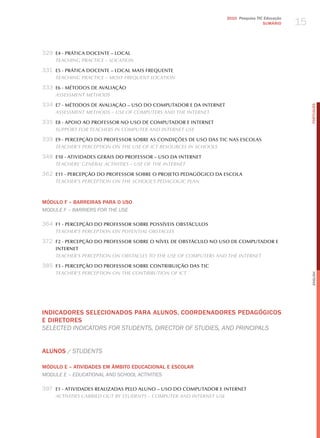
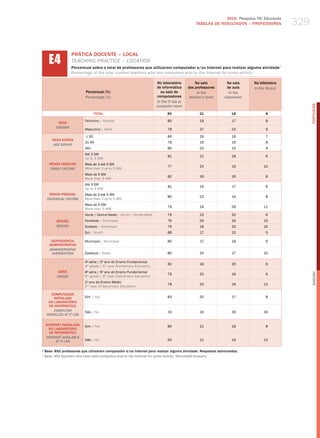
329 E4 - PRáTICA DOCENTE – LOCAL
    teAching PrActice – locAtion

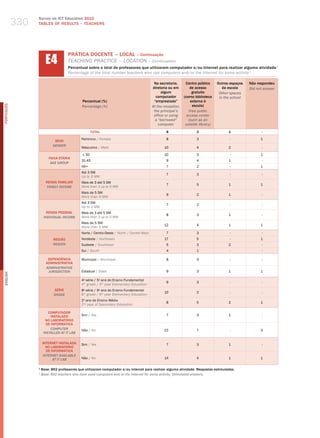
331 E5 - PRáTICA DOCENTE – LOCAL MAIS FREqUENTE
    teAching PrActice – moSt Frequent locAtion

333 E6 - MéTODOS DE AVALIAçãO
    ASSeSSment methodS

334 E7 - MéTODOS DE AVALIAçãO – USO DO COMPUTADOR E DA INTERNET


                                                                                                       PORTuGuÊS
    ASSeSSment methodS – uSe oF comPuterS And the internet

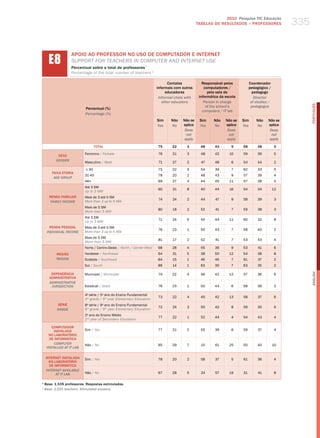
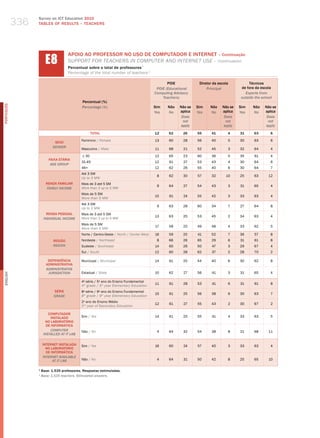
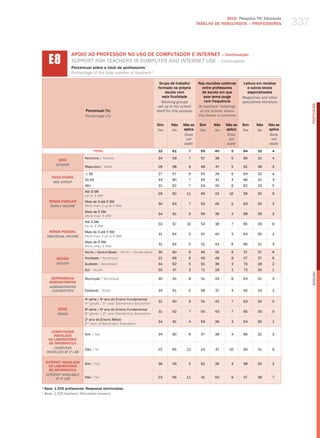
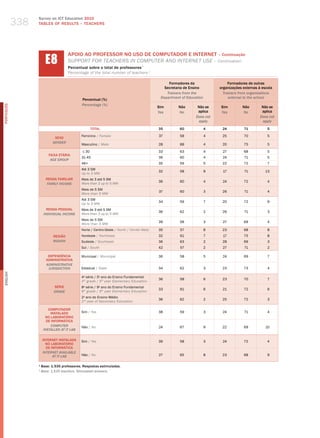
335 E8 - APOIO AO PROFESSOR NO USO DE COMPUTADOR E INTERNET
    SuPPort For teAcherS in comPuter And internet uSe

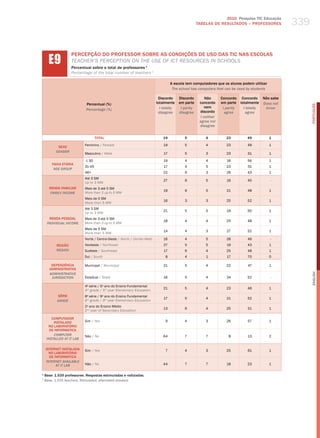
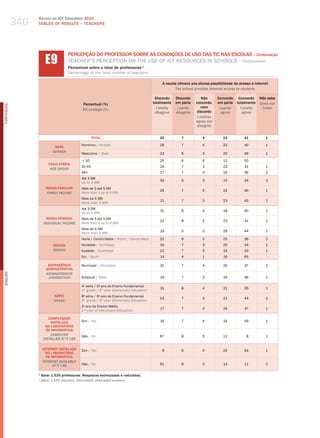
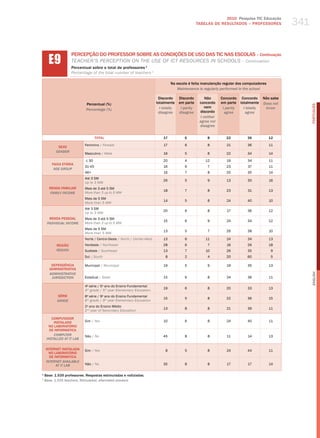
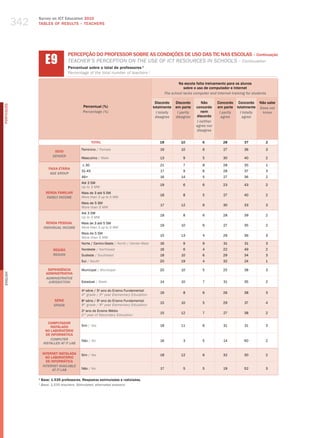
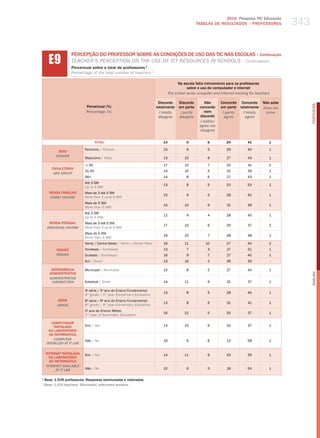
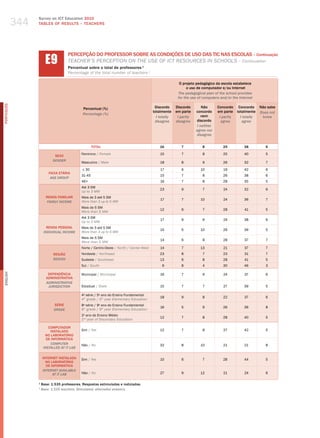
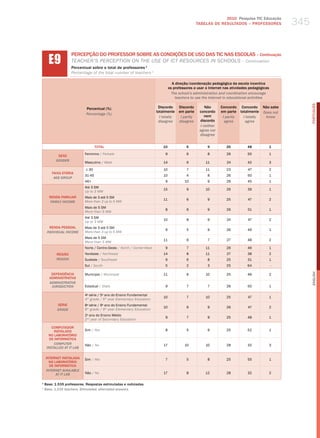
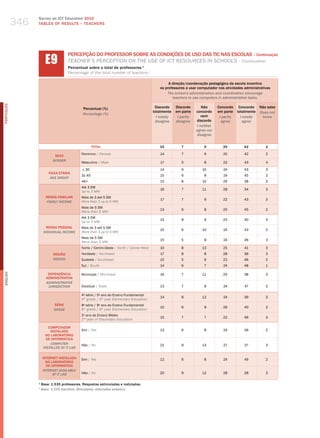
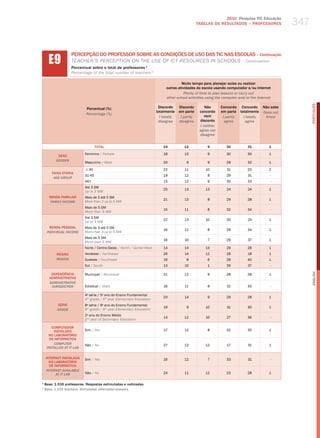
339 E9 - PERCEPçãO DO PROFESSOR SOBRE AS CONDIçõES DE USO DAS TIC NAS ESCOLAS
    teAcher’S PercePtion on the uSe oF ict reSourceS in SchoolS

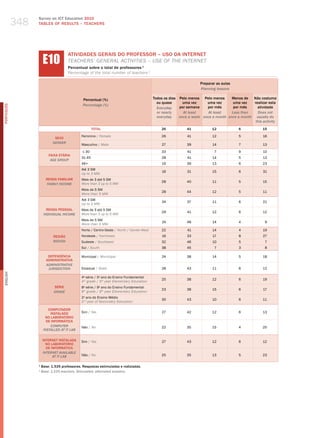
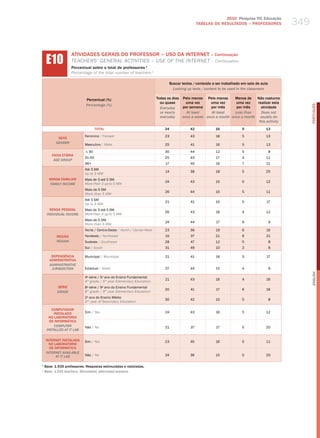
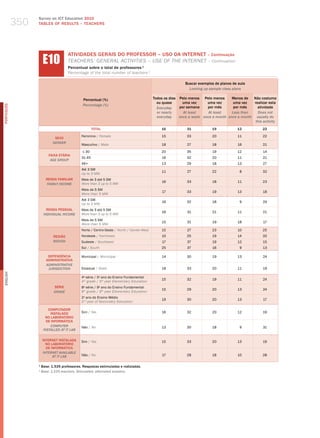
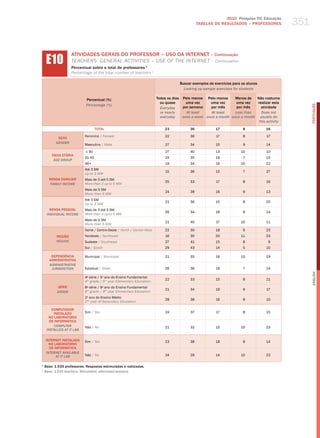
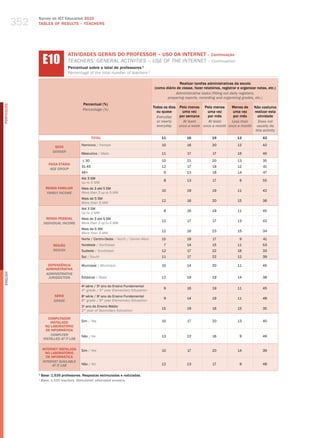
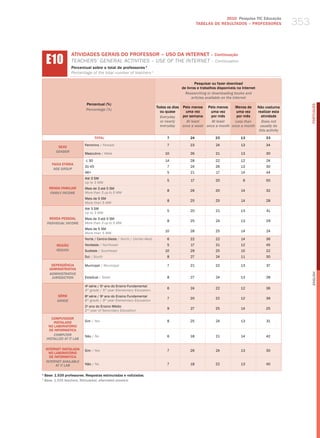
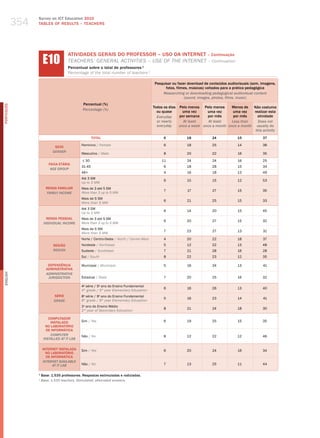
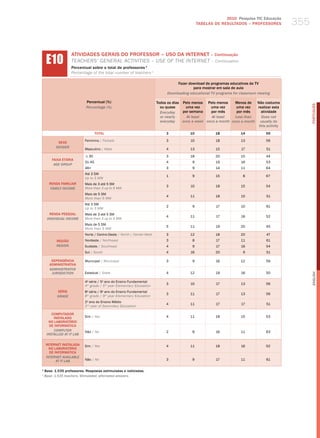
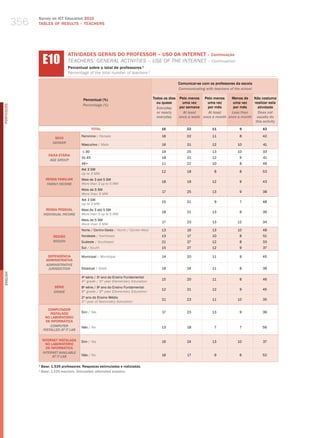
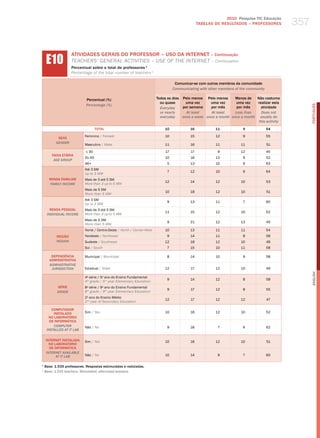
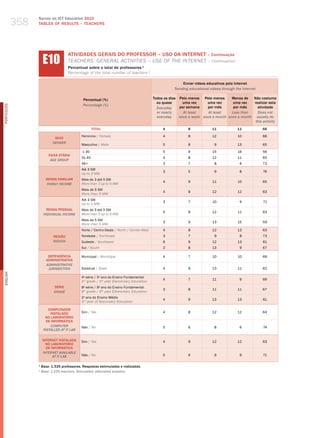
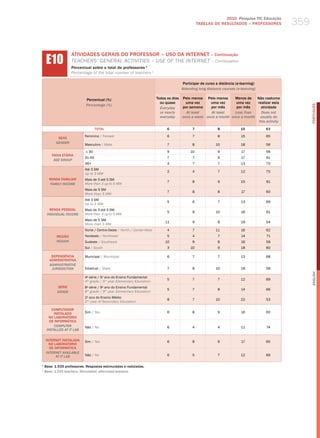
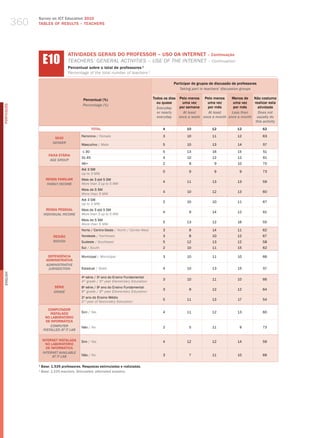
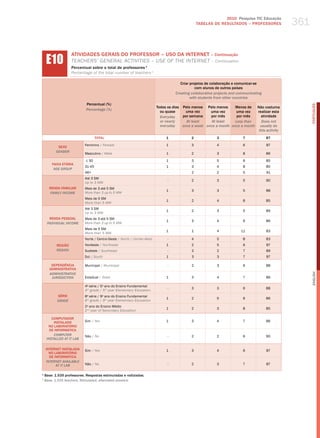
348 E10 - ATIVIDADES GERAIS DO PROFESSOR – USO DA INTERNET
    teAcherS’ generAl ActivitieS – uSe oF the internet

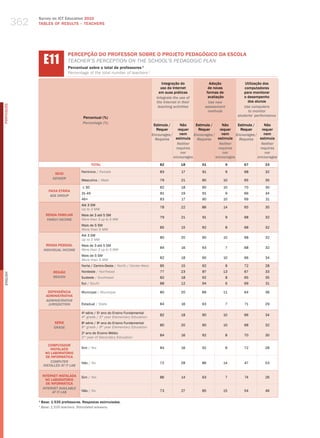
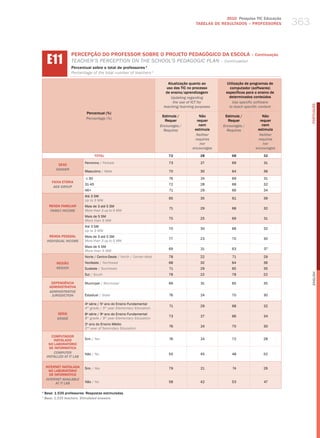
362 E11 - PERCEPçãO DO PROFESSOR SOBRE O PROJETO PEDAGóGICO DA ESCOLA
    teAcher’S PercePtion on the School’S PedAgogic PlAn


MÓDuLO F – BARREIRAS PARA O uSO
module f – BarrIerS for the uSe

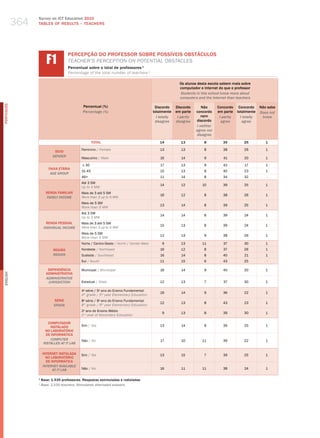
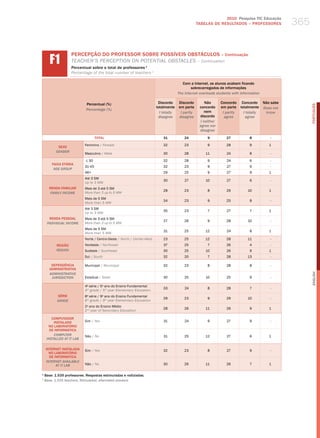
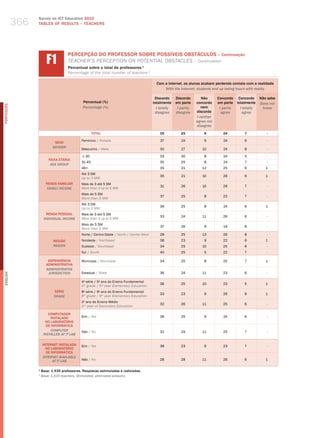
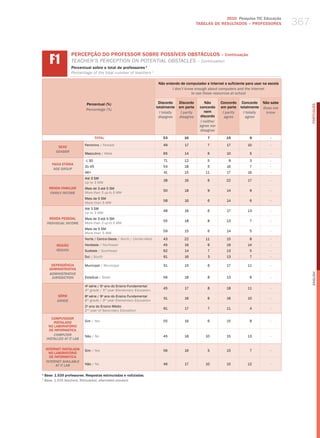
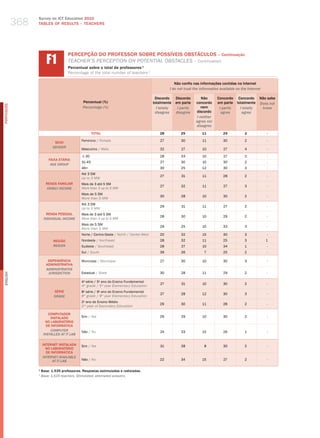
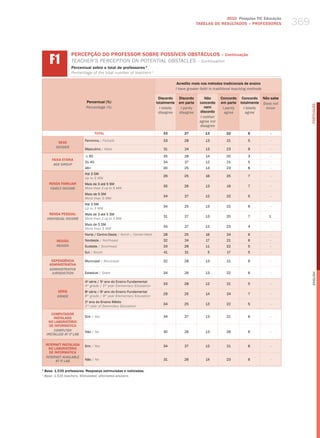
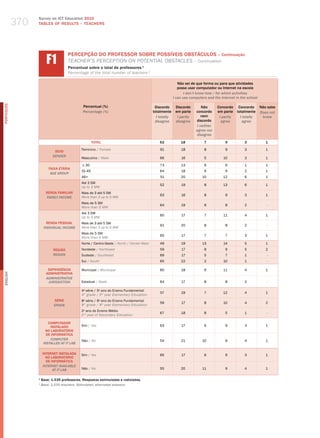
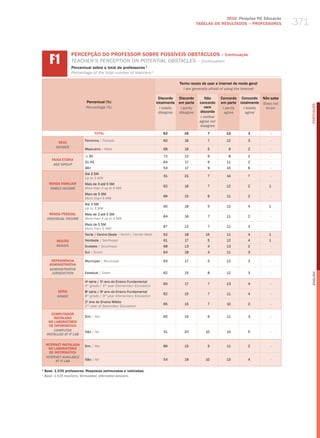
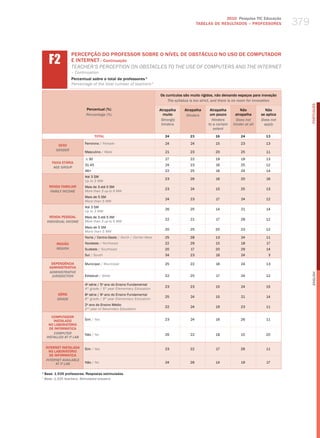
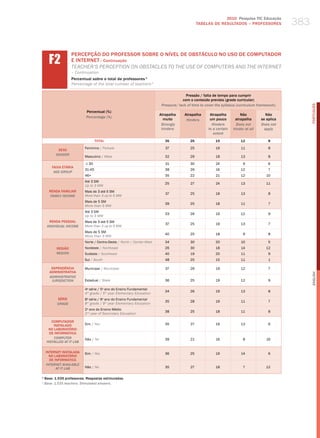
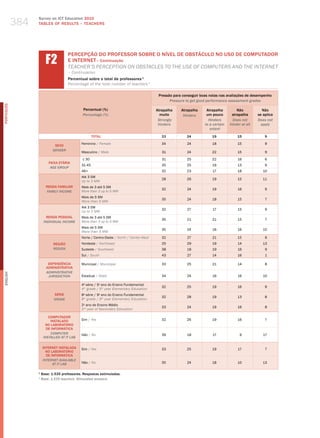
364 F1 - PERCEPçãO DO PROFESSOR SOBRE POSSíVEIS OBSTáCULOS
    teAcher’S PercePtion on PotentiAl oBStAcleS

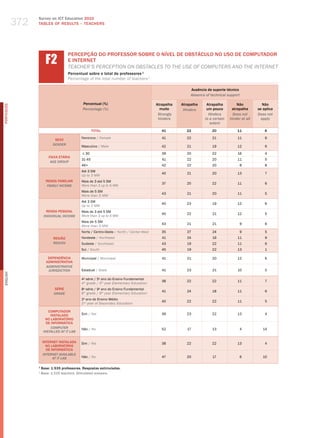
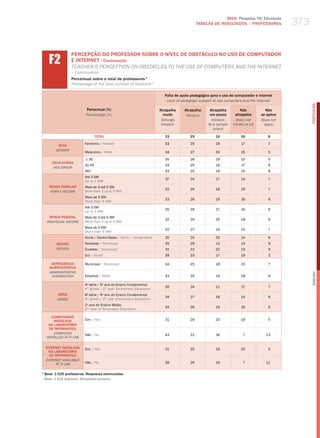
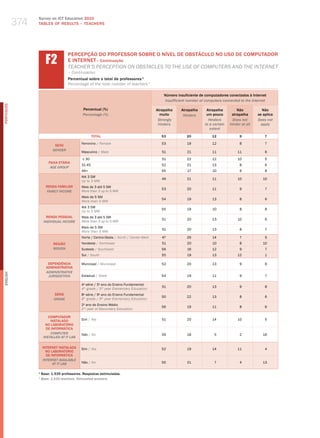
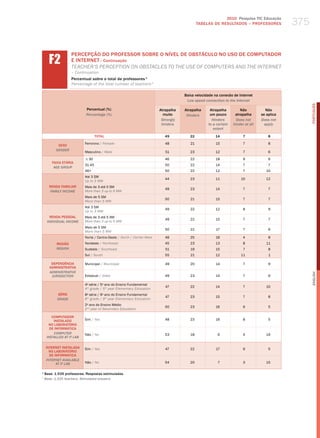
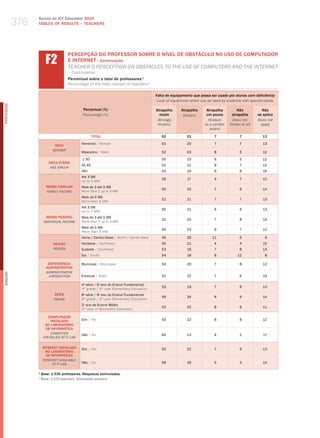
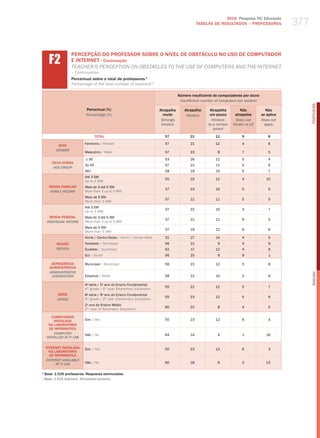
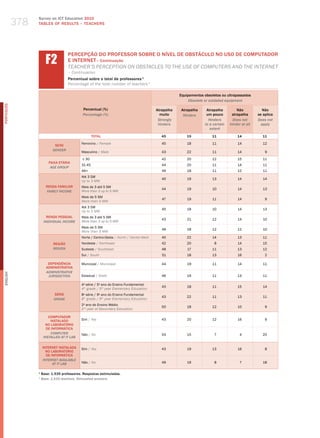
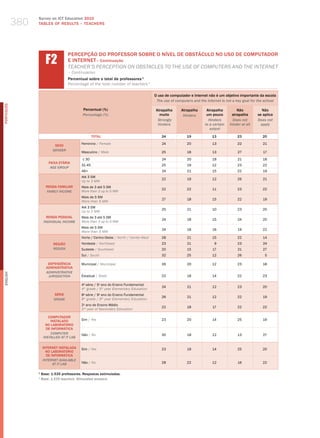
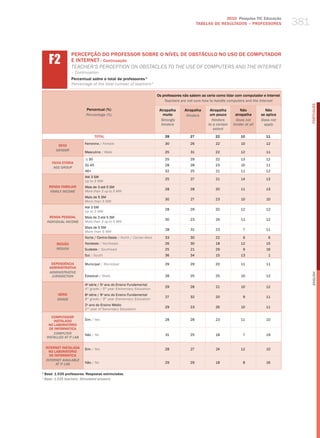
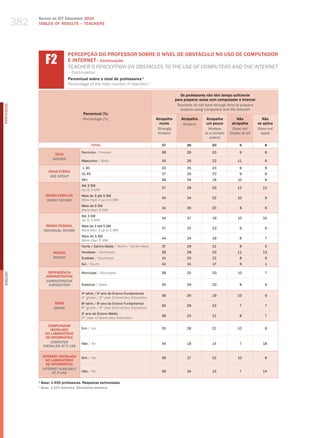
372 F2 - PERCEPçãO DO PROFESSOR SOBRE O NíVEL DE OBSTáCULO NO USO DE COMPUTADOR E
    INTERNET
    teAcher’S PercePtion on oBStAcleS to the uSe oF comPuterS And the internet

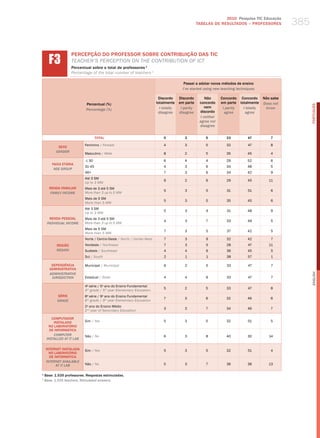
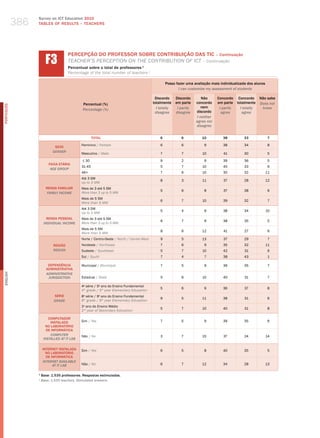
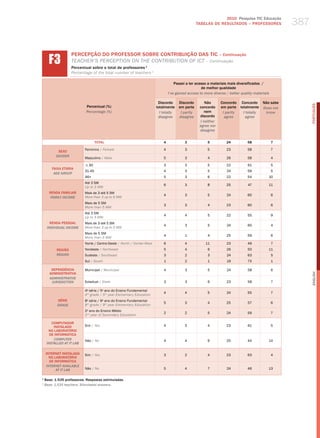
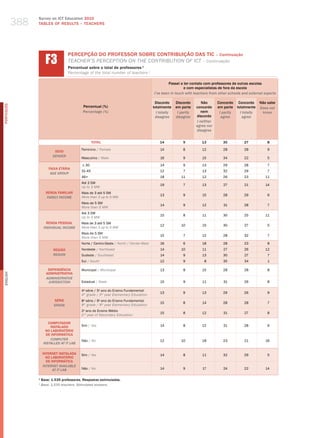
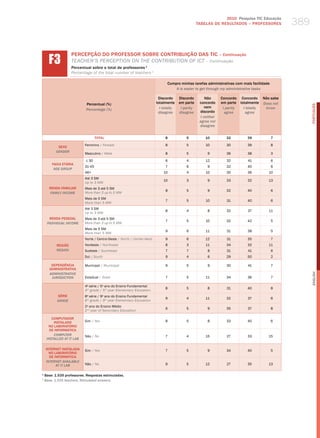
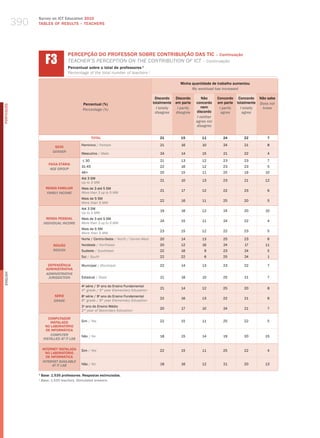
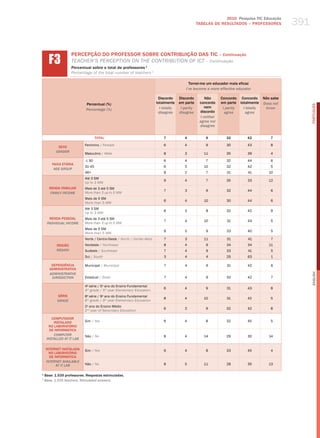
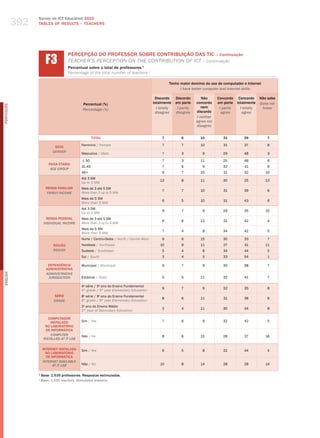
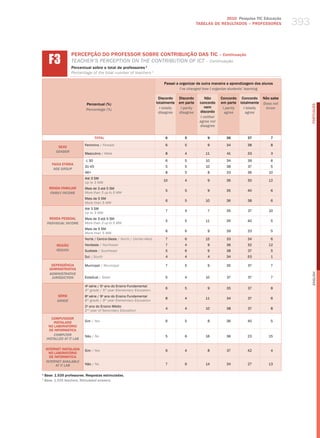
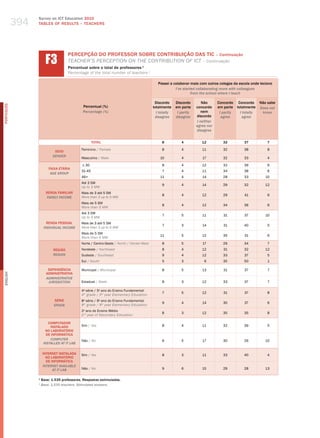
385 F3 - PERCEPçãO DO PROFESSOR SOBRE CONTRIBUIçãO DAS TIC
    teAcher’S PercePtion on the contriBution oF ict


INDICADORES SELECIONADOS PARA ALuNOS, COORDENADORES PEDAGÓGICOS                                        English
E DIRETORES
SeleCted INdICatorS for StudeNtS, dIreCtor of StudIeS, aNd PrINCIPalS


ALuNOS / StudeNtS

MÓDuLO E – ATIvIDADES EM âMBITO EDuCACIONAL E ESCOLAR
module e – eduCatIoNal aNd SChool aCtIvItIeS

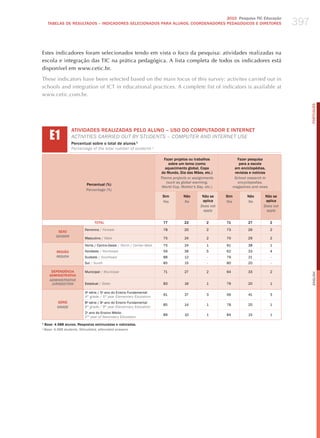
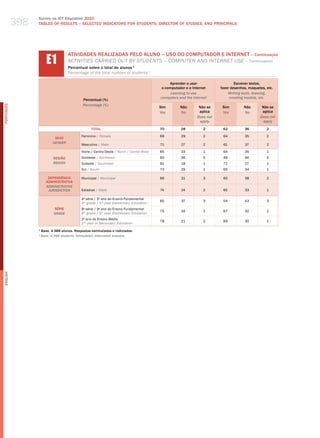
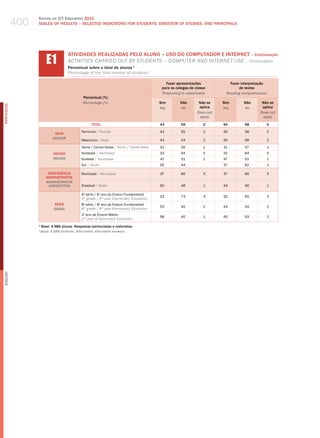
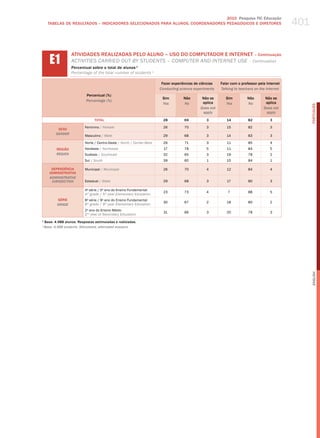
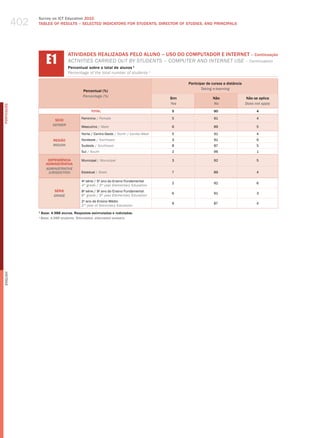
397 E1 - ATIVIDADES REALIZADAS PELO ALUNO – USO DO COMPUTADOR E INTERNET
    ActivitieS cArried out By StudentS – comPuter And internet uSe
16
                 Survey on ICT Education 2010
                 CONTENTS


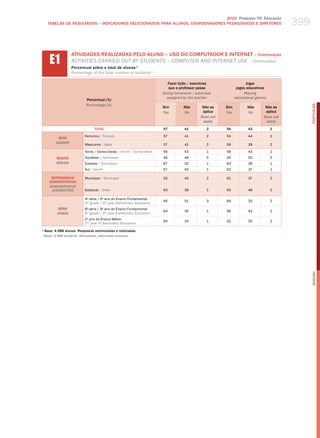
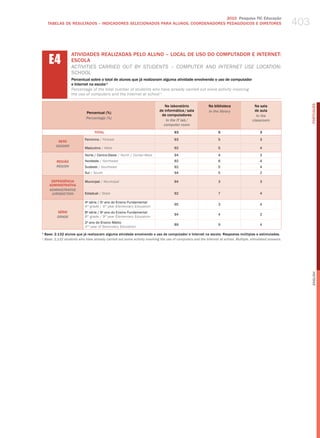
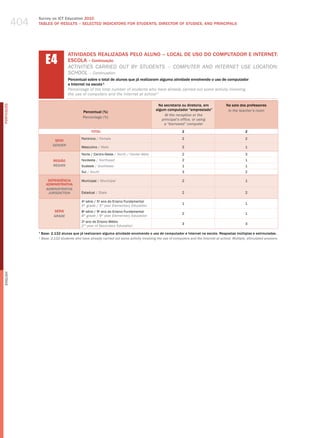
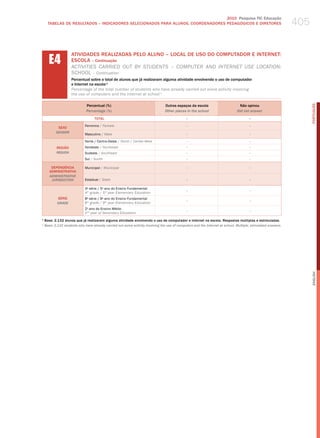
                 403 E4 - ATIVIDADES REALIZADAS PELO ALUNO – LOCAL DE USO DO COMPUTADOR E INTERNET: ESCOLA
                       ActivitieS cArried out By StudentS – comPuter And internet uSe locAtion: School


                 COORDENADORES PEDAGÓGICOS / dIreCtor of StudIeS

                 MÓDuLO C – HABILIDADES RELACIONADAS COM O COMPuTADOR E A INTERNET
PORTuGuÊS


                 module C – ComPuter aNd INterNet SkIllS

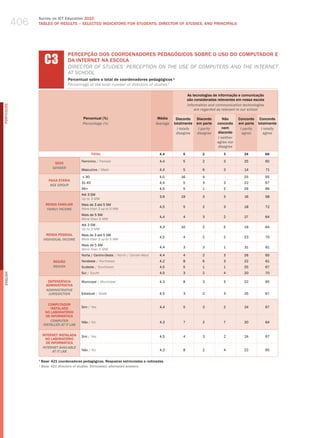
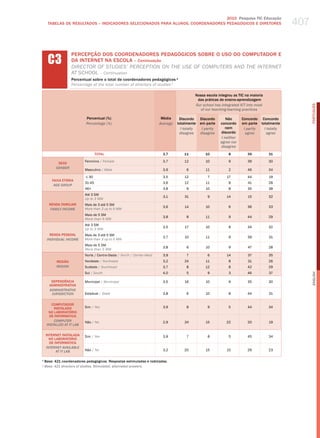
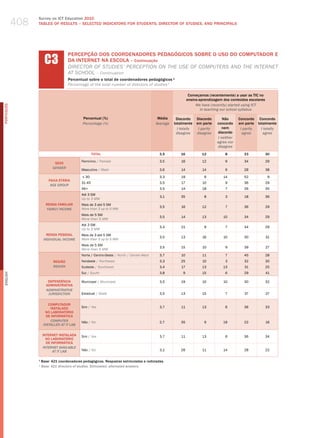
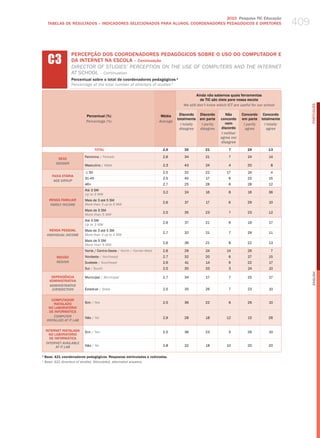
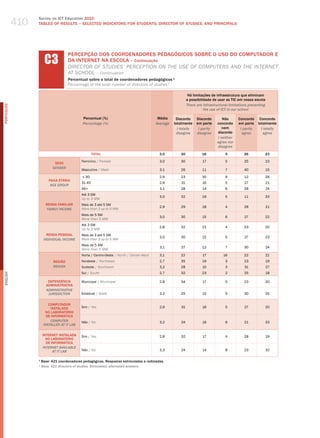
                 406 C3 - PERCEPçãO DOS COORDENADORES PEDAGóGICOS SOBRE O USO DO COMPUTADOR E DA
                       INTERNET NA ESCOLA
                       director oF StudieS’ PercePtion on the uSe oF comPuterS And the internet At School

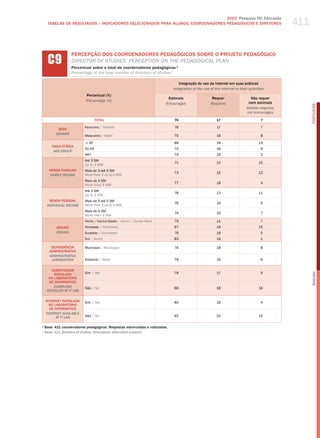
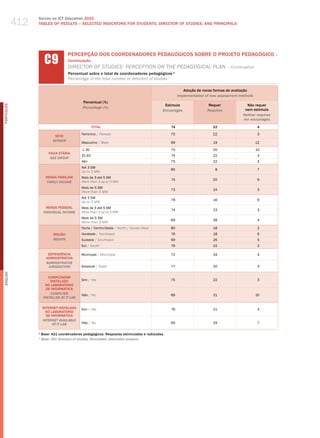
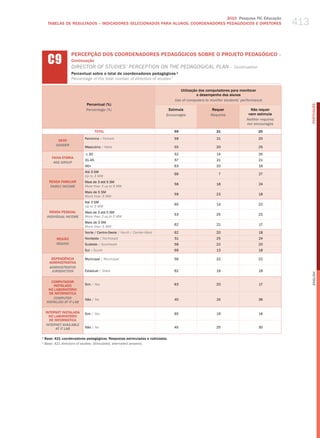
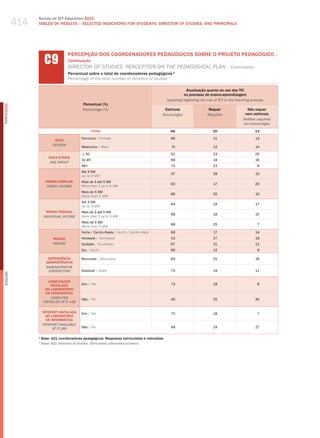
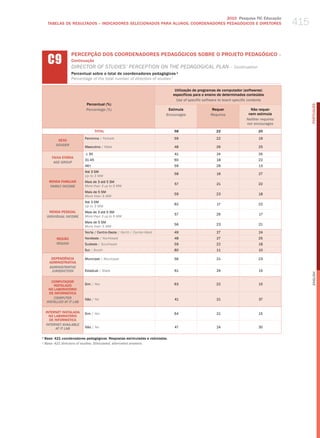
                 411 C9 - PERCEPçãO DOS COORDENADORES PEDAGóGICOS SOBRE O PROJETO PEDAGóGICO
                       director oF StudieS’ PercePtion on the PedAgogicAl PlAn


                 DIRETORES / PrINCIPalS

                 MÓDuLO C – HABILIDADES RELACIONADAS COM O COMPuTADOR E A INTERNET
                 module C – ComPuter aNd INterNet SkIllS

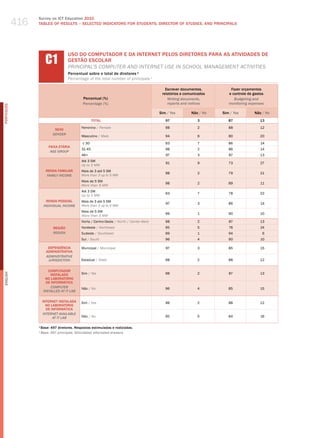
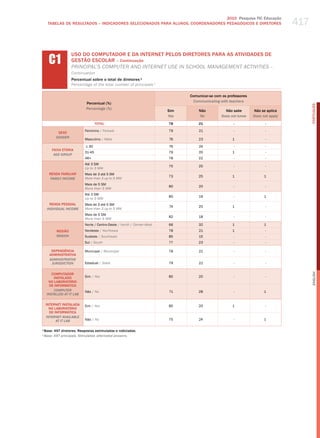
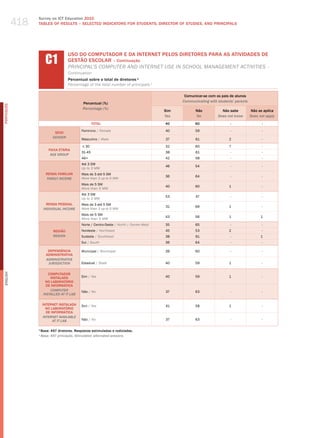
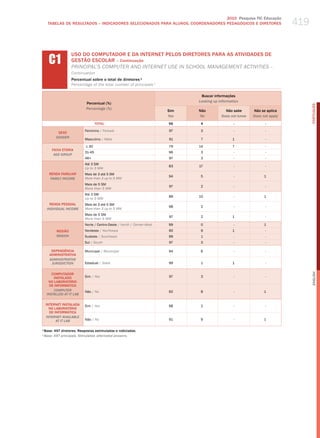
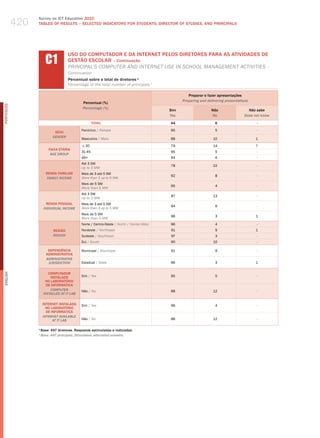
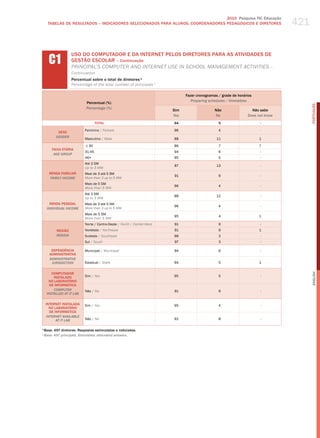
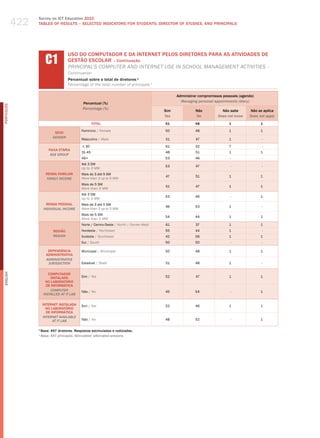
                 416 C1 - USO DO COMPUTADOR E DA INTERNET PELOS DIRETORES PARA AS ATIVIDADES DE GESTãO
                       ESCOLAR
                       PrinciPAl’S comPuter And internet uSe in School mAnAgement ActivitieS


                 MÓDuLO E – ATIvIDADES EM âMBITO EDuCACIONAL E ESCOLAR
                 module e – eduCatIoNal aNd SChool aCtIvItIeS
English


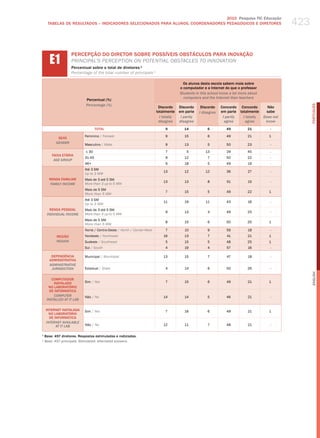
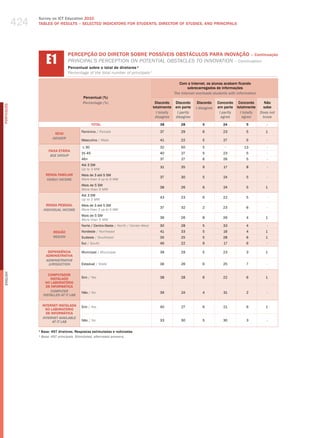
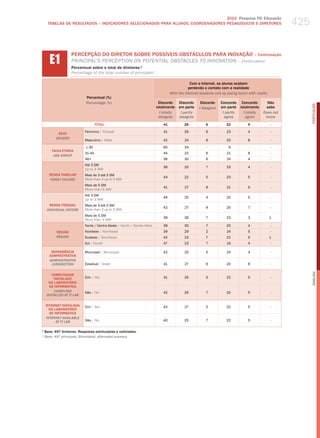
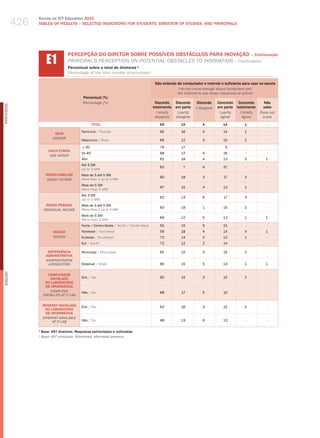
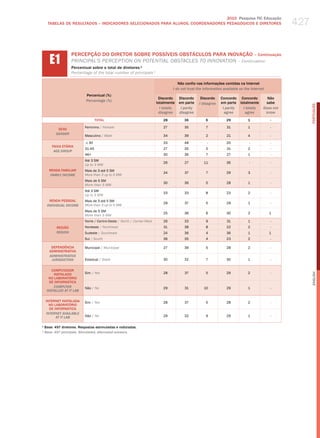
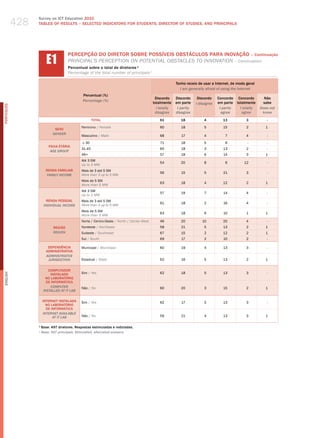
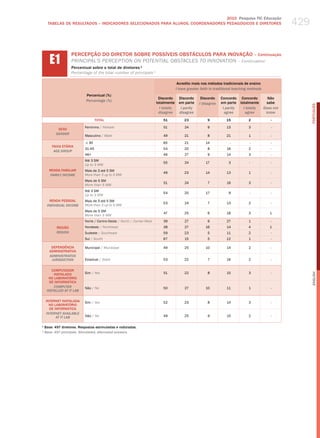
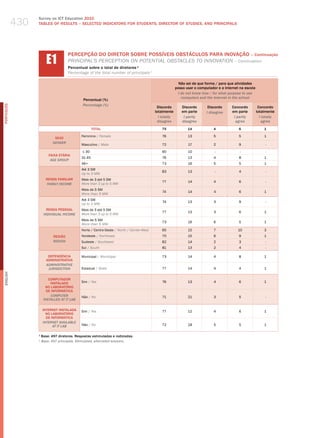
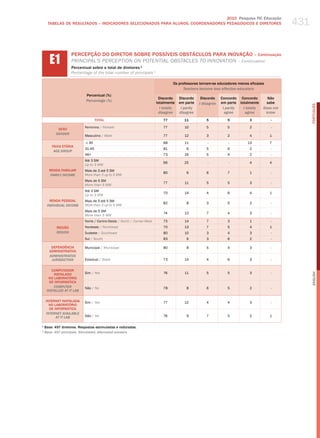
                 423 E1 - PERCEPçãO DO DIRETOR SOBRE POSSíVEIS OBSTáCULOS PARA INOVAçãO
                       PrinciPAl’S PercePtion on PotentiAl oBStAcleS to innovAtion
17
                                                                              2010 Pesquisa TIC Educação
                                                                                               PREFÁCIO


PREFÁCIo


                                                                                                                PORTuGuÊS
Quando começares a tua viagem para Ítaca,
reza para que o caminho seja longo,
cheio de aventura e de conhecimento.
(...)
Será melhor que ela dure muitos anos
para que sejas velho quando chegares à ilha,
rico com tudo o que encontraste no caminho,
sem esperares que Ítaca te traga riquezas.


Ítaca deu-te a tua bela viagem.
Sem ela não terias sequer partido.
Não tem mais nada a dar-te.

(Konstantínos Kaváfis, viagem a Ítaca)


Com o início formal das operações do NIC.br, em 2005, os recursos arrecadados pelo Registro.br,
responsável pelas atividades de registro de nomes de domínio e pela distribuição de endereços Ipv4
e IPv6 no Brasil, permitiram que o CGI.br expandisse o leque de iniciativas em prol da comunida-
de da Internet brasileira. Nesse contexto, o Cetic.br foi criado, dentro do NIC.br, para cuidar do
mapeamento da posse e do uso das TIC, bem como para delinear os contornos da Internet no país.
O Cetic.br é um dos mais significativos e impactantes resultados do aproveitamento dos recursos
do CGI.br em favor da sociedade.

Outras iniciativas fundamentais foram reforçadas, como o estabelecimento de mais pontos de tro-
ca de tráfego (PTTs) no país, a distribuição gratuita da hora oficial brasileira via NTP (network time
Protocol), o desenvolvimento do Sistema de Medição de Tráfego de Última Milha (Simet), a dissemi-
nação e “evangelização” do uso do IPv6 por meio de eventos e cursos, todos sob responsabilidade
do Ceptro.br, também um órgão do NIC.br. Quanto a projetos voltados à segurança da Internet bra-
sileira, entre os conduzidos pelo Cert.br destacaram-se a cartilha de segurança, cursos especializa-
dos e em padrão internacional e o projeto de mapeamento do spam no país: os honeypots. Além
disso, a conscientização a respeito da importância do uso de padrões abertos, visando ao cresci-
mento da web com base em diretrizes voltadas a uma Internet inclusiva e democrática, é importan-
te atuação do W3C.br, escritório brasileiro do W3C.
18
                 Pesquisa TIC Educação 2010
                 PREFÁCIO


                 A perenização das atividades do NIC.br é objetivo primário do CGI.br, para reforçar seu compro-
                 misso de devolver à comunidade da Internet brasileira os recursos advindos do registro de nomes
                 sob o domínio .br. E o constante crescimento desse número de registros, que alcançou, em junho
                 de 2011, a marca de 2,5 milhões, possibilita que o NIC.br se fortaleça como referência no país e
                 no exterior e possa conduzir com sucesso uma série crescente de projetos que visam ao apoio a um
                 melhor desenvolvimento da Internet no país. A pesquisa sobre o uso das TIC no Brasil, que nesse
                 ano alcança sua sexta edição, e a pesquisa inédita sobre TIC na educação brasileira, ambas condu-
PORTuGuÊS


                 zidas pelo Cetic.br, ilustram a busca do NIC.br por desenvolver e disseminar conhecimento sobre a
                 rede brasileira e prover subsídios para que políticas públicas possam ser geradas e orientadas a par-
                 tir do mapeamento cada vez mais profundo e completo da Internet no Brasil.

                 Bons ventos!


                                                                             Demi Getschko
                                                        Núcleo de Informação e Coordenação do Ponto BR – NIC.br
19
                                                                            2010 Survey on ICT Education
                                                                                        APRESENTAÇÃO


APRESENTAÇÃo

Desde a sua criação, em 1995, o Comitê Gestor da Internet no Brasil (CGI.br) coordena projetos
de importância fundamental para o funcionamento e o desenvolvimento da Internet no país. Entre
suas diversas atribuições e responsabilidades, o CGI.br fomenta a coleta, a organização e a disse-
minação de informações, análises, indicadores e estatísticas sobre as tecnologias de informação e
comunicação (TIC) no Brasil, em particular a Internet. Por meio do seu Centro de Estudos sobre as
Tecnologias da Informação e da Comunicação (Cetic.br), são conduzidos diversos projetos de pes-
quisa especializados nesse tema, visando à medição e ao acompanhamento da expansão das TIC
no país.

As estatísticas produzidas por meio destes projetos têm como objetivo contribuir para o debate
sobre as TIC no Brasil. E, felizmente, as pesquisas vêm ganhando cada vez mais destaque pelo rigor
metodológico e pela capacidade de gerar importantes insumos para os setores público e privado,
para organizações não governamentais e para a comunidade científica e acadêmica.

é com satisfação que comprovamos a utilização dos resultados da pesquisa do CGI.br por gesto-
res públicos na construção de estratégias governamentais e na elaboração de políticas públicas que
atendam às necessidades da população brasileira em temas críticos, como a inclusão digital, o uso
das TIC para a educação, a universalização da banda larga, a regulamentação das lanhouses, entre
outros. Os resultados também são utilizados amplamente pela academia na elaboração de pesqui-
sas acadêmicas, e por organizações privadas na identificação de tendências no cenário tecnológi-


                                                                                                                English
co brasileiro.

Empenhado na missão de estabelecer um centro de referências na produção de estatísticas e indi-
cadores sobre a posse e o uso das TIC no país, o CGI.br apresenta a sexta edição da Pesquisa sobre
o uso das tecnologias de informação e comunicação no Brasil – tic domicílios e tic empresas e,
também, a primeira edição da Pesquisa sobre o uso das tecnologias de informação e comunicação
nas escolas brasileiras – tic educação.


                                                      Hartmut Richard Glaser
                                             Comitê Gestor da Internet no Brasil – CGI.br
21
                                                                             2010 Pesquisa TIC Educação
                                                                                          INTRODuÇÃO


INTRodUÇÃo


                                                                                                               PORTuGuÊS
As novas tecnologias de informação e comunicação (TIC) têm criado, de forma cada vez mais inten-
sa e rápida, novas possibilidades para diferentes setores da sociedade, nas áreas econômica, social,
política e cultural, ao mesmo tempo que produzem revoluções significativas nos aspectos centrais
da vida cotidiana de indivíduos, organizações e governo. Avaliar os impactos dessas tecnologias na
sociedade tornou-se uma necessidade no processo de monitoramento da construção e do desen-
volvimento da sociedade da informação e do conhecimento. Organizações internacionais como
a Organização das Nações Unidas (ONU), Organização para a Cooperação e Desenvolvimento
Econômico (OCDE), Banco Mundial, entre outras, trabalham de forma colaborativa na definição de
metodologias, indicadores e métricas que sejam capazes de medir o acesso, o uso e a apropriação
das novas tecnologias, base para o desenvolvimento da sociedade da informação.

Garantir a universalização do acesso à educação é uma das metas do programa Objetivos de
Desenvolvimento do Milênio da ONU, e as TIC desempenham um papel fundamental para possibi-
litá-la. Dessa forma, é importante que sejam conhecidos os desafios para a apropriação das novas
tecnologias na educação e os impactos causados pelo uso das TIC nas salas de aula.

Embora o governo tenha empenhado recursos a fim de garantir o uso ampliado das TIC para a edu-
cação, ainda existe um desconhecimento das consequências desse uso na realização dos objetivos
e no alcance das metas dos programas educacionais. Assim, a criação de uma base de conhecimen-
tos relevante e que tenha credibilidade é fator essencial para ajudar no processo de decisão para o
desenvolvimento de políticas públicas sobre o uso das TIC voltadas aos programas de educação. E
essa foi a motivação inicial da Pesquisa sobre o Uso das Tecnologias de Informação e Comunicação
nas Escolas Brasileiras – TIC Educação 2010.

Para lidar com esse desafio, a pesquisa foi planejada a partir de duas abordagens. A primeira é
representada por um módulo qualitativo longitudinal, no qual doze escolas serão acompanhadas
durante quatro anos, com início em 2010 e término em 2013, com duas visitas anuais para obser-
vação, acompanhamento das mudanças na infraestrutura de acesso via banda larga e seu impacto
no ensino. Os resultados desse estudo serão analisados e publicados futuramente.

A segunda etapa, quantitativa e amostral, tem seus resultados apresentados nesta publicação.
Assim, mais um projeto de pesquisa passa a compor o portfólio do Cetic.br, juntamente com as
já consagradas pesquisas anuais sobre o uso das tecnologias de informação e comunicação: TIC
Domicílios e TIC Empresas, do Comitê Gestor da Internet no Brasil (CGI.br). As pesquisas do Cetic
vêm contribuindo com os setores público, privado e acadêmico ao fornecer subsídios para a dis-
cussão sobre o desenvolvimento das TIC no país. Inspiradas no conceito ICT4DEV (Information and
Comunnication Technologies for the Development), essas pesquisas buscam oferecer não somente
22
                 Pesquisa TIC Educação 2010
                 INTRODuÇÃO


                 um cenário sobre a apropriação das TIC, mas também uma série histórica de indicadores relevantes
                 que permitem uma análise aprofundada sobre o acesso e o uso das novas tecnologias, em particular
                 a Internet, contribuindo assim para uma melhor compreensão sobre as várias dimensões do impacto
                 das TIC na sociedade brasileira – nesse caso específico, na área de educação.

                 No âmbito do setor público, as estatísticas produzidas pelas pesquisas do Cetic.br contribuem para
                 as discussões sobre políticas públicas, principalmente aquelas voltadas a inclusão digital, como, por
                 exemplo, o Plano Nacional de Banda Larga, os programas Banda Larga nas Escolas e Telecentros
PORTuGuÊS


                 Comunitários, etc. O Brasil apresenta um quadro socioeconômico com enormes disparidades, o que
                 impõe grande desafio para a definição de políticas que consigam reduzir tal problema. As políticas
                 públicas nesse campo privilegiaram o acesso às TIC e o desenvolvimento da infraestrutura, mas pou-
                 co se discutiu sobre a participação ativa, o desenvolvimento de habilidades, a alfabetização digital
                 dos cidadãos e, agora também, de professores, coordenadores pedagógicos e diretores.

                 Os dados da pesquisa TIC Educação são uma importante contribuição para o debate acerca da
                 apropriação das TIC por parte dos atores escolares e para a discussão a respeito dos desafios cen-
                 trais para possibilitar seu uso efetivo no processo de ensino e aprendizagem.

                 No setor privado, as pesquisas do Cetic.br têm sido cada vez mais utilizadas por empresas que ope-
                 ram nos segmentos de telecomunicações, mídia e Internet para monitoramento de tendências, princi-
                 palmente de uso e aplicações da Internet, como redes sociais, comércio eletrônico, lazer, educação,
                 entre outros temas monitorados pelas pesquisas. No âmbito acadêmico, o número de publicações,
                 dissertações de mestrado, teses de doutorado e artigos científicos que utilizam os dados das pesqui-
                 sas também vem crescendo nos últimos anos. Percebe-se, portanto, que os dados do CGI.br são legi-
                 timados por agentes sociais do governo, do setor privado, do terceiro setor e da academia.

                 Seguindo a tradição das publicações do Cetic.br, será apresentada uma análise dos principais indi-
                 cadores da TIC Educação, com o intuito de oferecer um panorama completo do uso das novas tec-
                 nologias nas escolas públicas do país. Esperamos que esta leitura seja um convite para que o leitor
                 reflita sobre os desafios para a efetiva apropriação das TIC na escola e sobre as implicações decor-
                 rentes da sua introdução.

                 Em 2010, o Cetic.br ampliou ainda mais sua participação em debates nacionais e internacionais sobre
                 a definição de indicadores-chave para as TIC. Aumentou também a integração de especialistas aca-
                 dêmicos, instituições governamentais, organizações do terceiro setor, mantendo sempre o alinha-
                 mento com os padrões metodológicos da OCDE e da Eurostat (Instituto de Estatísticas da Comissão
                 Europeia), bem como as referências internacionais estabelecidas pelo Partnership on Measuring ICT for
                 Development, iniciativa que reúne entidades internacionais como, além das citadas OCDE e Eurostat,
                 a UIT, a UNCTAD, o Instituto de Estatísticas da Unesco, as agências regionais das Nações Unidas e
                 o Banco Mundial. Dessa forma, os resultados apresentados pelas nossas pesquisas oferecem consis-
                 tência e credibilidade, permitindo a comparabilidade entre a realidade brasileira e a de outros países.

                 Países de todos os continentes têm investido no uso das TIC nas escolas e na inovação de processos
                 pedagógicos. Infraestrutura de equipamentos TIC, acesso à Internet, desenvolvimento profissional e
                 criação de conteúdos digitais de aprendizagem são alguns exemplos desses investimentos.

                 A fim de concretizar esse objetivo, a pesquisa TIC Educação contou com uma amostra de 500 esco-
                 las públicas, entrevistando diretores, coordenadores pedagógicos, professores e alunos, buscando-
                 -se representar o cenário brasileiro sobre educação e uso das tecnologias. Seguindo essa proposta,
23
                                                                                  2010 Pesquisa TIC Educação
                                                                                               INTRODuÇÃO


o trabalho foi embasado em referências internacionais como o InfoDev (Banco Mundial), a IEA
(International Association for the Evaluation of Educational Achievement) e Sites 2006 (Second
Information Technology in Education Study).

Em sua primeira edição, a Pesquisa sobre o Uso das Tecnologias de Informação e Comunicação nas
Escolas Brasileiras – TIC Educação 2010 está estruturada da seguinte forma:

Parte 1 – Artigos: textos escritos por acadêmicos convidados, abordando, sob diferentes perspecti-


                                                                                                                    PORTuGuÊS
vas, temas pertinentes. Os artigos discutem, entre outros, nativos digitais, o papel da educação no
desenvolvimento social, formação inicial de docentes, desafios, cenário atual, ética e segurança.

Parte 2 – tic educação: o relatório metodológico, a descrição do plano amostral aplicado na pes-
quisa e uma análise dos principais resultados.

Parte 3 – tabelas da tic educação: todos os indicadores referentes aos professores, atores esco-
lares centrais da pesquisa, com suas respectivas tabelas de resultados e quebras por variáveis de
cruzamento.

Parte 4 – Apêndice: o glossário de termos utilizados na pesquisa, para facilitar a leitura.

A realização dessa pesquisa representa um grande esforço de tempo e recursos, porém é motivo de
muita satisfação e entusiasmo para toda a equipe do Cetic.br. Assim, esperamos que os dados e aná-
lises dessa publicação promovam importantes reflexões e debates, que sejam amplamente utiliza-
dos pelos gestores públicos para desenhar o futuro da sociedade da informação e do conhecimento
no Brasil, que possam continuar sendo insumo para trabalhos científicos e acadêmicos e que pos-
sam continuar ajudando escolas públicas e privadas e organizações do terceiro setor no monitora-
mento da educação brasileira.


                                                           Alexandre F. Barbosa
                                                 Centro de Estudos sobre as Tecnologias
                                               da Informação e da Comunicação – Cetic.br
1
arTigos
27
                                                                                             2010 Pesquisa TIC Educação
                                                                                                               ARTIGOS


o CENÁRIo ATUAL do USo dE TECNoLoGIAS dIGITAIS


                                                                                                                                 PORTuGuÊS
dA INFoRmAÇÃo E ComUNICAÇÃo

Maria da Graça Moreira da Silva1 e Maria Elizabeth Bianconcini de Almeida2


APRESENTAÇÃo

As vertiginosas mudanças nas organizações sociais provocadas pelos avanços da ciência e da
tecnologia transformaram a comunicação, as relações sociais, o trabalho, a economia e o lazer.
Encurtaram-se as distâncias, expandiram-se fronteiras, o mundo ficou globalizado. E, por sua vez,
as mídias e tecnologias estão relacionadas a todas essas transformações.

A sociedade, que no início do século XX caracterizava-se como rural, migrou para os espaços urba-
nos nos anos 1970, tendo passado durante essa mudança por profundas transformações. Entre o
final do século XX e o início do século XXI, a disseminação do uso das tecnologias digitais de infor-
mação e comunicação (TDIC) transformou as relações espaço-temporais, potencializou a mobilida-
de funcional e acentuou as mudanças já em curso nos modos de trabalho, na produção de conhe-
cimento e na aprendizagem, o que evidenciou a necessidade de preparar profissionais para viver e
trabalhar na sociedade tecnológica.

A inserção da população na sociedade tecnológica tornou-se estratégia prioritária de países que
têm o propósito de participar do mundo globalizado e combater o fosso digital (Castells, 2003)
decorrente das desigualdades sociais, levando-os à definição de políticas públicas de inclusão digi-
tal, entre as quais as ações de uso de tecnologias nas escolas.

Desse modo, a cibercultura abre novas possibilidades para os indivíduos realizarem suas ações
em contextos distintos, com mídias diferenciadas, favorecendo a constituição de uma teia entre o
ambiente onde se aprende e o cotidiano no qual cada pessoa atua, configurando novos caminhos
para que ela interaja e desenvolva suas constantes compreensões sobre o mundo e a cultura.


1
    Doutora em educação pela PUC-SP. é docente do Departamento de Computação e docente participante do Programa de Pós-
    Graduação em Educação na PUC-SP. Atua em pesquisa, coordenação de projetos e cursos sobre uso de tecnologias e mídias
    na educação e na formação docente.
2
    Doutora em educação pela PUC-SP, com pós-doutorado na Universidade do Minho, Portugal. é docente e coordenadora do
    Programa de Pós-Graduação em Educação na PUC-SP. Coordena projetos de desenvolvimento e pesquisa envolvendo a inte-
    gração de tecnologias na educação e na formação docente.
28
                 Pesquisa TIC Educação 2010
                 ARTIGOS


                 Vivemos sob conexão e em conexão com outros, vivemos a partir do mundo digital, e este, sempre
                 acompanhado de mídias e dispositivos em formatos diversos, nos acrescenta novas funções de comu-
                 nicação. Servimo-nos, em nosso cotidiano, dos recursos possíveis à comunicação e à informação, e é
                 principalmente da tecnologia da Internet que nos valemos para realizar transações, ouvir música, assis-
                 tir a vídeos, acessar notícias, comunicar, conversar, compartilhar, informar e produzir informações.

                 De fato, o advento da Internet favoreceu o desenvolvimento de uma cultura de uso das mídias e,
                 por conseguinte, de uma configuração social pautada num modelo digital de pensar, criar, produ-
PORTuGuÊS


                 zir, comunicar, aprender, enfim, viver. Isso já nos permite afirmar que os dias atuais são pautados
                 pela comunicação e pelo gerenciamento da informação e que isso se estabelece de forma totalmen-
                 te diferenciada daquela dos tempos iniciais da Internet, nos anos 1990, e da utilização dos compu-
                 tadores pessoais até a mesma época.

                 Ao considerarmos o contexto da evolução histórica das mídias – na qual o rádio, a televisão, o
                 computador e, principalmente, a Internet têm uma importância de destaque para a vida midiática e
                 midiatizada pela informação –, sem dúvida a evolução tecnológica, o computador e pontualmente
                 a Internet são os principais responsáveis por vivermos imersos num modelo social totalmente ino-
                 vador do ponto de vista da comunicação: a “cultura das mídias”, como conceitua Santaella (2004).
                 Para se compreender o cenário atual do uso das tecnologias na educação, é necessário, num pri-
                 meiro momento, refletir sobre como isso evoluiu no Brasil.


                 BREvE hISTóRICo do USo dE TECNoLoGIAS NA EdUCAÇÃo

                 A utilização de computadores na educação teve início com a invenção, em 1924, de uma máqui-
                 na para apresentar conteúdos, aplicar e corrigir testes de múltipla escolha – a Máquina de Pressey
                 (Leigh, 1998).

                 A década de 1950 foi próspera no desenvolvimento de teorias e tecnologias instrucionais. Benjamin
                 Bloom desenvolveu teorias municiando professores com meios para transmitir, eficazmente, con-
                 teúdos instrucionais. E, impulsionado pelos estudos do psicólogo Skinner, foram construídas e tes-
                 tadas diversas versões de “máquinas para ensinar”, cujo uso se baseava na ideia da aprendizagem
                 individualizada e no reforço (positivo ou negativo) imediatamente após o acerto ou erro em forma
                 de sons, de progresso nas lições ou de estímulos visuais.

                 O modelo de instrução programada por computador, ou CAI (computer Assisted instruction), teve
                 grande desenvolvimento a partir dos anos 1960, com o investimento de empresas norte-americanas,
                 como a IBM, e de universidades, como Stanford e a Universidade de Illinois.3 Acreditava-se que o
                 uso dos computadores fosse revolucionar a educação. Naquele momento, os esforços convergiam
                 para a conversão dos conteúdos das aulas em softwares – concepção que traduzia o enfraqueci-
                 mento do papel do professor.


                 3
                     Esta última, em parceria com uma fábrica de computadores, desenvolveu o sistema Plato, que consistia em um computador
                     de grande porte que chegou a armazenar e distribuir cerca de 8 mil horas de materiais instrucionais, por meio de 950 termi-
                     nais de computadores distribuídos em 140 locais. O Plato caracteriza uma das principais etapas da história da utilização de
                     computadores na educação (Leigh, 1998).
29
                                                                              2010 Pesquisa TIC Educação
                                                                                                ARTIGOS


Com o tempo, os computadores foram sendo incorporados de diferentes maneiras pelos professores
e pelas instituições de ensino, e isso originou novas propostas, segundo novas abordagens de uso,
e não apenas a instrução programada.

Além da diversidade de CAIs, a ideia de ensino pelo computador permitiu a elaboração de outras
abordagens, em que o computador é usado como ferramenta para auxiliar a resolução de proble-
mas, a produção de textos, a manipulação de banco de dados e o controle de processos em tempo
real (Valente & Almeida, 1997). Dessa forma, foi recontextualizada a utilização dos computadores


                                                                                                                PORTuGuÊS
na educação, passando de “máquina de ensinar” para “ferramenta educacional”, de uma aborda-
gem instrucionista para a construcionista. No Brasil, a prática pedagógica baseada nesta última abor-
dagem passou a ser utilizada a partir da metade dos anos 1980, inspirada pelas ideias de Seymour
Papert (1985), que associou o uso do computador com a construção de conhecimento por meio da
linguagem de programação Logo, abordagem que posteriormente se expandiu e foi aproveitada em
outros programas computacionais que permitiam o exercício da autoria (Almeida, 2008).

A última metade da década de 1990 foi marcada pelo início da revolução digital e da emergência
da sociedade da informação, fruto do desenvolvimento tecnológico, que, por sua vez, teve suas ori-
gens e trajetória marcadas pelas pesquisas e pelo desenvolvimento propulsionados ora pelo cenário
corporativo, ora pelo cenário militar, ora pelo cenário científico e educacional.

A utilização da rede mundial de computadores foi disseminada no mercado corporativo, nas esco-
las e universidades, e surgiram em universidades vários grupos de estudos e projetos pioneiros de
pesquisas.

Com a popularização da Internet, o uso de tecnologias na educação sofreu um grande impulso e,
em poucos anos, assistiu-se a uma multiplicação de projetos, nos diversos segmentos educacionais,
relacionados à utilização das tecnologias digitais de informação e comunicação (TDIC) em ativida-
des de ensino e aprendizagem. Os educadores passaram a discutir e a pesquisar as novas possibili-
dades que a Internet e as mídias digitais podiam exercer na educação. Como consequência, a utili-
zação das TDIC se disseminou com mais intensidade no cotidiano da educação, e, pouco a pouco,
elas começaram a ser apreendidas pelos professores, o que não ocorreu com as gerações anterio-
res, cujas tecnologias de educação envolviam o uso de rádio ou TV. O cenário atual de uso das tec-
nologias na educação indica novas possibilidade e tendências, conforme apresentamos a seguir.


CENÁRIo ATUAL dE USo dAS TECNoLoGIAS NA EdUCAÇÃo

Embora, desde o final dos anos 1980, tenham sido implantados diversos projetos voltados à inser-
ção de tecnologias na educação (Almeida, 2008), ainda não se chegou à universalização do uso
das TDIC nas escolas. Além disso, a observação das práticas com o uso das TDIC nas escolas e a
literatura disponível sobre esse tema mostram que tais aproveitamentos (Valente & Almeida, 1997;
Almeida, 2008) caracterizam-se por atividades pontuais sem uma real integração ao currículo.

Como a tecnologia é compreendida como um instrumento estruturante do pensamento – desde sua
concepção como projeto e antes mesmo de se fazer artefato –, para que ela possa ser integrada cri-
ticamente ao currículo e ao fazer pedagógico, é preciso apoderar-se de suas propriedades intrínse-
cas, utilizá-la na própria aprendizagem e na prática pedagógica e refletir sobre por que e para que
30
                 Pesquisa TIC Educação 2010
                 ARTIGOS


                 usar a tecnologia, como se dá esse uso e que contribuições ela pode trazer à aprendizagem e ao
                 desenvolvimento do currículo (Almeida, 2010a, p. 68).

                 As inovações que essas tecnologias trazem para a educação refletem no repensar sobre concei-
                 tos fundamentais da educação e em sua reconstrução. Os novos ambientes de aprendizagem e os
                 ambientes virtuais viabilizados pelos sistemas tecnológicos na rede mundial de computadores reú-
                 nem professores e alunos no ciberespaço e possuem características inéditas, evidenciando as “poten-
                 cialidades pedagógicas das tecnologias de informação e comunicação – TIC” (Almeida, 2010b, p. 5).
PORTuGuÊS


                 Além de inserir as TDIC nas escolas, é necessária sua integração com a cultura digital, ou seja,
                 oportunizar a todos que atuam na escola a participação na cibercultura, que é constituída como o
                 “conjunto de técnicas (materiais e intelectuais), de práticas, de atitudes, de modos de pensamen-
                 to e de valores” (Lévy, 2000, p. 17). Isso deve ocorrer por meio da exploração das funcionalidades
                 e serviços oferecidos pelas TDIC, em especial pela Internet, como: a comunicação todos-todos a
                 qualquer momento e de qualquer lugar em que se tenha conexão disponível; os distintos caminhos
                 de navegação alinear através de nós e ligações que compõem as redes hipermidiáticas, a autoria;
                 a expressão e publicação de ideias que incorporam diferentes linguagens; e o desenvolvimento de
                 produções em coautoria.

                 A participação na construção confere aos professores e alunos a autoria coletiva, e não mais a auto-
                 ria solitária da sala de aula. As produções em construção podem ser adensadas por diversas contri-
                 buições e pelas participações de diferentes autores, sugerindo formas de organizar o pensamento
                 multidimensional e não hierarquizado.

                 Nascem novos autores, cujas obras podem ter o alcance multiplicado pela rede. A ideia de rede é
                 expandida, e o que era considerado apenas uma interconexão entre computadores passa a ser enten-
                 dido também como uma metáfora de organização do ciberespaço (Ramal, 2003), onde todas as vozes
                 podem ser ouvidas, onde flui a intersubjetividade e os conhecimentos se constroem coletivamente.

                 Com todas essas possibilidades, muitas iniciativas ainda centram seus esforços e olhares no uso das
                 TDIC com a mesma abordagem das máquinas de ensinar. Daí a emergência de compreender como
                 as mídias e tecnologias se articulam no contexto atual e na “vida mesma da escola”, conforme pon-
                 tuava Paulo Freire.

                 No cenário atual, o uso das tecnologias na educação não pode ser confundido com o aproveita-
                 mento de máquinas, estratégias ou ferramentas para tornar as aulas mais atraentes ou dinâmicas,
                 ou mesmo para motivar os jovens alunos (Silva, 2010). Também não podem ser utilizadas, como as
                 antigas máquinas para ensinar, apenas para provimento de conteúdos organizados e testes.

                 Uma breve investigação revela que os estudantes chegam às escolas trazendo um vasto repertó-
                 rio de contato com as mídias e tecnologias, pois, como salienta Gadotti (2005), a primeira cultura
                 do aluno é a midiática. Independentemente do contexto em que vivem, os estudantes trazem para
                 a escola suas experiências cotidianas com uma multiplicidade de mídias e tecnologias; porém as
                 entendem como meios e instrumentos de comunicação, e não as identificam como recursos, ferra-
                 mentas ou interfaces para a aprendizagem.

                 Do mesmo modo, os educadores entram em contato com as mídias e tecnologias no seu dia a dia.
                 Porém, na maioria das vezes, elas não chegam às salas de aula como instrumentos de midiatização
                 dos processos de ensino, aprendizagem e desenvolvimento do currículo. A integração das tecnolo-
                 gias ao currículo depende de diversos componentes: a implantação de infraestrutura tecnológica; o
31
                                                                            2010 Pesquisa TIC Educação
                                                                                              ARTIGOS


provimento de acesso às tecnologias; o letramento digital dos sujeitos da educação; políticas con-
sistentes de uso; a inserção dos envolvidos no mundo das tecnologias; entre outros. Assim, para a
efetiva integração das mídias e tecnologias aos processos educativos, é necessária, principalmente,
a formação dos professores, gestores e demais educadores (Prado & Silva, 2009).

Assim, podemos imaginar uma conjugação de esforços das iniciativas da educação pública e da
privada no país no seguinte sentido: implantação gradual de acesso à Internet e de banda larga nas
escolas, provimento de laboratórios e computadores móveis, aumento dos processos de formação


                                                                                                              PORTuGuÊS
de professores e gestores, entre outras ações.

Desponta no cenário educativo atual, e como promessa para o futuro, o uso mais intensivo e inte-
grado ao currículo das tecnologias de informação e comunicação. O uso de computadores tende a
passar de poucas horas semanais em laboratórios de informática a algo mais frequente, em diver-
sas situações e ambientes de aprendizagem e por meio de dispositivos móveis conectados. Esse uso
mais frequente é também motivado pelas novas possibilidades de autoria, produção colaborativa
de conteúdos com a integração de diversas mídias, publicação, compartilhamento e disseminação,
propiciadas pelas ferramentas da Web 2.0, como analisaremos a seguir.


WEB 2.0 E mídIAS SoCIAIS: weB SoCIAL

A Web 2.0 representa mais do que uma nova tecnologia; é uma mudança na forma de utilização
da própria web, em que os usuários expandem seu papel na navegação ou na pesquisa de conteú-
dos para também produzi-los e compartilhá-los. Significa, também, que as ferramentas tecnológi-
cas ficaram mais acessíveis e simples de serem utilizadas, oportunizando que usuários, como pro-
fessores e alunos, postem conteúdos com facilidade. Para muitos autores e pesquisadores, a Web
2.0 nada mais é do que uma segunda geração de uso da Internet.

O poder de criação propiciado pelo uso das tecnologias potencializa a abertura do currículo iden-
tificada na primeira geração da Internet (chamada de Web 1.0, com foco na oferta de informações),
uma vez que a Web 2.0 amplia o potencial de interação multidirecional e participação de pessoas
situadas em distintos lugares com acesso às TDIC, permitindo-lhes compartilhar informações, resol-
ver problemas e produzir conhecimentos em colaboração, exercitando a coautoria com pessoas de
todas as partes do mundo.

Isso intensifica a participação de professores e alunos como autores e produtores de conhecimen-
tos, divulgadores de pesquisas e projetos. A interação e a coautoria possuem um caráter de des-
taque quando se fala em Web 2.0, e delas derivam muitas tecnologias de fácil uso, gratuitas ou
de baixo custo, que impulsionam a produção colaborativa, tais como blogs, Wiki, Youtube, entre
outras, as mídias sociais.

Os recursos e interfaces disponíveis na Web 2.0 podem ser considerados mais do que simples fer-
ramentas, pela facilidade e plasticidade com que podem ser utilizados para exercer as ações de
autoria coletiva e compartilhar conhecimento por meio de diferentes mídias (texto, som, imagem,
podcast, vídeo, etc.). Oferecem também serviços para a formação de redes sociais, que hoje consti-
tuem espaços abertos de compartilhamento de ideias e informações e ponto de encontro de comu-
nidades e realização de estudos sobre temas de interesse comum.
32
                 Pesquisa TIC Educação 2010
                 ARTIGOS


                 A Web 2.0 também pode ser chamada de web social (Isotani et al., 2008), já que seu uso poten-
                 cializa a formação de redes sociais – que surgiram a partir da sociologia, que estuda as interações
                 complexas da vida social e os desafios epistemológicos da integração da complexidade e da diver-
                 sidade nos processos sociais.

                 Na esfera educacional, dispomos de alguns ambientes para a criação de redes sociais voltadas para
                 o contato com alunos, ou ex-alunos, e para colocá-los em contato uns com os outros. Alguns exem-
                 plos são as comunidades de relacionamento, como Facebook e Orkut, e outras de cunho profissio-
PORTuGuÊS


                 nal, como hi5 e LinkedIn; as ferramentas para comunicação e interação, como Twitter; ferramentas
                 para comunidades de prática, como o Ning, que também se propõe a integrar o mundo acadêmico
                 numa ferramenta metassocial; ferramentas para apresentação e trocas de vídeos e imagens, como
                 Youtube; ferramentas para edição colaborativa na Internet, como Wiki e GoogleDocs; ferramentas
                 para comunicação instantânea, como MSN e Skype; ambientes de jogos em rede; mundos virtuais
                 imersivos... entre inúmeras outras opções que, integradas à educação, possibilitam criar solitaria-
                 mente, criar colaborativamente e compartilhar.


                 USo dE dISPoSITIvoS móvEIS NA EdUCAÇÃo: APRENdIzAGEm Com moBILIdAdE

                 A associação da Web 2.0 com as tecnologias móveis, como computadores portáteis de diferentes
                 modelos (netbook, iPad e celulares), propicia o desenvolvimento de um currículo aberto, dinâmico
                 e flexível (Almeida, 2010b), promovendo a articulação com distintas áreas de conhecimento e com
                 as experiências de professores e alunos e as relações que se estabelecem no ato educativo.

                 A mobilidade traz outra lógica ao como e quando aprender. O sentido de estar aqui para aprender
                 ou de aprender estando em qualquer lugar tornou-se o referente na sociedade digital. A mobilida-
                 de não tem duplo sentido, mas tem dupla capacidade: a tecnológica, que nos permite utilizar um
                 dispositivo em qualquer lugar, e a do conteúdo, que diz respeito à informação, ao lugar onde ela
                 se encontra, não importando o fato em si, mas a capacidade de ser acessada (Basso, 2003), produ-
                 zida e compartilhada.

                 Marçal, Andrade & Rios (2005, p. 3) defendem o uso de dispositivos móveis na educação citando
                 seus principais objetivos:

                    •	melhorar os recursos para o aprendizado, que poderá contar com um dispositivo para execu-
                      ção de tarefas, anotação de ideias, consulta de informações via Internet, registros digitais e
                      outras funcionalidades;

                    •	prover acesso aos conteúdos em qualquer lugar e a qualquer momento;

                    •	aumentar as possibilidades de acesso a conteúdos, incrementando e incentivando a utilização
                      dos serviços providos pela instituição;

                    •	expandir as estratégias de aprendizado disponíveis, por meio de novas tecnologias que dão
                      suporte tanto à aprendizagem formal como à informal;

                    •	fornecer meios para o desenvolvimento de métodos inovadores de ensino, utilizando os recur-
                      sos de computação e de mobilidade.
33
                                                                                  2010 Pesquisa TIC Educação
                                                                                                    ARTIGOS


O uso de dispositivos móveis na educação, além dessas possibilidades e dada sua característica
e relevância para a inclusão digital, é conceituado como mobile-learning, ou aprendizagem com
mobilidade (Silva & Consolo, 2008).

há experiências importantes em desenvolvimento voltadas à aprendizagem com mobilidade. Uma
delas, protagonizada pelo governo federal brasileiro, intitulada Um Computador por Aluno (UCA),
promove o uso de um computador portátil por aluno, professor e gestor da escola. Nesse projeto,
alunos e professores podem fazer uso de laptops conectados à Internet, e isso não fica restrito a


                                                                                                                    PORTuGuÊS
laboratórios de informática ou à sala de aula. O projeto está em desenvolvimento em escolas públi-
cas selecionadas como piloto, objetivando, principalmente, a inclusão digital e social da comuni-
dade escolar e o uso dessa tecnologia nos processos de ensinar e aprender no desenvolvimento do
currículo. Diversas outras iniciativas de uso de computadores portáteis podem ser encontradas em
sistemas públicos e privados de ensino.


CoNCLUSõES E CoNSIdERAÇõES

O cenário atual acena para a concretização de inovações pedagógicas possibilitadas pela integra-
ção das tecnologias com a educação, em especial com a exploração de alguns conceitos e caracte-
rísticas propiciados pela presença de inovações como a Web 2.0, a conectividade sem fio, a mobili-
dade e o uso do laptop na proporção de um computador por aluno. é possível que outros ambientes
virtuais e ferramentas também estejam presentes e sejam explorados na educação, como os ambien-
tes imersivos tridimensionais (metaversos) e os games, entre outros já existentes ou emergentes.

A coexistência e a integração dessas inovações tecnológicas podem, inclusive, conviver com as
tecnologias já em uso, convergindo para potencializar a inovação educativa, que se concretiza por
meio da interação multidirecional, da criação de redes de construção de significados, da coautoria,
da expansão dos espaços e tempos de aprender e ensinar, e do trabalho pedagógico com o uso de
diferentes letramentos e linguagens.

Como tendência, essas ferramentas e atividades estarão, também, na essência da Web 3.0 (web
semântica), favorecendo os chamados sistemas de conhecimento coletivo, “capazes de auxiliar
na produção de conhecimento coletivo através da análise da contribuição colaborativa humana”
(Isotani et al., 2008, p. 6).

Finalmente, o uso de determinada tecnologia provoca mudanças nos modos de aprender, ensinar,
pensar, relacionar-se com as demais pessoas e, também, de conceber e desenvolver o currículo.
Como ressalta Kenski (2007):


      A presença de uma determinada tecnologia pode induzir profundas mudanças na maneira de
      organizar o ensino [...] existe uma relação direta entre educação e tecnologia. Usamos muitos
      tipos de tecnologias para aprender e saber mais e precisamos da educação para aprender e saber
      mais sobre as tecnologias. (p. 44)


é, assim, importante considerar que a incorporação de novas tecnologias aos modos de aprender e
ensinar torna necessário repensar o desenvolvimento do currículo.
34
                 Pesquisa TIC Educação 2010
                 ARTIGOS


                 REFERêNCIAS BIBLIoGRÁFICAS

                 ALMEIDA, Maria Elizabeth Bianconcini. Tecnologias na educação: dos caminhos trilhados aos atuais desafios.
                 BolemA – Boletim de Educação Matemática, 29(21), 2008.

                          . Transformações no trabalho e na formação docente na educação a distância on-line. em Aberto,
                 Brasília, 23(84), pp. 67-77, nov. 2010a.

                      . web Currículo, caminhos e narrativas. In: Anais do ii Seminário web currículo. Publicação em
PORTuGuÊS


                 CD-ROM. São Paulo: PUC-SP, 2010b.

                 BASSO, Maria Aparecida josé. Pedagogia digital na convergência do suporte “e” da educação: uma propos-
                 ta de modelo para logística de negócios sob demanda. Doutorado em engenharia de produção. Florianópolis:
                 Programa de Pós-Graduação em Engenharia de Produção da Universidade Federal de Santa Catarina, 2003.

                 CASTELLS, Manoel. Internet e sociedade em rede. In Moraes, D. (org.). Por uma outra comunicação. Rio de
                 janeiro: Record, 2003.

                 GADOTTI, Moacir. A escola frente à cultura midiática. In: OROFINO, Maria Izabel. mídias e mediação esco-
                 lar: pedagogia dos meios, participação e visibilidade. Guia da Escola Cidadã, v. 12. São Paulo: Cortez / Instituto
                 Paulo Freire, 2005. pp. 15-94.

                 ISOTANI, Seiji et al. Web 3.0: os rumos da web semântica e da Web 2.0 nos ambientes educacionais. In: Anais
                 do xix Simpósio Brasileiro de informática na educação. SBIE, 2008.

                 KENSKI, Vani Moreira. educação e tecnologias: o novo ritmo da informação. Campinas: Papirus, 2007.

                 LEIGh, Douglas. A Brief history of Instructional Design. In: iSPi global network chapter. 1998. Disponível em:
                 http://www.pignc-ispi.com/articles/education/brief%20history.htm.

                 LéVY, Pierre. cibercultura. Trad. Carlos Irineu da Costa. 2. ed. São Paulo: Editora 34, 2000.

                 MARçAL, Edgar; ANDRADE, Rossana; RIOS, Riverson. Aprendizagem utilizando dispositivos móveis com siste-
                 mas de realidade virtual. In: renote – revista novas tecnologias na educação, 3(1), Porto Alegre: UFRGS,
                 Centro Interdisciplinar de Novas Tecnologias na Educação, maio de 2005.

                 PAPERT, Seymour. logo: computadores e educação. São Paulo: Brasiliense, 1985.

                 PRADO, Maria Elisabette Brisola Brito; SILVA, Maria da Graça Moreira. Formação de educadores em ambientes
                 virtuais de aprendizagem. em Aberto, Brasília, 22(79), pp. 61-74, jan. 2009.

                 RAMAL, Andréa Cecília. Educação com tecnologias digitais: uma revolução epistemológica em mãos do dese-
                 nho instrucional. In: SILVA, Marco (org.). educação on-line. São Paulo: Loyola, 2003.

                 SANTAELLA, Lucia. navegar no ciberespaço: o perfil cognitivo do leitor imersivo. São Paulo: Paulus, 2004.

                 SILVA, Marco. Sala de aula interativa. 3. ed. Rio de janeiro: Quartet, 2002.

                 SILVA, Maria da Graça Moreira da; CONSOLO, Adriane Treitero. Mobile learning: uso de dispositivos móveis
                 como auxiliar na mediação pedagógica de cursos a distância. In: OSÓRIO, Antonio josé; DIAS, Paulo. Ambientes
                 educativos emergentes. Minho: Universidade do Minho, 2008.

                 SILVA, Maria da Graça Moreira. De navegadores a autores: a construção do currículo no mundo digital. In: Anais
                 do endiPe. Belo horizonte: 2010.

                 VALENTE, josé Armando; ALMEIDA, Fernando j. Visão analítica da informática na educação no Brasil: a questão
                 da formação do professor. revista Brasileira de informática na educação, v. 1, 1997. Educação e desenvolvimento:
                 modos de regulação dos sistemas de ensino.
35
                                                                                                   2010 Pesquisa TIC Educação
                                                                                                                     ARTIGOS


dESAFIoS dA EdUCAÇÃo PARA PRomoÇÃo


                                                                                                                                        PORTuGuÊS
do USo éTICo E SEGURo dA INTERNET No BRASIL

Rodrigo Nejm1


INTRodUÇÃo

A democratização do acesso à Internet está em destaque na agenda de muitas políticas públicas
no país, precisamente no Plano Nacional de Banda Larga e no Projeto de Banda Larga nas Escolas.
Essas duas ações estão trazendo milhões de novos internautas para a Internet brasileira, potenciali-
zando com muita velocidade as novas possibilidades de relacionamento social, científico, cultural
e político na sociedade contemporânea. Essas políticas, somadas aos projetos de ampliação de tele-
centros públicos e formalização de milhares de lanhouses no Brasil, estão construindo uma nova
realidade social ao permitir a criação de novas linguagens, novos sentidos e o crescimento da cultu-
ra digital. Além de mudarem com muita velocidade, as tecnologias são incorporadas à vida dos bra-
sileiros com muita rapidez, surpreendendo constantemente nas estatísticas. Apesar da pesquisa TIC
Domicílios 2009, do Cetic.br, apontar que 55% da população brasileira nunca acessou a Internet,
a mesma pesquisa mostra que o acesso à rede é uma realidade para 69% dos brasileiros na faixa
etária entre 10 e 15 anos de idade e para 78% dos jovens entre 16 e 24 anos. Entre as crianças de
5 a 9 anos, o acesso é comum para 29% delas, segundo a pesquisa TIC Crianças 2009, do Cetic.br.

Presenciamos profundas mudanças psicossociais na infância, na adolescência e na juventude con-
temporâneas, produzidas por muitos fatores, como, entre outros, o uso intenso e diverso das tec-
nologias de informação e comunicação (TIC). Certamente as TIC desempenham um papel de des-
taque na transformação do lazer, do estudo, do comunicar e do brincar das novas gerações, mas as
mudanças também são radicais no âmbito do universo de consumo, no conflito entre gerações, no
mundo do trabalho, na conquista de direitos civis e mesmo políticos em algumas sociedades. Como
aponta a pesquisadora Sonia Livingstone (2009), não podemos centrar a reflexão nas tecnologias


1
    Psicólogo pela Unesp (Assis-SP) e mestre em gestão e desenvolvimento social pelo CIAGS/UFBA. Diretor de Prevenção da
    ONG Safernet, responsável pela criação de materiais pedagógicos, cursos e pesquisas para prevenção aos cibercrimes contra
    direitos humanos no Brasil. Pesquisador na área de psicologia e novas mídias, participa de pesquisas nacionais e internacio-
    nais sobre as subjetividades na era da informação.
36
                 Pesquisa TIC Educação 2010
                 ARTIGOS


                 sem levar em conta outras transformações no mundo do trabalho, da estruturação da família e do
                 universo de consumo infanto juvenil.

                 Os recursos tecnológicos têm sido incorporados intensamente no cotidiano das novas gerações de
                 crianças e adolescentes, e de forma muito acelerada. Mesmo as classes sociais menos favoreci-
                 das possuem cada vez mais acesso a Internet, celulares e equipamentos eletrônicos para comuni-
                 cação, estudo, trabalho e entretenimento. Quando pensamos nos desafios para uma apropriação
                 ética e segura da Internet na vida das crianças e adolescentes, não podemos deixar de conside-
PORTuGuÊS


                 rar que o ciberespaço é um espaço social de relacionamento. Ainda hoje, muitos internautas com-
                 preendem a Internet como uma “terra sem lei e da impunidade absoluta”, como se tudo fosse per-
                 mitido pelo anonimato. Um dos primeiros desafios para promover o uso ético e seguro da rede é
                 justamente conscientizar os usuários sobre a dimensão pública do ciberespaço, espaço no qual as
                 pessoas, e não apenas computadores, se relacionam socialmente. Nesse novo tipo de espaço públi-
                 co, precisamos também nos comportar como cidadãos e adotar medidas de segurança tanto quan-
                 to em outros espaços. Certamente há espaços privados no ciberespaço, mas o uso intenso das redes
                 sociais, blogs, câmeras e celulares está cada vez mais diluindo os limites entre o público e privado
                 (Livingstone, 2009). Mesmo nos espaços privados, a dimensão de direitos e deveres dos cidadãos e
                 internautas deveria ser apropriada desde o primeiro clique de navegação.

                 As políticas de inclusão digital não podem ficar restritas ao simples acesso à tecnologia. é vital que
                 a inclusão digital seja compreendida como um processo educativo mais amplo, que habilite a for-
                 mação crítica e cidadã dos internautas, para que estes tenham condições de exercer plenamente
                 sua cidadania também nos espaços de relacionamento possibilitados pelas TIC. “A Internet, de certo
                 modo, reproduz o mundo da rua” (Amadeu, 2010). O educar no mundo contemporâneo exige edu-
                 car para estas novas ruas e praças cibernéticas nas quais as novas gerações passam boa parte de seu
                 tempo. Ao usar a Internet, uma criança acessa um espaço público planetário e imensurável que pos-
                 sui todo tipo de informação e pessoas, com todos os benefícios e perigos que outros espaços públi-
                 cos podem oferecer. Logicamente, há muito mais oportunidades do que riscos, mas, como em todo
                 espaço público amplo e movimentado, no ciberespaço também há crimes, golpes e violações aos
                 direitos humanos em diferentes graus. Crianças e adolescentes, que passam a usar a Internet cada
                 vez mais cedo, precisam ser educados para compreender a dimensão ética, seus direitos e deveres
                 quando estão on-line, não apenas na perspectiva da proteção, mas especialmente na perspectiva da
                 emancipação para uma navegação autônoma, responsável e segura.

                 Os desafios da educação no Brasil são enormes em diferentes áreas, mas não podemos nos furtar
                 de incorporar as questões relativas à educação para uso ético e seguro da Internet. A pequena pro-
                 porção de crianças e adolescentes que usam a Internet da escola (27% das crianças de 5 a 9 anos –
                 TIC Crianças 2009; 25% das crianças entre 10 e 15 anos e 17% entre 16 e 24 anos – TIC Domicílios
                 2009) ilustra parcialmente o lugar ocupado pela escola nesse processo. Apesar de todos os esfor-
                 ços para ampliar os acessos nas escolas públicas, o uso da Internet extrapola e muito os muros
                 da escola. Ainda na pesquisa TIC Domicílios 2009, as lanhouses aparecem como local de acesso
                 para 61% das crianças entre 10 e 15 anos de idade. São espaços importantes não apenas de aces-
                 so, mas também de socialização, e precisam ser vistos antes como potenciais agentes de proteção
                 e educação do que como espaços perigosos. Quando pensamos em uma educação para o uso éti-
                 co e seguro, o mais importante não é o local de acesso, mas os locais que oferecem as condições
                 de aprendizado para qualificar o uso que as crianças e adolescentes fazem da Internet e demais
                 TIC. Crianças e adolescentes podem aprender muito rapidamente a usar os novos recursos digitais,
37
                                                                              2010 Pesquisa TIC Educação
                                                                                                ARTIGOS


sejam equipamentos ou serviços on-line, porém a educação para o uso ético depende de um pro-
cesso mais amplo de educação cidadã, um compromisso da escola compartilhado com a família
e com toda a sociedade. O desafio geracional na familiaridade com as novas tecnologias não será
um obstáculo tão grande nesse processo se o foco estiver na educação cidadã, e não na educação
pragmática do uso das TIC. Educar para a cidadania é uma meta transversal das políticas educacio-
nais, e as TIC precisam urgentemente ser incorporadas nos projetos pedagógicos não apenas como
recursos técnicos, mas como produtoras de novos espaços de socialização, novas expressões cultu-


                                                                                                                PORTuGuÊS
rais e como mediadoras na formação da personalidade.

O Plano Nacional de Educação em Direitos humanos (PNEDh, 2007) e o Programa ética e Cidadania,
criados pelo Ministério da Educação (MEC) e pela Secretaria Nacional de Direitos humanos (SDh),
oferecem oportunidades de discussão a respeito dessa temática como política pública. No PNEDh,
há um eixo dedicado à mídia, que pode orientar a incorporação das TIC no trabalho pedagógico dos
educadores brasileiros. As ações do e-Proinfo, projeto integrado do MEC, estão avançando muito na
apropriação pedagógica, e podem ser complementadas com essa dimensão de uso ético para efeti-
var a escola como espaço de formação cidadã também no que diz respeito às TIC. Usar essas referên-
cias e fortalecer a criação de recursos educacionais abertos são caminhos disponíveis para sensibili-
zar e orientar nossos pequenos internautas nas escolas, na lanhouse, em casa e na própria Internet,
adaptando os conteúdos pedagógicos a cada contexto sociocultural e com foco no interesse públi-
co da educação. Parece vital conscientizar os educadores e pais para que possam estimular o uso da
Internet pelas crianças e adolescentes numa perspectiva de promoção de direitos, e não apenas de
proteção. Quando pensamos no uso ético da Internet, estamos justamente considerando que cada
usuário precisa ter plena consciência de seus direitos e deveres e que possa estabelecer on-line rela-
ções sociais baseadas na pluralidade e no respeito à diversidade. Os princípios de uma ciberdemo-
cracia (Lemos & Levy, 2010) estão alinhados aos princípios fundamentais dos direitos humanos, e
não podemos pensar a cultura digital sem essa consciência dos internautas.

A Constituição Federal garante (art. 227) a promoção e a proteção dos direitos das crianças e ado-
lescentes como prioridade absoluta. é fácil perceber que, mesmo off-line, essa prioridade ainda
não foi efetivamente concretizada, apesar dos significativos avanços nos vinte anos de existência
do Estatuto da Criança e do Adolescente (ECA, 1990). Atualmente, são intensas as medidas de com-
bate aos crimes sexuais contra crianças e adolescentes na Internet, mas é preciso ir muito além do
previsto no art. 227 da CF. Precisamos sempre ter em mente que crianças e adolescentes são, antes
de tudo, sujeitos de direitos, e não apenas objetos de ações de proteção. Ou seja, devemos evi-
denciar também as leis que garantem às crianças e adolescentes os direitos sexuais, o direito à pri-
vacidade, à liberdade, o direito de acesso ao lazer e à cultura. Como outros internautas, crianças
e adolescentes precisam ter seus direitos preservados também no âmbito de uma navegação autô-
noma. Uma navegação segura para elas não precisa ser sinônimo de uma Internet vigiada e com
as liberdades restritas quando consideramos a segurança como um dos direitos humanos – direi-
tos que são indissociáveis. Essa observação é vital em toda e qualquer ação que tenha como obje-
tivo o melhor interesse das crianças e adolescentes, pois, como sujeitos de direitos, não deveriam
ser apenas receptores passivos de “ajudas”, assistencialismos ou protecionismos de adultos ou polí-
ticas públicas. Proteger, dentro ou fora da Internet, traz à tona o desafio de equilibrar o exercício
dos direitos à privacidade, à liberdade e ao acesso à informação com os limites previstos para res-
peitar a singularidade de cada fase do desenvolvimento de crianças e adolescentes. Na Internet,
esse desafio torna-se ainda mais complexo, com fronteiras, limites e representações cada vez mais
fluidas e dinâmicas.
38
                 Pesquisa TIC Educação 2010
                 ARTIGOS


                 Considerando essas observações, acreditamos ser importante uma reflexão que possa antecipar
                 medidas de prevenção aos riscos e vulnerabilidades de crianças e adolescentes na Internet no Brasil.


                 ENTRE RISCoS E oPoRTUNIdAdES No CIBERESPAÇo

                 Crimes e violações de diretos aumentam progressivamente conforme aumenta o número e a inten-
PORTuGuÊS


                 sidade de usuários da Internet no Brasil, trazendo mais um grande desafio à educação e ao siste-
                 ma de garantia dos direitos das crianças e adolescentes no presente e no futuro próximo. Como
                 outros espaços públicos de relacionamento, a Internet brasileira também é palco para a prática de
                 crimes e/ou violações aos direitos humanos, como a exploração sexual de crianças e adolescen-
                 tes nas redes de pornografia infantil, a humilhação pública na Internet (ciberbullying, difamação e
                 calúnia), apologia a crimes contra a vida, manifestação de intolerância religiosa, étnica e de orien-
                 tação sexual. Mesmo vítimas que não chegam a ser presencialmente violentadas são seriamente
                 afetadas pela violência da chantagem, dos conteúdos impróprios, da exposição e da autoculpabili-
                 zação produzida após experiências traumáticas vivenciadas na Internet. As situações de violência
                 são reproduzidas também na Internet, não por ser um ambiente mais perigoso ou inseguro, mas por
                 ser ela reflexo da sociedade e fruto do comportamento dos usuários. Enquanto for percebida como
                 espaço paralelo às normas sociais válidas nas relações presenciais, as violações de direitos on-line
                 tenderão a crescer. O desafio para a sociedade é minimizar os riscos e potencializar as oportunida-
                 des da Internet e demais TIC para todas as faixas etárias da população por meio de esforços conju-
                 gados de educação.

                 No Brasil, no que diz respeito a violência sexual, várias práticas foram potencializadas com o uso
                 das tecnologias, aumentando a necessidade de ações preventivas e de enfrentamento para preser-
                 var a dignidade de vítimas reais e potenciais. Com os serviços da Internet, a troca e difusão desse
                 tipo de conteúdo ilegal foram facilitados, ganhando dimensões cada vez mais globais, seja na pro-
                 paganda e venda de viagens para turismo envolvendo redes de exploração sexual comercial ou no
                 uso das TIC para aliciar sexualmente crianças e adolescentes. é importante salientar que todas essas
                 práticas mediadas pelas TIC já estão contempladas como crime na nova versão do ECA, nos arti-
                 gos 240 e 241. As TIC também podem ser usadas para promover a incitação a crimes contra a vida,
                 ao uso de drogas ilícitas, à tortura e diferentes formas de violência, com dicas e guias práticos para
                 “iniciantes”. Destaca-se a incidência de muitos conteúdos racistas e homofóbicos. A facilidade para
                 trocar informações e se comunicar pela Internet potencializa as diferentes práticas sociais já exis-
                 tentes, tanto aquelas que fortalecem a cidadania quanto aquelas que agridem as leis e os direitos
                 fundamentais dos cidadãos.

                 A possibilidade de forjar identidades virtuais favorece comportamentos de risco, ampliando a
                 potência de antigas práticas de agressão e intimidação entre crianças, como o bullying. Essa vio-
                 lência ganha força quando mensagens ofensivas passam a chegar a milhares de espectadores por
                 meio de sites de compartilhamento de vídeos, fotos e textos. Crianças e adolescentes humilham e
                 são humilhados diante de um enorme público, que envolve familiares, amigos, vizinhos e um uni-
                 verso quase ilimitado de internautas que podem ter acesso a cenas vexatórias, configurando o cha-
                 mado ciberbullying. Isso, que parece apenas uma brincadeirinha aos olhos dos que praticam, divul-
                 gam e consomem, pode produzir graves consequências psicossociais às vítimas, comprometendo
                 um desenvolvimento saudável. Outro fenômeno recente e preocupante é o sexting, nome dado à
39
                                                                             2010 Pesquisa TIC Educação
                                                                                               ARTIGOS


prática de adolescentes de tirar fotos do próprio corpo nu ou seminu e enviar para amigos e preten-
dentes por meio de mensagens de celular e/ou pela Internet. Em muitos casos, o(a) adolescente víti-
ma perde o controle sobre a imagem que ganha a rede e pode cair em sites de pornografia infanto-
-juvenil. Essa prática viola os artigos 241-A, B e E do ECA, mas traz à tona a carência de educação
sobre sexualidade e a gravidade dos riscos quando não há orientações adequadas sobre os perigos
da exposição on-line.


                                                                                                               PORTuGuÊS
SINAIS dE vULNERABILIdAdE E INdICAdoRES
dE vIoLAÇõES dE dIREIToS NA INTERNET

Na pesquisa EU Kids Online, sobre riscos e segurança na Internet, realizada em 23 países da União
Europeia pela London School of Economics, com mais de 23 mil crianças entre 9 e 16 anos de ida-
de (Livingstone & haddon, 2010), podemos perceber a dimensão global de algumas situações de
vulnerabilidade on-line. Mesmo com alto índice de penetração da Internet nos países europeus
(chegando a mais de 90% em alguns casos) e com 85% dos entrevistados tendo acesso domésti-
co, as crianças e adolescentes europeias possuem carências de conhecimentos básicos de seguran-
ça on-line. Na faixa etária entre 11 e 12 anos, apenas 43% sabem bloquear mensagens indesejadas
e 48% sabem encontrar orientações sobre uso seguro. No grupo entre 11 e 16 anos, apenas 54%
sabem mudar as configurações de privacidade de seu perfil nas redes sociais. Sobre as situações de
risco, 24% afirmaram já ter sido vítima de ciberbullying, 15% já praticaram sexting, e 8% já saíram
de casa para encontrar pessoalmente um amigo virtual (que conheceu primeiramente pela Internet).

No Brasil, apesar de a penetração da Internet ainda ser bastante inferior (69% na faixa etária entre
10 e 15 anos de idade, e 78% entre 16 e 24 anos), 58% das crianças entre 10 e 15 anos gastam
entre uma e cinco horas por semana na Internet, e 15% gastam de seis a dez horas semanais, sendo
que 74% participam de sites de relacionamento (TIC Domicílios 2009). Na pesquisa sobre hábitos
de segurança on-line (Safernet, 2009), 69% dos alunos têm ao menos um amigo virtual (que conhe-
ceu pela Internet), sendo que 32% têm mais de 30 amigos do tipo. 12% dos alunos já namoraram
ao menos uma vez pela Internet, e 11% já publicaram na rede fotos íntimas e/ou sensuais. No que
diz respeito a ciberbullying, 33% afirmam que algum amigo seu já foi vítima desse tipo de humi-
lhação. Para 90% dos educadores, a Internet e demais TIC têm efeitos positivos na vida de seus alu-
nos. Para 77% dos educadores, é comum os alunos comentarem em sala de aula o que fazem na
Internet, sendo que para 65% dos educadores isso ocorre constantemente. Em relação aos perigos
vivenciados pelos alunos, 6% souberam de casos em que alunos de sua escola foram vítimas de
aliciamento sexual pela Internet. já em relação ao ciberbullying, 26% dos educadores sabiam de
casos entre alunos de sua escola. Quanto ao compromisso da escola com a discussão das medi-
das de segurança on-line, 99% consideram isso um dever da escola, sendo que 67% a consideram
uma temática urgente que merece trabalhos permanentes de orientação. No entanto é preocupante
o fato de que 50% dos educadores consideram que não há informações suficientes para trabalhar
o tema nas escolas, e 24% não conhecem nenhum programa que trate do tema. Quando indagados
sobre os recursos que têm para levar o tema à sala de aula, 29% dizem que não têm nenhum recur-
so e gostariam muito de ter, e outros 9% não têm e nem sabem como buscar esse tipo de recurso.

Considerando-se esse cenário complexo, é vital que as organizações da sociedade civil, famí-
lias, empresas e governos somem esforços para maximizar a promoção dos direitos das crianças
40
                 Pesquisa TIC Educação 2010
                 ARTIGOS


                 e adolescentes dentro e fora da Internet. é necessário articular as diferentes políticas e iniciativas,
                 e ampliar os serviços de utilidade pública, com o objetivo de aproveitar a própria tecnologia para
                 potencializar as oportunidades, minimizar os riscos e fazer da Internet no Brasil uma porta de entra-
                 da segura para que nossas crianças e demais internautas criem e desenvolvam relações sociais éti-
                 cas, seguras e saudáveis.
PORTuGuÊS


                 EdUCAÇÃo PARA PRomoÇÃo dE dIREIToS E PREvENÇÃo

                 Sabendo que as novas gerações estão crescendo habituadas ao uso contínuo dos novos dispositivos
                 tecnológicos, é fundamental que estes mesmos dispositivos sejam utilizados para educar, prevenir e
                 orientar. Muitas crianças e adolescentes não encontram espaços suficientes para acolher suas dúvi-
                 das, inquietações, angústias e problemas relacionados ao uso da Internet e a possíveis violações
                 de seus diretos cometidas on-line e/ou off-line. Salienta-se a enorme lacuna nas habilidades tecno-
                 lógicas entre as gerações atuais de educadores, conselheiros e pais e as gerações de alunos/filhos.
                 é urgente que, desde o primeiro clique, para evitar o aumento de vitimizações, os pequenos inter-
                 nautas brasileiros saibam manter sua segurança e seus direitos garantidos. Não só as crianças, mas
                 também pais, educadores e agentes do sistema de garantia dos direitos precisam aprender a evitar
                 os riscos on-line, atualizando-se sobre as novas formas de violações de direitos facilitadas pela mas-
                 sificação do uso das TIC. Como sugerido no início do artigo, é preciso olhar para a Internet como
                 para uma praça pública e, a partir daí, pensar nas orientações, cautelas e limites necessários para
                 crianças e adolescentes, de acordo com cada faixa etária e cada contexto. Não podemos aguardar
                 que os casos de aliciamento sexual pela Internet, chantagem virtual, apologia ao suicídio ou ciber-
                 bullying aumentem em proporções assustadoras para, só então, reagir.

                 Crianças e adolescentes têm direito de informar-se, divertir-se, interagir e brincar no ciberespaço
                 com privacidade e liberdade, devendo toda sua singularidade de pessoa em desenvolvimento tam-
                 bém ser preservada na Internet (artigos 15, 16, 17 e 71 do ECA). Por isso, precisamos orientá-las
                 para um uso da rede responsável, cidadão e seguro, oferecendo condições suficientes para prevenir
                 e garantir a proteção integral. As ações devem estar além da simples proteção, já que, como sujei-
                 tos de direitos, crianças e adolescentes podem participar ativamente da definição do seu próprio
                 “melhor interesse” (Melo, 2008). Fenômenos como o sexting trazem à tona um complexo cenário
                 no qual a Internet dá um poder aos adolescentes surpreende familiares, instituições e os adultos
                 em geral. Ele evidencia uma condição da sexualidade reificada, espetacularizada e midiatizada ou
                 apenas a livre expressão da sexualidade? Em tempos de hiperconexão, quais critérios para descre-
                 ver a condição peculiar de uma pessoa em desenvolvimento devem ser respeitados para delimitar
                 os direitos de acesso a informação, cultura, lazer e privacidade na Internet por parte das crianças?
                 Questões como essa precisam ser debatidas para podermos antecipar situações de risco, minimi-
                 zando-as o quanto antes e com pleno respeito às liberdades dos milhões de novos usuários que o
                 Brasil ganhará nos próximos anos.

                 Nem sempre crianças e adolescentes conseguem avaliar as consequências de seus comportamen-
                 tos “atrás da tela”, evidenciando quão amplo é, por exemplo, o tema dos direitos sexuais na ado-
                 lescência. Para garantir uma educação que promova a afirmação de direitos e a emancipação, pre-
                 cisamos rever reducionismos que desqualificam a voz e a vontade de crianças e adolescentes em
                 nome de uma suposta proteção. A Internet permite um fantástico empoderamento dos usuários,
41
                                                                                      2010 Pesquisa TIC Educação
                                                                                                        ARTIGOS


e este empoderamento só será cidadão quando for desmistificada a noção de Internet como ter-
ra de ninguém e espaço de impunidade absoluta. O caminho mais efetivo está muito além da res-
trição de liberdades ou da criminalização; ele depende de processos educativos que criem condi-
ções para uma navegação consciente e responsável. Considerar a dimensão pública da Internet e
reconhecer os deveres que acompanham os direitos nas relações mediadas são ações que favore-
cem o desenvolvimento de uma Internet cada vez mais livre e democrática. Se pais e educadores
não se apropriarem imediatamente desse processo educativo, também on-line, pode estar ameaça-


                                                                                                                        PORTuGuÊS
do o futuro tanto dos diretos humanos de crianças e adolescentes quanto da própria Internet. As
relações sociais mediadas pelas TIC são cada vez mais intensas no processo de formação da sub-
jetividade na contemporaneidade. Nesse contexto, nosso maior desafio diante das TIC permanece
tão antigo quanto a própria civilização: como promover a educação para que tenhamos condições
dignas para desenvolver projetos de vida que respeitem os direitos humanos e favoreçam relações
sociais justas e éticas?


REFERêNCIAS BIBLIoGRÁFICAS

AMADEU, S. A. Vigiar e punir: comunicação e controle na Internet. In: CGI.br. Pesquisa sobre o uso das tec-
nologias da informação e da comunicação no Brasil: 2005-2009. São Paulo: Comitê Gestor da Internet, 2010.

BRASIL. Comitê Nacional de Educação em Direitos humanos. Plano nacional de educação em direitos
humanos. Brasília: Secretaria Especial dos Direitos humanos, 2007a.

BRASIL. estatuto da criança e do Adolescente, Lei no 8.069, de 13 de julho de 1990. Disponível em: http://www.
planalto.gov.br/ccivil_03/leis/l8069compilado.htm.

BRASIL. Ministério da Educação. Secretaria de Educação Básica. Programa Ética e cidadania: construindo
valores na escola e na sociedade: inclusão e exclusão social. Brasília, 2007b.

CGI.br. Pesquisa sobre o uso das tecnologias da informação e da comunicação no Brasil – tic crianças 2009.
São Paulo: Comitê Gestor da Internet, 2010.

       . Pesquisa sobre o uso das tecnologias da informação e da comunicação no Brasil 2009 – tic domicílios
e tic empresas. São Paulo: Comitê Gestor da Internet, 2010.

LEMOS, A. & LEVY, P. o futuro da internet: em direção a uma ciberdemocracia planetária. São Paulo: Paulus, 2010.

LIVINGSTONE, S. children and internet: great expectations, challenging realities. Cambridge: Polity, 2009.

LIVINGSTONE, S.; hADDON, L. (orgs.). risks and Safety on the internet: the Perspective of european children.
Londres: EU Kids Online, 2010.

MARTÍN-BARBERO, j. dos meios às mediações. Rio de janeiro: Editora da UFRj, 2001.

MELO, Eduardo Rezende. Direito e norma no campo da sexualidade na infância e na adolescência. In: ABMP.
criança e adolescente: direitos e sexualidades. São Paulo: ABMP, 2008.

SAFERNET BRASIL. cartilha Saferdic@s. Disponível em: www.safernet.org.br/cartilha.

        . Pesquisa hábitos de navegação e vulnerabilidades on-line 2009. Disponível em: http://www.safernet.
org.br/site/prevencao/pesquisas, 2009.

SILVEIRA, R. M. G. et al. (org.). educação em direitos humanos: fundamentos teórico-metodológicos. joão
Pessoa: Editora da UFPB, 2007.
43
                                                                                                2010 Pesquisa TIC Educação
                                                                                                                  ARTIGOS


FoRmAÇÃo dE doCENTES PARA o USo dAS TIC


                                                                                                                                     PORTuGuÊS
No ENSINo/APRENdIzAGEm NA AméRICA LATINA

Maria Inês Bastos 1


A formação de docentes para o uso das TIC no processo de ensino / aprendizagem é uma questão
recente na América Latina e ocorre com o amadurecimento dos processos de modernização tecno-
lógica das escolas. Grande parte dos formadores de docentes na região sequer está no grupo dos
chamados “imigrantes digitais”, isto é, não tiveram a oportunidade de se habilitar à adoção das
novas tecnologias anos após sua própria formação docente e no exercício profissional em escolas
desprovidas dessa tecnologia. Muitos continuam, de fato, à margem das inovações. Grande parte
– talvez a maioria – dos docentes em exercício nas escolas primárias e secundárias não aprendeu
os rudimentos do uso das novas tecnologias e muito menos suas aplicações educacionais durante a
formação inicial. Alguns “migraram” por iniciativa própria, incentivados pelos avanços tecnológicos
na sociedade circundante ou pelos cursos de capacitação em serviço. Esses docentes se veem na
situação de ter de liderar grupos de alunos “nativos digitais” em escolas providas com equipamen-
tos muito inferiores ao que parte dos alunos dispõe em seus lares ou em centros públicos de acesso.


PERFIL CURRICULAR dA FoRmAÇÃo INICIAL do doCENTE

Os estudos sobre a formação de docentes no Brasil (Gatti & Sá Barreto, 2009) e na Colômbia,
Equador e Venezuela (Fabara, 2004) apontam situação muito similar à que o Ministério da Educação
do Chile encontrou antes da execução do Projeto de Fortalecimento da Formação Inicial Docente
(FFID). Fabara encontra nos três países um currículo tradicional sem campos de estudo nem prática
em pesquisa e inovações educativas, em que não se elaboram recursos didáticos para favorecer a
educação ativa, nem há processos de desenvolvimento do pensamento e da criatividade.

O Projeto FFID, do Chile, foi elaborado para enfrentar a queda de qualidade dos cursos superio-
res de formação docente, acompanhada de diminuição do número de candidatos e consequen-
te redução dos padrões de admissão. A queda da qualidade dos cursos era resultado de uma fraca


1
    Mestre em ciência política pela UFMG e doutora em estudos do desenvolvimento pela Universidade de Sussex, Inglaterra. Foi
    docente na UnB, assessora do Senado Federal, pesquisadora no Instituto para Novas Tecnologias, em Maastricht (holanda),
    e funcionária da Unesco no Brasil.
44
                 Pesquisa TIC Educação 2010
                 ARTIGOS


                 estrutura curricular (conteúdo heterogêneo e fragmentado, muitas aulas expositivas e poucas práticas),
                 características e comportamento dos formadores (de idade avançada, com baixa qualificação, mínima
                 atualização e pouco contato com escolas), baixo nível de desempenho acadêmico dos alunos no cur-
                 so secundário e escassez de apoio docente e recursos de aprendizagem disponíveis nas instituições.

                 No Brasil, o currículo dos cursos superiores de pedagogia – que formam professores para os pri-
                 meiros anos da educação básica – tem uma característica fragmentária e apresenta um conjunto
                 disciplinar bastante disperso. O tempo dedicado a disciplinas de formação profissional específica
PORTuGuÊS


                 corresponde a apenas 30% do total. Uma análise das ementas das disciplinas mostra que, nas de
                 formação específica, predominam os referenciais teóricos – sejam de natureza sociológica, psico-
                 lógica ou outros –, com associação em poucos casos às práticas educacionais.


                         Assim, as disciplinas referentes à formação profissional específica apresentam ementas que
                         registram preocupação com as justificativas sobre o porquê de ensinar, o que, de certa forma,
                         contribuiria para evitar que essas matérias se transformassem em meros receituários; entretanto
                         só de forma muito incipiente registram o quê e como ensinar. (Gatti & Sá Barreto, 2009, p. 152).


                 O tema das tecnologias (que não se reduz às TIC, mas que as inclui) está coberto tanto como um
                 dos “saberes relacionados a tecnologia” – que constituem uma parte dos “conhecimentos relativos
                 à formação profissional específica” – quanto como “outros saberes”, mas representam uma propor-
                 ção ínfima do tempo total dedicado à formação dos futuros docentes.

                 A experiência do FFID, do Chile, embora auspiciosa em relação ao conteúdo curricular, não atin-
                 giu os níveis desejados. Rodríguez Méndez e Silva Quiroz (2008) estudam, em profundidade, como
                 dezenove programas universitários de formação inicial docente, beneficiários do FFID, apresen-
                 tam as TIC como recurso pedagógico. Sua análise mostra que o tema é tratado em aulas expositivas
                 complementadas com trabalho nos laboratórios de informática, e, em menor grau, envolve trabalho
                 colaborativo e a elaboração de projetos. As disciplinas são geralmente denominadas “informática
                 educativa” ou “computação educativa” e tratam de tópicos referentes a arquitetura e funcionamen-
                 to dos computadores, manejo de sistema operacional e das ferramentas de produtividade (proces-
                 sador de texto, planilha de cálculo e software de apresentação), além da Internet como recurso de
                 comunicação e busca de dados. Com essas disciplinas, os programas analisados mostram uma cla-
                 ra definição pelo domínio operativo das ferramentas. Não apresentam as TIC como elementos que
                 podem contribuir para o desenvolvimento profissional docente, não exploram o compartilhamen-
                 to de experiências e produtos validados pelos pares em exercício, não articulam os benefícios das
                 TIC para a gestão escolar e muito menos conduzem ao conhecimento e à reflexão sobre o papel
                 das TIC na sociedade, o que poderia levar a discussões sobre seus aspectos éticos, legais e sociais.

                 Infelizmente, são poucos os estudos que trazem análises detalhadas do conteúdo curricular e das
                 ementas de disciplinas efetivamente ministradas aos futuros docentes na América Latina, impedin-
                 do que se possa estudar com maior clareza o desenvolvimento de habilidades para a condução do
                 processo de ensino e aprendizagem. Na ausência dessa informação, não se pode verificar como as
                 potencialidades das TIC para o ensino e aprendizagem estão sendo, de fato, apresentadas aos futu-
                 ros professores.
45
                                                                            2010 Pesquisa TIC Educação
                                                                                              ARTIGOS


Pode-se dizer, portanto, que “TIC e educação” é um tema praticamente ausente da reforma educa-
cional e da reforma da formação de docentes na América Latina. Até mesmo em Cuba, cujos cur-
rículos de formação inicial já incluíam a disciplina “computação” na década de 1990, e no Chile,
onde as TIC estavam presentes no conjunto dos “conhecimentos instrumentais para o ensino”, as
indicações apontavam para que a formação se limitasse, de fato, à familiaridade com equipamentos
e aplicativos básicos, e, às vezes, o acesso aos equipamentos restringia-se aos formadores.

O caso do Brasil pode ser ilustrativo. A preocupação com a inclusão do tema “TIC e educação” na


                                                                                                              PORTuGuÊS
formação inicial docente ficou clara nas intenções das autoridades educacionais em 2009, quando
foi instituída a Política Nacional de Formação de Profissionais do Magistério da Educação Básica
(Decreto no 6.755, de 29 de janeiro de 2009) e, em seguida, o Plano Nacional de Formação dos
Professores da Educação Básica (Portaria Normativa no 9, de 1o de julho de 2009). O Decreto no
6.755/2009 estabelece como um de seus dez objetivos: “IX – promover a atualização teórico-meto-
dológica nos processos de formação dos profissionais do magistério, inclusive no que se refere ao
uso das tecnologias de comunicação e informação nos processos educativos”.

A formação de formadores no uso pedagógico das TIC é uma das questões a serem enfrentadas no
Brasil e nos outros países da América Latina que têm a intenção de incorporar as novas TIC em sua
prática educacional. Não é uma questão trivial, considerando-se o tamanho da demanda a ser aten-
dida, mas as atividades de pesquisa em muitas faculdades de educação ou departamentos de psico-
logia das melhores universidades da região já podem contribuir com um razoável número de forma-
dores. Nesse caso, a questão passará a ser como atraí-los e mantê-los nas instituições de formação
inicial de professores.

A limitada incorporação do tema “TIC e educação” no currículo da formação inicial de docentes
na América Latina ocorre num contexto de tardia e desigual difusão dessas tecnologias na região.
Somente em tempos bastante recentes as TIC assumiram nível significativo na economia e socieda-
de da América Latina. A “informatização” das escolas públicas representou um papel importante na
redução do hiato digital, sem, no entanto, representar estímulo à introdução do tema na formação
inicial, nem resultar em pressão suficiente sobre os docentes em exercício para utilizá-las de modo
a dinamizar o processo de ensino/aprendizagem.


TIC NAS ESCoLAS dA AméRICA LATINA

Preocupações com maior eficiência e qualidade da educação orientaram as iniciativas públicas de
informatizar escolas. Usualmente, a literatura identifica como primeiras iniciativas de TIC na edu-
cação aquelas que se destinaram a introduzir nas escolas computadores e, depois, conectivida-
de. Na América Latina, as primeiras ações nessa direção foram tomadas na Costa Rica (Programa
Nacional de Informática Educativa), em 1988, e no Chile (Red Enlaces), em 1992, seguidos pelo
Brasil (Proinfo), em 1997.

Paulatinamente e motivados pelo impulso que a Internet mostrava ter nos países desenvolvidos, em
meados da década de 1990, grande parte dos países da América Latina lançou iniciativas ou pro-
gramas de TIC para escolas. Essas iniciativas visavam a melhorar a qualidade da educação por meio
da criação de ambientes de aprendizagem com alta densidade tecnológica – incluindo o uso de
softwares multimídia e computadores em redes – que estimulassem a criatividade, o pensamento
46
                 Pesquisa TIC Educação 2010
                 ARTIGOS


                 lógico e a capacidade de resolver problemas. No final da década, o RIVED – uma iniciativa colabo-
                 rativa regional envolvendo Brasil, Peru e Venezuela – buscou explorar as potencialidades no desen-
                 volvimento de software educativo de universidades da região para elaborar “objetos educacionais”
                 que pudessem ser utilizados pelos diversos países, com adaptações às exigências curriculares espe-
                 cíficas. A iniciativa resultou em um Banco Internacional de Objetos Educacionais, disponibilizado
                 no portal do Ministério da Educação do Brasil.2

                 Os resultados dessas iniciativas são visíveis na base de computadores instalados nas escolas (algu-
PORTuGuÊS


                 mas vezes sem recursos para manutenção e atualização dos equipamentos). Como adverte Valdivia
                 (2008), em alguns países, as políticas são muito recentes e resultaram em pouco mais do que um
                 sítio com conteúdos educativos, com uma baixa cobertura de escolas conectadas e professores
                 capacitados. Mas existem outros cujas políticas são executadas sustentavelmente há décadas, a
                 cobertura é alta, os portais educativos dispõem de acervo relevante e existe processo sistemáti-
                 co de capacitação em serviço. Em alguns, começa-se a avançar para uma nova geração de políti-
                 cas explorando os avanços da conexão de banda larga e sem fio. O México desenvolve o projeto
                 Enciclomedia,3 o Chile fez planos de reduzir a taxa de alunos por computador de trinta para dez
                 até o final da década, e a Argentina, o Brasil e o Uruguai participam do projeto One Laptop per
                 Child (Um laptop por criança). A Red Latinoamericana de Portales Educativos foi lançada em 2004,
                 criando a possibilidade de enriquecimento de conteúdo pelo compartilhamento de informações.

                 Observada de um ponto de vista tecnológico-educativo, a informatização das escolas na América
                 Latina é sintetizada por Valdivia (2008) como seguindo pelos menos três modelos: o laboratório de
                 informática, as redes de escolas e o computador dentro da sala de aula.

                 O laboratório de informática é o modelo mais difundido e criticado. é uma solução conveniente em
                 termos de flexibilidade e custos para as escolas, mas é também capaz de produzir efeitos colaterais
                 indesejáveis. Entre os maiores estão a intimidação do professor, a separação das “aulas de informá-
                 tica” do restante do processo de ensino/aprendizagem e do docente do “professor de informática
                 educativa” ou do técnico de informática responsável pelo laboratório. Os laboratórios de informáti-
                 ca são mais utilizados por professores e alunos fora do horário das aulas, para a realização de traba-
                 lhos, pesquisas ou outras atividades – como correio eletrônico, jogos e navegação na Internet. Um
                 ponto positivo é que eles também são utilizados para o acesso à Internet por membros da comuni-
                 dade, usualmente em fins de semana.

                 As redes de escolas promovem o uso da Internet como base para a promoção do intercâmbio de
                 projetos e experiências e a colaboração entre escolas participantes. Elas ampliam as oportunida-
                 des de pesquisa e conhecimento de professores e alunos ao criarem as bases para o trabalho coo-
                 perativo e a troca de experiências no dia a dia da sala de aula. Alguns exemplos de redes escolares


                 2
                     Os objetos estão apresentados por nível educacional (educação infantil, ensino fundamental, ensino médio, educação pro-
                     fissional e educação superior) em http://objetoseducacionais2.mec.gov.br/.
                 3
                     A Enciclomedia é uma iniciativa que integra várias mídias em uma base de dados especial para utilização por alunos e pro-
                     fessores na sala de aula. Por meio de um computador, professores e alunos podem ter, na sala de aula e de forma digitaliza-
                     da, o plano e o programa de estudos, livros para o professor, avanços programáticos, notas de cursos e oficinas para docen-
                     tes, livros-texto das diferentes matérias, atlas geográfico do México e universal, etc. Cada aula com a Enciclomedia é uma
                     oportunidade de ter acesso a imagens de cinema, teatro, museus, bibliotecas, zonas arqueológicas, jogos interativos e livros.
                     Disponível em: http://www.enciclomedia.edu.mx.
47
                                                                               2010 Pesquisa TIC Educação
                                                                                                 ARTIGOS


na América Latina são a RedEscolar (México), a Red Telemática Educativa (Costa Rica), a Red Telar
(Argentina) e a Conexiones (Colômbia).

No terceiro modelo, os professores organizam as atividades de ensino com base em trabalho indivi-
dual ou de grupo apoiado em recursos digitais, mas, à diferença do primeiro modelo, não se requer
um espaço especial fora da sala de aula. Esse modelo desenvolve-se num contexto de redução do
preço de computadores portáteis e da difusão de redes sem fio (ou wireless). Um carrinho com os
computadores portáteis se desloca para a sala que os solicita, e, em alguns casos, esses recursos são


                                                                                                                 PORTuGuÊS
complementados por lousa eletrônica ou projetor que mostram a tela do computador do professor
para toda a classe. Uma variante desse modelo – ou o alvorecer de um novo modelo – são as expe-
riências de uso individual de computadores pelos alunos, dentro ou fora da sala de aula, conecta-
dos à rede por modo wireless, e que envolvem adaptações da prática escolar a esse novo cenário.
Nessa variante, inscrevem-se as propostas One Laptop per Child, que estão em desenvolvimento na
Argentina, no Brasil e no Uruguai.

Os resultados das políticas de TIC nas escolas são difíceis de avaliar, já que há falta de metodologia,
indicadores específicos e dados sistemáticos e confiáveis. Como aponta Valdivia (2008), o resulta-
do mais ansiado – significativos impactos na aprendizagem – não está devidamente documentado,
e há consenso entre analistas sobre a dificuldade de se observarem resultados acadêmicos consis-
tentes em diversas matérias do currículo. O que a evidência acumulada permite ver são os resulta-
dos positivos sobre a motivação dos estudantes. Emerge dos estudos a noção de que os resultados
na aprendizagem estão fortemente condicionados pelas características da escola, sua liderança e
seus docentes, características dos alunos e do acesso às TIC na escola e nos domicílios. Mas, entre
todos, os professores são os fatores-chave.

é oportuno referir às esperanças depositadas nas TIC como elemento provocador de mudanças na
escola e na educação. Como apontam Peres e hilbert (2009, p. 239), nos anos 1980 supunha-se
que os computadores atuariam como uma semente da mudança e da inovação no ensino e apren-
dizagem. Na década de 1990, acreditou-se no papel das TIC como catalisadoras do processo de
mudança e inovação da educação. Após duas décadas de esperanças e frustrações, o determinismo
tecnológico que as fundamentava passa, gradualmente, a ser substituído, nesse início de novo sécu-
lo, por uma visão mais equilibrada, que considera as TIC ferramentas úteis para se atingirem metas
preestabelecidas. Caminha-se para um consenso de que o impacto das tecnologias não depende
simplesmente de se ter acesso a elas, mas sim de como elas são utilizadas pelos estudantes.


ComENTÁRIoS FINAIS

Entre os pontos pendentes na reforma da educação em que se envolveram os países da América
Latina, a reforma da formação inicial docente e os processos de seu desenvolvimento profissional
estão entre os mais urgentes. há consenso entre os analistas de que pouco se poderá conseguir com
a reforma da educação sem um consistente e decisivo cuidado com esses pontos. Assim, tanto para
o exercício docente quanto para o desenvolvimento profissional do professor, é indispensável um
satisfatório nível de utilização de novas ferramentas tecnológicas para a produtividade, a pesquisa
e o compartilhamento de soluções.
48
                 Pesquisa TIC Educação 2010
                 ARTIGOS


                 Infelizmente, muito do debate sobre o tema decorre menos de diferenças de opinião sobre os even-
                 tuais resultados educacionais das tecnologias e mais da resistência dos que temem inovações ou se
                 recusam a ver avanços alcançados desde a época em que as escolas recebiam equipamentos para
                 deixá-los entregues à poeira. Outros ainda creem que as TIC substituirão os professores, que, por-
                 tanto, não resistirão ao desaparecimento de seus ofícios. Os argumentos que combatem essas visões
                 negativas são abundantes, e não podemos adiantar aqui nada de novo. O que importa mencionar é
                 que a situação dos países da América Latina exige de seus docentes da educação básica (primária e
PORTuGuÊS


                 secundária) atualização constante e preparação para tornar melhores e mais proveitosos os proces-
                 sos de ensino e aprendizagem. Onde as TIC estiverem disponíveis, melhor será que os docentes este-
                 jam em condições de integrá-las ao ensino. Onde não existirem, melhor será que os docentes sejam
                 preparados para incorporá-las quando chegarem e, ainda, para utilizar o que estiver disponível em
                 benefício de seus alunos.

                 Como os docentes não estão preparados para um melhor aproveitamento curricular das TIC, as
                 escolas públicas cumprem principalmente um papel de redução do hiato digital, oferecendo a
                 oportunidade de alunos – e comunidades circundantes à escola – se familiarizarem com as novas
                 tecnologias. Esse é um resultado positivo, mas pobre do ponto de vista educacional. As TIC na
                 escola podem e devem ser um apoio útil para o ensino e a aprendizagem, desenvolvendo o racio-
                 cínio, apresentando variedades de fontes de informação, facilitando o desenvolvimento do pensa-
                 mento abstrato por meio de simulações e modelos e estimulando a troca de informação no traba-
                 lho colaborativo.

                 O desenvolvimento de competências em TIC na formação inicial de docentes é muito limitado nos
                 países da região, e, quando existe, atinge níveis mais básicos, não chegando a preparar os futuros
                 docentes para a incorporação dessas tecnologias ao ensino e à aprendizagem.

                 Como as TIC se desenvolveram fora da área de educação, a questão sobre o seu uso pelos profes-
                 sores resultou da pressão que seu desenvolvimento realizou sobre a escola e possíveis práticas de
                 ensino/aprendizagem aliadas a décadas de pesquisa e desenvolvimento no campo da educação,
                 mas longe das escolas de formação de docentes. é preciso que a formação inicial docente em TIC
                 deixe de ser responsabilidade do professor de informática, no laboratório de informática, para tor-
                 nar-se tarefa de todos os formadores e da instituição formadora como um todo. Somente dessa for-
                 ma os futuros docentes serão capazes de ultrapassar o nível técnico propriamente dito e integrar
                 aspectos técnicos e pedagógicos no desenvolvimento do currículo com seus futuros alunos.

                 As instituições formadoras, bem como aquelas responsáveis por avaliação e certificação, ganharão
                 muito com a definição das competências em TIC consideradas desejáveis para os futuros docentes.
                 há inúmeras propostas que definem padrões de competência para formação continuada e forma-
                 ção inicial, entendendo-as como elementos de um itinerário único de desenvolvimento de compe-
                 tências docentes.


                 REFERêNCIAS BIBLIoGRÁFICAS

                 BARRIOS, Óscar. hacia un nuevo enfoque de la formación inicial. In: ARéVOLO, Isabel Flores (org.). ¿cómo
                 estamos formando a los maestros en América latina?. Encontro internacional “El desarrollo profesional de los
                 docentes en América Latina”, Lima, novembro de 2003. Lima: Proeduca GTz, OREALC/Unesco Santiago, 2004.
49
                                                                                        2010 Pesquisa TIC Educação
                                                                                                          ARTIGOS


BASTOS, Maria Inês. o desenvolvimento de competências em “tic para a educação” na formação de docentes
na América latina. Brasília: Unesco, 2010.

FABARA, Eduardo. Colombia, Ecuador y Venezuela. In: ARéVALO, Isabel Flores (org.). ¿cómo estamos for-
mando a los maestros en América latina?. Encontro internacional “El desarrollo profesional de los docentes en
América Latina”, Lima, novembro de 2003. Lima: Proeduca GTz, OREALC/Unesco Santiago, 2004.

GATTI, Bernardete Angelina; SÁ BARRETO, Elba Siqueira. Professores do Brasil: impasses e desafios. Brasília:
Unesco, 2009.


                                                                                                                           PORTuGuÊS
PERES, Wilson; hILBERT, Martin (orgs.). la sociedad de la información en América latina y el caribe: desarrollo
de las tecnologías y tecnologías para el desarrollo, Santiago: Cepal, 2009.

RODRÍGUEz MéNDEz, jaime; SILVA QUIROz, juan. El desarrollo profesional docente en informática educati-
va en Chile. In: ENLACES; OREALC/UNESCO. estándares tic para la Formación inicial docente: una Propuesta
en el contexto chileno. Santiago: Orealc / Unesco, 2008.

SUNKEL, Guillermo. las tecnologías de la información y comunicación (tic) en la educación en América latina:
una exploración de indicadores. Serie Políticas Sociales 126. Santiago: Cepal, División de Desarrollo Social, 2006.

VALDIVIA, Ignacio jara. las políticas de tecnología para escuelas en América latina y el mundo: visiones y lec-
ciones. Santiago: ONU, 2008.
51
                                                                                                  2010 Pesquisa TIC Educação
                                                                                                                    ARTIGOS


NATIvoS dIGITAIS: A NUvEm doS “SEm FIo”


                                                                                                                                       PORTuGuÊS
Rogério da Costa1


INTELIGêNCIA CoLETIvA: WIKIPédIA E YoUTUBE

Quando observamos com cuidado os eventos que marcaram a evolução da Internet, sem dúvida
uma das tendências que mais se afirmaram foi a da inteligência coletiva. Na verdade, o trabalho
colaborativo tornou-se um marco da cultura ocidental deste início de século XXI, e sua essência
passou a ser a troca de conhecimentos, informação e comunicação. Um dos maiores fenômenos de
inteligência coletiva na web é, sem dúvida, a Wikipédia, a proposta de uma grande enciclopédia
digital aberta produzida com a colaboração de usuários de todo o mundo. Desde seu lançamento,
em 2001, a Wikipédia cresceu e ganhou versões em muitas línguas. hoje, é uma referência que ser-
ve a todos aqueles que buscam informações sobre qualquer assunto.

Mas, com o aumento da banda de acesso à Internet, e na esteira do barateamento e da populari-
zação dos vídeos digitais, uma verdadeira explosão de publicação de vídeos chegou à web. E o
grande promotor e catalisador dessa onda foi o Youtube, uma plataforma criada em 2005 para a
publicação de vídeos, aberta a qualquer usuário de Internet. Pouco mais de um ano depois, ele se
tornaria o centro de uma revolução nos hábitos dos internautas. O Youtube passou a contar cada
vez mais com vídeos de toda a natureza, vídeos produzidos por profissionais ou amadores, pela
televisão, por empresas, por veículos oficiais de notícias, vídeos recuperados de arquivos e digita-
lizados e, atualmente, vídeos produzidos por jovens de todas as idades. Reunindo propriedades de
redes sociais, como o sistema de comunidades, e outras características de televisão on-line, as telas
do Youtube passaram a estar presentes em milhares de sites por todo o mundo. E como está muito
mais fácil produzir imagens em movimento, cada vez mais o conteúdo do Youtube amplia-se e tor-
na-se variado. Trata-se de uma verdadeira enciclopédia universal audiovisual produzida pela inte-
ligência coletiva dos internautas.

Mas, se o Youtube representa tanto atualmente para a Internet, fora dela são os celulares que ditam
as mais significativas mudanças em nossa cultura. O enxame dos telefones sem-fio propaga-se pelos


1
    Professor do Programa de Estudos Pós-Graduados em Comunicação e Semiótica da PUC-SP (linha de pesquisa: Cultura e
    ambientes midiáticos). Coordenador do Laboratório de Inteligência Coletiva (LInC). Doutor em filosofia pela Universidade de
    Paris IV-Sorbonne, mestre em filosofia pela USP, engenheiro de sistemas e computação pela UERj.
52
                 Pesquisa TIC Educação 2010
                 ARTIGOS


                 quatro cantos do planeta. Praticamente todo o mundo está coberto por alguma operadora de celu-
                 lar. Atualmente, já são mais de 3 bilhões e meio de aparelhos em uso, e, com o lançamento de uma
                 nova geração de aparelhos móveis, confirmou-se de vez aquilo que em 2002 era apenas uma ten-
                 dência: a web está se prolongando nos celulares, e vice-versa. Iniciativas que se apoiam na sinergia
                 entre Internet e celular começam a proliferar, e o enxame de imagens do Youtube já está ao alcan-
                 ce das mãos de todos.
PORTuGuÊS


                 REdES SoCIAIS móvEIS

                 A essência da nova mutação social tem um nome: mobilidade. O essencial agora é poder estar
                 “sempre ligado” em qualquer lugar. Com isso, o que se pode observar é que a revolução real na
                 computação sem fio não é apenas comercial ou tecnológica, mas também social. Conectadas a
                 todo momento e em qualquer lugar, as pessoas podem se comunicar e cooperar de novas maneiras.
                 hoje, em qualquer canto do mundo, os serviços de dados para dispositivos móveis tornaram-se uma
                 plataforma importante não apenas para receber ou enviar conteúdos em áudio e vídeo, mas sobre-
                 tudo para a interação de grupos. À comunicação por voz e texto, que já nos era familiar no início
                 dos anos 2000, vem se juntar o envio de imagens e vídeos como parte habitual das trocas de mensa-
                 gens entre indivíduos e grupos de usuários de aparelhos portáteis. E não podemos esquecer os jogos
                 para multiusuários via celulares, algo que também vem se notabilizando entre usuários no Brasil.

                 A revolução da mobilidade já havia sido anunciada por howard Rheingold (2002). Como um pri-
                 meiro aspecto, cabe lembrar que, enquanto o universo dos desktops suscitava questões sobre a pre-
                 cariedade das relações presenciais entre os seres humanos, os dispositivos móveis começaram a
                 propor que o virtual seria um meio poderoso para promover encontros reais. Isso já era um fato em
                 relação aos telefones fixos, que permitiram às pessoas ampliar consideravelmente seus encontros
                 presenciais. hoje, após tantos eventos coletivos, políticos e artísticos disparados pelo uso em rede
                 dos celulares, não há mais dúvidas sobre seu potencial de reorganização da dinâmica dos movi-
                 mentos sociais.  Como segundo aspecto, destaca-se a próxima evolução desses aparelhos, que já
                 incorporam os recursos de GPS, possibilitando assim uma gama de usos que associa a comunica-
                 ção com o georeferenciamento. é preciso assinalar, igualmente, que muito em breve não teremos
                 mais a distinção entre celulares convencionais e smartphones. Todos os dispositivos móveis serão
                 inteligentes. Note-se que a ubiquidade proporcionada por esses aparelhos abriu um campo, ain-
                 da sem fronteiras nítidas, de veiculação de informações e entretenimento de toda espécie. Tanto
                 do ponto de vista da urgência (obter informações em qualquer lugar e a qualquer momento) quan-
                 to da perspectiva da ocupação do tempo ocioso (assistir a um filme, jogar em rede ou sozinho), os
                 smartphones apresentam-se como uma tecnologia que reúne várias mídias num só aparelho (tele-
                 fone, Internet, televisão, console de jogos, recursos de desktop). Isso aponta para uma evolução já
                 prevista no final do século XX: a inteligência dos chips deve se disseminar por todos os tipos de apa-
                 relhos a nossa volta, e todos devem muito em breve se interconectar por de redes sem fio.

                 Com isso, uma das manifestações que mais chamam a atenção atualmente é a emergência de comu-
                 nidades móveis que se apoiam no uso dos portáteis para se articular. Parece difícil pensar numa
                 comunidade virtual móvel de forma similar aos grupos que se formam na Internet. Como será que
                 elas funcionam por meio de aparelhos como celulares, palms e tablets, por exemplo? Será que nos-
                 sas definições de comunidade ainda se aplicam nesses casos?
53
                                                                               2010 Pesquisa TIC Educação
                                                                                                 ARTIGOS


As comunidades virtuais que se formam em torno de celulares, palmtops e outros dispositivos
sem fio têm funcionado, cada vez mais, como apoio a ações coordenadas de grupos num espaço
geográfico. Por isso, pode-se afirmar que a essência dessas comunidades é o movimento, a reu-
nião dos grupos em espaços físicos. é conhecido o exemplo de grupos de adolescentes na cidade
de helsinque, Finlândia, conectados em seus celulares por todo canto, que combinam numa fra-
ção de segundos um encontro num shopping. Eles chegam como enxames! Outro exemplo são os
chamados flashmobs, em que grupos se reúnem para um ato político instantâneo e se dispersam


                                                                                                                 PORTuGuÊS
em questão de minutos. Mas o exemplo ainda mais famoso é o da deposição do presidente das
Filipinas, joseph Estrada, que ocorreu depois que milhares de manifestantes se reuniram em fren-
te ao Palácio do Governo para protestar. Eles se mobilizaram via mensagens de texto por celular
em menos de uma hora! – e sem nenhuma coordenação central. howard Rheingold nomeou esse
fenômeno de smartmobs – grupos inteligentes.

O fato é que essas comunidades servem, literalmente, para muitas pessoas se acharem umas às outras,
e se conhecerem em grupo. Isso também é experimentado em raras ocasiões por comunidades que
evoluem na Internet. Mas aqui, entre os sem-fio, encontrar-se presencialmente parece ser o que há de
mais interessante. Rheingold fala de ativistas que se mobilizam nas ruas e de jovens que se encontram
em clubes. há inclusive sites no japão que oferecem um serviço original: criando seu perfil e indican-
do um perfil de afinidade, o usuário pode receber um chamado em seu celular no momento em que
outra pessoa com o perfil escolhido estiver dentro de um raio de 50 metros. O telefone dos dois toca ao
mesmo tempo indicando que há alguém com seu perfil na proximidade. Aqui, parece que um poten-
cial de revolução permanente encontra-se nas mãos dos jovens.

Outro exemplo surpreendente é a proposta do “ativista ciborgue” Steve Mann, que propõe o uso
dos portáteis como instrumento de contravigilância nos espaços públicos (ver http://genesis.eecg.
toronto.edu/). Qualquer pessoa pode perceber que os espaços públicos foram literalmente invadi-
dos por câmaras de vídeo que gravam suas imagens ininterruptamente. Mann iniciou um experi-
mento em que ele trazia no peito, sobre sua camisa, um domo (como esses que escondem câma-
ras nos elevadores) com uma webcam ativada e conectada à Internet por meio de um portátil. Na
camisa, os dizeres: “Sorria, você está sendo filmado!”. Ele fez diversas experiências em lojas onde,
no momento da compra, os usuários são filmados. Mas Steve também filmava o vendedor. No mes-
mo instante, as imagens eram compartilhadas com uma comunidade virtual móvel, que dessa forma
funcionava como contravigilância do sistema da loja. Esse exemplo ilustra quanto o ativismo polí-
tico pode ser inventivo dispondo dos meios portáteis de comunicação.

Em Nova York, um exemplo também já conhecido é o das magic bikes, bicicletas que carregam
hotspots para conexão WiFi, oferecendo acesso aberto à Internet por onde ela passar (ver http://
www.magicbike.net/). Essa iniciativa explora uma nova estratégia de oferta de Internet no espaço
urbano. As bicicletas wireless conseguem levar conexão à Internet para espaços e comunidades
de excluídos. Os protagonistas do projeto afirmam que se trata de um misto de arte pública com
técnico-ativismo, servindo como ponto de rede ad hoc nos lugares e momentos onde ocorrem uma
performance artística, eventos culturais, manifestações públicas, ou simplesmente para colocar em
rede comunidades vítimas da exclusão digital.

Essas experiências parecem mostrar que já está em curso mais uma revolução de hábitos e costu-
mes, que se forja junto a uma geração de jovens e adolescentes que estão bem longe dos desktops.
A própria metáfora da rede parece se modificar aqui. O que vemos emergir é uma geração que
54
                 Pesquisa TIC Educação 2010
                 ARTIGOS


                 viverá imersa na “nuvem de sem-fios”. Em qualquer lugar e a qualquer momento, o que conta é se
                 você está ou não na nuvem.


                 REdES SoCIAIS E ComUNIdAdES vIRTUAIS dE APRENdIzAGEm

                 Qual seria o papel das redes sociais nas escolas? Essa pergunta ainda é colocada por inúmeros ges-
PORTuGuÊS


                 tores, que mostram preocupação ou insegurança em relação ao uso de ferramentas colaborativas
                 em seus programas pedagógicos. Acontece que o foco das redes sociais e das comunidades virtuais
                 que elas promovem está tanto no conteúdo quanto nas pessoas, tanto no que alguém disse como
                 em quem disse o quê. Afinal são as pessoas que levam consigo as informações sobre os conteúdos
                 ou sobre como se chegar até eles. São elas que incentivam, sugerem, inclinam, influenciam os alu-
                 nos na investigação sobre conteúdos.

                 Mas, no caso dos alunos, quem são essas pessoas? São os professores, os amigos de classe, os pro-
                 fessores de outra classe indicados por colegas que viram e gostaram de seu curso, os amigos dos
                 amigos, os pais e parentes, os colegas de clube, etc.

                 Essas pessoas constituem a rede pessoal de cada aluno e, acreditem, elas são a coisa mais interes-
                 sante na vida de cada um, aquilo que mais mobiliza sua atenção voluntária. Essa atenção voluntá-
                 ria é uma espécie de energia preciosa que não podemos desperdiçar; ao contrário, devemos esti-
                 mulá-la, alimentá-la de forma a capitalizá-la para a produção de conhecimento. As redes sociais,
                 formadas com o auxílio da rede de computadores e celulares, é uma das experiências atuais mais
                 consistentes de consolidação, expansão e capitalização das redes pessoais. E as comunidades vir-
                 tuais, que as precederam, já existiam há mais de vinte anos, mas apenas recentemente tornaram-se
                 um fenômeno que chamou a atenção da investigação científica e, também, do mundo da pedago-
                 gia. Esse fenômeno revela que é essencial organizar a possibilidade de relação entre as pessoas, as
                 diversas formas pelas quais elas entrarão em sinergia e, como consequência, transmitirão informa-
                 ções e construirão conhecimentos.

                 A produção e organização de conteúdos, desse ponto de vista, deveriam depender fundamental-
                 mente da forma como é estabelecida a relação entre as pessoas. As redes sociais organizam de for-
                 ma transversal a comunicação entre usuários, e conseguem fazer os conteúdos circularem. Circular
                 significa estar vivo. Conteúdo organizado que não circula é conteúdo desvitalizado!

                 O fato é que, de alguma maneira, começamos a perceber que as pessoas desempenham, em boa
                 parte de seu tempo, o papel de índices de informação para outras pessoas, e isso não é diferente no
                 âmbito da escola. Um dos exemplos mais interessantes dessa abordagem foi, sem dúvida, a inicia-
                 tiva do jornal the new york times. Em 1999, o periódico lançou uma comunidade virtual, Abuzz,
                 que funcionava exclusivamente na base de perguntas e respostas. houve um grande planejamento
                 por trás dessa iniciativa, não apenas tecnológico, mas sobretudo de gestão e estímulo à participação
                 das pessoas. O funcionamento era simples: as perguntas eram feitas pelos membros da comunida-
                 de, e o sistema direcionava as questões para aqueles com perfil de interesse mais próximo. As pes-
                 soas interessadas respondiam diretamente por e-mail. Em apenas seis meses, mais de meio milhão
                 de pessoas já participavam da comunidade. Ela se encerrou por volta de 2004, momento em que se
                 consolidava outra iniciativa de partilha de conhecimentos: a Wikipédia.
55
                                                                              2010 Pesquisa TIC Educação
                                                                                                ARTIGOS


Outro movimento interessante foram as ágoras virtuais, sites exclusivamente dedicados a discussão
política. Um bom exemplo é o SpeakOut (www.speakout.com), iniciativa apartidária que promo-
ve discussões sobre problemas que abrangem desde comunidades locais até questões nacionais. A
técnica utilizada pelos promotores no fórum do site é interessante: há sempre uma questão polêmi-
ca, que recebe duas considerações opostas (a favor e contra). Os participantes comentam a questão
até a exaustão, sendo que o objetivo não é simplesmente encontrar a resposta certa, mas mostrar
que bons argumentos podem ser construídos para defender ambas as posições. Trata-se, no fundo,


                                                                                                                PORTuGuÊS
de um exercício profundo de cidadania, pois nesse caso o mais importante não é apenas chegar a
uma posição definida, qualquer que seja ela, mas aprender a difícil arte de problematizar, perce-
bendo, a partir das muitas argumentações, os muitos pontos de vista que podem ser construídos a
partir de um único problema. A favor e contra perdem sua importância ao final, pois percebemos
que os problemas são muito mais complexos do que acreditávamos no início.


o dESAFIo doS dISPoSITIvoS móvEIS NA EdUCAÇÃo

é comum os jovens ouvirem de seus professores que devem manter seus telefones celulares desli-
gados enquanto estiverem na sala de aula. Afinal celular serve para conversar, para distrair o aluno,
não podendo, assim, estar ligado durante as atividades na classe. Depois de anos procurando incor-
porar os computadores nas atividades de ensino – e ainda sem se ter exatamente um resultado que
possa ser considerado satisfatório –, os professores e educadores se veem diante de um novo desa-
fio: os celulares tornaram-se a paixão dos jovens. Recente pesquisa da Universidade de Navarra,
Espanha, patrocinada pela Fundação Telefónica, apresenta resultados muito claros em relação ao
uso dos celulares por crianças e adolescentes. Nada menos que 82% dos entrevistados afirmaram
possuir um telefone celular. Entre as crianças, 45% conseguiram um aparelho como presente.

Caso esse dispositivo servisse apenas para se comunicar – e ainda é assim visto por muitos edu-
cadores –, seria difícil imaginar para ele um uso pedagógico interessante. Mas o fato é que esses
pequenos aparelhos estão sendo usados para tantas outras coisas, que o difícil é não imaginar mui-
tos usos pedagógicos que poderiam ser propostos não apenas em sala de aula, mas sobretudo em
atividades extracurriculares.

Assim, fazer fotos e gravar vídeos, enviar e receber arquivos via bluetooth ou praticar jogos educati-
vos mereceriam espaço em qualquer atividade educacional. Mas talvez seja mais interessante men-
cionar as recentes inovações que em breve devem estar ao alcance de qualquer aparelho. Pesquisas
realizadas pelo Mobile Experience Laboratory, do MIT (http://mobile.mit.edu), apontam para uma
sinergia cada vez maior entre pessoas, lugares e informações. O aspecto urbano aqui é de grande
importância. De fato, as tecnologias de comunicação ainda são vistas como meios que vencem dis-
tâncias e, portanto, como meios que fazem a economia (ou abstração) do espaço. O virtual sempre
foi denunciado como o “lugar” que afasta as pessoas do convívio, do relacionamento, que mantém
os jovens isolados, portanto que nos distancia dos relacionamentos no espaço físico. Pois as recen-
tes experiências com dispositivos móveis revelam justamente outras possibilidades, apontando para
o sentido oposto dessa preocupação: como integrar as pessoas em seu espaço urbano, fazendo jus-
tamente uso das tecnologias móveis? Nas pesquisas do Mobile Lab, o importante não é apenas o
tipo de projeto realizado, mas o esforço em estabelecer um novo paradigma para as tecnologias da
comunicação: elas podem servir para que as pessoas façam uso inteligente do espaço que habitam,
56
                 Pesquisa TIC Educação 2010
                 ARTIGOS


                 que possam integrar seus hábitos e atitudes num coletivo inteligente, pensando a favor do lugar em
                 que vivem.

                 As redes sociais, tão famosas entre os jovens, são utilizadas para que as pessoas se organizem,
                 podendo, por exemplo, compartilhar seus automóveis para ir ao trabalho. São também utilizadas
                 para que, com o uso do celular, se possa consultar os amigos a respeito de uma tarefa que se este-
                 ja realizando. De exemplos que vão da redefinição dos pontos de ônibus, como terminais digitais
                 inteligentes, até o tagueamento de lugares históricos, abre-se um número enorme de possibilidades
PORTuGuÊS


                 com o uso dos dispositivos móveis para a educação.

                 Enquanto nos preocupamos em dar acesso à Internet aos nossos jovens, essas pesquisas apontam
                 para como reinserir os jovens nos problemas do espaço urbano via redes de comunicação.


                 REFERêNCIAS BIBLIoGRÁFICAS

                 MANN, S.; NIEDzVIECKI, h. cyborg: digital destiny and human Possibility in the Age of the wearable
                 computer. Toronto: Doubleday Canada, 2001.

                 RhEINGOLD, h. Smartmobs: the next Social revolution. Cambridge, MA: Perseus, 2002.

                 SALA, X. B.; ChALEzQUER, C. S. A geração interativa na ibero-América. Madri: Coleção Fundación Telefónica /
                 Ariel, 2008.
57
                                                                                                2010 Pesquisa TIC Educação
                                                                                                                  ARTIGOS


o PAPEL dA INFoRmAÇÃo


                                                                                                                                     PORTuGuÊS
No dESENvoLvImENTo SoCIAL

Ladislau Dowbor1


                                                                          “com informações, somos todos iguais.”

                                                                             (Dando, Favela de Antares, Rio de janeiro)


O grande vetor de transformação da sociedade – o elefante no meio da sala, por assim dizer – é a
explosão do ritmo de transformações tecnológicas. houve grandes momentos, sem dúvida: os gre-
gos na Antiguidade, a Renascença na Europa e a expansão de conhecimentos científicos na virada
do século XIX para o XX – a eletricidade, o telégrafo, o transporte ferroviário, o avião, o automóvel,
a teoria da relatividade, e assim por diante.

Nada se compara, no entanto, à fantástica progressão após a Segunda Guerra Mundial: do muito
amplo, com o telescópio em órbita e o homem na Lua, ao muito pequeno, com o DNA e a nano-
tecnologia, passando pela química fina, a bioengenharia, os avanços nos meios de transporte e a
generalização da educação que hoje atinge quase a totalidade do planeta. O conhecimento tornou-
-se central no processo de mudança econômica, social, política e cultural. é a sociedade do conhe-
cimento em marcha – o conhecimento, sim, mas acompanhado de longe, e com impressionantes
atrasos, pela organização política e social.

Dentro desse processo, adquiriu particular importância a revolução potencializadora de todas as
pesquisas, resultante das tecnologias de informação e comunicação. Ao passar dos sinais “dese-
nhados”, como a letra “a” ou o número “2”, para uma notação digital em 0 e 1, o conjunto do
conhecimento humano passou a ser passível de ser anotado em variações de partículas subatômicas
e transmitido em ondas eletromagnéticas. Com isso, a dimensão criativa da humanidade adquire
papel preponderante: as tecnologias de informação e comunicação se generalizam na mesma era
em que o conjunto das atividades econômicas torna-se mais denso em conhecimento. Imagine-se
o sequenciamento da dupla hélice da vida sem o computador...


1
    Ladislau Dowbor é doutor em ciências econômicas pela Escola Central de Planejamento e Estatística de Varsóvia, profes-
    sor titular da PUC de São Paulo e consultor de diversas agências das Nações Unidas. é autor de diversos livros e artigos.
    Seus numerosos trabalhos sobre planejamento econômico e social estão disponíveis, gratuitamente e na íntegra, em regime
    creative commons, no site http://dowbor.org. e-mail: ladislau@dowbor.org.
58
                 Pesquisa TIC Educação 2010
                 ARTIGOS


                 As TIC vêm, dessa maneira, potencializar todo o processo, pois, além de novas tecnologias, cons-
                 tituem um instrumento de multiplicação e disseminação do conhecimento em todas as áreas, uma
                 revolução na revolução. O conhecimento se desmaterializa, passa a banhar o planeta, acessível
                 hoje a partir de um simples telefone celular em qualquer parte, navegando na velocidade da luz.
                 Entramos de forma acelerada na economia da informação.

                 As tecnologias, permitindo fazer mais com menos esforço, sem dúvida geram possibilidades de
                 progresso. Foi calculado que o homem, ao utilizar eletricidade, o combustível do seu carro e ou-
PORTuGuÊS


                 tras fontes, utiliza 156 vezes mais energia do que permite sua massa muscular. Temos poderosas
                 alavancas. Mas dispor de meios mais poderosos, quando os utilizamos de maneira negativa, apenas
                 potencializa a desgraça. hoje podemos fabricar drogas muito baratas, sintetizadas quimicamente,
                 sem precisar depender do ciclo de produção da coca e da papoula, e estamos destruindo centenas
                 de milhões de pessoas. Andar rápido, mas sem saber para onde, constitui um problema maior. E a
                 isto as tecnologias não respondem.

                 As novas tecnologias permitem gerar sistemas especulativos planetários que elevam artificialmente o
                 preço dos alimentos; formas avançadas de extração de águas subterrâneas que estão levando ao es-
                 gotamento reservas multiseculares de lençóis freáticos; a generalização do automóvel está levando ao
                 colapso urbano; o consumo irresponsável e generalizado dos combustíveis fósseis está levando à maior
                 ameaça planetária, que é a mudança climática; as tecnologias modernas de pesca estão permitindo
                 localizar e liquidar com facilidade a vida nos oceanos; a expansão da monocultura e o desmatamen-
                 to estão gerando a esterilização dos solos e reforçando a mudança climática. Assistimos como que
                 anestesiados e impotentes ao desenrolar deste drama que se acelera, com as suas dimensões positivas
                 – levamos com orgulho o último celular no bolso – e ameaçadoras. O problema não está nas tecnolo-
                 gias, está no seu uso, nos processos pelos quais a humanidade passa a dispor de tecnologias podero-
                 sas, enquanto a capacidade política continua no limbo. Esta disritmia entre os tempos acelerados da
                 tecnologia e o tempo impressionantemente lento do amadurecimento cultural, social e político gera
                 uma tensão perigosa, constituindo a principal ameaça.

                 No centro dos dilemas, portanto, está o processo decisório de como se utilizam os novos poten-
                 ciais, quem os controla, quem a eles tem acesso e com que fins. As tecnologias multiplicam-se
                 numa sociedade que herdamos, com os seus trágicos desequilíbrios. Os desequilíbrios manifestam-
                 -se em dois eixos articulados: a tragédia ambiental, diretamente ligada ao potencial expandido de
                 destruição do planeta – mas sem a governança correspondente –, e a tragédia social, que resulta dos
                 novos mecanismos de aprofundamento da desigualdade que essas mesmas tecnologias permitem,
                 como, por exemplo, por meio dos sistemas financeiros globalizados.

                 é importante lembrar que os avanços tecnológicos são fruto de inúmeras iniciativas de pesquisa,
                 dominantemente públicas na área de pesquisa fundamental, dominantemente privadas na área
                 de desenvolvimento e aproveitamento econômico. Trata-se de um processo social generalizado,
                 com uns aproveitando os avanços dos outros, como tão bem analisaram Lawrence Lessig (2008)
                 e Toffler (2006). Mas, se o processo científico em si, com a imagem simpática do inventor em seu
                 laboratório, nos parece boa coisa, a realidade é que poucos cientistas têm qualquer controle sobre
                 o que desenvolveram, pois não é deles que depende se uma nova molécula vai ser utilizada como
                 medicamento ou como agrotóxico, se um coquetel capaz de conter o hIV vai se generalizar no pla-
                 neta ou vai ter seu acesso restringido para assegurar maiores preços, e assim por diante. O uso das
                 tecnologias está nas mãos de corporações, e estas estão nas mãos de especialistas em marketing,
                 finanças e leis. Aos cientistas se recomenda que cuidem dos seus laboratórios.
59
                                                                            2010 Pesquisa TIC Educação
                                                                                              ARTIGOS


Assim, o bem e o mal estão sempre misturados. Desenvolver antibióticos é bom, generalizar seu
uso na criação de gado – com o que se contamina a carne que comemos – não é nada bom. Ou
melhor, é bom para a empresa que vende os antibióticos e para pecuaristas de poucos escrúpulos,
mas ruim em termos de impacto final para a população. Arrancar trilhos de transporte coletivo
urbano eletrificado para vender mais automóveis parece absurdo, mas a culpa não é dos técnicos
que desenvolvem motores: está no processo decisório, no poder corporativo. Este evidentemente
centra, de forma prioritária, as suas decisões no interesse próprio – administradores e acionistas.


                                                                                                              PORTuGuÊS
Só irão utilizar e ampliar o uso de tecnologias mais limpas, como motores de melhor desempenho,
híbridos ou elétricos, se houver pressão externa. E isso é contido pelo mecanismo de financiamen-
to de campanhas políticas, que assegura o acesso ao poder aos que irão defender seus interesses.
Torna-se profundo o divórcio entre a motivação da pesquisa – a excitante dinâmica criativa – e a
dos que decidem o uso dos seus resultados – o lucro a qualquer custo.

O que sugerimos aqui é que o aproveitamento da fantástica revolução tecnológica que vivemos,
no sentido dos interesses prosaicos da humanidade, depende da democratização dos processos
econômicos, tese que desenvolvemos mais amplamente no ensaio democracia econômica, em
particular no capítulo “A economia do conhecimento”. Somente com a apropriação pela sociedade
de informações sobre os processos decisórios na corporação e nos governos, a pressão passa a gerar
outras dinâmicas, mais condizentes com os interesses gerais.

Antes de tudo, é essencial entender que a economia do conhecimento desloca radicalmente o con-
ceito de escassez, base da ciência econômica herdada do século passado. Um relógio que entrego
a outra pessoa deixa de me pertencer. Uma ideia que passo para outra pessoa continua comigo.
No jargão econômico, o conhecimento é um bem não rival – o seu consumo não reduz o estoque.
hoje, o essencial do valor de grande parte dos bens depende muito menos dos insumos materiais e
da mão de obra física; o essencial é o conhecimento incorporado. Assim, em termos macroeconô-
micos, o conhecimento gera riqueza quando se multiplica e se dissemina, não quando é trancado.

O conhecimento, uma vez gerado, pode ser multiplicado indefinidamente, e sua circulação é vir-
tualmente gratuita, permitindo o acesso segundo os interesses do usuário. Representa um poderoso
fator de democratização. Mas as corporações, na visão microeconômica, buscam não o enriqueci-
mento social, mas o valor que pode ser auferido para elas, e o caminho que aparece naturalmente
é monopolizar o conhecimento, gerando portanto escassez. Dificultam artificialmente o acesso, a
fim de assegurar seus lucros. Gera-se a economia do pedágio.

Ignacy Sachs (2010) exprime isso de maneira simples e direta: no século passado, o poder eco-
nômico passava pelo controle privado dos bens de produção, das máquinas, das fábricas; hoje,
o poder resulta do controle da informação, do conhecimento. Onde antes havia a portaria, hoje
há as proibições de uso, os copyrights, as patentes, os royalties. A luta da corporação atualmente
se concentra na restrição do acesso, para forçar o pagamento do pedágio. A imagem publicitária
é sempre a da defesa do pobre autor, simpática e legítima, mas na realidade trata-se de lucro dos
grandes intermediários. Os direitos quase sempre pertencem aos que produzem o suporte material,
não aos criadores.

Os resultados são práticos: nas universidades de ponta do país, proíbe-se o acesso a conteúdo de
livros, podendo-se apenas xerocar um capítulo. Segundo pesquisas do GPOPAI, 30% dos livros
recomendados estão esgotados, mas não podem ser copiados. Assim, de um lado se gastam imen-
sos recursos para educar a nova geração, por outro torna-se difícil o acesso ao conhecimento.
60
                 Pesquisa TIC Educação 2010
                 ARTIGOS


                 Naturalmente, a empresa que editou o livro e o autor que o escreveu buscam remuneração – e é
                 legítimo. Mas por que travar o acesso, ou torná-lo tão caro que se torna acessível apenas aos mais
                 ricos? O MIT, nos Estados Unidos, criou o conceito de opencourseware, curso aberto, tal como o
                 Linux criou a fonte aberta.2 Todos os trabalhos de todos os professores são disponibilizados on-line
                 gratuitamente, a partir do portal www.ocw.mit.edu. Em poucos anos, mais de 50 milhões de textos
                 científicos foram baixados no planeta só do MIT. Imagine-se a contribuição para o conhecimento,
                 para o avanço científico geral.
PORTuGuÊS


                 Como isso se compara com o interesse da editora e do autor? é legítima sua remuneração, mas não
                 impedir o acesso e a comunicação científica sem fins lucrativos. E a pessoa que gostar de um livro
                 poderá comprá-lo. Inclusive livros bons cujo uso se generaliza por meio do fácil acesso, terminam
                 sendo também mais comprados. Diziam que a televisão ia acabar com o cinema. Era uma boba-
                 gem, mas sobretudo seria absurdo proibir a televisão pelo risco de prejudicar o cinema.

                 O que acontece é que, com a generalização do conhecimento como fator principal de produção
                 de riqueza, com a facilidade da sua circulação planetária on-line e praticamente sem custos e com
                 seu caráter de bem não rival, as regras do jogo precisam ser adaptadas. A maioria das pessoas
                 ignora que os advogados corporativos foram estendendo o copyright até ele travar o livre acesso por
                 setenta anos depois da morte do autor. Patentes de vinte anos sobre medicamentos, numa era de
                 transformações extremamente aceleradas, não têm sentido. Os livros de Paulo Freire têm seu livre
                 acesso travado até 2050, ele que tanto batalhou pela democratização do conhecimento.

                 O absurdo gerado está levando ao surgimento de inúmeras alternativas que buscam contornar os
                 que tentam travar o acesso ao conhecimento e o pleno uso das novas tecnologias. O livro wiki-
                 nomics mostra como numerosas empresas que pararam de proibir e buscam, ao contrário, a cola-
                 boração em massa dos clientes, abrindo suas informações e solicitando contribuições, estão sim-
                 plesmente se dando melhor. O estudo Apropriação indébita mostra como funcionam os pedágios
                 corporativos sobre os conhecimentos, e como eles dificultam o progresso para gerar grandes lucros
                 sem as contribuições produtivas correspondentes. cognitive Surplus [Excedente cognitivo] mostra
                 que a humanidade dispõe de um imenso capital de conhecimentos armazenado na cabeça das
                 pessoas, tragicamente subutilizado: quando a wikipédia faz a sua aposta, e gera a impressionante
                 fonte planetária de informações, está simplesmente disponibilizando para todos a possibilidade de
                 contribuir com o conhecimento de que dispõem, que estaria parado ou disponível apenas para si.
                 Interessante também é o fato de inúmeras pessoas contribuírem financeiramente para a wikipédia,
                 sem obrigação, pagando o que acham que valem os serviços recebidos. O detalhamento dessas
                 questões pode ser encontrado no nosso artigo mais amplo, da propriedade intelectual à sociedade
                 do conhecimento.

                 O ser humano é dotado de inteligência, e ser rico não significa ser mais inteligente. Numa era
                 em que o desenvolvimento econômico depende cada vez mais do conhecimento incorporado aos
                 processos produtivos, liberar o acesso aos conhecimentos por parte dos dois terços esmagados da
                 humanidade pode constituir um eixo privilegiado para se enfrentar simultaneamente a desigual-
                 dade e, por meio de processos produtivos mais inteligentes, os desafios ambientais. Na realidade,
                 deveríamos não apenas não dificultar este acesso: deveríamos fomentá-lo.


                 2
                     Mais informações em http://web.mit.edu/newsoffice/2009/open-access-0320.html.
61
                                                                              2010 Pesquisa TIC Educação
                                                                                                ARTIGOS


Uma ilustração simples mas significativa nos vem da experiência da favela de Antares, no Rio de
janeiro, premiada pelo Trip Transformadores.3 Ao organizar o acesso à banda larga na favela, Dan-
do e seus companheiros descobriram, como diz Claudio Prado, que pode não haver emprego, mas
trabalho sempre há. E, com o acesso à Internet, a favela passou a prestar os mais variados serviços,
como design, produção cultural, apoio informático on-line, entre outros. Na era da economia “ima-
terial”, do “intangível”, não é preciso ter acesso à fábrica, basta ter acesso ao sistema planetário
de produção de conhecimento. “Com informações, somos todos iguais”, declarou Dando, com


                                                                                                                PORTuGuÊS
simplicidade, ao receber o prêmio.

Em escala mundial, uma avaliação recente das dinâmicas de aplicação de tecnologias ao mundo
rural levou a um excelente estudo (IAASTD, 2008). A visão geral é que as mesmas tecnologias que
vêm sendo aplicadas para a monocultura (mais agrotóxicos), baixo emprego (duzentos hectares
para um emprego na monocultura da soja), esgotamento de reservas de água e apropriação do
produto pelo seleto grupo de multinacionais (Cargill, Monsanto, Bunge, etc.) podem assegurar uma
dinâmica superior, com cultivos consorciados, sistemas inteligentes de irrigação, tecnologias de
primeira transformação no nível do pequeno produtor, policultura que aumenta o emprego, locali-
zação da produção mais próxima do consumidor final, e assim por diante.

Na área educacional, como já mencionado, mais do que progresso, trata-se de uma revolução: a
educação tende a ser vista menos como instituição no sentido de “instalações”, onde crianças e
jovens passam parte da sua vida – liberando-nos assim para o trabalho profissional –, e mais como
um sistema permanente de gestão do conhecimento. Iniciativas como “Minha Escola Meu Lugar”
em Santa Catarina, ou os “Arranjos Educativos Locais” no Paraná, ou ainda a referência que hoje é
a iniciativa “Piraí Digital”, no estado do Rio de janeiro, constituem as “andorinhas” de uma trans-
formação profunda em curso.

Os exemplos de sucesso são inúmeros. Os ataques também: basta ligar o rádio para ouvir sisudas
declarações de oligopólios nos chamando a sermos éticos. Vêm com sérios argumentos, em que a
ética é virada de cabeça para baixo. Em frente a numerosos cinemas, universidades ou pontos de
aglomeração cultural, descobrimos na calçada, vendidos clandestinamente, filmes de Antonioni,
Kurosawa, Fellini, jean Renoir, centenas dos gigantes que criaram a riqueza cultural do mundo do
cinema. E, vendidos ou alugados em lugares legais e cheios de propaganda, encontramos essencial-
mente um monte de lixo, com pérolas raras e escondidas. é interessante ver que a cultura se tornou
clandestina, e a indústria cultural domina. Se não fossem os homens da rua, não haveria como
trazer para casa as joias da criatividade humana que passo para os meus filhos. Onde está a lógica?

O argumento da ética é falso, como é falso o argumento do direito, da lei. O jurista americano
james Boyle explicita que uma ideia não constitui propriedade natural, como o seria meu relógio
(que posso usar ou não). As próprias patentes ou copyrights foram criados para proteger um produ-
tor de outro produtor comercial, não para dificultar o acesso ao usuário. Tanto não é direito natural,
que foi fixado para vigorar por tempo determinado e, depois, cair em uso comum. Só que, de tanto
estender o “tempo determinado”, os assessores jurídicos das corporações tornaram o acesso virtual-
mente inútil, ultrapassado quando liberado.


3
    Ver vídeo em http://bit.ly/fuKOVh.
62
                 Pesquisa TIC Educação 2010
                 ARTIGOS


                 é importante lembrar também que o conceito de propriedade intelectual foi desenhado não por-
                 que a ideia deva ser apropriada, mas porque se pensou que um tempo de apropriação exclusiva
                 estimularia as pessoas a desenvolver mais ideias. Ou seja, se o sistema está travando o acesso ao
                 conhecimento novo, na realidade está-se gerando o efeito inverso do pretendido. Aqui também
                 temos misturados o bem e o mal: é bom assegurar um curto tempo de direitos exclusivos, para es-
                 timular o criador, mas é ruim ver esse tempo ser estendido durante as últimas décadas até o ponto
                 de travar o progresso.
PORTuGuÊS


                 À plateia que assistia a sua conferência em harvard, Lessig perguntou quantos adotavam, para
                 acessar conhecimento on-line, práticas ilegais: a contagem mostrou mais de 70%. O progresso,
                 conclui Lessig, resulta de um processo permanente de articulação inovadora de avanços anteriores,
                 uns copiando aos outros, mas acrescentando o seu (Lessig, 2008). No plano internacional, Chang
                 mostrou de maneira magistral como os países hoje desenvolvidos copiaram uns dos outros, inclusi-
                 ve com amplos sistemas de espionagem econômica que até hoje perduram, mas decidiram, a partir
                 de certo momento, travar o acesso aos países pobres. chutando a escada (2003) trata justamente da
                 história de países que se apropriaram dos conhecimentos de outros, mas que agora querem travar o
                 processo, e “puxam a escada”. E falam naturalmente de ética, mesmo quando tentam patentear um
                 arroz indiano ou o cupuaçu brasileiro.

                 O verdadeiro eixo de ação está na liberação do acesso e, em particular, na generalização do acesso
                 à banda larga. Poucas pessoas sabem que o tão cômodo “www”, que nos permite acessar conheci-
                 mento em todo o planeta, foi desenvolvido por Tim Berners-Lee, no centro de pesquisa nuclear em
                 Genebra (CERN), e que Tim se recusou a patentear o sistema, pois se trata de um aporte à humani-
                 dade, hoje administrado por um consórcio sem fins lucrativos. Toda a humanidade lucra, inclusive
                 Google, Microsoft. Todos navegam alegremente nos “www”, que nos permitem intercambiar ideias
                 gratuitamente ao redor do planeta. Propostas de colocar pedágios aqui também não faltaram.

                 Uma comparação ajuda a materializar a ideia: ninguém paga para andar na rua. No entanto a rua
                 tem custos, e pagamos esses custos por meio dos impostos. Não seria nada prático encher as ruas
                 de pedágios, ainda que comecemos a sentir isso em qualquer estacionamento ou estrada. O fato
                 de todos poderem transitar livremente pelas ruas e avenidas é simplesmente mais prático. E a conta
                 fecha, pois o livre trânsito permite que nas ruas se tornem economicamente viáveis comércios,
                 postos de gasolina, etc., que pagam impostos, o que, por sua vez, paga a manutenção das ruas.
                 Nada é de graça. Mas a Internet, ao viajar em ondas eletromagnéticas, não precisa construir ruas e
                 calçadas – as ondas são públicas e gratuitas, dom da natureza. é natural que o conhecimento nelas
                 circule, no planeta todo, gratuitamente como serviço público. Em compensação, a livre circulação
                 e o livre acesso permitirão o surgimento de inúmeras aplicações econômicas, as quais, sim, pode-
                 rão ser remuneradas.

                 Toda essa área está dominada por fundamentalismos ideológicos, apelos hipócritas à ética, perse-
                 guições inúteis. Os jovens sofrem em particular: não têm dinheiro para pagar os pedágios exigidos
                 pelas corporações. Na realidade, jovens têm pouco dinheiro e muito tempo: usarão seu tempo,
                 legitimamente, para ter o acesso ao conhecimento de qualquer maneira, coisa que na escola seria
                 até considerado obrigação, e não pirataria. Em contraste, como nos explica Alperovitz, o adulto tem
                 dinheiro e pouco tempo: para eles, basta desenvolver produtos diferenciados, estes, sim, cobrados.

                 O objetivo central que devemos ter em mente é o que vimos acima: assegurar que o conhecimento
                 se generalize, pois a sociedade no conjunto se tornará mais próspera, os produtores poderão ter
63
                                                                                     2010 Pesquisa TIC Educação
                                                                                                       ARTIGOS


mais acesso a tecnologias limpas, protegendo o planeta, e as contribuições à economia do conheci-
mento poderão se generalizar até nas sociedades mais pobres, reduzindo a dramática desigualdade
que hoje atinge quatro bilhões de excluídos econômicos, os que o Banco Mundial qualifica delica-
damente de pessoas que “não têm acesso aos benefícios da globalização”.

Estando claros os objetivos, o caminho que temos pela frente é deixar os ódios e ideologias de lado
e buscar o que funciona. As regras do jogo que estamos utilizando, de reduzir tudo à propriedade
privada, constituem uma aplicação desajeitada de regras que foram desenvolvidas para uma eco-


                                                                                                                       PORTuGuÊS
nomia de bens físicos – no século XX – a uma nova sociedade que nasce no século XXI. Travar o
progresso, ou monopolizar a apropriação dos avanços, simplesmente não funciona.


REFERêNCIAS BIBLIoGRÁFICAS

ALPEROVITz, Gar; DALY, Lew. Apropriação indébita: como os ricos estão se apropriando da nossa herança
comum. São Paulo: Editora Senac São Paulo, 2010.

ANDERSON, Chris. grátis, o futuro dos preços. São Paulo: Campus, 2010.

BOYLE, james. the Public domain: enclosing the commons of the mind. New haven e Londres: Yale University
Press, 2008.

CASTELLS, Manuel. the rise of the network Society. Oxford: Blackwell, 1996.

CEPAL. A hora da igualdade. Brasília, 2010. Disponível em: http://bit.ly/bqwYAh. Documento completo em
espanhol: la hora de la igualdad: brechas por cerrar, caminos por abrir. Santiago, maio de 2010. Disponível
em: http://bit.ly/bA9yrl.

ChANG, ha-joon. chutando a escada: a estratégia do desenvolvimento em perspectiva histórica. São Paulo:
Editora da Unesp, 2003.

DAVIDSON, Cathy N.; GOLDBERG, David. the Future of learning institutions in the digital Age. Boston: MIT
Press, 2009.

DOWBOR, Ladislau. da propriedade intelectual à sociedade do conhecimento. 2009. Disponível em: http://bit.ly/
8nlK61.

        . democracia econômica: alternativas de gestão social. Disponível em http://dowbor.org/10demoecovozes3.
doc. Atualizado em dezembro de 2010.

GPOPAI. direitos autorais e livros didáticos. Seminário “Direitos autorais e educação”. Ação Educativa,
24.3.2009. Disponível em http://www.gpopai.usp.br/wiki/images/5/53/Seminario_ae.pdf.

IAASTD – Evaluación Internacional del Papel del Conocimiento, la Ciencia y la Tecnología en el Desarrollo
Agrícola. resumen del informe de síntesis. Disponível em http://dowbor.org/ar/08iaastdesp.pdf.

LESSIG, Lawrence. the Future of ideas: the Fate of the commons in an connected world. Nova York: Random
house, 2001.

       . remix: making Art and commerce thrive in the hybrid economy. Nova York: Penguin, 2008.

ORTELLADO, Pablo. A educação e os livros didáticos. Universidade de São Paulo, 2009. Disponível em: http://
www.gpopai.usp.br/wiki/images/5/53/Seminario_ae.pdf.

RIFKIN, jeremy. A era do acesso. São Paulo: Makron Books, 2001.

SAChS, Ignacy; LOPES, Carlos; DOWBOR, Ladislau. riscos e oportunidades em tempos de mudanças. Fortaleza
e São Paulo: BNB/IPF, 2010. Disponível em: http://dowbor.org/riscos_e_oportunidades.pdf.
64
                 Pesquisa TIC Educação 2010
                 ARTIGOS


                 ShIRKY, Clay. cognitive Surplus. Nova York: Penguin, 2010.

                 TAPSCOTT, Don; WILLIAMS, Anthony. wikinomics: como a colaboração em massa pode mudar o seu negócio.
                 Rio de janeiro: Nova Fronteira, 2007.

                 TOFFLER, Alvin; TOFFLER, heidi. revolutionary wealth. Nova York: Doubleday, 2006.
PORTuGuÊS
65
                                                                                               2010 Pesquisa TIC Educação
                                                                                                                 ARTIGOS


EdUCAÇÃo E dESENvoLvImENTo:


                                                                                                                                   PORTuGuÊS
modoS dE REGULAÇÃo doS SISTEmAS dE ENSINo

Marisa Duarte1


Este artigo expõe os resultados dos primeiros estudos efetuados no âmbito do projeto apresenta-
do para a cátedra Anísio Teixeira, do programa “Cátedras IPEA/CAPES para o Desenvolvimento”. A
investigação em curso objetiva interrogar a sociologia da educação no Brasil a partir do binômio
“educação e desenvolvimento”, mas tem por pressupostos as novas formas de sociabilidade forja-
das ao longo de vinte anos de eleições regulares e de reinserção do país na economia capitalista
mundializada. Não se trata de um texto homogêneo e coerente ou de uma teoria harmoniosa dessa
relação, mas a questão que o orienta interroga a fragilidade dos sistemas de regulações que contri-
buem na governação de novos atores presentes no sistema educacional brasileiro.

O estudo tem uma dupla origem. Por um lado, é uma interpretação livre do artigo de Ball (2008)
para a compreensão das mudanças em curso no sistema educacional brasileiro. Para esse pesqui-
sador, em tempos diferenciados, um redirecionamento das perspectivas de análise sociológica –
concomitantemente ao desenvolvimento de um conjunto de conhecimentos especializados sobre a
formação de docentes e administração educacional – contribuiu para criar “condições de possibili-
dade” favoráveis à implantação de novos dispositivos de governação sistêmicos. Se a inspiração em
Foucault é central no argumento construído a partir de Ball (2008), em que mudanças sistêmicas
promovem o desenvolvimento de novas formas de governação, para a apreensão das tensões e con-
flitos presentes no processo de desenvolvimento uma segunda perspectiva analítica é incorporada.
O recurso ao conceito de esfera pública (habermas, 1984) possibilita articular a tensão presente no
sistema educacional entre a emergência de novos sujeitos no cenário social brasileiro – com novas
perspectivas sobre educação escolar – e aquelas que a reconhecem e reivindicam como direito a
ser assegurado pela prestação estatal dos serviços.


1
    Professora adjunta da Faculdade de Educação da UFMG. Bolsista de pesquisa do IPEA, Cátedra Anísio Teixeira, pesquisa na
    área de políticas públicas em educação do Programa de Pós-Graduação em Educação da Faculdade de Educação da UFMG.
66
                 Pesquisa TIC Educação 2010
                 ARTIGOS


                 EdUCAÇÃo E dESENvoLvImENTo: o LUGAR do PLANEjAmENTo ESTATAL

                 Na sociologia da educação brasileira, a associação entre educação e desenvolvimento social rela-
                 ciona, inicialmente, o aumento do número de instituições, cursos, estudantes e profissionais com
                 o crescimento do sistema educacional. Ampliar a oferta e o atendimento consistiria em desenvol-
                 vimento da educação e, por consequência, “do social”. Este termo seria a expressão de melho-
                 rias na distribuição de renda, patamares de escolarização da população, de saneamento bási-
PORTuGuÊS


                 co, em contraposição ao econômico, aferido por indicadores de produção de bens, serviços, etc.
                 Desenvolvimento social importava em crescimento e diferenciação do sistema educacional, vistos
                 teleologicamente como modernização societária. Nessa perspectiva, o sistema educacional cum-
                 priria uma função de desenvolvimento da população pela massiva e abrangente socialização dos
                 indivíduos e sua possível alocação meritocrática. Entretanto esse desenvolvimento não se fazia na
                 mesma dimensão e intensidade por todo o país. Internamente, existiriam regiões brasileiras subde-
                 senvolvidas e outras com elevados padrões educacionais.

                 A obra de Cunha (1988) constitui um dos principais referentes para a crítica às concepções mais
                 economicistas, centradas na formação individual do capital humano. O sociólogo da educação bra-
                 sileira argumentava contra a suposição corrente de que a educação permitiria aos indivíduos, por-
                 tadores de qualidade/quantidade de conhecimentos, seja qual fosse sua extração social de origem,
                 ascenderem socialmente de acordo com seu mérito individual. A educação escolar desempenha-
                 ria a função ideológica de dissimular os mecanismos de discriminação da própria educação, bem
                 como os da ordem econômica. A crítica empreendida à função da educação como fator de desen-
                 volvimento foi acompanhada da crítica ao modelo nacional desenvolvimentista, em que o cresci-
                 mento econômico era visto como capaz de resolver per si problemas como desigualdade excluden-
                 te e marginalização.

                 Entretanto Cunha manteve, e provavelmente ainda mantém, uma perspectiva sociológica em que
                 as possibilidades de desenvolvimento acham-se associadas ao planejamento estatal. A esse respei-
                 to, analisa o crescimento do ensino superior no período posterior à aprovação da Constituição de
                 1988: “O fato é que o desenvolvimento do ensino superior tem sido feito à base da improvisação
                 docente, no âmbito do patrimonialismo prevalecente nas instituições públicas e privadas” (Cunha,
                 2007, p. 797).

                 A estratégia política implícita é a destacada por Domingues (1999), quando ele afirma que o Estado
                 parece ser o agente – a “subjetividade coletiva” – fundamental para deslanchar o processo de
                 desenvolvimento. Ao analisar a obra de Costa Pinto, Domingues observa que o sociólogo brasilei-
                 ro nomeava desenvolvimento como “um processo contínuo de mudança social, deliberado e glo-
                 bal, não somente econômico ou técnico, com uma mobilização intensa da sociedade, inclusive do
                 poder” (p. 84). Ele acrescenta a esse respeito:


                         Desenvolvimento seria, então, uma forma particular de modernização, caracterizada por uma
                         mudança profunda das estruturas produtivas do país, de sua estrutura de classes, e pela demo-
                         cratização política e social, com a incorporação das massas à nação, acompanhada de transfor-
                         mações no próprio cenário internacional da dependência brasileira. (Domingues, 1999, p. 85)
67
                                                                                     2010 Pesquisa TIC Educação
                                                                                                       ARTIGOS


Na perspectiva proveniente desde a obra de Costa Pinto, para o desenvolvimento do país importava
atribuir ao Estado uma função protagonista da ação política, pela via do planejamento. Nessa tradi-
ção sociológica, o desenvolvimento da sociedade brasileira é mediado pela ação intencional e arti-
culada do Estado – a via do planejamento –, ator capaz de mobilizar a sociedade para a produção
de mudanças mais profundas no país. Atualmente, trata-se de uma perspectiva sociológica implíci-
ta nas proposições hegemônicas da Conferência Brasileira de Educação:


                                                                                                                       PORTuGuÊS
       Na medida em que a CONAE visa à mobilização social em prol da educação, o documento-
       -referência inspira-se na necessidade de enfrentamento de, pelo menos, cinco grandes desafios
       para o Estado e para a sociedade brasileira [...]. Portanto, a construção de um Sistema Nacional
       de Educação requer o redimensionamento da ação dos entes federados, garantindo diretrizes
       educacionais comuns a serem implementadas em todo o território nacional, tendo como pers-
       pectiva a superação das desigualdades regionais. Dessa forma, objetiva-se o desenvolvimento
       de políticas públicas educacionais nacionais universalizáveis, por meio da regulamentação das
       atribuições específicas de cada ente federado no regime de colaboração e da educação privada
       pelos órgãos de Estado [...]. No cenário educacional brasileiro, marcado pela edição de planos
       e projetos educacionais, torna-se necessário empreender ações articuladas entre a proposição e
       a materialização de políticas, bem como ações de planejamento sistemático. Por sua vez, todas
       precisam se articular com uma política nacional para a educação, com vistas ao seu acompa-
       nhamento, monitoramento e avaliação. (Brasil, 2010)


A ação do Estado e a mobilização social em prol da educação importam na construção de um siste-
ma educacional – entendido como produção de mudanças estruturais, especialmente na construção
de direitos sociais universais – que garanta diretrizes educacionais comuns superadoras de desigual-
dades, mediante a regulamentação das atribuições dos entes federados. A Conferência Nacional em
2010 declara, também, que para tais objetivos são necessários recursos fiscais e operacionais. No
entanto, para as mudanças desejáveis, a mobilização social articula-se com a ação estatal.

Por essa razão, as transformações operadas na sociedade brasileira pelo vetor da expansão da
governança democrática e da maior inserção na economia capitalista mundializada devem ser ana-
lisadas. Essas transformações produziram novos sujeitos e formas de sociabilidade, que por sua vez
confrontam com a atuação burocrático-corporativa ou de matriz clientelista ainda presentes.


EdUCAÇÃo E dESENvoLvImENTo: A EmERGêNCIA
dE NovAS FoRmAS dE SoCIABILIdAdE

Ao aproximar modernização e desenvolvimento, cuja apreensão se dá a partir dos projetos e dos
movimentos das diversas subjetividades coletivas que para ela contribuem, Domingues observa que:


       A modernidade brasileira, em seus desenvolvimentos recentes, tem sido impulsionada por
       processos poderosos de “desencaixe” dos sujeitos de laços mais firmes e estáveis, inclusive,
       hoje, em termos da estruturação subjetiva de indivíduos e coletividades como trabalhadores;
68
                 Pesquisa TIC Educação 2010
                 ARTIGOS


                           processos de individualização se acentuam, a família muda, a posição da mulher se altera; uma
                           “democratização” social, ligada a essa individualização, e ao menos a reivindicação de cidada-
                           nia avançam; a economia sente a demanda de um funcionamento mais flexível e eficiente nos
                           próprios processos produtivos; a multiplicação do consumo coloca para os sujeitos uma mul-
                           tiplicidade crescente de opções, desde, é claro, que façam parte daqueles em condições míni-
                           mas de a elas terem acesso. Ou seja, a existência individual se faz potencialmente mais aberta.
                           (Domingues, 1999, pp. 86-7)
PORTuGuÊS


                 As análises de Domingues sobre os processos modernos de individualização a localizam na difusão
                 da cidadania, apreendida como “abstração real” na qual os indivíduos buscam guarita. Desencaixes-
                 reencaixes-novos desencaixes constituem processos de desenvolvimento societário em contextos
                 em que o “ajuste neoliberal” dos Estados latino-americanos obstaculizou a universalização de ser-
                 viços que assegurem os direitos de cidadania.

                 Autores como Souza (2010) apontam como um dos resultantes desses processos de desencaixe e
                 produção de novas identidades a formação no país de uma classe trabalhadora de “batalhadores”,
                 ou empreendedores, em que o substrato político-ideológico do self-made-man está presente. Para
                 esses sujeitos, a educação escolar configura-se como um valor a ser preservado, 2 embora sua inser-
                 ção e inclusão no mercado e nas novas formas de sociabilidade provenham em grande parte do tra-
                 balho intensivo e/ou da fortuna. Como participa a educação escolar do(s) projeto(s) individual(is)/
                 coletivo(s) de desenvolvimento dessa classe social?


                           Nossa pesquisa mostrou que essa classe conseguiu seu lugar ao sol à custa de extraordiná-
                           rio esforço: a sua capacidade de resistir ao cansaço de vários empregos e turnos de trabalho, à
                           dupla jornada na escola e no trabalho, à extraordinária capacidade de poupança e de resistên-
                           cia ao consumo imediato e, tão ou mais importante que tudo que foi dito, a uma extraordiná-
                           ria crença em si mesmo e no próprio trabalho [...]. Como inexiste o privilégio das classes domi-
                           nantes da dedicação ao estudo como atividade principal e muitas vezes única, a apropriação
                           do capital escolar e cultural vai ser, tendencialmente, menor que na verdadeira classe média.
                           (Souza, 2010, pp. 50-2)


                 As respostas possíveis apreendidas dos depoimentos colhidos por Souza (2010) revelam que as
                 valorizações do acesso, permanência e aprendizagens escolares podem ser vistas como reações
                 subjetivas individuais a situações de desencaixe, de vivências de injustiças e, também, revelam que


                 2
                     As modificações do capitalismo contemporâneo não foram automáticas nem óbvias para ninguém. Ao contrário, durante toda
                     essa década, os filhos da “revolução expressiva” dos anos 1960 passaram em vários países a ocupar postos-chaves como for-
                     madores de opinião e como figuras centrais da vida pública dessas sociedades. Essa geração, a primeira a ser produzida no
                     contexto da educação pública de qualidade para amplos setores sociais – princípio que se consolidou depois da Segunda
                     Guerra Mundial como subproduto do próprio compromisso fordista –, foi, ela própria, o suporte de uma crítica virulenta
                     à heteronímia típica do trabalho fordista, assim como ao corte hierárquico de todas as instituições capitalistas e burguesas
                     dominantes nesse período (Souza, 2010, p. 38).
69
                                                                                      2010 Pesquisa TIC Educação
                                                                                                        ARTIGOS


as instituições escolares cumprem, em muitos casos, a função sociopolítica de assegurar serviços
que permitam futuras individualizações.


      [...] é muito comum investir em alternativas, sobretudo nos estudos, na esperança de um empre-
      go que traga um pouco mais de estabilidade [...] ele sabe que o telemarketing não é para a vida
      toda, mas o fato de ter completado o ensino médio não corresponde automaticamente ao aces-
      so irrestrito às instituições superiores de ensino, principalmente às mais prestigiadas e concorri-


                                                                                                                        PORTuGuÊS
      das [...] sua mãe, insistentemente, cobra emprenho e dedicação pessoal nos estudos na esperan-
      ça de que ele [...] Ele experimenta a sensação de insegurança devido à produção sócio-escolar,
      nos últimos anos, de um verdadeiro exército de reserva minimamente escolarizado para o tra-
      balho precário. (Souza, 2010: 71-8)


A função de desenvolvimento pela via meritocrática da educação escolar é, simultaneamente, valo-
rizada e/ou desconsiderada. A escolarização inscreve-se na construção de projetos de futuro e/ou
constitui-se como ex-ante da situação atual.


      O entrevistado já tem filho que estudou mais que os pais e que terá, segundo ele, um futuro
      melhor do que o de pequeno comerciante [...] um traço comum destes batalhadores é a posse
      de alguma capacidade de trabalho cuja origem não é o ensino formal da escola [...] a filha, de
      onze anos, tem computador e Internet em casa [...] já pensa em como poderá trabalhar para sus-
      tentar a futura faculdade da filha. (Souza, 2010)


Com Foucault, a análise atenta do conjunto de depoimentos colhidos por Souza (2010) revela como
o capitalismo penetrou em nossa existência e, também, como as instituições educacionais articu-
lam-se às novas formas de sociabilidade. Uma leitura foucaultiana dos depoimentos colhidos jun-
to aos “batalhadores brasileiros” é reveladora dos diversos dispositivos de governação/educação
sobre os indivíduos. A presença/ausência da educação escolar responde pela configuração de uma
nova ratio governamentale capaz de justificar a(s) situação(ões) de desenvolvimento no capitalis-
mo como associada(s) ao progresso individual. As formas mais contemporâneas de sociabilidade –
desveladas em Souza (2004) – sugerem contraditoriamente que a apropriação, da educação escolar
pelos indivíduos se faz tanto por sua ausência quanto por sua presença. A interveniência dessa ins-
tituição pode ser desejável e ter sido relevante, porém não é imprescindível.


      é um pouco na escola, ao desenvolver um raciocínio matemático que já conhecia na prática ao
      vender os produtos agrícolas do pai desde bem pequeno, mas muito mais nas suas experiências
      de trabalho, que Pedro desenvolve as disposições requisitadas para a subsistência econômica no
      seio do capitalismo contemporâneo. (Souza, 2010, p. 102)
70
                 Pesquisa TIC Educação 2010
                 ARTIGOS


                 dESENvoLvImENTo doS SISTEmAS EdUCACIoNAIS:
                 A EmERGêNCIA dE NovoS modoS dE REGULAÇÃo

                 Em simbiose com essas novas formas de sociabilidade, tem-se difundido globalmente o movimento
                 conhecido como New Public Manegement3 (NPM), que vem estruturando toda uma discussão con-
                 temporânea sobre mudanças organizacionais e administrativas no setor estatal, com influência na
                 administração dos sistemas de ensino. (Power, 1997)
PORTuGuÊS


                          Defino NPM abstratamente como um campo de discussão política – conduzida internacional-
                          mente – sobre assuntos relacionados a administração pública, incluindo políticas de administra-
                          ção pública, liderança executiva, projetos de organizações programáticas e operações governa-
                          mentais. (Barzelay, 2000, p. 23)


                 Os programas no campo da NPM têm por pressupostos estudos relacionados à teoria da escolha
                 racional e a teorias organizacionais de cunho empresarial (Barzelay, 2000). Tanto as reformas edu-
                 cativas (inglesa e americana) da década de 1990 quanto os programas inspirados na NPM privile-
                 giaram a livre oferta de serviços públicos (educacionais incluídos), para a “livre” escolha dos cida-
                 dãos-consumidores, mediadas pela introdução de formas mais competitivas de financiamento, para
                 a consecução de objetivos de maior eficiência e eficácia e monitorados quanto a resultados.

                 Nesse corpus ideológico, as ideias que orientaram perspectivas “modernizantes de reforma do
                 Estado” configuraram, também, o imaginário social. Por um lado, há o reconhecimento das orga-
                 nizações da sociedade civil4 como uma instância positiva de realização de democracia versus um
                 aparato de Estado como instrumento de dominação burocrática. Desse modo, a desconcentração
                 da prestação de serviços, especialmente na área social, é considerada como capaz de potenciar
                 respostas à diversidade e possibilidades existentes na sociedade. Essa perspectiva se fundamenta na
                 clivagem entre fins/objetivos e meios/procedimentos. A burocracia é questionada por sua ineficá-
                 cia, rigidez e pouca visibilidade na formulação de alternativas.

                 é extensa e diversificada a literatura na área educacional sobre temas como diversidade curricular,
                 modalidades de ensino específicas para jovens, povos indígenas, alternância de métodos e proces-
                 sos educativos, etc. Subjaz a essa literatura o reconhecimento da diversidade de grupos e setores da
                 sociedade que demandariam rupturas com o padrão uniforme de atendimento proveniente de um
                 modo de regulação do sistema educacional de matriz burocrática (Maroy, 2008).

                 Proposições político-administrativas de ênfase gerencialista passam a destacar resultados e produ-
                 tividade, obnubilando a crítica às relações sociais que as construíram. Nessa perspectiva, a ênfa-
                 se em mecanismos de controle ex post pelos poderes centrais dos resultados obtidos – avaliação
                 sistêmica, por exemplo – é combinada com apelos à iniciativa local com o objetivo de validação


                 3
                     “NPM é uma filosofia da administração […] que emergiu na década de 1980. [...] h & j afirmam que a NPM influenciou a
                     agenda de governos ao estabelecer um ambiente de opinião em favor de suas doutrinas” (Barzelay, 2000, p. 235).
                 4
                     O termo, nesta perspectiva, designava uma instância positiva de realização plena e democrática das diferenças, uma suposta
                     esfera de autenticidade e de liberdade em face de interesses e da cultura (Moraes, 2001, pp. 14-16).
71
                                                                                                   2010 Pesquisa TIC Educação
                                                                                                                     ARTIGOS


consequencial. A padronização do atendimento é questionada, e medidas de desempenho, as mais
diversas, emergem como formas de legitimar as ações empreendidas.

No entanto, podemos afirmar que essas diretrizes político-administrativas (NPM) contêm compo-
nentes de modernização5 dos sistemas educacionais construídos nos regimes autoritários no Brasil.
Elas apontam uma preocupação de diversificação na oferta de bens e serviços, com o intuito de
favorecer a expressão de necessidades socioculturais diferenciadas presentes na sociedade (Durut-
Bellat, 2001), e também apontam para o monitoramento dos resultados (accountability) obtidos


                                                                                                                                        PORTuGuÊS
pelo poder público. Ao advogarem maior diversidade na oferta de serviços para o atendimento a
identidades e interesses plurais de cidadãos-consumidores, contrapõem-se à tendência de unifor-
mização burocrática presente nos períodos autoritários e fordista. Enfatizam, também, maior trans-
parência na definição de metas e na alocação de recursos públicos como prerrequisito de com-
petitividade (Pereira, 1996). O trato patrimonialista da res publica é criticado por não favorecer a
expansão competitiva dos mercados.6

Para os “batalhadores brasileiros”, se a existência individual se fez mais aberta, com comportamen-
tos e valores diferenciados convivendo de modo instável, o tratamento diferenciado – “personali-
zado” – de suas necessidades é visto como requisito de qualidade e reconhecimento. Alternância
no horário de atendimento e opções de escolha em um leque de possibilidades e períodos de
atividade(s) individual(is) mais autônomas tornam-se requisitos de consumo dos mais diversos ser-
viços, neles incluídos os educacionais. A oferta de opções em um mesmo serviço orienta e seduz
como reconhecimento da singularidade e da diferença. A administração educacional é eficaz ao
ofertar um atendimento diferenciado, que produz reconhecimento de necessidades mais específi-
cas de pessoas ou grupos.

é no mesmo contexto de emergência dessas novas formas de sociabilidade, de difusão da NPM,
que são também divulgados os resultados de pesquisas (Rutter, 1999; Brookover, 1979) sobre a
influência da escola na evolução dos alunos. Se as condições socioeconômicas e culturais das famí-
lias têm influência sobre o desempenho escolar, esses estudos comprovaram, igualmente, a existên-
cia do que os franceses chamam de “efeito estabelecimento” (Cousin, 1998). Esse foco de pesquisa
demonstrava que tipos de escolas têm efeitos importantes sobre o desempenho dos alunos. Ou seja,
os modos de funcionamento das escolas podem, ou não, permitir que se reduzam os efeitos nega-
tivos da situação socioeconômica das famílias (Lavinas & Barbosa, 2000). A escola, desse modo,
é vista como o locus privilegiado da gestão educacional (Oliveira, 2000), e reformá-las é torná-las
funcionais ao atendimento de um padrão mínimo de qualidade de ensino (art. 4o da LDBEN), qua-
lidade aferida por testes nacionais de aprendizagem.

Expressão dessa ratio governamentale é a divulgação do Índice de Desenvolvimento da Educação
Básica (IDEB) pelo Ministério da Educação. O desenvolvimento da educação passou a ser aferi-
do pelo desempenho do estudante em testes de língua portuguesa e de matemática, associado ao


5
    O termo “modernização” expressa, neste caso, a adoção de padrões de consumo, de comportamento, de instituições, valo-
    res e ideias das sociedades ditas mais avançadas, sem importar necessariamente em transformações reais da estrutura econô-
    mica e social.
6
    Parte do sucesso político dessas diretrizes pode ser atribuída, também, ao fato de que elas se apresentaram e foram divulga-
    das como instrumento de luta contra a corrupção e a cooptação partidária dos serviços públicos.
72
                 Pesquisa TIC Educação 2010
                 ARTIGOS


                 fluxo escolar (frequência e repetência). Esses índices informariam metas de qualidade da educação
                 a serem perseguidas comparáveis às de países desenvolvidos.

                 Esses três processos sociais – emergência de novos sujeitos, difusão dos princípios do NPM e pro-
                 jetos de reforma dos serviços prestados no âmago de cada uma e de todas as unidades educacio-
                 nais – refuncionalizam a educação escolar, articulando-a agora ao termo “desenvolvimento social”.
                 A crítica à educação escolar vista como “burocrática” e promotora de “meritocracias” é superada
                 ao se comprovar a dissociação entre escolaridade e ascensão social, mas especialmente ao se pro-
PORTuGuÊS


                 por reformá-la, na atualidade, como instituição promotora do desenvolvimento social. Nesse caso,
                 a administração (gestão) das unidades escolares e sistemas de ensino foi reconfigurada pela nova
                 tessitura das relações sociais e da cultura político-administrativa gestada ao longo dos últimos vin-
                 te anos. Esses três processos sociais desenvolveram os sistemas educacionais e produziram efeitos
                 na vida social, influenciando a relação entre educação e sociedade, no sentido de restringi-la aos
                 padrões mínimos aferidos de modo mais uniforme e universalizado.

                 Entretanto outra dimensão do desenvolvimento societário, também afeta aos sistemas educacio-
                 nais, envolve a emergência de uma esfera pública diversificada, incluindo meios de comunicação
                 de massa e alternativos.


                 ESFERAS PúBLICAS: A TESSITURA dA RELAÇÃo
                 ENTRE EdUCAÇÃo E dESENvoLvImENTo SoCIAL

                 Ao apontar os elementos que promoveram a gênese da esfera pública, habermas (1984) constituiu
                 como a primeira fonte do conceito a separação entre a capacidade reflexiva dos indivíduos e a esfe-
                 ra da realização de seus interesses materiais. De acordo com o pensamento habermasiano, inter-
                 põe-se entre o interesse privado e a ação estatal um espaço/tempo caracterizado pela discussão
                 livre e racional do exercício da autoridade política (Avritzer & Costa, 2004, p. 704).

                 habermas acrescenta, ainda, no contexto de surgimento da sociedade burguesa o papel da ciência das
                 finanças e da doutrina da administração, subordinando a esfera privada aos órgãos do poder público.


                         A economia moderna não se orienta mais pelo oikos, pois no lugar da casa colocou-se o mer-
                         cado: transforma-se em “economia comercial”. Na Cameralística do século XVIII (que deriva o
                         seu nome de câmera, a câmara do tesouro do senhor feudal), esta precursora da economia polí-
                         tica se coloca, por um lado, no mesmo nível da ciência das finanças e, por outro, da doutrina
                         que se destacava da técnica agrária sintomaticamente como uma parte da “policy”, a doutrina
                         da administração propriamente dita: tão estreitamente a esfera privada da sociedade burguesa é
                         subordinada aos órgãos do poder público. [...]

                         Ainda que isso seja dito por um preconceito muito espalhado, o mercantilismo não favorece de
                         jeito nenhum a empresa estatal; a política empresarial exige, pelo contrário, ainda que por vias
                         burocráticas, montar e desmontar empresas privadas que trabalhem capitalistamente. Por isso, a
                         relação entre autoridades e súditos acaba redundando na peculiar ambivalência de regulamen-
                         tação pública e iniciativa privada. Assim, é problematizada aquela zona em que o poder públi-
                         co, mediante atos administrativos contínuos, mantém ligações com as pessoas privadas. [...] já
73
                                                                                              2010 Pesquisa TIC Educação
                                                                                                                ARTIGOS


         que, por um lado, um setor privado delimita nitidamente a sociedade em relação ao poder públi-
         co, mas, por outro, eleva a reprodução da vida acima dos limites do poder doméstico privado,
         fazendo dela algo de interesse público, a referida zona de contato administrativo contínuo tor-
         na-se uma zona “critica” também no sentido de que exige a crítica de um público pensante.
         (habermas, 1984, pp. 34-39)


Na perspectiva habermasiana, a instituição da “ciência da administração” se fez como um instru-


                                                                                                                                PORTuGuÊS
mento de intervenção ambígua do poder na esfera da vida privada e constituiu-se como proce-
dimento de uma progressiva estatização do mundo da vida (habermas, 1984, p. 45). Nesse sentido,
efetuamos uma aproximação entre a perspectiva analítica foucautiana sobre o poder, que recusa
uma apreensão do Estado na condição de esfera jurídico-política apartada do social, e a imbrica-
ção habermasiana entre o poder administrativo e a configuração da esfera pública política, para a
construção de outro olhar sobre a emergência de novas formas de regulação da relação entre edu-
cação e desenvolvimento.

Inicialmente, habermas (1984) considerou que a esfera pública política provinha da literária, como
um espaço de intermediação, por meio da opinião pública entre o Estado e as necessidades da
sociedade (sociedade civil burguesa em sentido estrito).


         O processo ao longo do qual o público constituído pelos indivíduos conscientizados se apro-
         pria da esfera pública controlada pela autoridade e a transforma numa esfera em que a crítica se
         exerce contra o poder do Estado realiza-se com a refuncionalização da esfera pública literária,
         que já era dotada de um público possuidor de suas próprias instituições e plataformas de dis-
         cussão. (habermas, 1984, p. 68).


Na análise habermasiana, para a constituição de uma esfera pública em que a crítica se exer-
ce contra o poder7, requereu-se a institucionalização de uma privacidade simultânea a espaço(s)
institucional(is) de informação e expressão de indivíduos livres. Essa contradição se retroalimen-
tava produzindo indivíduos críticos ao poder e, pari passu, dotando a administração do Estado de
impessoabilidade capaz de intervir em assuntos privados (empreendimentos mercantis, incluída a
cultura) em nome de um interesse geral.

Posteriormente, habermas introduz uma substancial reformulação de seu conceito de esfera públi-
ca. Ele abandona uma concepção mais unitária em favor de uma concepção multiforme, ainda que
linguisticamente unida. habermas fala de uma “rede altamente diferenciada de esferas públicas
locais e suprarregionais, literárias, científicas e políticas, interpartidárias ou específicas de asso-
ciações dependentes dos media ou subculturais, em que ocorrem processos discursivos de forma-
ção de opinião cujo principal objetivo é a difusão do conhecimento e da informação” (Silva, 2001,
p. 449). Nesse sentido, Ball (2008), com suporte em Foucault, indaga sobre aqueles momentos em
que a linguagem, o olhar e novas formas de sociabilidade são unificados, diríamos, de forma con-
traditoriamente articulada.


7
    Formas de comunicação pública discursivas caracterizadas por seu conteúdo argumentativo (Costa, 2002, p.187)
74
                 Pesquisa TIC Educação 2010
                 ARTIGOS


                 A reformulação apresentada por habermas mantém, no entanto, da concepção original de esfera
                 pública seu poder emancipatório de proteção e recuperação do mundo da vida, que sofre os efeitos
                 de uma colonização sistêmica e o descaracteriza; mais concretamente, onde a economia e o apare-
                 lho burocrático do Estado destroem os processos comunicativos, em áreas como cultura, educação
                 ou socialização (Silva, 2001, p. 443). é nesse sentido que a formulação habermasiana sobre esfe-
                 ra pública pode contribuir para a compreensão e a crítica da relação entre educação e desenvolvi-
                 mento social, sem um retorno à teoria do capital humano.
PORTuGuÊS


                 “mudança estrutural da esfera pública” permite uma interpretação da constituição de espaços-tem-
                 po, em que a generalização da forma mercantil produziu a superveniência da abstração dos ele-
                 mentos imediatos da atividade concreta de trabalho (labor) e a extensão entre os indivíduos da per-
                 cepção das relações abstratas constitutivas da forma capitalista de produção. Nessa perspectiva, a
                 obra de habermas possibilita inferir que a generalização da forma mercadoria na produção e repro-
                 dução da vida social pela mediação do poder administrativo estatal contribuiu, contraditoriamente,
                 para o fortalecimento da esfera pública política, ou seja, para a reunião de indivíduos privados com
                 o objetivo de submeter ao crivo da crítica as decisões da autoridade pública.

                 habermas (1984) funda a constituição da esfera pública política na existência prévia de interações
                 não colonizadas por relações mercantis, mas sua obra traz indicações do fortalecimento de rela-
                 ções no sistema de poder (esfera estatal) que contraditoriamente também reforçariam uma esfera
                 pública política. A possível tensão entre setor privado (sociedade civil) e poder público (adminis-
                 trativo) como necessária para a constituição de uma esfera pública política remete a indagações
                 sobre o crescimento de expressões de diversidade político-educativas no país, ou seja, a efetivação
                 de um sistema educacional capaz de compor com essa diversidade. Em outros termos, políticas de
                 administração educacional são capazes de “colonizar” rupturas provenientes de desigualdades por
                 intermédio de intervenções reguladoras, mas colonizam espaços de expressão das diversidades.

                 Para Ball (2008), uma sociologia que permitiu “linkar” as desigualdades sociais com as escolas
                 e as famílias demonstrou como essas instituições são multidimensionais e interligadas e, embora
                 por configurações sobrepostas em diferentes momentos, possibilitaram novos dispositivos de poder
                 (governação). Para habermas, por sua vez, o desenvolvimento das esferas públicas políticas, pen-
                 sadas como possibilidades concretas, conecta-se ao problema da cidadania como uma subjetivida-
                 de coletiva instituinte (chamada também de “cidadania ativa”, por Domingues, 2009, p. 58). São
                 esses movimentos societários contraditórios que subjazem à distribuição/concentração do poder no
                 desenvolvimento dos sistemas educacionais e fatores-chave nas dinâmicas sociais que os modificam.

                 Diferenças de opinião, de demandas, de públicos (jovens, étnicos, de orientação sexual) fragmen-
                 tam-se em direções próprias, e sua articulação mediante princípios hierárquicos e burocráticos
                 encontra fortes resistências. Uma sociedade mais complexa e diversificada aumenta e torna disfun-
                 cionais arranjos institucionais por meio das quais demandas são canalizadas para o Estado – sistema
                 educacional incluso – e novas subjetividades coletivas (identidades) são mediadas por outros modos
                 de regulação da vida social. Nesse sentido, educação e desenvolvimento se articulariam na medida
                 em que a primeira participasse dos processos de individualização contemporâneos pela prestação
                 de serviços de base universal com qualidade, e a institucionalização de um outro sistema educacio-
                 nal, mais diversificado, produzisse fissuras significativas nas práticas e no imaginário meritocrático.
75
                                                                                        2010 Pesquisa TIC Educação
                                                                                                          ARTIGOS


CoNCLUSõES PARCIAIS: dESENvoLvER o SISTEmA EdUCACIoNAL

A concepção originária de desenvolvimento e educação associada à ampliação do sistema como
mecanismo de desenvolvimento teria por fundamento uma atuação protagonista de Estado pela via
do planejamento. Este, mediante políticas sociais, enfrentaria o subdesenvolvimento social e, com
políticas de ciência e tecnologia, os entraves ao desenvolvimento técnico-produtivo.

Entretanto dois autores contemporâneos chamam nossa atenção para os movimentos societários


                                                                                                                          PORTuGuÊS
em cursos na contemporaneidade, em que são gestadas, por um lado, novas formas de governa-
ção das subjetividades e, por outro, formas de individualização mediante a prestação de servi-
ços que asseguram direitos sociais. Para essa sociologia, a noção de desenvolvimento expressa-
ria ciclos de transformação social, cujos efeitos de médio e longo prazo não são vislumbrados.
Desenvolvimento, desse modo, acha-se dissociado da noção de progresso e aproximar-se-ia da
configuração de alternativas societárias.


REFERêNCIAS BIBLIoGRÁFICAS

AVRITzER, Leonardo; COSTA, Sérgio. Teoria crítica, democracia e esfera pública: concepções e usos na América
Latina. dados, Rio de janeiro, v. 47, no 4, pp. 703-728, 2004.

BALL, Stephen. Some Sociologies of Education: a history of Problems and Places, and Segments and Gazes. the
Sociological review, v. 56, no 4, 2008.

BARzELAY, Michael. The New Public Management: a Bibliografical Essay for Latin America (and Other) Scholars.
international Public management journal, no 3, pp. 229-265, 2000.

BRASIL. Conae. construindo o sistema nacional articulado de educação: o plano nacional de educação, diretri-
zes e estratégias de ação. Documento-base, v. 1. Brasília: Conferência Nacional de Educação, 2010.

BROOKOVER, Wilbur C. et al. School Social Systems and Student Achievement: Schools can make of difference.
Nova York: Praeger, 1979.

COSTA, Sérgio. As cores de ercília: esfera pública, democracia e configurações pós-nacionais. Belo horizonte:
Editora da UFMG, 2002.

CUNhA, Luiz Antonio. educação e desenvolvimento social no Brasil. 10. ed. Rio de janeiro: Francisco Alves,
1988.

COUSIN, Olivier. l’efficacité des collèges: sociologie de l’effet établissement. Paris: PUF, 1998.

DOMINGUES, josé Maurício. Desenvolvimento, modernidade e subjetividade. rBcS, v. 14, no 40, junho de
1999.

        . A América latina e a modernidade contemporânea: uma interpretação sociológica. Belo horizonte:
Editora da UFMG, 2009.

DURUT-BELLAT, Marie. Politiques éducatives et analyse des inégalites: de quelques vertus heuristiques des com-
paraisons franco-britanniques. revue française de pédagogie, no 135, pp. 19-28. abril-junho de 2001.

hABERMAS, jürgen. mudança estrutural da esfera pública. Rio de janeiro: Tempo Brasileiro, 1984.

LAVINAS, Lena; BARBOSA, Maria Ligia O. Combater a pobreza estimulando a frequência escolar: o estudo de
caso do Programa Bolsa-Escola do Recife. dados, v. 43, no 3, Rio de janeiro, 2000.
76
                 Pesquisa TIC Educação 2010
                 ARTIGOS


                 MAROY, Christian. Régulation des systèmes éducatives. In: VAN zANTEN, Agnès. dictionnaire de l’éducation.
                 Paris: Presse Universitaire de France, 2008.

                 MORAES, Maria Célia M. Recuo da teoria: dilemas na pesquisa em educação. revista Portuguesa de educação,
                 v. 14, no 1, pp. 97-65, 2001.

                 OLIVEIRA, Dalila Andrade (org.). gestão democrática da educação: desafios contemporâneos, v. 1. 3. ed.
                 Petrópolis: Vozes, 2000.

                 PEREIRA, Luis Carlos Bresser. Da administração pública burocrática à gerencial. revista do Serviço Público,
PORTuGuÊS


                 47(1), janeiro de 1996.

                 POWER, Sally. Managing the State and the Market: “New” Education Management in Five Countries. British
                 journal of educational Studies, v. 45, no 4, pp. 342-362, 1997.

                 RUTTER, Michael et al. Fifteen thousand hours: Secondary Schools and their effects on children. Somerset:
                 Open Book. 1999

                 SILVA, Felipe C. Espaço público e democracia: o papel da esfera pública no pensamento político de habermas.
                 Análise social, v. XXXVI (158-159), 2001, pp. 435-459.

                 SOUzA, jessé de. A gramática social da desigualdade brasileira. rBcS, 19(54), fevereiro de 2004.

                       . os batalhadores brasileiros: nova classe média ou classe trabalhadora? Belo horizonte: Editora da
                 UFMG, 2010.
77
                                                                                                2010 Pesquisa TIC Educação
                                                                                                                  ARTIGOS


dESAFIoS dA PESqUISA EdUCACIoNAL


                                                                                                                                    PORTuGuÊS
E AS AvALIAÇõES ExTERNAS: ALGUmAS RELAÇõES
Com o CoNhECImENTo E A PoLíTICA

Ocimar Munhoz Alavarse1


O título encerra, para a completude de sua delimitação e seu desdobramento, uma miríade de
aspectos que, diacrônica e sincronicamente, seria impossível abarcar nos marcos deste trabalho.
Uma vasta literatura já foi consagrada tanto para recensear e problematizar a produção no âmbi-
to da pesquisa educacional, no Brasil e no exterior, quanto para demarcar as alternativas e polêmi-
cas metodológicas para o efetivo desenvolvimento dessas pesquisas. Como exemplário dessa pro-
dução, e pela excelência de suas contribuições, podemos indicar Azanha (1992), Cohen, Manion
& Morrison (2007), Ferrare (2011) e Gatti (2007).

Especialmente para a apreensão de um importante quadro da produção científica educacional,
incluindo seus desafios, deve-se destacar a Associação Nacional de Pesquisa e Pós-Graduação em
Educação (Anped) como referência favorecida em virtude da disponibilização de materiais em seu
portal. A Anped, ademais, é a entidade que congrega todos os programas de pós-graduação em edu-
cação do Brasil, sendo suas reuniões anuais um dos principais eventos científicos, e sua revista – a
revista Brasileira de educação –, um dos mais destacados periódicos de divulgação científica na área.

De qualquer modo, para abordar o tema, ainda que num tom ensaístico, problematizo desafios
da pesquisa educacional procurando articular um aspecto de conteúdo epistemológico, relativo à
delimitação de objetos de pesquisa, com outro referente a um traço que se avulta no campo edu-
cacional brasileiro. Quanto ao primeiro, procuro explorar a própria condição de produção de
conhecimento, razão essencial de toda e qualquer pesquisa, demarcando alguns obstáculos e pro-
blematizações do fazer científico. Quanto ao segundo, desenvolvo-o a partir da disseminação e
do destaque que a avaliação externa às escolas de educação básica passou a ocupar nas políticas
públicas em educação. Tais avaliações se caracterizam, na maioria das vezes, como avaliação de
sistemas, sendo realizadas como avaliações em larga escala ou avaliações padronizadas, por conta
dos instrumentos e procedimentos que nelas são adotados em suas fases de concretização.


1
    Professor da Faculdade de Educação da Universidade de São Paulo e pesquisador sobre ciclos, progressão continuada e ava-
    liação educacional.
78
                 Pesquisa TIC Educação 2010
                 ARTIGOS


                 No Brasil, esse quadro avaliativo ganhou densidade notadamente após o desdobramento, em
                 2005, do Sistema Nacional de Avaliação da Educação Básica (Saeb), no qual um de seus ramos, a
                 Avaliação Nacional do Rendimento Escolar (Anresc) – mais conhecida pelo nome de Prova Brasil –,
                 teve seus resultados de língua portuguesa (leitura) e matemática (resolução de problemas) incor-
                 porados, juntamente com as taxas de aprovação, ao cálculo do Índice de Desenvolvimento da
                 Educação Básica (Ideb)2, estimulando ações similares em várias redes públicas de ensino, com des-
                 taque para o Índice de Desenvolvimento da Educação no Estado de São Paulo (Idesp). No caso do
PORTuGuÊS


                 Ideb, uma característica é a divulgação dos dados de todas as escolas públicas que participaram da
                 Prova Brasil, aumentando o envolvimento de vários segmentos no debate e na investigação sobre
                 seus significados e possíveis explicações. Textualmente, a formulação do Ideb apresenta uma visão
                 extremamente objetivista sobre seu potencial para indicar a qualidade da escola, embora, histórica
                 e politicamente, essa concepção encontre, antes e depois de sua edição, outras manifestações na
                 literatura e nas políticas educacionais.

                 Com efeito, nesse cenário, os resultados da avaliação externa passaram a compor, tanto em políti-
                 cas públicas quanto em pesquisa, neste caso ainda de modo incipiente, um nexo explicativo para
                 o que se designa genericamente como qualidade da educação. E aqui reside precisamente o centro
                 do problema deste trabalho para fins de apreciar possíveis desafios de pesquisa educacional: seriam
                 tais resultados capazes de indicar a qualidade da escola? Isso abre o debate, então, para pelo menos
                 duas outras questões: uma referente ao próprio objeto dessas avaliações – a escola como um todo
                 ou apenas face, mesmo que importante, do trabalho aí desencadeado – e outra sobre a maneira de
                 investigar tal objeto.


                 oS dESAFIoS dA dELImITAÇÃo dE oBjEToS
                 E PRoBLEmAS NA PESqUISA EdUCACIoNAL

                 Burke (2003, p. 183), passando em revista o processo social de produção do conhecimento, indica
                 que, com variações no tempo e nas culturas:


                         [...] só há quatro razões para aceitar proposições como verdadeiras: sentimento, autoridade,
                         razão e percepção sensorial [...] No início do período moderno esse equilíbrio se inclinava para
                         uma combinação de razão e percepção sensorial [...] O que era novo era uma consciência cada
                         vez mais aguda do método, ligada ao uso de instrumentos científicos, à coleta cada vez mais
                         sistemática de fatos particulares e ao surgimento dos manuais práticos.


                 2 O Ideb, oficializado pelo Decreto no 6.074/2007 e fundamentado em Fernandes (2007), é calculado e divulgado, entre outros
                   estratos, para todas as escolas públicas com pelo menos trinta alunos na 4 a e 8a séries do ensino fundamental. Para maiores
                   informações, deve-se consultar o sítio do Inep, autarquia do Ministério da Educação, responsável pela operacionalização do
                   Saeb (www.inep.gov.br).
79
                                                                              2010 Pesquisa TIC Educação
                                                                                                ARTIGOS


Mesmo que desprovidos da esperança, propalada por Leibniz, de uma matemática universal para o
cálculo da verdade, mas provavelmente tomados por esse “espírito” que condensou a pretensão de
fazer a razão controlar os sentidos na busca de evidências, não houve ramo da investigação cientí-
fica que não tenha sido assolado por tal perspectiva empírica como seu leitmotiv. No afã de encon-
trar leis e regularidades, ainda que potenciais, o método indutivo foi, em decorrência de favorecer
à primeira vista – pelos olhos que veem os dados objetivos –, revestido de uma aura de autoprote-
ção por garantir, pela tentativa de levá-la quase à exaustão, a busca das evidências, e daí favorecer


                                                                                                                PORTuGuÊS
o encontro com os nexos causais. Uma implicação para as pesquisas foi a tentação de buscar a ver-
dade na quase-exaustão de experimentações e testagens. A indução é admitida, entre outras justifi-
cativas, por sua face operativa, mesmo quando estamos diante de “alvos móveis” – como é o caso
de políticas sociais, nos dizeres de Palumbo (1994) –, particularmente quando nos propomos com-
preender fenômenos como a avaliação de escolas.

Se é possível aditar que esse quadro indutivo tenha esmaecido, no sentido de que tais crenças foram
cedendo espaço a novas metodologias que procuram problematizar o caminho para a verdade, é
possível a fortiori afirmar que suas influências não cessaram ou retornam com vigor restaurado e
transfigurado. Como uma indicação de tais ressurgimentos, há os riscos do operacionalismo, ou seja,
a ânsia de encontrar e manipular conceitos que se revelem operativos no enfrentamento de determi-
nados objetos, incorrendo-se, contudo, numa postura acrítica diante de tais conceitos, como parece
ser o caso da divulgação de resultados de avaliação em larga escala, mediante utilização de provas
padronizadas, como se isso fosse mecânica e automaticamente associado às aprendizagens escola-
res e, por conseguinte, uma decorrência do trabalho desencadeado no interior das escolas. Aliás, em
muitos casos, rompe o limite que distingue a correlação causa-efeito, como se uma balança pudesse
dimensionar a massa de alguma matéria e, também, informar se ela é ouro ou prata.

Mas, antes de avançar sobre as consequências de tais inferências, entre desempenho em provas e
trabalho pedagógico nas escolas – fator primordial da qualidade da instituição –, destaque-se que a
essência de qualquer pesquisa científica – e acrescentaria: sua conditio sine qua non – está no deli-
neamento de problemas de pesquisa, o que, por sua vez, nos remete, inexoravelmente, ao desafio
relativo a seus objetos de pesquisa. Isso, na área da educação, parece agregar desafios adicionais,
pois poderia até mesmo nos remeter a questões atinentes ao fato de se considerar se há uma ciên-
cia da educação; em outras palavras, saber se a pedagogia teria alcançado um estatuto de modo
que pudesse apresentar-se, entre outros atributos, com objetos bem delineados, mesmo consideran-
do a possibilidades de subáreas.

A disseminação, em anos recentes, de grandes quantidades de dados provenientes de avaliações
externas, contrariamente ao que se pretende pelo seu uso em muitas políticas públicas, não resol-
ve a delimitação de problemas e de objetos de investigação no campo da pesquisa educacional. A
fixação de tais resultados, eivada de força política, com variáveis dependentes e indicadores, par
excellence, a respeito da qualidade da educação escolar acaba por configurar de modo reducionis-
ta e exacerbante importantes elementos no escopo das pesquisas educacionais. há um privilégio
desses resultados como objetos de estudo e do recurso de provas padronizadas como metodologia
de pesquisa. E, mesmo quando se recorre ao estudo de supostas variáveis independentes no interior
da escola, isso parece ser concebido dentro de um equacionamento em que tais variáveis perdem
a condição de serem elas próprias dependentes, na verdade, de outros fatores que acabam negli-
genciados ou desconsiderados. Uma consequência desse tipo de enquadramento, já clássica nos
Estados Unidos, conforme vários apontamentos na literatura e destacado por Madaus (1988), seria o
80
                 Pesquisa TIC Educação 2010
                 ARTIGOS


                 “ensinar para o teste”, com profundas restrições curriculares, pedagógicas e didáticas. Outra conse-
                 quência seria a responsabilização de participantes do processo educacional, destacadamente pro-
                 fessores e gestores de escola, que não corresponderia ao efetivo peso que estes teriam na condução
                 de tal processo. Contudo a mais grave consequência seriam, no escopo deste trabalho, implicações
                 para a pesquisa educacional, pois esta estaria sendo levada a delimitações de problemas e objetos
                 que abstrairiam a realidade da educação escolar.

                 Isso em hipótese alguma pode nos conduzir a negar a pertinência de se levantar como proble-
PORTuGuÊS


                 mas de pesquisa os seguintes exemplos: o que aprendem as crianças na escola? Quanto aprendem
                 do que aprendem na escola? A ressalva, no entanto, é que tais perguntas parecem ser perfeita-
                 mente evidenciáveis, empírica, fidedigna e indutivamente respondidas pelas provas padronizadas.
                 Entretanto o desafio ainda estaria na delimitação do que é a própria escola, sua qualidade no sen-
                 tido de constituição histórica e social. E daí subjazem perguntas mais essenciais: por que as crian-
                 ças aprendem o que aprendem na escola? Por que aprendem o quanto aprendem na escola? Para
                 que aprendem o que aprendem na escola? A esse rol, do ponto de vista metodológico, devemos
                 acrescentar a seguinte indagação: como saber sobre tais questões? E isso nos remete aos procedi-
                 mentos das provas padronizadas, na elaboração e no tratamento dos dados, aspecto ainda sem a
                 precisão que os usuários de seus resultados supõem possuírem. Tal aspecto deveria merecer maior
                 atenção quando se trata de traçar políticas públicas.

                 Supondo, então, algumas ”simplificações” diante desses resultados – o que, ressalvo, não tira o méri-
                 to de sua produção –, é imperioso destacar a permanente tarefa investigativa de localizar a educa-
                 ção escolar no interior das práticas sociais. Isso, por um lado, faculta que outras vertentes da ciên-
                 cia a abordem, mas, por outro, impõe aos cientistas da educação a necessidade de sempre levar em
                 conta um conjunto de liames a influenciar, a condicionar, a impor restrições e potencialidades para
                 a atividade educativa escolar e que operam como se fossem um traço latente. Aprendê-lo, em sua
                 imensidão de variáveis, não necessariamente deve ser sempre o objeto de investigação, tampou-
                 co deva ser sempre recuperado no quadro de explicações, mas supô-lo inexistente ou sem impacto
                 pode comprometer todo o esforço explicativo da missão investigativa, inclusive porque é desse reco-
                 nhecimento que se poderá empreender a busca por melhores opções, alternativas para a superação
                 de impasses didático-pedagógicos, para a otimização de processos, e assim por diante. Trata-se, sim,
                 no âmbito da pesquisa educacional, de confirmar que as evidências nem confirmam, nem refutam,
                 como tão facilmente se supõe, o encadeamento que os resultados dessas avaliações parecem indicar.

                 Se a interconexão de fenômenos é marca de qualquer ciência, na educação isso assume propor-
                 ções peculiares que dificultam a apreensão de objetos de investigação, de modo que o recorte pode
                 levar, muitas vezes, o pesquisador a uma “ilusão de ótica”.

                 Na pesquisa educacional, seu objeto está impregnado de uma gama quase incalculável de influên-
                 cias, por se configurar como uma prática social. Adiciona desafios no plano gnosiológico, pela
                 natureza e à validade desse conhecimento. Tais assertivas, longe de retirar-lhe o mérito heurístico,
                 operam muito mais como uma ressalva, tanto para as generalizações imperativas – e impotentes nos
                 próprios termos em que se anunciam –, quanto para as hiperespecializações enfeudadas por pou-
                 quíssimos praticantes.

                 Orlandi (1969, p. 16-17), preocupado com a complexidade estrutural do objeto nas pesquisas edu-
                 cacionais e face às dificuldades enfrentadas pela “consciência pedagógica” para evitar as flutua-
                 ções de ênfases teóricas buscadas fora de seu campo próprio, demarcava uma possível razão para
81
                                                                                   2010 Pesquisa TIC Educação
                                                                                                     ARTIGOS


essas flutuações na “natureza dispersiva do objeto de pesquisa educacional [que] condiciona a fun-
ção das hipóteses operadas para estudá-lo”, pois essa natureza “reclama a construção prévia de
uma estrutura teórica suficientemente ampla e maleável em face do objeto de estudo”. No entanto,
inescapavelmente, a construção de um marco teórico sólido o suficiente para dar conta dos proble-
mas que precisam ser enfrentados passa pela necessidade de abertura a outras ciências, inclusive
pela própria formação do pesquisador. Mas reitera Orlandi (1969, p. 17):


                                                                                                                     PORTuGuÊS
       O caráter flutuante dessas aberturas só pode ser controlado, não pela negação da própria aber-
       tura [...] mas pela dinamização crescente de outras teorizações e práticas humanas em função
       da própria mobilidade do objeto de pesquisa em educação.


Isso recolocaria a relevância da perspectiva de se admitir com maior indulgência a hipótese de ado-
tar a grounded theory, como apontam Gibson e Brown (2009), na condição de recurso de funda-
mentação e, mesmo, de metodologia de investigação, como estratégia de estudar, por exemplo, os
números com mais vagar, sem a pressa que outros modelos exortariam, na linha de encontrar mui-
to facilmente a relação causa-efeito.

é preciso, nessa altura, realçar que – a despeito de usos e generalizações equivocadas e para se evi-
tar questionamentos simplistas que afirmam que tais recursos quantitativos seriam um ressurgimen-
to de vertentes “positivistas” – a existência de resultados de avaliações externas traz para a pesquisa
educacional o debate sobre os métodos quantitativos, os quais, como demarca Ferrare (2011), acen-
tuadamente pelo que se denominou pensamento crítico na educação, foram quase abandonados
em função de que a tradição que os alicerçou não levava em conta os fatores sociais mais amplos
que condicionam a educação e reforçam os mecanismos conservadores desta.

Assim, o aparecimento ou a retomada de metodologias que se concentram nas medidas educacio-
nais – abarcando instrumentos, procedimentos de aplicação e de coleta, dados, constituição de
bases de dados, informação, argumentos, conhecimento, juízos, ações, consequências, impactos,
etc. – podem infundir novos horizontes – e desafios à pesquisa educacional, sem nada a obstar
as preocupações mais amplas, sociais e políticas, sobre a natureza política da escola, o que não
dispensa tais aportes metodológicos, nem o fazem os únicos na investigação científica, como se
encontra em Pearl (2009) ou em Shadish, Cook & Campbell (2002).


AvALIAÇõES ExTERNAS Como ExPRESSÃo dE PoLíTICA EdUCACIoNAL

Diante da potencial polarização entre usar ou não resultados de avaliações externas como indica-
dores, podemos recorrer a josé Paulo Paes, que indica que “é entre a recusa e o entusiasmo que
corre a estrada da compreensão crítica” (1985, p. 10). Essa indicação parece adequada para tratar-
mos de um tema que, sem nunca ter perdido sua componente política, ganha maior densidade nas
políticas educacionais e, portanto, é mais propenso a ser abordado com recusas e entusiasmo, o
que pode turvar sua análise.

Com licença poética e alicerçando o dimensionamento político das avaliações externas, podemos
nos apoiar em Secchin (1993, p. 216-217), quando este indaga e responde:
82
                 Pesquisa TIC Educação 2010
                 ARTIGOS


                         Para que serve um poema? Talvez para insistir que há sempre restos, equívocos, lapsos, fraturas
                         na sintonia do homem com o real. Ignorá-los é acreditar na adequação entre palavras e coisas,
                         na vigência de um discurso homogêneo que nega a cada um a possibilidade de negociar com as
                         palavras as frestas de perturbação e mudança de que elas e nós necessitamos para continuarmos
                         vivos [...] O recorte entre o prosaico e o poético é administrado por inúmeros vetores culturais, por
                         mais que isso desagrade aos caçadores da essência perdida, e perdida por nunca ter existido [...]

                         [...] a poesia não precisa lamuriar-se diante da ordem tecnológica e nela acusar o inimigo obs-
PORTuGuÊS


                         trutor de seu alcance. [...] ela pode vigorar sem outro compromisso que não seja a afirmação de
                         que nossa liberdade passa não apenas pelas palavras em que nos reconhecemos, mas, sobretu-
                         do, pelas palavras com as quais aprendemos a nos transformar.


                 Ou seja, os números não dão precisão per se ao entendimento da realidade, mas introduzem uma
                 outra maneira de inquirir essa realidade, cujo entendimento – supondo-o possível – se fará median-
                 te os recortes que nela fazemos, expressos nos objetos e perguntas aos quais endereçamos. Ainda
                 que avaliação não se confunda com pesquisa, pois aquela é revestida de preocupações mais ime-
                 diatas e tem em seus julgamentos um dos traços mais salientes, como destaca Nevo (2006) – e que
                 daí derivem resultados com a mais elevada consistência, face às condições em que se realiza –, ela
                 pode ser considerada um forte ponto de apoio.

                 A educação diz respeito ao processo formativo, ou endocultural, nas acepções de Brandão (2010),
                 da espécie humana, processo do qual não pode ser privado sob pena de não tornar-se humano. Não
                 obstante, na maioria das sociedades, a formação dos seres humanos associou-se à ideia de que isso
                 deve, em algum grau e em alguma quantidade, associar-se à escola. Tal configuração cultural dá a
                 entender, em muitos contextos, que falar de educação supõe, intrinsecamente, falar de educação
                 escolar. Mesmo quando se reconhece que esta está subsumida àquela, a força simbólica da educa-
                 ção escolar avulta, quer pelo horizonte da conservação social, quer pelo da contestação, mas nun-
                 ca apartada da política, como recuperou, entre muitos outros autores, Fernandes (2010).

                 Os valores liberais da igualdade de oportunidades, entendidos, via de regra, como igualdade de
                 oportunidades escolares, salientam o lugar especial da escola na sociedade, locus privilegiado na
                 instrumentação para a disputa por posições na estrutura hierárquica social. Mesmo por outros ângu-
                 los ideológicos, a defesa da escola, na perspectiva de emancipação humana e de integração lin-
                 guística ou noutros vislumbres orientados pela igualdade social final, converteu-se, provavelmente,
                 num dos principais direitos humanos, a ponto de ser estabelecida como uma imposição. Nas pala-
                 vras de Marshall (1967), trata-se de um direito que é condição para usufruto de outros direitos, o
                 que justificaria a violência – simbólica, mas quiçá física – sobre crianças a ela compelidas.

                 E, nesses termos do processo formativo, a avaliação expõe-se potencialmente como um objeto de
                 investigação. Inclusive para se aquilatar, na via da meta-avaliação, se não foram violadas certas regras
                 do processo avaliativo, o que, por sua vez, comprometeria o juízo avaliativo e suas consequências.

                 Além do mais, dado seu caráter concentrador, pode-se afirmar que a avaliação configura-se como
                 uma categoria dos processos educativos que merecem atenção especial, particularmente por ser
                 concreta, ou seja, porque é a síntese de múltiplas determinações, considerando-se as observações
                 de Marx (1970, p. 206):
83
                                                                                     2010 Pesquisa TIC Educação
                                                                                                       ARTIGOS


      [...] é concreto porque é síntese de muitas definições, representando, então, a unidade de diver-
      sos aspectos. Ele aparece, portanto, no pensamento como um resumo, um resultado, não como
      um ponto de partida, embora seja verdadeiro ponto de origem, e, assim, também como ponto
      de origem da percepção e da imaginação.


Adicionalmente, para fundamentar a avaliação como categoria, Cury (1985, p. 21) aponta:


                                                                                                                       PORTuGuÊS
      As categorias são conceitos básicos que pretendem refletir os aspectos gerais e essenciais do
      real, suas conexões e relações. Elas surgem da análise da multiplicidade dos fenômenos e pre-
      tendem um alto grau de generalidade.

      Desde logo observe-se que as categorias devem corresponder às condições concretas de cada
      tempo e lugar. Elas não são algo definidas de uma vez por todas e não possuem um fim em si
      mesmas. Elas ganham sentido enquanto instrumento de compreensão de uma realidade social
      concreta, compreensão esta que, por sua vez, só ganha sentido quando assumida pelos grupos
      e agentes que participam de uma prática educativa.

      As categorias possuem simultaneamente a função de intérpretes do real e de indicadores de
      uma estratégia política. Portanto, a exposição formal que se segue só tem sentido enquanto ins-
      trumento metodológico de análise, ligado à prática educativa e no contexto de um tempo e um
      lugar determinados.

      As categorias, assim, só adquirem real consistência quando elaboradas a partir de um contex-
      to econômico-social e político historicamente determinado, pois a realidade não é uma petri-
      ficação de modelos ou um congelamento de movimentos. Pelo contrário, síntese de múltiplas
      determinações, está em constante movimento de expansão. Por isso é importante considerar o
      contexto, porque é ele que possibilita que as categorias não se isolem em estruturas conceituais
      puras, mas se mesclem de realidade e movimento.


Isso implica, portanto, tentar descobrir a quais fatores sociais, evidentemente articulados em uma
expressão propriamente pedagógica, sua existência corresponde, até para que se possa compreen-
der como se desenvolveu como ideia, que parece presidir todo o processo de escolarização e que,
como concreto, condensa uma articulação sócio-histórica.

Marx (2005, p. 151) alertou que “[é] certo que a arma da crítica não pode substituir a crítica das
armas”, o que, mutatis mutandis, coloca como um grande desafio apoiar-se, eventualmente, nos
resultados das avaliações externas para apreensão da escola, entretanto sem deixar de considerar a
hipótese de que esses resultados, talvez, não resultem da escola, e sim de outros elementos da rea-
lidade, incluindo interesses que não querem “revelar” a escola, mas “produzir” uma escola. Isso é
legítimo como luta política, mas não como apresentação pura e simples da realidade/verdade pela
precisão dos números. Nem sempre eles são precisos, nem sempre deles precisamos. E nesse sen-
tido são dignas de nota as contribuições de Sousa (1997a e 1997b) e Weiss (1982, 1991 e 1997).
84
                 Pesquisa TIC Educação 2010
                 ARTIGOS


                 CoNSIdERAÇõES FINAIS

                 Em suma, pode-se fixar os fundamentos de um verdadeiro programa de pesquisa educacional, no
                 quadro atual das políticas educacionais, na investigação que recoloca como objeto, simultanea-
                 mente, a escola e sua avaliação como unidades que, sem transformá-las em práticas autônomas ou
                 subsumidas, sejam tomadas em sua concretude. Isso, ademais de contribuir no enfrentamento e
                 superação de impasses da pesquisa educacional, permitiria que avançássemos para estabelecimen-
PORTuGuÊS


                 tos referenciais nas análises da prática escolar, pela incorporação de resultados de avaliações exter-
                 nas e, ao mesmo tempo, desprovendo essas avaliações de sua aura mistificadora de tudo explicar.
                 Desse modo, preserva-se o caráter inferencial, e portanto aproximativo, dos conhecimentos advin-
                 dos desses resultados, e os mesmos não são tomados como adversos ou desconectados dos proces-
                 sos nos quais se ancoram.

                 Restituir ou reafirmar a busca da concretude dos fenômenos, no caso a escola e sua avaliação, é dar
                 um sentido investigativo que realça o conjunto de variáveis que as perpassa. Mais do que sustentar
                 que “à política o que é da política” e em defesa de uma ciência suficientemente autocrítica, trata-
                 -se de sublinhar que simplificações no terreno da ciência costumam irmaná-la, empobrecida, com
                 o senso comum, e no terreno da política, pela via da ingenuidade ou do apoliticismo, condená-la
                 à impotência, explicativa e efetiva, frente à realidade que elege como objeto.


                 REFERêNCIAS BIBLIoGRÁFICAS

                 AzANhA, josé Mário Pires. uma idéia de pesquisa educacional. Campi, 6. São Paulo: Edusp, 1992.

                 BRANDÃO, Carlos Rodrigues. o que é educação. 53. reimpr. Primeiros Passos, 20. São Paulo: Brasiliense, 2010.

                 BURKE, Peter. uma história social do conhecimento: de gutenberg a diderot. Trad. Plínio Dentzien. Rio de
                 janeiro: jorge zahar, 2003.

                 COhEN, Louis; MANION, Lawrence; MORRISON, Keith. research methods in education. 6. ed. Londres:
                 Routledge, 2007.

                 CURY, Carlos Roberto jamil. educação e contradição: elementos metodológicos para uma teoria crítica do fenô-
                 meno educativo. São Paulo: Cortez / Autores Associados, 1985.

                 FERNANDES, Florestan. A educação como problema social. In:        . Florestan Fernandes: leituras e legados.
                 Apres. Maria Arminda do Nascimento Arruda. São Paulo: Global, 2010. pp. 243-254.

                 FERNANDES, Reynaldo. Índice de desenvolvimento da educação Básica (ideb). Série Documental. Textos para
                 Discussão, 26. Brasília: Instituto Nacional de Estudos e Pesquisas Educacionais Anísio Teixeira (Inep), 2007.

                 FERRARE, joseph j. A pesquisa educacional crítica pode ser ‘quantitativa’? In: APPLE, Michael W.; AU, Wayne;
                 GANDIN, Luís Armando. educação crítica: análise internacional. Trad. Vinicius Figueira. Porto Alegre: Artmed,
                 2011. pp. 512-529.

                 GATTI, Bernardete Angelina. A construção da pesquisa em educação no Brasil. Série Pesquisa, v. 1. Brasília:
                 Líber Livro, 2007.

                 GIBSON, Will; BROWN, Andrew. Teoria, grounded theory e análise qualitativa. Trad. Verônica van Wilpe.
                 In: BOURGUIGNON, jussara Ayres (org.). Pesquisa social: reflexões teóricas e metodológicas. Ponta Grossa:
                 Todapalavra, 2009. pp. 35-62.
85
                                                                                        2010 Pesquisa TIC Educação
                                                                                                          ARTIGOS


MADAUS, G. F. The Influence of Testing on the Curriculum. In: TANNER, L. N. (org.). critical issues in curriculum.
Eighty-seventh Yearbook of the National Society for the Study of Education. Chicago: University of Chicago
Press, 1988. pp. 83-121.

MARShALL, Thomas humphrey. cidadania, classe social e status. Biblioteca de Ciências Sociais. Trad. Meton
Porto Gadelha. Rio de janeiro: zahar, 1967.

MARX, Karl. A contribution to the critique of Political economy. Trad. S. W. Ryazanskaya. Org. e intr. Maurice
Dobb. Moscou: Progress, 1970.


                                                                                                                          PORTuGuÊS
        . crítica da filosofia do direito de hegel. Trad. Rubens Enderle e Leonardo de Deus. São Paulo: Boitempo,
2005.

NEVO, David. Evaluation in Education. In: ShAW, Ian F.; GREENE, jennifer C.; MARK, Malvin M. (org.).
handbook of evaluation. Londres: Sage, 2006. pp. 441-460.

ORLANDI, Luiz Benedicto Lacerda. O problema da pesquisa em educação e algumas de suas implicações.
educação hoje, São Paulo, no 2, pp. 7-25, 1969.

PAES, josé Paulo. gregos & baianos: ensaios. São Paulo: Brasiliense, 1985.

PALUMBO, Dennis j. Public Policy in America: government in Action. 2. ed. Fort Worth: harcourt Brace College,
1994.

PEARL, judea. causality: models, reasoning and inference. 2. ed. Nova Iorque: Cambridge University Press,
2009.

ShADISh, William R.; COOK, Thomas D.; CAMPBELL, Donald T. experimental and quasi-experimental designs
for generalized causal inference. Belmont: Wadsworth / Cengage Learning, 2002.

SECChIN, Antônio Carlos. Poesia e desordem. Poesia Sempre, Rio de janeiro, 1(1), pp. 215-217, jan. 1993.

SOUSA, Sandra Maria zákia Lian. Avaliação escolar e democratização: o direito de errar. In: AQUINO, julio
Groppa (org.). erro e fracasso na escola: alternativas teóricas e práticas. São Paulo: Summus, 1997a. pp. 125-139.

       . Avaliação do rendimento escolar como instrumento de gestão educacional. In: OLIVEIRA, Dalila
Andrade (org.). gestão democrática da educação: desafios contemporâneos. Petrópolis: Vozes, 1997b. pp.
264-283.

WEISS, Carol hirschon. Pesquisa avaliativa no contexto político. Trad. Yara Marques. In: GOLDBERG, Maria
Amélia Azevedo; SOUzA, Clarilza Prado de (org.). Avaliação de programas educacionais: vicissitudes, contro-
vérsias e desafios. São Paulo: EPU, 1982. pp. 23-27.

       . Evaluation Research in the Political Context: Sixteen Years and Four Administrations Later. In:
MCLAUGhLIN, Milbrey W.; PhILLIPS, D. C. (org.). evaluation and education: at quarter century. Ninetieth
Yearbook of the National Society for the Study of Education. Part II. Chicago: National Society for the Study of
Education, 1991. pp. 211-231.

        . evaluation: methods for Studying Programs and Policies. 2. ed. Upper Saddle River: Prentice-hall, 1997.
2
Tic educação
89
                                                                             2010 Pesquisa TIC Educação
                                                              TIC EDuCAÇÃO – RELATÓRIO METODOLÓGICO


RELATóRIo mETodoLóGICo


                                                                                                               PORTuGuÊS
TIC EdUCAÇÃo 2010


INTRodUÇÃo

O Centro de Estudos sobre as Tecnologias da Informação e da Comunicação (Cetic.br), do Núcleo
de Informação e Coordenação do Ponto BR (NIC.br) – braço executivo do Comitê Gestor da Internet
no Brasil (CGI.br) –, inclui, a partir de 2010, a pesquisa TIC Educação entre seus projetos sobre o
uso das tecnologias de informação e comunicação (TIC) no país.

A metodologia da pesquisa utilizou referências internacionais e contou com o suporte de órgãos
renomados como a IEA (International Association for the Evaluation of Educational Achievement).

A pesquisa buscou identificar os usos e apropriações das TIC nas escolas públicas por meio da prá-
tica pedagógica e da gestão escolar, e assim acompanhar possíveis mudanças na dinâmica escolar
provenientes desses usos.


ASPECToS mETodoLóGICoS


dATA dE REFERêNCIA

A pesquisa foi realizada entre os meses de agosto e novembro de 2010.


PoPULAÇÃo-ALvo E UNIdAdE AmoSTRAL

A população-alvo do estudo são professores, alunos, coordenadores pedagógicos e diretores de
escolas públicas do Brasil, estaduais ou municipais, de áreas metropolitanas, que oferecem as
seguintes modalidades de educação: Ensino Fundamental I, Ensino Fundamental II e Ensino Médio.

Cada escola é tratada como um conglomerado composto de professores, alunos, diretores e coor-
denadores pedagógicos, os atores considerados relevantes para a pesquisa. Dessa forma, conside-
ra-se como unidade amostral primária o estabelecimento escolar.
90
                 Pesquisa TIC Educação 2010
                 TIC EDuCAÇÃO – RELATÓRIO METODOLÓGICO


                 CAdASTRoS UTILIzAdoS E UNIdAdES INFoRmANTES

                 O cadastro utilizado para a seleção das escolas foi o Censo Escolar da Educação Básica 2007, rea-
                 lizado pelo Inep (Instituto Nacional de Estudos e Pesquisas Educacionais Anísio Teixeira). Em cada
                 estabelecimento escolar, buscou-se selecionar um diretor, um coordenador pedagógico, dois pro-
                 fessores de português, dois de matemática e dez alunos. Tanto os estudantes quanto os professo-
                 res selecionados são pertencentes aos seguintes níveis de ensino: 5o ano do Ensino Fundamental
                 I (antiga 4a série), 9o ano do Ensino Fundamental II (antiga 8a série) e 2o ano do Ensino Médio.
PORTuGuÊS


                 Considerando os respondentes da pesquisa, a TIC Educação teve seu foco voltado para o professor.


                 PERFIS dE ANÁLISE

                 Para atingir os objetivos, a pesquisa abordou os seguintes temas com focos específicos:

                    A. Escolas: perfil em termos de infraestrutura e práticas com TIC nos estabelecimentos públi-
                       cos de ensino;

                    B. Professores: perfil, estágio da carreira e dedicação ao ensino; habilidade e capacitação no
                       uso de TIC; emprego de TIC nas atividades escolares e barreiras para seu avanço;

                    C. Alunos: perfil e habilidades no uso de TIC; capacitação no uso de TIC; atividades com
                       Internet realizadas na escola;

                    D. Diretores: perfil; uso de TIC nas atividades administrativas e de gestão, inclusive na intera-
                       ção com a comunidade.

                    E. Coordenadores pedagógicos: perfil; uso de TIC nas atividades administrativas e de gestão,
                       inclusive na interação com a comunidade.

                 Para esses temas, os resultados permitem leitura para as seguintes variáveis:

                 Região: referente à divisão regional do Brasil em macrorregiões, segundo critérios do IBGE. Para fins
                 de representatividade, as regiões Centro-Oeste e Norte foram agrupadas para amostragem e análise.

                 Dependência administrativa: referente ao âmbito de subordinação administrativa, que pode ser
                 municipal ou estadual.

                 Série: trata-se da classificação dos diferentes níveis do processo educacional. Três séries foram
                 investigadas nesta pesquisa, e cada uma retrata um nível de ensino a ser abordado pela pesquisa:
                 Ensino Fundamental I (4a série/5o ano), Ensino Fundamental II (8a série / 9o ano) e Ensino Médio (2o
                 ano).

                 Computador instalado no laboratório de informática: presença de computador no laboratório de
                 informática de cada escola, variável coletada por meio da resposta do diretor da escola.

                 Internet instalada no laboratório de informática: acesso à Internet no computador instalado no labo-
                 ratório de informática de cada escola, variável coletada por meio da resposta do diretor do colégio.
91
                                                                              2010 Pesquisa TIC Educação
                                                               TIC EDuCAÇÃO – RELATÓRIO METODOLÓGICO


Renda familiar: referente à renda domiciliar, ou seja, a soma da renda mensal de todos os membros
do domicílio do respondente.

Renda individual: referente ao salário mensal total do respondente.

Para fins de divulgação, foram estabelecidas três faixas de renda. Vale ressaltar que não foram inves-
tigadas as rendas, familiar e individual, dos alunos.


                                                                                                                PORTuGuÊS
INFoRmAÇõES SoBRE o qUESTIoNÁRIo

Foram conduzidas entrevistas com questionários estruturados para cada um dos quatro públicos.

O instrumento de coleta de dados para professores e alunos teve duração de aproximadamente vin-
te minutos. Para diretores e coordenadores pedagógicos durou cerca de trinta minutos. Cada ques-
tionário é composto pelos módulos detalhados a seguir.

O módulo A apresenta perguntas referentes aos aspectos pessoais de cada um dos atores. Com
exceção do aluno, para os outros perfis são levantados aspectos profissionais e acadêmicos. Além
disso, para o diretor são feitas perguntas sobre aspectos gerais da infraestrutura escolar. Dessa for-
ma, obtêm-se os dados básicos da escola.

O módulo B traça o perfil dos atores escolares como usuários de TIC, buscando identificar as con-
dições de posse e uso do computador e da Internet. Observando o tipo de computador, a mobili-
dade, a portabilidade e a periodicidade de uso, indaga-se sobre a posição do aluno, do professor,
do coordenador e do diretor na inclusão digital. Exceto para os alunos, investigam-se as fontes de
recursos para aquisição de computadores, com o propósito de identificar a existência e a utilização
dos programas oferecidos pelo governo.

Para alunos e professores, o módulo C capta a percepção sobre habilidades pessoais em realizar
atividades por meio do computador e da Internet. já para coordenadores pedagógicos e diretores,
esse módulo refere-se à utilização das TIC para atividades administrativas e planejamento organi-
zacional e pedagógico da escola.

As barreiras de uso foram investigadas nos módulos D para coordenador pedagógico, E para diretor
e F para professor, com o intuito de compreender fatores que se configuram como limitações para
a integração das TIC na escola.

O módulo D para aluno e professor trata da capacitação específica, buscando compreender a origem
do aprendizado, principalmente do uso de computador e Internet, além de identificar a existência e a
utilização dos programas do governo. No caso dos diretores, esse módulo investiga a existência e as
condições dos equipamentos e recursos das TIC nas escolas.

As atividades em âmbito educacional e escolar são levantadas no módulo E para aluno e professor.
Em relação ao aluno, explora-se o universo das atividades realizadas em sala de aula e investiga-se
se o aluno utiliza os recursos tecnológicos oferecidos pela escola como recurso de aprendizagem.
já em relação aos professores, busca-se compreender o universo das atividades escolares e sua per-
cepção em relação aos objetivos pedagógicos, prática docente, método de avaliação e o suporte
ao uso das TIC.
92
                 Pesquisa TIC Educação 2010
                 TIC EDuCAÇÃO – RELATÓRIO METODOLÓGICO


                 PLANo AmoSTRAL

                 Com o objetivo de levantar informações sobre o uso das TIC na educação pública brasileira, a pes-
                 quisa TIC Educação 2010 considerou os dados do Censo Escolar 2007 (Inep / Ideb) para o plano
                 amostral. Uma amostra de 500 escolas foi desenhada pelo Ibope Inteligência, que também teve a
                 responsabilidade de coletar dados e calcular os resultados.

                 A amostra é probabilística, estratificada por conglomerados e selecionada por estágios. A seleção
PORTuGuÊS


                 foi realizada pelo método PPT (probabilidade proporcional ao tamanho), com base no número de
                 matrículas do Censo Escolar 2007. Foram respeitadas as proporções das escolas por dependência
                 administrativa (municipal e estadual) e nível de ensino (Fundamental, Médio e ambos). No caso de
                 regiões (Nordeste, Sudeste, Sul e Norte / Centro-Oeste), a amostra é desproporcional, mas foi pos-
                 teriormente ponderada.

                 Desta forma, o plano amostral permite um levantamento de informações das escolas públicas muni-
                 cipais e estaduais brasileiras. As escolas federais foram desconsideradas por terem comportamen-
                 to singular.

                 Cada unidade amostral sorteada (estabelecimento escolar) foi considerada um conglomerado, e
                 nessas unidades até duas turmas foram sorteadas com base no número de matrículas por escola e
                 por série. A seleção dos alunos foi realizada no momento da entrevista. Em geral, para cada turma
                 foram entrevistados 5 alunos, exceto quando na escola havia apenas uma turma para a série defini-
                 da, caso em que 10 alunos foram selecionados para entrevista.

                 A principal diferença da amostra da TIC Educação em relação à amostra utilizada pelo Saeb (Sistema
                 Nacional de Avaliação da Educação Básica) é o critério de definição do porte das escolas. Para o
                 Saeb, o porte da escola é definido pelo número de turmas existentes, enquanto a TIC Educação uti-
                 liza como critério o número de matrículas na escola.

                 Foram gerados 24 estratos a partir do cruzamento entre região, dependência administrativa e nível
                 de ensino, sendo criada uma lista de escolas para cada um desses estratos. Nas listas, as escolas
                 foram ordenadas de forma decrescente pelo total de matrículas, de modo a garantir uma boa distri-
                 buição entre os variados tamanhos de estabelecimento. A primeira escola de cada estrato foi selecio-
                 nada por meio de um salto inicial aleatório, multiplicado por um intervalo com base na razão entre
                 o número total de alunos e o número de escolas a serem sorteadas no estrato. Para as demais esco-
                 las, foi utilizado sistematicamente o intervalo. A quantidade de escolas sorteadas em cada estrato foi
                 proporcional ao tamanho do universo.

                 Em um segundo estágio, foram selecionadas as turmas a partir da definição de uma série para cada
                 unidade amostral sorteada (estabelecimento escolar).

                 Caso a escola tenha sido selecionada para entrevistas em uma única série, poderia ocorrer a seleção
                 de uma ou duas turmas. Dessa forma, nas escolas que continham apenas uma turma da série sele-
                 cionada, as dez entrevistas foram realizadas com alunos dessa turma. Em escolas com duas turmas
                 da série selecionada, entrevistaram-se cinco alunos de cada turma. No caso de escolas com mais de
                 duas turmas na referida série, foram entrevistados alunos do período que concentra o maior núme-
                 ro de turmas, sendo cinco entrevistas na primeira (turma A ou a primeira letra do período) e outras
                 cinco na última turma listada pela escola.
93
                                                                                      2010 Pesquisa TIC Educação
                                                                       TIC EDuCAÇÃO – RELATÓRIO METODOLÓGICO


Caso a escola tenha sido selecionada para entrevistas em duas séries, sendo uma turma de cada,
em escolas com apenas uma turma de cada série, foram realizadas entrevistas com cinco alunos de
cada turma. Nas escolas com mais de uma turma das séries selecionadas, para cada uma das séries
foram entrevistados alunos do período que concentra o maior número de alunos matriculados na
escola, sendo cinco entrevistados na primeira (turma A ou a primeira letra do período de cada série
abordada) e outros cinco na última turma listada pela escola referente às séries abordadas.

As escolas deveriam apresentar pelo menos uma turma de cada série selecionada, caso contrário


                                                                                                                        PORTuGuÊS
eram substituídas. Os demais critérios são detalhados em “Não-resposta à unidade”.

Em algumas escolas, as entrevistas foram realizadas com a totalidade de alunos da turma selecio-
nada, pois a quantidade disponível era menor do que a estipulada.

Para selecionar os respondentes, terceiro estágio, os alunos de cada turma foram escolhidos siste-
maticamente com um salto de tamanho 4, segundo a ordem das fileiras ou distribuição da sala. O
primeiro foi selecionado aleatoriamente pelo entrevistador, e nas demais turmas da mesma escola
a posição não foi repetida.

Foram entrevistados os professores de português e matemática envolvidos com as turmas das séries
selecionadas. Nas turmas de 4a série e 5o ano, foram entrevistados os que ministram as disciplinas
básicas. Em relação ao coordenador pedagógico e ao diretor, buscou-se entrevistar aqueles que tra-
balham com as séries das turmas selecionadas; caso não fosse possível, as entrevistas eram realiza-
das com os que estivessem disponíveis para responder.

Ao todo, foram realizadas 7.453 entrevistas, sendo 1.541 com professores, 4.987 com alunos, 497
com diretores e 428 com coordenadores pedagógicos.


PoNdERAÇÃo

O plano amostral contemplava um desenho desproporcional por região, sendo assim necessário
aplicar um fator de ponderação para que o perfil da amostra tivesse a mesma distribuição do univer-
so considerado no estudo. A ponderação utilizada é a cell weighting. Dessa maneira, as regiões Sul
e Norte/Centro-Oeste foram sobrerrepresentadas para permitir a leitura dos dados levantados nes-
sas regiões, e a desproporcionalidade foi corrigida com um fator de ponderação para cada região,
como indicado abaixo na Tabela 1.


                                      Tabela 1. FATOR DE PONDERAÇÃO – REGIÃO

                                 Região                 Escolas        Fator de ponderação

                      Norte / Centro-oeste               100                   0,800
                      Nordeste                           130                   1,200
                      Sudeste                            170                   1,065
                      Sul                                100                   0,830
                      ToTAL                              500
94
                 Pesquisa TIC Educação 2010
                 TIC EDuCAÇÃO – RELATÓRIO METODOLÓGICO


                 PRECISÃo dA AmoSTRA

                 As medidas de erro amostral relativas à mensuração dos indicadores da pesquisa TIC Educação
                 foram planejadas considerando-se um intervalo de confiança estimado de 95%. A margem de erro
                 máxima estipulada é de 2 pontos percentuais para mais ou para menos sobre os resultados encon-
                 trados no total da amostra.

                 As margens de erro apresentadas nas Tabelas 2, 3 e 4 foram calculadas sobre um nível de 95% de
PORTuGuÊS


                 confiança, supondo a ocorrência de cenários de maior variabilidade para as variáveis de cruzamen-
                 to. A título de informação, a maior variabilidade ocorre quando uma dada proporção populacional
                 assume o valor de 50% (P = 0,5).


                                               Tabela 2. MARGEM DE ERRO – DEPENDÊNCIA ADMINISTRATIvA

                                           Dependência administrativa          Escolas            margem de erro

                                        Estadual                                221                     7
                                        municipal                               279                     6
                                        ToTAL                                   500                     4


                                                             Tabela 3. MARGEM DE ERRO – REGIÃO

                                                    Região                     Escolas            margem de erro

                                        Norte / Centro-oeste                    100                     10
                                        Nordeste                                130                      9
                                        Sudeste                                 170                      8
                                        Sul                                     100                     10
                                        ToTAL                                   500                      4


                                                               Tabela 4. MARGEM DE ERRO – SéRIE

                                                     Série                            Turmas          margem de erro

                                   Ensino Fundamental I – 4a série e 5o ano           376                    5
                                   Ensino Fundamental II – 8a série e 9o ano          328                    5
                                   Ensino médio – 2a série                            296                    6
                                   ToTAL                                              1000                   3


                 Arredondamentos fazem com que, em alguns resultados, a soma das categorias parciais supere
                 100% em questões de resposta única. O somatório de frequências em questões de resposta múlti-
                 pla usualmente ultrapassa 100%.


                 TRATAmENTo dA NÃo-RESPoSTA

                 Na pesquisa TIC Educação, o tratamento da não-reposta é feito em dois níveis: a não-resposta à uni-
                 dade e a não-resposta ao item, conforme é detalhado a seguir.
95
                                                                                      2010 Pesquisa TIC Educação
                                                                       TIC EDuCAÇÃO – RELATÓRIO METODOLÓGICO


NÃo-RESPoSTA à UNIdAdE

A não-resposta à unidade ocorre quando não foi possível realizar as entrevistas na escola selecio-
nada. Nesses casos, foram realizadas substituições, segundo critérios estatísticos de seleção aleató-
ria das escolas-reserva. Ocorreram substituições quando:

   •	A escola estava sem aulas durante o período de estudo (recesso, greve, problemas de segu-
     rança, intempéries extremas recorrentes e que se prolonguem até o final do período de cam-


                                                                                                                        PORTuGuÊS
     po); ou

   •	A instituição não autorizava a presença dos entrevistadores e a realização da pesquisa; ou

   •	A condição de realização da pesquisa era a seleção dos respondentes por critério do diretor
     ou de qualquer outra pessoa externa às equipes de campo contratadas; ou

   •	As escolas não satisfaziam os critérios estabelecidos pelas cotas de estratificação (ou seja, no
     âmbito das características utilizadas para definir os estratos, as informações reais ou atuais da
     escola eram diferentes daquelas registradas no cadastro do Censo Escolar.

Além da seleção padrão referente aos critérios utilizados nos estratos, as escolas substitutas eram
as que estavam, em relação ao número de matrículas, fisicamente próximas às titulares na lista de
escolas, ordenadas pela probabilidade proporcional ao tamanho. Eram selecionadas as duas ante-
riores, com número de matrículas maior do que a titular, e as duas posteriores, com número menor
de matrículas. A tabela a seguir apresenta a quantidade de escolas da amostra originalmente sele-
cionada que foram substituídas.


                                    Tabela 5. NÃO-RESPOSTA à uNIDADE – REGIÃO

                                 Região                 Escolas          Substituições

                      Norte / Centro-oeste               100                    5
                      Nordeste                           130                    6
                      Sudeste                            170                    19
                      Sul                                100                    3
                      ToTAL                              500                    33


NÃo-RESPoSTA Ao ITEm

A não-resposta ao item ocorre quando algum dos atores selecionados não respondeu a determinada
pergunta do questionário. Isso acontece, geralmente, quando o respondente não tem conhecimen-
to suficiente sobre o assunto ou mesmo por se negar a responder à questão. Para esses casos, dis-
ponibilizam-se duas opções: “Não sabe” e “Não respondeu”. Dessa maneira, é possível mensurar
a taxa de não-resposta ao item para uma questão, além de disponibilizar o resultado dessas opções
de resposta nas tabelas de resultados.
97
                                                                                      2010 Pesquisa TIC Educação
                                                                             TIC EDuCAÇÃO – PERFIL DA AMOSTRA


PERFIL dA AmoSTRA


                                                                                                                        PORTuGuÊS
TIC EdUCAÇÃo 2010

O objetivo desta seção é apresentar sucintamente o perfil da amostra da pesquisa TIC Educação,
buscando contextualizar e ampliar o entendimento sobre os resultados da pesquisa. A amostra é
composta por quatro grupos: professores, diretores, alunos e coordenadores pedagógicos.

A pesquisa possui três estratos para seleção: dependência administrativa (o tipo de rede de ensino
a que a escola pertence), série e região (onde a escola está localizada). Porém, além dessas, é pos-
sível que sejam feitas leituras dos resultados por meio de variáveis como sexo, faixa etária, renda
pessoal e renda familiar (estas últimas não foram perguntadas aos alunos). Nos quesitos abordados,
o Censo Escolar 2007 foi utilizado como referência da realidade educacional brasileira.

O perfil amostral da pesquisa revela a equivalência da proporção de alunos respondentes dos
sexos feminino e masculino, com suave predominância de mulheres, por representarem 55% do
total de alunos entrevistados. Entretanto, para os outros públicos, há uma grande maioria de res-
pondentes do sexo feminino, sendo 77% de professores, 80% de diretores e 91% de coordenado-
res pedagógicos.


                                       Gráfico 1. PERFIL DA AMOSTRA – SExO
                    100                                                       91

                           77                                 80
                     80

                     60                       55
                                                       45
                     40
                                 23                                  20
                     20
                                                                                    9

                      0
                           Professor            Aluno           Diretor      Coordenador
                                                                             pedagógico

                                                   Feminino    Masculino


Em relação à distribuição por faixas etárias, observa-se entre os alunos que a maioria tem até 13
anos (42%), e os alunos de 14 e 15 anos são 29% dos respondentes, mesmo número dos maiores
de 16 anos. Com relação à idade dos professores, coordenadores pedagógicos e diretores, a maio-
ria se concentra na faixa de 31 a 45 anos, sendo 55% de professores, 51% dos diretores e 59% dos
coordenadores. Entre os diretores, 46% dos respondentes têm 46 anos ou mais, e apenas 3% estão
abaixo dos 30 anos.
98
                 Pesquisa TIC Educação 2010
                 TIC EDuCAÇÃO – PERFIL DA AMOSTRA


                                             Gráfico 2. PERFIL DA AMOSTRA DE ALuNOS – FAIxA ETÁRIA


                                            42%                            29%                                     29%
                                            ≤ 13                      14 - 15 anos                                 16 +
PORTuGuÊS


                                           Gráfico 3. PERFIL DA AMOSTRA DE EDuCADORES – FAIxA ETÁRIA


                                                                                                              59
                                     60            55
                                                                           51
                                     50                                            46

                                     40                                                                             35
                                                        29
                                     30

                                     20     16

                                     10                                                                  6
                                                                      3
                                      0
                                                  Professor                Diretor                  Coordenador pedagógico

                                                              ≤ 30               31 - 45               46 +


                 A amostra é composta por 52% de professores em rede municipal contra 48% da rede estadual.
                 A rede municipal ainda representa 54% das entrevistas com alunos, 54% dos diretores e 53% dos
                 coordenadores pedagógicos.


                                           Gráfico 4. PERFIL DA AMOSTRA – DEPENDÊNCIA ADMINISTRATIvA

                                      60
                                             52               54                        54                     53
                                      50           48                                                                47
                                                                     46                        46

                                      40

                                      30

                                      20

                                      10

                                       0
                                              Professor            Aluno                     Diretor          Coordenador
                                                                                                               pedagógico
                                                                     Municipal               Estadual


                 Quando verificada a proporção de matrículas de alunos na amostra por série de ensino, nota-se que
                 a maior parte refere-se ao Ensino Fundamental, sendo 39% dos alunos no 5 o ano (antiga 4a série) e
                 34% dos alunos no 9o ano (antiga 8a série). Em relação aos professores, 31% ministram aulas para o
99
                                                                                                             2010 Pesquisa TIC Educação
                                                                                                    TIC EDuCAÇÃO – PERFIL DA AMOSTRA


Ensino Médio, 42% para o 5o ano e 40% para o 9o ano do Ensino Fundamental. As somas ultrapas-
sam 100%, porque há escolas com mais de uma série.


                                          Gráfico 5. PERFIL DA AMOSTRA – SéRIE
                     50
                           42                                             42                        42
                                40                39                            39                       39
                     40
                                                         34
                                     31


                                                                                                                                               PORTuGuÊS
                                                                                     30                        30
                     30                                       27

                     20

                     10

                      0
                            Professor                  Aluno                   Diretor              Coordenador
                                                                                                     pedagógico

                                          5o ano do EF             9o ano do EF            2o ano do EM


Devido à extensão territorial e à diversidade cultural do Brasil, fez-se necessária a leitura dos indi-
cadores por região. Dessa forma, em relação à distribuição das escolas, a maior concentração da
amostra se dá na região Sudeste, sendo 39% dos coordenadores pedagógicos e 36% dos demais
atores, e a menor participação na região Sul, com parcela entre 15 % e 18 %, que condiz com os
resultados obtidos no Censo Escolar de 2007.


                                          Gráfico 6. PERFIL DA AMOSTRA – REGIÃO

                     40                                                                                        39
                                     36                       36                     36
                                31                       31                     31
                     30
                                                                                                         25

                     20    18                                      17                     17        18              18
                                          15      16                      16

                     10


                      0
                            Professor                    Aluno                 Diretor              Coordenador
                                                                                                     pedagógico

                                     Norte / Centro-Oeste           Nordeste              Sudeste             Sul


A renda familiar predominante é de mais de 5 SM para os públicos entrevistados, sendo 75% dos dire-
tores, 64% dos coordenadores pedagógicos e 52% dos professores, seguida pela faixa de mais de 3 até
5 SM. Destaca-se que, na renda pessoal, 41% dos diretores permanecem na faixa de mais de 5 SM,
e 40% na faixa de mais de 3 até 5 SM, enquanto, entre os professores, apenas 20% estão na faixa de
mais de 5 SM, e 42% recebem até 3 SM.
100
                  Pesquisa TIC Educação 2010
                  TIC EDuCAÇÃO – PERFIL DA AMOSTRA


                                            Gráfico 7. PERFIL DA AMOSTRA DE EDuCADORES – RENDA FAMILIAR
                                       80
                                                                                           75

                                                                                                                         64
                                       60
                                                            52


                                       40
                                                      30
PORTuGuÊS


                                                                                                                   28


                                       20                                         18
                                                16

                                                                              6                             8
                                                                  2                             1
                                        0
                                                     Professor                     Diretor                      Coordenador
                                                                                                                 pedagógico

                                                 Até 3 SM             Mais de 3 até 5 SM            Mais de 5 SM             Recusa


                                            Gráfico 8. PERFIL DA AMOSTRA DE EDuCADORES – RENDA PESSOAL

                                         50

                                                 42                                        41
                                                                                   40                            40
                                         40
                                                       37
                                                                                                          33
                                         30                                                                             27

                                                             20
                                         20                                  18


                                         10

                                                                  1                             1
                                            0
                                                      Professor                    Diretor                  Coordenador

                                                 Até 3 SM             Mais de 3 até 5 SM            Mais de 5 SM             Recusa
101
                                                                             2010 Pesquisa TIC Educação
                                                              TIC EDuCAÇÃO – ANÁLISE DOS RESuLTADOS


ANÁLISE doS RESULTAdoS


                                                                                                                PORTuGuÊS
TIC EdUCAÇÃo 2010


APRESENTAÇÃo

O Centro de Estudos sobre as Tecnologias da Informação e da Comunicação (Cetic.br), do Núcleo
de Informação e Coordenação do Ponto BR (NIC.br) – braço executivo do Comitê Gestor da Internet
no Brasil (CGI.br) –, coordena a realização da pesquisa sobre o uso das tecnologias de informação e
comunicação no Brasil, sendo que TIC Domicílios e Empresas ocorre desde 2005. Em 2010, foi lan-
çada a pesquisa TIC Educação, que, em seus componentes de levantamento quantitativo junto a esco-
las públicas e análise em profundidade de um conjunto de algumas delas, contribui para consolidar o
Cetic.br como referência na produção de estatísticas e análise sobre posse e uso das TIC no país.

A pesquisa TIC Educação tem como objetivo principal identificar usos e apropriações da Internet
de banda larga na rotina de escolas públicas, tanto na gestão administrativa quanto, principalmen-
te, na prática pedagógica. A coleta de dados do levantamento quantitativo da pesquisa ocorreu no
período compreendido entre os meses de agosto e novembro, cobrindo uma amostra de 500 esco-
las públicas de áreas urbanas em todo o território nacional, onde foram entrevistados 1.541 profes-
sores, 4.987 alunos, 497 diretores e 428 coordenadores pedagógicos.

A TIC Educação 2010 adapta alguns dos indicadores do estudo “SITES 2006: Second Information
Technology in Education Study 2006”, da IEA (International Association for the Evaluation of
Educational Achievement – Associação Internacional para a Avaliação das Conquistas Educacionais).
Além disso, a pesquisa possui indicadores desenvolvidos para atender a temas específicos da reali-
dade brasileira. A amostra da pesquisa foi desenhada pelo Ibope Inteligência, responsável também
pela coleta dos dados e o cálculo dos resultados.

As medidas de erro amostral relativas à mensuração dos indicadores da pesquisa TIC Educação
2010 foram planejadas considerando-se um intervalo de confiança estimado de 95%. A margem
de erro máxima estipulada é de 2 pontos percentuais para mais ou para menos sobre os resultados
encontrados no total da amostra.


INTRodUÇÃo

Quando os primeiros computadores começaram a ser instalados nas escolas de vários países, na
década de 1970, começou-se a fazer referência a eles e a seus usos como “computadores na educa-
ção”. Acompanhando os computadores, chegaram às escolas os periféricos, ou seja, as impressoras,
102
                  Pesquisa TIC Educação 2010
                  TIC EDuCAÇÃO – ANÁLISE DOS RESuLTADOS


                  drivers externos, scanners e as primeiras câmeras fotográficas digitais. O conjunto composto por
                  todos esses equipamentos passou a ser identificado como tecnologia de informação, ou TI. Quando
                  a Internet chegou às escolas, junto com computadores em rede, a World Wide Web, o e-mail e as
                  ferramentas de busca, uma nova expressão foi cunhada: TIC, as iniciais de “tecnologias de informa-
                  ção e comunicação”, referente à pluralidade de tecnologias (equipamentos e funções) que permi-
                  tem criar, capturar, interpretar, armazenar, receber e transmitir informações.1

                  Em todo o mundo, a inserção das TIC nas escolas tem provocado, em pouco tempo, efeitos marcan-
PORTuGuÊS


                  tes no ensino e na aprendizagem. No nível institucional, as escolas têm utilizado computadores e
                  softwares para tarefas administrativas de caráter mais geral, como contabilidade, controle de mate-
                  rial, comunicação, preparação de documentos e sua impressão, além de programas específicos à
                  gestão escolar, como elaboração de horários, relatórios eletrônicos, monitoramento de frequência,
                  registro de avaliações, gestão de bibliotecas e elaboração de perfil de alunos.

                  No nível instrucional, o uso das TIC em atividades de sala de aula, auditórios e laboratórios em
                  vários países está sendo acompanhado por mudanças no modo como os professores ensinam e os
                  alunos aprendem. já se pode observar que as inovações tecnológicas na escola e na sala de aula
                  estão sendo acompanhadas pela transformação do papel do professor, que passa de transmissor de
                  conhecimento, fonte primária de informação, controlador e direcionador de todos os aspectos da
                  aprendizagem para facilitador da aprendizagem, colaborador, coach, orientador do conhecimento
                  e coaprendiz, propiciando aos alunos maiores opções e responsabilidades em seu próprio proces-
                  so de aprendizagem.

                  Essa mudança no papel do professor é muito bem resumida da seguinte forma: ele deixa de ser “o
                  sábio no palco” para tornar-se “o guia ao lado”, ou o maestro que procura trazer à tona o melhor
                  desempenho de cada um dos membros da orquestra.

                  Complementarmente às mudanças no papel do professor, a literatura já registra que as TIC estão
                  também provocando mudanças nos papéis dos estudantes, que passam de recipientes passivos de
                  informação, reprodutores de conhecimento e aprendizes solitários para participantes ativos no pro-
                  cesso de aprendizagem, produtores de conhecimento e aprendizes em colaboração com outros.

                  Como mostra a evidência de países em estágio mais avançado da integração das TIC no ensino/
                  aprendizagem, estudantes em salas equipadas com as tecnologias são geralmente pesquisadores
                  ativos, buscando na web informações para completar projetos individuais ou em grupo, comuni-
                  cando-se por e-mail, blogs e redes sociais com estudantes de outras escolas e tirando conclusões
                  com base na evidência obtida.2

                  A adoção das TIC nas escolas é vista, portanto, como capaz de criar as oportunidades – tão espera-
                  das por estudiosos da educação – de transformar as organizações escolares em comunidades capa-
                  zes de aprender, o que requer que docentes, gestores e alunos desenvolvam essa habilidade.

                  As experiências com uso das TIC nas escolas mostram que o potencial educativo dessas tecno-
                  logias não tem uma orientação pedagógica intrínseca para o construtivismo, podendo também
                  apoiar o desenvolvimento de pedagogias tradicionais. Ao final da década de 2000, parece haver o


                  1
                      ANDERSON, jonathan. ict transforming education: a regional guide. Bangkok: Unesco, 2010.
                  2
                      idem.
103
                                                                                            2010 Pesquisa TIC Educação
                                                                             TIC EDuCAÇÃO – ANÁLISE DOS RESuLTADOS


reconhecimento na América Latina de inúmeros benefícios que as TIC podem trazer à educação,
qualquer que seja o modelo pedagógico dominante.3

A questão central para as políticas públicas de estímulo às inovações tecnológicas na educação é,
portanto, saber quando e como essa potencialidade se realiza, isto é, que impacto efetivo as TIC
produzem nos resultados educacionais e em que condições isso ocorre. A literatura não é conclu-
siva a esse respeito, e tal situação é atribuída, em grande parte, à ausência de indicadores específi-
cos e consistentes e de observações sistemáticas sobre a realidade das escolas e de seus processos


                                                                                                                                  PORTuGuÊS
de ensino/aprendizagem.

A formulação de indicadores nessa área é tarefa espinhosa, dada sua própria complexidade, e com-
parações internacionais esbarram na adicional diversidade curricular e de sistemas educacionais. A
Unesco está atualmente determinada a contribuir para reduzir essas dificuldades e se empenha no
processo de formulação de indicadores internacionalmente comparáveis sobre TIC na educação.4

Confiante em reforçar a contribuição do Brasil para esse esforço global e em consonância com as
iniciativas internacionais relativas ao tema, a pesquisa TIC Educação desenvolve seu trabalho tendo
como principal objetivo identificar usos e apropriações das tecnologias de informação e comunica-
ção em escolas públicas brasileiras focando a gestão escolar e, principalmente, a prática pedagógica.


CoNTExTo dA EdUCAÇÃo BRASILEIRA

Atualmente, de acordo com o Censo Escolar de 2010, há 51,5 milhões de alunos matriculados nas
escolas do país. Desses, apenas 15% cursam a Educação Básica em escolas privadas, enquanto a
grande maioria, 85%, está matriculada em colégios públicos. Ainda considerando o Ensino Básico,
segundo a Sinopse do Professor 2009, do Ministério da Educação, conta-se com quase 2 milhões
de docentes empregados. O aluno de escolas públicas e os professores em exercício no Ensino
Básico devem ser os atores centrais do desenvolvimento das políticas públicas para a educação no
país. E nesse contexto inserem-se as políticas de modernização tecnológica das escolas públicas
brasileiras.

já está consolidado o conceito de que a educação é fundamental para a construção e o desenvol-
vimento da sociedade. O cenário atual do país demonstra que, embora exista um avanço com rela-
ção ao acesso à escola, ainda há um grande desafio para aprimorar a educação.

Desde os anos 1990, praticamente todas as crianças de 6 a 14 anos vêm tendo acesso à esco-
la. Em 2009, 97,6% das crianças dessa faixa etária estavam frequentando escolas da Educação
Básica. Em relação à faixa etária seguinte, ou seja, crianças de 15 a 17 anos, a proporção de
acesso à escola é menor do que o desejado: em 2009, segundo a “Síntese de indicadores sociais
2010”, do IBGE, 85,2% desses jovens frequentavam a escola. Os dados apontam também que,


3
    VALDIVIA, Ignacio jara. las políticas de tecnología para escuelas en América latina y el mundo: visiones y lecciones.
    Santiago: ONU, 2008. p. 18.
4
    UNESCO. guide to measuring information and communication technologies (ict) in education. Nova York: Instituto de
    Estatística da Unesco, 2009
104
                  Pesquisa TIC Educação 2010
                  TIC EDuCAÇÃO – ANÁLISE DOS RESuLTADOS


                  para esses adolescentes, há uma alta defasagem em relação à taxa de escolarização líquida, isto
                  é, a proporção de uma população em determinada faixa etária que se encontra no nível de ensi-
                  no adequado a sua idade, embora os índices tenham melhorado entre o fim da década de 1990 e
                  os dias atuais. Em 2009, somente 39,2% dos adolescentes estavam no nível médio, não chegando
                  nem a atingir a proporção de 42,1% da região Sudeste em 1999. Em um nível mais aprofundado
                  desse desafio se encontra a qualidade do ensino e da aprendizagem. A complexidade da questão
                  pode ser avaliada pela meta a ser alcançada pelo Índice de Desenvolvimento da Educação Básica
PORTuGuÊS


                  (Ideb)5 em 2021, ano em que as escolas deverão atingir a nota 6,0, comparável a resultados obtidos
                  em países mais desenvolvidos. Pode-se estimar o esforço necessário verificando-se que, em 2009,
                  a média do Ideb para as séries iniciais no país foi de 4,6. Além disso, o índice salienta a disparida-
                  de entre a rede pública e a rede particular de ensino, uma vez que os estabelecimentos particulares
                  atingiram nota 5,9 já em 2005, enquanto nesse mesmo ano a nota para as escolas públicas foi 3,6.

                  Em comparação com outros países, o Brasil ainda se encontra em posição desvantajosa quanto
                  ao conhecimento atingido por crianças e jovens em idade escolar. Nos levantamentos que o Pisa
                  (Programa Internacional de Avaliação dos Alunos) realizou em 65 países em 2009,6 o país colocou-
                  -se na 54a posição em proficiência em leitura dos alunos de 15 anos, índice abaixo da média da
                  OCDE.

                  Em relação à taxa de abandono, o Brasil apresenta índices altos, tanto no Ensino Fundamental
                  quanto no Ensino Médio, mesmo quando comparado com alguns países da América Latina, como
                  Argentina, Chile, Paraguai, Uruguai e Venezuela.7

                  Outra dimensão educacional em que o país deverá buscar melhores resultados se refere aos anos
                  de estudo concluídos. Comparado com países do mesmo nível de desenvolvimento econômico e
                  social, o brasileiro de 15 anos apresentava, em 2009, uma média de 7,5 anos de estudo, ou seja,
                  não havia sequer concluído o ensino fundamental obrigatório, direito garantido pela Constituição.
                  Segundo o Eurostat, a proporção de pessoas na faixa etária de 18 a 24 anos com onze anos de estu-
                  do é um indicador essencial para avaliar tanto a eficiência do sistema educacional de um país como
                  sua capacidade de combater a pobreza e diminuir as desigualdades socioeconômicas. Em 2009, a
                  Pnad registrou que apenas 37,9% da população dessa faixa etária tinha completado onze anos de
                  instrução.

                  A luta pela melhoria da educação no Brasil envolve, necessariamente, a batalha pela redução das
                  disparidades regionais. As estatísticas educacionais do país sugerem intensa desigualdade entre
                  as regiões. Muito já se fez, como apontado acima, mas novos e velhos desafios se desdobram no
                  futuro.


                  5
                      O Ideb é calculado a partir de dois componentes: taxa de rendimento escolar (aprovação), obtido a partir do Censo Escolar,
                      e médias de desempenho nos exames padronizados Prova Brasil (para Ideb de escolas municipais) e do Saeb (Ideb dos
                      estabelecimentos estaduais e federais). O índice se baseia nos resultados dos estudantes ao final de cada etapa do Ensino
                      Fundamental (antiga 4a série/atual 5o ano e antiga 8a série/atual 9o ano) e do 3o ano do Ensino Médio, por meio de exames
                      padronizados e da taxa de aprovação correspondente aos estudantes de cada etapa de ensino (investigado pelo Censo
                      Escolar).
                  6
                      Disponível em http://browse.oecdbookshop.org/oecd/pdfs/free/9810071e.pdf.
                  7
                      Indicadores Estadísticos del Sistema Educativo del Mercosur 2008.
105
                                                                             2010 Pesquisa TIC Educação
                                                              TIC EDuCAÇÃO – ANÁLISE DOS RESuLTADOS


EdUCAÇÃo E TECNoLoGIA: PoLíTICAS PúBLICAS No BRASIL

As iniciativas governamentais de incentivo ao uso de tecnologias de informação e comunicação nas
escolas públicas brasileiras datam aproximadamente de 1996. Atualmente, as principais ações do
governo voltadas para a integração das TIC na educação são as relacionadas a seguir.


Programa Nacional de Informática na Educação (Proinfo)


                                                                                                                PORTuGuÊS
Desde 1997, o Programa Nacional de Informática na Educação volta-se para a rede pública de ensi-
no, tanto no nível fundamental quanto no médio, de todas as unidades da federação. A princípio,
as diretrizes do programa desenvolvidas pela Secretaria de Ensino a Distância (SEED), do Ministério
da Educação, previam a aquisição de 100 mil computadores e sua instalação nas escolas de acordo
com critérios preestabelecidos e em regime de colaboração com os governos estaduais e municipais.

De acordo com o MEC, o programa está em funcionamento em 5.100 municípios e já atingiu, des-
de 2004, 64,6 mil estabelecimentos educacionais, 28,3 milhões de alunos e 1,2 milhão de profes-
sores. Pelo balanço oficial, nesse período foram adquiridos mais de 100 mil laboratórios de infor-
mática, segundo as Diretrizes do Proinfo.


Programa Banda Larga nas Escolas (PNBLE)

O Programa Banda Larga nas Escolas foi lançado em abril de 2008 pelo governo federal e tem como
objetivo conectar todas as escolas públicas urbanas à Internet.

O projeto é resultado de uma parceria entre o governo e empresas de telefonia como Oi (Telemar),
Telefônica (Telesp), SERCOMTEL e CTBC. O PNBLE estabeleceu como meta levar conexão igual ou
superior a 1 Mbps a todas as escolas públicas urbanas (estaduais, municipais e federais) que cons-
tam no Censo Escolar.

O programa exige que a instalação seja realizada no laboratório de informática ou outro espaço
pedagógico indicado pelos diretores das escolas. O serviço de conexão será mantido de forma gra-
tuita até o ano de 2025.


Programa Um Computador Por Aluno (Prouca)

O Programa Um Computador por Aluno tem como objetivo promover a inclusão digital por meio
da distribuição de um computador portátil (laptop) para cada estudante e professor de Educação
Básica em escolas públicas.

O programa surgiu com base no projeto One Laptop per Child (OLPC), proposto originalmente do
MIT, e foi apresentado ao governo brasileiro no Fórum Econômico Mundial, em janeiro de 2005.

A parceria com a FacTI (Fundação de Apoio à Capacitação em Tecnologia da Informação), da Finep
(Financiadora de Estudos e Projetos), para validar a solução da OLPC foi formalizada após reu-
niões com especialistas brasileiros para debates sobre a utilização pedagógica intensiva das TIC
nas escolas.
106
                  Pesquisa TIC Educação 2010
                  TIC EDuCAÇÃO – ANÁLISE DOS RESuLTADOS


                  Durante o ano de 2007, foram selecionadas cinco escolas como experimentos iniciais, em cinco
                  cidades, de cinco estados: São Paulo/SP, Porto Alegre/RS, Palmas/TO, Piraí/Rj e Brasília/DF. Cada
                  escola recebeu laptops para alunos e professores, infraestrutura para acesso à Internet e capacita-
                  ção de gestores e professores no uso da tecnologia.

                  Em sua execução, o projeto conta com o Grupo de Trabalho do Programa UCA (GTUCA), formado
                  por especialistas no uso de TIC na educação.
PORTuGuÊS


                  RESULTAdoS

                  Para investigar o cenário da inclusão digital na escola brasileira, a pesquisa TIC Educação traz resul-
                  tados relevantes, que permitem direcionar o olhar da sociedade e fomentar as políticas públicas
                  voltadas para a educação.


                  ESTRUTURA dA ESCoLA

                  Em média, as escolas mantêm 14 turmas no Ensino Fundamental I, 13 no Ensino Fundamental II e
                  15 turmas no Ensino Médio. A relação de número de alunos por turma cresce com o nível de ensi-
                  no: 29 alunos por turma no Ensino Fundamental I, 33 no Ensino Fundamental II e 36 alunos no
                  Ensino Médio.

                  Grande parte das escolas que oferecem Educação Infantil distribui de maneira semelhante o núme-
                  ro de turmas nos turnos matutino e vespertino. O mesmo ocorre nas escolas que oferecem o Ensino
                  Fundamental I. No Ensino Médio, o período vespertino apresenta a menor incidência de turmas, e
                  o turno de maior incidência é o noturno.

                  Em relação ao quadro de funcionários, coordenadores pedagógicos estão presentes em 85% das
                  escolas, e monitores prestam apoio técnico nos laboratórios de informática de 52% dos estabeleci-
                  mentos. A figura do coordenador pedagógico surge principalmente nas regiões Sul e Sudeste, com
                  percentuais 92% e 90% respectivamente; por outro lado, a região Nordeste apresenta a maior defa-
                  sagem desse profissional, já que apenas 76% das escolas contam com esse educador, proporção
                  significativamente abaixo do total do país.


                  INFRAESTRUTURA TECNoLóGICA

                  Praticamente todas as escolas dispõem de televisor, impressora e leitor de videocassete/DVD. A
                  cobertura de telefone fixo é a infraestrutura tecnológica que apresenta a maior disparidade regio-
                  nal: 81% das escolas brasileiras estão cobertas por essa tecnologia, sendo que essa proporção na
                  região Norte/Centro-Oeste é de 73%, e no Nordeste, 55%.

                  Por outro lado, as escolas começam a se aparelhar para ações voltadas à produção de conteúdo
                  multimídia. Câmeras fotográficas digitais e filmadoras, que poderão estimular a produção desse tipo
                  de conteúdo, estão presentes em 78% e 42% das escolas, respectivamente (Gráfico 1).
107
                                                                                                 2010 Pesquisa TIC Educação
                                                                                  TIC EDuCAÇÃO – ANÁLISE DOS RESuLTADOS


                          Gráfico 1. DISPONIBILIDADE DE EquIPAMENTOS TIC NA ESCOLA
                                        Percentual sobre o total de escolas


                            Televisão                                                                    99

                          Impressora                                                                     99

                  Videocassete / DVD                                                                    96

                                Rádio                                                              83


                                                                                                                                    PORTuGuÊS
                        Retroprojetor                                                              83

                         Telefone fixo                                                            81

                         Mimeógrafo                                                               81

                       Câmera digital                                                         78

                            Datashow                                                         75

                            CD player                                                   69

                    Antena parabólica                                        54

                           Filmadora                                   42

                      Telefone celular       8

                                         0           20           40             60          80         100


A infraestrutura tecnológica das escolas públicas é relativamente diversificada, mas o número de
equipamentos disponíveis pode restringir seu uso pela comunidade escolar, ainda mais quando se
considera que há em média 800 alunos por escola.

As escolas que possuem tais equipamentos contam, em média, com quatro unidades de equipa-
mentos, como rádio, televisor, impressora e cd player. Equipamentos mais sofisticados estão dis-
poníveis em pouco mais que uma unidade por escola. Isso ocorre com filmadoras, câmeras foto-
gráficas digitais e datashow.


                                Gráfico 2. NúMERO DE COMPuTADORES NA ESCOLA
                                        Percentual sobre o total de escolas


                                até 5                         9

                            de 6 a 15                                             21

                          de 16 a 20                                         20

                          de 21 a 30                                                              29

                          de 31 a 40                              13

                          41 ou mais                      8

                                         0       5        10      15        20         25         30


Cada estabelecimento de ensino público conta, em média, com 23 computadores; no Nordeste, a
média cai para 19; já o Sul apresenta um número superior à média brasileira, 27 computadores por
escola. A quantidade de equipamentos é mais confortável nas escolas que oferecem o Ensino Médio,
108
                  Pesquisa TIC Educação 2010
                  TIC EDuCAÇÃO – ANÁLISE DOS RESuLTADOS


                  onde há, em média, 27 computadores. Escolas que oferecem somente o Ensino Fundamental I dis-
                  põem, em média, de 20 computadores, e as que oferecem o Ensino Fundamental II, 23.

                  Um aspecto importante a ressaltar é que há significativa diferença entre o número de computado-
                  res que a escola possui e o número dos que estão efetivamente instalados, em uso. A média de 23
                  computadores por escola reduz-se a apenas 18 em funcionamento, uma perda de cerca de 22% dos
                  equipamentos. Nesse caso, a disparidade regional aumenta: enquanto há, em média, 24 computa-
                  dores em funcionamento nas escolas situadas na região Sul e 19 no Sudeste, no Nordeste apenas 13
PORTuGuÊS


                  dos computadores estão ligados, uma perda significativa de 32%.

                  Uma possível explicação para essa perda funcional tem a ver com manutenção. A maior parte dos
                  estabelecimentos escolares (68%) conta com prestadores de serviço fornecidos pela Secretaria da
                  Educação para a manutenção dos computadores. Em 24% das escolas, o serviço de manutenção
                  cabe a prestadores de serviço terceirizados, e 5% dos colégios não têm responsável por manter as
                  máquinas funcionando.

                  O sistema operacional Windows é utilizado em 84% das escolas, e o Linux – software de código
                  aberto, ou seja, qualquer pessoa pode utilizá-lo sem ter de pagar pela licença – está presente em
                  52%, o que indica que em algumas escolas coexistem os dois sistemas operacionais. Vale ressaltar
                  que a região Sul apresenta o maior índice de escolas utilizando o Linux (74%); o Sudeste, em con-
                  trapartida, tem o menor percentual (35%).

                  Pouco mais de um terço das escolas públicas (36%) tem sua própria página na Internet. Mais uma
                  vez, a região Sul está à frente, com pouco mais da metade (52%) das escolas com site próprio.
                  Considerando a dependência administrativa, a maioria das escolas municipais (68%) não possui
                  página.

                  Outros recursos foram investigados: 74% das escolas têm e-mail institucional, e quase um quarto
                  das escolas (24%) já conta com a produção de um website pelos alunos.

                  O conteúdo dos websites escolares é composto, principalmente, por uma galeria de fotos, a pro-
                  posta pedagógica da escola, dados de localização, calendário dos eventos e espaço para conta-
                  to com a escola. Os conteúdos menos encontrados são: o cardápio oferecido pela lanchonete da
                  escola, exercícios para serem feitos on-line e consulta a notas dos alunos/avaliação de desempe-
                  nho. Os websites das escolas apresentam uma lacuna no que se refere a atendimento e comuni-
                  cação com o aluno, o que demonstra que essas páginas carecem de interação (Gráfico 3).

                  A banda larga é a forma de conexão da grande maioria das escolas públicas brasileiras, presente
                  em 87% das escolas que possuem conexão. O acesso discado responde por apenas 5%, e o aces-
                  so móvel, 4%.

                  As maiores deficiências na cobertura da banda larga emergem no Norte/Centro-Oeste, onde 14%
                  das escolas relatam o acesso discado como tipo de conexão. No geral, 35% das escolas receberam
                  acesso à Internet nos últimos dois anos, mas essa proporção é muito maior no Nordeste: 60% das
                  escolas se conectaram à rede nesse período. No Sudeste, esse índice corresponde a 16%.
109
                                                                                                         2010 Pesquisa TIC Educação
                                                                                          TIC EDuCAÇÃO – ANÁLISE DOS RESuLTADOS


                               Gráfico 3. CONTEúDOS PRESENTES NO website DA ESCOLA
                                           Percentual sobre o total de escolas


                                     Galeria de fotos                                                                   54

                    A proposta pedagógica da escola                                                                    52

                                          Localização                                                             48

                              Calendário dos eventos                                                         44

                   Espaço para contato com a escola                                                          43


                                                                                                                                            PORTuGuÊS
                 Sugestões de atividades e exercícios                                              34

           O conteúdo das matérias por período letivo                                         28

            Orientações diversas para pais ou alunos                                 20

                   Agendamento de reuniões de pais                              17

                         Consulta a notas dos alunos                       14

                  Exercicios para serem feitos on-line                 13

         Alimentação / cardápio oferecido pela escola                 11

                                               Outros        3

                         Nenhum site em construção                                            28

                                                         0       10             20            30        40        50         60


ENGAjAmENTo dA ESCoLA NoS PRoGRAmAS dE INTEGRAÇÃo TECNoLóGICA

A pesquisa investigou como as iniciativas governamentais em favor das TIC na educação atingem
as escolas públicas. A proporção de escolas que não participam de nenhum programa de governo
é 40%, segundo os diretores.

O Proinfo aparece como relevante para a difusão das TIC na educação: 47% das escolas relataram
participar do programa. A penetração do programa é menor no Sudeste, onde foi citado por apenas
32% das escolas, mas nas demais regiões foi mencionado por 54%, 55% e 57% dos estabelecimen-
tos de ensino nas regiões Sul, Nordeste e Norte/Centro-Oeste respectivamente. já o Programa Banda
Larga nas Escolas, o segundo mais citado, ainda parece estar em fase inicial e, em contraposição ao
Proinfo, mais presente em escolas do Sudeste. No Brasil como um todo, 12% das escolas mencio-
naram o programa. Enquanto no Sudeste 17% citaram o programa em sua escola, no Nordeste ape-
nas 7% das escolas mencionaram o PBLE.

De forma geral, os programas de governo estão principalmente direcionados a questões de infraes-
trutura, já que 66% das escolas participantes apontam compra e instalação de computadores como
itens oferecidos pelo programa. Em segundo lugar, 17 pontos percentuais a menos, surge a capaci-
tação de professores (49%). No que se refere a atividades de manutenção, essencial para a conti-
nuidade do projeto, 47% dos programas mantêm computadores, e 34%, laboratórios. há ainda pro-
gramas que incluem contratação de monitores (26%) e oferecem treinamento para os alunos (23%).

37% das escolas que se integram em algum programa de capacitação de professores têm a iniciativa
implementada pela esfera estadual, e 34% pela municipal. O governo federal aparece em seguida,
participando em 23% das escolas por meio de projetos específicos. As próprias escolas respondem
por 14%, e a iniciativa privada e ONGs têm participação residual, de 5% e 1% respectivamente.
110
                  Pesquisa TIC Educação 2010
                  TIC EDuCAÇÃO – ANÁLISE DOS RESuLTADOS


                  Nesse quesito, há diferenças regionais bem marcadas. No Sul, 48% das escolas se inserem em pro-
                  gramas mantidos pelo governo municipal. Nas outras regiões, a participação do governo munici-
                  pal é menos relevante: no Sudeste, esse índice corresponde a 33%, e no Norte/Centro--Oeste, a
                  20%. Os governos estaduais têm pouca participação no Nordeste, onde respondem por 30% das
                  escolas que integram os programas governamentais; em outras regiões, essa proporção se aproxi-
                  ma dos 40% ou os ultrapassa. Programas do governo federal são mais comuns no Norte/Centro-
                  Oeste e no Nordeste, onde respondem por mais de 30% das escolas com projetos para capacita-
PORTuGuÊS


                  ção de professores.

                  A alocação de recursos na escola, entre eles os tecnológicos, é responsabilidade do diretor (52%),
                  seguido pela secretaria municipal ou estadual de educação (31%) e professores/conselho (15%).


                  moBILIdAdE

                  O modelo utilizado pelas iniciativas governamentais de informática na educação enfoca a imple-
                  mentação tecnológica nos laboratórios de informática (Gráfico 4). Embora esse modelo se justifi-
                  que em termos econômicos, especialistas em educação apontam a necessidade de superá-lo como
                  forma de elevar a utilização pedagógica da tecnologia, uma vez que o cotidiano do ensino-apren-
                  dizagem se desenvolve dentro da sala de aula.


                                              Gráfico 4. LOCAL DE INSTALAÇÃO DOS COMPuTADORES NA ESCOLA
                                                             Percentual sobre o total de escolas


                        Na sala do coordenador pedagógico ou do diretor                     88                          12


                                           No laboratório de informática                  81                           19


                             Na sala dos professores ou sala de reunião             58                            42


                         Na biblioteca ou sala de estudos para os alunos       38                            62


                                                        Na sala de aula    4                      96


                                                       No pátio coberto                          100


                                                                                          Sim          Não


                  O principal local de instalação dos computadores é a sala do coordenador pedagógico ou do diretor.
                  Isso pode indicar ainda um predomínio de uso mais voltado para a gestão escolar do que para a prá-
                  tica pedagógica (que significaria um aproveitamento maior em atividades com os alunos). O labo-
                  ratório de informática é o segundo local mais citado para a instalação de computadores na escola.

                  Quanto ao acesso ao computador nesse espaço, podem utilizar o laboratório: os alunos em 93%
                  das escolas, os professores em 88%, os funcionários em 54%, o coordenador pedagógico em 45%
                  e a comunidade em apenas 25%. A sala de aula praticamente inexiste como local de instalação
                  de computadores (4%).
111
                                                                              2010 Pesquisa TIC Educação
                                                               TIC EDuCAÇÃO – ANÁLISE DOS RESuLTADOS


O acesso à Internet dá-se principalmente a partir dos laboratórios de informática (86% das esco-
las), mas gestores, coordenadores e professores também têm acesso a partir da sala do coordenador/
diretor (85%), sala dos professores ou de reunião (81%), biblioteca ou sala de estudos para alunos
(76%). O acesso nas salas de aula não chega a 1% das escolas.

O modelo de informatização das escolas por meio de laboratórios de informática tem, de fato, esti-
mulado o acesso dos alunos à tecnologia: nas escolas que contam com laboratório, 31% dos estu-
dantes usam computador e Internet ao menos uma vez por semana; nas que não o têm, apenas 6%


                                                                                                                 PORTuGuÊS
dos alunos o fazem.

Quase metade das escolas possui computadores portáteis (média de 2 equipamentos). há sinais de
que os laptops sejam mais comuns nas regiões em que os laboratórios de informática foram cria-
dos e consolidados mais recentemente. Entre as escolas que possuem esse tipo de computador, no
Nordeste há em média 4 por escola, enquanto no Norte/ Centro-Oeste existem 3, no Sudeste, 1, e
no Sul, 2. A quantidade de laptops também é maior nas escolas com projeto específico para uso
pedagógico da informática – média de 3,5 máquinas por estabelecimento, contra 1,7 entre as esco-
las que não têm este tipo de projeto.


o PERFIL do PRoFESSoR, APRENdIzAdo E hABILIdAdES TECNoLóGICAS

Este módulo contém informações básicas sobre o docente, incluindo sua capacitação para o uso
das TIC e as habilidades para uso das tecnologias em ambiente escolar.


Perfil demográfico e profissional do educador

O professor desempenha papel central no processo de integração das TIC ao ensino-aprendizagem.
Na presença da necessária infraestrutura tecnológica, é ele quem traz para a sala de aula as diretri-
zes do projeto político-pedagógico da escola e a visão dos gestores escolares (diretor e coordena-
dor pedagógico) com relação ao uso educacional das tecnologias. Ele também pode explorar pouco
– ou até mesmo desconsiderar – a infraestrutura disponível na escola, de acordo com suas crenças
ou perspectivas quanto a tecnologias e seu papel na educação. Mas a mobilização que o professor
pode fazer dos recursos tecnológicos disponíveis na escola depende do nível de habilidades tecno-
lógicas e pedagógicas que ele desenvolveu para tal.

Do ponto de vista demográfico, a maioria dos docentes das escolas públicas são mulheres (77%)
(Gráfico 5). Isso se altera entre professores mais jovens: na faixa etária de até 30 anos, homens
representam 36% do total de docentes. O gênero feminino predomina também entre diretores e,
principalmente, coordenadores pedagógicos.
112
                  Pesquisa TIC Educação 2010
                  TIC EDuCAÇÃO – ANÁLISE DOS RESuLTADOS


                                                 Gráfico 5. PERFIL DOS PROFESSORES, POR SExO
                                                      Percentual sobre o total de professores


                                                           77%                   23%
PORTuGuÊS


                                                          Feminino            Masculino


                  A idade dos professores é um indicador relevante para a integração das TIC, pois outras pesquisas,
                  como a TIC Domicílios 2010, indicam que cidadãos mais jovens têm mais facilidade no uso do
                  computador e Internet.


                                              Gráfico 6. PERFIL DOS PROFESSORES, POR FAIxA ETÁRIA
                                                       Percentual sobre o total de professores


                                                  ≤ 30               16


                                                31 - 45                                             55


                                                  46 +                         29


                                                           0          20               40                60


                  16% dos professores têm até 30 anos de idade. O grupo etário com maior participação é o de 31 a
                  45 anos (55%). Professores com mais de 45 anos representam 29% do total. A média de idade dos
                  professores de escolas públicas pesquisadas é de 41 anos (Gráfico 6). Os professores do Nordeste
                  são mais jovens: 23% dos docentes têm até 30 anos. O Sudeste apresenta maior proporção de pro-
                  fessores na faixa etária de 46 anos ou mais (35%).

                  A relação entre renda e a idade indica que, quanto mais jovem é o professor, menor é sua renda
                  familiar em salários mínimos.
113
                                                                                               2010 Pesquisa TIC Educação
                                                                                TIC EDuCAÇÃO – ANÁLISE DOS RESuLTADOS


                           Gráfico 7. PERFIL DOS PROFESSORES, POR GRAu DE FORMAÇÃO
                                        Percentual sobre o total de professores


                                    Ensino Médio – magistério             3


                                        Ensino Médio – Outros         1


                                  Ensino Superior – pedagogia                                  21


                 Ensino Superior – licenciatura em matemática                                        24


                                                                                                                                  PORTuGuÊS
                       Ensino Superior – licenciatura em letras                                       25


                                           Magistério Superior            3


                                      Ensino Superior – Outros                                  22

                                                                  0        5   10   15    20        25     30


Os dados revelam que as exigências por parte do governo sobre a formação do professor para o exer-
cício do magistério na Educação Básica têm surtido efeito. Somente 4% dos professores revelaram
ter apenas o Ensino Médio. Todos os demais são portadores de certificados de Ensino Superior: licen-
ciatura em letras (25%) e em matemática (24%), são os mais frequentados pelos professores, além
do curso de pedagogia (21%) e outros cursos de nível superior (22%). Esse indicador aponta que o
Ensino Superior é praticamente universalizado em meio aos docentes (Gráfico 7).

Ademais, mais da metade (56%) dos professores foi além em sua formação inicial e realizaram
algum curso de especialização com mais de 360 horas, e 4% desses professores se formaram com
mestres a partir da pós-graduação stricto sensu. Entretanto, grande parcela (40%) não foi além da
formação inicial (Gráfico 8).


            Gráfico 8. PROPORÇÃO DE PROFESSORES quE REALIzARAM PÓS-GRADuAÇÃO Ou ESPECIALIzAÇÃO
                                      Percentual sobre o total de professores


                  Não fiz ou ainda não completei                                          40
                 nenhum curso de pós-graduação

                                 Especialização                                                             56
                          (mínimo de 360 horas)


                                       Mestrado        4


                                      Doutorado

                                                   0                  20                 40                     60


Sem os requisitos formais de uma pós-graduação ou especialização, cursos de capacitação consti-
tuem oportunidades de desenvolvimento profissional para os docentes na forma de educação con-
tinuada. Para 73% dos professores, essa foi uma oportunidade aproveitada nos dois anos anterio-
114
                  Pesquisa TIC Educação 2010
                  TIC EDuCAÇÃO – ANÁLISE DOS RESuLTADOS


                  res à pesquisa: 51% participaram de alguma atividade presencial de formação continuada, 7% de
                  capacitação a distância e 15% dos professores realizaram atividades dos dois tipos. Nesse período,
                  27% não realizaram algum curso de formação continuada (Gráfico 9).


                                              Gráfico 9. PROPORÇÃO DE PROFESSORES quE PARTICIPARAM DE
                                               CuRSOS DE FORMAÇÃO CONTINuADA NOS úLTIMOS DOIS ANOS
                                                           Percentual sobre o total de professores
PORTuGuÊS


                                    51%                        7%                     15%                   27%
                            Sim, apenas presencial   Sim, apenas a distância        Sim, ambos              Não


                  O professor da rede pública é um profissional experiente, já que, em média, exerce a docência há
                  15 anos. Isso significa que iniciou a docência na metade da década de 1990, quando os computa-
                  dores pessoais ainda não haviam penetrado de forma significativa a sociedade brasileira e os res-
                  ponsáveis pelas políticas públicas de educação básica não tinham proposto medidas que pusessem
                  o equipamento à disposição dos alunos.

                  Vale ressaltar também que a Internet comercial chegou ao Brasil nesse mesmo período. Os indica-
                  dores de atividades apontam mais à frente, em “Uso da tecnologia na escola”, o nível de integração
                  dessas tecnologias à educação, e é bem possível que o pouco conhecimento sobre computadores e
                  Internet durante a formação inicial dos professores tenha influenciado a integração das TIC à práti-
                  ca pedagógica dos tempos atuais.

                  Embora as universidades brasileiras já contassem com a tecnologia, possivelmente poucos forman-
                  dos da época teriam desenvolvido familiaridade com ela, e muito menos com seus possíveis usos
                  pedagógicos. Em percentuais, 34% dos entrevistados estão na profissão há 10 anos ou menos.
                  Atuam como professor entre 11 e 15 anos 18% dos entrevistados, e 21% entre 16 e 20 anos. Ainda
                  estão ativos com 21 anos ou mais de atividade profissional 27% dos professores (Gráfico 10).


                                                     Gráfico 10. ANOS DE ExPERIÊNCIA DO PROFESSOR
                                                           Percentual sobre o total de professores


                                                               até 5                  14


                                                               6 - 10                           20


                                                              11 - 15                      18


                                                              16 - 20                            21


                                                                21 +                                  27

                                                                        0      10          20          30
115
                                                                                                           2010 Pesquisa TIC Educação
                                                                                            TIC EDuCAÇÃO – ANÁLISE DOS RESuLTADOS


A carga horária no exercício da atividade profissional do docente é um assunto muito debatido em
âmbito nacional. A pesquisa TIC Educação reforça um dado já conhecido pela população: o pro-
fissional de educação está submetido a uma jornada de trabalho intensa. O professor ministra, em
média, 40 horas de aula por semana; isso faz com que o planejamento das aulas, atividade fun-
damental ao professor, fique prejudicado pela falta de tempo desse profissional, o que se configu-
ra também como limitação para a efetiva apropriação das novas tecnologias nas atividades com os
alunos. As jornadas mais comuns são de 40 horas (41%) e de 21 a 39 horas (20%). Quase um terço


                                                                                                                                              PORTuGuÊS
dos professores (28%) tem jornadas superiores a 40 horas semanais (Gráfico 11).


                           Gráfico 11. HORAS DE TRABALHO SEMANAIS DO PROFESSOR
                                      Percentual sobre o total de professores


                                          até 20                       12


                                          21 - 39                                20


                                                   40                                              41


                                          41 - 59                           15


                                                  60 +                 13

                                                         0        10         20        30     40         50


Os professores cumprem jornadas de trabalho muitas vezes duplas, em turnos alternados, em esco-
las das redes municipais e estaduais (Gráfico 12).


                     Gráfico 12. DEPENDÊNCIA ADMINISTRATIvA EM quE O PROFESSOR ATuA
                                     Percentual sobre o total de professores


                      Pública municipal                                                                 61


                      Pública estadual                                                                  61


                               Privada              7


                        Pública federal       1


                                          0                  20                   40               60         80


Para que o indivíduo desenvolva suas habilidades, é necessária a posse dos equipamentos de tecno-
logia. Entretanto, de acordo com a pesquisa TIC Domicílios 2010, o custo ainda é o maior impediti-
vo alegado pelos cidadãos para não comprar um computador e, principalmente, não adquirir aces-
so à Internet. Esse indicador se reflete no professor.
116
                  Pesquisa TIC Educação 2010
                  TIC EDuCAÇÃO – ANÁLISE DOS RESuLTADOS


                  A pesquisa TIC Educação 2010 buscou captar esse importante componente econômico da inclusão
                  digital do professor. Além de informação sobre a renda pessoal, a pesquisa também levantou sua
                  renda familiar ou domiciliar.

                  O nível salarial do professor constitui tema de debate nacional. A pesquisa revela que, embora o
                  docente tenha se desenvolvido academicamente – o que atestam os altos índices de professores
                  com ensino superior (96%) e o de educadores com curso de pós-graduação –, apresente em média
                  15 anos de atuação profissional, exerça uma carga intensa de trabalho, sua renda pessoal não cor-
PORTuGuÊS


                  responde à de outros empregos com o mesmo perfil.

                  Foi estimado que 79% dos professores têm renda pessoal de, no máximo, 5 salários mínimos (SM),
                  e para isso acumulam jornadas de trabalho duplas em escolas das redes municipais e estaduais.
                  Apenas 18% ganham até 10 SM, e 2% têm renda pessoal superior a isso (Gráfico 13).

                  Considerando a renda familiar desse profissional, há alguma diferença: quase metade (46%) dos
                  professores tem renda familiar de até 5 SM. Outros 40% estão em famílias com renda entre 5 e 10
                  SM. São 12% os que têm renda familiar acima desse valor (Gráfico 14). Isso sugere que o professor
                  possui um papel complementar na renda do domicílio.


                                             Gráfico 13. PERFIL DOS PROFESSORES, POR RENDA PESSOAL
                                                        Percentual sobre o total de professores


                                                Até 3 SM                                                         42


                                       Mais de 3 até 5 SM                                               37


                                      Mais de 5 até 10 SM                              18


                                           Mais de 10 SM        2


                                       Recusou responder        1

                                                            0           10             20         30        40        50


                                             Gráfico 14. PERFIL DOS PROFESSORES, POR RENDA FAMILIAR
                                                        Percentual sobre o total de professores


                                                Até 3 SM                                16


                                       Mais de 3 até 5 SM                                               30


                                      Mais de 5 até 10 SM                                                              40


                                           Mais de 10 SM                          12


                                       Recusou responder            2

                                                            0                10              20        30             40
117
                                                                                 2010 Pesquisa TIC Educação
                                                                  TIC EDuCAÇÃO – ANÁLISE DOS RESuLTADOS


Uso de computador e Internet pelo professor

Apesar de sua situação econômica perante o mercado de trabalho, o professor tem mais acesso às
tecnologias do que o total da população. Praticamente todos os professores já utilizaram o compu-
tador (98%) e acessaram a Internet (97%) alguma vez na vida, enquanto, de acordo com a pesquisa
TIC Domicílios 2010, aproximadamente metade dos cidadãos brasileiros nunca utilizou um com-
putador ou acessou a Internet.

O Nordeste é a região em que o contato dos professores com as TIC é um pouco menos difundi-


                                                                                                                    PORTuGuÊS
do, pois 5% dos educadores nunca usaram computador e 7% nunca se conectaram à rede mundial.
Entre os profissionais com idade acima de 45 anos, 3% nunca usaram computador e 6% não acessa-
ram a Internet – as maiores proporções por faixa etária, o que pode indicar que, também diferente-
mente da população total, professores com idade mais avançada não são excluídos do contato com
as tecnologias.

A maioria dos professores já desfruta das tecnologias para uso pessoal e/ou familiar: 90% têm
máquina em seu domicílio – quase sempre um computador de mesa – e 81% têm conexão à
Internet. A renda familiar é um determinante da posse das tecnologias: entre os que ganham até 3
mínimos, 72% têm computador; a proporção aumenta a cada faixa superior de renda, até chegar
aos 97% entre os que ganham mais de 10 SM (Gráfico 15).


                  Gráfico 15. PROPORÇÃO DE PROFESSORES quE TÊM COMPuTADOR NO DOMICíLIO
                                     Percentual sobre o total de professores


                               90%                                 10%
                                Sim                                Não


De fato, é em sua residência que o educador usa as TIC com mais frequência, mas, enquanto 90%
dispõem do equipamento no domicílio, apenas 62% os utilizam quase diariamente e 18% ao menos
uma vez por semana (Gráfico 16).

Pouco mais da metade dos docentes (54%) utiliza o computador e a Internet na escola quase diaria-
mente ou pelo menos uma vez por semana. Considerando o percentual de professores que não uti-
lizam as tecnologias em âmbito escolar, essa proporção é maior nas escolas municipais: 34%; nas
escolas estaduais, a proporção é de 19%.

Os coordenadores pedagógicos, por sua vez, têm a escola como local de uso mais frequente da
tecnologia, já que 69% deles as utilizam praticamente todos os dias nesse local. Esse fato reflete
o local onde estão os computadores e o acesso à Internet – em grande parte, na sala do coordena-
dor – o que facilita o uso das tecnologias para atividades de gestão escolar.
118
                  Pesquisa TIC Educação 2010
                  TIC EDuCAÇÃO – ANÁLISE DOS RESuLTADOS


                                Gráfico 16. FREquÊNCIA DE uSO DO COMPuTADOR E DA INTERNET PELOS PROFESSORES, POR LOCAL
                                Percentual sobre o total de professores que já utilizaram computador ou Internet alguma vez na vida


                                             Em casa                                           62                                         18         11            19


                                            Na escola                20                               34                        13        7                   26


                  Em outro estabelecimento de ensino         7           10         3 2                                          78


                             Na casa de outra pessoa     2       9              8     6                                              76
PORTuGuÊS


                   Em local público de acesso gratuito   2 4 3 3                                                           89


                             Em local de acesso pago 1 5             5      5                                               84


                                                             Todos os dias ou quase                 Pelo menos uma vez por semana             Pelo menos uma vez por mês

                                                             Menos de uma vez por mês               Não costuma utilizar


                  A frequência de uso das TIC pelos professores diminui entre os que se encontram nas faixas etárias
                  mais elevadas. Entre os profissionais que já utilizaram computador ou Internet alguma vez na vida,
                  69% daqueles com até 30 anos de idade usam computador ou Internet em casa praticamente todos
                  os dias; com mais de 45 anos, apenas 57% o fazem. No ambiente escolar, 61% dos mais jovens
                  usam computador até uma vez por semana, contra 46% dos acima de 45 anos.

                  Dentre os professores que possuem computador no domicílio, pouco menos da metade dos profes-
                  sores (48%) tem computador portátil. A pesquisa revela que iniciativas de incentivo à aquisição des-
                  se tipo de máquina têm beneficiado os educadores: 26% deles informaram ter adquirido seu com-
                  putador portátil com recursos subsidiados por programas direcionados ao professor. Os maiores
                  percentuais apareceram nos segmentos com mais de 45 anos de idade, na rede estadual de ensino
                  e no nível médio de ensino: 35%, 35% e 36% respectivamente fizeram uso desses programas para
                  adquirir seu laptop. Ainda assim, grande parte dos professores utiliza recursos próprios para a com-
                  pra do equipamento (65%) ou até auxílio de membros da família (7%) (Gráfico 17).


                                   Gráfico 17. RECuRSOS uTILIzADOS PELOS PROFESSORES PARA A AquISIÇÃO DO COMPuTADOR
                                             Percentual sobre o total de professores que possuem computador em casa


                                 Computador de mesa                                                 85                                          8    5 1


                                   Computador portátil                                    65                                7             26              1


                                                                         Recursos pessoais próprios

                                                                         Recursos de algum membro da família

                                                                         Recursos subsidiados por programas direcionados exclusivamente a professores

                                                                         Outros
119
                                                                                                            2010 Pesquisa TIC Educação
                                                                                             TIC EDuCAÇÃO – ANÁLISE DOS RESuLTADOS


Apesar de muitos professores possuírem computador portátil, a maioria (59%) não o desloca à esco-
la. As maiores proporções dos que não levam os laptops para a escola estão entre o sexo femini-
no, da região Sudeste, de renda pessoal mais baixa (3 salários mínimos) e com idade de 46 anos ou
mais. De cada 10 professores que têm laptop, 6 não o levam para a escola. No ambiente escolar,
18% dos professores utilizam o computador e a Internet para a realização de atividades em sala de
aula, mas essa proporção reduz-se quando se trata do local de uso mais frequente (7%). Na região
Sudeste, é maior o percentual de professores que utilizam a tecnologia em sala de aula; estes são


                                                                                                                                                      PORTuGuÊS
também do gênero masculino (23%). Apenas 15% dos professores com idade superior a 46 anos
demonstram aproveitar a tecnologia para tanto.


Habilidade no uso de computador e Internet

A grande maioria dos professores domina algumas habilidades básicas para o uso das ferramentas
de produtividade, encontrando-se no estágio identificado pela Unesco como de “alfabetização digi-
tal”. Isso se revela pela proporção de professores capazes de utilizar um editor de texto com nenhu-
ma dificuldade (70%) e mover ou copiar um arquivo (57%). Os docentes declararam ter menos
habilidades para a realização de tarefas mais complexas, como aplicações de multimídia, planilhas
de cálculo e apresentações (Gráfico 18).


               Gráfico 18. HABILIDADES DO PROFESSOR PARA AS ATIvIDADES REALIzADAS NO COMPuTADOR
                  Percentual sobre o total de professores que já utilizaram computador alguma vez na vida


                Acessar e navegar na Internet     6        7             12                                       74                        1


         Escrever utilizando um editor de texto   7            8          14                                       70                       1


         Copiar ou mover um arquivo ou pasta          13                  16            13                              57                  1


  Usar programas multimídia de som e imagem                22                     22                    19                      34          3

            Preparar apresentações ou slides                   25                       23                   17                  32         3
          usando um editor de apresentações
                      Usar planilha de cálculo                      31                       23                   16                 26     4


                                                                    Muita dificuldade             Dificuldade           Pouca dificuldade

                                                                    Nenhuma dificuldade           Não conhece a atividade


A idade do professor está associada ao nível de desenvolvimento de suas habilidades tecnológi-
cas, sendo que os mais velhos declaram ter mais dificuldades com a tecnologia. Entre os professo-
res com até 30 anos, 84% não têm nenhuma dificuldade para copiar arquivos e 88% para escrever
utilizando um editor de texto. Na faixa etária dos 31 aos 45 anos, essas proporções caem para 56%
e 71% respectivamente. Entre os mais velhos, apenas 42% copiam arquivo com facilidade, e 58%
não têm dificuldade para escrever utilizando um editor de texto.

A atividade que apresenta maior dificuldade para o professor é utilizar planilha de cálculo: 69%
dizem ter problemas com a tarefa, sendo que 31% afirmam ter muita dificuldade.
120
                  Pesquisa TIC Educação 2010
                  TIC EDuCAÇÃO – ANÁLISE DOS RESuLTADOS


                  A segunda atividade mais desafiadora é preparar apresentações ou slides com um editor de apre-
                  sentações. Apresentam alguma dificuldade em relação a essa tarefa 65% dos professores, sendo que
                  aproximadamente um em cada quatro professores relata ter muita dificuldade.

                  A navegação na Internet não representa dificuldade para 74% dos professores que possuem mestra-
                  do, que, no entanto, demonstram atuar mais como espectadores e não como produtores de conteú-
                  do, já que sua principal habilidade é usar um buscador de informações. 79% dos professores que
                  já usaram a Internet disseram não ter nenhuma dificuldade para isso. Enviar e-mails é a segunda
PORTuGuÊS


                  tarefa mais fácil, ainda que um em cada quatro usuários da Internet revele problemas para execu-
                  tá-la. Nas regiões Norte/Centro-Oeste e Nordeste, um terço dos usuários da Internet envia e-mails
                  com alguma dificuldade.

                  De forma geral, as mulheres relatam maior dificuldade em diferentes atividades. No uso do compu-
                  tador, a maior distância entre homens e mulheres aparece nas planilhas de cálculo: 35% das pro-
                  fessoras relatam grande dificuldade, enquanto apenas 18% dos homens afirmaram possuir grande
                  dificuldade nessa tarefa.

                  Participar de fórum está entre as atividades que representam grande desafio para os professores.
                  Mas a atividade que sobressai nesse sentido é fazer ligações usando VoIP: 40% dos professores têm
                  muita dificuldade com isso, e 25% nem conhecem esse recurso on-line (Gráfico 19).


                                       Gráfico 19. HABILIDADES DO PROFESSOR PARA AS ATIvIDADES REALIzADAS NA INTERNET
                                        Percentual sobre o total de professores que já utilizaram a Internet alguma vez na vida

                  Fazer busca de informações usando Google, Yahoo!, etc.      4       5            11                                                   79

                                                             Enviar e-mails       8            8         10                                              73                                              1

                                                    Usar MSN, G-Talk, etc.            14                11          11                                       58                                      6

                                     Participar de sites de relacionamento                19                  11         11                                   49                                 9

                                          Participar de cursos a distância                 23                      10     10                                 42                          15

                                  Assistir a filmes ou videos pela Internet                22                      13          14                                  40                        11

                                              Fazer compras pela Internet                  25                       11         11                                 40                        13

                                 Participar de fóruns de discussão on-line                 22                      14           13                                37                        13

                                                              Jogar on-line                        29                     16               9                       30                    16

                    Baixar e instalar softwares / programas de computador                           33                         16                  13                     27                 12

                                       Postar filmes ou videos na Internet                          34                         16                  12                   22               17

                             Criar ou atualizar blogs e páginas da Internet                             36                           19                 11                19                16

                            Usar a Internet para fazer ligações telefônicas                              40                         9          7              19                    25


                                                                                               Muita dificuldade                        Dificuldade                     Pouca dificuldade

                                                                                               Nenhuma dificuldade                      Não conhece a atividade


                  O professor apresenta muita dificuldade em postar vídeos e criar/atualizar blogs, atividades de cria-
                  ção de conteúdo, o que sugere uma baixa participação do professor na construção da web.

                  Os dados sugerem que ter um computador em casa contribui para capacitar o professor para o uso
                  da tecnologia. Entre os proprietários de um computador, 79% relatam facilidade em fazer buscas
121
                                                                                                                  2010 Pesquisa TIC Educação
                                                                                                   TIC EDuCAÇÃO – ANÁLISE DOS RESuLTADOS


usando um buscador de informações. 42 % dos professores declararam que não têm dificuldade em
participar de cursos a distância.

O retrato que os coordenadores apresentam das habilidades dos professores no uso das TIC é pessi-
mista. Quando questionados sobre o número de professores da sua escola que teriam domínio sobre
onze ferramentas, indicaram habilidade em apenas quatro tarefas: escrever utilizando um editor de
texto, utilizar o correio eletrônico, utilizar programas de navegação na Internet e participar de redes
sociais. Apenas uma minoria de professores foi apontada pelos coordenadores como capaz de utili-


                                                                                                                                                                                PORTuGuÊS
zar ferramentas com grande potencial para uso no ensino e aprendizagem, como planilhas eletrôni-
cas, programas para apresentações ou que trabalham com som e imagem (Gráfico 20).


          Gráfico 20. PERCEPÇÃO DOS COORDENADORES PEDAGÓGICOS SOBRE AS HABILIDADES DO PROFESSOR
                                Percentual sobre o total de coordenadores pedagógicos


                                               E-mail                              41                                         40                        16        21

                  Programas para navegar na Internet                          32                                  38                           25                 3 1

           Programas para participar de redes sociais                         31                                 36                           28                  4 1

                                     Editor de textos                     27                                     44                                26             21

                               Agendas / calendários                 18                      28                                     42                       8     4

       Programas que trabalham com som ou imagens            9                      28                                         52                            10       1

                 Programas para fazer apresentações          7                19                                         63                                  9        2

                                Planilhas eletrônicas    6                    19                                        61                               12           2

                                    Bancos de dados      5               13                                  58                                     20             5

         Administrar contas e pagamentos via Internet    5               13                                 58                                 20                 8

                              Construir blogs ou sites   3           8                                 60                                          26                 3


                                                                          Todos / quase todos                         A maioria               Alguns

                                                                          Nenhum / quase nenhum                        Não sabe


há segmentos em que é ainda mais aguda a percepção de habilidade insuficiente. Nas escolas loca-
lizadas na região Nordeste, 47% dos professores consideram ter habilidade insuficiente para o uso
profissional da Internet, o maior índice regional. Na faixa etária acima de 45 anos de idade, 47%
acham que sua habilidade deixa a desejar, contra 16% dos professores com até 30 anos. Entre as
mulheres, são 39%, enquanto 29% dos homens que declararam ter habilidade insuficiente.


                Gráfico 21. FORMA DE APRENDIzADO DO ALuNO PARA O uSO DE COMPuTADOR E INTERNET
               Percentual sobre o total de alunos que já utilizaram computador ou Internet alguma vez na vida


                                   Com outras pessoas                                                                                    43

                                                 Sozinho                                                                            40

                                Fez um curso específico                                                      26

              Com um professor ou educador da escola                                    11

                        Com os alunos / com um aluno                      3

                                                                 0                 10             20              30               40         50
122
                  Pesquisa TIC Educação 2010
                  TIC EDuCAÇÃO – ANÁLISE DOS RESuLTADOS


                  Apenas 11% dos alunos dizem que aprendem a usar computador e Internet com um professor ou
                  educador da escola. Aprender com parentes, amigos ou outras pessoas com quem o estudante tem
                  relação pessoal foi a forma mais citada: 43%. Em seguida, apareceu o aprendizado solitário, feito
                  pelo estudante por conta própria, com 40%. Cursos específicos são a forma de aprendizado relata-
                  da por 26% (Gráfico 21).

                  Em compensação, alunos de séries iniciais, que provavelmente ainda não tiveram uma introdução
                  à tecnologia por outros meios, beneficiam-se da alfabetização digital de seus professores. Esses alu-
PORTuGuÊS


                  nos são os que mais relatam estar aprendendo com os educadores, confirmando o relato dos pro-
                  fessores. De acordo com os docentes, está entre os professores do 5o ano do Ensino Fundamental
                  a maior proporção daqueles que ensinam os alunos a usar as tecnologias. Em contraste, entre alu-
                  nos do 2o ano do Ensino Médio, 5% aprenderam com educadores e 44% fizeram curso específico.


                  o PRojETo PoLíTICo-PEdAGóGICo E o USo dAS TIC

                  A pesquisa levantou a percepção dos coordenadores sobre a forma como as TIC estão sendo intro-
                  duzidas nas escolas, se por meio de estímulo ou de exigência de seu projeto pedagógico.


                                           Gráfico 22. ESTíMuLOS E ExIGÊNCIAS DO PROjETO PEDAGÓGICO DA ESCOLA
                                                     Percentual sobre o total de coordenadores pedagógicos

                                 Adoção de novas formas de avaliação                           68                               23                  9
                                    Atualização quanto ao uso das TIC
                                  no processo de ensino-aprendizagem                           66                          20                  13

                        Integração do uso da Internet em suas práticas                                                    18              18
                                                                                           64
                                         Utilização dos computadores
                             para monitorar o desempenho dos alunos                       59                         21                   20
                     Utilização de programas de computador (softwares)
                  específicos para o ensino de determinados conteúdos              49                        19                      32


                                                                               Estimula             Requer    Não estimula nem requer


                  De forma geral, o uso das novas tecnologias é percebido como incentivado bem mais do que cobra-
                  do pelo projeto pedagógico. A maioria dos coordenadores considera que a escola estimula mais do
                  que requer a adoção de novas formas de avaliação (68% contra 23%), a atualização quanto ao uso
                  das TIC no processo de ensino - aprendizagem (66% contra 20%) e a integração da Internet às prá-
                  ticas do professor (64% contra 18%).

                  Quanto à indiferença do projeto político - pedagógico das escolas, dois aspectos sobressaem: a uti-
                  lização de softwares específicos para o ensino de determinados conteúdos e o uso dos computado-
                  res para monitorar o desempenho dos alunos.
123
                                                                                                  2010 Pesquisa TIC Educação
                                                                                   TIC EDuCAÇÃO – ANÁLISE DOS RESuLTADOS


SUPoRTE E CAPACITAÇÃo PARA o dESENvoLvImENTo dE hABILIdAdES TECNoLóGICAS

Para a maioria dos professores (75%), a principal fonte de apoio para o desenvolvimento de suas
habilidades tecnológicas são os contatos informais com outros educadores. Em seguida, vêm as
revistas e textos especializados, para 64% dos professores. O resultado indica que, na perspectiva
do docente, ele depende principalmente de sua própria motivação pessoal e da ajuda dos colegas
para desenvolver habilidades no uso de computador e da Internet. O coordenador pedagógico ocu-
pa terceiro lugar como fonte de aprendizagem dos professores, com 58% das menções (Gráfico 23).


                                                                                                                                               PORTuGuÊS
    Gráfico 23. APOIO AO PROFESSOR NO DESENvOLvIMENTO DE HABILIDADES PARA O uSO DE COMPuTADOR E INTERNET
                                       Percentual sobre o total de professores

                             Contatos informais                                                                         22           3
                                                                              75
                         com outros educadores
                     Leitura em revistas e outros                        64                                        32            4
                            textos especializados
                      Coordenador pedagógico /                      58                                        38                 5
                                     pedagogo
                                Diretor da escola                   55                                        41                 4

     Nas reuniões coletivas entre professores na
                                                                    55                                        40                 5
  escola em que esse tema surge com frequência
              Responsável pelos computadores /                 48                                        43                  9
               pela sala de informática da escola
                       Formadores da Secretaria           35                                        60                           4
                                     de Ensino
                   Grupo de trabalho formado na          32                                      61                          7
              própria escola com essa finalidade
                      Técnicos de fora da escola         31                                      63                              6

                           Formadores de outras
                                                    24                                         71                                5
                  organizações externas à escola

                                                                     Sim              Não       Não se aplica


Em termos de faixa etária, os profissionais com até 30 anos são os que mais relatam (67%) terem
feito curso específico para o desenvolvimento de suas habilidades tecnológicas, contra cerca de
45% dos professores nas outras faixas etárias. Quando se aprofunda a questão sobre curso específi-
co, para investigar de que modo o docente teve acesso a ele, 71% dos docentes declaram ter pago
um curso especializado, e apenas 22% desses cursos foram oferecidos pelo governo, o que indi-
ca situação semelhante à da compra de laptops (73% dos professores dependem dos seus próprios
recursos). 13% dos professores realizaram o curso por intermédio da própria escola, e 4% se refe-
rem a curso oferecido por alguma outra entidade como empresas, ONGs, etc. Está também entre
professores do grupo etário mais jovem a maior frequência dos que arcaram com o ônus financeiro
de um curso para o desenvolvimento de habilidades tecnológicas, o que contrasta com a minoria
entre os professores com 46 anos de idade ou mais.

Pela entrevista com os diretores das escolas, a pesquisa procurou identificar a existência de algum
programa de capacitação direcionado a professores visando ao uso pedagógico das tecnologias.
Metade das escolas (53%) não oferece esse recurso, enquanto outra metade declara ter por inicia-
tiva orientar o professor para o uso das TIC (Gráfico 24).
124
                   Pesquisa TIC Educação 2010
                   TIC EDuCAÇÃO – ANÁLISE DOS RESuLTADOS


                              Gráfico 24. ExISTÊNCIA NA ESCOLA DE PROGRAMAS DE CAPACITAÇÃO DE PROFESSORES PARA O uSO DAS TIC
                                                        Percentual sobre o total de coordenadores pedagógicos


                                                                    47%                             53%
PORTuGuÊS


                                                                    Sim                        Não / Ainda não


                   PREPARAÇÃo dE AULAS

                   No cotidiano dos professores, a Internet é mais empregada para preparar aulas. Pelo menos uma
                   vez por semana, a maioria usa a ferramenta para buscar conteúdos, exercícios e exemplos a serem
                   utilizados em sala. Poucos utilizam a Internet para comunicar-se com colegas e outros membros da
                   comunidade ou baixar conteúdos disponíveis na rede – ou seja, os professores exploram pouco o
                   grande potencial da Internet para a comunicação.

                   Os professores mais jovens usam a Internet de forma mais frequente: entre os profissionais de até
                   30 anos de idade, 74% recorrem à rede ao menos uma vez por semana para preparar aulas; na fai-
                   xa etária acima de 45 anos, esse índice cai para 58% (Gráfico 25).

                                       Gráfico 25. FREquÊNCIA DE uSO DA INTERNET PELOS PROFESSORES, SEGuNDO A ATIvIDADE
                                                               Percentual sobre o total de professores


                                            Preparar as aulas               26                              41                          12         6             15

                                Buscar textos / conteúdo a ser
                                   trabalhado em sala de aula               24                            42                             16             5         13

                                Buscar exemplos de exercícios
                                                                            23                        36                          17           8                 16
                                                 para os alunos
                                               Buscar exemplos
                                                                       16                     31                        19              12                  22
                                              de planos de aula
                                          Comunicar-se com os
                                                                       16                 22             11         9                         42
                                         professores da escola
                                                Realizar tarefas    11              16           19               12                          42
                                     administrativas da escola
                                     Comunicar-se com outros        10            16          11       9                                54
                                     membros da comunidade
                               Pesquisar ou fazer download de     7                 24                 23                    13                     33
                    livros e trabalhos disponíveis na Internet
                                  Pesquisar ou fazer download     6            18                24                     15                         37
                                    de conteúdos audiovisuais
                                             Participar de curso
                                                                  6       7       8        15                                     63
                                         a distância (e-learning)
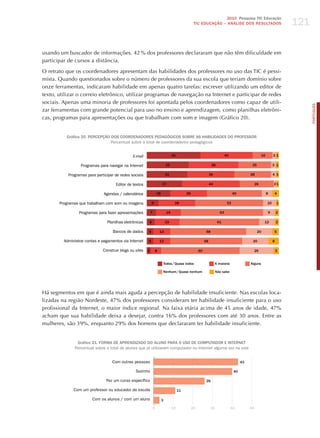
                                      Enviar vídeos educativos 4        8         11       11                                     66
                                                    pela Internet
                                        Participar de grupos de 4       10           12       12                                   62
                                     discussão de professores
                    Fazer download de programas educativos 3           10              18          14                                   55
                          da TV para mostrar em sala de aula
                               Criar projetos de colaboração e 1 2 3 7                                                  87
                  comunicar-se com alunos de outros países

                                                                    Todos os dias ou quase       Pelo menos uma vez por semana          Pelo menos uma vez por mês

                                                                    Menos de uma vez por mês     Não costuma realizar esta atividade
125
                                                                             2010 Pesquisa TIC Educação
                                                              TIC EDuCAÇÃO – ANÁLISE DOS RESuLTADOS


Múltiplas fontes encontradas na rede são usadas na preparação de aulas. Os professores costumam
consultar o projeto pedagógico da escola (72%), o MEC (45%), material de apoio de outras fontes
(39%) e materiais de apoio da Secretaria da Educação municipal ou estadual (37%). Os portais espe-
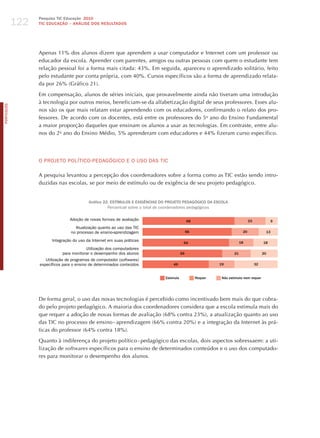
cializados para professores, como o do MEC, são acessados com relativa regularidade.

Uma faceta ainda pouco explorada das TIC são os conteúdos audiovisuais. Apenas uma minoria de
professores baixa programas educativos da TV ou conteúdos audiovisuais (som, imagens, fotos, fil-
mes, músicas) voltados para a prática pedagógica (apenas 31% e 48%, respectivamente, fazem isso


                                                                                                                PORTuGuÊS
ao menos uma vez por mês). O e-learning também é pouco explorado, como já mencionado: apro-
ximadamente um em cada cinco disse participar pelo menos uma vez por mês de cursos a distân-
cia. Da mesma forma, apenas um quarto participa de grupos de discussão de professores na Internet
ao menos uma vez ao mês.


ATIvIdAdES dE APRENdIzAGEm

A rotina diária das salas de aula fundamenta-se principalmente em práticas que mantêm o profes-
sor como figura central da dinâmica de aprendizagem, como o transmissor de conhecimento, fonte
primária de informação, controlador e direcionador de todos os aspectos da aprendizagem. As ati-
vidades mais frequentes, que definem o cotidiano escolar nas escolas públicas, são exercícios de
prática do conteúdo, aula expositiva e interpretação de texto.

Em geral, essas atividades não se alteram em função de fatores como renda pessoal do professor,
série e região. Contudo a aula expositiva apresenta um índice maior na região Sudeste, onde 65%
dos professores de escolas públicas realizam essa atividade praticamente todos os dias ou quase. A
região Sul é a que apresenta um percentual maior de atividades de interação com os alunos: 45%
dos professores realizam pesquisa de informações em livros, revistas e Internet pelo menos uma vez
por semana, 8 pontos percentuais de diferença (Gráfico 26).

Atividades que inserem o aluno como agente na dinâmica de aprendizagem em sala de aula,
como debates, jogos educativos e produção de materiais pelos alunos, apresentam uma frequência
significativamente menor que aquelas centradas no professor e que, muitas vezes, sequer são rea-
lizadas em sala.

Ensinar os alunos a usar o computador e Internet é a atividade menos frequente. Apesar disso, 40%
dos professores se dispõem a contribuir para desenvolver o conhecimento dos alunos em relação às
tecnologias, mesmo que em uma frequência baixa como “menos de uma vez por mês”.
126
                  Pesquisa TIC Educação 2010
                  TIC EDuCAÇÃO – ANÁLISE DOS RESuLTADOS


                         Gráfico 26. ATIvIDADES COM OS ALuNOS – FREquÊNCIA DE uSO DO COMPuTADOR E DA INTERNET PELO PROFESSOR
                                             Percentual sobre o total de professores que costumam realizar a atividade


                             Exercícios para prática e fixação do conteúdo                                               74                                              16                5 3 3

                                                            Aula expositiva                                    55                                       20               13               6        5

                                                   Interpretação de textos                                    54                                        25                   7        5       10

                                     Apoio individualizado a alguns alunos
                                                                                                     42                                       28                   12            7            11
                            para que possam alcançar o restante do grupo
PORTuGuÊS


                    Organizar, acompanhar e apoiar atividades em grupo e               19                                34                             26                       13            8
                                    trabalho colaborativo entre os alunos
                  Pesquisa de informações em livros, revistas e/ou Internet           15                            37                                   30                       11           7

                                       Produção de materiais pelos alunos             15                            36                                  28                       13            7

                                     Projetos ou trabalhos sobre um tema          10                          34                                   35                            14            7

                                  Realização de debates e apresentações           8                  24                                  40                             18                    10
                                    feitas pelos alunos para toda a turma
                  Conversar com pais sobre como eles podem apoiar e moni-
                                                                              6            12                            36                                   35                              12
                  torar a aprendizagem dos filhos e oferecer aconselhamento

                                                 Realizar jogos educativos    5                 22                            30                         21                           22

                                                  Experiências de ciências    5             17                      20                  16                          42

                              Organizar e / ou mediar a comunicação entre
                                                                              5        11                 18                       25                                   41
                            alunos e especialistas e orientadores externos
                                             Contribuir com a comunidade
                                                                              3       10                      26                             29                              32
                                           por meio de projetos temáticos

                           Ensinar os alunos a usar computador e Internet 2            17                 9          12                                       59


                                                                                  Todos os dias ou quase                      uma vez por semana              Pelo menos uma vez por mês

                                                                                  Menos de uma vez por mês                    Não utiliza


                  USo dA TECNoLoGIA NA ESCoLA

                  Para o aluno, a escola é o local menos frequente de acesso à tecnologia: apenas 2% dos alunos o
                  fazem todos os dias. Mesmo assim, para 25% dos alunos, a escola é uma oportunidade de acesso à
                  Internet, onde utilizam computador e Internet pelo menos uma vez por semana.

                  A frequência de uso da tecnologia na escola é maior entre alunos de escolas municipais (30% o
                  fazem ao menos uma vez por semana, contra 18% das estaduais) e no 5o ano do Ensino Fundamental
                  (31% utilizam tecnologia ao menos uma vez por semana, 24% do 9o ano do Fundamental e 17%
                  do 2o ano do Ensino Médio).

                  Observa-se que, de acordo com as respostas dos professores, nas atividades mais presentes no dia
                  a dia com os alunos, como aula expositiva, interpretação de texto e exercícios de prática e de fixa-
                  ção do conteúdo, a incidência de uso do computador e da Internet é ainda bastante baixa. Ademais,
                  o potencial de comunicação da Internet é pouco explorado, uma vez que conversar com os pais e
                  organizar / mediar a comunicação entre alunos e orientadores externos estão entre as atividades em
                  que os professores menos utilizam tecnologias (23% e 20%, respectivamente).

                  Em geral, são os professores mais jovens que mais usam computador e Internet nas atividades rea-
                  lizadas com os alunos. Outro fator que influencia o uso de tecnologias pelos professores em ativi-
                  dades com os alunos é sua renda – pessoal e familiar.
127
                                                                                                         2010 Pesquisa TIC Educação
                                                                                          TIC EDuCAÇÃO – ANÁLISE DOS RESuLTADOS


Escolas públicas localizadas na região Sul apresentam maior utilização das tecnologias pelo profes-
sor em atividades com os alunos. Um exemplo é a pesquisa de informações utilizando o computa-
dor e a Internet, que, nas escolas do Sul, é praticada por 56% dos professores, enquanto o percen-
tual nacional é de 44%.

A busca de informações é uma atividade de certa frequência em sala de aula (82% dos docentes
a desenvolvem até uma vez por mês) e com o mais alto percentual de uso das tecnologias (44%).
Projetos ou trabalhos sobre um tema são a terceira forma mais corrente de uso em sala de aula: 79%


                                                                                                                                            PORTuGuÊS
dos professores a promovem, e em 43% dos casos usa-se computador (Gráfico 27).


              Gráfico 27. uSO DO COMPuTADOR E DA INTERNET PELO PROFESSOR EM ATIvIDADES COM OS ALuNOS
                            Percentual sobre o total de professores que costumam realizar a atividade


           Ensinar os alunos a usar computador e Internet                            66                                      34

 Pesquisa de informações em livros, revistas e/ou Internet                      44                                      56

                     Projetos ou trabalhos sobre um tema                        43                                      57

                      Produção de materiais pelos alunos                   35                                      65

                                 Realizar jogos educativos                 32                                  68

                                 Experiências de ciências             28                                      72

                             Contribuir com a comunidade
                                                                      26                                      74
                           por meio de projetos temáticos

                                           Aula expositiva        24                                      76


             Exercícios para prática e fixação do conteúdo        23                                      77

                                   Interpretação de textos        23                                      77

            Organizar, acompanhar e apoiar atividades em
                                                                  23                                      77
            grupo e trabalho colaborativo entre os alunos
                          Realizar debates, apresentações
                                                                  22                                      78
                     eitas pelos alunos para toda a turma
Organizar e/ou mediar a comunicação entre alunos e espe-         20                                      80
                         cialistas e orientadores externos
   Apoio individualizado a alguns alunos para que possam
                                                                 18                                      82
                              alcançar o restante do grupo
Conversar com pais sobre como eles podem apoiar e moni-      8                                      92
torar a aprendizagem dos filhos e oferecer aconselhamento

                                                                                             Sim         Não


Os alunos confirmam que ainda há dificuldades no uso das tecnologias para a aprendizagem,
embora a maioria já esteja utilizando as TIC para esse fim. há ainda uma parcela de estudantes que
jamais aproveitou as TIC para realizar mesmo as atividades escolares mais simples e habituais. 22%
dos alunos nunca usaram computador ou Internet para fazer trabalhos sobre um dado tema (por
exemplo, aquecimento global ou Dia das Mães), sendo que em escolas públicas da região Nordeste
esse percentual sobe para 36%, o mais alto do país.

Em nível nacional, 71% dos alunos fizeram pesquisa escolar utilizando o computador e a Internet
– na região Sul, a proporção é de 80%, e no Nordeste, 62%. Fazer lição ou exercícios pelo com-
putador ou Internet é uma atividade que nunca foi desempenhada por 41% dos alunos brasileiros.
128
                  Pesquisa TIC Educação 2010
                  TIC EDuCAÇÃO – ANÁLISE DOS RESuLTADOS


                  A proporção de alunos que nunca utilizaram o computador ou a Internet para outras atividades
                  escolares é reveladora do uso limitado que as tecnologias têm na prática diária das atividades de
                  ensino/aprendizagem na escola pública brasileira. Cerca de 69% dos alunos nunca fizeram uma
                  experiência de ciências com auxílio das TIC; 55% nunca as empregaram para fazer apresentações
                  para a classe; 42% jamais jogaram jogos educativos; e nada menos que 82% nunca se comunica-
                  ram com o professor pela rede. Esses indicadores ilustram que, apesar de as políticas públicas vol-
                  tadas para a integração das TIC nas escolas públicas estarem em vigor há cerca de quatorze anos, o
PORTuGuÊS


                  alcance de seus objetivos maiores ainda encontra-se em fase inicial.


                  méTodoS dE AvALIAÇÃo

                  Provas, exames escritos, tarefas, exercícios e apresentação de trabalhos para a classe são menciona-
                  dos como métodos de avaliação pela quase totalidade dos professores. Muitos devem utilizar uma
                  combinação dessas formas de avaliação. é interessante observar que mais da metade dos professo-
                  res valoriza o uso, pelos alunos, de vídeos, imagens e sons em trabalhos ou apresentações que con-
                  duzem a avaliações (Gráfico 28).


                                   Gráfico 28. MéTODOS DE AvALIAÇÃO uTILIzADOS PELOS PROFESSORES COM OS ALuNOS
                                                         Percentual sobre o total de professores


                                     Provas e exames escritos                              99                             1


                                   Tarefas e exercícios escritos                           99                             1


                       Apresentação de trabalhos para a classe                          94                            6


                                Uso de vídeos, imagens e sons                 64                                 36
                                 em trabalhos e apresentações

                                                                                     Sim        Não


                  O computador ainda está longe de constituir ferramenta para a realização de atividades de avalia-
                  ção nas escolas públicas brasileiras, mas já se podem observar tentativas nessa direção. Chega a
                  10% a proporção de professores que utilizam o computador para aplicar provas e exames escritos,
                  e 22% avaliam seus alunos por meio de tarefas e exercícios escritos com o auxílio do computador.
                  Entre os professores que adotam apresentação de trabalhos para a classe como método de avalia-
                  ção, 47% indicam o uso de tecnologia para integrar recursos multimídia como vídeos, imagens e
                  sons em trabalhos ou apresentações para a classe.

                  Professores do Ensino Médio valorizam mais o computador, tanto para a apresentação de trabalhos
                  para a turma (41%) quanto para a integração de vídeos, imagens e sons em trabalhos ou apresen-
                  tações. Nesse nível de ensino, 59% dos professores valorizam a utilização de tecnologia na ava-
                  liação. O mesmo ocorre com os professores de escolas públicas localizadas na região Sul: 44%
                  valorizam o uso do computador para apresentação de trabalhos para a classe, e 59% dão valor à
                  integração de vídeos, imagens e sons em trabalhos ou apresentações (Gráfico 29).
129
                                                                                     2010 Pesquisa TIC Educação
                                                                      TIC EDuCAÇÃO – ANÁLISE DOS RESuLTADOS


                    Gráfico 29. MéTODOS DE AvALIAÇÃO PELO PROFESSOR uTILIzANDO O COMPuTADOR
                                        Percentual sobre o total de professores


                   Provas e exames escritos      10                         90


                 Tarefas e exercícios escritos        22                         78


     Apresentação de trabalhos para a classe               31                          69


                                                                                                                        PORTuGuÊS
              Uso de vídeos, imagens e sons                     47                          53
               em trabalhos e apresentações

                                                                     Sim         Não


A atividade menos tradicional de avaliação – isto é, valorizar a integração de vídeos, imagens e sons
em trabalhos e apresentações – recebe certa influência dos fatores gênero e faixa etária dos pro-
fessores. Enquanto 44% das professoras fazem uso dessa ferramenta, mais da metade dos professo-
res (56%) a utiliza. Além disso, 56% dos educadores com até 30 anos de idade adotam, com fre-
quência maior, formas de avaliação mais intensivas em tecnologia. Professores do 5o ano do Ensino
Fundamental e aqueles de escolas públicas localizadas na região Nordeste são os que menos utili-
zam métodos de avaliação com maior componente tecnológico.


LImITAÇõES PERCEBIdAS PARA o USo dAS TECNoLoGIAS NA ESCoLA

Da perspectiva do professor, a principal limitação percebida para maior uso das TIC na escola é
seu nível de habilidade tecnológica mais baixo quando comparado ao do aluno. Grande parte dos
professores (64%) concorda totalmente que os alunos da escola sabem mais sobre computador e
Internet do que o docente.

Essa opinião surgiu com intensidade inclusive entre professores de faixa etária mais jovem, e foi
maior no segmento dos que lecionam no 2o ano do Ensino Médio (70%). No total, perto de um em
cada quatro mestres acredita não entender o suficiente para usar as novas tecnologias na escola –
no caso do Nordeste, chega a um terço.

O professor também rejeita a ideia de que desconheça os usos da tecnologia em atividades de ensi-
no/aprendizagem. 80% discordam totalmente da afirmação de que não sabem de que forma ou para
quais atividades podem usar o computador e a Internet na escola.

Pouco mais de um terço dos professores considera que o uso mais intenso das TIC na escola pode
produzir uma sobrecarga de informação para os alunos – informação essa, muitas vezes, de nature-
za duvidosa –, o que consideram um fator que reduz um maior aproveitamento das TIC no ambien-
te escolar (Gráfico 30).
130
                  Pesquisa TIC Educação 2010
                  TIC EDuCAÇÃO – ANÁLISE DOS RESuLTADOS


                             Gráfico 30. BARREIRAS PERCEBIDAS PELO PROFESSOR PARA MAIOR uSO DA TECNOLOGIA NA ESCOLA
                                                         Percentual sobre o total de professores

                          Os alunos sabem mais sobre computador
                                                                                      25                                    39               8          13             14   1
                                      e Internet do que o professor
                         Com a Internet, os alunos acabam ficando
                                                                           8                       27                   9              24                     31
                                   sobrecarregados de informação
                                       Não confio nas informações
                                                                   2                       29                     11                   29                         28
                                              contidas na Internet
                                 Com a Internet, os alunos acabam
PORTuGuÊS


                                                                           7                   24                 9               25                         35
                                 perdendo contato com a realidade
                                        Acredito mais nos métodos
                                                                       6                   22                    13                27                        33
                                             tradicionais de ensino
                                        Não entendo de computador
                                                                           9               15           7              16                          53
                         e Internet o suficiente para usar na escola
                                       De modo geral, tenho receio
                                                                       3         12            7            16                                62
                                                de usar a Internet
                       Não sei de que forma ou para que atividades 3            9          7            18                                   62                             1
                       posso usar computador ou Internet na escola

                                                                               Concorda totalmente                    Concorda em parte     Não concorda nem discorda

                                                                               Discorda em parte                      Discorda totalmente   Não Sabe


                  Os docentes revelam confiança em sua capacidade para o uso de computador e Internet. Mais da
                  metade (58%) dos professores acredita que seu nível de habilidade com o computador é suficien-
                  te para suas necessidades pessoais, e 63% acham ser suficiente ou mais do que suficiente para as
                  necessidades relacionadas ao trabalho. Essa segurança encontra respaldo na descrição das princi-
                  pais atividades que o professor realiza em sala de aula, como visto anteriormente. é possível que a
                  maior parte das atividades diárias do professor exija um domínio mínimo de equipamentos infor-
                  máticos, o que pode levar os docentes de escolas públicas no Brasil a pensar que seu nível de alfa-
                  betização digital é certamente suficiente para atender às necessidades da prática em sala de aula.

                  Não chegou a um terço a proporção de professores que acreditam mais nos métodos tradicionais
                  de ensino, que desconfiam das informações contidas na Internet e que têm receio generalizado de
                  usá-la. Apenas 12% disseram não saber como ou para que usar as TIC na escola.

                  As opiniões dos diretores seguem a mesma direção, sugerindo que é pequena a parcela de educa-
                  dores que manifestam abertamente resistência ao avanço das novas tecnologias na educação. Maior
                  proporção de diretores, comparada à de professores, sente-se capaz de usar computador e Internet
                  na escola. Enquanto 24% dos mestres consideram não entender o suficiente para usar as TIC na
                  escola, somente 14% dos diretores têm essa percepção. Eles acreditam menos nos métodos tradi-
                  cionais de ensino do que os professores (17% dos diretores e 27% dos professores); e, tanto quanto
                  o professor, consideram saber de que forma usar o computador e a Internet na escola.

                  Na opinião de diretores, professores e coordenadores pedagógicos, um aspecto limitador do uso das
                  TIC na escola refere-se à infraestrutura. A principal queixa é quanto ao número insuficiente de com-
                  putadores por aluno, que, para 57% dos educadores, limita muito o uso das TIC. A falta de equipa-
                  mento apropriado ao aluno com necessidades especiais é um grande limitador na avaliação de 52%
                  educadores, e equipamentos obsoletos são uma questão limitante para 45% deles.
131
                                                                             2010 Pesquisa TIC Educação
                                                              TIC EDuCAÇÃO – ANÁLISE DOS RESuLTADOS


Ainda encontra-se entre os fatores limitantes ao maior uso das TIC na escola o número insuficiente
de computadores conectados à Internet (para 53% dos educadores, esse fator atrapalha muito). A
baixa velocidade na conexão à Internet é outro limitante (49%). Essas queixas aparecem com inten-
sidade semelhante em todas as regiões do país, independentemente do tipo de dependência admi-
nistrativa da escola e da série em que atua o professor.

Problemas propriamente pedagógicos ou de organização do trabalho aparecem com menor des-
taque. Para 37%, é um grande fator limitante a falta tempo para preparar aulas com maior incor-


                                                                                                                PORTuGuÊS
poração do computador e da Internet. Para 36% dos professores, o que limita maior intensidade
tecnológica na escola é a falta de tempo para cumprir o conteúdo previsto. Por fim, as reclamações
incluem falta de apoio pedagógico (33%), pressão para conseguir boa avaliação de desempenho
(33%) e currículos muito rígidos (24%).


PERCEPÇÃo doS BENEFíCIoS qUE PodEm AdvIR do USo dAS TIC NA ESCoLA

Embora ainda haja um desafio para o avanço das tecnologias nas escolas públicas brasileiras, os
professores já observam ganhos com o uso dessas ferramentas. O mais mencionado é a adoção de
materiais mais diversificados e de melhor qualidade, relatada por 81% dos professores. Também
para coordenadores pedagógicos e diretores, essa tem sido a principal contribuição das TIC para a
prática dos educadores.

Em segundo lugar, destaca-se a adoção de novos métodos de ensino, observada por 80% dos
docentes. Em terceiro, aparece o reconhecimento dos professores de se tornarem educadores mais
eficazes: 74% dos professores apontam esta afirmativa. A avaliação não é afetada pela faixa etária
do professor, mas apresenta variações regionais: 88% dos professores de escolas públicas localiza-
das na região Sul percebem essa evolução, enquanto nas demais regiões o percentual varia de 68%
(Nordeste) a 74% (Sudeste).

Apesar de o professor se sentir preparado para o uso das tecnologias na prática pedagógica, o uso
de computador e Internet nas atividades escolares mostra-se em estágio inicial nas escolas públi-
cas. Isso porque as atividades mais frequentes no cotidiano pedagógico apresentam baixa intensi-
dade de uso das TIC.


CoNSIdERAÇõES FINAIS

O estudo encontrou evidências que sugerem, nessa primeira década do século XXI, a existência de
grandes desafios para integrar as TIC à educação, apesar dos esforços em disponibilizar a infraes-
trutura de computador e Internet às escolas públicas no Brasil. O desafio se divide em duas verten-
tes: garantir que a comunidade escolar tenha acesso a infraestrutura tecnológica de boa qualidade
e desenvolver o uso pedagógico dessas ferramentas.

A pesquisa identificou que a o ambiente escolar como um todo e a liderança da escola são fato-
res fundamentais para a integração das tecnologias à educação. A postura dos diretores em face às
132
                  Pesquisa TIC Educação 2010
                  TIC EDuCAÇÃO – ANÁLISE DOS RESuLTADOS


                  tecnologias é elemento central para se compreender limitações e lacunas no diálogo entre as TIC e
                  a prática pedagógica.

                  Os atores escolares foram convidados a definir o grau de prioridade que atribuem a várias iniciati-
                  vas relacionadas a inovações tecnológicas na escola. Na visão dos diretores, desenvolver as com-
                  petências tecnológicas de professores e alunos é ação mais importante do que aumentar o número
                  de computadores ou aprimorar o acesso à Internet. Para coordenadores pedagógicos e professores,
                  a prioridade é resolver questões de infraestrutura, que, para eles, constituem a principal limitação
PORTuGuÊS


                  ao uso das TIC no processo pedagógico.

                  Na visão dos gestores, falta apoio pedagógico para aprimorar o uso de computador e Internet nas
                  atividades escolares. Na visão de professores e coordenadores pedagógicos, o que falta é suporte
                  técnico, aspecto de infraestrutura.

                  Na visão dos diretores, questões relacionadas a organização do trabalho, como tempo insuficiente
                  para preparação de aulas, pressão para cumprir a grade curricular e para conseguir bons resultados
                  nas avaliações, atrapalham com mais intensidade a integração tecnológica às atividades escolares.

                  A pesquisa mostra que acesso ampliado de alunos e professores a computadores é visto como fun-
                  damental para aumentar as chances de eles desenvolverem suas habilidades tecnológicas. é pre-
                  ciso, portanto, atenção especial para as restrições de acesso aos computadores nas escolas. Nesse
                  sentido, verificou-se que, nas escolas em que os alunos não têm acesso a computadores, aumen-
                  tar o número de equipamentos por aluno é citado como alta prioridade mais frequentemente que
                  naquelas em que há acesso dos alunos aos equipamentos. Outra queixa frequente é o número insu-
                  ficiente de computadores conectados à Internet – uma possível justificativa para restringir o acesso
                  dos alunos –, que é mais frequente em escolas com limitação de acesso do que naquelas em que
                  isso não ocorre.

                  Em suma, a figura central da pesquisa, o professor, surge como um profissional que, embora tenha
                  conquistado seu espaço, ou seja, consolidado sua atividade como profissão e se desenvolvido aca-
                  demicamente, ainda enfrenta condições precárias de trabalho, expressas em sua jornada, em seu
                  salário, no tipo de apoio para a aquisição de equipamentos e, sobretudo, para o desenvolvimen-
                  to profissional. Essas características impactam a incorporação das tecnologias ao processo de ensi-
                  no/aprendizagem. A formação inicial dos docentes aparece como um tema relevante, uma vez que
                  esses professores, estando em exercício há mais de quinze anos, entraram no magistério em épo-
                  ca anterior à difusão das TIC na sociedade e, certamente, não tiveram, em seus cursos superiores, a
                  oportunidade de serem formados no uso das tecnologias para a prática docente. Além disso, as con-
                  dições de trabalho impedem que professores se atualizem ou se especializem.

                  Dessa perspectiva, não se pode esperar que o professor, sozinho, promova possíveis mudanças no
                  paradigma da educação, incluindo a escola na cultura digital.
english
135
                                                                              2010 Survey on ICT Education
                                                                                              FOREWORD


FoREWoRd

As you set out for Ithaka
hope your road is a long one,
full of adventure, full of discovery.
(...)
Better if it lasts for years,
so you’re old by the time you reach the island,
wealthy with all you’ve gained on the way,
not expecting Ithaka to make you rich.


Ithaka gave you the marvelous journey.
Without her you wouldn’t have set out.
She has nothing left to give you now.

(Konstantínos Kaváfis, Ithaca)
Translation by Edmund Keeley & Philip Sherrard


When the NIC.br officially began its operations in 2005, the resources collected by the Registro.br –
the body in charge of domain name registry activities and distribution of IPv4 and IPv6 in Brazil
– enabled the CGI.br to expand its initiatives for the Brazilian Internet community. In this scenario,


                                                                                                                   English
the Cetic.br was created, within the NIC.br, to map out the ownership and the use of ICT, as well
as to produce a picture of the Internet in the country. The Cetic.br is one of the most significant and
consequential results of the use of CGI.br’s resources for the benefit of society.

Other key initiatives have been strengthened, such as the creation of Internet exchange points (IXPs)
in the country, free distribution of the official time in Brazil via NTP (Network Time Protocol), the
Last Mile Traffic Measurement System (Simet), the dissemination and “preaching” of the use of the
IPv6 protocol, through events and courses managed by the Ceptro.br, another body of the NIC.br.
Concerning Internet security projects, between those conducted by the Cert.br we highlight the
security booklet, specialized international standard courses, and the project to map out spam in
the country, namely honeypots. Furthermore, fostering the awareness of the importance of open
standards to ensure the growth of the Web, based on guidelines to create an inclusive and democratic
Internet, is an important role of the W3C.br, the Brazilian branch of the W3C.

One of CGI.br’s main roles is to ensure continuity of the activities of the NIC.br, as a means of
reinstating its commitment to reinvest in the Brazilian Internet community the resources generated
by domain name registry under the .br domain. Furthermore, the ongoing growth of the number
136
                Survey on ICT Education 2010
                FOREWORD


                of registry names, which has reached 2.5 million in june 2011, enables the NIC.br to become
                more prominent as a reference in the country and abroad, through the expansion of a series of
                projects aimed at supporting the development of the Internet in the country. The survey on the use
                of ICT in Brazil, in its sixth edition this year, and the new survey on ICT in the Brazilian education
                system, both conducted by the Cetic.br, are examples of the NIC.br’s commitment to produce and
                share knowledge on the Brazilian network and to produce supporting data for the design of public
                policies based on a more detailed and thorough understanding of the Internet in Brazil.

                Fair winds!


                                                                             Demi Getschko
                                                              Brazilian Network Information Center – NIC.br
English
137
                                                                             2010 Survey on ICT Education
                                                                                          PRESENTATION


PRESENTATIoN

Since its inception in 1995, the Brazilian Internet Steering Committee (CGI.br) coordinates key
projects for the development and operation of the Internet in the country. Among its numerous roles
and responsibilities, the CGI.br promotes the collection, compilation and sharing of information,
analyses, indicators and statistics on information and communication technologies (ICT) in Brazil,
particularly the Internet. Several research projects are conducted through its Center of Studies
on Information and Communication Technologies (Cetic.br), and are aimed at measuring and
monitoring the progress of ICT in the country.

Statistics produced by these projects aim to contribute to the debate about ICT in the country. Also,
the surveys are becoming increasingly more popular due to their methodological rigour and their
valuable contributions to the public and private sectors, to non-governmental organizations and to
the scientific and academic community.

We are glad to verify that public managers use the results of CGI.br’s surveys to design governmental
strategies and public policies that meet the needs of the Brazilian population regarding critical
aspects of society, such as digital inclusion, the use of ICT in education, universalization of
broadband connections, regulation of LAN houses, among others. These results are also broadly
used by scholars to design academic research projects, and by private organizations to identify
trends in the Brazilian technological scenario.

Committed to the goal of creating a reference center for statistics and indicators on the ownership


                                                                                                                  English
and use of ICT in the country, the CGI.br presents the sixth edition of the Survey on the use of
information and communication technologies in Brazil – ict households and ict enterprises, as
well as the first edition of the Survey on the use of information and communication technologies in
Brazilian schools – ict education.


                                                          Hartmut Richard Glaser
                                             Brazilian Internet Steering Committee – CGI.br
139
                                                                              2010 Survey on ICT Education
                                                                                           INTRODuCTION


INTRodUCTIoN

The new information and communication technologies (ICT) have lately created, with increasing
intensity and speed, new possibilities for different sectors of society, in the economic, social,
political and cultural fields. Furthermore, they are revolutionizing key aspects of the routine of
individuals, organizations and governments. Assessing how these technologies affect society is
a requirement for monitoring the progress and development of the information and knowledge
society. International organizations, such as the United Nations (UN), the Organization for Economic
Cooperation and Development (OECD), and the World Bank, among others, work collaboratively
to produce methodologies, indicators and metrics to measure access, use and appropriation of new
technologies, essential for the development of the information society.

Granting universal access to education is one of the aims of the UN Millennium Development
Goals program, and ICT play a key role in this process. hence, the challenges to ensuring the
appropriation of new technologies in education must be known, as well as the impacts caused by
the use of ICT in classrooms.

Although the government has invested resources in ensuring the broad use of ICT in education, the
results of this use in meeting the goals and targets of educational programs are, however, virtually
unknown. hence, creating a database of relevant and credible knowledge is paramount to the
decision making and design of public policies for the use of ICT in educational programs. This was
the primary driver for this Survey on the Use of Information and Communication Technologies by


                                                                                                                   English
Brazilian Schools - ICT Education 2010.

Two approaches have been adopted in the survey in order to address this challenge. The first
approach is comprised of a longitudinal qualitative module, in which 12 schools will be monitored
over four years, starting in 2010 and finishing in 2013, with two annual visits for observation,
monitoring the changes in broadband access and its impacts on teaching practices. Results of this
study will be analyzed and published in the future.

The second stage comprises a quantitative sample, which is presented in this publication. Thus,
another research project is added to the Cetic.br portfolio, along with the widely known annual surveys
on the use of information and communication technologies – ICT households and ICT Enterprises,
of the Brazilian Internet Steering Committee (CGI.br). Cetic’s surveys have been contributing to the
public, private and academic sectors by substantiating the debate on the development of ICT in
the country. Inspired by the concept of ICT4DEV (Information and Communication Technologies
for the Development), these surveys are not only aimed at outlining ICT appropriation, but also
at creating a historic series of relevant indicators, which enable in-depth analysis of access and
use of new technologies, particularly the Internet. This produces valuable contribution to a better
140
                Survey on ICT Education 2010
                INTRODuCTION


                understanding of the several ways in which the ICT impact Brazilian society, specifically education,
                in this case.

                In the public sector, the statistics produced by the Cetic.br surveys contribute to the debate about
                public policies, particularly those related to digital inclusion, such as the National Broadband Plan,
                the Broadband in Schools and the Community Telecenters programs, etc. There are several inequalities
                in the Brazilian socioeconomic scenario, and solving these issues is a great challenge to the design
                of public policies. Public policies in this field have focused on access to ICT and infrastructural
                development, but little has been discussed about active participation, skills development, digital
                literacy of citizens, and now also of teachers, directors of studies and principals.

                Data from the ICT Education survey are an important contribution to the debate on appropriation
                of ICT by school players, and to the debate about key challenges to enabling its effective use in the
                educational process.

                In the private sector, Cetic.br’s surveys have been increasingly used by companies operating in the
                telecommunications, media and Internet industries to monitor trends, particularly in Internet usage
                and applications, such as social networks, electronic commerce, entertainment, education, among
                other themes monitored by the surveys. In the academic sector, the number of publications, master’s
                and doctorate dissertations and scientific articles using data from the surveys has also increased in
                recent years. hence, the CGI.br’s data is notably legitimated by social players from the government,
                the private sector, the third sector and the academia.

                In line with the tradition of Cetic.br’s publications, an analysis of the main indicators of the ICT
                Education is presented, in order to create a comprehensive scenario of the use of new technologies
                in public schools of the country. We hope this reading prompts its readers to reflect upon the
                challenges to the effective appropriation of ICT in schools and the implications of their introduction.

                In 2010, the Cetic.br further extended its role in national and international debates on the design
                of key indicators for ICT. It also increased the involvement of academic experts, governmental
                institutions, and third sector organizations, always complying with the methodological standards
                set forth by the OCDE and the Eurostat (Statistical Office of the European Union), as well as the
English


                international references of the Partnership on Measuring ICT for Development, an initiative that
                brings together, in addition to the aforementioned OCDE and Eurostat, international entities such
                as the UIT, the UNCTAD, UNESCO’s Institute of Statistics, regional UN agencies and the World
                Bank. Thus, the results presented by our surveys are consistent and credible, enabling comparability
                between the Brazilian reality and the reality of other countries.

                Countries on every continent have been investing in the use of ICT in schools and innovation in
                pedagogical processes; ICT equipment infrastructure, Internet access, professional development
                and the creation of digital learning content are a few examples of these investments.

                In order to achieve its goals, the ICT Education Survey interviewed a sample of 500 public schools,
                interviewing principals, directors of studies, teachers and students, seeking to represent the Brazilian
                scenario of education and the use of technologies. According to this proposal, the work was based
                on international references, such as InfoDev (World Bank), the IEA (International Association for
                the Evaluation of Educational Achievement) and Sites 2006 (Second Information Technology in
                Education Study).
141
                                                                              2010 Survey on ICT Education
                                                                                           INTRODuCTION


In its first edition, the Survey on the Use of Information and Communication Technologies in
Brazilian Schools – ICT Education 2010 has been structured as follows:

Part 1 – Articles: texts written by guest scholars, approaching relevant themes from different
perspectives. The articles cover, among other themes, digital natives, the role of education in social
development, initial teacher formation, challenges, the current scenario, ethics and security.

Part 2 – ict education: methodological report, outline of the sample plan and analysis of the main
results of the survey.

Part 4 – ict education tables: all indicators for teachers, central players in the school survey, with
their respective tables of results, divided by independent variables.

Part 5 – Appendixes: glossary of terms used in the survey, to facilitate reading.

Undertaking this survey demands a lot of time and resources, but the effort is a source of great
enthusiasm and satisfaction for the entire Cetic.br team. hence, we hope that the data and analyzes
of this publication prompt important reflections and debate, and are broadly used by public
managers in charge of designing the future of the information and knowledge society in Brazil. We
furthermore hope they continue to function as a basis for scientific and academic works, helping
public and private schools and organizations in the third sector in the monitoring of Brazilian
education.


                                                           Alexandre F. Barbosa
                                                   Center of Studies on Information and
                                                  Communication Technologies – Cetic.br


                                                                                                                   English
1
                                          143
           2010 Survey on ICT Education
                             ARTICLES


ARTiCles


                                                English
144
                Survey on ICT Education 2010
                ARTICLES
English
145
                                                                                               2010 Survey on ICT Education
                                                                                                                 ARTICLES


ovERvIEW oF ThE USE oF dIGITAL INFoRmATIoN
ANd CommUNICATIoN TEChNoLoGIES

Maria da Graça Moreira da Silva 1 and Maria Elizabeth Bianconcini de Almeida 2


FoREWoRd

Massive changes in social structures caused by advances in science and technology have transformed
communication, social relations, labor, economy and entertainment. Distances have been shortened,
boundaries have been pushed and the world has become globalized. Media and technologies are in
turn related to all of these transformations.

Society, typically rural at the start of the 20th century, migrated to urban spaces in the 1970s and
was profoundly transformed during this movement. At the end of the 20th century and beginning
of the 21st century the spread of the use of digital information and communication technologies
(DICT) transformed space and time relationships, boosting functional mobility and increasing
the momentum of changes in work structures, knowledge production and education, uncovering
the need to prepare individuals to live and work in the technology society.


                                                                                                                                      English
Inclusion of the population in the technology society became key to countries willing to be part
of the globalized world and to overcome the digital gap (Castells, 2003) due to social inequalities,
which led to the design of public policies for digital inclusion, including initiatives to use
technologies in schools.

hence, the cyberculture creates new possibilities for individuals to operate in different contexts,
with different media, enabling a network of connections between the environment where they learn
and the context in which they operate, creating new means of interaction and development for their
views on the world and their culture.


1
    Doctor in Education from the Pontific Catholic University of São Paulo (PUC/SP). Professor at the Department of Computing
    and one of the professors involved in the Postgraduate Program in Education at PUC-SP. The author works as a researcher,
    overseeing projects and courses on the use of technologies and media in education and teacher training.
2
    Doctor in Education from the Pontific Catholic University of São Paulo (PUC/SP), and post-graduate from the University of
    Minho, Portugal. The author is a professor and coordinator of the Graduate Program in Education at PUC/SP. She oversees
    research and development projects on the use of technologies in education and teacher training.
146
                Survey on ICT Education 2010
                ARTICLES


                We are under connection and interconnected to others; our lives are based on a digital world – with
                media and devices in various formats – that creates new applications for communication. We resort to
                communication and information resources on a daily basis; we particularly use Internet technology
                for our transactions, listening to music, watching videos, accessing news, communicating, chatting,
                sharing, and disclosing and producing information.

                In fact, the rise of the Internet promoted the development of a culture of media use, and therefore
                a social configuration based on a digital model of thinking, creating, producing, communicating,
                learning, and even living. In view of this, we can ascertain that these modern times are steered by
                communication and information management. Furthermore, this context is not like that of the early
                days of the Internet in the 1990s, and the use of personal computers at the time.

                In the context of the historical development of media – in which the prominence of radio, television,
                computers and, more importantly, the Internet is marked in our mediatic and information-based
                lives – technological developments, computers and more specifically the Internet are undoubtedly
                the main promoters of our current social structure with an innovative approach to communication
                – the “media culture”, as defined by Santaella (2004). In order to shed light on the current scenario
                of the use of technologies in education, we must first analyze its historical development in Brazil.


                BRIEF hISToRY oF ThE USE oF TEChNoLoGIES IN EdUCATIoN

                The use of computers in education began in 1924 with the invention of a machine that presented
                contents and applied and corrected multiple choice tests – the Pressey Machine (Leigh, 1998).

                In the 1950s educational theories and technologies flourished. Benjamin Bloom created theories
                that prepared teachers to effectively share educational content. Also, prompted by studies by the
                psychologist Skinner, several versions of “teaching machines” were constructed and tested. They
                were based on the concept of individual learning and (positive or negative) sound reinforcement
                immediately after a correct or wrong result, progressive lessons and visual stimulation.
English


                The Computer Assisted Instruction (CAI) model enjoyed great progress as of the 1960s, propelled by
                investments from American companies, such as IBM, and universities, such as Stanford University
                and the University of Illinois.3 It was believed then that the use of computers would revolutionize
                education. At the time, efforts were aimed at converting the content of lessons into software – a
                concept that weakened the role of teachers.

                Over time, computers were used by teachers and educational institutions in different ways, creating
                new proposals based on new approaches to their use, not only programmed teaching.

                In addition to a range of CAIs, the concept of using computers in education originated other
                approaches in which computers were used as tools in problem solving, text production, data base
                manipulation and real-time process control (Valente & Almeida, 1997). Thus, the use of computers


                3
                    The latter, in partnership with a computer manufacturer, created the Plato system, which was a large computer that, at one
                    point, stored and distributed nearly 8 thousand hours of educational materials, through 950 computer terminals spread across
                    140 locations. Plato marked one of the main stages in the history of the use of computers in education (Leigh, 1998).
147
                                                                             2010 Survey on ICT Education
                                                                                               ARTICLES


in education was reviewed, and these devices, former “teaching machines”, became “educational
tools”, i.e. the informative approach became a constructive one. In Brazil, teaching methods based
on this approach were introduced in the second half of the 1980s, inspired by Seymour Papert’s
(1985) ideas, who associated the use of computers with knowledge production through the Logo
programming language, an approach later expanded and adopted in other software that promoted
authorship (Almeida, 2008).

The second half of the 1990s was marked by the beginning of the digital revolution and the rise
of the information society, resulting from technological development which, in turn, was marked
by research and development funded by corporations, the military or the science and education
community.

Use of the worldwide computer web spread across the corporate market, schools and universities,
and pioneering study groups and research projects were created in universities.

The use of technologies in education was largely driven by the popularization of the Internet, and
within a few years there were several projects from different areas of education on the use of digital
information and communication technologies (DICT) for teaching and education. Educators began
to debate and research the new potential impacts of the Internet and digital media in education.
As a consequence, the use of DICTs was intensified in education, and gradually teachers began
to embrace it, which hadn’t happened in previous generations when educational technologies
included the use of radio and TV. We’ll now discuss the new possibilities and trends for the use of
technologies in education in the current scenario.


CURRENT SCENARIo oF ThE USE oF TEChNoLoGIES IN EdUCATIoN

Although a number of projects for the use of technologies in education have been implemented
(Almeida, 2008) from the late 1980s to this day, not all of today’s schools have access to DICTs.
Furthermore, practical observations of the use of DICTs in schools and the literature available on


                                                                                                                  English
the subject reveal that such uses (Valente & Almeida, 1997; Almeida, 2008) are characterized by
isolated activities, not really integrated to the syllabus.

Since technology is viewed as a thought structuring element – from its very conception, even before
it is materialized – integrating it in a significant way to the school syllabus and to educational
practices requires dominating its intrinsic properties, using it in education and teaching practices
and reflecting on when and why to use it, how it is used and how it can contribute to the learning
process and to the school syllabus (Almeida, 2010a, p. 68).

The innovations enabled by these technologies in education require rethinking the fundamental
premises of education and revising them. New learning and virtual environments enabled by
technology systems on the worldwide Web of computers bring teachers and students together in
the cyberspace, and include unprecedented features, which evidences the “educational potential of
information and communication technologies – ICT” (Almeida, 2010b, p. 5).

In addition to being introduced in schools, DICTs must also be integrated in the digital culture, i.e.
all the players involved in the school must be engaged in the cyberculture, which consists in a “set
of techniques (material and intellectual), practices, attitudes, ways of thinking and values” (Lévy,
148
                Survey on ICT Education 2010
                ARTICLES


                2000, p. 17). This must be promoted by the discovery of applications and services provided by
                DICTs, particularly the Internet, such as: Communication with anyone, at any time, from anywhere
                where there is a connection; the many non-linear pathways that can be browsed, through the nodes
                and connections that comprise hypermedia networks; the creation, sharing and publication of ideas
                incorporating different languages; and the production of content in collaboration with others.

                Collaborative production allows teachers and students to have collective authorship, rather than
                solitary classroom production. Content under development may benefit from several contributions
                and the involvement of different authors, evoking new ways of structuring multidimensional, non-
                hierarchical thinking.

                New authors are born, whose work may reach a much wider audience through the network. The
                concept of network is expanded, a simple interconnection between computers becomes a metaphor
                for the organization of the cyberspace (Ramal, 2003), where all voices may be heard, where
                intersubjectivity flows and knowledge is produced collectively.

                With all these possibilities, several initiatives still approach the use of DICTs as teaching machines.
                hence the urgent need to understand how media and technologies articulate in the present contexts
                and in the “actual life of the school”, as asserted by Paulo Freire.

                In the current scenario, the use of technologies in education must not be confused with using
                devices, strategies and tools to make lessons more interesting or dynamic, or even to motivate young
                students (Silva, 2010). Additionally, they must not be used as the former teaching machines, solely
                to provide preset content and tests.

                A quick study reveals that when students come to school, they have already had extensive exposure
                to media and technology, because, as emphasized by Gadotti (2005), students’ first culture is the
                media culture. Regardless of the context in which they live, students bring their everyday experiences
                with different media and technology to school, but they tend to view these as means and devices for
                communication, not as learning resources, tools or interfaces.

                Similarly, educators are in touch with media and technologies on a daily basis, but these are
                usually not introduced in the classroom as tools for the mediatization of teaching, learning and
English


                syllabus enhancement processes. The integration of technologies in the school syllabus depends on
                a number of factors: Implementation of technological infrastructure; access to technologies; digital
                literacy of educators; consistent use policies; integration of all players involved in the universe
                of technologies; among others. hence, for effective integration of media and technologies into
                educational processes, training teachers, managers and other educators is key (Prado & Silva, 2009).

                Thus, we envisage a combination of efforts from public and private education initiatives towards
                gradually implementing access to the Internet and broadband in schools, supplying computer labs
                and mobile computers, increasing the number of teacher and manager training courses, amongst
                other initiatives.

                The increasing and integrated use of information and communication technologies is currently
                prominent in the education scenario, and viewed as a future trend. The use of computers tends
                to increase from few hours in computer labs to something more frequent, in different situations
                and learning environments and through connected mobile devices. This more frequent use is also
                motivated by new possibilities of authorship, collaborative content production with the integration
                of several media, publication, sharing and distribution enabled by Web 2.0 tools, as analyzed below.
149
                                                                             2010 Survey on ICT Education
                                                                                               ARTICLES


WEB 2.0 ANd SoCIAL mEdIA: SoCIAL WEB

Web 2.0 is more than a new technology; it represents a change in how the web itself is used, where
users expand their role of browsing or searching content to also producing and sharing it. It also
means that technological tools will become more accessible and simpler to use, enabling users,
such as teachers and students, to easily post content. According to several authors and researchers,
Web 2.0 is only a second generation of Internet use.

The production potential brought about by the use of technologies enhances the syllabus broadening
process identified in the first generation of the Internet (known as Web 1.0, and focused on providing
information), as Web 2.0 increases the potential for multidirectional interaction and the involvement
of people located in different places with access to DICTs, who are thus able to share information,
solve problems and produce knowledge collaboratively, being co-authors with people from all over
the world.

This increases the involvement of teachers and students as authors and knowledge producers, and
promoters of studies and projects. Interaction and co-authorship are prominent characteristics
of Web 2.0, and are the drivers of several easy-to-use, free or low cost technologies that enable
collaborative production, such as blogs, Wiki, YouTube, among others – the social media.

Resources and interfaces available on Web 2.0 may be viewed as more than mere tools, due to
how easily and flexibly they can be used for collective production and knowledge sharing through
different media (text, sound, image, podcast, video, and etc.), providing services for the creation of
social networks, which are open spaces for ideas and information exchange and meeting points for
communities and studies on topics of interest.

Web 2.0 may also be referred to as Social Web (Isotani et al., 2008), as its use promotes the creation
of social networks – which have emerged from sociology, a science that studies the complex
interactions in social life and epistemological challenges of integrating complexity and diversity
into social processes.

In education, there may be environments where social networks can be created to keep in touch with


                                                                                                                  English
students, former students, and to put them in touch with each other. A few examples are relationship
networks, such as Facebook and Orkut, and other professional networks, such as hi5 and LinkedIn;
communication and interaction tools, such as Twitter; tools for communities for specific practices,
such as Ning, which also aims to integrate the academic community in a metassocial tool; tools for
sharing and exchanging images and videos, such as YouTube; tools for collaborative editing on the
Internet, such as Wiki and GoogleDocs; tools for instant communication, such as MSN and Skype;
network gaming environments; virtual worlds... among numerous other options that, associated
with education, enable authoring, collaborative creation and sharing.


USE oF moBILE dEvICES IN EdUCATIoN: moBILE LEARNING

The combination of Web 2.0 with mobile technologies, such as different types of portable computers
(netbooks, iPads and mobile phones), enables the design of a broad, dynamic and flexible syllabus
150
                Survey on ICT Education 2010
                ARTICLES


                (Almeida, 2010b), fostering connections between different areas of knowledge, the experiences of
                teachers and students and the relationships forged in education.

                Mobility transforms the logics of how and when to learn. The idea of being somewhere to learn or
                learning being anywhere has become the reference in the digital society. There is only one meaning
                to the word mobility, but its potential is twofold – technological, which enables us to use a device
                anywhere, and in terms of content, which relates to information, to where it is located, in which
                being able to access, produce and share it is more important than the facts themselves (Basso, 2003).

                Marçal, Andrade & Rios (2005, p. 3) argue in favor of the use of mobile devices in education for the
                following main purposes:

                    •	Improving teaching resources, using such devices to execute tasks, take notes, look up
                      information online, keep records and other functions;

                    •	Providing access to content anywhere and anytime;

                    •	Increasing access to content, enhancing and promoting the use of the services provided by
                      the institution;

                    •	Broadening the scope of existing teaching strategies through new technologies that support
                      both formal and informal learning;

                    •	Providing means for the development of innovative teaching methods, using computing and
                      mobility resources.

                The use of mobile devices in education, given their possibilities, features and relevance to digital
                inclusion, is known as a mobile-learning (Silva & Consolo, 2008).

                There are important experiences in the development of mobile learning. One of them, led by the
                Brazilian federal government, is known as One Laptop per Student (UCA), which aims to provide
                a laptop per student, teacher and school manager. In this project, students and teachers can use
                laptops connected to the Internet, and this use is not restricted to computer labs or classrooms. The
                project is under way in selected public schools as a trial phase, and is aimed at promoting the digital
English


                and social inclusion of the school community, as well as the use of this technology in teaching
                processes and syllabus enhancement. There are several other initiatives for the use of portable
                computers in public and private education systems.


                FINAL ThoUGhTS ANd CoNCLUSIoNS

                The current scenario points towards the implementation of pedagogical innovations enabled by
                the use of technologies in education, particularly the application of certain concepts and features
                available through innovations, such as Web 2.0, wireless connectivity, mobility and use of individual
                laptops by students. Other virtual environments and tools are also potentially being used and
                explored in education, such as three-dimensional immersive environments (metaverses) and games,
                among other existing or emerging environments.

                The coexistence and integration of these innovations may even be compatible with technologies
                already in use, all converging to enhance innovation in education, which is realized through
151
                                                                                      2010 Survey on ICT Education
                                                                                                        ARTICLES


multidirectional interactions, the creation of networks of knowledge production and co-authorship,
the expansion of teaching spaces and times, and educational techniques using different forms of
writing and languages.

As an ongoing trend, these tools and activities shall also be ingrained in Web 3.0 (Semantics
Web), favoring the so-called collective knowledge systems, “able to support collective knowledge
production through the analysis of collaborative human efforts” (Isotani et al., 2008, p. 6).

Finally, the use of a technology in particular affects how we teach, think and relate to other people,
as well as how the syllabus is conceived and enhanced. Kenski (2007) emphasizes:


       The availability of a particular technology may induce profound changes in how teaching is
       structured [...] there is a direct relationship between education and technology. We use many
       types of technologies to learn and to know more and we need education to learn and to know
       more about technology. (p. 44)


hence, introducing new technologies to teaching methods requires reviewing how the syllabus is
structured.


REFERENCES

ALMEIDA, Maria Elizabeth Bianconcini. “Tecnologias na educação: dos caminhos trilhados aos atuais desafios”.
BolemA – Boletim de Educação Matemática, 29(21), 2008.

______. “Transformações no trabalho e na formação docente na educação a distância on-line”. em Aberto,
Brasília, 23(84), pp. 67-77, Nov. 2010a.

______. Web Currículo, caminhos e narrativas. In: Proceedings of the Second Seminar curriculum web.
Published in CD-ROM. São Paulo: PUC-SP, 2010b.


                                                                                                                           English
BASSO, Maria Aparecida josé. Pedagogia digital na convergência do suporte “e” da educação: uma proposta de
modelo para logística de negócios sob demanda. Doctorate in production engineering. Florianópolis: Graduate
Program in Production Engineering of the Federal University of Santa Catarina, 2003.

CASTELLS, Manoel. “Internet e sociedade em rede”. In Moraes, D. (org.). Por uma outra comunicação. Rio de
janeiro: Record, 2003.

GADOTTI, Moacir. A escola frente à cultura midiática. In: OROFINO, Maria Izabel. mídias e mediação escolar:
pedagogia dos meios, participação e visibilidade. Guia da Escola Cidadã, v. 12. São Paulo: Cortez / Instituto
Paulo Freire, 2005. pp. 15-94.

ISOTANI, Seiji et al. Web 3.0: os rumos da web semântica e da Web 2.0 nos ambientes educacionais. In:
Proceedings of the xix the Brazilian Symposium on computer in education. SBIE, 2008.

KENSKI, Vani Moreira educação e tecnologias: o novo ritmo da informação. Campinas: Papirus, 2007.

LEIGh, Douglas. A Brief history of Instructional Design. In: iSPi global network chapter. 1998. Available at:
http://www.pignc-ispi.com/articles/education/brief%20history.htm.

LéVY, Pierre. cibercultura. Trad. Carlos Irineu da Costa. 2. ed. São Paulo: Editora 34, 2000.
152
                Survey on ICT Education 2010
                ARTICLES


                MARçAL, Edgar; ANDRADE, Rossana; RIOS, Riverson. “Aprendizagem utilizando dispositivos móveis com
                sistemas de realidade virtual”. In renote – revista novas tecnologias na educação, 3(1), Porto Alegre, UFRGS,
                Centro Interdisciplinar de Novas Tecnologias na Educação, May 2005.

                PAPERT, Seymour. logo: computadores e educação. São Paulo: Brasiliense, 1985.

                PRADO, Maria Elisabette Brisola Brito; SILVA, Maria da Graça Moreira. “Formação de educadores em ambientes
                virtuais de aprendizagem”. em Aberto, Brasília, 22(79), pp. 61-74, jan. 2009.

                RAMAL, Andréa Cecília. “Educação com tecnologias digitais: uma revolução epistemológica em mãos do
                desenho instrucional”. In: SILVA, Marco (org.). educação on-line. São Paulo: Loyola, 2003.

                SANTAELLA, Lucia. navegar no ciberespaço: o perfil cognitivo do leitor imersivo. São Paulo: Paulus, 2004.

                SILVA, Marco. Sala de aula interativa. 3. ed. Rio de janeiro: Quartet, 2002.

                SilvA, maria da graça moreira da; conSolo, Adriane treitero. “mobile learning: uso de dispositivos móveis
                como auxiliar na mediação pedagógica de cursos a distância”. in: OSÓRIO, Antonio josé; DIAS, Paulo. Ambientes
                educativos emergentes. Minho: University of Minho, 2008.

                SILVA, Maria da Graça Moreira da. “De navegadores a autores: a construção do currículo no mundo digital”. In:
                Proceedings of the endiPe. Belo horizonte: 2010.

                VALENTE, josé Armando; ALMEIDA, Fernando j. “Visão analítica da informática na educação no Brasil: a
                questão da formação do professor”. revista Brasileira de informática na educação, v. 1, 1997.
English
153
                                                                                                  2010 Survey on ICT Education
                                                                                                                    ARTICLES


ThE ChALLENGES oF EdUCATIoN IN PRomoTING
EThICAL ANd SAFE USE oF ThE INTERNET IN BRAzIL

Rodrigo Nejm1


INTRodUCTIoN

The democratization of Internet access is a hot topic on the agenda of several public policies in
the country, namely the National Broadband Plan and the Broadband in Schools Project. These two
initiatives are attracting millions of new Internet users to the Brazilian Internet, thus quickly creating
an array of new types of cultural, scientific, social and political relationships in our contemporary
society. These policies -in addition to projects to expand public telecenters and to regularize
thousands of LAN houses in Brazil- are forging a new social reality by enabling the creation of
new languages, new meanings and the development of the digital culture. In addition to their fast
rate of development, technologies are incorporated into the lives of Brazilian citizens very quickly,
constantly producing astonishing statistics. Despite data from the ICT households 2009 Survey,
by the Cetic.br, showing that 55% of the Brazilian population has never accessed the Internet,
the aforementioned survey has shown that 69% of the Brazilian population aged between ten and


                                                                                                                                          English
fifteen years old and 78% of youngsters aged sixteen to twenty-four years old have access to the
network. Internet access is a reality for 29% of the children aged five to nine years old, according
to Cetic.br’s ICT Kids 2009 Survey.

We have witnessed profound psychosocial changes in contemporary childhood, adolescence and
youth, driven by several contemporary trends, such as the intense and diverse use of information
and communication technologies (ICT). Undoubtedly, ICT play an important role in transforming
how new generations socialize, learn, communicate and play. Nonetheless, they also drive radical
changes in fields such as consumption, the conflict between generations, labor relations, civil rights
and even politics in some societies. As formerly stated by researcher Sonia Livingstone (2009), we


1
    Psychology graduate from Unesp (Assis-SP) and Master in Social Management and Development from CIAGS/UFBA. Director
    of Prevention at the NGO Safernet, in charge of creating educational materials, courses and research for the prevention of
    Internet crimes against human rights in Brazil. A researcher in the fields of psychology and new media, the author is engaged
    nationally and internationally in research on subjectivities in the age of information.
154
                Survey on ICT Education 2010
                ARTICLES


                cannot base our understanding of society on technologies alone, and overlook other changes in
                work relations, family structure and consumerism amongst children and youngsters.

                Technological resources have been massively and rapidly incorporated into the daily lives of
                new generations of children and teenagers. Even lower social classes have increasingly greater
                access to the Internet, mobile phones and electronic devices for communication, study, work and
                entertainment. When we think about the challenges of ethically and safely introducing the Internet
                into the lives of children and teenagers, we cannot overlook the fact that the cyberspace is a social
                networking space. To this day, several Internet users still view the Internet as a “no man’s land,
                devoid of accountability”, believing that anonymity grants them the freedom to do anything. One of
                the primary challenges in promoting the ethical and safe use of the network is making users aware of
                the public dimension of the cyberspace; a space where people, not just computers, socially interact.
                In this new environment, as well as in any other public spaces, we also need to behave as citizens
                and adopt security measures. There certainly are private spaces in the cyberspace, but the massive
                use of social networks, blogs, cameras and mobile phones is increasingly blurring the boundaries
                between public and private (Livingstone, 2009). Even in private spaces, the approach to the rights
                and duties of citizens/netizens should be appropriate from the first click.

                Digital inclusion policies cannot be restricted to access to technology. Digital inclusion must be
                viewed as a broader educational process that prepares Internet users to approach the network
                critically and to view themselves as citizens, thus enabling internauts to play their role as citizens in
                ICT-enabled social environments. “In a way, the Internet emulates the real world” (Amadeu, 2010).
                Education in the contemporary world requires preparing individuals to dwell in these new cyber
                streets and squares, where younger generations spend a lot of their time. When on the Internet, a
                child accesses a global public space with countless types of information and people, including all
                the benefits and dangers enabled by any public space. There are naturally many more opportunities
                than risks, but similarly to any large and busy public space, there are also different levels of crimes,
                scams and human rights violations in the cyberspace. Children and teenagers, who start using the
                Internet at an increasingly early age, need to be educated to understand its ethical dimension, i.e.
                their rights and duties online, not only for protection, but, more importantly, for emancipation,
English


                enabling them to browse the network autonomously, responsibly and safely.

                Education in Brazil faces enormous challenges in a number of areas, but this should not prevent
                us from incorporating issues related to education for safe and ethical use of the Internet. The small
                proportion of children and teenagers who access the Internet from school – 27% of the children
                aged five to nine years old – ICT Kids 2009; 25% of the children aged ten to fifteen years old and
                17% of the youngsters aged sixteen to twenty-four years old – ICT households 2009 – reveals, in
                part, the role of schools in this process. Despite all the efforts to increase access from public schools,
                Internet use reaches far beyond school walls. The ICT households 2009 has also shown that 61%
                of the children aged between ten and fifteen years old access the Internet from LAN houses. The
                latter play an important role, not only in granting access, but also in promoting socialization, and
                must be viewed as potential protection and education agents, rather than intrinsically dangerous.
                Regarding education for ethical and safe use of the Internet, the actual places of access are not
                the most important factors in the equation, but whether these places provide the conditions to
                educate children and teenagers on how to use the Internet and other ICT. Children and teenagers
                can learn very quickly how to use new digital resources, both devices and online services, but
                education on how to use them ethically requires a broader process of education for citizenship,
155
                                                                                 2010 Survey on ICT Education
                                                                                                   ARTICLES


involving schools, families and society as a whole. The generation gap will not be so prominent
in this process if its approach is centered on education for citizenship, rather than on pragmatic
education for the use of ICT. Educating for citizenship is a collateral goal of educational policies,
and ICT must be urgently incorporated into educational projects, not only as technical resources,
but also as producers of new spaces for socialization, new cultural expressions and mediators in
character-building.

The National Plan for human Rights Education (PNEDh, 2007) and the Ethics and Citizenship
Program, created by the Ministry of Education (MEC) and the National Secretariat for human Rights
(SDh), create opportunities to discuss the issue as a public policy. There is a branch of the PNEDh
dedicated to media, which could steer the incorporation of ICT in the pedagogical approach of
Brazilian educators. Initiatives by the e-Proinfo program, implemented by MEC, are progressing
on educational appropriation, and may be complemented by incorporating the issue of the ethical
use of the Internet, thus empowering schools as citizenship educators for ICT as well. Using these
references and promoting the creation of open educational resources are means by which our young
Internet users can be educated and oriented in schools, LAN houses, at home and on the Internet
itself, by adapting educational content to each socio-cultural context and focusing on the public
aspect of education. Raising educators’ and parents’ awareness seems vital to ensure they are able to
encourage Internet use by children and teenagers based on the perspective of promoting rights, not
just for protection. Ethical use of the Internet foresees that citizens must be fully aware of their rights
and responsibilities, and are able to engage in online relationships respecting multiculturalism and
diversity. The principles of ciberdemocracy (Lemos & Levy, 2010) are in line with the fundamental
principles of human rights, and we cannot conceive a digital culture in which Internet users are not
aware of these.

The Brazilian Constitution prescribes (art. 227) the promotion and protection of the rights of
children and teenagers as an absolute priority. It is evident that, even offline, this priority is not yet
fully enforced, despite significant advances since the Children and Teenager’s Act came into effect
twenty years ago (ECA 1990). Currently, there are intensive measures in force to combat sexual
Internet crimes against children and teenagers, but the issue requires more than what is prescribed


                                                                                                                      English
in art. 227 of the Brazilian Constitution. We must always bear in mind that children and teenagers
are, above all, individuals who have individual rights, not mere targets of security measures. That
is, we must also promote the laws that guarantee their sexual rights, their right to privacy, freedom,
and their right to access the network for entertainment and culture. Not unlike other Internet users,
children and teenagers also need to have their right to autonomous access ensured. Safe browsing
for them need not be a synonym of Internet surveillance and restricted freedom, when security is
viewed as a human right – an inalienable right. This awareness is key to initiatives focused on the
best interests of children and teenagers, because, as individuals with rights, they should not be
passive recipients of ‘aid’, welfare or protectionism from adults and policies. Protection, inside or
outside the Internet, involves balancing the exercise of rights and privacy, freedom and access to
information within limits foreseen to respect the uniqueness of each phase of the development of
children and teenagers. This challenge is even more complex on the Internet, with its increasingly
fluid and dynamic boundaries, restrictions and symbolisms.

Regarding the discussion above, we believe it is paramount to employ efforts to bring forward
measures which can prevent the risks and vulnerabilities of children and teenagers on the Internet
in Brazil.
156
                Survey on ICT Education 2010
                ARTICLES


                RISKS ANd oPPoRTUNITIES IN ThE CYBERSPACE

                The increasing Internet user and usage rates in Brazil are directly proportional to the increasing rate
                of crimes and rights violations, which poses another enormous challenge to education and to the
                system safeguarding children and teenagers today and in the near future. Similarly to other public
                spaces, the Brazilian Internet also hosts crimes and/or violations of human rights, including the
                sexual exploitation of children and teenagers in child pornography networks, public humiliation on
                the Internet (cyberbullying, defamation and libel), promotion of crimes against life, and expressions
                of intolerance towards religious, ethnic and sexual orientation. Even victims who are not physically
                injured are seriously affected by the violence of blackmailing, inappropriate content, exposure and
                self-blaming after traumatic experiences on the Internet. Violent situations are also emulated on the
                Internet, not because it is a more dangerous or unsafe environment, but because it mirrors society
                and it is a product of its users’ behavior. For as long as it is viewed as a parallel environment to
                valid social norms, online rights violations will tend to increase. Society’s challenge is to minimize
                Internet and ICT risks and to maximize their opportunities for all age groups, through combined
                education efforts.

                The use of technologies has maximized several practices of sexual violence in Brazil, increasing
                the need for preventive and effective actions to preserve the dignity of actual and potential victims.
                Internet services have enabled easier exchange and disclosure of illegal content, which have
                escalated to global proportions, such as advertising and selling sex tourism packages and using
                ICT to sexually entice children and teenagers. It is noteworthy that all of these practices enabled
                by ICT are regarded as crimes under the ECA, as per articles 240 and 241. ICT may also be used to
                promote crimes against life, use of illegal drugs, torture and different types of violence, through tips
                and manuals for “beginners”. The volume of racist and homophobic content available is noteworthy.
                The ease with which information is exchanged and people communicate through the Internet
                promotes existing social practices, both those which encourage citizenship and those which violate
                laws and citizens’ inalienable rights.

                The ability to forge virtual identities promotes risk behaviors, maximizing aggressive practices
English


                and bullying amongst children. Violence is magnified when offensive messages reach thousands
                through video, photo and text share websites. Children and teenagers humiliate and are humiliated
                in front of a much wider audience, which includes family members, neighbors and an almost
                unlimited universe of Internet users who can access embarrassing scenes; this is referred to as
                cyberbullying. What is seemingly just a joke for those who initiate, forward and view such material
                may have serious psychosocial consequences to its victims, compromising healthy development.
                Another recent and worrying phenomenon is the so-called sexting, which consists in teenagers
                sending photos of themselves naked or semi-naked to friends and love interests via text messages
                or the Internet. Often the victimized teenager loses control over the image, which spreads through
                the network and may be featured in child pornography websites. Such practice violates articles
                241-A, B and E of the ECA, and evidences the need for education on sexuality and the severity of
                the risks incurred when children and teenagers are not adequately oriented about the dangers of
                online exposure.
157
                                                                               2010 Survey on ICT Education
                                                                                                 ARTICLES


SIGNS oF vULNERABILITY ANd INdICAToRS
oF hUmAN RIGhTS vIoLATIoNS oN ThE INTERNET

The EU Kids Online survey on Internet risks and safety, conducted in 23 European Union countries
by the London School of Economics, with over 23 thousand children between nine and sixteen years
old (Livingstone & haddon, 2010), reveals the dimension of certain online vulnerability situations.
Despite the high rate of Internet dissemination in European countries (over 90% in some cases)
and 85% of respondents having home access to the network, European children and teenagers are
unaware of basic concepts of online security. In the age group between eleven and twelve years
old, only 43% of the respondents knew how to block unwanted messages and 48% knew how to
find guidance on safe use. In the group between eleven and sixteen years old, only 54% knew how
to change the privacy settings of their profiles on social networks. Regarding risk situations, 24%
declared that they had been victims of cyberbullying, 15% had practiced sexting, and 8% had left
home to meet an online friend (first met online) in person.  

In Brazil, although the Internet is significantly less widespread (69% of the children aged between
ten and fifteen, and 78% of the youngsters aged sixteen to twenty-four years old), 58% of the
children aged between ten and fifteen years old spend one to five hours per week online, 15%
spend six to ten hours a week, and 74% take part in social networking websites (ICT household
Survey 2009). In a survey on online security habits (Safernet, 2009), 69% of the students had at
least one online friend (first met on the Internet), and 32% had over thirty such friends. 12% of
students had dated at least once over the Internet, and 11% had already published intimate and/
or sensual photos online. Regarding cyberbullying, 33% declared having a friend who had already
fallen victim to this kind of humiliation. According to 90% of the educators, the Internet and other
ICT have positive effects on the lives of their students. For 77% of the educators, it is not unusual to
have students commenting on the Internet in the classroom, while 65% of the educators believe it to
be a constant practice. Regarding the dangers experienced by students, 6% were aware that students
in their schools had been victims of sexual grooming on the Internet. Regarding cyberbullying, 26%
of the educators were aware of such cases between students in their schools. As for the school’s
commitment to discuss online security measures, 99% regarded it as the school’s duty, and 67%


                                                                                                                    English
regarded it as an urgent issue which should be addressed through ongoing guidance initiatives.
Nonetheless, worryingly, 50% of the educators believe that there is not enough information to
address the subject in schools, and 24% were not aware of any programs which dealt with the
subject. When asked about the resources they have to address the matter in the classroom, 29%
stated that they did not have any resources, but wished they did, and a further 9% did not have and
did not know how to find this type of resources.

In view of this complex scenario, it is paramount that civil society organizations, families, companies
and governments join efforts to maximize the promotion of the rights of children and teenagers on
and off the Internet. Different policies and initiatives must be coordinated, and public services must
be expanded to use technology itself to maximize opportunities, to minimize risks and to render the
Brazilian Internet a safe gateway for our children and other Internet users to establish and develop
ethical, safe and healthy social relationships.
158
                Survey on ICT Education 2010
                ARTICLES


                EdUCATIoN FoR RIGhTS ANd PREvENTIoN

                Knowing that new generations are growing up accustomed to the continuous use of new technological
                devices, it is essential that these same devices are used to educate, to protect and to guide them.
                Many children and teenagers do not find enough spaces to vent their doubts, anxieties, worries
                and issues related to the use of the Internet and potential online or offline violations of their rights.
                It is worth noting that there is a huge gap in technological skills among the current generation of
                educators, counselors and parents and the generations of students/children. To prevent the increase
                of victimization, young Brazilian internauts must, from the first click, know how to ensure their
                safety and have their rights enforced. Not only children, but also parents, educators and agents in
                the system that enforces rights must learn how to avoid online risks, and to be up-to-date with the
                new types of rights violations enabled by the widespread use of ICT. As suggested in the beginning
                of the present article, the Internet must be viewed as a public square and, based on this concept,
                guidelines, precautions and restrictions must be designed for children and teenagers, according to
                their specific age groups and contexts. We cannot wait for sexual grooming, virtual blackmailing,
                suicide incitement or cyberbullying over the Internet to increase to alarming proportions before we
                react.

                Children and teenagers have the right to learn, to enjoy, to interact and to play in the cyberspace
                freely and privately, and their uniqueness as developing individuals must also be preserved on the
                Internet (articles 15, 16, 17 and 71 of the ECA). hence, we need to guide them towards responsible,
                citizen-oriented and secure use of the network, providing adequate conditions to ensure their full
                protection. Initiatives must aim higher than protection alone, because, as citizens with individual
                rights, children and teenagers are able to actively participate in determining their own “best
                interests” (Melo, 2008). Phenomena such as sexting reveal a complex scenario in which the Internet
                empowers teenagers to astonish relatives, institutions and adults in general. Does it expose a
                scenario of objectified, mediated sexuality, or just the free expression of sexuality? In times of hyper
                connection, which criteria based on the unique nature of developing individuals should be taken
                into account in granting them access to information, culture, entertainment and Internet privacy?
                These and related issues must be debated in order to foresee risk situations, and to minimize their
English


                consequences as quickly as possible, fully granting the freedom of the millions of new users which
                Brazil will have in the forthcoming years.

                Children and teenagers aren’t always able to foresee the consequences of their behavior “behind
                the screen”, which reveals the large scope of issues such as sexual rights in adolescence. In order
                to ensure that education will promote the  enforcement of rights and emancipation, we must
                readdress reductionisms, which undermine the voice and will of children and teenagers in the
                name of, supposedly, protection. The Internet greatly empowers its users, and this empowerment
                will only be ethical and citizenship-oriented when the notion of the Internet as a “no man’s land
                of absolute impunity” is demystified. The most effective approach is far from restricting freedoms
                or criminalization; it relies on educational processes that create the conditions for responsible and
                conscious use of the Internet. Accounting for the extent of the public dimension of the Internet and
                recognizing the responsibilities that follow the rights in the relationships it enables will promote
                the development of an increasingly freer and more democratic Internet. If parents and educators do
                not immediately take the reigns of this educational process, online as well as offline, the future of
                children’s and teenagers’ human rights and of the Internet itself may be threatened. Relationships
159
                                                                                     2010 Survey on ICT Education
                                                                                                       ARTICLES


enabled by ICT are having a more prominent role in the contemporary process of creation of
subjectivity. In this context, our greatest challenge regarding ICT is as old as civilization itself: how
to promote education that enables humane living conditions for the development of life projects
that respect human rights and promote fair and ethical social relations?


REFERENCES

AMADEU, S. A. “MONITORING AND PUNIShMENT: COMMUNICATION AND CONTROL ON ThE INTERNET”.
In: CGI.br. Survey on the use of information and communication technologies in Brazil: 2005-2009. São Paulo:
Brazilian Internet Steering Committee, 2010.

BRAzIL. Comitê Nacional de Educação em Direitos humanos. Plano nacional de educação em direitos
humanos. Brasília: Secretaria Especial dos Direitos humanos, 2007a.

BRAzIL. estatuto da criança e do Adolescente, Law no 8,069, from july 13, 1990. Available at: http://www.
planalto.gov.br/ccivil_03/leis/l8069compilado.htm.

BRAzIL. Ministry of Education. Secretariat for Basic Education. Programa Ética e cidadania: construindo valores
na escola e na sociedade: inclusão e exclusão social. Brasília, 2007b.

CGI.br. Survey on the use of information and communciation technologies in Brazil – ict kids 2009. São Paulo:
Brazilian Internet Steering Committee, 2010.

       . Survey on the use of information and communciation technologies in Brazil 2009 – ict households
and ict enterprises. São Paulo: Brazilian Internet Steering Committee, 2010.

LEMOS, A. & LEVY, P. o futuro da internet: em direção a uma ciberdemocracia planetária. São Paulo: Paulus,
2010.

LIVINGSTONE, S. children and internet: great expectations, challenging realities. Cambridge: Polity, 2009.

LIVINGSTONE, S.; hADDON, L. (orgs.). risks and Safety on the internet: the Perspective of european children.
London: EU Kids Online, 2010.

MARTÍN-BARBERO, j. dos meios às mediações. Rio de janeiro: Editora da UFRj, 2001.


                                                                                                                          English
MELO, Eduardo Rezende. “Direito e norma no campo da sexualidade na infância e na adolescência”. In: ABMP.
criança e adolescente: direitos e sexualidades. São Paulo: ABMP, 2008.

SAFERNET BRASIL. Saferdic@s Booklet. Available at: www.safernet.org.br/cartilha.

         . Pesquisa hábitos de navegação e vulnerabilidades on-line 2009. Available at: http://www.safernet.org.
br/site/prevencao/pesquisas, 2009.

SILVEIRA, R. M. G. et al. (org.). educação em direitos humanos: fundamentos teórico-metodológicos. joão
Pessoa: Editora da UFPB, 2007.
161
                                                                                                      2010 Survey on ICT Education
                                                                                                                        ARTICLES


TEAChER TRAINING FoR ThE USE oF ICT
IN EdUCATIoN IN LATIN AmERICA

Maria Inês Bastos 1


Teacher training for the use of ICT in education is a recent theme in Latin America which has
resulted from the maturity of the process of technological modernization of schools. Most teacher
trainers in this region are not even part of the group of the so-called “digital immigrants”, i.e. they
have not yet had the opportunity to familiarize themselves with the use of new technologies long
after their own teaching qualification, and after years of professional practice in schools lacking
such technologies. Many actually remain excluded from innovations. A large number, perhaps most,
of the teachers currently working in primary and secondary schools have not learned the basics of
using new technologies, much less their educational applications in early education. Some have
“migrated” on their own initiative, encouraged by technological advances in society or by training
courses provided by employers. These teachers find themselves in the position of having to lead
groups of students who are “digital natives” in schools equipped with devices far inferior to what
these students have at home or in public access centers.


CURRICULAR PRoFILE oF INITIAL TEAChING qUALIFICATIoNS


                                                                                                                                               English
Studies on teacher training in Brazil (Gatti & Sá Barreto, 2009) and in Colombia, Ecuador and
Venezuela (Fabara, 2004) indicate very similar situations to what the Chilean Ministry of Education
found before implementing the Project for Strengthening Initial Teacher Training (FFID). In the
three countries surveyed, Fabara found traditional curricula, with no research or experience in
research and innovative practices, in which educational resources are not created to promote active
education, and there are no processes for the development of thinking and creativity.

The FFID Project, from Chile, was prepared to tackle the declining quality of resources in tertiary
teaching qualification courses, which is accompanied by a reduced number of applicants and
consequent lower admission standards. The decreasing quality of courses resulted from a weak


1
    Master’s in Political Science from the Federal University of Minas Gerais (UFMG), and doctorate in Development Studies from
    the University of Sussex, England. Former professor at the University of Brasília (UnB), adviser to the federal senate, researcher
    at the Institute for New Technologies in Maastricht (holland), and Unesco employee in Brazil.
162
                Survey on ICT Education 2010
                ARTICLES


                curricular structure – heterogeneous and fragmented content, too many lectures and few practical
                activities – the characteristics and approach of trainers – older, unqualified, outdated and with
                limited access to actual schools – a poor history of achievements in high school and little support
                available from teachers and learning resources.

                In Brazil, the curricula of university courses in pedagogy – which train teachers to work in the first
                years of primary education – are fragmented, with an uneven choice of subjects. The time assigned
                to subjects specifically related to professional qualification amounts to only 30% of the overall
                course duration. An analysis of the syllabuses of the subjects specifically related to training reveals
                the prevalence of a theoretical framework – whether sociological, psychological or otherwise – with
                only occasional association to educational practices.


                        Thus, the syllabuses of subjects specifically related to professional training seem to aim to shed
                        light on the reasons for teaching, which, to some extent, prevents these subjects from becoming
                        mere recipes; however, their concern with what and how to teach seems incipient. (Gatti & Sá
                        Barreto, 2009, p. 152)


                Technology as a theme (which is not limited to ICT, but includes them) is addressed both in
                “knowledge related to technology” – which is part of what is viewed as “knowledge related
                specifically to professional training” – and “other knowledge”, but represents a very small share of
                the overall time devoted to training future teachers.

                The experience of the FFID, from Chile, although auspicious regarding curriculum content, failed to
                reach the desired standards. Rodríguez Méndez and Sival Quiroz (2008) have conducted an in-depth
                study of how 19 university programs for initial teacher training, which had been the beneficiaries
                of the FFID, used ICT as a pedagogical resource. Their analysis shows that the issue is addressed in
                lectures and complemented by practical activities in computer labs, and, to a lesser degree, also
                involves collaborative work and project design. The subjects are commonly denominated educational
                IT and educational computing and cover topics related to the design and operation of computers, use
English


                of operating systems and productivity tools (word processor, spreadsheets and presentation software),
                and use of the Internet as a resource for communication and data search. These subjects reveal
                clearly an operating approach to ICT tools in the programs analyzed. They do not present ICT as
                elements that can contribute to the professional development of teachers, they do not emphasize the
                opportunity to share experiences and products validated by their peers, they do not account for the
                benefits of ICT in school management, let alone lead to knowledge and reflection on the role of ICT
                in society, which could lead to debate about their ethical, legal and social issues.

                Unfortunately, there are few studies that provide detailed analyses of the content of curricula and
                the syllabuses of subjects being taught to the future teachers of Latin America, which prevents
                drawing a clearer picture of how the skills required in education are developed. In the absence of
                such information, it is impossible to verify how the potential of ICT for teaching and learning is, in
                fact, presented to prospective teachers.

                One can therefore say that “ICT and education” is a topic largely absent from the educational reform
                and the reform of teacher training in Latin America. Even in Cuba, where initial teacher training
                curricula already included the subject “computing” since the 1990s, and Chile, where ICT have
163
                                                                                 2010 Survey on ICT Education
                                                                                                   ARTICLES


been part of the set “instrumental knowledge for teaching”, there were indications that training was
to be limited to familiarizing teachers with devices and basic applications, and, sometimes, access
to equipment was limited to trainers.

Brazil’s situation may be used as an example. The educational authorities’ intention to include the
theme of “ICT and education” in initial teacher training became clear in 2009, when the National
Policy on Education of Teaching Professionals for Basic Education (Decree no. 6,755 from january
29, 2009) and then the National Teacher Training Plan for Basic Education (Normative Decree no. 9,
from july 1, 2009) were implemented. Decree no. 6,755/2009 sets forth the following as one of its
objectives: “IX – to promote theoretical and methodological updates on teacher training processes
for basic education, including practices related to the use of information and communication
technologies in educational processes”.

Preparing trainers in the pedagogical use of ICT is one of the issues to be faced in Brazil and other
Latin American countries that intend to incorporate the new ICT in their educational practices.
This is not a simple task, considering the large demand to be met, but research activities in many
teaching tertiary courses or psychology departments in the finest universities in the region are
already able to contribute with a significant number of trainers. In this case, the challenge is how to
attract and keep these people in teacher education institutions.

The limited inclusion of the theme “ICT and education” in the curriculum of initial teacher education in
Latin America is part of a context of the late and uneven diffusion of these technologies in the region.
Only recently have ICT acquired a prominent status in Latin American economy and society. The
“computerization” of public schools played an important role in bridging the digital divide; however, it
did not seem to prompt the introduction of the theme in initial training, nor result in sufficient pressure
on working teachers to use ICT to make the teaching / learning processes more dynamic.


ICT IN LATIN AmERICAN SChooLS


                                                                                                                      English
The aim of improving the effectiveness and quality of education has steered public initiatives towards
implementing computing in schools. Overall, literature finds the first initiatives of introducing ICT
in education as those intended to introduce computers in schools, and later connectivity. In Latin
America, the first steps in this direction were taken in Costa Rica (National Program of Educational
Computing), in 1988, in Chile (Red Enlaces), in 1992, and in Brazil (Proinfo), in 1997.

Gradually, and encouraged by the apparent surge of the Internet in developed countries, most
countries in Latin America, by mid the 1990s, had created ICT initiatives or programs for schools.
These initiatives aimed at improving the quality of education through the creation of learning
environments with high technological content – including the use of multimedia software and
computer networks – to stimulate creativity, logical thinking and problem-solving skills. At the end
of the decade, the RIVED – a regional collaborative initiative involving Brazil, Peru and Venezuela
– aimed to unlock the potential of the development of educational software in universities around
the region to create “learning objects” that could be used by several countries, with adjustments to
164
                Survey on ICT Education 2010
                ARTICLES


                specific curricular requirements. The initiative resulted in the International Database of Educational
                Objects, available through the website of the Brazilian Ministry of Education.2

                The results of these initiatives are evident in the number of computers installed in schools – sometimes
                without resources for maintenance and equipment upgrading. As emphasized by Valdivia (2008), in
                some countries policies are very recent and have resulted in little more than a single website with
                educational content, with low coverage of connected schools and qualified teachers. however,
                there are countries where sustainable policies have been implemented for decades, coverage is
                widespread, education portals have the relevant content and there is a systematic process of on-the-
                job training. In some of them, a new generation of policies is dawning, exploring advances in
                broadband and wireless connection. Mexico has been developing the Enciclomedia3 project, Chile
                has plans to reduce the rate of students per computer from 30 to 10 by the end of the decade, and
                Argentina, Brazil and Uruguay are involved in the One Laptop per Child project (um laptop por
                criança). The Latin American Network of Education Portals was launched in 2004, creating potential
                to enrich content by sharing information.

                From a technological and educational standpoint, Valdivia (2008) synthesizes computerization of
                schools in Latin America as based on at least three models – computer labs, school networks and
                computers in classrooms.

                The computer lab is the most widely spread and criticized model. It is a convenient solution in terms
                of flexibility and costs for schools, but it may also produce undesirable side effects. Among the most
                prominent effects there is the intimidation of teachers, the separation of “computer classes” from
                the rest of the teaching / learning process and separation of teachers from “computing teachers”
                or computer technicians responsible for the computer lab. Computer labs are more often used
                by teachers and students out of class time for studies, research or other activities, such as email,
                games and browsing the Internet. A positive aspect is that they are also used for Internet access by
                community members, usually on weekends.

                School networks promote Internet use as a basis for promoting exchange of experiences and
                projects and collaboration among participating schools. They widen the opportunities for research
                and knowledge for teachers and students to create the basis for collaborative work and exchange of
English


                experiences in everyday classroom. Examples of school networks in Latin America are RedEscolar
                (Mexico), Red Telemática Educativa (Costa Rica), Red Telar (Argentina) and Conexiones (Colombia).

                In the third model, teachers organize teaching activities based on individual or group work
                supported by digital resources, but, unlike the first model, it does not require a special place outside
                the classroom. This model is implemented in a context where the price of laptops is reduced and
                wireless networks are widespread. A cart with laptops is taken to the room where they are needed,


                2
                    Objects are presented by educational level (primary school, elementary school, secondary education, professional
                    qualifications and tertiary education) at http://objetoseducacionais2.mec.gov.br/.
                3
                    Enciclomedia is an initiative that integrates several media in a special database to be used by students and teachers in the
                    classroom. Through computers, teachers and students have access to the syllabus and the study schedule, books for teachers,
                    program upgrades, course notes and workshops for teachers, text books from different subjects, geographic atlases showing
                    Mexico and the world, and etc., all digitally and all in the classroom. Every class with Enciclomedia is an opportunity to have
                    access to cinema, theater, museums, libraries, archeological sites, interactive games and books. Available at: http://www.
                    enciclomedia.edu.mx.
165
                                                                               2010 Survey on ICT Education
                                                                                                 ARTICLES


and, in some cases, these resources are complemented by an electronic whiteboard or a projector
screen showing the teacher’s computer to the whole class. A variant of this model – or the seed for
a new model – are experiences in which students use computers individually, within or outside the
classroom, connected via wireless networks; these require the adaptation of school practices to this
new scenario. Proposals such as the One Laptop per Child, which are underway in Argentina, Brazil
and Uruguay, are part of this context.

Results of ICT policies in schools are difficult to assess, since there is lack of methodology, specific
indicators, and systematic and reliable data. As pointed out by Valdivia (2008), the most longed-
for results – i.e. significant impacts on learning – are not properly documented, and there is a
consensus among analysts about the difficulty of monitoring consistent academic results in different
subjects of the curriculum. What the amassed evidence has shown is the positive results on student
motivation. Studies reveal that learning outcomes are highly conditioned by the characteristics of
the school, its leadership and faculty, student characteristics and access to ICT at schools and at
home. Nonetheless, teachers are key factors in this equation.

Expectations placed on ICT as drivers of change in schools and education are noteworthy. As indicated
by Peres and hilbert (2009, p. 239), in the 1980s computers were viewed as seeds of change and
innovation in teaching and learning. In the 1990s ICT were viewed as catalysts of change and
innovation in education. After two decades of hopes and frustrations, the underlying technological
determinism is gradually being replaced at the beginning of this new century by a more balanced
view that regards ICT as useful tools to achieve pre-set goals. A consensus is being reached that the
impact of technology is not simply dependent on having access to it, but how it is used by students.


FINAL ThoUGhTS

Among pending issues in the reform of education in which Latin American countries have been
involved, the reform of initial teacher training and professional development processes are among
the most urgent. There is a consensus among analysts that little could be achieved with education


                                                                                                                    English
reforms without consistent and careful attention to these fundamental issues. Thus, both teaching
practices and professional development require satisfactory use of new technological tools for
productivity, research and to share solutions.

Unfortunately, much of the debate on the subject stems less from differences of opinion about
the possible results of educational technologies and more from resistance to innovation or fear or
refusal to see progress made since the time when schools received equipment and just let it gather
dust. Others still believe that ICT will replace teachers, who will therefore be unable to resist
the extinction of their trade. Arguments against these negative views are plentiful, and we cannot
anticipate new data here. Nonetheless, it is worth mentioning that the situation of Latin America
requires its teachers of basic education – primary and secondary – to be constantly updated and
ready to make better and more efficient use of teaching and learning processes. Where ICT are
available, teachers will benefit from knowing how to integrate them into teaching. Where they are
not available, teachers must nonetheless be prepared to incorporate them when they arrive, and to
use what is available for the benefit of their students.
166
                Survey on ICT Education 2010
                ARTICLES


                Since teachers are not prepared to make better use of ICT in the curriculum, public schools
                mainly fulfill the role of reducing the digital divide, offering the opportunity for students – and
                communities surrounding schools – to familiarize themselves with new technologies. This is a
                positive result, but poor from an educational perspective. ICT in schools can and should be a
                useful aid for teaching and learning, developing thinking, offering a variety of information sources,
                facilitating the development of abstract thinking through simulations and models, and encouraging
                the exchange of information in collaborative work.

                The development of ICT skills in the initial training of teachers is very limited in countries of the
                region, and, if anything, only taps the surface, not preparing future teachers to incorporate these
                technologies into teaching and learning.

                As ICT have developed in areas other than education, the issue of their use by teachers resulted from
                the pressure that their development exerted upon schools and teaching / learning, combined with
                decades of research and development in education, though distant from teacher training schools.
                This requires initial teacher training in ICT no longer to be the responsibility of computing teachers,
                in computer labs, but to become the role of all trainers and educators in the institution as a whole.
                In no other way will teachers be able to overcome the technical level itself and integrate technical
                and educational aspects in the design of the curriculum with their future students.

                Training institutions, as well as those responsible for evaluation and certification, will gain much
                from determining the ICT skills regarded as desirable for future teachers. There are many proposals
                that define competence standards for ongoing education and training, regarding them as elements
                of a single path for the development of teaching skills.


                REFERENCES

                BARRIOS, Óscar. “hacia un nuevo enfoque de la formación inicial”. In: ARéVOLO, Isabel Flores (org.). ¿cómo
                estamos formando a los maestros en América latina? International Meeting “El desarrollo profesional de los
                decentes en America Latina, Lima, November 2003. Lima: Proeduca GTz, OREALC/Unesco Santiago, 2004.
English


                BASTOS, Maria Inês. o desenvolvimento de competências em “tic para a educação” na formação de docentes
                na América latina. Brasília: Unesco, 2010.

                FABARA, Eduardo. “Colombia, Ecuador y Venezuela.” In: ARéVALO, Isabel Flores (org.). ¿cómo estamos
                formando a los maestros en América latina? International meeting “El desarrollo profesional de los docentes en
                América Latina”, Lima, novembro de 2003. Lima: Proeduca GTz, OREALC/Unesco Santiago, 2004.

                GATTI, Bernardete Angelina; SÁ BARRETO, Elba Siqueira. Professores do Brasil: impasses e desafios. Brasília:
                Unesco, 2009.

                PERES, Wilson; hILBERT, Martin (orgs.). la sociedad de la información en América latina y el caribe: desarrollo
                de las tecnologías y tecnologías para el desarrollo, Santiago: Cepal, 2009.

                RODRÍGUEz MéNDEz, jaime; SILVA QUIROz, juan. “El desarrollo profesional docente en informática educativa
                en Chile”. In: ENLACES; OREALC/UNESCO. estándares tic para la Formación inicial docente: una Propuesta
                en el contexto chileno. Santiago: Orealc/Unesco, 2008.

                SUNKEL, Guillermo. las tecnologías de la información y comunicación (tic) en la educación en América latina:
                una exploración de indicadores. Serie Políticas Sociales 126. Santiago: Cepal, División de Desarrollo Social, 2006.

                VALDIVIA, Ignacio jara. las políticas de tecnología para escuelas en América latina y el mundo: visiones y
                lecciones. Santiago: UN, 2008.
167
                                                                                               2010 Survey on ICT Education
                                                                                                                 ARTICLES


dIGITAL NATIvES: ThE CLoUd oF ThE “WIRELESS”

Rogério da Costa 1


CoLLECTIvE INTELLIGENCE: WIKIPEdIA ANd YoUTUBE

A close look at the events that marked the evolution of the Internet reveals without a shadow of a
doubt that one of its most prominent trends is collective intelligence. In fact, collaborative work
has become a landmark of Western culture in the wake of the 21st century, and its essence is the
exchange of knowledge, information and communication. Wikipedia is unquestionably one of the
biggest phenomena of collective intelligence; its concept was to create a large digital encyclopedia
produced in collaboration with users from around the world. Since its launch in 2001, Wikipedia
has grown and there are now versions in several languages. Nowadays, it has become a reference
for anyone seeking information on any subject.

Also, due to increased bandwidth for Internet access and the fast pace at which digital videos have
become increasingly cheaper and more popular, there has been a marked explosion of videos
posted on the Web. And the great promoter and catalyst of this wave has been Youtube, a platform
created in 2005, where videos can be posted by any Internet user. just over a year later, it became


                                                                                                                                     English
the driver of a revolution in the habits of Internet users. Youtube has an increasing number of videos
of all kinds, e.g. videos produced by professionals, amateurs, television networks, businesses,
official news vehicles, videos retrieved from files and digitalized, and, currently, videos produced
by youngsters of all ages. Combining elements of social networks, such as the communities system,
and other characteristics from online television, YouTube screens are now on thousands of websites
around the world. Moreover, as it is much easier to produce moving images, the content available
on YouTube is expanding and becoming more diverse. It is a true universal audiovisual encyclopedia
produced by the collective intelligence of Internet users.

Nonetheless, while YouTube is such a driving force on the Internet, outside the Web mobile phones
are the main trendsetters in today’s culture. The wireless swarm spreads to the four corners of the


1
    Professor of Post Graduate Studies in Communication and Semiotics at the Pontific Catholic University of São Paulo (PUC-
    SP) – research field: Culture and Media Environments). Coordinator of the Lab of Collective Intelligence (LInC). Doctor
    in Philosophy from the University of Paris IV-Sorbonne, master in Philosophy from the University of São Paulo (USP), and
    graduate in Systems and Computing Engineering from the State University of Rio de janeiro (UERj).
168
                Survey on ICT Education 2010
                ARTICLES


                planet. Virtually everyone is under the coverage area of a mobile operator. Currently there are over
                three and a half billion devices in use, and the launch of a new generation of mobile devices has
                confirmed what used to be viewed only as a trend in 2002; i.e. the Web is extending itself to mobile
                phones, and vice-versa. Initiatives that rely on the synergy between mobile phones and the Internet
                are springing up, and the massive archive of images from YouTube is already accessible in the palm
                of their hands.


                moBILE SoCIAL NETWoRKS

                The new essence of social change has a name – mobility. Being “always connected” anywhere is
                now critical. This reveals that the actual revolution in wireless computing is not just commercial
                or technical, but social. Connected at all times and everywhere, people can communicate and
                cooperate in new ways. Nowadays, data services for mobile devices have become an important
                platform worldwide, not only for receiving or sending audio and video content, but also for group
                interaction. Voice and text communication, which were no strangers to us in the early 2000s,
                are joined by images and videos in regular message exchanges among individuals and groups of
                users of portable devices. And let’s not forget multiplayer games for mobile phones, which are also
                becoming increasingly more popular among Brazilian users.

                The mobility revolution had already been foreseen by howard Rheingold (2002). First of all, it
                is worth remembering that while the world of desktops raised questions about the deterioration
                of physical relationships among human beings, mobile devices started indicating that virtual
                communication would become a powerful medium to promote real encounters. Landline phones
                had long been enabling people to significantly increase their face-to-face meetings. Nowadays,
                with so many collective, political and artistic events being enabled by the mobile phone network,
                its potential for transforming the dynamics of social movements is indisputable. Second of all, there
                is the next generation of these devices, which have already incorporated GPS functions, enabling
                a range of uses that combine communication and georeferencing. It is equally noteworthy that
English


                very soon we will no longer distinguish between conventional mobile phones and smartphones.
                All mobile devices will be “smart” devices. The ubiquity enabled by these devices has created a
                vast unbound universe of possibilities for all kinds of exchange of information and entertainment.
                Both from the perspective of urgency (accessing information anywhere, anytime) and entertainment
                (watching movies, playing group games or alone), smartphones are embedded with technology that
                combines multiple media in one device (phone, Internet, television, game console, and desktop
                features). This corroborates a trend foreseen in the late twentieth century – the smart technology of
                chips should spread to all kinds of devices available, and they will all very soon be interconnected
                via wireless networks.

                Thus, one of the most prominent trends is mobile communities, which rely on the use of portable
                devices to operate. It may be hard to imagine mobile virtual communities as something similar to
                social groups. For example, how do they work through devices such as mobile phones, palmtops
                and tablets? Do our definitions of community still apply in this case?

                Virtual communities based on mobile phones, PDAs and other wireless devices have been
                increasingly used to support the coordination of group actions in localized geographic space. Thus,
169
                                                                             2010 Survey on ICT Education
                                                                                               ARTICLES


we can rightly assume that the essence of these communities is movement, gathering groups in
physical spaces. There are groups of teenagers connected through their mobile phones in helsinki,
Finland, for example, who are widely known for being able to arrange meetings at malls in a
split second. They arrive in swarms! Another example is the so-called flashmobs, in which groups
gather for instant political acts and disperse in minutes. Nonetheless, the most famous example
is the overthrow of the president of the Philippines, joseph Estrada, who fled when thousands of
protesters gathered outside the Government Palace to protest. They arranged the gathering via text
messages in less than an hour! – and without central management. howard Rheingold has named
this phenomenon smartmobs.

The fact is that these communities literally enable many people to find each other and meet as
groups. This is rarely the case of Internet-based communities. however, meeting in person seems to
be the be-all and end-all of these wireless groups. Rheingold lists activists who come together on the
streets and youngsters who meet at clubs. There are even websites in japan offering a unique service
– by creating a profile and indicating an affinity profile, users may get calls on their mobiles when
other people matching their chosen profile are within a radius of 50 meters. Both phones ring at
the same time indicating that there is someone with the chosen profile in the vicinity. Young people
seem to have an endless potential for transformation in their hands.

Another striking example is a proposal by “cyborg activist” Steve Mann, who proposes the use of
portable devices as a counter surveillance tool in public spaces (see http://genesis.eecg.toronto.
edu/). It is no secret to anyone that public spaces have been literally invaded by video cameras
continuously recording images of us. Mann began an experiment in which he carried on his chest,
over his shirt, a dome (such as those used to hide cameras in elevators) with a webcam turned on
and connected to the Internet via portable device. his shirt read: “Smile, you’re on camera!” he
conducted several experiments in stores where customers were filmed at the time of purchase. Steve
would also film the seller. Images were instantly shared with a mobile virtual community, which
thus functioned as counter surveillance to the store system. This example illustrates how political
activism may be creative when using portable means of communication.

In New York, another well-known example are magic bikes, bicycles carrying WiFi hotspots,


                                                                                                                  English
providing open access to the Internet wherever they go (see http://www.magicbike.net/). This
initiative explores a new strategy to provide Internet access in urban spaces. Wireless bikes can take
wireless Internet access to remote areas and communities. The protagonists of this project say that
it is a mixture of public art and techno-activism, as they provide an ad hoc network at places and
times where art performances, cultural events, and public events are taking place, or simply enable
communities that are digitally excluded to network.

These experiences seem to show that a revolution of habits and customs is already underway, forged
by a generation of young people and teenagers who are very far away from their desktops. The very
metaphor of networks seems to have been transformed. What we see emerging is a generation that
will live immersed in the “cloud of the wireless”. Anywhere and anytime, what matters is whether
you are in or out of the cloud.
170
                Survey on ICT Education 2010
                ARTICLES


                SoCIAL NETWoRKS ANd vIRTUAL LEARNING CommUNITIES

                What would be the role of social networks in schools? This question is still widely asked by countless
                educators who show concern or uncertainty regarding the use of collaborative tools in their
                teaching programs. Social networks and virtual communities, as it turns out, promote both content
                and people, both what has been said and who has said what. After all, people are the sources
                of information on contents or on how to reach them. People encourage, suggest, and influence
                students to research specific contents.

                Nonetheless, in the specific case of students, who are these people? They are teachers, fellow
                classmates, teachers of other classes recommended by classmates who attended and enjoyed their
                courses, friends of friends, parents and relatives, club mates, and etc.

                These people are the personal network of each student and, believe it or not, they are the most
                interesting thing in their lives, significantly mobilizing their voluntary attention. This voluntary
                attention is precious energy that must not go to waste; instead, we should encourage and nurture it,
                capitalizing on it for the production of knowledge. Social networks, created through computer and
                mobile phone networks, currently represent one of the most consistent experiences of consolidation,
                expansion and capitalization of personal networks. The virtual communities that preceded them
                have been around for over twenty years, but only recently have become a phenomenon deemed
                worthy of scientific and pedagogical investigation. This phenomenon shows that it is essential to
                enable relationships between people, the various ways in which they will enter into synergy and,
                consequently, transmit information and create knowledge.

                From this perspective, content production and organization fundamentally depend on how
                relationships among people are established. Social networks enable cross communication among
                users, circulating content and keeping it alive. Organized content that is stagnant becomes lifeless!

                In fact, somehow we began to realize that people act most of their time as content indexes for other
                people, and this is no different in schools. One of the most interesting examples of this approach
                was, undoubtedly, the initiative of the new york times. In 1999, it launched a virtual community
                called Abuzz, which functioned exclusively as a Q&A platform. This initiative involved a lot of
English


                planning, not only from the technological standpoint, but also on how to manage and encourage
                people to get involved. Its operation was simple: questions were posted by community members,
                and the system would direct the questions to those who had closer profiles. Interested persons would
                reply directly via email. In just six months, more than half a million people had already joined the
                community. It was terminated around 2004, when another initiative for sharing knowledge was
                being consolidated – Wikipedia.

                Another interesting movement is the so-called virtual agoras, which are websites created exclusively
                for political debate. A good example is Speakout (www.speakout.com), a non-partisan initiative that
                encourages discussions on topics ranging from local community problems to national issues. The
                technique used by the promoters on the website’s forum is interesting: there is always a controversial
                issue, which is given two opposing arguments (pro and con). Participants exhaust the issue, and their
                goal is not only to find the right answer, but to show that good arguments can be created to defend
                both sides. Essentially, it is an in-depth exercise of citizenship, because the key issue is not just
                agreeing on a specific position, whatever it is, but to learn the difficult art of questioning, perceiving
                through various arguments the multiple views that can be construed from a single problem. Pros and
171
                                                                              2010 Survey on ICT Education
                                                                                                ARTICLES


cons are ultimately not so important, because we realize that the problems are much more complex
than we originally thought.


ThE ChALLENGE oF moBILE dEvICES IN EdUCATIoN

Not infrequently, teachers tell youngsters to keep their phones off in the classroom. After all, mobile
phones are for talking, distracting students, and cannot thus be switched on during class activities.
After years trying to incorporate computers into teaching – and without achieving results that can
be regarded as satisfactory – teachers and educators find themselves facing a new challenge: mobile
phones have become youngsters’ passion. Recent research from the University of Navarra, Spain,
sponsored by the Telefónica Foundation, yielded clear results on the use of mobile phones by
children and teenagers. No less than 82% of the respondents reported owning a mobile phone.
Among children, 45% had managed to get a mobile phone as a gift.

If these devices were only for communication – as they are still viewed by many educators – it
would be hard to imagine an interesting educational use for them. But, in fact, these small devices
are being used for so many other things, that it is hard not to imagine educational uses for them, not
only in the classroom, but especially for extracurricular activities.

Thus, any educational activity should include taking pictures and recording videos, sending
and receiving files via Bluetooth or playing educational games. Recent innovations soon to be
available on any device are perhaps even more interesting. Research conducted by the Mobile
Experience Laboratory, of the MIT (http://mobile.mit.edu), indicates an increasing synergy among
people, places and information. The urban aspect is of great importance in these cases. In fact,
communication technologies are still viewed as a means of overcoming distances and, therefore,
of saving (or abstracting) space. The virtual environment has always been censured as the “place”
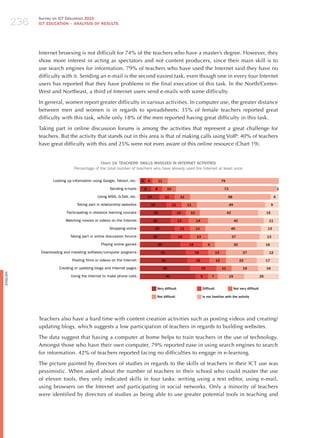
which alienates people from socializing and relating to each other, which isolates young people,
thus moving us further away from relationships in physical spaces. Recent experiences with mobile
devices have shown other possibilities that indicate otherwise: how can we integrate people into


                                                                                                                   English
their urban space by using mobile technologies? According to studies by Mobile Lab, what matters is
not only the type of project implemented, but the effort to create a new paradigm for communication
technologies. They may allow people to use the space where they live in a smart way, so that they
are able integrate their habits and attitudes into the collective intelligence, thinking for benefit of
the place where they live.

Social networks, so popular among youngsters, are used to enable people to organize themselves,
e.g. to organize a car pool scheme to go to work. They are also used, for example, to consult with
friends, via mobile phone, about tasks being performing. From examples that range from reinventing
bus stops, such as smart digital terminals, to tagging historic places, they create a vast number of
possibilities for the use of mobile devices in education.

While we worry about whether to allow our youngsters to have Internet access, these studies
indicate how to reintroduce young people in urban space issues through communication networks.
172
                Survey on ICT Education 2010
                ARTICLES


                REFERENCES

                MANN, S.; NIEDzVIECKI, h. cyborg: digital destiny and human Possibility in the Age of the wearable
                computer. Toronto: Doubleday Canada, 2001.

                RhEINGOLD, h. Smartmobs: the next Social revolution. Cambridge, MA: Perseus, 2002.

                SALA, X. B.; ChALEzQUER, C. S. A geração interativa na ibero-América. Madri: Coleção Fundación Telefónica
                / Ariel, 2008.
English
173
                                                                                                    2010 Survey on ICT Education
                                                                                                                      ARTICLES


ThE RoLE oF INFoRmATIoN
IN SoCIAL dEvELoPmENT


Ladislau Dowbor1


                                                                                     “information makes us all equal.”
                                                                                     (Dando, Antares Slum, Rio de janeiro)
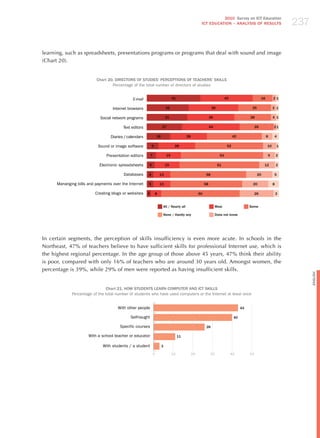


The great driver of society’s transformation – the elephant in the room, so to speak – has been
the increasing momentum of technological transformations. Undoubtedly, there have been other
epic moments, e.g. the Ancient Greeks, the European Renaissance and the explosion of scientific
knowledge in the wake of the twentieth century – electricity, the telegraph, railway transport,
airplanes, cars, the theory of the relativity, and etc.

however, nothing compares to the unparalleled development that followed World War II – from
large scale events, such as telescopes in orbit and man’s landing on the moon, to the realm of small
molecules, such as the DNA and nanotechnology, fine chemicals, bioengineering, advancements
in means of transportation and the spread of education, which has currently reached almost every


                                                                                                                                            English
corner of the planet. Knowledge has become the center of the process of cultural, political, social,
and economic change. We are beholding the knowledge society – which, indeed, has knowledge,
though not followed closely by social and political structure.

As part of this process, the revolution enabled by the information and communication technologies,
which drives the potential of all fields of research, has become particularly important. By progressing
from “drawn” signs, such as the letter “a” or the number “2”, to digital notation in “0s” and “1s”, it
has become feasible to record human knowledge in different subatomic particles and to transmit it on
electromagnetic waves. This advance has enabled mankind’s creative side to flourish – information
and communication technologies become widespread at the same moment in time as economic


1
    Ladislau Dowbor is a doctor in Economic Sciences from the Warsaw Central School of Planning and Statistics, a professor at
    the Pontific Catholic University of São Paulo and a consultant for several United Nations agencies. he is the author of several
    books and articles. his numerous publications on social and economic planning are available, in full and free of charge, as
    Creative Commons, at the website http://dowbor.org. Email: ladislau@dowbor.org.
174
                Survey on ICT Education 2010
                ARTICLES


                activities acquire more in-depth knowledge. how could the sequencing of the double helix of life
                have been possible without computers?

                In this context, the role of ICT is to drive the entire process forward, because, in addition to being
                new technologies themselves, they act as instruments of multiplication and dissemination of
                knowledge in all fields, i.e. a revolution within the revolution. Knowledge dematerializes, spreads
                across the planet, traveling at the speed of light, and is accessible today from a simple mobile phone
                anywhere.

                Technologies enable us to achieve more with less effort, and undoubtedly create opportunities
                for progress. It has been calculated that a man using electricity, fuel and other sources of energy
                uses 156 times more energy than his muscular strength would allow. We have powerful levers.
                Nonetheless, availability of more powerful means, when the latter are used negatively, only drives
                adversity. Nowadays, we are able to chemically synthesize very cheap drugs, without necessarily
                relying on the production cycle of coke and poppy, and this is destroying hundreds of millions of
                people’s lives. Moving fast with no direction creates even bigger problems, and technologies do not
                have the answer for that.

                New technologies enable the design of speculative global systems, which artificially increase
                the prices of food; advanced means of groundwater exploitation are leading to the depletion
                of centennial groundwater reserves; the massive use of automotive vehicles is leading to urban
                collapse; widespread and irresponsible consumption of fossil fuels is leading to climate change,
                i.e. the greatest global threat; modern fishing technologies have enabled us to easily track down
                and exploit life in our oceans; and the expansion of monoculture and deforestation are leading to
                soil sterilization and boosting climate change. We have been watching in a state of numbness and
                powerlessness as this dramatic sequence of events unravels quickly before us, with its positive – we
                proudly carry the latest mobile phone in our pockets – and threatening aspects. Technology in itself
                is not the problem; the problem is how it is used, the processes by which powerful technologies are
                produced, while our political structures remain archaic. This imbalance between the accelerated
                pace of technology and the remarkably slow pace of cultural, social and political maturity is the
                cause of dangerous tension, i.e. our biggest threat.
English


                Central to the dilemma, therefore, is the decision making process of how to use new potential, who
                controls it, who has access to it and for what purposes. Technologies multiply in our inherited society
                and are accompanied by their tragic imbalances. The latter can be divided into two articulated axis:
                environmental tragedy, directly linked to the increased potential for global destruction – devoid
                of corresponding governance – and social tragedy, which results from new mechanisms by which
                these very technologies create inequalities, e.g. through global financial systems.

                It is noteworthy that technological advances are the result of numerous research initiatives in basic
                research and in economic development, predominantly led by the public sector and the private
                sector, respectively. They consist in a widespread social process, in which different sectors benefit
                from the advances in others, as thoroughly analyzed by Lawrence Lessig (2008) and Toffler (2006).
                however, although the scientific process itself, which evokes friendly images of an inventor in
                his lab, is perceived as positive, the reality is that few scientists have any control over what they
                develop. They do not get to decide whether a new molecule will be used as a medicine or as
                a pesticide, or whether drugs capable of restricting the hIV will become widespread across the
                planet, or will be restricted to ensure higher prices, and etc. The use of technology is controlled by
175
                                                                              2010 Survey on ICT Education
                                                                                                ARTICLES


corporations, and these, in turn, are controlled by marketing, finance and law experts. Scientists are
urged to stick to their labs.

Thus, good and evil are always hand in hand. Developing antibiotics is good, but its widespread use
in livestock – which contaminates the meat we eat – is not. Better still, it is good for the company
that sells antibiotics and unscrupulous breeders, but bad in terms of final impact on the population.
Removing railway tracks in order to sell more cars seems preposterous, but engine designers are
not to blame; the problem is in the decision making process, i.e. in corporate power. The latter
evidently prioritizes decisions that promote its own – directors’ and shareholders’ – interests. They
will only use and expand the use of cleaner technologies, such as more efficient hybrid or electric
engines, if under external pressure. however, this pressure is contained when corporations finance
political campaigns, and elect those who will defend their interests. The gap between what motivates
research, i.e. the exciting creative dynamics, and those who decide how its results are used, i.e. to
generate profits at any cost, becomes huge.

What we are hereby suggesting, regarding humanity’s prosaic interests, is that making the most
of the fantastic technological revolution that we live in is dependant upon the democratization of
economic processes. This theory is discussed in more detail in the essay “Democracia econômica”
(Economic Democracy), particularly in the chapter “A economia do conhecimento” (The Economy
of Knowledge). Only when society takes ownership of information on decision making processes
in corporations and governments will its pressure begin to create other dynamics, more closely
in line with general interests. First and foremost, understanding that the economy of knowledge
radically shifts the concept of scarcity – one of the pillars of economic sciences in the last century
– is paramount. A watch given to someone else is no longer mine. An idea given to someone else is
still mine. In the economic jargon, knowledge is a non-rivalrous asset, i.e. its consumption does not
reduce stocks. Nowadays, the primary value of most goods is less related to materials and labor; it
is based on the knowledge embedded in them. Thus, in macroeconomic terms, knowledge creates
wealth when it multiplies and spreads, not when it is locked.

Knowledge produced can be multiplied endlessly, and it costs virtually nothing to spread it, enabling
users to access it at their will. Therefore, it may be viewed as a powerful driver of democratization.


                                                                                                                   English
Nonetheless, from the microeconomic perspective, corporations are not seeking social development;
instead, they are interested in making profits, and for that it seems only natural to monopolize
knowledge, thus creating scarcity. They artificially create obstacles to access in order to ensure
profits, and create the economy of tolls.

Ignacy Sachs (2010) puts it simply and clearly: in the last century, economic power relied on
the private control of production assets, machinery, factories, and etc.; nowadays, power results
from controlling information and knowledge. Where before there was a gate, now there are
use restrictions, copyrights, patents and royalties. Today’s corporations employ efforts to restrict
access, in order to demand toll payments. The legitimate and well intended concept advertised is
always one of protecting the defenseless author, but in fact, it is about ensuring the profits of large
intermediaries. Rights often belong to those who provide material support, not to the creators.

Results are straightforward: in the top universities in the country access to book content is denied,
and researchers only have authorization to photocopy one chapter. According to surveys by the
GPOPAI, 30% of the recommended literature is sold out, but cannot be copied. hence, on one
hand, significant resources are spent to educate new generations; whereas, on the other hand,
176
                Survey on ICT Education 2010
                ARTICLES


                access to knowledge is impaired. Naturally, a company that has published a book and its author
                will seek compensation – and that is legitimate. But why deny access, or make it so expensive
                that it becomes accessible only to the wealthy? The MIT, in the U.S., has created the concept
                of OpenCourseWare, open course, such as Linux created open source.2 All publications from all
                professors are available online, free of charge, at the portal www.ocw.mit.edu. In a few years, more
                than 50 million scientific texts have been downloaded worldwide from the MIT alone. One can only
                but wonder at the significance of its contribution to knowledge, and to scientific progress in general.

                how does this compare with the interests of the publisher and the author? They are entitled to
                payment, but not to prevent access for non-profit scientific communication. And whoever likes a
                book may buy it. Even renowned books are bought more often when widespread access to them is
                gained easily. It used to be said that television would mean the end of cinemas. That was clearly
                nonsense, and banning television to prevent the demise of cinemas would have been absurd.

                Knowledge spreads as the primary driver of wealth production, is easily and freely transported
                online across the globe, and has a non-rivalrous nature, so the rules of the game must change. Most
                people are unaware that corporate lawyers have managed to extend copyrights to prevent open
                access for seventy years after the death of the author. Twenty-year patents on medicines, in an era of
                extremely accelerated transformations, are unacceptable. Books by Paulo Freire, who campaigned
                for the democratization of knowledge, are denied free access until 2050.

                The absurdity of the situation is leading to the creation of numerous alternatives that seek to
                circumvent attempts to deny access to knowledge and full use of new technologies. The book
                wikinomics shows how many companies have stopped denying access and, instead, are now
                seeking mass collaboration from clients. By enabling access to their information and requesting
                contributions they are actually doing better. A survey called “Embezzlement” reveals how
                corporative tolls on knowledge work, and how they prevent progress and larger profits, by
                preventing productive contributions. Cognitive Surplus shows that humanity has a vast host of
                knowledge capital stored in people’s minds, tragically underused. By taking a chance, and creating
                an impressive global source of information, wikipedia granted everyone a chance to contribute
                with their own knowledge, which would otherwise be stationary or available only to them. It is also
English


                curious that many people contribute financially to wikipedia, despite there being no obligation,
                by paying what they think the services received are worth. These issues are discussed in detail in
                our article “Da propriedade intelectual à sociedade do conhecimento” (From Intellectual Property
                to the Knowledge Society).

                human beings are gifted with intelligence, and wealth is not a synonym of intelligence. In an
                era when economic development is increasingly more dependent on the knowledge embedded
                in production processes, enabling the two thirds of the underprivileged global population to
                access knowledge may be a promising way of simultaneously tackling inequality and, through
                smarter processes, environmental challenges. As a matter of fact, we should not allow access,
                but promote it.


                2
                    More information available at http://web.mit.edu/newsoffice/2009/open-access-0320.html.
177
                                                                                 2010 Survey on ICT Education
                                                                                                   ARTICLES


A simple but powerful image comes from an experience in the Antares slum in Rio de janeiro,
experience awarded by Trip Transformadores.3 When implementing broadband access in the slum,
Dando and his companions discovered, according to Claudio Prado, that there may be no jobs, but
there is always work to be done. And enabled by Internet access, a wide range of services became
available from the slum, such as design, cultural production, and online computer support, among
others. In the age of “immaterial” economy, of the “intangible”, access to factories is no longer a
requirement; all that is needed is access to the global system of knowledge production. “Information
makes us all equal,” declared Dando when presented with the award.

Globally, a recent evaluation of the dynamics of the use of technologies in rural settings produced an
excellent study (IAASTD, 2008). Overall, the same technologies being used in monocultures (more
pesticides) to create low employment levels (two hundred hectares per job in soybean monocultures),
to deplete water reserves and to control production by a select group of multinational companies
(Cargill, Monsanto, Bunge, etc..) can be used to create a better dynamics, with intercropping
systems, smart irrigation, first transformation technologies for small producers, mixed farming that
increases employment, production closer to end consumers, and etc.

In education, as previously stated, rather than progress, what is required is a revolution: education
is viewed less as an institution, providing facilities where children and young people spend most of
their lives – thus allowing adults to work – than as a permanent system for knowledge management.
Initiatives such as “Minha Escola, Meu Lugar” (“My School, my Place”) in Santa Catarina, or “Arranjos
Educativos Locais” (“Local Educational Settings”) in Parana, or the reference initiative, “Piraí Digital”
(“Digital Piraí”), in the state of Rio de janeiro, are the first signs of a profound transformation.

There are countless successful experiences. There are countless attacks too – it does not take more
than turning the radio on to hear grim statements by oligopolies pleading for us to be ethical. They
make serious claims that our ethics is upside down. just outside several cinemas, universities or
cultural spaces, there are people illegally selling Antonioni’s, Kurozawa’s, Fellini’s, and jean Renoir’s
films, hundreds of the giants who created the cultural wealth of the film industry. Whereas, at official
stores, which are full of advertising materials, we are able to rent or buy essentially a pile of rubbish,
with rare hidden gems. It is curious to note that our culture has become clandestine, and the culture


                                                                                                                      English
industry prevails. If it were not for the men who sell pirate films on the sidewalks, I would not be able
to bring home the gems of human creativity that I play for my children. Where is the logic in that?

Claiming it to be about ethics, rights or laws is bogus. The American lawyer james Boyle states that
an idea is not a natural property, such as my watch would be (which I may choose to wear or not).
Patents and copyrights themselves were created to protect a commercial producer from another
commercial producer, not to prevent user access. It is so clearly not a natural right, that it has been
set to expire after a certain period of time and become public. however, by endlessly extending the
validity of such rights, corporations’ legal advisors have made access virtually useless and outdated
when finally allowed.

It is also noteworthy that the concept of intellectual property was not designed because an idea had
to be owned, but because it was thought that a period of exclusive access would encourage people


3
    Watch video available at http://bit.ly/fuKOVh.
178
                Survey on ICT Education 2010
                ARTICLES


                to come up with more ideas. That is, if the system is preventing access to new knowledge, it is, in
                fact, producing an opposite effect to the intended. In this case we also have a mixture of good and
                evil: Granting a short period of exclusive rights is good to stimulate creators, but if this period is
                extended over decades to the point of halting progress, it is bad.

                When Lessig asked the audience attending his lecture at harvard whether they adopted illegal
                practices to access knowledge online, more than 70% of them admitted to doing so. Lessig concludes
                that progress results from an ongoing process of innovative articulation of previous innovations; we
                copy each other, and add our own new twists (Lessig, 2008). Internationally, Chang has masterfully
                demonstrated how developed countries have copied each other, including through large systems of
                economic espionage still in use, and, at a certain moment in time, decided to deny access to poor
                countries. Chang’s “Chutando a escada” (Kicking the Ladder / 2003) is about the history of countries
                who took ownership of the knowledge of others, but now want to prevent others from accessing it,
                and “kick their ladder”. They speak naturally of ethics, even when trying to patent an Indian rice
                species or the Brazilian cupuaçu.

                Initiatives must focus on enabling access, particularly widespread access to broadband. Few
                people know that the common “www”, which allows us to access knowledge across the planet,
                was developed by Tim Berners-Lee at the Geneva nuclear research center (CERN), and that Tim
                refused to patent the system because he viewed it as a contribution to mankind, which nowadays is
                managed by a non-profit consortium. Mankind as a whole benefits from this, including Google and
                Microsoft. We all browse happily through “www”s, which enable us to exchange ideas freely across
                the planet. There was no shortage of proposals to set up tolls for this as well.

                The idea is clearer when compared to walking on the streets – no one pays to walk on the streets.
                however, there are costs involved in maintaining the streets, and we pay for these through taxes.
                It would not be practical to set up tolls all over the streets, although it seems to be happening
                on most parking lots or highways. The fact that everyone can walk freely on the streets and
                avenues is simply more practical. And it makes sense, because free traffic enables the streets to
                be economically attractive for businesses, gas stations, and etc., which pay taxes that, in turn, pay
                for street maintenance. Nothing is free. But the Internet, by traveling on electromagnetic waves,
English


                does not need to build streets and sidewalks – waves are public and free, a gift of nature. It is
                only natural that knowledge is transported on them across the globe, freely, as a public service.
                In contrast, free movement and free access enable the creation of several economic applications,
                which, in turn, may be paid for.

                This whole field is controlled by ideological fundamentalisms, hypocritical claims to ethics, and
                useless persecutions. Youngsters, in particular, struggle – they cannot afford the toll charges charged
                by corporations. As a matter of fact, youngsters have little money and lots of time – they may use
                their time, rightfully, to have access to knowledge anyway, which in schools would be regarded as
                an obligation, not piracy. In contrast, as explained by Alperovitz, adults have money and little time:
                differentiated products that are paid for cater for their needs.

                We must bear the objective mentioned above in mind: i.e. to ensure that knowledge is widespread,
                because society as a whole will become more prosperous; e.g. producers will have more access
                to clean technologies, thus protecting the planet, contributions to the economy of knowledge
                may spread, even to poorer societies, and this may reduce the significant inequality that now
179
                                                                                     2010 Survey on ICT Education
                                                                                                       ARTICLES


economically isolates the four billion people gently classified by the World Bank as people who
“do not have access to the benefits of globalization.”

With clear goals, the path ahead leads to leaving hatred and ideologies behind and pursuing what
actually works. We are currently clumsily playing the game by rules that were developed for an
economy of physical assets – in the twentieth century – which aim to reduce everything to private
property, not by the rules of a new society, born in the twenty-first century. Impairing progress or
monopolizing the appropriation of innovations simply does not work.


REFERENCES

Alperovitz, Gar Daly, Lew. Apropriação indébita: como os ricos estão se apropriando da nossa herança comum.
São Paulo: Editora Senac São Paulo, 2010

ANDERSON, Chris. grátis, o futuro dos preços. São Paulo: Campus, 2010.

BOYLE, james. the Public domain: enclosing the commons of the mind. New haven and London: Yale University
Press, 2008.

CASTELLS, Manuel. the rise of the network Society. Oxford: Blackwell, 1996.

CEPAL. A hora da igualdade. Brasília, 2010. Available at: http://bit.ly/bqwYAh. Full manuscript in Spanish: la
hora de la igualdad: brechas por cerrar, caminos por abrir. Santiago, maio de 2010. Available at: http://bit.ly/
bA9yrl.

ChANG, ha-joon. chutando a escada: a estratégia do desenvolvimento em perspectiva histórica. São Paulo:
Editora da Unesp, 2003.

DAVIDSON, Cathy N.; GOLDBERG, David. the Future of learning institutions in the digital Age. Boston: MIT
Press, 2009.

DOWBOR, Ladislau. da propriedade intelectual à sociedade do conhecimento. 2009. Available at: http://bit.
ly/8nlK61.

       . democracia econômica: alternativas de gestão social. Available at http://dowbor.org/10demoecovozes3.


                                                                                                                          English
doc. Updated in December, 2010.

GPOPAI. direitos autorais e livros didáticos. Seminário “Direitos autorais e educação”. Ação Educativa,
24.3.2009. Available at: http://www.gpopai.usp.br/wiki/images/5/53/Seminario_ae.pdf.

IAASTD – Evaluación Internacional del Papel del Conocimiento, la Ciencia y la Tecnología en el Desarrollo
Agrícola. resumen del informe de síntesis. Available at http://dowbor.org/ar/08iaastdesp.pdf.

LESSIG, Lawrence. the Future of ideas: the Fate of the commons in a connected world. New York: Random
house, 2001.

       . remix: making Art and commerce thrive in the hybrid economy. New York: Penguin, 2008.

ORTELLADO, Pablo. A educação e os livros didáticos. Universidade de São Paulo, 2009. Available at: http://
www.gpopai.usp.br/wiki/images/5/53/Seminario_ae.pdf.

RIFKIN, jeremy. A era do acesso. São Paulo: Makron Books, 2001.

SAChS, Ignacy; LOPES, Carlos; DOWBOR, Ladislau. riscos e oportunidades em tempos de mudanças. Fortaleza
e São Paulo: BNB/IPF, 2010. Available at: http://dowbor.org/riscos_e_oportunidades.pdf.

ShIRKY, Clay. cognitive Surplus. New York: Penguin, 2010.
180
                Survey on ICT Education 2010
                ARTICLES


                TAPSCOTT, Don; WILLIAMS, Anthony. wikinomics: como a colaboração em massa pode mudar o seu negócio.
                Rio de janeiro: Nova Fronteira, 2007.

                TOFFLER, Alvin; TOFFLER, heidi. revolutionary wealth. New York: Doubleday, 2006.
English
181
                                                                                                 2010 Survey on ICT Education
                                                                                                                   ARTICLES


EdUCATIoN ANd dEvELoPmENT:
REGULATIoN modES IN EdUCATIoNAL SYSTEmS

Marisa Duarte 1


This article presents the results of the first studies conducted under the project submitted to the
Anísio Teixeira Chair, of the Program “IPEA/CAPES Chairs for Development”. The ongoing research
aims to examine the sociology of education in Brazil based on the binomial “education and
development”, and its premises include new forms of sociability forged over twenty years of regular
elections and the reintegration of the country in the globalized capitalist economy. This article does
not intend to be a homogeneous and coherent text, or a harmonious theory about this relationship.
Nonetheless, its underlying question explores the fragility of the regulation systems contributing to
the governance of new players in the Brazilian educational system.

There are two separate origins to this study. On the one hand, it is a free interpretation of the article
by Ball (2008), aimed at dissecting the changes underway in the Brazilian educational system.
According to Ball, there have been moments when the course of perspectives on sociological
analysis was rerouted – concurrently with the production of expert knowledge on teacher training
and education management – contributing to the creation of “conditions favorable” to the
implementation of new systemic governance instruments. If Foucault’s inspiration is central to the
construction of the argument based on Ball’s (2008) perspective, in which systemic changes promote


                                                                                                                                        English
the development of new governance modes, a second analytical perspective is introduced to shed
light on the tensions and conflicts in the development process. Resorting to the concept of public
sphere (habermas, 1984), we are able to relate the tension in the educational system between new
players in the Brazilian social scene – with new perspectives on schooling – and those who believe
and claim education to be a right that should be provided by the government.


1
    Associate professor at the School of Education of the Federal University of Minas Gerais (UFMG). Grant researcher at IPEA,
    Anísio Teixeira Chair – research on public policies in education as part of the Graduate Program of the School of Education
    of the UFMG.
182
                Survey on ICT Education 2010
                ARTICLES


                EdUCATIoN ANd dEvELoPmENT:
                ThE RoLE oF GovERNmENTAL PLANNING

                In the field of sociology of education in Brazil, the initial association between the concepts of
                education and social development relates the increasing number of institutions, courses, students
                and professionals with the growth of the educational system. Increasing availability and services are
                viewed as educational and, consequently, social development. In this approach, the latter results
                from improvements in income distribution, level of education of the population, basic sanitation,
                instead of economic aspects, measured by production, services and etc. Social development is
                viewed as a product of the expansion and differentiation of the educational system, teleologically
                regarded as societal modernization. In this perspective, the educational system would promote the
                development of the population by enabling individuals to socialize massively and comprehensively;
                social segregation would then be potentially based on merit. however, this development is not the
                same in dimension and intensity across the country. Internally, there are underdeveloped regions,
                as well as regions with high educational standards in Brazil.

                The work of Cunha (1988) is a key reference for the criticism of economistic conceptions, focused
                on the individual training of human resources. The Brazilian education sociologist argued against
                the current assumption that education would enable individuals, bearers of types/amounts of
                knowledge, whatever their social background, to ascend socially based on their individual merit.
                The ideological role of schooling was to disguise education’s inherent mechanisms of discrimination,
                as well as those inherent to the economic structure. The criticism against the role of education as
                a promoter of development was accompanied by a criticism against the national development
                model, in which economic growth per se was believed to solve problems, such as non-inclusive
                inequalities and marginalization.

                however, Cunha upheld, and probably still does, a sociological perspective in which potential
                development is related to governmental planning. In this respect, he analyzes the expansion of
                tertiary education in the wake of the 1988 Constitution: “It is clear that the development of tertiary
                education has been based on “teaching improvisation”, in the context of the patronage that prevails
English


                in public and private institutions” (Cunha, 2007, p. 797).

                The implicit political strategy is highlighted by Domingues (1999), who states that the government
                seems to be the agent – the “collective subjectivity” – whose role is crucial in promoting the
                development process. Analyzing the work of Costa Pinto, Domingues reveals that the Brazilian
                sociologist defined development as “an ongoing, intentional and global process of social change,
                not just economic or technical, which intensely mobilizes society, including the government”
                (p. 84). On this subject, he also added:


                        Development would then be a particular form of modernization, typically and profoundly affecting
                        the country’s productive structures, its class structure, and political and social democratization,
                        by incorporating masses into the nation, followed by changes in Brazil’s dependence pattern in
                        the international scenario. (Domingues, 1999, p. 85)
183
                                                                                        2010 Survey on ICT Education
                                                                                                          ARTICLES


In the perspective derived from Costa Pinto’s work, the country’s development requires the
government to take on a leading political role, specifically in planning. In this sociological tradition,
the development of Brazilian society is mediated by the government’s intentional and structured
action – i.e. through planning – as it is the one player capable of mobilizing society towards more
profound changes. Currently, this sociological perspective is implicit in the hegemonic propositions
of the Brazilian Conference on Education:


       In view of CONAE’s purpose to mobilize society in favor of education, the reference document is
       based on the need for the government and Brazilian society to face at least five major challenges
       [...]. Therefore, the construction of a National Educational System requires reassessing the
       role of federal agencies, ensuring the implementation of common educational guidelines
       throughout the national territory, in an attempt to overcome regional inequalities. Thus, the
       goal is to design national public policies on education that can be implemented nationwide by
       regulating the specific role of each federal entity in a collaborative system, as well as the role of
       private education by governmental agencies [...]. In the Brazilian education scenario, marked
       by educational plans and projects, the proposition and implementation of policies must be
       coordinated, as well as systematic planning initiatives. In turn, all of these must be articulated by
       a national education policy aimed at following up, monitoring and assessing them. (Brazil, 2010)


Governmental initiatives and social mobilization are key to the creation of an educational system
– i.e. the promotion of structural changes, especially towards granting universal social rights – that
will entail common educational guidelines aimed at overcoming inequalities, by regulating the
power of federal entities. The 2010 National Conference also states that such goals require fiscal
and operational resources. however, the desired changes require social mobilization combined
with governmental action.

hence, the transformations in Brazilian society promoted by the expansion of democratic
governance and greater participation in the globalized capitalist economy must be analyzed. These


                                                                                                                             English
transformations have created new subjects and forms of sociability, which clash with the current
bureaucratic and corporate role or patronage system.


EdUCATIoN ANd dEvELoPmENT: ThE EmERGENCE
oF NEW FoRmS oF SoCIABILITY

By closely relating modernization and development, perceived in the projects and movements of
various collective subjectivities contributing to it, Domingues observes:


       The recent developments of modernity in Brazil have been driven by powerful processes of
       “detaching” subjects from more ingrained and stable relationships. Nowadays, even in terms
       of the subjective structure of individuals and collectives, such as the workforce, processes of
       individualization are more marked, the family structure changes, the role of women changes;
       social “democratization” related to this individualization progresses, at least in terms of citizens
184
                Survey on ICT Education 2010
                ARTICLES


                          claiming their rightful position within society; the economy is affected by a demand for more
                          flexible and efficient processes; the expansion of consumption makes increasing options
                          available to individuals, as long as, naturally, they possess the minimum conditions to gain
                          access to them. Thus, individual existence is potentially broader. (Domingues, 1999, pp. 86-7)


                Domingues’ analysis on modern processes of individualization relates them with the diffusion
                of citizenship, viewed as a “real abstraction” in which individuals seek shelter. Detachment-
                reattachment-further detachment processes are social development processes in contexts in which
                the “neoliberal adjustment” of Latin American countries created obstacles to the universalization of
                services that promote the rights of citizenship.

                Authors such as Souza (2010) observe that one of results of these processes of detachment and
                production of new identities is the emergence in the country of a working class of “fighters”, or
                entrepreneurs, who have absorbed the concept of the “self-made man”. For these individuals, formal
                education is an essential asset,2 despite the fact that their integration and inclusion in the workforce
                is due to new forms of sociability, largely resulting from hard work and/or money. how does formal
                education contribute to this social class’ individual/collective development project(s)?


                          Our research has shown that this class has found its place in the sun through extraordinary efforts:
                          Its ability to withstand fatigue from multiple jobs and work shifts, and double shifts studying and
                          working, its extraordinary capacity to save money and resist to immediate consumption and,
                          equally or even more importantly, its extraordinary belief in itself and in its own efforts [...].
                          Because this class is unable, unlike the dominant classes, to dedicate its time exclusively to
                          studying, overall its appropriation of educational and cultural knowledge is lower than in the
                          true middle class. (Souza, 2010, pp. 50-2)


                The personal statements collected by Souza (2010) reveal that the appreciation of educational
                access, attendance and learning may be viewed as subjective reactions to detachment situations,
English


                experiences of injustice, as well as to the fact that schools have a socio-political role in providing
                services that enable future individualization.


                          [...] investments in alternatives, especially in education, are very common from those hoping to
                          get a job that will bring them a little more stability [...] the individual knows that telemarketing
                          is not for life, but the fact that he/she has graduated from high school does not automatically
                          grant unrestricted access to tertiary education, especially not to the most prestigious and sought


                2
                    Transformations in contemporary capitalism have not been automatic or obvious to anyone. Instead, throughout this decade,
                    the offspring of the “expressive revolution” of the 60s took over key positions in several countries, as opinion leaders and
                    central public figures in their societies. This generation, the first born in the context of quality public education for large social
                    sectors – a principle consolidated after the Second World War, as a byproduct of the Fordist commitment – was in itself a
                    supporting element to the virulent critique against the typical heteronomy of Fordist labor, as well as the hierarchical structure
                    of all leading capitalist and bourgeois institutions of the period (Souza, 2010, p. 38).
185
                                                                                         2010 Survey on ICT Education
                                                                                                           ARTICLES


         after institutions [...] his/her mother will, repeatedly, demand dedication and commitment to
         his/her education in the hope that he/she [...] This individual experiences uncertainty, in view
         of the recent poorly educated army of individuals prepared to occupy lower positions. (Souza,
         2010: 71-8)


The role of development through the meritocratic pathway of education is both valued and/or
disregarded. Formal education is part of the design of projects for the future and/or the driver behind
the current scenario.


         The respondent will have a child who has already studied for longer than the parents and will
         have, according to him/her, a better future than that of a small retailer [...] there is a common
         work-enabling element among these entrepreneurs that does not result from formal education
         [...] the eleven-year-old daughter has a computer and Internet at home [...] is already thinking
         about what to do in terms of work to fund his/her daughter’s tertiary education. (Souza, 2010)


Based on Foucault, the careful analysis of all statements collected by Souza (2010) reveals how
capitalism has penetrated our lives, as well as how educational institutions articulate in view of the
new forms of sociability. A Foucaultian reading of the statements collected from “Brazilian fighters”
reveals various government/education instruments available to individuals. The presence/absence of
formal education leads to the creation of a new rationale behind development in capitalism, which
is associated with individual progress. The most contemporary forms of sociability – unveiled in
Souza 2004 – paradoxically suggest that individuals take charge of formal education both by their
absence and their presence. The role of this institution may have been desirable and relevant, but
is not essential.


         Partly through school, when the mathematical thinking he’d already been familiar with since


                                                                                                                              English
         childhood – from selling his father’s agricultural produce – is developed, but more importantly
         through his work experiences, Pedro develops the skills required for his economic survival in
         contemporary capitalism. (Souza, 2010, p. 102)


dEvELoPmENT oF EdUCATIoNAL SYSTEmS:
ThE EmERGENCE oF NEW REGULATIoN modES

In line with these new forms of sociability, a movement known as New Public Management3 (NPM)
has been spreading globally, and it has laid out the foundation for the contemporary debate on


3
    “The NPM is an administrative philosophy [] that emerged in the 1980s. [...] h&j asserted that the NPM influenced
    governments’ agendas by establishing a climate of opinion in favor of its doctrines” (Barzelay, 2000, p. 235).
186
                Survey on ICT Education 2010
                ARTICLES


                organizational and administrative changes in the governmental sector, thus affecting the management
                of education systems (Power, 1997).


                          I define the NPM abstractly as a field of professional and political debate – conducted
                          internationally – about subjects concerning public management, including public management
                          policies, executive leadership, design of programmatic organizations, and government
                          operations. (Barzelay, 2000, p. 23)


                The working assumptions for research programs on NPM are the theory of rational choice and
                business-related organizational theories (Barzelay, 2000). Both the education reforms (English
                and American) of the 1990s and NPM-based programs have viewed favorably free public services
                (education included), which citizens/consumers are “free” to choose, enabled by more competitive
                funding options, for greater efficiency and effectiveness and monitored results.

                In this ideological body, ideas behind the “modernizing perspectives on government reform” have
                also shaped the social imaginary. On the one hand there is the acknowledgement of civil society
                organizations4 as potential promoters of democracy versus the government as an instrument of
                bureaucratic domination. Thus, decentralization in the provision of services, especially social
                services, is regarded as capable of enhancing responses to diversity and to society’s existing
                alternatives. This perspective is based on the separation between purposes/objectives and means/
                procedures. The inefficiency, rigidity and poor visibility of bureaucracy are questioned in the
                formulation of alternatives.

                The scientific literature on education is extensive and diverse, including themes such as curricular
                diversity, specific teaching methods for youngsters, indigenous peoples, alternating methods and
                educational processes, and etc. Underlying this literary production is the acknowledgment of the
                diversity of groups and sectors of society, which requires breaking away from the standardized
                services model that results from the bureaucratic regulation mode of the educational system (Maroy,
                2008).
English


                Management-based political and administrative propositions emphasize results and productivity,
                clouding the arguments against the social relations that produced them. In this approach, leading
                authorities’ emphasis on ex post mechanisms to control results – e.g. systemic evaluation – is
                combined with appeals to local initiative to validate outcomes. The standardization of services
                is questioned, and diverse performance measures emerge as a means of legitimating the actions
                undertaken.

                however, it can be said that these political and administrative guidelines (NPM) include, to some
                extent, the modernization5 of educational systems created in the authoritarian regimes of Brazil. They
                are aimed at diversifying products and services on offer in order to promote the manifestation of the


                4
                    In this context, the term referred to a positive sphere where differences could comprehensively and democratically flourish,
                    a space of supposed authenticity and freedom of interests and culture (Moraes, 2001, pp. 14-16).
                5
                    The term “modernization” here means the adoption of consumption, behavioral and institutional patterns, values and ideas
                    of the so-called advanced societies, not necessarily focusing on actually transforming the economic and social structure.
187
                                                                                                   2010 Survey on ICT Education
                                                                                                                     ARTICLES


various socio-cultural needs in society (Durut-Bellat, 2001), and at monitoring the results obtained
by governments (accountability). By promoting a greater diversity of services on offer to provide for
the many interests and needs of citizens/consumers, they stand in opposition to the authoritarian
and Fordist trend of bureaucratic homogenization. They also emphasize greater transparency in the
setting of targets and allocation of public resources as a prerequisite for competitiveness (Pereira,
1996). The patrimonialist approach of the res publica is criticized because it does not promote the
competitive expansion of markets.6

For the “Brazilian fighters,” if individual existence has become freer – different values and behaviors
coexist unstably – customized treatment of their needs is a prerequisite for quality and recognition.
Flexible opening hours and more options in a range of possibilities and periods of independent
activity become requisites for the use of various services, including education. A wider range
of options for a single service is both instructive and alluring in its recognition of uniqueness
and difference. Education management is effective in providing customized services, revealing
awareness of the more specific needs of individuals or groups.

It is also in the context of emerging new forms of sociability and the spread of the NPM that the
results of surveys (Rutter, 1999; Brookover, 1979) on the influence of schools on students’ progress
are disclosed. If, on one hand, the socioeconomic and cultural status of families affects kids’ school
performance, on the other, these studies have demonstrated what the French referred to as the
“establishment effect” (Cousin, 1998). This line of research proposed that different types of schools
affect students’ performance. That is, the different modus operandi of schools may reduce or not the
negative effects of the socioeconomic status of families (Lavinas & Barbosa, 2000). Schools are thus
viewed as the loci of education management (Oliveira, 2000), and restructuring them is bringing
them to the minimum required standards for quality in education (art. 4 from the LDBEN), which is
measured by national learning tests.

Disclosure of the Basic Education Development Index by the Ministry of Education is evidence
of this approach to government. The progress of education is now measured based on students’
performance in Portuguese and Math tests, and student flows (attendance and failure). These
indexes would yield goals to be pursued by education and are comparable with those of developed


                                                                                                                                           English
countries.

These three social processes – emergence of new subjects, spread of NPM principles and reform plans
for the services provided by each and every educational unit – have repositioned formal education,
linking it to “social development”. Criticism of formal education, viewed as “bureaucratic” and
“meritocratic”, is counter argued by the dissociation between schooling and social mobility,
especially when reforms are foreseen to transform formal education into a promoter of social
development. In this case, the administration (management) of school units and school systems has
been reconfigured by the new fabric of social relations and the political and administrative culture
brewed over the last twenty years. These three social processes have promoted the development of
educational systems and had an impact on social life, affecting the relationship between education
and society, restricting it to minimum standards assessed by more uniform and universal means.


6
    The political success of these guidelines may be partially attributed to the fact that they were initially introduced as tools
    against corruption and party cooptation in the public sector.
188
                Survey on ICT Education 2010
                ARTICLES


                Nonetheless, another aspect of social development that also affects educational systems is the
                emergence of a diverse public sphere, one that includes mass media and alternative means of
                communication.


                PUBLIC SPhERES: ThE FABRIC oF ThE RELATIoNShIP
                BETWEEN EdUCATIoN ANd SoCIAL dEvELoPmENT

                When describing the origin of the public sphere, habermas (1984) identified the divide between
                individuals’ ability to think and the dimension where their material interests are fulfilled as the
                first origin of the concept. According to the habermasian approach, between private interests and
                governmental actions there is a space/time marked by an open and rational debate on the exercise
                of political authority (Avritzer & Costa, 2004, p. 704).

                habermas also highlights, in the context of the emergence of the bourgeois society, the role of the
                science of finance and the administration doctrine in subjecting the private sphere to the public
                sector.


                        Modern economy is no longer steered by the oikos, as markets have taken over the role of
                        people’s homes: the economy is transformed into a “commercial economy”. The Camerilistics of
                        the 18th century (its name comes from the term kamara, the treasury chamber of feudal lords),
                        the predecessor of the political economy, is, on one hand, partially at the same level as the
                        science of finance, and, on the other, as the agricultural doctrine, symptomatically known as part
                        of the “policy”, the management doctrine per se: so closely subordinated is the private sphere of
                        the bourgeois society to public bodies. [...]

                        Although this is mostly said due to a widespread prejudice, mercantilism in no way favors
                        governmental enterprises; on the contrary, the business policy requires, even if via bureaucratic
                        processes, the setting up and dissolution of private companies working capitalistically. Therefore,
English


                        the relationship between authorities and subjects eventually results in the peculiar ambivalence
                        of public regulation and private initiative. Thus, issues arise in the space where the government,
                        through ongoing administrative actions, keeps ties with private persons. [...] As, on one hand,
                        the private sector clearly shapes society in relation to the government, but, on the other hand, it
                        elevates the play of life beyond the confines of the domestic private power, making it something
                        of public interest, the zone of continuous administrative contact area becomes “critical” in that
                        it also requires the critical thinking of an audience (habermas, 1984, pp. 34-39)


                In habermas’ perspective, the creation of the “management science” was a means for the government
                to interfere with private life and consisted in a process of progressive nationalization of the living
                world (habermas, 1984, p. 45). In this respect, Foucault’s analytical perspective on power, which
                refuses to regard the government as a legal/political dimension detached from the social dimension,
                and habermas’ overlapping of powers between the administrative power and the configuration of
                the political public sphere, are combined in a different approach on the emergence of new ways of
                regulating the relationship between education and development.
189
                                                                                               2010 Survey on ICT Education
                                                                                                                 ARTICLES


Initially, habermas (1984) believed that the political public sphere resulted from the literary sphere,
functioning as an intermediate, through public opinion, between the government and society’s – a
burgeoning civil society in the strict sense – needs.


         The process by which the public, comprising critical individuals, appropriates the public sphere
         controlled by authorities, and transforms it into a sphere where criticism is exercised against the
         Government, involves restructuring the role of the literary public sphere, previously comprising
         its own public with its own institutions and spheres of debate. (habermas, 1984, p. 68).


In habermas’ analysis, creating a public sphere in which criticism is exerted against the dominant
power7 required the institutionalization of privacy both in spaces of institutional information and
of expression of free individuals. This contradiction retro feeds itself, elevating critical individuals
to power and, pari passu, rendering the government impersonal to intervene in private matters
(commercial ventures, including culture) on behalf of a general interest.

Later, habermas substantially reviews his concept of public sphere. he parts with a more unified
view in favor of a linguistically united, but multifaceted concept. habermas speaks of a “highly
differentiated network of public spheres which are local and suprarregional, literary, scientific and
political, interparty or specific to media-related associations or subcultural, in which discursive
processes of opinion formation take place, primarily aimed at spreading knowledge and information
“(Siva, 2001, p. 449). In this context, Ball (2008), based on Foucault, explores those moments
when language, attitudes and new forms of sociability are unified, or we should say, paradoxically
articulated.

The revision proposed by habermas preserves, however, from the original conception of public
sphere, its emancipatory power to protect and restore the living world, which is affected and
uncharacterized by systemic colonization; more specifically, the economy and the state bureaucracy
destroy communication processes in areas such as culture, education or socialization (Silva, 2001, p.
443). In this context, the habermasian concept of public sphere may contribute to the understanding


                                                                                                                                    English
and assessment of the relationship between education and social development, without resorting to
the human capital theory.

“Structural transformation of the public sphere” enables viewing the constitution of space-time,
in which the generalization of the mercantile mode has created the supervenience of immediate
abstract products of labor and heightened individual perceptions of abstract relations, characteristic
of the capitalist mode of production. From this perspective, habermas’ work allows us to infer
that the generalization of the mercantile mode in the production and reproduction of social life
mediated by the administrative power of the State, paradoxically, has contributed to strengthen
the political public sphere; i.e. private individuals are brought together under the scope of critical
decisions by public authorities.


7
    Discursive forms of public communication characterized by their argumentative content (Costa, 2002, p.187)
190
                Survey on ICT Education 2010
                ARTICLES


                According to habermas (1984), the foundation of the political public sphere lies in the previous
                existence of interactions not colonized by mercantile relations, but his work indicates that
                relationships are strengthened in the power system (state sphere), which paradoxically also
                strengthens the political public sphere. The potential tension between the private sector (civil
                society) and the public power (government), a requirement for the construction of a political public
                sphere, creates a need for increasing forms of political and educational diversity in the country,
                namely the design of an educational system capable of creating this diversity. In other words,
                education management policies are able to “fill” the gaps created by inequalities, but they fill the
                spaces where diversity is expressed.

                According to Ball (2008), sociological studies relating social inequalities with schools and families
                have shown how these institutions are multidimensional and interconnected and, although due to
                configurations that overlap at different points, have enabled new power mechanisms (governance).
                habermas, in turn, claims that the development of political public spheres, viewed as real
                opportunities, is related to the issue of citizenship viewed as a formative collective subjectivity
                (also referred to as “active citizenship” by Domingues, 2009, p. 58). These contradictory social
                movements underlie power distribution/concentration in the development of educational systems
                and key factors in social dynamics that affect them.

                Different opinions, needs, publics (youth, ethnic, sexual orientation) have different focuses, and
                their articulation through hierarchical and bureaucratic principles meets strong resistance. A
                more complex and diverse society grows and renders institutional arrangements through which
                demands are channeled to the government dysfunctional – including the educational system –
                and new collective subjectivities (identities) are mediated by other modes of regulation of social
                life. In this context, education and development are related in that the former is involved in
                contemporary individualization processes by providing quality universally basic services, and the
                institutionalization of a different, more diverse education system significantly shakes the core of
                meritocratic practices and imagery.
English


                PARTIAL CoNCLUSIoNS: dEvELoPING ThE EdUCATIoNAL SYSTEm

                The original concept of development and education views the expansion of the system as a means
                of developing it, and requires the government to take on a leading role through planning. The
                latter, through social policies, works to overcome social underdevelopment, and uses science and
                technology policies to overcome obstacle to technical/production progress.

                however, two contemporary authors draw our attention to current ongoing social movements in
                which, on one hand, new forms of governing subjectivity are forged and, on the other, new forms of
                individualization are created by the provision of services that grant social rights. In this sociological
                perspective, the concept of development refers to cycles of social transformation whose medium
                and long term effects cannot be foreseen. Thus, development is dissociated from the concept of
                progress and more closely related to the structuring of new societal alternatives.
191
                                                                                       2010 Survey on ICT Education
                                                                                                         ARTICLES


REFERENCES

AVRITzER, Leonardo; COSTA, Sérgio. Teoria crítica, democracia e esfera pública: concepções e usos na América
Latina. dados, Rio de janeiro, v. 47, n. 4, pp. 703-728, 2004.

BALL, Stephen. Some Sociologies of Education: a history of Problems and Places, and Segments and Gazes. the
Sociological review, v. 56, n. 4, 2008.

BARzELAY, Michael. The New Public Management: a Bibliographical Essay for Latin America (and Other)
Scholars. international Public management journal, n. 3, pp. 229-265, 2000.

BRASIL. Conae. construindo o sistema nacional articulado de educação: o plano nacional de educação,
diretrizes e estratégias de ação. Documento-base, v. 1. Brasília: Conferência Nacional de Educação, 2010.

BROOKOVER, Wilbur C. et al. School Social Systems and Student Achievement: Schools can make of difference.
New York: Praeger, 1979.

COSTA, Sérgio. As cores de ercília: esfera pública, democracia e configurações pós-nacionais. Belo horizonte:
Editora da UFMG, 2002.

CUNhA, Luiz Antonio. educação e desenvolvimento social no Brasil. 10. ed. Rio de janeiro: Francisco Alves,
1988.

COUSIN, Olivier. l’efficacité des collèges: sociologie de l’effet établissement. Paris: PUF, 1998.

DOMINGUES, josé Maurício. Desenvolvimento, modernidade e subjetividade. rBcS, v. 14, n. 40, june, 1999.

_____. A América latina e a modernidade contemporânea: uma interpretação sociológica. Belo horizonte:
Editora da UFMG, 2009.

DURUT-BELLAT, Marie. Politiques éducatives et analyse des inégalites: de quelques vertus heuristiques des
comparaisons franco-britanniques. revue française de pédagogie, n. 135, pp. 19-28. April-june, 2001.

hABERMAS, jürgen. mudança estrutural da esfera pública. Rio de janeiro: Tempo Brasileiro, 1984.

LAVINAS, Lena; BARBOSA, Maria Ligia O. Combater a pobreza estimulando a frequência escolar: o estudo de
caso do Programa Bolsa-Escola do Recife. dados, v. 43, n. 3, Rio de janeiro, 2000.

MAROY, Christian. “Régulation des systèmes éducatives”. In: VAN zANTEN, Agnès. dictionnaire de l’éducation.
Paris: Presse Universitaire de France, 2008.


                                                                                                                            English
MORAES, Maria Célia M. Recuo da teoria: dilemas na pesquisa em educação. revista Portuguesa de educação,
v. 14, n. 1, pp. 97-65, 2001.

OLIVEIRA, Dalila Andrade (org.). gestão democrática da educação: desafios contemporâneos, v. 1. 3. ed.
Petrópolis: Vozes, 2000.

PEREIRA, Luis Carlos Bresser. “Da administração pública burocrática à gerencial”. revista do Serviço Público,
47(1), january, 1996.

POWER, Sally. Managing the State and the Market: “New” Education Management in Five Countries. British
journal of educational Studies, v. 45, n. 4, pp. 342-362, 1997.

RUTTER, Michael et al. Fifteen thousand hours: Secondary Schools and their effects on children. Somerset:
Open Book. 1999

SILVA, Felipe C. Espaço público e democracia: o papel da esfera pública no pensamento político de habermas.
Análise social, v. XXXVI (158-159), 2001, pp. 435-459.

SOUzA, jessé de. “A gramática social da desigualdade brasileira”. rBcS, 19(54), February, 2004.

_______. os batalhadores brasileiros: nova classe média ou classe trabalhadora?. Belo horizonte: Editora da
UFMG, 2010.
193
                                                                                              2010 Survey on ICT Education
                                                                                                                ARTICLES


ChALLENGES FoR ThE STUdY oF EdUCATIoN
ANd ExTERNAL EvALUATIoNS: PARALLELS WITh
KNoWLEdGE ANd PoLITICS

Ocimar Munhoz Alavarse 1


A comprehensive analysis of the numerous issues comprising the subject of this essay, as well as
their unfolding, would be impossible within the context of this work. A vast literature has been
devoted both to identify and discuss the body of research on education in Brazil and abroad, and to
establish methodological options and controversies that contribute to the effective development of
such research. Examples of this production and the excellence of its contributions include Azanha
(1992), Cohen, Manion & Morrison (2007), Ferrare (2011) and Gatti (2007).

The National Association for Research and Graduate Studies on Education (Anped) is a noteworthy
reference in scientific research on education in Brazil and its challenges, thanks to the relevant
material made available through its portal. Furthermore, Anped, whose annual meetings are one
of the main scientific events in the country, brings together all graduate programs in education
in Brazil, and its journal – the Brazilian journal of education – is one of the leading scientific
publications in its field.

In any case, in order to address the issue, albeit within the limitations of an essay, I have explored


                                                                                                                                    English
the challenges of educational research, aiming to relate the epistemological issue of determining
research objects with an aspect that stands out in education in Brazil. Regarding the first issue, I
have aimed to discuss the state of knowledge production, the essential reason for any research,
exploring some of the obstacles and concerns of scientific production. Regarding the second aspect
analyzed, I have explored the widespread use and prominent role played by external evaluations of
basic education schools in public policies for education. Most of the time, such evaluations take the
form of evaluation systems conducted as large-scale evaluations or standardized evaluations due to
the instruments and procedures adopted in their implementation.

In Brazil, this evaluation framework became prominent after the implementation, in 2005, of
the National Evaluation System for Basic Education (Saeb). The Portuguese (reading) and Math
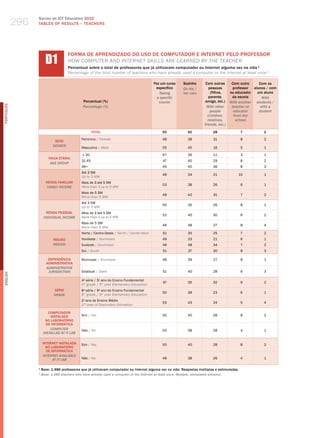
(problem solving) results and pass rates of one of its instruments, namely the National Evaluation
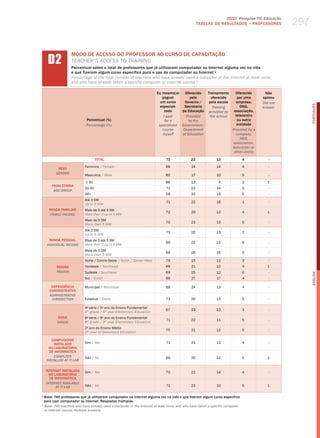


1
    Professor at the School of Education of the University of São Paulo and researcher on education cycles, progression and
    evaluation.
194
                Survey on ICT Education 2010
                ARTICLES


                of Educational Performance (Anresc) – widely known as Prova Brazil – have been incorporated into
                computing the Basic Education Development Index (Ideb)2, promoting similar initiatives in various
                public education networks, particularly the Education Development Index in the State of São Paulo
                (Idesp). One of Ideb’s aims is to disclose data from all public schools taking part in Prova Brasil,
                thus enabling several sectors to be involved in the debate and research on their meanings and
                potential explanations. Textually, Ideb’s proposal is extremely objective regarding its potential to
                reveal the quality of schools, although, historically and politically, this concept, before and after its
                publication, has revealed other manifestations in literature and educational policies.

                Indeed, in this scenario, the results of external evaluations have been included in both public
                policies and research, and represent the initial stages of defining what is broadly known as quality
                of education. The very heart of the challenge for this study in understanding the potential setbacks
                of research on education lies in the question: Would such results be able to assess the quality of
                schools? hence, at least two new questions arise, one concerning the very object of these evaluations
                – the school as a whole or just a facet, however important, of the work being done – and the other
                related to how this object is investigated.


                ChALLENGES IN dETERmINING STUdY oBjECTS
                ANd ISSUES RELATEd To RESEARCh oN EdUCATIoN

                Burke (2003, p. 183), analyzing the social process of knowledge production, indicates that, with
                variations in time and cultures:


                          [...] there are only four reasons to accept propositions as true – sentiment, authority, reason and
                          sensory perception [...] In the early modern period, this balance tipped towards a combination of
                          reason and sensory perception [...] There was a new increasingly acute awareness of the method,
                          connected with the use of scientific instruments, the more systematic collection of particular
English


                          facts and the emergence of practical guides.


                Although devoid of the hope heralded by Leibniz, namely of a universal mathematics to calculate
                truth, but probably propelled by the very “spirit” that embodied the claim of reason to control the
                senses in the search for evidence, no field of scientific research remained immune to adopting this
                empirical approach as its leitmotiv. In the quest to uncover laws and patterns, albeit potential, the
                inductive method, due to apparently favoring the search for evidence – in the eyes of those who seek
                objective data – was invested with an “aura” of self protection for its relentless efforts to exhaust the
                quest for evidence, thus uncovering causal relationships. One of the implications for research was
                introducing near exhaustive trial and testing efforts in the search for truth. Induction is acceptable,


                2
                    Ideb was instituted by Decree no. 6,074/2007 and is based on Fernandes (2007); it is calculated and disclosed to all public
                    schools with at least thirty students in years 4th to 8th of basic education, as well as other segments. For more information
                    see the Inep website, a body of the Ministry of Education in charge of implementing the Saeb (www.inep.gov.br).
195
                                                                             2010 Survey on ICT Education
                                                                                               ARTICLES


among other reasons related to its practical aspects, even when addressing “moving targets” – such
as social policies, in the words of Palumbo (1994) – particularly when we set out to understand
phenomena such as the evaluation of schools.

Whereas it is reasonable to say that the authority of this inductive approach has waned, in the sense
that such beliefs are being replaced by new methodologies that seek to investigate the path to truth,
a fortiori it is reasonable to state that its influence has not ceased, or has resurged with renewed
and transformed vigor. As an indication of such renewed vigor, there are the risks of operationalism,
i.e. the desire to find and manipulate seemingly operative concepts in the study of certain objects,
incurring, however, in an uncritical stance towards such concepts, as seems to be the case of the
disclosure of large scale evaluation results, through the use of standardized tests, as if they were
mechanically and automatically related to school learning and, therefore, a consequence of the
work carried out in schools. Indeed, in many cases, it oversteps the boundary that distinguishes
cause from effect, as if a set of scales could determine the mass of any matter and, at the same time,
determine if it is gold or silver.

Nonetheless, before discussing the consequences of such inferences, relating performance in tests
to the educational efforts of schools – a primary driver of the quality of institutions – we emphasize
that the essence of any scientific research – its conditio sine qua non even – is the determination of
research problems, which, in turn, leads us inexorably back to the challenge of determining study
objects. In education, this seems to add further challenges, as we could even question issues such
as whether there is a science of education; i.e. whether pedagogy has reached a status in which it is
defined, among other attributes, with clear objects, even when potential sub areas are accounted for.

The recent disclosure of vast amounts of data from external evaluations, contrary to their proposed
use in several public policies, does not solve the issue of determining research problems and
objects in educational research. The acceptance of such politically contaminated results, with
dependent variables and indicators, par excellence, on the quality of formal education ultimately
reduces or aggravates the significance of important factors in the scope of research on education.
These results become the research object of choice, and the use of standardized tests becomes the
preferred research methodology. And even studies on independent variables within schools seem


                                                                                                                  English
to be conceived within a context in which these variables are actually no longer dependent on
other factors that are neglected or overlooked. A consequence of this type of approach, extensively
verified in the United States – as shown in the literature by Madaus (1988) – is “teaching for tests”,
with profound curricular, pedagogical and didactic restrictions. Another consequence is that players
in the education process, particularly teachers and superintendents, would be held accountable to
an extent that does not correspond to the actual weight of their role in such a process. Nonetheless,
the most serious consequences of this approach are, within the scope of this study, implications to
research on education, as it would lead to defining problems and objects that are distant from the
reality of formal education.

This does not mean denying the relevance of research problems such as the following examples:
what do kids learn in school? how much of what they learn is learnt at school? The caveat, however,
is that such questions seem to be perfectly provable, empirically, reliably and inductively answered
by standardized tests. however, the challenge would still lie in defining school itself, its quality
regarding its historical and social constitution. This implies more essential questions, e.g. why do
kids learn what they learn in school? why do they learn as much as they do in school? what is the
purpose of learning what they learn in school? From a methodological perspective, the following
196
                Survey on ICT Education 2010
                ARTICLES


                question must be added to this list: how can we learn the answers to such questions? This refers us
                to the procedures of standardized tests, to the preparation and processing of data which is still not
                as precise as believed by users of its results. This aspect should be taken into greater consideration
                in conceiving public policies.

                hence, assuming that “simplifications” apply to some extent to these results – which, I stress, does
                not take away the merit of their production – it is imperative to emphasize the ongoing investigative
                task of positioning formal education within social practices. This, on one hand, creates room for
                other fields of science to address it, but, on the other hand, requires education scientists to always
                account for a set of issues that affect, limit, and impose restrictions and potentialities on school
                educational activities, functioning as latent traits. Understanding this, in its multitude of variables,
                does not always necessarily have to be the object of investigation, nor does it always have to be
                discussed within the set of explanations, but overlooking its existence or impact may undermine
                the elucidative effort of the investigative mission, especially because it is this acknowledgement
                that will lead to the search for better options, alternatives to overcome didactic and pedagogical
                impasses, to optimize processes, and etc. In the context of research on education, it is important to
                confirm that evidence neither confirms nor refutes, as it may easily be assumed, the connections
                that the results of these evaluations seem to indicate.

                If the relationship among phenomena is characteristic of any science, in education this feature
                takes on proportions that make it more difficult to determine research objects. Thus, the partial view
                enabled by the object may, often, create “optical illusions” for researchers.

                In educational research, its object is suffused with an almost incalculable range of influences, as it
                is constituted as a social practice. Epistemological challenges arise in the gnosiologic sphere, due to
                the nature and validity of such knowledge. Such assertions, far from undermining its heuristic merit,
                function more as a caveat both for imperative generalizations – and powerless in the very terms they
                refer to – and for hyper specializations approached by very few researchers.

                Orlandi (1969, p. 16-17), concerned with the structural complexity of the research object of studies
                on education, as well as the challenging role of “pedagogical awareness” in preventing theoretical
                emphasis from fluctuating and venturing outside its own field, defined a potential reason for these
English


                fluctuations in the “dispersive nature of the object of research on education [that] affects the role
                of the hypothesis employed to study it”, because this nature “requires the previous construction
                of a sufficiently broad and flexible theoretical structure to address the study object”. however,
                inexorably, constructing a sufficiently solid theoretical framework to address issues requires opening
                up to other sciences, including researcher training, but Orlandi (1969, p. 17) reiterates:


                        The fluctuating character of this expansion can only be controlled, not by denying the expansion,
                        [...] but by the increasing dynamism of other theories and human practices prompted by the
                        mobility of the research object itself in the study of education.


                This attests the relevance of being more open to the possibility of adopting the grounded theory, as
                suggested by Gibson and Brown (2009), as a baseline reference, and even as a research methodology
                – a strategy to study figures more carefully, for example, avoiding the haste required by other models
                to easily uncover cause-effect relationship.
197
                                                                                       2010 Survey on ICT Education
                                                                                                         ARTICLES


At this stage, it is noteworthy that – despite misguided uses and generalizations and to avoid
simplistic criticisms claiming such resources to be a resurgence of “positivist” theories – results
from external evaluations elicit a debate on the study of education regarding quantitative methods,
which, as established by Ferrare (2011), were markedly refuted and almost abandoned due to what
was referred to as critical thinking in education, because their underlying tradition did not take into
account the broader social factors affecting education and reinforcing conservative mechanisms.

hence, the onset or resurgence of methodologies targeting education metrics – including
instruments, application and collection procedures, data, creation of databases, information,
arguments, knowledge, judgments, actions, consequences, impacts, and etc. – may lead to new
perspectives and challenges to educational research, notwithstanding broader social and political
concerns regarding the political nature of schools, which does not dismiss such methodological
contributions, nor render them unique in scientific research, as found in Pearl (2009) or in Shadish,
Cook & Campbell (2002).


ExTERNAL EvALUATIoNS vIEWEd AS ExPRESSIoNS oF EdUCATIoNAL PoLICIES

In view of the dilemma of whether or not to use the results of external evaluations as indicators, we
may resort to the words of josé Paulo Paes, who claims that “the road of critical understanding runs
between refusal and enthusiasm” (1985, p. 10). This proposition seems appropriate to approach a
subject that, having always had a political streak, becomes more prominent in educational policies
and, therefore, more likely to be approached with refusal and enthusiasm, which could potentially
cloud its analysis.

With poetic license and consolidating the political dimension of external evaluations, we may
borrow Secchin’s (1993, p. 216-217) words when he asks and answers:


       What is the purpose of a poem? Perhaps to emphasize that there are always remnants, mistakes,


                                                                                                                            English
       gaps, fractures in man’s perception of reality. To ignore them is to believe that words accurately
       reflect things, to believe the validity of a homogeneous view that prevents individuals from
       negotiating the meaning of gaps resulting from uncertainty and change that both words and we
       need to stay alive [...] The divide between what is prosaic and what is poetic is managed by
       several cultural vectors, however upsetting this is to hunters of the lost essence, and lost is the
       essence for never having existed [...]

       [...] poetry does not need to wail when confronted by the technological order, and accuse it of
       being the enemy preventing its reach. [...] it remains with no other purpose than to attest that our
       freedom is not only substantiated on the words we define ourselves in, but, more importantly, on
       the words with which we learn to transform ourselves.


That is, figures per se do not yield an accurate understanding of reality, but they introduce another
means of exploring this reality, whose understanding – assuming it is feasible – will depend on how
we investigate it through the objects and questions we address. Although evaluations are different
from research, which is based on more immediate concerns and has bias as one its most prominent
198
                Survey on ICT Education 2010
                ARTICLES


                features, as highlighted by Nevo (2006) – resulting in highly consistent results, given the conditions
                under which they are employed – they may be viewed as strong footholds.

                According to Brandão (2010), education is the formative or endocultural process of the human
                species, a process our species cannot do without, lest it forgo its humanity. Nevertheless, in most
                societies, the education of human beings has been connected with the idea that, to some degree
                and extent, it must be related to schooling. Such a cultural setting suggests, in many contexts, that
                speaking of education is inexorably speaking of schooling. Even when it is acknowledged that the
                latter is subsumed to the former, the symbolic significance of schooling prevails, whether from the
                perspective of social conservation or criticism, but never dissociated from politics, as uncovered by
                Fernandes (2010), among many other authors.

                The liberal values of equal opportunities, generally viewed as equal schooling opportunities,
                emphasize the high prominence of schools in society; schools are the main arena where the
                competition for positions in the hierarchical social structure takes place. Even in other ideological
                perspectives, the notion of schooling as a promoter of human emancipation and linguistic integration,
                or other objectives related to social equality, has probably become one of the key points in the
                human rights agenda, to the extent that it is now mandatory. In the words of Marshall (1967), it is a
                right which is also a prerequisite for the fulfillment of other rights, thereby justifying the – symbolic,
                but perhaps physical – violence with which children are compelled to it.

                Furthermore, in this context of the formative process, evaluation potentially figures as an object of
                investigation. It may even assess, via meta-evaluation, if certain rules of the evaluation process have
                not been violated, which, in turn, would jeopardize evaluative judgments and their consequences.

                Moreover, given its congregational character, we can safely say that evaluation features as a
                category of educational processes, requiring special attention, particularly for being concrete, that
                is, because it synthesizes multiple determinations; In Marx’s words (1970, p. 206):


                        [...] it is concrete because it synthesizes several definitions, thus representing the unity of several
                        aspects. In our minds, therefore, it is viewed as a summary, a result, not as a starting point,
English


                        despite being the true origin, thus the origin of observation and imagination.


                Additionally, to substantiate evaluation as a category, Cury (1985, p. 21) points out:


                        Categories are basic concepts aimed at reflecting general and essential aspects of reality, its
                        connections and relationships. They emerge from the analysis of multiple phenomena and are
                        highly general.

                        From the outset, it is notable that categories must correspond to the actual conditions of each
                        place and time. They cannot be defined as one and they do not have a purpose themselves. They
                        play a role as tools for the understanding of a concrete social reality, and this understanding is
                        only significant if embraced by the groups and agents involved in educational practice.
199
                                                                                        2010 Survey on ICT Education
                                                                                                          ARTICLES


       Categories are simultaneously interpreters of reality and indicators of political strategies.
       Therefore, the only valid purpose for disclosing them is as methodological analytical instruments,
       related to the educational practice in the context of a specific time and place.

       Thus, categories are only truly consistent when constructed from an economic, social and
       political context that is historically set, because reality is not comprised of stagnant models or
       frozen movements. Instead, it is a synthesis of multiple determinants, it is constantly expanding.
       hence, it is important to take the context into account, as it is what prevents categories from being
       isolated as purely conceptual structures, enabling them to merge with reality and movement.


This entails, therefore, attempting to determine which social factors – evidently manifested as truly
pedagogic – underlie them, in order to comprehend how they have been conceived as an idea,
which seems to prevail in the schooling process, and how their concrete manifestation consolidates
a socio-historical relationship.

Marx (2005, p. 151) warned that “the weapon of criticism cannot, of course, replace criticism of the
weapon”, which, mutatis mutandis, uncovers the great challenge of eventually using the results of
external evaluations as a basis for the understanding of formal education, without overlooking the
hypothesis that these results are perhaps not a product of schools themselves, but of other elements
of reality, including interests that do not aim to “reveal” schooling, but to “produce” it. The latter
may be legitimate as a political artifact, but not as a pure and simple presentation of reality/truth
based on the accuracy of figures. These are not always accurate, and we do not always need them.
In this regard, the contributions of Sousa (1997a and 1997b) and Weiss (1982, 1991 and 1997) are
noteworthy.


FINAL ThoUGhTS

In short, a true research programme on education, in the current framework of educational policies,


                                                                                                                             English
may be based on a methodology that simultaneously reinstates schools and their evaluations as
objects viewed in their concreteness, not as autonomous or subsumed practices. This, in addition
to contributing to facing and overcoming impasses in studies on education, would enable us to
establish references for the analysis of schooling, by incorporating results from external evaluations
and, at the same time, refuting the mystifying status of these evaluations as being able to explain
everything. Thus, these results are viewed as inherently inferential, and therefore approximative and
not as adverse or disconnected from their underlying processes.

Restoring or reinstating the perspective of concrete phenomena, namely schools and their evaluation,
is to adopt an investigative approach that emphasizes the set of variables that pervades them. In
addition to arguing that politics should be left to politics, and defending a reasonably self-critical
science, we emphasize that simplifications in the realm of science tend to level it, to lessen its
strength with general beliefs, and, in the realm of politics, by innocence or apoliticism, to condemn
it to explanatory and effective impotence in relation to its object reality.
200
                Survey on ICT Education 2010
                ARTICLES


                REFERENCES

                AzANhA, josé Mário Pires. uma idéia de pesquisa educacional. Campi, 6. São Paulo: Edusp, 1992.

                BRANDÃO, Carlos Rodrigues. o que é educação. 53. reimpr. Primeiros Passos, 20. São Paulo: Brasiliense, 2010.

                BURKE, Peter. uma história social do conhecimento: de gutenberg a diderot. Translation Plínio Dentzien. Rio
                de janeiro: jorge zahar, 2003.

                COhEN, Louis; MANION, Lawrence; MORRISON, Keith. research methods in education. 6. ed. London:
                Routledge, 2007.

                CURY, Carlos Roberto jamil. educação e contradição: elementos metodológicos para uma teoria crítica do
                fenômeno educativo. São Paulo: Cortez / Autores Associados, 1985.

                FERNANDES, Florestan. “A educação como problema social”. In: ______. Florestan Fernandes: leituras e
                legados. Apres. Maria Arminda do Nascimento Arruda. São Paulo: Global, 2010. pp. 243-254.

                FERNANDES, Reynaldo. Índice de desenvolvimento da educação Básica (ideb). Série Documental. Textos para
                Discussão, 26.Brasília: Instituto Nacional de Estudos e Pesquisas Educacionais Anísio Teixeira (Inep), 2007.

                FERRARE, joseph j. “A pesquisa educacional crítica pode ser ‘quantitativa’?”. In: APPLE, Michael W.; AU,
                Wayne; GANDIN, Luís Armando. educação crítica: análise internacional. Translation Vinicius Figueira. Porto
                Alegre: Artmed, 2011. pp. 512-529.

                GATTI, Bernardete Angelina. A construção da pesquisa em educação no Brasil. Série Pesquisa, v. 1. Brasília:
                Líber Livro, 2007.

                GIBSON, Will; BROWN, Andrew. “Teoria, grounded theory e análise qualitativa”. Translation Verônica van
                Wilpe. In: BOURGUIGNON, jussara Ayres (org.). Pesquisa social: reflexões teóricas e metodológicas. Ponta
                Grossa: Todapalavra, 2009. pp. 35-62.

                MADAUS, G. F. “The Influence of Testing on the Curriculum”. In: TANNER, L. N. (org.). critical issues in
                curriculum. Eighty-seventh Yearbook of the National Society for the Study of Education. Chicago: University of
                Chicago Press, 1988. pp. 83-121.

                MARShALL, Thomas humphrey. cidadania, classe social e status. Biblioteca de Ciências Sociais. Translation
                Meton Porto Gadelha. Rio de janeiro: zahar, 1967.

                MARX, Karl. A contribution to the critique of Political economy. Translation S. W. Ryazanskaya. Org. e intr.
English


                Maurice Dobb. Moscow: Progress, 1970.

                ______. crítica da filosofia do direito de hegel. Translation Rubens Enderle e Leonardo de Deus. São Paulo:
                Boitempo, 2005.

                NEVO, David. Evaluation in Education. In: ShAW, Ian F.; GREENE, jennifer C.; MARK, Malvin M. (org.).
                handbook of evaluation. London: Sage, 2006. pp. 441-460.

                ORLANDI, Luiz Benedicto Lacerda. O problema da pesquisa em educação e algumas de suas implicações.
                educação hoje, São Paulo, n. 2, pp. 7-25, 1969.

                PAES, josé Paulo. gregos & baianos: ensaios. São Paulo: Brasiliense, 1985.

                PALUMBO, Dennis j. Public Policy in America: government in Action. 2. ed. Fort Worth: harcourt Brace College,
                1994.

                PEARL, judea. causality: models, reasoning and inference. 2. ed. New York: Cambridge University Press, 2009.

                ShADISh, William R.; COOK, Thomas D.; CAMPBELL, Donald T. experimental and quasi-experimental designs
                for generalized causal inference. Belmont: Wadsworth / Cengage Learning, 2002.

                SECChIN, Antônio Carlos. Poesia e desordem. Poesia Sempre, Rio de janeiro, 1(1), pp. 215-217, jan., 1993.
201
                                                                                       2010 Survey on ICT Education
                                                                                                         ARTICLES


SOUSA, Sandra Maria zákia Lian. “Avaliação escolar e democratização: o direito de errar”. In: AQUINO, julio
Groppa (org.). erro e fracasso na escola: alternativas teóricas e práticas. São Paulo: Summus, 1997a. pp. 125-139.

______. “Avaliação do rendimento escolar como instrumento de gestão educacional”. In: OLIVEIRA, Dalila
Andrade (org.). gestão democrática da educação: desafios contemporâneos. Petrópolis: Vozes, 1997b. pp.
264-283.

WEISS, Carol hirschon. “Pesquisa avaliativa no contexto político”. Translation Yara Marques. In: GOLDBERG,
Maria Amélia Azevedo; SOUzA, Clarilza Prado de (org.). Avaliação de programas educacionais: vicissitudes,
controvérsias e desafios. São Paulo: EPU, 1982. pp. 23-27.

______. Evaluation Research in the Political Context: Sixteen Years and Four Administrations Later. In:
MCLAUGhLIN, Milbrey W.; PhILLIPS, D. C. (org.). evaluation and education: at quarter century. Ninetieth
Yearbook of the National Society for the Study of Education. Part II. Chicago: National Society for the Study of
Education, 1991. pp. 211-231.

______. evaluation: methods for Studying Programs and Policies. 2. ed. Upper Saddle River: Prentice-hall, 1997.


                                                                                                                            English
2
iCT eDUCATiOn
205
                                                                            2010 Survey on ICT Education
                                                             ICT EDuCATION – METHODOLOGICAL REPORT


mEThodoLoGICAL REPoRT
ICT EdUCATIoN 2010


INTRodUCTIoN

The Center of Studies on Information and Communication Technologies (Cetic.br), of the Brazilian
Network Information Center (NIC.br) – the executive branch of the Brazilian Internet Steering
Committee (CGI.br) – presents as of 2010 the ICT Education survey, which is one of its surveys on
the use of information and communication technologies (ICT) in Brazil.

The survey methodology was based on international references and received the support of renowned
bodies, such as the IEA (International Association for the Evaluation of Educational Achievement).

The survey aimed to determine how ICT are used and incorporated by public schools in teaching
practices and school management, thus monitoring potential changes to school dynamics related
to this use.


mEThodoLoGICAL ASPECTS


                                                                                                                 English
REFERENCE dATE

The survey was conducted between August and November 2010.


TARGET PoPULATIoN ANd SAmPLE UNIT

The target population of the study are teachers, directors of studies and principals from state or
municipal public schools in Brazil, in metropolitan areas, who work in the following levels of the
Brazilian education system: Elementary Education I (elementary school), Elementary Education II
(middle school), Secondary Education (high school).

Each school is viewed as a conglomerate comprised of teachers, students, principals and directors
of studies, who are the relevant actors in this survey. hence, a school is regarded as a primary
sample unit.
206
                Survey on ICT Education 2010
                ICT EDuCATION – METHODOLOGICAL REPORT


                REGISTRIES USEd ANd REPoRTING UNITS

                The registry used to select schools was the Basic Education Census 2007, conducted by Inep (Anísio
                Teixeira National Institute for Studies and Research on Education). In every school, the aim was
                to select a principal, a director of studies, two Portuguese teachers, two math teachers and ten
                students. Students and teachers selected attended or worked in the following grades: 5th year of
                Elementary Education I (former 4th grade), 9th year of Elementary Education II (former 8th grade) and
                2nd year of Secondary Education. ICT Education survey focused on teachers.


                ANALYSIS PRoFILES

                In order to reach its goals, the survey addressed the following subjects, based on specific approaches:

                   A. Schools: profile of ICT infrastructure and practices in public educational institutions.

                   B. Teachers: profile, career level and commitment to teaching; ICT skills; use of ICT in school
                      activities and barriers preventing its progress.

                   C. Students: profile and ICT skills; ICT training; school activities carried out on the Internet.

                   D. Principals: profile; use of ICT in management and administrative activities, including interac-
                      tion with the community.

                   E. Directors of studies: profile; use of ICT in management and administrative activities, inclu-
                      ding interaction with the community.


                Results for the subjects outlined above may be viewed segmented by the following variables:

                Region: the macro regions of Brazil, as divided by the Brazilian Institute of Geography and Statistics
                (IBGE). In order to increase representativeness, samples from the Center-West and North regions
English


                were grouped in the analysis.

                Administrative jurisdiction: administrative reporting level, i.e., municipal or state.

                Grade: levels in the formal educational system. Three grades were investigated, each representing a
                level of education addressed in the survey: Elementary Education I (4th grade/5th year), Elementary
                Education II (8th grade/9th year) and Secondary Education (2nd year).

                Computer installed in the IT lab: presence of computers in the IT lab of each school, which was
                recorded according to information provided by the school principal.

                Internet available in the IT lab: access to the Internet from computers installed in the IT lab of each
                school, which was recorded based on information provided by the school principal.

                Family income: household income, i.e., the total monthly income of all members living in the
                respondent’s household.

                Individual income: total monthly wage of the respondent.
207
                                                                               2010 Survey on ICT Education
                                                                ICT EDuCATION – METHODOLOGICAL REPORT


For data publication, three income ranges were determined. It is worth noting that individual and
family incomes were not surveyed among students.


INFoRmATIoN oN ThE qUESTIoNNAIRE

Interviews were conducted based on structured questionnaires for each target population.

Application of the data collection instrument took approximately 20 minutes for teachers and
students and approximately 30 minutes for principals and directors of studies. Each questionnaire
includes the modules below.

Module A has questions about the personal characteristics of each actor. Professional and academic
profiles were surveyed with all actors, except for students. Furthermore, principals were asked
about general aspects of the school infrastructure, thus obtaining basic school data.

Module B outlines the profile of school actors as ICT users; it aims to draw a picture of ownership
and use of computers and the Internet. It accounts for the type of computer, mobility, portability
and frequency of use, and investigates the digital inclusion status of students, teachers, directors
of studies and principals. Except for students, it investigates the sources of resources for computer
acquisition, in order to determine whether there are governmental programs and if these are being
used.

Module C captures the perceptions of students and teachers regarding their individual skills when
carrying out activities using computers and the Internet. It also investigates directors of studies’
and principals’ ICT skills in carrying out school administration and organizational and pedagogic
planning activities.

Barriers preventing use were investigated in modules D for directors of studies, E for principals and
F for teachers, in order to shed light on the barriers preventing ICT incorporation by schools.

Module D investigates specific training for teachers and students; it aims to outline where knowledge


                                                                                                                    English
is obtained, particularly computer and Internet skills, as well as to determine whether there are
governmental programs and if these are being used. This module also asked principals about the ICT
equipment and resources available in the school and about their conditions.

School and educational activities are surveyed in module E for students and teachers. Regarding
students, it explores the range of activities available in classrooms and investigates whether students
use technological resources offered by the school as learning tools. With teachers, it seeks to outline
the universe of school activities and their perceptions regarding pedagogic objectives, teaching
practices, evaluation methods and support to the use of ICT.
208
                Survey on ICT Education 2010
                ICT EDuCATION – METHODOLOGICAL REPORT


                SAmPLE PLAN

                In order to gather information on the use of ICT in the Brazilian public education system, the
                ICT Education 2010 survey used data from the School Census 2007 (Inep/Ideb). A sample of 500
                schools was designed by Ibope Inteligência, which was also in charge of data collection and result
                calculation.

                It is a probability sample, cluster-stratified and selected in stages. Selection was performed by
                PPS (probability proportional to size), based on the number of enrollments in the School Census
                2007. The proportion of schools per administrative jurisdiction (municipal and state) and level of
                education (Elementary, Secondary and both) was maintained. The sample is disproportional for
                regions (Northeast, Southeast, South and North / Center-West), but it was further weighted.

                Thus, the sample plan enables data collection from Brazilian municipal and state public schools.
                Federal schools were not included due to their particularities.

                Each sample unit drawn (school) was regarded as a conglomerate, and in these units, up to two
                classes were drawn based on the number of enrollments per school and grade. Students were
                selected at the time of the interview. Overall, 5 students were interviewed in every class, except
                when there was only one class for the set grade in the school, in which case 10 students were
                selected for the interview.

                The main difference between the ICT Education survey sample and the one used by Saeb (National
                Basic Education Evaluation System) is the criterion that defines school size. For Saeb, school size
                is determined based on the number of existing classes, whereas in the ICT Education the criterion
                used is the number of enrollments.

                The cross-section combining region, administrative jurisdiction and level of education produced 24
                strata, and a list of schools was created for each of these strata. In this list, schools were organized in
                descending order of number of enrollments to ensure all school sizes were significantly represented.
                The first school from each registry was selected by an initial random jump, multiplied by an interval
                based on a ratio combining the total number of students over the number of schools to be selected
English


                in each stratum. The interval was used systematically to select the remaining schools. The number
                of schools drawn in each stratum was proportional to the size of the universe.

                A second stage involved selecting classes, after selecting a grade in each sample unit drawn (school).

                If the school was only selected for interviews with one grade, one or two classes could be selected.
                hence, in schools where there was only one class in the grade selected, ten interviews were carried
                out with students from that class. In schools where there were two classes for the grade selected, five
                students were interviewed in each class. For schools with more than two classes in a given grade,
                students attending school during the period when there were more classes were interviewed; five
                interviews were carried out with the first class (class A or first letter of the period) and other five
                interviews were carried out with the last class listed by the school.

                If the school was selected for interviews with two different grades, one class was interviewed in
                each grade; in schools where there was only one class per grade, five students were interviewed in
                each of the classes. In schools with more than one class in the selected grades, students attending
                school during the period when there were more students enrolled were interviewed; five interviews
209
                                                                                          2010 Survey on ICT Education
                                                                           ICT EDuCATION – METHODOLOGICAL REPORT


were carried out with the first class (class A or first letter of the period for each grade selected) and
other five interviews were carried out with the last class listed by the school for the grade selected.

Schools had to have at least one class in each grade selected, otherwise they would be replaced. The
remaining criteria are described in detail under “Non-response to a unit”.

In certain schools, interviews were carried out with all students in a class, because the number of
students available was lower than the desired quantity.

In order to select interviewees, the third stage of selection, students were chosen systematically
by jumps of 4 students, following row distribution in the classroom. The first student was selected
randomly by the interviewer, and that position was not repeated for the remaining classes in the
same school.

Portuguese and math teachers involved with the classes from the selected grades were interviewed.
In 4th grade/5th year classes, teachers teaching basic subjects were interviewed. Regarding directors
of studies and principals, the survey aimed to interview those who worked with the grades of the
classes selected. When this was not feasible, interviews were carried out with the subjects available
for the interview.

In total, 7,453 interviews were carried out – 1,541 with teachers, 4,987 with students, 497 with
principals and 428 with directors of studies.


WEIGhTING

The sample plan considered a disproportionate distribution per region, thus results had to be
weighted to ensure the sample profile was representative of the universe of the study. The weighting
method used was the so-called cell weighting. hence, the South and North/Center-West regions
were over represented to ensure accurate reading of the data collected from these regions, and this
disproportional distribution was corrected by applying weighting factors for each region, as shown
below in Table 1.


                                                                                                                               English
                                            Table 1. WEIGHTING FACTOR – REGION

                                   Region                   Schools          Weighting factor

                       North/Center-West                     100                 0,800
                       Northeast                             130                 1,200
                       Southeast                             170                 1,065
                       South                                 100                 0,830
                       ToTAL                                 500
210
                Survey on ICT Education 2010
                ICT EDuCATION – METHODOLOGICAL REPORT


                SAmPLE PRECISIoN

                Sample error measurements relative to the indicators of the ICT Education survey were designed for
                an estimated confidence interval of 95%. The maximum margin of error set forth was 2 percentage
                points either way over the results for the total sample.

                Margins of error presented in the Tables 2, 3 and 4 below were calculated with a 95% confidence
                interval, assuming the most variable scenarios for independent variables. For illustrative purposes,
                the highest variability occurs when a given proportion of the population equals 50% (P = 0.5).


                                                 Table 2. MARGIN OF ERROR – ADMINISTRATIvE juRISDICTION

                                           Administrative jurisdiction             Schools             margin of error

                                         State                                      221                      7
                                         municipal                                  279                      6
                                         ToTAL                                      500                      4


                                                                   Table 3. MARGIN OF ERROR – REGION

                                                     Region                        Schools             margin of error

                                         North/Center-West                          100                      10
                                         Northeast                                  130                      9
                                         Southeast                                  170                      8
                                         South                                      100                      10
                                         ToTAL                                      500                      4


                                                                   Table 4. MARGIN OF ERROR – GRADE

                                                     Grade                                   Classes             margin of error

                                 Elementary Education I – 4 grade and 5 year
                                                              th            th
                                                                                              376                        5
                                 Elementary Education I – 4th grade and 5th year              328                        5
English


                                 Secondary Education – 2nd grade                              296                        6
                                 ToTAL                                                       1000                        3


                Due to rounding, the sum of individual categories is occasionally above 100% for single-answer
                questions. The sum of frequencies in multiple answer questions is usually above 100%.


                TREATmENT oF NoN-RESPoNSE

                In the ICT Education 2010, there are two levels of non-response treatment: non-response to a unit
                and non-response to an item, as explained below.
211
                                                                                       2010 Survey on ICT Education
                                                                        ICT EDuCATION – METHODOLOGICAL REPORT


NoN-RESPoNSE To A UNIT

Non-response to a unit is when an interview could not be carried out with a selected school. In
these cases, replacements were made according to the statistical criteria for random selection of
replacement schools. Replacements were made when:

   •	Classes had been suspended (recess, strikes, security problems, recurring extreme weather
     conditions ongoing until the end of the field data collection); or

   •	The institution would not authorize interviewers to enter the school and carry out the survey; or

   •	The school was imperative about the principal or other person not involved in the contracted
     field teams selecting the interviewees; or

   •	Schools did not meet the criteria set forth for stratified quotas (i.e., the school’s current infor-
     mation for the variables used to create the strata in the survey was different from the informa-
     tion available in the School Census registry).

In addition to the standard strata selection procedures, replacement schools were physically close,
regarding the number of enrollments, to the schools originally selected for the survey in the list of
schools, ordered by probability proportional to size. The two schools preceding the original school
were selected, with higher numbers of enrollments, as well as the two subsequent schools, with
lower number of enrollments. The following table shows the number of schools replaced in the
original sample.


                                        Table 5. NON-RESPONSE uNITS – REGION

                                   Region                Schools           Replacements

                       North/Center-West                  100                   5
                       Northeast                          130                   6
                       Southeast                          170                  19
                       South                              100                   3


                                                                                                                            English
                       ToTAL                              500                  33


NoN-RESPoNSE To AN ITEm

Non-response to an item is when one of the actors selected does not answer a specific question
of the questionnaire. This usually happens when the interviewee does not know enough about the
subject or when he/she refuses to answer a question. In these cases, two options are available:
“Does not know” and “Did not answer”. hence, the non-response rate component of a question can
be measured, and results for this option are displayed in the tables of results.
213
                                                                                        2010 Survey on ICT Education
                                                                                  ICT EDuCATION – SAMPLE PROFILE


SAmPLE PRoFILE
ICT EdUCATIoN 2010

The objective of this section is to briefly present the sample profile of the ICT Education survey,
contextualizing and promoting better understanding of the survey’s results. The sample is comprised
of four groups: teachers, principals, students and directors of studies.

The survey has three strata for selection: administrative jurisdiction (the education sector of the
school), grade and region (where the school is located). Nonetheless, in addition to these variables,
results may be viewed separately for other variables such as gender, age group, individual income
and family income for all target populations (except for students). Regarding the variables of the
survey, the School Census 2007 was used as reference of the Brazilian educational scenario.

The sample profile has an equivalent proportion of male and female students, with slight
predominance of women, who represent 55% of the students interviewed. however, in other target
populations there is a notable predominance of women – 77% of the teachers, 80% of the principals
and 91% of the directors of studies.


                                      Chart 1. SAMPLE PROFILE – GENDER

                    100                                                      91
                                                            80


                                                                                                                             English
                     80    77


                     60                     55
                                                  45
                     40
                                 23                                     20
                     20
                                                                                       9

                      0
                            Teacher          Student        Principal         Director
                                                                             of studies

                                                 Female          Male


Regarding distribution by age group, students in the survey are divided as follows: most of them
are 13 years old (42%), and 14- and 15-year-olds represent 29% of the sample, which is the same
proportion of students over 16 years old. Regarding the age of teachers, directors of studies and
principals, most of the respondents were aged between 31 and 45 – 55% of the teachers, 51% of
the principals and 59% of the directors of studies. Among principals, 46% of the interviewees were
46 years old or older, and only 3% were under 30 years old.
214
                Survey on ICT Education 2010
                ICT EDuCATION – SAMPLE PROFILE


                                                  Chart 2. STuDENTS SAMPLE PROFILE – AGE GROuP


                                           42%                            29%                                   29%
                                           ≤ 13                           14 - 15                               16+


                                                  Chart 3. EDuCATORS SAMPLE PROFILE – AGE GROuP


                                                                                                           59
                                     60           55
                                                                            51
                                     50                                             46

                                     40                                                                           35
                                                       29
                                     30

                                     20     16

                                     10                                                               6
                                                                      3
                                      0
                                                  Teachers                 Principals               Directors of studies

                                                              ≤ 30               31 - 45            46 +


                The sample is comprised of 52% of teachers in the municipal jurisdiction against 48% in the state
                jurisdiction. A total of 54% of the interviews were carried out with students, 54% with principals
                and 53% with directors of studies in the municipal education sector.
English


                                     Chart 4. SCHOOL PLAyERS SAMPLE PROFILE – ADMINISTRATIvE juRISDICTION


                                     60
                                            52                54                      54                   53
                                     50           48                                                               47
                                                                     46                     46

                                     40

                                     30

                                     20

                                     10

                                      0
                                             Teachers          Students                  Principals             Directors
                                                                                                                of studies

                                                                      Municipal             State
215
                                                                                                                 2010 Survey on ICT Education
                                                                                                           ICT EDuCATION – SAMPLE PROFILE


Proportions of students enrolled per grade reveal that most students are in Elementary Education,
39% of them attend the 5th year (former 4th grade) and 34% attend the 9th year (former 8th grade). The
proportions of teachers are as follows: 31% teach in Secondary Education, 42% teach the 5 th year
and 40% teach the 9th year of Elementary Education. Sums are in excess of 100% because certain
schools have more than one grade.


                                   Chart 5. SCHOOL PLAyERS SAMPLE PROFILE – GRADE


                      50
                              42                                            42                        42
                                   40              39                             39                       39
                      40
                                                          34
                                        31                                             30                        30
                      30                                       27

                      20

                      10

                        0
                                Teachers             Students                   Principals             Directors
                                                                                                       of studies

                5th year Elementary Education      9th year of Elementary Education               2nd year of Secondary Education


Due to Brazil’s vast territory and cultural diversity, indicators must be analyzed separately for each
region. hence, most schools are located in the Southeast region, which accounts for 39% of the
directors of studies and 36% of the other actors; and the lowest share of schools is found in the
South region, with a proportion that varies from 15% to 18%, in line with the results of the School
Census 2007.


                                   Chart 6. SCHOOL PLAyERS SAMPLE PROFILE – REGION


                                                                                                                                                      English
                      40                                                                                         39
                                        36                     36                      36
                                   31                     31                      31
                      30
                                                                                                           25

                      20      18                                    17                       17       18              18
                                             15    16                       16

                      10


                        0
                                Teachers             Students                   Principals              Directors
                                                                                                        of studies

                                    North / Center-West             Northeast          Southeast                South


The predominant family income was of 5 minimum wages (MW) or more for the target populations
interviewed, with 75% of the principals, 64% of the directors of studies and 52% of the teachers,
followed by the more than 3 up to 5 MW income range. It is noteworthy that regarding individual
216
                Survey on ICT Education 2010
                ICT EDuCATION – SAMPLE PROFILE


                income, 41% of the principals earn more than 5 MW, and 40% of them earn between 3 and 5 MW;
                whereas amongst teachers, only 20% earn more than 5 MW, and 42% earn up to 3 MW.


                                                    Chart 7. EDuCATORS SAMPLE PROFILE – FAMILy INCOME

                                    80
                                                                                       75

                                                                                                                    64
                                    60
                                                            52


                                    40
                                                      30
                                                                                                              28


                                    20                                            18
                                               16

                                                                            6                            8
                                                                  2                           1
                                     0
                                                    Teachers                     Principals            Directors of studies

                                              up to 3 MW          More than 3 up to 5 MW          More than 5 MW         Refusal


                                                Chart 8. EDuCATORS SAMPLE PROFILE – INDIvIDuAL INCOME

                                         50

                                                 42                                    41
                                                                                  40                         40
                                         40
                                                       37
                                                                                                        33
                                         30                                                                        27
English


                                                             20
                                         20                                 18


                                         10

                                                                      1                       1
                                          0
                                                      Teachers                   Principals           Directors of studies

                                              up to 3 MW          More than 3 up to 5 MW          More than 5 MW         Refusal
217
                                                                             2010 Survey on ICT Education
                                                                   ICT EDuCATION – ANALySIS OF RESuLTS


ANALYSIS oF RESULTS
ICT EdUCATIoN 2010


PRESENTATIoN

The Center of Studies on Information and Communication Technologies (Cetic.br), of the Brazilian
Network Information Center (NIC.br) – the executive branch of the Brazilian Internet Steering
Committee (CGI.br) – coordinates the Survey on the Use of Information and Communication
Technologies in Brazil, and since 2005 conducts the ICT households and Enterprises. In 2010, the
ICT Education survey was launched, combining elements of a quantitative survey in public schools,
as well as an in-depth analysis of some of them. This has contributed towards consolidating the
Cetic.br as a reference center in the production of statistics and analysis on ownership and use of
ICT in the country.

The primary goal of the ICT Education survey is to determine how broadband Internet connections
are used and incorporated into the routine of public schools, both in management and, more
importantly, teaching practices. Data collection for the quantitative survey took place between
August and November, covering a sample of 500 public schools in urban areas across the country,
where 1,541 teachers, 4,987 students, 497 principals and 428 directors of study were interviewed.

The ICT Education 2010 adapts some of the indicators from the “SITES 2006 study: Second


                                                                                                                  English
Information Technology in Education Study 2006”, of the IEA (International Association for the
Evaluation of Educational Achievement). Furthermore, the survey includes indicators produced
to address specific themes in the Brazilian scenario. The survey sample was designed by Ibope
Inteligência, also in charge of data collection and results calculation.

Sample error measurements relative to the indicators of the ICT Education 2010 survey were designed
estimating a confidence interval of 95%. The maximum error margin set forth is 2 percentage points
either way over the results for the total sample.


INTRodUCTIoN
When the first computers were being installed in schools in several countries in the 1970s,
we began to refer to them and to their use as “computers in education”. Following computers,
peripheral devices were introduced in schools, i.e., printers, external drives, scanners and the
first digital cameras. All of these devices together were then referred to as information technology,
or IT. When the Internet arrived in schools, along with networked computers, the World Wide
218
                Survey on ICT Education 2010
                ICT EDuCATION – ANALySIS OF RESuLTS


                Web, e-mail and search engines, a new term was coined: ICT, which stands for information and
                communication technologies. This refers to the technological diversity (equipment and features) that
                enables individuals to create, capture, interpret, store, receive and transfer information.1

                Worldwide, the introduction of ICT in schools has quickly been responsible for marked effects on
                teaching and learning. At the institutional level, schools have been using computers and software for
                general administrative tasks, such as accounting, inventory, communications, document preparation
                and printing, as well as specific software for school management, i.e., schedule preparation,
                electronic reports, attendance tracking, assessment records, library management and creating
                student profiles.

                At the instructional level, the use of ICT in classroom activities, lecture halls and laboratories in
                several countries has been accompanied by changes in the way teachers teach and students learn.
                It can be clearly seen that technological innovations in school and within the classroom are being
                accompanied by the transformation of the teacher’s role, from transmitter of knowledge, primary
                source of information, controller and manager of all aspects of learning to facilitator, collaborator,
                coach, knowledge mentor and co-learner in the learning process, providing students with more
                options and responsibilities in their own learning process.

                This change in the teachers’ role is well summarized as follows: they are no longer the “sages on
                stage” but have become “the guides next you”, or the conductors who seek to bring out the best in
                each member of the orchestra.

                In addition to changing the role of teachers, the literature shows that ICT are also transforming the
                role of students, who progress from being passive recipients of information, knowledge reproducers
                and lonely learners to active participants in the learning process, knowledge producers and learners
                in collaboration with others.

                As shown in evidence from countries which are in a more advanced stage of ICT integration in
                teaching / learning, students in rooms equipped with technology are generally active researchers
                seeking information on the web to complete individual or group projects, communicating by e-mail,
                blogs and social networks with students from other schools and drawing conclusions based on
English


                collected evidence.2

                The use of ICT in schools is seen therefore as being capable of creating opportunities – long awaited
                by education scholars – to transform school organizations into learning communities, which requires
                that teachers, administrators and students develop this skill.

                Experiments with the use of ICT in schools show that the educational potential of these technologies
                is not intrinsically orientated towards constructivism, but can also support the development of
                traditional pedagogies. At the end of the 2000s, there seems to be recognition in Latin America of
                the numerous benefits of ICT to education, regardless of the predominant model of education.3


                1
                    ANDERSON, jonathan. ict transforming education: a regional guide. Bangkok: Unesco, 2010.
                2
                    idem.
                3
                    VALDIVIA, Ignacio jara. las políticas de tecnología para escuelas en América latina y el mundo: visiones y lecciones.
                    Santiago: ONU, 2008. p. 18.
219
                                                                                         2010 Survey on ICT Education
                                                                               ICT EDuCATION – ANALySIS OF RESuLTS


The central issue for public policies designed to stimulate technological innovation in education is,
therefore, knowing when and how this potential is realized, that is, the effective impact of ICT on
educational outcomes and the conditions in which this occurs. The literature is inconclusive in this
regard, and this situation is largely attributed to the absence of specific indicators and consistent
and systematic observations on the realities of schools and their teaching / learning processes.

The formulation of indicators in this area is a tricky task, given its intrinsic complexity, and
international comparisons are hindered by the additional diversity in curricula and educational
systems. Unesco is currently determined to contribute to reducing these difficulties and is committed
to the formulation of internationally comparable indicators on ICT in education.4

Confident in strengthening Brazil’s contribution to this global effort, and consistent with international
efforts in this field, the ICT Education survey carries out its work with the main objective of identifying
uses and appropriation of information and communication technologies in Brazilian public schools,
focusing on school management and especially pedagogical practice.


CoNTExT oF BRAzILIAN EdUCATIoN

Currently, according to the 2010 School Census, there are 51.5 million students enrolled in schools
nationwide. Of these, only 15% are getting their basic education in private schools, while the vast
majority, 85%, is enrolled in public schools. According to the Teacher Synopsis 2009, of the Ministry
of Education, there are almost 2 million teachers employed in basic education. Students from public
schools and practicing teachers in basic education must be central players in the development
of public policies for the education in the country. Included in this context are the policies for
technological modernization in Brazilian public schools.

The concept that education is fundamental to the construction and development of society has
already been established. The current scenario of the country shows that while there has been
improvement in relation to school access, there is still a great challenge to improve education.


                                                                                                                                English
Since the 1990s, virtually all children from 6 to 14 years have access to schooling. In 2009, 97.6%
of children in this age group were attending basic education schools. Regarding the age group of
children from 15 to 17, the proportion of access to school is lower than desired: in 2009, according
to the “Synthesis of Social Indicators 2010”, of IBGE, 85.2% of these young people were attending
school. The data also indicate that, for these teenagers, there is a high discrepancy in relation to the
net enrollment ratio, i.e., the proportion of the population in a particular age group that is in the
level of education appropriate to their age, even though rates have improved since the end of the
1990s. In 2009 only 39.2% of adolescents were in secondary school, which does not even reach
the 42.1% ratio of the Southeast region in 1999. An even greater challenge is the quality of teaching
and learning. The complexity of this issue can be assessed by looking at the goal to be achieved by


4
    UNESCO. guide to measuring information and communication technologies (ict) in educationnew york: Unesco Statistics
    Institute, 2009
220
                Survey on ICT Education 2010
                ICT EDuCATION – ANALySIS OF RESuLTS


                the Development Index of Basic Education (Ideb)5 in 2021, the year when schools should achieve
                a grade of 6.0, comparable to results obtained in more developed countries. One can estimate the
                effort necessary to achieve that level seeing that, in 2009, the Ideb average for the early grades in the
                country was 4.6. Moreover, the index highlights the disparity between public and private schools,
                since private establishments reached 5.9 as early as 2005, while in that same year the level for
                public schools was 3.6.

                Compared to other countries, Brazil is still in a position of disadvantage in terms of knowledge
                attained by school age children. In the surveys conducted by Pisa (Program for International
                Student Assessment) in 65 countries in 2009,6 the country was ranked in the 54th position in reading
                proficiency for 15-year-old students, a rate well below the OECD average.

                Regarding the dropout rate, Brazil’s rates are high, both in elementary school and in secondary
                school, especially when compared to some Latin American countries like Argentina, Chile, Paraguay,
                Uruguay and Venezuela.7

                Another dimension of education in which the country will try to get better results refers to the
                completed years of study. Comparing countries with the same level of economic and social
                development, a 15-year old Brazilian had in 2009 an average of 7.5 years of study, or had not even
                completed the mandatory elementary education, a right guaranteed by the Constitution. According
                to Eurostat, the proportion of people aged 18 to 24 with eleven years of study is a key indicator for
                assessing both the efficiency of the educational system of a country and its ability to fight poverty and
                reduce socioeconomic inequalities. In 2009, Pnad (National households Sample Survey) reported
                that only 37.9% of the population in this age group had completed eleven years of schooling.

                The struggle for better education in Brazil involves the battle for reducing regional differences. The
                country’s educational statistics suggest great inequality between regions. Much has already been
                done, as noted above, but old and new challenges unfold in the future.
English


                5
                    Ideb is calculated from two components: academic performance rate (approval), obtained from the school census, and
                    average performance in standardized Prova Brazil tests (Ideb for municipal schools) and Saeb (Ideb for state and national
                    establishments). The index is based on the students’ results at the end of each stage of Elementary Education (former 4 th grade
                    / current 5th year and former 8th grade / current 9th year) and the 3rd year of Secondary Education, through standardized tests,
                    and the rate of corresponding approval of students of every stage of education (investigated by the school census).
                6
                    Available at http://browse.oecdbookshop.org/oecd/pdfs/free/9810071e.pdf.
                7
                    Indicadores Estadísticos del Sistema Educativo del Mercosur 2008.
221
                                                                               2010 Survey on ICT Education
                                                                     ICT EDuCATION – ANALySIS OF RESuLTS


EdUCATIoN ANd TEChNoLoGY: PUBLIC PoLICIES IN BRAzIL

Government initiatives to encourage the use of information and communication technology in
Brazilian public schools date back to about 1996. The main current government actions aimed at
integrating ICT in education are those listed below.


National Programme for IT Integration in Education (Proinfo)

Since 1997, the National Program for IT Integration in Education has addressed the public school
system at both elementary and secondary level in all states in the federation. At first, the program
guidelines developed by the Department of Distance Education (SEED), of the Ministry of Education,
intended to purchase and install 100,000 computers in schools in accordance with predetermined
criteria and in cooperation with the state and municipal governments.

According to MEC, the program is operating in 5,100 towns and has reached, since 2004, 64.6
thousand educational establishments, 28.3 million students and 1.2 million teachers. Official
records point to the acquisition of more than 100,000 computer labs during this period, according
to Proinfo Guidelines.


Broadband in School Program (PNBLE)

The Broadband in School Program was launched in April 2008 by the federal government and aims
to connect all urban public schools to the Internet.

The project is the result of a partnership between the government and telecom operators companies
such as Oi (Telemar), Telefônica (Telesp), Sercomtel and CTBC. The PNBLE set a goal of taking a
connection of not less than 1 Mbps to all urban state, local and federal public schools listed in
the school census. The program requires that the installation be done in the computer lab or other
teaching space indicated by the school principals. The service connection will be maintained for
free until the year 2025.


                                                                                                                    English
One Computer per Student Program (Prouca)

The One Computer per Student Program aims to promote digital inclusion through the distribution
of a portable computer (laptop) for each student and teacher of basic education in public schools.
The program came about based on the One Laptop per Child (OLPC) project, originally proposed by
MIT, and was presented to the Brazilian government at the World Economic Forum in january 2005.

The partnership with FacTI (Foundation to Support Training in Information Technology), of Finep
(Research and Projects Financing Agency), to validate the OLPC solution was formalized after
meetings with Brazilian experts to discuss the intensive pedagogical use of ICT in schools.

During 2007, five schools were selected as initial experiments, in five cities in five states: São Paulo
/SP, Porto Alegre/RS, Palmas/TO, Piraí/Rj and Brasilia / DF. Each school received laptops for students
and teachers, infrastructure for Internet access and training of managers and teachers in the use of
222
                Survey on ICT Education 2010
                ICT EDuCATION – ANALySIS OF RESuLTS


                technology. In its implementation, the project has also the support of the Work Group from the UCA
                program (GTUCA), composed of specialists in the use of ICT in education.


                RESULTS

                To investigate the scenario of digital inclusion in Brazilian schools, the ICT Education survey
                brings relevant results, making it possible to direct the eyes of society and foster public policies for
                education.


                SChooL STRUCTURE

                On average, schools have 14 classes in elementary school (first five years of elementary education),
                13 in middle school (four last years of elementary education) and 15 classes in secondary school.
                The ratio of the number of students per class increases with the level of education: 29 students per
                class in elementary school, 33 in middle school and 36 students in secondary school.

                A large part of the schools that offer pre-school distribute equally the number of classes in the
                morning and afternoon periods. The same occurs in schools offering elementary school. In secondary
                school, the afternoon period has the lowest incidence of classes, and the highest incidence occurs
                in the night period.

                In relation to staff, directors of studies are present in 85% of Brazilian schools, and monitors provide
                technical support for computer labs at 52% of the schools. The role of the director of studies is
                more prominent in the South and Southeast regions, as seen by the percentage of 92% and 90%
                respectively; on the other hand, the Northeast is the region that most lacks this professional, since
                only 76% of schools have such an educator, a proportion significantly below the country’s total.
English


                TEChNoLoGY INFRASTRUCTURE

                Landline coverage is the technological infrastructure which presents more regional differences: 81%
                of Brazilian schools are covered by this technology, and this proportion in North/Center-West is of
                73%, and in Northeast is of 55%.

                On the other hand, the schools have started equipping themselves in preparation for action related
                to the production of multimedia content. Digital cameras and camcorders, which can stimulate this
                type of content, are present in 78% and 42% of schools, respectively (Chart 1).
223
                                                                                                  2010 Survey on ICT Education
                                                                                        ICT EDuCATION – ANALySIS OF RESuLTS


                                Chart 1. AvAILABILITy OF ICT EquIPMENT IN SCHOOLS
                                     Percentage of the total numbers of schools


                                    TV                                                                    99

                                Printer                                                                   99

                           VCR / DVD                                                                     96

                                Radio                                                               83

                    Overhead projector                                                              83

                              Landline                                                             81

                          Mimeograph                                                               81

                        Digital camera                                                         78

                            Datashow                                                          75

                            CD player                                                    69

                         Satellite dish                                       54

                           Camcorder                                    42

                         Mobile phone         8

                                          0           20           40             60          80         100


The technological infrastructure of public schools is relatively diverse, but the amount of available
equipment can restrict its use by the school community, especially when one considers that there
are an average 800 students per school.

The schools which have these equipments have, on average, four units of equipment, such as radio,
TV, printer and CD player. More sophisticated equipment is available at a little over one unit per
school. This occurs with camcorders, digital cameras and data projectors.


                                  Chart 2. NuMBER OF COMPuTERS IN THE SCHOOL


                                                                                                                                       English
                                     Percentage of the total number of schools


                               up to 5                         9

                               6 to 15                                             21

                             16 to 20                                         20

                             21 to 30                                                              29

                             31 to 40                              13

                           41 or more                      8

                                          0       5        10      15        20         25         30
224
                Survey on ICT Education 2010
                ICT EDuCATION – ANALySIS OF RESuLTS


                Each public school has on average 23 computers (Chart 2). In the Northeast, the average falls to 19,
                whereas the South has a number higher than the national average, 27 computers per school. The
                amount of equipment is more comfortable in schools offering secondary school, where there is an
                average of 27 computers. Schools that offer only elementary school have, on average, 20 computers,
                and the ones offering middle school have 23.

                An important aspect to note is that there is a significant difference between the number of computers
                in a school and the number that are actually installed and in use. The average of 23 computers per
                school is reduced to only 18 in operation, a loss of about 22% of the equipment. In this case, the
                regional disparity increases: while there is an average of 24 computers running in schools located in
                the South and 19 in the Southeast, in the Northeast only 13 computers are connected, a significant
                loss of 32%.

                One possible explanation for this functional loss has relation to the maintenance. Most schools
                (68%) have computer maintenance provided by the Department of Education. In 24% of the schools,
                maintenance service is left to third-party providers, and 5% of the schools have no one responsible
                for keeping the machines running.

                The Windows operating system is used in 84% of schools, and Linux – open source software,
                meaning anyone can use it without having to pay for the license – is present in 52%, indicating that
                in some schools the two operating systems coexist. It is noteworthy that the South has the highest
                rate of schools using Linux (74%); the Southeast, by contrast, has the lowest percentage (35%).

                just over a third of schools (36%) have their own website. Again, the South region is ahead, with just
                over half (52%) of the schools having their own website. Considering the administrative jurisdiction,
                most municipal schools (68%) have no website.

                Other resources were investigated: 74% of the schools have institutional e-mail, and almost a
                quarter of the schools (24%) already have a website produced by the students themselves.

                The content of school websites includes mostly a photo gallery, the pedagogical purpose of the
                school, data concerning its location, an events calendar and a space to contact the school. The
                content least found is: the menu offered by the school cafeteria, exercises that can be done online
English


                and information on the students’ grades/performance evaluation. The school websites have an
                apparent gap in regards to service and communication with the students, which demonstrates a lack
                of online interaction (Chart 3).

                Broadband is the method which connects the vast majority of Brazilian public schools. It is present
                in 87% of schools that have an Internet connection. Dial-up connections account for only 5% of the
                connections, and mobile access accounts for 4%.

                The largest gaps in broadband coverage emerge in the North/Center-West, where 14% of schools
                report using dial-up connections. Overall, 35% of the schools have received Internet access over
                the past two years, but this proportion is much higher in the Northeast: 60% of the schools were
                connected to the Internet in that same time period. In the Southeast, this figure corresponds to 16%.
225
                                                                                                    2010 Survey on ICT Education
                                                                                          ICT EDuCATION – ANALySIS OF RESuLTS


                                         Chart 3. CONTENT IN SCHOOL WEBSITES
                                        Percentage of the total number of schools


                                        Photo gallery                                                               54

                             School pedagogical plan                                                               52

                                             Location                                                         48

                                       Event calendar                                                    44

                Space to get in touch with the school                                                    43

              Suggestions for activities and exercises                                         34

                             Syllabus per school term                                     28

          Several guidelines for parents and students                                20

                        Scheduling parents’ meetings                            17

                           Checking students’ marks                        14

                                     Online exercises                  13

                 Food / menu provided by the school                   11

                                                Other        3

                       No website under construction                                      28

                                                         0       10             20        30        40        50         60


SChooL PARTICIPATIoN IN TEChNoLoGY INTEGRATIoN PRoGRAmS

The survey investigated how government initiatives in favor of ICT in education reach public schools.
The proportion of schools that do not participate in any government program is 40%, according to
the principals.

Proinfo appears to be relevant to the spread of ICT in education: 47% of schools were reported


                                                                                                                                         English
as participating in the program. The percentage of program penetration is lower in the Southeast,
where it was cited in only 32% of the schools, but in other regions it was mentioned by 54%, 55%
and 57% of schools in the South, North and Northeast/Center-West respectively. The Broadband in
Schools Program (PNBLE), the second most cited, still seems to be in its early phases and, in contrast
to Proinfo, is more present in schools in the Southeast. In Brazil as a whole, 12% of the schools
mentioned the program. While in the Southeast 17% cited the program in their schools, only 7% of
the schools in the Northeast mentioned the PNBLE.

In general, government programs are mainly directed towards issues involving infrastructure, since
66% of the participating schools pointed out that the buying and installing of computers is offered
by the program. In second place, 17 percentage points lower, comes teacher training (49%). In
regards to maintenance activities, which are essential to the continuity of the project, 47% of the
programs maintain computers, and 34% laboratories. There are also programs that include the
hiring of monitors (26%) and provide training for students (23%).

37% of the schools that integrate training programs for teachers have the initiative implemented
at state level, and 34% at municipal level. The federal government then appears, participating in
226
                Survey on ICT Education 2010
                ICT EDuCATION – ANALySIS OF RESuLTS


                23% of schools through specific projects. The schools themselves are responsible for 14%, and the
                private sector and NGOs have a residual interest of 5% and 1% respectively.

                In regards to this issue, there are notable regional differences as well. In the South, 48% of schools
                involve themselves in programs maintained by the municipal government. In other regions, the
                participation of the local municipal government is less relevant: in the Southeast, this figure
                corresponds to 33% and in the North/Center-West to 20%. State governments have little participation
                in the Northeast, where they account for 30% of the schools that are part of government programs;
                in other regions, this ratio approaches or exceeds 40%. Federal programs are more common in the
                North/Center-West and in the Northeast, where they account for more than 30% of schools with
                projects geared towards training teachers.

                The allocation of resources in schools, including those that are technological, are the responsibility of
                the principal (52%), followed by the municipal or state department of education (31%) and then the
                teachers/board (15%).


                moBILITY

                The model used by government initiatives in computing education focuses on computer technology
                implementation in the computer labs (Chart 4). Although this model is justifiable in economic
                terms, education experts point out the need for improvement in this area as a way to raise the use of
                technology in education, since routine teaching and learning happen within the classroom.


                                             Chart 4. LOCATION WHERE COMPuTERS ARE INSTALLED IN THE SCHOOL
                                                           Percentage of the total number of schools


                       In the director of studies’ or the principal’s office                  88                          12


                                                               In the IT lab                 81                          19
English


                           In the teachers’ lounge or the meeting room                  58                          42


                                 In the library or the students’ study hall        38                          62


                                                            In classrooms      4                     96


                                                 In the covered courtyard                           100


                                                                                              yes         No


                The main location for the installation of computers is the director of studies’ or the principal’s
                office. This may lead to a prevalence of use focused more on school management than on actual
                pedagogical practice, which would be more beneficial for student activities. An IT lab is the second
                most cited location for the installation of computers at school.

                In regards to access to the computers within this space, those that can use the lab are: students
                in 93% of the schools, teachers in 88%, staff in 54%, the director of studies in 45% and the
227
                                                                               2010 Survey on ICT Education
                                                                     ICT EDuCATION – ANALySIS OF RESuLTS


community in only 25%. The classroom is practically nonexistent as a location for the installation
of computers (4%).

Internet access takes place mainly in the IT labs (86% of schools), but managers, directors of studies
and teachers are also able to have access in the director of studies’ or principal’s office (85%), in
the teachers’ lounge or meeting room (81%), in the library or students’ study hall (76%). Access in
classrooms is present in less than 1% of schools.

The model for IT implementation in schools through IT labs has, indeed, encouraged student access
to technology: in schools that have these labs, 31% of students use computers and the Internet at
least once a week; in those which do not have these labs, only 6% of students get access to this
technology.

Almost half of all schools have laptops (an average of two equipments). There are signs that laptops
are more common in regions where IT labs have been created and consolidated more recently.
Amongst the schools that have these types of computers in the Northeast the average is 4 per
school, whereas there is an average of 3 in the North/Center-West, of 1 in the Southeast and of 2
in the South. The number of laptops is also higher in schools that have specific projects directed
towards the pedagogical use of information technology – they have an average of 3.5 machines per
establishment, compared to the 1.7 in the schools that have not implemented this type of project.


ThE TEAChERS’ PRoFILE, LEARNING ANd TEChNoLoGY SKILLS

This module contains basic information about teachers, including training in ICT use and skills to
use this technology in the school environment.


The demographic and professional profile of the educator

Teachers play a vital role in the process of integrating ICT in teaching and learning. In the presence


                                                                                                                    English
of the necessary technological infrastructure, it is they who will bring to the classroom the guidelines
of the political-educational program of the school as well as the vision of school administrators (the
principal and the director of studies) in regards to the use of educational technology. They can also
briefly explore – or even ignore – the infrastructure available at the school according to their beliefs
or perspectives in regards to technology and its role in education. But the use teachers can make
of the technology available within the school depends on the level of development of both their
technological and pedagogical skills.

From the demographic point of view, most public school teachers are women (77%) (Chart 5). This
percentage changes amongst teachers aged 30 or younger, where men represent 36% of all teachers.
Females are also predominant amongst principals and, especially, amongst directors of studies.
228
                Survey on ICT Education 2010
                ICT EDuCATION – ANALySIS OF RESuLTS


                                                  Chart 5. TEACHERS’ PROFILE, PER GENDER
                                                  Percentage of the total number of teachers


                                                          77%                     23%
                                                        Female                    Male


                The age of teachers is an important indicator for the integration of ICT, since other surveys, such
                as the ICT households 2010 survey, indicated that younger citizens are more adept at using the
                computer and the Internet.


                                                  Chart 6. TEACHERS’ PROFILE PER, AGE GROuP
                                                   Percentage of the total number of teachers


                                                        ≤ 30             16


                                                      31 - 45                                   55


                                                        46 +                        29


                                                                0         20               40        60


                16% of the teachers were 30 years of age or younger. The age groups with the largest amount of
English


                participants are those from 31 to 45 years old (55%). Teachers older than 45 represent 29% of the
                total. The average age of public school teachers surveyed was 41 years (Chart 6). Teachers in the
                Northeast are younger: 23% of the teachers are 30 years old. In the Southeast, there is a higher
                proportion of teachers aged 46 or more (35%).

                The relationship between income and age indicates that the younger the teacher, the lower their
                income in minimum wages.
229
                                                                                               2010 Survey on ICT Education
                                                                                     ICT EDuCATION – ANALySIS OF RESuLTS


                                Chart 7. TEACHERS’ PROFILE PER LEvEL OF EDuCATION
                                      Percentage of the total number of teachers


                         Secondary Education – teacher training             3


                                   Secondary Education – other         1


                                  Tertiary Education – pedagogy                                 21


                      Tertiary Education – math teaching degree                                       24


                 Tertiary Education – languages teaching degree                                        25


                                           Degree in education              3


                                      Tertiary Education – other                                 22

                                                                   0        5   10   15    20        25     30


The data reveal that the government’s educational requirements for the practice of teaching in basic
education have been working. Only 4% of teachers reported having only a secondary school diploma.
All others hold higher education certificates: teaching degrees in languages (25%) and mathematics
(24%) are the most common, alongside pedagogy (21%) and other upper-level courses (22%). This
indicator shows that higher education is practically universal amongst teachers (Chart 7).

Aside from this, more than half (56%) of teachers went further in their training by putting themselves
through a specialization course lasting more than 360 hours, and 4% of these teachers obtained a
master’s degree. however, a large proportion (40%) did not go beyond their undergraduate studies
(Chart 8).


               Chart 8. PROPORTION OF TEACHERS WHO HAvE A GRADuATE OR SPECIALIzATION DEGREE
                                    Percentage of the total number of teachers


                                                                                                                                    English
                I have not undertaken or completed                                         40
                         any post-graduate courses


             Specialization (minimum of 360 hours)                                                               56


                                          Masters        4


                                              PhD

                                                     0                     20             40                      60


Without the formal requirements needed for graduation or specialization degrees, training courses
are opportunities in continued learning for teachers’ professional development. For 73% of the
teachers, this was an opportunity seized by them in the two years preceding the survey: 51%
participated in some classroom activity which allowed the continuing of their education, 7%
engaged in e-learning and 15% chose to engage in two of these learning activities.
230
                Survey on ICT Education 2010
                ICT EDuCATION – ANALySIS OF RESuLTS


                During this same period, 27% did not undertake any continued learning course (Chart 9).


                                                      Chart 9. PROPORTION OF TEACHERS WHO TOOk
                                                  CONTINuED EDuCATION COuRSES IN THE LAST TWO yEARS
                                                        Percentage of the total number of teachers


                                   51%                         7%                    15%                  27%
                            Yes, in person only        Yes, e-learning only        Yes, both              No


                Public school teachers are experienced professionals, since, on average, they have been teaching
                for 15 years. This means that they began teaching in the mid-1990s, when personal computers had
                not yet significantly made their way into Brazilian society and the policy makers of basic education
                had not yet implemented measures through which to make this equipment available to students.

                It is also worthy to note that commercial Internet came to Brazil in this same time period. The
                activity indicators (in “The use of technology in school”) point out the level of integration of these
                technologies in regards to education. It is quite possible that the little knowledge in regards to
                computers and the Internet during the teachers’ undergraduate studies has influenced the integration
                of ICT into teaching practices nowadays.

                Although the Brazilian universities may have already had the technology, it is possible that at
                the time there were very few teachers who had developed familiarity with it, not to mention its
                possibilities in an educational sense. In percentages, 34% of respondents have been teaching for 10
                years or less. 18% of respondents have been teachers for 11 to 15 years, 21% have been teachers
                for 16 to 20 years and 27% are still active after having been professionals in the area of teaching for
                21 years or more (Chart 10).
English


                                                    Chart 10. TEACHERS’ WORk ExPERIENCE (IN yEARS)
                                                        Percentage of the total number of teachers


                                                             Up to 5                14


                                                                6 - 10                        20


                                                              11 - 15                    18


                                                              16 - 20                          21


                                                                 21+                                27

                                                                         0    10          20         30
231
                                                                                                               2010 Survey on ICT Education
                                                                                                     ICT EDuCATION – ANALySIS OF RESuLTS


The teacher’s workload is a subject of much national debate. The ICT Education survey reinforces a fact
that is already known by the general population: the professional in education is subjected to an intense
workload. The teacher works, on average, 40 hours per week. This implies that the planning of lessons,
an activity which is essential to the teacher, is hampered by lack of time for these professionals, which
also sets a limitation on their effective appropriation of new technologies in activities with students. The
most common workloads consist of 40 hours (41%) and 21 to 39 hours per week (20%). Almost a third
of the teachers (28%) have a workload of more than a 40-hour weekly workload (Chart 11).


                                       Chart 11. TEACHERS’ WORkING HOuRS PER WEEk
                                          Percentage of the total number of teachers


                                                 Up to 20                      12


                                                   21 - 39                               20


                                                           40                                            41


                                                   41 - 59                          15


                                                          60 +                 13

                                                                 0        10         20        30   40         50


Amongst the teachers, many work double shifts, alternating between municipal and state schools
(Chart 12).8

                                      Chart 12. TEACHERS’ ADMINISTRATIvE juRISDICTION
                                          Percentage of the total number of teachers


                                                                                                                                                    English
                             Municipal public                                                                 61


                                 State public                                                                 61


                                       Private              7


                                Federal public        1


                                                  0                  20                   40             60         80


For individuals to develop their skills, they need to own the equipment for that specific technology.
however, according to the ICT households 2010 survey, the cost is still the highest limitation


8
    In Brazil, public schools may be managed by the local or state government.
232
                Survey on ICT Education 2010
                ICT EDuCATION – ANALySIS OF RESuLTS


                mentioned by citizens for buying a computer and, especially, for not paying for Internet access. This
                indicator also reflects in teachers.

                The ICT Education 2010 survey sought to capture this important economic component of teachers’
                digital inclusion. In addition to information on personal income, the survey also looked into their
                family or household income.

                The wage level of a teacher is a subject of national debate. The survey reveals that although teachers
                have developed academically – a fact which is made clear by the large number of teachers with
                higher education qualification (96%) as well as educators with graduate degrees –, have an average
                of 15 years of professional activity and undergo a heavy workload, their personal income does not
                correspond to that of other professions with this same profile.

                Is was estimated that 79% of teachers have a personal income of up to 5 minimum wages (MW),
                including the accumulated work of double shifts in both municipal and state schools. Only 18%
                earn up to 10 MW, and 2% have personal incomes higher than this (Chart 13).

                When including the family income of such professionals, there is some difference: nearly half (46%)
                of teachers have a family income of up to 5 MW. The other 40% are in families with incomes between
                5 and 10 MW. 12% have a family income above this amount (Chart 14). This suggests that the teacher
                has more of a complementary role in household income.

                                               Chart 13. TEACHERS’ PROFILE, PER INDIvIDuAL INCOME
                                                     Percentage of the total number of teachers


                                                Up to 3 MW                                                         42


                                    More than 3 up to 5 MW                                                   37


                                   More than 5 up to 10 MW                               18


                                          More than 10 MW         2
English


                                          Refused to answer       1

                                                              0           10             20             30    40        50


                                                 Chart 14. TEACHERS’ PROFILE, PER FAMILy INCOME
                                                     Percentage of the total number of teachers


                                                Up to 3 MW                                    16


                                     More than 3 up to 5 MW                                                   30


                                    More than 5 up to 10 MW                                                                  40


                                          More than 10 MW                           12


                                          Refused to answer           2

                                                              0                10                  20        30         40
233
                                                                                  2010 Survey on ICT Education
                                                                        ICT EDuCATION – ANALySIS OF RESuLTS


Computer and Internet use by teachers

Despite their economic situation within the labor market, teachers have more access to technology
than the general population. Virtually all teachers have used computers (98%) and have accessed
the Internet (97%) during their lifetimes, while, according to the ICT households 2010 survey,
approximately half of Brazilian citizens have never used a computer or accessed the Internet.

The Northeast is the region where teachers’ contact with ICT is somewhat less widespread, because
5% of the teachers have never used a computer and 7% have never connected to the Internet.
Among workers aged over 45, 3% have never used a computer and 6% have not accessed the
Internet – the largest proportions by age group, which may indicate that, also unlike the general
population, older teachers have not been excluded from contact with technology.

Most teachers already enjoy technology in their personal lives and within their families: 90% have a
computer machine at home – usually a desktop model – and 81% have Internet connection. Family
income is a determining factor in whether or not they own this technology: among those who earn
up to 3 minimum wages, 72% have a computer; the proportion increases with each higher income
range, up to 97% amongst those earning more than 10 MW or more (Chart 15).


                       Chart 15. PROPORTION OF TEACHERS WHO HAvE COMPuTERS AT HOME
                                    Percentage of the total number of teachers


                                 90%                               10%
                                 Yes                               No


It’s a fact that the home is the place where teachers use ICT more often, but even though 90% of


                                                                                                                       English
them have equipment at home, only 62% use it almost daily and 18% use it at least once a week.

Slightly more than half of the teachers (54%) use computers and the Internet at school almost daily
or at least once a week. Considering the percentage of teachers not using technology in schools, this
proportion is higher in municipal schools: 34%; in state schools, the proportion is 19%.

Directors of studies, in turn, use technology more frequently at school, since 69% of them use it
there almost every day. This reflects the fact that the computers and Internet access are largely kept
in the director of studies’ office, which thus facilitates the use of technology for school management
activities.
234
                Survey on ICT Education 2010
                ICT EDuCATION – ANALySIS OF RESuLTS


                                    Chart 16. FREquENCy OF COMPuTER AND INTERNET uSE By TEACHERS, PER LOCATION
                          Percentage of the total number of teachers who have already used computers and the Internet at least once


                                           At home                                           62                                             18        11             19


                                          At school                20                             34                          13            7                   26


                  At another educational institution       7           10         3 2                                             78


                          At someone else’s house      2       9              8     6                                              76


                         Free public access facility   2 4 3 3                                                         89


                                Paid access facility 1 5           5      5                                                  84


                                                                   Everyday or nearly              At least once a week                 At least once a month

                                                                   Less than once a month          Does not usually use it


                The frequency of ICT use by teachers decreases among those who are in the older age groups.
                Amongst the professionals who have used the computer or Internet at least once in their lives, 69%
                of those who are at least 30 years old use computers or the Internet at home almost every day; among
                those who are 45 years old or more, only 57% of them do so. In a school setting, 61% of those who
                are younger use the computer once a week, which is 46% more than those who are over 45 years old.

                Amongst the teachers who have computers at home, just under half of them (48%) have laptops. The
                survey has shown that programs that encourage the acquisition of this type of machine have been of
                great benefit to educators: 26% of them reported having purchased laptops thanks to resources from
                programs aimed at teachers. The highest percentage appeared in the segment of those that were 45
                years old or older, in state schools and in secondary education: 35%, 35% and 36% respectively
                had used these programs to acquire their laptops. Still, many teachers use their own resources to
                purchase their equipment (65%) or depend on the aid of family members (7%) (Chart 17).
English


                                             Chart 17. RESOuRCES FOR COMPuTER ACquISITION By THE TEACHER
                                            Percentage of the total number of teachers who have computers at home


                                 Desktop computer                                                 85                                              8   5 1


                                 Portable computer                                      65                                7                  26            1


                                                                       Own resources

                                                                       A family member’s resources

                                                                       Subsidized by exclusive teacher programs

                                                                       Other
235
                                                                                                                  2010 Survey on ICT Education
                                                                                                        ICT EDuCATION – ANALySIS OF RESuLTS


Although many teachers have laptops, most do not take them to school, 59%. The largest percentages
of those who do not bring laptops to school are among females, from the Southeast, with a lower
personal income (up to 3 minimum wages) and aged 46 or more. Out of every 10 teachers who
have laptops, 6 do not take them to school. In a school setting, 18% of teachers use the computer
and the Internet to carry out activities within the classroom, but this proportion is reduced when
the classroom is the most frequent place of use (7%). The Southeast is the place where a greater
percentage of teachers use technology in the classroom; they are also mostly male (23%). Only
15% of teachers who are aged over 46 demonstrate interest in taking advantage of the technology.


Computer and Internet skills

The vast majority of teachers master some basic skills in the use of productivity tools, thus being
identified as in the stage that Unesco describes as “digital literacy”. This is revealed by the proportion
of teachers able to use a text editor with no difficulty (70%) and move or copy a file or folder (57%).
Teachers say they have less ability to perform more complex tasks such as multimedia applications,
spreadsheets and presentations (Chart 18).


                        Chart 18. TEACHERS’ SkILLS FOR ACTIvITIES CARRIED OuT ON THE COMPuTER
                  Percentage of the total number of teachers who have already used computers at least once


             Accessing and browsing the Internet      6        7             12                                          74                          1


                        Writing using a text editor   7            8          14                                          70                         1


                 Copying or moving a file or folder       13                  16          13                                   57                    1


 Using multimedia software, with sound and image               22                        22                    19                       34           3

           Preparing presentations or slide shows                  25                         23                    17                      32       3
                       using a presentation editor

                 Using a calculation spreadsheet                        31                         23                    16                  26      4


                                                                                                                                                               English
                                                                        very difficult                  Difficult               Not very difficult

                                                                        Not difficult                   Is not familiar with the activity


Teachers’ age is associated with the level of development of their technological skills, with those who
are older being reported as having more difficulty with technology. Amongst the teachers who are up
to 30 years of age, 84% have no trouble copying files and 88% can write using a text editor. From
the ages of 31 to 45, these proportions fall to 56% and 71% respectively. Amongst those who are
older, only 42% copy files and folders with ease, and 58% have no trouble writing using a text editor.

The activity which was found to be more difficult for teachers was using a spreadsheet for calculations:
69% say they have trouble with this task, and 31% report having difficulty.

The second most difficult activity is preparing presentations or slides with a presentation editor.
65% of teachers report having some difficulty with this task and approximately 1 in every 4 teachers
reports having great difficulty in this area.
236
                Survey on ICT Education 2010
                ICT EDuCATION – ANALySIS OF RESuLTS


                Internet browsing is not difficult for 74% of the teachers who have a master’s degree. however, they
                show more interest in acting as spectators and not content producers, since their main skill is to
                use search engines for information. 79% of teachers who have used the Internet said they have no
                difficulty with it. Sending an e-mail is the second easiest task, even though one in every four Internet
                users has reported that they have problems in the final execution of this task. In the North/Center-
                West and Northeast, a third of Internet users send e-mails with some difficulty.

                In general, women report greater difficulty in various activities. In computer use, the greater distance
                between men and women is in regards to spreadsheets: 35% of female teachers reported great
                difficulty with this task, while only 18% of the men reported having great difficulty in this task.

                Taking part in online discussion forums is among the activities that represent a great challenge for
                teachers. But the activity that stands out in this area is that of making calls using VoIP: 40% of teachers
                have great difficulty with this and 25% were not even aware of this online resource (Chart 19).


                                                 Chart 19. TEACHERS’ SkILLS INvOLvED IN INTERNET ACTIvITIES
                                   Percentage of the total number of teachers who have already used the Internet at least once

                       Looking up information using Google, Yahoo!, etc.    4       5            11                                                  79

                                                        Sending e-mails         8            8         10                                             73                                               1

                                                 Using MSN, G-Talk, etc.            14                11          11                                      58                                       6

                                     Taking part in relationship websites               19                  11         11                                  49                                  9

                               Participating in distance learning courses                23                      10     10                                42                              15

                              Watching movies or videos on the Internet                  22                      13          14                                 40                         11

                                                        Shopping online                  25                       11         11                                40                         13

                                 Taking part in online discussion forums                 22                      14           13                               37                         13

                                                   Playing online games                          29                     16              9                       30                        16

                 Downloading and installing software/computer programs                            33                         16                 13                    27                   12

                                  Posting films or videos on the Internet                         34                         16                 12                   22                   17

                           Creating or updating blogs and Internet pages                              36                           19                11               19                  16
English


                                 Using the Internet to make phone calls                                40                         9         7              19                        25


                                                                                             very difficult                        Difficult                    Not very difficult

                                                                                             Not difficult                         Is not familiar with the activity


                Teachers also have a hard time with content creation activities such as posting videos and creating/
                updating blogs, which suggests a low participation of teachers in regards to building websites.

                The data suggest that having a computer at home helps to train teachers in the use of technology.
                Amongst those who have their own computer, 79% reported ease in using search engines to search
                for information. 42% of teachers reported facing no difficulties to engage in e-learning.

                The picture painted by directors of studies in regards to the skills of teachers in their ICT use was
                pessimistic. When asked about the number of teachers in their school who could master the use
                of eleven tools, they only indicated skills in four tasks: writing using a text editor, using e-mail,
                using browsers on the Internet and participating in social networks. Only a minority of teachers
                were identified by directors of studies as being able to use greater potential tools in teaching and
237
                                                                                                                 2010 Survey on ICT Education
                                                                                                       ICT EDuCATION – ANALySIS OF RESuLTS


learning, such as spreadsheets, presentations programs or programs that deal with sound and image
(Chart 20).


                           Chart 20. DIRECTORS OF STuDIES’ PERCEPTIONS OF TEACHERS’ SkILLS
                                   Percentage of the total number of directors of studies


                                              E-mail                              41                                        40                        16        21

                                   Internet browsers                         32                                  38                          25                 3 1

                             Social network programs                         31                                 36                          28                  4 1

                                         Text editors                    27                                     44                               26             21

                                  Diaries / calendars               18                      28                                    42                       8     4

                           Sound or image software          9                      28                                        52                            10       1

                                Presentation editors        7                19                                        63                                  9        2

                            Electronic spreadsheets     6                    19                                       61                               12           2

                                         Databases      5               13                                  58                                    20             5

      Mananging bills and payments over the Internet    5               13                                 58                                20                 8

                          Creating blogs or websites    3           8                                 60                                         26                 3


                                                                         All / Nearly all                            Most                   Some

                                                                         None / Hardly any                           Does not know


In certain segments, the perception of skills insufficiency is even more acute. In schools in the
Northeast, 47% of teachers believe to have sufficient skills for professional Internet use, which is
the highest regional percentage. In the age group of those above 45 years, 47% think their ability
is poor, compared with only 16% of teachers who are around 30 years old. Amongst women, the
percentage is 39%, while 29% of men were reported as having insufficient skills.


                                                                                                                                                                              English
                                 Chart 21. HOW STuDENTS LEARN COMPuTER AND ICT SkILLS
              Percentage of the total number of students who have used computers or the Internet at least once


                                      With other people                                                                                43

                                             Self-taught                                                                          40

                                       Specific courses                                                     26

                      With a school teacher or educator                                11

                              With students / a student                  3

                                                                0                 10             20              30              40         50
238
                Survey on ICT Education 2010
                ICT EDuCATION – ANALySIS OF RESuLTS


                Only 11% of students say they learned to use the computer and Internet with a school teacher or
                educator. Learning from relatives, friends or others with whom the student has a personal relationship
                was the most mentioned form of learning: 43%. Then came the case of those who learned on their
                own, with 40%. Specific courses in this area were the method of learning reported by 26% (Chart 21).

                On the other hand, students in the early grades, which have probably not had an introduction to
                technology by other means, benefit from the digital literacy of their teachers. These students are
                the ones who report learning from their teachers, corroborating teachers’ perceptions. According
                to teachers, the highest proportion of those who teach students to use technology work in the 5 th
                year of elementary education. In contrast, amongst students of the 2nd year of secondary school, 5%
                learned from their teachers and 44% went through a specific course in this area.


                ThE PoLITICAL-PEdAGoGICAL PLAN ANd ThE USE oF ICT

                The survey investigated the perception of directors of studies on how ICT are being introduced in
                schools, through encouragement or as a result of a requirement of the school’s educational project.


                                     Chart 22. ACTIONS ENCOuRAGED AND REquESTED By THE SCHOOLS’ PEDAGOGIC PLAN
                                                     Percentage of the total number of directors of studies


                                  Adopting new evaluation procedures                       68                                  23                  9

                Updating on the use of ICT in the educational process                      66                             20                  13

                   Integrating the use of Internet in teaching practices                 64                              18              18

                  Using computers to monitors students’ performance                   59                            21                   20

                     Using specific software to teach specific content           49                        19                       32


                                                                            Encourages          Requires        Neither encourages nor requires
English


                In general, the use of new technology is perceived as being much more encouraged than demanded
                through educational projects. Most directors of studies consider that the school encourages rather
                than requires the use of new forms of assessment (68% vs. 23%), the update on the use of ICT in
                teaching and learning (66% vs. 20%), and the integration of the Internet in the teachers’ practice
                (64% vs. 18%) (Chart 22).

                As for the school’s political-pedagogical plan, according to the respondents, two aspects seems
                to be not addressed: the use of specific software for teaching and the use of computers to monitor
                student performance.
239
                                                                                               2010 Survey on ICT Education
                                                                                     ICT EDuCATION – ANALySIS OF RESuLTS


SUPPoRT ANd TRAINING FoR ThE dEvELoPmENT oF TEChNoLoGY SKILLS

For most teachers (75%), the most significant support for the development of their technology
skills are the informal chats they have with other educators. Next come magazines and specialized
literatures, for 64% of the teachers. The result indicates that, in the teachers’ view, they depend
mostly on their own personal motivation as well as help from colleagues in order to develop their
computer and Internet skills. The director of studies comes in third place, and was mentioned by
58% of the teachers as being a source of learning in this area (Chart 23).


                      Chart 23. SuPPORT TO TEACHERS’ COMPuTER AND INTERNET SkILLS DEvELOPMENT
                                         Percentage of the total number of teachers


               Informal chats with other educators                              75                                    22           3

       Magazines and other specialized literatures                         64                                    32            4


                    Director of studies/pedagogue                     58                                    38                 5

                                   School principal                   55                                    41                 4

              At teachers’ meetings at the school
                                                                      55                                    40                 5
                     where this theme is common
    Person in charge of school’s computers / IT lab              48                                    43                  9

        Trainers from the Department of Education           35                                    60                           4

                Working group set up in the school
                                                           32                                  61                          7
                            itself for this purpose
                  Experts from outside the school          31                                  63                              6

                       Trainers from organizations    24                                     71                                5
                            external to the school

                                                                       yes           No      Does not apply


In terms of age, professionals with up to 30 years of age are the ones that most reported (67%)


                                                                                                                                             English
having taken a specific course to help develop their technology skills, compared to about 45%
of teachers in other age groups. When questioned more deeply as to which specific course they
had taken in order to investigate how the teacher had access to it, 71% of teachers say they paid
a specialized course, and only 22% of courses were offered by the government, which indicates a
similar situation to the purchase of laptops (73% of teachers rely on their own resources). 13% of
the teachers completed the course through the school itself, and 4% referred to courses offered by
some other entity such as companies, NGOs, etc. It was also the teachers in the younger age group
that most often bore the financial burden of a course for the development of their technology skills,
which contrasts with the minority of teachers that are 46 years of age or older.

From the interview with the school principals, the survey sought to identify the existence of any
teacher training program aimed at the pedagogical use of technology. half the schools (53%) do not
offer this feature, while the other half claims they try to guide teachers towards taking the initiative
of using ICT (Chart 24).
240
                Survey on ICT Education 2010
                ICT EDuCATION – ANALySIS OF RESuLTS


                                             Chart 24. AvAILABILITy OF ICT SkILLS TRAINING PROGRAMS FOR TEACHERS
                                                        Percentage of the total number of directors of studies


                                                                     47%                                                    53%
                                                                     Yes                                              No / Not yet


                LESSoN PLANNING

                In the everyday life of teachers, the Internet is mostly used to plan lessons. At least once a week,
                most use this tool to search for content, exercises and examples that can be used in classroom. Few
                use the Internet to communicate with colleagues, other members of the community or download
                content available on the Internet – that is, teachers rarely explore the great potential of the Internet
                in terms of communication.

                The younger teachers use the Internet more frequently; among the professionals of 30 years of age,
                74% use the Internet at least once a week to plan lessons. Among those who are over 45 years old,
                this figure drops to 58% (Chart 25).

                                                 Chart 25. FREquENCy OF INTERNET uSE By TEACHERS, PER ACTIvITy
                                                             Percentage of the total number of teachers

                                            Planning lessons                           26                                               41                           12         6             15

                                   Looking up texts/content
                                                                                       24                                              42                             16             5         13
                                to be used in the classroom

                   Looking up sample exercises for students                           23                                          36                          17            8                 16

                              Looking up sample class plans
English


                                                                              16                                     31                            19                12                  22

                 Communicating with teachers of the school                    16                               22                  11          9                           42

                                         Administrative tasks            11                          16                    19                12                            42

                                  Communicating with other
                                                                         10                      16                  11           9                                  54
                                 members of the community
                          Researching or downloading books           7                               24                            23                    13                      33
                        and articles available on the Internet
                               Researching or downloading            6                      18                             24                      15                           37
                            pedagogical audiovisual content
                                Attending e-learning courses         6            7              8              15                                             63

                                 Sending educational videos      4            8                  11             11                                            66
                                        through the Internet
                                     Taking part in teachers’    4            10                     12              12                                         62
                                          discussion groups
                                Downloading educational TV       3            10                          18                 14                                      55
                             programs for classroom viewing
                  Creating collaborative projects and commu- 1 2 3                 7                                                                87
                  nicating with students from other countries

                                                                     Everyday or nearly                                   At least once a week                At least once a month

                                                                     Less than once a month                               Does not usually do this activity
241
                                                                              2010 Survey on ICT Education
                                                                    ICT EDuCATION – ANALySIS OF RESuLTS


Multiple sources found on the net are used in the planning of lessons. Teachers often use it when
referring to the school’s educational plan (72%), MEC (45%), support material from other sources
(39%) and support material from the municipal or state education department (37%). Specialized
portals for teachers, such as MEC’s, are accessed with relative regularity.

One aspect of the ICT that is rarely explored is audiovisual content. Only a minority of teachers
download TV educational programs or use other audiovisual content (sound, images, photos,
movies, music) which are related to teaching (only 31% and 48%, respectively, use this medium at
least once per month). E-learning is also rarely explored, as mentioned above; approximately one
out of five said that they were involved at least once a month in e-learning courses. Similarly, only
one fourth take part in discussion groups with other teachers through the Internet at least once a
month.


LEARNING ACTIvITIES

The daily routine of the classroom is based mainly on practices that maintain the teacher as the
central figure in the dynamics of learning, the transmitter of knowledge, the students’ primary source
of information, the one who controls and directs all aspects of learning. The most common activities
that define the school routine in the public schools were practical exercises to reinforce knowledge,
lectures and reading comprehension.

In general, these activities do not change because of factors such as individual income, grade or
region. however, lecturing has a higher rate in the Southeast, where 65% of public school teachers
perform this activity nearly every day or so. The South region is the one that has a higher percentage
of interactive activities with students: 45% of teachers research in books, magazines and/or the
Internet at least once a week, a difference of 8 percentage points (Chart 26).

Activities that include the student as an agent in the dynamics of learning in the classroom, such as
debates, educational games and the production of materials by students, have a significantly lower
frequency than those that are teacher-centered and often are not even performed in the classroom.


                                                                                                                   English
Teaching students to use the computer and the Internet is the least frequent. Nevertheless, 40% of
teachers are willing to help develop the students’ knowledge in relation to technology, even if not
very frequently, such as “less than once a month”.
242
                Survey on ICT Education 2010
                ICT EDuCATION – ANALySIS OF RESuLTS


                          Chart 26. ACTIvITIES WITH STuDENTS – FREquENCy OF uSE By TEACHERS OF COMPuTERS AND THE INTERNET
                                                         Percentage of the total number of teachers


                                  Practical exercises for content retention                                               74                                               16                5 3 3

                                                                  Lectures                                      55                                        20               13               6        5

                                                  Reading comprehension                                        54                                         25                   7        5       10

                          Customized support to ensure certain students
                                                                                                      42                                        28                   12            7            11
                            are able to perform with the rest of the group
                           Organizing, monitoring and supporting of group
                                                                                        19                                34                              26                       13            8
                        activities and collaborative work among students
                                                  Researching in books,                15                            37                                    30                       11           7
                                           magazines and /or the Internet
                                       Production of material by students              15                            36                                   28                       13            7

                                          Theme projects or assignments            10                          34                                    35                            14            7

                                        Debates and presentations made
                                                                                   8                  24                                   40                             18                    10
                                          by students to the whole class
                  Talking to parents about how they can support /monitor       6            12                            36                                    35                              12
                               their children’s learning and offering advice
                                                Playing educational games      5                 22                             30                         21                           22

                                                      Science experiments      5             17                      20                   16                           42

                Organizing and /or intermediating communication between
                                                                               5        11                 18                        25                                   41
                                  students and external experts /advisors

                    Contributing to the community through theme projects       3       10                      26                              29                              32

                    Teaching students to use computers and the Internet 2               17                 9          12                                        59


                                                                                   Everyday or nearly                          At least once a week             At least once a month

                                                                                   Less than once a month                      Does not usually do this activity


                ThE USE oF TEChNoLoGY IN SChooL

                For students, the school is the location where access to technology is least frequent: only 2% of
English


                students have this access every day. Still, for 25% of students the school is an opportunity of access
                to the Internet, where they use computers and the Internet at least once a week.

                The frequency of the use of technology in schools is higher amongst the students of municipal schools
                (30% use it at least once a week, compared with the 18% of those in state schools) and in the 5th year
                of elementary education (31% use computers and the Internet at least once a week, 24% of those in
                their 9th year of elementary education and 17% of those in their 2nd year of secondary school).

                According to teachers’ response, it was observed that in the students’ daily activities such as lectures,
                reading comprehension and practical exercises, the habit of computer and Internet use is still quite
                low. Moreover, very little is used of the communication potential of the Internet, since activities like
                talkings to parents and organizing and/or intermediating communications between students and
                external experts / advisors are among those for which teachers do not use technologies (only 23%
                and 20% respectively).

                In general, it is the younger teachers that are more computer and Internet oriented and who use them
                in their activities with the students. Another factor which influences teachers’ use of technology in
                their activities with students is their income – both individual and that of their family.
243
                                                                                                       2010 Survey on ICT Education
                                                                                             ICT EDuCATION – ANALySIS OF RESuLTS


Public schools in the South have increased the use of technology by teachers in their activities with
the students. An example of this is their use of searching for information using the computer and the
Internet, which, in the schools of the South, is practiced by 56% of the teachers, while the national
percentage is 44%. Researches are activities which are quite frequently used in the classroom (82%
of the teachers use this at least once each month) and have the highest percentage in regards to use
of technology (44%). Projects or assignments on a certain theme is the third most common form of
use in the classroom: 79% of the teachers promote it, and in 43% of these cases the computer is
used (Chart 27).


                  Chart 27. uSE OF COMPuTERS AND THE INTERNET By TEACHERS IN ACTIvITIES WITH STuDENTS
                              Percentage of the total number of teachers who usually do the activity


     Teaching students to use computers and the Internet                                66                                   34

                                   Researching in books,
                                                                                   44                                   56
                            magazines and /or the Internet
                           Theme projects or assignments                           43                                   57

                        Production of material by students                    35                                   65

                                 Playing educational games                    32                               68

                                       Science experiments               28                                   72

     Contributing to the community through theme projects                26                                   74

                                                   Lectures          24                                   76

                  Practical exercises for content retention          23                                   77

                                   Reading comprehension
                                                                     23                                   77
       Organizing, monitoring and supporting work of group
  activities and collaborative assignments among students            23                                   77
                     Promoting debates and presentations
                      given by students to the whole class           22                                   78
 Organizing and /or intermediating communication between
                   students and external experts /advisors          20                                   80


                                                                                                                                            English
           Customized support to ensure certain students
             are able to perform with the rest of the group         18                                   82
   Talking to parents about how they can support /monitor
                their children’s learning and offering advice   8                                   92


                                                                                             yes         No


Students confirm that there are still difficulties in the use of technology in learning, although most
of them are already using ICT for this purpose. There is still a portion of students who never took
advantage of ICT to perform even the simplest and most regular school activities. 22% of students
never used the computer or Internet to work on any given topic (e.g., global warming or Mother’s
Day), and in public schools in the Northeast this rate is as high as 36%, the highest in the country.

On a national level, 71% of the students have done research using a computer and the Internet –
in the South, the proportion is 80%, and in the Northeast, 62%. Doing homework or exercises with
the help of a computer or the Internet is an activity which has never been performed by 41% of the
Brazilian students.
244
                Survey on ICT Education 2010
                ICT EDuCATION – ANALySIS OF RESuLTS


                The proportion of students who have never used the computer or the Internet for other school
                activities is indicative of the limited use that technology has had in the daily practice of teaching/
                learning in Brazilian public schools. About 69% of students have never done a science experiment
                with the help of an ICT, 55% have never used them to give a presentation to their class, 42% have
                never played educational games, and no less than 82% have never communicated with their teacher
                over the Internet. These indicators illustrate that, despite the fact that there have been public policies
                aimed at the integration of ICT in public schools and which have been in place for nearly 14 years,
                the scope of some of their major goals is still in its early stages.


                EvALUATIoN mEThodS

                Written tests and exams, assignments, exercises and presenting assignments and exercises are
                referred to as evaluation methods by almost all teachers. Many must use a combination of these
                forms of evaluation. Interestingly enough, more than half of all teachers appreciate it when their
                students use video, images and sounds in assessed presentations or assignments (Chart 28).


                                           Chart 28. EvALuATION METHODS uSED By TEACHERS WITH STuDENTS
                                                        Percentage of the total number of teachers


                                      Written tests and exams                                 99                        1


                            Written assignments and exercises                                 99                        1


                           Presenting assignments to the class                            94                        6


                           Use of videos, images and sounds in                  64                        36
                                assignments and presentations
English


                                                                                        yes        No


                The computer is still far from being a tool for carrying out evaluation activities within the Brazilian
                public schools, but we can already see attempts in this direction. Up to 10% of teachers now use
                the computer to apply written tests and exams, and 22% evaluate their students through written
                assignments and exercises with the help of computers.

                Amongst the teachers who adopt class presentation as a method of evaluation, 47% perceive the
                use of technology in integrating multimedia features such as videos, images and sounds in their
                students’ assignments and presentations.

                Secondary school teachers value the computer, both for presenting assignments to the class
                (41%) as well as for the integration of videos, images and sounds in their students’ assignments
                and presentations. At this level of education, 59% of the teachers value the use of technology
                in evaluations. The same applies to teachers in public schools in the South: 44% value using the
                computer for presenting assignments to the class, and 59% value the integration of videos, images
                and sounds in their students’ assignments and presentations (Chart 29).
245
                                                                                    2010 Survey on ICT Education
                                                                          ICT EDuCATION – ANALySIS OF RESuLTS


                          Chart 29. COMPuTERIzED EvALuATION METHODS uSED By TEACHERS
                                      Percentage of the total number of teachers


                    Written tests and exams    10                           90


          Written assignments and exercises         22                           78


         Presenting assignments to the class             31                           69


           Use of videos, images and sounds
                                                              47                           53
           in assignments and presentations

                                                                    yes          No


The least traditional evaluation activity – that is, valuing the integration of videos, images and sounds
in assignments and presentations – involves a certain influence of gender and age of teachers.
While 44% of the female teachers are using this tool, more than half of the male teachers (56%)
use it. In addition, 56% of the teachers who are 30 years of age often adopt larger, more intensive
forms of evaluation using technology. Teachers of the 5th year of elementary education and those
of public schools in the Northeast are the ones who least use methods of evaluation with a greater
technological component.


PERCEIvEd LImITATIoNS To ThE USE oF TEChNoLoGY IN SChooL

From the teachers’ perspective, the main perceived limitation to greater use of ICT in school is their
level of technological ability, which is lower in comparison to the students’. Most teachers (64%)
strongly agree that students know more about computer and Internet use than teachers.

That opinion was stressed with intensity even amongst teachers of the youngest age group, and even


                                                                                                                         English
more so amongst the segment of those who teach in the 2nd year of secondary school (70%). In the
overall, nearly one in every four teachers believes they do not understand enough in order to be
able to use new technology in school – in the case of the Northeast, it goes up to one third.

Teachers also reject the idea that they don’t know enough about the uses of technology in teaching/
learning. 80% totally disagree with the statement that they do not know how or for which activities
the computer and Internet can be used at school.

just over a third of the teachers consider that an intensive use of ICT in schools could produce an
overload of information for students – and that this information is often of a dubious nature. They
consider this to be a factor that hinders a better use of ICT within the school environment (Chart 30).
246
                Survey on ICT Education 2010
                ICT EDuCATION – ANALySIS OF RESuLTS


                             Chart 30. BARRIERS PREvENTING WIDER uSE OF TECHNOLOGIES IN SCHOOLS ACCORDING TO TEACHERS
                                                        Percentage of the total number of teachers


                            Students know more about computers
                                                                                    25                                     39                       8         13             14     1
                                   and the Internet than teachers

                 The Internet overloads students with information          8                     27                    9                24                           31

                                      I do not trust the information
                                                                     2                   29                       11                     29                             28
                                           available on the Internet

                                        With the Internet, students        7                 24                   9                25                              35
                                    end up losing touch with reality
                I have greater faith in traditional teaching methods     6               22                      13                27                                33


                   I do not know enough about computers and the            9             15            7              16                                 53
                         Internet to use these resources at school

                         I am generally afraid of using the Internet   3       12            7              16                                      62

                  I do not know how/for which activities I can use 3           9         7             18                                           62                              1
                             computers and the Internet in school


                                                                       I totally                 I partly        I neither agree         I partly        I totally           Does not
                                                                        agree                     agree            nor disagree         disagree         disagree             know
                                                                           (5)                      (4)                 (3)                 (2)             (1)


                Teachers show confidence in their ability to use the computer and the Internet. more than half
                (58%) of teachers believe that their level of computer skills is sufficient for their needs, and 63%
                feel that its enough or more than enough for their work-related needs. This confidence is supported
                by the description of the main activities that the teacher performs in the classroom, as was shown
                previously. It is possible that a minimal amount of computer knowledge is enough for most of the
                teachers’ daily activities, which can lead the teachers of public schools in Brazil to believe that their
                level of digital literacy is certainly sufficient to meet the needs of their classroom.

                Less than a third of the teachers believe in more traditional teaching methods, are distrustful of the
                information contained on the Internet and have a widespread fear of using it. Only 12% said they
English


                did not know to use ICT in school.

                The opinions of the principals followed in the same direction, suggesting that it is a small portion
                of educators who openly express resistance to the advancement of new technology in education. A
                higher proportion of principals, compared to teachers, feel that they are able to use the computer
                and Internet at school. While 24% of teachers consider themselves unable to understand enough
                to use ICT in school, only 14% of principals share this perception. They believe less in traditional
                teaching methods than teachers (17% of principals and 27% of teachers) and just like the teachers,
                they consider it important to know how to use the computer and the Internet at school.

                In the opinion of principals, teachers and directors of study, one aspect limiting the use of ICT in
                school is infrastructure. The main complaint is about the insufficient number of computers per
                student, which for 57% of the educators severely limits the use of ICT. The lack of appropriate
                equipment for students with special needs is a major limitation according to the evaluation of 52%
                of the educators, and obsolete equipment is a limiting issue for 45% of them.
247
                                                                              2010 Survey on ICT Education
                                                                    ICT EDuCATION – ANALySIS OF RESuLTS


Also among the factors which limit the greater use of ICT in school is the insufficient number
of computers which are connected to the Internet (for 53% of educators this factor has been a
great hindrance). Low speed Internet connection is another limiting factor (49%). These complaints
appear with similar intensity in all regions of the country, regardless of the schools’ administrative
jurisdiction or the grades which the teacher works with.

Actual pedagogical or work organization issues appeared as less prominent. For 37%, a major
limiting factor is their lack of time to plan lessons with a greater incorporation of computers and
Internet. For 36% of the teachers, what limits a more intense use of technology in schools is the lack
of time to cover the syllabus content. Finally, the complaints include lack of educational support
(33%), pressure to achieve good performance in evaluations (33%) and very rigid curricula (24%).


PERCEPTIoN oF ThE BENEFITS ThAT mAY ARISE FRom ThE USE oF ICT IN SChooL

Although there is still a challenge in regards to the advancement of technology in Brazilian public
schools, teachers have noticed benefits in the use of these tools. The most frequently mentioned is
the use of diversified materials and the improvement in quality, reported by 81% of the teachers.
Also for directors of studies and principals, this has been the main contribution of ICT in regards to
their work as educators.

Secondly, there is the use of new teaching methods, observed by 80% of the teachers. Thirdly
comes the recognition of the fact that the teachers seem to become more effective educators: 74%
of teachers mentioned this. The evaluation is not affected by the age of the teacher, but has regional
variations: 88% of the teachers in public schools in the South perceive this evolution, while in other
regions the percentage varies from 68% (Northeast) to 74% (Southeast).

Although teachers feel prepared for the use of technology in their teaching practice, the use of the
computer and Internet activities within public schools is still in the early stages of development.
This is because the most common activities of everyday teaching include a low intensity use of ICT.


                                                                                                                   English
FINAL ThoUGhTS

The study found evidence that suggests that, within the first decade of this century, there are a
lot of challenges in regards to the integration of ICT into education, despite efforts to provide the
infrastructure of computers and Internet use to public schools in Brazil. This challenge is divided
into two parts: ensuring that the school community has access to a high quality technological
infrastructure and developing the pedagogical use of these tools.

Results show that the school environment as a whole and school leadership are critical to the
integration of technology in education. The position of the principals in the face of technology is
central to understanding the limitations and gaps in the dialogue between the ICT and pedagogical
practice.

The actors in education were asked to define the priority they attach to various initiatives related to
technological innovations in school. In the principals’ view, the development of the technological
248
                Survey on ICT Education 2010
                ICT EDuCATION – ANALySIS OF RESuLTS


                skills of the teachers and students is the most important action that needs to be taken in order to
                increase the number of computers and improve Internet access. For directors of studies and teachers,
                the priority is to address infrastructure issues, which for them constitute the main limitation to the
                use of ICT within the educational process.

                In the administrators’ viewpoint, there is a lack of educational support to improve the use of
                computer and Internet in school activities. In the view of teachers and directors of studies, the
                technical support, an infrastructural aspect, is lacking more than the educational side.

                In the principals’ viewpoint, issues related to work organization, such as insufficient time to prepare
                lessons, pressure to fulfill the curriculum and to achieve good assessment results, disrupt more
                strongly the integration of a higher level of technology in school activities.

                The survey shows that increased access of students and teachers to computers is seen as essential
                in order to increase the chances to develop their technology skills. We must therefore pay special
                attention to the restrictions to access to computers in schools. In this sense, it was found that in
                schools where students do not have access to computers, increasing the number of equipment
                per student was quoted as high priority more often than in those where students have access to
                equipment. Another frequent complaint was in regards to the insufficient number of computers
                connected to the Internet – a possible justification for restricting students’ access –, which is more
                common in schools with limited access than in those where that does not occur.

                In short, as the central figures in the survey, teachers appear to be professionals who, in spite of
                having conquered their space, that is, consolidated their practice as a profession and developed
                academically, still face poor working conditions, expressed in their workday, their wages and the
                type of support for the acquisition of equipment, and, especially, for professional development.
                These characteristics impact the incorporation of technology in the teaching/learning process. The
                initial training of teachers shows up as a relevant issue, since these teachers, being in their position
                for over fifteen years, entered the teaching profession at a time prior to the diffusion of ICT in
                society, and the opportunity to be trained in the use of technology for teaching was certainly not
                included in their courses. In addition to this, working conditions have prevented teachers from
                staying up to date or specializing.
English


                When seen from this perspective, one cannot expect that teachers alone promote possible changes
                in the paradigm of education, including the integration of the digital culture into schooling.
3
                                                    249
                     2010 Survey on ICT Education
           ICT EDuCATION – ANALySIS OF RESuLTS


   Tabelas de
   resulTados
– Professores –


                                                          English
   TABles OF
    ResUlTs
 – TeACheRs –
2010 Pesquisa TIC Educação
                                                                                              TABELAS DE RESuLTADOS – PROFESSORES                 251


      A1
                    GRAU DE ESCOLARIDADE DOS PROFESSORES
                    level of eduCatIoN of teaCherS
                    Percentual sobre o total de professores¹
                    Percentage of the total number of teachers¹

                                                                         Ensino Médio       Ensino Médio      Ensino Superior   Ensino Superior
                                                                          – magistério         – outros        – pedagogia       – licenciatura
                                                                        (antigo 2o grau)   (antigo 2o grau)       Tertiary      em matemática
                            Percentual (%)
                                                                           secondary         secondary           Education           Tertiary
                            Percentage (%)
                                                                           Education          Education         – pedagogy         Education


                                                                                                                                                        PORTuGuÊS
                                                                           – teacher           – other                              – maths
                                                                            training                                            teaching degree
                                   TOTAL                                       3                  1                 21                24

                           Feminino / female                                   4                  1                 24                17
           SEXO
          gEnDER
                           masculino / male                                    1                  1                 11                50

                            ≤ 30                                               2                  2                 18                30
        FAIXA ETÁRIA
                           31-45                                               3                  -                 22                25
         AgE gROUP
                           46+                                                 4                  1                 22                21
                           Até 3 Sm
                                                                               7                  2                 26                21
                           up to 3 mw
      RENDA FAMILIAR       mais de 3 até 5 Sm
                                                                               3                  1                 22                24
       FAMilY inCOME       more than 3 up to 5 mw
                           mais de 5 Sm
                                                                               2                  -                 19                26
                           more than 5 mw
                           Até 3 Sm
                                                                               5                  1                 25                20
                           up to 3 mw
       RENDA PESSOAL       mais de 3 até 5 Sm
                                                                               2                  1                 20                26
     inDiViDUAl inCOME     more than 3 up to 5 mw
                           mais de 5 Sm
                                                                               1                  -                 15                30
                           more than 5 mw
                           Norte / Centro-oeste / North / Center-west          2                  1                 22                23
           REGIÃO          Nordeste / Northeast                                4                  1                 22                25
           REgiOn          Sudeste / Southeast                                 3                  1                 22                27
                           Sul / South                                         2                  -                 17                21

       DEPENDêNCIA         municipal / municipal                               4                  1                 29                18
      ADMINISTRATIvA
      ADMinisTRATiVE
       JURisDiCTiOn        Estadual / State                                    2                  1                 12                31

                           4a série / 5o ano do Ensino Fundamental
                                                                               5                  1                 39                11
                           4th grade / 5th year elementary education


                                                                                                                                                        English
           SÉRIE           8 série / 9 ano do Ensino Fundamental
                             a         o
                                                                               2                  1                 14                28
           gRADE           8th grade / 9th year elementary education
                           2 ano do Ensino médio
                             o
                                                                               -                  1                  4                39
                           2nd year of Secondary education

        COMPUTADOR
         INSTALADO         Sim / yes                                           3                  1                 21                25
      NO LABORATóRIO
       DE INFORMÁTICA
         COMPUTER          Não / No                                            5                  1                 23                21
     insTAllED AT iT lAb

    INTERNET INSTALADA     Sim / yes                                           2                  1                 19                26
      NO LABORATóRIO
      DE INFORMÁTICA
    inTERnET AVAilAblE
          AT iT lAb        Não / No                                            5                  1                 26                21

1
    Base: 1.535 professores. Respostas estimuladas.
1
    base: 1,535 teachers. stimulated answers.
252
                  Survey on ICT Education 2010
                  TABLES OF RESuLTS – TEACHERS


                        A1
                                      GRAU DE ESCOLARIDADE DOS PROFESSORES – Continuação
                                      level of eduCatIoN of teaCherS – Continuation
                                      Percentual sobre o total de professores¹
                                      Percentage of the total number of teachers¹

                                                                                           Ensino Superior     Magistério Superior    Ensino Superior
                                                                                             – licenciatura     (Escola Normal             – outros
                                              Percentual (%)                                   em letras            Superior)        Tertiary Education
                                              Percentage (%)                              Tertiary Education         Degree                – other
                                                                                             – languages          in Education
PORTuGuÊS


                                                                                           teaching degree
                                                     TOTAL                                       25                    3                    22

                                             Feminino / female                                   28                    4                    23
                             SEXO
                            gEnDER
                                             masculino / male                                    17                    1                    20

                                              ≤ 30                                               25                    1                    22
                          FAIXA ETÁRIA
                                             31-45                                               26                    4                    20
                           AgE gROUP
                                             46+                                                 24                    4                    25
                                             Até 3 Sm
                                                                                                 21                    5                    18
                                             up to 3 mw
                        RENDA FAMILIAR       mais de 3 até 5 Sm
                                                                                                 25                    4                    21
                         FAMilY inCOME       more than 3 up to 5 mw
                                             mais de 5 Sm
                                                                                                 27                    2                    24
                                             more than 5 mw
                                             Até 3 Sm
                                                                                                 21                    4                    23
                                             up to 3 mw
                         RENDA PESSOAL       mais de 3 até 5 Sm
                                                                                                 28                    3                    21
                       inDiViDUAl inCOME     more than 3 up to 5 mw
                                             mais de 5 Sm
                                                                                                 29                    2                    21
                                             more than 5 mw
                                             Norte / Centro-oeste / North / Center-west          24                    5                    23
                             REGIÃO          Nordeste / Northeast                                24                    3                    22
                             REgiOn          Sudeste / Southeast                                 28                    3                    17
                                             Sul / South                                         25                    3                    33

                         DEPENDêNCIA         municipal / municipal                               20                    4                    24
                        ADMINISTRATIvA
                        ADMinisTRATiVE
                         JURisDiCTiOn        Estadual / State                                    31                    2                    20

                                             4a série / 5o ano do Ensino Fundamental
                                                                                                 14                    5                    25
                                             4th grade / 5th year elementary education
                             SÉRIE           8 série / 9 ano do Ensino Fundamental
                                               a         o
English


                                                                                                 29                    3                    24
                             gRADE           8th grade / 9th year elementary education
                                             2o ano do Ensino médio
                                                                                                 36                    1                    19
                                             2nd year of Secondary education

                          COMPUTADOR
                           INSTALADO         Sim / yes                                           26                    3                    21
                        NO LABORATóRIO
                         DE INFORMÁTICA
                           COMPUTER          Não / No                                            21                    3                    25
                       insTAllED AT iT lAb

                      INTERNET INSTALADA     Sim / yes                                           27                    3                    22
                        NO LABORATóRIO
                        DE INFORMÁTICA
                      inTERnET AVAilAblE
                            AT iT lAb        Não / No                                            22                    5                    22

                  1
                      Base: 1.535 professores. Respostas estimuladas.
                  1
                      base: 1,535 teachers. stimulated answers.
2010 Pesquisa TIC Educação
                                                                                          TABELAS DE RESuLTADOS – PROFESSORES         253


      A2
                    MODALIDADES DE PóS-GRADUAÇÃO DOS PROFESSORES
                    PoSt-graduate QualIfICatIoNS of teaCherS
                    Percentual sobre o total de professores¹
                    Percentage of the total number of teachers¹

                                                                        Especialização   Mestrado     Doutorado    Não fiz ou ainda
                                                                          (mínimo de     Masters        PhD         não completei
                                                                          360 horas)                                nenhum curso
                                                                        specialization                            de pós-graduação
                            Percentual (%)
                                                                         (minimum of                                  i have not
                            Percentage (%)


                                                                                                                                            PORTuGuÊS
                                                                          360 hours)                                undertaken or
                                                                                                                    completed any
                                                                                                                    post-graduate
                                                                                                                        courses
                                   TOTAL                                     56             4             -              40

                           Feminino / female                                 57             3             -              40
           SEXO
          gEnDER
                           masculino / male                                  54             5            1               40

                            ≤ 30                                             45             3            1               51
        FAIXA ETÁRIA
                           31-45                                             58             3             -              39
         AgE gROUP
                           46+                                               58             6             -              37
                           Até 3 Sm
                                                                             45             3             -              52
                           up to 3 mw
      RENDA FAMILIAR       mais de 3 até 5 Sm
                                                                             53             2             -              44
       FAMilY inCOME       more than 3 up to 5 mw
                           mais de 5 Sm
                                                                             60             5            1               34
                           more than 5 mw
                           Até 3 Sm
                                                                             49             3             -              47
                           up to 3 mw
       RENDA PESSOAL       mais de 3 até 5 Sm
                                                                             60             3             -              37
     inDiViDUAl inCOME     more than 3 up to 5 mw
                           mais de 5 Sm
                                                                             62             7             -              31
                           more than 5 mw
                           Norte / Centro-oeste / North / Center-west        62             1             -              36
           REGIÃO          Nordeste / Northeast                              57             3             -              40
           REgiOn          Sudeste / Southeast                               46             5            1               49
                           Sul / South                                       70             6            1               23

       DEPENDêNCIA         municipal / municipal                             57             3             -              40
      ADMINISTRATIvA
      ADMinisTRATiVE
       JURisDiCTiOn        Estadual / State                                  55             4            1               40


                                                                                                                                            English
                           4a série / 5o ano do Ensino Fundamental
                                                                             53             2             -              45
                           4th grade / 5th year elementary education
           SÉRIE           8a série / 9o ano do Ensino Fundamental
                                                                             60             4             -              36
           gRADE           8th grade / 9th year elementary education
                           2 ano do Ensino médio
                             o
                                                                             57             5            1               37
                           2nd year of Secondary education

        COMPUTADOR
         INSTALADO         Sim / yes                                         57             4             -              38
      NO LABORATóRIO
       DE INFORMÁTICA
         COMPUTER          Não / No                                          51             2            1               46
     insTAllED AT iT lAb

    INTERNET INSTALADA     Sim / yes                                         57             5             -              38
      NO LABORATóRIO
      DE INFORMÁTICA
    inTERnET AVAilAblE
          AT iT lAb        Não / No                                          54             2             -              44

1
    Base: 1.535 professores. Respostas estimuladas.
1
    base: 1,535 teachers. stimulated answers.
254
                  Survey on ICT Education 2010
                  TABLES OF RESuLTS – TEACHERS


                        A3
                                      ÁREA DE FORMAÇÃO NA GRADUAÇÃO DOS PROFESSORES
                                      fIeld of uNdergraduate StudIeS of teaCherS
                                      Percentual sobre o total de professores¹
                                      Percentage of the total number of teachers¹

                                                                                             Letras    Matemática    Pedagogia     Ciências físicas
                                               Percentual (%)                              languages   Mathematics   Pedagogy        e biológicas
                                               Percentage (%)                                                                       Physical and
                                                                                                                                 biological sciences
                                                      TOTAL                                   31           30           27               6
PORTuGuÊS


                                              Feminino / female                               34           21           32               5
                              SEXO
                             gEnDER
                                              masculino / male                                21           61           14               7

                                              ≤ 30                                            30           36           19               3
                          FAIXA ETÁRIA
                                              31-45                                           32           29           29               6
                           AgE gROUP
                                              46+                                             30           30           30               7
                                              Até 3 Sm
                                                                                              24           26           26               7
                                              up to 3 mw
                        RENDA FAMILIAR        mais de 3 até 5 Sm
                                                                                              30           28           28               6
                         FAMilY inCOME        more than 3 up to 5 mw
                                              mais de 5 Sm
                                                                                              34           33           27               6
                                              more than 5 mw
                                              Até 3 Sm
                                                                                              28           25           29               5
                                              up to 3 mw
                         RENDA PESSOAL        mais de 3 até 5 Sm
                                                                                              32           30           28               7
                       inDiViDUAl inCOME      more than 3 up to 5 mw
                                              mais de 5 Sm
                                                                                              37           40           23               5
                                              more than 5 mw
                                              Norte / Centro-oeste / North / Center-west      30           26           27               3
                             REGIÃO           Nordeste / Northeast                            30           30           22               4
                             REgiOn           Sudeste / Southeast                             32           34           34               9
                                              Sul / South                                     36           27           24               6

                          DEPENDêNCIA         municipal / municipal                           26           26           36               5
                         ADMINISTRATIvA
                         ADMinisTRATiVE
                          JURisDiCTiOn        Estadual / State                                37           35           18               7

                                              4 série / 5 ano do Ensino Fundamental
                                               a          o
                                                                                              20           16           46               4
                                              4th grade / 5th year elementary education
                             SÉRIE            8a série / 9o ano do Ensino Fundamental
                                                                                              37           36           20               6
                             gRADE            8th grade / 9th year elementary education
                                              2o ano do Ensino médio
English


                                                                                              42           45           10               7
                                              2nd year of Secondary education

                          COMPUTADOR
                           INSTALADO          Sim / yes                                       33           31           27               6
                        NO LABORATóRIO
                         DE INFORMÁTICA
                           COMPUTER           Não / No                                        25           28           30               7
                       insTAllED AT iT lAb

                      INTERNET INSTALADA      Sim / yes                                       34           31           25               6
                        NO LABORATóRIO
                        DE INFORMÁTICA
                      inTERnET AVAilAblE
                            AT iT lAb         Não / No                                        25           28           33               6

                  1
                      Base: 1.535 professores. Respostas múltiplas e estimuladas.
                  1
                      base: 1,535 teachers. Multiple, stimulated answers.
2010 Pesquisa TIC Educação
                                                                                              TABELAS DE RESuLTADOS – PROFESSORES       255


      A3
                    ÁREA DE FORMAÇÃO NA GRADUAÇÃO DOS PROFESSORES – Continuação
                    fIeld of uNdergraduate StudIeS of teaCherS – Continuation
                    Percentual sobre o total de professores¹
                    Percentage of the total number of teachers¹

                                                                         Psicopedagogia   Gestão escolar   Geografia     História
                             Percentual (%)
                                                                         Psychopedagogy      school        geography     history
                             Percentage (%)
                                                                                           management
                                    TOTAL                                      4                3             2             2


                                                                                                                                              PORTuGuÊS
                            Feminino / female                                  5                4             3             2
            SEXO
           gEnDER
                            masculino / male                                   1                2             1             1

                            ≤ 30                                               3                2             2             2
        FAIXA ETÁRIA
                            31-45                                              4                3             2             2
         AgE gROUP
                            46+                                                5                4             2             3
                            Até 3 Sm
                                                                               3                3             4             3
                            up to 3 mw
      RENDA FAMILIAR        mais de 3 até 5 Sm
                                                                               4                2             2             3
       FAMilY inCOME        more than 3 up to 5 mw
                            mais de 5 Sm
                                                                               4                4             2             2
                            more than 5 mw
                            Até 3 Sm
                                                                               4                3             2             2
                            up to 3 mw
       RENDA PESSOAL        mais de 3 até 5 Sm
                                                                               4                3             2             2
     inDiViDUAl inCOME      more than 3 up to 5 mw
                            mais de 5 Sm
                                                                               4                5             2             1
                            more than 5 mw
                            Norte / Centro-oeste / North / Center-west         6                4             1             1
           REGIÃO           Nordeste / Northeast                               3                2             3             2
           REgiOn           Sudeste / Southeast                                5                3             2             2
                            Sul / South                                        3                5             3             3

        DEPENDêNCIA         municipal / municipal                              5                4             3             3
       ADMINISTRATIvA
       ADMinisTRATiVE
        JURisDiCTiOn        Estadual / State                                   3                2             1             1

                            4 série / 5 ano do Ensino Fundamental
                             a          o
                                                                               7                5             3             4
                            4th grade / 5th year elementary education
           SÉRIE            8a série / 9o ano do Ensino Fundamental
                                                                               3                2             1             1
           gRADE            8th grade / 9th year elementary education
                            2o ano do Ensino médio
                                                                               2                2             1             1
                            2nd year of Secondary education


                                                                                                                                              English
        COMPUTADOR
         INSTALADO          Sim / yes                                          4                3             2             2
      NO LABORATóRIO
       DE INFORMÁTICA
         COMPUTER           Não / No                                           4                4             3             2
     insTAllED AT iT lAb

    INTERNET INSTALADA      Sim / yes                                          4                3             2             2
      NO LABORATóRIO
      DE INFORMÁTICA
    inTERnET AVAilAblE
          AT iT lAb         Não / No                                           5                4             3             2

1
    Base: 1.535 professores. Respostas múltiplas e estimuladas.
1
    base: 1,535 teachers. Multiple, stimulated answers.
256
                  Survey on ICT Education 2010
                  TABLES OF RESuLTS – TEACHERS


                        A3
                                      ÁREA DE FORMAÇÃO NA GRADUAÇÃO DOS PROFESSORES – Continuação
                                      fIeld of uNdergraduate StudIeS of teaCherS – Continuation
                                      Percentual sobre o total de professores¹
                                      Percentage of the total number of teachers¹

                                                                                             Educação       Filosofia   Psicologia   Ciências   Direito
                                                                                             artística e   Philosophy   Psychology    sociais    law
                                              Percentual (%)
                                                                                            belas artes                               social
                                              Percentage (%)
                                                                                           Art education                             sciences
                                                                                            and fine art
PORTuGuÊS


                                                      TOTAL                                     1              1            1           1         1

                                              Feminino / female                                 1              1            1           1         1
                             SEXO
                            gEnDER
                                              masculino / male                                   -             1            -           2         1

                                              ≤ 30                                               -             1            -           -          -
                          FAIXA ETÁRIA
                                              31-45                                             1              1            1           1         1
                           AgE gROUP
                                              46+                                               2              1            1           1         1
                                              Até 3 Sm
                                                                                                1              1            -           1          -
                                              up to 3 mw
                        RENDA FAMILIAR        mais de 3 até 5 Sm
                                                                                                1              1            -           1         1
                         FAMilY inCOME        more than 3 up to 5 mw
                                              mais de 5 Sm
                                                                                                1              1            1           1         1
                                              more than 5 mw
                                              Até 3 Sm
                                                                                                1              1            1           1          -
                                              up to 3 mw
                         RENDA PESSOAL        mais de 3 até 5 Sm
                                                                                                 -             1            1           1         1
                       inDiViDUAl inCOME      more than 3 up to 5 mw
                                              mais de 5 Sm
                                                                                                2              2            2           1         1
                                              more than 5 mw
                                              Norte / Centro-oeste / North / Center-west        1              1            1           -          -
                             REGIÃO           Nordeste / Northeast                               -             1            -           1          -
                             REgiOn           Sudeste / Southeast                               1              2            2           2         2
                                              Sul / South                                       3              1            1           -          -

                          DEPENDêNCIA         municipal / municipal                             2              1            1           1          -
                         ADMINISTRATIvA
                         ADMinisTRATiVE
                          JURisDiCTiOn        Estadual / State                                  1              1            1           1         1

                                              4 série / 5 ano do Ensino Fundamental
                                               a          o
                                                                                                2              2            2           1          -
                                              4th grade / 5th year elementary education
                             SÉRIE            8 série / 9 ano do Ensino Fundamental
                                               a          o
                                                                                                1              1            -           1          -
                             gRADE            8th grade / 9th year elementary education
English


                                              2o ano do Ensino médio
                                                                                                1              -            -           1         2
                                              2nd year of Secondary education

                          COMPUTADOR
                           INSTALADO          Sim / yes                                         1              1            1           1         1
                        NO LABORATóRIO
                         DE INFORMÁTICA
                           COMPUTER           Não / No                                          1              1            1           2         1
                       insTAllED AT iT lAb

                      INTERNET INSTALADA      Sim / yes                                         1              1            1           -         1
                        NO LABORATóRIO
                        DE INFORMÁTICA
                      inTERnET AVAilAblE
                            AT iT lAb         Não / No                                          1              1            1           2         1

                  1
                      Base: 1.535 professores. Respostas múltiplas e estimuladas.
                  1
                      base: 1,535 teachers. Multiple, stimulated answers.
2010 Pesquisa TIC Educação
                                                                                      TABELAS DE RESuLTADOS – PROFESSORES          257


      A3
                    ÁREA DE FORMAÇÃO NA GRADUAÇÃO DOS PROFESSORES – Continuação
                    fIeld of uNdergraduate StudIeS of teaCherS – Continuation
                    Percentual sobre o total de professores¹
                    Percentage of the total number of teachers¹

                                                                         Educação    Serviço       Outras          Não tem
                                                                           física     social       Other          graduação
                            Percentual (%)                                Physical    social                       / não fez
                            Percentage (%)                               education   services                  Did not complete
                                                                                                              tertiary education


                                                                                                                                         PORTuGuÊS
                                                                                                                / did not do it
                                    TOTAL                                   1           -            7                 6

                            Feminino / female                               1           -            7                 6
           SEXO
          gEnDER
                            masculino / male                                 -          -            6                 5

                            ≤ 30                                             -          -            5                 8
        FAIXA ETÁRIA
                            31-45                                           1           -            6                 5
         AgE gROUP
                            46+                                              -          -            8                 7
                            Até 3 Sm
                                                                             -          -            7               13
                            up to 3 mw
      RENDA FAMILIAR        mais de 3 até 5 Sm
                                                                            1           -            7                 6
       FAMilY inCOME        more than 3 up to 5 mw
                            mais de 5 Sm
                                                                            1           -            6                 4
                            more than 5 mw
                            Até 3 Sm
                                                                            1           -            6                 9
                            up to 3 mw
       RENDA PESSOAL        mais de 3 até 5 Sm
                                                                             -          -            7                 5
     inDiViDUAl inCOME      more than 3 up to 5 mw
                            mais de 5 Sm
                                                                            1           -            6                 2
                            more than 5 mw
                            Norte / Centro-oeste / North / Center-west      1           -            9                 5
           REGIÃO           Nordeste / Northeast                             -          -            7                 8
           REgiOn           Sudeste / Southeast                             1           -            6                 6
                            Sul / South                                     1           1            5                 3

       DEPENDêNCIA          municipal / municipal                           1           -            6                 6
      ADMINISTRATIvA
      ADMinisTRATiVE
       JURisDiCTiOn         Estadual / State                                 -          -            8                 6

                            4a série / 5o ano do Ensino Fundamental
                                                                            1           -            7                 8
                            4th grade / 5th year elementary education
           SÉRIE            8 série / 9 ano do Ensino Fundamental
                             a          o


                                                                                                                                         English
                                                                             -          -            7                 4
           gRADE            8th grade / 9th year elementary education
                            2o ano do Ensino médio
                                                                             -          -            7                 4
                            2nd year of Secondary education

        COMPUTADOR
         INSTALADO          Sim / yes                                       1           -            7                 6
      NO LABORATóRIO
       DE INFORMÁTICA
         COMPUTER           Não / No                                         -          -            6                 7
     insTAllED AT iT lAb

    INTERNET INSTALADA      Sim / yes                                       1           -            6                 5
      NO LABORATóRIO
      DE INFORMÁTICA
    inTERnET AVAilAblE
          AT iT lAb         Não / No                                        1           -            8                 7

1
    Base: 1.535 professores. Respostas múltiplas e estimuladas.
1
    base: 1,535 teachers. Multiple, stimulated answers.
258
                  Survey on ICT Education 2010
                  TABLES OF RESuLTS – TEACHERS


                        A4
                                      FORMAÇÃO CONTINUADA DOS PROFESSORES
                                      oNgoINg eduCatIoN of teaCherS
                                      Percentual sobre o total de professores¹
                                      Percentage of the total number of teachers¹

                                                 Percentual (%)                               Sim   Não
                                                 Percentage (%)                               Yes   no
                                                         TOTAL                                73    27

                                                 Feminino / female                            74    26
                              SEXO
PORTuGuÊS


                             gEnDER
                                                 masculino / male                             69    31

                                                 ≤ 30                                         72    28
                          FAIXA ETÁRIA
                                                 31-45                                        76    24
                           AgE gROUP
                                                 46+                                          69    31
                                                 Até 3 Sm
                                                                                              72    28
                                                 up to 3 mw
                        RENDA FAMILIAR           mais de 3 até 5 Sm
                                                                                              73    27
                         FAMilY inCOME           more than 3 up to 5 mw
                                                 mais de 5 Sm
                                                                                              74    26
                                                 more than 5 mw
                                                 Até 3 Sm
                                                                                              71    29
                                                 up to 3 mw
                         RENDA PESSOAL           mais de 3 até 5 Sm
                                                                                              74    26
                       inDiViDUAl inCOME         more than 3 up to 5 mw
                                                 mais de 5 Sm
                                                                                              76    24
                                                 more than 5 mw
                                                 Norte / Centro-oeste / North / Center-west   77    23
                             REGIÃO              Nordeste / Northeast                         72    28
                             REgiOn              Sudeste / Southeast                          70    30
                                                 Sul / South                                  79    21

                         DEPENDêNCIA             municipal / municipal                        78    22
                        ADMINISTRATIvA
                        ADMinisTRATiVE
                         JURisDiCTiOn            Estadual / State                             68    32

                                                 4 série / 5 ano do Ensino Fundamental
                                                  a          o
                                                                                              74    26
                                                 4th grade / 5th year elementary education
                             SÉRIE               8a série / 9o ano do Ensino Fundamental
                                                                                              73    27
                             gRADE               8th grade / 9th year elementary education
                                                 2o ano do Ensino médio
                                                                                              69    31
                                                 2nd year of Secondary education
English


                          COMPUTADOR
                           INSTALADO             Sim / yes                                    73    27
                        NO LABORATóRIO
                         DE INFORMÁTICA
                           COMPUTER              Não / No                                     73    27
                       insTAllED AT iT lAb

                      INTERNET INSTALADA         Sim / yes                                    73    27
                        NO LABORATóRIO
                        DE INFORMÁTICA
                      inTERnET AVAilAblE
                            AT iT lAb            Não / No                                     74    26

                  1
                      Base: 1.535 professores.
                  1
                      base: 1,535 teachers.
2010 Pesquisa TIC Educação
                                                                                                TABELAS DE RESuLTADOS – PROFESSORES       259


      A5
                    ANOS DE EXPERIêNCIA COMO PROFESSOR
                    yearS of teaChINg eXPerIeNCe
                    Percentual sobre o total de professores¹
                    Percentage of the total number of teachers¹

                               Percentual (%)                                Média     Até 5       6-10     11-15     16-20     21+
                               Percentage (%)                               Average   Up to 5
                                       TOTAL                                  15        14          20       18        21        27

                               Feminino / female                              16        12          17       18        22        30
            SEXO


                                                                                                                                                PORTuGuÊS
           gEnDER
                               masculino / male                               13        20          28       19        18        15

                               ≤ 30                                            5        55          41        4         -        -
        FAIXA ETÁRIA
                               31-45                                          14         9          21       28        27        16
         AgE gROUP
                               46+                                            23         2           6        9        21        62
                               Até 3 Sm
                                                                              13        23          20        16       17        23
                               up to 3 mw
      RENDA FAMILIAR           mais de 3 até 5 Sm
                                                                              15        16          22       18        20        23
       FAMilY inCOME           more than 3 up to 5 mw
                               mais de 5 Sm
                                                                              16        10          18       19        22        30
                               more than 5 mw
                               Até 3 Sm
                                                                              13        21          23        16       20        19
                               up to 3 mw
       RENDA PESSOAL           mais de 3 até 5 Sm
                                                                              16        12          18       20        21        29
     inDiViDUAl inCOME         more than 3 up to 5 mw
                               mais de 5 Sm
                                                                              18         5          16       20        23        36
                               more than 5 mw
                               Norte / Centro-oeste / North / Center-west     14        17          23       20        19        21
           REGIÃO              Nordeste / Northeast                           14        16          25        17       19        23
           REgiOn              Sudeste / Southeast                            17        11          15        21       23        31
                               Sul / South                                    16        15          17        16       23        30

        DEPENDêNCIA            municipal / municipal                          15        14          23       18        22        23
       ADMINISTRATIvA
       ADMinisTRATiVE
        JURisDiCTiOn           Estadual / State                               16        15          16        19       20        30

                               4 série / 5 ano do Ensino Fundamental
                                a          o
                                                                              16        13          20        17       22        29
                               4th grade / 5th year elementary education
           SÉRIE               8a série / 9o ano do Ensino Fundamental
                                                                              15        16          21       18        21        24
           gRADE               8th grade / 9th year elementary education
                               2o ano do Ensino médio
                                                                              15        14          20       20        20        26
                               2nd year of Secondary education


                                                                                                                                                English
        COMPUTADOR
         INSTALADO             Sim / yes                                      15        14          19       19        21        26
      NO LABORATóRIO
       DE INFORMÁTICA
         COMPUTER              Não / No                                       16        13          21        17       22        28
     insTAllED AT iT lAb

    INTERNET INSTALADA         Sim / yes                                      15        14          19       19        21        27
      NO LABORATóRIO
      DE INFORMÁTICA
    inTERnET AVAilAblE
          AT iT lAb            Não / No                                       15        14          23        17       21        26

1
    Base: 1.535 professores.
1
    base: 1,535 teachers.
260
                  Survey on ICT Education 2010
                  TABLES OF RESuLTS – TEACHERS


                        A6
                                      HORAS DE TRABALHO SEMANAIS
                                      workINg hourS Per week
                                      Percentual sobre o total de professores¹
                                      Percentage of the total number of teachers¹

                                                 Percentual (%)                                Média     Até 20    21-39   40   41-59   60+
                                                 Percentage (%)                               Average   Up to 20
                                                         TOTAL                                  40        12        20     41    15     13

                                                 Feminino / female                              39        13        19     42    14     11
                              SEXO
PORTuGuÊS


                             gEnDER
                                                 masculino / male                               42         9        22     35    17     17

                                                 ≤ 30                                           37        19        22     36    15      9
                          FAIXA ETÁRIA
                                                 31-45                                          41        11        19     41    16     15
                           AgE gROUP
                                                 46+                                            39        11        22     44    13     10
                                                 Até 3 Sm
                                                                                                33        29        21     38     6      6
                                                 up to 3 mw
                        RENDA FAMILIAR           mais de 3 até 5 Sm
                                                                                                40        10        21     43    13     13
                         FAMilY inCOME           more than 3 up to 5 mw
                                                 mais de 5 Sm
                                                                                                41         8        19     41    18     14
                                                 more than 5 mw
                                                 Até 3 Sm
                                                                                                36        20        22     42     8      8
                                                 up to 3 mw
                         RENDA PESSOAL           mais de 3 até 5 Sm
                                                                                                41         7        20     44    16     12
                       inDiViDUAl inCOME         more than 3 up to 5 mw
                                                 mais de 5 Sm
                                                                                                45         5        16     32    26     22
                                                 more than 5 mw
                                                 Norte / Centro-oeste / North / Center-west     41         8        16     48    11     16
                             REGIÃO              Nordeste / Northeast                           38        21        12     48     6     13
                             REgiOn              Sudeste / Southeast                            41         6        34     21    27     13
                                                 Sul / South                                    39        14         8     64     7      6

                          DEPENDêNCIA            municipal / municipal                          40        13        15     42    15     15
                         ADMINISTRATIvA
                         ADMinisTRATiVE
                          JURisDiCTiOn           Estadual / State                               39        11        25     40    15     10

                                                 4 série / 5 ano do Ensino Fundamental
                                                  a          o
                                                                                                40        14        15     44    13     14
                                                 4th grade / 5th year elementary education
                             SÉRIE               8a série / 9o ano do Ensino Fundamental
                                                                                                40        12        17     44    14     13
                             gRADE               8th grade / 9th year elementary education
                                                 2o ano do Ensino médio
                                                                                                39        11        26     35    17     10
                                                 2nd year of Secondary education
English


                          COMPUTADOR
                           INSTALADO             Sim / yes                                      40        11        19     41    15     13
                        NO LABORATóRIO
                         DE INFORMÁTICA
                           COMPUTER              Não / No                                       37        16        24     39    13      8
                       insTAllED AT iT lAb

                      INTERNET INSTALADA         Sim / yes                                      40        11        20     41    15     13
                        NO LABORATóRIO
                        DE INFORMÁTICA
                      inTERnET AVAilAblE
                            AT iT lAb            Não / No                                       39        14        21     41    13     12

                  1
                      Base: 1.535 professores.
                  1
                      base: 1,535 teachers.
2010 Pesquisa TIC Educação
                                                                                               TABELAS DE RESuLTADOS – PROFESSORES       261


      A7
                    REDES DE ENSINO EM QUE O PROFESSOR ATUA
                    eduCatIoN SeCtorS IN whICh the teaCher workS
                    Percentual sobre o total de professores¹
                    Percentage of the total number of teachers¹

                                                                            Pública           Pública         Pública       Particular
                             Percentual (%)
                                                                           municipal         estadual         federal        Private
                             Percentage (%)
                                                                         Municipal public   state public   Federal public
                                    TOTAL                                      61               61               1              7


                                                                                                                                               PORTuGuÊS
                            Feminino / female                                  62               59               1              6
            SEXO
           gEnDER
                            masculino / male                                   56               69               1             12

                            ≤ 30                                               60               57               1             13
        FAIXA ETÁRIA
                            31-45                                              65               59               1              7
         AgE gROUP
                            46+                                                53               67               1              5
                            Até 3 Sm
                                                                               73               40               -              2
                            up to 3 mw
      RENDA FAMILIAR        mais de 3 até 5 Sm
                                                                               62               60               1              6
       FAMilY inCOME        more than 3 up to 5 mw
                            mais de 5 Sm
                                                                               56               68               1             10
                            more than 5 mw
                            Até 3 Sm
                                                                               65               50               1              4
                            up to 3 mw
       RENDA PESSOAL        mais de 3 até 5 Sm
                                                                               57               65               -              6
     inDiViDUAl inCOME      more than 3 up to 5 mw
                            mais de 5 Sm
                                                                               57               75               1             15
                            more than 5 mw
                            Norte / Centro-oeste / North / Center-west         54               70               2              4
           REGIÃO           Nordeste / Northeast                               71               51               1              6
           REgiOn           Sudeste / Southeast                                56               68               1             11
                            Sul / South                                        57               55               -              5

        DEPENDêNCIA         municipal / municipal                              99               27               -              6
       ADMINISTRATIvA
       ADMinisTRATiVE
        JURisDiCTiOn        Estadual / State                                   19               99               1              9

                            4 série / 5 ano do Ensino Fundamental
                             a          o
                                                                               79               41               1              5
                            4th grade / 5th year elementary education
           SÉRIE            8a série / 9o ano do Ensino Fundamental
                                                                               74               54               1              6
           gRADE            8th grade / 9th year elementary education
                            2o ano do Ensino médio
                                                                               22               96               2             11
                            2nd year of Secondary education


                                                                                                                                               English
        COMPUTADOR
         INSTALADO          Sim / yes                                          58               63               1              7
      NO LABORATóRIO
       DE INFORMÁTICA
         COMPUTER           Não / No                                           70               55               1              8
     insTAllED AT iT lAb

    INTERNET INSTALADA      Sim / yes                                          55               66               1              7
      NO LABORATóRIO
      DE INFORMÁTICA
    inTERnET AVAilAblE
          AT iT lAb         Não / No                                           72               51               1              8

1
    Base: 1.535 professores. Respostas múltiplas.
1
    base: 1,535 teachers. Multiple answers.
262
                  Survey on ICT Education 2010
                  TABLES OF RESuLTS – TEACHERS


                        b1
                                      PROPORÇÃO DE PROFESSORES QUE JÁ UTILIZARAM UM COMPUTADOR
                                      ProPortIoN of teaCherS who have uSed ComPuterS
                                      Percentual sobre o total de professores¹
                                      Percentage of the total number of teachers¹

                                                 Percentual (%)                               Sim   Não
                                                 Percentage (%)                               Yes   no
                                                         TOTAL                                98     2

                                                 Feminino / female                            98     2
                              SEXO
PORTuGuÊS


                             gEnDER
                                                 masculino / male                             99     1

                                                 ≤ 30                                         100    -
                          FAIXA ETÁRIA
                                                 31-45                                        98     2
                           AgE gROUP
                                                 46+                                           97    3
                                                 Até 3 Sm
                                                                                              93     7
                                                 up to 3 mw
                        RENDA FAMILIAR           mais de 3 até 5 Sm
                                                                                              99     1
                         FAMilY inCOME           more than 3 up to 5 mw
                                                 mais de 5 Sm
                                                                                              99     1
                                                 more than 5 mw
                                                 Até 3 Sm
                                                                                              96     4
                                                 up to 3 mw
                         RENDA PESSOAL           mais de 3 até 5 Sm
                                                                                              99     1
                       inDiViDUAl inCOME         more than 3 up to 5 mw
                                                 mais de 5 Sm
                                                                                              100    -
                                                 more than 5 mw
                                                 Norte / Centro-oeste / North / Center-west   98     2
                             REGIÃO              Nordeste / Northeast                         95     5
                             REgiOn              Sudeste / Southeast                          100    -
                                                 Sul / South                                  99     1

                         DEPENDêNCIA             municipal / municipal                         97    3
                        ADMINISTRATIvA
                        ADMinisTRATiVE
                         JURisDiCTiOn            Estadual / State                             99     1

                                                 4 série / 5 ano do Ensino Fundamental
                                                  a          o
                                                                                               97    3
                                                 4th grade / 5th year elementary education
                             SÉRIE               8a série / 9o ano do Ensino Fundamental
                                                                                              98     2
                             gRADE               8th grade / 9th year elementary education
                                                 2o ano do Ensino médio
                                                                                              99     1
                                                 2nd year of Secondary education
English


                          COMPUTADOR
                           INSTALADO             Sim / yes                                    99     1
                        NO LABORATóRIO
                         DE INFORMÁTICA
                           COMPUTER              Não / No                                     96     4
                       insTAllED AT iT lAb

                      INTERNET INSTALADA         Sim / yes                                    99     1
                        NO LABORATóRIO
                        DE INFORMÁTICA
                      inTERnET AVAilAblE
                            AT iT lAb            Não / No                                      97    3

                  1
                      Base: 1.535 professores.
                  1
                      base: 1,535 teachers.
2010 Pesquisa TIC Educação
                                                                                  TABELAS DE RESuLTADOS – PROFESSORES       263


      b2
                    PROPORÇÃO DE PROFESSORES QUE JÁ UTILIZARAM A INTERNET
                    ProPortIoN of teaCherS who have uSed the INterNet
                    Percentual sobre o total de professores¹
                    Percentage of the total number of teachers¹

                               Percentual (%)                               Sim                          Não
                               Percentage (%)                               Yes                          no
                                       TOTAL                                97                            3

                               Feminino / female                            96                            4
            SEXO


                                                                                                                                  PORTuGuÊS
           gEnDER
                               masculino / male                             99                            1

                               ≤ 30                                         99                            1
        FAIXA ETÁRIA
                               31-45                                        97                            3
         AgE gROUP
                               46+                                          94                            6
                               Até 3 Sm
                                                                            90                           10
                               up to 3 mw
      RENDA FAMILIAR           mais de 3 até 5 Sm
                                                                            97                            3
       FAMilY inCOME           more than 3 up to 5 mw
                               mais de 5 Sm
                                                                            98                            2
                               more than 5 mw
                               Até 3 Sm
                                                                            93                            7
                               up to 3 mw
       RENDA PESSOAL           mais de 3 até 5 Sm
                                                                            99                            1
     inDiViDUAl inCOME         more than 3 up to 5 mw
                               mais de 5 Sm
                                                                            99                            1
                               more than 5 mw
                               Norte / Centro-oeste / North / Center-west   96                            4
           REGIÃO              Nordeste / Northeast                         93                            7
           REgiOn              Sudeste / Southeast                          99                            1
                               Sul / South                                  98                            2

       DEPENDêNCIA             municipal / municipal                        95                            5
      ADMINISTRATIvA
      ADMinisTRATiVE
       JURisDiCTiOn            Estadual / State                             98                            2

                               4 série / 5 ano do Ensino Fundamental
                                a          o
                                                                            95                            5
                               4th grade / 5th year elementary education
           SÉRIE               8a série / 9o ano do Ensino Fundamental
                                                                            97                            3
           gRADE               8th grade / 9th year elementary education
                               2o ano do Ensino médio
                                                                            99                            1
                               2nd year of Secondary education


                                                                                                                                  English
        COMPUTADOR
         INSTALADO             Sim / yes                                    97                            3
      NO LABORATóRIO
       DE INFORMÁTICA
         COMPUTER              Não / No                                     94                            6
     insTAllED AT iT lAb

    INTERNET INSTALADA         Sim / yes                                    98                            2
      NO LABORATóRIO
      DE INFORMÁTICA
    inTERnET AVAilAblE
          AT iT lAb            Não / No                                     94                            6

1
    Base: 1.535 professores.
1
    base: 1,535 teachers.
264
                  Survey on ICT Education 2010
                  TABLES OF RESuLTS – TEACHERS


                        b3
                                      PROPORÇÃO DE PROFESSORES QUE POSSUEM COMPUTADOR EM SEU DOMICÍLIO
                                      ProPortIoN of teaCherS who have ComPuterS at houSehold
                                      Percentual sobre o total de professores¹
                                      Percentage of the total number of teachers¹

                                                 Percentual (%)                               Sim   Não
                                                 Percentage (%)                               Yes   no
                                                         TOTAL                                90    10

                                                 Feminino / female                            90    10
                              SEXO
PORTuGuÊS


                             gEnDER
                                                 masculino / male                             89    11

                                                 ≤ 30                                         88    12
                          FAIXA ETÁRIA
                                                 31-45                                        90    10
                           AgE gROUP
                                                 46+                                          91     9
                                                 Até 3 Sm
                                                                                              72    28
                                                 up to 3 mw
                        RENDA FAMILIAR           mais de 3 até 5 Sm
                                                                                              87    13
                         FAMilY inCOME           more than 3 up to 5 mw
                                                 mais de 5 Sm
                                                                                              97     3
                                                 more than 5 mw
                                                 Até 3 Sm
                                                                                              83    17
                                                 up to 3 mw
                         RENDA PESSOAL           mais de 3 até 5 Sm
                                                                                              94     6
                       inDiViDUAl inCOME         more than 3 up to 5 mw
                                                 mais de 5 Sm
                                                                                              97     3
                                                 more than 5 mw
                                                 Norte / Centro-oeste / North / Center-west   89    11
                             REGIÃO              Nordeste / Northeast                         79    21
                             REgiOn              Sudeste / Southeast                          98     2
                                                 Sul / South                                  96     4

                         DEPENDêNCIA             municipal / municipal                        86    14
                        ADMINISTRATIvA
                        ADMinisTRATiVE
                         JURisDiCTiOn            Estadual / State                             94     6

                                                 4 série / 5 ano do Ensino Fundamental
                                                  a          o
                                                                                              86    14
                                                 4th grade / 5th year elementary education
                             SÉRIE               8a série / 9o ano do Ensino Fundamental
                                                                                              87    13
                             gRADE               8th grade / 9th year elementary education
                                                 2o ano do Ensino médio
                                                                                              94     6
                                                 2nd year of Secondary education
English


                          COMPUTADOR
                           INSTALADO             Sim / yes                                    91     9
                        NO LABORATóRIO
                         DE INFORMÁTICA
                           COMPUTER              Não / No                                     86    14
                       insTAllED AT iT lAb

                      INTERNET INSTALADA         Sim / yes                                    92     8
                        NO LABORATóRIO
                        DE INFORMÁTICA
                      inTERnET AVAilAblE
                            AT iT lAb            Não / No                                     86    14

                  1
                      Base: 1.535 professores.
                  1
                      base: 1,535 teachers.
2010 Pesquisa TIC Educação
                                                                                      TABELAS DE RESuLTADOS – PROFESSORES       265


      b4
                   TIPO DE COMPUTADOR EXISTENTE NO DOMICÍLIO DO PROFESSOR
                   tyPe of ComPuter IN the teaCher’S houSehold
                   Percentual sobre o total de professores que possuem computador em casa¹
                   Percentage of the total number of teachers who have computers at home¹

                                                                          Somente           Computador          Somente
                                                                         computador          de mesa e         computador
                           Percentual (%)
                                                                           de mesa      computador portátil      portátil
                           Percentage (%)
                                                                           Desktop          Desktop and          Portable
                                                                             only        portable computer    computer only


                                                                                                                                      PORTuGuÊS
                                   TOTAL                                     52                 34                 14

                           Feminino / female                                 53                 34                 13
           SEXO
          gEnDER
                           masculino / male                                  48                 35                 17

                           ≤ 30                                              50                 32                 18
        FAIXA ETÁRIA
                           31-45                                             53                 33                 14
         AgE gROUP
                           46+                                               51                 38                 11
                           Até 3 Sm
                                                                             69                 18                 13
                           up to 3 mw
      RENDA FAMILIAR       mais de 3 até 5 Sm
                                                                             59                 24                 17
       FAMilY inCOME       more than 3 up to 5 mw
                           mais de 5 Sm
                                                                             45                 42                 13
                           more than 5 mw
                           Até 3 Sm
                                                                             60                 27                 13
                           up to 3 mw
       RENDA PESSOAL       mais de 3 até 5 Sm
                                                                             52                 35                 13
     inDiViDUAl inCOME     more than 3 up to 5 mw
                           mais de 5 Sm
                                                                             37                 46                 17
                           more than 5 mw
                           Norte / Centro-oeste / North / Center-west        52                 29                 18
          REGIÃO           Nordeste / Northeast                              63                 24                 13
          REgiOn           Sudeste / Southeast                               44                 42                 14
                           Sul / South                                       51                 38                 11

       DEPENDêNCIA         municipal / municipal                             56                 31                 13
      ADMINISTRATIvA
      ADMinisTRATiVE
       JURisDiCTiOn        Estadual / State                                  47                 37                 16

                           4 série / 5 ano do Ensino Fundamental
                            a          o
                                                                             56                 32                 13
                           4th grade / 5th year elementary education
           SÉRIE           8 série / 9 ano do Ensino Fundamental
                            a          o
                                                                             55                 31                 14
           gRADE           8th grade / 9th year elementary education


                                                                                                                                      English
                           2o ano do Ensino médio
                                                                             45                 39                 17
                           2nd year of Secondary education

        COMPUTADOR
         INSTALADO         Sim / yes                                         50                 34                 15
      NO LABORATóRIO
       DE INFORMÁTICA
         COMPUTER          Não / No                                          59                 34                  7
     insTAllED AT iT lAb

    INTERNET INSTALADA     Sim / yes                                         50                 36                 15
      NO LABORATóRIO
      DE INFORMÁTICA
    inTERnET AVAilAblE
          AT iT lAb        Não / No                                          57                 30                 13

1
    Base: 1.382 professores que possuem computador em casa. Respostas estimuladas.
1
    base: 1,382 teachers who have computers at home. stimulated answers.
266
                  Survey on ICT Education 2010
                  TABLES OF RESuLTS – TEACHERS


                      b5A
                                     FORMA DE AQUISIÇÃO DO COMPUTADOR EXISTENTE NO DOMICÍLIO DO PROFESSOR
                                     how the houSehold ComPuter waS aCQuIred By the teaCher
                                     Percentual sobre o total de professores que possuem computador de mesa em casa
                                     Percentage of the total number of teachers who have desktop computers at home

                                                                                                                Computador de mesa¹
                                                                                                                     Desktop1

                                                                                            Recursos       Recursos de al-     Subsidiado     Outros
                                                                                            próprios      gum membro da      por programas    Other
PORTuGuÊS


                                             Percentual (%)                               Own resources       família         direcionados
                                             Percentage (%)                                                   A family       exclusivamente
                                                                                                             member’s         a professores
                                                                                                             resources          subsidized
                                                                                                                               by exclusive
                                                                                                                                 teacher
                                                                                                                                programs
                                                     TOTAL                                     85                8                 5            1

                                             Feminino / female                                 84                9                 6            1
                             SEXO
                            gEnDER
                                             masculino / male                                  91                6                 2            1

                                             ≤ 30                                              88               11                 -            1
                          FAIXA ETÁRIA
                                             31-45                                             86                8                 4            1
                           AgE gROUP
                                             46+                                               82                8                 9            1
                                             Até 3 Sm
                                                                                               84               12                 2            2
                                             up to 3 mw
                        RENDA FAMILIAR       mais de 3 até 5 Sm
                                                                                               85               10                 3            2
                         FAMilY inCOME       more than 3 up to 5 mw
                                             mais de 5 Sm
                                                                                               86                7                 7             -
                                             more than 5 mw
                                             Até 3 Sm
                                                                                               84               13                 1            2
                                             up to 3 mw
                         RENDA PESSOAL       mais de 3 até 5 Sm
                                                                                               86                6                 7             -
                       inDiViDUAl inCOME     more than 3 up to 5 mw
                                             mais de 5 Sm
                                                                                               86                4                 9            1
                                             more than 5 mw
                                             Norte / Centro-oeste / North / Center-west        83               12                 5             -
                            REGIÃO           Nordeste / Northeast                              87                8                 4            1
                            REgiOn           Sudeste / Southeast                               85                6                 7            1
                                             Sul / South                                       86                9                 4             -

                         DEPENDêNCIA         municipal / municipal                             87                9                 2            1
                        ADMINISTRATIvA
English


                        ADMinisTRATiVE
                         JURisDiCTiOn        Estadual / State                                  84                8                 8            1

                                             4a série / 5o ano do Ensino Fundamental
                                                                                               84               10                 5            1
                                             4th grade / 5th year elementary education
                             SÉRIE           8a série / 9o ano do Ensino Fundamental
                                                                                               87                7                 4            2
                             gRADE           8th grade / 9th year elementary education
                                             2 ano do Ensino médio
                                              o
                                                                                               87                6                 7             -
                                             2nd year of Secondary education

                          COMPUTADOR
                           INSTALADO         Sim / yes                                         86                9                 5            1
                        NO LABORATóRIO
                         DE INFORMÁTICA
                           COMPUTER          Não / No                                          85                8                 7            1
                       insTAllED AT iT lAb

                      INTERNET INSTALADA     Sim / yes                                         86                8                 5            1
                        NO LABORATóRIO
                        DE INFORMÁTICA
                      inTERnET AVAilAblE
                            AT iT lAb        Não / No                                          85               10                 5             -

                  1
                      Base: 1.188 professores que possuem computador de mesa em casa. Respostas estimuladas.
                  1
                      base: 1,188 teachers who have desktop computers at home. stimulated answers.
2010 Pesquisa TIC Educação
                                                                                             TABELAS DE RESuLTADOS – PROFESSORES           267


    b5b
                    FORMA DE AQUISIÇÃO DO COMPUTADOR EXISTENTE NO DOMICÍLIO DO PROFESSOR –
                    Continuação
                    how the houSehold ComPuter waS aCQuIred By the teaCher – Continuation
                    Percentual sobre o total de professores que possuem computador portátil em casa
                    Percentage of the total number of teachers who have portable computers at household

                                                                                  Computador portátil (notebook, laptop, netbook) 1
                                                                                   Portable computer (notebook, laptop, netbook) 1

                                                                          Recursos         Recursos de        Subsidiado          Outros


                                                                                                                                                 PORTuGuÊS
                            Percentual (%)                                próprios       algum membro       por programas         Other
                                                                        Own resources       da família       direcionados
                            Percentage (%)
                                                                                             A family       exclusivamente
                                                                                            member’s         a professores
                                                                                            resources        subsidized by
                                                                                                             exclusive tea-
                                                                                                            cher programs
                                   TOTAL                                     65                  7                26                  1

                           Feminino / female                                 64                  9                26                  1
           SEXO
          gEnDER
                           masculino / male                                  70                  1                28                  1

                            ≤ 30                                             73                  6                20                  1
        FAIXA ETÁRIA
                           31-45                                             68                  7                23                  1
         AgE gROUP
                           46+                                               56                  8                35                  1
                           Até 3 Sm
                                                                             69                  3                26                  2
                           up to 3 mw
      RENDA FAMILIAR       mais de 3 até 5 Sm
                                                                             69                  6                23                  1
       FAMilY inCOME       more than 3 up to 5 mw
                           mais de 5 Sm
                                                                             65                  8                26                  1
                           more than 5 mw
                           Até 3 Sm
                                                                             73                11                 15                  1
                           up to 3 mw
       RENDA PESSOAL       mais de 3 até 5 Sm
                                                                             64                  6                30                  1
     inDiViDUAl inCOME     more than 3 up to 5 mw
                           mais de 5 Sm
                                                                             60                  6                33                  1
                           more than 5 mw
                           Norte / Centro-oeste / North / Center-west        59                11                 28                  1
           REGIÃO          Nordeste / Northeast                              76                  4                19                  1
           REgiOn          Sudeste / Southeast                               56                  6                38                  1
                           Sul / South                                       86                11                  2                  1

       DEPENDêNCIA         municipal / municipal                             75                  7                16                  2


                                                                                                                                                 English
      ADMINISTRATIvA
      ADMinisTRATiVE
       JURisDiCTiOn        Estadual / State                                  57                  8                35                  -

                           4 série / 5 ano do Ensino Fundamental
                            a          o
                                                                             67                10                 21                  2
                           4th grade / 5th year elementary education
           SÉRIE           8a série / 9o ano do Ensino Fundamental
                                                                             70                  7                22                  1
           gRADE           8th grade / 9th year elementary education
                           2o ano do Ensino médio
                                                                             59                  4                36                  -
                           2nd year of Secondary education

        COMPUTADOR
         INSTALADO         Sim / yes                                         67                  8                24                  1
      NO LABORATóRIO
       DE INFORMÁTICA
         COMPUTER          Não / No                                          55                  4                39                  1
     insTAllED AT iT lAb

    INTERNET INSTALADA     Sim / yes                                         67                  8                24                  1
      NO LABORATóRIO
      DE INFORMÁTICA
    inTERnET AVAilAblE
          AT iT lAb        Não / No                                          59                  6                35                  1

1
    Base: 667 professores que possuem computador portátil em casa. Respostas estimuladas.
1
    base: 667 teachers who have portable computers at home. stimulated answers.
268
                  Survey on ICT Education 2010
                  TABLES OF RESuLTS – TEACHERS


                       b6
                                      DESLOCAMENTO DO COMPUTADOR PORTÁTIL DO PROFESSOR À ESCOLA
                                      takINg the teaCher’S PortaBle ComPuter to SChool
                                      Percentual sobre o total de professores que possuem computador portátil em casa ¹
                                      Percentage of the total number of teachers who have portable computers at home ¹

                                              Percentual (%)                                   Sim                        Não
                                              Percentage (%)                                   Yes                        no
                                                     TOTAL                                      41                        59

                                             Feminino / female                                  37                        63
                             SEXO
PORTuGuÊS


                            gEnDER
                                             masculino / male                                   54                        46

                                             ≤ 30                                               51                        49
                          FAIXA ETÁRIA
                                             31-45                                              45                        55
                           AgE gROUP
                                             46+                                                30                        70
                                             Até 3 Sm
                                                                                                38                        62
                                             up to 3 mw
                        RENDA FAMILIAR       mais de 3 até 5 Sm
                                                                                                39                        61
                         FAMilY inCOME       more than 3 up to 5 mw
                                             mais de 5 Sm
                                                                                                42                        58
                                             more than 5 mw
                                             Até 3 Sm
                                                                                                35                        65
                                             up to 3 mw
                         RENDA PESSOAL       mais de 3 até 5 Sm
                                                                                                42                        58
                       inDiViDUAl inCOME     more than 3 up to 5 mw
                                             mais de 5 Sm
                                                                                                46                        54
                                             more than 5 mw
                                             Norte / Centro-oeste / North / Center-west         63                        38
                             REGIÃO          Nordeste / Northeast                               40                        60
                             REgiOn          Sudeste / Southeast                                33                        67
                                             Sul / South                                        42                        58

                         DEPENDêNCIA         municipal / municipal                              40                        60
                        ADMINISTRATIvA
                        ADMinisTRATiVE
                         JURisDiCTiOn        Estadual / State                                   42                        58

                                             4 série / 5 ano do Ensino Fundamental
                                              a          o
                                                                                                40                        60
                                             4th grade / 5th year elementary education
                             SÉRIE           8a série / 9o ano do Ensino Fundamental
                                                                                                40                        60
                             gRADE           8th grade / 9th year elementary education
                                             2o ano do Ensino médio
                                                                                                45                        55
                                             2nd year of Secondary education
English


                          COMPUTADOR
                           INSTALADO         Sim / yes                                          41                        59
                        NO LABORATóRIO
                         DE INFORMÁTICA
                           COMPUTER          Não / No                                           42                        58
                       insTAllED AT iT lAb

                      INTERNET INSTALADA     Sim / yes                                          39                        61
                        NO LABORATóRIO
                        DE INFORMÁTICA
                      inTERnET AVAilAblE
                            AT iT lAb        Não / No                                           47                        53

                  1
                      Base: 667 professores que possuem computador portátil em casa.
                  1
                      base: 667 teachers who have portable computers at home.
2010 Pesquisa TIC Educação
                                                                                  TABELAS DE RESuLTADOS – PROFESSORES       269


      b7
                    PROPORÇÃO DE PROFESSORES COM ACESSO À INTERNET NO DOMICÍLIO
                    ProPortIoN of teaCherS who have INterNet aCCeSS at home
                    Percentual sobre o total de professores¹
                    Percentage of the total number of teachers¹

                               Percentual (%)                               Sim           Não              Não sabe
                               Percentage (%)                               Yes           no             Does not know
                                       TOTAL                                81             18                  -

                               Feminino / female                            82             17                  -
            SEXO


                                                                                                                                  PORTuGuÊS
           gEnDER
                               masculino / male                             77             23                  -

                               ≤ 30                                         76             24                  -
        FAIXA ETÁRIA
                               31-45                                        81             18                 1
         AgE gROUP
                               46+                                          84             15                  -
                               Até 3 Sm
                                                                            59             40                 1
                               up to 3 mw
      RENDA FAMILIAR           mais de 3 até 5 Sm
                                                                            75             24                 1
       FAMilY inCOME           more than 3 up to 5 mw
                               mais de 5 Sm
                                                                            91              9                  -
                               more than 5 mw
                               Até 3 Sm
                                                                            72             27                 1
                               up to 3 mw
       RENDA PESSOAL           mais de 3 até 5 Sm
                                                                            85             15                  -
     inDiViDUAl inCOME         more than 3 up to 5 mw
                               mais de 5 Sm
                                                                            92              8                  -
                               more than 5 mw
                               Norte / Centro-oeste / North / Center-west   73             27                 1
           REGIÃO              Nordeste / Northeast                         68             31                 1
           REgiOn              Sudeste / Southeast                          94              6                  -
                               Sul / South                                  88             11                  -

       DEPENDêNCIA             municipal / municipal                        78             22                 1
      ADMINISTRATIvA
      ADMinisTRATiVE
       JURisDiCTiOn            Estadual / State                             85             15                  -

                               4 série / 5 ano do Ensino Fundamental
                                a          o
                                                                            78             22                 1
                               4th grade / 5th year elementary education
           SÉRIE               8a série / 9o ano do Ensino Fundamental
                                                                            78             21                 1
           gRADE               8th grade / 9th year elementary education
                               2o ano do Ensino médio
                                                                            86             14                  -
                               2nd year of Secondary education


                                                                                                                                  English
        COMPUTADOR
         INSTALADO             Sim / yes                                    82             18                  -
      NO LABORATóRIO
       DE INFORMÁTICA
         COMPUTER              Não / No                                     77             22                 1
     insTAllED AT iT lAb

    INTERNET INSTALADA         Sim / yes                                    84             16                  -
      NO LABORATóRIO
      DE INFORMÁTICA
    inTERnET AVAilAblE
          AT iT lAb            Não / No                                     75             23                 1

1
    Base: 1.535 professores.
1
    base: 1,535 teachers.
270
                  Survey on ICT Education 2010
                  TABLES OF RESuLTS – TEACHERS


                        b8
                                      FREQUêNCIA DE USO DO COMPUTADOR E DA INTERNET EM LOCAIS ESPECÍFICOS PELOS
                                      PROFESSORES
                                      freQueNCy of INterNet aNd ComPuter uSe By teaCherS at SPeCIfIC loCatIoNS
                                      Percentual sobre o total de professores que já utilizaram computador ou Internet alguma vez na vida 1
                                      Percentage of the total number of teachers who have already used a computer or the Internet at least once 1

                                                                                                                          Em casa
                                                                                                                          At home

                                                                                            Todos os     Pelo menos      Pelo menos      Menos de       Não
PORTuGuÊS


                                               Percentual (%)
                                                                                             dias ou       uma vez        uma vez         uma vez    costuma
                                               Percentage (%)
                                                                                             quase       por semana       por mês         por mês     utilizar
                                                                                            Everyday       At least        At least      less than   Does not
                                                                                            or nearly    once a week       once a          once a     usually
                                                                                            everyday                       month           month       use it
                                                      TOTAL                                    62             18              1              1          19

                                              Feminino / female                                61             19              2              1          17
                              SEXO
                             gEnDER
                                              masculino / male                                 65             12              -              -          23

                                               ≤ 30                                            69              6              -              1          24
                          FAIXA ETÁRIA
                                              31-45                                            62             17              1              1          19
                           AgE gROUP
                                              46+                                              57             24              2              1          15
                                              Até 3 Sm
                                                                                               39             19              2              2          39
                                              up to 3 mw
                        RENDA FAMILIAR        mais de 3 até 5 Sm
                                                                                               55             18              1              1          26
                         FAMilY inCOME        more than 3 up to 5 mw
                                              mais de 5 Sm
                                                                                               72             17              1              1           9
                                              more than 5 mw
                                              Até 3 Sm
                                                                                               51             19              2              1          26
                                              up to 3 mw
                         RENDA PESSOAL        mais de 3 até 5 Sm
                                                                                               66             16              1                  -      16
                       inDiViDUAl inCOME      more than 3 up to 5 mw
                                              mais de 5 Sm
                                                                                               74             17              2                  -       8
                                              more than 5 mw
                                              Norte / Centro-oeste / North / Center-west       52             16              1              1          29
                             REGIÃO           Nordeste / Northeast                             51             15              2              1          31
                             REgiOn           Sudeste / Southeast                              72             21              1              -           6
                                              Sul / South                                      71             17              1              -          12

                          DEPENDêNCIA         municipal / municipal                            59             17              1              1          22
                         ADMINISTRATIvA
                         ADMinisTRATiVE
English


                          JURisDiCTiOn        Estadual / State                                 65             18              1              1          15

                                              4a série / 5o ano do Ensino Fundamental
                                                                                               54             20              2              1          23
                                              4th grade / 5th year elementary education
                             SÉRIE            8 série / 9 ano do Ensino Fundamental
                                               a          o
                                                                                               60             16              1              -          22
                             gRADE            8th grade / 9th year elementary education
                                              2o ano do Ensino médio
                                                                                               69             16              -              -          14
                                              2nd year of Secondary education

                          COMPUTADOR
                           INSTALADO          Sim / yes                                        63             17              1              1          18
                        NO LABORATóRIO
                         DE INFORMÁTICA
                           COMPUTER           Não / No                                         56             22              2              1          20
                       insTAllED AT iT lAb

                      INTERNET INSTALADA      Sim / yes                                        65             17              1              1          17
                        NO LABORATóRIO
                        DE INFORMÁTICA
                      inTERnET AVAilAblE
                            AT iT lAb         Não / No                                         55             19              2              1          24

                  1
                      Base: 1.506 professores que já utilizaram computador ou Internet alguma vez na vida. Respostas estimuladas e rodiziadas.
                  1
                      base: 1,506 teachers who have already used a computer or the internet at least once. stimulated, alternated answers.
2010 Pesquisa TIC Educação
                                                                                                 TABELAS DE RESuLTADOS – PROFESSORES           271


      b8
                    FREQUêNCIA DE USO DO COMPUTADOR E DA INTERNET EM LOCAIS ESPECÍFICOS PELOS
                    PROFESSORES – Continuação
                    freQueNCy of INterNet aNd ComPuter uSe By teaCherS at SPeCIfIC loCatIoNS
                    – Continuation
                    Percentual sobre o total de professores que já utilizaram computador ou Internet alguma vez na vida 1
                    Percentage of the total number of teachers who have already used a computer or the Internet at least once 1

                                                                                                        Na escola
                                                                                                        At school


                                                                                                                                                     PORTuGuÊS
                             Percentual (%)                              Todos os dias Pelo menos      Pelo menos      Menos de       Não
                                                                           ou quase      uma vez        uma vez         uma vez    costuma
                             Percentage (%)
                                                                           Everyday    por semana       por mês         por mês     utilizar
                                                                           or nearly     At least        At least      less than   Does not
                                                                           everyday    once a week       once a          once a     usually
                                                                                                         month           month       use it
                                    TOTAL                                    20             34             13              7          26

                            Feminino / female                                18             33             13              7          28
            SEXO
           gEnDER
                            masculino / male                                 25             37             11              6          22

                            ≤ 30                                             25             36             11              5          23
        FAIXA ETÁRIA
                            31-45                                            20             36             14              8          23
         AgE gROUP
                            46+                                              16             30             12              7          35
                            Até 3 Sm
                                                                             15             26             13              9          38
                            up to 3 mw
      RENDA FAMILIAR        mais de 3 até 5 Sm
                                                                             19             33             12              6          31
       FAMilY inCOME        more than 3 up to 5 mw
                            mais de 5 Sm
                                                                             21             37             14              8          20
                            more than 5 mw
                            Até 3 Sm
                                                                             17             30             15              7          32
                            up to 3 mw
       RENDA PESSOAL        mais de 3 até 5 Sm
                                                                             20             37             13              7          23
     inDiViDUAl inCOME      more than 3 up to 5 mw
                            mais de 5 Sm
                                                                             24             38             10              8          20
                            more than 5 mw
                            Norte / Centro-oeste / North / Center-west       23             34             11              6          26
           REGIÃO           Nordeste / Northeast                             15             24             12              8          40
           REgiOn           Sudeste / Southeast                              21             40             12              8          20
                            Sul / South                                      19             40             19              5          17

        DEPENDêNCIA         municipal / municipal                            16             31             11              8          34
       ADMINISTRATIvA


                                                                                                                                                     English
       ADMinisTRATiVE
        JURisDiCTiOn        Estadual / State                                 23             37             14              7          19

                            4a série / 5o ano do Ensino Fundamental
                                                                             17             32             11              7          33
                            4th grade / 5th year elementary education
           SÉRIE            8 série / 9 ano do Ensino Fundamental
                             a          o
                                                                             18             34             13              8          28
           gRADE            8th grade / 9th year elementary education
                            2o ano do Ensino médio
                                                                             24             36             14              8          17
                            2nd year of Secondary education

        COMPUTADOR
         INSTALADO          Sim / yes                                        21             36             14              7          22
      NO LABORATóRIO
       DE INFORMÁTICA
         COMPUTER           Não / No                                         14             24               7             9          45
     insTAllED AT iT lAb

    INTERNET INSTALADA      Sim / yes                                        22             38             15              7          18
      NO LABORATóRIO
      DE INFORMÁTICA
    inTERnET AVAilAblE
          AT iT lAb         Não / No                                         15             26               7             7          45

1
    Base: 1.506 professores que já utilizaram computador ou Internet alguma vez na vida. Respostas estimuladas e rodiziadas.
1
    base: 1,506 teachers who have already used a computer or the internet at least once. stimulated, alternated answers.
272
                  Survey on ICT Education 2010
                  TABLES OF RESuLTS – TEACHERS


                        b8
                                      FREQUêNCIA DE USO DO COMPUTADOR E DA INTERNET EM LOCAIS ESPECÍFICOS PELOS
                                      PROFESSORES – Continuação
                                      freQueNCy of INterNet aNd ComPuter uSe By teaCherS at SPeCIfIC loCatIoNS
                                      – Continuation
                                      Percentual sobre o total de professores que já utilizaram computador ou Internet alguma vez na vida 1
                                      Percentage of the total number of teachers who have already used a computer or the Internet at least once 1

                                                                                             Em algum outro estabelecimento de ensino (faculdade, curso, etc.)
                                                                                               At any other educational institution (university, courses, etc.)
PORTuGuÊS


                                               Percentual (%)                              Todos os dias Pelo menos      Pelo menos      Menos de        Não
                                                                                             ou quase      uma vez        uma vez         uma vez     costuma
                                               Percentage (%)
                                                                                             Everyday    por semana       por mês         por mês      utilizar
                                                                                             or nearly     At least        At least      less than    Does not
                                                                                             everyday    once a week       once a          once a      usually
                                                                                                                           month           month        use it
                                                      TOTAL                                      7            10              3              2            78

                                              Feminino / female                                  6             9              3              2            81
                              SEXO
                             gEnDER
                                              masculino / male                                 10             11              4              3            72

                                               ≤ 30                                            10             12              6              5            67
                          FAIXA ETÁRIA
                                              31-45                                              7            10              2              2            79
                           AgE gROUP
                                              46+                                                5             7              3              1            84
                                              Até 3 Sm
                                                                                                 5            10              3              3            80
                                              up to 3 mw
                        RENDA FAMILIAR        mais de 3 até 5 Sm
                                                                                                 6             9              4              1            80
                         FAMilY inCOME        more than 3 up to 5 mw
                                              mais de 5 Sm
                                                                                                 8            10              3              2            77
                                              more than 5 mw
                                              Até 3 Sm
                                                                                                 6             8              3              2            81
                                              up to 3 mw
                         RENDA PESSOAL        mais de 3 até 5 Sm
                                                                                                 5            11              2              2            80
                       inDiViDUAl inCOME      more than 3 up to 5 mw
                                              mais de 5 Sm
                                                                                               11             12              4              1            72
                                              more than 5 mw
                                              Norte / Centro-oeste / North / Center-west         3            11              3              2            81
                             REGIÃO           Nordeste / Northeast                               7             8              4              3            79
                             REgiOn           Sudeste / Southeast                                9            11              3              2            75
                                              Sul / South                                        6             9              2              0            83

                          DEPENDêNCIA         municipal / municipal                              6            10              3              3            79
                         ADMINISTRATIvA
English


                         ADMinisTRATiVE
                          JURisDiCTiOn        Estadual / State                                   8            10              3              1            78

                                              4a série / 5o ano do Ensino Fundamental
                                                                                                 5             9              3              2            81
                                              4th grade / 5th year elementary education
                             SÉRIE            8 série / 9 ano do Ensino Fundamental
                                               a          o
                                                                                                 7            10              4              2            78
                             gRADE            8th grade / 9th year elementary education
                                              2 ano do Ensino médio
                                               o
                                                                                               10             10              3              1            76
                                              2nd year of Secondary education

                          COMPUTADOR
                           INSTALADO          Sim / yes                                          7            10              3              2            79
                        NO LABORATóRIO
                         DE INFORMÁTICA
                           COMPUTER           Não / No                                           8            11              2              2            76
                       insTAllED AT iT lAb

                      INTERNET INSTALADA      Sim / yes                                          7            10              3              2            78
                        NO LABORATóRIO
                        DE INFORMÁTICA
                      inTERnET AVAilAblE
                            AT iT lAb         Não / No                                           7            10              3              2            78

                  1
                      Base: 1.506 professores que já utilizaram computador ou Internet alguma vez na vida. Respostas estimuladas e rodiziadas.
                  1
                      base: 1,506 teachers who have already used a computer or the internet at least once. stimulated, alternated answers.
2010 Pesquisa TIC Educação
                                                                                                  TABELAS DE RESuLTADOS – PROFESSORES               273


      b8
                    FREQUêNCIA DE USO DO COMPUTADOR E DA INTERNET EM LOCAIS ESPECÍFICOS PELOS
                    PROFESSORES – Continuação
                    freQueNCy of INterNet aNd ComPuter uSe By teaCherS at SPeCIfIC loCatIoNS
                    – Continuation
                    Percentual sobre o total de professores que já utilizaram computador ou Internet alguma vez na vida 1
                    Percentage of the total number of teachers who have already used a computer or the Internet at least once 1

                                                                              Na casa de outra pessoa (amigo, colega, parente, vizinho, etc.)
                                                                           At someone else's house (friend, colleague, relative, neighbour, etc.)


                                                                                                                                                          PORTuGuÊS
                             Percentual (%)                              Todos os dias Pelo menos      Pelo menos       Menos de           Não
                                                                           ou quase      uma vez        uma vez          uma vez        costuma
                             Percentage (%)
                                                                           Everyday    por semana       por mês          por mês         utilizar
                                                                           or nearly     At least        At least       less than       Does not
                                                                           everyday    once a week       once a           once a         usually
                                                                                                         month            month           use it
                                    TOTAL                                     2               9               8             6              76

                            Feminino / female                                 1               8               8             5              78
            SEXO
           gEnDER
                            masculino / male                                  3              13               7             8              70

                            ≤ 30                                              5              14               8             9              64
        FAIXA ETÁRIA
                            31-45                                             1               9               9             6              75
         AgE gROUP
                            46+                                               -               7               5             3              84
                            Até 3 Sm
                                                                              3              12             10              2              73
                            up to 3 mw
      RENDA FAMILIAR        mais de 3 até 5 Sm
                                                                              2              10               9             6              72
       FAMilY inCOME        more than 3 up to 5 mw
                            mais de 5 Sm
                                                                              1               7               6             7              79
                            more than 5 mw
                            Até 3 Sm
                                                                              2              10               8             4              75
                            up to 3 mw
       RENDA PESSOAL        mais de 3 até 5 Sm
                                                                              1               8               8             7              75
     inDiViDUAl inCOME      more than 3 up to 5 mw
                            mais de 5 Sm
                                                                              1               9               6             7              77
                            more than 5 mw
                            Norte / Centro-oeste / North / Center-west        2               7               8             5              79
           REGIÃO           Nordeste / Northeast                              3              11             10              6              70
           REgiOn           Sudeste / Southeast                               1               9               5             7              77
                            Sul / South                                       1               7               9             5              79

        DEPENDêNCIA         municipal / municipal                             2              10               8             6              75
       ADMINISTRATIvA


                                                                                                                                                          English
       ADMinisTRATiVE
        JURisDiCTiOn        Estadual / State                                  2               8               7             6              77

                            4a série / 5o ano do Ensino Fundamental
                                                                              2               9               8             5              76
                            4th grade / 5th year elementary education
           SÉRIE            8 série / 9 ano do Ensino Fundamental
                             a          o
                                                                              2              10               9             7              74
           gRADE            8th grade / 9th year elementary education
                            2 ano do Ensino médio
                             o
                                                                              2               8               6             8              76
                            2nd year of Secondary education

        COMPUTADOR
         INSTALADO          Sim / yes                                         2               8               8             6              76
      NO LABORATóRIO
       DE INFORMÁTICA
         COMPUTER           Não / No                                          2              14               8             4              73
     insTAllED AT iT lAb

    INTERNET INSTALADA      Sim / yes                                         1               8               8             6              76
      NO LABORATóRIO
      DE INFORMÁTICA
    inTERnET AVAilAblE
          AT iT lAb         Não / No                                          3              12               6             5              74

1
    Base: 1.506 professores que já utilizaram computador ou Internet alguma vez na vida. Respostas estimuladas e rodiziadas.
1
    base: 1,506 teachers who have already used a computer or the internet at least once. stimulated, alternated answers.
274
                  Survey on ICT Education 2010
                  TABLES OF RESuLTS – TEACHERS


                        b8
                                      FREQUêNCIA DE USO DO COMPUTADOR E DA INTERNET EM LOCAIS ESPECÍFICOS PELOS
                                      PROFESSORES – Continuação
                                      freQueNCy of INterNet aNd ComPuter uSe By teaCherS at SPeCIfIC loCatIoNS
                                      – Continuation
                                      Percentual sobre o total de professores que já utilizaram computador ou Internet alguma vez na vida 1
                                      Percentage of the total number of teachers who have already used a computer or the Internet at least once 1

                                                                                                                 Local público de acesso gratuito
                                                                                             (biblioteca externa à escola, centro comunitário, correios, Sesc, etc.)
                                                                                                At a free public internet access center (such as libraries outside
PORTuGuÊS


                                                                                                     the school, community centers, post offices, sesc, etc.)
                                               Percentual (%)
                                                                                           Todos os dias Pelo menos       Pelo menos       Menos de          Não
                                               Percentage (%)
                                                                                             ou quase      uma vez         uma vez          uma vez       costuma
                                                                                             Everyday    por semana        por mês          por mês        utilizar
                                                                                             or nearly     At least         At least       less than      Does not
                                                                                             everyday    once a week        once a           once a        usually
                                                                                                                            month            month          use it
                                                      TOTAL                                     2              4               3               3              89

                                              Feminino / female                                 1              3               3               3              90
                              SEXO
                             gEnDER
                                              masculino / male                                  2              8               4               3              84

                                               ≤ 30                                             4              5               4               3              84
                          FAIXA ETÁRIA
                                              31-45                                             2              4               3               3              89
                           AgE gROUP
                                              46+                                               1              3               3               3              90
                                              Até 3 Sm
                                                                                                2              5               4               3              85
                                              up to 3 mw
                        RENDA FAMILIAR        mais de 3 até 5 Sm
                                                                                                1              4               3               2              90
                         FAMilY inCOME        more than 3 up to 5 mw
                                              mais de 5 Sm
                                                                                                1              3               3               4              89
                                              more than 5 mw
                                              Até 3 Sm
                                                                                                2              4               3               2              89
                                              up to 3 mw
                         RENDA PESSOAL        mais de 3 até 5 Sm
                                                                                                2              3               3               3              89
                       inDiViDUAl inCOME      more than 3 up to 5 mw
                                              mais de 5 Sm
                                                                                                1              4               3               5              88
                                              more than 5 mw
                                              Norte / Centro-oeste / North / Center-west        1              6               3               3              87
                             REGIÃO           Nordeste / Northeast                              3              5               3               3              87
                             REgiOn           Sudeste / Southeast                               1              3               3               4              89
                                              Sul / South                                        -             1               4               2              92
English


                          DEPENDêNCIA         municipal / municipal                             1              4               4               4              87
                         ADMINISTRATIvA
                         ADMinisTRATiVE
                          JURisDiCTiOn        Estadual / State                                  2              4               3               2              90

                                              4a série / 5o ano do Ensino Fundamental
                                                                                                2              4               3               2              90
                                              4th grade / 5th year elementary education
                             SÉRIE            8a série / 9o ano do Ensino Fundamental
                                                                                                1              4               3               4              88
                             gRADE            8th grade / 9th year elementary education
                                              2 ano do Ensino médio
                                               o
                                                                                                2              4               3               3              87
                                              2nd year of Secondary education

                          COMPUTADOR
                           INSTALADO          Sim / yes                                         1              4               3               3              89
                        NO LABORATóRIO
                         DE INFORMÁTICA
                           COMPUTER           Não / No                                          3              4               4               3              87
                       insTAllED AT iT lAb

                      INTERNET INSTALADA      Sim / yes                                         1              3               3               3              89
                        NO LABORATóRIO
                        DE INFORMÁTICA
                      inTERnET AVAilAblE
                            AT iT lAb         Não / No                                          2              4               3               3              88

                  1
                      Base: 1.506 professores que já utilizaram computador ou Internet alguma vez na vida. Respostas estimuladas e rodiziadas.
                  1
                      base: 1,506 teachers who have already used a computer or the internet at least once. stimulated, alternated answers.
2010 Pesquisa TIC Educação
                                                                                                   TABELAS DE RESuLTADOS – PROFESSORES             275


      b8
                    FREQUêNCIA DE USO DO COMPUTADOR E DA INTERNET EM LOCAIS ESPECÍFICOS PELOS
                    PROFESSORES – Continuação
                    freQueNCy of INterNet aNd ComPuter uSe By teaCherS at SPeCIfIC loCatIoNS
                    – Continuation
                    Percentual sobre o total de professores que já utilizaram computador ou Internet alguma vez na vida 1
                    Percentage of the total number of teachers who have already used a computer or the Internet at least once 1

                                                                                  Local de acesso pago (lanhouse, Internet café, hot spot)
                                                                                   Paid access venue (lAn house, internet cafe, hot spot)


                                                                                                                                                         PORTuGuÊS
                             Percentual (%)                              Todos os dias Pelo menos       Pelo menos      Menos de          Não
                                                                           ou quase      uma vez         uma vez         uma vez       costuma
                             Percentage (%)
                                                                           Everyday    por semana        por mês         por mês        utilizar
                                                                           or nearly     At least         At least      less than      Does not
                                                                           everyday    once a week        once a          once a        usually
                                                                                                          month           month          use it
                                    TOTAL                                     1               5              5              5                84

                            Feminino / female                                 1               4              4              4                87
            SEXO
           gEnDER
                            masculino / male                                  2              10              5              8                74

                            ≤ 30                                              2              13              6              8                71
        FAIXA ETÁRIA
                            31-45                                             1               4              5              5                84
         AgE gROUP
                            46+                                               -               3              2              4                90
                            Até 3 Sm
                                                                              2              14              7              5                73
                            up to 3 mw
      RENDA FAMILIAR        mais de 3 até 5 Sm
                                                                              2               6              6              7                79
       FAMilY inCOME        more than 3 up to 5 mw
                            mais de 5 Sm
                                                                              -               2              3              5                90
                            more than 5 mw
                            Até 3 Sm
                                                                              2               7              6              5                80
                            up to 3 mw
       RENDA PESSOAL        mais de 3 até 5 Sm
                                                                              1               4              4              5                85
     inDiViDUAl inCOME      more than 3 up to 5 mw
                            mais de 5 Sm
                                                                              -               2              3              5                89
                            more than 5 mw
                            Norte / Centro-oeste / North / Center-west        1               7              6              8                79
           REGIÃO           Nordeste / Northeast                              2               9              6              6                76
           REgiOn           Sudeste / Southeast                               1               2              3              3                91
                            Sul / South                                       -               2              4              4                91

        DEPENDêNCIA         municipal / municipal                             1                6             5              6                82
       ADMINISTRATIvA


                                                                                                                                                         English
       ADMinisTRATiVE
        JURisDiCTiOn        Estadual / State                                  1                4             4              4                86

                            4 série / 5 ano do Ensino Fundamental
                             a          o
                                                                              1               6              5              5                83
                            4th grade / 5th year elementary education
           SÉRIE            8 série / 9 ano do Ensino Fundamental
                             a          o
                                                                              1               6              6              6                81
           gRADE            8th grade / 9th year elementary education
                            2o ano do Ensino médio
                                                                              1               4              4              7                85
                            2nd year of Secondary education

        COMPUTADOR
         INSTALADO          Sim / yes                                         1               5              5              5                84
      NO LABORATóRIO
       DE INFORMÁTICA
         COMPUTER           Não / No                                          2               7              2              4                85
     insTAllED AT iT lAb

    INTERNET INSTALADA      Sim / yes                                         1               4              5              5                85
      NO LABORATóRIO
      DE INFORMÁTICA
    inTERnET AVAilAblE
          AT iT lAb         Não / No                                          1               8              5              5                82

1
    Base: 1.506 professores que já utilizaram computador ou Internet alguma vez na vida. Respostas estimuladas e rodiziadas.
1
    base: 1,506 teachers who have already used a computer or the internet at least once. stimulated, alternated answers.
276
                  Survey on ICT Education 2010
                  TABLES OF RESuLTS – TEACHERS


                        b9
                                      ACESSO DO PROFESSOR À INTERNET POR MEIO DE TELEFONE CELULAR
                                      teaCher’S aCCeSS to the INterNet vIa moBIle PhoNeS
                                      Percentual sobre o total de professores¹
                                      Percentage of the total number of teachers¹

                                                 Percentual (%)                               Sim   Não
                                                 Percentage (%)                               Yes   no
                                                         TOTAL                                 6    94

                                                 Feminino / female                             6    94
                              SEXO
PORTuGuÊS


                             gEnDER
                                                 masculino / male                              6    94

                                                 ≤ 30                                         10    90
                          FAIXA ETÁRIA
                                                 31-45                                         6    94
                           AgE gROUP
                                                 46+                                           3    97
                                                 Até 3 Sm
                                                                                               4    96
                                                 up to 3 mw
                        RENDA FAMILIAR           mais de 3 até 5 Sm
                                                                                               6    94
                         FAMilY inCOME           more than 3 up to 5 mw
                                                 mais de 5 Sm
                                                                                               6    94
                                                 more than 5 mw
                                                 Até 3 Sm
                                                                                               4    96
                                                 up to 3 mw
                         RENDA PESSOAL           mais de 3 até 5 Sm
                                                                                               7    93
                       inDiViDUAl inCOME         more than 3 up to 5 mw
                                                 mais de 5 Sm
                                                                                               7    93
                                                 more than 5 mw
                                                 Norte / Centro-oeste / North / Center-west    5    95
                             REGIÃO              Nordeste / Northeast                          6    94
                             REgiOn              Sudeste / Southeast                           6    94
                                                 Sul / South                                   5    95

                         DEPENDêNCIA             municipal / municipal                         6    94
                        ADMINISTRATIvA
                        ADMinisTRATiVE
                         JURisDiCTiOn            Estadual / State                              6    94

                                                 4 série / 5 ano do Ensino Fundamental
                                                  a          o
                                                                                               6    94
                                                 4th grade / 5th year elementary education
                             SÉRIE               8a série / 9o ano do Ensino Fundamental
                                                                                               5    95
                             gRADE               8th grade / 9th year elementary education
                                                 2o ano do Ensino médio
                                                                                               7    93
                                                 2nd year of Secondary education
English


                          COMPUTADOR
                           INSTALADO             Sim / yes                                     6    94
                        NO LABORATóRIO
                         DE INFORMÁTICA
                           COMPUTER              Não / No                                      5    95
                       insTAllED AT iT lAb

                      INTERNET INSTALADA         Sim / yes                                     6    94
                        NO LABORATóRIO
                        DE INFORMÁTICA
                      inTERnET AVAilAblE
                            AT iT lAb            Não / No                                      5    95

                  1
                      Base: 1.535 professores.
                  1
                      base: 1,535 teachers.
2010 Pesquisa TIC Educação
                                                                                                TABELAS DE RESuLTADOS – PROFESSORES                277


      C1
                    PERCEPÇÃO DO PROFESSOR SOBRE AS ATIvIDADES REALIZADAS NO COMPUTADOR
                    teaCher’S PerCePtIoN oN the aCtIvItIeS CarrIed out oN the ComPuter
                    Percentual sobre o total de professores que já utilizaram computador alguma vez na vida 1
                    Percentage of the total number of teachers who have already used a computer at least once 1

                                                                                       Copiar ou mover um arquivo ou uma pasta
                                                                                           Copying or moving a file or folder

                                                                            Muita      Dificuldade       Pouca       Nenhuma         Não se
                             Percentual (%)                              dificuldade    Difficult     dificuldade   dificuldade      aplica /


                                                                                                                                                         PORTuGuÊS
                             Percentage (%)                                  Very                      not very     not difficult Não conhece
                                                                           difficult                    difficult                  a atividade
                                                                                                                                    Does not
                                                                                                                                  apply / is not
                                                                                                                                  familiar with
                                                                                                                                   the activity
                                    TOTAL                                   13             16             13           57               1

                            Feminino / female                               15             17             14           53               1
            SEXO
           gEnDER
                            masculino / male                                  8            14             10           68               1

                            ≤ 30                                              2             7              7           84               1
        FAIXA ETÁRIA
                            31-45                                           13             16             14           56               1
         AgE gROUP
                            46+                                             21             21             14           42               1
                            Até 3 Sm
                                                                            19             18             17           43               3
                            up to 3 mw
      RENDA FAMILIAR        mais de 3 até 5 Sm
                                                                            14             17             14           54                -
       FAMilY inCOME        more than 3 up to 5 mw
                            mais de 5 Sm
                                                                            11             15             11           62               1
                            more than 5 mw
                            Até 3 Sm
                                                                            16             16             13           53               2
                            up to 3 mw
       RENDA PESSOAL        mais de 3 até 5 Sm
                                                                            13             16             14            57               -
     inDiViDUAl inCOME      more than 3 up to 5 mw
                            mais de 5 Sm
                                                                            10             17             11           62                -
                            more than 5 mw
                            Norte / Centro-oeste / North / Center-west      15             16             12           56               1
           REGIÃO           Nordeste / Northeast                            19             15             14           50               1
           REgiOn           Sudeste / Southeast                             10             17             14           58               1
                            Sul / South                                       8            14             11           67                -

        DEPENDêNCIA         municipal / municipal                           16             16             14           53               1
       ADMINISTRATIvA
       ADMinisTRATiVE


                                                                                                                                                         English
        JURisDiCTiOn        Estadual / State                                10             16             11            61              1

                            4a série / 5o ano do Ensino Fundamental
                                                                            19             17             14           49               1
                            4th grade / 5th year elementary education
           SÉRIE            8 série / 9 ano do Ensino Fundamental
                             a          o
                                                                            13             16             14           56               1
           gRADE            8th grade / 9th year elementary education
                            2 ano do Ensino médio
                             o
                                                                              8            15             11           66                -
                            2nd year of Secondary education

        COMPUTADOR
         INSTALADO          Sim / yes                                       13             15             13           59               1
      NO LABORATóRIO
       DE INFORMÁTICA
         COMPUTER           Não / No                                        16             22             12           49               1
     insTAllED AT iT lAb

    INTERNET INSTALADA      Sim / yes                                       12             15             13           59               1
      NO LABORATóRIO
      DE INFORMÁTICA
    inTERnET AVAilAblE
          AT iT lAb         Não / No                                        15             20             12           52               1

1
    Base: 1.506 professores que já utilizaram computador alguma vez na vida. Respostas estimuladas e rodiziadas.
1
    base: 1,506 teachers who have already used a computer at least once. stimulated, alternated answers.
278
                  Survey on ICT Education 2010
                  TABLES OF RESuLTS – TEACHERS


                        C1
                                      PERCEPÇÃO DO PROFESSOR SOBRE AS ATIvIDADES REALIZADAS NO COMPUTADOR – Continuação
                                      teaCher’S PerCePtIoN oN the aCtIvItIeS CarrIed out oN the ComPuter – Continuation
                                      Percentual sobre o total de professores que já utilizaram computador alguma vez na vida 1
                                      Percentage of the total number of teachers who have already used a computer at least once 1

                                                                                                           Escrever utilizando um editor de texto
                                                                                                                 Writing using a text editor

                                                                                              Muita      Dificuldade       Pouca        Nenhuma         Não se
                                               Percentual (%)                              dificuldade    Difficult     dificuldade    dificuldade      aplica /
PORTuGuÊS


                                               Percentage (%)                                  Very                      not very      not difficult Não conhece
                                                                                             difficult                    difficult                   a atividade
                                                                                                                                                       Does not
                                                                                                                                                     apply / is not
                                                                                                                                                     familiar with
                                                                                                                                                      the activity
                                                      TOTAL                                     7             8             14             70              1

                                              Feminino / female                                 9             8             15             67              1
                              SEXO
                             gEnDER
                                              masculino / male                                  2             8             11             78               -

                                              ≤ 30                                              1             4              7             88              1
                          FAIXA ETÁRIA
                                              31-45                                             7             7             15             71              1
                           AgE gROUP
                                              46+                                             12             13             16             58              2
                                              Até 3 Sm
                                                                                              13             11             14             59              3
                                              up to 3 mw
                        RENDA FAMILIAR        mais de 3 até 5 Sm
                                                                                                7             9             18             66               -
                         FAMilY inCOME        more than 3 up to 5 mw
                                              mais de 5 Sm
                                                                                                6             6             12             75              1
                                              more than 5 mw
                                              Até 3 Sm
                                                                                                9             9             15             65              1
                                              up to 3 mw
                         RENDA PESSOAL        mais de 3 até 5 Sm
                                                                                                7             7             16             70               -
                       inDiViDUAl inCOME      more than 3 up to 5 mw
                                              mais de 5 Sm
                                                                                                5             6             10             78              1
                                              more than 5 mw
                                              Norte / Centro-oeste / North / Center-west      10              8             15             65              1
                             REGIÃO           Nordeste / Northeast                            12             10             16             61              2
                             REgiOn           Sudeste / Southeast                               4             7             13             75               -
                                              Sul / South                                       4             5             12             79               -

                          DEPENDêNCIA         municipal / municipal                             9            10             14             66              1
                         ADMINISTRATIvA
                         ADMinisTRATiVE
English


                          JURisDiCTiOn        Estadual / State                                  6             6             14             73              1

                                              4a série / 5o ano do Ensino Fundamental
                                                                                              11             10             17             61              1
                                              4th grade / 5th year elementary education
                             SÉRIE            8 série / 9 ano do Ensino Fundamental
                                               a          o
                                                                                                7             8             15             68              1
                             gRADE            8th grade / 9th year elementary education
                                              2 ano do Ensino médio
                                               o
                                                                                                3             5             13             79               -
                                              2nd year of Secondary education

                          COMPUTADOR
                           INSTALADO          Sim / yes                                         6             7             14             71              1
                        NO LABORATóRIO
                         DE INFORMÁTICA
                           COMPUTER           Não / No                                        11             11             14             62              2
                       insTAllED AT iT lAb

                      INTERNET INSTALADA      Sim / yes                                         6             7             14             73              1
                        NO LABORATóRIO
                        DE INFORMÁTICA
                      inTERnET AVAilAblE
                            AT iT lAb         Não / No                                        10             10             16             63              2

                  1
                      Base: 1.506 professores que já utilizaram computador alguma vez na vida. Respostas estimuladas e rodiziadas.
                  1
                      base: 1,506 teachers who have already used a computer at least once. stimulated, alternated answers.
2010 Pesquisa TIC Educação
                                                                                                TABELAS DE RESuLTADOS – PROFESSORES                279


      C1
                    PERCEPÇÃO DO PROFESSOR SOBRE AS ATIvIDADES REALIZADAS NO COMPUTADOR – Continuação
                    teaCher’S PerCePtIoN oN the aCtIvItIeS CarrIed out oN the ComPuter – Continuation
                    Percentual sobre o total de professores que já utilizaram computador alguma vez na vida 1
                    Percentage of the total number of teachers who have already used a computer at least once 1

                                                                         Preparar apresentações ou slides usando um editor de apresentações
                                                                           Preparing presentations or slide shows using a presentation editor

                                                                            Muita      Dificuldade       Pouca       Nenhuma         Não se
                             Percentual (%)                              dificuldade    Difficult     dificuldade   dificuldade      aplica /


                                                                                                                                                         PORTuGuÊS
                             Percentage (%)                                  Very                      not very     not difficult Não conhece
                                                                           difficult                    difficult                  a atividade
                                                                                                                                    Does not
                                                                                                                                  apply / is not
                                                                                                                                  familiar with
                                                                                                                                   the activity
                                    TOTAL                                   25             23             17           32               3

                            Feminino / female                               27             23             17           30               3
            SEXO
           gEnDER
                            masculino / male                                18             21             20           40               1

                            ≤ 30                                              9            13             23           55               1
        FAIXA ETÁRIA
                            31-45                                           25             24             19           30               2
         AgE gROUP
                            46+                                             34             26             12           23               5
                            Até 3 Sm
                                                                            29             23             15           28               5
                            up to 3 mw
      RENDA FAMILIAR        mais de 3 até 5 Sm
                                                                            30             24             16           28               2
       FAMilY inCOME        more than 3 up to 5 mw
                            mais de 5 Sm
                                                                            22             22             19           35               3
                            more than 5 mw
                            Até 3 Sm
                                                                            27             21             16           32               4
                            up to 3 mw
       RENDA PESSOAL        mais de 3 até 5 Sm
                                                                            26             25             18           30               2
     inDiViDUAl inCOME      more than 3 up to 5 mw
                            mais de 5 Sm
                                                                            19             22             21           35               3
                            more than 5 mw
                            Norte / Centro-oeste / North / Center-west      27             20             17           33               3
           REGIÃO           Nordeste / Northeast                            31             20             16           30               4
           REgiOn           Sudeste / Southeast                             23             27             19           29               2
                            Sul / South                                     18             21             18           42               2

        DEPENDêNCIA         municipal / municipal                           29             23             16           30               2
       ADMINISTRATIvA
       ADMinisTRATiVE


                                                                                                                                                         English
        JURisDiCTiOn        Estadual / State                                21             22             19           34               3

                            4a série / 5o ano do Ensino Fundamental
                                                                            32             22             14           28               3
                            4th grade / 5th year elementary education
           SÉRIE            8 série / 9 ano do Ensino Fundamental
                             a          o
                                                                            25             23             17            31              4
           gRADE            8th grade / 9th year elementary education
                            2 ano do Ensino médio
                             o
                                                                            17             21             23           38               2
                            2nd year of Secondary education

        COMPUTADOR
         INSTALADO          Sim / yes                                       23             21             19           34               3
      NO LABORATóRIO
       DE INFORMÁTICA
         COMPUTER           Não / No                                        33             29             10            24              4
     insTAllED AT iT lAb

    INTERNET INSTALADA      Sim / yes                                       23             21             19           34               3
      NO LABORATóRIO
      DE INFORMÁTICA
    inTERnET AVAilAblE
          AT iT lAb         Não / No                                        29             27             13            27              4

1
    Base: 1.506 professores que já utilizaram computador alguma vez na vida. Respostas estimuladas e rodiziadas.
1
    base: 1,506 teachers who have already used a computer at least once. stimulated, alternated answers.
280
                  Survey on ICT Education 2010
                  TABLES OF RESuLTS – TEACHERS


                        C1
                                      PERCEPÇÃO DO PROFESSOR SOBRE AS ATIvIDADES REALIZADAS NO COMPUTADOR – Continuação
                                      teaCher’S PerCePtIoN oN the aCtIvItIeS CarrIed out oN the ComPuter – Continuation
                                      Percentual sobre o total de professores que já utilizaram computador alguma vez na vida 1
                                      Percentage of the total number of teachers who have already used a computer at least once 1

                                                                                                                  Usar planilha de cálculo
                                                                                                              Using a calculation spreadsheet

                                                                                              Muita      Dificuldade       Pouca       Nenhuma         Não se
                                               Percentual (%)                              dificuldade    Difficult     dificuldade   dificuldade      aplica /
PORTuGuÊS


                                               Percentage (%)                                  Very                      not very     not difficult Não conhece
                                                                                             difficult                    difficult                  a atividade
                                                                                                                                                      Does not
                                                                                                                                                    apply / is not
                                                                                                                                                    familiar with
                                                                                                                                                     the activity
                                                      TOTAL                                   31             23             16            26              4

                                              Feminino / female                               35             23             15            22              5
                              SEXO
                             gEnDER
                                              masculino / male                                18             22             19            39              2

                                              ≤ 30                                            13             21             25            40              1
                          FAIXA ETÁRIA
                                              31-45                                           32             23             16            25              4
                           AgE gROUP
                                              46+                                             37             25             12            20              6
                                              Até 3 Sm
                                                                                              32             23             16            23              5
                                              up to 3 mw
                        RENDA FAMILIAR        mais de 3 até 5 Sm
                                                                                              36             23             15            25              2
                         FAMilY inCOME        more than 3 up to 5 mw
                                              mais de 5 Sm
                                                                                              27             23             17            28              5
                                              more than 5 mw
                                              Até 3 Sm
                                                                                              34             20             15            27              4
                                              up to 3 mw
                         RENDA PESSOAL        mais de 3 até 5 Sm
                                                                                              31             26             17            23              3
                       inDiViDUAl inCOME      more than 3 up to 5 mw
                                              mais de 5 Sm
                                                                                              25             23             18            29              5
                                              more than 5 mw
                                              Norte / Centro-oeste / North / Center-west      34             24             18            22              2
                             REGIÃO           Nordeste / Northeast                            33             20             13            28              6
                             REgiOn           Sudeste / Southeast                             28             25             18            26              4
                                              Sul / South                                     27             23             16            30              3

                          DEPENDêNCIA         municipal / municipal                           34             23             16            24              3
                         ADMINISTRATIvA
                         ADMinisTRATiVE
English


                          JURisDiCTiOn        Estadual / State                                28             23             16            29              5

                                              4a série / 5o ano do Ensino Fundamental
                                                                                              37             24             14            21              5
                                              4th grade / 5th year elementary education
                             SÉRIE            8 série / 9 ano do Ensino Fundamental
                                               a          o
                                                                                              30             23             17            25              5
                             gRADE            8th grade / 9th year elementary education
                                              2 ano do Ensino médio
                                               o
                                                                                              22             23             17            34              4
                                              2nd year of Secondary education

                          COMPUTADOR
                           INSTALADO          Sim / yes                                       30             23             17            27              4
                        NO LABORATóRIO
                         DE INFORMÁTICA
                           COMPUTER           Não / No                                        34             24             15            22              5
                       insTAllED AT iT lAb

                      INTERNET INSTALADA      Sim / yes                                       30             23             17            27              4
                        NO LABORATóRIO
                        DE INFORMÁTICA
                      inTERnET AVAilAblE
                            AT iT lAb         Não / No                                        32             24             15            24              5

                  1
                      Base: 1.506 professores que já utilizaram computador alguma vez na vida. Respostas estimuladas e rodiziadas.
                  1
                      base: 1,506 teachers who have already used a computer at least once. stimulated, alternated answers.
2010 Pesquisa TIC Educação
                                                                                                TABELAS DE RESuLTADOS – PROFESSORES                281


      C1
                    PERCEPÇÃO DO PROFESSOR SOBRE AS ATIvIDADES REALIZADAS NO COMPUTADOR – Continuação
                    teaCher’S PerCePtIoN oN the aCtIvItIeS CarrIed out oN the ComPuter – Continuation
                    Percentual sobre o total de professores que já utilizaram computador alguma vez na vida 1
                    Percentage of the total number of teachers who have already used a computer at least once 1

                                                                                     Usar programa multimídia, de som e imagem
                                                                                   Using multimedia software, with sound and image

                                                                            Muita      Dificuldade       Pouca       Nenhuma         Não se
                             Percentual (%)                              dificuldade    Difficult     dificuldade   dificuldade      aplica /


                                                                                                                                                         PORTuGuÊS
                             Percentage (%)                                  Very                      not very     not difficult Não conhece
                                                                           difficult                    difficult                  a atividade
                                                                                                                                    Does not
                                                                                                                                  apply / is not
                                                                                                                                  familiar with
                                                                                                                                   the activity
                                    TOTAL                                   22             22             19           34               3

                            Feminino / female                               24             23             20            31              3
            SEXO
           gEnDER
                            masculino / male                                15             21             19           45               1

                            ≤ 30                                              8            14             24           53               1
        FAIXA ETÁRIA
                            31-45                                           21             24             19           33               3
         AgE gROUP
                            46+                                             30             23             17           26               4
                            Até 3 Sm
                                                                            24             25             18           30               3
                            up to 3 mw
      RENDA FAMILIAR        mais de 3 até 5 Sm
                                                                            25             20             20           34               1
       FAMilY inCOME        more than 3 up to 5 mw
                            mais de 5 Sm
                                                                            19             23             19           35               3
                            more than 5 mw
                            Até 3 Sm
                                                                            23             21             17           35               3
                            up to 3 mw
       RENDA PESSOAL        mais de 3 até 5 Sm
                                                                            21             23             21           34               2
     inDiViDUAl inCOME      more than 3 up to 5 mw
                            mais de 5 Sm
                                                                            20             24             20           33               3
                            more than 5 mw
                            Norte / Centro-oeste / North / Center-west      24             20             19           34               3
           REGIÃO           Nordeste / Northeast                            26             21             14           36               3
           REgiOn           Sudeste / Southeast                             19             26             23           30               2
                            Sul / South                                     15             20             21           42               2

        DEPENDêNCIA         municipal / municipal                           25             23             17           33               3
       ADMINISTRATIvA
       ADMinisTRATiVE


                                                                                                                                                         English
        JURisDiCTiOn        Estadual / State                                18             22             22           35               2

                            4a série / 5o ano do Ensino Fundamental
                                                                            26             23             17            31              3
                            4th grade / 5th year elementary education
           SÉRIE            8 série / 9 ano do Ensino Fundamental
                             a          o
                                                                            21             24             16           35               4
           gRADE            8th grade / 9th year elementary education
                            2 ano do Ensino médio
                             o
                                                                            16             19             24           39               2
                            2nd year of Secondary education

        COMPUTADOR
         INSTALADO          Sim / yes                                       21             22             20           35               3
      NO LABORATóRIO
       DE INFORMÁTICA
         COMPUTER           Não / No                                        23             26             16            31              3
     insTAllED AT iT lAb

    INTERNET INSTALADA      Sim / yes                                       20             21             21           35               2
      NO LABORATóRIO
      DE INFORMÁTICA
    inTERnET AVAilAblE
          AT iT lAb         Não / No                                        24             25             17            31              3

1
    Base: 1.506 professores que já utilizaram computador alguma vez na vida. Respostas estimuladas e rodiziadas.
1
    base: 1,506 teachers who have already used a computer at least once. stimulated, alternated answers.
282
                  Survey on ICT Education 2010
                  TABLES OF RESuLTS – TEACHERS


                        C1
                                      PERCEPÇÃO DO PROFESSOR SOBRE AS ATIvIDADES REALIZADAS NO COMPUTADOR – Continuação
                                      teaCher’S PerCePtIoN oN the aCtIvItIeS CarrIed out oN the ComPuter – Continuation
                                      Percentual sobre o total de professores que já utilizaram computador alguma vez na vida 1
                                      Percentage of the total number of teachers who have already used a computer at least once 1

                                                                                                              Acessar e navegar na Internet
                                                                                                           Accessing and browsing the internet

                                                                                              Muita      Dificuldade       Pouca       Nenhuma         Não se
                                               Percentual (%)                              dificuldade    Difficult     dificuldade   dificuldade      aplica /
PORTuGuÊS


                                               Percentage (%)                                  Very                      not very     not difficult Não conhece
                                                                                             difficult                    difficult                  a atividade
                                                                                                                                                      Does not
                                                                                                                                                    apply / is not
                                                                                                                                                    familiar with
                                                                                                                                                     the activity
                                                      TOTAL                                     6             7             12            74              1

                                              Feminino / female                                 7             7             13            71              1
                              SEXO
                             gEnDER
                                              masculino / male                                  2             5              8           84               1

                                              ≤ 30                                              -             3              4           92               1
                          FAIXA ETÁRIA
                                              31-45                                             5             6             12           75               1
                           AgE gROUP
                                              46+                                             11             10             16           62               1
                                              Até 3 Sm
                                                                                              13              9             10           67               2
                                              up to 3 mw
                        RENDA FAMILIAR        mais de 3 até 5 Sm
                                                                                                6             9             13           72                -
                         FAMilY inCOME        more than 3 up to 5 mw
                                              mais de 5 Sm
                                                                                                4             5             13            77              1
                                              more than 5 mw
                                              Até 3 Sm
                                                                                                8             8             11           72               2
                                              up to 3 mw
                         RENDA PESSOAL        mais de 3 até 5 Sm
                                                                                                5             7             14           75                -
                       inDiViDUAl inCOME      more than 3 up to 5 mw
                                              mais de 5 Sm
                                                                                                4             6             12            77              1
                                              more than 5 mw
                                              Norte / Centro-oeste / North / Center-west        8            10             12           69               2
                             REGIÃO           Nordeste / Northeast                            11              8             12           69               1
                             REgiOn           Sudeste / Southeast                               2             6             13           78               1
                                              Sul / South                                       4             3             12            81               -

                          DEPENDêNCIA         municipal / municipal                             7             8             12           72               1
                         ADMINISTRATIvA
                         ADMinisTRATiVE
English


                          JURisDiCTiOn        Estadual / State                                  5             6             12            77              1

                                              4a série / 5o ano do Ensino Fundamental
                                                                                                9             8             14           68               1
                                              4th grade / 5th year elementary education
                             SÉRIE            8 série / 9 ano do Ensino Fundamental
                                               a          o
                                                                                                6             7             12            74              1
                             gRADE            8th grade / 9th year elementary education
                                              2 ano do Ensino médio
                                               o
                                                                                                3             5             11            81               -
                                              2nd year of Secondary education

                          COMPUTADOR
                           INSTALADO          Sim / yes                                         5             6             12           75               1
                        NO LABORATóRIO
                         DE INFORMÁTICA
                           COMPUTER           Não / No                                          8             9             13           69               1
                       insTAllED AT iT lAb

                      INTERNET INSTALADA      Sim / yes                                         5             6             12            76              1
                        NO LABORATóRIO
                        DE INFORMÁTICA
                      inTERnET AVAilAblE
                            AT iT lAb         Não / No                                          8             8             13           69               1

                  1
                      Base: 1.506 professores que já utilizaram computador alguma vez na vida. Respostas estimuladas e rodiziadas.
                  1
                      base: 1,506 teachers who have already used a computer at least once. stimulated, alternated answers.
2010 Pesquisa TIC Educação
                                                                                                  TABELAS DE RESuLTADOS – PROFESSORES                283


      C2
                    PERCEPÇÃO DO PROFESSOR SOBRE AS ATIvIDADES REALIZADAS NA INTERNET
                    teaCher’S PerCePtIoN oN the aCtIvItIeS CarrIed out oN the INterNet
                    Percentual sobre o total de professores que já utilizaram a Internet alguma vez na vida 1
                    Percentage of the total number of teachers who have already used the Internet at least once 1

                                                                                    Fazer busca de informação utilizando um buscador
                                                                                       Using a search engine to look up information

                                                                            Muita        Dificuldade       Pouca       Nenhuma         Não se
                             Percentual (%)                              dificuldade      Difficult     dificuldade   dificuldade      aplica /


                                                                                                                                                           PORTuGuÊS
                             Percentage (%)                                  Very                        not very     not difficult Não conhece
                                                                           difficult                      difficult                  a atividade
                                                                                                                                      Does not
                                                                                                                                    apply / is not
                                                                                                                                    familiar with
                                                                                                                                     the activity
                                    TOTAL                                      4              5             11           79                -

                            Feminino / female                                  5              5             12            77               -
            SEXO
           gEnDER
                            masculino / male                                   1              5              9           84                -

                             ≤ 30                                              -              3              5           92                -
        FAIXA ETÁRIA
                            31-45                                              3              4             12           80                -
         AgE gROUP
                            46+                                                8              8             15           69               1
                            Até 3 Sm
                                                                             10               7             11           70               1
                            up to 3 mw
      RENDA FAMILIAR        mais de 3 até 5 Sm
                                                                               3              7             13            77               -
       FAMilY inCOME        more than 3 up to 5 mw
                            mais de 5 Sm
                                                                               3              3             10           83                -
                            more than 5 mw
                            Até 3 Sm
                                                                               5              6             12            77               -
                            up to 3 mw
       RENDA PESSOAL        mais de 3 até 5 Sm
                                                                               4              5             12           80                -
     inDiViDUAl inCOME      more than 3 up to 5 mw
                            mais de 5 Sm
                                                                               3              4             11            81              1
                            more than 5 mw
                            Norte / Centro-oeste / North / Center-west         8              8             13           72                -
           REGIÃO           Nordeste / Northeast                               7              6             14           73               1
           REgiOn           Sudeste / Southeast                                1              4             11           84                -
                            Sul / South                                        2              3              7           88                -

        DEPENDêNCIA         municipal / municipal                              5              5             12           78                -
       ADMINISTRATIvA
       ADMinisTRATiVE


                                                                                                                                                           English
        JURisDiCTiOn        Estadual / State                                   3              5             11           80                -

                            4a série / 5o ano do Ensino Fundamental
                                                                               6              6             14            74               -
                            4th grade / 5th year elementary education
           SÉRIE            8 série / 9 ano do Ensino Fundamental
                              a         o
                                                                               4              5             12           78               1
           gRADE            8th grade / 9th year elementary education
                            2 ano do Ensino médio
                              o
                                                                               2              5             10           84                -
                            2nd year of Secondary education

        COMPUTADOR
         INSTALADO          Sim / yes                                          4              5             11           80                -
      NO LABORATóRIO
       DE INFORMÁTICA
         COMPUTER           Não / No                                           6              7             11            76               -
     insTAllED AT iT lAb

    INTERNET INSTALADA      Sim / yes                                          3              4             12           80                -
      NO LABORATóRIO
      DE INFORMÁTICA
    inTERnET AVAilAblE
          AT iT lAb         Não / No                                           6              6             11            76               -

1
    Base: 1.483 professores que já utilizaram a Internet alguma vez na vida. Respostas estimuladas e rodiziadas.
1
    base: 1,483 teachers who have already used the internet at least once. stimulated, alternated answers.
284
                  Survey on ICT Education 2010
                  TABLES OF RESuLTS – TEACHERS


                        C2
                                      PERCEPÇÃO DO PROFESSOR SOBRE AS ATIvIDADES REALIZADAS NA INTERNET – Continuação
                                      teaCher’S PerCePtIoN oN the aCtIvItIeS CarrIed out oN the INterNet – Continuation
                                      Percentual sobre o total de professores que já utilizaram a Internet alguma vez na vida 1
                                      Percentage of the total number of teachers who have already used the Internet at least once 1

                                                                                                                          Enviar e-mails
                                                                                                                         sending e-mails

                                                                                              Muita        Dificuldade        Pouca         Nenhuma         Não se
                                               Percentual (%)                              dificuldade      Difficult      dificuldade     dificuldade      aplica /
PORTuGuÊS


                                               Percentage (%)                                  Very                         not very       not difficult Não conhece
                                                                                             difficult                       difficult                    a atividade
                                                                                                                                                           Does not
                                                                                                                                                         apply / is not
                                                                                                                                                         familiar with
                                                                                                                                                          the activity
                                                      TOTAL                                      8              8             10              73               1

                                              Feminino / female                                  9              9             10               71              1
                              SEXO
                             gEnDER
                                              masculino / male                                   5              5             11              79                -

                                               ≤ 30                                              2              4               6             88                -
                          FAIXA ETÁRIA
                                              31-45                                              7              7             10              75               1
                           AgE gROUP
                                              46+                                              14              11             14              60               2
                                              Até 3 Sm
                                                                                               16               9             13              60               2
                                              up to 3 mw
                        RENDA FAMILIAR        mais de 3 até 5 Sm
                                                                                               10               8             13              69                -
                         FAMilY inCOME        more than 3 up to 5 mw
                                              mais de 5 Sm
                                                                                                 5              7               8             79               1
                                              more than 5 mw
                                              Até 3 Sm
                                                                                               10               9             11              70               1
                                              up to 3 mw
                         RENDA PESSOAL        mais de 3 até 5 Sm
                                                                                                 8              8               9             75                -
                       inDiViDUAl inCOME      more than 3 up to 5 mw
                                              mais de 5 Sm
                                                                                                 4              6             11               77              1
                                              more than 5 mw
                                              Norte / Centro-oeste / North / Center-west       10              11             12              66               1
                             REGIÃO           Nordeste / Northeast                             13               9             11              66               1
                             REgiOn           Sudeste / Southeast                                4              6             11              78                -
                                              Sul / South                                        4              4               6             85               1

                          DEPENDêNCIA         municipal / municipal                            10               7             11              70               1
                         ADMINISTRATIvA
                         ADMinisTRATiVE
English


                          JURisDiCTiOn        Estadual / State                                   6              8             10               76               -

                                              4a série / 5o ano do Ensino Fundamental
                                                                                               10              10             12              67               1
                                              4th grade / 5th year elementary education
                             SÉRIE            8 série / 9 ano do Ensino Fundamental
                                                a         o
                                                                                                 7              8             10              72               1
                             gRADE            8th grade / 9th year elementary education
                                              2 ano do Ensino médio
                                                o
                                                                                                 6              5               9              81               -
                                              2nd year of Secondary education

                          COMPUTADOR
                           INSTALADO          Sim / yes                                          7              8             10               74              1
                        NO LABORATóRIO
                         DE INFORMÁTICA
                           COMPUTER           Não / No                                         12               7             11              68               1
                       insTAllED AT iT lAb

                      INTERNET INSTALADA      Sim / yes                                          6              7             10              75               1
                        NO LABORATóRIO
                        DE INFORMÁTICA
                      inTERnET AVAilAblE
                            AT iT lAb         Não / No                                         11               8             11              69               1

                  1
                      Base: 1.483 professores que já utilizaram a Internet alguma vez na vida. Respostas estimuladas e rodiziadas.
                  1
                      base: 1,483 teachers who have already used the internet at least once. stimulated, alternated answers.
2010 Pesquisa TIC Educação
                                                                                                  TABELAS DE RESuLTADOS – PROFESSORES                285


      C2
                    PERCEPÇÃO DO PROFESSOR SOBRE AS ATIvIDADES REALIZADAS NA INTERNET – Continuação
                    teaCher’S PerCePtIoN oN the aCtIvItIeS CarrIed out oN the INterNet – Continuation
                    Percentual sobre o total de professores que já utilizaram a Internet alguma vez na vida 1
                    Percentage of the total number of teachers who have already used the Internet at least once 1

                                                                                              Enviar mensagens instantâneas
                                                                                                sending instant messages

                                                                            Muita        Dificuldade       Pouca       Nenhuma         Não se
                             Percentual (%)                              dificuldade      Difficult     dificuldade   dificuldade      aplica /


                                                                                                                                                           PORTuGuÊS
                             Percentage (%)                                  Very                        not very     not difficult Não conhece
                                                                           difficult                      difficult                  a atividade
                                                                                                                                      Does not
                                                                                                                                    apply / is not
                                                                                                                                    familiar with
                                                                                                                                     the activity
                                    TOTAL                                    14              11             11           58               6

                            Feminino / female                                14              12             10            57              7
            SEXO
           gEnDER
                            masculino / male                                 13               9             13            61              4

                             ≤ 30                                              2              8              8            81              1
        FAIXA ETÁRIA
                            31-45                                            14              10             12           58               6
         AgE gROUP
                            46+                                              22              14             10           45               9
                            Até 3 Sm
                                                                             19              12             14           50               5
                            up to 3 mw
      RENDA FAMILIAR        mais de 3 até 5 Sm
                                                                             17              10             11           58               5
       FAMilY inCOME        more than 3 up to 5 mw
                            mais de 5 Sm
                                                                             11              11             10            61              7
                            more than 5 mw
                            Até 3 Sm
                                                                             15              10             12           58               5
                            up to 3 mw
       RENDA PESSOAL        mais de 3 até 5 Sm
                                                                             15              12              9           60               4
     inDiViDUAl inCOME      more than 3 up to 5 mw
                            mais de 5 Sm
                                                                             12              12             12           54               9
                            more than 5 mw
                            Norte / Centro-oeste / North / Center-west       16              12             12            57              2
           REGIÃO           Nordeste / Northeast                             19              11             10           53               7
           REgiOn           Sudeste / Southeast                              12              13             13           56               6
                            Sul / South                                        8              6              7           72               7

        DEPENDêNCIA         municipal / municipal                            16              10             11            57              7
       ADMINISTRATIvA
       ADMinisTRATiVE


                                                                                                                                                           English
        JURisDiCTiOn        Estadual / State                                 12              12             11           59               5

                            4a série / 5o ano do Ensino Fundamental
                                                                             17              12             11           54               5
                            4th grade / 5th year elementary education
           SÉRIE            8 série / 9 ano do Ensino Fundamental
                              a         o
                                                                             13               9             11           59               8
           gRADE            8th grade / 9th year elementary education
                            2 ano do Ensino médio
                              o
                                                                             11              11             10            61              7
                            2nd year of Secondary education

        COMPUTADOR
         INSTALADO          Sim / yes                                        13              11             11           59               6
      NO LABORATóRIO
       DE INFORMÁTICA
         COMPUTER           Não / No                                         20              12             10            51              7
     insTAllED AT iT lAb

    INTERNET INSTALADA      Sim / yes                                        13              11             11           59               6
      NO LABORATóRIO
      DE INFORMÁTICA
    inTERnET AVAilAblE
          AT iT lAb         Não / No                                         18              11             10           54               6

1
    Base: 1.483 professores que já utilizaram a Internet alguma vez na vida. Respostas estimuladas e rodiziadas.
1
    base: 1,483 teachers who have already used the internet at least once. stimulated, alternated answers.
286
                  Survey on ICT Education 2010
                  TABLES OF RESuLTS – TEACHERS


                        C2
                                      PERCEPÇÃO DO PROFESSOR SOBRE AS ATIvIDADES REALIZADAS NA INTERNET – Continuação
                                      teaCher’S PerCePtIoN oN the aCtIvItIeS CarrIed out oN the INterNet – Continuation
                                      Percentual sobre o total de professores que já utilizaram a Internet alguma vez na vida 1
                                      Percentage of the total number of teachers who have already used the Internet at least once 1

                                                                                                           Participar de fóruns de discussão on-line
                                                                                                            Taking part in online discussion forums

                                                                                              Muita        Dificuldade       Pouca       Nenhuma         Não se
                                               Percentual (%)                              dificuldade      Difficult     dificuldade   dificuldade      aplica /
PORTuGuÊS


                                               Percentage (%)                                  Very                        not very     not difficult Não conhece
                                                                                             difficult                      difficult                  a atividade
                                                                                                                                                        Does not
                                                                                                                                                      apply / is not
                                                                                                                                                      familiar with
                                                                                                                                                       the activity
                                                      TOTAL                                    22              14             13            37              13

                                              Feminino / female                                22              15             13            35              14
                              SEXO
                             gEnDER
                                              masculino / male                                 21              12             13            44              10

                                               ≤ 30                                              8             13             16            51              11
                          FAIXA ETÁRIA
                                              31-45                                            22              13             14            39              13
                           AgE gROUP
                                              46+                                              28              18             10            27              16
                                              Até 3 Sm
                                                                                               31              14             11            31              12
                                              up to 3 mw
                        RENDA FAMILIAR        mais de 3 até 5 Sm
                                                                                               27              12             15            34              12
                         FAMilY inCOME        more than 3 up to 5 mw
                                              mais de 5 Sm
                                                                                               16              15             13            42              14
                                              more than 5 mw
                                              Até 3 Sm
                                                                                               23              16             12            36              13
                                              up to 3 mw
                         RENDA PESSOAL        mais de 3 até 5 Sm
                                                                                               22              14             14            37              13
                       inDiViDUAl inCOME      more than 3 up to 5 mw
                                              mais de 5 Sm
                                                                                               19              12             13            42              14
                                              more than 5 mw
                                              Norte / Centro-oeste / North / Center-west       26              18             11            33              12
                             REGIÃO           Nordeste / Northeast                             28              13             12            32              15
                             REgiOn           Sudeste / Southeast                              20              15             15            40              11
                                              Sul / South                                        9             12             13            49              17

                          DEPENDêNCIA         municipal / municipal                            25              13             12            36              15
                         ADMINISTRATIvA
                         ADMinisTRATiVE
English


                          JURisDiCTiOn        Estadual / State                                 19              16             15            40              12

                                              4a série / 5o ano do Ensino Fundamental
                                                                                               27              16             12            32              13
                                              4th grade / 5th year elementary education
                             SÉRIE            8 série / 9 ano do Ensino Fundamental
                                                a         o
                                                                                               21              14             13            37              15
                             gRADE            8th grade / 9th year elementary education
                                              2 ano do Ensino médio
                                                o
                                                                                               15              13             16            44              13
                                              2nd year of Secondary education

                          COMPUTADOR
                           INSTALADO          Sim / yes                                        21              14             13            40              12
                        NO LABORATóRIO
                         DE INFORMÁTICA
                           COMPUTER           Não / No                                         26              16             13            28              17
                       insTAllED AT iT lAb

                      INTERNET INSTALADA      Sim / yes                                        20              14             14             41             12
                        NO LABORATóRIO
                        DE INFORMÁTICA
                      inTERnET AVAilAblE
                            AT iT lAb         Não / No                                         26              16             12            30              16

                  1
                      Base: 1.483 professores que já utilizaram a Internet alguma vez na vida. Respostas estimuladas e rodiziadas.
                  1
                      base: 1,483 teachers who have already used the internet at least once. stimulated, alternated answers.
2010 Pesquisa TIC Educação
                                                                                                  TABELAS DE RESuLTADOS – PROFESSORES                287


      C2
                    PERCEPÇÃO DO PROFESSOR SOBRE AS ATIvIDADES REALIZADAS NA INTERNET – Continuação
                    teaCher’S PerCePtIoN oN the aCtIvItIeS CarrIed out oN the INterNet – Continuation
                    Percentual sobre o total de professores que já utilizaram a Internet alguma vez na vida 1
                    Percentage of the total number of teachers who have already used the Internet at least once 1

                                                                                           Participar de sites de relacionamento
                                                                                            Taking part in relationship websites

                                                                            Muita        Dificuldade       Pouca       Nenhuma         Não se
                             Percentual (%)                              dificuldade      Difficult     dificuldade   dificuldade      aplica /


                                                                                                                                                           PORTuGuÊS
                             Percentage (%)                                  Very                        not very     not difficult Não conhece
                                                                           difficult                      difficult                  a atividade
                                                                                                                                      Does not
                                                                                                                                    apply / is not
                                                                                                                                    familiar with
                                                                                                                                     the activity
                                    TOTAL                                    19              11             11            49               9

                            Feminino / female                                19              12             11            48              10
            SEXO
           gEnDER
                            masculino / male                                 18              10             12            52               8

                             ≤ 30                                              6              9             10            74               2
        FAIXA ETÁRIA
                            31-45                                            18              11             13            48              10
         AgE gROUP
                            46+                                              27              13              9            38              12
                            Até 3 Sm
                                                                             25              13             11            44               7
                            up to 3 mw
      RENDA FAMILIAR        mais de 3 até 5 Sm
                                                                             22              11             11            48               8
       FAMilY inCOME        more than 3 up to 5 mw
                            mais de 5 Sm
                                                                             16              11             11            52              10
                            more than 5 mw
                            Até 3 Sm
                                                                             18              13             11            49               8
                            up to 3 mw
       RENDA PESSOAL        mais de 3 até 5 Sm
                                                                             20              10             11            52               8
     inDiViDUAl inCOME      more than 3 up to 5 mw
                            mais de 5 Sm
                                                                             19               9             11            47              14
                            more than 5 mw
                            Norte / Centro-oeste / North / Center-west       23              11             12            47               7
           REGIÃO           Nordeste / Northeast                             23              12             10            44              10
           REgiOn           Sudeste / Southeast                              17              12             12            49              10
                            Sul / South                                      11               7             10            61              10

        DEPENDêNCIA         municipal / municipal                            20              12             11            48               9
       ADMINISTRATIvA
       ADMinisTRATiVE


                                                                                                                                                           English
        JURisDiCTiOn        Estadual / State                                 17              11             11            51              10

                            4a série / 5o ano do Ensino Fundamental
                                                                             21              14             12            46               7
                            4th grade / 5th year elementary education
           SÉRIE            8 série / 9 ano do Ensino Fundamental
                              a         o
                                                                             18              10             11            49              12
           gRADE            8th grade / 9th year elementary education
                            2 ano do Ensino médio
                              o
                                                                             17              10             10            52              11
                            2nd year of Secondary education

        COMPUTADOR
         INSTALADO          Sim / yes                                        19              10             11            51               9
      NO LABORATóRIO
       DE INFORMÁTICA
         COMPUTER           Não / No                                         18              15             12            43              12
     insTAllED AT iT lAb

    INTERNET INSTALADA      Sim / yes                                        18              11             11            51               9
      NO LABORATóRIO
      DE INFORMÁTICA
    inTERnET AVAilAblE
          AT iT lAb         Não / No                                         20              12             13            44              11

1
    Base: 1.483 professores que já utilizaram a Internet alguma vez na vida. Respostas estimuladas e rodiziadas.
1
    base: 1,483 teachers who have already used the internet at least once. stimulated, alternated answers.
288
                  Survey on ICT Education 2010
                  TABLES OF RESuLTS – TEACHERS


                        C2
                                      PERCEPÇÃO DO PROFESSOR SOBRE AS ATIvIDADES REALIZADAS NA INTERNET – Continuação
                                      teaCher’S PerCePtIoN oN the aCtIvItIeS CarrIed out oN the INterNet – Continuation
                                      Percentual sobre o total de professores que já utilizaram a Internet alguma vez na vida 1
                                      Percentage of the total number of teachers who have already used the Internet at least once 1

                                                                                                         Criar ou atualizar blogs e páginas na Internet
                                                                                                         Criating or updating blogs and internet pages

                                                                                              Muita        Dificuldade       Pouca        Nenhuma         Não se
                                               Percentual (%)                              dificuldade      Difficult     dificuldade    dificuldade      aplica /
PORTuGuÊS


                                               Percentage (%)                                  Very                        not very      not difficult Não conhece
                                                                                             difficult                      difficult                   a atividade
                                                                                                                                                         Does not
                                                                                                                                                       apply / is not
                                                                                                                                                       familiar with
                                                                                                                                                        the activity
                                                      TOTAL                                    36              19             11             19              16

                                              Feminino / female                                36              19             11             17              18
                              SEXO
                             gEnDER
                                              masculino / male                                 35              19              9             28               9

                                               ≤ 30                                            24              19             14             34               9
                          FAIXA ETÁRIA
                                              31-45                                            35              19             11             19              16
                           AgE gROUP
                                              46+                                              43              18              7             12              19
                                              Até 3 Sm
                                                                                               42              19             11             16              12
                                              up to 3 mw
                        RENDA FAMILIAR        mais de 3 até 5 Sm
                                                                                               36              17             12             21              14
                         FAMilY inCOME        more than 3 up to 5 mw
                                              mais de 5 Sm
                                                                                               34              19             10             19              17
                                              more than 5 mw
                                              Até 3 Sm
                                                                                               37              18             11             20              14
                                              up to 3 mw
                         RENDA PESSOAL        mais de 3 até 5 Sm
                                                                                               35              20             11             20              14
                       inDiViDUAl inCOME      more than 3 up to 5 mw
                                              mais de 5 Sm
                                                                                               34              18             10             17              21
                                              more than 5 mw
                                              Norte / Centro-oeste / North / Center-west       35              18             10             20              16
                             REGIÃO           Nordeste / Northeast                             39              18             10             18              15
                             REgiOn           Sudeste / Southeast                              36              20             10             19              15
                                              Sul / South                                      30              16             13             23              19

                          DEPENDêNCIA         municipal / municipal                            37              18             10             19              15
                         ADMINISTRATIvA
                         ADMinisTRATiVE
English


                          JURisDiCTiOn        Estadual / State                                 34              19             11             20              16

                                              4a série / 5o ano do Ensino Fundamental
                                                                                               40              19             10             17              15
                                              4th grade / 5th year elementary education
                             SÉRIE            8 série / 9 ano do Ensino Fundamental
                                                a         o
                                                                                               34              20             10             20              17
                             gRADE            8th grade / 9th year elementary education
                                              2 ano do Ensino médio
                                                o
                                                                                               30              19             12             22              17
                                              2nd year of Secondary education

                          COMPUTADOR
                           INSTALADO          Sim / yes                                        34              19             11             21              15
                        NO LABORATóRIO
                         DE INFORMÁTICA
                           COMPUTER           Não / No                                         43              19              8             12              18
                       insTAllED AT iT lAb

                      INTERNET INSTALADA      Sim / yes                                        34              19             11             22              15
                        NO LABORATóRIO
                        DE INFORMÁTICA
                      inTERnET AVAilAblE
                            AT iT lAb         Não / No                                         41              18             10             14              18

                  1
                      Base: 1.483 professores que já utilizaram a Internet alguma vez na vida. Respostas estimuladas e rodiziadas.
                  1
                      base: 1,483 teachers who have already used the internet at least once. stimulated, alternated answers.
2010 Pesquisa TIC Educação
                                                                                                  TABELAS DE RESuLTADOS – PROFESSORES                289


      C2
                    PERCEPÇÃO DO PROFESSOR SOBRE AS ATIvIDADES REALIZADAS NA INTERNET – Continuação
                    teaCher’S PerCePtIoN oN the aCtIvItIeS CarrIed out oN the INterNet – Continuation
                    Percentual sobre o total de professores que já utilizaram a Internet alguma vez na vida 1
                    Percentage of the total number of teachers who have already used the Internet at least once 1

                                                                                                        Jogar on-line
                                                                                                    Playing online games

                                                                            Muita        Dificuldade       Pouca       Nenhuma         Não se
                             Percentual (%)                              dificuldade      Difficult     dificuldade   dificuldade      aplica /


                                                                                                                                                           PORTuGuÊS
                             Percentage (%)                                  Very                        not very     not difficult Não conhece
                                                                           difficult                      difficult                  a atividade
                                                                                                                                      Does not
                                                                                                                                    apply / is not
                                                                                                                                    familiar with
                                                                                                                                     the activity
                                    TOTAL                                    29              16              9             30             16

                            Feminino / female                                29              16              9             29             17
            SEXO
           gEnDER
                            masculino / male                                 27              15             10             34             14

                             ≤ 30                                            16              16             14             44             10
        FAIXA ETÁRIA
                            31-45                                            30              15              9             31             16
         AgE gROUP
                            46+                                              34              18              8             20             21
                            Até 3 Sm
                                                                             36              21              8             24             11
                            up to 3 mw
      RENDA FAMILIAR        mais de 3 até 5 Sm
                                                                             32              14              8             32             14
       FAMilY inCOME        more than 3 up to 5 mw
                            mais de 5 Sm
                                                                             25              16             10             30             19
                            more than 5 mw
                            Até 3 Sm
                                                                             31              18              8             31             12
                            up to 3 mw
       RENDA PESSOAL        mais de 3 até 5 Sm
                                                                             28              16              8             31             17
     inDiViDUAl inCOME      more than 3 up to 5 mw
                            mais de 5 Sm
                                                                             25              13             12             27             23
                            more than 5 mw
                            Norte / Centro-oeste / North / Center-west       33              13              9             27             17
           REGIÃO           Nordeste / Northeast                             34              17             10             25             15
           REgiOn           Sudeste / Southeast                              25              17             11             32             15
                            Sul / South                                      21              15              5             38             20

        DEPENDêNCIA         municipal / municipal                            31              15              9             30             15
       ADMINISTRATIvA
       ADMinisTRATiVE


                                                                                                                                                           English
        JURisDiCTiOn        Estadual / State                                 26              17             10             30             17

                            4a série / 5o ano do Ensino Fundamental
                                                                             34              14              9             30             14
                            4th grade / 5th year elementary education
           SÉRIE            8 série / 9 ano do Ensino Fundamental
                              a         o
                                                                             26              16             10             29             18
           gRADE            8th grade / 9th year elementary education
                            2 ano do Ensino médio
                              o
                                                                             24              18             10             30             19
                            2nd year of Secondary education

        COMPUTADOR
         INSTALADO          Sim / yes                                        28              16             10             31             15
      NO LABORATóRIO
       DE INFORMÁTICA
         COMPUTER           Não / No                                         32              17              7             24             20
     insTAllED AT iT lAb

    INTERNET INSTALADA      Sim / yes                                        27              16             10             33             14
      NO LABORATóRIO
      DE INFORMÁTICA
    inTERnET AVAilAblE
          AT iT lAb         Não / No                                         33              15              7             24             21

1
    Base: 1.483 professores que já utilizaram a Internet alguma vez na vida. Respostas estimuladas e rodiziadas.
1
    base: 1,483 teachers who have already used the internet at least once. stimulated, alternated answers.
290
                  Survey on ICT Education 2010
                  TABLES OF RESuLTS – TEACHERS


                        C2
                                      PERCEPÇÃO DO PROFESSOR SOBRE AS ATIvIDADES REALIZADAS NA INTERNET – Continuação
                                      teaCher’S PerCePtIoN oN the aCtIvItIeS CarrIed out oN the INterNet – Continuation
                                      Percentual sobre o total de professores que já utilizaram a Internet alguma vez na vida 1
                                      Percentage of the total number of teachers who have already used the Internet at least once 1

                                                                                                           Assistir a filmes ou vídeos pela Internet
                                                                                                          Watching movies or videos on the internet

                                                                                              Muita        Dificuldade       Pouca       Nenhuma         Não se
                                               Percentual (%)                              dificuldade      Difficult     dificuldade   dificuldade      aplica /
PORTuGuÊS


                                               Percentage (%)                                  Very                        not very     not difficult Não conhece
                                                                                             difficult                      difficult                  a atividade
                                                                                                                                                        Does not
                                                                                                                                                      apply / is not
                                                                                                                                                      familiar with
                                                                                                                                                       the activity
                                                      TOTAL                                    22              13             14            40              11

                                              Feminino / female                                23              13             14            38              13
                              SEXO
                             gEnDER
                                              masculino / male                                 18              14             16            46               7

                                               ≤ 30                                            12              11             17            54               6
                          FAIXA ETÁRIA
                                              31-45                                            22              13             14            40              11
                           AgE gROUP
                                              46+                                              28              14             14            30              15
                                              Até 3 Sm
                                                                                               29              16             17            26              12
                                              up to 3 mw
                        RENDA FAMILIAR        mais de 3 até 5 Sm
                                                                                               24              12             14            41               9
                         FAMilY inCOME        more than 3 up to 5 mw
                                              mais de 5 Sm
                                                                                               18              13             14            43              12
                                              more than 5 mw
                                              Até 3 Sm
                                                                                               23              13             15            39              11
                                              up to 3 mw
                         RENDA PESSOAL        mais de 3 até 5 Sm
                                                                                               22              14             13            41               9
                       inDiViDUAl inCOME      more than 3 up to 5 mw
                                              mais de 5 Sm
                                                                                               18              12             16            39              16
                                              more than 5 mw
                                              Norte / Centro-oeste / North / Center-west       25              14             12            35              14
                             REGIÃO           Nordeste / Northeast                             30              12             15            31              12
                             REgiOn           Sudeste / Southeast                              18              15             16            42               9
                                              Sul / South                                      10               8             14            56              13

                          DEPENDêNCIA         municipal / municipal                            24              12             15            37              12
                         ADMINISTRATIvA
                         ADMinisTRATiVE
English


                          JURisDiCTiOn        Estadual / State                                 19              14             14            43              10

                                              4a série / 5o ano do Ensino Fundamental
                                                                                               27              12             14            36              11
                                              4th grade / 5th year elementary education
                             SÉRIE            8 série / 9 ano do Ensino Fundamental
                                                a         o
                                                                                               20              14             13            39              14
                             gRADE            8th grade / 9th year elementary education
                                              2 ano do Ensino médio
                                                o
                                                                                               19              13             15            42              11
                                              2nd year of Secondary education

                          COMPUTADOR
                           INSTALADO          Sim / yes                                        21              12             16            41              11
                        NO LABORATóRIO
                         DE INFORMÁTICA
                           COMPUTER           Não / No                                         25              17              8            36              14
                       insTAllED AT iT lAb

                      INTERNET INSTALADA      Sim / yes                                        21              11             16            43              10
                        NO LABORATóRIO
                        DE INFORMÁTICA
                      inTERnET AVAilAblE
                            AT iT lAb         Não / No                                         24              18             11            33              15

                  1
                      Base: 1.483 professores que já utilizaram a Internet alguma vez na vida. Respostas estimuladas e rodiziadas.
                  1
                      base: 1,483 teachers who have already used the internet at least once. stimulated, alternated answers.
2010 Pesquisa TIC Educação
                                                                                                  TABELAS DE RESuLTADOS – PROFESSORES                 291


      C2
                    PERCEPÇÃO DO PROFESSOR SOBRE AS ATIvIDADES REALIZADAS NA INTERNET – Continuação
                    teaCher’S PerCePtIoN oN the aCtIvItIeS CarrIed out oN the INterNet – Continuation
                    Percentual sobre o total de professores que já utilizaram a Internet alguma vez na vida 1
                    Percentage of the total number of teachers who have already used the Internet at least once 1

                                                                                           Postar filmes ou vídeos na Internet
                                                                                          Posting films or videos on the internet

                                                                            Muita        Dificuldade       Pouca        Nenhuma         Não se
                             Percentual (%)                              dificuldade      Difficult     dificuldade    dificuldade      aplica /


                                                                                                                                                            PORTuGuÊS
                             Percentage (%)                                  Very                        not very      not difficult Não conhece
                                                                           difficult                      difficult                   a atividade
                                                                                                                                       Does not
                                                                                                                                     apply / is not
                                                                                                                                     familiar with
                                                                                                                                      the activity
                                    TOTAL                                    34              16             12             22              17

                            Feminino / female                                34              16             12             21              18
            SEXO
           gEnDER
                            masculino / male                                 31              17             12             28              13

                             ≤ 30                                            22              20             10             37              11
        FAIXA ETÁRIA
                            31-45                                            34              16             12             22              17
         AgE gROUP
                            46+                                              39              14             12             16              19
                            Até 3 Sm
                                                                             39              17             12             18              14
                            up to 3 mw
      RENDA FAMILIAR        mais de 3 até 5 Sm
                                                                             37              15              9             25              13
       FAMilY inCOME        more than 3 up to 5 mw
                            mais de 5 Sm
                                                                             30              16             13             22              19
                            more than 5 mw
                            Até 3 Sm
                                                                             34              18             11             23              14
                            up to 3 mw
       RENDA PESSOAL        mais de 3 até 5 Sm
                                                                             35              15             11             23              16
     inDiViDUAl inCOME      more than 3 up to 5 mw
                            mais de 5 Sm
                                                                             29              14             14             21              23
                            more than 5 mw
                            Norte / Centro-oeste / North / Center-west       35              15             11             21              19
           REGIÃO           Nordeste / Northeast                             39              13              9             23              15
           REgiOn           Sudeste / Southeast                              32              19             14             20              14
                            Sul / South                                      25              14             11             27              22

        DEPENDêNCIA         municipal / municipal                            37              13             12             21              17
       ADMINISTRATIvA
       ADMinisTRATiVE


                                                                                                                                                            English
        JURisDiCTiOn        Estadual / State                                 30              19             12             23              16

                            4a série / 5o ano do Ensino Fundamental
                                                                             38              15             11             21              15
                            4th grade / 5th year elementary education
           SÉRIE            8 série / 9 ano do Ensino Fundamental
                              a         o
                                                                             32              15             12             22              19
           gRADE            8th grade / 9th year elementary education
                            2 ano do Ensino médio
                              o
                                                                             29              18             12             23              18
                            2nd year of Secondary education

        COMPUTADOR
         INSTALADO          Sim / yes                                        32              15             12             24              16
      NO LABORATóRIO
       DE INFORMÁTICA
         COMPUTER           Não / No                                         38              19             10             15              17
     insTAllED AT iT lAb

    INTERNET INSTALADA      Sim / yes                                        32              15             12             25              16
      NO LABORATóRIO
      DE INFORMÁTICA
    inTERnET AVAilAblE
          AT iT lAb         Não / No                                         37              19             10             16              18

1
    Base: 1.483 professores que já utilizaram a Internet alguma vez na vida. Respostas estimuladas e rodiziadas.
1
    base: 1,483 teachers who have already used the internet at least once. stimulated, alternated answers.
292
                  Survey on ICT Education 2010
                  TABLES OF RESuLTS – TEACHERS


                        C2
                                      PERCEPÇÃO DO PROFESSOR SOBRE AS ATIvIDADES REALIZADAS NA INTERNET – Continuação
                                      teaCher’S PerCePtIoN oN the aCtIvItIeS CarrIed out oN the INterNet – Continuation
                                      Percentual sobre o total de professores que já utilizaram a Internet alguma vez na vida 1
                                      Percentage of the total number of teachers who have already used the Internet at least once 1

                                                                                                         Usar Internet para realizar ligações telefônicas
                                                                                                            Using the internet to make phone calls

                                                                                              Muita        Dificuldade        Pouca        Nenhuma         Não se
                                               Percentual (%)                              dificuldade      Difficult      dificuldade    dificuldade      aplica /
PORTuGuÊS


                                               Percentage (%)                                  Very                         not very      not difficult Não conhece
                                                                                             difficult                       difficult                   a atividade
                                                                                                                                                          Does not
                                                                                                                                                        apply / is not
                                                                                                                                                        familiar with
                                                                                                                                                         the activity
                                                      TOTAL                                    40                9             7              19              25

                                              Feminino / female                                39                9             6              18              27
                              SEXO
                             gEnDER
                                              masculino / male                                 42                9             7              23              19

                                               ≤ 30                                            33              13              8              28              17
                          FAIXA ETÁRIA
                                              31-45                                            40                9             7              18              26
                           AgE gROUP
                                              46+                                              43                9             6              15              28
                                              Até 3 Sm
                                                                                               51              11              3              11              24
                                              up to 3 mw
                        RENDA FAMILIAR        mais de 3 até 5 Sm
                                                                                               45              11              6              16              23
                         FAMilY inCOME        more than 3 up to 5 mw
                                              mais de 5 Sm
                                                                                               34                8             8              23              27
                                              more than 5 mw
                                              Até 3 Sm
                                                                                               41              11              6              19              24
                                              up to 3 mw
                         RENDA PESSOAL        mais de 3 até 5 Sm
                                                                                               40                8             8              19              24
                       inDiViDUAl inCOME      more than 3 up to 5 mw
                                              mais de 5 Sm
                                                                                               36                9             6              20              29
                                              more than 5 mw
                                              Norte / Centro-oeste / North / Center-west       45              12              6              13              24
                             REGIÃO           Nordeste / Northeast                             49                8             5              12              27
                             REgiOn           Sudeste / Southeast                              38              10              8              20              24
                                              Sul / South                                      21                8             8              37              26

                          DEPENDêNCIA         municipal / municipal                            42                9             7              18              25
                         ADMINISTRATIvA
                         ADMinisTRATiVE
English


                          JURisDiCTiOn        Estadual / State                                 38              10              6              20              25

                                              4a série / 5o ano do Ensino Fundamental
                                                                                               44              10              6              15              25
                                              4th grade / 5th year elementary education
                             SÉRIE            8 série / 9 ano do Ensino Fundamental
                                                a         o
                                                                                               38                9             7              19              27
                             gRADE            8th grade / 9th year elementary education
                                              2 ano do Ensino médio
                                                o
                                                                                               37                9             6              22              25
                                              2nd year of Secondary education

                          COMPUTADOR
                           INSTALADO          Sim / yes                                        39                9             7              20              24
                        NO LABORATóRIO
                         DE INFORMÁTICA
                           COMPUTER           Não / No                                         45              11              4              12              28
                       insTAllED AT iT lAb

                      INTERNET INSTALADA      Sim / yes                                        38                9             7              22              24
                        NO LABORATóRIO
                        DE INFORMÁTICA
                      inTERnET AVAilAblE
                            AT iT lAb         Não / No                                         45              10              5              13              28

                  1
                      Base: 1.483 professores que já utilizaram a Internet alguma vez na vida. Respostas estimuladas e rodiziadas.
                  1
                      base: 1,483 teachers who have already used the internet at least once. stimulated, alternated answers.
2010 Pesquisa TIC Educação
                                                                                                  TABELAS DE RESuLTADOS – PROFESSORES                293


      C2
                    PERCEPÇÃO DO PROFESSOR SOBRE AS ATIvIDADES REALIZADAS NA INTERNET – Continuação
                    teaCher’S PerCePtIoN oN the aCtIvItIeS CarrIed out oN the INterNet – Continuation
                    Percentual sobre o total de professores que já utilizaram a Internet alguma vez na vida 1
                    Percentage of the total number of teachers who have already used the Internet at least once 1

                                                                                  Baixar e instalar softwares / programas de computador
                                                                                  Dowloading and installing software / computer programs

                                                                            Muita        Dificuldade       Pouca       Nenhuma         Não se
                             Percentual (%)                              dificuldade      Difficult     dificuldade   dificuldade      aplica /


                                                                                                                                                           PORTuGuÊS
                             Percentage (%)                                  Very                        not very     not difficult Não conhece
                                                                           difficult                      difficult                  a atividade
                                                                                                                                      Does not
                                                                                                                                    apply / is not
                                                                                                                                    familiar with
                                                                                                                                     the activity
                                    TOTAL                                    33              16             13            27             12

                            Feminino / female                                36              16             12           23              13
            SEXO
           gEnDER
                            masculino / male                                 23              15             16           40                7

                             ≤ 30                                            19              15             13            47               6
        FAIXA ETÁRIA
                            31-45                                            33              16             14            27             11
         AgE gROUP
                            46+                                              40              16             12            16             16
                            Até 3 Sm
                                                                             43              14             12            16             15
                            up to 3 mw
      RENDA FAMILIAR        mais de 3 até 5 Sm
                                                                             38              17             10           26              10
       FAMilY inCOME        more than 3 up to 5 mw
                            mais de 5 Sm
                                                                             27              16             15           30              12
                            more than 5 mw
                            Até 3 Sm
                                                                             38              14             12            24             12
                            up to 3 mw
       RENDA PESSOAL        mais de 3 até 5 Sm
                                                                             33              18             12            27             11
     inDiViDUAl inCOME      more than 3 up to 5 mw
                            mais de 5 Sm
                                                                             23              14             16           34              13
                            more than 5 mw
                            Norte / Centro-oeste / North / Center-west       36              13             13           22              15
           REGIÃO           Nordeste / Northeast                             42              13              8           22              14
           REgiOn           Sudeste / Southeast                              27              19             16            31               8
                            Sul / South                                      23              17             16           32              12

        DEPENDêNCIA         municipal / municipal                            36              15             11           26              12
       ADMINISTRATIvA
       ADMinisTRATiVE


                                                                                                                                                           English
        JURisDiCTiOn        Estadual / State                                 29              17             15           28              11

                            4a série / 5o ano do Ensino Fundamental
                                                                             40              13             11           22              14
                            4th grade / 5th year elementary education
           SÉRIE            8 série / 9 ano do Ensino Fundamental
                              a         o
                                                                             33              16             11            27             13
           gRADE            8th grade / 9th year elementary education
                            2 ano do Ensino médio
                              o
                                                                             25              17             17            31             10
                            2nd year of Secondary education

        COMPUTADOR
         INSTALADO          Sim / yes                                        31              15             14           28              11
      NO LABORATóRIO
       DE INFORMÁTICA
         COMPUTER           Não / No                                         39              18              7           23              13
     insTAllED AT iT lAb

    INTERNET INSTALADA      Sim / yes                                        30              16             15           29              11
      NO LABORATóRIO
      DE INFORMÁTICA
    inTERnET AVAilAblE
          AT iT lAb         Não / No                                         38              15              9           23              14

1
    Base: 1.483 professores que já utilizaram a Internet alguma vez na vida. Respostas estimuladas e rodiziadas.
1
    base: 1,483 teachers who have already used the internet at least once. stimulated, alternated answers.
294
                  Survey on ICT Education 2010
                  TABLES OF RESuLTS – TEACHERS


                        C2
                                      PERCEPÇÃO DO PROFESSOR SOBRE AS ATIvIDADES REALIZADAS NA INTERNET – Continuação
                                      teaCher’S PerCePtIoN oN the aCtIvItIeS CarrIed out oN the INterNet – Continuation
                                      Percentual sobre o total de professores que já utilizaram a Internet alguma vez na vida 1
                                      Percentage of the total number of teachers who have already used the Internet at least once 1

                                                                                                                    Fazer compras pela internet
                                                                                                                          shopping online

                                                                                              Muita        Dificuldade         Pouca       Nenhuma         Não se
                                               Percentual (%)                              dificuldade      Difficult       dificuldade   dificuldade      aplica /
PORTuGuÊS


                                               Percentage (%)                                  Very                          not very     not difficult Não conhece
                                                                                             difficult                        difficult                  a atividade
                                                                                                                                                          Does not
                                                                                                                                                        apply / is not
                                                                                                                                                        familiar with
                                                                                                                                                         the activity
                                                      TOTAL                                    25              11              11             40             13

                                              Feminino / female                                27              11              11             37             14
                              SEXO
                             gEnDER
                                              masculino / male                                 19              12              12             50              8

                                               ≤ 30                                            12              12              10             57              8
                          FAIXA ETÁRIA
                                              31-45                                            24              11              11             41             12
                           AgE gROUP
                                              46+                                              34              10              11             30             16
                                              Até 3 Sm
                                                                                               38              13              12             23             14
                                              up to 3 mw
                        RENDA FAMILIAR        mais de 3 até 5 Sm
                                                                                               29              10              12             37             12
                         FAMilY inCOME        more than 3 up to 5 mw
                                              mais de 5 Sm
                                                                                               18              11              10             48             12
                                              more than 5 mw
                                              Até 3 Sm
                                                                                               27              12              12             37             12
                                              up to 3 mw
                         RENDA PESSOAL        mais de 3 até 5 Sm
                                                                                               26               9              11             41             14
                       inDiViDUAl inCOME      more than 3 up to 5 mw
                                              mais de 5 Sm
                                                                                               18              14                9            48             11
                                              more than 5 mw
                                              Norte / Centro-oeste / North / Center-west       27              12              11             33             17
                             REGIÃO           Nordeste / Northeast                             33              11              12             32             13
                             REgiOn           Sudeste / Southeast                              21              13              11             45              9
                                              Sul / South                                      16               6              10             54             16

                          DEPENDêNCIA         municipal / municipal                            26              12              10             39             13
                         ADMINISTRATIvA
                         ADMinisTRATiVE
English


                          JURisDiCTiOn        Estadual / State                                 24              10              12             42             13

                                              4a série / 5o ano do Ensino Fundamental
                                                                                               29              13              10             34             14
                                              4th grade / 5th year elementary education
                             SÉRIE            8 série / 9 ano do Ensino Fundamental
                                                a         o
                                                                                               23              11              11             41             14
                             gRADE            8th grade / 9th year elementary education
                                              2 ano do Ensino médio
                                                o
                                                                                               21               9              13             45             12
                                              2nd year of Secondary education

                          COMPUTADOR
                           INSTALADO          Sim / yes                                        24              10              12             42             12
                        NO LABORATóRIO
                         DE INFORMÁTICA
                           COMPUTER           Não / No                                         30              14                9            33             13
                       insTAllED AT iT lAb

                      INTERNET INSTALADA      Sim / yes                                        22              10              12             44             12
                        NO LABORATóRIO
                        DE INFORMÁTICA
                      inTERnET AVAilAblE
                            AT iT lAb         Não / No                                         30              14                9            33             14

                  1
                      Base: 1.483 professores que já utilizaram a Internet alguma vez na vida. Respostas estimuladas e rodiziadas.
                  1
                      base: 1,483 teachers who have already used the internet at least once. stimulated, alternated answers.
2010 Pesquisa TIC Educação
                                                                                                  TABELAS DE RESuLTADOS – PROFESSORES                 295


      C2
                    PERCEPÇÃO DO PROFESSOR SOBRE AS ATIvIDADES REALIZADAS NA INTERNET – Continuação
                    teaCher’S PerCePtIoN oN the aCtIvItIeS CarrIed out oN the INterNet – Continuation
                    Percentual sobre o total de professores que já utilizaram a Internet alguma vez na vida 1
                    Percentage of the total number of teachers who have already used the Internet at least once 1

                                                                                              Participar de cursos a distância
                                                                                         Participating in distance learning courses

                                                                            Muita        Dificuldade       Pouca        Nenhuma         Não se
                             Percentual (%)                              dificuldade      Difficult     dificuldade    dificuldade      aplica /


                                                                                                                                                            PORTuGuÊS
                             Percentage (%)                                  Very                        not very      not difficult Não conhece
                                                                           difficult                      difficult                   a atividade
                                                                                                                                       Does not
                                                                                                                                     apply / is not
                                                                                                                                     familiar with
                                                                                                                                      the activity
                                    TOTAL                                    23              10             10             42             15

                            Feminino / female                                24              10              9             41             16
            SEXO
           gEnDER
                            masculino / male                                 21              11             11             46             12

                             ≤ 30                                            15               9              8             54             15
        FAIXA ETÁRIA
                            31-45                                            22              10              9             44             14
         AgE gROUP
                            46+                                              30              10             11             32             17
                            Até 3 Sm
                                                                             36              11             10             27             16
                            up to 3 mw
      RENDA FAMILIAR        mais de 3 até 5 Sm
                                                                             28              10              9             41             12
       FAMilY inCOME        more than 3 up to 5 mw
                            mais de 5 Sm
                                                                             17              10             10             47             17
                            more than 5 mw
                            Até 3 Sm
                                                                             26              12             10             38             14
                            up to 3 mw
       RENDA PESSOAL        mais de 3 até 5 Sm
                                                                             25               8             10             43             15
     inDiViDUAl inCOME      more than 3 up to 5 mw
                            mais de 5 Sm
                                                                             16              10             10             49             17
                            more than 5 mw
                            Norte / Centro-oeste / North / Center-west       27              10             11             36             16
           REGIÃO           Nordeste / Northeast                             32              13              8             30             17
           REgiOn           Sudeste / Southeast                              20               9             10             49             11
                            Sul / South                                      10               6              9             57             19

        DEPENDêNCIA         municipal / municipal                            26              10              9             38             16
       ADMINISTRATIvA
       ADMinisTRATiVE


                                                                                                                                                            English
        JURisDiCTiOn        Estadual / State                                 20              10             10             46             14

                            4a série / 5o ano do Ensino Fundamental
                                                                             29              10              9             36             16
                            4th grade / 5th year elementary education
           SÉRIE            8 série / 9 ano do Ensino Fundamental
                              a         o
                                                                             22              11             10             39             18
           gRADE            8th grade / 9th year elementary education
                            2 ano do Ensino médio
                              o
                                                                             17              10             11             48             14
                            2nd year of Secondary education

        COMPUTADOR
         INSTALADO          Sim / yes                                        22              10             10             44             14
      NO LABORATóRIO
       DE INFORMÁTICA
         COMPUTER           Não / No                                         30              10             10             32             19
     insTAllED AT iT lAb

    INTERNET INSTALADA      Sim / yes                                        21              10             10             46             13
      NO LABORATóRIO
      DE INFORMÁTICA
    inTERnET AVAilAblE
          AT iT lAb         Não / No                                         29              10             10             32             19

1
    Base: 1.483 professores que já utilizaram a Internet alguma vez na vida. Respostas estimuladas e rodiziadas.
1
    base: 1,483 teachers who have already used the internet at least once. stimulated, alternated answers.
296
                  Survey on ICT Education 2010
                  TABLES OF RESuLTS – TEACHERS


                        D1
                                      FORMA DE APRENDIZADO DO USO DE COMPUTADOR E INTERNET PELO PROFESSOR
                                      how ComPuter aNd INterNet SkIllS are learNed By the teaCher
                                      Percentual sobre o total de professores que já utilizaram computador ou Internet alguma vez na vida ¹
                                      Percentage of the total number of teachers who have already used a computer or the Internet at least once ¹

                                                                                           Fez um curso    Sozinho       Com outras     Com outro     Com os
                                                                                            específico     On his /        pessoas       professor alunos / com
                                                                                              Taking       her own          (filhos,   ou educador   um aluno
                                                                                             a specific                    parente,     da escola       With
                                               Percentual (%)                                 course                    amigo, etc.) With another students /
PORTuGuÊS


                                               Percentage (%)                                                            With other     teacher or     with a
                                                                                                                            people       educator     student
                                                                                                                          (children,     from the
                                                                                                                          relatives,      school
                                                                                                                        friends, etc.)
                                                      TOTAL                                    50             40             28                 7       2

                                              Feminino / female                                48             38             31                 8       2
                              SEXO
                             gEnDER
                                              masculino / male                                 55             45             16                 5       1

                                              ≤ 30                                             67             36             11                 3       1
                          FAIXA ETÁRIA
                                              31-45                                            47             40             29                 8       2
                           AgE gROUP
                                              46+                                              45             40             36                 8       3
                                              Até 3 Sm
                                                                                               49             34             21             10          1
                                              up to 3 mw
                        RENDA FAMILIAR        mais de 3 até 5 Sm
                                                                                               53             38             26                 6       1
                         FAMilY inCOME        more than 3 up to 5 mw
                                              mais de 5 Sm
                                                                                               49             42             31                 7       2
                                              more than 5 mw
                                              Até 3 Sm
                                                                                               50             35             26                 8       1
                                              up to 3 mw
                         RENDA PESSOAL        mais de 3 até 5 Sm
                                                                                               52             40             30                 6       2
                       inDiViDUAl inCOME      more than 3 up to 5 mw
                                              mais de 5 Sm
                                                                                               46             48             27                 8       4
                                              more than 5 mw
                                              Norte / Centro-oeste / North / Center-west       51             35             25                 7       2
                             REGIÃO           Nordeste / Northeast                             49             33             21                 6       1
                             REgiOn           Sudeste / Southeast                              49             48             34                 7       2
                                              Sul / South                                      51             37             30                 8       3

                          DEPENDêNCIA         municipal / municipal                            48             39             27                 8       1
                         ADMINISTRATIvA
                         ADMinisTRATiVE
                          JURisDiCTiOn        Estadual / State                                 51             40             28                 6       3
English


                                              4 série / 5 ano do Ensino Fundamental
                                               a          o
                                                                                               47             35             32                 9       2
                                              4th grade / 5th year elementary education
                             SÉRIE            8a série / 9o ano do Ensino Fundamental
                                                                                               50             39             23                 6       1
                             gRADE            8th grade / 9th year elementary education
                                              2o ano do Ensino médio
                                                                                               53             43             24                 5       4
                                              2nd year of Secondary education

                          COMPUTADOR
                           INSTALADO          Sim / yes                                        50             40             28                 8       2
                        NO LABORATóRIO
                         DE INFORMÁTICA
                           COMPUTER           Não / No                                         50             38             28                 4       1
                       insTAllED AT iT lAb

                      INTERNET INSTALADA      Sim / yes                                        50             40             28                 8       2
                        NO LABORATóRIO
                        DE INFORMÁTICA
                      inTERnET AVAilAblE
                            AT iT lAb         Não / No                                         49             38             26                 4       1

                  1
                      Base: 1.486 professores que já utilizaram computador ou Internet alguma vez na vida. Respostas múltiplas e estimuladas.
                  1
                      base: 1,486 teachers who have already used a computer or the internet at least once. Multiple, stimulated answers.
2010 Pesquisa TIC Educação
                                                                                                    TABELAS DE RESuLTADOS – PROFESSORES       297


      D2
                    MODO DE ACESSO DO PROFESSOR AO CURSO DE CAPACITAÇÃO
                    teaCher’S aCCeSS to traININg
                    Percentual sobre o total de professores que já utilizaram computador ou Internet alguma vez na vida
                    e que fizeram algum curso específico para o uso de computador ou Internet ¹
                    Percentage of the total number of teachers who have already used a computer or the Internet at least once,
                    and who have already taken a specific computer or Internet course ¹

                                                                          Eu mesmo(a)   Oferecido   Treinamento    Oferecido         Não
                                                                             paguei         pelo      oferecido     por uma         opinou
                                                                            um curso    Governo /    pela escola   empresa,         Did not


                                                                                                                                                    PORTuGuÊS
                                                                            especiali-  Secretaria     Training       ONG,          answer
                                                                               zado    da Educação provided by associação,
                                                                              i paid     Provided    the school    telecentro
                              Percentual (%)                                   for a       by the                   ou outra
                              Percentage (%)                               specialized government /                 entidade
                                                                             course    Department                Provided by a
                                                                             myself    of Education                company,
                                                                                                                      ngO,
                                                                                                                  association,
                                                                                                                 telecenter or
                                                                                                                  other entity
                                     TOTAL                                     71             22              13                4      -

                             Feminino / female                                 68             24              14                4      -
            SEXO
           gEnDER
                             masculino / male                                  80              17             10                5      -

                             ≤ 30                                              86             12               4                2     1
        FAIXA ETÁRIA
                             31-45                                             71             22              14                5      -
         AgE gROUP
                             46+                                               58             32              19                6      -
                             Até 3 Sm
                                                                               71             22              16                1      -
                             up to 3 mw
       RENDA FAMILIAR        mais de 3 até 5 Sm
                                                                               72             20              12                4     1
        FAMilY inCOME        more than 3 up to 5 mw
                             mais de 5 Sm
                                                                               70             23              13                5      -
                             more than 5 mw
                             Até 3 Sm
                                                                               73             20              13                2      -
                             up to 3 mw
       RENDA PESSOAL         mais de 3 até 5 Sm
                                                                               69             22              12                6      -
     inDiViDUAl inCOME       more than 3 up to 5 mw
                             mais de 5 Sm
                                                                               69             26              15                5      -
                             more than 5 mw
                             Norte / Centro-oeste / North / Center-west        79             15              12                3      -
           REGIÃO            Nordeste / Northeast                              69             21              12                4     1
           REgiOn            Sudeste / Southeast                               69             25              12                6      -


                                                                                                                                                    English
                             Sul / South                                       69              27             17                4      -

        DEPENDêNCIA          municipal / municipal                             69              24             13                4      -
       ADMINISTRATIvA
       ADMinisTRATiVE
        JURisDiCTiOn         Estadual / State                                  73             20              13                5      -

                             4a série / 5o ano do Ensino Fundamental
                                                                               67             23              13                3      -
                             4th grade / 5th year elementary education
            SÉRIE            8 série / 9 ano do Ensino Fundamental
                              a          o
                                                                               71             22              11                5      -
            gRADE            8th grade / 9th year elementary education
                             2o ano do Ensino médio
                                                                               75             21              12                5      -
                             2nd year of Secondary education

        COMPUTADOR
         INSTALADO           Sim / yes                                         71             23              13                4      -
      NO LABORATóRIO
       DE INFORMÁTICA
         COMPUTER            Não / No                                          69             20              12                5     1
     insTAllED AT iT lAb

     INTERNET INSTALADA      Sim / yes                                         70             22              14                4      -
       NO LABORATóRIO
       DE INFORMÁTICA
     inTERnET AVAilAblE
           AT iT lAb         Não / No                                          71             23              10                5     1

1
    Base: 740 professores que já utilizaram computador ou Internet alguma vez na vida e que fizeram algum curso específico
    para usar computador ou Internet. Respostas múltiplas.
1
    base: 740 teachers who have already used a computer or the internet at least once, and who have taken a specific computer
    or internet course. Multiple answers.
298
                  Survey on ICT Education 2010
                  TABLES OF RESuLTS – TEACHERS


                        D3
                                      PERCEPÇÃO DO PROFESSOR SOBRE AS HABILIDADES RELACIONADAS A COMPUTADOR OU
                                      INTERNET
                                      teaCher’S PerCePtIoN oN ComPuter aNd INterNet SkIllS
                                      Percentual sobre o total de professores 1
                                      Percentage of the total number of teachers 1

                                                                                                                  Uso pessoal do computador
                                                                                                                  Personal use of computers

                                                                                              Minha         Minha         Tenho            Minha       Minha
PORTuGuÊS


                                                                                            habilidade   habilidade     habilidade      habilidade   habilidade
                                              Percentual (%)                                 é muito    é insuficiente na medida          é maior     é muito
                                              Percentage (%)                               insuficiente My skills are    certa /         do que o   maior do que
                                                                                             My skills  not sufficient é suficiente     necessário o necessário
                                                                                          are very poor                My skills are    i am more    i am a lot
                                                                                                                       adequate /      skilled than more skilled
                                                                                                                        sufficient     i need to be than i need
                                                                                                                                                        to be
                                                     TOTAL                                     7             23             58                8          3

                                             Feminino / female                                 8             25             58                7          3
                             SEXO
                            gEnDER
                                             masculino / male                                  3             18             61            13             6

                                              ≤ 30                                             3              9             64            18             5
                          FAIXA ETÁRIA
                                             31-45                                             6             23             61                7          3
                           AgE gROUP
                                             46+                                              10             31              51               4          3
                                             Até 3 Sm
                                                                                              18             30             45                4          3
                                             up to 3 mw
                        RENDA FAMILIAR       mais de 3 até 5 Sm
                                                                                               7             25             58                7          3
                         FAMilY inCOME       more than 3 up to 5 mw
                                             mais de 5 Sm
                                                                                               4             20             62            10             4
                                             more than 5 mw
                                             Até 3 Sm
                                                                                              11             27             54                6          3
                                             up to 3 mw
                         RENDA PESSOAL       mais de 3 até 5 Sm
                                                                                               5             21              61               9          3
                       inDiViDUAl inCOME     more than 3 up to 5 mw
                                             mais de 5 Sm
                                                                                               2             19             63            10             5
                                             more than 5 mw
                                             Norte / Centro-oeste / North / Center-west        8             25             58                6          3
                             REGIÃO          Nordeste / Northeast                             11             28              51               6          3
                             REgiOn          Sudeste / Southeast                               4             18             64            10             4
                                             Sul / South                                       4             24             60            10             1
English


                         DEPENDêNCIA         municipal / municipal                             9             24              57               8          2
                        ADMINISTRATIvA
                        ADMinisTRATiVE
                         JURisDiCTiOn        Estadual / State                                  4             23             60                8          4

                                             4 série / 5 ano do Ensino Fundamental
                                               a         o
                                                                                              10             26             56                5          2
                                             4th grade / 5th year elementary education
                             SÉRIE           8a série / 9o ano do Ensino Fundamental
                                                                                               8             25              57               9          2
                             gRADE           8th grade / 9th year elementary education
                                             2o ano do Ensino médio
                                                                                               2             21             60            10             6
                                             2nd year of Secondary education

                          COMPUTADOR
                           INSTALADO         Sim / yes                                         6             23             59                9          3
                        NO LABORATóRIO
                         DE INFORMÁTICA
                           COMPUTER          Não / No                                         11             24             56                5          4
                       insTAllED AT iT lAb

                      INTERNET INSTALADA     Sim / yes                                         5             23             60                8          3
                        NO LABORATóRIO
                        DE INFORMÁTICA
                      inTERnET AVAilAblE
                            AT iT lAb        Não / No                                         10             24             55                8          3

                  1
                      Base: 1.535 professores. Respostas estimuladas.
                  1
                      base: 1,535 teachers. stimulated answers.
2010 Pesquisa TIC Educação
                                                                                                TABELAS DE RESuLTADOS – PROFESSORES              299


      D3
                    PERCEPÇÃO DO PROFESSOR SOBRE AS HABILIDADES RELACIONADAS A COMPUTADOR OU
                    INTERNET – Continuação
                    teaCher’S PerCePtIoN oN ComPuter aNd INterNet SkIllS – Continuation
                    Percentual sobre o total de professores 1
                    Percentage of the total number of teachers 1

                                                                                              Uso profissional da Internet
                                                                                            Professional use of the internet

                                                                            Minha         Minha         Tenho            Minha       Minha


                                                                                                                                                       PORTuGuÊS
                                                                          habilidade   habilidade     habilidade      habilidade   habilidade
                            Percentual (%)                                 é muito    é insuficiente na medida          é maior     é muito
                            Percentage (%)                               insuficiente My skills are    certa /         do que o   maior do que
                                                                           My skills  not sufficient é suficiente     necessário o necessário
                                                                        are very poor                My skills are    i am more    i am a lot
                                                                                                     adequate /      skilled than more skilled
                                                                                                      sufficient     i need to be than i need
                                                                                                                                      to be
                                   TOTAL                                     8             29             51              9            4

                           Feminino / female                                 9             30             50              7            3
           SEXO
          gEnDER
                           masculino / male                                  3             26             51             13            7

                            ≤ 30                                             4             12             58             18            8
        FAIXA ETÁRIA
                           31-45                                             7             31             51              8            3
         AgE gROUP
                           46+                                              12             35             45              5            3
                           Até 3 Sm
                                                                            18             37             36              5            3
                           up to 3 mw
      RENDA FAMILIAR       mais de 3 até 5 Sm
                                                                             7             31             52              6            4
       FAMilY inCOME       more than 3 up to 5 mw
                           mais de 5 Sm
                                                                             5             26             54             11            4
                           more than 5 mw
                           Até 3 Sm
                                                                            12             32             46              6            3
                           up to 3 mw
       RENDA PESSOAL       mais de 3 até 5 Sm
                                                                             6             27             53             10            4
     inDiViDUAl inCOME     more than 3 up to 5 mw
                           mais de 5 Sm
                                                                             3             26             54             12            6
                           more than 5 mw
                           Norte / Centro-oeste / North / Center-west        8             29             51              7            4
           REGIÃO          Nordeste / Northeast                             13             33             43              7            4
           REgiOn          Sudeste / Southeast                               4             25             55             10            5
                           Sul / South                                       5             30             54             10            2


                                                                                                                                                       English
       DEPENDêNCIA         municipal / municipal                            11             31             47              8            3
      ADMINISTRATIvA
      ADMinisTRATiVE
       JURisDiCTiOn        Estadual / State                                  4             28             54              9            5

                           4 série / 5 ano do Ensino Fundamental
                             a         o
                                                                            11             32             48              6            3
                           4th grade / 5th year elementary education
           SÉRIE           8a série / 9o ano do Ensino Fundamental
                                                                             9             30             51              8            2
           gRADE           8th grade / 9th year elementary education
                           2o ano do Ensino médio
                                                                             2             26             54             11            6
                           2nd year of Secondary education

        COMPUTADOR
         INSTALADO         Sim / yes                                         7             29             51              9            4
      NO LABORATóRIO
       DE INFORMÁTICA
         COMPUTER          Não / No                                         13             30             47              7            4
     insTAllED AT iT lAb

    INTERNET INSTALADA     Sim / yes                                         6             29             53              8            4
      NO LABORATóRIO
      DE INFORMÁTICA
    inTERnET AVAilAblE
          AT iT lAb        Não / No                                         12             30             45              9            4

1
    Base: 1.535 professores. Respostas estimuladas.
1
    base: 1,535 teachers. stimulated answers.
300
                  Survey on ICT Education 2010
                  TABLES OF RESuLTS – TEACHERS


                         E1
                                      PERCEPÇÃO DO PROFESSOR SOBRE OS OBJETIvOS PEDAGóGICOS
                                      teaCher’S PerCePtIoN oN PedagogIC oBJeCtIveS
                                      Percentual sobre o total de professores 1
                                      Percentage of the total number of teachers 1

                                                                                                  Preparar os alunos para o mercado de trabalho
                                                                                                     Preparing students for the work market
                                              Percentual (%)
                                                                                             Nada           Pouco           Importante           Muito
                                              Percentage (%)
                                                                                          importante      importante         important        importante
PORTuGuÊS


                                                                                              not           Of little                            Very
                                                                                           important      importance                           important
                                                     TOTAL                                    -                1                18                80

                                             Feminino / female                                –                2                18                80
                             SEXO
                            gEnDER
                                             masculino / male                                 –                1                19                80

                                              ≤ 30                                            –                1                16                83
                          FAIXA ETÁRIA
                                             31-45                                            –                1                18                80
                           AgE gROUP
                                             46+                                              1                1                20                78
                                             Até 3 Sm
                                                                                              –                –                14                86
                                             up to 3 mw
                        RENDA FAMILIAR       mais de 3 até 5 Sm
                                                                                              1                1                18                80
                         FAMilY inCOME       more than 3 up to 5 mw
                                             mais de 5 Sm
                                                                                              –                1                19                79
                                             more than 5 mw
                                             Até 3 Sm
                                                                                              –                1                17                82
                                             up to 3 mw
                         RENDA PESSOAL       mais de 3 até 5 Sm
                                                                                              1                1                18                80
                       inDiViDUAl inCOME     more than 3 up to 5 mw
                                             mais de 5 Sm
                                                                                              –                2                21                76
                                             more than 5 mw
                                             Norte / Centro-oeste / North / Center-west       –                3                20                77
                             REGIÃO          Nordeste / Northeast                             1                1                16                83
                             REgiOn          Sudeste / Southeast                              –                1                19                79
                                             Sul / South                                      –                2                18                80

                         DEPENDêNCIA         municipal / municipal                            1                1                18                80
                        ADMINISTRATIvA
                        ADMinisTRATiVE
                         JURisDiCTiOn        Estadual / State                                 –                1                19                80

                                             4 série / 5 ano do Ensino Fundamental
                                               a         o
                                                                                              1                2                17                80
                                             4th grade / 5th year elementary education
English


                             SÉRIE           8a série / 9o ano do Ensino Fundamental
                                                                                              –                1                18                81
                             gRADE           8th grade / 9th year elementary education
                                             2o ano do Ensino médio
                                                                                              –                2                18                81
                                             2nd year of Secondary education

                          COMPUTADOR
                           INSTALADO         Sim / yes                                        –                1                19                79
                        NO LABORATóRIO
                         DE INFORMÁTICA
                           COMPUTER          Não / No                                         –                1                12                86
                       insTAllED AT iT lAb

                      INTERNET INSTALADA     Sim / yes                                        –                1                20                79
                        NO LABORATóRIO
                        DE INFORMÁTICA
                      inTERnET AVAilAblE
                            AT iT lAb        Não / No                                         –                1                15                84

                  1
                      Base: 1.535 professores. Respostas estimuladas.
                  1
                      base: 1,535 teachers. stimulated answers.
2010 Pesquisa TIC Educação
                                                                                              TABELAS DE RESuLTADOS – PROFESSORES                301


       E1
                    PERCEPÇÃO DO PROFESSOR SOBRE OS OBJETIvOS PEDAGóGICOS – Continuação
                    teaCher’S PerCePtIoN oN PedagogIC oBJeCtIveS – Continuation
                    Percentual sobre o total de professores 1
                    Percentage of the total number of teachers 1

                                                                                Promover atividades contextualizadas ou relacionadas
                                                                                      com a vida cotidiana/prática dos alunos
                                                                                Promoting contextualized activities or activities related
                                                                                        to students’ every day / practical life
                            Percentual (%)
                            Percentage (%)


                                                                                                                                                       PORTuGuÊS
                                                                           Nada                Pouco             Importante            Muito
                                                                        importante           importante           important         importante
                                                                            not                Of little                               Very
                                                                         important           importance                              important
                                   TOTAL                                    -                     1                  20                 79

                           Feminino / female                                –                     1                  18                 81
           SEXO
          gEnDER
                           masculino / male                                 –                     1                  25                 74

                            ≤ 30                                            –                     1                  20                 79
        FAIXA ETÁRIA
                           31-45                                            –                     1                  18                 81
         AgE gROUP
                           46+                                              1                     1                  24                 75
                           Até 3 Sm
                                                                            -                     1                  18                 80
                           up to 3 mw
      RENDA FAMILIAR       mais de 3 até 5 Sm
                                                                            -                     -                  22                 78
       FAMilY inCOME       more than 3 up to 5 mw
                           mais de 5 Sm
                                                                            -                     1                  20                 79
                           more than 5 mw
                           Até 3 Sm
                                                                            -                     1                  20                 79
                           up to 3 mw
       RENDA PESSOAL       mais de 3 até 5 Sm
                                                                            -                     -                  19                 81
     inDiViDUAl inCOME     more than 3 up to 5 mw
                           mais de 5 Sm
                                                                            -                     2                  22                 76
                           more than 5 mw
                           Norte / Centro-oeste / North / Center-west       1                     1                  21                 78
           REGIÃO          Nordeste / Northeast                             -                     1                  20                 79
           REgiOn          Sudeste / Southeast                              -                     1                  20                 79
                           Sul / South                                      -                     -                  18                 82

       DEPENDêNCIA         municipal / municipal                            -                     1                  19                 80
      ADMINISTRATIvA
      ADMinisTRATiVE
       JURisDiCTiOn        Estadual / State                                 -                     1                  21                 78


                                                                                                                                                       English
                           4 série / 5 ano do Ensino Fundamental
                             a         o
                                                                            -                     1                  17                 83
                           4th grade / 5th year elementary education
           SÉRIE           8 série / 9 ano do Ensino Fundamental
                             a         o
                                                                            -                     1                  20                 80
           gRADE           8th grade / 9th year elementary education
                           2o ano do Ensino médio
                                                                            -                     1                  22                 77
                           2nd year of Secondary education

        COMPUTADOR
         INSTALADO         Sim / yes                                        -                     1                  20                 79
      NO LABORATóRIO
       DE INFORMÁTICA
         COMPUTER          Não / No                                         -                     2                  19                 80
     insTAllED AT iT lAb

    INTERNET INSTALADA     Sim / yes                                        -                     1                  21                 78
      NO LABORATóRIO
      DE INFORMÁTICA
    inTERnET AVAilAblE
          AT iT lAb        Não / No                                         -                     1                  17                 82

1
    Base: 1.535 professores. Respostas estimuladas.
1
    base: 1,535 teachers. stimulated answers.
302
                  Survey on ICT Education 2010
                  TABLES OF RESuLTS – TEACHERS


                         E1
                                      PERCEPÇÃO DO PROFESSOR SOBRE OS OBJETIvOS PEDAGóGICOS – Continuação
                                      teaCher’S PerCePtIoN oN PedagogIC oBJeCtIveS – Continuatio
                                      Percentual sobre o total de professores 1
                                      Percentage of the total number of teachers 1

                                                                                          Assegurar um bom resultado do aluno em testes de desempenho
                                                                                                  Ensuring students do well in performance tests
                                              Percentual (%)
                                                                                             Nada           Pouco          Importante         Muito
                                              Percentage (%)
                                                                                          importante      importante        important      importante
PORTuGuÊS


                                                                                              not           Of little                         Very
                                                                                           important      importance                        important
                                                     TOTAL                                    -               2                27              70

                                             Feminino / female                                -               2                25              72
                             SEXO
                            gEnDER
                                             masculino / male                                 -               1                34              64

                                              ≤ 30                                            -               3                28              69
                          FAIXA ETÁRIA
                                             31-45                                            -               1                27              71
                           AgE gROUP
                                             46+                                              1               2                28              70
                                             Até 3 Sm
                                                                                              -                -               27              73
                                             up to 3 mw
                        RENDA FAMILIAR       mais de 3 até 5 Sm
                                                                                              1               2                27              71
                         FAMilY inCOME       more than 3 up to 5 mw
                                             mais de 5 Sm
                                                                                              -               2                28              69
                                             more than 5 mw
                                             Até 3 Sm
                                                                                              -               2                27              71
                                             up to 3 mw
                         RENDA PESSOAL       mais de 3 até 5 Sm
                                                                                              1               2                24              74
                       inDiViDUAl inCOME     more than 3 up to 5 mw
                                             mais de 5 Sm
                                                                                              -               3                35              63
                                             more than 5 mw
                                             Norte / Centro-oeste / North / Center-west       1               3                29              68
                             REGIÃO          Nordeste / Northeast                             -               2                28              71
                             REgiOn          Sudeste / Southeast                              -               2                29              69
                                             Sul / South                                      -               2                23              75

                         DEPENDêNCIA         municipal / municipal                            -               2                26              72
                        ADMINISTRATIvA
                        ADMinisTRATiVE
                         JURisDiCTiOn        Estadual / State                                 -               2                29              69

                                             4 série / 5 ano do Ensino Fundamental
                                               a         o
                                                                                              -               2                25              73
                                             4th grade / 5th year elementary education
English


                             SÉRIE           8a série / 9o ano do Ensino Fundamental
                                                                                              -               2                27              70
                             gRADE           8th grade / 9th year elementary education
                                             2o ano do Ensino médio
                                                                                              -               2                31              66
                                             2nd year of Secondary education

                          COMPUTADOR
                           INSTALADO         Sim / yes                                        -               2                29              69
                        NO LABORATóRIO
                         DE INFORMÁTICA
                           COMPUTER          Não / No                                         -               2                21              77
                       insTAllED AT iT lAb

                      INTERNET INSTALADA     Sim / yes                                        -               2                29              69
                        NO LABORATóRIO
                        DE INFORMÁTICA
                      inTERnET AVAilAblE
                            AT iT lAb        Não / No                                         1               2                22              75

                  1
                      Base: 1.535 professores. Respostas estimuladas.
                  1
                      base: 1,535 teachers. stimulated answers.
2010 Pesquisa TIC Educação
                                                                                           TABELAS DE RESuLTADOS – PROFESSORES               303


       E1
                    PERCEPÇÃO DO PROFESSOR SOBRE OS OBJETIvOS PEDAGóGICOS – Continuação
                    teaCher’S PerCePtIoN oN PedagogIC oBJeCtIveS – Continuatio
                    Percentual sobre o total de professores 1
                    Percentage of the total number of teachers 1

                                                                                     Desenvolver habilidades de colaboração
                                                                                   entre os alunos para trabalharem em grupo
                                                                             building students’ collaborative skills to work as a team
                            Percentual (%)
                            Percentage (%)                                 Nada             Pouco             Importante           Muito


                                                                                                                                                   PORTuGuÊS
                                                                        importante        importante           important        importante
                                                                            not             Of little                              Very
                                                                         important        importance                             important
                                   TOTAL                                    -                  1                  23                 75

                           Feminino / female                                -                  1                  20                 78
           SEXO
          gEnDER
                           masculino / male                                 -                  1                  34                 65

                            ≤ 30                                            -                  2                  26                 72
        FAIXA ETÁRIA
                           31-45                                            -                  1                  23                 77
         AgE gROUP
                           46+                                              -                  2                  24                 74
                           Até 3 Sm
                                                                            -                  2                  24                 74
                           up to 3 mw
      RENDA FAMILIAR       mais de 3 até 5 Sm
                                                                            -                  1                  23                 77
       FAMilY inCOME       more than 3 up to 5 mw
                           mais de 5 Sm
                                                                            -                  1                  24                 75
                           more than 5 mw
                           Até 3 Sm
                                                                            -                  1                  22                 77
                           up to 3 mw
       RENDA PESSOAL       mais de 3 até 5 Sm
                                                                            -                  2                  23                 75
     inDiViDUAl inCOME     more than 3 up to 5 mw
                           mais de 5 Sm
                                                                            -                  1                  27                 72
                           more than 5 mw
                           Norte / Centro-oeste / North / Center-west       -                  2                  25                 73
           REGIÃO          Nordeste / Northeast                             -                  1                  26                 73
           REgiOn          Sudeste / Southeast                              -                  1                  22                 77
                           Sul / South                                      -                  1                  21                 78

       DEPENDêNCIA         municipal / municipal                            -                  1                  21                 78
      ADMINISTRATIvA
      ADMinisTRATiVE
       JURisDiCTiOn        Estadual / State                                 -                  2                  26                 72

                           4 série / 5 ano do Ensino Fundamental
                             a         o


                                                                                                                                                   English
                                                                            -                  1                  19                 80
                           4th grade / 5th year elementary education
           SÉRIE           8a série / 9o ano do Ensino Fundamental
                                                                            -                  1                  25                 74
           gRADE           8th grade / 9th year elementary education
                           2o ano do Ensino médio
                                                                            -                  2                  29                 69
                           2nd year of Secondary education

        COMPUTADOR
         INSTALADO         Sim / yes                                        -                  1                  25                 74
      NO LABORATóRIO
       DE INFORMÁTICA
         COMPUTER          Não / No                                         -                  2                  17                 81
     insTAllED AT iT lAb

    INTERNET INSTALADA     Sim / yes                                        -                  1                  25                 74
      NO LABORATóRIO
      DE INFORMÁTICA
    inTERnET AVAilAblE
          AT iT lAb        Não / No                                         -                  2                  19                 79

1
    Base: 1.535 professores. Respostas estimuladas.
1
    base: 1,535 teachers. stimulated answers.
304
                  Survey on ICT Education 2010
                  TABLES OF RESuLTS – TEACHERS


                         E1
                                      PERCEPÇÃO DO PROFESSOR SOBRE OS OBJETIvOS PEDAGóGICOS – Continuação
                                      teaCher’S PerCePtIoN oN PedagogIC oBJeCtIveS – Continuatio
                                      Percentual sobre o total de professores 1
                                      Percentage of the total number of teachers 1

                                                                                                  Satisfazer as expectativas dos pais e da comunidade
                                                                                                  Meeting parents’ and the community’s expectations
                                              Percentual (%)
                                                                                             Nada              Pouco           Importante           Muito
                                              Percentage (%)
                                                                                          importante         importante         important        importante
PORTuGuÊS


                                                                                              not              Of little                            Very
                                                                                           important         importance                           important
                                                     TOTAL                                    1                   5                42                   52

                                             Feminino / female                                -                   4                42                   54
                             SEXO
                            gEnDER
                                             masculino / male                                 1                   8                43                   48

                                              ≤ 30                                            -                   5                48                   47
                          FAIXA ETÁRIA
                                             31-45                                            -                   5                40                   54
                           AgE gROUP
                                             46+                                              1                   4                43                   52
                                             Até 3 Sm
                                                                                              -                   3                40                   57
                                             up to 3 mw
                        RENDA FAMILIAR       mais de 3 até 5 Sm
                                                                                              -                   5                44                   51
                         FAMilY inCOME       more than 3 up to 5 mw
                                             mais de 5 Sm
                                                                                              1                   5                41                   52
                                             more than 5 mw
                                             Até 3 Sm
                                                                                              -                   3                42                   54
                                             up to 3 mw
                         RENDA PESSOAL       mais de 3 até 5 Sm
                                                                                              1                   5                41                   53
                       inDiViDUAl inCOME     more than 3 up to 5 mw
                                             mais de 5 Sm
                                                                                              2                   8                43                   48
                                             more than 5 mw
                                             Norte / Centro-oeste / North / Center-west       1                   5                38                   56
                             REGIÃO          Nordeste / Northeast                             1                   3                42                   54
                             REgiOn          Sudeste / Southeast                              1                   7                47                   45
                                             Sul / South                                      -                   5                35                   61

                         DEPENDêNCIA         municipal / municipal                            1                   4                42                   53
                        ADMINISTRATIvA
                        ADMinisTRATiVE
                         JURisDiCTiOn        Estadual / State                                 1                   6                42                   52

                                             4 série / 5 ano do Ensino Fundamental
                                               a         o
                                                                                              -                   3                42                   55
                                             4th grade / 5th year elementary education
English


                             SÉRIE           8a série / 9o ano do Ensino Fundamental
                                                                                              1                   5                39                   55
                             gRADE           8th grade / 9th year elementary education
                                             2o ano do Ensino médio
                                                                                              1                   6                43                   50
                                             2nd year of Secondary education

                          COMPUTADOR
                           INSTALADO         Sim / yes                                        1                   5                42                   52
                        NO LABORATóRIO
                         DE INFORMÁTICA
                           COMPUTER          Não / No                                         1                   5                41                   54
                       insTAllED AT iT lAb

                      INTERNET INSTALADA     Sim / yes                                        1                   5                42                   52
                        NO LABORATóRIO
                        DE INFORMÁTICA
                      inTERnET AVAilAblE
                            AT iT lAb        Não / No                                         1                   4                42                   52

                  1
                      Base: 1.535 professores. Respostas estimuladas.
                  1
                      base: 1,535 teachers. stimulated answers.
2010 Pesquisa TIC Educação
                                                                                          TABELAS DE RESuLTADOS – PROFESSORES            305


       E1
                    PERCEPÇÃO DO PROFESSOR SOBRE OS OBJETIvOS PEDAGóGICOS – Continuação
                    teaCher’S PerCePtIoN oN PedagogIC oBJeCtIveS – Continuatio
                    Percentual sobre o total de professores 1
                    Percentage of the total number of teachers 1

                                                                            Promover experiências de aprendizado individualizadas,
                                                                            atendendo a diferentes necessidades de aprendizagem
                                                                                 Promoting customized learning experiences
                                                                                     to address different learning needs
                            Percentual (%)
                            Percentage (%)


                                                                                                                                               PORTuGuÊS
                                                                           Nada           Pouco            Importante          Muito
                                                                        importante      importante          important       importante
                                                                            not           Of little                            Very
                                                                         important      importance                           important
                                   TOTAL                                    -                2                 28               70

                           Feminino / female                                -                2                 24                74
           SEXO
          gEnDER
                           masculino / male                                 -                3                 40               58

                            ≤ 30                                            -                3                 34               63
        FAIXA ETÁRIA
                           31-45                                            -                1                 28                71
         AgE gROUP
                           46+                                              -                3                 25               72
                           Até 3 Sm
                                                                            -                3                 29               68
                           up to 3 mw
      RENDA FAMILIAR       mais de 3 até 5 Sm
                                                                            -                2                 29               69
       FAMilY inCOME       more than 3 up to 5 mw
                           mais de 5 Sm
                                                                            -                2                 27                71
                           more than 5 mw
                           Até 3 Sm
                                                                            -                2                 29               69
                           up to 3 mw
       RENDA PESSOAL       mais de 3 até 5 Sm
                                                                            -                2                 27               72
     inDiViDUAl inCOME     more than 3 up to 5 mw
                           mais de 5 Sm
                                                                            -                2                 30               68
                           more than 5 mw
                           Norte / Centro-oeste / North / Center-west       -                2                 32               66
           REGIÃO          Nordeste / Northeast                             -                2                 32               66
           REgiOn          Sudeste / Southeast                              -                2                 26               72
                           Sul / South                                      -                2                 20               78

       DEPENDêNCIA         municipal / municipal                            -                1                 26               72
      ADMINISTRATIvA
      ADMinisTRATiVE
       JURisDiCTiOn        Estadual / State                                 -                2                 30               68


                                                                                                                                               English
                           4 série / 5 ano do Ensino Fundamental
                             a         o
                                                                            -                1                 25                74
                           4th grade / 5th year elementary education
           SÉRIE           8 série / 9 ano do Ensino Fundamental
                             a         o
                                                                            -                1                 30               69
           gRADE           8th grade / 9th year elementary education
                           2o ano do Ensino médio
                                                                            -                3                 32               65
                           2nd year of Secondary education

        COMPUTADOR
         INSTALADO         Sim / yes                                        -                2                 28               70
      NO LABORATóRIO
       DE INFORMÁTICA
         COMPUTER          Não / No                                         -                2                 27                71
     insTAllED AT iT lAb

    INTERNET INSTALADA     Sim / yes                                        -                2                 28                71
      NO LABORATóRIO
      DE INFORMÁTICA
    inTERnET AVAilAblE
          AT iT lAb        Não / No                                         -                3                 29               69

1
    Base: 1.535 professores. Respostas estimuladas.
1
    base: 1,535 teachers. stimulated answers.
306
                  Survey on ICT Education 2010
                  TABLES OF RESuLTS – TEACHERS


                         E1
                                      PERCEPÇÃO DO PROFESSOR SOBRE OS OBJETIvOS PEDAGóGICOS – Continuação
                                      teaCher’S PerCePtIoN oN PedagogIC oBJeCtIveS – Continuatio
                                      Percentual sobre o total de professores 1
                                      Percentage of the total number of teachers 1

                                                                                                       Desenvolver habilidades de comunicação
                                                                                                          Developing communication skills
                                              Percentual (%)
                                                                                             Nada             Pouco           Importante           Muito
                                              Percentage (%)
                                                                                          importante        importante         important        importante
PORTuGuÊS


                                                                                              not             Of little                            Very
                                                                                           important        importance                           important
                                                     TOTAL                                    -                 1                23                76

                                             Feminino / female                                -                 1                21                79
                             SEXO
                            gEnDER
                                             masculino / male                                 -                 3                30                67

                                              ≤ 30                                            -                 1                28                71
                          FAIXA ETÁRIA
                                             31-45                                            -                 1                21                77
                           AgE gROUP
                                             46+                                              -                 2                22                76
                                             Até 3 Sm
                                                                                              -                 3                20                78
                                             up to 3 mw
                        RENDA FAMILIAR       mais de 3 até 5 Sm
                                                                                              -                 1                25                75
                         FAMilY inCOME       more than 3 up to 5 mw
                                             mais de 5 Sm
                                                                                              -                 1                23                76
                                             more than 5 mw
                                             Até 3 Sm
                                                                                              -                 2                22                76
                                             up to 3 mw
                         RENDA PESSOAL       mais de 3 até 5 Sm
                                                                                              -                  -               23                77
                       inDiViDUAl inCOME     more than 3 up to 5 mw
                                             mais de 5 Sm
                                                                                              -                 2                24                74
                                             more than 5 mw
                                             Norte / Centro-oeste / North / Center-west       1                 1                28                70
                             REGIÃO          Nordeste / Northeast                             -                 2                24                74
                             REgiOn          Sudeste / Southeast                              -                 1                20                79
                                             Sul / South                                      -                 1                18                81

                         DEPENDêNCIA         municipal / municipal                            -                 1                23                76
                        ADMINISTRATIvA
                        ADMinisTRATiVE
                         JURisDiCTiOn        Estadual / State                                 -                 2                23                76

                                             4 série / 5 ano do Ensino Fundamental
                                               a         o
                                                                                              -                 1                20                79
                                             4th grade / 5th year elementary education
English


                             SÉRIE           8a série / 9o ano do Ensino Fundamental
                                                                                              -                 1                25                74
                             gRADE           8th grade / 9th year elementary education
                                             2o ano do Ensino médio
                                                                                              -                 2                24                74
                                             2nd year of Secondary education

                          COMPUTADOR
                           INSTALADO         Sim / yes                                        -                 1                23                76
                        NO LABORATóRIO
                         DE INFORMÁTICA
                           COMPUTER          Não / No                                         -                 1                21                78
                       insTAllED AT iT lAb

                      INTERNET INSTALADA     Sim / yes                                        -                 1                21                77
                        NO LABORATóRIO
                        DE INFORMÁTICA
                      inTERnET AVAilAblE
                            AT iT lAb        Não / No                                         -                 1                26                73

                  1
                      Base: 1.535 professores. Respostas estimuladas.
                  1
                      base: 1,535 teachers. stimulated answers.
2010 Pesquisa TIC Educação
                                                                                            TABELAS DE RESuLTADOS – PROFESSORES              307


       E1
                    PERCEPÇÃO DO PROFESSOR SOBRE OS OBJETIvOS PEDAGóGICOS – Continuação
                    teaCher’S PerCePtIoN oN PedagogIC oBJeCtIveS – Continuatio
                    Percentual sobre o total de professores 1
                    Percentage of the total number of teachers 1

                                                                        Preparar os alunos para que sejam competentes no uso da tecnologia
                                                                                  Preparing students to use technology effectively
                            Percentual (%)
                                                                            Nada             Pouco           Importante          Muito
                            Percentage (%)
                                                                         importante        importante         important       importante


                                                                                                                                                   PORTuGuÊS
                                                                             not             Of little                           Very
                                                                          important        importance                          important
                                   TOTAL                                     1                 3                 27               70

                           Feminino / female                                  -                2                 27               71
           SEXO
          gEnDER
                           masculino / male                                  1                 4                 28               67

                            ≤ 30                                              -                4                 25               70
        FAIXA ETÁRIA
                           31-45                                              -                3                 29               68
         AgE gROUP
                           46+                                               2                 2                 25               72
                           Até 3 Sm
                                                                             2                 1                 29               68
                           up to 3 mw
      RENDA FAMILIAR       mais de 3 até 5 Sm
                                                                             1                 4                 24               72
       FAMilY inCOME       more than 3 up to 5 mw
                           mais de 5 Sm
                                                                              -                2                 29               69
                           more than 5 mw
                           Até 3 Sm
                                                                             1                 2                 26               71
                           up to 3 mw
       RENDA PESSOAL       mais de 3 até 5 Sm
                                                                              -                4                 28               68
     inDiViDUAl inCOME     more than 3 up to 5 mw
                           mais de 5 Sm
                                                                              -                1                 30               69
                           more than 5 mw
                           Norte / Centro-oeste / North / Center-west         -                4                 28               67
           REGIÃO          Nordeste / Northeast                              1                 2                 26               71
           REgiOn          Sudeste / Southeast                                -                2                 31               67
                           Sul / South                                        -                2                 21               77

       DEPENDêNCIA         municipal / municipal                              -                3                 26               70
      ADMINISTRATIvA
      ADMinisTRATiVE
       JURisDiCTiOn        Estadual / State                                  1                 2                 28               69

                           4 série / 5 ano do Ensino Fundamental
                             a         o
                                                                              -                2                 25               73
                           4th grade / 5th year elementary education


                                                                                                                                                   English
           SÉRIE           8a série / 9o ano do Ensino Fundamental
                                                                              -                3                 27               69
           gRADE           8th grade / 9th year elementary education
                           2o ano do Ensino médio
                                                                             1                 3                 30               66
                           2nd year of Secondary education

        COMPUTADOR
         INSTALADO         Sim / yes                                         1                 2                 27               70
      NO LABORATóRIO
       DE INFORMÁTICA
         COMPUTER          Não / No                                          1                 3                 28               68
     insTAllED AT iT lAb

    INTERNET INSTALADA     Sim / yes                                          -                2                 26               71
      NO LABORATóRIO
      DE INFORMÁTICA
    inTERnET AVAilAblE
          AT iT lAb        Não / No                                          1                 4                 30               66

1
    Base: 1.535 professores. Respostas estimuladas.
1
    base: 1,535 teachers. stimulated answers.
308
                  Survey on ICT Education 2010
                  TABLES OF RESuLTS – TEACHERS


                         E1
                                      PERCEPÇÃO DO PROFESSOR SOBRE OS OBJETIvOS PEDAGóGICOS – Continuação
                                      teaCher’S PerCePtIoN oN PedagogIC oBJeCtIveS – Continuatio
                                      Percentual sobre o total de professores 1
                                      Percentage of the total number of teachers 1

                                                                                          Dar oportunidades para os alunos aprenderem com especialistas
                                                                                                       e estudantes de outras escolas/países
                                                                                              Creating opportunities for students to learn with experts
                                                                                                     and students from other schools/countries
                                              Percentual (%)
                                              Percentage (%)
PORTuGuÊS


                                                                                             Nada           Pouco           Importante          Muito
                                                                                          importante      importante         important       importante
                                                                                              not           Of little                           Very
                                                                                           important      importance                          important
                                                     TOTAL                                    1                6                41               52

                                             Feminino / female                                1                5                40               54
                             SEXO
                            gEnDER
                                             masculino / male                                 2                9                43               46

                                              ≤ 30                                            1                8                41               50
                          FAIXA ETÁRIA
                                             31-45                                            1                5                42               52
                           AgE gROUP
                                             46+                                              1                6                39               53
                                             Até 3 Sm
                                                                                              2                5                38               55
                                             up to 3 mw
                        RENDA FAMILIAR       mais de 3 até 5 Sm
                                                                                              1                6                39               53
                         FAMilY inCOME       more than 3 up to 5 mw
                                             mais de 5 Sm
                                                                                              -                6                42               52
                                             more than 5 mw
                                             Até 3 Sm
                                                                                              1                6                39               54
                                             up to 3 mw
                         RENDA PESSOAL       mais de 3 até 5 Sm
                                                                                              1                6                40               53
                       inDiViDUAl inCOME     more than 3 up to 5 mw
                                             mais de 5 Sm
                                                                                              -                7                45               48
                                             more than 5 mw
                                             Norte / Centro-oeste / North / Center-west       1                7                42               51
                             REGIÃO          Nordeste / Northeast                             2                6                40               53
                             REgiOn          Sudeste / Southeast                              1                8                44               48
                                             Sul / South                                      -                3                33               65

                         DEPENDêNCIA         municipal / municipal                            1                6                38               56
                        ADMINISTRATIvA
                        ADMinisTRATiVE
                         JURisDiCTiOn        Estadual / State                                 1                6                44               49
English


                                             4 série / 5 ano do Ensino Fundamental
                                               a         o
                                                                                              -                5                39               56
                                             4th grade / 5th year elementary education
                             SÉRIE           8 série / 9 ano do Ensino Fundamental
                                               a         o
                                                                                              1                6                41               53
                             gRADE           8th grade / 9th year elementary education
                                             2o ano do Ensino médio
                                                                                              2                8                42               49
                                             2nd year of Secondary education

                          COMPUTADOR
                           INSTALADO         Sim / yes                                        1                6                41               52
                        NO LABORATóRIO
                         DE INFORMÁTICA
                           COMPUTER          Não / No                                         -                5                38               56
                       insTAllED AT iT lAb

                      INTERNET INSTALADA     Sim / yes                                        1                6                41               52
                        NO LABORATóRIO
                        DE INFORMÁTICA
                      inTERnET AVAilAblE
                            AT iT lAb        Não / No                                         1                6                40               53

                  1
                      Base: 1.535 professores. Respostas estimuladas.
                  1
                      base: 1,535 teachers. stimulated answers.
2010 Pesquisa TIC Educação
                                                                                         TABELAS DE RESuLTADOS – PROFESSORES           309


       E1
                    PERCEPÇÃO DO PROFESSOR SOBRE OS OBJETIvOS PEDAGóGICOS – Continuação
                    teaCher’S PerCePtIoN oN PedagogIC oBJeCtIveS – Continuatio
                    Percentual sobre o total de professores 1
                    Percentage of the total number of teachers 1

                                                                          Preparar os estudantes para um comportamento responsável
                                                                                    Preparing students to behave responsibly
                            Percentual (%)
                                                                           Nada           Pouco           Importante         Muito
                            Percentage (%)
                                                                        importante      importante         important      importante


                                                                                                                                             PORTuGuÊS
                                                                            not           Of little                          Very
                                                                         important      importance                         important
                                   TOTAL                                    -                1               14               85

                           Feminino / female                                -                1               12               86
           SEXO
          gEnDER
                           masculino / male                                 -                -               19               81

                            ≤ 30                                            -                1               12               87
        FAIXA ETÁRIA
                           31-45                                            -                1               13               86
         AgE gROUP
                           46+                                              -                -                17              82
                           Até 3 Sm
                                                                            -                2                16              82
                           up to 3 mw
      RENDA FAMILIAR       mais de 3 até 5 Sm
                                                                            -                1                16              83
       FAMilY inCOME       more than 3 up to 5 mw
                           mais de 5 Sm
                                                                            -                1               12               87
                           more than 5 mw
                           Até 3 Sm
                                                                            -                1               15               83
                           up to 3 mw
       RENDA PESSOAL       mais de 3 até 5 Sm
                                                                            -                -               13               87
     inDiViDUAl inCOME     more than 3 up to 5 mw
                           mais de 5 Sm
                                                                            -                1                14              85
                           more than 5 mw
                           Norte / Centro-oeste / North / Center-west       -                1                17              82
           REGIÃO          Nordeste / Northeast                             -                2                17              81
           REgiOn          Sudeste / Southeast                              -                1               12               87
                           Sul / South                                      -                -                 8              92

       DEPENDêNCIA         municipal / municipal                            -                1               13               86
      ADMINISTRATIvA
      ADMinisTRATiVE
       JURisDiCTiOn        Estadual / State                                 -                1               15               84

                           4 série / 5 ano do Ensino Fundamental
                             a         o
                                                                            -                1                14              85
                           4th grade / 5th year elementary education


                                                                                                                                             English
           SÉRIE           8a série / 9o ano do Ensino Fundamental
                                                                            -                1               13               86
           gRADE           8th grade / 9th year elementary education
                           2o ano do Ensino médio
                                                                            -                1               15               84
                           2nd year of Secondary education

        COMPUTADOR
         INSTALADO         Sim / yes                                        -                1               15               84
      NO LABORATóRIO
       DE INFORMÁTICA
         COMPUTER          Não / No                                         -                1                10              89
     insTAllED AT iT lAb

    INTERNET INSTALADA     Sim / yes                                        -                1                14              85
      NO LABORATóRIO
      DE INFORMÁTICA
    inTERnET AVAilAblE
          AT iT lAb        Não / No                                         -                1               13               85

1
    Base: 1.535 professores. Respostas estimuladas.
1
    base: 1,535 teachers. stimulated answers.
310
                  Survey on ICT Education 2010
                  TABLES OF RESuLTS – TEACHERS


                        E2
                                      PRÁTICA DOCENTE – FREQUêNCIA
                                      teaChINg PraCtICe – freQueNCy
                                      Percentual sobre o total de professores 1
                                      Percentage of the total number of teachers 1

                                                                                                           Projetos ou trabalhos sobre um tema
                                                                                              (como aquecimento global, Copa do Mundo, Dia das Mães, etc.)
                                                                                                              Theme projects or assignments
                                                                                                  (such as global warming, World Cup, Mother’s Day, etc.)
                                              Percentual (%)
PORTuGuÊS


                                                                                          Todos os dias Pelo menos Pelo menos      Menos de  Não costuma
                                              Percentage (%)
                                                                                            ou quase      uma vez     uma vez       uma vez   realizar esta
                                                                                            Everyday    por semana    por mês       por mês     atividade
                                                                                            or nearly     At least     At least    less than    Does not
                                                                                            everyday    once a week once a month once a month usually do
                                                                                                                                               this activity
                                                     TOTAL                                    10            34            35            14             7

                                             Feminino / female                                11            36            34            13             5
                             SEXO
                            gEnDER
                                             masculino / male                                  7            25            37            18            12

                                              ≤ 30                                             9            31            34            16             9
                          FAIXA ETÁRIA
                                             31-45                                             9            35            36            14             5
                           AgE gROUP
                                             46+                                              13            32            34            13             8
                                             Até 3 Sm
                                                                                               8            35            36            14             7
                                             up to 3 mw
                        RENDA FAMILIAR       mais de 3 até 5 Sm
                                                                                              12            31            38            13             6
                         FAMilY inCOME       more than 3 up to 5 mw
                                             mais de 5 Sm
                                                                                              10            35            33            15             7
                                             more than 5 mw
                                             Até 3 Sm
                                                                                              11            35            33            14             8
                                             up to 3 mw
                         RENDA PESSOAL       mais de 3 até 5 Sm
                                                                                              10            33            39            13             6
                       inDiViDUAl inCOME     more than 3 up to 5 mw
                                             mais de 5 Sm
                                                                                               9            34            32            18             7
                                             more than 5 mw
                                             Norte / Centro-oeste / North / Center-west        8            34            36            16             6
                             REGIÃO          Nordeste / Northeast                              9            26            39            18             8
                             REgiOn          Sudeste / Southeast                              12            39            32            12             5
                                             Sul / South                                      13            37            29            12             8

                         DEPENDêNCIA         municipal / municipal                            12            37            34            13             5
                        ADMINISTRATIvA
                        ADMinisTRATiVE
English


                         JURisDiCTiOn        Estadual / State                                  9            31            36            15             9

                                             4a série / 5o ano do Ensino Fundamental
                                                                                              13            42            30            11             4
                                             4th grade / 5th year elementary education
                             SÉRIE           8 série / 9 ano do Ensino Fundamental
                                               a         o
                                                                                               9            29            38            16             8
                             gRADE           8th grade / 9th year elementary education
                                             2 ano do Ensino médio
                                               o
                                                                                               8            23            40            18            10
                                             2nd year of Secondary education

                          COMPUTADOR
                           INSTALADO         Sim / yes                                        10            33            35            15             7
                        NO LABORATóRIO
                         DE INFORMÁTICA
                           COMPUTER          Não / No                                         12            37            33            13             5
                       insTAllED AT iT lAb

                      INTERNET INSTALADA     Sim / yes                                         9            33            36            15             8
                        NO LABORATóRIO
                        DE INFORMÁTICA
                      inTERnET AVAilAblE
                            AT iT lAb        Não / No                                         12            37            33            13             5

                  1
                      Base: 1.535 professores. Respostas estimuladas.
                  1
                      base: 1,535 teachers. stimulated answers.
2010 Pesquisa TIC Educação
                                                                                                 TABELAS DE RESuLTADOS – PROFESSORES              311


      E2
                    PRÁTICA DOCENTE – FREQUêNCIA – Continuação
                    teaChINg PraCtICe – freQueNCy – Continuation
                    Percentual sobre o total de professores 1
                    Percentage of the total number of teachers 1

                                                                                            Produção de materiais pelos alunos
                                                                           (textos de diferentes gêneros, desenhos, maquetes, relatórios, etc.)
                                                                                            Production of materials by students
                                                                                (different genres of texts, drawings, models, reports, etc.)
                            Percentual (%)


                                                                                                                                                        PORTuGuÊS
                                                                        Todos os dias Pelo menos Pelo menos      Menos de  Não costuma
                            Percentage (%)
                                                                          ou quase      uma vez     uma vez       uma vez   realizar esta
                                                                          Everyday    por semana    por mês       por mês     atividade
                                                                          or nearly     At least     At least    less than    Does not
                                                                          everyday    once a week once a month once a month usually do
                                                                                                                             this activity
                                   TOTAL                                    15              36             28             13               7

                           Feminino / female                                 17             39             27             12               5
           SEXO
          gEnDER
                           masculino / male                                   9             26             31             20              15

                            ≤ 30                                            14              33             30             15               8
        FAIXA ETÁRIA
                           31-45                                            16              38             28             12               6
         AgE gROUP
                           46+                                              14              35             27             15              10
                           Até 3 Sm
                                                                              7             45             26             17               6
                           up to 3 mw
      RENDA FAMILIAR       mais de 3 até 5 Sm
                                                                             17             38             25             12               7
       FAMilY inCOME       more than 3 up to 5 mw
                           mais de 5 Sm
                                                                            16              33             30             13               8
                           more than 5 mw
                           Até 3 Sm
                                                                            13              40             28             14               6
                           up to 3 mw
       RENDA PESSOAL       mais de 3 até 5 Sm
                                                                            19              35             25             13               8
     inDiViDUAl inCOME     more than 3 up to 5 mw
                           mais de 5 Sm
                                                                            12              32             33             14              10
                           more than 5 mw
                           Norte / Centro-oeste / North / Center-west       11              36             29             15               9
           REGIÃO          Nordeste / Northeast                             12              37             31             12               7
           REgiOn          Sudeste / Southeast                              21              35             23             14               8
                           Sul / South                                      13              37             32             12               7

       DEPENDêNCIA         municipal / municipal                            16              40             26             12               6
      ADMINISTRATIvA
      ADMinisTRATiVE


                                                                                                                                                        English
       JURisDiCTiOn        Estadual / State                                 14              32             30             15               9

                           4a série / 5o ano do Ensino Fundamental
                                                                            20              43             23              9               5
                           4th grade / 5th year elementary education
           SÉRIE           8 série / 9 ano do Ensino Fundamental
                             a         o
                                                                            12              33             31             15               8
           gRADE           8th grade / 9th year elementary education
                           2 ano do Ensino médio
                             o
                                                                            12              29             32             17              11
                           2nd year of Secondary education

        COMPUTADOR
         INSTALADO         Sim / yes                                        14              35             29             14               8
      NO LABORATóRIO
       DE INFORMÁTICA
         COMPUTER          Não / No                                         18              40             23             12               7
     insTAllED AT iT lAb

    INTERNET INSTALADA     Sim / yes                                        13              35             30             14               8
      NO LABORATóRIO
      DE INFORMÁTICA
    inTERnET AVAilAblE
          AT iT lAb        Não / No                                         20              39             24             12               6

1
    Base: 1.535 professores. Respostas estimuladas.
1
    base: 1,535 teachers. stimulated answers.
312
                  Survey on ICT Education 2010
                  TABLES OF RESuLTS – TEACHERS


                        E2
                                      PRÁTICA DOCENTE – FREQUêNCIA – Continuação
                                      teaChINg PraCtICe – freQueNCy – Continuation
                                      Percentual sobre o total de professores 1
                                      Percentage of the total number of teachers 1

                                                                                                                    Aula expositiva
                                                                                                                       lectures

                                              Percentual (%)                              Todos os dias Pelo menos Pelo menos      Menos de  Não costuma
                                                                                            ou quase      uma vez     uma vez       uma vez   realizar esta
                                              Percentage (%)
PORTuGuÊS


                                                                                            Everyday    por semana    por mês       por mês     atividade
                                                                                            or nearly     At least     At least    less than    Does not
                                                                                            everyday    once a week once a month once a month usually do
                                                                                                                                               this activity
                                                     TOTAL                                    55            20           13             6            5

                                             Feminino / female                                55            21           13             6            5
                             SEXO
                            gEnDER
                                             masculino / male                                 56            16           14             8            7

                                              ≤ 30                                            57            20           12             8            3
                          FAIXA ETÁRIA
                                             31-45                                            56            20           14             6            5
                           AgE gROUP
                                             46+                                              53            21           13             6            8
                                             Até 3 Sm
                                                                                              47            21           13            11            9
                                             up to 3 mw
                        RENDA FAMILIAR       mais de 3 até 5 Sm
                                                                                              55            21           13             5            5
                         FAMilY inCOME       more than 3 up to 5 mw
                                             mais de 5 Sm
                                                                                              58            20           13             5            4
                                             more than 5 mw
                                             Até 3 Sm
                                                                                              49            20           16             8            7
                                             up to 3 mw
                         RENDA PESSOAL       mais de 3 até 5 Sm
                                                                                              57            21           13             5            4
                       inDiViDUAl inCOME     more than 3 up to 5 mw
                                             mais de 5 Sm
                                                                                              67            18             8            3            5
                                             more than 5 mw
                                             Norte / Centro-oeste / North / Center-west       47            24           15             7            8
                             REGIÃO          Nordeste / Northeast                             55            19           12             8            7
                             REgiOn          Sudeste / Southeast                              65            18            8             5            4
                                             Sul / South                                      44            21           27             6            2

                         DEPENDêNCIA         municipal / municipal                            55            20           14             7            5
                        ADMINISTRATIvA
                        ADMinisTRATiVE
                         JURisDiCTiOn        Estadual / State                                 56            20           13             6            6
English


                                             4 série / 5 ano do Ensino Fundamental
                                               a         o
                                                                                              51            22           14             6            6
                                             4th grade / 5th year elementary education
                             SÉRIE           8 série / 9 ano do Ensino Fundamental
                                               a         o
                                                                                              57            19           14             6            5
                             gRADE           8th grade / 9th year elementary education
                                             2o ano do Ensino médio
                                                                                              57            21           11             7            5
                                             2nd year of Secondary education

                          COMPUTADOR
                           INSTALADO         Sim / yes                                        55            20           13             6            5
                        NO LABORATóRIO
                         DE INFORMÁTICA
                           COMPUTER          Não / No                                         56            21           12             6            6
                       insTAllED AT iT lAb

                      INTERNET INSTALADA     Sim / yes                                        57            19           13             6            5
                        NO LABORATóRIO
                        DE INFORMÁTICA
                      inTERnET AVAilAblE
                            AT iT lAb        Não / No                                         53            22           13             6            6

                  1
                      Base: 1.535 professores. Respostas estimuladas.
                  1
                      base: 1,535 teachers. stimulated answers.
2010 Pesquisa TIC Educação
                                                                                               TABELAS DE RESuLTADOS – PROFESSORES           313


      E2
                    PRÁTICA DOCENTE – FREQUêNCIA – Continuação
                    teaChINg PraCtICe – freQueNCy – Continuation
                    Percentual sobre o total de professores 1
                    Percentage of the total number of teachers 1

                                                                                    Exercícios para prática e fixação de conteúdo
                                                                                      Practical exercises for content retention

                            Percentual (%)                              Todos os dias Pelo menos Pelo menos      Menos de  Não costuma
                                                                          ou quase      uma vez     uma vez       uma vez   realizar esta
                            Percentage (%)


                                                                                                                                                   PORTuGuÊS
                                                                          Everyday    por semana    por mês       por mês     atividade
                                                                          or nearly     At least     At least    less than    Does not
                                                                          everyday    once a week once a month once a month usually do
                                                                                                                             this activity
                                   TOTAL                                    74            16             5              3           3

                           Feminino / female                                75            16             5              2           3
           SEXO
          gEnDER
                           masculino / male                                 70            17             5              3           4

                            ≤ 30                                            79            11             5              2           2
        FAIXA ETÁRIA
                           31-45                                            73            17             4              3           2
         AgE gROUP
                           46+                                              72            16             6              2           5
                           Até 3 Sm
                                                                            76            12             3              5           4
                           up to 3 mw
      RENDA FAMILIAR       mais de 3 até 5 Sm
                                                                            73            18             5              1           3
       FAMilY inCOME       more than 3 up to 5 mw
                           mais de 5 Sm
                                                                            74            16             5              2           3
                           more than 5 mw
                           Até 3 Sm
                                                                            75            14             5              3           3
                           up to 3 mw
       RENDA PESSOAL       mais de 3 até 5 Sm
                                                                            73            17             6              2           2
     inDiViDUAl inCOME     more than 3 up to 5 mw
                           mais de 5 Sm
                                                                            71            19             4              2           4
                           more than 5 mw
                           Norte / Centro-oeste / North / Center-west       63            19             8              4           5
           REGIÃO          Nordeste / Northeast                             78            11             5              4           2
           REgiOn          Sudeste / Southeast                              74            19             3              2           2
                           Sul / South                                      75            16             5              1           3

       DEPENDêNCIA         municipal / municipal                            76            14             5              3           2
      ADMINISTRATIvA
      ADMinisTRATiVE
       JURisDiCTiOn        Estadual / State                                 71            18             5              2           4


                                                                                                                                                   English
                           4 série / 5 ano do Ensino Fundamental
                             a         o
                                                                            74            14             6              3           3
                           4th grade / 5th year elementary education
           SÉRIE           8 série / 9 ano do Ensino Fundamental
                             a         o
                                                                            77            13             4              2           3
           gRADE           8th grade / 9th year elementary education
                           2o ano do Ensino médio
                                                                            70            20             4              2           3
                           2nd year of Secondary education

        COMPUTADOR
         INSTALADO         Sim / yes                                        73            17             5              3           3
      NO LABORATóRIO
       DE INFORMÁTICA
         COMPUTER          Não / No                                         75            13             6              3           3
     insTAllED AT iT lAb

    INTERNET INSTALADA     Sim / yes                                        73            16             5              2           3
      NO LABORATóRIO
      DE INFORMÁTICA
    inTERnET AVAilAblE
          AT iT lAb        Não / No                                         74            15             5              3           3

1
    Base: 1.535 professores. Respostas estimuladas.
1
    base: 1,535 teachers. stimulated answers.
314
                  Survey on ICT Education 2010
                  TABLES OF RESuLTS – TEACHERS


                        E2
                                      PRÁTICA DOCENTE – FREQUêNCIA – Continuação
                                      teaChINg PraCtICe – freQueNCy – Continuation
                                      Percentual sobre o total de professores 1
                                      Percentage of the total number of teachers 1

                                                                                                                 Experiências de ciências
                                                                                                                   science experiments

                                              Percentual (%)                              Todos os dias Pelo menos Pelo menos      Menos de  Não costuma
                                                                                            ou quase      uma vez     uma vez       uma vez   realizar esta
                                              Percentage (%)
PORTuGuÊS


                                                                                            Everyday    por semana    por mês       por mês     atividade
                                                                                            or nearly     At least     At least    less than    Does not
                                                                                            everyday    once a week once a month once a month usually do
                                                                                                                                               this activity
                                                     TOTAL                                     5            17             20               16      42

                                             Feminino / female                                 5            18             21               16      40
                             SEXO
                            gEnDER
                                             masculino / male                                  5            13             15               17      49

                                              ≤ 30                                             3            15             20               18      44
                          FAIXA ETÁRIA
                                             31-45                                             5            17             22               16      40
                           AgE gROUP
                                             46+                                               6            17             17               15      46
                                             Até 3 Sm
                                                                                               4            20             20               20      36
                                             up to 3 mw
                        RENDA FAMILIAR       mais de 3 até 5 Sm
                                                                                               6            18             22               17      37
                         FAMilY inCOME       more than 3 up to 5 mw
                                             mais de 5 Sm
                                                                                               5            15             19               14      47
                                             more than 5 mw
                                             Até 3 Sm
                                                                                               5            18             21               18      38
                                             up to 3 mw
                         RENDA PESSOAL       mais de 3 até 5 Sm
                                                                                               5            17             22               15      41
                       inDiViDUAl inCOME     more than 3 up to 5 mw
                                             mais de 5 Sm
                                                                                               5            15             15               14      52
                                             more than 5 mw
                                             Norte / Centro-oeste / North / Center-west        6            20             21               18      36
                             REGIÃO          Nordeste / Northeast                              5            17             19               18      41
                             REgiOn          Sudeste / Southeast                               4            16             19               13      47
                                             Sul / South                                       7            14             24               14      42

                         DEPENDêNCIA         municipal / municipal                             5            19             23               18      34
                        ADMINISTRATIvA
                        ADMinisTRATiVE
                         JURisDiCTiOn        Estadual / State                                  5            14             16               14      51
English


                                             4 série / 5 ano do Ensino Fundamental
                                               a         o
                                                                                               6            24             30               18      21
                                             4th grade / 5th year elementary education
                             SÉRIE           8 série / 9 ano do Ensino Fundamental
                                               a         o
                                                                                               5            12             16               16      52
                             gRADE           8th grade / 9th year elementary education
                                             2o ano do Ensino médio
                                                                                               4            11             12               14      59
                                             2nd year of Secondary education

                          COMPUTADOR
                           INSTALADO         Sim / yes                                         5            16             20               16      43
                        NO LABORATóRIO
                         DE INFORMÁTICA
                           COMPUTER          Não / No                                          5            19             21               16      39
                       insTAllED AT iT lAb

                      INTERNET INSTALADA     Sim / yes                                         5            16             20               15      45
                        NO LABORATóRIO
                        DE INFORMÁTICA
                      inTERnET AVAilAblE
                            AT iT lAb        Não / No                                          6            19             21               17      37

                  1
                      Base: 1.535 professores. Respostas estimuladas.
                  1
                      base: 1,535 teachers. stimulated answers.
2010 Pesquisa TIC Educação
                                                                                                  TABELAS DE RESuLTADOS – PROFESSORES            315


      E2
                    PRÁTICA DOCENTE – FREQUêNCIA – Continuação
                    teaChINg PraCtICe – freQueNCy – Continuation
                    Percentual sobre o total de professores 1
                    Percentage of the total number of teachers 1

                                                                                 Pesquisa de informações em livros, revistas e/ou Internet
                                                                                    Research in books, magazines and/or the internet

                            Percentual (%)                              Todos os dias Pelo menos Pelo menos      Menos de  Não costuma
                                                                          ou quase      uma vez     uma vez       uma vez   realizar esta
                            Percentage (%)


                                                                                                                                                       PORTuGuÊS
                                                                          Everyday    por semana    por mês       por mês     atividade
                                                                          or nearly     At least     At least    less than    Does not
                                                                          everyday    once a week once a month once a month usually do
                                                                                                                             this activity
                                   TOTAL                                    15               37            30             11                 7

                           Feminino / female                                16              40             28             10                 6
           SEXO
          gEnDER
                           masculino / male                                 13              28             34             15                 9

                            ≤ 30                                            14              38             30             12                 6
        FAIXA ETÁRIA
                           31-45                                            14              39             30             11                 6
         AgE gROUP
                           46+                                              18              34             28             12                 9
                           Até 3 Sm
                                                                            16               37            24             13             11
                           up to 3 mw
      RENDA FAMILIAR       mais de 3 até 5 Sm
                                                                            15              39             29              9                 7
       FAMilY inCOME       more than 3 up to 5 mw
                           mais de 5 Sm
                                                                            15               37            31             12                 6
                           more than 5 mw
                           Até 3 Sm
                                                                            16              38             29             10                 7
                           up to 3 mw
       RENDA PESSOAL       mais de 3 até 5 Sm
                                                                            15              39             28             12                 7
     inDiViDUAl inCOME     more than 3 up to 5 mw
                           mais de 5 Sm
                                                                            14              34             34             12                 6
                           more than 5 mw
                           Norte / Centro-oeste / North / Center-west       20              34             27             12                 7
           REGIÃO          Nordeste / Northeast                             13              35             30             12             10
           REgiOn          Sudeste / Southeast                              14               38            32             11                 4
                           Sul / South                                      16               45            26              8                 5

       DEPENDêNCIA         municipal / municipal                            16               36            29             11                 8
      ADMINISTRATIvA
      ADMinisTRATiVE
       JURisDiCTiOn        Estadual / State                                 15               39            30             11                 6


                                                                                                                                                       English
                           4 série / 5 ano do Ensino Fundamental
                             a         o
                                                                            16              42             27              8                 7
                           4th grade / 5th year elementary education
           SÉRIE           8 série / 9 ano do Ensino Fundamental
                             a         o
                                                                            15              33             31             13                 9
           gRADE           8th grade / 9th year elementary education
                           2o ano do Ensino médio
                                                                            14              34             34             13                 5
                           2nd year of Secondary education

        COMPUTADOR
         INSTALADO         Sim / yes                                        15              38             30             11                 7
      NO LABORATóRIO
       DE INFORMÁTICA
         COMPUTER          Não / No                                         17              35             28             12                 8
     insTAllED AT iT lAb

    INTERNET INSTALADA     Sim / yes                                        14              39             29             11                 6
      NO LABORATóRIO
      DE INFORMÁTICA
    inTERnET AVAilAblE
          AT iT lAb        Não / No                                         17              32             30             12                 9

1
    Base: 1.535 professores. Respostas estimuladas.
1
    base: 1,535 teachers. stimulated answers.
316
                  Survey on ICT Education 2010
                  TABLES OF RESuLTS – TEACHERS


                        E2
                                      PRÁTICA DOCENTE – FREQUêNCIA – Continuação
                                      teaChINg PraCtICe – freQueNCy – Continuation
                                      Percentual sobre o total de professores 1
                                      Percentage of the total number of teachers 1

                                                                                                                 Interpretação de textos
                                                                                                                 Reading comprehension

                                              Percentual (%)                              Todos os dias Pelo menos Pelo menos      Menos de  Não costuma
                                                                                            ou quase      uma vez     uma vez       uma vez   realizar esta
                                              Percentage (%)
PORTuGuÊS


                                                                                            Everyday    por semana    por mês       por mês     atividade
                                                                                            or nearly     At least     At least    less than    Does not
                                                                                            everyday    once a week once a month once a month usually do
                                                                                                                                               this activity
                                                     TOTAL                                    54            25              7              5        10

                                             Feminino / female                                58            26              6              3         7
                             SEXO
                            gEnDER
                                             masculino / male                                 38            22            11               9        20

                                              ≤ 30                                            49            25              9              6        11
                          FAIXA ETÁRIA
                                             31-45                                            55            25              7              5         8
                           AgE gROUP
                                             46+                                              54            25              6              3        12
                                             Até 3 Sm
                                                                                              54            24              9              4         8
                                             up to 3 mw
                        RENDA FAMILIAR       mais de 3 até 5 Sm
                                                                                              56            26              7              4         8
                         FAMilY inCOME       more than 3 up to 5 mw
                                             mais de 5 Sm
                                                                                              52            25              6              5        11
                                             more than 5 mw
                                             Até 3 Sm
                                                                                              52            27              7              4         9
                                             up to 3 mw
                         RENDA PESSOAL       mais de 3 até 5 Sm
                                                                                              57            24              6              4         9
                       inDiViDUAl inCOME     more than 3 up to 5 mw
                                             mais de 5 Sm
                                                                                              50            24              8              6        13
                                             more than 5 mw
                                             Norte / Centro-oeste / North / Center-west       47            28              9              5        11
                             REGIÃO          Nordeste / Northeast                             54            23              7              5        12
                             REgiOn          Sudeste / Southeast                              56            26              6              5         7
                                             Sul / South                                      56            24              5              3        12

                         DEPENDêNCIA         municipal / municipal                            56            26              7              4         8
                        ADMINISTRATIvA
                        ADMinisTRATiVE
                         JURisDiCTiOn        Estadual / State                                 51            25              7              5        12
English


                                             4 série / 5 ano do Ensino Fundamental
                                               a         o
                                                                                              58            27              6              3         6
                                             4th grade / 5th year elementary education
                             SÉRIE           8 série / 9 ano do Ensino Fundamental
                                               a         o
                                                                                              52            23              8              5        11
                             gRADE           8th grade / 9th year elementary education
                                             2o ano do Ensino médio
                                                                                              48            23              8              6        14
                                             2nd year of Secondary education

                          COMPUTADOR
                           INSTALADO         Sim / yes                                        53            25              7              5        10
                        NO LABORATóRIO
                         DE INFORMÁTICA
                           COMPUTER          Não / No                                         56            28              6              3         7
                       insTAllED AT iT lAb

                      INTERNET INSTALADA     Sim / yes                                        52            25              7              5        11
                        NO LABORATóRIO
                        DE INFORMÁTICA
                      inTERnET AVAilAblE
                            AT iT lAb        Não / No                                         58            25              7              3         8

                  1
                      Base: 1.535 professores. Respostas estimuladas.
                  1
                      base: 1,535 teachers. stimulated answers.
2010 Pesquisa TIC Educação
                                                                                               TABELAS DE RESuLTADOS – PROFESSORES           317


      E2
                    PRÁTICA DOCENTE – FREQUêNCIA – Continuação
                    teaChINg PraCtICe – freQueNCy – Continuation
                    Percentual sobre o total de professores 1
                    Percentage of the total number of teachers 1

                                                                                       Realização de debates e apresentações
                                                                                        feitas pelos alunos para toda a turma
                                                                            Debates and presentations made by students to the whole class

                            Percentual (%)                              Todos os dias Pelo menos Pelo menos      Menos de  Não costuma


                                                                                                                                                   PORTuGuÊS
                            Percentage (%)                                ou quase      uma vez     uma vez       uma vez   realizar esta
                                                                          Everyday    por semana    por mês       por mês     atividade
                                                                          or nearly     At least     At least    less than    Does not
                                                                          everyday    once a week once a month once a month usually do
                                                                                                                             this activity
                                   TOTAL                                     8            24            40             18            10

                           Feminino / female                                 9            26            41             16             8
           SEXO
          gEnDER
                           masculino / male                                  6            17            36             26            15

                            ≤ 30                                             8            26            35             18            12
        FAIXA ETÁRIA
                           31-45                                             8            24            41             18             9
         AgE gROUP
                           46+                                               9            22            38             20            11
                           Até 3 Sm
                                                                            10            28            33             16            12
                           up to 3 mw
      RENDA FAMILIAR       mais de 3 até 5 Sm
                                                                            10            23            40             19             8
       FAMilY inCOME       more than 3 up to 5 mw
                           mais de 5 Sm
                                                                             7            23            41             19            10
                           more than 5 mw
                           Até 3 Sm
                                                                             9            24            41             17             8
                           up to 3 mw
       RENDA PESSOAL       mais de 3 até 5 Sm
                                                                             8            26            38             20             8
     inDiViDUAl inCOME     more than 3 up to 5 mw
                           mais de 5 Sm
                                                                             7            20            38             19            15
                           more than 5 mw
                           Norte / Centro-oeste / North / Center-west        7            20            37             23            13
           REGIÃO          Nordeste / Northeast                             11            27            36             17             9
           REgiOn          Sudeste / Southeast                               6            22            41             20            11
                           Sul / South                                      10            26            46             14             4

       DEPENDêNCIA         municipal / municipal                             9            25            39             19             8
      ADMINISTRATIvA
      ADMinisTRATiVE
       JURisDiCTiOn        Estadual / State                                  8            23            40             18            11


                                                                                                                                                   English
                           4a série / 5o ano do Ensino Fundamental
                                                                            10            27            40             16             7
                           4th grade / 5th year elementary education
           SÉRIE           8 série / 9 ano do Ensino Fundamental
                             a         o
                                                                             8            25            37             19            10
           gRADE           8th grade / 9th year elementary education
                           2o ano do Ensino médio
                                                                             8            21            39             19            13
                           2nd year of Secondary education

        COMPUTADOR
         INSTALADO         Sim / yes                                         9            23            40             18            10
      NO LABORATóRIO
       DE INFORMÁTICA
         COMPUTER          Não / No                                          8            26            36             20            11
     insTAllED AT iT lAb

    INTERNET INSTALADA     Sim / yes                                         8            24            40             18            10
      NO LABORATóRIO
      DE INFORMÁTICA
    inTERnET AVAilAblE
          AT iT lAb        Não / No                                         10            24            38             18            10

1
    Base: 1.535 professores. Respostas estimuladas.
1
    base: 1,535 teachers. stimulated answers.
318
                  Survey on ICT Education 2010
                  TABLES OF RESuLTS – TEACHERS


                        E2
                                      PRÁTICA DOCENTE – FREQUêNCIA – Continuação
                                      teaChINg PraCtICe – freQueNCy – Continuation
                                      Percentual sobre o total de professores 1
                                      Percentage of the total number of teachers 1

                                                                                                          Organizar e/ou mediar a comunicação
                                                                                                    entre alunos e especialistas/orientadores externos
                                                                                                     Organizing and/or intermediating communication
                                                                                                     between students and external experts/advisors
                                              Percentual (%)
PORTuGuÊS


                                                                                          Todos os dias Pelo menos Pelo menos      Menos de  Não costuma
                                              Percentage (%)
                                                                                            ou quase      uma vez     uma vez       uma vez   realizar esta
                                                                                            Everyday    por semana    por mês       por mês     atividade
                                                                                            or nearly     At least     At least    less than    Does not
                                                                                            everyday    once a week once a month once a month usually do
                                                                                                                                               this activity
                                                     TOTAL                                     5            11             18            25              41

                                             Feminino / female                                 5            12             19            24              40
                             SEXO
                            gEnDER
                                             masculino / male                                  3             8             17            26              46

                                              ≤ 30                                             4            10             19            33              34
                          FAIXA ETÁRIA
                                             31-45                                             4            12             20            25              39
                           AgE gROUP
                                             46+                                               7             9             15            19              49
                                             Até 3 Sm
                                                                                               4            12             19            24              41
                                             up to 3 mw
                        RENDA FAMILIAR       mais de 3 até 5 Sm
                                                                                               5            12             19            25              38
                         FAMilY inCOME       more than 3 up to 5 mw
                                             mais de 5 Sm
                                                                                               5            10             18            24              42
                                             more than 5 mw
                                             Até 3 Sm
                                                                                               4            12             19            24              40
                                             up to 3 mw
                         RENDA PESSOAL       mais de 3 até 5 Sm
                                                                                               6            11             19            26              39
                       inDiViDUAl inCOME     more than 3 up to 5 mw
                                             mais de 5 Sm
                                                                                               5             9             17            23              46
                                             more than 5 mw
                                             Norte / Centro-oeste / North / Center-west        3            14             17            27              40
                             REGIÃO          Nordeste / Northeast                              3            10             20            25              41
                             REgiOn          Sudeste / Southeast                               7            10             16            23              44
                                             Sul / South                                       6            11             21            27              36

                         DEPENDêNCIA         municipal / municipal                             5            11             19            25              39
                        ADMINISTRATIvA
                        ADMinisTRATiVE
English


                         JURisDiCTiOn        Estadual / State                                  5            10             17            24              43

                                             4a série / 5o ano do Ensino Fundamental
                                                                                               5            15             19            24              38
                                             4th grade / 5th year elementary education
                             SÉRIE           8 série / 9 ano do Ensino Fundamental
                                               a         o
                                                                                               5            11             20            23              41
                             gRADE           8th grade / 9th year elementary education
                                             2 ano do Ensino médio
                                               o
                                                                                               4             8             15            26              47
                                             2nd year of Secondary education

                          COMPUTADOR
                           INSTALADO         Sim / yes                                         5            11             18            24              42
                        NO LABORATóRIO
                         DE INFORMÁTICA
                           COMPUTER          Não / No                                          5            11             20            25              38
                       insTAllED AT iT lAb

                      INTERNET INSTALADA     Sim / yes                                         4            10             18            25              42
                        NO LABORATóRIO
                        DE INFORMÁTICA
                      inTERnET AVAilAblE
                            AT iT lAb        Não / No                                          6            13             19            22              39

                  1
                      Base: 1.535 professores. Respostas estimuladas.
                  1
                      base: 1,535 teachers. stimulated answers.
2010 Pesquisa TIC Educação
                                                                                                TABELAS DE RESuLTADOS – PROFESSORES            319


      E2
                    PRÁTICA DOCENTE – FREQUêNCIA – Continuação
                    teaChINg PraCtICe – freQueNCy – Continuation
                    Percentual sobre o total de professores 1
                    Percentage of the total number of teachers 1

                                                                                 Organizar, acompanhar e apoiar atividades em grupo
                                                                                        e trabalho colaborativo entre os alunos
                                                                                 Organizing, monitoring and supporting group activities
                                                                                        and collaborative work among students
                            Percentual (%)


                                                                                                                                                     PORTuGuÊS
                                                                        Todos os dias Pelo menos Pelo menos      Menos de  Não costuma
                            Percentage (%)
                                                                          ou quase      uma vez     uma vez       uma vez   realizar esta
                                                                          Everyday    por semana    por mês       por mês     atividade
                                                                          or nearly     At least     At least    less than    Does not
                                                                          everyday    once a week once a month once a month usually do
                                                                                                                             this activity
                                   TOTAL                                    19             34             26             13                8

                           Feminino / female                                20             35             27             12                7
           SEXO
          gEnDER
                           masculino / male                                 16             31             25             17               10

                            ≤ 30                                            18             34             24             18                6
        FAIXA ETÁRIA
                           31-45                                            19             36             26             12                7
         AgE gROUP
                           46+                                              20             30             28             12               11
                           Até 3 Sm
                                                                            13             33             27             16               11
                           up to 3 mw
      RENDA FAMILIAR       mais de 3 até 5 Sm
                                                                            20             37             24             11                8
       FAMilY inCOME       more than 3 up to 5 mw
                           mais de 5 Sm
                                                                            20             33             28             13                7
                           more than 5 mw
                           Até 3 Sm
                                                                            16             34             26             14                9
                           up to 3 mw
       RENDA PESSOAL       mais de 3 até 5 Sm
                                                                            21             35             26             12                6
     inDiViDUAl inCOME     more than 3 up to 5 mw
                           mais de 5 Sm
                                                                            20             34             26             13                7
                           more than 5 mw
                           Norte / Centro-oeste / North / Center-west       14             30             25             18               12
           REGIÃO          Nordeste / Northeast                             14             31             27             17               11
           REgiOn          Sudeste / Southeast                              25             36             26              9                4
                           Sul / South                                      22             39             26              9                4

       DEPENDêNCIA         municipal / municipal                            19             34             26             14                7
      ADMINISTRATIvA
      ADMinisTRATiVE


                                                                                                                                                     English
       JURisDiCTiOn        Estadual / State                                 19             34             26             12                9

                           4a série / 5o ano do Ensino Fundamental
                                                                            20             36             25             13               7
                           4th grade / 5th year elementary education
           SÉRIE           8 série / 9 ano do Ensino Fundamental
                             a         o
                                                                            18             35             26             14                8
           gRADE           8th grade / 9th year elementary education
                           2 ano do Ensino médio
                             o
                                                                            18             29             30             15                8
                           2nd year of Secondary education

        COMPUTADOR
         INSTALADO         Sim / yes                                        19             34             27             13               7
      NO LABORATóRIO
       DE INFORMÁTICA
         COMPUTER          Não / No                                         18             35             23             14               11
     insTAllED AT iT lAb

    INTERNET INSTALADA     Sim / yes                                        19             35             26             13               7
      NO LABORATóRIO
      DE INFORMÁTICA
    inTERnET AVAilAblE
          AT iT lAb        Não / No                                         18             32             26             14               10

1
    Base: 1.535 professores. Respostas estimuladas.
1
    base: 1,535 teachers. stimulated answers.
320
                  Survey on ICT Education 2010
                  TABLES OF RESuLTS – TEACHERS


                        E2
                                      PRÁTICA DOCENTE – FREQUêNCIA – Continuação
                                      teaChINg PraCtICe – freQueNCy – Continuation
                                      Percentual sobre o total de professores 1
                                      Percentage of the total number of teachers 1

                                                                                                                 Realizar jogos educativos
                                                                                                                  Play educational games

                                              Percentual (%)                              Todos os dias Pelo menos Pelo menos      Menos de  Não costuma
                                                                                            ou quase      uma vez     uma vez       uma vez   realizar esta
                                              Percentage (%)
PORTuGuÊS


                                                                                            Everyday    por semana    por mês       por mês     atividade
                                                                                            or nearly     At least     At least    less than    Does not
                                                                                            everyday    once a week once a month once a month usually do
                                                                                                                                               this activity
                                                     TOTAL                                     5            22             30                21     22

                                             Feminino / female                                 6            25             30                20     20
                             SEXO
                            gEnDER
                                             masculino / male                                  4            15             29                24     28

                                              ≤ 30                                             5            22             32                21     20
                          FAIXA ETÁRIA
                                             31-45                                             5            23             32                21     20
                           AgE gROUP
                                             46+                                               6            21             24                20     28
                                             Até 3 Sm
                                                                                               5            24             29                18     23
                                             up to 3 mw
                        RENDA FAMILIAR       mais de 3 até 5 Sm
                                                                                               7            20             31                22     19
                         FAMilY inCOME       more than 3 up to 5 mw
                                             mais de 5 Sm
                                                                                               4            23             29                20     24
                                             more than 5 mw
                                             Até 3 Sm
                                                                                               6            22             30                20     21
                                             up to 3 mw
                         RENDA PESSOAL       mais de 3 até 5 Sm
                                                                                               5            25             30                19     20
                       inDiViDUAl inCOME     more than 3 up to 5 mw
                                             mais de 5 Sm
                                                                                               3            18             29                23     27
                                             more than 5 mw
                                             Norte / Centro-oeste / North / Center-west        3            24             30                21     23
                             REGIÃO          Nordeste / Northeast                              6            18             29                24     23
                             REgiOn          Sudeste / Southeast                               5            23             32                19     20
                                             Sul / South                                       7            28             25                16     24

                         DEPENDêNCIA         municipal / municipal                             6            27             31                19     17
                        ADMINISTRATIvA
                        ADMinisTRATiVE
                         JURisDiCTiOn        Estadual / State                                  4            17             29                22     28
English


                                             4 série / 5 ano do Ensino Fundamental
                                               a         o
                                                                                               9            32             29                16     14
                                             4th grade / 5th year elementary education
                             SÉRIE           8 série / 9 ano do Ensino Fundamental
                                               a         o
                                                                                               4            20             31                22     23
                             gRADE           8th grade / 9th year elementary education
                                             2o ano do Ensino médio
                                                                                               2            10             27                28     33
                                             2nd year of Secondary education

                          COMPUTADOR
                           INSTALADO         Sim / yes                                         5            22             29                21     23
                        NO LABORATóRIO
                         DE INFORMÁTICA
                           COMPUTER          Não / No                                          6            27             30                19     17
                       insTAllED AT iT lAb

                      INTERNET INSTALADA     Sim / yes                                         5            21             29                21     23
                        NO LABORATóRIO
                        DE INFORMÁTICA
                      inTERnET AVAilAblE
                            AT iT lAb        Não / No                                          5            25             29                20     21

                  1
                      Base: 1.535 professores. Respostas estimuladas.
                  1
                      base: 1,535 teachers. stimulated answers.
2010 Pesquisa TIC Educação
                                                                                               TABELAS DE RESuLTADOS – PROFESSORES           321


      E2
                    PRÁTICA DOCENTE – FREQUêNCIA – Continuação
                    teaChINg PraCtICe – freQueNCy – Continuation
                    Percentual sobre o total de professores 1
                    Percentage of the total number of teachers 1

                                                                                   Ensinar os alunos a usar computador e Internet
                                                                                             (laboratório de informática)
                                                                                 Teaching students to use computers and the internet
                                                                                                        (iT lab)
                            Percentual (%)


                                                                                                                                                   PORTuGuÊS
                                                                        Todos os dias Pelo menos Pelo menos      Menos de  Não costuma
                            Percentage (%)
                                                                          ou quase      uma vez     uma vez       uma vez   realizar esta
                                                                          Everyday    por semana    por mês       por mês     atividade
                                                                          or nearly     At least     At least    less than    Does not
                                                                          everyday    once a week once a month once a month usually do
                                                                                                                             this activity
                                   TOTAL                                     2            17              9            12              59

                           Feminino / female                                 2            19              9            10              60
           SEXO
          gEnDER
                           masculino / male                                  2            12            12             16              58

                            ≤ 30                                             5            16            13             17              49
        FAIXA ETÁRIA
                           31-45                                             2            19            10             12              57
         AgE gROUP
                           46+                                               2            14              6             8              70
                           Até 3 Sm
                                                                             2            18              7            12              62
                           up to 3 mw
      RENDA FAMILIAR       mais de 3 até 5 Sm
                                                                             3            19              9            11              58
       FAMilY inCOME       more than 3 up to 5 mw
                           mais de 5 Sm
                                                                             2            17            10             11              60
                           more than 5 mw
                           Até 3 Sm
                                                                             2            18              8            11              61
                           up to 3 mw
       RENDA PESSOAL       mais de 3 até 5 Sm
                                                                             3            19            10             11              58
     inDiViDUAl inCOME     more than 3 up to 5 mw
                           mais de 5 Sm
                                                                             1            14            12             14              58
                           more than 5 mw
                           Norte / Centro-oeste / North / Center-west        1            18            15             13              52
           REGIÃO          Nordeste / Northeast                              2            11              8            14              65
           REgiOn          Sudeste / Southeast                               2            22              8            10              57
                           Sul / South                                       4            18              9             8              61

       DEPENDêNCIA         municipal / municipal                             2            22              9             9              58
      ADMINISTRATIvA
      ADMinisTRATiVE


                                                                                                                                                   English
       JURisDiCTiOn        Estadual / State                                  2            12            10             14              61

                           4a série / 5o ano do Ensino Fundamental
                                                                             2            26              8             8              55
                           4th grade / 5th year elementary education
           SÉRIE           8 série / 9 ano do Ensino Fundamental
                             a         o
                                                                             2            13            12             14              60
           gRADE           8th grade / 9th year elementary education
                           2 ano do Ensino médio
                             o
                                                                             2             9              9            16              65
                           2nd year of Secondary education

        COMPUTADOR
         INSTALADO         Sim / yes                                         2            20            11             13              54
      NO LABORATóRIO
       DE INFORMÁTICA
         COMPUTER          Não / No                                          2             5              4             5              84
     insTAllED AT iT lAb

    INTERNET INSTALADA     Sim / yes                                         2            20            11             14              53
      NO LABORATóRIO
      DE INFORMÁTICA
    inTERnET AVAilAblE
          AT iT lAb        Não / No                                          3            11              5             6              76

1
    Base: 1.535 professores. Respostas estimuladas.
1
    base: 1,535 teachers. stimulated answers.
322
                  Survey on ICT Education 2010
                  TABLES OF RESuLTS – TEACHERS


                        E2
                                      PRÁTICA DOCENTE – FREQUêNCIA – Continuação
                                      teaChINg PraCtICe – freQueNCy – Continuation
                                      Percentual sobre o total de professores 1
                                      Percentage of the total number of teachers 1

                                                                                                           Apoio individualizado a alguns alunos
                                                                                                      para que possam alcançar o restante do grupo
                                                                                                      Customized support to ensure certain students
                                                                                                       are able to perform with the rest of the group
                                              Percentual (%)
PORTuGuÊS


                                                                                          Todos os dias Pelo menos Pelo menos      Menos de  Não costuma
                                              Percentage (%)
                                                                                            ou quase      uma vez     uma vez       uma vez   realizar esta
                                                                                            Everyday    por semana    por mês       por mês     atividade
                                                                                            or nearly     At least     At least    less than    Does not
                                                                                            everyday    once a week once a month once a month usually do
                                                                                                                                               this activity
                                                     TOTAL                                    42            28             12               7           11

                                             Feminino / female                                45            27             11               6           11
                             SEXO
                            gEnDER
                                             masculino / male                                 34            29             15             13             8

                                              ≤ 30                                            39            28             13             11            10
                          FAIXA ETÁRIA
                                             31-45                                            43            28             12               7           10
                           AgE gROUP
                                             46+                                              43            26             12               5           13
                                             Até 3 Sm
                                                                                              40            26             13             10            10
                                             up to 3 mw
                        RENDA FAMILIAR       mais de 3 até 5 Sm
                                                                                              42            29             13               5           10
                         FAMilY inCOME       more than 3 up to 5 mw
                                             mais de 5 Sm
                                                                                              43            27             12               7           11
                                             more than 5 mw
                                             Até 3 Sm
                                                                                              41            30             11               8           10
                                             up to 3 mw
                         RENDA PESSOAL       mais de 3 até 5 Sm
                                                                                              44            28             12               6           11
                       inDiViDUAl inCOME     more than 3 up to 5 mw
                                             mais de 5 Sm
                                                                                              43            24             15               8           11
                                             more than 5 mw
                                             Norte / Centro-oeste / North / Center-west       36            27             12               9           16
                             REGIÃO          Nordeste / Northeast                             31            28             16             11            14
                             REgiOn          Sudeste / Southeast                              54            25               9              5            6
                                             Sul / South                                      45            34             11               2            8

                         DEPENDêNCIA         municipal / municipal                            44            29             12               7            8
                        ADMINISTRATIvA
                        ADMinisTRATiVE
English


                         JURisDiCTiOn        Estadual / State                                 41            25             12               8           14

                                             4a série / 5o ano do Ensino Fundamental
                                                                                              47            27             11               6           10
                                             4th grade / 5th year elementary education
                             SÉRIE           8 série / 9 ano do Ensino Fundamental
                                               a         o
                                                                                              38            29             15               8           10
                             gRADE           8th grade / 9th year elementary education
                                             2 ano do Ensino médio
                                               o
                                                                                              36            27             13             10            14
                                             2nd year of Secondary education

                          COMPUTADOR
                           INSTALADO         Sim / yes                                        41            29             12               7           10
                        NO LABORATóRIO
                         DE INFORMÁTICA
                           COMPUTER          Não / No                                         47            19             14               8           12
                       insTAllED AT iT lAb

                      INTERNET INSTALADA     Sim / yes                                        42            30             11               7           10
                        NO LABORATóRIO
                        DE INFORMÁTICA
                      inTERnET AVAilAblE
                            AT iT lAb        Não / No                                         44            23             14               7           12

                  1
                      Base: 1.535 professores. Respostas estimuladas.
                  1
                      base: 1,535 teachers. stimulated answers.
2010 Pesquisa TIC Educação
                                                                                               TABELAS DE RESuLTADOS – PROFESSORES           323


      E2
                    PRÁTICA DOCENTE – FREQUêNCIA – Continuação
                    teaChINg PraCtICe – freQueNCy – Continuation
                    Percentual sobre o total de professores 1
                    Percentage of the total number of teachers 1

                                                                             Contribuir com a comunidade por meio de projetos temáticos
                                                                                              (como projetos ambientais)
                                                                                Contributing to the community through theme projects
                                                                                           (such as environmental projects)
                            Percentual (%)


                                                                                                                                                   PORTuGuÊS
                                                                        Todos os dias Pelo menos Pelo menos      Menos de  Não costuma
                            Percentage (%)
                                                                          ou quase      uma vez     uma vez       uma vez   realizar esta
                                                                          Everyday    por semana    por mês       por mês     atividade
                                                                          or nearly     At least     At least    less than    Does not
                                                                          everyday    once a week once a month once a month usually do
                                                                                                                             this activity
                                   TOTAL                                     3            10            26            29            32

                           Feminino / female                                 3            10            28            30            30
           SEXO
          gEnDER
                           masculino / male                                  4             8            20            28            40

                            ≤ 30                                             4            11            21            30            34
        FAIXA ETÁRIA
                           31-45                                             3             9            30            31            28
         AgE gROUP
                           46+                                               3            10            21            27            40
                           Até 3 Sm
                                                                             2             9            29            32            28
                           up to 3 mw
      RENDA FAMILIAR       mais de 3 até 5 Sm
                                                                             4             9            29            32            26
       FAMilY inCOME       more than 3 up to 5 mw
                           mais de 5 Sm
                                                                             3            10            23            27            37
                           more than 5 mw
                           Até 3 Sm
                                                                             3             9            26            31            31
                           up to 3 mw
       RENDA PESSOAL       mais de 3 até 5 Sm
                                                                             3            10            27            28            32
     inDiViDUAl inCOME     more than 3 up to 5 mw
                           mais de 5 Sm
                                                                             4            10            23            28            34
                           more than 5 mw
                           Norte / Centro-oeste / North / Center-west        3            11            27            26            32
           REGIÃO          Nordeste / Northeast                              3             9            27            33            28
           REgiOn          Sudeste / Southeast                               3             9            26            29            33
                           Sul / South                                       3            10            22            27            38

       DEPENDêNCIA         municipal / municipal                             3             9            29            31            28
      ADMINISTRATIvA
      ADMinisTRATiVE


                                                                                                                                                   English
       JURisDiCTiOn        Estadual / State                                  3            10            22            28            37

                           4a série / 5o ano do Ensino Fundamental
                                                                             4            12            30            29            25
                           4th grade / 5th year elementary education
           SÉRIE           8 série / 9 ano do Ensino Fundamental
                             a         o
                                                                             3             9            26            28            34
           gRADE           8th grade / 9th year elementary education
                           2 ano do Ensino médio
                             o
                                                                             3             8            18            31            40
                           2nd year of Secondary education

        COMPUTADOR
         INSTALADO         Sim / yes                                         3            10            26            29            32
      NO LABORATóRIO
       DE INFORMÁTICA
         COMPUTER          Não / No                                          5             7            27            29            32
     insTAllED AT iT lAb

    INTERNET INSTALADA     Sim / yes                                         3            10            25            29            33
      NO LABORATóRIO
      DE INFORMÁTICA
    inTERnET AVAilAblE
          AT iT lAb        Não / No                                          4             9            27            29            31

1
    Base: 1.535 professores. Respostas estimuladas.
1
    base: 1,535 teachers. stimulated answers.
324
                  Survey on ICT Education 2010
                  TABLES OF RESuLTS – TEACHERS


                        E2
                                      PRÁTICA DOCENTE – FREQUêNCIA – Continuação
                                      teaChINg PraCtICe – freQueNCy – Continuation
                                      Percentual sobre o total de professores 1
                                      Percentage of the total number of teachers 1

                                                                                               Conversar com pais sobre como eles podem apoiar/monitorar
                                                                                                  a aprendizagem dos filhos e oferecer aconselhamento
                                                                                                 Talking to parents about how they can support / monitor
                                                                                                       their children’s learning and offering advice
                                              Percentual (%)
PORTuGuÊS


                                                                                          Todos os dias Pelo menos Pelo menos      Menos de  Não costuma
                                              Percentage (%)
                                                                                            ou quase      uma vez     uma vez       uma vez   realizar esta
                                                                                            Everyday    por semana    por mês       por mês     atividade
                                                                                            or nearly     At least     At least    less than    Does not
                                                                                            everyday    once a week once a month once a month usually do
                                                                                                                                               this activity
                                                     TOTAL                                     6            12           36            35            12

                                             Feminino / female                                 5            13           37            34            11
                             SEXO
                            gEnDER
                                             masculino / male                                  6             8           32            37            16

                                              ≤ 30                                             4            14           36            33            12
                          FAIXA ETÁRIA
                                             31-45                                             6            12           37            35            10
                           AgE gROUP
                                             46+                                               6            10           33            36            16
                                             Até 3 Sm
                                                                                              10             8           40            31            12
                                             up to 3 mw
                        RENDA FAMILIAR       mais de 3 até 5 Sm
                                                                                               5            13           38            35             9
                         FAMilY inCOME       more than 3 up to 5 mw
                                             mais de 5 Sm
                                                                                               5            12           33            37            13
                                             more than 5 mw
                                             Até 3 Sm
                                                                                               6            10           39            36             9
                                             up to 3 mw
                         RENDA PESSOAL       mais de 3 até 5 Sm
                                                                                               5            15           36            32            12
                       inDiViDUAl inCOME     more than 3 up to 5 mw
                                             mais de 5 Sm
                                                                                               6             9           28            40            17
                                             more than 5 mw
                                             Norte / Centro-oeste / North / Center-west        6            15           35            29            16
                             REGIÃO          Nordeste / Northeast                              8            13           37            32            11
                             REgiOn          Sudeste / Southeast                               4             8           35            40            13
                                             Sul / South                                       4            14           37            37             9

                         DEPENDêNCIA         municipal / municipal                             6            12           37            36             8
                        ADMINISTRATIvA
                        ADMinisTRATiVE
English


                         JURisDiCTiOn        Estadual / State                                  5            11           34            34            17

                                             4a série / 5o ano do Ensino Fundamental
                                                                                               7            13           40            33             8
                                             4th grade / 5th year elementary education
                             SÉRIE           8 série / 9 ano do Ensino Fundamental
                                               a         o
                                                                                               6            13           36            34            10
                             gRADE           8th grade / 9th year elementary education
                                             2 ano do Ensino médio
                                               o
                                                                                               4             8           30            38            21
                                             2nd year of Secondary education

                          COMPUTADOR
                           INSTALADO         Sim / yes                                         5            12           36            35            13
                        NO LABORATóRIO
                         DE INFORMÁTICA
                           COMPUTER          Não / No                                          9            12           36            33            10
                       insTAllED AT iT lAb

                      INTERNET INSTALADA     Sim / yes                                         5            11           35            36            13
                        NO LABORATóRIO
                        DE INFORMÁTICA
                      inTERnET AVAilAblE
                            AT iT lAb        Não / No                                          8            13           36            33            10

                  1
                      Base: 1.535 professores. Respostas estimuladas.
                  1
                      base: 1,535 teachers. stimulated answers.
2010 Pesquisa TIC Educação
                                                                                            TABELAS DE RESuLTADOS – PROFESSORES                      325


     E3
                  PRÁTICA DOCENTE – USO DO COMPUTADOR E INTERNET
                  teaChINg PraCtICe – uSe of ComPuterS aNd the INterNet
                  Percentual sobre o total de professores que costumam realizar a atividade
                  Percentage of the overall number of teachers who usually do this activity

                                                                            Ensinar       Pesquisa de          Projetos ou       Produção de
                                                                          os alunos      informações            trabalhos      materiais pelos
                                                                             a usar        em livros,      sobre um tema        alunos (textos
                                                                         computador      revistas e/ou       (como aqueci-      de diferentes
                                                                          e Internet       Internet ²        mento global,         gêneros,
                                                                       (laboratório de                     Copa do Mundo,         desenhos,


                                                                                                                                                           PORTuGuÊS
                                                                                         Researching
                                                                        informática) ¹     in books,             Dia das          maquetes,
                          Percentual (%)
                                                                           Teaching        magazines          Mães, etc.) ³    relatórios, etc.) 4
                          Percentage (%)
                                                                           students         and/or                Theme           Production
                                                                             to use      the internet 2        projects or       of materials
                                                                          computers                           assignments        by students
                                                                            and the                         (such as global        (different
                                                                            internet                       warming, World      genres of texts,
                                                                           (iT lab) 1                        Cup, Mother's    drawings, models,
                                                                                                               Day, etc.) 3   reports and etc.) 4
                                 TOTAL                                       66                44                 43                  35

                          Feminino / female                                  68                44                 43                  35
          SEXO
         gEnDER
                          masculino / male                                   57                46                 43                  34

                          ≤ 30                                               65                45                 50                  36
       FAIXA ETÁRIA
                          31-45                                              68                46                 44                  37
        AgE gROUP
                          46+                                                61                41                 37                  31
                          Até 3 Sm
                                                                             54                33                 30                  24
                          up to 3 mw
     RENDA FAMILIAR       mais de 3 até 5 Sm
                                                                             65                45                 43                  33
      FAMilY inCOME       more than 3 up to 5 mw
                          mais de 5 Sm
                                                                             70                48                 47                  40
                          more than 5 mw
                          Até 3 Sm
                                                                             62                41                 37                  29
                          up to 3 mw
      RENDA PESSOAL       mais de 3 até 5 Sm
                                                                             67                46                 46                  37
    inDiViDUAl inCOME     more than 3 up to 5 mw
                          mais de 5 Sm
                                                                             71                50                 52                  45
                          more than 5 mw
                          Norte / Centro-oeste / North / Center-west         59                48                 53                  42
         REGIÃO           Nordeste / Northeast                               55                36                 35                  26
         REgiOn           Sudeste / Southeast                                71                45                 44                  36
                          Sul / South                                        81                56                 43                  42


                                                                                                                                                           English
      DEPENDêNCIA         municipal / municipal                              66                40                 38                  31
     ADMINISTRATIvA
     ADMinisTRATiVE
      JURisDiCTiOn        Estadual / State                                   65                49                 49                  40

                          4 série / 5 ano do Ensino Fundamental
                           a          o
                                                                             69                40                 39                  32
                          4th grade / 5th year elementary education
          SÉRIE           8a série / 9o ano do Ensino Fundamental
                                                                             62                47                 44                  35
          gRADE           8th grade / 9th year elementary education
                          2o ano do Ensino médio
                                                                             62                50                 48                  40
                          2nd year of Secondary education

       COMPUTADOR
        INSTALADO         Sim / yes                                          68                51                 50                  41
     NO LABORATóRIO
      DE INFORMÁTICA
        COMPUTER          Não / No                                           41                13                 12                    9
    insTAllED AT iT lAb

    INTERNET INSTALADA    Sim / yes                                          71                54                 52                  42
      NO LABORATóRIO
      DE INFORMÁTICA
    inTERnET AVAilAblE
          AT iT lAb       Não / No                                           46                20                 22                  19

1
  Base: 623 professores que costumam ensinar os alunos a usar computador e Internet durante o tempo de aula.
¹ base: 623 teachers who usually teach their students to use computers and the internet during class time.
² Base: 1.430 professores que costumam realizar pesquisas de informações em livros, revistas e/ou Internet durante o tempo de aula.
² base: 1,430 teachers who conduct research in books, magazines and/or the internet during class time.
³ Base: 1.431 professores que costumam realizar projetos ou trabalhos sobre um tema durante o tempo de aula.
³ base: 1,431 teachers who propose theme projects or assignments during class time.
4
  Base: 1.421 professores que costumam promover a produção de materiais pelos alunos durante o tempo de aula.
4
  base: 1,421 teachers who usually prompt students to produce materials during class time.
326
                  Survey on ICT Education 2010
                  TABLES OF RESuLTS – TEACHERS


                        E3
                                      PRÁTICA DOCENTE – USO DO COMPUTADOR E INTERNET – Continuação
                                      teaChINg PraCtICe – uSe of ComPuterS aNd the INterNet – Continuation
                                      Percentual sobre o total de professores que costumam realizar a atividade
                                      Percentage of the overall number of teachers who usually do this activity

                                                                                             Realizar       Experiências    Contribuir com a        Aula
                                                                                              jogos         de ciências 6   comunidade por       expositiva 8
                                                                                           educativos 5       science       meio de projetos      lectures 8
                                                                                             Playing        experiments 6        temáticos
                                                                                           educational                       (como projetos
                                              Percentual (%)                                                                   ambientais) 7
PORTuGuÊS


                                                                                             games 5
                                              Percentage (%)                                                                  Contributing to
                                                                                                                             the community
                                                                                                                              through theme
                                                                                                                               projects (such
                                                                                                                            as environmental
                                                                                                                                 projects) 7
                                                     TOTAL                                     32                 28               26                24

                                              Feminino / female                                32                 27               25                23
                              SEXO
                             gEnDER
                                              masculino / male                                 29                 31               26                27

                                              ≤ 30                                             38                 29               28                20
                          FAIXA ETÁRIA
                                              31-45                                            33                 29               26                27
                           AgE gROUP
                                              46+                                              25                 25               23                21
                                              Até 3 Sm
                                                                                               23                 19               19                15
                                              up to 3 mw
                        RENDA FAMILIAR        mais de 3 até 5 Sm
                                                                                               29                 24               24                21
                         FAMilY inCOME        more than 3 up to 5 mw
                                              mais de 5 Sm
                                                                                                37                34               29                29
                                              more than 5 mw
                                              Até 3 Sm
                                                                                               29                 23               23                20
                                              up to 3 mw
                         RENDA PESSOAL        mais de 3 até 5 Sm
                                                                                               33                 29               25                26
                       inDiViDUAl inCOME      more than 3 up to 5 mw
                                              mais de 5 Sm
                                                                                               35                 40               33                29
                                              more than 5 mw
                                              Norte / Centro-oeste / North / Center-west        31                33               31                32
                             REGIÃO           Nordeste / Northeast                              19                20               18                14
                             REgiOn           Sudeste / Southeast                              34                 29               26                22
                                              Sul / South                                      52                 37               35                41

                         DEPENDêNCIA          municipal / municipal                             31                23               23                21
                        ADMINISTRATIvA
English


                        ADMinisTRATiVE
                         JURisDiCTiOn         Estadual / State                                 33                 36               29                27

                                              4 série / 5 ano do Ensino Fundamental
                                               a          o
                                                                                               33                 25               23                24
                                              4th grade / 5th year elementary education
                             SÉRIE            8 série / 9 ano do Ensino Fundamental
                                               a          o
                                                                                                31                28               26                22
                             gRADE            8th grade / 9th year elementary education
                                              2o ano do Ensino médio
                                                                                                31                42               30                28
                                              2nd year of Secondary education

                          COMPUTADOR
                           INSTALADO          Sim / yes                                         37                33               29                28
                        NO LABORATóRIO
                         DE INFORMÁTICA
                           COMPUTER           Não / No                                           8                    9             8                 7
                       insTAllED AT iT lAb

                      INTERNET INSTALADA      Sim / yes                                        40                 36               32                29
                        NO LABORATóRIO
                        DE INFORMÁTICA
                      inTERnET AVAilAblE
                            AT iT lAb         Não / No                                          11                13               12                12

                  5
                      Base: 1.195 professores que costumam realizar jogos educativos durante o tempo de aula.
                  5
                      base: 1,195 teachers who usually play educational games during class time.
                  6
                      Base: 888 professores que costumam realizar experiências de ciências durante o tempo de aula.
                  6
                      base: 888 teachers who usually propose science experiments during class time.
                  7
                      Base: 1.041 professores que costumam contribuir com a comunidade por meio de projetos temáticos durante o tempo de aula.
                  7
                      base: 1,041 teachers who usually contribute to the community through theme projects during class time.
                  8
                      Base: 1.456 professores que costumam realizar aulas expositivas durante o tempo de aula.
                  8
                      base: 1,456 teachers who usually give lectures during class time.
2010 Pesquisa TIC Educação
                                                                                                TABELAS DE RESuLTADOS – PROFESSORES                   327


     E3
                  PRÁTICA DOCENTE – USO DO COMPUTADOR E INTERNET – Continuação
                  teaChINg PraCtICe – uSe of ComPuterS aNd the INterNet – Continuation
                  Percentual sobre o total de professores que costumam realizar a atividade
                  Percentage of the overall number of teachers who usually do this activity

                                                                        Exercícios para    Organizar, acom-      Interpretação     Realizar debates
                                                                       prática e fixação    panhar e apoiar       de textos 11     e apresentações
                                                                         de conteúdo 9       atividades em          Reading           feitas pelos
                                                                           Practical        grupo e trabalho    comprehension         alunos para
                                                                         exercises for        colaborativo         activities 11    toda a turma 12
                                                                                           entre os alunos 10


                                                                                                                                                            PORTuGuÊS
                          Percentual (%)                                    content                                                    Promoting
                                                                          retention 9         Organizing,                             debates and
                          Percentage (%)
                                                                                            monitoring and                           presentations
                                                                                           supporting group                             given by
                                                                                             activities and                         students to the
                                                                                             collaborative                           whole class 12
                                                                                              work among
                                                                                               students 10
                                 TOTAL                                        23                  23                  23                  22

                          Feminino / female                                   22                  23                  23                  22
          SEXO
         gEnDER
                          masculino / male                                    25                  23                   24                 21

                          ≤ 30                                                23                   24                  24                 24
       FAIXA ETÁRIA
                          31-45                                               25                  25                  25                  23
        AgE gROUP
                          46+                                                 19                  18                   17                 19
                          Até 3 Sm
                                                                              17                   17                  17                 15
                          up to 3 mw
     RENDA FAMILIAR       mais de 3 até 5 Sm
                                                                              23                  23                  22                  20
      FAMilY inCOME       more than 3 up to 5 mw
                          mais de 5 Sm
                                                                              25                  25                  26                  25
                          more than 5 mw
                          Até 3 Sm
                                                                              19                  19                  19                  18
                          up to 3 mw
      RENDA PESSOAL       mais de 3 até 5 Sm
                                                                              26                   24                  24                 25
    inDiViDUAl inCOME     more than 3 up to 5 mw
                          mais de 5 Sm
                                                                              27                  29                  29                  24
                          more than 5 mw
                          Norte / Centro-oeste / North / Center-west          30                  29                   31                 28
         REGIÃO           Nordeste / Northeast                                16                  15                   17                 14
         REgiOn           Sudeste / Southeast                                 23                   24                 22                  20
                          Sul / South                                         27                  28                  26                  32

      DEPENDêNCIA         municipal / municipal                               23                  20                   21                 18


                                                                                                                                                            English
     ADMINISTRATIvA
     ADMinisTRATiVE
      JURisDiCTiOn        Estadual / State                                    23                  26                  25                  25

                          4a série / 5o ano do Ensino Fundamental
                                                                              25                   21                 23                  17
                          4th grade / 5th year elementary education
          SÉRIE           8 série / 9 ano do Ensino Fundamental
                           a          o
                                                                              23                   21                 22                  23
          gRADE           8th grade / 9th year elementary education
                          2o ano do Ensino médio
                                                                              22                   27                  24                 28
                          2nd year of Secondary education

       COMPUTADOR
        INSTALADO         Sim / yes                                           26                  26                  26                  25
     NO LABORATóRIO
      DE INFORMÁTICA
        COMPUTER          Não / No                                             8                    7                   7                  8
    insTAllED AT iT lAb

    INTERNET INSTALADA    Sim / yes                                           28                  28                  28                  26
      NO LABORATóRIO
      DE INFORMÁTICA
    inTERnET AVAilAblE
          AT iT lAb       Não / No                                            11                   10                 12                  12

9
   Base: 1.491 professores que costumam realizar exercícios para prática e fixação do conteúdo durante o tempo de aula.
9
   base: 1,491 teachers who usually propose practical and retention exercises during class time.
10
   Base: 1.416 professores que costumam organizar, acompanhar e dar apoio a atividades em grupo e trabalho colaborativo entre os alunos durante
   o tempo de aula.
10
   base: 1,416 teachers who usually organize, monitor and support group and collaborative activities among students during class.
11
   Base: 1.384 professores que costumam realizar interpretação de textos durante o tempo de aula.
11
   base: 1,384 teachers who usually propose reading comprehension activities during class time.
12
   Base: 1.384 professores que costumam realizar debates e apresentações feitas pelos alunos para toda a turma durante o tempo de aula.
12
   base: 1,384 teachers who usually have debates and presentations prepared by students presented to the whole class during class time.
328
                  Survey on ICT Education 2010
                  TABLES OF RESuLTS – TEACHERS


                        E3
                                      PRÁTICA DOCENTE – USO DO COMPUTADOR E INTERNET – Continuação
                                      teaChINg PraCtICe – uSe of ComPuterS aNd the INterNet – Continuation
                                      Percentual sobre o total de professores que costumam realizar a atividade
                                      Percentage of the overall number of teachers who usually do this activity

                                                                                               Organizar e/ou     Apoio individualizado a    Conversas com pais
                                                                                            mediar a comunicação alguns alunos para que         sobre como eles
                                                                                                entre alunos e       possam alcançar            podem apoiar e
                                                                                               especialistas e     o restante do grupo   14
                                                                                                                                                   monitorar a
                                                                                                 orientadores      Customized support to      aprendizagem dos
                                               Percentual (%)                                     externos 13                                   filhos e oferecer
PORTuGuÊS


                                                                                                                  ensure certain students
                                               Percentage (%)                                 Organizing and/or   are able to perform with    aconselhamento 15
                                                                                               intermediating      the rest of the group 14    Talking to parents
                                                                                               communication                                  about how they can
                                                                                              between students                              support / monitor their
                                                                                             and external experts                           children’s learning and
                                                                                               and advisors 13                                 offering advice 15
                                                      TOTAL                                          20                        18                          8

                                               Feminino / female                                     21                        19                          8
                              SEXO
                             gEnDER
                                               masculino / male                                      17                        15                          9

                                               ≤ 30                                                  19                        20                          7
                          FAIXA ETÁRIA
                                               31-45                                                 22                        20                          9
                           AgE gROUP
                                               46+                                                   17                        12                          6
                                               Até 3 Sm
                                                                                                     16                        11                          6
                                               up to 3 mw
                         RENDA FAMILIAR        mais de 3 até 5 Sm
                                                                                                     17                        17                          8
                          FAMilY inCOME        more than 3 up to 5 mw
                                               mais de 5 Sm
                                                                                                     24                        20                          8
                                               more than 5 mw
                                               Até 3 Sm
                                                                                                     15                        14                          7
                                               up to 3 mw
                         RENDA PESSOAL         mais de 3 até 5 Sm
                                                                                                     23                        19                          9
                       inDiViDUAl inCOME       more than 3 up to 5 mw
                                               mais de 5 Sm
                                                                                                     29                        24                          9
                                               more than 5 mw
                                               Norte / Centro-oeste / North / Center-west            27                        24                        15
                             REGIÃO            Nordeste / Northeast                                  10                        11                          6
                             REgiOn            Sudeste / Southeast                                   20                        19                          6
                                               Sul / South                                           33                        21                          9

                          DEPENDêNCIA          municipal / municipal                                 16                        17                          7
                         ADMINISTRATIvA
English


                         ADMinisTRATiVE
                          JURisDiCTiOn         Estadual / State                                      26                        19                          9

                                               4 série / 5 ano do Ensino Fundamental
                                                a          o
                                                                                                     15                        19                          7
                                               4th grade / 5th year elementary education
                              SÉRIE            8 série / 9 ano do Ensino Fundamental
                                                a          o
                                                                                                     21                        17                          9
                              gRADE            8th grade / 9th year elementary education
                                               2o ano do Ensino médio
                                                                                                     28                        17                          9
                                               2nd year of Secondary education

                          COMPUTADOR
                           INSTALADO           Sim / yes                                             23                        21                          9
                        NO LABORATóRIO
                         DE INFORMÁTICA
                           COMPUTER            Não / No                                               8                         4                          3
                       insTAllED AT iT lAb

                       INTERNET INSTALADA      Sim / yes                                             24                        22                          9
                         NO LABORATóRIO
                         DE INFORMÁTICA
                       inTERnET AVAilAblE
                             AT iT lAb         Não / No                                              12                         8                          5

                  13
                       Base: 904 professores que costumam organizar e/ou mediar a comunicação entre estudantes e especialistas e orientadores externos durante o
                       tempo de aula.
                  13
                       base: 904 teachers who usually organize/intermediate communication between students and external experts or advisors during class time.
                  14
                     Base: 1.372 professores que costumam realizar apoio individualizado a alguns alunos para que possam alcançar o restante do grupo durante o
                     tempo de aula.
                  14
                     base: 1,372 teachers who usually provide individual support to certain students to ensure they perform with the whole class during class time.
                  15
                       Base: 1.348 professores que costumam conversar com pais sobre como eles podem apoiar/monitorar a aprendizagem dos filhos e oferecer acon-
                       selhamento durante o tempo de aula.
                  15
                       base: 1,348 teachers who talk to parents about how they can support/monitor their children’s learning process, and offer advice during class time.
2010 Pesquisa TIC Educação
                                                                                                TABELAS DE RESuLTADOS – PROFESSORES          329


      E4
                    PRÁTICA DOCENTE – LOCAL
                    teaChINg PraCtICe – loCatIoN
                    Percentual sobre o total de professores que utilizaram computador e/ou Internet para realizar alguma atividade ¹
                    Percentage of the total number teachers who use computers and/or the Internet for some activity 1

                                                                         No laboratório         Na sala          Na sala    Na biblioteca
                                                                         de informática     dos professores       de aula   in the library
                            Percentual (%)                                 ou sala de            in the            in the
                            Percentage (%)                               computadores        teacher’s room     classroom
                                                                         in the iT lab or


                                                                                                                                                   PORTuGuÊS
                                                                         computer room
                                   TOTAL                                       80                 21                18             8

                            Feminino / female                                  80                 19                17             8
            SEXO
           gEnDER
                            masculino / male                                   78                 27                23             9

                            ≤ 30                                               86                 29                18             7
        FAIXA ETÁRIA
                            31-45                                              78                 19                19             8
         AgE gROUP
                            46+                                                80                 20                15             9
                            Até 3 Sm
                                                                                81                21                18             6
                            up to 3 mw
      RENDA FAMILIAR        mais de 3 até 5 Sm
                                                                                77                24                16            10
       FAMilY inCOME        more than 3 up to 5 mw
                            mais de 5 Sm
                                                                               82                 19                19             8
                            more than 5 mw
                            Até 3 Sm
                                                                                81                19                17             6
                            up to 3 mw
       RENDA PESSOAL        mais de 3 até 5 Sm
                                                                               80                 23                14             8
     inDiViDUAl inCOME      more than 3 up to 5 mw
                            mais de 5 Sm
                                                                               79                 19                26           11
                            more than 5 mw
                            Norte / Centro-oeste / North / Center-west         79                 23                20             6
           REGIÃO           Nordeste / Northeast                                76                26                16            10
           REgiOn           Sudeste / Southeast                                79                 18                20            10
                            Sul / South                                        88                 17                15             5

        DEPENDêNCIA         municipal / municipal                              80                 17                19             6
       ADMINISTRATIvA
       ADMinisTRATiVE
        JURisDiCTiOn        Estadual / State                                   80                 24                17            10

                            4a série / 5o ano do Ensino Fundamental
                                                                               82                 18                20             6
                            4th grade / 5th year elementary education
           SÉRIE            8a série / 9o ano do Ensino Fundamental


                                                                                                                                                   English
                                                                               79                 25                16             6
           gRADE            8th grade / 9th year elementary education
                            2 ano do Ensino médio
                             o
                                                                               78                 25                16           12
                            2nd year of Secondary education

        COMPUTADOR
         INSTALADO          Sim / yes                                          83                 20                17             8
      NO LABORATóRIO
       DE INFORMÁTICA
         COMPUTER           Não / No                                           33                 24                26            16
     insTAllED AT iT lAb

    INTERNET INSTALADA      Sim / yes                                          85                 21                18             8
      NO LABORATóRIO
      DE INFORMÁTICA
    inTERnET AVAilAblE
          AT iT lAb         Não / No                                           55                 21                19           13

1
    Base: 892 professores que utilizaram computador e/ou Internet para realizar alguma atividade. Respostas estimuladas.
1
    base: 892 teachers who have used computers and/or the internet for some activity. stimulated answers.
330
                  Survey on ICT Education 2010
                  TABLES OF RESuLTS – TEACHERS


                        E4
                                      PRÁTICA DOCENTE – LOCAL – Continuação
                                      teaChINg PraCtICe – loCatIoN – Continuation
                                      Percentual sobre o total de professores que utilizaram computador e/ou Internet para realizar alguma atividade ¹
                                      Percentage of the total number teachers who use computers and/or the Internet for some activity 1

                                                                                            Na secretaria,      Centro público     Outros espaços   Não respondeu
                                                                                           diretoria ou em         de acesso          da escola     Did not answer
                                                                                                 algum              gratuito        Other spaces
                                                                                             computador        (como biblioteca     in the school
                                              Percentual (%)                                “emprestado”           externa à
                                                                                                                    escola)
PORTuGuÊS


                                              Percentage (%)                               At the reception,
                                                                                            the principal’s       Free public
                                                                                            office or using      access center
                                                                                             a “borrowed”         (such as an
                                                                                               computer         outside library)
                                                     TOTAL                                         8                  3                  1                -

                                              Feminino / female                                    8                  3                  -                1
                              SEXO
                             gEnDER
                                              masculino / male                                    10                  4                  2                -

                                              ≤ 30                                                10                  3                  -                1
                          FAIXA ETÁRIA
                                              31-45                                                9                  4                  1                -
                           AgE gROUP
                                              46+                                                  7                  2                  -                1
                                              Até 3 Sm
                                                                                                   7                  3                  -                -
                                              up to 3 mw
                        RENDA FAMILIAR        mais de 3 até 5 Sm
                                                                                                   7                  5                  1                1
                         FAMilY inCOME        more than 3 up to 5 mw
                                              mais de 5 Sm
                                                                                                   9                  2                  1                -
                                              more than 5 mw
                                              Até 3 Sm
                                                                                                   7                  2                  -                -
                                              up to 3 mw
                         RENDA PESSOAL        mais de 3 até 5 Sm
                                                                                                   8                  3                  1                -
                       inDiViDUAl inCOME      more than 3 up to 5 mw
                                              mais de 5 Sm
                                                                                                  12                  4                  1                1
                                              more than 5 mw
                                              Norte / Centro-oeste / North / Center-west           7                  3                  -                -
                             REGIÃO           Nordeste / Northeast                                17                  5                  -                1
                             REgiOn           Sudeste / Southeast                                  5                  3                  2                -
                                              Sul / South                                          4                  1                  -                -

                          DEPENDêNCIA         municipal / municipal                                8                  3                  -                -
                         ADMINISTRATIvA
                         ADMinisTRATiVE
                          JURisDiCTiOn        Estadual / State                                     9                  3                  1                1
English


                                              4 série / 5 ano do Ensino Fundamental
                                               a          o
                                                                                                   9                  3                  -                -
                                              4th grade / 5th year elementary education
                             SÉRIE            8a série / 9o ano do Ensino Fundamental
                                                                                                  10                  2                  -                -
                             gRADE            8th grade / 9th year elementary education
                                              2o ano do Ensino médio
                                                                                                   8                  5                  2                1
                                              2nd year of Secondary education

                          COMPUTADOR
                           INSTALADO          Sim / yes                                            7                  3                  1                -
                        NO LABORATóRIO
                         DE INFORMÁTICA
                           COMPUTER           Não / No                                            22                  7                  -                3
                       insTAllED AT iT lAb

                      INTERNET INSTALADA      Sim / yes                                            7                  3                  1                -
                        NO LABORATóRIO
                        DE INFORMÁTICA
                      inTERnET AVAilAblE
                            AT iT lAb         Não / No                                            14                  4                  1                1

                  1
                      Base: 892 professores que utilizaram computador e/ou Internet para realizar alguma atividade. Respostas estimuladas.
                  1
                      base: 892 teachers who have used computers and/or the internet for some activity. stimulated answers.
2010 Pesquisa TIC Educação
                                                                                                TABELAS DE RESuLTADOS – PROFESSORES          331


      E5
                    PRÁTICA DOCENTE – LOCAL MAIS FREQUENTE
                    teaChINg PraCtICe – moSt freQueNt loCatIoN
                    Percentual sobre o total de professores que utilizaram computador e/ou Internet para realizar alguma atividade ¹
                    Percentage of the total number teachers who use computers and/or the Internet for some activity 1

                                                                         No laboratório         Na sala          Na sala    Na biblioteca
                                                                         de informática     dos professores       de aula   in the library
                            Percentual (%)                                 ou sala de            in the            in the
                            Percentage (%)                               computadores        teacher’s room     classroom
                                                                         in the iT lab or


                                                                                                                                                   PORTuGuÊS
                                                                         computer room
                                   TOTAL                                       70                 13                 7             4

                            Feminino / female                                  72                 11                 7             4
            SEXO
           gEnDER
                            masculino / male                                   64                 17                 8             4

                            ≤ 30                                                71                16                 5             3
        FAIXA ETÁRIA
                            31-45                                              69                 11                 8             4
         AgE gROUP
                            46+                                                 71                13                 7             4
                            Até 3 Sm
                                                                               68                 13                 8             5
                            up to 3 mw
      RENDA FAMILIAR        mais de 3 até 5 Sm
                                                                               68                 16                 5             4
       FAMilY inCOME        more than 3 up to 5 mw
                            mais de 5 Sm
                                                                               72                 11                 8             4
                            more than 5 mw
                            Até 3 Sm
                                                                                71                13                 8             3
                            up to 3 mw
       RENDA PESSOAL        mais de 3 até 5 Sm
                                                                               72                 14                 5             3
     inDiViDUAl inCOME      more than 3 up to 5 mw
                            mais de 5 Sm
                                                                               65                  9                10             7
                            more than 5 mw
                            Norte / Centro-oeste / North / Center-west         69                 16                 7             3
           REGIÃO           Nordeste / Northeast                               59                 18                 7             5
           REgiOn           Sudeste / Southeast                                72                  8                 8             6
                            Sul / South                                        82                 11                 5             0

       DEPENDêNCIA          municipal / municipal                              72                 11                 7             4
      ADMINISTRATIvA
      ADMinisTRATiVE
       JURisDiCTiOn         Estadual / State                                   68                 14                 8             4

                            4a série / 5o ano do Ensino Fundamental
                                                                               73                 11                 8             2
                            4th grade / 5th year elementary education
           SÉRIE            8a série / 9o ano do Ensino Fundamental


                                                                                                                                                   English
                                                                               68                 16                 7             3
           gRADE            8th grade / 9th year elementary education
                            2 ano do Ensino médio
                             o
                                                                               67                 14                 7             5
                            2nd year of Secondary education

        COMPUTADOR
         INSTALADO          Sim / yes                                          73                 12                 6             3
      NO LABORATóRIO
       DE INFORMÁTICA
         COMPUTER           Não / No                                           28                 15                22           11
     insTAllED AT iT lAb

    INTERNET INSTALADA      Sim / yes                                           74                12                 6             3
      NO LABORATóRIO
      DE INFORMÁTICA
    inTERnET AVAilAblE
          AT iT lAb         Não / No                                           49                 16                13             7

1
    Base: 892 professores que utilizaram computador e/ou Internet para realizar alguma atividade. Respostas estimuladas.
1
    base: 892 teachers who have used computers and/or the internet for some activity. stimulated answers.
332
                  Survey on ICT Education 2010
                  TABLES OF RESuLTS – TEACHERS


                        E5
                                      PRÁTICA DOCENTE – LOCAL MAIS FREQUENTE – Continuação
                                      teaChINg PraCtICe – moSt freQueNt loCatIoN – Continuation
                                      Percentual sobre o total de professores que utilizaram computador e/ou Internet para realizar alguma atividade ¹
                                      Percentage of the total number teachers who use computers and/or the Internet for some activity 1

                                                                                            Na secretaria,      Centro público     Outros espaços   Não respondeu
                                                                                              diretoria ou         de acesso          da escola     Did not answer
                                                                                               em algum             gratuito        Other spaces
                                                                                             computador        (como biblioteca     in the school
                                              Percentual (%)                                “emprestado”           externa à
                                                                                                                    escola)
PORTuGuÊS


                                              Percentage (%)                               At the reception,
                                                                                            the principal’s       Free public
                                                                                            office or using      access center
                                                                                             a “borrowed”         (such as an
                                                                                               computer         outside library)
                                                     TOTAL                                         3                  1                  1                1

                                              Feminino / female                                    3                  2                  -                1
                              SEXO
                             gEnDER
                                              masculino / male                                     4                  1                  2                1

                                              ≤ 30                                                 4                  1                  -                1
                          FAIXA ETÁRIA
                                              31-45                                                4                  2                  1                1
                           AgE gROUP
                                              46+                                                  2                  1                  1                1
                                              Até 3 Sm
                                                                                                   5                  2                  -                -
                                              up to 3 mw
                        RENDA FAMILIAR        mais de 3 até 5 Sm
                                                                                                   3                  3                  1                1
                         FAMilY inCOME        more than 3 up to 5 mw
                                              mais de 5 Sm
                                                                                                   4                  0                  1                1
                                              more than 5 mw
                                              Até 3 Sm
                                                                                                   2                  2                  -                -
                                              up to 3 mw
                         RENDA PESSOAL        mais de 3 até 5 Sm
                                                                                                   4                  2                  1                -
                       inDiViDUAl inCOME      more than 3 up to 5 mw
                                              mais de 5 Sm
                                                                                                   5                   -                 2                3
                                              more than 5 mw
                                              Norte / Centro-oeste / North / Center-west           4                  1                  -                -
                             REGIÃO           Nordeste / Northeast                                 8                  3                  -                1
                             REgiOn           Sudeste / Southeast                                  1                  1                  2                1
                                              Sul / South                                          1                   -                 -                -

                          DEPENDêNCIA         municipal / municipal                                4                  1                  1                1
                         ADMINISTRATIvA
                         ADMinisTRATiVE
                          JURisDiCTiOn        Estadual / State                                     3                  2                  1                1
English


                                              4 série / 5 ano do Ensino Fundamental
                                               a          o
                                                                                                   4                  1                  -                1
                                              4th grade / 5th year elementary education
                             SÉRIE            8a série / 9o ano do Ensino Fundamental
                                                                                                   5                  1                  1                -
                             gRADE            8th grade / 9th year elementary education
                                              2o ano do Ensino médio
                                                                                                   2                  2                  2                1
                                              2nd year of Secondary education

                          COMPUTADOR
                           INSTALADO          Sim / yes                                            2                  1                  1                1
                        NO LABORATóRIO
                         DE INFORMÁTICA
                           COMPUTER           Não / No                                            18                  3                  -                3
                       insTAllED AT iT lAb

                      INTERNET INSTALADA      Sim / yes                                            2                  1                  1                1
                        NO LABORATóRIO
                        DE INFORMÁTICA
                      inTERnET AVAilAblE
                            AT iT lAb         Não / No                                            11                  2                  1                1

                  1
                      Base: 892 professores que utilizaram computador e/ou Internet para realizar alguma atividade. Respostas estimuladas.
                  1
                      base: 892 teachers who have used computers and/or the internet for some activity. stimulated answers.
2010 Pesquisa TIC Educação
                                                                                            TABELAS DE RESuLTADOS – PROFESSORES             333


      E6
                    MÉTODOS DE AvALIAÇÃO
                    aSSeSSmeNt methodS
                    Percentual sobre o total de professores ¹
                    Percentage of the total number of teachers 1

                                                                          Provas           Tarefas e     Apresentação      Uso de vídeos,
                                                                         e exames          exercícios    de trabalhos     imagens e sons
                                                                          escritos          escritos     para a turma    em trabalhos ou
                                                                          Written           Written       Presenting       apresentações
                                                                         tests and       assignments     assignments       Use of videos,


                                                                                                                                                  PORTuGuÊS
                            Percentual (%)                                 exams         and exercises    to the class      images and
                            Percentage (%)                                                                                   sounds in
                                                                                                                         assignments and
                                                                                                                           presentations

                                                                        Sim     Não      Sim      Não    Sim      Não     Sim      Não
                                                                        Yes     no       Yes      no     Yes      no      Yes      no
                                   TOTAL                                99       1        99       1      94        6      64       36

                           Feminino / female                            99       1        99       1      96        4      65       35
           SEXO
          gEnDER
                           masculino / male                             99       1        98       2      89       11      58       42

                            ≤ 30                                        98       2       100        -     96        4      70       30
        FAIXA ETÁRIA
                           31-45                                        99       1        99       1      94        6      64       36
         AgE gROUP
                           46+                                          100          -    99       1      94        6      59       41
                           Até 3 Sm
                                                                        98       2        99       1      96        4      64       36
                           up to 3 mw
      RENDA FAMILIAR       mais de 3 até 5 Sm
                                                                        99       1        99       1      95        5      65       35
       FAMilY inCOME       more than 3 up to 5 mw
                           mais de 5 Sm
                                                                        99       1        99       1      93        7      64       36
                           more than 5 mw
                           Até 3 Sm
                                                                        99       1        99       1      97        3      69       31
                           up to 3 mw
       RENDA PESSOAL       mais de 3 até 5 Sm
                                                                        99       1       100        -     95        5      61       39
     inDiViDUAl inCOME     more than 3 up to 5 mw
                           mais de 5 Sm
                                                                        100          -    98       2      89       11      60       40
                           more than 5 mw
                           Norte / Centro-oeste / North / Center-west   99       1        99       1      92        8      61       39
           REGIÃO          Nordeste / Northeast                         99       1        99       1      97        3      71       29
           REgiOn          Sudeste / Southeast                          100          -    99       1      93        7      55       45
                           Sul / South                                  99       1       100        -     95        5      71       29

       DEPENDêNCIA         municipal / municipal                        99       1        99       1      95        5      61       39
      ADMINISTRATIvA


                                                                                                                                                  English
      ADMinisTRATiVE
       JURisDiCTiOn        Estadual / State                             99       1        99       1      94        6      67       33

                           4a série / 5o ano do Ensino Fundamental
                                                                        99       1        99       1      96        4      63       37
                           4th grade / 5th year elementary education
           SÉRIE           8a série / 9o ano do Ensino Fundamental
                                                                        99       1        99       1      94        6      65       35
           gRADE           8th grade / 9th year elementary education
                           2 ano do Ensino médio
                             o
                                                                        100          -    99       1      94        6      67       33
                           2nd year of Secondary education

        COMPUTADOR
         INSTALADO         Sim / yes                                    99       1        99       1      94        6      64       36
      NO LABORATóRIO
       DE INFORMÁTICA
         COMPUTER          Não / No                                     100          -   100        -     95        5      64       36
     insTAllED AT iT lAb

    INTERNET INSTALADA     Sim / yes                                    99       1        99       1      94        6      64       36
      NO LABORATóRIO
      DE INFORMÁTICA
    inTERnET AVAilAblE
          AT iT lAb        Não / No                                     99       1       100        -     95        5      62       38

1
    Base: 1.535 professores. Respostas estimuladas.
1
    base: 1,535 teachers. stimulated answers.
334
                  Survey on ICT Education 2010
                  TABLES OF RESuLTS – TEACHERS


                         E7
                                      MÉTODOS DE AvALIAÇÃO – USO DO COMPUTADOR E DA INTERNET
                                      aSSeSSmeNt methodS – uSe of ComPuterS aNd the INterNet
                                      Percentual sobre o total de professores ¹
                                      Percentage of the total number of teachers 1

                                                                                             Provas                Tarefas        Apresentação       Uso de vídeos,
                                                                                            e exames            e exercícios      de trabalhos      imagens e sons
                                                                                            escritos ¹            escritos ²     para a turma ³    em trabalhos ou
                                                                                             Written               Written         Presentation    apresentações 4
                                              Percentual (%)
                                                                                              tests             assignments      of assignments      Use of videos,
                                              Percentage (%)
PORTuGuÊS


                                                                                           and exams 1         and exercises 2    to the class 3      images and
                                                                                                                                                       sounds in
                                                                                                                                                   assignments and
                                                                                                                                                     presentations 4
                                                     TOTAL                                     10                    22                31                 47

                                              Feminino / female                                10                    22                31                 44
                              SEXO
                             gEnDER
                                              masculino / male                                 12                    24                32                 56

                                              ≤ 30                                             12                    25                37                 56
                          FAIXA ETÁRIA
                                              31-45                                            11                    23                32                 47
                           AgE gROUP
                                              46+                                               9                    19                27                 39
                                              Até 3 Sm
                                                                                               10                    18                24                 30
                                              up to 3 mw
                        RENDA FAMILIAR        mais de 3 até 5 Sm
                                                                                               12                    23                30                 43
                         FAMilY inCOME        more than 3 up to 5 mw
                                              mais de 5 Sm
                                                                                               10                    23                35                 53
                                              more than 5 mw
                                              Até 3 Sm
                                                                                                9                    18                27                 39
                                              up to 3 mw
                         RENDA PESSOAL        mais de 3 até 5 Sm
                                                                                               10                    23                33                 51
                       inDiViDUAl inCOME      more than 3 up to 5 mw
                                              mais de 5 Sm
                                                                                               12                    29                40                 58
                                              more than 5 mw
                                              Norte / Centro-oeste / North / Center-west       15                    24                38                 49
                             REGIÃO           Nordeste / Northeast                             10                    17                22                 36
                             REgiOn           Sudeste / Southeast                               8                    25                31                 50
                                              Sul / South                                      10                    24                44                 59

                         DEPENDêNCIA          municipal / municipal                             9                    19                25                 39
                        ADMINISTRATIvA
                        ADMinisTRATiVE
                         JURisDiCTiOn         Estadual / State                                 12                    26                38                 54
English


                                              4 série / 5 ano do Ensino Fundamental
                                               a          o
                                                                                               10                    19                24                 36
                                              4th grade / 5th year elementary education
                             SÉRIE            8a série / 9o ano do Ensino Fundamental
                                                                                               10                    22                33                 48
                             gRADE            8th grade / 9th year elementary education
                                              2o ano do Ensino médio
                                                                                               10                    25                41                 59
                                              2nd year of Secondary education

                          COMPUTADOR
                           INSTALADO          Sim / yes                                        11                    25                35                 52
                        NO LABORATóRIO
                         DE INFORMÁTICA
                           COMPUTER           Não / No                                          5                     9                12                 20
                       insTAllED AT iT lAb

                      INTERNET INSTALADA      Sim / yes                                        12                    27                37                 55
                        NO LABORATóRIO
                        DE INFORMÁTICA
                      inTERnET AVAilAblE
                            AT iT lAb         Não / No                                          6                    12                18                 27

                  1
                      Base: 1.522 professores que avaliam os alunos por meio de provas e exames escritos.
                  1
                      base: 1,522 teachers who assess students through written tests and exams.
                  ² Base: 1.520 professores que avaliam os alunos por meio de tarefas e exercícios escritos.
                  ² base: 1,520 teachers who assess students through written assignments and exercises.
                  ³ Base: 1.450 professores que avaliam os alunos por meio de apresentação de trabalhos para a classe.
                  ³ base: 1,450 teachers who assess students through presentations to the class.
                  4
                      Base: 978 professores que avaliam os alunos por meio do uso de vídeos, imagens e sons em trabalhos ou apresentações.
                  4
                      base: 978 teachers who assess students through the use of videos, images and sounds in assignments or presentations.
2010 Pesquisa TIC Educação
                                                                                               TABELAS DE RESuLTADOS – PROFESSORES                335


      E8
                    APOIO AO PROFESSOR NO USO DE COMPUTADOR E INTERNET
                    SuPPort for teaCherS IN ComPuter aNd INterNet uSe
                    Percentual sobre o total de professores ¹
                    Percentage of the total number of teachers 1

                                                                              Contatos            Responsável pelos          Coordenador
                                                                        informais com outros       computadores /            pedagógico /
                                                                             educadores              pela sala de              pedagogo
                                                                         informal chats with    informática da escola           Director
                                                                           other educators         Person in charge           of studies /


                                                                                                                                                        PORTuGuÊS
                                                                                                    of the school’s           pedagogue
                            Percentual (%)
                                                                                                  computers / iT lab
                            Percentage (%)
                                                                        Sim     Não   Não se    Sim     Não    Não se   Sim      Não    Não se
                                                                        Yes     no    aplica    Yes     no     aplica   Yes      no     aplica
                                                                                       Does                     Does                     Does
                                                                                        not                      not                      not
                                                                                       apply                    apply                    apply
                                   TOTAL                                75      22      3        48      43       9     58        38          5

                           Feminino / female                             76     21      3        48      42      10     59        36          5
           SEXO
          gEnDER
                           masculino / male                              71     27      2        47      48       6     54        44          2

                            ≤ 30                                        75      22      3        54      39       7     62        33          5
        FAIXA ETÁRIA
                           31-45                                        78      20      2        48      43       9     57        39          4
         AgE gROUP
                           46+                                          69      27      4        44      45      11     57        38          5
                           Até 3 Sm
                                                                        60      31      8        40      44      16     54        34         12
                           up to 3 mw
      RENDA FAMILIAR       mais de 3 até 5 Sm
                                                                         74     24      2        44      47       9     58        39          3
       FAMilY inCOME       more than 3 up to 5 mw
                           mais de 5 Sm
                                                                        80      18      2        52      41       7     59        38          3
                           more than 5 mw
                           Até 3 Sm
                                                                         71     24      5        45      44      11     60        32          8
                           up to 3 mw
       RENDA PESSOAL       mais de 3 até 5 Sm
                                                                         76     23      1        50      43       7     58        40          2
     inDiViDUAl inCOME     more than 3 up to 5 mw
                           mais de 5 Sm
                                                                        81      17      2        52      41       7     53        43          4
                           more than 5 mw
                           Norte / Centro-oeste / North / Center-west   68      28      4        55      36       9     53        41         6
           REGIÃO          Nordeste / Northeast                         64      31      5        38      50      12     54        38         8
           REgiOn          Sudeste / Southeast                          84      15      1        46      46       7     61        37         2
                           Sul / South                                  86      14      1        63      30       7     63        35         2

       DEPENDêNCIA


                                                                                                                                                        English
                           municipal / municipal                         74     22      4        46      42      12     57        36         6
      ADMINISTRATIvA
      ADMinisTRATiVE
       JURisDiCTiOn        Estadual / State                             76      23      1        50      44       6     58        39         3

                           4a série / 5o ano do Ensino Fundamental
                                                                        73      22      4        45      42      13     58        37          6
                           4th grade / 5th year elementary education
           SÉRIE           8a série / 9o ano do Ensino Fundamental
                                                                        72      24      3        50      42       8     59        35          6
           gRADE           8th grade / 9th year elementary education
                           2 ano do Ensino médio
                             o
                                                                        77      22      1        52      44       4     54        43          4
                           2nd year of Secondary education

        COMPUTADOR
         INSTALADO         Sim / yes                                    77      21      2        55      39       6     59        37          4
      NO LABORATóRIO
       DE INFORMÁTICA
         COMPUTER          Não / No                                     65      29      7        15      61      25     50        40         10
     insTAllED AT iT lAb

    INTERNET INSTALADA     Sim / yes                                    78      20      2        58      37       5     61        36          4
      NO LABORATóRIO
      DE INFORMÁTICA
    inTERnET AVAilAblE
          AT iT lAb        Não / No                                     67      28      5        24      57      19     51        41          8

1
    Base: 1.535 professores. Respostas estimuladas.
1
    base: 1,535 teachers. stimulated answers.
336
                  Survey on ICT Education 2010
                  TABLES OF RESuLTS – TEACHERS


                        E8
                                      APOIO AO PROFESSOR NO USO DE COMPUTADOR E INTERNET – Continuação
                                      SuPPort for teaCherS IN ComPuter aNd INterNet uSe – Continuation
                                      Percentual sobre o total de professores ¹
                                      Percentage of the total number of teachers 1

                                                                                                 POIE            Diretor da escola          Técnicos
                                                                                           POiE (Educational         Principal         de fora da escola
                                                                                          Computing Advisory                             Experts from
                                                                                              Teachers)                                outside the school
                                              Percentual (%)
PORTuGuÊS


                                              Percentage (%)                              Sim    Não   Não se   Sim    Não    Não se   Sim    Não    Não se
                                                                                          Yes    no    aplica   Yes    no     aplica   Yes    no     aplica
                                                                                                        Does                   Does                   Does
                                                                                                         not                    not                    not
                                                                                                        apply                  apply                  apply
                                                     TOTAL                                12     62      26     55      41       4     31     63        6

                                             Feminino / female                            13     60      28     56      40       5     30     63        6
                             SEXO
                            gEnDER
                                             masculino / male                             11     68      21     52      45       3     32     64        4

                                              ≤ 30                                        12     65      23     60      36       5     35     61        4
                          FAIXA ETÁRIA
                                             31-45                                        12     61      27     53      43       4     30     64        6
                           AgE gROUP
                                             46+                                          12     62      26     55      40       6     30     64        7
                                             Até 3 Sm
                                                                                           8     62      30     57      32      10     25     63       12
                                             up to 3 mw
                        RENDA FAMILIAR       mais de 3 até 5 Sm
                                                                                           9     64      27     54      43       3     31     65        4
                         FAMilY inCOME       more than 3 up to 5 mw
                                             mais de 5 Sm
                                                                                          15     61      24     55      42       3     33     63        4
                                             more than 5 mw
                                             Até 3 Sm
                                                                                           9     63      28     60      34       7     27     64        8
                                             up to 3 mw
                         RENDA PESSOAL       mais de 3 até 5 Sm
                                                                                          13     63      25     53      45       2     34     63        4
                       inDiViDUAl inCOME     more than 3 up to 5 mw
                                             mais de 5 Sm
                                                                                          17     58      25     49      48       4     33     62        5
                                             more than 5 mw
                                             Norte / Centro-oeste / North / Center-west   16     59      25     41      52       7     36     57        8
                             REGIÃO          Nordeste / Northeast                          8     66      26     65      29       6     31     61        8
                             REgiOn          Sudeste / Southeast                          14     60      26     50      47       3     29     67        4
                                             Sul / South                                  12     60      28     62      37       2     28     70        2

                         DEPENDêNCIA         municipal / municipal                        14     61      25     54      40       6     30     62        8
                        ADMINISTRATIvA
                        ADMinisTRATiVE
                         JURisDiCTiOn        Estadual / State                             10     62      27     56      41       3     31     65        4
English


                                             4a série / 5o ano do Ensino Fundamental
                                                                                          11     61      28     53      41       6     31     61        8
                                             4th grade / 5th year elementary education
                             SÉRIE           8 série / 9 ano do Ensino Fundamental
                                               a         o
                                                                                          15     61      25     56      38       6     30     63        7
                             gRADE           8th grade / 9th year elementary education
                                             2o ano do Ensino médio
                                                                                          12     61      27     55      43       2     30     67        2
                                             2nd year of Secondary education

                          COMPUTADOR
                           INSTALADO         Sim / yes                                    14     61      25     55      41       4     33     63        5
                        NO LABORATóRIO
                         DE INFORMÁTICA
                           COMPUTER          Não / No                                      4     64      32     54      38       8     21     68       11
                       insTAllED AT iT lAb

                      INTERNET INSTALADA     Sim / yes                                    16     60      24     57      40       3     33     63        4
                        NO LABORATóRIO
                        DE INFORMÁTICA
                      inTERnET AVAilAblE
                            AT iT lAb        Não / No                                      4     64      31     50      42       8     25     65       10

                  1
                      Base: 1.535 professores. Respostas estimuladas.
                  1
                      base: 1,535 teachers. stimulated answers.
2010 Pesquisa TIC Educação
                                                                                                  TABELAS DE RESuLTADOS – PROFESSORES                337


      E8
                    APOIO AO PROFESSOR NO USO DE COMPUTADOR E INTERNET – Continuação
                    SuPPort for teaCherS IN ComPuter aNd INterNet uSe – Continuation
                    Percentual sobre o total de professores ¹
                    Percentage of the total number of teachers 1

                                                                          Grupo de trabalho        Nas reuniões coletivas    Leitura em revistas
                                                                         formado na própria           entre professores        e outros textos
                                                                              escola com             da escola em que          especializados
                                                                            esta finalidade            este tema surge      Magazines and other
                                                                           Working groups              com frequência       specialized literature


                                                                                                                                                           PORTuGuÊS
                                                                         set up in the school      At teachers’ meetings
                            Percentual (%)                              itself for this purpose     at the school, where
                            Percentage (%)                                                         this theme is common

                                                                        Sim      Não     Não se    Sim      Não    Não se   Sim     Não     Não se
                                                                        Yes      no      aplica    Yes      no     aplica   Yes     no      aplica
                                                                                          Does                      Does                     Does
                                                                                           not                       not                      not
                                                                                          apply                     apply                    apply
                                   TOTAL                                32        61        7       55      40        5     64       32       4

                           Feminino / female                            34        59        7       57      38        5     65       31       4
           SEXO
          gEnDER
                           masculino / male                             26        68        6       48      47        5     61       36       3

                            ≤ 30                                         27       67        6       55      39        6     64       32       4
        FAIXA ETÁRIA
                           31-45                                        34        60        7       55      41        4     66       31       3
         AgE gROUP
                           46+                                           31       62        7       54      40        6     62       33       5
                           Até 3 Sm
                                                                        29        60       11       46      43       10     56       35       9
                           up to 3 mw
      RENDA FAMILIAR       mais de 3 até 5 Sm
                                                                        30        63        7       50      45        5     63       35       3
       FAMilY inCOME       more than 3 up to 5 mw
                           mais de 5 Sm
                                                                        34        61        5       59      36        4     68       29       3
                           more than 5 mw
                           Até 3 Sm
                                                                        33        57       10       54      38        7     65       29       6
                           up to 3 mw
       RENDA PESSOAL       mais de 3 até 5 Sm
                                                                         31       64        5       57      40        3     63       35       2
     inDiViDUAl inCOME     more than 3 up to 5 mw
                           mais de 5 Sm
                                                                         31       64        5       51      43        6     66       31       3
                           more than 5 mw
                           Norte / Centro-oeste / North / Center-west   30        60        9       46      45        9     57       37       6
           REGIÃO          Nordeste / Northeast                         22        69        9       45      48        8     57       37       6
           REgiOn          Sudeste / Southeast                          34        62        5       61      36        3     70       28       2
                           Sul / South                                  50        47        3       71      28        1     75       24       1


                                                                                                                                                           English
       DEPENDêNCIA         municipal / municipal                        30        61        8       51      43        6     64       31       5
      ADMINISTRATIvA
      ADMinisTRATiVE
       JURisDiCTiOn        Estadual / State                             34        61        5       58      37        4     65       33       2

                           4 série / 5 ano do Ensino Fundamental
                             a         o
                                                                         31       60        9       51      42        7     63       32       5
                           4th grade / 5th year elementary education
           SÉRIE           8a série / 9o ano do Ensino Fundamental
                                                                         31       62        7       50      43        7     65       30       5
           gRADE           8th grade / 9th year elementary education
                           2o ano do Ensino médio
                                                                        34        61        4       59      38        3     64       35       1
                           2nd year of Secondary education

        COMPUTADOR
         INSTALADO         Sim / yes                                    34        60        6       57      38        4     66       32       3
      NO LABORATóRIO
       DE INFORMÁTICA
         COMPUTER          Não / No                                     22        65       12       43      47       10     60       31       9
     insTAllED AT iT lAb

    INTERNET INSTALADA     Sim / yes                                    36        59        5       61      36        4     68       30       2
      NO LABORATóRIO
      DE INFORMÁTICA
    inTERnET AVAilAblE
          AT iT lAb        Não / No                                     23        66       11       41      50        9     57       36       7

1
    Base: 1.535 professores. Respostas estimuladas.
1
    base: 1,535 teachers. stimulated answers.
338
                  Survey on ICT Education 2010
                  TABLES OF RESuLTS – TEACHERS


                        E8
                                      APOIO AO PROFESSOR NO USO DE COMPUTADOR E INTERNET – Continuação
                                      SuPPort for teaCherS IN ComPuter aNd INterNet uSe – Continuation
                                      Percentual sobre o total de professores ¹
                                      Percentage of the total number of teachers 1

                                                                                               Formadores da                  Formadores de outras
                                                                                             Secretaria de Ensino        organizações externas à escola
                                                                                              Trainers from the            Trainers from organizations
                                                                                           Department of Education            external to the school
                                              Percentual (%)
                                              Percentage (%)
PORTuGuÊS


                                                                                          Sim       Não        Não se    Sim          Não        Não se
                                                                                          Yes       no         aplica    Yes          no         aplica
                                                                                                              Does not                          Does not
                                                                                                                apply                             apply
                                                     TOTAL                                35         60              4    24          71            5

                                             Feminino / female                            37         58              4    25          70            5
                             SEXO
                            gEnDER
                                             masculino / male                             28         68              4    20          75            5

                                              ≤ 30                                        33         63              4    27          68            5
                          FAIXA ETÁRIA
                                             31-45                                        36         60              4    24           71           5
                           AgE gROUP
                                             46+                                          35         59              5    22          72            7
                                             Até 3 Sm
                                                                                          32         58              9    17           71          13
                                             up to 3 mw
                        RENDA FAMILIAR       mais de 3 até 5 Sm
                                                                                          36         60              4    24          72            4
                         FAMilY inCOME       more than 3 up to 5 mw
                                             mais de 5 Sm
                                                                                          37         60              3    26           71           4
                                             more than 5 mw
                                             Até 3 Sm
                                                                                          34         59              7    20          72            9
                                             up to 3 mw
                         RENDA PESSOAL       mais de 3 até 5 Sm
                                                                                          36         62              2    26           71           3
                       inDiViDUAl inCOME     more than 3 up to 5 mw
                                             mais de 5 Sm
                                                                                          39         58              3    27          69            4
                                             more than 5 mw
                                             Norte / Centro-oeste / North / Center-west   35         57              8    23          68            8
                             REGIÃO          Nordeste / Northeast                         32         61              7    17          75            8
                             REgiOn          Sudeste / Southeast                          36         63              2    28          69            3
                                             Sul / South                                  42         57              2    27           71           2

                         DEPENDêNCIA         municipal / municipal                        36         58              5    24          69            7
                        ADMINISTRATIvA
                        ADMinisTRATiVE
                         JURisDiCTiOn        Estadual / State                             34         62              3    23          73            4
English


                                             4 série / 5 ano do Ensino Fundamental
                                               a         o
                                                                                          36         58              6    23          70            7
                                             4th grade / 5th year elementary education
                             SÉRIE           8 série / 9 ano do Ensino Fundamental
                                               a         o
                                                                                          33         61              6    21          72            6
                             gRADE           8th grade / 9th year elementary education
                                             2o ano do Ensino médio
                                                                                          36         62              2    25          72            3
                                             2nd year of Secondary education

                          COMPUTADOR
                           INSTALADO         Sim / yes                                    38         59              3    24           71           4
                        NO LABORATóRIO
                         DE INFORMÁTICA
                           COMPUTER          Não / No                                     24         67              9    22          69           10
                       insTAllED AT iT lAb

                      INTERNET INSTALADA     Sim / yes                                    39         58              3    24          72            4
                        NO LABORATóRIO
                        DE INFORMÁTICA
                      inTERnET AVAilAblE
                            AT iT lAb        Não / No                                     27         65              8    23          68            9

                  1
                      Base: 1.535 professores. Respostas estimuladas.
                  1
                      base: 1,535 teachers. stimulated answers.
2010 Pesquisa TIC Educação
                                                                                                   TABELAS DE RESuLTADOS – PROFESSORES            339


      E9
                    PERCEPÇÃO DO PROFESSOR SOBRE AS CONDIÇÕES DE USO DAS TIC NAS ESCOLAS
                    teaCher’S PerCePtIoN oN the uSe of ICt reSourCeS IN SChoolS
                    Percentual sobre o total de professores 1
                    Percentage of the total number of teachers 1

                                                                                  A escola tem computadores que os alunos podem utilizar
                                                                                   The school has computers that can be used by students

                                                                          Discordo     Discordo        Não      Concordo Concordo      Não sabe
                             Percentual (%)                              totalmente    em parte     concordo    em parte totalmente    Does not


                                                                                                                                                        PORTuGuÊS
                                                                           i totally    i partly       nem       i partly  i totally    know
                             Percentage (%)
                                                                          disagree     disagree     discordo      agree     agree
                                                                                                    i neither
                                                                                                    agree nor
                                                                                                    disagree


                                    TOTAL                                    19           5            4           23         49           1

                            Feminino / female                                19           5            4           23         49           1
            SEXO
           gEnDER
                            masculino / male                                 17           5            3           23         51           1

                            ≤ 30                                             19           4            4           16         56           1
        FAIXA ETÁRIA
                            31-45                                            17           4            5           23         51           1
         AgE gROUP
                            46+                                              22           6            3           26         43           1
                            Até 3 Sm
                                                                             27           6            5           16         45           -
                            up to 3 mw
      RENDA FAMILIAR        mais de 3 até 5 Sm
                                                                             19           6            5           21         48           1
       FAMilY inCOME        more than 3 up to 5 mw
                            mais de 5 Sm
                                                                             16           3            3           25         52           1
                            more than 5 mw
                            Até 3 Sm
                                                                             21           5            5           19         50           1
                            up to 3 mw
       RENDA PESSOAL        mais de 3 até 5 Sm
                                                                             18           4            4           25         48           1
     inDiViDUAl inCOME      more than 3 up to 5 mw
                            mais de 5 Sm
                                                                             14           4            3           27         52           1
                            more than 5 mw
                            Norte / Centro-oeste / North / Center-west       16           4            5           28         46           -
           REGIÃO           Nordeste / Northeast                             27           5            5           19         43           1
           REgiOn           Sudeste / Southeast                              17           6            4           25         48           1
                            Sul / South                                       8           4            1           17         70           0

        DEPENDêNCIA         municipal / municipal                            21           5            4           22         47           1
       ADMINISTRATIvA
       ADMinisTRATiVE


                                                                                                                                                        English
        JURisDiCTiOn        Estadual / State                                 16           5            4           24         52           -

                            4a série / 5o ano do Ensino Fundamental
                                                                             21           5            4           23         46           1
                            4th grade / 5th year elementary education
           SÉRIE            8 série / 9 ano do Ensino Fundamental
                             a          o
                                                                             17           5            4           21         52           1
           gRADE            8th grade / 9th year elementary education
                            2 ano do Ensino médio
                             o
                                                                             13           6            4           25         51           1
                            2nd year of Secondary education

        COMPUTADOR
         INSTALADO          Sim / yes                                         9           4            3           26         57           1
      NO LABORATóRIO
       DE INFORMÁTICA
         COMPUTER           Não / No                                         64           7            7            8         13           2
     insTAllED AT iT lAb

    INTERNET INSTALADA      Sim / yes                                         7           4            3           25         61           1
      NO LABORATóRIO
      DE INFORMÁTICA
    inTERnET AVAilAblE
          AT iT lAb         Não / No                                         44           7            7           18         23           1

1
    Base: 1.535 professores. Respostas estimuladas e rodiziadas.
1
    base: 1,535 teachers. stimulated, alternated answers.
340
                  Survey on ICT Education 2010
                  TABLES OF RESuLTS – TEACHERS


                        E9
                                      PERCEPÇÃO DO PROFESSOR SOBRE AS CONDIÇÕES DE USO DAS TIC NAS ESCOLAS – Continuação
                                      teaCher’S PerCePtIoN oN the uSe of ICt reSourCeS IN SChoolS – Continuation
                                      Percentual sobre o total de professores 1
                                      Percentage of the total number of teachers 1

                                                                                                A escola oferece aos alunos possibilidade de acesso à Internet
                                                                                                       The school provides internet access to students

                                                                                            Discordo     Discordo        Não      Concordo Concordo      Não sabe
                                               Percentual (%)                              totalmente    em parte    concordo,    em parte totalmente    Does not
PORTuGuÊS


                                                                                             i totally    i partly       nem       i partly  i totally    know
                                               Percentage (%)
                                                                                            disagree     disagree     discordo      agree     agree
                                                                                                                      i neither
                                                                                                                     agree nor
                                                                                                                      disagree


                                                      TOTAL                                    25           7           4            22         41          1

                                              Feminino / female                                26           7           4            22         40          1
                              SEXO
                             gEnDER
                                              masculino / male                                 23           6           4            20         46          1

                                              ≤ 30                                             25           6           6            12         50           -
                          FAIXA ETÁRIA
                                              31-45                                            24           7           3            23         41          1
                           AgE gROUP
                                              46+                                              27           7           4            25         36          2
                                              Até 3 Sm
                                                                                               39           6           3            15         34          3
                                              up to 3 mw
                        RENDA FAMILIAR        mais de 3 até 5 Sm
                                                                                               25           7           5            22         40          1
                         FAMilY inCOME        more than 3 up to 5 mw
                                              mais de 5 Sm
                                                                                               21           7           3            23         45          1
                                              more than 5 mw
                                              Até 3 Sm
                                                                                               31           6            4           18         40          1
                                              up to 3 mw
                         RENDA PESSOAL        mais de 3 até 5 Sm
                                                                                               22           8           5            23         41          1
                       inDiViDUAl inCOME      more than 3 up to 5 mw
                                              mais de 5 Sm
                                                                                               19           5           2            28         44          1
                                              more than 5 mw
                                              Norte / Centro-oeste / North / Center-west       22           9           5            25         36          2
                             REGIÃO           Nordeste / Northeast                             35           7           3            20         34          1
                             REgiOn           Sudeste / Southeast                              22           7           5            24         40          1
                                              Sul / South                                      14           4           1            16         65           -

                          DEPENDêNCIA         municipal / municipal                            31           7           4            20         37          1
                         ADMINISTRATIvA
                         ADMinisTRATiVE
English


                          JURisDiCTiOn        Estadual / State                                 19           7           3            24         46          1

                                              4a série / 5o ano do Ensino Fundamental
                                                                                               31           8           4            21         35          1
                                              4th grade / 5th year elementary education
                             SÉRIE            8 série / 9 ano do Ensino Fundamental
                                               a          o
                                                                                               23           7           3            21         44          2
                             gRADE            8th grade / 9th year elementary education
                                              2 ano do Ensino médio
                                               o
                                                                                               17           7           4            24         47          1
                                              2nd year of Secondary education

                          COMPUTADOR
                           INSTALADO          Sim / yes                                        16           7           4            24         49          1
                        NO LABORATóRIO
                         DE INFORMÁTICA
                           COMPUTER           Não / No                                         67           8           5            12          8          1
                       insTAllED AT iT lAb

                      INTERNET INSTALADA      Sim / yes                                         9           6           4            25         54          1
                        NO LABORATóRIO
                        DE INFORMÁTICA
                      inTERnET AVAilAblE
                            AT iT lAb         Não / No                                         61           8           4            14         11          2

                  1
                      Base: 1.535 professores. Respostas estimuladas e rodiziadas.
                  1
                      base: 1,535 teachers. stimulated, alternated answers.
2010 Pesquisa TIC Educação
                                                                                                   TABELAS DE RESuLTADOS – PROFESSORES            341


      E9
                    PERCEPÇÃO DO PROFESSOR SOBRE AS CONDIÇÕES DE USO DAS TIC NAS ESCOLAS – Continuação
                    teaCher’S PerCePtIoN oN the uSe of ICt reSourCeS IN SChoolS – Continuation
                    Percentual sobre o total de professores 1
                    Percentage of the total number of teachers 1

                                                                                  Na escola é feita manutenção regular dos computadores
                                                                                     Maintenance is regularly performed in the school

                                                                          Discordo     Discordo        Não      Concordo Concordo      Não sabe
                             Percentual (%)                              totalmente    em parte     concordo    em parte totalmente    Does not


                                                                                                                                                        PORTuGuÊS
                                                                           i totally    i partly       nem       i partly  i totally    know
                             Percentage (%)
                                                                          disagree     disagree     discordo      agree     agree
                                                                                                    i neither
                                                                                                    agree nor
                                                                                                    disagree


                                    TOTAL                                    17           6             8          22         36          12

                            Feminino / female                                17           6             8          21         36          11
            SEXO
           gEnDER
                            masculino / male                                 16           5             8          22         34          14

                            ≤ 30                                             20           4            12          19         34          11
        FAIXA ETÁRIA
                            31-45                                            16           6             7          23         37          11
         AgE gROUP
                            46+                                              16           7             8          20         35          14
                            Até 3 Sm
                                                                             26           5             9          13         30          16
                            up to 3 mw
      RENDA FAMILIAR        mais de 3 até 5 Sm
                                                                             18           7             8          23         31          13
       FAMilY inCOME        more than 3 up to 5 mw
                            mais de 5 Sm
                                                                             14           5             8          24         40          10
                            more than 5 mw
                            Até 3 Sm
                                                                             20           6             8          17         36          12
                            up to 3 mw
       RENDA PESSOAL        mais de 3 até 5 Sm
                                                                             15           6             9          24         34          12
     inDiViDUAl inCOME      more than 3 up to 5 mw
                            mais de 5 Sm
                                                                             13           5             7          26         38          10
                            more than 5 mw
                            Norte / Centro-oeste / North / Center-west       13           6            11          24         34          13
           REGIÃO           Nordeste / Northeast                             28           6             7          16         26          18
           REgiOn           Sudeste / Southeast                              13           7            10          26         35           9
                            Sul / South                                       8           2             4          20         60           5

        DEPENDêNCIA         municipal / municipal                            19           5             9          19         35          13
       ADMINISTRATIvA
       ADMinisTRATiVE


                                                                                                                                                        English
        JURisDiCTiOn        Estadual / State                                 15           6             8          24         36          11

                            4a série / 5o ano do Ensino Fundamental
                                                                             19           6             8          20         33          13
                            4th grade / 5th year elementary education
           SÉRIE            8 série / 9 ano do Ensino Fundamental
                             a          o
                                                                             15           5             8          22         36          15
           gRADE            8th grade / 9th year elementary education
                            2 ano do Ensino médio
                             o
                                                                             13           8             8          21         39          11
                            2nd year of Secondary education

        COMPUTADOR
         INSTALADO          Sim / yes                                        10           6             8          24         40          11
      NO LABORATóRIO
       DE INFORMÁTICA
         COMPUTER           Não / No                                         45           8             8          11         14          13
     insTAllED AT iT lAb

    INTERNET INSTALADA      Sim / yes                                         8           5             8          24         44          11
      NO LABORATóRIO
      DE INFORMÁTICA
    inTERnET AVAilAblE
          AT iT lAb         Não / No                                         35           8             8          17         17          14

1
    Base: 1.535 professores. Respostas estimuladas e rodiziadas.
1
    base: 1,535 teachers. stimulated, alternated answers.
342
                  Survey on ICT Education 2010
                  TABLES OF RESuLTS – TEACHERS


                        E9
                                      PERCEPÇÃO DO PROFESSOR SOBRE AS CONDIÇÕES DE USO DAS TIC NAS ESCOLAS – Continuação
                                      teaCher’S PerCePtIoN oN the uSe of ICt reSourCeS IN SChoolS – Continuation
                                      Percentual sobre o total de professores 1
                                      Percentage of the total number of teachers 1

                                                                                                            Na escola falta treinamento para os alunos
                                                                                                               sobre o uso de computador e Internet
                                                                                                    The school lacks computer and internet training for students

                                                                                            Discordo      Discordo       Não       Concordo Concordo        Não sabe
PORTuGuÊS


                                               Percentual (%)                              totalmente     em parte    concordo     em parte totalmente      Does not
                                               Percentage (%)                                i totally     i partly      nem        i partly  i totally      know
                                                                                            disagree      disagree    discordo       agree     agree
                                                                                                                      i neither
                                                                                                                      agree nor
                                                                                                                      disagree


                                                      TOTAL                                    18            10           6           28           37          2

                                              Feminino / female                                19            10           6           27           36          3
                              SEXO
                             gEnDER
                                              masculino / male                                 13              9          5           30           40          2

                                              ≤ 30                                             21              7          8           28           35          1
                          FAIXA ETÁRIA
                                              31-45                                            17              9          6           28           37          3
                           AgE gROUP
                                              46+                                              16            14           5           27           36          2
                                              Até 3 Sm
                                                                                               19              6          6           23           43          2
                                              up to 3 mw
                        RENDA FAMILIAR        mais de 3 até 5 Sm
                                                                                               18              8          5           27           40          2
                         FAMilY inCOME        more than 3 up to 5 mw
                                              mais de 5 Sm
                                                                                               17            12           6           30           33          3
                                              more than 5 mw
                                              Até 3 Sm
                                                                                               18              8          6           28           39          2
                                              up to 3 mw
                         RENDA PESSOAL        mais de 3 até 5 Sm
                                                                                               19            10           6           27           35          2
                       inDiViDUAl inCOME      more than 3 up to 5 mw
                                              mais de 5 Sm
                                                                                               15            13           4           29           36          3
                                              more than 5 mw
                                              Norte / Centro-oeste / North / Center-west       16              9          9           31           31          3
                             REGIÃO           Nordeste / Northeast                             16              6          4           22           49          2
                             REgiOn           Sudeste / Southeast                              18            10           6           29           34          3
                                              Sul / South                                      20            19           4           32           24          1

                          DEPENDêNCIA         municipal / municipal                            20            10           5           25           38          3
                         ADMINISTRATIvA
English


                         ADMinisTRATiVE
                          JURisDiCTiOn        Estadual / State                                 14            10           7           31           35          2

                                              4a série / 5o ano do Ensino Fundamental
                                                                                               19              8          6           26           38          3
                                              4th grade / 5th year elementary education
                             SÉRIE            8a série / 9o ano do Ensino Fundamental
                                                                                               15            10           5           29           37          4
                             gRADE            8th grade / 9th year elementary education
                                              2 ano do Ensino médio
                                               o
                                                                                               15            12           7           27           38          2
                                              2nd year of Secondary education

                          COMPUTADOR
                           INSTALADO          Sim / yes                                        18            11           6           31           31          3
                        NO LABORATóRIO
                         DE INFORMÁTICA
                           COMPUTER           Não / No                                         16              3          5           14           60          2
                       insTAllED AT iT lAb

                      INTERNET INSTALADA      Sim / yes                                        18            12           6           32           30          2
                        NO LABORATóRIO
                        DE INFORMÁTICA
                      inTERnET AVAilAblE
                            AT iT lAb         Não / No                                         17              5          5           19           52          3

                  1
                      Base: 1.535 professores. Respostas estimuladas e rodiziadas.
                  1
                      base: 1,535 teachers. stimulated, alternated answers.
2010 Pesquisa TIC Educação
                                                                                                    TABELAS DE RESuLTADOS – PROFESSORES              343


      E9
                    PERCEPÇÃO DO PROFESSOR SOBRE AS CONDIÇÕES DE USO DAS TIC NAS ESCOLAS – Continuação
                    teaCher’S PerCePtIoN oN the uSe of ICt reSourCeS IN SChoolS – Continuation
                    Percentual sobre o total de professores 1
                    Percentage of the total number of teachers 1

                                                                                        Na escola falta treinamento para os professores
                                                                                             sobre o uso de computador e Internet
                                                                                  The school lacks computer and internet training for teachers

                                                                          Discordo      Discordo        Não      Concordo Concordo        Não sabe


                                                                                                                                                           PORTuGuÊS
                             Percentual (%)                              totalmente     em parte     concordo    em parte totalmente      Does not
                             Percentage (%)                                i totally     i partly       nem       i partly  i totally      know
                                                                          disagree      disagree     discordo      agree     agree
                                                                                                     i neither
                                                                                                     agree nor
                                                                                                     disagree


                                    TOTAL                                    14              9           6          29           41          1

                            Feminino / female                                15              9           5          29           40          1
            SEXO
           gEnDER
                            masculino / male                                 13            10            6          27           43          1

                            ≤ 30                                             17            10            7          24           41          2
        FAIXA ETÁRIA
                            31-45                                            14            10            5          31           39          1
         AgE gROUP
                            46+                                              14              8           6          27           43          1
                            Até 3 Sm
                                                                             13              6           5          22           53          1
                            up to 3 mw
      RENDA FAMILIAR        mais de 3 até 5 Sm
                                                                             15              9           5          28           42          1
       FAMilY inCOME        more than 3 up to 5 mw
                            mais de 5 Sm
                                                                             15            10            6          31           36          1
                            more than 5 mw
                            Até 3 Sm
                                                                             12              9           4          28           45          1
                            up to 3 mw
       RENDA PESSOAL        mais de 3 até 5 Sm
                                                                             17            10            6          29           37          2
     inDiViDUAl inCOME      more than 3 up to 5 mw
                            mais de 5 Sm
                                                                             16            10            7          28           38          1
                            more than 5 mw
                            Norte / Centro-oeste / North / Center-west       16            11           10          27           34          2
           REGIÃO           Nordeste / Northeast                             13              7           3          27           51          1
           REgiOn           Sudeste / Southeast                              16              9           7          27           40          1
                            Sul / South                                      13            16            2          39           30              -

        DEPENDêNCIA         municipal / municipal                            15              8           5          27           44          1
       ADMINISTRATIvA


                                                                                                                                                           English
       ADMinisTRATiVE
        JURisDiCTiOn        Estadual / State                                 14            11            6          31           37          1

                            4a série / 5o ano do Ensino Fundamental
                                                                             13              8           5          28           45          1
                            4th grade / 5th year elementary education
           SÉRIE            8a série / 9o ano do Ensino Fundamental
                                                                             13              8           6          31           41          1
           gRADE            8th grade / 9th year elementary education
                            2 ano do Ensino médio
                             o
                                                                             16            12            5          30           37          1
                            2nd year of Secondary education

        COMPUTADOR
         INSTALADO          Sim / yes                                        14            10            6          32           37          1
      NO LABORATóRIO
       DE INFORMÁTICA
         COMPUTER           Não / No                                         16              6           6          13           58          1
     insTAllED AT iT lAb

    INTERNET INSTALADA      Sim / yes                                        14            11            6          33           35          1
      NO LABORATóRIO
      DE INFORMÁTICA
    inTERnET AVAilAblE
          AT iT lAb         Não / No                                         15              6           5          18           54          1

1
    Base: 1.535 professores. Respostas estimuladas e rodiziadas.
1
    base: 1,535 teachers. stimulated, alternated answers.
344
                  Survey on ICT Education 2010
                  TABLES OF RESuLTS – TEACHERS


                        E9
                                      PERCEPÇÃO DO PROFESSOR SOBRE AS CONDIÇÕES DE USO DAS TIC NAS ESCOLAS – Continuação
                                      teaCher’S PerCePtIoN oN the uSe of ICt reSourCeS IN SChoolS – Continuation
                                      Percentual sobre o total de professores 1
                                      Percentage of the total number of teachers 1

                                                                                                           O projeto pedagógico da escola estabelece
                                                                                                                o uso de computador e/ou Internet
                                                                                                          The pedagogical plan of the school provides
                                                                                                          for the use of computers and/or the internet
PORTuGuÊS


                                               Percentual (%)                               Discordo     Discordo       Não      Concordo Concordo       Não sabe
                                                                                           totalmente    em parte    concordo    em parte totalmente     Does not
                                               Percentage (%)
                                                                                             i totally    i partly      nem       i partly  i totally     know
                                                                                            disagree     disagree    discordo      agree     agree
                                                                                                                     i neither
                                                                                                                     agree nor
                                                                                                                     disagree


                                                      TOTAL                                    16           7           8           25           38         6

                                              Feminino / female                                15           7           8           25           40         5
                              SEXO
                             gEnDER
                                              masculino / male                                 18           8           9           26           32         7

                                              ≤ 30                                             17           6          10           19           42         6
                          FAIXA ETÁRIA
                                              31-45                                            15           7           8           26           38         6
                           AgE gROUP
                                              46+                                              16           7           8           28           35         5
                                              Até 3 Sm
                                                                                               23           9           7           24           32         6
                                              up to 3 mw
                        RENDA FAMILIAR        mais de 3 até 5 Sm
                                                                                               17           7          10           24           36         7
                         FAMilY inCOME        more than 3 up to 5 mw
                                              mais de 5 Sm
                                                                                               12           6           7           28           41         5
                                              more than 5 mw
                                              Até 3 Sm
                                                                                               17           9           6           24           38         6
                                              up to 3 mw
                         RENDA PESSOAL        mais de 3 até 5 Sm
                                                                                               15           5          10           26           39         5
                       inDiViDUAl inCOME      more than 3 up to 5 mw
                                              mais de 5 Sm
                                                                                               14           6           8           28           37         7
                                              more than 5 mw
                                              Norte / Centro-oeste / North / Center-west       14           7          13           21           37         7
                             REGIÃO           Nordeste / Northeast                             23           8           7           23           31         7
                             REgiOn           Sudeste / Southeast                              13           6           8           28           41         5
                                              Sul / South                                       9           8           4           30           46         3
English


                          DEPENDêNCIA         municipal / municipal                            16           7           9           24           37         6
                         ADMINISTRATIvA
                         ADMinisTRATiVE
                          JURisDiCTiOn        Estadual / State                                 15           7           7           27           39         5

                                              4a série / 5o ano do Ensino Fundamental
                                                                                               18           9           8           22           37         6
                                              4th grade / 5th year elementary education
                             SÉRIE            8a série / 9o ano do Ensino Fundamental
                                                                                               16           5           9           26           36         8
                             gRADE            8th grade / 9th year elementary education
                                              2 ano do Ensino médio
                                               o
                                                                                               12           7           8           28           40         5
                                              2nd year of Secondary education

                          COMPUTADOR
                           INSTALADO          Sim / yes                                        12           7           8           27           42         5
                        NO LABORATóRIO
                         DE INFORMÁTICA
                           COMPUTER           Não / No                                         32           8          10           21           21         8
                       insTAllED AT iT lAb

                      INTERNET INSTALADA      Sim / yes                                        10           6           7           28           44         5
                        NO LABORATóRIO
                        DE INFORMÁTICA
                      inTERnET AVAilAblE
                            AT iT lAb         Não / No                                         27           9          12           21           24         6

                  1
                      Base: 1.535 professores. Respostas estimuladas e rodiziadas.
                  1
                      base: 1,535 teachers. stimulated, alternated answers.
2010 Pesquisa TIC Educação
                                                                                                    TABELAS DE RESuLTADOS – PROFESSORES             345


      E9
                    PERCEPÇÃO DO PROFESSOR SOBRE AS CONDIÇÕES DE USO DAS TIC NAS ESCOLAS – Continuação
                    teaCher’S PerCePtIoN oN the uSe of ICt reSourCeS IN SChoolS – Continuation
                    Percentual sobre o total de professores 1
                    Percentage of the total number of teachers 1

                                                                                    A direção/coordenação pedagógica da escola incentiva
                                                                                  os professores a usar a Internet nas atividades pedagógicas
                                                                                    The school’s administration and coordination encourage
                                                                                      teachers to use the internet in educational activities


                                                                                                                                                          PORTuGuÊS
                             Percentual (%)                               Discordo      Discordo        Não      Concordo Concordo       Não sabe
                                                                         totalmente     em parte     concordo    em parte totalmente     Does not
                             Percentage (%)
                                                                           i totally     i partly       nem       i partly  i totally     know
                                                                          disagree      disagree     discordo      agree     agree
                                                                                                     i neither
                                                                                                     agree nor
                                                                                                     disagree


                                    TOTAL                                    10             6            9          26          48              1

                            Feminino / female                                 9             6            8          26          50              1
            SEXO
           gEnDER
                            masculino / male                                 14             6           11          24          42              3

                            ≤ 30                                             10             7           11          23          47              2
        FAIXA ETÁRIA
                            31-45                                            10             4            8          26          50              1
         AgE gROUP
                            46+                                               9            10            9          26          45          1
                            Até 3 Sm
                                                                             15             9           10          26          39          1
                            up to 3 mw
      RENDA FAMILIAR        mais de 3 até 5 Sm
                                                                             11             6            9          25          47          2
       FAMilY inCOME        more than 3 up to 5 mw
                            mais de 5 Sm
                                                                              8             6            9          26          51          1
                            more than 5 mw
                            Até 3 Sm
                                                                             10             8            9          24          47              2
                            up to 3 mw
       RENDA PESSOAL        mais de 3 até 5 Sm
                                                                              9             5            9          26          49              1
     inDiViDUAl inCOME      more than 3 up to 5 mw
                            mais de 5 Sm
                                                                             11             6            7          27          48              2
                            more than 5 mw
                            Norte / Centro-oeste / North / Center-west        9             7           11          26          46          1
           REGIÃO           Nordeste / Northeast                             14             8           11          27          38          2
           REgiOn           Sudeste / Southeast                               9             6            8          25          51          1
                            Sul / South                                       5             2            3          25          64              -


                                                                                                                                                          English
        DEPENDêNCIA         municipal / municipal                            11             6           10          25          46          2
       ADMINISTRATIvA
       ADMinisTRATiVE
        JURisDiCTiOn        Estadual / State                                  9             7            7          26          50          1

                            4a série / 5o ano do Ensino Fundamental
                                                                             10             7           10          25          47              1
                            4th grade / 5th year elementary education
           SÉRIE            8a série / 9o ano do Ensino Fundamental
                                                                             10             6            9          26          47              2
           gRADE            8th grade / 9th year elementary education
                            2 ano do Ensino médio
                             o
                                                                              9             7            9          25          48              1
                            2nd year of Secondary education

        COMPUTADOR
         INSTALADO          Sim / yes                                         8             5            9          25          52              1
      NO LABORATóRIO
       DE INFORMÁTICA
         COMPUTER           Não / No                                         17            10           10          28          32              3
     insTAllED AT iT lAb

    INTERNET INSTALADA      Sim / yes                                         7             5            8          25          55              1
      NO LABORATóRIO
      DE INFORMÁTICA
    inTERnET AVAilAblE
          AT iT lAb         Não / No                                         17             8           12          28          32              2

1
    Base: 1.535 professores. Respostas estimuladas e rodiziadas.
1
    base: 1,535 teachers. stimulated, alternated answers.
346
                  Survey on ICT Education 2010
                  TABLES OF RESuLTS – TEACHERS


                        E9
                                      PERCEPÇÃO DO PROFESSOR SOBRE AS CONDIÇÕES DE USO DAS TIC NAS ESCOLAS – Continuação
                                      teaCher’S PerCePtIoN oN the uSe of ICt reSourCeS IN SChoolS – Continuation
                                      Percentual sobre o total de professores 1
                                      Percentage of the total number of teachers 1

                                                                                                    A direção/coordenação pedagógica da escola incentiva
                                                                                               os professores a usar computador nas atividades administrativas
                                                                                                    The school’s administration and coordination encourage
                                                                                                      teachers to use computers in administrative tasks.
PORTuGuÊS


                                               Percentual (%)                               Discordo     Discordo       Não      Concordo Concordo      Não sabe
                                                                                           totalmente    em parte    concordo    em parte totalmente    Does not
                                               Percentage (%)
                                                                                             i totally    i partly      nem       i partly  i totally    know
                                                                                            disagree     disagree    discordo      agree     agree
                                                                                                                     i neither
                                                                                                                     agree nor
                                                                                                                     disagree


                                                      TOTAL                                    15           7            9          25         42          2

                                              Feminino / female                                14           7            9          25         42          2
                              SEXO
                             gEnDER
                                              masculino / male                                 17           5            8          22         43          4

                                              ≤ 30                                             14           6           10          24         43          3
                          FAIXA ETÁRIA
                                              31-45                                            15           6            8          24         45          2
                           AgE gROUP
                                              46+                                              15           8           10          26         38          3
                                              Até 3 Sm
                                                                                               16           7           11          28         34          3
                                              up to 3 mw
                        RENDA FAMILIAR        mais de 3 até 5 Sm
                                                                                               17           7            9          22         43          3
                         FAMilY inCOME        more than 3 up to 5 mw
                                              mais de 5 Sm
                                                                                               13           6            8          25         45          2
                                              more than 5 mw
                                              Até 3 Sm
                                                                                               15           8            9          25         40          3
                                              up to 3 mw
                         RENDA PESSOAL        mais de 3 até 5 Sm
                                                                                               15           6           10          24         43          2
                       inDiViDUAl inCOME      more than 3 up to 5 mw
                                              mais de 5 Sm
                                                                                               15           5            8          24         46          3
                                              more than 5 mw
                                              Norte / Centro-oeste / North / Center-west       10           8           13          25         41          3
                             REGIÃO           Nordeste / Northeast                             17           8            8          28         36          3
                             REgiOn           Sudeste / Southeast                              15           5            9          22         46          2
                                              Sul / South                                      14           6            7          24         48          1
English


                         DEPENDêNCIA          municipal / municipal                            16           7           11          25         38          3
                        ADMINISTRATIvA
                        ADMinisTRATiVE
                         JURisDiCTiOn         Estadual / State                                 13           7            8          24         47          2

                                              4a série / 5o ano do Ensino Fundamental
                                                                                               14           8           12          24         39          3
                                              4th grade / 5th year elementary education
                             SÉRIE            8a série / 9o ano do Ensino Fundamental
                                                                                               15           6            9          26         40          3
                             gRADE            8th grade / 9th year elementary education
                                              2 ano do Ensino médio
                                               o
                                                                                               15           7            7          22         46          3
                                              2nd year of Secondary education

                          COMPUTADOR
                           INSTALADO          Sim / yes                                        13           6            8          24         46          2
                        NO LABORATóRIO
                         DE INFORMÁTICA
                           COMPUTER           Não / No                                         21           9           13          27         27          3
                       insTAllED AT iT lAb

                      INTERNET INSTALADA      Sim / yes                                        12           6            8          24         49          2
                        NO LABORATóRIO
                        DE INFORMÁTICA
                      inTERnET AVAilAblE
                            AT iT lAb         Não / No                                         20           9           12          28         28          3

                  1
                      Base: 1.535 professores. Respostas estimuladas e rodiziadas.
                  1
                      base: 1,535 teachers. stimulated, alternated answers.
2010 Pesquisa TIC Educação
                                                                                                   TABELAS DE RESuLTADOS – PROFESSORES            347


      E9
                    PERCEPÇÃO DO PROFESSOR SOBRE AS CONDIÇÕES DE USO DAS TIC NAS ESCOLAS – Continuação
                    teaCher’S PerCePtIoN oN the uSe of ICt reSourCeS IN SChoolS – Continuation
                    Percentual sobre o total de professores 1
                    Percentage of the total number of teachers 1

                                                                                       Muito tempo para planejar aulas ou realizar
                                                                              outras atividades da escola usando computador e/ou Internet
                                                                                         Plenty of time to plan lessons or carry out
                                                                              other school activities using the computer and/or the internet


                                                                                                                                                        PORTuGuÊS
                             Percentual (%)                               Discordo     Discordo        Não      Concordo Concordo      Não sabe
                                                                         totalmente    em parte     concordo    em parte totalmente    Does not
                             Percentage (%)
                                                                           i totally    i partly       nem       i partly  i totally    know
                                                                          disagree     disagree     discordo      agree     agree
                                                                                                    i neither
                                                                                                    agree nor
                                                                                                    disagree


                                    TOTAL                                    19           12            9          30         31          1

                            Feminino / female                                18           13            9          30         30          1
            SEXO
           gEnDER
                            masculino / male                                 20            9            9          29         32          1

                            ≤ 30                                             22           11           10          31         25          2
        FAIXA ETÁRIA
                            31-45                                            19           12            8          29         31           -
         AgE gROUP
                            46+                                              15           12            9          30         33           -
                            Até 3 Sm
                                                                             25           13           13          24         24          1
                            up to 3 mw
      RENDA FAMILIAR        mais de 3 até 5 Sm
                                                                             21           13            8          29         28          1
       FAMilY inCOME        more than 3 up to 5 mw
                            mais de 5 Sm
                                                                             15           11            8          32         34           -
                            more than 5 mw
                            Até 3 Sm
                                                                             22           13           10          30         24          1
                            up to 3 mw
       RENDA PESSOAL        mais de 3 até 5 Sm
                                                                             16           11            8          29         34          1
     inDiViDUAl inCOME      more than 3 up to 5 mw
                            mais de 5 Sm
                                                                             16           10            7          29         37          1
                            more than 5 mw
                            Norte / Centro-oeste / North / Center-west       14           14           13          29         28          1
           REGIÃO           Nordeste / Northeast                             26           14           12          28         18          1
           REgiOn           Sudeste / Southeast                              16            9            6          28         40          1
                            Sul / South                                      13           10            1          39         37           -


                                                                                                                                                        English
        DEPENDêNCIA         municipal / municipal                            21           12            9          28         28          1
       ADMINISTRATIvA
       ADMinisTRATiVE
        JURisDiCTiOn        Estadual / State                                 16           11            8          31         33           -

                            4a série / 5o ano do Ensino Fundamental
                                                                             20           14            9          29         28          1
                            4th grade / 5th year elementary education
           SÉRIE            8a série / 9o ano do Ensino Fundamental
                                                                             19            9           10          31         30          1
           gRADE            8th grade / 9th year elementary education
                            2 ano do Ensino médio
                             o
                                                                             14           12           10          27         36           -
                            2nd year of Secondary education

        COMPUTADOR
         INSTALADO          Sim / yes                                        17           12            8          32         30          1
      NO LABORATóRIO
       DE INFORMÁTICA
         COMPUTER           Não / No                                         27           12           12          17         31           1
     insTAllED AT iT lAb

    INTERNET INSTALADA      Sim / yes                                        16           12            7          33         31           -
      NO LABORATóRIO
      DE INFORMÁTICA
    inTERnET AVAilAblE
          AT iT lAb         Não / No                                         24           11           12          23         28           1

1
    Base: 1.535 professores. Respostas estimuladas e rodiziadas.
1
    base: 1,535 teachers. stimulated, alternated answers.
348
                  Survey on ICT Education 2010
                  TABLES OF RESuLTS – TEACHERS


                       E10
                                      ATIvIDADES GERAIS DO PROFESSOR – USO DA INTERNET
                                      teaCherS’ geNeral aCtIvItIeS – uSe of the INterNet
                                      Percentual sobre o total de professores 1
                                      Percentage of the total number of teachers 1

                                                                                                                    Preparar as aulas
                                                                                                                    Planning lessons

                                               Percentual (%)                              Todos os dias Pelo menos Pelo menos      Menos de  Não costuma
                                                                                             ou quase      uma vez     uma vez       uma vez   realizar esta
                                               Percentage (%)
PORTuGuÊS


                                                                                             Everyday    por semana    por mês       por mês     atividade
                                                                                             or nearly     At least     At least    less than    Does not
                                                                                             everyday    once a week once a month once a month usually do
                                                                                                                                                this activity
                                                      TOTAL                                    26            41           12            6            15

                                              Feminino / female                                26            41           12            5            16
                              SEXO
                             gEnDER
                                              masculino / male                                 27            39           14            7            13

                                              ≤ 30                                             33            41             7           9            10
                          FAIXA ETÁRIA
                                              31-45                                            28            41           14            5            13
                           AgE gROUP
                                              46+                                              19            39           13            6            23
                                              Até 3 Sm
                                                                                               16            31           15            6            31
                                              up to 3 mw
                        RENDA FAMILIAR        mais de 3 até 5 Sm
                                                                                               28            40           11            5            15
                         FAMilY inCOME        more than 3 up to 5 mw
                                              mais de 5 Sm
                                                                                               28            44           12            5            11
                                              more than 5 mw
                                              Até 3 Sm
                                                                                               24            37           11            6            21
                                              up to 3 mw
                         RENDA PESSOAL        mais de 3 até 5 Sm
                                                                                               29            41           12            6            12
                       inDiViDUAl inCOME      more than 3 up to 5 mw
                                              mais de 5 Sm
                                                                                               24            48           14            4             9
                                              more than 5 mw
                                              Norte / Centro-oeste / North / Center-west       22            41           14            4            19
                             REGIÃO           Nordeste / Northeast                             16            33           17            8            27
                             REgiOn           Sudeste / Southeast                              32            46           10            5             7
                                              Sul / South                                      38            45             7           3             8

                          DEPENDêNCIA         municipal / municipal                            24            38           14            5            18
                         ADMINISTRATIvA
                         ADMinisTRATiVE
                          JURisDiCTiOn        Estadual / State                                 28            43           11            6            12
English


                                              4 série / 5 ano do Ensino Fundamental
                                               a          o
                                                                                               25            38           12            6            19
                                              4th grade / 5th year elementary education
                             SÉRIE            8 série / 9 ano do Ensino Fundamental
                                               a          o
                                                                                               23            38           15            6            17
                             gRADE            8th grade / 9th year elementary education
                                              2o ano do Ensino médio
                                                                                               30            43           10            6            11
                                              2nd year of Secondary education

                          COMPUTADOR
                           INSTALADO          Sim / yes                                        27            42           12            6            13
                        NO LABORATóRIO
                         DE INFORMÁTICA
                           COMPUTER           Não / No                                         22            35           15            4            25
                       insTAllED AT iT lAb

                      INTERNET INSTALADA      Sim / yes                                        27            43           12            6            12
                        NO LABORATóRIO
                        DE INFORMÁTICA
                      inTERnET AVAilAblE
                            AT iT lAb         Não / No                                         25            35           13            5            23

                  1
                      Base: 1.535 professores. Respostas estimuladas e rodiziadas.
                  1
                      base: 1,535 teachers. stimulated, alternated answers.
2010 Pesquisa TIC Educação
                                                                                                   TABELAS DE RESuLTADOS – PROFESSORES            349


     E10
                    ATIvIDADES GERAIS DO PROFESSOR – USO DA INTERNET – Continuação
                    teaCherS’ geNeral aCtIvItIeS – uSe of the INterNet – Continuation
                    Percentual sobre o total de professores 1
                    Percentage of the total number of teachers 1

                                                                                  Buscar textos / conteúdo a ser trabalhado em sala de aula
                                                                                    looking up texts / content to be used in the classroom

                             Percentual (%)                              Todos os dias Pelo menos Pelo menos      Menos de  Não costuma
                                                                           ou quase      uma vez     uma vez       uma vez   realizar esta
                             Percentage (%)


                                                                                                                                                        PORTuGuÊS
                                                                           Everyday    por semana    por mês       por mês     atividade
                                                                           or nearly     At least     At least    less than    Does not
                                                                           everyday    once a week once a month once a month usually do
                                                                                                                              this activity
                                    TOTAL                                    24               42            16              5            13

                            Feminino / female                                23               43            16              5             13
            SEXO
           gEnDER
                            masculino / male                                 25               41            16              5             13

                            ≤ 30                                             30               44            12              5                 8
        FAIXA ETÁRIA
                            31-45                                            25               43            17              4             11
         AgE gROUP
                            46+                                              17               40            16              7             21
                            Até 3 Sm
                                                                             14               38            18              5             25
                            up to 3 mw
      RENDA FAMILIAR        mais de 3 até 5 Sm
                                                                             24               43            15              5             12
       FAMilY inCOME        more than 3 up to 5 mw
                            mais de 5 Sm
                                                                             26               44            15              5             11
                            more than 5 mw
                            Até 3 Sm
                                                                             21               41            15              5             17
                            up to 3 mw
       RENDA PESSOAL        mais de 3 até 5 Sm
                                                                             26               43            16              4             12
     inDiViDUAl inCOME      more than 3 up to 5 mw
                            mais de 5 Sm
                                                                             24               44            17              6                 9
                            more than 5 mw
                            Norte / Centro-oeste / North / Center-west       23               36            19              6             16
           REGIÃO           Nordeste / Northeast                             15               37            21              6             21
           REgiOn           Sudeste / Southeast                              28               47            12              5                 8
                            Sul / South                                      31               49            10              2                 8

        DEPENDêNCIA         municipal / municipal                            21               41            16              5             17
       ADMINISTRATIvA
       ADMinisTRATiVE
        JURisDiCTiOn        Estadual / State                                 27               44            15              4                 9


                                                                                                                                                        English
                            4 série / 5 ano do Ensino Fundamental
                             a          o
                                                                             21               43            16              4             16
                            4th grade / 5th year elementary education
           SÉRIE            8 série / 9 ano do Ensino Fundamental
                             a          o
                                                                             20               41            17              6             16
           gRADE            8th grade / 9th year elementary education
                            2o ano do Ensino médio
                                                                             30               42            15              5                 8
                            2nd year of Secondary education

        COMPUTADOR
         INSTALADO          Sim / yes                                        24               43            16              5             12
      NO LABORATóRIO
       DE INFORMÁTICA
         COMPUTER           Não / No                                         21               37            17              5             20
     insTAllED AT iT lAb

    INTERNET INSTALADA      Sim / yes                                        23               45            16              5             11
      NO LABORATóRIO
      DE INFORMÁTICA
    inTERnET AVAilAblE
          AT iT lAb         Não / No                                         24               36            15              5             20

1
    Base: 1.535 professores. Respostas estimuladas e rodiziadas.
1
    base: 1,535 teachers. stimulated, alternated answers.
350
                  Survey on ICT Education 2010
                  TABLES OF RESuLTS – TEACHERS


                       E10
                                      ATIvIDADES GERAIS DO PROFESSOR – USO DA INTERNET – Continuação
                                      teaCherS’ geNeral aCtIvItIeS – uSe of the INterNet – Continuation
                                      Percentual sobre o total de professores 1
                                      Percentage of the total number of teachers 1

                                                                                                            Buscar exemplos de planos de aula
                                                                                                              looking up sample class plans

                                               Percentual (%)                              Todos os dias Pelo menos Pelo menos      Menos de  Não costuma
                                                                                             ou quase      uma vez     uma vez       uma vez   realizar esta
                                               Percentage (%)
PORTuGuÊS


                                                                                             Everyday    por semana    por mês       por mês     atividade
                                                                                             or nearly     At least     At least    less than    Does not
                                                                                             everyday    once a week once a month once a month usually do
                                                                                                                                                this activity
                                                      TOTAL                                    16            31           19            12           22

                                              Feminino / female                                15            33           20            11           22
                              SEXO
                             gEnDER
                                              masculino / male                                 18            27           18            16           21

                                              ≤ 30                                             20            35           19            12           14
                          FAIXA ETÁRIA
                                              31-45                                            16            32           20            11           21
                           AgE gROUP
                                              46+                                              13            29           18            13           27
                                              Até 3 Sm
                                                                                               11            27           22              8          32
                                              up to 3 mw
                        RENDA FAMILIAR        mais de 3 até 5 Sm
                                                                                               16            33           18            11           23
                         FAMilY inCOME        more than 3 up to 5 mw
                                              mais de 5 Sm
                                                                                               17            33           19            13           18
                                              more than 5 mw
                                              Até 3 Sm
                                                                                               16            32           18              9          24
                                              up to 3 mw
                         RENDA PESSOAL        mais de 3 até 5 Sm
                                                                                               16            31           21            11           21
                       inDiViDUAl inCOME      more than 3 up to 5 mw
                                              mais de 5 Sm
                                                                                               15            31           19            18           17
                                              more than 5 mw
                                              Norte / Centro-oeste / North / Center-west       15            27           23            10           25
                             REGIÃO           Nordeste / Northeast                             10            25           19            14           32
                             REgiOn           Sudeste / Southeast                              17            37           19            12           15
                                              Sul / South                                      25            37           16              9          13

                          DEPENDêNCIA         municipal / municipal                            14            30           19            13           24
                         ADMINISTRATIvA
                         ADMinisTRATiVE
                          JURisDiCTiOn        Estadual / State                                 18            33           20            11           19
English


                                              4 série / 5 ano do Ensino Fundamental
                                               a          o
                                                                                               15            32           19            11           24
                                              4th grade / 5th year elementary education
                             SÉRIE            8 série / 9 ano do Ensino Fundamental
                                               a          o
                                                                                               15            29           20            13           24
                             gRADE            8th grade / 9th year elementary education
                                              2o ano do Ensino médio
                                                                                               19            30           20            13           17
                                              2nd year of Secondary education

                          COMPUTADOR
                           INSTALADO          Sim / yes                                        16            32           20            12           19
                        NO LABORATóRIO
                         DE INFORMÁTICA
                           COMPUTER           Não / No                                         13            30           18              9          31
                       insTAllED AT iT lAb

                      INTERNET INSTALADA      Sim / yes                                        15            33           20            13           19
                        NO LABORATóRIO
                        DE INFORMÁTICA
                      inTERnET AVAilAblE
                            AT iT lAb         Não / No                                         17            28           18            10           28

                  1
                      Base: 1.535 professores. Respostas estimuladas e rodiziadas.
                  1
                      base: 1,535 teachers. stimulated, alternated answers.
2010 Pesquisa TIC Educação
                                                                                                TABELAS DE RESuLTADOS – PROFESSORES           351


     E10
                    ATIvIDADES GERAIS DO PROFESSOR – USO DA INTERNET – Continuação
                    teaCherS’ geNeral aCtIvItIeS – uSe of the INterNet – Continuation
                    Percentual sobre o total de professores 1
                    Percentage of the total number of teachers 1

                                                                                     Buscar exemplos de exercícios para os alunos
                                                                                       looking up sample exercises for students

                             Percentual (%)                              Todos os dias Pelo menos Pelo menos      Menos de  Não costuma
                                                                           ou quase      uma vez     uma vez       uma vez   realizar esta
                             Percentage (%)


                                                                                                                                                    PORTuGuÊS
                                                                           Everyday    por semana    por mês       por mês     atividade
                                                                           or nearly     At least     At least    less than    Does not
                                                                           everyday    once a week once a month once a month usually do
                                                                                                                              this activity
                                    TOTAL                                    23            36            17             8           16

                            Feminino / female                                22            36            17             8           17
            SEXO
           gEnDER
                            masculino / male                                 27            34            15             9           14

                            ≤ 30                                             27            40            13            10           10
        FAIXA ETÁRIA
                            31-45                                            24            35            18             7           15
         AgE gROUP
                            46+                                              19            34            16            10           22
                            Até 3 Sm
                                                                             15            36            15             7           27
                            up to 3 mw
      RENDA FAMILIAR        mais de 3 até 5 Sm
                                                                             25            33            17             8           16
       FAMilY inCOME        more than 3 up to 5 mw
                            mais de 5 Sm
                                                                             24            38            16             9           13
                            more than 5 mw
                            Até 3 Sm
                                                                             21            36            15             8           20
                            up to 3 mw
       RENDA PESSOAL        mais de 3 até 5 Sm
                                                                             26            34            18             8           14
     inDiViDUAl inCOME      more than 3 up to 5 mw
                            mais de 5 Sm
                                                                             21            40            17            10           11
                            more than 5 mw
                            Norte / Centro-oeste / North / Center-west       22            30            18             6           23
           REGIÃO           Nordeste / Northeast                             16            30            20            11           23
           REgiOn           Sudeste / Southeast                              27            41            15             8            9
                            Sul / South                                      29            43            14             5           10

        DEPENDêNCIA         municipal / municipal                            21            35            16            10           19
       ADMINISTRATIvA
       ADMinisTRATiVE
        JURisDiCTiOn        Estadual / State                                 26            36            18             7           14


                                                                                                                                                    English
                            4 série / 5 ano do Ensino Fundamental
                             a          o
                                                                             22            33            15             8           21
                            4th grade / 5th year elementary education
           SÉRIE            8 série / 9 ano do Ensino Fundamental
                             a          o
                                                                             21            34            19             9           17
           gRADE            8th grade / 9th year elementary education
                            2o ano do Ensino médio
                                                                             28            38            16             8           10
                            2nd year of Secondary education

        COMPUTADOR
         INSTALADO          Sim / yes                                        24            37            17             8           15
      NO LABORATóRIO
       DE INFORMÁTICA
         COMPUTER           Não / No                                         21            32            15            10           23
     insTAllED AT iT lAb

    INTERNET INSTALADA      Sim / yes                                        23            38            18             8           14
      NO LABORATóRIO
      DE INFORMÁTICA
    inTERnET AVAilAblE
          AT iT lAb         Não / No                                         24            29            14            10           22

1
    Base: 1.535 professores. Respostas estimuladas e rodiziadas.
1
    base: 1,535 teachers. stimulated, alternated answers.
352
                  Survey on ICT Education 2010
                  TABLES OF RESuLTS – TEACHERS


                       E10
                                      ATIvIDADES GERAIS DO PROFESSOR – USO DA INTERNET – Continuação
                                      teaCherS’ geNeral aCtIvItIeS – uSe of the INterNet – Continuation
                                      Percentual sobre o total de professores 1
                                      Percentage of the total number of teachers 1

                                                                                                         Realizar tarefas administrativas da escola
                                                                                           (como diário de classe, fazer relatórios, registrar e organizar notas, etc.)
                                                                                                       Administrative tasks (filling out daily registers,
                                                                                                  preparing reports, recording and organizing grades, etc.)
                                               Percentual (%)
PORTuGuÊS


                                                                                           Todos os dias Pelo menos Pelo menos      Menos de  Não costuma
                                               Percentage (%)
                                                                                             ou quase      uma vez     uma vez       uma vez   realizar esta
                                                                                             Everyday    por semana    por mês       por mês     atividade
                                                                                             or nearly     At least     At least    less than    Does not
                                                                                             everyday    once a week once a month once a month usually do
                                                                                                                                                this activity
                                                      TOTAL                                    11              16              19             12              42

                                              Feminino / female                                10              16              20              12             42
                              SEXO
                             gEnDER
                                              masculino / male                                 11              17              17              15             40

                                              ≤ 30                                             10              21              20              13             35
                          FAIXA ETÁRIA
                                              31-45                                            12              17              19             12               41
                           AgE gROUP
                                              46+                                               9              13              18              14              47
                                              Até 3 Sm
                                                                                                8              13              17               6             55
                                              up to 3 mw
                        RENDA FAMILIAR        mais de 3 até 5 Sm
                                                                                               10              19              19              11             42
                         FAMilY inCOME        more than 3 up to 5 mw
                                              mais de 5 Sm
                                                                                               12              16              20              15             38
                                              more than 5 mw
                                              Até 3 Sm
                                                                                                8              16              19              11             45
                                              up to 3 mw
                         RENDA PESSOAL        mais de 3 até 5 Sm
                                                                                               12              17              17              13             42
                       inDiViDUAl inCOME      more than 3 up to 5 mw
                                              mais de 5 Sm
                                                                                               12              16              23              15             34
                                              more than 5 mw
                                              Norte / Centro-oeste / North / Center-west       15              18              17               9              41
                             REGIÃO           Nordeste / Northeast                              7              14              15              11             53
                             REgiOn           Sudeste / Southeast                              12              17              22              16             33
                                              Sul / South                                      11              17              22             12              39

                          DEPENDêNCIA         municipal / municipal                            10              14              20              11             45
                         ADMINISTRATIvA
                         ADMinisTRATiVE
English


                          JURisDiCTiOn        Estadual / State                                 12              19              19              14             38

                                              4a série / 5o ano do Ensino Fundamental
                                                                                                9              16              19              11             45
                                              4th grade / 5th year elementary education
                             SÉRIE            8 série / 9 ano do Ensino Fundamental
                                               a          o
                                                                                                9              14              19              11             48
                             gRADE            8th grade / 9th year elementary education
                                              2 ano do Ensino médio
                                               o
                                                                                               15              19              16              15             35
                                              2nd year of Secondary education

                          COMPUTADOR
                           INSTALADO          Sim / yes                                        10              17              20              13             40
                        NO LABORATóRIO
                         DE INFORMÁTICA
                           COMPUTER           Não / No                                         13              12              16               9             49
                       insTAllED AT iT lAb

                      INTERNET INSTALADA      Sim / yes                                        10              17              20              14             39
                        NO LABORATóRIO
                        DE INFORMÁTICA
                      inTERnET AVAilAblE
                            AT iT lAb         Não / No                                         12              13              17               9             48

                  1
                      Base: 1.535 professores. Respostas estimuladas e rodiziadas.
                  1
                      base: 1,535 teachers. stimulated, alternated answers.
2010 Pesquisa TIC Educação
                                                                                                TABELAS DE RESuLTADOS – PROFESSORES           353


     E10
                    ATIvIDADES GERAIS DO PROFESSOR – USO DA INTERNET – Continuação
                    teaCherS’ geNeral aCtIvItIeS – uSe of the INterNet – Continuation
                    Percentual sobre o total de professores 1
                    Percentage of the total number of teachers 1

                                                                                              Pesquisar ou fazer download
                                                                                      de livros e trabalhos disponíveis na Internet
                                                                                        Researching or downloading books and
                                                                                            articles available on the internet
                             Percentual (%)


                                                                                                                                                    PORTuGuÊS
                                                                         Todos os dias Pelo menos Pelo menos      Menos de  Não costuma
                             Percentage (%)
                                                                           ou quase      uma vez     uma vez       uma vez   realizar esta
                                                                           Everyday    por semana    por mês       por mês     atividade
                                                                           or nearly     At least     At least    less than    Does not
                                                                           everyday    once a week once a month once a month usually do
                                                                                                                              this activity
                                    TOTAL                                     7            24             23              13          33

                            Feminino / female                                 7            23             24              13          34
            SEXO
           gEnDER
                            masculino / male                                 10            26             21              13          30

                            ≤ 30                                             14            28             22              12          24
        FAIXA ETÁRIA
                            31-45                                             7            24             26              13          30
         AgE gROUP
                            46+                                               5            21             17              14          44
                            Até 3 Sm
                                                                              5            17             20               9          50
                            up to 3 mw
      RENDA FAMILIAR        mais de 3 até 5 Sm
                                                                              8            26             20              14          32
       FAMilY inCOME        more than 3 up to 5 mw
                            mais de 5 Sm
                                                                              8            25             25              14          28
                            more than 5 mw
                            Até 3 Sm
                                                                              5            20             21              13          41
                            up to 3 mw
       RENDA PESSOAL        mais de 3 até 5 Sm
                                                                              8            25             24              13          29
     inDiViDUAl inCOME      more than 3 up to 5 mw
                            mais de 5 Sm
                                                                             10            28             25              14          24
                            more than 5 mw
                            Norte / Centro-oeste / North / Center-west        6            22             22              14          36
           REGIÃO           Nordeste / Northeast                              5            17             21              12          45
           REgiOn           Sudeste / Southeast                              10            29             25              15          22
                            Sul / South                                       8            27             24              11          30

        DEPENDêNCIA         municipal / municipal                             7            21             22              13          37
       ADMINISTRATIvA
       ADMinisTRATiVE


                                                                                                                                                    English
        JURisDiCTiOn        Estadual / State                                  8            27             24              13          28

                            4a série / 5o ano do Ensino Fundamental
                                                                              6            24             22              12          36
                            4th grade / 5th year elementary education
           SÉRIE            8 série / 9 ano do Ensino Fundamental
                             a          o
                                                                              7            20             22              12          39
           gRADE            8th grade / 9th year elementary education
                            2 ano do Ensino médio
                             o
                                                                              9            27             25              14          25
                            2nd year of Secondary education

        COMPUTADOR
         INSTALADO          Sim / yes                                         8            25             24              13          31
      NO LABORATóRIO
       DE INFORMÁTICA
         COMPUTER           Não / No                                          6            18             21              14          42
     insTAllED AT iT lAb

    INTERNET INSTALADA      Sim / yes                                         7            26             24              13          30
      NO LABORATóRIO
      DE INFORMÁTICA
    inTERnET AVAilAblE
          AT iT lAb         Não / No                                          7            18             22              13          40

1
    Base: 1.535 professores. Respostas estimuladas e rodiziadas.
1
    base: 1,535 teachers. stimulated, alternated answers.
354
                  Survey on ICT Education 2010
                  TABLES OF RESuLTS – TEACHERS


                       E10
                                      ATIvIDADES GERAIS DO PROFESSOR – USO DA INTERNET – Continuação
                                      teaCherS’ geNeral aCtIvItIeS – uSe of the INterNet – Continuation
                                      Percentual sobre o total de professores 1
                                      Percentage of the total number of teachers 1

                                                                                           Pesquisar ou fazer download de conteúdos audiovisuais (som, imagens,
                                                                                                 fotos, filmes, músicas) voltados para a prática pedagógica
                                                                                               Researching or downloading pedagogical audiovisual content
                                                                                                            (sound, images, photos, films, music)
                                               Percentual (%)
PORTuGuÊS


                                                                                           Todos os dias Pelo menos Pelo menos      Menos de  Não costuma
                                               Percentage (%)
                                                                                             ou quase      uma vez     uma vez       uma vez   realizar esta
                                                                                             Everyday    por semana    por mês       por mês     atividade
                                                                                             or nearly     At least     At least    less than    Does not
                                                                                             everyday    once a week once a month once a month usually do
                                                                                                                                                this activity
                                                      TOTAL                                     6            18            24            15            37

                                              Feminino / female                                 6            18            25            14            38
                              SEXO
                             gEnDER
                                              masculino / male                                  8            20            22            16            35

                                              ≤ 30                                             11            24            24            16            25
                          FAIXA ETÁRIA
                                              31-45                                             6            18            28            15            34
                           AgE gROUP
                                              46+                                               4            16            18            13            49
                                              Até 3 Sm
                                                                                                6            15            15            12            53
                                              up to 3 mw
                        RENDA FAMILIAR        mais de 3 até 5 Sm
                                                                                                7            17            27            15            35
                         FAMilY inCOME        more than 3 up to 5 mw
                                              mais de 5 Sm
                                                                                                6            21            25            15            33
                                              more than 5 mw
                                              Até 3 Sm
                                                                                                6            14            20            15            45
                                              up to 3 mw
                         RENDA PESSOAL        mais de 3 até 5 Sm
                                                                                                6            20            27            15            32
                       inDiViDUAl inCOME      more than 3 up to 5 mw
                                              mais de 5 Sm
                                                                                                7            23            27            13            31
                                              more than 5 mw
                                              Norte / Centro-oeste / North / Center-west        4            20            22            18            37
                             REGIÃO           Nordeste / Northeast                              5            12            22            13            48
                             REgiOn           Sudeste / Southeast                               7            21            28            16            28
                                              Sul / South                                       8            22            23            12            35

                          DEPENDêNCIA         municipal / municipal                             5            16            24            13            41
                         ADMINISTRATIvA
                         ADMinisTRATiVE
English


                          JURisDiCTiOn        Estadual / State                                  7            20            25            16            32

                                              4a série / 5o ano do Ensino Fundamental
                                                                                                6            16            26            13            40
                                              4th grade / 5th year elementary education
                             SÉRIE            8 série / 9 ano do Ensino Fundamental
                                               a          o
                                                                                                5            16            23            14            41
                             gRADE            8th grade / 9th year elementary education
                                              2 ano do Ensino médio
                                               o
                                                                                                8            21            24            18            30
                                              2nd year of Secondary education

                          COMPUTADOR
                           INSTALADO          Sim / yes                                         6            19            25            15            35
                        NO LABORATóRIO
                         DE INFORMÁTICA
                           COMPUTER           Não / No                                          8            12            22            12            46
                       insTAllED AT iT lAb

                      INTERNET INSTALADA      Sim / yes                                         6            20            24            16            34
                        NO LABORATóRIO
                        DE INFORMÁTICA
                      inTERnET AVAilAblE
                            AT iT lAb         Não / No                                          7            13            25            11            44

                  1
                      Base: 1.535 professores. Respostas estimuladas e rodiziadas.
                  1
                      base: 1,535 teachers. stimulated, alternated answers.
2010 Pesquisa TIC Educação
                                                                                                TABELAS DE RESuLTADOS – PROFESSORES           355


     E10
                    ATIvIDADES GERAIS DO PROFESSOR – USO DA INTERNET – Continuação
                    teaCherS’ geNeral aCtIvItIeS – uSe of the INterNet – Continuation
                    Percentual sobre o total de professores 1
                    Percentage of the total number of teachers 1

                                                                                   Fazer download de programas educativos da Tv
                                                                                            para mostrar em sala de aula
                                                                              Downloading educational TV programs for classroom viewing

                             Percentual (%)                              Todos os dias Pelo menos Pelo menos      Menos de  Não costuma


                                                                                                                                                    PORTuGuÊS
                             Percentage (%)                                ou quase      uma vez     uma vez       uma vez   realizar esta
                                                                           Everyday    por semana    por mês       por mês     atividade
                                                                           or nearly     At least     At least    less than    Does not
                                                                           everyday    once a week once a month once a month usually do
                                                                                                                              this activity
                                    TOTAL                                     3            10           18            14            55

                            Feminino / female                                 3            10           18            13            56
            SEXO
           gEnDER
                            masculino / male                                  4            13           15             17            51

                            ≤ 30                                              3            18           20            15            44
        FAIXA ETÁRIA
                            31-45                                             4             9           19            16            53
         AgE gROUP
                            46+                                               3             9            14           11            64
                            Até 3 Sm
                                                                              1             9           15              8           67
                            up to 3 mw
      RENDA FAMILIAR        mais de 3 até 5 Sm
                                                                              3            10           18            15            54
       FAMilY inCOME        more than 3 up to 5 mw
                            mais de 5 Sm
                                                                              4            11           18            15             51
                            more than 5 mw
                            Até 3 Sm
                                                                              2             9            17           10             61
                            up to 3 mw
       RENDA PESSOAL        mais de 3 até 5 Sm
                                                                              4            11            17           16            52
     inDiViDUAl inCOME      more than 3 up to 5 mw
                            mais de 5 Sm
                                                                              5            11           19            20            45
                            more than 5 mw
                            Norte / Centro-oeste / North / Center-west        3            12           18            20             47
           REGIÃO           Nordeste / Northeast                              3             8            17           11             61
           REgiOn           Sudeste / Southeast                               4             9            17           16            54
                            Sul / South                                       4            16           20              9            51

        DEPENDêNCIA         municipal / municipal                             3             9            16           12            59
       ADMINISTRATIvA
       ADMinisTRATiVE
        JURisDiCTiOn        Estadual / State                                  4            12           19            16            50


                                                                                                                                                    English
                            4a série / 5o ano do Ensino Fundamental
                                                                              3            10            17           13            56
                            4th grade / 5th year elementary education
           SÉRIE            8 série / 9 ano do Ensino Fundamental
                             a          o
                                                                              3            11            17           13            56
           gRADE            8th grade / 9th year elementary education
                            2o ano do Ensino médio
                                                                              4            11            17            17            51
                            2nd year of Secondary education

        COMPUTADOR
         INSTALADO          Sim / yes                                         4            11           18            15            53
      NO LABORATóRIO
       DE INFORMÁTICA
         COMPUTER           Não / No                                          2             8            16           11            63
     insTAllED AT iT lAb

    INTERNET INSTALADA      Sim / yes                                         4            11           18            16            52
      NO LABORATóRIO
      DE INFORMÁTICA
    inTERnET AVAilAblE
          AT iT lAb         Não / No                                          3             9            17           11             61

1
    Base: 1.535 professores. Respostas estimuladas e rodiziadas.
1
    base: 1,535 teachers. stimulated, alternated answers.
356
                  Survey on ICT Education 2010
                  TABLES OF RESuLTS – TEACHERS


                       E10
                                      ATIvIDADES GERAIS DO PROFESSOR – USO DA INTERNET – Continuação
                                      teaCherS’ geNeral aCtIvItIeS – uSe of the INterNet – Continuation
                                      Percentual sobre o total de professores 1
                                      Percentage of the total number of teachers 1

                                                                                                        Comunicar-se com os professores da escola
                                                                                                        Communicating with teachers of the school

                                               Percentual (%)                              Todos os dias Pelo menos Pelo menos      Menos de  Não costuma
                                                                                             ou quase      uma vez     uma vez       uma vez   realizar esta
                                               Percentage (%)
PORTuGuÊS


                                                                                             Everyday    por semana    por mês       por mês     atividade
                                                                                             or nearly     At least     At least    less than    Does not
                                                                                             everyday    once a week once a month once a month usually do
                                                                                                                                                this activity
                                                      TOTAL                                    16            22           11              9          42

                                              Feminino / female                                16            22           11              8          42
                              SEXO
                             gEnDER
                                              masculino / male                                 16            21           12            10           41

                                              ≤ 30                                             19            25           13            10           33
                          FAIXA ETÁRIA
                                              31-45                                            18            21           12              9          41
                           AgE gROUP
                                              46+                                              11            22           10              8          49
                                              Até 3 Sm
                                                                                               12            18             8             8          53
                                              up to 3 mw
                        RENDA FAMILIAR        mais de 3 até 5 Sm
                                                                                               18            19           12              9          43
                         FAMilY inCOME        more than 3 up to 5 mw
                                              mais de 5 Sm
                                                                                               17            25           13              9          38
                                              more than 5 mw
                                              Até 3 Sm
                                                                                               15            21             9             7          48
                                              up to 3 mw
                         RENDA PESSOAL        mais de 3 até 5 Sm
                                                                                               18            21           13              9          39
                       inDiViDUAl inCOME      more than 3 up to 5 mw
                                              mais de 5 Sm
                                                                                               17            23           13            12           34
                                              more than 5 mw
                                              Norte / Centro-oeste / North / Center-west       13            16           13            10           48
                             REGIÃO           Nordeste / Northeast                             13            17           10              8          51
                             REgiOn           Sudeste / Southeast                              21            27           12              8          33
                                              Sul / South                                      15            27           12              9          37

                          DEPENDêNCIA         municipal / municipal                            14            20           11              9          45
                         ADMINISTRATIvA
                         ADMinisTRATiVE
                          JURisDiCTiOn        Estadual / State                                 18            24           11              8          38
English


                                              4 série / 5 ano do Ensino Fundamental
                                               a          o
                                                                                               15            20           11              8          46
                                              4th grade / 5th year elementary education
                             SÉRIE            8 série / 9 ano do Ensino Fundamental
                                               a          o
                                                                                               12            21           12              9          45
                             gRADE            8th grade / 9th year elementary education
                                              2o ano do Ensino médio
                                                                                               21            23           11            10           35
                                              2nd year of Secondary education

                          COMPUTADOR
                           INSTALADO          Sim / yes                                        17            23           13              9          39
                        NO LABORATóRIO
                         DE INFORMÁTICA
                           COMPUTER           Não / No                                         13            18             7             7          56
                       insTAllED AT iT lAb

                      INTERNET INSTALADA      Sim / yes                                        16            24           13            10           37
                        NO LABORATóRIO
                        DE INFORMÁTICA
                      inTERnET AVAilAblE
                            AT iT lAb         Não / No                                         16            17             9             6          52

                  1
                      Base: 1.535 professores. Respostas estimuladas e rodiziadas.
                  1
                      base: 1,535 teachers. stimulated, alternated answers.
2010 Pesquisa TIC Educação
                                                                                                TABELAS DE RESuLTADOS – PROFESSORES           357


     E10
                    ATIvIDADES GERAIS DO PROFESSOR – USO DA INTERNET – Continuação
                    teaCherS’ geNeral aCtIvItIeS – uSe of the INterNet – Continuation
                    Percentual sobre o total de professores 1
                    Percentage of the total number of teachers 1

                                                                                   Comunicar-se com outros membros da comunidade
                                                                                  Communicating with other members of the community

                             Percentual (%)                              Todos os dias Pelo menos Pelo menos      Menos de  Não costuma
                                                                           ou quase      uma vez     uma vez       uma vez   realizar esta
                             Percentage (%)


                                                                                                                                                    PORTuGuÊS
                                                                           Everyday    por semana    por mês       por mês     atividade
                                                                           or nearly     At least     At least    less than    Does not
                                                                           everyday    once a week once a month once a month usually do
                                                                                                                              this activity
                                    TOTAL                                    10            16           11             9              54

                            Feminino / female                                10            15           12             9              55
            SEXO
           gEnDER
                            masculino / male                                 11            16           11            11              51

                            ≤ 30                                             17            17             9           12              45
        FAIXA ETÁRIA
                            31-45                                            10            16           13             9              52
         AgE gROUP
                            46+                                               5            13            10            9              63
                            Até 3 Sm
                                                                              7            12            10            6              64
                            up to 3 mw
      RENDA FAMILIAR        mais de 3 até 5 Sm
                                                                             12            14           12            10              53
       FAMilY inCOME        more than 3 up to 5 mw
                            mais de 5 Sm
                                                                             10            18           12            10              51
                            more than 5 mw
                            Até 3 Sm
                                                                              9            13           11             7              60
                            up to 3 mw
       RENDA PESSOAL        mais de 3 até 5 Sm
                                                                             11            15           12            10              52
     inDiViDUAl inCOME      more than 3 up to 5 mw
                            mais de 5 Sm
                                                                              9            21           12            13              45
                            more than 5 mw
                            Norte / Centro-oeste / North / Center-west       10            13           11            11              54
           REGIÃO           Nordeste / Northeast                              9            14           11             8              58
           REgiOn           Sudeste / Southeast                              12            18           12            10              49
                            Sul / South                                       7            15            10           11              58

        DEPENDêNCIA         municipal / municipal                             8            14            10            9              58
       ADMINISTRATIvA
       ADMinisTRATiVE
        JURisDiCTiOn        Estadual / State                                 12            17           12            10              49


                                                                                                                                                    English
                            4 série / 5 ano do Ensino Fundamental
                             a          o
                                                                              9            14           12             8              58
                            4th grade / 5th year elementary education
           SÉRIE            8 série / 9 ano do Ensino Fundamental
                             a          o
                                                                              9            17           12             8              55
           gRADE            8th grade / 9th year elementary education
                            2o ano do Ensino médio
                                                                             12            17           12            12              47
                            2nd year of Secondary education

        COMPUTADOR
         INSTALADO          Sim / yes                                        10            16           12            10              52
      NO LABORATóRIO
       DE INFORMÁTICA
         COMPUTER           Não / No                                          9            16             7            6              62
     insTAllED AT iT lAb

    INTERNET INSTALADA      Sim / yes                                        10            16           12            10              51
      NO LABORATóRIO
      DE INFORMÁTICA
    inTERnET AVAilAblE
          AT iT lAb         Não / No                                         10            14             9            7              60

1
    Base: 1.535 professores. Respostas estimuladas e rodiziadas.
1
    base: 1,535 teachers. stimulated, alternated answers.
358
                  Survey on ICT Education 2010
                  TABLES OF RESuLTS – TEACHERS


                       E10
                                      ATIvIDADES GERAIS DO PROFESSOR – USO DA INTERNET – Continuação
                                      teaCherS’ geNeral aCtIvItIeS – uSe of the INterNet – Continuation
                                      Percentual sobre o total de professores 1
                                      Percentage of the total number of teachers 1

                                                                                                          Enviar vídeos educativos pela Internet
                                                                                                      sending educational videos through the internet

                                               Percentual (%)                              Todos os dias Pelo menos Pelo menos      Menos de  Não costuma
                                                                                             ou quase      uma vez     uma vez       uma vez   realizar esta
                                               Percentage (%)
PORTuGuÊS


                                                                                             Everyday    por semana    por mês       por mês     atividade
                                                                                             or nearly     At least     At least    less than    Does not
                                                                                             everyday    once a week once a month once a month usually do
                                                                                                                                                this activity
                                                      TOTAL                                     4            8             11             11            66

                                              Feminino / female                                 4            8             12             10            66
                              SEXO
                             gEnDER
                                              masculino / male                                  5            8               9            13            65

                                              ≤ 30                                              5            9             15             16            56
                          FAIXA ETÁRIA
                                              31-45                                             4            8             12             11            65
                           AgE gROUP
                                              46+                                               3            7               8             9            73
                                              Até 3 Sm
                                                                                                3            5               9             8            76
                                              up to 3 mw
                        RENDA FAMILIAR        mais de 3 até 5 Sm
                                                                                                4            9             11             10            65
                         FAMilY inCOME        more than 3 up to 5 mw
                                              mais de 5 Sm
                                                                                                4            9             12             12            63
                                              more than 5 mw
                                              Até 3 Sm
                                                                                                3            7             10              9            71
                                              up to 3 mw
                         RENDA PESSOAL        mais de 3 até 5 Sm
                                                                                                5            8             12             11            63
                       inDiViDUAl inCOME      more than 3 up to 5 mw
                                              mais de 5 Sm
                                                                                                3            9             13             15            59
                                              more than 5 mw
                                              Norte / Centro-oeste / North / Center-west        4            8             12             13            63
                             REGIÃO           Nordeste / Northeast                              3            7               9             8            73
                             REgiOn           Sudeste / Southeast                               6            9             12             13            61
                                              Sul / South                                       2            8             13              9            67

                          DEPENDêNCIA         municipal / municipal                             4            7             10             10            69
                         ADMINISTRATIvA
                         ADMinisTRATiVE
                          JURisDiCTiOn        Estadual / State                                  4            9             13             11            62
English


                                              4 série / 5 ano do Ensino Fundamental
                                               a          o
                                                                                                4            7             11              9            69
                                              4th grade / 5th year elementary education
                             SÉRIE            8 série / 9 ano do Ensino Fundamental
                                               a          o
                                                                                                3            8             11             11            67
                             gRADE            8th grade / 9th year elementary education
                                              2o ano do Ensino médio
                                                                                                4            9             13             13            61
                                              2nd year of Secondary education

                          COMPUTADOR
                           INSTALADO          Sim / yes                                         4            8             12             12            64
                        NO LABORATóRIO
                         DE INFORMÁTICA
                           COMPUTER           Não / No                                          5            6               8             6            74
                       insTAllED AT iT lAb

                      INTERNET INSTALADA      Sim / yes                                         4            9             12             12            63
                        NO LABORATóRIO
                        DE INFORMÁTICA
                      inTERnET AVAilAblE
                            AT iT lAb         Não / No                                          5            6               9             9            71

                  1
                      Base: 1.535 professores. Respostas estimuladas e rodiziadas.
                  1
                      base: 1,535 teachers. stimulated, alternated answers.
2010 Pesquisa TIC Educação
                                                                                                TABELAS DE RESuLTADOS – PROFESSORES           359


     E10
                    ATIvIDADES GERAIS DO PROFESSOR – USO DA INTERNET – Continuação
                    teaCherS’ geNeral aCtIvItIeS – uSe of the INterNet – Continuation
                    Percentual sobre o total de professores 1
                    Percentage of the total number of teachers 1

                                                                                       Participar de curso a distância (e-learning)
                                                                                      Attending long distance courses (e-learning)

                             Percentual (%)                              Todos os dias Pelo menos Pelo menos      Menos de  Não costuma
                                                                           ou quase      uma vez     uma vez       uma vez   realizar esta
                             Percentage (%)


                                                                                                                                                    PORTuGuÊS
                                                                           Everyday    por semana    por mês       por mês     atividade
                                                                           or nearly     At least     At least    less than    Does not
                                                                           everyday    once a week once a month once a month usually do
                                                                                                                              this activity
                                    TOTAL                                     6             7               8             15          63

                            Feminino / female                                 6             7               8             15          65
            SEXO
           gEnDER
                            masculino / male                                  7             8             10              18          56

                            ≤ 30                                              9            10               9             17          56
        FAIXA ETÁRIA
                            31-45                                             7             7               9             17          61
         AgE gROUP
                            46+                                               4             7               7             13          70
                            Até 3 Sm
                                                                              2             4               7             12          75
                            up to 3 mw
      RENDA FAMILIAR        mais de 3 até 5 Sm
                                                                              7             8               9             15          61
       FAMilY inCOME        more than 3 up to 5 mw
                            mais de 5 Sm
                                                                              7             8               8             17          60
                            more than 5 mw
                            Até 3 Sm
                                                                              5             6               7             13          69
                            up to 3 mw
       RENDA PESSOAL        mais de 3 até 5 Sm
                                                                              5             8             10              16          61
     inDiViDUAl inCOME      more than 3 up to 5 mw
                            mais de 5 Sm
                                                                             11             9               8             19          54
                            more than 5 mw
                            Norte / Centro-oeste / North / Center-west        4             7             11              16          62
           REGIÃO           Nordeste / Northeast                              5             4               7             14          71
           REgiOn           Sudeste / Southeast                              10             9               8             16          58
                            Sul / South                                       3            10               9             18          60

        DEPENDêNCIA         municipal / municipal                             6             7               7             13          68
       ADMINISTRATIvA
       ADMinisTRATiVE
        JURisDiCTiOn        Estadual / State                                  7             8             10              18          58


                                                                                                                                                    English
                            4 série / 5 ano do Ensino Fundamental
                             a          o
                                                                              5             7               7             12          69
                            4th grade / 5th year elementary education
           SÉRIE            8 série / 9 ano do Ensino Fundamental
                             a          o
                                                                              5             7               8             14          66
           gRADE            8th grade / 9th year elementary education
                            2o ano do Ensino médio
                                                                              8             7             10              22          53
                            2nd year of Secondary education

        COMPUTADOR
         INSTALADO          Sim / yes                                         6             8               9             16          60
      NO LABORATóRIO
       DE INFORMÁTICA
         COMPUTER           Não / No                                          6             4               4             11          74
     insTAllED AT iT lAb

    INTERNET INSTALADA      Sim / yes                                         6             8               9             17          60
      NO LABORATóRIO
      DE INFORMÁTICA
    inTERnET AVAilAblE
          AT iT lAb         Não / No                                          6             5               7             12          69

1
    Base: 1.535 professores. Respostas estimuladas e rodiziadas.
1
    base: 1,535 teachers. stimulated, alternated answers.
360
                  Survey on ICT Education 2010
                  TABLES OF RESuLTS – TEACHERS


                       E10
                                      ATIvIDADES GERAIS DO PROFESSOR – USO DA INTERNET – Continuação
                                      teaCherS’ geNeral aCtIvItIeS – uSe of the INterNet – Continuation
                                      Percentual sobre o total de professores 1
                                      Percentage of the total number of teachers 1

                                                                                                      Participar de grupos de discussão de professores
                                                                                                         Taking part in teachers’ discussion groups

                                               Percentual (%)                              Todos os dias Pelo menos Pelo menos      Menos de  Não costuma
                                                                                             ou quase      uma vez     uma vez       uma vez   realizar esta
                                               Percentage (%)
PORTuGuÊS


                                                                                             Everyday    por semana    por mês       por mês     atividade
                                                                                             or nearly     At least     At least    less than    Does not
                                                                                             everyday    once a week once a month once a month usually do
                                                                                                                                                this activity
                                                      TOTAL                                     4            10             12            12             62

                                              Feminino / female                                 3            10             11            12             63
                              SEXO
                             gEnDER
                                              masculino / male                                  5            10             13             14            57

                                              ≤ 30                                              5            13             16            15             51
                          FAIXA ETÁRIA
                                              31-45                                             4            10             12            12             61
                           AgE gROUP
                                              46+                                               2             8              9             10            70
                                              Até 3 Sm
                                                                                                0             9              9              9            73
                                              up to 3 mw
                        RENDA FAMILIAR        mais de 3 até 5 Sm
                                                                                                4            11             13            13             59
                         FAMilY inCOME        more than 3 up to 5 mw
                                              mais de 5 Sm
                                                                                                4            10             12            13             60
                                              more than 5 mw
                                              Até 3 Sm
                                                                                                2            10             10            11             67
                                              up to 3 mw
                         RENDA PESSOAL        mais de 3 até 5 Sm
                                                                                                4             9             14            12             61
                       inDiViDUAl inCOME      more than 3 up to 5 mw
                                              mais de 5 Sm
                                                                                                5            13             12             16            55
                                              more than 5 mw
                                              Norte / Centro-oeste / North / Center-west        3             9             14            11             62
                             REGIÃO           Nordeste / Northeast                              3             8             10            12             67
                             REgiOn           Sudeste / Southeast                               5            12             13            12             58
                                              Sul / South                                       2            10             11            15             62

                          DEPENDêNCIA         municipal / municipal                             3            10             11             10            66
                         ADMINISTRATIvA
                         ADMinisTRATiVE
                          JURisDiCTiOn        Estadual / State                                  4            10             13            15             57
English


                                              4 série / 5 ano do Ensino Fundamental
                                               a          o
                                                                                                3            10             11             10            66
                                              4th grade / 5th year elementary education
                             SÉRIE            8 série / 9 ano do Ensino Fundamental
                                               a          o
                                                                                                3             9             12            12             64
                             gRADE            8th grade / 9th year elementary education
                                              2o ano do Ensino médio
                                                                                                5            11             13             17            54
                                              2nd year of Secondary education

                          COMPUTADOR
                           INSTALADO          Sim / yes                                         4            11             12            13             60
                        NO LABORATóRIO
                         DE INFORMÁTICA
                           COMPUTER           Não / No                                          2             5             11              9            73
                       insTAllED AT iT lAb

                      INTERNET INSTALADA      Sim / yes                                         4            12             12             14            59
                        NO LABORATóRIO
                        DE INFORMÁTICA
                      inTERnET AVAilAblE
                            AT iT lAb         Não / No                                          3             7             11             10            69

                  1
                      Base: 1.535 professores. Respostas estimuladas e rodiziadas.
                  1
                      base: 1,535 teachers. stimulated, alternated answers.
2010 Pesquisa TIC Educação
                                                                                                TABELAS DE RESuLTADOS – PROFESSORES           361


     E10
                    ATIvIDADES GERAIS DO PROFESSOR – USO DA INTERNET – Continuação
                    teaCherS’ geNeral aCtIvItIeS – uSe of the INterNet – Continuation
                    Percentual sobre o total de professores 1
                    Percentage of the total number of teachers 1

                                                                                      Criar projetos de colaboração e comunicar-se
                                                                                               com alunos de outros países
                                                                                   Creating collaborative projects and communicating
                                                                                            with students from other countries
                             Percentual (%)


                                                                                                                                                    PORTuGuÊS
                                                                         Todos os dias Pelo menos Pelo menos      Menos de  Não costuma
                             Percentage (%)
                                                                           ou quase      uma vez     uma vez       uma vez   realizar esta
                                                                           Everyday    por semana    por mês       por mês     atividade
                                                                           or nearly     At least     At least    less than    Does not
                                                                           everyday    once a week once a month once a month usually do
                                                                                                                              this activity
                                    TOTAL                                     1             2             3              7             87

                            Feminino / female                                 1             3             4              6             87
            SEXO
           gEnDER
                            masculino / male                                  1             2             3              8             86

                            ≤ 30                                              1             3             5              6             85
        FAIXA ETÁRIA
                            31-45                                             1             3             4              8             85
         AgE gROUP
                            46+                                                -            2             2              5             91
                            Até 3 Sm
                                                                               -            2             3              5             90
                            up to 3 mw
      RENDA FAMILIAR        mais de 3 até 5 Sm
                                                                              1             3             3              5             88
       FAMilY inCOME        more than 3 up to 5 mw
                            mais de 5 Sm
                                                                              1             2             4              8             85
                            more than 5 mw
                            Até 3 Sm
                                                                              1             2             3              5             89
                            up to 3 mw
       RENDA PESSOAL        mais de 3 até 5 Sm
                                                                              1             3             4              6             86
     inDiViDUAl inCOME      more than 3 up to 5 mw
                            mais de 5 Sm
                                                                              1             1             4             11             83
                            more than 5 mw
                            Norte / Centro-oeste / North / Center-west         -            4             5              8             83
           REGIÃO           Nordeste / Northeast                              1             2             5              6             87
           REgiOn           Sudeste / Southeast                                -            3             2              7             89
                            Sul / South                                       1             3             3              7             87

        DEPENDêNCIA         municipal / municipal                              -            2             3              6             88
       ADMINISTRATIvA
       ADMinisTRATiVE


                                                                                                                                                    English
        JURisDiCTiOn        Estadual / State                                  1             3             4              7             86

                            4a série / 5o ano do Ensino Fundamental
                                                                               -            3             3              6             88
                            4th grade / 5th year elementary education
           SÉRIE            8 série / 9 ano do Ensino Fundamental
                             a          o
                                                                              1             2             5              6             86
           gRADE            8th grade / 9th year elementary education
                            2 ano do Ensino médio
                             o
                                                                              1             2             3              8             85
                            2nd year of Secondary education

        COMPUTADOR
         INSTALADO          Sim / yes                                         1             3             4              7             86
      NO LABORATóRIO
       DE INFORMÁTICA
         COMPUTER           Não / No                                           -            2             2              6             90
     insTAllED AT iT lAb

    INTERNET INSTALADA      Sim / yes                                         1             3             4              6             87
      NO LABORATóRIO
      DE INFORMÁTICA
    inTERnET AVAilAblE
          AT iT lAb         Não / No                                           -            2             3              7             87

1
    Base: 1.535 professores. Respostas estimuladas e rodiziadas.
1
    base: 1,535 teachers. stimulated, alternated answers.
362
                  Survey on ICT Education 2010
                  TABLES OF RESuLTS – TEACHERS


                       E11
                                      PERCEPÇÃO DO PROFESSOR SOBRE O PROJETO PEDAGóGICO DA ESCOLA
                                      teaCher’S PerCePtIoN oN the SChool’S PedagogIC PlaN
                                      Percentual sobre o total de professores 1
                                      Percentage of the total number of teachers 1

                                                                                                Integração do              Adoção             Utilização dos
                                                                                               uso da Internet            de novas            computadores
                                                                                              em suas práticas           formas de            para monitorar
                                                                                            integrate the use of          avaliação           o desempenho
                                                                                            the internet in their         Use new               dos alunos
PORTuGuÊS


                                                                                             teaching activities        assessment            Use computers
                                                                                                                          methods               to monitor
                                                                                                                                          students’ performance
                                              Percentual (%)
                                              Percentage (%)
                                                                                           Estimula /     Não      Estimula /     Não      Estimula /     Não
                                                                                             Requer      requer      Requer      requer      Requer      requer
                                                                                          Encourages /    nem     Encourages /    nem     Encourages /    nem
                                                                                            Requires    estimula    Requires    estimula    Requires    estimula
                                                                                                         neither                 neither                 neither
                                                                                                        requires                requires                requires
                                                                                                           nor                     nor                     nor
                                                                                                       encourages              encourages              encourages
                                                     TOTAL                                    82           18         91              9       67          33

                                             Feminino / female                                83           17         91              9       68          32
                             SEXO
                            gEnDER
                                             masculino / male                                 79           21         90          10          65          35

                                              ≤ 30                                            82           18         90          10          70          30
                          FAIXA ETÁRIA
                                             31-45                                            81           19         91              9       66          34
                           AgE gROUP
                                             46+                                              83           17         90          10          69          31
                                             Até 3 Sm
                                                                                              78           22         86          14          65          35
                                             up to 3 mw
                        RENDA FAMILIAR       mais de 3 até 5 Sm
                                                                                              79           21         91              9       68          32
                         FAMilY inCOME       more than 3 up to 5 mw
                                             mais de 5 Sm
                                                                                              85           15         92              8       68          32
                                             more than 5 mw
                                             Até 3 Sm
                                                                                              80           20         90          10          68          32
                                             up to 3 mw
                         RENDA PESSOAL       mais de 3 até 5 Sm
                                                                                              84           16         93              7       68          32
                       inDiViDUAl inCOME     more than 3 up to 5 mw
                                             mais de 5 Sm
                                                                                              82           18         90          10          66          34
                                             more than 5 mw
                                             Norte / Centro-oeste / North / Center-west       85           15         92              8       72          28
                             REGIÃO          Nordeste / Northeast                             77           23         87          13          67          33
English


                             REgiOn          Sudeste / Southeast                              82           18         92              8       65          35
                                             Sul / South                                      88           12         94              6       69          31

                         DEPENDêNCIA         municipal / municipal                            80           20         89          11          64          36
                        ADMINISTRATIvA
                        ADMinisTRATiVE
                         JURisDiCTiOn        Estadual / State                                 84           16         93              7       71          29

                                             4 série / 5 ano do Ensino Fundamental
                                               a         o
                                                                                              82           18         90          10          66          34
                                             4th grade / 5th year elementary education
                             SÉRIE           8 série / 9 ano do Ensino Fundamental
                                               a         o
                                                                                              80           20         90          10          68          32
                             gRADE           8th grade / 9th year elementary education
                                             2o ano do Ensino médio
                                                                                              84           16         92              8       70          30
                                             2nd year of Secondary education

                          COMPUTADOR
                           INSTALADO         Sim / yes                                        84           16         92              8       72          28
                        NO LABORATóRIO
                         DE INFORMÁTICA
                           COMPUTER          Não / No                                         72           28         86          14          47          53
                       insTAllED AT iT lAb

                      INTERNET INSTALADA     Sim / yes                                        86           14         93              7       74          26
                        NO LABORATóRIO
                        DE INFORMÁTICA
                      inTERnET AVAilAblE
                            AT iT lAb        Não / No                                         73           27         85          15          54          46

                  1
                      Base: 1.535 professores. Respostas estimuladas.
                  1
                      base: 1,535 teachers. stimulated answers.
2010 Pesquisa TIC Educação
                                                                                            TABELAS DE RESuLTADOS – PROFESSORES         363


     E11
                    PERCEPÇÃO DO PROFESSOR SOBRE O PROJETO PEDAGóGICO DA ESCOLA – Continuação
                    teaCher’S PerCePtIoN oN the SChool’S PedagogIC PlaN – Continuation
                    Percentual sobre o total de professores 1
                    Percentage of the total number of teachers 1

                                                                             Atualização quanto ao       Utilização de programas de
                                                                            uso das TIC no processo        computador (softwares)
                                                                           de ensino/aprendizagem        específicos para o ensino de
                                                                              Updating regarding           determinados conteúdos
                                                                               the use of iCT for            Use specific software


                                                                                                                                              PORTuGuÊS
                                                                          teaching/learning purposes       to teach specific content
                            Percentual (%)
                                                                         Estimula /          Não         Estimula /          Não
                            Percentage (%)
                                                                           Requer           requer         Requer           requer
                                                                        Encourages /         nem        Encourages /         nem
                                                                          Requires         estimula       Requires         estimula
                                                                                            neither                         neither
                                                                                           requires                        requires
                                                                                              nor                             nor
                                                                                          encourages                      encourages
                                   TOTAL                                    72                28            68                32

                           Feminino / female                                73                27            69                31
           SEXO
          gEnDER
                           masculino / male                                 70                30            64                36

                            ≤ 30                                             76               24            69                31
        FAIXA ETÁRIA
                           31-45                                            72                28            68                32
         AgE gROUP
                           46+                                               71               29            66                34
                           Até 3 Sm
                                                                            65                35             61               39
                           up to 3 mw
      RENDA FAMILIAR       mais de 3 até 5 Sm
                                                                             71               29            68                32
       FAMilY inCOME       more than 3 up to 5 mw
                           mais de 5 Sm
                                                                            75                25            69                31
                           more than 5 mw
                           Até 3 Sm
                                                                            70                30            68                32
                           up to 3 mw
       RENDA PESSOAL       mais de 3 até 5 Sm
                                                                            77                23            70                30
     inDiViDUAl inCOME     more than 3 up to 5 mw
                           mais de 5 Sm
                                                                            69                31            63                37
                           more than 5 mw
                           Norte / Centro-oeste / North / Center-west       78                22             71               29
           REGIÃO          Nordeste / Northeast                             68                32            64                36
           REgiOn          Sudeste / Southeast                               71               29            65                35


                                                                                                                                              English
                           Sul / South                                      78                22            78                22

       DEPENDêNCIA         municipal / municipal                            69                31            65                35
      ADMINISTRATIvA
      ADMinisTRATiVE
       JURisDiCTiOn        Estadual / State                                  76               24            70                30

                           4 série / 5 ano do Ensino Fundamental
                             a         o
                                                                             71               29            68                32
                           4th grade / 5th year elementary education
           SÉRIE           8a série / 9o ano do Ensino Fundamental
                                                                            73                27            66                34
           gRADE           8th grade / 9th year elementary education
                           2o ano do Ensino médio
                                                                             76               24            70                30
                           2nd year of Secondary education

        COMPUTADOR
         INSTALADO         Sim / yes                                         76               24            72                28
      NO LABORATóRIO
       DE INFORMÁTICA
         COMPUTER          Não / No                                         55                45            48                52
     insTAllED AT iT lAb

    INTERNET INSTALADA     Sim / yes                                        79                21             74               26
      NO LABORATóRIO
      DE INFORMÁTICA
    inTERnET AVAilAblE
          AT iT lAb        Não / No                                         58                42            53                47

1
    Base: 1.535 professores. Respostas estimuladas.
1
    base: 1,535 teachers. stimulated answers.
364
                  Survey on ICT Education 2010
                  TABLES OF RESuLTS – TEACHERS


                         f1
                                      PERCEPÇÃO DO PROFESSOR SOBRE POSSÍvEIS OBSTÁCULOS
                                      teaCher’S PerCePtIoN oN PoteNtIal oBStaCleS
                                      Percentual sobre o total de professores 1
                                      Percentage of the total number of teachers 1

                                                                                                           Os alunos desta escola sabem mais sobre
                                                                                                           computador e Internet do que o professor
                                                                                                           students in this school know more about
                                                                                                           computers and the internet than teachers
PORTuGuÊS


                                               Percentual (%)                               Discordo     Discordo       Não      Concordo Concordo      Não sabe
                                               Percentage (%)                              totalmente    em parte    concordo    em parte totalmente    Does not
                                                                                             i totally    i partly      nem       i partly  i totally    know
                                                                                            disagree     disagree    discordo      agree     agree
                                                                                                                     i neither
                                                                                                                     agree nor
                                                                                                                     disagree
                                                      TOTAL                                    14           13           8          39         25          1

                                              Feminino / female                                13           13           8          38         26          1
                              SEXO
                             gEnDER
                                              masculino / male                                 16           14           9          41         20          1

                                              ≤ 30                                             17           13           9          42         17          1
                          FAIXA ETÁRIA
                                              31-45                                            15           13           8          40         23          1
                           AgE gROUP
                                              46+                                              11           14           8          34         32          -
                                              Até 3 Sm
                                                                                               14           12          10          39         25          1
                                              up to 3 mw
                        RENDA FAMILIAR        mais de 3 até 5 Sm
                                                                                               16           12           8          38         26          1
                         FAMilY inCOME        more than 3 up to 5 mw
                                              mais de 5 Sm
                                                                                               13           14           8          39         25          1
                                              more than 5 mw
                                              Até 3 Sm
                                                                                               14           14           8          39         24          1
                                              up to 3 mw
                         RENDA PESSOAL        mais de 3 até 5 Sm
                                                                                               15           13           8          39         24          1
                       inDiViDUAl inCOME      more than 3 up to 5 mw
                                              mais de 5 Sm
                                                                                               12           13           9          38         26          1
                                              more than 5 mw
                                              Norte / Centro-oeste / North / Center-west        9           13          11          37         30          1
                             REGIÃO           Nordeste / Northeast                             16           12           8          37         26          1
                             REgiOn           Sudeste / Southeast                              16           14           8          40         21          1
                                              Sul / South                                      11           15           6          43         25          -

                          DEPENDêNCIA         municipal / municipal                            16           14           9          40         20          1
                         ADMINISTRATIvA
English


                         ADMinisTRATiVE
                          JURisDiCTiOn        Estadual / State                                 12           13           7          37         30          1

                                              4a série / 5o ano do Ensino Fundamental
                                                                                               19           14           9          36         22          1
                                              4th grade / 5th year elementary education
                             SÉRIE            8 série / 9 ano do Ensino Fundamental
                                               a          o
                                                                                               12           13           8          43         23          1
                             gRADE            8th grade / 9th year elementary education
                                              2 ano do Ensino médio
                                               o
                                                                                                9           13           8          39         30          1
                                              2nd year of Secondary education

                          COMPUTADOR
                           INSTALADO          Sim / yes                                        13           14           8          39         25          1
                        NO LABORATóRIO
                         DE INFORMÁTICA
                           COMPUTER           Não / No                                         17           10          11          39         22          1
                       insTAllED AT iT lAb

                      INTERNET INSTALADA      Sim / yes                                        13           15           7          39         25          1
                        NO LABORATóRIO
                        DE INFORMÁTICA
                      inTERnET AVAilAblE
                            AT iT lAb         Não / No                                         16           11          11          38         24          1

                  1
                      Base: 1.535 professores. Respostas estimuladas e rodiziadas.
                  1
                      base: 1,535 teachers. stimulated, alternated answers.
2010 Pesquisa TIC Educação
                                                                                                   TABELAS DE RESuLTADOS – PROFESSORES               365


       f1
                    PERCEPÇÃO DO PROFESSOR SOBRE POSSÍvEIS OBSTÁCULOS – Continuação
                    teaCher’S PerCePtIoN oN PoteNtIal oBStaCleS – Continuation
                    Percentual sobre o total de professores 1
                    Percentage of the total number of teachers 1

                                                                                          Com a Internet, os alunos acabam ficando
                                                                                               sobrecarregados de informações
                                                                                       The internet overloads students with information

                             Percentual (%)                               Discordo     Discordo        Não      Concordo Concordo         Não sabe


                                                                                                                                                           PORTuGuÊS
                                                                         totalmente    em parte     concordo    em parte totalmente       Does not
                             Percentage (%)
                                                                           i totally    i partly       nem       i partly  i totally       know
                                                                          disagree     disagree     discordo      agree     agree
                                                                                                    i neither
                                                                                                    agree nor
                                                                                                    disagree
                                    TOTAL                                    31            24           9          27            8           -

                            Feminino / female                                32           23            9          28            9           1
            SEXO
           gEnDER
                            masculino / male                                 30           28           11          24            8           -

                            ≤ 30                                             32           28            9          24            6           -
        FAIXA ETÁRIA
                            31-45                                            32           23            9          27            9           -
         AgE gROUP
                            46+                                              29           25            9          27            9           1
                            Até 3 Sm
                                                                             30            27          10          27            6           -
                            up to 3 mw
      RENDA FAMILIAR        mais de 3 até 5 Sm
                                                                             28           23            8          29           10           1
       FAMilY inCOME        more than 3 up to 5 mw
                            mais de 5 Sm
                                                                             34           23            9          25            8           -
                            more than 5 mw
                            Até 3 Sm
                                                                             35           23            7          27            7           1
                            up to 3 mw
       RENDA PESSOAL        mais de 3 até 5 Sm
                                                                             27           26            9          28           10           -
     inDiViDUAl inCOME      more than 3 up to 5 mw
                            mais de 5 Sm
                                                                             31           25           12          24            8           1
                            more than 5 mw
                            Norte / Centro-oeste / North / Center-west       23           25           12          28           11           -
           REGIÃO           Nordeste / Northeast                             37            25           7          26            4           -
           REgiOn           Sudeste / Southeast                              30            25          10          26            9           1
                            Sul / South                                      32            20           7          28           13           -

        DEPENDêNCIA         municipal / municipal                            32            23           8          28            8           -
       ADMINISTRATIvA
       ADMinisTRATiVE


                                                                                                                                                           English
        JURisDiCTiOn        Estadual / State                                 30            25          10          25            9           -

                            4a série / 5o ano do Ensino Fundamental
                                                                             33            24           8          28            7           -
                            4th grade / 5th year elementary education
           SÉRIE            8 série / 9 ano do Ensino Fundamental
                             a          o
                                                                             29           23            9          29           10           -
           gRADE            8th grade / 9th year elementary education
                            2 ano do Ensino médio
                             o
                                                                             28           26           11          26            9           1
                            2nd year of Secondary education

        COMPUTADOR
         INSTALADO          Sim / yes                                        31            24           9          27            9           -
      NO LABORATóRIO
       DE INFORMÁTICA
         COMPUTER           Não / No                                         31           25           12          27            6           1
     insTAllED AT iT lAb

    INTERNET INSTALADA      Sim / yes                                        32            23           8          27            9           -
      NO LABORATóRIO
      DE INFORMÁTICA
    inTERnET AVAilAblE
          AT iT lAb         Não / No                                         30            26          11          26            7           1

1
    Base: 1.535 professores. Respostas estimuladas e rodiziadas.
1
    base: 1,535 teachers. stimulated, alternated answers.
366
                  Survey on ICT Education 2010
                  TABLES OF RESuLTS – TEACHERS


                         f1
                                      PERCEPÇÃO DO PROFESSOR SOBRE POSSÍvEIS OBSTÁCULOS – Continuação
                                      teaCher’S PerCePtIoN oN PoteNtIal oBStaCleS – Continuation
                                      Percentual sobre o total de professores 1
                                      Percentage of the total number of teachers 1

                                                                                             Com a Internet, os alunos acabam perdendo contato com a realidade
                                                                                                 With the internet, students end up losing touch with reality

                                                                                            Discordo     Discordo       Não      Concordo Concordo      Não sabe
                                               Percentual (%)                              totalmente    em parte    concordo    em parte totalmente    Does not
PORTuGuÊS


                                               Percentage (%)                                i totally    i partly      nem       i partly  i totally    know
                                                                                            disagree     disagree    discordo      agree     agree
                                                                                                                     i neither
                                                                                                                     agree nor
                                                                                                                     disagree
                                                      TOTAL                                    35           25           9          24         7           -

                                              Feminino / female                                37           24           9          24         6           -
                              SEXO
                             gEnDER
                                              masculino / male                                 30           27          10          24         8           -

                                              ≤ 30                                             33           30           8          24         5           -
                          FAIXA ETÁRIA
                                              31-45                                            35           25           8          24         7           -
                           AgE gROUP
                                              46+                                              35           21          12          25         6           1
                                              Até 3 Sm
                                                                                               35           21          10          26         6           1
                                              up to 3 mw
                        RENDA FAMILIAR        mais de 3 até 5 Sm
                                                                                               31           26          10          26         7           -
                         FAMilY inCOME        more than 3 up to 5 mw
                                              mais de 5 Sm
                                                                                               37           25           8          22         7           -
                                              more than 5 mw
                                              Até 3 Sm
                                                                                               36           25           8          24         6           1
                                              up to 3 mw
                         RENDA PESSOAL        mais de 3 até 5 Sm
                                                                                               33           24          11          26         6           -
                       inDiViDUAl inCOME      more than 3 up to 5 mw
                                              mais de 5 Sm
                                                                                               37           26           9          19         8           -
                                              more than 5 mw
                                              Norte / Centro-oeste / North / Center-west       28           25          13          26         8           -
                             REGIÃO           Nordeste / Northeast                             38           23           9          22         6           1
                             REgiOn           Sudeste / Southeast                              34           25          10          25         6           -
                                              Sul / South                                      40           25           5          22         7           -

                          DEPENDêNCIA         municipal / municipal                            34           25           8          25         7           1
                         ADMINISTRATIvA
                         ADMinisTRATiVE
                          JURisDiCTiOn        Estadual / State                                 36           24          11          23         6           -
English


                                              4a série / 5o ano do Ensino Fundamental
                                                                                               36           25          10          23         5           1
                                              4th grade / 5th year elementary education
                             SÉRIE            8 série / 9 ano do Ensino Fundamental
                                               a          o
                                                                                               33           23           9          26         9           1
                             gRADE            8th grade / 9th year elementary education
                                              2o ano do Ensino médio
                                                                                               32           26          11          25         6           -
                                              2nd year of Secondary education

                          COMPUTADOR
                           INSTALADO          Sim / yes                                        36           25           9          24         6           -
                        NO LABORATóRIO
                         DE INFORMÁTICA
                           COMPUTER           Não / No                                         32           24          11          25         7           -
                       insTAllED AT iT lAb

                      INTERNET INSTALADA      Sim / yes                                        38           23           9          23         7           -
                        NO LABORATóRIO
                        DE INFORMÁTICA
                      inTERnET AVAilAblE
                            AT iT lAb         Não / No                                         28           28          11          26         6           1

                  1
                      Base: 1.535 professores. Respostas estimuladas e rodiziadas.
                  1
                      base: 1,535 teachers. stimulated, alternated answers.
2010 Pesquisa TIC Educação
                                                                                                   TABELAS DE RESuLTADOS – PROFESSORES            367


       f1
                    PERCEPÇÃO DO PROFESSOR SOBRE POSSÍvEIS OBSTÁCULOS – Continuação
                    teaCher’S PerCePtIoN oN PoteNtIal oBStaCleS – Continuation
                    Percentual sobre o total de professores 1
                    Percentage of the total number of teachers 1

                                                                          Não entendo de computador e Internet o suficiente para usar na escola
                                                                                  i don’t know enough about computers and the internet
                                                                                             to use these resources at school

                             Percentual (%)                               Discordo     Discordo        Não      Concordo Concordo      Não sabe


                                                                                                                                                        PORTuGuÊS
                                                                         totalmente    em parte     concordo    em parte totalmente    Does not
                             Percentage (%)
                                                                           i totally    i partly       nem       i partly  i totally    know
                                                                          disagree     disagree     discordo      agree     agree
                                                                                                    i neither
                                                                                                    agree nor
                                                                                                    disagree
                                    TOTAL                                    53           16            7          15          9          -

                            Feminino / female                                49           17            7          17         10          -
            SEXO
           gEnDER
                            masculino / male                                 65           14            6          10          5          -

                            ≤ 30                                             71           12            5           9          3          -
        FAIXA ETÁRIA
                            31-45                                            54           18            5          16          7          -
         AgE gROUP
                            46+                                              41           15           11          17         16          -
                            Até 3 Sm
                                                                             38           16            6          22         17          -
                            up to 3 mw
      RENDA FAMILIAR        mais de 3 até 5 Sm
                                                                             50           18            9          14          9          -
       FAMilY inCOME        more than 3 up to 5 mw
                            mais de 5 Sm
                                                                             58           16            6          14          6          -
                            more than 5 mw
                            Até 3 Sm
                                                                             48           16            6          17         13          -
                            up to 3 mw
       RENDA PESSOAL        mais de 3 até 5 Sm
                                                                             55           18            8          13          7          -
     inDiViDUAl inCOME      more than 3 up to 5 mw
                            mais de 5 Sm
                                                                             59           15            6          14          5          -
                            more than 5 mw
                            Norte / Centro-oeste / North / Center-west       43           22           11          15          8          -
           REGIÃO           Nordeste / Northeast                             45           16            6          19         14          -
           REgiOn           Sudeste / Southeast                              62           14            7          13          5          -
                            Sul / South                                      61           16            3          13          7          -

        DEPENDêNCIA         municipal / municipal                            51           15            6          17         11          -
       ADMINISTRATIvA
       ADMinisTRATiVE


                                                                                                                                                        English
        JURisDiCTiOn        Estadual / State                                 56           18            8          13          6          -

                            4a série / 5o ano do Ensino Fundamental
                                                                             45           17            8          18         11          -
                            4th grade / 5th year elementary education
           SÉRIE            8 série / 9 ano do Ensino Fundamental
                             a          o
                                                                             51           16            6          16         10          -
           gRADE            8th grade / 9th year elementary education
                            2 ano do Ensino médio
                             o
                                                                             61           17            7          11          4          -
                            2nd year of Secondary education

        COMPUTADOR
         INSTALADO          Sim / yes                                        55           16            6          15          8          -
      NO LABORATóRIO
       DE INFORMÁTICA
         COMPUTER           Não / No                                         45           18           10          15         13          -
     insTAllED AT iT lAb

    INTERNET INSTALADA      Sim / yes                                        56           16            5          15          7          -
      NO LABORATóRIO
      DE INFORMÁTICA
    inTERnET AVAilAblE
          AT iT lAb         Não / No                                         46           17           10          15         12          -

1
    Base: 1.535 professores. Respostas estimuladas e rodiziadas.
1
    base: 1,535 teachers. stimulated, alternated answers.
368
                  Survey on ICT Education 2010
                  TABLES OF RESuLTS – TEACHERS


                         f1
                                      PERCEPÇÃO DO PROFESSOR SOBRE POSSÍvEIS OBSTÁCULOS – Continuação
                                      teaCher’S PerCePtIoN oN PoteNtIal oBStaCleS – Continuation
                                      Percentual sobre o total de professores 1
                                      Percentage of the total number of teachers 1

                                                                                                        Não confio nas informações contidas na Internet
                                                                                                     i do not trust the information available on the internet

                                                                                            Discordo     Discordo       Não       Concordo Concordo         Não sabe
                                               Percentual (%)                              totalmente    em parte    concordo     em parte totalmente       Does not
PORTuGuÊS


                                               Percentage (%)                                i totally    i partly      nem        i partly  i totally       know
                                                                                            disagree     disagree    discordo       agree     agree
                                                                                                                     i neither
                                                                                                                     agree nor
                                                                                                                     disagree
                                                      TOTAL                                    28           29          11           29            2            -

                                              Feminino / female                                27           30          11           30            2            -
                              SEXO
                             gEnDER
                                              masculino / male                                 32           27           10           27           4            -

                                              ≤ 30                                             28           33           10           27           2            -
                          FAIXA ETÁRIA
                                              31-45                                            27           30           10          30            2            -
                           AgE gROUP
                                              46+                                              30           25          12           30            3            -
                                              Até 3 Sm
                                                                                               27           31          11           28            2            -
                                              up to 3 mw
                        RENDA FAMILIAR        mais de 3 até 5 Sm
                                                                                               27           32          11            27           3            -
                         FAMilY inCOME        more than 3 up to 5 mw
                                              mais de 5 Sm
                                                                                               30           28           10          30            2            -
                                              more than 5 mw
                                              Até 3 Sm
                                                                                               29           31          11            27           2            -
                                              up to 3 mw
                         RENDA PESSOAL        mais de 3 até 5 Sm
                                                                                               28           30           10          29            2            -
                       inDiViDUAl inCOME      more than 3 up to 5 mw
                                              mais de 5 Sm
                                                                                               29           25           10          33            3            -
                                              more than 5 mw
                                              Norte / Centro-oeste / North / Center-west       20           32          15           30            3            -
                             REGIÃO           Nordeste / Northeast                             28           32          11           25            3            1
                             REgiOn           Sudeste / Southeast                              28           27           10          34            1            -
                                              Sul / South                                      39           26            7          25            2            -

                          DEPENDêNCIA         municipal / municipal                            27           30           10          30            3            -
                         ADMINISTRATIvA
                         ADMinisTRATiVE
                          JURisDiCTiOn        Estadual / State                                 30           28          11           29            2            -
English


                                              4a série / 5o ano do Ensino Fundamental
                                                                                               27           31           10          30            2            -
                                              4th grade / 5th year elementary education
                             SÉRIE            8 série / 9 ano do Ensino Fundamental
                                               a          o
                                                                                               27           28          12           30            3            -
                             gRADE            8th grade / 9th year elementary education
                                              2o ano do Ensino médio
                                                                                               29           30          11           28            2            -
                                              2nd year of Secondary education

                          COMPUTADOR
                           INSTALADO          Sim / yes                                        29           29           10          30            2            -
                        NO LABORATóRIO
                         DE INFORMÁTICA
                           COMPUTER           Não / No                                         24           33          15           26            1            -
                       insTAllED AT iT lAb

                      INTERNET INSTALADA      Sim / yes                                        31           28            8          30            2            -
                        NO LABORATóRIO
                        DE INFORMÁTICA
                      inTERnET AVAilAblE
                            AT iT lAb         Não / No                                         22           34          15            27           2            -

                  1
                      Base: 1.535 professores. Respostas estimuladas e rodiziadas.
                  1
                      base: 1,535 teachers. stimulated, alternated answers.
2010 Pesquisa TIC Educação
                                                                                                    TABELAS DE RESuLTADOS – PROFESSORES                  369


       f1
                    PERCEPÇÃO DO PROFESSOR SOBRE POSSÍvEIS OBSTÁCULOS – Continuação
                    teaCher’S PerCePtIoN oN PoteNtIal oBStaCleS – Continuation
                    Percentual sobre o total de professores 1
                    Percentage of the total number of teachers 1

                                                                                        Acredito mais nos métodos tradicionais de ensino
                                                                                       i have greater faith in traditional teaching methods

                                                                          Discordo      Discordo        Não       Concordo Concordo           Não sabe
                             Percentual (%)                              totalmente     em parte     concordo     em parte totalmente         Does not


                                                                                                                                                               PORTuGuÊS
                             Percentage (%)                                i totally     i partly       nem        i partly  i totally         know
                                                                          disagree      disagree     discordo       agree     agree
                                                                                                     i neither
                                                                                                     agree nor
                                                                                                     disagree
                                    TOTAL                                    33             27           13          22           6              -

                            Feminino / female                                33             28           13          21           5              -
            SEXO
           gEnDER
                            masculino / male                                 31             24           13          23           9              -

                            ≤ 30                                             35             28           14          20           3              -
        FAIXA ETÁRIA
                            31-45                                            34             27           12          21           5              -
         AgE gROUP
                            46+                                              30             25           13          23           8              -
                            Até 3 Sm
                                                                             26             25           16          25           7              -
                            up to 3 mw
      RENDA FAMILIAR        mais de 3 até 5 Sm
                                                                             35             26           13          19           7              -
       FAMilY inCOME        more than 3 up to 5 mw
                            mais de 5 Sm
                                                                             34             27           12          22           5              -
                            more than 5 mw
                            Até 3 Sm
                                                                             34             25           13          22           6              -
                            up to 3 mw
       RENDA PESSOAL        mais de 3 até 5 Sm
                                                                             31             27           13          20           7              1
     inDiViDUAl inCOME      more than 3 up to 5 mw
                            mais de 5 Sm
                                                                             34             27           12          23           4              -
                            more than 5 mw
                            Norte / Centro-oeste / North / Center-west       28             25           16          24           6              -
           REGIÃO           Nordeste / Northeast                             32             24           17          21           6              -
           REgiOn           Sudeste / Southeast                              33             28           11          22           5              -
                            Sul / South                                      41             31            5          17           5              -

        DEPENDêNCIA         municipal / municipal                            32             28           13          21           6              -
       ADMINISTRATIvA
       ADMinisTRATiVE
        JURisDiCTiOn        Estadual / State                                 34             26           13          22           6              -


                                                                                                                                                               English
                            4a série / 5o ano do Ensino Fundamental
                                                                             33             28           12          21           5              -
                            4th grade / 5th year elementary education
           SÉRIE            8 série / 9 ano do Ensino Fundamental
                             a          o
                                                                             29             25           14          24           7              -
           gRADE            8th grade / 9th year elementary education
                            2o ano do Ensino médio
                                                                             34             25           13          22           5              -
                            2nd year of Secondary education

        COMPUTADOR
         INSTALADO          Sim / yes                                        34             27           13          21           6              -
      NO LABORATóRIO
       DE INFORMÁTICA
         COMPUTER           Não / No                                         30             26           13          26           6              -
     insTAllED AT iT lAb

    INTERNET INSTALADA      Sim / yes                                        34             27           12          21           6              -
      NO LABORATóRIO
      DE INFORMÁTICA
    inTERnET AVAilAblE
          AT iT lAb         Não / No                                         31             26           14          23           6              -

1
    Base: 1.535 professores. Respostas estimuladas e rodiziadas.
1
    base: 1,535 teachers. stimulated, alternated answers.
370
                  Survey on ICT Education 2010
                  TABLES OF RESuLTS – TEACHERS


                         f1
                                      PERCEPÇÃO DO PROFESSOR SOBRE POSSÍvEIS OBSTÁCULOS – Continuação
                                      teaCher’S PerCePtIoN oN PoteNtIal oBStaCleS – Continuation
                                      Percentual sobre o total de professores 1
                                      Percentage of the total number of teachers 1

                                                                                                            Não sei de que forma ou para que atividades
                                                                                                            posso usar computador ou Internet na escola
                                                                                                                i don’t know how / for which activities
                                                                                                         i can use computers and the internet in the school
PORTuGuÊS


                                               Percentual (%)                               Discordo      Discordo       Não       Concordo Concordo          Não sabe
                                               Percentage (%)                              totalmente     em parte    concordo     em parte totalmente        Does not
                                                                                             i totally     i partly      nem        i partly  i totally        know
                                                                                            disagree      disagree    discordo       agree     agree
                                                                                                                      i neither
                                                                                                                      agree nor
                                                                                                                      disagree
                                                      TOTAL                                    62            18            7           9           3             1

                                              Feminino / female                                61            18            8           9           3             1
                              SEXO
                             gEnDER
                                              masculino / male                                 66            16            5          10           3             1

                                              ≤ 30                                             73            13            6           6           1             1
                          FAIXA ETÁRIA
                                              31-45                                            64            18            6           9           2             1
                           AgE gROUP
                                              46+                                              51            20           10          12           6             1
                                              Até 3 Sm
                                                                                               52            19            8          13           6             1
                                              up to 3 mw
                        RENDA FAMILIAR        mais de 3 até 5 Sm
                                                                                               63            16            8           9           3             1
                         FAMilY inCOME        more than 3 up to 5 mw
                                              mais de 5 Sm
                                                                                               64            19            6           8           2             -
                                              more than 5 mw
                                              Até 3 Sm
                                                                                               60            17            7          11           4             1
                                              up to 3 mw
                         RENDA PESSOAL        mais de 3 até 5 Sm
                                                                                               61            20            8           8           2             -
                       inDiViDUAl inCOME      more than 3 up to 5 mw
                                              mais de 5 Sm
                                                                                               65            17            7           7           3             1
                                              more than 5 mw
                                              Norte / Centro-oeste / North / Center-west       49            19           13          14           5             1
                             REGIÃO           Nordeste / Northeast                             59            17            8           9           5             2
                             REgiOn           Sudeste / Southeast                              69            17            5           7           1             -
                                              Sul / South                                      65            22            2          10           1             -

                          DEPENDêNCIA         municipal / municipal                            60            18            6          11           4             1
                         ADMINISTRATIvA
English


                         ADMinisTRATiVE
                          JURisDiCTiOn        Estadual / State                                 64            17            8           8           2             -

                                              4a série / 5o ano do Ensino Fundamental
                                                                                               57            19            7          12           4             1
                                              4th grade / 5th year elementary education
                             SÉRIE            8a série / 9o ano do Ensino Fundamental
                                                                                               59            17            8          10           4             2
                             gRADE            8th grade / 9th year elementary education
                                              2 ano do Ensino médio
                                               o
                                                                                               67            18            8           5           1             -
                                              2nd year of Secondary education

                          COMPUTADOR
                           INSTALADO          Sim / yes                                        63            17            6           9           3             1
                        NO LABORATóRIO
                         DE INFORMÁTICA
                           COMPUTER           Não / No                                         54            21           10           9           4             1
                       insTAllED AT iT lAb

                      INTERNET INSTALADA      Sim / yes                                        65            17            6           9           3             1
                        NO LABORATóRIO
                        DE INFORMÁTICA
                      inTERnET AVAilAblE
                            AT iT lAb         Não / No                                         55            20           11           9           4             1

                  1
                      Base: 1.535 professores. Respostas estimuladas e rodiziadas.
                  1
                      base: 1,535 teachers. stimulated, alternated answers.
2010 Pesquisa TIC Educação
                                                                                                   TABELAS DE RESuLTADOS – PROFESSORES            371


       f1
                    PERCEPÇÃO DO PROFESSOR SOBRE POSSÍvEIS OBSTÁCULOS – Continuação
                    teaCher’S PerCePtIoN oN PoteNtIal oBStaCleS – Continuation
                    Percentual sobre o total de professores 1
                    Percentage of the total number of teachers 1

                                                                                       Tenho receio de usar a Internet de modo geral
                                                                                         i am generally afraid of using the internet

                                                                          Discordo     Discordo        Não      Concordo Concordo      Não sabe
                             Percentual (%)                              totalmente    em parte     concordo    em parte totalmente    Does not


                                                                                                                                                        PORTuGuÊS
                             Percentage (%)                                i totally    i partly       nem       i partly  i totally    know
                                                                          disagree     disagree     discordo      agree     agree
                                                                                                    i neither
                                                                                                    agree nor
                                                                                                    disagree
                                    TOTAL                                    62           16            7          12         3           -

                            Feminino / female                                60           16            7          12         3           -
            SEXO
           gEnDER
                            masculino / male                                 68           16            5           9         2           -

                            ≤ 30                                             72           12            6           8         2           -
        FAIXA ETÁRIA
                            31-45                                            64           17            6          11         2           -
         AgE gROUP
                            46+                                              53           17            9          15         6           -
                            Até 3 Sm
                                                                             51           21            7          14         7           -
                            up to 3 mw
      RENDA FAMILIAR        mais de 3 até 5 Sm
                                                                             62           16            7          12         2           1
       FAMilY inCOME        more than 3 up to 5 mw
                            mais de 5 Sm
                                                                             66           15            6          11         2           -
                            more than 5 mw
                            Até 3 Sm
                                                                             60           18            5          12         4           1
                            up to 3 mw
       RENDA PESSOAL        mais de 3 até 5 Sm
                                                                             64           16            7          11         2           -
     inDiViDUAl inCOME      more than 3 up to 5 mw
                            mais de 5 Sm
                                                                             67           12            7          11         3           -
                            more than 5 mw
                            Norte / Centro-oeste / North / Center-west       52           18           15          11         4           1
           REGIÃO           Nordeste / Northeast                             61           17            5          12         4           1
           REgiOn           Sudeste / Southeast                              68           13            4          13         2           -
                            Sul / South                                      64           18            4          11         3           -

        DEPENDêNCIA         municipal / municipal                            63           17            5          12         3           -
       ADMINISTRATIvA
       ADMinisTRATiVE
        JURisDiCTiOn        Estadual / State                                 62           15            8          12         3           -


                                                                                                                                                        English
                            4a série / 5o ano do Ensino Fundamental
                                                                             60           17            7          13         4           -
                            4th grade / 5th year elementary education
           SÉRIE            8 série / 9 ano do Ensino Fundamental
                             a          o
                                                                             62           15            7          11         4           -
           gRADE            8th grade / 9th year elementary education
                            2o ano do Ensino médio
                                                                             65           15            7          10         2           -
                            2nd year of Secondary education

        COMPUTADOR
         INSTALADO          Sim / yes                                        65           15            6          11         3           -
      NO LABORATóRIO
       DE INFORMÁTICA
         COMPUTER           Não / No                                         51           20           10          14         5           -
     insTAllED AT iT lAb

    INTERNET INSTALADA      Sim / yes                                        66           15            5          11         2           -
      NO LABORATóRIO
      DE INFORMÁTICA
    inTERnET AVAilAblE
          AT iT lAb         Não / No                                         54           19           10          13         4           -

1
    Base: 1.535 professores. Respostas estimuladas e rodiziadas.
1
    base: 1,535 teachers. stimulated, alternated answers.
372
                  Survey on ICT Education 2010
                  TABLES OF RESuLTS – TEACHERS


                        f2
                                      PERCEPÇÃO DO PROFESSOR SOBRE O NÍvEL DE OBSTÁCULO NO USO DE COMPUTADOR
                                      E INTERNET
                                      teaCher’S PerCePtIoN oN oBStaCleS to the uSe of ComPuterS aNd the INterNet
                                      Percentual sobre o total de professores 1
                                      Percentage of the total number of teachers 1

                                                                                                           Ausência de suporte técnico
                                                                                                           Absence of technical support

                                              Percentual (%)                              Atrapalha   Atrapalha     Atrapalha         Não            Não
PORTuGuÊS


                                              Percentage (%)                                muito      hinders      um pouco       atrapalha      se aplica
                                                                                           strongly                  hinders        Does not      Does not
                                                                                           hinders                 to a certain   hinder at all     apply
                                                                                                                      extent
                                                     TOTAL                                   41          22            20             11              6

                                             Feminino / female                               41          22            21             11              6
                             SEXO
                            gEnDER
                                             masculino / male                                42          21            19             12              6

                                              ≤ 30                                           39          20            22             16              4
                          FAIXA ETÁRIA
                                             31-45                                           41          22            20             11              5
                           AgE gROUP
                                             46+                                             42          22            20                 8           8
                                             Até 3 Sm
                                                                                             40          21            20             13              7
                                             up to 3 mw
                        RENDA FAMILIAR       mais de 3 até 5 Sm
                                                                                             37          25            22             11              6
                         FAMilY inCOME       more than 3 up to 5 mw
                                             mais de 5 Sm
                                                                                             43          21            20             11              5
                                             more than 5 mw
                                             Até 3 Sm
                                                                                             40          23            19             12              6
                                             up to 3 mw
                         RENDA PESSOAL       mais de 3 até 5 Sm
                                                                                             40          22            21             12              5
                       inDiViDUAl inCOME     more than 3 up to 5 mw
                                             mais de 5 Sm
                                                                                             43          21            21                 9           6
                                             more than 5 mw
                                             Norte / Centro-oeste / North / Center-west      35          27            24                 9           5
                             REGIÃO          Nordeste / Northeast                            41          24            16             11              9
                             REgiOn          Sudeste / Southeast                             43          19            22             11              6
                                             Sul / South                                     45          19            22             13              1

                         DEPENDêNCIA         municipal / municipal                           41          21            20             12              6
                        ADMINISTRATIvA
                        ADMinisTRATiVE
                         JURisDiCTiOn        Estadual / State                                41          23            21             10              5
English


                                             4a série / 5o ano do Ensino Fundamental
                                                                                             38          22            22             11              7
                                             4th grade / 5th year elementary education
                             SÉRIE           8 série / 9 ano do Ensino Fundamental
                                               a         o
                                                                                             41          24            18             11              6
                             gRADE           8th grade / 9th year elementary education
                                             2 ano do Ensino médio
                                               o
                                                                                             40          22            22             11              5
                                             2nd year of Secondary education

                          COMPUTADOR
                           INSTALADO         Sim / yes                                       39          23            22             13              4
                        NO LABORATóRIO
                         DE INFORMÁTICA
                           COMPUTER          Não / No                                        52          17            13               4            14
                       insTAllED AT iT lAb

                      INTERNET INSTALADA     Sim / yes                                       38          22            22             13              4
                        NO LABORATóRIO
                        DE INFORMÁTICA
                      inTERnET AVAilAblE
                            AT iT lAb        Não / No                                        47          20            17               6            10

                  1
                      Base: 1.535 professores. Respostas estimuladas.
                  1
                      base: 1,535 teachers. stimulated answers.
2010 Pesquisa TIC Educação
                                                                                              TABELAS DE RESuLTADOS – PROFESSORES             373


      f2
                    PERCEPÇÃO DO PROFESSOR SOBRE O NÍvEL DE OBSTÁCULO NO USO DE COMPUTADOR
                    E INTERNET– Continuação
                    teaCher’S PerCePtIoN oN oBStaCleS to the uSe of ComPuterS aNd the INterNet
                    – Continuation
                    Percentual sobre o total de professores 1
                    Percentage of the total number of teachers 1

                                                                           Falta de apoio pedagógico para o uso de computador e Internet
                                                                            lack of pedagogic support to use computers and the internet


                                                                                                                                                    PORTuGuÊS
                            Percentual (%)                              Atrapalha     Atrapalha     Atrapalha         Não            Não
                            Percentage (%)                                muito        hinders      um pouco       atrapalha      se aplica
                                                                         strongly                    hinders        Does not      Does not
                                                                         hinders                   to a certain   hinder at all     apply
                                                                                                      extent
                                   TOTAL                                   33            25            19             16              6

                           Feminino / female                               33            25            19              17             7
           SEXO
          gEnDER
                           masculino / male                                34            27            20             15              5

                            ≤ 30                                           35            26            19             15              5
        FAIXA ETÁRIA
                           31-45                                           33            25            19              17             6
         AgE gROUP
                           46+                                             33            25            18             16              8
                           Até 3 Sm
                                                                           37            24            17             14              7
                           up to 3 mw
      RENDA FAMILIAR       mais de 3 até 5 Sm
                                                                           32            24            18             19              7
       FAMilY inCOME       more than 3 up to 5 mw
                           mais de 5 Sm
                                                                           33            26            19             16              6
                           more than 5 mw
                           Até 3 Sm
                                                                           35            26            17             16              6
                           up to 3 mw
       RENDA PESSOAL       mais de 3 até 5 Sm
                                                                           32            24            20             18              6
     inDiViDUAl inCOME     more than 3 up to 5 mw
                           mais de 5 Sm
                                                                           32            27            19             15              7
                           more than 5 mw
                           Norte / Centro-oeste / North / Center-west      30            25            25             14              6
           REGIÃO          Nordeste / Northeast                            35            29            13             14              9
           REgiOn          Sudeste / Southeast                             31            22            22             19              6
                           Sul / South                                     39            23            17             19              2

       DEPENDêNCIA         municipal / municipal                           34            25            18             15              7
      ADMINISTRATIvA
      ADMinisTRATiVE


                                                                                                                                                    English
       JURisDiCTiOn        Estadual / State                                33            25            19             18              6

                           4 série / 5 ano do Ensino Fundamental
                             a         o
                                                                           30            24            21              17             7
                           4th grade / 5th year elementary education
           SÉRIE           8a série / 9o ano do Ensino Fundamental
                                                                           34            27            18             14              6
           gRADE           8th grade / 9th year elementary education
                           2o ano do Ensino médio
                                                                           34            26            19             16              5
                           2nd year of Secondary education

        COMPUTADOR
         INSTALADO         Sim / yes                                       31            26            20             19              5
      NO LABORATóRIO
       DE INFORMÁTICA
         COMPUTER          Não / No                                        43            22            16               7            13
     insTAllED AT iT lAb

    INTERNET INSTALADA     Sim / yes                                       31            25            19             20              5
      NO LABORATóRIO
      DE INFORMÁTICA
    inTERnET AVAilAblE
          AT iT lAb        Não / No                                        39            24            19               7            11

1
    Base: 1.535 professores. Respostas estimuladas.
1
    base: 1,535 teachers. stimulated answers.
374
                  Survey on ICT Education 2010
                  TABLES OF RESuLTS – TEACHERS


                        f2
                                      PERCEPÇÃO DO PROFESSOR SOBRE O NÍvEL DE OBSTÁCULO NO USO DE COMPUTADOR
                                      E INTERNET– Continuação
                                      teaCher’S PerCePtIoN oN oBStaCleS to the uSe of ComPuterS aNd the INterNet
                                      – Continuation
                                      Percentual sobre o total de professores 1
                                      Percentage of the total number of teachers 1

                                                                                              Número insuficiente de computadores conectados à Internet
                                                                                              insufficient number of computers connected to the internet
PORTuGuÊS


                                              Percentual (%)                              Atrapalha    Atrapalha      Atrapalha         Não            Não
                                              Percentage (%)                                muito       hinders       um pouco       atrapalha      se aplica
                                                                                           strongly                    hinders        Does not      Does not
                                                                                           hinders                   to a certain   hinder at all     apply
                                                                                                                        extent
                                                     TOTAL                                   53           20             12               9             7

                                             Feminino / female                               53            19            12               8             7
                             SEXO
                            gEnDER
                                             masculino / male                                51            21            11             11              6

                                              ≤ 30                                           51            22            12             10              5
                          FAIXA ETÁRIA
                                             31-45                                           52            21            13               8             6
                           AgE gROUP
                                             46+                                             55            17            10               9             8
                                             Até 3 Sm
                                                                                             49            21            11             10             10
                                             up to 3 mw
                        RENDA FAMILIAR       mais de 3 até 5 Sm
                                                                                             53            20            11               9             7
                         FAMilY inCOME       more than 3 up to 5 mw
                                             mais de 5 Sm
                                                                                             54            19            13               8             6
                                             more than 5 mw
                                             Até 3 Sm
                                                                                             55            19            10               8             8
                                             up to 3 mw
                         RENDA PESSOAL       mais de 3 até 5 Sm
                                                                                             51            20            13             10              6
                       inDiViDUAl inCOME     more than 3 up to 5 mw
                                             mais de 5 Sm
                                                                                             51            20            13               8             7
                                             more than 5 mw
                                             Norte / Centro-oeste / North / Center-west      47            26            14               7             5
                             REGIÃO          Nordeste / Northeast                            51            20            10               8            10
                             REgiOn          Sudeste / Southeast                             56            16            12               9             7
                                             Sul / South                                     55            19            13             12              1

                         DEPENDêNCIA         municipal / municipal                           52            20            13               9             6
                        ADMINISTRATIvA
                        ADMinisTRATiVE
English


                         JURisDiCTiOn        Estadual / State                                54            19            11               9             7

                                             4 série / 5 ano do Ensino Fundamental
                                               a         o
                                                                                             51            20            13               9             8
                                             4th grade / 5th year elementary education
                             SÉRIE           8a série / 9o ano do Ensino Fundamental
                                                                                             50            22            13               8             6
                             gRADE           8th grade / 9th year elementary education
                                             2o ano do Ensino médio
                                                                                             56            19            11               8             6
                                             2nd year of Secondary education

                          COMPUTADOR
                           INSTALADO         Sim / yes                                       51            20            14             10              5
                        NO LABORATóRIO
                         DE INFORMÁTICA
                           COMPUTER          Não / No                                        59            18             5               2            16
                       insTAllED AT iT lAb

                      INTERNET INSTALADA     Sim / yes                                       52            19            14             11              4
                        NO LABORATóRIO
                        DE INFORMÁTICA
                      inTERnET AVAilAblE
                            AT iT lAb        Não / No                                        55            21             7               4           13

                  1
                      Base: 1.535 professores. Respostas estimuladas.
                  1
                      base: 1,535 teachers. stimulated answers.
2010 Pesquisa TIC Educação
                                                                                            TABELAS DE RESuLTADOS – PROFESSORES             375


      f2
                    PERCEPÇÃO DO PROFESSOR SOBRE O NÍvEL DE OBSTÁCULO NO USO DE COMPUTADOR
                    E INTERNET– Continuação
                    teaCher’S PerCePtIoN oN oBStaCleS to the uSe of ComPuterS aNd the INterNet
                    – Continuation
                    Percentual sobre o total de professores 1
                    Percentage of the total number of teachers 1

                                                                                    Baixa velocidade na conexão de Internet
                                                                                     low speed connection to the internet


                                                                                                                                                  PORTuGuÊS
                            Percentual (%)                              Atrapalha   Atrapalha     Atrapalha         Não            Não
                            Percentage (%)                                muito      hinders      um pouco       atrapalha      se aplica
                                                                         strongly                  hinders        Does not      Does not
                                                                         hinders                 to a certain   hinder at all     apply
                                                                                                    extent
                                   TOTAL                                   49          22            14               7             8

                           Feminino / female                               48          21            15               7             8
           SEXO
          gEnDER
                           masculino / male                                51          23            12               7             6

                            ≤ 30                                           46          22            18               9             6
        FAIXA ETÁRIA
                           31-45                                           50          22            14               7             7
         AgE gROUP
                           46+                                             50          22            12               7            10
                           Até 3 Sm
                                                                           44          23            11             10            12
                           up to 3 mw
      RENDA FAMILIAR       mais de 3 até 5 Sm
                                                                           49          23            14               7             7
       FAMilY inCOME       more than 3 up to 5 mw
                           mais de 5 Sm
                                                                           50          21            15               7             7
                           more than 5 mw
                           Até 3 Sm
                                                                           49          22            12               8             9
                           up to 3 mw
       RENDA PESSOAL       mais de 3 até 5 Sm
                                                                           49          22            15               7             7
     inDiViDUAl inCOME     more than 3 up to 5 mw
                           mais de 5 Sm
                                                                           50          21            17               7             6
                           more than 5 mw
                           Norte / Centro-oeste / North / Center-west      46          25            16               4             8
           REGIÃO          Nordeste / Northeast                            45          23            13               8            11
           REgiOn          Sudeste / Southeast                             51          19            15               7             8
                           Sul / South                                     55          21            12             11              1

       DEPENDêNCIA         municipal / municipal                           49          20            14               7             9
      ADMINISTRATIvA
      ADMinisTRATiVE


                                                                                                                                                  English
       JURisDiCTiOn        Estadual / State                                49          23            14               7             6

                           4 série / 5 ano do Ensino Fundamental
                             a         o
                                                                           47          22            14               7            10
                           4th grade / 5th year elementary education
           SÉRIE           8a série / 9o ano do Ensino Fundamental
                                                                           47          23            15               7             8
           gRADE           8th grade / 9th year elementary education
                           2o ano do Ensino médio
                                                                           50          23            16               6             5
                           2nd year of Secondary education

        COMPUTADOR
         INSTALADO         Sim / yes                                       48          23            16               8             5
      NO LABORATóRIO
       DE INFORMÁTICA
         COMPUTER          Não / No                                        53          18              6              4            19
     insTAllED AT iT lAb

    INTERNET INSTALADA     Sim / yes                                       47          22            17               9             5
      NO LABORATóRIO
      DE INFORMÁTICA
    inTERnET AVAilAblE
          AT iT lAb        Não / No                                        54          20              7              3            15

1
    Base: 1.535 professores. Respostas estimuladas.
1
    base: 1,535 teachers. stimulated answers.
376
                  Survey on ICT Education 2010
                  TABLES OF RESuLTS – TEACHERS


                        f2
                                      PERCEPÇÃO DO PROFESSOR SOBRE O NÍvEL DE OBSTÁCULO NO USO DE COMPUTADOR
                                      E INTERNET– Continuação
                                      teaCher’S PerCePtIoN oN oBStaCleS to the uSe of ComPuterS aNd the INterNet
                                      – Continuation
                                      Percentual sobre o total de professores 1
                                      Percentage of the total number of teachers 1

                                                                                          Falta de equipamento que possa ser usado por alunos com deficiência
                                                                                           lack of equipment which can be used by students with special needs
PORTuGuÊS


                                              Percentual (%)                              Atrapalha     Atrapalha     Atrapalha         Não            Não
                                              Percentage (%)                                muito        hinders      um pouco       atrapalha      se aplica
                                                                                           strongly                    hinders        Does not      Does not
                                                                                           hinders                   to a certain   hinder at all     apply
                                                                                                                        extent
                                                     TOTAL                                   52            21              7              7           13

                                             Feminino / female                               53            20              7              7            13
                             SEXO
                            gEnDER
                                             masculino / male                                52            23              8              5           12

                                              ≤ 30                                           55            23              6              5           12
                          FAIXA ETÁRIA
                                             31-45                                           52            21              8              7           12
                           AgE gROUP
                                             46+                                             53            19              6              8            16
                                             Até 3 Sm
                                                                                             59            17              4              7           12
                                             up to 3 mw
                        RENDA FAMILIAR       mais de 3 até 5 Sm
                                                                                             50            23              7              6            14
                         FAMilY inCOME       more than 3 up to 5 mw
                                             mais de 5 Sm
                                                                                             52            21              7              7            13
                                             more than 5 mw
                                             Até 3 Sm
                                                                                             55            21              6              6            13
                                             up to 3 mw
                         RENDA PESSOAL       mais de 3 até 5 Sm
                                                                                             51            20              7              8            14
                       inDiViDUAl inCOME     more than 3 up to 5 mw
                                             mais de 5 Sm
                                                                                             50            23              9              7           12
                                             more than 5 mw
                                             Norte / Centro-oeste / North / Center-west      45            28            11               6             9
                             REGIÃO          Nordeste / Northeast                            55            21              4              4            15
                             REgiOn          Sudeste / Southeast                             53            18              7              8            14
                                             Sul / South                                     54            18              8            12              8

                         DEPENDêNCIA         municipal / municipal                           53            20              7              8           12
                        ADMINISTRATIvA
                        ADMinisTRATiVE
English


                         JURisDiCTiOn        Estadual / State                                52            22              7              6            14

                                             4 série / 5 ano do Ensino Fundamental
                                               a         o
                                                                                             53            19              7              8            13
                                             4th grade / 5th year elementary education
                             SÉRIE           8a série / 9o ano do Ensino Fundamental
                                                                                             49            24              8              6            14
                             gRADE           8th grade / 9th year elementary education
                                             2o ano do Ensino médio
                                                                                             53            22              8              6            11
                                             2nd year of Secondary education

                          COMPUTADOR
                           INSTALADO         Sim / yes                                       50            22              8              8           12
                        NO LABORATóRIO
                         DE INFORMÁTICA
                           COMPUTER          Não / No                                        64            13              4              2            17
                       insTAllED AT iT lAb

                      INTERNET INSTALADA     Sim / yes                                       50            22              7              9            13
                        NO LABORATóRIO
                        DE INFORMÁTICA
                      inTERnET AVAilAblE
                            AT iT lAb        Não / No                                        59            18              5              3            14

                  1
                      Base: 1.535 professores. Respostas estimuladas.
                  1
                      base: 1,535 teachers. stimulated answers.
2010 Pesquisa TIC Educação
                                                                                                TABELAS DE RESuLTADOS – PROFESSORES             377


      f2
                    PERCEPÇÃO DO PROFESSOR SOBRE O NÍvEL DE OBSTÁCULO NO USO DE COMPUTADOR
                    E INTERNET– Continuação
                    teaCher’S PerCePtIoN oN oBStaCleS to the uSe of ComPuterS aNd the INterNet
                    – Continuation
                    Percentual sobre o total de professores 1
                    Percentage of the total number of teachers 1

                                                                                    Número insuficiente de computadores por aluno
                                                                                     insufficient number of computers per student


                                                                                                                                                      PORTuGuÊS
                            Percentual (%)                              Atrapalha      Atrapalha      Atrapalha         Não            Não
                            Percentage (%)                                muito         hinders       um pouco       atrapalha      se aplica
                                                                         strongly                      hinders        Does not      Does not
                                                                         hinders                     to a certain   hinder at all     apply
                                                                                                        extent
                                   TOTAL                                   57             21             11              5              6

                           Feminino / female                               57             21             12              4              6
           SEXO
          gEnDER
                           masculino / male                                57             23              8              7              5

                            ≤ 30                                           53             26             12              5              4
        FAIXA ETÁRIA
                           31-45                                           57             21             11              5              6
         AgE gROUP
                           46+                                             58             19             10              5              7
                           Até 3 Sm
                                                                           55             19             12              4             10
                           up to 3 mw
      RENDA FAMILIAR       mais de 3 até 5 Sm
                                                                           57             23             10              5              5
       FAMilY inCOME       more than 3 up to 5 mw
                           mais de 5 Sm
                                                                           57              21            11              5              5
                           more than 5 mw
                           Até 3 Sm
                                                                           57             22             10              4              7
                           up to 3 mw
       RENDA PESSOAL       mais de 3 até 5 Sm
                                                                           57              21            11              6              5
     inDiViDUAl inCOME     more than 3 up to 5 mw
                           mais de 5 Sm
                                                                           57             19             12              6              6
                           more than 5 mw
                           Norte / Centro-oeste / North / Center-west      51              27            14              4              5
           REGIÃO          Nordeste / Northeast                            56              21             9              4              9
           REgiOn          Sudeste / Southeast                             62              17            12              4              6
                           Sul / South                                     56             25              9              9              1

       DEPENDêNCIA         municipal / municipal                           56              21            12              5              6
      ADMINISTRATIvA
      ADMinisTRATiVE


                                                                                                                                                      English
       JURisDiCTiOn        Estadual / State                                58              21            10              5              6

                           4 série / 5 ano do Ensino Fundamental
                             a         o
                                                                           55             21             12              5              7
                           4th grade / 5th year elementary education
           SÉRIE           8a série / 9o ano do Ensino Fundamental
                                                                           55             23             12              5              6
           gRADE           8th grade / 9th year elementary education
                           2o ano do Ensino médio
                                                                           60             22              8              4              5
                           2nd year of Secondary education

        COMPUTADOR
         INSTALADO         Sim / yes                                       55             23             12              6              4
      NO LABORATóRIO
       DE INFORMÁTICA
         COMPUTER          Não / No                                        64             14              4              1             16
     insTAllED AT iT lAb

    INTERNET INSTALADA     Sim / yes                                       55             23             13              6              3
      NO LABORATóRIO
      DE INFORMÁTICA
    inTERnET AVAilAblE
          AT iT lAb        Não / No                                        60             18              6              2            13

1
    Base: 1.535 professores. Respostas estimuladas.
1
    base: 1,535 teachers. stimulated answers.
378
                  Survey on ICT Education 2010
                  TABLES OF RESuLTS – TEACHERS


                        f2
                                      PERCEPÇÃO DO PROFESSOR SOBRE O NÍvEL DE OBSTÁCULO NO USO DE COMPUTADOR
                                      E INTERNET– Continuação
                                      teaCher’S PerCePtIoN oN oBStaCleS to the uSe of ComPuterS aNd the INterNet
                                      – Continuation
                                      Percentual sobre o total de professores 1
                                      Percentage of the total number of teachers 1

                                                                                                      Equipamentos obsoletos ou ultrapassados
                                                                                                           Obsolete or outdated equipment
PORTuGuÊS


                                              Percentual (%)                              Atrapalha   Atrapalha      Atrapalha         Não            Não
                                              Percentage (%)                                muito      hinders       um pouco       atrapalha      se aplica
                                                                                           strongly                   hinders        Does not      Does not
                                                                                           hinders                  to a certain   hinder at all     apply
                                                                                                                       extent
                                                     TOTAL                                   45           19            11             14            11

                                             Feminino / female                               45           18            11             14            12
                             SEXO
                            gEnDER
                                             masculino / male                                43           22            11             14              9

                                              ≤ 30                                           42           20            12             15             11
                          FAIXA ETÁRIA
                                             31-45                                           44           20            11             14             11
                           AgE gROUP
                                             46+                                             49           18            11             12             11
                                             Até 3 Sm
                                                                                             40           19            13             14             14
                                             up to 3 mw
                        RENDA FAMILIAR       mais de 3 até 5 Sm
                                                                                             44           19            10             14             13
                         FAMilY inCOME       more than 3 up to 5 mw
                                             mais de 5 Sm
                                                                                             47           19            11             14              9
                                             more than 5 mw
                                             Até 3 Sm
                                                                                             45           18            10             14             13
                                             up to 3 mw
                         RENDA PESSOAL       mais de 3 até 5 Sm
                                                                                             43           21            12             14             10
                       inDiViDUAl inCOME     more than 3 up to 5 mw
                                             mais de 5 Sm
                                                                                             49           18            12             12             10
                                             more than 5 mw
                                             Norte / Centro-oeste / North / Center-west      40           22            14             13             11
                             REGIÃO          Nordeste / Northeast                            42           20             8             14             15
                             REgiOn          Sudeste / Southeast                             48           17            11             13            12
                                             Sul / South                                     51           18            13             16              2

                         DEPENDêNCIA         municipal / municipal                           44           19            11             14             11
                        ADMINISTRATIvA
                        ADMinisTRATiVE
English


                         JURisDiCTiOn        Estadual / State                                46           19            11             13             11

                                             4 série / 5 ano do Ensino Fundamental
                                               a         o
                                                                                             43           18            11             15             14
                                             4th grade / 5th year elementary education
                             SÉRIE           8a série / 9o ano do Ensino Fundamental
                                                                                             43           22            11             13             11
                             gRADE           8th grade / 9th year elementary education
                                             2o ano do Ensino médio
                                                                                             50           18            12             10              9
                                             2nd year of Secondary education

                          COMPUTADOR
                           INSTALADO         Sim / yes                                       43           20            12             16              9
                        NO LABORATóRIO
                         DE INFORMÁTICA
                           COMPUTER          Não / No                                        54           15             7               4           20
                       insTAllED AT iT lAb

                      INTERNET INSTALADA     Sim / yes                                       43           19            13             16              8
                        NO LABORATóRIO
                        DE INFORMÁTICA
                      inTERnET AVAilAblE
                            AT iT lAb        Não / No                                        49           19             8               7           18

                  1
                      Base: 1.535 professores. Respostas estimuladas.
                  1
                      base: 1,535 teachers. stimulated answers.
2010 Pesquisa TIC Educação
                                                                                              TABELAS DE RESuLTADOS – PROFESSORES             379


      f2
                    PERCEPÇÃO DO PROFESSOR SOBRE O NÍvEL DE OBSTÁCULO NO USO DE COMPUTADOR
                    E INTERNET– Continuação
                    teaCher’S PerCePtIoN oN oBStaCleS to the uSe of ComPuterS aNd the INterNet
                    – Continuation
                    Percentual sobre o total de professores 1
                    Percentage of the total number of teachers 1

                                                                        Os currículos são muito rígidos, não deixando espaços para inovação
                                                                            The syllabus is too strict, and there is no room for innovation


                                                                                                                                                    PORTuGuÊS
                            Percentual (%)                              Atrapalha    Atrapalha      Atrapalha         Não            Não
                            Percentage (%)                                muito       hinders       um pouco       atrapalha      se aplica
                                                                         strongly                    hinders        Does not      Does not
                                                                         hinders                   to a certain   hinder at all     apply
                                                                                                      extent
                                   TOTAL                                   24            23            16             24            13

                           Feminino / female                               24            24            15             23             13
           SEXO
          gEnDER
                           masculino / male                                21            23            20             25             11

                            ≤ 30                                           27            22            19             19             13
        FAIXA ETÁRIA
                           31-45                                           24            23            16             25            12
         AgE gROUP
                           46+                                             22            25            16             24             14
                           Até 3 Sm
                                                                           23            26            16             20             16
                           up to 3 mw
      RENDA FAMILIAR       mais de 3 até 5 Sm
                                                                           23            24            15             25             13
       FAMilY inCOME       more than 3 up to 5 mw
                           mais de 5 Sm
                                                                           24            23            17             24            12
                           more than 5 mw
                           Até 3 Sm
                                                                           26            25            14             21             14
                           up to 3 mw
       RENDA PESSOAL       mais de 3 até 5 Sm
                                                                           22            21            17             28            12
     inDiViDUAl inCOME     more than 3 up to 5 mw
                           mais de 5 Sm
                                                                           20            25            20             23            12
                           more than 5 mw
                           Norte / Centro-oeste / North / Center-west      25            28            13             24             11
           REGIÃO          Nordeste / Northeast                            22            29            15             18             17
           REgiOn          Sudeste / Southeast                             20            17            20             29             14
                           Sul / South                                     34            23            16             24              3

       DEPENDêNCIA         municipal / municipal                           25            22            16             24             13
      ADMINISTRATIvA
      ADMinisTRATiVE


                                                                                                                                                    English
       JURisDiCTiOn        Estadual / State                                22            25            17             24            12

                           4 série / 5 ano do Ensino Fundamental
                             a         o
                                                                           23            23            15             24             15
                           4th grade / 5th year elementary education
           SÉRIE           8a série / 9o ano do Ensino Fundamental
                                                                           25            24            15             21             14
           gRADE           8th grade / 9th year elementary education
                           2o ano do Ensino médio
                                                                           22            24            19             23             11
                           2nd year of Secondary education

        COMPUTADOR
         INSTALADO         Sim / yes                                       23            24            16             26             11
      NO LABORATóRIO
       DE INFORMÁTICA
         COMPUTER          Não / No                                        26            22            18             15            20
     insTAllED AT iT lAb

    INTERNET INSTALADA     Sim / yes                                       23            22            17             26             11
      NO LABORATóRIO
      DE INFORMÁTICA
    inTERnET AVAilAblE
          AT iT lAb        Não / No                                        24            26            14             19             17

1
    Base: 1.535 professores. Respostas estimuladas.
1
    base: 1,535 teachers. stimulated answers.
380
                  Survey on ICT Education 2010
                  TABLES OF RESuLTS – TEACHERS


                        f2
                                      PERCEPÇÃO DO PROFESSOR SOBRE O NÍvEL DE OBSTÁCULO NO USO DE COMPUTADOR
                                      E INTERNET– Continuação
                                      teaCher’S PerCePtIoN oN oBStaCleS to the uSe of ComPuterS aNd the INterNet
                                      – Continuation
                                      Percentual sobre o total de professores 1
                                      Percentage of the total number of teachers 1

                                                                                          O uso de computador e Internet não é um objetivo importante da escola
                                                                                           The use of computers and the internet is not a key goal for the school
PORTuGuÊS


                                              Percentual (%)                              Atrapalha      Atrapalha      Atrapalha         Não            Não
                                              Percentage (%)                                muito         hinders       um pouco       atrapalha      se aplica
                                                                                           strongly                      hinders        Does not      Does not
                                                                                           hinders                     to a certain   hinder at all     apply
                                                                                                                          extent
                                                     TOTAL                                    24             19            13             23             20

                                             Feminino / female                                24             20            13             22             21
                             SEXO
                            gEnDER
                                             masculino / male                                 25             18            13             27             17

                                              ≤ 30                                            24             20            18             21             18
                          FAIXA ETÁRIA
                                             31-45                                            25             19            12             23             22
                           AgE gROUP
                                             46+                                              24             21            15             22             19
                                             Até 3 Sm
                                                                                              22             19            12             26             21
                                             up to 3 mw
                        RENDA FAMILIAR       mais de 3 até 5 Sm
                                                                                              22             22            11             23             22
                         FAMilY inCOME       more than 3 up to 5 mw
                                             mais de 5 Sm
                                                                                              27             18            15             22             19
                                             more than 5 mw
                                             Até 3 Sm
                                                                                              25             21            10             23             20
                                             up to 3 mw
                         RENDA PESSOAL       mais de 3 até 5 Sm
                                                                                              24             18            15             24             20
                       inDiViDUAl inCOME     more than 3 up to 5 mw
                                             mais de 5 Sm
                                                                                              24             18            16             19             22
                                             more than 5 mw
                                             Norte / Centro-oeste / North / Center-west       28             21            15             22             14
                             REGIÃO          Nordeste / Northeast                             23             21              9            23             24
                             REgiOn          Sudeste / Southeast                              20             15            17             21             27
                                             Sul / South                                      32             25            12             26              5

                         DEPENDêNCIA         municipal / municipal                            26             20            12             23             18
                        ADMINISTRATIvA
                        ADMinisTRATiVE
English


                         JURisDiCTiOn        Estadual / State                                 22             18            14             22             23

                                             4 série / 5 ano do Ensino Fundamental
                                               a         o
                                                                                              24             21            12             23             20
                                             4th grade / 5th year elementary education
                             SÉRIE           8a série / 9o ano do Ensino Fundamental
                                                                                              26             21            12             22             19
                             gRADE           8th grade / 9th year elementary education
                                             2o ano do Ensino médio
                                                                                              22             18            17             22             22
                                             2nd year of Secondary education

                          COMPUTADOR
                           INSTALADO         Sim / yes                                        23             20            14             25             19
                        NO LABORATóRIO
                         DE INFORMÁTICA
                           COMPUTER          Não / No                                         30             18            12             13             27
                       insTAllED AT iT lAb

                      INTERNET INSTALADA     Sim / yes                                        23             19            14             25             20
                        NO LABORATóRIO
                        DE INFORMÁTICA
                      inTERnET AVAilAblE
                            AT iT lAb        Não / No                                         28             22            12             16             22

                  1
                      Base: 1.535 professores. Respostas estimuladas.
                  1
                      base: 1,535 teachers. stimulated answers.
2010 Pesquisa TIC Educação
                                                                                                TABELAS DE RESuLTADOS – PROFESSORES              381


      f2
                    PERCEPÇÃO DO PROFESSOR SOBRE O NÍvEL DE OBSTÁCULO NO USO DE COMPUTADOR
                    E INTERNET– Continuação
                    teaCher’S PerCePtIoN oN oBStaCleS to the uSe of ComPuterS aNd the INterNet
                    – Continuation
                    Percentual sobre o total de professores 1
                    Percentage of the total number of teachers 1

                                                                        Os professores não sabem ao certo como lidar com computador e Internet
                                                                            Teachers are not sure how to handle computers and the internet


                                                                                                                                                       PORTuGuÊS
                            Percentual (%)                               Atrapalha     Atrapalha      Atrapalha         Não            Não
                            Percentage (%)                                 muito        hinders       um pouco       atrapalha      se aplica
                                                                          strongly                     hinders        Does not      Does not
                                                                          hinders                    to a certain   hinder at all     apply
                                                                                                        extent
                                   TOTAL                                    28            27             22             10            11

                           Feminino / female                                30            26             22             10            12
           SEXO
          gEnDER
                           masculino / male                                 25             31            22             12             11

                            ≤ 30                                            25            29             22             13            12
        FAIXA ETÁRIA
                           31-45                                            28            28             23             10             11
         AgE gROUP
                           46+                                              32            25             21             11            12
                           Até 3 Sm
                                                                            25             27            21             14             13
                           up to 3 mw
      RENDA FAMILIAR       mais de 3 até 5 Sm
                                                                            28            28             20             11             13
       FAMilY inCOME       more than 3 up to 5 mw
                           mais de 5 Sm
                                                                            30             27            23             10             10
                           more than 5 mw
                           Até 3 Sm
                                                                            28            29             20             12            12
                           up to 3 mw
       RENDA PESSOAL       mais de 3 até 5 Sm
                                                                            30            23             24             11            12
     inDiViDUAl inCOME     more than 3 up to 5 mw
                           mais de 5 Sm
                                                                            28             31            23               7            11
                           more than 5 mw
                           Norte / Centro-oeste / North / Center-west       33            30             22               9             6
           REGIÃO          Nordeste / Northeast                             26            30             18             12             15
           REgiOn          Sudeste / Southeast                              25             21            29               9            16
                           Sul / South                                      36            34             15             13              1

       DEPENDêNCIA         municipal / municipal                            29            29             20             11             11
      ADMINISTRATIvA
      ADMinisTRATiVE


                                                                                                                                                       English
       JURisDiCTiOn        Estadual / State                                 28            25             25             10            12

                           4 série / 5 ano do Ensino Fundamental
                             a         o
                                                                            29            28             21             10            12
                           4th grade / 5th year elementary education
           SÉRIE           8a série / 9o ano do Ensino Fundamental
                                                                            27            32             20               9            11
           gRADE           8th grade / 9th year elementary education
                           2o ano do Ensino médio
                                                                            29            23             26             10             11
                           2nd year of Secondary education

        COMPUTADOR
         INSTALADO         Sim / yes                                        28            28             23             11             10
      NO LABORATóRIO
       DE INFORMÁTICA
         COMPUTER          Não / No                                         31            25             18               7            19
     insTAllED AT iT lAb

    INTERNET INSTALADA     Sim / yes                                        28             27            24             12             10
      NO LABORATóRIO
      DE INFORMÁTICA
    inTERnET AVAilAblE
          AT iT lAb        Não / No                                         29            29             18               8            16

1
    Base: 1.535 professores. Respostas estimuladas.
1
    base: 1,535 teachers. stimulated answers.
382
                  Survey on ICT Education 2010
                  TABLES OF RESuLTS – TEACHERS


                        f2
                                      PERCEPÇÃO DO PROFESSOR SOBRE O NÍvEL DE OBSTÁCULO NO USO DE COMPUTADOR
                                      E INTERNET– Continuação
                                      teaCher’S PerCePtIoN oN oBStaCleS to the uSe of ComPuterS aNd the INterNet
                                      – Continuation
                                      Percentual sobre o total de professores 1
                                      Percentage of the total number of teachers 1

                                                                                                         Os professores não têm tempo suficiente
                                                                                                      para preparar aulas com computador e Internet
                                                                                                       Teachers do not have enough time to prepare
PORTuGuÊS


                                                                                                         lessons using computers and the internet
                                              Percentual (%)
                                              Percentage (%)                              Atrapalha      Atrapalha     Atrapalha         Não             Não
                                                                                            muito         hinders      um pouco       atrapalha       se aplica
                                                                                           strongly                     hinders        Does not       Does not
                                                                                           hinders                    to a certain   hinder at all      apply
                                                                                                                         extent
                                                     TOTAL                                   37             26            20               9              8

                                             Feminino / female                               38             26            20               9              8
                             SEXO
                            gEnDER
                                             masculino / male                                34             26            22             11               9

                                              ≤ 30                                           33             25            23               9              9
                          FAIXA ETÁRIA
                                             31-45                                           37             26            20               9              8
                           AgE gROUP
                                             46+                                             38             26            18             10               8
                                             Até 3 Sm
                                                                                             27             28            20             12             12
                                             up to 3 mw
                        RENDA FAMILIAR       mais de 3 até 5 Sm
                                                                                             34             24            22             10               9
                         FAMilY inCOME       more than 3 up to 5 mw
                                             mais de 5 Sm
                                                                                             41             26            20               8              6
                                             more than 5 mw
                                             Até 3 Sm
                                                                                             34             27            19             10              10
                                             up to 3 mw
                         RENDA PESSOAL       mais de 3 até 5 Sm
                                                                                             37             25            23               9              6
                       inDiViDUAl inCOME     more than 3 up to 5 mw
                                             mais de 5 Sm
                                                                                             44             24            19               6              7
                                             more than 5 mw
                                             Norte / Centro-oeste / North / Center-west      37             29            21               8              5
                             REGIÃO          Nordeste / Northeast                            28             28            20             11              13
                             REgiOn          Sudeste / Southeast                             41             20            22               8              9
                                             Sul / South                                     42             31             17              9              1

                         DEPENDêNCIA         municipal / municipal                           38             25            20             10               7
English


                        ADMINISTRATIvA
                        ADMinisTRATiVE
                         JURisDiCTiOn        Estadual / State                                35             26            20               8              9

                                             4a série / 5o ano do Ensino Fundamental
                                                                                             36             26            19             10               9
                                             4th grade / 5th year elementary education
                             SÉRIE           8 série / 9 ano do Ensino Fundamental
                                               a         o
                                                                                             35             28            22               7              7
                             gRADE           8th grade / 9th year elementary education
                                             2o ano do Ensino médio
                                                                                             38             25            21               8              7
                                             2nd year of Secondary education

                          COMPUTADOR
                           INSTALADO         Sim / yes                                       35             28            22             10               6
                        NO LABORATóRIO
                         DE INFORMÁTICA
                           COMPUTER          Não / No                                        44             18            14               7            18
                       insTAllED AT iT lAb

                      INTERNET INSTALADA     Sim / yes                                       36             27            22             10               6
                        NO LABORATóRIO
                        DE INFORMÁTICA
                      inTERnET AVAilAblE
                            AT iT lAb        Não / No                                        39             24            15               7             14

                  1
                      Base: 1.535 professores. Respostas estimuladas.
                  1
                      base: 1,535 teachers. stimulated answers.
2010 Pesquisa TIC Educação
                                                                                               TABELAS DE RESuLTADOS – PROFESSORES             383


      f2
                    PERCEPÇÃO DO PROFESSOR SOBRE O NÍvEL DE OBSTÁCULO NO USO DE COMPUTADOR
                    E INTERNET– Continuação
                    teaCher’S PerCePtIoN oN oBStaCleS to the uSe of ComPuterS aNd the INterNet
                    – Continuation
                    Percentual sobre o total de professores 1
                    Percentage of the total number of teachers 1

                                                                                       Pressão / falta de tempo para cumprir
                                                                                     com o conteúdo previsto (grade curricular)
                                                                         Pressure/ lack of time to cover the syllabus (curriculum framework)


                                                                                                                                                     PORTuGuÊS
                            Percentual (%)
                                                                        Atrapalha     Atrapalha      Atrapalha         Não            Não
                            Percentage (%)
                                                                          muito        hinders       um pouco       atrapalha      se aplica
                                                                         strongly                     hinders        Does not      Does not
                                                                         hinders                    to a certain   hinder at all     apply
                                                                                                       extent
                                   TOTAL                                   36            26             19             12              8

                           Feminino / female                               37            25             19             11              8
           SEXO
          gEnDER
                           masculino / male                                32            29             18             13              8

                            ≤ 30                                           31            30             24               9             6
        FAIXA ETÁRIA
                           31-45                                           38            26             16             12              7
         AgE gROUP
                           46+                                             35            22             21             12             10
                           Até 3 Sm
                                                                           25             27            24             13             11
                           up to 3 mw
      RENDA FAMILIAR       mais de 3 até 5 Sm
                                                                           37            25             18             13              8
       FAMilY inCOME       more than 3 up to 5 mw
                           mais de 5 Sm
                                                                           39            25             18             11              7
                           more than 5 mw
                           Até 3 Sm
                                                                           33            26             19             12              9
                           up to 3 mw
       RENDA PESSOAL       mais de 3 até 5 Sm
                                                                           37            25             19             13              7
     inDiViDUAl inCOME     more than 3 up to 5 mw
                           mais de 5 Sm
                                                                           40            25             18               9             8
                           more than 5 mw
                           Norte / Centro-oeste / North / Center-west      34            30             20             10              5
           REGIÃO          Nordeste / Northeast                            26            30             18             14             12
           REgiOn          Sudeste / Southeast                             40            19             20             11              9
                           Sul / South                                     48            25             15             11              1

       DEPENDêNCIA         municipal / municipal                           37            26             19             12              7
      ADMINISTRATIvA


                                                                                                                                                     English
      ADMinisTRATiVE
       JURisDiCTiOn        Estadual / State                                36            25             19             12              9

                           4 série / 5 ano do Ensino Fundamental
                             a         o
                                                                           34            26             19             13              8
                           4th grade / 5th year elementary education
           SÉRIE           8a série / 9o ano do Ensino Fundamental
                                                                           35            28             19             11              7
           gRADE           8th grade / 9th year elementary education
                           2o ano do Ensino médio
                                                                           38            25             18             11              8
                           2nd year of Secondary education

        COMPUTADOR
         INSTALADO         Sim / yes                                       35             27            19             13              6
      NO LABORATóRIO
       DE INFORMÁTICA
         COMPUTER          Não / No                                        39            21             16               8            16
     insTAllED AT iT lAb

    INTERNET INSTALADA     Sim / yes                                       36            25             19             14              6
      NO LABORATóRIO
      DE INFORMÁTICA
    inTERnET AVAilAblE
          AT iT lAb        Não / No                                        35             27            18               7            12

1
    Base: 1.535 professores. Respostas estimuladas.
1
    base: 1,535 teachers. stimulated answers.
384
                  Survey on ICT Education 2010
                  TABLES OF RESuLTS – TEACHERS


                        f2
                                      PERCEPÇÃO DO PROFESSOR SOBRE O NÍvEL DE OBSTÁCULO NO USO DE COMPUTADOR
                                      E INTERNET– Continuação
                                      teaCher’S PerCePtIoN oN oBStaCleS to the uSe of ComPuterS aNd the INterNet
                                      – Continuation
                                      Percentual sobre o total de professores 1
                                      Percentage of the total number of teachers 1

                                                                                           Pressão para conseguir boas notas nas avaliações de desempenho
                                                                                                 Pressure to get good performance assessment grades
PORTuGuÊS


                                              Percentual (%)                              Atrapalha    Atrapalha     Atrapalha         Não            Não
                                              Percentage (%)                                muito       hinders      um pouco       atrapalha      se aplica
                                                                                           strongly                   hinders        Does not      Does not
                                                                                           hinders                  to a certain   hinder at all     apply
                                                                                                                       extent
                                                     TOTAL                                   33           24            19             15              9

                                             Feminino / female                               34           24            18             15              9
                             SEXO
                            gEnDER
                                             masculino / male                                31           24            22             15              9

                                              ≤ 30                                           31           25            22             16              6
                          FAIXA ETÁRIA
                                             31-45                                           35           25            19             13              9
                           AgE gROUP
                                             46+                                             32           23            17             18             10
                                             Até 3 Sm
                                                                                             28           26            19             15             11
                                             up to 3 mw
                        RENDA FAMILIAR       mais de 3 até 5 Sm
                                                                                             32           24            19             16              9
                         FAMilY inCOME       more than 3 up to 5 mw
                                             mais de 5 Sm
                                                                                             35           24            18             15              7
                                             more than 5 mw
                                             Até 3 Sm
                                                                                             32           27            17             15              9
                                             up to 3 mw
                         RENDA PESSOAL       mais de 3 até 5 Sm
                                                                                             35           21            21             15              7
                       inDiViDUAl inCOME     more than 3 up to 5 mw
                                             mais de 5 Sm
                                                                                             35           24            16             16             10
                                             more than 5 mw
                                             Norte / Centro-oeste / North / Center-west      32           27            21             15              6
                             REGIÃO          Nordeste / Northeast                            25           29            19             14             13
                             REgiOn          Sudeste / Southeast                             38           18            19             16              9
                                             Sul / South                                     43           27            14             16              1

                         DEPENDêNCIA         municipal / municipal                           33           25            21             14              8
                        ADMINISTRATIvA
                        ADMinisTRATiVE
English


                         JURisDiCTiOn        Estadual / State                                34           24            16             16             10

                                             4 série / 5 ano do Ensino Fundamental
                                               a         o
                                                                                             32           25            19             16              9
                                             4th grade / 5th year elementary education
                             SÉRIE           8a série / 9o ano do Ensino Fundamental
                                                                                             32           28            19             13              8
                             gRADE           8th grade / 9th year elementary education
                                             2o ano do Ensino médio
                                                                                             33           24            19             16              8
                                             2nd year of Secondary education

                          COMPUTADOR
                           INSTALADO         Sim / yes                                       32           26            19             16              7
                        NO LABORATóRIO
                         DE INFORMÁTICA
                           COMPUTER          Não / No                                        39           18            17               9            17
                       insTAllED AT iT lAb

                      INTERNET INSTALADA     Sim / yes                                       33           25            19              17             7
                        NO LABORATóRIO
                        DE INFORMÁTICA
                      inTERnET AVAilAblE
                            AT iT lAb        Não / No                                        35           24            18             10            13

                  1
                      Base: 1.535 professores. Respostas estimuladas.
                  1
                      base: 1,535 teachers. stimulated answers.
2010 Pesquisa TIC Educação
                                                                                                  TABELAS DE RESuLTADOS – PROFESSORES            385


      f3
                    PERCEPÇÃO DO PROFESSOR SOBRE CONTRIBUIÇÃO DAS TIC
                    teaCher’S PerCePtIoN oN the CoNtrIButIoN of ICt
                    Percentual sobre o total de professores 1
                    Percentage of the total number of teachers 1

                                                                                         Passei a adotar novos métodos de ensino
                                                                                        i’ve started using new teaching techniques

                                                                         Discordo     Discordo        Não      Concordo Concordo      Não sabe
                            Percentual (%)                              totalmente    em parte     concordo    em parte totalmente    Does not


                                                                                                                                                       PORTuGuÊS
                                                                          i totally    i partly       nem       i partly  i totally    know
                            Percentage (%)
                                                                         disagree     disagree     discordo      agree     agree
                                                                                                   i neither
                                                                                                   agree nor
                                                                                                   disagree


                                   TOTAL                                    5            3            5           33          47          7

                           Feminino / female                                4            3            5           32          47          8
           SEXO
          gEnDER
                           masculino / male                                 8            2            5           35          45          4

                            ≤ 30                                            6            4            4           29          52          6
        FAIXA ETÁRIA
                           31-45                                            4            3            6           34          48          5
         AgE gROUP
                           46+                                              7            3            6           34          42          9
                           Até 3 Sm
                                                                            6            2            6           29          45        11
                           up to 3 mw
      RENDA FAMILIAR       mais de 3 até 5 Sm
                                                                            5            3            5           31          51          6
       FAMilY inCOME       more than 3 up to 5 mw
                           mais de 5 Sm
                                                                            5            3            5           35          45          6
                           more than 5 mw
                           Até 3 Sm
                                                                            5            3            4           31          48          9
                           up to 3 mw
       RENDA PESSOAL       mais de 3 até 5 Sm
                                                                            4            3            7           33          49          5
     inDiViDUAl inCOME     more than 3 up to 5 mw
                           mais de 5 Sm
                                                                            7            3            5           37          42          5
                           more than 5 mw
                           Norte / Centro-oeste / North / Center-west       7            3            9           32          42          7
           REGIÃO          Nordeste / Northeast                             7            3            5           28          47         11
           REgiOn          Sudeste / Southeast                              4            4            6           36          45          5
                           Sul / South                                      2            1            1           38          57          1

        DEPENDêNCIA         municipal / municipal                           6            2            5           33          47          7
       ADMINISTRATIvA
       ADMinisTRATiVE


                                                                                                                                                       English
        JURisDiCTiOn        Estadual / State                                4            4            6           33          47          7

                           4a série / 5o ano do Ensino Fundamental
                                                                            5            2            5           33          47          8
                           4th grade / 5th year elementary education
           SÉRIE           8 série / 9 ano do Ensino Fundamental
                             a         o
                                                                            7            3            6           32          46          6
           gRADE           8th grade / 9th year elementary education
                           2 ano do Ensino médio
                             o
                                                                            3            3            7           34          46          7
                           2nd year of Secondary education

        COMPUTADOR
         INSTALADO         Sim / yes                                        5            3            5           32          51          5
      NO LABORATóRIO
       DE INFORMÁTICA
         COMPUTER          Não / No                                         6            3            8           40          30         14
     insTAllED AT iT lAb

    INTERNET INSTALADA     Sim / yes                                        5            3            5           32          51          4
      NO LABORATóRIO
      DE INFORMÁTICA
    inTERnET AVAilAblE
          AT iT lAb        Não / No                                         5            3            7           36          36        13

1
    Base: 1.535 professores. Respostas estimuladas.
1
    base: 1,535 teachers. stimulated answers.
386
                  Survey on ICT Education 2010
                  TABLES OF RESuLTS – TEACHERS


                        f3
                                      PERCEPÇÃO DO PROFESSOR SOBRE CONTRIBUIÇÃO DAS TIC – Continuação
                                      teaCher’S PerCePtIoN oN the CoNtrIButIoN of ICt – Continuação
                                      Percentual sobre o total de professores 1
                                      Percentage of the total number of teachers 1

                                                                                                  Posso fazer uma avaliação mais individualizada dos alunos
                                                                                                         i can customize my assessment of students

                                                                                           Discordo     Discordo       Não      Concordo Concordo      Não sabe
                                              Percentual (%)                              totalmente    em parte    concordo    em parte totalmente    Does not
PORTuGuÊS


                                                                                            i totally    i partly      nem       i partly  i totally    know
                                              Percentage (%)
                                                                                           disagree     disagree    discordo      agree     agree
                                                                                                                    i neither
                                                                                                                    agree nor
                                                                                                                    disagree


                                                     TOTAL                                    6            6           10          38          33             7

                                             Feminino / female                                6            6            9          38          34             8
                             SEXO
                            gEnDER
                                             masculino / male                                 7            7           10          41          30             5

                                              ≤ 30                                            9            2            9          39          36              5
                          FAIXA ETÁRIA
                                             31-45                                            5            7           10          40          33              6
                           AgE gROUP
                                             46+                                              7            6           10          35          32             11
                                             Até 3 Sm
                                                                                              8            3           11          37          28             12
                                             up to 3 mw
                        RENDA FAMILIAR       mais de 3 até 5 Sm
                                                                                              5            6            8          37          38              6
                         FAMilY inCOME       more than 3 up to 5 mw
                                             mais de 5 Sm
                                                                                              6            7           10          39          32              7
                                             more than 5 mw
                                             Até 3 Sm
                                                                                              5            4            9          38          34             10
                                             up to 3 mw
                         RENDA PESSOAL       mais de 3 até 5 Sm
                                                                                              6            7            9          38          35              5
                       inDiViDUAl inCOME     more than 3 up to 5 mw
                                             mais de 5 Sm
                                                                                              8            6           12          41          27              6
                                             more than 5 mw
                                             Norte / Centro-oeste / North / Center-west       9            5           13          37          29              7
                             REGIÃO          Nordeste / Northeast                             7            6            9          35          32             11
                             REgiOn          Sudeste / Southeast                              5            7           10          42          31              6
                                             Sul / South                                      7            4            7          38          43              1

                          DEPENDêNCIA        municipal / municipal                            7            5            9          36          35              7
                         ADMINISTRATIvA
                         ADMinisTRATiVE
English


                          JURisDiCTiOn       Estadual / State                                 5            6           10          40          31              7

                                             4a série / 5o ano do Ensino Fundamental
                                                                                              5            6            9          36          37             8
                                             4th grade / 5th year elementary education
                             SÉRIE           8 série / 9 ano do Ensino Fundamental
                                               a         o
                                                                                              9            5           11          38          31             6
                             gRADE           8th grade / 9th year elementary education
                                             2 ano do Ensino médio
                                               o
                                                                                              5            7           10          40          31             8
                                             2nd year of Secondary education

                          COMPUTADOR
                           INSTALADO         Sim / yes                                        7            5            9          39          35             6
                        NO LABORATóRIO
                         DE INFORMÁTICA
                           COMPUTER          Não / No                                         3            7           15          37          24             14
                       insTAllED AT iT lAb

                      INTERNET INSTALADA     Sim / yes                                        6            5            8          40          35             5
                        NO LABORATóRIO
                        DE INFORMÁTICA
                      inTERnET AVAilAblE
                            AT iT lAb        Não / No                                         6            7           12          34          28             13

                  1
                      Base: 1.535 professores. Respostas estimuladas.
                  1
                      base: 1,535 teachers. stimulated answers.
2010 Pesquisa TIC Educação
                                                                                                  TABELAS DE RESuLTADOS – PROFESSORES               387


      f3
                    PERCEPÇÃO DO PROFESSOR SOBRE CONTRIBUIÇÃO DAS TIC – Continuação
                    teaCher’S PerCePtIoN oN the CoNtrIButIoN of ICt – Continuação
                    Percentual sobre o total de professores 1
                    Percentage of the total number of teachers 1

                                                                                    Passei a ter acesso a materiais mais diversificados /
                                                                                                    de melhor qualidade
                                                                                i’ve gained access to more diverse / better quality materials

                                                                         Discordo     Discordo        Não      Concordo Concordo         Não sabe


                                                                                                                                                          PORTuGuÊS
                            Percentual (%)                              totalmente    em parte     concordo    em parte totalmente       Does not
                            Percentage (%)                                i totally    i partly       nem       i partly  i totally       know
                                                                         disagree     disagree     discordo      agree     agree
                                                                                                   i neither
                                                                                                   agree nor
                                                                                                   disagree


                                   TOTAL                                    4             3            5           24          58               7

                           Feminino / female                                4             3            5           23           58              7
           SEXO
          gEnDER
                           masculino / male                                 5             3            4           26           58              4

                            ≤ 30                                            3             3            5           22           61              5
        FAIXA ETÁRIA
                           31-45                                            4             3            5           24           59              5
         AgE gROUP
                           46+                                              5             3            6           22           54          10
                           Até 3 Sm
                                                                            6             3            8           25           47          11
                           up to 3 mw
      RENDA FAMILIAR       mais de 3 até 5 Sm
                                                                            4             3            5           24           60              6
       FAMilY inCOME       more than 3 up to 5 mw
                           mais de 5 Sm
                                                                            3             3            4           23           60              6
                           more than 5 mw
                           Até 3 Sm
                                                                            4             4            5           22           55              9
                           up to 3 mw
       RENDA PESSOAL       mais de 3 até 5 Sm
                                                                            4             3            5           24           60              4
     inDiViDUAl inCOME     more than 3 up to 5 mw
                           mais de 5 Sm
                                                                            4             1            4           25           59              6
                           more than 5 mw
                           Norte / Centro-oeste / North / Center-west       6             4           11           23           49              7
           REGIÃO          Nordeste / Northeast                             5             4            6           26           50          11
           REgiOn          Sudeste / Southeast                              3             2            3           24           63              5
                           Sul / South                                      1             2            1           19           75              1

       DEPENDêNCIA         municipal / municipal                            4             3            5           24           58              6
      ADMINISTRATIvA


                                                                                                                                                          English
      ADMinisTRATiVE
       JURisDiCTiOn        Estadual / State                                 3             3            6           23           58              7

                           4a série / 5o ano do Ensino Fundamental
                                                                            4             4            5           24           55              7
                           4th grade / 5th year elementary education
           SÉRIE           8a série / 9o ano do Ensino Fundamental
                                                                            5             3            4           25           57              6
           gRADE           8th grade / 9th year elementary education
                           2 ano do Ensino médio
                             o
                                                                            2             2            5           24           59              7
                           2nd year of Secondary education

        COMPUTADOR
         INSTALADO         Sim / yes                                        4             3            4           23           61              5
      NO LABORATóRIO
       DE INFORMÁTICA
         COMPUTER          Não / No                                         4             4            9           25           44          14
     insTAllED AT iT lAb

    INTERNET INSTALADA     Sim / yes                                        3             2            4           23           63              4
      NO LABORATóRIO
      DE INFORMÁTICA
    inTERnET AVAilAblE
          AT iT lAb        Não / No                                         5             4            7           24           46          13

1
    Base: 1.535 professores. Respostas estimuladas.
1
    base: 1,535 teachers. stimulated answers.
388
                  Survey on ICT Education 2010
                  TABLES OF RESuLTS – TEACHERS


                        f3
                                      PERCEPÇÃO DO PROFESSOR SOBRE CONTRIBUIÇÃO DAS TIC – Continuação
                                      teaCher’S PerCePtIoN oN the CoNtrIButIoN of ICt – Continuação
                                      Percentual sobre o total de professores 1
                                      Percentage of the total number of teachers 1

                                                                                                   Passei a ter contato com professores de outras escolas
                                                                                                            e com especialistas de fora da escola
                                                                                          i’ve been in touch with teachers from other schools and external experts

                                                                                           Discordo     Discordo       Não      Concordo Concordo       Não sabe
PORTuGuÊS


                                              Percentual (%)                              totalmente    em parte    concordo    em parte totalmente     Does not
                                              Percentage (%)                                i totally    i partly      nem       i partly  i totally     know
                                                                                           disagree     disagree    discordo      agree     agree
                                                                                                                    i neither
                                                                                                                    agree nor
                                                                                                                    disagree


                                                     TOTAL                                    14            9          13          30          27           8

                                             Feminino / female                                14            8          12          28          28           9
                             SEXO
                            gEnDER
                                             masculino / male                                 16            9          15          34          22           5

                                              ≤ 30                                            14            9          13          29          28           7
                          FAIXA ETÁRIA
                                             31-45                                            12            7          13          32          29           7
                           AgE gROUP
                                             46+                                              18           11          12          26          23          11
                                             Até 3 Sm
                                                                                              19            7          13          27          21          14
                                             up to 3 mw
                        RENDA FAMILIAR       mais de 3 até 5 Sm
                                                                                              13            9          15          28          29           6
                         FAMilY inCOME       more than 3 up to 5 mw
                                             mais de 5 Sm
                                                                                              14            9          12          31          28           7
                                             more than 5 mw
                                             Até 3 Sm
                                                                                              15            8          11          30          25          11
                                             up to 3 mw
                         RENDA PESSOAL       mais de 3 até 5 Sm
                                                                                              12           10          15          30          27           5
                       inDiViDUAl inCOME     more than 3 up to 5 mw
                                             mais de 5 Sm
                                                                                              15            7          12          28          32           7
                                             more than 5 mw
                                             Norte / Centro-oeste / North / Center-west       16            6          18          28          23           8
                             REGIÃO          Nordeste / Northeast                             14           10          11          27          26          12
                             REgiOn          Sudeste / Southeast                              14            9          13          30          27           7
                                             Sul / South                                      12            9           8          35          34           1

                         DEPENDêNCIA         municipal / municipal                            13            8          15          28          28           8
                        ADMINISTRATIvA
English


                        ADMinisTRATiVE
                         JURisDiCTiOn        Estadual / State                                 15            9          11          31          26           8

                                             4a série / 5o ano do Ensino Fundamental
                                                                                              13            9          13          29          26           9
                                             4th grade / 5th year elementary education
                             SÉRIE           8a série / 9o ano do Ensino Fundamental
                                                                                              15            8          14          28          28           7
                             gRADE           8th grade / 9th year elementary education
                                             2 ano do Ensino médio
                                               o
                                                                                              15            8          12          31          27           8
                                             2nd year of Secondary education

                          COMPUTADOR
                           INSTALADO         Sim / yes                                        14            8          12          31          28           6
                        NO LABORATóRIO
                         DE INFORMÁTICA
                           COMPUTER          Não / No                                         12           10          18          23          21          16
                       insTAllED AT iT lAb

                      INTERNET INSTALADA     Sim / yes                                        14            8          11          32          29           5
                        NO LABORATóRIO
                        DE INFORMÁTICA
                      inTERnET AVAilAblE
                            AT iT lAb        Não / No                                         14            9          17          24          22          14

                  1
                      Base: 1.535 professores. Respostas estimuladas.
                  1
                      base: 1,535 teachers. stimulated answers.
2010 Pesquisa TIC Educação
                                                                                                  TABELAS DE RESuLTADOS – PROFESSORES            389


      f3
                    PERCEPÇÃO DO PROFESSOR SOBRE CONTRIBUIÇÃO DAS TIC – Continuação
                    teaCher’S PerCePtIoN oN the CoNtrIButIoN of ICt – Continuação
                    Percentual sobre o total de professores 1
                    Percentage of the total number of teachers 1

                                                                              Cumpro minhas tarefas administrativas com mais facilidade
                                                                                  it is easier to get through my administrative tasks

                                                                         Discordo     Discordo        Não      Concordo Concordo      Não sabe
                            Percentual (%)                              totalmente    em parte     concordo    em parte totalmente    Does not


                                                                                                                                                       PORTuGuÊS
                                                                          i totally    i partly       nem       i partly  i totally    know
                            Percentage (%)
                                                                         disagree     disagree     discordo      agree     agree
                                                                                                   i neither
                                                                                                   agree nor
                                                                                                   disagree


                                   TOTAL                                     8            5           10          32         39           7

                           Feminino / female                                 8            5           10          30         39           8
           SEXO
          gEnDER
                           masculino / male                                  8            5            9          36         38           3

                            ≤ 30                                             6            4           12          32         41           6
        FAIXA ETÁRIA
                           31-45                                             7            6            9          32         40           6
         AgE gROUP
                           46+                                              10            4           10          30         36          10
                           Até 3 Sm
                                                                            10            3            9          33         32         13
                           up to 3 mw
      RENDA FAMILIAR       mais de 3 até 5 Sm
                                                                             8            5            9          32         40           6
       FAMilY inCOME       more than 3 up to 5 mw
                           mais de 5 Sm
                                                                             7            5           10          31         40           6
                           more than 5 mw
                           Até 3 Sm
                                                                             8            4            8          32         37         11
                           up to 3 mw
       RENDA PESSOAL       mais de 3 até 5 Sm
                                                                             7            5           10          32         42           5
     inDiViDUAl inCOME     more than 3 up to 5 mw
                           mais de 5 Sm
                                                                             9            6           11          31         38           5
                           more than 5 mw
                           Norte / Centro-oeste / North / Center-west        9            6           12          31         35           7
           REGIÃO          Nordeste / Northeast                              8            3           11          34         32         11
           REgiOn          Sudeste / Southeast                               7            7            8          31         41           6
                           Sul / South                                       9            4            6          29         50           2

       DEPENDêNCIA         municipal / municipal                             9            5            9          30         41           7
      ADMINISTRATIvA
      ADMinisTRATiVE


                                                                                                                                                       English
       JURisDiCTiOn        Estadual / State                                  7            5           11          34         36           7

                           4a série / 5o ano do Ensino Fundamental
                                                                             8            5            8          31         40           8
                           4th grade / 5th year elementary education
           SÉRIE           8 série / 9 ano do Ensino Fundamental
                             a         o
                                                                             9            4           11          32         37           6
           gRADE           8th grade / 9th year elementary education
                           2 ano do Ensino médio
                             o
                                                                             6            5            9          35         37           8
                           2nd year of Secondary education

        COMPUTADOR
         INSTALADO         Sim / yes                                         8            5            8          33         40           6
      NO LABORATóRIO
       DE INFORMÁTICA
         COMPUTER          Não / No                                          7            4           15          27         33         15
     insTAllED AT iT lAb

    INTERNET INSTALADA     Sim / yes                                         7            5            9          34         40           5
      NO LABORATóRIO
      DE INFORMÁTICA
    inTERnET AVAilAblE
          AT iT lAb        Não / No                                          9            5           12          27         35         13

1
    Base: 1.535 professores. Respostas estimuladas.
1
    base: 1,535 teachers. stimulated answers.
390
                  Survey on ICT Education 2010
                  TABLES OF RESuLTS – TEACHERS


                        f3
                                      PERCEPÇÃO DO PROFESSOR SOBRE CONTRIBUIÇÃO DAS TIC – Continuação
                                      teaCher’S PerCePtIoN oN the CoNtrIButIoN of ICt – Continuação
                                      Percentual sobre o total de professores 1
                                      Percentage of the total number of teachers 1

                                                                                                          Minha quantidade de trabalho aumentou
                                                                                                                My workload has increased

                                                                                           Discordo     Discordo       Não      Concordo Concordo      Não sabe
                                              Percentual (%)                              totalmente    em parte    concordo    em parte totalmente    Does not
PORTuGuÊS


                                                                                            i totally    i partly      nem       i partly  i totally    know
                                              Percentage (%)
                                                                                           disagree     disagree    discordo      agree     agree
                                                                                                                    i neither
                                                                                                                    agree nor
                                                                                                                    disagree


                                                     TOTAL                                    21           15          11          24         22           7

                                             Feminino / female                                21           16          10          24         21           8
                             SEXO
                            gEnDER
                                             masculino / male                                 24           14          15          21         22           4

                                              ≤ 30                                            21           13          12          23         23           7
                          FAIXA ETÁRIA
                                             31-45                                            22           16          12          23         23           5
                           AgE gROUP
                                             46+                                              20           15          11          25         19          10
                                             Até 3 Sm
                                                                                              21           10          13          23         21         12
                                             up to 3 mw
                        RENDA FAMILIAR       mais de 3 até 5 Sm
                                                                                              21           17          12          22         23           6
                         FAMilY inCOME       more than 3 up to 5 mw
                                             mais de 5 Sm
                                                                                              22           16          11          25         20           5
                                             more than 5 mw
                                             Até 3 Sm
                                                                                              19           16          12          24         20          10
                                             up to 3 mw
                         RENDA PESSOAL       mais de 3 até 5 Sm
                                                                                              24           15          11          24         22           4
                       inDiViDUAl inCOME     more than 3 up to 5 mw
                                             mais de 5 Sm
                                                                                              23           15          12          22         23           5
                                             more than 5 mw
                                             Norte / Centro-oeste / North / Center-west       20           14          13          25         23           6
                             REGIÃO          Nordeste / Northeast                             20           12          16          24         17         11
                             REgiOn          Sudeste / Southeast                              22           16           9          23         24           5
                                             Sul / South                                      22           22           6          25         24           1

                         DEPENDêNCIA         municipal / municipal                            22           14          13          23         22           7
                        ADMINISTRATIvA
                        ADMinisTRATiVE
English


                         JURisDiCTiOn        Estadual / State                                 21           16          10          25         21           7

                                             4a série / 5o ano do Ensino Fundamental
                                                                                              21           14          12          25         20           8
                                             4th grade / 5th year elementary education
                             SÉRIE           8 série / 9 ano do Ensino Fundamental
                                               a         o
                                                                                              22           16          13          22         21           6
                             gRADE           8th grade / 9th year elementary education
                                             2 ano do Ensino médio
                                               o
                                                                                              20           17          10          24         21           7
                                             2nd year of Secondary education

                          COMPUTADOR
                           INSTALADO         Sim / yes                                        22           15          11          25         22           5
                        NO LABORATóRIO
                         DE INFORMÁTICA
                           COMPUTER          Não / No                                         18           15          14          19         20         15
                       insTAllED AT iT lAb

                      INTERNET INSTALADA     Sim / yes                                        22           15          11          25         22           4
                        NO LABORATóRIO
                        DE INFORMÁTICA
                      inTERnET AVAilAblE
                            AT iT lAb        Não / No                                         18           16          12          21         20         13

                  1
                      Base: 1.535 professores. Respostas estimuladas.
                  1
                      base: 1,535 teachers. stimulated answers.
2010 Pesquisa TIC Educação
                                                                                                  TABELAS DE RESuLTADOS – PROFESSORES            391


      f3
                    PERCEPÇÃO DO PROFESSOR SOBRE CONTRIBUIÇÃO DAS TIC – Continuação
                    teaCher’S PerCePtIoN oN the CoNtrIButIoN of ICt – Continuação
                    Percentual sobre o total de professores 1
                    Percentage of the total number of teachers 1

                                                                                            Tornei-me um educador mais eficaz
                                                                                          i’ve become a more effective educator

                                                                         Discordo     Discordo        Não      Concordo Concordo      Não sabe
                            Percentual (%)                              totalmente    em parte     concordo    em parte totalmente    Does not


                                                                                                                                                       PORTuGuÊS
                                                                          i totally    i partly       nem       i partly  i totally    know
                            Percentage (%)
                                                                         disagree     disagree     discordo      agree     agree
                                                                                                   i neither
                                                                                                   agree nor
                                                                                                   disagree


                                   TOTAL                                    7            4            9           32         42           7

                           Feminino / female                                6            4            9           30         43           8
           SEXO
          gEnDER
                           masculino / male                                 8            3           11           35         39           4

                            ≤ 30                                            6            4            7           32         44           6
        FAIXA ETÁRIA
                           31-45                                            6            5           10           32         42           5
         AgE gROUP
                           46+                                              8            2            7           31         41          10
                           Até 3 Sm
                                                                            9            4            7           35         33         12
                           up to 3 mw
      RENDA FAMILIAR       mais de 3 até 5 Sm
                                                                            7            3            9           32         44           6
       FAMilY inCOME       more than 3 up to 5 mw
                           mais de 5 Sm
                                                                            6            4           10           30         44           6
                           more than 5 mw
                           Até 3 Sm
                                                                            6            3            8           32         42           9
                           up to 3 mw
       RENDA PESSOAL       mais de 3 até 5 Sm
                                                                            7            4           10           31         43           5
     inDiViDUAl inCOME     more than 3 up to 5 mw
                           mais de 5 Sm
                                                                            9            5            9           33         40           5
                           more than 5 mw
                           Norte / Centro-oeste / North / Center-west       7            3           11           31         41           7
           REGIÃO          Nordeste / Northeast                             8            4            9           34         34          11
           REgiOn          Sudeste / Southeast                              7            4            9           33         41           5
                           Sul / South                                      3            4            4           25         63           1

        DEPENDêNCIA         municipal / municipal                           7            4            9           31         42           6
       ADMINISTRATIvA
       ADMinisTRATiVE


                                                                                                                                                       English
        JURisDiCTiOn        Estadual / State                                7            4            9           32         42           7

                           4a série / 5o ano do Ensino Fundamental
                                                                            6            4            9           31         43           8
                           4th grade / 5th year elementary education
           SÉRIE           8 série / 9 ano do Ensino Fundamental
                             a         o
                                                                            8            4           10           31         42           5
           gRADE           8th grade / 9th year elementary education
                           2 ano do Ensino médio
                             o
                                                                            6            3            9           32         42           8
                           2nd year of Secondary education

        COMPUTADOR
         INSTALADO         Sim / yes                                        6            4            8           32         45           5
      NO LABORATóRIO
       DE INFORMÁTICA
         COMPUTER          Não / No                                         8            4           14           29         30          14
     insTAllED AT iT lAb

    INTERNET INSTALADA     Sim / yes                                        6            4            8           33         45           4
      NO LABORATóRIO
      DE INFORMÁTICA
    inTERnET AVAilAblE
          AT iT lAb        Não / No                                         8            5           11           28         35         13

1
    Base: 1.535 professores. Respostas estimuladas.
1
    base: 1,535 teachers. stimulated answers.
392
                  Survey on ICT Education 2010
                  TABLES OF RESuLTS – TEACHERS


                        f3
                                      PERCEPÇÃO DO PROFESSOR SOBRE CONTRIBUIÇÃO DAS TIC – Continuação
                                      teaCher’S PerCePtIoN oN the CoNtrIButIoN of ICt – Continuação
                                      Percentual sobre o total de professores 1
                                      Percentage of the total number of teachers 1

                                                                                                   Tenho maior domínio do uso de computador e Internet
                                                                                                         i have better computer and internet skills

                                                                                           Discordo     Discordo       Não      Concordo Concordo      Não sabe
                                              Percentual (%)                              totalmente    em parte    concordo    em parte totalmente    Does not
PORTuGuÊS


                                                                                            i totally    i partly      nem       i partly  i totally    know
                                              Percentage (%)
                                                                                           disagree     disagree    discordo      agree     agree
                                                                                                                    i neither
                                                                                                                    agree nor
                                                                                                                    disagree


                                                     TOTAL                                     7           6          10           31         39           7

                                             Feminino / female                                 7           7          10           31         37           8
                             SEXO
                            gEnDER
                                             masculino / male                                  7           3           9           29         48           3

                                              ≤ 30                                             7           3          11           25         48           6
                          FAIXA ETÁRIA
                                             31-45                                             7           6           9           32         41           6
                           AgE gROUP
                                             46+                                               9           7          10           31         32         10
                                             Até 3 Sm
                                                                                              13           8          11           30         25         13
                                             up to 3 mw
                        RENDA FAMILIAR       mais de 3 até 5 Sm
                                                                                               7           7          10           31         39           6
                         FAMilY inCOME       more than 3 up to 5 mw
                                             mais de 5 Sm
                                                                                               6           5          10           31         43           6
                                             more than 5 mw
                                             Até 3 Sm
                                                                                               9           7           9           29         35          10
                                             up to 3 mw
                         RENDA PESSOAL       mais de 3 até 5 Sm
                                                                                               6           6          12           31         42           4
                       inDiViDUAl inCOME     more than 3 up to 5 mw
                                             mais de 5 Sm
                                                                                               7           4           8           34         42           5
                                             more than 5 mw
                                             Norte / Centro-oeste / North / Center-west        9           6          15           30         33           7
                             REGIÃO          Nordeste / Northeast                             10           9          11           27         31         11
                             REgiOn          Sudeste / Southeast                               5           4           8           34         44           5
                                             Sul / South                                       3           4           5           33         54           1

                         DEPENDêNCIA         municipal / municipal                             9           7           9           30         38           7
                        ADMINISTRATIvA
                        ADMinisTRATiVE
English


                         JURisDiCTiOn        Estadual / State                                  5           5          11           32         41           7

                                             4a série / 5o ano do Ensino Fundamental
                                                                                               9           7           9           32         35           8
                                             4th grade / 5th year elementary education
                             SÉRIE           8 série / 9 ano do Ensino Fundamental
                                               a         o
                                                                                               8           6          11           31         38           6
                             gRADE           8th grade / 9th year elementary education
                                             2 ano do Ensino médio
                                               o
                                                                                               3           4          11           30         44           8
                                             2nd year of Secondary education

                          COMPUTADOR
                           INSTALADO         Sim / yes                                         7           6           9           32         42           5
                        NO LABORATóRIO
                         DE INFORMÁTICA
                           COMPUTER          Não / No                                          8           6          15           28         27         16
                       insTAllED AT iT lAb

                      INTERNET INSTALADA     Sim / yes                                         6           5           8           32         44           4
                        NO LABORATóRIO
                        DE INFORMÁTICA
                      inTERnET AVAilAblE
                            AT iT lAb        Não / No                                         10           8          14           28         28         14

                  1
                      Base: 1.535 professores. Respostas estimuladas.
                  1
                      base: 1,535 teachers. stimulated answers.
2010 Pesquisa TIC Educação
                                                                                                  TABELAS DE RESuLTADOS – PROFESSORES            393


      f3
                    PERCEPÇÃO DO PROFESSOR SOBRE CONTRIBUIÇÃO DAS TIC – Continuação
                    teaCher’S PerCePtIoN oN the CoNtrIButIoN of ICt – Continuação
                    Percentual sobre o total de professores 1
                    Percentage of the total number of teachers 1

                                                                            Passei a organizar de outra maneira a aprendizagem dos alunos
                                                                                     i’ve changed how i organize students’ learning

                                                                         Discordo     Discordo        Não      Concordo Concordo      Não sabe
                            Percentual (%)                              totalmente    em parte     concordo    em parte totalmente    Does not


                                                                                                                                                       PORTuGuÊS
                                                                          i totally    i partly       nem       i partly  i totally    know
                            Percentage (%)
                                                                         disagree     disagree     discordo      agree     agree
                                                                                                   i neither
                                                                                                   agree nor
                                                                                                   disagree


                                   TOTAL                                     6           5             9          36         37           7

                           Feminino / female                                 6           5             9          34         38           8
           SEXO
          gEnDER
                           masculino / male                                  8           4            11          41         33           3

                            ≤ 30                                             6           5            10          34         39           6
        FAIXA ETÁRIA
                           31-45                                             5           5            10          38         37           5
         AgE gROUP
                           46+                                               8           5             8          33         36         10
                           Até 3 Sm
                                                                            10           4             9          36         30         12
                           up to 3 mw
      RENDA FAMILIAR       mais de 3 até 5 Sm
                                                                             5           5             9          35         40           6
       FAMilY inCOME       more than 3 up to 5 mw
                           mais de 5 Sm
                                                                             6           5            10          36         38           6
                           more than 5 mw
                           Até 3 Sm
                                                                             7           4             7          35         37         10
                           up to 3 mw
       RENDA PESSOAL       mais de 3 até 5 Sm
                                                                             5           5            11          35         40           5
     inDiViDUAl inCOME     more than 3 up to 5 mw
                           mais de 5 Sm
                                                                             8           6             9          39         33           5
                           more than 5 mw
                           Norte / Centro-oeste / North / Center-west        7           6            15          33         34           6
           REGIÃO          Nordeste / Northeast                              7           4             9          36         32         12
           REgiOn          Sudeste / Southeast                               5           6             9          38         37           5
                           Sul / South                                       4           4             4          34         53           1

       DEPENDêNCIA         municipal / municipal                             7           5             9          35         37           7
      ADMINISTRATIvA
      ADMinisTRATiVE


                                                                                                                                                       English
       JURisDiCTiOn        Estadual / State                                  5           4            10          37         37           7

                           4a série / 5o ano do Ensino Fundamental
                                                                             6           5             9          35         37           8
                           4th grade / 5th year elementary education
           SÉRIE           8 série / 9 ano do Ensino Fundamental
                             a         o
                                                                             8           4            11          34         37           6
           gRADE           8th grade / 9th year elementary education
                           2 ano do Ensino médio
                             o
                                                                             4           4            10          38         37           8
                           2nd year of Secondary education

        COMPUTADOR
         INSTALADO         Sim / yes                                         6           5             8          36         40           5
      NO LABORATóRIO
       DE INFORMÁTICA
         COMPUTER          Não / No                                          5           6            16          36         23         15
     insTAllED AT iT lAb

    INTERNET INSTALADA     Sim / yes                                         6           4             8          37         42           4
      NO LABORATóRIO
      DE INFORMÁTICA
    inTERnET AVAilAblE
          AT iT lAb        Não / No                                          7           6            14          34         27         13

1
    Base: 1.535 professores. Respostas estimuladas.
1
    base: 1,535 teachers. stimulated answers.
394
                  Survey on ICT Education 2010
                  TABLES OF RESuLTS – TEACHERS


                        f3
                                      PERCEPÇÃO DO PROFESSOR SOBRE CONTRIBUIÇÃO DAS TIC – Continuação
                                      teaCher’S PerCePtIoN oN the CoNtrIButIoN of ICt – Continuação
                                      Percentual sobre o total de professores 1
                                      Percentage of the total number of teachers 1

                                                                                             Passei a colaborar mais com outros colegas da escola onde leciono
                                                                                                       i’ve started collaborating more with colleagues
                                                                                                                 from the school where i teach

                                                                                           Discordo     Discordo       Não      Concordo Concordo      Não sabe
PORTuGuÊS


                                              Percentual (%)                              totalmente    em parte    concordo    em parte totalmente    Does not
                                              Percentage (%)                                i totally    i partly      nem       i partly  i totally    know
                                                                                           disagree     disagree    discordo      agree     agree
                                                                                                                    i neither
                                                                                                                    agree nor
                                                                                                                    disagree


                                                     TOTAL                                     8           4           12          32         37           7

                                             Feminino / female                                 8           4           11          32         38           8
                             SEXO
                            gEnDER
                                             masculino / male                                 10           4           17          32         33           4

                                              ≤ 30                                             8           4           12          32         39           6
                          FAIXA ETÁRIA
                                             31-45                                             7           4           11          34         38           6
                           AgE gROUP
                                             46+                                              11           4           14          28         33          10
                                             Até 3 Sm
                                                                                               9           4           14          29         32          12
                                             up to 3 mw
                        RENDA FAMILIAR       mais de 3 até 5 Sm
                                                                                               8           4           12          29         41           6
                         FAMilY inCOME       more than 3 up to 5 mw
                                             mais de 5 Sm
                                                                                               8           4           12          34         36           6
                                             more than 5 mw
                                             Até 3 Sm
                                                                                               7           5           11          31         37          10
                                             up to 3 mw
                         RENDA PESSOAL       mais de 3 até 5 Sm
                                                                                               7           3           14          31         40           5
                       inDiViDUAl inCOME     more than 3 up to 5 mw
                                             mais de 5 Sm
                                                                                              11           5           12          35         31           6
                                             more than 5 mw
                                             Norte / Centro-oeste / North / Center-west        8           5           17          29         34           7
                             REGIÃO          Nordeste / Northeast                              8           4           12          31         32          12
                             REgiOn          Sudeste / Southeast                               9           4           12          33         37           5
                                             Sul / South                                       5           3            6          35         50           1

                         DEPENDêNCIA         municipal / municipal                             8           5           13          31         37           7
                        ADMINISTRATIvA
English


                        ADMinisTRATiVE
                         JURisDiCTiOn        Estadual / State                                  8           3           12          33         37           7

                                             4a série / 5o ano do Ensino Fundamental
                                                                                               7           5           12          31         37           8
                                             4th grade / 5th year elementary education
                             SÉRIE           8a série / 9o ano do Ensino Fundamental
                                                                                               9           4           14          30         37           6
                             gRADE           8th grade / 9th year elementary education
                                             2 ano do Ensino médio
                                               o
                                                                                               8           3           12          35         35           8
                                             2nd year of Secondary education

                          COMPUTADOR
                           INSTALADO         Sim / yes                                         8           4           11          32         39           5
                        NO LABORATóRIO
                         DE INFORMÁTICA
                           COMPUTER          Não / No                                          6           5           17          30         26          15
                       insTAllED AT iT lAb

                      INTERNET INSTALADA     Sim / yes                                         8           3           11          33         40           4
                        NO LABORATóRIO
                        DE INFORMÁTICA
                      inTERnET AVAilAblE
                            AT iT lAb        Não / No                                          9           6           15          29         28          13

                  1
                      Base: 1.535 professores. Respostas estimuladas.
                  1
                      base: 1,535 teachers. stimulated answers.
4
Tabelas de resulTados
      indicadores
     selecionados
     Para alunos,
    coordenadores
     Pedagógicos
       e direTores


  Tables of resulTs
        seleCTeD
       inDiCATORs
      FOR sTUDenTs,
  DiReCTORs OF sTUDies,
     AnD pRinCipAls
397
                                                                                2010 Pesquisa TIC Educação
    TABELAS DE RESuLTADOS – INDICADORES SELECIONADOS PARA ALuNOS, COORDENADORES PEDAGÓGICOS E DIRETORES


Estes indicadores foram selecionados tendo em vista o foco da pesquisa: atividades realizadas na
escola e integração das TIC na prática pedagógica. A lista completa de todos os indicadores está
disponível em www.cetic.br.

These indicators have been selected based on the main focus of this survey: activites carried out in
schools and integration of ICT in educational practices. A complete list of indicators is available at
www.cetic.com.br.


                                                                                                                                               PORTuGuÊS
    E1
                 ATIvIDADES REALIZADAS PELO ALUNO – USO DO COMPUTADOR E INTERNET
                 aCtIvItIeS CarrIed out By StudeNtS – ComPuter aNd INterNet uSe
                 Percentual sobre o total de alunos 1
                 Percentage of the total number of students ¹

                                                                        Fazer projetos ou trabalhos             Fazer pesquisa
                                                                            sobre um tema (como                  para a escola
                                                                         aquecimento global, Copa             em enciclopédias,
                                                                       do Mundo, Dia das Mães, etc.)          revistas e notícias
                                                                      Theme projects or assignments           school research in
                                                                          (such as global warming,              encyclopedias,
                          Percentual (%)
                                                                       World Cup, Mother's Day, etc.)        magazines and news
                          Percentage (%)
                                                                       Sim         Não        Não se    Sim          Não       Não se
                                                                       Yes         no         aplica    Yes          no        aplica
                                                                                             Does not                         Does not
                                                                                               apply                            apply


                               TOTAL                                   77           22           2      71           27             2

                         Feminino / female                             78           20           2      73           26             2
         SEXO
        gEnDER
                         masculino / male                              75           24           2      70           29             2

                         Norte / Centro-oeste / North / Center-west    75           24           1      61           38             1
        REGIÃO           Nordeste / Northeast                          59           36           5      62           33             4
        REgiOn           Sudeste / Southeast                           88           12           -      79           21             -
                         Sul / South                                   85           15           -      80           20             -

     DEPENDêNCIA         municipal / municipal                         71           27           2      64           33             2


                                                                                                                                               English
    ADMINISTRATIvA
    ADMinisTRATiVE
     JURisDiCTiOn        Estadual / State                              83           16           1      79           20             1

                         4a série / 5o ano do Ensino Fundamental
                                                                       61           37           3      56           41             3
                         4th grade / 5th year elementary education
         SÉRIE           8a série / 9o ano do Ensino Fundamental
                                                                       85           14           1      78           20             1
         gRADE           8th grade / 9th year elementary education
                         2 ano do Ensino médio
                           o
                                                                       89           10           1      84           15             1
                         2nd year of Secondary education
1
  Base: 4.988 alunos. Respostas estimuladas e rodiziadas.
¹ base: 4,988 students. stimulated, alternated answers.
398
                  Survey on ICT Education 2010
                  TABLES OF RESuLTS – SELECTED INDICATORS FOR STuDENTS, DIRECTOR OF STuDIES, AND PRINCIPALS


                      E1
                                   ATIvIDADES REALIZADAS PELO ALUNO – USO DO COMPUTADOR E INTERNET – Continuação
                                   aCtIvItIeS CarrIed out By StudeNtS – ComPuter aNd INterNet uSe – Continuation
                                   Percentual sobre o total de alunos 1
                                   Percentage of the total number of students ¹

                                                                                             Aprender a usar                   Escrever textos,
                                                                                         o computador e a Internet     fazer desenhos, maquetes, etc.
                                                                                              learning to use              Writing texts, drawing,
                                                                                        computers and the internet          creating models, etc.
                                            Percentual (%)
                                            Percentage (%)
PORTuGuÊS


                                                                                        Sim        Não       Não se     Sim         Não       Não se
                                                                                        Yes        no        aplica     Yes         no        aplica
                                                                                                            Does not                         Does not
                                                                                                              apply                            apply
                                                 TOTAL                                  70         28           2       62          36           2

                                           Feminino / female                            69         29           2       64          35           2
                           SEXO
                          gEnDER
                                           masculino / male                             71         27           2       61          37           2

                                           Norte / Centro-oeste / North / Center-west   65         33           1       64          35           1
                          REGIÃO           Nordeste / Northeast                         60         36           5       49          46           5
                          REgiOn           Sudeste / Southeast                          81         18           1       72          27           1
                                           Sul / South                                  70         29           1       65          34           1

                       DEPENDêNCIA         municipal / municipal                        66         31           3       60          38           2
                      ADMINISTRATIvA
                      ADMinisTRATiVE
                       JURisDiCTiOn        Estadual / State                             74         24           2       65          33           1

                                           4 série / 5 ano do Ensino Fundamental
                                             a        o
                                                                                        60         37           3       54          43           3
                                           4th grade / 5th year elementary education
                           SÉRIE           8a série / 9o ano do Ensino Fundamental
                                                                                        75         24           1       67          32           1
                           gRADE           8th grade / 9th year elementary education
                                           2o ano do Ensino médio
                                                                                        78         21           2       69          30           1
                                           2nd year of Secondary education
                  1
                    Base: 4.988 alunos. Respostas estimuladas e rodiziadas.
                  ¹ base: 4,988 students. stimulated, alternated answers.
English
399
                                                                                2010 Pesquisa TIC Educação
    TABELAS DE RESuLTADOS – INDICADORES SELECIONADOS PARA ALuNOS, COORDENADORES PEDAGÓGICOS E DIRETORES


    E1
                 ATIvIDADES REALIZADAS PELO ALUNO – USO DO COMPUTADOR E INTERNET – Continuação
                 aCtIvItIeS CarrIed out By StudeNtS – ComPuter aNd INterNet uSe – Continuation
                 Percentual sobre o total de alunos 1
                 Percentage of the total number of students ¹

                                                                        Fazer lição / exercícios                  Jogar
                                                                         que o professor passa              jogos educativos
                                                                      Doing homework / exercises                Playing
                                                                        assigned by the teacher            educational games
                          Percentual (%)
                          Percentage (%)


                                                                                                                                           PORTuGuÊS
                                                                      Sim        Não       Não se    Sim          Não      Não se
                                                                      Yes        no        aplica    Yes          no       aplica
                                                                                          Does not                        Does not
                                                                                            apply                           apply
                               TOTAL                                  57         41          2       56           42           2

                         Feminino / female                            57         41          2       54           44           2
         SEXO
        gEnDER
                         masculino / male                             57         41          2       59           39           2

                         Norte / Centro-oeste / North / Center-west   56         43          1       56           43           1
        REGIÃO           Nordeste / Northeast                         46         49          5       45           50           5
        REgiOn           Sudeste / Southeast                          67         32          1       63           36           1
                         Sul / South                                  57         42          1       62           37           1

     DEPENDêNCIA         municipal / municipal                        52         45          2       61           37           2
    ADMINISTRATIvA
    ADMinisTRATiVE
     JURisDiCTiOn        Estadual / State                             63         36          1       50           48           2

                         4 série / 5 ano do Ensino Fundamental
                           a        o
                                                                      46         51          3       66           32           2
                         4th grade / 5th year elementary education
         SÉRIE           8a série / 9o ano do Ensino Fundamental
                                                                      64         35          1       56           43           2
         gRADE           8th grade / 9th year elementary education
                         2o ano do Ensino médio
                                                                      64         34          1       42           55           2
                         2nd year of Secondary education
1
  Base: 4.988 alunos. Respostas estimuladas e rodiziadas.
¹ base: 4,988 students. stimulated, alternated answers.


                                                                                                                                           English
400
                  Survey on ICT Education 2010
                  TABLES OF RESuLTS – SELECTED INDICATORS FOR STuDENTS, DIRECTOR OF STuDIES, AND PRINCIPALS


                      E1
                                   ATIvIDADES REALIZADAS PELO ALUNO – USO DO COMPUTADOR E INTERNET – Continuação
                                   aCtIvItIeS CarrIed out By StudeNtS – ComPuter aNd INterNet uSe – Continuation
                                   Percentual sobre o total de alunos 1
                                   Percentage of the total number of students ¹

                                                                                           Fazer apresentações             Fazer interpretação
                                                                                         para os colegas de classe              de textos
                                                                                         Presenting to classmates        Reading comprehension
                                            Percentual (%)
                                            Percentage (%)                              Sim        Não        Não se    Sim       Não      Não se
PORTuGuÊS


                                                                                        Yes        no         aplica    Yes       no       aplica
                                                                                                             Does not                     Does not
                                                                                                               apply                        apply
                                                 TOTAL                                  43          55          2       40        58         2

                                           Feminino / female                            43          55          2       40        58         2
                           SEXO
                          gEnDER
                                           masculino / male                             44          54          2       40        58         2

                                           Norte / Centro-oeste / North / Center-west   42          56          1       41        57         1
                          REGIÃO           Nordeste / Northeast                         32          64          5       32        64         5
                          REgiOn           Sudeste / Southeast                          47          51          1       47        52         1
                                           Sul / South                                  55          44           -      37        62         1

                       DEPENDêNCIA         municipal / municipal                        37          60          3       37        60         3
                      ADMINISTRATIvA
                      ADMinisTRATiVE
                       JURisDiCTiOn        Estadual / State                             50          48          1       43        56         1

                                           4 série / 5 ano do Ensino Fundamental
                                             a        o
                                                                                        23          73          3       32        65         3
                                           4th grade / 5th year elementary education
                           SÉRIE           8a série / 9o ano do Ensino Fundamental
                                                                                        53          45          2       44        54         2
                           gRADE           8th grade / 9th year elementary education
                                           2o ano do Ensino médio
                                                                                        58          40          1       45        53         2
                                           2nd year of Secondary education
                  1
                    Base: 4.988 alunos. Respostas estimuladas e rodiziadas.
                  ¹ base: 4,988 students. stimulated, alternated answers.
English
401
                                                                                2010 Pesquisa TIC Educação
    TABELAS DE RESuLTADOS – INDICADORES SELECIONADOS PARA ALuNOS, COORDENADORES PEDAGÓGICOS E DIRETORES


    E1
                 ATIvIDADES REALIZADAS PELO ALUNO – USO DO COMPUTADOR E INTERNET – Continuação
                 aCtIvItIeS CarrIed out By StudeNtS – ComPuter aNd INterNet uSe – Continuation
                 Percentual sobre o total de alunos 1
                 Percentage of the total number of students ¹

                                                                       Fazer experiências de ciências   Falar com o professor pela Internet
                                                                      Conducting science experiments    Talking to teachers on the internet
                          Percentual (%)
                                                                       Sim         Não        Não se       Sim         Não        Não se
                          Percentage (%)
                                                                       Yes         no         aplica       Yes         no         aplica


                                                                                                                                                    PORTuGuÊS
                                                                                             Does not                            Does not
                                                                                               apply                               apply
                               TOTAL                                    28          69          3          14           82           3

                         Feminino / female                              26          70          3          15           82           3
         SEXO
        gEnDER
                         masculino / male                               29          68          3          14           83           3

                         Norte / Centro-oeste / North / Center-west     26          71          3          11           85           4
        REGIÃO           Nordeste / Northeast                           17          78          5          11           84           5
        REgiOn           Sudeste / Southeast                            32          65          3          19           78           2
                         Sul / South                                    39          60          1          15           84           1

     DEPENDêNCIA         municipal / municipal                          26          70          4          12           84           4
    ADMINISTRATIvA
    ADMinisTRATiVE
     JURisDiCTiOn        Estadual / State                               29          68          3          17           80           3

                         4 série / 5 ano do Ensino Fundamental
                           a        o
                                                                        23          73          4           7           88           5
                         4th grade / 5th year elementary education
         SÉRIE           8a série / 9o ano do Ensino Fundamental
                                                                        30          67          2          18           80           2
         gRADE           8th grade / 9th year elementary education
                         2o ano do Ensino médio
                                                                        31          66          3          20           78           3
                         2nd year of Secondary education
1
  Base: 4.988 alunos. Respostas estimuladas e rodiziadas.
¹ base: 4,988 students. stimulated, alternated answers.


                                                                                                                                                    English
402
                  Survey on ICT Education 2010
                  TABLES OF RESuLTS – SELECTED INDICATORS FOR STuDENTS, DIRECTOR OF STuDIES, AND PRINCIPALS


                      E1
                                   ATIvIDADES REALIZADAS PELO ALUNO – USO DO COMPUTADOR E INTERNET – Continuação
                                   aCtIvItIeS CarrIed out By StudeNtS – ComPuter aNd INterNet uSe – Continuation
                                   Percentual sobre o total de alunos 1
                                   Percentage of the total number of students ¹

                                                                                              Participar de cursos a distância
                                                                                                      Taking e-learning
                                            Percentual (%)
                                            Percentage (%)
                                                                                        Sim                 Não                  Não se aplica
                                                                                        Yes                 no                   Does not apply
PORTuGuÊS


                                                 TOTAL                                  5                    90                        4

                                           Feminino / female                            5                    91                        4
                           SEXO
                          gEnDER
                                           masculino / male                             6                    89                        5

                                           Norte / Centro-oeste / North / Center-west   5                    91                        4
                          REGIÃO           Nordeste / Northeast                         3                    91                        6
                          REgiOn           Sudeste / Southeast                          8                    87                        5
                                           Sul / South                                  2                    96                        1

                       DEPENDêNCIA         municipal / municipal                        3                    92                        5
                      ADMINISTRATIvA
                      ADMinisTRATiVE
                       JURisDiCTiOn        Estadual / State                             7                    89                        4

                                           4a série / 5o ano do Ensino Fundamental
                                                                                        2                    92                        6
                                           4th grade / 5th year elementary education
                           SÉRIE           8a série / 9o ano do Ensino Fundamental
                                                                                        6                    91                        3
                           gRADE           8th grade / 9th year elementary education
                                           2 ano do Ensino médio
                                             o
                                                                                        9                    87                        4
                                           2nd year of Secondary education
                  1
                    Base: 4.988 alunos. Respostas estimuladas e rodiziadas.
                  ¹ base: 4,988 students. stimulated, alternated answers.
English
403
                                                                                2010 Pesquisa TIC Educação
    TABELAS DE RESuLTADOS – INDICADORES SELECIONADOS PARA ALuNOS, COORDENADORES PEDAGÓGICOS E DIRETORES


    E4
                  ATIvIDADES REALIZADAS PELO ALUNO – LOCAL DE USO DO COMPUTADOR E INTERNET:
                  ESCOLA
                  aCtIvItIeS CarrIed out By StudeNtS – ComPuter aNd INterNet uSe loCatIoN:
                  SChool
                  Percentual sobre o total de alunos que já realizaram alguma atividade envolvendo o uso de computador
                  e Internet na escola ¹
                  Percentage of the total number of students who have already carried out some activity involving
                  the use of computers and the Internet at school 1


                                                                                                                                                                   PORTuGuÊS
                                                                              No laboratório               Na biblioteca                Na sala
                                                                           de informática / sala           in the library                de aula
                            Percentual (%)
                                                                            de computadores                                               in the
                            Percentage (%)
                                                                               in the iT lab /                                         classroom
                                                                             computer room
                                 TOTAL                                               93                          5                          3

                           Feminino / female                                         93                          5                          3
         SEXO
        gEnDER
                           masculino / male                                          92                          5                          4

                           Norte / Centro-oeste / North / Center-west                94                          4                          3
         REGIÃO            Nordeste / Northeast                                      92                          6                          4
         REgiOn            Sudeste / Southeast                                       92                          5                          4
                           Sul / South                                               94                          5                          2

     DEPENDêNCIA           municipal / municipal                                     94                          3                          3
    ADMINISTRATIvA
    ADMinisTRATiVE
     JURisDiCTiOn          Estadual / State                                          92                          7                          4

                           4a série / 5o ano do Ensino Fundamental
                                                                                     95                          3                          4
                           4th grade / 5th year elementary education
         SÉRIE             8a série / 9o ano do Ensino Fundamental
                                                                                     94                          4                          2
         gRADE             8th grade / 9th year elementary education
                           2 ano do Ensino médio
                            o
                                                                                     89                          9                          4
                           2nd year of Secondary education
1
  Base: 2.132 alunos que já realizaram alguma atividade envolvendo o uso de computador e Internet na escola. Respostas múltiplas e estimuladas.
¹ base: 2,132 students who have already carried out some activity involving the use of computers and the internet at school. Multiple, stimulated answers.


                                                                                                                                                                   English
404
                  Survey on ICT Education 2010
                  TABLES OF RESuLTS – SELECTED INDICATORS FOR STuDENTS, DIRECTOR OF STuDIES, AND PRINCIPALS


                      E4
                                    ATIvIDADES REALIZADAS PELO ALUNO – LOCAL DE USO DO COMPUTADOR E INTERNET:
                                    ESCOLA – Continuação
                                    aCtIvItIeS CarrIed out By StudeNtS – ComPuter aNd INterNet uSe loCatIoN:
                                    SChool – Continuation
                                    Percentual sobre o total de alunos que já realizaram alguma atividade envolvendo o uso de computador
                                    e Internet na escola ¹
                                    Percentage of the total number of students who have already carried out some activity involving
                                    the use of computers and the Internet at school 1

                                                                                              Na secretaria ou diretoria, em              Na sala dos professores
PORTuGuÊS


                                                                                             algum computador “emprestado”                 in the teacher’s room
                                              Percentual (%)
                                                                                                  At the reception or the
                                              Percentage (%)
                                                                                                principal’s office, or using
                                                                                                 a “borrowed” computer
                                                   TOTAL                                                      2                                       2

                                             Feminino / female                                                2                                       2
                           SEXO
                          gEnDER
                                             masculino / male                                                 2                                       1

                                             Norte / Centro-oeste / North / Center-west                       2                                       3
                           REGIÃO            Nordeste / Northeast                                             2                                       1
                           REgiOn            Sudeste / Southeast                                              1                                       1
                                             Sul / South                                                      3                                       2

                       DEPENDêNCIA           municipal / municipal                                            2                                       1
                      ADMINISTRATIvA
                      ADMinisTRATiVE
                       JURisDiCTiOn          Estadual / State                                                 2                                       2

                                             4 série / 5 ano do Ensino Fundamental
                                              a         o
                                                                                                              1                                       1
                                             4th grade / 5th year elementary education
                           SÉRIE             8a série / 9o ano do Ensino Fundamental
                                                                                                              2                                       1
                           gRADE             8th grade / 9th year elementary education
                                             2o ano do Ensino médio
                                                                                                              3                                       3
                                             2nd year of Secondary education
                  1
                    Base: 2.132 alunos que já realizaram alguma atividade envolvendo o uso de computador e Internet na escola. Respostas múltiplas e estimuladas.
                  ¹ base: 2,132 students who have already carried out some activity involving the use of computers and the internet at school. Multiple, stimulated answers.
English
405
                                                                                2010 Pesquisa TIC Educação
    TABELAS DE RESuLTADOS – INDICADORES SELECIONADOS PARA ALuNOS, COORDENADORES PEDAGÓGICOS E DIRETORES


    E4
                  ATIvIDADES REALIZADAS PELO ALUNO – LOCAL DE USO DO COMPUTADOR E INTERNET:
                  ESCOLA – Continuação
                  aCtIvItIeS CarrIed out By StudeNtS – ComPuter aNd INterNet uSe loCatIoN:
                  SChool – Continuation
                  Percentual sobre o total de alunos que já realizaram alguma atividade envolvendo o uso de computador
                  e Internet na escola ¹
                  Percentage of the total number of students who have already carried out some activity involving
                  the use of computers and the Internet at school 1

                            Percentual (%)                                     Outros espaços da escola                       Não opinou


                                                                                                                                                                   PORTuGuÊS
                            Percentage (%)                                     Other places in the school                    Did not answer
                                 TOTAL                                                       -                                       -

                           Feminino / female                                                -                                        -
         SEXO
        gEnDER
                           masculino / male                                                 -                                        -

                           Norte / Centro-oeste / North / Center-west                       -                                        -
         REGIÃO            Nordeste / Northeast                                             -                                        -
         REgiOn            Sudeste / Southeast                                              -                                        -
                           Sul / South                                                      -                                        -

     DEPENDêNCIA           municipal / municipal                                            -                                        -
    ADMINISTRATIvA
    ADMinisTRATiVE
     JURisDiCTiOn          Estadual / State                                                 -                                        -

                           4a série / 5o ano do Ensino Fundamental
                                                                                            -                                        -
                           4th grade / 5th year elementary education
         SÉRIE             8 série / 9 ano do Ensino Fundamental
                            a         o
                                                                                            -                                        -
         gRADE             8th grade / 9th year elementary education
                           2 ano do Ensino médio
                            o
                                                                                            -                                        -
                           2nd year of Secondary education
1
  Base: 2.132 alunos que já realizaram alguma atividade envolvendo o uso de computador e Internet na escola. Respostas múltiplas e estimuladas.
¹ base: 2,132 students who have already carried out some activity involving the use of computers and the internet at school. Multiple, stimulated answers.


                                                                                                                                                                   English
406
                  Survey on ICT Education 2010
                  TABLES OF RESuLTS – SELECTED INDICATORS FOR STuDENTS, DIRECTOR OF STuDIES, AND PRINCIPALS


                       C3
                                    PERCEPÇÃO DOS COORDENADORES PEDAGóGICOS SOBRE O USO DO COMPUTADOR E
                                    DA INTERNET NA ESCOLA
                                    dIreCtor of StudIeS’ PerCePtIoN oN the uSe of ComPuterS aNd the INterNet
                                    at SChool
                                    Percentual sobre o total de coordenadores pedagógicos ¹
                                    Percentage of the total number of directors of studies 1

                                                                                                            As tecnologias de informação e comunicação
                                                                                                            são consideradas relevantes em nossa escola
                                                                                                            information and communication technologies
PORTuGuÊS


                                                                                                                are regarded as relevant in our school

                                            Percentual (%)                                Média     Discordo     Discordo       Não      Concordo Concordo
                                            Percentage (%)                               Average   totalmente    em parte    concordo    em parte totalmente
                                                                                                     i totally    i partly      nem       i partly  i totally
                                                                                                    disagree     disagree    discordo      agree     agree
                                                                                                                             i neither
                                                                                                                             agree nor
                                                                                                                             disagree
                                                    TOTAL                                 4,4           5           2           3           24            66

                                            Feminino / female                             4,4           5           2           3           25            65
                            SEXO
                           gEnDER
                                            masculino / male                              4,4           5           6           3           14            71

                                            ≤ 30                                          4,0          16           4            -          25            55
                         FAIXA ETÁRIA
                                            31-45                                         4,4           5           3           3           22            67
                          AgE gROUP
                                            46+                                           4,5           5           1           2           26            66
                                            Até 3 Sm
                                                                                          3,9          19           3           3           16            58
                                            up to 3 mw
                       RENDA FAMILIAR       mais de 3 até 5 Sm
                                                                                          4,5           5           2           3           18            72
                        FAMilY inCOME       more than 3 up to 5 mw
                                            mais de 5 Sm
                                                                                          4,4           4           3           2           27            64
                                            more than 5 mw
                                            Até 3 Sm
                                                                                          4,3          10           2           5           19            64
                                            up to 3 mw
                        RENDA PESSOAL       mais de 3 até 5 Sm
                                                                                          4,5           4           2           2           23            70
                      inDiViDUAl inCOME     more than 3 up to 5 mw
                                            mais de 5 Sm
                                                                                          4,4           3           3           1           31            61
                                            more than 5 mw
                                            Norte / Centro-oeste / North / Center-west    4,4           4           2           3           26            65
                           REGIÃO           Nordeste / Northeast                          4,2           8           6           3           22            61
                           REgiOn           Sudeste / Southeast                           4,5           5           1           1           25            67
                                            Sul / South                                   4,5           3           2           4           20            70
English


                        DEPENDêNCIA         municipal / municipal                         4,3           8           3           3           22            65
                       ADMINISTRATIvA
                       ADMinisTRATiVE
                        JURisDiCTiOn        Estadual / State                              4,5           3           2           3           25            67


                         COMPUTADOR
                          INSTALADO         Sim / yes                                     4,4           5           3           2           24            67
                       NO LABORATóRIO
                        DE INFORMÁTICA
                          COMPUTER          Não / No                                      4,3           7           2           7           20            64
                      insTAllED AT iT lAb

                      INTERNET INSTALADA    Sim / yes                                     4,5           4           3           2           24            67
                        NO LABORATóRIO
                        DE INFORMÁTICA
                      inTERnET AVAilAblE
                            AT iT lAb       Não / No                                      4,3           8           2           4           22            65

                  1
                    Base: 421 coordenadores pedagógicos. Respostas estimuladas e rodiziadas.
                  ¹ base: 421 directors of studies. stimulated, alternated answers.
407
                                                                                 2010 Pesquisa TIC Educação
     TABELAS DE RESuLTADOS – INDICADORES SELECIONADOS PARA ALuNOS, COORDENADORES PEDAGÓGICOS E DIRETORES


     C3
                  PERCEPÇÃO DOS COORDENADORES PEDAGóGICOS SOBRE O USO DO COMPUTADOR E
                  DA INTERNET NA ESCOLA – Continuação
                  dIreCtor of StudIeS’ PerCePtIoN oN the uSe of ComPuterS aNd the INterNet
                  at SChool – Continuation
                  Percentual sobre o total de coordenadores pedagógicos ¹
                  Percentage of the total number of directors of studies 1

                                                                                           Nossa escola integrou as TIC na maioria
                                                                                            das práticas de ensino-aprendizagem
                                                                                           Our school has integrated iCT into most


                                                                                                                                                    PORTuGuÊS
                                                                                              of our teaching-learning practices

                          Percentual (%)                                Média     Discordo     Discordo       Não      Concordo Concordo
                          Percentage (%)                               Average   totalmente    em parte    concordo    em parte totalmente
                                                                                   i totally    i partly      nem       i partly  i totally
                                                                                  disagree     disagree    discordo      agree     agree
                                                                                                           i neither
                                                                                                           agree nor
                                                                                                           disagree
                                  TOTAL                                 3,7          11           10           8          39         31

                          Feminino / female                             3,7          12           10           9          39         30
          SEXO
         gEnDER
                          masculino / male                              3,9           6           11           2          46         34

                          ≤ 30                                          3,5          12            7          17          44         19
       FAIXA ETÁRIA
                          31-45                                         3,6          12           11           8          41         28
        AgE gROUP
                          46+                                           3,8           9           10           8          35         38
                          Até 3 Sm
                                                                         3,1         31            9          14          15         32
                          up to 3 mw
     RENDA FAMILIAR       mais de 3 até 5 Sm
                                                                        3,6          14           10           6          36         33
      FAMilY inCOME       more than 3 up to 5 mw
                          mais de 5 Sm
                                                                        3,8           8           11           9          44         29
                          more than 5 mw
                          Até 3 Sm
                                                                        3,5          17           10           8          34         32
                          up to 3 mw
      RENDA PESSOAL       mais de 3 até 5 Sm
                                                                        3,7          10           11           9          39         31
    inDiViDUAl inCOME     more than 3 up to 5 mw
                          mais de 5 Sm
                                                                        3,8           6           10           9          47         28
                          more than 5 mw
                          Norte / Centro-oeste / North / Center-west    3,9           7            6          14          37         35
         REGIÃO           Nordeste / Northeast                          3,2          24           11           8          31         26
         REgiOn           Sudeste / Southeast                           3,7           8           12           8          42         29
                          Sul / South                                   4,0           5            9           3          46         37


                                                                                                                                                    English
      DEPENDêNCIA         municipal / municipal                         3,5          16           10           9          35         30
     ADMINISTRATIvA
     ADMinisTRATiVE
      JURisDiCTiOn        Estadual / State                              3,8           6           10           8          44         31


       COMPUTADOR
        INSTALADO         Sim / yes                                     3,9           8            9           5          44         34
     NO LABORATóRIO
      DE INFORMÁTICA
        COMPUTER          Não / No                                      2,9          24           15          22          20         19
    insTAllED AT iT lAb

    INTERNET INSTALADA    Sim / yes                                     3,9           7            8           5          45         34
      NO LABORATóRIO
      DE INFORMÁTICA
    inTERnET AVAilAblE
          AT iT lAb       Não / No                                      3,2          20           15          15          26         23

1
  Base: 421 coordenadores pedagógicos. Respostas estimuladas e rodiziadas.
¹ base: 421 directors of studies. stimulated, alternated answers.
408
                  Survey on ICT Education 2010
                  TABLES OF RESuLTS – SELECTED INDICATORS FOR STuDENTS, DIRECTOR OF STuDIES, AND PRINCIPALS


                       C3
                                    PERCEPÇÃO DOS COORDENADORES PEDAGóGICOS SOBRE O USO DO COMPUTADOR E
                                    DA INTERNET NA ESCOLA – Continuação
                                    dIreCtor of StudIeS’ PerCePtIoN oN the uSe of ComPuterS aNd the INterNet
                                    at SChool – Continuation
                                    Percentual sobre o total de coordenadores pedagógicos ¹
                                    Percentage of the total number of directors of studies 1

                                                                                                             Começamos (recentemente) a usar as TIC no
                                                                                                            ensino-aprendizagem dos conteúdos escolares
                                                                                                                 We have (recently) started using iCT
PORTuGuÊS


                                                                                                                    in teaching our school syllabus

                                            Percentual (%)                                Média     Discordo     Discordo       Não      Concordo Concordo
                                            Percentage (%)                               Average   totalmente    em parte    concordo    em parte totalmente
                                                                                                     i totally    i partly      nem       i partly  i totally
                                                                                                    disagree     disagree    discordo      agree     agree
                                                                                                                             i neither
                                                                                                                             agree nor
                                                                                                                             disagree
                                                    TOTAL                                 3,5          16           12           8          33            30

                                            Feminino / female                             3,5          16           12           9          34            29
                            SEXO
                           gEnDER
                                            masculino / male                              3,6          14           14           6          28            38

                                            ≤ 30                                          3,3          19            6          14          52             9
                         FAIXA ETÁRIA
                                            31-45                                         3,5          17           10           9          36            29
                          AgE gROUP
                                            46+                                           3,5          14           18           7          26            35
                                            Até 3 Sm
                                                                                          3,1          35            8           3          18            36
                                            up to 3 mw
                       RENDA FAMILIAR       mais de 3 até 5 Sm
                                                                                          3,5          16           12           7          36            29
                        FAMilY inCOME       more than 3 up to 5 mw
                                            mais de 5 Sm
                                                                                          3,5          14           13          10          34            29
                                            more than 5 mw
                                            Até 3 Sm
                                                                                          3,4          21            9           7          34            29
                                            up to 3 mw
                        RENDA PESSOAL       mais de 3 até 5 Sm
                                                                                          3,5          13           16          10          30            31
                      inDiViDUAl inCOME     more than 3 up to 5 mw
                                            mais de 5 Sm
                                                                                          3,5          15           10           9          39            27
                                            more than 5 mw
                                            Norte / Centro-oeste / North / Center-west    3,7          10           11           7          45            28
                           REGIÃO           Nordeste / Northeast                          3,3          25           10           3          32            30
                           REgiOn           Sudeste / Southeast                           3,4          17           13          13          31            25
                                            Sul / South                                   3,8           9           15           6          29            41
English


                        DEPENDêNCIA         municipal / municipal                         3,5          19           10          10          30            32
                       ADMINISTRATIvA
                       ADMinisTRATiVE
                        JURisDiCTiOn        Estadual / State                              3,5          13           15           7          37            27


                         COMPUTADOR
                          INSTALADO         Sim / yes                                     3,7          11           13           6          36            33
                       NO LABORATóRIO
                        DE INFORMÁTICA
                          COMPUTER          Não / No                                      2,7          35            9          19          22            16
                      insTAllED AT iT lAb

                      INTERNET INSTALADA    Sim / yes                                     3,7          11           13           6          36            34
                        NO LABORATóRIO
                        DE INFORMÁTICA
                      inTERnET AVAilAblE
                            AT iT lAb       Não / No                                       3,1         26           11          14          28            22

                  1
                    Base: 421 coordenadores pedagógicos. Respostas estimuladas e rodiziadas.
                  ¹ base: 421 directors of studies. stimulated, alternated answers.
409
                                                                                 2010 Pesquisa TIC Educação
     TABELAS DE RESuLTADOS – INDICADORES SELECIONADOS PARA ALuNOS, COORDENADORES PEDAGÓGICOS E DIRETORES


     C3
                  PERCEPÇÃO DOS COORDENADORES PEDAGóGICOS SOBRE O USO DO COMPUTADOR E
                  DA INTERNET NA ESCOLA – Continuação
                  dIreCtor of StudIeS’ PerCePtIoN oN the uSe of ComPuterS aNd the INterNet
                  at SChool – Continuation
                  Percentual sobre o total de coordenadores pedagógicos ¹
                  Percentage of the total number of directors of studies 1

                                                                                            Ainda não sabemos quais ferramentas
                                                                                              de TIC são úteis para nossa escola
                                                                                    We still don’t know which iCT are useful for our school


                                                                                                                                                    PORTuGuÊS
                          Percentual (%)                                Média     Discordo     Discordo       Não      Concordo Concordo
                                                                                 totalmente    em parte    concordo    em parte totalmente
                          Percentage (%)                               Average
                                                                                   i totally    i partly      nem       i partly  i totally
                                                                                  disagree     disagree    discordo      agree     agree
                                                                                                           i neither
                                                                                                           agree nor
                                                                                                           disagree
                                  TOTAL                                 2,6          35           21           7          24           13

                          Feminino / female                             2,6          34           21           7          24           14
          SEXO
         gEnDER
                          masculino / male                              2,3          43           24           4          20            8

                          ≤ 30                                          2,5          32           22          17          24            4
       FAIXA ETÁRIA
                          31-45                                         2,5          40           17           6          22           15
        AgE gROUP
                          46+                                           2,7          25           28           6          28           12
                          Até 3 Sm
                                                                        3,2          24           16           8          16           36
                          up to 3 mw
     RENDA FAMILIAR       mais de 3 até 5 Sm
                                                                        2,6          37           17           6          29           10
      FAMilY inCOME       more than 3 up to 5 mw
                          mais de 5 Sm
                                                                        2,5          35           23           7          23           12
                          more than 5 mw
                          Até 3 Sm
                                                                        2,6          37           21           6          19           17
                          up to 3 mw
      RENDA PESSOAL       mais de 3 até 5 Sm
                                                                        2,7          32           21           7          29           11
    inDiViDUAl inCOME     more than 3 up to 5 mw
                          mais de 5 Sm
                                                                        2,6          36           21           8          22           13
                          more than 5 mw
                          Norte / Centro-oeste / North / Center-west    2,6          29           24          14          26            7
         REGIÃO           Nordeste / Northeast                          2,7          32           20           6          27           15
         REgiOn           Sudeste / Southeast                           2,6          41           14           6          22           17
                          Sul / South                                   2,5          30           33           3          24           10


                                                                                                                                                    English
      DEPENDêNCIA         municipal / municipal                         2,7          34           17           7          25           17
     ADMINISTRATIvA
     ADMinisTRATiVE
      JURisDiCTiOn        Estadual / State                              2,5          35           26           7          23           10


       COMPUTADOR
        INSTALADO         Sim / yes                                     2,5          36           22           6          26           10
     NO LABORATóRIO
      DE INFORMÁTICA
        COMPUTER          Não / No                                      2,9          28           18          12          15           26
    insTAllED AT iT lAb

    INTERNET INSTALADA    Sim / yes                                     2,5          36           23           5          26           10
      NO LABORATóRIO
      DE INFORMÁTICA
    inTERnET AVAilAblE
          AT iT lAb       Não / No                                      2,8          32           18          10          20           20

1
  Base: 421 coordenadores pedagógicos. Respostas estimuladas e rodiziadas.
¹ base: 421 directors of studies. stimulated, alternated answers.
410
                  Survey on ICT Education 2010
                  TABLES OF RESuLTS – SELECTED INDICATORS FOR STuDENTS, DIRECTOR OF STuDIES, AND PRINCIPALS


                       C3
                                    PERCEPÇÃO DOS COORDENADORES PEDAGóGICOS SOBRE O USO DO COMPUTADOR E
                                    DA INTERNET NA ESCOLA – Continuação
                                    dIreCtor of StudIeS’ PerCePtIoN oN the uSe of ComPuterS aNd the INterNet
                                    at SChool – Continuation
                                    Percentual sobre o total de coordenadores pedagógicos ¹
                                    Percentage of the total number of directors of studies 1

                                                                                                             Há limitações de infraestrutura que eliminam
                                                                                                            a possibilidade de usar as TIC em nossa escola
                                                                                                            There are infrastructural limitations preventing
PORTuGuÊS


                                                                                                                       the use of iCT in our school

                                            Percentual (%)                                Média     Discordo      Discordo       Não       Concordo Concordo
                                            Percentage (%)                               Average   totalmente     em parte    concordo     em parte totalmente
                                                                                                     i totally     i partly      nem        i partly  i totally
                                                                                                    disagree      disagree    discordo       agree     agree
                                                                                                                              i neither
                                                                                                                              agree nor
                                                                                                                              disagree
                                                    TOTAL                                 3,0          30            16            5           26          23

                                            Feminino / female                             3,0          30            17            5           25          23
                            SEXO
                           gEnDER
                                            masculino / male                              3,1          26            11            7           40          15

                                            ≤ 30                                          2,9          23            30            9           12          26
                         FAIXA ETÁRIA
                                            31-45                                         2,9          31            16            5           27              21
                          AgE gROUP
                                            46+                                            3,1         28            14            6           28              24
                                            Até 3 Sm
                                                                                          3,0          32            19            5           11          33
                                            up to 3 mw
                       RENDA FAMILIAR       mais de 3 até 5 Sm
                                                                                          2,9          29            18            4           28              21
                        FAMilY inCOME       more than 3 up to 5 mw
                                            mais de 5 Sm
                                                                                          3,0          30            15            6           27          22
                                            more than 5 mw
                                            Até 3 Sm
                                                                                          2,8          32            21            4           23          20
                                            up to 3 mw
                        RENDA PESSOAL       mais de 3 até 5 Sm
                                                                                          3,0          30            15            5           27          23
                      inDiViDUAl inCOME     more than 3 up to 5 mw
                                            mais de 5 Sm
                                                                                           3,1         27            12            7           30              24
                                            more than 5 mw
                                            Norte / Centro-oeste / North / Center-west     3,1         22            17           16           22          22
                           REGIÃO           Nordeste / Northeast                          2,7          35            19            3           23          19
                           REgiOn           Sudeste / Southeast                           3,2          28            10            3           31              27
                                            Sul / South                                   2,7          32            23            2           25          18
English


                        DEPENDêNCIA         municipal / municipal                         2,8          34            17            5           23          20
                       ADMINISTRATIvA
                       ADMinisTRATiVE
                        JURisDiCTiOn        Estadual / State                              3,2          25            15            5           30          25


                         COMPUTADOR
                          INSTALADO         Sim / yes                                     2,9          31            16            5           27          20
                       NO LABORATóRIO
                        DE INFORMÁTICA
                          COMPUTER          Não / No                                      3,2          24            16            6           21          33
                      insTAllED AT iT lAb

                      INTERNET INSTALADA    Sim / yes                                     2,8          32            17            4           28          19
                        NO LABORATóRIO
                        DE INFORMÁTICA
                      inTERnET AVAilAblE
                            AT iT lAb       Não / No                                      3,3          24            14            8           23          32

                  1
                    Base: 421 coordenadores pedagógicos. Respostas estimuladas e rodiziadas.
                  ¹ base: 421 directors of studies. stimulated, alternated answers.
411
                                                                                 2010 Pesquisa TIC Educação
     TABELAS DE RESuLTADOS – INDICADORES SELECIONADOS PARA ALuNOS, COORDENADORES PEDAGÓGICOS E DIRETORES


     C9
                  PERCEPÇÃO DOS COORDENADORES PEDAGóGICOS SOBRE O PROJETO PEDAGóGICO
                  dIreCtor of StudIeS’ PerCePtIoN oN the PedagogICal PlaN
                  Percentual sobre o total de coordenadores pedagógicos ¹
                  Percentage of the total number of directors of studies 1

                                                                                Integração do uso da Internet em suas práticas
                                                                             integration of the use of the internet in their activities
                          Percentual (%)
                                                                          Estimula                   Requer                   Não requer
                          Percentage (%)
                                                                         Encourages                 Requires                 nem estimula


                                                                                                                                                     PORTuGuÊS
                                                                                                                            neither requires
                                                                                                                            nor encourages
                                  TOTAL                                      76                         17                           7

                          Feminino / female                                  76                         17                           7
          SEXO
         gEnDER
                          masculino / male                                   75                         16                           8

                          ≤ 30                                               68                         18                         13
       FAIXA ETÁRIA
                          31-45                                              75                         16                           9
        AgE gROUP
                          46+                                                79                         19                           2
                          Até 3 Sm
                                                                             71                         14                         15
                          up to 3 mw
     RENDA FAMILIAR       mais de 3 até 5 Sm
                                                                             73                         15                         12
      FAMilY inCOME       more than 3 up to 5 mw
                          mais de 5 Sm
                                                                             77                         18                           4
                          more than 5 mw
                          Até 3 Sm
                                                                             76                         13                         11
                          up to 3 mw
      RENDA PESSOAL       mais de 3 até 5 Sm
                                                                             76                         19                           5
    inDiViDUAl inCOME     more than 3 up to 5 mw
                          mais de 5 Sm
                                                                             74                         19                           7
                          more than 5 mw
                          Norte / Centro-oeste / North / Center-west         79                         14                           7
         REGIÃO           Nordeste / Northeast                               67                         18                         15
         REgiOn           Sudeste / Southeast                                76                         18                           5
                          Sul / South                                        83                         16                           1

      DEPENDêNCIA         municipal / municipal                              74                         18                           8
     ADMINISTRATIvA
     ADMinisTRATiVE
      JURisDiCTiOn        Estadual / State                                   78                         16                           6


       COMPUTADOR
                          Sim / yes                                          78                         17                           5


                                                                                                                                                     English
        INSTALADO
     NO LABORATóRIO
      DE INFORMÁTICA
        COMPUTER          Não / No                                           66                         18                         16
    insTAllED AT iT lAb

    INTERNET INSTALADA    Sim / yes                                          80                         16                           4
      NO LABORATóRIO
      DE INFORMÁTICA
    inTERnET AVAilAblE
          AT iT lAb       Não / No                                           65                         20                         15

1
  Base: 421 coordenadores pedagógicos. Respostas estimuladas e rodiziadas.
¹ base: 421 directors of studies. stimulated, alternated answers.
412
                  Survey on ICT Education 2010
                  TABLES OF RESuLTS – SELECTED INDICATORS FOR STuDENTS, DIRECTOR OF STuDIES, AND PRINCIPALS


                       C9
                                    PERCEPÇÃO DOS COORDENADORES PEDAGóGICOS SOBRE O PROJETO PEDAGóGICO –
                                    Continuação
                                    dIreCtor of StudIeS’ PerCePtIoN oN the PedagogICal PlaN – Continuation
                                    Percentual sobre o total de coordenadores pedagógicos ¹
                                    Percentage of the total number of directors of studies 1

                                                                                                       Adoção de novas formas de avaliação
                                                                                                    implementation of new assessment methods
                                            Percentual (%)
                                                                                            Estimula                Requer              Não requer
PORTuGuÊS


                                            Percentage (%)
                                                                                           Encourages              Requires            nem estimula
                                                                                                                                      neither requires
                                                                                                                                      nor encourages
                                                    TOTAL                                      74                     22                        4

                                            Feminino / female                                  75                     22                        3
                            SEXO
                           gEnDER
                                            masculino / male                                   69                     19                       12

                                            ≤ 30                                               70                     20                       10
                         FAIXA ETÁRIA
                                            31-45                                              74                     22                        4
                          AgE gROUP
                                            46+                                                75                     22                        3
                                            Até 3 Sm
                                                                                               85                       8                       7
                                            up to 3 mw
                       RENDA FAMILIAR       mais de 3 até 5 Sm
                                                                                               74                     20                        6
                        FAMilY inCOME       more than 3 up to 5 mw
                                            mais de 5 Sm
                                                                                               73                     24                        3
                                            more than 5 mw
                                            Até 3 Sm
                                                                                               78                     16                        6
                                            up to 3 mw
                        RENDA PESSOAL       mais de 3 até 5 Sm
                                                                                               74                     23                        3
                      inDiViDUAl inCOME     more than 3 up to 5 mw
                                            mais de 5 Sm
                                                                                               69                     28                        4
                                            more than 5 mw
                                            Norte / Centro-oeste / North / Center-west         80                     18                        2
                           REGIÃO           Nordeste / Northeast                               76                     18                        6
                           REgiOn           Sudeste / Southeast                                69                     26                        5
                                            Sul / South                                        76                     22                        2

                        DEPENDêNCIA         municipal / municipal                              72                     24                        4
                       ADMINISTRATIvA
                       ADMinisTRATiVE
                        JURisDiCTiOn        Estadual / State                                   77                     20                        4
English


                         COMPUTADOR
                          INSTALADO         Sim / yes                                          75                     22                        3
                       NO LABORATóRIO
                        DE INFORMÁTICA
                          COMPUTER          Não / No                                           69                     21                       10
                      insTAllED AT iT lAb

                      INTERNET INSTALADA    Sim / yes                                          76                     21                        3
                        NO LABORATóRIO
                        DE INFORMÁTICA
                      inTERnET AVAilAblE
                            AT iT lAb       Não / No                                           69                     24                        7

                  1
                    Base: 421 coordenadores pedagógicos. Respostas estimuladas e rodiziadas.
                  ¹ base: 421 directors of studies. stimulated, alternated answers.
413
                                                                                 2010 Pesquisa TIC Educação
     TABELAS DE RESuLTADOS – INDICADORES SELECIONADOS PARA ALuNOS, COORDENADORES PEDAGÓGICOS E DIRETORES


     C9
                  PERCEPÇÃO DOS COORDENADORES PEDAGóGICOS SOBRE O PROJETO PEDAGóGICO –
                  Continuação
                  dIreCtor of StudIeS’ PerCePtIoN oN the PedagogICal PlaN – Continuation
                  Percentual sobre o total de coordenadores pedagógicos ¹
                  Percentage of the total number of directors of studies 1

                                                                                Utilização dos computadores para monitorar
                                                                                          o desempenho dos alunos
                                                                             Use of computers to monitor students’ performance
                          Percentual (%)


                                                                                                                                              PORTuGuÊS
                          Percentage (%)                                  Estimula                Requer               Não requer
                                                                         Encourages              Requires             nem estimula
                                                                                                                     neither requires
                                                                                                                     nor encourages
                                  TOTAL                                      59                     21                     20

                          Feminino / female                                  59                     21                      20
          SEXO
         gEnDER
                          masculino / male                                   55                     20                      25

                          ≤ 30                                               52                     14                      35
       FAIXA ETÁRIA
                          31-45                                              57                     21                      21
        AgE gROUP
                          46+                                                63                     20                      16
                          Até 3 Sm
                                                                             66                      7                      27
                          up to 3 mw
     RENDA FAMILIAR       mais de 3 até 5 Sm
                                                                             58                     18                      24
      FAMilY inCOME       more than 3 up to 5 mw
                          mais de 5 Sm
                                                                             59                     23                      18
                          more than 5 mw
                          Até 3 Sm
                                                                             65                     14                      22
                          up to 3 mw
      RENDA PESSOAL       mais de 3 até 5 Sm
                                                                             53                     25                      22
    inDiViDUAl inCOME     more than 3 up to 5 mw
                          mais de 5 Sm
                                                                             62                     21                      17
                          more than 5 mw
                          Norte / Centro-oeste / North / Center-west         62                     20                      18
         REGIÃO           Nordeste / Northeast                               51                     25                      24
         REgiOn           Sudeste / Southeast                                58                     22                      20
                          Sul / South                                        69                     13                      18

      DEPENDêNCIA         municipal / municipal                              56                     22                      22
     ADMINISTRATIvA
     ADMinisTRATiVE
      JURisDiCTiOn        Estadual / State                                   62                     19                      18


                                                                                                                                              English
       COMPUTADOR
        INSTALADO         Sim / yes                                          63                     20                      17
     NO LABORATóRIO
      DE INFORMÁTICA
        COMPUTER          Não / No                                           40                     24                      36
    insTAllED AT iT lAb

    INTERNET INSTALADA    Sim / yes                                          65                     19                      16
      NO LABORATóRIO
      DE INFORMÁTICA
    inTERnET AVAilAblE
          AT iT lAb       Não / No                                           45                     25                      30

1
  Base: 421 coordenadores pedagógicos. Respostas estimuladas e rodiziadas.
¹ base: 421 directors of studies. stimulated, alternated answers.
414
                  Survey on ICT Education 2010
                  TABLES OF RESuLTS – SELECTED INDICATORS FOR STuDENTS, DIRECTOR OF STuDIES, AND PRINCIPALS


                       C9
                                    PERCEPÇÃO DOS COORDENADORES PEDAGóGICOS SOBRE O PROJETO PEDAGóGICO –
                                    Continuação
                                    dIreCtor of StudIeS’ PerCePtIoN oN the PedagogICal PlaN – Continuation
                                    Percentual sobre o total de coordenadores pedagógicos ¹
                                    Percentage of the total number of directors of studies 1

                                                                                                          Atualização quanto ao uso das TIC
                                                                                                         no processo de ensino-aprendizagem
                                                                                               Updating regarding the use of iCT in the teaching process
                                            Percentual (%)
PORTuGuÊS


                                            Percentage (%)                                  Estimula                   Requer                 Não requer
                                                                                           Encourages                 Requires               nem estimula
                                                                                                                                            neither requires
                                                                                                                                            nor encourages
                                                    TOTAL                                        66                       20                       13

                                            Feminino / female                                    66                       21                       13
                            SEXO
                           gEnDER
                                            masculino / male                                     74                       12                       14

                                            ≤ 30                                                 52                       23                       25
                         FAIXA ETÁRIA
                                            31-45                                                66                       18                       16
                          AgE gROUP
                                            46+                                                  70                       23                        8
                                            Até 3 Sm
                                                                                                 57                       28                       15
                                            up to 3 mw
                       RENDA FAMILIAR       mais de 3 até 5 Sm
                                                                                                 63                       17                       20
                        FAMilY inCOME       more than 3 up to 5 mw
                                            mais de 5 Sm
                                                                                                 69                       20                       10
                                            more than 5 mw
                                            Até 3 Sm
                                                                                                 64                       19                       17
                                            up to 3 mw
                        RENDA PESSOAL       mais de 3 até 5 Sm
                                                                                                 68                       18                       15
                      inDiViDUAl inCOME     more than 3 up to 5 mw
                                            mais de 5 Sm
                                                                                                 68                       25                        7
                                            more than 5 mw
                                            Norte / Centro-oeste / North / Center-west           69                       17                       14
                           REGIÃO           Nordeste / Northeast                                 53                       27                       19
                           REgiOn           Sudeste / Southeast                                  67                       21                       12
                                            Sul / South                                          80                       12                        9

                        DEPENDêNCIA         municipal / municipal                                63                       21                       16
                       ADMINISTRATIvA
                       ADMinisTRATiVE
                        JURisDiCTiOn        Estadual / State                                     70                       19                       11
English


                         COMPUTADOR
                          INSTALADO         Sim / yes                                            73                       19                        8
                       NO LABORATóRIO
                        DE INFORMÁTICA
                          COMPUTER          Não / No                                             40                       25                       35
                      insTAllED AT iT lAb

                      INTERNET INSTALADA    Sim / yes                                            75                       18                        7
                        NO LABORATóRIO
                        DE INFORMÁTICA
                      inTERnET AVAilAblE
                            AT iT lAb       Não / No                                             49                       24                       27

                  1
                    Base: 421 coordenadores pedagógicos. Respostas estimuladas e rodiziadas.
                  ¹ base: 421 directors of studies. stimulated, alternated answers.
415
                                                                                 2010 Pesquisa TIC Educação
     TABELAS DE RESuLTADOS – INDICADORES SELECIONADOS PARA ALuNOS, COORDENADORES PEDAGÓGICOS E DIRETORES


     C9
                  PERCEPÇÃO DOS COORDENADORES PEDAGóGICOS SOBRE O PROJETO PEDAGóGICO –
                  Continuação
                  dIreCtor of StudIeS’ PerCePtIoN oN the PedagogICal PlaN – Continuation
                  Percentual sobre o total de coordenadores pedagógicos ¹
                  Percentage of the total number of directors of studies 1

                                                                              Utilização de programas de computador (softwares)
                                                                             específicos para o ensino de determinados conteúdos
                                                                               Use of specific software to teach specific contents
                          Percentual (%)


                                                                                                                                                PORTuGuÊS
                          Percentage (%)                                  Estimula                 Requer                Não requer
                                                                         Encourages               Requires              nem estimula
                                                                                                                       neither requires
                                                                                                                       nor encourages
                                  TOTAL                                      58                       22                      20

                          Feminino / female                                  59                       22                      19
          SEXO
         gEnDER
                          masculino / male                                   48                       26                      25

                          ≤ 30                                               41                       24                      35
       FAIXA ETÁRIA
                          31-45                                              60                       18                      22
        AgE gROUP
                          46+                                                59                       28                      13
                          Até 3 Sm
                                                                             58                       16                      27
                          up to 3 mw
     RENDA FAMILIAR       mais de 3 até 5 Sm
                                                                             57                       21                      22
      FAMilY inCOME       more than 3 up to 5 mw
                          mais de 5 Sm
                                                                             59                       23                      18
                          more than 5 mw
                          Até 3 Sm
                                                                             62                       17                      22
                          up to 3 mw
      RENDA PESSOAL       mais de 3 até 5 Sm
                                                                             57                       26                       17
    inDiViDUAl inCOME     more than 3 up to 5 mw
                          mais de 5 Sm
                                                                             56                       23                      21
                          more than 5 mw
                          Norte / Centro-oeste / North / Center-west         49                       27                      24
         REGIÃO           Nordeste / Northeast                               48                       27                      25
         REgiOn           Sudeste / Southeast                                59                       22                      18
                          Sul / South                                        80                       11                      10

      DEPENDêNCIA         municipal / municipal                              56                       21                      23
     ADMINISTRATIvA
     ADMinisTRATiVE
      JURisDiCTiOn        Estadual / State                                   61                       24                      15


                                                                                                                                                English
       COMPUTADOR
        INSTALADO         Sim / yes                                          63                       22                      15
     NO LABORATóRIO
      DE INFORMÁTICA
        COMPUTER          Não / No                                           41                       21                      37
    insTAllED AT iT lAb

    INTERNET INSTALADA    Sim / yes                                          64                       21                      15
      NO LABORATóRIO
      DE INFORMÁTICA
    inTERnET AVAilAblE
          AT iT lAb       Não / No                                           47                       24                      30

1
  Base: 421 coordenadores pedagógicos. Respostas estimuladas e rodiziadas.
¹ base: 421 directors of studies. stimulated, alternated answers.
416
                  Survey on ICT Education 2010
                  TABLES OF RESuLTS – SELECTED INDICATORS FOR STuDENTS, DIRECTOR OF STuDIES, AND PRINCIPALS


                       C1
                                    USO DO COMPUTADOR E DA INTERNET PELOS DIRETORES PARA AS ATIvIDADES DE
                                    GESTÃO ESCOLAR
                                    PrINCIPal’S ComPuter aNd INterNet uSe IN SChool maNagemeNt aCtIvItIeS
                                    Percentual sobre o total de diretores ¹
                                    Percentage of the total number of principals 1

                                                                                            Escrever documentos,         Fazer orçamentos
                                                                                          relatórios e comunicados      e controle de gastos
                                             Percentual (%)                                  Writing documents,            budgeting and
                                             Percentage (%)                                  reports and notices        monitoring expenses
PORTuGuÊS


                                                                                         Sim / Yes        Não / no   Sim / Yes        Não / no
                                                    TOTAL                                   97               3          87               13

                                            Feminino / female                               98               2          88               12
                            SEXO
                           gEnDER
                                            masculino / male                                94               6          80               20

                                            ≤ 30                                            93               7          86                14
                         FAIXA ETÁRIA
                                            31-45                                           98               2          86                14
                          AgE gROUP
                                            46+                                             97               3          87               13
                                            Até 3 Sm
                                                                                            91               9          73                27
                                            up to 3 mw
                       RENDA FAMILIAR       mais de 3 até 5 Sm
                                                                                            98               2          79                21
                        FAMilY inCOME       more than 3 up to 5 mw
                                            mais de 5 Sm
                                                                                            98               2          89               11
                                            more than 5 mw
                                            Até 3 Sm
                                                                                            93               7          78               22
                                            up to 3 mw
                        RENDA PESSOAL       mais de 3 até 5 Sm
                                                                                            97               3          86                14
                      inDiViDUAl inCOME     more than 3 up to 5 mw
                                            mais de 5 Sm
                                                                                            99               1          90                10
                                            more than 5 mw
                                            Norte / Centro-oeste / North / Center-west      98               2          87               13
                           REGIÃO           Nordeste / Northeast                            95               5          76                24
                           REgiOn           Sudeste / Southeast                             99               1          94                 6
                                            Sul / South                                     96               4          90               10

                        DEPENDêNCIA         municipal / municipal                           97               3          85               15
                       ADMINISTRATIvA
                       ADMinisTRATiVE
                        JURisDiCTiOn        Estadual / State                                98               2          88               12


                         COMPUTADOR
                                            Sim / yes                                       98               2          87               13
English


                          INSTALADO
                       NO LABORATóRIO
                        DE INFORMÁTICA
                          COMPUTER          Não / No                                        96               4          85               15
                      insTAllED AT iT lAb

                      INTERNET INSTALADA    Sim / yes                                       98               2          88               12
                        NO LABORATóRIO
                        DE INFORMÁTICA
                      inTERnET AVAilAblE
                            AT iT lAb       Não / No                                        95               5          84               16

                  1
                    Base: 497 diretores. Respostas estimuladas e rodiziadas.
                  ¹ base: 497 principals. stimulated, alternated answers.
417
                                                                                 2010 Pesquisa TIC Educação
     TABELAS DE RESuLTADOS – INDICADORES SELECIONADOS PARA ALuNOS, COORDENADORES PEDAGÓGICOS E DIRETORES


     C1
                  USO DO COMPUTADOR E DA INTERNET PELOS DIRETORES PARA AS ATIvIDADES DE
                  GESTÃO ESCOLAR – Continuação
                  PrINCIPal’S ComPuter aNd INterNet uSe IN SChool maNagemeNt aCtIvItIeS –
                  Continuation
                  Percentual sobre o total de diretores ¹
                  Percentage of the total number of principals 1

                                                                             Comunicar-se com os professores
                                                                              Communicating with teachers
                           Percentual (%)


                                                                                                                                      PORTuGuÊS
                           Percentage (%)
                                                                       Sim       Não            não sabe       não se aplica
                                                                       Yes       no           Does not know    Does not apply
                                  TOTAL                                78        21                 -                -

                          Feminino / female                            79        21                 -                -
          SEXO
         gEnDER
                          masculino / male                             76        23                 1                -

                          ≤ 30                                         76        24                 -                -
       FAIXA ETÁRIA
                          31-45                                        79        20                 1                -
        AgE gROUP
                          46+                                          78        22                 -                -
                          Até 3 Sm
                                                                       75        25                 -                -
                          up to 3 mw
     RENDA FAMILIAR       mais de 3 até 5 Sm
                                                                       73        25                 1                1
      FAMilY inCOME       more than 3 up to 5 mw
                          mais de 5 Sm
                                                                       80        20                 -                -
                          more than 5 mw
                          Até 3 Sm
                                                                       80        19                 -                1
                          up to 3 mw
      RENDA PESSOAL       mais de 3 até 5 Sm
                                                                       74        25                 1                -
    inDiViDUAl inCOME     more than 3 up to 5 mw
                          mais de 5 Sm
                                                                       82        18                 -                -
                          more than 5 mw
                          Norte / Centro-oeste / North / Center-west   66        32                 1                1
         REGIÃO           Nordeste / Northeast                         78        21                 1                -
         REgiOn           Sudeste / Southeast                          85        15                 -                -
                          Sul / South                                  77        23                 -                -

      DEPENDêNCIA         municipal / municipal                        78        21                 -                -
     ADMINISTRATIvA
     ADMinisTRATiVE
      JURisDiCTiOn        Estadual / State                             79        21                 -                -


                                                                                                                                      English
       COMPUTADOR
        INSTALADO         Sim / yes                                    80        20                 -                -
     NO LABORATóRIO
      DE INFORMÁTICA
        COMPUTER          Não / No                                     71        28                 -                1
    insTAllED AT iT lAb

    INTERNET INSTALADA    Sim / yes                                    80        20                 1                -
      NO LABORATóRIO
      DE INFORMÁTICA
    inTERnET AVAilAblE
          AT iT lAb       Não / No                                     75        24                 -                1

1
  Base: 497 diretores. Respostas estimuladas e rodiziadas.
¹ base: 497 principals. stimulated, alternated answers.
418
                  Survey on ICT Education 2010
                  TABLES OF RESuLTS – SELECTED INDICATORS FOR STuDENTS, DIRECTOR OF STuDIES, AND PRINCIPALS


                       C1
                                    USO DO COMPUTADOR E DA INTERNET PELOS DIRETORES PARA AS ATIvIDADES DE
                                    GESTÃO ESCOLAR – Continuação
                                    PrINCIPal’S ComPuter aNd INterNet uSe IN SChool maNagemeNt aCtIvItIeS –
                                    Continuation
                                    Percentual sobre o total de diretores ¹
                                    Percentage of the total number of principals 1

                                                                                                Comunicar-se com os pais de alunos
                                                                                               Communicating with students’ parents
                                             Percentual (%)
PORTuGuÊS


                                             Percentage (%)
                                                                                         Sim          Não           não sabe          não se aplica
                                                                                         Yes          no          Does not know       Does not apply
                                                    TOTAL                                40           60                 -                  -

                                            Feminino / female                            40           59                 -                  -
                            SEXO
                           gEnDER
                                            masculino / male                             37           61                2                   -

                                            ≤ 30                                         32           60                7                   -
                         FAIXA ETÁRIA
                                            31-45                                        38           61                 -                  -
                          AgE gROUP
                                            46+                                          42           58                 -                  -
                                            Até 3 Sm
                                                                                         46           54                 -                  -
                                            up to 3 mw
                       RENDA FAMILIAR       mais de 3 até 5 Sm
                                                                                         36           64                 -                  -
                        FAMilY inCOME       more than 3 up to 5 mw
                                            mais de 5 Sm
                                                                                         40           60                1                   -
                                            more than 5 mw
                                            Até 3 Sm
                                                                                         53           47                 -                  -
                                            up to 3 mw
                        RENDA PESSOAL       mais de 3 até 5 Sm
                                                                                         31           69                1                   -
                      inDiViDUAl inCOME     more than 3 up to 5 mw
                                            mais de 5 Sm
                                                                                         43           56                1                   1
                                            more than 5 mw
                                            Norte / Centro-oeste / North / Center-west   35           65                 -                  -
                           REGIÃO           Nordeste / Northeast                         45           53                2                   -
                           REgiOn           Sudeste / Southeast                          38           61                 -                  1
                                            Sul / South                                  36           64                 -                  -

                        DEPENDêNCIA         municipal / municipal                        39           60                 -                  -
                       ADMINISTRATIvA
                       ADMinisTRATiVE
                        JURisDiCTiOn        Estadual / State                             40           59                1                   -
English


                         COMPUTADOR
                          INSTALADO         Sim / yes                                    40           59                1                   -
                       NO LABORATóRIO
                        DE INFORMÁTICA
                          COMPUTER          Não / No                                     37           63                 -                  -
                      insTAllED AT iT lAb

                      INTERNET INSTALADA    Sim / yes                                    41           58                1                   -
                        NO LABORATóRIO
                        DE INFORMÁTICA
                      inTERnET AVAilAblE
                            AT iT lAb       Não / No                                     37           63                 -                  -

                  1
                    Base: 497 diretores. Respostas estimuladas e rodiziadas.
                  ¹ base: 497 principals. stimulated, alternated answers.
419
                                                                                 2010 Pesquisa TIC Educação
     TABELAS DE RESuLTADOS – INDICADORES SELECIONADOS PARA ALuNOS, COORDENADORES PEDAGÓGICOS E DIRETORES


     C1
                  USO DO COMPUTADOR E DA INTERNET PELOS DIRETORES PARA AS ATIvIDADES DE
                  GESTÃO ESCOLAR – Continuação
                  PrINCIPal’S ComPuter aNd INterNet uSe IN SChool maNagemeNt aCtIvItIeS –
                  Continuation
                  Percentual sobre o total de diretores ¹
                  Percentage of the total number of principals 1

                                                                              Buscar informações
                                                                             looking up information
                           Percentual (%)


                                                                                                                                PORTuGuÊS
                           Percentage (%)
                                                                       Sim   Não           não sabe      não se aplica
                                                                       Yes   no          Does not know   Does not apply
                                  TOTAL                                96     4                 -              -

                          Feminino / female                            97     3                 -              -
          SEXO
         gEnDER
                          masculino / male                             91     7                1               -

                          ≤ 30                                         79    14                7               -
       FAIXA ETÁRIA
                          31-45                                        96     3                 -              -
        AgE gROUP
                          46+                                          97     3                 -              -
                          Até 3 Sm
                                                                       83    17                 -              -
                          up to 3 mw
     RENDA FAMILIAR       mais de 3 até 5 Sm
                                                                       94     5                 -              1
      FAMilY inCOME       more than 3 up to 5 mw
                          mais de 5 Sm
                                                                       97     2                 -              -
                          more than 5 mw
                          Até 3 Sm
                                                                       89    10                 -              1
                          up to 3 mw
      RENDA PESSOAL       mais de 3 até 5 Sm
                                                                       98     2                 -              -
    inDiViDUAl inCOME     more than 3 up to 5 mw
                          mais de 5 Sm
                                                                       97     2                1               -
                          more than 5 mw
                          Norte / Centro-oeste / North / Center-west   99     0                 -              1
         REGIÃO           Nordeste / Northeast                         90     9                1               -
         REgiOn           Sudeste / Southeast                          99     1                 -              -
                          Sul / South                                  97     3                 -              -

      DEPENDêNCIA         municipal / municipal                        94     6                 -              -
     ADMINISTRATIvA
     ADMinisTRATiVE
      JURisDiCTiOn        Estadual / State                             99     1                1               -


                                                                                                                                English
       COMPUTADOR
        INSTALADO         Sim / yes                                    97     3                 -              -
     NO LABORATóRIO
      DE INFORMÁTICA
        COMPUTER          Não / No                                     92     8                 -              1
    insTAllED AT iT lAb

    INTERNET INSTALADA    Sim / yes                                    98     2                 -              -
      NO LABORATóRIO
      DE INFORMÁTICA
    inTERnET AVAilAblE
          AT iT lAb       Não / No                                     91     9                 -              1

1
  Base: 497 diretores. Respostas estimuladas e rodiziadas.
¹ base: 497 principals. stimulated, alternated answers.
420
                  Survey on ICT Education 2010
                  TABLES OF RESuLTS – SELECTED INDICATORS FOR STuDENTS, DIRECTOR OF STuDIES, AND PRINCIPALS


                       C1
                                    USO DO COMPUTADOR E DA INTERNET PELOS DIRETORES PARA AS ATIvIDADES DE
                                    GESTÃO ESCOLAR – Continuação
                                    PrINCIPal’S ComPuter aNd INterNet uSe IN SChool maNagemeNt aCtIvItIeS –
                                    Continuation
                                    Percentual sobre o total de diretores ¹
                                    Percentage of the total number of principals 1

                                                                                                  Preparar e fazer apresentações
                                                                                               Preparing and delivering presentations
                                             Percentual (%)
PORTuGuÊS


                                             Percentage (%)
                                                                                         Sim                   Não                   não sabe
                                                                                         Yes                   no                  Does not know
                                                    TOTAL                                94                       6                      -

                                            Feminino / female                            95                       5                      -
                            SEXO
                           gEnDER
                                            masculino / male                             88                     10                      1

                                            ≤ 30                                         79                     14                      7
                         FAIXA ETÁRIA
                                            31-45                                        95                       5                      -
                          AgE gROUP
                                            46+                                          94                       6                      -
                                            Até 3 Sm
                                                                                         78                     22                       -
                                            up to 3 mw
                       RENDA FAMILIAR       mais de 3 até 5 Sm
                                                                                         92                       8                      -
                        FAMilY inCOME       more than 3 up to 5 mw
                                            mais de 5 Sm
                                                                                         95                       4                      -
                                            more than 5 mw
                                            Até 3 Sm
                                                                                         87                     13                       -
                                            up to 3 mw
                        RENDA PESSOAL       mais de 3 até 5 Sm
                                                                                         94                       6                      -
                      inDiViDUAl inCOME     more than 3 up to 5 mw
                                            mais de 5 Sm
                                                                                         96                       3                     1
                                            more than 5 mw
                                            Norte / Centro-oeste / North / Center-west   96                       4                      -
                           REGIÃO           Nordeste / Northeast                         91                       9                     1
                           REgiOn           Sudeste / Southeast                          97                       3                      -
                                            Sul / South                                  90                     10                       -

                        DEPENDêNCIA         municipal / municipal                        91                       9                      -
                       ADMINISTRATIvA
                       ADMinisTRATiVE
                        JURisDiCTiOn        Estadual / State                             96                       3                     1


                         COMPUTADOR
English


                          INSTALADO         Sim / yes                                    95                       5                      -
                       NO LABORATóRIO
                        DE INFORMÁTICA
                          COMPUTER          Não / No                                     88                     12                       -
                      insTAllED AT iT lAb

                      INTERNET INSTALADA    Sim / yes                                    96                       4                      -
                        NO LABORATóRIO
                        DE INFORMÁTICA
                      inTERnET AVAilAblE
                            AT iT lAb       Não / No                                     88                     12                       -

                  1
                    Base: 497 diretores. Respostas estimuladas e rodiziadas.
                  ¹ base: 497 principals. stimulated, alternated answers.
421
                                                                                 2010 Pesquisa TIC Educação
     TABELAS DE RESuLTADOS – INDICADORES SELECIONADOS PARA ALuNOS, COORDENADORES PEDAGÓGICOS E DIRETORES


     C1
                  USO DO COMPUTADOR E DA INTERNET PELOS DIRETORES PARA AS ATIvIDADES DE
                  GESTÃO ESCOLAR – Continuação
                  PrINCIPal’S ComPuter aNd INterNet uSe IN SChool maNagemeNt aCtIvItIeS –
                  Continuation
                  Percentual sobre o total de diretores ¹
                  Percentage of the total number of principals 1

                                                                             Fazer cronogramas / grade de horários
                                                                                Preparing schedules / timetables
                           Percentual (%)


                                                                                                                                     PORTuGuÊS
                           Percentage (%)
                                                                       Sim                   Não                 não sabe
                                                                       Yes                   no                Does not know
                                  TOTAL                                94                      5                     -

                          Feminino / female                            96                      4                     -
          SEXO
         gEnDER
                          masculino / male                             88                     11                     1

                          ≤ 30                                         86                      7                     7
       FAIXA ETÁRIA
                          31-45                                        94                      6                     -
        AgE gROUP
                          46+                                          95                      5                     -
                          Até 3 Sm
                                                                       87                     13                     -
                          up to 3 mw
     RENDA FAMILIAR       mais de 3 até 5 Sm
                                                                       91                      9                     -
      FAMilY inCOME       more than 3 up to 5 mw
                          mais de 5 Sm
                                                                       96                      4                     -
                          more than 5 mw
                          Até 3 Sm
                                                                       88                     12                     -
                          up to 3 mw
      RENDA PESSOAL       mais de 3 até 5 Sm
                                                                       96                      4                     -
    inDiViDUAl inCOME     more than 3 up to 5 mw
                          mais de 5 Sm
                                                                       95                      4                     1
                          more than 5 mw
                          Norte / Centro-oeste / North / Center-west   91                      9                     -
         REGIÃO           Nordeste / Northeast                         91                      9                     1
         REgiOn           Sudeste / Southeast                          98                      2                     -
                          Sul / South                                  97                      3                     -

      DEPENDêNCIA         municipal / municipal                        94                      6                     -
     ADMINISTRATIvA
     ADMinisTRATiVE
      JURisDiCTiOn        Estadual / State                             94                      5                     1


       COMPUTADOR


                                                                                                                                     English
        INSTALADO         Sim / yes                                    95                      5                     -
     NO LABORATóRIO
      DE INFORMÁTICA
        COMPUTER          Não / No                                     91                      9                     -
    insTAllED AT iT lAb

    INTERNET INSTALADA    Sim / yes                                    95                      4                     -
      NO LABORATóRIO
      DE INFORMÁTICA
    inTERnET AVAilAblE
          AT iT lAb       Não / No                                     92                      8                     -

1
  Base: 497 diretores. Respostas estimuladas e rodiziadas.
¹ base: 497 principals. stimulated, alternated answers.
422
                  Survey on ICT Education 2010
                  TABLES OF RESuLTS – SELECTED INDICATORS FOR STuDENTS, DIRECTOR OF STuDIES, AND PRINCIPALS


                       C1
                                    USO DO COMPUTADOR E DA INTERNET PELOS DIRETORES PARA AS ATIvIDADES DE
                                    GESTÃO ESCOLAR – Continuação
                                    PrINCIPal’S ComPuter aNd INterNet uSe IN SChool maNagemeNt aCtIvItIeS –
                                    Continuation
                                    Percentual sobre o total de diretores ¹
                                    Percentage of the total number of principals 1

                                                                                               Administrar compromissos pessoais (agenda)
                                                                                                 Managing personal appointments (diary)
                                             Percentual (%)
PORTuGuÊS


                                             Percentage (%)
                                                                                         Sim             Não           não sabe       não se aplica
                                                                                         Yes             no          Does not know    Does not apply
                                                    TOTAL                                51              48                1                1

                                            Feminino / female                            50              48                1                1
                            SEXO
                           gEnDER
                                            masculino / male                             51              47                1                -

                                            ≤ 30                                         61              32                7                -
                         FAIXA ETÁRIA
                                            31-45                                        48              51                1                1
                          AgE gROUP
                                            46+                                          53              46                 -               -
                                            Até 3 Sm
                                                                                         53              47                 -               -
                                            up to 3 mw
                       RENDA FAMILIAR       mais de 3 até 5 Sm
                                                                                         47              51                1                1
                        FAMilY inCOME       more than 3 up to 5 mw
                                            mais de 5 Sm
                                                                                         51              47                1                1
                                            more than 5 mw
                                            Até 3 Sm
                                                                                         53              46                 -               1
                                            up to 3 mw
                        RENDA PESSOAL       mais de 3 até 5 Sm
                                                                                         46              53                1                -
                      inDiViDUAl inCOME     more than 3 up to 5 mw
                                            mais de 5 Sm
                                                                                         54              44                1                1
                                            more than 5 mw
                                            Norte / Centro-oeste / North / Center-west   61              37                1                1
                           REGIÃO           Nordeste / Northeast                         55              44                1                -
                           REgiOn           Sudeste / Southeast                          42              56                1                1
                                            Sul / South                                  50              50                 -               -

                        DEPENDêNCIA         municipal / municipal                        50              48                1                1
                       ADMINISTRATIvA
                       ADMinisTRATiVE
                        JURisDiCTiOn        Estadual / State                             51              48                1                -
English


                         COMPUTADOR
                          INSTALADO         Sim / yes                                    52              47                1                1
                       NO LABORATóRIO
                        DE INFORMÁTICA
                          COMPUTER          Não / No                                     45              54                 -               1
                      insTAllED AT iT lAb

                      INTERNET INSTALADA    Sim / yes                                    52              46                1                1
                        NO LABORATóRIO
                        DE INFORMÁTICA
                      inTERnET AVAilAblE
                            AT iT lAb       Não / No                                     48              52                 -               1

                  1
                    Base: 497 diretores. Respostas estimuladas e rodiziadas.
                  ¹ base: 497 principals. stimulated, alternated answers.
423
                                                                                 2010 Pesquisa TIC Educação
     TABELAS DE RESuLTADOS – INDICADORES SELECIONADOS PARA ALuNOS, COORDENADORES PEDAGÓGICOS E DIRETORES


      E1
                  PERCEPÇÃO DO DIRETOR SOBRE POSSÍvEIS OBSTÁCULOS PARA INOvAÇÃO
                  PrINCIPal’S PerCePtIoN oN PoteNtIal oBStaCleS to INNovatIoN
                  Percentual sobre o total de diretores ¹
                  Percentage of the total number of principals 1

                                                                                       Os alunos desta escola sabem mais sobre
                                                                                     o computador e a Internet do que o professor
                                                                                     students in this school know a lot more about
                                                                                       computers and the internet than teachers
                           Percentual (%)
                           Percentage (%)


                                                                                                                                                      PORTuGuÊS
                                                                        Discordo     Discordo     Discordo    Concordo Concordo        Não
                                                                       totalmente    em parte    i disagree   em parte totalmente     sabe
                                                                         i totally    i partly                 i partly  i totally   Does not
                                                                        disagree     disagree                   agree     agree       know
                                  TOTAL                                     9           14            6          49         21          -

                          Feminino / female                                 9           15            6          49         21          1
          SEXO
         gEnDER
                          masculino / male                                  9           13            5          50         23          -

                          ≤ 30                                              7            5          13           29         45          -
       FAIXA ETÁRIA
                          31-45                                             9           12            7          50         22          -
        AgE gROUP
                          46+                                               9           18            5          49         19          -
                          Até 3 Sm
                                                                           13           12          12           36         27          -
                          up to 3 mw
     RENDA FAMILIAR       mais de 3 até 5 Sm
                                                                           13           13            8          51         15          -
      FAMilY inCOME       more than 3 up to 5 mw
                          mais de 5 Sm
                                                                            7           15            5          49         22          1
                          more than 5 mw
                          Até 3 Sm
                                                                           11           19          11           43         16          -
                          up to 3 mw
      RENDA PESSOAL       mais de 3 até 5 Sm
                                                                            9           13            4          49         25          -
    inDiViDUAl inCOME     more than 3 up to 5 mw
                          mais de 5 Sm
                                                                            8           15            6          50         20          1
                          more than 5 mw
                          Norte / Centro-oeste / North / Center-west        7           10            9          56         18          -
         REGIÃO           Nordeste / Northeast                             16           13            7          41         21          1
         REgiOn           Sudeste / Southeast                               5           15            5          48         25          1
                          Sul / South                                       4           19            4          57         16          -

      DEPENDêNCIA         municipal / municipal                            13           15            7          47         18          -
     ADMINISTRATIvA
     ADMinisTRATiVE
      JURisDiCTiOn        Estadual / State                                  4           14            6          50         26          -


                                                                                                                                                      English
       COMPUTADOR
        INSTALADO         Sim / yes                                         7           15            6          49         21          1
     NO LABORATóRIO
      DE INFORMÁTICA
        COMPUTER          Não / No                                         14           14            5          46         21          -
    insTAllED AT iT lAb

    INTERNET INSTALADA    Sim / yes                                         7           16            6          49         21          1
      NO LABORATóRIO
      DE INFORMÁTICA
    inTERnET AVAilAblE
          AT iT lAb       Não / No                                         12           11            7          48         21          -

1
  Base: 497 diretores. Respostas estimuladas e rodiziadas.
¹ base: 497 principals. stimulated, alternated answers.
424
                  Survey on ICT Education 2010
                  TABLES OF RESuLTS – SELECTED INDICATORS FOR STuDENTS, DIRECTOR OF STuDIES, AND PRINCIPALS


                        E1
                                    PERCEPÇÃO DO DIRETOR SOBRE POSSÍvEIS OBSTÁCULOS PARA INOvAÇÃO – Continuação
                                    PrINCIPal’S PerCePtIoN oN PoteNtIal oBStaCleS to INNovatIoN – Continuation
                                    Percentual sobre o total de diretores ¹
                                    Percentage of the total number of principals 1

                                                                                                          Com a Internet, os alunos acabam ficando
                                                                                                               sobrecarregados de informações
                                                                                                       The internet overloads students with information
                                             Percentual (%)
                                             Percentage (%)                               Discordo     Discordo     Discordo    Concordo Concordo           Não
PORTuGuÊS


                                                                                         totalmente    em parte    i disagree   em parte totalmente        sabe
                                                                                           i totally    i partly                 i partly  i totally      Does not
                                                                                          disagree     disagree                   agree     agree          know
                                                    TOTAL                                    38           28           5           24            5           -

                                            Feminino / female                                37           29           6           23            5           1
                            SEXO
                           gEnDER
                                            masculino / male                                 41           22           5           27            5           -

                                            ≤ 30                                             32           50           5            -           13           -
                         FAIXA ETÁRIA
                                            31-45                                            40            27          5           23            5           -
                          AgE gROUP
                                            46+                                              37            27          6           26            5           -
                                            Até 3 Sm
                                                                                             31           35           9           17            8           -
                                            up to 3 mw
                       RENDA FAMILIAR       mais de 3 até 5 Sm
                                                                                             37           30           5           24            5           -
                        FAMilY inCOME       more than 3 up to 5 mw
                                            mais de 5 Sm
                                                                                             38           26           6           24            5           1
                                            more than 5 mw
                                            Até 3 Sm
                                                                                             43           23           6           22            5           -
                                            up to 3 mw
                        RENDA PESSOAL       mais de 3 até 5 Sm
                                                                                             37            32          2           23            6           -
                      inDiViDUAl inCOME     more than 3 up to 5 mw
                                            mais de 5 Sm
                                                                                             36            26          8           26            4           1
                                            more than 5 mw
                                            Norte / Centro-oeste / North / Center-west       30            28          5           33            4           -
                           REGIÃO           Nordeste / Northeast                             41            33          5           16            4           1
                           REgiOn           Sudeste / Southeast                              35            25          5           28            6           1
                                            Sul / South                                      46            22          9           17            6           -

                        DEPENDêNCIA         municipal / municipal                            39            29          5           23            3           1
                       ADMINISTRATIvA
                       ADMinisTRATiVE
                        JURisDiCTiOn        Estadual / State                                 36            26          6           25            7           -
English


                         COMPUTADOR
                          INSTALADO         Sim / yes                                        38            28          6           22            6           1
                       NO LABORATóRIO
                        DE INFORMÁTICA
                          COMPUTER          Não / No                                         39            24          4           31            2           -
                      insTAllED AT iT lAb

                      INTERNET INSTALADA    Sim / yes                                        40            27          6           21            6           1
                        NO LABORATóRIO
                        DE INFORMÁTICA
                      inTERnET AVAilAblE
                            AT iT lAb       Não / No                                         33            30          5           30            3           -

                  1
                    Base: 497 diretores. Respostas estimuladas e rodiziadas.
                  ¹ base: 497 principals. stimulated, alternated answers.
425
                                                                                 2010 Pesquisa TIC Educação
     TABELAS DE RESuLTADOS – INDICADORES SELECIONADOS PARA ALuNOS, COORDENADORES PEDAGÓGICOS E DIRETORES


      E1
                  PERCEPÇÃO DO DIRETOR SOBRE POSSÍvEIS OBSTÁCULOS PARA INOvAÇÃO – Continuação
                  PrINCIPal’S PerCePtIoN oN PoteNtIal oBStaCleS to INNovatIoN – Continuation
                  Percentual sobre o total de diretores ¹
                  Percentage of the total number of principals 1

                                                                                            Com a Internet, os alunos acabam
                                                                                           perdendo o contato com a realidade
                                                                                With the internet students end up losing touch with reality
                           Percentual (%)
                           Percentage (%)                               Discordo     Discordo     Discordo    Concordo Concordo           Não


                                                                                                                                                         PORTuGuÊS
                                                                       totalmente    em parte    i disagree   em parte totalmente        sabe
                                                                         i totally    i partly                 i partly  i totally      Does not
                                                                        disagree     disagree                   agree     agree          know
                                  TOTAL                                    41           26           6            22           5              -

                          Feminino / female                                41           26           6            23           4              -
          SEXO
         gEnDER
                          masculino / male                                 42           24           6            20           8              -

                          ≤ 30                                             60           34            -            6            -             -
       FAIXA ETÁRIA
                          31-45                                            45           22           6            21           6              -
        AgE gROUP
                          46+                                              36           30           6            24           4              -
                          Até 3 Sm
                                                                           36           20           7            33           4              -
                          up to 3 mw
     RENDA FAMILIAR       mais de 3 até 5 Sm
                                                                           44           22           5            23           5              -
      FAMilY inCOME       more than 3 up to 5 mw
                          mais de 5 Sm
                                                                           41           27           6            21           5              -
                          more than 5 mw
                          Até 3 Sm
                                                                           46           20           4            25           5              -
                          up to 3 mw
      RENDA PESSOAL       mais de 3 até 5 Sm
                                                                           42           27           4            20           7              -
    inDiViDUAl inCOME     more than 3 up to 5 mw
                          mais de 5 Sm
                                                                           39           28           7            23           3              1
                          more than 5 mw
                          Norte / Centro-oeste / North / Center-west       39           30           7            20           4              -
         REGIÃO           Nordeste / Northeast                             39           29           2            24           5              -
         REgiOn           Sudeste / Southeast                              42           23           7            22           5              1
                          Sul / South                                      47           23           7            19           4              -

      DEPENDêNCIA         municipal / municipal                            42           25           5            24           4              -
     ADMINISTRATIvA
     ADMinisTRATiVE
      JURisDiCTiOn        Estadual / State                                 41           27           6            20           6              -


                                                                                                                                                         English
       COMPUTADOR
        INSTALADO         Sim / yes                                        41           26           5            22           5              -
     NO LABORATóRIO
      DE INFORMÁTICA
        COMPUTER          Não / No                                         42           26           7            20           5              -
    insTAllED AT iT lAb

    INTERNET INSTALADA    Sim / yes                                        42           27           5            22           5              -
      NO LABORATóRIO
      DE INFORMÁTICA
    inTERnET AVAilAblE
          AT iT lAb       Não / No                                         40           25           7            22           5              -

1
  Base: 497 diretores. Respostas estimuladas e rodiziadas.
¹ base: 497 principals. stimulated, alternated answers.
426
                  Survey on ICT Education 2010
                  TABLES OF RESuLTS – SELECTED INDICATORS FOR STuDENTS, DIRECTOR OF STuDIES, AND PRINCIPALS


                        E1
                                    PERCEPÇÃO DO DIRETOR SOBRE POSSÍvEIS OBSTÁCULOS PARA INOvAÇÃO – Continuação
                                    PrINCIPal’S PerCePtIoN oN PoteNtIal oBStaCleS to INNovatIoN – Continuation
                                    Percentual sobre o total de diretores ¹
                                    Percentage of the total number of principals 1

                                                                                          Não entendo de computador e Internet o suficiente para usar na escola
                                                                                                       i do not know enough about computers and
                                                                                                      the internet to use these resources at school
                                             Percentual (%)
                                             Percentage (%)                               Discordo     Discordo     Discordo    Concordo Concordo        Não
PORTuGuÊS


                                                                                         totalmente    em parte    i disagree   em parte totalmente     sabe
                                                                                           i totally    i partly                 i partly  i totally   Does not
                                                                                          disagree     disagree                   agree     agree       know
                                                    TOTAL                                    65           15          4            14         1           -

                                            Feminino / female                                65           16          4            14         1           -
                            SEXO
                           gEnDER
                                            masculino / male                                 69           12          3            15         2           -

                                            ≤ 30                                             79           17           -            5         -           -
                         FAIXA ETÁRIA
                                            31-45                                            68           12          4            16         -           -
                          AgE gROUP
                                            46+                                              62           18          4            13         3           1
                                            Até 3 Sm
                                                                                             62            7          4            27         -           -
                                            up to 3 mw
                       RENDA FAMILIAR       mais de 3 até 5 Sm
                                                                                             60           18          3            17         3           -
                        FAMilY inCOME       more than 3 up to 5 mw
                                            mais de 5 Sm
                                                                                             67           15          4            13         1           -
                                            more than 5 mw
                                            Até 3 Sm
                                                                                             62           13          6            17         3           -
                                            up to 3 mw
                        RENDA PESSOAL       mais de 3 até 5 Sm
                                                                                             63           19          1            15         2           -
                      inDiViDUAl inCOME     more than 3 up to 5 mw
                                            mais de 5 Sm
                                                                                             69           12          5            13         1           1
                                            more than 5 mw
                                            Norte / Centro-oeste / North / Center-west       55           15          9            21         -           -
                           REGIÃO           Nordeste / Northeast                             59           18          4            14         4           1
                           REgiOn           Sudeste / Southeast                              72           14          2            12         1           -
                                            Sul / South                                      72           12          2            14         -           -

                        DEPENDêNCIA         municipal / municipal                            65           15          3            15         2           -
                       ADMINISTRATIvA
                       ADMinisTRATiVE
                        JURisDiCTiOn        Estadual / State                                 66           15          5            13         1           1
English


                         COMPUTADOR
                          INSTALADO         Sim / yes                                        65           15          3            15         2           -
                       NO LABORATóRIO
                        DE INFORMÁTICA
                          COMPUTER          Não / No                                         68           17          5            10         -           -
                      insTAllED AT iT lAb

                      INTERNET INSTALADA    Sim / yes                                        64           16           3           15         2           -
                        NO LABORATóRIO
                        DE INFORMÁTICA
                      inTERnET AVAilAblE
                            AT iT lAb       Não / No                                         68           13           6           13         -           -

                  1
                    Base: 497 diretores. Respostas estimuladas e rodiziadas.
                  ¹ base: 497 principals. stimulated, alternated answers.
427
                                                                                 2010 Pesquisa TIC Educação
     TABELAS DE RESuLTADOS – INDICADORES SELECIONADOS PARA ALuNOS, COORDENADORES PEDAGÓGICOS E DIRETORES


      E1
                  PERCEPÇÃO DO DIRETOR SOBRE POSSÍvEIS OBSTÁCULOS PARA INOvAÇÃO – Continuação
                  PrINCIPal’S PerCePtIoN oN PoteNtIal oBStaCleS to INNovatIoN – Continuation
                  Percentual sobre o total de diretores ¹
                  Percentage of the total number of principals 1

                                                                                    Não confio nas informações contidas na Internet
                                                                                 i do not trust the information available on the internet
                           Percentual (%)
                                                                        Discordo     Discordo     Discordo    Concordo Concordo           Não
                           Percentage (%)
                                                                       totalmente    em parte    i disagree   em parte totalmente        sabe


                                                                                                                                                         PORTuGuÊS
                                                                         i totally    i partly                 i partly  i totally      Does not
                                                                        disagree     disagree                   agree     agree          know
                                  TOTAL                                    28           36           6           29            1            -

                          Feminino / female                                27           35           7            31           1            -
          SEXO
         gEnDER
                          masculino / male                                 34           39           2            21           4            -

                          ≤ 30                                             33           48           -           20            -            -
       FAIXA ETÁRIA
                          31-45                                            27           35           5            31           2            -
        AgE gROUP
                          46+                                              30           36           7            27           1            -
                          Até 3 Sm
                                                                           26           27         11            36            -            -
                          up to 3 mw
     RENDA FAMILIAR       mais de 3 até 5 Sm
                                                                           24           37           7           29            3            -
      FAMilY inCOME       more than 3 up to 5 mw
                          mais de 5 Sm
                                                                           30           36           5           28            1            -
                          more than 5 mw
                          Até 3 Sm
                                                                           33           33           8           23            2            -
                          up to 3 mw
      RENDA PESSOAL       mais de 3 até 5 Sm
                                                                           29           37           5           29            1            -
    inDiViDUAl inCOME     more than 3 up to 5 mw
                          mais de 5 Sm
                                                                           25           36           6           30            2            1
                          more than 5 mw
                          Norte / Centro-oeste / North / Center-west       26           33           9            31           1            -
         REGIÃO           Nordeste / Northeast                             31           38           8           22            2            -
         REgiOn           Sudeste / Southeast                              24           36           4           36            1            1
                          Sul / South                                      36           35           4           23            2            -

      DEPENDêNCIA         municipal / municipal                            27           39           5           28            2            -
     ADMINISTRATIvA
     ADMinisTRATiVE
      JURisDiCTiOn        Estadual / State                                 30           32           7           30            1            -


       COMPUTADOR
                          Sim / yes                                        28           37           5           29            2            -


                                                                                                                                                         English
        INSTALADO
     NO LABORATóRIO
      DE INFORMÁTICA
        COMPUTER          Não / No                                         29           31         10            29            1            -
    insTAllED AT iT lAb

    INTERNET INSTALADA    Sim / yes                                        28           37           5           28            2            -
      NO LABORATóRIO
      DE INFORMÁTICA
    inTERnET AVAilAblE
          AT iT lAb       Não / No                                         29           32           9           29            1            -

1
  Base: 497 diretores. Respostas estimuladas e rodiziadas.
¹ base: 497 principals. stimulated, alternated answers.
428
                  Survey on ICT Education 2010
                  TABLES OF RESuLTS – SELECTED INDICATORS FOR STuDENTS, DIRECTOR OF STuDIES, AND PRINCIPALS


                        E1
                                    PERCEPÇÃO DO DIRETOR SOBRE POSSÍvEIS OBSTÁCULOS PARA INOvAÇÃO – Continuação
                                    PrINCIPal’S PerCePtIoN oN PoteNtIal oBStaCleS to INNovatIoN – Continuation
                                    Percentual sobre o total de diretores ¹
                                    Percentage of the total number of principals 1

                                                                                                       Tenho receio de usar a Internet, de modo geral
                                                                                                         i am generally afraid of using the internet
                                             Percentual (%)
                                                                                          Discordo     Discordo     Discordo    Concordo Concordo         Não
                                             Percentage (%)
                                                                                         totalmente    em parte    i disagree   em parte totalmente      sabe
PORTuGuÊS


                                                                                           i totally    i partly                 i partly  i totally    Does not
                                                                                          disagree     disagree                   agree     agree        know
                                                    TOTAL                                    61           18            4          13           3          -

                                            Feminino / female                                60           18            5          15           2          1
                            SEXO
                           gEnDER
                                            masculino / male                                 68           17            4           7           4          -

                                            ≤ 30                                             71           18            5           6           -          -
                         FAIXA ETÁRIA
                                            31-45                                            65           18            3          13           2          -
                          AgE gROUP
                                            46+                                              57           18            6          14           3          1
                                            Até 3 Sm
                                                                                             54           20            8           6         12           -
                                            up to 3 mw
                       RENDA FAMILIAR       mais de 3 até 5 Sm
                                                                                             56           15            5          21           3          -
                        FAMilY inCOME       more than 3 up to 5 mw
                                            mais de 5 Sm
                                                                                             63           18            4          12           2          1
                                            more than 5 mw
                                            Até 3 Sm
                                                                                             57           19            7          14           4          -
                                            up to 3 mw
                        RENDA PESSOAL       mais de 3 até 5 Sm
                                                                                             61           18            2          16           4          -
                      inDiViDUAl inCOME     more than 3 up to 5 mw
                                            mais de 5 Sm
                                                                                             63           18            6          10           1          1
                                            more than 5 mw
                                            Norte / Centro-oeste / North / Center-west       46           20          10           20           4          -
                           REGIÃO           Nordeste / Northeast                             58           21            5          13           2          1
                           REgiOn           Sudeste / Southeast                              67           15            2          12           2          1
                                            Sul / South                                      69           17            2          10           2          -

                        DEPENDêNCIA         municipal / municipal                            60           19            4          13           3          -
                       ADMINISTRATIvA
                       ADMinisTRATiVE
                        JURisDiCTiOn        Estadual / State                                 62           16            5          13           2          1


                         COMPUTADOR
                                            Sim / yes                                        62           18            5          13           3          -
English


                          INSTALADO
                       NO LABORATóRIO
                        DE INFORMÁTICA
                          COMPUTER          Não / No                                         60           20            3          15           2          1
                      insTAllED AT iT lAb

                      INTERNET INSTALADA    Sim / yes                                        62           17            5          13           3          -
                        NO LABORATóRIO
                        DE INFORMÁTICA
                      inTERnET AVAilAblE
                            AT iT lAb       Não / No                                         59           21            4          13           3          1

                  1
                    Base: 497 diretores. Respostas estimuladas e rodiziadas.
                  ¹ base: 497 principals. stimulated, alternated answers.
429
                                                                                 2010 Pesquisa TIC Educação
     TABELAS DE RESuLTADOS – INDICADORES SELECIONADOS PARA ALuNOS, COORDENADORES PEDAGÓGICOS E DIRETORES


      E1
                  PERCEPÇÃO DO DIRETOR SOBRE POSSÍvEIS OBSTÁCULOS PARA INOvAÇÃO – Continuação
                  PrINCIPal’S PerCePtIoN oN PoteNtIal oBStaCleS to INNovatIoN – Continuation
                  Percentual sobre o total de diretores ¹
                  Percentage of the total number of principals 1

                                                                                      Acredito mais nos métodos tradicionais de ensino
                                                                                     i have greater faith in traditional teaching methods
                           Percentual (%)
                                                                        Discordo      Discordo      Discordo    Concordo Concordo             Não
                           Percentage (%)
                                                                       totalmente     em parte     i disagree   em parte totalmente          sabe


                                                                                                                                                             PORTuGuÊS
                                                                         i totally     i partly                  i partly  i totally        Does not
                                                                        disagree      disagree                    agree     agree            know
                                  TOTAL                                    51             23            9          15            2              -

                          Feminino / female                                51             24            9          13            3              -
          SEXO
         gEnDER
                          masculino / male                                 49             21            8          21            1              -

                          ≤ 30                                             65             21           14            -           -              -
       FAIXA ETÁRIA
                          31-45                                            54             20            8          16            2              -
        AgE gROUP
                          46+                                              46             27            9          14            3              -
                          Até 3 Sm
                                                                           55             24           17            3           -              -
                          up to 3 mw
     RENDA FAMILIAR       mais de 3 até 5 Sm
                                                                           49             23           14          13            1              -
      FAMilY inCOME       more than 3 up to 5 mw
                          mais de 5 Sm
                                                                           51             24            7          16            3              -
                          more than 5 mw
                          Até 3 Sm
                                                                           54             20           17            9           -              -
                          up to 3 mw
      RENDA PESSOAL       mais de 3 até 5 Sm
                                                                           53             24            7          13            2              -
    inDiViDUAl inCOME     more than 3 up to 5 mw
                          mais de 5 Sm
                                                                           47             25            6          18            3             1
                          more than 5 mw
                          Norte / Centro-oeste / North / Center-west       39             27            6          27            1              -
         REGIÃO           Nordeste / Northeast                             38             27           16          14            4             1
         REgiOn           Sudeste / Southeast                              59             23            5          11            2              -
                          Sul / South                                      67             15            5          12            1              -

      DEPENDêNCIA         municipal / municipal                            49             25           10          14            2              -
     ADMINISTRATIvA
     ADMinisTRATiVE
      JURisDiCTiOn        Estadual / State                                 53             22            7          16            2              -


       COMPUTADOR
                          Sim / yes                                        51             22            8          15            3              -


                                                                                                                                                             English
        INSTALADO
     NO LABORATóRIO
      DE INFORMÁTICA
        COMPUTER          Não / No                                         50             27           10          11            1              -
    insTAllED AT iT lAb

    INTERNET INSTALADA    Sim / yes                                        52             23            8          14            3              -
      NO LABORATóRIO
      DE INFORMÁTICA
    inTERnET AVAilAblE
          AT iT lAb       Não / No                                         49             25            9          15            2              -

1
  Base: 497 diretores. Respostas estimuladas e rodiziadas.
¹ base: 497 principals. stimulated, alternated answers.
430
                  Survey on ICT Education 2010
                  TABLES OF RESuLTS – SELECTED INDICATORS FOR STuDENTS, DIRECTOR OF STuDIES, AND PRINCIPALS


                        E1
                                    PERCEPÇÃO DO DIRETOR SOBRE POSSÍvEIS OBSTÁCULOS PARA INOvAÇÃO – Continuação
                                    PrINCIPal’S PerCePtIoN oN PoteNtIal oBStaCleS to INNovatIoN – Continuation
                                    Percentual sobre o total de diretores ¹
                                    Percentage of the total number of principals 1

                                                                                                         Não sei de que forma / para que atividades
                                                                                                       posso usar o computador e a Internet na escola
                                                                                                         i do not know how / for what purpose to use
                                                                                                           computers and the internet in the school
                                             Percentual (%)
                                             Percentage (%)
PORTuGuÊS


                                                                                          Discordo        Discordo        Discordo     Concordo          Concordo
                                                                                         totalmente       em parte       i disagree    em parte         totalmente
                                                                                           i totally       i partly                     i partly          i totally
                                                                                          disagree        disagree                       agree             agree
                                                    TOTAL                                    75               14             4             6                1

                                            Feminino / female                                76               13             5             5                1
                            SEXO
                           gEnDER
                                            masculino / male                                 72               17             2             9                 -

                                            ≤ 30                                             90               10              -             -                -
                         FAIXA ETÁRIA
                                            31-45                                            76               13             4             8                1
                          AgE gROUP
                                            46+                                              73               16             5             5                1
                                            Até 3 Sm
                                                                                             83               13              -            4                 -
                                            up to 3 mw
                       RENDA FAMILIAR       mais de 3 até 5 Sm
                                                                                             77               14             4             6                 -
                        FAMilY inCOME       more than 3 up to 5 mw
                                            mais de 5 Sm
                                                                                             74               14             4             6                1
                                            more than 5 mw
                                            Até 3 Sm
                                                                                             74               13             3             9                 -
                                            up to 3 mw
                        RENDA PESSOAL       mais de 3 até 5 Sm
                                                                                             77               13             3             6                1
                      inDiViDUAl inCOME     more than 3 up to 5 mw
                                            mais de 5 Sm
                                                                                             73               16             6             5                1
                                            more than 5 mw
                                            Norte / Centro-oeste / North / Center-west       65               15             7             10               3
                           REGIÃO           Nordeste / Northeast                             70               15             6             9                1
                           REgiOn           Sudeste / Southeast                              82               14             2             3                 -
                                            Sul / South                                      81               13             2             4                 -

                        DEPENDêNCIA         municipal / municipal                            73               14             4             8                1
                       ADMINISTRATIvA
                       ADMinisTRATiVE
                        JURisDiCTiOn        Estadual / State                                 77               14             4             4                1
English


                         COMPUTADOR
                          INSTALADO         Sim / yes                                        76               13             4             6                1
                       NO LABORATóRIO
                        DE INFORMÁTICA
                          COMPUTER          Não / No                                         71               21             3             5                 -
                      insTAllED AT iT lAb

                      INTERNET INSTALADA    Sim / yes                                        77               12             4             6                1
                        NO LABORATóRIO
                        DE INFORMÁTICA
                      inTERnET AVAilAblE
                            AT iT lAb       Não / No                                         72               18             5             5                1

                  1
                    Base: 497 diretores. Respostas estimuladas e rodiziadas.
                  ¹ base: 497 principals. stimulated, alternated answers.
431
                                                                                 2010 Pesquisa TIC Educação
     TABELAS DE RESuLTADOS – INDICADORES SELECIONADOS PARA ALuNOS, COORDENADORES PEDAGÓGICOS E DIRETORES


      E1
                  PERCEPÇÃO DO DIRETOR SOBRE POSSÍvEIS OBSTÁCULOS PARA INOvAÇÃO – Continuação
                  PrINCIPal’S PerCePtIoN oN PoteNtIal oBStaCleS to INNovatIoN – Continuation
                  Percentual sobre o total de diretores ¹
                  Percentage of the total number of principals 1

                                                                                 Os professores tornam-se educadores menos eficazes
                                                                                       Teachers become less effective educators
                           Percentual (%)
                                                                        Discordo     Discordo     Discordo    Concordo Concordo        Não
                           Percentage (%)
                                                                       totalmente    em parte    i disagree   em parte totalmente     sabe


                                                                                                                                                      PORTuGuÊS
                                                                         i totally    i partly                 i partly  i totally   Does not
                                                                        disagree     disagree                   agree     agree       know
                                  TOTAL                                    77           11           5           5           3           -

                          Feminino / female                                77           10           5           5           2           -
          SEXO
         gEnDER
                          masculino / male                                 77           12           3           2           4          1

                          ≤ 30                                             68           11            -          -          13          7
       FAIXA ETÁRIA
                          31-45                                            81            6           5           6           2           -
        AgE gROUP
                          46+                                              73           16           5           4           2           -
                          Até 3 Sm
                                                                           66           25            -           -          4          4
                          up to 3 mw
     RENDA FAMILIAR       mais de 3 até 5 Sm
                                                                           80            6           6           7           1           -
      FAMilY inCOME       more than 3 up to 5 mw
                          mais de 5 Sm
                                                                           77           11           5           5           3           -
                          more than 5 mw
                          Até 3 Sm
                                                                           70           14           4           6           4          1
                          up to 3 mw
      RENDA PESSOAL       mais de 3 até 5 Sm
                                                                           82            8           3           5           2           -
    inDiViDUAl inCOME     more than 3 up to 5 mw
                          mais de 5 Sm
                                                                           74           12           7           4           3           -
                          more than 5 mw
                          Norte / Centro-oeste / North / Center-west       75           14           7           3           1           -
         REGIÃO           Nordeste / Northeast                             70           13           7           5           4          1
         REgiOn           Sudeste / Southeast                              80           10           3           4           3           -
                          Sul / South                                      83            6           3           6           2           -

      DEPENDêNCIA         municipal / municipal                            80            8           5           4           3           -
     ADMINISTRATIvA
     ADMinisTRATiVE
      JURisDiCTiOn        Estadual / State                                 73           14           4           6           3           -


       COMPUTADOR
                          Sim / yes                                        76           11           5           5           3           -


                                                                                                                                                      English
        INSTALADO
     NO LABORATóRIO
      DE INFORMÁTICA
        COMPUTER          Não / No                                         78            8           6           5           2           -
    insTAllED AT iT lAb

    INTERNET INSTALADA    Sim / yes                                        77           12           4           4           3           -
      NO LABORATóRIO
      DE INFORMÁTICA
    inTERnET AVAilAblE
          AT iT lAb       Não / No                                         76            9           7           5           2          1

1
  Base: 497 diretores. Respostas estimuladas e rodiziadas.
¹ base: 497 principals. stimulated, alternated answers.
5
aPêndices


AppenDixes
435
                                                                                     2010 Pesquisa TIC Educação
                                                                                                    APÊNDICES


                                                                                                                        PORTuGuÊS
GLoSSÁRIo


Baixar software – Ver Download.

Banda larga – Conexão à Internet com capacidade acima daquela usualmente conseguida em conexão disca-
da via sistema telefônico. Não há uma definição de métrica de banda larga aceita por todos, mas é comum que
conexões em banda larga sejam permanentes e não comutadas, como as conexões discadas. Mede-se a ban-
da em bps (bits por segundo) ou seus múltiplos, Kbps e Mbps. Banda larga, usualmente, compreende conexões
com mais de 256 Kbps, porém esse limite é muito variável de país para país e de serviço para serviço. No caso
desta pesquisa, banda larga refere-se a todas as conexões diferentes da conexão discada. ver conexão discada.

Blog – é uma contração da palavra “weblog”, usada para descrever uma forma de “diário” na Internet. A maior
parte dos blogs é mantida por indivíduos (como os diários no papel) que escrevem suas ideias sobre os aconte-
cimentos diários ou outros assuntos de interesse.

CD (Compact Disc) – Disco compacto. é um disco óptico com grande capacidade de armazenamento de dados.
é amplamente utilizado pela indústria fonográfica para a gravação de músicas.

CD Player – Aparelho leitor de disco compacto, que reproduz os arquivos armazenados no disco.

Celular com Internet (WAP, GPRS, UMTS, etc.) – Telefone celular que oferece como uma de suas funcionalida-
des a possibilidade de acesso à Internet. Por meio desses aparelhos é possível ler e-mails, navegar por páginas
da Internet, fazer compras e acessar informações de forma geral. Cada sigla (WAP, GPRS, UMTS) indica uma
tecnologia diferente para acessar a Internet pelo celular ou computador de mão.

Compressão de arquivos – Tarefa realizada por software para reduzir o tamanho de um arquivo digital de modo
a facilitar o envio e o recebimento via Internet. O programa mais utilizado é o Winzip.

Computador de mão (pocket PC, palmtop) – Computador pequeno, que cabe na palma da mão, do tamanho de
uma pequena agenda telefônica. Computadores de mão possuem muito mais funções que agendas eletrônicas
e podem receber e executar certos programas, o que não acontece com as agendas eletrônicas. Por ser peque-
no, seu desempenho é limitado em comparação com o de um computador de mesa ou um computador portátil.
Por outro lado, permite maior mobilidade.

Computador de mesa (desktop, PC) – A grande maioria dos computadores em uso é de mesa. desktop literal-
mente significa “sobre a mesa”, e é o termo usado para designar o computador pessoal em inglês. Geralmente, o
computador de mesa é composto de um monitor, que lembra um televisor, com um teclado à frente, um mouse
para movimentar o ponteiro na tela e uma caixa metálica onde ficam seus principais componentes eletrônicos.
436
                  Pesquisa TIC Educação 2010
                  APÊNDICES


                  Computador portátil (laptop, notebook, netbook, tablet) – é um computador compacto e fácil de transportar.
                  laptop, notebook, netbook e tablet Pc são os tipos mais comuns de computador portátil.

                  Conexão discada – Conexão comutada à Internet, realizada por meio de um modem analógico e uma linha da
                  rede de telefonia fixa, que requer que o modem disque um número telefônico para realizar o acesso.

                  Conexão via celular – Acesso à Internet sem fio, de longo alcance, que utiliza a transmissão sem fio das redes
                  de telefonia móvel, tais como hSCSD, GPRS, CDMA, GSM, entre outras.
PORTuGuÊS


                  Conexão via rádio – Conexão à Internet sem fio, de longo alcance, que utiliza radiofrequências para transmitir
                  sinais de dados (e prover o acesso à Internet) entre pontos fixos.

                  Conexão via satélite – Conexão à Internet sem fio, de longo alcance, que utiliza satélites para transmitir sinais
                  de dados (e prover o acesso à Internet) entre pontos fixos distantes entre si.

                  Cursos on-line – Método de ensino que conta com o suporte da Internet para educação a distância.

                  Datashow – Projetor de vídeo, que processa um sinal de vídeo e projeta a imagem correspondente em uma tela
                  usando um sistema de lentes.

                  Desktop / PC – Ver Computador de mesa.

                  Download – é a transferência de arquivos de um computador remoto / site para o computador “local” do usuá-
                  rio. No Brasil, é comum usar o termo “baixar” arquivos com o mesmo sentido que “fazer download”.

                  DVD (Digital Video Disc) – Disco óptico utilizado para armazenamento de dados, com alta capacidade de
                  armazenamento, muito superior à do CD.

                  E-learning – Ensino a distância. Cursos, de nível técnico, graduação e especialização que podem ser realiza-
                  dos por meio da Internet.

                  E-mail – O equivalente a “correio eletrônico”. Refere-se a um endereço eletrônico, ou seja, a uma caixa postal
                  para trocar mensagens pela Internet. Normalmente, a fórmula de um endereço de e-mail é “nome” + @ + “nome
                  do domínio”. Para enviar mensagens a um determinado usuário, é necessário escrever seu endereço eletrônico.

                  Excel (Microsoft Excel) – Software editor de planilhas desenvolvido pela empresa Microsoft.

                  Extranet – Extensão segura de uma Intranet que permite o acesso a alguns setores da Intranet de uma organiza-
                  ção aos usuários externos. Ver Intranet.

                  Facebook – Rede social na Internet, que permite a seus membros criar novas amizades e manter relacionamen-
                  tos. Ver Participar de sites de comunidades e relacionamentos.

                  Filtro – Configuração na conta de e-mail que bloqueia mensagens indesejadas ou não solicitadas. Ver Software
                  anti-spam.

                  Firewall – Software ou programa utilizado para proteger um computador de acessos não autorizados vindos da
                  Internet.

                  Fóruns – Ver Listas de discussão / Fóruns.
437
                                                                                    2010 Pesquisa TIC Educação
                                                                                                   APÊNDICES


IDH (Índice de Desenvolvimento Humano) – Indicador utilizado pelo Pnud, composto de três dimensões – saú-
de, educação e qualidade de vida – e medido a partir de quatro indicadores: expectativa de vida da população,
média de anos de estudo da população, expectativa de vida escolar e PIB per capita.

Internet banking – Conjunto de operações bancárias que podem ser feitas pela Internet, como ver saldo, fazer
transferências, pagar contas, entre outras.

Internet café – Local de acesso público, onde se pode usar computador e acessar a Internet. Normalmente seu


                                                                                                                       PORTuGuÊS
uso é pago. Ver Lanhouse.

Internet Explorer – Programa de navegação na Internet.

Kbps – Abreviatura de kilobits por segundo. é uma unidade de medida de transmissão de dados equivalente a
mil bits por segundo.

Lanhouse – Estabelecimento comercial em que é possível pagar para utilizar um computador com acesso à
Internet. é comum que esse estabelecimento ofereça também uma série de serviços, como impressão, xerox,
digitação, entre outros. No Brasil, a denominação lanhouse é a mais corrente, mas também podem ser chama-
dos de cyber café, ou Internet café.

Laptop – Ver Computador portátil.

Linux – Sistema operacional da família Unix, de código aberto, desenvolvido inicialmente por Linus Torvalds e
que hoje conta com milhares de desenvolvedores em colaboração.

Listas de discussão / Fóruns – Listas em que grupos de usuários trocam opiniões, comentam e discutem diver-
sos assuntos pertinentes a temas em comum.

Material on-line – Documentação ou conteúdo de curso ou atividade disponível para download pela Internet.

Mbps – Abreviatura de megabits por segundo. é uma unidade de medida de transmissão de dados equivalente
a mil kilobits por segundo.

Mecanismo de busca – Uma ferramenta na Internet que serve para a procura de informações em sites. O mais
conhecido atualmente é o Google.

Microsoft – Empresa multinacional de softwares, criadora do sistema operacional Windows e do pacote Office.

Mimeógrafo – Aparelho de impressão, elétrico ou manual, com que se reproduzem cópias de páginas escritas,
datilografadas ou de desenhos sobre matriz de papel ou metálica, chamada estêncil.

Mouse – Equipamento para mover o ponteiro do computador.

Mozilla Firefox – Programa de navegação na Internet.

Notebook – Ver Computador portátil.

On-line – Em linha. significa eletronicamente “disponível” no momento, ligado.
438
                  Pesquisa TIC Educação 2010
                  APÊNDICES


                  Página na Internet (webpage) – A web funciona como uma grande coleção de locais de informação agrupada.
                  Cada página de informação de um agrupamento é uma webpage. Ao agrupamento dessas páginas denomina-se
                  website, que significa literalmente “local na rede”.

                  PC (Personal Computer) – Ver Computador de mesa.

                  PIB (Produto Interno Bruto) – Representa a soma (em valores monetários) de todos os bens e serviços finais pro-
                  duzidos numa determinada região (quer seja, países, estados, cidades), durante um período determinado (mês,
PORTuGuÊS


                  trimestre, ano, etc.).

                  Palmtop – Ver Computador de mão.

                  Participar de sites de comunidades e relacionamentos – é possível se cadastrar em certas páginas da Internet
                  para entrar em contato com outras pessoas, fazer novos amigos, reencontrar os antigos e discutir assuntos de
                  interesse.

                  Sistema operacional – Programa ou Conjunto de programas e aplicativos que servem de interface entre o usu-
                  ário e o computador. O sistema operacional gerencia os recursos de hardware do computador via softwares.

                  Skype – Software que permite comunicação de voz pela Internet por meio de conexões VoIP (Voz sobre IP) e
                  pode substituir a linha telefônica tradicional.

                  Software – Qualquer programa de computador. O computador se divide em duas partes: a parte física e palpá-
                  vel (hardware) e a parte não física, os programas, que são as instruções para qualquer computador funcionar
                  (software).

                  Upload – é a transferência de arquivos de um computador “local” do usuário para uma máquina remota / site.
                  No Brasil, é comum usar o termo “subir” arquivos com o mesmo sentido que “fazer upload”.

                  Videoconferência – Comunicação de imagem (vídeo) e voz via Internet.

                  WAP (Wireless Application Protocol) – Protocolo de Aplicação sem Fio. é um padrão aberto que permite que
                  dispositivos móveis, como celulares ou PDAs, acessem na Internet informações ou serviços projetados especial-
                  mente para seu uso.

                  Webcam – Câmera de vídeo de baixo custo que capta e transfere imagens de modo quase instantâneo para o
                  computador. A conexão utilizada é do tipo USB. ver uSB.

                  Website – Literalmente, significa “local na rede”. Pode-se dizer que é um conjunto de páginas na Internet sobre
                  determinado tema, identificado por um endereço web. Ver Página na Internet.

                  WiFi (Wireless Fidelity) – Marca licenciada originalmente pela Wi-Fi Alliance para descrever a tecnologia de
                  redes sem fio (WLAN), baseadas no padrão IEEE 802.11.

                  Windows (Microsoft Windows) – Nome comercial do sistema operacional desenvolvido pela empresa Microsoft.

                  WinZip – Software utilizado para compactação e descompactação de arquivos digitais.

                  Word (Microsoft Word) – Software editor de texto desenvolvido pela empresa Microsoft, que faz parte do Pacote
                  Office.
439
                                                                                     2010 Pesquisa TIC Educação
                                                                                                    APÊNDICES


WWW (World Wide Web) – é a rede mundial de computadores.

YouTube – website que permite aos usuários carregar, ver e compartilhar vídeos em formato digital na Internet,
sem a necessidade de download do arquivo de vídeo para o computador.


                                                                                                                        PORTuGuÊS
441
                                                                                     2010 Pesquisa TIC Educação
                                                                                                    APÊNDICES


                                                                                                                        PORTuGuÊS
LISTA dE ABREvIATURAS


Abep – Associação Brasileira de Empresas de Pesquisa

CenPRA – Centro de Pesquisa Renato Archer

Cepal – Comissão Econômica para a América Latina e Caribe das Nações Unidas

Certi – Fundação Centros de Referência em Tecnologias Inovadoras

Eurostat – Instituto de Estatísticas da Comissão Europeia

FacTI – Fundação de Apoio à Capacitação em Tecnologia da Informação

Finep – Financiadora de Estudos e Projetos

IBGE – Instituto Brasileiro de Geografia e Estatística

Ideb – Índice de Desenvolvimento da Educação Básica

IEA – International Association for the Evaluation of Educational Achievement (Associação Internacional para a
Avaliação das Conquistas Educacionais)

Inep – Instituto Nacional de Estudos e Pesquisas Educacionais Anísio Teixeira

Ipea – Instituto de Pesquisa Econômica Aplicada

ITU – Agência das Nações Unidas especializada em TIC

LSI – Laboratório de Sistemas Integráveis Tecnológicos

MEC – Ministério da Educação

Minc – Ministério da Cultura

OCDE – Organização para a Cooperação e Desenvolvimento Econômico
442
                  Pesquisa TIC Educação 2010
                  APÊNDICES


                  OIT – Organização Internacional do Trabalho

                  OLPC – One Laptop per Child

                  Osilac – Observatório para a Sociedade da Informação na América Latina e Caribe

                  Pisa – Programa Internacional de Avaliação dos Alunos
PORTuGuÊS


                  Pnad – Pesquisa Nacional por Amostra de Domicílios

                  PNBL – Plano Nacional de Banda Larga

                  PNBLE – Programa Banda Larga nas Escolas

                  Pnud – Programa das Nações Unidas para o Desenvolvimento

                  Proinfo – Programa Nacional de Informática na Educação

                  Prouca – Programa Um Computador por Aluno

                  Saeb – Sistema Nacional de Avaliação da Educação Básica

                  SEED – Secretaria de Ensino à Distância, órgão do Ministério da Educação
443
                                                                                       2010 Survey on ICT Education
                                                                                                      APPENDIxES


GLoSSARY


Blog – It is a contraction of the words “web log” which is used to describe an online “journal”. The majority of
these blogs, similarly to paper journals, is maintained by individuals who write their ideas about daily events
and other topics of interest.

Broadband – Internet access that offers higher capacity than that usually supplied by dial-up connections.
There is no metric definition of broadband that is universally accepted. however, it is common for broadband
connections to be permanent and not commuted as the dial-up ones. Bandwidth is measured in bps (bits
per second) or its multiples, kbps and Mbps. Broadband usually comprises connections that supply download
speeds of more than 256 Kbps; but this is highly variable from country to country and service to service. For the
purpose of this survey, broadband comprises any connection that differs from dial-up connections. See Dial-up
connection.

CD (Compact Disc) – It is an optical disk with great data storage capacity. It is widely used by the music industry
to record songs.

CD player – Device used to read a compact disc, which reproduces all its stored files.

Datashow – Video projector, which processes a video signal and projects the image in a screen using a lens
system.


                                                                                                                            English
Desktop computer (PC) – Constitute the great majority of computers being used. Generally the computer
comprises a monitor, which resembles a TV set, with a keyboard in front of it, a mouse to move the arrow on the
screen, and a metal box where the main electronic components of a desktop are.

Dial-up connection – A temporary connection to the Internet via an analogue modem and standard telephone
line, which requires the modem to dial a phone number to access the Internet.

Discussion list/Forums – Lists in which groups of users exchange opinions, comment and discuss several issues
that are relevant to common themes.

Download – It is the transfer of files from a remote computer/website to user´s “local” computer.

DVD (Digital Video Disc) – Optical disc with high data storage capacity, far superior to the CD.

E-learning – Long distance technical, graduation and specialization courses that can be done through the
Internet.
444
                Survey on ICT Education 2010
                APPENDIxES


                E-mail – Electronic mail is an electronic address, a type of PO Box, which enables message exchange through
                the Internet. The usual configuration of an e-mail is “name” + @ + “domain name”. In order to send messages to
                a certain user it is necessary to type in his/her e-mail.

                Excel (Microsoft Excel) – Software developed by Microsoft to edit spreadsheets.

                Extranet – A secure extension of an Intranet that allows external users to access some parts of an organization’s
                Intranet. See Intranet.

                Facebook – Social network in the Internet, which allows its members to create new friendships and maintain
                relationships.

                File compacting – Task performed by specific software that reduces the size of digital files in order to facilitate
                sending and receiving them via the Internet. The most used software of this kind is Winzip.

                Filter – E-mail account configuration that blocks unwanted or unsolicited messages. See Anti-spam software.

                Firewall – Program or software used to protect a computer of unauthorized access from other Internet users.

                Forums – See Discussion lists/Forums.

                GDP (Gross Domestic Product) – Represents, in monetary values, all assets and final services produced in a
                certain region (country, state or city) during some time (month, three months, year).

                Handheld computer – A small computer that fits in the hand, and is the size of a small phonebook. handheld
                computers have more functions than electronic calendars and can receive and execute certain programs, which
                is not the case of phonebooks. Due to its size, its performance is limited when compared to the performance of
                a desktop computer or a laptop computer. On the other hand, its size allows the owner to have greater mobility.

                HDI (Human Development Index) – Index used by the UNDP, composed of three dimensions – health, education
                and standard of living –, measured according to four indicator: life expectancy, average of years of study, school
                life years and GDP per capita.
English


                Internet banking – Set of bank transactions that can be done on the Internet, such as balance checks, money
                transfers, bill payments among others.

                Internet café – Public access facility where a computer can be used to access the Internet. Usually this usage
                has to be paid for. See LAN house.

                Internet Explorer – Internet browser developed by Microsfot.

                Internet Mobile Phone (WAP, GPRS, UMTS, etc.) – Mobile phone that enables connection to the Internet.
                Through these devices it is possible to read e-mails, browse through websites, shop and access information in
                general. Each acronym (WAP, GPRS, UMTS) indicates a different technology used to access the Internet from a
                mobile phone or a handheld computer.

                Kbps – Stands for kilobits per second, a unit of measuring data transmission equivalent to a thousand bits per
                second.
445
                                                                                     2010 Survey on ICT Education
                                                                                                    APPENDIxES


LAN house – A commercial establishment where people can pay to use a computer with access to the Internet.
This establishment usually offer many services, as printing, photocopying, digitation, among others. In Brazil,
LAN house is the most used term, but it can also be called cyber café or Internet café.

Laptop – See Portable computer.

Linux – Open source operating system from the Unix family, initially developed by Linus Torvalds and which
currently has thousands of developers working in collaboration.

Mbps – Abbreviation of megabits per second. It is a unit of measurement for data transmission equivalent to a
thousand kilobits per second.

Microsoft – Multinational software manufacturer, which developed the Windows operating system and Office
package.

Mimeograph – Printing device, electric or manual, which reproduces copies of written or typewritten pages or
drawings over a paper or metal matrix called stencil.

Mobile phone connection – Wireless, long range Internet connection, which uses a long range wireless
transmission from mobile network technologies such as hSCSD, GPRS, CDMA, GSM, etc.

Mouse – Computer pointing device.

Mozilla Firefox – Internet browser.

Notebook – See Portable computer.

Online – “Online” means electronically available at the moment, turned on.

Online courses – Teaching method that relies on Internet support for distance education (e-learning).

Online material – Documents or content from a course or activity available for download on the Internet.


                                                                                                                          English
Operating system – Group of computer programs and applications that works as the interface between the user
and the computer. The operating system manages the computer hardware resources via softwares.

Palmtop – See Handheld computer.

PC (Personal Computer) – See Desktop computer.

Portable computer (laptop, notebook, netbook, tablet PC) – It is a compact computer, easy to transport.

Radio connection – Wireless, long range Internet connection, which uses radio frequencies to transmit data
signals (and provide access to the Internet) between fixed points.

Satellite connection – Wireless, long range Internet connection, which uses satellites to transmit data signals
(and provide access to the Internet) between fixed points.

Search engines – Internet tool to search for information on websites. The most known is Google.
446
                Survey on ICT Education 2010
                APPENDIxES


                Skype – Software that enables voice communication on the Internet over VoIP (Voice over IP), which can replace
                the traditional landline.

                Software – Any computer program. The computer is divided into two parts: the physical, tangible part (hardware),
                and the non-physical part, the programs, which are the instructions for any computer to work (software).

                Taking part in social networks – It is possible to register in some websites where you can get in touch with other
                people, make new friends, meet with old friends and discuss themes of common interest.

                Upload – A transfer of files from a “local” computer to a remote machine or website.

                Videoconference – Image (video) and voice communication over the Internet.

                WAP (Wireless Application Protocol) – An open standard that enables mobile devices, such as mobile phones
                or PDAs, to access information and services, designed specifically for its use, over the Internet.

                Webcam – Low cost video camera that captures and transfers images almost instantly to a computer. It is
                connected to the computer through a USB port. See USB.

                Webpage – Corresponds to a web address which one can see and browse through a browser. The web functions
                as a great collection of sites where the information is grouped. Each information page from a group is a webpage.
                A group of these pages is called “website”.

                Website – Literally means a “place in the network”. You can say that it is a set of webpages of a particular issue
                identified by a web address. See Webpage.

                WiFi (Wireless Fidelity) – Trademark of Wi-Fi Alliance, created to describe a type of wireless network technology
                (WLAN) based on the IEEE 802.11 standard.

                Windows (Microsoft Windows) – Commercial name of the operating system developed by Microsoft.

                WinZip – Software used to compress and decompress digital files.
English


                Word (Microsoft Word) – Text editing software developed by Microsoft, which is part of Microsoft Office.

                WWW (World Wide Web) – The world network of computers.

                YouTube – Website that allows users to load, watch and share videos in digital format over the Internet, without
                having to download the video file in their computer.
447
                                                                                        2010 Survey on ICT Education
                                                                                                       APPENDIxES


LIST oF ABBREvIATIoNS


Abep – Associação Brasileira de Empresas de Pesquisa (Brazilian Association of Research Institutes)

CenPRA – Centro de Pesquisa Renato Archer (Renato Archer Research Center)

Certi – Fundação Centros de Referência em Tecnologias Inovadoras (Foundation Reference Center on Innovative
Technologies)

FacTI – Fundação de Apoio à Capacitação em Tecnologia da Informação (Foundation of Support to IT Learning)

Finep – Financiadora de Estudos e Projetos (Financier of Studies and Projects)

IBGE – Instituto Brasileiro de Geografia e Estatística (Brazilian Institute of Geography and Statistics)

Ideb – Índice de Desenvolvimento da Educação Básica (Index of Basic EducationDevelopment)

IEA – International Association for the Evaluation of Educational Achievement

Inep – Instituto Nacional de Estudos e Pesquisas Educacionais Anísio Teixeira (Anisio Teixeira National Institute
of Education Study and Research)


                                                                                                                             English
Ipea – Instituto de Pesquisa Econômica Aplicada (Institute of Applied Economic Research)

ITU – International Telecommunication Union

LSI – Laboratório de Sistemas Integráveis Tecnológicos (Labs for Technological Integrable Systems)

MEC – Ministério da Educação (Ministry of Education)

Minc – Ministério da Cultura (Ministry of Cultural Affairs)

OCED – Organisation for Economic Co-operation and Development

OIT – Organização Internacional do Trabalho

OLPC – One Laptop per Child

Osilac – Observatory for the Information Society in Latin America and the Caribbean
448
                Survey on ICT Education 2010
                APPENDIxES


                Pisa – Programa Internacional de Avaliação dos Alunos (International Program for Students Assessment)

                Pnad – Pesquisa Nacional por Amostra de Domicílios (National Survey on household Sample)

                PNBL – Plano Nacional de Banda Larga (National Plan for Broadband)

                PNBLE – Programa Banda Larga nas Escolas (National Program for Broadband in Schools)

                Proinfo – Programa Nacional de Informática na Educação (National Program for IT in Education)

                Prouca – Programa Um Computador por Aluno (One Laptop per Student Program)

                Saeb – Sistema Nacional de Avaliação da Educação Básica (National System of Basic Education Evaluation)

                SEED – Secretaria de Ensino à Distância (E-Learning Office), a body of the Ministry of Education

                UNDP – United Nations Development Program

                UNECLAC – United Nations Economic Commission for Latin America and the Caribbean
English
www.cetic.br


Núcleo de Informação e Coordenação do Ponto BR   ISBN 978-85-60062-45-4
Brazilian Network Information Center
Tel 55 11 5509 3511
Fax 55 11 5509 3512                               9 788560 062454

www.nic.br

Indicadores Comite Gestor - Uso da internet na Educação

  • 1.
    TIC EDUCAçãO 2010 Pesquisa sobre o uso das Tecnologias de informação e comunicação nas escolas brasileiras ICT EDUCATION 2010 Survey on the uSe of InformatIon and CommunICatIon teChnologIeS In BrazIlIan SChoolS Comitê Gestor da Internet no Brasil Brazilian Internet Steering Committee www.cgi.br
  • 2.
    Atribuição uso Não ComerCiAl VedAdA A CriAção de obrAs deriVAdAs 2.5 brAsil Attribution noncommerciAl no DerivAtive Works 2.5 brAzil VoCÊ Pode: You Are Free: copiar, distribuir, exibir e executar a obra sob as seguintes condições: to copy, distribute and transmit the work under the following conditions: Atribuição: Você deve dar crédito ao autor original, da forma especificada pelo autor ou licenciante. Attribution: You must attribute the work in the manner specified by the author or licensor (but not in any way that suggests that they endorse you or your use of the work). uso Não ComerCiAl: Você não pode utilizar esta obra com finalidades comerciais. noncommerciAl: You may not use this work for commercial purposes. VedAdA A CriAção de obrAs deriVAdAs: Você não pode alterar, transformar ou criar outra obra com base nesta. no DerivAte Works: You may not alter, transform, or build upon this work.
  • 3.
    Comitê Gestor daInternet no Brasil Brazilian Internet Steering Committee TIC EDUCAçãO 2010 Pesquisa sobre o uso das Tecnologias de informação e comunicação nas escolas brasileiras ICT EDUCATION 2010 Survey oN the uSe of INformatIoN aNd CommuNICatIoN teChNologIeS IN BrazIlIaN SChoolS Núcleo de Informação e Coordenação do Ponto BR Brazilian Network Information Center São Paulo 2011
  • 4.
    Núcleo de Informaçãoe Coordenação do Ponto BR Brazilian Network Information Center Diretor Presidente / CEO Demi Getschko Diretor Administrativo / CFO Ricardo Narchi Diretor de Serviços e Tecnologia / CTO Frederico Neves Diretor de Projetos Especiais e de Desenvolvimento / Director of Special Projects and Development Milton Kaoru Kashiwakura Centro de Estudos sobre as Tecnologias da Informação e da Comunicação – Cetic.br Center of Studies on Information and Communication Technologies (Cetic.br) Coordenação Executiva e Editorial / Executive and Editorial Coordination Alexandre F. Barbosa Coordenação Técnica / Technical Coordination Juliano Cappi e Emerson Santos Equipe técnica / Technical Team Camila Garroux, Isabela Coelho, Suzana Alves, Tatiana Jereissati e Winston Oyadomari Edição / Editing : Comunicação NIC.br: Caroline D’Avo, Everton Teles Rodrigues, Fabiana Araújo Apoio Editorial / Editorial Support Projeto gráfico / Graphic Design : Suzana De Bonis / DB Comunicação Preparação de texto / Proof reading : Pedro Barros Tradução para o inglês / Translation into English : Karen Brito-Sexton Revisão / Revision : Anthony Sean Cleaver e Leandro Rodrigues Composição / Desktop publishing : Alvaro T. De Bonis Dados Internacionais de Catalogação na Publicação (CIP) (Câmara Brasileira do Livro, SP, Brasil) Pesquisa sobre o uso das tecnologias de informação e comunicação no Brasil : TIC Edu- cação 2010 = Survey on the use of information and communication technologies in Brazil : ICT Education 2010 / [coordenação executiva e editorial/ executive and editorial coordination, Alexandre F. Barbosa ; tradução/ translation Karen Brito Sexton]. -- São Paulo : Comitê Gestor da Internet no Brasil, 2011. Edição bilíngue: português/inglês. ISBN 978-85-60062-45-4 1. Internet (Rede de computadores) – Brasil 2. Tecnologia da informação e da comunicação – Brasil – Pesquisa I. Barbosa, Alexandre F.. II. Título: Survey on the use of information and communication technologies in Brazil : ICT Education 2010. 11-0823 CDD- 004.6072081 Índices para catálogo sistemático: 1. Brasil : Tecnologias de informação e comunicação : Uso : Pesquisa 004.6072081 2. Pesquisa : Tecnologia da informação e comunicação : Uso : Brasil 004.6072081 Esta publicação está disponível também em formato digital em www.cetic.br This publication is also available in digital format at www.cetic.br
  • 5.
    TIC Educação 2010 Pesquisa sobre o Uso das Tecnologias de Informação e Comunicação nas Escolas Brasileiras ICt education 2010 Survey on the use of Information and Communication technologies in Brazilian Schools COMITÊ GESTOR DA INTERNET NO BRASIL – CGI.br BrazIlIaN INterNet SteerINg CommIttee (CgI.br) (em dezembro de 2010 / in december 2010) Augusto Cesar Gadelha Vieira Coordenador / Coordinator Conselheiros / Counselors Adriano Silva Mota Alexandre Annenberg Netto André Barbosa Filho Carlos Alberto Afonso Demi Getschko Ernesto Costa de Paula Flávio Rech Wagner Francelino José Lamy de Miranda Grando Gustavo Gindre Monteiro Soares Henrique Faulhaber Jaime Barreiro Wagner Jorge Santana de Oliveira Lisandro Zambenedetti Granville Marcelo Bechara de Souza Hobaika Marcelo Fernandes Costa Mario Luis Teza Nelson Simões da Silva Nivaldo Cleto Rogério Santanna dos Santos Ronaldo Mota Sardenberg Diretor executivo / Executive Director Hartmut Richard Glaser
  • 7.
    5 AGRAdECImENToS Em seu primeiroano de realização, a Pesquisa sobre o Uso das Tecnologias de Informação e Comunicação nas Escolas Brasileiras – TIC Educação 2010 contou com o apoio e a colaboração de pessoas renomadas pelo conhecimento em educação e tecnologias de informação e comunicação. A importância da educação para a inclusão digital impulsionou o CGI.br a incluir esse tema fun- damental em suas pesquisas. A compreensão dos desafios sobre a apropriação das TIC em âmbito educacional serviu como fonte de motivação e estímulos para que um grupo de especialistas par- ticipasse ativamente desse trabalho, colaborando voluntariamente em meio a um esforço coletivo com críticas e contribuições. Nesta edição, o Cetic.br agradece especialmente a: Abril Educação Pontifícia Universidade Católica Ana Ralston e Roberta Camparini do Paraná (PUC-PR) Dilmeire Vosgerau Fundação Padre Anchieta Neyza Furgler Pontifícia Universidade Católica de São Paulo (PUC-SP) Instituto Paulo Montenegro Maria da Graça Moreira da Silva e Ana Lucia Lima Maria Elizabeth Bianconcini de Almeida Safernet Fundação Victor Civita Angela Cristina Dannemann e Rodrigo Nejm Mauro Morellato Universidade Federal de Minas Gerais (UFMG) Instituto Ayrton Senna Marisa Duarte Adriana Martinelli Universidade Federal do Rio Grande do Sul (UFRGS) Ministério da Educação (MEC) Léa da Cruz Fagundes Demerval Bruzzi e Wellington Maciel Organização das Nações Unidas para a Educação, a Ciência e a Cultura (Unesco) Organização dos Estados Ibero-americanos / Claude Akpabie, Guilherme Canela e Instituto para o Desenvolvimento e a Maria Inês Bastos Inovação Educativa (OEI/IDIE) Katya Garabetti, Marcia Padilha Lotito e Universidade de São Paulo (USP) Solange Aguirre Ocimar Munhoz Alavarse
  • 8.
    6 ACKNoWLEdGEmENTS In its first year, the Survey on the Use of Information and Communication Technologies in Brazilian Schools – ICT Education 2010 has had the support and collaboration of people who are renowned for their knowledge in education and information and communication technologies. The importance of education for digital inclusion has prompted the CGI.br to address this key theme in its surveys. Awareness of the challenges of embedding ICT in the educational environments has been the motivation and stimulus for the active involvement of a group of experts in this project, who voluntarily collaborated by reviewing and contributing in a collective effort. In this edition the CGI.br gives special thanks to: Abril Educação Pontific Catholic University Ana Ralston and Roberta Camparini of Paraná (PUC-PR) Dilmeire Vosgerau Padre Anchieta Foundation Neyza Furgler Pontific Catholic University of São Paulo (PUC-SP) Paulo Montenegro Institute Maria da Graça Moreira da Silva and Ana Lucia Lima Maria Elizabeth Bianconcini de Almeida Safernet Victor Civita Foundation Angela Cristina Dannemann and Rodrigo Nejm Mauro Morellato Federal University of Minas Gerais (UFMG) Ayrton Senna Institute Marisa Duarte Adriana Martinelli Federal University of Rio Grande do Sul (UFRGS) Ministry of Education (MEC) Léa da Cruz Fagundes Demerval Bruzzi and Wellington Maciel United Nations Educational, Scientific and Cultural Organization (Unesco) Organization of Iberian-American States / Claude Akpabie, Guilherme Canela and Institute for Development and Educational Maria Inês Bastos Innovation (OEI/IDIE) Katya Garabetti, Marcia Padilha Lotito and University of São Paulo (USP) Solange Aguirre Ocimar Munhoz Alavarse
  • 9.
    7 SUmÁRIo / CoNteNtS PORTuGuÊS 5 AGRADECIMENTOS / AcknowledgementS, 6 17 PREFáCIO / Foreword, 135 19 APRESENTAçãO / PreSentAtion, 137 21 INTRODUçãO / introduction, 139 PARTE 1: ARTIGOS / Part 1: artICleS 27 O CENáRIO ATUAL DO USO DE TECNOLOGIAS DIGITAIS DA INFORMAçãO E COMUNICAçãO overview oF the uSe oF digitAl inFormAtion And communicAtion technologieS, 145 MARIA DA GRAçA MOREIRA DA SILVA E MARIA ELIzABETh BIANCONCINI DE ALMEIDA 35 DESAFIOS DA EDUCAçãO PARA PROMOçãO DO USO éTICO E SEGURO DA INTERNET NO BRASIL the chAllengeS oF educAtion in Promoting ethicAl And SAFe uSe oF the internet in BrAzil, 153 RODRIGO NEjM 43 FORMAçãO DE DOCENTES PARA O USO DAS TIC NO ENSINO/APRENDIZAGEM NA AMéRICA LATINA teAcher trAining For the uSe oF ict in educAtion in lAtin AmericA, 161 MARIA INêS BASTOS 51 NATIVOS DIGITAIS: A NUVEM DOS “SEM FIO” English digitAl nAtiveS: the cloud oF the “wireleSS”, 167 ROGéRIO DA COSTA 57 O PAPEL DA INFORMAçãO NO DESENVOLVIMENTO SOCIAL the role oF inFormAtion in SociAl develoPment, 173 LADISLAU DOWBOR 65 EDUCAçãO E DESENVOLVIMENTO: MODOS DE REGULAçãO DOS SISTEMAS DE ENSINO educAtion And develoPment: regulAtion modeS in educAtionAl SyStemS, 181 MARISA DUARTE 77 DESAFIOS DA PESqUISA EDUCACIONAL E AS AVALIAçõES ExTERNAS: ALGUMAS RELAçõES COM O CONHECIMENTO E A POLíTICA chAllengeS For the Study oF educAtion And externAl evAluAtionS: PArAllelS with knowledge And PoliticS, 193 OCIMAR MUNhOz ALAVARSE
  • 10.
    8 Survey on ICT Education 2010 CONTENTS PARTE 2: TIC EDuCAÇÃO / Part 2: ICt eduCatIoN 89 RELATóRIO METODOLóGICO TIC EDUCAçãO 2010 methodologicAl rePort ict educAtion 2010, 205 97 PERFIL DA AMOSTRA TIC EDUCAçãO 2010 SAmPle ProFile ict educAtion 2010, 213 101 ANáLISE DOS RESULTADOS TIC EDUCAçãO 2010 AnAlySiS oF reSultS ict educAtion 2010, 217 PORTuGuÊS PARTE 3: TABELAS DE RESuLTADOS / Part 2: taBle of reSultS 251 PROFESSORES teAcherS 397 INDICADORES SELECIONADOS PARA ALUNOS, COORDENADORES PEDAGóGICOS E DIRETORES Selected indicAtorS For StudentS, directorS oF StudieS, And PrinciPAlS PARTE 4: APÊNDICES / Part 4: aPPeNdIXeS 435 GLOSSáRIO gloSSAry, 443 441 LISTA DE ABREVIATURAS liSt oF ABBreviAtionS, 447 English
  • 11.
    9 2010 Pesquisa TIC Educação SuMÁRIO LISTA dE GRÁFICoS / Chart lISt PORTuGuÊS PERFIL DA AMOSTRA / SamPle ProfIle 97 PERFIL DA AMOSTRA – SExO SAmPle ProFile – gender, 213 98 PERFIL DA AMOSTRA DE ALUNOS – FAIxA ETáRIA StudentS SAmPle ProFile – Age grouP, 214 98 PERFIL DA AMOSTRA DE EDUCADORES – FAIxA ETáRIA educAtorS SAmPle ProFile – Age grouP, 214 98 PERFIL DA AMOSTRA – DEPENDÊNCIA ADMINISTRATIVA School PlAyerS SAmPle ProFile – AdminiStrAtive juriSdiction, 214 99 PERFIL DA AMOSTRA – SéRIE School PlAyerS SAmPle ProFile – grAde, 215 99 PERFIL DA AMOSTRA – REGIãO School PlAyerS SAmPle ProFile – region, 215 100 PERFIL DA AMOSTRA DE EDUCADORES – RENDA FAMILIAR educAtorS SAmPle ProFile – FAmily income, 216 100 PERFIL DA AMOSTRA DE EDUCADORES – RENDA PESSOAL educAtorS SAmPle ProFile – individuAl income, 216 English ANÁLISE DOS RESuLTADOS / aNalySIS of reSultS 107 DISPONIBILIDADE DE EqUIPAMENTOS TIC NA ESCOLA AvAilABility oF ict equiPment in SchoolS, 223 107 NúMERO DE COMPUTADORES NA ESCOLA numBer oF comPuterS in the School, 223 109 CONTEúDOS PRESENTES NO wEBSITE DA ESCOLA content in School weBSiteS, 225 110 LOCAL DE INSTALAçãO DOS COMPUTADORES NA ESCOLA locAtion where comPuterS Are inStAlled in the School, 226 112 PERFIL DOS PROFESSORES, POR SExO teAcherS’ ProFile, Per gender, 228 112 PERFIL DOS PROFESSORES, POR FAIxA ETáRIA teAcherS’ ProFile, Per Age grouP, 228
  • 12.
    10 Survey on ICT Education 2010 CONTENTS 113 PERFIL DOS PROFESSORES, POR GRAU DE FORMAçãO teAcherS’ ProFile, Per level oF educAtion, 229 113 PROPORçãO DE PROFESSORES qUE REALIZARAM PóS-GRADUAçãO OU ESPECIALIZAçãO ProPortion oF teAcherS who hAve A grAduAte or SPeciAlizAtion degree, 229 114 PROPORçãO DE PROFESSORES qUE PARTICIPARAM DE CURSOS DE FORMAçãO CONTINUADA NOS úLTIMOS DOIS ANOS ProPortion oF teAcherS who took continued educAtion courSeS in the lASt two PORTuGuÊS yeArS, 230 114 ANOS DE ExPERIÊNCIA DO PROFESSOR teAcherS’ work exPerience (in yeArS), 230 115 HORAS DE TRABALHO SEMANAIS DO PROFESSOR teAcherS’ working hourS Per week, 231 115 DEPENDÊNCIA ADMINISTRATIVA EM qUE O PROFESSOR ATUA teAcherS’ AdminiStrAtive juriSdiction, 231 116 PERFIL DOS PROFESSORES, POR RENDA PESSOAL teAcherS’ ProFile, Per individuAl income, 232 116 PERFIL DOS PROFESSORES, POR RENDA FAMILIAR teAcherS’ ProFile, Per FAmily income, 232 117 PROPORçãO DE PROFESSORES qUE TÊM COMPUTADOR NO DOMICíLIO ProPortion oF teAcherS who hAve comPuterS At home, 233 118 FREqUÊNCIA DE USO DO COMPUTADOR E DA INTERNET PELOS PROFESSORES, POR LOCAL Frequency oF comPuter And internet uSe By teAcherS, By locAtion, 234 118 RECURSOS UTILIZADOS PELOS PROFESSORES PARA A AqUISIçãO DO COMPUTADOR reSourceS For comPuter AcquiSition By the teAcher, 234 119 HABILIDADES DO PROFESSOR PARA AS ATIVIDADES REALIZADAS NO COMPUTADOR teAcherS’ SkillS For ActivitieS cArried out on the comPuter, 235 120 HABILIDADES DO PROFESSOR PARA AS ATIVIDADES REALIZADAS NA INTERNET English teAcherS’ SkillS involved in internet ActivitieS, 236 121 PERCEPçãO DOS COORDENADORES PEDAGóGICOS SOBRE AS HABILIDADES DO PROFESSOR directorS oF StudieS’ PercePtionS oF teAcherS’ SkillS, 237 121 FORMA DE APRENDIZADO DO ALUNO PARA O USO DE COMPUTADOR E INTERNET how StudentS leArn comPuter And ict SkillS, 237 122 ESTíMULOS E ExIGÊNCIAS DO PROJETO PEDAGóGICO DA ESCOLA ActionS encourAged And requeSted By the SchoolS’ PedAgogic PlAn, 238 123 APOIO AO PROFESSOR NO DESENVOLVIMENTO DE HABILIDADES PARA O USO DE COMPUTADOR E INTERNET SuPPort to teAcherS’ comPuter And internet SkillS develoPment, 239 124 ExISTÊNCIA NA ESCOLA DE PROGRAMAS DE CAPACITAçãO DE PROFESSORES PARA O USO DAS TIC AvAilABility oF ict SkillS trAining ProgrAmS For teAcherS, 240 124 FREqUÊNCIA DE USO DA INTERNET PELOS PROFESSORES, SEGUNDO A ATIVIDADE Frequency oF internet uSe By teAcherS, Per Activity, 240
  • 13.
    11 2010 Pesquisa TIC Educação SuMÁRIO 126 ATIVIDADES COM OS ALUNOS – FREqUÊNCIA DE USO DO COMPUTADOR E DA INTERNET PELO PROFESSOR ActivitieS with StudentS – Frequency oF uSe By teAcherS oF comPuterS And the internet, 242 127 USO DO COMPUTADOR E DA INTERNET PELO PROFESSOR EM ATIVIDADES COM OS ALUNOS uSe oF comPuterS And the internet By teAcherS in ActivitieS with StudentS, 243 128 MéTODOS DE AVALIAçãO UTILIZADOS PELOS PROFESSORES COM OS ALUNOS PORTuGuÊS evAluAtion methodS uSed By teAcherS with StudentS, 244 129 MéTODOS DE AVALIAçãO PELO PROFESSOR UTILIZANDO O COMPUTADOR comPuterized evAluAtion methodS uSed By teAcherS, 245 130 BARREIRAS PERCEBIDAS PELO PROFESSOR PARA MAIOR USO DA TECNOLOGIA NA ESCOLA BArrierS Preventing wider uSe oF technologieS in SchoolS According to teAcherS, 246 English
  • 14.
    12 Survey on ICT Education 2010 CONTENTS LISTA dE TABELAS / taBle lISt PORTuGuÊS 93 FATOR DE PONDERAçãO – REGIãO weighting FActor – region, 209 94 MARGEM DE ERRO – DEPENDÊNCIA ADMINISTRATIVA mArgin oF error – AdminiStrAtive juriSdiction, 210 94 MARGEM DE ERRO – REGIãO mArgin oF error – region, 210 94 MARGEM DE ERRO – SéRIE mArgin oF error – grAde, 210 95 NãO-RESPOSTA à UNIDADE – REGIãO non-reSPonSe unitS – region, 211 English
  • 15.
    13 2010 Pesquisa TIC Educação SuMÁRIO LISTA dE TABELAS dE RESULTAdoS PORTuGuÊS taBle of reSultS lISt PROFESSORES / teaCherS MÓDuLO A – PERFIL DEMOGRÁFICO E PROFISSIONAL module a – demograPhIC aNd ProfeSSIoNal ProfIle 251 A1 - GRAU DE ESCOLARIDADE DOS PROFESSORES level oF educAtion oF teAcherS 253 A2 - MODALIDADES DE PóS-GRADUAçãO DOS PROFESSORES PoSt-grAduAte quAliFicAtionS oF teAcherS 254 A3 - áREA DE FORMAçãO NA GRADUAçãO DOS PROFESSORES Field oF undergrAduAte StudieS oF teAcherS 258 A4 - FORMAçãO CONTINUADA DOS PROFESSORES ongoing educAtion oF teAcherS 259 A5 - ANOS DE ExPERIÊNCIA COMO PROFESSOR yeArS oF teAching exPerience 260 A6 - HORAS DE TRABALHO SEMANAIS English working hourS Per week 261 A7 - REDES DE ENSINO EM qUE O PROFESSOR ATUA educAtion SectorS in which the teAcher workS MÓDuLO B – PERFIL DO uSuÁRIO DE COMPuTADOR E INTERNET module B – ComPuter aNd INterNet uSer ProfIle 262 B1 - PROPORçãO DE PROFESSORES qUE Já UTILIZARAM UM COMPUTADOR ProPortion oF teAcherS who hAve uSed comPuterS 263 B2 - PROPORçãO DE PROFESSORES qUE Já UTILIZARAM A INTERNET ProPortion oF teAcherS who hAve uSed the internet 264 B3 - PROPORçãO DE PROFESSORES qUE POSSUEM COMPUTADOR EM SEU DOMICíLIO ProPortion oF teAcherS who hAve comPuterS At houSehold 265 B4 - TIPO DE COMPUTADOR ExISTENTE NO DOMICíLIO DO PROFESSOR tyPe oF comPuter in the teAcher’S houSehold
  • 16.
    14 Survey on ICT Education 2010 CONTENTS 266 B5A - FORMA DE AqUISIçãO DO COMPUTADOR ExISTENTE NO DOMICíLIO DO PROFESSOR how the houSehold comPuter wAS Acquired By the teAcher 267 B5B - FORMA DE AqUISIçãO DO COMPUTADOR ExISTENTE NO DOMICíLIO DO PROFESSOR how the houSehold comPuter wAS Acquired By the teAcher 268 B6 - DESLOCAMENTO DO COMPUTADOR PORTáTIL DO PROFESSOR à ESCOLA tAking the teAcher’S PortABle comPuter to School 269 B7 - PROPORçãO DE PROFESSORES COM ACESSO à INTERNET NO DOMICíLIO PORTuGuÊS ProPortion oF teAcherS who hAve internet AcceSS At home 270 B8 - FREqUÊNCIA DE USO DO COMPUTADOR E DA INTERNET EM LOCAIS ESPECíFICOS PELOS PROFESSORES Frequency oF internet And comPuter uSe By teAcherS At SPeciFic locAtionS 276 B9 - ACESSO DO PROFESSOR à INTERNET POR MEIO DE TELEFONE CELULAR teAcher’S AcceSS to the internet viA moBile PhoneS MÓDuLO C – HABILIDADES RELACIONADAS COM O COMPuTADOR E A INTERNET module C – ComPuter aNd INterNet SkIllS 277 C1 – PERCEPçãO DO PROFESSOR SOBRE AS ATIVIDADES REALIZADAS NO COMPUTADOR teAcher’S PercePtion on the ActivitieS cArried out on the comPuter 283 C2 - PERCEPçãO DO PROFESSOR SOBRE AS ATIVIDADES REALIZADAS NA INTERNET teAcher’S PercePtion on the ActivitieS cArried out on the internet MÓDuLO D – CAPACITAÇÃO ESPECíFICA module d – SPeCIfIC learNINg 296 D1 - FORMA DE APRENDIZADO DO USO DE COMPUTADOR E INTERNET PELO PROFESSOR how comPuter And internet SkillS Are leArned By the teAcher English 297 D2 - MODO DE ACESSO DO PROFESSOR AO CURSO DE CAPACITAçãO teAcher’S AcceSS to trAining 298 D3 - PERCEPçãO DO PROFESSOR SOBRE AS HABILIDADES RELACIONADAS A COMPUTADOR OU INTERNET teAcher’S PercePtion on comPuter And internet SkillS MÓDuLO E – ATIvIDADES EM âMBITO EDuCACIONAL E ESCOLAR module e – eduCatIoNal aNd SChool aCtIvItIeS 300 E1 - PERCEPçãO DO PROFESSOR SOBRE OS OBJETIVOS PEDAGóGICOS teAcher’S PercePtion on PedAgogic oBjectiveS 310 E2 - PRáTICA DOCENTE – FREqUÊNCIA teAching PrActice – Frequency 325 E3 - PRáTICA DOCENTE – USO DO COMPUTADOR E INTERNET teAching PrActice – uSe oF comPuterS And the internet
  • 17.
    15 2010 Pesquisa TIC Educação SuMÁRIO 329 E4 - PRáTICA DOCENTE – LOCAL teAching PrActice – locAtion 331 E5 - PRáTICA DOCENTE – LOCAL MAIS FREqUENTE teAching PrActice – moSt Frequent locAtion 333 E6 - MéTODOS DE AVALIAçãO ASSeSSment methodS 334 E7 - MéTODOS DE AVALIAçãO – USO DO COMPUTADOR E DA INTERNET PORTuGuÊS ASSeSSment methodS – uSe oF comPuterS And the internet 335 E8 - APOIO AO PROFESSOR NO USO DE COMPUTADOR E INTERNET SuPPort For teAcherS in comPuter And internet uSe 339 E9 - PERCEPçãO DO PROFESSOR SOBRE AS CONDIçõES DE USO DAS TIC NAS ESCOLAS teAcher’S PercePtion on the uSe oF ict reSourceS in SchoolS 348 E10 - ATIVIDADES GERAIS DO PROFESSOR – USO DA INTERNET teAcherS’ generAl ActivitieS – uSe oF the internet 362 E11 - PERCEPçãO DO PROFESSOR SOBRE O PROJETO PEDAGóGICO DA ESCOLA teAcher’S PercePtion on the School’S PedAgogic PlAn MÓDuLO F – BARREIRAS PARA O uSO module f – BarrIerS for the uSe 364 F1 - PERCEPçãO DO PROFESSOR SOBRE POSSíVEIS OBSTáCULOS teAcher’S PercePtion on PotentiAl oBStAcleS 372 F2 - PERCEPçãO DO PROFESSOR SOBRE O NíVEL DE OBSTáCULO NO USO DE COMPUTADOR E INTERNET teAcher’S PercePtion on oBStAcleS to the uSe oF comPuterS And the internet 385 F3 - PERCEPçãO DO PROFESSOR SOBRE CONTRIBUIçãO DAS TIC teAcher’S PercePtion on the contriBution oF ict INDICADORES SELECIONADOS PARA ALuNOS, COORDENADORES PEDAGÓGICOS English E DIRETORES SeleCted INdICatorS for StudeNtS, dIreCtor of StudIeS, aNd PrINCIPalS ALuNOS / StudeNtS MÓDuLO E – ATIvIDADES EM âMBITO EDuCACIONAL E ESCOLAR module e – eduCatIoNal aNd SChool aCtIvItIeS 397 E1 - ATIVIDADES REALIZADAS PELO ALUNO – USO DO COMPUTADOR E INTERNET ActivitieS cArried out By StudentS – comPuter And internet uSe
  • 18.
    16 Survey on ICT Education 2010 CONTENTS 403 E4 - ATIVIDADES REALIZADAS PELO ALUNO – LOCAL DE USO DO COMPUTADOR E INTERNET: ESCOLA ActivitieS cArried out By StudentS – comPuter And internet uSe locAtion: School COORDENADORES PEDAGÓGICOS / dIreCtor of StudIeS MÓDuLO C – HABILIDADES RELACIONADAS COM O COMPuTADOR E A INTERNET PORTuGuÊS module C – ComPuter aNd INterNet SkIllS 406 C3 - PERCEPçãO DOS COORDENADORES PEDAGóGICOS SOBRE O USO DO COMPUTADOR E DA INTERNET NA ESCOLA director oF StudieS’ PercePtion on the uSe oF comPuterS And the internet At School 411 C9 - PERCEPçãO DOS COORDENADORES PEDAGóGICOS SOBRE O PROJETO PEDAGóGICO director oF StudieS’ PercePtion on the PedAgogicAl PlAn DIRETORES / PrINCIPalS MÓDuLO C – HABILIDADES RELACIONADAS COM O COMPuTADOR E A INTERNET module C – ComPuter aNd INterNet SkIllS 416 C1 - USO DO COMPUTADOR E DA INTERNET PELOS DIRETORES PARA AS ATIVIDADES DE GESTãO ESCOLAR PrinciPAl’S comPuter And internet uSe in School mAnAgement ActivitieS MÓDuLO E – ATIvIDADES EM âMBITO EDuCACIONAL E ESCOLAR module e – eduCatIoNal aNd SChool aCtIvItIeS English 423 E1 - PERCEPçãO DO DIRETOR SOBRE POSSíVEIS OBSTáCULOS PARA INOVAçãO PrinciPAl’S PercePtion on PotentiAl oBStAcleS to innovAtion
  • 19.
    17 2010 Pesquisa TIC Educação PREFÁCIO PREFÁCIo PORTuGuÊS Quando começares a tua viagem para Ítaca, reza para que o caminho seja longo, cheio de aventura e de conhecimento. (...) Será melhor que ela dure muitos anos para que sejas velho quando chegares à ilha, rico com tudo o que encontraste no caminho, sem esperares que Ítaca te traga riquezas. Ítaca deu-te a tua bela viagem. Sem ela não terias sequer partido. Não tem mais nada a dar-te. (Konstantínos Kaváfis, viagem a Ítaca) Com o início formal das operações do NIC.br, em 2005, os recursos arrecadados pelo Registro.br, responsável pelas atividades de registro de nomes de domínio e pela distribuição de endereços Ipv4 e IPv6 no Brasil, permitiram que o CGI.br expandisse o leque de iniciativas em prol da comunida- de da Internet brasileira. Nesse contexto, o Cetic.br foi criado, dentro do NIC.br, para cuidar do mapeamento da posse e do uso das TIC, bem como para delinear os contornos da Internet no país. O Cetic.br é um dos mais significativos e impactantes resultados do aproveitamento dos recursos do CGI.br em favor da sociedade. Outras iniciativas fundamentais foram reforçadas, como o estabelecimento de mais pontos de tro- ca de tráfego (PTTs) no país, a distribuição gratuita da hora oficial brasileira via NTP (network time Protocol), o desenvolvimento do Sistema de Medição de Tráfego de Última Milha (Simet), a dissemi- nação e “evangelização” do uso do IPv6 por meio de eventos e cursos, todos sob responsabilidade do Ceptro.br, também um órgão do NIC.br. Quanto a projetos voltados à segurança da Internet bra- sileira, entre os conduzidos pelo Cert.br destacaram-se a cartilha de segurança, cursos especializa- dos e em padrão internacional e o projeto de mapeamento do spam no país: os honeypots. Além disso, a conscientização a respeito da importância do uso de padrões abertos, visando ao cresci- mento da web com base em diretrizes voltadas a uma Internet inclusiva e democrática, é importan- te atuação do W3C.br, escritório brasileiro do W3C.
  • 20.
    18 Pesquisa TIC Educação 2010 PREFÁCIO A perenização das atividades do NIC.br é objetivo primário do CGI.br, para reforçar seu compro- misso de devolver à comunidade da Internet brasileira os recursos advindos do registro de nomes sob o domínio .br. E o constante crescimento desse número de registros, que alcançou, em junho de 2011, a marca de 2,5 milhões, possibilita que o NIC.br se fortaleça como referência no país e no exterior e possa conduzir com sucesso uma série crescente de projetos que visam ao apoio a um melhor desenvolvimento da Internet no país. A pesquisa sobre o uso das TIC no Brasil, que nesse ano alcança sua sexta edição, e a pesquisa inédita sobre TIC na educação brasileira, ambas condu- PORTuGuÊS zidas pelo Cetic.br, ilustram a busca do NIC.br por desenvolver e disseminar conhecimento sobre a rede brasileira e prover subsídios para que políticas públicas possam ser geradas e orientadas a par- tir do mapeamento cada vez mais profundo e completo da Internet no Brasil. Bons ventos! Demi Getschko Núcleo de Informação e Coordenação do Ponto BR – NIC.br
  • 21.
    19 2010 Survey on ICT Education APRESENTAÇÃO APRESENTAÇÃo Desde a sua criação, em 1995, o Comitê Gestor da Internet no Brasil (CGI.br) coordena projetos de importância fundamental para o funcionamento e o desenvolvimento da Internet no país. Entre suas diversas atribuições e responsabilidades, o CGI.br fomenta a coleta, a organização e a disse- minação de informações, análises, indicadores e estatísticas sobre as tecnologias de informação e comunicação (TIC) no Brasil, em particular a Internet. Por meio do seu Centro de Estudos sobre as Tecnologias da Informação e da Comunicação (Cetic.br), são conduzidos diversos projetos de pes- quisa especializados nesse tema, visando à medição e ao acompanhamento da expansão das TIC no país. As estatísticas produzidas por meio destes projetos têm como objetivo contribuir para o debate sobre as TIC no Brasil. E, felizmente, as pesquisas vêm ganhando cada vez mais destaque pelo rigor metodológico e pela capacidade de gerar importantes insumos para os setores público e privado, para organizações não governamentais e para a comunidade científica e acadêmica. é com satisfação que comprovamos a utilização dos resultados da pesquisa do CGI.br por gesto- res públicos na construção de estratégias governamentais e na elaboração de políticas públicas que atendam às necessidades da população brasileira em temas críticos, como a inclusão digital, o uso das TIC para a educação, a universalização da banda larga, a regulamentação das lanhouses, entre outros. Os resultados também são utilizados amplamente pela academia na elaboração de pesqui- sas acadêmicas, e por organizações privadas na identificação de tendências no cenário tecnológi- English co brasileiro. Empenhado na missão de estabelecer um centro de referências na produção de estatísticas e indi- cadores sobre a posse e o uso das TIC no país, o CGI.br apresenta a sexta edição da Pesquisa sobre o uso das tecnologias de informação e comunicação no Brasil – tic domicílios e tic empresas e, também, a primeira edição da Pesquisa sobre o uso das tecnologias de informação e comunicação nas escolas brasileiras – tic educação. Hartmut Richard Glaser Comitê Gestor da Internet no Brasil – CGI.br
  • 23.
    21 2010 Pesquisa TIC Educação INTRODuÇÃO INTRodUÇÃo PORTuGuÊS As novas tecnologias de informação e comunicação (TIC) têm criado, de forma cada vez mais inten- sa e rápida, novas possibilidades para diferentes setores da sociedade, nas áreas econômica, social, política e cultural, ao mesmo tempo que produzem revoluções significativas nos aspectos centrais da vida cotidiana de indivíduos, organizações e governo. Avaliar os impactos dessas tecnologias na sociedade tornou-se uma necessidade no processo de monitoramento da construção e do desen- volvimento da sociedade da informação e do conhecimento. Organizações internacionais como a Organização das Nações Unidas (ONU), Organização para a Cooperação e Desenvolvimento Econômico (OCDE), Banco Mundial, entre outras, trabalham de forma colaborativa na definição de metodologias, indicadores e métricas que sejam capazes de medir o acesso, o uso e a apropriação das novas tecnologias, base para o desenvolvimento da sociedade da informação. Garantir a universalização do acesso à educação é uma das metas do programa Objetivos de Desenvolvimento do Milênio da ONU, e as TIC desempenham um papel fundamental para possibi- litá-la. Dessa forma, é importante que sejam conhecidos os desafios para a apropriação das novas tecnologias na educação e os impactos causados pelo uso das TIC nas salas de aula. Embora o governo tenha empenhado recursos a fim de garantir o uso ampliado das TIC para a edu- cação, ainda existe um desconhecimento das consequências desse uso na realização dos objetivos e no alcance das metas dos programas educacionais. Assim, a criação de uma base de conhecimen- tos relevante e que tenha credibilidade é fator essencial para ajudar no processo de decisão para o desenvolvimento de políticas públicas sobre o uso das TIC voltadas aos programas de educação. E essa foi a motivação inicial da Pesquisa sobre o Uso das Tecnologias de Informação e Comunicação nas Escolas Brasileiras – TIC Educação 2010. Para lidar com esse desafio, a pesquisa foi planejada a partir de duas abordagens. A primeira é representada por um módulo qualitativo longitudinal, no qual doze escolas serão acompanhadas durante quatro anos, com início em 2010 e término em 2013, com duas visitas anuais para obser- vação, acompanhamento das mudanças na infraestrutura de acesso via banda larga e seu impacto no ensino. Os resultados desse estudo serão analisados e publicados futuramente. A segunda etapa, quantitativa e amostral, tem seus resultados apresentados nesta publicação. Assim, mais um projeto de pesquisa passa a compor o portfólio do Cetic.br, juntamente com as já consagradas pesquisas anuais sobre o uso das tecnologias de informação e comunicação: TIC Domicílios e TIC Empresas, do Comitê Gestor da Internet no Brasil (CGI.br). As pesquisas do Cetic vêm contribuindo com os setores público, privado e acadêmico ao fornecer subsídios para a dis- cussão sobre o desenvolvimento das TIC no país. Inspiradas no conceito ICT4DEV (Information and Comunnication Technologies for the Development), essas pesquisas buscam oferecer não somente
  • 24.
    22 Pesquisa TIC Educação 2010 INTRODuÇÃO um cenário sobre a apropriação das TIC, mas também uma série histórica de indicadores relevantes que permitem uma análise aprofundada sobre o acesso e o uso das novas tecnologias, em particular a Internet, contribuindo assim para uma melhor compreensão sobre as várias dimensões do impacto das TIC na sociedade brasileira – nesse caso específico, na área de educação. No âmbito do setor público, as estatísticas produzidas pelas pesquisas do Cetic.br contribuem para as discussões sobre políticas públicas, principalmente aquelas voltadas a inclusão digital, como, por exemplo, o Plano Nacional de Banda Larga, os programas Banda Larga nas Escolas e Telecentros PORTuGuÊS Comunitários, etc. O Brasil apresenta um quadro socioeconômico com enormes disparidades, o que impõe grande desafio para a definição de políticas que consigam reduzir tal problema. As políticas públicas nesse campo privilegiaram o acesso às TIC e o desenvolvimento da infraestrutura, mas pou- co se discutiu sobre a participação ativa, o desenvolvimento de habilidades, a alfabetização digital dos cidadãos e, agora também, de professores, coordenadores pedagógicos e diretores. Os dados da pesquisa TIC Educação são uma importante contribuição para o debate acerca da apropriação das TIC por parte dos atores escolares e para a discussão a respeito dos desafios cen- trais para possibilitar seu uso efetivo no processo de ensino e aprendizagem. No setor privado, as pesquisas do Cetic.br têm sido cada vez mais utilizadas por empresas que ope- ram nos segmentos de telecomunicações, mídia e Internet para monitoramento de tendências, princi- palmente de uso e aplicações da Internet, como redes sociais, comércio eletrônico, lazer, educação, entre outros temas monitorados pelas pesquisas. No âmbito acadêmico, o número de publicações, dissertações de mestrado, teses de doutorado e artigos científicos que utilizam os dados das pesqui- sas também vem crescendo nos últimos anos. Percebe-se, portanto, que os dados do CGI.br são legi- timados por agentes sociais do governo, do setor privado, do terceiro setor e da academia. Seguindo a tradição das publicações do Cetic.br, será apresentada uma análise dos principais indi- cadores da TIC Educação, com o intuito de oferecer um panorama completo do uso das novas tec- nologias nas escolas públicas do país. Esperamos que esta leitura seja um convite para que o leitor reflita sobre os desafios para a efetiva apropriação das TIC na escola e sobre as implicações decor- rentes da sua introdução. Em 2010, o Cetic.br ampliou ainda mais sua participação em debates nacionais e internacionais sobre a definição de indicadores-chave para as TIC. Aumentou também a integração de especialistas aca- dêmicos, instituições governamentais, organizações do terceiro setor, mantendo sempre o alinha- mento com os padrões metodológicos da OCDE e da Eurostat (Instituto de Estatísticas da Comissão Europeia), bem como as referências internacionais estabelecidas pelo Partnership on Measuring ICT for Development, iniciativa que reúne entidades internacionais como, além das citadas OCDE e Eurostat, a UIT, a UNCTAD, o Instituto de Estatísticas da Unesco, as agências regionais das Nações Unidas e o Banco Mundial. Dessa forma, os resultados apresentados pelas nossas pesquisas oferecem consis- tência e credibilidade, permitindo a comparabilidade entre a realidade brasileira e a de outros países. Países de todos os continentes têm investido no uso das TIC nas escolas e na inovação de processos pedagógicos. Infraestrutura de equipamentos TIC, acesso à Internet, desenvolvimento profissional e criação de conteúdos digitais de aprendizagem são alguns exemplos desses investimentos. A fim de concretizar esse objetivo, a pesquisa TIC Educação contou com uma amostra de 500 esco- las públicas, entrevistando diretores, coordenadores pedagógicos, professores e alunos, buscando- -se representar o cenário brasileiro sobre educação e uso das tecnologias. Seguindo essa proposta,
  • 25.
    23 2010 Pesquisa TIC Educação INTRODuÇÃO o trabalho foi embasado em referências internacionais como o InfoDev (Banco Mundial), a IEA (International Association for the Evaluation of Educational Achievement) e Sites 2006 (Second Information Technology in Education Study). Em sua primeira edição, a Pesquisa sobre o Uso das Tecnologias de Informação e Comunicação nas Escolas Brasileiras – TIC Educação 2010 está estruturada da seguinte forma: Parte 1 – Artigos: textos escritos por acadêmicos convidados, abordando, sob diferentes perspecti- PORTuGuÊS vas, temas pertinentes. Os artigos discutem, entre outros, nativos digitais, o papel da educação no desenvolvimento social, formação inicial de docentes, desafios, cenário atual, ética e segurança. Parte 2 – tic educação: o relatório metodológico, a descrição do plano amostral aplicado na pes- quisa e uma análise dos principais resultados. Parte 3 – tabelas da tic educação: todos os indicadores referentes aos professores, atores esco- lares centrais da pesquisa, com suas respectivas tabelas de resultados e quebras por variáveis de cruzamento. Parte 4 – Apêndice: o glossário de termos utilizados na pesquisa, para facilitar a leitura. A realização dessa pesquisa representa um grande esforço de tempo e recursos, porém é motivo de muita satisfação e entusiasmo para toda a equipe do Cetic.br. Assim, esperamos que os dados e aná- lises dessa publicação promovam importantes reflexões e debates, que sejam amplamente utiliza- dos pelos gestores públicos para desenhar o futuro da sociedade da informação e do conhecimento no Brasil, que possam continuar sendo insumo para trabalhos científicos e acadêmicos e que pos- sam continuar ajudando escolas públicas e privadas e organizações do terceiro setor no monitora- mento da educação brasileira. Alexandre F. Barbosa Centro de Estudos sobre as Tecnologias da Informação e da Comunicação – Cetic.br
  • 27.
  • 29.
    27 2010 Pesquisa TIC Educação ARTIGOS o CENÁRIo ATUAL do USo dE TECNoLoGIAS dIGITAIS PORTuGuÊS dA INFoRmAÇÃo E ComUNICAÇÃo Maria da Graça Moreira da Silva1 e Maria Elizabeth Bianconcini de Almeida2 APRESENTAÇÃo As vertiginosas mudanças nas organizações sociais provocadas pelos avanços da ciência e da tecnologia transformaram a comunicação, as relações sociais, o trabalho, a economia e o lazer. Encurtaram-se as distâncias, expandiram-se fronteiras, o mundo ficou globalizado. E, por sua vez, as mídias e tecnologias estão relacionadas a todas essas transformações. A sociedade, que no início do século XX caracterizava-se como rural, migrou para os espaços urba- nos nos anos 1970, tendo passado durante essa mudança por profundas transformações. Entre o final do século XX e o início do século XXI, a disseminação do uso das tecnologias digitais de infor- mação e comunicação (TDIC) transformou as relações espaço-temporais, potencializou a mobilida- de funcional e acentuou as mudanças já em curso nos modos de trabalho, na produção de conhe- cimento e na aprendizagem, o que evidenciou a necessidade de preparar profissionais para viver e trabalhar na sociedade tecnológica. A inserção da população na sociedade tecnológica tornou-se estratégia prioritária de países que têm o propósito de participar do mundo globalizado e combater o fosso digital (Castells, 2003) decorrente das desigualdades sociais, levando-os à definição de políticas públicas de inclusão digi- tal, entre as quais as ações de uso de tecnologias nas escolas. Desse modo, a cibercultura abre novas possibilidades para os indivíduos realizarem suas ações em contextos distintos, com mídias diferenciadas, favorecendo a constituição de uma teia entre o ambiente onde se aprende e o cotidiano no qual cada pessoa atua, configurando novos caminhos para que ela interaja e desenvolva suas constantes compreensões sobre o mundo e a cultura. 1 Doutora em educação pela PUC-SP. é docente do Departamento de Computação e docente participante do Programa de Pós- Graduação em Educação na PUC-SP. Atua em pesquisa, coordenação de projetos e cursos sobre uso de tecnologias e mídias na educação e na formação docente. 2 Doutora em educação pela PUC-SP, com pós-doutorado na Universidade do Minho, Portugal. é docente e coordenadora do Programa de Pós-Graduação em Educação na PUC-SP. Coordena projetos de desenvolvimento e pesquisa envolvendo a inte- gração de tecnologias na educação e na formação docente.
  • 30.
    28 Pesquisa TIC Educação 2010 ARTIGOS Vivemos sob conexão e em conexão com outros, vivemos a partir do mundo digital, e este, sempre acompanhado de mídias e dispositivos em formatos diversos, nos acrescenta novas funções de comu- nicação. Servimo-nos, em nosso cotidiano, dos recursos possíveis à comunicação e à informação, e é principalmente da tecnologia da Internet que nos valemos para realizar transações, ouvir música, assis- tir a vídeos, acessar notícias, comunicar, conversar, compartilhar, informar e produzir informações. De fato, o advento da Internet favoreceu o desenvolvimento de uma cultura de uso das mídias e, por conseguinte, de uma configuração social pautada num modelo digital de pensar, criar, produ- PORTuGuÊS zir, comunicar, aprender, enfim, viver. Isso já nos permite afirmar que os dias atuais são pautados pela comunicação e pelo gerenciamento da informação e que isso se estabelece de forma totalmen- te diferenciada daquela dos tempos iniciais da Internet, nos anos 1990, e da utilização dos compu- tadores pessoais até a mesma época. Ao considerarmos o contexto da evolução histórica das mídias – na qual o rádio, a televisão, o computador e, principalmente, a Internet têm uma importância de destaque para a vida midiática e midiatizada pela informação –, sem dúvida a evolução tecnológica, o computador e pontualmente a Internet são os principais responsáveis por vivermos imersos num modelo social totalmente ino- vador do ponto de vista da comunicação: a “cultura das mídias”, como conceitua Santaella (2004). Para se compreender o cenário atual do uso das tecnologias na educação, é necessário, num pri- meiro momento, refletir sobre como isso evoluiu no Brasil. BREvE hISTóRICo do USo dE TECNoLoGIAS NA EdUCAÇÃo A utilização de computadores na educação teve início com a invenção, em 1924, de uma máqui- na para apresentar conteúdos, aplicar e corrigir testes de múltipla escolha – a Máquina de Pressey (Leigh, 1998). A década de 1950 foi próspera no desenvolvimento de teorias e tecnologias instrucionais. Benjamin Bloom desenvolveu teorias municiando professores com meios para transmitir, eficazmente, con- teúdos instrucionais. E, impulsionado pelos estudos do psicólogo Skinner, foram construídas e tes- tadas diversas versões de “máquinas para ensinar”, cujo uso se baseava na ideia da aprendizagem individualizada e no reforço (positivo ou negativo) imediatamente após o acerto ou erro em forma de sons, de progresso nas lições ou de estímulos visuais. O modelo de instrução programada por computador, ou CAI (computer Assisted instruction), teve grande desenvolvimento a partir dos anos 1960, com o investimento de empresas norte-americanas, como a IBM, e de universidades, como Stanford e a Universidade de Illinois.3 Acreditava-se que o uso dos computadores fosse revolucionar a educação. Naquele momento, os esforços convergiam para a conversão dos conteúdos das aulas em softwares – concepção que traduzia o enfraqueci- mento do papel do professor. 3 Esta última, em parceria com uma fábrica de computadores, desenvolveu o sistema Plato, que consistia em um computador de grande porte que chegou a armazenar e distribuir cerca de 8 mil horas de materiais instrucionais, por meio de 950 termi- nais de computadores distribuídos em 140 locais. O Plato caracteriza uma das principais etapas da história da utilização de computadores na educação (Leigh, 1998).
  • 31.
    29 2010 Pesquisa TIC Educação ARTIGOS Com o tempo, os computadores foram sendo incorporados de diferentes maneiras pelos professores e pelas instituições de ensino, e isso originou novas propostas, segundo novas abordagens de uso, e não apenas a instrução programada. Além da diversidade de CAIs, a ideia de ensino pelo computador permitiu a elaboração de outras abordagens, em que o computador é usado como ferramenta para auxiliar a resolução de proble- mas, a produção de textos, a manipulação de banco de dados e o controle de processos em tempo real (Valente & Almeida, 1997). Dessa forma, foi recontextualizada a utilização dos computadores PORTuGuÊS na educação, passando de “máquina de ensinar” para “ferramenta educacional”, de uma aborda- gem instrucionista para a construcionista. No Brasil, a prática pedagógica baseada nesta última abor- dagem passou a ser utilizada a partir da metade dos anos 1980, inspirada pelas ideias de Seymour Papert (1985), que associou o uso do computador com a construção de conhecimento por meio da linguagem de programação Logo, abordagem que posteriormente se expandiu e foi aproveitada em outros programas computacionais que permitiam o exercício da autoria (Almeida, 2008). A última metade da década de 1990 foi marcada pelo início da revolução digital e da emergência da sociedade da informação, fruto do desenvolvimento tecnológico, que, por sua vez, teve suas ori- gens e trajetória marcadas pelas pesquisas e pelo desenvolvimento propulsionados ora pelo cenário corporativo, ora pelo cenário militar, ora pelo cenário científico e educacional. A utilização da rede mundial de computadores foi disseminada no mercado corporativo, nas esco- las e universidades, e surgiram em universidades vários grupos de estudos e projetos pioneiros de pesquisas. Com a popularização da Internet, o uso de tecnologias na educação sofreu um grande impulso e, em poucos anos, assistiu-se a uma multiplicação de projetos, nos diversos segmentos educacionais, relacionados à utilização das tecnologias digitais de informação e comunicação (TDIC) em ativida- des de ensino e aprendizagem. Os educadores passaram a discutir e a pesquisar as novas possibili- dades que a Internet e as mídias digitais podiam exercer na educação. Como consequência, a utili- zação das TDIC se disseminou com mais intensidade no cotidiano da educação, e, pouco a pouco, elas começaram a ser apreendidas pelos professores, o que não ocorreu com as gerações anterio- res, cujas tecnologias de educação envolviam o uso de rádio ou TV. O cenário atual de uso das tec- nologias na educação indica novas possibilidade e tendências, conforme apresentamos a seguir. CENÁRIo ATUAL dE USo dAS TECNoLoGIAS NA EdUCAÇÃo Embora, desde o final dos anos 1980, tenham sido implantados diversos projetos voltados à inser- ção de tecnologias na educação (Almeida, 2008), ainda não se chegou à universalização do uso das TDIC nas escolas. Além disso, a observação das práticas com o uso das TDIC nas escolas e a literatura disponível sobre esse tema mostram que tais aproveitamentos (Valente & Almeida, 1997; Almeida, 2008) caracterizam-se por atividades pontuais sem uma real integração ao currículo. Como a tecnologia é compreendida como um instrumento estruturante do pensamento – desde sua concepção como projeto e antes mesmo de se fazer artefato –, para que ela possa ser integrada cri- ticamente ao currículo e ao fazer pedagógico, é preciso apoderar-se de suas propriedades intrínse- cas, utilizá-la na própria aprendizagem e na prática pedagógica e refletir sobre por que e para que
  • 32.
    30 Pesquisa TIC Educação 2010 ARTIGOS usar a tecnologia, como se dá esse uso e que contribuições ela pode trazer à aprendizagem e ao desenvolvimento do currículo (Almeida, 2010a, p. 68). As inovações que essas tecnologias trazem para a educação refletem no repensar sobre concei- tos fundamentais da educação e em sua reconstrução. Os novos ambientes de aprendizagem e os ambientes virtuais viabilizados pelos sistemas tecnológicos na rede mundial de computadores reú- nem professores e alunos no ciberespaço e possuem características inéditas, evidenciando as “poten- cialidades pedagógicas das tecnologias de informação e comunicação – TIC” (Almeida, 2010b, p. 5). PORTuGuÊS Além de inserir as TDIC nas escolas, é necessária sua integração com a cultura digital, ou seja, oportunizar a todos que atuam na escola a participação na cibercultura, que é constituída como o “conjunto de técnicas (materiais e intelectuais), de práticas, de atitudes, de modos de pensamen- to e de valores” (Lévy, 2000, p. 17). Isso deve ocorrer por meio da exploração das funcionalidades e serviços oferecidos pelas TDIC, em especial pela Internet, como: a comunicação todos-todos a qualquer momento e de qualquer lugar em que se tenha conexão disponível; os distintos caminhos de navegação alinear através de nós e ligações que compõem as redes hipermidiáticas, a autoria; a expressão e publicação de ideias que incorporam diferentes linguagens; e o desenvolvimento de produções em coautoria. A participação na construção confere aos professores e alunos a autoria coletiva, e não mais a auto- ria solitária da sala de aula. As produções em construção podem ser adensadas por diversas contri- buições e pelas participações de diferentes autores, sugerindo formas de organizar o pensamento multidimensional e não hierarquizado. Nascem novos autores, cujas obras podem ter o alcance multiplicado pela rede. A ideia de rede é expandida, e o que era considerado apenas uma interconexão entre computadores passa a ser enten- dido também como uma metáfora de organização do ciberespaço (Ramal, 2003), onde todas as vozes podem ser ouvidas, onde flui a intersubjetividade e os conhecimentos se constroem coletivamente. Com todas essas possibilidades, muitas iniciativas ainda centram seus esforços e olhares no uso das TDIC com a mesma abordagem das máquinas de ensinar. Daí a emergência de compreender como as mídias e tecnologias se articulam no contexto atual e na “vida mesma da escola”, conforme pon- tuava Paulo Freire. No cenário atual, o uso das tecnologias na educação não pode ser confundido com o aproveita- mento de máquinas, estratégias ou ferramentas para tornar as aulas mais atraentes ou dinâmicas, ou mesmo para motivar os jovens alunos (Silva, 2010). Também não podem ser utilizadas, como as antigas máquinas para ensinar, apenas para provimento de conteúdos organizados e testes. Uma breve investigação revela que os estudantes chegam às escolas trazendo um vasto repertó- rio de contato com as mídias e tecnologias, pois, como salienta Gadotti (2005), a primeira cultura do aluno é a midiática. Independentemente do contexto em que vivem, os estudantes trazem para a escola suas experiências cotidianas com uma multiplicidade de mídias e tecnologias; porém as entendem como meios e instrumentos de comunicação, e não as identificam como recursos, ferra- mentas ou interfaces para a aprendizagem. Do mesmo modo, os educadores entram em contato com as mídias e tecnologias no seu dia a dia. Porém, na maioria das vezes, elas não chegam às salas de aula como instrumentos de midiatização dos processos de ensino, aprendizagem e desenvolvimento do currículo. A integração das tecnolo- gias ao currículo depende de diversos componentes: a implantação de infraestrutura tecnológica; o
  • 33.
    31 2010 Pesquisa TIC Educação ARTIGOS provimento de acesso às tecnologias; o letramento digital dos sujeitos da educação; políticas con- sistentes de uso; a inserção dos envolvidos no mundo das tecnologias; entre outros. Assim, para a efetiva integração das mídias e tecnologias aos processos educativos, é necessária, principalmente, a formação dos professores, gestores e demais educadores (Prado & Silva, 2009). Assim, podemos imaginar uma conjugação de esforços das iniciativas da educação pública e da privada no país no seguinte sentido: implantação gradual de acesso à Internet e de banda larga nas escolas, provimento de laboratórios e computadores móveis, aumento dos processos de formação PORTuGuÊS de professores e gestores, entre outras ações. Desponta no cenário educativo atual, e como promessa para o futuro, o uso mais intensivo e inte- grado ao currículo das tecnologias de informação e comunicação. O uso de computadores tende a passar de poucas horas semanais em laboratórios de informática a algo mais frequente, em diver- sas situações e ambientes de aprendizagem e por meio de dispositivos móveis conectados. Esse uso mais frequente é também motivado pelas novas possibilidades de autoria, produção colaborativa de conteúdos com a integração de diversas mídias, publicação, compartilhamento e disseminação, propiciadas pelas ferramentas da Web 2.0, como analisaremos a seguir. WEB 2.0 E mídIAS SoCIAIS: weB SoCIAL A Web 2.0 representa mais do que uma nova tecnologia; é uma mudança na forma de utilização da própria web, em que os usuários expandem seu papel na navegação ou na pesquisa de conteú- dos para também produzi-los e compartilhá-los. Significa, também, que as ferramentas tecnológi- cas ficaram mais acessíveis e simples de serem utilizadas, oportunizando que usuários, como pro- fessores e alunos, postem conteúdos com facilidade. Para muitos autores e pesquisadores, a Web 2.0 nada mais é do que uma segunda geração de uso da Internet. O poder de criação propiciado pelo uso das tecnologias potencializa a abertura do currículo iden- tificada na primeira geração da Internet (chamada de Web 1.0, com foco na oferta de informações), uma vez que a Web 2.0 amplia o potencial de interação multidirecional e participação de pessoas situadas em distintos lugares com acesso às TDIC, permitindo-lhes compartilhar informações, resol- ver problemas e produzir conhecimentos em colaboração, exercitando a coautoria com pessoas de todas as partes do mundo. Isso intensifica a participação de professores e alunos como autores e produtores de conhecimen- tos, divulgadores de pesquisas e projetos. A interação e a coautoria possuem um caráter de des- taque quando se fala em Web 2.0, e delas derivam muitas tecnologias de fácil uso, gratuitas ou de baixo custo, que impulsionam a produção colaborativa, tais como blogs, Wiki, Youtube, entre outras, as mídias sociais. Os recursos e interfaces disponíveis na Web 2.0 podem ser considerados mais do que simples fer- ramentas, pela facilidade e plasticidade com que podem ser utilizados para exercer as ações de autoria coletiva e compartilhar conhecimento por meio de diferentes mídias (texto, som, imagem, podcast, vídeo, etc.). Oferecem também serviços para a formação de redes sociais, que hoje consti- tuem espaços abertos de compartilhamento de ideias e informações e ponto de encontro de comu- nidades e realização de estudos sobre temas de interesse comum.
  • 34.
    32 Pesquisa TIC Educação 2010 ARTIGOS A Web 2.0 também pode ser chamada de web social (Isotani et al., 2008), já que seu uso poten- cializa a formação de redes sociais – que surgiram a partir da sociologia, que estuda as interações complexas da vida social e os desafios epistemológicos da integração da complexidade e da diver- sidade nos processos sociais. Na esfera educacional, dispomos de alguns ambientes para a criação de redes sociais voltadas para o contato com alunos, ou ex-alunos, e para colocá-los em contato uns com os outros. Alguns exem- plos são as comunidades de relacionamento, como Facebook e Orkut, e outras de cunho profissio- PORTuGuÊS nal, como hi5 e LinkedIn; as ferramentas para comunicação e interação, como Twitter; ferramentas para comunidades de prática, como o Ning, que também se propõe a integrar o mundo acadêmico numa ferramenta metassocial; ferramentas para apresentação e trocas de vídeos e imagens, como Youtube; ferramentas para edição colaborativa na Internet, como Wiki e GoogleDocs; ferramentas para comunicação instantânea, como MSN e Skype; ambientes de jogos em rede; mundos virtuais imersivos... entre inúmeras outras opções que, integradas à educação, possibilitam criar solitaria- mente, criar colaborativamente e compartilhar. USo dE dISPoSITIvoS móvEIS NA EdUCAÇÃo: APRENdIzAGEm Com moBILIdAdE A associação da Web 2.0 com as tecnologias móveis, como computadores portáteis de diferentes modelos (netbook, iPad e celulares), propicia o desenvolvimento de um currículo aberto, dinâmico e flexível (Almeida, 2010b), promovendo a articulação com distintas áreas de conhecimento e com as experiências de professores e alunos e as relações que se estabelecem no ato educativo. A mobilidade traz outra lógica ao como e quando aprender. O sentido de estar aqui para aprender ou de aprender estando em qualquer lugar tornou-se o referente na sociedade digital. A mobilida- de não tem duplo sentido, mas tem dupla capacidade: a tecnológica, que nos permite utilizar um dispositivo em qualquer lugar, e a do conteúdo, que diz respeito à informação, ao lugar onde ela se encontra, não importando o fato em si, mas a capacidade de ser acessada (Basso, 2003), produ- zida e compartilhada. Marçal, Andrade & Rios (2005, p. 3) defendem o uso de dispositivos móveis na educação citando seus principais objetivos: • melhorar os recursos para o aprendizado, que poderá contar com um dispositivo para execu- ção de tarefas, anotação de ideias, consulta de informações via Internet, registros digitais e outras funcionalidades; • prover acesso aos conteúdos em qualquer lugar e a qualquer momento; • aumentar as possibilidades de acesso a conteúdos, incrementando e incentivando a utilização dos serviços providos pela instituição; • expandir as estratégias de aprendizado disponíveis, por meio de novas tecnologias que dão suporte tanto à aprendizagem formal como à informal; • fornecer meios para o desenvolvimento de métodos inovadores de ensino, utilizando os recur- sos de computação e de mobilidade.
  • 35.
    33 2010 Pesquisa TIC Educação ARTIGOS O uso de dispositivos móveis na educação, além dessas possibilidades e dada sua característica e relevância para a inclusão digital, é conceituado como mobile-learning, ou aprendizagem com mobilidade (Silva & Consolo, 2008). há experiências importantes em desenvolvimento voltadas à aprendizagem com mobilidade. Uma delas, protagonizada pelo governo federal brasileiro, intitulada Um Computador por Aluno (UCA), promove o uso de um computador portátil por aluno, professor e gestor da escola. Nesse projeto, alunos e professores podem fazer uso de laptops conectados à Internet, e isso não fica restrito a PORTuGuÊS laboratórios de informática ou à sala de aula. O projeto está em desenvolvimento em escolas públi- cas selecionadas como piloto, objetivando, principalmente, a inclusão digital e social da comuni- dade escolar e o uso dessa tecnologia nos processos de ensinar e aprender no desenvolvimento do currículo. Diversas outras iniciativas de uso de computadores portáteis podem ser encontradas em sistemas públicos e privados de ensino. CoNCLUSõES E CoNSIdERAÇõES O cenário atual acena para a concretização de inovações pedagógicas possibilitadas pela integra- ção das tecnologias com a educação, em especial com a exploração de alguns conceitos e caracte- rísticas propiciados pela presença de inovações como a Web 2.0, a conectividade sem fio, a mobili- dade e o uso do laptop na proporção de um computador por aluno. é possível que outros ambientes virtuais e ferramentas também estejam presentes e sejam explorados na educação, como os ambien- tes imersivos tridimensionais (metaversos) e os games, entre outros já existentes ou emergentes. A coexistência e a integração dessas inovações tecnológicas podem, inclusive, conviver com as tecnologias já em uso, convergindo para potencializar a inovação educativa, que se concretiza por meio da interação multidirecional, da criação de redes de construção de significados, da coautoria, da expansão dos espaços e tempos de aprender e ensinar, e do trabalho pedagógico com o uso de diferentes letramentos e linguagens. Como tendência, essas ferramentas e atividades estarão, também, na essência da Web 3.0 (web semântica), favorecendo os chamados sistemas de conhecimento coletivo, “capazes de auxiliar na produção de conhecimento coletivo através da análise da contribuição colaborativa humana” (Isotani et al., 2008, p. 6). Finalmente, o uso de determinada tecnologia provoca mudanças nos modos de aprender, ensinar, pensar, relacionar-se com as demais pessoas e, também, de conceber e desenvolver o currículo. Como ressalta Kenski (2007): A presença de uma determinada tecnologia pode induzir profundas mudanças na maneira de organizar o ensino [...] existe uma relação direta entre educação e tecnologia. Usamos muitos tipos de tecnologias para aprender e saber mais e precisamos da educação para aprender e saber mais sobre as tecnologias. (p. 44) é, assim, importante considerar que a incorporação de novas tecnologias aos modos de aprender e ensinar torna necessário repensar o desenvolvimento do currículo.
  • 36.
    34 Pesquisa TIC Educação 2010 ARTIGOS REFERêNCIAS BIBLIoGRÁFICAS ALMEIDA, Maria Elizabeth Bianconcini. Tecnologias na educação: dos caminhos trilhados aos atuais desafios. BolemA – Boletim de Educação Matemática, 29(21), 2008. . Transformações no trabalho e na formação docente na educação a distância on-line. em Aberto, Brasília, 23(84), pp. 67-77, nov. 2010a. . web Currículo, caminhos e narrativas. In: Anais do ii Seminário web currículo. Publicação em PORTuGuÊS CD-ROM. São Paulo: PUC-SP, 2010b. BASSO, Maria Aparecida josé. Pedagogia digital na convergência do suporte “e” da educação: uma propos- ta de modelo para logística de negócios sob demanda. Doutorado em engenharia de produção. Florianópolis: Programa de Pós-Graduação em Engenharia de Produção da Universidade Federal de Santa Catarina, 2003. CASTELLS, Manoel. Internet e sociedade em rede. In Moraes, D. (org.). Por uma outra comunicação. Rio de janeiro: Record, 2003. GADOTTI, Moacir. A escola frente à cultura midiática. In: OROFINO, Maria Izabel. mídias e mediação esco- lar: pedagogia dos meios, participação e visibilidade. Guia da Escola Cidadã, v. 12. São Paulo: Cortez / Instituto Paulo Freire, 2005. pp. 15-94. ISOTANI, Seiji et al. Web 3.0: os rumos da web semântica e da Web 2.0 nos ambientes educacionais. In: Anais do xix Simpósio Brasileiro de informática na educação. SBIE, 2008. KENSKI, Vani Moreira. educação e tecnologias: o novo ritmo da informação. Campinas: Papirus, 2007. LEIGh, Douglas. A Brief history of Instructional Design. In: iSPi global network chapter. 1998. Disponível em: http://www.pignc-ispi.com/articles/education/brief%20history.htm. LéVY, Pierre. cibercultura. Trad. Carlos Irineu da Costa. 2. ed. São Paulo: Editora 34, 2000. MARçAL, Edgar; ANDRADE, Rossana; RIOS, Riverson. Aprendizagem utilizando dispositivos móveis com siste- mas de realidade virtual. In: renote – revista novas tecnologias na educação, 3(1), Porto Alegre: UFRGS, Centro Interdisciplinar de Novas Tecnologias na Educação, maio de 2005. PAPERT, Seymour. logo: computadores e educação. São Paulo: Brasiliense, 1985. PRADO, Maria Elisabette Brisola Brito; SILVA, Maria da Graça Moreira. Formação de educadores em ambientes virtuais de aprendizagem. em Aberto, Brasília, 22(79), pp. 61-74, jan. 2009. RAMAL, Andréa Cecília. Educação com tecnologias digitais: uma revolução epistemológica em mãos do dese- nho instrucional. In: SILVA, Marco (org.). educação on-line. São Paulo: Loyola, 2003. SANTAELLA, Lucia. navegar no ciberespaço: o perfil cognitivo do leitor imersivo. São Paulo: Paulus, 2004. SILVA, Marco. Sala de aula interativa. 3. ed. Rio de janeiro: Quartet, 2002. SILVA, Maria da Graça Moreira da; CONSOLO, Adriane Treitero. Mobile learning: uso de dispositivos móveis como auxiliar na mediação pedagógica de cursos a distância. In: OSÓRIO, Antonio josé; DIAS, Paulo. Ambientes educativos emergentes. Minho: Universidade do Minho, 2008. SILVA, Maria da Graça Moreira. De navegadores a autores: a construção do currículo no mundo digital. In: Anais do endiPe. Belo horizonte: 2010. VALENTE, josé Armando; ALMEIDA, Fernando j. Visão analítica da informática na educação no Brasil: a questão da formação do professor. revista Brasileira de informática na educação, v. 1, 1997. Educação e desenvolvimento: modos de regulação dos sistemas de ensino.
  • 37.
    35 2010 Pesquisa TIC Educação ARTIGOS dESAFIoS dA EdUCAÇÃo PARA PRomoÇÃo PORTuGuÊS do USo éTICo E SEGURo dA INTERNET No BRASIL Rodrigo Nejm1 INTRodUÇÃo A democratização do acesso à Internet está em destaque na agenda de muitas políticas públicas no país, precisamente no Plano Nacional de Banda Larga e no Projeto de Banda Larga nas Escolas. Essas duas ações estão trazendo milhões de novos internautas para a Internet brasileira, potenciali- zando com muita velocidade as novas possibilidades de relacionamento social, científico, cultural e político na sociedade contemporânea. Essas políticas, somadas aos projetos de ampliação de tele- centros públicos e formalização de milhares de lanhouses no Brasil, estão construindo uma nova realidade social ao permitir a criação de novas linguagens, novos sentidos e o crescimento da cultu- ra digital. Além de mudarem com muita velocidade, as tecnologias são incorporadas à vida dos bra- sileiros com muita rapidez, surpreendendo constantemente nas estatísticas. Apesar da pesquisa TIC Domicílios 2009, do Cetic.br, apontar que 55% da população brasileira nunca acessou a Internet, a mesma pesquisa mostra que o acesso à rede é uma realidade para 69% dos brasileiros na faixa etária entre 10 e 15 anos de idade e para 78% dos jovens entre 16 e 24 anos. Entre as crianças de 5 a 9 anos, o acesso é comum para 29% delas, segundo a pesquisa TIC Crianças 2009, do Cetic.br. Presenciamos profundas mudanças psicossociais na infância, na adolescência e na juventude con- temporâneas, produzidas por muitos fatores, como, entre outros, o uso intenso e diverso das tec- nologias de informação e comunicação (TIC). Certamente as TIC desempenham um papel de des- taque na transformação do lazer, do estudo, do comunicar e do brincar das novas gerações, mas as mudanças também são radicais no âmbito do universo de consumo, no conflito entre gerações, no mundo do trabalho, na conquista de direitos civis e mesmo políticos em algumas sociedades. Como aponta a pesquisadora Sonia Livingstone (2009), não podemos centrar a reflexão nas tecnologias 1 Psicólogo pela Unesp (Assis-SP) e mestre em gestão e desenvolvimento social pelo CIAGS/UFBA. Diretor de Prevenção da ONG Safernet, responsável pela criação de materiais pedagógicos, cursos e pesquisas para prevenção aos cibercrimes contra direitos humanos no Brasil. Pesquisador na área de psicologia e novas mídias, participa de pesquisas nacionais e internacio- nais sobre as subjetividades na era da informação.
  • 38.
    36 Pesquisa TIC Educação 2010 ARTIGOS sem levar em conta outras transformações no mundo do trabalho, da estruturação da família e do universo de consumo infanto juvenil. Os recursos tecnológicos têm sido incorporados intensamente no cotidiano das novas gerações de crianças e adolescentes, e de forma muito acelerada. Mesmo as classes sociais menos favoreci- das possuem cada vez mais acesso a Internet, celulares e equipamentos eletrônicos para comuni- cação, estudo, trabalho e entretenimento. Quando pensamos nos desafios para uma apropriação ética e segura da Internet na vida das crianças e adolescentes, não podemos deixar de conside- PORTuGuÊS rar que o ciberespaço é um espaço social de relacionamento. Ainda hoje, muitos internautas com- preendem a Internet como uma “terra sem lei e da impunidade absoluta”, como se tudo fosse per- mitido pelo anonimato. Um dos primeiros desafios para promover o uso ético e seguro da rede é justamente conscientizar os usuários sobre a dimensão pública do ciberespaço, espaço no qual as pessoas, e não apenas computadores, se relacionam socialmente. Nesse novo tipo de espaço públi- co, precisamos também nos comportar como cidadãos e adotar medidas de segurança tanto quan- to em outros espaços. Certamente há espaços privados no ciberespaço, mas o uso intenso das redes sociais, blogs, câmeras e celulares está cada vez mais diluindo os limites entre o público e privado (Livingstone, 2009). Mesmo nos espaços privados, a dimensão de direitos e deveres dos cidadãos e internautas deveria ser apropriada desde o primeiro clique de navegação. As políticas de inclusão digital não podem ficar restritas ao simples acesso à tecnologia. é vital que a inclusão digital seja compreendida como um processo educativo mais amplo, que habilite a for- mação crítica e cidadã dos internautas, para que estes tenham condições de exercer plenamente sua cidadania também nos espaços de relacionamento possibilitados pelas TIC. “A Internet, de certo modo, reproduz o mundo da rua” (Amadeu, 2010). O educar no mundo contemporâneo exige edu- car para estas novas ruas e praças cibernéticas nas quais as novas gerações passam boa parte de seu tempo. Ao usar a Internet, uma criança acessa um espaço público planetário e imensurável que pos- sui todo tipo de informação e pessoas, com todos os benefícios e perigos que outros espaços públi- cos podem oferecer. Logicamente, há muito mais oportunidades do que riscos, mas, como em todo espaço público amplo e movimentado, no ciberespaço também há crimes, golpes e violações aos direitos humanos em diferentes graus. Crianças e adolescentes, que passam a usar a Internet cada vez mais cedo, precisam ser educados para compreender a dimensão ética, seus direitos e deveres quando estão on-line, não apenas na perspectiva da proteção, mas especialmente na perspectiva da emancipação para uma navegação autônoma, responsável e segura. Os desafios da educação no Brasil são enormes em diferentes áreas, mas não podemos nos furtar de incorporar as questões relativas à educação para uso ético e seguro da Internet. A pequena pro- porção de crianças e adolescentes que usam a Internet da escola (27% das crianças de 5 a 9 anos – TIC Crianças 2009; 25% das crianças entre 10 e 15 anos e 17% entre 16 e 24 anos – TIC Domicílios 2009) ilustra parcialmente o lugar ocupado pela escola nesse processo. Apesar de todos os esfor- ços para ampliar os acessos nas escolas públicas, o uso da Internet extrapola e muito os muros da escola. Ainda na pesquisa TIC Domicílios 2009, as lanhouses aparecem como local de acesso para 61% das crianças entre 10 e 15 anos de idade. São espaços importantes não apenas de aces- so, mas também de socialização, e precisam ser vistos antes como potenciais agentes de proteção e educação do que como espaços perigosos. Quando pensamos em uma educação para o uso éti- co e seguro, o mais importante não é o local de acesso, mas os locais que oferecem as condições de aprendizado para qualificar o uso que as crianças e adolescentes fazem da Internet e demais TIC. Crianças e adolescentes podem aprender muito rapidamente a usar os novos recursos digitais,
  • 39.
    37 2010 Pesquisa TIC Educação ARTIGOS sejam equipamentos ou serviços on-line, porém a educação para o uso ético depende de um pro- cesso mais amplo de educação cidadã, um compromisso da escola compartilhado com a família e com toda a sociedade. O desafio geracional na familiaridade com as novas tecnologias não será um obstáculo tão grande nesse processo se o foco estiver na educação cidadã, e não na educação pragmática do uso das TIC. Educar para a cidadania é uma meta transversal das políticas educacio- nais, e as TIC precisam urgentemente ser incorporadas nos projetos pedagógicos não apenas como recursos técnicos, mas como produtoras de novos espaços de socialização, novas expressões cultu- PORTuGuÊS rais e como mediadoras na formação da personalidade. O Plano Nacional de Educação em Direitos humanos (PNEDh, 2007) e o Programa ética e Cidadania, criados pelo Ministério da Educação (MEC) e pela Secretaria Nacional de Direitos humanos (SDh), oferecem oportunidades de discussão a respeito dessa temática como política pública. No PNEDh, há um eixo dedicado à mídia, que pode orientar a incorporação das TIC no trabalho pedagógico dos educadores brasileiros. As ações do e-Proinfo, projeto integrado do MEC, estão avançando muito na apropriação pedagógica, e podem ser complementadas com essa dimensão de uso ético para efeti- var a escola como espaço de formação cidadã também no que diz respeito às TIC. Usar essas referên- cias e fortalecer a criação de recursos educacionais abertos são caminhos disponíveis para sensibili- zar e orientar nossos pequenos internautas nas escolas, na lanhouse, em casa e na própria Internet, adaptando os conteúdos pedagógicos a cada contexto sociocultural e com foco no interesse públi- co da educação. Parece vital conscientizar os educadores e pais para que possam estimular o uso da Internet pelas crianças e adolescentes numa perspectiva de promoção de direitos, e não apenas de proteção. Quando pensamos no uso ético da Internet, estamos justamente considerando que cada usuário precisa ter plena consciência de seus direitos e deveres e que possa estabelecer on-line rela- ções sociais baseadas na pluralidade e no respeito à diversidade. Os princípios de uma ciberdemo- cracia (Lemos & Levy, 2010) estão alinhados aos princípios fundamentais dos direitos humanos, e não podemos pensar a cultura digital sem essa consciência dos internautas. A Constituição Federal garante (art. 227) a promoção e a proteção dos direitos das crianças e ado- lescentes como prioridade absoluta. é fácil perceber que, mesmo off-line, essa prioridade ainda não foi efetivamente concretizada, apesar dos significativos avanços nos vinte anos de existência do Estatuto da Criança e do Adolescente (ECA, 1990). Atualmente, são intensas as medidas de com- bate aos crimes sexuais contra crianças e adolescentes na Internet, mas é preciso ir muito além do previsto no art. 227 da CF. Precisamos sempre ter em mente que crianças e adolescentes são, antes de tudo, sujeitos de direitos, e não apenas objetos de ações de proteção. Ou seja, devemos evi- denciar também as leis que garantem às crianças e adolescentes os direitos sexuais, o direito à pri- vacidade, à liberdade, o direito de acesso ao lazer e à cultura. Como outros internautas, crianças e adolescentes precisam ter seus direitos preservados também no âmbito de uma navegação autô- noma. Uma navegação segura para elas não precisa ser sinônimo de uma Internet vigiada e com as liberdades restritas quando consideramos a segurança como um dos direitos humanos – direi- tos que são indissociáveis. Essa observação é vital em toda e qualquer ação que tenha como obje- tivo o melhor interesse das crianças e adolescentes, pois, como sujeitos de direitos, não deveriam ser apenas receptores passivos de “ajudas”, assistencialismos ou protecionismos de adultos ou polí- ticas públicas. Proteger, dentro ou fora da Internet, traz à tona o desafio de equilibrar o exercício dos direitos à privacidade, à liberdade e ao acesso à informação com os limites previstos para res- peitar a singularidade de cada fase do desenvolvimento de crianças e adolescentes. Na Internet, esse desafio torna-se ainda mais complexo, com fronteiras, limites e representações cada vez mais fluidas e dinâmicas.
  • 40.
    38 Pesquisa TIC Educação 2010 ARTIGOS Considerando essas observações, acreditamos ser importante uma reflexão que possa antecipar medidas de prevenção aos riscos e vulnerabilidades de crianças e adolescentes na Internet no Brasil. ENTRE RISCoS E oPoRTUNIdAdES No CIBERESPAÇo Crimes e violações de diretos aumentam progressivamente conforme aumenta o número e a inten- PORTuGuÊS sidade de usuários da Internet no Brasil, trazendo mais um grande desafio à educação e ao siste- ma de garantia dos direitos das crianças e adolescentes no presente e no futuro próximo. Como outros espaços públicos de relacionamento, a Internet brasileira também é palco para a prática de crimes e/ou violações aos direitos humanos, como a exploração sexual de crianças e adolescen- tes nas redes de pornografia infantil, a humilhação pública na Internet (ciberbullying, difamação e calúnia), apologia a crimes contra a vida, manifestação de intolerância religiosa, étnica e de orien- tação sexual. Mesmo vítimas que não chegam a ser presencialmente violentadas são seriamente afetadas pela violência da chantagem, dos conteúdos impróprios, da exposição e da autoculpabili- zação produzida após experiências traumáticas vivenciadas na Internet. As situações de violência são reproduzidas também na Internet, não por ser um ambiente mais perigoso ou inseguro, mas por ser ela reflexo da sociedade e fruto do comportamento dos usuários. Enquanto for percebida como espaço paralelo às normas sociais válidas nas relações presenciais, as violações de direitos on-line tenderão a crescer. O desafio para a sociedade é minimizar os riscos e potencializar as oportunida- des da Internet e demais TIC para todas as faixas etárias da população por meio de esforços conju- gados de educação. No Brasil, no que diz respeito a violência sexual, várias práticas foram potencializadas com o uso das tecnologias, aumentando a necessidade de ações preventivas e de enfrentamento para preser- var a dignidade de vítimas reais e potenciais. Com os serviços da Internet, a troca e difusão desse tipo de conteúdo ilegal foram facilitados, ganhando dimensões cada vez mais globais, seja na pro- paganda e venda de viagens para turismo envolvendo redes de exploração sexual comercial ou no uso das TIC para aliciar sexualmente crianças e adolescentes. é importante salientar que todas essas práticas mediadas pelas TIC já estão contempladas como crime na nova versão do ECA, nos arti- gos 240 e 241. As TIC também podem ser usadas para promover a incitação a crimes contra a vida, ao uso de drogas ilícitas, à tortura e diferentes formas de violência, com dicas e guias práticos para “iniciantes”. Destaca-se a incidência de muitos conteúdos racistas e homofóbicos. A facilidade para trocar informações e se comunicar pela Internet potencializa as diferentes práticas sociais já exis- tentes, tanto aquelas que fortalecem a cidadania quanto aquelas que agridem as leis e os direitos fundamentais dos cidadãos. A possibilidade de forjar identidades virtuais favorece comportamentos de risco, ampliando a potência de antigas práticas de agressão e intimidação entre crianças, como o bullying. Essa vio- lência ganha força quando mensagens ofensivas passam a chegar a milhares de espectadores por meio de sites de compartilhamento de vídeos, fotos e textos. Crianças e adolescentes humilham e são humilhados diante de um enorme público, que envolve familiares, amigos, vizinhos e um uni- verso quase ilimitado de internautas que podem ter acesso a cenas vexatórias, configurando o cha- mado ciberbullying. Isso, que parece apenas uma brincadeirinha aos olhos dos que praticam, divul- gam e consomem, pode produzir graves consequências psicossociais às vítimas, comprometendo um desenvolvimento saudável. Outro fenômeno recente e preocupante é o sexting, nome dado à
  • 41.
    39 2010 Pesquisa TIC Educação ARTIGOS prática de adolescentes de tirar fotos do próprio corpo nu ou seminu e enviar para amigos e preten- dentes por meio de mensagens de celular e/ou pela Internet. Em muitos casos, o(a) adolescente víti- ma perde o controle sobre a imagem que ganha a rede e pode cair em sites de pornografia infanto- -juvenil. Essa prática viola os artigos 241-A, B e E do ECA, mas traz à tona a carência de educação sobre sexualidade e a gravidade dos riscos quando não há orientações adequadas sobre os perigos da exposição on-line. PORTuGuÊS SINAIS dE vULNERABILIdAdE E INdICAdoRES dE vIoLAÇõES dE dIREIToS NA INTERNET Na pesquisa EU Kids Online, sobre riscos e segurança na Internet, realizada em 23 países da União Europeia pela London School of Economics, com mais de 23 mil crianças entre 9 e 16 anos de ida- de (Livingstone & haddon, 2010), podemos perceber a dimensão global de algumas situações de vulnerabilidade on-line. Mesmo com alto índice de penetração da Internet nos países europeus (chegando a mais de 90% em alguns casos) e com 85% dos entrevistados tendo acesso domésti- co, as crianças e adolescentes europeias possuem carências de conhecimentos básicos de seguran- ça on-line. Na faixa etária entre 11 e 12 anos, apenas 43% sabem bloquear mensagens indesejadas e 48% sabem encontrar orientações sobre uso seguro. No grupo entre 11 e 16 anos, apenas 54% sabem mudar as configurações de privacidade de seu perfil nas redes sociais. Sobre as situações de risco, 24% afirmaram já ter sido vítima de ciberbullying, 15% já praticaram sexting, e 8% já saíram de casa para encontrar pessoalmente um amigo virtual (que conheceu primeiramente pela Internet). No Brasil, apesar de a penetração da Internet ainda ser bastante inferior (69% na faixa etária entre 10 e 15 anos de idade, e 78% entre 16 e 24 anos), 58% das crianças entre 10 e 15 anos gastam entre uma e cinco horas por semana na Internet, e 15% gastam de seis a dez horas semanais, sendo que 74% participam de sites de relacionamento (TIC Domicílios 2009). Na pesquisa sobre hábitos de segurança on-line (Safernet, 2009), 69% dos alunos têm ao menos um amigo virtual (que conhe- ceu pela Internet), sendo que 32% têm mais de 30 amigos do tipo. 12% dos alunos já namoraram ao menos uma vez pela Internet, e 11% já publicaram na rede fotos íntimas e/ou sensuais. No que diz respeito a ciberbullying, 33% afirmam que algum amigo seu já foi vítima desse tipo de humi- lhação. Para 90% dos educadores, a Internet e demais TIC têm efeitos positivos na vida de seus alu- nos. Para 77% dos educadores, é comum os alunos comentarem em sala de aula o que fazem na Internet, sendo que para 65% dos educadores isso ocorre constantemente. Em relação aos perigos vivenciados pelos alunos, 6% souberam de casos em que alunos de sua escola foram vítimas de aliciamento sexual pela Internet. já em relação ao ciberbullying, 26% dos educadores sabiam de casos entre alunos de sua escola. Quanto ao compromisso da escola com a discussão das medi- das de segurança on-line, 99% consideram isso um dever da escola, sendo que 67% a consideram uma temática urgente que merece trabalhos permanentes de orientação. No entanto é preocupante o fato de que 50% dos educadores consideram que não há informações suficientes para trabalhar o tema nas escolas, e 24% não conhecem nenhum programa que trate do tema. Quando indagados sobre os recursos que têm para levar o tema à sala de aula, 29% dizem que não têm nenhum recur- so e gostariam muito de ter, e outros 9% não têm e nem sabem como buscar esse tipo de recurso. Considerando-se esse cenário complexo, é vital que as organizações da sociedade civil, famí- lias, empresas e governos somem esforços para maximizar a promoção dos direitos das crianças
  • 42.
    40 Pesquisa TIC Educação 2010 ARTIGOS e adolescentes dentro e fora da Internet. é necessário articular as diferentes políticas e iniciativas, e ampliar os serviços de utilidade pública, com o objetivo de aproveitar a própria tecnologia para potencializar as oportunidades, minimizar os riscos e fazer da Internet no Brasil uma porta de entra- da segura para que nossas crianças e demais internautas criem e desenvolvam relações sociais éti- cas, seguras e saudáveis. PORTuGuÊS EdUCAÇÃo PARA PRomoÇÃo dE dIREIToS E PREvENÇÃo Sabendo que as novas gerações estão crescendo habituadas ao uso contínuo dos novos dispositivos tecnológicos, é fundamental que estes mesmos dispositivos sejam utilizados para educar, prevenir e orientar. Muitas crianças e adolescentes não encontram espaços suficientes para acolher suas dúvi- das, inquietações, angústias e problemas relacionados ao uso da Internet e a possíveis violações de seus diretos cometidas on-line e/ou off-line. Salienta-se a enorme lacuna nas habilidades tecno- lógicas entre as gerações atuais de educadores, conselheiros e pais e as gerações de alunos/filhos. é urgente que, desde o primeiro clique, para evitar o aumento de vitimizações, os pequenos inter- nautas brasileiros saibam manter sua segurança e seus direitos garantidos. Não só as crianças, mas também pais, educadores e agentes do sistema de garantia dos direitos precisam aprender a evitar os riscos on-line, atualizando-se sobre as novas formas de violações de direitos facilitadas pela mas- sificação do uso das TIC. Como sugerido no início do artigo, é preciso olhar para a Internet como para uma praça pública e, a partir daí, pensar nas orientações, cautelas e limites necessários para crianças e adolescentes, de acordo com cada faixa etária e cada contexto. Não podemos aguardar que os casos de aliciamento sexual pela Internet, chantagem virtual, apologia ao suicídio ou ciber- bullying aumentem em proporções assustadoras para, só então, reagir. Crianças e adolescentes têm direito de informar-se, divertir-se, interagir e brincar no ciberespaço com privacidade e liberdade, devendo toda sua singularidade de pessoa em desenvolvimento tam- bém ser preservada na Internet (artigos 15, 16, 17 e 71 do ECA). Por isso, precisamos orientá-las para um uso da rede responsável, cidadão e seguro, oferecendo condições suficientes para prevenir e garantir a proteção integral. As ações devem estar além da simples proteção, já que, como sujei- tos de direitos, crianças e adolescentes podem participar ativamente da definição do seu próprio “melhor interesse” (Melo, 2008). Fenômenos como o sexting trazem à tona um complexo cenário no qual a Internet dá um poder aos adolescentes surpreende familiares, instituições e os adultos em geral. Ele evidencia uma condição da sexualidade reificada, espetacularizada e midiatizada ou apenas a livre expressão da sexualidade? Em tempos de hiperconexão, quais critérios para descre- ver a condição peculiar de uma pessoa em desenvolvimento devem ser respeitados para delimitar os direitos de acesso a informação, cultura, lazer e privacidade na Internet por parte das crianças? Questões como essa precisam ser debatidas para podermos antecipar situações de risco, minimi- zando-as o quanto antes e com pleno respeito às liberdades dos milhões de novos usuários que o Brasil ganhará nos próximos anos. Nem sempre crianças e adolescentes conseguem avaliar as consequências de seus comportamen- tos “atrás da tela”, evidenciando quão amplo é, por exemplo, o tema dos direitos sexuais na ado- lescência. Para garantir uma educação que promova a afirmação de direitos e a emancipação, pre- cisamos rever reducionismos que desqualificam a voz e a vontade de crianças e adolescentes em nome de uma suposta proteção. A Internet permite um fantástico empoderamento dos usuários,
  • 43.
    41 2010 Pesquisa TIC Educação ARTIGOS e este empoderamento só será cidadão quando for desmistificada a noção de Internet como ter- ra de ninguém e espaço de impunidade absoluta. O caminho mais efetivo está muito além da res- trição de liberdades ou da criminalização; ele depende de processos educativos que criem condi- ções para uma navegação consciente e responsável. Considerar a dimensão pública da Internet e reconhecer os deveres que acompanham os direitos nas relações mediadas são ações que favore- cem o desenvolvimento de uma Internet cada vez mais livre e democrática. Se pais e educadores não se apropriarem imediatamente desse processo educativo, também on-line, pode estar ameaça- PORTuGuÊS do o futuro tanto dos diretos humanos de crianças e adolescentes quanto da própria Internet. As relações sociais mediadas pelas TIC são cada vez mais intensas no processo de formação da sub- jetividade na contemporaneidade. Nesse contexto, nosso maior desafio diante das TIC permanece tão antigo quanto a própria civilização: como promover a educação para que tenhamos condições dignas para desenvolver projetos de vida que respeitem os direitos humanos e favoreçam relações sociais justas e éticas? REFERêNCIAS BIBLIoGRÁFICAS AMADEU, S. A. Vigiar e punir: comunicação e controle na Internet. In: CGI.br. Pesquisa sobre o uso das tec- nologias da informação e da comunicação no Brasil: 2005-2009. São Paulo: Comitê Gestor da Internet, 2010. BRASIL. Comitê Nacional de Educação em Direitos humanos. Plano nacional de educação em direitos humanos. Brasília: Secretaria Especial dos Direitos humanos, 2007a. BRASIL. estatuto da criança e do Adolescente, Lei no 8.069, de 13 de julho de 1990. Disponível em: http://www. planalto.gov.br/ccivil_03/leis/l8069compilado.htm. BRASIL. Ministério da Educação. Secretaria de Educação Básica. Programa Ética e cidadania: construindo valores na escola e na sociedade: inclusão e exclusão social. Brasília, 2007b. CGI.br. Pesquisa sobre o uso das tecnologias da informação e da comunicação no Brasil – tic crianças 2009. São Paulo: Comitê Gestor da Internet, 2010. . Pesquisa sobre o uso das tecnologias da informação e da comunicação no Brasil 2009 – tic domicílios e tic empresas. São Paulo: Comitê Gestor da Internet, 2010. LEMOS, A. & LEVY, P. o futuro da internet: em direção a uma ciberdemocracia planetária. São Paulo: Paulus, 2010. LIVINGSTONE, S. children and internet: great expectations, challenging realities. Cambridge: Polity, 2009. LIVINGSTONE, S.; hADDON, L. (orgs.). risks and Safety on the internet: the Perspective of european children. Londres: EU Kids Online, 2010. MARTÍN-BARBERO, j. dos meios às mediações. Rio de janeiro: Editora da UFRj, 2001. MELO, Eduardo Rezende. Direito e norma no campo da sexualidade na infância e na adolescência. In: ABMP. criança e adolescente: direitos e sexualidades. São Paulo: ABMP, 2008. SAFERNET BRASIL. cartilha Saferdic@s. Disponível em: www.safernet.org.br/cartilha. . Pesquisa hábitos de navegação e vulnerabilidades on-line 2009. Disponível em: http://www.safernet. org.br/site/prevencao/pesquisas, 2009. SILVEIRA, R. M. G. et al. (org.). educação em direitos humanos: fundamentos teórico-metodológicos. joão Pessoa: Editora da UFPB, 2007.
  • 45.
    43 2010 Pesquisa TIC Educação ARTIGOS FoRmAÇÃo dE doCENTES PARA o USo dAS TIC PORTuGuÊS No ENSINo/APRENdIzAGEm NA AméRICA LATINA Maria Inês Bastos 1 A formação de docentes para o uso das TIC no processo de ensino / aprendizagem é uma questão recente na América Latina e ocorre com o amadurecimento dos processos de modernização tecno- lógica das escolas. Grande parte dos formadores de docentes na região sequer está no grupo dos chamados “imigrantes digitais”, isto é, não tiveram a oportunidade de se habilitar à adoção das novas tecnologias anos após sua própria formação docente e no exercício profissional em escolas desprovidas dessa tecnologia. Muitos continuam, de fato, à margem das inovações. Grande parte – talvez a maioria – dos docentes em exercício nas escolas primárias e secundárias não aprendeu os rudimentos do uso das novas tecnologias e muito menos suas aplicações educacionais durante a formação inicial. Alguns “migraram” por iniciativa própria, incentivados pelos avanços tecnológicos na sociedade circundante ou pelos cursos de capacitação em serviço. Esses docentes se veem na situação de ter de liderar grupos de alunos “nativos digitais” em escolas providas com equipamen- tos muito inferiores ao que parte dos alunos dispõe em seus lares ou em centros públicos de acesso. PERFIL CURRICULAR dA FoRmAÇÃo INICIAL do doCENTE Os estudos sobre a formação de docentes no Brasil (Gatti & Sá Barreto, 2009) e na Colômbia, Equador e Venezuela (Fabara, 2004) apontam situação muito similar à que o Ministério da Educação do Chile encontrou antes da execução do Projeto de Fortalecimento da Formação Inicial Docente (FFID). Fabara encontra nos três países um currículo tradicional sem campos de estudo nem prática em pesquisa e inovações educativas, em que não se elaboram recursos didáticos para favorecer a educação ativa, nem há processos de desenvolvimento do pensamento e da criatividade. O Projeto FFID, do Chile, foi elaborado para enfrentar a queda de qualidade dos cursos superio- res de formação docente, acompanhada de diminuição do número de candidatos e consequen- te redução dos padrões de admissão. A queda da qualidade dos cursos era resultado de uma fraca 1 Mestre em ciência política pela UFMG e doutora em estudos do desenvolvimento pela Universidade de Sussex, Inglaterra. Foi docente na UnB, assessora do Senado Federal, pesquisadora no Instituto para Novas Tecnologias, em Maastricht (holanda), e funcionária da Unesco no Brasil.
  • 46.
    44 Pesquisa TIC Educação 2010 ARTIGOS estrutura curricular (conteúdo heterogêneo e fragmentado, muitas aulas expositivas e poucas práticas), características e comportamento dos formadores (de idade avançada, com baixa qualificação, mínima atualização e pouco contato com escolas), baixo nível de desempenho acadêmico dos alunos no cur- so secundário e escassez de apoio docente e recursos de aprendizagem disponíveis nas instituições. No Brasil, o currículo dos cursos superiores de pedagogia – que formam professores para os pri- meiros anos da educação básica – tem uma característica fragmentária e apresenta um conjunto disciplinar bastante disperso. O tempo dedicado a disciplinas de formação profissional específica PORTuGuÊS corresponde a apenas 30% do total. Uma análise das ementas das disciplinas mostra que, nas de formação específica, predominam os referenciais teóricos – sejam de natureza sociológica, psico- lógica ou outros –, com associação em poucos casos às práticas educacionais. Assim, as disciplinas referentes à formação profissional específica apresentam ementas que registram preocupação com as justificativas sobre o porquê de ensinar, o que, de certa forma, contribuiria para evitar que essas matérias se transformassem em meros receituários; entretanto só de forma muito incipiente registram o quê e como ensinar. (Gatti & Sá Barreto, 2009, p. 152). O tema das tecnologias (que não se reduz às TIC, mas que as inclui) está coberto tanto como um dos “saberes relacionados a tecnologia” – que constituem uma parte dos “conhecimentos relativos à formação profissional específica” – quanto como “outros saberes”, mas representam uma propor- ção ínfima do tempo total dedicado à formação dos futuros docentes. A experiência do FFID, do Chile, embora auspiciosa em relação ao conteúdo curricular, não atin- giu os níveis desejados. Rodríguez Méndez e Silva Quiroz (2008) estudam, em profundidade, como dezenove programas universitários de formação inicial docente, beneficiários do FFID, apresen- tam as TIC como recurso pedagógico. Sua análise mostra que o tema é tratado em aulas expositivas complementadas com trabalho nos laboratórios de informática, e, em menor grau, envolve trabalho colaborativo e a elaboração de projetos. As disciplinas são geralmente denominadas “informática educativa” ou “computação educativa” e tratam de tópicos referentes a arquitetura e funcionamen- to dos computadores, manejo de sistema operacional e das ferramentas de produtividade (proces- sador de texto, planilha de cálculo e software de apresentação), além da Internet como recurso de comunicação e busca de dados. Com essas disciplinas, os programas analisados mostram uma cla- ra definição pelo domínio operativo das ferramentas. Não apresentam as TIC como elementos que podem contribuir para o desenvolvimento profissional docente, não exploram o compartilhamen- to de experiências e produtos validados pelos pares em exercício, não articulam os benefícios das TIC para a gestão escolar e muito menos conduzem ao conhecimento e à reflexão sobre o papel das TIC na sociedade, o que poderia levar a discussões sobre seus aspectos éticos, legais e sociais. Infelizmente, são poucos os estudos que trazem análises detalhadas do conteúdo curricular e das ementas de disciplinas efetivamente ministradas aos futuros docentes na América Latina, impedin- do que se possa estudar com maior clareza o desenvolvimento de habilidades para a condução do processo de ensino e aprendizagem. Na ausência dessa informação, não se pode verificar como as potencialidades das TIC para o ensino e aprendizagem estão sendo, de fato, apresentadas aos futu- ros professores.
  • 47.
    45 2010 Pesquisa TIC Educação ARTIGOS Pode-se dizer, portanto, que “TIC e educação” é um tema praticamente ausente da reforma educa- cional e da reforma da formação de docentes na América Latina. Até mesmo em Cuba, cujos cur- rículos de formação inicial já incluíam a disciplina “computação” na década de 1990, e no Chile, onde as TIC estavam presentes no conjunto dos “conhecimentos instrumentais para o ensino”, as indicações apontavam para que a formação se limitasse, de fato, à familiaridade com equipamentos e aplicativos básicos, e, às vezes, o acesso aos equipamentos restringia-se aos formadores. O caso do Brasil pode ser ilustrativo. A preocupação com a inclusão do tema “TIC e educação” na PORTuGuÊS formação inicial docente ficou clara nas intenções das autoridades educacionais em 2009, quando foi instituída a Política Nacional de Formação de Profissionais do Magistério da Educação Básica (Decreto no 6.755, de 29 de janeiro de 2009) e, em seguida, o Plano Nacional de Formação dos Professores da Educação Básica (Portaria Normativa no 9, de 1o de julho de 2009). O Decreto no 6.755/2009 estabelece como um de seus dez objetivos: “IX – promover a atualização teórico-meto- dológica nos processos de formação dos profissionais do magistério, inclusive no que se refere ao uso das tecnologias de comunicação e informação nos processos educativos”. A formação de formadores no uso pedagógico das TIC é uma das questões a serem enfrentadas no Brasil e nos outros países da América Latina que têm a intenção de incorporar as novas TIC em sua prática educacional. Não é uma questão trivial, considerando-se o tamanho da demanda a ser aten- dida, mas as atividades de pesquisa em muitas faculdades de educação ou departamentos de psico- logia das melhores universidades da região já podem contribuir com um razoável número de forma- dores. Nesse caso, a questão passará a ser como atraí-los e mantê-los nas instituições de formação inicial de professores. A limitada incorporação do tema “TIC e educação” no currículo da formação inicial de docentes na América Latina ocorre num contexto de tardia e desigual difusão dessas tecnologias na região. Somente em tempos bastante recentes as TIC assumiram nível significativo na economia e socieda- de da América Latina. A “informatização” das escolas públicas representou um papel importante na redução do hiato digital, sem, no entanto, representar estímulo à introdução do tema na formação inicial, nem resultar em pressão suficiente sobre os docentes em exercício para utilizá-las de modo a dinamizar o processo de ensino/aprendizagem. TIC NAS ESCoLAS dA AméRICA LATINA Preocupações com maior eficiência e qualidade da educação orientaram as iniciativas públicas de informatizar escolas. Usualmente, a literatura identifica como primeiras iniciativas de TIC na edu- cação aquelas que se destinaram a introduzir nas escolas computadores e, depois, conectivida- de. Na América Latina, as primeiras ações nessa direção foram tomadas na Costa Rica (Programa Nacional de Informática Educativa), em 1988, e no Chile (Red Enlaces), em 1992, seguidos pelo Brasil (Proinfo), em 1997. Paulatinamente e motivados pelo impulso que a Internet mostrava ter nos países desenvolvidos, em meados da década de 1990, grande parte dos países da América Latina lançou iniciativas ou pro- gramas de TIC para escolas. Essas iniciativas visavam a melhorar a qualidade da educação por meio da criação de ambientes de aprendizagem com alta densidade tecnológica – incluindo o uso de softwares multimídia e computadores em redes – que estimulassem a criatividade, o pensamento
  • 48.
    46 Pesquisa TIC Educação 2010 ARTIGOS lógico e a capacidade de resolver problemas. No final da década, o RIVED – uma iniciativa colabo- rativa regional envolvendo Brasil, Peru e Venezuela – buscou explorar as potencialidades no desen- volvimento de software educativo de universidades da região para elaborar “objetos educacionais” que pudessem ser utilizados pelos diversos países, com adaptações às exigências curriculares espe- cíficas. A iniciativa resultou em um Banco Internacional de Objetos Educacionais, disponibilizado no portal do Ministério da Educação do Brasil.2 Os resultados dessas iniciativas são visíveis na base de computadores instalados nas escolas (algu- PORTuGuÊS mas vezes sem recursos para manutenção e atualização dos equipamentos). Como adverte Valdivia (2008), em alguns países, as políticas são muito recentes e resultaram em pouco mais do que um sítio com conteúdos educativos, com uma baixa cobertura de escolas conectadas e professores capacitados. Mas existem outros cujas políticas são executadas sustentavelmente há décadas, a cobertura é alta, os portais educativos dispõem de acervo relevante e existe processo sistemáti- co de capacitação em serviço. Em alguns, começa-se a avançar para uma nova geração de políti- cas explorando os avanços da conexão de banda larga e sem fio. O México desenvolve o projeto Enciclomedia,3 o Chile fez planos de reduzir a taxa de alunos por computador de trinta para dez até o final da década, e a Argentina, o Brasil e o Uruguai participam do projeto One Laptop per Child (Um laptop por criança). A Red Latinoamericana de Portales Educativos foi lançada em 2004, criando a possibilidade de enriquecimento de conteúdo pelo compartilhamento de informações. Observada de um ponto de vista tecnológico-educativo, a informatização das escolas na América Latina é sintetizada por Valdivia (2008) como seguindo pelos menos três modelos: o laboratório de informática, as redes de escolas e o computador dentro da sala de aula. O laboratório de informática é o modelo mais difundido e criticado. é uma solução conveniente em termos de flexibilidade e custos para as escolas, mas é também capaz de produzir efeitos colaterais indesejáveis. Entre os maiores estão a intimidação do professor, a separação das “aulas de informá- tica” do restante do processo de ensino/aprendizagem e do docente do “professor de informática educativa” ou do técnico de informática responsável pelo laboratório. Os laboratórios de informáti- ca são mais utilizados por professores e alunos fora do horário das aulas, para a realização de traba- lhos, pesquisas ou outras atividades – como correio eletrônico, jogos e navegação na Internet. Um ponto positivo é que eles também são utilizados para o acesso à Internet por membros da comuni- dade, usualmente em fins de semana. As redes de escolas promovem o uso da Internet como base para a promoção do intercâmbio de projetos e experiências e a colaboração entre escolas participantes. Elas ampliam as oportunida- des de pesquisa e conhecimento de professores e alunos ao criarem as bases para o trabalho coo- perativo e a troca de experiências no dia a dia da sala de aula. Alguns exemplos de redes escolares 2 Os objetos estão apresentados por nível educacional (educação infantil, ensino fundamental, ensino médio, educação pro- fissional e educação superior) em http://objetoseducacionais2.mec.gov.br/. 3 A Enciclomedia é uma iniciativa que integra várias mídias em uma base de dados especial para utilização por alunos e pro- fessores na sala de aula. Por meio de um computador, professores e alunos podem ter, na sala de aula e de forma digitaliza- da, o plano e o programa de estudos, livros para o professor, avanços programáticos, notas de cursos e oficinas para docen- tes, livros-texto das diferentes matérias, atlas geográfico do México e universal, etc. Cada aula com a Enciclomedia é uma oportunidade de ter acesso a imagens de cinema, teatro, museus, bibliotecas, zonas arqueológicas, jogos interativos e livros. Disponível em: http://www.enciclomedia.edu.mx.
  • 49.
    47 2010 Pesquisa TIC Educação ARTIGOS na América Latina são a RedEscolar (México), a Red Telemática Educativa (Costa Rica), a Red Telar (Argentina) e a Conexiones (Colômbia). No terceiro modelo, os professores organizam as atividades de ensino com base em trabalho indivi- dual ou de grupo apoiado em recursos digitais, mas, à diferença do primeiro modelo, não se requer um espaço especial fora da sala de aula. Esse modelo desenvolve-se num contexto de redução do preço de computadores portáteis e da difusão de redes sem fio (ou wireless). Um carrinho com os computadores portáteis se desloca para a sala que os solicita, e, em alguns casos, esses recursos são PORTuGuÊS complementados por lousa eletrônica ou projetor que mostram a tela do computador do professor para toda a classe. Uma variante desse modelo – ou o alvorecer de um novo modelo – são as expe- riências de uso individual de computadores pelos alunos, dentro ou fora da sala de aula, conecta- dos à rede por modo wireless, e que envolvem adaptações da prática escolar a esse novo cenário. Nessa variante, inscrevem-se as propostas One Laptop per Child, que estão em desenvolvimento na Argentina, no Brasil e no Uruguai. Os resultados das políticas de TIC nas escolas são difíceis de avaliar, já que há falta de metodologia, indicadores específicos e dados sistemáticos e confiáveis. Como aponta Valdivia (2008), o resulta- do mais ansiado – significativos impactos na aprendizagem – não está devidamente documentado, e há consenso entre analistas sobre a dificuldade de se observarem resultados acadêmicos consis- tentes em diversas matérias do currículo. O que a evidência acumulada permite ver são os resulta- dos positivos sobre a motivação dos estudantes. Emerge dos estudos a noção de que os resultados na aprendizagem estão fortemente condicionados pelas características da escola, sua liderança e seus docentes, características dos alunos e do acesso às TIC na escola e nos domicílios. Mas, entre todos, os professores são os fatores-chave. é oportuno referir às esperanças depositadas nas TIC como elemento provocador de mudanças na escola e na educação. Como apontam Peres e hilbert (2009, p. 239), nos anos 1980 supunha-se que os computadores atuariam como uma semente da mudança e da inovação no ensino e apren- dizagem. Na década de 1990, acreditou-se no papel das TIC como catalisadoras do processo de mudança e inovação da educação. Após duas décadas de esperanças e frustrações, o determinismo tecnológico que as fundamentava passa, gradualmente, a ser substituído, nesse início de novo sécu- lo, por uma visão mais equilibrada, que considera as TIC ferramentas úteis para se atingirem metas preestabelecidas. Caminha-se para um consenso de que o impacto das tecnologias não depende simplesmente de se ter acesso a elas, mas sim de como elas são utilizadas pelos estudantes. ComENTÁRIoS FINAIS Entre os pontos pendentes na reforma da educação em que se envolveram os países da América Latina, a reforma da formação inicial docente e os processos de seu desenvolvimento profissional estão entre os mais urgentes. há consenso entre os analistas de que pouco se poderá conseguir com a reforma da educação sem um consistente e decisivo cuidado com esses pontos. Assim, tanto para o exercício docente quanto para o desenvolvimento profissional do professor, é indispensável um satisfatório nível de utilização de novas ferramentas tecnológicas para a produtividade, a pesquisa e o compartilhamento de soluções.
  • 50.
    48 Pesquisa TIC Educação 2010 ARTIGOS Infelizmente, muito do debate sobre o tema decorre menos de diferenças de opinião sobre os even- tuais resultados educacionais das tecnologias e mais da resistência dos que temem inovações ou se recusam a ver avanços alcançados desde a época em que as escolas recebiam equipamentos para deixá-los entregues à poeira. Outros ainda creem que as TIC substituirão os professores, que, por- tanto, não resistirão ao desaparecimento de seus ofícios. Os argumentos que combatem essas visões negativas são abundantes, e não podemos adiantar aqui nada de novo. O que importa mencionar é que a situação dos países da América Latina exige de seus docentes da educação básica (primária e PORTuGuÊS secundária) atualização constante e preparação para tornar melhores e mais proveitosos os proces- sos de ensino e aprendizagem. Onde as TIC estiverem disponíveis, melhor será que os docentes este- jam em condições de integrá-las ao ensino. Onde não existirem, melhor será que os docentes sejam preparados para incorporá-las quando chegarem e, ainda, para utilizar o que estiver disponível em benefício de seus alunos. Como os docentes não estão preparados para um melhor aproveitamento curricular das TIC, as escolas públicas cumprem principalmente um papel de redução do hiato digital, oferecendo a oportunidade de alunos – e comunidades circundantes à escola – se familiarizarem com as novas tecnologias. Esse é um resultado positivo, mas pobre do ponto de vista educacional. As TIC na escola podem e devem ser um apoio útil para o ensino e a aprendizagem, desenvolvendo o racio- cínio, apresentando variedades de fontes de informação, facilitando o desenvolvimento do pensa- mento abstrato por meio de simulações e modelos e estimulando a troca de informação no traba- lho colaborativo. O desenvolvimento de competências em TIC na formação inicial de docentes é muito limitado nos países da região, e, quando existe, atinge níveis mais básicos, não chegando a preparar os futuros docentes para a incorporação dessas tecnologias ao ensino e à aprendizagem. Como as TIC se desenvolveram fora da área de educação, a questão sobre o seu uso pelos profes- sores resultou da pressão que seu desenvolvimento realizou sobre a escola e possíveis práticas de ensino/aprendizagem aliadas a décadas de pesquisa e desenvolvimento no campo da educação, mas longe das escolas de formação de docentes. é preciso que a formação inicial docente em TIC deixe de ser responsabilidade do professor de informática, no laboratório de informática, para tor- nar-se tarefa de todos os formadores e da instituição formadora como um todo. Somente dessa for- ma os futuros docentes serão capazes de ultrapassar o nível técnico propriamente dito e integrar aspectos técnicos e pedagógicos no desenvolvimento do currículo com seus futuros alunos. As instituições formadoras, bem como aquelas responsáveis por avaliação e certificação, ganharão muito com a definição das competências em TIC consideradas desejáveis para os futuros docentes. há inúmeras propostas que definem padrões de competência para formação continuada e forma- ção inicial, entendendo-as como elementos de um itinerário único de desenvolvimento de compe- tências docentes. REFERêNCIAS BIBLIoGRÁFICAS BARRIOS, Óscar. hacia un nuevo enfoque de la formación inicial. In: ARéVOLO, Isabel Flores (org.). ¿cómo estamos formando a los maestros en América latina?. Encontro internacional “El desarrollo profesional de los docentes en América Latina”, Lima, novembro de 2003. Lima: Proeduca GTz, OREALC/Unesco Santiago, 2004.
  • 51.
    49 2010 Pesquisa TIC Educação ARTIGOS BASTOS, Maria Inês. o desenvolvimento de competências em “tic para a educação” na formação de docentes na América latina. Brasília: Unesco, 2010. FABARA, Eduardo. Colombia, Ecuador y Venezuela. In: ARéVALO, Isabel Flores (org.). ¿cómo estamos for- mando a los maestros en América latina?. Encontro internacional “El desarrollo profesional de los docentes en América Latina”, Lima, novembro de 2003. Lima: Proeduca GTz, OREALC/Unesco Santiago, 2004. GATTI, Bernardete Angelina; SÁ BARRETO, Elba Siqueira. Professores do Brasil: impasses e desafios. Brasília: Unesco, 2009. PORTuGuÊS PERES, Wilson; hILBERT, Martin (orgs.). la sociedad de la información en América latina y el caribe: desarrollo de las tecnologías y tecnologías para el desarrollo, Santiago: Cepal, 2009. RODRÍGUEz MéNDEz, jaime; SILVA QUIROz, juan. El desarrollo profesional docente en informática educati- va en Chile. In: ENLACES; OREALC/UNESCO. estándares tic para la Formación inicial docente: una Propuesta en el contexto chileno. Santiago: Orealc / Unesco, 2008. SUNKEL, Guillermo. las tecnologías de la información y comunicación (tic) en la educación en América latina: una exploración de indicadores. Serie Políticas Sociales 126. Santiago: Cepal, División de Desarrollo Social, 2006. VALDIVIA, Ignacio jara. las políticas de tecnología para escuelas en América latina y el mundo: visiones y lec- ciones. Santiago: ONU, 2008.
  • 53.
    51 2010 Pesquisa TIC Educação ARTIGOS NATIvoS dIGITAIS: A NUvEm doS “SEm FIo” PORTuGuÊS Rogério da Costa1 INTELIGêNCIA CoLETIvA: WIKIPédIA E YoUTUBE Quando observamos com cuidado os eventos que marcaram a evolução da Internet, sem dúvida uma das tendências que mais se afirmaram foi a da inteligência coletiva. Na verdade, o trabalho colaborativo tornou-se um marco da cultura ocidental deste início de século XXI, e sua essência passou a ser a troca de conhecimentos, informação e comunicação. Um dos maiores fenômenos de inteligência coletiva na web é, sem dúvida, a Wikipédia, a proposta de uma grande enciclopédia digital aberta produzida com a colaboração de usuários de todo o mundo. Desde seu lançamento, em 2001, a Wikipédia cresceu e ganhou versões em muitas línguas. hoje, é uma referência que ser- ve a todos aqueles que buscam informações sobre qualquer assunto. Mas, com o aumento da banda de acesso à Internet, e na esteira do barateamento e da populari- zação dos vídeos digitais, uma verdadeira explosão de publicação de vídeos chegou à web. E o grande promotor e catalisador dessa onda foi o Youtube, uma plataforma criada em 2005 para a publicação de vídeos, aberta a qualquer usuário de Internet. Pouco mais de um ano depois, ele se tornaria o centro de uma revolução nos hábitos dos internautas. O Youtube passou a contar cada vez mais com vídeos de toda a natureza, vídeos produzidos por profissionais ou amadores, pela televisão, por empresas, por veículos oficiais de notícias, vídeos recuperados de arquivos e digita- lizados e, atualmente, vídeos produzidos por jovens de todas as idades. Reunindo propriedades de redes sociais, como o sistema de comunidades, e outras características de televisão on-line, as telas do Youtube passaram a estar presentes em milhares de sites por todo o mundo. E como está muito mais fácil produzir imagens em movimento, cada vez mais o conteúdo do Youtube amplia-se e tor- na-se variado. Trata-se de uma verdadeira enciclopédia universal audiovisual produzida pela inte- ligência coletiva dos internautas. Mas, se o Youtube representa tanto atualmente para a Internet, fora dela são os celulares que ditam as mais significativas mudanças em nossa cultura. O enxame dos telefones sem-fio propaga-se pelos 1 Professor do Programa de Estudos Pós-Graduados em Comunicação e Semiótica da PUC-SP (linha de pesquisa: Cultura e ambientes midiáticos). Coordenador do Laboratório de Inteligência Coletiva (LInC). Doutor em filosofia pela Universidade de Paris IV-Sorbonne, mestre em filosofia pela USP, engenheiro de sistemas e computação pela UERj.
  • 54.
    52 Pesquisa TIC Educação 2010 ARTIGOS quatro cantos do planeta. Praticamente todo o mundo está coberto por alguma operadora de celu- lar. Atualmente, já são mais de 3 bilhões e meio de aparelhos em uso, e, com o lançamento de uma nova geração de aparelhos móveis, confirmou-se de vez aquilo que em 2002 era apenas uma ten- dência: a web está se prolongando nos celulares, e vice-versa. Iniciativas que se apoiam na sinergia entre Internet e celular começam a proliferar, e o enxame de imagens do Youtube já está ao alcan- ce das mãos de todos. PORTuGuÊS REdES SoCIAIS móvEIS A essência da nova mutação social tem um nome: mobilidade. O essencial agora é poder estar “sempre ligado” em qualquer lugar. Com isso, o que se pode observar é que a revolução real na computação sem fio não é apenas comercial ou tecnológica, mas também social. Conectadas a todo momento e em qualquer lugar, as pessoas podem se comunicar e cooperar de novas maneiras. hoje, em qualquer canto do mundo, os serviços de dados para dispositivos móveis tornaram-se uma plataforma importante não apenas para receber ou enviar conteúdos em áudio e vídeo, mas sobre- tudo para a interação de grupos. À comunicação por voz e texto, que já nos era familiar no início dos anos 2000, vem se juntar o envio de imagens e vídeos como parte habitual das trocas de mensa- gens entre indivíduos e grupos de usuários de aparelhos portáteis. E não podemos esquecer os jogos para multiusuários via celulares, algo que também vem se notabilizando entre usuários no Brasil. A revolução da mobilidade já havia sido anunciada por howard Rheingold (2002). Como um pri- meiro aspecto, cabe lembrar que, enquanto o universo dos desktops suscitava questões sobre a pre- cariedade das relações presenciais entre os seres humanos, os dispositivos móveis começaram a propor que o virtual seria um meio poderoso para promover encontros reais. Isso já era um fato em relação aos telefones fixos, que permitiram às pessoas ampliar consideravelmente seus encontros presenciais. hoje, após tantos eventos coletivos, políticos e artísticos disparados pelo uso em rede dos celulares, não há mais dúvidas sobre seu potencial de reorganização da dinâmica dos movi- mentos sociais.  Como segundo aspecto, destaca-se a próxima evolução desses aparelhos, que já incorporam os recursos de GPS, possibilitando assim uma gama de usos que associa a comunica- ção com o georeferenciamento. é preciso assinalar, igualmente, que muito em breve não teremos mais a distinção entre celulares convencionais e smartphones. Todos os dispositivos móveis serão inteligentes. Note-se que a ubiquidade proporcionada por esses aparelhos abriu um campo, ain- da sem fronteiras nítidas, de veiculação de informações e entretenimento de toda espécie. Tanto do ponto de vista da urgência (obter informações em qualquer lugar e a qualquer momento) quan- to da perspectiva da ocupação do tempo ocioso (assistir a um filme, jogar em rede ou sozinho), os smartphones apresentam-se como uma tecnologia que reúne várias mídias num só aparelho (tele- fone, Internet, televisão, console de jogos, recursos de desktop). Isso aponta para uma evolução já prevista no final do século XX: a inteligência dos chips deve se disseminar por todos os tipos de apa- relhos a nossa volta, e todos devem muito em breve se interconectar por de redes sem fio. Com isso, uma das manifestações que mais chamam a atenção atualmente é a emergência de comu- nidades móveis que se apoiam no uso dos portáteis para se articular. Parece difícil pensar numa comunidade virtual móvel de forma similar aos grupos que se formam na Internet. Como será que elas funcionam por meio de aparelhos como celulares, palms e tablets, por exemplo? Será que nos- sas definições de comunidade ainda se aplicam nesses casos?
  • 55.
    53 2010 Pesquisa TIC Educação ARTIGOS As comunidades virtuais que se formam em torno de celulares, palmtops e outros dispositivos sem fio têm funcionado, cada vez mais, como apoio a ações coordenadas de grupos num espaço geográfico. Por isso, pode-se afirmar que a essência dessas comunidades é o movimento, a reu- nião dos grupos em espaços físicos. é conhecido o exemplo de grupos de adolescentes na cidade de helsinque, Finlândia, conectados em seus celulares por todo canto, que combinam numa fra- ção de segundos um encontro num shopping. Eles chegam como enxames! Outro exemplo são os chamados flashmobs, em que grupos se reúnem para um ato político instantâneo e se dispersam PORTuGuÊS em questão de minutos. Mas o exemplo ainda mais famoso é o da deposição do presidente das Filipinas, joseph Estrada, que ocorreu depois que milhares de manifestantes se reuniram em fren- te ao Palácio do Governo para protestar. Eles se mobilizaram via mensagens de texto por celular em menos de uma hora! – e sem nenhuma coordenação central. howard Rheingold nomeou esse fenômeno de smartmobs – grupos inteligentes. O fato é que essas comunidades servem, literalmente, para muitas pessoas se acharem umas às outras, e se conhecerem em grupo. Isso também é experimentado em raras ocasiões por comunidades que evoluem na Internet. Mas aqui, entre os sem-fio, encontrar-se presencialmente parece ser o que há de mais interessante. Rheingold fala de ativistas que se mobilizam nas ruas e de jovens que se encontram em clubes. há inclusive sites no japão que oferecem um serviço original: criando seu perfil e indican- do um perfil de afinidade, o usuário pode receber um chamado em seu celular no momento em que outra pessoa com o perfil escolhido estiver dentro de um raio de 50 metros. O telefone dos dois toca ao mesmo tempo indicando que há alguém com seu perfil na proximidade. Aqui, parece que um poten- cial de revolução permanente encontra-se nas mãos dos jovens. Outro exemplo surpreendente é a proposta do “ativista ciborgue” Steve Mann, que propõe o uso dos portáteis como instrumento de contravigilância nos espaços públicos (ver http://genesis.eecg. toronto.edu/). Qualquer pessoa pode perceber que os espaços públicos foram literalmente invadi- dos por câmaras de vídeo que gravam suas imagens ininterruptamente. Mann iniciou um experi- mento em que ele trazia no peito, sobre sua camisa, um domo (como esses que escondem câma- ras nos elevadores) com uma webcam ativada e conectada à Internet por meio de um portátil. Na camisa, os dizeres: “Sorria, você está sendo filmado!”. Ele fez diversas experiências em lojas onde, no momento da compra, os usuários são filmados. Mas Steve também filmava o vendedor. No mes- mo instante, as imagens eram compartilhadas com uma comunidade virtual móvel, que dessa forma funcionava como contravigilância do sistema da loja. Esse exemplo ilustra quanto o ativismo polí- tico pode ser inventivo dispondo dos meios portáteis de comunicação. Em Nova York, um exemplo também já conhecido é o das magic bikes, bicicletas que carregam hotspots para conexão WiFi, oferecendo acesso aberto à Internet por onde ela passar (ver http:// www.magicbike.net/). Essa iniciativa explora uma nova estratégia de oferta de Internet no espaço urbano. As bicicletas wireless conseguem levar conexão à Internet para espaços e comunidades de excluídos. Os protagonistas do projeto afirmam que se trata de um misto de arte pública com técnico-ativismo, servindo como ponto de rede ad hoc nos lugares e momentos onde ocorrem uma performance artística, eventos culturais, manifestações públicas, ou simplesmente para colocar em rede comunidades vítimas da exclusão digital. Essas experiências parecem mostrar que já está em curso mais uma revolução de hábitos e costu- mes, que se forja junto a uma geração de jovens e adolescentes que estão bem longe dos desktops. A própria metáfora da rede parece se modificar aqui. O que vemos emergir é uma geração que
  • 56.
    54 Pesquisa TIC Educação 2010 ARTIGOS viverá imersa na “nuvem de sem-fios”. Em qualquer lugar e a qualquer momento, o que conta é se você está ou não na nuvem. REdES SoCIAIS E ComUNIdAdES vIRTUAIS dE APRENdIzAGEm Qual seria o papel das redes sociais nas escolas? Essa pergunta ainda é colocada por inúmeros ges- PORTuGuÊS tores, que mostram preocupação ou insegurança em relação ao uso de ferramentas colaborativas em seus programas pedagógicos. Acontece que o foco das redes sociais e das comunidades virtuais que elas promovem está tanto no conteúdo quanto nas pessoas, tanto no que alguém disse como em quem disse o quê. Afinal são as pessoas que levam consigo as informações sobre os conteúdos ou sobre como se chegar até eles. São elas que incentivam, sugerem, inclinam, influenciam os alu- nos na investigação sobre conteúdos. Mas, no caso dos alunos, quem são essas pessoas? São os professores, os amigos de classe, os pro- fessores de outra classe indicados por colegas que viram e gostaram de seu curso, os amigos dos amigos, os pais e parentes, os colegas de clube, etc. Essas pessoas constituem a rede pessoal de cada aluno e, acreditem, elas são a coisa mais interes- sante na vida de cada um, aquilo que mais mobiliza sua atenção voluntária. Essa atenção voluntá- ria é uma espécie de energia preciosa que não podemos desperdiçar; ao contrário, devemos esti- mulá-la, alimentá-la de forma a capitalizá-la para a produção de conhecimento. As redes sociais, formadas com o auxílio da rede de computadores e celulares, é uma das experiências atuais mais consistentes de consolidação, expansão e capitalização das redes pessoais. E as comunidades vir- tuais, que as precederam, já existiam há mais de vinte anos, mas apenas recentemente tornaram-se um fenômeno que chamou a atenção da investigação científica e, também, do mundo da pedago- gia. Esse fenômeno revela que é essencial organizar a possibilidade de relação entre as pessoas, as diversas formas pelas quais elas entrarão em sinergia e, como consequência, transmitirão informa- ções e construirão conhecimentos. A produção e organização de conteúdos, desse ponto de vista, deveriam depender fundamental- mente da forma como é estabelecida a relação entre as pessoas. As redes sociais organizam de for- ma transversal a comunicação entre usuários, e conseguem fazer os conteúdos circularem. Circular significa estar vivo. Conteúdo organizado que não circula é conteúdo desvitalizado! O fato é que, de alguma maneira, começamos a perceber que as pessoas desempenham, em boa parte de seu tempo, o papel de índices de informação para outras pessoas, e isso não é diferente no âmbito da escola. Um dos exemplos mais interessantes dessa abordagem foi, sem dúvida, a inicia- tiva do jornal the new york times. Em 1999, o periódico lançou uma comunidade virtual, Abuzz, que funcionava exclusivamente na base de perguntas e respostas. houve um grande planejamento por trás dessa iniciativa, não apenas tecnológico, mas sobretudo de gestão e estímulo à participação das pessoas. O funcionamento era simples: as perguntas eram feitas pelos membros da comunida- de, e o sistema direcionava as questões para aqueles com perfil de interesse mais próximo. As pes- soas interessadas respondiam diretamente por e-mail. Em apenas seis meses, mais de meio milhão de pessoas já participavam da comunidade. Ela se encerrou por volta de 2004, momento em que se consolidava outra iniciativa de partilha de conhecimentos: a Wikipédia.
  • 57.
    55 2010 Pesquisa TIC Educação ARTIGOS Outro movimento interessante foram as ágoras virtuais, sites exclusivamente dedicados a discussão política. Um bom exemplo é o SpeakOut (www.speakout.com), iniciativa apartidária que promo- ve discussões sobre problemas que abrangem desde comunidades locais até questões nacionais. A técnica utilizada pelos promotores no fórum do site é interessante: há sempre uma questão polêmi- ca, que recebe duas considerações opostas (a favor e contra). Os participantes comentam a questão até a exaustão, sendo que o objetivo não é simplesmente encontrar a resposta certa, mas mostrar que bons argumentos podem ser construídos para defender ambas as posições. Trata-se, no fundo, PORTuGuÊS de um exercício profundo de cidadania, pois nesse caso o mais importante não é apenas chegar a uma posição definida, qualquer que seja ela, mas aprender a difícil arte de problematizar, perce- bendo, a partir das muitas argumentações, os muitos pontos de vista que podem ser construídos a partir de um único problema. A favor e contra perdem sua importância ao final, pois percebemos que os problemas são muito mais complexos do que acreditávamos no início. o dESAFIo doS dISPoSITIvoS móvEIS NA EdUCAÇÃo é comum os jovens ouvirem de seus professores que devem manter seus telefones celulares desli- gados enquanto estiverem na sala de aula. Afinal celular serve para conversar, para distrair o aluno, não podendo, assim, estar ligado durante as atividades na classe. Depois de anos procurando incor- porar os computadores nas atividades de ensino – e ainda sem se ter exatamente um resultado que possa ser considerado satisfatório –, os professores e educadores se veem diante de um novo desa- fio: os celulares tornaram-se a paixão dos jovens. Recente pesquisa da Universidade de Navarra, Espanha, patrocinada pela Fundação Telefónica, apresenta resultados muito claros em relação ao uso dos celulares por crianças e adolescentes. Nada menos que 82% dos entrevistados afirmaram possuir um telefone celular. Entre as crianças, 45% conseguiram um aparelho como presente. Caso esse dispositivo servisse apenas para se comunicar – e ainda é assim visto por muitos edu- cadores –, seria difícil imaginar para ele um uso pedagógico interessante. Mas o fato é que esses pequenos aparelhos estão sendo usados para tantas outras coisas, que o difícil é não imaginar mui- tos usos pedagógicos que poderiam ser propostos não apenas em sala de aula, mas sobretudo em atividades extracurriculares. Assim, fazer fotos e gravar vídeos, enviar e receber arquivos via bluetooth ou praticar jogos educati- vos mereceriam espaço em qualquer atividade educacional. Mas talvez seja mais interessante men- cionar as recentes inovações que em breve devem estar ao alcance de qualquer aparelho. Pesquisas realizadas pelo Mobile Experience Laboratory, do MIT (http://mobile.mit.edu), apontam para uma sinergia cada vez maior entre pessoas, lugares e informações. O aspecto urbano aqui é de grande importância. De fato, as tecnologias de comunicação ainda são vistas como meios que vencem dis- tâncias e, portanto, como meios que fazem a economia (ou abstração) do espaço. O virtual sempre foi denunciado como o “lugar” que afasta as pessoas do convívio, do relacionamento, que mantém os jovens isolados, portanto que nos distancia dos relacionamentos no espaço físico. Pois as recen- tes experiências com dispositivos móveis revelam justamente outras possibilidades, apontando para o sentido oposto dessa preocupação: como integrar as pessoas em seu espaço urbano, fazendo jus- tamente uso das tecnologias móveis? Nas pesquisas do Mobile Lab, o importante não é apenas o tipo de projeto realizado, mas o esforço em estabelecer um novo paradigma para as tecnologias da comunicação: elas podem servir para que as pessoas façam uso inteligente do espaço que habitam,
  • 58.
    56 Pesquisa TIC Educação 2010 ARTIGOS que possam integrar seus hábitos e atitudes num coletivo inteligente, pensando a favor do lugar em que vivem. As redes sociais, tão famosas entre os jovens, são utilizadas para que as pessoas se organizem, podendo, por exemplo, compartilhar seus automóveis para ir ao trabalho. São também utilizadas para que, com o uso do celular, se possa consultar os amigos a respeito de uma tarefa que se este- ja realizando. De exemplos que vão da redefinição dos pontos de ônibus, como terminais digitais inteligentes, até o tagueamento de lugares históricos, abre-se um número enorme de possibilidades PORTuGuÊS com o uso dos dispositivos móveis para a educação. Enquanto nos preocupamos em dar acesso à Internet aos nossos jovens, essas pesquisas apontam para como reinserir os jovens nos problemas do espaço urbano via redes de comunicação. REFERêNCIAS BIBLIoGRÁFICAS MANN, S.; NIEDzVIECKI, h. cyborg: digital destiny and human Possibility in the Age of the wearable computer. Toronto: Doubleday Canada, 2001. RhEINGOLD, h. Smartmobs: the next Social revolution. Cambridge, MA: Perseus, 2002. SALA, X. B.; ChALEzQUER, C. S. A geração interativa na ibero-América. Madri: Coleção Fundación Telefónica / Ariel, 2008.
  • 59.
    57 2010 Pesquisa TIC Educação ARTIGOS o PAPEL dA INFoRmAÇÃo PORTuGuÊS No dESENvoLvImENTo SoCIAL Ladislau Dowbor1 “com informações, somos todos iguais.” (Dando, Favela de Antares, Rio de janeiro) O grande vetor de transformação da sociedade – o elefante no meio da sala, por assim dizer – é a explosão do ritmo de transformações tecnológicas. houve grandes momentos, sem dúvida: os gre- gos na Antiguidade, a Renascença na Europa e a expansão de conhecimentos científicos na virada do século XIX para o XX – a eletricidade, o telégrafo, o transporte ferroviário, o avião, o automóvel, a teoria da relatividade, e assim por diante. Nada se compara, no entanto, à fantástica progressão após a Segunda Guerra Mundial: do muito amplo, com o telescópio em órbita e o homem na Lua, ao muito pequeno, com o DNA e a nano- tecnologia, passando pela química fina, a bioengenharia, os avanços nos meios de transporte e a generalização da educação que hoje atinge quase a totalidade do planeta. O conhecimento tornou- -se central no processo de mudança econômica, social, política e cultural. é a sociedade do conhe- cimento em marcha – o conhecimento, sim, mas acompanhado de longe, e com impressionantes atrasos, pela organização política e social. Dentro desse processo, adquiriu particular importância a revolução potencializadora de todas as pesquisas, resultante das tecnologias de informação e comunicação. Ao passar dos sinais “dese- nhados”, como a letra “a” ou o número “2”, para uma notação digital em 0 e 1, o conjunto do conhecimento humano passou a ser passível de ser anotado em variações de partículas subatômicas e transmitido em ondas eletromagnéticas. Com isso, a dimensão criativa da humanidade adquire papel preponderante: as tecnologias de informação e comunicação se generalizam na mesma era em que o conjunto das atividades econômicas torna-se mais denso em conhecimento. Imagine-se o sequenciamento da dupla hélice da vida sem o computador... 1 Ladislau Dowbor é doutor em ciências econômicas pela Escola Central de Planejamento e Estatística de Varsóvia, profes- sor titular da PUC de São Paulo e consultor de diversas agências das Nações Unidas. é autor de diversos livros e artigos. Seus numerosos trabalhos sobre planejamento econômico e social estão disponíveis, gratuitamente e na íntegra, em regime creative commons, no site http://dowbor.org. e-mail: ladislau@dowbor.org.
  • 60.
    58 Pesquisa TIC Educação 2010 ARTIGOS As TIC vêm, dessa maneira, potencializar todo o processo, pois, além de novas tecnologias, cons- tituem um instrumento de multiplicação e disseminação do conhecimento em todas as áreas, uma revolução na revolução. O conhecimento se desmaterializa, passa a banhar o planeta, acessível hoje a partir de um simples telefone celular em qualquer parte, navegando na velocidade da luz. Entramos de forma acelerada na economia da informação. As tecnologias, permitindo fazer mais com menos esforço, sem dúvida geram possibilidades de progresso. Foi calculado que o homem, ao utilizar eletricidade, o combustível do seu carro e ou- PORTuGuÊS tras fontes, utiliza 156 vezes mais energia do que permite sua massa muscular. Temos poderosas alavancas. Mas dispor de meios mais poderosos, quando os utilizamos de maneira negativa, apenas potencializa a desgraça. hoje podemos fabricar drogas muito baratas, sintetizadas quimicamente, sem precisar depender do ciclo de produção da coca e da papoula, e estamos destruindo centenas de milhões de pessoas. Andar rápido, mas sem saber para onde, constitui um problema maior. E a isto as tecnologias não respondem. As novas tecnologias permitem gerar sistemas especulativos planetários que elevam artificialmente o preço dos alimentos; formas avançadas de extração de águas subterrâneas que estão levando ao es- gotamento reservas multiseculares de lençóis freáticos; a generalização do automóvel está levando ao colapso urbano; o consumo irresponsável e generalizado dos combustíveis fósseis está levando à maior ameaça planetária, que é a mudança climática; as tecnologias modernas de pesca estão permitindo localizar e liquidar com facilidade a vida nos oceanos; a expansão da monocultura e o desmatamen- to estão gerando a esterilização dos solos e reforçando a mudança climática. Assistimos como que anestesiados e impotentes ao desenrolar deste drama que se acelera, com as suas dimensões positivas – levamos com orgulho o último celular no bolso – e ameaçadoras. O problema não está nas tecnolo- gias, está no seu uso, nos processos pelos quais a humanidade passa a dispor de tecnologias podero- sas, enquanto a capacidade política continua no limbo. Esta disritmia entre os tempos acelerados da tecnologia e o tempo impressionantemente lento do amadurecimento cultural, social e político gera uma tensão perigosa, constituindo a principal ameaça. No centro dos dilemas, portanto, está o processo decisório de como se utilizam os novos poten- ciais, quem os controla, quem a eles tem acesso e com que fins. As tecnologias multiplicam-se numa sociedade que herdamos, com os seus trágicos desequilíbrios. Os desequilíbrios manifestam- -se em dois eixos articulados: a tragédia ambiental, diretamente ligada ao potencial expandido de destruição do planeta – mas sem a governança correspondente –, e a tragédia social, que resulta dos novos mecanismos de aprofundamento da desigualdade que essas mesmas tecnologias permitem, como, por exemplo, por meio dos sistemas financeiros globalizados. é importante lembrar que os avanços tecnológicos são fruto de inúmeras iniciativas de pesquisa, dominantemente públicas na área de pesquisa fundamental, dominantemente privadas na área de desenvolvimento e aproveitamento econômico. Trata-se de um processo social generalizado, com uns aproveitando os avanços dos outros, como tão bem analisaram Lawrence Lessig (2008) e Toffler (2006). Mas, se o processo científico em si, com a imagem simpática do inventor em seu laboratório, nos parece boa coisa, a realidade é que poucos cientistas têm qualquer controle sobre o que desenvolveram, pois não é deles que depende se uma nova molécula vai ser utilizada como medicamento ou como agrotóxico, se um coquetel capaz de conter o hIV vai se generalizar no pla- neta ou vai ter seu acesso restringido para assegurar maiores preços, e assim por diante. O uso das tecnologias está nas mãos de corporações, e estas estão nas mãos de especialistas em marketing, finanças e leis. Aos cientistas se recomenda que cuidem dos seus laboratórios.
  • 61.
    59 2010 Pesquisa TIC Educação ARTIGOS Assim, o bem e o mal estão sempre misturados. Desenvolver antibióticos é bom, generalizar seu uso na criação de gado – com o que se contamina a carne que comemos – não é nada bom. Ou melhor, é bom para a empresa que vende os antibióticos e para pecuaristas de poucos escrúpulos, mas ruim em termos de impacto final para a população. Arrancar trilhos de transporte coletivo urbano eletrificado para vender mais automóveis parece absurdo, mas a culpa não é dos técnicos que desenvolvem motores: está no processo decisório, no poder corporativo. Este evidentemente centra, de forma prioritária, as suas decisões no interesse próprio – administradores e acionistas. PORTuGuÊS Só irão utilizar e ampliar o uso de tecnologias mais limpas, como motores de melhor desempenho, híbridos ou elétricos, se houver pressão externa. E isso é contido pelo mecanismo de financiamen- to de campanhas políticas, que assegura o acesso ao poder aos que irão defender seus interesses. Torna-se profundo o divórcio entre a motivação da pesquisa – a excitante dinâmica criativa – e a dos que decidem o uso dos seus resultados – o lucro a qualquer custo. O que sugerimos aqui é que o aproveitamento da fantástica revolução tecnológica que vivemos, no sentido dos interesses prosaicos da humanidade, depende da democratização dos processos econômicos, tese que desenvolvemos mais amplamente no ensaio democracia econômica, em particular no capítulo “A economia do conhecimento”. Somente com a apropriação pela sociedade de informações sobre os processos decisórios na corporação e nos governos, a pressão passa a gerar outras dinâmicas, mais condizentes com os interesses gerais. Antes de tudo, é essencial entender que a economia do conhecimento desloca radicalmente o con- ceito de escassez, base da ciência econômica herdada do século passado. Um relógio que entrego a outra pessoa deixa de me pertencer. Uma ideia que passo para outra pessoa continua comigo. No jargão econômico, o conhecimento é um bem não rival – o seu consumo não reduz o estoque. hoje, o essencial do valor de grande parte dos bens depende muito menos dos insumos materiais e da mão de obra física; o essencial é o conhecimento incorporado. Assim, em termos macroeconô- micos, o conhecimento gera riqueza quando se multiplica e se dissemina, não quando é trancado. O conhecimento, uma vez gerado, pode ser multiplicado indefinidamente, e sua circulação é vir- tualmente gratuita, permitindo o acesso segundo os interesses do usuário. Representa um poderoso fator de democratização. Mas as corporações, na visão microeconômica, buscam não o enriqueci- mento social, mas o valor que pode ser auferido para elas, e o caminho que aparece naturalmente é monopolizar o conhecimento, gerando portanto escassez. Dificultam artificialmente o acesso, a fim de assegurar seus lucros. Gera-se a economia do pedágio. Ignacy Sachs (2010) exprime isso de maneira simples e direta: no século passado, o poder eco- nômico passava pelo controle privado dos bens de produção, das máquinas, das fábricas; hoje, o poder resulta do controle da informação, do conhecimento. Onde antes havia a portaria, hoje há as proibições de uso, os copyrights, as patentes, os royalties. A luta da corporação atualmente se concentra na restrição do acesso, para forçar o pagamento do pedágio. A imagem publicitária é sempre a da defesa do pobre autor, simpática e legítima, mas na realidade trata-se de lucro dos grandes intermediários. Os direitos quase sempre pertencem aos que produzem o suporte material, não aos criadores. Os resultados são práticos: nas universidades de ponta do país, proíbe-se o acesso a conteúdo de livros, podendo-se apenas xerocar um capítulo. Segundo pesquisas do GPOPAI, 30% dos livros recomendados estão esgotados, mas não podem ser copiados. Assim, de um lado se gastam imen- sos recursos para educar a nova geração, por outro torna-se difícil o acesso ao conhecimento.
  • 62.
    60 Pesquisa TIC Educação 2010 ARTIGOS Naturalmente, a empresa que editou o livro e o autor que o escreveu buscam remuneração – e é legítimo. Mas por que travar o acesso, ou torná-lo tão caro que se torna acessível apenas aos mais ricos? O MIT, nos Estados Unidos, criou o conceito de opencourseware, curso aberto, tal como o Linux criou a fonte aberta.2 Todos os trabalhos de todos os professores são disponibilizados on-line gratuitamente, a partir do portal www.ocw.mit.edu. Em poucos anos, mais de 50 milhões de textos científicos foram baixados no planeta só do MIT. Imagine-se a contribuição para o conhecimento, para o avanço científico geral. PORTuGuÊS Como isso se compara com o interesse da editora e do autor? é legítima sua remuneração, mas não impedir o acesso e a comunicação científica sem fins lucrativos. E a pessoa que gostar de um livro poderá comprá-lo. Inclusive livros bons cujo uso se generaliza por meio do fácil acesso, terminam sendo também mais comprados. Diziam que a televisão ia acabar com o cinema. Era uma boba- gem, mas sobretudo seria absurdo proibir a televisão pelo risco de prejudicar o cinema. O que acontece é que, com a generalização do conhecimento como fator principal de produção de riqueza, com a facilidade da sua circulação planetária on-line e praticamente sem custos e com seu caráter de bem não rival, as regras do jogo precisam ser adaptadas. A maioria das pessoas ignora que os advogados corporativos foram estendendo o copyright até ele travar o livre acesso por setenta anos depois da morte do autor. Patentes de vinte anos sobre medicamentos, numa era de transformações extremamente aceleradas, não têm sentido. Os livros de Paulo Freire têm seu livre acesso travado até 2050, ele que tanto batalhou pela democratização do conhecimento. O absurdo gerado está levando ao surgimento de inúmeras alternativas que buscam contornar os que tentam travar o acesso ao conhecimento e o pleno uso das novas tecnologias. O livro wiki- nomics mostra como numerosas empresas que pararam de proibir e buscam, ao contrário, a cola- boração em massa dos clientes, abrindo suas informações e solicitando contribuições, estão sim- plesmente se dando melhor. O estudo Apropriação indébita mostra como funcionam os pedágios corporativos sobre os conhecimentos, e como eles dificultam o progresso para gerar grandes lucros sem as contribuições produtivas correspondentes. cognitive Surplus [Excedente cognitivo] mostra que a humanidade dispõe de um imenso capital de conhecimentos armazenado na cabeça das pessoas, tragicamente subutilizado: quando a wikipédia faz a sua aposta, e gera a impressionante fonte planetária de informações, está simplesmente disponibilizando para todos a possibilidade de contribuir com o conhecimento de que dispõem, que estaria parado ou disponível apenas para si. Interessante também é o fato de inúmeras pessoas contribuírem financeiramente para a wikipédia, sem obrigação, pagando o que acham que valem os serviços recebidos. O detalhamento dessas questões pode ser encontrado no nosso artigo mais amplo, da propriedade intelectual à sociedade do conhecimento. O ser humano é dotado de inteligência, e ser rico não significa ser mais inteligente. Numa era em que o desenvolvimento econômico depende cada vez mais do conhecimento incorporado aos processos produtivos, liberar o acesso aos conhecimentos por parte dos dois terços esmagados da humanidade pode constituir um eixo privilegiado para se enfrentar simultaneamente a desigual- dade e, por meio de processos produtivos mais inteligentes, os desafios ambientais. Na realidade, deveríamos não apenas não dificultar este acesso: deveríamos fomentá-lo. 2 Mais informações em http://web.mit.edu/newsoffice/2009/open-access-0320.html.
  • 63.
    61 2010 Pesquisa TIC Educação ARTIGOS Uma ilustração simples mas significativa nos vem da experiência da favela de Antares, no Rio de janeiro, premiada pelo Trip Transformadores.3 Ao organizar o acesso à banda larga na favela, Dan- do e seus companheiros descobriram, como diz Claudio Prado, que pode não haver emprego, mas trabalho sempre há. E, com o acesso à Internet, a favela passou a prestar os mais variados serviços, como design, produção cultural, apoio informático on-line, entre outros. Na era da economia “ima- terial”, do “intangível”, não é preciso ter acesso à fábrica, basta ter acesso ao sistema planetário de produção de conhecimento. “Com informações, somos todos iguais”, declarou Dando, com PORTuGuÊS simplicidade, ao receber o prêmio. Em escala mundial, uma avaliação recente das dinâmicas de aplicação de tecnologias ao mundo rural levou a um excelente estudo (IAASTD, 2008). A visão geral é que as mesmas tecnologias que vêm sendo aplicadas para a monocultura (mais agrotóxicos), baixo emprego (duzentos hectares para um emprego na monocultura da soja), esgotamento de reservas de água e apropriação do produto pelo seleto grupo de multinacionais (Cargill, Monsanto, Bunge, etc.) podem assegurar uma dinâmica superior, com cultivos consorciados, sistemas inteligentes de irrigação, tecnologias de primeira transformação no nível do pequeno produtor, policultura que aumenta o emprego, locali- zação da produção mais próxima do consumidor final, e assim por diante. Na área educacional, como já mencionado, mais do que progresso, trata-se de uma revolução: a educação tende a ser vista menos como instituição no sentido de “instalações”, onde crianças e jovens passam parte da sua vida – liberando-nos assim para o trabalho profissional –, e mais como um sistema permanente de gestão do conhecimento. Iniciativas como “Minha Escola Meu Lugar” em Santa Catarina, ou os “Arranjos Educativos Locais” no Paraná, ou ainda a referência que hoje é a iniciativa “Piraí Digital”, no estado do Rio de janeiro, constituem as “andorinhas” de uma trans- formação profunda em curso. Os exemplos de sucesso são inúmeros. Os ataques também: basta ligar o rádio para ouvir sisudas declarações de oligopólios nos chamando a sermos éticos. Vêm com sérios argumentos, em que a ética é virada de cabeça para baixo. Em frente a numerosos cinemas, universidades ou pontos de aglomeração cultural, descobrimos na calçada, vendidos clandestinamente, filmes de Antonioni, Kurosawa, Fellini, jean Renoir, centenas dos gigantes que criaram a riqueza cultural do mundo do cinema. E, vendidos ou alugados em lugares legais e cheios de propaganda, encontramos essencial- mente um monte de lixo, com pérolas raras e escondidas. é interessante ver que a cultura se tornou clandestina, e a indústria cultural domina. Se não fossem os homens da rua, não haveria como trazer para casa as joias da criatividade humana que passo para os meus filhos. Onde está a lógica? O argumento da ética é falso, como é falso o argumento do direito, da lei. O jurista americano james Boyle explicita que uma ideia não constitui propriedade natural, como o seria meu relógio (que posso usar ou não). As próprias patentes ou copyrights foram criados para proteger um produ- tor de outro produtor comercial, não para dificultar o acesso ao usuário. Tanto não é direito natural, que foi fixado para vigorar por tempo determinado e, depois, cair em uso comum. Só que, de tanto estender o “tempo determinado”, os assessores jurídicos das corporações tornaram o acesso virtual- mente inútil, ultrapassado quando liberado. 3 Ver vídeo em http://bit.ly/fuKOVh.
  • 64.
    62 Pesquisa TIC Educação 2010 ARTIGOS é importante lembrar também que o conceito de propriedade intelectual foi desenhado não por- que a ideia deva ser apropriada, mas porque se pensou que um tempo de apropriação exclusiva estimularia as pessoas a desenvolver mais ideias. Ou seja, se o sistema está travando o acesso ao conhecimento novo, na realidade está-se gerando o efeito inverso do pretendido. Aqui também temos misturados o bem e o mal: é bom assegurar um curto tempo de direitos exclusivos, para es- timular o criador, mas é ruim ver esse tempo ser estendido durante as últimas décadas até o ponto de travar o progresso. PORTuGuÊS À plateia que assistia a sua conferência em harvard, Lessig perguntou quantos adotavam, para acessar conhecimento on-line, práticas ilegais: a contagem mostrou mais de 70%. O progresso, conclui Lessig, resulta de um processo permanente de articulação inovadora de avanços anteriores, uns copiando aos outros, mas acrescentando o seu (Lessig, 2008). No plano internacional, Chang mostrou de maneira magistral como os países hoje desenvolvidos copiaram uns dos outros, inclusi- ve com amplos sistemas de espionagem econômica que até hoje perduram, mas decidiram, a partir de certo momento, travar o acesso aos países pobres. chutando a escada (2003) trata justamente da história de países que se apropriaram dos conhecimentos de outros, mas que agora querem travar o processo, e “puxam a escada”. E falam naturalmente de ética, mesmo quando tentam patentear um arroz indiano ou o cupuaçu brasileiro. O verdadeiro eixo de ação está na liberação do acesso e, em particular, na generalização do acesso à banda larga. Poucas pessoas sabem que o tão cômodo “www”, que nos permite acessar conheci- mento em todo o planeta, foi desenvolvido por Tim Berners-Lee, no centro de pesquisa nuclear em Genebra (CERN), e que Tim se recusou a patentear o sistema, pois se trata de um aporte à humani- dade, hoje administrado por um consórcio sem fins lucrativos. Toda a humanidade lucra, inclusive Google, Microsoft. Todos navegam alegremente nos “www”, que nos permitem intercambiar ideias gratuitamente ao redor do planeta. Propostas de colocar pedágios aqui também não faltaram. Uma comparação ajuda a materializar a ideia: ninguém paga para andar na rua. No entanto a rua tem custos, e pagamos esses custos por meio dos impostos. Não seria nada prático encher as ruas de pedágios, ainda que comecemos a sentir isso em qualquer estacionamento ou estrada. O fato de todos poderem transitar livremente pelas ruas e avenidas é simplesmente mais prático. E a conta fecha, pois o livre trânsito permite que nas ruas se tornem economicamente viáveis comércios, postos de gasolina, etc., que pagam impostos, o que, por sua vez, paga a manutenção das ruas. Nada é de graça. Mas a Internet, ao viajar em ondas eletromagnéticas, não precisa construir ruas e calçadas – as ondas são públicas e gratuitas, dom da natureza. é natural que o conhecimento nelas circule, no planeta todo, gratuitamente como serviço público. Em compensação, a livre circulação e o livre acesso permitirão o surgimento de inúmeras aplicações econômicas, as quais, sim, pode- rão ser remuneradas. Toda essa área está dominada por fundamentalismos ideológicos, apelos hipócritas à ética, perse- guições inúteis. Os jovens sofrem em particular: não têm dinheiro para pagar os pedágios exigidos pelas corporações. Na realidade, jovens têm pouco dinheiro e muito tempo: usarão seu tempo, legitimamente, para ter o acesso ao conhecimento de qualquer maneira, coisa que na escola seria até considerado obrigação, e não pirataria. Em contraste, como nos explica Alperovitz, o adulto tem dinheiro e pouco tempo: para eles, basta desenvolver produtos diferenciados, estes, sim, cobrados. O objetivo central que devemos ter em mente é o que vimos acima: assegurar que o conhecimento se generalize, pois a sociedade no conjunto se tornará mais próspera, os produtores poderão ter
  • 65.
    63 2010 Pesquisa TIC Educação ARTIGOS mais acesso a tecnologias limpas, protegendo o planeta, e as contribuições à economia do conheci- mento poderão se generalizar até nas sociedades mais pobres, reduzindo a dramática desigualdade que hoje atinge quatro bilhões de excluídos econômicos, os que o Banco Mundial qualifica delica- damente de pessoas que “não têm acesso aos benefícios da globalização”. Estando claros os objetivos, o caminho que temos pela frente é deixar os ódios e ideologias de lado e buscar o que funciona. As regras do jogo que estamos utilizando, de reduzir tudo à propriedade privada, constituem uma aplicação desajeitada de regras que foram desenvolvidas para uma eco- PORTuGuÊS nomia de bens físicos – no século XX – a uma nova sociedade que nasce no século XXI. Travar o progresso, ou monopolizar a apropriação dos avanços, simplesmente não funciona. REFERêNCIAS BIBLIoGRÁFICAS ALPEROVITz, Gar; DALY, Lew. Apropriação indébita: como os ricos estão se apropriando da nossa herança comum. São Paulo: Editora Senac São Paulo, 2010. ANDERSON, Chris. grátis, o futuro dos preços. São Paulo: Campus, 2010. BOYLE, james. the Public domain: enclosing the commons of the mind. New haven e Londres: Yale University Press, 2008. CASTELLS, Manuel. the rise of the network Society. Oxford: Blackwell, 1996. CEPAL. A hora da igualdade. Brasília, 2010. Disponível em: http://bit.ly/bqwYAh. Documento completo em espanhol: la hora de la igualdad: brechas por cerrar, caminos por abrir. Santiago, maio de 2010. Disponível em: http://bit.ly/bA9yrl. ChANG, ha-joon. chutando a escada: a estratégia do desenvolvimento em perspectiva histórica. São Paulo: Editora da Unesp, 2003. DAVIDSON, Cathy N.; GOLDBERG, David. the Future of learning institutions in the digital Age. Boston: MIT Press, 2009. DOWBOR, Ladislau. da propriedade intelectual à sociedade do conhecimento. 2009. Disponível em: http://bit.ly/ 8nlK61. . democracia econômica: alternativas de gestão social. Disponível em http://dowbor.org/10demoecovozes3. doc. Atualizado em dezembro de 2010. GPOPAI. direitos autorais e livros didáticos. Seminário “Direitos autorais e educação”. Ação Educativa, 24.3.2009. Disponível em http://www.gpopai.usp.br/wiki/images/5/53/Seminario_ae.pdf. IAASTD – Evaluación Internacional del Papel del Conocimiento, la Ciencia y la Tecnología en el Desarrollo Agrícola. resumen del informe de síntesis. Disponível em http://dowbor.org/ar/08iaastdesp.pdf. LESSIG, Lawrence. the Future of ideas: the Fate of the commons in an connected world. Nova York: Random house, 2001. . remix: making Art and commerce thrive in the hybrid economy. Nova York: Penguin, 2008. ORTELLADO, Pablo. A educação e os livros didáticos. Universidade de São Paulo, 2009. Disponível em: http:// www.gpopai.usp.br/wiki/images/5/53/Seminario_ae.pdf. RIFKIN, jeremy. A era do acesso. São Paulo: Makron Books, 2001. SAChS, Ignacy; LOPES, Carlos; DOWBOR, Ladislau. riscos e oportunidades em tempos de mudanças. Fortaleza e São Paulo: BNB/IPF, 2010. Disponível em: http://dowbor.org/riscos_e_oportunidades.pdf.
  • 66.
    64 Pesquisa TIC Educação 2010 ARTIGOS ShIRKY, Clay. cognitive Surplus. Nova York: Penguin, 2010. TAPSCOTT, Don; WILLIAMS, Anthony. wikinomics: como a colaboração em massa pode mudar o seu negócio. Rio de janeiro: Nova Fronteira, 2007. TOFFLER, Alvin; TOFFLER, heidi. revolutionary wealth. Nova York: Doubleday, 2006. PORTuGuÊS
  • 67.
    65 2010 Pesquisa TIC Educação ARTIGOS EdUCAÇÃo E dESENvoLvImENTo: PORTuGuÊS modoS dE REGULAÇÃo doS SISTEmAS dE ENSINo Marisa Duarte1 Este artigo expõe os resultados dos primeiros estudos efetuados no âmbito do projeto apresenta- do para a cátedra Anísio Teixeira, do programa “Cátedras IPEA/CAPES para o Desenvolvimento”. A investigação em curso objetiva interrogar a sociologia da educação no Brasil a partir do binômio “educação e desenvolvimento”, mas tem por pressupostos as novas formas de sociabilidade forja- das ao longo de vinte anos de eleições regulares e de reinserção do país na economia capitalista mundializada. Não se trata de um texto homogêneo e coerente ou de uma teoria harmoniosa dessa relação, mas a questão que o orienta interroga a fragilidade dos sistemas de regulações que contri- buem na governação de novos atores presentes no sistema educacional brasileiro. O estudo tem uma dupla origem. Por um lado, é uma interpretação livre do artigo de Ball (2008) para a compreensão das mudanças em curso no sistema educacional brasileiro. Para esse pesqui- sador, em tempos diferenciados, um redirecionamento das perspectivas de análise sociológica – concomitantemente ao desenvolvimento de um conjunto de conhecimentos especializados sobre a formação de docentes e administração educacional – contribuiu para criar “condições de possibili- dade” favoráveis à implantação de novos dispositivos de governação sistêmicos. Se a inspiração em Foucault é central no argumento construído a partir de Ball (2008), em que mudanças sistêmicas promovem o desenvolvimento de novas formas de governação, para a apreensão das tensões e con- flitos presentes no processo de desenvolvimento uma segunda perspectiva analítica é incorporada. O recurso ao conceito de esfera pública (habermas, 1984) possibilita articular a tensão presente no sistema educacional entre a emergência de novos sujeitos no cenário social brasileiro – com novas perspectivas sobre educação escolar – e aquelas que a reconhecem e reivindicam como direito a ser assegurado pela prestação estatal dos serviços. 1 Professora adjunta da Faculdade de Educação da UFMG. Bolsista de pesquisa do IPEA, Cátedra Anísio Teixeira, pesquisa na área de políticas públicas em educação do Programa de Pós-Graduação em Educação da Faculdade de Educação da UFMG.
  • 68.
    66 Pesquisa TIC Educação 2010 ARTIGOS EdUCAÇÃo E dESENvoLvImENTo: o LUGAR do PLANEjAmENTo ESTATAL Na sociologia da educação brasileira, a associação entre educação e desenvolvimento social rela- ciona, inicialmente, o aumento do número de instituições, cursos, estudantes e profissionais com o crescimento do sistema educacional. Ampliar a oferta e o atendimento consistiria em desenvol- vimento da educação e, por consequência, “do social”. Este termo seria a expressão de melho- rias na distribuição de renda, patamares de escolarização da população, de saneamento bási- PORTuGuÊS co, em contraposição ao econômico, aferido por indicadores de produção de bens, serviços, etc. Desenvolvimento social importava em crescimento e diferenciação do sistema educacional, vistos teleologicamente como modernização societária. Nessa perspectiva, o sistema educacional cum- priria uma função de desenvolvimento da população pela massiva e abrangente socialização dos indivíduos e sua possível alocação meritocrática. Entretanto esse desenvolvimento não se fazia na mesma dimensão e intensidade por todo o país. Internamente, existiriam regiões brasileiras subde- senvolvidas e outras com elevados padrões educacionais. A obra de Cunha (1988) constitui um dos principais referentes para a crítica às concepções mais economicistas, centradas na formação individual do capital humano. O sociólogo da educação bra- sileira argumentava contra a suposição corrente de que a educação permitiria aos indivíduos, por- tadores de qualidade/quantidade de conhecimentos, seja qual fosse sua extração social de origem, ascenderem socialmente de acordo com seu mérito individual. A educação escolar desempenha- ria a função ideológica de dissimular os mecanismos de discriminação da própria educação, bem como os da ordem econômica. A crítica empreendida à função da educação como fator de desen- volvimento foi acompanhada da crítica ao modelo nacional desenvolvimentista, em que o cresci- mento econômico era visto como capaz de resolver per si problemas como desigualdade excluden- te e marginalização. Entretanto Cunha manteve, e provavelmente ainda mantém, uma perspectiva sociológica em que as possibilidades de desenvolvimento acham-se associadas ao planejamento estatal. A esse respei- to, analisa o crescimento do ensino superior no período posterior à aprovação da Constituição de 1988: “O fato é que o desenvolvimento do ensino superior tem sido feito à base da improvisação docente, no âmbito do patrimonialismo prevalecente nas instituições públicas e privadas” (Cunha, 2007, p. 797). A estratégia política implícita é a destacada por Domingues (1999), quando ele afirma que o Estado parece ser o agente – a “subjetividade coletiva” – fundamental para deslanchar o processo de desenvolvimento. Ao analisar a obra de Costa Pinto, Domingues observa que o sociólogo brasilei- ro nomeava desenvolvimento como “um processo contínuo de mudança social, deliberado e glo- bal, não somente econômico ou técnico, com uma mobilização intensa da sociedade, inclusive do poder” (p. 84). Ele acrescenta a esse respeito: Desenvolvimento seria, então, uma forma particular de modernização, caracterizada por uma mudança profunda das estruturas produtivas do país, de sua estrutura de classes, e pela demo- cratização política e social, com a incorporação das massas à nação, acompanhada de transfor- mações no próprio cenário internacional da dependência brasileira. (Domingues, 1999, p. 85)
  • 69.
    67 2010 Pesquisa TIC Educação ARTIGOS Na perspectiva proveniente desde a obra de Costa Pinto, para o desenvolvimento do país importava atribuir ao Estado uma função protagonista da ação política, pela via do planejamento. Nessa tradi- ção sociológica, o desenvolvimento da sociedade brasileira é mediado pela ação intencional e arti- culada do Estado – a via do planejamento –, ator capaz de mobilizar a sociedade para a produção de mudanças mais profundas no país. Atualmente, trata-se de uma perspectiva sociológica implíci- ta nas proposições hegemônicas da Conferência Brasileira de Educação: PORTuGuÊS Na medida em que a CONAE visa à mobilização social em prol da educação, o documento- -referência inspira-se na necessidade de enfrentamento de, pelo menos, cinco grandes desafios para o Estado e para a sociedade brasileira [...]. Portanto, a construção de um Sistema Nacional de Educação requer o redimensionamento da ação dos entes federados, garantindo diretrizes educacionais comuns a serem implementadas em todo o território nacional, tendo como pers- pectiva a superação das desigualdades regionais. Dessa forma, objetiva-se o desenvolvimento de políticas públicas educacionais nacionais universalizáveis, por meio da regulamentação das atribuições específicas de cada ente federado no regime de colaboração e da educação privada pelos órgãos de Estado [...]. No cenário educacional brasileiro, marcado pela edição de planos e projetos educacionais, torna-se necessário empreender ações articuladas entre a proposição e a materialização de políticas, bem como ações de planejamento sistemático. Por sua vez, todas precisam se articular com uma política nacional para a educação, com vistas ao seu acompa- nhamento, monitoramento e avaliação. (Brasil, 2010) A ação do Estado e a mobilização social em prol da educação importam na construção de um siste- ma educacional – entendido como produção de mudanças estruturais, especialmente na construção de direitos sociais universais – que garanta diretrizes educacionais comuns superadoras de desigual- dades, mediante a regulamentação das atribuições dos entes federados. A Conferência Nacional em 2010 declara, também, que para tais objetivos são necessários recursos fiscais e operacionais. No entanto, para as mudanças desejáveis, a mobilização social articula-se com a ação estatal. Por essa razão, as transformações operadas na sociedade brasileira pelo vetor da expansão da governança democrática e da maior inserção na economia capitalista mundializada devem ser ana- lisadas. Essas transformações produziram novos sujeitos e formas de sociabilidade, que por sua vez confrontam com a atuação burocrático-corporativa ou de matriz clientelista ainda presentes. EdUCAÇÃo E dESENvoLvImENTo: A EmERGêNCIA dE NovAS FoRmAS dE SoCIABILIdAdE Ao aproximar modernização e desenvolvimento, cuja apreensão se dá a partir dos projetos e dos movimentos das diversas subjetividades coletivas que para ela contribuem, Domingues observa que: A modernidade brasileira, em seus desenvolvimentos recentes, tem sido impulsionada por processos poderosos de “desencaixe” dos sujeitos de laços mais firmes e estáveis, inclusive, hoje, em termos da estruturação subjetiva de indivíduos e coletividades como trabalhadores;
  • 70.
    68 Pesquisa TIC Educação 2010 ARTIGOS processos de individualização se acentuam, a família muda, a posição da mulher se altera; uma “democratização” social, ligada a essa individualização, e ao menos a reivindicação de cidada- nia avançam; a economia sente a demanda de um funcionamento mais flexível e eficiente nos próprios processos produtivos; a multiplicação do consumo coloca para os sujeitos uma mul- tiplicidade crescente de opções, desde, é claro, que façam parte daqueles em condições míni- mas de a elas terem acesso. Ou seja, a existência individual se faz potencialmente mais aberta. (Domingues, 1999, pp. 86-7) PORTuGuÊS As análises de Domingues sobre os processos modernos de individualização a localizam na difusão da cidadania, apreendida como “abstração real” na qual os indivíduos buscam guarita. Desencaixes- reencaixes-novos desencaixes constituem processos de desenvolvimento societário em contextos em que o “ajuste neoliberal” dos Estados latino-americanos obstaculizou a universalização de ser- viços que assegurem os direitos de cidadania. Autores como Souza (2010) apontam como um dos resultantes desses processos de desencaixe e produção de novas identidades a formação no país de uma classe trabalhadora de “batalhadores”, ou empreendedores, em que o substrato político-ideológico do self-made-man está presente. Para esses sujeitos, a educação escolar configura-se como um valor a ser preservado, 2 embora sua inser- ção e inclusão no mercado e nas novas formas de sociabilidade provenham em grande parte do tra- balho intensivo e/ou da fortuna. Como participa a educação escolar do(s) projeto(s) individual(is)/ coletivo(s) de desenvolvimento dessa classe social? Nossa pesquisa mostrou que essa classe conseguiu seu lugar ao sol à custa de extraordiná- rio esforço: a sua capacidade de resistir ao cansaço de vários empregos e turnos de trabalho, à dupla jornada na escola e no trabalho, à extraordinária capacidade de poupança e de resistên- cia ao consumo imediato e, tão ou mais importante que tudo que foi dito, a uma extraordiná- ria crença em si mesmo e no próprio trabalho [...]. Como inexiste o privilégio das classes domi- nantes da dedicação ao estudo como atividade principal e muitas vezes única, a apropriação do capital escolar e cultural vai ser, tendencialmente, menor que na verdadeira classe média. (Souza, 2010, pp. 50-2) As respostas possíveis apreendidas dos depoimentos colhidos por Souza (2010) revelam que as valorizações do acesso, permanência e aprendizagens escolares podem ser vistas como reações subjetivas individuais a situações de desencaixe, de vivências de injustiças e, também, revelam que 2 As modificações do capitalismo contemporâneo não foram automáticas nem óbvias para ninguém. Ao contrário, durante toda essa década, os filhos da “revolução expressiva” dos anos 1960 passaram em vários países a ocupar postos-chaves como for- madores de opinião e como figuras centrais da vida pública dessas sociedades. Essa geração, a primeira a ser produzida no contexto da educação pública de qualidade para amplos setores sociais – princípio que se consolidou depois da Segunda Guerra Mundial como subproduto do próprio compromisso fordista –, foi, ela própria, o suporte de uma crítica virulenta à heteronímia típica do trabalho fordista, assim como ao corte hierárquico de todas as instituições capitalistas e burguesas dominantes nesse período (Souza, 2010, p. 38).
  • 71.
    69 2010 Pesquisa TIC Educação ARTIGOS as instituições escolares cumprem, em muitos casos, a função sociopolítica de assegurar serviços que permitam futuras individualizações. [...] é muito comum investir em alternativas, sobretudo nos estudos, na esperança de um empre- go que traga um pouco mais de estabilidade [...] ele sabe que o telemarketing não é para a vida toda, mas o fato de ter completado o ensino médio não corresponde automaticamente ao aces- so irrestrito às instituições superiores de ensino, principalmente às mais prestigiadas e concorri- PORTuGuÊS das [...] sua mãe, insistentemente, cobra emprenho e dedicação pessoal nos estudos na esperan- ça de que ele [...] Ele experimenta a sensação de insegurança devido à produção sócio-escolar, nos últimos anos, de um verdadeiro exército de reserva minimamente escolarizado para o tra- balho precário. (Souza, 2010: 71-8) A função de desenvolvimento pela via meritocrática da educação escolar é, simultaneamente, valo- rizada e/ou desconsiderada. A escolarização inscreve-se na construção de projetos de futuro e/ou constitui-se como ex-ante da situação atual. O entrevistado já tem filho que estudou mais que os pais e que terá, segundo ele, um futuro melhor do que o de pequeno comerciante [...] um traço comum destes batalhadores é a posse de alguma capacidade de trabalho cuja origem não é o ensino formal da escola [...] a filha, de onze anos, tem computador e Internet em casa [...] já pensa em como poderá trabalhar para sus- tentar a futura faculdade da filha. (Souza, 2010) Com Foucault, a análise atenta do conjunto de depoimentos colhidos por Souza (2010) revela como o capitalismo penetrou em nossa existência e, também, como as instituições educacionais articu- lam-se às novas formas de sociabilidade. Uma leitura foucaultiana dos depoimentos colhidos jun- to aos “batalhadores brasileiros” é reveladora dos diversos dispositivos de governação/educação sobre os indivíduos. A presença/ausência da educação escolar responde pela configuração de uma nova ratio governamentale capaz de justificar a(s) situação(ões) de desenvolvimento no capitalis- mo como associada(s) ao progresso individual. As formas mais contemporâneas de sociabilidade – desveladas em Souza (2004) – sugerem contraditoriamente que a apropriação, da educação escolar pelos indivíduos se faz tanto por sua ausência quanto por sua presença. A interveniência dessa ins- tituição pode ser desejável e ter sido relevante, porém não é imprescindível. é um pouco na escola, ao desenvolver um raciocínio matemático que já conhecia na prática ao vender os produtos agrícolas do pai desde bem pequeno, mas muito mais nas suas experiências de trabalho, que Pedro desenvolve as disposições requisitadas para a subsistência econômica no seio do capitalismo contemporâneo. (Souza, 2010, p. 102)
  • 72.
    70 Pesquisa TIC Educação 2010 ARTIGOS dESENvoLvImENTo doS SISTEmAS EdUCACIoNAIS: A EmERGêNCIA dE NovoS modoS dE REGULAÇÃo Em simbiose com essas novas formas de sociabilidade, tem-se difundido globalmente o movimento conhecido como New Public Manegement3 (NPM), que vem estruturando toda uma discussão con- temporânea sobre mudanças organizacionais e administrativas no setor estatal, com influência na administração dos sistemas de ensino. (Power, 1997) PORTuGuÊS Defino NPM abstratamente como um campo de discussão política – conduzida internacional- mente – sobre assuntos relacionados a administração pública, incluindo políticas de administra- ção pública, liderança executiva, projetos de organizações programáticas e operações governa- mentais. (Barzelay, 2000, p. 23) Os programas no campo da NPM têm por pressupostos estudos relacionados à teoria da escolha racional e a teorias organizacionais de cunho empresarial (Barzelay, 2000). Tanto as reformas edu- cativas (inglesa e americana) da década de 1990 quanto os programas inspirados na NPM privile- giaram a livre oferta de serviços públicos (educacionais incluídos), para a “livre” escolha dos cida- dãos-consumidores, mediadas pela introdução de formas mais competitivas de financiamento, para a consecução de objetivos de maior eficiência e eficácia e monitorados quanto a resultados. Nesse corpus ideológico, as ideias que orientaram perspectivas “modernizantes de reforma do Estado” configuraram, também, o imaginário social. Por um lado, há o reconhecimento das orga- nizações da sociedade civil4 como uma instância positiva de realização de democracia versus um aparato de Estado como instrumento de dominação burocrática. Desse modo, a desconcentração da prestação de serviços, especialmente na área social, é considerada como capaz de potenciar respostas à diversidade e possibilidades existentes na sociedade. Essa perspectiva se fundamenta na clivagem entre fins/objetivos e meios/procedimentos. A burocracia é questionada por sua ineficá- cia, rigidez e pouca visibilidade na formulação de alternativas. é extensa e diversificada a literatura na área educacional sobre temas como diversidade curricular, modalidades de ensino específicas para jovens, povos indígenas, alternância de métodos e proces- sos educativos, etc. Subjaz a essa literatura o reconhecimento da diversidade de grupos e setores da sociedade que demandariam rupturas com o padrão uniforme de atendimento proveniente de um modo de regulação do sistema educacional de matriz burocrática (Maroy, 2008). Proposições político-administrativas de ênfase gerencialista passam a destacar resultados e produ- tividade, obnubilando a crítica às relações sociais que as construíram. Nessa perspectiva, a ênfa- se em mecanismos de controle ex post pelos poderes centrais dos resultados obtidos – avaliação sistêmica, por exemplo – é combinada com apelos à iniciativa local com o objetivo de validação 3 “NPM é uma filosofia da administração […] que emergiu na década de 1980. [...] h & j afirmam que a NPM influenciou a agenda de governos ao estabelecer um ambiente de opinião em favor de suas doutrinas” (Barzelay, 2000, p. 235). 4 O termo, nesta perspectiva, designava uma instância positiva de realização plena e democrática das diferenças, uma suposta esfera de autenticidade e de liberdade em face de interesses e da cultura (Moraes, 2001, pp. 14-16).
  • 73.
    71 2010 Pesquisa TIC Educação ARTIGOS consequencial. A padronização do atendimento é questionada, e medidas de desempenho, as mais diversas, emergem como formas de legitimar as ações empreendidas. No entanto, podemos afirmar que essas diretrizes político-administrativas (NPM) contêm compo- nentes de modernização5 dos sistemas educacionais construídos nos regimes autoritários no Brasil. Elas apontam uma preocupação de diversificação na oferta de bens e serviços, com o intuito de favorecer a expressão de necessidades socioculturais diferenciadas presentes na sociedade (Durut- Bellat, 2001), e também apontam para o monitoramento dos resultados (accountability) obtidos PORTuGuÊS pelo poder público. Ao advogarem maior diversidade na oferta de serviços para o atendimento a identidades e interesses plurais de cidadãos-consumidores, contrapõem-se à tendência de unifor- mização burocrática presente nos períodos autoritários e fordista. Enfatizam, também, maior trans- parência na definição de metas e na alocação de recursos públicos como prerrequisito de com- petitividade (Pereira, 1996). O trato patrimonialista da res publica é criticado por não favorecer a expansão competitiva dos mercados.6 Para os “batalhadores brasileiros”, se a existência individual se fez mais aberta, com comportamen- tos e valores diferenciados convivendo de modo instável, o tratamento diferenciado – “personali- zado” – de suas necessidades é visto como requisito de qualidade e reconhecimento. Alternância no horário de atendimento e opções de escolha em um leque de possibilidades e períodos de atividade(s) individual(is) mais autônomas tornam-se requisitos de consumo dos mais diversos ser- viços, neles incluídos os educacionais. A oferta de opções em um mesmo serviço orienta e seduz como reconhecimento da singularidade e da diferença. A administração educacional é eficaz ao ofertar um atendimento diferenciado, que produz reconhecimento de necessidades mais específi- cas de pessoas ou grupos. é no mesmo contexto de emergência dessas novas formas de sociabilidade, de difusão da NPM, que são também divulgados os resultados de pesquisas (Rutter, 1999; Brookover, 1979) sobre a influência da escola na evolução dos alunos. Se as condições socioeconômicas e culturais das famí- lias têm influência sobre o desempenho escolar, esses estudos comprovaram, igualmente, a existên- cia do que os franceses chamam de “efeito estabelecimento” (Cousin, 1998). Esse foco de pesquisa demonstrava que tipos de escolas têm efeitos importantes sobre o desempenho dos alunos. Ou seja, os modos de funcionamento das escolas podem, ou não, permitir que se reduzam os efeitos nega- tivos da situação socioeconômica das famílias (Lavinas & Barbosa, 2000). A escola, desse modo, é vista como o locus privilegiado da gestão educacional (Oliveira, 2000), e reformá-las é torná-las funcionais ao atendimento de um padrão mínimo de qualidade de ensino (art. 4o da LDBEN), qua- lidade aferida por testes nacionais de aprendizagem. Expressão dessa ratio governamentale é a divulgação do Índice de Desenvolvimento da Educação Básica (IDEB) pelo Ministério da Educação. O desenvolvimento da educação passou a ser aferi- do pelo desempenho do estudante em testes de língua portuguesa e de matemática, associado ao 5 O termo “modernização” expressa, neste caso, a adoção de padrões de consumo, de comportamento, de instituições, valo- res e ideias das sociedades ditas mais avançadas, sem importar necessariamente em transformações reais da estrutura econô- mica e social. 6 Parte do sucesso político dessas diretrizes pode ser atribuída, também, ao fato de que elas se apresentaram e foram divulga- das como instrumento de luta contra a corrupção e a cooptação partidária dos serviços públicos.
  • 74.
    72 Pesquisa TIC Educação 2010 ARTIGOS fluxo escolar (frequência e repetência). Esses índices informariam metas de qualidade da educação a serem perseguidas comparáveis às de países desenvolvidos. Esses três processos sociais – emergência de novos sujeitos, difusão dos princípios do NPM e pro- jetos de reforma dos serviços prestados no âmago de cada uma e de todas as unidades educacio- nais – refuncionalizam a educação escolar, articulando-a agora ao termo “desenvolvimento social”. A crítica à educação escolar vista como “burocrática” e promotora de “meritocracias” é superada ao se comprovar a dissociação entre escolaridade e ascensão social, mas especialmente ao se pro- PORTuGuÊS por reformá-la, na atualidade, como instituição promotora do desenvolvimento social. Nesse caso, a administração (gestão) das unidades escolares e sistemas de ensino foi reconfigurada pela nova tessitura das relações sociais e da cultura político-administrativa gestada ao longo dos últimos vin- te anos. Esses três processos sociais desenvolveram os sistemas educacionais e produziram efeitos na vida social, influenciando a relação entre educação e sociedade, no sentido de restringi-la aos padrões mínimos aferidos de modo mais uniforme e universalizado. Entretanto outra dimensão do desenvolvimento societário, também afeta aos sistemas educacio- nais, envolve a emergência de uma esfera pública diversificada, incluindo meios de comunicação de massa e alternativos. ESFERAS PúBLICAS: A TESSITURA dA RELAÇÃo ENTRE EdUCAÇÃo E dESENvoLvImENTo SoCIAL Ao apontar os elementos que promoveram a gênese da esfera pública, habermas (1984) constituiu como a primeira fonte do conceito a separação entre a capacidade reflexiva dos indivíduos e a esfe- ra da realização de seus interesses materiais. De acordo com o pensamento habermasiano, inter- põe-se entre o interesse privado e a ação estatal um espaço/tempo caracterizado pela discussão livre e racional do exercício da autoridade política (Avritzer & Costa, 2004, p. 704). habermas acrescenta, ainda, no contexto de surgimento da sociedade burguesa o papel da ciência das finanças e da doutrina da administração, subordinando a esfera privada aos órgãos do poder público. A economia moderna não se orienta mais pelo oikos, pois no lugar da casa colocou-se o mer- cado: transforma-se em “economia comercial”. Na Cameralística do século XVIII (que deriva o seu nome de câmera, a câmara do tesouro do senhor feudal), esta precursora da economia polí- tica se coloca, por um lado, no mesmo nível da ciência das finanças e, por outro, da doutrina que se destacava da técnica agrária sintomaticamente como uma parte da “policy”, a doutrina da administração propriamente dita: tão estreitamente a esfera privada da sociedade burguesa é subordinada aos órgãos do poder público. [...] Ainda que isso seja dito por um preconceito muito espalhado, o mercantilismo não favorece de jeito nenhum a empresa estatal; a política empresarial exige, pelo contrário, ainda que por vias burocráticas, montar e desmontar empresas privadas que trabalhem capitalistamente. Por isso, a relação entre autoridades e súditos acaba redundando na peculiar ambivalência de regulamen- tação pública e iniciativa privada. Assim, é problematizada aquela zona em que o poder públi- co, mediante atos administrativos contínuos, mantém ligações com as pessoas privadas. [...] já
  • 75.
    73 2010 Pesquisa TIC Educação ARTIGOS que, por um lado, um setor privado delimita nitidamente a sociedade em relação ao poder públi- co, mas, por outro, eleva a reprodução da vida acima dos limites do poder doméstico privado, fazendo dela algo de interesse público, a referida zona de contato administrativo contínuo tor- na-se uma zona “critica” também no sentido de que exige a crítica de um público pensante. (habermas, 1984, pp. 34-39) Na perspectiva habermasiana, a instituição da “ciência da administração” se fez como um instru- PORTuGuÊS mento de intervenção ambígua do poder na esfera da vida privada e constituiu-se como proce- dimento de uma progressiva estatização do mundo da vida (habermas, 1984, p. 45). Nesse sentido, efetuamos uma aproximação entre a perspectiva analítica foucautiana sobre o poder, que recusa uma apreensão do Estado na condição de esfera jurídico-política apartada do social, e a imbrica- ção habermasiana entre o poder administrativo e a configuração da esfera pública política, para a construção de outro olhar sobre a emergência de novas formas de regulação da relação entre edu- cação e desenvolvimento. Inicialmente, habermas (1984) considerou que a esfera pública política provinha da literária, como um espaço de intermediação, por meio da opinião pública entre o Estado e as necessidades da sociedade (sociedade civil burguesa em sentido estrito). O processo ao longo do qual o público constituído pelos indivíduos conscientizados se apro- pria da esfera pública controlada pela autoridade e a transforma numa esfera em que a crítica se exerce contra o poder do Estado realiza-se com a refuncionalização da esfera pública literária, que já era dotada de um público possuidor de suas próprias instituições e plataformas de dis- cussão. (habermas, 1984, p. 68). Na análise habermasiana, para a constituição de uma esfera pública em que a crítica se exer- ce contra o poder7, requereu-se a institucionalização de uma privacidade simultânea a espaço(s) institucional(is) de informação e expressão de indivíduos livres. Essa contradição se retroalimen- tava produzindo indivíduos críticos ao poder e, pari passu, dotando a administração do Estado de impessoabilidade capaz de intervir em assuntos privados (empreendimentos mercantis, incluída a cultura) em nome de um interesse geral. Posteriormente, habermas introduz uma substancial reformulação de seu conceito de esfera públi- ca. Ele abandona uma concepção mais unitária em favor de uma concepção multiforme, ainda que linguisticamente unida. habermas fala de uma “rede altamente diferenciada de esferas públicas locais e suprarregionais, literárias, científicas e políticas, interpartidárias ou específicas de asso- ciações dependentes dos media ou subculturais, em que ocorrem processos discursivos de forma- ção de opinião cujo principal objetivo é a difusão do conhecimento e da informação” (Silva, 2001, p. 449). Nesse sentido, Ball (2008), com suporte em Foucault, indaga sobre aqueles momentos em que a linguagem, o olhar e novas formas de sociabilidade são unificados, diríamos, de forma con- traditoriamente articulada. 7 Formas de comunicação pública discursivas caracterizadas por seu conteúdo argumentativo (Costa, 2002, p.187)
  • 76.
    74 Pesquisa TIC Educação 2010 ARTIGOS A reformulação apresentada por habermas mantém, no entanto, da concepção original de esfera pública seu poder emancipatório de proteção e recuperação do mundo da vida, que sofre os efeitos de uma colonização sistêmica e o descaracteriza; mais concretamente, onde a economia e o apare- lho burocrático do Estado destroem os processos comunicativos, em áreas como cultura, educação ou socialização (Silva, 2001, p. 443). é nesse sentido que a formulação habermasiana sobre esfe- ra pública pode contribuir para a compreensão e a crítica da relação entre educação e desenvolvi- mento social, sem um retorno à teoria do capital humano. PORTuGuÊS “mudança estrutural da esfera pública” permite uma interpretação da constituição de espaços-tem- po, em que a generalização da forma mercantil produziu a superveniência da abstração dos ele- mentos imediatos da atividade concreta de trabalho (labor) e a extensão entre os indivíduos da per- cepção das relações abstratas constitutivas da forma capitalista de produção. Nessa perspectiva, a obra de habermas possibilita inferir que a generalização da forma mercadoria na produção e repro- dução da vida social pela mediação do poder administrativo estatal contribuiu, contraditoriamente, para o fortalecimento da esfera pública política, ou seja, para a reunião de indivíduos privados com o objetivo de submeter ao crivo da crítica as decisões da autoridade pública. habermas (1984) funda a constituição da esfera pública política na existência prévia de interações não colonizadas por relações mercantis, mas sua obra traz indicações do fortalecimento de rela- ções no sistema de poder (esfera estatal) que contraditoriamente também reforçariam uma esfera pública política. A possível tensão entre setor privado (sociedade civil) e poder público (adminis- trativo) como necessária para a constituição de uma esfera pública política remete a indagações sobre o crescimento de expressões de diversidade político-educativas no país, ou seja, a efetivação de um sistema educacional capaz de compor com essa diversidade. Em outros termos, políticas de administração educacional são capazes de “colonizar” rupturas provenientes de desigualdades por intermédio de intervenções reguladoras, mas colonizam espaços de expressão das diversidades. Para Ball (2008), uma sociologia que permitiu “linkar” as desigualdades sociais com as escolas e as famílias demonstrou como essas instituições são multidimensionais e interligadas e, embora por configurações sobrepostas em diferentes momentos, possibilitaram novos dispositivos de poder (governação). Para habermas, por sua vez, o desenvolvimento das esferas públicas políticas, pen- sadas como possibilidades concretas, conecta-se ao problema da cidadania como uma subjetivida- de coletiva instituinte (chamada também de “cidadania ativa”, por Domingues, 2009, p. 58). São esses movimentos societários contraditórios que subjazem à distribuição/concentração do poder no desenvolvimento dos sistemas educacionais e fatores-chave nas dinâmicas sociais que os modificam. Diferenças de opinião, de demandas, de públicos (jovens, étnicos, de orientação sexual) fragmen- tam-se em direções próprias, e sua articulação mediante princípios hierárquicos e burocráticos encontra fortes resistências. Uma sociedade mais complexa e diversificada aumenta e torna disfun- cionais arranjos institucionais por meio das quais demandas são canalizadas para o Estado – sistema educacional incluso – e novas subjetividades coletivas (identidades) são mediadas por outros modos de regulação da vida social. Nesse sentido, educação e desenvolvimento se articulariam na medida em que a primeira participasse dos processos de individualização contemporâneos pela prestação de serviços de base universal com qualidade, e a institucionalização de um outro sistema educacio- nal, mais diversificado, produzisse fissuras significativas nas práticas e no imaginário meritocrático.
  • 77.
    75 2010 Pesquisa TIC Educação ARTIGOS CoNCLUSõES PARCIAIS: dESENvoLvER o SISTEmA EdUCACIoNAL A concepção originária de desenvolvimento e educação associada à ampliação do sistema como mecanismo de desenvolvimento teria por fundamento uma atuação protagonista de Estado pela via do planejamento. Este, mediante políticas sociais, enfrentaria o subdesenvolvimento social e, com políticas de ciência e tecnologia, os entraves ao desenvolvimento técnico-produtivo. Entretanto dois autores contemporâneos chamam nossa atenção para os movimentos societários PORTuGuÊS em cursos na contemporaneidade, em que são gestadas, por um lado, novas formas de governa- ção das subjetividades e, por outro, formas de individualização mediante a prestação de servi- ços que asseguram direitos sociais. Para essa sociologia, a noção de desenvolvimento expressa- ria ciclos de transformação social, cujos efeitos de médio e longo prazo não são vislumbrados. Desenvolvimento, desse modo, acha-se dissociado da noção de progresso e aproximar-se-ia da configuração de alternativas societárias. REFERêNCIAS BIBLIoGRÁFICAS AVRITzER, Leonardo; COSTA, Sérgio. Teoria crítica, democracia e esfera pública: concepções e usos na América Latina. dados, Rio de janeiro, v. 47, no 4, pp. 703-728, 2004. BALL, Stephen. Some Sociologies of Education: a history of Problems and Places, and Segments and Gazes. the Sociological review, v. 56, no 4, 2008. BARzELAY, Michael. The New Public Management: a Bibliografical Essay for Latin America (and Other) Scholars. international Public management journal, no 3, pp. 229-265, 2000. BRASIL. Conae. construindo o sistema nacional articulado de educação: o plano nacional de educação, diretri- zes e estratégias de ação. Documento-base, v. 1. Brasília: Conferência Nacional de Educação, 2010. BROOKOVER, Wilbur C. et al. School Social Systems and Student Achievement: Schools can make of difference. Nova York: Praeger, 1979. COSTA, Sérgio. As cores de ercília: esfera pública, democracia e configurações pós-nacionais. Belo horizonte: Editora da UFMG, 2002. CUNhA, Luiz Antonio. educação e desenvolvimento social no Brasil. 10. ed. Rio de janeiro: Francisco Alves, 1988. COUSIN, Olivier. l’efficacité des collèges: sociologie de l’effet établissement. Paris: PUF, 1998. DOMINGUES, josé Maurício. Desenvolvimento, modernidade e subjetividade. rBcS, v. 14, no 40, junho de 1999. . A América latina e a modernidade contemporânea: uma interpretação sociológica. Belo horizonte: Editora da UFMG, 2009. DURUT-BELLAT, Marie. Politiques éducatives et analyse des inégalites: de quelques vertus heuristiques des com- paraisons franco-britanniques. revue française de pédagogie, no 135, pp. 19-28. abril-junho de 2001. hABERMAS, jürgen. mudança estrutural da esfera pública. Rio de janeiro: Tempo Brasileiro, 1984. LAVINAS, Lena; BARBOSA, Maria Ligia O. Combater a pobreza estimulando a frequência escolar: o estudo de caso do Programa Bolsa-Escola do Recife. dados, v. 43, no 3, Rio de janeiro, 2000.
  • 78.
    76 Pesquisa TIC Educação 2010 ARTIGOS MAROY, Christian. Régulation des systèmes éducatives. In: VAN zANTEN, Agnès. dictionnaire de l’éducation. Paris: Presse Universitaire de France, 2008. MORAES, Maria Célia M. Recuo da teoria: dilemas na pesquisa em educação. revista Portuguesa de educação, v. 14, no 1, pp. 97-65, 2001. OLIVEIRA, Dalila Andrade (org.). gestão democrática da educação: desafios contemporâneos, v. 1. 3. ed. Petrópolis: Vozes, 2000. PEREIRA, Luis Carlos Bresser. Da administração pública burocrática à gerencial. revista do Serviço Público, PORTuGuÊS 47(1), janeiro de 1996. POWER, Sally. Managing the State and the Market: “New” Education Management in Five Countries. British journal of educational Studies, v. 45, no 4, pp. 342-362, 1997. RUTTER, Michael et al. Fifteen thousand hours: Secondary Schools and their effects on children. Somerset: Open Book. 1999 SILVA, Felipe C. Espaço público e democracia: o papel da esfera pública no pensamento político de habermas. Análise social, v. XXXVI (158-159), 2001, pp. 435-459. SOUzA, jessé de. A gramática social da desigualdade brasileira. rBcS, 19(54), fevereiro de 2004. . os batalhadores brasileiros: nova classe média ou classe trabalhadora? Belo horizonte: Editora da UFMG, 2010.
  • 79.
    77 2010 Pesquisa TIC Educação ARTIGOS dESAFIoS dA PESqUISA EdUCACIoNAL PORTuGuÊS E AS AvALIAÇõES ExTERNAS: ALGUmAS RELAÇõES Com o CoNhECImENTo E A PoLíTICA Ocimar Munhoz Alavarse1 O título encerra, para a completude de sua delimitação e seu desdobramento, uma miríade de aspectos que, diacrônica e sincronicamente, seria impossível abarcar nos marcos deste trabalho. Uma vasta literatura já foi consagrada tanto para recensear e problematizar a produção no âmbi- to da pesquisa educacional, no Brasil e no exterior, quanto para demarcar as alternativas e polêmi- cas metodológicas para o efetivo desenvolvimento dessas pesquisas. Como exemplário dessa pro- dução, e pela excelência de suas contribuições, podemos indicar Azanha (1992), Cohen, Manion & Morrison (2007), Ferrare (2011) e Gatti (2007). Especialmente para a apreensão de um importante quadro da produção científica educacional, incluindo seus desafios, deve-se destacar a Associação Nacional de Pesquisa e Pós-Graduação em Educação (Anped) como referência favorecida em virtude da disponibilização de materiais em seu portal. A Anped, ademais, é a entidade que congrega todos os programas de pós-graduação em edu- cação do Brasil, sendo suas reuniões anuais um dos principais eventos científicos, e sua revista – a revista Brasileira de educação –, um dos mais destacados periódicos de divulgação científica na área. De qualquer modo, para abordar o tema, ainda que num tom ensaístico, problematizo desafios da pesquisa educacional procurando articular um aspecto de conteúdo epistemológico, relativo à delimitação de objetos de pesquisa, com outro referente a um traço que se avulta no campo edu- cacional brasileiro. Quanto ao primeiro, procuro explorar a própria condição de produção de conhecimento, razão essencial de toda e qualquer pesquisa, demarcando alguns obstáculos e pro- blematizações do fazer científico. Quanto ao segundo, desenvolvo-o a partir da disseminação e do destaque que a avaliação externa às escolas de educação básica passou a ocupar nas políticas públicas em educação. Tais avaliações se caracterizam, na maioria das vezes, como avaliação de sistemas, sendo realizadas como avaliações em larga escala ou avaliações padronizadas, por conta dos instrumentos e procedimentos que nelas são adotados em suas fases de concretização. 1 Professor da Faculdade de Educação da Universidade de São Paulo e pesquisador sobre ciclos, progressão continuada e ava- liação educacional.
  • 80.
    78 Pesquisa TIC Educação 2010 ARTIGOS No Brasil, esse quadro avaliativo ganhou densidade notadamente após o desdobramento, em 2005, do Sistema Nacional de Avaliação da Educação Básica (Saeb), no qual um de seus ramos, a Avaliação Nacional do Rendimento Escolar (Anresc) – mais conhecida pelo nome de Prova Brasil –, teve seus resultados de língua portuguesa (leitura) e matemática (resolução de problemas) incor- porados, juntamente com as taxas de aprovação, ao cálculo do Índice de Desenvolvimento da Educação Básica (Ideb)2, estimulando ações similares em várias redes públicas de ensino, com des- taque para o Índice de Desenvolvimento da Educação no Estado de São Paulo (Idesp). No caso do PORTuGuÊS Ideb, uma característica é a divulgação dos dados de todas as escolas públicas que participaram da Prova Brasil, aumentando o envolvimento de vários segmentos no debate e na investigação sobre seus significados e possíveis explicações. Textualmente, a formulação do Ideb apresenta uma visão extremamente objetivista sobre seu potencial para indicar a qualidade da escola, embora, histórica e politicamente, essa concepção encontre, antes e depois de sua edição, outras manifestações na literatura e nas políticas educacionais. Com efeito, nesse cenário, os resultados da avaliação externa passaram a compor, tanto em políti- cas públicas quanto em pesquisa, neste caso ainda de modo incipiente, um nexo explicativo para o que se designa genericamente como qualidade da educação. E aqui reside precisamente o centro do problema deste trabalho para fins de apreciar possíveis desafios de pesquisa educacional: seriam tais resultados capazes de indicar a qualidade da escola? Isso abre o debate, então, para pelo menos duas outras questões: uma referente ao próprio objeto dessas avaliações – a escola como um todo ou apenas face, mesmo que importante, do trabalho aí desencadeado – e outra sobre a maneira de investigar tal objeto. oS dESAFIoS dA dELImITAÇÃo dE oBjEToS E PRoBLEmAS NA PESqUISA EdUCACIoNAL Burke (2003, p. 183), passando em revista o processo social de produção do conhecimento, indica que, com variações no tempo e nas culturas: [...] só há quatro razões para aceitar proposições como verdadeiras: sentimento, autoridade, razão e percepção sensorial [...] No início do período moderno esse equilíbrio se inclinava para uma combinação de razão e percepção sensorial [...] O que era novo era uma consciência cada vez mais aguda do método, ligada ao uso de instrumentos científicos, à coleta cada vez mais sistemática de fatos particulares e ao surgimento dos manuais práticos. 2 O Ideb, oficializado pelo Decreto no 6.074/2007 e fundamentado em Fernandes (2007), é calculado e divulgado, entre outros estratos, para todas as escolas públicas com pelo menos trinta alunos na 4 a e 8a séries do ensino fundamental. Para maiores informações, deve-se consultar o sítio do Inep, autarquia do Ministério da Educação, responsável pela operacionalização do Saeb (www.inep.gov.br).
  • 81.
    79 2010 Pesquisa TIC Educação ARTIGOS Mesmo que desprovidos da esperança, propalada por Leibniz, de uma matemática universal para o cálculo da verdade, mas provavelmente tomados por esse “espírito” que condensou a pretensão de fazer a razão controlar os sentidos na busca de evidências, não houve ramo da investigação cientí- fica que não tenha sido assolado por tal perspectiva empírica como seu leitmotiv. No afã de encon- trar leis e regularidades, ainda que potenciais, o método indutivo foi, em decorrência de favorecer à primeira vista – pelos olhos que veem os dados objetivos –, revestido de uma aura de autoprote- ção por garantir, pela tentativa de levá-la quase à exaustão, a busca das evidências, e daí favorecer PORTuGuÊS o encontro com os nexos causais. Uma implicação para as pesquisas foi a tentação de buscar a ver- dade na quase-exaustão de experimentações e testagens. A indução é admitida, entre outras justifi- cativas, por sua face operativa, mesmo quando estamos diante de “alvos móveis” – como é o caso de políticas sociais, nos dizeres de Palumbo (1994) –, particularmente quando nos propomos com- preender fenômenos como a avaliação de escolas. Se é possível aditar que esse quadro indutivo tenha esmaecido, no sentido de que tais crenças foram cedendo espaço a novas metodologias que procuram problematizar o caminho para a verdade, é possível a fortiori afirmar que suas influências não cessaram ou retornam com vigor restaurado e transfigurado. Como uma indicação de tais ressurgimentos, há os riscos do operacionalismo, ou seja, a ânsia de encontrar e manipular conceitos que se revelem operativos no enfrentamento de determi- nados objetos, incorrendo-se, contudo, numa postura acrítica diante de tais conceitos, como parece ser o caso da divulgação de resultados de avaliação em larga escala, mediante utilização de provas padronizadas, como se isso fosse mecânica e automaticamente associado às aprendizagens escola- res e, por conseguinte, uma decorrência do trabalho desencadeado no interior das escolas. Aliás, em muitos casos, rompe o limite que distingue a correlação causa-efeito, como se uma balança pudesse dimensionar a massa de alguma matéria e, também, informar se ela é ouro ou prata. Mas, antes de avançar sobre as consequências de tais inferências, entre desempenho em provas e trabalho pedagógico nas escolas – fator primordial da qualidade da instituição –, destaque-se que a essência de qualquer pesquisa científica – e acrescentaria: sua conditio sine qua non – está no deli- neamento de problemas de pesquisa, o que, por sua vez, nos remete, inexoravelmente, ao desafio relativo a seus objetos de pesquisa. Isso, na área da educação, parece agregar desafios adicionais, pois poderia até mesmo nos remeter a questões atinentes ao fato de se considerar se há uma ciên- cia da educação; em outras palavras, saber se a pedagogia teria alcançado um estatuto de modo que pudesse apresentar-se, entre outros atributos, com objetos bem delineados, mesmo consideran- do a possibilidades de subáreas. A disseminação, em anos recentes, de grandes quantidades de dados provenientes de avaliações externas, contrariamente ao que se pretende pelo seu uso em muitas políticas públicas, não resol- ve a delimitação de problemas e de objetos de investigação no campo da pesquisa educacional. A fixação de tais resultados, eivada de força política, com variáveis dependentes e indicadores, par excellence, a respeito da qualidade da educação escolar acaba por configurar de modo reducionis- ta e exacerbante importantes elementos no escopo das pesquisas educacionais. há um privilégio desses resultados como objetos de estudo e do recurso de provas padronizadas como metodologia de pesquisa. E, mesmo quando se recorre ao estudo de supostas variáveis independentes no interior da escola, isso parece ser concebido dentro de um equacionamento em que tais variáveis perdem a condição de serem elas próprias dependentes, na verdade, de outros fatores que acabam negli- genciados ou desconsiderados. Uma consequência desse tipo de enquadramento, já clássica nos Estados Unidos, conforme vários apontamentos na literatura e destacado por Madaus (1988), seria o
  • 82.
    80 Pesquisa TIC Educação 2010 ARTIGOS “ensinar para o teste”, com profundas restrições curriculares, pedagógicas e didáticas. Outra conse- quência seria a responsabilização de participantes do processo educacional, destacadamente pro- fessores e gestores de escola, que não corresponderia ao efetivo peso que estes teriam na condução de tal processo. Contudo a mais grave consequência seriam, no escopo deste trabalho, implicações para a pesquisa educacional, pois esta estaria sendo levada a delimitações de problemas e objetos que abstrairiam a realidade da educação escolar. Isso em hipótese alguma pode nos conduzir a negar a pertinência de se levantar como proble- PORTuGuÊS mas de pesquisa os seguintes exemplos: o que aprendem as crianças na escola? Quanto aprendem do que aprendem na escola? A ressalva, no entanto, é que tais perguntas parecem ser perfeita- mente evidenciáveis, empírica, fidedigna e indutivamente respondidas pelas provas padronizadas. Entretanto o desafio ainda estaria na delimitação do que é a própria escola, sua qualidade no sen- tido de constituição histórica e social. E daí subjazem perguntas mais essenciais: por que as crian- ças aprendem o que aprendem na escola? Por que aprendem o quanto aprendem na escola? Para que aprendem o que aprendem na escola? A esse rol, do ponto de vista metodológico, devemos acrescentar a seguinte indagação: como saber sobre tais questões? E isso nos remete aos procedi- mentos das provas padronizadas, na elaboração e no tratamento dos dados, aspecto ainda sem a precisão que os usuários de seus resultados supõem possuírem. Tal aspecto deveria merecer maior atenção quando se trata de traçar políticas públicas. Supondo, então, algumas ”simplificações” diante desses resultados – o que, ressalvo, não tira o méri- to de sua produção –, é imperioso destacar a permanente tarefa investigativa de localizar a educa- ção escolar no interior das práticas sociais. Isso, por um lado, faculta que outras vertentes da ciên- cia a abordem, mas, por outro, impõe aos cientistas da educação a necessidade de sempre levar em conta um conjunto de liames a influenciar, a condicionar, a impor restrições e potencialidades para a atividade educativa escolar e que operam como se fossem um traço latente. Aprendê-lo, em sua imensidão de variáveis, não necessariamente deve ser sempre o objeto de investigação, tampou- co deva ser sempre recuperado no quadro de explicações, mas supô-lo inexistente ou sem impacto pode comprometer todo o esforço explicativo da missão investigativa, inclusive porque é desse reco- nhecimento que se poderá empreender a busca por melhores opções, alternativas para a superação de impasses didático-pedagógicos, para a otimização de processos, e assim por diante. Trata-se, sim, no âmbito da pesquisa educacional, de confirmar que as evidências nem confirmam, nem refutam, como tão facilmente se supõe, o encadeamento que os resultados dessas avaliações parecem indicar. Se a interconexão de fenômenos é marca de qualquer ciência, na educação isso assume propor- ções peculiares que dificultam a apreensão de objetos de investigação, de modo que o recorte pode levar, muitas vezes, o pesquisador a uma “ilusão de ótica”. Na pesquisa educacional, seu objeto está impregnado de uma gama quase incalculável de influên- cias, por se configurar como uma prática social. Adiciona desafios no plano gnosiológico, pela natureza e à validade desse conhecimento. Tais assertivas, longe de retirar-lhe o mérito heurístico, operam muito mais como uma ressalva, tanto para as generalizações imperativas – e impotentes nos próprios termos em que se anunciam –, quanto para as hiperespecializações enfeudadas por pou- quíssimos praticantes. Orlandi (1969, p. 16-17), preocupado com a complexidade estrutural do objeto nas pesquisas edu- cacionais e face às dificuldades enfrentadas pela “consciência pedagógica” para evitar as flutua- ções de ênfases teóricas buscadas fora de seu campo próprio, demarcava uma possível razão para
  • 83.
    81 2010 Pesquisa TIC Educação ARTIGOS essas flutuações na “natureza dispersiva do objeto de pesquisa educacional [que] condiciona a fun- ção das hipóteses operadas para estudá-lo”, pois essa natureza “reclama a construção prévia de uma estrutura teórica suficientemente ampla e maleável em face do objeto de estudo”. No entanto, inescapavelmente, a construção de um marco teórico sólido o suficiente para dar conta dos proble- mas que precisam ser enfrentados passa pela necessidade de abertura a outras ciências, inclusive pela própria formação do pesquisador. Mas reitera Orlandi (1969, p. 17): PORTuGuÊS O caráter flutuante dessas aberturas só pode ser controlado, não pela negação da própria aber- tura [...] mas pela dinamização crescente de outras teorizações e práticas humanas em função da própria mobilidade do objeto de pesquisa em educação. Isso recolocaria a relevância da perspectiva de se admitir com maior indulgência a hipótese de ado- tar a grounded theory, como apontam Gibson e Brown (2009), na condição de recurso de funda- mentação e, mesmo, de metodologia de investigação, como estratégia de estudar, por exemplo, os números com mais vagar, sem a pressa que outros modelos exortariam, na linha de encontrar mui- to facilmente a relação causa-efeito. é preciso, nessa altura, realçar que – a despeito de usos e generalizações equivocadas e para se evi- tar questionamentos simplistas que afirmam que tais recursos quantitativos seriam um ressurgimen- to de vertentes “positivistas” – a existência de resultados de avaliações externas traz para a pesquisa educacional o debate sobre os métodos quantitativos, os quais, como demarca Ferrare (2011), acen- tuadamente pelo que se denominou pensamento crítico na educação, foram quase abandonados em função de que a tradição que os alicerçou não levava em conta os fatores sociais mais amplos que condicionam a educação e reforçam os mecanismos conservadores desta. Assim, o aparecimento ou a retomada de metodologias que se concentram nas medidas educacio- nais – abarcando instrumentos, procedimentos de aplicação e de coleta, dados, constituição de bases de dados, informação, argumentos, conhecimento, juízos, ações, consequências, impactos, etc. – podem infundir novos horizontes – e desafios à pesquisa educacional, sem nada a obstar as preocupações mais amplas, sociais e políticas, sobre a natureza política da escola, o que não dispensa tais aportes metodológicos, nem o fazem os únicos na investigação científica, como se encontra em Pearl (2009) ou em Shadish, Cook & Campbell (2002). AvALIAÇõES ExTERNAS Como ExPRESSÃo dE PoLíTICA EdUCACIoNAL Diante da potencial polarização entre usar ou não resultados de avaliações externas como indica- dores, podemos recorrer a josé Paulo Paes, que indica que “é entre a recusa e o entusiasmo que corre a estrada da compreensão crítica” (1985, p. 10). Essa indicação parece adequada para tratar- mos de um tema que, sem nunca ter perdido sua componente política, ganha maior densidade nas políticas educacionais e, portanto, é mais propenso a ser abordado com recusas e entusiasmo, o que pode turvar sua análise. Com licença poética e alicerçando o dimensionamento político das avaliações externas, podemos nos apoiar em Secchin (1993, p. 216-217), quando este indaga e responde:
  • 84.
    82 Pesquisa TIC Educação 2010 ARTIGOS Para que serve um poema? Talvez para insistir que há sempre restos, equívocos, lapsos, fraturas na sintonia do homem com o real. Ignorá-los é acreditar na adequação entre palavras e coisas, na vigência de um discurso homogêneo que nega a cada um a possibilidade de negociar com as palavras as frestas de perturbação e mudança de que elas e nós necessitamos para continuarmos vivos [...] O recorte entre o prosaico e o poético é administrado por inúmeros vetores culturais, por mais que isso desagrade aos caçadores da essência perdida, e perdida por nunca ter existido [...] [...] a poesia não precisa lamuriar-se diante da ordem tecnológica e nela acusar o inimigo obs- PORTuGuÊS trutor de seu alcance. [...] ela pode vigorar sem outro compromisso que não seja a afirmação de que nossa liberdade passa não apenas pelas palavras em que nos reconhecemos, mas, sobretu- do, pelas palavras com as quais aprendemos a nos transformar. Ou seja, os números não dão precisão per se ao entendimento da realidade, mas introduzem uma outra maneira de inquirir essa realidade, cujo entendimento – supondo-o possível – se fará median- te os recortes que nela fazemos, expressos nos objetos e perguntas aos quais endereçamos. Ainda que avaliação não se confunda com pesquisa, pois aquela é revestida de preocupações mais ime- diatas e tem em seus julgamentos um dos traços mais salientes, como destaca Nevo (2006) – e que daí derivem resultados com a mais elevada consistência, face às condições em que se realiza –, ela pode ser considerada um forte ponto de apoio. A educação diz respeito ao processo formativo, ou endocultural, nas acepções de Brandão (2010), da espécie humana, processo do qual não pode ser privado sob pena de não tornar-se humano. Não obstante, na maioria das sociedades, a formação dos seres humanos associou-se à ideia de que isso deve, em algum grau e em alguma quantidade, associar-se à escola. Tal configuração cultural dá a entender, em muitos contextos, que falar de educação supõe, intrinsecamente, falar de educação escolar. Mesmo quando se reconhece que esta está subsumida àquela, a força simbólica da educa- ção escolar avulta, quer pelo horizonte da conservação social, quer pelo da contestação, mas nun- ca apartada da política, como recuperou, entre muitos outros autores, Fernandes (2010). Os valores liberais da igualdade de oportunidades, entendidos, via de regra, como igualdade de oportunidades escolares, salientam o lugar especial da escola na sociedade, locus privilegiado na instrumentação para a disputa por posições na estrutura hierárquica social. Mesmo por outros ângu- los ideológicos, a defesa da escola, na perspectiva de emancipação humana e de integração lin- guística ou noutros vislumbres orientados pela igualdade social final, converteu-se, provavelmente, num dos principais direitos humanos, a ponto de ser estabelecida como uma imposição. Nas pala- vras de Marshall (1967), trata-se de um direito que é condição para usufruto de outros direitos, o que justificaria a violência – simbólica, mas quiçá física – sobre crianças a ela compelidas. E, nesses termos do processo formativo, a avaliação expõe-se potencialmente como um objeto de investigação. Inclusive para se aquilatar, na via da meta-avaliação, se não foram violadas certas regras do processo avaliativo, o que, por sua vez, comprometeria o juízo avaliativo e suas consequências. Além do mais, dado seu caráter concentrador, pode-se afirmar que a avaliação configura-se como uma categoria dos processos educativos que merecem atenção especial, particularmente por ser concreta, ou seja, porque é a síntese de múltiplas determinações, considerando-se as observações de Marx (1970, p. 206):
  • 85.
    83 2010 Pesquisa TIC Educação ARTIGOS [...] é concreto porque é síntese de muitas definições, representando, então, a unidade de diver- sos aspectos. Ele aparece, portanto, no pensamento como um resumo, um resultado, não como um ponto de partida, embora seja verdadeiro ponto de origem, e, assim, também como ponto de origem da percepção e da imaginação. Adicionalmente, para fundamentar a avaliação como categoria, Cury (1985, p. 21) aponta: PORTuGuÊS As categorias são conceitos básicos que pretendem refletir os aspectos gerais e essenciais do real, suas conexões e relações. Elas surgem da análise da multiplicidade dos fenômenos e pre- tendem um alto grau de generalidade. Desde logo observe-se que as categorias devem corresponder às condições concretas de cada tempo e lugar. Elas não são algo definidas de uma vez por todas e não possuem um fim em si mesmas. Elas ganham sentido enquanto instrumento de compreensão de uma realidade social concreta, compreensão esta que, por sua vez, só ganha sentido quando assumida pelos grupos e agentes que participam de uma prática educativa. As categorias possuem simultaneamente a função de intérpretes do real e de indicadores de uma estratégia política. Portanto, a exposição formal que se segue só tem sentido enquanto ins- trumento metodológico de análise, ligado à prática educativa e no contexto de um tempo e um lugar determinados. As categorias, assim, só adquirem real consistência quando elaboradas a partir de um contex- to econômico-social e político historicamente determinado, pois a realidade não é uma petri- ficação de modelos ou um congelamento de movimentos. Pelo contrário, síntese de múltiplas determinações, está em constante movimento de expansão. Por isso é importante considerar o contexto, porque é ele que possibilita que as categorias não se isolem em estruturas conceituais puras, mas se mesclem de realidade e movimento. Isso implica, portanto, tentar descobrir a quais fatores sociais, evidentemente articulados em uma expressão propriamente pedagógica, sua existência corresponde, até para que se possa compreen- der como se desenvolveu como ideia, que parece presidir todo o processo de escolarização e que, como concreto, condensa uma articulação sócio-histórica. Marx (2005, p. 151) alertou que “[é] certo que a arma da crítica não pode substituir a crítica das armas”, o que, mutatis mutandis, coloca como um grande desafio apoiar-se, eventualmente, nos resultados das avaliações externas para apreensão da escola, entretanto sem deixar de considerar a hipótese de que esses resultados, talvez, não resultem da escola, e sim de outros elementos da rea- lidade, incluindo interesses que não querem “revelar” a escola, mas “produzir” uma escola. Isso é legítimo como luta política, mas não como apresentação pura e simples da realidade/verdade pela precisão dos números. Nem sempre eles são precisos, nem sempre deles precisamos. E nesse sen- tido são dignas de nota as contribuições de Sousa (1997a e 1997b) e Weiss (1982, 1991 e 1997).
  • 86.
    84 Pesquisa TIC Educação 2010 ARTIGOS CoNSIdERAÇõES FINAIS Em suma, pode-se fixar os fundamentos de um verdadeiro programa de pesquisa educacional, no quadro atual das políticas educacionais, na investigação que recoloca como objeto, simultanea- mente, a escola e sua avaliação como unidades que, sem transformá-las em práticas autônomas ou subsumidas, sejam tomadas em sua concretude. Isso, ademais de contribuir no enfrentamento e superação de impasses da pesquisa educacional, permitiria que avançássemos para estabelecimen- PORTuGuÊS tos referenciais nas análises da prática escolar, pela incorporação de resultados de avaliações exter- nas e, ao mesmo tempo, desprovendo essas avaliações de sua aura mistificadora de tudo explicar. Desse modo, preserva-se o caráter inferencial, e portanto aproximativo, dos conhecimentos advin- dos desses resultados, e os mesmos não são tomados como adversos ou desconectados dos proces- sos nos quais se ancoram. Restituir ou reafirmar a busca da concretude dos fenômenos, no caso a escola e sua avaliação, é dar um sentido investigativo que realça o conjunto de variáveis que as perpassa. Mais do que sustentar que “à política o que é da política” e em defesa de uma ciência suficientemente autocrítica, trata- -se de sublinhar que simplificações no terreno da ciência costumam irmaná-la, empobrecida, com o senso comum, e no terreno da política, pela via da ingenuidade ou do apoliticismo, condená-la à impotência, explicativa e efetiva, frente à realidade que elege como objeto. REFERêNCIAS BIBLIoGRÁFICAS AzANhA, josé Mário Pires. uma idéia de pesquisa educacional. Campi, 6. São Paulo: Edusp, 1992. BRANDÃO, Carlos Rodrigues. o que é educação. 53. reimpr. Primeiros Passos, 20. São Paulo: Brasiliense, 2010. BURKE, Peter. uma história social do conhecimento: de gutenberg a diderot. Trad. Plínio Dentzien. Rio de janeiro: jorge zahar, 2003. COhEN, Louis; MANION, Lawrence; MORRISON, Keith. research methods in education. 6. ed. Londres: Routledge, 2007. CURY, Carlos Roberto jamil. educação e contradição: elementos metodológicos para uma teoria crítica do fenô- meno educativo. São Paulo: Cortez / Autores Associados, 1985. FERNANDES, Florestan. A educação como problema social. In: . Florestan Fernandes: leituras e legados. Apres. Maria Arminda do Nascimento Arruda. São Paulo: Global, 2010. pp. 243-254. FERNANDES, Reynaldo. Índice de desenvolvimento da educação Básica (ideb). Série Documental. Textos para Discussão, 26. Brasília: Instituto Nacional de Estudos e Pesquisas Educacionais Anísio Teixeira (Inep), 2007. FERRARE, joseph j. A pesquisa educacional crítica pode ser ‘quantitativa’? In: APPLE, Michael W.; AU, Wayne; GANDIN, Luís Armando. educação crítica: análise internacional. Trad. Vinicius Figueira. Porto Alegre: Artmed, 2011. pp. 512-529. GATTI, Bernardete Angelina. A construção da pesquisa em educação no Brasil. Série Pesquisa, v. 1. Brasília: Líber Livro, 2007. GIBSON, Will; BROWN, Andrew. Teoria, grounded theory e análise qualitativa. Trad. Verônica van Wilpe. In: BOURGUIGNON, jussara Ayres (org.). Pesquisa social: reflexões teóricas e metodológicas. Ponta Grossa: Todapalavra, 2009. pp. 35-62.
  • 87.
    85 2010 Pesquisa TIC Educação ARTIGOS MADAUS, G. F. The Influence of Testing on the Curriculum. In: TANNER, L. N. (org.). critical issues in curriculum. Eighty-seventh Yearbook of the National Society for the Study of Education. Chicago: University of Chicago Press, 1988. pp. 83-121. MARShALL, Thomas humphrey. cidadania, classe social e status. Biblioteca de Ciências Sociais. Trad. Meton Porto Gadelha. Rio de janeiro: zahar, 1967. MARX, Karl. A contribution to the critique of Political economy. Trad. S. W. Ryazanskaya. Org. e intr. Maurice Dobb. Moscou: Progress, 1970. PORTuGuÊS . crítica da filosofia do direito de hegel. Trad. Rubens Enderle e Leonardo de Deus. São Paulo: Boitempo, 2005. NEVO, David. Evaluation in Education. In: ShAW, Ian F.; GREENE, jennifer C.; MARK, Malvin M. (org.). handbook of evaluation. Londres: Sage, 2006. pp. 441-460. ORLANDI, Luiz Benedicto Lacerda. O problema da pesquisa em educação e algumas de suas implicações. educação hoje, São Paulo, no 2, pp. 7-25, 1969. PAES, josé Paulo. gregos & baianos: ensaios. São Paulo: Brasiliense, 1985. PALUMBO, Dennis j. Public Policy in America: government in Action. 2. ed. Fort Worth: harcourt Brace College, 1994. PEARL, judea. causality: models, reasoning and inference. 2. ed. Nova Iorque: Cambridge University Press, 2009. ShADISh, William R.; COOK, Thomas D.; CAMPBELL, Donald T. experimental and quasi-experimental designs for generalized causal inference. Belmont: Wadsworth / Cengage Learning, 2002. SECChIN, Antônio Carlos. Poesia e desordem. Poesia Sempre, Rio de janeiro, 1(1), pp. 215-217, jan. 1993. SOUSA, Sandra Maria zákia Lian. Avaliação escolar e democratização: o direito de errar. In: AQUINO, julio Groppa (org.). erro e fracasso na escola: alternativas teóricas e práticas. São Paulo: Summus, 1997a. pp. 125-139. . Avaliação do rendimento escolar como instrumento de gestão educacional. In: OLIVEIRA, Dalila Andrade (org.). gestão democrática da educação: desafios contemporâneos. Petrópolis: Vozes, 1997b. pp. 264-283. WEISS, Carol hirschon. Pesquisa avaliativa no contexto político. Trad. Yara Marques. In: GOLDBERG, Maria Amélia Azevedo; SOUzA, Clarilza Prado de (org.). Avaliação de programas educacionais: vicissitudes, contro- vérsias e desafios. São Paulo: EPU, 1982. pp. 23-27. . Evaluation Research in the Political Context: Sixteen Years and Four Administrations Later. In: MCLAUGhLIN, Milbrey W.; PhILLIPS, D. C. (org.). evaluation and education: at quarter century. Ninetieth Yearbook of the National Society for the Study of Education. Part II. Chicago: National Society for the Study of Education, 1991. pp. 211-231. . evaluation: methods for Studying Programs and Policies. 2. ed. Upper Saddle River: Prentice-hall, 1997.
  • 89.
  • 91.
    89 2010 Pesquisa TIC Educação TIC EDuCAÇÃO – RELATÓRIO METODOLÓGICO RELATóRIo mETodoLóGICo PORTuGuÊS TIC EdUCAÇÃo 2010 INTRodUÇÃo O Centro de Estudos sobre as Tecnologias da Informação e da Comunicação (Cetic.br), do Núcleo de Informação e Coordenação do Ponto BR (NIC.br) – braço executivo do Comitê Gestor da Internet no Brasil (CGI.br) –, inclui, a partir de 2010, a pesquisa TIC Educação entre seus projetos sobre o uso das tecnologias de informação e comunicação (TIC) no país. A metodologia da pesquisa utilizou referências internacionais e contou com o suporte de órgãos renomados como a IEA (International Association for the Evaluation of Educational Achievement). A pesquisa buscou identificar os usos e apropriações das TIC nas escolas públicas por meio da prá- tica pedagógica e da gestão escolar, e assim acompanhar possíveis mudanças na dinâmica escolar provenientes desses usos. ASPECToS mETodoLóGICoS dATA dE REFERêNCIA A pesquisa foi realizada entre os meses de agosto e novembro de 2010. PoPULAÇÃo-ALvo E UNIdAdE AmoSTRAL A população-alvo do estudo são professores, alunos, coordenadores pedagógicos e diretores de escolas públicas do Brasil, estaduais ou municipais, de áreas metropolitanas, que oferecem as seguintes modalidades de educação: Ensino Fundamental I, Ensino Fundamental II e Ensino Médio. Cada escola é tratada como um conglomerado composto de professores, alunos, diretores e coor- denadores pedagógicos, os atores considerados relevantes para a pesquisa. Dessa forma, conside- ra-se como unidade amostral primária o estabelecimento escolar.
  • 92.
    90 Pesquisa TIC Educação 2010 TIC EDuCAÇÃO – RELATÓRIO METODOLÓGICO CAdASTRoS UTILIzAdoS E UNIdAdES INFoRmANTES O cadastro utilizado para a seleção das escolas foi o Censo Escolar da Educação Básica 2007, rea- lizado pelo Inep (Instituto Nacional de Estudos e Pesquisas Educacionais Anísio Teixeira). Em cada estabelecimento escolar, buscou-se selecionar um diretor, um coordenador pedagógico, dois pro- fessores de português, dois de matemática e dez alunos. Tanto os estudantes quanto os professo- res selecionados são pertencentes aos seguintes níveis de ensino: 5o ano do Ensino Fundamental I (antiga 4a série), 9o ano do Ensino Fundamental II (antiga 8a série) e 2o ano do Ensino Médio. PORTuGuÊS Considerando os respondentes da pesquisa, a TIC Educação teve seu foco voltado para o professor. PERFIS dE ANÁLISE Para atingir os objetivos, a pesquisa abordou os seguintes temas com focos específicos: A. Escolas: perfil em termos de infraestrutura e práticas com TIC nos estabelecimentos públi- cos de ensino; B. Professores: perfil, estágio da carreira e dedicação ao ensino; habilidade e capacitação no uso de TIC; emprego de TIC nas atividades escolares e barreiras para seu avanço; C. Alunos: perfil e habilidades no uso de TIC; capacitação no uso de TIC; atividades com Internet realizadas na escola; D. Diretores: perfil; uso de TIC nas atividades administrativas e de gestão, inclusive na intera- ção com a comunidade. E. Coordenadores pedagógicos: perfil; uso de TIC nas atividades administrativas e de gestão, inclusive na interação com a comunidade. Para esses temas, os resultados permitem leitura para as seguintes variáveis: Região: referente à divisão regional do Brasil em macrorregiões, segundo critérios do IBGE. Para fins de representatividade, as regiões Centro-Oeste e Norte foram agrupadas para amostragem e análise. Dependência administrativa: referente ao âmbito de subordinação administrativa, que pode ser municipal ou estadual. Série: trata-se da classificação dos diferentes níveis do processo educacional. Três séries foram investigadas nesta pesquisa, e cada uma retrata um nível de ensino a ser abordado pela pesquisa: Ensino Fundamental I (4a série/5o ano), Ensino Fundamental II (8a série / 9o ano) e Ensino Médio (2o ano). Computador instalado no laboratório de informática: presença de computador no laboratório de informática de cada escola, variável coletada por meio da resposta do diretor da escola. Internet instalada no laboratório de informática: acesso à Internet no computador instalado no labo- ratório de informática de cada escola, variável coletada por meio da resposta do diretor do colégio.
  • 93.
    91 2010 Pesquisa TIC Educação TIC EDuCAÇÃO – RELATÓRIO METODOLÓGICO Renda familiar: referente à renda domiciliar, ou seja, a soma da renda mensal de todos os membros do domicílio do respondente. Renda individual: referente ao salário mensal total do respondente. Para fins de divulgação, foram estabelecidas três faixas de renda. Vale ressaltar que não foram inves- tigadas as rendas, familiar e individual, dos alunos. PORTuGuÊS INFoRmAÇõES SoBRE o qUESTIoNÁRIo Foram conduzidas entrevistas com questionários estruturados para cada um dos quatro públicos. O instrumento de coleta de dados para professores e alunos teve duração de aproximadamente vin- te minutos. Para diretores e coordenadores pedagógicos durou cerca de trinta minutos. Cada ques- tionário é composto pelos módulos detalhados a seguir. O módulo A apresenta perguntas referentes aos aspectos pessoais de cada um dos atores. Com exceção do aluno, para os outros perfis são levantados aspectos profissionais e acadêmicos. Além disso, para o diretor são feitas perguntas sobre aspectos gerais da infraestrutura escolar. Dessa for- ma, obtêm-se os dados básicos da escola. O módulo B traça o perfil dos atores escolares como usuários de TIC, buscando identificar as con- dições de posse e uso do computador e da Internet. Observando o tipo de computador, a mobili- dade, a portabilidade e a periodicidade de uso, indaga-se sobre a posição do aluno, do professor, do coordenador e do diretor na inclusão digital. Exceto para os alunos, investigam-se as fontes de recursos para aquisição de computadores, com o propósito de identificar a existência e a utilização dos programas oferecidos pelo governo. Para alunos e professores, o módulo C capta a percepção sobre habilidades pessoais em realizar atividades por meio do computador e da Internet. já para coordenadores pedagógicos e diretores, esse módulo refere-se à utilização das TIC para atividades administrativas e planejamento organi- zacional e pedagógico da escola. As barreiras de uso foram investigadas nos módulos D para coordenador pedagógico, E para diretor e F para professor, com o intuito de compreender fatores que se configuram como limitações para a integração das TIC na escola. O módulo D para aluno e professor trata da capacitação específica, buscando compreender a origem do aprendizado, principalmente do uso de computador e Internet, além de identificar a existência e a utilização dos programas do governo. No caso dos diretores, esse módulo investiga a existência e as condições dos equipamentos e recursos das TIC nas escolas. As atividades em âmbito educacional e escolar são levantadas no módulo E para aluno e professor. Em relação ao aluno, explora-se o universo das atividades realizadas em sala de aula e investiga-se se o aluno utiliza os recursos tecnológicos oferecidos pela escola como recurso de aprendizagem. já em relação aos professores, busca-se compreender o universo das atividades escolares e sua per- cepção em relação aos objetivos pedagógicos, prática docente, método de avaliação e o suporte ao uso das TIC.
  • 94.
    92 Pesquisa TIC Educação 2010 TIC EDuCAÇÃO – RELATÓRIO METODOLÓGICO PLANo AmoSTRAL Com o objetivo de levantar informações sobre o uso das TIC na educação pública brasileira, a pes- quisa TIC Educação 2010 considerou os dados do Censo Escolar 2007 (Inep / Ideb) para o plano amostral. Uma amostra de 500 escolas foi desenhada pelo Ibope Inteligência, que também teve a responsabilidade de coletar dados e calcular os resultados. A amostra é probabilística, estratificada por conglomerados e selecionada por estágios. A seleção PORTuGuÊS foi realizada pelo método PPT (probabilidade proporcional ao tamanho), com base no número de matrículas do Censo Escolar 2007. Foram respeitadas as proporções das escolas por dependência administrativa (municipal e estadual) e nível de ensino (Fundamental, Médio e ambos). No caso de regiões (Nordeste, Sudeste, Sul e Norte / Centro-Oeste), a amostra é desproporcional, mas foi pos- teriormente ponderada. Desta forma, o plano amostral permite um levantamento de informações das escolas públicas muni- cipais e estaduais brasileiras. As escolas federais foram desconsideradas por terem comportamen- to singular. Cada unidade amostral sorteada (estabelecimento escolar) foi considerada um conglomerado, e nessas unidades até duas turmas foram sorteadas com base no número de matrículas por escola e por série. A seleção dos alunos foi realizada no momento da entrevista. Em geral, para cada turma foram entrevistados 5 alunos, exceto quando na escola havia apenas uma turma para a série defini- da, caso em que 10 alunos foram selecionados para entrevista. A principal diferença da amostra da TIC Educação em relação à amostra utilizada pelo Saeb (Sistema Nacional de Avaliação da Educação Básica) é o critério de definição do porte das escolas. Para o Saeb, o porte da escola é definido pelo número de turmas existentes, enquanto a TIC Educação uti- liza como critério o número de matrículas na escola. Foram gerados 24 estratos a partir do cruzamento entre região, dependência administrativa e nível de ensino, sendo criada uma lista de escolas para cada um desses estratos. Nas listas, as escolas foram ordenadas de forma decrescente pelo total de matrículas, de modo a garantir uma boa distri- buição entre os variados tamanhos de estabelecimento. A primeira escola de cada estrato foi selecio- nada por meio de um salto inicial aleatório, multiplicado por um intervalo com base na razão entre o número total de alunos e o número de escolas a serem sorteadas no estrato. Para as demais esco- las, foi utilizado sistematicamente o intervalo. A quantidade de escolas sorteadas em cada estrato foi proporcional ao tamanho do universo. Em um segundo estágio, foram selecionadas as turmas a partir da definição de uma série para cada unidade amostral sorteada (estabelecimento escolar). Caso a escola tenha sido selecionada para entrevistas em uma única série, poderia ocorrer a seleção de uma ou duas turmas. Dessa forma, nas escolas que continham apenas uma turma da série sele- cionada, as dez entrevistas foram realizadas com alunos dessa turma. Em escolas com duas turmas da série selecionada, entrevistaram-se cinco alunos de cada turma. No caso de escolas com mais de duas turmas na referida série, foram entrevistados alunos do período que concentra o maior núme- ro de turmas, sendo cinco entrevistas na primeira (turma A ou a primeira letra do período) e outras cinco na última turma listada pela escola.
  • 95.
    93 2010 Pesquisa TIC Educação TIC EDuCAÇÃO – RELATÓRIO METODOLÓGICO Caso a escola tenha sido selecionada para entrevistas em duas séries, sendo uma turma de cada, em escolas com apenas uma turma de cada série, foram realizadas entrevistas com cinco alunos de cada turma. Nas escolas com mais de uma turma das séries selecionadas, para cada uma das séries foram entrevistados alunos do período que concentra o maior número de alunos matriculados na escola, sendo cinco entrevistados na primeira (turma A ou a primeira letra do período de cada série abordada) e outros cinco na última turma listada pela escola referente às séries abordadas. As escolas deveriam apresentar pelo menos uma turma de cada série selecionada, caso contrário PORTuGuÊS eram substituídas. Os demais critérios são detalhados em “Não-resposta à unidade”. Em algumas escolas, as entrevistas foram realizadas com a totalidade de alunos da turma selecio- nada, pois a quantidade disponível era menor do que a estipulada. Para selecionar os respondentes, terceiro estágio, os alunos de cada turma foram escolhidos siste- maticamente com um salto de tamanho 4, segundo a ordem das fileiras ou distribuição da sala. O primeiro foi selecionado aleatoriamente pelo entrevistador, e nas demais turmas da mesma escola a posição não foi repetida. Foram entrevistados os professores de português e matemática envolvidos com as turmas das séries selecionadas. Nas turmas de 4a série e 5o ano, foram entrevistados os que ministram as disciplinas básicas. Em relação ao coordenador pedagógico e ao diretor, buscou-se entrevistar aqueles que tra- balham com as séries das turmas selecionadas; caso não fosse possível, as entrevistas eram realiza- das com os que estivessem disponíveis para responder. Ao todo, foram realizadas 7.453 entrevistas, sendo 1.541 com professores, 4.987 com alunos, 497 com diretores e 428 com coordenadores pedagógicos. PoNdERAÇÃo O plano amostral contemplava um desenho desproporcional por região, sendo assim necessário aplicar um fator de ponderação para que o perfil da amostra tivesse a mesma distribuição do univer- so considerado no estudo. A ponderação utilizada é a cell weighting. Dessa maneira, as regiões Sul e Norte/Centro-Oeste foram sobrerrepresentadas para permitir a leitura dos dados levantados nes- sas regiões, e a desproporcionalidade foi corrigida com um fator de ponderação para cada região, como indicado abaixo na Tabela 1. Tabela 1. FATOR DE PONDERAÇÃO – REGIÃO Região Escolas Fator de ponderação Norte / Centro-oeste 100 0,800 Nordeste 130 1,200 Sudeste 170 1,065 Sul 100 0,830 ToTAL 500
  • 96.
    94 Pesquisa TIC Educação 2010 TIC EDuCAÇÃO – RELATÓRIO METODOLÓGICO PRECISÃo dA AmoSTRA As medidas de erro amostral relativas à mensuração dos indicadores da pesquisa TIC Educação foram planejadas considerando-se um intervalo de confiança estimado de 95%. A margem de erro máxima estipulada é de 2 pontos percentuais para mais ou para menos sobre os resultados encon- trados no total da amostra. As margens de erro apresentadas nas Tabelas 2, 3 e 4 foram calculadas sobre um nível de 95% de PORTuGuÊS confiança, supondo a ocorrência de cenários de maior variabilidade para as variáveis de cruzamen- to. A título de informação, a maior variabilidade ocorre quando uma dada proporção populacional assume o valor de 50% (P = 0,5). Tabela 2. MARGEM DE ERRO – DEPENDÊNCIA ADMINISTRATIvA Dependência administrativa Escolas margem de erro Estadual 221 7 municipal 279 6 ToTAL 500 4 Tabela 3. MARGEM DE ERRO – REGIÃO Região Escolas margem de erro Norte / Centro-oeste 100 10 Nordeste 130 9 Sudeste 170 8 Sul 100 10 ToTAL 500 4 Tabela 4. MARGEM DE ERRO – SéRIE Série Turmas margem de erro Ensino Fundamental I – 4a série e 5o ano 376 5 Ensino Fundamental II – 8a série e 9o ano 328 5 Ensino médio – 2a série 296 6 ToTAL 1000 3 Arredondamentos fazem com que, em alguns resultados, a soma das categorias parciais supere 100% em questões de resposta única. O somatório de frequências em questões de resposta múlti- pla usualmente ultrapassa 100%. TRATAmENTo dA NÃo-RESPoSTA Na pesquisa TIC Educação, o tratamento da não-reposta é feito em dois níveis: a não-resposta à uni- dade e a não-resposta ao item, conforme é detalhado a seguir.
  • 97.
    95 2010 Pesquisa TIC Educação TIC EDuCAÇÃO – RELATÓRIO METODOLÓGICO NÃo-RESPoSTA à UNIdAdE A não-resposta à unidade ocorre quando não foi possível realizar as entrevistas na escola selecio- nada. Nesses casos, foram realizadas substituições, segundo critérios estatísticos de seleção aleató- ria das escolas-reserva. Ocorreram substituições quando: • A escola estava sem aulas durante o período de estudo (recesso, greve, problemas de segu- rança, intempéries extremas recorrentes e que se prolonguem até o final do período de cam- PORTuGuÊS po); ou • A instituição não autorizava a presença dos entrevistadores e a realização da pesquisa; ou • A condição de realização da pesquisa era a seleção dos respondentes por critério do diretor ou de qualquer outra pessoa externa às equipes de campo contratadas; ou • As escolas não satisfaziam os critérios estabelecidos pelas cotas de estratificação (ou seja, no âmbito das características utilizadas para definir os estratos, as informações reais ou atuais da escola eram diferentes daquelas registradas no cadastro do Censo Escolar. Além da seleção padrão referente aos critérios utilizados nos estratos, as escolas substitutas eram as que estavam, em relação ao número de matrículas, fisicamente próximas às titulares na lista de escolas, ordenadas pela probabilidade proporcional ao tamanho. Eram selecionadas as duas ante- riores, com número de matrículas maior do que a titular, e as duas posteriores, com número menor de matrículas. A tabela a seguir apresenta a quantidade de escolas da amostra originalmente sele- cionada que foram substituídas. Tabela 5. NÃO-RESPOSTA à uNIDADE – REGIÃO Região Escolas Substituições Norte / Centro-oeste 100 5 Nordeste 130 6 Sudeste 170 19 Sul 100 3 ToTAL 500 33 NÃo-RESPoSTA Ao ITEm A não-resposta ao item ocorre quando algum dos atores selecionados não respondeu a determinada pergunta do questionário. Isso acontece, geralmente, quando o respondente não tem conhecimen- to suficiente sobre o assunto ou mesmo por se negar a responder à questão. Para esses casos, dis- ponibilizam-se duas opções: “Não sabe” e “Não respondeu”. Dessa maneira, é possível mensurar a taxa de não-resposta ao item para uma questão, além de disponibilizar o resultado dessas opções de resposta nas tabelas de resultados.
  • 99.
    97 2010 Pesquisa TIC Educação TIC EDuCAÇÃO – PERFIL DA AMOSTRA PERFIL dA AmoSTRA PORTuGuÊS TIC EdUCAÇÃo 2010 O objetivo desta seção é apresentar sucintamente o perfil da amostra da pesquisa TIC Educação, buscando contextualizar e ampliar o entendimento sobre os resultados da pesquisa. A amostra é composta por quatro grupos: professores, diretores, alunos e coordenadores pedagógicos. A pesquisa possui três estratos para seleção: dependência administrativa (o tipo de rede de ensino a que a escola pertence), série e região (onde a escola está localizada). Porém, além dessas, é pos- sível que sejam feitas leituras dos resultados por meio de variáveis como sexo, faixa etária, renda pessoal e renda familiar (estas últimas não foram perguntadas aos alunos). Nos quesitos abordados, o Censo Escolar 2007 foi utilizado como referência da realidade educacional brasileira. O perfil amostral da pesquisa revela a equivalência da proporção de alunos respondentes dos sexos feminino e masculino, com suave predominância de mulheres, por representarem 55% do total de alunos entrevistados. Entretanto, para os outros públicos, há uma grande maioria de res- pondentes do sexo feminino, sendo 77% de professores, 80% de diretores e 91% de coordenado- res pedagógicos. Gráfico 1. PERFIL DA AMOSTRA – SExO 100 91 77 80 80 60 55 45 40 23 20 20 9 0 Professor Aluno Diretor Coordenador pedagógico Feminino Masculino Em relação à distribuição por faixas etárias, observa-se entre os alunos que a maioria tem até 13 anos (42%), e os alunos de 14 e 15 anos são 29% dos respondentes, mesmo número dos maiores de 16 anos. Com relação à idade dos professores, coordenadores pedagógicos e diretores, a maio- ria se concentra na faixa de 31 a 45 anos, sendo 55% de professores, 51% dos diretores e 59% dos coordenadores. Entre os diretores, 46% dos respondentes têm 46 anos ou mais, e apenas 3% estão abaixo dos 30 anos.
  • 100.
    98 Pesquisa TIC Educação 2010 TIC EDuCAÇÃO – PERFIL DA AMOSTRA Gráfico 2. PERFIL DA AMOSTRA DE ALuNOS – FAIxA ETÁRIA 42% 29% 29% ≤ 13 14 - 15 anos 16 + PORTuGuÊS Gráfico 3. PERFIL DA AMOSTRA DE EDuCADORES – FAIxA ETÁRIA 59 60 55 51 50 46 40 35 29 30 20 16 10 6 3 0 Professor Diretor Coordenador pedagógico ≤ 30 31 - 45 46 + A amostra é composta por 52% de professores em rede municipal contra 48% da rede estadual. A rede municipal ainda representa 54% das entrevistas com alunos, 54% dos diretores e 53% dos coordenadores pedagógicos. Gráfico 4. PERFIL DA AMOSTRA – DEPENDÊNCIA ADMINISTRATIvA 60 52 54 54 53 50 48 47 46 46 40 30 20 10 0 Professor Aluno Diretor Coordenador pedagógico Municipal Estadual Quando verificada a proporção de matrículas de alunos na amostra por série de ensino, nota-se que a maior parte refere-se ao Ensino Fundamental, sendo 39% dos alunos no 5 o ano (antiga 4a série) e 34% dos alunos no 9o ano (antiga 8a série). Em relação aos professores, 31% ministram aulas para o
  • 101.
    99 2010 Pesquisa TIC Educação TIC EDuCAÇÃO – PERFIL DA AMOSTRA Ensino Médio, 42% para o 5o ano e 40% para o 9o ano do Ensino Fundamental. As somas ultrapas- sam 100%, porque há escolas com mais de uma série. Gráfico 5. PERFIL DA AMOSTRA – SéRIE 50 42 42 42 40 39 39 39 40 34 31 PORTuGuÊS 30 30 30 27 20 10 0 Professor Aluno Diretor Coordenador pedagógico 5o ano do EF 9o ano do EF 2o ano do EM Devido à extensão territorial e à diversidade cultural do Brasil, fez-se necessária a leitura dos indi- cadores por região. Dessa forma, em relação à distribuição das escolas, a maior concentração da amostra se dá na região Sudeste, sendo 39% dos coordenadores pedagógicos e 36% dos demais atores, e a menor participação na região Sul, com parcela entre 15 % e 18 %, que condiz com os resultados obtidos no Censo Escolar de 2007. Gráfico 6. PERFIL DA AMOSTRA – REGIÃO 40 39 36 36 36 31 31 31 30 25 20 18 17 17 18 18 15 16 16 10 0 Professor Aluno Diretor Coordenador pedagógico Norte / Centro-Oeste Nordeste Sudeste Sul A renda familiar predominante é de mais de 5 SM para os públicos entrevistados, sendo 75% dos dire- tores, 64% dos coordenadores pedagógicos e 52% dos professores, seguida pela faixa de mais de 3 até 5 SM. Destaca-se que, na renda pessoal, 41% dos diretores permanecem na faixa de mais de 5 SM, e 40% na faixa de mais de 3 até 5 SM, enquanto, entre os professores, apenas 20% estão na faixa de mais de 5 SM, e 42% recebem até 3 SM.
  • 102.
    100 Pesquisa TIC Educação 2010 TIC EDuCAÇÃO – PERFIL DA AMOSTRA Gráfico 7. PERFIL DA AMOSTRA DE EDuCADORES – RENDA FAMILIAR 80 75 64 60 52 40 30 PORTuGuÊS 28 20 18 16 6 8 2 1 0 Professor Diretor Coordenador pedagógico Até 3 SM Mais de 3 até 5 SM Mais de 5 SM Recusa Gráfico 8. PERFIL DA AMOSTRA DE EDuCADORES – RENDA PESSOAL 50 42 41 40 40 40 37 33 30 27 20 20 18 10 1 1 0 Professor Diretor Coordenador Até 3 SM Mais de 3 até 5 SM Mais de 5 SM Recusa
  • 103.
    101 2010 Pesquisa TIC Educação TIC EDuCAÇÃO – ANÁLISE DOS RESuLTADOS ANÁLISE doS RESULTAdoS PORTuGuÊS TIC EdUCAÇÃo 2010 APRESENTAÇÃo O Centro de Estudos sobre as Tecnologias da Informação e da Comunicação (Cetic.br), do Núcleo de Informação e Coordenação do Ponto BR (NIC.br) – braço executivo do Comitê Gestor da Internet no Brasil (CGI.br) –, coordena a realização da pesquisa sobre o uso das tecnologias de informação e comunicação no Brasil, sendo que TIC Domicílios e Empresas ocorre desde 2005. Em 2010, foi lan- çada a pesquisa TIC Educação, que, em seus componentes de levantamento quantitativo junto a esco- las públicas e análise em profundidade de um conjunto de algumas delas, contribui para consolidar o Cetic.br como referência na produção de estatísticas e análise sobre posse e uso das TIC no país. A pesquisa TIC Educação tem como objetivo principal identificar usos e apropriações da Internet de banda larga na rotina de escolas públicas, tanto na gestão administrativa quanto, principalmen- te, na prática pedagógica. A coleta de dados do levantamento quantitativo da pesquisa ocorreu no período compreendido entre os meses de agosto e novembro, cobrindo uma amostra de 500 esco- las públicas de áreas urbanas em todo o território nacional, onde foram entrevistados 1.541 profes- sores, 4.987 alunos, 497 diretores e 428 coordenadores pedagógicos. A TIC Educação 2010 adapta alguns dos indicadores do estudo “SITES 2006: Second Information Technology in Education Study 2006”, da IEA (International Association for the Evaluation of Educational Achievement – Associação Internacional para a Avaliação das Conquistas Educacionais). Além disso, a pesquisa possui indicadores desenvolvidos para atender a temas específicos da reali- dade brasileira. A amostra da pesquisa foi desenhada pelo Ibope Inteligência, responsável também pela coleta dos dados e o cálculo dos resultados. As medidas de erro amostral relativas à mensuração dos indicadores da pesquisa TIC Educação 2010 foram planejadas considerando-se um intervalo de confiança estimado de 95%. A margem de erro máxima estipulada é de 2 pontos percentuais para mais ou para menos sobre os resultados encontrados no total da amostra. INTRodUÇÃo Quando os primeiros computadores começaram a ser instalados nas escolas de vários países, na década de 1970, começou-se a fazer referência a eles e a seus usos como “computadores na educa- ção”. Acompanhando os computadores, chegaram às escolas os periféricos, ou seja, as impressoras,
  • 104.
    102 Pesquisa TIC Educação 2010 TIC EDuCAÇÃO – ANÁLISE DOS RESuLTADOS drivers externos, scanners e as primeiras câmeras fotográficas digitais. O conjunto composto por todos esses equipamentos passou a ser identificado como tecnologia de informação, ou TI. Quando a Internet chegou às escolas, junto com computadores em rede, a World Wide Web, o e-mail e as ferramentas de busca, uma nova expressão foi cunhada: TIC, as iniciais de “tecnologias de informa- ção e comunicação”, referente à pluralidade de tecnologias (equipamentos e funções) que permi- tem criar, capturar, interpretar, armazenar, receber e transmitir informações.1 Em todo o mundo, a inserção das TIC nas escolas tem provocado, em pouco tempo, efeitos marcan- PORTuGuÊS tes no ensino e na aprendizagem. No nível institucional, as escolas têm utilizado computadores e softwares para tarefas administrativas de caráter mais geral, como contabilidade, controle de mate- rial, comunicação, preparação de documentos e sua impressão, além de programas específicos à gestão escolar, como elaboração de horários, relatórios eletrônicos, monitoramento de frequência, registro de avaliações, gestão de bibliotecas e elaboração de perfil de alunos. No nível instrucional, o uso das TIC em atividades de sala de aula, auditórios e laboratórios em vários países está sendo acompanhado por mudanças no modo como os professores ensinam e os alunos aprendem. já se pode observar que as inovações tecnológicas na escola e na sala de aula estão sendo acompanhadas pela transformação do papel do professor, que passa de transmissor de conhecimento, fonte primária de informação, controlador e direcionador de todos os aspectos da aprendizagem para facilitador da aprendizagem, colaborador, coach, orientador do conhecimento e coaprendiz, propiciando aos alunos maiores opções e responsabilidades em seu próprio proces- so de aprendizagem. Essa mudança no papel do professor é muito bem resumida da seguinte forma: ele deixa de ser “o sábio no palco” para tornar-se “o guia ao lado”, ou o maestro que procura trazer à tona o melhor desempenho de cada um dos membros da orquestra. Complementarmente às mudanças no papel do professor, a literatura já registra que as TIC estão também provocando mudanças nos papéis dos estudantes, que passam de recipientes passivos de informação, reprodutores de conhecimento e aprendizes solitários para participantes ativos no pro- cesso de aprendizagem, produtores de conhecimento e aprendizes em colaboração com outros. Como mostra a evidência de países em estágio mais avançado da integração das TIC no ensino/ aprendizagem, estudantes em salas equipadas com as tecnologias são geralmente pesquisadores ativos, buscando na web informações para completar projetos individuais ou em grupo, comuni- cando-se por e-mail, blogs e redes sociais com estudantes de outras escolas e tirando conclusões com base na evidência obtida.2 A adoção das TIC nas escolas é vista, portanto, como capaz de criar as oportunidades – tão espera- das por estudiosos da educação – de transformar as organizações escolares em comunidades capa- zes de aprender, o que requer que docentes, gestores e alunos desenvolvam essa habilidade. As experiências com uso das TIC nas escolas mostram que o potencial educativo dessas tecno- logias não tem uma orientação pedagógica intrínseca para o construtivismo, podendo também apoiar o desenvolvimento de pedagogias tradicionais. Ao final da década de 2000, parece haver o 1 ANDERSON, jonathan. ict transforming education: a regional guide. Bangkok: Unesco, 2010. 2 idem.
  • 105.
    103 2010 Pesquisa TIC Educação TIC EDuCAÇÃO – ANÁLISE DOS RESuLTADOS reconhecimento na América Latina de inúmeros benefícios que as TIC podem trazer à educação, qualquer que seja o modelo pedagógico dominante.3 A questão central para as políticas públicas de estímulo às inovações tecnológicas na educação é, portanto, saber quando e como essa potencialidade se realiza, isto é, que impacto efetivo as TIC produzem nos resultados educacionais e em que condições isso ocorre. A literatura não é conclu- siva a esse respeito, e tal situação é atribuída, em grande parte, à ausência de indicadores específi- cos e consistentes e de observações sistemáticas sobre a realidade das escolas e de seus processos PORTuGuÊS de ensino/aprendizagem. A formulação de indicadores nessa área é tarefa espinhosa, dada sua própria complexidade, e com- parações internacionais esbarram na adicional diversidade curricular e de sistemas educacionais. A Unesco está atualmente determinada a contribuir para reduzir essas dificuldades e se empenha no processo de formulação de indicadores internacionalmente comparáveis sobre TIC na educação.4 Confiante em reforçar a contribuição do Brasil para esse esforço global e em consonância com as iniciativas internacionais relativas ao tema, a pesquisa TIC Educação desenvolve seu trabalho tendo como principal objetivo identificar usos e apropriações das tecnologias de informação e comunica- ção em escolas públicas brasileiras focando a gestão escolar e, principalmente, a prática pedagógica. CoNTExTo dA EdUCAÇÃo BRASILEIRA Atualmente, de acordo com o Censo Escolar de 2010, há 51,5 milhões de alunos matriculados nas escolas do país. Desses, apenas 15% cursam a Educação Básica em escolas privadas, enquanto a grande maioria, 85%, está matriculada em colégios públicos. Ainda considerando o Ensino Básico, segundo a Sinopse do Professor 2009, do Ministério da Educação, conta-se com quase 2 milhões de docentes empregados. O aluno de escolas públicas e os professores em exercício no Ensino Básico devem ser os atores centrais do desenvolvimento das políticas públicas para a educação no país. E nesse contexto inserem-se as políticas de modernização tecnológica das escolas públicas brasileiras. já está consolidado o conceito de que a educação é fundamental para a construção e o desenvol- vimento da sociedade. O cenário atual do país demonstra que, embora exista um avanço com rela- ção ao acesso à escola, ainda há um grande desafio para aprimorar a educação. Desde os anos 1990, praticamente todas as crianças de 6 a 14 anos vêm tendo acesso à esco- la. Em 2009, 97,6% das crianças dessa faixa etária estavam frequentando escolas da Educação Básica. Em relação à faixa etária seguinte, ou seja, crianças de 15 a 17 anos, a proporção de acesso à escola é menor do que o desejado: em 2009, segundo a “Síntese de indicadores sociais 2010”, do IBGE, 85,2% desses jovens frequentavam a escola. Os dados apontam também que, 3 VALDIVIA, Ignacio jara. las políticas de tecnología para escuelas en América latina y el mundo: visiones y lecciones. Santiago: ONU, 2008. p. 18. 4 UNESCO. guide to measuring information and communication technologies (ict) in education. Nova York: Instituto de Estatística da Unesco, 2009
  • 106.
    104 Pesquisa TIC Educação 2010 TIC EDuCAÇÃO – ANÁLISE DOS RESuLTADOS para esses adolescentes, há uma alta defasagem em relação à taxa de escolarização líquida, isto é, a proporção de uma população em determinada faixa etária que se encontra no nível de ensi- no adequado a sua idade, embora os índices tenham melhorado entre o fim da década de 1990 e os dias atuais. Em 2009, somente 39,2% dos adolescentes estavam no nível médio, não chegando nem a atingir a proporção de 42,1% da região Sudeste em 1999. Em um nível mais aprofundado desse desafio se encontra a qualidade do ensino e da aprendizagem. A complexidade da questão pode ser avaliada pela meta a ser alcançada pelo Índice de Desenvolvimento da Educação Básica PORTuGuÊS (Ideb)5 em 2021, ano em que as escolas deverão atingir a nota 6,0, comparável a resultados obtidos em países mais desenvolvidos. Pode-se estimar o esforço necessário verificando-se que, em 2009, a média do Ideb para as séries iniciais no país foi de 4,6. Além disso, o índice salienta a disparida- de entre a rede pública e a rede particular de ensino, uma vez que os estabelecimentos particulares atingiram nota 5,9 já em 2005, enquanto nesse mesmo ano a nota para as escolas públicas foi 3,6. Em comparação com outros países, o Brasil ainda se encontra em posição desvantajosa quanto ao conhecimento atingido por crianças e jovens em idade escolar. Nos levantamentos que o Pisa (Programa Internacional de Avaliação dos Alunos) realizou em 65 países em 2009,6 o país colocou- -se na 54a posição em proficiência em leitura dos alunos de 15 anos, índice abaixo da média da OCDE. Em relação à taxa de abandono, o Brasil apresenta índices altos, tanto no Ensino Fundamental quanto no Ensino Médio, mesmo quando comparado com alguns países da América Latina, como Argentina, Chile, Paraguai, Uruguai e Venezuela.7 Outra dimensão educacional em que o país deverá buscar melhores resultados se refere aos anos de estudo concluídos. Comparado com países do mesmo nível de desenvolvimento econômico e social, o brasileiro de 15 anos apresentava, em 2009, uma média de 7,5 anos de estudo, ou seja, não havia sequer concluído o ensino fundamental obrigatório, direito garantido pela Constituição. Segundo o Eurostat, a proporção de pessoas na faixa etária de 18 a 24 anos com onze anos de estu- do é um indicador essencial para avaliar tanto a eficiência do sistema educacional de um país como sua capacidade de combater a pobreza e diminuir as desigualdades socioeconômicas. Em 2009, a Pnad registrou que apenas 37,9% da população dessa faixa etária tinha completado onze anos de instrução. A luta pela melhoria da educação no Brasil envolve, necessariamente, a batalha pela redução das disparidades regionais. As estatísticas educacionais do país sugerem intensa desigualdade entre as regiões. Muito já se fez, como apontado acima, mas novos e velhos desafios se desdobram no futuro. 5 O Ideb é calculado a partir de dois componentes: taxa de rendimento escolar (aprovação), obtido a partir do Censo Escolar, e médias de desempenho nos exames padronizados Prova Brasil (para Ideb de escolas municipais) e do Saeb (Ideb dos estabelecimentos estaduais e federais). O índice se baseia nos resultados dos estudantes ao final de cada etapa do Ensino Fundamental (antiga 4a série/atual 5o ano e antiga 8a série/atual 9o ano) e do 3o ano do Ensino Médio, por meio de exames padronizados e da taxa de aprovação correspondente aos estudantes de cada etapa de ensino (investigado pelo Censo Escolar). 6 Disponível em http://browse.oecdbookshop.org/oecd/pdfs/free/9810071e.pdf. 7 Indicadores Estadísticos del Sistema Educativo del Mercosur 2008.
  • 107.
    105 2010 Pesquisa TIC Educação TIC EDuCAÇÃO – ANÁLISE DOS RESuLTADOS EdUCAÇÃo E TECNoLoGIA: PoLíTICAS PúBLICAS No BRASIL As iniciativas governamentais de incentivo ao uso de tecnologias de informação e comunicação nas escolas públicas brasileiras datam aproximadamente de 1996. Atualmente, as principais ações do governo voltadas para a integração das TIC na educação são as relacionadas a seguir. Programa Nacional de Informática na Educação (Proinfo) PORTuGuÊS Desde 1997, o Programa Nacional de Informática na Educação volta-se para a rede pública de ensi- no, tanto no nível fundamental quanto no médio, de todas as unidades da federação. A princípio, as diretrizes do programa desenvolvidas pela Secretaria de Ensino a Distância (SEED), do Ministério da Educação, previam a aquisição de 100 mil computadores e sua instalação nas escolas de acordo com critérios preestabelecidos e em regime de colaboração com os governos estaduais e municipais. De acordo com o MEC, o programa está em funcionamento em 5.100 municípios e já atingiu, des- de 2004, 64,6 mil estabelecimentos educacionais, 28,3 milhões de alunos e 1,2 milhão de profes- sores. Pelo balanço oficial, nesse período foram adquiridos mais de 100 mil laboratórios de infor- mática, segundo as Diretrizes do Proinfo. Programa Banda Larga nas Escolas (PNBLE) O Programa Banda Larga nas Escolas foi lançado em abril de 2008 pelo governo federal e tem como objetivo conectar todas as escolas públicas urbanas à Internet. O projeto é resultado de uma parceria entre o governo e empresas de telefonia como Oi (Telemar), Telefônica (Telesp), SERCOMTEL e CTBC. O PNBLE estabeleceu como meta levar conexão igual ou superior a 1 Mbps a todas as escolas públicas urbanas (estaduais, municipais e federais) que cons- tam no Censo Escolar. O programa exige que a instalação seja realizada no laboratório de informática ou outro espaço pedagógico indicado pelos diretores das escolas. O serviço de conexão será mantido de forma gra- tuita até o ano de 2025. Programa Um Computador Por Aluno (Prouca) O Programa Um Computador por Aluno tem como objetivo promover a inclusão digital por meio da distribuição de um computador portátil (laptop) para cada estudante e professor de Educação Básica em escolas públicas. O programa surgiu com base no projeto One Laptop per Child (OLPC), proposto originalmente do MIT, e foi apresentado ao governo brasileiro no Fórum Econômico Mundial, em janeiro de 2005. A parceria com a FacTI (Fundação de Apoio à Capacitação em Tecnologia da Informação), da Finep (Financiadora de Estudos e Projetos), para validar a solução da OLPC foi formalizada após reu- niões com especialistas brasileiros para debates sobre a utilização pedagógica intensiva das TIC nas escolas.
  • 108.
    106 Pesquisa TIC Educação 2010 TIC EDuCAÇÃO – ANÁLISE DOS RESuLTADOS Durante o ano de 2007, foram selecionadas cinco escolas como experimentos iniciais, em cinco cidades, de cinco estados: São Paulo/SP, Porto Alegre/RS, Palmas/TO, Piraí/Rj e Brasília/DF. Cada escola recebeu laptops para alunos e professores, infraestrutura para acesso à Internet e capacita- ção de gestores e professores no uso da tecnologia. Em sua execução, o projeto conta com o Grupo de Trabalho do Programa UCA (GTUCA), formado por especialistas no uso de TIC na educação. PORTuGuÊS RESULTAdoS Para investigar o cenário da inclusão digital na escola brasileira, a pesquisa TIC Educação traz resul- tados relevantes, que permitem direcionar o olhar da sociedade e fomentar as políticas públicas voltadas para a educação. ESTRUTURA dA ESCoLA Em média, as escolas mantêm 14 turmas no Ensino Fundamental I, 13 no Ensino Fundamental II e 15 turmas no Ensino Médio. A relação de número de alunos por turma cresce com o nível de ensi- no: 29 alunos por turma no Ensino Fundamental I, 33 no Ensino Fundamental II e 36 alunos no Ensino Médio. Grande parte das escolas que oferecem Educação Infantil distribui de maneira semelhante o núme- ro de turmas nos turnos matutino e vespertino. O mesmo ocorre nas escolas que oferecem o Ensino Fundamental I. No Ensino Médio, o período vespertino apresenta a menor incidência de turmas, e o turno de maior incidência é o noturno. Em relação ao quadro de funcionários, coordenadores pedagógicos estão presentes em 85% das escolas, e monitores prestam apoio técnico nos laboratórios de informática de 52% dos estabeleci- mentos. A figura do coordenador pedagógico surge principalmente nas regiões Sul e Sudeste, com percentuais 92% e 90% respectivamente; por outro lado, a região Nordeste apresenta a maior defa- sagem desse profissional, já que apenas 76% das escolas contam com esse educador, proporção significativamente abaixo do total do país. INFRAESTRUTURA TECNoLóGICA Praticamente todas as escolas dispõem de televisor, impressora e leitor de videocassete/DVD. A cobertura de telefone fixo é a infraestrutura tecnológica que apresenta a maior disparidade regio- nal: 81% das escolas brasileiras estão cobertas por essa tecnologia, sendo que essa proporção na região Norte/Centro-Oeste é de 73%, e no Nordeste, 55%. Por outro lado, as escolas começam a se aparelhar para ações voltadas à produção de conteúdo multimídia. Câmeras fotográficas digitais e filmadoras, que poderão estimular a produção desse tipo de conteúdo, estão presentes em 78% e 42% das escolas, respectivamente (Gráfico 1).
  • 109.
    107 2010 Pesquisa TIC Educação TIC EDuCAÇÃO – ANÁLISE DOS RESuLTADOS Gráfico 1. DISPONIBILIDADE DE EquIPAMENTOS TIC NA ESCOLA Percentual sobre o total de escolas Televisão 99 Impressora 99 Videocassete / DVD 96 Rádio 83 PORTuGuÊS Retroprojetor 83 Telefone fixo 81 Mimeógrafo 81 Câmera digital 78 Datashow 75 CD player 69 Antena parabólica 54 Filmadora 42 Telefone celular 8 0 20 40 60 80 100 A infraestrutura tecnológica das escolas públicas é relativamente diversificada, mas o número de equipamentos disponíveis pode restringir seu uso pela comunidade escolar, ainda mais quando se considera que há em média 800 alunos por escola. As escolas que possuem tais equipamentos contam, em média, com quatro unidades de equipa- mentos, como rádio, televisor, impressora e cd player. Equipamentos mais sofisticados estão dis- poníveis em pouco mais que uma unidade por escola. Isso ocorre com filmadoras, câmeras foto- gráficas digitais e datashow. Gráfico 2. NúMERO DE COMPuTADORES NA ESCOLA Percentual sobre o total de escolas até 5 9 de 6 a 15 21 de 16 a 20 20 de 21 a 30 29 de 31 a 40 13 41 ou mais 8 0 5 10 15 20 25 30 Cada estabelecimento de ensino público conta, em média, com 23 computadores; no Nordeste, a média cai para 19; já o Sul apresenta um número superior à média brasileira, 27 computadores por escola. A quantidade de equipamentos é mais confortável nas escolas que oferecem o Ensino Médio,
  • 110.
    108 Pesquisa TIC Educação 2010 TIC EDuCAÇÃO – ANÁLISE DOS RESuLTADOS onde há, em média, 27 computadores. Escolas que oferecem somente o Ensino Fundamental I dis- põem, em média, de 20 computadores, e as que oferecem o Ensino Fundamental II, 23. Um aspecto importante a ressaltar é que há significativa diferença entre o número de computado- res que a escola possui e o número dos que estão efetivamente instalados, em uso. A média de 23 computadores por escola reduz-se a apenas 18 em funcionamento, uma perda de cerca de 22% dos equipamentos. Nesse caso, a disparidade regional aumenta: enquanto há, em média, 24 computa- dores em funcionamento nas escolas situadas na região Sul e 19 no Sudeste, no Nordeste apenas 13 PORTuGuÊS dos computadores estão ligados, uma perda significativa de 32%. Uma possível explicação para essa perda funcional tem a ver com manutenção. A maior parte dos estabelecimentos escolares (68%) conta com prestadores de serviço fornecidos pela Secretaria da Educação para a manutenção dos computadores. Em 24% das escolas, o serviço de manutenção cabe a prestadores de serviço terceirizados, e 5% dos colégios não têm responsável por manter as máquinas funcionando. O sistema operacional Windows é utilizado em 84% das escolas, e o Linux – software de código aberto, ou seja, qualquer pessoa pode utilizá-lo sem ter de pagar pela licença – está presente em 52%, o que indica que em algumas escolas coexistem os dois sistemas operacionais. Vale ressaltar que a região Sul apresenta o maior índice de escolas utilizando o Linux (74%); o Sudeste, em con- trapartida, tem o menor percentual (35%). Pouco mais de um terço das escolas públicas (36%) tem sua própria página na Internet. Mais uma vez, a região Sul está à frente, com pouco mais da metade (52%) das escolas com site próprio. Considerando a dependência administrativa, a maioria das escolas municipais (68%) não possui página. Outros recursos foram investigados: 74% das escolas têm e-mail institucional, e quase um quarto das escolas (24%) já conta com a produção de um website pelos alunos. O conteúdo dos websites escolares é composto, principalmente, por uma galeria de fotos, a pro- posta pedagógica da escola, dados de localização, calendário dos eventos e espaço para conta- to com a escola. Os conteúdos menos encontrados são: o cardápio oferecido pela lanchonete da escola, exercícios para serem feitos on-line e consulta a notas dos alunos/avaliação de desempe- nho. Os websites das escolas apresentam uma lacuna no que se refere a atendimento e comuni- cação com o aluno, o que demonstra que essas páginas carecem de interação (Gráfico 3). A banda larga é a forma de conexão da grande maioria das escolas públicas brasileiras, presente em 87% das escolas que possuem conexão. O acesso discado responde por apenas 5%, e o aces- so móvel, 4%. As maiores deficiências na cobertura da banda larga emergem no Norte/Centro-Oeste, onde 14% das escolas relatam o acesso discado como tipo de conexão. No geral, 35% das escolas receberam acesso à Internet nos últimos dois anos, mas essa proporção é muito maior no Nordeste: 60% das escolas se conectaram à rede nesse período. No Sudeste, esse índice corresponde a 16%.
  • 111.
    109 2010 Pesquisa TIC Educação TIC EDuCAÇÃO – ANÁLISE DOS RESuLTADOS Gráfico 3. CONTEúDOS PRESENTES NO website DA ESCOLA Percentual sobre o total de escolas Galeria de fotos 54 A proposta pedagógica da escola 52 Localização 48 Calendário dos eventos 44 Espaço para contato com a escola 43 PORTuGuÊS Sugestões de atividades e exercícios 34 O conteúdo das matérias por período letivo 28 Orientações diversas para pais ou alunos 20 Agendamento de reuniões de pais 17 Consulta a notas dos alunos 14 Exercicios para serem feitos on-line 13 Alimentação / cardápio oferecido pela escola 11 Outros 3 Nenhum site em construção 28 0 10 20 30 40 50 60 ENGAjAmENTo dA ESCoLA NoS PRoGRAmAS dE INTEGRAÇÃo TECNoLóGICA A pesquisa investigou como as iniciativas governamentais em favor das TIC na educação atingem as escolas públicas. A proporção de escolas que não participam de nenhum programa de governo é 40%, segundo os diretores. O Proinfo aparece como relevante para a difusão das TIC na educação: 47% das escolas relataram participar do programa. A penetração do programa é menor no Sudeste, onde foi citado por apenas 32% das escolas, mas nas demais regiões foi mencionado por 54%, 55% e 57% dos estabelecimen- tos de ensino nas regiões Sul, Nordeste e Norte/Centro-Oeste respectivamente. já o Programa Banda Larga nas Escolas, o segundo mais citado, ainda parece estar em fase inicial e, em contraposição ao Proinfo, mais presente em escolas do Sudeste. No Brasil como um todo, 12% das escolas mencio- naram o programa. Enquanto no Sudeste 17% citaram o programa em sua escola, no Nordeste ape- nas 7% das escolas mencionaram o PBLE. De forma geral, os programas de governo estão principalmente direcionados a questões de infraes- trutura, já que 66% das escolas participantes apontam compra e instalação de computadores como itens oferecidos pelo programa. Em segundo lugar, 17 pontos percentuais a menos, surge a capaci- tação de professores (49%). No que se refere a atividades de manutenção, essencial para a conti- nuidade do projeto, 47% dos programas mantêm computadores, e 34%, laboratórios. há ainda pro- gramas que incluem contratação de monitores (26%) e oferecem treinamento para os alunos (23%). 37% das escolas que se integram em algum programa de capacitação de professores têm a iniciativa implementada pela esfera estadual, e 34% pela municipal. O governo federal aparece em seguida, participando em 23% das escolas por meio de projetos específicos. As próprias escolas respondem por 14%, e a iniciativa privada e ONGs têm participação residual, de 5% e 1% respectivamente.
  • 112.
    110 Pesquisa TIC Educação 2010 TIC EDuCAÇÃO – ANÁLISE DOS RESuLTADOS Nesse quesito, há diferenças regionais bem marcadas. No Sul, 48% das escolas se inserem em pro- gramas mantidos pelo governo municipal. Nas outras regiões, a participação do governo munici- pal é menos relevante: no Sudeste, esse índice corresponde a 33%, e no Norte/Centro--Oeste, a 20%. Os governos estaduais têm pouca participação no Nordeste, onde respondem por 30% das escolas que integram os programas governamentais; em outras regiões, essa proporção se aproxi- ma dos 40% ou os ultrapassa. Programas do governo federal são mais comuns no Norte/Centro- Oeste e no Nordeste, onde respondem por mais de 30% das escolas com projetos para capacita- PORTuGuÊS ção de professores. A alocação de recursos na escola, entre eles os tecnológicos, é responsabilidade do diretor (52%), seguido pela secretaria municipal ou estadual de educação (31%) e professores/conselho (15%). moBILIdAdE O modelo utilizado pelas iniciativas governamentais de informática na educação enfoca a imple- mentação tecnológica nos laboratórios de informática (Gráfico 4). Embora esse modelo se justifi- que em termos econômicos, especialistas em educação apontam a necessidade de superá-lo como forma de elevar a utilização pedagógica da tecnologia, uma vez que o cotidiano do ensino-apren- dizagem se desenvolve dentro da sala de aula. Gráfico 4. LOCAL DE INSTALAÇÃO DOS COMPuTADORES NA ESCOLA Percentual sobre o total de escolas Na sala do coordenador pedagógico ou do diretor 88 12 No laboratório de informática 81 19 Na sala dos professores ou sala de reunião 58 42 Na biblioteca ou sala de estudos para os alunos 38 62 Na sala de aula 4 96 No pátio coberto 100 Sim Não O principal local de instalação dos computadores é a sala do coordenador pedagógico ou do diretor. Isso pode indicar ainda um predomínio de uso mais voltado para a gestão escolar do que para a prá- tica pedagógica (que significaria um aproveitamento maior em atividades com os alunos). O labo- ratório de informática é o segundo local mais citado para a instalação de computadores na escola. Quanto ao acesso ao computador nesse espaço, podem utilizar o laboratório: os alunos em 93% das escolas, os professores em 88%, os funcionários em 54%, o coordenador pedagógico em 45% e a comunidade em apenas 25%. A sala de aula praticamente inexiste como local de instalação de computadores (4%).
  • 113.
    111 2010 Pesquisa TIC Educação TIC EDuCAÇÃO – ANÁLISE DOS RESuLTADOS O acesso à Internet dá-se principalmente a partir dos laboratórios de informática (86% das esco- las), mas gestores, coordenadores e professores também têm acesso a partir da sala do coordenador/ diretor (85%), sala dos professores ou de reunião (81%), biblioteca ou sala de estudos para alunos (76%). O acesso nas salas de aula não chega a 1% das escolas. O modelo de informatização das escolas por meio de laboratórios de informática tem, de fato, esti- mulado o acesso dos alunos à tecnologia: nas escolas que contam com laboratório, 31% dos estu- dantes usam computador e Internet ao menos uma vez por semana; nas que não o têm, apenas 6% PORTuGuÊS dos alunos o fazem. Quase metade das escolas possui computadores portáteis (média de 2 equipamentos). há sinais de que os laptops sejam mais comuns nas regiões em que os laboratórios de informática foram cria- dos e consolidados mais recentemente. Entre as escolas que possuem esse tipo de computador, no Nordeste há em média 4 por escola, enquanto no Norte/ Centro-Oeste existem 3, no Sudeste, 1, e no Sul, 2. A quantidade de laptops também é maior nas escolas com projeto específico para uso pedagógico da informática – média de 3,5 máquinas por estabelecimento, contra 1,7 entre as esco- las que não têm este tipo de projeto. o PERFIL do PRoFESSoR, APRENdIzAdo E hABILIdAdES TECNoLóGICAS Este módulo contém informações básicas sobre o docente, incluindo sua capacitação para o uso das TIC e as habilidades para uso das tecnologias em ambiente escolar. Perfil demográfico e profissional do educador O professor desempenha papel central no processo de integração das TIC ao ensino-aprendizagem. Na presença da necessária infraestrutura tecnológica, é ele quem traz para a sala de aula as diretri- zes do projeto político-pedagógico da escola e a visão dos gestores escolares (diretor e coordena- dor pedagógico) com relação ao uso educacional das tecnologias. Ele também pode explorar pouco – ou até mesmo desconsiderar – a infraestrutura disponível na escola, de acordo com suas crenças ou perspectivas quanto a tecnologias e seu papel na educação. Mas a mobilização que o professor pode fazer dos recursos tecnológicos disponíveis na escola depende do nível de habilidades tecno- lógicas e pedagógicas que ele desenvolveu para tal. Do ponto de vista demográfico, a maioria dos docentes das escolas públicas são mulheres (77%) (Gráfico 5). Isso se altera entre professores mais jovens: na faixa etária de até 30 anos, homens representam 36% do total de docentes. O gênero feminino predomina também entre diretores e, principalmente, coordenadores pedagógicos.
  • 114.
    112 Pesquisa TIC Educação 2010 TIC EDuCAÇÃO – ANÁLISE DOS RESuLTADOS Gráfico 5. PERFIL DOS PROFESSORES, POR SExO Percentual sobre o total de professores 77% 23% PORTuGuÊS Feminino Masculino A idade dos professores é um indicador relevante para a integração das TIC, pois outras pesquisas, como a TIC Domicílios 2010, indicam que cidadãos mais jovens têm mais facilidade no uso do computador e Internet. Gráfico 6. PERFIL DOS PROFESSORES, POR FAIxA ETÁRIA Percentual sobre o total de professores ≤ 30 16 31 - 45 55 46 + 29 0 20 40 60 16% dos professores têm até 30 anos de idade. O grupo etário com maior participação é o de 31 a 45 anos (55%). Professores com mais de 45 anos representam 29% do total. A média de idade dos professores de escolas públicas pesquisadas é de 41 anos (Gráfico 6). Os professores do Nordeste são mais jovens: 23% dos docentes têm até 30 anos. O Sudeste apresenta maior proporção de pro- fessores na faixa etária de 46 anos ou mais (35%). A relação entre renda e a idade indica que, quanto mais jovem é o professor, menor é sua renda familiar em salários mínimos.
  • 115.
    113 2010 Pesquisa TIC Educação TIC EDuCAÇÃO – ANÁLISE DOS RESuLTADOS Gráfico 7. PERFIL DOS PROFESSORES, POR GRAu DE FORMAÇÃO Percentual sobre o total de professores Ensino Médio – magistério 3 Ensino Médio – Outros 1 Ensino Superior – pedagogia 21 Ensino Superior – licenciatura em matemática 24 PORTuGuÊS Ensino Superior – licenciatura em letras 25 Magistério Superior 3 Ensino Superior – Outros 22 0 5 10 15 20 25 30 Os dados revelam que as exigências por parte do governo sobre a formação do professor para o exer- cício do magistério na Educação Básica têm surtido efeito. Somente 4% dos professores revelaram ter apenas o Ensino Médio. Todos os demais são portadores de certificados de Ensino Superior: licen- ciatura em letras (25%) e em matemática (24%), são os mais frequentados pelos professores, além do curso de pedagogia (21%) e outros cursos de nível superior (22%). Esse indicador aponta que o Ensino Superior é praticamente universalizado em meio aos docentes (Gráfico 7). Ademais, mais da metade (56%) dos professores foi além em sua formação inicial e realizaram algum curso de especialização com mais de 360 horas, e 4% desses professores se formaram com mestres a partir da pós-graduação stricto sensu. Entretanto, grande parcela (40%) não foi além da formação inicial (Gráfico 8). Gráfico 8. PROPORÇÃO DE PROFESSORES quE REALIzARAM PÓS-GRADuAÇÃO Ou ESPECIALIzAÇÃO Percentual sobre o total de professores Não fiz ou ainda não completei 40 nenhum curso de pós-graduação Especialização 56 (mínimo de 360 horas) Mestrado 4 Doutorado 0 20 40 60 Sem os requisitos formais de uma pós-graduação ou especialização, cursos de capacitação consti- tuem oportunidades de desenvolvimento profissional para os docentes na forma de educação con- tinuada. Para 73% dos professores, essa foi uma oportunidade aproveitada nos dois anos anterio-
  • 116.
    114 Pesquisa TIC Educação 2010 TIC EDuCAÇÃO – ANÁLISE DOS RESuLTADOS res à pesquisa: 51% participaram de alguma atividade presencial de formação continuada, 7% de capacitação a distância e 15% dos professores realizaram atividades dos dois tipos. Nesse período, 27% não realizaram algum curso de formação continuada (Gráfico 9). Gráfico 9. PROPORÇÃO DE PROFESSORES quE PARTICIPARAM DE CuRSOS DE FORMAÇÃO CONTINuADA NOS úLTIMOS DOIS ANOS Percentual sobre o total de professores PORTuGuÊS 51% 7% 15% 27% Sim, apenas presencial Sim, apenas a distância Sim, ambos Não O professor da rede pública é um profissional experiente, já que, em média, exerce a docência há 15 anos. Isso significa que iniciou a docência na metade da década de 1990, quando os computa- dores pessoais ainda não haviam penetrado de forma significativa a sociedade brasileira e os res- ponsáveis pelas políticas públicas de educação básica não tinham proposto medidas que pusessem o equipamento à disposição dos alunos. Vale ressaltar também que a Internet comercial chegou ao Brasil nesse mesmo período. Os indica- dores de atividades apontam mais à frente, em “Uso da tecnologia na escola”, o nível de integração dessas tecnologias à educação, e é bem possível que o pouco conhecimento sobre computadores e Internet durante a formação inicial dos professores tenha influenciado a integração das TIC à práti- ca pedagógica dos tempos atuais. Embora as universidades brasileiras já contassem com a tecnologia, possivelmente poucos forman- dos da época teriam desenvolvido familiaridade com ela, e muito menos com seus possíveis usos pedagógicos. Em percentuais, 34% dos entrevistados estão na profissão há 10 anos ou menos. Atuam como professor entre 11 e 15 anos 18% dos entrevistados, e 21% entre 16 e 20 anos. Ainda estão ativos com 21 anos ou mais de atividade profissional 27% dos professores (Gráfico 10). Gráfico 10. ANOS DE ExPERIÊNCIA DO PROFESSOR Percentual sobre o total de professores até 5 14 6 - 10 20 11 - 15 18 16 - 20 21 21 + 27 0 10 20 30
  • 117.
    115 2010 Pesquisa TIC Educação TIC EDuCAÇÃO – ANÁLISE DOS RESuLTADOS A carga horária no exercício da atividade profissional do docente é um assunto muito debatido em âmbito nacional. A pesquisa TIC Educação reforça um dado já conhecido pela população: o pro- fissional de educação está submetido a uma jornada de trabalho intensa. O professor ministra, em média, 40 horas de aula por semana; isso faz com que o planejamento das aulas, atividade fun- damental ao professor, fique prejudicado pela falta de tempo desse profissional, o que se configu- ra também como limitação para a efetiva apropriação das novas tecnologias nas atividades com os alunos. As jornadas mais comuns são de 40 horas (41%) e de 21 a 39 horas (20%). Quase um terço PORTuGuÊS dos professores (28%) tem jornadas superiores a 40 horas semanais (Gráfico 11). Gráfico 11. HORAS DE TRABALHO SEMANAIS DO PROFESSOR Percentual sobre o total de professores até 20 12 21 - 39 20 40 41 41 - 59 15 60 + 13 0 10 20 30 40 50 Os professores cumprem jornadas de trabalho muitas vezes duplas, em turnos alternados, em esco- las das redes municipais e estaduais (Gráfico 12). Gráfico 12. DEPENDÊNCIA ADMINISTRATIvA EM quE O PROFESSOR ATuA Percentual sobre o total de professores Pública municipal 61 Pública estadual 61 Privada 7 Pública federal 1 0 20 40 60 80 Para que o indivíduo desenvolva suas habilidades, é necessária a posse dos equipamentos de tecno- logia. Entretanto, de acordo com a pesquisa TIC Domicílios 2010, o custo ainda é o maior impediti- vo alegado pelos cidadãos para não comprar um computador e, principalmente, não adquirir aces- so à Internet. Esse indicador se reflete no professor.
  • 118.
    116 Pesquisa TIC Educação 2010 TIC EDuCAÇÃO – ANÁLISE DOS RESuLTADOS A pesquisa TIC Educação 2010 buscou captar esse importante componente econômico da inclusão digital do professor. Além de informação sobre a renda pessoal, a pesquisa também levantou sua renda familiar ou domiciliar. O nível salarial do professor constitui tema de debate nacional. A pesquisa revela que, embora o docente tenha se desenvolvido academicamente – o que atestam os altos índices de professores com ensino superior (96%) e o de educadores com curso de pós-graduação –, apresente em média 15 anos de atuação profissional, exerça uma carga intensa de trabalho, sua renda pessoal não cor- PORTuGuÊS responde à de outros empregos com o mesmo perfil. Foi estimado que 79% dos professores têm renda pessoal de, no máximo, 5 salários mínimos (SM), e para isso acumulam jornadas de trabalho duplas em escolas das redes municipais e estaduais. Apenas 18% ganham até 10 SM, e 2% têm renda pessoal superior a isso (Gráfico 13). Considerando a renda familiar desse profissional, há alguma diferença: quase metade (46%) dos professores tem renda familiar de até 5 SM. Outros 40% estão em famílias com renda entre 5 e 10 SM. São 12% os que têm renda familiar acima desse valor (Gráfico 14). Isso sugere que o professor possui um papel complementar na renda do domicílio. Gráfico 13. PERFIL DOS PROFESSORES, POR RENDA PESSOAL Percentual sobre o total de professores Até 3 SM 42 Mais de 3 até 5 SM 37 Mais de 5 até 10 SM 18 Mais de 10 SM 2 Recusou responder 1 0 10 20 30 40 50 Gráfico 14. PERFIL DOS PROFESSORES, POR RENDA FAMILIAR Percentual sobre o total de professores Até 3 SM 16 Mais de 3 até 5 SM 30 Mais de 5 até 10 SM 40 Mais de 10 SM 12 Recusou responder 2 0 10 20 30 40
  • 119.
    117 2010 Pesquisa TIC Educação TIC EDuCAÇÃO – ANÁLISE DOS RESuLTADOS Uso de computador e Internet pelo professor Apesar de sua situação econômica perante o mercado de trabalho, o professor tem mais acesso às tecnologias do que o total da população. Praticamente todos os professores já utilizaram o compu- tador (98%) e acessaram a Internet (97%) alguma vez na vida, enquanto, de acordo com a pesquisa TIC Domicílios 2010, aproximadamente metade dos cidadãos brasileiros nunca utilizou um com- putador ou acessou a Internet. O Nordeste é a região em que o contato dos professores com as TIC é um pouco menos difundi- PORTuGuÊS do, pois 5% dos educadores nunca usaram computador e 7% nunca se conectaram à rede mundial. Entre os profissionais com idade acima de 45 anos, 3% nunca usaram computador e 6% não acessa- ram a Internet – as maiores proporções por faixa etária, o que pode indicar que, também diferente- mente da população total, professores com idade mais avançada não são excluídos do contato com as tecnologias. A maioria dos professores já desfruta das tecnologias para uso pessoal e/ou familiar: 90% têm máquina em seu domicílio – quase sempre um computador de mesa – e 81% têm conexão à Internet. A renda familiar é um determinante da posse das tecnologias: entre os que ganham até 3 mínimos, 72% têm computador; a proporção aumenta a cada faixa superior de renda, até chegar aos 97% entre os que ganham mais de 10 SM (Gráfico 15). Gráfico 15. PROPORÇÃO DE PROFESSORES quE TÊM COMPuTADOR NO DOMICíLIO Percentual sobre o total de professores 90% 10% Sim Não De fato, é em sua residência que o educador usa as TIC com mais frequência, mas, enquanto 90% dispõem do equipamento no domicílio, apenas 62% os utilizam quase diariamente e 18% ao menos uma vez por semana (Gráfico 16). Pouco mais da metade dos docentes (54%) utiliza o computador e a Internet na escola quase diaria- mente ou pelo menos uma vez por semana. Considerando o percentual de professores que não uti- lizam as tecnologias em âmbito escolar, essa proporção é maior nas escolas municipais: 34%; nas escolas estaduais, a proporção é de 19%. Os coordenadores pedagógicos, por sua vez, têm a escola como local de uso mais frequente da tecnologia, já que 69% deles as utilizam praticamente todos os dias nesse local. Esse fato reflete o local onde estão os computadores e o acesso à Internet – em grande parte, na sala do coordena- dor – o que facilita o uso das tecnologias para atividades de gestão escolar.
  • 120.
    118 Pesquisa TIC Educação 2010 TIC EDuCAÇÃO – ANÁLISE DOS RESuLTADOS Gráfico 16. FREquÊNCIA DE uSO DO COMPuTADOR E DA INTERNET PELOS PROFESSORES, POR LOCAL Percentual sobre o total de professores que já utilizaram computador ou Internet alguma vez na vida Em casa 62 18 11 19 Na escola 20 34 13 7 26 Em outro estabelecimento de ensino 7 10 3 2 78 Na casa de outra pessoa 2 9 8 6 76 PORTuGuÊS Em local público de acesso gratuito 2 4 3 3 89 Em local de acesso pago 1 5 5 5 84 Todos os dias ou quase Pelo menos uma vez por semana Pelo menos uma vez por mês Menos de uma vez por mês Não costuma utilizar A frequência de uso das TIC pelos professores diminui entre os que se encontram nas faixas etárias mais elevadas. Entre os profissionais que já utilizaram computador ou Internet alguma vez na vida, 69% daqueles com até 30 anos de idade usam computador ou Internet em casa praticamente todos os dias; com mais de 45 anos, apenas 57% o fazem. No ambiente escolar, 61% dos mais jovens usam computador até uma vez por semana, contra 46% dos acima de 45 anos. Dentre os professores que possuem computador no domicílio, pouco menos da metade dos profes- sores (48%) tem computador portátil. A pesquisa revela que iniciativas de incentivo à aquisição des- se tipo de máquina têm beneficiado os educadores: 26% deles informaram ter adquirido seu com- putador portátil com recursos subsidiados por programas direcionados ao professor. Os maiores percentuais apareceram nos segmentos com mais de 45 anos de idade, na rede estadual de ensino e no nível médio de ensino: 35%, 35% e 36% respectivamente fizeram uso desses programas para adquirir seu laptop. Ainda assim, grande parte dos professores utiliza recursos próprios para a com- pra do equipamento (65%) ou até auxílio de membros da família (7%) (Gráfico 17). Gráfico 17. RECuRSOS uTILIzADOS PELOS PROFESSORES PARA A AquISIÇÃO DO COMPuTADOR Percentual sobre o total de professores que possuem computador em casa Computador de mesa 85 8 5 1 Computador portátil 65 7 26 1 Recursos pessoais próprios Recursos de algum membro da família Recursos subsidiados por programas direcionados exclusivamente a professores Outros
  • 121.
    119 2010 Pesquisa TIC Educação TIC EDuCAÇÃO – ANÁLISE DOS RESuLTADOS Apesar de muitos professores possuírem computador portátil, a maioria (59%) não o desloca à esco- la. As maiores proporções dos que não levam os laptops para a escola estão entre o sexo femini- no, da região Sudeste, de renda pessoal mais baixa (3 salários mínimos) e com idade de 46 anos ou mais. De cada 10 professores que têm laptop, 6 não o levam para a escola. No ambiente escolar, 18% dos professores utilizam o computador e a Internet para a realização de atividades em sala de aula, mas essa proporção reduz-se quando se trata do local de uso mais frequente (7%). Na região Sudeste, é maior o percentual de professores que utilizam a tecnologia em sala de aula; estes são PORTuGuÊS também do gênero masculino (23%). Apenas 15% dos professores com idade superior a 46 anos demonstram aproveitar a tecnologia para tanto. Habilidade no uso de computador e Internet A grande maioria dos professores domina algumas habilidades básicas para o uso das ferramentas de produtividade, encontrando-se no estágio identificado pela Unesco como de “alfabetização digi- tal”. Isso se revela pela proporção de professores capazes de utilizar um editor de texto com nenhu- ma dificuldade (70%) e mover ou copiar um arquivo (57%). Os docentes declararam ter menos habilidades para a realização de tarefas mais complexas, como aplicações de multimídia, planilhas de cálculo e apresentações (Gráfico 18). Gráfico 18. HABILIDADES DO PROFESSOR PARA AS ATIvIDADES REALIzADAS NO COMPuTADOR Percentual sobre o total de professores que já utilizaram computador alguma vez na vida Acessar e navegar na Internet 6 7 12 74 1 Escrever utilizando um editor de texto 7 8 14 70 1 Copiar ou mover um arquivo ou pasta 13 16 13 57 1 Usar programas multimídia de som e imagem 22 22 19 34 3 Preparar apresentações ou slides 25 23 17 32 3 usando um editor de apresentações Usar planilha de cálculo 31 23 16 26 4 Muita dificuldade Dificuldade Pouca dificuldade Nenhuma dificuldade Não conhece a atividade A idade do professor está associada ao nível de desenvolvimento de suas habilidades tecnológi- cas, sendo que os mais velhos declaram ter mais dificuldades com a tecnologia. Entre os professo- res com até 30 anos, 84% não têm nenhuma dificuldade para copiar arquivos e 88% para escrever utilizando um editor de texto. Na faixa etária dos 31 aos 45 anos, essas proporções caem para 56% e 71% respectivamente. Entre os mais velhos, apenas 42% copiam arquivo com facilidade, e 58% não têm dificuldade para escrever utilizando um editor de texto. A atividade que apresenta maior dificuldade para o professor é utilizar planilha de cálculo: 69% dizem ter problemas com a tarefa, sendo que 31% afirmam ter muita dificuldade.
  • 122.
    120 Pesquisa TIC Educação 2010 TIC EDuCAÇÃO – ANÁLISE DOS RESuLTADOS A segunda atividade mais desafiadora é preparar apresentações ou slides com um editor de apre- sentações. Apresentam alguma dificuldade em relação a essa tarefa 65% dos professores, sendo que aproximadamente um em cada quatro professores relata ter muita dificuldade. A navegação na Internet não representa dificuldade para 74% dos professores que possuem mestra- do, que, no entanto, demonstram atuar mais como espectadores e não como produtores de conteú- do, já que sua principal habilidade é usar um buscador de informações. 79% dos professores que já usaram a Internet disseram não ter nenhuma dificuldade para isso. Enviar e-mails é a segunda PORTuGuÊS tarefa mais fácil, ainda que um em cada quatro usuários da Internet revele problemas para execu- tá-la. Nas regiões Norte/Centro-Oeste e Nordeste, um terço dos usuários da Internet envia e-mails com alguma dificuldade. De forma geral, as mulheres relatam maior dificuldade em diferentes atividades. No uso do compu- tador, a maior distância entre homens e mulheres aparece nas planilhas de cálculo: 35% das pro- fessoras relatam grande dificuldade, enquanto apenas 18% dos homens afirmaram possuir grande dificuldade nessa tarefa. Participar de fórum está entre as atividades que representam grande desafio para os professores. Mas a atividade que sobressai nesse sentido é fazer ligações usando VoIP: 40% dos professores têm muita dificuldade com isso, e 25% nem conhecem esse recurso on-line (Gráfico 19). Gráfico 19. HABILIDADES DO PROFESSOR PARA AS ATIvIDADES REALIzADAS NA INTERNET Percentual sobre o total de professores que já utilizaram a Internet alguma vez na vida Fazer busca de informações usando Google, Yahoo!, etc. 4 5 11 79 Enviar e-mails 8 8 10 73 1 Usar MSN, G-Talk, etc. 14 11 11 58 6 Participar de sites de relacionamento 19 11 11 49 9 Participar de cursos a distância 23 10 10 42 15 Assistir a filmes ou videos pela Internet 22 13 14 40 11 Fazer compras pela Internet 25 11 11 40 13 Participar de fóruns de discussão on-line 22 14 13 37 13 Jogar on-line 29 16 9 30 16 Baixar e instalar softwares / programas de computador 33 16 13 27 12 Postar filmes ou videos na Internet 34 16 12 22 17 Criar ou atualizar blogs e páginas da Internet 36 19 11 19 16 Usar a Internet para fazer ligações telefônicas 40 9 7 19 25 Muita dificuldade Dificuldade Pouca dificuldade Nenhuma dificuldade Não conhece a atividade O professor apresenta muita dificuldade em postar vídeos e criar/atualizar blogs, atividades de cria- ção de conteúdo, o que sugere uma baixa participação do professor na construção da web. Os dados sugerem que ter um computador em casa contribui para capacitar o professor para o uso da tecnologia. Entre os proprietários de um computador, 79% relatam facilidade em fazer buscas
  • 123.
    121 2010 Pesquisa TIC Educação TIC EDuCAÇÃO – ANÁLISE DOS RESuLTADOS usando um buscador de informações. 42 % dos professores declararam que não têm dificuldade em participar de cursos a distância. O retrato que os coordenadores apresentam das habilidades dos professores no uso das TIC é pessi- mista. Quando questionados sobre o número de professores da sua escola que teriam domínio sobre onze ferramentas, indicaram habilidade em apenas quatro tarefas: escrever utilizando um editor de texto, utilizar o correio eletrônico, utilizar programas de navegação na Internet e participar de redes sociais. Apenas uma minoria de professores foi apontada pelos coordenadores como capaz de utili- PORTuGuÊS zar ferramentas com grande potencial para uso no ensino e aprendizagem, como planilhas eletrôni- cas, programas para apresentações ou que trabalham com som e imagem (Gráfico 20). Gráfico 20. PERCEPÇÃO DOS COORDENADORES PEDAGÓGICOS SOBRE AS HABILIDADES DO PROFESSOR Percentual sobre o total de coordenadores pedagógicos E-mail 41 40 16 21 Programas para navegar na Internet 32 38 25 3 1 Programas para participar de redes sociais 31 36 28 4 1 Editor de textos 27 44 26 21 Agendas / calendários 18 28 42 8 4 Programas que trabalham com som ou imagens 9 28 52 10 1 Programas para fazer apresentações 7 19 63 9 2 Planilhas eletrônicas 6 19 61 12 2 Bancos de dados 5 13 58 20 5 Administrar contas e pagamentos via Internet 5 13 58 20 8 Construir blogs ou sites 3 8 60 26 3 Todos / quase todos A maioria Alguns Nenhum / quase nenhum Não sabe há segmentos em que é ainda mais aguda a percepção de habilidade insuficiente. Nas escolas loca- lizadas na região Nordeste, 47% dos professores consideram ter habilidade insuficiente para o uso profissional da Internet, o maior índice regional. Na faixa etária acima de 45 anos de idade, 47% acham que sua habilidade deixa a desejar, contra 16% dos professores com até 30 anos. Entre as mulheres, são 39%, enquanto 29% dos homens que declararam ter habilidade insuficiente. Gráfico 21. FORMA DE APRENDIzADO DO ALuNO PARA O uSO DE COMPuTADOR E INTERNET Percentual sobre o total de alunos que já utilizaram computador ou Internet alguma vez na vida Com outras pessoas 43 Sozinho 40 Fez um curso específico 26 Com um professor ou educador da escola 11 Com os alunos / com um aluno 3 0 10 20 30 40 50
  • 124.
    122 Pesquisa TIC Educação 2010 TIC EDuCAÇÃO – ANÁLISE DOS RESuLTADOS Apenas 11% dos alunos dizem que aprendem a usar computador e Internet com um professor ou educador da escola. Aprender com parentes, amigos ou outras pessoas com quem o estudante tem relação pessoal foi a forma mais citada: 43%. Em seguida, apareceu o aprendizado solitário, feito pelo estudante por conta própria, com 40%. Cursos específicos são a forma de aprendizado relata- da por 26% (Gráfico 21). Em compensação, alunos de séries iniciais, que provavelmente ainda não tiveram uma introdução à tecnologia por outros meios, beneficiam-se da alfabetização digital de seus professores. Esses alu- PORTuGuÊS nos são os que mais relatam estar aprendendo com os educadores, confirmando o relato dos pro- fessores. De acordo com os docentes, está entre os professores do 5o ano do Ensino Fundamental a maior proporção daqueles que ensinam os alunos a usar as tecnologias. Em contraste, entre alu- nos do 2o ano do Ensino Médio, 5% aprenderam com educadores e 44% fizeram curso específico. o PRojETo PoLíTICo-PEdAGóGICo E o USo dAS TIC A pesquisa levantou a percepção dos coordenadores sobre a forma como as TIC estão sendo intro- duzidas nas escolas, se por meio de estímulo ou de exigência de seu projeto pedagógico. Gráfico 22. ESTíMuLOS E ExIGÊNCIAS DO PROjETO PEDAGÓGICO DA ESCOLA Percentual sobre o total de coordenadores pedagógicos Adoção de novas formas de avaliação 68 23 9 Atualização quanto ao uso das TIC no processo de ensino-aprendizagem 66 20 13 Integração do uso da Internet em suas práticas 18 18 64 Utilização dos computadores para monitorar o desempenho dos alunos 59 21 20 Utilização de programas de computador (softwares) específicos para o ensino de determinados conteúdos 49 19 32 Estimula Requer Não estimula nem requer De forma geral, o uso das novas tecnologias é percebido como incentivado bem mais do que cobra- do pelo projeto pedagógico. A maioria dos coordenadores considera que a escola estimula mais do que requer a adoção de novas formas de avaliação (68% contra 23%), a atualização quanto ao uso das TIC no processo de ensino - aprendizagem (66% contra 20%) e a integração da Internet às prá- ticas do professor (64% contra 18%). Quanto à indiferença do projeto político - pedagógico das escolas, dois aspectos sobressaem: a uti- lização de softwares específicos para o ensino de determinados conteúdos e o uso dos computado- res para monitorar o desempenho dos alunos.
  • 125.
    123 2010 Pesquisa TIC Educação TIC EDuCAÇÃO – ANÁLISE DOS RESuLTADOS SUPoRTE E CAPACITAÇÃo PARA o dESENvoLvImENTo dE hABILIdAdES TECNoLóGICAS Para a maioria dos professores (75%), a principal fonte de apoio para o desenvolvimento de suas habilidades tecnológicas são os contatos informais com outros educadores. Em seguida, vêm as revistas e textos especializados, para 64% dos professores. O resultado indica que, na perspectiva do docente, ele depende principalmente de sua própria motivação pessoal e da ajuda dos colegas para desenvolver habilidades no uso de computador e da Internet. O coordenador pedagógico ocu- pa terceiro lugar como fonte de aprendizagem dos professores, com 58% das menções (Gráfico 23). PORTuGuÊS Gráfico 23. APOIO AO PROFESSOR NO DESENvOLvIMENTO DE HABILIDADES PARA O uSO DE COMPuTADOR E INTERNET Percentual sobre o total de professores Contatos informais 22 3 75 com outros educadores Leitura em revistas e outros 64 32 4 textos especializados Coordenador pedagógico / 58 38 5 pedagogo Diretor da escola 55 41 4 Nas reuniões coletivas entre professores na 55 40 5 escola em que esse tema surge com frequência Responsável pelos computadores / 48 43 9 pela sala de informática da escola Formadores da Secretaria 35 60 4 de Ensino Grupo de trabalho formado na 32 61 7 própria escola com essa finalidade Técnicos de fora da escola 31 63 6 Formadores de outras 24 71 5 organizações externas à escola Sim Não Não se aplica Em termos de faixa etária, os profissionais com até 30 anos são os que mais relatam (67%) terem feito curso específico para o desenvolvimento de suas habilidades tecnológicas, contra cerca de 45% dos professores nas outras faixas etárias. Quando se aprofunda a questão sobre curso específi- co, para investigar de que modo o docente teve acesso a ele, 71% dos docentes declaram ter pago um curso especializado, e apenas 22% desses cursos foram oferecidos pelo governo, o que indi- ca situação semelhante à da compra de laptops (73% dos professores dependem dos seus próprios recursos). 13% dos professores realizaram o curso por intermédio da própria escola, e 4% se refe- rem a curso oferecido por alguma outra entidade como empresas, ONGs, etc. Está também entre professores do grupo etário mais jovem a maior frequência dos que arcaram com o ônus financeiro de um curso para o desenvolvimento de habilidades tecnológicas, o que contrasta com a minoria entre os professores com 46 anos de idade ou mais. Pela entrevista com os diretores das escolas, a pesquisa procurou identificar a existência de algum programa de capacitação direcionado a professores visando ao uso pedagógico das tecnologias. Metade das escolas (53%) não oferece esse recurso, enquanto outra metade declara ter por inicia- tiva orientar o professor para o uso das TIC (Gráfico 24).
  • 126.
    124 Pesquisa TIC Educação 2010 TIC EDuCAÇÃO – ANÁLISE DOS RESuLTADOS Gráfico 24. ExISTÊNCIA NA ESCOLA DE PROGRAMAS DE CAPACITAÇÃO DE PROFESSORES PARA O uSO DAS TIC Percentual sobre o total de coordenadores pedagógicos 47% 53% PORTuGuÊS Sim Não / Ainda não PREPARAÇÃo dE AULAS No cotidiano dos professores, a Internet é mais empregada para preparar aulas. Pelo menos uma vez por semana, a maioria usa a ferramenta para buscar conteúdos, exercícios e exemplos a serem utilizados em sala. Poucos utilizam a Internet para comunicar-se com colegas e outros membros da comunidade ou baixar conteúdos disponíveis na rede – ou seja, os professores exploram pouco o grande potencial da Internet para a comunicação. Os professores mais jovens usam a Internet de forma mais frequente: entre os profissionais de até 30 anos de idade, 74% recorrem à rede ao menos uma vez por semana para preparar aulas; na fai- xa etária acima de 45 anos, esse índice cai para 58% (Gráfico 25). Gráfico 25. FREquÊNCIA DE uSO DA INTERNET PELOS PROFESSORES, SEGuNDO A ATIvIDADE Percentual sobre o total de professores Preparar as aulas 26 41 12 6 15 Buscar textos / conteúdo a ser trabalhado em sala de aula 24 42 16 5 13 Buscar exemplos de exercícios 23 36 17 8 16 para os alunos Buscar exemplos 16 31 19 12 22 de planos de aula Comunicar-se com os 16 22 11 9 42 professores da escola Realizar tarefas 11 16 19 12 42 administrativas da escola Comunicar-se com outros 10 16 11 9 54 membros da comunidade Pesquisar ou fazer download de 7 24 23 13 33 livros e trabalhos disponíveis na Internet Pesquisar ou fazer download 6 18 24 15 37 de conteúdos audiovisuais Participar de curso 6 7 8 15 63 a distância (e-learning) Enviar vídeos educativos 4 8 11 11 66 pela Internet Participar de grupos de 4 10 12 12 62 discussão de professores Fazer download de programas educativos 3 10 18 14 55 da TV para mostrar em sala de aula Criar projetos de colaboração e 1 2 3 7 87 comunicar-se com alunos de outros países Todos os dias ou quase Pelo menos uma vez por semana Pelo menos uma vez por mês Menos de uma vez por mês Não costuma realizar esta atividade
  • 127.
    125 2010 Pesquisa TIC Educação TIC EDuCAÇÃO – ANÁLISE DOS RESuLTADOS Múltiplas fontes encontradas na rede são usadas na preparação de aulas. Os professores costumam consultar o projeto pedagógico da escola (72%), o MEC (45%), material de apoio de outras fontes (39%) e materiais de apoio da Secretaria da Educação municipal ou estadual (37%). Os portais espe- cializados para professores, como o do MEC, são acessados com relativa regularidade. Uma faceta ainda pouco explorada das TIC são os conteúdos audiovisuais. Apenas uma minoria de professores baixa programas educativos da TV ou conteúdos audiovisuais (som, imagens, fotos, fil- mes, músicas) voltados para a prática pedagógica (apenas 31% e 48%, respectivamente, fazem isso PORTuGuÊS ao menos uma vez por mês). O e-learning também é pouco explorado, como já mencionado: apro- ximadamente um em cada cinco disse participar pelo menos uma vez por mês de cursos a distân- cia. Da mesma forma, apenas um quarto participa de grupos de discussão de professores na Internet ao menos uma vez ao mês. ATIvIdAdES dE APRENdIzAGEm A rotina diária das salas de aula fundamenta-se principalmente em práticas que mantêm o profes- sor como figura central da dinâmica de aprendizagem, como o transmissor de conhecimento, fonte primária de informação, controlador e direcionador de todos os aspectos da aprendizagem. As ati- vidades mais frequentes, que definem o cotidiano escolar nas escolas públicas, são exercícios de prática do conteúdo, aula expositiva e interpretação de texto. Em geral, essas atividades não se alteram em função de fatores como renda pessoal do professor, série e região. Contudo a aula expositiva apresenta um índice maior na região Sudeste, onde 65% dos professores de escolas públicas realizam essa atividade praticamente todos os dias ou quase. A região Sul é a que apresenta um percentual maior de atividades de interação com os alunos: 45% dos professores realizam pesquisa de informações em livros, revistas e Internet pelo menos uma vez por semana, 8 pontos percentuais de diferença (Gráfico 26). Atividades que inserem o aluno como agente na dinâmica de aprendizagem em sala de aula, como debates, jogos educativos e produção de materiais pelos alunos, apresentam uma frequência significativamente menor que aquelas centradas no professor e que, muitas vezes, sequer são rea- lizadas em sala. Ensinar os alunos a usar o computador e Internet é a atividade menos frequente. Apesar disso, 40% dos professores se dispõem a contribuir para desenvolver o conhecimento dos alunos em relação às tecnologias, mesmo que em uma frequência baixa como “menos de uma vez por mês”.
  • 128.
    126 Pesquisa TIC Educação 2010 TIC EDuCAÇÃO – ANÁLISE DOS RESuLTADOS Gráfico 26. ATIvIDADES COM OS ALuNOS – FREquÊNCIA DE uSO DO COMPuTADOR E DA INTERNET PELO PROFESSOR Percentual sobre o total de professores que costumam realizar a atividade Exercícios para prática e fixação do conteúdo 74 16 5 3 3 Aula expositiva 55 20 13 6 5 Interpretação de textos 54 25 7 5 10 Apoio individualizado a alguns alunos 42 28 12 7 11 para que possam alcançar o restante do grupo PORTuGuÊS Organizar, acompanhar e apoiar atividades em grupo e 19 34 26 13 8 trabalho colaborativo entre os alunos Pesquisa de informações em livros, revistas e/ou Internet 15 37 30 11 7 Produção de materiais pelos alunos 15 36 28 13 7 Projetos ou trabalhos sobre um tema 10 34 35 14 7 Realização de debates e apresentações 8 24 40 18 10 feitas pelos alunos para toda a turma Conversar com pais sobre como eles podem apoiar e moni- 6 12 36 35 12 torar a aprendizagem dos filhos e oferecer aconselhamento Realizar jogos educativos 5 22 30 21 22 Experiências de ciências 5 17 20 16 42 Organizar e / ou mediar a comunicação entre 5 11 18 25 41 alunos e especialistas e orientadores externos Contribuir com a comunidade 3 10 26 29 32 por meio de projetos temáticos Ensinar os alunos a usar computador e Internet 2 17 9 12 59 Todos os dias ou quase uma vez por semana Pelo menos uma vez por mês Menos de uma vez por mês Não utiliza USo dA TECNoLoGIA NA ESCoLA Para o aluno, a escola é o local menos frequente de acesso à tecnologia: apenas 2% dos alunos o fazem todos os dias. Mesmo assim, para 25% dos alunos, a escola é uma oportunidade de acesso à Internet, onde utilizam computador e Internet pelo menos uma vez por semana. A frequência de uso da tecnologia na escola é maior entre alunos de escolas municipais (30% o fazem ao menos uma vez por semana, contra 18% das estaduais) e no 5o ano do Ensino Fundamental (31% utilizam tecnologia ao menos uma vez por semana, 24% do 9o ano do Fundamental e 17% do 2o ano do Ensino Médio). Observa-se que, de acordo com as respostas dos professores, nas atividades mais presentes no dia a dia com os alunos, como aula expositiva, interpretação de texto e exercícios de prática e de fixa- ção do conteúdo, a incidência de uso do computador e da Internet é ainda bastante baixa. Ademais, o potencial de comunicação da Internet é pouco explorado, uma vez que conversar com os pais e organizar / mediar a comunicação entre alunos e orientadores externos estão entre as atividades em que os professores menos utilizam tecnologias (23% e 20%, respectivamente). Em geral, são os professores mais jovens que mais usam computador e Internet nas atividades rea- lizadas com os alunos. Outro fator que influencia o uso de tecnologias pelos professores em ativi- dades com os alunos é sua renda – pessoal e familiar.
  • 129.
    127 2010 Pesquisa TIC Educação TIC EDuCAÇÃO – ANÁLISE DOS RESuLTADOS Escolas públicas localizadas na região Sul apresentam maior utilização das tecnologias pelo profes- sor em atividades com os alunos. Um exemplo é a pesquisa de informações utilizando o computa- dor e a Internet, que, nas escolas do Sul, é praticada por 56% dos professores, enquanto o percen- tual nacional é de 44%. A busca de informações é uma atividade de certa frequência em sala de aula (82% dos docentes a desenvolvem até uma vez por mês) e com o mais alto percentual de uso das tecnologias (44%). Projetos ou trabalhos sobre um tema são a terceira forma mais corrente de uso em sala de aula: 79% PORTuGuÊS dos professores a promovem, e em 43% dos casos usa-se computador (Gráfico 27). Gráfico 27. uSO DO COMPuTADOR E DA INTERNET PELO PROFESSOR EM ATIvIDADES COM OS ALuNOS Percentual sobre o total de professores que costumam realizar a atividade Ensinar os alunos a usar computador e Internet 66 34 Pesquisa de informações em livros, revistas e/ou Internet 44 56 Projetos ou trabalhos sobre um tema 43 57 Produção de materiais pelos alunos 35 65 Realizar jogos educativos 32 68 Experiências de ciências 28 72 Contribuir com a comunidade 26 74 por meio de projetos temáticos Aula expositiva 24 76 Exercícios para prática e fixação do conteúdo 23 77 Interpretação de textos 23 77 Organizar, acompanhar e apoiar atividades em 23 77 grupo e trabalho colaborativo entre os alunos Realizar debates, apresentações 22 78 eitas pelos alunos para toda a turma Organizar e/ou mediar a comunicação entre alunos e espe- 20 80 cialistas e orientadores externos Apoio individualizado a alguns alunos para que possam 18 82 alcançar o restante do grupo Conversar com pais sobre como eles podem apoiar e moni- 8 92 torar a aprendizagem dos filhos e oferecer aconselhamento Sim Não Os alunos confirmam que ainda há dificuldades no uso das tecnologias para a aprendizagem, embora a maioria já esteja utilizando as TIC para esse fim. há ainda uma parcela de estudantes que jamais aproveitou as TIC para realizar mesmo as atividades escolares mais simples e habituais. 22% dos alunos nunca usaram computador ou Internet para fazer trabalhos sobre um dado tema (por exemplo, aquecimento global ou Dia das Mães), sendo que em escolas públicas da região Nordeste esse percentual sobe para 36%, o mais alto do país. Em nível nacional, 71% dos alunos fizeram pesquisa escolar utilizando o computador e a Internet – na região Sul, a proporção é de 80%, e no Nordeste, 62%. Fazer lição ou exercícios pelo com- putador ou Internet é uma atividade que nunca foi desempenhada por 41% dos alunos brasileiros.
  • 130.
    128 Pesquisa TIC Educação 2010 TIC EDuCAÇÃO – ANÁLISE DOS RESuLTADOS A proporção de alunos que nunca utilizaram o computador ou a Internet para outras atividades escolares é reveladora do uso limitado que as tecnologias têm na prática diária das atividades de ensino/aprendizagem na escola pública brasileira. Cerca de 69% dos alunos nunca fizeram uma experiência de ciências com auxílio das TIC; 55% nunca as empregaram para fazer apresentações para a classe; 42% jamais jogaram jogos educativos; e nada menos que 82% nunca se comunica- ram com o professor pela rede. Esses indicadores ilustram que, apesar de as políticas públicas vol- tadas para a integração das TIC nas escolas públicas estarem em vigor há cerca de quatorze anos, o PORTuGuÊS alcance de seus objetivos maiores ainda encontra-se em fase inicial. méTodoS dE AvALIAÇÃo Provas, exames escritos, tarefas, exercícios e apresentação de trabalhos para a classe são menciona- dos como métodos de avaliação pela quase totalidade dos professores. Muitos devem utilizar uma combinação dessas formas de avaliação. é interessante observar que mais da metade dos professo- res valoriza o uso, pelos alunos, de vídeos, imagens e sons em trabalhos ou apresentações que con- duzem a avaliações (Gráfico 28). Gráfico 28. MéTODOS DE AvALIAÇÃO uTILIzADOS PELOS PROFESSORES COM OS ALuNOS Percentual sobre o total de professores Provas e exames escritos 99 1 Tarefas e exercícios escritos 99 1 Apresentação de trabalhos para a classe 94 6 Uso de vídeos, imagens e sons 64 36 em trabalhos e apresentações Sim Não O computador ainda está longe de constituir ferramenta para a realização de atividades de avalia- ção nas escolas públicas brasileiras, mas já se podem observar tentativas nessa direção. Chega a 10% a proporção de professores que utilizam o computador para aplicar provas e exames escritos, e 22% avaliam seus alunos por meio de tarefas e exercícios escritos com o auxílio do computador. Entre os professores que adotam apresentação de trabalhos para a classe como método de avalia- ção, 47% indicam o uso de tecnologia para integrar recursos multimídia como vídeos, imagens e sons em trabalhos ou apresentações para a classe. Professores do Ensino Médio valorizam mais o computador, tanto para a apresentação de trabalhos para a turma (41%) quanto para a integração de vídeos, imagens e sons em trabalhos ou apresen- tações. Nesse nível de ensino, 59% dos professores valorizam a utilização de tecnologia na ava- liação. O mesmo ocorre com os professores de escolas públicas localizadas na região Sul: 44% valorizam o uso do computador para apresentação de trabalhos para a classe, e 59% dão valor à integração de vídeos, imagens e sons em trabalhos ou apresentações (Gráfico 29).
  • 131.
    129 2010 Pesquisa TIC Educação TIC EDuCAÇÃO – ANÁLISE DOS RESuLTADOS Gráfico 29. MéTODOS DE AvALIAÇÃO PELO PROFESSOR uTILIzANDO O COMPuTADOR Percentual sobre o total de professores Provas e exames escritos 10 90 Tarefas e exercícios escritos 22 78 Apresentação de trabalhos para a classe 31 69 PORTuGuÊS Uso de vídeos, imagens e sons 47 53 em trabalhos e apresentações Sim Não A atividade menos tradicional de avaliação – isto é, valorizar a integração de vídeos, imagens e sons em trabalhos e apresentações – recebe certa influência dos fatores gênero e faixa etária dos pro- fessores. Enquanto 44% das professoras fazem uso dessa ferramenta, mais da metade dos professo- res (56%) a utiliza. Além disso, 56% dos educadores com até 30 anos de idade adotam, com fre- quência maior, formas de avaliação mais intensivas em tecnologia. Professores do 5o ano do Ensino Fundamental e aqueles de escolas públicas localizadas na região Nordeste são os que menos utili- zam métodos de avaliação com maior componente tecnológico. LImITAÇõES PERCEBIdAS PARA o USo dAS TECNoLoGIAS NA ESCoLA Da perspectiva do professor, a principal limitação percebida para maior uso das TIC na escola é seu nível de habilidade tecnológica mais baixo quando comparado ao do aluno. Grande parte dos professores (64%) concorda totalmente que os alunos da escola sabem mais sobre computador e Internet do que o docente. Essa opinião surgiu com intensidade inclusive entre professores de faixa etária mais jovem, e foi maior no segmento dos que lecionam no 2o ano do Ensino Médio (70%). No total, perto de um em cada quatro mestres acredita não entender o suficiente para usar as novas tecnologias na escola – no caso do Nordeste, chega a um terço. O professor também rejeita a ideia de que desconheça os usos da tecnologia em atividades de ensi- no/aprendizagem. 80% discordam totalmente da afirmação de que não sabem de que forma ou para quais atividades podem usar o computador e a Internet na escola. Pouco mais de um terço dos professores considera que o uso mais intenso das TIC na escola pode produzir uma sobrecarga de informação para os alunos – informação essa, muitas vezes, de nature- za duvidosa –, o que consideram um fator que reduz um maior aproveitamento das TIC no ambien- te escolar (Gráfico 30).
  • 132.
    130 Pesquisa TIC Educação 2010 TIC EDuCAÇÃO – ANÁLISE DOS RESuLTADOS Gráfico 30. BARREIRAS PERCEBIDAS PELO PROFESSOR PARA MAIOR uSO DA TECNOLOGIA NA ESCOLA Percentual sobre o total de professores Os alunos sabem mais sobre computador 25 39 8 13 14 1 e Internet do que o professor Com a Internet, os alunos acabam ficando 8 27 9 24 31 sobrecarregados de informação Não confio nas informações 2 29 11 29 28 contidas na Internet Com a Internet, os alunos acabam PORTuGuÊS 7 24 9 25 35 perdendo contato com a realidade Acredito mais nos métodos 6 22 13 27 33 tradicionais de ensino Não entendo de computador 9 15 7 16 53 e Internet o suficiente para usar na escola De modo geral, tenho receio 3 12 7 16 62 de usar a Internet Não sei de que forma ou para que atividades 3 9 7 18 62 1 posso usar computador ou Internet na escola Concorda totalmente Concorda em parte Não concorda nem discorda Discorda em parte Discorda totalmente Não Sabe Os docentes revelam confiança em sua capacidade para o uso de computador e Internet. Mais da metade (58%) dos professores acredita que seu nível de habilidade com o computador é suficien- te para suas necessidades pessoais, e 63% acham ser suficiente ou mais do que suficiente para as necessidades relacionadas ao trabalho. Essa segurança encontra respaldo na descrição das princi- pais atividades que o professor realiza em sala de aula, como visto anteriormente. é possível que a maior parte das atividades diárias do professor exija um domínio mínimo de equipamentos infor- máticos, o que pode levar os docentes de escolas públicas no Brasil a pensar que seu nível de alfa- betização digital é certamente suficiente para atender às necessidades da prática em sala de aula. Não chegou a um terço a proporção de professores que acreditam mais nos métodos tradicionais de ensino, que desconfiam das informações contidas na Internet e que têm receio generalizado de usá-la. Apenas 12% disseram não saber como ou para que usar as TIC na escola. As opiniões dos diretores seguem a mesma direção, sugerindo que é pequena a parcela de educa- dores que manifestam abertamente resistência ao avanço das novas tecnologias na educação. Maior proporção de diretores, comparada à de professores, sente-se capaz de usar computador e Internet na escola. Enquanto 24% dos mestres consideram não entender o suficiente para usar as TIC na escola, somente 14% dos diretores têm essa percepção. Eles acreditam menos nos métodos tradi- cionais de ensino do que os professores (17% dos diretores e 27% dos professores); e, tanto quanto o professor, consideram saber de que forma usar o computador e a Internet na escola. Na opinião de diretores, professores e coordenadores pedagógicos, um aspecto limitador do uso das TIC na escola refere-se à infraestrutura. A principal queixa é quanto ao número insuficiente de com- putadores por aluno, que, para 57% dos educadores, limita muito o uso das TIC. A falta de equipa- mento apropriado ao aluno com necessidades especiais é um grande limitador na avaliação de 52% educadores, e equipamentos obsoletos são uma questão limitante para 45% deles.
  • 133.
    131 2010 Pesquisa TIC Educação TIC EDuCAÇÃO – ANÁLISE DOS RESuLTADOS Ainda encontra-se entre os fatores limitantes ao maior uso das TIC na escola o número insuficiente de computadores conectados à Internet (para 53% dos educadores, esse fator atrapalha muito). A baixa velocidade na conexão à Internet é outro limitante (49%). Essas queixas aparecem com inten- sidade semelhante em todas as regiões do país, independentemente do tipo de dependência admi- nistrativa da escola e da série em que atua o professor. Problemas propriamente pedagógicos ou de organização do trabalho aparecem com menor des- taque. Para 37%, é um grande fator limitante a falta tempo para preparar aulas com maior incor- PORTuGuÊS poração do computador e da Internet. Para 36% dos professores, o que limita maior intensidade tecnológica na escola é a falta de tempo para cumprir o conteúdo previsto. Por fim, as reclamações incluem falta de apoio pedagógico (33%), pressão para conseguir boa avaliação de desempenho (33%) e currículos muito rígidos (24%). PERCEPÇÃo doS BENEFíCIoS qUE PodEm AdvIR do USo dAS TIC NA ESCoLA Embora ainda haja um desafio para o avanço das tecnologias nas escolas públicas brasileiras, os professores já observam ganhos com o uso dessas ferramentas. O mais mencionado é a adoção de materiais mais diversificados e de melhor qualidade, relatada por 81% dos professores. Também para coordenadores pedagógicos e diretores, essa tem sido a principal contribuição das TIC para a prática dos educadores. Em segundo lugar, destaca-se a adoção de novos métodos de ensino, observada por 80% dos docentes. Em terceiro, aparece o reconhecimento dos professores de se tornarem educadores mais eficazes: 74% dos professores apontam esta afirmativa. A avaliação não é afetada pela faixa etária do professor, mas apresenta variações regionais: 88% dos professores de escolas públicas localiza- das na região Sul percebem essa evolução, enquanto nas demais regiões o percentual varia de 68% (Nordeste) a 74% (Sudeste). Apesar de o professor se sentir preparado para o uso das tecnologias na prática pedagógica, o uso de computador e Internet nas atividades escolares mostra-se em estágio inicial nas escolas públi- cas. Isso porque as atividades mais frequentes no cotidiano pedagógico apresentam baixa intensi- dade de uso das TIC. CoNSIdERAÇõES FINAIS O estudo encontrou evidências que sugerem, nessa primeira década do século XXI, a existência de grandes desafios para integrar as TIC à educação, apesar dos esforços em disponibilizar a infraes- trutura de computador e Internet às escolas públicas no Brasil. O desafio se divide em duas verten- tes: garantir que a comunidade escolar tenha acesso a infraestrutura tecnológica de boa qualidade e desenvolver o uso pedagógico dessas ferramentas. A pesquisa identificou que a o ambiente escolar como um todo e a liderança da escola são fato- res fundamentais para a integração das tecnologias à educação. A postura dos diretores em face às
  • 134.
    132 Pesquisa TIC Educação 2010 TIC EDuCAÇÃO – ANÁLISE DOS RESuLTADOS tecnologias é elemento central para se compreender limitações e lacunas no diálogo entre as TIC e a prática pedagógica. Os atores escolares foram convidados a definir o grau de prioridade que atribuem a várias iniciati- vas relacionadas a inovações tecnológicas na escola. Na visão dos diretores, desenvolver as com- petências tecnológicas de professores e alunos é ação mais importante do que aumentar o número de computadores ou aprimorar o acesso à Internet. Para coordenadores pedagógicos e professores, a prioridade é resolver questões de infraestrutura, que, para eles, constituem a principal limitação PORTuGuÊS ao uso das TIC no processo pedagógico. Na visão dos gestores, falta apoio pedagógico para aprimorar o uso de computador e Internet nas atividades escolares. Na visão de professores e coordenadores pedagógicos, o que falta é suporte técnico, aspecto de infraestrutura. Na visão dos diretores, questões relacionadas a organização do trabalho, como tempo insuficiente para preparação de aulas, pressão para cumprir a grade curricular e para conseguir bons resultados nas avaliações, atrapalham com mais intensidade a integração tecnológica às atividades escolares. A pesquisa mostra que acesso ampliado de alunos e professores a computadores é visto como fun- damental para aumentar as chances de eles desenvolverem suas habilidades tecnológicas. é pre- ciso, portanto, atenção especial para as restrições de acesso aos computadores nas escolas. Nesse sentido, verificou-se que, nas escolas em que os alunos não têm acesso a computadores, aumen- tar o número de equipamentos por aluno é citado como alta prioridade mais frequentemente que naquelas em que há acesso dos alunos aos equipamentos. Outra queixa frequente é o número insu- ficiente de computadores conectados à Internet – uma possível justificativa para restringir o acesso dos alunos –, que é mais frequente em escolas com limitação de acesso do que naquelas em que isso não ocorre. Em suma, a figura central da pesquisa, o professor, surge como um profissional que, embora tenha conquistado seu espaço, ou seja, consolidado sua atividade como profissão e se desenvolvido aca- demicamente, ainda enfrenta condições precárias de trabalho, expressas em sua jornada, em seu salário, no tipo de apoio para a aquisição de equipamentos e, sobretudo, para o desenvolvimen- to profissional. Essas características impactam a incorporação das tecnologias ao processo de ensi- no/aprendizagem. A formação inicial dos docentes aparece como um tema relevante, uma vez que esses professores, estando em exercício há mais de quinze anos, entraram no magistério em épo- ca anterior à difusão das TIC na sociedade e, certamente, não tiveram, em seus cursos superiores, a oportunidade de serem formados no uso das tecnologias para a prática docente. Além disso, as con- dições de trabalho impedem que professores se atualizem ou se especializem. Dessa perspectiva, não se pode esperar que o professor, sozinho, promova possíveis mudanças no paradigma da educação, incluindo a escola na cultura digital.
  • 135.
  • 137.
    135 2010 Survey on ICT Education FOREWORD FoREWoRd As you set out for Ithaka hope your road is a long one, full of adventure, full of discovery. (...) Better if it lasts for years, so you’re old by the time you reach the island, wealthy with all you’ve gained on the way, not expecting Ithaka to make you rich. Ithaka gave you the marvelous journey. Without her you wouldn’t have set out. She has nothing left to give you now. (Konstantínos Kaváfis, Ithaca) Translation by Edmund Keeley & Philip Sherrard When the NIC.br officially began its operations in 2005, the resources collected by the Registro.br – the body in charge of domain name registry activities and distribution of IPv4 and IPv6 in Brazil – enabled the CGI.br to expand its initiatives for the Brazilian Internet community. In this scenario, English the Cetic.br was created, within the NIC.br, to map out the ownership and the use of ICT, as well as to produce a picture of the Internet in the country. The Cetic.br is one of the most significant and consequential results of the use of CGI.br’s resources for the benefit of society. Other key initiatives have been strengthened, such as the creation of Internet exchange points (IXPs) in the country, free distribution of the official time in Brazil via NTP (Network Time Protocol), the Last Mile Traffic Measurement System (Simet), the dissemination and “preaching” of the use of the IPv6 protocol, through events and courses managed by the Ceptro.br, another body of the NIC.br. Concerning Internet security projects, between those conducted by the Cert.br we highlight the security booklet, specialized international standard courses, and the project to map out spam in the country, namely honeypots. Furthermore, fostering the awareness of the importance of open standards to ensure the growth of the Web, based on guidelines to create an inclusive and democratic Internet, is an important role of the W3C.br, the Brazilian branch of the W3C. One of CGI.br’s main roles is to ensure continuity of the activities of the NIC.br, as a means of reinstating its commitment to reinvest in the Brazilian Internet community the resources generated by domain name registry under the .br domain. Furthermore, the ongoing growth of the number
  • 138.
    136 Survey on ICT Education 2010 FOREWORD of registry names, which has reached 2.5 million in june 2011, enables the NIC.br to become more prominent as a reference in the country and abroad, through the expansion of a series of projects aimed at supporting the development of the Internet in the country. The survey on the use of ICT in Brazil, in its sixth edition this year, and the new survey on ICT in the Brazilian education system, both conducted by the Cetic.br, are examples of the NIC.br’s commitment to produce and share knowledge on the Brazilian network and to produce supporting data for the design of public policies based on a more detailed and thorough understanding of the Internet in Brazil. Fair winds! Demi Getschko Brazilian Network Information Center – NIC.br English
  • 139.
    137 2010 Survey on ICT Education PRESENTATION PRESENTATIoN Since its inception in 1995, the Brazilian Internet Steering Committee (CGI.br) coordinates key projects for the development and operation of the Internet in the country. Among its numerous roles and responsibilities, the CGI.br promotes the collection, compilation and sharing of information, analyses, indicators and statistics on information and communication technologies (ICT) in Brazil, particularly the Internet. Several research projects are conducted through its Center of Studies on Information and Communication Technologies (Cetic.br), and are aimed at measuring and monitoring the progress of ICT in the country. Statistics produced by these projects aim to contribute to the debate about ICT in the country. Also, the surveys are becoming increasingly more popular due to their methodological rigour and their valuable contributions to the public and private sectors, to non-governmental organizations and to the scientific and academic community. We are glad to verify that public managers use the results of CGI.br’s surveys to design governmental strategies and public policies that meet the needs of the Brazilian population regarding critical aspects of society, such as digital inclusion, the use of ICT in education, universalization of broadband connections, regulation of LAN houses, among others. These results are also broadly used by scholars to design academic research projects, and by private organizations to identify trends in the Brazilian technological scenario. Committed to the goal of creating a reference center for statistics and indicators on the ownership English and use of ICT in the country, the CGI.br presents the sixth edition of the Survey on the use of information and communication technologies in Brazil – ict households and ict enterprises, as well as the first edition of the Survey on the use of information and communication technologies in Brazilian schools – ict education. Hartmut Richard Glaser Brazilian Internet Steering Committee – CGI.br
  • 141.
    139 2010 Survey on ICT Education INTRODuCTION INTRodUCTIoN The new information and communication technologies (ICT) have lately created, with increasing intensity and speed, new possibilities for different sectors of society, in the economic, social, political and cultural fields. Furthermore, they are revolutionizing key aspects of the routine of individuals, organizations and governments. Assessing how these technologies affect society is a requirement for monitoring the progress and development of the information and knowledge society. International organizations, such as the United Nations (UN), the Organization for Economic Cooperation and Development (OECD), and the World Bank, among others, work collaboratively to produce methodologies, indicators and metrics to measure access, use and appropriation of new technologies, essential for the development of the information society. Granting universal access to education is one of the aims of the UN Millennium Development Goals program, and ICT play a key role in this process. hence, the challenges to ensuring the appropriation of new technologies in education must be known, as well as the impacts caused by the use of ICT in classrooms. Although the government has invested resources in ensuring the broad use of ICT in education, the results of this use in meeting the goals and targets of educational programs are, however, virtually unknown. hence, creating a database of relevant and credible knowledge is paramount to the decision making and design of public policies for the use of ICT in educational programs. This was the primary driver for this Survey on the Use of Information and Communication Technologies by English Brazilian Schools - ICT Education 2010. Two approaches have been adopted in the survey in order to address this challenge. The first approach is comprised of a longitudinal qualitative module, in which 12 schools will be monitored over four years, starting in 2010 and finishing in 2013, with two annual visits for observation, monitoring the changes in broadband access and its impacts on teaching practices. Results of this study will be analyzed and published in the future. The second stage comprises a quantitative sample, which is presented in this publication. Thus, another research project is added to the Cetic.br portfolio, along with the widely known annual surveys on the use of information and communication technologies – ICT households and ICT Enterprises, of the Brazilian Internet Steering Committee (CGI.br). Cetic’s surveys have been contributing to the public, private and academic sectors by substantiating the debate on the development of ICT in the country. Inspired by the concept of ICT4DEV (Information and Communication Technologies for the Development), these surveys are not only aimed at outlining ICT appropriation, but also at creating a historic series of relevant indicators, which enable in-depth analysis of access and use of new technologies, particularly the Internet. This produces valuable contribution to a better
  • 142.
    140 Survey on ICT Education 2010 INTRODuCTION understanding of the several ways in which the ICT impact Brazilian society, specifically education, in this case. In the public sector, the statistics produced by the Cetic.br surveys contribute to the debate about public policies, particularly those related to digital inclusion, such as the National Broadband Plan, the Broadband in Schools and the Community Telecenters programs, etc. There are several inequalities in the Brazilian socioeconomic scenario, and solving these issues is a great challenge to the design of public policies. Public policies in this field have focused on access to ICT and infrastructural development, but little has been discussed about active participation, skills development, digital literacy of citizens, and now also of teachers, directors of studies and principals. Data from the ICT Education survey are an important contribution to the debate on appropriation of ICT by school players, and to the debate about key challenges to enabling its effective use in the educational process. In the private sector, Cetic.br’s surveys have been increasingly used by companies operating in the telecommunications, media and Internet industries to monitor trends, particularly in Internet usage and applications, such as social networks, electronic commerce, entertainment, education, among other themes monitored by the surveys. In the academic sector, the number of publications, master’s and doctorate dissertations and scientific articles using data from the surveys has also increased in recent years. hence, the CGI.br’s data is notably legitimated by social players from the government, the private sector, the third sector and the academia. In line with the tradition of Cetic.br’s publications, an analysis of the main indicators of the ICT Education is presented, in order to create a comprehensive scenario of the use of new technologies in public schools of the country. We hope this reading prompts its readers to reflect upon the challenges to the effective appropriation of ICT in schools and the implications of their introduction. In 2010, the Cetic.br further extended its role in national and international debates on the design of key indicators for ICT. It also increased the involvement of academic experts, governmental institutions, and third sector organizations, always complying with the methodological standards set forth by the OCDE and the Eurostat (Statistical Office of the European Union), as well as the English international references of the Partnership on Measuring ICT for Development, an initiative that brings together, in addition to the aforementioned OCDE and Eurostat, international entities such as the UIT, the UNCTAD, UNESCO’s Institute of Statistics, regional UN agencies and the World Bank. Thus, the results presented by our surveys are consistent and credible, enabling comparability between the Brazilian reality and the reality of other countries. Countries on every continent have been investing in the use of ICT in schools and innovation in pedagogical processes; ICT equipment infrastructure, Internet access, professional development and the creation of digital learning content are a few examples of these investments. In order to achieve its goals, the ICT Education Survey interviewed a sample of 500 public schools, interviewing principals, directors of studies, teachers and students, seeking to represent the Brazilian scenario of education and the use of technologies. According to this proposal, the work was based on international references, such as InfoDev (World Bank), the IEA (International Association for the Evaluation of Educational Achievement) and Sites 2006 (Second Information Technology in Education Study).
  • 143.
    141 2010 Survey on ICT Education INTRODuCTION In its first edition, the Survey on the Use of Information and Communication Technologies in Brazilian Schools – ICT Education 2010 has been structured as follows: Part 1 – Articles: texts written by guest scholars, approaching relevant themes from different perspectives. The articles cover, among other themes, digital natives, the role of education in social development, initial teacher formation, challenges, the current scenario, ethics and security. Part 2 – ict education: methodological report, outline of the sample plan and analysis of the main results of the survey. Part 4 – ict education tables: all indicators for teachers, central players in the school survey, with their respective tables of results, divided by independent variables. Part 5 – Appendixes: glossary of terms used in the survey, to facilitate reading. Undertaking this survey demands a lot of time and resources, but the effort is a source of great enthusiasm and satisfaction for the entire Cetic.br team. hence, we hope that the data and analyzes of this publication prompt important reflections and debate, and are broadly used by public managers in charge of designing the future of the information and knowledge society in Brazil. We furthermore hope they continue to function as a basis for scientific and academic works, helping public and private schools and organizations in the third sector in the monitoring of Brazilian education. Alexandre F. Barbosa Center of Studies on Information and Communication Technologies – Cetic.br English
  • 145.
    1 143 2010 Survey on ICT Education ARTICLES ARTiCles English
  • 146.
    144 Survey on ICT Education 2010 ARTICLES English
  • 147.
    145 2010 Survey on ICT Education ARTICLES ovERvIEW oF ThE USE oF dIGITAL INFoRmATIoN ANd CommUNICATIoN TEChNoLoGIES Maria da Graça Moreira da Silva 1 and Maria Elizabeth Bianconcini de Almeida 2 FoREWoRd Massive changes in social structures caused by advances in science and technology have transformed communication, social relations, labor, economy and entertainment. Distances have been shortened, boundaries have been pushed and the world has become globalized. Media and technologies are in turn related to all of these transformations. Society, typically rural at the start of the 20th century, migrated to urban spaces in the 1970s and was profoundly transformed during this movement. At the end of the 20th century and beginning of the 21st century the spread of the use of digital information and communication technologies (DICT) transformed space and time relationships, boosting functional mobility and increasing the momentum of changes in work structures, knowledge production and education, uncovering the need to prepare individuals to live and work in the technology society. English Inclusion of the population in the technology society became key to countries willing to be part of the globalized world and to overcome the digital gap (Castells, 2003) due to social inequalities, which led to the design of public policies for digital inclusion, including initiatives to use technologies in schools. hence, the cyberculture creates new possibilities for individuals to operate in different contexts, with different media, enabling a network of connections between the environment where they learn and the context in which they operate, creating new means of interaction and development for their views on the world and their culture. 1 Doctor in Education from the Pontific Catholic University of São Paulo (PUC/SP). Professor at the Department of Computing and one of the professors involved in the Postgraduate Program in Education at PUC-SP. The author works as a researcher, overseeing projects and courses on the use of technologies and media in education and teacher training. 2 Doctor in Education from the Pontific Catholic University of São Paulo (PUC/SP), and post-graduate from the University of Minho, Portugal. The author is a professor and coordinator of the Graduate Program in Education at PUC/SP. She oversees research and development projects on the use of technologies in education and teacher training.
  • 148.
    146 Survey on ICT Education 2010 ARTICLES We are under connection and interconnected to others; our lives are based on a digital world – with media and devices in various formats – that creates new applications for communication. We resort to communication and information resources on a daily basis; we particularly use Internet technology for our transactions, listening to music, watching videos, accessing news, communicating, chatting, sharing, and disclosing and producing information. In fact, the rise of the Internet promoted the development of a culture of media use, and therefore a social configuration based on a digital model of thinking, creating, producing, communicating, learning, and even living. In view of this, we can ascertain that these modern times are steered by communication and information management. Furthermore, this context is not like that of the early days of the Internet in the 1990s, and the use of personal computers at the time. In the context of the historical development of media – in which the prominence of radio, television, computers and, more importantly, the Internet is marked in our mediatic and information-based lives – technological developments, computers and more specifically the Internet are undoubtedly the main promoters of our current social structure with an innovative approach to communication – the “media culture”, as defined by Santaella (2004). In order to shed light on the current scenario of the use of technologies in education, we must first analyze its historical development in Brazil. BRIEF hISToRY oF ThE USE oF TEChNoLoGIES IN EdUCATIoN The use of computers in education began in 1924 with the invention of a machine that presented contents and applied and corrected multiple choice tests – the Pressey Machine (Leigh, 1998). In the 1950s educational theories and technologies flourished. Benjamin Bloom created theories that prepared teachers to effectively share educational content. Also, prompted by studies by the psychologist Skinner, several versions of “teaching machines” were constructed and tested. They were based on the concept of individual learning and (positive or negative) sound reinforcement immediately after a correct or wrong result, progressive lessons and visual stimulation. English The Computer Assisted Instruction (CAI) model enjoyed great progress as of the 1960s, propelled by investments from American companies, such as IBM, and universities, such as Stanford University and the University of Illinois.3 It was believed then that the use of computers would revolutionize education. At the time, efforts were aimed at converting the content of lessons into software – a concept that weakened the role of teachers. Over time, computers were used by teachers and educational institutions in different ways, creating new proposals based on new approaches to their use, not only programmed teaching. In addition to a range of CAIs, the concept of using computers in education originated other approaches in which computers were used as tools in problem solving, text production, data base manipulation and real-time process control (Valente & Almeida, 1997). Thus, the use of computers 3 The latter, in partnership with a computer manufacturer, created the Plato system, which was a large computer that, at one point, stored and distributed nearly 8 thousand hours of educational materials, through 950 computer terminals spread across 140 locations. Plato marked one of the main stages in the history of the use of computers in education (Leigh, 1998).
  • 149.
    147 2010 Survey on ICT Education ARTICLES in education was reviewed, and these devices, former “teaching machines”, became “educational tools”, i.e. the informative approach became a constructive one. In Brazil, teaching methods based on this approach were introduced in the second half of the 1980s, inspired by Seymour Papert’s (1985) ideas, who associated the use of computers with knowledge production through the Logo programming language, an approach later expanded and adopted in other software that promoted authorship (Almeida, 2008). The second half of the 1990s was marked by the beginning of the digital revolution and the rise of the information society, resulting from technological development which, in turn, was marked by research and development funded by corporations, the military or the science and education community. Use of the worldwide computer web spread across the corporate market, schools and universities, and pioneering study groups and research projects were created in universities. The use of technologies in education was largely driven by the popularization of the Internet, and within a few years there were several projects from different areas of education on the use of digital information and communication technologies (DICT) for teaching and education. Educators began to debate and research the new potential impacts of the Internet and digital media in education. As a consequence, the use of DICTs was intensified in education, and gradually teachers began to embrace it, which hadn’t happened in previous generations when educational technologies included the use of radio and TV. We’ll now discuss the new possibilities and trends for the use of technologies in education in the current scenario. CURRENT SCENARIo oF ThE USE oF TEChNoLoGIES IN EdUCATIoN Although a number of projects for the use of technologies in education have been implemented (Almeida, 2008) from the late 1980s to this day, not all of today’s schools have access to DICTs. Furthermore, practical observations of the use of DICTs in schools and the literature available on English the subject reveal that such uses (Valente & Almeida, 1997; Almeida, 2008) are characterized by isolated activities, not really integrated to the syllabus. Since technology is viewed as a thought structuring element – from its very conception, even before it is materialized – integrating it in a significant way to the school syllabus and to educational practices requires dominating its intrinsic properties, using it in education and teaching practices and reflecting on when and why to use it, how it is used and how it can contribute to the learning process and to the school syllabus (Almeida, 2010a, p. 68). The innovations enabled by these technologies in education require rethinking the fundamental premises of education and revising them. New learning and virtual environments enabled by technology systems on the worldwide Web of computers bring teachers and students together in the cyberspace, and include unprecedented features, which evidences the “educational potential of information and communication technologies – ICT” (Almeida, 2010b, p. 5). In addition to being introduced in schools, DICTs must also be integrated in the digital culture, i.e. all the players involved in the school must be engaged in the cyberculture, which consists in a “set of techniques (material and intellectual), practices, attitudes, ways of thinking and values” (Lévy,
  • 150.
    148 Survey on ICT Education 2010 ARTICLES 2000, p. 17). This must be promoted by the discovery of applications and services provided by DICTs, particularly the Internet, such as: Communication with anyone, at any time, from anywhere where there is a connection; the many non-linear pathways that can be browsed, through the nodes and connections that comprise hypermedia networks; the creation, sharing and publication of ideas incorporating different languages; and the production of content in collaboration with others. Collaborative production allows teachers and students to have collective authorship, rather than solitary classroom production. Content under development may benefit from several contributions and the involvement of different authors, evoking new ways of structuring multidimensional, non- hierarchical thinking. New authors are born, whose work may reach a much wider audience through the network. The concept of network is expanded, a simple interconnection between computers becomes a metaphor for the organization of the cyberspace (Ramal, 2003), where all voices may be heard, where intersubjectivity flows and knowledge is produced collectively. With all these possibilities, several initiatives still approach the use of DICTs as teaching machines. hence the urgent need to understand how media and technologies articulate in the present contexts and in the “actual life of the school”, as asserted by Paulo Freire. In the current scenario, the use of technologies in education must not be confused with using devices, strategies and tools to make lessons more interesting or dynamic, or even to motivate young students (Silva, 2010). Additionally, they must not be used as the former teaching machines, solely to provide preset content and tests. A quick study reveals that when students come to school, they have already had extensive exposure to media and technology, because, as emphasized by Gadotti (2005), students’ first culture is the media culture. Regardless of the context in which they live, students bring their everyday experiences with different media and technology to school, but they tend to view these as means and devices for communication, not as learning resources, tools or interfaces. Similarly, educators are in touch with media and technologies on a daily basis, but these are usually not introduced in the classroom as tools for the mediatization of teaching, learning and English syllabus enhancement processes. The integration of technologies in the school syllabus depends on a number of factors: Implementation of technological infrastructure; access to technologies; digital literacy of educators; consistent use policies; integration of all players involved in the universe of technologies; among others. hence, for effective integration of media and technologies into educational processes, training teachers, managers and other educators is key (Prado & Silva, 2009). Thus, we envisage a combination of efforts from public and private education initiatives towards gradually implementing access to the Internet and broadband in schools, supplying computer labs and mobile computers, increasing the number of teacher and manager training courses, amongst other initiatives. The increasing and integrated use of information and communication technologies is currently prominent in the education scenario, and viewed as a future trend. The use of computers tends to increase from few hours in computer labs to something more frequent, in different situations and learning environments and through connected mobile devices. This more frequent use is also motivated by new possibilities of authorship, collaborative content production with the integration of several media, publication, sharing and distribution enabled by Web 2.0 tools, as analyzed below.
  • 151.
    149 2010 Survey on ICT Education ARTICLES WEB 2.0 ANd SoCIAL mEdIA: SoCIAL WEB Web 2.0 is more than a new technology; it represents a change in how the web itself is used, where users expand their role of browsing or searching content to also producing and sharing it. It also means that technological tools will become more accessible and simpler to use, enabling users, such as teachers and students, to easily post content. According to several authors and researchers, Web 2.0 is only a second generation of Internet use. The production potential brought about by the use of technologies enhances the syllabus broadening process identified in the first generation of the Internet (known as Web 1.0, and focused on providing information), as Web 2.0 increases the potential for multidirectional interaction and the involvement of people located in different places with access to DICTs, who are thus able to share information, solve problems and produce knowledge collaboratively, being co-authors with people from all over the world. This increases the involvement of teachers and students as authors and knowledge producers, and promoters of studies and projects. Interaction and co-authorship are prominent characteristics of Web 2.0, and are the drivers of several easy-to-use, free or low cost technologies that enable collaborative production, such as blogs, Wiki, YouTube, among others – the social media. Resources and interfaces available on Web 2.0 may be viewed as more than mere tools, due to how easily and flexibly they can be used for collective production and knowledge sharing through different media (text, sound, image, podcast, video, and etc.), providing services for the creation of social networks, which are open spaces for ideas and information exchange and meeting points for communities and studies on topics of interest. Web 2.0 may also be referred to as Social Web (Isotani et al., 2008), as its use promotes the creation of social networks – which have emerged from sociology, a science that studies the complex interactions in social life and epistemological challenges of integrating complexity and diversity into social processes. In education, there may be environments where social networks can be created to keep in touch with English students, former students, and to put them in touch with each other. A few examples are relationship networks, such as Facebook and Orkut, and other professional networks, such as hi5 and LinkedIn; communication and interaction tools, such as Twitter; tools for communities for specific practices, such as Ning, which also aims to integrate the academic community in a metassocial tool; tools for sharing and exchanging images and videos, such as YouTube; tools for collaborative editing on the Internet, such as Wiki and GoogleDocs; tools for instant communication, such as MSN and Skype; network gaming environments; virtual worlds... among numerous other options that, associated with education, enable authoring, collaborative creation and sharing. USE oF moBILE dEvICES IN EdUCATIoN: moBILE LEARNING The combination of Web 2.0 with mobile technologies, such as different types of portable computers (netbooks, iPads and mobile phones), enables the design of a broad, dynamic and flexible syllabus
  • 152.
    150 Survey on ICT Education 2010 ARTICLES (Almeida, 2010b), fostering connections between different areas of knowledge, the experiences of teachers and students and the relationships forged in education. Mobility transforms the logics of how and when to learn. The idea of being somewhere to learn or learning being anywhere has become the reference in the digital society. There is only one meaning to the word mobility, but its potential is twofold – technological, which enables us to use a device anywhere, and in terms of content, which relates to information, to where it is located, in which being able to access, produce and share it is more important than the facts themselves (Basso, 2003). Marçal, Andrade & Rios (2005, p. 3) argue in favor of the use of mobile devices in education for the following main purposes: • Improving teaching resources, using such devices to execute tasks, take notes, look up information online, keep records and other functions; • Providing access to content anywhere and anytime; • Increasing access to content, enhancing and promoting the use of the services provided by the institution; • Broadening the scope of existing teaching strategies through new technologies that support both formal and informal learning; • Providing means for the development of innovative teaching methods, using computing and mobility resources. The use of mobile devices in education, given their possibilities, features and relevance to digital inclusion, is known as a mobile-learning (Silva & Consolo, 2008). There are important experiences in the development of mobile learning. One of them, led by the Brazilian federal government, is known as One Laptop per Student (UCA), which aims to provide a laptop per student, teacher and school manager. In this project, students and teachers can use laptops connected to the Internet, and this use is not restricted to computer labs or classrooms. The project is under way in selected public schools as a trial phase, and is aimed at promoting the digital English and social inclusion of the school community, as well as the use of this technology in teaching processes and syllabus enhancement. There are several other initiatives for the use of portable computers in public and private education systems. FINAL ThoUGhTS ANd CoNCLUSIoNS The current scenario points towards the implementation of pedagogical innovations enabled by the use of technologies in education, particularly the application of certain concepts and features available through innovations, such as Web 2.0, wireless connectivity, mobility and use of individual laptops by students. Other virtual environments and tools are also potentially being used and explored in education, such as three-dimensional immersive environments (metaverses) and games, among other existing or emerging environments. The coexistence and integration of these innovations may even be compatible with technologies already in use, all converging to enhance innovation in education, which is realized through
  • 153.
    151 2010 Survey on ICT Education ARTICLES multidirectional interactions, the creation of networks of knowledge production and co-authorship, the expansion of teaching spaces and times, and educational techniques using different forms of writing and languages. As an ongoing trend, these tools and activities shall also be ingrained in Web 3.0 (Semantics Web), favoring the so-called collective knowledge systems, “able to support collective knowledge production through the analysis of collaborative human efforts” (Isotani et al., 2008, p. 6). Finally, the use of a technology in particular affects how we teach, think and relate to other people, as well as how the syllabus is conceived and enhanced. Kenski (2007) emphasizes: The availability of a particular technology may induce profound changes in how teaching is structured [...] there is a direct relationship between education and technology. We use many types of technologies to learn and to know more and we need education to learn and to know more about technology. (p. 44) hence, introducing new technologies to teaching methods requires reviewing how the syllabus is structured. REFERENCES ALMEIDA, Maria Elizabeth Bianconcini. “Tecnologias na educação: dos caminhos trilhados aos atuais desafios”. BolemA – Boletim de Educação Matemática, 29(21), 2008. ______. “Transformações no trabalho e na formação docente na educação a distância on-line”. em Aberto, Brasília, 23(84), pp. 67-77, Nov. 2010a. ______. Web Currículo, caminhos e narrativas. In: Proceedings of the Second Seminar curriculum web. Published in CD-ROM. São Paulo: PUC-SP, 2010b. English BASSO, Maria Aparecida josé. Pedagogia digital na convergência do suporte “e” da educação: uma proposta de modelo para logística de negócios sob demanda. Doctorate in production engineering. Florianópolis: Graduate Program in Production Engineering of the Federal University of Santa Catarina, 2003. CASTELLS, Manoel. “Internet e sociedade em rede”. In Moraes, D. (org.). Por uma outra comunicação. Rio de janeiro: Record, 2003. GADOTTI, Moacir. A escola frente à cultura midiática. In: OROFINO, Maria Izabel. mídias e mediação escolar: pedagogia dos meios, participação e visibilidade. Guia da Escola Cidadã, v. 12. São Paulo: Cortez / Instituto Paulo Freire, 2005. pp. 15-94. ISOTANI, Seiji et al. Web 3.0: os rumos da web semântica e da Web 2.0 nos ambientes educacionais. In: Proceedings of the xix the Brazilian Symposium on computer in education. SBIE, 2008. KENSKI, Vani Moreira educação e tecnologias: o novo ritmo da informação. Campinas: Papirus, 2007. LEIGh, Douglas. A Brief history of Instructional Design. In: iSPi global network chapter. 1998. Available at: http://www.pignc-ispi.com/articles/education/brief%20history.htm. LéVY, Pierre. cibercultura. Trad. Carlos Irineu da Costa. 2. ed. São Paulo: Editora 34, 2000.
  • 154.
    152 Survey on ICT Education 2010 ARTICLES MARçAL, Edgar; ANDRADE, Rossana; RIOS, Riverson. “Aprendizagem utilizando dispositivos móveis com sistemas de realidade virtual”. In renote – revista novas tecnologias na educação, 3(1), Porto Alegre, UFRGS, Centro Interdisciplinar de Novas Tecnologias na Educação, May 2005. PAPERT, Seymour. logo: computadores e educação. São Paulo: Brasiliense, 1985. PRADO, Maria Elisabette Brisola Brito; SILVA, Maria da Graça Moreira. “Formação de educadores em ambientes virtuais de aprendizagem”. em Aberto, Brasília, 22(79), pp. 61-74, jan. 2009. RAMAL, Andréa Cecília. “Educação com tecnologias digitais: uma revolução epistemológica em mãos do desenho instrucional”. In: SILVA, Marco (org.). educação on-line. São Paulo: Loyola, 2003. SANTAELLA, Lucia. navegar no ciberespaço: o perfil cognitivo do leitor imersivo. São Paulo: Paulus, 2004. SILVA, Marco. Sala de aula interativa. 3. ed. Rio de janeiro: Quartet, 2002. SilvA, maria da graça moreira da; conSolo, Adriane treitero. “mobile learning: uso de dispositivos móveis como auxiliar na mediação pedagógica de cursos a distância”. in: OSÓRIO, Antonio josé; DIAS, Paulo. Ambientes educativos emergentes. Minho: University of Minho, 2008. SILVA, Maria da Graça Moreira da. “De navegadores a autores: a construção do currículo no mundo digital”. In: Proceedings of the endiPe. Belo horizonte: 2010. VALENTE, josé Armando; ALMEIDA, Fernando j. “Visão analítica da informática na educação no Brasil: a questão da formação do professor”. revista Brasileira de informática na educação, v. 1, 1997. English
  • 155.
    153 2010 Survey on ICT Education ARTICLES ThE ChALLENGES oF EdUCATIoN IN PRomoTING EThICAL ANd SAFE USE oF ThE INTERNET IN BRAzIL Rodrigo Nejm1 INTRodUCTIoN The democratization of Internet access is a hot topic on the agenda of several public policies in the country, namely the National Broadband Plan and the Broadband in Schools Project. These two initiatives are attracting millions of new Internet users to the Brazilian Internet, thus quickly creating an array of new types of cultural, scientific, social and political relationships in our contemporary society. These policies -in addition to projects to expand public telecenters and to regularize thousands of LAN houses in Brazil- are forging a new social reality by enabling the creation of new languages, new meanings and the development of the digital culture. In addition to their fast rate of development, technologies are incorporated into the lives of Brazilian citizens very quickly, constantly producing astonishing statistics. Despite data from the ICT households 2009 Survey, by the Cetic.br, showing that 55% of the Brazilian population has never accessed the Internet, the aforementioned survey has shown that 69% of the Brazilian population aged between ten and English fifteen years old and 78% of youngsters aged sixteen to twenty-four years old have access to the network. Internet access is a reality for 29% of the children aged five to nine years old, according to Cetic.br’s ICT Kids 2009 Survey. We have witnessed profound psychosocial changes in contemporary childhood, adolescence and youth, driven by several contemporary trends, such as the intense and diverse use of information and communication technologies (ICT). Undoubtedly, ICT play an important role in transforming how new generations socialize, learn, communicate and play. Nonetheless, they also drive radical changes in fields such as consumption, the conflict between generations, labor relations, civil rights and even politics in some societies. As formerly stated by researcher Sonia Livingstone (2009), we 1 Psychology graduate from Unesp (Assis-SP) and Master in Social Management and Development from CIAGS/UFBA. Director of Prevention at the NGO Safernet, in charge of creating educational materials, courses and research for the prevention of Internet crimes against human rights in Brazil. A researcher in the fields of psychology and new media, the author is engaged nationally and internationally in research on subjectivities in the age of information.
  • 156.
    154 Survey on ICT Education 2010 ARTICLES cannot base our understanding of society on technologies alone, and overlook other changes in work relations, family structure and consumerism amongst children and youngsters. Technological resources have been massively and rapidly incorporated into the daily lives of new generations of children and teenagers. Even lower social classes have increasingly greater access to the Internet, mobile phones and electronic devices for communication, study, work and entertainment. When we think about the challenges of ethically and safely introducing the Internet into the lives of children and teenagers, we cannot overlook the fact that the cyberspace is a social networking space. To this day, several Internet users still view the Internet as a “no man’s land, devoid of accountability”, believing that anonymity grants them the freedom to do anything. One of the primary challenges in promoting the ethical and safe use of the network is making users aware of the public dimension of the cyberspace; a space where people, not just computers, socially interact. In this new environment, as well as in any other public spaces, we also need to behave as citizens and adopt security measures. There certainly are private spaces in the cyberspace, but the massive use of social networks, blogs, cameras and mobile phones is increasingly blurring the boundaries between public and private (Livingstone, 2009). Even in private spaces, the approach to the rights and duties of citizens/netizens should be appropriate from the first click. Digital inclusion policies cannot be restricted to access to technology. Digital inclusion must be viewed as a broader educational process that prepares Internet users to approach the network critically and to view themselves as citizens, thus enabling internauts to play their role as citizens in ICT-enabled social environments. “In a way, the Internet emulates the real world” (Amadeu, 2010). Education in the contemporary world requires preparing individuals to dwell in these new cyber streets and squares, where younger generations spend a lot of their time. When on the Internet, a child accesses a global public space with countless types of information and people, including all the benefits and dangers enabled by any public space. There are naturally many more opportunities than risks, but similarly to any large and busy public space, there are also different levels of crimes, scams and human rights violations in the cyberspace. Children and teenagers, who start using the Internet at an increasingly early age, need to be educated to understand its ethical dimension, i.e. their rights and duties online, not only for protection, but, more importantly, for emancipation, English enabling them to browse the network autonomously, responsibly and safely. Education in Brazil faces enormous challenges in a number of areas, but this should not prevent us from incorporating issues related to education for safe and ethical use of the Internet. The small proportion of children and teenagers who access the Internet from school – 27% of the children aged five to nine years old – ICT Kids 2009; 25% of the children aged ten to fifteen years old and 17% of the youngsters aged sixteen to twenty-four years old – ICT households 2009 – reveals, in part, the role of schools in this process. Despite all the efforts to increase access from public schools, Internet use reaches far beyond school walls. The ICT households 2009 has also shown that 61% of the children aged between ten and fifteen years old access the Internet from LAN houses. The latter play an important role, not only in granting access, but also in promoting socialization, and must be viewed as potential protection and education agents, rather than intrinsically dangerous. Regarding education for ethical and safe use of the Internet, the actual places of access are not the most important factors in the equation, but whether these places provide the conditions to educate children and teenagers on how to use the Internet and other ICT. Children and teenagers can learn very quickly how to use new digital resources, both devices and online services, but education on how to use them ethically requires a broader process of education for citizenship,
  • 157.
    155 2010 Survey on ICT Education ARTICLES involving schools, families and society as a whole. The generation gap will not be so prominent in this process if its approach is centered on education for citizenship, rather than on pragmatic education for the use of ICT. Educating for citizenship is a collateral goal of educational policies, and ICT must be urgently incorporated into educational projects, not only as technical resources, but also as producers of new spaces for socialization, new cultural expressions and mediators in character-building. The National Plan for human Rights Education (PNEDh, 2007) and the Ethics and Citizenship Program, created by the Ministry of Education (MEC) and the National Secretariat for human Rights (SDh), create opportunities to discuss the issue as a public policy. There is a branch of the PNEDh dedicated to media, which could steer the incorporation of ICT in the pedagogical approach of Brazilian educators. Initiatives by the e-Proinfo program, implemented by MEC, are progressing on educational appropriation, and may be complemented by incorporating the issue of the ethical use of the Internet, thus empowering schools as citizenship educators for ICT as well. Using these references and promoting the creation of open educational resources are means by which our young Internet users can be educated and oriented in schools, LAN houses, at home and on the Internet itself, by adapting educational content to each socio-cultural context and focusing on the public aspect of education. Raising educators’ and parents’ awareness seems vital to ensure they are able to encourage Internet use by children and teenagers based on the perspective of promoting rights, not just for protection. Ethical use of the Internet foresees that citizens must be fully aware of their rights and responsibilities, and are able to engage in online relationships respecting multiculturalism and diversity. The principles of ciberdemocracy (Lemos & Levy, 2010) are in line with the fundamental principles of human rights, and we cannot conceive a digital culture in which Internet users are not aware of these. The Brazilian Constitution prescribes (art. 227) the promotion and protection of the rights of children and teenagers as an absolute priority. It is evident that, even offline, this priority is not yet fully enforced, despite significant advances since the Children and Teenager’s Act came into effect twenty years ago (ECA 1990). Currently, there are intensive measures in force to combat sexual Internet crimes against children and teenagers, but the issue requires more than what is prescribed English in art. 227 of the Brazilian Constitution. We must always bear in mind that children and teenagers are, above all, individuals who have individual rights, not mere targets of security measures. That is, we must also promote the laws that guarantee their sexual rights, their right to privacy, freedom, and their right to access the network for entertainment and culture. Not unlike other Internet users, children and teenagers also need to have their right to autonomous access ensured. Safe browsing for them need not be a synonym of Internet surveillance and restricted freedom, when security is viewed as a human right – an inalienable right. This awareness is key to initiatives focused on the best interests of children and teenagers, because, as individuals with rights, they should not be passive recipients of ‘aid’, welfare or protectionism from adults and policies. Protection, inside or outside the Internet, involves balancing the exercise of rights and privacy, freedom and access to information within limits foreseen to respect the uniqueness of each phase of the development of children and teenagers. This challenge is even more complex on the Internet, with its increasingly fluid and dynamic boundaries, restrictions and symbolisms. Regarding the discussion above, we believe it is paramount to employ efforts to bring forward measures which can prevent the risks and vulnerabilities of children and teenagers on the Internet in Brazil.
  • 158.
    156 Survey on ICT Education 2010 ARTICLES RISKS ANd oPPoRTUNITIES IN ThE CYBERSPACE The increasing Internet user and usage rates in Brazil are directly proportional to the increasing rate of crimes and rights violations, which poses another enormous challenge to education and to the system safeguarding children and teenagers today and in the near future. Similarly to other public spaces, the Brazilian Internet also hosts crimes and/or violations of human rights, including the sexual exploitation of children and teenagers in child pornography networks, public humiliation on the Internet (cyberbullying, defamation and libel), promotion of crimes against life, and expressions of intolerance towards religious, ethnic and sexual orientation. Even victims who are not physically injured are seriously affected by the violence of blackmailing, inappropriate content, exposure and self-blaming after traumatic experiences on the Internet. Violent situations are also emulated on the Internet, not because it is a more dangerous or unsafe environment, but because it mirrors society and it is a product of its users’ behavior. For as long as it is viewed as a parallel environment to valid social norms, online rights violations will tend to increase. Society’s challenge is to minimize Internet and ICT risks and to maximize their opportunities for all age groups, through combined education efforts. The use of technologies has maximized several practices of sexual violence in Brazil, increasing the need for preventive and effective actions to preserve the dignity of actual and potential victims. Internet services have enabled easier exchange and disclosure of illegal content, which have escalated to global proportions, such as advertising and selling sex tourism packages and using ICT to sexually entice children and teenagers. It is noteworthy that all of these practices enabled by ICT are regarded as crimes under the ECA, as per articles 240 and 241. ICT may also be used to promote crimes against life, use of illegal drugs, torture and different types of violence, through tips and manuals for “beginners”. The volume of racist and homophobic content available is noteworthy. The ease with which information is exchanged and people communicate through the Internet promotes existing social practices, both those which encourage citizenship and those which violate laws and citizens’ inalienable rights. The ability to forge virtual identities promotes risk behaviors, maximizing aggressive practices English and bullying amongst children. Violence is magnified when offensive messages reach thousands through video, photo and text share websites. Children and teenagers humiliate and are humiliated in front of a much wider audience, which includes family members, neighbors and an almost unlimited universe of Internet users who can access embarrassing scenes; this is referred to as cyberbullying. What is seemingly just a joke for those who initiate, forward and view such material may have serious psychosocial consequences to its victims, compromising healthy development. Another recent and worrying phenomenon is the so-called sexting, which consists in teenagers sending photos of themselves naked or semi-naked to friends and love interests via text messages or the Internet. Often the victimized teenager loses control over the image, which spreads through the network and may be featured in child pornography websites. Such practice violates articles 241-A, B and E of the ECA, and evidences the need for education on sexuality and the severity of the risks incurred when children and teenagers are not adequately oriented about the dangers of online exposure.
  • 159.
    157 2010 Survey on ICT Education ARTICLES SIGNS oF vULNERABILITY ANd INdICAToRS oF hUmAN RIGhTS vIoLATIoNS oN ThE INTERNET The EU Kids Online survey on Internet risks and safety, conducted in 23 European Union countries by the London School of Economics, with over 23 thousand children between nine and sixteen years old (Livingstone & haddon, 2010), reveals the dimension of certain online vulnerability situations. Despite the high rate of Internet dissemination in European countries (over 90% in some cases) and 85% of respondents having home access to the network, European children and teenagers are unaware of basic concepts of online security. In the age group between eleven and twelve years old, only 43% of the respondents knew how to block unwanted messages and 48% knew how to find guidance on safe use. In the group between eleven and sixteen years old, only 54% knew how to change the privacy settings of their profiles on social networks. Regarding risk situations, 24% declared that they had been victims of cyberbullying, 15% had practiced sexting, and 8% had left home to meet an online friend (first met online) in person.   In Brazil, although the Internet is significantly less widespread (69% of the children aged between ten and fifteen, and 78% of the youngsters aged sixteen to twenty-four years old), 58% of the children aged between ten and fifteen years old spend one to five hours per week online, 15% spend six to ten hours a week, and 74% take part in social networking websites (ICT household Survey 2009). In a survey on online security habits (Safernet, 2009), 69% of the students had at least one online friend (first met on the Internet), and 32% had over thirty such friends. 12% of students had dated at least once over the Internet, and 11% had already published intimate and/ or sensual photos online. Regarding cyberbullying, 33% declared having a friend who had already fallen victim to this kind of humiliation. According to 90% of the educators, the Internet and other ICT have positive effects on the lives of their students. For 77% of the educators, it is not unusual to have students commenting on the Internet in the classroom, while 65% of the educators believe it to be a constant practice. Regarding the dangers experienced by students, 6% were aware that students in their schools had been victims of sexual grooming on the Internet. Regarding cyberbullying, 26% of the educators were aware of such cases between students in their schools. As for the school’s commitment to discuss online security measures, 99% regarded it as the school’s duty, and 67% English regarded it as an urgent issue which should be addressed through ongoing guidance initiatives. Nonetheless, worryingly, 50% of the educators believe that there is not enough information to address the subject in schools, and 24% were not aware of any programs which dealt with the subject. When asked about the resources they have to address the matter in the classroom, 29% stated that they did not have any resources, but wished they did, and a further 9% did not have and did not know how to find this type of resources. In view of this complex scenario, it is paramount that civil society organizations, families, companies and governments join efforts to maximize the promotion of the rights of children and teenagers on and off the Internet. Different policies and initiatives must be coordinated, and public services must be expanded to use technology itself to maximize opportunities, to minimize risks and to render the Brazilian Internet a safe gateway for our children and other Internet users to establish and develop ethical, safe and healthy social relationships.
  • 160.
    158 Survey on ICT Education 2010 ARTICLES EdUCATIoN FoR RIGhTS ANd PREvENTIoN Knowing that new generations are growing up accustomed to the continuous use of new technological devices, it is essential that these same devices are used to educate, to protect and to guide them. Many children and teenagers do not find enough spaces to vent their doubts, anxieties, worries and issues related to the use of the Internet and potential online or offline violations of their rights. It is worth noting that there is a huge gap in technological skills among the current generation of educators, counselors and parents and the generations of students/children. To prevent the increase of victimization, young Brazilian internauts must, from the first click, know how to ensure their safety and have their rights enforced. Not only children, but also parents, educators and agents in the system that enforces rights must learn how to avoid online risks, and to be up-to-date with the new types of rights violations enabled by the widespread use of ICT. As suggested in the beginning of the present article, the Internet must be viewed as a public square and, based on this concept, guidelines, precautions and restrictions must be designed for children and teenagers, according to their specific age groups and contexts. We cannot wait for sexual grooming, virtual blackmailing, suicide incitement or cyberbullying over the Internet to increase to alarming proportions before we react. Children and teenagers have the right to learn, to enjoy, to interact and to play in the cyberspace freely and privately, and their uniqueness as developing individuals must also be preserved on the Internet (articles 15, 16, 17 and 71 of the ECA). hence, we need to guide them towards responsible, citizen-oriented and secure use of the network, providing adequate conditions to ensure their full protection. Initiatives must aim higher than protection alone, because, as citizens with individual rights, children and teenagers are able to actively participate in determining their own “best interests” (Melo, 2008). Phenomena such as sexting reveal a complex scenario in which the Internet empowers teenagers to astonish relatives, institutions and adults in general. Does it expose a scenario of objectified, mediated sexuality, or just the free expression of sexuality? In times of hyper connection, which criteria based on the unique nature of developing individuals should be taken into account in granting them access to information, culture, entertainment and Internet privacy? These and related issues must be debated in order to foresee risk situations, and to minimize their English consequences as quickly as possible, fully granting the freedom of the millions of new users which Brazil will have in the forthcoming years. Children and teenagers aren’t always able to foresee the consequences of their behavior “behind the screen”, which reveals the large scope of issues such as sexual rights in adolescence. In order to ensure that education will promote the  enforcement of rights and emancipation, we must readdress reductionisms, which undermine the voice and will of children and teenagers in the name of, supposedly, protection. The Internet greatly empowers its users, and this empowerment will only be ethical and citizenship-oriented when the notion of the Internet as a “no man’s land of absolute impunity” is demystified. The most effective approach is far from restricting freedoms or criminalization; it relies on educational processes that create the conditions for responsible and conscious use of the Internet. Accounting for the extent of the public dimension of the Internet and recognizing the responsibilities that follow the rights in the relationships it enables will promote the development of an increasingly freer and more democratic Internet. If parents and educators do not immediately take the reigns of this educational process, online as well as offline, the future of children’s and teenagers’ human rights and of the Internet itself may be threatened. Relationships
  • 161.
    159 2010 Survey on ICT Education ARTICLES enabled by ICT are having a more prominent role in the contemporary process of creation of subjectivity. In this context, our greatest challenge regarding ICT is as old as civilization itself: how to promote education that enables humane living conditions for the development of life projects that respect human rights and promote fair and ethical social relations? REFERENCES AMADEU, S. A. “MONITORING AND PUNIShMENT: COMMUNICATION AND CONTROL ON ThE INTERNET”. In: CGI.br. Survey on the use of information and communication technologies in Brazil: 2005-2009. São Paulo: Brazilian Internet Steering Committee, 2010. BRAzIL. Comitê Nacional de Educação em Direitos humanos. Plano nacional de educação em direitos humanos. Brasília: Secretaria Especial dos Direitos humanos, 2007a. BRAzIL. estatuto da criança e do Adolescente, Law no 8,069, from july 13, 1990. Available at: http://www. planalto.gov.br/ccivil_03/leis/l8069compilado.htm. BRAzIL. Ministry of Education. Secretariat for Basic Education. Programa Ética e cidadania: construindo valores na escola e na sociedade: inclusão e exclusão social. Brasília, 2007b. CGI.br. Survey on the use of information and communciation technologies in Brazil – ict kids 2009. São Paulo: Brazilian Internet Steering Committee, 2010. . Survey on the use of information and communciation technologies in Brazil 2009 – ict households and ict enterprises. São Paulo: Brazilian Internet Steering Committee, 2010. LEMOS, A. & LEVY, P. o futuro da internet: em direção a uma ciberdemocracia planetária. São Paulo: Paulus, 2010. LIVINGSTONE, S. children and internet: great expectations, challenging realities. Cambridge: Polity, 2009. LIVINGSTONE, S.; hADDON, L. (orgs.). risks and Safety on the internet: the Perspective of european children. London: EU Kids Online, 2010. MARTÍN-BARBERO, j. dos meios às mediações. Rio de janeiro: Editora da UFRj, 2001. English MELO, Eduardo Rezende. “Direito e norma no campo da sexualidade na infância e na adolescência”. In: ABMP. criança e adolescente: direitos e sexualidades. São Paulo: ABMP, 2008. SAFERNET BRASIL. Saferdic@s Booklet. Available at: www.safernet.org.br/cartilha. . Pesquisa hábitos de navegação e vulnerabilidades on-line 2009. Available at: http://www.safernet.org. br/site/prevencao/pesquisas, 2009. SILVEIRA, R. M. G. et al. (org.). educação em direitos humanos: fundamentos teórico-metodológicos. joão Pessoa: Editora da UFPB, 2007.
  • 163.
    161 2010 Survey on ICT Education ARTICLES TEAChER TRAINING FoR ThE USE oF ICT IN EdUCATIoN IN LATIN AmERICA Maria Inês Bastos 1 Teacher training for the use of ICT in education is a recent theme in Latin America which has resulted from the maturity of the process of technological modernization of schools. Most teacher trainers in this region are not even part of the group of the so-called “digital immigrants”, i.e. they have not yet had the opportunity to familiarize themselves with the use of new technologies long after their own teaching qualification, and after years of professional practice in schools lacking such technologies. Many actually remain excluded from innovations. A large number, perhaps most, of the teachers currently working in primary and secondary schools have not learned the basics of using new technologies, much less their educational applications in early education. Some have “migrated” on their own initiative, encouraged by technological advances in society or by training courses provided by employers. These teachers find themselves in the position of having to lead groups of students who are “digital natives” in schools equipped with devices far inferior to what these students have at home or in public access centers. CURRICULAR PRoFILE oF INITIAL TEAChING qUALIFICATIoNS English Studies on teacher training in Brazil (Gatti & Sá Barreto, 2009) and in Colombia, Ecuador and Venezuela (Fabara, 2004) indicate very similar situations to what the Chilean Ministry of Education found before implementing the Project for Strengthening Initial Teacher Training (FFID). In the three countries surveyed, Fabara found traditional curricula, with no research or experience in research and innovative practices, in which educational resources are not created to promote active education, and there are no processes for the development of thinking and creativity. The FFID Project, from Chile, was prepared to tackle the declining quality of resources in tertiary teaching qualification courses, which is accompanied by a reduced number of applicants and consequent lower admission standards. The decreasing quality of courses resulted from a weak 1 Master’s in Political Science from the Federal University of Minas Gerais (UFMG), and doctorate in Development Studies from the University of Sussex, England. Former professor at the University of Brasília (UnB), adviser to the federal senate, researcher at the Institute for New Technologies in Maastricht (holland), and Unesco employee in Brazil.
  • 164.
    162 Survey on ICT Education 2010 ARTICLES curricular structure – heterogeneous and fragmented content, too many lectures and few practical activities – the characteristics and approach of trainers – older, unqualified, outdated and with limited access to actual schools – a poor history of achievements in high school and little support available from teachers and learning resources. In Brazil, the curricula of university courses in pedagogy – which train teachers to work in the first years of primary education – are fragmented, with an uneven choice of subjects. The time assigned to subjects specifically related to professional qualification amounts to only 30% of the overall course duration. An analysis of the syllabuses of the subjects specifically related to training reveals the prevalence of a theoretical framework – whether sociological, psychological or otherwise – with only occasional association to educational practices. Thus, the syllabuses of subjects specifically related to professional training seem to aim to shed light on the reasons for teaching, which, to some extent, prevents these subjects from becoming mere recipes; however, their concern with what and how to teach seems incipient. (Gatti & Sá Barreto, 2009, p. 152) Technology as a theme (which is not limited to ICT, but includes them) is addressed both in “knowledge related to technology” – which is part of what is viewed as “knowledge related specifically to professional training” – and “other knowledge”, but represents a very small share of the overall time devoted to training future teachers. The experience of the FFID, from Chile, although auspicious regarding curriculum content, failed to reach the desired standards. Rodríguez Méndez and Sival Quiroz (2008) have conducted an in-depth study of how 19 university programs for initial teacher training, which had been the beneficiaries of the FFID, used ICT as a pedagogical resource. Their analysis shows that the issue is addressed in lectures and complemented by practical activities in computer labs, and, to a lesser degree, also involves collaborative work and project design. The subjects are commonly denominated educational IT and educational computing and cover topics related to the design and operation of computers, use English of operating systems and productivity tools (word processor, spreadsheets and presentation software), and use of the Internet as a resource for communication and data search. These subjects reveal clearly an operating approach to ICT tools in the programs analyzed. They do not present ICT as elements that can contribute to the professional development of teachers, they do not emphasize the opportunity to share experiences and products validated by their peers, they do not account for the benefits of ICT in school management, let alone lead to knowledge and reflection on the role of ICT in society, which could lead to debate about their ethical, legal and social issues. Unfortunately, there are few studies that provide detailed analyses of the content of curricula and the syllabuses of subjects being taught to the future teachers of Latin America, which prevents drawing a clearer picture of how the skills required in education are developed. In the absence of such information, it is impossible to verify how the potential of ICT for teaching and learning is, in fact, presented to prospective teachers. One can therefore say that “ICT and education” is a topic largely absent from the educational reform and the reform of teacher training in Latin America. Even in Cuba, where initial teacher training curricula already included the subject “computing” since the 1990s, and Chile, where ICT have
  • 165.
    163 2010 Survey on ICT Education ARTICLES been part of the set “instrumental knowledge for teaching”, there were indications that training was to be limited to familiarizing teachers with devices and basic applications, and, sometimes, access to equipment was limited to trainers. Brazil’s situation may be used as an example. The educational authorities’ intention to include the theme of “ICT and education” in initial teacher training became clear in 2009, when the National Policy on Education of Teaching Professionals for Basic Education (Decree no. 6,755 from january 29, 2009) and then the National Teacher Training Plan for Basic Education (Normative Decree no. 9, from july 1, 2009) were implemented. Decree no. 6,755/2009 sets forth the following as one of its objectives: “IX – to promote theoretical and methodological updates on teacher training processes for basic education, including practices related to the use of information and communication technologies in educational processes”. Preparing trainers in the pedagogical use of ICT is one of the issues to be faced in Brazil and other Latin American countries that intend to incorporate the new ICT in their educational practices. This is not a simple task, considering the large demand to be met, but research activities in many teaching tertiary courses or psychology departments in the finest universities in the region are already able to contribute with a significant number of trainers. In this case, the challenge is how to attract and keep these people in teacher education institutions. The limited inclusion of the theme “ICT and education” in the curriculum of initial teacher education in Latin America is part of a context of the late and uneven diffusion of these technologies in the region. Only recently have ICT acquired a prominent status in Latin American economy and society. The “computerization” of public schools played an important role in bridging the digital divide; however, it did not seem to prompt the introduction of the theme in initial training, nor result in sufficient pressure on working teachers to use ICT to make the teaching / learning processes more dynamic. ICT IN LATIN AmERICAN SChooLS English The aim of improving the effectiveness and quality of education has steered public initiatives towards implementing computing in schools. Overall, literature finds the first initiatives of introducing ICT in education as those intended to introduce computers in schools, and later connectivity. In Latin America, the first steps in this direction were taken in Costa Rica (National Program of Educational Computing), in 1988, in Chile (Red Enlaces), in 1992, and in Brazil (Proinfo), in 1997. Gradually, and encouraged by the apparent surge of the Internet in developed countries, most countries in Latin America, by mid the 1990s, had created ICT initiatives or programs for schools. These initiatives aimed at improving the quality of education through the creation of learning environments with high technological content – including the use of multimedia software and computer networks – to stimulate creativity, logical thinking and problem-solving skills. At the end of the decade, the RIVED – a regional collaborative initiative involving Brazil, Peru and Venezuela – aimed to unlock the potential of the development of educational software in universities around the region to create “learning objects” that could be used by several countries, with adjustments to
  • 166.
    164 Survey on ICT Education 2010 ARTICLES specific curricular requirements. The initiative resulted in the International Database of Educational Objects, available through the website of the Brazilian Ministry of Education.2 The results of these initiatives are evident in the number of computers installed in schools – sometimes without resources for maintenance and equipment upgrading. As emphasized by Valdivia (2008), in some countries policies are very recent and have resulted in little more than a single website with educational content, with low coverage of connected schools and qualified teachers. however, there are countries where sustainable policies have been implemented for decades, coverage is widespread, education portals have the relevant content and there is a systematic process of on-the- job training. In some of them, a new generation of policies is dawning, exploring advances in broadband and wireless connection. Mexico has been developing the Enciclomedia3 project, Chile has plans to reduce the rate of students per computer from 30 to 10 by the end of the decade, and Argentina, Brazil and Uruguay are involved in the One Laptop per Child project (um laptop por criança). The Latin American Network of Education Portals was launched in 2004, creating potential to enrich content by sharing information. From a technological and educational standpoint, Valdivia (2008) synthesizes computerization of schools in Latin America as based on at least three models – computer labs, school networks and computers in classrooms. The computer lab is the most widely spread and criticized model. It is a convenient solution in terms of flexibility and costs for schools, but it may also produce undesirable side effects. Among the most prominent effects there is the intimidation of teachers, the separation of “computer classes” from the rest of the teaching / learning process and separation of teachers from “computing teachers” or computer technicians responsible for the computer lab. Computer labs are more often used by teachers and students out of class time for studies, research or other activities, such as email, games and browsing the Internet. A positive aspect is that they are also used for Internet access by community members, usually on weekends. School networks promote Internet use as a basis for promoting exchange of experiences and projects and collaboration among participating schools. They widen the opportunities for research and knowledge for teachers and students to create the basis for collaborative work and exchange of English experiences in everyday classroom. Examples of school networks in Latin America are RedEscolar (Mexico), Red Telemática Educativa (Costa Rica), Red Telar (Argentina) and Conexiones (Colombia). In the third model, teachers organize teaching activities based on individual or group work supported by digital resources, but, unlike the first model, it does not require a special place outside the classroom. This model is implemented in a context where the price of laptops is reduced and wireless networks are widespread. A cart with laptops is taken to the room where they are needed, 2 Objects are presented by educational level (primary school, elementary school, secondary education, professional qualifications and tertiary education) at http://objetoseducacionais2.mec.gov.br/. 3 Enciclomedia is an initiative that integrates several media in a special database to be used by students and teachers in the classroom. Through computers, teachers and students have access to the syllabus and the study schedule, books for teachers, program upgrades, course notes and workshops for teachers, text books from different subjects, geographic atlases showing Mexico and the world, and etc., all digitally and all in the classroom. Every class with Enciclomedia is an opportunity to have access to cinema, theater, museums, libraries, archeological sites, interactive games and books. Available at: http://www. enciclomedia.edu.mx.
  • 167.
    165 2010 Survey on ICT Education ARTICLES and, in some cases, these resources are complemented by an electronic whiteboard or a projector screen showing the teacher’s computer to the whole class. A variant of this model – or the seed for a new model – are experiences in which students use computers individually, within or outside the classroom, connected via wireless networks; these require the adaptation of school practices to this new scenario. Proposals such as the One Laptop per Child, which are underway in Argentina, Brazil and Uruguay, are part of this context. Results of ICT policies in schools are difficult to assess, since there is lack of methodology, specific indicators, and systematic and reliable data. As pointed out by Valdivia (2008), the most longed- for results – i.e. significant impacts on learning – are not properly documented, and there is a consensus among analysts about the difficulty of monitoring consistent academic results in different subjects of the curriculum. What the amassed evidence has shown is the positive results on student motivation. Studies reveal that learning outcomes are highly conditioned by the characteristics of the school, its leadership and faculty, student characteristics and access to ICT at schools and at home. Nonetheless, teachers are key factors in this equation. Expectations placed on ICT as drivers of change in schools and education are noteworthy. As indicated by Peres and hilbert (2009, p. 239), in the 1980s computers were viewed as seeds of change and innovation in teaching and learning. In the 1990s ICT were viewed as catalysts of change and innovation in education. After two decades of hopes and frustrations, the underlying technological determinism is gradually being replaced at the beginning of this new century by a more balanced view that regards ICT as useful tools to achieve pre-set goals. A consensus is being reached that the impact of technology is not simply dependent on having access to it, but how it is used by students. FINAL ThoUGhTS Among pending issues in the reform of education in which Latin American countries have been involved, the reform of initial teacher training and professional development processes are among the most urgent. There is a consensus among analysts that little could be achieved with education English reforms without consistent and careful attention to these fundamental issues. Thus, both teaching practices and professional development require satisfactory use of new technological tools for productivity, research and to share solutions. Unfortunately, much of the debate on the subject stems less from differences of opinion about the possible results of educational technologies and more from resistance to innovation or fear or refusal to see progress made since the time when schools received equipment and just let it gather dust. Others still believe that ICT will replace teachers, who will therefore be unable to resist the extinction of their trade. Arguments against these negative views are plentiful, and we cannot anticipate new data here. Nonetheless, it is worth mentioning that the situation of Latin America requires its teachers of basic education – primary and secondary – to be constantly updated and ready to make better and more efficient use of teaching and learning processes. Where ICT are available, teachers will benefit from knowing how to integrate them into teaching. Where they are not available, teachers must nonetheless be prepared to incorporate them when they arrive, and to use what is available for the benefit of their students.
  • 168.
    166 Survey on ICT Education 2010 ARTICLES Since teachers are not prepared to make better use of ICT in the curriculum, public schools mainly fulfill the role of reducing the digital divide, offering the opportunity for students – and communities surrounding schools – to familiarize themselves with new technologies. This is a positive result, but poor from an educational perspective. ICT in schools can and should be a useful aid for teaching and learning, developing thinking, offering a variety of information sources, facilitating the development of abstract thinking through simulations and models, and encouraging the exchange of information in collaborative work. The development of ICT skills in the initial training of teachers is very limited in countries of the region, and, if anything, only taps the surface, not preparing future teachers to incorporate these technologies into teaching and learning. As ICT have developed in areas other than education, the issue of their use by teachers resulted from the pressure that their development exerted upon schools and teaching / learning, combined with decades of research and development in education, though distant from teacher training schools. This requires initial teacher training in ICT no longer to be the responsibility of computing teachers, in computer labs, but to become the role of all trainers and educators in the institution as a whole. In no other way will teachers be able to overcome the technical level itself and integrate technical and educational aspects in the design of the curriculum with their future students. Training institutions, as well as those responsible for evaluation and certification, will gain much from determining the ICT skills regarded as desirable for future teachers. There are many proposals that define competence standards for ongoing education and training, regarding them as elements of a single path for the development of teaching skills. REFERENCES BARRIOS, Óscar. “hacia un nuevo enfoque de la formación inicial”. In: ARéVOLO, Isabel Flores (org.). ¿cómo estamos formando a los maestros en América latina? International Meeting “El desarrollo profesional de los decentes en America Latina, Lima, November 2003. Lima: Proeduca GTz, OREALC/Unesco Santiago, 2004. English BASTOS, Maria Inês. o desenvolvimento de competências em “tic para a educação” na formação de docentes na América latina. Brasília: Unesco, 2010. FABARA, Eduardo. “Colombia, Ecuador y Venezuela.” In: ARéVALO, Isabel Flores (org.). ¿cómo estamos formando a los maestros en América latina? International meeting “El desarrollo profesional de los docentes en América Latina”, Lima, novembro de 2003. Lima: Proeduca GTz, OREALC/Unesco Santiago, 2004. GATTI, Bernardete Angelina; SÁ BARRETO, Elba Siqueira. Professores do Brasil: impasses e desafios. Brasília: Unesco, 2009. PERES, Wilson; hILBERT, Martin (orgs.). la sociedad de la información en América latina y el caribe: desarrollo de las tecnologías y tecnologías para el desarrollo, Santiago: Cepal, 2009. RODRÍGUEz MéNDEz, jaime; SILVA QUIROz, juan. “El desarrollo profesional docente en informática educativa en Chile”. In: ENLACES; OREALC/UNESCO. estándares tic para la Formación inicial docente: una Propuesta en el contexto chileno. Santiago: Orealc/Unesco, 2008. SUNKEL, Guillermo. las tecnologías de la información y comunicación (tic) en la educación en América latina: una exploración de indicadores. Serie Políticas Sociales 126. Santiago: Cepal, División de Desarrollo Social, 2006. VALDIVIA, Ignacio jara. las políticas de tecnología para escuelas en América latina y el mundo: visiones y lecciones. Santiago: UN, 2008.
  • 169.
    167 2010 Survey on ICT Education ARTICLES dIGITAL NATIvES: ThE CLoUd oF ThE “WIRELESS” Rogério da Costa 1 CoLLECTIvE INTELLIGENCE: WIKIPEdIA ANd YoUTUBE A close look at the events that marked the evolution of the Internet reveals without a shadow of a doubt that one of its most prominent trends is collective intelligence. In fact, collaborative work has become a landmark of Western culture in the wake of the 21st century, and its essence is the exchange of knowledge, information and communication. Wikipedia is unquestionably one of the biggest phenomena of collective intelligence; its concept was to create a large digital encyclopedia produced in collaboration with users from around the world. Since its launch in 2001, Wikipedia has grown and there are now versions in several languages. Nowadays, it has become a reference for anyone seeking information on any subject. Also, due to increased bandwidth for Internet access and the fast pace at which digital videos have become increasingly cheaper and more popular, there has been a marked explosion of videos posted on the Web. And the great promoter and catalyst of this wave has been Youtube, a platform created in 2005, where videos can be posted by any Internet user. just over a year later, it became English the driver of a revolution in the habits of Internet users. Youtube has an increasing number of videos of all kinds, e.g. videos produced by professionals, amateurs, television networks, businesses, official news vehicles, videos retrieved from files and digitalized, and, currently, videos produced by youngsters of all ages. Combining elements of social networks, such as the communities system, and other characteristics from online television, YouTube screens are now on thousands of websites around the world. Moreover, as it is much easier to produce moving images, the content available on YouTube is expanding and becoming more diverse. It is a true universal audiovisual encyclopedia produced by the collective intelligence of Internet users. Nonetheless, while YouTube is such a driving force on the Internet, outside the Web mobile phones are the main trendsetters in today’s culture. The wireless swarm spreads to the four corners of the 1 Professor of Post Graduate Studies in Communication and Semiotics at the Pontific Catholic University of São Paulo (PUC- SP) – research field: Culture and Media Environments). Coordinator of the Lab of Collective Intelligence (LInC). Doctor in Philosophy from the University of Paris IV-Sorbonne, master in Philosophy from the University of São Paulo (USP), and graduate in Systems and Computing Engineering from the State University of Rio de janeiro (UERj).
  • 170.
    168 Survey on ICT Education 2010 ARTICLES planet. Virtually everyone is under the coverage area of a mobile operator. Currently there are over three and a half billion devices in use, and the launch of a new generation of mobile devices has confirmed what used to be viewed only as a trend in 2002; i.e. the Web is extending itself to mobile phones, and vice-versa. Initiatives that rely on the synergy between mobile phones and the Internet are springing up, and the massive archive of images from YouTube is already accessible in the palm of their hands. moBILE SoCIAL NETWoRKS The new essence of social change has a name – mobility. Being “always connected” anywhere is now critical. This reveals that the actual revolution in wireless computing is not just commercial or technical, but social. Connected at all times and everywhere, people can communicate and cooperate in new ways. Nowadays, data services for mobile devices have become an important platform worldwide, not only for receiving or sending audio and video content, but also for group interaction. Voice and text communication, which were no strangers to us in the early 2000s, are joined by images and videos in regular message exchanges among individuals and groups of users of portable devices. And let’s not forget multiplayer games for mobile phones, which are also becoming increasingly more popular among Brazilian users. The mobility revolution had already been foreseen by howard Rheingold (2002). First of all, it is worth remembering that while the world of desktops raised questions about the deterioration of physical relationships among human beings, mobile devices started indicating that virtual communication would become a powerful medium to promote real encounters. Landline phones had long been enabling people to significantly increase their face-to-face meetings. Nowadays, with so many collective, political and artistic events being enabled by the mobile phone network, its potential for transforming the dynamics of social movements is indisputable. Second of all, there is the next generation of these devices, which have already incorporated GPS functions, enabling a range of uses that combine communication and georeferencing. It is equally noteworthy that English very soon we will no longer distinguish between conventional mobile phones and smartphones. All mobile devices will be “smart” devices. The ubiquity enabled by these devices has created a vast unbound universe of possibilities for all kinds of exchange of information and entertainment. Both from the perspective of urgency (accessing information anywhere, anytime) and entertainment (watching movies, playing group games or alone), smartphones are embedded with technology that combines multiple media in one device (phone, Internet, television, game console, and desktop features). This corroborates a trend foreseen in the late twentieth century – the smart technology of chips should spread to all kinds of devices available, and they will all very soon be interconnected via wireless networks. Thus, one of the most prominent trends is mobile communities, which rely on the use of portable devices to operate. It may be hard to imagine mobile virtual communities as something similar to social groups. For example, how do they work through devices such as mobile phones, palmtops and tablets? Do our definitions of community still apply in this case? Virtual communities based on mobile phones, PDAs and other wireless devices have been increasingly used to support the coordination of group actions in localized geographic space. Thus,
  • 171.
    169 2010 Survey on ICT Education ARTICLES we can rightly assume that the essence of these communities is movement, gathering groups in physical spaces. There are groups of teenagers connected through their mobile phones in helsinki, Finland, for example, who are widely known for being able to arrange meetings at malls in a split second. They arrive in swarms! Another example is the so-called flashmobs, in which groups gather for instant political acts and disperse in minutes. Nonetheless, the most famous example is the overthrow of the president of the Philippines, joseph Estrada, who fled when thousands of protesters gathered outside the Government Palace to protest. They arranged the gathering via text messages in less than an hour! – and without central management. howard Rheingold has named this phenomenon smartmobs. The fact is that these communities literally enable many people to find each other and meet as groups. This is rarely the case of Internet-based communities. however, meeting in person seems to be the be-all and end-all of these wireless groups. Rheingold lists activists who come together on the streets and youngsters who meet at clubs. There are even websites in japan offering a unique service – by creating a profile and indicating an affinity profile, users may get calls on their mobiles when other people matching their chosen profile are within a radius of 50 meters. Both phones ring at the same time indicating that there is someone with the chosen profile in the vicinity. Young people seem to have an endless potential for transformation in their hands. Another striking example is a proposal by “cyborg activist” Steve Mann, who proposes the use of portable devices as a counter surveillance tool in public spaces (see http://genesis.eecg.toronto. edu/). It is no secret to anyone that public spaces have been literally invaded by video cameras continuously recording images of us. Mann began an experiment in which he carried on his chest, over his shirt, a dome (such as those used to hide cameras in elevators) with a webcam turned on and connected to the Internet via portable device. his shirt read: “Smile, you’re on camera!” he conducted several experiments in stores where customers were filmed at the time of purchase. Steve would also film the seller. Images were instantly shared with a mobile virtual community, which thus functioned as counter surveillance to the store system. This example illustrates how political activism may be creative when using portable means of communication. In New York, another well-known example are magic bikes, bicycles carrying WiFi hotspots, English providing open access to the Internet wherever they go (see http://www.magicbike.net/). This initiative explores a new strategy to provide Internet access in urban spaces. Wireless bikes can take wireless Internet access to remote areas and communities. The protagonists of this project say that it is a mixture of public art and techno-activism, as they provide an ad hoc network at places and times where art performances, cultural events, and public events are taking place, or simply enable communities that are digitally excluded to network. These experiences seem to show that a revolution of habits and customs is already underway, forged by a generation of young people and teenagers who are very far away from their desktops. The very metaphor of networks seems to have been transformed. What we see emerging is a generation that will live immersed in the “cloud of the wireless”. Anywhere and anytime, what matters is whether you are in or out of the cloud.
  • 172.
    170 Survey on ICT Education 2010 ARTICLES SoCIAL NETWoRKS ANd vIRTUAL LEARNING CommUNITIES What would be the role of social networks in schools? This question is still widely asked by countless educators who show concern or uncertainty regarding the use of collaborative tools in their teaching programs. Social networks and virtual communities, as it turns out, promote both content and people, both what has been said and who has said what. After all, people are the sources of information on contents or on how to reach them. People encourage, suggest, and influence students to research specific contents. Nonetheless, in the specific case of students, who are these people? They are teachers, fellow classmates, teachers of other classes recommended by classmates who attended and enjoyed their courses, friends of friends, parents and relatives, club mates, and etc. These people are the personal network of each student and, believe it or not, they are the most interesting thing in their lives, significantly mobilizing their voluntary attention. This voluntary attention is precious energy that must not go to waste; instead, we should encourage and nurture it, capitalizing on it for the production of knowledge. Social networks, created through computer and mobile phone networks, currently represent one of the most consistent experiences of consolidation, expansion and capitalization of personal networks. The virtual communities that preceded them have been around for over twenty years, but only recently have become a phenomenon deemed worthy of scientific and pedagogical investigation. This phenomenon shows that it is essential to enable relationships between people, the various ways in which they will enter into synergy and, consequently, transmit information and create knowledge. From this perspective, content production and organization fundamentally depend on how relationships among people are established. Social networks enable cross communication among users, circulating content and keeping it alive. Organized content that is stagnant becomes lifeless! In fact, somehow we began to realize that people act most of their time as content indexes for other people, and this is no different in schools. One of the most interesting examples of this approach was, undoubtedly, the initiative of the new york times. In 1999, it launched a virtual community called Abuzz, which functioned exclusively as a Q&A platform. This initiative involved a lot of English planning, not only from the technological standpoint, but also on how to manage and encourage people to get involved. Its operation was simple: questions were posted by community members, and the system would direct the questions to those who had closer profiles. Interested persons would reply directly via email. In just six months, more than half a million people had already joined the community. It was terminated around 2004, when another initiative for sharing knowledge was being consolidated – Wikipedia. Another interesting movement is the so-called virtual agoras, which are websites created exclusively for political debate. A good example is Speakout (www.speakout.com), a non-partisan initiative that encourages discussions on topics ranging from local community problems to national issues. The technique used by the promoters on the website’s forum is interesting: there is always a controversial issue, which is given two opposing arguments (pro and con). Participants exhaust the issue, and their goal is not only to find the right answer, but to show that good arguments can be created to defend both sides. Essentially, it is an in-depth exercise of citizenship, because the key issue is not just agreeing on a specific position, whatever it is, but to learn the difficult art of questioning, perceiving through various arguments the multiple views that can be construed from a single problem. Pros and
  • 173.
    171 2010 Survey on ICT Education ARTICLES cons are ultimately not so important, because we realize that the problems are much more complex than we originally thought. ThE ChALLENGE oF moBILE dEvICES IN EdUCATIoN Not infrequently, teachers tell youngsters to keep their phones off in the classroom. After all, mobile phones are for talking, distracting students, and cannot thus be switched on during class activities. After years trying to incorporate computers into teaching – and without achieving results that can be regarded as satisfactory – teachers and educators find themselves facing a new challenge: mobile phones have become youngsters’ passion. Recent research from the University of Navarra, Spain, sponsored by the Telefónica Foundation, yielded clear results on the use of mobile phones by children and teenagers. No less than 82% of the respondents reported owning a mobile phone. Among children, 45% had managed to get a mobile phone as a gift. If these devices were only for communication – as they are still viewed by many educators – it would be hard to imagine an interesting educational use for them. But, in fact, these small devices are being used for so many other things, that it is hard not to imagine educational uses for them, not only in the classroom, but especially for extracurricular activities. Thus, any educational activity should include taking pictures and recording videos, sending and receiving files via Bluetooth or playing educational games. Recent innovations soon to be available on any device are perhaps even more interesting. Research conducted by the Mobile Experience Laboratory, of the MIT (http://mobile.mit.edu), indicates an increasing synergy among people, places and information. The urban aspect is of great importance in these cases. In fact, communication technologies are still viewed as a means of overcoming distances and, therefore, of saving (or abstracting) space. The virtual environment has always been censured as the “place” which alienates people from socializing and relating to each other, which isolates young people, thus moving us further away from relationships in physical spaces. Recent experiences with mobile devices have shown other possibilities that indicate otherwise: how can we integrate people into English their urban space by using mobile technologies? According to studies by Mobile Lab, what matters is not only the type of project implemented, but the effort to create a new paradigm for communication technologies. They may allow people to use the space where they live in a smart way, so that they are able integrate their habits and attitudes into the collective intelligence, thinking for benefit of the place where they live. Social networks, so popular among youngsters, are used to enable people to organize themselves, e.g. to organize a car pool scheme to go to work. They are also used, for example, to consult with friends, via mobile phone, about tasks being performing. From examples that range from reinventing bus stops, such as smart digital terminals, to tagging historic places, they create a vast number of possibilities for the use of mobile devices in education. While we worry about whether to allow our youngsters to have Internet access, these studies indicate how to reintroduce young people in urban space issues through communication networks.
  • 174.
    172 Survey on ICT Education 2010 ARTICLES REFERENCES MANN, S.; NIEDzVIECKI, h. cyborg: digital destiny and human Possibility in the Age of the wearable computer. Toronto: Doubleday Canada, 2001. RhEINGOLD, h. Smartmobs: the next Social revolution. Cambridge, MA: Perseus, 2002. SALA, X. B.; ChALEzQUER, C. S. A geração interativa na ibero-América. Madri: Coleção Fundación Telefónica / Ariel, 2008. English
  • 175.
    173 2010 Survey on ICT Education ARTICLES ThE RoLE oF INFoRmATIoN IN SoCIAL dEvELoPmENT Ladislau Dowbor1 “information makes us all equal.” (Dando, Antares Slum, Rio de janeiro) The great driver of society’s transformation – the elephant in the room, so to speak – has been the increasing momentum of technological transformations. Undoubtedly, there have been other epic moments, e.g. the Ancient Greeks, the European Renaissance and the explosion of scientific knowledge in the wake of the twentieth century – electricity, the telegraph, railway transport, airplanes, cars, the theory of the relativity, and etc. however, nothing compares to the unparalleled development that followed World War II – from large scale events, such as telescopes in orbit and man’s landing on the moon, to the realm of small molecules, such as the DNA and nanotechnology, fine chemicals, bioengineering, advancements in means of transportation and the spread of education, which has currently reached almost every English corner of the planet. Knowledge has become the center of the process of cultural, political, social, and economic change. We are beholding the knowledge society – which, indeed, has knowledge, though not followed closely by social and political structure. As part of this process, the revolution enabled by the information and communication technologies, which drives the potential of all fields of research, has become particularly important. By progressing from “drawn” signs, such as the letter “a” or the number “2”, to digital notation in “0s” and “1s”, it has become feasible to record human knowledge in different subatomic particles and to transmit it on electromagnetic waves. This advance has enabled mankind’s creative side to flourish – information and communication technologies become widespread at the same moment in time as economic 1 Ladislau Dowbor is a doctor in Economic Sciences from the Warsaw Central School of Planning and Statistics, a professor at the Pontific Catholic University of São Paulo and a consultant for several United Nations agencies. he is the author of several books and articles. his numerous publications on social and economic planning are available, in full and free of charge, as Creative Commons, at the website http://dowbor.org. Email: ladislau@dowbor.org.
  • 176.
    174 Survey on ICT Education 2010 ARTICLES activities acquire more in-depth knowledge. how could the sequencing of the double helix of life have been possible without computers? In this context, the role of ICT is to drive the entire process forward, because, in addition to being new technologies themselves, they act as instruments of multiplication and dissemination of knowledge in all fields, i.e. a revolution within the revolution. Knowledge dematerializes, spreads across the planet, traveling at the speed of light, and is accessible today from a simple mobile phone anywhere. Technologies enable us to achieve more with less effort, and undoubtedly create opportunities for progress. It has been calculated that a man using electricity, fuel and other sources of energy uses 156 times more energy than his muscular strength would allow. We have powerful levers. Nonetheless, availability of more powerful means, when the latter are used negatively, only drives adversity. Nowadays, we are able to chemically synthesize very cheap drugs, without necessarily relying on the production cycle of coke and poppy, and this is destroying hundreds of millions of people’s lives. Moving fast with no direction creates even bigger problems, and technologies do not have the answer for that. New technologies enable the design of speculative global systems, which artificially increase the prices of food; advanced means of groundwater exploitation are leading to the depletion of centennial groundwater reserves; the massive use of automotive vehicles is leading to urban collapse; widespread and irresponsible consumption of fossil fuels is leading to climate change, i.e. the greatest global threat; modern fishing technologies have enabled us to easily track down and exploit life in our oceans; and the expansion of monoculture and deforestation are leading to soil sterilization and boosting climate change. We have been watching in a state of numbness and powerlessness as this dramatic sequence of events unravels quickly before us, with its positive – we proudly carry the latest mobile phone in our pockets – and threatening aspects. Technology in itself is not the problem; the problem is how it is used, the processes by which powerful technologies are produced, while our political structures remain archaic. This imbalance between the accelerated pace of technology and the remarkably slow pace of cultural, social and political maturity is the cause of dangerous tension, i.e. our biggest threat. English Central to the dilemma, therefore, is the decision making process of how to use new potential, who controls it, who has access to it and for what purposes. Technologies multiply in our inherited society and are accompanied by their tragic imbalances. The latter can be divided into two articulated axis: environmental tragedy, directly linked to the increased potential for global destruction – devoid of corresponding governance – and social tragedy, which results from new mechanisms by which these very technologies create inequalities, e.g. through global financial systems. It is noteworthy that technological advances are the result of numerous research initiatives in basic research and in economic development, predominantly led by the public sector and the private sector, respectively. They consist in a widespread social process, in which different sectors benefit from the advances in others, as thoroughly analyzed by Lawrence Lessig (2008) and Toffler (2006). however, although the scientific process itself, which evokes friendly images of an inventor in his lab, is perceived as positive, the reality is that few scientists have any control over what they develop. They do not get to decide whether a new molecule will be used as a medicine or as a pesticide, or whether drugs capable of restricting the hIV will become widespread across the planet, or will be restricted to ensure higher prices, and etc. The use of technology is controlled by
  • 177.
    175 2010 Survey on ICT Education ARTICLES corporations, and these, in turn, are controlled by marketing, finance and law experts. Scientists are urged to stick to their labs. Thus, good and evil are always hand in hand. Developing antibiotics is good, but its widespread use in livestock – which contaminates the meat we eat – is not. Better still, it is good for the company that sells antibiotics and unscrupulous breeders, but bad in terms of final impact on the population. Removing railway tracks in order to sell more cars seems preposterous, but engine designers are not to blame; the problem is in the decision making process, i.e. in corporate power. The latter evidently prioritizes decisions that promote its own – directors’ and shareholders’ – interests. They will only use and expand the use of cleaner technologies, such as more efficient hybrid or electric engines, if under external pressure. however, this pressure is contained when corporations finance political campaigns, and elect those who will defend their interests. The gap between what motivates research, i.e. the exciting creative dynamics, and those who decide how its results are used, i.e. to generate profits at any cost, becomes huge. What we are hereby suggesting, regarding humanity’s prosaic interests, is that making the most of the fantastic technological revolution that we live in is dependant upon the democratization of economic processes. This theory is discussed in more detail in the essay “Democracia econômica” (Economic Democracy), particularly in the chapter “A economia do conhecimento” (The Economy of Knowledge). Only when society takes ownership of information on decision making processes in corporations and governments will its pressure begin to create other dynamics, more closely in line with general interests. First and foremost, understanding that the economy of knowledge radically shifts the concept of scarcity – one of the pillars of economic sciences in the last century – is paramount. A watch given to someone else is no longer mine. An idea given to someone else is still mine. In the economic jargon, knowledge is a non-rivalrous asset, i.e. its consumption does not reduce stocks. Nowadays, the primary value of most goods is less related to materials and labor; it is based on the knowledge embedded in them. Thus, in macroeconomic terms, knowledge creates wealth when it multiplies and spreads, not when it is locked. Knowledge produced can be multiplied endlessly, and it costs virtually nothing to spread it, enabling users to access it at their will. Therefore, it may be viewed as a powerful driver of democratization. English Nonetheless, from the microeconomic perspective, corporations are not seeking social development; instead, they are interested in making profits, and for that it seems only natural to monopolize knowledge, thus creating scarcity. They artificially create obstacles to access in order to ensure profits, and create the economy of tolls. Ignacy Sachs (2010) puts it simply and clearly: in the last century, economic power relied on the private control of production assets, machinery, factories, and etc.; nowadays, power results from controlling information and knowledge. Where before there was a gate, now there are use restrictions, copyrights, patents and royalties. Today’s corporations employ efforts to restrict access, in order to demand toll payments. The legitimate and well intended concept advertised is always one of protecting the defenseless author, but in fact, it is about ensuring the profits of large intermediaries. Rights often belong to those who provide material support, not to the creators. Results are straightforward: in the top universities in the country access to book content is denied, and researchers only have authorization to photocopy one chapter. According to surveys by the GPOPAI, 30% of the recommended literature is sold out, but cannot be copied. hence, on one hand, significant resources are spent to educate new generations; whereas, on the other hand,
  • 178.
    176 Survey on ICT Education 2010 ARTICLES access to knowledge is impaired. Naturally, a company that has published a book and its author will seek compensation – and that is legitimate. But why deny access, or make it so expensive that it becomes accessible only to the wealthy? The MIT, in the U.S., has created the concept of OpenCourseWare, open course, such as Linux created open source.2 All publications from all professors are available online, free of charge, at the portal www.ocw.mit.edu. In a few years, more than 50 million scientific texts have been downloaded worldwide from the MIT alone. One can only but wonder at the significance of its contribution to knowledge, and to scientific progress in general. how does this compare with the interests of the publisher and the author? They are entitled to payment, but not to prevent access for non-profit scientific communication. And whoever likes a book may buy it. Even renowned books are bought more often when widespread access to them is gained easily. It used to be said that television would mean the end of cinemas. That was clearly nonsense, and banning television to prevent the demise of cinemas would have been absurd. Knowledge spreads as the primary driver of wealth production, is easily and freely transported online across the globe, and has a non-rivalrous nature, so the rules of the game must change. Most people are unaware that corporate lawyers have managed to extend copyrights to prevent open access for seventy years after the death of the author. Twenty-year patents on medicines, in an era of extremely accelerated transformations, are unacceptable. Books by Paulo Freire, who campaigned for the democratization of knowledge, are denied free access until 2050. The absurdity of the situation is leading to the creation of numerous alternatives that seek to circumvent attempts to deny access to knowledge and full use of new technologies. The book wikinomics shows how many companies have stopped denying access and, instead, are now seeking mass collaboration from clients. By enabling access to their information and requesting contributions they are actually doing better. A survey called “Embezzlement” reveals how corporative tolls on knowledge work, and how they prevent progress and larger profits, by preventing productive contributions. Cognitive Surplus shows that humanity has a vast host of knowledge capital stored in people’s minds, tragically underused. By taking a chance, and creating an impressive global source of information, wikipedia granted everyone a chance to contribute with their own knowledge, which would otherwise be stationary or available only to them. It is also English curious that many people contribute financially to wikipedia, despite there being no obligation, by paying what they think the services received are worth. These issues are discussed in detail in our article “Da propriedade intelectual à sociedade do conhecimento” (From Intellectual Property to the Knowledge Society). human beings are gifted with intelligence, and wealth is not a synonym of intelligence. In an era when economic development is increasingly more dependent on the knowledge embedded in production processes, enabling the two thirds of the underprivileged global population to access knowledge may be a promising way of simultaneously tackling inequality and, through smarter processes, environmental challenges. As a matter of fact, we should not allow access, but promote it. 2 More information available at http://web.mit.edu/newsoffice/2009/open-access-0320.html.
  • 179.
    177 2010 Survey on ICT Education ARTICLES A simple but powerful image comes from an experience in the Antares slum in Rio de janeiro, experience awarded by Trip Transformadores.3 When implementing broadband access in the slum, Dando and his companions discovered, according to Claudio Prado, that there may be no jobs, but there is always work to be done. And enabled by Internet access, a wide range of services became available from the slum, such as design, cultural production, and online computer support, among others. In the age of “immaterial” economy, of the “intangible”, access to factories is no longer a requirement; all that is needed is access to the global system of knowledge production. “Information makes us all equal,” declared Dando when presented with the award. Globally, a recent evaluation of the dynamics of the use of technologies in rural settings produced an excellent study (IAASTD, 2008). Overall, the same technologies being used in monocultures (more pesticides) to create low employment levels (two hundred hectares per job in soybean monocultures), to deplete water reserves and to control production by a select group of multinational companies (Cargill, Monsanto, Bunge, etc..) can be used to create a better dynamics, with intercropping systems, smart irrigation, first transformation technologies for small producers, mixed farming that increases employment, production closer to end consumers, and etc. In education, as previously stated, rather than progress, what is required is a revolution: education is viewed less as an institution, providing facilities where children and young people spend most of their lives – thus allowing adults to work – than as a permanent system for knowledge management. Initiatives such as “Minha Escola, Meu Lugar” (“My School, my Place”) in Santa Catarina, or “Arranjos Educativos Locais” (“Local Educational Settings”) in Parana, or the reference initiative, “Piraí Digital” (“Digital Piraí”), in the state of Rio de janeiro, are the first signs of a profound transformation. There are countless successful experiences. There are countless attacks too – it does not take more than turning the radio on to hear grim statements by oligopolies pleading for us to be ethical. They make serious claims that our ethics is upside down. just outside several cinemas, universities or cultural spaces, there are people illegally selling Antonioni’s, Kurozawa’s, Fellini’s, and jean Renoir’s films, hundreds of the giants who created the cultural wealth of the film industry. Whereas, at official stores, which are full of advertising materials, we are able to rent or buy essentially a pile of rubbish, with rare hidden gems. It is curious to note that our culture has become clandestine, and the culture English industry prevails. If it were not for the men who sell pirate films on the sidewalks, I would not be able to bring home the gems of human creativity that I play for my children. Where is the logic in that? Claiming it to be about ethics, rights or laws is bogus. The American lawyer james Boyle states that an idea is not a natural property, such as my watch would be (which I may choose to wear or not). Patents and copyrights themselves were created to protect a commercial producer from another commercial producer, not to prevent user access. It is so clearly not a natural right, that it has been set to expire after a certain period of time and become public. however, by endlessly extending the validity of such rights, corporations’ legal advisors have made access virtually useless and outdated when finally allowed. It is also noteworthy that the concept of intellectual property was not designed because an idea had to be owned, but because it was thought that a period of exclusive access would encourage people 3 Watch video available at http://bit.ly/fuKOVh.
  • 180.
    178 Survey on ICT Education 2010 ARTICLES to come up with more ideas. That is, if the system is preventing access to new knowledge, it is, in fact, producing an opposite effect to the intended. In this case we also have a mixture of good and evil: Granting a short period of exclusive rights is good to stimulate creators, but if this period is extended over decades to the point of halting progress, it is bad. When Lessig asked the audience attending his lecture at harvard whether they adopted illegal practices to access knowledge online, more than 70% of them admitted to doing so. Lessig concludes that progress results from an ongoing process of innovative articulation of previous innovations; we copy each other, and add our own new twists (Lessig, 2008). Internationally, Chang has masterfully demonstrated how developed countries have copied each other, including through large systems of economic espionage still in use, and, at a certain moment in time, decided to deny access to poor countries. Chang’s “Chutando a escada” (Kicking the Ladder / 2003) is about the history of countries who took ownership of the knowledge of others, but now want to prevent others from accessing it, and “kick their ladder”. They speak naturally of ethics, even when trying to patent an Indian rice species or the Brazilian cupuaçu. Initiatives must focus on enabling access, particularly widespread access to broadband. Few people know that the common “www”, which allows us to access knowledge across the planet, was developed by Tim Berners-Lee at the Geneva nuclear research center (CERN), and that Tim refused to patent the system because he viewed it as a contribution to mankind, which nowadays is managed by a non-profit consortium. Mankind as a whole benefits from this, including Google and Microsoft. We all browse happily through “www”s, which enable us to exchange ideas freely across the planet. There was no shortage of proposals to set up tolls for this as well. The idea is clearer when compared to walking on the streets – no one pays to walk on the streets. however, there are costs involved in maintaining the streets, and we pay for these through taxes. It would not be practical to set up tolls all over the streets, although it seems to be happening on most parking lots or highways. The fact that everyone can walk freely on the streets and avenues is simply more practical. And it makes sense, because free traffic enables the streets to be economically attractive for businesses, gas stations, and etc., which pay taxes that, in turn, pay for street maintenance. Nothing is free. But the Internet, by traveling on electromagnetic waves, English does not need to build streets and sidewalks – waves are public and free, a gift of nature. It is only natural that knowledge is transported on them across the globe, freely, as a public service. In contrast, free movement and free access enable the creation of several economic applications, which, in turn, may be paid for. This whole field is controlled by ideological fundamentalisms, hypocritical claims to ethics, and useless persecutions. Youngsters, in particular, struggle – they cannot afford the toll charges charged by corporations. As a matter of fact, youngsters have little money and lots of time – they may use their time, rightfully, to have access to knowledge anyway, which in schools would be regarded as an obligation, not piracy. In contrast, as explained by Alperovitz, adults have money and little time: differentiated products that are paid for cater for their needs. We must bear the objective mentioned above in mind: i.e. to ensure that knowledge is widespread, because society as a whole will become more prosperous; e.g. producers will have more access to clean technologies, thus protecting the planet, contributions to the economy of knowledge may spread, even to poorer societies, and this may reduce the significant inequality that now
  • 181.
    179 2010 Survey on ICT Education ARTICLES economically isolates the four billion people gently classified by the World Bank as people who “do not have access to the benefits of globalization.” With clear goals, the path ahead leads to leaving hatred and ideologies behind and pursuing what actually works. We are currently clumsily playing the game by rules that were developed for an economy of physical assets – in the twentieth century – which aim to reduce everything to private property, not by the rules of a new society, born in the twenty-first century. Impairing progress or monopolizing the appropriation of innovations simply does not work. REFERENCES Alperovitz, Gar Daly, Lew. Apropriação indébita: como os ricos estão se apropriando da nossa herança comum. São Paulo: Editora Senac São Paulo, 2010 ANDERSON, Chris. grátis, o futuro dos preços. São Paulo: Campus, 2010. BOYLE, james. the Public domain: enclosing the commons of the mind. New haven and London: Yale University Press, 2008. CASTELLS, Manuel. the rise of the network Society. Oxford: Blackwell, 1996. CEPAL. A hora da igualdade. Brasília, 2010. Available at: http://bit.ly/bqwYAh. Full manuscript in Spanish: la hora de la igualdad: brechas por cerrar, caminos por abrir. Santiago, maio de 2010. Available at: http://bit.ly/ bA9yrl. ChANG, ha-joon. chutando a escada: a estratégia do desenvolvimento em perspectiva histórica. São Paulo: Editora da Unesp, 2003. DAVIDSON, Cathy N.; GOLDBERG, David. the Future of learning institutions in the digital Age. Boston: MIT Press, 2009. DOWBOR, Ladislau. da propriedade intelectual à sociedade do conhecimento. 2009. Available at: http://bit. ly/8nlK61. . democracia econômica: alternativas de gestão social. Available at http://dowbor.org/10demoecovozes3. English doc. Updated in December, 2010. GPOPAI. direitos autorais e livros didáticos. Seminário “Direitos autorais e educação”. Ação Educativa, 24.3.2009. Available at: http://www.gpopai.usp.br/wiki/images/5/53/Seminario_ae.pdf. IAASTD – Evaluación Internacional del Papel del Conocimiento, la Ciencia y la Tecnología en el Desarrollo Agrícola. resumen del informe de síntesis. Available at http://dowbor.org/ar/08iaastdesp.pdf. LESSIG, Lawrence. the Future of ideas: the Fate of the commons in a connected world. New York: Random house, 2001. . remix: making Art and commerce thrive in the hybrid economy. New York: Penguin, 2008. ORTELLADO, Pablo. A educação e os livros didáticos. Universidade de São Paulo, 2009. Available at: http:// www.gpopai.usp.br/wiki/images/5/53/Seminario_ae.pdf. RIFKIN, jeremy. A era do acesso. São Paulo: Makron Books, 2001. SAChS, Ignacy; LOPES, Carlos; DOWBOR, Ladislau. riscos e oportunidades em tempos de mudanças. Fortaleza e São Paulo: BNB/IPF, 2010. Available at: http://dowbor.org/riscos_e_oportunidades.pdf. ShIRKY, Clay. cognitive Surplus. New York: Penguin, 2010.
  • 182.
    180 Survey on ICT Education 2010 ARTICLES TAPSCOTT, Don; WILLIAMS, Anthony. wikinomics: como a colaboração em massa pode mudar o seu negócio. Rio de janeiro: Nova Fronteira, 2007. TOFFLER, Alvin; TOFFLER, heidi. revolutionary wealth. New York: Doubleday, 2006. English
  • 183.
    181 2010 Survey on ICT Education ARTICLES EdUCATIoN ANd dEvELoPmENT: REGULATIoN modES IN EdUCATIoNAL SYSTEmS Marisa Duarte 1 This article presents the results of the first studies conducted under the project submitted to the Anísio Teixeira Chair, of the Program “IPEA/CAPES Chairs for Development”. The ongoing research aims to examine the sociology of education in Brazil based on the binomial “education and development”, and its premises include new forms of sociability forged over twenty years of regular elections and the reintegration of the country in the globalized capitalist economy. This article does not intend to be a homogeneous and coherent text, or a harmonious theory about this relationship. Nonetheless, its underlying question explores the fragility of the regulation systems contributing to the governance of new players in the Brazilian educational system. There are two separate origins to this study. On the one hand, it is a free interpretation of the article by Ball (2008), aimed at dissecting the changes underway in the Brazilian educational system. According to Ball, there have been moments when the course of perspectives on sociological analysis was rerouted – concurrently with the production of expert knowledge on teacher training and education management – contributing to the creation of “conditions favorable” to the implementation of new systemic governance instruments. If Foucault’s inspiration is central to the construction of the argument based on Ball’s (2008) perspective, in which systemic changes promote English the development of new governance modes, a second analytical perspective is introduced to shed light on the tensions and conflicts in the development process. Resorting to the concept of public sphere (habermas, 1984), we are able to relate the tension in the educational system between new players in the Brazilian social scene – with new perspectives on schooling – and those who believe and claim education to be a right that should be provided by the government. 1 Associate professor at the School of Education of the Federal University of Minas Gerais (UFMG). Grant researcher at IPEA, Anísio Teixeira Chair – research on public policies in education as part of the Graduate Program of the School of Education of the UFMG.
  • 184.
    182 Survey on ICT Education 2010 ARTICLES EdUCATIoN ANd dEvELoPmENT: ThE RoLE oF GovERNmENTAL PLANNING In the field of sociology of education in Brazil, the initial association between the concepts of education and social development relates the increasing number of institutions, courses, students and professionals with the growth of the educational system. Increasing availability and services are viewed as educational and, consequently, social development. In this approach, the latter results from improvements in income distribution, level of education of the population, basic sanitation, instead of economic aspects, measured by production, services and etc. Social development is viewed as a product of the expansion and differentiation of the educational system, teleologically regarded as societal modernization. In this perspective, the educational system would promote the development of the population by enabling individuals to socialize massively and comprehensively; social segregation would then be potentially based on merit. however, this development is not the same in dimension and intensity across the country. Internally, there are underdeveloped regions, as well as regions with high educational standards in Brazil. The work of Cunha (1988) is a key reference for the criticism of economistic conceptions, focused on the individual training of human resources. The Brazilian education sociologist argued against the current assumption that education would enable individuals, bearers of types/amounts of knowledge, whatever their social background, to ascend socially based on their individual merit. The ideological role of schooling was to disguise education’s inherent mechanisms of discrimination, as well as those inherent to the economic structure. The criticism against the role of education as a promoter of development was accompanied by a criticism against the national development model, in which economic growth per se was believed to solve problems, such as non-inclusive inequalities and marginalization. however, Cunha upheld, and probably still does, a sociological perspective in which potential development is related to governmental planning. In this respect, he analyzes the expansion of tertiary education in the wake of the 1988 Constitution: “It is clear that the development of tertiary education has been based on “teaching improvisation”, in the context of the patronage that prevails English in public and private institutions” (Cunha, 2007, p. 797). The implicit political strategy is highlighted by Domingues (1999), who states that the government seems to be the agent – the “collective subjectivity” – whose role is crucial in promoting the development process. Analyzing the work of Costa Pinto, Domingues reveals that the Brazilian sociologist defined development as “an ongoing, intentional and global process of social change, not just economic or technical, which intensely mobilizes society, including the government” (p. 84). On this subject, he also added: Development would then be a particular form of modernization, typically and profoundly affecting the country’s productive structures, its class structure, and political and social democratization, by incorporating masses into the nation, followed by changes in Brazil’s dependence pattern in the international scenario. (Domingues, 1999, p. 85)
  • 185.
    183 2010 Survey on ICT Education ARTICLES In the perspective derived from Costa Pinto’s work, the country’s development requires the government to take on a leading political role, specifically in planning. In this sociological tradition, the development of Brazilian society is mediated by the government’s intentional and structured action – i.e. through planning – as it is the one player capable of mobilizing society towards more profound changes. Currently, this sociological perspective is implicit in the hegemonic propositions of the Brazilian Conference on Education: In view of CONAE’s purpose to mobilize society in favor of education, the reference document is based on the need for the government and Brazilian society to face at least five major challenges [...]. Therefore, the construction of a National Educational System requires reassessing the role of federal agencies, ensuring the implementation of common educational guidelines throughout the national territory, in an attempt to overcome regional inequalities. Thus, the goal is to design national public policies on education that can be implemented nationwide by regulating the specific role of each federal entity in a collaborative system, as well as the role of private education by governmental agencies [...]. In the Brazilian education scenario, marked by educational plans and projects, the proposition and implementation of policies must be coordinated, as well as systematic planning initiatives. In turn, all of these must be articulated by a national education policy aimed at following up, monitoring and assessing them. (Brazil, 2010) Governmental initiatives and social mobilization are key to the creation of an educational system – i.e. the promotion of structural changes, especially towards granting universal social rights – that will entail common educational guidelines aimed at overcoming inequalities, by regulating the power of federal entities. The 2010 National Conference also states that such goals require fiscal and operational resources. however, the desired changes require social mobilization combined with governmental action. hence, the transformations in Brazilian society promoted by the expansion of democratic governance and greater participation in the globalized capitalist economy must be analyzed. These English transformations have created new subjects and forms of sociability, which clash with the current bureaucratic and corporate role or patronage system. EdUCATIoN ANd dEvELoPmENT: ThE EmERGENCE oF NEW FoRmS oF SoCIABILITY By closely relating modernization and development, perceived in the projects and movements of various collective subjectivities contributing to it, Domingues observes: The recent developments of modernity in Brazil have been driven by powerful processes of “detaching” subjects from more ingrained and stable relationships. Nowadays, even in terms of the subjective structure of individuals and collectives, such as the workforce, processes of individualization are more marked, the family structure changes, the role of women changes; social “democratization” related to this individualization progresses, at least in terms of citizens
  • 186.
    184 Survey on ICT Education 2010 ARTICLES claiming their rightful position within society; the economy is affected by a demand for more flexible and efficient processes; the expansion of consumption makes increasing options available to individuals, as long as, naturally, they possess the minimum conditions to gain access to them. Thus, individual existence is potentially broader. (Domingues, 1999, pp. 86-7) Domingues’ analysis on modern processes of individualization relates them with the diffusion of citizenship, viewed as a “real abstraction” in which individuals seek shelter. Detachment- reattachment-further detachment processes are social development processes in contexts in which the “neoliberal adjustment” of Latin American countries created obstacles to the universalization of services that promote the rights of citizenship. Authors such as Souza (2010) observe that one of results of these processes of detachment and production of new identities is the emergence in the country of a working class of “fighters”, or entrepreneurs, who have absorbed the concept of the “self-made man”. For these individuals, formal education is an essential asset,2 despite the fact that their integration and inclusion in the workforce is due to new forms of sociability, largely resulting from hard work and/or money. how does formal education contribute to this social class’ individual/collective development project(s)? Our research has shown that this class has found its place in the sun through extraordinary efforts: Its ability to withstand fatigue from multiple jobs and work shifts, and double shifts studying and working, its extraordinary capacity to save money and resist to immediate consumption and, equally or even more importantly, its extraordinary belief in itself and in its own efforts [...]. Because this class is unable, unlike the dominant classes, to dedicate its time exclusively to studying, overall its appropriation of educational and cultural knowledge is lower than in the true middle class. (Souza, 2010, pp. 50-2) The personal statements collected by Souza (2010) reveal that the appreciation of educational access, attendance and learning may be viewed as subjective reactions to detachment situations, English experiences of injustice, as well as to the fact that schools have a socio-political role in providing services that enable future individualization. [...] investments in alternatives, especially in education, are very common from those hoping to get a job that will bring them a little more stability [...] the individual knows that telemarketing is not for life, but the fact that he/she has graduated from high school does not automatically grant unrestricted access to tertiary education, especially not to the most prestigious and sought 2 Transformations in contemporary capitalism have not been automatic or obvious to anyone. Instead, throughout this decade, the offspring of the “expressive revolution” of the 60s took over key positions in several countries, as opinion leaders and central public figures in their societies. This generation, the first born in the context of quality public education for large social sectors – a principle consolidated after the Second World War, as a byproduct of the Fordist commitment – was in itself a supporting element to the virulent critique against the typical heteronomy of Fordist labor, as well as the hierarchical structure of all leading capitalist and bourgeois institutions of the period (Souza, 2010, p. 38).
  • 187.
    185 2010 Survey on ICT Education ARTICLES after institutions [...] his/her mother will, repeatedly, demand dedication and commitment to his/her education in the hope that he/she [...] This individual experiences uncertainty, in view of the recent poorly educated army of individuals prepared to occupy lower positions. (Souza, 2010: 71-8) The role of development through the meritocratic pathway of education is both valued and/or disregarded. Formal education is part of the design of projects for the future and/or the driver behind the current scenario. The respondent will have a child who has already studied for longer than the parents and will have, according to him/her, a better future than that of a small retailer [...] there is a common work-enabling element among these entrepreneurs that does not result from formal education [...] the eleven-year-old daughter has a computer and Internet at home [...] is already thinking about what to do in terms of work to fund his/her daughter’s tertiary education. (Souza, 2010) Based on Foucault, the careful analysis of all statements collected by Souza (2010) reveals how capitalism has penetrated our lives, as well as how educational institutions articulate in view of the new forms of sociability. A Foucaultian reading of the statements collected from “Brazilian fighters” reveals various government/education instruments available to individuals. The presence/absence of formal education leads to the creation of a new rationale behind development in capitalism, which is associated with individual progress. The most contemporary forms of sociability – unveiled in Souza 2004 – paradoxically suggest that individuals take charge of formal education both by their absence and their presence. The role of this institution may have been desirable and relevant, but is not essential. Partly through school, when the mathematical thinking he’d already been familiar with since English childhood – from selling his father’s agricultural produce – is developed, but more importantly through his work experiences, Pedro develops the skills required for his economic survival in contemporary capitalism. (Souza, 2010, p. 102) dEvELoPmENT oF EdUCATIoNAL SYSTEmS: ThE EmERGENCE oF NEW REGULATIoN modES In line with these new forms of sociability, a movement known as New Public Management3 (NPM) has been spreading globally, and it has laid out the foundation for the contemporary debate on 3 “The NPM is an administrative philosophy [] that emerged in the 1980s. [...] h&j asserted that the NPM influenced governments’ agendas by establishing a climate of opinion in favor of its doctrines” (Barzelay, 2000, p. 235).
  • 188.
    186 Survey on ICT Education 2010 ARTICLES organizational and administrative changes in the governmental sector, thus affecting the management of education systems (Power, 1997). I define the NPM abstractly as a field of professional and political debate – conducted internationally – about subjects concerning public management, including public management policies, executive leadership, design of programmatic organizations, and government operations. (Barzelay, 2000, p. 23) The working assumptions for research programs on NPM are the theory of rational choice and business-related organizational theories (Barzelay, 2000). Both the education reforms (English and American) of the 1990s and NPM-based programs have viewed favorably free public services (education included), which citizens/consumers are “free” to choose, enabled by more competitive funding options, for greater efficiency and effectiveness and monitored results. In this ideological body, ideas behind the “modernizing perspectives on government reform” have also shaped the social imaginary. On the one hand there is the acknowledgement of civil society organizations4 as potential promoters of democracy versus the government as an instrument of bureaucratic domination. Thus, decentralization in the provision of services, especially social services, is regarded as capable of enhancing responses to diversity and to society’s existing alternatives. This perspective is based on the separation between purposes/objectives and means/ procedures. The inefficiency, rigidity and poor visibility of bureaucracy are questioned in the formulation of alternatives. The scientific literature on education is extensive and diverse, including themes such as curricular diversity, specific teaching methods for youngsters, indigenous peoples, alternating methods and educational processes, and etc. Underlying this literary production is the acknowledgment of the diversity of groups and sectors of society, which requires breaking away from the standardized services model that results from the bureaucratic regulation mode of the educational system (Maroy, 2008). English Management-based political and administrative propositions emphasize results and productivity, clouding the arguments against the social relations that produced them. In this approach, leading authorities’ emphasis on ex post mechanisms to control results – e.g. systemic evaluation – is combined with appeals to local initiative to validate outcomes. The standardization of services is questioned, and diverse performance measures emerge as a means of legitimating the actions undertaken. however, it can be said that these political and administrative guidelines (NPM) include, to some extent, the modernization5 of educational systems created in the authoritarian regimes of Brazil. They are aimed at diversifying products and services on offer in order to promote the manifestation of the 4 In this context, the term referred to a positive sphere where differences could comprehensively and democratically flourish, a space of supposed authenticity and freedom of interests and culture (Moraes, 2001, pp. 14-16). 5 The term “modernization” here means the adoption of consumption, behavioral and institutional patterns, values and ideas of the so-called advanced societies, not necessarily focusing on actually transforming the economic and social structure.
  • 189.
    187 2010 Survey on ICT Education ARTICLES various socio-cultural needs in society (Durut-Bellat, 2001), and at monitoring the results obtained by governments (accountability). By promoting a greater diversity of services on offer to provide for the many interests and needs of citizens/consumers, they stand in opposition to the authoritarian and Fordist trend of bureaucratic homogenization. They also emphasize greater transparency in the setting of targets and allocation of public resources as a prerequisite for competitiveness (Pereira, 1996). The patrimonialist approach of the res publica is criticized because it does not promote the competitive expansion of markets.6 For the “Brazilian fighters,” if individual existence has become freer – different values and behaviors coexist unstably – customized treatment of their needs is a prerequisite for quality and recognition. Flexible opening hours and more options in a range of possibilities and periods of independent activity become requisites for the use of various services, including education. A wider range of options for a single service is both instructive and alluring in its recognition of uniqueness and difference. Education management is effective in providing customized services, revealing awareness of the more specific needs of individuals or groups. It is also in the context of emerging new forms of sociability and the spread of the NPM that the results of surveys (Rutter, 1999; Brookover, 1979) on the influence of schools on students’ progress are disclosed. If, on one hand, the socioeconomic and cultural status of families affects kids’ school performance, on the other, these studies have demonstrated what the French referred to as the “establishment effect” (Cousin, 1998). This line of research proposed that different types of schools affect students’ performance. That is, the different modus operandi of schools may reduce or not the negative effects of the socioeconomic status of families (Lavinas & Barbosa, 2000). Schools are thus viewed as the loci of education management (Oliveira, 2000), and restructuring them is bringing them to the minimum required standards for quality in education (art. 4 from the LDBEN), which is measured by national learning tests. Disclosure of the Basic Education Development Index by the Ministry of Education is evidence of this approach to government. The progress of education is now measured based on students’ performance in Portuguese and Math tests, and student flows (attendance and failure). These indexes would yield goals to be pursued by education and are comparable with those of developed English countries. These three social processes – emergence of new subjects, spread of NPM principles and reform plans for the services provided by each and every educational unit – have repositioned formal education, linking it to “social development”. Criticism of formal education, viewed as “bureaucratic” and “meritocratic”, is counter argued by the dissociation between schooling and social mobility, especially when reforms are foreseen to transform formal education into a promoter of social development. In this case, the administration (management) of school units and school systems has been reconfigured by the new fabric of social relations and the political and administrative culture brewed over the last twenty years. These three social processes have promoted the development of educational systems and had an impact on social life, affecting the relationship between education and society, restricting it to minimum standards assessed by more uniform and universal means. 6 The political success of these guidelines may be partially attributed to the fact that they were initially introduced as tools against corruption and party cooptation in the public sector.
  • 190.
    188 Survey on ICT Education 2010 ARTICLES Nonetheless, another aspect of social development that also affects educational systems is the emergence of a diverse public sphere, one that includes mass media and alternative means of communication. PUBLIC SPhERES: ThE FABRIC oF ThE RELATIoNShIP BETWEEN EdUCATIoN ANd SoCIAL dEvELoPmENT When describing the origin of the public sphere, habermas (1984) identified the divide between individuals’ ability to think and the dimension where their material interests are fulfilled as the first origin of the concept. According to the habermasian approach, between private interests and governmental actions there is a space/time marked by an open and rational debate on the exercise of political authority (Avritzer & Costa, 2004, p. 704). habermas also highlights, in the context of the emergence of the bourgeois society, the role of the science of finance and the administration doctrine in subjecting the private sphere to the public sector. Modern economy is no longer steered by the oikos, as markets have taken over the role of people’s homes: the economy is transformed into a “commercial economy”. The Camerilistics of the 18th century (its name comes from the term kamara, the treasury chamber of feudal lords), the predecessor of the political economy, is, on one hand, partially at the same level as the science of finance, and, on the other, as the agricultural doctrine, symptomatically known as part of the “policy”, the management doctrine per se: so closely subordinated is the private sphere of the bourgeois society to public bodies. [...] Although this is mostly said due to a widespread prejudice, mercantilism in no way favors governmental enterprises; on the contrary, the business policy requires, even if via bureaucratic processes, the setting up and dissolution of private companies working capitalistically. Therefore, English the relationship between authorities and subjects eventually results in the peculiar ambivalence of public regulation and private initiative. Thus, issues arise in the space where the government, through ongoing administrative actions, keeps ties with private persons. [...] As, on one hand, the private sector clearly shapes society in relation to the government, but, on the other hand, it elevates the play of life beyond the confines of the domestic private power, making it something of public interest, the zone of continuous administrative contact area becomes “critical” in that it also requires the critical thinking of an audience (habermas, 1984, pp. 34-39) In habermas’ perspective, the creation of the “management science” was a means for the government to interfere with private life and consisted in a process of progressive nationalization of the living world (habermas, 1984, p. 45). In this respect, Foucault’s analytical perspective on power, which refuses to regard the government as a legal/political dimension detached from the social dimension, and habermas’ overlapping of powers between the administrative power and the configuration of the political public sphere, are combined in a different approach on the emergence of new ways of regulating the relationship between education and development.
  • 191.
    189 2010 Survey on ICT Education ARTICLES Initially, habermas (1984) believed that the political public sphere resulted from the literary sphere, functioning as an intermediate, through public opinion, between the government and society’s – a burgeoning civil society in the strict sense – needs. The process by which the public, comprising critical individuals, appropriates the public sphere controlled by authorities, and transforms it into a sphere where criticism is exercised against the Government, involves restructuring the role of the literary public sphere, previously comprising its own public with its own institutions and spheres of debate. (habermas, 1984, p. 68). In habermas’ analysis, creating a public sphere in which criticism is exerted against the dominant power7 required the institutionalization of privacy both in spaces of institutional information and of expression of free individuals. This contradiction retro feeds itself, elevating critical individuals to power and, pari passu, rendering the government impersonal to intervene in private matters (commercial ventures, including culture) on behalf of a general interest. Later, habermas substantially reviews his concept of public sphere. he parts with a more unified view in favor of a linguistically united, but multifaceted concept. habermas speaks of a “highly differentiated network of public spheres which are local and suprarregional, literary, scientific and political, interparty or specific to media-related associations or subcultural, in which discursive processes of opinion formation take place, primarily aimed at spreading knowledge and information “(Siva, 2001, p. 449). In this context, Ball (2008), based on Foucault, explores those moments when language, attitudes and new forms of sociability are unified, or we should say, paradoxically articulated. The revision proposed by habermas preserves, however, from the original conception of public sphere, its emancipatory power to protect and restore the living world, which is affected and uncharacterized by systemic colonization; more specifically, the economy and the state bureaucracy destroy communication processes in areas such as culture, education or socialization (Silva, 2001, p. 443). In this context, the habermasian concept of public sphere may contribute to the understanding English and assessment of the relationship between education and social development, without resorting to the human capital theory. “Structural transformation of the public sphere” enables viewing the constitution of space-time, in which the generalization of the mercantile mode has created the supervenience of immediate abstract products of labor and heightened individual perceptions of abstract relations, characteristic of the capitalist mode of production. From this perspective, habermas’ work allows us to infer that the generalization of the mercantile mode in the production and reproduction of social life mediated by the administrative power of the State, paradoxically, has contributed to strengthen the political public sphere; i.e. private individuals are brought together under the scope of critical decisions by public authorities. 7 Discursive forms of public communication characterized by their argumentative content (Costa, 2002, p.187)
  • 192.
    190 Survey on ICT Education 2010 ARTICLES According to habermas (1984), the foundation of the political public sphere lies in the previous existence of interactions not colonized by mercantile relations, but his work indicates that relationships are strengthened in the power system (state sphere), which paradoxically also strengthens the political public sphere. The potential tension between the private sector (civil society) and the public power (government), a requirement for the construction of a political public sphere, creates a need for increasing forms of political and educational diversity in the country, namely the design of an educational system capable of creating this diversity. In other words, education management policies are able to “fill” the gaps created by inequalities, but they fill the spaces where diversity is expressed. According to Ball (2008), sociological studies relating social inequalities with schools and families have shown how these institutions are multidimensional and interconnected and, although due to configurations that overlap at different points, have enabled new power mechanisms (governance). habermas, in turn, claims that the development of political public spheres, viewed as real opportunities, is related to the issue of citizenship viewed as a formative collective subjectivity (also referred to as “active citizenship” by Domingues, 2009, p. 58). These contradictory social movements underlie power distribution/concentration in the development of educational systems and key factors in social dynamics that affect them. Different opinions, needs, publics (youth, ethnic, sexual orientation) have different focuses, and their articulation through hierarchical and bureaucratic principles meets strong resistance. A more complex and diverse society grows and renders institutional arrangements through which demands are channeled to the government dysfunctional – including the educational system – and new collective subjectivities (identities) are mediated by other modes of regulation of social life. In this context, education and development are related in that the former is involved in contemporary individualization processes by providing quality universally basic services, and the institutionalization of a different, more diverse education system significantly shakes the core of meritocratic practices and imagery. English PARTIAL CoNCLUSIoNS: dEvELoPING ThE EdUCATIoNAL SYSTEm The original concept of development and education views the expansion of the system as a means of developing it, and requires the government to take on a leading role through planning. The latter, through social policies, works to overcome social underdevelopment, and uses science and technology policies to overcome obstacle to technical/production progress. however, two contemporary authors draw our attention to current ongoing social movements in which, on one hand, new forms of governing subjectivity are forged and, on the other, new forms of individualization are created by the provision of services that grant social rights. In this sociological perspective, the concept of development refers to cycles of social transformation whose medium and long term effects cannot be foreseen. Thus, development is dissociated from the concept of progress and more closely related to the structuring of new societal alternatives.
  • 193.
    191 2010 Survey on ICT Education ARTICLES REFERENCES AVRITzER, Leonardo; COSTA, Sérgio. Teoria crítica, democracia e esfera pública: concepções e usos na América Latina. dados, Rio de janeiro, v. 47, n. 4, pp. 703-728, 2004. BALL, Stephen. Some Sociologies of Education: a history of Problems and Places, and Segments and Gazes. the Sociological review, v. 56, n. 4, 2008. BARzELAY, Michael. The New Public Management: a Bibliographical Essay for Latin America (and Other) Scholars. international Public management journal, n. 3, pp. 229-265, 2000. BRASIL. Conae. construindo o sistema nacional articulado de educação: o plano nacional de educação, diretrizes e estratégias de ação. Documento-base, v. 1. Brasília: Conferência Nacional de Educação, 2010. BROOKOVER, Wilbur C. et al. School Social Systems and Student Achievement: Schools can make of difference. New York: Praeger, 1979. COSTA, Sérgio. As cores de ercília: esfera pública, democracia e configurações pós-nacionais. Belo horizonte: Editora da UFMG, 2002. CUNhA, Luiz Antonio. educação e desenvolvimento social no Brasil. 10. ed. Rio de janeiro: Francisco Alves, 1988. COUSIN, Olivier. l’efficacité des collèges: sociologie de l’effet établissement. Paris: PUF, 1998. DOMINGUES, josé Maurício. Desenvolvimento, modernidade e subjetividade. rBcS, v. 14, n. 40, june, 1999. _____. A América latina e a modernidade contemporânea: uma interpretação sociológica. Belo horizonte: Editora da UFMG, 2009. DURUT-BELLAT, Marie. Politiques éducatives et analyse des inégalites: de quelques vertus heuristiques des comparaisons franco-britanniques. revue française de pédagogie, n. 135, pp. 19-28. April-june, 2001. hABERMAS, jürgen. mudança estrutural da esfera pública. Rio de janeiro: Tempo Brasileiro, 1984. LAVINAS, Lena; BARBOSA, Maria Ligia O. Combater a pobreza estimulando a frequência escolar: o estudo de caso do Programa Bolsa-Escola do Recife. dados, v. 43, n. 3, Rio de janeiro, 2000. MAROY, Christian. “Régulation des systèmes éducatives”. In: VAN zANTEN, Agnès. dictionnaire de l’éducation. Paris: Presse Universitaire de France, 2008. English MORAES, Maria Célia M. Recuo da teoria: dilemas na pesquisa em educação. revista Portuguesa de educação, v. 14, n. 1, pp. 97-65, 2001. OLIVEIRA, Dalila Andrade (org.). gestão democrática da educação: desafios contemporâneos, v. 1. 3. ed. Petrópolis: Vozes, 2000. PEREIRA, Luis Carlos Bresser. “Da administração pública burocrática à gerencial”. revista do Serviço Público, 47(1), january, 1996. POWER, Sally. Managing the State and the Market: “New” Education Management in Five Countries. British journal of educational Studies, v. 45, n. 4, pp. 342-362, 1997. RUTTER, Michael et al. Fifteen thousand hours: Secondary Schools and their effects on children. Somerset: Open Book. 1999 SILVA, Felipe C. Espaço público e democracia: o papel da esfera pública no pensamento político de habermas. Análise social, v. XXXVI (158-159), 2001, pp. 435-459. SOUzA, jessé de. “A gramática social da desigualdade brasileira”. rBcS, 19(54), February, 2004. _______. os batalhadores brasileiros: nova classe média ou classe trabalhadora?. Belo horizonte: Editora da UFMG, 2010.
  • 195.
    193 2010 Survey on ICT Education ARTICLES ChALLENGES FoR ThE STUdY oF EdUCATIoN ANd ExTERNAL EvALUATIoNS: PARALLELS WITh KNoWLEdGE ANd PoLITICS Ocimar Munhoz Alavarse 1 A comprehensive analysis of the numerous issues comprising the subject of this essay, as well as their unfolding, would be impossible within the context of this work. A vast literature has been devoted both to identify and discuss the body of research on education in Brazil and abroad, and to establish methodological options and controversies that contribute to the effective development of such research. Examples of this production and the excellence of its contributions include Azanha (1992), Cohen, Manion & Morrison (2007), Ferrare (2011) and Gatti (2007). The National Association for Research and Graduate Studies on Education (Anped) is a noteworthy reference in scientific research on education in Brazil and its challenges, thanks to the relevant material made available through its portal. Furthermore, Anped, whose annual meetings are one of the main scientific events in the country, brings together all graduate programs in education in Brazil, and its journal – the Brazilian journal of education – is one of the leading scientific publications in its field. In any case, in order to address the issue, albeit within the limitations of an essay, I have explored English the challenges of educational research, aiming to relate the epistemological issue of determining research objects with an aspect that stands out in education in Brazil. Regarding the first issue, I have aimed to discuss the state of knowledge production, the essential reason for any research, exploring some of the obstacles and concerns of scientific production. Regarding the second aspect analyzed, I have explored the widespread use and prominent role played by external evaluations of basic education schools in public policies for education. Most of the time, such evaluations take the form of evaluation systems conducted as large-scale evaluations or standardized evaluations due to the instruments and procedures adopted in their implementation. In Brazil, this evaluation framework became prominent after the implementation, in 2005, of the National Evaluation System for Basic Education (Saeb). The Portuguese (reading) and Math (problem solving) results and pass rates of one of its instruments, namely the National Evaluation 1 Professor at the School of Education of the University of São Paulo and researcher on education cycles, progression and evaluation.
  • 196.
    194 Survey on ICT Education 2010 ARTICLES of Educational Performance (Anresc) – widely known as Prova Brazil – have been incorporated into computing the Basic Education Development Index (Ideb)2, promoting similar initiatives in various public education networks, particularly the Education Development Index in the State of São Paulo (Idesp). One of Ideb’s aims is to disclose data from all public schools taking part in Prova Brasil, thus enabling several sectors to be involved in the debate and research on their meanings and potential explanations. Textually, Ideb’s proposal is extremely objective regarding its potential to reveal the quality of schools, although, historically and politically, this concept, before and after its publication, has revealed other manifestations in literature and educational policies. Indeed, in this scenario, the results of external evaluations have been included in both public policies and research, and represent the initial stages of defining what is broadly known as quality of education. The very heart of the challenge for this study in understanding the potential setbacks of research on education lies in the question: Would such results be able to assess the quality of schools? hence, at least two new questions arise, one concerning the very object of these evaluations – the school as a whole or just a facet, however important, of the work being done – and the other related to how this object is investigated. ChALLENGES IN dETERmINING STUdY oBjECTS ANd ISSUES RELATEd To RESEARCh oN EdUCATIoN Burke (2003, p. 183), analyzing the social process of knowledge production, indicates that, with variations in time and cultures: [...] there are only four reasons to accept propositions as true – sentiment, authority, reason and sensory perception [...] In the early modern period, this balance tipped towards a combination of reason and sensory perception [...] There was a new increasingly acute awareness of the method, connected with the use of scientific instruments, the more systematic collection of particular English facts and the emergence of practical guides. Although devoid of the hope heralded by Leibniz, namely of a universal mathematics to calculate truth, but probably propelled by the very “spirit” that embodied the claim of reason to control the senses in the search for evidence, no field of scientific research remained immune to adopting this empirical approach as its leitmotiv. In the quest to uncover laws and patterns, albeit potential, the inductive method, due to apparently favoring the search for evidence – in the eyes of those who seek objective data – was invested with an “aura” of self protection for its relentless efforts to exhaust the quest for evidence, thus uncovering causal relationships. One of the implications for research was introducing near exhaustive trial and testing efforts in the search for truth. Induction is acceptable, 2 Ideb was instituted by Decree no. 6,074/2007 and is based on Fernandes (2007); it is calculated and disclosed to all public schools with at least thirty students in years 4th to 8th of basic education, as well as other segments. For more information see the Inep website, a body of the Ministry of Education in charge of implementing the Saeb (www.inep.gov.br).
  • 197.
    195 2010 Survey on ICT Education ARTICLES among other reasons related to its practical aspects, even when addressing “moving targets” – such as social policies, in the words of Palumbo (1994) – particularly when we set out to understand phenomena such as the evaluation of schools. Whereas it is reasonable to say that the authority of this inductive approach has waned, in the sense that such beliefs are being replaced by new methodologies that seek to investigate the path to truth, a fortiori it is reasonable to state that its influence has not ceased, or has resurged with renewed and transformed vigor. As an indication of such renewed vigor, there are the risks of operationalism, i.e. the desire to find and manipulate seemingly operative concepts in the study of certain objects, incurring, however, in an uncritical stance towards such concepts, as seems to be the case of the disclosure of large scale evaluation results, through the use of standardized tests, as if they were mechanically and automatically related to school learning and, therefore, a consequence of the work carried out in schools. Indeed, in many cases, it oversteps the boundary that distinguishes cause from effect, as if a set of scales could determine the mass of any matter and, at the same time, determine if it is gold or silver. Nonetheless, before discussing the consequences of such inferences, relating performance in tests to the educational efforts of schools – a primary driver of the quality of institutions – we emphasize that the essence of any scientific research – its conditio sine qua non even – is the determination of research problems, which, in turn, leads us inexorably back to the challenge of determining study objects. In education, this seems to add further challenges, as we could even question issues such as whether there is a science of education; i.e. whether pedagogy has reached a status in which it is defined, among other attributes, with clear objects, even when potential sub areas are accounted for. The recent disclosure of vast amounts of data from external evaluations, contrary to their proposed use in several public policies, does not solve the issue of determining research problems and objects in educational research. The acceptance of such politically contaminated results, with dependent variables and indicators, par excellence, on the quality of formal education ultimately reduces or aggravates the significance of important factors in the scope of research on education. These results become the research object of choice, and the use of standardized tests becomes the preferred research methodology. And even studies on independent variables within schools seem English to be conceived within a context in which these variables are actually no longer dependent on other factors that are neglected or overlooked. A consequence of this type of approach, extensively verified in the United States – as shown in the literature by Madaus (1988) – is “teaching for tests”, with profound curricular, pedagogical and didactic restrictions. Another consequence is that players in the education process, particularly teachers and superintendents, would be held accountable to an extent that does not correspond to the actual weight of their role in such a process. Nonetheless, the most serious consequences of this approach are, within the scope of this study, implications to research on education, as it would lead to defining problems and objects that are distant from the reality of formal education. This does not mean denying the relevance of research problems such as the following examples: what do kids learn in school? how much of what they learn is learnt at school? The caveat, however, is that such questions seem to be perfectly provable, empirically, reliably and inductively answered by standardized tests. however, the challenge would still lie in defining school itself, its quality regarding its historical and social constitution. This implies more essential questions, e.g. why do kids learn what they learn in school? why do they learn as much as they do in school? what is the purpose of learning what they learn in school? From a methodological perspective, the following
  • 198.
    196 Survey on ICT Education 2010 ARTICLES question must be added to this list: how can we learn the answers to such questions? This refers us to the procedures of standardized tests, to the preparation and processing of data which is still not as precise as believed by users of its results. This aspect should be taken into greater consideration in conceiving public policies. hence, assuming that “simplifications” apply to some extent to these results – which, I stress, does not take away the merit of their production – it is imperative to emphasize the ongoing investigative task of positioning formal education within social practices. This, on one hand, creates room for other fields of science to address it, but, on the other hand, requires education scientists to always account for a set of issues that affect, limit, and impose restrictions and potentialities on school educational activities, functioning as latent traits. Understanding this, in its multitude of variables, does not always necessarily have to be the object of investigation, nor does it always have to be discussed within the set of explanations, but overlooking its existence or impact may undermine the elucidative effort of the investigative mission, especially because it is this acknowledgement that will lead to the search for better options, alternatives to overcome didactic and pedagogical impasses, to optimize processes, and etc. In the context of research on education, it is important to confirm that evidence neither confirms nor refutes, as it may easily be assumed, the connections that the results of these evaluations seem to indicate. If the relationship among phenomena is characteristic of any science, in education this feature takes on proportions that make it more difficult to determine research objects. Thus, the partial view enabled by the object may, often, create “optical illusions” for researchers. In educational research, its object is suffused with an almost incalculable range of influences, as it is constituted as a social practice. Epistemological challenges arise in the gnosiologic sphere, due to the nature and validity of such knowledge. Such assertions, far from undermining its heuristic merit, function more as a caveat both for imperative generalizations – and powerless in the very terms they refer to – and for hyper specializations approached by very few researchers. Orlandi (1969, p. 16-17), concerned with the structural complexity of the research object of studies on education, as well as the challenging role of “pedagogical awareness” in preventing theoretical emphasis from fluctuating and venturing outside its own field, defined a potential reason for these English fluctuations in the “dispersive nature of the object of research on education [that] affects the role of the hypothesis employed to study it”, because this nature “requires the previous construction of a sufficiently broad and flexible theoretical structure to address the study object”. however, inexorably, constructing a sufficiently solid theoretical framework to address issues requires opening up to other sciences, including researcher training, but Orlandi (1969, p. 17) reiterates: The fluctuating character of this expansion can only be controlled, not by denying the expansion, [...] but by the increasing dynamism of other theories and human practices prompted by the mobility of the research object itself in the study of education. This attests the relevance of being more open to the possibility of adopting the grounded theory, as suggested by Gibson and Brown (2009), as a baseline reference, and even as a research methodology – a strategy to study figures more carefully, for example, avoiding the haste required by other models to easily uncover cause-effect relationship.
  • 199.
    197 2010 Survey on ICT Education ARTICLES At this stage, it is noteworthy that – despite misguided uses and generalizations and to avoid simplistic criticisms claiming such resources to be a resurgence of “positivist” theories – results from external evaluations elicit a debate on the study of education regarding quantitative methods, which, as established by Ferrare (2011), were markedly refuted and almost abandoned due to what was referred to as critical thinking in education, because their underlying tradition did not take into account the broader social factors affecting education and reinforcing conservative mechanisms. hence, the onset or resurgence of methodologies targeting education metrics – including instruments, application and collection procedures, data, creation of databases, information, arguments, knowledge, judgments, actions, consequences, impacts, and etc. – may lead to new perspectives and challenges to educational research, notwithstanding broader social and political concerns regarding the political nature of schools, which does not dismiss such methodological contributions, nor render them unique in scientific research, as found in Pearl (2009) or in Shadish, Cook & Campbell (2002). ExTERNAL EvALUATIoNS vIEWEd AS ExPRESSIoNS oF EdUCATIoNAL PoLICIES In view of the dilemma of whether or not to use the results of external evaluations as indicators, we may resort to the words of josé Paulo Paes, who claims that “the road of critical understanding runs between refusal and enthusiasm” (1985, p. 10). This proposition seems appropriate to approach a subject that, having always had a political streak, becomes more prominent in educational policies and, therefore, more likely to be approached with refusal and enthusiasm, which could potentially cloud its analysis. With poetic license and consolidating the political dimension of external evaluations, we may borrow Secchin’s (1993, p. 216-217) words when he asks and answers: What is the purpose of a poem? Perhaps to emphasize that there are always remnants, mistakes, English gaps, fractures in man’s perception of reality. To ignore them is to believe that words accurately reflect things, to believe the validity of a homogeneous view that prevents individuals from negotiating the meaning of gaps resulting from uncertainty and change that both words and we need to stay alive [...] The divide between what is prosaic and what is poetic is managed by several cultural vectors, however upsetting this is to hunters of the lost essence, and lost is the essence for never having existed [...] [...] poetry does not need to wail when confronted by the technological order, and accuse it of being the enemy preventing its reach. [...] it remains with no other purpose than to attest that our freedom is not only substantiated on the words we define ourselves in, but, more importantly, on the words with which we learn to transform ourselves. That is, figures per se do not yield an accurate understanding of reality, but they introduce another means of exploring this reality, whose understanding – assuming it is feasible – will depend on how we investigate it through the objects and questions we address. Although evaluations are different from research, which is based on more immediate concerns and has bias as one its most prominent
  • 200.
    198 Survey on ICT Education 2010 ARTICLES features, as highlighted by Nevo (2006) – resulting in highly consistent results, given the conditions under which they are employed – they may be viewed as strong footholds. According to Brandão (2010), education is the formative or endocultural process of the human species, a process our species cannot do without, lest it forgo its humanity. Nevertheless, in most societies, the education of human beings has been connected with the idea that, to some degree and extent, it must be related to schooling. Such a cultural setting suggests, in many contexts, that speaking of education is inexorably speaking of schooling. Even when it is acknowledged that the latter is subsumed to the former, the symbolic significance of schooling prevails, whether from the perspective of social conservation or criticism, but never dissociated from politics, as uncovered by Fernandes (2010), among many other authors. The liberal values of equal opportunities, generally viewed as equal schooling opportunities, emphasize the high prominence of schools in society; schools are the main arena where the competition for positions in the hierarchical social structure takes place. Even in other ideological perspectives, the notion of schooling as a promoter of human emancipation and linguistic integration, or other objectives related to social equality, has probably become one of the key points in the human rights agenda, to the extent that it is now mandatory. In the words of Marshall (1967), it is a right which is also a prerequisite for the fulfillment of other rights, thereby justifying the – symbolic, but perhaps physical – violence with which children are compelled to it. Furthermore, in this context of the formative process, evaluation potentially figures as an object of investigation. It may even assess, via meta-evaluation, if certain rules of the evaluation process have not been violated, which, in turn, would jeopardize evaluative judgments and their consequences. Moreover, given its congregational character, we can safely say that evaluation features as a category of educational processes, requiring special attention, particularly for being concrete, that is, because it synthesizes multiple determinations; In Marx’s words (1970, p. 206): [...] it is concrete because it synthesizes several definitions, thus representing the unity of several aspects. In our minds, therefore, it is viewed as a summary, a result, not as a starting point, English despite being the true origin, thus the origin of observation and imagination. Additionally, to substantiate evaluation as a category, Cury (1985, p. 21) points out: Categories are basic concepts aimed at reflecting general and essential aspects of reality, its connections and relationships. They emerge from the analysis of multiple phenomena and are highly general. From the outset, it is notable that categories must correspond to the actual conditions of each place and time. They cannot be defined as one and they do not have a purpose themselves. They play a role as tools for the understanding of a concrete social reality, and this understanding is only significant if embraced by the groups and agents involved in educational practice.
  • 201.
    199 2010 Survey on ICT Education ARTICLES Categories are simultaneously interpreters of reality and indicators of political strategies. Therefore, the only valid purpose for disclosing them is as methodological analytical instruments, related to the educational practice in the context of a specific time and place. Thus, categories are only truly consistent when constructed from an economic, social and political context that is historically set, because reality is not comprised of stagnant models or frozen movements. Instead, it is a synthesis of multiple determinants, it is constantly expanding. hence, it is important to take the context into account, as it is what prevents categories from being isolated as purely conceptual structures, enabling them to merge with reality and movement. This entails, therefore, attempting to determine which social factors – evidently manifested as truly pedagogic – underlie them, in order to comprehend how they have been conceived as an idea, which seems to prevail in the schooling process, and how their concrete manifestation consolidates a socio-historical relationship. Marx (2005, p. 151) warned that “the weapon of criticism cannot, of course, replace criticism of the weapon”, which, mutatis mutandis, uncovers the great challenge of eventually using the results of external evaluations as a basis for the understanding of formal education, without overlooking the hypothesis that these results are perhaps not a product of schools themselves, but of other elements of reality, including interests that do not aim to “reveal” schooling, but to “produce” it. The latter may be legitimate as a political artifact, but not as a pure and simple presentation of reality/truth based on the accuracy of figures. These are not always accurate, and we do not always need them. In this regard, the contributions of Sousa (1997a and 1997b) and Weiss (1982, 1991 and 1997) are noteworthy. FINAL ThoUGhTS In short, a true research programme on education, in the current framework of educational policies, English may be based on a methodology that simultaneously reinstates schools and their evaluations as objects viewed in their concreteness, not as autonomous or subsumed practices. This, in addition to contributing to facing and overcoming impasses in studies on education, would enable us to establish references for the analysis of schooling, by incorporating results from external evaluations and, at the same time, refuting the mystifying status of these evaluations as being able to explain everything. Thus, these results are viewed as inherently inferential, and therefore approximative and not as adverse or disconnected from their underlying processes. Restoring or reinstating the perspective of concrete phenomena, namely schools and their evaluation, is to adopt an investigative approach that emphasizes the set of variables that pervades them. In addition to arguing that politics should be left to politics, and defending a reasonably self-critical science, we emphasize that simplifications in the realm of science tend to level it, to lessen its strength with general beliefs, and, in the realm of politics, by innocence or apoliticism, to condemn it to explanatory and effective impotence in relation to its object reality.
  • 202.
    200 Survey on ICT Education 2010 ARTICLES REFERENCES AzANhA, josé Mário Pires. uma idéia de pesquisa educacional. Campi, 6. São Paulo: Edusp, 1992. BRANDÃO, Carlos Rodrigues. o que é educação. 53. reimpr. Primeiros Passos, 20. São Paulo: Brasiliense, 2010. BURKE, Peter. uma história social do conhecimento: de gutenberg a diderot. Translation Plínio Dentzien. Rio de janeiro: jorge zahar, 2003. COhEN, Louis; MANION, Lawrence; MORRISON, Keith. research methods in education. 6. ed. London: Routledge, 2007. CURY, Carlos Roberto jamil. educação e contradição: elementos metodológicos para uma teoria crítica do fenômeno educativo. São Paulo: Cortez / Autores Associados, 1985. FERNANDES, Florestan. “A educação como problema social”. In: ______. Florestan Fernandes: leituras e legados. Apres. Maria Arminda do Nascimento Arruda. São Paulo: Global, 2010. pp. 243-254. FERNANDES, Reynaldo. Índice de desenvolvimento da educação Básica (ideb). Série Documental. Textos para Discussão, 26.Brasília: Instituto Nacional de Estudos e Pesquisas Educacionais Anísio Teixeira (Inep), 2007. FERRARE, joseph j. “A pesquisa educacional crítica pode ser ‘quantitativa’?”. In: APPLE, Michael W.; AU, Wayne; GANDIN, Luís Armando. educação crítica: análise internacional. Translation Vinicius Figueira. Porto Alegre: Artmed, 2011. pp. 512-529. GATTI, Bernardete Angelina. A construção da pesquisa em educação no Brasil. Série Pesquisa, v. 1. Brasília: Líber Livro, 2007. GIBSON, Will; BROWN, Andrew. “Teoria, grounded theory e análise qualitativa”. Translation Verônica van Wilpe. In: BOURGUIGNON, jussara Ayres (org.). Pesquisa social: reflexões teóricas e metodológicas. Ponta Grossa: Todapalavra, 2009. pp. 35-62. MADAUS, G. F. “The Influence of Testing on the Curriculum”. In: TANNER, L. N. (org.). critical issues in curriculum. Eighty-seventh Yearbook of the National Society for the Study of Education. Chicago: University of Chicago Press, 1988. pp. 83-121. MARShALL, Thomas humphrey. cidadania, classe social e status. Biblioteca de Ciências Sociais. Translation Meton Porto Gadelha. Rio de janeiro: zahar, 1967. MARX, Karl. A contribution to the critique of Political economy. Translation S. W. Ryazanskaya. Org. e intr. English Maurice Dobb. Moscow: Progress, 1970. ______. crítica da filosofia do direito de hegel. Translation Rubens Enderle e Leonardo de Deus. São Paulo: Boitempo, 2005. NEVO, David. Evaluation in Education. In: ShAW, Ian F.; GREENE, jennifer C.; MARK, Malvin M. (org.). handbook of evaluation. London: Sage, 2006. pp. 441-460. ORLANDI, Luiz Benedicto Lacerda. O problema da pesquisa em educação e algumas de suas implicações. educação hoje, São Paulo, n. 2, pp. 7-25, 1969. PAES, josé Paulo. gregos & baianos: ensaios. São Paulo: Brasiliense, 1985. PALUMBO, Dennis j. Public Policy in America: government in Action. 2. ed. Fort Worth: harcourt Brace College, 1994. PEARL, judea. causality: models, reasoning and inference. 2. ed. New York: Cambridge University Press, 2009. ShADISh, William R.; COOK, Thomas D.; CAMPBELL, Donald T. experimental and quasi-experimental designs for generalized causal inference. Belmont: Wadsworth / Cengage Learning, 2002. SECChIN, Antônio Carlos. Poesia e desordem. Poesia Sempre, Rio de janeiro, 1(1), pp. 215-217, jan., 1993.
  • 203.
    201 2010 Survey on ICT Education ARTICLES SOUSA, Sandra Maria zákia Lian. “Avaliação escolar e democratização: o direito de errar”. In: AQUINO, julio Groppa (org.). erro e fracasso na escola: alternativas teóricas e práticas. São Paulo: Summus, 1997a. pp. 125-139. ______. “Avaliação do rendimento escolar como instrumento de gestão educacional”. In: OLIVEIRA, Dalila Andrade (org.). gestão democrática da educação: desafios contemporâneos. Petrópolis: Vozes, 1997b. pp. 264-283. WEISS, Carol hirschon. “Pesquisa avaliativa no contexto político”. Translation Yara Marques. In: GOLDBERG, Maria Amélia Azevedo; SOUzA, Clarilza Prado de (org.). Avaliação de programas educacionais: vicissitudes, controvérsias e desafios. São Paulo: EPU, 1982. pp. 23-27. ______. Evaluation Research in the Political Context: Sixteen Years and Four Administrations Later. In: MCLAUGhLIN, Milbrey W.; PhILLIPS, D. C. (org.). evaluation and education: at quarter century. Ninetieth Yearbook of the National Society for the Study of Education. Part II. Chicago: National Society for the Study of Education, 1991. pp. 211-231. ______. evaluation: methods for Studying Programs and Policies. 2. ed. Upper Saddle River: Prentice-hall, 1997. English
  • 205.
  • 207.
    205 2010 Survey on ICT Education ICT EDuCATION – METHODOLOGICAL REPORT mEThodoLoGICAL REPoRT ICT EdUCATIoN 2010 INTRodUCTIoN The Center of Studies on Information and Communication Technologies (Cetic.br), of the Brazilian Network Information Center (NIC.br) – the executive branch of the Brazilian Internet Steering Committee (CGI.br) – presents as of 2010 the ICT Education survey, which is one of its surveys on the use of information and communication technologies (ICT) in Brazil. The survey methodology was based on international references and received the support of renowned bodies, such as the IEA (International Association for the Evaluation of Educational Achievement). The survey aimed to determine how ICT are used and incorporated by public schools in teaching practices and school management, thus monitoring potential changes to school dynamics related to this use. mEThodoLoGICAL ASPECTS English REFERENCE dATE The survey was conducted between August and November 2010. TARGET PoPULATIoN ANd SAmPLE UNIT The target population of the study are teachers, directors of studies and principals from state or municipal public schools in Brazil, in metropolitan areas, who work in the following levels of the Brazilian education system: Elementary Education I (elementary school), Elementary Education II (middle school), Secondary Education (high school). Each school is viewed as a conglomerate comprised of teachers, students, principals and directors of studies, who are the relevant actors in this survey. hence, a school is regarded as a primary sample unit.
  • 208.
    206 Survey on ICT Education 2010 ICT EDuCATION – METHODOLOGICAL REPORT REGISTRIES USEd ANd REPoRTING UNITS The registry used to select schools was the Basic Education Census 2007, conducted by Inep (Anísio Teixeira National Institute for Studies and Research on Education). In every school, the aim was to select a principal, a director of studies, two Portuguese teachers, two math teachers and ten students. Students and teachers selected attended or worked in the following grades: 5th year of Elementary Education I (former 4th grade), 9th year of Elementary Education II (former 8th grade) and 2nd year of Secondary Education. ICT Education survey focused on teachers. ANALYSIS PRoFILES In order to reach its goals, the survey addressed the following subjects, based on specific approaches: A. Schools: profile of ICT infrastructure and practices in public educational institutions. B. Teachers: profile, career level and commitment to teaching; ICT skills; use of ICT in school activities and barriers preventing its progress. C. Students: profile and ICT skills; ICT training; school activities carried out on the Internet. D. Principals: profile; use of ICT in management and administrative activities, including interac- tion with the community. E. Directors of studies: profile; use of ICT in management and administrative activities, inclu- ding interaction with the community. Results for the subjects outlined above may be viewed segmented by the following variables: Region: the macro regions of Brazil, as divided by the Brazilian Institute of Geography and Statistics (IBGE). In order to increase representativeness, samples from the Center-West and North regions English were grouped in the analysis. Administrative jurisdiction: administrative reporting level, i.e., municipal or state. Grade: levels in the formal educational system. Three grades were investigated, each representing a level of education addressed in the survey: Elementary Education I (4th grade/5th year), Elementary Education II (8th grade/9th year) and Secondary Education (2nd year). Computer installed in the IT lab: presence of computers in the IT lab of each school, which was recorded according to information provided by the school principal. Internet available in the IT lab: access to the Internet from computers installed in the IT lab of each school, which was recorded based on information provided by the school principal. Family income: household income, i.e., the total monthly income of all members living in the respondent’s household. Individual income: total monthly wage of the respondent.
  • 209.
    207 2010 Survey on ICT Education ICT EDuCATION – METHODOLOGICAL REPORT For data publication, three income ranges were determined. It is worth noting that individual and family incomes were not surveyed among students. INFoRmATIoN oN ThE qUESTIoNNAIRE Interviews were conducted based on structured questionnaires for each target population. Application of the data collection instrument took approximately 20 minutes for teachers and students and approximately 30 minutes for principals and directors of studies. Each questionnaire includes the modules below. Module A has questions about the personal characteristics of each actor. Professional and academic profiles were surveyed with all actors, except for students. Furthermore, principals were asked about general aspects of the school infrastructure, thus obtaining basic school data. Module B outlines the profile of school actors as ICT users; it aims to draw a picture of ownership and use of computers and the Internet. It accounts for the type of computer, mobility, portability and frequency of use, and investigates the digital inclusion status of students, teachers, directors of studies and principals. Except for students, it investigates the sources of resources for computer acquisition, in order to determine whether there are governmental programs and if these are being used. Module C captures the perceptions of students and teachers regarding their individual skills when carrying out activities using computers and the Internet. It also investigates directors of studies’ and principals’ ICT skills in carrying out school administration and organizational and pedagogic planning activities. Barriers preventing use were investigated in modules D for directors of studies, E for principals and F for teachers, in order to shed light on the barriers preventing ICT incorporation by schools. Module D investigates specific training for teachers and students; it aims to outline where knowledge English is obtained, particularly computer and Internet skills, as well as to determine whether there are governmental programs and if these are being used. This module also asked principals about the ICT equipment and resources available in the school and about their conditions. School and educational activities are surveyed in module E for students and teachers. Regarding students, it explores the range of activities available in classrooms and investigates whether students use technological resources offered by the school as learning tools. With teachers, it seeks to outline the universe of school activities and their perceptions regarding pedagogic objectives, teaching practices, evaluation methods and support to the use of ICT.
  • 210.
    208 Survey on ICT Education 2010 ICT EDuCATION – METHODOLOGICAL REPORT SAmPLE PLAN In order to gather information on the use of ICT in the Brazilian public education system, the ICT Education 2010 survey used data from the School Census 2007 (Inep/Ideb). A sample of 500 schools was designed by Ibope Inteligência, which was also in charge of data collection and result calculation. It is a probability sample, cluster-stratified and selected in stages. Selection was performed by PPS (probability proportional to size), based on the number of enrollments in the School Census 2007. The proportion of schools per administrative jurisdiction (municipal and state) and level of education (Elementary, Secondary and both) was maintained. The sample is disproportional for regions (Northeast, Southeast, South and North / Center-West), but it was further weighted. Thus, the sample plan enables data collection from Brazilian municipal and state public schools. Federal schools were not included due to their particularities. Each sample unit drawn (school) was regarded as a conglomerate, and in these units, up to two classes were drawn based on the number of enrollments per school and grade. Students were selected at the time of the interview. Overall, 5 students were interviewed in every class, except when there was only one class for the set grade in the school, in which case 10 students were selected for the interview. The main difference between the ICT Education survey sample and the one used by Saeb (National Basic Education Evaluation System) is the criterion that defines school size. For Saeb, school size is determined based on the number of existing classes, whereas in the ICT Education the criterion used is the number of enrollments. The cross-section combining region, administrative jurisdiction and level of education produced 24 strata, and a list of schools was created for each of these strata. In this list, schools were organized in descending order of number of enrollments to ensure all school sizes were significantly represented. The first school from each registry was selected by an initial random jump, multiplied by an interval based on a ratio combining the total number of students over the number of schools to be selected English in each stratum. The interval was used systematically to select the remaining schools. The number of schools drawn in each stratum was proportional to the size of the universe. A second stage involved selecting classes, after selecting a grade in each sample unit drawn (school). If the school was only selected for interviews with one grade, one or two classes could be selected. hence, in schools where there was only one class in the grade selected, ten interviews were carried out with students from that class. In schools where there were two classes for the grade selected, five students were interviewed in each class. For schools with more than two classes in a given grade, students attending school during the period when there were more classes were interviewed; five interviews were carried out with the first class (class A or first letter of the period) and other five interviews were carried out with the last class listed by the school. If the school was selected for interviews with two different grades, one class was interviewed in each grade; in schools where there was only one class per grade, five students were interviewed in each of the classes. In schools with more than one class in the selected grades, students attending school during the period when there were more students enrolled were interviewed; five interviews
  • 211.
    209 2010 Survey on ICT Education ICT EDuCATION – METHODOLOGICAL REPORT were carried out with the first class (class A or first letter of the period for each grade selected) and other five interviews were carried out with the last class listed by the school for the grade selected. Schools had to have at least one class in each grade selected, otherwise they would be replaced. The remaining criteria are described in detail under “Non-response to a unit”. In certain schools, interviews were carried out with all students in a class, because the number of students available was lower than the desired quantity. In order to select interviewees, the third stage of selection, students were chosen systematically by jumps of 4 students, following row distribution in the classroom. The first student was selected randomly by the interviewer, and that position was not repeated for the remaining classes in the same school. Portuguese and math teachers involved with the classes from the selected grades were interviewed. In 4th grade/5th year classes, teachers teaching basic subjects were interviewed. Regarding directors of studies and principals, the survey aimed to interview those who worked with the grades of the classes selected. When this was not feasible, interviews were carried out with the subjects available for the interview. In total, 7,453 interviews were carried out – 1,541 with teachers, 4,987 with students, 497 with principals and 428 with directors of studies. WEIGhTING The sample plan considered a disproportionate distribution per region, thus results had to be weighted to ensure the sample profile was representative of the universe of the study. The weighting method used was the so-called cell weighting. hence, the South and North/Center-West regions were over represented to ensure accurate reading of the data collected from these regions, and this disproportional distribution was corrected by applying weighting factors for each region, as shown below in Table 1. English Table 1. WEIGHTING FACTOR – REGION Region Schools Weighting factor North/Center-West 100 0,800 Northeast 130 1,200 Southeast 170 1,065 South 100 0,830 ToTAL 500
  • 212.
    210 Survey on ICT Education 2010 ICT EDuCATION – METHODOLOGICAL REPORT SAmPLE PRECISIoN Sample error measurements relative to the indicators of the ICT Education survey were designed for an estimated confidence interval of 95%. The maximum margin of error set forth was 2 percentage points either way over the results for the total sample. Margins of error presented in the Tables 2, 3 and 4 below were calculated with a 95% confidence interval, assuming the most variable scenarios for independent variables. For illustrative purposes, the highest variability occurs when a given proportion of the population equals 50% (P = 0.5). Table 2. MARGIN OF ERROR – ADMINISTRATIvE juRISDICTION Administrative jurisdiction Schools margin of error State 221 7 municipal 279 6 ToTAL 500 4 Table 3. MARGIN OF ERROR – REGION Region Schools margin of error North/Center-West 100 10 Northeast 130 9 Southeast 170 8 South 100 10 ToTAL 500 4 Table 4. MARGIN OF ERROR – GRADE Grade Classes margin of error Elementary Education I – 4 grade and 5 year th th 376 5 Elementary Education I – 4th grade and 5th year 328 5 English Secondary Education – 2nd grade 296 6 ToTAL 1000 3 Due to rounding, the sum of individual categories is occasionally above 100% for single-answer questions. The sum of frequencies in multiple answer questions is usually above 100%. TREATmENT oF NoN-RESPoNSE In the ICT Education 2010, there are two levels of non-response treatment: non-response to a unit and non-response to an item, as explained below.
  • 213.
    211 2010 Survey on ICT Education ICT EDuCATION – METHODOLOGICAL REPORT NoN-RESPoNSE To A UNIT Non-response to a unit is when an interview could not be carried out with a selected school. In these cases, replacements were made according to the statistical criteria for random selection of replacement schools. Replacements were made when: • Classes had been suspended (recess, strikes, security problems, recurring extreme weather conditions ongoing until the end of the field data collection); or • The institution would not authorize interviewers to enter the school and carry out the survey; or • The school was imperative about the principal or other person not involved in the contracted field teams selecting the interviewees; or • Schools did not meet the criteria set forth for stratified quotas (i.e., the school’s current infor- mation for the variables used to create the strata in the survey was different from the informa- tion available in the School Census registry). In addition to the standard strata selection procedures, replacement schools were physically close, regarding the number of enrollments, to the schools originally selected for the survey in the list of schools, ordered by probability proportional to size. The two schools preceding the original school were selected, with higher numbers of enrollments, as well as the two subsequent schools, with lower number of enrollments. The following table shows the number of schools replaced in the original sample. Table 5. NON-RESPONSE uNITS – REGION Region Schools Replacements North/Center-West 100 5 Northeast 130 6 Southeast 170 19 South 100 3 English ToTAL 500 33 NoN-RESPoNSE To AN ITEm Non-response to an item is when one of the actors selected does not answer a specific question of the questionnaire. This usually happens when the interviewee does not know enough about the subject or when he/she refuses to answer a question. In these cases, two options are available: “Does not know” and “Did not answer”. hence, the non-response rate component of a question can be measured, and results for this option are displayed in the tables of results.
  • 215.
    213 2010 Survey on ICT Education ICT EDuCATION – SAMPLE PROFILE SAmPLE PRoFILE ICT EdUCATIoN 2010 The objective of this section is to briefly present the sample profile of the ICT Education survey, contextualizing and promoting better understanding of the survey’s results. The sample is comprised of four groups: teachers, principals, students and directors of studies. The survey has three strata for selection: administrative jurisdiction (the education sector of the school), grade and region (where the school is located). Nonetheless, in addition to these variables, results may be viewed separately for other variables such as gender, age group, individual income and family income for all target populations (except for students). Regarding the variables of the survey, the School Census 2007 was used as reference of the Brazilian educational scenario. The sample profile has an equivalent proportion of male and female students, with slight predominance of women, who represent 55% of the students interviewed. however, in other target populations there is a notable predominance of women – 77% of the teachers, 80% of the principals and 91% of the directors of studies. Chart 1. SAMPLE PROFILE – GENDER 100 91 80 English 80 77 60 55 45 40 23 20 20 9 0 Teacher Student Principal Director of studies Female Male Regarding distribution by age group, students in the survey are divided as follows: most of them are 13 years old (42%), and 14- and 15-year-olds represent 29% of the sample, which is the same proportion of students over 16 years old. Regarding the age of teachers, directors of studies and principals, most of the respondents were aged between 31 and 45 – 55% of the teachers, 51% of the principals and 59% of the directors of studies. Among principals, 46% of the interviewees were 46 years old or older, and only 3% were under 30 years old.
  • 216.
    214 Survey on ICT Education 2010 ICT EDuCATION – SAMPLE PROFILE Chart 2. STuDENTS SAMPLE PROFILE – AGE GROuP 42% 29% 29% ≤ 13 14 - 15 16+ Chart 3. EDuCATORS SAMPLE PROFILE – AGE GROuP 59 60 55 51 50 46 40 35 29 30 20 16 10 6 3 0 Teachers Principals Directors of studies ≤ 30 31 - 45 46 + The sample is comprised of 52% of teachers in the municipal jurisdiction against 48% in the state jurisdiction. A total of 54% of the interviews were carried out with students, 54% with principals and 53% with directors of studies in the municipal education sector. English Chart 4. SCHOOL PLAyERS SAMPLE PROFILE – ADMINISTRATIvE juRISDICTION 60 52 54 54 53 50 48 47 46 46 40 30 20 10 0 Teachers Students Principals Directors of studies Municipal State
  • 217.
    215 2010 Survey on ICT Education ICT EDuCATION – SAMPLE PROFILE Proportions of students enrolled per grade reveal that most students are in Elementary Education, 39% of them attend the 5th year (former 4th grade) and 34% attend the 9th year (former 8th grade). The proportions of teachers are as follows: 31% teach in Secondary Education, 42% teach the 5 th year and 40% teach the 9th year of Elementary Education. Sums are in excess of 100% because certain schools have more than one grade. Chart 5. SCHOOL PLAyERS SAMPLE PROFILE – GRADE 50 42 42 42 40 39 39 39 40 34 31 30 30 30 27 20 10 0 Teachers Students Principals Directors of studies 5th year Elementary Education 9th year of Elementary Education 2nd year of Secondary Education Due to Brazil’s vast territory and cultural diversity, indicators must be analyzed separately for each region. hence, most schools are located in the Southeast region, which accounts for 39% of the directors of studies and 36% of the other actors; and the lowest share of schools is found in the South region, with a proportion that varies from 15% to 18%, in line with the results of the School Census 2007. Chart 6. SCHOOL PLAyERS SAMPLE PROFILE – REGION English 40 39 36 36 36 31 31 31 30 25 20 18 17 17 18 18 15 16 16 10 0 Teachers Students Principals Directors of studies North / Center-West Northeast Southeast South The predominant family income was of 5 minimum wages (MW) or more for the target populations interviewed, with 75% of the principals, 64% of the directors of studies and 52% of the teachers, followed by the more than 3 up to 5 MW income range. It is noteworthy that regarding individual
  • 218.
    216 Survey on ICT Education 2010 ICT EDuCATION – SAMPLE PROFILE income, 41% of the principals earn more than 5 MW, and 40% of them earn between 3 and 5 MW; whereas amongst teachers, only 20% earn more than 5 MW, and 42% earn up to 3 MW. Chart 7. EDuCATORS SAMPLE PROFILE – FAMILy INCOME 80 75 64 60 52 40 30 28 20 18 16 6 8 2 1 0 Teachers Principals Directors of studies up to 3 MW More than 3 up to 5 MW More than 5 MW Refusal Chart 8. EDuCATORS SAMPLE PROFILE – INDIvIDuAL INCOME 50 42 41 40 40 40 37 33 30 27 English 20 20 18 10 1 1 0 Teachers Principals Directors of studies up to 3 MW More than 3 up to 5 MW More than 5 MW Refusal
  • 219.
    217 2010 Survey on ICT Education ICT EDuCATION – ANALySIS OF RESuLTS ANALYSIS oF RESULTS ICT EdUCATIoN 2010 PRESENTATIoN The Center of Studies on Information and Communication Technologies (Cetic.br), of the Brazilian Network Information Center (NIC.br) – the executive branch of the Brazilian Internet Steering Committee (CGI.br) – coordinates the Survey on the Use of Information and Communication Technologies in Brazil, and since 2005 conducts the ICT households and Enterprises. In 2010, the ICT Education survey was launched, combining elements of a quantitative survey in public schools, as well as an in-depth analysis of some of them. This has contributed towards consolidating the Cetic.br as a reference center in the production of statistics and analysis on ownership and use of ICT in the country. The primary goal of the ICT Education survey is to determine how broadband Internet connections are used and incorporated into the routine of public schools, both in management and, more importantly, teaching practices. Data collection for the quantitative survey took place between August and November, covering a sample of 500 public schools in urban areas across the country, where 1,541 teachers, 4,987 students, 497 principals and 428 directors of study were interviewed. The ICT Education 2010 adapts some of the indicators from the “SITES 2006 study: Second English Information Technology in Education Study 2006”, of the IEA (International Association for the Evaluation of Educational Achievement). Furthermore, the survey includes indicators produced to address specific themes in the Brazilian scenario. The survey sample was designed by Ibope Inteligência, also in charge of data collection and results calculation. Sample error measurements relative to the indicators of the ICT Education 2010 survey were designed estimating a confidence interval of 95%. The maximum error margin set forth is 2 percentage points either way over the results for the total sample. INTRodUCTIoN When the first computers were being installed in schools in several countries in the 1970s, we began to refer to them and to their use as “computers in education”. Following computers, peripheral devices were introduced in schools, i.e., printers, external drives, scanners and the first digital cameras. All of these devices together were then referred to as information technology, or IT. When the Internet arrived in schools, along with networked computers, the World Wide
  • 220.
    218 Survey on ICT Education 2010 ICT EDuCATION – ANALySIS OF RESuLTS Web, e-mail and search engines, a new term was coined: ICT, which stands for information and communication technologies. This refers to the technological diversity (equipment and features) that enables individuals to create, capture, interpret, store, receive and transfer information.1 Worldwide, the introduction of ICT in schools has quickly been responsible for marked effects on teaching and learning. At the institutional level, schools have been using computers and software for general administrative tasks, such as accounting, inventory, communications, document preparation and printing, as well as specific software for school management, i.e., schedule preparation, electronic reports, attendance tracking, assessment records, library management and creating student profiles. At the instructional level, the use of ICT in classroom activities, lecture halls and laboratories in several countries has been accompanied by changes in the way teachers teach and students learn. It can be clearly seen that technological innovations in school and within the classroom are being accompanied by the transformation of the teacher’s role, from transmitter of knowledge, primary source of information, controller and manager of all aspects of learning to facilitator, collaborator, coach, knowledge mentor and co-learner in the learning process, providing students with more options and responsibilities in their own learning process. This change in the teachers’ role is well summarized as follows: they are no longer the “sages on stage” but have become “the guides next you”, or the conductors who seek to bring out the best in each member of the orchestra. In addition to changing the role of teachers, the literature shows that ICT are also transforming the role of students, who progress from being passive recipients of information, knowledge reproducers and lonely learners to active participants in the learning process, knowledge producers and learners in collaboration with others. As shown in evidence from countries which are in a more advanced stage of ICT integration in teaching / learning, students in rooms equipped with technology are generally active researchers seeking information on the web to complete individual or group projects, communicating by e-mail, blogs and social networks with students from other schools and drawing conclusions based on English collected evidence.2 The use of ICT in schools is seen therefore as being capable of creating opportunities – long awaited by education scholars – to transform school organizations into learning communities, which requires that teachers, administrators and students develop this skill. Experiments with the use of ICT in schools show that the educational potential of these technologies is not intrinsically orientated towards constructivism, but can also support the development of traditional pedagogies. At the end of the 2000s, there seems to be recognition in Latin America of the numerous benefits of ICT to education, regardless of the predominant model of education.3 1 ANDERSON, jonathan. ict transforming education: a regional guide. Bangkok: Unesco, 2010. 2 idem. 3 VALDIVIA, Ignacio jara. las políticas de tecnología para escuelas en América latina y el mundo: visiones y lecciones. Santiago: ONU, 2008. p. 18.
  • 221.
    219 2010 Survey on ICT Education ICT EDuCATION – ANALySIS OF RESuLTS The central issue for public policies designed to stimulate technological innovation in education is, therefore, knowing when and how this potential is realized, that is, the effective impact of ICT on educational outcomes and the conditions in which this occurs. The literature is inconclusive in this regard, and this situation is largely attributed to the absence of specific indicators and consistent and systematic observations on the realities of schools and their teaching / learning processes. The formulation of indicators in this area is a tricky task, given its intrinsic complexity, and international comparisons are hindered by the additional diversity in curricula and educational systems. Unesco is currently determined to contribute to reducing these difficulties and is committed to the formulation of internationally comparable indicators on ICT in education.4 Confident in strengthening Brazil’s contribution to this global effort, and consistent with international efforts in this field, the ICT Education survey carries out its work with the main objective of identifying uses and appropriation of information and communication technologies in Brazilian public schools, focusing on school management and especially pedagogical practice. CoNTExT oF BRAzILIAN EdUCATIoN Currently, according to the 2010 School Census, there are 51.5 million students enrolled in schools nationwide. Of these, only 15% are getting their basic education in private schools, while the vast majority, 85%, is enrolled in public schools. According to the Teacher Synopsis 2009, of the Ministry of Education, there are almost 2 million teachers employed in basic education. Students from public schools and practicing teachers in basic education must be central players in the development of public policies for the education in the country. Included in this context are the policies for technological modernization in Brazilian public schools. The concept that education is fundamental to the construction and development of society has already been established. The current scenario of the country shows that while there has been improvement in relation to school access, there is still a great challenge to improve education. English Since the 1990s, virtually all children from 6 to 14 years have access to schooling. In 2009, 97.6% of children in this age group were attending basic education schools. Regarding the age group of children from 15 to 17, the proportion of access to school is lower than desired: in 2009, according to the “Synthesis of Social Indicators 2010”, of IBGE, 85.2% of these young people were attending school. The data also indicate that, for these teenagers, there is a high discrepancy in relation to the net enrollment ratio, i.e., the proportion of the population in a particular age group that is in the level of education appropriate to their age, even though rates have improved since the end of the 1990s. In 2009 only 39.2% of adolescents were in secondary school, which does not even reach the 42.1% ratio of the Southeast region in 1999. An even greater challenge is the quality of teaching and learning. The complexity of this issue can be assessed by looking at the goal to be achieved by 4 UNESCO. guide to measuring information and communication technologies (ict) in educationnew york: Unesco Statistics Institute, 2009
  • 222.
    220 Survey on ICT Education 2010 ICT EDuCATION – ANALySIS OF RESuLTS the Development Index of Basic Education (Ideb)5 in 2021, the year when schools should achieve a grade of 6.0, comparable to results obtained in more developed countries. One can estimate the effort necessary to achieve that level seeing that, in 2009, the Ideb average for the early grades in the country was 4.6. Moreover, the index highlights the disparity between public and private schools, since private establishments reached 5.9 as early as 2005, while in that same year the level for public schools was 3.6. Compared to other countries, Brazil is still in a position of disadvantage in terms of knowledge attained by school age children. In the surveys conducted by Pisa (Program for International Student Assessment) in 65 countries in 2009,6 the country was ranked in the 54th position in reading proficiency for 15-year-old students, a rate well below the OECD average. Regarding the dropout rate, Brazil’s rates are high, both in elementary school and in secondary school, especially when compared to some Latin American countries like Argentina, Chile, Paraguay, Uruguay and Venezuela.7 Another dimension of education in which the country will try to get better results refers to the completed years of study. Comparing countries with the same level of economic and social development, a 15-year old Brazilian had in 2009 an average of 7.5 years of study, or had not even completed the mandatory elementary education, a right guaranteed by the Constitution. According to Eurostat, the proportion of people aged 18 to 24 with eleven years of study is a key indicator for assessing both the efficiency of the educational system of a country and its ability to fight poverty and reduce socioeconomic inequalities. In 2009, Pnad (National households Sample Survey) reported that only 37.9% of the population in this age group had completed eleven years of schooling. The struggle for better education in Brazil involves the battle for reducing regional differences. The country’s educational statistics suggest great inequality between regions. Much has already been done, as noted above, but old and new challenges unfold in the future. English 5 Ideb is calculated from two components: academic performance rate (approval), obtained from the school census, and average performance in standardized Prova Brazil tests (Ideb for municipal schools) and Saeb (Ideb for state and national establishments). The index is based on the students’ results at the end of each stage of Elementary Education (former 4 th grade / current 5th year and former 8th grade / current 9th year) and the 3rd year of Secondary Education, through standardized tests, and the rate of corresponding approval of students of every stage of education (investigated by the school census). 6 Available at http://browse.oecdbookshop.org/oecd/pdfs/free/9810071e.pdf. 7 Indicadores Estadísticos del Sistema Educativo del Mercosur 2008.
  • 223.
    221 2010 Survey on ICT Education ICT EDuCATION – ANALySIS OF RESuLTS EdUCATIoN ANd TEChNoLoGY: PUBLIC PoLICIES IN BRAzIL Government initiatives to encourage the use of information and communication technology in Brazilian public schools date back to about 1996. The main current government actions aimed at integrating ICT in education are those listed below. National Programme for IT Integration in Education (Proinfo) Since 1997, the National Program for IT Integration in Education has addressed the public school system at both elementary and secondary level in all states in the federation. At first, the program guidelines developed by the Department of Distance Education (SEED), of the Ministry of Education, intended to purchase and install 100,000 computers in schools in accordance with predetermined criteria and in cooperation with the state and municipal governments. According to MEC, the program is operating in 5,100 towns and has reached, since 2004, 64.6 thousand educational establishments, 28.3 million students and 1.2 million teachers. Official records point to the acquisition of more than 100,000 computer labs during this period, according to Proinfo Guidelines. Broadband in School Program (PNBLE) The Broadband in School Program was launched in April 2008 by the federal government and aims to connect all urban public schools to the Internet. The project is the result of a partnership between the government and telecom operators companies such as Oi (Telemar), Telefônica (Telesp), Sercomtel and CTBC. The PNBLE set a goal of taking a connection of not less than 1 Mbps to all urban state, local and federal public schools listed in the school census. The program requires that the installation be done in the computer lab or other teaching space indicated by the school principals. The service connection will be maintained for free until the year 2025. English One Computer per Student Program (Prouca) The One Computer per Student Program aims to promote digital inclusion through the distribution of a portable computer (laptop) for each student and teacher of basic education in public schools. The program came about based on the One Laptop per Child (OLPC) project, originally proposed by MIT, and was presented to the Brazilian government at the World Economic Forum in january 2005. The partnership with FacTI (Foundation to Support Training in Information Technology), of Finep (Research and Projects Financing Agency), to validate the OLPC solution was formalized after meetings with Brazilian experts to discuss the intensive pedagogical use of ICT in schools. During 2007, five schools were selected as initial experiments, in five cities in five states: São Paulo /SP, Porto Alegre/RS, Palmas/TO, Piraí/Rj and Brasilia / DF. Each school received laptops for students and teachers, infrastructure for Internet access and training of managers and teachers in the use of
  • 224.
    222 Survey on ICT Education 2010 ICT EDuCATION – ANALySIS OF RESuLTS technology. In its implementation, the project has also the support of the Work Group from the UCA program (GTUCA), composed of specialists in the use of ICT in education. RESULTS To investigate the scenario of digital inclusion in Brazilian schools, the ICT Education survey brings relevant results, making it possible to direct the eyes of society and foster public policies for education. SChooL STRUCTURE On average, schools have 14 classes in elementary school (first five years of elementary education), 13 in middle school (four last years of elementary education) and 15 classes in secondary school. The ratio of the number of students per class increases with the level of education: 29 students per class in elementary school, 33 in middle school and 36 students in secondary school. A large part of the schools that offer pre-school distribute equally the number of classes in the morning and afternoon periods. The same occurs in schools offering elementary school. In secondary school, the afternoon period has the lowest incidence of classes, and the highest incidence occurs in the night period. In relation to staff, directors of studies are present in 85% of Brazilian schools, and monitors provide technical support for computer labs at 52% of the schools. The role of the director of studies is more prominent in the South and Southeast regions, as seen by the percentage of 92% and 90% respectively; on the other hand, the Northeast is the region that most lacks this professional, since only 76% of schools have such an educator, a proportion significantly below the country’s total. English TEChNoLoGY INFRASTRUCTURE Landline coverage is the technological infrastructure which presents more regional differences: 81% of Brazilian schools are covered by this technology, and this proportion in North/Center-West is of 73%, and in Northeast is of 55%. On the other hand, the schools have started equipping themselves in preparation for action related to the production of multimedia content. Digital cameras and camcorders, which can stimulate this type of content, are present in 78% and 42% of schools, respectively (Chart 1).
  • 225.
    223 2010 Survey on ICT Education ICT EDuCATION – ANALySIS OF RESuLTS Chart 1. AvAILABILITy OF ICT EquIPMENT IN SCHOOLS Percentage of the total numbers of schools TV 99 Printer 99 VCR / DVD 96 Radio 83 Overhead projector 83 Landline 81 Mimeograph 81 Digital camera 78 Datashow 75 CD player 69 Satellite dish 54 Camcorder 42 Mobile phone 8 0 20 40 60 80 100 The technological infrastructure of public schools is relatively diverse, but the amount of available equipment can restrict its use by the school community, especially when one considers that there are an average 800 students per school. The schools which have these equipments have, on average, four units of equipment, such as radio, TV, printer and CD player. More sophisticated equipment is available at a little over one unit per school. This occurs with camcorders, digital cameras and data projectors. Chart 2. NuMBER OF COMPuTERS IN THE SCHOOL English Percentage of the total number of schools up to 5 9 6 to 15 21 16 to 20 20 21 to 30 29 31 to 40 13 41 or more 8 0 5 10 15 20 25 30
  • 226.
    224 Survey on ICT Education 2010 ICT EDuCATION – ANALySIS OF RESuLTS Each public school has on average 23 computers (Chart 2). In the Northeast, the average falls to 19, whereas the South has a number higher than the national average, 27 computers per school. The amount of equipment is more comfortable in schools offering secondary school, where there is an average of 27 computers. Schools that offer only elementary school have, on average, 20 computers, and the ones offering middle school have 23. An important aspect to note is that there is a significant difference between the number of computers in a school and the number that are actually installed and in use. The average of 23 computers per school is reduced to only 18 in operation, a loss of about 22% of the equipment. In this case, the regional disparity increases: while there is an average of 24 computers running in schools located in the South and 19 in the Southeast, in the Northeast only 13 computers are connected, a significant loss of 32%. One possible explanation for this functional loss has relation to the maintenance. Most schools (68%) have computer maintenance provided by the Department of Education. In 24% of the schools, maintenance service is left to third-party providers, and 5% of the schools have no one responsible for keeping the machines running. The Windows operating system is used in 84% of schools, and Linux – open source software, meaning anyone can use it without having to pay for the license – is present in 52%, indicating that in some schools the two operating systems coexist. It is noteworthy that the South has the highest rate of schools using Linux (74%); the Southeast, by contrast, has the lowest percentage (35%). just over a third of schools (36%) have their own website. Again, the South region is ahead, with just over half (52%) of the schools having their own website. Considering the administrative jurisdiction, most municipal schools (68%) have no website. Other resources were investigated: 74% of the schools have institutional e-mail, and almost a quarter of the schools (24%) already have a website produced by the students themselves. The content of school websites includes mostly a photo gallery, the pedagogical purpose of the school, data concerning its location, an events calendar and a space to contact the school. The content least found is: the menu offered by the school cafeteria, exercises that can be done online English and information on the students’ grades/performance evaluation. The school websites have an apparent gap in regards to service and communication with the students, which demonstrates a lack of online interaction (Chart 3). Broadband is the method which connects the vast majority of Brazilian public schools. It is present in 87% of schools that have an Internet connection. Dial-up connections account for only 5% of the connections, and mobile access accounts for 4%. The largest gaps in broadband coverage emerge in the North/Center-West, where 14% of schools report using dial-up connections. Overall, 35% of the schools have received Internet access over the past two years, but this proportion is much higher in the Northeast: 60% of the schools were connected to the Internet in that same time period. In the Southeast, this figure corresponds to 16%.
  • 227.
    225 2010 Survey on ICT Education ICT EDuCATION – ANALySIS OF RESuLTS Chart 3. CONTENT IN SCHOOL WEBSITES Percentage of the total number of schools Photo gallery 54 School pedagogical plan 52 Location 48 Event calendar 44 Space to get in touch with the school 43 Suggestions for activities and exercises 34 Syllabus per school term 28 Several guidelines for parents and students 20 Scheduling parents’ meetings 17 Checking students’ marks 14 Online exercises 13 Food / menu provided by the school 11 Other 3 No website under construction 28 0 10 20 30 40 50 60 SChooL PARTICIPATIoN IN TEChNoLoGY INTEGRATIoN PRoGRAmS The survey investigated how government initiatives in favor of ICT in education reach public schools. The proportion of schools that do not participate in any government program is 40%, according to the principals. Proinfo appears to be relevant to the spread of ICT in education: 47% of schools were reported English as participating in the program. The percentage of program penetration is lower in the Southeast, where it was cited in only 32% of the schools, but in other regions it was mentioned by 54%, 55% and 57% of schools in the South, North and Northeast/Center-West respectively. The Broadband in Schools Program (PNBLE), the second most cited, still seems to be in its early phases and, in contrast to Proinfo, is more present in schools in the Southeast. In Brazil as a whole, 12% of the schools mentioned the program. While in the Southeast 17% cited the program in their schools, only 7% of the schools in the Northeast mentioned the PNBLE. In general, government programs are mainly directed towards issues involving infrastructure, since 66% of the participating schools pointed out that the buying and installing of computers is offered by the program. In second place, 17 percentage points lower, comes teacher training (49%). In regards to maintenance activities, which are essential to the continuity of the project, 47% of the programs maintain computers, and 34% laboratories. There are also programs that include the hiring of monitors (26%) and provide training for students (23%). 37% of the schools that integrate training programs for teachers have the initiative implemented at state level, and 34% at municipal level. The federal government then appears, participating in
  • 228.
    226 Survey on ICT Education 2010 ICT EDuCATION – ANALySIS OF RESuLTS 23% of schools through specific projects. The schools themselves are responsible for 14%, and the private sector and NGOs have a residual interest of 5% and 1% respectively. In regards to this issue, there are notable regional differences as well. In the South, 48% of schools involve themselves in programs maintained by the municipal government. In other regions, the participation of the local municipal government is less relevant: in the Southeast, this figure corresponds to 33% and in the North/Center-West to 20%. State governments have little participation in the Northeast, where they account for 30% of the schools that are part of government programs; in other regions, this ratio approaches or exceeds 40%. Federal programs are more common in the North/Center-West and in the Northeast, where they account for more than 30% of schools with projects geared towards training teachers. The allocation of resources in schools, including those that are technological, are the responsibility of the principal (52%), followed by the municipal or state department of education (31%) and then the teachers/board (15%). moBILITY The model used by government initiatives in computing education focuses on computer technology implementation in the computer labs (Chart 4). Although this model is justifiable in economic terms, education experts point out the need for improvement in this area as a way to raise the use of technology in education, since routine teaching and learning happen within the classroom. Chart 4. LOCATION WHERE COMPuTERS ARE INSTALLED IN THE SCHOOL Percentage of the total number of schools In the director of studies’ or the principal’s office 88 12 In the IT lab 81 19 English In the teachers’ lounge or the meeting room 58 42 In the library or the students’ study hall 38 62 In classrooms 4 96 In the covered courtyard 100 yes No The main location for the installation of computers is the director of studies’ or the principal’s office. This may lead to a prevalence of use focused more on school management than on actual pedagogical practice, which would be more beneficial for student activities. An IT lab is the second most cited location for the installation of computers at school. In regards to access to the computers within this space, those that can use the lab are: students in 93% of the schools, teachers in 88%, staff in 54%, the director of studies in 45% and the
  • 229.
    227 2010 Survey on ICT Education ICT EDuCATION – ANALySIS OF RESuLTS community in only 25%. The classroom is practically nonexistent as a location for the installation of computers (4%). Internet access takes place mainly in the IT labs (86% of schools), but managers, directors of studies and teachers are also able to have access in the director of studies’ or principal’s office (85%), in the teachers’ lounge or meeting room (81%), in the library or students’ study hall (76%). Access in classrooms is present in less than 1% of schools. The model for IT implementation in schools through IT labs has, indeed, encouraged student access to technology: in schools that have these labs, 31% of students use computers and the Internet at least once a week; in those which do not have these labs, only 6% of students get access to this technology. Almost half of all schools have laptops (an average of two equipments). There are signs that laptops are more common in regions where IT labs have been created and consolidated more recently. Amongst the schools that have these types of computers in the Northeast the average is 4 per school, whereas there is an average of 3 in the North/Center-West, of 1 in the Southeast and of 2 in the South. The number of laptops is also higher in schools that have specific projects directed towards the pedagogical use of information technology – they have an average of 3.5 machines per establishment, compared to the 1.7 in the schools that have not implemented this type of project. ThE TEAChERS’ PRoFILE, LEARNING ANd TEChNoLoGY SKILLS This module contains basic information about teachers, including training in ICT use and skills to use this technology in the school environment. The demographic and professional profile of the educator Teachers play a vital role in the process of integrating ICT in teaching and learning. In the presence English of the necessary technological infrastructure, it is they who will bring to the classroom the guidelines of the political-educational program of the school as well as the vision of school administrators (the principal and the director of studies) in regards to the use of educational technology. They can also briefly explore – or even ignore – the infrastructure available at the school according to their beliefs or perspectives in regards to technology and its role in education. But the use teachers can make of the technology available within the school depends on the level of development of both their technological and pedagogical skills. From the demographic point of view, most public school teachers are women (77%) (Chart 5). This percentage changes amongst teachers aged 30 or younger, where men represent 36% of all teachers. Females are also predominant amongst principals and, especially, amongst directors of studies.
  • 230.
    228 Survey on ICT Education 2010 ICT EDuCATION – ANALySIS OF RESuLTS Chart 5. TEACHERS’ PROFILE, PER GENDER Percentage of the total number of teachers 77% 23% Female Male The age of teachers is an important indicator for the integration of ICT, since other surveys, such as the ICT households 2010 survey, indicated that younger citizens are more adept at using the computer and the Internet. Chart 6. TEACHERS’ PROFILE PER, AGE GROuP Percentage of the total number of teachers ≤ 30 16 31 - 45 55 46 + 29 0 20 40 60 16% of the teachers were 30 years of age or younger. The age groups with the largest amount of English participants are those from 31 to 45 years old (55%). Teachers older than 45 represent 29% of the total. The average age of public school teachers surveyed was 41 years (Chart 6). Teachers in the Northeast are younger: 23% of the teachers are 30 years old. In the Southeast, there is a higher proportion of teachers aged 46 or more (35%). The relationship between income and age indicates that the younger the teacher, the lower their income in minimum wages.
  • 231.
    229 2010 Survey on ICT Education ICT EDuCATION – ANALySIS OF RESuLTS Chart 7. TEACHERS’ PROFILE PER LEvEL OF EDuCATION Percentage of the total number of teachers Secondary Education – teacher training 3 Secondary Education – other 1 Tertiary Education – pedagogy 21 Tertiary Education – math teaching degree 24 Tertiary Education – languages teaching degree 25 Degree in education 3 Tertiary Education – other 22 0 5 10 15 20 25 30 The data reveal that the government’s educational requirements for the practice of teaching in basic education have been working. Only 4% of teachers reported having only a secondary school diploma. All others hold higher education certificates: teaching degrees in languages (25%) and mathematics (24%) are the most common, alongside pedagogy (21%) and other upper-level courses (22%). This indicator shows that higher education is practically universal amongst teachers (Chart 7). Aside from this, more than half (56%) of teachers went further in their training by putting themselves through a specialization course lasting more than 360 hours, and 4% of these teachers obtained a master’s degree. however, a large proportion (40%) did not go beyond their undergraduate studies (Chart 8). Chart 8. PROPORTION OF TEACHERS WHO HAvE A GRADuATE OR SPECIALIzATION DEGREE Percentage of the total number of teachers English I have not undertaken or completed 40 any post-graduate courses Specialization (minimum of 360 hours) 56 Masters 4 PhD 0 20 40 60 Without the formal requirements needed for graduation or specialization degrees, training courses are opportunities in continued learning for teachers’ professional development. For 73% of the teachers, this was an opportunity seized by them in the two years preceding the survey: 51% participated in some classroom activity which allowed the continuing of their education, 7% engaged in e-learning and 15% chose to engage in two of these learning activities.
  • 232.
    230 Survey on ICT Education 2010 ICT EDuCATION – ANALySIS OF RESuLTS During this same period, 27% did not undertake any continued learning course (Chart 9). Chart 9. PROPORTION OF TEACHERS WHO TOOk CONTINuED EDuCATION COuRSES IN THE LAST TWO yEARS Percentage of the total number of teachers 51% 7% 15% 27% Yes, in person only Yes, e-learning only Yes, both No Public school teachers are experienced professionals, since, on average, they have been teaching for 15 years. This means that they began teaching in the mid-1990s, when personal computers had not yet significantly made their way into Brazilian society and the policy makers of basic education had not yet implemented measures through which to make this equipment available to students. It is also worthy to note that commercial Internet came to Brazil in this same time period. The activity indicators (in “The use of technology in school”) point out the level of integration of these technologies in regards to education. It is quite possible that the little knowledge in regards to computers and the Internet during the teachers’ undergraduate studies has influenced the integration of ICT into teaching practices nowadays. Although the Brazilian universities may have already had the technology, it is possible that at the time there were very few teachers who had developed familiarity with it, not to mention its possibilities in an educational sense. In percentages, 34% of respondents have been teaching for 10 years or less. 18% of respondents have been teachers for 11 to 15 years, 21% have been teachers for 16 to 20 years and 27% are still active after having been professionals in the area of teaching for 21 years or more (Chart 10). English Chart 10. TEACHERS’ WORk ExPERIENCE (IN yEARS) Percentage of the total number of teachers Up to 5 14 6 - 10 20 11 - 15 18 16 - 20 21 21+ 27 0 10 20 30
  • 233.
    231 2010 Survey on ICT Education ICT EDuCATION – ANALySIS OF RESuLTS The teacher’s workload is a subject of much national debate. The ICT Education survey reinforces a fact that is already known by the general population: the professional in education is subjected to an intense workload. The teacher works, on average, 40 hours per week. This implies that the planning of lessons, an activity which is essential to the teacher, is hampered by lack of time for these professionals, which also sets a limitation on their effective appropriation of new technologies in activities with students. The most common workloads consist of 40 hours (41%) and 21 to 39 hours per week (20%). Almost a third of the teachers (28%) have a workload of more than a 40-hour weekly workload (Chart 11). Chart 11. TEACHERS’ WORkING HOuRS PER WEEk Percentage of the total number of teachers Up to 20 12 21 - 39 20 40 41 41 - 59 15 60 + 13 0 10 20 30 40 50 Amongst the teachers, many work double shifts, alternating between municipal and state schools (Chart 12).8 Chart 12. TEACHERS’ ADMINISTRATIvE juRISDICTION Percentage of the total number of teachers English Municipal public 61 State public 61 Private 7 Federal public 1 0 20 40 60 80 For individuals to develop their skills, they need to own the equipment for that specific technology. however, according to the ICT households 2010 survey, the cost is still the highest limitation 8 In Brazil, public schools may be managed by the local or state government.
  • 234.
    232 Survey on ICT Education 2010 ICT EDuCATION – ANALySIS OF RESuLTS mentioned by citizens for buying a computer and, especially, for not paying for Internet access. This indicator also reflects in teachers. The ICT Education 2010 survey sought to capture this important economic component of teachers’ digital inclusion. In addition to information on personal income, the survey also looked into their family or household income. The wage level of a teacher is a subject of national debate. The survey reveals that although teachers have developed academically – a fact which is made clear by the large number of teachers with higher education qualification (96%) as well as educators with graduate degrees –, have an average of 15 years of professional activity and undergo a heavy workload, their personal income does not correspond to that of other professions with this same profile. Is was estimated that 79% of teachers have a personal income of up to 5 minimum wages (MW), including the accumulated work of double shifts in both municipal and state schools. Only 18% earn up to 10 MW, and 2% have personal incomes higher than this (Chart 13). When including the family income of such professionals, there is some difference: nearly half (46%) of teachers have a family income of up to 5 MW. The other 40% are in families with incomes between 5 and 10 MW. 12% have a family income above this amount (Chart 14). This suggests that the teacher has more of a complementary role in household income. Chart 13. TEACHERS’ PROFILE, PER INDIvIDuAL INCOME Percentage of the total number of teachers Up to 3 MW 42 More than 3 up to 5 MW 37 More than 5 up to 10 MW 18 More than 10 MW 2 English Refused to answer 1 0 10 20 30 40 50 Chart 14. TEACHERS’ PROFILE, PER FAMILy INCOME Percentage of the total number of teachers Up to 3 MW 16 More than 3 up to 5 MW 30 More than 5 up to 10 MW 40 More than 10 MW 12 Refused to answer 2 0 10 20 30 40
  • 235.
    233 2010 Survey on ICT Education ICT EDuCATION – ANALySIS OF RESuLTS Computer and Internet use by teachers Despite their economic situation within the labor market, teachers have more access to technology than the general population. Virtually all teachers have used computers (98%) and have accessed the Internet (97%) during their lifetimes, while, according to the ICT households 2010 survey, approximately half of Brazilian citizens have never used a computer or accessed the Internet. The Northeast is the region where teachers’ contact with ICT is somewhat less widespread, because 5% of the teachers have never used a computer and 7% have never connected to the Internet. Among workers aged over 45, 3% have never used a computer and 6% have not accessed the Internet – the largest proportions by age group, which may indicate that, also unlike the general population, older teachers have not been excluded from contact with technology. Most teachers already enjoy technology in their personal lives and within their families: 90% have a computer machine at home – usually a desktop model – and 81% have Internet connection. Family income is a determining factor in whether or not they own this technology: among those who earn up to 3 minimum wages, 72% have a computer; the proportion increases with each higher income range, up to 97% amongst those earning more than 10 MW or more (Chart 15). Chart 15. PROPORTION OF TEACHERS WHO HAvE COMPuTERS AT HOME Percentage of the total number of teachers 90% 10% Yes No It’s a fact that the home is the place where teachers use ICT more often, but even though 90% of English them have equipment at home, only 62% use it almost daily and 18% use it at least once a week. Slightly more than half of the teachers (54%) use computers and the Internet at school almost daily or at least once a week. Considering the percentage of teachers not using technology in schools, this proportion is higher in municipal schools: 34%; in state schools, the proportion is 19%. Directors of studies, in turn, use technology more frequently at school, since 69% of them use it there almost every day. This reflects the fact that the computers and Internet access are largely kept in the director of studies’ office, which thus facilitates the use of technology for school management activities.
  • 236.
    234 Survey on ICT Education 2010 ICT EDuCATION – ANALySIS OF RESuLTS Chart 16. FREquENCy OF COMPuTER AND INTERNET uSE By TEACHERS, PER LOCATION Percentage of the total number of teachers who have already used computers and the Internet at least once At home 62 18 11 19 At school 20 34 13 7 26 At another educational institution 7 10 3 2 78 At someone else’s house 2 9 8 6 76 Free public access facility 2 4 3 3 89 Paid access facility 1 5 5 5 84 Everyday or nearly At least once a week At least once a month Less than once a month Does not usually use it The frequency of ICT use by teachers decreases among those who are in the older age groups. Amongst the professionals who have used the computer or Internet at least once in their lives, 69% of those who are at least 30 years old use computers or the Internet at home almost every day; among those who are 45 years old or more, only 57% of them do so. In a school setting, 61% of those who are younger use the computer once a week, which is 46% more than those who are over 45 years old. Amongst the teachers who have computers at home, just under half of them (48%) have laptops. The survey has shown that programs that encourage the acquisition of this type of machine have been of great benefit to educators: 26% of them reported having purchased laptops thanks to resources from programs aimed at teachers. The highest percentage appeared in the segment of those that were 45 years old or older, in state schools and in secondary education: 35%, 35% and 36% respectively had used these programs to acquire their laptops. Still, many teachers use their own resources to purchase their equipment (65%) or depend on the aid of family members (7%) (Chart 17). English Chart 17. RESOuRCES FOR COMPuTER ACquISITION By THE TEACHER Percentage of the total number of teachers who have computers at home Desktop computer 85 8 5 1 Portable computer 65 7 26 1 Own resources A family member’s resources Subsidized by exclusive teacher programs Other
  • 237.
    235 2010 Survey on ICT Education ICT EDuCATION – ANALySIS OF RESuLTS Although many teachers have laptops, most do not take them to school, 59%. The largest percentages of those who do not bring laptops to school are among females, from the Southeast, with a lower personal income (up to 3 minimum wages) and aged 46 or more. Out of every 10 teachers who have laptops, 6 do not take them to school. In a school setting, 18% of teachers use the computer and the Internet to carry out activities within the classroom, but this proportion is reduced when the classroom is the most frequent place of use (7%). The Southeast is the place where a greater percentage of teachers use technology in the classroom; they are also mostly male (23%). Only 15% of teachers who are aged over 46 demonstrate interest in taking advantage of the technology. Computer and Internet skills The vast majority of teachers master some basic skills in the use of productivity tools, thus being identified as in the stage that Unesco describes as “digital literacy”. This is revealed by the proportion of teachers able to use a text editor with no difficulty (70%) and move or copy a file or folder (57%). Teachers say they have less ability to perform more complex tasks such as multimedia applications, spreadsheets and presentations (Chart 18). Chart 18. TEACHERS’ SkILLS FOR ACTIvITIES CARRIED OuT ON THE COMPuTER Percentage of the total number of teachers who have already used computers at least once Accessing and browsing the Internet 6 7 12 74 1 Writing using a text editor 7 8 14 70 1 Copying or moving a file or folder 13 16 13 57 1 Using multimedia software, with sound and image 22 22 19 34 3 Preparing presentations or slide shows 25 23 17 32 3 using a presentation editor Using a calculation spreadsheet 31 23 16 26 4 English very difficult Difficult Not very difficult Not difficult Is not familiar with the activity Teachers’ age is associated with the level of development of their technological skills, with those who are older being reported as having more difficulty with technology. Amongst the teachers who are up to 30 years of age, 84% have no trouble copying files and 88% can write using a text editor. From the ages of 31 to 45, these proportions fall to 56% and 71% respectively. Amongst those who are older, only 42% copy files and folders with ease, and 58% have no trouble writing using a text editor. The activity which was found to be more difficult for teachers was using a spreadsheet for calculations: 69% say they have trouble with this task, and 31% report having difficulty. The second most difficult activity is preparing presentations or slides with a presentation editor. 65% of teachers report having some difficulty with this task and approximately 1 in every 4 teachers reports having great difficulty in this area.
  • 238.
    236 Survey on ICT Education 2010 ICT EDuCATION – ANALySIS OF RESuLTS Internet browsing is not difficult for 74% of the teachers who have a master’s degree. however, they show more interest in acting as spectators and not content producers, since their main skill is to use search engines for information. 79% of teachers who have used the Internet said they have no difficulty with it. Sending an e-mail is the second easiest task, even though one in every four Internet users has reported that they have problems in the final execution of this task. In the North/Center- West and Northeast, a third of Internet users send e-mails with some difficulty. In general, women report greater difficulty in various activities. In computer use, the greater distance between men and women is in regards to spreadsheets: 35% of female teachers reported great difficulty with this task, while only 18% of the men reported having great difficulty in this task. Taking part in online discussion forums is among the activities that represent a great challenge for teachers. But the activity that stands out in this area is that of making calls using VoIP: 40% of teachers have great difficulty with this and 25% were not even aware of this online resource (Chart 19). Chart 19. TEACHERS’ SkILLS INvOLvED IN INTERNET ACTIvITIES Percentage of the total number of teachers who have already used the Internet at least once Looking up information using Google, Yahoo!, etc. 4 5 11 79 Sending e-mails 8 8 10 73 1 Using MSN, G-Talk, etc. 14 11 11 58 6 Taking part in relationship websites 19 11 11 49 9 Participating in distance learning courses 23 10 10 42 15 Watching movies or videos on the Internet 22 13 14 40 11 Shopping online 25 11 11 40 13 Taking part in online discussion forums 22 14 13 37 13 Playing online games 29 16 9 30 16 Downloading and installing software/computer programs 33 16 13 27 12 Posting films or videos on the Internet 34 16 12 22 17 Creating or updating blogs and Internet pages 36 19 11 19 16 English Using the Internet to make phone calls 40 9 7 19 25 very difficult Difficult Not very difficult Not difficult Is not familiar with the activity Teachers also have a hard time with content creation activities such as posting videos and creating/ updating blogs, which suggests a low participation of teachers in regards to building websites. The data suggest that having a computer at home helps to train teachers in the use of technology. Amongst those who have their own computer, 79% reported ease in using search engines to search for information. 42% of teachers reported facing no difficulties to engage in e-learning. The picture painted by directors of studies in regards to the skills of teachers in their ICT use was pessimistic. When asked about the number of teachers in their school who could master the use of eleven tools, they only indicated skills in four tasks: writing using a text editor, using e-mail, using browsers on the Internet and participating in social networks. Only a minority of teachers were identified by directors of studies as being able to use greater potential tools in teaching and
  • 239.
    237 2010 Survey on ICT Education ICT EDuCATION – ANALySIS OF RESuLTS learning, such as spreadsheets, presentations programs or programs that deal with sound and image (Chart 20). Chart 20. DIRECTORS OF STuDIES’ PERCEPTIONS OF TEACHERS’ SkILLS Percentage of the total number of directors of studies E-mail 41 40 16 21 Internet browsers 32 38 25 3 1 Social network programs 31 36 28 4 1 Text editors 27 44 26 21 Diaries / calendars 18 28 42 8 4 Sound or image software 9 28 52 10 1 Presentation editors 7 19 63 9 2 Electronic spreadsheets 6 19 61 12 2 Databases 5 13 58 20 5 Mananging bills and payments over the Internet 5 13 58 20 8 Creating blogs or websites 3 8 60 26 3 All / Nearly all Most Some None / Hardly any Does not know In certain segments, the perception of skills insufficiency is even more acute. In schools in the Northeast, 47% of teachers believe to have sufficient skills for professional Internet use, which is the highest regional percentage. In the age group of those above 45 years, 47% think their ability is poor, compared with only 16% of teachers who are around 30 years old. Amongst women, the percentage is 39%, while 29% of men were reported as having insufficient skills. English Chart 21. HOW STuDENTS LEARN COMPuTER AND ICT SkILLS Percentage of the total number of students who have used computers or the Internet at least once With other people 43 Self-taught 40 Specific courses 26 With a school teacher or educator 11 With students / a student 3 0 10 20 30 40 50
  • 240.
    238 Survey on ICT Education 2010 ICT EDuCATION – ANALySIS OF RESuLTS Only 11% of students say they learned to use the computer and Internet with a school teacher or educator. Learning from relatives, friends or others with whom the student has a personal relationship was the most mentioned form of learning: 43%. Then came the case of those who learned on their own, with 40%. Specific courses in this area were the method of learning reported by 26% (Chart 21). On the other hand, students in the early grades, which have probably not had an introduction to technology by other means, benefit from the digital literacy of their teachers. These students are the ones who report learning from their teachers, corroborating teachers’ perceptions. According to teachers, the highest proportion of those who teach students to use technology work in the 5 th year of elementary education. In contrast, amongst students of the 2nd year of secondary school, 5% learned from their teachers and 44% went through a specific course in this area. ThE PoLITICAL-PEdAGoGICAL PLAN ANd ThE USE oF ICT The survey investigated the perception of directors of studies on how ICT are being introduced in schools, through encouragement or as a result of a requirement of the school’s educational project. Chart 22. ACTIONS ENCOuRAGED AND REquESTED By THE SCHOOLS’ PEDAGOGIC PLAN Percentage of the total number of directors of studies Adopting new evaluation procedures 68 23 9 Updating on the use of ICT in the educational process 66 20 13 Integrating the use of Internet in teaching practices 64 18 18 Using computers to monitors students’ performance 59 21 20 Using specific software to teach specific content 49 19 32 Encourages Requires Neither encourages nor requires English In general, the use of new technology is perceived as being much more encouraged than demanded through educational projects. Most directors of studies consider that the school encourages rather than requires the use of new forms of assessment (68% vs. 23%), the update on the use of ICT in teaching and learning (66% vs. 20%), and the integration of the Internet in the teachers’ practice (64% vs. 18%) (Chart 22). As for the school’s political-pedagogical plan, according to the respondents, two aspects seems to be not addressed: the use of specific software for teaching and the use of computers to monitor student performance.
  • 241.
    239 2010 Survey on ICT Education ICT EDuCATION – ANALySIS OF RESuLTS SUPPoRT ANd TRAINING FoR ThE dEvELoPmENT oF TEChNoLoGY SKILLS For most teachers (75%), the most significant support for the development of their technology skills are the informal chats they have with other educators. Next come magazines and specialized literatures, for 64% of the teachers. The result indicates that, in the teachers’ view, they depend mostly on their own personal motivation as well as help from colleagues in order to develop their computer and Internet skills. The director of studies comes in third place, and was mentioned by 58% of the teachers as being a source of learning in this area (Chart 23). Chart 23. SuPPORT TO TEACHERS’ COMPuTER AND INTERNET SkILLS DEvELOPMENT Percentage of the total number of teachers Informal chats with other educators 75 22 3 Magazines and other specialized literatures 64 32 4 Director of studies/pedagogue 58 38 5 School principal 55 41 4 At teachers’ meetings at the school 55 40 5 where this theme is common Person in charge of school’s computers / IT lab 48 43 9 Trainers from the Department of Education 35 60 4 Working group set up in the school 32 61 7 itself for this purpose Experts from outside the school 31 63 6 Trainers from organizations 24 71 5 external to the school yes No Does not apply In terms of age, professionals with up to 30 years of age are the ones that most reported (67%) English having taken a specific course to help develop their technology skills, compared to about 45% of teachers in other age groups. When questioned more deeply as to which specific course they had taken in order to investigate how the teacher had access to it, 71% of teachers say they paid a specialized course, and only 22% of courses were offered by the government, which indicates a similar situation to the purchase of laptops (73% of teachers rely on their own resources). 13% of the teachers completed the course through the school itself, and 4% referred to courses offered by some other entity such as companies, NGOs, etc. It was also the teachers in the younger age group that most often bore the financial burden of a course for the development of their technology skills, which contrasts with the minority of teachers that are 46 years of age or older. From the interview with the school principals, the survey sought to identify the existence of any teacher training program aimed at the pedagogical use of technology. half the schools (53%) do not offer this feature, while the other half claims they try to guide teachers towards taking the initiative of using ICT (Chart 24).
  • 242.
    240 Survey on ICT Education 2010 ICT EDuCATION – ANALySIS OF RESuLTS Chart 24. AvAILABILITy OF ICT SkILLS TRAINING PROGRAMS FOR TEACHERS Percentage of the total number of directors of studies 47% 53% Yes No / Not yet LESSoN PLANNING In the everyday life of teachers, the Internet is mostly used to plan lessons. At least once a week, most use this tool to search for content, exercises and examples that can be used in classroom. Few use the Internet to communicate with colleagues, other members of the community or download content available on the Internet – that is, teachers rarely explore the great potential of the Internet in terms of communication. The younger teachers use the Internet more frequently; among the professionals of 30 years of age, 74% use the Internet at least once a week to plan lessons. Among those who are over 45 years old, this figure drops to 58% (Chart 25). Chart 25. FREquENCy OF INTERNET uSE By TEACHERS, PER ACTIvITy Percentage of the total number of teachers Planning lessons 26 41 12 6 15 Looking up texts/content 24 42 16 5 13 to be used in the classroom Looking up sample exercises for students 23 36 17 8 16 Looking up sample class plans English 16 31 19 12 22 Communicating with teachers of the school 16 22 11 9 42 Administrative tasks 11 16 19 12 42 Communicating with other 10 16 11 9 54 members of the community Researching or downloading books 7 24 23 13 33 and articles available on the Internet Researching or downloading 6 18 24 15 37 pedagogical audiovisual content Attending e-learning courses 6 7 8 15 63 Sending educational videos 4 8 11 11 66 through the Internet Taking part in teachers’ 4 10 12 12 62 discussion groups Downloading educational TV 3 10 18 14 55 programs for classroom viewing Creating collaborative projects and commu- 1 2 3 7 87 nicating with students from other countries Everyday or nearly At least once a week At least once a month Less than once a month Does not usually do this activity
  • 243.
    241 2010 Survey on ICT Education ICT EDuCATION – ANALySIS OF RESuLTS Multiple sources found on the net are used in the planning of lessons. Teachers often use it when referring to the school’s educational plan (72%), MEC (45%), support material from other sources (39%) and support material from the municipal or state education department (37%). Specialized portals for teachers, such as MEC’s, are accessed with relative regularity. One aspect of the ICT that is rarely explored is audiovisual content. Only a minority of teachers download TV educational programs or use other audiovisual content (sound, images, photos, movies, music) which are related to teaching (only 31% and 48%, respectively, use this medium at least once per month). E-learning is also rarely explored, as mentioned above; approximately one out of five said that they were involved at least once a month in e-learning courses. Similarly, only one fourth take part in discussion groups with other teachers through the Internet at least once a month. LEARNING ACTIvITIES The daily routine of the classroom is based mainly on practices that maintain the teacher as the central figure in the dynamics of learning, the transmitter of knowledge, the students’ primary source of information, the one who controls and directs all aspects of learning. The most common activities that define the school routine in the public schools were practical exercises to reinforce knowledge, lectures and reading comprehension. In general, these activities do not change because of factors such as individual income, grade or region. however, lecturing has a higher rate in the Southeast, where 65% of public school teachers perform this activity nearly every day or so. The South region is the one that has a higher percentage of interactive activities with students: 45% of teachers research in books, magazines and/or the Internet at least once a week, a difference of 8 percentage points (Chart 26). Activities that include the student as an agent in the dynamics of learning in the classroom, such as debates, educational games and the production of materials by students, have a significantly lower frequency than those that are teacher-centered and often are not even performed in the classroom. English Teaching students to use the computer and the Internet is the least frequent. Nevertheless, 40% of teachers are willing to help develop the students’ knowledge in relation to technology, even if not very frequently, such as “less than once a month”.
  • 244.
    242 Survey on ICT Education 2010 ICT EDuCATION – ANALySIS OF RESuLTS Chart 26. ACTIvITIES WITH STuDENTS – FREquENCy OF uSE By TEACHERS OF COMPuTERS AND THE INTERNET Percentage of the total number of teachers Practical exercises for content retention 74 16 5 3 3 Lectures 55 20 13 6 5 Reading comprehension 54 25 7 5 10 Customized support to ensure certain students 42 28 12 7 11 are able to perform with the rest of the group Organizing, monitoring and supporting of group 19 34 26 13 8 activities and collaborative work among students Researching in books, 15 37 30 11 7 magazines and /or the Internet Production of material by students 15 36 28 13 7 Theme projects or assignments 10 34 35 14 7 Debates and presentations made 8 24 40 18 10 by students to the whole class Talking to parents about how they can support /monitor 6 12 36 35 12 their children’s learning and offering advice Playing educational games 5 22 30 21 22 Science experiments 5 17 20 16 42 Organizing and /or intermediating communication between 5 11 18 25 41 students and external experts /advisors Contributing to the community through theme projects 3 10 26 29 32 Teaching students to use computers and the Internet 2 17 9 12 59 Everyday or nearly At least once a week At least once a month Less than once a month Does not usually do this activity ThE USE oF TEChNoLoGY IN SChooL For students, the school is the location where access to technology is least frequent: only 2% of English students have this access every day. Still, for 25% of students the school is an opportunity of access to the Internet, where they use computers and the Internet at least once a week. The frequency of the use of technology in schools is higher amongst the students of municipal schools (30% use it at least once a week, compared with the 18% of those in state schools) and in the 5th year of elementary education (31% use computers and the Internet at least once a week, 24% of those in their 9th year of elementary education and 17% of those in their 2nd year of secondary school). According to teachers’ response, it was observed that in the students’ daily activities such as lectures, reading comprehension and practical exercises, the habit of computer and Internet use is still quite low. Moreover, very little is used of the communication potential of the Internet, since activities like talkings to parents and organizing and/or intermediating communications between students and external experts / advisors are among those for which teachers do not use technologies (only 23% and 20% respectively). In general, it is the younger teachers that are more computer and Internet oriented and who use them in their activities with the students. Another factor which influences teachers’ use of technology in their activities with students is their income – both individual and that of their family.
  • 245.
    243 2010 Survey on ICT Education ICT EDuCATION – ANALySIS OF RESuLTS Public schools in the South have increased the use of technology by teachers in their activities with the students. An example of this is their use of searching for information using the computer and the Internet, which, in the schools of the South, is practiced by 56% of the teachers, while the national percentage is 44%. Researches are activities which are quite frequently used in the classroom (82% of the teachers use this at least once each month) and have the highest percentage in regards to use of technology (44%). Projects or assignments on a certain theme is the third most common form of use in the classroom: 79% of the teachers promote it, and in 43% of these cases the computer is used (Chart 27). Chart 27. uSE OF COMPuTERS AND THE INTERNET By TEACHERS IN ACTIvITIES WITH STuDENTS Percentage of the total number of teachers who usually do the activity Teaching students to use computers and the Internet 66 34 Researching in books, 44 56 magazines and /or the Internet Theme projects or assignments 43 57 Production of material by students 35 65 Playing educational games 32 68 Science experiments 28 72 Contributing to the community through theme projects 26 74 Lectures 24 76 Practical exercises for content retention 23 77 Reading comprehension 23 77 Organizing, monitoring and supporting work of group activities and collaborative assignments among students 23 77 Promoting debates and presentations given by students to the whole class 22 78 Organizing and /or intermediating communication between students and external experts /advisors 20 80 English Customized support to ensure certain students are able to perform with the rest of the group 18 82 Talking to parents about how they can support /monitor their children’s learning and offering advice 8 92 yes No Students confirm that there are still difficulties in the use of technology in learning, although most of them are already using ICT for this purpose. There is still a portion of students who never took advantage of ICT to perform even the simplest and most regular school activities. 22% of students never used the computer or Internet to work on any given topic (e.g., global warming or Mother’s Day), and in public schools in the Northeast this rate is as high as 36%, the highest in the country. On a national level, 71% of the students have done research using a computer and the Internet – in the South, the proportion is 80%, and in the Northeast, 62%. Doing homework or exercises with the help of a computer or the Internet is an activity which has never been performed by 41% of the Brazilian students.
  • 246.
    244 Survey on ICT Education 2010 ICT EDuCATION – ANALySIS OF RESuLTS The proportion of students who have never used the computer or the Internet for other school activities is indicative of the limited use that technology has had in the daily practice of teaching/ learning in Brazilian public schools. About 69% of students have never done a science experiment with the help of an ICT, 55% have never used them to give a presentation to their class, 42% have never played educational games, and no less than 82% have never communicated with their teacher over the Internet. These indicators illustrate that, despite the fact that there have been public policies aimed at the integration of ICT in public schools and which have been in place for nearly 14 years, the scope of some of their major goals is still in its early stages. EvALUATIoN mEThodS Written tests and exams, assignments, exercises and presenting assignments and exercises are referred to as evaluation methods by almost all teachers. Many must use a combination of these forms of evaluation. Interestingly enough, more than half of all teachers appreciate it when their students use video, images and sounds in assessed presentations or assignments (Chart 28). Chart 28. EvALuATION METHODS uSED By TEACHERS WITH STuDENTS Percentage of the total number of teachers Written tests and exams 99 1 Written assignments and exercises 99 1 Presenting assignments to the class 94 6 Use of videos, images and sounds in 64 36 assignments and presentations English yes No The computer is still far from being a tool for carrying out evaluation activities within the Brazilian public schools, but we can already see attempts in this direction. Up to 10% of teachers now use the computer to apply written tests and exams, and 22% evaluate their students through written assignments and exercises with the help of computers. Amongst the teachers who adopt class presentation as a method of evaluation, 47% perceive the use of technology in integrating multimedia features such as videos, images and sounds in their students’ assignments and presentations. Secondary school teachers value the computer, both for presenting assignments to the class (41%) as well as for the integration of videos, images and sounds in their students’ assignments and presentations. At this level of education, 59% of the teachers value the use of technology in evaluations. The same applies to teachers in public schools in the South: 44% value using the computer for presenting assignments to the class, and 59% value the integration of videos, images and sounds in their students’ assignments and presentations (Chart 29).
  • 247.
    245 2010 Survey on ICT Education ICT EDuCATION – ANALySIS OF RESuLTS Chart 29. COMPuTERIzED EvALuATION METHODS uSED By TEACHERS Percentage of the total number of teachers Written tests and exams 10 90 Written assignments and exercises 22 78 Presenting assignments to the class 31 69 Use of videos, images and sounds 47 53 in assignments and presentations yes No The least traditional evaluation activity – that is, valuing the integration of videos, images and sounds in assignments and presentations – involves a certain influence of gender and age of teachers. While 44% of the female teachers are using this tool, more than half of the male teachers (56%) use it. In addition, 56% of the teachers who are 30 years of age often adopt larger, more intensive forms of evaluation using technology. Teachers of the 5th year of elementary education and those of public schools in the Northeast are the ones who least use methods of evaluation with a greater technological component. PERCEIvEd LImITATIoNS To ThE USE oF TEChNoLoGY IN SChooL From the teachers’ perspective, the main perceived limitation to greater use of ICT in school is their level of technological ability, which is lower in comparison to the students’. Most teachers (64%) strongly agree that students know more about computer and Internet use than teachers. That opinion was stressed with intensity even amongst teachers of the youngest age group, and even English more so amongst the segment of those who teach in the 2nd year of secondary school (70%). In the overall, nearly one in every four teachers believes they do not understand enough in order to be able to use new technology in school – in the case of the Northeast, it goes up to one third. Teachers also reject the idea that they don’t know enough about the uses of technology in teaching/ learning. 80% totally disagree with the statement that they do not know how or for which activities the computer and Internet can be used at school. just over a third of the teachers consider that an intensive use of ICT in schools could produce an overload of information for students – and that this information is often of a dubious nature. They consider this to be a factor that hinders a better use of ICT within the school environment (Chart 30).
  • 248.
    246 Survey on ICT Education 2010 ICT EDuCATION – ANALySIS OF RESuLTS Chart 30. BARRIERS PREvENTING WIDER uSE OF TECHNOLOGIES IN SCHOOLS ACCORDING TO TEACHERS Percentage of the total number of teachers Students know more about computers 25 39 8 13 14 1 and the Internet than teachers The Internet overloads students with information 8 27 9 24 31 I do not trust the information 2 29 11 29 28 available on the Internet With the Internet, students 7 24 9 25 35 end up losing touch with reality I have greater faith in traditional teaching methods 6 22 13 27 33 I do not know enough about computers and the 9 15 7 16 53 Internet to use these resources at school I am generally afraid of using the Internet 3 12 7 16 62 I do not know how/for which activities I can use 3 9 7 18 62 1 computers and the Internet in school I totally I partly I neither agree I partly I totally Does not agree agree nor disagree disagree disagree know (5) (4) (3) (2) (1) Teachers show confidence in their ability to use the computer and the Internet. more than half (58%) of teachers believe that their level of computer skills is sufficient for their needs, and 63% feel that its enough or more than enough for their work-related needs. This confidence is supported by the description of the main activities that the teacher performs in the classroom, as was shown previously. It is possible that a minimal amount of computer knowledge is enough for most of the teachers’ daily activities, which can lead the teachers of public schools in Brazil to believe that their level of digital literacy is certainly sufficient to meet the needs of their classroom. Less than a third of the teachers believe in more traditional teaching methods, are distrustful of the information contained on the Internet and have a widespread fear of using it. Only 12% said they English did not know to use ICT in school. The opinions of the principals followed in the same direction, suggesting that it is a small portion of educators who openly express resistance to the advancement of new technology in education. A higher proportion of principals, compared to teachers, feel that they are able to use the computer and Internet at school. While 24% of teachers consider themselves unable to understand enough to use ICT in school, only 14% of principals share this perception. They believe less in traditional teaching methods than teachers (17% of principals and 27% of teachers) and just like the teachers, they consider it important to know how to use the computer and the Internet at school. In the opinion of principals, teachers and directors of study, one aspect limiting the use of ICT in school is infrastructure. The main complaint is about the insufficient number of computers per student, which for 57% of the educators severely limits the use of ICT. The lack of appropriate equipment for students with special needs is a major limitation according to the evaluation of 52% of the educators, and obsolete equipment is a limiting issue for 45% of them.
  • 249.
    247 2010 Survey on ICT Education ICT EDuCATION – ANALySIS OF RESuLTS Also among the factors which limit the greater use of ICT in school is the insufficient number of computers which are connected to the Internet (for 53% of educators this factor has been a great hindrance). Low speed Internet connection is another limiting factor (49%). These complaints appear with similar intensity in all regions of the country, regardless of the schools’ administrative jurisdiction or the grades which the teacher works with. Actual pedagogical or work organization issues appeared as less prominent. For 37%, a major limiting factor is their lack of time to plan lessons with a greater incorporation of computers and Internet. For 36% of the teachers, what limits a more intense use of technology in schools is the lack of time to cover the syllabus content. Finally, the complaints include lack of educational support (33%), pressure to achieve good performance in evaluations (33%) and very rigid curricula (24%). PERCEPTIoN oF ThE BENEFITS ThAT mAY ARISE FRom ThE USE oF ICT IN SChooL Although there is still a challenge in regards to the advancement of technology in Brazilian public schools, teachers have noticed benefits in the use of these tools. The most frequently mentioned is the use of diversified materials and the improvement in quality, reported by 81% of the teachers. Also for directors of studies and principals, this has been the main contribution of ICT in regards to their work as educators. Secondly, there is the use of new teaching methods, observed by 80% of the teachers. Thirdly comes the recognition of the fact that the teachers seem to become more effective educators: 74% of teachers mentioned this. The evaluation is not affected by the age of the teacher, but has regional variations: 88% of the teachers in public schools in the South perceive this evolution, while in other regions the percentage varies from 68% (Northeast) to 74% (Southeast). Although teachers feel prepared for the use of technology in their teaching practice, the use of the computer and Internet activities within public schools is still in the early stages of development. This is because the most common activities of everyday teaching include a low intensity use of ICT. English FINAL ThoUGhTS The study found evidence that suggests that, within the first decade of this century, there are a lot of challenges in regards to the integration of ICT into education, despite efforts to provide the infrastructure of computers and Internet use to public schools in Brazil. This challenge is divided into two parts: ensuring that the school community has access to a high quality technological infrastructure and developing the pedagogical use of these tools. Results show that the school environment as a whole and school leadership are critical to the integration of technology in education. The position of the principals in the face of technology is central to understanding the limitations and gaps in the dialogue between the ICT and pedagogical practice. The actors in education were asked to define the priority they attach to various initiatives related to technological innovations in school. In the principals’ view, the development of the technological
  • 250.
    248 Survey on ICT Education 2010 ICT EDuCATION – ANALySIS OF RESuLTS skills of the teachers and students is the most important action that needs to be taken in order to increase the number of computers and improve Internet access. For directors of studies and teachers, the priority is to address infrastructure issues, which for them constitute the main limitation to the use of ICT within the educational process. In the administrators’ viewpoint, there is a lack of educational support to improve the use of computer and Internet in school activities. In the view of teachers and directors of studies, the technical support, an infrastructural aspect, is lacking more than the educational side. In the principals’ viewpoint, issues related to work organization, such as insufficient time to prepare lessons, pressure to fulfill the curriculum and to achieve good assessment results, disrupt more strongly the integration of a higher level of technology in school activities. The survey shows that increased access of students and teachers to computers is seen as essential in order to increase the chances to develop their technology skills. We must therefore pay special attention to the restrictions to access to computers in schools. In this sense, it was found that in schools where students do not have access to computers, increasing the number of equipment per student was quoted as high priority more often than in those where students have access to equipment. Another frequent complaint was in regards to the insufficient number of computers connected to the Internet – a possible justification for restricting students’ access –, which is more common in schools with limited access than in those where that does not occur. In short, as the central figures in the survey, teachers appear to be professionals who, in spite of having conquered their space, that is, consolidated their practice as a profession and developed academically, still face poor working conditions, expressed in their workday, their wages and the type of support for the acquisition of equipment, and, especially, for professional development. These characteristics impact the incorporation of technology in the teaching/learning process. The initial training of teachers shows up as a relevant issue, since these teachers, being in their position for over fifteen years, entered the teaching profession at a time prior to the diffusion of ICT in society, and the opportunity to be trained in the use of technology for teaching was certainly not included in their courses. In addition to this, working conditions have prevented teachers from staying up to date or specializing. English When seen from this perspective, one cannot expect that teachers alone promote possible changes in the paradigm of education, including the integration of the digital culture into schooling.
  • 251.
    3 249 2010 Survey on ICT Education ICT EDuCATION – ANALySIS OF RESuLTS Tabelas de resulTados – Professores – English TABles OF ResUlTs – TeACheRs –
  • 253.
    2010 Pesquisa TICEducação TABELAS DE RESuLTADOS – PROFESSORES 251 A1 GRAU DE ESCOLARIDADE DOS PROFESSORES level of eduCatIoN of teaCherS Percentual sobre o total de professores¹ Percentage of the total number of teachers¹ Ensino Médio Ensino Médio Ensino Superior Ensino Superior – magistério – outros – pedagogia – licenciatura (antigo 2o grau) (antigo 2o grau) Tertiary em matemática Percentual (%) secondary secondary Education Tertiary Percentage (%) Education Education – pedagogy Education PORTuGuÊS – teacher – other – maths training teaching degree TOTAL 3 1 21 24 Feminino / female 4 1 24 17 SEXO gEnDER masculino / male 1 1 11 50 ≤ 30 2 2 18 30 FAIXA ETÁRIA 31-45 3 - 22 25 AgE gROUP 46+ 4 1 22 21 Até 3 Sm 7 2 26 21 up to 3 mw RENDA FAMILIAR mais de 3 até 5 Sm 3 1 22 24 FAMilY inCOME more than 3 up to 5 mw mais de 5 Sm 2 - 19 26 more than 5 mw Até 3 Sm 5 1 25 20 up to 3 mw RENDA PESSOAL mais de 3 até 5 Sm 2 1 20 26 inDiViDUAl inCOME more than 3 up to 5 mw mais de 5 Sm 1 - 15 30 more than 5 mw Norte / Centro-oeste / North / Center-west 2 1 22 23 REGIÃO Nordeste / Northeast 4 1 22 25 REgiOn Sudeste / Southeast 3 1 22 27 Sul / South 2 - 17 21 DEPENDêNCIA municipal / municipal 4 1 29 18 ADMINISTRATIvA ADMinisTRATiVE JURisDiCTiOn Estadual / State 2 1 12 31 4a série / 5o ano do Ensino Fundamental 5 1 39 11 4th grade / 5th year elementary education English SÉRIE 8 série / 9 ano do Ensino Fundamental a o 2 1 14 28 gRADE 8th grade / 9th year elementary education 2 ano do Ensino médio o - 1 4 39 2nd year of Secondary education COMPUTADOR INSTALADO Sim / yes 3 1 21 25 NO LABORATóRIO DE INFORMÁTICA COMPUTER Não / No 5 1 23 21 insTAllED AT iT lAb INTERNET INSTALADA Sim / yes 2 1 19 26 NO LABORATóRIO DE INFORMÁTICA inTERnET AVAilAblE AT iT lAb Não / No 5 1 26 21 1 Base: 1.535 professores. Respostas estimuladas. 1 base: 1,535 teachers. stimulated answers.
  • 254.
    252 Survey on ICT Education 2010 TABLES OF RESuLTS – TEACHERS A1 GRAU DE ESCOLARIDADE DOS PROFESSORES – Continuação level of eduCatIoN of teaCherS – Continuation Percentual sobre o total de professores¹ Percentage of the total number of teachers¹ Ensino Superior Magistério Superior Ensino Superior – licenciatura (Escola Normal – outros Percentual (%) em letras Superior) Tertiary Education Percentage (%) Tertiary Education Degree – other – languages in Education PORTuGuÊS teaching degree TOTAL 25 3 22 Feminino / female 28 4 23 SEXO gEnDER masculino / male 17 1 20 ≤ 30 25 1 22 FAIXA ETÁRIA 31-45 26 4 20 AgE gROUP 46+ 24 4 25 Até 3 Sm 21 5 18 up to 3 mw RENDA FAMILIAR mais de 3 até 5 Sm 25 4 21 FAMilY inCOME more than 3 up to 5 mw mais de 5 Sm 27 2 24 more than 5 mw Até 3 Sm 21 4 23 up to 3 mw RENDA PESSOAL mais de 3 até 5 Sm 28 3 21 inDiViDUAl inCOME more than 3 up to 5 mw mais de 5 Sm 29 2 21 more than 5 mw Norte / Centro-oeste / North / Center-west 24 5 23 REGIÃO Nordeste / Northeast 24 3 22 REgiOn Sudeste / Southeast 28 3 17 Sul / South 25 3 33 DEPENDêNCIA municipal / municipal 20 4 24 ADMINISTRATIvA ADMinisTRATiVE JURisDiCTiOn Estadual / State 31 2 20 4a série / 5o ano do Ensino Fundamental 14 5 25 4th grade / 5th year elementary education SÉRIE 8 série / 9 ano do Ensino Fundamental a o English 29 3 24 gRADE 8th grade / 9th year elementary education 2o ano do Ensino médio 36 1 19 2nd year of Secondary education COMPUTADOR INSTALADO Sim / yes 26 3 21 NO LABORATóRIO DE INFORMÁTICA COMPUTER Não / No 21 3 25 insTAllED AT iT lAb INTERNET INSTALADA Sim / yes 27 3 22 NO LABORATóRIO DE INFORMÁTICA inTERnET AVAilAblE AT iT lAb Não / No 22 5 22 1 Base: 1.535 professores. Respostas estimuladas. 1 base: 1,535 teachers. stimulated answers.
  • 255.
    2010 Pesquisa TICEducação TABELAS DE RESuLTADOS – PROFESSORES 253 A2 MODALIDADES DE PóS-GRADUAÇÃO DOS PROFESSORES PoSt-graduate QualIfICatIoNS of teaCherS Percentual sobre o total de professores¹ Percentage of the total number of teachers¹ Especialização Mestrado Doutorado Não fiz ou ainda (mínimo de Masters PhD não completei 360 horas) nenhum curso specialization de pós-graduação Percentual (%) (minimum of i have not Percentage (%) PORTuGuÊS 360 hours) undertaken or completed any post-graduate courses TOTAL 56 4 - 40 Feminino / female 57 3 - 40 SEXO gEnDER masculino / male 54 5 1 40 ≤ 30 45 3 1 51 FAIXA ETÁRIA 31-45 58 3 - 39 AgE gROUP 46+ 58 6 - 37 Até 3 Sm 45 3 - 52 up to 3 mw RENDA FAMILIAR mais de 3 até 5 Sm 53 2 - 44 FAMilY inCOME more than 3 up to 5 mw mais de 5 Sm 60 5 1 34 more than 5 mw Até 3 Sm 49 3 - 47 up to 3 mw RENDA PESSOAL mais de 3 até 5 Sm 60 3 - 37 inDiViDUAl inCOME more than 3 up to 5 mw mais de 5 Sm 62 7 - 31 more than 5 mw Norte / Centro-oeste / North / Center-west 62 1 - 36 REGIÃO Nordeste / Northeast 57 3 - 40 REgiOn Sudeste / Southeast 46 5 1 49 Sul / South 70 6 1 23 DEPENDêNCIA municipal / municipal 57 3 - 40 ADMINISTRATIvA ADMinisTRATiVE JURisDiCTiOn Estadual / State 55 4 1 40 English 4a série / 5o ano do Ensino Fundamental 53 2 - 45 4th grade / 5th year elementary education SÉRIE 8a série / 9o ano do Ensino Fundamental 60 4 - 36 gRADE 8th grade / 9th year elementary education 2 ano do Ensino médio o 57 5 1 37 2nd year of Secondary education COMPUTADOR INSTALADO Sim / yes 57 4 - 38 NO LABORATóRIO DE INFORMÁTICA COMPUTER Não / No 51 2 1 46 insTAllED AT iT lAb INTERNET INSTALADA Sim / yes 57 5 - 38 NO LABORATóRIO DE INFORMÁTICA inTERnET AVAilAblE AT iT lAb Não / No 54 2 - 44 1 Base: 1.535 professores. Respostas estimuladas. 1 base: 1,535 teachers. stimulated answers.
  • 256.
    254 Survey on ICT Education 2010 TABLES OF RESuLTS – TEACHERS A3 ÁREA DE FORMAÇÃO NA GRADUAÇÃO DOS PROFESSORES fIeld of uNdergraduate StudIeS of teaCherS Percentual sobre o total de professores¹ Percentage of the total number of teachers¹ Letras Matemática Pedagogia Ciências físicas Percentual (%) languages Mathematics Pedagogy e biológicas Percentage (%) Physical and biological sciences TOTAL 31 30 27 6 PORTuGuÊS Feminino / female 34 21 32 5 SEXO gEnDER masculino / male 21 61 14 7 ≤ 30 30 36 19 3 FAIXA ETÁRIA 31-45 32 29 29 6 AgE gROUP 46+ 30 30 30 7 Até 3 Sm 24 26 26 7 up to 3 mw RENDA FAMILIAR mais de 3 até 5 Sm 30 28 28 6 FAMilY inCOME more than 3 up to 5 mw mais de 5 Sm 34 33 27 6 more than 5 mw Até 3 Sm 28 25 29 5 up to 3 mw RENDA PESSOAL mais de 3 até 5 Sm 32 30 28 7 inDiViDUAl inCOME more than 3 up to 5 mw mais de 5 Sm 37 40 23 5 more than 5 mw Norte / Centro-oeste / North / Center-west 30 26 27 3 REGIÃO Nordeste / Northeast 30 30 22 4 REgiOn Sudeste / Southeast 32 34 34 9 Sul / South 36 27 24 6 DEPENDêNCIA municipal / municipal 26 26 36 5 ADMINISTRATIvA ADMinisTRATiVE JURisDiCTiOn Estadual / State 37 35 18 7 4 série / 5 ano do Ensino Fundamental a o 20 16 46 4 4th grade / 5th year elementary education SÉRIE 8a série / 9o ano do Ensino Fundamental 37 36 20 6 gRADE 8th grade / 9th year elementary education 2o ano do Ensino médio English 42 45 10 7 2nd year of Secondary education COMPUTADOR INSTALADO Sim / yes 33 31 27 6 NO LABORATóRIO DE INFORMÁTICA COMPUTER Não / No 25 28 30 7 insTAllED AT iT lAb INTERNET INSTALADA Sim / yes 34 31 25 6 NO LABORATóRIO DE INFORMÁTICA inTERnET AVAilAblE AT iT lAb Não / No 25 28 33 6 1 Base: 1.535 professores. Respostas múltiplas e estimuladas. 1 base: 1,535 teachers. Multiple, stimulated answers.
  • 257.
    2010 Pesquisa TICEducação TABELAS DE RESuLTADOS – PROFESSORES 255 A3 ÁREA DE FORMAÇÃO NA GRADUAÇÃO DOS PROFESSORES – Continuação fIeld of uNdergraduate StudIeS of teaCherS – Continuation Percentual sobre o total de professores¹ Percentage of the total number of teachers¹ Psicopedagogia Gestão escolar Geografia História Percentual (%) Psychopedagogy school geography history Percentage (%) management TOTAL 4 3 2 2 PORTuGuÊS Feminino / female 5 4 3 2 SEXO gEnDER masculino / male 1 2 1 1 ≤ 30 3 2 2 2 FAIXA ETÁRIA 31-45 4 3 2 2 AgE gROUP 46+ 5 4 2 3 Até 3 Sm 3 3 4 3 up to 3 mw RENDA FAMILIAR mais de 3 até 5 Sm 4 2 2 3 FAMilY inCOME more than 3 up to 5 mw mais de 5 Sm 4 4 2 2 more than 5 mw Até 3 Sm 4 3 2 2 up to 3 mw RENDA PESSOAL mais de 3 até 5 Sm 4 3 2 2 inDiViDUAl inCOME more than 3 up to 5 mw mais de 5 Sm 4 5 2 1 more than 5 mw Norte / Centro-oeste / North / Center-west 6 4 1 1 REGIÃO Nordeste / Northeast 3 2 3 2 REgiOn Sudeste / Southeast 5 3 2 2 Sul / South 3 5 3 3 DEPENDêNCIA municipal / municipal 5 4 3 3 ADMINISTRATIvA ADMinisTRATiVE JURisDiCTiOn Estadual / State 3 2 1 1 4 série / 5 ano do Ensino Fundamental a o 7 5 3 4 4th grade / 5th year elementary education SÉRIE 8a série / 9o ano do Ensino Fundamental 3 2 1 1 gRADE 8th grade / 9th year elementary education 2o ano do Ensino médio 2 2 1 1 2nd year of Secondary education English COMPUTADOR INSTALADO Sim / yes 4 3 2 2 NO LABORATóRIO DE INFORMÁTICA COMPUTER Não / No 4 4 3 2 insTAllED AT iT lAb INTERNET INSTALADA Sim / yes 4 3 2 2 NO LABORATóRIO DE INFORMÁTICA inTERnET AVAilAblE AT iT lAb Não / No 5 4 3 2 1 Base: 1.535 professores. Respostas múltiplas e estimuladas. 1 base: 1,535 teachers. Multiple, stimulated answers.
  • 258.
    256 Survey on ICT Education 2010 TABLES OF RESuLTS – TEACHERS A3 ÁREA DE FORMAÇÃO NA GRADUAÇÃO DOS PROFESSORES – Continuação fIeld of uNdergraduate StudIeS of teaCherS – Continuation Percentual sobre o total de professores¹ Percentage of the total number of teachers¹ Educação Filosofia Psicologia Ciências Direito artística e Philosophy Psychology sociais law Percentual (%) belas artes social Percentage (%) Art education sciences and fine art PORTuGuÊS TOTAL 1 1 1 1 1 Feminino / female 1 1 1 1 1 SEXO gEnDER masculino / male - 1 - 2 1 ≤ 30 - 1 - - - FAIXA ETÁRIA 31-45 1 1 1 1 1 AgE gROUP 46+ 2 1 1 1 1 Até 3 Sm 1 1 - 1 - up to 3 mw RENDA FAMILIAR mais de 3 até 5 Sm 1 1 - 1 1 FAMilY inCOME more than 3 up to 5 mw mais de 5 Sm 1 1 1 1 1 more than 5 mw Até 3 Sm 1 1 1 1 - up to 3 mw RENDA PESSOAL mais de 3 até 5 Sm - 1 1 1 1 inDiViDUAl inCOME more than 3 up to 5 mw mais de 5 Sm 2 2 2 1 1 more than 5 mw Norte / Centro-oeste / North / Center-west 1 1 1 - - REGIÃO Nordeste / Northeast - 1 - 1 - REgiOn Sudeste / Southeast 1 2 2 2 2 Sul / South 3 1 1 - - DEPENDêNCIA municipal / municipal 2 1 1 1 - ADMINISTRATIvA ADMinisTRATiVE JURisDiCTiOn Estadual / State 1 1 1 1 1 4 série / 5 ano do Ensino Fundamental a o 2 2 2 1 - 4th grade / 5th year elementary education SÉRIE 8 série / 9 ano do Ensino Fundamental a o 1 1 - 1 - gRADE 8th grade / 9th year elementary education English 2o ano do Ensino médio 1 - - 1 2 2nd year of Secondary education COMPUTADOR INSTALADO Sim / yes 1 1 1 1 1 NO LABORATóRIO DE INFORMÁTICA COMPUTER Não / No 1 1 1 2 1 insTAllED AT iT lAb INTERNET INSTALADA Sim / yes 1 1 1 - 1 NO LABORATóRIO DE INFORMÁTICA inTERnET AVAilAblE AT iT lAb Não / No 1 1 1 2 1 1 Base: 1.535 professores. Respostas múltiplas e estimuladas. 1 base: 1,535 teachers. Multiple, stimulated answers.
  • 259.
    2010 Pesquisa TICEducação TABELAS DE RESuLTADOS – PROFESSORES 257 A3 ÁREA DE FORMAÇÃO NA GRADUAÇÃO DOS PROFESSORES – Continuação fIeld of uNdergraduate StudIeS of teaCherS – Continuation Percentual sobre o total de professores¹ Percentage of the total number of teachers¹ Educação Serviço Outras Não tem física social Other graduação Percentual (%) Physical social / não fez Percentage (%) education services Did not complete tertiary education PORTuGuÊS / did not do it TOTAL 1 - 7 6 Feminino / female 1 - 7 6 SEXO gEnDER masculino / male - - 6 5 ≤ 30 - - 5 8 FAIXA ETÁRIA 31-45 1 - 6 5 AgE gROUP 46+ - - 8 7 Até 3 Sm - - 7 13 up to 3 mw RENDA FAMILIAR mais de 3 até 5 Sm 1 - 7 6 FAMilY inCOME more than 3 up to 5 mw mais de 5 Sm 1 - 6 4 more than 5 mw Até 3 Sm 1 - 6 9 up to 3 mw RENDA PESSOAL mais de 3 até 5 Sm - - 7 5 inDiViDUAl inCOME more than 3 up to 5 mw mais de 5 Sm 1 - 6 2 more than 5 mw Norte / Centro-oeste / North / Center-west 1 - 9 5 REGIÃO Nordeste / Northeast - - 7 8 REgiOn Sudeste / Southeast 1 - 6 6 Sul / South 1 1 5 3 DEPENDêNCIA municipal / municipal 1 - 6 6 ADMINISTRATIvA ADMinisTRATiVE JURisDiCTiOn Estadual / State - - 8 6 4a série / 5o ano do Ensino Fundamental 1 - 7 8 4th grade / 5th year elementary education SÉRIE 8 série / 9 ano do Ensino Fundamental a o English - - 7 4 gRADE 8th grade / 9th year elementary education 2o ano do Ensino médio - - 7 4 2nd year of Secondary education COMPUTADOR INSTALADO Sim / yes 1 - 7 6 NO LABORATóRIO DE INFORMÁTICA COMPUTER Não / No - - 6 7 insTAllED AT iT lAb INTERNET INSTALADA Sim / yes 1 - 6 5 NO LABORATóRIO DE INFORMÁTICA inTERnET AVAilAblE AT iT lAb Não / No 1 - 8 7 1 Base: 1.535 professores. Respostas múltiplas e estimuladas. 1 base: 1,535 teachers. Multiple, stimulated answers.
  • 260.
    258 Survey on ICT Education 2010 TABLES OF RESuLTS – TEACHERS A4 FORMAÇÃO CONTINUADA DOS PROFESSORES oNgoINg eduCatIoN of teaCherS Percentual sobre o total de professores¹ Percentage of the total number of teachers¹ Percentual (%) Sim Não Percentage (%) Yes no TOTAL 73 27 Feminino / female 74 26 SEXO PORTuGuÊS gEnDER masculino / male 69 31 ≤ 30 72 28 FAIXA ETÁRIA 31-45 76 24 AgE gROUP 46+ 69 31 Até 3 Sm 72 28 up to 3 mw RENDA FAMILIAR mais de 3 até 5 Sm 73 27 FAMilY inCOME more than 3 up to 5 mw mais de 5 Sm 74 26 more than 5 mw Até 3 Sm 71 29 up to 3 mw RENDA PESSOAL mais de 3 até 5 Sm 74 26 inDiViDUAl inCOME more than 3 up to 5 mw mais de 5 Sm 76 24 more than 5 mw Norte / Centro-oeste / North / Center-west 77 23 REGIÃO Nordeste / Northeast 72 28 REgiOn Sudeste / Southeast 70 30 Sul / South 79 21 DEPENDêNCIA municipal / municipal 78 22 ADMINISTRATIvA ADMinisTRATiVE JURisDiCTiOn Estadual / State 68 32 4 série / 5 ano do Ensino Fundamental a o 74 26 4th grade / 5th year elementary education SÉRIE 8a série / 9o ano do Ensino Fundamental 73 27 gRADE 8th grade / 9th year elementary education 2o ano do Ensino médio 69 31 2nd year of Secondary education English COMPUTADOR INSTALADO Sim / yes 73 27 NO LABORATóRIO DE INFORMÁTICA COMPUTER Não / No 73 27 insTAllED AT iT lAb INTERNET INSTALADA Sim / yes 73 27 NO LABORATóRIO DE INFORMÁTICA inTERnET AVAilAblE AT iT lAb Não / No 74 26 1 Base: 1.535 professores. 1 base: 1,535 teachers.
  • 261.
    2010 Pesquisa TICEducação TABELAS DE RESuLTADOS – PROFESSORES 259 A5 ANOS DE EXPERIêNCIA COMO PROFESSOR yearS of teaChINg eXPerIeNCe Percentual sobre o total de professores¹ Percentage of the total number of teachers¹ Percentual (%) Média Até 5 6-10 11-15 16-20 21+ Percentage (%) Average Up to 5 TOTAL 15 14 20 18 21 27 Feminino / female 16 12 17 18 22 30 SEXO PORTuGuÊS gEnDER masculino / male 13 20 28 19 18 15 ≤ 30 5 55 41 4 - - FAIXA ETÁRIA 31-45 14 9 21 28 27 16 AgE gROUP 46+ 23 2 6 9 21 62 Até 3 Sm 13 23 20 16 17 23 up to 3 mw RENDA FAMILIAR mais de 3 até 5 Sm 15 16 22 18 20 23 FAMilY inCOME more than 3 up to 5 mw mais de 5 Sm 16 10 18 19 22 30 more than 5 mw Até 3 Sm 13 21 23 16 20 19 up to 3 mw RENDA PESSOAL mais de 3 até 5 Sm 16 12 18 20 21 29 inDiViDUAl inCOME more than 3 up to 5 mw mais de 5 Sm 18 5 16 20 23 36 more than 5 mw Norte / Centro-oeste / North / Center-west 14 17 23 20 19 21 REGIÃO Nordeste / Northeast 14 16 25 17 19 23 REgiOn Sudeste / Southeast 17 11 15 21 23 31 Sul / South 16 15 17 16 23 30 DEPENDêNCIA municipal / municipal 15 14 23 18 22 23 ADMINISTRATIvA ADMinisTRATiVE JURisDiCTiOn Estadual / State 16 15 16 19 20 30 4 série / 5 ano do Ensino Fundamental a o 16 13 20 17 22 29 4th grade / 5th year elementary education SÉRIE 8a série / 9o ano do Ensino Fundamental 15 16 21 18 21 24 gRADE 8th grade / 9th year elementary education 2o ano do Ensino médio 15 14 20 20 20 26 2nd year of Secondary education English COMPUTADOR INSTALADO Sim / yes 15 14 19 19 21 26 NO LABORATóRIO DE INFORMÁTICA COMPUTER Não / No 16 13 21 17 22 28 insTAllED AT iT lAb INTERNET INSTALADA Sim / yes 15 14 19 19 21 27 NO LABORATóRIO DE INFORMÁTICA inTERnET AVAilAblE AT iT lAb Não / No 15 14 23 17 21 26 1 Base: 1.535 professores. 1 base: 1,535 teachers.
  • 262.
    260 Survey on ICT Education 2010 TABLES OF RESuLTS – TEACHERS A6 HORAS DE TRABALHO SEMANAIS workINg hourS Per week Percentual sobre o total de professores¹ Percentage of the total number of teachers¹ Percentual (%) Média Até 20 21-39 40 41-59 60+ Percentage (%) Average Up to 20 TOTAL 40 12 20 41 15 13 Feminino / female 39 13 19 42 14 11 SEXO PORTuGuÊS gEnDER masculino / male 42 9 22 35 17 17 ≤ 30 37 19 22 36 15 9 FAIXA ETÁRIA 31-45 41 11 19 41 16 15 AgE gROUP 46+ 39 11 22 44 13 10 Até 3 Sm 33 29 21 38 6 6 up to 3 mw RENDA FAMILIAR mais de 3 até 5 Sm 40 10 21 43 13 13 FAMilY inCOME more than 3 up to 5 mw mais de 5 Sm 41 8 19 41 18 14 more than 5 mw Até 3 Sm 36 20 22 42 8 8 up to 3 mw RENDA PESSOAL mais de 3 até 5 Sm 41 7 20 44 16 12 inDiViDUAl inCOME more than 3 up to 5 mw mais de 5 Sm 45 5 16 32 26 22 more than 5 mw Norte / Centro-oeste / North / Center-west 41 8 16 48 11 16 REGIÃO Nordeste / Northeast 38 21 12 48 6 13 REgiOn Sudeste / Southeast 41 6 34 21 27 13 Sul / South 39 14 8 64 7 6 DEPENDêNCIA municipal / municipal 40 13 15 42 15 15 ADMINISTRATIvA ADMinisTRATiVE JURisDiCTiOn Estadual / State 39 11 25 40 15 10 4 série / 5 ano do Ensino Fundamental a o 40 14 15 44 13 14 4th grade / 5th year elementary education SÉRIE 8a série / 9o ano do Ensino Fundamental 40 12 17 44 14 13 gRADE 8th grade / 9th year elementary education 2o ano do Ensino médio 39 11 26 35 17 10 2nd year of Secondary education English COMPUTADOR INSTALADO Sim / yes 40 11 19 41 15 13 NO LABORATóRIO DE INFORMÁTICA COMPUTER Não / No 37 16 24 39 13 8 insTAllED AT iT lAb INTERNET INSTALADA Sim / yes 40 11 20 41 15 13 NO LABORATóRIO DE INFORMÁTICA inTERnET AVAilAblE AT iT lAb Não / No 39 14 21 41 13 12 1 Base: 1.535 professores. 1 base: 1,535 teachers.
  • 263.
    2010 Pesquisa TICEducação TABELAS DE RESuLTADOS – PROFESSORES 261 A7 REDES DE ENSINO EM QUE O PROFESSOR ATUA eduCatIoN SeCtorS IN whICh the teaCher workS Percentual sobre o total de professores¹ Percentage of the total number of teachers¹ Pública Pública Pública Particular Percentual (%) municipal estadual federal Private Percentage (%) Municipal public state public Federal public TOTAL 61 61 1 7 PORTuGuÊS Feminino / female 62 59 1 6 SEXO gEnDER masculino / male 56 69 1 12 ≤ 30 60 57 1 13 FAIXA ETÁRIA 31-45 65 59 1 7 AgE gROUP 46+ 53 67 1 5 Até 3 Sm 73 40 - 2 up to 3 mw RENDA FAMILIAR mais de 3 até 5 Sm 62 60 1 6 FAMilY inCOME more than 3 up to 5 mw mais de 5 Sm 56 68 1 10 more than 5 mw Até 3 Sm 65 50 1 4 up to 3 mw RENDA PESSOAL mais de 3 até 5 Sm 57 65 - 6 inDiViDUAl inCOME more than 3 up to 5 mw mais de 5 Sm 57 75 1 15 more than 5 mw Norte / Centro-oeste / North / Center-west 54 70 2 4 REGIÃO Nordeste / Northeast 71 51 1 6 REgiOn Sudeste / Southeast 56 68 1 11 Sul / South 57 55 - 5 DEPENDêNCIA municipal / municipal 99 27 - 6 ADMINISTRATIvA ADMinisTRATiVE JURisDiCTiOn Estadual / State 19 99 1 9 4 série / 5 ano do Ensino Fundamental a o 79 41 1 5 4th grade / 5th year elementary education SÉRIE 8a série / 9o ano do Ensino Fundamental 74 54 1 6 gRADE 8th grade / 9th year elementary education 2o ano do Ensino médio 22 96 2 11 2nd year of Secondary education English COMPUTADOR INSTALADO Sim / yes 58 63 1 7 NO LABORATóRIO DE INFORMÁTICA COMPUTER Não / No 70 55 1 8 insTAllED AT iT lAb INTERNET INSTALADA Sim / yes 55 66 1 7 NO LABORATóRIO DE INFORMÁTICA inTERnET AVAilAblE AT iT lAb Não / No 72 51 1 8 1 Base: 1.535 professores. Respostas múltiplas. 1 base: 1,535 teachers. Multiple answers.
  • 264.
    262 Survey on ICT Education 2010 TABLES OF RESuLTS – TEACHERS b1 PROPORÇÃO DE PROFESSORES QUE JÁ UTILIZARAM UM COMPUTADOR ProPortIoN of teaCherS who have uSed ComPuterS Percentual sobre o total de professores¹ Percentage of the total number of teachers¹ Percentual (%) Sim Não Percentage (%) Yes no TOTAL 98 2 Feminino / female 98 2 SEXO PORTuGuÊS gEnDER masculino / male 99 1 ≤ 30 100 - FAIXA ETÁRIA 31-45 98 2 AgE gROUP 46+ 97 3 Até 3 Sm 93 7 up to 3 mw RENDA FAMILIAR mais de 3 até 5 Sm 99 1 FAMilY inCOME more than 3 up to 5 mw mais de 5 Sm 99 1 more than 5 mw Até 3 Sm 96 4 up to 3 mw RENDA PESSOAL mais de 3 até 5 Sm 99 1 inDiViDUAl inCOME more than 3 up to 5 mw mais de 5 Sm 100 - more than 5 mw Norte / Centro-oeste / North / Center-west 98 2 REGIÃO Nordeste / Northeast 95 5 REgiOn Sudeste / Southeast 100 - Sul / South 99 1 DEPENDêNCIA municipal / municipal 97 3 ADMINISTRATIvA ADMinisTRATiVE JURisDiCTiOn Estadual / State 99 1 4 série / 5 ano do Ensino Fundamental a o 97 3 4th grade / 5th year elementary education SÉRIE 8a série / 9o ano do Ensino Fundamental 98 2 gRADE 8th grade / 9th year elementary education 2o ano do Ensino médio 99 1 2nd year of Secondary education English COMPUTADOR INSTALADO Sim / yes 99 1 NO LABORATóRIO DE INFORMÁTICA COMPUTER Não / No 96 4 insTAllED AT iT lAb INTERNET INSTALADA Sim / yes 99 1 NO LABORATóRIO DE INFORMÁTICA inTERnET AVAilAblE AT iT lAb Não / No 97 3 1 Base: 1.535 professores. 1 base: 1,535 teachers.
  • 265.
    2010 Pesquisa TICEducação TABELAS DE RESuLTADOS – PROFESSORES 263 b2 PROPORÇÃO DE PROFESSORES QUE JÁ UTILIZARAM A INTERNET ProPortIoN of teaCherS who have uSed the INterNet Percentual sobre o total de professores¹ Percentage of the total number of teachers¹ Percentual (%) Sim Não Percentage (%) Yes no TOTAL 97 3 Feminino / female 96 4 SEXO PORTuGuÊS gEnDER masculino / male 99 1 ≤ 30 99 1 FAIXA ETÁRIA 31-45 97 3 AgE gROUP 46+ 94 6 Até 3 Sm 90 10 up to 3 mw RENDA FAMILIAR mais de 3 até 5 Sm 97 3 FAMilY inCOME more than 3 up to 5 mw mais de 5 Sm 98 2 more than 5 mw Até 3 Sm 93 7 up to 3 mw RENDA PESSOAL mais de 3 até 5 Sm 99 1 inDiViDUAl inCOME more than 3 up to 5 mw mais de 5 Sm 99 1 more than 5 mw Norte / Centro-oeste / North / Center-west 96 4 REGIÃO Nordeste / Northeast 93 7 REgiOn Sudeste / Southeast 99 1 Sul / South 98 2 DEPENDêNCIA municipal / municipal 95 5 ADMINISTRATIvA ADMinisTRATiVE JURisDiCTiOn Estadual / State 98 2 4 série / 5 ano do Ensino Fundamental a o 95 5 4th grade / 5th year elementary education SÉRIE 8a série / 9o ano do Ensino Fundamental 97 3 gRADE 8th grade / 9th year elementary education 2o ano do Ensino médio 99 1 2nd year of Secondary education English COMPUTADOR INSTALADO Sim / yes 97 3 NO LABORATóRIO DE INFORMÁTICA COMPUTER Não / No 94 6 insTAllED AT iT lAb INTERNET INSTALADA Sim / yes 98 2 NO LABORATóRIO DE INFORMÁTICA inTERnET AVAilAblE AT iT lAb Não / No 94 6 1 Base: 1.535 professores. 1 base: 1,535 teachers.
  • 266.
    264 Survey on ICT Education 2010 TABLES OF RESuLTS – TEACHERS b3 PROPORÇÃO DE PROFESSORES QUE POSSUEM COMPUTADOR EM SEU DOMICÍLIO ProPortIoN of teaCherS who have ComPuterS at houSehold Percentual sobre o total de professores¹ Percentage of the total number of teachers¹ Percentual (%) Sim Não Percentage (%) Yes no TOTAL 90 10 Feminino / female 90 10 SEXO PORTuGuÊS gEnDER masculino / male 89 11 ≤ 30 88 12 FAIXA ETÁRIA 31-45 90 10 AgE gROUP 46+ 91 9 Até 3 Sm 72 28 up to 3 mw RENDA FAMILIAR mais de 3 até 5 Sm 87 13 FAMilY inCOME more than 3 up to 5 mw mais de 5 Sm 97 3 more than 5 mw Até 3 Sm 83 17 up to 3 mw RENDA PESSOAL mais de 3 até 5 Sm 94 6 inDiViDUAl inCOME more than 3 up to 5 mw mais de 5 Sm 97 3 more than 5 mw Norte / Centro-oeste / North / Center-west 89 11 REGIÃO Nordeste / Northeast 79 21 REgiOn Sudeste / Southeast 98 2 Sul / South 96 4 DEPENDêNCIA municipal / municipal 86 14 ADMINISTRATIvA ADMinisTRATiVE JURisDiCTiOn Estadual / State 94 6 4 série / 5 ano do Ensino Fundamental a o 86 14 4th grade / 5th year elementary education SÉRIE 8a série / 9o ano do Ensino Fundamental 87 13 gRADE 8th grade / 9th year elementary education 2o ano do Ensino médio 94 6 2nd year of Secondary education English COMPUTADOR INSTALADO Sim / yes 91 9 NO LABORATóRIO DE INFORMÁTICA COMPUTER Não / No 86 14 insTAllED AT iT lAb INTERNET INSTALADA Sim / yes 92 8 NO LABORATóRIO DE INFORMÁTICA inTERnET AVAilAblE AT iT lAb Não / No 86 14 1 Base: 1.535 professores. 1 base: 1,535 teachers.
  • 267.
    2010 Pesquisa TICEducação TABELAS DE RESuLTADOS – PROFESSORES 265 b4 TIPO DE COMPUTADOR EXISTENTE NO DOMICÍLIO DO PROFESSOR tyPe of ComPuter IN the teaCher’S houSehold Percentual sobre o total de professores que possuem computador em casa¹ Percentage of the total number of teachers who have computers at home¹ Somente Computador Somente computador de mesa e computador Percentual (%) de mesa computador portátil portátil Percentage (%) Desktop Desktop and Portable only portable computer computer only PORTuGuÊS TOTAL 52 34 14 Feminino / female 53 34 13 SEXO gEnDER masculino / male 48 35 17 ≤ 30 50 32 18 FAIXA ETÁRIA 31-45 53 33 14 AgE gROUP 46+ 51 38 11 Até 3 Sm 69 18 13 up to 3 mw RENDA FAMILIAR mais de 3 até 5 Sm 59 24 17 FAMilY inCOME more than 3 up to 5 mw mais de 5 Sm 45 42 13 more than 5 mw Até 3 Sm 60 27 13 up to 3 mw RENDA PESSOAL mais de 3 até 5 Sm 52 35 13 inDiViDUAl inCOME more than 3 up to 5 mw mais de 5 Sm 37 46 17 more than 5 mw Norte / Centro-oeste / North / Center-west 52 29 18 REGIÃO Nordeste / Northeast 63 24 13 REgiOn Sudeste / Southeast 44 42 14 Sul / South 51 38 11 DEPENDêNCIA municipal / municipal 56 31 13 ADMINISTRATIvA ADMinisTRATiVE JURisDiCTiOn Estadual / State 47 37 16 4 série / 5 ano do Ensino Fundamental a o 56 32 13 4th grade / 5th year elementary education SÉRIE 8 série / 9 ano do Ensino Fundamental a o 55 31 14 gRADE 8th grade / 9th year elementary education English 2o ano do Ensino médio 45 39 17 2nd year of Secondary education COMPUTADOR INSTALADO Sim / yes 50 34 15 NO LABORATóRIO DE INFORMÁTICA COMPUTER Não / No 59 34 7 insTAllED AT iT lAb INTERNET INSTALADA Sim / yes 50 36 15 NO LABORATóRIO DE INFORMÁTICA inTERnET AVAilAblE AT iT lAb Não / No 57 30 13 1 Base: 1.382 professores que possuem computador em casa. Respostas estimuladas. 1 base: 1,382 teachers who have computers at home. stimulated answers.
  • 268.
    266 Survey on ICT Education 2010 TABLES OF RESuLTS – TEACHERS b5A FORMA DE AQUISIÇÃO DO COMPUTADOR EXISTENTE NO DOMICÍLIO DO PROFESSOR how the houSehold ComPuter waS aCQuIred By the teaCher Percentual sobre o total de professores que possuem computador de mesa em casa Percentage of the total number of teachers who have desktop computers at home Computador de mesa¹ Desktop1 Recursos Recursos de al- Subsidiado Outros próprios gum membro da por programas Other PORTuGuÊS Percentual (%) Own resources família direcionados Percentage (%) A family exclusivamente member’s a professores resources subsidized by exclusive teacher programs TOTAL 85 8 5 1 Feminino / female 84 9 6 1 SEXO gEnDER masculino / male 91 6 2 1 ≤ 30 88 11 - 1 FAIXA ETÁRIA 31-45 86 8 4 1 AgE gROUP 46+ 82 8 9 1 Até 3 Sm 84 12 2 2 up to 3 mw RENDA FAMILIAR mais de 3 até 5 Sm 85 10 3 2 FAMilY inCOME more than 3 up to 5 mw mais de 5 Sm 86 7 7 - more than 5 mw Até 3 Sm 84 13 1 2 up to 3 mw RENDA PESSOAL mais de 3 até 5 Sm 86 6 7 - inDiViDUAl inCOME more than 3 up to 5 mw mais de 5 Sm 86 4 9 1 more than 5 mw Norte / Centro-oeste / North / Center-west 83 12 5 - REGIÃO Nordeste / Northeast 87 8 4 1 REgiOn Sudeste / Southeast 85 6 7 1 Sul / South 86 9 4 - DEPENDêNCIA municipal / municipal 87 9 2 1 ADMINISTRATIvA English ADMinisTRATiVE JURisDiCTiOn Estadual / State 84 8 8 1 4a série / 5o ano do Ensino Fundamental 84 10 5 1 4th grade / 5th year elementary education SÉRIE 8a série / 9o ano do Ensino Fundamental 87 7 4 2 gRADE 8th grade / 9th year elementary education 2 ano do Ensino médio o 87 6 7 - 2nd year of Secondary education COMPUTADOR INSTALADO Sim / yes 86 9 5 1 NO LABORATóRIO DE INFORMÁTICA COMPUTER Não / No 85 8 7 1 insTAllED AT iT lAb INTERNET INSTALADA Sim / yes 86 8 5 1 NO LABORATóRIO DE INFORMÁTICA inTERnET AVAilAblE AT iT lAb Não / No 85 10 5 - 1 Base: 1.188 professores que possuem computador de mesa em casa. Respostas estimuladas. 1 base: 1,188 teachers who have desktop computers at home. stimulated answers.
  • 269.
    2010 Pesquisa TICEducação TABELAS DE RESuLTADOS – PROFESSORES 267 b5b FORMA DE AQUISIÇÃO DO COMPUTADOR EXISTENTE NO DOMICÍLIO DO PROFESSOR – Continuação how the houSehold ComPuter waS aCQuIred By the teaCher – Continuation Percentual sobre o total de professores que possuem computador portátil em casa Percentage of the total number of teachers who have portable computers at household Computador portátil (notebook, laptop, netbook) 1 Portable computer (notebook, laptop, netbook) 1 Recursos Recursos de Subsidiado Outros PORTuGuÊS Percentual (%) próprios algum membro por programas Other Own resources da família direcionados Percentage (%) A family exclusivamente member’s a professores resources subsidized by exclusive tea- cher programs TOTAL 65 7 26 1 Feminino / female 64 9 26 1 SEXO gEnDER masculino / male 70 1 28 1 ≤ 30 73 6 20 1 FAIXA ETÁRIA 31-45 68 7 23 1 AgE gROUP 46+ 56 8 35 1 Até 3 Sm 69 3 26 2 up to 3 mw RENDA FAMILIAR mais de 3 até 5 Sm 69 6 23 1 FAMilY inCOME more than 3 up to 5 mw mais de 5 Sm 65 8 26 1 more than 5 mw Até 3 Sm 73 11 15 1 up to 3 mw RENDA PESSOAL mais de 3 até 5 Sm 64 6 30 1 inDiViDUAl inCOME more than 3 up to 5 mw mais de 5 Sm 60 6 33 1 more than 5 mw Norte / Centro-oeste / North / Center-west 59 11 28 1 REGIÃO Nordeste / Northeast 76 4 19 1 REgiOn Sudeste / Southeast 56 6 38 1 Sul / South 86 11 2 1 DEPENDêNCIA municipal / municipal 75 7 16 2 English ADMINISTRATIvA ADMinisTRATiVE JURisDiCTiOn Estadual / State 57 8 35 - 4 série / 5 ano do Ensino Fundamental a o 67 10 21 2 4th grade / 5th year elementary education SÉRIE 8a série / 9o ano do Ensino Fundamental 70 7 22 1 gRADE 8th grade / 9th year elementary education 2o ano do Ensino médio 59 4 36 - 2nd year of Secondary education COMPUTADOR INSTALADO Sim / yes 67 8 24 1 NO LABORATóRIO DE INFORMÁTICA COMPUTER Não / No 55 4 39 1 insTAllED AT iT lAb INTERNET INSTALADA Sim / yes 67 8 24 1 NO LABORATóRIO DE INFORMÁTICA inTERnET AVAilAblE AT iT lAb Não / No 59 6 35 1 1 Base: 667 professores que possuem computador portátil em casa. Respostas estimuladas. 1 base: 667 teachers who have portable computers at home. stimulated answers.
  • 270.
    268 Survey on ICT Education 2010 TABLES OF RESuLTS – TEACHERS b6 DESLOCAMENTO DO COMPUTADOR PORTÁTIL DO PROFESSOR À ESCOLA takINg the teaCher’S PortaBle ComPuter to SChool Percentual sobre o total de professores que possuem computador portátil em casa ¹ Percentage of the total number of teachers who have portable computers at home ¹ Percentual (%) Sim Não Percentage (%) Yes no TOTAL 41 59 Feminino / female 37 63 SEXO PORTuGuÊS gEnDER masculino / male 54 46 ≤ 30 51 49 FAIXA ETÁRIA 31-45 45 55 AgE gROUP 46+ 30 70 Até 3 Sm 38 62 up to 3 mw RENDA FAMILIAR mais de 3 até 5 Sm 39 61 FAMilY inCOME more than 3 up to 5 mw mais de 5 Sm 42 58 more than 5 mw Até 3 Sm 35 65 up to 3 mw RENDA PESSOAL mais de 3 até 5 Sm 42 58 inDiViDUAl inCOME more than 3 up to 5 mw mais de 5 Sm 46 54 more than 5 mw Norte / Centro-oeste / North / Center-west 63 38 REGIÃO Nordeste / Northeast 40 60 REgiOn Sudeste / Southeast 33 67 Sul / South 42 58 DEPENDêNCIA municipal / municipal 40 60 ADMINISTRATIvA ADMinisTRATiVE JURisDiCTiOn Estadual / State 42 58 4 série / 5 ano do Ensino Fundamental a o 40 60 4th grade / 5th year elementary education SÉRIE 8a série / 9o ano do Ensino Fundamental 40 60 gRADE 8th grade / 9th year elementary education 2o ano do Ensino médio 45 55 2nd year of Secondary education English COMPUTADOR INSTALADO Sim / yes 41 59 NO LABORATóRIO DE INFORMÁTICA COMPUTER Não / No 42 58 insTAllED AT iT lAb INTERNET INSTALADA Sim / yes 39 61 NO LABORATóRIO DE INFORMÁTICA inTERnET AVAilAblE AT iT lAb Não / No 47 53 1 Base: 667 professores que possuem computador portátil em casa. 1 base: 667 teachers who have portable computers at home.
  • 271.
    2010 Pesquisa TICEducação TABELAS DE RESuLTADOS – PROFESSORES 269 b7 PROPORÇÃO DE PROFESSORES COM ACESSO À INTERNET NO DOMICÍLIO ProPortIoN of teaCherS who have INterNet aCCeSS at home Percentual sobre o total de professores¹ Percentage of the total number of teachers¹ Percentual (%) Sim Não Não sabe Percentage (%) Yes no Does not know TOTAL 81 18 - Feminino / female 82 17 - SEXO PORTuGuÊS gEnDER masculino / male 77 23 - ≤ 30 76 24 - FAIXA ETÁRIA 31-45 81 18 1 AgE gROUP 46+ 84 15 - Até 3 Sm 59 40 1 up to 3 mw RENDA FAMILIAR mais de 3 até 5 Sm 75 24 1 FAMilY inCOME more than 3 up to 5 mw mais de 5 Sm 91 9 - more than 5 mw Até 3 Sm 72 27 1 up to 3 mw RENDA PESSOAL mais de 3 até 5 Sm 85 15 - inDiViDUAl inCOME more than 3 up to 5 mw mais de 5 Sm 92 8 - more than 5 mw Norte / Centro-oeste / North / Center-west 73 27 1 REGIÃO Nordeste / Northeast 68 31 1 REgiOn Sudeste / Southeast 94 6 - Sul / South 88 11 - DEPENDêNCIA municipal / municipal 78 22 1 ADMINISTRATIvA ADMinisTRATiVE JURisDiCTiOn Estadual / State 85 15 - 4 série / 5 ano do Ensino Fundamental a o 78 22 1 4th grade / 5th year elementary education SÉRIE 8a série / 9o ano do Ensino Fundamental 78 21 1 gRADE 8th grade / 9th year elementary education 2o ano do Ensino médio 86 14 - 2nd year of Secondary education English COMPUTADOR INSTALADO Sim / yes 82 18 - NO LABORATóRIO DE INFORMÁTICA COMPUTER Não / No 77 22 1 insTAllED AT iT lAb INTERNET INSTALADA Sim / yes 84 16 - NO LABORATóRIO DE INFORMÁTICA inTERnET AVAilAblE AT iT lAb Não / No 75 23 1 1 Base: 1.535 professores. 1 base: 1,535 teachers.
  • 272.
    270 Survey on ICT Education 2010 TABLES OF RESuLTS – TEACHERS b8 FREQUêNCIA DE USO DO COMPUTADOR E DA INTERNET EM LOCAIS ESPECÍFICOS PELOS PROFESSORES freQueNCy of INterNet aNd ComPuter uSe By teaCherS at SPeCIfIC loCatIoNS Percentual sobre o total de professores que já utilizaram computador ou Internet alguma vez na vida 1 Percentage of the total number of teachers who have already used a computer or the Internet at least once 1 Em casa At home Todos os Pelo menos Pelo menos Menos de Não PORTuGuÊS Percentual (%) dias ou uma vez uma vez uma vez costuma Percentage (%) quase por semana por mês por mês utilizar Everyday At least At least less than Does not or nearly once a week once a once a usually everyday month month use it TOTAL 62 18 1 1 19 Feminino / female 61 19 2 1 17 SEXO gEnDER masculino / male 65 12 - - 23 ≤ 30 69 6 - 1 24 FAIXA ETÁRIA 31-45 62 17 1 1 19 AgE gROUP 46+ 57 24 2 1 15 Até 3 Sm 39 19 2 2 39 up to 3 mw RENDA FAMILIAR mais de 3 até 5 Sm 55 18 1 1 26 FAMilY inCOME more than 3 up to 5 mw mais de 5 Sm 72 17 1 1 9 more than 5 mw Até 3 Sm 51 19 2 1 26 up to 3 mw RENDA PESSOAL mais de 3 até 5 Sm 66 16 1 - 16 inDiViDUAl inCOME more than 3 up to 5 mw mais de 5 Sm 74 17 2 - 8 more than 5 mw Norte / Centro-oeste / North / Center-west 52 16 1 1 29 REGIÃO Nordeste / Northeast 51 15 2 1 31 REgiOn Sudeste / Southeast 72 21 1 - 6 Sul / South 71 17 1 - 12 DEPENDêNCIA municipal / municipal 59 17 1 1 22 ADMINISTRATIvA ADMinisTRATiVE English JURisDiCTiOn Estadual / State 65 18 1 1 15 4a série / 5o ano do Ensino Fundamental 54 20 2 1 23 4th grade / 5th year elementary education SÉRIE 8 série / 9 ano do Ensino Fundamental a o 60 16 1 - 22 gRADE 8th grade / 9th year elementary education 2o ano do Ensino médio 69 16 - - 14 2nd year of Secondary education COMPUTADOR INSTALADO Sim / yes 63 17 1 1 18 NO LABORATóRIO DE INFORMÁTICA COMPUTER Não / No 56 22 2 1 20 insTAllED AT iT lAb INTERNET INSTALADA Sim / yes 65 17 1 1 17 NO LABORATóRIO DE INFORMÁTICA inTERnET AVAilAblE AT iT lAb Não / No 55 19 2 1 24 1 Base: 1.506 professores que já utilizaram computador ou Internet alguma vez na vida. Respostas estimuladas e rodiziadas. 1 base: 1,506 teachers who have already used a computer or the internet at least once. stimulated, alternated answers.
  • 273.
    2010 Pesquisa TICEducação TABELAS DE RESuLTADOS – PROFESSORES 271 b8 FREQUêNCIA DE USO DO COMPUTADOR E DA INTERNET EM LOCAIS ESPECÍFICOS PELOS PROFESSORES – Continuação freQueNCy of INterNet aNd ComPuter uSe By teaCherS at SPeCIfIC loCatIoNS – Continuation Percentual sobre o total de professores que já utilizaram computador ou Internet alguma vez na vida 1 Percentage of the total number of teachers who have already used a computer or the Internet at least once 1 Na escola At school PORTuGuÊS Percentual (%) Todos os dias Pelo menos Pelo menos Menos de Não ou quase uma vez uma vez uma vez costuma Percentage (%) Everyday por semana por mês por mês utilizar or nearly At least At least less than Does not everyday once a week once a once a usually month month use it TOTAL 20 34 13 7 26 Feminino / female 18 33 13 7 28 SEXO gEnDER masculino / male 25 37 11 6 22 ≤ 30 25 36 11 5 23 FAIXA ETÁRIA 31-45 20 36 14 8 23 AgE gROUP 46+ 16 30 12 7 35 Até 3 Sm 15 26 13 9 38 up to 3 mw RENDA FAMILIAR mais de 3 até 5 Sm 19 33 12 6 31 FAMilY inCOME more than 3 up to 5 mw mais de 5 Sm 21 37 14 8 20 more than 5 mw Até 3 Sm 17 30 15 7 32 up to 3 mw RENDA PESSOAL mais de 3 até 5 Sm 20 37 13 7 23 inDiViDUAl inCOME more than 3 up to 5 mw mais de 5 Sm 24 38 10 8 20 more than 5 mw Norte / Centro-oeste / North / Center-west 23 34 11 6 26 REGIÃO Nordeste / Northeast 15 24 12 8 40 REgiOn Sudeste / Southeast 21 40 12 8 20 Sul / South 19 40 19 5 17 DEPENDêNCIA municipal / municipal 16 31 11 8 34 ADMINISTRATIvA English ADMinisTRATiVE JURisDiCTiOn Estadual / State 23 37 14 7 19 4a série / 5o ano do Ensino Fundamental 17 32 11 7 33 4th grade / 5th year elementary education SÉRIE 8 série / 9 ano do Ensino Fundamental a o 18 34 13 8 28 gRADE 8th grade / 9th year elementary education 2o ano do Ensino médio 24 36 14 8 17 2nd year of Secondary education COMPUTADOR INSTALADO Sim / yes 21 36 14 7 22 NO LABORATóRIO DE INFORMÁTICA COMPUTER Não / No 14 24 7 9 45 insTAllED AT iT lAb INTERNET INSTALADA Sim / yes 22 38 15 7 18 NO LABORATóRIO DE INFORMÁTICA inTERnET AVAilAblE AT iT lAb Não / No 15 26 7 7 45 1 Base: 1.506 professores que já utilizaram computador ou Internet alguma vez na vida. Respostas estimuladas e rodiziadas. 1 base: 1,506 teachers who have already used a computer or the internet at least once. stimulated, alternated answers.
  • 274.
    272 Survey on ICT Education 2010 TABLES OF RESuLTS – TEACHERS b8 FREQUêNCIA DE USO DO COMPUTADOR E DA INTERNET EM LOCAIS ESPECÍFICOS PELOS PROFESSORES – Continuação freQueNCy of INterNet aNd ComPuter uSe By teaCherS at SPeCIfIC loCatIoNS – Continuation Percentual sobre o total de professores que já utilizaram computador ou Internet alguma vez na vida 1 Percentage of the total number of teachers who have already used a computer or the Internet at least once 1 Em algum outro estabelecimento de ensino (faculdade, curso, etc.) At any other educational institution (university, courses, etc.) PORTuGuÊS Percentual (%) Todos os dias Pelo menos Pelo menos Menos de Não ou quase uma vez uma vez uma vez costuma Percentage (%) Everyday por semana por mês por mês utilizar or nearly At least At least less than Does not everyday once a week once a once a usually month month use it TOTAL 7 10 3 2 78 Feminino / female 6 9 3 2 81 SEXO gEnDER masculino / male 10 11 4 3 72 ≤ 30 10 12 6 5 67 FAIXA ETÁRIA 31-45 7 10 2 2 79 AgE gROUP 46+ 5 7 3 1 84 Até 3 Sm 5 10 3 3 80 up to 3 mw RENDA FAMILIAR mais de 3 até 5 Sm 6 9 4 1 80 FAMilY inCOME more than 3 up to 5 mw mais de 5 Sm 8 10 3 2 77 more than 5 mw Até 3 Sm 6 8 3 2 81 up to 3 mw RENDA PESSOAL mais de 3 até 5 Sm 5 11 2 2 80 inDiViDUAl inCOME more than 3 up to 5 mw mais de 5 Sm 11 12 4 1 72 more than 5 mw Norte / Centro-oeste / North / Center-west 3 11 3 2 81 REGIÃO Nordeste / Northeast 7 8 4 3 79 REgiOn Sudeste / Southeast 9 11 3 2 75 Sul / South 6 9 2 0 83 DEPENDêNCIA municipal / municipal 6 10 3 3 79 ADMINISTRATIvA English ADMinisTRATiVE JURisDiCTiOn Estadual / State 8 10 3 1 78 4a série / 5o ano do Ensino Fundamental 5 9 3 2 81 4th grade / 5th year elementary education SÉRIE 8 série / 9 ano do Ensino Fundamental a o 7 10 4 2 78 gRADE 8th grade / 9th year elementary education 2 ano do Ensino médio o 10 10 3 1 76 2nd year of Secondary education COMPUTADOR INSTALADO Sim / yes 7 10 3 2 79 NO LABORATóRIO DE INFORMÁTICA COMPUTER Não / No 8 11 2 2 76 insTAllED AT iT lAb INTERNET INSTALADA Sim / yes 7 10 3 2 78 NO LABORATóRIO DE INFORMÁTICA inTERnET AVAilAblE AT iT lAb Não / No 7 10 3 2 78 1 Base: 1.506 professores que já utilizaram computador ou Internet alguma vez na vida. Respostas estimuladas e rodiziadas. 1 base: 1,506 teachers who have already used a computer or the internet at least once. stimulated, alternated answers.
  • 275.
    2010 Pesquisa TICEducação TABELAS DE RESuLTADOS – PROFESSORES 273 b8 FREQUêNCIA DE USO DO COMPUTADOR E DA INTERNET EM LOCAIS ESPECÍFICOS PELOS PROFESSORES – Continuação freQueNCy of INterNet aNd ComPuter uSe By teaCherS at SPeCIfIC loCatIoNS – Continuation Percentual sobre o total de professores que já utilizaram computador ou Internet alguma vez na vida 1 Percentage of the total number of teachers who have already used a computer or the Internet at least once 1 Na casa de outra pessoa (amigo, colega, parente, vizinho, etc.) At someone else's house (friend, colleague, relative, neighbour, etc.) PORTuGuÊS Percentual (%) Todos os dias Pelo menos Pelo menos Menos de Não ou quase uma vez uma vez uma vez costuma Percentage (%) Everyday por semana por mês por mês utilizar or nearly At least At least less than Does not everyday once a week once a once a usually month month use it TOTAL 2 9 8 6 76 Feminino / female 1 8 8 5 78 SEXO gEnDER masculino / male 3 13 7 8 70 ≤ 30 5 14 8 9 64 FAIXA ETÁRIA 31-45 1 9 9 6 75 AgE gROUP 46+ - 7 5 3 84 Até 3 Sm 3 12 10 2 73 up to 3 mw RENDA FAMILIAR mais de 3 até 5 Sm 2 10 9 6 72 FAMilY inCOME more than 3 up to 5 mw mais de 5 Sm 1 7 6 7 79 more than 5 mw Até 3 Sm 2 10 8 4 75 up to 3 mw RENDA PESSOAL mais de 3 até 5 Sm 1 8 8 7 75 inDiViDUAl inCOME more than 3 up to 5 mw mais de 5 Sm 1 9 6 7 77 more than 5 mw Norte / Centro-oeste / North / Center-west 2 7 8 5 79 REGIÃO Nordeste / Northeast 3 11 10 6 70 REgiOn Sudeste / Southeast 1 9 5 7 77 Sul / South 1 7 9 5 79 DEPENDêNCIA municipal / municipal 2 10 8 6 75 ADMINISTRATIvA English ADMinisTRATiVE JURisDiCTiOn Estadual / State 2 8 7 6 77 4a série / 5o ano do Ensino Fundamental 2 9 8 5 76 4th grade / 5th year elementary education SÉRIE 8 série / 9 ano do Ensino Fundamental a o 2 10 9 7 74 gRADE 8th grade / 9th year elementary education 2 ano do Ensino médio o 2 8 6 8 76 2nd year of Secondary education COMPUTADOR INSTALADO Sim / yes 2 8 8 6 76 NO LABORATóRIO DE INFORMÁTICA COMPUTER Não / No 2 14 8 4 73 insTAllED AT iT lAb INTERNET INSTALADA Sim / yes 1 8 8 6 76 NO LABORATóRIO DE INFORMÁTICA inTERnET AVAilAblE AT iT lAb Não / No 3 12 6 5 74 1 Base: 1.506 professores que já utilizaram computador ou Internet alguma vez na vida. Respostas estimuladas e rodiziadas. 1 base: 1,506 teachers who have already used a computer or the internet at least once. stimulated, alternated answers.
  • 276.
    274 Survey on ICT Education 2010 TABLES OF RESuLTS – TEACHERS b8 FREQUêNCIA DE USO DO COMPUTADOR E DA INTERNET EM LOCAIS ESPECÍFICOS PELOS PROFESSORES – Continuação freQueNCy of INterNet aNd ComPuter uSe By teaCherS at SPeCIfIC loCatIoNS – Continuation Percentual sobre o total de professores que já utilizaram computador ou Internet alguma vez na vida 1 Percentage of the total number of teachers who have already used a computer or the Internet at least once 1 Local público de acesso gratuito (biblioteca externa à escola, centro comunitário, correios, Sesc, etc.) At a free public internet access center (such as libraries outside PORTuGuÊS the school, community centers, post offices, sesc, etc.) Percentual (%) Todos os dias Pelo menos Pelo menos Menos de Não Percentage (%) ou quase uma vez uma vez uma vez costuma Everyday por semana por mês por mês utilizar or nearly At least At least less than Does not everyday once a week once a once a usually month month use it TOTAL 2 4 3 3 89 Feminino / female 1 3 3 3 90 SEXO gEnDER masculino / male 2 8 4 3 84 ≤ 30 4 5 4 3 84 FAIXA ETÁRIA 31-45 2 4 3 3 89 AgE gROUP 46+ 1 3 3 3 90 Até 3 Sm 2 5 4 3 85 up to 3 mw RENDA FAMILIAR mais de 3 até 5 Sm 1 4 3 2 90 FAMilY inCOME more than 3 up to 5 mw mais de 5 Sm 1 3 3 4 89 more than 5 mw Até 3 Sm 2 4 3 2 89 up to 3 mw RENDA PESSOAL mais de 3 até 5 Sm 2 3 3 3 89 inDiViDUAl inCOME more than 3 up to 5 mw mais de 5 Sm 1 4 3 5 88 more than 5 mw Norte / Centro-oeste / North / Center-west 1 6 3 3 87 REGIÃO Nordeste / Northeast 3 5 3 3 87 REgiOn Sudeste / Southeast 1 3 3 4 89 Sul / South - 1 4 2 92 English DEPENDêNCIA municipal / municipal 1 4 4 4 87 ADMINISTRATIvA ADMinisTRATiVE JURisDiCTiOn Estadual / State 2 4 3 2 90 4a série / 5o ano do Ensino Fundamental 2 4 3 2 90 4th grade / 5th year elementary education SÉRIE 8a série / 9o ano do Ensino Fundamental 1 4 3 4 88 gRADE 8th grade / 9th year elementary education 2 ano do Ensino médio o 2 4 3 3 87 2nd year of Secondary education COMPUTADOR INSTALADO Sim / yes 1 4 3 3 89 NO LABORATóRIO DE INFORMÁTICA COMPUTER Não / No 3 4 4 3 87 insTAllED AT iT lAb INTERNET INSTALADA Sim / yes 1 3 3 3 89 NO LABORATóRIO DE INFORMÁTICA inTERnET AVAilAblE AT iT lAb Não / No 2 4 3 3 88 1 Base: 1.506 professores que já utilizaram computador ou Internet alguma vez na vida. Respostas estimuladas e rodiziadas. 1 base: 1,506 teachers who have already used a computer or the internet at least once. stimulated, alternated answers.
  • 277.
    2010 Pesquisa TICEducação TABELAS DE RESuLTADOS – PROFESSORES 275 b8 FREQUêNCIA DE USO DO COMPUTADOR E DA INTERNET EM LOCAIS ESPECÍFICOS PELOS PROFESSORES – Continuação freQueNCy of INterNet aNd ComPuter uSe By teaCherS at SPeCIfIC loCatIoNS – Continuation Percentual sobre o total de professores que já utilizaram computador ou Internet alguma vez na vida 1 Percentage of the total number of teachers who have already used a computer or the Internet at least once 1 Local de acesso pago (lanhouse, Internet café, hot spot) Paid access venue (lAn house, internet cafe, hot spot) PORTuGuÊS Percentual (%) Todos os dias Pelo menos Pelo menos Menos de Não ou quase uma vez uma vez uma vez costuma Percentage (%) Everyday por semana por mês por mês utilizar or nearly At least At least less than Does not everyday once a week once a once a usually month month use it TOTAL 1 5 5 5 84 Feminino / female 1 4 4 4 87 SEXO gEnDER masculino / male 2 10 5 8 74 ≤ 30 2 13 6 8 71 FAIXA ETÁRIA 31-45 1 4 5 5 84 AgE gROUP 46+ - 3 2 4 90 Até 3 Sm 2 14 7 5 73 up to 3 mw RENDA FAMILIAR mais de 3 até 5 Sm 2 6 6 7 79 FAMilY inCOME more than 3 up to 5 mw mais de 5 Sm - 2 3 5 90 more than 5 mw Até 3 Sm 2 7 6 5 80 up to 3 mw RENDA PESSOAL mais de 3 até 5 Sm 1 4 4 5 85 inDiViDUAl inCOME more than 3 up to 5 mw mais de 5 Sm - 2 3 5 89 more than 5 mw Norte / Centro-oeste / North / Center-west 1 7 6 8 79 REGIÃO Nordeste / Northeast 2 9 6 6 76 REgiOn Sudeste / Southeast 1 2 3 3 91 Sul / South - 2 4 4 91 DEPENDêNCIA municipal / municipal 1 6 5 6 82 ADMINISTRATIvA English ADMinisTRATiVE JURisDiCTiOn Estadual / State 1 4 4 4 86 4 série / 5 ano do Ensino Fundamental a o 1 6 5 5 83 4th grade / 5th year elementary education SÉRIE 8 série / 9 ano do Ensino Fundamental a o 1 6 6 6 81 gRADE 8th grade / 9th year elementary education 2o ano do Ensino médio 1 4 4 7 85 2nd year of Secondary education COMPUTADOR INSTALADO Sim / yes 1 5 5 5 84 NO LABORATóRIO DE INFORMÁTICA COMPUTER Não / No 2 7 2 4 85 insTAllED AT iT lAb INTERNET INSTALADA Sim / yes 1 4 5 5 85 NO LABORATóRIO DE INFORMÁTICA inTERnET AVAilAblE AT iT lAb Não / No 1 8 5 5 82 1 Base: 1.506 professores que já utilizaram computador ou Internet alguma vez na vida. Respostas estimuladas e rodiziadas. 1 base: 1,506 teachers who have already used a computer or the internet at least once. stimulated, alternated answers.
  • 278.
    276 Survey on ICT Education 2010 TABLES OF RESuLTS – TEACHERS b9 ACESSO DO PROFESSOR À INTERNET POR MEIO DE TELEFONE CELULAR teaCher’S aCCeSS to the INterNet vIa moBIle PhoNeS Percentual sobre o total de professores¹ Percentage of the total number of teachers¹ Percentual (%) Sim Não Percentage (%) Yes no TOTAL 6 94 Feminino / female 6 94 SEXO PORTuGuÊS gEnDER masculino / male 6 94 ≤ 30 10 90 FAIXA ETÁRIA 31-45 6 94 AgE gROUP 46+ 3 97 Até 3 Sm 4 96 up to 3 mw RENDA FAMILIAR mais de 3 até 5 Sm 6 94 FAMilY inCOME more than 3 up to 5 mw mais de 5 Sm 6 94 more than 5 mw Até 3 Sm 4 96 up to 3 mw RENDA PESSOAL mais de 3 até 5 Sm 7 93 inDiViDUAl inCOME more than 3 up to 5 mw mais de 5 Sm 7 93 more than 5 mw Norte / Centro-oeste / North / Center-west 5 95 REGIÃO Nordeste / Northeast 6 94 REgiOn Sudeste / Southeast 6 94 Sul / South 5 95 DEPENDêNCIA municipal / municipal 6 94 ADMINISTRATIvA ADMinisTRATiVE JURisDiCTiOn Estadual / State 6 94 4 série / 5 ano do Ensino Fundamental a o 6 94 4th grade / 5th year elementary education SÉRIE 8a série / 9o ano do Ensino Fundamental 5 95 gRADE 8th grade / 9th year elementary education 2o ano do Ensino médio 7 93 2nd year of Secondary education English COMPUTADOR INSTALADO Sim / yes 6 94 NO LABORATóRIO DE INFORMÁTICA COMPUTER Não / No 5 95 insTAllED AT iT lAb INTERNET INSTALADA Sim / yes 6 94 NO LABORATóRIO DE INFORMÁTICA inTERnET AVAilAblE AT iT lAb Não / No 5 95 1 Base: 1.535 professores. 1 base: 1,535 teachers.
  • 279.
    2010 Pesquisa TICEducação TABELAS DE RESuLTADOS – PROFESSORES 277 C1 PERCEPÇÃO DO PROFESSOR SOBRE AS ATIvIDADES REALIZADAS NO COMPUTADOR teaCher’S PerCePtIoN oN the aCtIvItIeS CarrIed out oN the ComPuter Percentual sobre o total de professores que já utilizaram computador alguma vez na vida 1 Percentage of the total number of teachers who have already used a computer at least once 1 Copiar ou mover um arquivo ou uma pasta Copying or moving a file or folder Muita Dificuldade Pouca Nenhuma Não se Percentual (%) dificuldade Difficult dificuldade dificuldade aplica / PORTuGuÊS Percentage (%) Very not very not difficult Não conhece difficult difficult a atividade Does not apply / is not familiar with the activity TOTAL 13 16 13 57 1 Feminino / female 15 17 14 53 1 SEXO gEnDER masculino / male 8 14 10 68 1 ≤ 30 2 7 7 84 1 FAIXA ETÁRIA 31-45 13 16 14 56 1 AgE gROUP 46+ 21 21 14 42 1 Até 3 Sm 19 18 17 43 3 up to 3 mw RENDA FAMILIAR mais de 3 até 5 Sm 14 17 14 54 - FAMilY inCOME more than 3 up to 5 mw mais de 5 Sm 11 15 11 62 1 more than 5 mw Até 3 Sm 16 16 13 53 2 up to 3 mw RENDA PESSOAL mais de 3 até 5 Sm 13 16 14 57 - inDiViDUAl inCOME more than 3 up to 5 mw mais de 5 Sm 10 17 11 62 - more than 5 mw Norte / Centro-oeste / North / Center-west 15 16 12 56 1 REGIÃO Nordeste / Northeast 19 15 14 50 1 REgiOn Sudeste / Southeast 10 17 14 58 1 Sul / South 8 14 11 67 - DEPENDêNCIA municipal / municipal 16 16 14 53 1 ADMINISTRATIvA ADMinisTRATiVE English JURisDiCTiOn Estadual / State 10 16 11 61 1 4a série / 5o ano do Ensino Fundamental 19 17 14 49 1 4th grade / 5th year elementary education SÉRIE 8 série / 9 ano do Ensino Fundamental a o 13 16 14 56 1 gRADE 8th grade / 9th year elementary education 2 ano do Ensino médio o 8 15 11 66 - 2nd year of Secondary education COMPUTADOR INSTALADO Sim / yes 13 15 13 59 1 NO LABORATóRIO DE INFORMÁTICA COMPUTER Não / No 16 22 12 49 1 insTAllED AT iT lAb INTERNET INSTALADA Sim / yes 12 15 13 59 1 NO LABORATóRIO DE INFORMÁTICA inTERnET AVAilAblE AT iT lAb Não / No 15 20 12 52 1 1 Base: 1.506 professores que já utilizaram computador alguma vez na vida. Respostas estimuladas e rodiziadas. 1 base: 1,506 teachers who have already used a computer at least once. stimulated, alternated answers.
  • 280.
    278 Survey on ICT Education 2010 TABLES OF RESuLTS – TEACHERS C1 PERCEPÇÃO DO PROFESSOR SOBRE AS ATIvIDADES REALIZADAS NO COMPUTADOR – Continuação teaCher’S PerCePtIoN oN the aCtIvItIeS CarrIed out oN the ComPuter – Continuation Percentual sobre o total de professores que já utilizaram computador alguma vez na vida 1 Percentage of the total number of teachers who have already used a computer at least once 1 Escrever utilizando um editor de texto Writing using a text editor Muita Dificuldade Pouca Nenhuma Não se Percentual (%) dificuldade Difficult dificuldade dificuldade aplica / PORTuGuÊS Percentage (%) Very not very not difficult Não conhece difficult difficult a atividade Does not apply / is not familiar with the activity TOTAL 7 8 14 70 1 Feminino / female 9 8 15 67 1 SEXO gEnDER masculino / male 2 8 11 78 - ≤ 30 1 4 7 88 1 FAIXA ETÁRIA 31-45 7 7 15 71 1 AgE gROUP 46+ 12 13 16 58 2 Até 3 Sm 13 11 14 59 3 up to 3 mw RENDA FAMILIAR mais de 3 até 5 Sm 7 9 18 66 - FAMilY inCOME more than 3 up to 5 mw mais de 5 Sm 6 6 12 75 1 more than 5 mw Até 3 Sm 9 9 15 65 1 up to 3 mw RENDA PESSOAL mais de 3 até 5 Sm 7 7 16 70 - inDiViDUAl inCOME more than 3 up to 5 mw mais de 5 Sm 5 6 10 78 1 more than 5 mw Norte / Centro-oeste / North / Center-west 10 8 15 65 1 REGIÃO Nordeste / Northeast 12 10 16 61 2 REgiOn Sudeste / Southeast 4 7 13 75 - Sul / South 4 5 12 79 - DEPENDêNCIA municipal / municipal 9 10 14 66 1 ADMINISTRATIvA ADMinisTRATiVE English JURisDiCTiOn Estadual / State 6 6 14 73 1 4a série / 5o ano do Ensino Fundamental 11 10 17 61 1 4th grade / 5th year elementary education SÉRIE 8 série / 9 ano do Ensino Fundamental a o 7 8 15 68 1 gRADE 8th grade / 9th year elementary education 2 ano do Ensino médio o 3 5 13 79 - 2nd year of Secondary education COMPUTADOR INSTALADO Sim / yes 6 7 14 71 1 NO LABORATóRIO DE INFORMÁTICA COMPUTER Não / No 11 11 14 62 2 insTAllED AT iT lAb INTERNET INSTALADA Sim / yes 6 7 14 73 1 NO LABORATóRIO DE INFORMÁTICA inTERnET AVAilAblE AT iT lAb Não / No 10 10 16 63 2 1 Base: 1.506 professores que já utilizaram computador alguma vez na vida. Respostas estimuladas e rodiziadas. 1 base: 1,506 teachers who have already used a computer at least once. stimulated, alternated answers.
  • 281.
    2010 Pesquisa TICEducação TABELAS DE RESuLTADOS – PROFESSORES 279 C1 PERCEPÇÃO DO PROFESSOR SOBRE AS ATIvIDADES REALIZADAS NO COMPUTADOR – Continuação teaCher’S PerCePtIoN oN the aCtIvItIeS CarrIed out oN the ComPuter – Continuation Percentual sobre o total de professores que já utilizaram computador alguma vez na vida 1 Percentage of the total number of teachers who have already used a computer at least once 1 Preparar apresentações ou slides usando um editor de apresentações Preparing presentations or slide shows using a presentation editor Muita Dificuldade Pouca Nenhuma Não se Percentual (%) dificuldade Difficult dificuldade dificuldade aplica / PORTuGuÊS Percentage (%) Very not very not difficult Não conhece difficult difficult a atividade Does not apply / is not familiar with the activity TOTAL 25 23 17 32 3 Feminino / female 27 23 17 30 3 SEXO gEnDER masculino / male 18 21 20 40 1 ≤ 30 9 13 23 55 1 FAIXA ETÁRIA 31-45 25 24 19 30 2 AgE gROUP 46+ 34 26 12 23 5 Até 3 Sm 29 23 15 28 5 up to 3 mw RENDA FAMILIAR mais de 3 até 5 Sm 30 24 16 28 2 FAMilY inCOME more than 3 up to 5 mw mais de 5 Sm 22 22 19 35 3 more than 5 mw Até 3 Sm 27 21 16 32 4 up to 3 mw RENDA PESSOAL mais de 3 até 5 Sm 26 25 18 30 2 inDiViDUAl inCOME more than 3 up to 5 mw mais de 5 Sm 19 22 21 35 3 more than 5 mw Norte / Centro-oeste / North / Center-west 27 20 17 33 3 REGIÃO Nordeste / Northeast 31 20 16 30 4 REgiOn Sudeste / Southeast 23 27 19 29 2 Sul / South 18 21 18 42 2 DEPENDêNCIA municipal / municipal 29 23 16 30 2 ADMINISTRATIvA ADMinisTRATiVE English JURisDiCTiOn Estadual / State 21 22 19 34 3 4a série / 5o ano do Ensino Fundamental 32 22 14 28 3 4th grade / 5th year elementary education SÉRIE 8 série / 9 ano do Ensino Fundamental a o 25 23 17 31 4 gRADE 8th grade / 9th year elementary education 2 ano do Ensino médio o 17 21 23 38 2 2nd year of Secondary education COMPUTADOR INSTALADO Sim / yes 23 21 19 34 3 NO LABORATóRIO DE INFORMÁTICA COMPUTER Não / No 33 29 10 24 4 insTAllED AT iT lAb INTERNET INSTALADA Sim / yes 23 21 19 34 3 NO LABORATóRIO DE INFORMÁTICA inTERnET AVAilAblE AT iT lAb Não / No 29 27 13 27 4 1 Base: 1.506 professores que já utilizaram computador alguma vez na vida. Respostas estimuladas e rodiziadas. 1 base: 1,506 teachers who have already used a computer at least once. stimulated, alternated answers.
  • 282.
    280 Survey on ICT Education 2010 TABLES OF RESuLTS – TEACHERS C1 PERCEPÇÃO DO PROFESSOR SOBRE AS ATIvIDADES REALIZADAS NO COMPUTADOR – Continuação teaCher’S PerCePtIoN oN the aCtIvItIeS CarrIed out oN the ComPuter – Continuation Percentual sobre o total de professores que já utilizaram computador alguma vez na vida 1 Percentage of the total number of teachers who have already used a computer at least once 1 Usar planilha de cálculo Using a calculation spreadsheet Muita Dificuldade Pouca Nenhuma Não se Percentual (%) dificuldade Difficult dificuldade dificuldade aplica / PORTuGuÊS Percentage (%) Very not very not difficult Não conhece difficult difficult a atividade Does not apply / is not familiar with the activity TOTAL 31 23 16 26 4 Feminino / female 35 23 15 22 5 SEXO gEnDER masculino / male 18 22 19 39 2 ≤ 30 13 21 25 40 1 FAIXA ETÁRIA 31-45 32 23 16 25 4 AgE gROUP 46+ 37 25 12 20 6 Até 3 Sm 32 23 16 23 5 up to 3 mw RENDA FAMILIAR mais de 3 até 5 Sm 36 23 15 25 2 FAMilY inCOME more than 3 up to 5 mw mais de 5 Sm 27 23 17 28 5 more than 5 mw Até 3 Sm 34 20 15 27 4 up to 3 mw RENDA PESSOAL mais de 3 até 5 Sm 31 26 17 23 3 inDiViDUAl inCOME more than 3 up to 5 mw mais de 5 Sm 25 23 18 29 5 more than 5 mw Norte / Centro-oeste / North / Center-west 34 24 18 22 2 REGIÃO Nordeste / Northeast 33 20 13 28 6 REgiOn Sudeste / Southeast 28 25 18 26 4 Sul / South 27 23 16 30 3 DEPENDêNCIA municipal / municipal 34 23 16 24 3 ADMINISTRATIvA ADMinisTRATiVE English JURisDiCTiOn Estadual / State 28 23 16 29 5 4a série / 5o ano do Ensino Fundamental 37 24 14 21 5 4th grade / 5th year elementary education SÉRIE 8 série / 9 ano do Ensino Fundamental a o 30 23 17 25 5 gRADE 8th grade / 9th year elementary education 2 ano do Ensino médio o 22 23 17 34 4 2nd year of Secondary education COMPUTADOR INSTALADO Sim / yes 30 23 17 27 4 NO LABORATóRIO DE INFORMÁTICA COMPUTER Não / No 34 24 15 22 5 insTAllED AT iT lAb INTERNET INSTALADA Sim / yes 30 23 17 27 4 NO LABORATóRIO DE INFORMÁTICA inTERnET AVAilAblE AT iT lAb Não / No 32 24 15 24 5 1 Base: 1.506 professores que já utilizaram computador alguma vez na vida. Respostas estimuladas e rodiziadas. 1 base: 1,506 teachers who have already used a computer at least once. stimulated, alternated answers.
  • 283.
    2010 Pesquisa TICEducação TABELAS DE RESuLTADOS – PROFESSORES 281 C1 PERCEPÇÃO DO PROFESSOR SOBRE AS ATIvIDADES REALIZADAS NO COMPUTADOR – Continuação teaCher’S PerCePtIoN oN the aCtIvItIeS CarrIed out oN the ComPuter – Continuation Percentual sobre o total de professores que já utilizaram computador alguma vez na vida 1 Percentage of the total number of teachers who have already used a computer at least once 1 Usar programa multimídia, de som e imagem Using multimedia software, with sound and image Muita Dificuldade Pouca Nenhuma Não se Percentual (%) dificuldade Difficult dificuldade dificuldade aplica / PORTuGuÊS Percentage (%) Very not very not difficult Não conhece difficult difficult a atividade Does not apply / is not familiar with the activity TOTAL 22 22 19 34 3 Feminino / female 24 23 20 31 3 SEXO gEnDER masculino / male 15 21 19 45 1 ≤ 30 8 14 24 53 1 FAIXA ETÁRIA 31-45 21 24 19 33 3 AgE gROUP 46+ 30 23 17 26 4 Até 3 Sm 24 25 18 30 3 up to 3 mw RENDA FAMILIAR mais de 3 até 5 Sm 25 20 20 34 1 FAMilY inCOME more than 3 up to 5 mw mais de 5 Sm 19 23 19 35 3 more than 5 mw Até 3 Sm 23 21 17 35 3 up to 3 mw RENDA PESSOAL mais de 3 até 5 Sm 21 23 21 34 2 inDiViDUAl inCOME more than 3 up to 5 mw mais de 5 Sm 20 24 20 33 3 more than 5 mw Norte / Centro-oeste / North / Center-west 24 20 19 34 3 REGIÃO Nordeste / Northeast 26 21 14 36 3 REgiOn Sudeste / Southeast 19 26 23 30 2 Sul / South 15 20 21 42 2 DEPENDêNCIA municipal / municipal 25 23 17 33 3 ADMINISTRATIvA ADMinisTRATiVE English JURisDiCTiOn Estadual / State 18 22 22 35 2 4a série / 5o ano do Ensino Fundamental 26 23 17 31 3 4th grade / 5th year elementary education SÉRIE 8 série / 9 ano do Ensino Fundamental a o 21 24 16 35 4 gRADE 8th grade / 9th year elementary education 2 ano do Ensino médio o 16 19 24 39 2 2nd year of Secondary education COMPUTADOR INSTALADO Sim / yes 21 22 20 35 3 NO LABORATóRIO DE INFORMÁTICA COMPUTER Não / No 23 26 16 31 3 insTAllED AT iT lAb INTERNET INSTALADA Sim / yes 20 21 21 35 2 NO LABORATóRIO DE INFORMÁTICA inTERnET AVAilAblE AT iT lAb Não / No 24 25 17 31 3 1 Base: 1.506 professores que já utilizaram computador alguma vez na vida. Respostas estimuladas e rodiziadas. 1 base: 1,506 teachers who have already used a computer at least once. stimulated, alternated answers.
  • 284.
    282 Survey on ICT Education 2010 TABLES OF RESuLTS – TEACHERS C1 PERCEPÇÃO DO PROFESSOR SOBRE AS ATIvIDADES REALIZADAS NO COMPUTADOR – Continuação teaCher’S PerCePtIoN oN the aCtIvItIeS CarrIed out oN the ComPuter – Continuation Percentual sobre o total de professores que já utilizaram computador alguma vez na vida 1 Percentage of the total number of teachers who have already used a computer at least once 1 Acessar e navegar na Internet Accessing and browsing the internet Muita Dificuldade Pouca Nenhuma Não se Percentual (%) dificuldade Difficult dificuldade dificuldade aplica / PORTuGuÊS Percentage (%) Very not very not difficult Não conhece difficult difficult a atividade Does not apply / is not familiar with the activity TOTAL 6 7 12 74 1 Feminino / female 7 7 13 71 1 SEXO gEnDER masculino / male 2 5 8 84 1 ≤ 30 - 3 4 92 1 FAIXA ETÁRIA 31-45 5 6 12 75 1 AgE gROUP 46+ 11 10 16 62 1 Até 3 Sm 13 9 10 67 2 up to 3 mw RENDA FAMILIAR mais de 3 até 5 Sm 6 9 13 72 - FAMilY inCOME more than 3 up to 5 mw mais de 5 Sm 4 5 13 77 1 more than 5 mw Até 3 Sm 8 8 11 72 2 up to 3 mw RENDA PESSOAL mais de 3 até 5 Sm 5 7 14 75 - inDiViDUAl inCOME more than 3 up to 5 mw mais de 5 Sm 4 6 12 77 1 more than 5 mw Norte / Centro-oeste / North / Center-west 8 10 12 69 2 REGIÃO Nordeste / Northeast 11 8 12 69 1 REgiOn Sudeste / Southeast 2 6 13 78 1 Sul / South 4 3 12 81 - DEPENDêNCIA municipal / municipal 7 8 12 72 1 ADMINISTRATIvA ADMinisTRATiVE English JURisDiCTiOn Estadual / State 5 6 12 77 1 4a série / 5o ano do Ensino Fundamental 9 8 14 68 1 4th grade / 5th year elementary education SÉRIE 8 série / 9 ano do Ensino Fundamental a o 6 7 12 74 1 gRADE 8th grade / 9th year elementary education 2 ano do Ensino médio o 3 5 11 81 - 2nd year of Secondary education COMPUTADOR INSTALADO Sim / yes 5 6 12 75 1 NO LABORATóRIO DE INFORMÁTICA COMPUTER Não / No 8 9 13 69 1 insTAllED AT iT lAb INTERNET INSTALADA Sim / yes 5 6 12 76 1 NO LABORATóRIO DE INFORMÁTICA inTERnET AVAilAblE AT iT lAb Não / No 8 8 13 69 1 1 Base: 1.506 professores que já utilizaram computador alguma vez na vida. Respostas estimuladas e rodiziadas. 1 base: 1,506 teachers who have already used a computer at least once. stimulated, alternated answers.
  • 285.
    2010 Pesquisa TICEducação TABELAS DE RESuLTADOS – PROFESSORES 283 C2 PERCEPÇÃO DO PROFESSOR SOBRE AS ATIvIDADES REALIZADAS NA INTERNET teaCher’S PerCePtIoN oN the aCtIvItIeS CarrIed out oN the INterNet Percentual sobre o total de professores que já utilizaram a Internet alguma vez na vida 1 Percentage of the total number of teachers who have already used the Internet at least once 1 Fazer busca de informação utilizando um buscador Using a search engine to look up information Muita Dificuldade Pouca Nenhuma Não se Percentual (%) dificuldade Difficult dificuldade dificuldade aplica / PORTuGuÊS Percentage (%) Very not very not difficult Não conhece difficult difficult a atividade Does not apply / is not familiar with the activity TOTAL 4 5 11 79 - Feminino / female 5 5 12 77 - SEXO gEnDER masculino / male 1 5 9 84 - ≤ 30 - 3 5 92 - FAIXA ETÁRIA 31-45 3 4 12 80 - AgE gROUP 46+ 8 8 15 69 1 Até 3 Sm 10 7 11 70 1 up to 3 mw RENDA FAMILIAR mais de 3 até 5 Sm 3 7 13 77 - FAMilY inCOME more than 3 up to 5 mw mais de 5 Sm 3 3 10 83 - more than 5 mw Até 3 Sm 5 6 12 77 - up to 3 mw RENDA PESSOAL mais de 3 até 5 Sm 4 5 12 80 - inDiViDUAl inCOME more than 3 up to 5 mw mais de 5 Sm 3 4 11 81 1 more than 5 mw Norte / Centro-oeste / North / Center-west 8 8 13 72 - REGIÃO Nordeste / Northeast 7 6 14 73 1 REgiOn Sudeste / Southeast 1 4 11 84 - Sul / South 2 3 7 88 - DEPENDêNCIA municipal / municipal 5 5 12 78 - ADMINISTRATIvA ADMinisTRATiVE English JURisDiCTiOn Estadual / State 3 5 11 80 - 4a série / 5o ano do Ensino Fundamental 6 6 14 74 - 4th grade / 5th year elementary education SÉRIE 8 série / 9 ano do Ensino Fundamental a o 4 5 12 78 1 gRADE 8th grade / 9th year elementary education 2 ano do Ensino médio o 2 5 10 84 - 2nd year of Secondary education COMPUTADOR INSTALADO Sim / yes 4 5 11 80 - NO LABORATóRIO DE INFORMÁTICA COMPUTER Não / No 6 7 11 76 - insTAllED AT iT lAb INTERNET INSTALADA Sim / yes 3 4 12 80 - NO LABORATóRIO DE INFORMÁTICA inTERnET AVAilAblE AT iT lAb Não / No 6 6 11 76 - 1 Base: 1.483 professores que já utilizaram a Internet alguma vez na vida. Respostas estimuladas e rodiziadas. 1 base: 1,483 teachers who have already used the internet at least once. stimulated, alternated answers.
  • 286.
    284 Survey on ICT Education 2010 TABLES OF RESuLTS – TEACHERS C2 PERCEPÇÃO DO PROFESSOR SOBRE AS ATIvIDADES REALIZADAS NA INTERNET – Continuação teaCher’S PerCePtIoN oN the aCtIvItIeS CarrIed out oN the INterNet – Continuation Percentual sobre o total de professores que já utilizaram a Internet alguma vez na vida 1 Percentage of the total number of teachers who have already used the Internet at least once 1 Enviar e-mails sending e-mails Muita Dificuldade Pouca Nenhuma Não se Percentual (%) dificuldade Difficult dificuldade dificuldade aplica / PORTuGuÊS Percentage (%) Very not very not difficult Não conhece difficult difficult a atividade Does not apply / is not familiar with the activity TOTAL 8 8 10 73 1 Feminino / female 9 9 10 71 1 SEXO gEnDER masculino / male 5 5 11 79 - ≤ 30 2 4 6 88 - FAIXA ETÁRIA 31-45 7 7 10 75 1 AgE gROUP 46+ 14 11 14 60 2 Até 3 Sm 16 9 13 60 2 up to 3 mw RENDA FAMILIAR mais de 3 até 5 Sm 10 8 13 69 - FAMilY inCOME more than 3 up to 5 mw mais de 5 Sm 5 7 8 79 1 more than 5 mw Até 3 Sm 10 9 11 70 1 up to 3 mw RENDA PESSOAL mais de 3 até 5 Sm 8 8 9 75 - inDiViDUAl inCOME more than 3 up to 5 mw mais de 5 Sm 4 6 11 77 1 more than 5 mw Norte / Centro-oeste / North / Center-west 10 11 12 66 1 REGIÃO Nordeste / Northeast 13 9 11 66 1 REgiOn Sudeste / Southeast 4 6 11 78 - Sul / South 4 4 6 85 1 DEPENDêNCIA municipal / municipal 10 7 11 70 1 ADMINISTRATIvA ADMinisTRATiVE English JURisDiCTiOn Estadual / State 6 8 10 76 - 4a série / 5o ano do Ensino Fundamental 10 10 12 67 1 4th grade / 5th year elementary education SÉRIE 8 série / 9 ano do Ensino Fundamental a o 7 8 10 72 1 gRADE 8th grade / 9th year elementary education 2 ano do Ensino médio o 6 5 9 81 - 2nd year of Secondary education COMPUTADOR INSTALADO Sim / yes 7 8 10 74 1 NO LABORATóRIO DE INFORMÁTICA COMPUTER Não / No 12 7 11 68 1 insTAllED AT iT lAb INTERNET INSTALADA Sim / yes 6 7 10 75 1 NO LABORATóRIO DE INFORMÁTICA inTERnET AVAilAblE AT iT lAb Não / No 11 8 11 69 1 1 Base: 1.483 professores que já utilizaram a Internet alguma vez na vida. Respostas estimuladas e rodiziadas. 1 base: 1,483 teachers who have already used the internet at least once. stimulated, alternated answers.
  • 287.
    2010 Pesquisa TICEducação TABELAS DE RESuLTADOS – PROFESSORES 285 C2 PERCEPÇÃO DO PROFESSOR SOBRE AS ATIvIDADES REALIZADAS NA INTERNET – Continuação teaCher’S PerCePtIoN oN the aCtIvItIeS CarrIed out oN the INterNet – Continuation Percentual sobre o total de professores que já utilizaram a Internet alguma vez na vida 1 Percentage of the total number of teachers who have already used the Internet at least once 1 Enviar mensagens instantâneas sending instant messages Muita Dificuldade Pouca Nenhuma Não se Percentual (%) dificuldade Difficult dificuldade dificuldade aplica / PORTuGuÊS Percentage (%) Very not very not difficult Não conhece difficult difficult a atividade Does not apply / is not familiar with the activity TOTAL 14 11 11 58 6 Feminino / female 14 12 10 57 7 SEXO gEnDER masculino / male 13 9 13 61 4 ≤ 30 2 8 8 81 1 FAIXA ETÁRIA 31-45 14 10 12 58 6 AgE gROUP 46+ 22 14 10 45 9 Até 3 Sm 19 12 14 50 5 up to 3 mw RENDA FAMILIAR mais de 3 até 5 Sm 17 10 11 58 5 FAMilY inCOME more than 3 up to 5 mw mais de 5 Sm 11 11 10 61 7 more than 5 mw Até 3 Sm 15 10 12 58 5 up to 3 mw RENDA PESSOAL mais de 3 até 5 Sm 15 12 9 60 4 inDiViDUAl inCOME more than 3 up to 5 mw mais de 5 Sm 12 12 12 54 9 more than 5 mw Norte / Centro-oeste / North / Center-west 16 12 12 57 2 REGIÃO Nordeste / Northeast 19 11 10 53 7 REgiOn Sudeste / Southeast 12 13 13 56 6 Sul / South 8 6 7 72 7 DEPENDêNCIA municipal / municipal 16 10 11 57 7 ADMINISTRATIvA ADMinisTRATiVE English JURisDiCTiOn Estadual / State 12 12 11 59 5 4a série / 5o ano do Ensino Fundamental 17 12 11 54 5 4th grade / 5th year elementary education SÉRIE 8 série / 9 ano do Ensino Fundamental a o 13 9 11 59 8 gRADE 8th grade / 9th year elementary education 2 ano do Ensino médio o 11 11 10 61 7 2nd year of Secondary education COMPUTADOR INSTALADO Sim / yes 13 11 11 59 6 NO LABORATóRIO DE INFORMÁTICA COMPUTER Não / No 20 12 10 51 7 insTAllED AT iT lAb INTERNET INSTALADA Sim / yes 13 11 11 59 6 NO LABORATóRIO DE INFORMÁTICA inTERnET AVAilAblE AT iT lAb Não / No 18 11 10 54 6 1 Base: 1.483 professores que já utilizaram a Internet alguma vez na vida. Respostas estimuladas e rodiziadas. 1 base: 1,483 teachers who have already used the internet at least once. stimulated, alternated answers.
  • 288.
    286 Survey on ICT Education 2010 TABLES OF RESuLTS – TEACHERS C2 PERCEPÇÃO DO PROFESSOR SOBRE AS ATIvIDADES REALIZADAS NA INTERNET – Continuação teaCher’S PerCePtIoN oN the aCtIvItIeS CarrIed out oN the INterNet – Continuation Percentual sobre o total de professores que já utilizaram a Internet alguma vez na vida 1 Percentage of the total number of teachers who have already used the Internet at least once 1 Participar de fóruns de discussão on-line Taking part in online discussion forums Muita Dificuldade Pouca Nenhuma Não se Percentual (%) dificuldade Difficult dificuldade dificuldade aplica / PORTuGuÊS Percentage (%) Very not very not difficult Não conhece difficult difficult a atividade Does not apply / is not familiar with the activity TOTAL 22 14 13 37 13 Feminino / female 22 15 13 35 14 SEXO gEnDER masculino / male 21 12 13 44 10 ≤ 30 8 13 16 51 11 FAIXA ETÁRIA 31-45 22 13 14 39 13 AgE gROUP 46+ 28 18 10 27 16 Até 3 Sm 31 14 11 31 12 up to 3 mw RENDA FAMILIAR mais de 3 até 5 Sm 27 12 15 34 12 FAMilY inCOME more than 3 up to 5 mw mais de 5 Sm 16 15 13 42 14 more than 5 mw Até 3 Sm 23 16 12 36 13 up to 3 mw RENDA PESSOAL mais de 3 até 5 Sm 22 14 14 37 13 inDiViDUAl inCOME more than 3 up to 5 mw mais de 5 Sm 19 12 13 42 14 more than 5 mw Norte / Centro-oeste / North / Center-west 26 18 11 33 12 REGIÃO Nordeste / Northeast 28 13 12 32 15 REgiOn Sudeste / Southeast 20 15 15 40 11 Sul / South 9 12 13 49 17 DEPENDêNCIA municipal / municipal 25 13 12 36 15 ADMINISTRATIvA ADMinisTRATiVE English JURisDiCTiOn Estadual / State 19 16 15 40 12 4a série / 5o ano do Ensino Fundamental 27 16 12 32 13 4th grade / 5th year elementary education SÉRIE 8 série / 9 ano do Ensino Fundamental a o 21 14 13 37 15 gRADE 8th grade / 9th year elementary education 2 ano do Ensino médio o 15 13 16 44 13 2nd year of Secondary education COMPUTADOR INSTALADO Sim / yes 21 14 13 40 12 NO LABORATóRIO DE INFORMÁTICA COMPUTER Não / No 26 16 13 28 17 insTAllED AT iT lAb INTERNET INSTALADA Sim / yes 20 14 14 41 12 NO LABORATóRIO DE INFORMÁTICA inTERnET AVAilAblE AT iT lAb Não / No 26 16 12 30 16 1 Base: 1.483 professores que já utilizaram a Internet alguma vez na vida. Respostas estimuladas e rodiziadas. 1 base: 1,483 teachers who have already used the internet at least once. stimulated, alternated answers.
  • 289.
    2010 Pesquisa TICEducação TABELAS DE RESuLTADOS – PROFESSORES 287 C2 PERCEPÇÃO DO PROFESSOR SOBRE AS ATIvIDADES REALIZADAS NA INTERNET – Continuação teaCher’S PerCePtIoN oN the aCtIvItIeS CarrIed out oN the INterNet – Continuation Percentual sobre o total de professores que já utilizaram a Internet alguma vez na vida 1 Percentage of the total number of teachers who have already used the Internet at least once 1 Participar de sites de relacionamento Taking part in relationship websites Muita Dificuldade Pouca Nenhuma Não se Percentual (%) dificuldade Difficult dificuldade dificuldade aplica / PORTuGuÊS Percentage (%) Very not very not difficult Não conhece difficult difficult a atividade Does not apply / is not familiar with the activity TOTAL 19 11 11 49 9 Feminino / female 19 12 11 48 10 SEXO gEnDER masculino / male 18 10 12 52 8 ≤ 30 6 9 10 74 2 FAIXA ETÁRIA 31-45 18 11 13 48 10 AgE gROUP 46+ 27 13 9 38 12 Até 3 Sm 25 13 11 44 7 up to 3 mw RENDA FAMILIAR mais de 3 até 5 Sm 22 11 11 48 8 FAMilY inCOME more than 3 up to 5 mw mais de 5 Sm 16 11 11 52 10 more than 5 mw Até 3 Sm 18 13 11 49 8 up to 3 mw RENDA PESSOAL mais de 3 até 5 Sm 20 10 11 52 8 inDiViDUAl inCOME more than 3 up to 5 mw mais de 5 Sm 19 9 11 47 14 more than 5 mw Norte / Centro-oeste / North / Center-west 23 11 12 47 7 REGIÃO Nordeste / Northeast 23 12 10 44 10 REgiOn Sudeste / Southeast 17 12 12 49 10 Sul / South 11 7 10 61 10 DEPENDêNCIA municipal / municipal 20 12 11 48 9 ADMINISTRATIvA ADMinisTRATiVE English JURisDiCTiOn Estadual / State 17 11 11 51 10 4a série / 5o ano do Ensino Fundamental 21 14 12 46 7 4th grade / 5th year elementary education SÉRIE 8 série / 9 ano do Ensino Fundamental a o 18 10 11 49 12 gRADE 8th grade / 9th year elementary education 2 ano do Ensino médio o 17 10 10 52 11 2nd year of Secondary education COMPUTADOR INSTALADO Sim / yes 19 10 11 51 9 NO LABORATóRIO DE INFORMÁTICA COMPUTER Não / No 18 15 12 43 12 insTAllED AT iT lAb INTERNET INSTALADA Sim / yes 18 11 11 51 9 NO LABORATóRIO DE INFORMÁTICA inTERnET AVAilAblE AT iT lAb Não / No 20 12 13 44 11 1 Base: 1.483 professores que já utilizaram a Internet alguma vez na vida. Respostas estimuladas e rodiziadas. 1 base: 1,483 teachers who have already used the internet at least once. stimulated, alternated answers.
  • 290.
    288 Survey on ICT Education 2010 TABLES OF RESuLTS – TEACHERS C2 PERCEPÇÃO DO PROFESSOR SOBRE AS ATIvIDADES REALIZADAS NA INTERNET – Continuação teaCher’S PerCePtIoN oN the aCtIvItIeS CarrIed out oN the INterNet – Continuation Percentual sobre o total de professores que já utilizaram a Internet alguma vez na vida 1 Percentage of the total number of teachers who have already used the Internet at least once 1 Criar ou atualizar blogs e páginas na Internet Criating or updating blogs and internet pages Muita Dificuldade Pouca Nenhuma Não se Percentual (%) dificuldade Difficult dificuldade dificuldade aplica / PORTuGuÊS Percentage (%) Very not very not difficult Não conhece difficult difficult a atividade Does not apply / is not familiar with the activity TOTAL 36 19 11 19 16 Feminino / female 36 19 11 17 18 SEXO gEnDER masculino / male 35 19 9 28 9 ≤ 30 24 19 14 34 9 FAIXA ETÁRIA 31-45 35 19 11 19 16 AgE gROUP 46+ 43 18 7 12 19 Até 3 Sm 42 19 11 16 12 up to 3 mw RENDA FAMILIAR mais de 3 até 5 Sm 36 17 12 21 14 FAMilY inCOME more than 3 up to 5 mw mais de 5 Sm 34 19 10 19 17 more than 5 mw Até 3 Sm 37 18 11 20 14 up to 3 mw RENDA PESSOAL mais de 3 até 5 Sm 35 20 11 20 14 inDiViDUAl inCOME more than 3 up to 5 mw mais de 5 Sm 34 18 10 17 21 more than 5 mw Norte / Centro-oeste / North / Center-west 35 18 10 20 16 REGIÃO Nordeste / Northeast 39 18 10 18 15 REgiOn Sudeste / Southeast 36 20 10 19 15 Sul / South 30 16 13 23 19 DEPENDêNCIA municipal / municipal 37 18 10 19 15 ADMINISTRATIvA ADMinisTRATiVE English JURisDiCTiOn Estadual / State 34 19 11 20 16 4a série / 5o ano do Ensino Fundamental 40 19 10 17 15 4th grade / 5th year elementary education SÉRIE 8 série / 9 ano do Ensino Fundamental a o 34 20 10 20 17 gRADE 8th grade / 9th year elementary education 2 ano do Ensino médio o 30 19 12 22 17 2nd year of Secondary education COMPUTADOR INSTALADO Sim / yes 34 19 11 21 15 NO LABORATóRIO DE INFORMÁTICA COMPUTER Não / No 43 19 8 12 18 insTAllED AT iT lAb INTERNET INSTALADA Sim / yes 34 19 11 22 15 NO LABORATóRIO DE INFORMÁTICA inTERnET AVAilAblE AT iT lAb Não / No 41 18 10 14 18 1 Base: 1.483 professores que já utilizaram a Internet alguma vez na vida. Respostas estimuladas e rodiziadas. 1 base: 1,483 teachers who have already used the internet at least once. stimulated, alternated answers.
  • 291.
    2010 Pesquisa TICEducação TABELAS DE RESuLTADOS – PROFESSORES 289 C2 PERCEPÇÃO DO PROFESSOR SOBRE AS ATIvIDADES REALIZADAS NA INTERNET – Continuação teaCher’S PerCePtIoN oN the aCtIvItIeS CarrIed out oN the INterNet – Continuation Percentual sobre o total de professores que já utilizaram a Internet alguma vez na vida 1 Percentage of the total number of teachers who have already used the Internet at least once 1 Jogar on-line Playing online games Muita Dificuldade Pouca Nenhuma Não se Percentual (%) dificuldade Difficult dificuldade dificuldade aplica / PORTuGuÊS Percentage (%) Very not very not difficult Não conhece difficult difficult a atividade Does not apply / is not familiar with the activity TOTAL 29 16 9 30 16 Feminino / female 29 16 9 29 17 SEXO gEnDER masculino / male 27 15 10 34 14 ≤ 30 16 16 14 44 10 FAIXA ETÁRIA 31-45 30 15 9 31 16 AgE gROUP 46+ 34 18 8 20 21 Até 3 Sm 36 21 8 24 11 up to 3 mw RENDA FAMILIAR mais de 3 até 5 Sm 32 14 8 32 14 FAMilY inCOME more than 3 up to 5 mw mais de 5 Sm 25 16 10 30 19 more than 5 mw Até 3 Sm 31 18 8 31 12 up to 3 mw RENDA PESSOAL mais de 3 até 5 Sm 28 16 8 31 17 inDiViDUAl inCOME more than 3 up to 5 mw mais de 5 Sm 25 13 12 27 23 more than 5 mw Norte / Centro-oeste / North / Center-west 33 13 9 27 17 REGIÃO Nordeste / Northeast 34 17 10 25 15 REgiOn Sudeste / Southeast 25 17 11 32 15 Sul / South 21 15 5 38 20 DEPENDêNCIA municipal / municipal 31 15 9 30 15 ADMINISTRATIvA ADMinisTRATiVE English JURisDiCTiOn Estadual / State 26 17 10 30 17 4a série / 5o ano do Ensino Fundamental 34 14 9 30 14 4th grade / 5th year elementary education SÉRIE 8 série / 9 ano do Ensino Fundamental a o 26 16 10 29 18 gRADE 8th grade / 9th year elementary education 2 ano do Ensino médio o 24 18 10 30 19 2nd year of Secondary education COMPUTADOR INSTALADO Sim / yes 28 16 10 31 15 NO LABORATóRIO DE INFORMÁTICA COMPUTER Não / No 32 17 7 24 20 insTAllED AT iT lAb INTERNET INSTALADA Sim / yes 27 16 10 33 14 NO LABORATóRIO DE INFORMÁTICA inTERnET AVAilAblE AT iT lAb Não / No 33 15 7 24 21 1 Base: 1.483 professores que já utilizaram a Internet alguma vez na vida. Respostas estimuladas e rodiziadas. 1 base: 1,483 teachers who have already used the internet at least once. stimulated, alternated answers.
  • 292.
    290 Survey on ICT Education 2010 TABLES OF RESuLTS – TEACHERS C2 PERCEPÇÃO DO PROFESSOR SOBRE AS ATIvIDADES REALIZADAS NA INTERNET – Continuação teaCher’S PerCePtIoN oN the aCtIvItIeS CarrIed out oN the INterNet – Continuation Percentual sobre o total de professores que já utilizaram a Internet alguma vez na vida 1 Percentage of the total number of teachers who have already used the Internet at least once 1 Assistir a filmes ou vídeos pela Internet Watching movies or videos on the internet Muita Dificuldade Pouca Nenhuma Não se Percentual (%) dificuldade Difficult dificuldade dificuldade aplica / PORTuGuÊS Percentage (%) Very not very not difficult Não conhece difficult difficult a atividade Does not apply / is not familiar with the activity TOTAL 22 13 14 40 11 Feminino / female 23 13 14 38 13 SEXO gEnDER masculino / male 18 14 16 46 7 ≤ 30 12 11 17 54 6 FAIXA ETÁRIA 31-45 22 13 14 40 11 AgE gROUP 46+ 28 14 14 30 15 Até 3 Sm 29 16 17 26 12 up to 3 mw RENDA FAMILIAR mais de 3 até 5 Sm 24 12 14 41 9 FAMilY inCOME more than 3 up to 5 mw mais de 5 Sm 18 13 14 43 12 more than 5 mw Até 3 Sm 23 13 15 39 11 up to 3 mw RENDA PESSOAL mais de 3 até 5 Sm 22 14 13 41 9 inDiViDUAl inCOME more than 3 up to 5 mw mais de 5 Sm 18 12 16 39 16 more than 5 mw Norte / Centro-oeste / North / Center-west 25 14 12 35 14 REGIÃO Nordeste / Northeast 30 12 15 31 12 REgiOn Sudeste / Southeast 18 15 16 42 9 Sul / South 10 8 14 56 13 DEPENDêNCIA municipal / municipal 24 12 15 37 12 ADMINISTRATIvA ADMinisTRATiVE English JURisDiCTiOn Estadual / State 19 14 14 43 10 4a série / 5o ano do Ensino Fundamental 27 12 14 36 11 4th grade / 5th year elementary education SÉRIE 8 série / 9 ano do Ensino Fundamental a o 20 14 13 39 14 gRADE 8th grade / 9th year elementary education 2 ano do Ensino médio o 19 13 15 42 11 2nd year of Secondary education COMPUTADOR INSTALADO Sim / yes 21 12 16 41 11 NO LABORATóRIO DE INFORMÁTICA COMPUTER Não / No 25 17 8 36 14 insTAllED AT iT lAb INTERNET INSTALADA Sim / yes 21 11 16 43 10 NO LABORATóRIO DE INFORMÁTICA inTERnET AVAilAblE AT iT lAb Não / No 24 18 11 33 15 1 Base: 1.483 professores que já utilizaram a Internet alguma vez na vida. Respostas estimuladas e rodiziadas. 1 base: 1,483 teachers who have already used the internet at least once. stimulated, alternated answers.
  • 293.
    2010 Pesquisa TICEducação TABELAS DE RESuLTADOS – PROFESSORES 291 C2 PERCEPÇÃO DO PROFESSOR SOBRE AS ATIvIDADES REALIZADAS NA INTERNET – Continuação teaCher’S PerCePtIoN oN the aCtIvItIeS CarrIed out oN the INterNet – Continuation Percentual sobre o total de professores que já utilizaram a Internet alguma vez na vida 1 Percentage of the total number of teachers who have already used the Internet at least once 1 Postar filmes ou vídeos na Internet Posting films or videos on the internet Muita Dificuldade Pouca Nenhuma Não se Percentual (%) dificuldade Difficult dificuldade dificuldade aplica / PORTuGuÊS Percentage (%) Very not very not difficult Não conhece difficult difficult a atividade Does not apply / is not familiar with the activity TOTAL 34 16 12 22 17 Feminino / female 34 16 12 21 18 SEXO gEnDER masculino / male 31 17 12 28 13 ≤ 30 22 20 10 37 11 FAIXA ETÁRIA 31-45 34 16 12 22 17 AgE gROUP 46+ 39 14 12 16 19 Até 3 Sm 39 17 12 18 14 up to 3 mw RENDA FAMILIAR mais de 3 até 5 Sm 37 15 9 25 13 FAMilY inCOME more than 3 up to 5 mw mais de 5 Sm 30 16 13 22 19 more than 5 mw Até 3 Sm 34 18 11 23 14 up to 3 mw RENDA PESSOAL mais de 3 até 5 Sm 35 15 11 23 16 inDiViDUAl inCOME more than 3 up to 5 mw mais de 5 Sm 29 14 14 21 23 more than 5 mw Norte / Centro-oeste / North / Center-west 35 15 11 21 19 REGIÃO Nordeste / Northeast 39 13 9 23 15 REgiOn Sudeste / Southeast 32 19 14 20 14 Sul / South 25 14 11 27 22 DEPENDêNCIA municipal / municipal 37 13 12 21 17 ADMINISTRATIvA ADMinisTRATiVE English JURisDiCTiOn Estadual / State 30 19 12 23 16 4a série / 5o ano do Ensino Fundamental 38 15 11 21 15 4th grade / 5th year elementary education SÉRIE 8 série / 9 ano do Ensino Fundamental a o 32 15 12 22 19 gRADE 8th grade / 9th year elementary education 2 ano do Ensino médio o 29 18 12 23 18 2nd year of Secondary education COMPUTADOR INSTALADO Sim / yes 32 15 12 24 16 NO LABORATóRIO DE INFORMÁTICA COMPUTER Não / No 38 19 10 15 17 insTAllED AT iT lAb INTERNET INSTALADA Sim / yes 32 15 12 25 16 NO LABORATóRIO DE INFORMÁTICA inTERnET AVAilAblE AT iT lAb Não / No 37 19 10 16 18 1 Base: 1.483 professores que já utilizaram a Internet alguma vez na vida. Respostas estimuladas e rodiziadas. 1 base: 1,483 teachers who have already used the internet at least once. stimulated, alternated answers.
  • 294.
    292 Survey on ICT Education 2010 TABLES OF RESuLTS – TEACHERS C2 PERCEPÇÃO DO PROFESSOR SOBRE AS ATIvIDADES REALIZADAS NA INTERNET – Continuação teaCher’S PerCePtIoN oN the aCtIvItIeS CarrIed out oN the INterNet – Continuation Percentual sobre o total de professores que já utilizaram a Internet alguma vez na vida 1 Percentage of the total number of teachers who have already used the Internet at least once 1 Usar Internet para realizar ligações telefônicas Using the internet to make phone calls Muita Dificuldade Pouca Nenhuma Não se Percentual (%) dificuldade Difficult dificuldade dificuldade aplica / PORTuGuÊS Percentage (%) Very not very not difficult Não conhece difficult difficult a atividade Does not apply / is not familiar with the activity TOTAL 40 9 7 19 25 Feminino / female 39 9 6 18 27 SEXO gEnDER masculino / male 42 9 7 23 19 ≤ 30 33 13 8 28 17 FAIXA ETÁRIA 31-45 40 9 7 18 26 AgE gROUP 46+ 43 9 6 15 28 Até 3 Sm 51 11 3 11 24 up to 3 mw RENDA FAMILIAR mais de 3 até 5 Sm 45 11 6 16 23 FAMilY inCOME more than 3 up to 5 mw mais de 5 Sm 34 8 8 23 27 more than 5 mw Até 3 Sm 41 11 6 19 24 up to 3 mw RENDA PESSOAL mais de 3 até 5 Sm 40 8 8 19 24 inDiViDUAl inCOME more than 3 up to 5 mw mais de 5 Sm 36 9 6 20 29 more than 5 mw Norte / Centro-oeste / North / Center-west 45 12 6 13 24 REGIÃO Nordeste / Northeast 49 8 5 12 27 REgiOn Sudeste / Southeast 38 10 8 20 24 Sul / South 21 8 8 37 26 DEPENDêNCIA municipal / municipal 42 9 7 18 25 ADMINISTRATIvA ADMinisTRATiVE English JURisDiCTiOn Estadual / State 38 10 6 20 25 4a série / 5o ano do Ensino Fundamental 44 10 6 15 25 4th grade / 5th year elementary education SÉRIE 8 série / 9 ano do Ensino Fundamental a o 38 9 7 19 27 gRADE 8th grade / 9th year elementary education 2 ano do Ensino médio o 37 9 6 22 25 2nd year of Secondary education COMPUTADOR INSTALADO Sim / yes 39 9 7 20 24 NO LABORATóRIO DE INFORMÁTICA COMPUTER Não / No 45 11 4 12 28 insTAllED AT iT lAb INTERNET INSTALADA Sim / yes 38 9 7 22 24 NO LABORATóRIO DE INFORMÁTICA inTERnET AVAilAblE AT iT lAb Não / No 45 10 5 13 28 1 Base: 1.483 professores que já utilizaram a Internet alguma vez na vida. Respostas estimuladas e rodiziadas. 1 base: 1,483 teachers who have already used the internet at least once. stimulated, alternated answers.
  • 295.
    2010 Pesquisa TICEducação TABELAS DE RESuLTADOS – PROFESSORES 293 C2 PERCEPÇÃO DO PROFESSOR SOBRE AS ATIvIDADES REALIZADAS NA INTERNET – Continuação teaCher’S PerCePtIoN oN the aCtIvItIeS CarrIed out oN the INterNet – Continuation Percentual sobre o total de professores que já utilizaram a Internet alguma vez na vida 1 Percentage of the total number of teachers who have already used the Internet at least once 1 Baixar e instalar softwares / programas de computador Dowloading and installing software / computer programs Muita Dificuldade Pouca Nenhuma Não se Percentual (%) dificuldade Difficult dificuldade dificuldade aplica / PORTuGuÊS Percentage (%) Very not very not difficult Não conhece difficult difficult a atividade Does not apply / is not familiar with the activity TOTAL 33 16 13 27 12 Feminino / female 36 16 12 23 13 SEXO gEnDER masculino / male 23 15 16 40 7 ≤ 30 19 15 13 47 6 FAIXA ETÁRIA 31-45 33 16 14 27 11 AgE gROUP 46+ 40 16 12 16 16 Até 3 Sm 43 14 12 16 15 up to 3 mw RENDA FAMILIAR mais de 3 até 5 Sm 38 17 10 26 10 FAMilY inCOME more than 3 up to 5 mw mais de 5 Sm 27 16 15 30 12 more than 5 mw Até 3 Sm 38 14 12 24 12 up to 3 mw RENDA PESSOAL mais de 3 até 5 Sm 33 18 12 27 11 inDiViDUAl inCOME more than 3 up to 5 mw mais de 5 Sm 23 14 16 34 13 more than 5 mw Norte / Centro-oeste / North / Center-west 36 13 13 22 15 REGIÃO Nordeste / Northeast 42 13 8 22 14 REgiOn Sudeste / Southeast 27 19 16 31 8 Sul / South 23 17 16 32 12 DEPENDêNCIA municipal / municipal 36 15 11 26 12 ADMINISTRATIvA ADMinisTRATiVE English JURisDiCTiOn Estadual / State 29 17 15 28 11 4a série / 5o ano do Ensino Fundamental 40 13 11 22 14 4th grade / 5th year elementary education SÉRIE 8 série / 9 ano do Ensino Fundamental a o 33 16 11 27 13 gRADE 8th grade / 9th year elementary education 2 ano do Ensino médio o 25 17 17 31 10 2nd year of Secondary education COMPUTADOR INSTALADO Sim / yes 31 15 14 28 11 NO LABORATóRIO DE INFORMÁTICA COMPUTER Não / No 39 18 7 23 13 insTAllED AT iT lAb INTERNET INSTALADA Sim / yes 30 16 15 29 11 NO LABORATóRIO DE INFORMÁTICA inTERnET AVAilAblE AT iT lAb Não / No 38 15 9 23 14 1 Base: 1.483 professores que já utilizaram a Internet alguma vez na vida. Respostas estimuladas e rodiziadas. 1 base: 1,483 teachers who have already used the internet at least once. stimulated, alternated answers.
  • 296.
    294 Survey on ICT Education 2010 TABLES OF RESuLTS – TEACHERS C2 PERCEPÇÃO DO PROFESSOR SOBRE AS ATIvIDADES REALIZADAS NA INTERNET – Continuação teaCher’S PerCePtIoN oN the aCtIvItIeS CarrIed out oN the INterNet – Continuation Percentual sobre o total de professores que já utilizaram a Internet alguma vez na vida 1 Percentage of the total number of teachers who have already used the Internet at least once 1 Fazer compras pela internet shopping online Muita Dificuldade Pouca Nenhuma Não se Percentual (%) dificuldade Difficult dificuldade dificuldade aplica / PORTuGuÊS Percentage (%) Very not very not difficult Não conhece difficult difficult a atividade Does not apply / is not familiar with the activity TOTAL 25 11 11 40 13 Feminino / female 27 11 11 37 14 SEXO gEnDER masculino / male 19 12 12 50 8 ≤ 30 12 12 10 57 8 FAIXA ETÁRIA 31-45 24 11 11 41 12 AgE gROUP 46+ 34 10 11 30 16 Até 3 Sm 38 13 12 23 14 up to 3 mw RENDA FAMILIAR mais de 3 até 5 Sm 29 10 12 37 12 FAMilY inCOME more than 3 up to 5 mw mais de 5 Sm 18 11 10 48 12 more than 5 mw Até 3 Sm 27 12 12 37 12 up to 3 mw RENDA PESSOAL mais de 3 até 5 Sm 26 9 11 41 14 inDiViDUAl inCOME more than 3 up to 5 mw mais de 5 Sm 18 14 9 48 11 more than 5 mw Norte / Centro-oeste / North / Center-west 27 12 11 33 17 REGIÃO Nordeste / Northeast 33 11 12 32 13 REgiOn Sudeste / Southeast 21 13 11 45 9 Sul / South 16 6 10 54 16 DEPENDêNCIA municipal / municipal 26 12 10 39 13 ADMINISTRATIvA ADMinisTRATiVE English JURisDiCTiOn Estadual / State 24 10 12 42 13 4a série / 5o ano do Ensino Fundamental 29 13 10 34 14 4th grade / 5th year elementary education SÉRIE 8 série / 9 ano do Ensino Fundamental a o 23 11 11 41 14 gRADE 8th grade / 9th year elementary education 2 ano do Ensino médio o 21 9 13 45 12 2nd year of Secondary education COMPUTADOR INSTALADO Sim / yes 24 10 12 42 12 NO LABORATóRIO DE INFORMÁTICA COMPUTER Não / No 30 14 9 33 13 insTAllED AT iT lAb INTERNET INSTALADA Sim / yes 22 10 12 44 12 NO LABORATóRIO DE INFORMÁTICA inTERnET AVAilAblE AT iT lAb Não / No 30 14 9 33 14 1 Base: 1.483 professores que já utilizaram a Internet alguma vez na vida. Respostas estimuladas e rodiziadas. 1 base: 1,483 teachers who have already used the internet at least once. stimulated, alternated answers.
  • 297.
    2010 Pesquisa TICEducação TABELAS DE RESuLTADOS – PROFESSORES 295 C2 PERCEPÇÃO DO PROFESSOR SOBRE AS ATIvIDADES REALIZADAS NA INTERNET – Continuação teaCher’S PerCePtIoN oN the aCtIvItIeS CarrIed out oN the INterNet – Continuation Percentual sobre o total de professores que já utilizaram a Internet alguma vez na vida 1 Percentage of the total number of teachers who have already used the Internet at least once 1 Participar de cursos a distância Participating in distance learning courses Muita Dificuldade Pouca Nenhuma Não se Percentual (%) dificuldade Difficult dificuldade dificuldade aplica / PORTuGuÊS Percentage (%) Very not very not difficult Não conhece difficult difficult a atividade Does not apply / is not familiar with the activity TOTAL 23 10 10 42 15 Feminino / female 24 10 9 41 16 SEXO gEnDER masculino / male 21 11 11 46 12 ≤ 30 15 9 8 54 15 FAIXA ETÁRIA 31-45 22 10 9 44 14 AgE gROUP 46+ 30 10 11 32 17 Até 3 Sm 36 11 10 27 16 up to 3 mw RENDA FAMILIAR mais de 3 até 5 Sm 28 10 9 41 12 FAMilY inCOME more than 3 up to 5 mw mais de 5 Sm 17 10 10 47 17 more than 5 mw Até 3 Sm 26 12 10 38 14 up to 3 mw RENDA PESSOAL mais de 3 até 5 Sm 25 8 10 43 15 inDiViDUAl inCOME more than 3 up to 5 mw mais de 5 Sm 16 10 10 49 17 more than 5 mw Norte / Centro-oeste / North / Center-west 27 10 11 36 16 REGIÃO Nordeste / Northeast 32 13 8 30 17 REgiOn Sudeste / Southeast 20 9 10 49 11 Sul / South 10 6 9 57 19 DEPENDêNCIA municipal / municipal 26 10 9 38 16 ADMINISTRATIvA ADMinisTRATiVE English JURisDiCTiOn Estadual / State 20 10 10 46 14 4a série / 5o ano do Ensino Fundamental 29 10 9 36 16 4th grade / 5th year elementary education SÉRIE 8 série / 9 ano do Ensino Fundamental a o 22 11 10 39 18 gRADE 8th grade / 9th year elementary education 2 ano do Ensino médio o 17 10 11 48 14 2nd year of Secondary education COMPUTADOR INSTALADO Sim / yes 22 10 10 44 14 NO LABORATóRIO DE INFORMÁTICA COMPUTER Não / No 30 10 10 32 19 insTAllED AT iT lAb INTERNET INSTALADA Sim / yes 21 10 10 46 13 NO LABORATóRIO DE INFORMÁTICA inTERnET AVAilAblE AT iT lAb Não / No 29 10 10 32 19 1 Base: 1.483 professores que já utilizaram a Internet alguma vez na vida. Respostas estimuladas e rodiziadas. 1 base: 1,483 teachers who have already used the internet at least once. stimulated, alternated answers.
  • 298.
    296 Survey on ICT Education 2010 TABLES OF RESuLTS – TEACHERS D1 FORMA DE APRENDIZADO DO USO DE COMPUTADOR E INTERNET PELO PROFESSOR how ComPuter aNd INterNet SkIllS are learNed By the teaCher Percentual sobre o total de professores que já utilizaram computador ou Internet alguma vez na vida ¹ Percentage of the total number of teachers who have already used a computer or the Internet at least once ¹ Fez um curso Sozinho Com outras Com outro Com os específico On his / pessoas professor alunos / com Taking her own (filhos, ou educador um aluno a specific parente, da escola With Percentual (%) course amigo, etc.) With another students / PORTuGuÊS Percentage (%) With other teacher or with a people educator student (children, from the relatives, school friends, etc.) TOTAL 50 40 28 7 2 Feminino / female 48 38 31 8 2 SEXO gEnDER masculino / male 55 45 16 5 1 ≤ 30 67 36 11 3 1 FAIXA ETÁRIA 31-45 47 40 29 8 2 AgE gROUP 46+ 45 40 36 8 3 Até 3 Sm 49 34 21 10 1 up to 3 mw RENDA FAMILIAR mais de 3 até 5 Sm 53 38 26 6 1 FAMilY inCOME more than 3 up to 5 mw mais de 5 Sm 49 42 31 7 2 more than 5 mw Até 3 Sm 50 35 26 8 1 up to 3 mw RENDA PESSOAL mais de 3 até 5 Sm 52 40 30 6 2 inDiViDUAl inCOME more than 3 up to 5 mw mais de 5 Sm 46 48 27 8 4 more than 5 mw Norte / Centro-oeste / North / Center-west 51 35 25 7 2 REGIÃO Nordeste / Northeast 49 33 21 6 1 REgiOn Sudeste / Southeast 49 48 34 7 2 Sul / South 51 37 30 8 3 DEPENDêNCIA municipal / municipal 48 39 27 8 1 ADMINISTRATIvA ADMinisTRATiVE JURisDiCTiOn Estadual / State 51 40 28 6 3 English 4 série / 5 ano do Ensino Fundamental a o 47 35 32 9 2 4th grade / 5th year elementary education SÉRIE 8a série / 9o ano do Ensino Fundamental 50 39 23 6 1 gRADE 8th grade / 9th year elementary education 2o ano do Ensino médio 53 43 24 5 4 2nd year of Secondary education COMPUTADOR INSTALADO Sim / yes 50 40 28 8 2 NO LABORATóRIO DE INFORMÁTICA COMPUTER Não / No 50 38 28 4 1 insTAllED AT iT lAb INTERNET INSTALADA Sim / yes 50 40 28 8 2 NO LABORATóRIO DE INFORMÁTICA inTERnET AVAilAblE AT iT lAb Não / No 49 38 26 4 1 1 Base: 1.486 professores que já utilizaram computador ou Internet alguma vez na vida. Respostas múltiplas e estimuladas. 1 base: 1,486 teachers who have already used a computer or the internet at least once. Multiple, stimulated answers.
  • 299.
    2010 Pesquisa TICEducação TABELAS DE RESuLTADOS – PROFESSORES 297 D2 MODO DE ACESSO DO PROFESSOR AO CURSO DE CAPACITAÇÃO teaCher’S aCCeSS to traININg Percentual sobre o total de professores que já utilizaram computador ou Internet alguma vez na vida e que fizeram algum curso específico para o uso de computador ou Internet ¹ Percentage of the total number of teachers who have already used a computer or the Internet at least once, and who have already taken a specific computer or Internet course ¹ Eu mesmo(a) Oferecido Treinamento Oferecido Não paguei pelo oferecido por uma opinou um curso Governo / pela escola empresa, Did not PORTuGuÊS especiali- Secretaria Training ONG, answer zado da Educação provided by associação, i paid Provided the school telecentro Percentual (%) for a by the ou outra Percentage (%) specialized government / entidade course Department Provided by a myself of Education company, ngO, association, telecenter or other entity TOTAL 71 22 13 4 - Feminino / female 68 24 14 4 - SEXO gEnDER masculino / male 80 17 10 5 - ≤ 30 86 12 4 2 1 FAIXA ETÁRIA 31-45 71 22 14 5 - AgE gROUP 46+ 58 32 19 6 - Até 3 Sm 71 22 16 1 - up to 3 mw RENDA FAMILIAR mais de 3 até 5 Sm 72 20 12 4 1 FAMilY inCOME more than 3 up to 5 mw mais de 5 Sm 70 23 13 5 - more than 5 mw Até 3 Sm 73 20 13 2 - up to 3 mw RENDA PESSOAL mais de 3 até 5 Sm 69 22 12 6 - inDiViDUAl inCOME more than 3 up to 5 mw mais de 5 Sm 69 26 15 5 - more than 5 mw Norte / Centro-oeste / North / Center-west 79 15 12 3 - REGIÃO Nordeste / Northeast 69 21 12 4 1 REgiOn Sudeste / Southeast 69 25 12 6 - English Sul / South 69 27 17 4 - DEPENDêNCIA municipal / municipal 69 24 13 4 - ADMINISTRATIvA ADMinisTRATiVE JURisDiCTiOn Estadual / State 73 20 13 5 - 4a série / 5o ano do Ensino Fundamental 67 23 13 3 - 4th grade / 5th year elementary education SÉRIE 8 série / 9 ano do Ensino Fundamental a o 71 22 11 5 - gRADE 8th grade / 9th year elementary education 2o ano do Ensino médio 75 21 12 5 - 2nd year of Secondary education COMPUTADOR INSTALADO Sim / yes 71 23 13 4 - NO LABORATóRIO DE INFORMÁTICA COMPUTER Não / No 69 20 12 5 1 insTAllED AT iT lAb INTERNET INSTALADA Sim / yes 70 22 14 4 - NO LABORATóRIO DE INFORMÁTICA inTERnET AVAilAblE AT iT lAb Não / No 71 23 10 5 1 1 Base: 740 professores que já utilizaram computador ou Internet alguma vez na vida e que fizeram algum curso específico para usar computador ou Internet. Respostas múltiplas. 1 base: 740 teachers who have already used a computer or the internet at least once, and who have taken a specific computer or internet course. Multiple answers.
  • 300.
    298 Survey on ICT Education 2010 TABLES OF RESuLTS – TEACHERS D3 PERCEPÇÃO DO PROFESSOR SOBRE AS HABILIDADES RELACIONADAS A COMPUTADOR OU INTERNET teaCher’S PerCePtIoN oN ComPuter aNd INterNet SkIllS Percentual sobre o total de professores 1 Percentage of the total number of teachers 1 Uso pessoal do computador Personal use of computers Minha Minha Tenho Minha Minha PORTuGuÊS habilidade habilidade habilidade habilidade habilidade Percentual (%) é muito é insuficiente na medida é maior é muito Percentage (%) insuficiente My skills are certa / do que o maior do que My skills not sufficient é suficiente necessário o necessário are very poor My skills are i am more i am a lot adequate / skilled than more skilled sufficient i need to be than i need to be TOTAL 7 23 58 8 3 Feminino / female 8 25 58 7 3 SEXO gEnDER masculino / male 3 18 61 13 6 ≤ 30 3 9 64 18 5 FAIXA ETÁRIA 31-45 6 23 61 7 3 AgE gROUP 46+ 10 31 51 4 3 Até 3 Sm 18 30 45 4 3 up to 3 mw RENDA FAMILIAR mais de 3 até 5 Sm 7 25 58 7 3 FAMilY inCOME more than 3 up to 5 mw mais de 5 Sm 4 20 62 10 4 more than 5 mw Até 3 Sm 11 27 54 6 3 up to 3 mw RENDA PESSOAL mais de 3 até 5 Sm 5 21 61 9 3 inDiViDUAl inCOME more than 3 up to 5 mw mais de 5 Sm 2 19 63 10 5 more than 5 mw Norte / Centro-oeste / North / Center-west 8 25 58 6 3 REGIÃO Nordeste / Northeast 11 28 51 6 3 REgiOn Sudeste / Southeast 4 18 64 10 4 Sul / South 4 24 60 10 1 English DEPENDêNCIA municipal / municipal 9 24 57 8 2 ADMINISTRATIvA ADMinisTRATiVE JURisDiCTiOn Estadual / State 4 23 60 8 4 4 série / 5 ano do Ensino Fundamental a o 10 26 56 5 2 4th grade / 5th year elementary education SÉRIE 8a série / 9o ano do Ensino Fundamental 8 25 57 9 2 gRADE 8th grade / 9th year elementary education 2o ano do Ensino médio 2 21 60 10 6 2nd year of Secondary education COMPUTADOR INSTALADO Sim / yes 6 23 59 9 3 NO LABORATóRIO DE INFORMÁTICA COMPUTER Não / No 11 24 56 5 4 insTAllED AT iT lAb INTERNET INSTALADA Sim / yes 5 23 60 8 3 NO LABORATóRIO DE INFORMÁTICA inTERnET AVAilAblE AT iT lAb Não / No 10 24 55 8 3 1 Base: 1.535 professores. Respostas estimuladas. 1 base: 1,535 teachers. stimulated answers.
  • 301.
    2010 Pesquisa TICEducação TABELAS DE RESuLTADOS – PROFESSORES 299 D3 PERCEPÇÃO DO PROFESSOR SOBRE AS HABILIDADES RELACIONADAS A COMPUTADOR OU INTERNET – Continuação teaCher’S PerCePtIoN oN ComPuter aNd INterNet SkIllS – Continuation Percentual sobre o total de professores 1 Percentage of the total number of teachers 1 Uso profissional da Internet Professional use of the internet Minha Minha Tenho Minha Minha PORTuGuÊS habilidade habilidade habilidade habilidade habilidade Percentual (%) é muito é insuficiente na medida é maior é muito Percentage (%) insuficiente My skills are certa / do que o maior do que My skills not sufficient é suficiente necessário o necessário are very poor My skills are i am more i am a lot adequate / skilled than more skilled sufficient i need to be than i need to be TOTAL 8 29 51 9 4 Feminino / female 9 30 50 7 3 SEXO gEnDER masculino / male 3 26 51 13 7 ≤ 30 4 12 58 18 8 FAIXA ETÁRIA 31-45 7 31 51 8 3 AgE gROUP 46+ 12 35 45 5 3 Até 3 Sm 18 37 36 5 3 up to 3 mw RENDA FAMILIAR mais de 3 até 5 Sm 7 31 52 6 4 FAMilY inCOME more than 3 up to 5 mw mais de 5 Sm 5 26 54 11 4 more than 5 mw Até 3 Sm 12 32 46 6 3 up to 3 mw RENDA PESSOAL mais de 3 até 5 Sm 6 27 53 10 4 inDiViDUAl inCOME more than 3 up to 5 mw mais de 5 Sm 3 26 54 12 6 more than 5 mw Norte / Centro-oeste / North / Center-west 8 29 51 7 4 REGIÃO Nordeste / Northeast 13 33 43 7 4 REgiOn Sudeste / Southeast 4 25 55 10 5 Sul / South 5 30 54 10 2 English DEPENDêNCIA municipal / municipal 11 31 47 8 3 ADMINISTRATIvA ADMinisTRATiVE JURisDiCTiOn Estadual / State 4 28 54 9 5 4 série / 5 ano do Ensino Fundamental a o 11 32 48 6 3 4th grade / 5th year elementary education SÉRIE 8a série / 9o ano do Ensino Fundamental 9 30 51 8 2 gRADE 8th grade / 9th year elementary education 2o ano do Ensino médio 2 26 54 11 6 2nd year of Secondary education COMPUTADOR INSTALADO Sim / yes 7 29 51 9 4 NO LABORATóRIO DE INFORMÁTICA COMPUTER Não / No 13 30 47 7 4 insTAllED AT iT lAb INTERNET INSTALADA Sim / yes 6 29 53 8 4 NO LABORATóRIO DE INFORMÁTICA inTERnET AVAilAblE AT iT lAb Não / No 12 30 45 9 4 1 Base: 1.535 professores. Respostas estimuladas. 1 base: 1,535 teachers. stimulated answers.
  • 302.
    300 Survey on ICT Education 2010 TABLES OF RESuLTS – TEACHERS E1 PERCEPÇÃO DO PROFESSOR SOBRE OS OBJETIvOS PEDAGóGICOS teaCher’S PerCePtIoN oN PedagogIC oBJeCtIveS Percentual sobre o total de professores 1 Percentage of the total number of teachers 1 Preparar os alunos para o mercado de trabalho Preparing students for the work market Percentual (%) Nada Pouco Importante Muito Percentage (%) importante importante important importante PORTuGuÊS not Of little Very important importance important TOTAL - 1 18 80 Feminino / female – 2 18 80 SEXO gEnDER masculino / male – 1 19 80 ≤ 30 – 1 16 83 FAIXA ETÁRIA 31-45 – 1 18 80 AgE gROUP 46+ 1 1 20 78 Até 3 Sm – – 14 86 up to 3 mw RENDA FAMILIAR mais de 3 até 5 Sm 1 1 18 80 FAMilY inCOME more than 3 up to 5 mw mais de 5 Sm – 1 19 79 more than 5 mw Até 3 Sm – 1 17 82 up to 3 mw RENDA PESSOAL mais de 3 até 5 Sm 1 1 18 80 inDiViDUAl inCOME more than 3 up to 5 mw mais de 5 Sm – 2 21 76 more than 5 mw Norte / Centro-oeste / North / Center-west – 3 20 77 REGIÃO Nordeste / Northeast 1 1 16 83 REgiOn Sudeste / Southeast – 1 19 79 Sul / South – 2 18 80 DEPENDêNCIA municipal / municipal 1 1 18 80 ADMINISTRATIvA ADMinisTRATiVE JURisDiCTiOn Estadual / State – 1 19 80 4 série / 5 ano do Ensino Fundamental a o 1 2 17 80 4th grade / 5th year elementary education English SÉRIE 8a série / 9o ano do Ensino Fundamental – 1 18 81 gRADE 8th grade / 9th year elementary education 2o ano do Ensino médio – 2 18 81 2nd year of Secondary education COMPUTADOR INSTALADO Sim / yes – 1 19 79 NO LABORATóRIO DE INFORMÁTICA COMPUTER Não / No – 1 12 86 insTAllED AT iT lAb INTERNET INSTALADA Sim / yes – 1 20 79 NO LABORATóRIO DE INFORMÁTICA inTERnET AVAilAblE AT iT lAb Não / No – 1 15 84 1 Base: 1.535 professores. Respostas estimuladas. 1 base: 1,535 teachers. stimulated answers.
  • 303.
    2010 Pesquisa TICEducação TABELAS DE RESuLTADOS – PROFESSORES 301 E1 PERCEPÇÃO DO PROFESSOR SOBRE OS OBJETIvOS PEDAGóGICOS – Continuação teaCher’S PerCePtIoN oN PedagogIC oBJeCtIveS – Continuation Percentual sobre o total de professores 1 Percentage of the total number of teachers 1 Promover atividades contextualizadas ou relacionadas com a vida cotidiana/prática dos alunos Promoting contextualized activities or activities related to students’ every day / practical life Percentual (%) Percentage (%) PORTuGuÊS Nada Pouco Importante Muito importante importante important importante not Of little Very important importance important TOTAL - 1 20 79 Feminino / female – 1 18 81 SEXO gEnDER masculino / male – 1 25 74 ≤ 30 – 1 20 79 FAIXA ETÁRIA 31-45 – 1 18 81 AgE gROUP 46+ 1 1 24 75 Até 3 Sm - 1 18 80 up to 3 mw RENDA FAMILIAR mais de 3 até 5 Sm - - 22 78 FAMilY inCOME more than 3 up to 5 mw mais de 5 Sm - 1 20 79 more than 5 mw Até 3 Sm - 1 20 79 up to 3 mw RENDA PESSOAL mais de 3 até 5 Sm - - 19 81 inDiViDUAl inCOME more than 3 up to 5 mw mais de 5 Sm - 2 22 76 more than 5 mw Norte / Centro-oeste / North / Center-west 1 1 21 78 REGIÃO Nordeste / Northeast - 1 20 79 REgiOn Sudeste / Southeast - 1 20 79 Sul / South - - 18 82 DEPENDêNCIA municipal / municipal - 1 19 80 ADMINISTRATIvA ADMinisTRATiVE JURisDiCTiOn Estadual / State - 1 21 78 English 4 série / 5 ano do Ensino Fundamental a o - 1 17 83 4th grade / 5th year elementary education SÉRIE 8 série / 9 ano do Ensino Fundamental a o - 1 20 80 gRADE 8th grade / 9th year elementary education 2o ano do Ensino médio - 1 22 77 2nd year of Secondary education COMPUTADOR INSTALADO Sim / yes - 1 20 79 NO LABORATóRIO DE INFORMÁTICA COMPUTER Não / No - 2 19 80 insTAllED AT iT lAb INTERNET INSTALADA Sim / yes - 1 21 78 NO LABORATóRIO DE INFORMÁTICA inTERnET AVAilAblE AT iT lAb Não / No - 1 17 82 1 Base: 1.535 professores. Respostas estimuladas. 1 base: 1,535 teachers. stimulated answers.
  • 304.
    302 Survey on ICT Education 2010 TABLES OF RESuLTS – TEACHERS E1 PERCEPÇÃO DO PROFESSOR SOBRE OS OBJETIvOS PEDAGóGICOS – Continuação teaCher’S PerCePtIoN oN PedagogIC oBJeCtIveS – Continuatio Percentual sobre o total de professores 1 Percentage of the total number of teachers 1 Assegurar um bom resultado do aluno em testes de desempenho Ensuring students do well in performance tests Percentual (%) Nada Pouco Importante Muito Percentage (%) importante importante important importante PORTuGuÊS not Of little Very important importance important TOTAL - 2 27 70 Feminino / female - 2 25 72 SEXO gEnDER masculino / male - 1 34 64 ≤ 30 - 3 28 69 FAIXA ETÁRIA 31-45 - 1 27 71 AgE gROUP 46+ 1 2 28 70 Até 3 Sm - - 27 73 up to 3 mw RENDA FAMILIAR mais de 3 até 5 Sm 1 2 27 71 FAMilY inCOME more than 3 up to 5 mw mais de 5 Sm - 2 28 69 more than 5 mw Até 3 Sm - 2 27 71 up to 3 mw RENDA PESSOAL mais de 3 até 5 Sm 1 2 24 74 inDiViDUAl inCOME more than 3 up to 5 mw mais de 5 Sm - 3 35 63 more than 5 mw Norte / Centro-oeste / North / Center-west 1 3 29 68 REGIÃO Nordeste / Northeast - 2 28 71 REgiOn Sudeste / Southeast - 2 29 69 Sul / South - 2 23 75 DEPENDêNCIA municipal / municipal - 2 26 72 ADMINISTRATIvA ADMinisTRATiVE JURisDiCTiOn Estadual / State - 2 29 69 4 série / 5 ano do Ensino Fundamental a o - 2 25 73 4th grade / 5th year elementary education English SÉRIE 8a série / 9o ano do Ensino Fundamental - 2 27 70 gRADE 8th grade / 9th year elementary education 2o ano do Ensino médio - 2 31 66 2nd year of Secondary education COMPUTADOR INSTALADO Sim / yes - 2 29 69 NO LABORATóRIO DE INFORMÁTICA COMPUTER Não / No - 2 21 77 insTAllED AT iT lAb INTERNET INSTALADA Sim / yes - 2 29 69 NO LABORATóRIO DE INFORMÁTICA inTERnET AVAilAblE AT iT lAb Não / No 1 2 22 75 1 Base: 1.535 professores. Respostas estimuladas. 1 base: 1,535 teachers. stimulated answers.
  • 305.
    2010 Pesquisa TICEducação TABELAS DE RESuLTADOS – PROFESSORES 303 E1 PERCEPÇÃO DO PROFESSOR SOBRE OS OBJETIvOS PEDAGóGICOS – Continuação teaCher’S PerCePtIoN oN PedagogIC oBJeCtIveS – Continuatio Percentual sobre o total de professores 1 Percentage of the total number of teachers 1 Desenvolver habilidades de colaboração entre os alunos para trabalharem em grupo building students’ collaborative skills to work as a team Percentual (%) Percentage (%) Nada Pouco Importante Muito PORTuGuÊS importante importante important importante not Of little Very important importance important TOTAL - 1 23 75 Feminino / female - 1 20 78 SEXO gEnDER masculino / male - 1 34 65 ≤ 30 - 2 26 72 FAIXA ETÁRIA 31-45 - 1 23 77 AgE gROUP 46+ - 2 24 74 Até 3 Sm - 2 24 74 up to 3 mw RENDA FAMILIAR mais de 3 até 5 Sm - 1 23 77 FAMilY inCOME more than 3 up to 5 mw mais de 5 Sm - 1 24 75 more than 5 mw Até 3 Sm - 1 22 77 up to 3 mw RENDA PESSOAL mais de 3 até 5 Sm - 2 23 75 inDiViDUAl inCOME more than 3 up to 5 mw mais de 5 Sm - 1 27 72 more than 5 mw Norte / Centro-oeste / North / Center-west - 2 25 73 REGIÃO Nordeste / Northeast - 1 26 73 REgiOn Sudeste / Southeast - 1 22 77 Sul / South - 1 21 78 DEPENDêNCIA municipal / municipal - 1 21 78 ADMINISTRATIvA ADMinisTRATiVE JURisDiCTiOn Estadual / State - 2 26 72 4 série / 5 ano do Ensino Fundamental a o English - 1 19 80 4th grade / 5th year elementary education SÉRIE 8a série / 9o ano do Ensino Fundamental - 1 25 74 gRADE 8th grade / 9th year elementary education 2o ano do Ensino médio - 2 29 69 2nd year of Secondary education COMPUTADOR INSTALADO Sim / yes - 1 25 74 NO LABORATóRIO DE INFORMÁTICA COMPUTER Não / No - 2 17 81 insTAllED AT iT lAb INTERNET INSTALADA Sim / yes - 1 25 74 NO LABORATóRIO DE INFORMÁTICA inTERnET AVAilAblE AT iT lAb Não / No - 2 19 79 1 Base: 1.535 professores. Respostas estimuladas. 1 base: 1,535 teachers. stimulated answers.
  • 306.
    304 Survey on ICT Education 2010 TABLES OF RESuLTS – TEACHERS E1 PERCEPÇÃO DO PROFESSOR SOBRE OS OBJETIvOS PEDAGóGICOS – Continuação teaCher’S PerCePtIoN oN PedagogIC oBJeCtIveS – Continuatio Percentual sobre o total de professores 1 Percentage of the total number of teachers 1 Satisfazer as expectativas dos pais e da comunidade Meeting parents’ and the community’s expectations Percentual (%) Nada Pouco Importante Muito Percentage (%) importante importante important importante PORTuGuÊS not Of little Very important importance important TOTAL 1 5 42 52 Feminino / female - 4 42 54 SEXO gEnDER masculino / male 1 8 43 48 ≤ 30 - 5 48 47 FAIXA ETÁRIA 31-45 - 5 40 54 AgE gROUP 46+ 1 4 43 52 Até 3 Sm - 3 40 57 up to 3 mw RENDA FAMILIAR mais de 3 até 5 Sm - 5 44 51 FAMilY inCOME more than 3 up to 5 mw mais de 5 Sm 1 5 41 52 more than 5 mw Até 3 Sm - 3 42 54 up to 3 mw RENDA PESSOAL mais de 3 até 5 Sm 1 5 41 53 inDiViDUAl inCOME more than 3 up to 5 mw mais de 5 Sm 2 8 43 48 more than 5 mw Norte / Centro-oeste / North / Center-west 1 5 38 56 REGIÃO Nordeste / Northeast 1 3 42 54 REgiOn Sudeste / Southeast 1 7 47 45 Sul / South - 5 35 61 DEPENDêNCIA municipal / municipal 1 4 42 53 ADMINISTRATIvA ADMinisTRATiVE JURisDiCTiOn Estadual / State 1 6 42 52 4 série / 5 ano do Ensino Fundamental a o - 3 42 55 4th grade / 5th year elementary education English SÉRIE 8a série / 9o ano do Ensino Fundamental 1 5 39 55 gRADE 8th grade / 9th year elementary education 2o ano do Ensino médio 1 6 43 50 2nd year of Secondary education COMPUTADOR INSTALADO Sim / yes 1 5 42 52 NO LABORATóRIO DE INFORMÁTICA COMPUTER Não / No 1 5 41 54 insTAllED AT iT lAb INTERNET INSTALADA Sim / yes 1 5 42 52 NO LABORATóRIO DE INFORMÁTICA inTERnET AVAilAblE AT iT lAb Não / No 1 4 42 52 1 Base: 1.535 professores. Respostas estimuladas. 1 base: 1,535 teachers. stimulated answers.
  • 307.
    2010 Pesquisa TICEducação TABELAS DE RESuLTADOS – PROFESSORES 305 E1 PERCEPÇÃO DO PROFESSOR SOBRE OS OBJETIvOS PEDAGóGICOS – Continuação teaCher’S PerCePtIoN oN PedagogIC oBJeCtIveS – Continuatio Percentual sobre o total de professores 1 Percentage of the total number of teachers 1 Promover experiências de aprendizado individualizadas, atendendo a diferentes necessidades de aprendizagem Promoting customized learning experiences to address different learning needs Percentual (%) Percentage (%) PORTuGuÊS Nada Pouco Importante Muito importante importante important importante not Of little Very important importance important TOTAL - 2 28 70 Feminino / female - 2 24 74 SEXO gEnDER masculino / male - 3 40 58 ≤ 30 - 3 34 63 FAIXA ETÁRIA 31-45 - 1 28 71 AgE gROUP 46+ - 3 25 72 Até 3 Sm - 3 29 68 up to 3 mw RENDA FAMILIAR mais de 3 até 5 Sm - 2 29 69 FAMilY inCOME more than 3 up to 5 mw mais de 5 Sm - 2 27 71 more than 5 mw Até 3 Sm - 2 29 69 up to 3 mw RENDA PESSOAL mais de 3 até 5 Sm - 2 27 72 inDiViDUAl inCOME more than 3 up to 5 mw mais de 5 Sm - 2 30 68 more than 5 mw Norte / Centro-oeste / North / Center-west - 2 32 66 REGIÃO Nordeste / Northeast - 2 32 66 REgiOn Sudeste / Southeast - 2 26 72 Sul / South - 2 20 78 DEPENDêNCIA municipal / municipal - 1 26 72 ADMINISTRATIvA ADMinisTRATiVE JURisDiCTiOn Estadual / State - 2 30 68 English 4 série / 5 ano do Ensino Fundamental a o - 1 25 74 4th grade / 5th year elementary education SÉRIE 8 série / 9 ano do Ensino Fundamental a o - 1 30 69 gRADE 8th grade / 9th year elementary education 2o ano do Ensino médio - 3 32 65 2nd year of Secondary education COMPUTADOR INSTALADO Sim / yes - 2 28 70 NO LABORATóRIO DE INFORMÁTICA COMPUTER Não / No - 2 27 71 insTAllED AT iT lAb INTERNET INSTALADA Sim / yes - 2 28 71 NO LABORATóRIO DE INFORMÁTICA inTERnET AVAilAblE AT iT lAb Não / No - 3 29 69 1 Base: 1.535 professores. Respostas estimuladas. 1 base: 1,535 teachers. stimulated answers.
  • 308.
    306 Survey on ICT Education 2010 TABLES OF RESuLTS – TEACHERS E1 PERCEPÇÃO DO PROFESSOR SOBRE OS OBJETIvOS PEDAGóGICOS – Continuação teaCher’S PerCePtIoN oN PedagogIC oBJeCtIveS – Continuatio Percentual sobre o total de professores 1 Percentage of the total number of teachers 1 Desenvolver habilidades de comunicação Developing communication skills Percentual (%) Nada Pouco Importante Muito Percentage (%) importante importante important importante PORTuGuÊS not Of little Very important importance important TOTAL - 1 23 76 Feminino / female - 1 21 79 SEXO gEnDER masculino / male - 3 30 67 ≤ 30 - 1 28 71 FAIXA ETÁRIA 31-45 - 1 21 77 AgE gROUP 46+ - 2 22 76 Até 3 Sm - 3 20 78 up to 3 mw RENDA FAMILIAR mais de 3 até 5 Sm - 1 25 75 FAMilY inCOME more than 3 up to 5 mw mais de 5 Sm - 1 23 76 more than 5 mw Até 3 Sm - 2 22 76 up to 3 mw RENDA PESSOAL mais de 3 até 5 Sm - - 23 77 inDiViDUAl inCOME more than 3 up to 5 mw mais de 5 Sm - 2 24 74 more than 5 mw Norte / Centro-oeste / North / Center-west 1 1 28 70 REGIÃO Nordeste / Northeast - 2 24 74 REgiOn Sudeste / Southeast - 1 20 79 Sul / South - 1 18 81 DEPENDêNCIA municipal / municipal - 1 23 76 ADMINISTRATIvA ADMinisTRATiVE JURisDiCTiOn Estadual / State - 2 23 76 4 série / 5 ano do Ensino Fundamental a o - 1 20 79 4th grade / 5th year elementary education English SÉRIE 8a série / 9o ano do Ensino Fundamental - 1 25 74 gRADE 8th grade / 9th year elementary education 2o ano do Ensino médio - 2 24 74 2nd year of Secondary education COMPUTADOR INSTALADO Sim / yes - 1 23 76 NO LABORATóRIO DE INFORMÁTICA COMPUTER Não / No - 1 21 78 insTAllED AT iT lAb INTERNET INSTALADA Sim / yes - 1 21 77 NO LABORATóRIO DE INFORMÁTICA inTERnET AVAilAblE AT iT lAb Não / No - 1 26 73 1 Base: 1.535 professores. Respostas estimuladas. 1 base: 1,535 teachers. stimulated answers.
  • 309.
    2010 Pesquisa TICEducação TABELAS DE RESuLTADOS – PROFESSORES 307 E1 PERCEPÇÃO DO PROFESSOR SOBRE OS OBJETIvOS PEDAGóGICOS – Continuação teaCher’S PerCePtIoN oN PedagogIC oBJeCtIveS – Continuatio Percentual sobre o total de professores 1 Percentage of the total number of teachers 1 Preparar os alunos para que sejam competentes no uso da tecnologia Preparing students to use technology effectively Percentual (%) Nada Pouco Importante Muito Percentage (%) importante importante important importante PORTuGuÊS not Of little Very important importance important TOTAL 1 3 27 70 Feminino / female - 2 27 71 SEXO gEnDER masculino / male 1 4 28 67 ≤ 30 - 4 25 70 FAIXA ETÁRIA 31-45 - 3 29 68 AgE gROUP 46+ 2 2 25 72 Até 3 Sm 2 1 29 68 up to 3 mw RENDA FAMILIAR mais de 3 até 5 Sm 1 4 24 72 FAMilY inCOME more than 3 up to 5 mw mais de 5 Sm - 2 29 69 more than 5 mw Até 3 Sm 1 2 26 71 up to 3 mw RENDA PESSOAL mais de 3 até 5 Sm - 4 28 68 inDiViDUAl inCOME more than 3 up to 5 mw mais de 5 Sm - 1 30 69 more than 5 mw Norte / Centro-oeste / North / Center-west - 4 28 67 REGIÃO Nordeste / Northeast 1 2 26 71 REgiOn Sudeste / Southeast - 2 31 67 Sul / South - 2 21 77 DEPENDêNCIA municipal / municipal - 3 26 70 ADMINISTRATIvA ADMinisTRATiVE JURisDiCTiOn Estadual / State 1 2 28 69 4 série / 5 ano do Ensino Fundamental a o - 2 25 73 4th grade / 5th year elementary education English SÉRIE 8a série / 9o ano do Ensino Fundamental - 3 27 69 gRADE 8th grade / 9th year elementary education 2o ano do Ensino médio 1 3 30 66 2nd year of Secondary education COMPUTADOR INSTALADO Sim / yes 1 2 27 70 NO LABORATóRIO DE INFORMÁTICA COMPUTER Não / No 1 3 28 68 insTAllED AT iT lAb INTERNET INSTALADA Sim / yes - 2 26 71 NO LABORATóRIO DE INFORMÁTICA inTERnET AVAilAblE AT iT lAb Não / No 1 4 30 66 1 Base: 1.535 professores. Respostas estimuladas. 1 base: 1,535 teachers. stimulated answers.
  • 310.
    308 Survey on ICT Education 2010 TABLES OF RESuLTS – TEACHERS E1 PERCEPÇÃO DO PROFESSOR SOBRE OS OBJETIvOS PEDAGóGICOS – Continuação teaCher’S PerCePtIoN oN PedagogIC oBJeCtIveS – Continuatio Percentual sobre o total de professores 1 Percentage of the total number of teachers 1 Dar oportunidades para os alunos aprenderem com especialistas e estudantes de outras escolas/países Creating opportunities for students to learn with experts and students from other schools/countries Percentual (%) Percentage (%) PORTuGuÊS Nada Pouco Importante Muito importante importante important importante not Of little Very important importance important TOTAL 1 6 41 52 Feminino / female 1 5 40 54 SEXO gEnDER masculino / male 2 9 43 46 ≤ 30 1 8 41 50 FAIXA ETÁRIA 31-45 1 5 42 52 AgE gROUP 46+ 1 6 39 53 Até 3 Sm 2 5 38 55 up to 3 mw RENDA FAMILIAR mais de 3 até 5 Sm 1 6 39 53 FAMilY inCOME more than 3 up to 5 mw mais de 5 Sm - 6 42 52 more than 5 mw Até 3 Sm 1 6 39 54 up to 3 mw RENDA PESSOAL mais de 3 até 5 Sm 1 6 40 53 inDiViDUAl inCOME more than 3 up to 5 mw mais de 5 Sm - 7 45 48 more than 5 mw Norte / Centro-oeste / North / Center-west 1 7 42 51 REGIÃO Nordeste / Northeast 2 6 40 53 REgiOn Sudeste / Southeast 1 8 44 48 Sul / South - 3 33 65 DEPENDêNCIA municipal / municipal 1 6 38 56 ADMINISTRATIvA ADMinisTRATiVE JURisDiCTiOn Estadual / State 1 6 44 49 English 4 série / 5 ano do Ensino Fundamental a o - 5 39 56 4th grade / 5th year elementary education SÉRIE 8 série / 9 ano do Ensino Fundamental a o 1 6 41 53 gRADE 8th grade / 9th year elementary education 2o ano do Ensino médio 2 8 42 49 2nd year of Secondary education COMPUTADOR INSTALADO Sim / yes 1 6 41 52 NO LABORATóRIO DE INFORMÁTICA COMPUTER Não / No - 5 38 56 insTAllED AT iT lAb INTERNET INSTALADA Sim / yes 1 6 41 52 NO LABORATóRIO DE INFORMÁTICA inTERnET AVAilAblE AT iT lAb Não / No 1 6 40 53 1 Base: 1.535 professores. Respostas estimuladas. 1 base: 1,535 teachers. stimulated answers.
  • 311.
    2010 Pesquisa TICEducação TABELAS DE RESuLTADOS – PROFESSORES 309 E1 PERCEPÇÃO DO PROFESSOR SOBRE OS OBJETIvOS PEDAGóGICOS – Continuação teaCher’S PerCePtIoN oN PedagogIC oBJeCtIveS – Continuatio Percentual sobre o total de professores 1 Percentage of the total number of teachers 1 Preparar os estudantes para um comportamento responsável Preparing students to behave responsibly Percentual (%) Nada Pouco Importante Muito Percentage (%) importante importante important importante PORTuGuÊS not Of little Very important importance important TOTAL - 1 14 85 Feminino / female - 1 12 86 SEXO gEnDER masculino / male - - 19 81 ≤ 30 - 1 12 87 FAIXA ETÁRIA 31-45 - 1 13 86 AgE gROUP 46+ - - 17 82 Até 3 Sm - 2 16 82 up to 3 mw RENDA FAMILIAR mais de 3 até 5 Sm - 1 16 83 FAMilY inCOME more than 3 up to 5 mw mais de 5 Sm - 1 12 87 more than 5 mw Até 3 Sm - 1 15 83 up to 3 mw RENDA PESSOAL mais de 3 até 5 Sm - - 13 87 inDiViDUAl inCOME more than 3 up to 5 mw mais de 5 Sm - 1 14 85 more than 5 mw Norte / Centro-oeste / North / Center-west - 1 17 82 REGIÃO Nordeste / Northeast - 2 17 81 REgiOn Sudeste / Southeast - 1 12 87 Sul / South - - 8 92 DEPENDêNCIA municipal / municipal - 1 13 86 ADMINISTRATIvA ADMinisTRATiVE JURisDiCTiOn Estadual / State - 1 15 84 4 série / 5 ano do Ensino Fundamental a o - 1 14 85 4th grade / 5th year elementary education English SÉRIE 8a série / 9o ano do Ensino Fundamental - 1 13 86 gRADE 8th grade / 9th year elementary education 2o ano do Ensino médio - 1 15 84 2nd year of Secondary education COMPUTADOR INSTALADO Sim / yes - 1 15 84 NO LABORATóRIO DE INFORMÁTICA COMPUTER Não / No - 1 10 89 insTAllED AT iT lAb INTERNET INSTALADA Sim / yes - 1 14 85 NO LABORATóRIO DE INFORMÁTICA inTERnET AVAilAblE AT iT lAb Não / No - 1 13 85 1 Base: 1.535 professores. Respostas estimuladas. 1 base: 1,535 teachers. stimulated answers.
  • 312.
    310 Survey on ICT Education 2010 TABLES OF RESuLTS – TEACHERS E2 PRÁTICA DOCENTE – FREQUêNCIA teaChINg PraCtICe – freQueNCy Percentual sobre o total de professores 1 Percentage of the total number of teachers 1 Projetos ou trabalhos sobre um tema (como aquecimento global, Copa do Mundo, Dia das Mães, etc.) Theme projects or assignments (such as global warming, World Cup, Mother’s Day, etc.) Percentual (%) PORTuGuÊS Todos os dias Pelo menos Pelo menos Menos de Não costuma Percentage (%) ou quase uma vez uma vez uma vez realizar esta Everyday por semana por mês por mês atividade or nearly At least At least less than Does not everyday once a week once a month once a month usually do this activity TOTAL 10 34 35 14 7 Feminino / female 11 36 34 13 5 SEXO gEnDER masculino / male 7 25 37 18 12 ≤ 30 9 31 34 16 9 FAIXA ETÁRIA 31-45 9 35 36 14 5 AgE gROUP 46+ 13 32 34 13 8 Até 3 Sm 8 35 36 14 7 up to 3 mw RENDA FAMILIAR mais de 3 até 5 Sm 12 31 38 13 6 FAMilY inCOME more than 3 up to 5 mw mais de 5 Sm 10 35 33 15 7 more than 5 mw Até 3 Sm 11 35 33 14 8 up to 3 mw RENDA PESSOAL mais de 3 até 5 Sm 10 33 39 13 6 inDiViDUAl inCOME more than 3 up to 5 mw mais de 5 Sm 9 34 32 18 7 more than 5 mw Norte / Centro-oeste / North / Center-west 8 34 36 16 6 REGIÃO Nordeste / Northeast 9 26 39 18 8 REgiOn Sudeste / Southeast 12 39 32 12 5 Sul / South 13 37 29 12 8 DEPENDêNCIA municipal / municipal 12 37 34 13 5 ADMINISTRATIvA ADMinisTRATiVE English JURisDiCTiOn Estadual / State 9 31 36 15 9 4a série / 5o ano do Ensino Fundamental 13 42 30 11 4 4th grade / 5th year elementary education SÉRIE 8 série / 9 ano do Ensino Fundamental a o 9 29 38 16 8 gRADE 8th grade / 9th year elementary education 2 ano do Ensino médio o 8 23 40 18 10 2nd year of Secondary education COMPUTADOR INSTALADO Sim / yes 10 33 35 15 7 NO LABORATóRIO DE INFORMÁTICA COMPUTER Não / No 12 37 33 13 5 insTAllED AT iT lAb INTERNET INSTALADA Sim / yes 9 33 36 15 8 NO LABORATóRIO DE INFORMÁTICA inTERnET AVAilAblE AT iT lAb Não / No 12 37 33 13 5 1 Base: 1.535 professores. Respostas estimuladas. 1 base: 1,535 teachers. stimulated answers.
  • 313.
    2010 Pesquisa TICEducação TABELAS DE RESuLTADOS – PROFESSORES 311 E2 PRÁTICA DOCENTE – FREQUêNCIA – Continuação teaChINg PraCtICe – freQueNCy – Continuation Percentual sobre o total de professores 1 Percentage of the total number of teachers 1 Produção de materiais pelos alunos (textos de diferentes gêneros, desenhos, maquetes, relatórios, etc.) Production of materials by students (different genres of texts, drawings, models, reports, etc.) Percentual (%) PORTuGuÊS Todos os dias Pelo menos Pelo menos Menos de Não costuma Percentage (%) ou quase uma vez uma vez uma vez realizar esta Everyday por semana por mês por mês atividade or nearly At least At least less than Does not everyday once a week once a month once a month usually do this activity TOTAL 15 36 28 13 7 Feminino / female 17 39 27 12 5 SEXO gEnDER masculino / male 9 26 31 20 15 ≤ 30 14 33 30 15 8 FAIXA ETÁRIA 31-45 16 38 28 12 6 AgE gROUP 46+ 14 35 27 15 10 Até 3 Sm 7 45 26 17 6 up to 3 mw RENDA FAMILIAR mais de 3 até 5 Sm 17 38 25 12 7 FAMilY inCOME more than 3 up to 5 mw mais de 5 Sm 16 33 30 13 8 more than 5 mw Até 3 Sm 13 40 28 14 6 up to 3 mw RENDA PESSOAL mais de 3 até 5 Sm 19 35 25 13 8 inDiViDUAl inCOME more than 3 up to 5 mw mais de 5 Sm 12 32 33 14 10 more than 5 mw Norte / Centro-oeste / North / Center-west 11 36 29 15 9 REGIÃO Nordeste / Northeast 12 37 31 12 7 REgiOn Sudeste / Southeast 21 35 23 14 8 Sul / South 13 37 32 12 7 DEPENDêNCIA municipal / municipal 16 40 26 12 6 ADMINISTRATIvA ADMinisTRATiVE English JURisDiCTiOn Estadual / State 14 32 30 15 9 4a série / 5o ano do Ensino Fundamental 20 43 23 9 5 4th grade / 5th year elementary education SÉRIE 8 série / 9 ano do Ensino Fundamental a o 12 33 31 15 8 gRADE 8th grade / 9th year elementary education 2 ano do Ensino médio o 12 29 32 17 11 2nd year of Secondary education COMPUTADOR INSTALADO Sim / yes 14 35 29 14 8 NO LABORATóRIO DE INFORMÁTICA COMPUTER Não / No 18 40 23 12 7 insTAllED AT iT lAb INTERNET INSTALADA Sim / yes 13 35 30 14 8 NO LABORATóRIO DE INFORMÁTICA inTERnET AVAilAblE AT iT lAb Não / No 20 39 24 12 6 1 Base: 1.535 professores. Respostas estimuladas. 1 base: 1,535 teachers. stimulated answers.
  • 314.
    312 Survey on ICT Education 2010 TABLES OF RESuLTS – TEACHERS E2 PRÁTICA DOCENTE – FREQUêNCIA – Continuação teaChINg PraCtICe – freQueNCy – Continuation Percentual sobre o total de professores 1 Percentage of the total number of teachers 1 Aula expositiva lectures Percentual (%) Todos os dias Pelo menos Pelo menos Menos de Não costuma ou quase uma vez uma vez uma vez realizar esta Percentage (%) PORTuGuÊS Everyday por semana por mês por mês atividade or nearly At least At least less than Does not everyday once a week once a month once a month usually do this activity TOTAL 55 20 13 6 5 Feminino / female 55 21 13 6 5 SEXO gEnDER masculino / male 56 16 14 8 7 ≤ 30 57 20 12 8 3 FAIXA ETÁRIA 31-45 56 20 14 6 5 AgE gROUP 46+ 53 21 13 6 8 Até 3 Sm 47 21 13 11 9 up to 3 mw RENDA FAMILIAR mais de 3 até 5 Sm 55 21 13 5 5 FAMilY inCOME more than 3 up to 5 mw mais de 5 Sm 58 20 13 5 4 more than 5 mw Até 3 Sm 49 20 16 8 7 up to 3 mw RENDA PESSOAL mais de 3 até 5 Sm 57 21 13 5 4 inDiViDUAl inCOME more than 3 up to 5 mw mais de 5 Sm 67 18 8 3 5 more than 5 mw Norte / Centro-oeste / North / Center-west 47 24 15 7 8 REGIÃO Nordeste / Northeast 55 19 12 8 7 REgiOn Sudeste / Southeast 65 18 8 5 4 Sul / South 44 21 27 6 2 DEPENDêNCIA municipal / municipal 55 20 14 7 5 ADMINISTRATIvA ADMinisTRATiVE JURisDiCTiOn Estadual / State 56 20 13 6 6 English 4 série / 5 ano do Ensino Fundamental a o 51 22 14 6 6 4th grade / 5th year elementary education SÉRIE 8 série / 9 ano do Ensino Fundamental a o 57 19 14 6 5 gRADE 8th grade / 9th year elementary education 2o ano do Ensino médio 57 21 11 7 5 2nd year of Secondary education COMPUTADOR INSTALADO Sim / yes 55 20 13 6 5 NO LABORATóRIO DE INFORMÁTICA COMPUTER Não / No 56 21 12 6 6 insTAllED AT iT lAb INTERNET INSTALADA Sim / yes 57 19 13 6 5 NO LABORATóRIO DE INFORMÁTICA inTERnET AVAilAblE AT iT lAb Não / No 53 22 13 6 6 1 Base: 1.535 professores. Respostas estimuladas. 1 base: 1,535 teachers. stimulated answers.
  • 315.
    2010 Pesquisa TICEducação TABELAS DE RESuLTADOS – PROFESSORES 313 E2 PRÁTICA DOCENTE – FREQUêNCIA – Continuação teaChINg PraCtICe – freQueNCy – Continuation Percentual sobre o total de professores 1 Percentage of the total number of teachers 1 Exercícios para prática e fixação de conteúdo Practical exercises for content retention Percentual (%) Todos os dias Pelo menos Pelo menos Menos de Não costuma ou quase uma vez uma vez uma vez realizar esta Percentage (%) PORTuGuÊS Everyday por semana por mês por mês atividade or nearly At least At least less than Does not everyday once a week once a month once a month usually do this activity TOTAL 74 16 5 3 3 Feminino / female 75 16 5 2 3 SEXO gEnDER masculino / male 70 17 5 3 4 ≤ 30 79 11 5 2 2 FAIXA ETÁRIA 31-45 73 17 4 3 2 AgE gROUP 46+ 72 16 6 2 5 Até 3 Sm 76 12 3 5 4 up to 3 mw RENDA FAMILIAR mais de 3 até 5 Sm 73 18 5 1 3 FAMilY inCOME more than 3 up to 5 mw mais de 5 Sm 74 16 5 2 3 more than 5 mw Até 3 Sm 75 14 5 3 3 up to 3 mw RENDA PESSOAL mais de 3 até 5 Sm 73 17 6 2 2 inDiViDUAl inCOME more than 3 up to 5 mw mais de 5 Sm 71 19 4 2 4 more than 5 mw Norte / Centro-oeste / North / Center-west 63 19 8 4 5 REGIÃO Nordeste / Northeast 78 11 5 4 2 REgiOn Sudeste / Southeast 74 19 3 2 2 Sul / South 75 16 5 1 3 DEPENDêNCIA municipal / municipal 76 14 5 3 2 ADMINISTRATIvA ADMinisTRATiVE JURisDiCTiOn Estadual / State 71 18 5 2 4 English 4 série / 5 ano do Ensino Fundamental a o 74 14 6 3 3 4th grade / 5th year elementary education SÉRIE 8 série / 9 ano do Ensino Fundamental a o 77 13 4 2 3 gRADE 8th grade / 9th year elementary education 2o ano do Ensino médio 70 20 4 2 3 2nd year of Secondary education COMPUTADOR INSTALADO Sim / yes 73 17 5 3 3 NO LABORATóRIO DE INFORMÁTICA COMPUTER Não / No 75 13 6 3 3 insTAllED AT iT lAb INTERNET INSTALADA Sim / yes 73 16 5 2 3 NO LABORATóRIO DE INFORMÁTICA inTERnET AVAilAblE AT iT lAb Não / No 74 15 5 3 3 1 Base: 1.535 professores. Respostas estimuladas. 1 base: 1,535 teachers. stimulated answers.
  • 316.
    314 Survey on ICT Education 2010 TABLES OF RESuLTS – TEACHERS E2 PRÁTICA DOCENTE – FREQUêNCIA – Continuação teaChINg PraCtICe – freQueNCy – Continuation Percentual sobre o total de professores 1 Percentage of the total number of teachers 1 Experiências de ciências science experiments Percentual (%) Todos os dias Pelo menos Pelo menos Menos de Não costuma ou quase uma vez uma vez uma vez realizar esta Percentage (%) PORTuGuÊS Everyday por semana por mês por mês atividade or nearly At least At least less than Does not everyday once a week once a month once a month usually do this activity TOTAL 5 17 20 16 42 Feminino / female 5 18 21 16 40 SEXO gEnDER masculino / male 5 13 15 17 49 ≤ 30 3 15 20 18 44 FAIXA ETÁRIA 31-45 5 17 22 16 40 AgE gROUP 46+ 6 17 17 15 46 Até 3 Sm 4 20 20 20 36 up to 3 mw RENDA FAMILIAR mais de 3 até 5 Sm 6 18 22 17 37 FAMilY inCOME more than 3 up to 5 mw mais de 5 Sm 5 15 19 14 47 more than 5 mw Até 3 Sm 5 18 21 18 38 up to 3 mw RENDA PESSOAL mais de 3 até 5 Sm 5 17 22 15 41 inDiViDUAl inCOME more than 3 up to 5 mw mais de 5 Sm 5 15 15 14 52 more than 5 mw Norte / Centro-oeste / North / Center-west 6 20 21 18 36 REGIÃO Nordeste / Northeast 5 17 19 18 41 REgiOn Sudeste / Southeast 4 16 19 13 47 Sul / South 7 14 24 14 42 DEPENDêNCIA municipal / municipal 5 19 23 18 34 ADMINISTRATIvA ADMinisTRATiVE JURisDiCTiOn Estadual / State 5 14 16 14 51 English 4 série / 5 ano do Ensino Fundamental a o 6 24 30 18 21 4th grade / 5th year elementary education SÉRIE 8 série / 9 ano do Ensino Fundamental a o 5 12 16 16 52 gRADE 8th grade / 9th year elementary education 2o ano do Ensino médio 4 11 12 14 59 2nd year of Secondary education COMPUTADOR INSTALADO Sim / yes 5 16 20 16 43 NO LABORATóRIO DE INFORMÁTICA COMPUTER Não / No 5 19 21 16 39 insTAllED AT iT lAb INTERNET INSTALADA Sim / yes 5 16 20 15 45 NO LABORATóRIO DE INFORMÁTICA inTERnET AVAilAblE AT iT lAb Não / No 6 19 21 17 37 1 Base: 1.535 professores. Respostas estimuladas. 1 base: 1,535 teachers. stimulated answers.
  • 317.
    2010 Pesquisa TICEducação TABELAS DE RESuLTADOS – PROFESSORES 315 E2 PRÁTICA DOCENTE – FREQUêNCIA – Continuação teaChINg PraCtICe – freQueNCy – Continuation Percentual sobre o total de professores 1 Percentage of the total number of teachers 1 Pesquisa de informações em livros, revistas e/ou Internet Research in books, magazines and/or the internet Percentual (%) Todos os dias Pelo menos Pelo menos Menos de Não costuma ou quase uma vez uma vez uma vez realizar esta Percentage (%) PORTuGuÊS Everyday por semana por mês por mês atividade or nearly At least At least less than Does not everyday once a week once a month once a month usually do this activity TOTAL 15 37 30 11 7 Feminino / female 16 40 28 10 6 SEXO gEnDER masculino / male 13 28 34 15 9 ≤ 30 14 38 30 12 6 FAIXA ETÁRIA 31-45 14 39 30 11 6 AgE gROUP 46+ 18 34 28 12 9 Até 3 Sm 16 37 24 13 11 up to 3 mw RENDA FAMILIAR mais de 3 até 5 Sm 15 39 29 9 7 FAMilY inCOME more than 3 up to 5 mw mais de 5 Sm 15 37 31 12 6 more than 5 mw Até 3 Sm 16 38 29 10 7 up to 3 mw RENDA PESSOAL mais de 3 até 5 Sm 15 39 28 12 7 inDiViDUAl inCOME more than 3 up to 5 mw mais de 5 Sm 14 34 34 12 6 more than 5 mw Norte / Centro-oeste / North / Center-west 20 34 27 12 7 REGIÃO Nordeste / Northeast 13 35 30 12 10 REgiOn Sudeste / Southeast 14 38 32 11 4 Sul / South 16 45 26 8 5 DEPENDêNCIA municipal / municipal 16 36 29 11 8 ADMINISTRATIvA ADMinisTRATiVE JURisDiCTiOn Estadual / State 15 39 30 11 6 English 4 série / 5 ano do Ensino Fundamental a o 16 42 27 8 7 4th grade / 5th year elementary education SÉRIE 8 série / 9 ano do Ensino Fundamental a o 15 33 31 13 9 gRADE 8th grade / 9th year elementary education 2o ano do Ensino médio 14 34 34 13 5 2nd year of Secondary education COMPUTADOR INSTALADO Sim / yes 15 38 30 11 7 NO LABORATóRIO DE INFORMÁTICA COMPUTER Não / No 17 35 28 12 8 insTAllED AT iT lAb INTERNET INSTALADA Sim / yes 14 39 29 11 6 NO LABORATóRIO DE INFORMÁTICA inTERnET AVAilAblE AT iT lAb Não / No 17 32 30 12 9 1 Base: 1.535 professores. Respostas estimuladas. 1 base: 1,535 teachers. stimulated answers.
  • 318.
    316 Survey on ICT Education 2010 TABLES OF RESuLTS – TEACHERS E2 PRÁTICA DOCENTE – FREQUêNCIA – Continuação teaChINg PraCtICe – freQueNCy – Continuation Percentual sobre o total de professores 1 Percentage of the total number of teachers 1 Interpretação de textos Reading comprehension Percentual (%) Todos os dias Pelo menos Pelo menos Menos de Não costuma ou quase uma vez uma vez uma vez realizar esta Percentage (%) PORTuGuÊS Everyday por semana por mês por mês atividade or nearly At least At least less than Does not everyday once a week once a month once a month usually do this activity TOTAL 54 25 7 5 10 Feminino / female 58 26 6 3 7 SEXO gEnDER masculino / male 38 22 11 9 20 ≤ 30 49 25 9 6 11 FAIXA ETÁRIA 31-45 55 25 7 5 8 AgE gROUP 46+ 54 25 6 3 12 Até 3 Sm 54 24 9 4 8 up to 3 mw RENDA FAMILIAR mais de 3 até 5 Sm 56 26 7 4 8 FAMilY inCOME more than 3 up to 5 mw mais de 5 Sm 52 25 6 5 11 more than 5 mw Até 3 Sm 52 27 7 4 9 up to 3 mw RENDA PESSOAL mais de 3 até 5 Sm 57 24 6 4 9 inDiViDUAl inCOME more than 3 up to 5 mw mais de 5 Sm 50 24 8 6 13 more than 5 mw Norte / Centro-oeste / North / Center-west 47 28 9 5 11 REGIÃO Nordeste / Northeast 54 23 7 5 12 REgiOn Sudeste / Southeast 56 26 6 5 7 Sul / South 56 24 5 3 12 DEPENDêNCIA municipal / municipal 56 26 7 4 8 ADMINISTRATIvA ADMinisTRATiVE JURisDiCTiOn Estadual / State 51 25 7 5 12 English 4 série / 5 ano do Ensino Fundamental a o 58 27 6 3 6 4th grade / 5th year elementary education SÉRIE 8 série / 9 ano do Ensino Fundamental a o 52 23 8 5 11 gRADE 8th grade / 9th year elementary education 2o ano do Ensino médio 48 23 8 6 14 2nd year of Secondary education COMPUTADOR INSTALADO Sim / yes 53 25 7 5 10 NO LABORATóRIO DE INFORMÁTICA COMPUTER Não / No 56 28 6 3 7 insTAllED AT iT lAb INTERNET INSTALADA Sim / yes 52 25 7 5 11 NO LABORATóRIO DE INFORMÁTICA inTERnET AVAilAblE AT iT lAb Não / No 58 25 7 3 8 1 Base: 1.535 professores. Respostas estimuladas. 1 base: 1,535 teachers. stimulated answers.
  • 319.
    2010 Pesquisa TICEducação TABELAS DE RESuLTADOS – PROFESSORES 317 E2 PRÁTICA DOCENTE – FREQUêNCIA – Continuação teaChINg PraCtICe – freQueNCy – Continuation Percentual sobre o total de professores 1 Percentage of the total number of teachers 1 Realização de debates e apresentações feitas pelos alunos para toda a turma Debates and presentations made by students to the whole class Percentual (%) Todos os dias Pelo menos Pelo menos Menos de Não costuma PORTuGuÊS Percentage (%) ou quase uma vez uma vez uma vez realizar esta Everyday por semana por mês por mês atividade or nearly At least At least less than Does not everyday once a week once a month once a month usually do this activity TOTAL 8 24 40 18 10 Feminino / female 9 26 41 16 8 SEXO gEnDER masculino / male 6 17 36 26 15 ≤ 30 8 26 35 18 12 FAIXA ETÁRIA 31-45 8 24 41 18 9 AgE gROUP 46+ 9 22 38 20 11 Até 3 Sm 10 28 33 16 12 up to 3 mw RENDA FAMILIAR mais de 3 até 5 Sm 10 23 40 19 8 FAMilY inCOME more than 3 up to 5 mw mais de 5 Sm 7 23 41 19 10 more than 5 mw Até 3 Sm 9 24 41 17 8 up to 3 mw RENDA PESSOAL mais de 3 até 5 Sm 8 26 38 20 8 inDiViDUAl inCOME more than 3 up to 5 mw mais de 5 Sm 7 20 38 19 15 more than 5 mw Norte / Centro-oeste / North / Center-west 7 20 37 23 13 REGIÃO Nordeste / Northeast 11 27 36 17 9 REgiOn Sudeste / Southeast 6 22 41 20 11 Sul / South 10 26 46 14 4 DEPENDêNCIA municipal / municipal 9 25 39 19 8 ADMINISTRATIvA ADMinisTRATiVE JURisDiCTiOn Estadual / State 8 23 40 18 11 English 4a série / 5o ano do Ensino Fundamental 10 27 40 16 7 4th grade / 5th year elementary education SÉRIE 8 série / 9 ano do Ensino Fundamental a o 8 25 37 19 10 gRADE 8th grade / 9th year elementary education 2o ano do Ensino médio 8 21 39 19 13 2nd year of Secondary education COMPUTADOR INSTALADO Sim / yes 9 23 40 18 10 NO LABORATóRIO DE INFORMÁTICA COMPUTER Não / No 8 26 36 20 11 insTAllED AT iT lAb INTERNET INSTALADA Sim / yes 8 24 40 18 10 NO LABORATóRIO DE INFORMÁTICA inTERnET AVAilAblE AT iT lAb Não / No 10 24 38 18 10 1 Base: 1.535 professores. Respostas estimuladas. 1 base: 1,535 teachers. stimulated answers.
  • 320.
    318 Survey on ICT Education 2010 TABLES OF RESuLTS – TEACHERS E2 PRÁTICA DOCENTE – FREQUêNCIA – Continuação teaChINg PraCtICe – freQueNCy – Continuation Percentual sobre o total de professores 1 Percentage of the total number of teachers 1 Organizar e/ou mediar a comunicação entre alunos e especialistas/orientadores externos Organizing and/or intermediating communication between students and external experts/advisors Percentual (%) PORTuGuÊS Todos os dias Pelo menos Pelo menos Menos de Não costuma Percentage (%) ou quase uma vez uma vez uma vez realizar esta Everyday por semana por mês por mês atividade or nearly At least At least less than Does not everyday once a week once a month once a month usually do this activity TOTAL 5 11 18 25 41 Feminino / female 5 12 19 24 40 SEXO gEnDER masculino / male 3 8 17 26 46 ≤ 30 4 10 19 33 34 FAIXA ETÁRIA 31-45 4 12 20 25 39 AgE gROUP 46+ 7 9 15 19 49 Até 3 Sm 4 12 19 24 41 up to 3 mw RENDA FAMILIAR mais de 3 até 5 Sm 5 12 19 25 38 FAMilY inCOME more than 3 up to 5 mw mais de 5 Sm 5 10 18 24 42 more than 5 mw Até 3 Sm 4 12 19 24 40 up to 3 mw RENDA PESSOAL mais de 3 até 5 Sm 6 11 19 26 39 inDiViDUAl inCOME more than 3 up to 5 mw mais de 5 Sm 5 9 17 23 46 more than 5 mw Norte / Centro-oeste / North / Center-west 3 14 17 27 40 REGIÃO Nordeste / Northeast 3 10 20 25 41 REgiOn Sudeste / Southeast 7 10 16 23 44 Sul / South 6 11 21 27 36 DEPENDêNCIA municipal / municipal 5 11 19 25 39 ADMINISTRATIvA ADMinisTRATiVE English JURisDiCTiOn Estadual / State 5 10 17 24 43 4a série / 5o ano do Ensino Fundamental 5 15 19 24 38 4th grade / 5th year elementary education SÉRIE 8 série / 9 ano do Ensino Fundamental a o 5 11 20 23 41 gRADE 8th grade / 9th year elementary education 2 ano do Ensino médio o 4 8 15 26 47 2nd year of Secondary education COMPUTADOR INSTALADO Sim / yes 5 11 18 24 42 NO LABORATóRIO DE INFORMÁTICA COMPUTER Não / No 5 11 20 25 38 insTAllED AT iT lAb INTERNET INSTALADA Sim / yes 4 10 18 25 42 NO LABORATóRIO DE INFORMÁTICA inTERnET AVAilAblE AT iT lAb Não / No 6 13 19 22 39 1 Base: 1.535 professores. Respostas estimuladas. 1 base: 1,535 teachers. stimulated answers.
  • 321.
    2010 Pesquisa TICEducação TABELAS DE RESuLTADOS – PROFESSORES 319 E2 PRÁTICA DOCENTE – FREQUêNCIA – Continuação teaChINg PraCtICe – freQueNCy – Continuation Percentual sobre o total de professores 1 Percentage of the total number of teachers 1 Organizar, acompanhar e apoiar atividades em grupo e trabalho colaborativo entre os alunos Organizing, monitoring and supporting group activities and collaborative work among students Percentual (%) PORTuGuÊS Todos os dias Pelo menos Pelo menos Menos de Não costuma Percentage (%) ou quase uma vez uma vez uma vez realizar esta Everyday por semana por mês por mês atividade or nearly At least At least less than Does not everyday once a week once a month once a month usually do this activity TOTAL 19 34 26 13 8 Feminino / female 20 35 27 12 7 SEXO gEnDER masculino / male 16 31 25 17 10 ≤ 30 18 34 24 18 6 FAIXA ETÁRIA 31-45 19 36 26 12 7 AgE gROUP 46+ 20 30 28 12 11 Até 3 Sm 13 33 27 16 11 up to 3 mw RENDA FAMILIAR mais de 3 até 5 Sm 20 37 24 11 8 FAMilY inCOME more than 3 up to 5 mw mais de 5 Sm 20 33 28 13 7 more than 5 mw Até 3 Sm 16 34 26 14 9 up to 3 mw RENDA PESSOAL mais de 3 até 5 Sm 21 35 26 12 6 inDiViDUAl inCOME more than 3 up to 5 mw mais de 5 Sm 20 34 26 13 7 more than 5 mw Norte / Centro-oeste / North / Center-west 14 30 25 18 12 REGIÃO Nordeste / Northeast 14 31 27 17 11 REgiOn Sudeste / Southeast 25 36 26 9 4 Sul / South 22 39 26 9 4 DEPENDêNCIA municipal / municipal 19 34 26 14 7 ADMINISTRATIvA ADMinisTRATiVE English JURisDiCTiOn Estadual / State 19 34 26 12 9 4a série / 5o ano do Ensino Fundamental 20 36 25 13 7 4th grade / 5th year elementary education SÉRIE 8 série / 9 ano do Ensino Fundamental a o 18 35 26 14 8 gRADE 8th grade / 9th year elementary education 2 ano do Ensino médio o 18 29 30 15 8 2nd year of Secondary education COMPUTADOR INSTALADO Sim / yes 19 34 27 13 7 NO LABORATóRIO DE INFORMÁTICA COMPUTER Não / No 18 35 23 14 11 insTAllED AT iT lAb INTERNET INSTALADA Sim / yes 19 35 26 13 7 NO LABORATóRIO DE INFORMÁTICA inTERnET AVAilAblE AT iT lAb Não / No 18 32 26 14 10 1 Base: 1.535 professores. Respostas estimuladas. 1 base: 1,535 teachers. stimulated answers.
  • 322.
    320 Survey on ICT Education 2010 TABLES OF RESuLTS – TEACHERS E2 PRÁTICA DOCENTE – FREQUêNCIA – Continuação teaChINg PraCtICe – freQueNCy – Continuation Percentual sobre o total de professores 1 Percentage of the total number of teachers 1 Realizar jogos educativos Play educational games Percentual (%) Todos os dias Pelo menos Pelo menos Menos de Não costuma ou quase uma vez uma vez uma vez realizar esta Percentage (%) PORTuGuÊS Everyday por semana por mês por mês atividade or nearly At least At least less than Does not everyday once a week once a month once a month usually do this activity TOTAL 5 22 30 21 22 Feminino / female 6 25 30 20 20 SEXO gEnDER masculino / male 4 15 29 24 28 ≤ 30 5 22 32 21 20 FAIXA ETÁRIA 31-45 5 23 32 21 20 AgE gROUP 46+ 6 21 24 20 28 Até 3 Sm 5 24 29 18 23 up to 3 mw RENDA FAMILIAR mais de 3 até 5 Sm 7 20 31 22 19 FAMilY inCOME more than 3 up to 5 mw mais de 5 Sm 4 23 29 20 24 more than 5 mw Até 3 Sm 6 22 30 20 21 up to 3 mw RENDA PESSOAL mais de 3 até 5 Sm 5 25 30 19 20 inDiViDUAl inCOME more than 3 up to 5 mw mais de 5 Sm 3 18 29 23 27 more than 5 mw Norte / Centro-oeste / North / Center-west 3 24 30 21 23 REGIÃO Nordeste / Northeast 6 18 29 24 23 REgiOn Sudeste / Southeast 5 23 32 19 20 Sul / South 7 28 25 16 24 DEPENDêNCIA municipal / municipal 6 27 31 19 17 ADMINISTRATIvA ADMinisTRATiVE JURisDiCTiOn Estadual / State 4 17 29 22 28 English 4 série / 5 ano do Ensino Fundamental a o 9 32 29 16 14 4th grade / 5th year elementary education SÉRIE 8 série / 9 ano do Ensino Fundamental a o 4 20 31 22 23 gRADE 8th grade / 9th year elementary education 2o ano do Ensino médio 2 10 27 28 33 2nd year of Secondary education COMPUTADOR INSTALADO Sim / yes 5 22 29 21 23 NO LABORATóRIO DE INFORMÁTICA COMPUTER Não / No 6 27 30 19 17 insTAllED AT iT lAb INTERNET INSTALADA Sim / yes 5 21 29 21 23 NO LABORATóRIO DE INFORMÁTICA inTERnET AVAilAblE AT iT lAb Não / No 5 25 29 20 21 1 Base: 1.535 professores. Respostas estimuladas. 1 base: 1,535 teachers. stimulated answers.
  • 323.
    2010 Pesquisa TICEducação TABELAS DE RESuLTADOS – PROFESSORES 321 E2 PRÁTICA DOCENTE – FREQUêNCIA – Continuação teaChINg PraCtICe – freQueNCy – Continuation Percentual sobre o total de professores 1 Percentage of the total number of teachers 1 Ensinar os alunos a usar computador e Internet (laboratório de informática) Teaching students to use computers and the internet (iT lab) Percentual (%) PORTuGuÊS Todos os dias Pelo menos Pelo menos Menos de Não costuma Percentage (%) ou quase uma vez uma vez uma vez realizar esta Everyday por semana por mês por mês atividade or nearly At least At least less than Does not everyday once a week once a month once a month usually do this activity TOTAL 2 17 9 12 59 Feminino / female 2 19 9 10 60 SEXO gEnDER masculino / male 2 12 12 16 58 ≤ 30 5 16 13 17 49 FAIXA ETÁRIA 31-45 2 19 10 12 57 AgE gROUP 46+ 2 14 6 8 70 Até 3 Sm 2 18 7 12 62 up to 3 mw RENDA FAMILIAR mais de 3 até 5 Sm 3 19 9 11 58 FAMilY inCOME more than 3 up to 5 mw mais de 5 Sm 2 17 10 11 60 more than 5 mw Até 3 Sm 2 18 8 11 61 up to 3 mw RENDA PESSOAL mais de 3 até 5 Sm 3 19 10 11 58 inDiViDUAl inCOME more than 3 up to 5 mw mais de 5 Sm 1 14 12 14 58 more than 5 mw Norte / Centro-oeste / North / Center-west 1 18 15 13 52 REGIÃO Nordeste / Northeast 2 11 8 14 65 REgiOn Sudeste / Southeast 2 22 8 10 57 Sul / South 4 18 9 8 61 DEPENDêNCIA municipal / municipal 2 22 9 9 58 ADMINISTRATIvA ADMinisTRATiVE English JURisDiCTiOn Estadual / State 2 12 10 14 61 4a série / 5o ano do Ensino Fundamental 2 26 8 8 55 4th grade / 5th year elementary education SÉRIE 8 série / 9 ano do Ensino Fundamental a o 2 13 12 14 60 gRADE 8th grade / 9th year elementary education 2 ano do Ensino médio o 2 9 9 16 65 2nd year of Secondary education COMPUTADOR INSTALADO Sim / yes 2 20 11 13 54 NO LABORATóRIO DE INFORMÁTICA COMPUTER Não / No 2 5 4 5 84 insTAllED AT iT lAb INTERNET INSTALADA Sim / yes 2 20 11 14 53 NO LABORATóRIO DE INFORMÁTICA inTERnET AVAilAblE AT iT lAb Não / No 3 11 5 6 76 1 Base: 1.535 professores. Respostas estimuladas. 1 base: 1,535 teachers. stimulated answers.
  • 324.
    322 Survey on ICT Education 2010 TABLES OF RESuLTS – TEACHERS E2 PRÁTICA DOCENTE – FREQUêNCIA – Continuação teaChINg PraCtICe – freQueNCy – Continuation Percentual sobre o total de professores 1 Percentage of the total number of teachers 1 Apoio individualizado a alguns alunos para que possam alcançar o restante do grupo Customized support to ensure certain students are able to perform with the rest of the group Percentual (%) PORTuGuÊS Todos os dias Pelo menos Pelo menos Menos de Não costuma Percentage (%) ou quase uma vez uma vez uma vez realizar esta Everyday por semana por mês por mês atividade or nearly At least At least less than Does not everyday once a week once a month once a month usually do this activity TOTAL 42 28 12 7 11 Feminino / female 45 27 11 6 11 SEXO gEnDER masculino / male 34 29 15 13 8 ≤ 30 39 28 13 11 10 FAIXA ETÁRIA 31-45 43 28 12 7 10 AgE gROUP 46+ 43 26 12 5 13 Até 3 Sm 40 26 13 10 10 up to 3 mw RENDA FAMILIAR mais de 3 até 5 Sm 42 29 13 5 10 FAMilY inCOME more than 3 up to 5 mw mais de 5 Sm 43 27 12 7 11 more than 5 mw Até 3 Sm 41 30 11 8 10 up to 3 mw RENDA PESSOAL mais de 3 até 5 Sm 44 28 12 6 11 inDiViDUAl inCOME more than 3 up to 5 mw mais de 5 Sm 43 24 15 8 11 more than 5 mw Norte / Centro-oeste / North / Center-west 36 27 12 9 16 REGIÃO Nordeste / Northeast 31 28 16 11 14 REgiOn Sudeste / Southeast 54 25 9 5 6 Sul / South 45 34 11 2 8 DEPENDêNCIA municipal / municipal 44 29 12 7 8 ADMINISTRATIvA ADMinisTRATiVE English JURisDiCTiOn Estadual / State 41 25 12 8 14 4a série / 5o ano do Ensino Fundamental 47 27 11 6 10 4th grade / 5th year elementary education SÉRIE 8 série / 9 ano do Ensino Fundamental a o 38 29 15 8 10 gRADE 8th grade / 9th year elementary education 2 ano do Ensino médio o 36 27 13 10 14 2nd year of Secondary education COMPUTADOR INSTALADO Sim / yes 41 29 12 7 10 NO LABORATóRIO DE INFORMÁTICA COMPUTER Não / No 47 19 14 8 12 insTAllED AT iT lAb INTERNET INSTALADA Sim / yes 42 30 11 7 10 NO LABORATóRIO DE INFORMÁTICA inTERnET AVAilAblE AT iT lAb Não / No 44 23 14 7 12 1 Base: 1.535 professores. Respostas estimuladas. 1 base: 1,535 teachers. stimulated answers.
  • 325.
    2010 Pesquisa TICEducação TABELAS DE RESuLTADOS – PROFESSORES 323 E2 PRÁTICA DOCENTE – FREQUêNCIA – Continuação teaChINg PraCtICe – freQueNCy – Continuation Percentual sobre o total de professores 1 Percentage of the total number of teachers 1 Contribuir com a comunidade por meio de projetos temáticos (como projetos ambientais) Contributing to the community through theme projects (such as environmental projects) Percentual (%) PORTuGuÊS Todos os dias Pelo menos Pelo menos Menos de Não costuma Percentage (%) ou quase uma vez uma vez uma vez realizar esta Everyday por semana por mês por mês atividade or nearly At least At least less than Does not everyday once a week once a month once a month usually do this activity TOTAL 3 10 26 29 32 Feminino / female 3 10 28 30 30 SEXO gEnDER masculino / male 4 8 20 28 40 ≤ 30 4 11 21 30 34 FAIXA ETÁRIA 31-45 3 9 30 31 28 AgE gROUP 46+ 3 10 21 27 40 Até 3 Sm 2 9 29 32 28 up to 3 mw RENDA FAMILIAR mais de 3 até 5 Sm 4 9 29 32 26 FAMilY inCOME more than 3 up to 5 mw mais de 5 Sm 3 10 23 27 37 more than 5 mw Até 3 Sm 3 9 26 31 31 up to 3 mw RENDA PESSOAL mais de 3 até 5 Sm 3 10 27 28 32 inDiViDUAl inCOME more than 3 up to 5 mw mais de 5 Sm 4 10 23 28 34 more than 5 mw Norte / Centro-oeste / North / Center-west 3 11 27 26 32 REGIÃO Nordeste / Northeast 3 9 27 33 28 REgiOn Sudeste / Southeast 3 9 26 29 33 Sul / South 3 10 22 27 38 DEPENDêNCIA municipal / municipal 3 9 29 31 28 ADMINISTRATIvA ADMinisTRATiVE English JURisDiCTiOn Estadual / State 3 10 22 28 37 4a série / 5o ano do Ensino Fundamental 4 12 30 29 25 4th grade / 5th year elementary education SÉRIE 8 série / 9 ano do Ensino Fundamental a o 3 9 26 28 34 gRADE 8th grade / 9th year elementary education 2 ano do Ensino médio o 3 8 18 31 40 2nd year of Secondary education COMPUTADOR INSTALADO Sim / yes 3 10 26 29 32 NO LABORATóRIO DE INFORMÁTICA COMPUTER Não / No 5 7 27 29 32 insTAllED AT iT lAb INTERNET INSTALADA Sim / yes 3 10 25 29 33 NO LABORATóRIO DE INFORMÁTICA inTERnET AVAilAblE AT iT lAb Não / No 4 9 27 29 31 1 Base: 1.535 professores. Respostas estimuladas. 1 base: 1,535 teachers. stimulated answers.
  • 326.
    324 Survey on ICT Education 2010 TABLES OF RESuLTS – TEACHERS E2 PRÁTICA DOCENTE – FREQUêNCIA – Continuação teaChINg PraCtICe – freQueNCy – Continuation Percentual sobre o total de professores 1 Percentage of the total number of teachers 1 Conversar com pais sobre como eles podem apoiar/monitorar a aprendizagem dos filhos e oferecer aconselhamento Talking to parents about how they can support / monitor their children’s learning and offering advice Percentual (%) PORTuGuÊS Todos os dias Pelo menos Pelo menos Menos de Não costuma Percentage (%) ou quase uma vez uma vez uma vez realizar esta Everyday por semana por mês por mês atividade or nearly At least At least less than Does not everyday once a week once a month once a month usually do this activity TOTAL 6 12 36 35 12 Feminino / female 5 13 37 34 11 SEXO gEnDER masculino / male 6 8 32 37 16 ≤ 30 4 14 36 33 12 FAIXA ETÁRIA 31-45 6 12 37 35 10 AgE gROUP 46+ 6 10 33 36 16 Até 3 Sm 10 8 40 31 12 up to 3 mw RENDA FAMILIAR mais de 3 até 5 Sm 5 13 38 35 9 FAMilY inCOME more than 3 up to 5 mw mais de 5 Sm 5 12 33 37 13 more than 5 mw Até 3 Sm 6 10 39 36 9 up to 3 mw RENDA PESSOAL mais de 3 até 5 Sm 5 15 36 32 12 inDiViDUAl inCOME more than 3 up to 5 mw mais de 5 Sm 6 9 28 40 17 more than 5 mw Norte / Centro-oeste / North / Center-west 6 15 35 29 16 REGIÃO Nordeste / Northeast 8 13 37 32 11 REgiOn Sudeste / Southeast 4 8 35 40 13 Sul / South 4 14 37 37 9 DEPENDêNCIA municipal / municipal 6 12 37 36 8 ADMINISTRATIvA ADMinisTRATiVE English JURisDiCTiOn Estadual / State 5 11 34 34 17 4a série / 5o ano do Ensino Fundamental 7 13 40 33 8 4th grade / 5th year elementary education SÉRIE 8 série / 9 ano do Ensino Fundamental a o 6 13 36 34 10 gRADE 8th grade / 9th year elementary education 2 ano do Ensino médio o 4 8 30 38 21 2nd year of Secondary education COMPUTADOR INSTALADO Sim / yes 5 12 36 35 13 NO LABORATóRIO DE INFORMÁTICA COMPUTER Não / No 9 12 36 33 10 insTAllED AT iT lAb INTERNET INSTALADA Sim / yes 5 11 35 36 13 NO LABORATóRIO DE INFORMÁTICA inTERnET AVAilAblE AT iT lAb Não / No 8 13 36 33 10 1 Base: 1.535 professores. Respostas estimuladas. 1 base: 1,535 teachers. stimulated answers.
  • 327.
    2010 Pesquisa TICEducação TABELAS DE RESuLTADOS – PROFESSORES 325 E3 PRÁTICA DOCENTE – USO DO COMPUTADOR E INTERNET teaChINg PraCtICe – uSe of ComPuterS aNd the INterNet Percentual sobre o total de professores que costumam realizar a atividade Percentage of the overall number of teachers who usually do this activity Ensinar Pesquisa de Projetos ou Produção de os alunos informações trabalhos materiais pelos a usar em livros, sobre um tema alunos (textos computador revistas e/ou (como aqueci- de diferentes e Internet Internet ² mento global, gêneros, (laboratório de Copa do Mundo, desenhos, PORTuGuÊS Researching informática) ¹ in books, Dia das maquetes, Percentual (%) Teaching magazines Mães, etc.) ³ relatórios, etc.) 4 Percentage (%) students and/or Theme Production to use the internet 2 projects or of materials computers assignments by students and the (such as global (different internet warming, World genres of texts, (iT lab) 1 Cup, Mother's drawings, models, Day, etc.) 3 reports and etc.) 4 TOTAL 66 44 43 35 Feminino / female 68 44 43 35 SEXO gEnDER masculino / male 57 46 43 34 ≤ 30 65 45 50 36 FAIXA ETÁRIA 31-45 68 46 44 37 AgE gROUP 46+ 61 41 37 31 Até 3 Sm 54 33 30 24 up to 3 mw RENDA FAMILIAR mais de 3 até 5 Sm 65 45 43 33 FAMilY inCOME more than 3 up to 5 mw mais de 5 Sm 70 48 47 40 more than 5 mw Até 3 Sm 62 41 37 29 up to 3 mw RENDA PESSOAL mais de 3 até 5 Sm 67 46 46 37 inDiViDUAl inCOME more than 3 up to 5 mw mais de 5 Sm 71 50 52 45 more than 5 mw Norte / Centro-oeste / North / Center-west 59 48 53 42 REGIÃO Nordeste / Northeast 55 36 35 26 REgiOn Sudeste / Southeast 71 45 44 36 Sul / South 81 56 43 42 English DEPENDêNCIA municipal / municipal 66 40 38 31 ADMINISTRATIvA ADMinisTRATiVE JURisDiCTiOn Estadual / State 65 49 49 40 4 série / 5 ano do Ensino Fundamental a o 69 40 39 32 4th grade / 5th year elementary education SÉRIE 8a série / 9o ano do Ensino Fundamental 62 47 44 35 gRADE 8th grade / 9th year elementary education 2o ano do Ensino médio 62 50 48 40 2nd year of Secondary education COMPUTADOR INSTALADO Sim / yes 68 51 50 41 NO LABORATóRIO DE INFORMÁTICA COMPUTER Não / No 41 13 12 9 insTAllED AT iT lAb INTERNET INSTALADA Sim / yes 71 54 52 42 NO LABORATóRIO DE INFORMÁTICA inTERnET AVAilAblE AT iT lAb Não / No 46 20 22 19 1 Base: 623 professores que costumam ensinar os alunos a usar computador e Internet durante o tempo de aula. ¹ base: 623 teachers who usually teach their students to use computers and the internet during class time. ² Base: 1.430 professores que costumam realizar pesquisas de informações em livros, revistas e/ou Internet durante o tempo de aula. ² base: 1,430 teachers who conduct research in books, magazines and/or the internet during class time. ³ Base: 1.431 professores que costumam realizar projetos ou trabalhos sobre um tema durante o tempo de aula. ³ base: 1,431 teachers who propose theme projects or assignments during class time. 4 Base: 1.421 professores que costumam promover a produção de materiais pelos alunos durante o tempo de aula. 4 base: 1,421 teachers who usually prompt students to produce materials during class time.
  • 328.
    326 Survey on ICT Education 2010 TABLES OF RESuLTS – TEACHERS E3 PRÁTICA DOCENTE – USO DO COMPUTADOR E INTERNET – Continuação teaChINg PraCtICe – uSe of ComPuterS aNd the INterNet – Continuation Percentual sobre o total de professores que costumam realizar a atividade Percentage of the overall number of teachers who usually do this activity Realizar Experiências Contribuir com a Aula jogos de ciências 6 comunidade por expositiva 8 educativos 5 science meio de projetos lectures 8 Playing experiments 6 temáticos educational (como projetos Percentual (%) ambientais) 7 PORTuGuÊS games 5 Percentage (%) Contributing to the community through theme projects (such as environmental projects) 7 TOTAL 32 28 26 24 Feminino / female 32 27 25 23 SEXO gEnDER masculino / male 29 31 26 27 ≤ 30 38 29 28 20 FAIXA ETÁRIA 31-45 33 29 26 27 AgE gROUP 46+ 25 25 23 21 Até 3 Sm 23 19 19 15 up to 3 mw RENDA FAMILIAR mais de 3 até 5 Sm 29 24 24 21 FAMilY inCOME more than 3 up to 5 mw mais de 5 Sm 37 34 29 29 more than 5 mw Até 3 Sm 29 23 23 20 up to 3 mw RENDA PESSOAL mais de 3 até 5 Sm 33 29 25 26 inDiViDUAl inCOME more than 3 up to 5 mw mais de 5 Sm 35 40 33 29 more than 5 mw Norte / Centro-oeste / North / Center-west 31 33 31 32 REGIÃO Nordeste / Northeast 19 20 18 14 REgiOn Sudeste / Southeast 34 29 26 22 Sul / South 52 37 35 41 DEPENDêNCIA municipal / municipal 31 23 23 21 ADMINISTRATIvA English ADMinisTRATiVE JURisDiCTiOn Estadual / State 33 36 29 27 4 série / 5 ano do Ensino Fundamental a o 33 25 23 24 4th grade / 5th year elementary education SÉRIE 8 série / 9 ano do Ensino Fundamental a o 31 28 26 22 gRADE 8th grade / 9th year elementary education 2o ano do Ensino médio 31 42 30 28 2nd year of Secondary education COMPUTADOR INSTALADO Sim / yes 37 33 29 28 NO LABORATóRIO DE INFORMÁTICA COMPUTER Não / No 8 9 8 7 insTAllED AT iT lAb INTERNET INSTALADA Sim / yes 40 36 32 29 NO LABORATóRIO DE INFORMÁTICA inTERnET AVAilAblE AT iT lAb Não / No 11 13 12 12 5 Base: 1.195 professores que costumam realizar jogos educativos durante o tempo de aula. 5 base: 1,195 teachers who usually play educational games during class time. 6 Base: 888 professores que costumam realizar experiências de ciências durante o tempo de aula. 6 base: 888 teachers who usually propose science experiments during class time. 7 Base: 1.041 professores que costumam contribuir com a comunidade por meio de projetos temáticos durante o tempo de aula. 7 base: 1,041 teachers who usually contribute to the community through theme projects during class time. 8 Base: 1.456 professores que costumam realizar aulas expositivas durante o tempo de aula. 8 base: 1,456 teachers who usually give lectures during class time.
  • 329.
    2010 Pesquisa TICEducação TABELAS DE RESuLTADOS – PROFESSORES 327 E3 PRÁTICA DOCENTE – USO DO COMPUTADOR E INTERNET – Continuação teaChINg PraCtICe – uSe of ComPuterS aNd the INterNet – Continuation Percentual sobre o total de professores que costumam realizar a atividade Percentage of the overall number of teachers who usually do this activity Exercícios para Organizar, acom- Interpretação Realizar debates prática e fixação panhar e apoiar de textos 11 e apresentações de conteúdo 9 atividades em Reading feitas pelos Practical grupo e trabalho comprehension alunos para exercises for colaborativo activities 11 toda a turma 12 entre os alunos 10 PORTuGuÊS Percentual (%) content Promoting retention 9 Organizing, debates and Percentage (%) monitoring and presentations supporting group given by activities and students to the collaborative whole class 12 work among students 10 TOTAL 23 23 23 22 Feminino / female 22 23 23 22 SEXO gEnDER masculino / male 25 23 24 21 ≤ 30 23 24 24 24 FAIXA ETÁRIA 31-45 25 25 25 23 AgE gROUP 46+ 19 18 17 19 Até 3 Sm 17 17 17 15 up to 3 mw RENDA FAMILIAR mais de 3 até 5 Sm 23 23 22 20 FAMilY inCOME more than 3 up to 5 mw mais de 5 Sm 25 25 26 25 more than 5 mw Até 3 Sm 19 19 19 18 up to 3 mw RENDA PESSOAL mais de 3 até 5 Sm 26 24 24 25 inDiViDUAl inCOME more than 3 up to 5 mw mais de 5 Sm 27 29 29 24 more than 5 mw Norte / Centro-oeste / North / Center-west 30 29 31 28 REGIÃO Nordeste / Northeast 16 15 17 14 REgiOn Sudeste / Southeast 23 24 22 20 Sul / South 27 28 26 32 DEPENDêNCIA municipal / municipal 23 20 21 18 English ADMINISTRATIvA ADMinisTRATiVE JURisDiCTiOn Estadual / State 23 26 25 25 4a série / 5o ano do Ensino Fundamental 25 21 23 17 4th grade / 5th year elementary education SÉRIE 8 série / 9 ano do Ensino Fundamental a o 23 21 22 23 gRADE 8th grade / 9th year elementary education 2o ano do Ensino médio 22 27 24 28 2nd year of Secondary education COMPUTADOR INSTALADO Sim / yes 26 26 26 25 NO LABORATóRIO DE INFORMÁTICA COMPUTER Não / No 8 7 7 8 insTAllED AT iT lAb INTERNET INSTALADA Sim / yes 28 28 28 26 NO LABORATóRIO DE INFORMÁTICA inTERnET AVAilAblE AT iT lAb Não / No 11 10 12 12 9 Base: 1.491 professores que costumam realizar exercícios para prática e fixação do conteúdo durante o tempo de aula. 9 base: 1,491 teachers who usually propose practical and retention exercises during class time. 10 Base: 1.416 professores que costumam organizar, acompanhar e dar apoio a atividades em grupo e trabalho colaborativo entre os alunos durante o tempo de aula. 10 base: 1,416 teachers who usually organize, monitor and support group and collaborative activities among students during class. 11 Base: 1.384 professores que costumam realizar interpretação de textos durante o tempo de aula. 11 base: 1,384 teachers who usually propose reading comprehension activities during class time. 12 Base: 1.384 professores que costumam realizar debates e apresentações feitas pelos alunos para toda a turma durante o tempo de aula. 12 base: 1,384 teachers who usually have debates and presentations prepared by students presented to the whole class during class time.
  • 330.
    328 Survey on ICT Education 2010 TABLES OF RESuLTS – TEACHERS E3 PRÁTICA DOCENTE – USO DO COMPUTADOR E INTERNET – Continuação teaChINg PraCtICe – uSe of ComPuterS aNd the INterNet – Continuation Percentual sobre o total de professores que costumam realizar a atividade Percentage of the overall number of teachers who usually do this activity Organizar e/ou Apoio individualizado a Conversas com pais mediar a comunicação alguns alunos para que sobre como eles entre alunos e possam alcançar podem apoiar e especialistas e o restante do grupo 14 monitorar a orientadores Customized support to aprendizagem dos Percentual (%) externos 13 filhos e oferecer PORTuGuÊS ensure certain students Percentage (%) Organizing and/or are able to perform with aconselhamento 15 intermediating the rest of the group 14 Talking to parents communication about how they can between students support / monitor their and external experts children’s learning and and advisors 13 offering advice 15 TOTAL 20 18 8 Feminino / female 21 19 8 SEXO gEnDER masculino / male 17 15 9 ≤ 30 19 20 7 FAIXA ETÁRIA 31-45 22 20 9 AgE gROUP 46+ 17 12 6 Até 3 Sm 16 11 6 up to 3 mw RENDA FAMILIAR mais de 3 até 5 Sm 17 17 8 FAMilY inCOME more than 3 up to 5 mw mais de 5 Sm 24 20 8 more than 5 mw Até 3 Sm 15 14 7 up to 3 mw RENDA PESSOAL mais de 3 até 5 Sm 23 19 9 inDiViDUAl inCOME more than 3 up to 5 mw mais de 5 Sm 29 24 9 more than 5 mw Norte / Centro-oeste / North / Center-west 27 24 15 REGIÃO Nordeste / Northeast 10 11 6 REgiOn Sudeste / Southeast 20 19 6 Sul / South 33 21 9 DEPENDêNCIA municipal / municipal 16 17 7 ADMINISTRATIvA English ADMinisTRATiVE JURisDiCTiOn Estadual / State 26 19 9 4 série / 5 ano do Ensino Fundamental a o 15 19 7 4th grade / 5th year elementary education SÉRIE 8 série / 9 ano do Ensino Fundamental a o 21 17 9 gRADE 8th grade / 9th year elementary education 2o ano do Ensino médio 28 17 9 2nd year of Secondary education COMPUTADOR INSTALADO Sim / yes 23 21 9 NO LABORATóRIO DE INFORMÁTICA COMPUTER Não / No 8 4 3 insTAllED AT iT lAb INTERNET INSTALADA Sim / yes 24 22 9 NO LABORATóRIO DE INFORMÁTICA inTERnET AVAilAblE AT iT lAb Não / No 12 8 5 13 Base: 904 professores que costumam organizar e/ou mediar a comunicação entre estudantes e especialistas e orientadores externos durante o tempo de aula. 13 base: 904 teachers who usually organize/intermediate communication between students and external experts or advisors during class time. 14 Base: 1.372 professores que costumam realizar apoio individualizado a alguns alunos para que possam alcançar o restante do grupo durante o tempo de aula. 14 base: 1,372 teachers who usually provide individual support to certain students to ensure they perform with the whole class during class time. 15 Base: 1.348 professores que costumam conversar com pais sobre como eles podem apoiar/monitorar a aprendizagem dos filhos e oferecer acon- selhamento durante o tempo de aula. 15 base: 1,348 teachers who talk to parents about how they can support/monitor their children’s learning process, and offer advice during class time.
  • 331.
    2010 Pesquisa TICEducação TABELAS DE RESuLTADOS – PROFESSORES 329 E4 PRÁTICA DOCENTE – LOCAL teaChINg PraCtICe – loCatIoN Percentual sobre o total de professores que utilizaram computador e/ou Internet para realizar alguma atividade ¹ Percentage of the total number teachers who use computers and/or the Internet for some activity 1 No laboratório Na sala Na sala Na biblioteca de informática dos professores de aula in the library Percentual (%) ou sala de in the in the Percentage (%) computadores teacher’s room classroom in the iT lab or PORTuGuÊS computer room TOTAL 80 21 18 8 Feminino / female 80 19 17 8 SEXO gEnDER masculino / male 78 27 23 9 ≤ 30 86 29 18 7 FAIXA ETÁRIA 31-45 78 19 19 8 AgE gROUP 46+ 80 20 15 9 Até 3 Sm 81 21 18 6 up to 3 mw RENDA FAMILIAR mais de 3 até 5 Sm 77 24 16 10 FAMilY inCOME more than 3 up to 5 mw mais de 5 Sm 82 19 19 8 more than 5 mw Até 3 Sm 81 19 17 6 up to 3 mw RENDA PESSOAL mais de 3 até 5 Sm 80 23 14 8 inDiViDUAl inCOME more than 3 up to 5 mw mais de 5 Sm 79 19 26 11 more than 5 mw Norte / Centro-oeste / North / Center-west 79 23 20 6 REGIÃO Nordeste / Northeast 76 26 16 10 REgiOn Sudeste / Southeast 79 18 20 10 Sul / South 88 17 15 5 DEPENDêNCIA municipal / municipal 80 17 19 6 ADMINISTRATIvA ADMinisTRATiVE JURisDiCTiOn Estadual / State 80 24 17 10 4a série / 5o ano do Ensino Fundamental 82 18 20 6 4th grade / 5th year elementary education SÉRIE 8a série / 9o ano do Ensino Fundamental English 79 25 16 6 gRADE 8th grade / 9th year elementary education 2 ano do Ensino médio o 78 25 16 12 2nd year of Secondary education COMPUTADOR INSTALADO Sim / yes 83 20 17 8 NO LABORATóRIO DE INFORMÁTICA COMPUTER Não / No 33 24 26 16 insTAllED AT iT lAb INTERNET INSTALADA Sim / yes 85 21 18 8 NO LABORATóRIO DE INFORMÁTICA inTERnET AVAilAblE AT iT lAb Não / No 55 21 19 13 1 Base: 892 professores que utilizaram computador e/ou Internet para realizar alguma atividade. Respostas estimuladas. 1 base: 892 teachers who have used computers and/or the internet for some activity. stimulated answers.
  • 332.
    330 Survey on ICT Education 2010 TABLES OF RESuLTS – TEACHERS E4 PRÁTICA DOCENTE – LOCAL – Continuação teaChINg PraCtICe – loCatIoN – Continuation Percentual sobre o total de professores que utilizaram computador e/ou Internet para realizar alguma atividade ¹ Percentage of the total number teachers who use computers and/or the Internet for some activity 1 Na secretaria, Centro público Outros espaços Não respondeu diretoria ou em de acesso da escola Did not answer algum gratuito Other spaces computador (como biblioteca in the school Percentual (%) “emprestado” externa à escola) PORTuGuÊS Percentage (%) At the reception, the principal’s Free public office or using access center a “borrowed” (such as an computer outside library) TOTAL 8 3 1 - Feminino / female 8 3 - 1 SEXO gEnDER masculino / male 10 4 2 - ≤ 30 10 3 - 1 FAIXA ETÁRIA 31-45 9 4 1 - AgE gROUP 46+ 7 2 - 1 Até 3 Sm 7 3 - - up to 3 mw RENDA FAMILIAR mais de 3 até 5 Sm 7 5 1 1 FAMilY inCOME more than 3 up to 5 mw mais de 5 Sm 9 2 1 - more than 5 mw Até 3 Sm 7 2 - - up to 3 mw RENDA PESSOAL mais de 3 até 5 Sm 8 3 1 - inDiViDUAl inCOME more than 3 up to 5 mw mais de 5 Sm 12 4 1 1 more than 5 mw Norte / Centro-oeste / North / Center-west 7 3 - - REGIÃO Nordeste / Northeast 17 5 - 1 REgiOn Sudeste / Southeast 5 3 2 - Sul / South 4 1 - - DEPENDêNCIA municipal / municipal 8 3 - - ADMINISTRATIvA ADMinisTRATiVE JURisDiCTiOn Estadual / State 9 3 1 1 English 4 série / 5 ano do Ensino Fundamental a o 9 3 - - 4th grade / 5th year elementary education SÉRIE 8a série / 9o ano do Ensino Fundamental 10 2 - - gRADE 8th grade / 9th year elementary education 2o ano do Ensino médio 8 5 2 1 2nd year of Secondary education COMPUTADOR INSTALADO Sim / yes 7 3 1 - NO LABORATóRIO DE INFORMÁTICA COMPUTER Não / No 22 7 - 3 insTAllED AT iT lAb INTERNET INSTALADA Sim / yes 7 3 1 - NO LABORATóRIO DE INFORMÁTICA inTERnET AVAilAblE AT iT lAb Não / No 14 4 1 1 1 Base: 892 professores que utilizaram computador e/ou Internet para realizar alguma atividade. Respostas estimuladas. 1 base: 892 teachers who have used computers and/or the internet for some activity. stimulated answers.
  • 333.
    2010 Pesquisa TICEducação TABELAS DE RESuLTADOS – PROFESSORES 331 E5 PRÁTICA DOCENTE – LOCAL MAIS FREQUENTE teaChINg PraCtICe – moSt freQueNt loCatIoN Percentual sobre o total de professores que utilizaram computador e/ou Internet para realizar alguma atividade ¹ Percentage of the total number teachers who use computers and/or the Internet for some activity 1 No laboratório Na sala Na sala Na biblioteca de informática dos professores de aula in the library Percentual (%) ou sala de in the in the Percentage (%) computadores teacher’s room classroom in the iT lab or PORTuGuÊS computer room TOTAL 70 13 7 4 Feminino / female 72 11 7 4 SEXO gEnDER masculino / male 64 17 8 4 ≤ 30 71 16 5 3 FAIXA ETÁRIA 31-45 69 11 8 4 AgE gROUP 46+ 71 13 7 4 Até 3 Sm 68 13 8 5 up to 3 mw RENDA FAMILIAR mais de 3 até 5 Sm 68 16 5 4 FAMilY inCOME more than 3 up to 5 mw mais de 5 Sm 72 11 8 4 more than 5 mw Até 3 Sm 71 13 8 3 up to 3 mw RENDA PESSOAL mais de 3 até 5 Sm 72 14 5 3 inDiViDUAl inCOME more than 3 up to 5 mw mais de 5 Sm 65 9 10 7 more than 5 mw Norte / Centro-oeste / North / Center-west 69 16 7 3 REGIÃO Nordeste / Northeast 59 18 7 5 REgiOn Sudeste / Southeast 72 8 8 6 Sul / South 82 11 5 0 DEPENDêNCIA municipal / municipal 72 11 7 4 ADMINISTRATIvA ADMinisTRATiVE JURisDiCTiOn Estadual / State 68 14 8 4 4a série / 5o ano do Ensino Fundamental 73 11 8 2 4th grade / 5th year elementary education SÉRIE 8a série / 9o ano do Ensino Fundamental English 68 16 7 3 gRADE 8th grade / 9th year elementary education 2 ano do Ensino médio o 67 14 7 5 2nd year of Secondary education COMPUTADOR INSTALADO Sim / yes 73 12 6 3 NO LABORATóRIO DE INFORMÁTICA COMPUTER Não / No 28 15 22 11 insTAllED AT iT lAb INTERNET INSTALADA Sim / yes 74 12 6 3 NO LABORATóRIO DE INFORMÁTICA inTERnET AVAilAblE AT iT lAb Não / No 49 16 13 7 1 Base: 892 professores que utilizaram computador e/ou Internet para realizar alguma atividade. Respostas estimuladas. 1 base: 892 teachers who have used computers and/or the internet for some activity. stimulated answers.
  • 334.
    332 Survey on ICT Education 2010 TABLES OF RESuLTS – TEACHERS E5 PRÁTICA DOCENTE – LOCAL MAIS FREQUENTE – Continuação teaChINg PraCtICe – moSt freQueNt loCatIoN – Continuation Percentual sobre o total de professores que utilizaram computador e/ou Internet para realizar alguma atividade ¹ Percentage of the total number teachers who use computers and/or the Internet for some activity 1 Na secretaria, Centro público Outros espaços Não respondeu diretoria ou de acesso da escola Did not answer em algum gratuito Other spaces computador (como biblioteca in the school Percentual (%) “emprestado” externa à escola) PORTuGuÊS Percentage (%) At the reception, the principal’s Free public office or using access center a “borrowed” (such as an computer outside library) TOTAL 3 1 1 1 Feminino / female 3 2 - 1 SEXO gEnDER masculino / male 4 1 2 1 ≤ 30 4 1 - 1 FAIXA ETÁRIA 31-45 4 2 1 1 AgE gROUP 46+ 2 1 1 1 Até 3 Sm 5 2 - - up to 3 mw RENDA FAMILIAR mais de 3 até 5 Sm 3 3 1 1 FAMilY inCOME more than 3 up to 5 mw mais de 5 Sm 4 0 1 1 more than 5 mw Até 3 Sm 2 2 - - up to 3 mw RENDA PESSOAL mais de 3 até 5 Sm 4 2 1 - inDiViDUAl inCOME more than 3 up to 5 mw mais de 5 Sm 5 - 2 3 more than 5 mw Norte / Centro-oeste / North / Center-west 4 1 - - REGIÃO Nordeste / Northeast 8 3 - 1 REgiOn Sudeste / Southeast 1 1 2 1 Sul / South 1 - - - DEPENDêNCIA municipal / municipal 4 1 1 1 ADMINISTRATIvA ADMinisTRATiVE JURisDiCTiOn Estadual / State 3 2 1 1 English 4 série / 5 ano do Ensino Fundamental a o 4 1 - 1 4th grade / 5th year elementary education SÉRIE 8a série / 9o ano do Ensino Fundamental 5 1 1 - gRADE 8th grade / 9th year elementary education 2o ano do Ensino médio 2 2 2 1 2nd year of Secondary education COMPUTADOR INSTALADO Sim / yes 2 1 1 1 NO LABORATóRIO DE INFORMÁTICA COMPUTER Não / No 18 3 - 3 insTAllED AT iT lAb INTERNET INSTALADA Sim / yes 2 1 1 1 NO LABORATóRIO DE INFORMÁTICA inTERnET AVAilAblE AT iT lAb Não / No 11 2 1 1 1 Base: 892 professores que utilizaram computador e/ou Internet para realizar alguma atividade. Respostas estimuladas. 1 base: 892 teachers who have used computers and/or the internet for some activity. stimulated answers.
  • 335.
    2010 Pesquisa TICEducação TABELAS DE RESuLTADOS – PROFESSORES 333 E6 MÉTODOS DE AvALIAÇÃO aSSeSSmeNt methodS Percentual sobre o total de professores ¹ Percentage of the total number of teachers 1 Provas Tarefas e Apresentação Uso de vídeos, e exames exercícios de trabalhos imagens e sons escritos escritos para a turma em trabalhos ou Written Written Presenting apresentações tests and assignments assignments Use of videos, PORTuGuÊS Percentual (%) exams and exercises to the class images and Percentage (%) sounds in assignments and presentations Sim Não Sim Não Sim Não Sim Não Yes no Yes no Yes no Yes no TOTAL 99 1 99 1 94 6 64 36 Feminino / female 99 1 99 1 96 4 65 35 SEXO gEnDER masculino / male 99 1 98 2 89 11 58 42 ≤ 30 98 2 100 - 96 4 70 30 FAIXA ETÁRIA 31-45 99 1 99 1 94 6 64 36 AgE gROUP 46+ 100 - 99 1 94 6 59 41 Até 3 Sm 98 2 99 1 96 4 64 36 up to 3 mw RENDA FAMILIAR mais de 3 até 5 Sm 99 1 99 1 95 5 65 35 FAMilY inCOME more than 3 up to 5 mw mais de 5 Sm 99 1 99 1 93 7 64 36 more than 5 mw Até 3 Sm 99 1 99 1 97 3 69 31 up to 3 mw RENDA PESSOAL mais de 3 até 5 Sm 99 1 100 - 95 5 61 39 inDiViDUAl inCOME more than 3 up to 5 mw mais de 5 Sm 100 - 98 2 89 11 60 40 more than 5 mw Norte / Centro-oeste / North / Center-west 99 1 99 1 92 8 61 39 REGIÃO Nordeste / Northeast 99 1 99 1 97 3 71 29 REgiOn Sudeste / Southeast 100 - 99 1 93 7 55 45 Sul / South 99 1 100 - 95 5 71 29 DEPENDêNCIA municipal / municipal 99 1 99 1 95 5 61 39 ADMINISTRATIvA English ADMinisTRATiVE JURisDiCTiOn Estadual / State 99 1 99 1 94 6 67 33 4a série / 5o ano do Ensino Fundamental 99 1 99 1 96 4 63 37 4th grade / 5th year elementary education SÉRIE 8a série / 9o ano do Ensino Fundamental 99 1 99 1 94 6 65 35 gRADE 8th grade / 9th year elementary education 2 ano do Ensino médio o 100 - 99 1 94 6 67 33 2nd year of Secondary education COMPUTADOR INSTALADO Sim / yes 99 1 99 1 94 6 64 36 NO LABORATóRIO DE INFORMÁTICA COMPUTER Não / No 100 - 100 - 95 5 64 36 insTAllED AT iT lAb INTERNET INSTALADA Sim / yes 99 1 99 1 94 6 64 36 NO LABORATóRIO DE INFORMÁTICA inTERnET AVAilAblE AT iT lAb Não / No 99 1 100 - 95 5 62 38 1 Base: 1.535 professores. Respostas estimuladas. 1 base: 1,535 teachers. stimulated answers.
  • 336.
    334 Survey on ICT Education 2010 TABLES OF RESuLTS – TEACHERS E7 MÉTODOS DE AvALIAÇÃO – USO DO COMPUTADOR E DA INTERNET aSSeSSmeNt methodS – uSe of ComPuterS aNd the INterNet Percentual sobre o total de professores ¹ Percentage of the total number of teachers 1 Provas Tarefas Apresentação Uso de vídeos, e exames e exercícios de trabalhos imagens e sons escritos ¹ escritos ² para a turma ³ em trabalhos ou Written Written Presentation apresentações 4 Percentual (%) tests assignments of assignments Use of videos, Percentage (%) PORTuGuÊS and exams 1 and exercises 2 to the class 3 images and sounds in assignments and presentations 4 TOTAL 10 22 31 47 Feminino / female 10 22 31 44 SEXO gEnDER masculino / male 12 24 32 56 ≤ 30 12 25 37 56 FAIXA ETÁRIA 31-45 11 23 32 47 AgE gROUP 46+ 9 19 27 39 Até 3 Sm 10 18 24 30 up to 3 mw RENDA FAMILIAR mais de 3 até 5 Sm 12 23 30 43 FAMilY inCOME more than 3 up to 5 mw mais de 5 Sm 10 23 35 53 more than 5 mw Até 3 Sm 9 18 27 39 up to 3 mw RENDA PESSOAL mais de 3 até 5 Sm 10 23 33 51 inDiViDUAl inCOME more than 3 up to 5 mw mais de 5 Sm 12 29 40 58 more than 5 mw Norte / Centro-oeste / North / Center-west 15 24 38 49 REGIÃO Nordeste / Northeast 10 17 22 36 REgiOn Sudeste / Southeast 8 25 31 50 Sul / South 10 24 44 59 DEPENDêNCIA municipal / municipal 9 19 25 39 ADMINISTRATIvA ADMinisTRATiVE JURisDiCTiOn Estadual / State 12 26 38 54 English 4 série / 5 ano do Ensino Fundamental a o 10 19 24 36 4th grade / 5th year elementary education SÉRIE 8a série / 9o ano do Ensino Fundamental 10 22 33 48 gRADE 8th grade / 9th year elementary education 2o ano do Ensino médio 10 25 41 59 2nd year of Secondary education COMPUTADOR INSTALADO Sim / yes 11 25 35 52 NO LABORATóRIO DE INFORMÁTICA COMPUTER Não / No 5 9 12 20 insTAllED AT iT lAb INTERNET INSTALADA Sim / yes 12 27 37 55 NO LABORATóRIO DE INFORMÁTICA inTERnET AVAilAblE AT iT lAb Não / No 6 12 18 27 1 Base: 1.522 professores que avaliam os alunos por meio de provas e exames escritos. 1 base: 1,522 teachers who assess students through written tests and exams. ² Base: 1.520 professores que avaliam os alunos por meio de tarefas e exercícios escritos. ² base: 1,520 teachers who assess students through written assignments and exercises. ³ Base: 1.450 professores que avaliam os alunos por meio de apresentação de trabalhos para a classe. ³ base: 1,450 teachers who assess students through presentations to the class. 4 Base: 978 professores que avaliam os alunos por meio do uso de vídeos, imagens e sons em trabalhos ou apresentações. 4 base: 978 teachers who assess students through the use of videos, images and sounds in assignments or presentations.
  • 337.
    2010 Pesquisa TICEducação TABELAS DE RESuLTADOS – PROFESSORES 335 E8 APOIO AO PROFESSOR NO USO DE COMPUTADOR E INTERNET SuPPort for teaCherS IN ComPuter aNd INterNet uSe Percentual sobre o total de professores ¹ Percentage of the total number of teachers 1 Contatos Responsável pelos Coordenador informais com outros computadores / pedagógico / educadores pela sala de pedagogo informal chats with informática da escola Director other educators Person in charge of studies / PORTuGuÊS of the school’s pedagogue Percentual (%) computers / iT lab Percentage (%) Sim Não Não se Sim Não Não se Sim Não Não se Yes no aplica Yes no aplica Yes no aplica Does Does Does not not not apply apply apply TOTAL 75 22 3 48 43 9 58 38 5 Feminino / female 76 21 3 48 42 10 59 36 5 SEXO gEnDER masculino / male 71 27 2 47 48 6 54 44 2 ≤ 30 75 22 3 54 39 7 62 33 5 FAIXA ETÁRIA 31-45 78 20 2 48 43 9 57 39 4 AgE gROUP 46+ 69 27 4 44 45 11 57 38 5 Até 3 Sm 60 31 8 40 44 16 54 34 12 up to 3 mw RENDA FAMILIAR mais de 3 até 5 Sm 74 24 2 44 47 9 58 39 3 FAMilY inCOME more than 3 up to 5 mw mais de 5 Sm 80 18 2 52 41 7 59 38 3 more than 5 mw Até 3 Sm 71 24 5 45 44 11 60 32 8 up to 3 mw RENDA PESSOAL mais de 3 até 5 Sm 76 23 1 50 43 7 58 40 2 inDiViDUAl inCOME more than 3 up to 5 mw mais de 5 Sm 81 17 2 52 41 7 53 43 4 more than 5 mw Norte / Centro-oeste / North / Center-west 68 28 4 55 36 9 53 41 6 REGIÃO Nordeste / Northeast 64 31 5 38 50 12 54 38 8 REgiOn Sudeste / Southeast 84 15 1 46 46 7 61 37 2 Sul / South 86 14 1 63 30 7 63 35 2 DEPENDêNCIA English municipal / municipal 74 22 4 46 42 12 57 36 6 ADMINISTRATIvA ADMinisTRATiVE JURisDiCTiOn Estadual / State 76 23 1 50 44 6 58 39 3 4a série / 5o ano do Ensino Fundamental 73 22 4 45 42 13 58 37 6 4th grade / 5th year elementary education SÉRIE 8a série / 9o ano do Ensino Fundamental 72 24 3 50 42 8 59 35 6 gRADE 8th grade / 9th year elementary education 2 ano do Ensino médio o 77 22 1 52 44 4 54 43 4 2nd year of Secondary education COMPUTADOR INSTALADO Sim / yes 77 21 2 55 39 6 59 37 4 NO LABORATóRIO DE INFORMÁTICA COMPUTER Não / No 65 29 7 15 61 25 50 40 10 insTAllED AT iT lAb INTERNET INSTALADA Sim / yes 78 20 2 58 37 5 61 36 4 NO LABORATóRIO DE INFORMÁTICA inTERnET AVAilAblE AT iT lAb Não / No 67 28 5 24 57 19 51 41 8 1 Base: 1.535 professores. Respostas estimuladas. 1 base: 1,535 teachers. stimulated answers.
  • 338.
    336 Survey on ICT Education 2010 TABLES OF RESuLTS – TEACHERS E8 APOIO AO PROFESSOR NO USO DE COMPUTADOR E INTERNET – Continuação SuPPort for teaCherS IN ComPuter aNd INterNet uSe – Continuation Percentual sobre o total de professores ¹ Percentage of the total number of teachers 1 POIE Diretor da escola Técnicos POiE (Educational Principal de fora da escola Computing Advisory Experts from Teachers) outside the school Percentual (%) PORTuGuÊS Percentage (%) Sim Não Não se Sim Não Não se Sim Não Não se Yes no aplica Yes no aplica Yes no aplica Does Does Does not not not apply apply apply TOTAL 12 62 26 55 41 4 31 63 6 Feminino / female 13 60 28 56 40 5 30 63 6 SEXO gEnDER masculino / male 11 68 21 52 45 3 32 64 4 ≤ 30 12 65 23 60 36 5 35 61 4 FAIXA ETÁRIA 31-45 12 61 27 53 43 4 30 64 6 AgE gROUP 46+ 12 62 26 55 40 6 30 64 7 Até 3 Sm 8 62 30 57 32 10 25 63 12 up to 3 mw RENDA FAMILIAR mais de 3 até 5 Sm 9 64 27 54 43 3 31 65 4 FAMilY inCOME more than 3 up to 5 mw mais de 5 Sm 15 61 24 55 42 3 33 63 4 more than 5 mw Até 3 Sm 9 63 28 60 34 7 27 64 8 up to 3 mw RENDA PESSOAL mais de 3 até 5 Sm 13 63 25 53 45 2 34 63 4 inDiViDUAl inCOME more than 3 up to 5 mw mais de 5 Sm 17 58 25 49 48 4 33 62 5 more than 5 mw Norte / Centro-oeste / North / Center-west 16 59 25 41 52 7 36 57 8 REGIÃO Nordeste / Northeast 8 66 26 65 29 6 31 61 8 REgiOn Sudeste / Southeast 14 60 26 50 47 3 29 67 4 Sul / South 12 60 28 62 37 2 28 70 2 DEPENDêNCIA municipal / municipal 14 61 25 54 40 6 30 62 8 ADMINISTRATIvA ADMinisTRATiVE JURisDiCTiOn Estadual / State 10 62 27 56 41 3 31 65 4 English 4a série / 5o ano do Ensino Fundamental 11 61 28 53 41 6 31 61 8 4th grade / 5th year elementary education SÉRIE 8 série / 9 ano do Ensino Fundamental a o 15 61 25 56 38 6 30 63 7 gRADE 8th grade / 9th year elementary education 2o ano do Ensino médio 12 61 27 55 43 2 30 67 2 2nd year of Secondary education COMPUTADOR INSTALADO Sim / yes 14 61 25 55 41 4 33 63 5 NO LABORATóRIO DE INFORMÁTICA COMPUTER Não / No 4 64 32 54 38 8 21 68 11 insTAllED AT iT lAb INTERNET INSTALADA Sim / yes 16 60 24 57 40 3 33 63 4 NO LABORATóRIO DE INFORMÁTICA inTERnET AVAilAblE AT iT lAb Não / No 4 64 31 50 42 8 25 65 10 1 Base: 1.535 professores. Respostas estimuladas. 1 base: 1,535 teachers. stimulated answers.
  • 339.
    2010 Pesquisa TICEducação TABELAS DE RESuLTADOS – PROFESSORES 337 E8 APOIO AO PROFESSOR NO USO DE COMPUTADOR E INTERNET – Continuação SuPPort for teaCherS IN ComPuter aNd INterNet uSe – Continuation Percentual sobre o total de professores ¹ Percentage of the total number of teachers 1 Grupo de trabalho Nas reuniões coletivas Leitura em revistas formado na própria entre professores e outros textos escola com da escola em que especializados esta finalidade este tema surge Magazines and other Working groups com frequência specialized literature PORTuGuÊS set up in the school At teachers’ meetings Percentual (%) itself for this purpose at the school, where Percentage (%) this theme is common Sim Não Não se Sim Não Não se Sim Não Não se Yes no aplica Yes no aplica Yes no aplica Does Does Does not not not apply apply apply TOTAL 32 61 7 55 40 5 64 32 4 Feminino / female 34 59 7 57 38 5 65 31 4 SEXO gEnDER masculino / male 26 68 6 48 47 5 61 36 3 ≤ 30 27 67 6 55 39 6 64 32 4 FAIXA ETÁRIA 31-45 34 60 7 55 41 4 66 31 3 AgE gROUP 46+ 31 62 7 54 40 6 62 33 5 Até 3 Sm 29 60 11 46 43 10 56 35 9 up to 3 mw RENDA FAMILIAR mais de 3 até 5 Sm 30 63 7 50 45 5 63 35 3 FAMilY inCOME more than 3 up to 5 mw mais de 5 Sm 34 61 5 59 36 4 68 29 3 more than 5 mw Até 3 Sm 33 57 10 54 38 7 65 29 6 up to 3 mw RENDA PESSOAL mais de 3 até 5 Sm 31 64 5 57 40 3 63 35 2 inDiViDUAl inCOME more than 3 up to 5 mw mais de 5 Sm 31 64 5 51 43 6 66 31 3 more than 5 mw Norte / Centro-oeste / North / Center-west 30 60 9 46 45 9 57 37 6 REGIÃO Nordeste / Northeast 22 69 9 45 48 8 57 37 6 REgiOn Sudeste / Southeast 34 62 5 61 36 3 70 28 2 Sul / South 50 47 3 71 28 1 75 24 1 English DEPENDêNCIA municipal / municipal 30 61 8 51 43 6 64 31 5 ADMINISTRATIvA ADMinisTRATiVE JURisDiCTiOn Estadual / State 34 61 5 58 37 4 65 33 2 4 série / 5 ano do Ensino Fundamental a o 31 60 9 51 42 7 63 32 5 4th grade / 5th year elementary education SÉRIE 8a série / 9o ano do Ensino Fundamental 31 62 7 50 43 7 65 30 5 gRADE 8th grade / 9th year elementary education 2o ano do Ensino médio 34 61 4 59 38 3 64 35 1 2nd year of Secondary education COMPUTADOR INSTALADO Sim / yes 34 60 6 57 38 4 66 32 3 NO LABORATóRIO DE INFORMÁTICA COMPUTER Não / No 22 65 12 43 47 10 60 31 9 insTAllED AT iT lAb INTERNET INSTALADA Sim / yes 36 59 5 61 36 4 68 30 2 NO LABORATóRIO DE INFORMÁTICA inTERnET AVAilAblE AT iT lAb Não / No 23 66 11 41 50 9 57 36 7 1 Base: 1.535 professores. Respostas estimuladas. 1 base: 1,535 teachers. stimulated answers.
  • 340.
    338 Survey on ICT Education 2010 TABLES OF RESuLTS – TEACHERS E8 APOIO AO PROFESSOR NO USO DE COMPUTADOR E INTERNET – Continuação SuPPort for teaCherS IN ComPuter aNd INterNet uSe – Continuation Percentual sobre o total de professores ¹ Percentage of the total number of teachers 1 Formadores da Formadores de outras Secretaria de Ensino organizações externas à escola Trainers from the Trainers from organizations Department of Education external to the school Percentual (%) Percentage (%) PORTuGuÊS Sim Não Não se Sim Não Não se Yes no aplica Yes no aplica Does not Does not apply apply TOTAL 35 60 4 24 71 5 Feminino / female 37 58 4 25 70 5 SEXO gEnDER masculino / male 28 68 4 20 75 5 ≤ 30 33 63 4 27 68 5 FAIXA ETÁRIA 31-45 36 60 4 24 71 5 AgE gROUP 46+ 35 59 5 22 72 7 Até 3 Sm 32 58 9 17 71 13 up to 3 mw RENDA FAMILIAR mais de 3 até 5 Sm 36 60 4 24 72 4 FAMilY inCOME more than 3 up to 5 mw mais de 5 Sm 37 60 3 26 71 4 more than 5 mw Até 3 Sm 34 59 7 20 72 9 up to 3 mw RENDA PESSOAL mais de 3 até 5 Sm 36 62 2 26 71 3 inDiViDUAl inCOME more than 3 up to 5 mw mais de 5 Sm 39 58 3 27 69 4 more than 5 mw Norte / Centro-oeste / North / Center-west 35 57 8 23 68 8 REGIÃO Nordeste / Northeast 32 61 7 17 75 8 REgiOn Sudeste / Southeast 36 63 2 28 69 3 Sul / South 42 57 2 27 71 2 DEPENDêNCIA municipal / municipal 36 58 5 24 69 7 ADMINISTRATIvA ADMinisTRATiVE JURisDiCTiOn Estadual / State 34 62 3 23 73 4 English 4 série / 5 ano do Ensino Fundamental a o 36 58 6 23 70 7 4th grade / 5th year elementary education SÉRIE 8 série / 9 ano do Ensino Fundamental a o 33 61 6 21 72 6 gRADE 8th grade / 9th year elementary education 2o ano do Ensino médio 36 62 2 25 72 3 2nd year of Secondary education COMPUTADOR INSTALADO Sim / yes 38 59 3 24 71 4 NO LABORATóRIO DE INFORMÁTICA COMPUTER Não / No 24 67 9 22 69 10 insTAllED AT iT lAb INTERNET INSTALADA Sim / yes 39 58 3 24 72 4 NO LABORATóRIO DE INFORMÁTICA inTERnET AVAilAblE AT iT lAb Não / No 27 65 8 23 68 9 1 Base: 1.535 professores. Respostas estimuladas. 1 base: 1,535 teachers. stimulated answers.
  • 341.
    2010 Pesquisa TICEducação TABELAS DE RESuLTADOS – PROFESSORES 339 E9 PERCEPÇÃO DO PROFESSOR SOBRE AS CONDIÇÕES DE USO DAS TIC NAS ESCOLAS teaCher’S PerCePtIoN oN the uSe of ICt reSourCeS IN SChoolS Percentual sobre o total de professores 1 Percentage of the total number of teachers 1 A escola tem computadores que os alunos podem utilizar The school has computers that can be used by students Discordo Discordo Não Concordo Concordo Não sabe Percentual (%) totalmente em parte concordo em parte totalmente Does not PORTuGuÊS i totally i partly nem i partly i totally know Percentage (%) disagree disagree discordo agree agree i neither agree nor disagree TOTAL 19 5 4 23 49 1 Feminino / female 19 5 4 23 49 1 SEXO gEnDER masculino / male 17 5 3 23 51 1 ≤ 30 19 4 4 16 56 1 FAIXA ETÁRIA 31-45 17 4 5 23 51 1 AgE gROUP 46+ 22 6 3 26 43 1 Até 3 Sm 27 6 5 16 45 - up to 3 mw RENDA FAMILIAR mais de 3 até 5 Sm 19 6 5 21 48 1 FAMilY inCOME more than 3 up to 5 mw mais de 5 Sm 16 3 3 25 52 1 more than 5 mw Até 3 Sm 21 5 5 19 50 1 up to 3 mw RENDA PESSOAL mais de 3 até 5 Sm 18 4 4 25 48 1 inDiViDUAl inCOME more than 3 up to 5 mw mais de 5 Sm 14 4 3 27 52 1 more than 5 mw Norte / Centro-oeste / North / Center-west 16 4 5 28 46 - REGIÃO Nordeste / Northeast 27 5 5 19 43 1 REgiOn Sudeste / Southeast 17 6 4 25 48 1 Sul / South 8 4 1 17 70 0 DEPENDêNCIA municipal / municipal 21 5 4 22 47 1 ADMINISTRATIvA ADMinisTRATiVE English JURisDiCTiOn Estadual / State 16 5 4 24 52 - 4a série / 5o ano do Ensino Fundamental 21 5 4 23 46 1 4th grade / 5th year elementary education SÉRIE 8 série / 9 ano do Ensino Fundamental a o 17 5 4 21 52 1 gRADE 8th grade / 9th year elementary education 2 ano do Ensino médio o 13 6 4 25 51 1 2nd year of Secondary education COMPUTADOR INSTALADO Sim / yes 9 4 3 26 57 1 NO LABORATóRIO DE INFORMÁTICA COMPUTER Não / No 64 7 7 8 13 2 insTAllED AT iT lAb INTERNET INSTALADA Sim / yes 7 4 3 25 61 1 NO LABORATóRIO DE INFORMÁTICA inTERnET AVAilAblE AT iT lAb Não / No 44 7 7 18 23 1 1 Base: 1.535 professores. Respostas estimuladas e rodiziadas. 1 base: 1,535 teachers. stimulated, alternated answers.
  • 342.
    340 Survey on ICT Education 2010 TABLES OF RESuLTS – TEACHERS E9 PERCEPÇÃO DO PROFESSOR SOBRE AS CONDIÇÕES DE USO DAS TIC NAS ESCOLAS – Continuação teaCher’S PerCePtIoN oN the uSe of ICt reSourCeS IN SChoolS – Continuation Percentual sobre o total de professores 1 Percentage of the total number of teachers 1 A escola oferece aos alunos possibilidade de acesso à Internet The school provides internet access to students Discordo Discordo Não Concordo Concordo Não sabe Percentual (%) totalmente em parte concordo, em parte totalmente Does not PORTuGuÊS i totally i partly nem i partly i totally know Percentage (%) disagree disagree discordo agree agree i neither agree nor disagree TOTAL 25 7 4 22 41 1 Feminino / female 26 7 4 22 40 1 SEXO gEnDER masculino / male 23 6 4 20 46 1 ≤ 30 25 6 6 12 50 - FAIXA ETÁRIA 31-45 24 7 3 23 41 1 AgE gROUP 46+ 27 7 4 25 36 2 Até 3 Sm 39 6 3 15 34 3 up to 3 mw RENDA FAMILIAR mais de 3 até 5 Sm 25 7 5 22 40 1 FAMilY inCOME more than 3 up to 5 mw mais de 5 Sm 21 7 3 23 45 1 more than 5 mw Até 3 Sm 31 6 4 18 40 1 up to 3 mw RENDA PESSOAL mais de 3 até 5 Sm 22 8 5 23 41 1 inDiViDUAl inCOME more than 3 up to 5 mw mais de 5 Sm 19 5 2 28 44 1 more than 5 mw Norte / Centro-oeste / North / Center-west 22 9 5 25 36 2 REGIÃO Nordeste / Northeast 35 7 3 20 34 1 REgiOn Sudeste / Southeast 22 7 5 24 40 1 Sul / South 14 4 1 16 65 - DEPENDêNCIA municipal / municipal 31 7 4 20 37 1 ADMINISTRATIvA ADMinisTRATiVE English JURisDiCTiOn Estadual / State 19 7 3 24 46 1 4a série / 5o ano do Ensino Fundamental 31 8 4 21 35 1 4th grade / 5th year elementary education SÉRIE 8 série / 9 ano do Ensino Fundamental a o 23 7 3 21 44 2 gRADE 8th grade / 9th year elementary education 2 ano do Ensino médio o 17 7 4 24 47 1 2nd year of Secondary education COMPUTADOR INSTALADO Sim / yes 16 7 4 24 49 1 NO LABORATóRIO DE INFORMÁTICA COMPUTER Não / No 67 8 5 12 8 1 insTAllED AT iT lAb INTERNET INSTALADA Sim / yes 9 6 4 25 54 1 NO LABORATóRIO DE INFORMÁTICA inTERnET AVAilAblE AT iT lAb Não / No 61 8 4 14 11 2 1 Base: 1.535 professores. Respostas estimuladas e rodiziadas. 1 base: 1,535 teachers. stimulated, alternated answers.
  • 343.
    2010 Pesquisa TICEducação TABELAS DE RESuLTADOS – PROFESSORES 341 E9 PERCEPÇÃO DO PROFESSOR SOBRE AS CONDIÇÕES DE USO DAS TIC NAS ESCOLAS – Continuação teaCher’S PerCePtIoN oN the uSe of ICt reSourCeS IN SChoolS – Continuation Percentual sobre o total de professores 1 Percentage of the total number of teachers 1 Na escola é feita manutenção regular dos computadores Maintenance is regularly performed in the school Discordo Discordo Não Concordo Concordo Não sabe Percentual (%) totalmente em parte concordo em parte totalmente Does not PORTuGuÊS i totally i partly nem i partly i totally know Percentage (%) disagree disagree discordo agree agree i neither agree nor disagree TOTAL 17 6 8 22 36 12 Feminino / female 17 6 8 21 36 11 SEXO gEnDER masculino / male 16 5 8 22 34 14 ≤ 30 20 4 12 19 34 11 FAIXA ETÁRIA 31-45 16 6 7 23 37 11 AgE gROUP 46+ 16 7 8 20 35 14 Até 3 Sm 26 5 9 13 30 16 up to 3 mw RENDA FAMILIAR mais de 3 até 5 Sm 18 7 8 23 31 13 FAMilY inCOME more than 3 up to 5 mw mais de 5 Sm 14 5 8 24 40 10 more than 5 mw Até 3 Sm 20 6 8 17 36 12 up to 3 mw RENDA PESSOAL mais de 3 até 5 Sm 15 6 9 24 34 12 inDiViDUAl inCOME more than 3 up to 5 mw mais de 5 Sm 13 5 7 26 38 10 more than 5 mw Norte / Centro-oeste / North / Center-west 13 6 11 24 34 13 REGIÃO Nordeste / Northeast 28 6 7 16 26 18 REgiOn Sudeste / Southeast 13 7 10 26 35 9 Sul / South 8 2 4 20 60 5 DEPENDêNCIA municipal / municipal 19 5 9 19 35 13 ADMINISTRATIvA ADMinisTRATiVE English JURisDiCTiOn Estadual / State 15 6 8 24 36 11 4a série / 5o ano do Ensino Fundamental 19 6 8 20 33 13 4th grade / 5th year elementary education SÉRIE 8 série / 9 ano do Ensino Fundamental a o 15 5 8 22 36 15 gRADE 8th grade / 9th year elementary education 2 ano do Ensino médio o 13 8 8 21 39 11 2nd year of Secondary education COMPUTADOR INSTALADO Sim / yes 10 6 8 24 40 11 NO LABORATóRIO DE INFORMÁTICA COMPUTER Não / No 45 8 8 11 14 13 insTAllED AT iT lAb INTERNET INSTALADA Sim / yes 8 5 8 24 44 11 NO LABORATóRIO DE INFORMÁTICA inTERnET AVAilAblE AT iT lAb Não / No 35 8 8 17 17 14 1 Base: 1.535 professores. Respostas estimuladas e rodiziadas. 1 base: 1,535 teachers. stimulated, alternated answers.
  • 344.
    342 Survey on ICT Education 2010 TABLES OF RESuLTS – TEACHERS E9 PERCEPÇÃO DO PROFESSOR SOBRE AS CONDIÇÕES DE USO DAS TIC NAS ESCOLAS – Continuação teaCher’S PerCePtIoN oN the uSe of ICt reSourCeS IN SChoolS – Continuation Percentual sobre o total de professores 1 Percentage of the total number of teachers 1 Na escola falta treinamento para os alunos sobre o uso de computador e Internet The school lacks computer and internet training for students Discordo Discordo Não Concordo Concordo Não sabe PORTuGuÊS Percentual (%) totalmente em parte concordo em parte totalmente Does not Percentage (%) i totally i partly nem i partly i totally know disagree disagree discordo agree agree i neither agree nor disagree TOTAL 18 10 6 28 37 2 Feminino / female 19 10 6 27 36 3 SEXO gEnDER masculino / male 13 9 5 30 40 2 ≤ 30 21 7 8 28 35 1 FAIXA ETÁRIA 31-45 17 9 6 28 37 3 AgE gROUP 46+ 16 14 5 27 36 2 Até 3 Sm 19 6 6 23 43 2 up to 3 mw RENDA FAMILIAR mais de 3 até 5 Sm 18 8 5 27 40 2 FAMilY inCOME more than 3 up to 5 mw mais de 5 Sm 17 12 6 30 33 3 more than 5 mw Até 3 Sm 18 8 6 28 39 2 up to 3 mw RENDA PESSOAL mais de 3 até 5 Sm 19 10 6 27 35 2 inDiViDUAl inCOME more than 3 up to 5 mw mais de 5 Sm 15 13 4 29 36 3 more than 5 mw Norte / Centro-oeste / North / Center-west 16 9 9 31 31 3 REGIÃO Nordeste / Northeast 16 6 4 22 49 2 REgiOn Sudeste / Southeast 18 10 6 29 34 3 Sul / South 20 19 4 32 24 1 DEPENDêNCIA municipal / municipal 20 10 5 25 38 3 ADMINISTRATIvA English ADMinisTRATiVE JURisDiCTiOn Estadual / State 14 10 7 31 35 2 4a série / 5o ano do Ensino Fundamental 19 8 6 26 38 3 4th grade / 5th year elementary education SÉRIE 8a série / 9o ano do Ensino Fundamental 15 10 5 29 37 4 gRADE 8th grade / 9th year elementary education 2 ano do Ensino médio o 15 12 7 27 38 2 2nd year of Secondary education COMPUTADOR INSTALADO Sim / yes 18 11 6 31 31 3 NO LABORATóRIO DE INFORMÁTICA COMPUTER Não / No 16 3 5 14 60 2 insTAllED AT iT lAb INTERNET INSTALADA Sim / yes 18 12 6 32 30 2 NO LABORATóRIO DE INFORMÁTICA inTERnET AVAilAblE AT iT lAb Não / No 17 5 5 19 52 3 1 Base: 1.535 professores. Respostas estimuladas e rodiziadas. 1 base: 1,535 teachers. stimulated, alternated answers.
  • 345.
    2010 Pesquisa TICEducação TABELAS DE RESuLTADOS – PROFESSORES 343 E9 PERCEPÇÃO DO PROFESSOR SOBRE AS CONDIÇÕES DE USO DAS TIC NAS ESCOLAS – Continuação teaCher’S PerCePtIoN oN the uSe of ICt reSourCeS IN SChoolS – Continuation Percentual sobre o total de professores 1 Percentage of the total number of teachers 1 Na escola falta treinamento para os professores sobre o uso de computador e Internet The school lacks computer and internet training for teachers Discordo Discordo Não Concordo Concordo Não sabe PORTuGuÊS Percentual (%) totalmente em parte concordo em parte totalmente Does not Percentage (%) i totally i partly nem i partly i totally know disagree disagree discordo agree agree i neither agree nor disagree TOTAL 14 9 6 29 41 1 Feminino / female 15 9 5 29 40 1 SEXO gEnDER masculino / male 13 10 6 27 43 1 ≤ 30 17 10 7 24 41 2 FAIXA ETÁRIA 31-45 14 10 5 31 39 1 AgE gROUP 46+ 14 8 6 27 43 1 Até 3 Sm 13 6 5 22 53 1 up to 3 mw RENDA FAMILIAR mais de 3 até 5 Sm 15 9 5 28 42 1 FAMilY inCOME more than 3 up to 5 mw mais de 5 Sm 15 10 6 31 36 1 more than 5 mw Até 3 Sm 12 9 4 28 45 1 up to 3 mw RENDA PESSOAL mais de 3 até 5 Sm 17 10 6 29 37 2 inDiViDUAl inCOME more than 3 up to 5 mw mais de 5 Sm 16 10 7 28 38 1 more than 5 mw Norte / Centro-oeste / North / Center-west 16 11 10 27 34 2 REGIÃO Nordeste / Northeast 13 7 3 27 51 1 REgiOn Sudeste / Southeast 16 9 7 27 40 1 Sul / South 13 16 2 39 30 - DEPENDêNCIA municipal / municipal 15 8 5 27 44 1 ADMINISTRATIvA English ADMinisTRATiVE JURisDiCTiOn Estadual / State 14 11 6 31 37 1 4a série / 5o ano do Ensino Fundamental 13 8 5 28 45 1 4th grade / 5th year elementary education SÉRIE 8a série / 9o ano do Ensino Fundamental 13 8 6 31 41 1 gRADE 8th grade / 9th year elementary education 2 ano do Ensino médio o 16 12 5 30 37 1 2nd year of Secondary education COMPUTADOR INSTALADO Sim / yes 14 10 6 32 37 1 NO LABORATóRIO DE INFORMÁTICA COMPUTER Não / No 16 6 6 13 58 1 insTAllED AT iT lAb INTERNET INSTALADA Sim / yes 14 11 6 33 35 1 NO LABORATóRIO DE INFORMÁTICA inTERnET AVAilAblE AT iT lAb Não / No 15 6 5 18 54 1 1 Base: 1.535 professores. Respostas estimuladas e rodiziadas. 1 base: 1,535 teachers. stimulated, alternated answers.
  • 346.
    344 Survey on ICT Education 2010 TABLES OF RESuLTS – TEACHERS E9 PERCEPÇÃO DO PROFESSOR SOBRE AS CONDIÇÕES DE USO DAS TIC NAS ESCOLAS – Continuação teaCher’S PerCePtIoN oN the uSe of ICt reSourCeS IN SChoolS – Continuation Percentual sobre o total de professores 1 Percentage of the total number of teachers 1 O projeto pedagógico da escola estabelece o uso de computador e/ou Internet The pedagogical plan of the school provides for the use of computers and/or the internet PORTuGuÊS Percentual (%) Discordo Discordo Não Concordo Concordo Não sabe totalmente em parte concordo em parte totalmente Does not Percentage (%) i totally i partly nem i partly i totally know disagree disagree discordo agree agree i neither agree nor disagree TOTAL 16 7 8 25 38 6 Feminino / female 15 7 8 25 40 5 SEXO gEnDER masculino / male 18 8 9 26 32 7 ≤ 30 17 6 10 19 42 6 FAIXA ETÁRIA 31-45 15 7 8 26 38 6 AgE gROUP 46+ 16 7 8 28 35 5 Até 3 Sm 23 9 7 24 32 6 up to 3 mw RENDA FAMILIAR mais de 3 até 5 Sm 17 7 10 24 36 7 FAMilY inCOME more than 3 up to 5 mw mais de 5 Sm 12 6 7 28 41 5 more than 5 mw Até 3 Sm 17 9 6 24 38 6 up to 3 mw RENDA PESSOAL mais de 3 até 5 Sm 15 5 10 26 39 5 inDiViDUAl inCOME more than 3 up to 5 mw mais de 5 Sm 14 6 8 28 37 7 more than 5 mw Norte / Centro-oeste / North / Center-west 14 7 13 21 37 7 REGIÃO Nordeste / Northeast 23 8 7 23 31 7 REgiOn Sudeste / Southeast 13 6 8 28 41 5 Sul / South 9 8 4 30 46 3 English DEPENDêNCIA municipal / municipal 16 7 9 24 37 6 ADMINISTRATIvA ADMinisTRATiVE JURisDiCTiOn Estadual / State 15 7 7 27 39 5 4a série / 5o ano do Ensino Fundamental 18 9 8 22 37 6 4th grade / 5th year elementary education SÉRIE 8a série / 9o ano do Ensino Fundamental 16 5 9 26 36 8 gRADE 8th grade / 9th year elementary education 2 ano do Ensino médio o 12 7 8 28 40 5 2nd year of Secondary education COMPUTADOR INSTALADO Sim / yes 12 7 8 27 42 5 NO LABORATóRIO DE INFORMÁTICA COMPUTER Não / No 32 8 10 21 21 8 insTAllED AT iT lAb INTERNET INSTALADA Sim / yes 10 6 7 28 44 5 NO LABORATóRIO DE INFORMÁTICA inTERnET AVAilAblE AT iT lAb Não / No 27 9 12 21 24 6 1 Base: 1.535 professores. Respostas estimuladas e rodiziadas. 1 base: 1,535 teachers. stimulated, alternated answers.
  • 347.
    2010 Pesquisa TICEducação TABELAS DE RESuLTADOS – PROFESSORES 345 E9 PERCEPÇÃO DO PROFESSOR SOBRE AS CONDIÇÕES DE USO DAS TIC NAS ESCOLAS – Continuação teaCher’S PerCePtIoN oN the uSe of ICt reSourCeS IN SChoolS – Continuation Percentual sobre o total de professores 1 Percentage of the total number of teachers 1 A direção/coordenação pedagógica da escola incentiva os professores a usar a Internet nas atividades pedagógicas The school’s administration and coordination encourage teachers to use the internet in educational activities PORTuGuÊS Percentual (%) Discordo Discordo Não Concordo Concordo Não sabe totalmente em parte concordo em parte totalmente Does not Percentage (%) i totally i partly nem i partly i totally know disagree disagree discordo agree agree i neither agree nor disagree TOTAL 10 6 9 26 48 1 Feminino / female 9 6 8 26 50 1 SEXO gEnDER masculino / male 14 6 11 24 42 3 ≤ 30 10 7 11 23 47 2 FAIXA ETÁRIA 31-45 10 4 8 26 50 1 AgE gROUP 46+ 9 10 9 26 45 1 Até 3 Sm 15 9 10 26 39 1 up to 3 mw RENDA FAMILIAR mais de 3 até 5 Sm 11 6 9 25 47 2 FAMilY inCOME more than 3 up to 5 mw mais de 5 Sm 8 6 9 26 51 1 more than 5 mw Até 3 Sm 10 8 9 24 47 2 up to 3 mw RENDA PESSOAL mais de 3 até 5 Sm 9 5 9 26 49 1 inDiViDUAl inCOME more than 3 up to 5 mw mais de 5 Sm 11 6 7 27 48 2 more than 5 mw Norte / Centro-oeste / North / Center-west 9 7 11 26 46 1 REGIÃO Nordeste / Northeast 14 8 11 27 38 2 REgiOn Sudeste / Southeast 9 6 8 25 51 1 Sul / South 5 2 3 25 64 - English DEPENDêNCIA municipal / municipal 11 6 10 25 46 2 ADMINISTRATIvA ADMinisTRATiVE JURisDiCTiOn Estadual / State 9 7 7 26 50 1 4a série / 5o ano do Ensino Fundamental 10 7 10 25 47 1 4th grade / 5th year elementary education SÉRIE 8a série / 9o ano do Ensino Fundamental 10 6 9 26 47 2 gRADE 8th grade / 9th year elementary education 2 ano do Ensino médio o 9 7 9 25 48 1 2nd year of Secondary education COMPUTADOR INSTALADO Sim / yes 8 5 9 25 52 1 NO LABORATóRIO DE INFORMÁTICA COMPUTER Não / No 17 10 10 28 32 3 insTAllED AT iT lAb INTERNET INSTALADA Sim / yes 7 5 8 25 55 1 NO LABORATóRIO DE INFORMÁTICA inTERnET AVAilAblE AT iT lAb Não / No 17 8 12 28 32 2 1 Base: 1.535 professores. Respostas estimuladas e rodiziadas. 1 base: 1,535 teachers. stimulated, alternated answers.
  • 348.
    346 Survey on ICT Education 2010 TABLES OF RESuLTS – TEACHERS E9 PERCEPÇÃO DO PROFESSOR SOBRE AS CONDIÇÕES DE USO DAS TIC NAS ESCOLAS – Continuação teaCher’S PerCePtIoN oN the uSe of ICt reSourCeS IN SChoolS – Continuation Percentual sobre o total de professores 1 Percentage of the total number of teachers 1 A direção/coordenação pedagógica da escola incentiva os professores a usar computador nas atividades administrativas The school’s administration and coordination encourage teachers to use computers in administrative tasks. PORTuGuÊS Percentual (%) Discordo Discordo Não Concordo Concordo Não sabe totalmente em parte concordo em parte totalmente Does not Percentage (%) i totally i partly nem i partly i totally know disagree disagree discordo agree agree i neither agree nor disagree TOTAL 15 7 9 25 42 2 Feminino / female 14 7 9 25 42 2 SEXO gEnDER masculino / male 17 5 8 22 43 4 ≤ 30 14 6 10 24 43 3 FAIXA ETÁRIA 31-45 15 6 8 24 45 2 AgE gROUP 46+ 15 8 10 26 38 3 Até 3 Sm 16 7 11 28 34 3 up to 3 mw RENDA FAMILIAR mais de 3 até 5 Sm 17 7 9 22 43 3 FAMilY inCOME more than 3 up to 5 mw mais de 5 Sm 13 6 8 25 45 2 more than 5 mw Até 3 Sm 15 8 9 25 40 3 up to 3 mw RENDA PESSOAL mais de 3 até 5 Sm 15 6 10 24 43 2 inDiViDUAl inCOME more than 3 up to 5 mw mais de 5 Sm 15 5 8 24 46 3 more than 5 mw Norte / Centro-oeste / North / Center-west 10 8 13 25 41 3 REGIÃO Nordeste / Northeast 17 8 8 28 36 3 REgiOn Sudeste / Southeast 15 5 9 22 46 2 Sul / South 14 6 7 24 48 1 English DEPENDêNCIA municipal / municipal 16 7 11 25 38 3 ADMINISTRATIvA ADMinisTRATiVE JURisDiCTiOn Estadual / State 13 7 8 24 47 2 4a série / 5o ano do Ensino Fundamental 14 8 12 24 39 3 4th grade / 5th year elementary education SÉRIE 8a série / 9o ano do Ensino Fundamental 15 6 9 26 40 3 gRADE 8th grade / 9th year elementary education 2 ano do Ensino médio o 15 7 7 22 46 3 2nd year of Secondary education COMPUTADOR INSTALADO Sim / yes 13 6 8 24 46 2 NO LABORATóRIO DE INFORMÁTICA COMPUTER Não / No 21 9 13 27 27 3 insTAllED AT iT lAb INTERNET INSTALADA Sim / yes 12 6 8 24 49 2 NO LABORATóRIO DE INFORMÁTICA inTERnET AVAilAblE AT iT lAb Não / No 20 9 12 28 28 3 1 Base: 1.535 professores. Respostas estimuladas e rodiziadas. 1 base: 1,535 teachers. stimulated, alternated answers.
  • 349.
    2010 Pesquisa TICEducação TABELAS DE RESuLTADOS – PROFESSORES 347 E9 PERCEPÇÃO DO PROFESSOR SOBRE AS CONDIÇÕES DE USO DAS TIC NAS ESCOLAS – Continuação teaCher’S PerCePtIoN oN the uSe of ICt reSourCeS IN SChoolS – Continuation Percentual sobre o total de professores 1 Percentage of the total number of teachers 1 Muito tempo para planejar aulas ou realizar outras atividades da escola usando computador e/ou Internet Plenty of time to plan lessons or carry out other school activities using the computer and/or the internet PORTuGuÊS Percentual (%) Discordo Discordo Não Concordo Concordo Não sabe totalmente em parte concordo em parte totalmente Does not Percentage (%) i totally i partly nem i partly i totally know disagree disagree discordo agree agree i neither agree nor disagree TOTAL 19 12 9 30 31 1 Feminino / female 18 13 9 30 30 1 SEXO gEnDER masculino / male 20 9 9 29 32 1 ≤ 30 22 11 10 31 25 2 FAIXA ETÁRIA 31-45 19 12 8 29 31 - AgE gROUP 46+ 15 12 9 30 33 - Até 3 Sm 25 13 13 24 24 1 up to 3 mw RENDA FAMILIAR mais de 3 até 5 Sm 21 13 8 29 28 1 FAMilY inCOME more than 3 up to 5 mw mais de 5 Sm 15 11 8 32 34 - more than 5 mw Até 3 Sm 22 13 10 30 24 1 up to 3 mw RENDA PESSOAL mais de 3 até 5 Sm 16 11 8 29 34 1 inDiViDUAl inCOME more than 3 up to 5 mw mais de 5 Sm 16 10 7 29 37 1 more than 5 mw Norte / Centro-oeste / North / Center-west 14 14 13 29 28 1 REGIÃO Nordeste / Northeast 26 14 12 28 18 1 REgiOn Sudeste / Southeast 16 9 6 28 40 1 Sul / South 13 10 1 39 37 - English DEPENDêNCIA municipal / municipal 21 12 9 28 28 1 ADMINISTRATIvA ADMinisTRATiVE JURisDiCTiOn Estadual / State 16 11 8 31 33 - 4a série / 5o ano do Ensino Fundamental 20 14 9 29 28 1 4th grade / 5th year elementary education SÉRIE 8a série / 9o ano do Ensino Fundamental 19 9 10 31 30 1 gRADE 8th grade / 9th year elementary education 2 ano do Ensino médio o 14 12 10 27 36 - 2nd year of Secondary education COMPUTADOR INSTALADO Sim / yes 17 12 8 32 30 1 NO LABORATóRIO DE INFORMÁTICA COMPUTER Não / No 27 12 12 17 31 1 insTAllED AT iT lAb INTERNET INSTALADA Sim / yes 16 12 7 33 31 - NO LABORATóRIO DE INFORMÁTICA inTERnET AVAilAblE AT iT lAb Não / No 24 11 12 23 28 1 1 Base: 1.535 professores. Respostas estimuladas e rodiziadas. 1 base: 1,535 teachers. stimulated, alternated answers.
  • 350.
    348 Survey on ICT Education 2010 TABLES OF RESuLTS – TEACHERS E10 ATIvIDADES GERAIS DO PROFESSOR – USO DA INTERNET teaCherS’ geNeral aCtIvItIeS – uSe of the INterNet Percentual sobre o total de professores 1 Percentage of the total number of teachers 1 Preparar as aulas Planning lessons Percentual (%) Todos os dias Pelo menos Pelo menos Menos de Não costuma ou quase uma vez uma vez uma vez realizar esta Percentage (%) PORTuGuÊS Everyday por semana por mês por mês atividade or nearly At least At least less than Does not everyday once a week once a month once a month usually do this activity TOTAL 26 41 12 6 15 Feminino / female 26 41 12 5 16 SEXO gEnDER masculino / male 27 39 14 7 13 ≤ 30 33 41 7 9 10 FAIXA ETÁRIA 31-45 28 41 14 5 13 AgE gROUP 46+ 19 39 13 6 23 Até 3 Sm 16 31 15 6 31 up to 3 mw RENDA FAMILIAR mais de 3 até 5 Sm 28 40 11 5 15 FAMilY inCOME more than 3 up to 5 mw mais de 5 Sm 28 44 12 5 11 more than 5 mw Até 3 Sm 24 37 11 6 21 up to 3 mw RENDA PESSOAL mais de 3 até 5 Sm 29 41 12 6 12 inDiViDUAl inCOME more than 3 up to 5 mw mais de 5 Sm 24 48 14 4 9 more than 5 mw Norte / Centro-oeste / North / Center-west 22 41 14 4 19 REGIÃO Nordeste / Northeast 16 33 17 8 27 REgiOn Sudeste / Southeast 32 46 10 5 7 Sul / South 38 45 7 3 8 DEPENDêNCIA municipal / municipal 24 38 14 5 18 ADMINISTRATIvA ADMinisTRATiVE JURisDiCTiOn Estadual / State 28 43 11 6 12 English 4 série / 5 ano do Ensino Fundamental a o 25 38 12 6 19 4th grade / 5th year elementary education SÉRIE 8 série / 9 ano do Ensino Fundamental a o 23 38 15 6 17 gRADE 8th grade / 9th year elementary education 2o ano do Ensino médio 30 43 10 6 11 2nd year of Secondary education COMPUTADOR INSTALADO Sim / yes 27 42 12 6 13 NO LABORATóRIO DE INFORMÁTICA COMPUTER Não / No 22 35 15 4 25 insTAllED AT iT lAb INTERNET INSTALADA Sim / yes 27 43 12 6 12 NO LABORATóRIO DE INFORMÁTICA inTERnET AVAilAblE AT iT lAb Não / No 25 35 13 5 23 1 Base: 1.535 professores. Respostas estimuladas e rodiziadas. 1 base: 1,535 teachers. stimulated, alternated answers.
  • 351.
    2010 Pesquisa TICEducação TABELAS DE RESuLTADOS – PROFESSORES 349 E10 ATIvIDADES GERAIS DO PROFESSOR – USO DA INTERNET – Continuação teaCherS’ geNeral aCtIvItIeS – uSe of the INterNet – Continuation Percentual sobre o total de professores 1 Percentage of the total number of teachers 1 Buscar textos / conteúdo a ser trabalhado em sala de aula looking up texts / content to be used in the classroom Percentual (%) Todos os dias Pelo menos Pelo menos Menos de Não costuma ou quase uma vez uma vez uma vez realizar esta Percentage (%) PORTuGuÊS Everyday por semana por mês por mês atividade or nearly At least At least less than Does not everyday once a week once a month once a month usually do this activity TOTAL 24 42 16 5 13 Feminino / female 23 43 16 5 13 SEXO gEnDER masculino / male 25 41 16 5 13 ≤ 30 30 44 12 5 8 FAIXA ETÁRIA 31-45 25 43 17 4 11 AgE gROUP 46+ 17 40 16 7 21 Até 3 Sm 14 38 18 5 25 up to 3 mw RENDA FAMILIAR mais de 3 até 5 Sm 24 43 15 5 12 FAMilY inCOME more than 3 up to 5 mw mais de 5 Sm 26 44 15 5 11 more than 5 mw Até 3 Sm 21 41 15 5 17 up to 3 mw RENDA PESSOAL mais de 3 até 5 Sm 26 43 16 4 12 inDiViDUAl inCOME more than 3 up to 5 mw mais de 5 Sm 24 44 17 6 9 more than 5 mw Norte / Centro-oeste / North / Center-west 23 36 19 6 16 REGIÃO Nordeste / Northeast 15 37 21 6 21 REgiOn Sudeste / Southeast 28 47 12 5 8 Sul / South 31 49 10 2 8 DEPENDêNCIA municipal / municipal 21 41 16 5 17 ADMINISTRATIvA ADMinisTRATiVE JURisDiCTiOn Estadual / State 27 44 15 4 9 English 4 série / 5 ano do Ensino Fundamental a o 21 43 16 4 16 4th grade / 5th year elementary education SÉRIE 8 série / 9 ano do Ensino Fundamental a o 20 41 17 6 16 gRADE 8th grade / 9th year elementary education 2o ano do Ensino médio 30 42 15 5 8 2nd year of Secondary education COMPUTADOR INSTALADO Sim / yes 24 43 16 5 12 NO LABORATóRIO DE INFORMÁTICA COMPUTER Não / No 21 37 17 5 20 insTAllED AT iT lAb INTERNET INSTALADA Sim / yes 23 45 16 5 11 NO LABORATóRIO DE INFORMÁTICA inTERnET AVAilAblE AT iT lAb Não / No 24 36 15 5 20 1 Base: 1.535 professores. Respostas estimuladas e rodiziadas. 1 base: 1,535 teachers. stimulated, alternated answers.
  • 352.
    350 Survey on ICT Education 2010 TABLES OF RESuLTS – TEACHERS E10 ATIvIDADES GERAIS DO PROFESSOR – USO DA INTERNET – Continuação teaCherS’ geNeral aCtIvItIeS – uSe of the INterNet – Continuation Percentual sobre o total de professores 1 Percentage of the total number of teachers 1 Buscar exemplos de planos de aula looking up sample class plans Percentual (%) Todos os dias Pelo menos Pelo menos Menos de Não costuma ou quase uma vez uma vez uma vez realizar esta Percentage (%) PORTuGuÊS Everyday por semana por mês por mês atividade or nearly At least At least less than Does not everyday once a week once a month once a month usually do this activity TOTAL 16 31 19 12 22 Feminino / female 15 33 20 11 22 SEXO gEnDER masculino / male 18 27 18 16 21 ≤ 30 20 35 19 12 14 FAIXA ETÁRIA 31-45 16 32 20 11 21 AgE gROUP 46+ 13 29 18 13 27 Até 3 Sm 11 27 22 8 32 up to 3 mw RENDA FAMILIAR mais de 3 até 5 Sm 16 33 18 11 23 FAMilY inCOME more than 3 up to 5 mw mais de 5 Sm 17 33 19 13 18 more than 5 mw Até 3 Sm 16 32 18 9 24 up to 3 mw RENDA PESSOAL mais de 3 até 5 Sm 16 31 21 11 21 inDiViDUAl inCOME more than 3 up to 5 mw mais de 5 Sm 15 31 19 18 17 more than 5 mw Norte / Centro-oeste / North / Center-west 15 27 23 10 25 REGIÃO Nordeste / Northeast 10 25 19 14 32 REgiOn Sudeste / Southeast 17 37 19 12 15 Sul / South 25 37 16 9 13 DEPENDêNCIA municipal / municipal 14 30 19 13 24 ADMINISTRATIvA ADMinisTRATiVE JURisDiCTiOn Estadual / State 18 33 20 11 19 English 4 série / 5 ano do Ensino Fundamental a o 15 32 19 11 24 4th grade / 5th year elementary education SÉRIE 8 série / 9 ano do Ensino Fundamental a o 15 29 20 13 24 gRADE 8th grade / 9th year elementary education 2o ano do Ensino médio 19 30 20 13 17 2nd year of Secondary education COMPUTADOR INSTALADO Sim / yes 16 32 20 12 19 NO LABORATóRIO DE INFORMÁTICA COMPUTER Não / No 13 30 18 9 31 insTAllED AT iT lAb INTERNET INSTALADA Sim / yes 15 33 20 13 19 NO LABORATóRIO DE INFORMÁTICA inTERnET AVAilAblE AT iT lAb Não / No 17 28 18 10 28 1 Base: 1.535 professores. Respostas estimuladas e rodiziadas. 1 base: 1,535 teachers. stimulated, alternated answers.
  • 353.
    2010 Pesquisa TICEducação TABELAS DE RESuLTADOS – PROFESSORES 351 E10 ATIvIDADES GERAIS DO PROFESSOR – USO DA INTERNET – Continuação teaCherS’ geNeral aCtIvItIeS – uSe of the INterNet – Continuation Percentual sobre o total de professores 1 Percentage of the total number of teachers 1 Buscar exemplos de exercícios para os alunos looking up sample exercises for students Percentual (%) Todos os dias Pelo menos Pelo menos Menos de Não costuma ou quase uma vez uma vez uma vez realizar esta Percentage (%) PORTuGuÊS Everyday por semana por mês por mês atividade or nearly At least At least less than Does not everyday once a week once a month once a month usually do this activity TOTAL 23 36 17 8 16 Feminino / female 22 36 17 8 17 SEXO gEnDER masculino / male 27 34 15 9 14 ≤ 30 27 40 13 10 10 FAIXA ETÁRIA 31-45 24 35 18 7 15 AgE gROUP 46+ 19 34 16 10 22 Até 3 Sm 15 36 15 7 27 up to 3 mw RENDA FAMILIAR mais de 3 até 5 Sm 25 33 17 8 16 FAMilY inCOME more than 3 up to 5 mw mais de 5 Sm 24 38 16 9 13 more than 5 mw Até 3 Sm 21 36 15 8 20 up to 3 mw RENDA PESSOAL mais de 3 até 5 Sm 26 34 18 8 14 inDiViDUAl inCOME more than 3 up to 5 mw mais de 5 Sm 21 40 17 10 11 more than 5 mw Norte / Centro-oeste / North / Center-west 22 30 18 6 23 REGIÃO Nordeste / Northeast 16 30 20 11 23 REgiOn Sudeste / Southeast 27 41 15 8 9 Sul / South 29 43 14 5 10 DEPENDêNCIA municipal / municipal 21 35 16 10 19 ADMINISTRATIvA ADMinisTRATiVE JURisDiCTiOn Estadual / State 26 36 18 7 14 English 4 série / 5 ano do Ensino Fundamental a o 22 33 15 8 21 4th grade / 5th year elementary education SÉRIE 8 série / 9 ano do Ensino Fundamental a o 21 34 19 9 17 gRADE 8th grade / 9th year elementary education 2o ano do Ensino médio 28 38 16 8 10 2nd year of Secondary education COMPUTADOR INSTALADO Sim / yes 24 37 17 8 15 NO LABORATóRIO DE INFORMÁTICA COMPUTER Não / No 21 32 15 10 23 insTAllED AT iT lAb INTERNET INSTALADA Sim / yes 23 38 18 8 14 NO LABORATóRIO DE INFORMÁTICA inTERnET AVAilAblE AT iT lAb Não / No 24 29 14 10 22 1 Base: 1.535 professores. Respostas estimuladas e rodiziadas. 1 base: 1,535 teachers. stimulated, alternated answers.
  • 354.
    352 Survey on ICT Education 2010 TABLES OF RESuLTS – TEACHERS E10 ATIvIDADES GERAIS DO PROFESSOR – USO DA INTERNET – Continuação teaCherS’ geNeral aCtIvItIeS – uSe of the INterNet – Continuation Percentual sobre o total de professores 1 Percentage of the total number of teachers 1 Realizar tarefas administrativas da escola (como diário de classe, fazer relatórios, registrar e organizar notas, etc.) Administrative tasks (filling out daily registers, preparing reports, recording and organizing grades, etc.) Percentual (%) PORTuGuÊS Todos os dias Pelo menos Pelo menos Menos de Não costuma Percentage (%) ou quase uma vez uma vez uma vez realizar esta Everyday por semana por mês por mês atividade or nearly At least At least less than Does not everyday once a week once a month once a month usually do this activity TOTAL 11 16 19 12 42 Feminino / female 10 16 20 12 42 SEXO gEnDER masculino / male 11 17 17 15 40 ≤ 30 10 21 20 13 35 FAIXA ETÁRIA 31-45 12 17 19 12 41 AgE gROUP 46+ 9 13 18 14 47 Até 3 Sm 8 13 17 6 55 up to 3 mw RENDA FAMILIAR mais de 3 até 5 Sm 10 19 19 11 42 FAMilY inCOME more than 3 up to 5 mw mais de 5 Sm 12 16 20 15 38 more than 5 mw Até 3 Sm 8 16 19 11 45 up to 3 mw RENDA PESSOAL mais de 3 até 5 Sm 12 17 17 13 42 inDiViDUAl inCOME more than 3 up to 5 mw mais de 5 Sm 12 16 23 15 34 more than 5 mw Norte / Centro-oeste / North / Center-west 15 18 17 9 41 REGIÃO Nordeste / Northeast 7 14 15 11 53 REgiOn Sudeste / Southeast 12 17 22 16 33 Sul / South 11 17 22 12 39 DEPENDêNCIA municipal / municipal 10 14 20 11 45 ADMINISTRATIvA ADMinisTRATiVE English JURisDiCTiOn Estadual / State 12 19 19 14 38 4a série / 5o ano do Ensino Fundamental 9 16 19 11 45 4th grade / 5th year elementary education SÉRIE 8 série / 9 ano do Ensino Fundamental a o 9 14 19 11 48 gRADE 8th grade / 9th year elementary education 2 ano do Ensino médio o 15 19 16 15 35 2nd year of Secondary education COMPUTADOR INSTALADO Sim / yes 10 17 20 13 40 NO LABORATóRIO DE INFORMÁTICA COMPUTER Não / No 13 12 16 9 49 insTAllED AT iT lAb INTERNET INSTALADA Sim / yes 10 17 20 14 39 NO LABORATóRIO DE INFORMÁTICA inTERnET AVAilAblE AT iT lAb Não / No 12 13 17 9 48 1 Base: 1.535 professores. Respostas estimuladas e rodiziadas. 1 base: 1,535 teachers. stimulated, alternated answers.
  • 355.
    2010 Pesquisa TICEducação TABELAS DE RESuLTADOS – PROFESSORES 353 E10 ATIvIDADES GERAIS DO PROFESSOR – USO DA INTERNET – Continuação teaCherS’ geNeral aCtIvItIeS – uSe of the INterNet – Continuation Percentual sobre o total de professores 1 Percentage of the total number of teachers 1 Pesquisar ou fazer download de livros e trabalhos disponíveis na Internet Researching or downloading books and articles available on the internet Percentual (%) PORTuGuÊS Todos os dias Pelo menos Pelo menos Menos de Não costuma Percentage (%) ou quase uma vez uma vez uma vez realizar esta Everyday por semana por mês por mês atividade or nearly At least At least less than Does not everyday once a week once a month once a month usually do this activity TOTAL 7 24 23 13 33 Feminino / female 7 23 24 13 34 SEXO gEnDER masculino / male 10 26 21 13 30 ≤ 30 14 28 22 12 24 FAIXA ETÁRIA 31-45 7 24 26 13 30 AgE gROUP 46+ 5 21 17 14 44 Até 3 Sm 5 17 20 9 50 up to 3 mw RENDA FAMILIAR mais de 3 até 5 Sm 8 26 20 14 32 FAMilY inCOME more than 3 up to 5 mw mais de 5 Sm 8 25 25 14 28 more than 5 mw Até 3 Sm 5 20 21 13 41 up to 3 mw RENDA PESSOAL mais de 3 até 5 Sm 8 25 24 13 29 inDiViDUAl inCOME more than 3 up to 5 mw mais de 5 Sm 10 28 25 14 24 more than 5 mw Norte / Centro-oeste / North / Center-west 6 22 22 14 36 REGIÃO Nordeste / Northeast 5 17 21 12 45 REgiOn Sudeste / Southeast 10 29 25 15 22 Sul / South 8 27 24 11 30 DEPENDêNCIA municipal / municipal 7 21 22 13 37 ADMINISTRATIvA ADMinisTRATiVE English JURisDiCTiOn Estadual / State 8 27 24 13 28 4a série / 5o ano do Ensino Fundamental 6 24 22 12 36 4th grade / 5th year elementary education SÉRIE 8 série / 9 ano do Ensino Fundamental a o 7 20 22 12 39 gRADE 8th grade / 9th year elementary education 2 ano do Ensino médio o 9 27 25 14 25 2nd year of Secondary education COMPUTADOR INSTALADO Sim / yes 8 25 24 13 31 NO LABORATóRIO DE INFORMÁTICA COMPUTER Não / No 6 18 21 14 42 insTAllED AT iT lAb INTERNET INSTALADA Sim / yes 7 26 24 13 30 NO LABORATóRIO DE INFORMÁTICA inTERnET AVAilAblE AT iT lAb Não / No 7 18 22 13 40 1 Base: 1.535 professores. Respostas estimuladas e rodiziadas. 1 base: 1,535 teachers. stimulated, alternated answers.
  • 356.
    354 Survey on ICT Education 2010 TABLES OF RESuLTS – TEACHERS E10 ATIvIDADES GERAIS DO PROFESSOR – USO DA INTERNET – Continuação teaCherS’ geNeral aCtIvItIeS – uSe of the INterNet – Continuation Percentual sobre o total de professores 1 Percentage of the total number of teachers 1 Pesquisar ou fazer download de conteúdos audiovisuais (som, imagens, fotos, filmes, músicas) voltados para a prática pedagógica Researching or downloading pedagogical audiovisual content (sound, images, photos, films, music) Percentual (%) PORTuGuÊS Todos os dias Pelo menos Pelo menos Menos de Não costuma Percentage (%) ou quase uma vez uma vez uma vez realizar esta Everyday por semana por mês por mês atividade or nearly At least At least less than Does not everyday once a week once a month once a month usually do this activity TOTAL 6 18 24 15 37 Feminino / female 6 18 25 14 38 SEXO gEnDER masculino / male 8 20 22 16 35 ≤ 30 11 24 24 16 25 FAIXA ETÁRIA 31-45 6 18 28 15 34 AgE gROUP 46+ 4 16 18 13 49 Até 3 Sm 6 15 15 12 53 up to 3 mw RENDA FAMILIAR mais de 3 até 5 Sm 7 17 27 15 35 FAMilY inCOME more than 3 up to 5 mw mais de 5 Sm 6 21 25 15 33 more than 5 mw Até 3 Sm 6 14 20 15 45 up to 3 mw RENDA PESSOAL mais de 3 até 5 Sm 6 20 27 15 32 inDiViDUAl inCOME more than 3 up to 5 mw mais de 5 Sm 7 23 27 13 31 more than 5 mw Norte / Centro-oeste / North / Center-west 4 20 22 18 37 REGIÃO Nordeste / Northeast 5 12 22 13 48 REgiOn Sudeste / Southeast 7 21 28 16 28 Sul / South 8 22 23 12 35 DEPENDêNCIA municipal / municipal 5 16 24 13 41 ADMINISTRATIvA ADMinisTRATiVE English JURisDiCTiOn Estadual / State 7 20 25 16 32 4a série / 5o ano do Ensino Fundamental 6 16 26 13 40 4th grade / 5th year elementary education SÉRIE 8 série / 9 ano do Ensino Fundamental a o 5 16 23 14 41 gRADE 8th grade / 9th year elementary education 2 ano do Ensino médio o 8 21 24 18 30 2nd year of Secondary education COMPUTADOR INSTALADO Sim / yes 6 19 25 15 35 NO LABORATóRIO DE INFORMÁTICA COMPUTER Não / No 8 12 22 12 46 insTAllED AT iT lAb INTERNET INSTALADA Sim / yes 6 20 24 16 34 NO LABORATóRIO DE INFORMÁTICA inTERnET AVAilAblE AT iT lAb Não / No 7 13 25 11 44 1 Base: 1.535 professores. Respostas estimuladas e rodiziadas. 1 base: 1,535 teachers. stimulated, alternated answers.
  • 357.
    2010 Pesquisa TICEducação TABELAS DE RESuLTADOS – PROFESSORES 355 E10 ATIvIDADES GERAIS DO PROFESSOR – USO DA INTERNET – Continuação teaCherS’ geNeral aCtIvItIeS – uSe of the INterNet – Continuation Percentual sobre o total de professores 1 Percentage of the total number of teachers 1 Fazer download de programas educativos da Tv para mostrar em sala de aula Downloading educational TV programs for classroom viewing Percentual (%) Todos os dias Pelo menos Pelo menos Menos de Não costuma PORTuGuÊS Percentage (%) ou quase uma vez uma vez uma vez realizar esta Everyday por semana por mês por mês atividade or nearly At least At least less than Does not everyday once a week once a month once a month usually do this activity TOTAL 3 10 18 14 55 Feminino / female 3 10 18 13 56 SEXO gEnDER masculino / male 4 13 15 17 51 ≤ 30 3 18 20 15 44 FAIXA ETÁRIA 31-45 4 9 19 16 53 AgE gROUP 46+ 3 9 14 11 64 Até 3 Sm 1 9 15 8 67 up to 3 mw RENDA FAMILIAR mais de 3 até 5 Sm 3 10 18 15 54 FAMilY inCOME more than 3 up to 5 mw mais de 5 Sm 4 11 18 15 51 more than 5 mw Até 3 Sm 2 9 17 10 61 up to 3 mw RENDA PESSOAL mais de 3 até 5 Sm 4 11 17 16 52 inDiViDUAl inCOME more than 3 up to 5 mw mais de 5 Sm 5 11 19 20 45 more than 5 mw Norte / Centro-oeste / North / Center-west 3 12 18 20 47 REGIÃO Nordeste / Northeast 3 8 17 11 61 REgiOn Sudeste / Southeast 4 9 17 16 54 Sul / South 4 16 20 9 51 DEPENDêNCIA municipal / municipal 3 9 16 12 59 ADMINISTRATIvA ADMinisTRATiVE JURisDiCTiOn Estadual / State 4 12 19 16 50 English 4a série / 5o ano do Ensino Fundamental 3 10 17 13 56 4th grade / 5th year elementary education SÉRIE 8 série / 9 ano do Ensino Fundamental a o 3 11 17 13 56 gRADE 8th grade / 9th year elementary education 2o ano do Ensino médio 4 11 17 17 51 2nd year of Secondary education COMPUTADOR INSTALADO Sim / yes 4 11 18 15 53 NO LABORATóRIO DE INFORMÁTICA COMPUTER Não / No 2 8 16 11 63 insTAllED AT iT lAb INTERNET INSTALADA Sim / yes 4 11 18 16 52 NO LABORATóRIO DE INFORMÁTICA inTERnET AVAilAblE AT iT lAb Não / No 3 9 17 11 61 1 Base: 1.535 professores. Respostas estimuladas e rodiziadas. 1 base: 1,535 teachers. stimulated, alternated answers.
  • 358.
    356 Survey on ICT Education 2010 TABLES OF RESuLTS – TEACHERS E10 ATIvIDADES GERAIS DO PROFESSOR – USO DA INTERNET – Continuação teaCherS’ geNeral aCtIvItIeS – uSe of the INterNet – Continuation Percentual sobre o total de professores 1 Percentage of the total number of teachers 1 Comunicar-se com os professores da escola Communicating with teachers of the school Percentual (%) Todos os dias Pelo menos Pelo menos Menos de Não costuma ou quase uma vez uma vez uma vez realizar esta Percentage (%) PORTuGuÊS Everyday por semana por mês por mês atividade or nearly At least At least less than Does not everyday once a week once a month once a month usually do this activity TOTAL 16 22 11 9 42 Feminino / female 16 22 11 8 42 SEXO gEnDER masculino / male 16 21 12 10 41 ≤ 30 19 25 13 10 33 FAIXA ETÁRIA 31-45 18 21 12 9 41 AgE gROUP 46+ 11 22 10 8 49 Até 3 Sm 12 18 8 8 53 up to 3 mw RENDA FAMILIAR mais de 3 até 5 Sm 18 19 12 9 43 FAMilY inCOME more than 3 up to 5 mw mais de 5 Sm 17 25 13 9 38 more than 5 mw Até 3 Sm 15 21 9 7 48 up to 3 mw RENDA PESSOAL mais de 3 até 5 Sm 18 21 13 9 39 inDiViDUAl inCOME more than 3 up to 5 mw mais de 5 Sm 17 23 13 12 34 more than 5 mw Norte / Centro-oeste / North / Center-west 13 16 13 10 48 REGIÃO Nordeste / Northeast 13 17 10 8 51 REgiOn Sudeste / Southeast 21 27 12 8 33 Sul / South 15 27 12 9 37 DEPENDêNCIA municipal / municipal 14 20 11 9 45 ADMINISTRATIvA ADMinisTRATiVE JURisDiCTiOn Estadual / State 18 24 11 8 38 English 4 série / 5 ano do Ensino Fundamental a o 15 20 11 8 46 4th grade / 5th year elementary education SÉRIE 8 série / 9 ano do Ensino Fundamental a o 12 21 12 9 45 gRADE 8th grade / 9th year elementary education 2o ano do Ensino médio 21 23 11 10 35 2nd year of Secondary education COMPUTADOR INSTALADO Sim / yes 17 23 13 9 39 NO LABORATóRIO DE INFORMÁTICA COMPUTER Não / No 13 18 7 7 56 insTAllED AT iT lAb INTERNET INSTALADA Sim / yes 16 24 13 10 37 NO LABORATóRIO DE INFORMÁTICA inTERnET AVAilAblE AT iT lAb Não / No 16 17 9 6 52 1 Base: 1.535 professores. Respostas estimuladas e rodiziadas. 1 base: 1,535 teachers. stimulated, alternated answers.
  • 359.
    2010 Pesquisa TICEducação TABELAS DE RESuLTADOS – PROFESSORES 357 E10 ATIvIDADES GERAIS DO PROFESSOR – USO DA INTERNET – Continuação teaCherS’ geNeral aCtIvItIeS – uSe of the INterNet – Continuation Percentual sobre o total de professores 1 Percentage of the total number of teachers 1 Comunicar-se com outros membros da comunidade Communicating with other members of the community Percentual (%) Todos os dias Pelo menos Pelo menos Menos de Não costuma ou quase uma vez uma vez uma vez realizar esta Percentage (%) PORTuGuÊS Everyday por semana por mês por mês atividade or nearly At least At least less than Does not everyday once a week once a month once a month usually do this activity TOTAL 10 16 11 9 54 Feminino / female 10 15 12 9 55 SEXO gEnDER masculino / male 11 16 11 11 51 ≤ 30 17 17 9 12 45 FAIXA ETÁRIA 31-45 10 16 13 9 52 AgE gROUP 46+ 5 13 10 9 63 Até 3 Sm 7 12 10 6 64 up to 3 mw RENDA FAMILIAR mais de 3 até 5 Sm 12 14 12 10 53 FAMilY inCOME more than 3 up to 5 mw mais de 5 Sm 10 18 12 10 51 more than 5 mw Até 3 Sm 9 13 11 7 60 up to 3 mw RENDA PESSOAL mais de 3 até 5 Sm 11 15 12 10 52 inDiViDUAl inCOME more than 3 up to 5 mw mais de 5 Sm 9 21 12 13 45 more than 5 mw Norte / Centro-oeste / North / Center-west 10 13 11 11 54 REGIÃO Nordeste / Northeast 9 14 11 8 58 REgiOn Sudeste / Southeast 12 18 12 10 49 Sul / South 7 15 10 11 58 DEPENDêNCIA municipal / municipal 8 14 10 9 58 ADMINISTRATIvA ADMinisTRATiVE JURisDiCTiOn Estadual / State 12 17 12 10 49 English 4 série / 5 ano do Ensino Fundamental a o 9 14 12 8 58 4th grade / 5th year elementary education SÉRIE 8 série / 9 ano do Ensino Fundamental a o 9 17 12 8 55 gRADE 8th grade / 9th year elementary education 2o ano do Ensino médio 12 17 12 12 47 2nd year of Secondary education COMPUTADOR INSTALADO Sim / yes 10 16 12 10 52 NO LABORATóRIO DE INFORMÁTICA COMPUTER Não / No 9 16 7 6 62 insTAllED AT iT lAb INTERNET INSTALADA Sim / yes 10 16 12 10 51 NO LABORATóRIO DE INFORMÁTICA inTERnET AVAilAblE AT iT lAb Não / No 10 14 9 7 60 1 Base: 1.535 professores. Respostas estimuladas e rodiziadas. 1 base: 1,535 teachers. stimulated, alternated answers.
  • 360.
    358 Survey on ICT Education 2010 TABLES OF RESuLTS – TEACHERS E10 ATIvIDADES GERAIS DO PROFESSOR – USO DA INTERNET – Continuação teaCherS’ geNeral aCtIvItIeS – uSe of the INterNet – Continuation Percentual sobre o total de professores 1 Percentage of the total number of teachers 1 Enviar vídeos educativos pela Internet sending educational videos through the internet Percentual (%) Todos os dias Pelo menos Pelo menos Menos de Não costuma ou quase uma vez uma vez uma vez realizar esta Percentage (%) PORTuGuÊS Everyday por semana por mês por mês atividade or nearly At least At least less than Does not everyday once a week once a month once a month usually do this activity TOTAL 4 8 11 11 66 Feminino / female 4 8 12 10 66 SEXO gEnDER masculino / male 5 8 9 13 65 ≤ 30 5 9 15 16 56 FAIXA ETÁRIA 31-45 4 8 12 11 65 AgE gROUP 46+ 3 7 8 9 73 Até 3 Sm 3 5 9 8 76 up to 3 mw RENDA FAMILIAR mais de 3 até 5 Sm 4 9 11 10 65 FAMilY inCOME more than 3 up to 5 mw mais de 5 Sm 4 9 12 12 63 more than 5 mw Até 3 Sm 3 7 10 9 71 up to 3 mw RENDA PESSOAL mais de 3 até 5 Sm 5 8 12 11 63 inDiViDUAl inCOME more than 3 up to 5 mw mais de 5 Sm 3 9 13 15 59 more than 5 mw Norte / Centro-oeste / North / Center-west 4 8 12 13 63 REGIÃO Nordeste / Northeast 3 7 9 8 73 REgiOn Sudeste / Southeast 6 9 12 13 61 Sul / South 2 8 13 9 67 DEPENDêNCIA municipal / municipal 4 7 10 10 69 ADMINISTRATIvA ADMinisTRATiVE JURisDiCTiOn Estadual / State 4 9 13 11 62 English 4 série / 5 ano do Ensino Fundamental a o 4 7 11 9 69 4th grade / 5th year elementary education SÉRIE 8 série / 9 ano do Ensino Fundamental a o 3 8 11 11 67 gRADE 8th grade / 9th year elementary education 2o ano do Ensino médio 4 9 13 13 61 2nd year of Secondary education COMPUTADOR INSTALADO Sim / yes 4 8 12 12 64 NO LABORATóRIO DE INFORMÁTICA COMPUTER Não / No 5 6 8 6 74 insTAllED AT iT lAb INTERNET INSTALADA Sim / yes 4 9 12 12 63 NO LABORATóRIO DE INFORMÁTICA inTERnET AVAilAblE AT iT lAb Não / No 5 6 9 9 71 1 Base: 1.535 professores. Respostas estimuladas e rodiziadas. 1 base: 1,535 teachers. stimulated, alternated answers.
  • 361.
    2010 Pesquisa TICEducação TABELAS DE RESuLTADOS – PROFESSORES 359 E10 ATIvIDADES GERAIS DO PROFESSOR – USO DA INTERNET – Continuação teaCherS’ geNeral aCtIvItIeS – uSe of the INterNet – Continuation Percentual sobre o total de professores 1 Percentage of the total number of teachers 1 Participar de curso a distância (e-learning) Attending long distance courses (e-learning) Percentual (%) Todos os dias Pelo menos Pelo menos Menos de Não costuma ou quase uma vez uma vez uma vez realizar esta Percentage (%) PORTuGuÊS Everyday por semana por mês por mês atividade or nearly At least At least less than Does not everyday once a week once a month once a month usually do this activity TOTAL 6 7 8 15 63 Feminino / female 6 7 8 15 65 SEXO gEnDER masculino / male 7 8 10 18 56 ≤ 30 9 10 9 17 56 FAIXA ETÁRIA 31-45 7 7 9 17 61 AgE gROUP 46+ 4 7 7 13 70 Até 3 Sm 2 4 7 12 75 up to 3 mw RENDA FAMILIAR mais de 3 até 5 Sm 7 8 9 15 61 FAMilY inCOME more than 3 up to 5 mw mais de 5 Sm 7 8 8 17 60 more than 5 mw Até 3 Sm 5 6 7 13 69 up to 3 mw RENDA PESSOAL mais de 3 até 5 Sm 5 8 10 16 61 inDiViDUAl inCOME more than 3 up to 5 mw mais de 5 Sm 11 9 8 19 54 more than 5 mw Norte / Centro-oeste / North / Center-west 4 7 11 16 62 REGIÃO Nordeste / Northeast 5 4 7 14 71 REgiOn Sudeste / Southeast 10 9 8 16 58 Sul / South 3 10 9 18 60 DEPENDêNCIA municipal / municipal 6 7 7 13 68 ADMINISTRATIvA ADMinisTRATiVE JURisDiCTiOn Estadual / State 7 8 10 18 58 English 4 série / 5 ano do Ensino Fundamental a o 5 7 7 12 69 4th grade / 5th year elementary education SÉRIE 8 série / 9 ano do Ensino Fundamental a o 5 7 8 14 66 gRADE 8th grade / 9th year elementary education 2o ano do Ensino médio 8 7 10 22 53 2nd year of Secondary education COMPUTADOR INSTALADO Sim / yes 6 8 9 16 60 NO LABORATóRIO DE INFORMÁTICA COMPUTER Não / No 6 4 4 11 74 insTAllED AT iT lAb INTERNET INSTALADA Sim / yes 6 8 9 17 60 NO LABORATóRIO DE INFORMÁTICA inTERnET AVAilAblE AT iT lAb Não / No 6 5 7 12 69 1 Base: 1.535 professores. Respostas estimuladas e rodiziadas. 1 base: 1,535 teachers. stimulated, alternated answers.
  • 362.
    360 Survey on ICT Education 2010 TABLES OF RESuLTS – TEACHERS E10 ATIvIDADES GERAIS DO PROFESSOR – USO DA INTERNET – Continuação teaCherS’ geNeral aCtIvItIeS – uSe of the INterNet – Continuation Percentual sobre o total de professores 1 Percentage of the total number of teachers 1 Participar de grupos de discussão de professores Taking part in teachers’ discussion groups Percentual (%) Todos os dias Pelo menos Pelo menos Menos de Não costuma ou quase uma vez uma vez uma vez realizar esta Percentage (%) PORTuGuÊS Everyday por semana por mês por mês atividade or nearly At least At least less than Does not everyday once a week once a month once a month usually do this activity TOTAL 4 10 12 12 62 Feminino / female 3 10 11 12 63 SEXO gEnDER masculino / male 5 10 13 14 57 ≤ 30 5 13 16 15 51 FAIXA ETÁRIA 31-45 4 10 12 12 61 AgE gROUP 46+ 2 8 9 10 70 Até 3 Sm 0 9 9 9 73 up to 3 mw RENDA FAMILIAR mais de 3 até 5 Sm 4 11 13 13 59 FAMilY inCOME more than 3 up to 5 mw mais de 5 Sm 4 10 12 13 60 more than 5 mw Até 3 Sm 2 10 10 11 67 up to 3 mw RENDA PESSOAL mais de 3 até 5 Sm 4 9 14 12 61 inDiViDUAl inCOME more than 3 up to 5 mw mais de 5 Sm 5 13 12 16 55 more than 5 mw Norte / Centro-oeste / North / Center-west 3 9 14 11 62 REGIÃO Nordeste / Northeast 3 8 10 12 67 REgiOn Sudeste / Southeast 5 12 13 12 58 Sul / South 2 10 11 15 62 DEPENDêNCIA municipal / municipal 3 10 11 10 66 ADMINISTRATIvA ADMinisTRATiVE JURisDiCTiOn Estadual / State 4 10 13 15 57 English 4 série / 5 ano do Ensino Fundamental a o 3 10 11 10 66 4th grade / 5th year elementary education SÉRIE 8 série / 9 ano do Ensino Fundamental a o 3 9 12 12 64 gRADE 8th grade / 9th year elementary education 2o ano do Ensino médio 5 11 13 17 54 2nd year of Secondary education COMPUTADOR INSTALADO Sim / yes 4 11 12 13 60 NO LABORATóRIO DE INFORMÁTICA COMPUTER Não / No 2 5 11 9 73 insTAllED AT iT lAb INTERNET INSTALADA Sim / yes 4 12 12 14 59 NO LABORATóRIO DE INFORMÁTICA inTERnET AVAilAblE AT iT lAb Não / No 3 7 11 10 69 1 Base: 1.535 professores. Respostas estimuladas e rodiziadas. 1 base: 1,535 teachers. stimulated, alternated answers.
  • 363.
    2010 Pesquisa TICEducação TABELAS DE RESuLTADOS – PROFESSORES 361 E10 ATIvIDADES GERAIS DO PROFESSOR – USO DA INTERNET – Continuação teaCherS’ geNeral aCtIvItIeS – uSe of the INterNet – Continuation Percentual sobre o total de professores 1 Percentage of the total number of teachers 1 Criar projetos de colaboração e comunicar-se com alunos de outros países Creating collaborative projects and communicating with students from other countries Percentual (%) PORTuGuÊS Todos os dias Pelo menos Pelo menos Menos de Não costuma Percentage (%) ou quase uma vez uma vez uma vez realizar esta Everyday por semana por mês por mês atividade or nearly At least At least less than Does not everyday once a week once a month once a month usually do this activity TOTAL 1 2 3 7 87 Feminino / female 1 3 4 6 87 SEXO gEnDER masculino / male 1 2 3 8 86 ≤ 30 1 3 5 6 85 FAIXA ETÁRIA 31-45 1 3 4 8 85 AgE gROUP 46+ - 2 2 5 91 Até 3 Sm - 2 3 5 90 up to 3 mw RENDA FAMILIAR mais de 3 até 5 Sm 1 3 3 5 88 FAMilY inCOME more than 3 up to 5 mw mais de 5 Sm 1 2 4 8 85 more than 5 mw Até 3 Sm 1 2 3 5 89 up to 3 mw RENDA PESSOAL mais de 3 até 5 Sm 1 3 4 6 86 inDiViDUAl inCOME more than 3 up to 5 mw mais de 5 Sm 1 1 4 11 83 more than 5 mw Norte / Centro-oeste / North / Center-west - 4 5 8 83 REGIÃO Nordeste / Northeast 1 2 5 6 87 REgiOn Sudeste / Southeast - 3 2 7 89 Sul / South 1 3 3 7 87 DEPENDêNCIA municipal / municipal - 2 3 6 88 ADMINISTRATIvA ADMinisTRATiVE English JURisDiCTiOn Estadual / State 1 3 4 7 86 4a série / 5o ano do Ensino Fundamental - 3 3 6 88 4th grade / 5th year elementary education SÉRIE 8 série / 9 ano do Ensino Fundamental a o 1 2 5 6 86 gRADE 8th grade / 9th year elementary education 2 ano do Ensino médio o 1 2 3 8 85 2nd year of Secondary education COMPUTADOR INSTALADO Sim / yes 1 3 4 7 86 NO LABORATóRIO DE INFORMÁTICA COMPUTER Não / No - 2 2 6 90 insTAllED AT iT lAb INTERNET INSTALADA Sim / yes 1 3 4 6 87 NO LABORATóRIO DE INFORMÁTICA inTERnET AVAilAblE AT iT lAb Não / No - 2 3 7 87 1 Base: 1.535 professores. Respostas estimuladas e rodiziadas. 1 base: 1,535 teachers. stimulated, alternated answers.
  • 364.
    362 Survey on ICT Education 2010 TABLES OF RESuLTS – TEACHERS E11 PERCEPÇÃO DO PROFESSOR SOBRE O PROJETO PEDAGóGICO DA ESCOLA teaCher’S PerCePtIoN oN the SChool’S PedagogIC PlaN Percentual sobre o total de professores 1 Percentage of the total number of teachers 1 Integração do Adoção Utilização dos uso da Internet de novas computadores em suas práticas formas de para monitorar integrate the use of avaliação o desempenho the internet in their Use new dos alunos PORTuGuÊS teaching activities assessment Use computers methods to monitor students’ performance Percentual (%) Percentage (%) Estimula / Não Estimula / Não Estimula / Não Requer requer Requer requer Requer requer Encourages / nem Encourages / nem Encourages / nem Requires estimula Requires estimula Requires estimula neither neither neither requires requires requires nor nor nor encourages encourages encourages TOTAL 82 18 91 9 67 33 Feminino / female 83 17 91 9 68 32 SEXO gEnDER masculino / male 79 21 90 10 65 35 ≤ 30 82 18 90 10 70 30 FAIXA ETÁRIA 31-45 81 19 91 9 66 34 AgE gROUP 46+ 83 17 90 10 69 31 Até 3 Sm 78 22 86 14 65 35 up to 3 mw RENDA FAMILIAR mais de 3 até 5 Sm 79 21 91 9 68 32 FAMilY inCOME more than 3 up to 5 mw mais de 5 Sm 85 15 92 8 68 32 more than 5 mw Até 3 Sm 80 20 90 10 68 32 up to 3 mw RENDA PESSOAL mais de 3 até 5 Sm 84 16 93 7 68 32 inDiViDUAl inCOME more than 3 up to 5 mw mais de 5 Sm 82 18 90 10 66 34 more than 5 mw Norte / Centro-oeste / North / Center-west 85 15 92 8 72 28 REGIÃO Nordeste / Northeast 77 23 87 13 67 33 English REgiOn Sudeste / Southeast 82 18 92 8 65 35 Sul / South 88 12 94 6 69 31 DEPENDêNCIA municipal / municipal 80 20 89 11 64 36 ADMINISTRATIvA ADMinisTRATiVE JURisDiCTiOn Estadual / State 84 16 93 7 71 29 4 série / 5 ano do Ensino Fundamental a o 82 18 90 10 66 34 4th grade / 5th year elementary education SÉRIE 8 série / 9 ano do Ensino Fundamental a o 80 20 90 10 68 32 gRADE 8th grade / 9th year elementary education 2o ano do Ensino médio 84 16 92 8 70 30 2nd year of Secondary education COMPUTADOR INSTALADO Sim / yes 84 16 92 8 72 28 NO LABORATóRIO DE INFORMÁTICA COMPUTER Não / No 72 28 86 14 47 53 insTAllED AT iT lAb INTERNET INSTALADA Sim / yes 86 14 93 7 74 26 NO LABORATóRIO DE INFORMÁTICA inTERnET AVAilAblE AT iT lAb Não / No 73 27 85 15 54 46 1 Base: 1.535 professores. Respostas estimuladas. 1 base: 1,535 teachers. stimulated answers.
  • 365.
    2010 Pesquisa TICEducação TABELAS DE RESuLTADOS – PROFESSORES 363 E11 PERCEPÇÃO DO PROFESSOR SOBRE O PROJETO PEDAGóGICO DA ESCOLA – Continuação teaCher’S PerCePtIoN oN the SChool’S PedagogIC PlaN – Continuation Percentual sobre o total de professores 1 Percentage of the total number of teachers 1 Atualização quanto ao Utilização de programas de uso das TIC no processo computador (softwares) de ensino/aprendizagem específicos para o ensino de Updating regarding determinados conteúdos the use of iCT for Use specific software PORTuGuÊS teaching/learning purposes to teach specific content Percentual (%) Estimula / Não Estimula / Não Percentage (%) Requer requer Requer requer Encourages / nem Encourages / nem Requires estimula Requires estimula neither neither requires requires nor nor encourages encourages TOTAL 72 28 68 32 Feminino / female 73 27 69 31 SEXO gEnDER masculino / male 70 30 64 36 ≤ 30 76 24 69 31 FAIXA ETÁRIA 31-45 72 28 68 32 AgE gROUP 46+ 71 29 66 34 Até 3 Sm 65 35 61 39 up to 3 mw RENDA FAMILIAR mais de 3 até 5 Sm 71 29 68 32 FAMilY inCOME more than 3 up to 5 mw mais de 5 Sm 75 25 69 31 more than 5 mw Até 3 Sm 70 30 68 32 up to 3 mw RENDA PESSOAL mais de 3 até 5 Sm 77 23 70 30 inDiViDUAl inCOME more than 3 up to 5 mw mais de 5 Sm 69 31 63 37 more than 5 mw Norte / Centro-oeste / North / Center-west 78 22 71 29 REGIÃO Nordeste / Northeast 68 32 64 36 REgiOn Sudeste / Southeast 71 29 65 35 English Sul / South 78 22 78 22 DEPENDêNCIA municipal / municipal 69 31 65 35 ADMINISTRATIvA ADMinisTRATiVE JURisDiCTiOn Estadual / State 76 24 70 30 4 série / 5 ano do Ensino Fundamental a o 71 29 68 32 4th grade / 5th year elementary education SÉRIE 8a série / 9o ano do Ensino Fundamental 73 27 66 34 gRADE 8th grade / 9th year elementary education 2o ano do Ensino médio 76 24 70 30 2nd year of Secondary education COMPUTADOR INSTALADO Sim / yes 76 24 72 28 NO LABORATóRIO DE INFORMÁTICA COMPUTER Não / No 55 45 48 52 insTAllED AT iT lAb INTERNET INSTALADA Sim / yes 79 21 74 26 NO LABORATóRIO DE INFORMÁTICA inTERnET AVAilAblE AT iT lAb Não / No 58 42 53 47 1 Base: 1.535 professores. Respostas estimuladas. 1 base: 1,535 teachers. stimulated answers.
  • 366.
    364 Survey on ICT Education 2010 TABLES OF RESuLTS – TEACHERS f1 PERCEPÇÃO DO PROFESSOR SOBRE POSSÍvEIS OBSTÁCULOS teaCher’S PerCePtIoN oN PoteNtIal oBStaCleS Percentual sobre o total de professores 1 Percentage of the total number of teachers 1 Os alunos desta escola sabem mais sobre computador e Internet do que o professor students in this school know more about computers and the internet than teachers PORTuGuÊS Percentual (%) Discordo Discordo Não Concordo Concordo Não sabe Percentage (%) totalmente em parte concordo em parte totalmente Does not i totally i partly nem i partly i totally know disagree disagree discordo agree agree i neither agree nor disagree TOTAL 14 13 8 39 25 1 Feminino / female 13 13 8 38 26 1 SEXO gEnDER masculino / male 16 14 9 41 20 1 ≤ 30 17 13 9 42 17 1 FAIXA ETÁRIA 31-45 15 13 8 40 23 1 AgE gROUP 46+ 11 14 8 34 32 - Até 3 Sm 14 12 10 39 25 1 up to 3 mw RENDA FAMILIAR mais de 3 até 5 Sm 16 12 8 38 26 1 FAMilY inCOME more than 3 up to 5 mw mais de 5 Sm 13 14 8 39 25 1 more than 5 mw Até 3 Sm 14 14 8 39 24 1 up to 3 mw RENDA PESSOAL mais de 3 até 5 Sm 15 13 8 39 24 1 inDiViDUAl inCOME more than 3 up to 5 mw mais de 5 Sm 12 13 9 38 26 1 more than 5 mw Norte / Centro-oeste / North / Center-west 9 13 11 37 30 1 REGIÃO Nordeste / Northeast 16 12 8 37 26 1 REgiOn Sudeste / Southeast 16 14 8 40 21 1 Sul / South 11 15 6 43 25 - DEPENDêNCIA municipal / municipal 16 14 9 40 20 1 ADMINISTRATIvA English ADMinisTRATiVE JURisDiCTiOn Estadual / State 12 13 7 37 30 1 4a série / 5o ano do Ensino Fundamental 19 14 9 36 22 1 4th grade / 5th year elementary education SÉRIE 8 série / 9 ano do Ensino Fundamental a o 12 13 8 43 23 1 gRADE 8th grade / 9th year elementary education 2 ano do Ensino médio o 9 13 8 39 30 1 2nd year of Secondary education COMPUTADOR INSTALADO Sim / yes 13 14 8 39 25 1 NO LABORATóRIO DE INFORMÁTICA COMPUTER Não / No 17 10 11 39 22 1 insTAllED AT iT lAb INTERNET INSTALADA Sim / yes 13 15 7 39 25 1 NO LABORATóRIO DE INFORMÁTICA inTERnET AVAilAblE AT iT lAb Não / No 16 11 11 38 24 1 1 Base: 1.535 professores. Respostas estimuladas e rodiziadas. 1 base: 1,535 teachers. stimulated, alternated answers.
  • 367.
    2010 Pesquisa TICEducação TABELAS DE RESuLTADOS – PROFESSORES 365 f1 PERCEPÇÃO DO PROFESSOR SOBRE POSSÍvEIS OBSTÁCULOS – Continuação teaCher’S PerCePtIoN oN PoteNtIal oBStaCleS – Continuation Percentual sobre o total de professores 1 Percentage of the total number of teachers 1 Com a Internet, os alunos acabam ficando sobrecarregados de informações The internet overloads students with information Percentual (%) Discordo Discordo Não Concordo Concordo Não sabe PORTuGuÊS totalmente em parte concordo em parte totalmente Does not Percentage (%) i totally i partly nem i partly i totally know disagree disagree discordo agree agree i neither agree nor disagree TOTAL 31 24 9 27 8 - Feminino / female 32 23 9 28 9 1 SEXO gEnDER masculino / male 30 28 11 24 8 - ≤ 30 32 28 9 24 6 - FAIXA ETÁRIA 31-45 32 23 9 27 9 - AgE gROUP 46+ 29 25 9 27 9 1 Até 3 Sm 30 27 10 27 6 - up to 3 mw RENDA FAMILIAR mais de 3 até 5 Sm 28 23 8 29 10 1 FAMilY inCOME more than 3 up to 5 mw mais de 5 Sm 34 23 9 25 8 - more than 5 mw Até 3 Sm 35 23 7 27 7 1 up to 3 mw RENDA PESSOAL mais de 3 até 5 Sm 27 26 9 28 10 - inDiViDUAl inCOME more than 3 up to 5 mw mais de 5 Sm 31 25 12 24 8 1 more than 5 mw Norte / Centro-oeste / North / Center-west 23 25 12 28 11 - REGIÃO Nordeste / Northeast 37 25 7 26 4 - REgiOn Sudeste / Southeast 30 25 10 26 9 1 Sul / South 32 20 7 28 13 - DEPENDêNCIA municipal / municipal 32 23 8 28 8 - ADMINISTRATIvA ADMinisTRATiVE English JURisDiCTiOn Estadual / State 30 25 10 25 9 - 4a série / 5o ano do Ensino Fundamental 33 24 8 28 7 - 4th grade / 5th year elementary education SÉRIE 8 série / 9 ano do Ensino Fundamental a o 29 23 9 29 10 - gRADE 8th grade / 9th year elementary education 2 ano do Ensino médio o 28 26 11 26 9 1 2nd year of Secondary education COMPUTADOR INSTALADO Sim / yes 31 24 9 27 9 - NO LABORATóRIO DE INFORMÁTICA COMPUTER Não / No 31 25 12 27 6 1 insTAllED AT iT lAb INTERNET INSTALADA Sim / yes 32 23 8 27 9 - NO LABORATóRIO DE INFORMÁTICA inTERnET AVAilAblE AT iT lAb Não / No 30 26 11 26 7 1 1 Base: 1.535 professores. Respostas estimuladas e rodiziadas. 1 base: 1,535 teachers. stimulated, alternated answers.
  • 368.
    366 Survey on ICT Education 2010 TABLES OF RESuLTS – TEACHERS f1 PERCEPÇÃO DO PROFESSOR SOBRE POSSÍvEIS OBSTÁCULOS – Continuação teaCher’S PerCePtIoN oN PoteNtIal oBStaCleS – Continuation Percentual sobre o total de professores 1 Percentage of the total number of teachers 1 Com a Internet, os alunos acabam perdendo contato com a realidade With the internet, students end up losing touch with reality Discordo Discordo Não Concordo Concordo Não sabe Percentual (%) totalmente em parte concordo em parte totalmente Does not PORTuGuÊS Percentage (%) i totally i partly nem i partly i totally know disagree disagree discordo agree agree i neither agree nor disagree TOTAL 35 25 9 24 7 - Feminino / female 37 24 9 24 6 - SEXO gEnDER masculino / male 30 27 10 24 8 - ≤ 30 33 30 8 24 5 - FAIXA ETÁRIA 31-45 35 25 8 24 7 - AgE gROUP 46+ 35 21 12 25 6 1 Até 3 Sm 35 21 10 26 6 1 up to 3 mw RENDA FAMILIAR mais de 3 até 5 Sm 31 26 10 26 7 - FAMilY inCOME more than 3 up to 5 mw mais de 5 Sm 37 25 8 22 7 - more than 5 mw Até 3 Sm 36 25 8 24 6 1 up to 3 mw RENDA PESSOAL mais de 3 até 5 Sm 33 24 11 26 6 - inDiViDUAl inCOME more than 3 up to 5 mw mais de 5 Sm 37 26 9 19 8 - more than 5 mw Norte / Centro-oeste / North / Center-west 28 25 13 26 8 - REGIÃO Nordeste / Northeast 38 23 9 22 6 1 REgiOn Sudeste / Southeast 34 25 10 25 6 - Sul / South 40 25 5 22 7 - DEPENDêNCIA municipal / municipal 34 25 8 25 7 1 ADMINISTRATIvA ADMinisTRATiVE JURisDiCTiOn Estadual / State 36 24 11 23 6 - English 4a série / 5o ano do Ensino Fundamental 36 25 10 23 5 1 4th grade / 5th year elementary education SÉRIE 8 série / 9 ano do Ensino Fundamental a o 33 23 9 26 9 1 gRADE 8th grade / 9th year elementary education 2o ano do Ensino médio 32 26 11 25 6 - 2nd year of Secondary education COMPUTADOR INSTALADO Sim / yes 36 25 9 24 6 - NO LABORATóRIO DE INFORMÁTICA COMPUTER Não / No 32 24 11 25 7 - insTAllED AT iT lAb INTERNET INSTALADA Sim / yes 38 23 9 23 7 - NO LABORATóRIO DE INFORMÁTICA inTERnET AVAilAblE AT iT lAb Não / No 28 28 11 26 6 1 1 Base: 1.535 professores. Respostas estimuladas e rodiziadas. 1 base: 1,535 teachers. stimulated, alternated answers.
  • 369.
    2010 Pesquisa TICEducação TABELAS DE RESuLTADOS – PROFESSORES 367 f1 PERCEPÇÃO DO PROFESSOR SOBRE POSSÍvEIS OBSTÁCULOS – Continuação teaCher’S PerCePtIoN oN PoteNtIal oBStaCleS – Continuation Percentual sobre o total de professores 1 Percentage of the total number of teachers 1 Não entendo de computador e Internet o suficiente para usar na escola i don’t know enough about computers and the internet to use these resources at school Percentual (%) Discordo Discordo Não Concordo Concordo Não sabe PORTuGuÊS totalmente em parte concordo em parte totalmente Does not Percentage (%) i totally i partly nem i partly i totally know disagree disagree discordo agree agree i neither agree nor disagree TOTAL 53 16 7 15 9 - Feminino / female 49 17 7 17 10 - SEXO gEnDER masculino / male 65 14 6 10 5 - ≤ 30 71 12 5 9 3 - FAIXA ETÁRIA 31-45 54 18 5 16 7 - AgE gROUP 46+ 41 15 11 17 16 - Até 3 Sm 38 16 6 22 17 - up to 3 mw RENDA FAMILIAR mais de 3 até 5 Sm 50 18 9 14 9 - FAMilY inCOME more than 3 up to 5 mw mais de 5 Sm 58 16 6 14 6 - more than 5 mw Até 3 Sm 48 16 6 17 13 - up to 3 mw RENDA PESSOAL mais de 3 até 5 Sm 55 18 8 13 7 - inDiViDUAl inCOME more than 3 up to 5 mw mais de 5 Sm 59 15 6 14 5 - more than 5 mw Norte / Centro-oeste / North / Center-west 43 22 11 15 8 - REGIÃO Nordeste / Northeast 45 16 6 19 14 - REgiOn Sudeste / Southeast 62 14 7 13 5 - Sul / South 61 16 3 13 7 - DEPENDêNCIA municipal / municipal 51 15 6 17 11 - ADMINISTRATIvA ADMinisTRATiVE English JURisDiCTiOn Estadual / State 56 18 8 13 6 - 4a série / 5o ano do Ensino Fundamental 45 17 8 18 11 - 4th grade / 5th year elementary education SÉRIE 8 série / 9 ano do Ensino Fundamental a o 51 16 6 16 10 - gRADE 8th grade / 9th year elementary education 2 ano do Ensino médio o 61 17 7 11 4 - 2nd year of Secondary education COMPUTADOR INSTALADO Sim / yes 55 16 6 15 8 - NO LABORATóRIO DE INFORMÁTICA COMPUTER Não / No 45 18 10 15 13 - insTAllED AT iT lAb INTERNET INSTALADA Sim / yes 56 16 5 15 7 - NO LABORATóRIO DE INFORMÁTICA inTERnET AVAilAblE AT iT lAb Não / No 46 17 10 15 12 - 1 Base: 1.535 professores. Respostas estimuladas e rodiziadas. 1 base: 1,535 teachers. stimulated, alternated answers.
  • 370.
    368 Survey on ICT Education 2010 TABLES OF RESuLTS – TEACHERS f1 PERCEPÇÃO DO PROFESSOR SOBRE POSSÍvEIS OBSTÁCULOS – Continuação teaCher’S PerCePtIoN oN PoteNtIal oBStaCleS – Continuation Percentual sobre o total de professores 1 Percentage of the total number of teachers 1 Não confio nas informações contidas na Internet i do not trust the information available on the internet Discordo Discordo Não Concordo Concordo Não sabe Percentual (%) totalmente em parte concordo em parte totalmente Does not PORTuGuÊS Percentage (%) i totally i partly nem i partly i totally know disagree disagree discordo agree agree i neither agree nor disagree TOTAL 28 29 11 29 2 - Feminino / female 27 30 11 30 2 - SEXO gEnDER masculino / male 32 27 10 27 4 - ≤ 30 28 33 10 27 2 - FAIXA ETÁRIA 31-45 27 30 10 30 2 - AgE gROUP 46+ 30 25 12 30 3 - Até 3 Sm 27 31 11 28 2 - up to 3 mw RENDA FAMILIAR mais de 3 até 5 Sm 27 32 11 27 3 - FAMilY inCOME more than 3 up to 5 mw mais de 5 Sm 30 28 10 30 2 - more than 5 mw Até 3 Sm 29 31 11 27 2 - up to 3 mw RENDA PESSOAL mais de 3 até 5 Sm 28 30 10 29 2 - inDiViDUAl inCOME more than 3 up to 5 mw mais de 5 Sm 29 25 10 33 3 - more than 5 mw Norte / Centro-oeste / North / Center-west 20 32 15 30 3 - REGIÃO Nordeste / Northeast 28 32 11 25 3 1 REgiOn Sudeste / Southeast 28 27 10 34 1 - Sul / South 39 26 7 25 2 - DEPENDêNCIA municipal / municipal 27 30 10 30 3 - ADMINISTRATIvA ADMinisTRATiVE JURisDiCTiOn Estadual / State 30 28 11 29 2 - English 4a série / 5o ano do Ensino Fundamental 27 31 10 30 2 - 4th grade / 5th year elementary education SÉRIE 8 série / 9 ano do Ensino Fundamental a o 27 28 12 30 3 - gRADE 8th grade / 9th year elementary education 2o ano do Ensino médio 29 30 11 28 2 - 2nd year of Secondary education COMPUTADOR INSTALADO Sim / yes 29 29 10 30 2 - NO LABORATóRIO DE INFORMÁTICA COMPUTER Não / No 24 33 15 26 1 - insTAllED AT iT lAb INTERNET INSTALADA Sim / yes 31 28 8 30 2 - NO LABORATóRIO DE INFORMÁTICA inTERnET AVAilAblE AT iT lAb Não / No 22 34 15 27 2 - 1 Base: 1.535 professores. Respostas estimuladas e rodiziadas. 1 base: 1,535 teachers. stimulated, alternated answers.
  • 371.
    2010 Pesquisa TICEducação TABELAS DE RESuLTADOS – PROFESSORES 369 f1 PERCEPÇÃO DO PROFESSOR SOBRE POSSÍvEIS OBSTÁCULOS – Continuação teaCher’S PerCePtIoN oN PoteNtIal oBStaCleS – Continuation Percentual sobre o total de professores 1 Percentage of the total number of teachers 1 Acredito mais nos métodos tradicionais de ensino i have greater faith in traditional teaching methods Discordo Discordo Não Concordo Concordo Não sabe Percentual (%) totalmente em parte concordo em parte totalmente Does not PORTuGuÊS Percentage (%) i totally i partly nem i partly i totally know disagree disagree discordo agree agree i neither agree nor disagree TOTAL 33 27 13 22 6 - Feminino / female 33 28 13 21 5 - SEXO gEnDER masculino / male 31 24 13 23 9 - ≤ 30 35 28 14 20 3 - FAIXA ETÁRIA 31-45 34 27 12 21 5 - AgE gROUP 46+ 30 25 13 23 8 - Até 3 Sm 26 25 16 25 7 - up to 3 mw RENDA FAMILIAR mais de 3 até 5 Sm 35 26 13 19 7 - FAMilY inCOME more than 3 up to 5 mw mais de 5 Sm 34 27 12 22 5 - more than 5 mw Até 3 Sm 34 25 13 22 6 - up to 3 mw RENDA PESSOAL mais de 3 até 5 Sm 31 27 13 20 7 1 inDiViDUAl inCOME more than 3 up to 5 mw mais de 5 Sm 34 27 12 23 4 - more than 5 mw Norte / Centro-oeste / North / Center-west 28 25 16 24 6 - REGIÃO Nordeste / Northeast 32 24 17 21 6 - REgiOn Sudeste / Southeast 33 28 11 22 5 - Sul / South 41 31 5 17 5 - DEPENDêNCIA municipal / municipal 32 28 13 21 6 - ADMINISTRATIvA ADMinisTRATiVE JURisDiCTiOn Estadual / State 34 26 13 22 6 - English 4a série / 5o ano do Ensino Fundamental 33 28 12 21 5 - 4th grade / 5th year elementary education SÉRIE 8 série / 9 ano do Ensino Fundamental a o 29 25 14 24 7 - gRADE 8th grade / 9th year elementary education 2o ano do Ensino médio 34 25 13 22 5 - 2nd year of Secondary education COMPUTADOR INSTALADO Sim / yes 34 27 13 21 6 - NO LABORATóRIO DE INFORMÁTICA COMPUTER Não / No 30 26 13 26 6 - insTAllED AT iT lAb INTERNET INSTALADA Sim / yes 34 27 12 21 6 - NO LABORATóRIO DE INFORMÁTICA inTERnET AVAilAblE AT iT lAb Não / No 31 26 14 23 6 - 1 Base: 1.535 professores. Respostas estimuladas e rodiziadas. 1 base: 1,535 teachers. stimulated, alternated answers.
  • 372.
    370 Survey on ICT Education 2010 TABLES OF RESuLTS – TEACHERS f1 PERCEPÇÃO DO PROFESSOR SOBRE POSSÍvEIS OBSTÁCULOS – Continuação teaCher’S PerCePtIoN oN PoteNtIal oBStaCleS – Continuation Percentual sobre o total de professores 1 Percentage of the total number of teachers 1 Não sei de que forma ou para que atividades posso usar computador ou Internet na escola i don’t know how / for which activities i can use computers and the internet in the school PORTuGuÊS Percentual (%) Discordo Discordo Não Concordo Concordo Não sabe Percentage (%) totalmente em parte concordo em parte totalmente Does not i totally i partly nem i partly i totally know disagree disagree discordo agree agree i neither agree nor disagree TOTAL 62 18 7 9 3 1 Feminino / female 61 18 8 9 3 1 SEXO gEnDER masculino / male 66 16 5 10 3 1 ≤ 30 73 13 6 6 1 1 FAIXA ETÁRIA 31-45 64 18 6 9 2 1 AgE gROUP 46+ 51 20 10 12 6 1 Até 3 Sm 52 19 8 13 6 1 up to 3 mw RENDA FAMILIAR mais de 3 até 5 Sm 63 16 8 9 3 1 FAMilY inCOME more than 3 up to 5 mw mais de 5 Sm 64 19 6 8 2 - more than 5 mw Até 3 Sm 60 17 7 11 4 1 up to 3 mw RENDA PESSOAL mais de 3 até 5 Sm 61 20 8 8 2 - inDiViDUAl inCOME more than 3 up to 5 mw mais de 5 Sm 65 17 7 7 3 1 more than 5 mw Norte / Centro-oeste / North / Center-west 49 19 13 14 5 1 REGIÃO Nordeste / Northeast 59 17 8 9 5 2 REgiOn Sudeste / Southeast 69 17 5 7 1 - Sul / South 65 22 2 10 1 - DEPENDêNCIA municipal / municipal 60 18 6 11 4 1 ADMINISTRATIvA English ADMinisTRATiVE JURisDiCTiOn Estadual / State 64 17 8 8 2 - 4a série / 5o ano do Ensino Fundamental 57 19 7 12 4 1 4th grade / 5th year elementary education SÉRIE 8a série / 9o ano do Ensino Fundamental 59 17 8 10 4 2 gRADE 8th grade / 9th year elementary education 2 ano do Ensino médio o 67 18 8 5 1 - 2nd year of Secondary education COMPUTADOR INSTALADO Sim / yes 63 17 6 9 3 1 NO LABORATóRIO DE INFORMÁTICA COMPUTER Não / No 54 21 10 9 4 1 insTAllED AT iT lAb INTERNET INSTALADA Sim / yes 65 17 6 9 3 1 NO LABORATóRIO DE INFORMÁTICA inTERnET AVAilAblE AT iT lAb Não / No 55 20 11 9 4 1 1 Base: 1.535 professores. Respostas estimuladas e rodiziadas. 1 base: 1,535 teachers. stimulated, alternated answers.
  • 373.
    2010 Pesquisa TICEducação TABELAS DE RESuLTADOS – PROFESSORES 371 f1 PERCEPÇÃO DO PROFESSOR SOBRE POSSÍvEIS OBSTÁCULOS – Continuação teaCher’S PerCePtIoN oN PoteNtIal oBStaCleS – Continuation Percentual sobre o total de professores 1 Percentage of the total number of teachers 1 Tenho receio de usar a Internet de modo geral i am generally afraid of using the internet Discordo Discordo Não Concordo Concordo Não sabe Percentual (%) totalmente em parte concordo em parte totalmente Does not PORTuGuÊS Percentage (%) i totally i partly nem i partly i totally know disagree disagree discordo agree agree i neither agree nor disagree TOTAL 62 16 7 12 3 - Feminino / female 60 16 7 12 3 - SEXO gEnDER masculino / male 68 16 5 9 2 - ≤ 30 72 12 6 8 2 - FAIXA ETÁRIA 31-45 64 17 6 11 2 - AgE gROUP 46+ 53 17 9 15 6 - Até 3 Sm 51 21 7 14 7 - up to 3 mw RENDA FAMILIAR mais de 3 até 5 Sm 62 16 7 12 2 1 FAMilY inCOME more than 3 up to 5 mw mais de 5 Sm 66 15 6 11 2 - more than 5 mw Até 3 Sm 60 18 5 12 4 1 up to 3 mw RENDA PESSOAL mais de 3 até 5 Sm 64 16 7 11 2 - inDiViDUAl inCOME more than 3 up to 5 mw mais de 5 Sm 67 12 7 11 3 - more than 5 mw Norte / Centro-oeste / North / Center-west 52 18 15 11 4 1 REGIÃO Nordeste / Northeast 61 17 5 12 4 1 REgiOn Sudeste / Southeast 68 13 4 13 2 - Sul / South 64 18 4 11 3 - DEPENDêNCIA municipal / municipal 63 17 5 12 3 - ADMINISTRATIvA ADMinisTRATiVE JURisDiCTiOn Estadual / State 62 15 8 12 3 - English 4a série / 5o ano do Ensino Fundamental 60 17 7 13 4 - 4th grade / 5th year elementary education SÉRIE 8 série / 9 ano do Ensino Fundamental a o 62 15 7 11 4 - gRADE 8th grade / 9th year elementary education 2o ano do Ensino médio 65 15 7 10 2 - 2nd year of Secondary education COMPUTADOR INSTALADO Sim / yes 65 15 6 11 3 - NO LABORATóRIO DE INFORMÁTICA COMPUTER Não / No 51 20 10 14 5 - insTAllED AT iT lAb INTERNET INSTALADA Sim / yes 66 15 5 11 2 - NO LABORATóRIO DE INFORMÁTICA inTERnET AVAilAblE AT iT lAb Não / No 54 19 10 13 4 - 1 Base: 1.535 professores. Respostas estimuladas e rodiziadas. 1 base: 1,535 teachers. stimulated, alternated answers.
  • 374.
    372 Survey on ICT Education 2010 TABLES OF RESuLTS – TEACHERS f2 PERCEPÇÃO DO PROFESSOR SOBRE O NÍvEL DE OBSTÁCULO NO USO DE COMPUTADOR E INTERNET teaCher’S PerCePtIoN oN oBStaCleS to the uSe of ComPuterS aNd the INterNet Percentual sobre o total de professores 1 Percentage of the total number of teachers 1 Ausência de suporte técnico Absence of technical support Percentual (%) Atrapalha Atrapalha Atrapalha Não Não PORTuGuÊS Percentage (%) muito hinders um pouco atrapalha se aplica strongly hinders Does not Does not hinders to a certain hinder at all apply extent TOTAL 41 22 20 11 6 Feminino / female 41 22 21 11 6 SEXO gEnDER masculino / male 42 21 19 12 6 ≤ 30 39 20 22 16 4 FAIXA ETÁRIA 31-45 41 22 20 11 5 AgE gROUP 46+ 42 22 20 8 8 Até 3 Sm 40 21 20 13 7 up to 3 mw RENDA FAMILIAR mais de 3 até 5 Sm 37 25 22 11 6 FAMilY inCOME more than 3 up to 5 mw mais de 5 Sm 43 21 20 11 5 more than 5 mw Até 3 Sm 40 23 19 12 6 up to 3 mw RENDA PESSOAL mais de 3 até 5 Sm 40 22 21 12 5 inDiViDUAl inCOME more than 3 up to 5 mw mais de 5 Sm 43 21 21 9 6 more than 5 mw Norte / Centro-oeste / North / Center-west 35 27 24 9 5 REGIÃO Nordeste / Northeast 41 24 16 11 9 REgiOn Sudeste / Southeast 43 19 22 11 6 Sul / South 45 19 22 13 1 DEPENDêNCIA municipal / municipal 41 21 20 12 6 ADMINISTRATIvA ADMinisTRATiVE JURisDiCTiOn Estadual / State 41 23 21 10 5 English 4a série / 5o ano do Ensino Fundamental 38 22 22 11 7 4th grade / 5th year elementary education SÉRIE 8 série / 9 ano do Ensino Fundamental a o 41 24 18 11 6 gRADE 8th grade / 9th year elementary education 2 ano do Ensino médio o 40 22 22 11 5 2nd year of Secondary education COMPUTADOR INSTALADO Sim / yes 39 23 22 13 4 NO LABORATóRIO DE INFORMÁTICA COMPUTER Não / No 52 17 13 4 14 insTAllED AT iT lAb INTERNET INSTALADA Sim / yes 38 22 22 13 4 NO LABORATóRIO DE INFORMÁTICA inTERnET AVAilAblE AT iT lAb Não / No 47 20 17 6 10 1 Base: 1.535 professores. Respostas estimuladas. 1 base: 1,535 teachers. stimulated answers.
  • 375.
    2010 Pesquisa TICEducação TABELAS DE RESuLTADOS – PROFESSORES 373 f2 PERCEPÇÃO DO PROFESSOR SOBRE O NÍvEL DE OBSTÁCULO NO USO DE COMPUTADOR E INTERNET– Continuação teaCher’S PerCePtIoN oN oBStaCleS to the uSe of ComPuterS aNd the INterNet – Continuation Percentual sobre o total de professores 1 Percentage of the total number of teachers 1 Falta de apoio pedagógico para o uso de computador e Internet lack of pedagogic support to use computers and the internet PORTuGuÊS Percentual (%) Atrapalha Atrapalha Atrapalha Não Não Percentage (%) muito hinders um pouco atrapalha se aplica strongly hinders Does not Does not hinders to a certain hinder at all apply extent TOTAL 33 25 19 16 6 Feminino / female 33 25 19 17 7 SEXO gEnDER masculino / male 34 27 20 15 5 ≤ 30 35 26 19 15 5 FAIXA ETÁRIA 31-45 33 25 19 17 6 AgE gROUP 46+ 33 25 18 16 8 Até 3 Sm 37 24 17 14 7 up to 3 mw RENDA FAMILIAR mais de 3 até 5 Sm 32 24 18 19 7 FAMilY inCOME more than 3 up to 5 mw mais de 5 Sm 33 26 19 16 6 more than 5 mw Até 3 Sm 35 26 17 16 6 up to 3 mw RENDA PESSOAL mais de 3 até 5 Sm 32 24 20 18 6 inDiViDUAl inCOME more than 3 up to 5 mw mais de 5 Sm 32 27 19 15 7 more than 5 mw Norte / Centro-oeste / North / Center-west 30 25 25 14 6 REGIÃO Nordeste / Northeast 35 29 13 14 9 REgiOn Sudeste / Southeast 31 22 22 19 6 Sul / South 39 23 17 19 2 DEPENDêNCIA municipal / municipal 34 25 18 15 7 ADMINISTRATIvA ADMinisTRATiVE English JURisDiCTiOn Estadual / State 33 25 19 18 6 4 série / 5 ano do Ensino Fundamental a o 30 24 21 17 7 4th grade / 5th year elementary education SÉRIE 8a série / 9o ano do Ensino Fundamental 34 27 18 14 6 gRADE 8th grade / 9th year elementary education 2o ano do Ensino médio 34 26 19 16 5 2nd year of Secondary education COMPUTADOR INSTALADO Sim / yes 31 26 20 19 5 NO LABORATóRIO DE INFORMÁTICA COMPUTER Não / No 43 22 16 7 13 insTAllED AT iT lAb INTERNET INSTALADA Sim / yes 31 25 19 20 5 NO LABORATóRIO DE INFORMÁTICA inTERnET AVAilAblE AT iT lAb Não / No 39 24 19 7 11 1 Base: 1.535 professores. Respostas estimuladas. 1 base: 1,535 teachers. stimulated answers.
  • 376.
    374 Survey on ICT Education 2010 TABLES OF RESuLTS – TEACHERS f2 PERCEPÇÃO DO PROFESSOR SOBRE O NÍvEL DE OBSTÁCULO NO USO DE COMPUTADOR E INTERNET– Continuação teaCher’S PerCePtIoN oN oBStaCleS to the uSe of ComPuterS aNd the INterNet – Continuation Percentual sobre o total de professores 1 Percentage of the total number of teachers 1 Número insuficiente de computadores conectados à Internet insufficient number of computers connected to the internet PORTuGuÊS Percentual (%) Atrapalha Atrapalha Atrapalha Não Não Percentage (%) muito hinders um pouco atrapalha se aplica strongly hinders Does not Does not hinders to a certain hinder at all apply extent TOTAL 53 20 12 9 7 Feminino / female 53 19 12 8 7 SEXO gEnDER masculino / male 51 21 11 11 6 ≤ 30 51 22 12 10 5 FAIXA ETÁRIA 31-45 52 21 13 8 6 AgE gROUP 46+ 55 17 10 9 8 Até 3 Sm 49 21 11 10 10 up to 3 mw RENDA FAMILIAR mais de 3 até 5 Sm 53 20 11 9 7 FAMilY inCOME more than 3 up to 5 mw mais de 5 Sm 54 19 13 8 6 more than 5 mw Até 3 Sm 55 19 10 8 8 up to 3 mw RENDA PESSOAL mais de 3 até 5 Sm 51 20 13 10 6 inDiViDUAl inCOME more than 3 up to 5 mw mais de 5 Sm 51 20 13 8 7 more than 5 mw Norte / Centro-oeste / North / Center-west 47 26 14 7 5 REGIÃO Nordeste / Northeast 51 20 10 8 10 REgiOn Sudeste / Southeast 56 16 12 9 7 Sul / South 55 19 13 12 1 DEPENDêNCIA municipal / municipal 52 20 13 9 6 ADMINISTRATIvA ADMinisTRATiVE English JURisDiCTiOn Estadual / State 54 19 11 9 7 4 série / 5 ano do Ensino Fundamental a o 51 20 13 9 8 4th grade / 5th year elementary education SÉRIE 8a série / 9o ano do Ensino Fundamental 50 22 13 8 6 gRADE 8th grade / 9th year elementary education 2o ano do Ensino médio 56 19 11 8 6 2nd year of Secondary education COMPUTADOR INSTALADO Sim / yes 51 20 14 10 5 NO LABORATóRIO DE INFORMÁTICA COMPUTER Não / No 59 18 5 2 16 insTAllED AT iT lAb INTERNET INSTALADA Sim / yes 52 19 14 11 4 NO LABORATóRIO DE INFORMÁTICA inTERnET AVAilAblE AT iT lAb Não / No 55 21 7 4 13 1 Base: 1.535 professores. Respostas estimuladas. 1 base: 1,535 teachers. stimulated answers.
  • 377.
    2010 Pesquisa TICEducação TABELAS DE RESuLTADOS – PROFESSORES 375 f2 PERCEPÇÃO DO PROFESSOR SOBRE O NÍvEL DE OBSTÁCULO NO USO DE COMPUTADOR E INTERNET– Continuação teaCher’S PerCePtIoN oN oBStaCleS to the uSe of ComPuterS aNd the INterNet – Continuation Percentual sobre o total de professores 1 Percentage of the total number of teachers 1 Baixa velocidade na conexão de Internet low speed connection to the internet PORTuGuÊS Percentual (%) Atrapalha Atrapalha Atrapalha Não Não Percentage (%) muito hinders um pouco atrapalha se aplica strongly hinders Does not Does not hinders to a certain hinder at all apply extent TOTAL 49 22 14 7 8 Feminino / female 48 21 15 7 8 SEXO gEnDER masculino / male 51 23 12 7 6 ≤ 30 46 22 18 9 6 FAIXA ETÁRIA 31-45 50 22 14 7 7 AgE gROUP 46+ 50 22 12 7 10 Até 3 Sm 44 23 11 10 12 up to 3 mw RENDA FAMILIAR mais de 3 até 5 Sm 49 23 14 7 7 FAMilY inCOME more than 3 up to 5 mw mais de 5 Sm 50 21 15 7 7 more than 5 mw Até 3 Sm 49 22 12 8 9 up to 3 mw RENDA PESSOAL mais de 3 até 5 Sm 49 22 15 7 7 inDiViDUAl inCOME more than 3 up to 5 mw mais de 5 Sm 50 21 17 7 6 more than 5 mw Norte / Centro-oeste / North / Center-west 46 25 16 4 8 REGIÃO Nordeste / Northeast 45 23 13 8 11 REgiOn Sudeste / Southeast 51 19 15 7 8 Sul / South 55 21 12 11 1 DEPENDêNCIA municipal / municipal 49 20 14 7 9 ADMINISTRATIvA ADMinisTRATiVE English JURisDiCTiOn Estadual / State 49 23 14 7 6 4 série / 5 ano do Ensino Fundamental a o 47 22 14 7 10 4th grade / 5th year elementary education SÉRIE 8a série / 9o ano do Ensino Fundamental 47 23 15 7 8 gRADE 8th grade / 9th year elementary education 2o ano do Ensino médio 50 23 16 6 5 2nd year of Secondary education COMPUTADOR INSTALADO Sim / yes 48 23 16 8 5 NO LABORATóRIO DE INFORMÁTICA COMPUTER Não / No 53 18 6 4 19 insTAllED AT iT lAb INTERNET INSTALADA Sim / yes 47 22 17 9 5 NO LABORATóRIO DE INFORMÁTICA inTERnET AVAilAblE AT iT lAb Não / No 54 20 7 3 15 1 Base: 1.535 professores. Respostas estimuladas. 1 base: 1,535 teachers. stimulated answers.
  • 378.
    376 Survey on ICT Education 2010 TABLES OF RESuLTS – TEACHERS f2 PERCEPÇÃO DO PROFESSOR SOBRE O NÍvEL DE OBSTÁCULO NO USO DE COMPUTADOR E INTERNET– Continuação teaCher’S PerCePtIoN oN oBStaCleS to the uSe of ComPuterS aNd the INterNet – Continuation Percentual sobre o total de professores 1 Percentage of the total number of teachers 1 Falta de equipamento que possa ser usado por alunos com deficiência lack of equipment which can be used by students with special needs PORTuGuÊS Percentual (%) Atrapalha Atrapalha Atrapalha Não Não Percentage (%) muito hinders um pouco atrapalha se aplica strongly hinders Does not Does not hinders to a certain hinder at all apply extent TOTAL 52 21 7 7 13 Feminino / female 53 20 7 7 13 SEXO gEnDER masculino / male 52 23 8 5 12 ≤ 30 55 23 6 5 12 FAIXA ETÁRIA 31-45 52 21 8 7 12 AgE gROUP 46+ 53 19 6 8 16 Até 3 Sm 59 17 4 7 12 up to 3 mw RENDA FAMILIAR mais de 3 até 5 Sm 50 23 7 6 14 FAMilY inCOME more than 3 up to 5 mw mais de 5 Sm 52 21 7 7 13 more than 5 mw Até 3 Sm 55 21 6 6 13 up to 3 mw RENDA PESSOAL mais de 3 até 5 Sm 51 20 7 8 14 inDiViDUAl inCOME more than 3 up to 5 mw mais de 5 Sm 50 23 9 7 12 more than 5 mw Norte / Centro-oeste / North / Center-west 45 28 11 6 9 REGIÃO Nordeste / Northeast 55 21 4 4 15 REgiOn Sudeste / Southeast 53 18 7 8 14 Sul / South 54 18 8 12 8 DEPENDêNCIA municipal / municipal 53 20 7 8 12 ADMINISTRATIvA ADMinisTRATiVE English JURisDiCTiOn Estadual / State 52 22 7 6 14 4 série / 5 ano do Ensino Fundamental a o 53 19 7 8 13 4th grade / 5th year elementary education SÉRIE 8a série / 9o ano do Ensino Fundamental 49 24 8 6 14 gRADE 8th grade / 9th year elementary education 2o ano do Ensino médio 53 22 8 6 11 2nd year of Secondary education COMPUTADOR INSTALADO Sim / yes 50 22 8 8 12 NO LABORATóRIO DE INFORMÁTICA COMPUTER Não / No 64 13 4 2 17 insTAllED AT iT lAb INTERNET INSTALADA Sim / yes 50 22 7 9 13 NO LABORATóRIO DE INFORMÁTICA inTERnET AVAilAblE AT iT lAb Não / No 59 18 5 3 14 1 Base: 1.535 professores. Respostas estimuladas. 1 base: 1,535 teachers. stimulated answers.
  • 379.
    2010 Pesquisa TICEducação TABELAS DE RESuLTADOS – PROFESSORES 377 f2 PERCEPÇÃO DO PROFESSOR SOBRE O NÍvEL DE OBSTÁCULO NO USO DE COMPUTADOR E INTERNET– Continuação teaCher’S PerCePtIoN oN oBStaCleS to the uSe of ComPuterS aNd the INterNet – Continuation Percentual sobre o total de professores 1 Percentage of the total number of teachers 1 Número insuficiente de computadores por aluno insufficient number of computers per student PORTuGuÊS Percentual (%) Atrapalha Atrapalha Atrapalha Não Não Percentage (%) muito hinders um pouco atrapalha se aplica strongly hinders Does not Does not hinders to a certain hinder at all apply extent TOTAL 57 21 11 5 6 Feminino / female 57 21 12 4 6 SEXO gEnDER masculino / male 57 23 8 7 5 ≤ 30 53 26 12 5 4 FAIXA ETÁRIA 31-45 57 21 11 5 6 AgE gROUP 46+ 58 19 10 5 7 Até 3 Sm 55 19 12 4 10 up to 3 mw RENDA FAMILIAR mais de 3 até 5 Sm 57 23 10 5 5 FAMilY inCOME more than 3 up to 5 mw mais de 5 Sm 57 21 11 5 5 more than 5 mw Até 3 Sm 57 22 10 4 7 up to 3 mw RENDA PESSOAL mais de 3 até 5 Sm 57 21 11 6 5 inDiViDUAl inCOME more than 3 up to 5 mw mais de 5 Sm 57 19 12 6 6 more than 5 mw Norte / Centro-oeste / North / Center-west 51 27 14 4 5 REGIÃO Nordeste / Northeast 56 21 9 4 9 REgiOn Sudeste / Southeast 62 17 12 4 6 Sul / South 56 25 9 9 1 DEPENDêNCIA municipal / municipal 56 21 12 5 6 ADMINISTRATIvA ADMinisTRATiVE English JURisDiCTiOn Estadual / State 58 21 10 5 6 4 série / 5 ano do Ensino Fundamental a o 55 21 12 5 7 4th grade / 5th year elementary education SÉRIE 8a série / 9o ano do Ensino Fundamental 55 23 12 5 6 gRADE 8th grade / 9th year elementary education 2o ano do Ensino médio 60 22 8 4 5 2nd year of Secondary education COMPUTADOR INSTALADO Sim / yes 55 23 12 6 4 NO LABORATóRIO DE INFORMÁTICA COMPUTER Não / No 64 14 4 1 16 insTAllED AT iT lAb INTERNET INSTALADA Sim / yes 55 23 13 6 3 NO LABORATóRIO DE INFORMÁTICA inTERnET AVAilAblE AT iT lAb Não / No 60 18 6 2 13 1 Base: 1.535 professores. Respostas estimuladas. 1 base: 1,535 teachers. stimulated answers.
  • 380.
    378 Survey on ICT Education 2010 TABLES OF RESuLTS – TEACHERS f2 PERCEPÇÃO DO PROFESSOR SOBRE O NÍvEL DE OBSTÁCULO NO USO DE COMPUTADOR E INTERNET– Continuação teaCher’S PerCePtIoN oN oBStaCleS to the uSe of ComPuterS aNd the INterNet – Continuation Percentual sobre o total de professores 1 Percentage of the total number of teachers 1 Equipamentos obsoletos ou ultrapassados Obsolete or outdated equipment PORTuGuÊS Percentual (%) Atrapalha Atrapalha Atrapalha Não Não Percentage (%) muito hinders um pouco atrapalha se aplica strongly hinders Does not Does not hinders to a certain hinder at all apply extent TOTAL 45 19 11 14 11 Feminino / female 45 18 11 14 12 SEXO gEnDER masculino / male 43 22 11 14 9 ≤ 30 42 20 12 15 11 FAIXA ETÁRIA 31-45 44 20 11 14 11 AgE gROUP 46+ 49 18 11 12 11 Até 3 Sm 40 19 13 14 14 up to 3 mw RENDA FAMILIAR mais de 3 até 5 Sm 44 19 10 14 13 FAMilY inCOME more than 3 up to 5 mw mais de 5 Sm 47 19 11 14 9 more than 5 mw Até 3 Sm 45 18 10 14 13 up to 3 mw RENDA PESSOAL mais de 3 até 5 Sm 43 21 12 14 10 inDiViDUAl inCOME more than 3 up to 5 mw mais de 5 Sm 49 18 12 12 10 more than 5 mw Norte / Centro-oeste / North / Center-west 40 22 14 13 11 REGIÃO Nordeste / Northeast 42 20 8 14 15 REgiOn Sudeste / Southeast 48 17 11 13 12 Sul / South 51 18 13 16 2 DEPENDêNCIA municipal / municipal 44 19 11 14 11 ADMINISTRATIvA ADMinisTRATiVE English JURisDiCTiOn Estadual / State 46 19 11 13 11 4 série / 5 ano do Ensino Fundamental a o 43 18 11 15 14 4th grade / 5th year elementary education SÉRIE 8a série / 9o ano do Ensino Fundamental 43 22 11 13 11 gRADE 8th grade / 9th year elementary education 2o ano do Ensino médio 50 18 12 10 9 2nd year of Secondary education COMPUTADOR INSTALADO Sim / yes 43 20 12 16 9 NO LABORATóRIO DE INFORMÁTICA COMPUTER Não / No 54 15 7 4 20 insTAllED AT iT lAb INTERNET INSTALADA Sim / yes 43 19 13 16 8 NO LABORATóRIO DE INFORMÁTICA inTERnET AVAilAblE AT iT lAb Não / No 49 19 8 7 18 1 Base: 1.535 professores. Respostas estimuladas. 1 base: 1,535 teachers. stimulated answers.
  • 381.
    2010 Pesquisa TICEducação TABELAS DE RESuLTADOS – PROFESSORES 379 f2 PERCEPÇÃO DO PROFESSOR SOBRE O NÍvEL DE OBSTÁCULO NO USO DE COMPUTADOR E INTERNET– Continuação teaCher’S PerCePtIoN oN oBStaCleS to the uSe of ComPuterS aNd the INterNet – Continuation Percentual sobre o total de professores 1 Percentage of the total number of teachers 1 Os currículos são muito rígidos, não deixando espaços para inovação The syllabus is too strict, and there is no room for innovation PORTuGuÊS Percentual (%) Atrapalha Atrapalha Atrapalha Não Não Percentage (%) muito hinders um pouco atrapalha se aplica strongly hinders Does not Does not hinders to a certain hinder at all apply extent TOTAL 24 23 16 24 13 Feminino / female 24 24 15 23 13 SEXO gEnDER masculino / male 21 23 20 25 11 ≤ 30 27 22 19 19 13 FAIXA ETÁRIA 31-45 24 23 16 25 12 AgE gROUP 46+ 22 25 16 24 14 Até 3 Sm 23 26 16 20 16 up to 3 mw RENDA FAMILIAR mais de 3 até 5 Sm 23 24 15 25 13 FAMilY inCOME more than 3 up to 5 mw mais de 5 Sm 24 23 17 24 12 more than 5 mw Até 3 Sm 26 25 14 21 14 up to 3 mw RENDA PESSOAL mais de 3 até 5 Sm 22 21 17 28 12 inDiViDUAl inCOME more than 3 up to 5 mw mais de 5 Sm 20 25 20 23 12 more than 5 mw Norte / Centro-oeste / North / Center-west 25 28 13 24 11 REGIÃO Nordeste / Northeast 22 29 15 18 17 REgiOn Sudeste / Southeast 20 17 20 29 14 Sul / South 34 23 16 24 3 DEPENDêNCIA municipal / municipal 25 22 16 24 13 ADMINISTRATIvA ADMinisTRATiVE English JURisDiCTiOn Estadual / State 22 25 17 24 12 4 série / 5 ano do Ensino Fundamental a o 23 23 15 24 15 4th grade / 5th year elementary education SÉRIE 8a série / 9o ano do Ensino Fundamental 25 24 15 21 14 gRADE 8th grade / 9th year elementary education 2o ano do Ensino médio 22 24 19 23 11 2nd year of Secondary education COMPUTADOR INSTALADO Sim / yes 23 24 16 26 11 NO LABORATóRIO DE INFORMÁTICA COMPUTER Não / No 26 22 18 15 20 insTAllED AT iT lAb INTERNET INSTALADA Sim / yes 23 22 17 26 11 NO LABORATóRIO DE INFORMÁTICA inTERnET AVAilAblE AT iT lAb Não / No 24 26 14 19 17 1 Base: 1.535 professores. Respostas estimuladas. 1 base: 1,535 teachers. stimulated answers.
  • 382.
    380 Survey on ICT Education 2010 TABLES OF RESuLTS – TEACHERS f2 PERCEPÇÃO DO PROFESSOR SOBRE O NÍvEL DE OBSTÁCULO NO USO DE COMPUTADOR E INTERNET– Continuação teaCher’S PerCePtIoN oN oBStaCleS to the uSe of ComPuterS aNd the INterNet – Continuation Percentual sobre o total de professores 1 Percentage of the total number of teachers 1 O uso de computador e Internet não é um objetivo importante da escola The use of computers and the internet is not a key goal for the school PORTuGuÊS Percentual (%) Atrapalha Atrapalha Atrapalha Não Não Percentage (%) muito hinders um pouco atrapalha se aplica strongly hinders Does not Does not hinders to a certain hinder at all apply extent TOTAL 24 19 13 23 20 Feminino / female 24 20 13 22 21 SEXO gEnDER masculino / male 25 18 13 27 17 ≤ 30 24 20 18 21 18 FAIXA ETÁRIA 31-45 25 19 12 23 22 AgE gROUP 46+ 24 21 15 22 19 Até 3 Sm 22 19 12 26 21 up to 3 mw RENDA FAMILIAR mais de 3 até 5 Sm 22 22 11 23 22 FAMilY inCOME more than 3 up to 5 mw mais de 5 Sm 27 18 15 22 19 more than 5 mw Até 3 Sm 25 21 10 23 20 up to 3 mw RENDA PESSOAL mais de 3 até 5 Sm 24 18 15 24 20 inDiViDUAl inCOME more than 3 up to 5 mw mais de 5 Sm 24 18 16 19 22 more than 5 mw Norte / Centro-oeste / North / Center-west 28 21 15 22 14 REGIÃO Nordeste / Northeast 23 21 9 23 24 REgiOn Sudeste / Southeast 20 15 17 21 27 Sul / South 32 25 12 26 5 DEPENDêNCIA municipal / municipal 26 20 12 23 18 ADMINISTRATIvA ADMinisTRATiVE English JURisDiCTiOn Estadual / State 22 18 14 22 23 4 série / 5 ano do Ensino Fundamental a o 24 21 12 23 20 4th grade / 5th year elementary education SÉRIE 8a série / 9o ano do Ensino Fundamental 26 21 12 22 19 gRADE 8th grade / 9th year elementary education 2o ano do Ensino médio 22 18 17 22 22 2nd year of Secondary education COMPUTADOR INSTALADO Sim / yes 23 20 14 25 19 NO LABORATóRIO DE INFORMÁTICA COMPUTER Não / No 30 18 12 13 27 insTAllED AT iT lAb INTERNET INSTALADA Sim / yes 23 19 14 25 20 NO LABORATóRIO DE INFORMÁTICA inTERnET AVAilAblE AT iT lAb Não / No 28 22 12 16 22 1 Base: 1.535 professores. Respostas estimuladas. 1 base: 1,535 teachers. stimulated answers.
  • 383.
    2010 Pesquisa TICEducação TABELAS DE RESuLTADOS – PROFESSORES 381 f2 PERCEPÇÃO DO PROFESSOR SOBRE O NÍvEL DE OBSTÁCULO NO USO DE COMPUTADOR E INTERNET– Continuação teaCher’S PerCePtIoN oN oBStaCleS to the uSe of ComPuterS aNd the INterNet – Continuation Percentual sobre o total de professores 1 Percentage of the total number of teachers 1 Os professores não sabem ao certo como lidar com computador e Internet Teachers are not sure how to handle computers and the internet PORTuGuÊS Percentual (%) Atrapalha Atrapalha Atrapalha Não Não Percentage (%) muito hinders um pouco atrapalha se aplica strongly hinders Does not Does not hinders to a certain hinder at all apply extent TOTAL 28 27 22 10 11 Feminino / female 30 26 22 10 12 SEXO gEnDER masculino / male 25 31 22 12 11 ≤ 30 25 29 22 13 12 FAIXA ETÁRIA 31-45 28 28 23 10 11 AgE gROUP 46+ 32 25 21 11 12 Até 3 Sm 25 27 21 14 13 up to 3 mw RENDA FAMILIAR mais de 3 até 5 Sm 28 28 20 11 13 FAMilY inCOME more than 3 up to 5 mw mais de 5 Sm 30 27 23 10 10 more than 5 mw Até 3 Sm 28 29 20 12 12 up to 3 mw RENDA PESSOAL mais de 3 até 5 Sm 30 23 24 11 12 inDiViDUAl inCOME more than 3 up to 5 mw mais de 5 Sm 28 31 23 7 11 more than 5 mw Norte / Centro-oeste / North / Center-west 33 30 22 9 6 REGIÃO Nordeste / Northeast 26 30 18 12 15 REgiOn Sudeste / Southeast 25 21 29 9 16 Sul / South 36 34 15 13 1 DEPENDêNCIA municipal / municipal 29 29 20 11 11 ADMINISTRATIvA ADMinisTRATiVE English JURisDiCTiOn Estadual / State 28 25 25 10 12 4 série / 5 ano do Ensino Fundamental a o 29 28 21 10 12 4th grade / 5th year elementary education SÉRIE 8a série / 9o ano do Ensino Fundamental 27 32 20 9 11 gRADE 8th grade / 9th year elementary education 2o ano do Ensino médio 29 23 26 10 11 2nd year of Secondary education COMPUTADOR INSTALADO Sim / yes 28 28 23 11 10 NO LABORATóRIO DE INFORMÁTICA COMPUTER Não / No 31 25 18 7 19 insTAllED AT iT lAb INTERNET INSTALADA Sim / yes 28 27 24 12 10 NO LABORATóRIO DE INFORMÁTICA inTERnET AVAilAblE AT iT lAb Não / No 29 29 18 8 16 1 Base: 1.535 professores. Respostas estimuladas. 1 base: 1,535 teachers. stimulated answers.
  • 384.
    382 Survey on ICT Education 2010 TABLES OF RESuLTS – TEACHERS f2 PERCEPÇÃO DO PROFESSOR SOBRE O NÍvEL DE OBSTÁCULO NO USO DE COMPUTADOR E INTERNET– Continuação teaCher’S PerCePtIoN oN oBStaCleS to the uSe of ComPuterS aNd the INterNet – Continuation Percentual sobre o total de professores 1 Percentage of the total number of teachers 1 Os professores não têm tempo suficiente para preparar aulas com computador e Internet Teachers do not have enough time to prepare PORTuGuÊS lessons using computers and the internet Percentual (%) Percentage (%) Atrapalha Atrapalha Atrapalha Não Não muito hinders um pouco atrapalha se aplica strongly hinders Does not Does not hinders to a certain hinder at all apply extent TOTAL 37 26 20 9 8 Feminino / female 38 26 20 9 8 SEXO gEnDER masculino / male 34 26 22 11 9 ≤ 30 33 25 23 9 9 FAIXA ETÁRIA 31-45 37 26 20 9 8 AgE gROUP 46+ 38 26 18 10 8 Até 3 Sm 27 28 20 12 12 up to 3 mw RENDA FAMILIAR mais de 3 até 5 Sm 34 24 22 10 9 FAMilY inCOME more than 3 up to 5 mw mais de 5 Sm 41 26 20 8 6 more than 5 mw Até 3 Sm 34 27 19 10 10 up to 3 mw RENDA PESSOAL mais de 3 até 5 Sm 37 25 23 9 6 inDiViDUAl inCOME more than 3 up to 5 mw mais de 5 Sm 44 24 19 6 7 more than 5 mw Norte / Centro-oeste / North / Center-west 37 29 21 8 5 REGIÃO Nordeste / Northeast 28 28 20 11 13 REgiOn Sudeste / Southeast 41 20 22 8 9 Sul / South 42 31 17 9 1 DEPENDêNCIA municipal / municipal 38 25 20 10 7 English ADMINISTRATIvA ADMinisTRATiVE JURisDiCTiOn Estadual / State 35 26 20 8 9 4a série / 5o ano do Ensino Fundamental 36 26 19 10 9 4th grade / 5th year elementary education SÉRIE 8 série / 9 ano do Ensino Fundamental a o 35 28 22 7 7 gRADE 8th grade / 9th year elementary education 2o ano do Ensino médio 38 25 21 8 7 2nd year of Secondary education COMPUTADOR INSTALADO Sim / yes 35 28 22 10 6 NO LABORATóRIO DE INFORMÁTICA COMPUTER Não / No 44 18 14 7 18 insTAllED AT iT lAb INTERNET INSTALADA Sim / yes 36 27 22 10 6 NO LABORATóRIO DE INFORMÁTICA inTERnET AVAilAblE AT iT lAb Não / No 39 24 15 7 14 1 Base: 1.535 professores. Respostas estimuladas. 1 base: 1,535 teachers. stimulated answers.
  • 385.
    2010 Pesquisa TICEducação TABELAS DE RESuLTADOS – PROFESSORES 383 f2 PERCEPÇÃO DO PROFESSOR SOBRE O NÍvEL DE OBSTÁCULO NO USO DE COMPUTADOR E INTERNET– Continuação teaCher’S PerCePtIoN oN oBStaCleS to the uSe of ComPuterS aNd the INterNet – Continuation Percentual sobre o total de professores 1 Percentage of the total number of teachers 1 Pressão / falta de tempo para cumprir com o conteúdo previsto (grade curricular) Pressure/ lack of time to cover the syllabus (curriculum framework) PORTuGuÊS Percentual (%) Atrapalha Atrapalha Atrapalha Não Não Percentage (%) muito hinders um pouco atrapalha se aplica strongly hinders Does not Does not hinders to a certain hinder at all apply extent TOTAL 36 26 19 12 8 Feminino / female 37 25 19 11 8 SEXO gEnDER masculino / male 32 29 18 13 8 ≤ 30 31 30 24 9 6 FAIXA ETÁRIA 31-45 38 26 16 12 7 AgE gROUP 46+ 35 22 21 12 10 Até 3 Sm 25 27 24 13 11 up to 3 mw RENDA FAMILIAR mais de 3 até 5 Sm 37 25 18 13 8 FAMilY inCOME more than 3 up to 5 mw mais de 5 Sm 39 25 18 11 7 more than 5 mw Até 3 Sm 33 26 19 12 9 up to 3 mw RENDA PESSOAL mais de 3 até 5 Sm 37 25 19 13 7 inDiViDUAl inCOME more than 3 up to 5 mw mais de 5 Sm 40 25 18 9 8 more than 5 mw Norte / Centro-oeste / North / Center-west 34 30 20 10 5 REGIÃO Nordeste / Northeast 26 30 18 14 12 REgiOn Sudeste / Southeast 40 19 20 11 9 Sul / South 48 25 15 11 1 DEPENDêNCIA municipal / municipal 37 26 19 12 7 ADMINISTRATIvA English ADMinisTRATiVE JURisDiCTiOn Estadual / State 36 25 19 12 9 4 série / 5 ano do Ensino Fundamental a o 34 26 19 13 8 4th grade / 5th year elementary education SÉRIE 8a série / 9o ano do Ensino Fundamental 35 28 19 11 7 gRADE 8th grade / 9th year elementary education 2o ano do Ensino médio 38 25 18 11 8 2nd year of Secondary education COMPUTADOR INSTALADO Sim / yes 35 27 19 13 6 NO LABORATóRIO DE INFORMÁTICA COMPUTER Não / No 39 21 16 8 16 insTAllED AT iT lAb INTERNET INSTALADA Sim / yes 36 25 19 14 6 NO LABORATóRIO DE INFORMÁTICA inTERnET AVAilAblE AT iT lAb Não / No 35 27 18 7 12 1 Base: 1.535 professores. Respostas estimuladas. 1 base: 1,535 teachers. stimulated answers.
  • 386.
    384 Survey on ICT Education 2010 TABLES OF RESuLTS – TEACHERS f2 PERCEPÇÃO DO PROFESSOR SOBRE O NÍvEL DE OBSTÁCULO NO USO DE COMPUTADOR E INTERNET– Continuação teaCher’S PerCePtIoN oN oBStaCleS to the uSe of ComPuterS aNd the INterNet – Continuation Percentual sobre o total de professores 1 Percentage of the total number of teachers 1 Pressão para conseguir boas notas nas avaliações de desempenho Pressure to get good performance assessment grades PORTuGuÊS Percentual (%) Atrapalha Atrapalha Atrapalha Não Não Percentage (%) muito hinders um pouco atrapalha se aplica strongly hinders Does not Does not hinders to a certain hinder at all apply extent TOTAL 33 24 19 15 9 Feminino / female 34 24 18 15 9 SEXO gEnDER masculino / male 31 24 22 15 9 ≤ 30 31 25 22 16 6 FAIXA ETÁRIA 31-45 35 25 19 13 9 AgE gROUP 46+ 32 23 17 18 10 Até 3 Sm 28 26 19 15 11 up to 3 mw RENDA FAMILIAR mais de 3 até 5 Sm 32 24 19 16 9 FAMilY inCOME more than 3 up to 5 mw mais de 5 Sm 35 24 18 15 7 more than 5 mw Até 3 Sm 32 27 17 15 9 up to 3 mw RENDA PESSOAL mais de 3 até 5 Sm 35 21 21 15 7 inDiViDUAl inCOME more than 3 up to 5 mw mais de 5 Sm 35 24 16 16 10 more than 5 mw Norte / Centro-oeste / North / Center-west 32 27 21 15 6 REGIÃO Nordeste / Northeast 25 29 19 14 13 REgiOn Sudeste / Southeast 38 18 19 16 9 Sul / South 43 27 14 16 1 DEPENDêNCIA municipal / municipal 33 25 21 14 8 ADMINISTRATIvA ADMinisTRATiVE English JURisDiCTiOn Estadual / State 34 24 16 16 10 4 série / 5 ano do Ensino Fundamental a o 32 25 19 16 9 4th grade / 5th year elementary education SÉRIE 8a série / 9o ano do Ensino Fundamental 32 28 19 13 8 gRADE 8th grade / 9th year elementary education 2o ano do Ensino médio 33 24 19 16 8 2nd year of Secondary education COMPUTADOR INSTALADO Sim / yes 32 26 19 16 7 NO LABORATóRIO DE INFORMÁTICA COMPUTER Não / No 39 18 17 9 17 insTAllED AT iT lAb INTERNET INSTALADA Sim / yes 33 25 19 17 7 NO LABORATóRIO DE INFORMÁTICA inTERnET AVAilAblE AT iT lAb Não / No 35 24 18 10 13 1 Base: 1.535 professores. Respostas estimuladas. 1 base: 1,535 teachers. stimulated answers.
  • 387.
    2010 Pesquisa TICEducação TABELAS DE RESuLTADOS – PROFESSORES 385 f3 PERCEPÇÃO DO PROFESSOR SOBRE CONTRIBUIÇÃO DAS TIC teaCher’S PerCePtIoN oN the CoNtrIButIoN of ICt Percentual sobre o total de professores 1 Percentage of the total number of teachers 1 Passei a adotar novos métodos de ensino i’ve started using new teaching techniques Discordo Discordo Não Concordo Concordo Não sabe Percentual (%) totalmente em parte concordo em parte totalmente Does not PORTuGuÊS i totally i partly nem i partly i totally know Percentage (%) disagree disagree discordo agree agree i neither agree nor disagree TOTAL 5 3 5 33 47 7 Feminino / female 4 3 5 32 47 8 SEXO gEnDER masculino / male 8 2 5 35 45 4 ≤ 30 6 4 4 29 52 6 FAIXA ETÁRIA 31-45 4 3 6 34 48 5 AgE gROUP 46+ 7 3 6 34 42 9 Até 3 Sm 6 2 6 29 45 11 up to 3 mw RENDA FAMILIAR mais de 3 até 5 Sm 5 3 5 31 51 6 FAMilY inCOME more than 3 up to 5 mw mais de 5 Sm 5 3 5 35 45 6 more than 5 mw Até 3 Sm 5 3 4 31 48 9 up to 3 mw RENDA PESSOAL mais de 3 até 5 Sm 4 3 7 33 49 5 inDiViDUAl inCOME more than 3 up to 5 mw mais de 5 Sm 7 3 5 37 42 5 more than 5 mw Norte / Centro-oeste / North / Center-west 7 3 9 32 42 7 REGIÃO Nordeste / Northeast 7 3 5 28 47 11 REgiOn Sudeste / Southeast 4 4 6 36 45 5 Sul / South 2 1 1 38 57 1 DEPENDêNCIA municipal / municipal 6 2 5 33 47 7 ADMINISTRATIvA ADMinisTRATiVE English JURisDiCTiOn Estadual / State 4 4 6 33 47 7 4a série / 5o ano do Ensino Fundamental 5 2 5 33 47 8 4th grade / 5th year elementary education SÉRIE 8 série / 9 ano do Ensino Fundamental a o 7 3 6 32 46 6 gRADE 8th grade / 9th year elementary education 2 ano do Ensino médio o 3 3 7 34 46 7 2nd year of Secondary education COMPUTADOR INSTALADO Sim / yes 5 3 5 32 51 5 NO LABORATóRIO DE INFORMÁTICA COMPUTER Não / No 6 3 8 40 30 14 insTAllED AT iT lAb INTERNET INSTALADA Sim / yes 5 3 5 32 51 4 NO LABORATóRIO DE INFORMÁTICA inTERnET AVAilAblE AT iT lAb Não / No 5 3 7 36 36 13 1 Base: 1.535 professores. Respostas estimuladas. 1 base: 1,535 teachers. stimulated answers.
  • 388.
    386 Survey on ICT Education 2010 TABLES OF RESuLTS – TEACHERS f3 PERCEPÇÃO DO PROFESSOR SOBRE CONTRIBUIÇÃO DAS TIC – Continuação teaCher’S PerCePtIoN oN the CoNtrIButIoN of ICt – Continuação Percentual sobre o total de professores 1 Percentage of the total number of teachers 1 Posso fazer uma avaliação mais individualizada dos alunos i can customize my assessment of students Discordo Discordo Não Concordo Concordo Não sabe Percentual (%) totalmente em parte concordo em parte totalmente Does not PORTuGuÊS i totally i partly nem i partly i totally know Percentage (%) disagree disagree discordo agree agree i neither agree nor disagree TOTAL 6 6 10 38 33 7 Feminino / female 6 6 9 38 34 8 SEXO gEnDER masculino / male 7 7 10 41 30 5 ≤ 30 9 2 9 39 36 5 FAIXA ETÁRIA 31-45 5 7 10 40 33 6 AgE gROUP 46+ 7 6 10 35 32 11 Até 3 Sm 8 3 11 37 28 12 up to 3 mw RENDA FAMILIAR mais de 3 até 5 Sm 5 6 8 37 38 6 FAMilY inCOME more than 3 up to 5 mw mais de 5 Sm 6 7 10 39 32 7 more than 5 mw Até 3 Sm 5 4 9 38 34 10 up to 3 mw RENDA PESSOAL mais de 3 até 5 Sm 6 7 9 38 35 5 inDiViDUAl inCOME more than 3 up to 5 mw mais de 5 Sm 8 6 12 41 27 6 more than 5 mw Norte / Centro-oeste / North / Center-west 9 5 13 37 29 7 REGIÃO Nordeste / Northeast 7 6 9 35 32 11 REgiOn Sudeste / Southeast 5 7 10 42 31 6 Sul / South 7 4 7 38 43 1 DEPENDêNCIA municipal / municipal 7 5 9 36 35 7 ADMINISTRATIvA ADMinisTRATiVE English JURisDiCTiOn Estadual / State 5 6 10 40 31 7 4a série / 5o ano do Ensino Fundamental 5 6 9 36 37 8 4th grade / 5th year elementary education SÉRIE 8 série / 9 ano do Ensino Fundamental a o 9 5 11 38 31 6 gRADE 8th grade / 9th year elementary education 2 ano do Ensino médio o 5 7 10 40 31 8 2nd year of Secondary education COMPUTADOR INSTALADO Sim / yes 7 5 9 39 35 6 NO LABORATóRIO DE INFORMÁTICA COMPUTER Não / No 3 7 15 37 24 14 insTAllED AT iT lAb INTERNET INSTALADA Sim / yes 6 5 8 40 35 5 NO LABORATóRIO DE INFORMÁTICA inTERnET AVAilAblE AT iT lAb Não / No 6 7 12 34 28 13 1 Base: 1.535 professores. Respostas estimuladas. 1 base: 1,535 teachers. stimulated answers.
  • 389.
    2010 Pesquisa TICEducação TABELAS DE RESuLTADOS – PROFESSORES 387 f3 PERCEPÇÃO DO PROFESSOR SOBRE CONTRIBUIÇÃO DAS TIC – Continuação teaCher’S PerCePtIoN oN the CoNtrIButIoN of ICt – Continuação Percentual sobre o total de professores 1 Percentage of the total number of teachers 1 Passei a ter acesso a materiais mais diversificados / de melhor qualidade i’ve gained access to more diverse / better quality materials Discordo Discordo Não Concordo Concordo Não sabe PORTuGuÊS Percentual (%) totalmente em parte concordo em parte totalmente Does not Percentage (%) i totally i partly nem i partly i totally know disagree disagree discordo agree agree i neither agree nor disagree TOTAL 4 3 5 24 58 7 Feminino / female 4 3 5 23 58 7 SEXO gEnDER masculino / male 5 3 4 26 58 4 ≤ 30 3 3 5 22 61 5 FAIXA ETÁRIA 31-45 4 3 5 24 59 5 AgE gROUP 46+ 5 3 6 22 54 10 Até 3 Sm 6 3 8 25 47 11 up to 3 mw RENDA FAMILIAR mais de 3 até 5 Sm 4 3 5 24 60 6 FAMilY inCOME more than 3 up to 5 mw mais de 5 Sm 3 3 4 23 60 6 more than 5 mw Até 3 Sm 4 4 5 22 55 9 up to 3 mw RENDA PESSOAL mais de 3 até 5 Sm 4 3 5 24 60 4 inDiViDUAl inCOME more than 3 up to 5 mw mais de 5 Sm 4 1 4 25 59 6 more than 5 mw Norte / Centro-oeste / North / Center-west 6 4 11 23 49 7 REGIÃO Nordeste / Northeast 5 4 6 26 50 11 REgiOn Sudeste / Southeast 3 2 3 24 63 5 Sul / South 1 2 1 19 75 1 DEPENDêNCIA municipal / municipal 4 3 5 24 58 6 ADMINISTRATIvA English ADMinisTRATiVE JURisDiCTiOn Estadual / State 3 3 6 23 58 7 4a série / 5o ano do Ensino Fundamental 4 4 5 24 55 7 4th grade / 5th year elementary education SÉRIE 8a série / 9o ano do Ensino Fundamental 5 3 4 25 57 6 gRADE 8th grade / 9th year elementary education 2 ano do Ensino médio o 2 2 5 24 59 7 2nd year of Secondary education COMPUTADOR INSTALADO Sim / yes 4 3 4 23 61 5 NO LABORATóRIO DE INFORMÁTICA COMPUTER Não / No 4 4 9 25 44 14 insTAllED AT iT lAb INTERNET INSTALADA Sim / yes 3 2 4 23 63 4 NO LABORATóRIO DE INFORMÁTICA inTERnET AVAilAblE AT iT lAb Não / No 5 4 7 24 46 13 1 Base: 1.535 professores. Respostas estimuladas. 1 base: 1,535 teachers. stimulated answers.
  • 390.
    388 Survey on ICT Education 2010 TABLES OF RESuLTS – TEACHERS f3 PERCEPÇÃO DO PROFESSOR SOBRE CONTRIBUIÇÃO DAS TIC – Continuação teaCher’S PerCePtIoN oN the CoNtrIButIoN of ICt – Continuação Percentual sobre o total de professores 1 Percentage of the total number of teachers 1 Passei a ter contato com professores de outras escolas e com especialistas de fora da escola i’ve been in touch with teachers from other schools and external experts Discordo Discordo Não Concordo Concordo Não sabe PORTuGuÊS Percentual (%) totalmente em parte concordo em parte totalmente Does not Percentage (%) i totally i partly nem i partly i totally know disagree disagree discordo agree agree i neither agree nor disagree TOTAL 14 9 13 30 27 8 Feminino / female 14 8 12 28 28 9 SEXO gEnDER masculino / male 16 9 15 34 22 5 ≤ 30 14 9 13 29 28 7 FAIXA ETÁRIA 31-45 12 7 13 32 29 7 AgE gROUP 46+ 18 11 12 26 23 11 Até 3 Sm 19 7 13 27 21 14 up to 3 mw RENDA FAMILIAR mais de 3 até 5 Sm 13 9 15 28 29 6 FAMilY inCOME more than 3 up to 5 mw mais de 5 Sm 14 9 12 31 28 7 more than 5 mw Até 3 Sm 15 8 11 30 25 11 up to 3 mw RENDA PESSOAL mais de 3 até 5 Sm 12 10 15 30 27 5 inDiViDUAl inCOME more than 3 up to 5 mw mais de 5 Sm 15 7 12 28 32 7 more than 5 mw Norte / Centro-oeste / North / Center-west 16 6 18 28 23 8 REGIÃO Nordeste / Northeast 14 10 11 27 26 12 REgiOn Sudeste / Southeast 14 9 13 30 27 7 Sul / South 12 9 8 35 34 1 DEPENDêNCIA municipal / municipal 13 8 15 28 28 8 ADMINISTRATIvA English ADMinisTRATiVE JURisDiCTiOn Estadual / State 15 9 11 31 26 8 4a série / 5o ano do Ensino Fundamental 13 9 13 29 26 9 4th grade / 5th year elementary education SÉRIE 8a série / 9o ano do Ensino Fundamental 15 8 14 28 28 7 gRADE 8th grade / 9th year elementary education 2 ano do Ensino médio o 15 8 12 31 27 8 2nd year of Secondary education COMPUTADOR INSTALADO Sim / yes 14 8 12 31 28 6 NO LABORATóRIO DE INFORMÁTICA COMPUTER Não / No 12 10 18 23 21 16 insTAllED AT iT lAb INTERNET INSTALADA Sim / yes 14 8 11 32 29 5 NO LABORATóRIO DE INFORMÁTICA inTERnET AVAilAblE AT iT lAb Não / No 14 9 17 24 22 14 1 Base: 1.535 professores. Respostas estimuladas. 1 base: 1,535 teachers. stimulated answers.
  • 391.
    2010 Pesquisa TICEducação TABELAS DE RESuLTADOS – PROFESSORES 389 f3 PERCEPÇÃO DO PROFESSOR SOBRE CONTRIBUIÇÃO DAS TIC – Continuação teaCher’S PerCePtIoN oN the CoNtrIButIoN of ICt – Continuação Percentual sobre o total de professores 1 Percentage of the total number of teachers 1 Cumpro minhas tarefas administrativas com mais facilidade it is easier to get through my administrative tasks Discordo Discordo Não Concordo Concordo Não sabe Percentual (%) totalmente em parte concordo em parte totalmente Does not PORTuGuÊS i totally i partly nem i partly i totally know Percentage (%) disagree disagree discordo agree agree i neither agree nor disagree TOTAL 8 5 10 32 39 7 Feminino / female 8 5 10 30 39 8 SEXO gEnDER masculino / male 8 5 9 36 38 3 ≤ 30 6 4 12 32 41 6 FAIXA ETÁRIA 31-45 7 6 9 32 40 6 AgE gROUP 46+ 10 4 10 30 36 10 Até 3 Sm 10 3 9 33 32 13 up to 3 mw RENDA FAMILIAR mais de 3 até 5 Sm 8 5 9 32 40 6 FAMilY inCOME more than 3 up to 5 mw mais de 5 Sm 7 5 10 31 40 6 more than 5 mw Até 3 Sm 8 4 8 32 37 11 up to 3 mw RENDA PESSOAL mais de 3 até 5 Sm 7 5 10 32 42 5 inDiViDUAl inCOME more than 3 up to 5 mw mais de 5 Sm 9 6 11 31 38 5 more than 5 mw Norte / Centro-oeste / North / Center-west 9 6 12 31 35 7 REGIÃO Nordeste / Northeast 8 3 11 34 32 11 REgiOn Sudeste / Southeast 7 7 8 31 41 6 Sul / South 9 4 6 29 50 2 DEPENDêNCIA municipal / municipal 9 5 9 30 41 7 ADMINISTRATIvA ADMinisTRATiVE English JURisDiCTiOn Estadual / State 7 5 11 34 36 7 4a série / 5o ano do Ensino Fundamental 8 5 8 31 40 8 4th grade / 5th year elementary education SÉRIE 8 série / 9 ano do Ensino Fundamental a o 9 4 11 32 37 6 gRADE 8th grade / 9th year elementary education 2 ano do Ensino médio o 6 5 9 35 37 8 2nd year of Secondary education COMPUTADOR INSTALADO Sim / yes 8 5 8 33 40 6 NO LABORATóRIO DE INFORMÁTICA COMPUTER Não / No 7 4 15 27 33 15 insTAllED AT iT lAb INTERNET INSTALADA Sim / yes 7 5 9 34 40 5 NO LABORATóRIO DE INFORMÁTICA inTERnET AVAilAblE AT iT lAb Não / No 9 5 12 27 35 13 1 Base: 1.535 professores. Respostas estimuladas. 1 base: 1,535 teachers. stimulated answers.
  • 392.
    390 Survey on ICT Education 2010 TABLES OF RESuLTS – TEACHERS f3 PERCEPÇÃO DO PROFESSOR SOBRE CONTRIBUIÇÃO DAS TIC – Continuação teaCher’S PerCePtIoN oN the CoNtrIButIoN of ICt – Continuação Percentual sobre o total de professores 1 Percentage of the total number of teachers 1 Minha quantidade de trabalho aumentou My workload has increased Discordo Discordo Não Concordo Concordo Não sabe Percentual (%) totalmente em parte concordo em parte totalmente Does not PORTuGuÊS i totally i partly nem i partly i totally know Percentage (%) disagree disagree discordo agree agree i neither agree nor disagree TOTAL 21 15 11 24 22 7 Feminino / female 21 16 10 24 21 8 SEXO gEnDER masculino / male 24 14 15 21 22 4 ≤ 30 21 13 12 23 23 7 FAIXA ETÁRIA 31-45 22 16 12 23 23 5 AgE gROUP 46+ 20 15 11 25 19 10 Até 3 Sm 21 10 13 23 21 12 up to 3 mw RENDA FAMILIAR mais de 3 até 5 Sm 21 17 12 22 23 6 FAMilY inCOME more than 3 up to 5 mw mais de 5 Sm 22 16 11 25 20 5 more than 5 mw Até 3 Sm 19 16 12 24 20 10 up to 3 mw RENDA PESSOAL mais de 3 até 5 Sm 24 15 11 24 22 4 inDiViDUAl inCOME more than 3 up to 5 mw mais de 5 Sm 23 15 12 22 23 5 more than 5 mw Norte / Centro-oeste / North / Center-west 20 14 13 25 23 6 REGIÃO Nordeste / Northeast 20 12 16 24 17 11 REgiOn Sudeste / Southeast 22 16 9 23 24 5 Sul / South 22 22 6 25 24 1 DEPENDêNCIA municipal / municipal 22 14 13 23 22 7 ADMINISTRATIvA ADMinisTRATiVE English JURisDiCTiOn Estadual / State 21 16 10 25 21 7 4a série / 5o ano do Ensino Fundamental 21 14 12 25 20 8 4th grade / 5th year elementary education SÉRIE 8 série / 9 ano do Ensino Fundamental a o 22 16 13 22 21 6 gRADE 8th grade / 9th year elementary education 2 ano do Ensino médio o 20 17 10 24 21 7 2nd year of Secondary education COMPUTADOR INSTALADO Sim / yes 22 15 11 25 22 5 NO LABORATóRIO DE INFORMÁTICA COMPUTER Não / No 18 15 14 19 20 15 insTAllED AT iT lAb INTERNET INSTALADA Sim / yes 22 15 11 25 22 4 NO LABORATóRIO DE INFORMÁTICA inTERnET AVAilAblE AT iT lAb Não / No 18 16 12 21 20 13 1 Base: 1.535 professores. Respostas estimuladas. 1 base: 1,535 teachers. stimulated answers.
  • 393.
    2010 Pesquisa TICEducação TABELAS DE RESuLTADOS – PROFESSORES 391 f3 PERCEPÇÃO DO PROFESSOR SOBRE CONTRIBUIÇÃO DAS TIC – Continuação teaCher’S PerCePtIoN oN the CoNtrIButIoN of ICt – Continuação Percentual sobre o total de professores 1 Percentage of the total number of teachers 1 Tornei-me um educador mais eficaz i’ve become a more effective educator Discordo Discordo Não Concordo Concordo Não sabe Percentual (%) totalmente em parte concordo em parte totalmente Does not PORTuGuÊS i totally i partly nem i partly i totally know Percentage (%) disagree disagree discordo agree agree i neither agree nor disagree TOTAL 7 4 9 32 42 7 Feminino / female 6 4 9 30 43 8 SEXO gEnDER masculino / male 8 3 11 35 39 4 ≤ 30 6 4 7 32 44 6 FAIXA ETÁRIA 31-45 6 5 10 32 42 5 AgE gROUP 46+ 8 2 7 31 41 10 Até 3 Sm 9 4 7 35 33 12 up to 3 mw RENDA FAMILIAR mais de 3 até 5 Sm 7 3 9 32 44 6 FAMilY inCOME more than 3 up to 5 mw mais de 5 Sm 6 4 10 30 44 6 more than 5 mw Até 3 Sm 6 3 8 32 42 9 up to 3 mw RENDA PESSOAL mais de 3 até 5 Sm 7 4 10 31 43 5 inDiViDUAl inCOME more than 3 up to 5 mw mais de 5 Sm 9 5 9 33 40 5 more than 5 mw Norte / Centro-oeste / North / Center-west 7 3 11 31 41 7 REGIÃO Nordeste / Northeast 8 4 9 34 34 11 REgiOn Sudeste / Southeast 7 4 9 33 41 5 Sul / South 3 4 4 25 63 1 DEPENDêNCIA municipal / municipal 7 4 9 31 42 6 ADMINISTRATIvA ADMinisTRATiVE English JURisDiCTiOn Estadual / State 7 4 9 32 42 7 4a série / 5o ano do Ensino Fundamental 6 4 9 31 43 8 4th grade / 5th year elementary education SÉRIE 8 série / 9 ano do Ensino Fundamental a o 8 4 10 31 42 5 gRADE 8th grade / 9th year elementary education 2 ano do Ensino médio o 6 3 9 32 42 8 2nd year of Secondary education COMPUTADOR INSTALADO Sim / yes 6 4 8 32 45 5 NO LABORATóRIO DE INFORMÁTICA COMPUTER Não / No 8 4 14 29 30 14 insTAllED AT iT lAb INTERNET INSTALADA Sim / yes 6 4 8 33 45 4 NO LABORATóRIO DE INFORMÁTICA inTERnET AVAilAblE AT iT lAb Não / No 8 5 11 28 35 13 1 Base: 1.535 professores. Respostas estimuladas. 1 base: 1,535 teachers. stimulated answers.
  • 394.
    392 Survey on ICT Education 2010 TABLES OF RESuLTS – TEACHERS f3 PERCEPÇÃO DO PROFESSOR SOBRE CONTRIBUIÇÃO DAS TIC – Continuação teaCher’S PerCePtIoN oN the CoNtrIButIoN of ICt – Continuação Percentual sobre o total de professores 1 Percentage of the total number of teachers 1 Tenho maior domínio do uso de computador e Internet i have better computer and internet skills Discordo Discordo Não Concordo Concordo Não sabe Percentual (%) totalmente em parte concordo em parte totalmente Does not PORTuGuÊS i totally i partly nem i partly i totally know Percentage (%) disagree disagree discordo agree agree i neither agree nor disagree TOTAL 7 6 10 31 39 7 Feminino / female 7 7 10 31 37 8 SEXO gEnDER masculino / male 7 3 9 29 48 3 ≤ 30 7 3 11 25 48 6 FAIXA ETÁRIA 31-45 7 6 9 32 41 6 AgE gROUP 46+ 9 7 10 31 32 10 Até 3 Sm 13 8 11 30 25 13 up to 3 mw RENDA FAMILIAR mais de 3 até 5 Sm 7 7 10 31 39 6 FAMilY inCOME more than 3 up to 5 mw mais de 5 Sm 6 5 10 31 43 6 more than 5 mw Até 3 Sm 9 7 9 29 35 10 up to 3 mw RENDA PESSOAL mais de 3 até 5 Sm 6 6 12 31 42 4 inDiViDUAl inCOME more than 3 up to 5 mw mais de 5 Sm 7 4 8 34 42 5 more than 5 mw Norte / Centro-oeste / North / Center-west 9 6 15 30 33 7 REGIÃO Nordeste / Northeast 10 9 11 27 31 11 REgiOn Sudeste / Southeast 5 4 8 34 44 5 Sul / South 3 4 5 33 54 1 DEPENDêNCIA municipal / municipal 9 7 9 30 38 7 ADMINISTRATIvA ADMinisTRATiVE English JURisDiCTiOn Estadual / State 5 5 11 32 41 7 4a série / 5o ano do Ensino Fundamental 9 7 9 32 35 8 4th grade / 5th year elementary education SÉRIE 8 série / 9 ano do Ensino Fundamental a o 8 6 11 31 38 6 gRADE 8th grade / 9th year elementary education 2 ano do Ensino médio o 3 4 11 30 44 8 2nd year of Secondary education COMPUTADOR INSTALADO Sim / yes 7 6 9 32 42 5 NO LABORATóRIO DE INFORMÁTICA COMPUTER Não / No 8 6 15 28 27 16 insTAllED AT iT lAb INTERNET INSTALADA Sim / yes 6 5 8 32 44 4 NO LABORATóRIO DE INFORMÁTICA inTERnET AVAilAblE AT iT lAb Não / No 10 8 14 28 28 14 1 Base: 1.535 professores. Respostas estimuladas. 1 base: 1,535 teachers. stimulated answers.
  • 395.
    2010 Pesquisa TICEducação TABELAS DE RESuLTADOS – PROFESSORES 393 f3 PERCEPÇÃO DO PROFESSOR SOBRE CONTRIBUIÇÃO DAS TIC – Continuação teaCher’S PerCePtIoN oN the CoNtrIButIoN of ICt – Continuação Percentual sobre o total de professores 1 Percentage of the total number of teachers 1 Passei a organizar de outra maneira a aprendizagem dos alunos i’ve changed how i organize students’ learning Discordo Discordo Não Concordo Concordo Não sabe Percentual (%) totalmente em parte concordo em parte totalmente Does not PORTuGuÊS i totally i partly nem i partly i totally know Percentage (%) disagree disagree discordo agree agree i neither agree nor disagree TOTAL 6 5 9 36 37 7 Feminino / female 6 5 9 34 38 8 SEXO gEnDER masculino / male 8 4 11 41 33 3 ≤ 30 6 5 10 34 39 6 FAIXA ETÁRIA 31-45 5 5 10 38 37 5 AgE gROUP 46+ 8 5 8 33 36 10 Até 3 Sm 10 4 9 36 30 12 up to 3 mw RENDA FAMILIAR mais de 3 até 5 Sm 5 5 9 35 40 6 FAMilY inCOME more than 3 up to 5 mw mais de 5 Sm 6 5 10 36 38 6 more than 5 mw Até 3 Sm 7 4 7 35 37 10 up to 3 mw RENDA PESSOAL mais de 3 até 5 Sm 5 5 11 35 40 5 inDiViDUAl inCOME more than 3 up to 5 mw mais de 5 Sm 8 6 9 39 33 5 more than 5 mw Norte / Centro-oeste / North / Center-west 7 6 15 33 34 6 REGIÃO Nordeste / Northeast 7 4 9 36 32 12 REgiOn Sudeste / Southeast 5 6 9 38 37 5 Sul / South 4 4 4 34 53 1 DEPENDêNCIA municipal / municipal 7 5 9 35 37 7 ADMINISTRATIvA ADMinisTRATiVE English JURisDiCTiOn Estadual / State 5 4 10 37 37 7 4a série / 5o ano do Ensino Fundamental 6 5 9 35 37 8 4th grade / 5th year elementary education SÉRIE 8 série / 9 ano do Ensino Fundamental a o 8 4 11 34 37 6 gRADE 8th grade / 9th year elementary education 2 ano do Ensino médio o 4 4 10 38 37 8 2nd year of Secondary education COMPUTADOR INSTALADO Sim / yes 6 5 8 36 40 5 NO LABORATóRIO DE INFORMÁTICA COMPUTER Não / No 5 6 16 36 23 15 insTAllED AT iT lAb INTERNET INSTALADA Sim / yes 6 4 8 37 42 4 NO LABORATóRIO DE INFORMÁTICA inTERnET AVAilAblE AT iT lAb Não / No 7 6 14 34 27 13 1 Base: 1.535 professores. Respostas estimuladas. 1 base: 1,535 teachers. stimulated answers.
  • 396.
    394 Survey on ICT Education 2010 TABLES OF RESuLTS – TEACHERS f3 PERCEPÇÃO DO PROFESSOR SOBRE CONTRIBUIÇÃO DAS TIC – Continuação teaCher’S PerCePtIoN oN the CoNtrIButIoN of ICt – Continuação Percentual sobre o total de professores 1 Percentage of the total number of teachers 1 Passei a colaborar mais com outros colegas da escola onde leciono i’ve started collaborating more with colleagues from the school where i teach Discordo Discordo Não Concordo Concordo Não sabe PORTuGuÊS Percentual (%) totalmente em parte concordo em parte totalmente Does not Percentage (%) i totally i partly nem i partly i totally know disagree disagree discordo agree agree i neither agree nor disagree TOTAL 8 4 12 32 37 7 Feminino / female 8 4 11 32 38 8 SEXO gEnDER masculino / male 10 4 17 32 33 4 ≤ 30 8 4 12 32 39 6 FAIXA ETÁRIA 31-45 7 4 11 34 38 6 AgE gROUP 46+ 11 4 14 28 33 10 Até 3 Sm 9 4 14 29 32 12 up to 3 mw RENDA FAMILIAR mais de 3 até 5 Sm 8 4 12 29 41 6 FAMilY inCOME more than 3 up to 5 mw mais de 5 Sm 8 4 12 34 36 6 more than 5 mw Até 3 Sm 7 5 11 31 37 10 up to 3 mw RENDA PESSOAL mais de 3 até 5 Sm 7 3 14 31 40 5 inDiViDUAl inCOME more than 3 up to 5 mw mais de 5 Sm 11 5 12 35 31 6 more than 5 mw Norte / Centro-oeste / North / Center-west 8 5 17 29 34 7 REGIÃO Nordeste / Northeast 8 4 12 31 32 12 REgiOn Sudeste / Southeast 9 4 12 33 37 5 Sul / South 5 3 6 35 50 1 DEPENDêNCIA municipal / municipal 8 5 13 31 37 7 ADMINISTRATIvA English ADMinisTRATiVE JURisDiCTiOn Estadual / State 8 3 12 33 37 7 4a série / 5o ano do Ensino Fundamental 7 5 12 31 37 8 4th grade / 5th year elementary education SÉRIE 8a série / 9o ano do Ensino Fundamental 9 4 14 30 37 6 gRADE 8th grade / 9th year elementary education 2 ano do Ensino médio o 8 3 12 35 35 8 2nd year of Secondary education COMPUTADOR INSTALADO Sim / yes 8 4 11 32 39 5 NO LABORATóRIO DE INFORMÁTICA COMPUTER Não / No 6 5 17 30 26 15 insTAllED AT iT lAb INTERNET INSTALADA Sim / yes 8 3 11 33 40 4 NO LABORATóRIO DE INFORMÁTICA inTERnET AVAilAblE AT iT lAb Não / No 9 6 15 29 28 13 1 Base: 1.535 professores. Respostas estimuladas. 1 base: 1,535 teachers. stimulated answers.
  • 397.
    4 Tabelas de resulTados indicadores selecionados Para alunos, coordenadores Pedagógicos e direTores Tables of resulTs seleCTeD inDiCATORs FOR sTUDenTs, DiReCTORs OF sTUDies, AnD pRinCipAls
  • 399.
    397 2010 Pesquisa TIC Educação TABELAS DE RESuLTADOS – INDICADORES SELECIONADOS PARA ALuNOS, COORDENADORES PEDAGÓGICOS E DIRETORES Estes indicadores foram selecionados tendo em vista o foco da pesquisa: atividades realizadas na escola e integração das TIC na prática pedagógica. A lista completa de todos os indicadores está disponível em www.cetic.br. These indicators have been selected based on the main focus of this survey: activites carried out in schools and integration of ICT in educational practices. A complete list of indicators is available at www.cetic.com.br. PORTuGuÊS E1 ATIvIDADES REALIZADAS PELO ALUNO – USO DO COMPUTADOR E INTERNET aCtIvItIeS CarrIed out By StudeNtS – ComPuter aNd INterNet uSe Percentual sobre o total de alunos 1 Percentage of the total number of students ¹ Fazer projetos ou trabalhos Fazer pesquisa sobre um tema (como para a escola aquecimento global, Copa em enciclopédias, do Mundo, Dia das Mães, etc.) revistas e notícias Theme projects or assignments school research in (such as global warming, encyclopedias, Percentual (%) World Cup, Mother's Day, etc.) magazines and news Percentage (%) Sim Não Não se Sim Não Não se Yes no aplica Yes no aplica Does not Does not apply apply TOTAL 77 22 2 71 27 2 Feminino / female 78 20 2 73 26 2 SEXO gEnDER masculino / male 75 24 2 70 29 2 Norte / Centro-oeste / North / Center-west 75 24 1 61 38 1 REGIÃO Nordeste / Northeast 59 36 5 62 33 4 REgiOn Sudeste / Southeast 88 12 - 79 21 - Sul / South 85 15 - 80 20 - DEPENDêNCIA municipal / municipal 71 27 2 64 33 2 English ADMINISTRATIvA ADMinisTRATiVE JURisDiCTiOn Estadual / State 83 16 1 79 20 1 4a série / 5o ano do Ensino Fundamental 61 37 3 56 41 3 4th grade / 5th year elementary education SÉRIE 8a série / 9o ano do Ensino Fundamental 85 14 1 78 20 1 gRADE 8th grade / 9th year elementary education 2 ano do Ensino médio o 89 10 1 84 15 1 2nd year of Secondary education 1 Base: 4.988 alunos. Respostas estimuladas e rodiziadas. ¹ base: 4,988 students. stimulated, alternated answers.
  • 400.
    398 Survey on ICT Education 2010 TABLES OF RESuLTS – SELECTED INDICATORS FOR STuDENTS, DIRECTOR OF STuDIES, AND PRINCIPALS E1 ATIvIDADES REALIZADAS PELO ALUNO – USO DO COMPUTADOR E INTERNET – Continuação aCtIvItIeS CarrIed out By StudeNtS – ComPuter aNd INterNet uSe – Continuation Percentual sobre o total de alunos 1 Percentage of the total number of students ¹ Aprender a usar Escrever textos, o computador e a Internet fazer desenhos, maquetes, etc. learning to use Writing texts, drawing, computers and the internet creating models, etc. Percentual (%) Percentage (%) PORTuGuÊS Sim Não Não se Sim Não Não se Yes no aplica Yes no aplica Does not Does not apply apply TOTAL 70 28 2 62 36 2 Feminino / female 69 29 2 64 35 2 SEXO gEnDER masculino / male 71 27 2 61 37 2 Norte / Centro-oeste / North / Center-west 65 33 1 64 35 1 REGIÃO Nordeste / Northeast 60 36 5 49 46 5 REgiOn Sudeste / Southeast 81 18 1 72 27 1 Sul / South 70 29 1 65 34 1 DEPENDêNCIA municipal / municipal 66 31 3 60 38 2 ADMINISTRATIvA ADMinisTRATiVE JURisDiCTiOn Estadual / State 74 24 2 65 33 1 4 série / 5 ano do Ensino Fundamental a o 60 37 3 54 43 3 4th grade / 5th year elementary education SÉRIE 8a série / 9o ano do Ensino Fundamental 75 24 1 67 32 1 gRADE 8th grade / 9th year elementary education 2o ano do Ensino médio 78 21 2 69 30 1 2nd year of Secondary education 1 Base: 4.988 alunos. Respostas estimuladas e rodiziadas. ¹ base: 4,988 students. stimulated, alternated answers. English
  • 401.
    399 2010 Pesquisa TIC Educação TABELAS DE RESuLTADOS – INDICADORES SELECIONADOS PARA ALuNOS, COORDENADORES PEDAGÓGICOS E DIRETORES E1 ATIvIDADES REALIZADAS PELO ALUNO – USO DO COMPUTADOR E INTERNET – Continuação aCtIvItIeS CarrIed out By StudeNtS – ComPuter aNd INterNet uSe – Continuation Percentual sobre o total de alunos 1 Percentage of the total number of students ¹ Fazer lição / exercícios Jogar que o professor passa jogos educativos Doing homework / exercises Playing assigned by the teacher educational games Percentual (%) Percentage (%) PORTuGuÊS Sim Não Não se Sim Não Não se Yes no aplica Yes no aplica Does not Does not apply apply TOTAL 57 41 2 56 42 2 Feminino / female 57 41 2 54 44 2 SEXO gEnDER masculino / male 57 41 2 59 39 2 Norte / Centro-oeste / North / Center-west 56 43 1 56 43 1 REGIÃO Nordeste / Northeast 46 49 5 45 50 5 REgiOn Sudeste / Southeast 67 32 1 63 36 1 Sul / South 57 42 1 62 37 1 DEPENDêNCIA municipal / municipal 52 45 2 61 37 2 ADMINISTRATIvA ADMinisTRATiVE JURisDiCTiOn Estadual / State 63 36 1 50 48 2 4 série / 5 ano do Ensino Fundamental a o 46 51 3 66 32 2 4th grade / 5th year elementary education SÉRIE 8a série / 9o ano do Ensino Fundamental 64 35 1 56 43 2 gRADE 8th grade / 9th year elementary education 2o ano do Ensino médio 64 34 1 42 55 2 2nd year of Secondary education 1 Base: 4.988 alunos. Respostas estimuladas e rodiziadas. ¹ base: 4,988 students. stimulated, alternated answers. English
  • 402.
    400 Survey on ICT Education 2010 TABLES OF RESuLTS – SELECTED INDICATORS FOR STuDENTS, DIRECTOR OF STuDIES, AND PRINCIPALS E1 ATIvIDADES REALIZADAS PELO ALUNO – USO DO COMPUTADOR E INTERNET – Continuação aCtIvItIeS CarrIed out By StudeNtS – ComPuter aNd INterNet uSe – Continuation Percentual sobre o total de alunos 1 Percentage of the total number of students ¹ Fazer apresentações Fazer interpretação para os colegas de classe de textos Presenting to classmates Reading comprehension Percentual (%) Percentage (%) Sim Não Não se Sim Não Não se PORTuGuÊS Yes no aplica Yes no aplica Does not Does not apply apply TOTAL 43 55 2 40 58 2 Feminino / female 43 55 2 40 58 2 SEXO gEnDER masculino / male 44 54 2 40 58 2 Norte / Centro-oeste / North / Center-west 42 56 1 41 57 1 REGIÃO Nordeste / Northeast 32 64 5 32 64 5 REgiOn Sudeste / Southeast 47 51 1 47 52 1 Sul / South 55 44 - 37 62 1 DEPENDêNCIA municipal / municipal 37 60 3 37 60 3 ADMINISTRATIvA ADMinisTRATiVE JURisDiCTiOn Estadual / State 50 48 1 43 56 1 4 série / 5 ano do Ensino Fundamental a o 23 73 3 32 65 3 4th grade / 5th year elementary education SÉRIE 8a série / 9o ano do Ensino Fundamental 53 45 2 44 54 2 gRADE 8th grade / 9th year elementary education 2o ano do Ensino médio 58 40 1 45 53 2 2nd year of Secondary education 1 Base: 4.988 alunos. Respostas estimuladas e rodiziadas. ¹ base: 4,988 students. stimulated, alternated answers. English
  • 403.
    401 2010 Pesquisa TIC Educação TABELAS DE RESuLTADOS – INDICADORES SELECIONADOS PARA ALuNOS, COORDENADORES PEDAGÓGICOS E DIRETORES E1 ATIvIDADES REALIZADAS PELO ALUNO – USO DO COMPUTADOR E INTERNET – Continuação aCtIvItIeS CarrIed out By StudeNtS – ComPuter aNd INterNet uSe – Continuation Percentual sobre o total de alunos 1 Percentage of the total number of students ¹ Fazer experiências de ciências Falar com o professor pela Internet Conducting science experiments Talking to teachers on the internet Percentual (%) Sim Não Não se Sim Não Não se Percentage (%) Yes no aplica Yes no aplica PORTuGuÊS Does not Does not apply apply TOTAL 28 69 3 14 82 3 Feminino / female 26 70 3 15 82 3 SEXO gEnDER masculino / male 29 68 3 14 83 3 Norte / Centro-oeste / North / Center-west 26 71 3 11 85 4 REGIÃO Nordeste / Northeast 17 78 5 11 84 5 REgiOn Sudeste / Southeast 32 65 3 19 78 2 Sul / South 39 60 1 15 84 1 DEPENDêNCIA municipal / municipal 26 70 4 12 84 4 ADMINISTRATIvA ADMinisTRATiVE JURisDiCTiOn Estadual / State 29 68 3 17 80 3 4 série / 5 ano do Ensino Fundamental a o 23 73 4 7 88 5 4th grade / 5th year elementary education SÉRIE 8a série / 9o ano do Ensino Fundamental 30 67 2 18 80 2 gRADE 8th grade / 9th year elementary education 2o ano do Ensino médio 31 66 3 20 78 3 2nd year of Secondary education 1 Base: 4.988 alunos. Respostas estimuladas e rodiziadas. ¹ base: 4,988 students. stimulated, alternated answers. English
  • 404.
    402 Survey on ICT Education 2010 TABLES OF RESuLTS – SELECTED INDICATORS FOR STuDENTS, DIRECTOR OF STuDIES, AND PRINCIPALS E1 ATIvIDADES REALIZADAS PELO ALUNO – USO DO COMPUTADOR E INTERNET – Continuação aCtIvItIeS CarrIed out By StudeNtS – ComPuter aNd INterNet uSe – Continuation Percentual sobre o total de alunos 1 Percentage of the total number of students ¹ Participar de cursos a distância Taking e-learning Percentual (%) Percentage (%) Sim Não Não se aplica Yes no Does not apply PORTuGuÊS TOTAL 5 90 4 Feminino / female 5 91 4 SEXO gEnDER masculino / male 6 89 5 Norte / Centro-oeste / North / Center-west 5 91 4 REGIÃO Nordeste / Northeast 3 91 6 REgiOn Sudeste / Southeast 8 87 5 Sul / South 2 96 1 DEPENDêNCIA municipal / municipal 3 92 5 ADMINISTRATIvA ADMinisTRATiVE JURisDiCTiOn Estadual / State 7 89 4 4a série / 5o ano do Ensino Fundamental 2 92 6 4th grade / 5th year elementary education SÉRIE 8a série / 9o ano do Ensino Fundamental 6 91 3 gRADE 8th grade / 9th year elementary education 2 ano do Ensino médio o 9 87 4 2nd year of Secondary education 1 Base: 4.988 alunos. Respostas estimuladas e rodiziadas. ¹ base: 4,988 students. stimulated, alternated answers. English
  • 405.
    403 2010 Pesquisa TIC Educação TABELAS DE RESuLTADOS – INDICADORES SELECIONADOS PARA ALuNOS, COORDENADORES PEDAGÓGICOS E DIRETORES E4 ATIvIDADES REALIZADAS PELO ALUNO – LOCAL DE USO DO COMPUTADOR E INTERNET: ESCOLA aCtIvItIeS CarrIed out By StudeNtS – ComPuter aNd INterNet uSe loCatIoN: SChool Percentual sobre o total de alunos que já realizaram alguma atividade envolvendo o uso de computador e Internet na escola ¹ Percentage of the total number of students who have already carried out some activity involving the use of computers and the Internet at school 1 PORTuGuÊS No laboratório Na biblioteca Na sala de informática / sala in the library de aula Percentual (%) de computadores in the Percentage (%) in the iT lab / classroom computer room TOTAL 93 5 3 Feminino / female 93 5 3 SEXO gEnDER masculino / male 92 5 4 Norte / Centro-oeste / North / Center-west 94 4 3 REGIÃO Nordeste / Northeast 92 6 4 REgiOn Sudeste / Southeast 92 5 4 Sul / South 94 5 2 DEPENDêNCIA municipal / municipal 94 3 3 ADMINISTRATIvA ADMinisTRATiVE JURisDiCTiOn Estadual / State 92 7 4 4a série / 5o ano do Ensino Fundamental 95 3 4 4th grade / 5th year elementary education SÉRIE 8a série / 9o ano do Ensino Fundamental 94 4 2 gRADE 8th grade / 9th year elementary education 2 ano do Ensino médio o 89 9 4 2nd year of Secondary education 1 Base: 2.132 alunos que já realizaram alguma atividade envolvendo o uso de computador e Internet na escola. Respostas múltiplas e estimuladas. ¹ base: 2,132 students who have already carried out some activity involving the use of computers and the internet at school. Multiple, stimulated answers. English
  • 406.
    404 Survey on ICT Education 2010 TABLES OF RESuLTS – SELECTED INDICATORS FOR STuDENTS, DIRECTOR OF STuDIES, AND PRINCIPALS E4 ATIvIDADES REALIZADAS PELO ALUNO – LOCAL DE USO DO COMPUTADOR E INTERNET: ESCOLA – Continuação aCtIvItIeS CarrIed out By StudeNtS – ComPuter aNd INterNet uSe loCatIoN: SChool – Continuation Percentual sobre o total de alunos que já realizaram alguma atividade envolvendo o uso de computador e Internet na escola ¹ Percentage of the total number of students who have already carried out some activity involving the use of computers and the Internet at school 1 Na secretaria ou diretoria, em Na sala dos professores PORTuGuÊS algum computador “emprestado” in the teacher’s room Percentual (%) At the reception or the Percentage (%) principal’s office, or using a “borrowed” computer TOTAL 2 2 Feminino / female 2 2 SEXO gEnDER masculino / male 2 1 Norte / Centro-oeste / North / Center-west 2 3 REGIÃO Nordeste / Northeast 2 1 REgiOn Sudeste / Southeast 1 1 Sul / South 3 2 DEPENDêNCIA municipal / municipal 2 1 ADMINISTRATIvA ADMinisTRATiVE JURisDiCTiOn Estadual / State 2 2 4 série / 5 ano do Ensino Fundamental a o 1 1 4th grade / 5th year elementary education SÉRIE 8a série / 9o ano do Ensino Fundamental 2 1 gRADE 8th grade / 9th year elementary education 2o ano do Ensino médio 3 3 2nd year of Secondary education 1 Base: 2.132 alunos que já realizaram alguma atividade envolvendo o uso de computador e Internet na escola. Respostas múltiplas e estimuladas. ¹ base: 2,132 students who have already carried out some activity involving the use of computers and the internet at school. Multiple, stimulated answers. English
  • 407.
    405 2010 Pesquisa TIC Educação TABELAS DE RESuLTADOS – INDICADORES SELECIONADOS PARA ALuNOS, COORDENADORES PEDAGÓGICOS E DIRETORES E4 ATIvIDADES REALIZADAS PELO ALUNO – LOCAL DE USO DO COMPUTADOR E INTERNET: ESCOLA – Continuação aCtIvItIeS CarrIed out By StudeNtS – ComPuter aNd INterNet uSe loCatIoN: SChool – Continuation Percentual sobre o total de alunos que já realizaram alguma atividade envolvendo o uso de computador e Internet na escola ¹ Percentage of the total number of students who have already carried out some activity involving the use of computers and the Internet at school 1 Percentual (%) Outros espaços da escola Não opinou PORTuGuÊS Percentage (%) Other places in the school Did not answer TOTAL - - Feminino / female - - SEXO gEnDER masculino / male - - Norte / Centro-oeste / North / Center-west - - REGIÃO Nordeste / Northeast - - REgiOn Sudeste / Southeast - - Sul / South - - DEPENDêNCIA municipal / municipal - - ADMINISTRATIvA ADMinisTRATiVE JURisDiCTiOn Estadual / State - - 4a série / 5o ano do Ensino Fundamental - - 4th grade / 5th year elementary education SÉRIE 8 série / 9 ano do Ensino Fundamental a o - - gRADE 8th grade / 9th year elementary education 2 ano do Ensino médio o - - 2nd year of Secondary education 1 Base: 2.132 alunos que já realizaram alguma atividade envolvendo o uso de computador e Internet na escola. Respostas múltiplas e estimuladas. ¹ base: 2,132 students who have already carried out some activity involving the use of computers and the internet at school. Multiple, stimulated answers. English
  • 408.
    406 Survey on ICT Education 2010 TABLES OF RESuLTS – SELECTED INDICATORS FOR STuDENTS, DIRECTOR OF STuDIES, AND PRINCIPALS C3 PERCEPÇÃO DOS COORDENADORES PEDAGóGICOS SOBRE O USO DO COMPUTADOR E DA INTERNET NA ESCOLA dIreCtor of StudIeS’ PerCePtIoN oN the uSe of ComPuterS aNd the INterNet at SChool Percentual sobre o total de coordenadores pedagógicos ¹ Percentage of the total number of directors of studies 1 As tecnologias de informação e comunicação são consideradas relevantes em nossa escola information and communication technologies PORTuGuÊS are regarded as relevant in our school Percentual (%) Média Discordo Discordo Não Concordo Concordo Percentage (%) Average totalmente em parte concordo em parte totalmente i totally i partly nem i partly i totally disagree disagree discordo agree agree i neither agree nor disagree TOTAL 4,4 5 2 3 24 66 Feminino / female 4,4 5 2 3 25 65 SEXO gEnDER masculino / male 4,4 5 6 3 14 71 ≤ 30 4,0 16 4 - 25 55 FAIXA ETÁRIA 31-45 4,4 5 3 3 22 67 AgE gROUP 46+ 4,5 5 1 2 26 66 Até 3 Sm 3,9 19 3 3 16 58 up to 3 mw RENDA FAMILIAR mais de 3 até 5 Sm 4,5 5 2 3 18 72 FAMilY inCOME more than 3 up to 5 mw mais de 5 Sm 4,4 4 3 2 27 64 more than 5 mw Até 3 Sm 4,3 10 2 5 19 64 up to 3 mw RENDA PESSOAL mais de 3 até 5 Sm 4,5 4 2 2 23 70 inDiViDUAl inCOME more than 3 up to 5 mw mais de 5 Sm 4,4 3 3 1 31 61 more than 5 mw Norte / Centro-oeste / North / Center-west 4,4 4 2 3 26 65 REGIÃO Nordeste / Northeast 4,2 8 6 3 22 61 REgiOn Sudeste / Southeast 4,5 5 1 1 25 67 Sul / South 4,5 3 2 4 20 70 English DEPENDêNCIA municipal / municipal 4,3 8 3 3 22 65 ADMINISTRATIvA ADMinisTRATiVE JURisDiCTiOn Estadual / State 4,5 3 2 3 25 67 COMPUTADOR INSTALADO Sim / yes 4,4 5 3 2 24 67 NO LABORATóRIO DE INFORMÁTICA COMPUTER Não / No 4,3 7 2 7 20 64 insTAllED AT iT lAb INTERNET INSTALADA Sim / yes 4,5 4 3 2 24 67 NO LABORATóRIO DE INFORMÁTICA inTERnET AVAilAblE AT iT lAb Não / No 4,3 8 2 4 22 65 1 Base: 421 coordenadores pedagógicos. Respostas estimuladas e rodiziadas. ¹ base: 421 directors of studies. stimulated, alternated answers.
  • 409.
    407 2010 Pesquisa TIC Educação TABELAS DE RESuLTADOS – INDICADORES SELECIONADOS PARA ALuNOS, COORDENADORES PEDAGÓGICOS E DIRETORES C3 PERCEPÇÃO DOS COORDENADORES PEDAGóGICOS SOBRE O USO DO COMPUTADOR E DA INTERNET NA ESCOLA – Continuação dIreCtor of StudIeS’ PerCePtIoN oN the uSe of ComPuterS aNd the INterNet at SChool – Continuation Percentual sobre o total de coordenadores pedagógicos ¹ Percentage of the total number of directors of studies 1 Nossa escola integrou as TIC na maioria das práticas de ensino-aprendizagem Our school has integrated iCT into most PORTuGuÊS of our teaching-learning practices Percentual (%) Média Discordo Discordo Não Concordo Concordo Percentage (%) Average totalmente em parte concordo em parte totalmente i totally i partly nem i partly i totally disagree disagree discordo agree agree i neither agree nor disagree TOTAL 3,7 11 10 8 39 31 Feminino / female 3,7 12 10 9 39 30 SEXO gEnDER masculino / male 3,9 6 11 2 46 34 ≤ 30 3,5 12 7 17 44 19 FAIXA ETÁRIA 31-45 3,6 12 11 8 41 28 AgE gROUP 46+ 3,8 9 10 8 35 38 Até 3 Sm 3,1 31 9 14 15 32 up to 3 mw RENDA FAMILIAR mais de 3 até 5 Sm 3,6 14 10 6 36 33 FAMilY inCOME more than 3 up to 5 mw mais de 5 Sm 3,8 8 11 9 44 29 more than 5 mw Até 3 Sm 3,5 17 10 8 34 32 up to 3 mw RENDA PESSOAL mais de 3 até 5 Sm 3,7 10 11 9 39 31 inDiViDUAl inCOME more than 3 up to 5 mw mais de 5 Sm 3,8 6 10 9 47 28 more than 5 mw Norte / Centro-oeste / North / Center-west 3,9 7 6 14 37 35 REGIÃO Nordeste / Northeast 3,2 24 11 8 31 26 REgiOn Sudeste / Southeast 3,7 8 12 8 42 29 Sul / South 4,0 5 9 3 46 37 English DEPENDêNCIA municipal / municipal 3,5 16 10 9 35 30 ADMINISTRATIvA ADMinisTRATiVE JURisDiCTiOn Estadual / State 3,8 6 10 8 44 31 COMPUTADOR INSTALADO Sim / yes 3,9 8 9 5 44 34 NO LABORATóRIO DE INFORMÁTICA COMPUTER Não / No 2,9 24 15 22 20 19 insTAllED AT iT lAb INTERNET INSTALADA Sim / yes 3,9 7 8 5 45 34 NO LABORATóRIO DE INFORMÁTICA inTERnET AVAilAblE AT iT lAb Não / No 3,2 20 15 15 26 23 1 Base: 421 coordenadores pedagógicos. Respostas estimuladas e rodiziadas. ¹ base: 421 directors of studies. stimulated, alternated answers.
  • 410.
    408 Survey on ICT Education 2010 TABLES OF RESuLTS – SELECTED INDICATORS FOR STuDENTS, DIRECTOR OF STuDIES, AND PRINCIPALS C3 PERCEPÇÃO DOS COORDENADORES PEDAGóGICOS SOBRE O USO DO COMPUTADOR E DA INTERNET NA ESCOLA – Continuação dIreCtor of StudIeS’ PerCePtIoN oN the uSe of ComPuterS aNd the INterNet at SChool – Continuation Percentual sobre o total de coordenadores pedagógicos ¹ Percentage of the total number of directors of studies 1 Começamos (recentemente) a usar as TIC no ensino-aprendizagem dos conteúdos escolares We have (recently) started using iCT PORTuGuÊS in teaching our school syllabus Percentual (%) Média Discordo Discordo Não Concordo Concordo Percentage (%) Average totalmente em parte concordo em parte totalmente i totally i partly nem i partly i totally disagree disagree discordo agree agree i neither agree nor disagree TOTAL 3,5 16 12 8 33 30 Feminino / female 3,5 16 12 9 34 29 SEXO gEnDER masculino / male 3,6 14 14 6 28 38 ≤ 30 3,3 19 6 14 52 9 FAIXA ETÁRIA 31-45 3,5 17 10 9 36 29 AgE gROUP 46+ 3,5 14 18 7 26 35 Até 3 Sm 3,1 35 8 3 18 36 up to 3 mw RENDA FAMILIAR mais de 3 até 5 Sm 3,5 16 12 7 36 29 FAMilY inCOME more than 3 up to 5 mw mais de 5 Sm 3,5 14 13 10 34 29 more than 5 mw Até 3 Sm 3,4 21 9 7 34 29 up to 3 mw RENDA PESSOAL mais de 3 até 5 Sm 3,5 13 16 10 30 31 inDiViDUAl inCOME more than 3 up to 5 mw mais de 5 Sm 3,5 15 10 9 39 27 more than 5 mw Norte / Centro-oeste / North / Center-west 3,7 10 11 7 45 28 REGIÃO Nordeste / Northeast 3,3 25 10 3 32 30 REgiOn Sudeste / Southeast 3,4 17 13 13 31 25 Sul / South 3,8 9 15 6 29 41 English DEPENDêNCIA municipal / municipal 3,5 19 10 10 30 32 ADMINISTRATIvA ADMinisTRATiVE JURisDiCTiOn Estadual / State 3,5 13 15 7 37 27 COMPUTADOR INSTALADO Sim / yes 3,7 11 13 6 36 33 NO LABORATóRIO DE INFORMÁTICA COMPUTER Não / No 2,7 35 9 19 22 16 insTAllED AT iT lAb INTERNET INSTALADA Sim / yes 3,7 11 13 6 36 34 NO LABORATóRIO DE INFORMÁTICA inTERnET AVAilAblE AT iT lAb Não / No 3,1 26 11 14 28 22 1 Base: 421 coordenadores pedagógicos. Respostas estimuladas e rodiziadas. ¹ base: 421 directors of studies. stimulated, alternated answers.
  • 411.
    409 2010 Pesquisa TIC Educação TABELAS DE RESuLTADOS – INDICADORES SELECIONADOS PARA ALuNOS, COORDENADORES PEDAGÓGICOS E DIRETORES C3 PERCEPÇÃO DOS COORDENADORES PEDAGóGICOS SOBRE O USO DO COMPUTADOR E DA INTERNET NA ESCOLA – Continuação dIreCtor of StudIeS’ PerCePtIoN oN the uSe of ComPuterS aNd the INterNet at SChool – Continuation Percentual sobre o total de coordenadores pedagógicos ¹ Percentage of the total number of directors of studies 1 Ainda não sabemos quais ferramentas de TIC são úteis para nossa escola We still don’t know which iCT are useful for our school PORTuGuÊS Percentual (%) Média Discordo Discordo Não Concordo Concordo totalmente em parte concordo em parte totalmente Percentage (%) Average i totally i partly nem i partly i totally disagree disagree discordo agree agree i neither agree nor disagree TOTAL 2,6 35 21 7 24 13 Feminino / female 2,6 34 21 7 24 14 SEXO gEnDER masculino / male 2,3 43 24 4 20 8 ≤ 30 2,5 32 22 17 24 4 FAIXA ETÁRIA 31-45 2,5 40 17 6 22 15 AgE gROUP 46+ 2,7 25 28 6 28 12 Até 3 Sm 3,2 24 16 8 16 36 up to 3 mw RENDA FAMILIAR mais de 3 até 5 Sm 2,6 37 17 6 29 10 FAMilY inCOME more than 3 up to 5 mw mais de 5 Sm 2,5 35 23 7 23 12 more than 5 mw Até 3 Sm 2,6 37 21 6 19 17 up to 3 mw RENDA PESSOAL mais de 3 até 5 Sm 2,7 32 21 7 29 11 inDiViDUAl inCOME more than 3 up to 5 mw mais de 5 Sm 2,6 36 21 8 22 13 more than 5 mw Norte / Centro-oeste / North / Center-west 2,6 29 24 14 26 7 REGIÃO Nordeste / Northeast 2,7 32 20 6 27 15 REgiOn Sudeste / Southeast 2,6 41 14 6 22 17 Sul / South 2,5 30 33 3 24 10 English DEPENDêNCIA municipal / municipal 2,7 34 17 7 25 17 ADMINISTRATIvA ADMinisTRATiVE JURisDiCTiOn Estadual / State 2,5 35 26 7 23 10 COMPUTADOR INSTALADO Sim / yes 2,5 36 22 6 26 10 NO LABORATóRIO DE INFORMÁTICA COMPUTER Não / No 2,9 28 18 12 15 26 insTAllED AT iT lAb INTERNET INSTALADA Sim / yes 2,5 36 23 5 26 10 NO LABORATóRIO DE INFORMÁTICA inTERnET AVAilAblE AT iT lAb Não / No 2,8 32 18 10 20 20 1 Base: 421 coordenadores pedagógicos. Respostas estimuladas e rodiziadas. ¹ base: 421 directors of studies. stimulated, alternated answers.
  • 412.
    410 Survey on ICT Education 2010 TABLES OF RESuLTS – SELECTED INDICATORS FOR STuDENTS, DIRECTOR OF STuDIES, AND PRINCIPALS C3 PERCEPÇÃO DOS COORDENADORES PEDAGóGICOS SOBRE O USO DO COMPUTADOR E DA INTERNET NA ESCOLA – Continuação dIreCtor of StudIeS’ PerCePtIoN oN the uSe of ComPuterS aNd the INterNet at SChool – Continuation Percentual sobre o total de coordenadores pedagógicos ¹ Percentage of the total number of directors of studies 1 Há limitações de infraestrutura que eliminam a possibilidade de usar as TIC em nossa escola There are infrastructural limitations preventing PORTuGuÊS the use of iCT in our school Percentual (%) Média Discordo Discordo Não Concordo Concordo Percentage (%) Average totalmente em parte concordo em parte totalmente i totally i partly nem i partly i totally disagree disagree discordo agree agree i neither agree nor disagree TOTAL 3,0 30 16 5 26 23 Feminino / female 3,0 30 17 5 25 23 SEXO gEnDER masculino / male 3,1 26 11 7 40 15 ≤ 30 2,9 23 30 9 12 26 FAIXA ETÁRIA 31-45 2,9 31 16 5 27 21 AgE gROUP 46+ 3,1 28 14 6 28 24 Até 3 Sm 3,0 32 19 5 11 33 up to 3 mw RENDA FAMILIAR mais de 3 até 5 Sm 2,9 29 18 4 28 21 FAMilY inCOME more than 3 up to 5 mw mais de 5 Sm 3,0 30 15 6 27 22 more than 5 mw Até 3 Sm 2,8 32 21 4 23 20 up to 3 mw RENDA PESSOAL mais de 3 até 5 Sm 3,0 30 15 5 27 23 inDiViDUAl inCOME more than 3 up to 5 mw mais de 5 Sm 3,1 27 12 7 30 24 more than 5 mw Norte / Centro-oeste / North / Center-west 3,1 22 17 16 22 22 REGIÃO Nordeste / Northeast 2,7 35 19 3 23 19 REgiOn Sudeste / Southeast 3,2 28 10 3 31 27 Sul / South 2,7 32 23 2 25 18 English DEPENDêNCIA municipal / municipal 2,8 34 17 5 23 20 ADMINISTRATIvA ADMinisTRATiVE JURisDiCTiOn Estadual / State 3,2 25 15 5 30 25 COMPUTADOR INSTALADO Sim / yes 2,9 31 16 5 27 20 NO LABORATóRIO DE INFORMÁTICA COMPUTER Não / No 3,2 24 16 6 21 33 insTAllED AT iT lAb INTERNET INSTALADA Sim / yes 2,8 32 17 4 28 19 NO LABORATóRIO DE INFORMÁTICA inTERnET AVAilAblE AT iT lAb Não / No 3,3 24 14 8 23 32 1 Base: 421 coordenadores pedagógicos. Respostas estimuladas e rodiziadas. ¹ base: 421 directors of studies. stimulated, alternated answers.
  • 413.
    411 2010 Pesquisa TIC Educação TABELAS DE RESuLTADOS – INDICADORES SELECIONADOS PARA ALuNOS, COORDENADORES PEDAGÓGICOS E DIRETORES C9 PERCEPÇÃO DOS COORDENADORES PEDAGóGICOS SOBRE O PROJETO PEDAGóGICO dIreCtor of StudIeS’ PerCePtIoN oN the PedagogICal PlaN Percentual sobre o total de coordenadores pedagógicos ¹ Percentage of the total number of directors of studies 1 Integração do uso da Internet em suas práticas integration of the use of the internet in their activities Percentual (%) Estimula Requer Não requer Percentage (%) Encourages Requires nem estimula PORTuGuÊS neither requires nor encourages TOTAL 76 17 7 Feminino / female 76 17 7 SEXO gEnDER masculino / male 75 16 8 ≤ 30 68 18 13 FAIXA ETÁRIA 31-45 75 16 9 AgE gROUP 46+ 79 19 2 Até 3 Sm 71 14 15 up to 3 mw RENDA FAMILIAR mais de 3 até 5 Sm 73 15 12 FAMilY inCOME more than 3 up to 5 mw mais de 5 Sm 77 18 4 more than 5 mw Até 3 Sm 76 13 11 up to 3 mw RENDA PESSOAL mais de 3 até 5 Sm 76 19 5 inDiViDUAl inCOME more than 3 up to 5 mw mais de 5 Sm 74 19 7 more than 5 mw Norte / Centro-oeste / North / Center-west 79 14 7 REGIÃO Nordeste / Northeast 67 18 15 REgiOn Sudeste / Southeast 76 18 5 Sul / South 83 16 1 DEPENDêNCIA municipal / municipal 74 18 8 ADMINISTRATIvA ADMinisTRATiVE JURisDiCTiOn Estadual / State 78 16 6 COMPUTADOR Sim / yes 78 17 5 English INSTALADO NO LABORATóRIO DE INFORMÁTICA COMPUTER Não / No 66 18 16 insTAllED AT iT lAb INTERNET INSTALADA Sim / yes 80 16 4 NO LABORATóRIO DE INFORMÁTICA inTERnET AVAilAblE AT iT lAb Não / No 65 20 15 1 Base: 421 coordenadores pedagógicos. Respostas estimuladas e rodiziadas. ¹ base: 421 directors of studies. stimulated, alternated answers.
  • 414.
    412 Survey on ICT Education 2010 TABLES OF RESuLTS – SELECTED INDICATORS FOR STuDENTS, DIRECTOR OF STuDIES, AND PRINCIPALS C9 PERCEPÇÃO DOS COORDENADORES PEDAGóGICOS SOBRE O PROJETO PEDAGóGICO – Continuação dIreCtor of StudIeS’ PerCePtIoN oN the PedagogICal PlaN – Continuation Percentual sobre o total de coordenadores pedagógicos ¹ Percentage of the total number of directors of studies 1 Adoção de novas formas de avaliação implementation of new assessment methods Percentual (%) Estimula Requer Não requer PORTuGuÊS Percentage (%) Encourages Requires nem estimula neither requires nor encourages TOTAL 74 22 4 Feminino / female 75 22 3 SEXO gEnDER masculino / male 69 19 12 ≤ 30 70 20 10 FAIXA ETÁRIA 31-45 74 22 4 AgE gROUP 46+ 75 22 3 Até 3 Sm 85 8 7 up to 3 mw RENDA FAMILIAR mais de 3 até 5 Sm 74 20 6 FAMilY inCOME more than 3 up to 5 mw mais de 5 Sm 73 24 3 more than 5 mw Até 3 Sm 78 16 6 up to 3 mw RENDA PESSOAL mais de 3 até 5 Sm 74 23 3 inDiViDUAl inCOME more than 3 up to 5 mw mais de 5 Sm 69 28 4 more than 5 mw Norte / Centro-oeste / North / Center-west 80 18 2 REGIÃO Nordeste / Northeast 76 18 6 REgiOn Sudeste / Southeast 69 26 5 Sul / South 76 22 2 DEPENDêNCIA municipal / municipal 72 24 4 ADMINISTRATIvA ADMinisTRATiVE JURisDiCTiOn Estadual / State 77 20 4 English COMPUTADOR INSTALADO Sim / yes 75 22 3 NO LABORATóRIO DE INFORMÁTICA COMPUTER Não / No 69 21 10 insTAllED AT iT lAb INTERNET INSTALADA Sim / yes 76 21 3 NO LABORATóRIO DE INFORMÁTICA inTERnET AVAilAblE AT iT lAb Não / No 69 24 7 1 Base: 421 coordenadores pedagógicos. Respostas estimuladas e rodiziadas. ¹ base: 421 directors of studies. stimulated, alternated answers.
  • 415.
    413 2010 Pesquisa TIC Educação TABELAS DE RESuLTADOS – INDICADORES SELECIONADOS PARA ALuNOS, COORDENADORES PEDAGÓGICOS E DIRETORES C9 PERCEPÇÃO DOS COORDENADORES PEDAGóGICOS SOBRE O PROJETO PEDAGóGICO – Continuação dIreCtor of StudIeS’ PerCePtIoN oN the PedagogICal PlaN – Continuation Percentual sobre o total de coordenadores pedagógicos ¹ Percentage of the total number of directors of studies 1 Utilização dos computadores para monitorar o desempenho dos alunos Use of computers to monitor students’ performance Percentual (%) PORTuGuÊS Percentage (%) Estimula Requer Não requer Encourages Requires nem estimula neither requires nor encourages TOTAL 59 21 20 Feminino / female 59 21 20 SEXO gEnDER masculino / male 55 20 25 ≤ 30 52 14 35 FAIXA ETÁRIA 31-45 57 21 21 AgE gROUP 46+ 63 20 16 Até 3 Sm 66 7 27 up to 3 mw RENDA FAMILIAR mais de 3 até 5 Sm 58 18 24 FAMilY inCOME more than 3 up to 5 mw mais de 5 Sm 59 23 18 more than 5 mw Até 3 Sm 65 14 22 up to 3 mw RENDA PESSOAL mais de 3 até 5 Sm 53 25 22 inDiViDUAl inCOME more than 3 up to 5 mw mais de 5 Sm 62 21 17 more than 5 mw Norte / Centro-oeste / North / Center-west 62 20 18 REGIÃO Nordeste / Northeast 51 25 24 REgiOn Sudeste / Southeast 58 22 20 Sul / South 69 13 18 DEPENDêNCIA municipal / municipal 56 22 22 ADMINISTRATIvA ADMinisTRATiVE JURisDiCTiOn Estadual / State 62 19 18 English COMPUTADOR INSTALADO Sim / yes 63 20 17 NO LABORATóRIO DE INFORMÁTICA COMPUTER Não / No 40 24 36 insTAllED AT iT lAb INTERNET INSTALADA Sim / yes 65 19 16 NO LABORATóRIO DE INFORMÁTICA inTERnET AVAilAblE AT iT lAb Não / No 45 25 30 1 Base: 421 coordenadores pedagógicos. Respostas estimuladas e rodiziadas. ¹ base: 421 directors of studies. stimulated, alternated answers.
  • 416.
    414 Survey on ICT Education 2010 TABLES OF RESuLTS – SELECTED INDICATORS FOR STuDENTS, DIRECTOR OF STuDIES, AND PRINCIPALS C9 PERCEPÇÃO DOS COORDENADORES PEDAGóGICOS SOBRE O PROJETO PEDAGóGICO – Continuação dIreCtor of StudIeS’ PerCePtIoN oN the PedagogICal PlaN – Continuation Percentual sobre o total de coordenadores pedagógicos ¹ Percentage of the total number of directors of studies 1 Atualização quanto ao uso das TIC no processo de ensino-aprendizagem Updating regarding the use of iCT in the teaching process Percentual (%) PORTuGuÊS Percentage (%) Estimula Requer Não requer Encourages Requires nem estimula neither requires nor encourages TOTAL 66 20 13 Feminino / female 66 21 13 SEXO gEnDER masculino / male 74 12 14 ≤ 30 52 23 25 FAIXA ETÁRIA 31-45 66 18 16 AgE gROUP 46+ 70 23 8 Até 3 Sm 57 28 15 up to 3 mw RENDA FAMILIAR mais de 3 até 5 Sm 63 17 20 FAMilY inCOME more than 3 up to 5 mw mais de 5 Sm 69 20 10 more than 5 mw Até 3 Sm 64 19 17 up to 3 mw RENDA PESSOAL mais de 3 até 5 Sm 68 18 15 inDiViDUAl inCOME more than 3 up to 5 mw mais de 5 Sm 68 25 7 more than 5 mw Norte / Centro-oeste / North / Center-west 69 17 14 REGIÃO Nordeste / Northeast 53 27 19 REgiOn Sudeste / Southeast 67 21 12 Sul / South 80 12 9 DEPENDêNCIA municipal / municipal 63 21 16 ADMINISTRATIvA ADMinisTRATiVE JURisDiCTiOn Estadual / State 70 19 11 English COMPUTADOR INSTALADO Sim / yes 73 19 8 NO LABORATóRIO DE INFORMÁTICA COMPUTER Não / No 40 25 35 insTAllED AT iT lAb INTERNET INSTALADA Sim / yes 75 18 7 NO LABORATóRIO DE INFORMÁTICA inTERnET AVAilAblE AT iT lAb Não / No 49 24 27 1 Base: 421 coordenadores pedagógicos. Respostas estimuladas e rodiziadas. ¹ base: 421 directors of studies. stimulated, alternated answers.
  • 417.
    415 2010 Pesquisa TIC Educação TABELAS DE RESuLTADOS – INDICADORES SELECIONADOS PARA ALuNOS, COORDENADORES PEDAGÓGICOS E DIRETORES C9 PERCEPÇÃO DOS COORDENADORES PEDAGóGICOS SOBRE O PROJETO PEDAGóGICO – Continuação dIreCtor of StudIeS’ PerCePtIoN oN the PedagogICal PlaN – Continuation Percentual sobre o total de coordenadores pedagógicos ¹ Percentage of the total number of directors of studies 1 Utilização de programas de computador (softwares) específicos para o ensino de determinados conteúdos Use of specific software to teach specific contents Percentual (%) PORTuGuÊS Percentage (%) Estimula Requer Não requer Encourages Requires nem estimula neither requires nor encourages TOTAL 58 22 20 Feminino / female 59 22 19 SEXO gEnDER masculino / male 48 26 25 ≤ 30 41 24 35 FAIXA ETÁRIA 31-45 60 18 22 AgE gROUP 46+ 59 28 13 Até 3 Sm 58 16 27 up to 3 mw RENDA FAMILIAR mais de 3 até 5 Sm 57 21 22 FAMilY inCOME more than 3 up to 5 mw mais de 5 Sm 59 23 18 more than 5 mw Até 3 Sm 62 17 22 up to 3 mw RENDA PESSOAL mais de 3 até 5 Sm 57 26 17 inDiViDUAl inCOME more than 3 up to 5 mw mais de 5 Sm 56 23 21 more than 5 mw Norte / Centro-oeste / North / Center-west 49 27 24 REGIÃO Nordeste / Northeast 48 27 25 REgiOn Sudeste / Southeast 59 22 18 Sul / South 80 11 10 DEPENDêNCIA municipal / municipal 56 21 23 ADMINISTRATIvA ADMinisTRATiVE JURisDiCTiOn Estadual / State 61 24 15 English COMPUTADOR INSTALADO Sim / yes 63 22 15 NO LABORATóRIO DE INFORMÁTICA COMPUTER Não / No 41 21 37 insTAllED AT iT lAb INTERNET INSTALADA Sim / yes 64 21 15 NO LABORATóRIO DE INFORMÁTICA inTERnET AVAilAblE AT iT lAb Não / No 47 24 30 1 Base: 421 coordenadores pedagógicos. Respostas estimuladas e rodiziadas. ¹ base: 421 directors of studies. stimulated, alternated answers.
  • 418.
    416 Survey on ICT Education 2010 TABLES OF RESuLTS – SELECTED INDICATORS FOR STuDENTS, DIRECTOR OF STuDIES, AND PRINCIPALS C1 USO DO COMPUTADOR E DA INTERNET PELOS DIRETORES PARA AS ATIvIDADES DE GESTÃO ESCOLAR PrINCIPal’S ComPuter aNd INterNet uSe IN SChool maNagemeNt aCtIvItIeS Percentual sobre o total de diretores ¹ Percentage of the total number of principals 1 Escrever documentos, Fazer orçamentos relatórios e comunicados e controle de gastos Percentual (%) Writing documents, budgeting and Percentage (%) reports and notices monitoring expenses PORTuGuÊS Sim / Yes Não / no Sim / Yes Não / no TOTAL 97 3 87 13 Feminino / female 98 2 88 12 SEXO gEnDER masculino / male 94 6 80 20 ≤ 30 93 7 86 14 FAIXA ETÁRIA 31-45 98 2 86 14 AgE gROUP 46+ 97 3 87 13 Até 3 Sm 91 9 73 27 up to 3 mw RENDA FAMILIAR mais de 3 até 5 Sm 98 2 79 21 FAMilY inCOME more than 3 up to 5 mw mais de 5 Sm 98 2 89 11 more than 5 mw Até 3 Sm 93 7 78 22 up to 3 mw RENDA PESSOAL mais de 3 até 5 Sm 97 3 86 14 inDiViDUAl inCOME more than 3 up to 5 mw mais de 5 Sm 99 1 90 10 more than 5 mw Norte / Centro-oeste / North / Center-west 98 2 87 13 REGIÃO Nordeste / Northeast 95 5 76 24 REgiOn Sudeste / Southeast 99 1 94 6 Sul / South 96 4 90 10 DEPENDêNCIA municipal / municipal 97 3 85 15 ADMINISTRATIvA ADMinisTRATiVE JURisDiCTiOn Estadual / State 98 2 88 12 COMPUTADOR Sim / yes 98 2 87 13 English INSTALADO NO LABORATóRIO DE INFORMÁTICA COMPUTER Não / No 96 4 85 15 insTAllED AT iT lAb INTERNET INSTALADA Sim / yes 98 2 88 12 NO LABORATóRIO DE INFORMÁTICA inTERnET AVAilAblE AT iT lAb Não / No 95 5 84 16 1 Base: 497 diretores. Respostas estimuladas e rodiziadas. ¹ base: 497 principals. stimulated, alternated answers.
  • 419.
    417 2010 Pesquisa TIC Educação TABELAS DE RESuLTADOS – INDICADORES SELECIONADOS PARA ALuNOS, COORDENADORES PEDAGÓGICOS E DIRETORES C1 USO DO COMPUTADOR E DA INTERNET PELOS DIRETORES PARA AS ATIvIDADES DE GESTÃO ESCOLAR – Continuação PrINCIPal’S ComPuter aNd INterNet uSe IN SChool maNagemeNt aCtIvItIeS – Continuation Percentual sobre o total de diretores ¹ Percentage of the total number of principals 1 Comunicar-se com os professores Communicating with teachers Percentual (%) PORTuGuÊS Percentage (%) Sim Não não sabe não se aplica Yes no Does not know Does not apply TOTAL 78 21 - - Feminino / female 79 21 - - SEXO gEnDER masculino / male 76 23 1 - ≤ 30 76 24 - - FAIXA ETÁRIA 31-45 79 20 1 - AgE gROUP 46+ 78 22 - - Até 3 Sm 75 25 - - up to 3 mw RENDA FAMILIAR mais de 3 até 5 Sm 73 25 1 1 FAMilY inCOME more than 3 up to 5 mw mais de 5 Sm 80 20 - - more than 5 mw Até 3 Sm 80 19 - 1 up to 3 mw RENDA PESSOAL mais de 3 até 5 Sm 74 25 1 - inDiViDUAl inCOME more than 3 up to 5 mw mais de 5 Sm 82 18 - - more than 5 mw Norte / Centro-oeste / North / Center-west 66 32 1 1 REGIÃO Nordeste / Northeast 78 21 1 - REgiOn Sudeste / Southeast 85 15 - - Sul / South 77 23 - - DEPENDêNCIA municipal / municipal 78 21 - - ADMINISTRATIvA ADMinisTRATiVE JURisDiCTiOn Estadual / State 79 21 - - English COMPUTADOR INSTALADO Sim / yes 80 20 - - NO LABORATóRIO DE INFORMÁTICA COMPUTER Não / No 71 28 - 1 insTAllED AT iT lAb INTERNET INSTALADA Sim / yes 80 20 1 - NO LABORATóRIO DE INFORMÁTICA inTERnET AVAilAblE AT iT lAb Não / No 75 24 - 1 1 Base: 497 diretores. Respostas estimuladas e rodiziadas. ¹ base: 497 principals. stimulated, alternated answers.
  • 420.
    418 Survey on ICT Education 2010 TABLES OF RESuLTS – SELECTED INDICATORS FOR STuDENTS, DIRECTOR OF STuDIES, AND PRINCIPALS C1 USO DO COMPUTADOR E DA INTERNET PELOS DIRETORES PARA AS ATIvIDADES DE GESTÃO ESCOLAR – Continuação PrINCIPal’S ComPuter aNd INterNet uSe IN SChool maNagemeNt aCtIvItIeS – Continuation Percentual sobre o total de diretores ¹ Percentage of the total number of principals 1 Comunicar-se com os pais de alunos Communicating with students’ parents Percentual (%) PORTuGuÊS Percentage (%) Sim Não não sabe não se aplica Yes no Does not know Does not apply TOTAL 40 60 - - Feminino / female 40 59 - - SEXO gEnDER masculino / male 37 61 2 - ≤ 30 32 60 7 - FAIXA ETÁRIA 31-45 38 61 - - AgE gROUP 46+ 42 58 - - Até 3 Sm 46 54 - - up to 3 mw RENDA FAMILIAR mais de 3 até 5 Sm 36 64 - - FAMilY inCOME more than 3 up to 5 mw mais de 5 Sm 40 60 1 - more than 5 mw Até 3 Sm 53 47 - - up to 3 mw RENDA PESSOAL mais de 3 até 5 Sm 31 69 1 - inDiViDUAl inCOME more than 3 up to 5 mw mais de 5 Sm 43 56 1 1 more than 5 mw Norte / Centro-oeste / North / Center-west 35 65 - - REGIÃO Nordeste / Northeast 45 53 2 - REgiOn Sudeste / Southeast 38 61 - 1 Sul / South 36 64 - - DEPENDêNCIA municipal / municipal 39 60 - - ADMINISTRATIvA ADMinisTRATiVE JURisDiCTiOn Estadual / State 40 59 1 - English COMPUTADOR INSTALADO Sim / yes 40 59 1 - NO LABORATóRIO DE INFORMÁTICA COMPUTER Não / No 37 63 - - insTAllED AT iT lAb INTERNET INSTALADA Sim / yes 41 58 1 - NO LABORATóRIO DE INFORMÁTICA inTERnET AVAilAblE AT iT lAb Não / No 37 63 - - 1 Base: 497 diretores. Respostas estimuladas e rodiziadas. ¹ base: 497 principals. stimulated, alternated answers.
  • 421.
    419 2010 Pesquisa TIC Educação TABELAS DE RESuLTADOS – INDICADORES SELECIONADOS PARA ALuNOS, COORDENADORES PEDAGÓGICOS E DIRETORES C1 USO DO COMPUTADOR E DA INTERNET PELOS DIRETORES PARA AS ATIvIDADES DE GESTÃO ESCOLAR – Continuação PrINCIPal’S ComPuter aNd INterNet uSe IN SChool maNagemeNt aCtIvItIeS – Continuation Percentual sobre o total de diretores ¹ Percentage of the total number of principals 1 Buscar informações looking up information Percentual (%) PORTuGuÊS Percentage (%) Sim Não não sabe não se aplica Yes no Does not know Does not apply TOTAL 96 4 - - Feminino / female 97 3 - - SEXO gEnDER masculino / male 91 7 1 - ≤ 30 79 14 7 - FAIXA ETÁRIA 31-45 96 3 - - AgE gROUP 46+ 97 3 - - Até 3 Sm 83 17 - - up to 3 mw RENDA FAMILIAR mais de 3 até 5 Sm 94 5 - 1 FAMilY inCOME more than 3 up to 5 mw mais de 5 Sm 97 2 - - more than 5 mw Até 3 Sm 89 10 - 1 up to 3 mw RENDA PESSOAL mais de 3 até 5 Sm 98 2 - - inDiViDUAl inCOME more than 3 up to 5 mw mais de 5 Sm 97 2 1 - more than 5 mw Norte / Centro-oeste / North / Center-west 99 0 - 1 REGIÃO Nordeste / Northeast 90 9 1 - REgiOn Sudeste / Southeast 99 1 - - Sul / South 97 3 - - DEPENDêNCIA municipal / municipal 94 6 - - ADMINISTRATIvA ADMinisTRATiVE JURisDiCTiOn Estadual / State 99 1 1 - English COMPUTADOR INSTALADO Sim / yes 97 3 - - NO LABORATóRIO DE INFORMÁTICA COMPUTER Não / No 92 8 - 1 insTAllED AT iT lAb INTERNET INSTALADA Sim / yes 98 2 - - NO LABORATóRIO DE INFORMÁTICA inTERnET AVAilAblE AT iT lAb Não / No 91 9 - 1 1 Base: 497 diretores. Respostas estimuladas e rodiziadas. ¹ base: 497 principals. stimulated, alternated answers.
  • 422.
    420 Survey on ICT Education 2010 TABLES OF RESuLTS – SELECTED INDICATORS FOR STuDENTS, DIRECTOR OF STuDIES, AND PRINCIPALS C1 USO DO COMPUTADOR E DA INTERNET PELOS DIRETORES PARA AS ATIvIDADES DE GESTÃO ESCOLAR – Continuação PrINCIPal’S ComPuter aNd INterNet uSe IN SChool maNagemeNt aCtIvItIeS – Continuation Percentual sobre o total de diretores ¹ Percentage of the total number of principals 1 Preparar e fazer apresentações Preparing and delivering presentations Percentual (%) PORTuGuÊS Percentage (%) Sim Não não sabe Yes no Does not know TOTAL 94 6 - Feminino / female 95 5 - SEXO gEnDER masculino / male 88 10 1 ≤ 30 79 14 7 FAIXA ETÁRIA 31-45 95 5 - AgE gROUP 46+ 94 6 - Até 3 Sm 78 22 - up to 3 mw RENDA FAMILIAR mais de 3 até 5 Sm 92 8 - FAMilY inCOME more than 3 up to 5 mw mais de 5 Sm 95 4 - more than 5 mw Até 3 Sm 87 13 - up to 3 mw RENDA PESSOAL mais de 3 até 5 Sm 94 6 - inDiViDUAl inCOME more than 3 up to 5 mw mais de 5 Sm 96 3 1 more than 5 mw Norte / Centro-oeste / North / Center-west 96 4 - REGIÃO Nordeste / Northeast 91 9 1 REgiOn Sudeste / Southeast 97 3 - Sul / South 90 10 - DEPENDêNCIA municipal / municipal 91 9 - ADMINISTRATIvA ADMinisTRATiVE JURisDiCTiOn Estadual / State 96 3 1 COMPUTADOR English INSTALADO Sim / yes 95 5 - NO LABORATóRIO DE INFORMÁTICA COMPUTER Não / No 88 12 - insTAllED AT iT lAb INTERNET INSTALADA Sim / yes 96 4 - NO LABORATóRIO DE INFORMÁTICA inTERnET AVAilAblE AT iT lAb Não / No 88 12 - 1 Base: 497 diretores. Respostas estimuladas e rodiziadas. ¹ base: 497 principals. stimulated, alternated answers.
  • 423.
    421 2010 Pesquisa TIC Educação TABELAS DE RESuLTADOS – INDICADORES SELECIONADOS PARA ALuNOS, COORDENADORES PEDAGÓGICOS E DIRETORES C1 USO DO COMPUTADOR E DA INTERNET PELOS DIRETORES PARA AS ATIvIDADES DE GESTÃO ESCOLAR – Continuação PrINCIPal’S ComPuter aNd INterNet uSe IN SChool maNagemeNt aCtIvItIeS – Continuation Percentual sobre o total de diretores ¹ Percentage of the total number of principals 1 Fazer cronogramas / grade de horários Preparing schedules / timetables Percentual (%) PORTuGuÊS Percentage (%) Sim Não não sabe Yes no Does not know TOTAL 94 5 - Feminino / female 96 4 - SEXO gEnDER masculino / male 88 11 1 ≤ 30 86 7 7 FAIXA ETÁRIA 31-45 94 6 - AgE gROUP 46+ 95 5 - Até 3 Sm 87 13 - up to 3 mw RENDA FAMILIAR mais de 3 até 5 Sm 91 9 - FAMilY inCOME more than 3 up to 5 mw mais de 5 Sm 96 4 - more than 5 mw Até 3 Sm 88 12 - up to 3 mw RENDA PESSOAL mais de 3 até 5 Sm 96 4 - inDiViDUAl inCOME more than 3 up to 5 mw mais de 5 Sm 95 4 1 more than 5 mw Norte / Centro-oeste / North / Center-west 91 9 - REGIÃO Nordeste / Northeast 91 9 1 REgiOn Sudeste / Southeast 98 2 - Sul / South 97 3 - DEPENDêNCIA municipal / municipal 94 6 - ADMINISTRATIvA ADMinisTRATiVE JURisDiCTiOn Estadual / State 94 5 1 COMPUTADOR English INSTALADO Sim / yes 95 5 - NO LABORATóRIO DE INFORMÁTICA COMPUTER Não / No 91 9 - insTAllED AT iT lAb INTERNET INSTALADA Sim / yes 95 4 - NO LABORATóRIO DE INFORMÁTICA inTERnET AVAilAblE AT iT lAb Não / No 92 8 - 1 Base: 497 diretores. Respostas estimuladas e rodiziadas. ¹ base: 497 principals. stimulated, alternated answers.
  • 424.
    422 Survey on ICT Education 2010 TABLES OF RESuLTS – SELECTED INDICATORS FOR STuDENTS, DIRECTOR OF STuDIES, AND PRINCIPALS C1 USO DO COMPUTADOR E DA INTERNET PELOS DIRETORES PARA AS ATIvIDADES DE GESTÃO ESCOLAR – Continuação PrINCIPal’S ComPuter aNd INterNet uSe IN SChool maNagemeNt aCtIvItIeS – Continuation Percentual sobre o total de diretores ¹ Percentage of the total number of principals 1 Administrar compromissos pessoais (agenda) Managing personal appointments (diary) Percentual (%) PORTuGuÊS Percentage (%) Sim Não não sabe não se aplica Yes no Does not know Does not apply TOTAL 51 48 1 1 Feminino / female 50 48 1 1 SEXO gEnDER masculino / male 51 47 1 - ≤ 30 61 32 7 - FAIXA ETÁRIA 31-45 48 51 1 1 AgE gROUP 46+ 53 46 - - Até 3 Sm 53 47 - - up to 3 mw RENDA FAMILIAR mais de 3 até 5 Sm 47 51 1 1 FAMilY inCOME more than 3 up to 5 mw mais de 5 Sm 51 47 1 1 more than 5 mw Até 3 Sm 53 46 - 1 up to 3 mw RENDA PESSOAL mais de 3 até 5 Sm 46 53 1 - inDiViDUAl inCOME more than 3 up to 5 mw mais de 5 Sm 54 44 1 1 more than 5 mw Norte / Centro-oeste / North / Center-west 61 37 1 1 REGIÃO Nordeste / Northeast 55 44 1 - REgiOn Sudeste / Southeast 42 56 1 1 Sul / South 50 50 - - DEPENDêNCIA municipal / municipal 50 48 1 1 ADMINISTRATIvA ADMinisTRATiVE JURisDiCTiOn Estadual / State 51 48 1 - English COMPUTADOR INSTALADO Sim / yes 52 47 1 1 NO LABORATóRIO DE INFORMÁTICA COMPUTER Não / No 45 54 - 1 insTAllED AT iT lAb INTERNET INSTALADA Sim / yes 52 46 1 1 NO LABORATóRIO DE INFORMÁTICA inTERnET AVAilAblE AT iT lAb Não / No 48 52 - 1 1 Base: 497 diretores. Respostas estimuladas e rodiziadas. ¹ base: 497 principals. stimulated, alternated answers.
  • 425.
    423 2010 Pesquisa TIC Educação TABELAS DE RESuLTADOS – INDICADORES SELECIONADOS PARA ALuNOS, COORDENADORES PEDAGÓGICOS E DIRETORES E1 PERCEPÇÃO DO DIRETOR SOBRE POSSÍvEIS OBSTÁCULOS PARA INOvAÇÃO PrINCIPal’S PerCePtIoN oN PoteNtIal oBStaCleS to INNovatIoN Percentual sobre o total de diretores ¹ Percentage of the total number of principals 1 Os alunos desta escola sabem mais sobre o computador e a Internet do que o professor students in this school know a lot more about computers and the internet than teachers Percentual (%) Percentage (%) PORTuGuÊS Discordo Discordo Discordo Concordo Concordo Não totalmente em parte i disagree em parte totalmente sabe i totally i partly i partly i totally Does not disagree disagree agree agree know TOTAL 9 14 6 49 21 - Feminino / female 9 15 6 49 21 1 SEXO gEnDER masculino / male 9 13 5 50 23 - ≤ 30 7 5 13 29 45 - FAIXA ETÁRIA 31-45 9 12 7 50 22 - AgE gROUP 46+ 9 18 5 49 19 - Até 3 Sm 13 12 12 36 27 - up to 3 mw RENDA FAMILIAR mais de 3 até 5 Sm 13 13 8 51 15 - FAMilY inCOME more than 3 up to 5 mw mais de 5 Sm 7 15 5 49 22 1 more than 5 mw Até 3 Sm 11 19 11 43 16 - up to 3 mw RENDA PESSOAL mais de 3 até 5 Sm 9 13 4 49 25 - inDiViDUAl inCOME more than 3 up to 5 mw mais de 5 Sm 8 15 6 50 20 1 more than 5 mw Norte / Centro-oeste / North / Center-west 7 10 9 56 18 - REGIÃO Nordeste / Northeast 16 13 7 41 21 1 REgiOn Sudeste / Southeast 5 15 5 48 25 1 Sul / South 4 19 4 57 16 - DEPENDêNCIA municipal / municipal 13 15 7 47 18 - ADMINISTRATIvA ADMinisTRATiVE JURisDiCTiOn Estadual / State 4 14 6 50 26 - English COMPUTADOR INSTALADO Sim / yes 7 15 6 49 21 1 NO LABORATóRIO DE INFORMÁTICA COMPUTER Não / No 14 14 5 46 21 - insTAllED AT iT lAb INTERNET INSTALADA Sim / yes 7 16 6 49 21 1 NO LABORATóRIO DE INFORMÁTICA inTERnET AVAilAblE AT iT lAb Não / No 12 11 7 48 21 - 1 Base: 497 diretores. Respostas estimuladas e rodiziadas. ¹ base: 497 principals. stimulated, alternated answers.
  • 426.
    424 Survey on ICT Education 2010 TABLES OF RESuLTS – SELECTED INDICATORS FOR STuDENTS, DIRECTOR OF STuDIES, AND PRINCIPALS E1 PERCEPÇÃO DO DIRETOR SOBRE POSSÍvEIS OBSTÁCULOS PARA INOvAÇÃO – Continuação PrINCIPal’S PerCePtIoN oN PoteNtIal oBStaCleS to INNovatIoN – Continuation Percentual sobre o total de diretores ¹ Percentage of the total number of principals 1 Com a Internet, os alunos acabam ficando sobrecarregados de informações The internet overloads students with information Percentual (%) Percentage (%) Discordo Discordo Discordo Concordo Concordo Não PORTuGuÊS totalmente em parte i disagree em parte totalmente sabe i totally i partly i partly i totally Does not disagree disagree agree agree know TOTAL 38 28 5 24 5 - Feminino / female 37 29 6 23 5 1 SEXO gEnDER masculino / male 41 22 5 27 5 - ≤ 30 32 50 5 - 13 - FAIXA ETÁRIA 31-45 40 27 5 23 5 - AgE gROUP 46+ 37 27 6 26 5 - Até 3 Sm 31 35 9 17 8 - up to 3 mw RENDA FAMILIAR mais de 3 até 5 Sm 37 30 5 24 5 - FAMilY inCOME more than 3 up to 5 mw mais de 5 Sm 38 26 6 24 5 1 more than 5 mw Até 3 Sm 43 23 6 22 5 - up to 3 mw RENDA PESSOAL mais de 3 até 5 Sm 37 32 2 23 6 - inDiViDUAl inCOME more than 3 up to 5 mw mais de 5 Sm 36 26 8 26 4 1 more than 5 mw Norte / Centro-oeste / North / Center-west 30 28 5 33 4 - REGIÃO Nordeste / Northeast 41 33 5 16 4 1 REgiOn Sudeste / Southeast 35 25 5 28 6 1 Sul / South 46 22 9 17 6 - DEPENDêNCIA municipal / municipal 39 29 5 23 3 1 ADMINISTRATIvA ADMinisTRATiVE JURisDiCTiOn Estadual / State 36 26 6 25 7 - English COMPUTADOR INSTALADO Sim / yes 38 28 6 22 6 1 NO LABORATóRIO DE INFORMÁTICA COMPUTER Não / No 39 24 4 31 2 - insTAllED AT iT lAb INTERNET INSTALADA Sim / yes 40 27 6 21 6 1 NO LABORATóRIO DE INFORMÁTICA inTERnET AVAilAblE AT iT lAb Não / No 33 30 5 30 3 - 1 Base: 497 diretores. Respostas estimuladas e rodiziadas. ¹ base: 497 principals. stimulated, alternated answers.
  • 427.
    425 2010 Pesquisa TIC Educação TABELAS DE RESuLTADOS – INDICADORES SELECIONADOS PARA ALuNOS, COORDENADORES PEDAGÓGICOS E DIRETORES E1 PERCEPÇÃO DO DIRETOR SOBRE POSSÍvEIS OBSTÁCULOS PARA INOvAÇÃO – Continuação PrINCIPal’S PerCePtIoN oN PoteNtIal oBStaCleS to INNovatIoN – Continuation Percentual sobre o total de diretores ¹ Percentage of the total number of principals 1 Com a Internet, os alunos acabam perdendo o contato com a realidade With the internet students end up losing touch with reality Percentual (%) Percentage (%) Discordo Discordo Discordo Concordo Concordo Não PORTuGuÊS totalmente em parte i disagree em parte totalmente sabe i totally i partly i partly i totally Does not disagree disagree agree agree know TOTAL 41 26 6 22 5 - Feminino / female 41 26 6 23 4 - SEXO gEnDER masculino / male 42 24 6 20 8 - ≤ 30 60 34 - 6 - - FAIXA ETÁRIA 31-45 45 22 6 21 6 - AgE gROUP 46+ 36 30 6 24 4 - Até 3 Sm 36 20 7 33 4 - up to 3 mw RENDA FAMILIAR mais de 3 até 5 Sm 44 22 5 23 5 - FAMilY inCOME more than 3 up to 5 mw mais de 5 Sm 41 27 6 21 5 - more than 5 mw Até 3 Sm 46 20 4 25 5 - up to 3 mw RENDA PESSOAL mais de 3 até 5 Sm 42 27 4 20 7 - inDiViDUAl inCOME more than 3 up to 5 mw mais de 5 Sm 39 28 7 23 3 1 more than 5 mw Norte / Centro-oeste / North / Center-west 39 30 7 20 4 - REGIÃO Nordeste / Northeast 39 29 2 24 5 - REgiOn Sudeste / Southeast 42 23 7 22 5 1 Sul / South 47 23 7 19 4 - DEPENDêNCIA municipal / municipal 42 25 5 24 4 - ADMINISTRATIvA ADMinisTRATiVE JURisDiCTiOn Estadual / State 41 27 6 20 6 - English COMPUTADOR INSTALADO Sim / yes 41 26 5 22 5 - NO LABORATóRIO DE INFORMÁTICA COMPUTER Não / No 42 26 7 20 5 - insTAllED AT iT lAb INTERNET INSTALADA Sim / yes 42 27 5 22 5 - NO LABORATóRIO DE INFORMÁTICA inTERnET AVAilAblE AT iT lAb Não / No 40 25 7 22 5 - 1 Base: 497 diretores. Respostas estimuladas e rodiziadas. ¹ base: 497 principals. stimulated, alternated answers.
  • 428.
    426 Survey on ICT Education 2010 TABLES OF RESuLTS – SELECTED INDICATORS FOR STuDENTS, DIRECTOR OF STuDIES, AND PRINCIPALS E1 PERCEPÇÃO DO DIRETOR SOBRE POSSÍvEIS OBSTÁCULOS PARA INOvAÇÃO – Continuação PrINCIPal’S PerCePtIoN oN PoteNtIal oBStaCleS to INNovatIoN – Continuation Percentual sobre o total de diretores ¹ Percentage of the total number of principals 1 Não entendo de computador e Internet o suficiente para usar na escola i do not know enough about computers and the internet to use these resources at school Percentual (%) Percentage (%) Discordo Discordo Discordo Concordo Concordo Não PORTuGuÊS totalmente em parte i disagree em parte totalmente sabe i totally i partly i partly i totally Does not disagree disagree agree agree know TOTAL 65 15 4 14 1 - Feminino / female 65 16 4 14 1 - SEXO gEnDER masculino / male 69 12 3 15 2 - ≤ 30 79 17 - 5 - - FAIXA ETÁRIA 31-45 68 12 4 16 - - AgE gROUP 46+ 62 18 4 13 3 1 Até 3 Sm 62 7 4 27 - - up to 3 mw RENDA FAMILIAR mais de 3 até 5 Sm 60 18 3 17 3 - FAMilY inCOME more than 3 up to 5 mw mais de 5 Sm 67 15 4 13 1 - more than 5 mw Até 3 Sm 62 13 6 17 3 - up to 3 mw RENDA PESSOAL mais de 3 até 5 Sm 63 19 1 15 2 - inDiViDUAl inCOME more than 3 up to 5 mw mais de 5 Sm 69 12 5 13 1 1 more than 5 mw Norte / Centro-oeste / North / Center-west 55 15 9 21 - - REGIÃO Nordeste / Northeast 59 18 4 14 4 1 REgiOn Sudeste / Southeast 72 14 2 12 1 - Sul / South 72 12 2 14 - - DEPENDêNCIA municipal / municipal 65 15 3 15 2 - ADMINISTRATIvA ADMinisTRATiVE JURisDiCTiOn Estadual / State 66 15 5 13 1 1 English COMPUTADOR INSTALADO Sim / yes 65 15 3 15 2 - NO LABORATóRIO DE INFORMÁTICA COMPUTER Não / No 68 17 5 10 - - insTAllED AT iT lAb INTERNET INSTALADA Sim / yes 64 16 3 15 2 - NO LABORATóRIO DE INFORMÁTICA inTERnET AVAilAblE AT iT lAb Não / No 68 13 6 13 - - 1 Base: 497 diretores. Respostas estimuladas e rodiziadas. ¹ base: 497 principals. stimulated, alternated answers.
  • 429.
    427 2010 Pesquisa TIC Educação TABELAS DE RESuLTADOS – INDICADORES SELECIONADOS PARA ALuNOS, COORDENADORES PEDAGÓGICOS E DIRETORES E1 PERCEPÇÃO DO DIRETOR SOBRE POSSÍvEIS OBSTÁCULOS PARA INOvAÇÃO – Continuação PrINCIPal’S PerCePtIoN oN PoteNtIal oBStaCleS to INNovatIoN – Continuation Percentual sobre o total de diretores ¹ Percentage of the total number of principals 1 Não confio nas informações contidas na Internet i do not trust the information available on the internet Percentual (%) Discordo Discordo Discordo Concordo Concordo Não Percentage (%) totalmente em parte i disagree em parte totalmente sabe PORTuGuÊS i totally i partly i partly i totally Does not disagree disagree agree agree know TOTAL 28 36 6 29 1 - Feminino / female 27 35 7 31 1 - SEXO gEnDER masculino / male 34 39 2 21 4 - ≤ 30 33 48 - 20 - - FAIXA ETÁRIA 31-45 27 35 5 31 2 - AgE gROUP 46+ 30 36 7 27 1 - Até 3 Sm 26 27 11 36 - - up to 3 mw RENDA FAMILIAR mais de 3 até 5 Sm 24 37 7 29 3 - FAMilY inCOME more than 3 up to 5 mw mais de 5 Sm 30 36 5 28 1 - more than 5 mw Até 3 Sm 33 33 8 23 2 - up to 3 mw RENDA PESSOAL mais de 3 até 5 Sm 29 37 5 29 1 - inDiViDUAl inCOME more than 3 up to 5 mw mais de 5 Sm 25 36 6 30 2 1 more than 5 mw Norte / Centro-oeste / North / Center-west 26 33 9 31 1 - REGIÃO Nordeste / Northeast 31 38 8 22 2 - REgiOn Sudeste / Southeast 24 36 4 36 1 1 Sul / South 36 35 4 23 2 - DEPENDêNCIA municipal / municipal 27 39 5 28 2 - ADMINISTRATIvA ADMinisTRATiVE JURisDiCTiOn Estadual / State 30 32 7 30 1 - COMPUTADOR Sim / yes 28 37 5 29 2 - English INSTALADO NO LABORATóRIO DE INFORMÁTICA COMPUTER Não / No 29 31 10 29 1 - insTAllED AT iT lAb INTERNET INSTALADA Sim / yes 28 37 5 28 2 - NO LABORATóRIO DE INFORMÁTICA inTERnET AVAilAblE AT iT lAb Não / No 29 32 9 29 1 - 1 Base: 497 diretores. Respostas estimuladas e rodiziadas. ¹ base: 497 principals. stimulated, alternated answers.
  • 430.
    428 Survey on ICT Education 2010 TABLES OF RESuLTS – SELECTED INDICATORS FOR STuDENTS, DIRECTOR OF STuDIES, AND PRINCIPALS E1 PERCEPÇÃO DO DIRETOR SOBRE POSSÍvEIS OBSTÁCULOS PARA INOvAÇÃO – Continuação PrINCIPal’S PerCePtIoN oN PoteNtIal oBStaCleS to INNovatIoN – Continuation Percentual sobre o total de diretores ¹ Percentage of the total number of principals 1 Tenho receio de usar a Internet, de modo geral i am generally afraid of using the internet Percentual (%) Discordo Discordo Discordo Concordo Concordo Não Percentage (%) totalmente em parte i disagree em parte totalmente sabe PORTuGuÊS i totally i partly i partly i totally Does not disagree disagree agree agree know TOTAL 61 18 4 13 3 - Feminino / female 60 18 5 15 2 1 SEXO gEnDER masculino / male 68 17 4 7 4 - ≤ 30 71 18 5 6 - - FAIXA ETÁRIA 31-45 65 18 3 13 2 - AgE gROUP 46+ 57 18 6 14 3 1 Até 3 Sm 54 20 8 6 12 - up to 3 mw RENDA FAMILIAR mais de 3 até 5 Sm 56 15 5 21 3 - FAMilY inCOME more than 3 up to 5 mw mais de 5 Sm 63 18 4 12 2 1 more than 5 mw Até 3 Sm 57 19 7 14 4 - up to 3 mw RENDA PESSOAL mais de 3 até 5 Sm 61 18 2 16 4 - inDiViDUAl inCOME more than 3 up to 5 mw mais de 5 Sm 63 18 6 10 1 1 more than 5 mw Norte / Centro-oeste / North / Center-west 46 20 10 20 4 - REGIÃO Nordeste / Northeast 58 21 5 13 2 1 REgiOn Sudeste / Southeast 67 15 2 12 2 1 Sul / South 69 17 2 10 2 - DEPENDêNCIA municipal / municipal 60 19 4 13 3 - ADMINISTRATIvA ADMinisTRATiVE JURisDiCTiOn Estadual / State 62 16 5 13 2 1 COMPUTADOR Sim / yes 62 18 5 13 3 - English INSTALADO NO LABORATóRIO DE INFORMÁTICA COMPUTER Não / No 60 20 3 15 2 1 insTAllED AT iT lAb INTERNET INSTALADA Sim / yes 62 17 5 13 3 - NO LABORATóRIO DE INFORMÁTICA inTERnET AVAilAblE AT iT lAb Não / No 59 21 4 13 3 1 1 Base: 497 diretores. Respostas estimuladas e rodiziadas. ¹ base: 497 principals. stimulated, alternated answers.
  • 431.
    429 2010 Pesquisa TIC Educação TABELAS DE RESuLTADOS – INDICADORES SELECIONADOS PARA ALuNOS, COORDENADORES PEDAGÓGICOS E DIRETORES E1 PERCEPÇÃO DO DIRETOR SOBRE POSSÍvEIS OBSTÁCULOS PARA INOvAÇÃO – Continuação PrINCIPal’S PerCePtIoN oN PoteNtIal oBStaCleS to INNovatIoN – Continuation Percentual sobre o total de diretores ¹ Percentage of the total number of principals 1 Acredito mais nos métodos tradicionais de ensino i have greater faith in traditional teaching methods Percentual (%) Discordo Discordo Discordo Concordo Concordo Não Percentage (%) totalmente em parte i disagree em parte totalmente sabe PORTuGuÊS i totally i partly i partly i totally Does not disagree disagree agree agree know TOTAL 51 23 9 15 2 - Feminino / female 51 24 9 13 3 - SEXO gEnDER masculino / male 49 21 8 21 1 - ≤ 30 65 21 14 - - - FAIXA ETÁRIA 31-45 54 20 8 16 2 - AgE gROUP 46+ 46 27 9 14 3 - Até 3 Sm 55 24 17 3 - - up to 3 mw RENDA FAMILIAR mais de 3 até 5 Sm 49 23 14 13 1 - FAMilY inCOME more than 3 up to 5 mw mais de 5 Sm 51 24 7 16 3 - more than 5 mw Até 3 Sm 54 20 17 9 - - up to 3 mw RENDA PESSOAL mais de 3 até 5 Sm 53 24 7 13 2 - inDiViDUAl inCOME more than 3 up to 5 mw mais de 5 Sm 47 25 6 18 3 1 more than 5 mw Norte / Centro-oeste / North / Center-west 39 27 6 27 1 - REGIÃO Nordeste / Northeast 38 27 16 14 4 1 REgiOn Sudeste / Southeast 59 23 5 11 2 - Sul / South 67 15 5 12 1 - DEPENDêNCIA municipal / municipal 49 25 10 14 2 - ADMINISTRATIvA ADMinisTRATiVE JURisDiCTiOn Estadual / State 53 22 7 16 2 - COMPUTADOR Sim / yes 51 22 8 15 3 - English INSTALADO NO LABORATóRIO DE INFORMÁTICA COMPUTER Não / No 50 27 10 11 1 - insTAllED AT iT lAb INTERNET INSTALADA Sim / yes 52 23 8 14 3 - NO LABORATóRIO DE INFORMÁTICA inTERnET AVAilAblE AT iT lAb Não / No 49 25 9 15 2 - 1 Base: 497 diretores. Respostas estimuladas e rodiziadas. ¹ base: 497 principals. stimulated, alternated answers.
  • 432.
    430 Survey on ICT Education 2010 TABLES OF RESuLTS – SELECTED INDICATORS FOR STuDENTS, DIRECTOR OF STuDIES, AND PRINCIPALS E1 PERCEPÇÃO DO DIRETOR SOBRE POSSÍvEIS OBSTÁCULOS PARA INOvAÇÃO – Continuação PrINCIPal’S PerCePtIoN oN PoteNtIal oBStaCleS to INNovatIoN – Continuation Percentual sobre o total de diretores ¹ Percentage of the total number of principals 1 Não sei de que forma / para que atividades posso usar o computador e a Internet na escola i do not know how / for what purpose to use computers and the internet in the school Percentual (%) Percentage (%) PORTuGuÊS Discordo Discordo Discordo Concordo Concordo totalmente em parte i disagree em parte totalmente i totally i partly i partly i totally disagree disagree agree agree TOTAL 75 14 4 6 1 Feminino / female 76 13 5 5 1 SEXO gEnDER masculino / male 72 17 2 9 - ≤ 30 90 10 - - - FAIXA ETÁRIA 31-45 76 13 4 8 1 AgE gROUP 46+ 73 16 5 5 1 Até 3 Sm 83 13 - 4 - up to 3 mw RENDA FAMILIAR mais de 3 até 5 Sm 77 14 4 6 - FAMilY inCOME more than 3 up to 5 mw mais de 5 Sm 74 14 4 6 1 more than 5 mw Até 3 Sm 74 13 3 9 - up to 3 mw RENDA PESSOAL mais de 3 até 5 Sm 77 13 3 6 1 inDiViDUAl inCOME more than 3 up to 5 mw mais de 5 Sm 73 16 6 5 1 more than 5 mw Norte / Centro-oeste / North / Center-west 65 15 7 10 3 REGIÃO Nordeste / Northeast 70 15 6 9 1 REgiOn Sudeste / Southeast 82 14 2 3 - Sul / South 81 13 2 4 - DEPENDêNCIA municipal / municipal 73 14 4 8 1 ADMINISTRATIvA ADMinisTRATiVE JURisDiCTiOn Estadual / State 77 14 4 4 1 English COMPUTADOR INSTALADO Sim / yes 76 13 4 6 1 NO LABORATóRIO DE INFORMÁTICA COMPUTER Não / No 71 21 3 5 - insTAllED AT iT lAb INTERNET INSTALADA Sim / yes 77 12 4 6 1 NO LABORATóRIO DE INFORMÁTICA inTERnET AVAilAblE AT iT lAb Não / No 72 18 5 5 1 1 Base: 497 diretores. Respostas estimuladas e rodiziadas. ¹ base: 497 principals. stimulated, alternated answers.
  • 433.
    431 2010 Pesquisa TIC Educação TABELAS DE RESuLTADOS – INDICADORES SELECIONADOS PARA ALuNOS, COORDENADORES PEDAGÓGICOS E DIRETORES E1 PERCEPÇÃO DO DIRETOR SOBRE POSSÍvEIS OBSTÁCULOS PARA INOvAÇÃO – Continuação PrINCIPal’S PerCePtIoN oN PoteNtIal oBStaCleS to INNovatIoN – Continuation Percentual sobre o total de diretores ¹ Percentage of the total number of principals 1 Os professores tornam-se educadores menos eficazes Teachers become less effective educators Percentual (%) Discordo Discordo Discordo Concordo Concordo Não Percentage (%) totalmente em parte i disagree em parte totalmente sabe PORTuGuÊS i totally i partly i partly i totally Does not disagree disagree agree agree know TOTAL 77 11 5 5 3 - Feminino / female 77 10 5 5 2 - SEXO gEnDER masculino / male 77 12 3 2 4 1 ≤ 30 68 11 - - 13 7 FAIXA ETÁRIA 31-45 81 6 5 6 2 - AgE gROUP 46+ 73 16 5 4 2 - Até 3 Sm 66 25 - - 4 4 up to 3 mw RENDA FAMILIAR mais de 3 até 5 Sm 80 6 6 7 1 - FAMilY inCOME more than 3 up to 5 mw mais de 5 Sm 77 11 5 5 3 - more than 5 mw Até 3 Sm 70 14 4 6 4 1 up to 3 mw RENDA PESSOAL mais de 3 até 5 Sm 82 8 3 5 2 - inDiViDUAl inCOME more than 3 up to 5 mw mais de 5 Sm 74 12 7 4 3 - more than 5 mw Norte / Centro-oeste / North / Center-west 75 14 7 3 1 - REGIÃO Nordeste / Northeast 70 13 7 5 4 1 REgiOn Sudeste / Southeast 80 10 3 4 3 - Sul / South 83 6 3 6 2 - DEPENDêNCIA municipal / municipal 80 8 5 4 3 - ADMINISTRATIvA ADMinisTRATiVE JURisDiCTiOn Estadual / State 73 14 4 6 3 - COMPUTADOR Sim / yes 76 11 5 5 3 - English INSTALADO NO LABORATóRIO DE INFORMÁTICA COMPUTER Não / No 78 8 6 5 2 - insTAllED AT iT lAb INTERNET INSTALADA Sim / yes 77 12 4 4 3 - NO LABORATóRIO DE INFORMÁTICA inTERnET AVAilAblE AT iT lAb Não / No 76 9 7 5 2 1 1 Base: 497 diretores. Respostas estimuladas e rodiziadas. ¹ base: 497 principals. stimulated, alternated answers.
  • 435.
  • 437.
    435 2010 Pesquisa TIC Educação APÊNDICES PORTuGuÊS GLoSSÁRIo Baixar software – Ver Download. Banda larga – Conexão à Internet com capacidade acima daquela usualmente conseguida em conexão disca- da via sistema telefônico. Não há uma definição de métrica de banda larga aceita por todos, mas é comum que conexões em banda larga sejam permanentes e não comutadas, como as conexões discadas. Mede-se a ban- da em bps (bits por segundo) ou seus múltiplos, Kbps e Mbps. Banda larga, usualmente, compreende conexões com mais de 256 Kbps, porém esse limite é muito variável de país para país e de serviço para serviço. No caso desta pesquisa, banda larga refere-se a todas as conexões diferentes da conexão discada. ver conexão discada. Blog – é uma contração da palavra “weblog”, usada para descrever uma forma de “diário” na Internet. A maior parte dos blogs é mantida por indivíduos (como os diários no papel) que escrevem suas ideias sobre os aconte- cimentos diários ou outros assuntos de interesse. CD (Compact Disc) – Disco compacto. é um disco óptico com grande capacidade de armazenamento de dados. é amplamente utilizado pela indústria fonográfica para a gravação de músicas. CD Player – Aparelho leitor de disco compacto, que reproduz os arquivos armazenados no disco. Celular com Internet (WAP, GPRS, UMTS, etc.) – Telefone celular que oferece como uma de suas funcionalida- des a possibilidade de acesso à Internet. Por meio desses aparelhos é possível ler e-mails, navegar por páginas da Internet, fazer compras e acessar informações de forma geral. Cada sigla (WAP, GPRS, UMTS) indica uma tecnologia diferente para acessar a Internet pelo celular ou computador de mão. Compressão de arquivos – Tarefa realizada por software para reduzir o tamanho de um arquivo digital de modo a facilitar o envio e o recebimento via Internet. O programa mais utilizado é o Winzip. Computador de mão (pocket PC, palmtop) – Computador pequeno, que cabe na palma da mão, do tamanho de uma pequena agenda telefônica. Computadores de mão possuem muito mais funções que agendas eletrônicas e podem receber e executar certos programas, o que não acontece com as agendas eletrônicas. Por ser peque- no, seu desempenho é limitado em comparação com o de um computador de mesa ou um computador portátil. Por outro lado, permite maior mobilidade. Computador de mesa (desktop, PC) – A grande maioria dos computadores em uso é de mesa. desktop literal- mente significa “sobre a mesa”, e é o termo usado para designar o computador pessoal em inglês. Geralmente, o computador de mesa é composto de um monitor, que lembra um televisor, com um teclado à frente, um mouse para movimentar o ponteiro na tela e uma caixa metálica onde ficam seus principais componentes eletrônicos.
  • 438.
    436 Pesquisa TIC Educação 2010 APÊNDICES Computador portátil (laptop, notebook, netbook, tablet) – é um computador compacto e fácil de transportar. laptop, notebook, netbook e tablet Pc são os tipos mais comuns de computador portátil. Conexão discada – Conexão comutada à Internet, realizada por meio de um modem analógico e uma linha da rede de telefonia fixa, que requer que o modem disque um número telefônico para realizar o acesso. Conexão via celular – Acesso à Internet sem fio, de longo alcance, que utiliza a transmissão sem fio das redes de telefonia móvel, tais como hSCSD, GPRS, CDMA, GSM, entre outras. PORTuGuÊS Conexão via rádio – Conexão à Internet sem fio, de longo alcance, que utiliza radiofrequências para transmitir sinais de dados (e prover o acesso à Internet) entre pontos fixos. Conexão via satélite – Conexão à Internet sem fio, de longo alcance, que utiliza satélites para transmitir sinais de dados (e prover o acesso à Internet) entre pontos fixos distantes entre si. Cursos on-line – Método de ensino que conta com o suporte da Internet para educação a distância. Datashow – Projetor de vídeo, que processa um sinal de vídeo e projeta a imagem correspondente em uma tela usando um sistema de lentes. Desktop / PC – Ver Computador de mesa. Download – é a transferência de arquivos de um computador remoto / site para o computador “local” do usuá- rio. No Brasil, é comum usar o termo “baixar” arquivos com o mesmo sentido que “fazer download”. DVD (Digital Video Disc) – Disco óptico utilizado para armazenamento de dados, com alta capacidade de armazenamento, muito superior à do CD. E-learning – Ensino a distância. Cursos, de nível técnico, graduação e especialização que podem ser realiza- dos por meio da Internet. E-mail – O equivalente a “correio eletrônico”. Refere-se a um endereço eletrônico, ou seja, a uma caixa postal para trocar mensagens pela Internet. Normalmente, a fórmula de um endereço de e-mail é “nome” + @ + “nome do domínio”. Para enviar mensagens a um determinado usuário, é necessário escrever seu endereço eletrônico. Excel (Microsoft Excel) – Software editor de planilhas desenvolvido pela empresa Microsoft. Extranet – Extensão segura de uma Intranet que permite o acesso a alguns setores da Intranet de uma organiza- ção aos usuários externos. Ver Intranet. Facebook – Rede social na Internet, que permite a seus membros criar novas amizades e manter relacionamen- tos. Ver Participar de sites de comunidades e relacionamentos. Filtro – Configuração na conta de e-mail que bloqueia mensagens indesejadas ou não solicitadas. Ver Software anti-spam. Firewall – Software ou programa utilizado para proteger um computador de acessos não autorizados vindos da Internet. Fóruns – Ver Listas de discussão / Fóruns.
  • 439.
    437 2010 Pesquisa TIC Educação APÊNDICES IDH (Índice de Desenvolvimento Humano) – Indicador utilizado pelo Pnud, composto de três dimensões – saú- de, educação e qualidade de vida – e medido a partir de quatro indicadores: expectativa de vida da população, média de anos de estudo da população, expectativa de vida escolar e PIB per capita. Internet banking – Conjunto de operações bancárias que podem ser feitas pela Internet, como ver saldo, fazer transferências, pagar contas, entre outras. Internet café – Local de acesso público, onde se pode usar computador e acessar a Internet. Normalmente seu PORTuGuÊS uso é pago. Ver Lanhouse. Internet Explorer – Programa de navegação na Internet. Kbps – Abreviatura de kilobits por segundo. é uma unidade de medida de transmissão de dados equivalente a mil bits por segundo. Lanhouse – Estabelecimento comercial em que é possível pagar para utilizar um computador com acesso à Internet. é comum que esse estabelecimento ofereça também uma série de serviços, como impressão, xerox, digitação, entre outros. No Brasil, a denominação lanhouse é a mais corrente, mas também podem ser chama- dos de cyber café, ou Internet café. Laptop – Ver Computador portátil. Linux – Sistema operacional da família Unix, de código aberto, desenvolvido inicialmente por Linus Torvalds e que hoje conta com milhares de desenvolvedores em colaboração. Listas de discussão / Fóruns – Listas em que grupos de usuários trocam opiniões, comentam e discutem diver- sos assuntos pertinentes a temas em comum. Material on-line – Documentação ou conteúdo de curso ou atividade disponível para download pela Internet. Mbps – Abreviatura de megabits por segundo. é uma unidade de medida de transmissão de dados equivalente a mil kilobits por segundo. Mecanismo de busca – Uma ferramenta na Internet que serve para a procura de informações em sites. O mais conhecido atualmente é o Google. Microsoft – Empresa multinacional de softwares, criadora do sistema operacional Windows e do pacote Office. Mimeógrafo – Aparelho de impressão, elétrico ou manual, com que se reproduzem cópias de páginas escritas, datilografadas ou de desenhos sobre matriz de papel ou metálica, chamada estêncil. Mouse – Equipamento para mover o ponteiro do computador. Mozilla Firefox – Programa de navegação na Internet. Notebook – Ver Computador portátil. On-line – Em linha. significa eletronicamente “disponível” no momento, ligado.
  • 440.
    438 Pesquisa TIC Educação 2010 APÊNDICES Página na Internet (webpage) – A web funciona como uma grande coleção de locais de informação agrupada. Cada página de informação de um agrupamento é uma webpage. Ao agrupamento dessas páginas denomina-se website, que significa literalmente “local na rede”. PC (Personal Computer) – Ver Computador de mesa. PIB (Produto Interno Bruto) – Representa a soma (em valores monetários) de todos os bens e serviços finais pro- duzidos numa determinada região (quer seja, países, estados, cidades), durante um período determinado (mês, PORTuGuÊS trimestre, ano, etc.). Palmtop – Ver Computador de mão. Participar de sites de comunidades e relacionamentos – é possível se cadastrar em certas páginas da Internet para entrar em contato com outras pessoas, fazer novos amigos, reencontrar os antigos e discutir assuntos de interesse. Sistema operacional – Programa ou Conjunto de programas e aplicativos que servem de interface entre o usu- ário e o computador. O sistema operacional gerencia os recursos de hardware do computador via softwares. Skype – Software que permite comunicação de voz pela Internet por meio de conexões VoIP (Voz sobre IP) e pode substituir a linha telefônica tradicional. Software – Qualquer programa de computador. O computador se divide em duas partes: a parte física e palpá- vel (hardware) e a parte não física, os programas, que são as instruções para qualquer computador funcionar (software). Upload – é a transferência de arquivos de um computador “local” do usuário para uma máquina remota / site. No Brasil, é comum usar o termo “subir” arquivos com o mesmo sentido que “fazer upload”. Videoconferência – Comunicação de imagem (vídeo) e voz via Internet. WAP (Wireless Application Protocol) – Protocolo de Aplicação sem Fio. é um padrão aberto que permite que dispositivos móveis, como celulares ou PDAs, acessem na Internet informações ou serviços projetados especial- mente para seu uso. Webcam – Câmera de vídeo de baixo custo que capta e transfere imagens de modo quase instantâneo para o computador. A conexão utilizada é do tipo USB. ver uSB. Website – Literalmente, significa “local na rede”. Pode-se dizer que é um conjunto de páginas na Internet sobre determinado tema, identificado por um endereço web. Ver Página na Internet. WiFi (Wireless Fidelity) – Marca licenciada originalmente pela Wi-Fi Alliance para descrever a tecnologia de redes sem fio (WLAN), baseadas no padrão IEEE 802.11. Windows (Microsoft Windows) – Nome comercial do sistema operacional desenvolvido pela empresa Microsoft. WinZip – Software utilizado para compactação e descompactação de arquivos digitais. Word (Microsoft Word) – Software editor de texto desenvolvido pela empresa Microsoft, que faz parte do Pacote Office.
  • 441.
    439 2010 Pesquisa TIC Educação APÊNDICES WWW (World Wide Web) – é a rede mundial de computadores. YouTube – website que permite aos usuários carregar, ver e compartilhar vídeos em formato digital na Internet, sem a necessidade de download do arquivo de vídeo para o computador. PORTuGuÊS
  • 443.
    441 2010 Pesquisa TIC Educação APÊNDICES PORTuGuÊS LISTA dE ABREvIATURAS Abep – Associação Brasileira de Empresas de Pesquisa CenPRA – Centro de Pesquisa Renato Archer Cepal – Comissão Econômica para a América Latina e Caribe das Nações Unidas Certi – Fundação Centros de Referência em Tecnologias Inovadoras Eurostat – Instituto de Estatísticas da Comissão Europeia FacTI – Fundação de Apoio à Capacitação em Tecnologia da Informação Finep – Financiadora de Estudos e Projetos IBGE – Instituto Brasileiro de Geografia e Estatística Ideb – Índice de Desenvolvimento da Educação Básica IEA – International Association for the Evaluation of Educational Achievement (Associação Internacional para a Avaliação das Conquistas Educacionais) Inep – Instituto Nacional de Estudos e Pesquisas Educacionais Anísio Teixeira Ipea – Instituto de Pesquisa Econômica Aplicada ITU – Agência das Nações Unidas especializada em TIC LSI – Laboratório de Sistemas Integráveis Tecnológicos MEC – Ministério da Educação Minc – Ministério da Cultura OCDE – Organização para a Cooperação e Desenvolvimento Econômico
  • 444.
    442 Pesquisa TIC Educação 2010 APÊNDICES OIT – Organização Internacional do Trabalho OLPC – One Laptop per Child Osilac – Observatório para a Sociedade da Informação na América Latina e Caribe Pisa – Programa Internacional de Avaliação dos Alunos PORTuGuÊS Pnad – Pesquisa Nacional por Amostra de Domicílios PNBL – Plano Nacional de Banda Larga PNBLE – Programa Banda Larga nas Escolas Pnud – Programa das Nações Unidas para o Desenvolvimento Proinfo – Programa Nacional de Informática na Educação Prouca – Programa Um Computador por Aluno Saeb – Sistema Nacional de Avaliação da Educação Básica SEED – Secretaria de Ensino à Distância, órgão do Ministério da Educação
  • 445.
    443 2010 Survey on ICT Education APPENDIxES GLoSSARY Blog – It is a contraction of the words “web log” which is used to describe an online “journal”. The majority of these blogs, similarly to paper journals, is maintained by individuals who write their ideas about daily events and other topics of interest. Broadband – Internet access that offers higher capacity than that usually supplied by dial-up connections. There is no metric definition of broadband that is universally accepted. however, it is common for broadband connections to be permanent and not commuted as the dial-up ones. Bandwidth is measured in bps (bits per second) or its multiples, kbps and Mbps. Broadband usually comprises connections that supply download speeds of more than 256 Kbps; but this is highly variable from country to country and service to service. For the purpose of this survey, broadband comprises any connection that differs from dial-up connections. See Dial-up connection. CD (Compact Disc) – It is an optical disk with great data storage capacity. It is widely used by the music industry to record songs. CD player – Device used to read a compact disc, which reproduces all its stored files. Datashow – Video projector, which processes a video signal and projects the image in a screen using a lens system. English Desktop computer (PC) – Constitute the great majority of computers being used. Generally the computer comprises a monitor, which resembles a TV set, with a keyboard in front of it, a mouse to move the arrow on the screen, and a metal box where the main electronic components of a desktop are. Dial-up connection – A temporary connection to the Internet via an analogue modem and standard telephone line, which requires the modem to dial a phone number to access the Internet. Discussion list/Forums – Lists in which groups of users exchange opinions, comment and discuss several issues that are relevant to common themes. Download – It is the transfer of files from a remote computer/website to user´s “local” computer. DVD (Digital Video Disc) – Optical disc with high data storage capacity, far superior to the CD. E-learning – Long distance technical, graduation and specialization courses that can be done through the Internet.
  • 446.
    444 Survey on ICT Education 2010 APPENDIxES E-mail – Electronic mail is an electronic address, a type of PO Box, which enables message exchange through the Internet. The usual configuration of an e-mail is “name” + @ + “domain name”. In order to send messages to a certain user it is necessary to type in his/her e-mail. Excel (Microsoft Excel) – Software developed by Microsoft to edit spreadsheets. Extranet – A secure extension of an Intranet that allows external users to access some parts of an organization’s Intranet. See Intranet. Facebook – Social network in the Internet, which allows its members to create new friendships and maintain relationships. File compacting – Task performed by specific software that reduces the size of digital files in order to facilitate sending and receiving them via the Internet. The most used software of this kind is Winzip. Filter – E-mail account configuration that blocks unwanted or unsolicited messages. See Anti-spam software. Firewall – Program or software used to protect a computer of unauthorized access from other Internet users. Forums – See Discussion lists/Forums. GDP (Gross Domestic Product) – Represents, in monetary values, all assets and final services produced in a certain region (country, state or city) during some time (month, three months, year). Handheld computer – A small computer that fits in the hand, and is the size of a small phonebook. handheld computers have more functions than electronic calendars and can receive and execute certain programs, which is not the case of phonebooks. Due to its size, its performance is limited when compared to the performance of a desktop computer or a laptop computer. On the other hand, its size allows the owner to have greater mobility. HDI (Human Development Index) – Index used by the UNDP, composed of three dimensions – health, education and standard of living –, measured according to four indicator: life expectancy, average of years of study, school life years and GDP per capita. English Internet banking – Set of bank transactions that can be done on the Internet, such as balance checks, money transfers, bill payments among others. Internet café – Public access facility where a computer can be used to access the Internet. Usually this usage has to be paid for. See LAN house. Internet Explorer – Internet browser developed by Microsfot. Internet Mobile Phone (WAP, GPRS, UMTS, etc.) – Mobile phone that enables connection to the Internet. Through these devices it is possible to read e-mails, browse through websites, shop and access information in general. Each acronym (WAP, GPRS, UMTS) indicates a different technology used to access the Internet from a mobile phone or a handheld computer. Kbps – Stands for kilobits per second, a unit of measuring data transmission equivalent to a thousand bits per second.
  • 447.
    445 2010 Survey on ICT Education APPENDIxES LAN house – A commercial establishment where people can pay to use a computer with access to the Internet. This establishment usually offer many services, as printing, photocopying, digitation, among others. In Brazil, LAN house is the most used term, but it can also be called cyber café or Internet café. Laptop – See Portable computer. Linux – Open source operating system from the Unix family, initially developed by Linus Torvalds and which currently has thousands of developers working in collaboration. Mbps – Abbreviation of megabits per second. It is a unit of measurement for data transmission equivalent to a thousand kilobits per second. Microsoft – Multinational software manufacturer, which developed the Windows operating system and Office package. Mimeograph – Printing device, electric or manual, which reproduces copies of written or typewritten pages or drawings over a paper or metal matrix called stencil. Mobile phone connection – Wireless, long range Internet connection, which uses a long range wireless transmission from mobile network technologies such as hSCSD, GPRS, CDMA, GSM, etc. Mouse – Computer pointing device. Mozilla Firefox – Internet browser. Notebook – See Portable computer. Online – “Online” means electronically available at the moment, turned on. Online courses – Teaching method that relies on Internet support for distance education (e-learning). Online material – Documents or content from a course or activity available for download on the Internet. English Operating system – Group of computer programs and applications that works as the interface between the user and the computer. The operating system manages the computer hardware resources via softwares. Palmtop – See Handheld computer. PC (Personal Computer) – See Desktop computer. Portable computer (laptop, notebook, netbook, tablet PC) – It is a compact computer, easy to transport. Radio connection – Wireless, long range Internet connection, which uses radio frequencies to transmit data signals (and provide access to the Internet) between fixed points. Satellite connection – Wireless, long range Internet connection, which uses satellites to transmit data signals (and provide access to the Internet) between fixed points. Search engines – Internet tool to search for information on websites. The most known is Google.
  • 448.
    446 Survey on ICT Education 2010 APPENDIxES Skype – Software that enables voice communication on the Internet over VoIP (Voice over IP), which can replace the traditional landline. Software – Any computer program. The computer is divided into two parts: the physical, tangible part (hardware), and the non-physical part, the programs, which are the instructions for any computer to work (software). Taking part in social networks – It is possible to register in some websites where you can get in touch with other people, make new friends, meet with old friends and discuss themes of common interest. Upload – A transfer of files from a “local” computer to a remote machine or website. Videoconference – Image (video) and voice communication over the Internet. WAP (Wireless Application Protocol) – An open standard that enables mobile devices, such as mobile phones or PDAs, to access information and services, designed specifically for its use, over the Internet. Webcam – Low cost video camera that captures and transfers images almost instantly to a computer. It is connected to the computer through a USB port. See USB. Webpage – Corresponds to a web address which one can see and browse through a browser. The web functions as a great collection of sites where the information is grouped. Each information page from a group is a webpage. A group of these pages is called “website”. Website – Literally means a “place in the network”. You can say that it is a set of webpages of a particular issue identified by a web address. See Webpage. WiFi (Wireless Fidelity) – Trademark of Wi-Fi Alliance, created to describe a type of wireless network technology (WLAN) based on the IEEE 802.11 standard. Windows (Microsoft Windows) – Commercial name of the operating system developed by Microsoft. WinZip – Software used to compress and decompress digital files. English Word (Microsoft Word) – Text editing software developed by Microsoft, which is part of Microsoft Office. WWW (World Wide Web) – The world network of computers. YouTube – Website that allows users to load, watch and share videos in digital format over the Internet, without having to download the video file in their computer.
  • 449.
    447 2010 Survey on ICT Education APPENDIxES LIST oF ABBREvIATIoNS Abep – Associação Brasileira de Empresas de Pesquisa (Brazilian Association of Research Institutes) CenPRA – Centro de Pesquisa Renato Archer (Renato Archer Research Center) Certi – Fundação Centros de Referência em Tecnologias Inovadoras (Foundation Reference Center on Innovative Technologies) FacTI – Fundação de Apoio à Capacitação em Tecnologia da Informação (Foundation of Support to IT Learning) Finep – Financiadora de Estudos e Projetos (Financier of Studies and Projects) IBGE – Instituto Brasileiro de Geografia e Estatística (Brazilian Institute of Geography and Statistics) Ideb – Índice de Desenvolvimento da Educação Básica (Index of Basic EducationDevelopment) IEA – International Association for the Evaluation of Educational Achievement Inep – Instituto Nacional de Estudos e Pesquisas Educacionais Anísio Teixeira (Anisio Teixeira National Institute of Education Study and Research) English Ipea – Instituto de Pesquisa Econômica Aplicada (Institute of Applied Economic Research) ITU – International Telecommunication Union LSI – Laboratório de Sistemas Integráveis Tecnológicos (Labs for Technological Integrable Systems) MEC – Ministério da Educação (Ministry of Education) Minc – Ministério da Cultura (Ministry of Cultural Affairs) OCED – Organisation for Economic Co-operation and Development OIT – Organização Internacional do Trabalho OLPC – One Laptop per Child Osilac – Observatory for the Information Society in Latin America and the Caribbean
  • 450.
    448 Survey on ICT Education 2010 APPENDIxES Pisa – Programa Internacional de Avaliação dos Alunos (International Program for Students Assessment) Pnad – Pesquisa Nacional por Amostra de Domicílios (National Survey on household Sample) PNBL – Plano Nacional de Banda Larga (National Plan for Broadband) PNBLE – Programa Banda Larga nas Escolas (National Program for Broadband in Schools) Proinfo – Programa Nacional de Informática na Educação (National Program for IT in Education) Prouca – Programa Um Computador por Aluno (One Laptop per Student Program) Saeb – Sistema Nacional de Avaliação da Educação Básica (National System of Basic Education Evaluation) SEED – Secretaria de Ensino à Distância (E-Learning Office), a body of the Ministry of Education UNDP – United Nations Development Program UNECLAC – United Nations Economic Commission for Latin America and the Caribbean English
  • 452.
    www.cetic.br Núcleo de Informaçãoe Coordenação do Ponto BR ISBN 978-85-60062-45-4 Brazilian Network Information Center Tel 55 11 5509 3511 Fax 55 11 5509 3512 9 788560 062454 www.nic.br