Desafios da Tecnologia da
 Computação e Indústria
             Eduardo de Lucena Falcão
              Leandro Figueiredo Alves
   Furber, S. (2008) – “The Future of Computer
    Technology and its Implications for the Computer
    Industry”. Oxford University Press, por The
    British Computer Society

   Patterson, D. (2010) – “The Trouble With
    Multicore”. IEEE Spectrum. Disponível em
    http://spectrum.ieee.org/computing/software/th
    e-trouble-with-multicore, último acesso em
    09/04/2012

   Moore, S. K. (2008) – “Multicore Is Bad News For
    Supercomputers”. IEEE Spectrum. Disponível em
    http://spectrum.ieee.org/computing/hardware/m
    ulticore-is-bad-news-for-supercomputers, último
    acesso em 09/04/2012


Referências
   Hill, M. D.; Marty, M. R. (2008) – “Amdahl’s
    Law in the Multicore Era”. IEEE Computer
    Society

   Alted, F. (2010) - “Why Modern CPUs Are
    Starving and What Can Be Done About it”.
    IEEE Computing in ScienCe & Engineering

   Berard, S.; Koomey, J. G.; Sanchez, M.;
    Wong, H. (2009) – “Assessing Trends in the
    Electrical Efficiency of Computation Over
    Time”. IEEE Annals of the History of
    Computing


Referências
   Imagens (todos os links com último acesso
    em 09/04/2012):
    ◦ http://www.bbcbasic.co.uk/bbcbasic/birthday/

    ◦ http://www.rodrigostoledo.com/2008/01/sandisk-
      12gb-microsdhc-memoria-gigante-para-celulares/

    ◦ http://diariodoandroid.com.br/acessorios/sandisk-
      anuncia-cartoes-microsd-64gb/9895/

    ◦ http://thefutureofthings.com/news/6259/sdxc-
      memory-card-format-to-offer-2tb-of-storage.html

    ◦ http://www.reginaldtiangha.com/cpsc509/ssem.ht
      m


Referências
 Motivação
 Memória e CPU
 Multicore
 Considerações Finais


Sumário
 Motivação
  Memória e CPU
  Multicore
  Considerações Finais


Motivação
Assessing trends in the
electrical efficiency of
computation over time
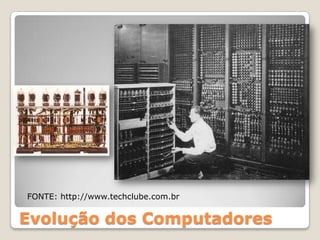
FONTE: http://www.techclube.com.br


Evolução dos Computadores
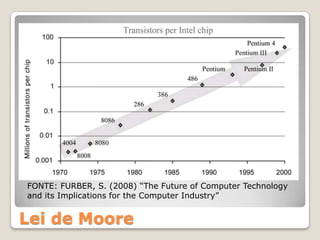
FONTE: FURBER, S. (2008) “The Future of Computer Technology
and its Implications for the Computer Industry”


Lei de Moore
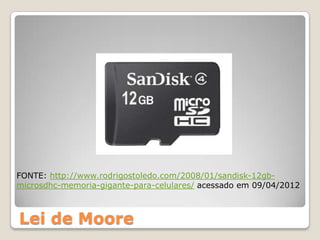
FONTE: http://www.rodrigostoledo.com/2008/01/sandisk-12gb-
microsdhc-memoria-gigante-para-celulares/ acessado em 09/04/2012


Lei de Moore
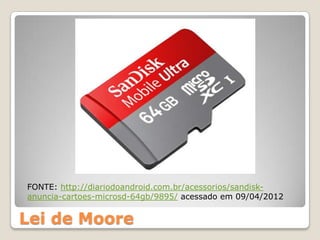
FONTE: http://diariodoandroid.com.br/acessorios/sandisk-
anuncia-cartoes-microsd-64gb/9895/ acessado em 09/04/2012


Lei de Moore
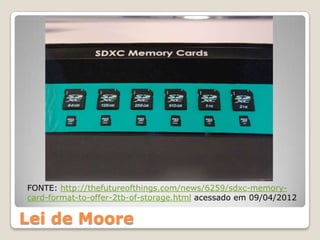
FONTE: http://thefutureofthings.com/news/6259/sdxc-memory-
card-format-to-offer-2tb-of-storage.html acessado em 09/04/2012

Lei de Moore
   Transistores fisicamente menores
    ◦   Mais baratos
    ◦   Mais rápidos
    ◦   Maior eficiencia energética
    ◦   Mais aproveitamento de espaço

    ◦ Crescimento exponencial no custo da
      construção de uma fábrica


Lei de Moore
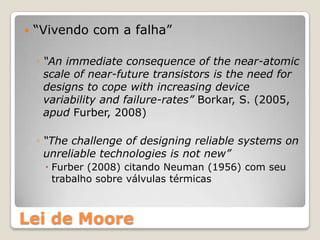
   “Vivendo com a falha”

    ◦ “An immediate consequence of the near-atomic
      scale of near-future transistors is the need for
      designs to cope with increasing device
      variability and failure-rates” Borkar, S. (2005,
      apud Furber, 2008)

    ◦ “The challenge of designing reliable systems on
      unreliable technologies is not new”
      Furber (2008) citando Neuman (1956) com seu
       trabalho sobre válvulas térmicas


Lei de Moore
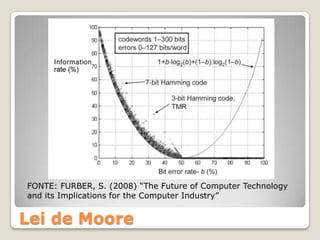
FONTE: FURBER, S. (2008) “The Future of Computer Technology
and its Implications for the Computer Industry”


Lei de Moore
   “Vivendo com a falha”

    ◦ Arquiteturas de memória e a complexidade de
      microprocessadores


Lei de Moore
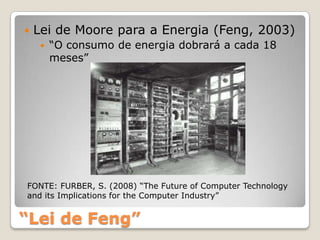
   Lei de Moore para a Energia (Feng, 2003)
        “O consumo de energia dobrará a cada 18
         meses”


FONTE: FURBER, S. (2008) “The Future of Computer Technology
and its Implications for the Computer Industry”


“Lei de Feng”
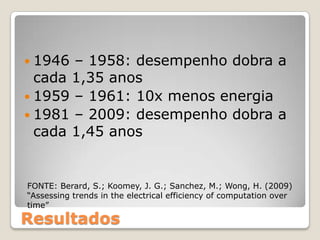
 1946 – 1958: desempenho dobra a
  cada 1,35 anos
 1959 – 1961: 10x menos energia
 1981 – 2009: desempenho dobra a
  cada 1,45 anos


FONTE: Berard, S.; Koomey, J. G.; Sanchez, M.; Wong, H. (2009)
“Assessing trends in the electrical efficiency of computation over
time”

Resultados
 Motivação
 Memória e CPU
 Multicore
 Considerações Finais


Memória e CPU
Why modern CPUs are
      starving
and what can be done
      about it
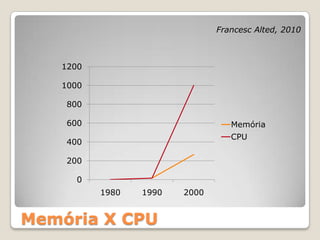
Francesc Alted, 2010


   1200

   1000

    800

    600                           Memória
                                  CPU
    400

    200

      0
          1980   1990   2000


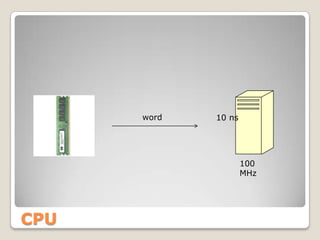
Memória X CPU
word   10 ns


                     100
                     MHz


CPU
Problema do “Power Wall”


 https://www.vaultnetworks.com/resources/amd-vs-intel/
 Motivação
  Memória e CPU
  Multicore
  Considerações Finais


Multicore
   Mudança de Paradigma
    ◦ Processadores multicore se tornando padrão

    ◦ Necessidade de mudança de paradigma
      também na programação

    ◦ “General-purpose parallelism certainly hasn’t
      been solved and, until it is, the utility of the
      future many-core processors remains
      questionable” – Furber (2008)


Vários núcleos, trabalho leve
THE MULTI-CORE AGE
   Mudança de Paradigma

    ◦ “Cut-and-paste is as easy on silicon as
      anywhere else, so putting two or four cores on
      a chip isn’t much harder than one (though
      maintaining a coherent memory model and
      balancing bandwidth requirements is non-
      trivial). The industry has simply abandoned the
      uniprocessor route as too hard and taken the
      line of least resistance. They can market ever
      more processor power through the multi-core
      route; whether or not you can use that power
      is your problem, not theirs.” – Furber (2008)

Vários núcleos, trabalho leve
   “After about 8 cores, there’s no
    improvement” – James Peery, diretor de
    computação, informação e matemática na
    Sandia, apud Moore (2008)

   “At 16 cores, it looks like 2” – James
    Peery, apud Moore (2008)


Novo paradigma
   Problema do “Memory Wall”

   “Although the number of cores per
    processor is increasing, the number of
    connections from the chip to the rest of
    the computer is not” – Moore (2008)

   Necessidade de maior integração de
    memória e processadores – James
    Perry, apud Moore (2008)


Novo paradigma
Francesc Alted, 2010


  Why, exactly, can’t we
    improve memory
latency and bandwidth to
          keep
     up with CPUs?
Francesc Alted, 2010


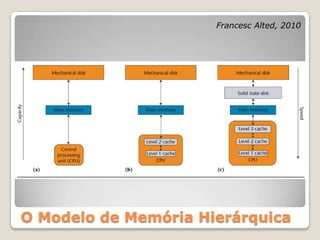
O Modelo de Memória Hierárquica
Técnicas para lidar
com o Data Starvation
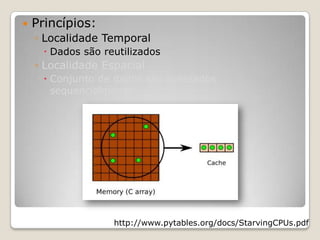
   Princípios:
    ◦ Localidade Temporal
       Dados são reutilizados
    ◦ Localidade Espacial
       Conjunto de dados são acessados
        sequencialmente


                    http://www.pytables.org/docs/StarvingCPUs.pdf
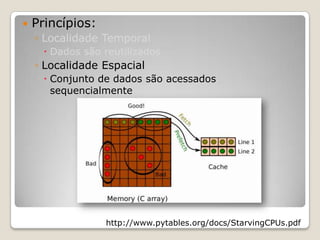
   Princípios:
    ◦ Localidade Temporal
       Dados são reutilizados
    ◦ Localidade Espacial
       Conjunto de dados são acessados
        sequencialmente


                  http://www.pytables.org/docs/StarvingCPUs.pdf
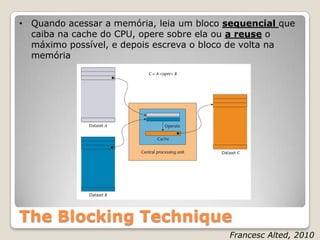
• Quando acessar a memória, leia um bloco sequencial que
  caiba na cache do CPU, opere sobre ela ou a reuse o
  máximo possível, e depois escreva o bloco de volta na
  memória


The Blocking Technique
                                          Francesc Alted, 2010
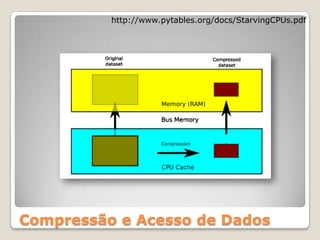
http://www.pytables.org/docs/StarvingCPUs.pdf


Compressão e Acesso de Dados
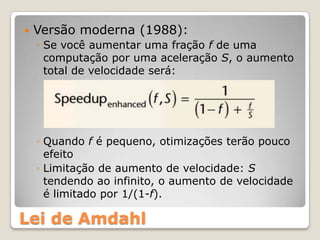
   Versão moderna (1988):
    ◦ Se você aumentar uma fração f de uma
      computação por uma aceleração S, o aumento
      total de velocidade será:


    ◦ Quando f é pequeno, otimizações terão pouco
      efeito
    ◦ Limitação de aumento de velocidade: S
      tendendo ao infinito, o aumento de velocidade
      é limitado por 1/(1-f).

Lei de Amdahl
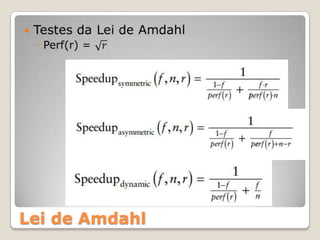
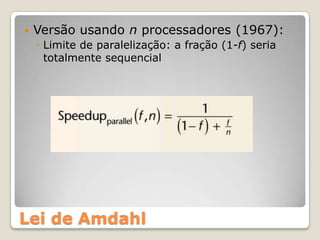
   Versão usando n processadores (1967):
    ◦ Limite de paralelização: a fração (1-f) seria
      totalmente sequencial


Lei de Amdahl
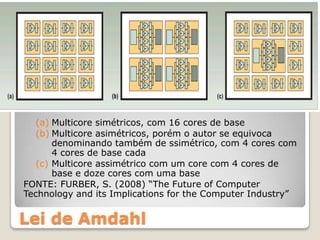
(a) Multicore simétricos, com 16 cores de base
   (b) Multicore asimétricos, porém o autor se equivoca
       denominando também de ssimétrico, com 4 cores com
       4 cores de base cada
   (c) Multicore assimétrico com um core com 4 cores de
       base e doze cores com uma base
FONTE: FURBER, S. (2008) “The Future of Computer
Technology and its Implications for the Computer Industry”


Lei de Amdahl



Lei de Amdahl
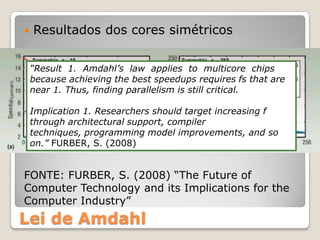
   Resultados dos cores simétricos


    “Result 1. Amdahl’s law applies to multicore chips
    because achieving the best speedups requires fs that are
    near 1. Thus, finding parallelism is still critical.

    Implication 1. Researchers should target increasing f
    through architectural support, compiler
    techniques, programming model improvements, and so
    on.” FURBER, S. (2008)


FONTE: FURBER, S. (2008) “The Future of
Computer Technology and its Implications for the
Computer Industry”
Lei de Amdahl
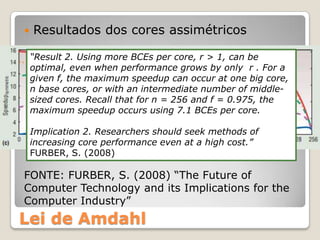
   Resultados dos cores assimétricos

    “Result 2. Using more BCEs per core, r > 1, can be
    optimal, even when performance grows by only r . For a
    given f, the maximum speedup can occur at one big core,
    n base cores, or with an intermediate number of middle-
    sized cores. Recall that for n = 256 and f = 0.975, the
    maximum speedup occurs using 7.1 BCEs per core.

    Implication 2. Researchers should seek methods of
    increasing core performance even at a high cost.”
    FURBER, S. (2008)

FONTE: FURBER, S. (2008) “The Future of
Computer Technology and its Implications for the
Computer Industry”
Lei de Amdahl
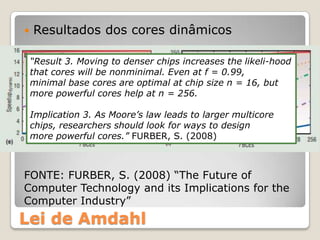
   Resultados dos cores dinâmicos

    “Result 3. Moving to denser chips increases the likeli-hood
    that cores will be nonminimal. Even at f = 0.99,
    minimal base cores are optimal at chip size n = 16, but
    more powerful cores help at n = 256.

    Implication 3. As Moore’s law leads to larger multicore
    chips, researchers should look for ways to design
    more powerful cores.” FURBER, S. (2008)


FONTE: FURBER, S. (2008) “The Future of
Computer Technology and its Implications for the
Computer Industry”
Lei de Amdahl
 Motivação
  Memória e CPU
  Multicore
  Considerações Finais


Considerações Finais
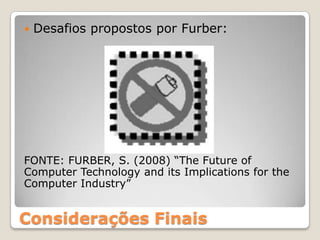
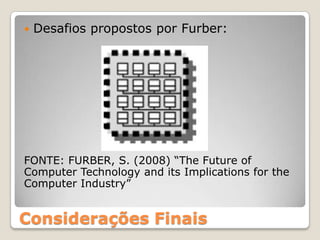
   Desafios propostos por Furber:


FONTE: FURBER, S. (2008) “The Future of
Computer Technology and its Implications for the
Computer Industry”


Considerações Finais
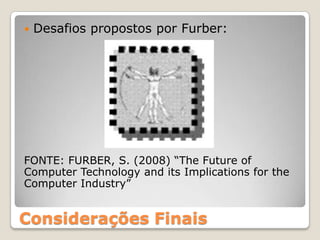
   Desafios propostos por Furber:


FONTE: FURBER, S. (2008) “The Future of
Computer Technology and its Implications for the
Computer Industry”


Considerações Finais
   Desafios propostos por Furber:


FONTE: FURBER, S. (2008) “The Future of
Computer Technology and its Implications for the
Computer Industry”


Considerações Finais
   Desafios propostos por Furber:


FONTE: FURBER, S. (2008) “The Future of
Computer Technology and its Implications for the
Computer Industry”


Considerações Finais
   Dúvidas? Perguntas? Considerações ou
    Curiosidades?


FONTE: http://vocevaientender.wordpress.com/tag/duvidas/
acessado em 09/04/2012

Considerações Finais

Desafios da tecnologia da computação e indústria

  • 1.
    Desafios da Tecnologiada Computação e Indústria Eduardo de Lucena Falcão Leandro Figueiredo Alves
  • 2.
    Furber, S. (2008) – “The Future of Computer Technology and its Implications for the Computer Industry”. Oxford University Press, por The British Computer Society  Patterson, D. (2010) – “The Trouble With Multicore”. IEEE Spectrum. Disponível em http://spectrum.ieee.org/computing/software/th e-trouble-with-multicore, último acesso em 09/04/2012  Moore, S. K. (2008) – “Multicore Is Bad News For Supercomputers”. IEEE Spectrum. Disponível em http://spectrum.ieee.org/computing/hardware/m ulticore-is-bad-news-for-supercomputers, último acesso em 09/04/2012 Referências
  • 3.
    Hill, M. D.; Marty, M. R. (2008) – “Amdahl’s Law in the Multicore Era”. IEEE Computer Society  Alted, F. (2010) - “Why Modern CPUs Are Starving and What Can Be Done About it”. IEEE Computing in ScienCe & Engineering  Berard, S.; Koomey, J. G.; Sanchez, M.; Wong, H. (2009) – “Assessing Trends in the Electrical Efficiency of Computation Over Time”. IEEE Annals of the History of Computing Referências
  • 4.
    Imagens (todos os links com último acesso em 09/04/2012): ◦ http://www.bbcbasic.co.uk/bbcbasic/birthday/ ◦ http://www.rodrigostoledo.com/2008/01/sandisk- 12gb-microsdhc-memoria-gigante-para-celulares/ ◦ http://diariodoandroid.com.br/acessorios/sandisk- anuncia-cartoes-microsd-64gb/9895/ ◦ http://thefutureofthings.com/news/6259/sdxc- memory-card-format-to-offer-2tb-of-storage.html ◦ http://www.reginaldtiangha.com/cpsc509/ssem.ht m Referências
  • 5.
     Motivação  Memóriae CPU  Multicore  Considerações Finais Sumário
  • 6.
     Motivação Memória e CPU  Multicore  Considerações Finais Motivação
  • 7.
    Assessing trends inthe electrical efficiency of computation over time
  • 8.
  • 9.
    FONTE: FURBER, S.(2008) “The Future of Computer Technology and its Implications for the Computer Industry” Lei de Moore
  • 10.
  • 11.
  • 12.
  • 13.
    Transistores fisicamente menores ◦ Mais baratos ◦ Mais rápidos ◦ Maior eficiencia energética ◦ Mais aproveitamento de espaço ◦ Crescimento exponencial no custo da construção de uma fábrica Lei de Moore
  • 14.
    “Vivendo com a falha” ◦ “An immediate consequence of the near-atomic scale of near-future transistors is the need for designs to cope with increasing device variability and failure-rates” Borkar, S. (2005, apud Furber, 2008) ◦ “The challenge of designing reliable systems on unreliable technologies is not new”  Furber (2008) citando Neuman (1956) com seu trabalho sobre válvulas térmicas Lei de Moore
  • 15.
    FONTE: FURBER, S.(2008) “The Future of Computer Technology and its Implications for the Computer Industry” Lei de Moore
  • 16.
    “Vivendo com a falha” ◦ Arquiteturas de memória e a complexidade de microprocessadores Lei de Moore
  • 17.
    Lei de Moore para a Energia (Feng, 2003)  “O consumo de energia dobrará a cada 18 meses” FONTE: FURBER, S. (2008) “The Future of Computer Technology and its Implications for the Computer Industry” “Lei de Feng”
  • 18.
     1946 –1958: desempenho dobra a cada 1,35 anos  1959 – 1961: 10x menos energia  1981 – 2009: desempenho dobra a cada 1,45 anos FONTE: Berard, S.; Koomey, J. G.; Sanchez, M.; Wong, H. (2009) “Assessing trends in the electrical efficiency of computation over time” Resultados
  • 19.
     Motivação  Memóriae CPU  Multicore  Considerações Finais Memória e CPU
  • 20.
    Why modern CPUsare starving and what can be done about it
  • 21.
    Francesc Alted, 2010 1200 1000 800 600 Memória CPU 400 200 0 1980 1990 2000 Memória X CPU
  • 22.
    word 10 ns 100 MHz CPU
  • 23.
    Problema do “PowerWall” https://www.vaultnetworks.com/resources/amd-vs-intel/
  • 24.
     Motivação Memória e CPU  Multicore  Considerações Finais Multicore
  • 25.
    Mudança de Paradigma ◦ Processadores multicore se tornando padrão ◦ Necessidade de mudança de paradigma também na programação ◦ “General-purpose parallelism certainly hasn’t been solved and, until it is, the utility of the future many-core processors remains questionable” – Furber (2008) Vários núcleos, trabalho leve
  • 26.
  • 27.
    Mudança de Paradigma ◦ “Cut-and-paste is as easy on silicon as anywhere else, so putting two or four cores on a chip isn’t much harder than one (though maintaining a coherent memory model and balancing bandwidth requirements is non- trivial). The industry has simply abandoned the uniprocessor route as too hard and taken the line of least resistance. They can market ever more processor power through the multi-core route; whether or not you can use that power is your problem, not theirs.” – Furber (2008) Vários núcleos, trabalho leve
  • 28.
    “After about 8 cores, there’s no improvement” – James Peery, diretor de computação, informação e matemática na Sandia, apud Moore (2008)  “At 16 cores, it looks like 2” – James Peery, apud Moore (2008) Novo paradigma
  • 29.
    Problema do “Memory Wall”  “Although the number of cores per processor is increasing, the number of connections from the chip to the rest of the computer is not” – Moore (2008)  Necessidade de maior integração de memória e processadores – James Perry, apud Moore (2008) Novo paradigma
  • 30.
    Francesc Alted, 2010 Why, exactly, can’t we improve memory latency and bandwidth to keep up with CPUs?
  • 31.
    Francesc Alted, 2010 OModelo de Memória Hierárquica
  • 32.
    Técnicas para lidar como Data Starvation
  • 33.
    Princípios: ◦ Localidade Temporal  Dados são reutilizados ◦ Localidade Espacial  Conjunto de dados são acessados sequencialmente http://www.pytables.org/docs/StarvingCPUs.pdf
  • 34.
    Princípios: ◦ Localidade Temporal  Dados são reutilizados ◦ Localidade Espacial  Conjunto de dados são acessados sequencialmente http://www.pytables.org/docs/StarvingCPUs.pdf
  • 35.
    • Quando acessara memória, leia um bloco sequencial que caiba na cache do CPU, opere sobre ela ou a reuse o máximo possível, e depois escreva o bloco de volta na memória The Blocking Technique Francesc Alted, 2010
  • 36.
  • 37.
    Versão moderna (1988): ◦ Se você aumentar uma fração f de uma computação por uma aceleração S, o aumento total de velocidade será: ◦ Quando f é pequeno, otimizações terão pouco efeito ◦ Limitação de aumento de velocidade: S tendendo ao infinito, o aumento de velocidade é limitado por 1/(1-f). Lei de Amdahl
  • 38.
    Versão usando n processadores (1967): ◦ Limite de paralelização: a fração (1-f) seria totalmente sequencial Lei de Amdahl
  • 39.
    (a) Multicore simétricos,com 16 cores de base (b) Multicore asimétricos, porém o autor se equivoca denominando também de ssimétrico, com 4 cores com 4 cores de base cada (c) Multicore assimétrico com um core com 4 cores de base e doze cores com uma base FONTE: FURBER, S. (2008) “The Future of Computer Technology and its Implications for the Computer Industry” Lei de Amdahl
  • 40.
  • 41.
    Resultados dos cores simétricos “Result 1. Amdahl’s law applies to multicore chips because achieving the best speedups requires fs that are near 1. Thus, finding parallelism is still critical. Implication 1. Researchers should target increasing f through architectural support, compiler techniques, programming model improvements, and so on.” FURBER, S. (2008) FONTE: FURBER, S. (2008) “The Future of Computer Technology and its Implications for the Computer Industry” Lei de Amdahl
  • 42.
    Resultados dos cores assimétricos “Result 2. Using more BCEs per core, r > 1, can be optimal, even when performance grows by only r . For a given f, the maximum speedup can occur at one big core, n base cores, or with an intermediate number of middle- sized cores. Recall that for n = 256 and f = 0.975, the maximum speedup occurs using 7.1 BCEs per core. Implication 2. Researchers should seek methods of increasing core performance even at a high cost.” FURBER, S. (2008) FONTE: FURBER, S. (2008) “The Future of Computer Technology and its Implications for the Computer Industry” Lei de Amdahl
  • 43.
    Resultados dos cores dinâmicos “Result 3. Moving to denser chips increases the likeli-hood that cores will be nonminimal. Even at f = 0.99, minimal base cores are optimal at chip size n = 16, but more powerful cores help at n = 256. Implication 3. As Moore’s law leads to larger multicore chips, researchers should look for ways to design more powerful cores.” FURBER, S. (2008) FONTE: FURBER, S. (2008) “The Future of Computer Technology and its Implications for the Computer Industry” Lei de Amdahl
  • 44.
     Motivação Memória e CPU  Multicore  Considerações Finais Considerações Finais
  • 45.
    Desafios propostos por Furber: FONTE: FURBER, S. (2008) “The Future of Computer Technology and its Implications for the Computer Industry” Considerações Finais
  • 46.
    Desafios propostos por Furber: FONTE: FURBER, S. (2008) “The Future of Computer Technology and its Implications for the Computer Industry” Considerações Finais
  • 47.
    Desafios propostos por Furber: FONTE: FURBER, S. (2008) “The Future of Computer Technology and its Implications for the Computer Industry” Considerações Finais
  • 48.
    Desafios propostos por Furber: FONTE: FURBER, S. (2008) “The Future of Computer Technology and its Implications for the Computer Industry” Considerações Finais
  • 49.
    Dúvidas? Perguntas? Considerações ou Curiosidades? FONTE: http://vocevaientender.wordpress.com/tag/duvidas/ acessado em 09/04/2012 Considerações Finais

Notas do Editor

  • #14 Demaisproblemas:Limitaçõesatomicasirácessar o crescimentoNa proximadecada, ocorrerá o crescimento de alto custo, com custos de fabricaçãoaumentandoinexoravelmente com difícilcontrole de tamanhosfisicamentemuitopequenosDificudade de estabeleceruma startup de semicondutores, poisexige alto investimento de risco, fugindo da zona de conforto de investidores de capital.
  • #26  No pronto de programação, citarhojeosprogramas mobile, quepoucos se utilizam dos recursosmultiprocessamento dos processadores mobile maisatuais.E: Ottelini, CEO da Intel, disseem 2004 queossoftwaressóseriammaisrápidos se osprogramadoresescreverem o software com rotinasparalelasparapoderem se utilizar do hardware multicore.
  • #30 Memory Wall: the growing disparity between how fast a CPU can operate on data and how fast it can get the data it needs
  • #46 EDUARDOBatteries Not Included – minimising the energy demands of electronics.As electronics becomes increasingly pervasive it is simply impractical to power it from batteries that constantly need changing. Can we use scavengedenergy, or get power requirements so low that a single battery will power the product throughout its life?
  • #47 Silicon meets Life – interfacing electronics to biology. Retinal prostheses, implanted medical diagnostics, brain-machine interfaces –these are all promising life-enhancing technologies that require a much closer integration between electronics and biology.
  • #48 EDUARDOMoore for Less– performance-driven design for next-generation chip technology. The drive for ever-higher computing power will continue, but much moreattention must be paid to the costs of so-doing: costs to the environment, and design costs
  • #49 Building Brains – neurologically inspired electronic systems.Our brains are much more power-efficient than electronics, and much more tolerant of component failure. If we could gain insights into how the biological system functions we might learn how apply those lessons to novel computational systems, and how