
UNIVERSIDADE ESTADUAL DO PIAUÍ - UESPI
CENTRO DE CIÊNCIAS HUMANAS E LETRAS –
CCHL
CURSO: LICENCIATURA PLENA EM LETRAS
INGLÊS

Voz Passiva (Passive Voice)

Leandro Scrifter
Passive Voice
A voz passiva é utilizada para contar o que acontece
com os objetos da ação. Ao contrario da voz
ativa, que contamos o que o sujeito realiza. Exemplo:
Voz ativa: “John pintou a casa”
(John painted the house)
Voz passiva: “A casa foi pintada por John”
(The car was washed)
A voz passiva é formada com o auxílio be
seguido do particípio passado do verbo
principal. Quando necessário, o agente
da passiva é precedido pela preposição
by.
 “The poison apple was bitten by Snow
White”
 To Bite(Infinitivo) >> Bitten(particípio
passado)

Usos
É usada para enfatizar mais uma ação.
- A new vaccine was discovered by
scientists
 Somente os verbos transitivos devem ser
transformados em construção da passiva.
 O agente da passsiva pode ser omitido:
A) quando for obvio: “Portuguese is spoken
in Brazil”
B) quando não é importante ou
desconhecido: “My wallet was found
yesterday. (Someone found it)

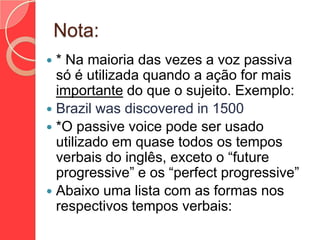
Nota:
* Na maioria das vezes a voz passiva
só é utilizada quando a ação for mais
importante do que o sujeito. Exemplo:
 Brazil was discovered in 1500
 *O passive voice pode ser usado
utilizado em quase todos os tempos
verbais do inglês, exceto o “future
progressive” e os “perfect progressive”
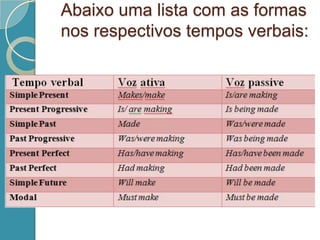
 Abaixo uma lista com as formas nos
respectivos tempos verbais:

Abaixo uma lista com as formas
nos respectivos tempos verbais:
ATIVIDADES



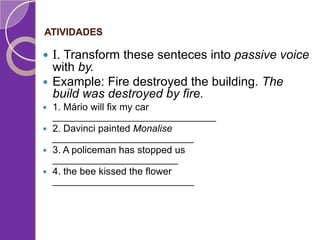
I. Transform these senteces into passive voice

with by.
 Example: Fire destroyed the building. The
build was destroyed by fire.
1. Mário will fix my car
______________________________
 2. Davinci painted Monalise
__________________________
 3. A policeman has stopped us
_______________________
 4. the bee kissed the flower
__________________________



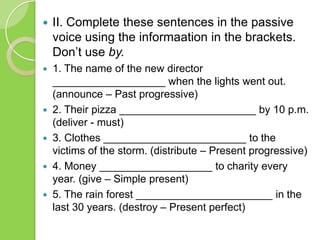
II. Complete these sentences in the passive
voice using the informaation in the brackets.
Don’t use by.



1. The name of the new director
___________________ when the lights went out.
(announce – Past progressive)
2. Their pizza _______________________ by 10 p.m.
(deliver - must)
3. Clothes ________________________ to the
victims of the storm. (distribute – Present progressive)
4. Money ___________________ to charity every
year. (give – Simple present)
5. The rain forest _______________________ in the
last 30 years. (destroy – Present perfect)







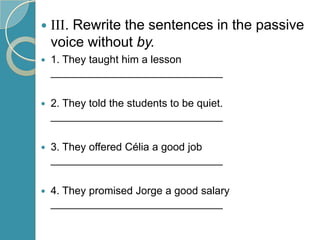
III. Rewrite the sentences in the passive
voice without by.



1. They taught him a lesson
_____________________________



2. They told the students to be quiet.
_____________________________



3. They offered Célia a good job
_____________________________



4. They promised Jorge a good salary
_____________________________
THE END

Thank you!!!

Voz passiva (passive voice) Updated

  • 1.
    UNIVERSIDADE ESTADUAL DOPIAUÍ - UESPI CENTRO DE CIÊNCIAS HUMANAS E LETRAS – CCHL CURSO: LICENCIATURA PLENA EM LETRAS INGLÊS Voz Passiva (Passive Voice) Leandro Scrifter
  • 2.
    Passive Voice A vozpassiva é utilizada para contar o que acontece com os objetos da ação. Ao contrario da voz ativa, que contamos o que o sujeito realiza. Exemplo: Voz ativa: “John pintou a casa” (John painted the house) Voz passiva: “A casa foi pintada por John” (The car was washed)
  • 3.
    A voz passivaé formada com o auxílio be seguido do particípio passado do verbo principal. Quando necessário, o agente da passiva é precedido pela preposição by.  “The poison apple was bitten by Snow White”  To Bite(Infinitivo) >> Bitten(particípio passado) 
  • 4.
    Usos É usada paraenfatizar mais uma ação. - A new vaccine was discovered by scientists  Somente os verbos transitivos devem ser transformados em construção da passiva.  O agente da passsiva pode ser omitido: A) quando for obvio: “Portuguese is spoken in Brazil” B) quando não é importante ou desconhecido: “My wallet was found yesterday. (Someone found it) 
  • 5.
    Nota: * Na maioriadas vezes a voz passiva só é utilizada quando a ação for mais importante do que o sujeito. Exemplo:  Brazil was discovered in 1500  *O passive voice pode ser usado utilizado em quase todos os tempos verbais do inglês, exceto o “future progressive” e os “perfect progressive”  Abaixo uma lista com as formas nos respectivos tempos verbais: 
  • 6.
    Abaixo uma listacom as formas nos respectivos tempos verbais:
  • 7.
    ATIVIDADES  I. Transform thesesenteces into passive voice with by.  Example: Fire destroyed the building. The build was destroyed by fire. 1. Mário will fix my car ______________________________  2. Davinci painted Monalise __________________________  3. A policeman has stopped us _______________________  4. the bee kissed the flower __________________________ 
  • 8.
     II. Complete thesesentences in the passive voice using the informaation in the brackets. Don’t use by.  1. The name of the new director ___________________ when the lights went out. (announce – Past progressive) 2. Their pizza _______________________ by 10 p.m. (deliver - must) 3. Clothes ________________________ to the victims of the storm. (distribute – Present progressive) 4. Money ___________________ to charity every year. (give – Simple present) 5. The rain forest _______________________ in the last 30 years. (destroy – Present perfect)    
  • 9.
     III. Rewrite thesentences in the passive voice without by.  1. They taught him a lesson _____________________________  2. They told the students to be quiet. _____________________________  3. They offered Célia a good job _____________________________  4. They promised Jorge a good salary _____________________________
  • 10.