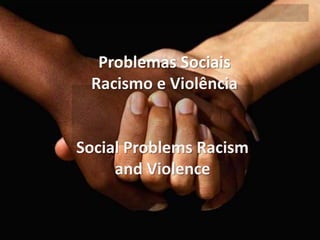
Problemas Sociais
 Racismo e Violência


Social Problems Racism
     and Violence
Racismo / Racism
•   Racism is a trend of thought, or the way of thinking in which attaches great
    importance to the notion of the existence of separate human races and
    above each other.
•   Where there is a belief that some individuals and their relationship between
    inherited physical characteristics, and certain character traits and
    intelligence or cultural, are superior to others.
•   Racism is not a scientific theory but a set of preconceived opinions where
    the main function is to enhance the biological differences between humans,
    which some believe to be superior to others according to their racial matrix.
Consequências do Racismo
 Consequences of Racism
              •   The consequences of racism
                  can lead to the exclusion of the
                  most disadvantaged forcing
                  them to do things they are
                  subjected to inhuman bondage
                  humiliating them in front of
                  other people causing mental
                  disorders that often lead people
                  to commit suicide, derived from
                  the impact of those
                  consequences.
O que leva ao Racismo
               Which leads to Racism
Skin color;
The type of hair;
Different cultures;
Different religions;
Different customs.


Normally racism is the thought
superiority over all other races!
Racismo no emprego
                 Racism in Employment
•   Their results suggest that among black workers is the highest proportion of
    employed in unskilled roles. Regarding access to the functions of
    management and planning, featuring the best pay and working conditions
    and higher level of education, black workers are in low proportions.
•   There are two main issues related to workplace discrimination:
    discrimination in access to work which means that blacks occupy primarily
    functions more disqualified and unhealthy and discrimination in access to
    "promotional" making it difficult for black men and women access to
    management positions and better salaries. Moreover limited or nearly
    nonexistent discrimination data relating to the daily work. Soon there is the
    use of social differences of ethnic-racial nature in characterizing forms of
    subordination at work, widely used as the variables of gender, generation or
    migratory experience.
Racismo na escola
                       Racism in school
•   Children do not have feelings of racism and prejudice, they see others as
    equal, but with time they learn with adults that are superior to other people,
    which is not quite true, but unfortunately they learn it and the solution to
    stop this racism is irrational that parents and teachers to teach to their
    children and students that all people are equal before God and the law of
    our country, no one is better or worse than another, everyone has the right
    to be equal.
Como acabar com o Racismo ?
            How to end Racism??
•   Para o futuro não houver racismo devemos ensinar as crianças que todos
    temos os mesmos direitos e deveres, não há superioridade nem
    inferioridade entre as pessoas “todos nós somos iguais”.
•   Para os adultos, eles devem ter respeito mútuo pelos outros que não sejam
    da sua raça ou religião no emprego e em qualquer lugar.
Heróis que mudaram os pensamentos dos racistas
     Heroes who changed the thoughts of racist
                               Martin Luther King (1929-1968)


15 Janeiro 1929
Martin Luther King Jr. era activista político norte-americano que morreu no ano de 1968. Membro
da Igreja Batista, tornou-se um dos mais importantes líderes do activismo pelos direitos civis (para
negros e mulheres, principalmente) nos Estados Unidos e no mundo, através de uma campanha
de não-violência e de amor para com o próximo. Tornou-se na pessoa mais jovem a receber o
Prémio Nobel da Paz em 1964, pouco antes de ser assassinado em Memphis por um branco que
foi condenado a 99 anos de prisão. O seu discurso mais famoso em Washington é lembrado como
"I have a dream" ("Eu tenho um sonho").
Nelson Mandela 1918


Nascido em Qunu, 18 de Julho de 1918, Nelson Mandela é advogado, ex-líder rebelde e ex-
presidente da África do Sul de 1994 a 1999.
Principal representante do movimento antiapartheid, Nelson Mandela é sim um guerreiro em luta
pela liberdade, bem ao contrário do que considerava o governo sul-africano, o qual temia suas
actuações por o classificar como um terrorista.
Como jovem estudante de Direito, Mandela se envolveu na oposição ao regime do apartheid, o qual
negava aos negros (maioria da população) direitos políticos, sociais e económicos.
Uniu-se ao Congresso Nacional Africano (conhecido no Brasil pela sigla portuguesa, CNA, e em
Portugal pela sigla inglesa, ANC) em 1942, e dois anos depois fundou com Walter Sisulu e Oliver
Tambo (entre outros) uma organização mais dinâmica, a Liga Jovem do ANC/CNA.
Em 1993, com de Klerk, recebeu o Prémio Nobel da Paz, pelos esforços desenvolvidos no sentido
de acabar com a segregação racial.
Frases celebres
                        Phrases celebrated
   “Enquanto a cor da pele for mais importante que o brilho dos olhos, haverá guerra.” Bob
    Marley

   “O racismo é a prova o quanto ainda somos primitivos.” César Jihad

   “A razão pela qual intolerância, racismo e a homofobia existem é o medo. As pessoas têm
    medo de seus próprios sentimentos, medo do desconhecido.” Madonna

   “Talvez o racismo aconteça, não só pela cor da pele, mas pela nossa cultura que vem
    crivada na selva de pedra.” André Tavares

   “Racismo é sinal de ignorância. Para conhecer a cultura de um outro país é preciso estar
    desarmado de preconceitos raciais.” Stevie Wonder

   “Ninguém nasce odiando outra pessoa pela cor de sua pele, por sua origem ou ainda por
    sua religião. Para odiar, as pessoas precisam aprender e, se podem aprender a odiar,
    podem ser ensinadas a amar.” Nelson Mandela

   “Eu tenho um sonho. O sonho de ver meus filhos julgados por sua personalidade, não pela
    cor de sua pele.” Martin Luther King
Violência
Violence
Definição
            Definition
• Violence is a behavior that causes
  harm to another person, object or
  living being. Invade autonomy,
  physical or psychological integrity
  and the lives of others.
Tipos de Violência
Types of Violence
Violência Física
        Physical Violence
• Physical violence is the use of force
  for the purpose of injuring, leaving
  no marks or obvious.
Violência Psicológica
    Psychological violence
• A psychological or emotional
  aggression, as or more harmful
  than physical, is characterized by
  rejection, depreciation,
  discrimination, humiliation,
  disrespect and exaggerated
  punishments.
Violência Verbal
        Verbal violence
Verbal violence is not a form of
psychological violence. Verbal
violence is often used to disturb the
life of others.
Violência Sexual
        Sexual Violence
• Violence where the abuser abuses
  the power it has on the victim for
  sexual gratification, without your
  consent, being induced or forced
  sexual acts with or without
  physical violence.
Violência nas Escola
       Violence in School
• Most young people who have
  violent behavior and / or bullies
  are usually boys, who are between
  13 to 16 years and generally do not
  feel happy, not very fond of
  school.

Slide Violence e Racism Ingles

  • 1.
    Problemas Sociais Racismoe Violência Social Problems Racism and Violence
  • 2.
    Racismo / Racism • Racism is a trend of thought, or the way of thinking in which attaches great importance to the notion of the existence of separate human races and above each other. • Where there is a belief that some individuals and their relationship between inherited physical characteristics, and certain character traits and intelligence or cultural, are superior to others. • Racism is not a scientific theory but a set of preconceived opinions where the main function is to enhance the biological differences between humans, which some believe to be superior to others according to their racial matrix.
  • 3.
    Consequências do Racismo Consequences of Racism • The consequences of racism can lead to the exclusion of the most disadvantaged forcing them to do things they are subjected to inhuman bondage humiliating them in front of other people causing mental disorders that often lead people to commit suicide, derived from the impact of those consequences.
  • 4.
    O que levaao Racismo Which leads to Racism Skin color; The type of hair; Different cultures; Different religions; Different customs. Normally racism is the thought superiority over all other races!
  • 5.
    Racismo no emprego Racism in Employment • Their results suggest that among black workers is the highest proportion of employed in unskilled roles. Regarding access to the functions of management and planning, featuring the best pay and working conditions and higher level of education, black workers are in low proportions. • There are two main issues related to workplace discrimination: discrimination in access to work which means that blacks occupy primarily functions more disqualified and unhealthy and discrimination in access to "promotional" making it difficult for black men and women access to management positions and better salaries. Moreover limited or nearly nonexistent discrimination data relating to the daily work. Soon there is the use of social differences of ethnic-racial nature in characterizing forms of subordination at work, widely used as the variables of gender, generation or migratory experience.
  • 6.
    Racismo na escola Racism in school • Children do not have feelings of racism and prejudice, they see others as equal, but with time they learn with adults that are superior to other people, which is not quite true, but unfortunately they learn it and the solution to stop this racism is irrational that parents and teachers to teach to their children and students that all people are equal before God and the law of our country, no one is better or worse than another, everyone has the right to be equal.
  • 7.
    Como acabar como Racismo ? How to end Racism?? • Para o futuro não houver racismo devemos ensinar as crianças que todos temos os mesmos direitos e deveres, não há superioridade nem inferioridade entre as pessoas “todos nós somos iguais”. • Para os adultos, eles devem ter respeito mútuo pelos outros que não sejam da sua raça ou religião no emprego e em qualquer lugar.
  • 8.
    Heróis que mudaramos pensamentos dos racistas Heroes who changed the thoughts of racist Martin Luther King (1929-1968) 15 Janeiro 1929 Martin Luther King Jr. era activista político norte-americano que morreu no ano de 1968. Membro da Igreja Batista, tornou-se um dos mais importantes líderes do activismo pelos direitos civis (para negros e mulheres, principalmente) nos Estados Unidos e no mundo, através de uma campanha de não-violência e de amor para com o próximo. Tornou-se na pessoa mais jovem a receber o Prémio Nobel da Paz em 1964, pouco antes de ser assassinado em Memphis por um branco que foi condenado a 99 anos de prisão. O seu discurso mais famoso em Washington é lembrado como "I have a dream" ("Eu tenho um sonho").
  • 9.
    Nelson Mandela 1918 Nascidoem Qunu, 18 de Julho de 1918, Nelson Mandela é advogado, ex-líder rebelde e ex- presidente da África do Sul de 1994 a 1999. Principal representante do movimento antiapartheid, Nelson Mandela é sim um guerreiro em luta pela liberdade, bem ao contrário do que considerava o governo sul-africano, o qual temia suas actuações por o classificar como um terrorista. Como jovem estudante de Direito, Mandela se envolveu na oposição ao regime do apartheid, o qual negava aos negros (maioria da população) direitos políticos, sociais e económicos. Uniu-se ao Congresso Nacional Africano (conhecido no Brasil pela sigla portuguesa, CNA, e em Portugal pela sigla inglesa, ANC) em 1942, e dois anos depois fundou com Walter Sisulu e Oliver Tambo (entre outros) uma organização mais dinâmica, a Liga Jovem do ANC/CNA. Em 1993, com de Klerk, recebeu o Prémio Nobel da Paz, pelos esforços desenvolvidos no sentido de acabar com a segregação racial.
  • 10.
    Frases celebres Phrases celebrated  “Enquanto a cor da pele for mais importante que o brilho dos olhos, haverá guerra.” Bob Marley  “O racismo é a prova o quanto ainda somos primitivos.” César Jihad  “A razão pela qual intolerância, racismo e a homofobia existem é o medo. As pessoas têm medo de seus próprios sentimentos, medo do desconhecido.” Madonna  “Talvez o racismo aconteça, não só pela cor da pele, mas pela nossa cultura que vem crivada na selva de pedra.” André Tavares  “Racismo é sinal de ignorância. Para conhecer a cultura de um outro país é preciso estar desarmado de preconceitos raciais.” Stevie Wonder  “Ninguém nasce odiando outra pessoa pela cor de sua pele, por sua origem ou ainda por sua religião. Para odiar, as pessoas precisam aprender e, se podem aprender a odiar, podem ser ensinadas a amar.” Nelson Mandela  “Eu tenho um sonho. O sonho de ver meus filhos julgados por sua personalidade, não pela cor de sua pele.” Martin Luther King
  • 12.
  • 13.
    Definição Definition • Violence is a behavior that causes harm to another person, object or living being. Invade autonomy, physical or psychological integrity and the lives of others.
  • 14.
  • 15.
    Violência Física Physical Violence • Physical violence is the use of force for the purpose of injuring, leaving no marks or obvious.
  • 16.
    Violência Psicológica Psychological violence • A psychological or emotional aggression, as or more harmful than physical, is characterized by rejection, depreciation, discrimination, humiliation, disrespect and exaggerated punishments.
  • 17.
    Violência Verbal Verbal violence Verbal violence is not a form of psychological violence. Verbal violence is often used to disturb the life of others.
  • 18.
    Violência Sexual Sexual Violence • Violence where the abuser abuses the power it has on the victim for sexual gratification, without your consent, being induced or forced sexual acts with or without physical violence.
  • 19.
    Violência nas Escola Violence in School • Most young people who have violent behavior and / or bullies are usually boys, who are between 13 to 16 years and generally do not feel happy, not very fond of school.