Linguagens, Códigos e suas
Tecnologias – Inglês
Ensino Médio, 1ª Série
Simple Future x Future with going to
SIMPLE FUTURE:
• É um tempo verbal que expressa uma ação
futura incerta, não planejada, transmitindo
ideias, fatos e decisões recém-tomadas.
• EXEMPLO:
• I will talk with you later.
• ( Eu conversarei com você mais tarde).
OBSERVAÇÕES:
• No Inglês antigo – período anterior à morte de
William Shakespeare – a forma will era
substituída por shall nas primeiras pessoas do
singular e do plural.
• Exemplo:
• I shall go tomorrow- Eu irei amanhã.
• We shall go tomorrow - Nós iremos amanhã.
• Forma abreviada: I’ll go...; You’ll go... etc.
• Eu irei...
SIMPLE FUTURE NO INGLÊS MODERNO:
• O Inglês moderno data do período intermediário
entre a morte de William Shakespeare e a publicação
da nova versão inglesa da Bíblia:
• No Inglês moderno é comum empregar will
para todas as pessoas verbais.
• Exemplo:
• I will go; You will go; He will go...etc.
Shall no Inglês moderno expressa obrigação ou sugestão.
Ex.: Shall we open the window? (Que tal abrirmos a janela?).
ADVÉRBIOS DE TEMPO MAIS COMUNS
RELACIONADOS AO FUTURO :
• TOMORROW = AMANHÃ
• NEXT WEEK = PRÓXIMA SEMANA
• NEXT MONTH = PRÓXIMO MÊS
• NEXT YEAR = PRÓXIMO ANO
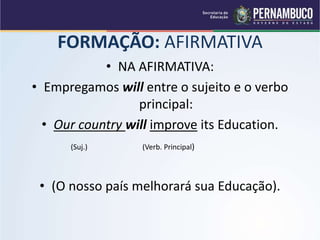
FORMAÇÃO: AFIRMATIVA
• NA AFIRMATIVA:
• Empregamos will entre o sujeito e o verbo
principal:
• Our country will improve its Education.
(Suj.) (Verb. Principal)
• (O nosso país melhorará sua Educação).
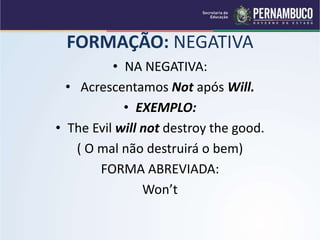
FORMAÇÃO: NEGATIVA
• NA NEGATIVA:
• Acrescentamos Not após Will.
• EXEMPLO:
• The Evil will not destroy the good.
( O mal não destruirá o bem)
FORMA ABREVIADA:
Won’t
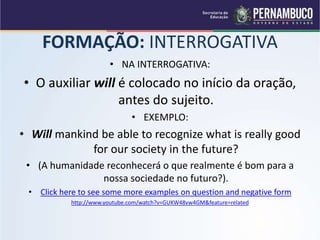
FORMAÇÃO: INTERROGATIVA
• NA INTERROGATIVA:
• O auxiliar will é colocado no início da oração,
antes do sujeito.
• EXEMPLO:
• Will mankind be able to recognize what is really good
for our society in the future?
• (A humanidade reconhecerá o que realmente é bom para a
nossa sociedade no futuro?).
• Click here to see some more examples on question and negative form
http://www.youtube.com/watch?v=GUKW48vw4GM&feature=related
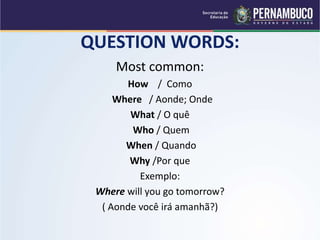
QUESTION WORDS:
Most common:
How / Como
Where / Aonde; Onde
What / O quê
Who / Quem
When / Quando
Why /Por que
Exemplo:
Where will you go tomorrow?
( Aonde você irá amanhã?)
QUESTION TAG:
• São perguntas feitas nos finais das orações
para confirmar o que foi dito antes.
• EXEMPLO:
• Você não irá, irá?
• QUESTION-TAG:
• A forma will é utilizada como question tag de
orações imperativas, ou seja, orações que expressam
ordem ou pedido.
• EXEMPLO:
• Stand up, will you?- Levante-se, sim?
SEE THE FOLLOWING VIDEO TO COMPLETE YOUR KNOWLEDGE
ABOUT WILL:
• Algumas vezes, na linguagem diária will e
going to podem ser usados indiferentemente.
• Click here for more information
• http://www.youtube.com/watch?v=YDj-7oyD6l0&feature=related
SIMPLE FUTURE X FUTURE WITH GOING TO:
• Enquanto o auxiliar will fala sobre ações de futuro
duvidoso e/ou próximos como, por exemplo: batem
à porta e você diz a alguém do seu lado: – “Deixe
que eu abrirei, ou eu abro ”. Em Inglês nesses casos
utilizamos
• will:
• Exemplo: I will open it!
• Ao contrário do futuro duvidoso e geralmente breve
que o auxiliar will expressa, o “Going to Future”
expressa um futuro planejado.
GOING TO FUTURE:
• É UM TEMPO VERBAL QUE EXPRESSA AÇÕES
DO FUTURO DE FORMA PLANEJADA.
• EXEMPLO:
• I am going to travel to the U. S. A. next year.
• (Vou viajar para os Estados Unidos no
próximo ano).
• Obs.: Ou seja, passaporte, acomodações todas
prontas: futuro planejado.
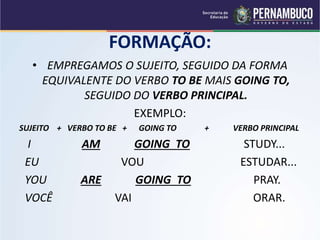
FORMAÇÃO:
• EMPREGAMOS O SUJEITO, SEGUIDO DA FORMA
EQUIVALENTE DO VERBO TO BE MAIS GOING TO,
SEGUIDO DO VERBO PRINCIPAL.
EXEMPLO:
SUJEITO + VERBO TO BE + GOING TO + VERBO PRINCIPAL
I AM GOING TO STUDY...
EU VOU ESTUDAR...
YOU ARE GOING TO PRAY.
VOCÊ VAI ORAR.
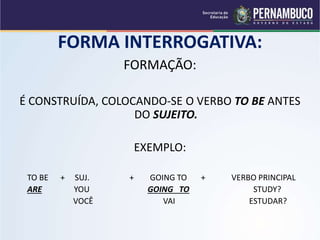
FORMA INTERROGATIVA:
FORMAÇÃO:
É CONSTRUÍDA, COLOCANDO-SE O VERBO TO BE ANTES
DO SUJEITO.
EXEMPLO:
TO BE + SUJ. + GOING TO + VERBO PRINCIPAL
ARE YOU GOING TO STUDY?
VOCÊ VAI ESTUDAR?
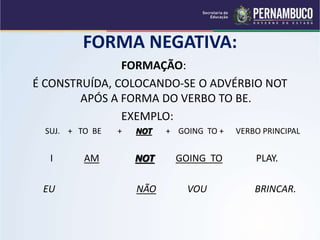
FORMA NEGATIVA:
FORMAÇÃO:
É CONSTRUÍDA, COLOCANDO-SE O ADVÉRBIO NOT
APÓS A FORMA DO VERBO TO BE.
EXEMPLO:
SUJ. + TO BE + NOT + GOING TO + VERBO PRINCIPAL
I AM NOT GOING TO PLAY.
EU NÃO VOU BRINCAR.
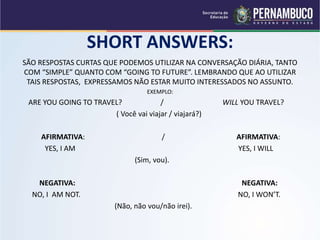
SHORT ANSWERS:
SÃO RESPOSTAS CURTAS QUE PODEMOS UTILIZAR NA CONVERSAÇÃO DIÁRIA, TANTO
COM “SIMPLE” QUANTO COM “GOING TO FUTURE”. LEMBRANDO QUE AO UTILIZAR
TAIS RESPOSTAS, EXPRESSAMOS NÃO ESTAR MUITO INTERESSADOS NO ASSUNTO.
EXEMPLO:
ARE YOU GOING TO TRAVEL? / WILL YOU TRAVEL?
( Você vai viajar / viajará?)
AFIRMATIVA: / AFIRMATIVA:
YES, I AM YES, I WILL
(Sim, vou).
NEGATIVA: NEGATIVA:
NO, I AM NOT. NO, I WON’T.
(Não, não vou/não irei).
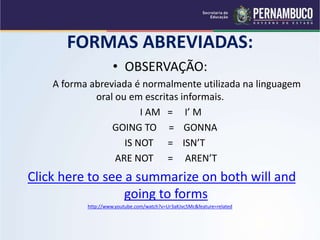
FORMAS ABREVIADAS:
• OBSERVAÇÃO:
A forma abreviada é normalmente utilizada na linguagem
oral ou em escritas informais.
I AM = I’ M
GOING TO = GONNA
IS NOT = ISN’T
ARE NOT = AREN’T
Click here to see a summarize on both will and
going to forms
http://www.youtube.com/watch?v=Ur3aKJvc5Mc&feature=related
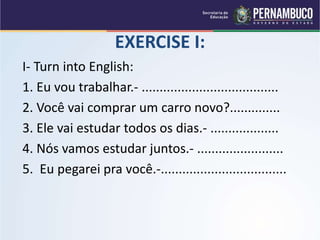
EXERCISE I:
I- Turn into English:
1. Eu vou trabalhar.- ......................................
2. Você vai comprar um carro novo?..............
3. Ele vai estudar todos os dias.- ...................
4. Nós vamos estudar juntos.- ........................
5. Eu pegarei pra você.-...................................
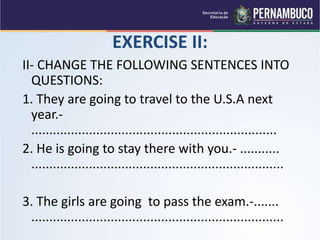
EXERCISE II:
II- CHANGE THE FOLLOWING SENTENCES INTO
QUESTIONS:
1. They are going to travel to the U.S.A next
year.-
....................................................................
2. He is going to stay there with you.- ...........
......................................................................
3. The girls are going to pass the exam.-.......
......................................................................
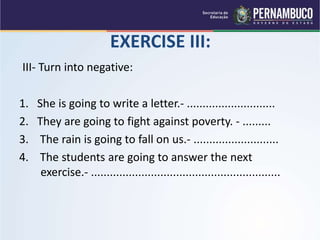
EXERCISE III:
III- Turn into negative:
1. She is going to write a letter.- ............................
2. They are going to fight against poverty. - .........
3. The rain is going to fall on us.- ...........................
4. The students are going to answer the next
exercise.- ............................................................
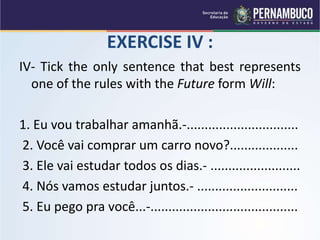
EXERCISE IV :
IV- Tick the only sentence that best represents
one of the rules with the Future form Will:
1. Eu vou trabalhar amanhã.-...............................
2. Você vai comprar um carro novo?...................
3. Ele vai estudar todos os dias.- .........................
4. Nós vamos estudar juntos.- ............................
5. Eu pego pra você...-.........................................
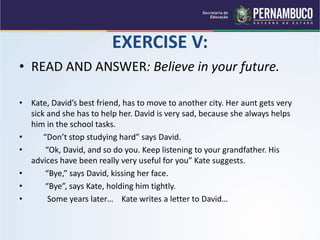
EXERCISE V:
• READ AND ANSWER: Believe in your future.
• Kate, David’s best friend, has to move to another city. Her aunt gets very
sick and she has to help her. David is very sad, because she always helps
him in the school tasks.
• “Don’t stop studying hard” says David.
• “Ok, David, and so do you. Keep listening to your grandfather. His
advices have been really very useful for you” Kate suggests.
• “Bye,” says David, kissing her face.
• “Bye”, says Kate, holding him tightly.
• Some years later… Kate writes a letter to David…
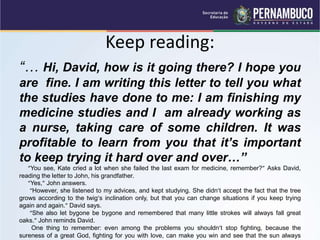
Keep reading:
“… Hi, David, how is it going there? I hope you
are fine. I am writing this letter to tell you what
the studies have done to me: I am finishing my
medicine studies and I am already working as
a nurse, taking care of some children. It was
profitable to learn from you that it’s important
to keep trying it hard over and over…”
“You see, Kate cried a lot when she failed the last exam for medicine, remember?” Asks David,
reading the letter to John, his grandfather.
“Yes,” John answers.
“However, she listened to my advices, and kept studying. She didn’t accept the fact that the tree
grows according to the twig’s inclination only, but that you can change situations if you keep trying
again and again.” David says.
“She also let bygone be bygone and remembered that many little strokes will always fall great
oaks.” John reminds David.
One thing to remember: even among the problems you shouldn’t stop fighting, because the
sureness of a great God, fighting for you with love, can make you win and see that the sun always
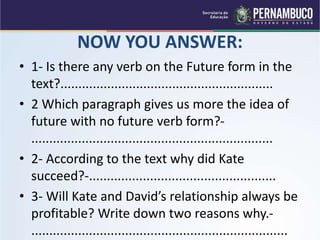
NOW YOU ANSWER:
• 1- Is there any verb on the Future form in the
text?...........................................................
• 2 Which paragraph gives us more the idea of
future with no future verb form?-
...................................................................
• 2- According to the text why did Kate
succeed?-....................................................
• 3- Will Kate and David’s relationship always be
profitable? Write down two reasons why.-
.......................................................................
THIS IS THE END OF OUR SIMPLE FUTURE X GOING TO CLASS:
• I HOPE YOU HAVE ENJOYED...
• THANK YOU!

SIMPLE FUTURE x FUTURE WITH GOING TO.ppt

  • 1.
    Linguagens, Códigos esuas Tecnologias – Inglês Ensino Médio, 1ª Série Simple Future x Future with going to
  • 2.
    SIMPLE FUTURE: • Éum tempo verbal que expressa uma ação futura incerta, não planejada, transmitindo ideias, fatos e decisões recém-tomadas. • EXEMPLO: • I will talk with you later. • ( Eu conversarei com você mais tarde).
  • 3.
    OBSERVAÇÕES: • No Inglêsantigo – período anterior à morte de William Shakespeare – a forma will era substituída por shall nas primeiras pessoas do singular e do plural. • Exemplo: • I shall go tomorrow- Eu irei amanhã. • We shall go tomorrow - Nós iremos amanhã. • Forma abreviada: I’ll go...; You’ll go... etc. • Eu irei...
  • 4.
    SIMPLE FUTURE NOINGLÊS MODERNO: • O Inglês moderno data do período intermediário entre a morte de William Shakespeare e a publicação da nova versão inglesa da Bíblia: • No Inglês moderno é comum empregar will para todas as pessoas verbais. • Exemplo: • I will go; You will go; He will go...etc. Shall no Inglês moderno expressa obrigação ou sugestão. Ex.: Shall we open the window? (Que tal abrirmos a janela?).
  • 5.
    ADVÉRBIOS DE TEMPOMAIS COMUNS RELACIONADOS AO FUTURO : • TOMORROW = AMANHÃ • NEXT WEEK = PRÓXIMA SEMANA • NEXT MONTH = PRÓXIMO MÊS • NEXT YEAR = PRÓXIMO ANO
  • 6.
    FORMAÇÃO: AFIRMATIVA • NAAFIRMATIVA: • Empregamos will entre o sujeito e o verbo principal: • Our country will improve its Education. (Suj.) (Verb. Principal) • (O nosso país melhorará sua Educação).
  • 7.
    FORMAÇÃO: NEGATIVA • NANEGATIVA: • Acrescentamos Not após Will. • EXEMPLO: • The Evil will not destroy the good. ( O mal não destruirá o bem) FORMA ABREVIADA: Won’t
  • 8.
    FORMAÇÃO: INTERROGATIVA • NAINTERROGATIVA: • O auxiliar will é colocado no início da oração, antes do sujeito. • EXEMPLO: • Will mankind be able to recognize what is really good for our society in the future? • (A humanidade reconhecerá o que realmente é bom para a nossa sociedade no futuro?). • Click here to see some more examples on question and negative form http://www.youtube.com/watch?v=GUKW48vw4GM&feature=related
  • 9.
    QUESTION WORDS: Most common: How/ Como Where / Aonde; Onde What / O quê Who / Quem When / Quando Why /Por que Exemplo: Where will you go tomorrow? ( Aonde você irá amanhã?)
  • 10.
    QUESTION TAG: • Sãoperguntas feitas nos finais das orações para confirmar o que foi dito antes. • EXEMPLO: • Você não irá, irá? • QUESTION-TAG: • A forma will é utilizada como question tag de orações imperativas, ou seja, orações que expressam ordem ou pedido. • EXEMPLO: • Stand up, will you?- Levante-se, sim?
  • 11.
    SEE THE FOLLOWINGVIDEO TO COMPLETE YOUR KNOWLEDGE ABOUT WILL: • Algumas vezes, na linguagem diária will e going to podem ser usados indiferentemente. • Click here for more information • http://www.youtube.com/watch?v=YDj-7oyD6l0&feature=related
  • 12.
    SIMPLE FUTURE XFUTURE WITH GOING TO: • Enquanto o auxiliar will fala sobre ações de futuro duvidoso e/ou próximos como, por exemplo: batem à porta e você diz a alguém do seu lado: – “Deixe que eu abrirei, ou eu abro ”. Em Inglês nesses casos utilizamos • will: • Exemplo: I will open it! • Ao contrário do futuro duvidoso e geralmente breve que o auxiliar will expressa, o “Going to Future” expressa um futuro planejado.
  • 13.
    GOING TO FUTURE: •É UM TEMPO VERBAL QUE EXPRESSA AÇÕES DO FUTURO DE FORMA PLANEJADA. • EXEMPLO: • I am going to travel to the U. S. A. next year. • (Vou viajar para os Estados Unidos no próximo ano). • Obs.: Ou seja, passaporte, acomodações todas prontas: futuro planejado.
  • 14.
    FORMAÇÃO: • EMPREGAMOS OSUJEITO, SEGUIDO DA FORMA EQUIVALENTE DO VERBO TO BE MAIS GOING TO, SEGUIDO DO VERBO PRINCIPAL. EXEMPLO: SUJEITO + VERBO TO BE + GOING TO + VERBO PRINCIPAL I AM GOING TO STUDY... EU VOU ESTUDAR... YOU ARE GOING TO PRAY. VOCÊ VAI ORAR.
  • 15.
    FORMA INTERROGATIVA: FORMAÇÃO: É CONSTRUÍDA,COLOCANDO-SE O VERBO TO BE ANTES DO SUJEITO. EXEMPLO: TO BE + SUJ. + GOING TO + VERBO PRINCIPAL ARE YOU GOING TO STUDY? VOCÊ VAI ESTUDAR?
  • 16.
    FORMA NEGATIVA: FORMAÇÃO: É CONSTRUÍDA,COLOCANDO-SE O ADVÉRBIO NOT APÓS A FORMA DO VERBO TO BE. EXEMPLO: SUJ. + TO BE + NOT + GOING TO + VERBO PRINCIPAL I AM NOT GOING TO PLAY. EU NÃO VOU BRINCAR.
  • 17.
    SHORT ANSWERS: SÃO RESPOSTASCURTAS QUE PODEMOS UTILIZAR NA CONVERSAÇÃO DIÁRIA, TANTO COM “SIMPLE” QUANTO COM “GOING TO FUTURE”. LEMBRANDO QUE AO UTILIZAR TAIS RESPOSTAS, EXPRESSAMOS NÃO ESTAR MUITO INTERESSADOS NO ASSUNTO. EXEMPLO: ARE YOU GOING TO TRAVEL? / WILL YOU TRAVEL? ( Você vai viajar / viajará?) AFIRMATIVA: / AFIRMATIVA: YES, I AM YES, I WILL (Sim, vou). NEGATIVA: NEGATIVA: NO, I AM NOT. NO, I WON’T. (Não, não vou/não irei).
  • 18.
    FORMAS ABREVIADAS: • OBSERVAÇÃO: Aforma abreviada é normalmente utilizada na linguagem oral ou em escritas informais. I AM = I’ M GOING TO = GONNA IS NOT = ISN’T ARE NOT = AREN’T Click here to see a summarize on both will and going to forms http://www.youtube.com/watch?v=Ur3aKJvc5Mc&feature=related
  • 19.
    EXERCISE I: I- Turninto English: 1. Eu vou trabalhar.- ...................................... 2. Você vai comprar um carro novo?.............. 3. Ele vai estudar todos os dias.- ................... 4. Nós vamos estudar juntos.- ........................ 5. Eu pegarei pra você.-...................................
  • 20.
    EXERCISE II: II- CHANGETHE FOLLOWING SENTENCES INTO QUESTIONS: 1. They are going to travel to the U.S.A next year.- .................................................................... 2. He is going to stay there with you.- ........... ...................................................................... 3. The girls are going to pass the exam.-....... ......................................................................
  • 21.
    EXERCISE III: III- Turninto negative: 1. She is going to write a letter.- ............................ 2. They are going to fight against poverty. - ......... 3. The rain is going to fall on us.- ........................... 4. The students are going to answer the next exercise.- ............................................................
  • 22.
    EXERCISE IV : IV-Tick the only sentence that best represents one of the rules with the Future form Will: 1. Eu vou trabalhar amanhã.-............................... 2. Você vai comprar um carro novo?................... 3. Ele vai estudar todos os dias.- ......................... 4. Nós vamos estudar juntos.- ............................ 5. Eu pego pra você...-.........................................
  • 23.
    EXERCISE V: • READAND ANSWER: Believe in your future. • Kate, David’s best friend, has to move to another city. Her aunt gets very sick and she has to help her. David is very sad, because she always helps him in the school tasks. • “Don’t stop studying hard” says David. • “Ok, David, and so do you. Keep listening to your grandfather. His advices have been really very useful for you” Kate suggests. • “Bye,” says David, kissing her face. • “Bye”, says Kate, holding him tightly. • Some years later… Kate writes a letter to David…
  • 24.
    Keep reading: “… Hi,David, how is it going there? I hope you are fine. I am writing this letter to tell you what the studies have done to me: I am finishing my medicine studies and I am already working as a nurse, taking care of some children. It was profitable to learn from you that it’s important to keep trying it hard over and over…” “You see, Kate cried a lot when she failed the last exam for medicine, remember?” Asks David, reading the letter to John, his grandfather. “Yes,” John answers. “However, she listened to my advices, and kept studying. She didn’t accept the fact that the tree grows according to the twig’s inclination only, but that you can change situations if you keep trying again and again.” David says. “She also let bygone be bygone and remembered that many little strokes will always fall great oaks.” John reminds David. One thing to remember: even among the problems you shouldn’t stop fighting, because the sureness of a great God, fighting for you with love, can make you win and see that the sun always
  • 25.
    NOW YOU ANSWER: •1- Is there any verb on the Future form in the text?........................................................... • 2 Which paragraph gives us more the idea of future with no future verb form?- ................................................................... • 2- According to the text why did Kate succeed?-.................................................... • 3- Will Kate and David’s relationship always be profitable? Write down two reasons why.- .......................................................................
  • 26.
    THIS IS THEEND OF OUR SIMPLE FUTURE X GOING TO CLASS: • I HOPE YOU HAVE ENJOYED... • THANK YOU!