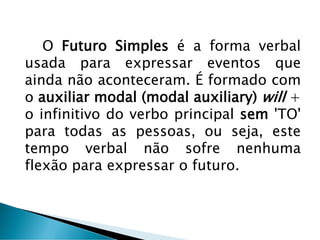
O Futuro Simplesé a forma verbal
usada para expressar eventos que
ainda não aconteceram. É formado com
o auxiliar modal (modal auxiliary) will +
o infinitivo do verbo principal sem 'TO'
para todas as pessoas, ou seja, este
tempo verbal não sofre nenhuma
flexão para expressar o futuro.
3.
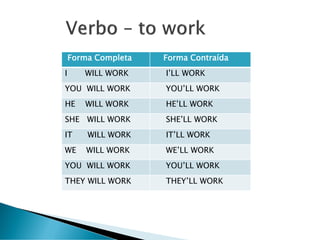
Forma Completa FormaContraída
I WILL WORK I’LL WORK
YOU WILL WORK YOU’LL WORK
HE WILL WORK HE’LL WORK
SHE WILL WORK SHE’LL WORK
IT WILL WORK IT’LL WORK
WE WILL WORK WE’LL WORK
YOU WILL WORK YOU’LL WORK
THEY WILL WORK THEY’LL WORK
4.
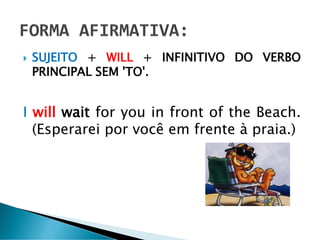
SUJEITO +WILL + INFINITIVO DO VERBO
PRINCIPAL SEM 'TO'.
I will wait for you in front of the Beach.
(Esperarei por você em frente à praia.)
5.
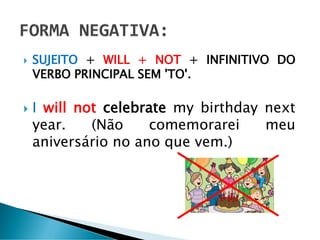
SUJEITO +WILL + NOT + INFINITIVO DO
VERBO PRINCIPAL SEM 'TO'.
I will not celebrate my birthday next
year. (Não comemorarei meu
aniversário no ano que vem.)
6.
A formacontraída de will not é: won’t.
I think it will not rain tomorrow.
ou
I think it won’t rain tomorrow.
(Acho que não choverá amanhã)
7.
WILL +SUJEITO + VERBO PRINCIPAL SEM 'TO‘
Will he travel abroad?
(Ele viajará para o exterior?)
Where will you spend your vacation?
(Onde você passará as férias?)
8.
Com aprimeira pessoa do singular (I)
e a primeira do plural (We), é possível
substituir will por shall. Esta forma é
mais comum em perguntas,
oferecimentos, sugestões e convites.
A forma shall também é considerada
mais formal.
9.
Shall wego? (Vamos?)
Shall I sing? (Vou cantar?)
Shall we dance? (Vamos dançar?)
10.
1. Falar deações que ainda ocorrerão em
um futuro não imediato:
He's sure his team will win the
championship. (Ele tem certeza de que
seu time vencerá o campeonato.)
Amanda is a good student; she'll
pass the exame. (Amanda é uma boa
aluna, ela passará no teste.)
11.
2. Expressar açõescompletas no futuro:
John will work in New York next year.
(John trabalhará em Nova Iorque no ano que vem)
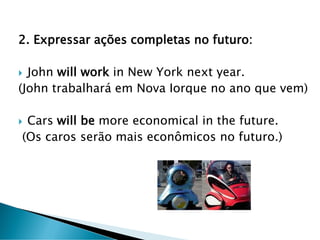
Cars will be more economical in the future.
(Os caros serão mais econômicos no futuro.)
12.
3. Expressar decisõestomadas no
momento da fala:
The phone is ringing. I'll answer it!
(O telefone está tocando. Irei atender)
14.
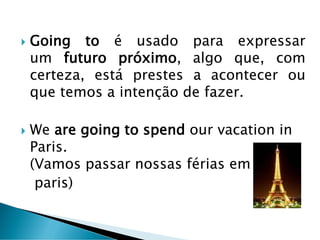
Going toé usado para expressar
um futuro próximo, algo que, com
certeza, está prestes a acontecer ou
que temos a intenção de fazer.
We are going to spend our vacation in
Paris.
(Vamos passar nossas férias em
paris)
15.
Na LínguaInglesa, assim como no
Português, pouco usamos o futuro do
presente (consertará, levará, irá, trará,
etc), que corresponde ao Simple
Future. Na maioria das vezes damos
preferência à construção vou
consertar, vou levar, etc. Essa
construção se faz com o Going to em
Inglês.
16.
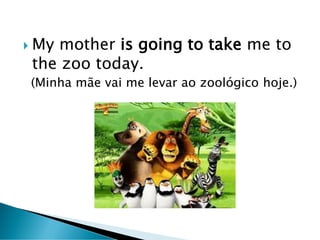
My motheris going to take me to
the zoo today.
(Minha mãe vai me levar ao zoológico hoje.)
17.
A formaafirmativa desta estrutura verbal é
formada por going to seguido do infinitivo do
verbo principal sem 'TO'. O verbo to be serve
como auxiliar e se posiciona após o sujeito:
SUJEITO + VERBO TO BE + GOING TO + INFINITIVO
DO VERBO PRINCIPAL SEM 'TO'.
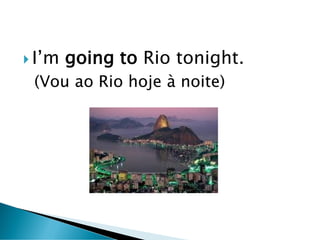
I’m goingto Rio tonight.
(Vou ao Rio hoje à noite)
20.
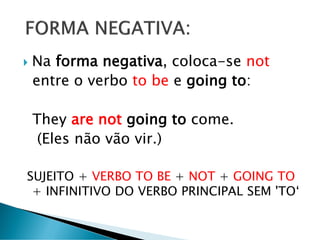
Na formanegativa, coloca-se not
entre o verbo to be e going to:
They are not going to come.
(Eles não vão vir.)
SUJEITO + VERBO TO BE + NOT + GOING TO
+ INFINITIVO DO VERBO PRINCIPAL SEM 'TO‘
21.
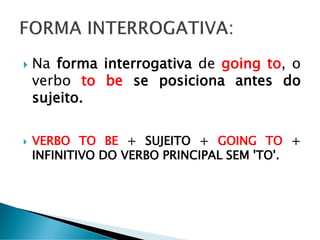
Na formainterrogativa de going to, o
verbo to be se posiciona antes do
sujeito.
VERBO TO BE + SUJEITO + GOING TO +
INFINITIVO DO VERBO PRINCIPAL SEM 'TO'.
22.
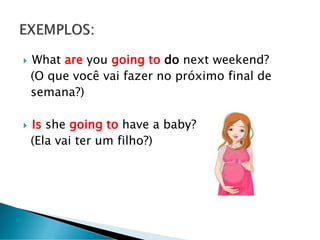
What areyou going to do next weekend?
(O que você vai fazer no próximo final de
semana?)
Is she going to have a baby?
(Ela vai ter um filho?)
23.
1. Expressar intençãode fazer alguma coisa:
I'm going to eat less to try to lose weight.
(Vou comer menos para tentar emagrecer.)
I'm going (to go) for a walk.
(Vou dar uma caminhada.)
24.
2. Falar deplanos para o futuro:
He is going to be a doctor when he grows up.
(Ele vai ser médico quando crescer.)
Carol is going to be engaged next month.
(Carol vai ficar noiva no mês que vem.)
25.
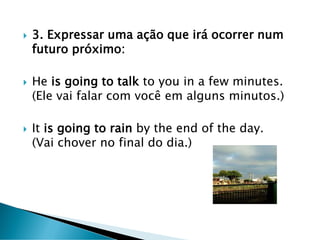
3. Expressaruma ação que irá ocorrer num
futuro próximo:
He is going to talk to you in a few minutes.
(Ele vai falar com você em alguns minutos.)
It is going to rain by the end of the day.
(Vai chover no final do dia.)
26.
A formagoing to geralmente é
seguida de advérbios de tempo,
como: next week; next month; next
year; in a week; in a month; in a year;
today; tonight; tomorrow, etc.
27.
Em muitoscasos podemos usar
tanto will quanto going
to exatamente com o mesmo
sentido. Porém, se nos referirmos
a algo que irá acontecer muito
em breve, geralmente optamos
pela forma going to.
28.
Outra distinçãoentre will e going
to refere-se ao planejamento prévio
ou não da ação. Will é usado quando
a pessoa que fala decide, no
momento em que fala, fazer alguma
coisa no futuro, ou seja, não houve
planejamento prévio. No entanto, se
a decisão já havia sido tomada,
emprega-se going to.
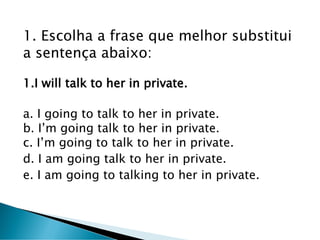
1. Escolha afrase que melhor substitui
a sentença abaixo:
1.I will talk to her in private.
a. I going to talk to her in private.
b. I’m going talk to her in private.
c. I’m going to talk to her in private.
d. I am going talk to her in private.
e. I am going to talking to her in private.
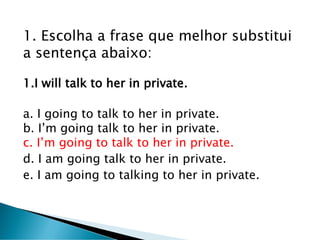
31.
1. Escolha afrase que melhor substitui
a sentença abaixo:
1.I will talk to her in private.
a. I going to talk to her in private.
b. I’m going talk to her in private.
c. I’m going to talk to her in private.
d. I am going talk to her in private.
e. I am going to talking to her in private.
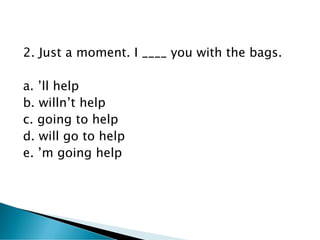
32.
2. Just amoment. I ____ you with the bags.
a. ’ll help
b. willn’t help
c. going to help
d. will go to help
e. ’m going help
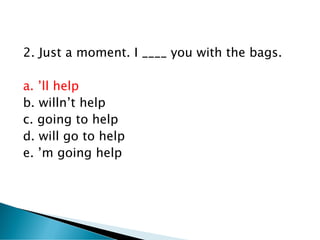
33.
2. Just amoment. I ____ you with the bags.
a. ’ll help
b. willn’t help
c. going to help
d. will go to help
e. ’m going help
34.
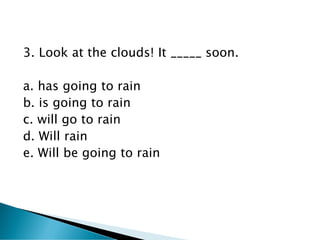
3. Look atthe clouds! It _____ soon.
a. has going to rain
b. is going to rain
c. will go to rain
d. Will rain
e. Will be going to rain
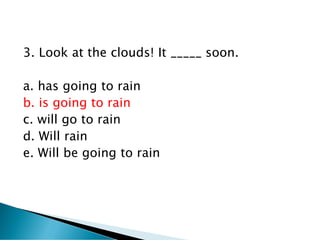
35.
3. Look atthe clouds! It _____ soon.
a. has going to rain
b. is going to rain
c. will go to rain
d. Will rain
e. Will be going to rain
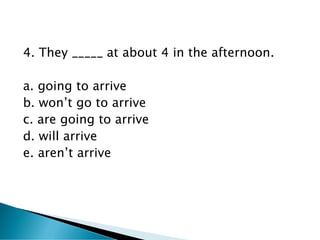
36.
4. They _____at about 4 in the afternoon.
a. going to arrive
b. won’t go to arrive
c. are going to arrive
d. will arrive
e. aren’t arrive
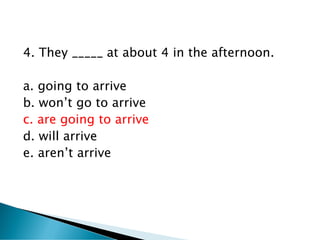
37.
4. They _____at about 4 in the afternoon.
a. going to arrive
b. won’t go to arrive
c. are going to arrive
d. will arrive
e. aren’t arrive
38.
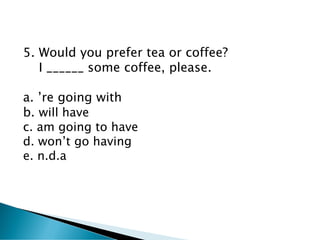
5. Would youprefer tea or coffee?
I ______ some coffee, please.
a. ’re going with
b. will have
c. am going to have
d. won’t go having
e. n.d.a
39.
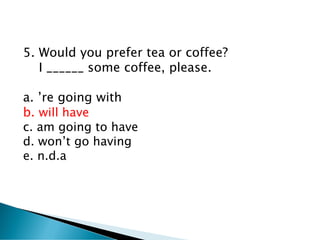
5. Would youprefer tea or coffee?
I ______ some coffee, please.
a. ’re going with
b. will have
c. am going to have
d. won’t go having
e. n.d.a
40.
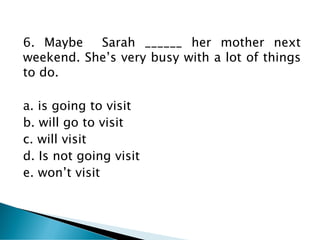
6. Maybe Sarah______ her mother next
weekend. She’s very busy with a lot of things
to do.
a. is going to visit
b. will go to visit
c. will visit
d. Is not going visit
e. won’t visit
41.
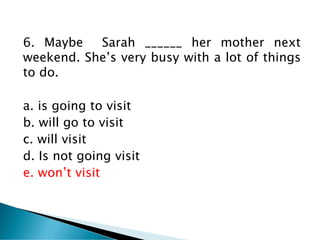
6. Maybe Sarah______ her mother next
weekend. She’s very busy with a lot of things
to do.
a. is going to visit
b. will go to visit
c. will visit
d. Is not going visit
e. won’t visit
42.
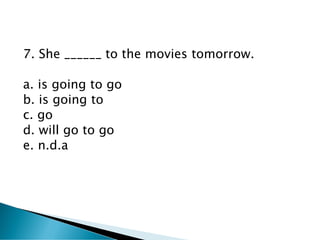
7. She ______to the movies tomorrow.
a. is going to go
b. is going to
c. go
d. will go to go
e. n.d.a
43.
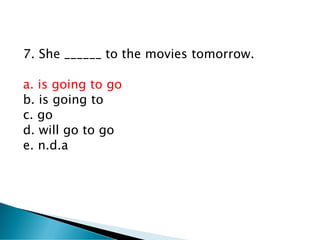
7. She ______to the movies tomorrow.
a. is going to go
b. is going to
c. go
d. will go to go
e. n.d.a