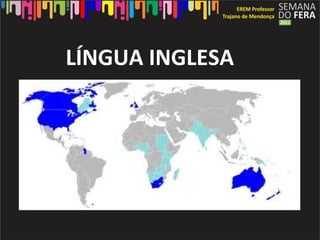
LÍNGUA INGLESA
Regras para plural dos substantivos em
Inglês
•Existem regras para a formação do plural
em inglês.

•Para formar o plural, temos duas
alternativas: acrescentamos S ou ES às
palavras.

•Para saber se acrescentamos S ou ES,
depende da terminação da palavra.
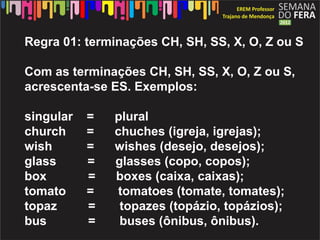
Regra 01: terminações CH, SH, SS, X, O, Z ou S

Com as terminações CH, SH, SS, X, O, Z ou S,
acrescenta-se ES. Exemplos:

singular   =   plural
church     =   chuches (igreja, igrejas);
wish       =   wishes (desejo, desejos);
glass      =   glasses (copo, copos);
box        =   boxes (caixa, caixas);
tomato     =    tomatoes (tomate, tomates);
topaz      =    topazes (topázio, topázios);
bus        =    buses (ônibus, ônibus).
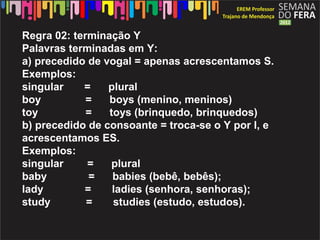
Regra 02: terminação Y
Palavras terminadas em Y:
a) precedido de vogal = apenas acrescentamos S.
Exemplos:
singular    =    plural
boy          =   boys (menino, meninos)
toy          =   toys (brinquedo, brinquedos)
b) precedido de consoante = troca-se o Y por I, e
acrescentamos ES.
Exemplos:
singular     =   plural
baby         =    babies (bebê, bebês);
lady        =     ladies (senhora, senhoras);
study        =    studies (estudo, estudos).
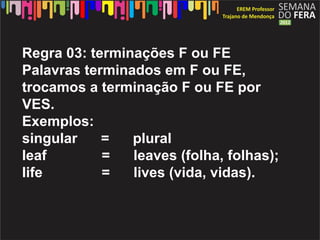
Regra 03: terminações F ou FE
Palavras terminados em F ou FE,
trocamos a terminação F ou FE por
VES.
Exemplos:
singular    =   plural
leaf        =   leaves (folha, folhas);
life        =   lives (vida, vidas).
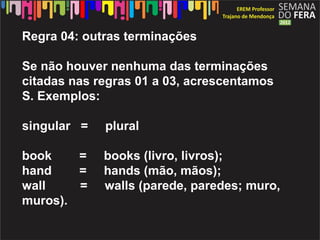
Regra 04: outras terminações

Se não houver nenhuma das terminações
citadas nas regras 01 a 03, acrescentamos
S. Exemplos:

singular =   plural

book    =    books (livro, livros);
hand    =    hands (mão, mãos);
wall    =    walls (parede, paredes; muro,
muros).
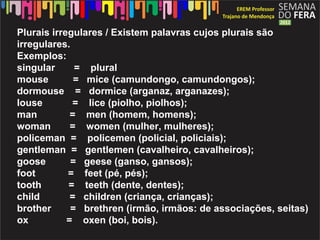
Plurais irregulares / Existem palavras cujos plurais são
irregulares.
Exemplos:
singular      = plural
mouse         = mice (camundongo, camundongos);
dormouse = dormice (arganaz, arganazes);
louse        = lice (piolho, piolhos);
man          = men (homem, homens);
woman        = women (mulher, mulheres);
policeman = policemen (policial, policiais);
gentleman = gentlemen (cavalheiro, cavalheiros);
goose        = geese (ganso, gansos);
foot        = feet (pé, pés);
tooth       = teeth (dente, dentes);
child        = children (criança, crianças);
brother      = brethren (irmão, irmãos: de associações, seitas)
ox          = oxen (boi, bois).
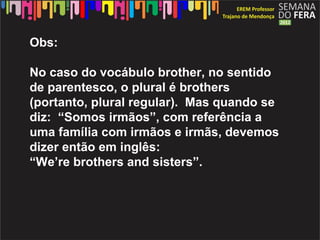
Obs:

No caso do vocábulo brother, no sentido
de parentesco, o plural é brothers
(portanto, plural regular). Mas quando se
diz: “Somos irmãos”, com referência a
uma família com irmãos e irmãs, devemos
dizer então em inglês:
“We’re brothers and sisters”.
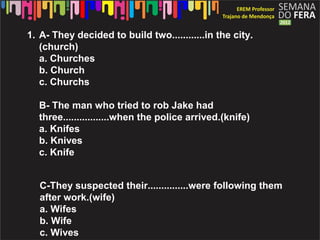
1. A- They decided to build two............in the city.
   (church)
   a. Churches
   b. Church
   c. Churchs

  B- The man who tried to rob Jake had
  three.................when the police arrived.(knife)
  a. Knifes
  b. Knives
  c. Knife


   C-They suspected their...............were following them
   after work.(wife)
   a. Wifes
   b. Wife
   c. Wives
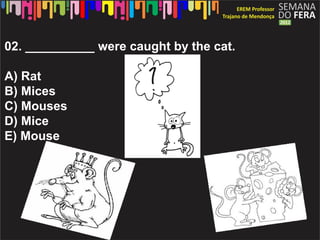
02. __________ were caught by the cat.

A) Rat
B) Mices
C) Mouses
D) Mice
E) Mouse
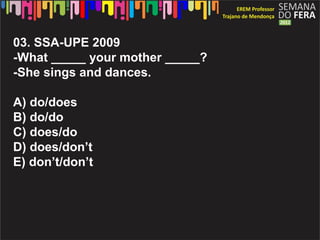
03. SSA-UPE 2009
-What _____ your mother _____?
-She sings and dances.

A) do/does
B) do/do
C) does/do
D) does/don’t
E) don’t/don’t
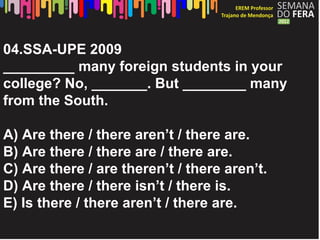
04.SSA-UPE 2009
_________ many foreign students in your
college? No, _______. But ________ many
from the South.

A) Are there / there aren’t / there are.
B) Are there / there are / there are.
C) Are there / are theren’t / there aren’t.
D) Are there / there isn’t / there is.
E) Is there / there aren’t / there are.
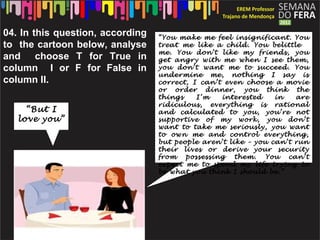
04. In this question, according   “You make me feel insignificant. You
to the cartoon below, analyse     treat me like a child. You belittle
                                  me. You don’t like my friends, you
and choose T for True in          get angry with me when I see them,
column I or F for False in        you don’t want me to succeed. You
                                  undermine me, nothing I say is
column II.                        correct, I can’t even choose a movie
                                  or order dinner, you think the
                                  things    I’m   interested    in   are
                                  ridiculous, everything is rational
     “But I                       and calculated to you, you’re not
   love you”                      supportive of my work, you don’t
                                  want to take me seriously, you want
                                  to own me and control everything,
                                  but people aren’t like – you can’t run
                                  their lives or derive your security
                                  from   possessing   them. You can’t
                                  expect me to spend my life trying to
                                  be what you think I should be.”
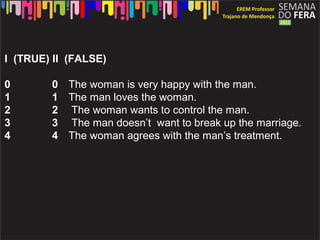
I (TRUE) II (FALSE)

0       0 The woman is very happy with the man.
1       1 The man loves the woman.
2       2 The woman wants to control the man.
3       3 The man doesn’t want to break up the marriage.
4       4 The woman agrees with the man’s treatment.
THANK YOU SO MUCH!

Apresentação questões aulão 2º ano

  • 1.
  • 2.
    Regras para pluraldos substantivos em Inglês •Existem regras para a formação do plural em inglês. •Para formar o plural, temos duas alternativas: acrescentamos S ou ES às palavras. •Para saber se acrescentamos S ou ES, depende da terminação da palavra.
  • 3.
    Regra 01: terminaçõesCH, SH, SS, X, O, Z ou S Com as terminações CH, SH, SS, X, O, Z ou S, acrescenta-se ES. Exemplos: singular = plural church = chuches (igreja, igrejas); wish = wishes (desejo, desejos); glass = glasses (copo, copos); box = boxes (caixa, caixas); tomato = tomatoes (tomate, tomates); topaz = topazes (topázio, topázios); bus = buses (ônibus, ônibus).
  • 4.
    Regra 02: terminaçãoY Palavras terminadas em Y: a) precedido de vogal = apenas acrescentamos S. Exemplos: singular = plural boy = boys (menino, meninos) toy = toys (brinquedo, brinquedos) b) precedido de consoante = troca-se o Y por I, e acrescentamos ES. Exemplos: singular = plural baby = babies (bebê, bebês); lady = ladies (senhora, senhoras); study = studies (estudo, estudos).
  • 5.
    Regra 03: terminaçõesF ou FE Palavras terminados em F ou FE, trocamos a terminação F ou FE por VES. Exemplos: singular = plural leaf = leaves (folha, folhas); life = lives (vida, vidas).
  • 6.
    Regra 04: outrasterminações Se não houver nenhuma das terminações citadas nas regras 01 a 03, acrescentamos S. Exemplos: singular = plural book = books (livro, livros); hand = hands (mão, mãos); wall = walls (parede, paredes; muro, muros).
  • 7.
    Plurais irregulares /Existem palavras cujos plurais são irregulares. Exemplos: singular = plural mouse = mice (camundongo, camundongos); dormouse = dormice (arganaz, arganazes); louse = lice (piolho, piolhos); man = men (homem, homens); woman = women (mulher, mulheres); policeman = policemen (policial, policiais); gentleman = gentlemen (cavalheiro, cavalheiros); goose = geese (ganso, gansos); foot = feet (pé, pés); tooth = teeth (dente, dentes); child = children (criança, crianças); brother = brethren (irmão, irmãos: de associações, seitas) ox = oxen (boi, bois).
  • 8.
    Obs: No caso dovocábulo brother, no sentido de parentesco, o plural é brothers (portanto, plural regular). Mas quando se diz: “Somos irmãos”, com referência a uma família com irmãos e irmãs, devemos dizer então em inglês: “We’re brothers and sisters”.
  • 9.
    1. A- Theydecided to build two............in the city. (church) a. Churches b. Church c. Churchs B- The man who tried to rob Jake had three.................when the police arrived.(knife) a. Knifes b. Knives c. Knife C-They suspected their...............were following them after work.(wife) a. Wifes b. Wife c. Wives
  • 10.
    02. __________ werecaught by the cat. A) Rat B) Mices C) Mouses D) Mice E) Mouse
  • 11.
    03. SSA-UPE 2009 -What_____ your mother _____? -She sings and dances. A) do/does B) do/do C) does/do D) does/don’t E) don’t/don’t
  • 12.
    04.SSA-UPE 2009 _________ manyforeign students in your college? No, _______. But ________ many from the South. A) Are there / there aren’t / there are. B) Are there / there are / there are. C) Are there / are theren’t / there aren’t. D) Are there / there isn’t / there is. E) Is there / there aren’t / there are.
  • 13.
    04. In thisquestion, according “You make me feel insignificant. You to the cartoon below, analyse treat me like a child. You belittle me. You don’t like my friends, you and choose T for True in get angry with me when I see them, column I or F for False in you don’t want me to succeed. You undermine me, nothing I say is column II. correct, I can’t even choose a movie or order dinner, you think the things I’m interested in are ridiculous, everything is rational “But I and calculated to you, you’re not love you” supportive of my work, you don’t want to take me seriously, you want to own me and control everything, but people aren’t like – you can’t run their lives or derive your security from possessing them. You can’t expect me to spend my life trying to be what you think I should be.”
  • 14.
    I (TRUE) II(FALSE) 0 0 The woman is very happy with the man. 1 1 The man loves the woman. 2 2 The woman wants to control the man. 3 3 The man doesn’t want to break up the marriage. 4 4 The woman agrees with the man’s treatment.
  • 15.