




Deixando o V8 otimizar sua
aplicação Node
Talysson / @talyssonoc
talyssonoc.github.io
Codeminer42
Node & V8
Node & V8
● V8: máquina virtual JS
● Libuv: async I/O
+
=
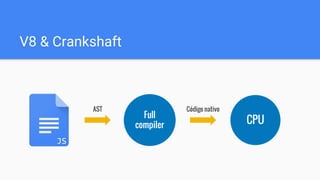
V8 & Crankshaft
Full
compiler
AST Código nativo
CPU
JS
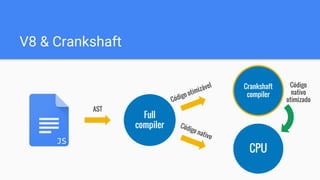
V8 & Crankshaft
Full
compiler
Crankshaft
compiler
AST
CPU
JS
Código
nativo
otimizado
Código nativo
Código otimizável
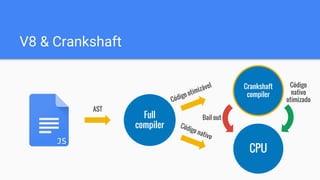
V8 & Crankshaft
Full
compiler
Crankshaft
compiler
AST
Código nativo
CPU
JS
Bail out
Código otimizável Código
nativo
otimizado
Escrevendo código otimizável
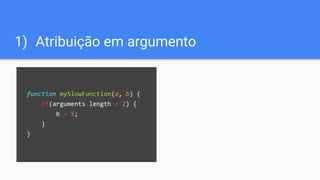
1) Atribuição em argumento
function mySlowFunction(a, b) {
if(arguments.length < 2) {
b = 5;
}
}
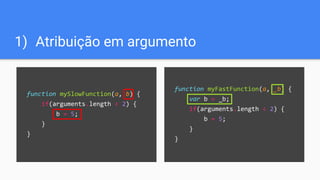
function myFastFunction(a, _b) {
var b = _b;
if(arguments.length < 2) {
b = 5;
}
}
1) Atribuição em argumento
function mySlowFunction(a, b) {
if(arguments.length < 2) {
b = 5;
}
}
var args = [].slice.call(arguments);
2) Vazamento do arguments
function leaksArguments() {
return arguments;
}
var args = new Array(arguments.length);
for(var i = 0; i < args.length; ++i) {
args[i] = arguments[i];
}
* Uso seguro do arguments
arguments.length;
arguments[i]; // `i` válido
fn.apply(y, arguments); // único
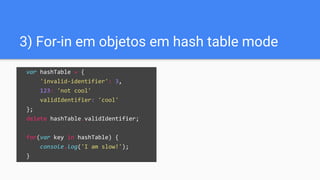
3) For-in em objetos em hash table mode
var hashTable = {
'invalid-identifier': 3,
123: 'not cool'
validIdentifier: 'cool'
};
delete hashTable.validIdentifier;
for(var key in hashTable) {
console.log('I am slow!');
}
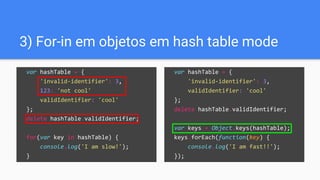
var hashTable = {
'invalid-identifier': 3,
validIdentifier: 'cool'
};
delete hashTable.validIdentifier;
var keys = Object.keys(hashTable);
keys.forEach(function(key) {
console.log('I am fast!!');
});
3) For-in em objetos em hash table mode
var hashTable = {
'invalid-identifier': 3,
123: 'not cool'
validIdentifier: 'cool'
};
delete hashTable.validIdentifier;
for(var key in hashTable) {
console.log('I am slow!');
}
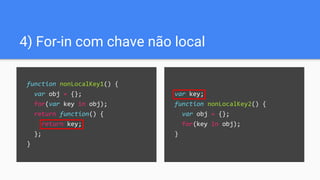
var key;
function nonLocalKey2() {
var obj = {};
for(key in obj);
}
function nonLocalKey1() {
var obj = {};
for(var key in obj);
return function() {
return key;
};
}
4) For-in com chave não local
var array = [1, 2, 3];
for(var i in array) {
console.log(array[i]);
}
5) For-in em objetos com índices numéricos
var array = [1, 2, 3];
for(var i in array) {
console.log(array[i]);
}
5) For-in em objetos com índices numéricos
var array = [1, 2, 3];
var length = array.length;
for(var i = 0; i < length; i++) {
console.log(array[i]);
}
array.forEach((v) => {
console.log(v);
});
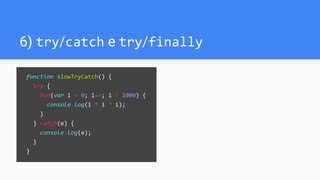
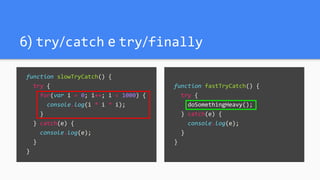
6) try/catch e try/finally
function slowTryCatch() {
try {
for(var i = 0; i++; i < 1000) {
console.log(i * i * i);
}
} catch(e) {
console.log(e);
}
}
function fastTryCatch() {
try {
doSomethingHeavy();
} catch(e) {
console.log(e);
}
}
6) try/catch e try/finally
function slowTryCatch() {
try {
for(var i = 0; i++; i < 1000) {
console.log(i * i * i);
}
} catch(e) {
console.log(e);
}
}
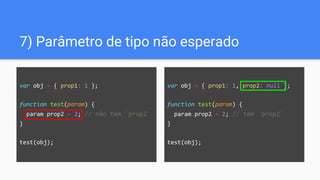
7) Parâmetro de tipo não esperado
var obj = { prop1: 1 };
function test(param) {
param.prop2 = 2; // não tem `prop2`
}
test(obj);
var obj = { prop1: 1, prop2: null };
function test(param) {
param.prop2 = 2; // tem `prop2`
}
test(obj);
7) Parâmetro de tipo não esperado
var obj = { prop1: 1 };
function test(param) {
param.prop2 = 2; // não tem `prop2`
}
test(obj);
8) Funções com argumentos variáveis
function calc() {
if(arguments.length === 2) {
return arguments[0] * arguments[1];
}
return arguments[0];
}
function calc() {
if(arguments.length === 2) {
return calcTwo(arguments[0],
arguments[1]);
}
return calcOne(arguments[0]);
}
function calcOne(a) { return a }
function calcTwo(a, b) { return a * b }
8) Funções com argumentos variáveis
function calc() {
if(arguments.length === 2) {
return arguments[0] * arguments[1];
}
return arguments[0];
}
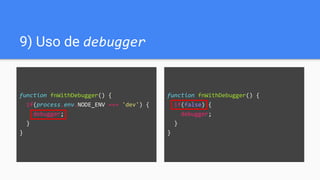
9) Uso de debugger
function fnWithDebugger() {
if(process.env.NODE_ENV === 'dev') {
debugger;
}
}
function fnWithDebugger() {
if(false) {
debugger;
}
}
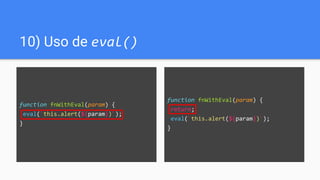
function fnWithEval(param) {
return;
eval(`this.alert(${param})`);
}
10) Uso de eval()
function fnWithEval(param) {
eval(`this.alert(${param})`);
}
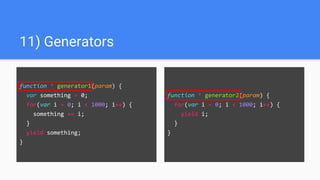
function * generator1(param) {
var something = 0;
for(var i = 0; i < 1000; i++) {
something += i;
}
yield something;
}
11) Generators
function * generator2(param) {
for(var i = 0; i < 1000; i++) {
yield i;
}
}
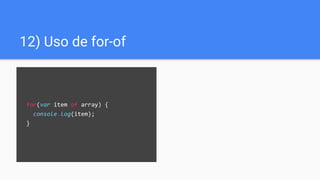
for(var item of array) {
console.log(item);
}
12) Uso de for-of
for(var item of array) {
console.log(item);
}
12) Uso de for-of
var length = array.length;
for(var i = 0; i < length; i++) {
console.log(array[i]);
}
array.forEach((item) => {
console.log(item);
});
Entre outros
● Objetos com __proto__
● Objetos com set / get
● Funções muito grandes
● Uso do with
● Índice negativo em arrays
● Nome de propriedade computada
● Otimização falhou muitas vezes
● Uso do super
● ...
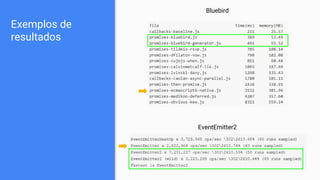
Mas isso funciona mesmo?!
Exemplos de
resultados
Bluebird
EventEmitter2
O futuro do V8: TurboFan
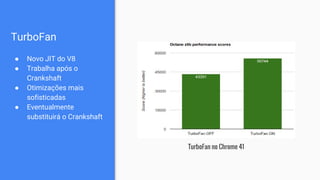
TurboFan
● Novo JIT do V8
● Trabalha após o
Crankshaft
● Otimizações mais
sofisticadas
● Eventualmente
substituirá o Crankshaft
TurboFan no Chrome 41
Referências
● Optimization killers: https://github.com/petkaantonov/bluebird/wiki/Optimization-killers
● V8 bailout reasons: https://github.com/vhf/v8-bailout-reasons
● NodeJS Anti-Patterns: https://github.com/zhangchiqing/OptimizationKillers
● A tour of V8: Crankshaft, the optimizing compiler: http://jayconrod.com/posts/54/a-tour-
of-v8-crankshaft-the-optimizing-compiler
● Bailout reasons: https://cs.chromium.org/chromium/src/v8/src/bailout-reason.h
● TurboFan: http://v8project.blogspot.com.br/2015/07/digging-into-turbofan-jit.html
● TurboFan performance: http://blog.chromium.org/2015/07/revving-up-javascript-
performance-with.html
Talysson / @talyssonoc
talyssonoc.github.io

TDC2016SP - Trilha Node.Js

  • 1.
    Deixando o V8otimizar sua aplicação Node
  • 2.
  • 3.
  • 4.
    Node & V8 ●V8: máquina virtual JS ● Libuv: async I/O + =
  • 5.
    V8 & Crankshaft Full compiler ASTCódigo nativo CPU JS
  • 6.
  • 7.
    V8 & Crankshaft Full compiler Crankshaft compiler AST Códigonativo CPU JS Bail out Código otimizável Código nativo otimizado
  • 8.
  • 9.
    1) Atribuição emargumento function mySlowFunction(a, b) { if(arguments.length < 2) { b = 5; } }
  • 10.
    function myFastFunction(a, _b){ var b = _b; if(arguments.length < 2) { b = 5; } } 1) Atribuição em argumento function mySlowFunction(a, b) { if(arguments.length < 2) { b = 5; } }
  • 11.
    var args =[].slice.call(arguments); 2) Vazamento do arguments function leaksArguments() { return arguments; }
  • 12.
    var args =new Array(arguments.length); for(var i = 0; i < args.length; ++i) { args[i] = arguments[i]; } * Uso seguro do arguments arguments.length; arguments[i]; // `i` válido fn.apply(y, arguments); // único
  • 13.
    3) For-in emobjetos em hash table mode var hashTable = { 'invalid-identifier': 3, 123: 'not cool' validIdentifier: 'cool' }; delete hashTable.validIdentifier; for(var key in hashTable) { console.log('I am slow!'); }
  • 14.
    var hashTable ={ 'invalid-identifier': 3, validIdentifier: 'cool' }; delete hashTable.validIdentifier; var keys = Object.keys(hashTable); keys.forEach(function(key) { console.log('I am fast!!'); }); 3) For-in em objetos em hash table mode var hashTable = { 'invalid-identifier': 3, 123: 'not cool' validIdentifier: 'cool' }; delete hashTable.validIdentifier; for(var key in hashTable) { console.log('I am slow!'); }
  • 15.
    var key; function nonLocalKey2(){ var obj = {}; for(key in obj); } function nonLocalKey1() { var obj = {}; for(var key in obj); return function() { return key; }; } 4) For-in com chave não local
  • 16.
    var array =[1, 2, 3]; for(var i in array) { console.log(array[i]); } 5) For-in em objetos com índices numéricos
  • 17.
    var array =[1, 2, 3]; for(var i in array) { console.log(array[i]); } 5) For-in em objetos com índices numéricos var array = [1, 2, 3]; var length = array.length; for(var i = 0; i < length; i++) { console.log(array[i]); } array.forEach((v) => { console.log(v); });
  • 18.
    6) try/catch etry/finally function slowTryCatch() { try { for(var i = 0; i++; i < 1000) { console.log(i * i * i); } } catch(e) { console.log(e); } }
  • 19.
    function fastTryCatch() { try{ doSomethingHeavy(); } catch(e) { console.log(e); } } 6) try/catch e try/finally function slowTryCatch() { try { for(var i = 0; i++; i < 1000) { console.log(i * i * i); } } catch(e) { console.log(e); } }
  • 20.
    7) Parâmetro detipo não esperado var obj = { prop1: 1 }; function test(param) { param.prop2 = 2; // não tem `prop2` } test(obj);
  • 21.
    var obj ={ prop1: 1, prop2: null }; function test(param) { param.prop2 = 2; // tem `prop2` } test(obj); 7) Parâmetro de tipo não esperado var obj = { prop1: 1 }; function test(param) { param.prop2 = 2; // não tem `prop2` } test(obj);
  • 22.
    8) Funções comargumentos variáveis function calc() { if(arguments.length === 2) { return arguments[0] * arguments[1]; } return arguments[0]; }
  • 23.
    function calc() { if(arguments.length=== 2) { return calcTwo(arguments[0], arguments[1]); } return calcOne(arguments[0]); } function calcOne(a) { return a } function calcTwo(a, b) { return a * b } 8) Funções com argumentos variáveis function calc() { if(arguments.length === 2) { return arguments[0] * arguments[1]; } return arguments[0]; }
  • 24.
    9) Uso dedebugger function fnWithDebugger() { if(process.env.NODE_ENV === 'dev') { debugger; } } function fnWithDebugger() { if(false) { debugger; } }
  • 25.
    function fnWithEval(param) { return; eval(`this.alert(${param})`); } 10)Uso de eval() function fnWithEval(param) { eval(`this.alert(${param})`); }
  • 26.
    function * generator1(param){ var something = 0; for(var i = 0; i < 1000; i++) { something += i; } yield something; } 11) Generators function * generator2(param) { for(var i = 0; i < 1000; i++) { yield i; } }
  • 27.
    for(var item ofarray) { console.log(item); } 12) Uso de for-of
  • 28.
    for(var item ofarray) { console.log(item); } 12) Uso de for-of var length = array.length; for(var i = 0; i < length; i++) { console.log(array[i]); } array.forEach((item) => { console.log(item); });
  • 29.
    Entre outros ● Objetoscom __proto__ ● Objetos com set / get ● Funções muito grandes ● Uso do with ● Índice negativo em arrays ● Nome de propriedade computada ● Otimização falhou muitas vezes ● Uso do super ● ...
  • 30.
  • 31.
  • 32.
    O futuro doV8: TurboFan
  • 33.
    TurboFan ● Novo JITdo V8 ● Trabalha após o Crankshaft ● Otimizações mais sofisticadas ● Eventualmente substituirá o Crankshaft TurboFan no Chrome 41
  • 34.
    Referências ● Optimization killers:https://github.com/petkaantonov/bluebird/wiki/Optimization-killers ● V8 bailout reasons: https://github.com/vhf/v8-bailout-reasons ● NodeJS Anti-Patterns: https://github.com/zhangchiqing/OptimizationKillers ● A tour of V8: Crankshaft, the optimizing compiler: http://jayconrod.com/posts/54/a-tour- of-v8-crankshaft-the-optimizing-compiler ● Bailout reasons: https://cs.chromium.org/chromium/src/v8/src/bailout-reason.h ● TurboFan: http://v8project.blogspot.com.br/2015/07/digging-into-turbofan-jit.html ● TurboFan performance: http://blog.chromium.org/2015/07/revving-up-javascript- performance-with.html
  • 35.