SOP
STANDARD OPERATING PROCEDURES B737

GOL TRANSPORTES AÉREOS S.A.
GOL Transportes Aéreos S.A.
SOP - STANDARD OPERATING PROCEDURES B737

INTENCIONALMENTE EM BRANCO

SAOOO

Elaboração:SAOOZ

Revisão18

10/01/2007

0-2
GOL Transportes Aéreos S.A.
SOP - STANDARD OPERATING PROCEDURES B737

ÍNDICE GERAL DE CAPÍTULOS
0 - INTRODUÇÃO

0

1 - PROCEDIMENTOS GERAIS

1

2- PROCEDIMENTOS DE DESPACHO OPERACIONAL 2
3 - PROCEDIMENTOS PARA USO DE EQUIPAMENTOS 3
4 - PROCEDIMENTOS DE CONTROLE E OPERAÇÃO ACFT
5 - PROCEDIMENTOS DA TRIPULAÇÃO
6.- NORMAL PROCEDURES B737NG

4

5

6

6 - NORMAL PROCEDURES B737-300 6
7 EMERGÊNCIAS

7

8 PROCEDIMENTOS NÃO NORMAIS

8

9 – FOLHAS VERDES. 9

ROTAS ESPECIAIS INTERNACIONAIS
ANEXO 1 – BUENOS AIRES – SANTIAGO DO CHILE
ANEXO 2 – OPERAÇÃO LIMA

SAOOO

Elaboração:SAOOZ

Revisão18

10/01/2007

0-3
GOL Transportes Aéreos S.A.
SOP - STANDARD OPERATING PROCEDURES B737

0 - INTRODUÇÃO 0-5
0.1 - CONTROLE DO MANUAL............................................................................................. 0-5
0.2 - COMPOSIÇÃO.................................................................................................................. 0-5
0.3 - REGISTRO DE REVISÕES............................................................................................. 0-5
0.4 - ATUALIZAÇÃO................................................................................................................ 0-6
0.5 - REVISÃO ........................................................................................................................... 0-6
CONTROLE DE REVISÕES ............................................................................................... 0-6
LISTA DE PÁGINAS EFETIVAS ....................................................................................... 0-8

SAOOO

Elaboração:SAOOZ

Revisão18

10/01/2007

0-4
GOL Transportes Aéreos S.A.
SOP - STANDARD OPERATING PROCEDURES B737

0 - INTRODUÇÃO
Este SOP – “Standard Operating Procedures” é parte integrante do MGO cap. 02. Foi preparado de acordo com o RBHA
121, MANUAIS TÉCNICOS DAS AERONAVES, demais regulamentos aplicáveis vigentes e a política da Gol
Transportes Aéreos S/A.
O SOP descreve os procedimentos e técnicas determinadas pela empresa que deverão ser utilizadas na operação do B737,
complementando as informações contidas nos manuais operacionais ou não cobertas pelos regulamentos em vigor. Para os
casos omissos neste manual deverão ser considerados os Manuais Técnicos das Aeronaves.
Este manual deverá ser seguido e cumprido por todos os tripulantes da Gol Transportes Aéreos S/A em todas as atividades
relacionadas com as operações de transporte aéreo executadas pela Empresa.
Nenhuma operação de vôo da Empresa incluída nos requisitos do RBHA 121 poderá ser executada sem a fiel observância
do disposto neste (SOP) - “Standard Operating Procedures”, (MGO) - Manual Geral de Operações, Manuais Técnicos da
Aeronave, cabendo ao Comandante de cada vôo certificar-se do cumprimento das exigências aqui contidas. O não
cumprimento do SOP e das normas da Diretoria de Operações determinará o encaminhamento do piloto ao Conselho de
Operações.

0.1 - CONTROLE DO MANUAL
O setor de publicações técnicas operacionais disporá de uma lista identificando o “status” de cada manual a bordo das
aeronaves da empresa e esta lista confirmará que todos os manuais estão atualizados e válidos para uso.
Após a aceitação pela vice-presidência técnica, um número suficiente de cópias do SOP e/ou das páginas revisadas, será
providenciada e encaminhada para cada tripulante através do “site” da empresa (GED).
Uma lista de páginas efetivas será emitida sempre que uma revisão for emitida, de modo que cada manual possa ser
verificado quanto à sua atualização.
0.2 - COMPOSIÇÃO
O manual está dividido em capítulos numerados seqüencialmente a partir do capítulo 1, cada qual tratando de um assunto
especifico.
O rodapé de cada capítulo indica, de um de seus lados a revisão e data da revisão da página, e do outro lado o número da
página.
A revisão segue o padrão de numeração seqüencial, iniciando-se por “000” (parágrafo em emissão original seguida pela
data de revisão no padrão de DD/MM/AAAA). Ex. 01/09/2000.
0.3 - REGISTRO DE REVISÕES
Folhas de encaminhamento de revisão (FER – páginas amarelas), serão enviadas pelo “site” da empresa (GED) juntamente
com as folhas afetadas pela revisão em questão. Tais FER apresentam a relação das páginas afetadas e instruções para
inserção das mesmas no manual, bem como exclusão de qualquer folha cujo conteúdo tenha sido incorporado. A
numeração da página de cada capítulo segue o padrão “1, 2, ...”, o número referência a página tratada.

SAOOO

Elaboração:SAOOZ

Revisão18

10/01/2007

0-5
GOL Transportes Aéreos S.A.
SOP - STANDARD OPERATING PROCEDURES B737

0.4 - ATUALIZAÇÃO
Cada detentor do manual da empresa é o responsável pela sua contínua atualização.
0.5 - REVISÃO
Sugestões contendo modificações ao SOP podem ser feitas por qualquer tripulante, devendo ser encaminhadas aos
superiores, os quais submeterão as alterações propostas ao(s) Gerente(s) e/ou Gerente(s) Geral (ais) da(s) área(s) afetada(s),
para encaminhamento a Diretoria de Operações e Vice-Presidência Técnica.
As revisões serão efetuadas bimestralmente, nas datas de 10/Janeiro, 10/Março, 10/Maio, 10/Julho, 10/Setembro e
10/Novembro de cada ano.
Os e-mails operacionais compreendidos entre as datas da revisão, estarão automaticamente cancelados a cada nova revisão,
quando serão incorporados ao SOP.
CONTROLE DE REVISÕES
Todas as revisões deste manual devem ser registradas. Se houver falta de alguma revisão, a mesma deverá ser solicitada à
Divisão de Normalização e Publicações Técnicas Operacionais.
Quando do recebimento de uma nova revisão, registrar na tabela abaixo o número da revisão e a respectiva data, a data da
inserção no manual e a rubrica.

SAOOO

Elaboração:SAOOZ

Revisão18

10/01/2007

0-6
GOL Transportes Aéreos S.A.
SOP - STANDARD OPERATING PROCEDURES B737

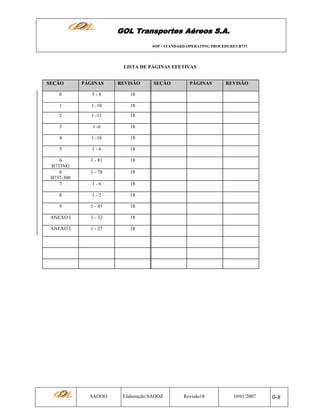
REV
No

DATA
REV

DATA
INSER

FEITA
POR

09

04NOV

04NOV

SAOOI

10

10MAI

10MAI

SAOOZ

11

10 JUL

10JUL

SAOOZ

12

10 SET

12 SET

SAOOZ

13

10 JAN

10 JAN

SAOOZ

14

10 MAR

10 ABR

SAOOZ

15

10 JUL

10 JUL

SAOOZ

16

10 SET

10 SET

SAOOZ

17

10 NOV

10 NOV

SAOOZ

18

10 JAN

10 JAN

SAOOZ

SAOOO

REV
No

Elaboração:SAOOZ

DATA
REV

Revisão18

DATA
INSER

FEITA
POR

10/01/2007

0-7
GOL Transportes Aéreos S.A.
SOP - STANDARD OPERATING PROCEDURES B737

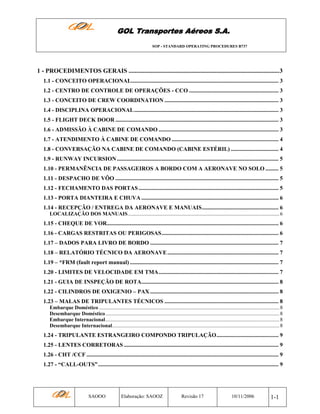
LISTA DE PÁGINAS EFETIVAS
SEÇÃO

PÁGINAS

REVISÃO

0

5-8
1 -10
1 -11

18

3

1 -6

18

4

1 -16

18

5

1-6

18

6
B733NG
6
B737-300
7

1 - 81

18

1 - 78

18

1-6

18

8

1-2

18

9

1 - 45

18

ANEXO I

1 - 32

18

ANEXO I

1 - 27

REVISÃO

18

2

PÁGINAS

18

1

SEÇÃO

18

SAOOO

Elaboração:SAOOZ

Revisão18

10/01/2007

0-8
GOL Transportes Aéreos S.A.
SOP - STANDARD OPERATING PROCEDURES B737

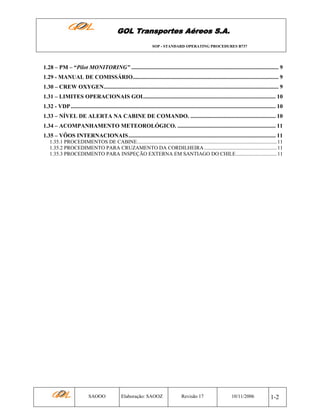
1 - PROCEDIMENTOS GERAIS ................................................................................................3
1.1 - CONCEITO OPERACIONAL...................................................................................................... 3
1.2 - CENTRO DE CONTROLE DE OPERAÇÕES - CCO .............................................................. 3
1.3 - CONCEITO DE CREW COORDINATION ............................................................................... 3
1.4 - DISCIPLINA OPERACIONAL.................................................................................................... 3
1.5 - FLIGHT DECK DOOR ................................................................................................................. 3
1.6 - ADMISSÃO À CABINE DE COMANDO ................................................................................... 3
1.7 - ATENDIMENTO À CABINE DE COMANDO .......................................................................... 4
1.8 - CONVERSAÇÃO NA CABINE DE COMANDO (CABINE ESTÉRIL) ................................. 4
1.9 - RUNWAY INCURSION ................................................................................................................ 5
1.10 - PERMANÊNCIA DE PASSAGEIROS A BORDO COM A AERONAVE NO SOLO ......... 5
1.11 - DESPACHO DE VÔO ................................................................................................................. 5
1.12 - FECHAMENTO DAS PORTAS ................................................................................................. 5
1.13 - PORTA DIANTEIRA E CHUVA ............................................................................................... 6
1.14 - RECEPÇÃO / ENTREGA DA AERONAVE E MANUAIS..................................................... 6
LOCALIZAÇÃO DOS MANUAIS................................................................................................................... 6

1.15 - CHEQUE DE VOR....................................................................................................................... 6
1.16 - CARGAS RESTRITAS OU PERIGOSAS................................................................................. 6
1.17 – DADOS PARA LIVRO DE BORDO ......................................................................................... 7
1.18 – RELATÓRIO TÉCNICO DA AERONAVE ............................................................................. 7
1.19 – *FRM (fault report manual) ....................................................................................................... 7
1.20 - LIMITES DE VELOCIDADE EM TMA................................................................................... 7
1.21 - GUIA DE INSPEÇÃO DE ROTA............................................................................................... 8
1.22 - CILINDROS DE OXIGENIO – PAX ......................................................................................... 8
1.23 – MALAS DE TRIPULANTES TÉCNICOS ............................................................................... 8
Embarque Doméstico ......................................................................................................................................... 8
Desembarque Doméstico.................................................................................................................................... 8
Embarque Internacional.................................................................................................................................... 8
Desembarque Internacional............................................................................................................................... 8

1.24 - TRIPULANTE ESTRANGEIRO COMPONDO TRIPULAÇÃO........................................... 9
1.25 - LENTES CORRETORAS ........................................................................................................... 9
1.26 - CHT /CCF ..................................................................................................................................... 9
1.27 - “CALL-OUTS” ............................................................................................................................. 9

SAOOO

Elaboração: SAOOZ

Revisão 17

10/11/2006

1-1
GOL Transportes Aéreos S.A.
SOP - STANDARD OPERATING PROCEDURES B737

1.28 – PM – “Pilot MONITORING” ...................................................................................................... 9
1.29 - MANUAL DE COMISSÁRIO..................................................................................................... 9
1.30 – CREW OXYGEN......................................................................................................................... 9
1.31 – LIMITES OPERACIONAIS GOL........................................................................................... 10
1.32 - VDP .............................................................................................................................................. 10
1.33 – NÍVEL DE ALERTA NA CABINE DE COMANDO. ........................................................... 10
1.34 – ACOMPANHAMENTO METEOROLÓGICO. .................................................................... 11
1.35 – VÔOS INTERNACIONAIS...................................................................................................... 11
1.35.1 PROCEDIMENTOS DE CABINE.......................................................................................................... 11
1.35.2 PROCEDIMENTO PARA CRUZAMENTO DA CORDILHEIRA ....................................................... 11
1.35.3 PROCEDIMENTO PARA INSPEÇÃO EXTERNA EM SANTIAGO DO CHILE............................... 11

SAOOO

Elaboração: SAOOZ

Revisão 17

10/11/2006

1-2
GOL Transportes Aéreos S.A.
SOP - STANDARD OPERATING PROCEDURES B737

1 - PROCEDIMENTOS GERAIS
1.1 - CONCEITO OPERACIONAL
É filosofia GOL o trabalho em equipe. Assim deve haver uma integração entre tripulantes e os demais envolvidos na
operação de aeronaves a fim de que os objetivos concernentes à segurança, atendimento ao cliente, horários, manutenção e
normas da empresa sejam perfeitamente atendidas.
Para que os objetivos sejam alcançados, é necessário, entre outras providências, que as tripulações mantenham constante
comunicação com os demais setores da empresa.
1.2 - CENTRO DE CONTROLE DE OPERAÇÕES - CCO
É o setor da Vice-presidência Técnica responsável pela coordenação de toda a operação da empresa. Trabalha interligado
com manutenção, escala, aeroportos e tripulantes.
Uma das finalidades do CCO é assessorar o cmte. visando a correta tomada de decisão.
Por ser órgão vital da empresa, precisa receber informações corretas e de imediato de todos os setores envolvidos.
Assim, reiteramos aos pilotos a importância da comunicação e do trabalho em conjunto com o CCO e o Piloto
Coordenador Operacional.
O CCO e o Piloto Coordenador Operacional são subordinados a Vice-presidência Técnica.
1.3 - CONCEITO DE CREW COORDINATION
As tarefas inerentes a cada função devem ser cumpridas com o mesmo padrão, independente da pessoa (tripulante) a que
esteja, no momento, exercendo.
Considera-se uma tripulação com alto nível de coordenação aquela em que cada membro desenvolve as atribuições
específicas da função em total aderência ao padrão GOL.
O grau de sucesso da tripulação como equipe eficaz é diretamente afetado pela disciplina de cada tripulante, pelo desejo e
intenção de se obter o resultado esperado, bem como seu grau de treinamento.
Os trabalhos no “Flight Deck” devem transcorrer sempre num clima de profissionalismo, assistência mútua e cordialidade.
Os princípios preconizados nos treinamentos CRM (Company Resource Management) e Loft (Line Oriented Flight
Training) devem ser a ferramenta de trabalho dos tripulantes no seu dia a dia.
Cada tripulante deve ser capaz de suplementar ou atuar como "backup" de outro tripulante em todas as fases do vôo.
A troca constante de informações e "callouts" padronizados facilitam a coordenação entre os tripulantes, exercendo papel
importante na detecção de falhas cometidas ou de eventuais casos de incapacidade.
1.4 - DISCIPLINA OPERACIONAL
A disciplina operacional envolve Disciplina Técnica e Disciplina Própria. Ambas são fundamentais para a otimização dos
trabalhos no “Flight Deck”.
A Disciplina Técnica é controlada através dos padrões operacionais previstos nos AOM's dos aviões e das normas internas
da Empresa. A Disciplina Própria está diretamente associada ao grau de profissionalismo de cada tripulante.
Não é permitido alteração das configurações dos procedimentos normais dos sistemas da aeronave, para simular falha em
vôo, para demonstração, instrução ou cheque.
Em casos especiais consultar MGO Cap. 02 pág. 2-10 – item 2.1.3 – OPERAÇÃO DE TESTE.
1.5 - FLIGHT DECK DOOR
A porta de acesso à cabine de comando deverá estar sempre fechada e travada durante o vôo (RBHA). Em cruzeiro poderá
ser aberta, momentaneamente, após a identificação positiva do comissário através do “SERVICE INTERFONE”,
permitindo o atendimento à cabine ou ingresso de pessoas autorizadas pelo comandante.
1.6 - ADMISSÃO À CABINE DE COMANDO
As hipóteses de admissão à cabine dos pilotos são disciplinadas pelo RBHA 121.547 que estabelece o que segue:
a) Nenhuma pessoa poderá ser admitida na cabine dos pilotos de um avião, a menos que a pessoa admitida seja:
(1) Um tripulante;
(2) Um INSPAC em trabalho oficial;

SAOOO

Elaboração: SAOOZ

Revisão 17

10/11/2006

1-3
GOL Transportes Aéreos S.A.
SOP - STANDARD OPERATING PROCEDURES B737

(3) Um funcionário do governo federal, um diretor ou empregado do detentor de certificado (GOL), ou um empregado de
indústria aeronáutica que tenha permissão do piloto em comando e suas obrigações sejam tais que a admissão à cabine é
necessária ou vantajosa para a segurança das operações.
(4) Qualquer pessoa com permissão do piloto em comando e que esteja especificamente autorizada pelo detentor de
certificado (GOL) e pela ANAC. O parágrafo (a) (2) desta seção não limita a autoridade do piloto em comando de, em
situação de emergência, retirar qualquer pessoa da cabine no interesse da segurança.
(b) Para propósitos do parágrafo (a) (3) desta seção, funcionários do governo federal que tenham responsabilidades em
assuntos relacionados com segurança de vôo ou segurança e facilitação do transporte aéreo e empregados do detentor de
certificado (GOL), cuja eficiência pode ser melhorada pela familiarização com as condições de vôo, podem ser admitidos
na cabine. Entretanto, o detentor de certificado (GOL) não deve autorizar a admissão de seu pessoal de tráfego, de vendas e
de outros departamentos não diretamente relacionados com atividades de vôo, a menos que sejam admissíveis pelo
parágrafo (a) (4) desta seção.
(c) Nenhuma pessoa pode admitir uma pessoa na cabine de vôo de um avião, a menos que haja um assento, no
compartimento de passageiros, à disposição dessa pessoa. Fazem exceção:
(1) Um INSPAC em verificação de piloto ou de procedimentos de operação;
(2) Um controlador de tráfego aéreo, devidamente autorizado pela ANAC e pelo detentor de certificado (GOL),
observando procedimentos de controle de tráfego;
(3) Um tripulante ou despachante operacional de vôo do detentor de certificado (GOL) devidamente qualificado;
(4) Tripulante de outro detentor de certificado, devidamente qualificado, autorizado pelo detentor de certificado (GOL)
operador do avião a fazer viagens específicas em uma rota;
(5) Um empregado do detentor de certificado (GOL) cujas obrigações estejam devidamente relacionadas com a condução
ou planejamento de vôos ou com o acompanhamento de equipamentos ou procedimentos em vôo, desde que sua presença
na cabine dos pilotos seja necessária para a execução de suas obrigações e que tenha sido autorizada, por escrito, pelo
superior responsável, listado no manual do detentor de certificado (GOL) como possuindo tal autoridade; e
(6) Representante técnico do fabricante do avião ou de seus componentes cujas obrigações estejam diretamente
relacionadas com o acompanhamento em vôo de equipamentos ou de procedimentos operacionais, desde que sua presença
na cabine de vôo seja indispensável para o cumprimento de suas obrigações e que tenha autorização escrita do supervisor
responsável, listado no manual do detentor de certificado (GOL) como tendo tal autoridade.

1.7 - ATENDIMENTO À CABINE DE COMANDO
Deve-se atender sempre que possível às chamadas da cabine de comando.
A entrega da bebida deve ser feita individualmente evitando posicionar a bandeja acima dos instrumentos e conseqüente
risco de derramamento de líquidos.
As refeições servidas na cabine de comando, incluindo lanches e café da manhã, deverão ser diferenciadas entre os pilotos.
Deverão, também, ser consumidas em momentos diferentes entre um piloto e outro. Ambas as medidas visam à
manutenção do controle positivo da aeronave, um piloto sempre efetivamente nos controles.
Na entrada da cabine, atenção redobrada com degraus, portas e bancos escamoteáveis.
Para evitar qualquer interrupção nas comunicações ou procedimentos, os comissários devem entrar na cabine em silêncio e
falar apenas quando os tripulantes perceberem suas presenças.
É obrigatório o travamento da porta da cabine de comando após a partida dos motores permanecendo durante o vôo. A
comunicação deve ser realizada através do SERVICE INTERFONE.
Nos vôos noturnos, antes de entrar na cabine de comando, apagar as luzes dos vestíbulos e da “galley”.
1.8 - CONVERSAÇÃO NA CABINE DE COMANDO (CABINE ESTÉRIL)
A filosofia de “Flt Deck” estéril visa basicamente concentrar as atividades nos procedimentos em andamento, limitando a
conversa, apenas, a assuntos ligados a operação.
São proibidas as conversas não pertinentes à operação da aeronave abaixo dos 10.000 ft. Durante o vôo, a porta da cabine
deve estar travada. Eventuais comunicações necessárias entre o “Flight Deck” e a cabine de pax devem ser feitas através do
“service interfone”.
Deverá ser evitado abaixo dos 10.000ft:

SAOOO

Elaboração: SAOOZ

Revisão 17

10/11/2006

1-4
GOL Transportes Aéreos S.A.
SOP - STANDARD OPERATING PROCEDURES B737

Conversação com os tripulantes de cabine
Ingressos / visitas ao “flight deck”
Contatos de rotina com a Cia.
Execuções de tarefas, tais como preenchimento do livro de bordo, relatórios técnicos, etc.
1.9 - RUNWAY INCURSION
Seguindo recomendações de segurança da GOL e do FAA, deverá ser adotadas além do SOP item 3.6, algumas regras de
utilização de luzes da aeronave para cruzamento ou táxi sobre a pista.
Runway Turnoff Lights: Devem permanecer ligadas no táxi sobre a pista (back track) e/ou quando for efetuar cruzamento
de pista.
Landing Lights (Fixed or Inboard): Devem permanecer ligadas no táxi sobre a pista (back track) e/ou quando for efetuar
cruzamento de pista.
Landing Lights (Retractable or Outboard): Devem permanecer ligadas no táxi sobre a pista (back track) e/ou quando for
efetuar cruzamento de pista.
Strobe Lights: Devem permanecer ligadas no táxi sobre a pista (back track) e/ou quando for efetuar cruzamento de pista.
Estes procedimentos visam aumentar a visualização por outras aeronaves.

1.10 - PERMANÊNCIA DE PASSAGEIROS A BORDO COM A AERONAVE NO SOLO
(reprodução do texto do MGO seção 2 11.17)
Em paradas intermediárias onde os passageiros permaneçam a bordo, a GOL manterá na aeronave pelo menos a metade
dos comissários pertencentes à tripulação em questão, distribuídos uniformemente ao longo da aeronave com o intuito de
garantir uma saída eficiente de passageiros em caso de evacuação. Havendo necessidade da permanência de passageiros a
bordo com a aeronave no solo, deverá sempre existir pelo menos um tripulante técnico habilitado a bordo.
Além disso, os seguintes requisitos devem ser cumpridos:
Pelo menos uma porta deverá estar aberta com a respectiva escada encostada ou abaixada, ou a plataforma de Embarque /
Desembarque (“finger”) encostada conforme o caso;
As demais portas, se fechadas, deverão estar com os “Scape Slide” armados;
Os motores deverão estar cortados ou deverá ser cumprido o disposto em MGO 11.7.4 e 11.16.
1.11 - DESPACHO DE VÔO
No intuito de reduzir o tempo de solo e manter a pontualidade, com a aeronave no solo e portas abertas, o despacho dará
prosseguimento ao procedimento de desembarque / embarque a seu critério, no pressuposto de que não há nada que impeça
a continuação do processo.
O despacho não irá solicitar nenhuma autorização prévia ao Comandante. Caso exista algum motivo de ordem técnica
que justifique a suspensão do processo de embarque, ou se faça necessário o desembarque de passageiros, o Comandante
deverá informar ao despacho, com a maior brevidade possível, para que este possa tomar as devidas providências.
1.12 - FECHAMENTO DAS PORTAS
Não existe uma seqüência predeterminada para o fechamento de portas e porões. As portas principais poderão ser fechadas
independentemente da situação das portas dos porões, ou vice-versa, estando “finger” ou escadas conectadas ou não.
A aeronave ficará liberada para o vôo após ser entregue à tripulação o Manifesto de Peso e Mensagem de Trânsito pelo
despachante.
Considerar como horário de fechamento de portas a última porta fechada, inclusive porões.
Para efeito de despacho, o horário de liberação da aeronave será considerado o de fechamento da última porta, inclusive os
porões.
As portas da aeronave poderão ser fechadas com antecedência de 10(dez) minutos da decolagem para vôos nacionais e 30
(trinta) minutos da decolagem para vôos internacionais (HOTRAN).

SAOOO

Elaboração: SAOOZ

Revisão 17

10/11/2006

1-5
GOL Transportes Aéreos S.A.
SOP - STANDARD OPERATING PROCEDURES B737

A responsabilidade pelo fechamento ou abertura das portas é do comandante do vôo.
O comissário Chefe de Cabine deve solicitar ao Comandante a autorização para o fechamento de porta.
1.13 - PORTA DIANTEIRA E CHUVA
B737-700/800: o uso da porta dianteira com chuva está liberado baseado em informações da manutenção com relação às
proteções existentes ao compartimento E/E
B737-300: NÃO utilizar a porta dianteira com chuva moderada ou forte, salvo se houver escadas com cobertura.
1.14 - RECEPÇÃO / ENTREGA DA AERONAVE E MANUAIS
Ao receber uma aeronave, a tripulação técnica deverá se certificar que todos os manuais pertinentes se encontram a bordo.
A tripulação, antes de deixar a aeronave, deverá organizar todo o material de bordo, bem como efetuar a limpeza da cabine
sempre que necessário. Caso haja necessidade de substituição do material de bordo, reportar no livro técnico da aeronave
(RTA).
Obs.: se uma tripulação reportar na recepção da aeronave a falta de qualquer manual, a tripulação anterior será
responsabilizada. Ressalve-se o caso de pernoite.
LOCALIZAÇÃO DOS MANUAIS
Os manuais Jeppesen devem ficar organizados no cockpit da seguinte maneira:
1- Pasta de manuais, lado direito:
*
01 volume I - Analises de pista - Nacional / DRY - BR (este manual é o mesmo que já temos nas acft´s, estamos
somente trocando as capas);
*
01 volume II - Analises de pista - Nacional / WET - BR (este manual é o mesmo que já temos nas acft´s, estamos
somente trocando as capas);
*
01 volume III - Analises de pista - Internacional / DRY e WET - South América (SAM) - (este manual está sendo
incluido com as novas capas);
*
01 jogo de manuais South America (vols. 01 / 02 e 03) - SAM (estes manuais estão substituindo os manuais da
Jeppesen Brasil);
*
01 novo manual que irá substituir as tabelas de landing, ou seja, este manual será um livreto plastificado contendo as
tabelas de landing separadas por paises contidos na região SAM, que deverá ficar na pasta de manuais do lado direito.
2- Pasta de manuais, lado esquerdo e direito:
*
Localidades South America (operadas pela GOL), ao fim de cada volume II do manual Jeppesen Quick.ou seja, este
manual passa a conter todos os procedimentos operados pela Gol incluindo os internacionais.
Obs.: Durante a condução do vôo, todos os manuais, tabelas e “briefing case” dos tripulantes, deverão estar
acomodados em seus lugares e presos de forma a não causar risco aos pilotos e equipamentos de bordo em caso de
turbulência.
1.15 - CHEQUE DE VOR
Para atender exigência do RBHA 91.171, fica estabelecido o seguinte procedimento:
No primeiro vôo do dia 10, 20 e 30 de cada mês a tripulação deverá efetuar o cheque de VOR usando como referência a
indicação no ponto de cheque de VOR do aeródromo durante o táxi.
A tripulação deverá selecionar a radial indicada e verificar se há discrepância.
Se não houver diferença ou esta for de até 4º a tripulação deverá lançar no RTA “VOR checked, OK”.
Caso haja uma diferença de 5º ou maior a tripulação deverá lançar no RTA “VOR checked with + or - degrees from NAV
1 and/or 2".
Exemplo: “VOR checked with +7 degrees from NAV 1”.
NOTA – Observar com rigor esse procedimento. A não realização pode gerar multa para a empresa.
1.16 - CARGAS RESTRITAS OU PERIGOSAS
A GOL, não transporta cargas restritas e/ou perigosas.
Toda e qualquer carga deste tipo, mesmo documentada, não deverá ser aceita para embarque em nossos vôos.

SAOOO

Elaboração: SAOOZ

Revisão 17

10/11/2006

1-6
GOL Transportes Aéreos S.A.
SOP - STANDARD OPERATING PROCEDURES B737

1.17 – DADOS PARA LIVRO DE BORDO
Os dados para o livro de bordo, com relação “Out of Gate – Off the ground – On the ground – In the Gate” devem ser
obtidos do FOQA. As informações para a companhia, via fonia, devem refletir esses mesmos horários. No caso da
inoperância desse sistema utilizar o horário do relógio da aeronave em UTC.
Em caso de rasuras que possam ser corrigidas e ainda assim permaneçam legíveis, poderá manter a mesma folha. Caso não
tenha condições de correção deverá ser cancelada a folha do relatório de bordo e esta deverá ser devolvida para a empresa
junto com a nova folha corretamente preenchida.
1.18 – RELATÓRIO TÉCNICO DA AERONAVE
É responsabilidade do comandante (assento esquerdo), antes de iniciar a inspeção, consultar o RTA para obter a liberação
da aeronave para o vôo pela manutenção.
Caso não conste por escrito ou o RTA não se encontre na aeronave, o Comandante deverá obter autorização da manutenção
antes de iniciar as inspeções.
Nas bases onde não houver equipe de manutenção da GOL, é responsabilidade do Comandante lançar no RTA “Inspeção
de trânsito efetuada, aeronave OK”, após a inspeção externa. Nas bases operadas regularmente, este procedimento não é
necessário visto que nestes locais as equipes de manutenção são da empresa.
É responsabilidade do Comandante, mas ambos os pilotos devem estar cientes do conteúdo do RTA:
ACR: verifique validade e a influência na operação (MEL - CDL).
Itens Pendentes;
Últimos reportes.
A inoperância ou mau funcionamento, detectado nas inspeções ou já reportado, deverá ser analisada pela tripulação em
conjunto com o CCO (Centro de Controle Operacional) e Piloto Coordenador Operacional levando em consideração o
MEL - CDL. O mesmo dispõe sobre as condições da aeronave para ser despachada e a consulta a ele, quando do
surgimento de anormalidades, poderá se estender, inclusive, desde a fase pós-acionamento dos motores até o inicio da
decolagem.
É responsabilidade do Comandante reportar todas as discrepâncias encontradas durante as verificações pré-vôo ou no vôo.
Para isto deve ser descrita a pane no RTA; nos equipamentos B700/800 deverá ser seguida do código do “Fault Report
Manual” (FRM) que se encontra a bordo junto ao RTA.
PREENCHIMENTO DO RTA
Para facilitar a comunicação e o entendimento dos itens reportados no LIVRO DE MANUTENÇÃO DA AERONAVE,
adotaremos os seguintes critérios:
• Reportar o sistema relacionado conforme apresentado na anunciadora da Aeronave, em Inglês. Para o
B700 / 800 acrescentar o código de falha obtido no “FRM – fault report manual” *.
• Descrição da pane deverá ser reportada entre parênteses na língua portuguesa ou inglesa.
Obs. Nos casos dos tripulantes com boa familiarização na língua inglesa dar preferência à descrição em inglês.
EX.:
B700 / 800 - AIR SYSTEMS – LH BLEED TRIP OFF – 361 010 001(INDICAÇÃO INTERMITENTE
DURANTE A SUBIDA)
B300 - AIR SYSTEMS – LH BLEED TRIP OFF – (INDICAÇÃO INTERMITENTE DURANTE A SUBIDA)
1.19 – *FRM (fault report manual)
É um manual com a relação de panes, dividido em duas partes ambas agrupadas em ordem alfabética:
- Observed Faults - basicamente para panes do Flt.Deck.
- Cabin Faults - para reportes por parte dos comissários.
Localização: no Flt.Deck, junto com o RTA e MEL/CDL
B300 – não aplicável.
1.20 - LIMITES DE VELOCIDADE EM TMA
Independentemente da classificação da TMA (espaço aéreo), é proibida a utilização de velocidade superior a 250 (duzentos
e cinqüenta) kts abaixo do FL 100. Somente a pedido do controle de tráfego aéreo, essa velocidade poderá ser ultrapassada.

SAOOO

Elaboração: SAOOZ

Revisão 17

10/11/2006

1-7
GOL Transportes Aéreos S.A.
SOP - STANDARD OPERATING PROCEDURES B737

1.21 - GUIA DE INSPEÇÃO DE ROTA
É um cartão plastificado com a relação de documentos exigidos pela ANAC por ocasião de uma inspeção de rampa.
Sua localização é na caixa à direita do co-piloto, junto com as cartas “Jeppesen” de AWY.
É responsabilidade do co-piloto verificar a existência e a localização ao assumir a aeronave.
1.22 - CILINDROS DE OXIGENIO – PAX
A GOL não transporta passageiro que necessite deste recurso.
1.23 – MALAS DE TRIPULANTES TÉCNICOS
As malas que não puderem ser alojadas no “Flt. Deck” serão colocadas no porão da aeronave.
As malas de tripulantes “Extras” serão embarcadas no porão da aeronave.
Proibido o uso de compartimentos na cabine de pax, áreas de “galleys” e sobre o assento do observador para o transporte
de malas.
Nota: Somente a BRIEFCASE do Chefe de Cabine poderá ser levada a bordo (cab. Pax).
Procedimento para despacho de mala em vôos domésticos:
Embarque Doméstico
Aeroportos com Finger
Deverá deixar a bagagem no finger,
próximo à porta de acesso à pista ou
obedecer às normas estabelecidas pelas
Autoridades aeroportuárias locais.
Desembarque Doméstico
Aeroportos com Finger
Deverá
obedecer
às
normas
estabelecidas
pelas
Autoridades
Aeroportuárias locais (esteira de
Bagagens ou na porta do Finger).

Aeroportos sem Finger
Deverá deixar a bagagem próxima à
escada da aeronave.

Aeroportos sem Finger
Receberá a bagagem junto à aeronave.

Procedimento para despacho de mala em vôos internacionais: Em cumprimento as normas da Policia Federal e Receita
Federal
Embarque Internacional
As bagagens da tripulação deverão ser
despachadas no “check-in” através da
esteira de bagagem
Desembarque Internacional
As bagagens da tripulação deverão ser
retiradas na esteira de bagagem
internacional.
Extravio de Bagagem - No caso de extravio de bagagem de Tripulante, é prevista indenização. Procedimento Operacional
vigente de indenização de bagagem:
- Acionar Setor LL e o Gerente do Aeroporto;
- Solicitar ao Supervisor do Aeroporto local o preenchimento de uma RIB (Relatório de Irregularidade de
Bagagem) descrevendo os pertences que continha dentro da bagagem e assinar a RIB juntamente com o Supervisor,
ficando de posse da 2ª via, devendo encaminhá-la ao responsável no setor SAO OZ.
Este procedimento terá validade somente nas seguintes condições:

SAOOO

Elaboração: SAOOZ

Revisão 17

10/11/2006

1-8
GOL Transportes Aéreos S.A.
SOP - STANDARD OPERATING PROCEDURES B737

Compondo tripulação em programação de vôo;
Como Tripulante Extra CAT I a serviço da Empresa;
Como Tripulante Extra CAT II, desde que a mala tenha sido despachada no CHECK-IN e esteja de posse do comprovante
de despacho de bagagem.
Os tripulantes na condição de EXTRA CAT II não terão prioridade no despacho de bagagens, devendo obedecer ao fluxo
de passageiros no CHECK-IN.
1.24 - TRIPULANTE ESTRANGEIRO COMPONDO TRIPULAÇÃO
Quando houver tripulações de diferentes nacionalidades a bordo, o idioma INGLÊS será utilizado para assegurar a fluência
de linguagem comum entre os Tripulantes Técnicos e Tripulantes de Cabine em conformidade às normas internacionais.
1.25 - LENTES CORRETORAS
Todo tripulante que fizer uso de lentes corretoras (óculos ou lentes) deverá portar um óculos reserva, de igual
características.
1.26 - CHT /CCF
Documentos de porte obrigatório em todas as atividades da empresa (vôo, simulador, etc.).
1.27 - “CALL-OUTS”
Para qualquer fase do vôo em que seja notada anormalidade ao padrão operacional, efetuar o “callout” apropriado para
alertar o PF sobre a discrepância apresentada. Esses “callouts” normalmente devem ser feitos pelo PM. Entretanto,
qualquer tripulante que observar um desvio dos parâmetros operacionais deverá efetuar o “callout” apropriado.
Para todo “call-out” realizado é compulsório uma resposta.
O PM deve considerar uma situação de “Pilot Incapacitation” e tomar atitude de controle da aeronave se:
a) realizar o “call-out” por duas vezes e não obtiver resposta;
b) a resposta dada pelo PF for incoerente ou não houver ação corretiva ao alerta;
c) Os limites GOL forem ultrapassados.
Foi adotado o call-out de estabilização na aproximação a 500 ft acima da pista IMC ou VMC. “O PM deverá informar ao
PF a estabilização da aproximação com o call-out, “stabilized approach” a resposta do PF será “Landing” ou caso o callout do PM seja “not stabilized approach, Go around” a resposta do PF será “Go around” e executar a ação.
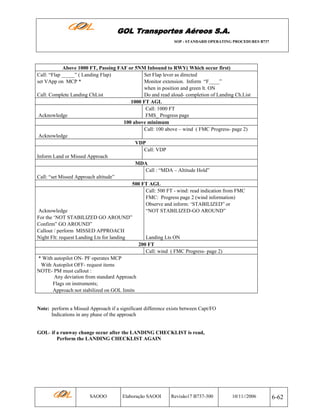
É política da empresa, ao cruzar 1000 ft para o nivelamento, subindo ou descendo, efetuar o call-out “1000 ft to level off”.
(FCTM pág. 1.20)
1.28 – PM – “Pilot MONITORING”
Além das atribuições normais de acompanhamento do vôo, fonia, check-list, o PM terá a obrigação de assumir o controle
efetivo da aeronave nas seguintes situações:
a) Não houver resposta do PF a “call-out” realizado duas vezes;
b) Não houver ação corretiva do PF a uma advertência ou “call-out”.
c) Os limites GOL forem ultrapassados;
1.29 - MANUAL DE COMISSÁRIO
Existe a bordo de cada aeronave um exemplar deste manual. Faz parte dos documentos exigidos em uma inspeção de
rampa.
1.30 – CREW OXYGEN
A capacidade dos cilindros de oxigênio para tripulantes é a seguinte:
B 737-700/800

114 FT / VOL I PD 11.6 para mínimo.

B 737-300 76FT / Check VOL I - PD 11.7 para mínimos.
É obrigatório o check da “CREW OXYGEN VALVE”, que deverá estar na posição “OPEN”.

SAOOO

Elaboração: SAOOZ

Revisão 17

10/11/2006

1-9
GOL Transportes Aéreos S.A.
SOP - STANDARD OPERATING PROCEDURES B737

1.31 – LIMITES OPERACIONAIS GOL
Por questão de segurança de suas operações, a GOL adota vários limites superiores (mais restritivos) do que os
estabelecidos pelo fabricante e pelos órgãos controladores.
Proibido a operação de pouso e decolagem sob CHUVA FORTE ou PISTA CONTAMINADA (Encharcada)
O mínimo para procedimento de não precisão é o MDA no VDP
Proibido a operação com presença de WINDSHEAR
Rwy WET: Pouso com F 40 obrigatório
Limite de TAILWIND:
Takeoff: 5 kts
Land: Variável para cada aeroporto e para cada condição de pista – DRY ou WET
O Max. Tailwind, o peso máx. de pouso e o limitante devem ser obtidos no cap.
“Landing Analysis’, considerando o menor entre os 4 valores: Field Limitations, Approach / Landing Climb, PCN e
Estrutural;
Condição de pista DRY ou WET;
Configuração de Flap;
Qualquer situação N. Normal-manual spoiler, F 15, anti-skid inoperante, etc.
NOTA - Existe no Flight Deck uma tabela para consulta rápida do Máx. Peso de Pouso. (Tabela válida para operação
normal).
Landing, Climb, Estrutural e PCN.
Para os aeroportos com OPERAÇÕES RESTRITAS OU ESPECIAIS, ver capítulo 09 deste manual, denominado FOLHAS
VERDES.
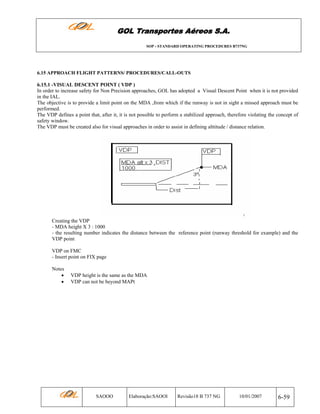
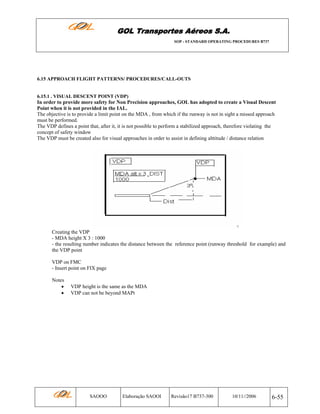
1.32 - VDP
Ponto limite de aproximação estabilizada em aproximações de “Não-Precisão” e referencial para aproximações visuais.
Para aproximações de “Não precisão”, o VDP deve ser criado através da pág. FIX do FMC.
VDP= “Altura do MDA” X 3 ÷ 1000.
Atingindo o VDP e não avistar a pista deverá iniciar o procedimento de arremetida.
Ver 6.12
1.33 – NÍVEL DE ALERTA NA CABINE DE COMANDO.
Durante a condução do vôo, é mandatório estar sempre alerta para assumir o controle efetivo da aeronave em qualquer fase
do vôo, com seu assento na posição correta para pilotagem, e os controles da aeronave ao seu alcance.
O monitoramento da comunicação deverá ser permanente durante toda fase do vôo.
Segue abaixo recomendações a serem adotadas para operação em aeroportos estrangeiros e aqueles onde a tripulação não
opera com freqüência.
•
•
•

Devido ao nível de atenção exigido durante as fases de execução dos procedimentos de aproximação e pouso em
áreas com grande volume de tráfego recomendamos evitar ao máximo a manipulação dos CDU’s abaixo do
FL100 em momentos de alto “Workload”.
Após o pouso, sempre que a tripulação tiver dúvidas quanto às instruções de táxi, ou ainda pouca familiarização
com o aeroporto, recomendamos a solicitação de instruções detalhadas de táxi. Exemplo: solicite “Progressive
Taxi”.
Quando houver necessidade de cruzamento da pista em uso, e ou pista paralela, com o intuito de evitar qualquer
tipo de incidente, recomendamos ligar todas as luzes, inclusive as “strobe lights”.

SAOOO

Elaboração: SAOOZ

Revisão 17

10/11/2006

1-10
GOL Transportes Aéreos S.A.
SOP - STANDARD OPERATING PROCEDURES B737

1.34 – ACOMPANHAMENTO METEOROLÓGICO.
A tripulação deverá efetuar o monitoramento das condições meteorológicas (rota, destino e alternado), por mais simples
que seja o trecho a ser voado. Os cheques meteorológicos deverão ser executados a cada 01h00minh de vôo ou quando
julgar necessário, através de contato rádio com a empresa ou centro meteorológico das áreas a ser voadas.
1.35 – VÔOS INTERNACIONAIS
1.35.1 PROCEDIMENTOS DE CABINE
Deverá ser conferido antes do inicio do vôo todas as posição da navegação SITA e o FMC página de LEGS, e inserido os
ventos da rota.
Este vôo só será realizado por tripulação homologada. A operação será exclusiva do Comandante.
Vôos com tripulações compostas o piloto em comando do vôo deverá obrigatoriamente ocupar um dos postos de pilotagem
em todos os pousos e decolagens.
1.35.2 PROCEDIMENTO PARA CRUZAMENTO DA CORDILHEIRA
No cruzamento da cordilheira os pilotos deverão manter as folhas do Manual “SOP” – capítulo “ROTAS ESPECIAIS
INTERNACIONAIS” do anexo referente à rota, aberta e com fácil acesso para consulta em caso de necessidade.
As páginas de contingências de despressurizarão e falhas de motor são plastificadas, os pilotos poderão retirar do manual a
folha referente ao procedimento de contingência e colocá-la no “clip” do manche, facilitando seu manuseio.
Nas decolagens de aeroportos com procedimentos especiais e/ou folhas verdes, como por exemplo, a operação no
aeroporto de Santiago do Chile, o BRIEFING DE DECOLAGEM, CLIMB BRIEFING e os PROCEDIMENTOS DE
CONTINGÊNCIA, deverão estar concluídos antes do acionamento dos motores.
1.35.3 PROCEDIMENTO PARA INSPEÇÃO EXTERNA EM SANTIAGO DO CHILE
Com a finalidade de atender as exigências das autoridades chilenas (DGAC) a partir desta data fica obrigatório o uso de
colete refletivo para efetuar a inspeção externa das nossas aeronaves no aeroporto SECL (Arturo Merino Benitez Intl).
Informo ainda que antes de iniciar o procedimento de inspeção o tripulante deverá solicitar à manutenção o referido colete.

SAOOO

Elaboração: SAOOZ

Revisão 17

10/11/2006

1-11
GOL Transportes Aéreos S.A.
SOP - STANDARD OPERATING PROCEDURES B737

2- PROCEDIMENTOS DE DESPACHO OPERACIONAL .....................................................2
2.1 - ABASTECIMENTO DE COMBUSTÍVEL (RBHA) .................................................................. 2
2.2 - ABASTECIMENTO ECONÔMICO............................................................................................ 2
2.3 – NOTA DE ABASTECIMENTO ................................................................................................... 2
2.4 – COST INDEX................................................................................................................................. 2
2.5 – LOAD SHEET................................................................................................................................ 2
2.6 – TAKEOFF / LANDING COMPUTATION................................................................................. 2
Modelo de TAKEOFF DATA CARD: .............................................................................................................. 4
Modelo LANDING DATA CARD: ................................................................................................................... 6

2.7 - NAVEGAÇÃO SITA...................................................................................................................... 7
Código de plano de vôo ...................................................................................................................................... 7

2.8 - PLANEJAMENTO DE DESPACHO ......................................................................................... 11
2.9 - BRIEFING COM DT NAS BASES............................................................................................. 11
2.10 VÔO DE TRASLADO.................................................................................................................. 12

SAOOO

Elaboração: SAOOZ

Revisão 17

10/11/2006

2-1
GOL Transportes Aéreos S.A.
SOP - STANDARD OPERATING PROCEDURES B737

2- PROCEDIMENTOS DE DESPACHO OPERACIONAL
2.1 - ABASTECIMENTO DE COMBUSTÍVEL (RBHA)
Durante o abastecimento de combustível, o Comandante deverá estar na cabine de comando em contato com o órgão ATS
apropriado (Radio, Solo, TWR ou APP) e com a manutenção, permanecendo na escuta de ambos até o término do
abastecimento.
Em escalas intermediárias, onde for necessário o reabastecimento de combustível com pax a bordo, o tripulante técnico
avisará o início do procedimento de abastecimento e as seguintes medidas de segurança devem ser adotadas:
Portas - A porta principal deverá permanecer aberta com a escada conectada, ou a passarela telescópica (Finger) encostada.
As demais, se fechadas, com “scape slide” armado.
Comunicação - Os comissários deverão ser avisados via PA no inicio e término do abastecimento.
Alocução - Ao iniciar o reabastecimento deverá ser efetuada a alocução respectiva (ver 5.12).
Quando houver troca de tripulação com a aeronave em trânsito sendo abastecida, o tripulante desembarcando só
abandonará o acompanhamento do abastecimento quando um dos tripulantes embarcando estiver acomodado na cabine de
comando e em condições de substituí-lo.
2.2 - ABASTECIMENTO ECONÔMICO
A GOL adota para seus vôos a política de abastecimento econômico (exceções para aeroportos com operação restrita ou
especial). Sempre que o custo do transporte do combustível para a etapa seguinte a que será realizada for menor do que o
custo do abastecimento no destino, a aeronave será abastecida com quantidade de combustível para este procedimento,
desde que as condições meteorológicas assim o permitam.
A quantidade de combustível para abastecimento econômico presente na navegação SITA é computada somente pelo
DOV. Não é, em hipótese alguma, um valor mandatório ou fixo caso exista algum motivo de ordem técnica ou
meteorológica que justifique a suspensão do abastecimento econômico por parte do Comandante, deverá informar ao DOV
com a maior brevidade possível, para que este possa tomar as devidas providências.
2.3 – NOTA DE ABASTECIMENTO
Nas bases onde não houver equipe de manutenção da Empresa, o Co-piloto é responsável pela assinatura e porte da nota de
abastecimento. Este documento deverá ser entregue à equipe de manutenção na próxima base GOL.
2.4 – COST INDEX
Adotar o CI 25 (cost index) na página de performance para o vôo em todas as aeronaves e etapas. As navegações “SITA”
serão preparadas usando este regime, conforme informado no campo “ECO/C.I. ....”.
O CI básico é o 25, poderá ser alterado em função dos custos variáveis da empresa.
2.5 – LOAD SHEET
Ao receber a folha de carregamento e balanceamento, o Comandante deve, após a verificação dos dados, colocar o nome
legível, assinar, colocar seu código ANDAC e devolver uma cópia ao despachante.
2.6 – TAKEOFF / LANDING COMPUTATION
A confecção e o preenchimento são de responsabilidade do Co-piloto (assento da direita) e deverá obedecer a instrução
prevista no Manual de Análise de Decolagem. Deve-se usar as tabelas para cálculos dos dados do “take-off” e ser conferido
com as informações do FMC, uma vez que a independência dos dados é fator fundamental para o “Crosscheck” de valores
e detecção de erros. Os dados ali contidos deverão ser sempre conferidos por um outro tripulante.
O comandante deverá conferir os dados preenchidos no “Takeoff / Land”, visto que a responsabilidade final é sua.
Nos casos de co-piloto em instrução, enfatizamos o cuidado na conferência dos dados por parte do respectivo instrutor.
Com o intuito de evitar preenchimentos apressados, somente iniciar a partida dos reatores ou Push Back após a devida
confecção do T.O. Data.
Segue abaixo a descrição e orientações específicas para o preenchimento do “TakeOff and Landing Data Card”.

SAOOO

Elaboração: SAOOZ

Revisão 17

10/11/2006

2-2
GOL Transportes Aéreos S.A.
SOP - STANDARD OPERATING PROCEDURES B737

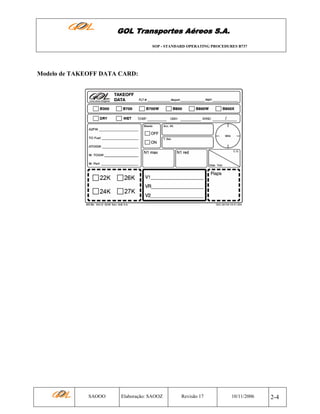
TAKEOFF DATA CARD
Informações Preliminares:
Contém as informações gerais sobre a etapa.
• -DATE – data;
• -FLT. NO. – número do vôo;
• -AIRPORT – código de 4 letras ( ex. SBSP);
• -RWY – pista para a qual o Takeoff foi calculado (L, R, interseção, etc...);
Contém os pesos utilizados para cálculo do takeoff, obtidos através do Balance Table, Navegação e Takeoff and Landing
Analysis, conforme o caso.

•
•
•
•
•
•

- Selecionar com um “X” o tipo de aeronave que está sendo utilizado, assim como a sua potência;
-Informações do ATIS: condição da pista (Dry/Wet), Tepmeratura, QNH e Vento;

-AZFW – Actual Zero Fuel Weight;
-T.O. FUEL – Takeoff Fuel;
-ATOGW – Actual Takeoff Gross Weight;
-MTOW – Maximum Takeoff Weight – peso máximo de decolagem específico para a etapa. É o menor entre as
seguintes limitações: Máximo de Performance, Landing Weight, Maximum Zero Fuel Weight, Estrutural de
Decolagem, e Pavimento;
• -M.PERF. – Maximum Takeoff Weight Limited by Performance – deve ser preenchido com o peso resultante da
Takeoff and Landing Analysis, de acordo com as condições atuais da atmosfera (temperatura, pressão, água na
pista, etc.) e status da aeronave ( bleeds, antiskid, etc.), onde são consideradas as limitações de obstacle, brakes,
field, climb, tire speed, bem como outros fatores que venham a alterar o peso máximo disponível.
• -THRUST BLEEDS ON OFF – efetuar um círculo ao redor da condição em que foi calculado o takeoff;
• -ACC. ALT – acceleration altitude – é a Minimum Level Off Altitude, que é a soma da altitude pressão do
aeroporto mais a Aceleration Height (padrão GOL - 1000 ft AGL);
• -Tº ASS – temperatura assumida encontrada na “Takeoff and Landing Analysis” correspondente;
• -MSA – informação referente a Minimum Safety Altitude, num raio de 25 NM, obtido através da IAL apropriada
para a pista em uso do aeroporto de decolagem, com ênfase ao setor de decolagem
• -MAXIMUM N1 –N1 correspondente obtido através da tabela “Maximum Takeoff % N1”;
• -REDUCED N1 – N1 correspondente à temperatura assumida obtida através da tabela “Maximum Takeoff %
N1”;
• -STAB TRIM – valor de stab trim para o TOCG encontrado na tabela “Stab Trim Setting”. O valor do TOCG
deve ser colocado ao lado do stab trim;
Campo destacado
• -V1 / VR / V2 – velocidades correspondentes encontradas na Takeoff and Landing Analysis, com as correções
apropriadas;
• - FLAPS – flap constante na “Takeoff and Landing Analysis” utilizada.

•

- 22K/24K/26K/27K – assinalar com um “X” o tipo de motor utilizado.

SAOOO

Elaboração: SAOOZ

Revisão 17

10/11/2006

2-3
GOL Transportes Aéreos S.A.
SOP - STANDARD OPERATING PROCEDURES B737

Modelo de TAKEOFF DATA CARD:

SAOOO

Elaboração: SAOOZ

Revisão 17

10/11/2006

2-4
GOL Transportes Aéreos S.A.
SOP - STANDARD OPERATING PROCEDURES B737

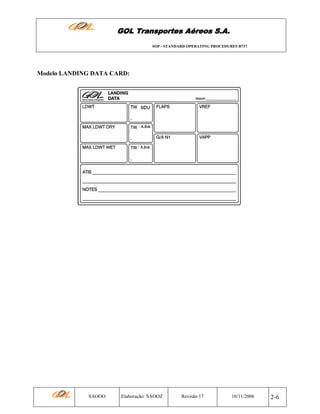
LANDING DATA CARD

•

-AIRPORT – código ICAO de 4 letras para a localidade;

Todas as informações de performance de pouso encontram-se representado de forma destacada no formulário.
• -LD WT – Actual Landing Weight;
• -Max LD WT DRY or WET – Maximum Landing Weight – é o menor dos limitantes para pouso (estrutural,
pavimento, performance de arremetida, stop distance) corrigido para as condições atuais atmosféricas e da
aeronave;

•

TW – Limitante de vento de cauda para a RWY (DRY/WET) e Autobreak utilizado para a condição de
pista.

•
•
•
•
•

Colocar sempre os valores LIMITANTES para as duas condições: DRY e WET
-FLAPS – flap de pouso considerado para efetuar o Landing Data;
-VREF – obtida da tabela “VREF”, utilizando flaps e pesos correspondentes;
-G/A N1 – obtido na tabela “Go Around N1” ajustado para as condições do aeroporto, Bleeds ON;
-VAPP – VREF corrigida para o vento previsto no pouso, com correção mínima de 5kt e máxima de 20kt;

Informações de Pouso/ ATIS:
Contém as informações de pouso obtidas através de ATIS, órgão ATC ou METAR.
• -ATIS – letra identificadora da mensagem de ATIS; horário;
• -WIND – direção/intensidade do vento;
• -VIS – visibilidade informada na aproximação (slant visibility). No caso de RVR, colocar RVR entre parênteses,
com a informação da pista na qual o valor foi obtido;
• -CLOUDS – quantidade e base das camadas. Utilizar F para FEW, S para SCATTERED, B para BROKEN e O
para OVERCAST, seguido de barra e a altura da base da camada em pés (Ex: O/500). Existem 3 campos, para 3
diferentes alturas de camada. Preencher em ordem crescente, iniciando com a camada mais baixa;
• -QNH – ajuste QNH do aeródromo de destino;
• -TEMP – temperatura ambiente/ponto de orvalho;
• -RWY – pista em uso para pouso;
• -APP PROC – IAL prevista para aproximação e pouso;
•
•

Notes: notas adicionais, restrições operacionais ou inoperância de auxílios;
- Tempo máximo de espera

SAOOO

Elaboração: SAOOZ

Revisão 17

10/11/2006

2-5
GOL Transportes Aéreos S.A.
SOP - STANDARD OPERATING PROCEDURES B737

Modelo LANDING DATA CARD:

SAOOO

Elaboração: SAOOZ

Revisão 17

10/11/2006

2-6
GOL Transportes Aéreos S.A.
SOP - STANDARD OPERATING PROCEDURES B737

2.7 - NAVEGAÇÃO SITA
Segue abaixo a descrição da "Navegação SITA passo a passo", relatando as várias informações contidas nas navegações.
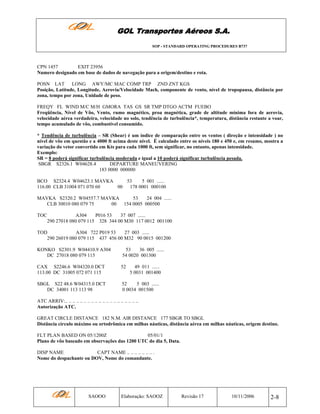
CFP INPUT MESSAGE DATE TIME REF 051635
START OF CFP REF: FGXNY - GOL9999 01 SBGR SBGL
FGXNY
Código de plano de vôo
FLT RELEASE GOL 9999 SBGR/GRU TO SBGL/GIG VM CRZ
Numero de Vôo, Origem Destino, “Mach” Variado e Regime de cruzeiro
ELEV 2459 FT 30 FT AVG W/C P11 ISA DEV P10
Elevação do Aeroporto de Origem e Destino em pés Media de componente de vento P=Positivo, M=Negativo, Media
diferença para ISA mesma designação que o vento.

COMP1635Z FOR ETD1000Z/06JAN01 REGN PR-GOL B737-700 ECO/C.I. 025
Hora que foi feito o calculo, estimado de decolagem/data, registro da aeronave, tipo da aeronave, Regime de
cruzeiro/índice de custo.
DEG 0.0 PC CFM56-7B22
KGS
Degradação de performance em porcentagem, Tipo de motores, unidades de pesos.
FUEL TIME CORR
BRWT LDGWT ZFWT
OWE
PLD
59000
57500 54600
37422
17178
Peso de decolagem planejado, peso de pouso planejado, Peso sem combustível Planejado, Peso básico operacional e
carga paga.
SBCF FL370 228NM MFOD/ 2800 W/C M005
Alternativa, nível do vôo, Distância para alternativa, mínimo combustível sobre o destino (Combustível Alternativa
+ HOLDING), componente de vento.
NOTE - LDGWT INCLUDES RESERVE FUEL
Nota Peso de pouso inclui o combustível reserva.
FLIGHT TIMES ETD 1000 ATD……….
ETA 1600 ATA………………...
Tempos de Vôo, Estimado de saída inserida na solicitação, Hora real de saída
Estimado de chegada, Hora real de chegada.
ATC CLRNC:.. .. .. .. .. .. .. .. .. .. .. .. .. .. .. .. .. .. .. ..
Autorização ATC.
SBGR MAVKA A304 KONKO DCT CAX DCT SBGL
Rota a voar.
FL 290
Nivel de Vôo.

SAOOO

Elaboração: SAOOZ

Revisão 17

10/11/2006

2-7
GOL Transportes Aéreos S.A.
SOP - STANDARD OPERATING PROCEDURES B737

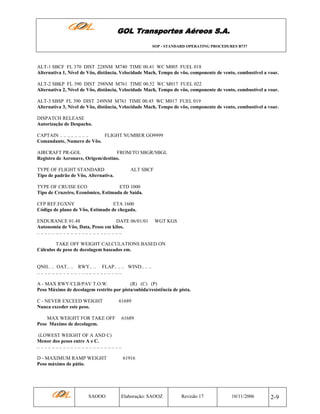
CPN 1457
EXIT 23956
Numero designado em base de dados de navegação para a origem/destino e rota.
POSN LAT
LONG AWY/MC MAC COMP TRP ZND ZNT KGS
Posição, Latitude, Longitude, Aerovia/Velocidade Mach, componente de vento, nível de tropopausa, distância por
zona, tempo por zona, Unidade de peso.
FREQY FL WIND M/C M/H GMORA TAS GS SR TMP DTGO ACTM FUEBO
Freqüência, Nível de Vôo, Vento, rumo magnético, proa magnética, grade de altitude mínima fora de aerovia,
velocidade aérea verdadeira, velocidade no solo, tendência de turbulência*, temperatura, distância restante a voar,
tempo acumulado de vôo, combustível consumido.
* Tendência de turbulência – SR (Shear) é um índice de comparação entre os ventos ( direção e intensidade ) no
nível de vôo em questão e a 4000 ft acima deste nível. É calculado entre os níveis 180 e 450 e, em resumo, mostra a
variação do vetor convertido em Kts para cada 1000 ft, sem significar, no entanto, apenas intensidade.
Exemplo:
SR = 8 poderá significar turbulência moderada e igual a 10 poderá significar turbulência pesada.
SBGR S2326.1 W04628.4
DEPARTURE MANEUVERING
183 0000 000000
BCO S2324.4 W04623.1 MAVKA
53
5 001 ......
116.00 CLB 31004 071 070 60
00
178 0001 000100
MAVKA S2320.2 W04557.7 MAVKA
53
24 004 ......
CLB 30010 080 079 75
00
154 0005 000500
TOC

A304
P016 53
37 007 ......
290 27018 080 079 115 328 344 00 M30 117 0012 001100

TOD
A304 722 P019 53
27 003 ......
290 26019 080 079 115 437 456 00 M32 90 0015 001200
KONKO S2301.9 W04410.9 A304
DC 27018 080 079 115

53
36 005 ......
54 0020 001300

CAX S2246.6 W04320.0 DCT
113.00 DC 31005 072 071 115

52

SBGL S22 48.6 W04315.0 DCT
DC 34001 113 113 98

52
5 003 ......
0 0034 001500

49 011 ......
5 0031 001400

ATC ARRIV:.. .. .. .. .. .. .. .. .. .. .. .. .. .. .. .. .. .. .. ..
Autorização ATC.
GREAT CIRCLE DISTANCE 182 N.M. AIR DISTANCE 177 SBGR TO SBGL
Distância círculo máximo ou ortodrômica em milhas náuticas, distância aérea em milhas náuticas, origem destino.
FLT PLAN BASED ON 05/1200Z
05/01/1
Plano de vôo baseado em observações das 1200 UTC do dia 5, Data.
DISP NAME
CAPT NAME .. .. .. .. .. .. .. .
Nome do despachante ou DOV, Nome do comandante.

SAOOO

Elaboração: SAOOZ

Revisão 17

10/11/2006

2-8
GOL Transportes Aéreos S.A.
SOP - STANDARD OPERATING PROCEDURES B737

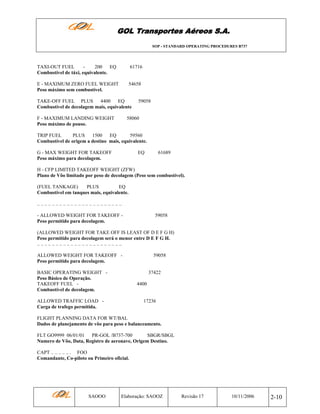
ALT-1 SBCF FL 370 DIST 228NM M740 TIME 00.41 WC M005 FUEL 018
Alternativa 1, Nível de Vôo, distância, Velocidade Mach, Tempo de vôo, componente de vento, combustível a voar.
ALT-2 SBKP FL 390 DIST 298NM M761 TIME 00.52 WC M017 FUEL 022
Alternativa 2, Nível de Vôo, distância, Velocidade Mach, Tempo de vôo, componente de vento, combustível a voar.
ALT-3 SBSP FL 390 DIST 249NM M761 TIME 00.45 WC M017 FUEL 019
Alternativa 3, Nível de Vôo, distância, Velocidade Mach, Tempo de vôo, componente de vento, combustível a voar.
DISPATCH RELEASE
Autorização de Despacho.
CAPTAIN .. .. .. .. .. .. .. ..
FLIGHT NUMBER GO9999
Comandante, Numero de Vôo.
AIRCRAFT PR-GOL
FROM/TO SBGR/SBGL
Registro de Aeronave, Origem/destino.
TYPE OF FLIGHT STANDARD
Tipo de padrão de Vôo, Alternativa.

ALT SBCF

TYPE OF CRUISE ECO
ETD 1000
Tipo de Cruzeiro, Econômico, Estimada de Saída.
CFP REF.FGXNY
ETA 1600
Código de plano de Vôo, Estimado de chegada.
ENDURANCE 01.48
DATE 06/01/01
Autonomia de Vôo, Data, Pesos em kilos.
.. .. .. .. .. .. .. .. .. .. .. .. .. .. .. .. .. .. .. .. .. .. ..

WGT KGS

TAKE OFF WEIGHT CALCULATIONS BASED ON
Cálculos de peso de decolagem baseados em.

QNH.. .. OAT.. .. RWY.. .. FLAP.. .. .. WIND.. .. ..
.. .. .. .. .. .. .. .. .. .. .. .. .. .. .. .. .. .. .. .. .. .. ..
A - MAX RWY/CLB/PAV T.O.W.
(R) (C) (P)
Peso Máximo de decolagem restrito por pista/subida/resistência de pista.
C - NEVER EXCEED WEIGHT
Nunca exceder este peso.
MAX WEIGHT FOR TAKE OFF
Peso Maximo de decolagem.

61689

61689

(LOWEST WEIGHT OF A AND C)
Menor dos pesos entre A e C.
.. .. .. .. .. .. .. .. .. .. .. .. .. .. .. .. .. .. .. .. .. .. ..
D - MAXIMUM RAMP WEIGHT
Peso máximo de pátio.

SAOOO

61916

Elaboração: SAOOZ

Revisão 17

10/11/2006

2-9
GOL Transportes Aéreos S.A.
SOP - STANDARD OPERATING PROCEDURES B737

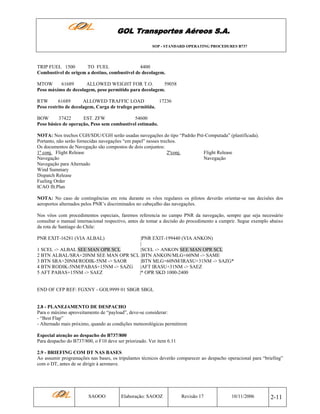
TAXI-OUT FUEL
200
EQ
Combustível de táxi, equivalente.

61716

E - MAXIMUM ZERO FUEL WEIGHT
Peso máximo sem combustível.

54658

TAKE-OFF FUEL PLUS
4400
EQ
Combustível de decolagem mais, equivalente
F - MAXIMUM LANDING WEIGHT
Peso máximo de pouso.

59058

58060

TRIP FUEL
PLUS
1500
EQ
59560
Combustível de origem a destino mais, equivalente.
G - MAX WEIGHT FOR TAKEOFF
Peso máximo para decolagem.

EQ

61689

H - CFP LIMITED TAKEOFF WEIGHT (ZFW)
Plano de Vôo limitado por peso de decolagem (Peso sem combustível).
(FUEL TANKAGE)
PLUS
EQ
Combustível em tanques mais, equivalente.
.. .. .. .. .. .. .. .. .. .. .. .. .. .. .. .. .. .. .. .. .. .. ..
- ALLOWED WEIGHT FOR TAKEOFF Peso permitido para decolagem.

59058

(ALLOWED WEIGHT FOR TAKE OFF IS LEAST OF D E F G H)
Peso permitido para decolagem será o menor entre D E F G H.
.. .. .. .. .. .. .. .. .. .. .. .. .. .. .. .. .. .. .. .. .. .. ..
ALLOWED WEIGHT FOR TAKEOFF Peso permitido para decolagem.
BASIC OPERATING WEIGHT Peso Básico de Operação.
TAKEOFF FUEL Combustível de decolagem.

59058

37422
4400

ALLOWED TRAFFIC LOAD Carga de trafego permitida.

17236

FLIGHT PLANNING DATA FOR WT/BAL
Dados de planejamento de vôo para peso e balanceamento.
FLT GO9999 06/01/01
PR-GOL /B737-700
SBGR/SBGL
Numero de Vôo, Data, Registro de aeronave, Origem Destino.
CAPT .. .. .. .. .. . FOO
Comandante, Co-piloto ou Primeiro oficial.

SAOOO

Elaboração: SAOOZ

Revisão 17

10/11/2006

2-10
GOL Transportes Aéreos S.A.
SOP - STANDARD OPERATING PROCEDURES B737

TRIP FUEL 1500
TO FUEL
4400
Combustível de origem a destino, combustível de decolagem.
MTOW
61689
ALLOWED WEIGHT FOR T.O.
59058
Peso máximo de decolagem, peso permitido para decolagem.
RTW
61689
ALLOWED TRAFFIC LOAD
17236
Peso restrito de decolagem, Carga de trafego permitida.
BOW
37422
EST. ZFW
54600
Peso básico de operação, Peso sem combustível estimado.
NOTA: Nos trechos CGH/SDU/CGH serão usadas navegações do tipo “Padrão Pré-Computada” (plastificada).
Portanto, não serão fornecidas navegações “em papel” nesses trechos.
Os documentos de Navegação são compostos de dois conjuntos:
1º conj. Flight Release
2ºconj.
Flight Release
Navegação
Navegação
Navegação para Alternado
Wind Summary
Dispatch Release
Fueling Order
ICAO flt.Plan
NOTA: No caso de contingências em rota durante os vôos regulares os pilotos deverão orientar-se nas decisões dos
aeroportos alternados pelos PNR’s discriminados no cabeçalho das navegações.
Nos vôos com procedimentos especiais, faremos referencia no campo PNR da navegação, sempre que seja necessário
consultar o manual internacional respectivo, antes de tomar a decisão do procedimento a cumprir. Segue exemplo abaixo
da rota de Santiago do Chile:
PNR EXIT-16281 (VIA ALBAL)

|PNR EXIT-199440 (VIA ANKON)
|
1 SCEL -> ALBAL SEE MAN OPR SCL
|SCEL -> ANKON SEE MAN OPR SCL
2 BTN ALBAL/SRA+20NM SEE MAN OPR SCL |BTN ANKON/MLG+60NM -> SAME
3 BTN SRA+20NM/RODIK-5NM -> SAOR
|BTN MLG+60NM/IRASU+31NM -> SAZG*
4 BTN RODIK-5NM/PABAS+15NM -> SAZG
|AFT IRASU+31NM -> SAEZ
5 AFT PABAS+15NM -> SAEZ
|* OPR SKD 1000-2400

END OF CFP REF: FGXNY - GOL9999 01 SBGR SBGL

2.8 - PLANEJAMENTO DE DESPACHO
Para o máximo aproveitamento de “payload”, deve-se considerar:
- “Best Flap”
- Alternado mais próximo, quando as condições meteorológicas permitirem
Especial atenção ao despacho do B737/800
Para despacho do B737/800, o F10 deve ser priorizado. Ver item 6.11
2.9 - BRIEFING COM DT NAS BASES
Ao assumir programações nas bases, os tripulantes técnicos deverão comparecer ao despacho operacional para “briefing”
com o DT, antes de se dirigir à aeronave.

SAOOO

Elaboração: SAOOZ

Revisão 17

10/11/2006

2-11
GOL Transportes Aéreos S.A.
SOP - STANDARD OPERATING PROCEDURES B737

Em SBSP o “briefing” pode ser obtido através de contato telefônico com os DOVs (Telefone existente no DO).
Informações meteorológicas poderão ser obtidas pelo terminal de computador no DO, pelo “site” www.redemet.aer.mil.br
Briefings de decolagem via VHF com estação radio.
Os briefings de decolagem via VHF deverão ser feitos somente em solo, para diminuir workload em vôo.
2.10 VÔO DE TRASLADO
No vôo de traslado sem comissários a bordo, a tripulação técnica deverá observar alguns procedimentos de segurança
conforme Cap. 06 item 6.4 - "Interior Inspection
Special procedure to be performed by flight crew when there is no flight attendant on board".
Interior Inspection
Special procedure to be performed by flight crew when there is no flight attendant on board
AFT ENTRY AND SERVICE DOORS …………………………......…………...…..……...................……..……….Closed
AFT
LAVATORIES………………………….…...…………………………..…….....................…….……………..……Checked
AFT GALLEYS…………………………….……………………………..…….....................….……………..….…Checked
Trolleys –locked in place
Transporters –locked in place
Waste bins-locked in place
Coffee maker-locked inplace
PAX CABIN…………………………........……...……………..…………...................………….……………...Bins Closed
OVERWING EXITS……………………………...………….…..……………...................………...………….....…..Locked
FORWARD GALLEYS…………………………….......………………….....................………………..……......…Checked
Trolleys –locked in place
Transporters –locked in place
Waste bins-locked in place
Coffee maker-locked in place
FWD LAVATORIES………......……………………………………….……..................……………………………Checked
FWD SERVICE & ENTRY DOORS ………………………….………………..………...................…...………..….Closed

SAOOO

Elaboração: SAOOZ

Revisão 17

10/11/2006

2-12
GOL Transportes Aéreos S.A.
SOP - STANDARD OPERATING PROCEDURES B737

3 - PROCEDIMENTOS PARA USO DE EQUIPAMENTOS ...................................................2
3.1 - RELÓGIOS ..................................................................................................................................... 2
3.2 - CINTOS DE SEGURANÇA (RBHA) ........................................................................................... 2
3.3 - LIMPADORES DE PÁRA-BRISA ............................................................................................... 2
3.4- VHF- COMUNICAÇÃO................................................................................................................. 2
3.5 - FONES DE OUVIDO ..................................................................................................................... 2
3.6 - LUZES EXTERNAS ...................................................................................................................... 2
3.7 – APU ................................................................................................................................................. 3
3.8 - SELEÇÃO DE ITENS DUPLOS .................................................................................................. 3
3.9 - EQUIPAMENTOS INOPERANTES............................................................................................ 3
3.10 - AVISO LUMINOSO ‘ usar cintos’ e “não fume”...................................................................... 4
3.11 - ELT ................................................................................................................................................ 4
3.12 - UTILIZAÇÃO DE RADAR / PÁSSAROS................................................................................. 4
3.13 - EXTINTORES DE INCÊNDIO - VALIDADE.......................................................................... 4
3.14 - GARRAFAS PORTÁTEIS DE OXIGÊNIO – VALIDADE .................................................... 4
3.15 – POLÍTICA DE UTILIZAÇÃO DE FLAPS PARA POUSO.................................................... 4
3.16 – AUTO BRAKE............................................................................................................................. 5
3.17 – FMS – INICIALIZAÇÃO (DADOS FOQA) ............................................................................. 5
3.18 - GRAVADORES DE VÔO ........................................................................................................... 5
3.19 - MCP COURSE. ............................................................................................................................ 5
3.20 - B 737/300: EQUIPAMENTOS DE NAVEGAÇÃO / ILS ......................................................... 6
3.21 - INFLIGHT POSITION UPDATE ................................................................................................ 6

SAOOO

Elaboração: SAOOZ

Revisão 17

10/11/2006

3-1
GOL Transportes Aéreos S.A.
SOP - STANDARD OPERATING PROCEDURES B737

3 - PROCEDIMENTOS PARA USO DE EQUIPAMENTOS
3.1 - RELÓGIOS
Os relógios de bordo devem ser ajustados para a hora UTC.

3.2 - CINTOS DE SEGURANÇA (RBHA)
Todos os tripulantes ocupando assento na cabine de comando deverão manter seus cintos de segurança afivelados. Os
“shoulder harness” deverão ser utilizados quando:
- Do acionamento dos motores até o FL100 (RBHA)
- Do início da descida até o estacionamento da aeronave.
- Em vôo com turbulência forte, vôo local ou de experiência.

3.3 - LIMPADORES DE PÁRA-BRISA
Os limpadores de pára-brisa não devem ser acionados com os vidros secos.
Quando não estiverem em uso devem ficar sempre na posição B700/800 - “Park / Stowed” e B300 - “OFF/ Stowed”.

3.4- VHF- COMUNICAÇÃO
Toda mudança de freqüência de rádio navegação ou comunicação deverá ser feita obedecendo às áreas de responsabilidade
e notificada aos demais tripulantes envolvidos com o vôo.
Os painéis de radiocomunicação devem ser usados da seguinte forma:
Aeronaves com 2 conjuntos rádios
VHF 1 – para contato com os órgãos ATC;
VHF2 – em vôo manter 121.500, ou momentaneamente para serviços auxiliares (companhia/ ATIS/ meteoro/ Ar-Ar). No
Solo manter a freqüência da companhia (131.225). No aeroporto de São Paulo (Congonhas) utilizar a freqüência 131.225
para contato com a central, e a 136.225 para o briefing operacional.
Usar VHF1 para contatos com os órgãos ATC e HF2 para contatos com a empresa ou Meteorologia.
Para aeronaves com sintonia manual, o rádio-navegação do PF deverá ser sintonizado nos auxílios ao longo do eixo da rota
e o do PM nos auxílios necessários para as marcações laterais.
Aeronaves com painel de VHF-3 (sem o módulo de VHF) deixar o painel em OFF

3.5 - FONES DE OUVIDO
Durante as fases do vôo envolvendo o início da partida até atingir o TOC e do TOD até o estacionamento os pilotos
deverão utilizar fone de ouvido durante todo tempo e manter o speaker da cabine desligado. Em vôo de cruzeiro poderá ser
usado o alto-falante da cabine em volume adequado.
Em situações que apenas um dos pilotos esteja monitorando a freqüência em uso com o órgão ATC, o uso do fone por este
é obrigatório.
(Ex.: enquanto o comandante faz “speech” aos passageiros, o co-piloto deverá usar fone).
Os pilotos que usarem “boom-mike” particulares deverão, obrigatoriamente, recolocar o fone da aeronave no devido
“plug” ao término de seu vôo.

3.6 - LUZES EXTERNAS
Não há necessidade da tripulação efetuar o check de faróis . É efetuado pela manutenção.
ANTI-COLLISION – Ligar para a partida dos motores ou início do “tratoramento” (“push back”) e desligar após o corte
ou final do “tratoramento”. Não ligar no cheque externo.
POSITION LIGHTS – São de uso contínuo entre o pôr e o nascer do sol, bem como em operação com baixa visibilidade.
Para os vôos internacionais são de uso contínuo, independente das condições ou do horário.

SAOOO

Elaboração: SAOOZ

Revisão 17

10/11/2006

3-2
GOL Transportes Aéreos S.A.
SOP - STANDARD OPERATING PROCEDURES B737

LOGO LIGHTS – São de uso entre o pôr e nascer do sol, bem como em operação de baixa visibilidade, com a
aeronave no solo. Em vôo, usar nas fases de subida e descida.
RUNWAY TURNOFF – Uso obrigatório do início da decolagem até o TOC e do TOD até o pouso. Devem permanecer
ligadas no táxi sobre a pista (back track) e/ou quando for efetuar cruzamento de pista.
WING ILLUMINATION - Uso específico para inspeção de asa. Não ligar no cheque externo
LANDING LIGHTS (FIXED OR INBOARD) – Utilizar sempre abaixo do FL 100. Devem permanecer ligadas no táxi
sobre a pista (back track) e/ou quando for efetuar cruzamento de pista.
LANDING LIGHTS (RETRACTABLE OR OUTBOARD) – Para o pouso noturno, recomenda-se que elas sejam acesas a
500ft ou abaixo quando em contato visual com a pista. Normalmente não são utilizados para decolagem. Devem
permanecer ligadas no táxi sobre a pista (back track) e/ou quando for efetuar cruzamento de pista.
STROBE – Devem permanecer ligadas desde o Before Takeoff CheckList Bellow the Line até o After Landing, do pôr ao
nascer do sol. Devem permanecer ligadas no táxi sobre a pista (back track) e/ou quando for efetuar cruzamento de pista.
Não ligar no cheque externo
TAXI LIGHT – Durante o movimento da aeronave no solo por meios próprios deve estar acesa, tanto no período noturno
como diurno.

3.7 – APU
B300 - Em caso de partida do APU (No solo) sem sucesso, não tentar nova partida.
Observar os Limites de partida conforme OM
Operations Manual Bulletin TBCE-4 June 16, 1995: observador externo para partidas sucessivas; start cycle pode durar
135”; uso do combustível do tanque central ( mínimo453kgs); é obrigatoriedade ter pessoas qualificadas na cabine de
comando para esse procedimento.
NOTAS: O corte do “APU” deverá ser efetuado após 2 minutos da retirada das cargas elétrica e pneumática.
Nos trechos CGH/SDU/CGH – manter APU ON durante todo o vôo.
B700/800 - Em caso de partida do APU sem sucesso, não tentar nova partida. Avisar a coordenação via fonia e solicitar
auxílio de fonte externa.
B.Operacional – GOT-6: APU Battery Start – toda vez que for dada partida no APU e a única fonte de alimentação da
aeronave for a bateria, poderá “saltar” RCCB (Remote Circuit Breaker) situado no Stby Pwr Control Unit Panel.
(Observar no Preliminary Flt.Deck Preparation e Loss of Both Eng Driven Gen NormalProcedures ).
A configuração “APU Bleed Takeoff” deve ser realizada no “Before Taxi Procedures”.
Procedimentos de acordo com OM-SP2.5 (700/800) ou OM-SP 2.9 (300).
Com o APU funcionando, é obrigatória a permanência de um dos tripulantes técnico na cabine de comando e na escuta do
órgão ATS. Para abandonar a cabine de comando o tripulante deverá ser substituído por outra pessoa qualificada (piloto ou
mecânico) ou cortar do APU.

3.8 - SELEÇÃO DE ITENS DUPLOS
Usar todos os equipamentos que tenham opção de seleção de itens duplos (Left, Right; 1, 2; A, B) da seguinte maneira:
Nos vôos de números impares utilizar os equipamentos em Left, 1 ou A.
Nos vôos de números pares utilizar os equipamentos em Right, 2 ou B.

3.9 - EQUIPAMENTOS INOPERANTES
Se, durante a verificação normal pré-vôo ou durante a operação, for constatada a falha ou inoperância de um equipamento
ou sistema, o tripulante, piloto ou comissário, deverá avisar ao comandante que providenciará a correção do item ou
orientará a tripulação para o procedimento homologado conforme o MEL – CDL da aeronave.

SAOOO

Elaboração: SAOOZ

Revisão 17

10/11/2006

3-3
GOL Transportes Aéreos S.A.
SOP - STANDARD OPERATING PROCEDURES B737

3.10 - AVISO LUMINOSO ‘ usar cintos’ e “não fume”.
O aviso “não fume” deverá estar ligado em toda operação do vôo.
Conforme o procedimento exposto em 5.3, passamos a adotar o seguinte, com relação ao aviso “USAR CINTOS”:
- Em condições de turbulência, “SEAT BELTS SW” em “ON”.
- Durante a travessia da cordilheira nas rotas transandinas
- Before Start: colocar “SEAT BELT SW” em “ON”
- Subida: ao cruzar o FL100, colocar o “SW” em “AUTO” (Sem turbulência)
- Descida/aproximação: com SW em “AUTO”, o aviso acenderá com a seleção de flap ou trem de pouso, o que ocorrer
primeiro.
O aviso “não fume” deverá estar ligado em toda operação do vôo.
Conforme o procedimento exposto em 5.3, passamos a adotar o seguinte, com relação ao aviso “USAR CINTOS”:
- Em condições de turbulência, “SEAT BELTS SW” em “ON”.
- Before Start: colocar “SEAT BELT SW” em “ON”
- Subida: ao cruzar o FL100, colocar o “SW” em “AUTO” (Sem turbulência)
- Descida/aproximação: com SW em “AUTO”, o aviso acenderá com a seleção de flap ou trem de pouso, o que ocorrer
primeiro.

3.11 - ELT
Todas as aeronaves da empresa possuem um ELT.

3.12 - UTILIZAÇÃO DE RADAR / PÁSSAROS
Recomenda-se o uso de radar meteorológico em áreas em que haja reporte, suspeita ou observação de concentração de
pássaros (Dep e Arr).
(Baseado em estudos efetuados a respeito do uso de radar meteorológico contra pássaros)

3.13 - EXTINTORES DE INCÊNDIO - VALIDADE
De acordo com informação da manutenção GOL, não há necessidade de etiqueta de validade nos extintores, visto que o
controle é feito pelo sistema AMIS. (Of. 1053/4TE-1/2002)
Cópia do ofício incluído na pasta de documentos dos comissários.

3.14 - GARRAFAS PORTÁTEIS DE OXIGÊNIO – VALIDADE
É dispensável a existência de etiqueta indicando a validade (OF. 178/ 4TE-1/2003).
Cópia do ofício incluído na pasta de documentos dos comissários.

3.15 – POLÍTICA DE UTILIZAÇÃO DE FLAPS PARA POUSO
Como política geral de utilização de flap para pouso, em pistas menores ou iguais a 2000 m é compulsória a utilização do
flap 40 para os equipamentos B737-300/700. No equipamento B737-800 o flap 40 é utilizado para todos os comprimentos
de pistas.
Nas pistas de operações normais “GOL” deverá ser utilizada a tabela “Landing Limit Weights (TABELA DE CONSULTA
RÁPIDA)” colocada a bordo das aeronaves, onde constam o flap, os limites de “Maximum Landing Weight (MLW)”, o
limite do componente de vento de cauda (TW) e o auto-brake para cada pista. As exceções são inseridas nas “FOLHAS
VERDES” que deverão ser checadas nas pistas com operações restritas.

SAOOO

Elaboração: SAOOZ

Revisão 17

10/11/2006

3-4
GOL Transportes Aéreos S.A.
SOP - STANDARD OPERATING PROCEDURES B737

3.16 – AUTO BRAKE
É padrão GOL o uso do “Autobrake” em todas as operações. Nas pistas de operações normais “GOL” deverá ser utilizada a
tabela “Landing Limit Weights (TABELA DE CONSULTA RÁPIDA)” colocada a bordo das aeronaves, onde constam o
flap, os limites de “Maximum Landing Weight (MLW)”, o limite do componente de vento de cauda (TW) e o auto-brake
para cada pista.

As pistas que não constam na tabela a bordo deverão obedecer as seguintes seleções:
a) RWY com comprimento de 2500m ou mais
“3” (DRY ou WET)
b) RWY com comprimento inferior a 2500m
“3” para Rwy DRY
“MAX’ para Rwy WET
c) Aeroportos com operações especiais ou restrições operacionais, têm suas informações sobre uso de “AUTO BRAKE” no
capítulo 09 - FOLHAS VERDES.
O piloto desligará o sistema após o pouso, quando a parada dentro dos limites da pista estiver garantida e completará a
frenagem manualmente para minimizar o desconforto de uma desaceleração acentuada.
Os pilotos, entretanto, devem entender que as técnicas acima não devem sobrepor à necessidade de parada da aeronave
dentro dos limites da pista. Com pista molhada, contaminada ou escorregadia, vento de rajadas ou de través, etc., deve ser
aplicado o freio no nível que garanta uma parada segura. Quando houver dúvida, use os freios em sua capacidade máxima.
O “call-out” AUTOBRAKE DISARM deverá ser feito pelo PM ao observar a indicação no painel.
Para a situação de “autobrake” inoperante, a frenagem deve ser equivalente à seleção que seria usada para a situação, de
acordo com a relação acima. Não bombear o freio quando a operação for manual.

3.17 – FMS – INICIALIZAÇÃO (DADOS FOQA)
Na inicialização do FMS, os campos referentes ao nº. do vôo devem ser preenchidos da seguinte forma: “GOL XXXX (4
dígitos)”.

3.18 - GRAVADORES DE VÔO
NÃO É PERMITIDO A DESENERGIZAÇÃO DE QUAISQUER DOS EQUIPAMENTOS (DFDR, DFDAU ou FOQA),
A NÃO SER EM CASO DE INCIDENTE.
GRAVADORES DE DADOS DE VÔO E DE VOZ
As aeronaves deverão ser despachadas de acordo com MEL
Notas:
Casos específicos serão julgados pelo Chefe de Operações;
1. Não é permitido a desenergização de qualquer um dos equipamentos, a não ser em caso de incidentes.
2. Em caso de incidente ou situação anormal em que é importante a apresentação dos dados registrados nos gravadores, é
recomendado “puxar o CB” do “Voice Recorder” para preservação dos mesmos.

3.19 - MCP COURSE.
No Course do MCP deve constar a 1ª radial a ser interceptada e o VOR correspondente selecionado, mesmo que esse não
se encontre sobre o aeródromo de partida.
Obs: não colocar em “COURSE” uma proa ou uma radial que não será interceptada. Deixar claro esse procedimento no
“Take-off briefing”.

SAOOO

Elaboração: SAOOZ

Revisão 17

10/11/2006

3-5
GOL Transportes Aéreos S.A.
SOP - STANDARD OPERATING PROCEDURES B737

3.20 - B 737/300: EQUIPAMENTOS DE NAVEGAÇÃO / ILS
ILS
A fim de evitar que a aeronave intercepte G/S antes de estabilizado no LOC, adotar o seguinte procedimento:
- na proa de interceptação manter o modo de “HDG SEL”;
- selecionar modo VOR /LOC;
- após interceptação do LOC, selecionar modo APP (FCTM 4.10.12)
GLA
Equipamentos:
ADF: uma unidade, com indicação no EHSI (ponteiro)
VOR: duas unidades, com indicações no RMI-VOR e EFIS
Devido ao modelo do FMC, não tem Sw seletor MAN/AUTO nos equipamentos VHF-NAV.

3.21 - INFLIGHT POSITION UPDATE
NÃO é PROCEDIMENTO NORMAL da GOL o “Inflight Position Update” manual,. Quando apresentado à informação
“IRS NAV ONLY, VERIFY POSITION ou UNABLE REQUIRED NAV PERFORMANCE – RNP” no FMC adotar o
procedimento abaixo até que receba informações de “VOR DME” para o “UPDATE AUTOMÁTICO”.
•

Colocar o EHSI do lado do “PM” para “Raw Data” e acompanhar a navegação com o “VHF NAV” do lado
correspondente. Para o B300 selecionar o “VHF NAV” em “MANUAL”;

•

Lado do “PF” poderá ser mantido em MAP para acompanhar a navegação.

SAOOO

Elaboração: SAOOZ

Revisão 17

10/11/2006

3-6
GOL Transportes Aéreos S.A.
SOP - STANDARD OPERATING PROCEDURES B737

4 - PROCEDIMENTOS DE CONTROLE E OPERAÇÃO ACFT...........................................2
4.1 - CONTROLE POSITIVO DA AERONAVE ................................................................................ 2
4.2 - USO DA AUTOMAÇÃO ............................................................................................................... 2
4.3 - ALTERAÇOES DE CONFIGURAÇÃO...................................................................................... 3
4.4 - OPERAÇÃO DO CO-PILOTO (Decolagem e Pouso) ................................................................ 3
4.5 – PROIBIÇÃO DO CANCELAMENTO DO PLANO IFR EM AEROPORTOS FORA DO
BRASIL.................................................................................................................................................... 3
4.6 – AEROPORTOS COM RESTRIÇÕES OPERACIONAIS ........................................................ 4
4.7 – AEROPORTOS COM OPERAÇÕES ESPECIAIS. .................................................................. 4
SANTOS DUMONT - SBRJ .............................................................................................................................. 4

4.8 - ROTAS DE OPERAÇÕES ESPECIAIS ...................................................................................... 4
A) ETAPAS COM RECLEARENCE............................................................................................................... 4
B) ROTA SBXX/ SAZS (BARILOCHE) ......................................................................................................... 5

4.9 - OPERAÇÃO GPS........................................................................................................................... 5
PRÉ-VÔO............................................................................................................................................................ 6
- ROTAS OCEÂNICAS. .................................................................................................................................... 6
- ROTAS DOMÉSTICAS E TMAs.................................................................................................................. 6
- ROTAS INTERNACIONAIS.......................................................................................................................... 6
- PROCEDIMENTOS OPERACIONAIS GPS. .............................................................................................. 7

4.10 – APROXIMAÇÃO DESESTABILIZADA ................................................................................. 8
4.11 - LIMITE PARA OPERAÇÃO EM PISTA “WET” (DECOLAGEM E POUSO) .................. 9
4.12 - LIMITES DE VENTO PARA OPERAÇÃO (DECOLAGEM E POUSO) ............................. 9
Proibida decolagem com “Windshear”................................................................................................. 9
TAILWIND ............................................................................................................................................. 9
CROSSWIND (TAKEOFF and LANDING)...................................................................................... 9
4.13 OPERAÇÕES NO SOLO EM CONDIÇÕES DE FORMAÇÃO DE GELO – “COLD
WEATHER OPERATION”................................................................................................................. 10
4.13.1-Características de condições de gelo no solo:...................................................................................... 10
4.13.2 - Inspeção externa de segurança........................................................................................................... 10
4.13.3 - Operação. ............................................................................................................................................. 11
4.13.4 - Procedimentos de “de-ice” e “anti-ice” ............................................................................................. 11
4.13.5 - Reporte de verificação para partida ("departure check report"): ................................................. 12
4.13.6 - Tipos de Fluidos e “Holdover Time” ................................................................................................. 12
FLUIDOS TIPO I (fluidos sem espessante) ..................................................................................................... 12
FLUIDOS TIPO II (fluidos Killfrost / Hoechst, com espessante) ................................................................... 13
FLUIDOS TIPO IV ........................................................................................................................................... 13
Time Table for type IV fluid.............................................................................................................................. 14

4.15 - OPERAÇÃO EM CONDIÇÕES ADVERSAS (B737-300).................................................... 15
4.16 – PLACAR DE ALERTA DO FLAP 40 NO B737-800.............................................................. 15

SAOOO

Elaboração: SAOOZ

Revisão 17

10/11/2006

4-1
GOL Transportes Aéreos S.A.
SOP - STANDARD OPERATING PROCEDURES B737

4 - PROCEDIMENTOS DE CONTROLE E OPERAÇÃO ACFT
4.1 - CONTROLE POSITIVO DA AERONAVE
O comandante deverá ter o controle direto da aeronave e operá-la nas seguintes condições:
• Aeronave em condições técnicas anormais / emergência;
• Pista curta ou restrita;
• Operação em Taxiways;
• Chuva moderada ou neve;
• Componente de vento de través superior a 15Kts;
• Condições que indicam a possibilidade de WIND-SHEAR;
• Operações Especiais ou Restritas. (Ver capítulo 09 – FOLHAS VERDES).
• Qualquer outra condição em que o comandante julgar necessário.
Nota:
Sempre que houver transferência de controle na pilotagem, deverá ficar bem claro quem está assumindo os controles de
vôo, informando o seguinte:
• Piloto assumindo a pilotagem............ “Meu Controle”
• Piloto transferindo a pilotagem.......... “Seu Controle”

4.2 - USO DA AUTOMAÇÃO
Os sistemas automatizados dos aviões visam, basicamente, aumentar a precisão dos vôos e diminuir carga de trabalho nas
fases críticas.
Tais sistemas, entretanto, poderão induzir seus operadores à complacência por excesso de confiança. Cabem sempre, aos
tripulantes as tarefas de programar, monitorar e sempre intervir caso apresentem discrepâncias com a operação desejada.
O “Autopilot” será usado sempre que disponível de modo a colocar a tripulação em um papel de gerente do vôo e da
pilotagem. A carga de trabalho reduzida disponibiliza, para a tripulação, mais tempo para outros deveres, (vigia de tráfego,
ATC e monitoramento do avião).
O PF deverá lançar mão dos recursos disponíveis - VNAV, LNAV, INS, GPS, VOR LOC. HDG ou MANUAL – com
prioridade aos recursos automatizados - que melhor mantenham o avião no “Track”, utilizando como informação básica os
parâmetros “Raw Data” de VOR/ILS/ADF disponíveis.
Os sistemas automáticos deverão ser empregados em todas as fases do vôo em que estiverem disponíveis, obedecendo aos
seguintes critérios:
Nos segmentos do vôo que se fizerem necessárias mudanças acentuadas de potência / atitude, ou após o primeiro FLAP
SETTING na aproximação, o PF deverá ter um controle positivo da aeronave (manche / pedais) e das manetes de potência,
independente do uso do automatismo.
Com a finalidade de treinamento, os pilotos deverão fazer aproximações manuais ocasionalmente, de preferência em
condições de vôo VMC e em situações de baixo “workload”, sempre combinado previamente.
Evitar ao máximo a manipulação dos CDU's abaixo do FL 100 e em momentos de alto “workload”.
O uso dos dois pilotos automáticos acoplados (dual channel) não é autorizado para aproximação ILS.
NOTA - sob vetoração RADAR, usar a função HSEL.
Sempre que disponível, o “Autothrottle System” deverá ser utilizado.
Nas aproximações com “Autothrottle” desconectado, é obrigatório manter a mão nas manetes abaixo do FL100.

SAOOO

Elaboração: SAOOZ

Revisão 17

10/11/2006

4-2
GOL Transportes Aéreos S.A.
SOP - STANDARD OPERATING PROCEDURES B737

O uso contínuo do ATS, além de confortável e seguro acaba condicionando os pilotos a este tipo de operação. Recomendase que nos casos de inoperância do sistema (seja por falha ou mesmo por desativação com fins de treinamento), o
Comandante alerte os demais tripulantes para um “monitoramento especial na velocidade”.
4.3 - ALTERAÇOES DE CONFIGURAÇÃO
Quando o PF solicitar uma alteração (MCP ou Flight Controls, por exemplo), esta deverá ser realizada e, posteriormente,
confirmada pelo PNF.
Exemplo:
- PF: determina F1
- PM: coloca a alavanca no “detent” correspondente e informa “F1” quando configurado.
- PF: Gear Down
- PM: coloca a alavanca na posição e informa quando configurado
- PF: Heading ___°
- PM: efetua a modificação no MCP e informa “Heading ___º”
NOTAS:
1) no caso específico de extensão do flap, o PM deverá observar o novo posicionamento e indicação de luz de LE FLAPS
EXT para informar: “Flap__ ”
Exemplo:
PF: determina “F1”
PM: coloca a alavanca na posição correspondente, observa a indicação de posição e luz do flap e informa “Flap 1”.
2) para a retração de flap, o procedimento permanecerá de acordo com o FCTM 3.25
O PM deverá observar o F Up e luzes indicativas de L.Edge apagadas e informar “F Up”.
3) para seleção de flap para pouso todas as alterações de “flaps” deverão ser pedidas pelo número que reflete a nova
posição. Isso como ocorre nas alterações iniciais (flap 1, 5...) e deverá também ser assim para o flap de pouso.
Por exemplo, não pedir apenas "Set Landing Flaps", pedir pelo número: "FLAP 40" ou "FLAP 30". O PM, após monitorar
a nova posição, deverá também confirmar com o número: "FLAP 40" ou "FLAP 30".
Visa prevenir eventual seleção de flap inadequado para pouso do Boeing 737-800, sempre 40.
4.4 - OPERAÇÃO DO CO-PILOTO (Decolagem e Pouso)
É proibida a operação do Co-piloto nas condições abaixo:
a) em pistas de comprimento inferior a 1.700 m;
b) em qualquer aproximação em que não exista referência da rampa de planeio como Glideslope, Papi ou Vasis.
Outras restrições para operação do Co-piloto, estão descritas nos itens 4.1 “CONTROLE POSITIVO DA AERONAVE” e
4.5 “AEROPORTOS COM RESTRIÇÕES OPERACIONAIS”.
4.5 – PROIBIÇÃO DO CANCELAMENTO DO PLANO IFR EM AEROPORTOS FORA DO BRASIL
As aproximações para pousos nos destinos internacionais deverão ser realizadas seguindo plano IFR, sem "cancelamento",
na seguinte ordem de prioridade:
1.Vetoração Radar;
2.ILS;
3.GPS;
4.VOR;
5.NDB.
Para as pistas desprovidas de procedimentos IFR:
- executar a IAL para a cabeceira oposta e prosseguir visual para a cabeceira em uso obedecendo aos mínimos VFR da
localidade ou, caso não especificado, 1500 pés de teto e 5000 metros de visibilidade;
OBSERVAR TAMBÉM "FOLHA VERDE" PARA A LOCALIDADE

SAOOO

Elaboração: SAOOZ

Revisão 17

10/11/2006

4-3
GOL Transportes Aéreos S.A.
SOP - STANDARD OPERATING PROCEDURES B737

4.6 – AEROPORTOS COM RESTRIÇÕES OPERACIONAIS
Aeroportos com operações de características particulares para a GOL.
São representadas pelas Folhas Verdes, e estão inseridas no SOP - Capítulo 09 e na cabine de comando no “conjunto
condensado Jeppesen” faceado a primeira carta do conjunto de procedimentos das localidades com restrições operacionais.
Solicitamos aos pilotos que observem essa ordem ao guardar as cartas.
4.7 – AEROPORTOS COM OPERAÇÕES ESPECIAIS.
Estabelecidos pela legislação, como aeroportos com operações de características particulares.
São representadas pelas Folhas Verdes, e estão inseridas no SOP - Capítulo 09 e na cabine de comando no “conjunto
condensado Jeppesen” faceado a primeira carta do conjunto de procedimentos das localidades com restrições operacionais.
Solicitamos aos pilotos que observem essa ordem ao guardar as cartas.
SANTOS DUMONT - SBRJ
Operação de acordo com a IAC 3130 – 121 – 1296 de 31/12/1996 e a IAC 3502 de 01/08/1988
Observar os seguintes procedimentos:
a) Qualificação de tripulante técnico - o comandante deverá se certificar da devida habilitação do co-piloto, antes de iniciar
uma programação que envolva “operação SDU”;
b) Qualificação da aeronave - apesar de todas as aeronaves (B700 e 300) estarem qualificadas para a operação, a tripulação
técnica deverá se certificar que não exista nenhum item inoperante (em ACR ou que ocorra na etapa) que impeça a
operação em SDU.
Os itens MEL que oferecem restrições operacionais para o SDU são acompanhados da seguinte frase no manual
(MEL/CDL): “Required for Santos Dumont airport special operations”.
c) GPS - confirmar aeronave equipada com GPS quando SDU operando com “mínimos meteorológicos” para tal operação.
4.8 - ROTAS DE OPERAÇÕES ESPECIAIS
A) ETAPAS COM RECLEARENCE
I-Conceito de “Re-despacho” - O re-despacho (reclearence) é um procedimento que permite a redução de combustível de
contingência em etapas longas sem afetar a segurança. Neste processo, seleciona-se aeroporto intermediário, entre a origem
e o destino; o avião é despachado para esse aeroporto intermediário e, em certo ponto, é re-despachado para o destino final,
desde que possua combustível suficiente (Incluindo reservas).
Cálculo de combustível para vôo com re-despacho:
A) combustível mínimo para o destino:
1- combustível para voar do aeroporto de origem ao aeroporto de destino;
2- 10% do combustível necessário para voar do ponto de re-despacho para o destino final;
3- combustível para voar do aeroporto de destino para o aeroporto de alternativa;
4- combustível para voar no regime de máxima autonomia durante 30' a 1500 FT acima do aeroporto de alternativa.
B) combustível mínimo para aeroporto intermediário:
1- voar do aeroporto de origem até o aeroporto intermediário;
2- 10% do combustível para voar do aeroporto de origem até o aeroporto intermediário;
3- combustível para voar do aeroporto intermediário até o aeroporto alternativa especificado no plano de vôo;
4- combustível para voar no regime de máxima autonomia durante 30' a 1500 FT acima do aeroporto de alternativa.
Quando o combustível para o 1º plano (voar até o destino final) for inferior ao 2º plano (voar ao aeroporto intermediário),
ele deve ser acrescido dessa diferença.
II-Procedimentos Operacionais:
1- Pré-vôo: inserir ventos previstos no FMC;
2- Controle de horário consumo e vento em cada "fixo" da rota;
3- No ponto de “re-despacho”: inserir ventos previstos até o destino no FMC; considerar estimados, meteorologia e
consumo previsto; comparar combustível existente com o previsto no "Combustível Mínimo para Destino" da navegação.
4- Com essa análise, definir destino.
A legislação brasileira não permite o re-despacho para vôos domésticos.

SAOOO

Elaboração: SAOOZ

Revisão 17

10/11/2006

4-4
GOL Transportes Aéreos S.A.
SOP - STANDARD OPERATING PROCEDURES B737

B) ROTA SBXX/ SAZS (BARILOCHE)
1) Importante a inserção dos ventos previstos pela navegação no FMC;
2) O ATC da Argentina exige separação de 10 min. entre aeronaves com destino a SAZS. Esse controle é feito em cada
posição na rota. Por isso, os fixos “não compulsórios” devem ser considerados “compulsórios”, em princípio.
3) Está sendo comum "Warnings" do FMC na chegada em SAZS (Unable RNP ; Verify position, etc).
Estes ocorrem durante a descida ou durante "holding" sobre o VOR.
Isto pode provocar defasagem entre a posição prevista (cartas) e a real:
Portanto, é importante lembrar que a navegação, espera e procedimento IAL deve ser baseado em NAV RADIOSindicações do RDMI e HSI.
4) Independente das condições (IMC ou VMC), deverá ser executado procedimento IFR de aproximação, de acordo com a
IAL autorizada, seguindo rigorosamente o perfil do mesmo. O "Pattern" de Flap determinado no SOP é compulsório,
também.
A EXECUÇÃO DE APROXIMAÇÃO IFR É COMPULSÓRIA PELA GOL.
PROIBIDO CLD DE PLANO IFR E EXECUÇÃO DE APROXIMAÇÃO VISUAL.
Nota: O problema apresentado pelo FMC em BRC, que pode provocar uma defasagem de posição, somado a uma
velocidade maior do que a recomendada e o relevo existente pode causar alerta de GPWS.
- É recomendado " EFIS CONTROL PANEL - FUNÇÃO TERRAIN" no painel do PNF (manual de treinamento - cap3,
pag17) quando o recurso estiver disponível.
5) Cold Weather: Rever os procedimentos constantes no Oper. Manual, Supplementary procedures 16.1 e SOP item 4.11.
- O ponto de congelamento do combustível usado é -43º C.
Outras Rotas especiais serão mencionadas Em anexos a este SOP
4.9 - OPERAÇÃO GPS
APLICABILIDADE.
As orientações aqui contidas aplicam-se aos pilotos da GOL.
As provisões constantes nas Especificações Operativas aprovadas devem ser atendidas. Em caso de conflito, as
Especificações Operativas têm precedência.
Para efetuar um procedimento GPS, é necessário que os dois pilotos tenham recebido treinamento específico conforme o
Programa de Treinamento aprovado.
As aeronaves da GOL não certificadas para operação GPS são identificadas por “placard” no painel, como abaixo:

•

Quando a operação GPS autorizada;

GPS
•

Quando não instalado o equipamento GPS;
GPS
NOT INSTALLED

•

Quando a aeronave não está homologada para o procedimento;
GPS OPERATION
NOT ALLOWED

Uma aproximação GPS não pode ser executada com alerta de "Unable RNP"

SAOOO

Elaboração: SAOOZ

Revisão 17

10/11/2006

4-5
GOL Transportes Aéreos S.A.
SOP - STANDARD OPERATING PROCEDURES B737

PRÉ-VÔO
Geral. Todas as operações IFR GPS devem ser conduzidas de acordo com o AFM ou com um suplemento ao Manual de
Vôo. Antes de um vôo IFR usando GPS, o piloto deve certificar-se de que o equipamento GPS está operando normalmente
e que o DataBase está atualizado. O equipamento deve ser operado de acordo com as provisões do AFM aplicável. Todos
os pilotos devem estar totalmente familiarizados com o equipamento GPS instalado na aeronave e com as limitações.
Receptores GPS. O piloto deve seguir os procedimentos estabelecidos no AFM ou suplemento ao Manual de Vôo para
operação do GPS.
c) NOTAM’s. Antes de qualquer operação IFR GPS, o piloto deve rever os NOTAM’s apropriados. São emitidos
NOTAM’s para avisar de períodos de inatividade de satélites GPS específicos, por número de ruído pseudo-aleatório
(Pseudo Random Noise Number – PRN) e por número de satélite (Satellite Vehicle Number – SVN). Os NOTAM’s GPS
são emitidos sob a identificação “GPS”. Os pilotos podem obter informações sobre NOTAM’s GPS solicitando-as na sala
AIS ou solicitando os NOTAM’s, usando o identificador “GPS”, através do sistema “BIA” (Banco de Informações
Aeronáuticas), que serão fornecidos pelo Despacho Técnico.
d) O piloto deve selecionar o procedimento apropriado para o aeródromo / pista e o fixo inicial de aproximação no FMC.
Os especialistas do Controle de Tráfego Aéreo não possuem nenhuma informação sobre a integridade operacional do
sistema. Isto é especialmente importante quando o piloto for autorizado a iniciar a aproximação. O piloto deve estabelecer
procedimentos para a eventualidade de ocorrer inatividade de satélites prevista ou não. Nessas situações o piloto deve
alternar para outro equipamento aprovado, atrasar o início do procedimento ou cancelar a operação.
e) Apesar de uma aeronave navegando por GPS ser considerada como aeronave equipada para RNAV, o DECEA
recomenda a inclusão no Plano de Vôo do sufixo /G. Se o equipamento GPS tornar-se inoperante, o piloto deve informar
ao ATC e corrigir o sufixo do equipamento.
- ROTAS OCEÂNICAS.
Operação oceânica é definida como aquela fase de vôo entre as fases de partida e chegada com uma extensa trajetória de
vôo sobre área oceânica. A aeronave deve estar equipada com outro meio aprovado de navegação apropriado para a rota de
vôo pretendida, como INS. Esse equipamento de navegação deve estar operacional, mas não precisa ser ativamente
monitorado a não ser em caso de falha da capacidade RAIM do sistema. A perda da capacidade RAIM é indicada pelo
acendimento da luz GPS no Overhead Panel. O objetivo do sistema sobressalente (backup) é assegurar que o vôo possa
prosseguir para seu destino se algo não previsível ocorrer com a constelação GPS.
- ROTAS DOMÉSTICAS E TMAs
Operação doméstica em rota é definida como aquela fase do vôo entre as fases de partida e chegada, com pontos de partida
e de chegada dentro do território brasileiro. Operação em área terminal inclui aquela fase de vôo conduzida em área
mapeada nas SID e STARS ou em operações de vôo entre o último fixo / ponto de controle em rota e um fixo / ponto de
controle inicial de aproximação (IAF).
Aplicam-se, ainda, os seguintes critérios:
a) Os equipamentos normais para navegação IFR devem estar instalados e operacionais (de acordo com o MEL) para
receber os auxílios de solo que definem a rota a ser voada para aeródromo de destino e qualquer aeródromo de alternativa
requerido.
b) Os auxílios de solo que definem essas rotas devem estar operacionais.
c) A aeronave deve ter os equipamentos normais para navegação IFR aprovados e apropriados à rota a ser voada. Esses
equipamentos de navegação devem estar operacionais (de acordo com o MEL), mas não precisam ser ativamente
monitorados a não ser em caso de falha da capacidade RAIM do sistema. O objetivo do sistema sobressalente (backup) é
assegurar que o vôo possa prosseguir para seu destino se alguma coisa não previsível ocorrer com os aviônicos ou com a
constelação GPS.
- ROTAS INTERNACIONAIS
O GPS pode ser utilizado em territórios que admitam o uso do mesmo.
- APROXIMAÇÃO.
As aproximações a ser voadas por GPS devem ser obtidas no Data Base do FMC. Qualquer aeródromo de alternativa deve
ter um procedimento de aproximação aprovado, que não seja GPS, o qual deve estar operacional no horário estimado de
chegada.

SAOOO

Elaboração: SAOOZ

Revisão 17

10/11/2006

4-6
GOL Transportes Aéreos S.A.
SOP - STANDARD OPERATING PROCEDURES B737

Critérios Adicionais - As aeronaves civis não estão autorizadas a usar GPS para voar qualquer segmento de qualquer
aproximação por instrumentos sob condições IFR a menos que as seguintes condições sejam atendidas:
a) Os aviônicos de GPS usados para voar qualquer procedimento de aproximação por instrumentos de não-precisão devem
ser homologados segundo a OTP (TSO) C129 ou critério similar. A instalação na aeronave deve ser aprovada e as
provisões do AFM aplicável ou do suplemento do Manual de Vôo devem ser atendidas.
b) O DataBase de navegação de bordo deve conter todos os pontos de controle apresentados na aproximação de nãoprecisão publicada a ser voada.
c) A aproximação não pode ser voada a menos que a aproximação por instrumentos tenha sido obtida do DataBase do
equipamento. É responsabilidade do piloto verificar se o procedimento de aproximação desejado está no Data Base.
d)O FMC deve ter no Data Base todos os pontos de controle mostrados na aproximação a ser voada e deve apresentá-los
como aparecem na carta publicada desse procedimento de aproximação de não-precisão.
e) As aproximações devem ser voadas de acordo com o AFM ou suplemento do Manual de Vôo e conforme o
procedimento mostrado na apropriada carta de aproximação por instrumentos.
Qualquer aeródromo de alternativa deve ter um procedimento de aproximação por instrumentos aprovado, que não seja
procedimento GPS ou LORAN-C, o qual deverá estar operacional no horário estimado de chegada. A aeronave deve
possuir os equipamentos de navegação apropriados e operacionais para receber os auxílios de navegação de solo.
É proibido executar um procedimento GPS caso o alerta “Unable RNP” esteja presente
- PROCEDIMENTOS OPERACIONAIS GPS.
a) Usualmente, voar um procedimento de aproximação por instrumentos de não-precisão por GPS é idêntico a voar uma
aproximação tradicional. As diferenças incluem as informações de navegação apresentadas pelo equipamento de GPS e a
terminologia usada para descrever algumas das características. Voar uma aproximação exclusivamente com GPS é,
normalmente, uma navegação ponto a ponto independente de qualquer auxílio de solo.
b) Voar na reta de ponto de controle para ponto de controle, como seqüenciados no DataBase, não assegura conformidade
com o procedimento de aproximação publicado. Se aparecerem discrepâncias entre a carta de aproximação e o DataBase, a
carta de aproximação publicada, suplementada por NOTAM’s, tem precedência.
c) Os pilotos devem estar alertas que, quando voando uma aproximação GPS, os cursos publicados em cartas de
aproximação VOR/ILS podem diferir ligeiramente do curso a ser voado como indicado na carta de aproximação GPS.
Todos os cursos magnéticos definidos por uma radial VOR são determinados pela aplicação da variação de uma estação
VOR. Desse modo, uma diferença entre o curso mapeado para VOR e o curso mapeado para equipamento GPS pode
ocorrer. Qualquer método de navegação, seja VOR ou GPS, produz o mesmo traçado no solo desejado
Selecionando a Aproximação.
a) Verificar se aeronave está equipada com GPS e se o mesmo está ativo.
FMS: Index > Nav Options ( pag 2/2) > GPS Update
b) Para iniciar uma aproximação somente por GPS, o piloto deve primeiro selecionar o apropriado aeródromo, pista,
procedimento de aproximação e fixo inicial de aproximação (IAF).
c) A aproximação poderá ser efetuada em LNAV ( preferencialmente) ou HGH SEL.
d) O equipamento, automaticamente, apresentará os pontos de controle desde o fixo inicial de aproximação (IAF) até o
ponto de espera de aproximação perdida.
e) Com vetoração radar (RV) o piloto pode ser requerido a selecionar manualmente o próximo ponto de controle para que o
GPS passe a usar corretamente os pontos de controle do DataBase e as trajetórias de vôo a eles associados.
f) Criar o Ponto de Descida Estabilizada (VDP) – Conforme item 6.15.1.
g) A navegação vertical poderá ser efetuada em VNAV (preferencialmente) ou com controle da razão de descida. Em
ambos os casos, as restrições de altitudes deverão ser liberadas “passo a passo”.
h) As altitudes mínimas por segmento e o MDA devem ser rigorosamente observados. Monitorar a navegação vertical
(VNAV) atentamente. Em caso de dúvida ou falha, assumir em V/S ou manual.
Segmento Inicial de Aproximação.
A seguir estão algumas características únicas sobre as quais um piloto deve ser alertado durante o segmento inicial de
aproximação de um procedimento GPS de não-precisão:
a) Procedimentos com Arco. O método para navegar em arcos pode variar com o fabricante e os pilotos devem usar os
procedimentos especificados no AFM aplicável. Não é incomum que uma aeronave seja vetorada pelo ATC para um arco

SAOOO

Elaboração: SAOOZ

Revisão 17

10/11/2006

4-7
GOL Transportes Aéreos S.A.
SOP - STANDARD OPERATING PROCEDURES B737

em um ponto diferente do IAF para esse arco. Nesses casos o piloto deve fazer o seqüenciamento manual dos pontos de
controle até atingir o segmento de arco da aproximação.
b) Ponto de Curva no Segmento Inicial. Em alguns casos um ponto de curva é incorporado no segmento inicial da
aproximação. Nota: é importante saber que o ponto de curva pode ser um ponto de controle identificado por nome ou por
código.
- Segmento Intermediário de Aproximação.
Se um fixo intermediário (IF) ou ponto de controle for parte de um procedimento de aproximação por instrumentos, ele
será incluído no Data Base e será usado do mesmo modo que no procedimento com apoio no solo.
- Segmento Final de Aproximação.
A seguir estão algumas características únicas sobre as quais o piloto deve estar alerta durante o segmento final de
aproximação de um procedimento GPS de não-precisão:
a)Fixo de Aproximação Final (FAF). Procedimentos sem um FAF ou sem um ponto de início de descida têm um
ponto de controle (FAF) por sensor codificado no Data Base. Esse FAF por sensor fica, no mínimo, a 4mn do MAP.
Nesses casos o MAP é sempre colocado sobre um auxílio de solo. Se existir um fixo de início de descida no procedimento
publicado que esteja a mais de 2 mn do MAP, esse fixo de início de descida torna-se o FAF do procedimento GPS; se o
fixo estiver a 2 mn, ou menos, do MAP, o FAF por sensor será estabelecido a 4 mn do MAP. Durante as comunicações
com o ATC, o piloto deve informar suas posições conforme as que aparecem na carta de aproximação publicada.
b)Ponto de Controle de Aproximação Final – Aproximação GPS. O ponto de controle de aproximação final para
aproximações GPS será um ponto de controle padrão, com identificação por nome, normalmente situado a 5 mn da
cabeceira da pista.
- Fixo de Início de Descida.
Os fixos de inicio de descida são utilizados da mesma forma que nas aproximações com auxílios de solo. Os pilotos devem
ser alertados de que a distâncias lidas no display do FMC são iguais às distâncias a voar até o próximo ponto de controle.
Para procedimentos apenas GPS, qualquer fixo de início de descida requerido antes do ponto de aproximação perdida será
identificado por distâncias ao longo da trajetória.
- Segmento de Aproximação Perdida.
A aproximação perdida deve ser voada como na carta publicada, com as mesmas técnicas de pilotagem usadas nos casos
tradicionais.
NOTAS sobre aproximações GPS
O perfil vertical poderá ser voado em VNAV, observando, porém, que haja mudanças suaves de atitudes da aeronave nas
transições de altitudes. Caso uma mudança de atitude seja brusca, a aproximação deverá continuar com controle em V/S.
As restrições de altitudes do procedimento devem ser colocadas no MCP de forma “passo a passo”. Alterar de uma altitude
para a seguinte com pequena antecedência (1 NM por exemplo), a fim de garantir uma transição suave.
As altitudes mínimas por segmento e o MDA devem ser rigorosamente observados. Monitor a navegação vertical (VNAV)
atentamente. Em caso de dúvida ou falha, assumir em V/S ou manual.
Em caso de arremetida, seguir o padrão estabelecido em NORM PROC.
Pontos auxiliares podem ser criados para a aproximação desde que na função “FIX”.
O ponto de decisão para definição de “pouso ou arremetida” é definido pelo VDP na MDA.
4.10 – APROXIMAÇÃO DESESTABILIZADA
(Conforme MGO Capitulo 2 Item 14.2)
Uma aproximação não deve ser continuada, sendo compulsório efetuar o procedimento de arremetida, se a aeronave não
estiver numa aproximação estabilizada abaixo das seguintes altitudes (safety window):
VMC – 500 ft
IMC – 1000 ft
As condições que definem uma aproximação estabilizada são:
• A trajetória de vôo correta;
• Apenas pequenas mudanças no ângulo são necessárias para manter a trajetória de vôo;
• A velocidade da aeronave não é maior que Vref + 20, e não menor que Vref;
• A aeronave deve estar na configuração de pouso correta;

SAOOO

Elaboração: SAOOZ

Revisão 17

10/11/2006

4-8
GOL Transportes Aéreos S.A.
SOP - STANDARD OPERATING PROCEDURES B737

•
•
•

A razão de descida não é maior que 1.000 ft/min;
O ajuste de potência deve ser apropriado para a configuração da aeronave;
Todos os “briefings” e “checklists” foram executados.

NOTA - se observar que a aproximação não está estabilizada e que poderá atingir o limite prescrito sem que a estabilização
determinada aconteça, o cte. deverá antecipar a arremetida. Ou seja, não é necessário atingir o limite para se determinar
uma arremetida.
4.11 - LIMITE PARA OPERAÇÃO EM PISTA “WET” (DECOLAGEM E POUSO)
Para pista “WET” adotar os seguintes critérios para definir o limite operacional:
Informação do órgão de controle definindo a pista com película de água ou poças de água.
Observação visual.
Diurna: película de água sobre a pista de modo que as marcações fiquem encobertas em parte;
Impossibilidade de definir os limites laterais da pista (encobertos por água);
Poças de água grandes ou em grande número por razoável extensão da pista.
Noturna: refexão de luz do “Landing Lights” na pista (efeito espelho)
Proibida a operação em pistas que apresentarem características de contaminada ou escorregadia.

4.12 - LIMITES DE VENTO PARA OPERAÇÃO (DECOLAGEM E POUSO)
Proibida decolagem com “Windshear”
TAILWIND
Decolagem: Limite: 5 kts
Pouso
Variável de aeroporto para aeroporto, e condição Dry / Wet.
O Limite de vento de cauda, bem como o Flap e o autobrake a ser utilizado, devem ser obtidos na tabela de referencia
rápida para pouso. Esta tabela não é aplicável para situações não normais e ou de emergência, nestas situações deve ser
consultada a tabela completa e/ou QRH.
As temperaturas limite de uso das tabelas rápidas estão na própria tabela, quando as temperaturas excederem os limites,
deverão ser consultadas as tabelas completas, no manual de análises de pista.
SBRJ ( Tail Wind Limits): check limits in chapter 09 – FOLHA VERDE.

CROSSWIND (TAKEOFF and LANDING)
RUNWAY CONDITIONS
Dry
Wet
Standing Water/Slush
Pista com gelo

Lama de neve /neve molhada
Neve seca
Taxiway Operation
Loss of One Hydr.Syst
Slipery Runway
Manual Reversion

CROSSWIND - Knots
33
30
15
5
15
25
15
15
NA (Not Authorized)
7/*

*GOL recommended limit. FCOM limit is 15 kts.

SAOOO

Elaboração: SAOOZ

Revisão 17

10/11/2006

4-9
GOL Transportes Aéreos S.A.
SOP - STANDARD OPERATING PROCEDURES B737

Above 15 knots captain operation only.

B/A REPORTADO

B/A ESTIMADO

VENTO
CRUZADO (Kt)

0,40 ou mais
0,35
0,30
0,25
0,20
Abaixo de 0,20

GOOD
MEDIUM=to GOOD
MEDIUM
MEDIUM to POOR
POOR

31
25
20
15
5
0

4.13 OPERAÇÕES NO SOLO EM CONDIÇÕES DE FORMAÇÃO DE GELO – “COLD WEATHER
OPERATION”.
Sempre que uma operação for realizada em condições previsíveis de gelo adotar os procedimentos descritos em FCOM –
Supplementary Procedures SP3 e 16.1.
4.13.1-Características de condições de gelo no solo:
• Temperatura inferior a 10ºC;
• Umidade presente (nuvem, nevoeiro limitando a visibilidade a 1NM);
• Chuva, neve, sleet - chuva com neve, cristais de gelo, etc ou
• Água empoçada, gelo ou neve presente no pátio, “taxiway” ou pista.
4.13.2 - Inspeção externa de segurança.
Cabe ao co-piloto efetuar o check externo no primeiro vôo da tripulação e lugares que não houver manutenção da empresa
e observar:
• Cold Soaked Fuel Frost Área – Supp Procedure 3.1,3.2,3.3;
• Exterior Safety inspection – Supp Procedure 16.2,16.3.

SAOOO

Elaboração: SAOOZ

Revisão 17

10/11/2006

4-10
GOL Transportes Aéreos S.A.
SOP - STANDARD OPERATING PROCEDURES B737

4.13.3 - Operação.
Além das observações existentes em SP 3 e 16.1, adotar:
Limite de vento cruzado:
Normalmente solicite e use B/A em termos de coeficiente de fricção

CONDIÇÕES DA PISTA

COMPONENTE
MÁXIMA
DE VENTO CRUZADO

PISTA COM GELO

05kt

LAMA
DE
MOLHADA

NEVE/NEVE 15kt

NEVE SECA

25kt

b) Decolagem:
• Potência máxima
• Decolagem "standing" (ver SP 16.7- engine run-up)
• V1 mínima pode ser adotada a fim de prover maior distância de parada.
4.13.4 - Procedimentos de “de-ice” e “anti-ice”
“De-ice”: Este procedimento deve ser acionado antes da partida, quando as superfícies da aeronave estiverem
contaminadas.
“Anti-ice”: Este procedimento deve ser acionado antes da partida, ou decolagem, quando houver risco de congelamento
para a aeronave.
Se ambos forem necessários, o procedimento pode ser feito em uma ou duas etapas. A escolha de um procedimento de uma
ou duas etapas dependerá das condições meteorológicas, dos equipamentos disponíveis, dos fluídos disponíveis e do tempo
de duração do processo ("holdover time"). Para obter-se um maior "holdover time" deve-se utilizar um processo de duas
etapas:
a) “De-ice”
A contaminação deve ser removida mecanicamente ou com fluídos aquecidos.
b) “Anti-ice”
O “Anti-ice” deve ser acionado antes da partida, ou decolagem, quando houver risco de congelamento para a aeronave.
Quanto mais próximo da decolagem for efetuado o procedimento melhor aproveitamento do "holdover time".
Procedimento de cabine:
• Antes do tratamento, certifique-se de que todas as portas e janelas estejam fechadas, ar condicionado desligado e
luzes externas apagadas, exceto as luzes de navegação de anticolisão.
• Informar os passageiros antes de iniciar o tratamento
• Estabeleça comunicação com a equipe de solo responsável ou manutenção, se houver.
• Antes da decolagem verifique visualmente a superfície da asa. Não poderá estar coberta por neve ou gelo. Se for
observado algum tipo de cobertura deve-se retornar ao estacionamento para novo procedimento de “de-ice” e
“anti-ice”.
• Procedimentos de acordo com SP 16.6

SAOOO

Elaboração: SAOOZ

Revisão 17

10/11/2006

4-11
GOL Transportes Aéreos S.A.
SOP - STANDARD OPERATING PROCEDURES B737

4.13.5 - Reporte de verificação para partida ("departure check report"):
A aeronave não deve ser despachada sob condições de gelo ou após operação de “de-ice” / “anti-ice”, até que a verificação
final tenha sido efetuada e reportada por uma pessoa responsável autorizada no solo para o piloto no comando.
A pessoa de solo responsável deve reportar-se ao piloto no comando sobre o tipo de procedimento “de-ice” / “anti-ice” e o
tipo de fluido utilizado. Tal reporte pode ser efetuado tanto verbalmente quanto por meio escrito.
O tratamento deve ser repetido se assim requisitado pela pessoa de solo responsável, pelo piloto no comando ou no caso de
expirar o prazo do holdover time.
O Comandante é responsável por aceitar o tratamento efetuado e a aeronavegabilidade da aeronave.
Por motivo de segurança a decisão por “de-ice” / “anti-ice” pode ser tomada tanto pelo responsável no solo quanto pelo
Comandante.
4.13.6 - Tipos de Fluidos e “Holdover Time”
Os fluidos glicóis para “anti-ice” estão divididos em Tipo I, Tipo II e Tipo IV. Os não aquecidos do Tipo IV e II fornecem
a melhor proteção, enquanto o fluido Tipo I tem efetividade limitada.
O tratamento é realizado com fluido puro e/ou uma mistura de fluido e água, a qual possui códigos especiais:
ANTI-ICE AEA TYPE I
ANTI-ICE AEA TYPE II/100
ANTI-ICE AEA TYPE II/75
ANTI-ICE AEA TYPE II/50
ANTI-ICE AEA TYPE IV/100
ANTI-ICE AEA TYPE IV/75
ANTI-ICE AEA TYPE IV/50
(o último número indica a porcentagem do volume do fluido na mistura fluido/água)
Ver tabelas nas próximas páginas de Holdover Time por Tipo.

FLUIDOS TIPO I (fluidos sem espessante)
CONDIÇÕES METEOROLÓGICAS
OAT (ºC)

GEADA OU
NEVASCA

+0 e acima

NEVOEIRO
CONGELANTE

NEVE
FIRME

CHUVA
CONGELANTE

CHUVA EM
ASAS FRIAS
MOLHADAS

ν

45
ν
ν
ν
ν

-0 a -10

ν
ν

ν
ν
ν

-10 e abaixo

"HOLD OVER
TIME" (min)

ν

ν

SAOOO

ν

Elaboração: SAOOZ

12 a 30
6 a 15
5a8
2a5
45
6 a 15
5a8
2a5
45

6 a 15

Revisão 17

10/11/2006

4-12
GOL Transportes Aéreos S.A.
SOP - STANDARD OPERATING PROCEDURES B737

FLUIDOS TIPO II (fluidos Killfrost / Hoechst, com espessante)
"HOLD OVER TIME" PARA DIFERENTES MISTURAS DE
FLUIDO+ÁGUA (%)

CONDIÇÕES METEOROLÓGICAS
OAT
(ºC)

GEADA OU
NEVASCA

NEVOEIRO
CONGELANTE

NEVE
FIRME

CHUVA
CONGELANTE

CHUVA EM
ASAS FRIAS
MOLHADAS

100+0

75+25

50+50

12h

6h

4h

1:15h a 3h

50 min a 2h

35min a 1:30h

20min a 1h

15min a 45min

5min a 15min

30min a 1h

20min a 45min

15min a 25min

20min a 40min

10min a 25min

-

8h

5h

3h

35min a 1:30h

25min a 1h

15min a 45min

20min a 45min

15min a 30min

5min a 15min

30min a 1h

20min a 45min

15min a 25min

15min a 30min

-

8h

5h

35min a 1:30h

25min a 1h

20min a 45min

15min a 30min

30min a 1h

ν

20min a 45min

+0 e acima
ν
ν
ν
ν
ν
-0 a -3

ν
ν
ν
ν
ν

-3 a -14
ν
ν
ν
ν

8h

-14 a -25
ν

35min a 1:30h
ν

20min a 45min

FLUIDOS TIPO IV
"HOLD OVER TIME" PARA DIFERENTES MISTURAS DE
FLUIDO+ÁGUA (%)

CONDIÇÕES METEOROLÓGICAS
OAT
(ºC)

GEADA OU
NEVASCA

NEVOEIRO
CONGELANTE

NEVE
FIRME

CHUVA
CONGELANTE

CHUVA EM
ASAS FRIAS
MOLHADAS

100+0

75+25

50+50

18h

6h

4h

2h a 3h

40 min a 2h

15min a 45min

55min a 1:40h

20min a 1h

5min a 25min

45min a 1:50h

20min a 1h

7min a 15min

20min a 40min

10min a 25min

-

12h

5h

3h

2h a 3h

40min a 2h

15min a 45min

45min a 1:40h

15min a 1h

5min a 20min

45min a 1:50h

20min a 1h

7min a 15min

12h

5h

2h a 3h

40min a 2h

35min a 1:35h

ν

15min a 1h

45min a 1:50h

20min a 1h

+0 e acima
ν
ν
ν
ν
ν
-0 a -3
ν
ν
ν
-3 a -14

ν
ν
ν
ν
ν

12h

-14 a -25
ν

1h a 2h
ν

SAOOO

30min a 1:10h

Elaboração: SAOOZ

Revisão 17

10/11/2006

4-13
GOL Transportes Aéreos S.A.
SOP - STANDARD OPERATING PROCEDURES B737

Time Table for type IV fluid

SAOOO

Elaboração: SAOOZ

Revisão 17

10/11/2006

4-14
GOL Transportes Aéreos S.A.
SOP - STANDARD OPERATING PROCEDURES B737

4.14 - OPERAÇÃO RVSM
A operação RVSM no Brasil é regulamentada pela IAC 3510-91-0398 – NOSER.
I-Planejamento de vôo:
a) verificações de que a aeronave seja aprovada – restrições MEL/ CDL;
b) condições meteorológicas conhecidas e previstas para a rota;
II-Procedimetos pré-vôo:
a) verificação da condição de despacho da aeronave ( MEL/CDL);
b) inspeção externa com particular atenção a condições das fontes estáticas;
c) Flt deck preparation – defasagem maxima entre altímetros:
Pela IAC: ajustado o QNH, a diferença entre a elevação do aeródromo e o indicado no altímetro é, no máximo, 75 FT.
Pelo Operations Manual: observar limites determinados em LIMITATIONS (L.10.2).
III-Procedimentos após entrar no espaço aéreo RVSM:
a) Ao nivelar, verificar altitudes exatas indicadas nos altímetros;
b) durante transição autorizada entre níveis de vôo, não permitir que aeronave ultrapasse o novo nível em mais de 150FT;
c) usar sistema automático de controle de altitude (auto-pilot);
d) “cross-check” de altímetros a cada hora de vôo em espaço RVSM;
e) utilizar fraseologia específica à área RVSM nos contatos com ACC.

IV-Procedimento de Contingência em espaço aéreo RVSM.
a) comunicar ao órgão ATC qualquer contingência que possa afetar a capacidade de manter o nível com precisão-falha de equipamento, condições meteorológicas, etc.
A turbulência acima de moderada deve ser reportada.
b) a menos que a natureza da contingência obrigue, o piloto deve avisar ao ATC tão cedo quanto possível a situação e
requerer a devida autorização antes de desviar da rota ou nível designado.
c) caso negativo contato com ATC em situação de contingência, o piloto deve alertar as outras aeronave, nas proximidades
com o uso de iluminação externa máxima possível e transmitir sua posição, nível e intenções na freqüência 121.5 MHz;
Quando executando uma manobra de contingência, deve-se:
1º - ficar atento a tráfegos conflitantes;
2º - continuar a alertar as outras aeronaves através da iluminação externa e pela freqüência 121.5;
3º - obter autorização ATC o mais breve possível.

4.15 - OPERAÇÃO EM CONDIÇÕES ADVERSAS (B737-300)
Além do previsto em “Supplementary Procedures”, para melhor prevenção devemos adotar o uso dos “ENGINE START”
switches na posição “FLIGHT” para todas as situações de potência reduzida sob turbulência, chuva moderada ou forte, e
granizo.

4.16 – PLACAR DE ALERTA DO FLAP 40 NO B737-800
A GOL adota o flap 40 para pousos normais no B737-800, existe no indicador de flap desse modelo um adesivo com a
letra “X” vermelha sobre a linha que demarca a indicação de flap 30 e, ao lado do indicador, um placar com os dizeres
“NOT RECOMMENDED”.
Caso necessário, por motivos operacionais, o adesivo poderá ser removido.

SAOOO

Elaboração: SAOOZ

Revisão 17

10/11/2006

4-15
GOL Transportes Aéreos S.A.
SOP - STANDARD OPERATING PROCEDURES B737

Segue modelo abaixo:

SAOOO

Elaboração: SAOOZ

Revisão 17

10/11/2006

4-16
GOL Transportes Aéreos S.A.
SOP - STANDARD OPERATING PROCEDURES B737

5 - PROCEDIMENTOS DA TRIPULAÇÃO ..............................................................................2
5.1 - USO DE CARTAS .......................................................................................................................... 2
5.2 - USO DO CHECKLIST .................................................................................................................. 2
5.3 - AVISOS AOS COMISSÁRIOS..................................................................................................... 3
5.4 - BRIEFING E APRESENTAÇÃO DA TRIPULAÇÃO .............................................................. 3
5.5 - TAKEOFF BRIEFING E CLIMB BRIEFING ........................................................................... 3
5.6 - RTO BRIEFING............................................................................................................................. 4
5.7- “CALL-OUTS” DEVIATION ........................................................................................................ 5
5.8 - CALLOUTS DO FMA ................................................................................................................... 6
5.9 - POTÊNCIA REDUZIDA .......................................................................................................................... 6

5.10 - PROCEDIMENTO –CHECK EM ROTA ................................................................................. 6
5.11 - INSPAC - VOO DE MANUTENÇÃO ........................................................................................ 6
5.12 – COMUNICAÇÃO FLT DECK / COMISS................................................................................ 6
5.13 - ALOCUÇÃO: ABASTECIMENTO COM PAX A BORDO.................................................... 6

SAOOO

Elaboração:SAOOZ

Revisão 17

10/11/2006

5-1
GOL Transportes Aéreos S.A.
SOP - STANDARD OPERATING PROCEDURES B737

5 - PROCEDIMENTOS DA TRIPULAÇÃO
5.1 - USO DE CARTAS
As cartas relativas aos procedimentos de táxi, decolagem e aproximação deverão estar sempre disponíveis no clip do
manche de cada piloto. A carta de rota deverá ser dobrada de forma a estar sempre atualizada com a área de sobrevôo e em
lugar acessível aos pilotos.
O traçado das rotas, nos casos de áreas congestionadas e pouco familiares para os pilotos, poderá ser evidenciado com
canetas highlighters, preferencialmente do tipo que possa ser removida a marca após o uso.
Localização das cartas conforme item 1.13 desse manual.
Para aeroporto que não seja de operação regular da GOL, deverá ser usado o conjunto completo.
Lembramos que as cartas Jeppesen possuem um índice na sua parte superior que facilitam a sua organização (Ex: 10-1;111;11-2). Essa ordem deve ser seguida.
É responsabilidade dos tripulantes verificarem antes de cada etapa a existência a bordo das cartas necessárias para o vôo,
inclusive as do destino. A falta de qualquer documento deverá ser informada ao CCO antes de sua partida de modo a ser
providenciado a inclusão no conjunto de bordo.
É, também, responsabilidade da cada tripulante guardar as cartas usadas de forma correta após o uso (kit ou no jogo
completo), de acordo com numeração.
Lembre-se: você poderá ser o próximo a necessitar da carta que você mesmo guardou em lugar errado
5.2 - USO DO CHECKLIST
É importante que o tripulante não tenha dúvida quanto ao uso do Normal e Non-Normal Checklists. A Gol adota a mesma
filosofia descrita no QRH capítulo “Checklist Introduction” que deve ser de conhecimento de todos os tripulantes.
Conforme descrito na introdução do QRH, cada tripulante responde pelos sistemas e controles de sua área de
responsabilidade.
O tripulante que lê o checklist é o responsável pela verificação dos itens mencionados ou se a ação tomada concorda com a
resposta. Itens que não podem ser observados pelo tripulante que lê o checklist serão verificados pelo tripulante
responsável por aquele item.
Quando um item pedido no check está inoperante, a resposta formal é “INOPERATIVE”. Quando um item não está
instalado, a resposta formal é “NO APPLICABLE (NA)”.
Quando um item tem respostas variadas (ON/OFF; AS REQUIRED), a resposta formal será a condição exigida no
momento (“ON”, “OFF”, etc.).
Na leitura de um checklist deverá ser observado:
• · um item da lista de cheque não deverá ser lido enquanto o item anterior não tiver sido respondido
satisfatoriamente;
• · não deverão ficar itens pendentes. A leitura só poderá ser normalmente interrompida nas dashed lines. Caso
contrário, o checklist deve ser relido na sua totalidade. (Ex.: Em caso de apresentação de comissários, tripulante
extra ou chamada da manutenção durante a execução do “checklis”t, deverá ser relido).
Para agilizar os trabalhos de cabine para a partida é admissível a resposta de papers aboard no Before Start Checklist com
as informações obtidas via fonia, mesmo que a load sheet ainda não esteja a bordo.
Nota – o fato de ser considerado a bordo para efeito de “checklist” não dispensa a existência real dos mesmos para o
despacho do vôo.
Ao receber os documentos referentes ao vôo, o cmte. deverá conferir os dados e proceder de acordo com o item 2.5.
É admissível a resposta de transponder set quando no mesmo está sintonizado o código 2000 (enquanto aguarda o código
definitivo).

NN CH.LIST:
no “checklist” de Emergência, o PM deverá ler o item e a resposta que será confirmada por quem efetuou a ação (por tratarse de operação fora de rotina) .
- Os “checklist” deverão ser pedidos pela nomenclatura existente no “Operations Manual” e “QRH”.

SAOOO

Elaboração:SAOOZ

Revisão 17

10/11/2006

5-2
GOL Transportes Aéreos S.A.
SOP - STANDARD OPERATING PROCEDURES B737

5.3 - AVISOS AOS COMISSÁRIOS
Os seguintes avisos deverão ser feitos em cada etapa:
a) Copiloto: ”Tripulação preparar para a partida” – ao fechamento das portas e antes do “Push-Back” ou acionamento dos
motores.
b) Copiloto: “Tripulação preparar para a decolagem” – Quando próximo ao ponto de espera e/ou
autorizado a decolar.
c) PM “Tripulação, preparar para o pouso” – quando cruzar 10000 ft na descida. Essa alocução visa informar que a fase
onde atividades não relacionadas diretamente com a segurança do vôo devem ser encerradas ( FAR 135-100), que está
ativada a fase de acesso restrito à cabine de comando e a fase de segurança prevista no RBHA.
d) Copiloto: “Tripulação preparar para o desembarque”- quando estacionado e “Seat Belt –Off”.
5.4 - BRIEFING E APRESENTAÇÃO DA TRIPULAÇÃO
Efetuar um “briefing” com todos os tripulantes do vôo definindo a divisão de trabalho, o atendimento à cabine e
orientações que se fizerem necessárias. É recomendável ressaltar a forma de comunicação efetiva com a tripulação de
cabine na eventualidade de uma evacuação da aeronave em caso de emergência na decolagem, ou após o pouso.
Incluir no “briefing”:
- obrigatoriedade portar e ter válidos os documentos pessoais e de tripulante;
- condições meteorológicas da rota;
- trocar informações em qualquer eventualidade, tal como fumaça, cheiros anormais, problemas
com passageiros, etc.
- Relembrar os procedimentos, “call-outs”, comunicação com a tripulação de cabine e evacuation, conforme SOP
item 7.2 e 7.3
Apresentação de Tripulantes
No DO
- Toda a tripulação se apresenta ao Comandante e Co-piloto.
Na aeronave:
Tendo em vista, que a fase de preparação da aeronave no solo pelos pilotos requer muita atenção, as interrupções
devem ser evitadas. Por motivo de segurança, fica dispensada a apresentação da tripulação de comissários. Apenas o/a
chefe de equipe se apresentará ao Comandante e Co-piloto, fornecendo os dados da sua tripulação.
-Nos casos de extras CAT I o/a chefe de equipe encaminhará os dados a serem registrados no livro de bordo ao copiloto.
-Os tripulantes extras CAT II se apresentarão apenas para o/a chefe de equipe, que informará o comandante

5.5 - TAKEOFF BRIEFING E CLIMB BRIEFING
Antes de cada decolagem efetuar um “briefing” focalizando a operação para a situação, as diferenças específicas (se
houver), a coordenação de cabine e revisar critérios para uma rejeição de decolagem.
Nas decolagens de aeroportos com procedimentos especiais e/ou folhas verdes, como por exemplo, a operação no
aeroporto de Santiago do Chile, o BRIEFING DE DECOLAGEM, CLIMB BRIEFING e os PROCEDIMENTOS DE
CONTINGÊNCIA, deverão estar concluídos antes do acionamento dos motores.
Os Briefings deverão ser adequados para as diferentes situações e cada piloto deverá empregar seu estilo próprio de
comunicação, sempre dentro de um clima profissional e de objetividade. Briefings decorados, apressados ou
“mecanizados” tornam-se enfadonhos e pouco atingem seus objetivos. Entretanto, seguirá, no mínimo, o roteiro
estabelecido pela empresa que consta dos seguintes itens:
- ACFT STATUS
- RTO BRIEFING (Ver item 5.6)
- TAKE-OFF DATA CARD
- MSA FOR DEPARTURE
- SID ANALYSIS (CHART and FMS)
- Deverá ser feita uma análise da SID e verificar se ela está corretamente inserida no FMS.
- Informar se efetuará Normal Takeoff ou Close-in Turn.

SAOOO

Elaboração:SAOOZ

Revisão 17

10/11/2006

5-3
GOL Transportes Aéreos S.A.
SOP - STANDARD OPERATING PROCEDURES B737

(este roteiro encontra-se afixado na prancheta existente na janela nº 2 de cada piloto)
Comentar o despacho do vôo: nível de vôo, combustível, peso de decolagem, limitação.
Comentar o Takeoff: potência, velocidades e MSA.
Verificar a inserção dos dados no FMC/ MCP (restrições /rádios).
Comentar o procedimento para o caso de falha de motor ou procedimento de emergência.
PM comentará detalhes que achar conveniente.
Um briefing mais abrangente, que inclue, além dos itens acima, um “review” dos procedimentos e boletins das últimas
modificações que ocorreram nos NP, FCTM e SOP, deverá ser executado quando da formação da tripulação.
O briefing deverá ser realizado pelo PF antes do acionamento dos motores, se possível.
(1ª etapa da equipe ou 1ª etapa do dia). Este será feito pelo comandante ou de forma conjunta por ambos os pilotos, cada
um relembrando a rotina operacional / call-outs específicos da função que irá exercer.
Nesta ocasião, o comandante incluirá o RTO briefing
B 700/800: NP 20.30; FCTM 2.1 e SOP 5.4 e 5.6.
B 300:NP 21.23; FCTM 2.1 E SOP 5.4 e 5.6.
ATENÇÃO
Ao retirar uma restrição válida de subida no FMC, manter a altitude de restrição
no MCP. Não efetuar o inverso pelo risco de estar usando “LVL CHG”.

5.6 - RTO BRIEFING
O comandante deve dar ênfase na diferenciação das fases da corrida de decolagem.
Manter controle de “steering” até aeronave alinhada com eixo da pista e potencia de decolagem estabilizada, observando o
limite de velocidade para uso do “nose wheel steering” até 30 kt. Conforme determinado no FCTM 3.5.
Região de baixa energia
- Abaixo de 80 kts, a decolagem deve ser descontinuada por qualquer motivo que gere dúvida quanto a conveniência de
continuar a mesma.
Entre outras, a decolagem deve ser descontinuada nas seguintes situações:
• activation of the master caution system
• system failure(s)
• unusual noise or vibration
• tire failure
• abnormally slow acceleration
• unsafe takeoff configuration warning
• fire or fire warning
• engine failure
• predictive windshear warning (YA321 - YK721)
• if the airplane is unsafe or unable to fly.
assimetria acentuada de potencia de aceleração;
problema direcional.
Procedimento de RTO em regime de baixa velocidade
- RTO é responsabilidade do cmte sempre.
- USAR FRENAGEM MÁXIMA E REVERSOR MÁXIMO ATÉ TER A CERTEZA DE QUE AERONAVE IRÁ
PARAR NA PISTA
During a rejected takeoff below 90 knots, autobraking is not initiated and the AUTO BRAKE DISARM
light does not illuminate.
-Thrust reduce- Autothrottle OFF
-Direcional- usar nose wheel steering (ver limitação do FCTM).

SAOOO

Elaboração:SAOOZ

Revisão 17

10/11/2006

5-4
GOL Transportes Aéreos S.A.
SOP - STANDARD OPERATING PROCEDURES B737

Região de alta energia
Acima de 80 kts, a decolagem deve ser descontinuada nas seguintes situações:
• fire or fire warning ( Engine or APU)
• engine failure
• predictive windshear warning (YA321 - YK721)
• if the airplane is unsafe or unable to fly.
Procedimento de RTO em regime de alta velocidade
- RTO é responsabilidade do cmte sempre.
- USAR FRENAGEM MÁXIMA E REVERSOR MÁXIMO ATÉ A VELOCIDADE DE TAXI.
Como é padrão GOL a decolagem com Auto-brake em RTO, deve-se monitorar a performance do mesmo em RTO
acima de 90 kts. Em caso de dúvida quanto à atuação do autobrake, aplicar “maximum manual brakes”.
- Thrust reduce - Autothrottle OFF
Relembrar os procedimentos e “call-outs”, comunicação com a tripulação de cabine e evacuation, conforme SOP item 7.2 e
7.3 .
A tabela “Recommended Brake Cooling Schedule” está no QRH (B700 PI 12.12 / B800 PI 22.12/ B300 PI 22.8)

5.7- “CALL-OUTS” DEVIATION
Para qualquer fase do vôo em que seja notada anormalidade ao padrão operacional, efetuar o “callout” apropriado para
alertar o PF sobre a discrepância apresentada. Estes “callouts” normalmente devem ser feitos pelo PM. Entretanto,
qualquer tripulante que observar um desvio dos parâmetros operacionais deverá efetuar o “callout” apropriado.
Para todo “call-out” é compulsório, uma resposta.
O PM deve considerar uma situação de “Pilot Incapacitation” e tomar atitude de controle da aeronave se:
a) realizar o “call-out” por duas vezes e não obtiver resposta;
b) a resposta dada pelo PF for incoerente ou não houver ação corretiva ao alerta;
c) os limites GOL forem ultrapassados.
Exemplos de call-outs:
PARAMÊTRO
IAS
ASSIGNED ALTITUDE
RATE OF DESCENT
APPROACH
BANK ANGLE
LOCALIZER

DESVIO
Mais 10 ou Menos 05
Mais ou Menos 200 ft
ON

CALLOUT
SPEED
ALTITUDE

Maior do que 1.000 ft

SINKRATE

Maior do que 30°
1 Dot

BANK
LOCALIZER
GLIDE
GLIDE SLOPE
1 Dot
SLOPE
FINAL APPROACH
Potência anormal * e NOT
1.000 ft “IMC” / 500 ft “VMC” velocidade maior que
STABILIZED GO
Vref +20 kt
AROUND
FINAL APPR-200 FT
Vento acima do limite
Wind above limit

CONFIRMAÇÃO
CORRECTING
CORRECTING
CORRECTING
CORRECTING
CORRECTING
CORRECTING
GO- AROUND

GO-AROUND

Notas:
* considera-se “potencia anormal”, aquela que está fora da margem normal de operação, tanto para mais como para menos.
Em caso de um “callout” do tipo “Not Stabilized”, deverá ser iniciada uma arremetida.
Tomada a decisão de pousar ou arremeter, o PF deverá efetuar o “callout” “Landing / Go-Around”.

SAOOO

Elaboração:SAOOZ

Revisão 17

10/11/2006

5-5
GOL Transportes Aéreos S.A.
SOP - STANDARD OPERATING PROCEDURES B737

5.8 - CALLOUTS DO FMA
Ambos os pilotos devem monitorar o Flight Mode Annunciation. Com o autopilot, flight director ou autothrottle em uso, se
uma mudança de modo for feita, o PF deve informar. O FMA deve ser verificado por ambos os pilotos (não o MCP). O
PM deverá fazer o callout do modo boxeado em concordância com a fase do vôo, assim como quando ocorrer discrepância
entre o modo selecionado e o anúncio do FMA.
5.9 - POTÊNCIA REDUZIDA
A decolagem com potência reduzida é padrão da Empresa e um fator significativo na preservação do desempenho
adequado do motor, com benefícios adicionais de redução dos custos operacionais e de manutenção. Após selecionar a
Assumed Temperature na página de N1 LIMIT o CLB-1 ou o CLB-2 será automaticamente selecionado.
5.10 - PROCEDIMENTO –CHECK EM ROTA
Será administrado por “elemento credenciado” (Cte. “checador” da empresa) ou Oficial INSPAC. Este ocupará o assento
de observador.
5.11 - INSPAC - VOO DE MANUTENÇÃO
Se autorizado, será efetuado com instrutor da empresa ocupando um dos postos de pilotagem.
5.12 – COMUNICAÇÃO FLT DECK / COMISS
É obrigatório o travamento da porta da cabine de comando após a partida dos motores, a comunicação deverá ser realizada
através do SERVICE INTERFONE.
O acesso à cabine só será autorizado após a identificação positiva do comissário via INTERFONE.
Efetuar a comunicação normal entre as cabines por interfone, com o seguinte código de chamada:
Flt Deck para os comissários: pressionar o Attendant Call Sw 2 vezes, o comissário atenderá via interfone.
No solo poderão ser chamados os comissários com apenas 01 toque, quando a porta estiver aberta (destravada).
5.13 - ALOCUÇÃO: ABASTECIMENTO COM PAX A BORDO
Além dos procedimentos estipulados em 2.1, informar ao comissário chefe de cabine o início do procedimento de
abastecimento de combustível, quando houver passageiros a bordo ou embarcando / desembarcando.
Comunicação padrão via PA (pelo copiloto preferencialmente):
Ao iniciar o abastecimento - "Tripulação, início de abastecimento".
Ao ser concluído o abastecimento - "Tripulação, término de abastecimento."
(conforme determinação MGO 11.7.3)

SAOOO

Elaboração:SAOOZ

Revisão 17

10/11/2006

5-6
GOL Transportes Aéreos S.A.
SOP - STANDARD OPERATING PROCEDURES B737NG

6.

NORMAL PROCEDURES ...................................................................................................3
6.1 Introduction, Crew Duties and areas of responsibility.................................................................. 3
General.................................................................................................................................................................... 3
Normal Procedures Philosophy and Assumptions .................................................................................................. 3
Configuration Check............................................................................................................................................... 3
Crew Duties ............................................................................................................................................................ 4
Areas of Responsibilty............................................................................................................................................ 5

6.2 Preliminary Procedures.................................................................................................................... 8
Preliminary Procedure Captain ............................................................................................................................... 8
Preliminary Procedure F/O ..................................................................................................................................... 8

6.3 Exterior Inspection F/O.................................................................................................................. 10
GOL- Perform on first flight on the aircraft ...................................................................................... 10
6.4 Preflight Procedures ....................................................................................................................... 14
Preflight Procedure CAPT ................................................................................................................................... 14
Preflight Procedure F/O ....................................................................................................................................... 23
Preflight Checklist ............................................................................................................................................... 27

6.5 Before Start Procedure For __K CAPT& FO............................................................................ 29
Before Start Checklist ........................................................................................................................................... 32
Start Clearance...................................................................................................................................................... 33
When Clear for Start ............................................................................................................................................. 33
Before Start Checklist - When clear to Start ....................................................................................................... 34

6.6 Pushback or Towing Procedure..................................................................................................... 35
6.7 Engine Start Procedure Capt &F/O.............................................................................................. 36
Starter Duty Cycle: ............................................................................................................................................... 37

6.8 Before Taxi Procedure.................................................................................................................... 38
Before Taxi Checklist ........................................................................................................................................... 39

6.9 Before Takeoff Procedure .............................................................................................................. 40
6.10 Cleared to Takeoff ........................................................................................................................ 41
Before Takeoff Checklist...................................................................................................................................... 41

6.11 TAKEOFF ..................................................................................................................................... 42
GOL- limits:.......................................................................................................................................................... 42
GOL- B737-800 Takeoff ...................................................................................................................................... 42
F1 TAKEOFF- NOT ALLOWED in GOL operation........................................................................................... 42
F5 Takeoff- the clearance between the fuselage and ground is minimum on this configuration. ......................... 42
Takeoff Runway ................................................................................................................................................... 42
Takeoff -Captain as PF ......................................................................................................................................... 43
Takeoff- Capt as PM............................................................................................................................................. 45
Close-in Turn Takeoff........................................................................................................................................... 47
Flap Retraction Speed schedule ............................................................................................................................ 48
After Takeoff Checklist ........................................................................................................................................ 48

6.12 Climb and Cruise Procedures ...................................................................................................... 49
GOL- Enroute Climb ............................................................................................................................................ 50

SAOOO

Elaboração:SAOOI

Revisão18 B 737 NG

10/01/2007

6-1
GOL Transportes Aéreos S.A.
SOP - STANDARD OPERATING PROCEDURES B737NG

GOL- ATC Communication ................................................................................................................................. 50
GOL – Company Communication ........................................................................................................................ 50

6.13 Descent Procedure......................................................................................................................... 51
GOL – Landing Data............................................................................................................................................ 51
GOL- Company Communication ......................................................................................................................... 51
GOL- STAR ......................................................................................................................................................... 51
GOL – Autopilot in Approach.............................................................................................................................. 51
GOL –Speed brake ............................................................................................................................................... 51
GOL- Aircrafts with Winglets and In-flight Speed brake Load Alleviation System........................................... 51
6.13 Descent PF, PM ............................................................................................................................................ 53
Descent Checklist ................................................................................................................................................. 55

6.14 Approach Procedure..................................................................................................................... 56
GOL –Flap speed schedule .................................................................................................................................. 57
Flap Extension Schedule....................................................................................................................................... 57
GOL –Landing Limits ........................................................................................................................................ 57
GOL-Landing Flap ............................................................................................................................................... 57
GOL-Auto Land.................................................................................................................................................... 57
Approach Checklist............................................................................................................................................... 58

6.15 APPROACH FLIGHT PATTERNS/ PROCEDURES/CALL-OUTS ..................................... 59
6.15.1 -VISUAL DESCENT POINT ( VDP ) ...................................................................................................... 59
6.15.2 ILS / LOC ................................................................................................................................................ 60
6.15.3. VOR / NDB / LOC (only)........................................................................................................................ 63
6.15.4. GPS ........................................................................................................................................................... 68
6.15.5. VISUAL APPROACH ............................................................................................................................ 71

6.16 Go–Around and Missed Approach Procedure PF, PM ............................................................ 74
It might be safier to proceed to an alternate airport immediately ................................................... 75
6.17 Landing ......................................................................................................................................... 76
Landing Checklist ................................................................................................................................................. 76
GOL -Landing at Opposite Runway - IFR Approach ........................................................................................... 76
Landing Roll Procedure PF, PM ........................................................................................................................... 76
GOL –Reverse Thrust (use) ................................................................................................................................ 77

6.18 After Landing Procedure Capt/FO ............................................................................................. 78
Shutdown Checklist .............................................................................................................................................. 80

6.20 Secure Procedure Capt/FO ......................................................................................................... 82
Secure Checklist ................................................................................................................................................... 83

SAOOO

Elaboração:SAOOI

Revisão18 B 737 NG

10/01/2007

6-2
GOL Transportes Aéreos S.A.
SOP - STANDARD OPERATING PROCEDURES B737NG

6. NORMAL PROCEDURES
6.1 Introduction, Crew Duties and areas of responsibility

General
This chapter gives:
• an introduction to the normal procedures philosophy and assumptions
• step by step normal procedures
Normal Procedures Philosophy and Assumptions
Normal procedures verify for each phase of flight that:
• the airplane condition is satisfactory
• the flight deck configuration is correct
Normal procedures are done on each flight.
Refer to the Supplementary Procedures (SP) chapter of Flight Crew Operations Manual (FCOM) for procedures
that are done as needed, for example the adverse weather procedures.
GOL – in bold letters- indicates company procedures modified or added.
Normal procedures are used by a trained flight crew and assume:
• all systems operate normally
• the use of all automated features (LNAV, VNAV, autopilot, and autothrottle, observing the applicable rules)
Normal procedures also assume coordination with the ground crew before:
• hydraulic system pressurization, or
• flight control surface movement, or
• airplane movement
Normal procedures do not include steps for flight deck lighting and crew comfort items.
Normal procedures are done by recall and scan flow. The panel illustration in this section shows the scan flow. The scan
flow sequence may be changed as needed by company policy.
Configuration Check
It is the crew member’s responsibility to verify correct system response. Before engine start, use system lights to verify
each system's condition or configuration.
After engine start, the master caution system alerts the crew to warnings or cautions away from the normal field of view.
If there is an incorrect configuration or response:
• verify that the system controls are set correctly;
• check the respective circuit breaker as needed. Maintenance must first determine that it is safe to reset a tripped
circuit breaker on the ground;
• test the respective system light as needed;
Before engine start, use individual system lights to verify the system status. If an individual system light indicates an
improper condition:
• check the MEL to decide if the condition has a dispatch effect;
• decide if maintenance is needed
If, during or after engine start, a red warning or amber caution light illuminates:
• do the respective non-normal checklist (NNC);
• on the ground, check the MEL.

SAOOO

Elaboração:SAOOI

Revisão18 B 737 NG

10/01/2007

6-3
GOL Transportes Aéreos S.A.
SOP - STANDARD OPERATING PROCEDURES B737NG

If, during recall, an amber caution illuminates and then extinguishes after a master caution reset:
• check the MEL;
• the respective non-normal checklist is not needed.
Crew Duties
Preflight and postflight crew duties are divided between the captain and first officer. Phase of flight duties are divided
between the Pilot Flying (PF) and the Pilot Monitoring (PM).
Each crewmember is responsible for moving the controls and switches in their area of responsibility. The Area of
Responsibility illustrations in this section show the area of responsibility for both normal and non-normal procedures.
Typical panel locations are shown. area of responsibility is established for high work load phase of flight.
The captain may direct actions outside of the crewmember’s area of responsibility.
The general PF phase of flight responsibilities are:
• taxiing
• flight path and airspeed control
• airplane configuration
• navigation
The general PM phase of flight responsibilities are:
• checklist reading
• communications
• tasks asked for by the PF
• monitoring taxiing, flight path, airspeed, airplane configuration and navigation.
PF and PM duties may change during a flight. For example, the captain could be the PF during taxi but be the PM during
takeoff through landing.
Normal procedures show who does a step by crew position (C, F/O, PF, or PM):
• in the procedure title, or
• in the far right column, or
• in the column heading of a table
The mode control panel (MCP) is the PF’s responsibility. When flying manually, the PF directs the PM to make the
changes on the mode control panel.
The captain is the final authority for all tasks directed and done.
The task sharing here shown is based on Boeing Normal Procedures.However it has been modified by GOL
considering:
- in the reception of aircraft it is desirable that the Captain has a knowledge of system conditions;
- due to short time on ground, Captain has the ability of better preparing the flight deck.

SAOOO

Elaboração:SAOOI

Revisão18 B 737 NG

10/01/2007

6-4
GOL Transportes Aéreos S.A.
SOP - STANDARD OPERATING PROCEDURES B737NG

Areas of Responsibilty
Panel Scan Diagram
The following diagram describe each crewmember’s area of responsibility and scan flow pattern for each panel when
airplane is not moving under its own power

SAOOO

Elaboração:SAOOI

Revisão18 B 737 NG

10/01/2007

6-5
GOL Transportes Aéreos S.A.
SOP - STANDARD OPERATING PROCEDURES B737NG

SAOOO

Elaboração:SAOOI

Revisão18 B 737 NG

10/01/2007

6-6
GOL Transportes Aéreos S.A.
SOP - STANDARD OPERATING PROCEDURES B737NG

SAOOO

Elaboração:SAOOI

Revisão18 B 737 NG

10/01/2007

6-7
GOL Transportes Aéreos S.A.
SOP - STANDARD OPERATING PROCEDURES B737NG

6.2 Preliminary Procedures

Preliminary Procedure

Captain

TECHNICAL LOG…………………….............................................................................................................................Check
Verify “ACR” list, also. Crosscheck necessary operational procedure with MEL/CDL

Preliminary Procedure

F/O

GOL- FLT MANUALS………………………...………………………..………….……….…………….…..….….…..Check
The Preliminary Preflight Procedure assumes that the Electrical Power Up Supplementary Procedure is complete.
----------------------------------------------------------------------------------------------------------------------------------------------------Electrical Power Up
F/O
Perform procedure as established in Supplementary Procedure –Electrical-if:
APU or External Power not ON;
APU power desirable even if External Power is on.
----------------------------------------------------------------------------------------------------------------------------------------------------FLAP POSITION INDICATOR……………………………….……………………..…………….…………………….Check
Set the flap lever to agree with the indicator, if necessary
LANDING GEAR LEVER…………………………………….…………………....……………………..Down, 3 Green Lts.
MANUAL GEAR extension access door ........................................................................................................................Closed
YA201 - YA242, YA321 - YD257, YJ471 - YK727
FLIGHT DECK ACCESS SYSTEM switch...........................................................................................................Guard closed
EMERGENCY EQUIPMENT ...........................................................................................................................................Check
Escape ropes – Stowed
Fire extinguisher – Checked and stowed
Crash axe – Stowed
Other needed equipment – Checked and stowed
PSEU light ....................................................................................................................................................Verify extinguished
GPS light .......................................................................................................................................................Verify extinguished
IRS mode selectors .............................................................................................................................................OFF, then NAV
A full IRS alignment is recommended before each flight. If time does not allow a full alignment, do the Fast Realignment
supplementary procedure.
Verify that the ON DC lights illuminate then extinguish.
Verify that the ALIGN lights are illuminated.
SERVICE INTERPHONE switch ..........................................................................................................................................Off
GOL -AUDIO CONTROL PANEL (observer) …………………………..……………………………….....................Verify
Transmitter Selector Sw in FLT and all receivers in Minimum

SAOOO

Elaboração:SAOOI

Revisão18 B 737 NG

10/01/2007

6-8
GOL Transportes Aéreos S.A.
SOP - STANDARD OPERATING PROCEDURES B737NG

ENGINE panel ........................................................................................................................................................................Set
Verify that the REVERSER lights are extinguished.
Verify that the ENGINE CONTROL lights are extinguished.
EEC switches – ON
Verify that the ALTERNATE lights are extinguished.

OXYGEN panel ......................................................................................................................................................................Set
CREW OXYGEN pressure indicator - Check
Verify that the pressure meets dispatch requirements.
Note: PASSENGER OXYGEN sw activation causes deployment of the passenger oxygen masks.
PASSENGER OXYGEN switch - Guard closed
Verify that the PASS OXY ON light is extinguished.
Verify pressure meets dispatch requirements.
LANDING GEAR indicator lights ……........................................................................................................Verify illuminated
FLIGHT RECORDER switch ...............................................................................................................................Guard closed
MACH/AIRSPEED WARNING……….….…………………..….………..…………….....…………………………test 1&2
STALL WARNING………………………….…………………….……….………………………………..………...test 1&2
YD302 - YD307
EMERGENCY EVACUATION activation switch .................................................................................................Guard closed
Verify that the EVAC light is extinguished.
YA232 - YA242, YA321, YA607 - YD257, YJ471 - YJ944
VOICE RECORDER switch .......................................................................................................................................As needed
CIRCUIT BREAKERS (P6) ..............................................................................................................................................Check
CIRCUIT BREAKERS (P18) ............................................................................................................................................Check
GOL-check circuit brakes position carefully, on flights after maintenance services or overnights.
CBs may be find pulled due to maintenance action. Common action to weather radar CB
PARKING BRAKE ...................................................................................................................................................As required
Set the parking brake if brake wear indicators will be checked during the exterior inspection.
GOL- Parking brake not required for external check-f

SAOOO

Elaboração:SAOOI

Revisão18 B 737 NG

10/01/2007

6-9
GOL Transportes Aéreos S.A.
SOP - STANDARD OPERATING PROCEDURES B737NG

6.3 Exterior Inspection

F/O

GOL- Perform on first flight on the aircraft

LOGO light switch – ON (night flight)
POSITION light switch – ON
ANTI–COLLISION light switch – OFF
WHEEL WELL light switch – ON (night flight)
Landing Lights – checked by maintenance.

Before each flight the captain, first officer, or maintenance crew must verify that the airplane is satisfactory for flight.
Items at each location may be checked in any sequence.
Use the detailed inspection route below to check that:
• the surfaces and structures are clear, not damaged, not missing parts and there are no fluid leaks
• the tires are not too worn, not damaged, and there is no tread separation
• the gear struts are not fully compressed
• the engine inlets and tailpipes are clear, the access panels are secured, the exterior is not damaged, and the reversers are
stowed
• the doors and access panels that are not in use are latched
• the probes, vents, and static ports are clear and not damaged
• the skin area adjacent to the pitot probes and static ports is not wrinkled
• the antennas are not damaged
• the light lenses are clean and not damaged
For cold weather operations see the Supplementary Procedures.

SAOOO

Elaboração:SAOOI

Revisão18 B 737 NG

10/01/2007

6-10
GOL Transportes Aéreos S.A.
SOP - STANDARD OPERATING PROCEDURES B737NG

Left Forward Fuselage
Probes, sensors, ports, vents, and drains (as applicable).....................................................................................................Check
Doors and access panels (not in use)................................................................................................................................Latched
Nose
Radome ...............................................................................................................................................................................Check
Conductor straps……………………………………………………………...……………………..………...………….Secure
Forward E and E door ....................................................................................................................................................... Secure
Nose Wheel Well
Tires and wheels .................................................................................................................................................................Check
Exterior light ......................................................................................................................................................................Check
Gear strut and doors ...........................................................................................................................................................Check
Nose wheel steering assembly ...........................................................................................................................................Check
Nose gear steering lockout pin ....................................................................................................................................As needed
Gear pin .......................................................................................................................................................................As needed
Nose wheel spin brake (snubbers) ...................................................................................................................................In place
Right Forward Fuselage
Probes, sensors, ports, vents, and drains (as applicable) ………………………………….….…………..........................Check
Oxygen pressure relief green disc ....................................................................................................................................In place
Doors and access panels (not in use) ...............................................................................................................................Latched
Right Wing Root, Pack, and Lower Fuselage
Ram air deflector door ............................................................................................................................ ......................Extended
Pack and pneumatic access doors ......................................................................................................................................Secure
Probes, sensors, ports, vents, and drains (as applicable) ....................................................................................................Check
Exterior lights .....................................................................................................................................................................Check
Leading edge flaps .............................................................................................................................................................Check
Number 2 Engine
Access panels ...................................................................................................................................................................Latched
Probes, sensors, ports, vents, and drains (as applicable) ....................................................................................................Check
Fan blades, probes, and spinner .........................................................................................................................................Check
Thrust reverser .................................................................................................................................................................Stowed
Exhaust area and tailcone ...................................................................................................................................................Check
Right Wing and Leading Edge
Access panels ...................................................................................................................................................................Latched
Leading edge flaps and slats ...............................................................................................................................................Check
Fuel measuring sticks ........................................................................................................................................Flush and Secure
Wing Surfaces ....................................................................................................................................................................Check
Fuel tank vent .....................................................................................................................................................................Check
Right Wing Tip and Trailing Edge
Position and strobe lights ...................................................................................................................................................Check
Static discharge wicks ........................................................................................................................................................Check
Aileron and trailing edge flaps ...........................................................................................................................................Check

SAOOO

Elaboração:SAOOI

Revisão18 B 737 NG

10/01/2007

6-11
GOL Transportes Aéreos S.A.
SOP - STANDARD OPERATING PROCEDURES B737NG

Right Main Gear
Tires, brakes and wheels ....................................................................................................................................................Check
Verify that the wheel chocks are in place as needed.
If the parking brake is set, the brake wear indicator pins must extend out of the guides.
Gear strut, actuators, and doors ..........................................................................................................................................Check
Hydraulic lines ...................................................................................................................................................................Secure
Gear pin ................................................................................ ……………………………….……………………….As needed
Right Main Wheel Well
APU FIRE CONTROL handle ................................................................................................................................................Up
Wheel well ..........................................................................................................................................................................Check
Right Aft Fuselage
Doors and access panels (not in use)................................................................................................................................Latched
Negative pressure relief door ............................................................................................................................................Closed
Outflow valve………………………………………………………………………..……………………………………Check
Probes, sensors, ports, vents, and drains (as applicable).....................................................................................................Check
APU air inlet ........................................................................................................................................................................Open
Tail
Vertical stabilizer and rudder..............................................................................................................................................Check
Elevator feel probes.............................................................................................................................................................Check
YD256 - YK727
Tail skid ..............................................................................................................................................................................Check
Verify that the tail skid is not damaged.
Horizontal stabilizer and elevator ......................................................................................................................................Check
Static discharge wicks.........................................................................................................................................................Check
Strobe light ..........................................................................………………………………..…….…………………...….Check
APU cooling air inlet and exhaust outlet ...........................................................................................................................Check
Left Aft Fuselage
Doors and access panels (not in use) ...............................................................................................................................Latched
Probes, sensors, ports, vents, and drains (as applicable) ...................................................……………………………….Check
Left Main Gear
Tires, brakes and wheels .................................................................………………………………………….…..………Check
Verify that the wheel chocks are in place as needed.
If the parking brake is set, the brake wear indicator pins must extend out of the guides.
Gear strut, actuators, and doors .................................................................……………………………...……….……….Check
Hydraulic lines....................................................................................................................................................................Secure
Gear pin .......................................................................................................................................................................As needed
Left Main Wheel Well
Wheel well ..........................................................................................................................................................................Check
Engine fire bottle pressure ..................................................…………………………...………………………………….Check
Left Wing Tip and Trailing Edge
Aileron and trailing edge flaps ...........................................................................................................................................Check
Static discharge wicks.........................................................................................................................................................Check

SAOOO

Elaboração:SAOOI

Revisão18 B 737 NG

10/01/2007

6-12
GOL Transportes Aéreos S.A.
SOP - STANDARD OPERATING PROCEDURES B737NG

Position and strobe lights ...................................................................................................................................................Check
Left Wing and Leading Edge
Fuel tank vent .....................................................................................................................................................................Check
Wing Surfaces ....................................................................................................................................................................Check
Fuel measuring sticks ........................................................................................................................................Flush and Secure
Leading edge flaps and slats ...............................................................................................................................................Check
Access panels ...................................................................................................................................................................Latched
Number 1 Engine
Exhaust area and tailcone ...................................................................................................................................................Check
Thrust reverser .........................................................................………………………………………………………….Stowed
Fan blades, probes, and spinne............................................................................................................................................Check
Probes, sensors, ports, vents, and drains (as applicable) ....................................................................................................Check
Access panels ...................................................................................................................................................................Latched
Left Wing Root, Pack, and Lower Fuselage
Leading edge flaps .............................................................................................................................................................Check
Probes, sensors, ports, vents, and drains (as applicable)....................................................................................................Check
Exterior lights ....................................................................................................................................................................Check
Pack and pneumatic access doors .....................................................................................................................................Secure
Ram air deflector door .................................................................................................................................................Extended
GOL- In return from exterior inspection:
LOGO light switch – ON ( night flight)
POSITION light switch – OFF. ON for night or international flight
ANTI–COLLISION light switch – OFF
WHEEL WELL light switch – OFF

SAOOO

Elaboração:SAOOI

Revisão18 B 737 NG

10/01/2007

6-13
GOL Transportes Aéreos S.A.
SOP - STANDARD OPERATING PROCEDURES B737NG

6.4 Preflight Procedures

Preflight Procedure

CAPT

GOL-Perform Preflight Procedure on first flight of the day on aircraft or when Secure Procedure has been
performed
LIGHTS..................................................................................................................................................................................Test
Master LIGHTS TEST and DIM switch – TEST
The fire warning lights are not checked during this test. Use individual test switches or push to test features to check lights
which do not illuminate during the light test. Use scan flow to verify that all other lights are flashing or illuminated. Verify
that all system annunciator panel lights are illuminated.
Master LIGHTS TEST and DIM switch – As needed
CDU Preflight Procedure
The Initial Data and Navigation Data entries must be complete before the flight instrument check during the Preflight
Procedure. The Performance Data entries must be complete before the Before Start Checklist.
The captain or first officer may make CDU entries. The other pilot must verify the entries.
Enter data in all the boxed items on the following CDU pages.Enter data in the dashed items or modify small font items that
are listed in this procedure. Enter or modify other items at pilot's discretion.
Failure to enter enroute winds can result in flight plan time and fuel burn errors.
Initial Data ...............................................................................................................................................................................Set
IDENT page:
Verify that the MODEL is correct.
Verify that the ENG RATING is correct.
Verify that the navigation data base ACTIVE date range is current.
POS INIT page:
Verify that the time is correct.
Enter the present position on the SET IRS POS line.
Use the most accurate latitude and longitude Navigation Data
FLIGHT CONTROL panel ................................................................................................................................................Check
FLIGHT CONTROL switches – Guards closed
Verify that the flight control LOW PRESSURE lights are illuminated.
Flight SPOILER switches – Guards closed
YAW DAMPER switch – ON
Verify that the YAW DAMPER light is extinguished.
Verify that the standby hydraulic LOW QUANTITY light is extinguished.
Verify that the standby hydraulic LOW PRESSURE light is extinguished.
YA607, YA631, YD302 - YD307, YJ944 - YK727
(SB changes YA201 - YA251, YA321 - YA605, YA611, YA612, YA646 -YD257, YJ471, YJ472)
Verify that the STBY RUD ON light is extinguished.
ALTERNATE FLAPS master switch – Guard closed
ALTERNATE FLAPS position switch – OFF
Verify that the FEEL DIFF PRESS light is extinguished.
Verify that the SPEED TRIM FAIL light is extinguished.
Verify that the MACH TRIM FAIL light is extinguished.
Verify that the AUTO SLAT FAIL light is extinguished.

SAOOO

Elaboração:SAOOI

Revisão18 B 737 NG

10/01/2007

6-14
GOL Transportes Aéreos S.A.
SOP - STANDARD OPERATING PROCEDURES B737NG

NAVIGATION panel...............................................................................................................................................................Set
VHF NAV transfer switch – NORMAL
IRS transfer switch – NORMAL
FMC transfer switch – NORMAL
DISPLAYS panel ....................................................................................................................................................................Set
SOURCE selector – AUTO
CONTROL PANEL select switch – NORMAL
FUEL panel .............................................................................................................................................................................Set
Verify that the ENG VALVE CLOSED lights are illuminated dim.
Verify that the SPAR VALVE CLOSED lights are illuminated dim.
Verify that the FILTER BYPASS lights are extinguished.
CROSSFEED selector – Closed
Verify that the VALVE OPEN light is extinguished.
Check Fuel Quantity
GOL- Required FUEL PUMP switches – ON
Check the center tank fuel quantity.
Both center tank fuel pump switches must be OFF for takeoff if center tank fuel is less than 2300 kilograms.
Verify that the center tank fuel pump LOW PRESSURE lights are extinguished.
Verify that the main tank fuel pump LOW PRESSURE lights are extinguished.
ELECTRICAL panel ...............................................................................................................................................................Set
BATTERY switch – Guard closed
Position Electrical Selector in STBY PWR .
GOL- DC indicator in BAT
GOL- AC indicator in STBY POWER
YA631, YA648, YA650, YD256, YD257, YJ944 - YK727
CAB/UTIL power switch .- On
YA631, YA648, YA650, YD256, YD257, YJ944 - YK727
IFE/PASS SEAT power switch .- On
YA201 - YA612, YA646, YA647, YA657 - YB271, YD302 - YJ472
GALLEY power switch - On
STANDBY POWER switch – Guard closed
Verify that the STANDBY PWR OFF light is extinguished.
Verify that the BAT DISCHARGE light is extinguished.
Verify that the TR UNIT light is extinguished.
Verify that the ELEC light is extinguished.
Generator drive DISCONNECT switches – Guards closed
Verify that the DRIVE lights are illuminated.
BUS TRANSFER switch – Guard closed
Verify that the TRANSFER BUS OFF lights are extinguished.
Verify that the SOURCE OFF lights are extinguished.
Verify that the GEN OFF BUS lights are illuminated.
YA201, YA202, YD256, YD257
LAVATORY SMOKE light ........................................................................................................................Verify Extinguished

SAOOO

Elaboração:SAOOI

Revisão18 B 737 NG

10/01/2007

6-15
GOL Transportes Aéreos S.A.
SOP - STANDARD OPERATING PROCEDURES B737NG

EQUIPMENT COOLING switches..................................................................................................................................Normal
Verify that the OFF lights are extinguished.
EMERGENCY EXIT LIGHTS switch ...................................................................................................................Guard closed
Verify that the NOT ARMED light is extinguished.
PASSENGER SIGNS...............................................................................................................................................................Set
YA201 - YA612, YA646 - YD257, YJ471, YJ472
NO SMOKING switch – ON
FASTEN BELTS switch – ON
WINDSHIELD WIPER selectors .........................................................................................................................................Park
Verify that the windshield wipers are stowed.
GOL- do not operate wipers on dry windshield. When not operating maintain in park position.
WINDOW HEAT switches .....................................................................................................................................................On
Position switches ON at least 10 minutes before takeoff.
Verify that the OVERHEAT lights are extinguished.
YA201 - YD257, YJ471 - YK727
Verify that the ON lights are illuminated (except at high ambient temperatures).
YD302 - YD307
Verify that the OFF lights are extinguished (except at high ambient temperatures).
PROBE HEAT switches .........................................................................................................................................................Off
Verify that all lights are illuminated.
WING ANTI–ICE switch .......................................................................................................................................................Off
Verify that the VALVE OPEN lights are extinguished.
ENGINE ANTI–ICE switches.................................................................................................................................................Off
Verify that the COWL ANTI–ICE lights are extinguished.
Verify that the COWL VALVE OPEN lights are extinguished.
HYDRAULIC panel.................................................................................................................................................................Set
GOL-Verify hydraulics quantity.
ENGINE HYDRAULIC PUMPS switches – ON
Verify that the LOW PRESSURE lights are illuminated.
Obtain a clearance to pressurize the hydraulic systems.
GOL- ELECTRIC HYDRAULIC PUMPS switches – ON
Verify that the OVERHEAT lights are extinguished.
Verify that the LOW PRESSURE lights OFF.
LIGHTING panel- L...............................................................................................................................................................Set
LANDING light switches – RETRACT and OFF
RUNWAY TURNOFF light switches – OFF
TAXI light switch – OFF

SAOOO

Elaboração:SAOOI

Revisão18 B 737 NG

10/01/2007

6-16
GOL Transportes Aéreos S.A.
SOP - STANDARD OPERATING PROCEDURES B737NG

IGNITION select switch ..............................................................................................................................................Ign L or R
GOL- Odd number flights: select L
Even number flights: select R
Alternate the ignition select switch position according to flt. number
YA201 - YD257, YJ471 - YK727
ENGINE START switches .....................................................................................................................................................Off
YD302 - YD307
ENGINE START switches ..................................................................................................................................................Auto
LIGHTING panel -R ...............................................................................................................................................................Set
LOGO light switch – As needed ( ON for night flight)
POSITION light switch – As needed (ON for international or night flight)
STROBE lights OFF.
ANTI–COLLISION light switch – OFF
WING illumination switch – As needed
WHEEL WELL light switch – As needed.
EFIS control panel ..................................................................................................................................................................Set
MINIMUMS reference selector – RADIO or BARO
GOL- BARO
MINIMUMS selector – Set decision height or altitude reference
GOL- set acceleration altitude (normally 1000 Ft AGL). Check “Takeoff Analysis” Manual
YA201 - YA242, YA321 - YK727
FLIGHT PATH VECTOR switch – As needed
GOL – Flight Path Vector not used in normal operation
METERS switch – As needed
BAROMETRIC reference selector – IN or HPA
BAROMETRIC selector – Set local altimeter setting
VOR/ADF switches – As needed
Mode selector – MAP
CENTER switch – As needed
Range selector – As needed
TRAFFIC switch – As needed
WEATHER RADAR – Test and Off
Verify that the weather radar indications are not shown on the MAP.
Map switches – As needed
MODE CONTROL panel........................................................................................................................................................Set
COURSE - set first VOR course to be intercepted – Set (if known)
GOL – left side only
FLIGHT DIRECTOR switch – ON
Move the switch for the pilot flying to ON first.
Bank angle selector – As needed
Hdg Selector –set to Runway heading (if known)
Autopilot DISENGAGE bar – UP

SAOOO

Elaboração:SAOOI

Revisão18 B 737 NG

10/01/2007

6-17
GOL Transportes Aéreos S.A.
SOP - STANDARD OPERATING PROCEDURES B737NG

OXYGEN................................................................................................................................................................. Test and Set
Crew oxygen pressure – Check
Verify that the pressure is sufficient for dispatch.
Oxygen mask – Stowed and doors closed
RESET/TEST switch – Push and hold
Verify that the yellow cross shows momentarily in the flow indicator.
EMERGENCY/TEST selector – Push and hold
Continue to hold the RESET/TEST switch down and push the
EMERGENCY/TEST selector for 5 seconds. Verify that the yellow cross shows
continuously in the flow indicator.
Verify that the crew oxygen pressure does not decrease more than100 psig.
If the oxygen cylinder valve is not in the full open position, pressure can:
• decrease rapidly, or
• decrease more than 100 psig, or
• increase slowly back to normal.
Oxygen Mask Microphone- Test
Release the RESET/TEST switch and the EMERGENCY/TESTselector.
Verify that the yellow does not show in the flow indicator.
Normal/100% selector – 100%
MASK-BOOM switch -MASK
RESET/TEST -Push and hold
EMERGENCY/TEST selector -.Push and hold
YA232 - YA242, YA321, YA631
FLT INT -.Push
Verify oxygen flow sound is heard through the flight deck loudspeaker.
YA201, YA202, YA251, YA252, YA602 - YA612, YA646 - YK721
INTERPHONE transmitter selector and receiver switches .-.Push
Verify oxygen flow sound is heard through the flight deck loudspeaker.
YA201 - YA612, YA646 - YK721
Push-to-Talk switch -..I/C
Simultaneously push the Push-to-Talk switch, EMERGENCY/TEST selector and the RESET/TEST switch.
Verify oxygen flow sound is heard through the flight deck loudspeaker.
YA631
Push-to-Talk switch-.INT
Simultaneously push the Push-to-Talk switch, EMERGENCY/TEST selector and the RESET/TEST switch.
Verify oxygen flow sound is heard through the flight deck loudspeaker.
Push-to-Talk switch - Release
EMERGENCY/TEST selector -Release
RESET/TEST-Release
MASK-BOOM switch - BOOM
YA201 - YA252
CLOCK....................................................................................................................................................................................Set
YA321 - YK727
CLOCK....................................................................................................................................................................................Set
TIME/DATE pushbutton - UTC time
GOL- Clocks must be set in UTC time. Crosscheck with F/O clock.

SAOOO

Elaboração:SAOOI

Revisão18 B 737 NG

10/01/2007

6-18
GOL Transportes Aéreos S.A.
SOP - STANDARD OPERATING PROCEDURES B737NG

NOSE WHEEL STEERING switch .......................................................................................................................Guard Closed
DISPLAY select panel ............................................................................................................................................................Set
MAIN PANEL DISPLAY UNITS selector – NORM
LOWER DISPLAY UNIT selector – NORM
DISENGAGE LIGHT TEST switch .......................... ................................................................................................Hold to 1
Verify that the A/P light is illuminated steady amber.
Verify that the A/T light is illuminated steady amber.
Verify that the FMC light is illuminated steady amber.
Disengage light TEST switch ........................................................................................................................................Hold to 2
Verify that the A/P light is illuminated steady red.
Verify that the A/T light is illuminated steady red.
Verify that the FMC light is illuminated steady amber.
STAB OUT OF TRIM light .........................................................................................................................Verify extinguished
Do the Initial Data and Navigation Data steps from the CDU Preflight Procedure and
verify that the IRS alignment is complete before checking the flight instruments.
FLIGHT INSTRUMENTS ................................................................................................................................................Check
Verify that the flight instrument indications are correct.
GOL -Verify Altimeters for RVSM limits
Verify that the only these flags are shown:
TCAS OFF
NO VSPD until V–speeds are selected
expected RMI flags
FMA – Verify that the flight mode annunciations are correct:
Note: Autothrottle mode and AFDS status are blank until the MCP is set in the captain’s before start procedure.
• autothrottle mode is blank
• roll mode is blank
• pitch mode is blank
• AFDS status is FD
Select the map mode.
YA201 - YD303, YJ471 - YK727
STANDBY INSTRUMENTS.............................................................................................................................................Check
Standby horizon – Set
Gyro caging control – Pull, then release
Approach mode selector – As needed
Verify that the flight instrument indications are correct.
Verify that no flags are shown.
Standby altimeter – Set
Verify that the flight instrument indications are correct.
Verify that no flags are shown.

SAOOO

Elaboração:SAOOI

Revisão18 B 737 NG

10/01/2007

6-19
GOL Transportes Aéreos S.A.
SOP - STANDARD OPERATING PROCEDURES B737NG

YD306, YD307
INTEGRATED STBY FLIGHT DISPLAY............................................................................................................................Set
Verify that the approach mode display is blank.
Set the altimeter.
Verify that the flight instrument indications are correct.
Verify that no flags or messages are shown.
STANDBY RMI.......................................................................................................................................................................Set
Select either VOR or ADF.
ENGINE DISPLAY control panel...........................................................................................................................................Set
N1 SET selector – AUTO
SPEED REFERENCE selector – AUTO
FUEL FLOW switch – RATE
AUTOBRAKE selector ........................................................................................................................................................RTO
Verify that the AUTOBRAKE DISARM light is extinguished
ANTISKID INOP light..................................................................................................................................Verify extinguished
LANDING GEAR PANEL .....................................................................................................................................................Set
LANDING GEAR lever – DN
Verify that the green landing gear indicator lights are illuminated.
Verify that the red landing gear indicator lights are extinguished.
ENGINE INSTRUMENTS ................................................................................................................................................Check
Verify that the primary and secondary engine indications show existing conditions.
Verify that no exceedance is shown.
GOL-Verify engine oil quantity. Minimum70% for dispatch
SPEEDBRAKE lever ...........................................................................................................................................DOWN Detent
Verify that the SPEEDBRAKE ARMED light is extinguished.
Verify that the SPEEDBRAKE DO NOT ARM light is extinguished.
Verify that the SPEEDBRAKE EXTENDED light is extinguished.
REVERSE THRUST LEVER.............................................................................................................................................Down
FORWARD THRUST LEVERS ......................................................................................................................................Closed
FLAP LEVER..........................................................................................................................................................................Set
Set the flap lever to agree with the flap position.
YA201, YA202, YD303 - YD307
Verify that the FLAP LOAD RELIEF light is extinguished.
PARKING BRAKE ................................................................................................................................................................Set
Verify that the parking brake warning light is illuminated if parking brake applied.
Note: Do not assume that the parking brake will prevent airplane movement.
Accumulator pressure can be insufficient. Check brake pressure
ENGINE START LEVERS................................................................................................................................................Cutoff

SAOOO

Elaboração:SAOOI

Revisão18 B 737 NG

10/01/2007

6-20
GOL Transportes Aéreos S.A.
SOP - STANDARD OPERATING PROCEDURES B737NG

STABILIZER TRIM cutout switches...............................................................................................................................Normal
OVERHEAT AND FIRE PROTECTION panel .............................................................................................................Check
GOL-Do this check if the flight crew did not do the Electrical Power Up supplementary procedure.
This check is needed once per flight day.
Verify that the engine No. 1, APU, and engine No. 2 fire switches are in.
Alert ground personnel before the following test is accomplished:
OVERHEAT DETECTOR switches – NORMAL
TEST switch – Hold to FAULT/INOP
Verify that the MASTER CAUTION lights are illuminated.
Verify that the OVHT/DET annunciator is illuminated.
Verify that the FAULT light is illuminated.
If the FAULT light fails to illuminate, the fault monitoring system is inoperative.
Verify that the APU DET INOP light is illuminated.
Do not run the APU if the APU DET INOP light does not illuminate.
Note: The fire warning light flashes and the horn sounds on the APU ground control panel when this test is done with the
APU running. This can be mistaken by the ground crew as an APU fire.
TEST switch – Hold to OVHT/FIRE
Verify that the fire warning bell sounds.
Verify that the master FIRE WARN lights are illuminated.
Verify that the MASTER CAUTION lights are illuminated.
Verify that the OVHT/DET annunciator is illuminated.
Master FIRE WARN light – Push
Verify that the master FIRE WARN lights are extinguished.
Verify that the fire warning bell cancels.
Verify that the engine No.1, APU and engine No.2 fire switches stay illuminated.
Verify that the ENG 1 OVERHEAT and ENG 2 OVERHEAT lights stay illuminated.
Verify that the WHEEL WELL light stays illuminated.
EXTINGUISHER TEST switch – Check
TEST switch – Position to 1 and hold.
Verify that the three green extinguisher test lights are illuminated.
TEST switch – Release
Verify that the three green extinguisher test lights are extinguished.
Repeat for test position 2.
YA321 – YK 727
CARGO FIRE panel ...........................................................................................................................................................Check
This check is needed once per flight day or following a flight crew change.
DETECTOR SELECT switches – NORM
TEST switch – Push
Verify that the fire warning bell sounds.
Verify that the master FIRE WARN lights are illuminated.
Master FIRE WARN light – Push
Verify that the master FIRE WARN lights are extinguished.
Verify that the fire warning bell cancels.
Verify that the FWD and AFT lights stay illuminated.
Verify that the DETECTOR FAULT light stays extinguished.
Verify that the green EXTINGUISHER test lights stay illuminated.
Verify that the DISCH light stays illuminated.

SAOOO

Elaboração:SAOOI

Revisão18 B 737 NG

10/01/2007

6-21
GOL Transportes Aéreos S.A.
SOP - STANDARD OPERATING PROCEDURES B737NG

YA201, YA202, YA602 - YK727
RADIO TUNING PANEL ......................................................................................................................................................Set
WARNING:Do not key HF radio while airplane is being fueled.
Injury to personnel or fire may result.
Verify that the OFF light is extinguished.
YA232 - YA321
VHF COMMUNICATION RADIOS......................................................................................................................................Set
GOL- VHF 1 select to ATC frequency.
VHF 2 select to company (131.225 or 136.225 ).
Select for ATIS or other information briefly
VHF NAVIGATION radios...............................................................................................................................Set for departure
AUDIO CONTROL PANEL...................................................................................................................................................Set
RADIO TUNING PANEL.......................................................................................................................................................Set
TRANSPONDER panel ..........................................................................................................................................................Set
GOL- select 1 for flights with odd number;
2 for flight with even number
TRIM .......................................................................................................................................................................................Set
Check each trim for freedom of movement.
Verify that the trim is in the green band.
Aileron trim – 0 units
Rudder trim – 0 units
STABILIZER TRIM override switch .....................................................................................................................Guard closed
WARNING:Do not put objects between the seat and the aisle stand.
Injury can occur when the seat is adjusted.
SEAT .................................................................................................................................................................................Adjust
Adjust the seat for optimum eye reference.
Verify a positive horizontal (fore and aft) seat lock.

RUDDER PEDALS........................................... ................................................................................................................Adjust
Adjust the rudder pedals to allow full rudder pedal and brake pedal movement.
SEAT BELT AND SHOULDER HARDNESS ................................................................................................................Adjust
GOL – shoulder hardness must be used from engine start on ground to at least FL 100
Capt: Call “ PREFLIGHT CHECKLIST”FO: Do (Read Aloud) the PREFLIGHT CHECKLIST

SAOOO

Elaboração:SAOOI

Revisão18 B 737 NG

10/01/2007

6-22
GOL Transportes Aéreos S.A.
SOP - STANDARD OPERATING PROCEDURES B737NG

Preflight Procedure

F/O

GOL-perform on first flight on the aircraft or when Secure Procedure has been done.
AIR CONDITIONING panel...................................................................................................................................................Set
AIR TEMPERATURE source selector – As needed
YD256 - YK727
TRIM AIR switch – ON
YA201 - YB271
Verify that the DUCT OVERHEAT lights are extinguished.
YD256 - YK727
Verify that the ZONE TEMP lights are extinguished.
Temperature selectors – As needed
Verify that the RAM DOOR FULL OPEN lights are illuminated.
YA201 - YB271
RECIRCULATION FAN switch – AUTO
YD256 - YK727
RECIRCULATION FAN switches – AUTO
Air conditioning PACK switches – AUTO or HIGH
ISOLATION VALVE switch – OPEN
Engine BLEED air switches – ON
APU BLEED air switch – ON
Verify that the DUAL BLEED light is illuminated.
YA201 - YB271
Verify that the PACK TRIP OFF lights are extinguished.
YD256 - YK727
Verify that the PACK lights are extinguished.
Verify that the WING–BODY OVERHEAT lights are extinguished.
Verify that the BLEED TRIP OFF lights are extinguished.
CABIN PRESSURIZATION panel ........................................................................................................................................Set
Verify that the AUTO FAIL light is extinguished.
Verify that the OFF SCHED DESCENT light is extinguished.
FLIGHT ALTITUDE indicator – Cruise altitude
LANDING ALTITUDE indicator – Destination field elevation
Pressurization mode selector – AUTO
EFIS control panel ...................................................................................................................................................................Set
MINIMUMS reference selector – RADIO or BARO
GOL- BARO
MINIMUMS selector – Set decision height or altitude reference
GOL- set acceleration altitude (normally 1000 Ft AGL). Check “Takeoff Analysis”
YA201 - YA242, YA321 - YK727
FLIGHT PATH VECTOR switch – As needed
GOL – Flight Path Vector not used in normal operation
METERS switch – As needed
BAROMETRIC reference selector – IN or HPA
BAROMETRIC selector – Set local altimeter setting
VOR/ADF switches – As needed

SAOOO

Elaboração:SAOOI

Revisão18 B 737 NG

10/01/2007

6-23
GOL Transportes Aéreos S.A.
SOP - STANDARD OPERATING PROCEDURES B737NG

Mode selector – MAP
CENTER switch – As needed
Range selector – As needed
TRAFFIC switch – As needed
WEATHER RADAR – Test and Off
Verify that the weather radar indications are not shown on the MAP.
Map switches – As needed
MODE CONTROL panel........................................................................................................................................................Set
COURSE - set first VOR course to be intercepted t (if known)
GOL – right side only
OXYGEN..................................................................................................................................................................Test and Set
Crew oxygen pressure – Check
Verify that the pressure is sufficient for dispatch.
Oxygen mask – Stowed and doors closed
RESET/TEST switch – Push and hold
Verify that the yellow cross shows momentarily in the flow indicator.
EMERGENCY/TEST selector – Push and hold
Continue to hold the RESET/TEST switch down and push the EMERGENCY/TEST selector for 5 seconds. Verify that the
yellow cross shows continuously in the flow indicator.
Verify that the crew oxygen pressure does not decrease more than100 psig.
If the oxygen cylinder valve is not in the full open position, pressure can:
• decrease rapidly, or
• decrease more than 100 psig, or
• increase slowly back to normal.
Oxygen Mask Microphone- Test
Release the RESET/TEST switch and the EMERGENCY/TESTselector.
Verify that the yellow does not show in the flow indicator.
Normal/100% selector – 100%
MASK-BOOM switch -.MASK
RESET/TEST -Push and hold
EMERGENCY/TEST selector -Push and hold
YA232 - YA242, YA321, YA631
FLT INT -Push
Verify oxygen flow sound is heard through the flight deck loudspeaker.
YA201, YA202, YA251, YA252, YA602 - YA612, YA646 - YK721
INTERPHONE transmitter selector and receiver switches -Push
Verify oxygen flow sound is heard through the flight deck loudspeaker.
YA201 - YA612, YA646 - YK721
Push-to-Talk switch -I/C
Simultaneously push the Push-to-Talk switch, EMERGENCY/TEST
selector and the RESET/TEST switch.
Verify oxygen flow sound is heard through the flight deck loudspeaker.
YA631
Push-to-Talk switch -INT
Simultaneously push the Push-to-Talk switch, EMERGENCY/TEST
selector and the RESET/TEST switch.
Verify oxygen flow sound is heard through the flight deck loudspeaker.
Push-to-Talk switch - Release

SAOOO

Elaboração:SAOOI

Revisão18 B 737 NG

10/01/2007

6-24
GOL Transportes Aéreos S.A.
SOP - STANDARD OPERATING PROCEDURES B737NG

EMERGENCY/TEST selector - Release
RESET/TEST-Release
MASK-BOOM switch- BOOM
YA201 - YA252
CLOCK....................................................................................................................................................................................Set
YA321 - YK727
CLOCK....................................................................................................................................................................................Set
TIME/DATE pushbutton - UTC time
GOL – Clocks must be set in UTC time. Crosscheck with Capt. clock.
DISPLAY SELECT PANEL .................................................................................... .............................................................Set
MAIN PANEL DISPLAY UNITS selector – NORM
LOWER DISPLAY UNIT selector – NORM
Do the Initial Data and Navigation Data steps from the CDU Preflight Procedure and verify that the IRS alignment is
complete before checking the flight instruments.
FLIGHT INSTRUMENTS .................................................................................................................................................Check
Verify that the flight instrument indications are correct.
GOL-Verify Altimeters for RVSM limits
Verify that the only these flags are shown:
• TCAS OFF
• NO VSPD until V–speeds are selected
• expected RMI flags
Verify that the flight mode annunciations are correct:
Note: Autothrottle mode and AFDS status are blank until the MCP is set in the captain’s preflight procedure.
• autothrottle mode is blank
• roll mode is blank
• pitch mode is blank
• AFDS status is FD
Select the map mode.
GROUND PROXIMITY panel..........................................................................................................................................Check
FLAP INHIBIT switch – Guard closed
GEAR INHIBIT switch – Guard closed
YA232 - YA242, YA321 - YK727
TERRAIN INHIBIT switch – Guard closed
Verify that the INOP light is extinguished.
YA201, YA202, YA602 - YJ472
RADIO TUNING PANEL ......................................................................................................................................................Set
WARNING:Do not key HF radio while airplane is being fueled.
Injury to personnel or fire may result.
Verify that the OFF light is extinguished.

SAOOO

Elaboração:SAOOI

Revisão18 B 737 NG

10/01/2007

6-25
GOL Transportes Aéreos S.A.
SOP - STANDARD OPERATING PROCEDURES B737NG

YA232 - YA321
VHF COMMUNICATION radios ..........................................................................................................................................Set
GOL- VHF 1 select to ATC frequency.
VHF 2 select to company frequency (131.225 or 136.225 );
Select for ATIS or other information briefly
VHF NAVIGATION radios...............................................................................................................................Set for departure
AUDIO CONTROL panel .......................................................................................................................................................Set
TRANSPONDER PANEL.......................................................................................................................................................Set
TRIM ...................................................................................................................................................................................... Set
Verify that the trim is in the green band.
Aileron trim – 0 units
Rudder trim – 0 units
WARNING:Do not put objects between the seat and the aisle stand.
Injury can occur when the seat is adjusted.
SEAT .................................................................................................................................................................................Adjust
Adjust the seat for optimum eye reference.
Verify a positive horizontal (fore and aft) seat lock.
RUDDER PEDALS ...........................................................................................................................................................Adjust
Adjust the rudder pedals to allow full rudder pedal and brake pedal movement.
SEAT BELT AND SHOULDER HARDNESS …………................................................................................................Adjust
GOL – shoulder hardness must be used from engine start on ground to at least FL 100

Capt: Call “ PREFLIGHT CHECKLIST”FO: Do (Read Aloud) the PREFLIGHT CHECKLIST

SAOOO

Elaboração:SAOOI

Revisão18 B 737 NG

10/01/2007

6-26
GOL Transportes Aéreos S.A.
SOP - STANDARD OPERATING PROCEDURES B737NG

Preflight Checklist
TECHNICAL LOG

CHECKED (C)

PRELIMINARY PROCEDURE
LIGHT TEST.
YAW DAMPER
NAVIGATION TRANSFER & DISPLAY SWS
FUEL PANEL
CAB/UTIL& IFE/PASS SEAT PWR.SWS
GALLEY POWER
EMERGENCY EXIT LIGHTS
PASSENGER SIGNS.
WINDOW HEAT
HYDRAULICS
AIR CONDITIONING
PRESSURIZATION
AUTO PILOTS
OXYGEN & INTERPHONE
FLIGHT INSTRUMENTS
SPEED BRAKE
PARKING BRAKE
STABILIZER TRIM CUTOUT SWITCHES
ENGINE START LEVERS
FIRE WARNING PANELS
RADIOS, RADAR & TRANSPONDER
RUDDER & AILERON TRIM.

SAOOO

Elaboração:SAOOI

COMPLETED (FO)
CHECKED (C)
ON (C)
NORMAL & AUTO (C)
SET (C)
ON or NA (C)
ON or NA (C)
ARMED (C)
SET (C)
ON (C)
NORMAL (C)
SET (FO)
AUTO/LTS OFF (FO)
MODE OFF (C)
CHECKED/______PSI (C) /(FO)
X-CHECKED (C)/ (FO)
DOWN DETENT (C)
AS REQUIRED (C)
NORMAL (C)
CUTOFF (C)
CHECKED (C)
SET (C) /(FO)
FREE & ZERO (C)

Revisão18 B 737 NG

10/01/2007

6-27
GOL Transportes Aéreos S.A.
SOP - STANDARD OPERATING PROCEDURES B737NG

----------------------------------------------------------------------------------------------------------------------------------------------------Interior Inspection
Special procedure to be performed by flight crew when there is no flight attendant on board
AFT ENTRY AND SERVICE DOORS ………………………………........…………...….…………………..……….Closed
AFT LAVATORIES……………………………...………………………...…..………….……………………..……Checked
AFT GALLEYS…………………………….………………………………….....……………….……………..….…Checked
Trolleys –locked in place
Transporters –locked in place
Waste bins-locked in place
Coffee maker-locked inplace
PAX CABIN………………………….......…………...……………..……………..............……….……………...Bins Closed
OVERWING EXITS……………………………...……………….………………....…….……..…...………….....…..Locked

FORWARD GALLEYS…………………………….......…………………………………...……………..……......…Checked
Trolleys –locked in place
Transporters –locked in place
Waste bins-locked in place
Coffee maker-locked in place
FWD LAVATORIES………......……………………………………….…………………...…....……………………Checked
FWD SERVICE & ENTRY DOORS ..………………………….………………………...…....……...………….…….Closed
-----------------------------------------------------------------------------------------------------------------------------------------------------

SAOOO

Elaboração:SAOOI

Revisão18 B 737 NG

10/01/2007

6-28
GOL Transportes Aéreos S.A.
SOP - STANDARD OPERATING PROCEDURES B737NG

6.5 Before Start Procedure For __K

CAPT& FO

GOL – Capt. must identify type of aircraft B 700/ B 700 W/B 800/B 800W and engine rating for take-off.
GOL – perform this procedure after FUEL / ZFW /ATOGW /CG is obtained
FUEL ...........................................................................................................................................................................check (C)
Check fuel quantity in acccordance with required and the necessary pumps on
PASSENGER SIGNS.......................................................................................................................................................Set (C)
FASTEN BELTS switch – ON
AIR CONDITIONING panel ........................................................................................................................................Set (FO)
AIR TEMPERATURE source selector – As needed
YD256 - YK727
TRIM AIR switch – ON
YA201 - YB271
Verify that the DUCT OVERHEAT lights are extinguished.
YD256 - YK727
Verify that the ZONE TEMP lights are extinguished.
Temperature selectors – As needed
Verify that the RAM DOOR FULL OPEN lights are illuminated.
YA201 - YB271
RECIRCULATION FAN switch – AUTO
YD256 - YK727
RECIRCULATION FAN switches – AUTO
Air conditioning PACK switches – AUTO or HIGH
ISOLATION VALVE switch – OPEN
Engine BLEED air switches – ON
APU BLEED air switch – ON (if APU ON)
Verify that the DUAL BLEED light is illuminated.
YA201 - YB271
Verify that the PACK TRIP OFF lights are extinguished.
YD256 - YK727
Verify that the PACK lights are extinguished.
Verify that the WING–BODY OVERHEAT lights are extinguished.
Verify that the BLEED TRIP OFF lights are extinguishe
CABIN PRESSURIZATION panel ...............................................................................................................................Set (FO)
Verify that the AUTO FAIL light is extinguished.
Verify that the OFF SCHED DESCENT light is extinguished.
FLIGHT ALTITUDE indicator – Cruise altitude
LANDING ALTITUDE indicator – Destination field elevation
Pressurization mode selector – AUTO
ENGINE INSTRUMENTS .........................................................................................................................................Check (C)
Verify that the primary and secondary engine indications show existing conditions.
Verify that no exceedance is shown.
GOL-Verify engine oil quantity. Minimum70% for dispatch

SAOOO

Elaboração:SAOOI

Revisão18 B 737 NG

10/01/2007

6-29
GOL Transportes Aéreos S.A.
SOP - STANDARD OPERATING PROCEDURES B737NG

Do the CDU Preflight Procedure – Performance Data steps before completing this procedure.
CDU……………………………………………………..…………………………...…………...…….............…Set (C) (FO)
Navigation Data -.Set
ROUTE page:
Enter the ORIGIN/Enter the route.
GOL- enter company route if available
YA201 - YA321, YA631, YA657 - YD307, YJ944 - YK727
Enter the FLIGHT NUMBER.
GOL – Flight number must be filled GOL XXXX (four digits)
Activate and execute the route.
DEPARTURES page:
Select the runway and departure routing.
Execute the runway and departure routing.
GOL-Verify that SID, ROUTE and LEGS pages are correct.
When inserting SID, check waypoints with altitude restrictions.
Specially those with minimum and maximum altitude
Performance Data -Set
PERF INIT page:
Enter the ZFW.
Verify that the FUEL on the CDU, the dispatch papers, and the fuel quantity indicators agree.
YB202, YB271, YD302 - YD307
If refueling is not complete, enter the PLAN trip fuel as needed.Verify that the fuel is sufficient for flight. Verify that the
gross weight and cruise CG (GW/CRZ CG) on the CDU and the dispatch papers agree.
Thrust mode display:
YA201, YA202, YB271, YD302 - YD307
Verify that TO shows.
YA232 - YB202, YD256, YD257, YJ471 - YK727
Verify that dashes are shown.
N1 LIMIT page:
Select an assumed temperature, or a fixed derate takeoff, or both as needed.
Select a full or a derated climb thrust as needed.
GOL- confirm engine rating (___K)
TAKEOFF REF page:
Make data entries on page 2/2 before page 1/2.
Enter the CG.
Verify that a trim value is shown.
Select or enter the takeoff V speeds.
YA251, YA252, YA607 - YA657, YD256 - YK727
Verify or enter a thrust reduction altitude.
Verify that the preflight is complete.
CDU display ............................................................................................................................................................Set (C) (FO)
Normally the PF selects the TAKEOFF REF page.
Normally the PM selects the LEGS page.
GOL- check takeoff computation and set:
N1 bugs -Check (C)
Verify that the N1 reference bugs are correct.
IAS bugs -Set (C) (FO)
Verify that the speed bugs are at V1, VR, V2 + 15, and flaps up maneuvering speed.

SAOOO

Elaboração:SAOOI

Revisão18 B 737 NG

10/01/2007

6-30
GOL Transportes Aéreos S.A.
SOP - STANDARD OPERATING PROCEDURES B737NG

OAT must be inserted manually even if it is to confirm the aspirated information
( direct from TAT probe).
WIND must be inserted at waypoints for long or routes with reclearance
EFIS..........................................................................................................................................................................Set (C) (FO)
GOL- set acceleration altitude
MCP........................................................................................................................................................................ Set (C) (FO)
COURSE - set first VOR course to be intercepted.
FD Sws -ON
IAS/MACH selector – Set V2 (CAPT)
Arm LNAV as needed.
GOL procedures: do not arm LNAV on ground
Initial heading – Set (CAPT/COPILOT)
Set Runway Heading
Initial altitude – Set (CAPT)
AUTO BRAKE…………………………………………......…………………………….…………...………...…….RTO (C)
PARKING BRAKE .........................................................................................................................................................Set (C)
Verify that the parking brake warning light is illuminated if parking brake applied.
Note: Do not assume that the parking brake will prevent airplane movement.
Accumulator pressure can be insufficient.
STABILIZER TRIM ..............................................................................……………….……………...……...….……..Set (C)
Stab Trim - ____takeoff setting
Aileron trim – 0 units
Rudder trim – 0 units
TAXI and TAKEOFF BRIEFING ................................................................................................................................Complete
The pilot who will do the takeoff does the taxi and takeoff briefings.
GOL- Takeoff briefings will include (but are not limited to):
-Acft Status
-Takeoff Analyses (takeoff card, Weather – use of anti-ice)
- RTO Briefing
- SID Analyses (chart, FMS , MSA)
- Contingency Procedures for departure
Capt: Call “BEFORE START CHECKLIST TO THE LINE”FO: Do (Read Aloud) the BEFORE START CHECKLIST

SAOOO

Elaboração:SAOOI

Revisão18 B 737 NG

10/01/2007

6-31
GOL Transportes Aéreos S.A.
SOP - STANDARD OPERATING PROCEDURES B737NG

Before Start Checklist
BEFORE START FOR ____ K
PAPERS
FUEL
SEAT BELT
AIR CONDITIONING & PRESSURIZATION
ACCELERATION ALTITUDE
MCP
AUTO BRAKE
ENGINE OIL QTY
CDU ROUTE / SID
N1
IAS BUGS
PARKING BRAKE
TRIM
NAV RADIOS / TRANSPONDER
TAXI/TAKEOFF BRIEFING

SAOOO

Elaboração:SAOOI

ABOARD (C)
_______KGS/ PUMPS ON (C)
ON (C)
____PACK(S), BLEEDS ON SET (FO)
_____FT (C) (FO)
V2___,HDG___ (C) (FO)
RTO (C)
.CHECKED (C)
ATC CHECK&INSERT (C)
___K, FULL / REDUCED (C)
V1__,VR___,V2___ (C)
. AS REQUIRED (C)
__UNITS, 0 ,0 (C)
SET (C)
COMPLETED (C) (FO)

Revisão18 B 737 NG

10/01/2007

6-32
GOL Transportes Aéreos S.A.
SOP - STANDARD OPERATING PROCEDURES B737NG

Start Clearance
ATC clearance for pushback and start should be obtained as soon as the doors are closed .So it is desirable that all
procedures and checklists are performed by this time.
Consider that 15 minutes before takeoff time ATC should have the flight plan clearance available. After due clearance is
obtained, by regulations the acft has 5 minutes to begin its pushback maneuver. So, pushback/start up should only be
requested 5 minutes before closing doors. However, in certain airports, due to traffic it advisable to anticipate such request.
We recommend that the capts continue to proceed as to date, organizing each situation, but having in mind the legislation in
order to avoid any confrontation with ATC.
The FO request the clearance on the adequate frequency of each airport
When Clear for Start
START CLEARANCE..............................................................................................................................................Obtain (FO)
Obtain a clearance to (push back) start the engines.
FLIGHT DECK WINDOWS............................................................................................................Closed and locked (C) (FO)
EXTERIOR DOORS......................................…….…….…............…..…....….......…………………………Verify closed (C)
If pushback is needed:
Verify that the nose gear steering lockout pin is installed, or, if the nose gear steering lockout pin is not used, depressurize
hydraulic system A during the hydraulic panel set step.
HYDRAULIC PANEL .....................................................................................................................................................Set (C)
If pushback is needed and the nose gear steering lockout pin is not installed:
System A HYDRAULIC PUMP switches – OFF
Verify that the system A pump LOW PRESSURE lights are illuminated.
System B electric HYDRAULIC PUMP switch – ON
Verify that the system B electric pump LOW PRESSURE light is extinguished.
Verify that the brake pressure is 2,800 psi minimum.
Verify that the system B pressure is 2,800 psi minimum.
WARNING:Do not pressurize hydraulic system A.
Unwanted tow bar movement can occur.
GOL- If pushback is not needed, or if pushback is needed and the nose gear steering lockout pin is installed:
Electric HYDRAULIC PUMP switches – ON
Verify that the electric pump LOW PRESSURE lights are extinguished.
Verify that the brake pressure is 2,800 PSI minimum.
Verify that the system A and B pressures are 2,800 psi minimum.
AIR CONDITIONING PACKS ...................................................................................................................................OFF (FO)
ANTI COLLISION light switch ......................................................................................................................................ON (C)
.
GOL –Inform Cabin crew to prepare to start........................................................................................................................(FO)
Capt: Call “BEFORE START CHECKLIST BELOW THE LINE”FO: Do (Read Aloud) the BEFORE START BELOW THE LINE CHECKLIST

SAOOO

Elaboração:SAOOI

Revisão18 B 737 NG

10/01/2007

6-33
GOL Transportes Aéreos S.A.
SOP - STANDARD OPERATING PROCEDURES B737NG

Before Start Checklist - When clear to Start
---------------- when clear for start ------------DOORS/WINDOWS
AIR CONDITIONING PACKS
ANTICOLLISION LIGHT

SAOOO

Elaboração:SAOOI

Revisão18 B 737 NG

CLOSED (C) (FO)
OFF
(FO)
ON
(C)

10/01/2007

6-34
GOL Transportes Aéreos S.A.
SOP - STANDARD OPERATING PROCEDURES B737NG

6.6 Pushback or Towing Procedure

The Engine Start procedure may be done during pushback or towing.
GOL- If a crossbleed start is required, do not execute procedure during pushback
Establish communications with ground handling personnel.……………….………............................….…..…....……....(C)
GOL- check with maintenance “security check performed”
GOL- All communication with maintenance personnel will be handled by the capt (left seat).
Standard phraseology should be use in communication during all procedure ( pushback, engine start and clearance) via
interphone. In case of malfunction , conventional hand sign may be used
The capt will maintain the ground crew informed of any delay regarding push/start procedure.
Maintenance personnel will be reponsible for external safety during pushback and start procedure.
Pilots will monitor such procedure.
When beginnning pushback or start up procedure:
a) capt must maintain positive contact with brakes ( feet on pedals)
b) it is compulsory that maintenance inform on safety check, emphasing Probe Heat and Static Ports.
If such is not done, the capt. must enquiry about the procedure.
This procedure is normaly performed by maintenance personnel and includes check of proper lock of doors, engine
intake areas and probe heaters
c) Capt. must receive information regarding “Slat moving” before reliefing maintenance. After disconnecting the
headset, ground personnel must position itself on the left side of the aircraft (right side if there is agreement with capt)
in order to show gear pin and clear for taxi sign.
CAUTION: Do not hold or turn the nose wheel steering wheel during pushback or towing.
This can damage the nose gear or the tow bar.
CAUTION: Do not use airplane brakes to stop the airplane during pushback or towing.
This can damage the nose gear or the tow bar.
Set or release the parking brake as directed by ground handling personnel............................................................................(C)
GOL – Capt must maintain contact with brakes during push back procedures.
When pushback or towing is complete:
GOL- visual check of aircraft stopped before applying parking brakes
Verify that the tow bar is disconnected………………….……………..…............................…………………....………….(C)
Verify that the nose gear steering lockout pin is removed…………………................…………………..………...…….….(C)
System A HYDRAULIC PUMPS switches – ON. .................................................................................................................(C)
Verify that the system A pump LOW PRESSURE lights are extinguished
Verify that the system A pressure is 2800 psi minimum

SAOOO

Elaboração:SAOOI

Revisão18 B 737 NG

10/01/2007

6-35
GOL Transportes Aéreos S.A.
SOP - STANDARD OPERATING PROCEDURES B737NG

6.7 Engine Start Procedure

Capt &F/O

CAPT

FO

Start sequence ....Announce (Normal: 2 -1)
Call “START ___ ENGINE”
ENGINE START switch :GRD
Start Crono
Verify that the N2 RPM increases.
When N1 rotation is seen and N2 is at 25%
or (if 25% N2 is not possible) at maximum
motoring and a minimum of 20 % N2:
Engine start lever ..........IDLE

Start Crono- observe time to EGT rise

Monitor fuel flow and EGT indications
YD302 - YD307
At 56% N2, verify that the ENGINE START
SW moves to AUTO. If not, move manually
the ENGINE START switch to AUTO
YA201 - YD257, YJ471, YK 727
At 56% N2, verify that the ENG START SW
Moves to OFF. If not, move the
ENG. START switch manually to AUTO
YD302 - YD307
Verify that the START VALVE OPEN
alert extinguishes when the ENG START SW
moves to AUTO
YA201 - YD257, YJ471, YK727
Verify that the START VALVE OPEN alert
extinguishes when the ENGINE START
SW moves to OFF
Call: “STARTER CUTOUT.”
GOL- Isolated Pack Operation
After Eng 2 start and stabilized:
Isolation Valve Sw –Close
Right Pack
- Auto
Duct Pressure
- Stabilized
Monitor N1, N2, EGT, fuel flow and oil pressure for normal indications while the engine accelerates to a
stable idle.
After the engine is stable at idle, start the other engine

SAOOO

Elaboração:SAOOI

Revisão18 B 737 NG

10/01/2007

6-36
GOL Transportes Aéreos S.A.
SOP - STANDARD OPERATING PROCEDURES B737NG

Starter Duty Cycle:
• Do not exceed 2 minutes during each start attempt
• A minimum of 10 seconds is needed between start attempts
Normal engine start considerations:
• do not move an engine start lever to idle early or a hot start can occur
• keep a hand on the engine start lever while monitoring RPM, EGT and fuel flow until stable
• if fuel is shutoff accidentally (by closing the engine start lever) do not reopen the engine start lever in an attempt to restart
the engine
• failure of the ENGINE START switch to stay in GRD until the starter cutout RPM can cause a hot start. Do not re–engage
the ENGINE START switch until engine RPM is below 20% N2.
Do the ABORTED ENGINE START checklist if:
• the N1 or N2 does not increase or increases very slowly after the EGT increases
• there is no oil pressure indication by the time that the engine is stable at idle
• the EGT does not increase by 10 seconds after the engine start lever is moved to IDLE
• the EGT quickly nears or exceeds the start limit
Note: do not extend flap during pushback.

SAOOO

Elaboração:SAOOI

Revisão18 B 737 NG

10/01/2007

6-37
GOL Transportes Aéreos S.A.
SOP - STANDARD OPERATING PROCEDURES B737NG

6.8 Before Taxi Procedure

GOL-Perform in continuation of Engine Start Procedure and before initiating taxi
CAPT
GENERATOR 1 and 2 switches ……… ON
PROBE HEAT switches ………………. ON
WING ANTI–ICE switch …….. .As needed *
ENGINE ANTI–ICE sw-……… As needed *
*-Established in Takeoff Briefing

APU sw…………….……….. As Needed
ENG START sw ….... .. …. .......CONT

Engine start levers ... ……...IDLE detent

F/O

*-Established in Takeoff Briefing
PACK switches ………………… AUTO
ISOLATION VALVE sw .........As Needed
ENG BLEED sw …........……. As Needed
APU BLEED air sw ........….. . As Needed
GOL- for “APU bleed takeoff”, set configuration
at this moment.
Recall…………………….…………Checked
Verify that all system annunciator panel lights
Illuminate and then extinguishes for normal
operation.
Flap lever - Set for takeoff flaps
Verify LE FLAPS EXT green light illuminates
Note: Flap lever is positioned during the scan flow
sequency.
Do not wait for Capt command to perform

Ground Personnel informs
“SLATS MOVING”
Release Ground Personnel
Flt Deck Door …………………….Locked
YA251, YA252, YD302 - YD307
Verify that the CAB DOOR UNLOCKED light is
extinguished.
YA201 - YA242, YA321 - YD257, YJ471 - YK727
Verify that the LOCK FAIL light is extinguished
Verify that the ground equipment is clear.
Check Gear Pin

Verify that the ground equipment is clear.
Check Gear Pin

Update changes to the taxi briefing, as needed.
Call “BEFORE TAXI CHECKLIST.”
NOTE-Checklist performed before taxi is initiated

Do ( read aloud) BEFORE TAXI CHECKLIST

TAXI CLEARANCE…………………..obtain
Taxi Light “ON”

SAOOO

Elaboração:SAOOI

Revisão18 B 737 NG

10/01/2007

6-38
GOL Transportes Aéreos S.A.
SOP - STANDARD OPERATING PROCEDURES B737NG

Before Taxi Checklist
BEFORE TAXI
ELECTRICAL
PROBE HEAT
ANTI-ICE
AIR CONDITIONING
ISOLATION VALVE
PRESSURIZATION
APU
START SWITCHE
RECALL*
START LEVERS
FLIGHT DECK DOOR
GROUND EQUIP/GEAR PINS

GENERATORS ON (C)
.ON (C)
AS REQUIRED (C)
.PACKS ON (FO)
AS REQUIRED (FO)
ENG or APU BLEED (FO)
AS REQUIRED (C)
CONT (C)
*CHECKED (C)
IDLE DETENT (C)
.LOCKED (FO)
REMOVED (C)

GOL- * all annunciators light must be OFF during RECALL CHECK before taxi is initiated for normal operation.
For dispatch with annunciator ON check with MEL.
GOL – Taxi Speed Limits:
straight taxiways 20 kts;
wide turns
15 kts;
normal turns
10 kts.
GOL –Reversers:
Do not use during taxi

SAOOO

Elaboração:SAOOI

Revisão18 B 737 NG

10/01/2007

6-39
GOL Transportes Aéreos S.A.
SOP - STANDARD OPERATING PROCEDURES B737NG

6.9 Before Takeoff Procedure

[Alternate Method of Compliance(AMOC) to AD 2002-24-51]
CAPT
As soon as taxi is initiated:
a) crosscheck Flap indicated in Takeoff computation
with FMC and Flap position indicator:
b) crosscheck STAB TRIM indicated in Takeoff
computation with FMC and Stab Trim Indicator

FO
Check the center tank fuel quantity.
Both center tank fuel pump switches must be OFF
for takeoff if center tank fuel is less than 2300 kgs.
Do not accomplish the CONFIG non-normal
checklist with less than 2300 kilograms in the
center tank prior

c) check TO thrust and V speeds
Flight controls ...............................................Check

Hold the nose wheel steering wheel during
the rudder check to prevent nose wheel movement
Move the rudder pedals to full travel in both
directions and verify:
• freedom of movement
• that the rudder pedals return to center

Perform as soon as possible after taxi is initiated:
Flight controls ............................................Check
Do not wait for Capt command to perform
Move the control wheel and the control column
to full travel in both directions and verify:
• freedom of movement
• that the controls return to center

Follow the rudder pedals to full travel in both
directions and verify:
• freedom of movement
• that the rudder pedals return to center

Call “BEFORE TAKEOFF CHECKLIST to the
Do ( read aloud) BEFORE TAKEOFF CHLIST
line
to the dotted line
The PF the takeoff updates changes to the takeoff briefing as needed
NOTE- IN CASE OF TAKEOFF RUNWAY CHANGE, PERFORM THE ESTABLISHED SPECIAL
PROCEDURE
READ THE PROCEDURE ON THE CHECKLIST
RUNWAY CHANGE
FLAPS.............................................._____/ GREEN LIGHT (C)
N1.................................................____K/FULL/REDUCED (C)
IAS BUGS..............................................V1__- VR__-V2___ (C)
STABILIZER TRIM..............................................__UNITS (C)
TAKEOFF BRIEFING.....................................REVIEWED(PF)

SAOOO

Elaboração:SAOOI

Revisão18 B 737 NG

10/01/2007

6-40
GOL Transportes Aéreos S.A.
SOP - STANDARD OPERATING PROCEDURES B737NG

6.10 Cleared to Takeoff

CAPT
FO
WHEN CLEAR TO ENTER TAKEOFF RUNWAY
For an UNPRESSURIZED TAKEOFF
(no Bleeds) set configuration at this moment
PA-Notify cabin crew: "Prepare for Takeoff"
Verify Pax cabin is secured
Lights:
Runway Turnoff & Landing Fixed Lights -ON
Taxi lights- OFF
Strobe Light -ON
ATS...............................................................ARM
Transponder.................................................RA
Call:" BEFORE TAKEOFF CHECKLIST
Below the Line "
Do (Read Aloud) BEFORE TAKEOFF
CHECKLIST -Below the Line

Before Takeoff Checklist
BEFORE TAKEOFF
FLAPS
FLIGHT CONTROLS
RUNWAY CHANGE

.____/GREEN LIGHT (C)
CHECKED (C)
.NA/PERFORM
(C)
FOR RUNWAY CHANGE
FLAPS…................…____GREEN LIGHT (C)(FO)
N1 ...….........…...___K, FULL/REDUCED
(C)
IAS BUGS..……..........…V1__,VR___,V2___ (C)
STABILIZER TRIM….......... …___UNITS
(C)
TAKEOFF BRIEFING................ .REVIEWED (PF)
-------------- CLEARED FOR TAKEOFF--------------

LIGHTS
AUTOTHROTTLE
TRANSPONDER

ON (FO)
ARMED (C)
ON (FO)

SAOOO

Elaboração:SAOOI

Revisão18 B 737 NG

10/01/2007

6-41
GOL Transportes Aéreos S.A.
SOP - STANDARD OPERATING PROCEDURES B737NG

6.11 TAKEOFF

GOL- limits:
Check the following limits
4.11 – operation on wet runway
4.12 – wind limits
GOL- B737-800 Takeoff
F1 TAKEOFF- NOT ALLOWED in GOL operation
F5 Takeoff- the clearance between the fuselage and ground is minimum on this configuration.
Maximum care must be taken in rotation technique when using F5.(no abrupt rotation)
When possible use bigger flap configuration. Consider F 10 takeoff possibility always, including APU or No Bleeds takeoff
Takeoff Runway
Full extension of the runway should be used for takeoff. If not, specific takeoff analysis must be used.
To align up at the runway threshold avoid tight turns in order to prevent unnecessary load on tires and gear.
Be aware for last minute changes, mainly of wind and runway, and its influence on weight, flap and takeoff speeds.
When authorized for takeoff, do a read back of the clearance, including runway ( number, L or R if the case). It is
mandatory to confirm direction when aligning up with runway number painted and L or R indication

SAOOO

Elaboração:SAOOI

Revisão18 B 737 NG

10/01/2007

6-42
GOL Transportes Aéreos S.A.
SOP - STANDARD OPERATING PROCEDURES B737NG

Takeoff -Captain as PF
CAPT

FO
YA 251,YA 252,YA 607,YA 657,
YD256 - YD307, YJ944 - YK727
Enter the runway offset on the CDU TAKEOFF
REF page
YJ471, YJ472
Update the FMC position to the runway threshold
on the CDU TAKEOFF REFpage.
FMC – Takeoff page
FMC -Legs
When Lined Up for Takeoff
Announce“Take-Off Rwy_(L or R)"
“ Hdg _____º”
Confirm “ Hdg____º”
Hdg Bug: runway heading
Hdg Bug:runway heading
Clock / Chr - Run
Clock / Chr - Run
Radar as required
Radar as required
GOL- radar ON due to weather conditions or
existence of birds in vicinity of airport
YA232 - YA242, YA321 - YK727
Set the terrain display as needed.
Maintain steering control until acft
aligned with runway centerline and takeoff
power stabilized.
Nose wheel steering is not recommended above
30 kts. Use caution when using the nose
wheel steering above 20 kts to avoid overcontrolling the nose wheels resulting in
possible loss of directional control.
Advance the thrust levers to approximately 40 %
N1
Allow the engines to stabilize.
Push the TO/GA switch.
Request “Check Thrust”.
Verify that the correct takeoff thrust is set
(Adjust takeoff thrust before 60 kts as needed
Respond “Thrust Set”.
During strong headwinds, if the thrust levers do
not advance to the planned takeoff thrust by 60 kts
Manually advance the thrust levers)
After takeoff thrust is set, the Capt’s hand must be Monitor the engine instruments during
on the thrust leversuntil V1
the takeoff. Call out any abnormal indications
Monitor airspeed

SAOOO

Elaboração:SAOOI

Revisão18 B 737 NG

10/01/2007

6-43
GOL Transportes Aéreos S.A.
SOP - STANDARD OPERATING PROCEDURES B737NG

80 KTS
Verify 80 kts and call “80 KNOTS”
Check FMA –Thrust Hold information
If Thrust hold not displayed: Inform

Verify 80 knots and call “CHECK.”
If Thrust hold doesn’t occur adjust thrust
thrust manually

Verify V1 speed
Call “V1.” At V1-5
Check VR, Call: “ROTATE”
At VR, rotate toward 15° pitch attitude.
After liftoff, follow F/D commands.
Establish a positive rate of climb.
Monitor airspeed and vertical speed.

Monitor airspeed and vertical speed.
Verify a positive rate of climb on the altimeter
Inform :”Positive Climb”

Verify a positive rate of climb on the altimeter
call “GEAR UP.”

Set the landing gear lever to UP.
Observe Land.Gear Lts and inform “gear up” in
accordance
400 Ft – Baro Altitude – AGL
Call for a roll mode as needed
Select Roll Mode as requested
LNAV for FMC route or Hdg sel
Verify FMA
Autopilot may be selected – ON
Note- after Autopilot engaged, PF is
responsible for MCP operation
1000 Ft AGL or Thrust reduction Altitude
Climb Thrust- Set/Request - MCP : N1
Set Climb Thrust if requested
Check FMA
Speed Bug- Set/request: FUp or ATC limit
Set Speed Bug as requested
Call “ Bug Up or __( ATC limit)”
Call “FLAPS ___” according to the flap
Set the FLAP lever as directed.
retraction schedule
Monitor flaps and slats retraction
Inform each new flap position
3000 Ft above AGL
Select or request VNAV if there is no retriction
to be applied
Select VNAV if requested
GOL- 250 kts maximum up to FL 100
check FMA
Passing Transition Altitude
Call “AFTER TAKEOFF CHECKLIST”
When F UP and after passing Transition Altitude Do ( Read Aloud ) the AFTER TAKEOFF
CHECKLIST
CAUTION: Do not allow the shoulder harness straps to retract quickly. Buckles can pull or damage circuit
breakers.

SAOOO

Elaboração:SAOOI

Revisão18 B 737 NG

10/01/2007

6-44
GOL Transportes Aéreos S.A.
SOP - STANDARD OPERATING PROCEDURES B737NG

Takeoff- Capt as PM
GOL- Verify Airports Where F/O may be the PF (SOP GOL NOTAMs Folhas verdes)
As the Capt is responsible for RTO, he will maintain positive contact with aircraft during takeoff: hand on throttle and feet
on rudder pedals
CAPT

FMC – Legs

FO
YA 251,YA 252,YA 607,YA 657, YD 256-YD 307,
YJ944 - YK727
Enter the runway offset on the CDU TAKEOFF
REF page
YJ471, YJ472
Update the FMC position to the runway threshold
on the CDU TAKEOFF REFpage.
FMC -Takeoff page
When Lined Up for Takeoff

Announce“Take-Off Rwy_(L or R)"
“ Hdg ___º”
Hdg Bug:runway heading
Clock / Chr - Run
Radar as required
Capt assumes as PM
GOL- radar ON due to weather conditions or
existence of birds in vicinity of airport

Maintain steering control until acft aligned with
runway centerline and takeoff power stabilized
Nose wheel steering is not recommended above
30 kts. Use caution when using the nose wheel
steering above 20 kts to avoid over-controlling
the nose wheels resulting in possible loss of
directional control.
Advance thrust levers to approximately 40 % N1
Allow the engines to stabilize.
Push the TO/GA switch.
Inform “Thrust Set”.
(Adjust takeoff thrust before 60 kts as needed
During strong headwinds, if the thrust levers do
not advance to the planned takeoff thrust by 60 kts
Manually advance the thrust levers)
After takeoff thrust is set, the Capt’s hand must be
on the thrust levers until V1
Monitor the engine instruments during takeoff
Call out any abnormal indications
Monitor airspeed

SAOOO

Confirm “ Hdg___º_”
Hdg Bug:runway heading
Clock / Chr - Run
Radar as required
FO assumes as PF
GOL- radar ON due to weather conditions or
existence of birds in vicinity of airport
YA232 - YA242, YA321 - YK727
Set the terrain display as needed.

Verify that the correct takeoff thrust is set
Respond “Thrust Set”.

Monitor the engine instruments during
the takeoff. Call out any abnormal indications

Monitor airspeed

Elaboração:SAOOI

Revisão18 B 737 NG

10/01/2007

6-45
GOL Transportes Aéreos S.A.
SOP - STANDARD OPERATING PROCEDURES B737NG

80 KTS
Verify 80 kts and call “CHECK"
Check FMA –Thrust Hold information

Verify 80 kts and call “80 KNOTS
Check FMA –Thrust Hold information
If Thrust hold not displayed: Inform
If Thrust hold doesn’t occur adjust thrust
manually
Verify V1 speed
Call “V1.” At V1-5
Check VR, Call: “ROTATE”

Monitor airspeed and vertical speed.
Verify a positive rate of climb on the altimeter
Inform : "Positive Climb”

At VR, rotate toward 15° pitch attitude.
After liftoff, follow F/D commands.
Establish a positive rate of climb.
Monitor airspeed and vertical speed.

Verify a positive rate of climb on the altimeter
call “GEAR UP.”
Set the landing Gear Lever to UP.
Observe Land.Gear Lts and inform “Gear Up” in
accordance
400 FT – Baro Altitude – AGL
Call for a roll mode as needed
Select a roll mode as requested
LNAV for FMC route or Hdg sel
Check FMA –Thrust Hold information
Autopilot may be selected – ON
Note- after Autopilot engaged, PF is
responsible for MCP operation
1000 FT AGL or Thrust reduction Altitude
Set Climb Thrust if requested
Climb Thrust- Set/Request - MCP : N1
Check FMA
Set Speed Bug as requested
Speed Bug- Set/request: F Up or ATC limit
Call “ Bug Up or __( ATC limit)”
Set the FLAP lever as directed.
Call “FLAPS ___” according to the flap
Monitor flaps and slats retraction
retraction schedule
Inform each new flap position
Passing Transition Altitude
Call “AFTER TAKEOFF CHECKLIST”
Do ( Read Aloud ) the AFTER TAKEOFF
When F UP and after passing Transition Altitude
CHECKLIST
GOL- When Autopilot engaged all MCP operation should be done by the PF
CAUTION: Do not allow the shoulder harness straps to retract quickly. Buckles can pull or damage circuit
breakers.

SAOOO

Elaboração:SAOOI

Revisão18 B 737 NG

10/01/2007

6-46
GOL Transportes Aéreos S.A.
SOP - STANDARD OPERATING PROCEDURES B737NG

Close-in Turn Takeoff
PF

PM
400 FT

Call for LNAV
(if FMC Route) or HDG
Verify FMA
Engage Autopilot*
Verify FMA
Call N1
Verify FMA

Select the desired roll mode
Verify FMA
Above 400 FT
Verify FMA
1000 FT or Safety Altitude
Select N1 and
Verify FMA
At desired Heading

Call Bug up
Speed Bug to desired Speed
Verify Speed Bug
Request Flap retraction on Flap speed schedule

Position flap as directed
Monitor Flap/Slat retraction
Inform each new position
Crossing Transition Altitude & Flap and Gear Up
Call: “AFTER TAKEOFF CHECKLIST”
Do and Read (aloud) AFTER TAKEOFF
CHECKLIST
3000 FT AGL
Select VNAV
Verify FMA
Verify FMA

CAUTION: Do not allow the shoulder harness straps to retract quickly.
Buckles can pull or damage circuit breakers.
Complete the After Takeoff Checklist before starting the Climb and Cruise Procedure

SAOOO

Elaboração:SAOOI

Revisão18 B 737 NG

10/01/2007

6-47
GOL Transportes Aéreos S.A.
SOP - STANDARD OPERATING PROCEDURES B737NG

Flap Retraction Speed schedule

After Takeoff Checklist
AFTER TAKEOFF
PACKS
ISOLATION
ENGINE BLEEDS
ENGINE START SWITCHES
APU.
LANDING GEAR
FLAPS.
ALTIMETERS

.AUTO
AS REQUIRED
.ON
AS REQUIRED
AS REQUIRED
UP & OFF
UP,NO LIGHTS
SET

(PM)
(PM)
(PM)
(PM)
(PM)
(PM)
(PM)
(PM)

GOL-FMC for climb
PF: Acft ECON climb
PM: Legs

SAOOO

Elaboração:SAOOI

Revisão18 B 737 NG

10/01/2007

6-48
GOL Transportes Aéreos S.A.
SOP - STANDARD OPERATING PROCEDURES B737NG

6.12 Climb and Cruise Procedures

PF

PM
MSA
INFORM

Acknowledge MSA information
FL 100 or 10000 FT
INFORM
Fixed Landing Lts - OFF
Seat Belt Sign ( if adviseble)- OFF
If the center tank fuel pump switches were OFF
for takeoff and the centertank contains more than
950 kilograms,position both center tank fuel
pump switches ON above 10,000 feet or after the
pitch attitude has been reduced to begin
acceleration to a climb speed of 250 knots or
greater.
During climb or cruise, position one center tank
fuel pump switch OFFwhen center tank fuel
quantity reaches approximately 950 kilograms.
Open the crossfeed valve to minimize fuel
imbalance.

Acknowledge FL 100 information

Position the remaining center tank fuel pump
switch OFF without delay and close the crossfeed
valve when the Master Caution and FUEL system
annunciator illuminate.
1000 FT BELOW FLT LEVEL
Inform: 1000 FT to level off
Acknowledge information
WHEN REACHING CRUISE ALTITUDE
RUNWAY TURNOFF LTS -OFF
Altimeter:"__________FT"
Check RVSM limits
Check RVSM limits
Check N1 -for Cruise Thrust
Check Fuel Consumption with Navigation
If Fuel in accordance and imbalance exist,
consider Crossfeed procedures
If Fuel not in accordance, suspect fuel leak
FMS: LEGS
FMS: PROGRESS
Aircraft Trim -check
perform periodic RVSM procedures
Perform periodic RVSM procedures
During the last hour of cruise on all ETOPS
flights, do a Fuel Crossfeed Valve check
Before the top of descent, modify the active route
as needed for the arrival and approach.

SAOOO

Elaboração:SAOOI

Revisão18 B 737 NG

10/01/2007

6-49
GOL Transportes Aéreos S.A.
SOP - STANDARD OPERATING PROCEDURES B737NG

CAUTION: Do not allow the shoulder harness straps to retract quickly. Buckles can pull or damage circuit
breakers.
GOL- Enroute Climb
IMC or night VMC - maintain SID lateral profile until MSA or ATC radar vectors.
VMC day time – maintain SID lateral profile until complete flaps retraction, then, may fly direct to enroute fix determined
by ATC.
Exceptions are specified on chapter 9 –folhas verdes
“MSA” callout should be made by PM under any flight conditions .
GOL- ATC Communication
Specially in areas of high traffic load, communication with ATC after takeoff should be made after flap retraction has
begun.
For nonnormal situation, inform as soon as possible, in concise and clear form.
GOL – Company Communication
Contact GOL above FL 100 via VHF or HF during climb to inform Block off , takeoff, arrival time, fuel for departure and
delay, if any.
Use time provided by FOQA

SAOOO

Elaboração:SAOOI

Revisão18 B 737 NG

10/01/2007

6-50
GOL Transportes Aéreos S.A.
SOP - STANDARD OPERATING PROCEDURES B737NG

6.13 Descent Procedure

GOL – Landing Data
In order to plan the descent and calculate landing performance, the FO should obtain the necessary data (ATIS, fuel, weight)
and fill the Land Computation form. These information must be available for the briefing.
In the landing computation form the limitations regarding runway dry or wet and tailwind must be informed. It is obtained
from Landing analysis or quick reference table (glareshield)
Ex. Dry – F30 – Vref – max tailwind- autobrake “3”
Wet – F40 – Vref- max tailwind – autobrake “max”
Data is obtainable in the Landing Analysis. The limit is the least of the following values: Field-Approach-PCN-structural
A quick reference table is available on the glareshield. It is for normal operation only.
For the fields in grey and for temperatures above 34º for B737-700 , 38º for B737- 300 and 25º for B737-800,
The found values must be checked with the Land Analysis full table. Consider always the least of the 4:
Landing, Climb, Strutural and PCN.
MFOD- holding calculation must be made considering the hold over destination or last “fix” of the approach.
GOL- Company Communication
During descent forward information of landing estimate, acft conditions and any special requirements for paxs.
GOL- STAR
When inserting STAR, check waypoints with altitude restrictions. Specially those with minimum and maximum altitude.
It is compulsory to insert altitude restriction in MCP
STAR Clearance:
-when VIA STAR xxxxx is authorized, the lateral and vertical profiles are to be maintained (as published);
-when STAR xxxxx is cleared (without VIA) , the lateral profile only is authorized. Altitudes will be informed by APP.
GOL – Autopilot in Approach
Use Autopilot until visual reference with the runway is obtained on final approach or entering visual approach flight pattern.
For training purpose, autopilot may be disconnected if ceiling is 500 ft above DA/MDA and visibility above 1000 m of the
minimum published on IAL.
For autopilot OFF – autothrottle OFF
Below Fl 100 and on approaches, hand on throttle is mandatory when AUTOTHROTTLE INOP
GOL –Speed brake
Do not use in intermediate position between Down Detent and Flight Detent
Use in accordance with information of FCTM 4.18 (NG).
Use of Speed brake with flap extended is prohibited in GOL operation
GOL- Aircrafts with Winglets and In-flight Speed brake Load Alleviation System.
On airplanes with the speed brakes wing load alleviation system, the speed brakes may retract to the “50%” position when
airspeed exceeds 320 KIAS. If this occurs do not move the speed brake lever beyond the “50%” position until airspeed is
less than 320 KIAS.
I- Normal Procedures.
1) Inflight speedbrake use ( specific to acft with winglets and 320kts speed restriction- speed limit informed in front panel):
- command speed brake to flt detent with speed less than 320 kias;
- after deployed, if speed exceeds 320 kias and system sense overload, spoilers will be partialy retracted and
Speed brake lever will move to half course position ( 50%) automatically;
- maintain lever at this position and decrease speed to 320 kias or less;

SAOOO

Elaboração:SAOOI

Revisão18 B 737 NG

10/01/2007

6-51
GOL Transportes Aéreos S.A.
SOP - STANDARD OPERATING PROCEDURES B737NG

-after speed reduction, if necessary, speed brake lever may be positioned at flt detent again
Note- do not exceed 320 kias deliberately
II- N Normal Procedures
1)Automatic Speed Brakes N Normal Procedures
Automatic Speed Brakes (applicable only to configurations with the Speed Brake Load Alleviation System Installed)
If a fault in the Automatic Speed Brake System is indicated with flaps up, do not exceed 320 knots.
If a fault in the Automatic Speed Brake System is indicated with flaps not up, do not arm the automatic speed brakes for
landing.
Use manual speed brake deployment as required. Increased force may be required to move the Speed Brake lever into the
UP position.
2) Emergency Descent
NOTE: The following procedure assumed structural integrity of the airplane.
If structural integrity is in doubt, limit speed as much as possible, and avoid high maneuvering loads.
Emergency Descent ..........................................ANNOUNCE
Start Switches ....................................................ON
Thrust Levers .....................................................CLOSE
Speed Brakes .....................................................FLIGHT DETENT*
Initiate Descent ..................................................45 degrees maximum bank (if desired)
Target Speed.......................................................Mmo/Vmo*
Level Off Altitude ..............................................10,000 ft or MEA (whichever is higher)

SAOOO

Elaboração:SAOOI

Revisão18 B 737 NG

10/01/2007

6-52
GOL Transportes Aéreos S.A.
SOP - STANDARD OPERATING PROCEDURES B737NG

6.13 Descent
[Alternate Method of Compliance (AMOC) to AD 2002-24-51] -GOL

PF, PM

Start the Descent Procedure before the airplane descends below the cruise altitude for arrival at destination.

PF

PM
Before Descent

Perform descent briefing
This briefing includes, but is not limited to
§ Acft status
§ Notams – general and GOL
§ Atis
§ Meteorology – analyses of present conditions
and possibilities of change during the approach
Use this analyses to determine landing
configuration regarding to Flap and Autobrake
note: B-800 F 40
Modification on the present weather condition
Must be warned by PM
It may be necessary to change the chosen
Landing configuraton
In doubt, use the most conservative configuration
§ Altimeters – pre set (QNH)
§ Landing data - Flap and landing speed Limits for
DRY / WET Runway and Tailwind
§ Auto-brake – (selection) – “3” or “MAX” according to determined for the airport and runway
conditions
§ Charts – approach procedure analyses, MSA
and FMC data insertion. It is recommended the use
of the Briefing Strip- Jeppesen manuals
§ DH, DA or MDA
§ VDP for Nprecision Approach
§ MFOD – Maximum holding time and define
alternate.

Set the RADIO/BARO minimum for the approach.
GOL: set BARO minimum

Call:"DESCENT CHECKLIST"

SAOOO

§ Notams – general and GOL
§ Atis -obtain

note: B-800 F 40
Modification on the present weather condition
must be warned by the PM
It may be necessary to change the chosen
Landing configuration
In doubt, use the most conservative configuration
§ Altimeters – pre set (QNH)
§ Landing data - Flap and landing speed Limits for
DRY / WET Runway and Tailwind

§ Charts – approach procedure analyses, MSA
and FMC data insertion. It is recommended the use
of the Briefing Strip- Jeppesen manuals
§ DH, DA or MDA
§ VDP for Nprecision Approach
§ MFOD – Maximum holding time and define
Alternate.
calculate Holding over destination or last App FIX
Verify that pressurization is set to landing altitude
Runway Turnoff Lts -ON
Review the system annunciator lights.
Set the RADIO/BARO minimum for the approach.
GOL: set BARO minimum
Set the AUTOBRAKE selector to the needed
brake setting
FMC: Verify VREF on the APP REF PAGE
Do ( Read Aloud) the DESCENT CHECKLIST

Elaboração:SAOOI

Revisão18 B 737 NG

10/01/2007

6-53
GOL Transportes Aéreos S.A.
SOP - STANDARD OPERATING PROCEDURES B737NG

During Descend
FMC: LEGS
During descent, position one center tank fuel pump
switch OFF when center tank fuel quantity reaches
approximately 1400 kilograms. Open the crossfeed
valve to minimize fuel imbalance.
Turn the remaining center tank fuel pump sw. OFF
without delay and close the crossfeed valve when
the Master Caution ]and Fuel System annunciator
illuminate.
If established in level flight for an extended period
of time prior to approach and landing with more
than 950 kilograms in the center tank and the center
tank fuel pump switches OFF, one center tank fuel
pump switch may be turned ON again.
Open the crossfeed valve to minimize fuel
imbalance
Turn the remaining center tank fuel pump switch
OFF without delay and close the crossfeed valve
when the Master Caution and FUEL system
annunciator illuminate
FL 100

FMC: descent

GOL: speed 250 kts below FL 100
Inform
Acknowledge Information
PA: Notify cabin crew to prepare for landing
Landing Lts ( fixed) -ON
MSA
Inform
Acknowledge Information
Select TERRAIN on EFIS when available
GPWS – Any alert received below MSA must be
considered as real.
If not in VMC condition
take action immediately

SAOOO

Elaboração:SAOOI

Revisão18 B 737 NG

10/01/2007

6-54
GOL Transportes Aéreos S.A.
SOP - STANDARD OPERATING PROCEDURES B737NG

Descent Checklist
DESCENT
BRIEFING
ANTI-ICE
PRESSURIZATION.
EXTERNAL LTS
MINIMUM
RECALL
CDU STAR/APPROACH.
FLAP / SPEED.

SAOOO

COMPLETED (PF)
AS REQUIRED (PM)
SET FOR_____ (PM)
ON (PM)
_____ DA/MDA (PF) (PM)
CHECKED (PM)
CHECK&INSERT (PM)
____/ Vref__ (PM)

Elaboração:SAOOI

Revisão18 B 737 NG

10/01/2007

6-55
GOL Transportes Aéreos S.A.
SOP - STANDARD OPERATING PROCEDURES B737NG

6.14 Approach Procedure

PF

PM

A -At Transition Level
Set Altimeters and crosscheck
_____ -hp;__________-FT
B - When cleared for the approach and NAV Radios not necessary for navigation
Confirm Cabin secure for landing.
When cleared for the approach and NAV RADIOS
not necessary for navigation or position,
perform Set Radios for Approach procedure:
Confirm conditions for approach:
Rwy Dry or Wet
Landing Flap
Autobrake Selection
Review Missed Approach Procedure
Call " Set Radio for _______ Approach
Rwy_______( L or R if the case)”
“Set Radios” flow procedure
EFIS Control Panel: VOR/ADF switch in
accordance with IAL
MCP: Course;
RMI Standby: VOR/ADF bearing pointers
in accordance with IAL
NAV Radios: select frequencies for
Approach (active) and Missed (Stby)
Call "Complete Radios for Approach"
Note- exact scanflow for each type of procedure
is exposed in APPROACH PATTERN (6.15)
The approach procedure may have A& B or B&A order, at pilot discreption.
The approach Checklist should be performed after both (A &B) have been accomplished
Call: "APPROACH CHECKLIST"
Do (Read Aloud) APPROACH CHECKLIST

The Approach Procedure is normally started at transition level.
Complete the Approach Procedure before:
• the initial approach fix, or
• the start of radar vectors to the final approach course, or
• the start of a visual approach
For a BCRS approach, enter the front course in the Mode Control Panel COURSE
window. Do not select VOR/LOC.
If a flaps 15 landing is needed because of performance:
GROUND PROXIMITY flap inhibit switch ...................................FLAP INHIBIT

SAOOO

Elaboração:SAOOI

(F/O)

Revisão18 B 737 NG

10/01/2007

6-56
GOL Transportes Aéreos S.A.
SOP - STANDARD OPERATING PROCEDURES B737NG

GOL –Flap speed schedule
Flap is to be extended near the actual maneuvering speed.
Exception is to be made when there is an ATC request to maintain a determined speed to a Fix during the approach and this
request implies in abrupt reduction of speed after the position.
As an example, we have the approach for runway 17 in SBSP. Often APP request 180 kts to OM. In this case, use a F10 or
F15 configuration and the speed at 180 kts. As soon as clear from the speed restriction the speed reduction will be easier
with the flap extended.
(Note- the situation of descent and speed reduction use speedbrake or even anticipate gear configuration. Flap are not made
to assist high rate descent).

Flap Extension Schedule

GOL –Landing Limits
Check the following limits:
4.11 – operation on wet runway
4.12 – wind limits

GOL-Landing Flap
Normally plan:
• F30 for B 737-700 and B737-300 – Dry Runway;
• F40 for B 737-700 and B737-300 – Wet Runway;
F40 landing is mandatory for some locations. Check chapter 9 –FOLHAS VERDES
For situations of high landing weights – close to the maximum- and high OAT or short runways, use F40 on the B700/300
even for DRY runway.
B737-800: F40 is compulsory
.
GOL-Auto Land
Not authorized in GOL operation

SAOOO

Elaboração:SAOOI

Revisão18 B 737 NG

10/01/2007

6-57
GOL Transportes Aéreos S.A.
SOP - STANDARD OPERATING PROCEDURES B737NG

GOL – Capt must be informed that the cabin is secured for landing (C/C)

Approach Checklist

APPROACH
NAV RADIOS.
RWY / AUTO BRAKE
MISSED APPROACH
ALTIMETERS.

SAOOO

SET/ MANUAL (PF)
COND (dry or wet)-/ SET (PF)
REVIEW (PF)
_____(QNH) (PF) (PM)

Elaboração:SAOOI

Revisão18 B 737 NG

10/01/2007

6-58
GOL Transportes Aéreos S.A.
SOP - STANDARD OPERATING PROCEDURES B737NG

6.15 APPROACH FLIGHT PATTERNS/ PROCEDURES/CALL-OUTS

6.15.1 -VISUAL DESCENT POINT ( VDP )
In order to increase safety for Non Precision approaches, GOL has adopted a Visual Descent Point when it is not provided
in the IAL.
The objective is to provide a limit point on the MDA ,from which if the runway is not in sight a missed approach must be
performed.
The VDP defines a point that, after it, it is not possible to perform a stabilized approach, therefore violating the concept of
safety window.
The VDP must be created also for visual approaches in order to assist in defining alttitude / distance relation.

Creating the VDP
- MDA height X 3 : 1000
- the resulting number indicates the distance between the reference point (runway threshold for example) and the
VDP point
VDP on FMC
- Insert point on FIX page
Notes
•
•

VDP height is the same as the MDA
VDP can not be beyond MAPt

SAOOO

Elaboração:SAOOI

Revisão18 B 737 NG

10/01/2007

6-59
GOL Transportes Aéreos S.A.
SOP - STANDARD OPERATING PROCEDURES B737NG

-6.15.2 ILS / LOC

Glide Slope, VASI and PAPI resources must be used when available
- ILS / LOC
- Autopilot: GOL standard operation is Single Autopilot for ILS approach
- For straight in approach, plan to be at 3NM of the Outer Marker with F5 configuration
- For holding, select F1 initiating outbound leg and F5 at the end of the outbound leg
- With G/S indication 11/2 dot select L.Gear down and F15
(this will be the final configuration for One Engine Inop approach)
If G/S inop, select L.Gear down and F 15 at 3 NM from OM
- PF: request:“Landing Ch.List”.
PM: read aloud and do “Landing Check List” .Visually confirm flap and gear positions
- G/S 1 Dot, select F 25
- At 1500ft select Landing Flap.
- If OM inop., use associated NDB or DME distance.
- At 1000ft AGL aircraft must be fully configurated for landing.
In VMC conditions, the landing flaps may be selected at 1000 Ft AGL, considering the safety window concept
for VFR appoach
- Auto-pilot must be in HSEL for LOC interception.
(In LNAV, acft my fly a parallel course of the LOC and not intercept it).
When in Holding Pattern, monitor outbound leg. Remember that flap configuration change will imply in speed
change and consequently the change of others parameters (time /distance)
- For straight in approach, monitor distance to the OM in order not to establish F5 configuration too early.
- The above pattern is indicated for standard operation. Deviations by ATC must be worked upon
- During ILS approach perform a crosscheck between HSI and RDMI and between G/S and rate of descent.
- It is forbidden to remove ILS signal during the approach
Note- GPWS or TCAS warning will have priority over ILS

SAOOO

Elaboração:SAOOI

Revisão18 B 737 NG

10/01/2007

6-60
GOL Transportes Aéreos S.A.
SOP - STANDARD OPERATING PROCEDURES B737NG

PF
Confirm Cabin secure for landing.
When cleared for ILS approach and NAV Radios
not necessary for navigation or position set radios
for approach.
Confirm conditions for approach:
Rwy Dry or Wet
Landing Flap
Autobrake selection
Review Missed Approach Procedure
Call " Set Radios for Approach ILS –Rwy _____
( L or R if the case)”

For straight in approach, plan to be at 3NM of the
Outer Marker with F5 configuration
In holding, call for F1 initiating outbound leg and
set F1 speed on MCP *
At the end of outbound call for F5 and set F5
speed on MCP*
Select H SEL to intercept LOC
Arm APP
observe LOC-Course deviation indicator
GS 1 1/2 dot, call: "Gear Down, F 15
Landing Checklist to Flap"
Set SPEED BRAKE handle in ARM

GS 1 dot: call F25 and set F 25 speed on MCP

Set or Call Missed Approach Altitude on MCP

SAOOO

PM

“Set Radios” flow procedure:
EFIS Control Panel: VOR/ADF switch in
accordance with IAL
MCP: Course;
RMI Standby: VOR/ADF bearing pointers
in accordance with IAL
NAV Radios: select frequencies for
ILS (active) and Missed (Stby)

Set Flap lever as directed. Monitor extension
Inform “F1” when in position and green lt ON
Set Flap lever as directed. Monitor extension
and inform “F5” when in position and green
light On
FMA: check and inform LOC/GS (white)
Call LOC captured and check FMA
Select Gear Down and set flap lever .
Observe when Gear Dwn and green lt ON
and inform "Gear Down"
Monitor flap extension and inform “F15”
when in position and green lt ON.
Verify SPEED BRAKE ARMED light illuminated
Do and read aloud- Landing Ch.List
Set Flap lever as directed. Monitor flap extension
Inform “F25”when in position and green lt ON
Call GS capture and check FMA
Set Missed Approach Altitude on MCP
as requested.

Elaboração:SAOOI

Revisão18 B 737 NG

10/01/2007

6-61
GOL Transportes Aéreos S.A.
SOP - STANDARD OPERATING PROCEDURES B737NG

Outer Marker
Inform:“ OM ________FT”
Confirm OM__________FTIf significant difference exists perform a
Missed Approach
GS intercept- OM - or 1500FT
Call: “Flap ____”( Landing Flap)
set VApp on MCP *
B800- F40 mandatory
Call: "Complete landing ChList"

Set Flap lever as directed
Monitor extension and inform “F__”
when in position and green lt. ON
Do and read aloud- completion of Landing
ChList
1000 FT AGL
Call: 1000 FT

Acknowledge
500 FT AGL
Call: 500 FT - wind: read indication from FMC
FMC: Progress page 2
Observe and inform: ‘STABILIZED” or
Acknowledge
“NOT STABILIZED-GO AROUND”
For the ‘NOT STABILIZED GO AROUND”
Callout, perform MISSED APPROACH
100 FT above minimuns
Call: 100 above- wind “_____”
Acknowledge
FMC: Progress page 2 (wind information)
DA
Call: DA – wind”______”
Inform Land or Missed Approach
Night Flt:Request Landing Lts
Landing Light ON
* With autopilot ON- PF operates MCP
With Autopilot OFF- request items
NOTE- PM must callout any deviation from standard Approach
LOC 1dot deviation ;
GS 1dot deviation;
Flags on instruments;
Approach not stabilized on GOL limits

GOL- if a runway change occur after the LANDING CHECKLIST is read,
Perform the LANDING CHECKLIST AGAIN

SAOOO

Elaboração:SAOOI

Revisão18 B 737 NG

10/01/2007

6-62
GOL Transportes Aéreos S.A.
SOP - STANDARD OPERATING PROCEDURES B737NG

6.15.3. VOR / NDB / LOC (only)

Glide Slope, VASI and PAPI resources must be used when available
NOTE – insert VDP in Non Precision approaches always ( FIX page –FMC)
VDP defines decision point: Land or Missed Approach (at MDA height)
- For holding, select F1 initiating outbound leg and F 5 in accordance with type of procedure (see figures above)
- F5 is to be maintained until the beginning of final approach, where Landing Gear will be selected down and flap
extended to 15.
(this will be the final configuration for a One Engine Inop approach)

SAOOO

Elaboração:SAOOI

Revisão18 B 737 NG

10/01/2007

6-63
GOL Transportes Aéreos S.A.
SOP - STANDARD OPERATING PROCEDURES B737NG

- Select F25 as soon as Gear is locked down and F15 (green lt.indication)
- Landing Flaps must be selected in order to have acft.in the due configuration at:
1000 FT above airport (runway) elevation;
FAF if available;
5 DME from runway.
( FAF or 5 DME –which occurs first)
- When in Holding Pattern, monitor outbound leg. Remember that flap configuration change will imply in speed
change and consequently the change of others parameters (time /distance)
- For straight in approach, monitor distance to the VOR/NDB in order not to establish F5 or the Gear Down F15
configuration too early.
- The above pattern is indicated for standard operation. Deviations by ATC must be worked upon.

SAOOO

Elaboração:SAOOI

Revisão18 B 737 NG

10/01/2007

6-64
GOL Transportes Aéreos S.A.
SOP - STANDARD OPERATING PROCEDURES B737NG

PF
Confirm Cabin secure for landing.
When cleared for the approach and
NAV Radios not necessary for navigation
or position, set radios for approach.
Confirm conditions for approach::
Rwy Dry or Wet
Landing Flap
Autobrake selection
Review Missed Approach Procedure
Call " Set Radio for Approach
VOR/NDB -Rwy_______( L or R if appropriate)”

For straight in approach, plan to be at 3 NM
of the VOR/NDB with the needed
configuration (F5 or GDwn F15)
In holding, call for F1 initiating outbound
leg and set F1 speed on MCP *
At the position (see figures)call for F5 and
set F5 speed on MCP*

Observe VOR-Course deviation indicator
At the end of outbound confirm:
“Approach Course______”
When appropriate call: "Gear Down, F 15
Landing Checklist to Flap"
Set SPEED BRAKE handle in ARM

As soon as G Dwn and F15 config is
obtained, call for “F25”

SAOOO

PM

Set Radios flow procedure
EFIS Control Panel: VOR/ADF switch in
accordance with IAL
MCP: Course;
RMI Standby: VOR/ADF bearing pointers
in accordance with IAL
NAV Radios: select frequencies for
VOR/NDB (active) and Missed (Stby)

Set Flap lever as directed. Monitor extension
Inform “F1” when in position and green lt.ON
Set Flap lever as directed. Monitor extension
Inform “F5” when in position and green lt.ON
FMA: check and inform VOR (white)
Call VOR captured and check FMA
Confirm : “Course ______”
FMA: Confirm course capture
Select Gear Down and flap lever to F15
Observe when Gear Dwn and green Lt ON
and inform "Gear Down"
Monitor extension. Inform “F15” when in
position and Green Light ON
Verify SPEED BRAKE ARMED Lt.
illuminated
Do and read aloud- Landing Ch.List
Set Flap lever as directed. Monitor extension.
Inform“F25” when in position and green lt ON

Elaboração:SAOOI

Revisão18 B 737 NG

10/01/2007

6-65
GOL Transportes Aéreos S.A.
SOP - STANDARD OPERATING PROCEDURES B737NG

Above 1000 FT, Passing FAF or 5NM Inbound to RWY( Which occur first)
Call: “Flap_____”(Landing Flap)
Set Flap lever as directed
set VApp on MCP *
Monitor extension. Inform “F____”
B800- F40 mandatory
when in position and green lt. ON
Call: Complete Landing ChList
Do and read aloud- completion of Landing Ch.List
1000 FT AGL
Call: 1000 FT
Acknowledge
FMS_ Progress page
100 above minimun
Call: 100 above – wind ( FMC Progress- page 2)
Acknowledge
VDP
Call: VDP
Inform Land or Missed Approach
MDA
Call : “MDA – Altitude Hold”
Call: “set Missed Approach altitude”
500 FT AGL
Call: 500 FT - wind: read indication from FMC
FMC: Progress page 2 (wind information)
Observe and inform: ‘STABILIZED” or
Acknowledge
“NOT STABILIZED-GO AROUND”
For the ‘NOT STABILIZED GO AROUND”
Confirm” GO AROUND”
Callout / perform MISSED APPROACH
Night Flt: request Landing Lts for landing
Landing Lts ON
200 FT
Call: wind ( FMC Progress- page 2)
* With autopilot ON- PF operates MCP
With Autopilot OFF- request items
NOTE- PM must callout :
Any deviation from standard Approach
Flags on instruments;
Approach not stabilized on GOL limits

SAOOO

Elaboração:SAOOI

Revisão18 B 737 NG

10/01/2007

6-66
GOL Transportes Aéreos S.A.
SOP - STANDARD OPERATING PROCEDURES B737NG

Note: perform a Missed Approach if a significant difference exists between Capt/FO indications in any phase of the
approach

GOL- if a runway change occur after the LANDING CHECKLIST is read, Perform the LANDING CHECKLIST
AGAIN

SAOOO

Elaboração:SAOOI

Revisão18 B 737 NG

10/01/2007

6-67
GOL Transportes Aéreos S.A.
SOP - STANDARD OPERATING PROCEDURES B737NG

6.15.4. GPS
For GPS approach, check if the GPS is installed and allowed

Glide Slope, VASI and PAPI resources must be used when available
NOTE – insert VDP in Non Precision approaches always
( FIX page –FMC)
VDP defines the Missed Approach point at MDA height
- GPS approach must be obtained from FMC data base. Also it must contain all fixes as informed in official chart for the
Non precision approach.
- GPS must be checked ON .
FMS: Index > Nav Options (pag 2/2) > GPS Update
- GPS may not be used with “UNABLE RNP” displayed on FMC
- GPS should be performed in LNAV / VNAV preferably. Use HDG or V/S as secondary option.
- A follow up of the procedure is mandatory to the crew. Altitude must be released step by step. (Use a certain anticipation
in releasing the altitude) .
- Minimum altitude for the sector and MDA must be severely observed. In doubt, assume manual or V/S control.
- MAP display is the basic indicator for GPS approach.
- NAVAID follow up can be made up to the FAF. After that, select NAVAIDs for the missed approach support.
CAUTION: pilots must be aware that GPS course may differ from those of ILS /VOR approach for the same runway.
Therefore,if course is selected in MCP it should serve as a reference only and not be followed.

SAOOO

Elaboração:SAOOI

Revisão18 B 737 NG

10/01/2007

6-68
GOL Transportes Aéreos S.A.
SOP - STANDARD OPERATING PROCEDURES B737NG

PF
Confirm Cabin secure for landing.
When cleared for the approach and NAV Radios
not necessary for navigation or position, set
radios for approach.
Confirm conditions for approach:
Rwy Dry or Wet
Landing Flap
Autobrake selection
Review Missed Approach Procedure
Call " Set Radio for Approach
GPS -Rwy_______( L or R if the case)”

For straight in approach, plan to be at 3 NM of the
FAF with the needed configuration - F5
In holding, call for F1 initiating outbound leg
and set F1speed on MCP *
At the end of outbound leg call for F5 and set
F5 speed on MCP*
Inbound, confirm Course_"_____”
Altitude_"_________”When appropriate call: "Gear Down, F 15
Landing Checklist to Flap"
Speed Brake handle in ARM
Verify SPEED BRAKE ARMED lt illuminated

FAF: call F25
Set F25 speed on MCP
Call: “ Flap _____” (Landing Flaps)
set VApp on MCP *
B800- F40 mandatory
Call: “Complete LANDING CH.LIST”

SAOOO

PM

“Set Radios” flow procedure:
EFIS Control Panel: VOR/ADF switch in
accordance with IAL-Missed App
MCP: Course - optional
RMI Standby: VOR/ADF bearing pointers in
accordance with IAL Missed Approach:
NAV Radios: select freq.for Missed App (stby)

Select flap lever as directed.Monitor extension
Inform "F1" when in position and green lt ON
Select flap lever as directed.Monitor extension
Inform "F5" when in position and green lt ON
FMA: check and inform LNAV
Confirm Course_"_____”

Select Gear Down and F15
Observe when Gear Dwn and green lt and inform
"Gear Down"
Select flap lever as directed and inform “F15”
when in position and green lt ON
Verify SPEED BRAKE ARMED lt illuminated
Do and read aloud- Landing Check List
Select flap lever as directed- Monitor extension
Inform "F25" when in position and green lt ON
1500 FT AGL
Select flap lever as directed. Monitor extension
Inform “F__” when in position and green lt ON
Do and read aloud- completion of Landing Ch.List

Elaboração:SAOOI

Revisão18 B 737 NG

10/01/2007

6-69
GOL Transportes Aéreos S.A.
SOP - STANDARD OPERATING PROCEDURES B737NG

1000 FT AGL
Call: 1000 FT
FMC: Progress page 2
100 above minimun
Call: 100 above – wind “___” ( FMC)

Acknowledge

acknowledge
VDP
Call: VDP
Inform Land or Missed Approach
Night:if landing, request Landing Lts.ON

Landing Lights ON
MDA
Call : “MDA – Altitude Hold”

Call: “set Missed Approach Altitude”

Acknowledge
For the ‘NOT STABILIZED GO AROUND”
Confirm” GO AROUND”
callout / perform MISSED APPROACH
Night Flt: request Landing Lts for landing

500 FT AGL
call: 500 FT - wind: read indication from FMC
FMC: Progress page 2
Observe and inform: ‘STABILIZED” or
“NOT STABILIZED-GO AROUND”

Landing Lts ON
200 FT
Call: wind ( FMC Progress- page 2)

* With autopilot ON- PF operates MCP
With Autopilot OFF- request items
NOTE- PM must callout:
Any deviation from standard Approach;
Flags on instruments
Approach not stabilized on GOL limits

- Landing Flaps must be selected in order to have acft.in the due configuration at:
1000 FT above airport (runway) elevation;
FAF if available;
5 DME from runway.
( FAF or 5 DME –which occurs first)
Note: perform a Missed Approach if a significant difference exists between Capt/FO
Indications in any phase of the approach
GOL- if a runway change occur after the LANDING CHECKLIST is read,
Perform the LANDING CHECKLIST AGAIN

SAOOO

Elaboração:SAOOI

Revisão18 B 737 NG

10/01/2007

6-70
GOL Transportes Aéreos S.A.
SOP - STANDARD OPERATING PROCEDURES B737NG

6.15.5. VISUAL APPROACH

Glide Slope, VASI and PAPI resources must be used when available
- select F5 before entering downwind leg.
- abeam of landing threshold start crono – 40”
- 20” after threshold select Landing Gear down – F15 – Perform Landing Check List
(this will be the final configuration for a One Engine Inop approach)
- 40” after threshold turn base leg
- select F25 to turn base leg
- Landing Flaps must be selected in order to have acft.in the due configuration at 1000 FT
above airport (runway) elevation

SAOOO

Elaboração:SAOOI

Revisão18 B 737 NG

10/01/2007

6-71
GOL Transportes Aéreos S.A.
SOP - STANDARD OPERATING PROCEDURES B737NG

PF
Confirm Cabin secure for landing.
When cleared for the approach and NAV radios
not necessary for navigation or position, set
radios for approach.
Confirm conditions for approach:
Rwy Dry or Wet
Landing Flap
Autobrake selection
Review Missed Approach Procedure
If any NAVAID available
Call " Set Radio for Approach
_______ -Rwy_______( L or R if the case)”

PM

“Set Radios” flow procedure
EFIS Control Panel: VOR/ADF switch in
accordance with IAL
MCP: Course;
RMI Standby: VOR/ADF bearing pointers in
accordance with IAL
NAV Radios: select frequencies for
ILS/VOR/NDB (active) and Missed (Stby)
BEFORE DOWNWIND LEG
Before Downwind leg call for F1 and set
Select flap as directed –Monitor extension
F1 speed on MCP *
Inform ‘F1” when in position and green lt.ON
Call for F5 and set F5 speed on MCP*
Select flap as directed –Monitor extension
Inform “F5” when in position and green lt.ON
ABEAM LANDING THRESHOLD
Abeam Landing Threshold –start chrono 40”
With 20”call: "Gear Down, F 15
Select Gear Down and flap lever to F15
Landing Checklist to Flap"
Observe when Gear Dwn and green Lt
SPEED BRAKE handle - ARM
and inform "Gear Down"
Monitor flap extension. Inform “F15”
when in position and green lt ON
Verify SPEED BRAKE ARMED Lt. illuminated
Do and read aloud- Landing Ch.List
40” after threshold start base turn
call F25 / set F25 speed on MCP
Select flap lever as directed. Monitor extension
Inform "F25" when in position and green lt. ON

SAOOO

Elaboração:SAOOI

Revisão18 B 737 NG

10/01/2007

6-72
GOL Transportes Aéreos S.A.
SOP - STANDARD OPERATING PROCEDURES B737NG

ABOVE 1000 FT
Select flap lever as directed
Monitor extension and inform “F___”
when in position and Green Lt.ON
Do and read aloud- completion of
LANDING CHECKLIST
1000 FT AGL
Call: 1000 FT
Acknowledge
FMC: Progress page 2 (wind information)
500 FT AGL
call: 500 FT - wind: read indication from FMC
Progress page 2/4
Observe and inform: ‘STABILIZED” or
“NOT STABILIZED-GO AROUND”
For the ‘NOT STABILIZED GO AROUND”
callout, perform MISSED APPROACH
Night Flight- request Landing Lts
Landing Lts ON
200 FT AGL
Call: wind -read indication from FMC
* With autopilot ON- PF operates MCP
With Autopilot OFF- request items
Call: “Flap _____” ( Landing Flap)
set VApp on MCP *
B800- F40 mandatory
Call: Complete LANDING CHECKLIST

NOTE- PM must callout:
Any deviation from standard Approach;
Flags on instruments;
Approach not stabilized on GOL limits

GOL- if a runway change occur after the LANDING CHECKLIST is read,
Perform the LANDING CHECKLIST AGAIN

SAOOO

Elaboração:SAOOI

Revisão18 B 737 NG

10/01/2007

6-73
GOL Transportes Aéreos S.A.
SOP - STANDARD OPERATING PROCEDURES B737NG

6.16 Go–Around and Missed Approach Procedure

PF
Callout decision “Go-Around”
Disengage Autopilot
Press TOGA sw
Verify:
-the rotation to go–around attitude
-the thrust increases
Press TOGA sw again to abtain full
Go-around N1 limit

PF, PM

PM

Verify:
-the rotation to go–around attitude
-the thrust increases

Verify / adjust G.Around Thrust
Select flap lever to “15”
Observe Flap Position Indication
Inform new flap position
When POSITIVE CLIMB INDICATED
Inform : "Positive Climb"
Call “Gear Up”
Select gear lever to UP
Inform Gear position when UP
400 FT AGL
Call: “Hdg Sel or LNAV"
Select the Roll mode as directed
“Radios for missed App"
Select / tune NAV RADIOS as directed
Verify Missed App route is tracked
With ALT ACQUIRE Indication
Call “Bug Up"
select Speed bug to desired speed
Call: "Flap 15"

Final Missed Approach Altitude
Climb Thrust- Set/Request Set Climb Thrust if requested
MCP: N1
Check FMA
Call “FLAPS ___” according to flap
retraction schedule
Set the FLAP lever as directed.
Monitor flaps and slats retraction
Inform each new flap position
Call “AFTER TAKEOFF CHECKLIST”
Do (read aloud) AFTER TOFF CH.LIST

SAOOO

Elaboração:SAOOI

Revisão18 B 737 NG

10/01/2007

6-74
GOL Transportes Aéreos S.A.
SOP - STANDARD OPERATING PROCEDURES B737NG

GOL-Situation analyses
After performing a missed approach procedure a scenario analyses should be done before deciding for a new
approach.
Consider:
• Reason for the missed approach
• The possibility of performing a new approach immediately
• The necessity os a holding
It may not be advisable to perform a second approach before a condition improvement.
If weather or any other reason may cause a delay for a new approach, maintain holding at a published holding
pattern.
Review area MSA
Consider maximum holding time and correct endurance calculation.
• A diversion may be considered.
It might be safier to proceed to an alternate airport immediately

SAOOO

Elaboração:SAOOI

Revisão18 B 737 NG

10/01/2007

6-75
GOL Transportes Aéreos S.A.
SOP - STANDARD OPERATING PROCEDURES B737NG

6.17 Landing

Landing Checklist
LANDING
ENGINE START SWITCHES
RECALL
ALTIMETERS
AUTOBRAKE
SPEEDBRAKE
LANDING GEAR
FLAP

CONT (PF)
CHECKED (PF)
QNH (PF) (PM)
______
(PF)
ARMED GREEN LT (PF)
.DOWN-3 GREEN LTS (PF)
._____ GREEN LT (PF)

RUNWAY CHANGE
REPEAT LANDING CHECKLIST

GOL -Landing at Opposite Runway - IFR Approach
If necessary to land at the opposite runway direction of that to which an IFR approached was performed, the Visual Traffic
Pattern and minimums ( normaly 5000 m x 1500ft) must be observed.
Follow instructions of visual chart (VAC) such as altitudes, speeds and flight path..

Landing Roll Procedure

PF, PM

PF
Verify that the thrust levers are closed.
Without delay, move the reverse thrust
levers to the interlocks and hold light
pressure until the interlocks release.
Then apply reverse thrust as needed.

Move SPEED BRAKE UP if necessary
Verify correct autobrake operation.
By 60 knots, start movement of the
reverse thrust levers to be at the reverse
idle detent before taxi speed.
After the engines are at reverse idle,
move the reverse thrust levers full down
Before taxi speed, disarm the autobrakes
Use manual braking as needed

PM

Verify that the SPEED BRAKE lever is up
Call “SPEED BRAKES UP.”
If the SPEED BRAKE lever is not UP,
call “SPEED BRAKES NOT UP.”

Call “60 KNOTS.”

WARNING:After the reverse thrust levers are moved, a full stop landing must be made.
If an engine stays in reverse, safe flight is not possible.

SAOOO

Elaboração:SAOOI

Revisão18 B 737 NG

10/01/2007

6-76
GOL Transportes Aéreos S.A.
SOP - STANDARD OPERATING PROCEDURES B737NG

GOL –Reverse Thrust (use)
Reversers are more effective at high speed. Good landing technique recommends that reversers are actuated to idle as soon
as main landing gears are on ground. Afterwards, commanded to 2nd detent. Maintain actuation down to 60 kts. Remove
reverse thrust smoothly in order to attain idle thrust at taxi speed.
Only remove reverser after engine is reduced to iddle.If removed with accelerated thrust, acft will jump forward and more
brakes are needed

SAOOO

Elaboração:SAOOI

Revisão18 B 737 NG

10/01/2007

6-77
GOL Transportes Aéreos S.A.
SOP - STANDARD OPERATING PROCEDURES B737NG

6.18 After Landing Procedure

Capt/FO

Start the After Landing Procedure when clear of the active runway or initiating back track
FO performs items automatically after Capt retracts speed brake
Speed Brake..........................................................………………………………………………….………..... Down (Captain)
Flap lever..................................................................……………….………………………………..……….….….…UP (FO)
APU (if required)...................................................................................………………………………...………..START (FO)
Probe Heat switches........................................………………………………………………………..……….….….OFF (FO)
Landing / RWY turn off /Taxi light switches…………………………………………………….…As desired(see note) (FO)
Strobe Light……………………………………………………………………………(when leaving the runway) OFF (FO)
Engine Start switches...............................................…………………………………………………………...…….OFF (FO)
Weather Radar.........................................................……………………………………….…………….…….……..OFF (FO)
Flight Director switches……….……………………………………………………………………………...……...OFF (FO)
MCP Speed cursor...................................................…………………………………………………………….…….100 (FO)
Auto Brake switch.....................................................…………………………………….…………………………..OFF (FO)
Stab Trim..................................................................…………………………..………………………………5 Nose Up (FO)
MKR ( Marker sw on ACP)…………………………………………………………………………………………..OFF (FO)
VHF NAV Radios......................................................…………………………………………………...VOR Frequency (FO)
TCAS........................................................................……………………………………………………………….STBY (FO)
Transponder.............................................................………………………………………………..…...Auto / Stby 2000 (FO)
APU Generator switches...........................................…………………………………………………….……………ON (FO)

NOTE: Landing / Táxi Lts modifications may only be performed by capt. ( left seat) request
TRANSPONDER: Those with AUTO position will be held in this position after landing.
Only TCAS must be cycled to Off/Stby
GOL – During taxi it is prohibited to perform procedures not related to the phase.
( preparation for next leg, for instance)
CAUTION: Do not hold or turn the nose wheel steering wheel during pushback or towing.
This can damage the nose gear or the tow bar.
CAUTION: Do not use airplane brakes to stop the airplane during pushback or towing.
This can damage the nose gear or the tow bar.

SAOOO

Elaboração:SAOOI

Revisão18 B 737 NG

10/01/2007

6-78
GOL Transportes Aéreos S.A.
SOP - STANDARD OPERATING PROCEDURES B737NG

6.19 Shutdown Procedure
Start the Shutdown Procedure after aircraft comes to a complete stop

Capt/FO

PARKING BRAKE .......................................................................……….....................................................................Set (C)
Verify warning light is illuminated if brake applied
GOL- to release Parking Brake confirm that chocks are placed and verify with external reference that the aircraft
doesn't move.
GOL- Check Electrical power
ENGINE START LEVERS .............................................…......................................................................................Cutoff (C)
If possible, after high thrust operation, including reverse thrust, run the engines at or near idle for three minutes before
shutdown to cool the engine hot sections.
Time at or near idle such as taxiing before shutdown, is applicable to this three minute period. If needed, the engines may be
shut down with a one minute cooling period
Routine cool down times of less than three minutes before shutdown are not recommended
ANTI COLLISION LT sw …………………………………….………..……………......…...…..…...………………Off (C)
FASTEN BELTS switch ......…….……………………...………….………………......…...….……..……………......Off (C)
FUEL PUMP sw ………………….……………………...………..…………….............……………………As Required (C)
CAUTION: Do not operate the center tank fuel pumps with the flight deck unattended.
ELECTRICAL…………………………………………………………………......…………….…………….ON ______ . (C)
If APU power is needed:
Verify that the APU GENERATOR OFF BUS light is illuminated.
APU GENERATOR bus switches – ON
Verify that the SOURCE OFF lights are extinguished.
If external power is needed:
Verify that the GRD POWER AVAILABLE light is illuminated.
GRD POWER switch – ON
Verify that the SOURCE OFF lights are extinguished.
PROBE HEAT sw………………………..……………………...……............................................................................Off (C)
WING ANTI–ICE switch ................................................................................................................................................Off (C)
Verify that the VALVE OPEN lights are extinguished.
ENGINE ANTI–ICE switches...........................................................................................................................................Off (C)
Verify that the COWL ANTI–ICE lights are extinguished.
Verify that the COWL VALVE OPEN lights are extinguished.
RECIRCULATION FAN switch .......................................................................................................................As needed (FO)
AIR CONDITIONING PACK Sw-……………...….………………….………….......……………….…...…….AUTO (FO)
ISOLATION VALVE sw- …………………………….……………….…………........……………………….…OPEN (FO)

SAOOO

Elaboração:SAOOI

Revisão18 B 737 NG

10/01/2007

6-79
GOL Transportes Aéreos S.A.
SOP - STANDARD OPERATING PROCEDURES B737NG

ENGINE BLEED air sw- …………………………………………….…………........…….……………..………......ON (FO)
APU BLEED air sw- ……………………………………..………..……........…..…………...………………...……ON (FO)
EXTERIOR LTS sw…………………………………………………………….........……………..………...….as needed (C)
WEATHER RADAR ....................................... ........................................................................................................Off (C,FO)
AUTO BRAKE select sw……… ……….….…………..…..………..........…….………………….………………….Off (C)
SPEED BRAKE LEVER…………………………………………………….........…….………...………….Down Detent (C)
FLAP………………………………………...……………………….….........………..………………………Up, no light (C)
TRANSPONDER …………..……………..……………...………….........………….………………….....As Required (FO)
Transponder with AUTO should be left on this position. Only TCAS should be cycled to OFF/STBY
FLIGHT DECK DOOR ………………………… ………….…………….……….......………………………...Unlock (FO)
Verify that the CABIN DOOR UNLOCKED light is illuminate
FUEL FLOW...............................................................................................................................................................Reset (FO)
Call “SHUTDOWN CHECKLIST.”…………………………….………………….......………………...…………….…(C)
Do / Read Aloud the SHUTDOWN CHECKLIST…………….………………..........……………….....……………...(FO)

Shutdown Checklist
SHUT DOWN
ELECTRICAL
FASTEN BELTS
PROBE HEAT
ANTI-ICE.
AIR COND
EXTERIOR LIGHTS
ENGINE START SWITCHES.
ANTICOLLISION LIGHT
AUTOBRAKE
SPEED BRAKE
FLAPS
PARKING BRAKE
START LEVERS
WEATHER RADAR
TRANSPONDER
FUEL FLOW

ON_____ (C)
.OFF (C)
OFF (C)
OFF (C)
PACK(S),BLEEDS ON (FO)
AS REQUIRED (C)
OFF /AUTO (C)
OFF (C)
OFF (C)
DOWN DETENT (C)
UP, NO LIGHTS (C)
.AS REQUIRED (C)
CUTOFF (C)
OFF (C)
AS REQUIRED (C)
RESET (FO)

GOL-After Shutdown Procedure/Checklist inform local GOL, via VHF, landing time, engine shutdown and remaining fuel .

SAOOO

Elaboração:SAOOI

Revisão18 B 737 NG

10/01/2007

6-80
GOL Transportes Aéreos S.A.
SOP - STANDARD OPERATING PROCEDURES B737NG

If towing is needed:
Establish communications with ground handling personnel.
WARNING: If the nose gear steering lockout pin is not installed and hydraulic system A is pressurized, any change
to electrical or hydraulic power with the tow bar connected may cause unwanted tow bar movement.
Verify that the nose gear steering lockout pin is installed, or, if the nose gear steering lockout pin is not used.

SAOOO

Elaboração:SAOOI

Revisão18 B 737 NG

10/01/2007

6-81
GOL Transportes Aéreos S.A.
SOP - STANDARD OPERATING PROCEDURES B737NG

6.20 Secure Procedure

Capt/FO

Perform this procedure when:
-aircraft will overnight;
-crew change ( not immediately)
- considerable ground time of aircraft with crew on board
IRS mode selectors ...........................................................................................................................................As Required (C)
FUEL PUMP sw ……………………….……...……………………………………………………….…..…As Required (C)
GOL- Fuel Pumps OFF for ground time greater than 30 minutes
CAUTION: Do not operate the center tank fuel pumps with the flight deck unattended.
YA631, YA648, YA650, YD256, YD257, YJ944 - YK727
CAB/UTIL power switch ..................................................................................................................................As Required (C)
YA631, YA648, YA650, YD256, YD257, YJ944 - YK727
IFE/PASS SEAT power switch .........................................................................................................................As Required (C)
YA201 - YA612, YA646, YA647, YA657 - YB271, YD302 - YJ472
GALLEY power switch ....................................................................................................................................As Required (C)
EMERGENCY EXIT LIGHTS switch...............................................................................................................As required (C)

WINDOW HEAT sw ……………………..……………….……………..………..…………...………....…As Required (C)
GOL- OFF for ground time greater than 30 minutes
ELECTR HYDRAULIC PUMP sw…………………….…..…………..………………………….…………As Required (C)
GOL-OFF for ground time greater than 30 minutes or fuel less than 760 kg in each wing tank.
AIR CONDITIONING PACK switches.........................................................................................................As Required (FO)
EXTERIOR LIGHT PANELS…………………………………………….....…………………….….……As Required (FO)
APU/ GRD POWER sw…………………………………………………….....………………………...……As Required (C)
DU illumination……………………………………………………................…….…..............…………...……Dim (C)(FO)
BATTERY sw………………………………………………………………....…………………...………….As Required (C)
Call“SECURE CHECKLIST.”……………………………...…….....………………………….……….……….……….(C)
Do/ Read aloud the SECURE CHECKLIST. …………………….....………...………………….……………..……..(F/O)

SAOOO

Elaboração:SAOOI

Revisão18 B 737 NG

10/01/2007

6-82
GOL Transportes Aéreos S.A.
SOP - STANDARD OPERATING PROCEDURES B737NG

Secure Checklist
SECURE
IRS MODE SELECTORS
FUEL
CAB/UTIL&IFE/PASS SEAT PWR SWS
GALLEY POWER
EMERGENCY EXIT LIGHTS
WINDOW HEAT
ELECTRICAL HYDRAULIC PUMPS
AIR CONDITIONING PACKS
APU/GROUND POWER
BATTERY

SAOOO

Elaboração:SAOOI

AS REQUIRED (C)
AS REQUIRED (C)
AS REQUIRED/NA (C)
AS REQUIRED (C)
AS REQUIRED (C)
AS REQUIRED (C)
AS REQUIRED (C)
AS REQUIRED (FO)
AS REQUIRED (C)
AS REQUIRED (C)

Revisão18 B 737 NG

10/01/2007

6-83
GOL Transportes Aéreos S.A.
SOP - STANDARD OPERATING PROCEDURES B737-300

6 – NORMAL PROCEDURES.................................................................................................................................................... 3
6.1 INTRODUCTION, CREW DUTIES AND AREAS OF RESPONSIBILITY ........................................................................................... 3
General.................................................................................................................................................................................. 3
Normal Procedures Philosophy and Assumptions ................................................................................................................ 3
Configuration Check ............................................................................................................................................................. 3
Crew Duties........................................................................................................................................................................... 4
Areas of Responsibility.......................................................................................................................................................... 5
6.2 PRELIMINARY PROCEDURES .................................................................................................................................................. 8
Preliminary Procedure Captain............................................................................................................................................ 8
Preliminary Procedure F/O .................................................................................................................................................. 8
GOL- FLT MANUALS .Check............................................................................................................................................... 8
Electrical Power Up F/O ...................................................................................................................................................... 8
6.3 EXTERIOR INSPECTION F/O................................................................................................................................................. 10
6.4 PREFLIGHT PROCEDURE ...................................................................................................................................................... 14
Preflight Procedure CAPT .................................................................................................................................................. 14
Preflight Procedure F/O ..................................................................................................................................................... 22
Preflight Checklist B737-300 ............................................................................................................................................. 25
6.5 BEFORE START PROCEDURE FOR B737-300 (CAPTAIN AND FO)......................................................................................... 27
BEFORE START CHECKLIST FOR B300- __ K ............................................................................................................... 30
Start Clearance ................................................................................................................................................................... 31
When Clear for start............................................................................................................................................................ 31
Before Start Checklist - When clear to Start ..................................................................................................................... 32
6.6 PUSHBACK OR TOWING PROCEDURE ................................................................................................................................... 33
6.7. ENGINE START PROCEDURE CAPTAIN /FO ........................................................................................................................ 34
Starter duty cycle: ............................................................................................................................................................... 35
6.8 BEFORE TAXI PROCEDURE .................................................................................................................................................. 36
Before Taxi Checklist .......................................................................................................................................................... 37
6.9 BEFORE TAKEOFF PROCEDURE .......................................................................................................................................... 38
6.10 CLEARED TO TAKEOFF ( BELOW THE LINE) ....................................................................................................................... 39
Before Takeoff Checklist ..................................................................................................................................................... 39
6.11 TAKEOFF........................................................................................................................................................................ 40
GOL- limits: ........................................................................................................................................................................ 40
TAKEOFF RUNWAY .......................................................................................................................................................... 40
Takeoff- Captain as PF ..................................................................................................................................................... 41
Takeoff- Capt as PM .......................................................................................................................................................... 43
Close-in Turn Takeoff.......................................................................................................................................................... 45
After Takeoff Checklist ........................................................................................................................................................ 46
6.12 CLIMB AND CRUISE PROCEDURES ..................................................................................................................................... 47
GOL- Enroute Climb........................................................................................................................................................... 48
GOL- ATC Communication................................................................................................................................................. 48
GOL – Company Communication ....................................................................................................................................... 48
6.13 DESCENT PROCEDURE ....................................................................................................................................................... 49
GOL – Landing Data .......................................................................................................................................................... 49
GOL- Company Communication......................................................................................................................................... 49
GOL- STAR ......................................................................................................................................................................... 49
GOL – Autopilot in Approach ............................................................................................................................................. 49
GOL –Speed brake .............................................................................................................................................................. 49
6.13 Descent PF, PM .......................................................................................................................................................... 50
Descent Checklist ................................................................................................................................................................ 51
6.14 APPROACH PROCEDURE .................................................................................................................................................... 52
GOL –Flap speed schedule ................................................................................................................................................. 53
SAOOO

Elaboração:SAOOI

Revisão17 B737-300

10/11/2006

6-1
GOL Transportes Aéreos S.A.
SOP - STANDARD OPERATING PROCEDURES B737-300

Flap Extension Schedule ..................................................................................................................................................... 53
GOL- Landing Limits......................................................................................................................................................... 53
GOL –Landing Flap ............................................................................................................................................................ 54
GOL- Auto Land.................................................................................................................................................................. 54
Approach Checklist ............................................................................................................................................................. 54
6.15 APPROACH FLIGHT PATTERNS/ PROCEDURES/CALL-OUTS.............................................................................. 55
6.15.1 . VISUAL DESCENT POINT (VDP)......................................................................................................................... 55
6.15.2. ILS ......................................................................................................................................................................... 56
6.15.3. VOR/NDB/LOC ONLY .......................................................................................................................................... 59
6.15.4. GPS – N.Aplicable................................................................................................................................................... 63
6.15.5 VISUAL APPROACH ............................................................................................................................................ 64
6.16 GO–AROUND AND MISSED APPROACH PROCEDURE PF, PM............................................................................................ 67
6.17 LANDING .......................................................................................................................................................................... 69
Landing Checklist................................................................................................................................................................ 69
GOL -Landing at Opposite Runway - IFR Approach.......................................................................................................... 69
Landing Roll Procedure PF, PM ........................................................................................................................................ 69
GOL –Reverse Thrust (use)................................................................................................................................................ 70
6.18 AFTER LANDING PROCEDURE CAPT/FO............................................................................................................................ 71
6.19 SHUTDOWN PROCEDURE CAPT/FO ................................................................................................................................... 72
FASTEN BELTS SWITCH OFF (C) ........................................................................................................................................... 72
Shutdown Checklist ............................................................................................................................................................. 74
6.20 SECURE PROCEDURE CAPT/FO......................................................................................................................................... 75
Secure Checklist .................................................................................................................................................................. 76

SAOOO

Elaboração:SAOOI

Revisão17 B737-300

10/11/2006

6-2
GOL Transportes Aéreos S.A.
SOP - STANDARD OPERATING PROCEDURES B737-300

6 – Normal Procedures
6.1 Introduction, Crew Duties and areas of responsibility
General

This chapter gives:
• an introduction to the normal procedures philosophy and assumptions
• step by step normal procedures
Normal Procedures Philosophy and Assumptions

Normal procedures verify for each phase of flight that:
• the airplane condition is satisfactory
• the flight deck configuration is correct
Normal procedures are done on each flight.
Refer to the Supplementary Procedures (SP) chapter of Flight Crew Operations Manual (FCOM) for procedures that
are done as needed, for example the adverse weather procedures.
GOL – in bold letters- indicates company procedures modified or added.
Normal procedures are used by a trained flight crew and assume:
• all systems operate normally
• the use of all automated features (LNAV, VNAV, autopilot, and autothrottle, observing the applicable rules)
Normal procedures also assume coordination with the ground crew before:
• hydraulic system pressurization, or
• flight control surface movement, or
• airplane movement
Normal procedures do not include steps for flight deck lighting and crew comfort items.
Normal procedures are done by recall and scan flow. The panel illustration in this section shows the scan flow. The scan
flow sequence may be changed as needed by company policy.
Configuration Check

It is the crew member’s responsibility to verify correct system response. Before engine start, use system lights to verify each
system's condition or configuration.
After engine start, the master caution system alerts the crew to warnings or cautions away from the normal field of view.
If there is an incorrect configuration or response:
• verify that the system controls are set correctly;
• check the respective circuit breaker as needed. Maintenance must first determine that it is safe to reset a tripped circuit
breaker on the ground;
• test the respective system light as needed;
Before engine start, use individual system lights to verify the system status. If an individual system light indicates an
improper condition:
• check the MEL to decide if the condition has a dispatch effect;
• decide if maintenance is needed
If, during or after engine start, a red warning or amber caution light illuminates:
• do the respective non-normal checklist (NNC);
• on the ground, check the MEL.
If, during recall, an amber caution illuminates and then extinguishes after a master caution reset:
• check the MEL;
• the respective non-normal checklist is not needed.
SAOOO

Elaboração:SAOOI

Revisão17 B737-300

10/11/2006

6-3
GOL Transportes Aéreos S.A.
SOP - STANDARD OPERATING PROCEDURES B737-300

Crew Duties

Preflight and post flight crew duties are divided between the captain and first officer. Phase of flight duties are divided
between the Pilot Flying (PF) and the Pilot Monitoring (PM).
Each crewmember is responsible for moving the controls and switches in their area of responsibility. The Area of
Responsibility illustrations in this section show the area of responsibility for both normal and non-normal procedures.
Typical panel locations are shown. area of responsibility is established for high work load phase of flight.
The captain may direct actions outside of the crewmember’s area of responsibility.
The general PF phase of flight responsibilities are:
• taxiing
• flight path and airspeed control
• airplane configuration
• navigation
The general PM phase of flight responsibilities are:
• checklist reading
• communications
• tasks asked for by the PF
• monitoring taxiing, flight path, airspeed, airplane configuration and navigation.
PF and PM duties may change during a flight. For example, the captain could be the PF during taxi but be the PM during
takeoff through landing.
Normal procedures show who does a step by crew position (C, F/O, PF, or PM):
• in the procedure title, or
• in the far right column, or
• in the column heading of a table
The mode control panel (MCP) is the PF’s responsibility. When flying manually, the PF directs the PM to make the changes
on the mode control panel.
The captain is the final authority for all tasks directed and done.
The task sharing here shown is based on Boeing Normal Procedures, however it has been modified by GOL
considering:
- in the reception of aircraft it is desirable that the Captain has a knowledge of system conditions;
- due to short time on ground, Captain has the ability of better preparing the flight deck.

SAOOO

Elaboração:SAOOI

Revisão17 B737-300

10/11/2006

6-4
GOL Transportes Aéreos S.A.
SOP - STANDARD OPERATING PROCEDURES B737-300

Areas of Responsibility

Panel Scan Diagram -The following diagram describe each crewmember’s area of responsibility and scan flow pattern for each
panel when airplane is not moving under its own power

SAOOO

Elaboração:SAOOI

Revisão17 B737-300

10/11/2006

6-5
GOL Transportes Aéreos S.A.
SOP - STANDARD OPERATING PROCEDURES B737-300

SAOOO

Elaboração:SAOOI

Revisão17 B737-300

10/11/2006

6-6
GOL Transportes Aéreos S.A.
SOP - STANDARD OPERATING PROCEDURES B737-300

SAOOO

Elaboração:SAOOI

Revisão17 B737-300

10/11/2006

6-7
GOL Transportes Aéreos S.A.
SOP - STANDARD OPERATING PROCEDURES B737-300

6.2 Preliminary Procedures
Preliminary Procedure

Captain

Technical Log.…….……………………………………………………………………................………………………….Check
Verify “ACR” list, also. Crosscheck necessary operational procedure with MEL/CDL.
Preliminary Procedure

F/O

Minor changes on scan flow may happen due to different panel configuration
GOL- FLT MANUALS………………………………………………………………….….………………................….….…...Check

The Preliminary Preflight Procedure assumes that the Electrical Power Up Supplementary Procedure is complete.

Electrical Power Up

F/O

Perform procedure as established in Supplementary Procedure –Electrical-if:
APU or External Power not ON;
APU power desirable even if External Power is on.
Note: The APU may be selected as Pneumatic source after 2 minutes of warm up.

FLAP POSITION INDICATOR…………………………………………………………………………....………… ……...Check
Set the flap lever to agree with the indicator, if necessary
LANDING GEAR LEVER………..…………………………………………………………….………............Down, 3 Green Lts
MANUAL GEAR extension access door………………………………………….……………...………………..….……..Closed

FLIGHT DECK ACCESS SYSTEM switch…………………………………………………………………..............Guard closed
EMERGENCY EQUIPMENT.………………………………………………………………………….……………. ……...Check
Escape ropes – Stowed
Fire extinguisher – Checked and stowed
Crash axe – Stowed
Other needed equipment – Checked and stowed
IRS mode selectors …………………………………………………………………………………………………OFF, then NAV
A full IRS alignment is recommended before each flight. If time does not allow a full alignment, do the Fast Realignment
supplementary procedure.
Verify that the ON DC lights illuminate then extinguish.
Verify that the ALIGN lights are illuminated.
SERVICE INTERPHONE switch ………………………………………………………………...............................................OFF
GOL-AUDIO CONTROL PANEL (observer) …………………….…..………………….…………………………………Verify
Transmitter Selector Sw in FLT and all receivers in Minimum

SAOOO

Elaboração:SAOOI

Revisão17 B737-300

10/11/2006

6-8
GOL Transportes Aéreos S.A.
SOP - STANDARD OPERATING PROCEDURES B737-300

ENGINE panel …………………………………………………………………………….…………………………………….Set
Verify that the REVERSER lights are extinguished.
PMC switches – ON
Verify that the INOP lights are extinguished.
Verify that the LOW IDLE light is extinguished.
OXYGEN panel.…………………………………………………………………………………………………………………Set
CREW OXYGEN pressure indicator - Check
Verify that the pressure meets dispatch requirements.
Note: PASSENGER OXYGEN sw activation causes deployment of the passenger oxygen masks.
PASSENGER OXYGEN switch - Guard closed
Verify that the PASS OXY ON light is extinguished.
Verify pressure meets dispatch requirements.
FLIGHT RECORDER switch………………………………………………………...………………………………Guard Closed
MACH/AIRSPEED WARNING………………………………………………………….……………………………….test 1&2
STALL WARNING………………………………………………………………………………………………………..test 1&2
CIRCUIT BREAKERS (P6)…………………………………………………………………………………………...……..Check
GOL-Crew Oxygen Valve…………………………………………………………………………………………………....Open
CIRCUIT BREAKERS (P18) ………………………………………………………………………………………………..Check
GOL-check circuit brakes position carefully, on flights after maintenance services or overnights.
CBs may be find pulled due to maintenance action. Common action to weather radar CB
PARKING BRAKE ……………………………………………………………………………………………………...As needed
Set the parking brake if brake wear indicators will be checked during the exterior inspection.
GOL-Parking brake not required for external check.

SAOOO

Elaboração:SAOOI

Revisão17 B737-300

10/11/2006

6-9
GOL Transportes Aéreos S.A.
SOP - STANDARD OPERATING PROCEDURES B737-300

6.3 Exterior Inspection

F/O

GOL- Perform on first flight on the aircraft
LOGO light switch – ON (set on for checking)
POSITION light switch – ON (set on for checking)
ANTI–COLLISION light switch – OFF
WHEEL WELL light switch – ON (set on for checking)
LANDING Lights – checked by maintenance

Before each flight the captain, first officer, or maintenance crew must verify that the airplane is satisfactory for flight.
Items at each location may be checked in any sequence.
Use the detailed inspection route below to check that:
• the surfaces and structures are clear, not damaged, not missing parts and there are no fluid leaks
• the tires are not too worn, not damaged, and there is no tread separation
• the gear struts are not fully compressed
• the engine inlets and tailpipes are clear, the access panels are secured,
the exterior is not damaged, and the reversers are stowed
• the doors and access panels that are not in use are latched
• the probes, vents, and static ports are clear and not damaged
• the skin area adjacent to the pitot probes and static ports is not wrinkled
• the antennas are not damaged
• the light lenses are clean and not damaged
For cold weather operations see the Supplementary Procedures.

SAOOO

Elaboração:SAOOI

Revisão17 B737-300

10/11/2006

6-10
GOL Transportes Aéreos S.A.
SOP - STANDARD OPERATING PROCEDURES B737-300

Left Forward Fuselage
Probes, sensors, ports, vents, and drains (as applicable)…………………………………………..…………………………Check
Doors and access panels (not in use)……………………………………………………………………………………….Latched
Nose
Radome ………………………………………………………………………………………………………………………Check
Conductor straps - ………………………………………………………………………………………….....……………..Secure
Forward E and E door ....................................................................................................................................…………........Secure
Nose Wheel Well
Tires and wheels . ...........................................................................................................................................……………....Check
Exterior light ..................................................................................................................................................………………Check
Gear strut and doors .......................................................................................................................................………………Check
Nose wheel steering assembly ........................................................................................................................………………Check
Nose gear steering lockout pin........................................................................................................................…………..As needed
Gear pin . ........................................................................................................................................................…………..As needed
Nose wheel spin brake (snubbers) .................................................................................................................……………..In place
Right Forward Fuselage
Probes, sensors, ports, vents, and drains (as applicable).................................................................................………………Check
Oxygen pressure relief green disc ..................................................................................................................……………..In place
Doors and access panels (not in use) . ............................................................................................................……………..Latched
Right Wing Root, Pack, and Lower Fuselage
Ram air deflector door . ..................................................................................................................................……………Extended
Pack and pneumatic access doors . .................................................................................................................………………Secure
Probes, sensors, ports, vents, and drains (as applicable) ................................................................................………………Check
Exterior lights .. …………………………………………………………………………………………………………......Check
Leading edge flaps . ........................................................................................................................................………………Check
Number 2 Engine
Access panels . …………………………………………………………………………………………………………....Latched
Probes, sensors, ports, vents, and drains (as applicable) ................................................................................………………Check
Fan blades, probes, and spinner ......................................................................................................................………………Check
Thrust reverser . …………………………………………………………………………………………………………....Stowed
Exhaust area and tailcone . .............................................................................................................................………………Check
.
Right Wing and Leading Edge
Access panels . .Latched
Leading edge flaps and slats ..........................................................................................................................……………....Check
Fuel measuring sticks .....................................................................................................................................…..Flush and Secure
Wing Surfaces . .Check
Fuel tank vent Check
Right Wing Tip and Trailing Edge
Position and strobe lights ...............................................................................................................................………………Check
Static discharge wicks ....................................................................................................................................………………Check
Aileron and trailing edge flaps........................................................................................................................………………Check

SAOOO

Elaboração:SAOOI

Revisão17 B737-300

10/11/2006

6-11
GOL Transportes Aéreos S.A.
SOP - STANDARD OPERATING PROCEDURES B737-300

Right Main Gear
Tires, brakes and wheels.................................................................................................................................………………Check
Verify that the wheel chocks are in place as needed.
If the parking brake is set, the brake wear indicator pins must extend out of the guides.
Gear strut, actuators, and doors.......................................................................................................................………………Check
Hydraulic lines ...............................................................................................................................................………………Secure
Gear pin .........................................................................................................................................................………......As needed
Right Main Wheel Well
APU FIRE CONTROL handle . .....................................................................................................................………………......Up
Wheel well . ....................................................................................................................................................……………....Check
Right Aft Fuselage
Doors and access panels (not in use). .............................................................................................................……………..Latched
Negative pressure relief door . ........................................................................................................................………………Closed
Outflow valve ……………………………………………………………………………………………………………..Check
Probes, sensors, ports, vents, and drains (as applicable).................................................................................……………....Check
APU air inlet . ………………………………………………………………………………………………………………Open
Tail
Vertical stabilizer and rudder..........................................................................................................................………………Check
Elevator feel probes.. ......................................................................................................................................………………Check
Verify that the tail skid is not damaged.
Horizontal stabilizer and elevator . .................................................................................................................………………Check
Static discharge wicks.....................................................................................................................................……………... Check
Strobe light
……………………………………………………………………………………………………………..Check
APU cooling air inlet and exhaust outlet .......................................................................................................………………Check
Left Aft Fuselage
Doors and access panels (not in use) .............................................................................................................……………..Latched
Probes, sensors, ports, vents, and drains (as applicable) ................................................................................………………Check
Left Main Gear
Tires, brakes and wheels ................................................................................................................................………………Check
Verify that the wheel chocks are in place as needed.
If the parking brake is set, the brake wear indicator pins must extend out of the guides.
Gear strut, actuators, and doors ......................................................................................................................……………....Check
Hydraulic lines……………… ........................................................................................................................……………...Secure
Gear pin…………….......................................................................................................................................………….As needed
Left Main Wheel Well
Wheel Well
……………………………………………………………………………………………………………..Check
Engine fire bottle pressure .............................................................................................................................………………Check
Left Wing Tip and Trailing Edge
Aileron and trailing edge flaps ....................................................................................................................………………Check
Static discharge wicks. ..................................................................................................................................……………...Check
Position and strobe lights .............................................................................................................................………………Check

SAOOO

Elaboração:SAOOI

Revisão17 B737-300

10/11/2006

6-12
GOL Transportes Aéreos S.A.
SOP - STANDARD OPERATING PROCEDURES B737-300

Left Wing and Leading Edge
Fuel tank vent ……………………………………………………………………………………………………………..Check
Wing Surfaces ……………………………………………………………………………………………………………..Check
Fuel measuring sticks .....................................................................................................................................…...Flush and Secure
Leading edge flaps and slats . .........................................................................................................................………………Check
Access panels ……………………………………………………………………………………………………………Latched
Number 1 Engine
Exhaust area and tailcone ..............................................................................................................................………………Check
Thrust reverser . ……………………………………………………………………………………………………………Stowed
Fan blades, probes, and spinner ......................................................................................................................………………Check
Probes, sensors, ports, vents, and drains (as applicable) ................................................................................………………Check
Access panels ……………………………………………………………………………………………………………Latched
Left Wing Root, Pack, and Lower Fuselage
Leading edge flaps ..........................................................................................................................................……………....Check
Probes, sensors, ports, vents, and drains (as applicable).................................................................................……………....Check
Exterior lights . …………………………………………………………………………………………………………….Check
Pack and pneumatic access doors ..................................................................................................................………………Secure
Ram air deflector door ...................................................................................................................................……………Extended

GOL-In return from exterior inspection:
LOGO light switch – ON ( IMC, or night flight until TOC)
POSITION light switch – OFF. ON for night, IMC or international flight
ANTI–COLLISION light switch – OFF
WHEEL WELL light switch – OFF

SAOOO

Elaboração:SAOOI

Revisão17 B737-300

10/11/2006

6-13
GOL Transportes Aéreos S.A.
SOP - STANDARD OPERATING PROCEDURES B737-300

6.4 Preflight Procedure
Preflight Procedure

CAPT

GOL- Perform Preflight Procedure on first flight of the day on aircraft or when Secure Procedure has been performed.
LIGHTS.............................................................................................………………………………...........................................Test
Master LIGHTS TEST and DIM switch – TEST
The fire warning lights are not checked during this test. Use individual test switches or push
to test features to check lights which do not illuminate during the light test. Use scan flow to verify
that all other lights are flashing or illuminated. Verify that all system annunciator panel lights are illuminated.
Master LIGHTS TEST and DIM switch – As needed
CDU Preflight Procedure ..............................................................................................................................................................Set
The Initial Data and Navigation Data entries must be complete before the flight instrument check during the Preflight
Procedure. The Performance Data entries must be complete before the Before Start Checklist.
The captain or first officer may make CDU entries. The other pilot must verify the entries.
Enter data in all the boxed items on the following CDU pages. Enter data in the dashed items or modify small font items that
are listed in this procedure. Enter or modify other items at pilot's discretion.
Failure to enter en route winds can result in flight plan time and fuel burn errors.
Initial Data -Set
IDENT page:
Verify that the MODEL is correct.
Verify that the ENG RATING is correct.
Verify that the navigation data base ACTIVE date range is current.
POS INIT page:
Set present position
Verify that the time is correct.
Navigation Data- Set
FLIGHT CONTROL panel ......................................................................................................................................................Check
FLIGHT CONTROL switches – Guards closed
Verify that the flight control LOW PRESSURE lights are illuminated.
Flight SPOILER switches – Guards closed
YAW DAMPER switch – ON
Verify that the YAW DAMPER light is extinguished.
Verify that the standby hydraulic LOW QUANTITY light is extinguished.
Verify that the standby hydraulic LOW PRESSURE light is extinguished.
For those airplanes with Rudder System Enhancement Program (RSEP) modification, verify
that the STBY RUD ON light is extinguished.
ALTERNATE FLAPS master switch – Guard closed
ALTERNATE FLAPS position switch – OFF
Verify that the FEEL DIFF PRESS light is extinguished.
Verify that the SPEED TRIM FAIL light is extinguished.
Verify that the MACH TRIM FAIL light is extinguished.
Verify that the AUTO SLAT FAIL light is extinguished.
Instrument and NAV transfer switch………………………………….…………………………………………………….…...Set
VHF NAV transfer switch – NORMAL
IRS transfer switch – NORMAL
EFI transfer switch – NORMAL (as applicable)

SAOOO

Elaboração:SAOOI

Revisão17 B737-300

10/11/2006

6-14
GOL Transportes Aéreos S.A.
SOP - STANDARD OPERATING PROCEDURES B737-300

FUEL panel ………………………………..................................................................................................................................Set
Verify that the FUEL VALVE CLOSED lights are illuminated dim.
Verify that the FILTER BYPASS lights are extinguished.
CROSSFEED selector – Closed
Verify that the VALVE OPEN light is extinguished.
Check Fuel Quantity
GOL –required FUEL PUMP switches – ON
Check the center tank fuel quantity.
Both center tank fuel pump switches must be OFF for takeoff if center tank fuel is less than 453 kilograms.
Verify that the center tank fuel pump LOW PRESSURE lights are extinguished.
Verify that the main tank fuel pump LOW PRESSURE lights are extinguished.
ELECTRICAL panel ....................................................................................................................................................................Set
BATTERY switch – Guard closed
GALLEY power switch – ON
STANDBY POWER switch – Guard closed
Position Electrical Selector in STBY PWR .
GOL-DC indicator in BAT
AC indicator in STBY POWER
Generator drive DISCONNECT switches – Guards closed
Verify that the LOW OIL PRESSURE lights are illuminated.
Verify that the HIGH OIL TEMP light are extinguished.
BUS TRANSFER switch – Guard closed
Verify that the TRANSFER BUS OFF lights are extinguished.
Verify that the BUS OFF lights are extinguished.
Verify that the GEN OFF BUS lights are illuminated.
EQUIPMENT COOLING switches…………………………………....................................................................................NORM
Verify that the OFF lights are extinguished.
EMERGENCY EXIT LIGHTS switch .........................................................................................................................Guard closed
Verify that the NOT ARMED light is extinguished.
PASSENGER SIGNAL.................................................................................................................................................................Set
NO SMOKING switch – ON
FASTEN BELTS switch – ON
WINDSHIELD WIPER selectors ...............................................................................................................................................OFF
Verify that the windshield wipers are stowed.
GOL-Do not operate wipers on dry windshield. When not operating, maintain in park position.
WINDOW HEAT switches ..........................................................................................................................................................ON
Position switches ON at least 10 minutes before takeoff.
Verify that the OVERHEAT lights are extinguished.
Verify that the ON lights are illuminated (except at high ambient temperatures.)
PITOT STATIC switches ...........................................................................................................................................................OFF
Verify that all lights are illuminated.
WING ANTI–ICE switch ...........................................................................................................................................................OFF
Verify that the VALVE OPEN lights are extinguished.

SAOOO

Elaboração:SAOOI

Revisão17 B737-300

10/11/2006

6-15
GOL Transportes Aéreos S.A.
SOP - STANDARD OPERATING PROCEDURES B737-300

ENGINE ANTI–ICE switches.....................................................................................................................................................OFF
Verify that the COWL ANTI–ICE lights are extinguished.
Verify that the COWL VALVE OPEN lights are extinguished.
HYDRAULIC panel......................................................................................................................................................................Set
GOL- Verify hidraulics quantity
ENGINE HYDRAULIC PUMPS switches – ON
Verify that the LOW PRESSURE lights are illuminated.
Obtain a clearance to pressurize the hydraulic systems.
GOL-ELECTRIC HYDRAULIC PUMPS switches – ON
Verify that the OVERHEAT lights are extinguished.
Verify that the LOW PRESSURE lights are illuminated.
LIGHTING panel- L.....................................................................................................................................................................Set
LANDING light switches – RETRACT and OFF
RUNWAY TURNOFF light switches – OFF
TAXI light switch – OFF
IGNITION select switch ..................................................................................................................................................IGN L or R
GOL-Odd number flights: select L
Even number flight : select R
Alternate the ignition select switch position according to flt. number
ENGINE START switches .........................................................................................................................................................OFF
LIGHTING panel -R ....................................................................................................................................................................Set
LOGO light switch – As needed (ON for night flight)
STROBE lights OFF
POSITION light switch – As needed (ON at night or international flight)
ANTI–COLLISION light switch – OFF
WING illumination switch – OFF
WHEEL WELL light switch – OFF.
MODE CONTROL panel..............................................................................................................................................................Set
LH COURSE -Set (if known)
COURSE - set first VOR course to be intercepted.
FLIGHT DIRECTOR switch -ON
Move the switch for the pilot flying to ON first.
Bank angle selector – As needed
Hdg Selector –set to Runway heading (if known)
Autopilot DISENGAGE bar – UP
OXYGEN........................................................................................................................................................................Test and Set
Crew oxygen pressure – Check
Verify that the pressure is sufficient for dispatch.
Oxygen mask – Stowed and doors closed
RESET/TEST switch – Push and hold
Verify that the yellow cross shows momentarily in the flow indicator.

SAOOO

Elaboração:SAOOI

Revisão17 B737-300

10/11/2006

6-16
GOL Transportes Aéreos S.A.
SOP - STANDARD OPERATING PROCEDURES B737-300

EMERGENCY/TEST selector – Push and hold
Continue to hold the RESET/TEST switch down and push the EMERGENCY/TEST selector for 5 seconds.
Verify that the yellow cross shows continuously in the flow indicator.
Verify that the crew oxygen pressure does not decrease more than100 psig.
If the oxygen cylinder valve is not in the full open position, pressure can:
• decrease rapidly, or
• decrease more than 100 psig, or
• increase slowly back to normal.
Release the RESET/TEST switch and the EMERGENCY/TEST selector.
Verify that the yellow does not show in the flow indicator.
Normal/100% selector – 100%
MASK-BOOM switch-.MASK
RESET/TEST-Push and hold
EMERGENCY/TEST selector-Push and hold
FLT INT-.Push
Verify oxygen flow sound is heard through the flight deck loudspeaker.
Push-to-Talk switch-.I/C
Simultaneously push the Push-to-Talk switch, EMERGENCY/TEST selector and the RESET/TEST switch.
Verify oxygen flow sound is heard through the flight deck loudspeaker.
Push-to-Talk switch -Release
EMERGENCY/TEST selector -Release
RESET/TEST -Release
MASK-BOOM switch - BOOM
Marker beacon Lights………………………………………………..……………..……………………..…………………….Test
Marker beacon switch……………………………………………….……………………………………….…………..As needed
CLOCK..........................................................................................................................................................................................Set
TIME/DATE pushbutton - UTC time
GOL-Clocks must be set in UTC time. Cross-check with F/O Clock.
NOSE WHEEL STEERING switch (as installed)........................................................................................................Guard Closed
DISENGAGE LIGHT TEST switch ..................................................................................................................................Hold to 1
Verify that the A/P light is illuminated steady amber.
Verify that the A/T light is illuminated steady amber.
Verify that the FMC light is illuminated steady amber.
Disengage light TEST switch .............................................................................................................................................Hold to 2
Verify that the A/P light is illuminated steady red.
Verify that the A/T light is illuminated steady red.
Verify that the FMC light is illuminated steady amber.
Do the Initial Data and Navigation Data steps from the CDU Preflight
Procedure and verify that the IRS alignment is complete before checking the flight instruments.

SAOOO

Elaboração:SAOOI

Revisão17 B737-300

10/11/2006

6-17
GOL Transportes Aéreos S.A.
SOP - STANDARD OPERATING PROCEDURES B737-300

FLIGHT INSTRUMENTS ......................................................................................................................................................Check
Verify that the flight instrument indications are correct.
Set the altimeter
GOL-Set bug to acceleration altitude –normally 1000 Ft AGL Check “Takeoff Analysis” Manual
GOL-Verify Altimeters for RVSM limits
Airspeed cursor control - Push
Verify that the flight instrument indications are correct.
Verify that the only these flags are shown:
TCAS OFF
Expected RMI flags
FMA – Verify that the flight mode annunciations are correct:
Note: Autothrottle mode and AFDS status are blank until the MCP is set in the captain’s preflight procedure.
• Autothrottle mode is blank
• Roll mode is blank
• Pitch mode is blank
• AFDS status is FD
Select the map mode.
STANDBY instruments...........................................................................................................................................................Check
Standby altimeter – Set
Verify that the flight instrument indications are correct.
Verify that no flags are shown.
Standby horizon – Set
Gyro caging control – Pull, then release
Approach mode selector – As needed
Verify that the flight instrument indications are correct.
Verify that no flags are shown.
Select either VOR or ADF.
STAB OUT OF TRIM light………………………………………….………………………....…………......Verify Extinguished
FUEL FLOW switch (as installed)…………………………………………………………………………....……………….Reset
REVERSER UNLOCKED lights…………………………………………………………………………...…Verify Extinguished
A/T LIM light (as installed) ………………………………………………………………………………...…Verify Extinguished
START VALVE OPEN lights………………………………………………………………………………....Verify Extinguished
LOW OIL PRESSURE lights……………………………………………….....................................................Verify Extinguished
OIL FILTER BYPASS lights………………………………………………………………………………......Verify extinguished
ENGINE INSTRUMENTS primary panel...............................................................................................................................Check
N1 manual set knob – Press
FUEL USED RESET switch (as installed) - Push

SAOOO

Elaboração:SAOOI

Revisão17 B737-300

10/11/2006

6-18
GOL Transportes Aéreos S.A.
SOP - STANDARD OPERATING PROCEDURES B737-300

Engine instruments……………………………………………………………………………………………………...…….Check
Verify that the primary and secondary engine indications show existing conditions.
GOL- Verify engine oil quantity. Minimum EIS = 70% or Non EIS = 2,5 GAL for dispatch
Hydraulic quantity indications (as installed)…………………………………………….……....……………Verify RF not shown
ANTISKID switch…………………………………………………………………………..………………………...Guard closed
Verify that the ANTISKID INOP light is extinguished
AUTOBRAKE selector ..............................................................................................................................................................RTO
Verify that the AUTOBRAKE DISARM light is extinguished
LANDING GEAR PANEL ..........................................................................................................................................................Set
LANDING GEAR lever – DN
Verify that the green landing gear indicator lights are illuminated.
Verify that the red landing gear indicator lights are extinguished.
SPEEDBRAKE lever .................................................................................................................................................DOWN Detent
Verify that the SPEEDBRAKE ARMED light is extinguished.
Verify that the SPEEDBRAKE DO NOT ARM light is extinguished.
Verify that the SPEEDBRAKE light (as installed) is extinguished.
REVERSE THRUST LEVER...................................................................................................................................................Down
FORWARD THRUST LEVERS ............................................................................................................................................Closed
FLAP LEVER................................................................................................................................................................................Set
Set the flap lever to agree with the flap position.
PARKING BRAKE ......................................................................................................................................................................Set
Verify that the parking brake warning light is illuminated if parking brake applied.
Note: Do not assume that the parking brake will prevent airplane movement.
Accumulator pressure can be insufficient.
ENGINE START LEVERS......................................................................................................................................................Cutoff
STABILIZER TRIM cutout switches ...............................................................................................................................NORMAL
OVERHEAT AND FIRE PROTECTION panel ...................................................................................................................Check
Do this check if the flight crew did not do the Electrical Power Up supplementary procedure.
This check is needed once per flight day.
Verify that the engine No. 1, APU, and engine No. 2 fire switches are in.
Alert ground personnel before the following test is accomplished:
OVERHEAT DETECTOR switches – NORMAL
TEST switch – Hold to FAULT/INOP
Verify that the MASTER CAUTION lights are illuminated.
Verify that the OVHT/DET annunciator is illuminated.
Verify that the FAULT light is illuminated.
If the FAULT light fails to illuminate, the fault monitoring system is inoperative.

SAOOO

Elaboração:SAOOI

Revisão17 B737-300

10/11/2006

6-19
GOL Transportes Aéreos S.A.
SOP - STANDARD OPERATING PROCEDURES B737-300

Verify that the APU DET INOP light is illuminated.
Do not run the APU if the APU DET INOP light does not illuminate.
Note: The fire warning light flashes and the horn sounds on the APU ground control panel when this test is done with the APU
running.
This can be mistaken by the ground crew as an APU fire.
TEST switch – Hold to OVHT/FIRE
Verify that the fire warning bell sounds.
Verify that the master FIRE WARN lights are illuminated.
Verify that the MASTER CAUTION lights are illuminated.
Verify that the OVHT/DET annunciator is illuminated.
Master FIRE WARN light – Push
Verify that the master FIRE WARN lights are extinguished.
Verify that the fire warning bell cancels.
Verify that the engine No. 1, APU and engine No. 2 fire switches stay illuminated.
Verify that the ENG 1 OVERHEAT and ENG 2 OVERHEAT lights stay illuminated.
Verify that the WHEEL WELL light stays illuminated.
EXTINGUISHER TEST switch – Check
TEST switch – Position to 1 and hold.
Verify that the three green extinguisher test lights are illuminated.
TEST switch – Release
Verify that the three green extinguisher test lights are extinguished.
Repeat for test position 2.
CARGO FIRE panel ................................................................................................................................................................Check
DETECTOR SELECT switches – ARM AUTO
TEST switch – Push
Verify that the Fire light.
Verify that the FWD and AFT PIT ARMED lights.
Verify that the 1st and 2nd BTL ARMED lights.
Verify that the Master caution light and OVHT/DET ANNUCIANTION.
Verify that the FIRE WARN light and FIRE BELL.
Master FIRE WARN light – Push
Verify that the master FIRE WARN lights are extinguished.
Verify that the fire warning bell cancels.
EFIS control panel…………………………………………………………………………………………....………………….Set
Decision height selector – As needed
Mode selector – (recommended)
GOL : PF - CTR-MAP ou MAP.
PM - FULL VOR/ILS ou EXP VOR/ILS.
Range selector – 10 or 20 nm.
TRAFFIC switch – ON
WEATHER RADAR – Test and Off
Verify that the weather radar indications are not shown on the MAP.
Map switches – As needed
VHF communications radios ........................................................................................................................................................Set
GOL-VHF 1 select to ATC frequency.
VHF 2 select to company (131.225 or 136.225).
Select for ATIS or other information briefly

SAOOO

Elaboração:SAOOI

Revisão17 B737-300

10/11/2006

6-20
GOL Transportes Aéreos S.A.
SOP - STANDARD OPERATING PROCEDURES B737-300

VHF NAVIGATION radios................................................................................................................MANUAL / Set for departure
GOL-Nav Radios set in manual. ( transfer to AUTO when crossing FL 100)
Audio control panel .......................................................................................................................................................................Set
ADF radios……….........................................................................................................................................................................Set
WEATHER RADAR panel…………………….…………………………………………..………………..…………………..Set
Verify that the weather radar indications are not shown.
TRANSPONDER and TCAS panel................................................................................................................................Test and Set
GOL-Select 1 for flights with odd numbers;
Select 2 for flight with even number
TRIM .............................................................................................................................................................................................Set
Check each trim for freedom of movement.
Verify that the trim is in the green band.
Aileron trim – 0 units
Rudder trim – 0 units
STABILIZER TRIM override switch ..........................................................................................................................Guard Closed
WARNING: Do not put objects between the seat and the aisle stand. Injury can occur when the seat is adjusted.
SEAT .................................................................................................................................…………………………………..Adjust
Adjust the seat for optimum eye reference.
Verify a positive horizontal (fore and aft) seat lock.
RUDDER PEDALS.................................................................................................................................................................Adjust
Adjust the rudder pedals to allow full rudder pedal and brake pedal movement.
SEAT BELT AND SHOULDER HARDNESS ................................................................……………………………..……Adjust
GOL-Shoulder hardness must be used from engine start on ground to at least FL 100
Capt: Call “PREFLIGHT CHECKLIST”
FO: Do (Read Aloud) the PREFLIGHT CHECKLIST

SAOOO

Elaboração:SAOOI

Revisão17 B737-300

10/11/2006

6-21
GOL Transportes Aéreos S.A.
SOP - STANDARD OPERATING PROCEDURES B737-300

Preflight Procedure

F/O

Gol- Perform on first flight on the aircraft or when Secure Procedure has been done.
AIR CONDITIONING panel ........................................................................................................................................................Set
AIR TEMPERATURE source selector – As needed
Verify that the DUCT OVERHEAT lights are extinguished.
Temperature selectors – As needed
Verify that the RAM DOOR FULL OPEN lights are illuminated.
RECIRCULATION FAN switch – AUTO
Air conditioning PACK switches – One switch AUTO or HIGH, one switch OFF
ISOLATION VALVE switch – AUTO
Engine BLEED air switches – ON
APU BLEED air switch – ON (if APU ON)
Verify that the DUAL BLEED light is illuminated.
Verify that the PACK TRIP OFF lights are extinguished.
Verify that the WING–BODY OVERHEAT lights are extinguished.
Verify that the BLEED TRIP OFF lights are extinguished.
CABIN PRESSURIZATION panel ..............................................................................................................................................Set
Verify that the AUTO FAIL light is extinguished.
Verify that the OFF SCHED DESCENT light is extinguished.
FLIGHT ALTITUDE indicator – Cruise altitude
LANDING ALTITUDE indicator – Destination field elevation
CABIN Rate selector – Index
CABIN ALTITUDE indicator – 200 feet below destination field elevation
FLT/GRD switch – GRD
Pressurization mode selector - AUTO
MCP RH COURSE…………………………………………………………………………………………………..Set (if known)
COURSE - set first VOR course to be intercepted
OXYGEN........................................................................................................................................................................Test and Set
Crew oxygen pressure – Check
Verify that the pressure is sufficient for dispatch.
(Oxygen pressure shall be around 1000 psi if below this value, check performance dispatch section on FCOM vol l )
Oxygen mask – Stowed and doors closed
RESET/TEST switch – Push and hold
Verify that the yellow cross shows momentarily in the flow indicator.
EMERGENCY/TEST selector – Push and hold
Continue to hold the RESET/TEST switch down and push the
EMERGENCY/TEST selector for 5 seconds. Verify that the yellow cross shows continuously in the flow indicator.
Verify that the crew oxygen pressure does not decrease more than100 psig.
If the oxygen cylinder valve is not in the full open position, pressure can:
• decrease rapidly, or
• decrease more than 100 psig, or
• increase slowly back to normal.
Release the RESET/TEST switch and the EMERGENCY/TEST selector.
Verify that the yellow does not show in the flow indicator.
Normal/100% selector – 100%
MASK-BOOM switch-.MASK
SAOOO

Elaboração:SAOOI

Revisão17 B737-300

10/11/2006

6-22
GOL Transportes Aéreos S.A.
SOP - STANDARD OPERATING PROCEDURES B737-300

RESET/TEST-Push and hold
EMERGENCY/TEST selector -Push and hold
FLT INT-Push
Verify oxygen flow sound is heard through the flight deck loudspeaker.
Push-to-Talk switch -.I/C
Simultaneously push the Push-to-Talk switch, EMERGENCY/TEST selector and the RESET/TEST switch.
Verify oxygen flow sound is heard through the flight deck loudspeaker.
Push-to-Talk switch - Release
EMERGENCY/TEST selector - Release
RESET/TEST-Release
MASK-BOOM switch - BOOM
Marker beacon lights…………………………………………………………………………………………..………..………Test
CLOCK..........................................................................................................................................................................................Set
TIME/DATE pushbutton - UTC time
GOL-Clocks must be set in UTC time. Crosscheck with Capt. clock.
DISENGAGE LIGHT TEST switch ..................................................................................................................................Hold to 1
Verify that the A/P light is illuminated steady amber.
Verify that the A/T light is illuminated steady amber.
Verify that the FMC light is illuminated steady amber.
Disengage light TEST switch .............................................................................................................................................Hold to 2
Verify that the A/P light is illuminated steady red.
Verify that the A/T light is illuminated steady red.
Verify that the FMC light is illuminated steady amber.
Do the Initial Data and Navigation Data steps from the CDU Preflight Procedure and verify that the IRS alignment is complete
before checking the flight instruments.
FLIGHT INSTRUMENTS ......................................................................................................................................................Check
Verify that the flight instrument indications are correct.
Set the altimeter
Gol-Set bug to acceleration altitude –normally 1000 Ft AGL. Check “Takeoff Analysis” Manual
GOL-Verify Altimeters for RVSM limits
Airspeed cursor control – Push
Verify that the flight instrument indications are correct.
Verify that the only these flags are shown:
TCAS OFF
Expected RMI flags
FMA – Verify that the flight mode annunciations are correct:
Note: Auto throttle mode and AFDS status are blank until the MCP is set in the captain’s preflight procedure.
• Auto throttle mode is blank
• Roll mode is blank
• Pitch mode is blank
• AFDS status is FD
Select the map or raw data modes as applicable.

SAOOO

Elaboração:SAOOI

Revisão17 B737-300

10/11/2006

6-23
GOL Transportes Aéreos S.A.
SOP - STANDARD OPERATING PROCEDURES B737-300

GROUND PROXIMITY panel ................................................................................................................................................Check
FLAP INHIBIT switch – Guard closed
GEAR INHIBIT switch – Guard closed
FLAP /GEAR INHIBIT switch (as installed) – Guard closed
Verify that the INOP light is extinguished
EFIS control panel………………………………………………………………………………………...……………………..Set
Decision height selector – As needed
Mode selector – (recommended)
GOL:
PF - CTR-MAP ou MAP.
PM - FULL VOR/ILS ou. EXP VOR/ILS.
Range selector – 10 or 20 nm.
TRAFFIC switch – ON
WEATHER RADAR – Test and Off
Verify that the weather radar indications are not shown on the MAP.
Map switches – As needed
VHF communications radios ....................................................................................................…………...…………………….Set
GOL- VHF 1 select to ATC frequency.
VHF 2 select to company frequency (131.225 or 136.225 );
Select for ATIS or other information briefly
VHF NAVIGATION radios.................................................................................................................MANUAL/Set for departure
Nav Radios shall be set in manual until FL100 when shall be selected in AUTO
AUDIO CONTROL panel ............................................................................................................................................................Set
TRANSPONDER Panel………………………………………………………………………………....……………………….Set
WARNING: Do not put objects between the seat and the aisle stand. Injury can occur when the seat is adjusted.
TRIM .....................................................................................................................................………………………………...….Set
Verify that the trim is in the green band.
Aileron trim – 0 units
Rudder trim – 0 units
SEAT .......................................................................................................................................................................................Adjust
Adjust the seat for optimum eye reference.
Verify a positive horizontal (fore and aft) seat lock.
RUDDER PEDALS ................................................................................................................................................................Adjust
Adjust the rudder pedals to allow full rudder pedal and brake pedal movement.
SEAT BELT AND SHOULDER HARDNESS ......................................................................................................................Adjust
GOL-Shoulder hardness must be used from engine start on ground to at least FL 100
Capt: Call “PREFLIGHT CHECKLIST”
FO: Do (Read Aloud) the PREFLIGHT CHECKLIST

SAOOO

Elaboração:SAOOI

Revisão17 B737-300

10/11/2006

6-24
GOL Transportes Aéreos S.A.
SOP - STANDARD OPERATING PROCEDURES B737-300

Preflight Checklist B737-300

TECHNICAL
PRELIMINARY PROCEDURE
LIGHT TEST.
YAW DAMPER
INSTRUMENT TRANSFER SW
FUEL PANEL
GALLEY POWER
EMERGENCY EXIT LIGHTS
PASSENGER SIGNS
WINDOW HEAT
HYDRAULICS
AIR CONDITIONING
PRESSURIZATION
AUTO PILOTS
OXYGEN VALVE
OXYGEN & INTERPHONE
FLIGHT INSTRUMENTS
SPEED BRAKE
PARKING BRAKE
STABILIZER TRIM CUTOUT SWITCHES
ENGINE START LEVERS
FIRE WARNING PANELS
RADIOS, RADAR & TRANSPONDER
RUDDER & AILERON TRIM

SAOOO

Elaboração:SAOOI

CHECKED (C)
COMPLETED (FO)
CHECKED (C)
ON (C)
NORMAL (C)
SET (C)
ON (C)
ARMED (C)
SET (C)
ON (C)
NORMAL (C)
SET (FO)
AUTO/LTS OFF (FO)
MODE OFF (C)
OPEN (FO)
CHECKED/______PSI (C) (FO)
X-CHECKED (C) (FO)
DOWN DETENT (C)
AS REQUIRED (C)
NORMAL (C)
CUTOFF (C)
CHECKED (C)
SET (C) (FO)
FREE & ZERO (C)

Revisão17 B737-300

10/11/2006

6-25
GOL Transportes Aéreos S.A.
SOP - STANDARD OPERATING PROCEDURES B737-300

---------------------------------------------------------------------------------------------------------------------------------------------------------Interior Inspection
Special procedure to be performed by flight crew when there is no flight attendant on board
AFT ENTRY AND SERVICE DOORS ………………………………......…………...…..……...................……..……….Closed
AFT LAVATORIES……………………………...…………………………..…….....................…….……………..……Checked
AFT GALLEYS…………………………….…………………………………..…….....................….……………..….…Checked
Trolleys –locked in place
Transporters –locked in place
Waste bins-locked in place
Coffee maker-locked inplace
PAX CABIN…………………………........…………...……………..…………...................………….……………...Bins Closed
OVERWING EXITS……………………………...……………….…..……………...................………...………….....…..Locked
FORWARD GALLEYS…………………………….......…………………..……...................………………..……......…Checked
Trolleys –locked in place
Transporters –locked in place
Waste bins-locked in place
Coffee maker-locked in place
FWD LAVATORIES………......……………………………………….……........................……………………………Checked
FWD SERVICE & ENTRY DOORS ………………………….………………..………...................…...………….…….Closed
----------------------------------------------------------------------------------------------------------------------------------------------------------

SAOOO

Elaboração:SAOOI

Revisão17 B737-300

10/11/2006

6-26
GOL Transportes Aéreos S.A.
SOP - STANDARD OPERATING PROCEDURES B737-300

6.5 Before Start Procedure for B737-300

(Captain and FO)

GOL-Perform this procedure after FUEL/ZFW/ATOGW/CG is obtained
GOL – Capt. must identify engine rating for take-off.
Fuel ………………………………………………………………………………………………………......…………...check (C)
Check fuel quantity in accordance with required and the necessary pumps on
PASSENGER SIGNS…………………………………………………………………………………….......……………...Set (C)
FASTEN BELTS switch - ON
AIR CONDITIONING panel ...............................................................................................……………......……………..Set (FO)
AIR TEMPERATURE source selector – As needed
Verify that the DUCT OVERHEAT lights are extinguished.
Temperature selectors – As needed
Verify that the RAM DOOR FULL OPEN lights are illuminated.
RECIRCULATION FAN switch – AUTO
Air conditioning PACK switches – One switch AUTO or HIGH, one switch OFF
ISOLATION VALVE switch – AUTO
Engine BLEED air switches – ON
APU BLEED air switch – ON (if APU ON)
Verify that the DUAL BLEED light is illuminated.
Verify that the PACK TRIP OFF lights are extinguished.
Verify that the WING–BODY OVERHEAT lights are extinguished.
Verify that the BLEED TRIP OFF lights are extinguished.
CABIN PRESSURIZATION panel ......................................................................................……………..……………….Set (FO)
Verify that the AUTO FAIL light is extinguished.
Verify that the OFF SCHED DESCENT light is extinguished.
FLIGHT ALTITUDE indicator – Cruise altitude
LANDING ALTITUDE indicator – Destination field elevation
CABIN Rate selector – Index
CABIN ALTITUDE indicator – 200 feet below destination field elevation
FLT/GRD switch – GRD
Pressurization mode selector - AUTO
ALTIMETERS……………………………………………………………………..…ACCELERATION ALTITUDE Set (C/FO)
ENGINE INSTRUMENTS................................................................................................................................................Check (C)
Verify that the primary and secondary engine indications show existing conditions.
Verify that no exceedance is shown.
GOL-Verify engine oil quantity. Minimum EIS = 70% or Non EIS = 2,5 GAL for dispatch

Do the CDU Preflight Procedure – Performance Data steps before completing this procedure.
CDU ……………………………………………………………………………………….………………...…………Set (C)(FO)
Navigation Data -Set
GOL-Enter company route if available
Activate and execute the route.
DEPARTURES page:
Select the runway and departure routing.
Execute the runway and departure routing.
SAOOO

Elaboração:SAOOI

Revisão17 B737-300

10/11/2006

6-27
GOL Transportes Aéreos S.A.
SOP - STANDARD OPERATING PROCEDURES B737-300

GOL-Verify that SID, ROUTE and LEGS pages are correct.
When inserting SID, check waypoints with altitude restrictions.
Specially those with minimum and maximum altitude
Performance Data -Set
PERF INIT page:
Enter the ZFW.
Verify that the FUEL on the CDU, the dispatch papers, and the fuel quantity indicators agree.
Verify that the gross weight and cruise CG (GW/CRZ CG) on the CDU and the dispatch papers agree.
Thrust mode display:
Verify that TO shows.
N1 LIMIT page:
Select an assumed temperature.
Confirm engine rating (___K)
TAKEOFF REF page:
Enter the CG.(if applicable)
Select or enter the takeoff V speeds.
Verify or enter a thrust reduction altitude.(if applicable)
Verify that the preflight is complete.
CDU display ...................................................................................................................................................................Set (C, F/O)
Normally the PF selects the TAKEOFF REF page.
Normally the PM selects the LEGS page.
Gol-Check takeoff computation and set:
N1 bugs- .Check (C, F/O)
Verify that the N1 reference bugs are correct.
IAS bugs -Set (C, F/O)
Verify that the speed bugs are at V1, VR, V2 + 15, and flaps up maneuvering speed.
OAT must be inserted manually even if it is to confirm the aspirated information
(direct from TAT probe).
WIND must be inserted at waypoints for long or routes with reclearance.
MCP..................................................................................................................................................................................Set (C,F/O)
COURSE - set first VOR course to be intercepted
IAS/MACH selector – Set V2
GOL: do not arm LNAV on ground
Initial heading – Set (CAPT/COPILOT)
Set Runway Heading
Initial altitude – Set (CAPT)
AUTO BRAKE…………………………………………………….……...……………………………………………….RTO (C)
STABILIZER TRIM .....................................................................................………..……………………………………...Set (C)
Stab Trim - _____takeoff setting
Aileron trim – 0 units
Rudder trim – 0 units

SAOOO

Elaboração:SAOOI

Revisão17 B737-300

10/11/2006

6-28
GOL Transportes Aéreos S.A.
SOP - STANDARD OPERATING PROCEDURES B737-300

TAXI and TAKEOFF BRIEFING .......................................................................................................................Complete (C, F/O)
The pilot who will do the takeoff does the taxi and takeoff briefings.
GOL- Takeoff briefings will include (but are not limited to):
-Acft Status
-Takeoff Analyses (takeoff card, Weather – use of anti-ice)
- RTO Briefing
- SID Analyses (chart, FMS , MSA)
- Contingency Procedures for departure

Capt: Call “BEFORE START CHECKLIST TO THE LINE”.
FO: Do (Read Aloud) the BEFORE START CHECKLIST

SAOOO

Elaboração:SAOOI

Revisão17 B737-300

10/11/2006

6-29
GOL Transportes Aéreos S.A.
SOP - STANDARD OPERATING PROCEDURES B737-300

Before Start Checklist
BEFORE START CHECKLIST FOR B300- __ K

PAPERS
FUEL
SEAT BELT
AIR CONDITIONING & PRESSURIZATION
MCP.
ACCELERATION ALTITUDE
AUTO BRAKE.
ENGINE OIL QTY
CDU ROUTE / SID
N1
IAS BUGS
PARKING BRAKE
TRIM
NAV RADIOS / TRANSPONDER
TAXI/TAKEOFF BRIEFING

SAOOO

Elaboração:SAOOI

ABOARD (C)
_______KGS/ PUMPS ON (C)
ON (C)
__PACK, BLEEDS ON SET (FO)
V2___,HDG___ (C) (FO)
_____FT (C) (FO)
RTO (C)
CHECKED (C)
ATC CHECK&INSERT (C)
___K, FULL/REDUCED (C
V1__,VR___,V2___ (C)
AS REQUIRED (C)
__UNITS, 0 ,0 (C)
SET (C)
COMPLETED (C) (FO)

Revisão17 B737-300

10/11/2006

6-30
GOL Transportes Aéreos S.A.
SOP - STANDARD OPERATING PROCEDURES B737-300

Start Clearance

ATC clearance for pushback and start should be obtained as soon as the doors are closed .So it is desirable that all procedures
and checklists are performed by this time.
Consider that 15 minutes before takeoff time ATC should have the flight plan clearance available. After due clearance is
obtained, by regulations the acft. has 5 minutes to begin its pushback maneuver. So, pushback/start up should only be requested
5 minutes before closing doors. However, in certain airports, due to traffic it advisable to anticipate such request.
We recommend that the captains continue to proceed as to date, organizing each situation, but having in mind the legislation in
order to avoid any confrontation with ATC.
The FO request the clearance on the adequate frequency of each airport
When Clear for start

START CLEARANCE……………..………………………………………………………………………………….Obtain (FO)
Obtain a clearance to (push back) start the engines.
If pushback is needed:
Verify that the nose gear steering lockout pin is installed, or, if the nose gear steering
lockout pin is not used, depressurize hydraulic system A during the hydraulic panel set step.
FLIGHT DECK WINDOWS…………………………………………………………………………...Closed and locked (C,FO)
EXTERIOR DOORS..............................................................……….……………………………………….….Verify closed (C)
HYDRAULIC PANEL ..........................................................................................................................................................Set (C)
If pushback is needed and the nose gear steering lockout pin is not installed:
System A HYDRAULIC PUMP switches – OFF
Verify that the system A pump LOW PRESSURE lights are illuminated.
System B electric HYDRAULIC PUMP switch – ON
Verify that the system B electric pump LOW PRESSURE light is extinguished.
Verify that the brake pressure is 2,800 psi minimum.
Verify that the system B pressure is 2,800 psi minimum.
WARNING: Do not pressurize hydraulic system A.
Unwanted tow bar movement can occur.
GOL- If pushback is not needed, or if pushback is needed and the nose gear
steering lockout pin is installed:
Electric HYDRAULIC PUMP switches – ON
Verify that the electric pump LOW PRESSURE lights are extinguished.
Verify that the brake pressure is 2,800 PSI minimum.
Verify that the system A and B pressures are 2,800 psi minimum.
AIR CONDITIONING PACKS ........................................................................................................................................OFF (FO)
Start pressure………………………………………………………………………..………………………………….___psi (FO)
ANTI COLLISION light switch ............................................................................................................................................ON (C)
GOL –Inform Cabin crew to prepare to start.............................................................................................................................(FO)

SAOOO

Elaboração:SAOOI

Revisão17 B737-300

10/11/2006

6-31
GOL Transportes Aéreos S.A.
SOP - STANDARD OPERATING PROCEDURES B737-300

Capt: Call “BEFORE START CHECKLIST BELOW THE LINE.”
FO:Do (Read Aloud) the BEFORE START BELOW THE LINE

Before Start Checklist - When clear to Start

--------------------When clear for start-------------------DOORS/WINDOWS
AIR CONDITIONING PACKS
START PRESSURE
ANTICOLLISION LIGHT

SAOOO

Elaboração:SAOOI

Revisão17 B737-300

CLOSED (C) (FO
OFF (FO)
____PSI (FO)
ON (C)

10/11/2006

6-32
GOL Transportes Aéreos S.A.
SOP - STANDARD OPERATING PROCEDURES B737-300

6.6 Pushback or Towing Procedure

The Engine Start procedure may be done during pushback or towing.
GOL-If a crossbleed start is required, do not execute procedure during pushback.
Establish communications with ground handling personnel.……………………………...…………….……..….…….……....(C)
GOL-Check with maintenance “security check performed”
GOL- All communication with maintenance personnel will be handled by the captain (left seat).
Standard phraseology should be use in communication during all procedure (pushback, engine start and clearance) via
interphone.
In case of malfunction, conventional hand sign may be used.
The capt will maintain the ground crew informed of any delay regarding push/start procedure.
Maintenance personnel will be responsible for external safety during pushback and start procedure.
Pilots will monitor such procedure.
When beginning pushback or start up procedure:
a) Captain must maintain positive contact with brakes (feet on pedals);
b) it is compulsory that maintenance inform on safety check, emphasizing Pitot Heat and Static Ports.
If such is not done, the captain. must enquiry about the procedure
This procedure is normally performed by maintenance personnel and includes check of proper lock of doors, engine intake
areas and pitot heaters
c) Capt. must receive information regarding “Slat moving” before relieving maintenance.
After disconnecting the headset, ground personnel must position itself on the left side of the aircraft (right side if there is
agreement with captain) in order to show gear pin and clear for taxi sign.
CAUTION: Do not hold or turn the nose wheel steering wheel during pushback or towing.
This can damage the nose gear or the tow bar.
CAUTION: Do not use airplane brakes to stop the airplane during pushback or towing.
This can damage the nose gear or the tow bar.

Set or release the parking brake as directed by ground handling personnel..................................................................................(C)
GOL-Capt must maintain contact with brakes during push back procedures.
When pushback or towing is complete:
GOL-Visual check of aircraft stopped before applying parking brakes
Verify that the tow bar is disconnected………………….……………………..…………..……………………....……………(C)
Verify that the nose gear steering lockout pin is removed……………………………..………………………..…………...….(C)
System A HYDRAULIC PUMPS switches – ON. ......................................................................................................................(C)
Verify that the system A pump LOW PRESSURE lights are extinguished
Verify that the system A pressure is 2800 psi minimum

SAOOO

Elaboração:SAOOI

Revisão17 B737-300

10/11/2006

6-33
GOL Transportes Aéreos S.A.
SOP - STANDARD OPERATING PROCEDURES B737-300

6.7. Engine Start Procedure

Captain /FO

Captain

F/O

Start sequence ...Announce (Normal: 2 -1)
Call “START ___ ENGINE”
ENGINE START switch :GRD
Start Chrono
Verify that the N2 RPM increases.
When N1 rotation is seen and N2 is at 25%
or (if 25% N2 is not possible) at maximum
motoring and a minimum of 20 % N2:
Engine start lever ..........IDLE

Start Chrono- observe time to EGT rise

Monitor fuel flow and EGT indications
At 46% N2, verify that the ENGINE START switch
moves to OFF. If not, move manually the ENGINE
START switch to OFF
Verify that the START VALVE OPEN alert
extinguishes when the ENG START switch
moves to OFF.
Call: “STARTER CUTOUT.”
GOL- Isolated Pack Operation
After Eng 2 start and stabilized
Isolation Valve Sw - Close
R Pack
- Auto
Duct Pressure
- Stabilized
Monitor N1, N2, EGT, fuel flow and oil pressure for normal indications while the engine accelerates
to a stable idle.
After the engine is stable at idle, start the other engine

SAOOO

Elaboração:SAOOI

Revisão17 B737-300

10/11/2006

6-34
GOL Transportes Aéreos S.A.
SOP - STANDARD OPERATING PROCEDURES B737-300

Starter duty cycle:

• Do not exceed 2 minutes during each start attempt.
• A minimum of 20 seconds is needed between start attempts.
A minimum of three minutes is needed between the second and subsequent start attempts.
Normal engine start considerations:
• do not move an engine start lever to idle early or a hot start can occur;
• keep a hand on the engine start lever while monitoring RPM, EGT and fuel flow until stable;
• if fuel is shutoff accidentally (by closing the engine start lever) do not reopen the engine start lever in an attempt to restart the
engine;
• failure of the ENGINE START switch to stay in GRD until the starter cutout RPM can cause a hot start. Do not re–engage the
ENGINE START switch until engine RPM is below 20% N2.
Do the ABORTED ENGINE START checklist if:
• the N1 or N2 does not increase or increases very slowly after the EGT increases;
• there is no oil pressure indication by the time that the engine is stable at idle;
• the EGT does not increase by 10 seconds after the engine start lever is moved to IDLE;
• the EGT quickly nears or exceeds the start limit.
Note: do not extend flap during pushback.

SAOOO

Elaboração:SAOOI

Revisão17 B737-300

10/11/2006

6-35
GOL Transportes Aéreos S.A.
SOP - STANDARD OPERATING PROCEDURES B737-300

6.8 Before Taxi Procedure

GOL-Perform in continuation of Engine Start Procedure and before initiating taxi

CAPT
GENERATOR 1 and 2 switches ON
PROBE HEAT switches
ON
WING ANTI–ICE switch .As needed *
ENGINE ANTI–ICE sw- As needed *
*-Established in Takeoff Briefing

APU sw…………….…… As Needed
ENG START sw ….... .. .......CONT

Engine start levers ... ....IDLE detent

Ground Personnel informs “SLATS MOVING”
Release Ground Personnel

Verify that the ground equipment is clear.
Check Gear Pin
Update changes to the taxi briefing, as needed
Call “BEFORE TAXI CHECKLIST.”
NOTE- checklist performed before taxi is
initiated

F/O

*-Established in Takeoff Briefing
PACK switches …………………….AUTO
ISOLATION VALVE sw .........As Needed
ENG BLEED sw …........……. As Needed
APU BLEED air sw ........….. . As Needed
FLT/GRD sw………………….……….FLT
GOL- for “APU bleed takeoff”, set configuration
at this moment.
Recall………………………….…… Checked
Verify that all system annunciator panel lights
Illuminate and then extinguishes for normal
operation.
For APU OFF configuration, start crono for APU
cool down: 2 minutes
Flap lever - Set for takeoff flaps
Verify LE FLAPS EXT green light .illuminates
Note: Flap lever is positioned during the scan flow
sequency.
Do not wait for Capt command to perform
Flt Deck Door ……………….Locked

Verify that the ground equipment is clear.
Check Gear Pin

Do ( read aloud) BEFORE TAXI CHECKLIST
TAXI CLEARANCE…………………..obtain

Taxi Light ON

SAOOO

Elaboração:SAOOI

Revisão17 B737-300

10/11/2006

6-36
GOL Transportes Aéreos S.A.
SOP - STANDARD OPERATING PROCEDURES B737-300

Before Taxi Checklist

BEFORE TAXI
ELECTRICAL
PITOT HEAT
ANTI-ICE
AIR CONDITIONING
ISOLATION VALVE
PRESSURIZATION
APU
ENGINE START SWITCHES
RECALL
START LEVERS
FLIGHT DECK DOOR
GROUND EQUIP/GEAR PINS.

GENERATORS ON (C)
ON (C)
AS REQUIRED (C)
PACKS ON (FO)
AS REQUIRED (FO)
ENG or APU BLEED / FLT (FO)
AS REQUIRED (C)
CONT (C)
CHECKED (C)
IDLE DETENT (C)
LOCKED (FO)
REMOVED (C)

GOL- * all annunciators light must be OFF during RECALL CHECK before taxi is initiated for normal operation.
For dispatch with annunciator ON check with MEL.
GOL – Taxi Speed Limits:
straight taxiways 20 kts;
wide turns
15 kts;
normal turns
10 kts.
GOL –Reversers
Do not use during taxi

SAOOO

Elaboração:SAOOI

Revisão17 B737-300

10/11/2006

6-37
GOL Transportes Aéreos S.A.
SOP - STANDARD OPERATING PROCEDURES B737-300

6.9 Before Takeoff Procedure

CAPT
As soon as taxi is initiated:
a) crosscheck Flap indicated in Takeoff computation
with FMC and Flap position indicator:
b) crosscheck STAB TRIM indicated in Takeoff
computation with FMC and Stab Trim Indicator

FO
Check the center tank fuel quantity.
Both center tank fuel pump switches must be OFF
for takeoff if center tank fuel is less than 453 kgs.

c) check TO thrust and V speeds
Flight controls ...............................................Check

Hold the nose wheel steering wheel during
the rudder check to prevent nose wheel movement
Move the rudder pedals to full travel in both
directions and verify:
• freedom of movement
• that the rudder pedals return to center

Perform as soon as possible after taxi is initiated:
Flight controls ............................................Check
Do not wait for Capt command to perform
Move the control wheel and the control column
to full travel in both directions and verify:
• freedom of movement
• that the controls return to center

Follow the rudder pedals to full travel in both
directions and verify:
• freedom of movement
• that the rudder pedals return to center
When APU reaches 2 minutes without load,
Inform: “APU 2 minutes”

If APU not required for takeoff, call: “APU OFF”
Call “BEFORE TAKEOFF CHECKLIST to the
Do ( read aloud) BEFORE TAKEOFF CHLIST
line
to the dotted line
The PF the takeoff updates changes to the takeoff briefing as needed
NOTE- IN CASE OF TAKEOFF RUNWAY CHANGE, PERFORM THE ESTABLISHED SPECIAL
PROCEDURE
READ THE PROCEDURE ON THE CHECKLIST
RUNWAY CHANGE
FLAPS.............................................._____/ GREEN LIGHT (C)
N1.................................................____K/FULL/REDUCED (C)
IAS BUGS..............................................V1__- VR__-V2___ (C)
STABILIZER TRIM..............................................__UNITS (C)
TAKEOFF BRIEFING.....................................REVIEWED(PF)

SAOOO

Elaboração:SAOOI

Revisão17 B737-300

10/11/2006

6-38
GOL Transportes Aéreos S.A.
SOP - STANDARD OPERATING PROCEDURES B737-300

6.10 Cleared to Takeoff ( below the line)

CAPT
FO
WHEN CLEAR TO ENTER TAKEOFF RUNWAY
For an UNPRESSURIZED TAKEOFF
(no Bleeds) set configuration at this moment
PA-Notify cabin crew: "Prepare for Takeoff"
Verify Pax cabin is secured
Lights:
Runway Turnoff & Landing Fixed Lights -ON
Strobe Light -ON
Taxi lights- OFF
ATS...............................................................ARM
Transponder................................................TA/.RA
Call:" BEFORE TAKEOFF CHECKLIST
Below the Line "
Do (Read Aloud) BEFORE TAKEOFF
CHECKLIST -Below the Line

Before Takeoff Checklist

BEFORE TAKEOFF
FLAPS
FLIGHT CONTROLS
RUNWAY CHANGE

____/GREEN LIGHT (C)
CHECKED (C)
NA/PERFORM (C)
FOR RUNWAY CHANGE
FLAPS…............…____GREEN LIGHT (C)(FO)
N1 ...……..............___K, FULL/REDUCED (C)
IAS BUGS.............………V1__,VR___,V2___ (C)
STABILIZER TRIM…........... …___UNITS (C)
TAKEOFF BRIEFING ...............REVIEWED (PF)

-----------------------CLEARED FOR TAKEOFF-----------------------LIGHTS
AUTOTHROTTLE
TRANSPONDER

SAOOO

ON (FO)
ARMED (C)
ON (FO)

Elaboração:SAOOI

Revisão17 B737-300

10/11/2006

6-39
GOL Transportes Aéreos S.A.
SOP - STANDARD OPERATING PROCEDURES B737-300

6.11 TAKEOFF
GOL- limits:

Check the following limits
4.11 – operation on wet runway
4.12 – wind limits
TAKEOFF RUNWAY

Full extension of the runway should be used for takeoff. If not, specific takeoff analysis must be used.
To align up at the runway threshold avoid tight turns in order to prevent unnecessary load on tires and gear.
Be aware for last minute changes, mainly of wind and runway, and its influence on weight, flap and takeoff speeds.
When authorized for takeoff, do a read back of the clearance, including runway ( number, L or R if the case). It is mandatory to
confirm direction when aligning up with runway number painted and L or R indication

SAOOO

Elaboração:SAOOZ

Revisão17
B737-300

10/11/2006

6-40
GOL Transportes Aéreos S.A.
SOP - STANDARD OPERATING PROCEDURES B737-300

Takeoff- Captain as PF

CAPT

FO
Enter the runway offset on the CDU TAKEOFF
REF page
Update the FMC position to the runway threshold
on the CDU TAKEOFF REFpage.
FMC – Takeoff page
FMC -Legs
When Lined Up for Takeoff
Announce“Take-Off Rwy_(L or R)"
“ Hdg ____º”
Confirm “ Hdg____º”
Hdg Bug:runway heading
Clock / Chr - Run
Clock / Chr - Run
Radar as required
Radar as required
GOL- radar ON due to weather conditions or
existence of birds in vicinity of airport
Set the terrain display as needed.
Maintain steering control until acft
aligned with runway centerline and takeoff
power stabilized.
Nose wheel steering is not recommended above
30 kts. Use caution when using the nose
wheel steering above 20 kts to avoid overcontrolling the nose wheels resulting in
possible loss of directional control.
Advance the thrust levers to approximately
40 % N1
Allow the engines to stabilize.
Push the TO/GA switch.
Request “Check Thrust”.
Verify that the correct takeoff thrust is set
(Adjust takeoff thrust before 60 kts as needed
Respond “Thrust Set”.
During strong headwinds, if the thrust levers do
not advance to the planned takeoff thrust by 60 kts
Manually advance the thrust levers)
After takeoff thrust is set, the Capt’s hand must be Monitor the engine instruments during
on the thrust levers until V1
the takeoff. Call out any abnormal indications
Monitor airspeed

SAOOO

Elaboração:SAOOZ

Revisão17
B737-300

10/11/2006

6-41
GOL Transportes Aéreos S.A.
SOP - STANDARD OPERATING PROCEDURES B737-300

Verify 80 knots and call “CHECK.”

80 KTS
Verify 80 kts and call “80 KNOTS”
Check FMA –Thrust Hold information
If Thrust hold not displayed: Inform

If Thrust hold doesn’t occur adjust thrust
thrust manually
Verify V1 speed
Call “V1.” At V1-5
Check VR, Call: “ROTATE”
At VR, rotate toward 15° pitch attitude.
After liftoff, follow F/D commands.
Establish a positive rate of climb.
Monitor airspeed and vertical speed.

Monitor airspeed and vertical speed.
Verify a positive rate of climb on the altimeter
Inform : “Positive Climb”

Verify a positive rate of climb on the altimeter
call “GEAR UP.”

Set the landing gear lever to UP.
Observe Land.Gear Lts and inform “Gear Up” in
accordance
400 Ft – baro altitude – AGL
Call for a roll mode as needed
Select Roll Mode as requested
LNAV for FMC route or Hdg sel
Verify FMA
1000 Ft AGL or Thrust reduction Altitude
Climb Thrust- Set/Request - MCP : N1
Set Climb Thrust if requested
Check FMA
Speed Bug- Set/request: Flap Up or ATC limit
Set Speed Bug as requested
Call “ Bug Up or __( ATC limit)”
Call “FLAPS ___” according to the flap
Set the FLAP lever as directed.
retraction schedule
Monitor flaps and slats retraction
Inform each new flap position
Autopilot may be selected – ON
Note- after Autopilot engaged, PF is
responsible for MCP operation
3000 Ft above AGL
Select or request VNAV if there is no retriction
to be applied
Select VNAV if requested
GOL- 250 kts maximum up to FL 100
check FMA
Passing Transition Altitude
Call “AFTER TAKEOFF CHECKLIST”
When F UP and after passing Transition Altitude Do ( Read Aloud ) the AFTER TAKEOFF
CHECKLIST

CAUTION: Do not allow the shoulder harness straps to retract quickly. Buckles can pull or damage circuit breakers.

SAOOO

Elaboração:SAOOZ

Revisão17
B737-300

10/11/2006

6-42
GOL Transportes Aéreos S.A.
SOP - STANDARD OPERATING PROCEDURES B737-300

Takeoff- Capt as PM

GOL- Verify Airports Where F/O may be the PF (SOP GOL NOTAMs Folhas verdes)
As the Capt is responsible for RTO, he will maintain positive contact with aircraft during the takeoff: hand on throttle
and feet on rudder pedals
CAPT

FMC – Legs

FO
Enter the runway offset on the CDU TAKEOFF
REF page
Update the FMC position to the runway threshold
on the CDU TAKEOFF REFpage.
FMC - Takeoff page
When Lined Up for Takeoff

Announce“Take-Off Rwy_(L or R)"
“ Hdg ___º_”
Hdg Bug:runway heading
Clock / Chr - Run
Radar as required
Capt assumes as PM
GOL- radar ON due to weather conditions or
existence of birds in vicinity of airport

Confirm “ Hdg___º_”
Hdg Bug:runway heading
Clock / Chr - Run
Radar as required
FO assumes as PF
GOL- radar ON due to weather conditions or
existence of birds in vicinity of airport
Set the terrain display as needed.

Maintain steering control until acft aligned with
runway centerline and takeoff power stabilized
Nose wheel steering is not recommended above
30 kts. Use caution when using the nose wheel
steering above 20 kts to avoid over-controlling
the nose wheels resulting in possible loss of
directional control.
Advance thrust levers to approximately 40 % N1
Allow the engines to stabilize.
Push the TO/GA switch.
Inform “ Thrust Set ”.
(Adjust takeoff thrust before 60 kts as needed
During strong headwinds, if the thrust levers do
not advance to the planned takeoff thrust by 60 kts
Manually advance the thrust levers)
After takeoff thrust is set, the Capt’s hand must be
on the thrust levers until V1
Monitor the engine instruments during
the takeoff. Call out any abnormal indications
Monitor airspeed

SAOOO

Elaboração:SAOOZ

Verify that the correct takeoff thrust is set
Respond “Thrust Set”.

Monitor the engine instruments during
the takeoff. Call out any abnormal indications

Monitor airspeed

Revisão17
B737-300

10/11/2006

6-43
GOL Transportes Aéreos S.A.
SOP - STANDARD OPERATING PROCEDURES B737-300

Verify 80 kts and call “80 KNOTS
Check FMA –Thrust Hold information
If Thrust hold not displayed: Inform
If Thrust hold doesn’t occur adjust thrust
manually
Verify V1 speed
Call “V1.” At V1-5
Check VR, Call: “ROTATE”

Monitor airspeed and vertical speed.
Verify a positive rate of climb on the altimeter
Inform : "Positive Climb”

80 KTS
Verify 80 kts and call “CHECK"
Check FMA –Thrust Hold information

At VR, rotate toward 15° pitch attitude.
After liftoff, follow F/D commands.
Establish a positive rate of climb.
Monitor airspeed and vertical speed.

Verify a positive rate of climb on the altimeter
call “GEAR UP.”
Set the landing Gear Lever to UP.
Observe Land.Gear Lts and inform “Gear Up” in
accordance
400 Ft – Baro Altitude – AGL
Call for a roll mode as needed
Select a roll mode as requested
LNAV for FMC route or Hdg sel
Check FMA –Thrust Hold information
1000 Ft AGL or Thrust reduction Altitude
Set Climb Thrust if requested
Climb Thrust- Set/Request - MCP : N1
Check FMA
Set Speed Bug as requested
Speed Bug- Set/request: FUp or ATC limit
Call “ Bug Up or __( ATC limit)”
Set the FLAP lever as directed.
Call “FLAPS ___” according to the flap
Monitor flaps and slats retraction
retraction schedule
Inform each new flap position
Autopilot may be selected – ON
Note- after Autopilot engaged, PF is
responsible for MCP operation
Passing Transition Altitude
Call “AFTER TAKEOFF CHECKLIST”
When F UP and after passing Transition Altitude
Do ( Read Aloud ) the AFTER TAKEOFF
CHECKLIST

When Autopilot engaged all MCP operation should be done by the PF
CAUTION: Do not allow the shoulder harness straps to retract quickly. Buckles can pull or damage circuit breakers.

SAOOO

Elaboração:SAOOZ

Revisão17
B737-300

10/11/2006

6-44
GOL Transportes Aéreos S.A.
SOP - STANDARD OPERATING PROCEDURES B737-300

Close-in Turn Takeoff

PF

PM
400 FT

Call for LNAV
(if FMC Route) or HDG
Verify FMA
Engage Autopilot*
Verify FMA

Select the desired roll mode
Verify FMA
Above 1000 FT
Verify FMA
1000 FT or Safety Altitude
Select N1
Verify FMA
At Desired Heading

Call N1
Verify FMA
Call Bug up

Speed Bug to desired Speed
Verify Speed Bug
Request Flap retraction on Flap speed schedule

Position flap as directed
Monitor Flap/Slat retraction
Inform each new position
Crossing Transition Altitude & Flap and Gear Up
Call: “AFTER TAKEOFF CHECKLIST”
Do and Read (aloud) AFTER TAKEOFF
CHECKLIST
3000 FT AGL
Select VNAV
Verify FMA
Verify FMA

CAUTION: Do not allow the shoulder harness straps to retract quickly. Buckles can pull or damage circuit breakers.
Complete the After Takeoff Checklist before starting the Climb and Cruise Procedure.

SAOOO

Elaboração:SAOOZ

Revisão17
B737-300

10/11/2006

6-45
GOL Transportes Aéreos S.A.
SOP - STANDARD OPERATING PROCEDURES B737-300

After Takeoff Checklist

AFTER TAKEOFF
PACKS
ISOLATION
ENGINE BLEEDS
ENGINE START SWITCHES
APU
LANDING GEAR
FLAPS
ALTIMETERS

AUTO
AS REQUIRED
ON
AS REQUIRED
AS REQUIRED
UP & OFF
UP,NO LIGHTS
SET

(PM)
(PM)
(PM)
(PM)
(PM)
(PM)
(PM)
(PM)

GOL- FMC for climb
PF: Acft ECON climb
PM: Legs

SAOOO

Elaboração:SAOOZ

Revisão17
B737-300

10/11/2006

6-46
GOL Transportes Aéreos S.A.
SOP - STANDARD OPERATING PROCEDURES B737-300

6.12 Climb and Cruise Procedures

PF

PM
MSA
INFORM

Acknowledge MSA information
FL 100 or 10000 FT
INFORM
GOL -Fixed Landing Lts :OFF
Acknowledge FL 100 information
Seat Belt Sign ( if adviseble)- OFF
GOL -NAV Radios select AUTO
1000 FT BELOW FLT LEVEL
Inform: 1000 FT to level off
Acknowledge information
WHEN REACHING CRUISE ALTITUDE
RUNWAY TURNOFF LTS -OFF
Altimeter:"__________FT"
Check RVSM limits
Check RVSM limits
Check N1 -for Cruise Thrust
Check Fuel Consumption with Navigation
If Fuel in accordance and imbalance exist,
consider Crossfeed procedures
If Fuel not in accordance, suspect fuel leak
FMS: LEGS
FMS: PROGRESS
Aircraft Trim -check
perform periodic RVSM procedures
Perform periodic RVSM procedures
During the last hour of cruise on all ETOPS
flights, do a Fuel Crossfeed Valve check
Before the top of descent, modify the active route
as needed for the arrival and approach.

CAUTION: Do not allow the shoulder harness straps to retract quickly. Buckles can pull or damage circuit breakers.

SAOOO

Elaboração:SAOOZ

Revisão17
B737-300

10/11/2006

6-47
GOL Transportes Aéreos S.A.
SOP - STANDARD OPERATING PROCEDURES B737

GOL- Enroute Climb

IMC or night VMC - maintain SID lateral profile until MSA or ATC radar vectors.
VMC day time – maintain SID lateral profile until complete flaps retraction, then, may fly direct to enroute fix
determined by ATC.
Exceptions are specified on chapter 9 –folhas verdes
“MSA” callout should be made by PM under any flight conditions .
GOL- ATC Communication

Specially in areas of high traffic load, communication with ATC after takeoff should be made after flap retraction
has begun.
For nonnormal situation, inform as soon as possible, in concise and clear form.
GOL – Company Communication

Contact GOL above FL 100 via VHF or HF during climb to inform Block off , takeoff, arrival time, fuel for departure
and delay, if any.
Use time provided by FOQA

SAOOO

Elaboração SAOOI

Revisão17 B737-300

10/11//2006

6-48
GOL Transportes Aéreos S.A.
SOP - STANDARD OPERATING PROCEDURES B737

6.13 Descent Procedure

GOL – Landing Data
In order to plan the descent and calculate landing performance, the FO should obtain the necessary data( ATIS, fuel,
weight) and fill the Land Computation form. These information must be available for the briefing.
In the landing computation form the limitations regarding runway dry or wet and tailwind must be informed. It is
obtained from Landing analysis or quick reference table (glareshield)
Ex. Dry – F30 – Vref – max tailwind- autobrake “3”
Wet – F40 – Vref- max tailwind – autobrake “max”
Data is obtainable in the Landing Analysis. The limit is the least of the following values: Field-Approach-PCNstructural
A quick reference table is available on the glareshield. It is for normal operation only.
For the fields in grey and for temperatures above 34º for B737-700 , 38º for B737- 300 and 25º for B737-800,
The found values must be checked with the Land Analysis full table. Consider always the least of the 4:
Landing, Climb, Strutural and PCN.
MFOD- holding calculation must be made considering the hold over destination or last “fix” of the approach.
GOL- Company Communication
During descent forward information of landing estimate, acft conditions and any special requirements for paxs.
GOL- STAR
When inserting STAR, check waypoints with altitude restrictions. Specially those with minimum and maximum
altitude.
It is compulsory to insert altitude restriction in MCP
STAR Clearance:
-when VIA STAR xxxxx is authorized, the lateral and vertical profiles are to be maintained (as published);
-when STAR xxxxx is cleared (without VIA) , the lateral profile only is authorized. Altitudes will be informed by
APP
GOL – Autopilot in Approach
Use Autopilot until visual reference with the runway is obtained on final approach or entering visual approach flight
pattern.
For training purpose, autopilot may be disconnected if ceiling is 500 ft above DA/MDA and visibility above 1000 m
of the minimum published on IAL.
For autopilot OFF – autothrottle OFF
Below Fl 100 and on approaches, hand on throttle is mandatory when AUTOTHROTTLE INOP
GOL –Speed brake
Do not use in intermediate position between Down Detent and Flight Detent
Use in accordance with information of FCTM 3.12 (300 ).
Use of Speed brake with flap extended is prohibited in GOL operation

SAOOO

Elaboração SAOOI

Revisão17 B737-300

10/11//2006

6-49
GOL Transportes Aéreos S.A.
SOP - STANDARD OPERATING PROCEDURES B737

6.13 Descent

PF, PM

Start the Descent Procedure before the airplane descends below the cruise altitude for arrival at destination.

PF

PM
Before Descent

Perform descent briefing
This briefing includes, but is not limited to
§ Acft status
§ Notams – general and GOL
§ Atis
§ Meteorology – analyses of present conditions
and possibilities of change during the approach
Use this analyses to determine landing
configuration regarding to Flap and Autobrake
Modification on the present weather condition
Must be warned by PM:
It may be necessary to change the chosen
Landing configuraton
In doubt, use the most conservative configuration
§ Altimeters – pre set (QNH)
§ Landing data - Flap and landing speed Limits for
DRY / WET Runway and Tailwind
§ Auto-brake – (selection) – “3” or “MAX” according to determined for the airport and runway
conditions
§ Charts – approach procedure analyses, MSA
and FMC data insertion. It is recommended the use
of the Briefing Strip- Jeppesen manuals
§ DH, DA or MDA
§ VDP for NPrecision Approach
§ MFOD – Maximum holding time and define
alternate.

Set the RADIO/BARO minimum for the approach.
GOL: set BARO minimum

Call:"DESCENT CHECKLIST"

SAOOO

§ Notams – general and GOL
§ Atis -obtain

Modification on the present weather condition
must be warned by the PM:
It may be necessary to change the chosen
Landing configuration
In doubt, use the most conservative configuration
§ Altimeters – pre set (QNH)
§ Landing data - Flap and landing speed Limits for
DRY / WET Runway and Tailwind

§ Charts – approach procedure analyses, MSA
and FMC data insertion. It is recommended the use
of the Briefing Strip- Jeppesen manuals
§ DH, DA or MDA
§ VDP for NPrecision Approach
§ MFOD – Maximum holding time and define
Alternate.
calculate Holding over destination or last App FIX
Verify that pressurization is set to landing altitude
Runway Turnoff Lts -ON
Review the system annunciator lights.
Set the RADIO/BARO minimum for the approach.
GOL: set BARO minimum
Set the AUTOBRAKE selector to the needed
brake setting
FMC: Verify VREF on the APP REF PAGE
Do ( Read Aloud) the DESCENT CHECKLIST

Elaboração SAOOI

Revisão17 B737-300

10/11//2006

6-50
GOL Transportes Aéreos S.A.
SOP - STANDARD OPERATING PROCEDURES B737

During Descend
FMC: LEGS
FL 100

FMC: descent
GOL: speed 250 kts below FL 100

Inform
Acknowledge Information
PA: Notify cabin crew to prepare for landing
Landing Lts ( fixed) -ON
MSA
Inform
Acknowledge Information
Select TERRAIN on EFIS when available
GPWS – Any alert received below MSA must be
considered as real.
If not in VMC condition take action immediately
take action immediately

Descent Checklist

DESCENT
BRIEFING
ANTI-ICE
PRESSURIZATION.
EXTERNAL LTS
MINIMUM
RECALL
CDU STAR/APPROACH.
FLAP / SPEED.

SAOOO

COMPLETED (PF)
AS REQUIRED (PM)
SET FOR_____ (PM)
ON (PM)
_____ DA/MDA (PF) (PM)
CHECKED (PM)
CHECK&INSERT (PM)
____/ Vref__ (PM)

Elaboração SAOOI

Revisão17 B737-300

10/11//2006

6-51
GOL Transportes Aéreos S.A.
SOP - STANDARD OPERATING PROCEDURES B737

6.14 Approach Procedure

PF

PM

A -At Transition Level
Set Altimeters and crosscheck
_____ -hp;__________-FT
B - When cleared for the approach and NAV Radios not necessary for navigation
Confirm Cabin secure for landing.
When cleared for the approach and NAV RADIOS
not necessary for navigation or position,
perform Set Radios for Approach procedure:
Confirm conditions for approach:
Rwy Dry or Wet
Landing Flap
Autobrake Selection
Review Missed Approach Procedure
Call " Set Radio for _______ Approach
Rwy_______( L or R if the case)”
“Set Radios” flow procedure
MCP: Course;
RMI Standby: VOR/ADF bearing pointers
NAV Radios MANUAL select frequencies
in accordance with IAL
EFIS control panel (PM - MAP /PF - RAW
DATA)
Identify Radios
Markers ON
Call "Complete Radios for Approach"
Note- exact scan flow for each type of procedure
is exposed in APPROACH PATTERN (6.15)
The approach procedure may have A& B or B&A order, at pilot discreption.
The approach Checklist should be performed after both (A&B) have been accomplished
Call: "APPROACH CHECKLIST"
Do (Read Aloud) APPROACH CHECKLIST

The Approach Procedure is normally started at transition level.
Complete the Approach Procedure before:
• the initial approach fix, or
• the start of radar vectors to the final approach course, or
• the start of a visual approach
For a BCRS approach, enter the front course in the Mode Control Panel COURSE
window. Do not select VOR/LOC.
If a flaps 15 landing is needed because of performance:
GROUND PROXIMITY flap inhibit switch ...................................FLAP INHIBIT

SAOOO

Elaboração SAOOI

Revisão17 B737-300

(F/O)

10/11//2006

6-52
GOL Transportes Aéreos S.A.
SOP - STANDARD OPERATING PROCEDURES B737

GOL –Flap speed schedule
Flap is to be extended near the actual maneuvering speed.
Exception is to be made when there is an ATC request to maintain a determined speed to a Fix during the approach
and this request implies in abrupt reduction of speed after the position.
As an example, we have the approach for runway 17 in SBSP. Often APP request 180 kts to OM. In this case, use a
F10 or F15 configuration and the speed at 180 kts. As soon as clear from the speed restriction the speed reduction will
be easier with the flap extended.
(Note- the situation of descent and speed reduction use speedbrake or even anticipate gear configuration. Flap are not
made to assist high rate descent).
Flap Extension Schedule

Flap is to be extended near the actual maneuvering speed.
Exception is to be made when there is an ATC request to maintain a determined speed to a Fix during the approach
and this request implies in abrupt reduction of speed after the position.
As an example, we have the approach for runway 17 in SBSP. Often APP request 180 kts to OM. In this case, use a
F10 or F15 configuration and the speed at 180 kts. As soon as clear from the speed restriction the speed reduction will
be easier with the flap extended.
( Note: the situation of descent and speed reduction. use speedbrake or even anticipate gear configuration. Flap are not
made to assist high rate descent.

GOL- Landing Limits
Check the following limits :
4.11 – operation on wet runway

SAOOO

Elaboração SAOOI

Revisão17 B737-300

10/11//2006

6-53
GOL Transportes Aéreos S.A.
SOP - STANDARD OPERATING PROCEDURES B737

4.12 – wind limits

GOL –Landing Flap

Normally plan:
• F30 for B 737-700 and B737-300 – Dry Runway;
• F40 for B 737-700 and B737-300 – Wet Runway;
F40 landing is mandatory for some locations. Check chapter 9 –FOLHAS VERDES
For situations of high landing weights – close to the maximum- and high OAT or short runways, use F40 on the
B700/300 even for DRY runway.
GOL- Auto Land

Not authorized in GOL operation

Capt. must be informed that the cabin is secured for landing (C/C)

Approach Checklist

APPROACH
NAV RADIOS.
RWY / AUTO BRAKE
MISSED APPROACH
ALTIMETERS.

SET/ MANUAL (PF)
COND (dry or wet)-/ SET (PF)
REVIEW (PF)
_________(QNH) (PF) (PM)

SAOOO

Elaboração SAOOI

Revisão17 B737-300

10/11//2006

6-54
GOL Transportes Aéreos S.A.
SOP - STANDARD OPERATING PROCEDURES B737

6.15 APPROACH FLIGHT PATTERNS/ PROCEDURES/CALL-OUTS

6.15.1 . VISUAL DESCENT POINT (VDP)

In order to provide more safety for Non Precision approaches, GOL has adopted to create a Visual Descent
Point when it is not provided in the IAL.
The objective is to provide a limit point on the MDA , from which if the runway is not in sight a missed approach
must be performed.
The VDP defines a point that, after it, it is not possible to perform a stabilized approach, therefore violating the
concept of safety window
The VDP must be created also for visual approaches in order to assist in defining alttitude / distance relation

Creating the VDP
- MDA height X 3 : 1000
- the resulting number indicates the distance between the reference point (runway threshold for example) and
the VDP point
VDP on FMC
- Insert point on FIX page
Notes
•
•

VDP height is the same as the MDA
VDP can not be beyond MAPt

SAOOO

Elaboração SAOOI

Revisão17 B737-300

10/11//2006

6-55
GOL Transportes Aéreos S.A.
SOP - STANDARD OPERATING PROCEDURES B737

6.15.2. ILS

Glide Slope, VASI and PAPI resources must be used when available
- ILS / LOC
- Autopilot: GOL standard operation is Single Autopilot for ILS approach
- For straight in approach, plan to be at 3NM of the Outer Marker with F5 configuration
- For holding, select F1 initiating outbound leg and F5 at the end of the outbound leg
- With G/S indication 11/2 dot select L.Gear down and F15
(this will be the final configuration for One Engine Inop approach)
If G/S inop, select L.Gear down and F 15 at 3 NM from OM
- PF: request:“Landing Ch.List”.
PM: read aloud and do “Landing Check List” .Visually confirm flap and gear positions
- G/S 1 Dot, select F 25
- At 1500ft select Landing Flap.
- If OM inop., use associated NDB or DME distance.
- At 1000ft AGL aircraft must be fully configurated for landing.
In VMC conditions, the landing flaps may be selected at 1000 Ft AGL, considering the safety window concept for
VFR appoach
- Auto-pilot must be in HSEL for LOC interception.
(In LNAV, acft my fly a parallel course of the LOC and not intercept it).
. When in Holding Pattern, monitor outbound leg. Remember that flap configuration change will imply in speed
change and consequently the change of others parameters (time /distance)
- For straight in approach, monitor distance to the OM in order not to establish F5 configuration too early.
- The above pattern is indicated for standard operation. Deviations by ATC must be worked upon
- During ILS approach perform a crosscheck between HSI and RDMI and between G/S and rate of descent.
- It is forbidden to remove ILS signal during the approach
Note- GPWS or TCAS warning will have priority over ILS

SAOOO

Elaboração SAOOI

Revisão17 B737-300

10/11//2006

6-56
GOL Transportes Aéreos S.A.
SOP - STANDARD OPERATING PROCEDURES B737

PF
Confirm Cabin secure for landing.
When cleared for ILS approach and NAV Radios
not necessary for navigation or position set radios
for approach.
Confirm conditions for approach:
Rwy Dry or Wet
Landing Flap
Autobrake selection
Review Missed Approach Procedure
Call " Set Radios for Approach ILS –Rwy _____
( L or R if the case)”

EFIS control panel: RAW DATA (Full VOR/ILS
Or Expanded VOR/ILS
For straight in approach, plan to be at 3NM
of the Outer Marker with F5 configuration
In holding, call for F1 initiating outbound leg and
set F1 speed on MCP *
At the end of outbound call for F5 and set F5
speed on MCP*
Select HSEL to intercept LOC
Arm VOR/LOC
Observe LOC-Course deviation indicator
Verify that the localizer is captured –arm APP
GS 1 1/2 dot, call: "Gear Down, F 15
Landing Checklist to Flap"
Set SPEED BRAKE handle in ARM

GS 1 dot: call F25 and set F 25 speed on MCP

Set or Call Missed Approach Altitude on MCP

SAOOO

PM

“Set Radios” flow procedure:
MCP: Course;
RMI Standby: VOR/ADF bearing pointers
NAV Radios MANUAL select frequencies
in accordance with IAL
EFIS control panel : CTR MAP or MAP
Identify Radios

Set Flap lever as directed. Monitor extension
Inform “F1” when in position and green lt ON
Set Flap lever as directed. Monitor extension
and inform “F5” when in position and green
light On
FMA: check and inform LOC/GS (white)
Call LOC captured and check FMA
Select Gear Down and set flap lever .
Observe when Gear Dwn and green lt ON
and inform "Gear Down"
Monitor flap extension and inform “F15”
when in position and green lt ON.
Verify SPEED BRAKE ARMED light illuminated
Do and read aloud- Landing Ch.List
Set Flap lever as directed. Monitor flap extension
Inform “F25”when in position and green lt ON
Call GS capture and check FMA
Set Missed Approach Altitude on MCP
as requested.

Elaboração SAOOI

Revisão17 B737-300

10/11//2006

6-57
GOL Transportes Aéreos S.A.
SOP - STANDARD OPERATING PROCEDURES B737

Outer Marker
Inform:“ OM ________FT”
Confirm OM__________FTIf significant difference exists perform a
Missed Approach
GS intercept- OM - or 1500FT
Call: “Flap ______” (Landing Flap)
set VApp on MCP *
Call: "Complete landing ChList"

Set Flap lever as directed
Monitor extension and inform “F__”
when in position and green lt. ON
Do and read aloud- completion of Landing
ChList
1000 FT AGL
Call: 1000 FT

Acknowledge
500 FT AGL
Call: 500 FT - wind: read indication from FMC
FMC: Progress page 2
Observe and inform: ‘STABILIZED” or
Acknowledge
“NOT STABILIZED-GO AROUND”
For the ‘NOT STABILIZED GO AROUND”
Callout, perform MISSED APPROACH
100 FT above minimum
Call: 100 above- wind “_____”
Acknowledge
FMC: Progress page 2 (wind information)
DA
Call: DA – wind”______”
Inform Land or Missed Approach
Night Flt:Request Landing Lts
Landing Light ON
* With autopilot ON- PF operates MCP
With Autopilot OFF- request items
NOTE- PM must callout any deviation from standard Approach
LOC 1dot deviation ;
GS 1dot deviation;
Flags on instruments;
Approach not stabilized on GOL limits

If a runway change occur after the LANDING CHECKLIST is read, perform the LANDING CHECKLIST
AGAIN

SAOOO

Elaboração SAOOI

Revisão17 B737-300

10/11//2006

6-58
GOL Transportes Aéreos S.A.
SOP - STANDARD OPERATING PROCEDURES B737

6.15.3. VOR/NDB/LOC ONLY

Glide Slope, VASI and PAPI resources must be used when available
NOTE – insert VDP in Non Precision approaches always (FIX page –FMC)
VDP defines decision point: Land or Missed Approach (at MDA height)
- For holding, select F1 initiating outbound leg and F 5 in accordance with type of procedure (see figures above)
- F5 is to be maintained until the beginning of final approach, where Landing Gear will be selected down and flap
extended to 15.
(this will be the final configuration for a One Engine Inop approach)
- Select F25 as soon as Gear is locked down and F15 (green lt.indication)
- Landing Flaps must be selected in order to have acft.in the due configuration at:
1000 FT above airport (runway) elevation;
FAF if available;
5 DME from runway.
( FAF or 5 DME –which occurs first)
- When in Holding Pattern, monitor outbound leg. Remember that flap configuration change will imply in speed
change and consequently the change of others parameters (time /distance)

SAOOO

Elaboração SAOOI

Revisão17 B737-300

10/11//2006

6-59
GOL Transportes Aéreos S.A.
SOP - STANDARD OPERATING PROCEDURES B737

-For straight in approach, monitor distance to the VOR/NDB in order not to establish F5 or the Gear Down F15
configuration too early.
- The above pattern is indicated for standard operation. Deviations by ATC must be worked upon.

SAOOO

Elaboração SAOOI

Revisão17 B737-300

10/11//2006

6-60
GOL Transportes Aéreos S.A.
SOP - STANDARD OPERATING PROCEDURES B737

PF
Confirm Cabin secure for landing.
When cleared for the approach and
NAV Radios not necessary for navigation
or position, set radios for approach.
Confirm conditions for approach::
Rwy Dry or Wet
Landing Flap
Autobrake selection
Review Missed Approach Procedure
Call " Set Radio for Approach
VOR/NDB -Rwy_______( L or R if appropriate)”

PM

EFIS control panel: RAW DATA (Full VOR
/ILS Or Expanded VOR/ILS)

Set Radios flow procedure
MCP: Course;
RMI Standby: VOR/ADF bearing pointers
NAV Radios MANUAL select frequencies
in accordance with IAL
EFIS control panel: CTR MAP or MAP
Identify Radios

For straight in approach, plan to be at 3 NM
of the VOR/NDB with the needed
configuration (F5 or GDwn F15)
In holding, call for F1 initiating outbound
leg and set F1 speed on MCP *
At the position (see figures)call for F5 and
set F5 speed on MCP*

Set Flap lever as directed. Monitor extension
Inform “F1” when in position and green lt.ON
Set Flap lever as directed. Monitor extension
Inform “F5” when in position and green lt.ON

Observe VOR-Course deviation indicator
At the end of outbound confirm:
“Approach Course______”
When appropriate call: "Gear Down, F 15
Landing Checklist to Flap"
Set SPEED BRAKE handle in ARM

As soon as G Dwn and F15 configuration is
obtained, call for “F25”

SAOOO

FMA: check and inform VOR (white)
Call VOR captured and check FMA
Confirm : “Course ______”
FMA: Confirm course capture
Select Gear Down and flap lever to F15
Observe when Gear Dwn and green Lt ON
and inform "Gear Down"
Monitor extension. Inform “F15” when in
position
and green lt ON
Verify SPEED BRAKE ARMED Lt.
illuminated
Do and read aloud- Landing Ch.List
Set Flap lever as directed. Monitor extension.
Inform“F25” when in position and green lt ON

Elaboração SAOOI

Revisão17 B737-300

10/11//2006

6-61
GOL Transportes Aéreos S.A.
SOP - STANDARD OPERATING PROCEDURES B737

Above 1000 FT, Passing FAF or 5NM Inbound to RWY( Which occur first)
Call: “Flap _____” ( Landing Flap)
Set Flap lever as directed
set VApp on MCP *
Monitor extension. Inform “F____”
when in position and green lt. ON
Call: Complete Landing ChList
Do and read aloud- completion of Landing Ch.List
1000 FT AGL
Call: 1000 FT
Acknowledge
FMS_ Progress page
100 above minimum
Call: 100 above – wind ( FMC Progress- page 2)
Acknowledge
VDP
Call: VDP
Inform Land or Missed Approach
MDA
Call : “MDA – Altitude Hold”
Call: “set Missed Approach altitude”
500 FT AGL
Call: 500 FT - wind: read indication from FMC
FMC: Progress page 2 (wind information)
Observe and inform: ‘STABILIZED” or
Acknowledge
“NOT STABILIZED-GO AROUND”
For the ‘NOT STABILIZED GO AROUND”
Confirm” GO AROUND”
Callout / perform MISSED APPROACH
Night Flt: request Landing Lts for landing
Landing Lts ON
200 FT
Call: wind ( FMC Progress- page 2)
* With autopilot ON- PF operates MCP
With Autopilot OFF- request items
NOTE- PM must callout :
Any deviation from standard Approach
Flags on instruments;
Approach not stabilized on GOL limits

Note: perform a Missed Approach if a significant difference exists between Capt/FO
Indications in any phase of the approach

GOL- if a runway change occur after the LANDING CHECKLIST is read,
Perform the LANDING CHECKLIST AGAIN

SAOOO

Elaboração SAOOI

Revisão17 B737-300

10/11//2006

6-62
GOL Transportes Aéreos S.A.
SOP - STANDARD OPERATING PROCEDURES B737

6.15.4. GPS – N.Aplicable

SAOOO

Elaboração SAOOI

Revisão17 B737-300

10/11//2006

6-63
GOL Transportes Aéreos S.A.
SOP - STANDARD OPERATING PROCEDURES B737

6.15.5

VISUAL APPROACH

Glide Slope, VASI and PAPI resources must be used when available
- select F5 before entering downwind leg.
- abeam of landing threshold start crono – 40”
- 20” after threshold select Landing Gear down – F15 – Perform Landing Check List
(this will be the final configuration for a One Engine Inop approach)
- 40” after threshold turn base leg
- select F25 to turn base leg
- Landing Flaps must be selected in order to have acft.in the due configuration at 1000 FT
above airport (Runway) elevation

SAOOO

Elaboração SAOOI

Revisão17 B737-300

10/11//2006

6-64
GOL Transportes Aéreos S.A.
SOP - STANDARD OPERATING PROCEDURES B737

PF
Confirm Cabin secure for landing.
When cleared for the approach and NAV radios
not necessary for navigation or position, set
radios for approach.
Confirm conditions for approach:
Rwy Dry or Wet
Landing Flap
Auto brake selection
Review Missed Approach Procedure
If any NAVAID available
Call " Set Radio for Approach
_______ -Rwy_______( L or R if the case)”

PM

“Set Radios” flow procedure
MCP: Course;
RMI Standby: VOR/ADF bearing pointers
NAV Radios MANUAL select frequencies
in accordance with IAL
EFIS control panel (PF –MAP/ PM-RAW DATA)
Identify Radios
BEFORE DOWNWIND LEG
Before Downwind leg call for F1 and set
Select flap as directed –Monitor extension
F1 speed on MCP *
Inform ‘F1” when in position and green lt.ON
Call for F5 and set F5 speed on MCP*
Select flap as directed –Monitor extension
Inform “F5” when in position and green lt.ON
ABEAM LANDING THRESHOLD
Abeam Landing Threshold –start chrono 40”
With 20” call: "Gear Down, F 15
Select Gear Down and flap lever to F15
Landing Checklist to Flap"
Observe when Gear Down and green Lt
SPEED BRAKE handle - ARM
and inform "Gear Down"
Monitor flap extension. Inform “F15”
when in position and Green Lt ON
Verify SPEED BRAKE ARMED Lt. illuminated
Do and read aloud- Landing Check .List
40” after threshold start base turn
call F25 / set F25 speed on MCP
Select flap lever as directed. Monitor extension
Inform "F25" when in position and green lt. ON

SAOOO

Elaboração SAOOI

Revisão17 B737-300

10/11//2006

6-65
GOL Transportes Aéreos S.A.
SOP - STANDARD OPERATING PROCEDURES B737

ABOVE 1000 FT
Select flap lever as directed
Monitor extension and inform “F___”
when in position and Green Lt.ON
Call: Complete LANDING CHECKLIST
Do and read aloud- completion of
LANDING CHECKLIST
1000 FT AGL
Call: 1000 FT
Acknowledge
FMC: Progress page 2 (wind information)
500 FT AGL
call: 500 FT - wind: read indication from FMC
Progress page 2/4
Observe and inform: ‘STABILIZED” or
“NOT STABILIZED-GO AROUND”
For the ‘NOT STABILIZED GO AROUND”
callout, perform MISSED APPROACH
Night Flight- request Landing Lts
Landing Lts ON
200 FT AGL
Call: wind -read indication from FMC
* With autopilot ON- PF operates MCP
With Autopilot OFF- request items
Call: “ Flap ____” ( Landing Flap)
set VApp on MCP *

NOTE- PM must callout:
Any deviation from standard Approach;
Flags on instruments;
Approach not stabilized on GOL limits

If a runway change occur after the LANDING CHECKLIST is read,
perform the LANDING CHECKLIST AGAIN

SAOOO

Elaboração SAOOI

Revisão17 B737-300

10/11//2006

6-66
GOL Transportes Aéreos S.A.
SOP - STANDARD OPERATING PROCEDURES B737

6.16 Go–Around and Missed Approach Procedure

PF
Callout decision “Go-Around”
Disengage Autopilot
Press TOGA sw Twice (2 times)
Verify:
-the rotation to go–around attitude
-the thrust increases

PF, PM

PM

Verify:
-the rotation to go–around attitude
-the thrust increases
Verify / adjust G.Around Thrust
Call: "Flap 15"
Select flap lever to “15”
Observe Flap Position Indication
Inform new flap position
When POSITIVE CLIMB INDICATED
Inform : "Positive Climb"
Call “Gear Up”
Select gear lever to UP
Inform Gear position when UP
400 FT AGL
Call: “Hdg Sel or LNAV"
Select the Roll mode as directed
“Radios for missed App"
Select / tune NAV RADIOS as directed
Verify Missed App route is tracked
With ALT ACQUIRE Indication
Call “Bug Up"
select Speed bug to desired speed
Final Missed Approach Altitude
Climb Thrust- Set/Request Set Climb Thrust if requested
MCP: N1
Check FMA
Call “FLAPS ___” according to flap
retraction schedule
Set the FLAP lever as directed.
Monitor flaps and slats retraction
Inform each new flap position
Call “AFTER TAKEOFF CHECKLIST”
Do ( read aloud) AFT TAKEOFF CLIST

GOL-Situation analyses
After performing a missed approach procedure a scenario analyses should be done before deciding for a new
approach.
Consider:
• Reason for the missed approach
• The possibility of performing a new approach immediately
• The necessity os a holding
It may not be advisable to perform a second approach before a condition improvement.

SAOOO

Elaboração SAOOI

Revisão17 B737-300

10/11//2006

6-67
GOL Transportes Aéreos S.A.
SOP - STANDARD OPERATING PROCEDURES B737

If weather or any other reason may cause a delay for a new approach, maintain holding at a published
holding pattern.
Review area MSA
Consider maximum holding time and correct endurance calculation.
• A diversion may be considered.
It might be safier to proceed to an alternate airport immediately

SAOOO

Elaboração SAOOI

Revisão17 B737-300

10/11//2006

6-68
GOL Transportes Aéreos S.A.
SOP - STANDARD OPERATING PROCEDURES B737

6.17 Landing
Landing Checklist

LANDING
ENGINE START SWITCHES
RECALL
ALTIMETERS
AUTOBRAKE
SPEEDBRAKE
LANDING GEAR
FLAP

CONT (PF)
CHECKED (PF)
QNH (PF) (PM)
______
(PF)
ARMED GREEN LT (PF)
.DOWN-3 GREEN LTS (PF)
._____ GREEN LT (PF)

RUNWAY CHANGE
REPEAT LANDING CHECKLIST

GOL -Landing at Opposite Runway - IFR Approach

If necessary to land at the opposite runway direction of that to which an IFR approached was performed, the
Visual Traffic Pattern and minimums ( normaly 5000 m x 1500ft) must be observed.
Follow instructions of visual chart (VAC) such as altitudes, speeds and flight path..

Landing Roll Procedure

PF, PM

PF
Verify that the thrust levers are closed.
Without delay, move the reverse thrust
levers to the interlocks and hold light
pressure until the interlocks release.
Then apply reverse thrust as needed.

Move SPEED BRAKE UP if necessary
Verify correct autobrake operation.
By 60 knots, start movement of the
reverse thrust levers to be at the reverse
idle detent before taxi speed.
After the engines are at reverse idle,
move the reverse thrust levers full down
Before taxi speed, disarm the autobrakes
Use manual braking as needed

PM

Verify that the SPEED BRAKE lever is up
Call “SPEED BRAKES UP.”
If the SPEED BRAKE lever is not UP,
call “SPEED BRAKES NOT UP.”

Call “60 KNOTS.”

WARNING:After the reverse thrust levers are moved, a full stop landing must be made.
If an engine stays in reverse, safe flight is not possible.

SAOOO

Elaboração SAOOI

Revisão17 B737-300

10/11//2006

6-69
GOL Transportes Aéreos S.A.
SOP - STANDARD OPERATING PROCEDURES B737

GOL –Reverse Thrust (use)
Reversers are more effective at high speed. Good landing technique recommends that reversers are actuated to idle as
soon as main landing gears are on ground. Afterwards, commanded to 2nd detent. Maintain actuation down to 60 kts.
Remove reverse thrust smoothly in order to attain idle thrust at taxi speed.
Only remove reverser after engine is reduced to iddle.If removed with accelerated thrust, acft will jump forward and
more brakes are needed
Warning – after the reverse thrust are moved, a full stop landing must be made. If an engine stays in reverse,
safe flight is not possible ( NP 21.39)

SAOOO

Elaboração SAOOI

Revisão17 B737-300

10/11//2006

6-70
GOL Transportes Aéreos S.A.
SOP - STANDARD OPERATING PROCEDURES B737

6.18 After Landing Procedure

Capt/FO

Start the After Landing Procedure when clear of the active runway or initiating back track
FO performs items automatically after Capt retracts speed brake
Speed Brake..........................................................……………….……………….……….......................Down (Captain)
Flap lever..................................................................……………….……………………….……….……..…UP (FO)
APU (if required)...................................................................................……………………………..…..START
(FO)
Pitot Static Heat switches........................................………………………………………….……………..OFF (FO)
FLT GRD switch………………………………………………………………………….……………..…GRD (FO)
Landing / RWY turn off /Taxi light switches……………………………….……………..As desired(see note) (FO)
Strobe Light ……………………………………………………………………… when leaving runway OFF (FO)
Engine Start switches...............................................………………………………………………….…….OFF (FO)
Flight Director switches……….…………………………………………………………………….……...OFF (FO)
MCP Speed cursor...................................................………………………………………….……….…….110
(FO)
Auto Brake switch.....................................................…………………………………….…………….…..OFF
(FO)
Stab Trim..................................................................……………………………..………..…………5 Nose Up
(FO)
VHF NAV Radios......................................................…………………….………...Manual / VOR Frequency
(FO)
Weather Radar.........................................................…………………………….……….…….……….…..OFF
(FO)
TCAS........................................................................……………………………….……………….……STBY
(FO)
Transponder.............................................................……………………………….……..…...Auto / Stby 2000
(FO)
APU Generator switches...........................................………………………………………….………ON BUS
(FO)

NOTE: Landing / Táxi Lts modifications may only be performed by capt. ( left seat) request
TRANSPONDER: Those with AUTO position will be held in this position after landing.
Only TCAS must be cycled to Off/Stby
GOL – During taxi it is prohibited to perform procedures not related to the phase.
( preparation for next leg, for instance)
CAUTION: Do not hold or turn the nose wheel steering wheel during pushback or towing.
This can damage the nose gear or the tow bar.
CAUTION: Do not use airplane brakes to stop the airplane during pushback or towing.
This can damage the nose gear or the tow bar.

SAOOO

Elaboração SAOOI

Revisão17 B737-300

10/11//2006

6-71
GOL Transportes Aéreos S.A.
SOP - STANDARD OPERATING PROCEDURES B737

6.19 Shutdown Procedure

Capt/FO

Start the Shutdown Procedure after aircraft comes to a complete stop
PARKING BRAKE .........................................................................………..........................................................Set (C)
Verify warning light is illuminated if brake applied
GOL- to release Parking Brake confirm that chocks are placed and verify with external reference that the
aircraft doesn't move.
GOL- Check Electrical power
ENGINE START LEVERS ..............................................................................................................................Cutoff (C)
If possible, after high thrust operation, including reverse thrust, run the engines at or near idle for three minutes before
shutdown to cool the engine hot sections.
Time at or near idle such as taxiing before shutdown, is applicable to this three minute period. If needed, the engines
may be shut down with a one minute cooling period
Routine cool down times of less than three minutes before shutdown are not recommended
ANTI COLLISION LT sw …………………….……….………..……………......…...…..…...………………..Off (C)
FASTEN BELTS switch .....…….……………..………………………......…...….……..…...………..……………...Off (C)

FUEL PUMP sw ………………………………………..…………..............................................……..As Required (C)
CAUTION: Do not operate the center tank fuel pumps with the flight deck unattended.
ELECTRICAL……………………………………………......…………......…………….…………….ON ______ . (C)
If APU power is needed:
Verify that the APU GENERATOR OFF BUS light is illuminated.
APU GENERATOR bus switches – ON
Verify that the SOURCE OFF lights are extinguished.
If external power is needed:
Verify that the GRD POWER AVAILABLE light is illuminated.
GRD POWER switch – ON
Verify that the SOURCE OFF lights are extinguished.
PITOT HEAT sw………………………………………………………..................................………….……….Off (C)
WING/ANTI ICE sw ……..……………………………………...................................………………...………Off (C)
Verify that the VALVE OPEN lights are extinguished.
ENGINE ANTI-ICE switch………………………………………………..………......................................……Off (C)
Verify that the COWL-ANTI-ICE lights are extinguished.
Verify that the COWL VALVE OPEN lights are extinguished
RECIRCULATION FAN switch ..............................................................................................….….…As needed (FO)
AIR CONDITIONING PACK Sw-…………….……..……….................................……………………….….Set (FO)

SAOOO

Elaboração SAOOI

Revisão17 B737-300

10/11//2006

6-72
GOL Transportes Aéreos S.A.
SOP - STANDARD OPERATING PROCEDURES B737

One air conditioning PACK switch – AUTO or HIGH
Other air conditioning PACK switch - OFF
ISOLATION VALVE sw- ………………………………..…..………………..................................…........AUTO (FO)
ENGINE BLEED air sw- …………………………………..………..…..................................………………...ON (FO)
APU BLEED air sw- ……………………………………..………..................................……………………...ON (FO)
EXTERIOR LTS sw…………………………………………………............................................……….as needed (C)
WEATHER RADAR ......................................................................................................................................Off (C,FO)
AUTO BRAKE select sw……….………….…………………………..................................……….……..……Off (C)
SPEED BRAKE LEVER……………….………………..………..................................……...……….Down Detent (C)
FLAP…………………………………………………….....................................…………………….…Up, no light (C)
TRANSPONDER…………………………..……………….................................……...……….….….As required (FO)
FUEL FLOW………………………………………………..………................................................................Reset (FO)
FLIGHT DECK DOOR ………………………………………………....................................…..………..Unlock (FO)
Verify that the CABIN DOOR UNLOCKED light is illuminated
Call “SHUTDOWN CHECKLIST.”………………………………………….......……...……...……………….…(C)
Do / Read Aloud the SHUTDOWN CHECKLIST………………………..........…..……………..……...……...(FO)

SAOOO

Elaboração SAOOI

Revisão17 B737-300

10/11//2006

6-73
GOL Transportes Aéreos S.A.
SOP - STANDARD OPERATING PROCEDURES B737

Shutdown Checklist

SHUTDOWN
ELECTRICAL
FASTEN BELTS
PITOT HEAT
ANTI-ICE
AIR COND
EXTERIOR LIGHTS
ENGINE START SWITCHES.
ANTICOLLISION LIGHT
AUTOBRAKE
SPEED BRAKE
FLAPS
PARKING BRAKE
START LEVERS
WEATHER RADAR
TRANSPONDER
FUEL FLOW

ON_____ (C)
OFF (C)
OFF (C)
OFF (C)
____ PACK, BLEEDS ON / GRD (FO)
AS REQUIRED (C)
OFF (C)
OFF (C)
OFF (C)
DOWN DETENT (C)
UP, NO LIGHTS (C)
AS REQUIRED (C)
CUTOFF (C)
OFF (C)
AS REQUIRED (C)
RESET (FO)

GOL-After Shutdown Procedure/Checklist inform local GOL, via VHF, landing time, engine shutdown and
remaining fuel .

If towing is needed:
Establish communications with ground handling personnel.
WARNING: If the nose gear steering lockout pin is not installed and hydraulic system A is pressurized, any
change to electrical or hydraulic power with the tow bar connected may cause unwanted tow bar movement.
Verify that the nose gear steering lockout pin is installed, or, if the nose gear steering lockout pin is not used.

SAOOO

Elaboração SAOOI

Revisão17 B737-300

10/11//2006

6-74
GOL Transportes Aéreos S.A.
SOP - STANDARD OPERATING PROCEDURES B737

6.20 Secure Procedure

Capt/FO

Perform this procedure when:
-aircraft will overnight;
-crew change ( not immediately)
- considerable ground time of aircraft with crew on board
IRS mode selectors ...............................................................................................................................................OFF (C)
FUEL PUMP sw ……………………………...................................................…..…..…………………As Required (C)
GOL- Fuel Pumps OFF for ground time greater than 30 minutes
CAUTION: Do not operate the center tank fuel pumps with the flight deck unattended.
GALLEY power switch ………………….……………………...................................................……..As Required (C)
EMERGENCY EXIT LIGHTS switch......................................................................................................As required (C)

WINDOW HEAT sw ……………………..……………….……………..…..………….....……..…..As Required (C)
GOL- OFF for ground time greater than 30 minutes
ELECTR HYDRAULIC PUMP sw…………………….…..…………..…………………..….………As Required (C)
GOL- PUMPSOFF for ground time greater than 30 minutes or fuel less than 760 kg in each wing tank.
AIR CONDITIONING PACK switches...............................................................................................As Required (FO)
EXTERIOR LIGHT PANELS………………………………………...………………………...……As Required (FO)
APU/ GRD POWER sw…………………………………………….....……………………….………As Required .(C)
Delay approximately 20 seconds after APU shutdown for the APU door to close to assure the APU will start on the
next flight
EADI/EHSI…………………………………………..……………………….........................................…..Dim (C, FO)
BATTERY switch ....................................................................................................................……........As Required (C)

Call “SECURE CHECKLIST.”……………………….................................................…………………………….(C)
Do/ Read aloud he SECURE checklist………………...............................................…………………………….(F/O)

SAOOO

Elaboração SAOOI

Revisão17 B737-300

10/11//2006

6-75
GOL Transportes Aéreos S.A.
SOP - STANDARD OPERATING PROCEDURES B737

Secure Checklist

SECURE
IRS MODE SELECTORS
FUEL
GALLEY POWER
EMERGENCY EXIT LIGHTS
WINDOW HEAT
ELECTRICAL HYDRAULIC PUMPS
AIR CONDITIONING PACKS
APU/GROUND POWER
BATTERY

SAOOO

AS REQUIRED (C)
AS REQUIRED (C)
AS REQUIRED (C)
AS REQUIRED (C)
AS REQUIRED (C)
AS REQUIRED (C)
AS REQUIRED (FO)
AS REQUIRED (C)
AS REQUIRED (C)

Elaboração SAOOI

Revisão17 B737-300

10/11//2006

6-76
GOL Transportes Aéreos S.A.
SOP - STANDARD OPERATING PROCEDURES B737

7 EMERGÊNCIAS.........................................................................................................................2
7.1 - COMUNICAÇÃO FLIGHT DECK/ COMISSÁRIOS ............................................................... 2
7.2- COMUNICAÇÂO EM SITUAÇÃO “NNORMAL” NO SOLO ............................................... 2
7.3 - EVACUATION ............................................................................................................................... 2
7.3.1 - ALOCUÇÃO AOS COMISSÁRIOS ..................................................................................................... 2
7.3.2- RESPONSABILIDADE........................................................................................................................... 2
7.3.3 - PROCEDIMENTOS PARA TRIPULANTES TÉCNICOS ................................................................ 3

7.4 - LOCALIZAÇÃO DOS EQUIPAMENTOS ................................................................................. 3
7.5 - SAÍDAS DE EMERGÊNCIA ........................................................................................................ 3
7.6 - OVERWEIGHT LANDING.......................................................................................................... 3
7.7 - ENGINE LIMIT / SURGE/ STALL ............................................................................................. 3
7.8 - PILOT INCAPACITATION ......................................................................................................... 3
7.9 - AERONAVE EM EMERGÊNCIA: SITUAÇÃO E COMUNICAÇÃO ................................... 4
7.10 - CARGO FIRE............................................................................................................................... 4
PROCEDIMENTOS .......................................................................................................................................... 4

7.11 - LOW FUEL................................................................................................................................... 4
7.12

- LOSS OF SYSTEM A ............................................................................................................. 4

7. 13 – FALECIMENTO A BORDO EM VÔOS NACIONAIS E INTERNACIONAIS. ................ 6
7.14 - OPERAÇÃO MANUAL DO PAINEL DE PRESSURIZAÇÃO B737-300............................. 6

SAOOO

Elaboração:SAOOZ

Revisão17

10/11/2006

7-1
GOL Transportes Aéreos S.A.
SOP - STANDARD OPERATING PROCEDURES B737

7 EMERGÊNCIAS
7.1 - COMUNICAÇÃO FLIGHT DECK/ COMISSÁRIOS
Sempre que houver necessidade de comunicação Flt.Deck/Comissários deverá ser usado o Interfone.

7.2- COMUNICAÇÂO EM SITUAÇÃO “NNORMAL” NO SOLO
Adotar o seguinte procedimento de comunicação para situações “NNormal” no solo:
a) ao estacionar a aeronave, antes de efetuar o devido “checklist”, efetuar, de imediato, o seguinte aviso via PA:
“MANTER POSIÇÃO”
b) após a execução dos procedimentos necessários, efetuar novo aviso pelo PA:
-para situações controladas e que não requeiram nenhuma providência por parte dos comissários,
“TRIPULAÇÃO DE CABINE SITUAÇÃO CONTROLADA”
•

para situações que evoluam para uma “Evacuation”, realizar o aviso quando determinado pelo “Checklist” e de
acordo com 7.3.
Nota- essa comunicação elimina o procedimento de “espera por 30 seg.”por parte dos comissários para a tomada
de atitudes independentes

7.3 - EVACUATION
7.3.1 - ALOCUÇÃO AOS COMISSÁRIOS
A ordem deve ser clara:
“INICIAR EVACUAÇÃO. USAR TODAS AS SAÍDAS”; ou
“INICIAR EVACUAÇÃO. USAR LADO ESQUERDO (ou DIREITO conforme a situação).
A palavra “NÃO” pode gerar dúvidas. Portanto, não deve ser usada.

7.3.2- RESPONSABILIDADE

Adota-se a seguinte ordem hierárquica para o comando de uma “Evacuation”:
a) comandante
b) co-piloto
c) chefe de cabine
d) comissário auxiliar
Entende-se que o cmte e o copiloto estão inaptos ao comando da evacuação quando não houver a comunicação
prevista em 7.2

SAOOO

Elaboração:SAOOZ

Revisão17

10/11/2006

7-2
GOL Transportes Aéreos S.A.
SOP - STANDARD OPERATING PROCEDURES B737

7.3.3 - PROCEDIMENTOS PARA TRIPULANTES TÉCNICOS
Após os procedimentos de “check-list” os tripulantes técnicos, além do exposto no MGO 10-3/4/5/6, deverão observar:
Cmte. - Se possível, dirigir-se à cabine de passageiros portando “fire axe”.
Co-Piloto. - Se possível, dirigir-se à cabine de passageiros portando o extintor.
Para a saída da aeronave, ao final dos procedimentos, deverão ser usadas as seguintes saídas se possível:
Cmte. - última saída disponível em direção à parte posterior da aeronave.
Co-Piloto. - saída dianteira direita da aeronave, prestando auxílio imediato aos passageiros no solo.
7.4 - LOCALIZAÇÃO DOS EQUIPAMENTOS
É dever de todos os tripulantes saber a localização e uso formal de extintores de incêndio, garrafas de oxigênio, saídas de
emergência, coletes salva-vidas, equipamento de flutuação, “scape slides”, portas e janelas.
7.5 - SAÍDAS DE EMERGÊNCIA
Em caso de pouso com falha de trem de pouso, todas as portas estarão disponíveis.
Obs.: De acordo com informação da Boeing, com qualquer trem recolhido, todos os “slides” estarão operacionais.
Em caso de pouso na água:
• B737-700/800 apenas as portas dianteiras e saídas sobre as asas.
• B737-300 todas as saídas poderão ser utilizadas.
7.6 - OVERWEIGHT LANDING
Na extrema necessidade de se realizar um pouso com peso acima do estrutural, além do exposto no FCTM 6.36 (737700/800), fica recomendado o uso do F 30 para pouso.
Analisar a RWY disponível para a definição de F30 ou F40.
7.7 - ENGINE LIMIT / SURGE/ STALL
Além do exposto no QRH, NNC.7.10 considerar:
B.Operacional – GOT-13 (Uncommanded Engine Acceleration Due To Engine Fuel Control Fault).
Se ocorrer um, ou mais, dos seguintes, executar o NNC Engine Limit/Surge/Stall :
- Eng. RPM or EGT indications abnormal, approaching or exceeding limits;
- no response to thrust lever movement;
- abnormal engine noise.
7.8 - PILOT INCAPACITATION
Considera-se essa situação, quando um piloto estiver visivelmente sem condições físicas de compor tripulação ou:
- não responder a “call-out” efetuado (2 vezes);
- não responder de forma coerente ou não agir para corrigir ao alerta;
- levar a aeronave a ultrapassar os limites estabelecidos pela GOL .
Para completar um vôo com “pilot incapacitation” , adotar os seguintes procedimentos:
a) solicitar auxílio de um tripulante técnico, se houver a bordo. Caso positivo, este completa a tripulação, considerar a
situação como operação normal.
Providenciar, apenas, para que o tripulante incapacitado tenha o devido atendimento, o mais breve possível.
b) Refazer o último “CHECK LIST” que havia sido efetuado antes da ocorrência, este procedimento garante que nenhum
item tenha ficado sem a devida verificação.
c) Caso de operação com um piloto apenas, ou dois co-pilotos:
- decretar emergência (situação de urgência);
- usar todos os recursos de automatismo;
- efetuar os “check-lists” 2 vezes;
- aproximação de acordo com “patterns”;
- configuração de pouso mais conservativa (flap e auto-brake);
-pousar em pista adequada à operação;
-pousar em local de melhores condições meteorológicas;
- solicitar reboque para sair da pista (operação efetuada por co-piloto);

SAOOO

Elaboração:SAOOZ

Revisão17

10/11/2006

7-3
GOL Transportes Aéreos S.A.
SOP - STANDARD OPERATING PROCEDURES B737

- lembrar que está em situação “N.Normal”. Preocupar-se exclusivamente com a sua aeronave. Não se preocupar com
outros tráfegos ou situações extra vôo.
7.9 - AERONAVE EM EMERGÊNCIA: SITUAÇÃO E COMUNICAÇÃO
SITUAÇÃO - A aeronave em emergência estará classificada em uma das condições:
SOCORRO – Condição que a aeronave se encontra ameaçada por grave e/ou eminente perigo e requer assistência
imediata;
URGÊNCIA - Condição que envolve a segurança da aeronave ou de alguma pessoa a bordo, mas NÃO requer assistência
imediata.
Em ambos os casos, os serviços de apoio (bombeiros,etc) serão acionados. Na situação de URGÊNCIA, o comandante
poderá dispensar.
COMUNICAÇÃO – As mensagens, por radiotelefonia, para comunicação dessas situações estão na IMA-100-12 anexo 1.
Reprodução das mesmas:
- as mensagens de socorro serão precedidas da expressão “MAYDAY, MAYDAY, MAYDAY”.
- as mensagens de urgência serão precedidas da expressão “PAN, PAN,PAN”
Exemplos citados no anexo 1:
Despressurização: “Mayday, Mayday, Mayday, TBA 525 em emergência, problema de pressurização, abandonando FL
180 descendo para......”
(Obs.: trata-se, na verdade, de uma descida de emergência).
Fogo e fumaça a bordo: “Pan,Pan,Pan, TTL 125 fumaça na cabine, estamos tentando localizar a fonte”.
Solicitação de auxílio médico: “Pan, Pan, Pan, VRG 200 solicita atendimento médico para passageiro imediatamente após
o pouso”.
NOTA: deve-se informar dados sobre a pessoa e sintomas apresentados (sexo masculino,62 anos, apresentando sintomas
cardíacos). Isso permite que a equipe médica agilize o atendimento.
7.10 - CARGO FIRE
As indicações de fogo no porão de carga são:
1. O alerta sonoro de fogo (warning bell);
2. Ambas as luzes master FIRE WARN acesas;
3. As luzes FWD / AFT Cargo Fire acesas
PROCEDIMENTOS
Executar os itens (lidos) N.Normal Ch.List” (8.3).
Em vôo, o combate ao fogo será efetuado pelo PM. Quando ocorrer no solo, o combate será efetuado pelo Co-piloto
(assento da direita) a mando do Comandante.
Nota: após o pouso, é recomendável só abrir a porta do porão que apresentou o problema depois do desembarque dos
passageiros e com a presença da equipe de combate ao fogo do aeroporto.
7.11 - LOW FUEL
Condições que observe a autonomia abaixo de 00:30h de vôo, é mandatório declarar emergência ao órgão de controle.

7.12 - LOSS OF SYSTEM A
Um procedimento “N.Normal” e o checklist correspondente devem ser efetuados com cautela e, portanto, não deve ser
feito sob pressão (apressar o procedimento para não perder a aproximação, por exemplo).
Manter órbita ou trajetória de vetoração para realizar o mesmo.
É conveniente que os dois pilotos leiam o mesmo para não ter dúvidas. Neste caso, uma transferência de funções
momentânea pode ser feito.
A aproximação para pouso só deve ser iniciada depois da aeronave estar configurada, ou seja, a parte “Landing” do
referido check-list estar completa.
A inclinação da aeronave fica limitada a 15° abaixo do flap up maneuvering speed.Adotar uma das seguintes opções com
relação a aproximação:

SAOOO

Elaboração:SAOOZ

Revisão17

10/11/2006

7-4
GOL Transportes Aéreos S.A.
SOP - STANDARD OPERATING PROCEDURES B737

Em condições visuais, afaste mais na perna do vento, efetue a curva base nivelado com a velocidade de flap up.
Em condições de vôo por instrumento, havendo vigilância radar, peça uma vetoração, mantenha a velocidade de flap up até
interceptar a aproximação final.
Caso não haja radar, opte por uma aproximação em que as curvas sejam menos acentuadas, como, por exemplo, um arco
DME. Outra opção, se não tiver restrição de velocidade no afastamento, seria efetuá-lo com a velocidade de flap up até
interceptar a aproximação final. Por fim, se isto não for possível, efetue uma criteriosa avaliação sobre os obstáculos
próximos ao perfil que será voado, para que a inclinação (máxima de 15º) não comprometa a segurança de vôo.
Executar o devido check-list.
Analisar condições de pista para pouso, considerando um pouso com F15 e GROUND SPOILERS INOP- QRH 13.2
Tabelas de pouso “Non-Normal”
No caso de item inoperante em vôo, as tabelas de “Non-Normal Configuration
Landing Distance” do QRH (seção PI) devem ser utilizadas. As distâncias
expressas nestas tabelas são “não fatoradas” (unfactored) e neste caso, não há obrigatoriedade de multiplicar estas
distâncias pelos fatores de pista seca ou molhada demonstrados no item anterior.
Seção PI do QRH indica distancia real de parada.
Este valor deve ser comparado com o comprimento da pista escolhida para o pouso.
O comprimento de pista deve ser maior do que a distancia real requerida para o pouso. Quanto maior a diferença entre
esses valores, maior a segurança do pouso.
Landing – Esta parte do check-list só deverá ser executada quando a segurança para o pouso estiver garantida.
Isto é, não houver risco de arremetida por motivos meteorológicos, quebra de outra aeronave na pista, etc.
-Onde houver aproximação tipo STAR, recomenda-se que o “check-list” esteja completo antes de se iniciar a mesma.
A aproximação para pouso só deve ser iniciada depois da aeronave estar configurada, ou seja, a parte LANDING do
NNormal estar completa.
O pouso será com configuração de F 15 devido à recomendação existente no FCTM 8.20 (Flap 15 is used to improve
go-around capabilitites). Lembrar que não há retração de Landing Gear.
O cmte deverá efetuar uma escolha de pista criteriosa, visto que estará com F 15 para pouso e GROUND
SPOILERS INOP- QRH 13.2
Enfatizamos o citado em “Introdução” com relação à coordenação com CCO GOL.
Um procedimento “N.Normal” e o checklist correspondente deve ser efetuado com cautela e, portanto, não deve ser feito
sob pressão (apressar o procedimento para não perder a aproximação, por exemplo).
Manter órbita ou trajetória de vetoração para realizar o mesmo.
É conveniente que os dois pilotos leiam o mesmo para não ter dúvidas. Neste caso, uma transferência de funções
momentânea pode ser feito.
Executar o devido check-list.
Analisar condições de pista para pouso, considerando um pouso com F15 e GROUND SPOILERS INOP- QRH 13.2
Tabelas de pouso “Non-Normal”
No caso de item inoperante em vôo, as tabelas de “Non-Normal Configuration
Landing Distance” do QRH (seção PI) devem ser utilizadas. As distâncias
expressas nestas tabelas são “não fatoradas” (unfactored) e neste caso, não há obrigatoriedade de multiplicar estas
distâncias pelos fatores de pista seca ou molhada demonstrados no item anterior.
Seção PI do QRH indica distancia real de parada.
Este valor deve ser comparado com o comprimento da pista escolhida para o pouso.

SAOOO

Elaboração:SAOOZ

Revisão17

10/11/2006

7-5
GOL Transportes Aéreos S.A.
SOP - STANDARD OPERATING PROCEDURES B737

O comprimento de pista deve ser maior do que a distancia real requerida para o pouso. Quanto maior a diferença entre
esses valores, maior a segurança do pouso.
Landing – Esta parte do check-list só deverá ser executada quando a segurança para o pouso estiver garantida.
Isto é, não houver risco de arremetida por motivos meteorológicos, quebra de outra aeronave na pista, etc.
-Onde houver aproximação tipo STAR, recomenda-se que o “check-list” esteja completo antes de se iniciar a mesma.
A aproximação para pouso só deve ser iniciada depois da aeronave estar configurada, ou seja, a parte LANDING do
NNormal estar completa.
O pouso será com configuração de F 15 devido à recomendação existente no FCTM 8.20 (Flap 15 is used to improve goaround capabilitites). Lembrar que não há retração de Landing Gear.
O cmte deverá efetuar uma escolha de pista criteriosa, visto que estará com F 15 para pouso e GROUND SPOILERS
INOP- QRH 13.2
Enfatizamos o citado em “Introdução” com relação à coordenação com CCO GOL.

7. 13 – FALECIMENTO A BORDO EM VÔOS NACIONAIS E INTERNACIONAIS.
Deverá comunicar a o gerente da base e a autoridade aeroportuária do destino para as medidas cabíveis e a liberação da
aeronave e tripulação, conforme MGO – Seção 2 – item 11.23.

7.14 - OPERAÇÃO MANUAL DO PAINEL DE PRESSURIZAÇÃO B737-300.
Quando o GRD/FLT Switch1 estiver em FLT e a operação for no MODO MANUAL AC ou DC2, a VALVE Switch3 deve
ser operada “através de toques” para que tenha a abertura ou o fechamento da OUTFLOW VALVE.
Se a VALVE Switch3 for operada para aberta ou fechada com “comando continuo”, a OUTFLOW4 ficará parada, não
abrindo totalmente, dando a impressão que a OUTFLOW4 não está operando corretamente.
Para operação do sistema em manual em vôo ou no solo com a GRD/FLT Switch1 em FLT, adotaremos como padrão para
toda a frota de B737-300:
1. operação da VALVE Switch3 através de TOQUES MOMENTÂNEOS (toggle SW);
2. observar a abertura ou o fechamento da OUTFLOW4.
Este procedimento deverá ser utilizado para todos os NON NORMAL CHECKLIST que necessitem da operação da
PRESSURIZAÇÃO EM MANUAL (DC ou AC):
•
•
•
•
•
•

EVACUATION
SMOKE/FUMES REMOVAL
DITCHING
AUTO FAIL/UNSCHEDULED PRESSURIZATION CHANGE
CABIN ALTITUDE WARNING OR RAPID DEPRESSURIZATION
PACK TRIP OFF

SAOOO

Elaboração:SAOOZ

Revisão17

10/11/2006

7-6
GOL Transportes Aéreos S.A.
SOP - STANDARD OPERATING PROCEDURES B737

SAOOO

Elaboração:SAOOZ

Revisão17

10/11/2006

7-7
GOL Transportes Aéreos S.A.
SOP - STANDARD OPERATING PROCEDURES B737

8 PROCEDIMENTOS NÃO NORMAIS.....................................................................................2
8.1 - UPSET RECOVERY...................................................................................................................... 2
8.2 - WINDSHEAR ................................................................................................................................. 2
8.3 – RTO................................................................................................................................................. 2
8.4 – ALTERNATE MODE EEC - B737-800W SFP2 / CFM56-7B27B1 ........................................... 2

SAOOO

Elaboração:SAOOZ

Revisão18

10/01/2007

8-1
GOL Transportes Aéreos S.A.
SOP - STANDARD OPERATING PROCEDURES B737

8 PROCEDIMENTOS NÃO NORMAIS
8.1 - UPSET RECOVERY
É considerada uma attitude anormal quando:
Pitch acima de 25º Up;
Pitch abaixo de 10º Down;
Bank angle acima de 45º.
Dentro dos limites estabelecidos acima, porém com velocidades inapropriadas.
Recomenda-se tomar atitude de recuperação em qualquer situação que se julgue anormal, não contando com atuação do
“Auto-pilot”.
Ver: QRH NNM 1.8 e 1.9
FCTM 5.25
8.2 - WINDSHEAR
Operação PROIBIDA com presença de Windshear.
Use as seguintes referencias como indicação de “windshear”;
Variação superior a 15 kts;
Variação superior a 500 ft de V “Speed”;
Variação de 5º de “pitch”;
Deslocamento de 1 dot no “Glide Slope”;
Posicionamento não usual dos aceleradores por período de tempo significativo.
Caso existam condições meteorológicas que possibilitem a formação de “windshear”, adotar as precauções abaixo:
Decolagem:
Escolher a pista mais adequada;
Flap entre 5 e 15 - se não estiver limitado por obstáculo;
Usar VR (rotation) para o “Max. Performance limit weight” para a temperatura (OAT);
Não exceder essa VR em 20 kt.
Usar VR (rotation) para o “Max. Weight” para a temperatura (OAT);
Usar o “Flight Director” para decolagem e “climb” inicial.
Aproximação:
Escolher a pista mais adequada;
Usar F 30;
Usar recursos como VASI, PAPI e “Glide Slope”;
Evitar grandes reduções de potencia ou mudanças de “trim” para a correção de
Velocidade , visto que poderá ocorrer diminuição brusca da mesma em seguida.
“Windshear” (FCTM 5.29 e QRH NNM 1.10 a 1.12 ).
8.3 – RTO
Em caso de RTO, proceder como descrito em NNM.1.1.
Como é padrão GOL selecionar RTO “autobrakes”, em caso de RTO monitorar a performance do sistema (regime de
"alta") e aplicar frenagem manual se acender indicação de "Autobrake Disarm" ou a desaceleração não for adequada.
É obrigação do co-piloto monitorar/ informar a indicação "Autobrake Disarm".
A tabela “Recommended Brake Cooling Schedule” está no QRH (B700 PI 12.12 / B800 PI 22.12 / B300 PI 12.8).
8.4 – ALTERNATE MODE EEC - B737-800W SFP2 / CFM56-7B27B1

No caso de operação em ALTERNATE MODE EEC nas aeronaves B737-800W SFP2 / CFM56-7B27B1, o
comandante deverá efetuar contato com o Piloto Coordenador ou DOV antes da decolagem devido penalização de
performance e utilização de análise de pista especifica para a condição.

SAOOO

Elaboração:SAOOZ

Revisão18

10/01/2007

8-2
GOL Transportes Aéreos S.A.
SOP - STANDARD OPERATING PROCEDURES B737

9 – FOLHAS VERDES. .................................................................................................................2
SAZS – BARILOCHE ...................................................................................................................3
SBAQ - ARARAQUARA...............................................................................................................5
SBBH – PAMPULHA ....................................................................................................................7
SBBT - BARRETOS ......................................................................................................................9
SBBV – BOA VISTA....................................................................................................................10
SBCX – CAXIAS DO SUL ..........................................................................................................12
SBFL – FLORIANÓPOLIS ........................................................................................................15
SBGL – INTL. DO RIO DE JANEIRO .....................................................................................17
SBGR – INTL. DE SÃO PAULO ...............................................................................................19
SBIL - ILHEUS ............................................................................................................................21
SBJV - JOINVILLE.....................................................................................................................23
SBKG – CAMPINA GRANDE ...................................................................................................25
SBLO - LONDRINA ....................................................................................................................27
SBNF - NAVEGANTES...............................................................................................................29
SBPJ – PALMAS..........................................................................................................................31
SBRJ – SANTOS DUMONT.......................................................................................................32
SBRP – RIBERÃO PRETO ........................................................................................................39
SBSP - CONGONHAS.................................................................................................................41
SBSR – SÃO JOSÉ DO RIO PRETO ........................................................................................44
SBUL - UBERLANDIA ...............................................................................................................46
SBVT - VITÓRIA.........................................................................................................................48
SNVB – VALENÇA .....................................................................................................................51
SBCH – CHAPECÓ .....................................................................................................................53
SBGO – GOIÂNIA.......................................................................................................................55
SBPS – PORTO SEGURO ..........................................................................................................57
SCEL – SANTIAGO DO CHILE ...............................................................................................59
SBJU – JUAZEIRO DO NORTE ...............................................................................................65
SPIM – LIMA ...............................................................................................................................68

SAOOO

Elaboração:SAOOZ

Revisão18

10/01/2007

9-1
GOL Transportes Aéreos S.A.
SOP - STANDARD OPERATING PROCEDURES B737

9 – FOLHAS VERDES.
Este capítulo é a reprodução fiel das FOLHAS VERDES, encontradas nas aeronaves (2 Kit SID/IAL “Jeppesen”
localidades GOL Item 5.1). Estas folhas relacionam os procedimentos necessários para as operações em AEROPORTOS
COM RESTRIÇÕES OPERACIONAIS (Item 4.5) e AEROPORTOS COM OPERAÇÕES ESPECIAIS (Item 4.6)

SAOOO

Elaboração:SAOOZ

Revisão18

10/01/2007

9-2
GOL Transportes Aéreos S.A.
SOP - STANDARD OPERATING PROCEDURES B737

SAZS – BARILOCHE
ALTO RISCO DE CFIT
- SID – Exceto quando sob vetoração radar, manter perfil da subida até MSA – IMC/VMC. Após, em coordenação
com APP, poderá aproar fixo da awy.

INFORMAÇÕES OPERACIONAIS
-É comum "Warnings" do FMC na chegada em SAZS (Unable RNP, Verify position, etc).
Ocorrem na descida ou durante "holding" sobre o VOR.
Isto pode provocar defasagem entre a posição prevista (cartas) e a real. Portanto, é importante lembrar que a
navegação, a espera e o procedimento IAL devem ser baseados em NAV RADIOS e indicações do RDMI e HSI.
- Independentemente das condições (IMC ou VMC), executar procedimento IFR de aproximação, de acordo com a
IAL autorizada, seguindo rigorosamente o perfil. O "Pattern" de Flap determinado no SOP é compulsório, também.
A EXECUÇÃO DE APROXIMAÇÃO IFR É COMPULSÓRIA PELA GOL.
PROIBIDO CLD DE PLANO IFR E EXECUÇÃO DE APROXIMAÇÃO VISUAL.
- Nota: O problema apresentado pelo FMC em BRC pode provocar uma defasagem de posição, que somado a
velocidade maior do que a recomendada e o relevo existente pode causar alerta de GPWS.
- Utilizar "EFIS CONTROL PANEL - FUNÇÃO TERRAIN" no painel do PNF quando o recurso estiver disponível.
- Cold Weather: Rever os procedimentos constantes no Oper. Manual, Supplementary procedures.
- O ponto de congelamento do combustível usado é -43º C.

SAOOO

Elaboração:SAOOZ

Revisão18

10/01/2007

9-3
GOL Transportes Aéreos S.A.
SOP - STANDARD OPERATING PROCEDURES B737

INFORMAÇÕES DE PERFORMANCE.
POUSO:
B737-300 22K

DRY

WET
Critical
Auto OAT (ºC)
Brake

SAZS
(SC DE
BARILOCHE)

11/29

Flaps

Max
TW
(kts)

Auto
Brake

Weight
(T)

Max
TW
(kts)

ST

-8

Brk 3

ST

-8

MAX

40

30

RWY

Weight
(T)

40

Airport

LDA
(m)

ST

-8

Brk 3

N/A

N/A

N/A

40

2348

B737-700/W 22K
Airport
SAZS
(SC DE
BARILOCHE)

DRY

SAZS
(SC DE
BARILOCHE)

Auto
Brake

Weight
(T)

Max
TW
(kts)

ST

-8

Brk 3

ST

-8

MAX

39

30

11/29

Flaps

Max
TW
(kts)

ST

-8

Brk 3

N/A

N/A

N/A

39

2348

LDA
RWY
(m)
11/29

2348

DRY

SAZS
(SC DE
BARILOCHE)

LDA
RWY
(m)
11/29

2348

WET

Flaps

Weight
(T)

Max
TW
(kts)

Auto
Brake

Weight
(T)

Max
TW
(kts)

40

ST

-8

Brk 3

ST

-8

B737-800SFP 27B1 Winglets
Airport

Critical
Auto OAT (ºC)
Brake

Weight
(T)

40

LDA
RWY
(m)

B737-800/W 24K
Airport

WET

Flaps

40

DRY

ST

MAX

39

WET

Max
TW
(kts)

Auto
Brake

-10

Weight
(T)

Critical
Auto OAT (ºC)
Brake

Brk 3

Weight
(T)
ST

Max
TW
(kts)
-8

Critical
Auto OAT (ºC)
Brake
MAX

40

DECOLAGEM: NIL
LER NOTAMs GOL (ESTA FOLHA NÃO SUBSTITUI NOTAMs GOL).

SAOOO

Elaboração:SAOOZ

Revisão18

10/01/2007

9-4
GOL Transportes Aéreos S.A.
SOP - STANDARD OPERATING PROCEDURES B737

SBAQ - ARARAQUARA
INFORMAÇÕES OPERACIONAIS
OPERAÇÃO EXCLUSIVA DO COMANDANTE;
- SID - IMC OU VMC - manter perfil da subida VAMP, subir até fl 090 (restrito). Após, em contato com órgão de
controle, poderá aproar posição grade. Caso a área de treinamento da academia não esteja ativada, a subida será
EDAM, restrito fl 090;
- proibida operação noturna
- não efetuar abastecimento econômico (fuel tankering) nos vôos de/para SBAQ;
- atenção a vento cruzado: largura da pista 30 metros, menor do que usual;
-180º NA CABECEIRA - OBSERVAR ÁREA DE GIRO NA CABECEIRA 35;
- proibida operação com 737-800;
- observar notam com informações de obstáculos nas proximidades (grupo de árvores) atenção ao estacionamento na
posição 01: terreno em declive para o push-back. manter os pés nos pedais durante a manobra.
- observar antenas na cidade, no alinhamento e à direita da final da pista 17.
- descida em Araraquara - o APP academia deve autorizar a descida até o fl 060. após, passará à coordenação da
rádio Araraquara, freqüência 131.60;
- atenção a tráfego de aeronaves da aviação geral e do aeroclube em vôos de treinamento.
- limite de velocidade - subidas e descidas - manter 210 kts até fl 100;
- faróis de pouso = manter acesas as “inboard landing lights” abaixo do fl 100.
- total de passageiros limitado a 110 (737-300) e 120 (737-700) nos vôos decolando de Araraquara - SBAQ.
- Saídas com push-back.

SAOOO

Elaboração:SAOOZ

Revisão18

10/01/2007

9-5
GOL Transportes Aéreos S.A.
SOP - STANDARD OPERATING PROCEDURES B737

INFORMAÇÕES DE PERFORMANCE
POUSO:
B737-300 22K

DRY

Airport

RWY

LDA
(m)

SBAQ

17/35

1800

WET

Max
Max
Weight
Auto Weight
Auto
Flaps
TW
TW
(T)
Brake
(T)
Brake
(kts)
(kts)
40

ST

B737-700/W 22K

0

MAX

ST

DRY

Airport

RWY

LDA
(m)

SBAQ

17/35

1800

Weight
Flaps
(T)
40

ST

0

MAX

Critical
OAT
(ºC)
40

WET

Critical
Max
Max
Auto Weight
Auto OAT (ºC)
TW
TW
Brake
(T)
Brake
(kts)
(kts)
0

Brk 3

ST

0

MAX

38

Considerar o vento de cauda mais restritivo: observado a 100 ft no FMS ou informado pela Rádio.

DECOLAGEM: NIL
LER NOTAMs GOL (ESTA FOLHA NÃO SUBSTITUI NOTAMs GOL).

SAOOO

Elaboração:SAOOZ

Revisão18

10/01/2007

9-6
GOL Transportes Aéreos S.A.
SOP - STANDARD OPERATING PROCEDURES B737

SBBH – PAMPULHA
ALTO RISCO DE CFIT
- SID – Exceto quando sob vetoração radar, manter perfil da subida até MSA – IMC/VMC. Após, em coordenação
com APP, poderá aproar fixo da awy.

INFORMAÇÕES OPERACIONAIS
OPERAÇÃO EXCLUSIVA DO COMANDANTE;
- RWY 31: velocidade máxima na perna do vento é de 140 kt e o afastamento, conforme o “flight pattern”, é de 40
segundos após o través da cabeceira (Operação GOL).

SAOOO

Elaboração:SAOOZ

Revisão18

10/01/2007

9-7
GOL Transportes Aéreos S.A.
SOP - STANDARD OPERATING PROCEDURES B737

INFORMAÇÕES DE PERFORMANCE
POUSO:
B737-300 22K

DRY

WET
Critical
OAT (ºC)

SBBH

13/31

Flaps

Max
TW
(kts)

Auto
Brake

Weight
(T)

Max
TW
(kts)

Auto
Brake

ST

-8

Brk 3

ST

-5

Brk 3

40

30

RWY

Weight
(T)

40

Airport

LDA
(m)

ST

-8

Brk 3

N/A

N/A

N/A

40

2540

B737-700/W 22K

DRY

WET
Auto
Brake

Weight
(T)

Max
TW
(kts)

Auto
Brake

Critical
OAT
(ºC)

LDA
(m)

SBBH

13/31

Weight
(T)
ST

-8

Brk 3

ST

-5

Brk 3

40

30

RWY

Flaps
40

Airport

Max
TW
(kts)

ST

-8

Brk 3

N/A

N/A

N/A

40

2540

B737-800/W 24K
Airport

RWY

LDA
(m)

SBBH

13/31

DRY

WET
Critical
Max
Max
Auto OAT (ºC)
Auto Weight
Weight
TW
TW
Flaps
Brake
Brake
(T)
(T)
(kts)
(kts)

2540

40

ST

B737-800SFP 27B1
Winglets

-5

Brk 3

ST

-5

Brk 3

DRY

WET
Auto
Brake

Weight
(T)

Max
TW
(kts)

Auto
Brake

Brk 3

ST

-5

Brk 3

Airport

RWY

LDA
(m)

Flaps

Weight
(T)

Max
TW
(kts)

SBBH

13/31

2540

40

ST

-10

31

Critical
OAT
(ºC)
40

DECOLAGEM: NIL
LER NOTAMs GOL (ESTA FOLHA NÃO SUBSTITUI NOTAMs GOL)

SAOOO

Elaboração:SAOOZ

Revisão18

10/01/2007

9-8
GOL Transportes Aéreos S.A.
SOP - STANDARD OPERATING PROCEDURES B737

SBBT - BARRETOS
INFORMAÇÕES OPERACIONAIS
OPERAÇÃO EXCLUSIVA DO COMANDANTE
- Observar largura da pista: 30 metros.
- Proibido abastecimento econômico.
- Limite de velocidade = manter velocidade de Flap Up abaixo do FL 100, devido aviação geral com grande
movimento (festa do peão durante mês de agosto);
- Faróis de pouso = manter acesas as “inboard landing lights” abaixo do FL 100, aviação geral com grande
movimento devido festa do peão durante mês de agosto.
- Proibido operação do B737-800

INFORMAÇÕES DE PERFORMANCE.
POUSO:
B737-300 22K
Airport

RWY

LDA
(m)

SBBT

08/26

DRY

WET

Max
Max
Weight
Auto Weight
Auto
Flaps
TW
TW
(T)
Brake
(T)
Brake
(kts)
(kts)

1800

40

ST

B737-700/W 22K

0

MAX

ST

DRY

Airport

RWY

LDA
(m)

Flaps

SBBT

08/26

1800

0

MAX

WET

Max
Max
Auto
Auto Weight
Weight
TW
TW
Brake
Brake
(T)
(T)
(kts)
(kts)

40

ST

0

Brk 3

ST

0

MAX

Critical
OAT (ºC)
40

Critical
OAT
(ºC)
40

- considerar o vento de cauda mais restritivo: observado a 100 ft no FMS ou informado pela
Rádio.
DECOLAGEM: NIL
LER NOTAMs GOL (ESTA FOLHA NÃO SUBSTITUI NOTAMs GOL)

SAOOO

Elaboração:SAOOZ

Revisão18

10/01/2007

9-9
GOL Transportes Aéreos S.A.
SOP - STANDARD OPERATING PROCEDURES B737

SBBV – BOA VISTA
INFORMAÇÕES OPERACIONAIS
– Considerar FL 050 como altitude mínima para os setores entre Radiais 090 e 270 do VOR BVI.
Essa alteração deverá ser observada até modificação das cartas DECEA, já em estudo, visto elevação na radial 205, a
19 nm do VOR.
- Observar concentração de pássaros nas proximidades do aeródromo
Observar torre metálica, balizada, altura de 72 m, situada aproximadamente a 575 m do eixo da RWY, à direita da
THR 08;
- Observar VAC para entrada ou saída do circuito de tráfego;
- Táxi out por meios próprios, sem push-back.

SAOOO

Elaboração:SAOOZ

Revisão18

10/01/2007

9-10
GOL Transportes Aéreos S.A.
SOP - STANDARD OPERATING PROCEDURES B737

INFORMAÇÕES DE PERFORMANCE
POUSO:
B737-300 22K

DRY

WET

LDA
(m)

SBBV

08/26

Weight
(T)
ST

-8

Brk 3

30

RWY

Flaps
40

Airport

Max
TW
(kts)

ST

-8

Brk 3

Critical
OAT (ºC)

Max
TW
(kts)

Auto
Brake

ST

-5

Brk 3

40

N/A

N/A

N/A

40

Auto Weight
Brake
(T)

2700

B737-700/W 22K

DRY

WET

Critical
OAT
(ºC)

SBBV

08/26

Flaps

Auto
Brake

Weight
(T)

Max
TW
(kts)

Auto
Brake

ST

-8

Brk 3

ST

-5

Brk 3

40

30

RWY

Weight
(T)

40

Airport

LDA
(m)

Max
TW
(kts)

ST

-8

Brk 3

N/A

N/A

N/A

40

2700

B737-800/W 24K
Airport

RWY

LDA
(m)

SBBV

08/26

DRY
Flaps

Weight
(T)

2700

40

ST

B737-800SFP 27B1
Winglets
Airport

RWY

LDA
(m)

SBBV

08/26

WET

Max
Auto
TW
Brake
(kts)
-8

Brk 3

Weight
(T)
ST

DRY

Max
Auto
TW
Brake
(kts)
-5

Brk 3

40

WET

Flaps

Weight
(T)

Max
TW
(kts)

Auto
Brake

Weight
(T)

Max
TW
(kts)

40

ST

-10

Brk 3

ST

-5

2700

Critical
OAT (ºC)

Critical
Auto OAT (ºC)
Brake
Brk 3

40

DECOLAGEM: NIL
LER NOTAMs GOL (ESTA FOLHA NÃO SUBSTITUI NOTAMs GOL)

SAOOO

Elaboração:SAOOZ

Revisão18

10/01/2007

9-11
GOL Transportes Aéreos S.A.
SOP - STANDARD OPERATING PROCEDURES B737

SBCX – CAXIAS DO SUL
ALTO RISCO DE CFIT
- SID – Exceto quando sob vetoração radar, manter perfil da subida até MSA – IMC/VMC. Após, em coordenação
com APP, poderá aproar fixo da awy.

INFORMAÇÕES OPERACIONAIS
OPERAÇÃO EXCLUSIVA DO COMANDANTE.
- RWY predominante: 33.
- RWY 33 - GPS: operação com LNAV apenas. Descida para VDP em V/S (virtude não haver ponto definindo
MDA).
- RWY 33: topografia propicia a formação de turbulência na aproximação final.
- observar pista com baixo coeficiente de atrito quando molhada. a área de toque da RWY 33 é a que apresenta
maiores características de emborrachamento.
- após o pouso a desaceleração final não deve ser deixada para este setor. neste trecho, deve-se estar com velocidade
não maior do que a de táxi.
- não efetuar abastecimento econômico (fuel tankering) nos vôos de/para sbcx;
- observar área de giro na cabeceira RWY 15.
- atenção a vento cruzado (largura da pista = 30 metros)
- atenção a turbulência na final da RWY 33 (predominante). pela topografia da área, possibilidade de windshear.
- observar informações no rotaer sobre obstáculos.
- observar taxiway para entrada no pátio a partir da cabeceira RWY 33. a segunda à direita leva ao pátio, a primeira
leva a um pátio secundário, de hangares.
- atenção às limitações de espaço no pátio. evitar alto regime de potência dos motores na saída, em virtude da
proximidade da estação de passageiros, além de aeronaves de pequeno porte, equipamentos de rampa e pessoas ao
redor da aeronave.
- observar divisória no solo entre o pátio em frente à estação e o pátio à esquerda, área para escoamento de água,
coberta com elemento vasado. deve ser evitado o taxiamento sobre essa região, piso vulnerável.

SAOOO

Elaboração:SAOOZ

Revisão18

10/01/2007

9-12
GOL Transportes Aéreos S.A.
SOP - STANDARD OPERATING PROCEDURES B737

- observar cabeceira RWY 15 deslocada para operação de pouso e decolagem. o deslocamento de 270 metros para
pouso deve-se a obstáculos na aproximação. para decolagens, o deslocamento deve-se à classificação do aeroporto.
se operacional em toda a extensão de 1.940 metros, seria classe 3, situação inviabilizada pela área do entorno do
aeroporto. com a redução para 1.670 metros, é classificado como categoria 2, situação permitida pelo espaço
adjacente.
- o piso tem a mesma resistência em toda a extensão de 1.940 metros. as áreas de giro são nas cabeceiras (observar
largura da pista de 30 metros).
- atenção à presença de pássaros nas laterais da pista.
- atenção : a revisão atual da carta jeppesen do aeroporto de caxias mostra que a cabeceira 33 é recuada, o que na
verdade ocorre na RWY 15. esta correção já foi solicitada à jeppesen.

SAOOO

Elaboração:SAOOZ

Revisão18

10/01/2007

9-13
GOL Transportes Aéreos S.A.
SOP - STANDARD OPERATING PROCEDURES B737

INFORMAÇÕES DE PERFORMANCE
POUSO:
B737-300 22K
Airport

RWY

LDA
(m)

SBCX

15/33

DRY
Flaps

Weight
(T)

1670

40

ST

B737-700/W 22K

WET

Max
TW
(kts)

Auto
Brake

Weight
(T)

Max
TW
(kts)

Auto
Brake

0

MAX

50,60

0

MAX

DRY

WET
Auto
Brake

Weight
(T)

Max
TW
(kts)

Auto
Brake

MAX

56,2

0

MAX

Airport

RWY

LDA
(m)

Flaps

Weight
(T)

Max
TW
(kts)

SBCX

15/33

1670

40

ST

0

B737-800/W 24K

DRY

RWY

LDA
(m)

Flaps

Weight
(T)

Max
TW
(kts)

Auto
Brake

Weight
(T)

Max
TW
(kts)

Auto
Brake

SBCX

15/33

1670

40

63,1

0

MAX

54,9

0

MAX

DRY

WET
Auto
Brake

Weight
(T)

Max
TW
(kts)

Auto
Brake

MAX

59,4

0

MAX

Airport

RWY

LDA
(m)

Flaps

Weight
(T)

Max
TW
(kts)

SBCX

15/33

1670

40

ST

0

40

Critical
OAT
(ºC)
38

WET

Airport

B737-800SFP 27B1
Winglets

Critical
OAT (ºC)

Critical
OAT (ºC)

31

Critical
OAT
(ºC)
40

-considerar o vento cauda mais restritivo - 100 ft no FMS ou informação da Rádio.

DECOLAGEM: NIL

LER NOTAMs GOL (ESTA FOLHA NÃO SUBSTITUI NOTAMs GOL)

SAOOO

Elaboração:SAOOZ

Revisão18

10/01/2007

9-14
GOL Transportes Aéreos S.A.
SOP - STANDARD OPERATING PROCEDURES B737

SBFL – FLORIANÓPOLIS
ALTO RISCO DE CFIT
- SID – Exceto quando sob vetoração radar, manter perfil da subida até MSA – IMC/VMC. Após, em coordenação
com APP, poderá aproar fixo da awy.

INFORMAÇÕES OPERACIONAIS
ATENÇÃO: DESCIDAS COM ARCO DME
Obrigatório adotar o procedimento de EDITAR no FMS as altitudes mínimas e velocidade de flap UP para a
interceptação do arco DME em todas as IALs com previsão de arco.
- Proibido tráfego visual noturno pista 14/32 = autorizado somente tráfego visual diurno.
- Localizador pista 14: Existem reportes de interceptação falsa do localizador da Pista 14.
- RWY 03/21: operação proibida em condições normais.
Somente utilizar em caso de interdição da pista 14/32, observando as limitações de performance. Utilizar na pista
03/21
RWY 03/21 operação compulsória do comandante.
- B737-800: proibida a operação na pista 03/21.
- em acordo com informações da INFRAERO, é permitido utilizar a taxiway alfa e trecho da pista 21 para ingressar
ou sair da pista 14 (válido para b737-300, 700 e 800)

SAOOO

Elaboração:SAOOZ

Revisão18

10/01/2007

9-15
GOL Transportes Aéreos S.A.
SOP - STANDARD OPERATING PROCEDURES B737

INFORMAÇÕES DE PERFORMANCE
POUSO:
B737-300 22K

DRY

WET

Max
TW
(kts)

Auto
Brake

Weight
(T)

Max
TW
(kts)

Auto
Brake

Critical
OAT (ºC)

RWY

Flaps

Weight
(T)

03/21

1500

40

43.65
(PCN)

0

MAX

43.65
(PCN)

0

MAX

40

40

ST

-5

Brk 3

ST

-5

MAX

40

14/32

2300
30

Airport

LDA
(m)

ST

-5

Brk 3

N/A

N/A

N/A

40

SBFL

B737-700/W 22K

DRY

WET
Critical
Auto OAT (ºC)
Brake

Flaps

Weight
(T)

Max
TW
(kts)

Auto
Brake

Weight
(T)

Max
TW
(kts)

40

ST

-8

Brk 3

ST

-8

MAX

40

30

ST

-8

Brk 3

N/A

N/A

N/A

40

40

ST

-5

Brk 3

ST

-5

MAX

40

30

RWY

14

Airport

ST

-5

Brk 3

N/A

N/A

N/A

40

40

LDA
(m)

45.3
(PCN)

0

MAX

45.3
(PCN)

0

MAX

40

2300

SBFL
32

03/21

2300

1500

B737-800/W 24K

DRY

WET

Airport

RWY

LDA
(m)

Flaps

Weight
(T)

Max
TW
(kts)

Auto
Brake

Weight
(T)

Max
TW
(kts)

Auto
Brake

SBFL

14/32

2300

40

ST

-5

Brk 3

ST

-5

MAX

B737-800SFP 27B1
Winglets
Airport

RWY

LDA
(m)

SBFL

14/32

2300

DRY

Critical
OAT (ºC)

40

WET

Flaps

Weight
(T)

Max
TW
(kts)

Auto
Brake

Weight
(T)

Max
TW
(kts)

Auto
Brake

40

ST

-10

Brk 3

ST

-8

MAX

Critical
OAT (ºC)

40

DECOLAGEM: NIL
LER NOTAMs GOL (ESTA FOLHA NÃO SUBSTITUI NOTAMs GOL)

SAOOO

Elaboração:SAOOZ

Revisão18

10/01/2007

9-16
GOL Transportes Aéreos S.A.
SOP - STANDARD OPERATING PROCEDURES B737

SBGL – INTL. DO RIO DE JANEIRO
ALTO RISCO DE CFIT
- SID – Exceto quando sob vetoração radar, manter perfil da subida até MSA – IMC/VMC. Após, em coordenação
com APP, poderá aproar fixo da AWY.

INFORMAÇÕES OPERACIONAIS
OPERAÇÃO EXCLUSIVA DO COMANDANTE PARA APROXIMAÇÕES E POUSOS.
ATENÇÃO – As descidas para o Galeão, procedentes do setor NORTE, têm restrições de altitude devido à
topografia da região. A restrição de 7.000 pés a 12 nm de CAX deixa “alto”, o que pode desestabilizar a aproximação
final.
RECOMENDAMOS EXPRESSAMENTE utilizar a configuração da aeronave com 220 kt, trem de pouso em baixo
e speed-brake em flight detent A PARTIR DESTE PONTO, para possibilitar uma razão de descida adequada às
situações de descida acentuada.
APP, poderá aproar fixo da awy.
ATENÇÃO – Tem ocorrido casos de desestabilização na aproximação final devido as STARs. RECOMENDAMOS
EXPRESSAMENTE editar no FMC as ALTITUDES e VELOCIDADES MÍNIMAS nos fixos das STARs com
restrições. Isso fará com que a energia seja dissipada antes de enquadrar a aproximação.
- operação com cautela em caso de pista molhada (10/28), primeiros 1000 metros da RWY 10, devido a baixo
coeficiente de atrito.

SAOOO

Elaboração:SAOOZ

Revisão18

10/01/2007

9-17
GOL Transportes Aéreos S.A.
SOP - STANDARD OPERATING PROCEDURES B737

INFORMAÇÕES DE PERFORMANCE
POUSO:
B737-300 22K

DRY

WET
Critical
OAT (ºC)

Flaps

Weight
(T)

Auto
Brake

Weight
(T)

Max
TW
(kts)

Auto
Brake

40

ST

-10

Brk 3

ST

-10

Brk 3

40

30

ST

-10

Brk 3

N/A

N/A

N/A

40

40

ST

-10

Brk 3

ST

-10

Brk 3

40

30

RWY

15/33

Airport

LDA
(m)

Max
TW
(kts)

ST

-10

Brk 3

N/A

N/A

N/A

40

3180

SBGL
10/28

4000

B737-700/W 22K

DRY

WET
Auto
Brake

Weight
(T)

Max
TW
(kts)

Auto
Brake

Critical
OAT
(ºC)

Weight
(T)
ST

-10

Brk 3

ST

-10

Brk 3

40

30

ST

-10

Brk 3

N/A

N/A

N/A

40

40

ST

-10

Brk 3

ST

-10

Brk 3

40

30

LDA
(m)

Flaps
40

RWY

10/28

Airport

Max
TW
(kts)

ST

-10

Brk 3

N/A

N/A

N/A

40

4000

SBGL
15/33

3180

B737-800/W 24K

DRY

WET
Auto
Brake

Weight
(T)

Max
TW
(kts)

Auto
Brake

Critical
OAT (ºC)

RWY

LDA
(m)

Flaps

Weight
(T)

10/28

4000

40

ST

-10

Brk 3

ST

-10

Brk 3

40

15/33

Airport

Max
TW
(kts)

3180

40

ST

-10

Brk 3

ST

-10

Brk 3

40

SBGL

B737-800SFP 27B1
Winglets

WET
Critical
OAT (ºC)

Flaps

Weight
(T)

Max
TW
(kts)

Auto
Brake

Weight
(T)

Max
TW
(kts)

Auto
Brake

4000

40

ST

-10

Brk 3

ST

-10

Brk 3

40

3180

40

ST

-10

Brk 3

ST

-10

Brk 3

40

RWY

LDA
(m)

10/28
15/33

Airport

DRY

SBGL

DECOLAGEM: NIL
LER NOTAMs GOL (ESTA FOLHA NÃO SUBSTITUI NOTAMs GOL)

SAOOO

Elaboração:SAOOZ

Revisão18

10/01/2007

9-18
GOL Transportes Aéreos S.A.
SOP - STANDARD OPERATING PROCEDURES B737

SBGR – INTL. DE SÃO PAULO
ALTO RISCO DE CFIT
- SID – Exceto quando sob vetoração radar, manter perfil da subida até MSA – IMC/VMC. Após, em coordenação
com APP, poderá aproar fixo da AWY.

INFORMAÇÕES OPERACIONAIS
- Procedimento NDB ou VOR = passar o FAF (fixo de aproximação final) já configurado com flap de pouso.
- Procedimento de não precisão - pistas paralelas - observar que o FAF é comum a ambas as pistas. O procedimento
NDB ou VOR deixa desalinhado na final, podendo induzir o pouso na pista errada.
Atenção - já houve casos de pousos na pista de táxi “B” ao invés de pouso na pista 27R. a autorização de pouso na
pista 27 da direita pode induzir ao pouso na taxi-way bravo (lado direito da pista).
- observar pista 09l/27R com baixo coeficiente de atrito quando molhada (pista emborrachada), com especial atenção
para os primeiros 600 metros da RWY 09L.

SAOOO

Elaboração:SAOOZ

Revisão18

10/01/2007

9-19
GOL Transportes Aéreos S.A.
SOP - STANDARD OPERATING PROCEDURES B737

INFORMAÇÕES DE PERFORMANCE
POUSO:
B737-300 22K

DRY

WET
Critical
OAT (ºC)

Flaps

Weight
(T)

Max
TW
(kts)

Auto
Brake

Weight
(T)

Max
TW
(kts)

Auto
Brake

40

ST

-8

Brk 3

ST

-8

Brk 3

40

30

ST

-8

Brk 3

N/A

N/A

N/A

40

40

ST

-8

Brk 3

ST

-8

Brk 3

40

30

RWY

09R/27L

Airport

LDA
(m)

ST

-8

Brk 3

N/A

N/A

N/A

40

3000

SBGR
09L/27R

3610

B737-700/W 22K

DRY

WET
Critical
OAT (ºC)

Flaps

Weight
(T)

Max
TW
(kts)

Auto
Brake

Weight
(T)

Max
TW
(kts)

Auto
Brake

40

ST

-8

Brk 3

ST

-8

Brk 3

40

30

ST

-8

Brk 3

N/A

N/A

N/A

40

40

ST

-8

Brk 3

ST

-8

Brk 3

40

30

RWY

09L/27R

Airport

LDA
(m)

ST

-8

Brk 3

N/A

N/A

N/A

40

3610

SBGR
09R/27L

3000

B737-800/W 24K

DRY

WET
Critical
OAT (ºC)

Airport

RWY

LDA
(m)

Flaps

Weight
(T)

Max
TW
(kts)

Auto
Brake

Weight
(T)

Max
TW
(kts)

Auto
Brake

SBGR

09L/27R

3610

40

ST

-8

Brk 3

ST

-8

Brk 3

31

09R/27L

3000

40

ST

-8

Brk 3

ST

-8

Brk 3

31

B737-800SFP 27B1
Winglets

DRY

WET

Flaps

Weight
(T)

Max
TW
(kts)

Auto
Brake

Weight
(T)

Max
TW
(kts)

Auto
Brake

Critical
OAT (ºC)

Airport

RWY

LDA
(m)

SBGR

09L/27R

3610

40

ST

-10

Brk 3

ST

-8

Brk 3

40

09R/27L

3000

40

ST

-10

Brk 3

ST

-8

Brk 3

40

DECOLAGEM: NIL
LER NOTAMs GOL (ESTA FOLHA NÃO SUBSTITUI NOTAMs GOL)

SAOOO

Elaboração:SAOOZ

Revisão18

10/01/2007

9-20
GOL Transportes Aéreos S.A.
SOP - STANDARD OPERATING PROCEDURES B737

SBIL - ILHEUS
ALTO RISCO DE CFIT
- SID – Manter perfil da subida até MSA – IMC / VMC. Após, em coordenação com o APP, poderá aproar fixo da
AWY.

INFORMAÇÕES OPERACIONAIS
OPERAÇÃO EXCLUSIVA DO COMANDANTE
- Observar IAS max de 160 kt no afastamento do procedimento ECHO 1 RWY 11 NDB;
- RWY 11, tráfego visual: velocidade máxima na perna do vento de
través da cabeceira (Operação GOL);

140 kt, afastamento de 40 segundos após o

- B737- 800: proibida a operação;
- Autobrake, autospolier e reversores = mínimos operacionais para ILHÉUS;
- Atenção a tráfego de aeronaves do aeroclube em vôos de treinamento;
- Grande quantidade de pássaros nas proximidades da pista;
- Não efetuar abastecimento econômico (fuel tankering) nos vôos
de / para ILHÉUS;
- Total de passageiros limitado a 130 (cento e trinta) nos vôos
de / para Ilhéus.

SAOOO

Elaboração:SAOOZ

Revisão18

10/01/2007

9-21
GOL Transportes Aéreos S.A.
SOP - STANDARD OPERATING PROCEDURES B737

INFORMAÇÕES DE PERFORMANCE
POUSO:
B737-300 22K
Airport

RWY

LDA
(m)

SBIL

11/29

1575

DRY
Flaps

Weight
(T)

Max
TW
(kts)

Auto
Brake

Weight
(T)

Max
TW
(kts)

Auto
Brake

40

ST

0

MAX

50,60

0

MAX

B737-700/W 22K
Airport

RWY

LDA
(m)

SBIL

11/29

WET

DRY
Flaps

Weight
(T)

1575

40

ST

Critical
OAT (ºC)

40

WET

Max
TW
(kts)

Auto
Brake

Weight
(T)

Max
TW
(kts)

0

MAX

56,1

0

Critical
Auto OAT (ºC)
Brake
MAX

40

- Considerar o vento de cauda mais restritivo: 100 ft no FMS ou informação do Controle (APP) ILHÉUS.

DECOLAGEM: NIL
LER NOTAMs GOL (ESTA FOLHA NÃO SUBSTITUI NOTAMs GOL)

SAOOO

Elaboração:SAOOZ

Revisão18

10/01/2007

9-22
GOL Transportes Aéreos S.A.
SOP - STANDARD OPERATING PROCEDURES B737

SBJV - JOINVILLE
ALTO RISCO DE CFIT
- SID – Exceto quando sob vetoração radar, manter perfil da subida até MSA – IMC/VMC. Após, em coordenação
com APP, poderá aproar fixo da AWY.

INFORMÇÕES OPERACIONAIS
OPERAÇÃO EXCLUSIVA DO COMANDANTE
- IAL GPS e VOR somente para RWY 33. Observar VAC para pouso na pista 15 após procedimento para a pista 33;
- Operação na RWY 15 – proibido pouso noturno, autorizado somente tráfego visual diurno - de acordo com VAC;
- RWY 15 - presença de árvores na curta final, o que dificulta a noção de profundidade;
- Operação na RWY 33 – proibida decolagem noturna;
- giro de 180 graus somente nas cabeceiras das pistas;
- não efetuar abastecimento econômico (fuel tankering) nos vôos de/para SBJV;
- observar concentração de pássaros nas pistas;

SAOOO

Elaboração:SAOOZ

Revisão18

10/01/2007

9-23
GOL Transportes Aéreos S.A.
SOP - STANDARD OPERATING PROCEDURES B737

INFORMAÇÕES DE PERFORMANCE
POUSO:

B737-300 22K

DRY

RWY

LDA
(m)

Flaps

Weight
(T)

Max
TW
(kts)

Auto
Brake

Weight
(T)

Max
TW
(kts)

Auto
Brake

15

1640

40

ST

0

MAX

ST

0

MAX

40

33

1640

40

ST

-5

MAX

ST

0

MAX

40

Airport

WET
Critical
OAT (ºC)

SBJV

B737-700/W 22K

DRY

WET
Critical
OAT (ºC)

RWY

LDA
(m)

Flaps

Weight
(T)

Max
TW
(kts)

Auto
Brake

Weight
(T)

Max
TW
(kts)

Auto
Brake

15

1640

40

ST

0

MAX

58,5

0

MAX

40

33

Airport

1640

40

ST

-5

MAX

58,5

0

MAX

40

SBJV

B737-800/W 24K
Airport

RWY

LDA
(m)

SBJV

15/33

DRY
Flaps

Weight
(T)

Max
TW
(kts)

Auto
Brake

Weight
(T)

Max
TW
(kts)

Auto
Brake

40

60,4

0

MAX

57,0

0

B737-800SFP 27B1
Winglets
Airport

RWY

SBJV

15/33

Critical
OAT (ºC)

MAX

1640

LDA
(m)

WET

DRY

40

WET

Flaps

Weight
(T)

Max
TW
(kts)

Auto
Brake

Weight
(T)

Max
TW
(kts)

Auto
Brake

40

60.4
(PCN)

0

MAX

60.4
(PCN)

0

Critical
OAT (ºC)

MAX

1640

40

- considerar o vento de cauda mais restritivo - 100 ft no FMS ou informação da TWR.

DECOLAGEM: NIL
LER NOTAMs GOL (ESTA FOLHA NÃO SUBSTITUI NOTAMs GOL)

SAOOO

Elaboração:SAOOZ

Revisão18

10/01/2007

9-24
GOL Transportes Aéreos S.A.
SOP - STANDARD OPERATING PROCEDURES B737

SBKG – CAMPINA GRANDE
ALTO RISCO DE CFIT
- SID – Manter perfil da subida até MSA – IMC/VMC. Após, em coordenação com APP, poderá aproar fixo da
AWY.

INFORMAÇÕES OPERACIONAIS
OPERAÇÃO EXCLUSIVA DO COMANDANTE;
- RWY predominante: 15.
- Período noturno e/ou IMC = obrigatório o procedimento para pouso. Não cancelar plano de vôo;
- observar IMA 100-12 – (SBKG fica no eixo da aerovia W46) o ACC recife deve autorizar a descida até o nível
mínimo da aerovia (FL 050). a partir daí, deve-se obter as condições com a rádio campina grande, bloquear o auxílio
básico e descer para 4.000 pés, altitude de início do procedimento.
- Pista 33 = pouso após procedimento ECHO 1, somente circular com mínimos visuais: 5.000 metros x 1.500 pés;
- Observar segmento de aceleração após decolagem: 4.000 pés. Somente acelerar acima de 4.000 PÉS;
- observar terreno elevado e obstáculos na aproximação para a pista 15/33.
- observar informações no AIP, no ROTAER e na IAL sobre obstáculos. presença de subestação de energia na lateral
direita da cabeceira 15 e linha de alta tensão ao longo da lateral da pista;

- Total de passageiros limitado a 110 (cento e dez) nos vôos de / para Campina Grande – SBKG.
- atenção à indisponibilidade de abastecimento de combustível
- não efetuar abastecimento econômico (fuel tankering) nos vôos de/para SBKG;
- Proibida operação com 737-800;

SAOOO

Elaboração:SAOOZ

Revisão18

10/01/2007

9-25
GOL Transportes Aéreos S.A.
SOP - STANDARD OPERATING PROCEDURES B737

INFORMAÇÕES DE PERFORMANCE
POUSO:
B737-300 22K

WET
Critical
OAT (ºC)

Flaps

Weight
(T)

Max
TW
(kts)

Auto
Brake

Weight
(T)

Max
TW
(kts)

Auto
Brake

1600

40

ST

-4

MAX

49,40

0

MAX

40

1600

40

ST

0

MAX

49,40

0

MAX

40

RWY

LDA
(m)

15
33

Airport

DRY

SBKG

B737-700/W 22K

WET
Critical
OAT (ºC)

Flaps

Weight
(T)

Max
TW
(kts)

Auto
Brake

Weight
(T)

Max
TW
(kts)

Auto
Brake

1600

40

ST

-4

MAX

54,9

0

MAX

40

1600

40

ST

0

MAX

54,9

0

MAX

40

RWY

LDA
(m)

15
33

Airport

DRY

SBKG

- considerar o vento de cauda mais restritivo: 100 ft no FMS ou informação da Rádio.

DECOLAGEM: NIL
LER NOTAMs GOL (ESTA FOLHA NÃO SUBSTITUI NOTAMs GOL)

SAOOO

Elaboração:SAOOZ

Revisão18

10/01/2007

9-26
GOL Transportes Aéreos S.A.
SOP - STANDARD OPERATING PROCEDURES B737

SBLO - LONDRINA
- SID – Pista 13: subidas Adaf, Berli, Carmo, Maring, Prudente e Redoc, efetuar Close-in turn após altitude de
aceleração, para interceptação da radial.

INFORMAÇÕES OPERACIONAIS
OPERAÇÃO EXCLUSIVA DO COMANDANTE
- Observar slope acentuado (down hill) pista 13;
- Obstáculos = antena e edificações na final da pista 13;
- Pista 13 - cabeceira deslocada para pouso (300 metros);
- Papi pista 13 ajustado para cabeceira deslocada;
- Push-back compulsório;
- Por informações de SBLO, ocorrem às vezes variações abruptas e repentinas de vento;
- Procedimento GPS pistas 13 e 31 = utilizar V/S para todas as descidas GPS (não utilizar VNAV);
- pista 13: subidas ADAF, BERLI, CARMO, MARING, PRUDENTE e REDOC, efetuar close-in turn após altitude
de aceleração, para bloqueio do VOR.

SAOOO

Elaboração:SAOOZ

Revisão18

10/01/2007

9-27
GOL Transportes Aéreos S.A.
SOP - STANDARD OPERATING PROCEDURES B737

INFORMAÇÕES DE PERFORMANCE
POUSO:
B737-300 22K

DRY

RWY

LDA
(m)

Flaps

Weight
(T)

Max
TW
(kts)

Auto
Brake

Weight
(T)

Max
TW
(kts)

Auto
Brake

13

1800

40

ST

0

MAX

ST

0

MAX

40

40

ST

-5

MAX

ST

-5

MAX

40

31

2100
30

ST

-5

MAX

N/A

N/A

N/A

40

Airport

SBLO

B737-700/W 22K

WET

DRY

Critical
OAT (ºC)

WET

Max
TW
(kts)

Auto
Brake

Weight
(T)

Max
TW
(kts)

Auto
Brake

Critical
OAT (ºC)

RWY

Flaps

Weight
(T)

13

1800

40

ST

0

Brk 3

ST

0

MAX

40

40

ST

-5

Brk 3

ST

-5

MAX

40

31

2100
30

Airport

LDA
(m)

ST

-5

Brk 3

N/A

N/A

N/A

40

SBLO

B737-800/W 24K

WET
Critical
OAT (ºC)

Flaps

Weight
(T)

Max
TW
(kts)

Auto
Brake

Weight
(T)

Max
TW
(kts)

Auto
Brake

1800

40

ST

0

MAX

60,0

0

MAX

33

2100

40

ST

-5

MAX

ST

0

MAX

33

RWY

LDA
(m)

13
31

Airport

DRY

SBLO

B737-800SFP 27B1
Winglets

WET
Critical
OAT (ºC)

Flaps

Weight
(T)

Max
TW
(kts)

Auto
Brake

Weight
(T)

Max
TW
(kts)

Auto
Brake

1800

40

ST

0

MAX

65,0

0

MAX

40

2100

40

ST

-5

MAX

ST

-5

MAX

40

RWY

LDA
(m)

13
31

Airport

DRY

SBLO

- considerar o vento de cauda mais restritivo: 100 ft no FMS ou informação da TWR.

DECOLAGEM:
LER NOTAMs GOL (ESTA FOLHA NÃO SUBSTITUI NOTAMs GOL)

SAOOO

Elaboração:SAOOZ

Revisão18

10/01/2007

9-28
GOL Transportes Aéreos S.A.
SOP - STANDARD OPERATING PROCEDURES B737

SBNF - NAVEGANTES
ALTO RISCO DE CFIT
- SID – Exceto quando sob vetoração radar, manter perfil da subida até MSA – IMC/VMC. Após, em coordenação
com APP, poderá aproar fixo da AWY.

INFORMAÇÕES OPERACIONAIS
OPERAÇÃO EXCLUSIVA DO COMANDANTE.
- observar formação de poças d’água em ambos os lados da center line (2 metros dos eixos) a partir da interseção até
a cabeceira (sentido 25 para 07). o tempo de drenagem destas poças é longo, mesmo após a chuva cessar.
- não efetuar abastecimento econômico (fuel tankering) nos vôos de/para SBNF.

SAOOO

Elaboração:SAOOZ

Revisão18

10/01/2007

9-29
GOL Transportes Aéreos S.A.
SOP - STANDARD OPERATING PROCEDURES B737

INFORMAÇÕES DE PERFORMANCE
POUSO:
B737-300 22K
Airport

RWY

LDA
(m)

SBNF

07/25

DRY
Flaps

Weight
(T)

1701

40

ST

B737-700/W 22K

Auto
Brake

Weight
(T)

Max
TW
(kts)

Auto
Brake

-5

MAX

ST

0

MAX

DRY

WET
Auto
Brake

Weight
(T)

Max
TW
(kts)

Auto
Brake

MAX

ST

0

MAX

Airport

RWY

LDA
(m)

Flaps

Weight
(T)

Max
TW
(kts)

SBNF

07/25

1701

40

ST

-5

B737-800/W 24K
Airport

RWY

LDA
(m)

SBNF

07/25

DRY

Flaps

Max
TW
(kts)

Auto
Brake

Weight
(T)

Max
TW
(kts)

Auto
Brake

40

56.2
(PCN)

0

MAX

56.2
(PCN)

0

MAX

B737-800SFP 27B1
Winglets
Airport

RWY

SBNF

07/25

1701

Critical
OAT (ºC)
40

Critical
OAT
(ºC)
40

WET

Weight
(T)

1701

LDA
(m)

WET

Max
TW
(kts)

DRY

Critical
OAT (ºC)

40

WET

Flaps

Weight
(T)

Max
TW
(kts)

Auto
Brake

Weight
(T)

Max
TW
(kts)

Auto
Brake

40

56.2
(PCN)

0

MAX

56.2
(PCN)

0

MAX

Critical
OAT (ºC)

40

- considerar o vento de cauda mais restritivo: observado a 100 ft no FMS ou informado pela TWR.

DECOLAGEM: NIL
LER NOTAMs GOL (ESTA FOLHA NÃO SUBSTITUI NOTAMs GOL)

SAOOO

Elaboração:SAOOZ

Revisão18

10/01/2007

9-30
GOL Transportes Aéreos S.A.
SOP - STANDARD OPERATING PROCEDURES B737

SBPJ – PALMAS
INFORMAÇÕES OPERACIONAIS
- Proibido o procedimento VOR RWY 14/32 para circular.

INFORMAÇÕES DE PERFORMANCE
POUSO:
B737-300 22K

DRY

WET

LDA
(m)

Critical
OAT (ºC)

SBPJ

14/32

Weight
(T)

Max
TW
(kts)

Auto
Brake

Weight
(T)

Max
TW
(kts)

Auto
Brake

ST

-8

Brk 3

ST

-5

MAX

40

30

RWY

Flaps
40

Airport

ST

-8

Brk 3

N/A

N/A

N/A

40

2500

B737-700/W 22K

DRY

WET

Critical
OAT
(ºC)

SBPJ

14/32

Flaps

Max
TW
(kts)

Auto
Brake

Weight
(T)

Max
TW
(kts)

Auto
Brake

ST

-8

Brk 3

ST

-5

MAX

40

30

RWY

Weight
(T)

40

Airport

LDA
(m)

ST

-8

Brk 3

N/A

N/A

N/A

40

2500

B737-800/W 24K
Airport

RWY

LDA
(m)

SBPJ

14/32

DRY

Flaps

Weight
(T)

Max
TW
(kts)

Auto
Brake

Weight
(T)

Max
TW
(kts)

Auto
Brake

40

ST

-5

Brk 3

ST

-5

MAX

2500

B737-800SFP 27B1
Winglets
Airport

RWY

LDA
(m)

SBPJ

14/32

2500

WET

DRY

Critical
OAT (ºC)

38

WET

Flaps

Weight
(T)

Max
TW
(kts)

Auto
Brake

Weight
(T)

Max
TW
(kts)

Auto
Brake

40

ST

-10

Brk 3

ST

-8

MAX

Critical
OAT (ºC)

40

DECOLAGEM: NIL
LER NOTAMs GOL (ESTA FOLHA NÃO SUBSTITUI NOTAMs GOL)

SAOOO

Elaboração:SAOOZ

Revisão18

10/01/2007

9-31
GOL Transportes Aéreos S.A.
SOP - STANDARD OPERATING PROCEDURES B737

SBRJ – SANTOS DUMONT
ALTO RISCO DE CFIT
- SID – Exceto quando sob vetoração radar, manter perfil da subida até MSA – IMC/VMC. Após, em coordenação
com APP, poderá aproar fixo da awy.

INFORMAÇÕES OPERACIONAIS
Observar os seguintes procedimentos:
a) Qualificação de tripulante técnico- o cmte. deverá se certificar da devida habilitação do copiloto, antes de
iniciar uma programação que envolva “operação SDU”;
b) Qualificação da aeronave - apesar de todas as aeronaves (700 e 300) estarem qualificadas para a
operação, a tripulação técnica deverá se certificar que não exista nenhum item inoperante ( em ACR ou que ocorra na
etapa) que impeça a operação em SDU.
Os itens MEL que oferecem restrições operacionais para o SDU são acompanhados da seguinte frase no manual (
MEL/CDL): “Required for Santos Dumont airport special operations”.
c) GPS - confirmar aeronave equipada com GPS quando SDU operando com “mínimos meteorológicos”
para tal operação.

SAOOO

Elaboração:SAOOZ

Revisão18

10/01/2007

9-32
GOL Transportes Aéreos S.A.
SOP - STANDARD OPERATING PROCEDURES B737

SEQÜÊNCIA PARA PARTIDA:
a) Contatar “Tráfego” para autorização;
b) Quando pronto para iniciar o “push-back” (portas e porões fechados) e acionar, informar ao “tráfego” dessa
condição, que orientará a aeronave a monitorar a freqüência do controle de solo para a devida autorização.
c) Durante o “táxi”, ao se aproximar da posição 2, ou no ponto determinado pelo “Solo”, monitorar a
freqüência da TWR.
OPERAÇÃO EM HORÁRIOS DE ALTO MOVIMENTO:
a) Ambas as pistas serão disponibilizadas (vedada a operação simultânea);
b) Autorizada a operação de aeronave com outra ocupando a posição 3 de pista paralela;
c) Terá precedência na decolagem, a aeronave com melhor “performance”;
d) Autorizado à aeronave, após o pouso, permanecer na pista enquanto outra opera em pista paralela;
e) Informar a TWR, no primeiro contato, possibilidade de operação na pista auxiliar.
OPERAÇÃO

OPERAÇÃO EXLUSIVA DO COMANDANTE.
Em caso de incapacidade do Cmte em vôo com destino ao SBRJ, este deverá ser desviado para SBGL ou outro
alternado disponível.
As operações de pouso e decolagem em SBRJ deverão, preferencialmente, ser efetuadas nas pistas 02R / 20L.

SAOOO

Elaboração:SAOOZ

Revisão18

10/01/2007

9-33
GOL Transportes Aéreos S.A.
SOP - STANDARD OPERATING PROCEDURES B737

INFORMAÇÕES DE PERFORMANCE
A operação no Aeroporto Santos Dumont deve atender aos requisitos para operação especial descritos no MGO e a
Normatização Operacional do Aeroporto Santos Dumont.
Em acréscimo às normas acima citadas e às comunicações feitas por operações, observar:

POUSO
a) Decolagem / Pouso com “Tail Wind” – decompor o vento informado para obter a componente;
b) Pouso: subtrair 1200kg (B700) e 1000kg (B300) do peso max. de pouso para cada 1 kt desse componente.
c) Para pouso com TailWind: definir o limite para pouso; a 100ft, verificar o vento indicado no FMC.
d) Caso componente esteja superior ao definido (mais restritivo:TWR ou FMS), arremeter.
B737-700/W 22K

DRY

RWY

Flaps

Weight
(T)

02L/20R

Airport

LDA
(m)
1260

40

Auto
Brake

Weight
(T)

50,8

0

MAX

54,0

(Max 5Kts) 1200Kg/kt

SBRJ
02R/20L

1323

40

B737-300 22K

SBRJ

RWY

LDA
(m)

Flaps

02L/20R

Airport

1260

40

02R/20L

1323

40

WET

Max TW
(kts)

MAX

DRY
Auto
Max
Weight
Brak
TW
(T)
e
(kts)
46,20
0
MAX
(Max 5
48,70
Kts)- MAX
1000
Kg/kt

Critical
OAT
(ºC)

Max TW
(kts)

Auto
Brake

50,8

0

MAX

40

54,0

(Max 5Kts) 1200Kg/kt

MAX

40

WET
Critical
OAT (ºC)

Weight
(T)

Max TW
(kts)

AutoBr
ake

46,20

0

MAX

40

48,70

(Max -5
Kts)-1000
Kg/kt

MAX

40

DECOLAGEM
• Está autorizado o uso de potência reduzida para a decolagem.
• Proibido “Rolling Take-Off”.
• Técnica para a decolagem: com freio manual aplicado, levar a potência até 70% de N1; soltar o freio com
suavidade e completar a potência até o valor previsto.
• LIMITES: 5 kt tailwind para RWY 20L / 02 R ; 0kt para RWY 20 R/ 02L
• B 737-700 - decolagens das pistas 20 ou 02, deverão sempre ser efetuadas com flap 15 ou 25.
• Se o peso permitir, preferência ao Flap 15 em função de melhor performance no 2° segmento.
• B 737-300 As decolagens das pistas 20 ou 02, deverão sempre ser efetuadas com flap 15
• Decolagem RWY 20: HDG BUG selecionado na proa 155º; “Bank Angle Selector” em 15º
• Decolagem RWY 20: efetuar curva a 200ft, com inclinação máxima de 15º, para a proa 155º.
•
Decolagem RWY 02: efetuar a curva de modo a evitar sobrevôo da Ponte Rio - Niterói.
• Decolagem RWY 02: Em caso de falha de motor após decolagem, recomenda-se cumprir o procedimento
descrito para aquela pista no item - Arremetidas.
• CLIMB 1 poderá ser pré-selecionado no FMC antes da decolagem.
• O fixo ISLA deverá ser “plotado” para todas as operações da Rwy 20
- É proibida a decolagem do RJ:

SAOOO

Elaboração:SAOOZ

Revisão18

10/01/2007

9-34
GOL Transportes Aéreos S.A.
SOP - STANDARD OPERATING PROCEDURES B737

•
•
•
•
•
•
•

Com outro flap que não o flap 15 ou 25 (700) – 15 (300)
Quando houver presença ou reporte de poças de água na pista;
Quando houver presença de "windshear";
Quando a componente de vento de través, incluindo rajadas, for superior a 15kt.
Limite “Tail-wind” 5 kts (checar, porém, se este vento não penaliza o peso de decolagem);
Quando houver interdição parcial da pista, quer no seu comprimento, quer na sua largura;
Quando houver chuva moderada ou forte sobre a pista.

- É proibido o pouso no RJ quando:
• Houver presença ou reporte de poças de água na pista.
• Houver presença de "windshear".
• A componente de vento de través, incluindo rajadas, for superior a 15kt. (Importa checar, porém, se este
vento não penaliza o peso de pouso);
• Houver qualquer condição operacional anormal que altere a configuração de pouso (flap 40), velocidade de
aproximação ou performance da aeronave;
• Houver interdição parcial da pista, quer no seu comprimento ou na sua largura;
• Houver chuva moderada ou forte na área de aproximação final e/ou sobre a pista;
• Houver formação de cumulus nimbus nas trajetórias de aproximação e decolagem;
• Indicador de velocidade não confiável ou inoperante (airspeed unreliable);
• Houver inoperância de itens de MEL para esta operação;
• Houver perda dos dois geradores do motor (Loss of both engine driven generators);
• Com um motor inoperante.
- PROCEDIMENTOS GOL
PISTA 20 L/R
APROXIMAÇÃO IFR
SINTONIA DE NAV RADIOS
ADFs de acordo com IAL
VORs/LOC /CRS de acordo com IAL
VORs –STBY em MRC
CONFIGURAÇÃO MCP
- De acordo com IAL
Na aproximação final após a passagem de PP ou MAP , selecionar
HDG BUG p/ 155° hdg com 15° de bank,
ARREMETIDA:
-De acordo com a IAL em uso
FMC - Plotar fixo ISLA
TRÁFEGO VISUAL
Tráfego visual em RJ deverá ser efetuado conforme carta de aproximaçãovisual publicada pelo DECEA, observando
os seguintes itens GOL:
Perna do vento a 1000ft já com flap 15 e Landing Gear Down.
Configurar para pouso (F 40) antes da perna base
Limite para perna do vento: estabelecido por NOTAM.
Observar, sempre, o limitante mais atualizado.
SINTONIA DE NAV RADIOS
ADFs em PP

SAOOO

Elaboração:SAOOZ

Revisão18

10/01/2007

9-35
GOL Transportes Aéreos S.A.
SOP - STANDARD OPERATING PROCEDURES B737

VORs/LOC /CRS de acordo com IAL
VORs –STBY em MRC
CONFIGURAÇÃO MCP (Na aproximação final após a passagem de PP ou MAP)
- Heading selector: selecionar HDG BUG p/ 155° hdg.
- Bank Angle Selector: 15° de bank,
- CRS: 196º
ARREMETIDA
Proceder de acordo com Op.Manual, permanecendo em condições VFR e no circuito de tráfego ou de acordo
com instruções da TWR.
Altitude mínima para a perna contra o vento é 1300ft.
FMC - Plotar fixo ISLA
SITUAÇÕES NÃO NORMAIS
Perda de potência, degradação de performance, perda de condições visuais em baixa altitude, etc.
Nesses casos, em que não é possível efetuar nenhum dos procedimentos acima descritos, a GOL adota os
procedimentos seguintes:
- Na aproximação final após a passagem de PP ou MAP, selecionar HDG BUG p/ 155° hdg, 15º de “bank” e os
VORs -STBY em MRC;
- A partir da cabeceira da pista 20 (em qualquer altitude) voar proa 155 º;
- Manter essa proa até interceptar a Radial 247 de MRC;
- Aproar MRC pela Radial 247 (proa 067º), subindo para 4000 FT;
- Contato com APP assim que possível.
Comentário: caso ocorra uma perda de potência na aproximação, manter a proa 196°, acelerar o motor
remanescente até a potência de Go-Around, recolher o flap p/ 15, e então iniciar o procedimento de arremetida mono
motor: Potência (já aplicada), o trem de pouso recolhido, recolher o flap para 01 e acelerar para VREF 15 + 5. Ao
atingir a velocidade e/ou sobrevoar a cabeceira 20L/R, iniciar uma curva de 15° de “bank” à esquerda para a proa
155°, e seguir conforme descrito acima,subindo para 4.000ft ou conforme instruções do controle.
O Co-Piloto deverá informar de imediato ao órgão de controle a intenção para a devida coordenação.
Nota – apesar de não poder ser usado oficialmente como balizador, o fixo ISLA fornece uma boa referência para as
operações (saídas) na RWY 20.
PISTA 02 L/R
APROXIMAÇÃO IFR
SINTONIA DE NAV RADIOS
ADFs de acordo com IAL, PP no trecho visual
VORs /CRS de acordo com IAL
VORs –STBY em MRC
CONFIGURAÇÃO MCP (Na aproximação final,ou qdo. determinado pelo cte)
- Heading selector: selecionar HDG BUG p/ 016°
ARREMETIDA:
-De acordo com a IAL em uso

SAOOO

Elaboração:SAOOZ

Revisão18

10/01/2007

9-36
GOL Transportes Aéreos S.A.
SOP - STANDARD OPERATING PROCEDURES B737

TRAFEGO VISUAL
O tráfego visual em RJ deverá ser efetuado conforme carta de aproximação visual publicada pelo DECEA,
observando pattern estabelecido pela GOL:

A perna do vento deverá ser
efetuada com passagem sobre CLOCK a 1300ft, já com Flap 15 e L.G Dwn. Sobre HOSP, deverá ser selecionado o
Flap 40, a velocidade reduzida p/ VAPP. Após a passagem de HOSP, deverá ser iniciada a descida para 1100ft. O
HDG BUG deverá ser selecionado para a proa 016° com 25° bank e em FOGO iniciada a curva base, sendo que a
interceptação da aproximação final deverá ocorrer entre 600 e 500ft.
Para descontinuar a aproximação em qualquer fase do tráfego visual, manter a configuração e velocidade de F15 até
estabilizar na proa de PP.
SINTONIA DE NAV RADIOS
ADFs em PP
VORs /CRS de acordo com IAL
VORs –STBY em PCX
CONFIGURAÇÃO MCP (Na aproximação final, ou qdo determinado pelo cte):
- o HDG BUG deverá estar selecionado para 016º hdg - CRS 016º
ARREMETIDA:
Proceder de acordo com Op.Manual, permanecendo em condições VFR e no circuito de tráfego ou de acordo com
instruções da TWR
Obs.: ficar atento à instrução da TWR, que poderá solicitar curva à direita para a perna contra-o-vento e cruzamento sobre o
aeródromo para a perna do vento.
SITUAÇÕES NÃO NORMAIS
Perda de potência, degradação de performance, perda de condições visuais em baixa altitude, etc.
Nesses casos, em que não é possível efetuar nenhum dos procedimentos acima descritos, a GOL adota os procedimentos seguintes
:
-de acordo com o “pattern” da pág. anterior, mantendo Vel.F 15 até proa de PAIOL;
-após PAIOL-PP, proa de de PCX ( Porto das Caixas), subindo para 5000 FT;
- contato imediato com APP informando a intenção.

SAOOO

Elaboração:SAOOZ

Revisão18

10/01/2007

9-37
GOL Transportes Aéreos S.A.
SOP - STANDARD OPERATING PROCEDURES B737

Caso ocorra uma perda de potência na perna do vento, o motor remanescente deverá ser acelerado até a potência de “Go-Around”,
o Flap selecionado p/ 15 unidades e o trem de pouso recolhido. A Aeronave deverá ser acelerada até a velocidade de manobra p/
Flap 15 e, mantendo-se esta velocidade, deverá ser iniciada uma curva à esquerda p/ a interceptação do QDM 016 de PP
independente da posição na perna do vento . Uma vez na proa 016°, o Flap deverá ser recolhido p/ 01, acelerando a aeronave p/ a
velocidade VREF 15 + 5, completando o procedimento de arremetida monomotor.
Sintonizar PP nos ADFs e PCX no VOR -STBY ao entrar no tráfego .
NOTA - Os “call-outs” e procedimentos de “Go-around “ estabelecidos no SOP
devem ser observados.

G.AROUND PF:"G AROUND”
SET RADIOS FOR
MISSED APPLNAV or HSEL”

PF:"G AROUND” PF:"G AROUND”
PF:"G AROUND”
SET RADIOS FOR SET RADIOS FOR SET RADIOS FOR
MISSED APP –
MISSED APPMISSED APPLNAV or HSEL”
LNAV or HSEL”
LNAV or HSEL”

LER NOTAMs GOL (ESTA FOLHA NÃO SUBSTITUI NOTAMs GOL)

SAOOO

Elaboração:SAOOZ

Revisão18

10/01/2007

9-38
GOL Transportes Aéreos S.A.
SOP - STANDARD OPERATING PROCEDURES B737

SBRP – RIBERÃO PRETO
INFORMAÇÕES OPERACIONAIS
OPERAÇÃO EXCLUSIVA DO COMANDANTE
- não efetuar abastecimento econômico (fuel tankering) nos vôos de/para SBRP;
- observar cabeceira 18 deslocada para pouso;
- observar possibilidade de invasão da pista por moradores de bairro no setor leste do aeródromo.
- B737-800: proibida a operação com pista WET.

SAOOO

Elaboração:SAOOZ

Revisão18

10/01/2007

9-39
GOL Transportes Aéreos S.A.
SOP - STANDARD OPERATING PROCEDURES B737

INFORMAÇÕES DE PERFORMANCE
POUSO:
B737-300 22K

WET
Critical OAT
(ºC)

Flaps

Weight
(T)

Max
TW
(kts)

Auto
Brake

Weight
(T)

Max
TW
(kts)

Auto
Brake

1900

40

ST

-5

MAX

ST

0

MAX

40

2000

40

ST

-5

Brk 3

ST

0

MAX

40

RWY

LDA
(m)

18
36

Airport

DRY

SBRP

B737-700/W 22K

WET
Critical
OAT (ºC)

Flaps

Weight
(T)

Max
TW
(kts)

Auto
Brake

Weight
(T)

Max
TW
(kts)

Auto
Brake

1900

40

ST

-5

Brk 3

ST

0

MAX

40

2000

40

ST

-5

Brk 3

ST

0

MAX

40

RWY

LDA
(m)

18
36

Airport

DRY

SBRP

B737-800/W 24K

DRY

RWY

LDA
(m)

Flaps

18

1900

40

36

Airport

2000

40

SBRP

Weight
(T)
61.9
(PCN)
61.9
(PCN)

B737-800SFP 27B1
Winglets
RWY

LDA
(m)

Flaps

1900

40

36

2000

40

SBRP

Weight
(T)
61.9
(PCN)
61.9
(PCN)

Critical
OAT (ºC)

Auto
Brake

Weight
(T)

Max
TW
(kts)

Auto
Brake

-5

MAX

N/A

N/A

N/A

34

-5

MAX

N/A

N/A

N/A

34

DRY

18

Airport

WET

Max
TW
(kts)

WET
Critical
OAT (ºC)

Max
TW
(kts)

Auto
Brake

Weight
(T)

Max
TW
(kts)

Auto
Brake

-5

MAX

N/A

N/A

N/A

40

-8

Brk 3

N/A

N/A

N/A

40

- considerar o vento de cauda mais restritivo: observado a 100 ft no FMS ou informado pela TWR.

DECOLAGEM:

LER NOTAMs GOL (ESTA FOLHA NÃO SUBSTITUI NOTAMs GOL)

SAOOO

Elaboração:SAOOZ

Revisão18

10/01/2007

9-40
GOL Transportes Aéreos S.A.
SOP - STANDARD OPERATING PROCEDURES B737

SBSP - CONGONHAS
INFORMAÇÕES OPERACIONAIS
OPERAÇÃO EXCLUSIVA DO COMANDANTE.
- exceto aos co-pilotos homologados na operação SDU realizando operação ponte aérea, quando a critério do
comandante, nas pistas 17R/35L (principal) em condições normais e pista seca poderão ser autorizados a efetuar a
decolagem e o pouso;
- A operação em CGH requer a confecção de dois (2) Takeoff Data Card:
- um para a pista principal, outro para a pista auxiliar (desde que o peso permita tal operação).
- Caso os valores de peso estejam acima do máximo permitido para a operação na pista auxiliar, o co-piloto
enfatizará esta informação no “briefing” pré-vôo confeccionando apenas um Takeoff Data Card. É recomendado o
uso de flap 10 (B737-700) e flap 15 (B737-300) para a decolagem da pista auxiliar. Em condições limitantes, o uso
de outro flap deve ser analisado para permitir a operação.
- Para a operação de pouso, os valores para a pista auxiliar, se possível, poderão ser incluídos entre parênteses no
Landing Data da pista Principal. O PF deverá incluir no seu Descent Approach Briefing a condição ou não de pouso
na pista auxiliar.
Colocar sempre os limitantes para as duas condições: DRY e WET.
- SIDE STEP: mínimos para aproximação “side step” são os mesmos dos procedimentos de não precisão.
- Para pouso utilizando o procedimento “side step”, este deve ser iniciado em condições visuais com as pistas, até a
altitude mínima de descida do procedimento de não precisão e de modo a ter a aeronave estabilizada na final para
pouso a 500 ft acima do campo (SAFETY WINDOW).
- Lembrar que se estiver fazendo o procedimento ILS para a pista 17R/35L, ao atingir condições visuais, tirar a
freqüência do ILS e rearmar os FD’s para prosseguir para a pista auxiliar.
- Para melhor coordenação com os órgãos de controle, informar:
-Quando solicitar autorização para “push-back” – possibilidade ou não de operação na auxiliar.
-Quando em aproximação para pouso, no primeiro contato com o APP, possibilidade ou não de operação na auxiliar.
- Estacionamento nas posições 01 a 08 – atenção especial quando o pátio estiver molhado, visto que, nessas posições,
as aeronaves podem se deslocar para frente, devido ao piso irregular.
-Pouso na pista 35 = passar DIADEMA já configurado com flap 40.
-Pista auxiliar (17L, 35R) = Todas as decolagens dessas pistas deverão ser com potência máxima. Proibido o uso de
temperatura assumida para decolagens da pista auxiliar de Congonhas.
- após o pouso a desaceleração final não deve ser deixada para o último terço da pista. neste trecho, deve-se estar
com velocidade não maior do que a de táxi (todas as pistas).
- não pousar sob chuva moderada ou forte.
- cancelada a utilização de tankering nos vôos de e para SBSP.
- proibido o pouso com reversor inoperante e pista molhada, independente do tipo de aeronave.

SAOOO

Elaboração:SAOOZ

Revisão18

10/01/2007

9-41
GOL Transportes Aéreos S.A.
SOP - STANDARD OPERATING PROCEDURES B737

- recomendamos que nas etapas de e para São Paulo (Congonhas) seja utilizado combustível mínimo requerido.

INFORMAÇÕES DE PERFORMANCE
POUSO
B737-300 22K

DRY

WET

Critical
OAT
(ºC)

Flaps

Weight
(T)

Max
TW
(kts)

Auto
Brake

Weight
(T)

Max
TW
(kts)

Auto
Brake

1435

40

49,7

0

MAX

42,4

0

MAX

40

17R

1813

40

ST

-5

MAX

ST

0

MAX

40

35L

1880

40

ST

-5

MAX

ST

0

MAX

40

RWY
17L/35R

Airport

SBSP

LDA
(m)

-B737/300 - proibida a operação na pista auxiliar sem “Autobrake”.
B737-700/W 22K

DRY

WET
Auto
Brake

Weight
(T)

Max
TW
(kts)

Auto
Brake

Critical
OAT
(ºC)

LDA
(m)

Flaps

Weight
(T)

1435

40

55,3

0

MAX

46,3

0

MAX

39

17R

1813

40

ST

-5

MAX

ST

0

MAX

39

35L

SBSP

RWY
17L/35R

Airport

Max
TW
(kts)

1880

40

ST

-5

MAX

ST

0

MAX

39

-B737/700 - proibida a operação na pista auxiliar sem “Autobrake”.
B737-800/W 24K

DRY

WET
Critical
OAT (ºC)

RWY

LDA
(m)

Flaps

Weight
(T)

Max
TW
(kts)

Auto
Brake

Weight
(T)

Max
TW
(kts)

Auto
Brake

17R

1813

40

ST

-1

MAX

57.5

0

MAX

30

35L

Airport

1880

40

ST

-4

MAX

57.5

0

MAX

30

SBSP

- B737/800 / W 24K - proibida a operação na pista auxiliar.
- B737/800/ W 24 K – RWY WET peso máximo de pouso limitado a 57.500 kgs devido NOTAM GOL.
B800SFP 27B1
WINGLETS

DRY

WET

Critical
OAT
(ºC)

RWY

LDA
(m)

Flaps

Weight
(T)

Max
TW
(kts)

Auto
Brake

Weight
(T)

Max
TW
(kts)

Auto
Brake

17R

Airport

1813

40

ST

-1

MAX

61.0

0

MAX

40

35L

1880

40

ST

-4

MAX

61.0

0

MAX

40

SBSP

SAOOO

Elaboração:SAOOZ

Revisão18

10/01/2007

9-42
GOL Transportes Aéreos S.A.
SOP - STANDARD OPERATING PROCEDURES B737

- B737/800 SFP - proibida a operação na pista auxiliar
- B737/800 SFP – RWY WET peso máximo de pouso limitado a 61.000 Kgs devido NOTAM GOL.

DECOLAGEM
Pista molhada;
- B737 – 300/700 peso máximo de decolagem para pista molhada diminuído de 2.000 kgs: mtogw = mtogw wet 2.000 kgs;
- B737/300 -, utilização de N1 máximo em todas as decolagens com pista molhada.
- B737-300 – 17L/35R auxiliar – proibida decolagem com a pista auxiliar molhada
- B737-800 / W 24K – peso máximo de decolagem limitado a 57.500 kgs.
- B737/800 / W 24K - proibida a operação na pista auxiliar
- B737-800 SFP – peso máximo de decolagem limitado a 62.500 Kgs.
- B737/800 SFP - proibida a operação na pista auxiliar

LER NOTAMs GOL (ESTA FOLHA NÃO SUBSTITUI NOTAMs GOL)

SAOOO

Elaboração:SAOOZ

Revisão18

10/01/2007

9-43
GOL Transportes Aéreos S.A.
SOP - STANDARD OPERATING PROCEDURES B737

SBSR – SÃO JOSÉ DO RIO PRETO
INFORMAÇÕES OPERACIONAIS
OPERAÇÃO EXCLUSIVA DO COMANDANTE.
- observar largura da pista: 35 metros.
- pista com baixo coeficiente de atrito quando molhada. há reportes de tripulações sobre as condições da pista.
- não efetuar abastecimento econômico (fuel tankering) nos vôos de/para SBSR;
- atenção a vento cruzado: largura da pista 35 metros, menor do que usual;
- observar antena no prolongamento da pista 07, 30º à direita do alinhamento, afastada 1.155 metros, com 31 metros
de altura;
- observar pista do aeroclube de mirassol junto à perna com o vento da pista 07;
- observar pista da fazenda Santa Inês, 05 milhas ao sul de SBSR;
- atenção a tráfego de aeronaves da aviação geral e de aeroclubes da região em vôos de treinamento;

- proibida operação com 737-800.

SAOOO

Elaboração:SAOOZ

Revisão18

10/01/2007

9-44
GOL Transportes Aéreos S.A.
SOP - STANDARD OPERATING PROCEDURES B737

INFORMAÇÕES DE PERFORMANCE
POUSO:
B737-300 22K
Airport

RWY

LDA
(m)

SBSR

07/25

DRY
Flaps

Weight
(T)

1640

40

ST

B737-700/W 22K
Airport

RWY

LDA
(m)

SBSR

07/25

WET

Max
TW
(kts)

Auto
Brake

Weight
(T)

Max
TW
(kts)

Auto
Brake

0

MAX

50,50

0

Critical
OAT (ºC)

MAX

DRY

40

WET

Flaps

Weight
(T)

Max
TW
(kts)

Auto
Brake

Weight
(T)

Max
TW
(kts)

Auto
Brake

40

ST

0

MAX

56,1

0

Critical
OAT (ºC)

MAX

1640

40

- considerar o vento de cauda mais restritivo: observado a 100 ft no FMS ou informado pela Rádio.

DECOLAGEM: NIL
LER NOTAMs GOL (ESTA FOLHA NÃO SUBSTITUI NOTAMs GOL)

SAOOO

Elaboração:SAOOZ

Revisão18

10/01/2007

9-45
GOL Transportes Aéreos S.A.
SOP - STANDARD OPERATING PROCEDURES B737

SBUL - UBERLANDIA
INFORMAÇÕES OPERACIONAIS
OPERAÇÃO EXCLUSIVA DO COMANDANTE.
- não efetuar abastecimento econômico (fuel tankering) nos vôos de/para SBUL;
- proibido pouso sob chuva forte;
- de acordo com reportes de tripulantes, há empoçamento de água na pista quando molhada;
- observar pista Araguari – SNAG – a 15 milhas, na radial 025 de Uberlândia, mesma direção SBUL.
- acionamento dos motores - só poderão ser acionados na faixa de rolagem, após a manobra de push-back.

SAOOO

Elaboração:SAOOZ

Revisão18

10/01/2007

9-46
GOL Transportes Aéreos S.A.
SOP - STANDARD OPERATING PROCEDURES B737

INFORMAÇÕES DE PERFORMANCE
POUSO
B737-300 22K
Airport

RWY

LDA
(m)

SBUL

04/22

DRY

WET

Flaps

Weight
(T)

Max
TW
(kts)

Auto
Brake

Weight
(T)

Max
TW
(kts)

Auto
Brake

40

ST

-5

MAX

ST

0

MAX

1950

B737-700/W 22K

DRY

WET
Auto
Brake

Weight
(T)

Max
TW
(kts)

Auto
Brake

Brk 3

ST

0

MAX

Airport

RWY

LDA
(m)

Flaps

Weight
(T)

Max
TW
(kts)

SBUL

04/22

1950

40

ST

-5

B737-800/W 24K
Airport

RWY

LDA
(m)

SBUL

04/22

DRY
Flaps

Max
TW
(kts)

Auto
Brake

Weight
(T)

Max
TW
(kts)

Auto
Brake

40

64,4

0

MAX

63,1

0

MAX

B737-800SFP 27B1
Winglets
Airport

RWY

LDA
(m)

SBUL

04/22

1950

40

Critical
OAT
(ºC)
38

WET

Weight
(T)

1950

Critical
OAT (ºC)

DRY

Critical
OAT (ºC)

28

WET

Flaps

Weight
(T)

Max
TW
(kts)

Auto
Brake

Weight
(T)

Max
TW
(kts)

Auto
Brake

40

64.4
(PCN)

-5

MAX

64.4
(PCN)

0

MAX

Critical
OAT (ºC)

40

- considerar o vento de cauda mais restritivo: observado a 100 ft no FMS ou informado pela
Rádio.
DECOLAGEM: NIL
LER NOTAMs GOL (ESTA FOLHA NÃO SUBSTITUI NOTAMs GOL)

SAOOO

Elaboração:SAOOZ

Revisão18

10/01/2007

9-47
GOL Transportes Aéreos S.A.
SOP - STANDARD OPERATING PROCEDURES B737

SBVT - VITÓRIA
ALTO RISCO DE CFIT
- SID – Exceto quando sob vetoração radar, manter perfil da subida até MSA – IMC/VMC. Após, em coordenação
com APP, poderá aproar fixo da awy.

INFORMAÇÕES OPERACIONAIS
OPERAÇÃO EXCLUSIVA DO COMANDANTE.
- não efetuar abastecimento econômico (fuel tankering) nos vôos de/para sbvt;
RWY 23
- Decolagem: iniciar curva a esquerda a 200 ft com bank angle selecionado em 15°.
- Pouso: Informações de pista escorregadia para o último terço.
RWY 05
- Tráfego proveniente do setor Sul, observar restrição de altitude a 10 NM: manter no mínimo FL 050 até 10 DME,
mesmo VMC, a fim de evitar acionamento do EGPWS.
- Após, se circuito visual, com referências visuais seguras e coordenação com órgão de controle, descer para a
altitude de tráfego, adaptando-se ao perfil anexo.
- proibida a execução do procedimento RNAV (GPS) da RWY 05 até segunda ordem. as cartas referentes a este
procedimento serão retiradas das aeronaves.

ATENÇÂO para obstáculo: limite no afastamento na perna do vento.

SAOOO

Elaboração:SAOOZ

Revisão18

10/01/2007

9-48
GOL Transportes Aéreos S.A.
SOP - STANDARD OPERATING PROCEDURES B737

- OBSERVAR CIRCUITO DE TRÁFEGO VISUAL ESPECIAL – SBVT:

OBS VAC: 1.000’
IAS MÁX 160 kt

SAOOO

Elaboração:SAOOZ

Revisão18

10/01/2007

9-49
GOL Transportes Aéreos S.A.
SOP - STANDARD OPERATING PROCEDURES B737

INFORMAÇÕES DE PERFORMANCE
POUSO
B737-300 22K

DRY

WET
Critical OAT
(ºC)

RWY

LDA
(m)

Flaps

Weight
(T)

Max
TW
(kts)

Auto
Brake

Weight
(T)

Max
TW
(kts)

Auto
Brake

05

1750

40

ST

0

MAX

ST

0

MAX

40

23

Airport

1750

40

ST

-5

MAX

ST

0

MAX

40

SBVT

B737-700/W 22K

WET
Critical
OAT (ºC)

Flaps

Weight
(T)

Max
TW
(kts)

Auto
Brake

Weight
(T)

Max
TW
(kts)

Auto
Brake

1750

40

ST

0

MAX

ST

0

MAX

40

1750

40

ST

-5

MAX

ST

0

MAX

40

RWY

LDA
(m)

05
23

Airport

DRY

SBVT

B737-800/W 24K

DRY

WET
Critical
OAT (ºC)

RWY

LDA
(m)

Flaps

Weight
(T)

Max
TW
(kts)

Auto
Brake

Weight
(T)

Max
TW
(kts)

Auto
Brake

05

1750

40

ST

0

MAX

60,9

0

MAX

40

23

Airport

1750

40

ST

-3

MAX

60,9

0

MAX

40

SBVT

B737-800SFP 27B1
Winglets

WET
Critical
OAT (ºC)

Flaps

Weight
(T)

Max
TW
(kts)

Auto
Brake

Weight
(T)

Max
TW
(kts)

Auto
Brake

1750

40

ST

0

MAX

ST

0

MAX

40

1750

40

ST

-3

MAX

ST

0

MAX

40

RWY

LDA
(m)

05
23

Airport

DRY

SBVT

- considerar o mais restritivo: observado a 100 ft no FMS ou informado pela TWR.

DECOLAGEM: NIL
LER NOTAMs GOL (ESTA FOLHA NÃO SUBSTITUI NOTAMs GOL)

SAOOO

Elaboração:SAOOZ

Revisão18

10/01/2007

9-50
GOL Transportes Aéreos S.A.
SOP - STANDARD OPERATING PROCEDURES B737

SNVB – VALENÇA
INFORMAÇÕES OPERACIONAIS
OPERAÇÃO EXCLUSIVA DO COMANDANTE.
- Inserir no FMC o aeroporto de Valença, pelas coordenadas;
- Operação sob regras de vôo visuais. Não há procedimento IFR. Não há Torre de Controle ou Rádio no aeródromo;
- Observar freqüência aviação geral na área de Valença e Morro de São Paulo (pista no litoral, próxima a Valença):
123.45;
- Descida com ACC Recife. O Plano de Vôo IFR deve ser cancelado com o ACC REC, quando em condições VMC
e em contato visual com a pista.
Obs.: O nível mínimo na FIR REC do setor é o FL 080.
- Se perder contato com ACC REC solicite ponte com APP SV (119.35/119.8).
- Na descida informe ao ACC REC a hora estimada de decolagem e verifique se o ACC REC pode fornecer um
Código Transponder Inicial para a decolagem.
- Na seqüência contatar APP SV (119.35/119.8). Mesmo fora da TMA, APP SV informa sobre condições e tráfegos
na região;
- Limite de velocidade = manter 210 Kt abaixo do FL 100;
- Vento predominante para a pista 04;
- Observar presença de urubus nas proximidades do aeródromo;
- Área de giro (obrigatório) nas cabeceiras;
- Atenção ao Pátio. Há sinalizador, porém o estacionamento é feito fora de faixas;
- Decolagem VFR. Manter VFR até contato com o ACC Recife (133.25/ 125.45). Subir até FL 085 e manter até
autorização do Centro.
- Entre o FL 085 e FL 145 há um espaço aéreo classe D (Delta). Para voar neste espaço, somente com autorização do
ACC RF. Se não conseguir contato com o ACC REC solicite ponte através do APP SV (119.35/119.8);
- Telefones do ACC REC: (81) 2129.8388/ 3462.2742

SAOOO

Elaboração:SAOOZ

Revisão18

10/01/2007

9-51
GOL Transportes Aéreos S.A.
SOP - STANDARD OPERATING PROCEDURES B737

INFORMAÇÕES DE PERFORMANCE
POUSO:
B737-300 22K
Airport

RWY
04/22

Weight
(T)

Max
TW
(kts)

Auto
Brake

Weight
(T)

Max
TW
(kts)

Auto
Brake

40

ST

-5

MAX

ST

0

B737-700/W 22K

SNVB

04/22

DRY

Flaps

Max
TW
(kts)

Auto
Brake

Weight
(T)

Max
TW
(kts)

Auto
Brake

40

ST

-5

Brk 3

ST

0

RWY

SNVB

04/22

1800

DRY

Airport

RWY

SNVB

04/22

1800

40

WET

Flaps

Weight
(T)

Max
TW
(kts)

Auto
Brake

Weight
(T)

Max
TW
(kts)

Auto
Brake

40

ST

0

MAX

62.6

0

Critical
OAT (ºC)

MAX

B737-800SFP 27B1
Winglets
LDA
(m)

Critical
OAT (ºC)

MAX

B737-800/W 24K
Airport

40

WET

Weight
(T)

1800

LDA
(m)

Critical
OAT (ºC)

MAX

1800

LDA
Airport RWY
(m)

WET

Flaps

LDA
(m)

SNVB

DRY

DRY

40

WET

Flaps

Weight
(T)

Max
TW
(kts)

Auto
Brake

Weight
(T)

Max
TW
(kts)

Auto
Brake

40

ST

0

MAX

ST

0

Critical
OAT (ºC)

MAX

40

DECOLAGEM: NIL

LER NOTAMs GOL (ESTA FOLHA NÃO SUBSTITUI NOTAMs GOL)

SAOOO

Elaboração:SAOOZ

Revisão18

10/01/2007

9-52
GOL Transportes Aéreos S.A.
SOP - STANDARD OPERATING PROCEDURES B737

SBCH – CHAPECÓ
ALTO RISCO DE CFIT
- SID – Manter perfil da subida até MSA – IMC/VMC. Após, em coordenação com APP, poderá aproar fixo da
AWY.

INFORMAÇÕES OPERACIONAIS
- Período noturno e/ou IMC = obrigatório efetuar o procedimento IFR para pouso.
- Procedimentos para pouso IFR apenas para a RWY 11;
- Pouso RWY 29 SÓ VFR DIURNO (1500 pés – VIS 5000 m) compulsório tráfego pela esquerda;
- Cabeceira RWY 29 deslocada, é proibido utilizar a área deslocada para pouso e decolagem (NÃO É
CONSIDERADA COMO PISTA);
- Manobra de 180° obrigatório nas áreas de giro das cabeceiras;
- Atenção elevações setores Norte/ Nordeste do campo;
- Atenção elevações a direita na aproximação final RW 29 (2898 pés);
- Atenção taxiway para o pátio de estacionamento estreita;
- Não existem marcações no pátio para estacionamento, parada a 45°;
- Atenção às limitações de espaço no pátio de estacionamento, quando houver duas aeronaves no pátio a saída deverá
ocorrer com push-back;
- Não efetuar abastecimento econômico (fuel tankering) nos vôos de/para SBCH;
- Decolagem da RWY 11 manter a proa e referências visuais até o cruzamento da altitude de 3600 ft antes de
executar curvas, conforme a SID de SBCH.

SAOOO

Elaboração:SAOOZ

Revisão18

10/01/2007

9-53
GOL Transportes Aéreos S.A.
SOP - STANDARD OPERATING PROCEDURES B737

INFORMAÇÕES DE PERFORMANCE
POUSO:
B737-300 22K
Airport

DRY
Flaps

Weight
(T)

40

Max
TW
(kts)

Auto
Brake

-5

LDA
(m)
2063

RWY

0

Flaps

Weight
(T)

40

Max
TW
(kts)

Auto
Brake

40

Auto
Brake

-5

MAX

0

MAX

Brk 3

DRY

Airport

RWY

LDA
(m)

Flaps

Weight
(T)

Max
TW
(kts)

SBCH

11/29

2063

40

ST

0

B737-800SFP 27B1
Winglets

Critical
OAT (ºC)

ST
0

B737-800/W 24K

Max
TW
(kts)

Brk 3

Weight
(T)

ST

29

MAX

WET

-5

LDA
(m)

MAX

Brk 3

DRY

11
SBCH

0

Critical
OAT (ºC)

ST
0

2063

Airport RWY

Auto
Brake

Brk 3

29

B737-700/W 22K

Max
TW
(kts)

Weight
(T)

ST

11
SBCH

WET

40

WET
Auto
Brake
MAX

Weight
(T)

Max
TW
(kts)

Auto
Brake

ST

0

Critical
OAT (ºC)

MAX

DRY

WET
Auto
Brake

Weight
(T)

Max
TW
(kts)

Auto
Brake

MAX

61.9
(PCN)

0

32

MAX

Airport

RWY

LDA
(m)

Flaps

Weight
(T)

Max
TW
(kts)

SBCH

11/29

2063

40

61.9
(PCN)

-8

Critical
OAT
(ºC)
40

- considerar o vento de cauda mais restritivo: 100 ft no FMS ou informação da Rádio.

DECOLAGEM: NIL
LER NOTAMs GOL (ESTA FOLHA NÃO SUBSTITUI NOTAMs GOL)

SAOOO

Elaboração:SAOOZ

Revisão18

10/01/2007

9-54
GOL Transportes Aéreos S.A.
SOP - STANDARD OPERATING PROCEDURES B737

SBGO – GOIÂNIA
INFORMAÇÕES OPERACIONAIS
O controle ANÁPOLIS tem encurtado a vetoração radar para a aproximação em Goiânia, o que às vezes tem
gerado aproximações desestabilizadas.

Recomendamos o seguinte:
IMC - Nas chegadas sob vetoração radar e condições meteorológicas por instrumentos, ajustar-se para interceptar a
final do procedimento IFR configurado para o pouso, utilizando a referência do VDP evitando-se uma aproximação
desestabilizada.
VMC - Nas chegadas visuais planejar-se para atingir 12NM do VOR com velocidade não superior à de FLAP UP
e a 5000ft, esperando vetor para reta final da pista em uso.
Nas aproximações visuais conduzidas sem orientação do radar de ANÁPOLIS, caso verifique que não tem condições
de interceptar direto a final da pista em uso e efetuar uma aproximação estabilizada, execute o circuito de tráfego
padrão.

Observar aeronaves sem rádio no Aeródromo Nacional de Aviação, na radial 290°, distância 7.5 NM de SBGO.

SAOOO

Elaboração:SAOOZ

Revisão18

10/01/2007

9-55
GOL Transportes Aéreos S.A.
SOP - STANDARD OPERATING PROCEDURES B737

INFORMAÇÕES DE PERFORMANCE
POUSO:
B737-300 22K

DRY

WET
Critical
OAT (ºC)

SBGO

14/32

Flaps

Max
TW
(kts)

Auto
Brake

Weight
(T)

Max
TW
(kts)

Auto
Brake

ST

-5

Brk 3

ST

-5

MAX

40

30

RWY

Weight
(T)

40

Airport

LDA
(m)

ST

-5

Brk 3

N/A

N/A

N/A

40

2200

B737-700/W 22K

DRY

WET
Critical
OAT (ºC)

SBGO

14/32

Flaps

Max
TW
(kts)

Auto
Brake

Weigh
t (T)

Max
TW
(kts)

Auto
Brake

ST

-5

Brk 3

ST

-5

MAX

40

30

RWY

Weigh
t (T)

40

Airport

LDA
(m)

ST

-5

Brk 3

N/A

N/A

N/A

40

2200

B737-800 / W 24K
Airport

RWY

LDA
(m)

SBGO

14/32

DRY

Flaps

Weigh
t (T)

Max
TW
(kts)

Auto
Brake

Weigh
t (T)

Max
TW
(kts)

Auto
Brake

40

61.9
PCN

-5

Brk 3

61.9
PCN

-5

B737-800SFP 27B1
Winglets
Airport

RWY

SBGO

14/32

2200

Critical
OAT (ºC)

MAX

2200

LDA
(m)

WET

DRY

31

WET

Flaps

Weigh
t (T)

Max
TW
(kts)

Auto
Brake

Weigh
t (T)

Max
TW
(kts)

Auto
Brake

40

61.9
(PCN)

-8

Brk 3

61.9
(PCN)

-5

Critical
OAT (ºC)

MAX

40

- considerar o vento de cauda mais restritivo: 100ft no FMS ou informação da Torre.

DECOLAGEM: NIL
LER NOTAMs GOL (ESTA FOLHA NÃO SUBSTITUI NOTAMs GOL)

SAOOO

Elaboração:SAOOZ

Revisão18

10/01/2007

9-56
GOL Transportes Aéreos S.A.
SOP - STANDARD OPERATING PROCEDURES B737

SBPS – PORTO SEGURO
INFORMAÇÕES OPERACIONAIS
Usualmente, nas aproximações para pouso em PORTO SEGURO, os pilotos solicitam ao CONTROLE a
interceptação da perna base, da reta final ou interceptação da final do procedimento GPS. Pelas circunstâncias, pode
gerar uma aproximação desestabilizada por não estar planejada.
Recomendamos o seguinte:
IMC - Sob condições meteorológicas instrumentos efetuar o procedimento para a pista em uso (IAL) completo,
utilizando o recurso do VDP, mantendo o conceito de aproximação estabilizada;
VMC - Nas chegadas visuais, o controle autoriza interceptação da perna base, o que diminui a trajetória até a
cabeceira da pista, aumentando a possibilidade de uma aproximação desestabilizada. Planeje-se para atingir 10NM
do aeródromo a 3000ft e com velocidade não superior à de FLAP UP.
Nas aproximações visuais, caso verifique que não tem condições de interceptar direto a final da pista em uso e
efetuar uma aproximação estabilizada, execute o circuito de tráfego padrão.
Na final da RWY 10, existe uma depressão antes da cabeceira da pista, devido ao vale do Rio Buranhém. Isso
ocasiona uma falsa noção de profundidade na curta final. Para evitar uma aproximação desestabilizada manter as
indicações do PAPI.

RWY 10/28 – 180° permitido somente nas cabeceiras.

SAOOO

Elaboração:SAOOZ

Revisão18

10/01/2007

9-57
GOL Transportes Aéreos S.A.
SOP - STANDARD OPERATING PROCEDURES B737

INFORMAÇÕES DE PERFORMANCE
POUSO:
B737-300 22K
Airport

RWY

LDA
(m)

SBPS

10/28

DRY

WET

Flaps

Weight
(T)

Max
TW
(kts)

Auto
Brake

Weight
(T)

Max
TW
(kts)

Auto
Brake

40

ST

-5

Brk 3

ST

0

MAX

2000

B737-700/W 22K

DRY

Critical
OAT (ºC)

40

WET

Airport

RWY

LDA
(m)

Flaps

Weigh
t (T)

Max
TW
(kts)

Auto
Brake

Weigh
t (T)

Max
TW
(kts)

Auto
Brake

SBPS

10/28

2000

40

ST

-5

Brk 3

ST

0

Critical
OAT (ºC)

MAX

B737-800 / W 24K
Airport

RWY

LDA
(m)

SBPS

10/28

DRY

Flaps

Max
TW
(kts)

Auto
Brake

Weigh
t (T)

Max
TW
(kts)

Auto
Brake

40

ST

-5

MAX

ST

0

RWY

SBPS

10/28

2000

Critical
OAT (ºC)

MAX

B737-800SFP 27B1
Winglets
Airport

WET

Weigh
t (T)

2000

LDA
(m)

40

DRY

40

WET

Flaps

Weigh
t (T)

Max
TW
(kts)

Auto
Brake

Weigh
t (T)

Max
TW
(kts)

Auto
Brake

40

ST

-8

Brk 3

ST

-5

Critical
OAT (ºC)

MAX

40

- considerar o vento de cauda mais restritivo: 100 ft no FMS ou informação da Torre.

DECOLAGEM: NIL
LER NOTAMs GOL (ESTA FOLHA NÃO SUBSTITUI NOTAMs GOL)

SAOOO

Elaboração:SAOOZ

Revisão18

10/01/2007

9-58
GOL Transportes Aéreos S.A.
SOP - STANDARD OPERATING PROCEDURES B737

SCEL – SANTIAGO DO CHILE
ALTO RISCO DE CFIT
ATENÇÃO MSA 19.000 FT
Manter compulsoriamente o perfil lateral e vertical da STAR.
O controle poderá autorizar “GOL ...... direct to.....clear STAR....., descent to FL.... and intercept ILS RWY 17L/R”,
está instrução não descarta as altitudes mínimas da STAR, nem o perfil lateral que deverá ser rigorosamente
obedecido.
ATENÇÂO: Durante a execução da STAR, devido ao relevo todos os desvios laterais de formações meteorológicas
e ou turbulência orográfica deverão ser efetuados em acordo com o controle de aproximação radar.
LER O SOP - ROTAS ESPECIAIS INTERNACIONAIS (ANEXO I – SANTIAGO DO CHILE) ESTA
FOLHA NÃO SUBSTITUI AS INFORMAÇÕES DO MANUAL.
O BRIEFING DE DECOLAGEM e o CLIMB BRIEFING DO CRUZAMENTO DA CORDILHEIRA deverão ser
feitos antes da decolagem, prevendo os procedimentos de contingência para perda de motor e despressurização.
Durante o cruzamento da cordilheira os pilotos deverão manter as folhas de contingências de despressurização e
falha de motor do “SOP - ROTAS ESPECIAIS INTERNACIONAIS – (ANEXO I - SANTIAGO DO CHILE)”
abertas com fácil acesso para consulta em caso de necessidade (ROTA 1, ROTA 2 OU ROTA ALTERNATIVA).
Checar condições meteorológicas para o cruzamento da cordilheira antes do início do vôo.
Vôo com destino a Santiago, “SCEL”, 30 min antes da posição Mendoza recomendamos checar as condições
meteorológicas para o cruzamento
da cordilheira. Caso as condições não sejam favoráveis para o cruzamento e não tenha autonomia para a ROTA
ALTERNATIVA deverá pousar em Mendoza para reabastecimento.
As informações meteorológicas poderão ser obtidas através do ACC CÓRDOBA ou nas freqüências apropriadas
informadas na página “SA5” capítulo de meteorologia no manual Jeppesen ou na freqüência 10635 kHz HF, call sign
“MERINO”.
Freqüência GOL - Santiago do Chile: 130,000 MHz/AM.

INFORMAÇÕES OPERACIONAIS
OPERAÇÃO EXCLUSIVA DO COMANDANTE.

SAOOO

Elaboração:SAOOZ

Revisão18

10/01/2007

9-59
GOL Transportes Aéreos S.A.
SOP - STANDARD OPERATING PROCEDURES B737

O piloto em comando (C.M.) do vôo deverá obrigatoriamente ocupar um dos postos de pilotagem em todos os
pousos e decolagens.
TAXI
O táxi com baixa visibilidade (teto e visibilidade abaixo dos mínimos CAT I) deverá obrigatoriamente ser
conduzido com o auxílio do FOLLOW-ME CAR. Em caso de indisponibilidade do mesmo, contatar o Piloto
Coordenador Operacional, para definição do procedimento.
DECOLAGEM DE SANTIAGO ABAIXO DOS MÍNIMOS ILS CAT I e TAXI COM BAIXA
VISIBILIDADE deverá ser consultado o manual SOP – Cap. 10 – ROTAS ESPECIAIS INTERNACIONAIS –
ANEXO I.
DECOLAGEM
Cumprir rigorosamente as subidas observando as altitudes mínimas previstas nas SIDs em condições IMC ou VMC.
Temos relatos de mudanças bruscas de vento (direção e intensidade). Tal fato aumenta a “GS” (ground speed)
impedindo que o nível mínimo das subidas seja atingido dentro das distâncias previstas.

SAOOO

Elaboração:SAOOZ

Revisão18

10/01/2007

9-60
GOL Transportes Aéreos S.A.
SOP - STANDARD OPERATING PROCEDURES B737

ATENÇÂO:
SIDs para o SETOR SUL com cruzamento da cordilheira, observar nível mínimo das SIDs antes de curvar
para proa da aerovia.
Caso não atinja os níveis mínimos previstos, manter proa até atingi-los, limitado a 40NM do VOR AMB
(Santiago), e só após curvar para a proa de interceptação da aerovia conforme previsto na SID.
Procedimentos de contingência
O BRIEFING DE DECOLAGEM e o CLIMB BRIEFING DO CRUZAMENTO DA CORDILHEIRA deverão ser
feitos antes da decolagem, prevendo os procedimentos de contingência para perda de motor e despressurização (SOP
- Cap. 10 - Rotas Especiais Internacionais – Anexo 01).
APROXIMAÇÃO
Manter compulsoriamente o perfil lateral e vertical da STAR.
O controle poderá autorizar “GOL ...... direct to.....clear STAR....., descent to FL.... and intercept ILS RWY 17L/R”,
está instrução não descarta as altitudes mínimas da STAR, nem o perfil lateral que deverá ser rigorosamente
obedecido.
ATENÇÂO: Durante a execução da STAR, devido ao relevo todos os desvios laterais de formações meteorológicas
e ou turbulência orográfica deverão ser efetuados em acordo com o controle de aproximação radar.
Observar VELOCIDADES, ALTITUDES NA STAR e as recomendações do SOP – Cap. 10 – Rotas Especiais
Internacionais – ANEXO I. Aproximação com acentuados gradientes de descida.
Independentemente das condições (IMC ou VMC), executar procedimento IFR de aproximação, de acordo com a
IAL autorizada, seguindo rigorosamente o perfil. O "Pattern" de Flap determinado no SOP é compulsório.
PROIBIDO O CANCELAMENTO DO PLANO IFR. APROXIMAÇÃO VISUAL QUANDO SUGERIDO PELO
CONTROLE, PODERÁ SER EXECUTADO SOB VETORAÇÃO RADAR PARA O TRÁFEGO VISUAL (TMA
CLASSE “A”).
Utilizar "EFIS CONTROL PANEL - FUNÇÃO TERRAIN" no painel do “PM” quando o recurso estiver disponível.

Pouso e arremetida pista 17.
A pista preferencialmente utilizada para as aproximações e pousos dos vôos internacionais é a 17R, em virtude da
localização dos Gates de parada na ala internacional.
A extensão total da RWY 17R é de 3800m, porém a torre espera sempre que possível, mas não obrigatório que as
aeronaves após o pouso livrem a pista na intersecção “U” evitando assim prosseguir até o final para iniciar o
regresso, uma vez que não é permitido o 180 degree turns on runway. Esse tempo de táxi poderá determinar a
arremetida da aeronave na seqüência para pouso. A extensão até a intersecção “U” é de 2400m.
RWY 17L será utilizada preferencialmente para operação com baixa visibilidade e para atenuação de ruído entre
03h00min e 11h00min UTC.

SAOOO

Elaboração:SAOOZ

Revisão18

10/01/2007

9-61
GOL Transportes Aéreos S.A.
SOP - STANDARD OPERATING PROCEDURES B737

Durante a aproximação em condições visuais manter o alinhamento pelas indicações dos instrumentos (ILS/VOR)
para não confundir as duas pistas paralelas e uma estrada à direita próxima à RWY17R.
Já houve casos de aeronaves internacionais alinharem para esta estrada.
Após o pouso a aeronave será orientada a ocupar um dos Gates na ala internacional que vai do número 10 até o 19.
Eventualmente poderão ser utilizados os Gates 20/21/22.

MISSED APPROACH
As arremetidas IFR deverão ser executadas conforme perfil estabelecido na carta.
Caso a arremetida seja efetuada em condições VMC, após atingir 5000ft no perfil da carta de arremetida, as
aeronaves serão orientadas a curvar à esquerda sob vetoração radar para interceptar o circuito visual mantendo
5000ft.

Outra possibilidade será circular pela direita sob vetoração radar mantendo no mínimo 5000ft e velocidade restrita
IAS MAX 200Kts, uma vez que existem obstáculos neste setor (W) até 3nm da pista. Após esta distância o nível
mínimo será o FL095 e os obstáculos estão distantes 7nm do eixo da pista. Este procedimento é considerado uma
operação crítica, uma vez que a separação lateral do eixo da pista será de aproximadamente 2nm e a 5000ft. Assim
sendo o controle não permite velocidades acima de 200Kts.
A Gol recomenda manter velocidade de Flaps Up ao atingir 5000ft. Após, manter as velocidades previstas
para o tráfego visual. A aeronave deverá estar configurada para pouso antes de receber o vetor para
interceptar a aproximação final.

SAOOO

Elaboração:SAOOZ

Revisão18

10/01/2007

9-62
GOL Transportes Aéreos S.A.
SOP - STANDARD OPERATING PROCEDURES B737

INFORMAÇÕES DE PERFORMANCE.
POUSO:
B737-300 22K
Airport

RWY

DRY

LDA
(m)

Flaps

Weight
(T)

WET

Max
Auto Weight
TW
Brake
(T)
(kts)

Max
Auto
TW
Brake
(kts)

Critical
OAT
(ºC)

40

ST

-10

Brk 3

40

ST

-10

Brk 3

N/A

N/A

N/A

40

ST

-10

Brk 3

ST

-10

Brk 3

40

30

ST

-10

Brk 3

N/A

N/A

N/A

40

ST

-10

Brk 3

ST

-10

Brk 3

40

30

35R

Brk 3

40
17R/35L

-10

40

SCEL
(SANTIAGO)

ST

30

17L

ST

-10

Brk 3

N/A

N/A

N/A

40

3750

3800

3200

B737-700/W 22K
Airport

RWY

LDA
(m)

DRY

WET

Max
Max
Auto Weight
Auto
Weight
TW
TW
Flaps
Brake
(T)
Brake
(T)
(kts)
(kts)

Critical
OAT
(ºC)

40

ST

-10

Brk 3

40

ST

-10

Brk 3

N/A

N/A

N/A

40

ST

-10

Brk 3

ST

-10

Brk 3

40

30

ST

-10

Brk 3

N/A

N/A

N/A

40

ST

-10

Brk 3

ST

-10

Brk 3

40

30

35R

Brk 3

40
17R/35L

-10

40

SCEL
(SANTIAGO)

ST

30

17L

ST

-10

Brk 3

N/A

N/A

N/A

40

3750

3800

3200

B737-800/W 24K
Airport

RWY

LDA
(m)

DRY

WET

Max
Max
Auto
Auto Weight
Weight
TW
TW
Flaps
Brake
Brake
(T)
(T)
(kts)
(kts)

Critical
OAT
(ºC)

17L
SCEL
(Santiago do
Chile)

3750

40

ST

-10

Brk 3

ST

-10

Brk 3

35

17R/35L

3800

40

ST

-10

Brk 3

ST

-10

Brk 3

35

35R

3200

40

ST

-10

Brk 3

ST

-10

Brk 3

35

SAOOO

Elaboração:SAOOZ

Revisão18

10/01/2007

9-63
GOL Transportes Aéreos S.A.
SOP - STANDARD OPERATING PROCEDURES B737

B737-800SFP 27B1 Winglets
Airport

RWY

LDA
(m)

DRY

WET

Max
Max
Auto
Auto Weight
Weight
TW
TW
Flaps
Brake
Brake
(T)
(T)
(kts)
(kts)

Critical
OAT
(ºC)

17L

3750

40

ST

-10

Brk 3

ST

-10

Brk 3

40

17R/35L

3800

40

ST

-10

Brk 3

ST

-10

Brk 3

40

35R

SCEL
(Santiago do
Chile)

3200

40

ST

-10

Brk 3

ST

-10

Brk 3

40

DECOLAGEM: NIL

LER NOTAMs GOL (ESTA FOLHA NÃO SUBSTITUI NOTAMs GOL).

SAOOO

Elaboração:SAOOZ

Revisão18

10/01/2007

9-64
GOL Transportes Aéreos S.A.
SOP - STANDARD OPERATING PROCEDURES B737

SBJU – JUAZEIRO DO NORTE
ALTO RISCO DE CFIT
- SID – Manter velocidade mínima de “FLAP UP” na subida até MSA – IMC/VMC.

INFORMAÇÕES OPERACIONAIS
OPERAÇÃO EXCLUSIVA DO COMANDANTE
- GPU E LPU NÂO DISPONIVEIS
- Para operação é obrigatório aeronave com APU DISPONIVEL e manter APU ON na etapa FOR/JDO.
- Manter APU ON durante o pernoite em JDO e após a decolagem até FL 100.
- Não efetuar abastecimento econômico (fuel tankering) nos vôos de/para SBJU.

TÁXI
- Obrigatória operação com “push-back” para a saída do pátio.

DECOLAGEM
- Não há subida por instrumentos publicada, observar obstáculos no setor “NW” de 2055ft, estátua do padre Cícero.
Após a decolagem se não obtiver outra autorização deverá efetuar o procedimento de subida conforme ICA 100-12
(item 7.16.1.2) abaixo:
- tomar um rumo que não interfira com o procedimento executado por outra aeronave que estiver realizando o
procedimento de aproximação por instrumento;
- efetuar a subida, evitando obstáculos, por um tempo suficiente que lhe permita penetrar na aerovia no nível
autorizado; e
- transmitir na freqüência da estação de telecomunicação aeronáutica local, durante a subida, as altitudes ou níveis
que for atingindo.

APROXIMAÇÃO
- Não há luzes de rampa de aproximação (VASI ou PAPI).
- Nas aproximações NDB para ambas as pistas são previstas “circling approach”. Conforme o padrão GOL,
deverá manter os mínimos de teto 1500 ft e visibilidade 5000 m para ambas as pistas 13/31.
- Devido às elevações próximas ao aeródromo os “circling approaches” são efetuados pelo setor sudoeste (SW)
da pista.

SAOOO

Elaboração:SAOOZ

Revisão18

10/01/2007

9-65
GOL Transportes Aéreos S.A.
SOP - STANDARD OPERATING PROCEDURES B737

- Observar na IAL as velocidades do procedimento:
• max holding =190kt
• max IAS outbound = 160kt.
- Aproximadamente na trajetória da perna do vento padrão da pista 13, setor “NW”, existe uma elevação na qual está
à estátua do padre Cícero com altitude de 2055ft, pouco antes da perna base para RWY 13.
- RWY 31 – observar a cabeceira deslocada devido ampliação da pista em 300m e não utilizáveis para pouso e
decolagem, balizada com lâmpadas vermelhas. Operação normal da pista com 1800x45 m como consta nas análises
de pista a bordo.
Obs.: RWY 31 - a cabeceira deslocada não consta em NOTAM.

- PROIBIDA OPERAÇÃO COM 737-800;

SAOOO

Elaboração:SAOOZ

Revisão18

10/01/2007

9-66
GOL Transportes Aéreos S.A.
SOP - STANDARD OPERATING PROCEDURES B737

INFORMAÇÕES DE PERFORMANCE
POUSO:
B737-300 22K
Airport

RWY

LDA
(m)

13

DRY
Flaps
40

1800

SBJU
31

40

Weight
(T)
49.8
(PCN)
49.8
(PCN)

B737-700/W 22K
Airport

RWY

LDA
(m)

13
31

Max
TW
(kts)

Auto
Brake

-5

MAX

-5

MAX

Weight
(T)
49,40
(PCN)
49,40
(PCN)

DRY
Flaps
40

1800

SBJU

WET

40

Weight
(T)
56.6
(PCN)
56.6
(PCN)

Critical
OAT (ºC)

Max
TW
(kts)

Auto
Brake

0

MAX

40

0

MAX

40

WET

Max
TW
(kts)

Auto
Brake

-5

MAX

-5

MAX

Weight
(T)
56.6
(PCN)
56.6
(PCN)

Critical
OAT (ºC)

Max
TW
(kts)

Auto
Brake

0

MAX

40

0

MAX

40

- considerar o vento de cauda mais restritivo: 100 ft no FMS ou informação da Rádio.

DECOLAGEM: NIL
LER NOTAMs GOL (ESTA FOLHA NÃO SUBSTITUI NOTAMs GOL)

SAOOO

Elaboração:SAOOZ

Revisão18

10/01/2007

9-67
GOL Transportes Aéreos S.A.
SOP - STANDARD OPERATING PROCEDURES B737

SPIM – LIMA
ALTO RISCO DE CFIT
ATENÇÃO MSA dos SETORES “NE”, “E” e “SE”: 16.000 ft.
LER O SOP - ROTAS ESPECIAIS INTERNACIONAIS (ANEXO II – LIMA) ESTA FOLHA NÃO
SUBSTITUI AS INFORMAÇÕES DO MANUAL.
O BRIEFING DE DECOLAGEM e o CLIMB BRIEFING DO CRUZAMENTO DA CORDILHEIRA deverão ser
feitos antes da decolagem, prevendo os procedimentos de contingência para perda de motor e despressurização.
Durante o cruzamento da cordilheira os pilotos deverão manter as folhas de contingências de despressurização e
falha de motor do “SOP - ROTAS ESPECIAIS INTERNACIONAIS – (ANEXO II - LIMA)” abertas com fácil
acesso para consulta em caso de necessidade.

INFORMAÇÕES OPERACIONAIS
O piloto em comando (C.M.) do vôo deverá obrigatoriamente ocupar um dos postos de pilotagem em todos os
pousos e decolagens.
TAXI
Os vôos internacionais serão alocados nos Fingers por ordem de chegada, desde que a variação no horário previsto
não seja superior ou inferior a 15 minutos.
Em caso de indisponibilidade, serão utilizadas as posições remotas mais próximas do terminal.

SAOOO

Elaboração:SAOOZ

Revisão18

10/01/2007

9-68
GOL Transportes Aéreos S.A.
SOP - STANDARD OPERATING PROCEDURES B737

DECOLAGEM
Cumprir rigorosamente as subidas observando as altitudes mínimas previstas nas SIDs em condições IMC ou VMC.
Até as 03h00min UTC a pista utilizada será em acordo com o vento. Após este horário, para evitar o sobrevôo da
cidade, a RWY 33 será utilizada para decolagem com vento de cauda de até 10 Kts. A troca da RWY 33 para RWY
15 só será efetuada quando o vento de cauda for superior a 10 Kts.

Noise abatement procedures - NAP

RWY 15:
As decolagens desta pista nos períodos diurno e noturno deverão ser conduzidas de acordo com “NAP”
previsto no manual Jeppesen. Manter V2+10 até V2+20, efetuar a redução de potência a 1000 ft e a 3000 ft
iniciar o recolhimento dos Flaps.
RWY 33:
Operação entre12h00min e 02h00min UTC: só poderão operar aeronaves estágio 3.
B737-300 / 700 / 800 são consideradas Stage 3 Aircraft.
As aeronaves partindo par o setor Norte utilizarão preferencialmente a RWY 33.
Operação entre 02h00min e 12h00min UTC: todas as aeronaves utilizarão a RWY 33, exceto quando o
vento de cauda for superior a 10 Kt. Neste caso será utilizada a RWY 15 com o procedimento “NAP”.

ATENÇÂO:
Procedimentos de contingência
O BRIEFING DE DECOLAGEM e o CLIMB BRIEFING DO CRUZAMENTO DA CORDILHEIRA deverão ser
feitos antes da decolagem, prevendo os procedimentos de contingência para perda de motor e despressurização (SOP
- Cap. 10 - Rotas Especiais Internacionais – Anexo II - LIMA).
APROXIMAÇÃO
Observar VELOCIDADES, ALTITUDES NA STAR e as recomendações do SOP – Cap. 10 – Rotas Especiais
Internacionais – ANEXO II.
Independentemente das condições (IMC ou VMC), executar procedimento IFR de aproximação, de acordo com a
IAL autorizada, seguindo rigorosamente o perfil. O "Pattern" de Flap determinado no SOP é compulsório.
Utilizar "EFIS CONTROL PANEL - FUNÇÃO TERRAIN" no painel do “PM” quando o recurso estiver disponível.
A aproximação em LIMA será predominantemente para a RWY 15. A troca da RWY 15 para RWY 33, só será
efetuada quando o vento de cauda for superior a 10 Kts.
O serviço RADAR será de vigilância devido à deficiência nas comunicações. A aproximação para os tráfegos
provenientes do setor Sul, será na maioria das vezes via fixo “APRON”, mantendo no mínimo o FL 080. Após,
prosseguir direto para o VOR de LIMA “LIM” para efetuar o procedimento VOR DME-ILS*

SAOOO

Elaboração:SAOOZ

Revisão18

10/01/2007

9-69
GOL Transportes Aéreos S.A.
SOP - STANDARD OPERATING PROCEDURES B737

* Observar a restrição de velocidade na curva base do procedimento (IAS MAX 185 Kts).

No setor da aproximação final, RWY 15, há uma pequena elevação a 250 ft de altura (Cerro de la Regla) distante 0.6
nm da cabeceira, e 0.5 nm a esquerda do alinhamento.

MISSED APPROACH
As arremetidas IFR deverão ser executadas conforme perfil estabelecido na carta.

SAOOO

Elaboração:SAOOZ

Revisão18

10/01/2007

9-70
GOL Transportes Aéreos S.A.
SOP - STANDARD OPERATING PROCEDURES B737

INFORMAÇÕES DE PERFORMANCE.
POUSO:
B737-300 22K
Airport

SPIM
LIMA

RWY

DRY

LDA
(m)

Weight
Flaps
(T)

WET

Max
Auto Weight
TW
Brake
(T)
(kts)

Max
Auto
TW
Brake
(kts)

Critical
OAT
(ºC)

40

ST

-10

Brk 3

ST

-10

Brk 3

40

30

15/33

ST

-10

Brk 3

N/A

N/A

N/A

40

3507

B737-700/W 22K
Airport

RWY

LDA
(m)

SPIM
LIMA

15/33

DRY

WET

Max
Max
Auto
Weight
Auto Weight
Flaps
TW
TW
Brake
(T)
Brake
(T)
(kts)
(kts)

Critical
OAT
(ºC)

3507

40

ST

-10

Brk 3

ST

-10

Brk 3

40

30

ST

-10

Brk 3

N/A

N/A

N/A

40

B737-800/W 24K
Airport

RWY

LDA
(m)

SPIM
LIMA

15/33

3507

DRY

Max
Max
Auto Weight
Auto
Weight
TW
TW
Flaps
Brake
(T)
Brake
(T)
(kts)
(kts)
40

ST

B737-800SFP 27B1 Winglets
Airport
SPIM
LIMA

RWY
15/33

LDA
(m)

WET

-10

Brk 3

ST

DRY

-10

Brk 3

WET

Max
Max
Auto Weight
Auto
Weight
TW
TW
Flaps
Brake
(T)
Brake
(T)
(kts)
(kts)

3507

40

ST

-10

Brk 3

ST

-10

Critical
OAT
(ºC)
40

Critical
OAT
(ºC)

Brk 3

40

DECOLAGEM: NIL
LER NOTAMs GOL (ESTA FOLHA NÃO SUBSTITUI NOTAMs GOL).

SAOOO

Elaboração:SAOOZ

Revisão18

10/01/2007

9-71

Sop b737 gol

  • 1.
    SOP STANDARD OPERATING PROCEDURESB737 GOL TRANSPORTES AÉREOS S.A.
  • 2.
    GOL Transportes AéreosS.A. SOP - STANDARD OPERATING PROCEDURES B737 INTENCIONALMENTE EM BRANCO SAOOO Elaboração:SAOOZ Revisão18 10/01/2007 0-2
  • 3.
    GOL Transportes AéreosS.A. SOP - STANDARD OPERATING PROCEDURES B737 ÍNDICE GERAL DE CAPÍTULOS 0 - INTRODUÇÃO 0 1 - PROCEDIMENTOS GERAIS 1 2- PROCEDIMENTOS DE DESPACHO OPERACIONAL 2 3 - PROCEDIMENTOS PARA USO DE EQUIPAMENTOS 3 4 - PROCEDIMENTOS DE CONTROLE E OPERAÇÃO ACFT 5 - PROCEDIMENTOS DA TRIPULAÇÃO 6.- NORMAL PROCEDURES B737NG 4 5 6 6 - NORMAL PROCEDURES B737-300 6 7 EMERGÊNCIAS 7 8 PROCEDIMENTOS NÃO NORMAIS 8 9 – FOLHAS VERDES. 9 ROTAS ESPECIAIS INTERNACIONAIS ANEXO 1 – BUENOS AIRES – SANTIAGO DO CHILE ANEXO 2 – OPERAÇÃO LIMA SAOOO Elaboração:SAOOZ Revisão18 10/01/2007 0-3
  • 4.
    GOL Transportes AéreosS.A. SOP - STANDARD OPERATING PROCEDURES B737 0 - INTRODUÇÃO 0-5 0.1 - CONTROLE DO MANUAL............................................................................................. 0-5 0.2 - COMPOSIÇÃO.................................................................................................................. 0-5 0.3 - REGISTRO DE REVISÕES............................................................................................. 0-5 0.4 - ATUALIZAÇÃO................................................................................................................ 0-6 0.5 - REVISÃO ........................................................................................................................... 0-6 CONTROLE DE REVISÕES ............................................................................................... 0-6 LISTA DE PÁGINAS EFETIVAS ....................................................................................... 0-8 SAOOO Elaboração:SAOOZ Revisão18 10/01/2007 0-4
  • 5.
    GOL Transportes AéreosS.A. SOP - STANDARD OPERATING PROCEDURES B737 0 - INTRODUÇÃO Este SOP – “Standard Operating Procedures” é parte integrante do MGO cap. 02. Foi preparado de acordo com o RBHA 121, MANUAIS TÉCNICOS DAS AERONAVES, demais regulamentos aplicáveis vigentes e a política da Gol Transportes Aéreos S/A. O SOP descreve os procedimentos e técnicas determinadas pela empresa que deverão ser utilizadas na operação do B737, complementando as informações contidas nos manuais operacionais ou não cobertas pelos regulamentos em vigor. Para os casos omissos neste manual deverão ser considerados os Manuais Técnicos das Aeronaves. Este manual deverá ser seguido e cumprido por todos os tripulantes da Gol Transportes Aéreos S/A em todas as atividades relacionadas com as operações de transporte aéreo executadas pela Empresa. Nenhuma operação de vôo da Empresa incluída nos requisitos do RBHA 121 poderá ser executada sem a fiel observância do disposto neste (SOP) - “Standard Operating Procedures”, (MGO) - Manual Geral de Operações, Manuais Técnicos da Aeronave, cabendo ao Comandante de cada vôo certificar-se do cumprimento das exigências aqui contidas. O não cumprimento do SOP e das normas da Diretoria de Operações determinará o encaminhamento do piloto ao Conselho de Operações. 0.1 - CONTROLE DO MANUAL O setor de publicações técnicas operacionais disporá de uma lista identificando o “status” de cada manual a bordo das aeronaves da empresa e esta lista confirmará que todos os manuais estão atualizados e válidos para uso. Após a aceitação pela vice-presidência técnica, um número suficiente de cópias do SOP e/ou das páginas revisadas, será providenciada e encaminhada para cada tripulante através do “site” da empresa (GED). Uma lista de páginas efetivas será emitida sempre que uma revisão for emitida, de modo que cada manual possa ser verificado quanto à sua atualização. 0.2 - COMPOSIÇÃO O manual está dividido em capítulos numerados seqüencialmente a partir do capítulo 1, cada qual tratando de um assunto especifico. O rodapé de cada capítulo indica, de um de seus lados a revisão e data da revisão da página, e do outro lado o número da página. A revisão segue o padrão de numeração seqüencial, iniciando-se por “000” (parágrafo em emissão original seguida pela data de revisão no padrão de DD/MM/AAAA). Ex. 01/09/2000. 0.3 - REGISTRO DE REVISÕES Folhas de encaminhamento de revisão (FER – páginas amarelas), serão enviadas pelo “site” da empresa (GED) juntamente com as folhas afetadas pela revisão em questão. Tais FER apresentam a relação das páginas afetadas e instruções para inserção das mesmas no manual, bem como exclusão de qualquer folha cujo conteúdo tenha sido incorporado. A numeração da página de cada capítulo segue o padrão “1, 2, ...”, o número referência a página tratada. SAOOO Elaboração:SAOOZ Revisão18 10/01/2007 0-5
  • 6.
    GOL Transportes AéreosS.A. SOP - STANDARD OPERATING PROCEDURES B737 0.4 - ATUALIZAÇÃO Cada detentor do manual da empresa é o responsável pela sua contínua atualização. 0.5 - REVISÃO Sugestões contendo modificações ao SOP podem ser feitas por qualquer tripulante, devendo ser encaminhadas aos superiores, os quais submeterão as alterações propostas ao(s) Gerente(s) e/ou Gerente(s) Geral (ais) da(s) área(s) afetada(s), para encaminhamento a Diretoria de Operações e Vice-Presidência Técnica. As revisões serão efetuadas bimestralmente, nas datas de 10/Janeiro, 10/Março, 10/Maio, 10/Julho, 10/Setembro e 10/Novembro de cada ano. Os e-mails operacionais compreendidos entre as datas da revisão, estarão automaticamente cancelados a cada nova revisão, quando serão incorporados ao SOP. CONTROLE DE REVISÕES Todas as revisões deste manual devem ser registradas. Se houver falta de alguma revisão, a mesma deverá ser solicitada à Divisão de Normalização e Publicações Técnicas Operacionais. Quando do recebimento de uma nova revisão, registrar na tabela abaixo o número da revisão e a respectiva data, a data da inserção no manual e a rubrica. SAOOO Elaboração:SAOOZ Revisão18 10/01/2007 0-6
  • 7.
    GOL Transportes AéreosS.A. SOP - STANDARD OPERATING PROCEDURES B737 REV No DATA REV DATA INSER FEITA POR 09 04NOV 04NOV SAOOI 10 10MAI 10MAI SAOOZ 11 10 JUL 10JUL SAOOZ 12 10 SET 12 SET SAOOZ 13 10 JAN 10 JAN SAOOZ 14 10 MAR 10 ABR SAOOZ 15 10 JUL 10 JUL SAOOZ 16 10 SET 10 SET SAOOZ 17 10 NOV 10 NOV SAOOZ 18 10 JAN 10 JAN SAOOZ SAOOO REV No Elaboração:SAOOZ DATA REV Revisão18 DATA INSER FEITA POR 10/01/2007 0-7
  • 8.
    GOL Transportes AéreosS.A. SOP - STANDARD OPERATING PROCEDURES B737 LISTA DE PÁGINAS EFETIVAS SEÇÃO PÁGINAS REVISÃO 0 5-8 1 -10 1 -11 18 3 1 -6 18 4 1 -16 18 5 1-6 18 6 B733NG 6 B737-300 7 1 - 81 18 1 - 78 18 1-6 18 8 1-2 18 9 1 - 45 18 ANEXO I 1 - 32 18 ANEXO I 1 - 27 REVISÃO 18 2 PÁGINAS 18 1 SEÇÃO 18 SAOOO Elaboração:SAOOZ Revisão18 10/01/2007 0-8
  • 9.
    GOL Transportes AéreosS.A. SOP - STANDARD OPERATING PROCEDURES B737 1 - PROCEDIMENTOS GERAIS ................................................................................................3 1.1 - CONCEITO OPERACIONAL...................................................................................................... 3 1.2 - CENTRO DE CONTROLE DE OPERAÇÕES - CCO .............................................................. 3 1.3 - CONCEITO DE CREW COORDINATION ............................................................................... 3 1.4 - DISCIPLINA OPERACIONAL.................................................................................................... 3 1.5 - FLIGHT DECK DOOR ................................................................................................................. 3 1.6 - ADMISSÃO À CABINE DE COMANDO ................................................................................... 3 1.7 - ATENDIMENTO À CABINE DE COMANDO .......................................................................... 4 1.8 - CONVERSAÇÃO NA CABINE DE COMANDO (CABINE ESTÉRIL) ................................. 4 1.9 - RUNWAY INCURSION ................................................................................................................ 5 1.10 - PERMANÊNCIA DE PASSAGEIROS A BORDO COM A AERONAVE NO SOLO ......... 5 1.11 - DESPACHO DE VÔO ................................................................................................................. 5 1.12 - FECHAMENTO DAS PORTAS ................................................................................................. 5 1.13 - PORTA DIANTEIRA E CHUVA ............................................................................................... 6 1.14 - RECEPÇÃO / ENTREGA DA AERONAVE E MANUAIS..................................................... 6 LOCALIZAÇÃO DOS MANUAIS................................................................................................................... 6 1.15 - CHEQUE DE VOR....................................................................................................................... 6 1.16 - CARGAS RESTRITAS OU PERIGOSAS................................................................................. 6 1.17 – DADOS PARA LIVRO DE BORDO ......................................................................................... 7 1.18 – RELATÓRIO TÉCNICO DA AERONAVE ............................................................................. 7 1.19 – *FRM (fault report manual) ....................................................................................................... 7 1.20 - LIMITES DE VELOCIDADE EM TMA................................................................................... 7 1.21 - GUIA DE INSPEÇÃO DE ROTA............................................................................................... 8 1.22 - CILINDROS DE OXIGENIO – PAX ......................................................................................... 8 1.23 – MALAS DE TRIPULANTES TÉCNICOS ............................................................................... 8 Embarque Doméstico ......................................................................................................................................... 8 Desembarque Doméstico.................................................................................................................................... 8 Embarque Internacional.................................................................................................................................... 8 Desembarque Internacional............................................................................................................................... 8 1.24 - TRIPULANTE ESTRANGEIRO COMPONDO TRIPULAÇÃO........................................... 9 1.25 - LENTES CORRETORAS ........................................................................................................... 9 1.26 - CHT /CCF ..................................................................................................................................... 9 1.27 - “CALL-OUTS” ............................................................................................................................. 9 SAOOO Elaboração: SAOOZ Revisão 17 10/11/2006 1-1
  • 10.
    GOL Transportes AéreosS.A. SOP - STANDARD OPERATING PROCEDURES B737 1.28 – PM – “Pilot MONITORING” ...................................................................................................... 9 1.29 - MANUAL DE COMISSÁRIO..................................................................................................... 9 1.30 – CREW OXYGEN......................................................................................................................... 9 1.31 – LIMITES OPERACIONAIS GOL........................................................................................... 10 1.32 - VDP .............................................................................................................................................. 10 1.33 – NÍVEL DE ALERTA NA CABINE DE COMANDO. ........................................................... 10 1.34 – ACOMPANHAMENTO METEOROLÓGICO. .................................................................... 11 1.35 – VÔOS INTERNACIONAIS...................................................................................................... 11 1.35.1 PROCEDIMENTOS DE CABINE.......................................................................................................... 11 1.35.2 PROCEDIMENTO PARA CRUZAMENTO DA CORDILHEIRA ....................................................... 11 1.35.3 PROCEDIMENTO PARA INSPEÇÃO EXTERNA EM SANTIAGO DO CHILE............................... 11 SAOOO Elaboração: SAOOZ Revisão 17 10/11/2006 1-2
  • 11.
    GOL Transportes AéreosS.A. SOP - STANDARD OPERATING PROCEDURES B737 1 - PROCEDIMENTOS GERAIS 1.1 - CONCEITO OPERACIONAL É filosofia GOL o trabalho em equipe. Assim deve haver uma integração entre tripulantes e os demais envolvidos na operação de aeronaves a fim de que os objetivos concernentes à segurança, atendimento ao cliente, horários, manutenção e normas da empresa sejam perfeitamente atendidas. Para que os objetivos sejam alcançados, é necessário, entre outras providências, que as tripulações mantenham constante comunicação com os demais setores da empresa. 1.2 - CENTRO DE CONTROLE DE OPERAÇÕES - CCO É o setor da Vice-presidência Técnica responsável pela coordenação de toda a operação da empresa. Trabalha interligado com manutenção, escala, aeroportos e tripulantes. Uma das finalidades do CCO é assessorar o cmte. visando a correta tomada de decisão. Por ser órgão vital da empresa, precisa receber informações corretas e de imediato de todos os setores envolvidos. Assim, reiteramos aos pilotos a importância da comunicação e do trabalho em conjunto com o CCO e o Piloto Coordenador Operacional. O CCO e o Piloto Coordenador Operacional são subordinados a Vice-presidência Técnica. 1.3 - CONCEITO DE CREW COORDINATION As tarefas inerentes a cada função devem ser cumpridas com o mesmo padrão, independente da pessoa (tripulante) a que esteja, no momento, exercendo. Considera-se uma tripulação com alto nível de coordenação aquela em que cada membro desenvolve as atribuições específicas da função em total aderência ao padrão GOL. O grau de sucesso da tripulação como equipe eficaz é diretamente afetado pela disciplina de cada tripulante, pelo desejo e intenção de se obter o resultado esperado, bem como seu grau de treinamento. Os trabalhos no “Flight Deck” devem transcorrer sempre num clima de profissionalismo, assistência mútua e cordialidade. Os princípios preconizados nos treinamentos CRM (Company Resource Management) e Loft (Line Oriented Flight Training) devem ser a ferramenta de trabalho dos tripulantes no seu dia a dia. Cada tripulante deve ser capaz de suplementar ou atuar como "backup" de outro tripulante em todas as fases do vôo. A troca constante de informações e "callouts" padronizados facilitam a coordenação entre os tripulantes, exercendo papel importante na detecção de falhas cometidas ou de eventuais casos de incapacidade. 1.4 - DISCIPLINA OPERACIONAL A disciplina operacional envolve Disciplina Técnica e Disciplina Própria. Ambas são fundamentais para a otimização dos trabalhos no “Flight Deck”. A Disciplina Técnica é controlada através dos padrões operacionais previstos nos AOM's dos aviões e das normas internas da Empresa. A Disciplina Própria está diretamente associada ao grau de profissionalismo de cada tripulante. Não é permitido alteração das configurações dos procedimentos normais dos sistemas da aeronave, para simular falha em vôo, para demonstração, instrução ou cheque. Em casos especiais consultar MGO Cap. 02 pág. 2-10 – item 2.1.3 – OPERAÇÃO DE TESTE. 1.5 - FLIGHT DECK DOOR A porta de acesso à cabine de comando deverá estar sempre fechada e travada durante o vôo (RBHA). Em cruzeiro poderá ser aberta, momentaneamente, após a identificação positiva do comissário através do “SERVICE INTERFONE”, permitindo o atendimento à cabine ou ingresso de pessoas autorizadas pelo comandante. 1.6 - ADMISSÃO À CABINE DE COMANDO As hipóteses de admissão à cabine dos pilotos são disciplinadas pelo RBHA 121.547 que estabelece o que segue: a) Nenhuma pessoa poderá ser admitida na cabine dos pilotos de um avião, a menos que a pessoa admitida seja: (1) Um tripulante; (2) Um INSPAC em trabalho oficial; SAOOO Elaboração: SAOOZ Revisão 17 10/11/2006 1-3
  • 12.
    GOL Transportes AéreosS.A. SOP - STANDARD OPERATING PROCEDURES B737 (3) Um funcionário do governo federal, um diretor ou empregado do detentor de certificado (GOL), ou um empregado de indústria aeronáutica que tenha permissão do piloto em comando e suas obrigações sejam tais que a admissão à cabine é necessária ou vantajosa para a segurança das operações. (4) Qualquer pessoa com permissão do piloto em comando e que esteja especificamente autorizada pelo detentor de certificado (GOL) e pela ANAC. O parágrafo (a) (2) desta seção não limita a autoridade do piloto em comando de, em situação de emergência, retirar qualquer pessoa da cabine no interesse da segurança. (b) Para propósitos do parágrafo (a) (3) desta seção, funcionários do governo federal que tenham responsabilidades em assuntos relacionados com segurança de vôo ou segurança e facilitação do transporte aéreo e empregados do detentor de certificado (GOL), cuja eficiência pode ser melhorada pela familiarização com as condições de vôo, podem ser admitidos na cabine. Entretanto, o detentor de certificado (GOL) não deve autorizar a admissão de seu pessoal de tráfego, de vendas e de outros departamentos não diretamente relacionados com atividades de vôo, a menos que sejam admissíveis pelo parágrafo (a) (4) desta seção. (c) Nenhuma pessoa pode admitir uma pessoa na cabine de vôo de um avião, a menos que haja um assento, no compartimento de passageiros, à disposição dessa pessoa. Fazem exceção: (1) Um INSPAC em verificação de piloto ou de procedimentos de operação; (2) Um controlador de tráfego aéreo, devidamente autorizado pela ANAC e pelo detentor de certificado (GOL), observando procedimentos de controle de tráfego; (3) Um tripulante ou despachante operacional de vôo do detentor de certificado (GOL) devidamente qualificado; (4) Tripulante de outro detentor de certificado, devidamente qualificado, autorizado pelo detentor de certificado (GOL) operador do avião a fazer viagens específicas em uma rota; (5) Um empregado do detentor de certificado (GOL) cujas obrigações estejam devidamente relacionadas com a condução ou planejamento de vôos ou com o acompanhamento de equipamentos ou procedimentos em vôo, desde que sua presença na cabine dos pilotos seja necessária para a execução de suas obrigações e que tenha sido autorizada, por escrito, pelo superior responsável, listado no manual do detentor de certificado (GOL) como possuindo tal autoridade; e (6) Representante técnico do fabricante do avião ou de seus componentes cujas obrigações estejam diretamente relacionadas com o acompanhamento em vôo de equipamentos ou de procedimentos operacionais, desde que sua presença na cabine de vôo seja indispensável para o cumprimento de suas obrigações e que tenha autorização escrita do supervisor responsável, listado no manual do detentor de certificado (GOL) como tendo tal autoridade. 1.7 - ATENDIMENTO À CABINE DE COMANDO Deve-se atender sempre que possível às chamadas da cabine de comando. A entrega da bebida deve ser feita individualmente evitando posicionar a bandeja acima dos instrumentos e conseqüente risco de derramamento de líquidos. As refeições servidas na cabine de comando, incluindo lanches e café da manhã, deverão ser diferenciadas entre os pilotos. Deverão, também, ser consumidas em momentos diferentes entre um piloto e outro. Ambas as medidas visam à manutenção do controle positivo da aeronave, um piloto sempre efetivamente nos controles. Na entrada da cabine, atenção redobrada com degraus, portas e bancos escamoteáveis. Para evitar qualquer interrupção nas comunicações ou procedimentos, os comissários devem entrar na cabine em silêncio e falar apenas quando os tripulantes perceberem suas presenças. É obrigatório o travamento da porta da cabine de comando após a partida dos motores permanecendo durante o vôo. A comunicação deve ser realizada através do SERVICE INTERFONE. Nos vôos noturnos, antes de entrar na cabine de comando, apagar as luzes dos vestíbulos e da “galley”. 1.8 - CONVERSAÇÃO NA CABINE DE COMANDO (CABINE ESTÉRIL) A filosofia de “Flt Deck” estéril visa basicamente concentrar as atividades nos procedimentos em andamento, limitando a conversa, apenas, a assuntos ligados a operação. São proibidas as conversas não pertinentes à operação da aeronave abaixo dos 10.000 ft. Durante o vôo, a porta da cabine deve estar travada. Eventuais comunicações necessárias entre o “Flight Deck” e a cabine de pax devem ser feitas através do “service interfone”. Deverá ser evitado abaixo dos 10.000ft: SAOOO Elaboração: SAOOZ Revisão 17 10/11/2006 1-4
  • 13.
    GOL Transportes AéreosS.A. SOP - STANDARD OPERATING PROCEDURES B737 Conversação com os tripulantes de cabine Ingressos / visitas ao “flight deck” Contatos de rotina com a Cia. Execuções de tarefas, tais como preenchimento do livro de bordo, relatórios técnicos, etc. 1.9 - RUNWAY INCURSION Seguindo recomendações de segurança da GOL e do FAA, deverá ser adotadas além do SOP item 3.6, algumas regras de utilização de luzes da aeronave para cruzamento ou táxi sobre a pista. Runway Turnoff Lights: Devem permanecer ligadas no táxi sobre a pista (back track) e/ou quando for efetuar cruzamento de pista. Landing Lights (Fixed or Inboard): Devem permanecer ligadas no táxi sobre a pista (back track) e/ou quando for efetuar cruzamento de pista. Landing Lights (Retractable or Outboard): Devem permanecer ligadas no táxi sobre a pista (back track) e/ou quando for efetuar cruzamento de pista. Strobe Lights: Devem permanecer ligadas no táxi sobre a pista (back track) e/ou quando for efetuar cruzamento de pista. Estes procedimentos visam aumentar a visualização por outras aeronaves. 1.10 - PERMANÊNCIA DE PASSAGEIROS A BORDO COM A AERONAVE NO SOLO (reprodução do texto do MGO seção 2 11.17) Em paradas intermediárias onde os passageiros permaneçam a bordo, a GOL manterá na aeronave pelo menos a metade dos comissários pertencentes à tripulação em questão, distribuídos uniformemente ao longo da aeronave com o intuito de garantir uma saída eficiente de passageiros em caso de evacuação. Havendo necessidade da permanência de passageiros a bordo com a aeronave no solo, deverá sempre existir pelo menos um tripulante técnico habilitado a bordo. Além disso, os seguintes requisitos devem ser cumpridos: Pelo menos uma porta deverá estar aberta com a respectiva escada encostada ou abaixada, ou a plataforma de Embarque / Desembarque (“finger”) encostada conforme o caso; As demais portas, se fechadas, deverão estar com os “Scape Slide” armados; Os motores deverão estar cortados ou deverá ser cumprido o disposto em MGO 11.7.4 e 11.16. 1.11 - DESPACHO DE VÔO No intuito de reduzir o tempo de solo e manter a pontualidade, com a aeronave no solo e portas abertas, o despacho dará prosseguimento ao procedimento de desembarque / embarque a seu critério, no pressuposto de que não há nada que impeça a continuação do processo. O despacho não irá solicitar nenhuma autorização prévia ao Comandante. Caso exista algum motivo de ordem técnica que justifique a suspensão do processo de embarque, ou se faça necessário o desembarque de passageiros, o Comandante deverá informar ao despacho, com a maior brevidade possível, para que este possa tomar as devidas providências. 1.12 - FECHAMENTO DAS PORTAS Não existe uma seqüência predeterminada para o fechamento de portas e porões. As portas principais poderão ser fechadas independentemente da situação das portas dos porões, ou vice-versa, estando “finger” ou escadas conectadas ou não. A aeronave ficará liberada para o vôo após ser entregue à tripulação o Manifesto de Peso e Mensagem de Trânsito pelo despachante. Considerar como horário de fechamento de portas a última porta fechada, inclusive porões. Para efeito de despacho, o horário de liberação da aeronave será considerado o de fechamento da última porta, inclusive os porões. As portas da aeronave poderão ser fechadas com antecedência de 10(dez) minutos da decolagem para vôos nacionais e 30 (trinta) minutos da decolagem para vôos internacionais (HOTRAN). SAOOO Elaboração: SAOOZ Revisão 17 10/11/2006 1-5
  • 14.
    GOL Transportes AéreosS.A. SOP - STANDARD OPERATING PROCEDURES B737 A responsabilidade pelo fechamento ou abertura das portas é do comandante do vôo. O comissário Chefe de Cabine deve solicitar ao Comandante a autorização para o fechamento de porta. 1.13 - PORTA DIANTEIRA E CHUVA B737-700/800: o uso da porta dianteira com chuva está liberado baseado em informações da manutenção com relação às proteções existentes ao compartimento E/E B737-300: NÃO utilizar a porta dianteira com chuva moderada ou forte, salvo se houver escadas com cobertura. 1.14 - RECEPÇÃO / ENTREGA DA AERONAVE E MANUAIS Ao receber uma aeronave, a tripulação técnica deverá se certificar que todos os manuais pertinentes se encontram a bordo. A tripulação, antes de deixar a aeronave, deverá organizar todo o material de bordo, bem como efetuar a limpeza da cabine sempre que necessário. Caso haja necessidade de substituição do material de bordo, reportar no livro técnico da aeronave (RTA). Obs.: se uma tripulação reportar na recepção da aeronave a falta de qualquer manual, a tripulação anterior será responsabilizada. Ressalve-se o caso de pernoite. LOCALIZAÇÃO DOS MANUAIS Os manuais Jeppesen devem ficar organizados no cockpit da seguinte maneira: 1- Pasta de manuais, lado direito: * 01 volume I - Analises de pista - Nacional / DRY - BR (este manual é o mesmo que já temos nas acft´s, estamos somente trocando as capas); * 01 volume II - Analises de pista - Nacional / WET - BR (este manual é o mesmo que já temos nas acft´s, estamos somente trocando as capas); * 01 volume III - Analises de pista - Internacional / DRY e WET - South América (SAM) - (este manual está sendo incluido com as novas capas); * 01 jogo de manuais South America (vols. 01 / 02 e 03) - SAM (estes manuais estão substituindo os manuais da Jeppesen Brasil); * 01 novo manual que irá substituir as tabelas de landing, ou seja, este manual será um livreto plastificado contendo as tabelas de landing separadas por paises contidos na região SAM, que deverá ficar na pasta de manuais do lado direito. 2- Pasta de manuais, lado esquerdo e direito: * Localidades South America (operadas pela GOL), ao fim de cada volume II do manual Jeppesen Quick.ou seja, este manual passa a conter todos os procedimentos operados pela Gol incluindo os internacionais. Obs.: Durante a condução do vôo, todos os manuais, tabelas e “briefing case” dos tripulantes, deverão estar acomodados em seus lugares e presos de forma a não causar risco aos pilotos e equipamentos de bordo em caso de turbulência. 1.15 - CHEQUE DE VOR Para atender exigência do RBHA 91.171, fica estabelecido o seguinte procedimento: No primeiro vôo do dia 10, 20 e 30 de cada mês a tripulação deverá efetuar o cheque de VOR usando como referência a indicação no ponto de cheque de VOR do aeródromo durante o táxi. A tripulação deverá selecionar a radial indicada e verificar se há discrepância. Se não houver diferença ou esta for de até 4º a tripulação deverá lançar no RTA “VOR checked, OK”. Caso haja uma diferença de 5º ou maior a tripulação deverá lançar no RTA “VOR checked with + or - degrees from NAV 1 and/or 2". Exemplo: “VOR checked with +7 degrees from NAV 1”. NOTA – Observar com rigor esse procedimento. A não realização pode gerar multa para a empresa. 1.16 - CARGAS RESTRITAS OU PERIGOSAS A GOL, não transporta cargas restritas e/ou perigosas. Toda e qualquer carga deste tipo, mesmo documentada, não deverá ser aceita para embarque em nossos vôos. SAOOO Elaboração: SAOOZ Revisão 17 10/11/2006 1-6
  • 15.
    GOL Transportes AéreosS.A. SOP - STANDARD OPERATING PROCEDURES B737 1.17 – DADOS PARA LIVRO DE BORDO Os dados para o livro de bordo, com relação “Out of Gate – Off the ground – On the ground – In the Gate” devem ser obtidos do FOQA. As informações para a companhia, via fonia, devem refletir esses mesmos horários. No caso da inoperância desse sistema utilizar o horário do relógio da aeronave em UTC. Em caso de rasuras que possam ser corrigidas e ainda assim permaneçam legíveis, poderá manter a mesma folha. Caso não tenha condições de correção deverá ser cancelada a folha do relatório de bordo e esta deverá ser devolvida para a empresa junto com a nova folha corretamente preenchida. 1.18 – RELATÓRIO TÉCNICO DA AERONAVE É responsabilidade do comandante (assento esquerdo), antes de iniciar a inspeção, consultar o RTA para obter a liberação da aeronave para o vôo pela manutenção. Caso não conste por escrito ou o RTA não se encontre na aeronave, o Comandante deverá obter autorização da manutenção antes de iniciar as inspeções. Nas bases onde não houver equipe de manutenção da GOL, é responsabilidade do Comandante lançar no RTA “Inspeção de trânsito efetuada, aeronave OK”, após a inspeção externa. Nas bases operadas regularmente, este procedimento não é necessário visto que nestes locais as equipes de manutenção são da empresa. É responsabilidade do Comandante, mas ambos os pilotos devem estar cientes do conteúdo do RTA: ACR: verifique validade e a influência na operação (MEL - CDL). Itens Pendentes; Últimos reportes. A inoperância ou mau funcionamento, detectado nas inspeções ou já reportado, deverá ser analisada pela tripulação em conjunto com o CCO (Centro de Controle Operacional) e Piloto Coordenador Operacional levando em consideração o MEL - CDL. O mesmo dispõe sobre as condições da aeronave para ser despachada e a consulta a ele, quando do surgimento de anormalidades, poderá se estender, inclusive, desde a fase pós-acionamento dos motores até o inicio da decolagem. É responsabilidade do Comandante reportar todas as discrepâncias encontradas durante as verificações pré-vôo ou no vôo. Para isto deve ser descrita a pane no RTA; nos equipamentos B700/800 deverá ser seguida do código do “Fault Report Manual” (FRM) que se encontra a bordo junto ao RTA. PREENCHIMENTO DO RTA Para facilitar a comunicação e o entendimento dos itens reportados no LIVRO DE MANUTENÇÃO DA AERONAVE, adotaremos os seguintes critérios: • Reportar o sistema relacionado conforme apresentado na anunciadora da Aeronave, em Inglês. Para o B700 / 800 acrescentar o código de falha obtido no “FRM – fault report manual” *. • Descrição da pane deverá ser reportada entre parênteses na língua portuguesa ou inglesa. Obs. Nos casos dos tripulantes com boa familiarização na língua inglesa dar preferência à descrição em inglês. EX.: B700 / 800 - AIR SYSTEMS – LH BLEED TRIP OFF – 361 010 001(INDICAÇÃO INTERMITENTE DURANTE A SUBIDA) B300 - AIR SYSTEMS – LH BLEED TRIP OFF – (INDICAÇÃO INTERMITENTE DURANTE A SUBIDA) 1.19 – *FRM (fault report manual) É um manual com a relação de panes, dividido em duas partes ambas agrupadas em ordem alfabética: - Observed Faults - basicamente para panes do Flt.Deck. - Cabin Faults - para reportes por parte dos comissários. Localização: no Flt.Deck, junto com o RTA e MEL/CDL B300 – não aplicável. 1.20 - LIMITES DE VELOCIDADE EM TMA Independentemente da classificação da TMA (espaço aéreo), é proibida a utilização de velocidade superior a 250 (duzentos e cinqüenta) kts abaixo do FL 100. Somente a pedido do controle de tráfego aéreo, essa velocidade poderá ser ultrapassada. SAOOO Elaboração: SAOOZ Revisão 17 10/11/2006 1-7
  • 16.
    GOL Transportes AéreosS.A. SOP - STANDARD OPERATING PROCEDURES B737 1.21 - GUIA DE INSPEÇÃO DE ROTA É um cartão plastificado com a relação de documentos exigidos pela ANAC por ocasião de uma inspeção de rampa. Sua localização é na caixa à direita do co-piloto, junto com as cartas “Jeppesen” de AWY. É responsabilidade do co-piloto verificar a existência e a localização ao assumir a aeronave. 1.22 - CILINDROS DE OXIGENIO – PAX A GOL não transporta passageiro que necessite deste recurso. 1.23 – MALAS DE TRIPULANTES TÉCNICOS As malas que não puderem ser alojadas no “Flt. Deck” serão colocadas no porão da aeronave. As malas de tripulantes “Extras” serão embarcadas no porão da aeronave. Proibido o uso de compartimentos na cabine de pax, áreas de “galleys” e sobre o assento do observador para o transporte de malas. Nota: Somente a BRIEFCASE do Chefe de Cabine poderá ser levada a bordo (cab. Pax). Procedimento para despacho de mala em vôos domésticos: Embarque Doméstico Aeroportos com Finger Deverá deixar a bagagem no finger, próximo à porta de acesso à pista ou obedecer às normas estabelecidas pelas Autoridades aeroportuárias locais. Desembarque Doméstico Aeroportos com Finger Deverá obedecer às normas estabelecidas pelas Autoridades Aeroportuárias locais (esteira de Bagagens ou na porta do Finger). Aeroportos sem Finger Deverá deixar a bagagem próxima à escada da aeronave. Aeroportos sem Finger Receberá a bagagem junto à aeronave. Procedimento para despacho de mala em vôos internacionais: Em cumprimento as normas da Policia Federal e Receita Federal Embarque Internacional As bagagens da tripulação deverão ser despachadas no “check-in” através da esteira de bagagem Desembarque Internacional As bagagens da tripulação deverão ser retiradas na esteira de bagagem internacional. Extravio de Bagagem - No caso de extravio de bagagem de Tripulante, é prevista indenização. Procedimento Operacional vigente de indenização de bagagem: - Acionar Setor LL e o Gerente do Aeroporto; - Solicitar ao Supervisor do Aeroporto local o preenchimento de uma RIB (Relatório de Irregularidade de Bagagem) descrevendo os pertences que continha dentro da bagagem e assinar a RIB juntamente com o Supervisor, ficando de posse da 2ª via, devendo encaminhá-la ao responsável no setor SAO OZ. Este procedimento terá validade somente nas seguintes condições: SAOOO Elaboração: SAOOZ Revisão 17 10/11/2006 1-8
  • 17.
    GOL Transportes AéreosS.A. SOP - STANDARD OPERATING PROCEDURES B737 Compondo tripulação em programação de vôo; Como Tripulante Extra CAT I a serviço da Empresa; Como Tripulante Extra CAT II, desde que a mala tenha sido despachada no CHECK-IN e esteja de posse do comprovante de despacho de bagagem. Os tripulantes na condição de EXTRA CAT II não terão prioridade no despacho de bagagens, devendo obedecer ao fluxo de passageiros no CHECK-IN. 1.24 - TRIPULANTE ESTRANGEIRO COMPONDO TRIPULAÇÃO Quando houver tripulações de diferentes nacionalidades a bordo, o idioma INGLÊS será utilizado para assegurar a fluência de linguagem comum entre os Tripulantes Técnicos e Tripulantes de Cabine em conformidade às normas internacionais. 1.25 - LENTES CORRETORAS Todo tripulante que fizer uso de lentes corretoras (óculos ou lentes) deverá portar um óculos reserva, de igual características. 1.26 - CHT /CCF Documentos de porte obrigatório em todas as atividades da empresa (vôo, simulador, etc.). 1.27 - “CALL-OUTS” Para qualquer fase do vôo em que seja notada anormalidade ao padrão operacional, efetuar o “callout” apropriado para alertar o PF sobre a discrepância apresentada. Esses “callouts” normalmente devem ser feitos pelo PM. Entretanto, qualquer tripulante que observar um desvio dos parâmetros operacionais deverá efetuar o “callout” apropriado. Para todo “call-out” realizado é compulsório uma resposta. O PM deve considerar uma situação de “Pilot Incapacitation” e tomar atitude de controle da aeronave se: a) realizar o “call-out” por duas vezes e não obtiver resposta; b) a resposta dada pelo PF for incoerente ou não houver ação corretiva ao alerta; c) Os limites GOL forem ultrapassados. Foi adotado o call-out de estabilização na aproximação a 500 ft acima da pista IMC ou VMC. “O PM deverá informar ao PF a estabilização da aproximação com o call-out, “stabilized approach” a resposta do PF será “Landing” ou caso o callout do PM seja “not stabilized approach, Go around” a resposta do PF será “Go around” e executar a ação. É política da empresa, ao cruzar 1000 ft para o nivelamento, subindo ou descendo, efetuar o call-out “1000 ft to level off”. (FCTM pág. 1.20) 1.28 – PM – “Pilot MONITORING” Além das atribuições normais de acompanhamento do vôo, fonia, check-list, o PM terá a obrigação de assumir o controle efetivo da aeronave nas seguintes situações: a) Não houver resposta do PF a “call-out” realizado duas vezes; b) Não houver ação corretiva do PF a uma advertência ou “call-out”. c) Os limites GOL forem ultrapassados; 1.29 - MANUAL DE COMISSÁRIO Existe a bordo de cada aeronave um exemplar deste manual. Faz parte dos documentos exigidos em uma inspeção de rampa. 1.30 – CREW OXYGEN A capacidade dos cilindros de oxigênio para tripulantes é a seguinte: B 737-700/800 114 FT / VOL I PD 11.6 para mínimo. B 737-300 76FT / Check VOL I - PD 11.7 para mínimos. É obrigatório o check da “CREW OXYGEN VALVE”, que deverá estar na posição “OPEN”. SAOOO Elaboração: SAOOZ Revisão 17 10/11/2006 1-9
  • 18.
    GOL Transportes AéreosS.A. SOP - STANDARD OPERATING PROCEDURES B737 1.31 – LIMITES OPERACIONAIS GOL Por questão de segurança de suas operações, a GOL adota vários limites superiores (mais restritivos) do que os estabelecidos pelo fabricante e pelos órgãos controladores. Proibido a operação de pouso e decolagem sob CHUVA FORTE ou PISTA CONTAMINADA (Encharcada) O mínimo para procedimento de não precisão é o MDA no VDP Proibido a operação com presença de WINDSHEAR Rwy WET: Pouso com F 40 obrigatório Limite de TAILWIND: Takeoff: 5 kts Land: Variável para cada aeroporto e para cada condição de pista – DRY ou WET O Max. Tailwind, o peso máx. de pouso e o limitante devem ser obtidos no cap. “Landing Analysis’, considerando o menor entre os 4 valores: Field Limitations, Approach / Landing Climb, PCN e Estrutural; Condição de pista DRY ou WET; Configuração de Flap; Qualquer situação N. Normal-manual spoiler, F 15, anti-skid inoperante, etc. NOTA - Existe no Flight Deck uma tabela para consulta rápida do Máx. Peso de Pouso. (Tabela válida para operação normal). Landing, Climb, Estrutural e PCN. Para os aeroportos com OPERAÇÕES RESTRITAS OU ESPECIAIS, ver capítulo 09 deste manual, denominado FOLHAS VERDES. 1.32 - VDP Ponto limite de aproximação estabilizada em aproximações de “Não-Precisão” e referencial para aproximações visuais. Para aproximações de “Não precisão”, o VDP deve ser criado através da pág. FIX do FMC. VDP= “Altura do MDA” X 3 ÷ 1000. Atingindo o VDP e não avistar a pista deverá iniciar o procedimento de arremetida. Ver 6.12 1.33 – NÍVEL DE ALERTA NA CABINE DE COMANDO. Durante a condução do vôo, é mandatório estar sempre alerta para assumir o controle efetivo da aeronave em qualquer fase do vôo, com seu assento na posição correta para pilotagem, e os controles da aeronave ao seu alcance. O monitoramento da comunicação deverá ser permanente durante toda fase do vôo. Segue abaixo recomendações a serem adotadas para operação em aeroportos estrangeiros e aqueles onde a tripulação não opera com freqüência. • • • Devido ao nível de atenção exigido durante as fases de execução dos procedimentos de aproximação e pouso em áreas com grande volume de tráfego recomendamos evitar ao máximo a manipulação dos CDU’s abaixo do FL100 em momentos de alto “Workload”. Após o pouso, sempre que a tripulação tiver dúvidas quanto às instruções de táxi, ou ainda pouca familiarização com o aeroporto, recomendamos a solicitação de instruções detalhadas de táxi. Exemplo: solicite “Progressive Taxi”. Quando houver necessidade de cruzamento da pista em uso, e ou pista paralela, com o intuito de evitar qualquer tipo de incidente, recomendamos ligar todas as luzes, inclusive as “strobe lights”. SAOOO Elaboração: SAOOZ Revisão 17 10/11/2006 1-10
  • 19.
    GOL Transportes AéreosS.A. SOP - STANDARD OPERATING PROCEDURES B737 1.34 – ACOMPANHAMENTO METEOROLÓGICO. A tripulação deverá efetuar o monitoramento das condições meteorológicas (rota, destino e alternado), por mais simples que seja o trecho a ser voado. Os cheques meteorológicos deverão ser executados a cada 01h00minh de vôo ou quando julgar necessário, através de contato rádio com a empresa ou centro meteorológico das áreas a ser voadas. 1.35 – VÔOS INTERNACIONAIS 1.35.1 PROCEDIMENTOS DE CABINE Deverá ser conferido antes do inicio do vôo todas as posição da navegação SITA e o FMC página de LEGS, e inserido os ventos da rota. Este vôo só será realizado por tripulação homologada. A operação será exclusiva do Comandante. Vôos com tripulações compostas o piloto em comando do vôo deverá obrigatoriamente ocupar um dos postos de pilotagem em todos os pousos e decolagens. 1.35.2 PROCEDIMENTO PARA CRUZAMENTO DA CORDILHEIRA No cruzamento da cordilheira os pilotos deverão manter as folhas do Manual “SOP” – capítulo “ROTAS ESPECIAIS INTERNACIONAIS” do anexo referente à rota, aberta e com fácil acesso para consulta em caso de necessidade. As páginas de contingências de despressurizarão e falhas de motor são plastificadas, os pilotos poderão retirar do manual a folha referente ao procedimento de contingência e colocá-la no “clip” do manche, facilitando seu manuseio. Nas decolagens de aeroportos com procedimentos especiais e/ou folhas verdes, como por exemplo, a operação no aeroporto de Santiago do Chile, o BRIEFING DE DECOLAGEM, CLIMB BRIEFING e os PROCEDIMENTOS DE CONTINGÊNCIA, deverão estar concluídos antes do acionamento dos motores. 1.35.3 PROCEDIMENTO PARA INSPEÇÃO EXTERNA EM SANTIAGO DO CHILE Com a finalidade de atender as exigências das autoridades chilenas (DGAC) a partir desta data fica obrigatório o uso de colete refletivo para efetuar a inspeção externa das nossas aeronaves no aeroporto SECL (Arturo Merino Benitez Intl). Informo ainda que antes de iniciar o procedimento de inspeção o tripulante deverá solicitar à manutenção o referido colete. SAOOO Elaboração: SAOOZ Revisão 17 10/11/2006 1-11
  • 20.
    GOL Transportes AéreosS.A. SOP - STANDARD OPERATING PROCEDURES B737 2- PROCEDIMENTOS DE DESPACHO OPERACIONAL .....................................................2 2.1 - ABASTECIMENTO DE COMBUSTÍVEL (RBHA) .................................................................. 2 2.2 - ABASTECIMENTO ECONÔMICO............................................................................................ 2 2.3 – NOTA DE ABASTECIMENTO ................................................................................................... 2 2.4 – COST INDEX................................................................................................................................. 2 2.5 – LOAD SHEET................................................................................................................................ 2 2.6 – TAKEOFF / LANDING COMPUTATION................................................................................. 2 Modelo de TAKEOFF DATA CARD: .............................................................................................................. 4 Modelo LANDING DATA CARD: ................................................................................................................... 6 2.7 - NAVEGAÇÃO SITA...................................................................................................................... 7 Código de plano de vôo ...................................................................................................................................... 7 2.8 - PLANEJAMENTO DE DESPACHO ......................................................................................... 11 2.9 - BRIEFING COM DT NAS BASES............................................................................................. 11 2.10 VÔO DE TRASLADO.................................................................................................................. 12 SAOOO Elaboração: SAOOZ Revisão 17 10/11/2006 2-1
  • 21.
    GOL Transportes AéreosS.A. SOP - STANDARD OPERATING PROCEDURES B737 2- PROCEDIMENTOS DE DESPACHO OPERACIONAL 2.1 - ABASTECIMENTO DE COMBUSTÍVEL (RBHA) Durante o abastecimento de combustível, o Comandante deverá estar na cabine de comando em contato com o órgão ATS apropriado (Radio, Solo, TWR ou APP) e com a manutenção, permanecendo na escuta de ambos até o término do abastecimento. Em escalas intermediárias, onde for necessário o reabastecimento de combustível com pax a bordo, o tripulante técnico avisará o início do procedimento de abastecimento e as seguintes medidas de segurança devem ser adotadas: Portas - A porta principal deverá permanecer aberta com a escada conectada, ou a passarela telescópica (Finger) encostada. As demais, se fechadas, com “scape slide” armado. Comunicação - Os comissários deverão ser avisados via PA no inicio e término do abastecimento. Alocução - Ao iniciar o reabastecimento deverá ser efetuada a alocução respectiva (ver 5.12). Quando houver troca de tripulação com a aeronave em trânsito sendo abastecida, o tripulante desembarcando só abandonará o acompanhamento do abastecimento quando um dos tripulantes embarcando estiver acomodado na cabine de comando e em condições de substituí-lo. 2.2 - ABASTECIMENTO ECONÔMICO A GOL adota para seus vôos a política de abastecimento econômico (exceções para aeroportos com operação restrita ou especial). Sempre que o custo do transporte do combustível para a etapa seguinte a que será realizada for menor do que o custo do abastecimento no destino, a aeronave será abastecida com quantidade de combustível para este procedimento, desde que as condições meteorológicas assim o permitam. A quantidade de combustível para abastecimento econômico presente na navegação SITA é computada somente pelo DOV. Não é, em hipótese alguma, um valor mandatório ou fixo caso exista algum motivo de ordem técnica ou meteorológica que justifique a suspensão do abastecimento econômico por parte do Comandante, deverá informar ao DOV com a maior brevidade possível, para que este possa tomar as devidas providências. 2.3 – NOTA DE ABASTECIMENTO Nas bases onde não houver equipe de manutenção da Empresa, o Co-piloto é responsável pela assinatura e porte da nota de abastecimento. Este documento deverá ser entregue à equipe de manutenção na próxima base GOL. 2.4 – COST INDEX Adotar o CI 25 (cost index) na página de performance para o vôo em todas as aeronaves e etapas. As navegações “SITA” serão preparadas usando este regime, conforme informado no campo “ECO/C.I. ....”. O CI básico é o 25, poderá ser alterado em função dos custos variáveis da empresa. 2.5 – LOAD SHEET Ao receber a folha de carregamento e balanceamento, o Comandante deve, após a verificação dos dados, colocar o nome legível, assinar, colocar seu código ANDAC e devolver uma cópia ao despachante. 2.6 – TAKEOFF / LANDING COMPUTATION A confecção e o preenchimento são de responsabilidade do Co-piloto (assento da direita) e deverá obedecer a instrução prevista no Manual de Análise de Decolagem. Deve-se usar as tabelas para cálculos dos dados do “take-off” e ser conferido com as informações do FMC, uma vez que a independência dos dados é fator fundamental para o “Crosscheck” de valores e detecção de erros. Os dados ali contidos deverão ser sempre conferidos por um outro tripulante. O comandante deverá conferir os dados preenchidos no “Takeoff / Land”, visto que a responsabilidade final é sua. Nos casos de co-piloto em instrução, enfatizamos o cuidado na conferência dos dados por parte do respectivo instrutor. Com o intuito de evitar preenchimentos apressados, somente iniciar a partida dos reatores ou Push Back após a devida confecção do T.O. Data. Segue abaixo a descrição e orientações específicas para o preenchimento do “TakeOff and Landing Data Card”. SAOOO Elaboração: SAOOZ Revisão 17 10/11/2006 2-2
  • 22.
    GOL Transportes AéreosS.A. SOP - STANDARD OPERATING PROCEDURES B737 TAKEOFF DATA CARD Informações Preliminares: Contém as informações gerais sobre a etapa. • -DATE – data; • -FLT. NO. – número do vôo; • -AIRPORT – código de 4 letras ( ex. SBSP); • -RWY – pista para a qual o Takeoff foi calculado (L, R, interseção, etc...); Contém os pesos utilizados para cálculo do takeoff, obtidos através do Balance Table, Navegação e Takeoff and Landing Analysis, conforme o caso. • • • • • • - Selecionar com um “X” o tipo de aeronave que está sendo utilizado, assim como a sua potência; -Informações do ATIS: condição da pista (Dry/Wet), Tepmeratura, QNH e Vento; -AZFW – Actual Zero Fuel Weight; -T.O. FUEL – Takeoff Fuel; -ATOGW – Actual Takeoff Gross Weight; -MTOW – Maximum Takeoff Weight – peso máximo de decolagem específico para a etapa. É o menor entre as seguintes limitações: Máximo de Performance, Landing Weight, Maximum Zero Fuel Weight, Estrutural de Decolagem, e Pavimento; • -M.PERF. – Maximum Takeoff Weight Limited by Performance – deve ser preenchido com o peso resultante da Takeoff and Landing Analysis, de acordo com as condições atuais da atmosfera (temperatura, pressão, água na pista, etc.) e status da aeronave ( bleeds, antiskid, etc.), onde são consideradas as limitações de obstacle, brakes, field, climb, tire speed, bem como outros fatores que venham a alterar o peso máximo disponível. • -THRUST BLEEDS ON OFF – efetuar um círculo ao redor da condição em que foi calculado o takeoff; • -ACC. ALT – acceleration altitude – é a Minimum Level Off Altitude, que é a soma da altitude pressão do aeroporto mais a Aceleration Height (padrão GOL - 1000 ft AGL); • -Tº ASS – temperatura assumida encontrada na “Takeoff and Landing Analysis” correspondente; • -MSA – informação referente a Minimum Safety Altitude, num raio de 25 NM, obtido através da IAL apropriada para a pista em uso do aeroporto de decolagem, com ênfase ao setor de decolagem • -MAXIMUM N1 –N1 correspondente obtido através da tabela “Maximum Takeoff % N1”; • -REDUCED N1 – N1 correspondente à temperatura assumida obtida através da tabela “Maximum Takeoff % N1”; • -STAB TRIM – valor de stab trim para o TOCG encontrado na tabela “Stab Trim Setting”. O valor do TOCG deve ser colocado ao lado do stab trim; Campo destacado • -V1 / VR / V2 – velocidades correspondentes encontradas na Takeoff and Landing Analysis, com as correções apropriadas; • - FLAPS – flap constante na “Takeoff and Landing Analysis” utilizada. • - 22K/24K/26K/27K – assinalar com um “X” o tipo de motor utilizado. SAOOO Elaboração: SAOOZ Revisão 17 10/11/2006 2-3
  • 23.
    GOL Transportes AéreosS.A. SOP - STANDARD OPERATING PROCEDURES B737 Modelo de TAKEOFF DATA CARD: SAOOO Elaboração: SAOOZ Revisão 17 10/11/2006 2-4
  • 24.
    GOL Transportes AéreosS.A. SOP - STANDARD OPERATING PROCEDURES B737 LANDING DATA CARD • -AIRPORT – código ICAO de 4 letras para a localidade; Todas as informações de performance de pouso encontram-se representado de forma destacada no formulário. • -LD WT – Actual Landing Weight; • -Max LD WT DRY or WET – Maximum Landing Weight – é o menor dos limitantes para pouso (estrutural, pavimento, performance de arremetida, stop distance) corrigido para as condições atuais atmosféricas e da aeronave; • TW – Limitante de vento de cauda para a RWY (DRY/WET) e Autobreak utilizado para a condição de pista. • • • • • Colocar sempre os valores LIMITANTES para as duas condições: DRY e WET -FLAPS – flap de pouso considerado para efetuar o Landing Data; -VREF – obtida da tabela “VREF”, utilizando flaps e pesos correspondentes; -G/A N1 – obtido na tabela “Go Around N1” ajustado para as condições do aeroporto, Bleeds ON; -VAPP – VREF corrigida para o vento previsto no pouso, com correção mínima de 5kt e máxima de 20kt; Informações de Pouso/ ATIS: Contém as informações de pouso obtidas através de ATIS, órgão ATC ou METAR. • -ATIS – letra identificadora da mensagem de ATIS; horário; • -WIND – direção/intensidade do vento; • -VIS – visibilidade informada na aproximação (slant visibility). No caso de RVR, colocar RVR entre parênteses, com a informação da pista na qual o valor foi obtido; • -CLOUDS – quantidade e base das camadas. Utilizar F para FEW, S para SCATTERED, B para BROKEN e O para OVERCAST, seguido de barra e a altura da base da camada em pés (Ex: O/500). Existem 3 campos, para 3 diferentes alturas de camada. Preencher em ordem crescente, iniciando com a camada mais baixa; • -QNH – ajuste QNH do aeródromo de destino; • -TEMP – temperatura ambiente/ponto de orvalho; • -RWY – pista em uso para pouso; • -APP PROC – IAL prevista para aproximação e pouso; • • Notes: notas adicionais, restrições operacionais ou inoperância de auxílios; - Tempo máximo de espera SAOOO Elaboração: SAOOZ Revisão 17 10/11/2006 2-5
  • 25.
    GOL Transportes AéreosS.A. SOP - STANDARD OPERATING PROCEDURES B737 Modelo LANDING DATA CARD: SAOOO Elaboração: SAOOZ Revisão 17 10/11/2006 2-6
  • 26.
    GOL Transportes AéreosS.A. SOP - STANDARD OPERATING PROCEDURES B737 2.7 - NAVEGAÇÃO SITA Segue abaixo a descrição da "Navegação SITA passo a passo", relatando as várias informações contidas nas navegações. CFP INPUT MESSAGE DATE TIME REF 051635 START OF CFP REF: FGXNY - GOL9999 01 SBGR SBGL FGXNY Código de plano de vôo FLT RELEASE GOL 9999 SBGR/GRU TO SBGL/GIG VM CRZ Numero de Vôo, Origem Destino, “Mach” Variado e Regime de cruzeiro ELEV 2459 FT 30 FT AVG W/C P11 ISA DEV P10 Elevação do Aeroporto de Origem e Destino em pés Media de componente de vento P=Positivo, M=Negativo, Media diferença para ISA mesma designação que o vento. COMP1635Z FOR ETD1000Z/06JAN01 REGN PR-GOL B737-700 ECO/C.I. 025 Hora que foi feito o calculo, estimado de decolagem/data, registro da aeronave, tipo da aeronave, Regime de cruzeiro/índice de custo. DEG 0.0 PC CFM56-7B22 KGS Degradação de performance em porcentagem, Tipo de motores, unidades de pesos. FUEL TIME CORR BRWT LDGWT ZFWT OWE PLD 59000 57500 54600 37422 17178 Peso de decolagem planejado, peso de pouso planejado, Peso sem combustível Planejado, Peso básico operacional e carga paga. SBCF FL370 228NM MFOD/ 2800 W/C M005 Alternativa, nível do vôo, Distância para alternativa, mínimo combustível sobre o destino (Combustível Alternativa + HOLDING), componente de vento. NOTE - LDGWT INCLUDES RESERVE FUEL Nota Peso de pouso inclui o combustível reserva. FLIGHT TIMES ETD 1000 ATD………. ETA 1600 ATA………………... Tempos de Vôo, Estimado de saída inserida na solicitação, Hora real de saída Estimado de chegada, Hora real de chegada. ATC CLRNC:.. .. .. .. .. .. .. .. .. .. .. .. .. .. .. .. .. .. .. .. Autorização ATC. SBGR MAVKA A304 KONKO DCT CAX DCT SBGL Rota a voar. FL 290 Nivel de Vôo. SAOOO Elaboração: SAOOZ Revisão 17 10/11/2006 2-7
  • 27.
    GOL Transportes AéreosS.A. SOP - STANDARD OPERATING PROCEDURES B737 CPN 1457 EXIT 23956 Numero designado em base de dados de navegação para a origem/destino e rota. POSN LAT LONG AWY/MC MAC COMP TRP ZND ZNT KGS Posição, Latitude, Longitude, Aerovia/Velocidade Mach, componente de vento, nível de tropopausa, distância por zona, tempo por zona, Unidade de peso. FREQY FL WIND M/C M/H GMORA TAS GS SR TMP DTGO ACTM FUEBO Freqüência, Nível de Vôo, Vento, rumo magnético, proa magnética, grade de altitude mínima fora de aerovia, velocidade aérea verdadeira, velocidade no solo, tendência de turbulência*, temperatura, distância restante a voar, tempo acumulado de vôo, combustível consumido. * Tendência de turbulência – SR (Shear) é um índice de comparação entre os ventos ( direção e intensidade ) no nível de vôo em questão e a 4000 ft acima deste nível. É calculado entre os níveis 180 e 450 e, em resumo, mostra a variação do vetor convertido em Kts para cada 1000 ft, sem significar, no entanto, apenas intensidade. Exemplo: SR = 8 poderá significar turbulência moderada e igual a 10 poderá significar turbulência pesada. SBGR S2326.1 W04628.4 DEPARTURE MANEUVERING 183 0000 000000 BCO S2324.4 W04623.1 MAVKA 53 5 001 ...... 116.00 CLB 31004 071 070 60 00 178 0001 000100 MAVKA S2320.2 W04557.7 MAVKA 53 24 004 ...... CLB 30010 080 079 75 00 154 0005 000500 TOC A304 P016 53 37 007 ...... 290 27018 080 079 115 328 344 00 M30 117 0012 001100 TOD A304 722 P019 53 27 003 ...... 290 26019 080 079 115 437 456 00 M32 90 0015 001200 KONKO S2301.9 W04410.9 A304 DC 27018 080 079 115 53 36 005 ...... 54 0020 001300 CAX S2246.6 W04320.0 DCT 113.00 DC 31005 072 071 115 52 SBGL S22 48.6 W04315.0 DCT DC 34001 113 113 98 52 5 003 ...... 0 0034 001500 49 011 ...... 5 0031 001400 ATC ARRIV:.. .. .. .. .. .. .. .. .. .. .. .. .. .. .. .. .. .. .. .. Autorização ATC. GREAT CIRCLE DISTANCE 182 N.M. AIR DISTANCE 177 SBGR TO SBGL Distância círculo máximo ou ortodrômica em milhas náuticas, distância aérea em milhas náuticas, origem destino. FLT PLAN BASED ON 05/1200Z 05/01/1 Plano de vôo baseado em observações das 1200 UTC do dia 5, Data. DISP NAME CAPT NAME .. .. .. .. .. .. .. . Nome do despachante ou DOV, Nome do comandante. SAOOO Elaboração: SAOOZ Revisão 17 10/11/2006 2-8
  • 28.
    GOL Transportes AéreosS.A. SOP - STANDARD OPERATING PROCEDURES B737 ALT-1 SBCF FL 370 DIST 228NM M740 TIME 00.41 WC M005 FUEL 018 Alternativa 1, Nível de Vôo, distância, Velocidade Mach, Tempo de vôo, componente de vento, combustível a voar. ALT-2 SBKP FL 390 DIST 298NM M761 TIME 00.52 WC M017 FUEL 022 Alternativa 2, Nível de Vôo, distância, Velocidade Mach, Tempo de vôo, componente de vento, combustível a voar. ALT-3 SBSP FL 390 DIST 249NM M761 TIME 00.45 WC M017 FUEL 019 Alternativa 3, Nível de Vôo, distância, Velocidade Mach, Tempo de vôo, componente de vento, combustível a voar. DISPATCH RELEASE Autorização de Despacho. CAPTAIN .. .. .. .. .. .. .. .. FLIGHT NUMBER GO9999 Comandante, Numero de Vôo. AIRCRAFT PR-GOL FROM/TO SBGR/SBGL Registro de Aeronave, Origem/destino. TYPE OF FLIGHT STANDARD Tipo de padrão de Vôo, Alternativa. ALT SBCF TYPE OF CRUISE ECO ETD 1000 Tipo de Cruzeiro, Econômico, Estimada de Saída. CFP REF.FGXNY ETA 1600 Código de plano de Vôo, Estimado de chegada. ENDURANCE 01.48 DATE 06/01/01 Autonomia de Vôo, Data, Pesos em kilos. .. .. .. .. .. .. .. .. .. .. .. .. .. .. .. .. .. .. .. .. .. .. .. WGT KGS TAKE OFF WEIGHT CALCULATIONS BASED ON Cálculos de peso de decolagem baseados em. QNH.. .. OAT.. .. RWY.. .. FLAP.. .. .. WIND.. .. .. .. .. .. .. .. .. .. .. .. .. .. .. .. .. .. .. .. .. .. .. .. .. .. A - MAX RWY/CLB/PAV T.O.W. (R) (C) (P) Peso Máximo de decolagem restrito por pista/subida/resistência de pista. C - NEVER EXCEED WEIGHT Nunca exceder este peso. MAX WEIGHT FOR TAKE OFF Peso Maximo de decolagem. 61689 61689 (LOWEST WEIGHT OF A AND C) Menor dos pesos entre A e C. .. .. .. .. .. .. .. .. .. .. .. .. .. .. .. .. .. .. .. .. .. .. .. D - MAXIMUM RAMP WEIGHT Peso máximo de pátio. SAOOO 61916 Elaboração: SAOOZ Revisão 17 10/11/2006 2-9
  • 29.
    GOL Transportes AéreosS.A. SOP - STANDARD OPERATING PROCEDURES B737 TAXI-OUT FUEL 200 EQ Combustível de táxi, equivalente. 61716 E - MAXIMUM ZERO FUEL WEIGHT Peso máximo sem combustível. 54658 TAKE-OFF FUEL PLUS 4400 EQ Combustível de decolagem mais, equivalente F - MAXIMUM LANDING WEIGHT Peso máximo de pouso. 59058 58060 TRIP FUEL PLUS 1500 EQ 59560 Combustível de origem a destino mais, equivalente. G - MAX WEIGHT FOR TAKEOFF Peso máximo para decolagem. EQ 61689 H - CFP LIMITED TAKEOFF WEIGHT (ZFW) Plano de Vôo limitado por peso de decolagem (Peso sem combustível). (FUEL TANKAGE) PLUS EQ Combustível em tanques mais, equivalente. .. .. .. .. .. .. .. .. .. .. .. .. .. .. .. .. .. .. .. .. .. .. .. - ALLOWED WEIGHT FOR TAKEOFF Peso permitido para decolagem. 59058 (ALLOWED WEIGHT FOR TAKE OFF IS LEAST OF D E F G H) Peso permitido para decolagem será o menor entre D E F G H. .. .. .. .. .. .. .. .. .. .. .. .. .. .. .. .. .. .. .. .. .. .. .. ALLOWED WEIGHT FOR TAKEOFF Peso permitido para decolagem. BASIC OPERATING WEIGHT Peso Básico de Operação. TAKEOFF FUEL Combustível de decolagem. 59058 37422 4400 ALLOWED TRAFFIC LOAD Carga de trafego permitida. 17236 FLIGHT PLANNING DATA FOR WT/BAL Dados de planejamento de vôo para peso e balanceamento. FLT GO9999 06/01/01 PR-GOL /B737-700 SBGR/SBGL Numero de Vôo, Data, Registro de aeronave, Origem Destino. CAPT .. .. .. .. .. . FOO Comandante, Co-piloto ou Primeiro oficial. SAOOO Elaboração: SAOOZ Revisão 17 10/11/2006 2-10
  • 30.
    GOL Transportes AéreosS.A. SOP - STANDARD OPERATING PROCEDURES B737 TRIP FUEL 1500 TO FUEL 4400 Combustível de origem a destino, combustível de decolagem. MTOW 61689 ALLOWED WEIGHT FOR T.O. 59058 Peso máximo de decolagem, peso permitido para decolagem. RTW 61689 ALLOWED TRAFFIC LOAD 17236 Peso restrito de decolagem, Carga de trafego permitida. BOW 37422 EST. ZFW 54600 Peso básico de operação, Peso sem combustível estimado. NOTA: Nos trechos CGH/SDU/CGH serão usadas navegações do tipo “Padrão Pré-Computada” (plastificada). Portanto, não serão fornecidas navegações “em papel” nesses trechos. Os documentos de Navegação são compostos de dois conjuntos: 1º conj. Flight Release 2ºconj. Flight Release Navegação Navegação Navegação para Alternado Wind Summary Dispatch Release Fueling Order ICAO flt.Plan NOTA: No caso de contingências em rota durante os vôos regulares os pilotos deverão orientar-se nas decisões dos aeroportos alternados pelos PNR’s discriminados no cabeçalho das navegações. Nos vôos com procedimentos especiais, faremos referencia no campo PNR da navegação, sempre que seja necessário consultar o manual internacional respectivo, antes de tomar a decisão do procedimento a cumprir. Segue exemplo abaixo da rota de Santiago do Chile: PNR EXIT-16281 (VIA ALBAL) |PNR EXIT-199440 (VIA ANKON) | 1 SCEL -> ALBAL SEE MAN OPR SCL |SCEL -> ANKON SEE MAN OPR SCL 2 BTN ALBAL/SRA+20NM SEE MAN OPR SCL |BTN ANKON/MLG+60NM -> SAME 3 BTN SRA+20NM/RODIK-5NM -> SAOR |BTN MLG+60NM/IRASU+31NM -> SAZG* 4 BTN RODIK-5NM/PABAS+15NM -> SAZG |AFT IRASU+31NM -> SAEZ 5 AFT PABAS+15NM -> SAEZ |* OPR SKD 1000-2400 END OF CFP REF: FGXNY - GOL9999 01 SBGR SBGL 2.8 - PLANEJAMENTO DE DESPACHO Para o máximo aproveitamento de “payload”, deve-se considerar: - “Best Flap” - Alternado mais próximo, quando as condições meteorológicas permitirem Especial atenção ao despacho do B737/800 Para despacho do B737/800, o F10 deve ser priorizado. Ver item 6.11 2.9 - BRIEFING COM DT NAS BASES Ao assumir programações nas bases, os tripulantes técnicos deverão comparecer ao despacho operacional para “briefing” com o DT, antes de se dirigir à aeronave. SAOOO Elaboração: SAOOZ Revisão 17 10/11/2006 2-11
  • 31.
    GOL Transportes AéreosS.A. SOP - STANDARD OPERATING PROCEDURES B737 Em SBSP o “briefing” pode ser obtido através de contato telefônico com os DOVs (Telefone existente no DO). Informações meteorológicas poderão ser obtidas pelo terminal de computador no DO, pelo “site” www.redemet.aer.mil.br Briefings de decolagem via VHF com estação radio. Os briefings de decolagem via VHF deverão ser feitos somente em solo, para diminuir workload em vôo. 2.10 VÔO DE TRASLADO No vôo de traslado sem comissários a bordo, a tripulação técnica deverá observar alguns procedimentos de segurança conforme Cap. 06 item 6.4 - "Interior Inspection Special procedure to be performed by flight crew when there is no flight attendant on board". Interior Inspection Special procedure to be performed by flight crew when there is no flight attendant on board AFT ENTRY AND SERVICE DOORS …………………………......…………...…..……...................……..……….Closed AFT LAVATORIES………………………….…...…………………………..…….....................…….……………..……Checked AFT GALLEYS…………………………….……………………………..…….....................….……………..….…Checked Trolleys –locked in place Transporters –locked in place Waste bins-locked in place Coffee maker-locked inplace PAX CABIN…………………………........……...……………..…………...................………….……………...Bins Closed OVERWING EXITS……………………………...………….…..……………...................………...………….....…..Locked FORWARD GALLEYS…………………………….......………………….....................………………..……......…Checked Trolleys –locked in place Transporters –locked in place Waste bins-locked in place Coffee maker-locked in place FWD LAVATORIES………......……………………………………….……..................……………………………Checked FWD SERVICE & ENTRY DOORS ………………………….………………..………...................…...………..….Closed SAOOO Elaboração: SAOOZ Revisão 17 10/11/2006 2-12
  • 32.
    GOL Transportes AéreosS.A. SOP - STANDARD OPERATING PROCEDURES B737 3 - PROCEDIMENTOS PARA USO DE EQUIPAMENTOS ...................................................2 3.1 - RELÓGIOS ..................................................................................................................................... 2 3.2 - CINTOS DE SEGURANÇA (RBHA) ........................................................................................... 2 3.3 - LIMPADORES DE PÁRA-BRISA ............................................................................................... 2 3.4- VHF- COMUNICAÇÃO................................................................................................................. 2 3.5 - FONES DE OUVIDO ..................................................................................................................... 2 3.6 - LUZES EXTERNAS ...................................................................................................................... 2 3.7 – APU ................................................................................................................................................. 3 3.8 - SELEÇÃO DE ITENS DUPLOS .................................................................................................. 3 3.9 - EQUIPAMENTOS INOPERANTES............................................................................................ 3 3.10 - AVISO LUMINOSO ‘ usar cintos’ e “não fume”...................................................................... 4 3.11 - ELT ................................................................................................................................................ 4 3.12 - UTILIZAÇÃO DE RADAR / PÁSSAROS................................................................................. 4 3.13 - EXTINTORES DE INCÊNDIO - VALIDADE.......................................................................... 4 3.14 - GARRAFAS PORTÁTEIS DE OXIGÊNIO – VALIDADE .................................................... 4 3.15 – POLÍTICA DE UTILIZAÇÃO DE FLAPS PARA POUSO.................................................... 4 3.16 – AUTO BRAKE............................................................................................................................. 5 3.17 – FMS – INICIALIZAÇÃO (DADOS FOQA) ............................................................................. 5 3.18 - GRAVADORES DE VÔO ........................................................................................................... 5 3.19 - MCP COURSE. ............................................................................................................................ 5 3.20 - B 737/300: EQUIPAMENTOS DE NAVEGAÇÃO / ILS ......................................................... 6 3.21 - INFLIGHT POSITION UPDATE ................................................................................................ 6 SAOOO Elaboração: SAOOZ Revisão 17 10/11/2006 3-1
  • 33.
    GOL Transportes AéreosS.A. SOP - STANDARD OPERATING PROCEDURES B737 3 - PROCEDIMENTOS PARA USO DE EQUIPAMENTOS 3.1 - RELÓGIOS Os relógios de bordo devem ser ajustados para a hora UTC. 3.2 - CINTOS DE SEGURANÇA (RBHA) Todos os tripulantes ocupando assento na cabine de comando deverão manter seus cintos de segurança afivelados. Os “shoulder harness” deverão ser utilizados quando: - Do acionamento dos motores até o FL100 (RBHA) - Do início da descida até o estacionamento da aeronave. - Em vôo com turbulência forte, vôo local ou de experiência. 3.3 - LIMPADORES DE PÁRA-BRISA Os limpadores de pára-brisa não devem ser acionados com os vidros secos. Quando não estiverem em uso devem ficar sempre na posição B700/800 - “Park / Stowed” e B300 - “OFF/ Stowed”. 3.4- VHF- COMUNICAÇÃO Toda mudança de freqüência de rádio navegação ou comunicação deverá ser feita obedecendo às áreas de responsabilidade e notificada aos demais tripulantes envolvidos com o vôo. Os painéis de radiocomunicação devem ser usados da seguinte forma: Aeronaves com 2 conjuntos rádios VHF 1 – para contato com os órgãos ATC; VHF2 – em vôo manter 121.500, ou momentaneamente para serviços auxiliares (companhia/ ATIS/ meteoro/ Ar-Ar). No Solo manter a freqüência da companhia (131.225). No aeroporto de São Paulo (Congonhas) utilizar a freqüência 131.225 para contato com a central, e a 136.225 para o briefing operacional. Usar VHF1 para contatos com os órgãos ATC e HF2 para contatos com a empresa ou Meteorologia. Para aeronaves com sintonia manual, o rádio-navegação do PF deverá ser sintonizado nos auxílios ao longo do eixo da rota e o do PM nos auxílios necessários para as marcações laterais. Aeronaves com painel de VHF-3 (sem o módulo de VHF) deixar o painel em OFF 3.5 - FONES DE OUVIDO Durante as fases do vôo envolvendo o início da partida até atingir o TOC e do TOD até o estacionamento os pilotos deverão utilizar fone de ouvido durante todo tempo e manter o speaker da cabine desligado. Em vôo de cruzeiro poderá ser usado o alto-falante da cabine em volume adequado. Em situações que apenas um dos pilotos esteja monitorando a freqüência em uso com o órgão ATC, o uso do fone por este é obrigatório. (Ex.: enquanto o comandante faz “speech” aos passageiros, o co-piloto deverá usar fone). Os pilotos que usarem “boom-mike” particulares deverão, obrigatoriamente, recolocar o fone da aeronave no devido “plug” ao término de seu vôo. 3.6 - LUZES EXTERNAS Não há necessidade da tripulação efetuar o check de faróis . É efetuado pela manutenção. ANTI-COLLISION – Ligar para a partida dos motores ou início do “tratoramento” (“push back”) e desligar após o corte ou final do “tratoramento”. Não ligar no cheque externo. POSITION LIGHTS – São de uso contínuo entre o pôr e o nascer do sol, bem como em operação com baixa visibilidade. Para os vôos internacionais são de uso contínuo, independente das condições ou do horário. SAOOO Elaboração: SAOOZ Revisão 17 10/11/2006 3-2
  • 34.
    GOL Transportes AéreosS.A. SOP - STANDARD OPERATING PROCEDURES B737 LOGO LIGHTS – São de uso entre o pôr e nascer do sol, bem como em operação de baixa visibilidade, com a aeronave no solo. Em vôo, usar nas fases de subida e descida. RUNWAY TURNOFF – Uso obrigatório do início da decolagem até o TOC e do TOD até o pouso. Devem permanecer ligadas no táxi sobre a pista (back track) e/ou quando for efetuar cruzamento de pista. WING ILLUMINATION - Uso específico para inspeção de asa. Não ligar no cheque externo LANDING LIGHTS (FIXED OR INBOARD) – Utilizar sempre abaixo do FL 100. Devem permanecer ligadas no táxi sobre a pista (back track) e/ou quando for efetuar cruzamento de pista. LANDING LIGHTS (RETRACTABLE OR OUTBOARD) – Para o pouso noturno, recomenda-se que elas sejam acesas a 500ft ou abaixo quando em contato visual com a pista. Normalmente não são utilizados para decolagem. Devem permanecer ligadas no táxi sobre a pista (back track) e/ou quando for efetuar cruzamento de pista. STROBE – Devem permanecer ligadas desde o Before Takeoff CheckList Bellow the Line até o After Landing, do pôr ao nascer do sol. Devem permanecer ligadas no táxi sobre a pista (back track) e/ou quando for efetuar cruzamento de pista. Não ligar no cheque externo TAXI LIGHT – Durante o movimento da aeronave no solo por meios próprios deve estar acesa, tanto no período noturno como diurno. 3.7 – APU B300 - Em caso de partida do APU (No solo) sem sucesso, não tentar nova partida. Observar os Limites de partida conforme OM Operations Manual Bulletin TBCE-4 June 16, 1995: observador externo para partidas sucessivas; start cycle pode durar 135”; uso do combustível do tanque central ( mínimo453kgs); é obrigatoriedade ter pessoas qualificadas na cabine de comando para esse procedimento. NOTAS: O corte do “APU” deverá ser efetuado após 2 minutos da retirada das cargas elétrica e pneumática. Nos trechos CGH/SDU/CGH – manter APU ON durante todo o vôo. B700/800 - Em caso de partida do APU sem sucesso, não tentar nova partida. Avisar a coordenação via fonia e solicitar auxílio de fonte externa. B.Operacional – GOT-6: APU Battery Start – toda vez que for dada partida no APU e a única fonte de alimentação da aeronave for a bateria, poderá “saltar” RCCB (Remote Circuit Breaker) situado no Stby Pwr Control Unit Panel. (Observar no Preliminary Flt.Deck Preparation e Loss of Both Eng Driven Gen NormalProcedures ). A configuração “APU Bleed Takeoff” deve ser realizada no “Before Taxi Procedures”. Procedimentos de acordo com OM-SP2.5 (700/800) ou OM-SP 2.9 (300). Com o APU funcionando, é obrigatória a permanência de um dos tripulantes técnico na cabine de comando e na escuta do órgão ATS. Para abandonar a cabine de comando o tripulante deverá ser substituído por outra pessoa qualificada (piloto ou mecânico) ou cortar do APU. 3.8 - SELEÇÃO DE ITENS DUPLOS Usar todos os equipamentos que tenham opção de seleção de itens duplos (Left, Right; 1, 2; A, B) da seguinte maneira: Nos vôos de números impares utilizar os equipamentos em Left, 1 ou A. Nos vôos de números pares utilizar os equipamentos em Right, 2 ou B. 3.9 - EQUIPAMENTOS INOPERANTES Se, durante a verificação normal pré-vôo ou durante a operação, for constatada a falha ou inoperância de um equipamento ou sistema, o tripulante, piloto ou comissário, deverá avisar ao comandante que providenciará a correção do item ou orientará a tripulação para o procedimento homologado conforme o MEL – CDL da aeronave. SAOOO Elaboração: SAOOZ Revisão 17 10/11/2006 3-3
  • 35.
    GOL Transportes AéreosS.A. SOP - STANDARD OPERATING PROCEDURES B737 3.10 - AVISO LUMINOSO ‘ usar cintos’ e “não fume”. O aviso “não fume” deverá estar ligado em toda operação do vôo. Conforme o procedimento exposto em 5.3, passamos a adotar o seguinte, com relação ao aviso “USAR CINTOS”: - Em condições de turbulência, “SEAT BELTS SW” em “ON”. - Durante a travessia da cordilheira nas rotas transandinas - Before Start: colocar “SEAT BELT SW” em “ON” - Subida: ao cruzar o FL100, colocar o “SW” em “AUTO” (Sem turbulência) - Descida/aproximação: com SW em “AUTO”, o aviso acenderá com a seleção de flap ou trem de pouso, o que ocorrer primeiro. O aviso “não fume” deverá estar ligado em toda operação do vôo. Conforme o procedimento exposto em 5.3, passamos a adotar o seguinte, com relação ao aviso “USAR CINTOS”: - Em condições de turbulência, “SEAT BELTS SW” em “ON”. - Before Start: colocar “SEAT BELT SW” em “ON” - Subida: ao cruzar o FL100, colocar o “SW” em “AUTO” (Sem turbulência) - Descida/aproximação: com SW em “AUTO”, o aviso acenderá com a seleção de flap ou trem de pouso, o que ocorrer primeiro. 3.11 - ELT Todas as aeronaves da empresa possuem um ELT. 3.12 - UTILIZAÇÃO DE RADAR / PÁSSAROS Recomenda-se o uso de radar meteorológico em áreas em que haja reporte, suspeita ou observação de concentração de pássaros (Dep e Arr). (Baseado em estudos efetuados a respeito do uso de radar meteorológico contra pássaros) 3.13 - EXTINTORES DE INCÊNDIO - VALIDADE De acordo com informação da manutenção GOL, não há necessidade de etiqueta de validade nos extintores, visto que o controle é feito pelo sistema AMIS. (Of. 1053/4TE-1/2002) Cópia do ofício incluído na pasta de documentos dos comissários. 3.14 - GARRAFAS PORTÁTEIS DE OXIGÊNIO – VALIDADE É dispensável a existência de etiqueta indicando a validade (OF. 178/ 4TE-1/2003). Cópia do ofício incluído na pasta de documentos dos comissários. 3.15 – POLÍTICA DE UTILIZAÇÃO DE FLAPS PARA POUSO Como política geral de utilização de flap para pouso, em pistas menores ou iguais a 2000 m é compulsória a utilização do flap 40 para os equipamentos B737-300/700. No equipamento B737-800 o flap 40 é utilizado para todos os comprimentos de pistas. Nas pistas de operações normais “GOL” deverá ser utilizada a tabela “Landing Limit Weights (TABELA DE CONSULTA RÁPIDA)” colocada a bordo das aeronaves, onde constam o flap, os limites de “Maximum Landing Weight (MLW)”, o limite do componente de vento de cauda (TW) e o auto-brake para cada pista. As exceções são inseridas nas “FOLHAS VERDES” que deverão ser checadas nas pistas com operações restritas. SAOOO Elaboração: SAOOZ Revisão 17 10/11/2006 3-4
  • 36.
    GOL Transportes AéreosS.A. SOP - STANDARD OPERATING PROCEDURES B737 3.16 – AUTO BRAKE É padrão GOL o uso do “Autobrake” em todas as operações. Nas pistas de operações normais “GOL” deverá ser utilizada a tabela “Landing Limit Weights (TABELA DE CONSULTA RÁPIDA)” colocada a bordo das aeronaves, onde constam o flap, os limites de “Maximum Landing Weight (MLW)”, o limite do componente de vento de cauda (TW) e o auto-brake para cada pista. As pistas que não constam na tabela a bordo deverão obedecer as seguintes seleções: a) RWY com comprimento de 2500m ou mais “3” (DRY ou WET) b) RWY com comprimento inferior a 2500m “3” para Rwy DRY “MAX’ para Rwy WET c) Aeroportos com operações especiais ou restrições operacionais, têm suas informações sobre uso de “AUTO BRAKE” no capítulo 09 - FOLHAS VERDES. O piloto desligará o sistema após o pouso, quando a parada dentro dos limites da pista estiver garantida e completará a frenagem manualmente para minimizar o desconforto de uma desaceleração acentuada. Os pilotos, entretanto, devem entender que as técnicas acima não devem sobrepor à necessidade de parada da aeronave dentro dos limites da pista. Com pista molhada, contaminada ou escorregadia, vento de rajadas ou de través, etc., deve ser aplicado o freio no nível que garanta uma parada segura. Quando houver dúvida, use os freios em sua capacidade máxima. O “call-out” AUTOBRAKE DISARM deverá ser feito pelo PM ao observar a indicação no painel. Para a situação de “autobrake” inoperante, a frenagem deve ser equivalente à seleção que seria usada para a situação, de acordo com a relação acima. Não bombear o freio quando a operação for manual. 3.17 – FMS – INICIALIZAÇÃO (DADOS FOQA) Na inicialização do FMS, os campos referentes ao nº. do vôo devem ser preenchidos da seguinte forma: “GOL XXXX (4 dígitos)”. 3.18 - GRAVADORES DE VÔO NÃO É PERMITIDO A DESENERGIZAÇÃO DE QUAISQUER DOS EQUIPAMENTOS (DFDR, DFDAU ou FOQA), A NÃO SER EM CASO DE INCIDENTE. GRAVADORES DE DADOS DE VÔO E DE VOZ As aeronaves deverão ser despachadas de acordo com MEL Notas: Casos específicos serão julgados pelo Chefe de Operações; 1. Não é permitido a desenergização de qualquer um dos equipamentos, a não ser em caso de incidentes. 2. Em caso de incidente ou situação anormal em que é importante a apresentação dos dados registrados nos gravadores, é recomendado “puxar o CB” do “Voice Recorder” para preservação dos mesmos. 3.19 - MCP COURSE. No Course do MCP deve constar a 1ª radial a ser interceptada e o VOR correspondente selecionado, mesmo que esse não se encontre sobre o aeródromo de partida. Obs: não colocar em “COURSE” uma proa ou uma radial que não será interceptada. Deixar claro esse procedimento no “Take-off briefing”. SAOOO Elaboração: SAOOZ Revisão 17 10/11/2006 3-5
  • 37.
    GOL Transportes AéreosS.A. SOP - STANDARD OPERATING PROCEDURES B737 3.20 - B 737/300: EQUIPAMENTOS DE NAVEGAÇÃO / ILS ILS A fim de evitar que a aeronave intercepte G/S antes de estabilizado no LOC, adotar o seguinte procedimento: - na proa de interceptação manter o modo de “HDG SEL”; - selecionar modo VOR /LOC; - após interceptação do LOC, selecionar modo APP (FCTM 4.10.12) GLA Equipamentos: ADF: uma unidade, com indicação no EHSI (ponteiro) VOR: duas unidades, com indicações no RMI-VOR e EFIS Devido ao modelo do FMC, não tem Sw seletor MAN/AUTO nos equipamentos VHF-NAV. 3.21 - INFLIGHT POSITION UPDATE NÃO é PROCEDIMENTO NORMAL da GOL o “Inflight Position Update” manual,. Quando apresentado à informação “IRS NAV ONLY, VERIFY POSITION ou UNABLE REQUIRED NAV PERFORMANCE – RNP” no FMC adotar o procedimento abaixo até que receba informações de “VOR DME” para o “UPDATE AUTOMÁTICO”. • Colocar o EHSI do lado do “PM” para “Raw Data” e acompanhar a navegação com o “VHF NAV” do lado correspondente. Para o B300 selecionar o “VHF NAV” em “MANUAL”; • Lado do “PF” poderá ser mantido em MAP para acompanhar a navegação. SAOOO Elaboração: SAOOZ Revisão 17 10/11/2006 3-6
  • 38.
    GOL Transportes AéreosS.A. SOP - STANDARD OPERATING PROCEDURES B737 4 - PROCEDIMENTOS DE CONTROLE E OPERAÇÃO ACFT...........................................2 4.1 - CONTROLE POSITIVO DA AERONAVE ................................................................................ 2 4.2 - USO DA AUTOMAÇÃO ............................................................................................................... 2 4.3 - ALTERAÇOES DE CONFIGURAÇÃO...................................................................................... 3 4.4 - OPERAÇÃO DO CO-PILOTO (Decolagem e Pouso) ................................................................ 3 4.5 – PROIBIÇÃO DO CANCELAMENTO DO PLANO IFR EM AEROPORTOS FORA DO BRASIL.................................................................................................................................................... 3 4.6 – AEROPORTOS COM RESTRIÇÕES OPERACIONAIS ........................................................ 4 4.7 – AEROPORTOS COM OPERAÇÕES ESPECIAIS. .................................................................. 4 SANTOS DUMONT - SBRJ .............................................................................................................................. 4 4.8 - ROTAS DE OPERAÇÕES ESPECIAIS ...................................................................................... 4 A) ETAPAS COM RECLEARENCE............................................................................................................... 4 B) ROTA SBXX/ SAZS (BARILOCHE) ......................................................................................................... 5 4.9 - OPERAÇÃO GPS........................................................................................................................... 5 PRÉ-VÔO............................................................................................................................................................ 6 - ROTAS OCEÂNICAS. .................................................................................................................................... 6 - ROTAS DOMÉSTICAS E TMAs.................................................................................................................. 6 - ROTAS INTERNACIONAIS.......................................................................................................................... 6 - PROCEDIMENTOS OPERACIONAIS GPS. .............................................................................................. 7 4.10 – APROXIMAÇÃO DESESTABILIZADA ................................................................................. 8 4.11 - LIMITE PARA OPERAÇÃO EM PISTA “WET” (DECOLAGEM E POUSO) .................. 9 4.12 - LIMITES DE VENTO PARA OPERAÇÃO (DECOLAGEM E POUSO) ............................. 9 Proibida decolagem com “Windshear”................................................................................................. 9 TAILWIND ............................................................................................................................................. 9 CROSSWIND (TAKEOFF and LANDING)...................................................................................... 9 4.13 OPERAÇÕES NO SOLO EM CONDIÇÕES DE FORMAÇÃO DE GELO – “COLD WEATHER OPERATION”................................................................................................................. 10 4.13.1-Características de condições de gelo no solo:...................................................................................... 10 4.13.2 - Inspeção externa de segurança........................................................................................................... 10 4.13.3 - Operação. ............................................................................................................................................. 11 4.13.4 - Procedimentos de “de-ice” e “anti-ice” ............................................................................................. 11 4.13.5 - Reporte de verificação para partida ("departure check report"): ................................................. 12 4.13.6 - Tipos de Fluidos e “Holdover Time” ................................................................................................. 12 FLUIDOS TIPO I (fluidos sem espessante) ..................................................................................................... 12 FLUIDOS TIPO II (fluidos Killfrost / Hoechst, com espessante) ................................................................... 13 FLUIDOS TIPO IV ........................................................................................................................................... 13 Time Table for type IV fluid.............................................................................................................................. 14 4.15 - OPERAÇÃO EM CONDIÇÕES ADVERSAS (B737-300).................................................... 15 4.16 – PLACAR DE ALERTA DO FLAP 40 NO B737-800.............................................................. 15 SAOOO Elaboração: SAOOZ Revisão 17 10/11/2006 4-1
  • 39.
    GOL Transportes AéreosS.A. SOP - STANDARD OPERATING PROCEDURES B737 4 - PROCEDIMENTOS DE CONTROLE E OPERAÇÃO ACFT 4.1 - CONTROLE POSITIVO DA AERONAVE O comandante deverá ter o controle direto da aeronave e operá-la nas seguintes condições: • Aeronave em condições técnicas anormais / emergência; • Pista curta ou restrita; • Operação em Taxiways; • Chuva moderada ou neve; • Componente de vento de través superior a 15Kts; • Condições que indicam a possibilidade de WIND-SHEAR; • Operações Especiais ou Restritas. (Ver capítulo 09 – FOLHAS VERDES). • Qualquer outra condição em que o comandante julgar necessário. Nota: Sempre que houver transferência de controle na pilotagem, deverá ficar bem claro quem está assumindo os controles de vôo, informando o seguinte: • Piloto assumindo a pilotagem............ “Meu Controle” • Piloto transferindo a pilotagem.......... “Seu Controle” 4.2 - USO DA AUTOMAÇÃO Os sistemas automatizados dos aviões visam, basicamente, aumentar a precisão dos vôos e diminuir carga de trabalho nas fases críticas. Tais sistemas, entretanto, poderão induzir seus operadores à complacência por excesso de confiança. Cabem sempre, aos tripulantes as tarefas de programar, monitorar e sempre intervir caso apresentem discrepâncias com a operação desejada. O “Autopilot” será usado sempre que disponível de modo a colocar a tripulação em um papel de gerente do vôo e da pilotagem. A carga de trabalho reduzida disponibiliza, para a tripulação, mais tempo para outros deveres, (vigia de tráfego, ATC e monitoramento do avião). O PF deverá lançar mão dos recursos disponíveis - VNAV, LNAV, INS, GPS, VOR LOC. HDG ou MANUAL – com prioridade aos recursos automatizados - que melhor mantenham o avião no “Track”, utilizando como informação básica os parâmetros “Raw Data” de VOR/ILS/ADF disponíveis. Os sistemas automáticos deverão ser empregados em todas as fases do vôo em que estiverem disponíveis, obedecendo aos seguintes critérios: Nos segmentos do vôo que se fizerem necessárias mudanças acentuadas de potência / atitude, ou após o primeiro FLAP SETTING na aproximação, o PF deverá ter um controle positivo da aeronave (manche / pedais) e das manetes de potência, independente do uso do automatismo. Com a finalidade de treinamento, os pilotos deverão fazer aproximações manuais ocasionalmente, de preferência em condições de vôo VMC e em situações de baixo “workload”, sempre combinado previamente. Evitar ao máximo a manipulação dos CDU's abaixo do FL 100 e em momentos de alto “workload”. O uso dos dois pilotos automáticos acoplados (dual channel) não é autorizado para aproximação ILS. NOTA - sob vetoração RADAR, usar a função HSEL. Sempre que disponível, o “Autothrottle System” deverá ser utilizado. Nas aproximações com “Autothrottle” desconectado, é obrigatório manter a mão nas manetes abaixo do FL100. SAOOO Elaboração: SAOOZ Revisão 17 10/11/2006 4-2
  • 40.
    GOL Transportes AéreosS.A. SOP - STANDARD OPERATING PROCEDURES B737 O uso contínuo do ATS, além de confortável e seguro acaba condicionando os pilotos a este tipo de operação. Recomendase que nos casos de inoperância do sistema (seja por falha ou mesmo por desativação com fins de treinamento), o Comandante alerte os demais tripulantes para um “monitoramento especial na velocidade”. 4.3 - ALTERAÇOES DE CONFIGURAÇÃO Quando o PF solicitar uma alteração (MCP ou Flight Controls, por exemplo), esta deverá ser realizada e, posteriormente, confirmada pelo PNF. Exemplo: - PF: determina F1 - PM: coloca a alavanca no “detent” correspondente e informa “F1” quando configurado. - PF: Gear Down - PM: coloca a alavanca na posição e informa quando configurado - PF: Heading ___° - PM: efetua a modificação no MCP e informa “Heading ___º” NOTAS: 1) no caso específico de extensão do flap, o PM deverá observar o novo posicionamento e indicação de luz de LE FLAPS EXT para informar: “Flap__ ” Exemplo: PF: determina “F1” PM: coloca a alavanca na posição correspondente, observa a indicação de posição e luz do flap e informa “Flap 1”. 2) para a retração de flap, o procedimento permanecerá de acordo com o FCTM 3.25 O PM deverá observar o F Up e luzes indicativas de L.Edge apagadas e informar “F Up”. 3) para seleção de flap para pouso todas as alterações de “flaps” deverão ser pedidas pelo número que reflete a nova posição. Isso como ocorre nas alterações iniciais (flap 1, 5...) e deverá também ser assim para o flap de pouso. Por exemplo, não pedir apenas "Set Landing Flaps", pedir pelo número: "FLAP 40" ou "FLAP 30". O PM, após monitorar a nova posição, deverá também confirmar com o número: "FLAP 40" ou "FLAP 30". Visa prevenir eventual seleção de flap inadequado para pouso do Boeing 737-800, sempre 40. 4.4 - OPERAÇÃO DO CO-PILOTO (Decolagem e Pouso) É proibida a operação do Co-piloto nas condições abaixo: a) em pistas de comprimento inferior a 1.700 m; b) em qualquer aproximação em que não exista referência da rampa de planeio como Glideslope, Papi ou Vasis. Outras restrições para operação do Co-piloto, estão descritas nos itens 4.1 “CONTROLE POSITIVO DA AERONAVE” e 4.5 “AEROPORTOS COM RESTRIÇÕES OPERACIONAIS”. 4.5 – PROIBIÇÃO DO CANCELAMENTO DO PLANO IFR EM AEROPORTOS FORA DO BRASIL As aproximações para pousos nos destinos internacionais deverão ser realizadas seguindo plano IFR, sem "cancelamento", na seguinte ordem de prioridade: 1.Vetoração Radar; 2.ILS; 3.GPS; 4.VOR; 5.NDB. Para as pistas desprovidas de procedimentos IFR: - executar a IAL para a cabeceira oposta e prosseguir visual para a cabeceira em uso obedecendo aos mínimos VFR da localidade ou, caso não especificado, 1500 pés de teto e 5000 metros de visibilidade; OBSERVAR TAMBÉM "FOLHA VERDE" PARA A LOCALIDADE SAOOO Elaboração: SAOOZ Revisão 17 10/11/2006 4-3
  • 41.
    GOL Transportes AéreosS.A. SOP - STANDARD OPERATING PROCEDURES B737 4.6 – AEROPORTOS COM RESTRIÇÕES OPERACIONAIS Aeroportos com operações de características particulares para a GOL. São representadas pelas Folhas Verdes, e estão inseridas no SOP - Capítulo 09 e na cabine de comando no “conjunto condensado Jeppesen” faceado a primeira carta do conjunto de procedimentos das localidades com restrições operacionais. Solicitamos aos pilotos que observem essa ordem ao guardar as cartas. 4.7 – AEROPORTOS COM OPERAÇÕES ESPECIAIS. Estabelecidos pela legislação, como aeroportos com operações de características particulares. São representadas pelas Folhas Verdes, e estão inseridas no SOP - Capítulo 09 e na cabine de comando no “conjunto condensado Jeppesen” faceado a primeira carta do conjunto de procedimentos das localidades com restrições operacionais. Solicitamos aos pilotos que observem essa ordem ao guardar as cartas. SANTOS DUMONT - SBRJ Operação de acordo com a IAC 3130 – 121 – 1296 de 31/12/1996 e a IAC 3502 de 01/08/1988 Observar os seguintes procedimentos: a) Qualificação de tripulante técnico - o comandante deverá se certificar da devida habilitação do co-piloto, antes de iniciar uma programação que envolva “operação SDU”; b) Qualificação da aeronave - apesar de todas as aeronaves (B700 e 300) estarem qualificadas para a operação, a tripulação técnica deverá se certificar que não exista nenhum item inoperante (em ACR ou que ocorra na etapa) que impeça a operação em SDU. Os itens MEL que oferecem restrições operacionais para o SDU são acompanhados da seguinte frase no manual (MEL/CDL): “Required for Santos Dumont airport special operations”. c) GPS - confirmar aeronave equipada com GPS quando SDU operando com “mínimos meteorológicos” para tal operação. 4.8 - ROTAS DE OPERAÇÕES ESPECIAIS A) ETAPAS COM RECLEARENCE I-Conceito de “Re-despacho” - O re-despacho (reclearence) é um procedimento que permite a redução de combustível de contingência em etapas longas sem afetar a segurança. Neste processo, seleciona-se aeroporto intermediário, entre a origem e o destino; o avião é despachado para esse aeroporto intermediário e, em certo ponto, é re-despachado para o destino final, desde que possua combustível suficiente (Incluindo reservas). Cálculo de combustível para vôo com re-despacho: A) combustível mínimo para o destino: 1- combustível para voar do aeroporto de origem ao aeroporto de destino; 2- 10% do combustível necessário para voar do ponto de re-despacho para o destino final; 3- combustível para voar do aeroporto de destino para o aeroporto de alternativa; 4- combustível para voar no regime de máxima autonomia durante 30' a 1500 FT acima do aeroporto de alternativa. B) combustível mínimo para aeroporto intermediário: 1- voar do aeroporto de origem até o aeroporto intermediário; 2- 10% do combustível para voar do aeroporto de origem até o aeroporto intermediário; 3- combustível para voar do aeroporto intermediário até o aeroporto alternativa especificado no plano de vôo; 4- combustível para voar no regime de máxima autonomia durante 30' a 1500 FT acima do aeroporto de alternativa. Quando o combustível para o 1º plano (voar até o destino final) for inferior ao 2º plano (voar ao aeroporto intermediário), ele deve ser acrescido dessa diferença. II-Procedimentos Operacionais: 1- Pré-vôo: inserir ventos previstos no FMC; 2- Controle de horário consumo e vento em cada "fixo" da rota; 3- No ponto de “re-despacho”: inserir ventos previstos até o destino no FMC; considerar estimados, meteorologia e consumo previsto; comparar combustível existente com o previsto no "Combustível Mínimo para Destino" da navegação. 4- Com essa análise, definir destino. A legislação brasileira não permite o re-despacho para vôos domésticos. SAOOO Elaboração: SAOOZ Revisão 17 10/11/2006 4-4
  • 42.
    GOL Transportes AéreosS.A. SOP - STANDARD OPERATING PROCEDURES B737 B) ROTA SBXX/ SAZS (BARILOCHE) 1) Importante a inserção dos ventos previstos pela navegação no FMC; 2) O ATC da Argentina exige separação de 10 min. entre aeronaves com destino a SAZS. Esse controle é feito em cada posição na rota. Por isso, os fixos “não compulsórios” devem ser considerados “compulsórios”, em princípio. 3) Está sendo comum "Warnings" do FMC na chegada em SAZS (Unable RNP ; Verify position, etc). Estes ocorrem durante a descida ou durante "holding" sobre o VOR. Isto pode provocar defasagem entre a posição prevista (cartas) e a real: Portanto, é importante lembrar que a navegação, espera e procedimento IAL deve ser baseado em NAV RADIOSindicações do RDMI e HSI. 4) Independente das condições (IMC ou VMC), deverá ser executado procedimento IFR de aproximação, de acordo com a IAL autorizada, seguindo rigorosamente o perfil do mesmo. O "Pattern" de Flap determinado no SOP é compulsório, também. A EXECUÇÃO DE APROXIMAÇÃO IFR É COMPULSÓRIA PELA GOL. PROIBIDO CLD DE PLANO IFR E EXECUÇÃO DE APROXIMAÇÃO VISUAL. Nota: O problema apresentado pelo FMC em BRC, que pode provocar uma defasagem de posição, somado a uma velocidade maior do que a recomendada e o relevo existente pode causar alerta de GPWS. - É recomendado " EFIS CONTROL PANEL - FUNÇÃO TERRAIN" no painel do PNF (manual de treinamento - cap3, pag17) quando o recurso estiver disponível. 5) Cold Weather: Rever os procedimentos constantes no Oper. Manual, Supplementary procedures 16.1 e SOP item 4.11. - O ponto de congelamento do combustível usado é -43º C. Outras Rotas especiais serão mencionadas Em anexos a este SOP 4.9 - OPERAÇÃO GPS APLICABILIDADE. As orientações aqui contidas aplicam-se aos pilotos da GOL. As provisões constantes nas Especificações Operativas aprovadas devem ser atendidas. Em caso de conflito, as Especificações Operativas têm precedência. Para efetuar um procedimento GPS, é necessário que os dois pilotos tenham recebido treinamento específico conforme o Programa de Treinamento aprovado. As aeronaves da GOL não certificadas para operação GPS são identificadas por “placard” no painel, como abaixo: • Quando a operação GPS autorizada; GPS • Quando não instalado o equipamento GPS; GPS NOT INSTALLED • Quando a aeronave não está homologada para o procedimento; GPS OPERATION NOT ALLOWED Uma aproximação GPS não pode ser executada com alerta de "Unable RNP" SAOOO Elaboração: SAOOZ Revisão 17 10/11/2006 4-5
  • 43.
    GOL Transportes AéreosS.A. SOP - STANDARD OPERATING PROCEDURES B737 PRÉ-VÔO Geral. Todas as operações IFR GPS devem ser conduzidas de acordo com o AFM ou com um suplemento ao Manual de Vôo. Antes de um vôo IFR usando GPS, o piloto deve certificar-se de que o equipamento GPS está operando normalmente e que o DataBase está atualizado. O equipamento deve ser operado de acordo com as provisões do AFM aplicável. Todos os pilotos devem estar totalmente familiarizados com o equipamento GPS instalado na aeronave e com as limitações. Receptores GPS. O piloto deve seguir os procedimentos estabelecidos no AFM ou suplemento ao Manual de Vôo para operação do GPS. c) NOTAM’s. Antes de qualquer operação IFR GPS, o piloto deve rever os NOTAM’s apropriados. São emitidos NOTAM’s para avisar de períodos de inatividade de satélites GPS específicos, por número de ruído pseudo-aleatório (Pseudo Random Noise Number – PRN) e por número de satélite (Satellite Vehicle Number – SVN). Os NOTAM’s GPS são emitidos sob a identificação “GPS”. Os pilotos podem obter informações sobre NOTAM’s GPS solicitando-as na sala AIS ou solicitando os NOTAM’s, usando o identificador “GPS”, através do sistema “BIA” (Banco de Informações Aeronáuticas), que serão fornecidos pelo Despacho Técnico. d) O piloto deve selecionar o procedimento apropriado para o aeródromo / pista e o fixo inicial de aproximação no FMC. Os especialistas do Controle de Tráfego Aéreo não possuem nenhuma informação sobre a integridade operacional do sistema. Isto é especialmente importante quando o piloto for autorizado a iniciar a aproximação. O piloto deve estabelecer procedimentos para a eventualidade de ocorrer inatividade de satélites prevista ou não. Nessas situações o piloto deve alternar para outro equipamento aprovado, atrasar o início do procedimento ou cancelar a operação. e) Apesar de uma aeronave navegando por GPS ser considerada como aeronave equipada para RNAV, o DECEA recomenda a inclusão no Plano de Vôo do sufixo /G. Se o equipamento GPS tornar-se inoperante, o piloto deve informar ao ATC e corrigir o sufixo do equipamento. - ROTAS OCEÂNICAS. Operação oceânica é definida como aquela fase de vôo entre as fases de partida e chegada com uma extensa trajetória de vôo sobre área oceânica. A aeronave deve estar equipada com outro meio aprovado de navegação apropriado para a rota de vôo pretendida, como INS. Esse equipamento de navegação deve estar operacional, mas não precisa ser ativamente monitorado a não ser em caso de falha da capacidade RAIM do sistema. A perda da capacidade RAIM é indicada pelo acendimento da luz GPS no Overhead Panel. O objetivo do sistema sobressalente (backup) é assegurar que o vôo possa prosseguir para seu destino se algo não previsível ocorrer com a constelação GPS. - ROTAS DOMÉSTICAS E TMAs Operação doméstica em rota é definida como aquela fase do vôo entre as fases de partida e chegada, com pontos de partida e de chegada dentro do território brasileiro. Operação em área terminal inclui aquela fase de vôo conduzida em área mapeada nas SID e STARS ou em operações de vôo entre o último fixo / ponto de controle em rota e um fixo / ponto de controle inicial de aproximação (IAF). Aplicam-se, ainda, os seguintes critérios: a) Os equipamentos normais para navegação IFR devem estar instalados e operacionais (de acordo com o MEL) para receber os auxílios de solo que definem a rota a ser voada para aeródromo de destino e qualquer aeródromo de alternativa requerido. b) Os auxílios de solo que definem essas rotas devem estar operacionais. c) A aeronave deve ter os equipamentos normais para navegação IFR aprovados e apropriados à rota a ser voada. Esses equipamentos de navegação devem estar operacionais (de acordo com o MEL), mas não precisam ser ativamente monitorados a não ser em caso de falha da capacidade RAIM do sistema. O objetivo do sistema sobressalente (backup) é assegurar que o vôo possa prosseguir para seu destino se alguma coisa não previsível ocorrer com os aviônicos ou com a constelação GPS. - ROTAS INTERNACIONAIS O GPS pode ser utilizado em territórios que admitam o uso do mesmo. - APROXIMAÇÃO. As aproximações a ser voadas por GPS devem ser obtidas no Data Base do FMC. Qualquer aeródromo de alternativa deve ter um procedimento de aproximação aprovado, que não seja GPS, o qual deve estar operacional no horário estimado de chegada. SAOOO Elaboração: SAOOZ Revisão 17 10/11/2006 4-6
  • 44.
    GOL Transportes AéreosS.A. SOP - STANDARD OPERATING PROCEDURES B737 Critérios Adicionais - As aeronaves civis não estão autorizadas a usar GPS para voar qualquer segmento de qualquer aproximação por instrumentos sob condições IFR a menos que as seguintes condições sejam atendidas: a) Os aviônicos de GPS usados para voar qualquer procedimento de aproximação por instrumentos de não-precisão devem ser homologados segundo a OTP (TSO) C129 ou critério similar. A instalação na aeronave deve ser aprovada e as provisões do AFM aplicável ou do suplemento do Manual de Vôo devem ser atendidas. b) O DataBase de navegação de bordo deve conter todos os pontos de controle apresentados na aproximação de nãoprecisão publicada a ser voada. c) A aproximação não pode ser voada a menos que a aproximação por instrumentos tenha sido obtida do DataBase do equipamento. É responsabilidade do piloto verificar se o procedimento de aproximação desejado está no Data Base. d)O FMC deve ter no Data Base todos os pontos de controle mostrados na aproximação a ser voada e deve apresentá-los como aparecem na carta publicada desse procedimento de aproximação de não-precisão. e) As aproximações devem ser voadas de acordo com o AFM ou suplemento do Manual de Vôo e conforme o procedimento mostrado na apropriada carta de aproximação por instrumentos. Qualquer aeródromo de alternativa deve ter um procedimento de aproximação por instrumentos aprovado, que não seja procedimento GPS ou LORAN-C, o qual deverá estar operacional no horário estimado de chegada. A aeronave deve possuir os equipamentos de navegação apropriados e operacionais para receber os auxílios de navegação de solo. É proibido executar um procedimento GPS caso o alerta “Unable RNP” esteja presente - PROCEDIMENTOS OPERACIONAIS GPS. a) Usualmente, voar um procedimento de aproximação por instrumentos de não-precisão por GPS é idêntico a voar uma aproximação tradicional. As diferenças incluem as informações de navegação apresentadas pelo equipamento de GPS e a terminologia usada para descrever algumas das características. Voar uma aproximação exclusivamente com GPS é, normalmente, uma navegação ponto a ponto independente de qualquer auxílio de solo. b) Voar na reta de ponto de controle para ponto de controle, como seqüenciados no DataBase, não assegura conformidade com o procedimento de aproximação publicado. Se aparecerem discrepâncias entre a carta de aproximação e o DataBase, a carta de aproximação publicada, suplementada por NOTAM’s, tem precedência. c) Os pilotos devem estar alertas que, quando voando uma aproximação GPS, os cursos publicados em cartas de aproximação VOR/ILS podem diferir ligeiramente do curso a ser voado como indicado na carta de aproximação GPS. Todos os cursos magnéticos definidos por uma radial VOR são determinados pela aplicação da variação de uma estação VOR. Desse modo, uma diferença entre o curso mapeado para VOR e o curso mapeado para equipamento GPS pode ocorrer. Qualquer método de navegação, seja VOR ou GPS, produz o mesmo traçado no solo desejado Selecionando a Aproximação. a) Verificar se aeronave está equipada com GPS e se o mesmo está ativo. FMS: Index > Nav Options ( pag 2/2) > GPS Update b) Para iniciar uma aproximação somente por GPS, o piloto deve primeiro selecionar o apropriado aeródromo, pista, procedimento de aproximação e fixo inicial de aproximação (IAF). c) A aproximação poderá ser efetuada em LNAV ( preferencialmente) ou HGH SEL. d) O equipamento, automaticamente, apresentará os pontos de controle desde o fixo inicial de aproximação (IAF) até o ponto de espera de aproximação perdida. e) Com vetoração radar (RV) o piloto pode ser requerido a selecionar manualmente o próximo ponto de controle para que o GPS passe a usar corretamente os pontos de controle do DataBase e as trajetórias de vôo a eles associados. f) Criar o Ponto de Descida Estabilizada (VDP) – Conforme item 6.15.1. g) A navegação vertical poderá ser efetuada em VNAV (preferencialmente) ou com controle da razão de descida. Em ambos os casos, as restrições de altitudes deverão ser liberadas “passo a passo”. h) As altitudes mínimas por segmento e o MDA devem ser rigorosamente observados. Monitorar a navegação vertical (VNAV) atentamente. Em caso de dúvida ou falha, assumir em V/S ou manual. Segmento Inicial de Aproximação. A seguir estão algumas características únicas sobre as quais um piloto deve ser alertado durante o segmento inicial de aproximação de um procedimento GPS de não-precisão: a) Procedimentos com Arco. O método para navegar em arcos pode variar com o fabricante e os pilotos devem usar os procedimentos especificados no AFM aplicável. Não é incomum que uma aeronave seja vetorada pelo ATC para um arco SAOOO Elaboração: SAOOZ Revisão 17 10/11/2006 4-7
  • 45.
    GOL Transportes AéreosS.A. SOP - STANDARD OPERATING PROCEDURES B737 em um ponto diferente do IAF para esse arco. Nesses casos o piloto deve fazer o seqüenciamento manual dos pontos de controle até atingir o segmento de arco da aproximação. b) Ponto de Curva no Segmento Inicial. Em alguns casos um ponto de curva é incorporado no segmento inicial da aproximação. Nota: é importante saber que o ponto de curva pode ser um ponto de controle identificado por nome ou por código. - Segmento Intermediário de Aproximação. Se um fixo intermediário (IF) ou ponto de controle for parte de um procedimento de aproximação por instrumentos, ele será incluído no Data Base e será usado do mesmo modo que no procedimento com apoio no solo. - Segmento Final de Aproximação. A seguir estão algumas características únicas sobre as quais o piloto deve estar alerta durante o segmento final de aproximação de um procedimento GPS de não-precisão: a)Fixo de Aproximação Final (FAF). Procedimentos sem um FAF ou sem um ponto de início de descida têm um ponto de controle (FAF) por sensor codificado no Data Base. Esse FAF por sensor fica, no mínimo, a 4mn do MAP. Nesses casos o MAP é sempre colocado sobre um auxílio de solo. Se existir um fixo de início de descida no procedimento publicado que esteja a mais de 2 mn do MAP, esse fixo de início de descida torna-se o FAF do procedimento GPS; se o fixo estiver a 2 mn, ou menos, do MAP, o FAF por sensor será estabelecido a 4 mn do MAP. Durante as comunicações com o ATC, o piloto deve informar suas posições conforme as que aparecem na carta de aproximação publicada. b)Ponto de Controle de Aproximação Final – Aproximação GPS. O ponto de controle de aproximação final para aproximações GPS será um ponto de controle padrão, com identificação por nome, normalmente situado a 5 mn da cabeceira da pista. - Fixo de Início de Descida. Os fixos de inicio de descida são utilizados da mesma forma que nas aproximações com auxílios de solo. Os pilotos devem ser alertados de que a distâncias lidas no display do FMC são iguais às distâncias a voar até o próximo ponto de controle. Para procedimentos apenas GPS, qualquer fixo de início de descida requerido antes do ponto de aproximação perdida será identificado por distâncias ao longo da trajetória. - Segmento de Aproximação Perdida. A aproximação perdida deve ser voada como na carta publicada, com as mesmas técnicas de pilotagem usadas nos casos tradicionais. NOTAS sobre aproximações GPS O perfil vertical poderá ser voado em VNAV, observando, porém, que haja mudanças suaves de atitudes da aeronave nas transições de altitudes. Caso uma mudança de atitude seja brusca, a aproximação deverá continuar com controle em V/S. As restrições de altitudes do procedimento devem ser colocadas no MCP de forma “passo a passo”. Alterar de uma altitude para a seguinte com pequena antecedência (1 NM por exemplo), a fim de garantir uma transição suave. As altitudes mínimas por segmento e o MDA devem ser rigorosamente observados. Monitor a navegação vertical (VNAV) atentamente. Em caso de dúvida ou falha, assumir em V/S ou manual. Em caso de arremetida, seguir o padrão estabelecido em NORM PROC. Pontos auxiliares podem ser criados para a aproximação desde que na função “FIX”. O ponto de decisão para definição de “pouso ou arremetida” é definido pelo VDP na MDA. 4.10 – APROXIMAÇÃO DESESTABILIZADA (Conforme MGO Capitulo 2 Item 14.2) Uma aproximação não deve ser continuada, sendo compulsório efetuar o procedimento de arremetida, se a aeronave não estiver numa aproximação estabilizada abaixo das seguintes altitudes (safety window): VMC – 500 ft IMC – 1000 ft As condições que definem uma aproximação estabilizada são: • A trajetória de vôo correta; • Apenas pequenas mudanças no ângulo são necessárias para manter a trajetória de vôo; • A velocidade da aeronave não é maior que Vref + 20, e não menor que Vref; • A aeronave deve estar na configuração de pouso correta; SAOOO Elaboração: SAOOZ Revisão 17 10/11/2006 4-8
  • 46.
    GOL Transportes AéreosS.A. SOP - STANDARD OPERATING PROCEDURES B737 • • • A razão de descida não é maior que 1.000 ft/min; O ajuste de potência deve ser apropriado para a configuração da aeronave; Todos os “briefings” e “checklists” foram executados. NOTA - se observar que a aproximação não está estabilizada e que poderá atingir o limite prescrito sem que a estabilização determinada aconteça, o cte. deverá antecipar a arremetida. Ou seja, não é necessário atingir o limite para se determinar uma arremetida. 4.11 - LIMITE PARA OPERAÇÃO EM PISTA “WET” (DECOLAGEM E POUSO) Para pista “WET” adotar os seguintes critérios para definir o limite operacional: Informação do órgão de controle definindo a pista com película de água ou poças de água. Observação visual. Diurna: película de água sobre a pista de modo que as marcações fiquem encobertas em parte; Impossibilidade de definir os limites laterais da pista (encobertos por água); Poças de água grandes ou em grande número por razoável extensão da pista. Noturna: refexão de luz do “Landing Lights” na pista (efeito espelho) Proibida a operação em pistas que apresentarem características de contaminada ou escorregadia. 4.12 - LIMITES DE VENTO PARA OPERAÇÃO (DECOLAGEM E POUSO) Proibida decolagem com “Windshear” TAILWIND Decolagem: Limite: 5 kts Pouso Variável de aeroporto para aeroporto, e condição Dry / Wet. O Limite de vento de cauda, bem como o Flap e o autobrake a ser utilizado, devem ser obtidos na tabela de referencia rápida para pouso. Esta tabela não é aplicável para situações não normais e ou de emergência, nestas situações deve ser consultada a tabela completa e/ou QRH. As temperaturas limite de uso das tabelas rápidas estão na própria tabela, quando as temperaturas excederem os limites, deverão ser consultadas as tabelas completas, no manual de análises de pista. SBRJ ( Tail Wind Limits): check limits in chapter 09 – FOLHA VERDE. CROSSWIND (TAKEOFF and LANDING) RUNWAY CONDITIONS Dry Wet Standing Water/Slush Pista com gelo Lama de neve /neve molhada Neve seca Taxiway Operation Loss of One Hydr.Syst Slipery Runway Manual Reversion CROSSWIND - Knots 33 30 15 5 15 25 15 15 NA (Not Authorized) 7/* *GOL recommended limit. FCOM limit is 15 kts. SAOOO Elaboração: SAOOZ Revisão 17 10/11/2006 4-9
  • 47.
    GOL Transportes AéreosS.A. SOP - STANDARD OPERATING PROCEDURES B737 Above 15 knots captain operation only. B/A REPORTADO B/A ESTIMADO VENTO CRUZADO (Kt) 0,40 ou mais 0,35 0,30 0,25 0,20 Abaixo de 0,20 GOOD MEDIUM=to GOOD MEDIUM MEDIUM to POOR POOR 31 25 20 15 5 0 4.13 OPERAÇÕES NO SOLO EM CONDIÇÕES DE FORMAÇÃO DE GELO – “COLD WEATHER OPERATION”. Sempre que uma operação for realizada em condições previsíveis de gelo adotar os procedimentos descritos em FCOM – Supplementary Procedures SP3 e 16.1. 4.13.1-Características de condições de gelo no solo: • Temperatura inferior a 10ºC; • Umidade presente (nuvem, nevoeiro limitando a visibilidade a 1NM); • Chuva, neve, sleet - chuva com neve, cristais de gelo, etc ou • Água empoçada, gelo ou neve presente no pátio, “taxiway” ou pista. 4.13.2 - Inspeção externa de segurança. Cabe ao co-piloto efetuar o check externo no primeiro vôo da tripulação e lugares que não houver manutenção da empresa e observar: • Cold Soaked Fuel Frost Área – Supp Procedure 3.1,3.2,3.3; • Exterior Safety inspection – Supp Procedure 16.2,16.3. SAOOO Elaboração: SAOOZ Revisão 17 10/11/2006 4-10
  • 48.
    GOL Transportes AéreosS.A. SOP - STANDARD OPERATING PROCEDURES B737 4.13.3 - Operação. Além das observações existentes em SP 3 e 16.1, adotar: Limite de vento cruzado: Normalmente solicite e use B/A em termos de coeficiente de fricção CONDIÇÕES DA PISTA COMPONENTE MÁXIMA DE VENTO CRUZADO PISTA COM GELO 05kt LAMA DE MOLHADA NEVE/NEVE 15kt NEVE SECA 25kt b) Decolagem: • Potência máxima • Decolagem "standing" (ver SP 16.7- engine run-up) • V1 mínima pode ser adotada a fim de prover maior distância de parada. 4.13.4 - Procedimentos de “de-ice” e “anti-ice” “De-ice”: Este procedimento deve ser acionado antes da partida, quando as superfícies da aeronave estiverem contaminadas. “Anti-ice”: Este procedimento deve ser acionado antes da partida, ou decolagem, quando houver risco de congelamento para a aeronave. Se ambos forem necessários, o procedimento pode ser feito em uma ou duas etapas. A escolha de um procedimento de uma ou duas etapas dependerá das condições meteorológicas, dos equipamentos disponíveis, dos fluídos disponíveis e do tempo de duração do processo ("holdover time"). Para obter-se um maior "holdover time" deve-se utilizar um processo de duas etapas: a) “De-ice” A contaminação deve ser removida mecanicamente ou com fluídos aquecidos. b) “Anti-ice” O “Anti-ice” deve ser acionado antes da partida, ou decolagem, quando houver risco de congelamento para a aeronave. Quanto mais próximo da decolagem for efetuado o procedimento melhor aproveitamento do "holdover time". Procedimento de cabine: • Antes do tratamento, certifique-se de que todas as portas e janelas estejam fechadas, ar condicionado desligado e luzes externas apagadas, exceto as luzes de navegação de anticolisão. • Informar os passageiros antes de iniciar o tratamento • Estabeleça comunicação com a equipe de solo responsável ou manutenção, se houver. • Antes da decolagem verifique visualmente a superfície da asa. Não poderá estar coberta por neve ou gelo. Se for observado algum tipo de cobertura deve-se retornar ao estacionamento para novo procedimento de “de-ice” e “anti-ice”. • Procedimentos de acordo com SP 16.6 SAOOO Elaboração: SAOOZ Revisão 17 10/11/2006 4-11
  • 49.
    GOL Transportes AéreosS.A. SOP - STANDARD OPERATING PROCEDURES B737 4.13.5 - Reporte de verificação para partida ("departure check report"): A aeronave não deve ser despachada sob condições de gelo ou após operação de “de-ice” / “anti-ice”, até que a verificação final tenha sido efetuada e reportada por uma pessoa responsável autorizada no solo para o piloto no comando. A pessoa de solo responsável deve reportar-se ao piloto no comando sobre o tipo de procedimento “de-ice” / “anti-ice” e o tipo de fluido utilizado. Tal reporte pode ser efetuado tanto verbalmente quanto por meio escrito. O tratamento deve ser repetido se assim requisitado pela pessoa de solo responsável, pelo piloto no comando ou no caso de expirar o prazo do holdover time. O Comandante é responsável por aceitar o tratamento efetuado e a aeronavegabilidade da aeronave. Por motivo de segurança a decisão por “de-ice” / “anti-ice” pode ser tomada tanto pelo responsável no solo quanto pelo Comandante. 4.13.6 - Tipos de Fluidos e “Holdover Time” Os fluidos glicóis para “anti-ice” estão divididos em Tipo I, Tipo II e Tipo IV. Os não aquecidos do Tipo IV e II fornecem a melhor proteção, enquanto o fluido Tipo I tem efetividade limitada. O tratamento é realizado com fluido puro e/ou uma mistura de fluido e água, a qual possui códigos especiais: ANTI-ICE AEA TYPE I ANTI-ICE AEA TYPE II/100 ANTI-ICE AEA TYPE II/75 ANTI-ICE AEA TYPE II/50 ANTI-ICE AEA TYPE IV/100 ANTI-ICE AEA TYPE IV/75 ANTI-ICE AEA TYPE IV/50 (o último número indica a porcentagem do volume do fluido na mistura fluido/água) Ver tabelas nas próximas páginas de Holdover Time por Tipo. FLUIDOS TIPO I (fluidos sem espessante) CONDIÇÕES METEOROLÓGICAS OAT (ºC) GEADA OU NEVASCA +0 e acima NEVOEIRO CONGELANTE NEVE FIRME CHUVA CONGELANTE CHUVA EM ASAS FRIAS MOLHADAS ν 45 ν ν ν ν -0 a -10 ν ν ν ν ν -10 e abaixo "HOLD OVER TIME" (min) ν ν SAOOO ν Elaboração: SAOOZ 12 a 30 6 a 15 5a8 2a5 45 6 a 15 5a8 2a5 45 6 a 15 Revisão 17 10/11/2006 4-12
  • 50.
    GOL Transportes AéreosS.A. SOP - STANDARD OPERATING PROCEDURES B737 FLUIDOS TIPO II (fluidos Killfrost / Hoechst, com espessante) "HOLD OVER TIME" PARA DIFERENTES MISTURAS DE FLUIDO+ÁGUA (%) CONDIÇÕES METEOROLÓGICAS OAT (ºC) GEADA OU NEVASCA NEVOEIRO CONGELANTE NEVE FIRME CHUVA CONGELANTE CHUVA EM ASAS FRIAS MOLHADAS 100+0 75+25 50+50 12h 6h 4h 1:15h a 3h 50 min a 2h 35min a 1:30h 20min a 1h 15min a 45min 5min a 15min 30min a 1h 20min a 45min 15min a 25min 20min a 40min 10min a 25min - 8h 5h 3h 35min a 1:30h 25min a 1h 15min a 45min 20min a 45min 15min a 30min 5min a 15min 30min a 1h 20min a 45min 15min a 25min 15min a 30min - 8h 5h 35min a 1:30h 25min a 1h 20min a 45min 15min a 30min 30min a 1h ν 20min a 45min +0 e acima ν ν ν ν ν -0 a -3 ν ν ν ν ν -3 a -14 ν ν ν ν 8h -14 a -25 ν 35min a 1:30h ν 20min a 45min FLUIDOS TIPO IV "HOLD OVER TIME" PARA DIFERENTES MISTURAS DE FLUIDO+ÁGUA (%) CONDIÇÕES METEOROLÓGICAS OAT (ºC) GEADA OU NEVASCA NEVOEIRO CONGELANTE NEVE FIRME CHUVA CONGELANTE CHUVA EM ASAS FRIAS MOLHADAS 100+0 75+25 50+50 18h 6h 4h 2h a 3h 40 min a 2h 15min a 45min 55min a 1:40h 20min a 1h 5min a 25min 45min a 1:50h 20min a 1h 7min a 15min 20min a 40min 10min a 25min - 12h 5h 3h 2h a 3h 40min a 2h 15min a 45min 45min a 1:40h 15min a 1h 5min a 20min 45min a 1:50h 20min a 1h 7min a 15min 12h 5h 2h a 3h 40min a 2h 35min a 1:35h ν 15min a 1h 45min a 1:50h 20min a 1h +0 e acima ν ν ν ν ν -0 a -3 ν ν ν -3 a -14 ν ν ν ν ν 12h -14 a -25 ν 1h a 2h ν SAOOO 30min a 1:10h Elaboração: SAOOZ Revisão 17 10/11/2006 4-13
  • 51.
    GOL Transportes AéreosS.A. SOP - STANDARD OPERATING PROCEDURES B737 Time Table for type IV fluid SAOOO Elaboração: SAOOZ Revisão 17 10/11/2006 4-14
  • 52.
    GOL Transportes AéreosS.A. SOP - STANDARD OPERATING PROCEDURES B737 4.14 - OPERAÇÃO RVSM A operação RVSM no Brasil é regulamentada pela IAC 3510-91-0398 – NOSER. I-Planejamento de vôo: a) verificações de que a aeronave seja aprovada – restrições MEL/ CDL; b) condições meteorológicas conhecidas e previstas para a rota; II-Procedimetos pré-vôo: a) verificação da condição de despacho da aeronave ( MEL/CDL); b) inspeção externa com particular atenção a condições das fontes estáticas; c) Flt deck preparation – defasagem maxima entre altímetros: Pela IAC: ajustado o QNH, a diferença entre a elevação do aeródromo e o indicado no altímetro é, no máximo, 75 FT. Pelo Operations Manual: observar limites determinados em LIMITATIONS (L.10.2). III-Procedimentos após entrar no espaço aéreo RVSM: a) Ao nivelar, verificar altitudes exatas indicadas nos altímetros; b) durante transição autorizada entre níveis de vôo, não permitir que aeronave ultrapasse o novo nível em mais de 150FT; c) usar sistema automático de controle de altitude (auto-pilot); d) “cross-check” de altímetros a cada hora de vôo em espaço RVSM; e) utilizar fraseologia específica à área RVSM nos contatos com ACC. IV-Procedimento de Contingência em espaço aéreo RVSM. a) comunicar ao órgão ATC qualquer contingência que possa afetar a capacidade de manter o nível com precisão-falha de equipamento, condições meteorológicas, etc. A turbulência acima de moderada deve ser reportada. b) a menos que a natureza da contingência obrigue, o piloto deve avisar ao ATC tão cedo quanto possível a situação e requerer a devida autorização antes de desviar da rota ou nível designado. c) caso negativo contato com ATC em situação de contingência, o piloto deve alertar as outras aeronave, nas proximidades com o uso de iluminação externa máxima possível e transmitir sua posição, nível e intenções na freqüência 121.5 MHz; Quando executando uma manobra de contingência, deve-se: 1º - ficar atento a tráfegos conflitantes; 2º - continuar a alertar as outras aeronaves através da iluminação externa e pela freqüência 121.5; 3º - obter autorização ATC o mais breve possível. 4.15 - OPERAÇÃO EM CONDIÇÕES ADVERSAS (B737-300) Além do previsto em “Supplementary Procedures”, para melhor prevenção devemos adotar o uso dos “ENGINE START” switches na posição “FLIGHT” para todas as situações de potência reduzida sob turbulência, chuva moderada ou forte, e granizo. 4.16 – PLACAR DE ALERTA DO FLAP 40 NO B737-800 A GOL adota o flap 40 para pousos normais no B737-800, existe no indicador de flap desse modelo um adesivo com a letra “X” vermelha sobre a linha que demarca a indicação de flap 30 e, ao lado do indicador, um placar com os dizeres “NOT RECOMMENDED”. Caso necessário, por motivos operacionais, o adesivo poderá ser removido. SAOOO Elaboração: SAOOZ Revisão 17 10/11/2006 4-15
  • 53.
    GOL Transportes AéreosS.A. SOP - STANDARD OPERATING PROCEDURES B737 Segue modelo abaixo: SAOOO Elaboração: SAOOZ Revisão 17 10/11/2006 4-16
  • 54.
    GOL Transportes AéreosS.A. SOP - STANDARD OPERATING PROCEDURES B737 5 - PROCEDIMENTOS DA TRIPULAÇÃO ..............................................................................2 5.1 - USO DE CARTAS .......................................................................................................................... 2 5.2 - USO DO CHECKLIST .................................................................................................................. 2 5.3 - AVISOS AOS COMISSÁRIOS..................................................................................................... 3 5.4 - BRIEFING E APRESENTAÇÃO DA TRIPULAÇÃO .............................................................. 3 5.5 - TAKEOFF BRIEFING E CLIMB BRIEFING ........................................................................... 3 5.6 - RTO BRIEFING............................................................................................................................. 4 5.7- “CALL-OUTS” DEVIATION ........................................................................................................ 5 5.8 - CALLOUTS DO FMA ................................................................................................................... 6 5.9 - POTÊNCIA REDUZIDA .......................................................................................................................... 6 5.10 - PROCEDIMENTO –CHECK EM ROTA ................................................................................. 6 5.11 - INSPAC - VOO DE MANUTENÇÃO ........................................................................................ 6 5.12 – COMUNICAÇÃO FLT DECK / COMISS................................................................................ 6 5.13 - ALOCUÇÃO: ABASTECIMENTO COM PAX A BORDO.................................................... 6 SAOOO Elaboração:SAOOZ Revisão 17 10/11/2006 5-1
  • 55.
    GOL Transportes AéreosS.A. SOP - STANDARD OPERATING PROCEDURES B737 5 - PROCEDIMENTOS DA TRIPULAÇÃO 5.1 - USO DE CARTAS As cartas relativas aos procedimentos de táxi, decolagem e aproximação deverão estar sempre disponíveis no clip do manche de cada piloto. A carta de rota deverá ser dobrada de forma a estar sempre atualizada com a área de sobrevôo e em lugar acessível aos pilotos. O traçado das rotas, nos casos de áreas congestionadas e pouco familiares para os pilotos, poderá ser evidenciado com canetas highlighters, preferencialmente do tipo que possa ser removida a marca após o uso. Localização das cartas conforme item 1.13 desse manual. Para aeroporto que não seja de operação regular da GOL, deverá ser usado o conjunto completo. Lembramos que as cartas Jeppesen possuem um índice na sua parte superior que facilitam a sua organização (Ex: 10-1;111;11-2). Essa ordem deve ser seguida. É responsabilidade dos tripulantes verificarem antes de cada etapa a existência a bordo das cartas necessárias para o vôo, inclusive as do destino. A falta de qualquer documento deverá ser informada ao CCO antes de sua partida de modo a ser providenciado a inclusão no conjunto de bordo. É, também, responsabilidade da cada tripulante guardar as cartas usadas de forma correta após o uso (kit ou no jogo completo), de acordo com numeração. Lembre-se: você poderá ser o próximo a necessitar da carta que você mesmo guardou em lugar errado 5.2 - USO DO CHECKLIST É importante que o tripulante não tenha dúvida quanto ao uso do Normal e Non-Normal Checklists. A Gol adota a mesma filosofia descrita no QRH capítulo “Checklist Introduction” que deve ser de conhecimento de todos os tripulantes. Conforme descrito na introdução do QRH, cada tripulante responde pelos sistemas e controles de sua área de responsabilidade. O tripulante que lê o checklist é o responsável pela verificação dos itens mencionados ou se a ação tomada concorda com a resposta. Itens que não podem ser observados pelo tripulante que lê o checklist serão verificados pelo tripulante responsável por aquele item. Quando um item pedido no check está inoperante, a resposta formal é “INOPERATIVE”. Quando um item não está instalado, a resposta formal é “NO APPLICABLE (NA)”. Quando um item tem respostas variadas (ON/OFF; AS REQUIRED), a resposta formal será a condição exigida no momento (“ON”, “OFF”, etc.). Na leitura de um checklist deverá ser observado: • · um item da lista de cheque não deverá ser lido enquanto o item anterior não tiver sido respondido satisfatoriamente; • · não deverão ficar itens pendentes. A leitura só poderá ser normalmente interrompida nas dashed lines. Caso contrário, o checklist deve ser relido na sua totalidade. (Ex.: Em caso de apresentação de comissários, tripulante extra ou chamada da manutenção durante a execução do “checklis”t, deverá ser relido). Para agilizar os trabalhos de cabine para a partida é admissível a resposta de papers aboard no Before Start Checklist com as informações obtidas via fonia, mesmo que a load sheet ainda não esteja a bordo. Nota – o fato de ser considerado a bordo para efeito de “checklist” não dispensa a existência real dos mesmos para o despacho do vôo. Ao receber os documentos referentes ao vôo, o cmte. deverá conferir os dados e proceder de acordo com o item 2.5. É admissível a resposta de transponder set quando no mesmo está sintonizado o código 2000 (enquanto aguarda o código definitivo). NN CH.LIST: no “checklist” de Emergência, o PM deverá ler o item e a resposta que será confirmada por quem efetuou a ação (por tratarse de operação fora de rotina) . - Os “checklist” deverão ser pedidos pela nomenclatura existente no “Operations Manual” e “QRH”. SAOOO Elaboração:SAOOZ Revisão 17 10/11/2006 5-2
  • 56.
    GOL Transportes AéreosS.A. SOP - STANDARD OPERATING PROCEDURES B737 5.3 - AVISOS AOS COMISSÁRIOS Os seguintes avisos deverão ser feitos em cada etapa: a) Copiloto: ”Tripulação preparar para a partida” – ao fechamento das portas e antes do “Push-Back” ou acionamento dos motores. b) Copiloto: “Tripulação preparar para a decolagem” – Quando próximo ao ponto de espera e/ou autorizado a decolar. c) PM “Tripulação, preparar para o pouso” – quando cruzar 10000 ft na descida. Essa alocução visa informar que a fase onde atividades não relacionadas diretamente com a segurança do vôo devem ser encerradas ( FAR 135-100), que está ativada a fase de acesso restrito à cabine de comando e a fase de segurança prevista no RBHA. d) Copiloto: “Tripulação preparar para o desembarque”- quando estacionado e “Seat Belt –Off”. 5.4 - BRIEFING E APRESENTAÇÃO DA TRIPULAÇÃO Efetuar um “briefing” com todos os tripulantes do vôo definindo a divisão de trabalho, o atendimento à cabine e orientações que se fizerem necessárias. É recomendável ressaltar a forma de comunicação efetiva com a tripulação de cabine na eventualidade de uma evacuação da aeronave em caso de emergência na decolagem, ou após o pouso. Incluir no “briefing”: - obrigatoriedade portar e ter válidos os documentos pessoais e de tripulante; - condições meteorológicas da rota; - trocar informações em qualquer eventualidade, tal como fumaça, cheiros anormais, problemas com passageiros, etc. - Relembrar os procedimentos, “call-outs”, comunicação com a tripulação de cabine e evacuation, conforme SOP item 7.2 e 7.3 Apresentação de Tripulantes No DO - Toda a tripulação se apresenta ao Comandante e Co-piloto. Na aeronave: Tendo em vista, que a fase de preparação da aeronave no solo pelos pilotos requer muita atenção, as interrupções devem ser evitadas. Por motivo de segurança, fica dispensada a apresentação da tripulação de comissários. Apenas o/a chefe de equipe se apresentará ao Comandante e Co-piloto, fornecendo os dados da sua tripulação. -Nos casos de extras CAT I o/a chefe de equipe encaminhará os dados a serem registrados no livro de bordo ao copiloto. -Os tripulantes extras CAT II se apresentarão apenas para o/a chefe de equipe, que informará o comandante 5.5 - TAKEOFF BRIEFING E CLIMB BRIEFING Antes de cada decolagem efetuar um “briefing” focalizando a operação para a situação, as diferenças específicas (se houver), a coordenação de cabine e revisar critérios para uma rejeição de decolagem. Nas decolagens de aeroportos com procedimentos especiais e/ou folhas verdes, como por exemplo, a operação no aeroporto de Santiago do Chile, o BRIEFING DE DECOLAGEM, CLIMB BRIEFING e os PROCEDIMENTOS DE CONTINGÊNCIA, deverão estar concluídos antes do acionamento dos motores. Os Briefings deverão ser adequados para as diferentes situações e cada piloto deverá empregar seu estilo próprio de comunicação, sempre dentro de um clima profissional e de objetividade. Briefings decorados, apressados ou “mecanizados” tornam-se enfadonhos e pouco atingem seus objetivos. Entretanto, seguirá, no mínimo, o roteiro estabelecido pela empresa que consta dos seguintes itens: - ACFT STATUS - RTO BRIEFING (Ver item 5.6) - TAKE-OFF DATA CARD - MSA FOR DEPARTURE - SID ANALYSIS (CHART and FMS) - Deverá ser feita uma análise da SID e verificar se ela está corretamente inserida no FMS. - Informar se efetuará Normal Takeoff ou Close-in Turn. SAOOO Elaboração:SAOOZ Revisão 17 10/11/2006 5-3
  • 57.
    GOL Transportes AéreosS.A. SOP - STANDARD OPERATING PROCEDURES B737 (este roteiro encontra-se afixado na prancheta existente na janela nº 2 de cada piloto) Comentar o despacho do vôo: nível de vôo, combustível, peso de decolagem, limitação. Comentar o Takeoff: potência, velocidades e MSA. Verificar a inserção dos dados no FMC/ MCP (restrições /rádios). Comentar o procedimento para o caso de falha de motor ou procedimento de emergência. PM comentará detalhes que achar conveniente. Um briefing mais abrangente, que inclue, além dos itens acima, um “review” dos procedimentos e boletins das últimas modificações que ocorreram nos NP, FCTM e SOP, deverá ser executado quando da formação da tripulação. O briefing deverá ser realizado pelo PF antes do acionamento dos motores, se possível. (1ª etapa da equipe ou 1ª etapa do dia). Este será feito pelo comandante ou de forma conjunta por ambos os pilotos, cada um relembrando a rotina operacional / call-outs específicos da função que irá exercer. Nesta ocasião, o comandante incluirá o RTO briefing B 700/800: NP 20.30; FCTM 2.1 e SOP 5.4 e 5.6. B 300:NP 21.23; FCTM 2.1 E SOP 5.4 e 5.6. ATENÇÃO Ao retirar uma restrição válida de subida no FMC, manter a altitude de restrição no MCP. Não efetuar o inverso pelo risco de estar usando “LVL CHG”. 5.6 - RTO BRIEFING O comandante deve dar ênfase na diferenciação das fases da corrida de decolagem. Manter controle de “steering” até aeronave alinhada com eixo da pista e potencia de decolagem estabilizada, observando o limite de velocidade para uso do “nose wheel steering” até 30 kt. Conforme determinado no FCTM 3.5. Região de baixa energia - Abaixo de 80 kts, a decolagem deve ser descontinuada por qualquer motivo que gere dúvida quanto a conveniência de continuar a mesma. Entre outras, a decolagem deve ser descontinuada nas seguintes situações: • activation of the master caution system • system failure(s) • unusual noise or vibration • tire failure • abnormally slow acceleration • unsafe takeoff configuration warning • fire or fire warning • engine failure • predictive windshear warning (YA321 - YK721) • if the airplane is unsafe or unable to fly. assimetria acentuada de potencia de aceleração; problema direcional. Procedimento de RTO em regime de baixa velocidade - RTO é responsabilidade do cmte sempre. - USAR FRENAGEM MÁXIMA E REVERSOR MÁXIMO ATÉ TER A CERTEZA DE QUE AERONAVE IRÁ PARAR NA PISTA During a rejected takeoff below 90 knots, autobraking is not initiated and the AUTO BRAKE DISARM light does not illuminate. -Thrust reduce- Autothrottle OFF -Direcional- usar nose wheel steering (ver limitação do FCTM). SAOOO Elaboração:SAOOZ Revisão 17 10/11/2006 5-4
  • 58.
    GOL Transportes AéreosS.A. SOP - STANDARD OPERATING PROCEDURES B737 Região de alta energia Acima de 80 kts, a decolagem deve ser descontinuada nas seguintes situações: • fire or fire warning ( Engine or APU) • engine failure • predictive windshear warning (YA321 - YK721) • if the airplane is unsafe or unable to fly. Procedimento de RTO em regime de alta velocidade - RTO é responsabilidade do cmte sempre. - USAR FRENAGEM MÁXIMA E REVERSOR MÁXIMO ATÉ A VELOCIDADE DE TAXI. Como é padrão GOL a decolagem com Auto-brake em RTO, deve-se monitorar a performance do mesmo em RTO acima de 90 kts. Em caso de dúvida quanto à atuação do autobrake, aplicar “maximum manual brakes”. - Thrust reduce - Autothrottle OFF Relembrar os procedimentos e “call-outs”, comunicação com a tripulação de cabine e evacuation, conforme SOP item 7.2 e 7.3 . A tabela “Recommended Brake Cooling Schedule” está no QRH (B700 PI 12.12 / B800 PI 22.12/ B300 PI 22.8) 5.7- “CALL-OUTS” DEVIATION Para qualquer fase do vôo em que seja notada anormalidade ao padrão operacional, efetuar o “callout” apropriado para alertar o PF sobre a discrepância apresentada. Estes “callouts” normalmente devem ser feitos pelo PM. Entretanto, qualquer tripulante que observar um desvio dos parâmetros operacionais deverá efetuar o “callout” apropriado. Para todo “call-out” é compulsório, uma resposta. O PM deve considerar uma situação de “Pilot Incapacitation” e tomar atitude de controle da aeronave se: a) realizar o “call-out” por duas vezes e não obtiver resposta; b) a resposta dada pelo PF for incoerente ou não houver ação corretiva ao alerta; c) os limites GOL forem ultrapassados. Exemplos de call-outs: PARAMÊTRO IAS ASSIGNED ALTITUDE RATE OF DESCENT APPROACH BANK ANGLE LOCALIZER DESVIO Mais 10 ou Menos 05 Mais ou Menos 200 ft ON CALLOUT SPEED ALTITUDE Maior do que 1.000 ft SINKRATE Maior do que 30° 1 Dot BANK LOCALIZER GLIDE GLIDE SLOPE 1 Dot SLOPE FINAL APPROACH Potência anormal * e NOT 1.000 ft “IMC” / 500 ft “VMC” velocidade maior que STABILIZED GO Vref +20 kt AROUND FINAL APPR-200 FT Vento acima do limite Wind above limit CONFIRMAÇÃO CORRECTING CORRECTING CORRECTING CORRECTING CORRECTING CORRECTING GO- AROUND GO-AROUND Notas: * considera-se “potencia anormal”, aquela que está fora da margem normal de operação, tanto para mais como para menos. Em caso de um “callout” do tipo “Not Stabilized”, deverá ser iniciada uma arremetida. Tomada a decisão de pousar ou arremeter, o PF deverá efetuar o “callout” “Landing / Go-Around”. SAOOO Elaboração:SAOOZ Revisão 17 10/11/2006 5-5
  • 59.
    GOL Transportes AéreosS.A. SOP - STANDARD OPERATING PROCEDURES B737 5.8 - CALLOUTS DO FMA Ambos os pilotos devem monitorar o Flight Mode Annunciation. Com o autopilot, flight director ou autothrottle em uso, se uma mudança de modo for feita, o PF deve informar. O FMA deve ser verificado por ambos os pilotos (não o MCP). O PM deverá fazer o callout do modo boxeado em concordância com a fase do vôo, assim como quando ocorrer discrepância entre o modo selecionado e o anúncio do FMA. 5.9 - POTÊNCIA REDUZIDA A decolagem com potência reduzida é padrão da Empresa e um fator significativo na preservação do desempenho adequado do motor, com benefícios adicionais de redução dos custos operacionais e de manutenção. Após selecionar a Assumed Temperature na página de N1 LIMIT o CLB-1 ou o CLB-2 será automaticamente selecionado. 5.10 - PROCEDIMENTO –CHECK EM ROTA Será administrado por “elemento credenciado” (Cte. “checador” da empresa) ou Oficial INSPAC. Este ocupará o assento de observador. 5.11 - INSPAC - VOO DE MANUTENÇÃO Se autorizado, será efetuado com instrutor da empresa ocupando um dos postos de pilotagem. 5.12 – COMUNICAÇÃO FLT DECK / COMISS É obrigatório o travamento da porta da cabine de comando após a partida dos motores, a comunicação deverá ser realizada através do SERVICE INTERFONE. O acesso à cabine só será autorizado após a identificação positiva do comissário via INTERFONE. Efetuar a comunicação normal entre as cabines por interfone, com o seguinte código de chamada: Flt Deck para os comissários: pressionar o Attendant Call Sw 2 vezes, o comissário atenderá via interfone. No solo poderão ser chamados os comissários com apenas 01 toque, quando a porta estiver aberta (destravada). 5.13 - ALOCUÇÃO: ABASTECIMENTO COM PAX A BORDO Além dos procedimentos estipulados em 2.1, informar ao comissário chefe de cabine o início do procedimento de abastecimento de combustível, quando houver passageiros a bordo ou embarcando / desembarcando. Comunicação padrão via PA (pelo copiloto preferencialmente): Ao iniciar o abastecimento - "Tripulação, início de abastecimento". Ao ser concluído o abastecimento - "Tripulação, término de abastecimento." (conforme determinação MGO 11.7.3) SAOOO Elaboração:SAOOZ Revisão 17 10/11/2006 5-6
  • 60.
    GOL Transportes AéreosS.A. SOP - STANDARD OPERATING PROCEDURES B737NG 6. NORMAL PROCEDURES ...................................................................................................3 6.1 Introduction, Crew Duties and areas of responsibility.................................................................. 3 General.................................................................................................................................................................... 3 Normal Procedures Philosophy and Assumptions .................................................................................................. 3 Configuration Check............................................................................................................................................... 3 Crew Duties ............................................................................................................................................................ 4 Areas of Responsibilty............................................................................................................................................ 5 6.2 Preliminary Procedures.................................................................................................................... 8 Preliminary Procedure Captain ............................................................................................................................... 8 Preliminary Procedure F/O ..................................................................................................................................... 8 6.3 Exterior Inspection F/O.................................................................................................................. 10 GOL- Perform on first flight on the aircraft ...................................................................................... 10 6.4 Preflight Procedures ....................................................................................................................... 14 Preflight Procedure CAPT ................................................................................................................................... 14 Preflight Procedure F/O ....................................................................................................................................... 23 Preflight Checklist ............................................................................................................................................... 27 6.5 Before Start Procedure For __K CAPT& FO............................................................................ 29 Before Start Checklist ........................................................................................................................................... 32 Start Clearance...................................................................................................................................................... 33 When Clear for Start ............................................................................................................................................. 33 Before Start Checklist - When clear to Start ....................................................................................................... 34 6.6 Pushback or Towing Procedure..................................................................................................... 35 6.7 Engine Start Procedure Capt &F/O.............................................................................................. 36 Starter Duty Cycle: ............................................................................................................................................... 37 6.8 Before Taxi Procedure.................................................................................................................... 38 Before Taxi Checklist ........................................................................................................................................... 39 6.9 Before Takeoff Procedure .............................................................................................................. 40 6.10 Cleared to Takeoff ........................................................................................................................ 41 Before Takeoff Checklist...................................................................................................................................... 41 6.11 TAKEOFF ..................................................................................................................................... 42 GOL- limits:.......................................................................................................................................................... 42 GOL- B737-800 Takeoff ...................................................................................................................................... 42 F1 TAKEOFF- NOT ALLOWED in GOL operation........................................................................................... 42 F5 Takeoff- the clearance between the fuselage and ground is minimum on this configuration. ......................... 42 Takeoff Runway ................................................................................................................................................... 42 Takeoff -Captain as PF ......................................................................................................................................... 43 Takeoff- Capt as PM............................................................................................................................................. 45 Close-in Turn Takeoff........................................................................................................................................... 47 Flap Retraction Speed schedule ............................................................................................................................ 48 After Takeoff Checklist ........................................................................................................................................ 48 6.12 Climb and Cruise Procedures ...................................................................................................... 49 GOL- Enroute Climb ............................................................................................................................................ 50 SAOOO Elaboração:SAOOI Revisão18 B 737 NG 10/01/2007 6-1
  • 61.
    GOL Transportes AéreosS.A. SOP - STANDARD OPERATING PROCEDURES B737NG GOL- ATC Communication ................................................................................................................................. 50 GOL – Company Communication ........................................................................................................................ 50 6.13 Descent Procedure......................................................................................................................... 51 GOL – Landing Data............................................................................................................................................ 51 GOL- Company Communication ......................................................................................................................... 51 GOL- STAR ......................................................................................................................................................... 51 GOL – Autopilot in Approach.............................................................................................................................. 51 GOL –Speed brake ............................................................................................................................................... 51 GOL- Aircrafts with Winglets and In-flight Speed brake Load Alleviation System........................................... 51 6.13 Descent PF, PM ............................................................................................................................................ 53 Descent Checklist ................................................................................................................................................. 55 6.14 Approach Procedure..................................................................................................................... 56 GOL –Flap speed schedule .................................................................................................................................. 57 Flap Extension Schedule....................................................................................................................................... 57 GOL –Landing Limits ........................................................................................................................................ 57 GOL-Landing Flap ............................................................................................................................................... 57 GOL-Auto Land.................................................................................................................................................... 57 Approach Checklist............................................................................................................................................... 58 6.15 APPROACH FLIGHT PATTERNS/ PROCEDURES/CALL-OUTS ..................................... 59 6.15.1 -VISUAL DESCENT POINT ( VDP ) ...................................................................................................... 59 6.15.2 ILS / LOC ................................................................................................................................................ 60 6.15.3. VOR / NDB / LOC (only)........................................................................................................................ 63 6.15.4. GPS ........................................................................................................................................................... 68 6.15.5. VISUAL APPROACH ............................................................................................................................ 71 6.16 Go–Around and Missed Approach Procedure PF, PM ............................................................ 74 It might be safier to proceed to an alternate airport immediately ................................................... 75 6.17 Landing ......................................................................................................................................... 76 Landing Checklist ................................................................................................................................................. 76 GOL -Landing at Opposite Runway - IFR Approach ........................................................................................... 76 Landing Roll Procedure PF, PM ........................................................................................................................... 76 GOL –Reverse Thrust (use) ................................................................................................................................ 77 6.18 After Landing Procedure Capt/FO ............................................................................................. 78 Shutdown Checklist .............................................................................................................................................. 80 6.20 Secure Procedure Capt/FO ......................................................................................................... 82 Secure Checklist ................................................................................................................................................... 83 SAOOO Elaboração:SAOOI Revisão18 B 737 NG 10/01/2007 6-2
  • 62.
    GOL Transportes AéreosS.A. SOP - STANDARD OPERATING PROCEDURES B737NG 6. NORMAL PROCEDURES 6.1 Introduction, Crew Duties and areas of responsibility General This chapter gives: • an introduction to the normal procedures philosophy and assumptions • step by step normal procedures Normal Procedures Philosophy and Assumptions Normal procedures verify for each phase of flight that: • the airplane condition is satisfactory • the flight deck configuration is correct Normal procedures are done on each flight. Refer to the Supplementary Procedures (SP) chapter of Flight Crew Operations Manual (FCOM) for procedures that are done as needed, for example the adverse weather procedures. GOL – in bold letters- indicates company procedures modified or added. Normal procedures are used by a trained flight crew and assume: • all systems operate normally • the use of all automated features (LNAV, VNAV, autopilot, and autothrottle, observing the applicable rules) Normal procedures also assume coordination with the ground crew before: • hydraulic system pressurization, or • flight control surface movement, or • airplane movement Normal procedures do not include steps for flight deck lighting and crew comfort items. Normal procedures are done by recall and scan flow. The panel illustration in this section shows the scan flow. The scan flow sequence may be changed as needed by company policy. Configuration Check It is the crew member’s responsibility to verify correct system response. Before engine start, use system lights to verify each system's condition or configuration. After engine start, the master caution system alerts the crew to warnings or cautions away from the normal field of view. If there is an incorrect configuration or response: • verify that the system controls are set correctly; • check the respective circuit breaker as needed. Maintenance must first determine that it is safe to reset a tripped circuit breaker on the ground; • test the respective system light as needed; Before engine start, use individual system lights to verify the system status. If an individual system light indicates an improper condition: • check the MEL to decide if the condition has a dispatch effect; • decide if maintenance is needed If, during or after engine start, a red warning or amber caution light illuminates: • do the respective non-normal checklist (NNC); • on the ground, check the MEL. SAOOO Elaboração:SAOOI Revisão18 B 737 NG 10/01/2007 6-3
  • 63.
    GOL Transportes AéreosS.A. SOP - STANDARD OPERATING PROCEDURES B737NG If, during recall, an amber caution illuminates and then extinguishes after a master caution reset: • check the MEL; • the respective non-normal checklist is not needed. Crew Duties Preflight and postflight crew duties are divided between the captain and first officer. Phase of flight duties are divided between the Pilot Flying (PF) and the Pilot Monitoring (PM). Each crewmember is responsible for moving the controls and switches in their area of responsibility. The Area of Responsibility illustrations in this section show the area of responsibility for both normal and non-normal procedures. Typical panel locations are shown. area of responsibility is established for high work load phase of flight. The captain may direct actions outside of the crewmember’s area of responsibility. The general PF phase of flight responsibilities are: • taxiing • flight path and airspeed control • airplane configuration • navigation The general PM phase of flight responsibilities are: • checklist reading • communications • tasks asked for by the PF • monitoring taxiing, flight path, airspeed, airplane configuration and navigation. PF and PM duties may change during a flight. For example, the captain could be the PF during taxi but be the PM during takeoff through landing. Normal procedures show who does a step by crew position (C, F/O, PF, or PM): • in the procedure title, or • in the far right column, or • in the column heading of a table The mode control panel (MCP) is the PF’s responsibility. When flying manually, the PF directs the PM to make the changes on the mode control panel. The captain is the final authority for all tasks directed and done. The task sharing here shown is based on Boeing Normal Procedures.However it has been modified by GOL considering: - in the reception of aircraft it is desirable that the Captain has a knowledge of system conditions; - due to short time on ground, Captain has the ability of better preparing the flight deck. SAOOO Elaboração:SAOOI Revisão18 B 737 NG 10/01/2007 6-4
  • 64.
    GOL Transportes AéreosS.A. SOP - STANDARD OPERATING PROCEDURES B737NG Areas of Responsibilty Panel Scan Diagram The following diagram describe each crewmember’s area of responsibility and scan flow pattern for each panel when airplane is not moving under its own power SAOOO Elaboração:SAOOI Revisão18 B 737 NG 10/01/2007 6-5
  • 65.
    GOL Transportes AéreosS.A. SOP - STANDARD OPERATING PROCEDURES B737NG SAOOO Elaboração:SAOOI Revisão18 B 737 NG 10/01/2007 6-6
  • 66.
    GOL Transportes AéreosS.A. SOP - STANDARD OPERATING PROCEDURES B737NG SAOOO Elaboração:SAOOI Revisão18 B 737 NG 10/01/2007 6-7
  • 67.
    GOL Transportes AéreosS.A. SOP - STANDARD OPERATING PROCEDURES B737NG 6.2 Preliminary Procedures Preliminary Procedure Captain TECHNICAL LOG…………………….............................................................................................................................Check Verify “ACR” list, also. Crosscheck necessary operational procedure with MEL/CDL Preliminary Procedure F/O GOL- FLT MANUALS………………………...………………………..………….……….…………….…..….….…..Check The Preliminary Preflight Procedure assumes that the Electrical Power Up Supplementary Procedure is complete. ----------------------------------------------------------------------------------------------------------------------------------------------------Electrical Power Up F/O Perform procedure as established in Supplementary Procedure –Electrical-if: APU or External Power not ON; APU power desirable even if External Power is on. ----------------------------------------------------------------------------------------------------------------------------------------------------FLAP POSITION INDICATOR……………………………….……………………..…………….…………………….Check Set the flap lever to agree with the indicator, if necessary LANDING GEAR LEVER…………………………………….…………………....……………………..Down, 3 Green Lts. MANUAL GEAR extension access door ........................................................................................................................Closed YA201 - YA242, YA321 - YD257, YJ471 - YK727 FLIGHT DECK ACCESS SYSTEM switch...........................................................................................................Guard closed EMERGENCY EQUIPMENT ...........................................................................................................................................Check Escape ropes – Stowed Fire extinguisher – Checked and stowed Crash axe – Stowed Other needed equipment – Checked and stowed PSEU light ....................................................................................................................................................Verify extinguished GPS light .......................................................................................................................................................Verify extinguished IRS mode selectors .............................................................................................................................................OFF, then NAV A full IRS alignment is recommended before each flight. If time does not allow a full alignment, do the Fast Realignment supplementary procedure. Verify that the ON DC lights illuminate then extinguish. Verify that the ALIGN lights are illuminated. SERVICE INTERPHONE switch ..........................................................................................................................................Off GOL -AUDIO CONTROL PANEL (observer) …………………………..……………………………….....................Verify Transmitter Selector Sw in FLT and all receivers in Minimum SAOOO Elaboração:SAOOI Revisão18 B 737 NG 10/01/2007 6-8
  • 68.
    GOL Transportes AéreosS.A. SOP - STANDARD OPERATING PROCEDURES B737NG ENGINE panel ........................................................................................................................................................................Set Verify that the REVERSER lights are extinguished. Verify that the ENGINE CONTROL lights are extinguished. EEC switches – ON Verify that the ALTERNATE lights are extinguished. OXYGEN panel ......................................................................................................................................................................Set CREW OXYGEN pressure indicator - Check Verify that the pressure meets dispatch requirements. Note: PASSENGER OXYGEN sw activation causes deployment of the passenger oxygen masks. PASSENGER OXYGEN switch - Guard closed Verify that the PASS OXY ON light is extinguished. Verify pressure meets dispatch requirements. LANDING GEAR indicator lights ……........................................................................................................Verify illuminated FLIGHT RECORDER switch ...............................................................................................................................Guard closed MACH/AIRSPEED WARNING……….….…………………..….………..…………….....…………………………test 1&2 STALL WARNING………………………….…………………….……….………………………………..………...test 1&2 YD302 - YD307 EMERGENCY EVACUATION activation switch .................................................................................................Guard closed Verify that the EVAC light is extinguished. YA232 - YA242, YA321, YA607 - YD257, YJ471 - YJ944 VOICE RECORDER switch .......................................................................................................................................As needed CIRCUIT BREAKERS (P6) ..............................................................................................................................................Check CIRCUIT BREAKERS (P18) ............................................................................................................................................Check GOL-check circuit brakes position carefully, on flights after maintenance services or overnights. CBs may be find pulled due to maintenance action. Common action to weather radar CB PARKING BRAKE ...................................................................................................................................................As required Set the parking brake if brake wear indicators will be checked during the exterior inspection. GOL- Parking brake not required for external check-f SAOOO Elaboração:SAOOI Revisão18 B 737 NG 10/01/2007 6-9
  • 69.
    GOL Transportes AéreosS.A. SOP - STANDARD OPERATING PROCEDURES B737NG 6.3 Exterior Inspection F/O GOL- Perform on first flight on the aircraft LOGO light switch – ON (night flight) POSITION light switch – ON ANTI–COLLISION light switch – OFF WHEEL WELL light switch – ON (night flight) Landing Lights – checked by maintenance. Before each flight the captain, first officer, or maintenance crew must verify that the airplane is satisfactory for flight. Items at each location may be checked in any sequence. Use the detailed inspection route below to check that: • the surfaces and structures are clear, not damaged, not missing parts and there are no fluid leaks • the tires are not too worn, not damaged, and there is no tread separation • the gear struts are not fully compressed • the engine inlets and tailpipes are clear, the access panels are secured, the exterior is not damaged, and the reversers are stowed • the doors and access panels that are not in use are latched • the probes, vents, and static ports are clear and not damaged • the skin area adjacent to the pitot probes and static ports is not wrinkled • the antennas are not damaged • the light lenses are clean and not damaged For cold weather operations see the Supplementary Procedures. SAOOO Elaboração:SAOOI Revisão18 B 737 NG 10/01/2007 6-10
  • 70.
    GOL Transportes AéreosS.A. SOP - STANDARD OPERATING PROCEDURES B737NG Left Forward Fuselage Probes, sensors, ports, vents, and drains (as applicable).....................................................................................................Check Doors and access panels (not in use)................................................................................................................................Latched Nose Radome ...............................................................................................................................................................................Check Conductor straps……………………………………………………………...……………………..………...………….Secure Forward E and E door ....................................................................................................................................................... Secure Nose Wheel Well Tires and wheels .................................................................................................................................................................Check Exterior light ......................................................................................................................................................................Check Gear strut and doors ...........................................................................................................................................................Check Nose wheel steering assembly ...........................................................................................................................................Check Nose gear steering lockout pin ....................................................................................................................................As needed Gear pin .......................................................................................................................................................................As needed Nose wheel spin brake (snubbers) ...................................................................................................................................In place Right Forward Fuselage Probes, sensors, ports, vents, and drains (as applicable) ………………………………….….…………..........................Check Oxygen pressure relief green disc ....................................................................................................................................In place Doors and access panels (not in use) ...............................................................................................................................Latched Right Wing Root, Pack, and Lower Fuselage Ram air deflector door ............................................................................................................................ ......................Extended Pack and pneumatic access doors ......................................................................................................................................Secure Probes, sensors, ports, vents, and drains (as applicable) ....................................................................................................Check Exterior lights .....................................................................................................................................................................Check Leading edge flaps .............................................................................................................................................................Check Number 2 Engine Access panels ...................................................................................................................................................................Latched Probes, sensors, ports, vents, and drains (as applicable) ....................................................................................................Check Fan blades, probes, and spinner .........................................................................................................................................Check Thrust reverser .................................................................................................................................................................Stowed Exhaust area and tailcone ...................................................................................................................................................Check Right Wing and Leading Edge Access panels ...................................................................................................................................................................Latched Leading edge flaps and slats ...............................................................................................................................................Check Fuel measuring sticks ........................................................................................................................................Flush and Secure Wing Surfaces ....................................................................................................................................................................Check Fuel tank vent .....................................................................................................................................................................Check Right Wing Tip and Trailing Edge Position and strobe lights ...................................................................................................................................................Check Static discharge wicks ........................................................................................................................................................Check Aileron and trailing edge flaps ...........................................................................................................................................Check SAOOO Elaboração:SAOOI Revisão18 B 737 NG 10/01/2007 6-11
  • 71.
    GOL Transportes AéreosS.A. SOP - STANDARD OPERATING PROCEDURES B737NG Right Main Gear Tires, brakes and wheels ....................................................................................................................................................Check Verify that the wheel chocks are in place as needed. If the parking brake is set, the brake wear indicator pins must extend out of the guides. Gear strut, actuators, and doors ..........................................................................................................................................Check Hydraulic lines ...................................................................................................................................................................Secure Gear pin ................................................................................ ……………………………….……………………….As needed Right Main Wheel Well APU FIRE CONTROL handle ................................................................................................................................................Up Wheel well ..........................................................................................................................................................................Check Right Aft Fuselage Doors and access panels (not in use)................................................................................................................................Latched Negative pressure relief door ............................................................................................................................................Closed Outflow valve………………………………………………………………………..……………………………………Check Probes, sensors, ports, vents, and drains (as applicable).....................................................................................................Check APU air inlet ........................................................................................................................................................................Open Tail Vertical stabilizer and rudder..............................................................................................................................................Check Elevator feel probes.............................................................................................................................................................Check YD256 - YK727 Tail skid ..............................................................................................................................................................................Check Verify that the tail skid is not damaged. Horizontal stabilizer and elevator ......................................................................................................................................Check Static discharge wicks.........................................................................................................................................................Check Strobe light ..........................................................................………………………………..…….…………………...….Check APU cooling air inlet and exhaust outlet ...........................................................................................................................Check Left Aft Fuselage Doors and access panels (not in use) ...............................................................................................................................Latched Probes, sensors, ports, vents, and drains (as applicable) ...................................................……………………………….Check Left Main Gear Tires, brakes and wheels .................................................................………………………………………….…..………Check Verify that the wheel chocks are in place as needed. If the parking brake is set, the brake wear indicator pins must extend out of the guides. Gear strut, actuators, and doors .................................................................……………………………...……….……….Check Hydraulic lines....................................................................................................................................................................Secure Gear pin .......................................................................................................................................................................As needed Left Main Wheel Well Wheel well ..........................................................................................................................................................................Check Engine fire bottle pressure ..................................................…………………………...………………………………….Check Left Wing Tip and Trailing Edge Aileron and trailing edge flaps ...........................................................................................................................................Check Static discharge wicks.........................................................................................................................................................Check SAOOO Elaboração:SAOOI Revisão18 B 737 NG 10/01/2007 6-12
  • 72.
    GOL Transportes AéreosS.A. SOP - STANDARD OPERATING PROCEDURES B737NG Position and strobe lights ...................................................................................................................................................Check Left Wing and Leading Edge Fuel tank vent .....................................................................................................................................................................Check Wing Surfaces ....................................................................................................................................................................Check Fuel measuring sticks ........................................................................................................................................Flush and Secure Leading edge flaps and slats ...............................................................................................................................................Check Access panels ...................................................................................................................................................................Latched Number 1 Engine Exhaust area and tailcone ...................................................................................................................................................Check Thrust reverser .........................................................................………………………………………………………….Stowed Fan blades, probes, and spinne............................................................................................................................................Check Probes, sensors, ports, vents, and drains (as applicable) ....................................................................................................Check Access panels ...................................................................................................................................................................Latched Left Wing Root, Pack, and Lower Fuselage Leading edge flaps .............................................................................................................................................................Check Probes, sensors, ports, vents, and drains (as applicable)....................................................................................................Check Exterior lights ....................................................................................................................................................................Check Pack and pneumatic access doors .....................................................................................................................................Secure Ram air deflector door .................................................................................................................................................Extended GOL- In return from exterior inspection: LOGO light switch – ON ( night flight) POSITION light switch – OFF. ON for night or international flight ANTI–COLLISION light switch – OFF WHEEL WELL light switch – OFF SAOOO Elaboração:SAOOI Revisão18 B 737 NG 10/01/2007 6-13
  • 73.
    GOL Transportes AéreosS.A. SOP - STANDARD OPERATING PROCEDURES B737NG 6.4 Preflight Procedures Preflight Procedure CAPT GOL-Perform Preflight Procedure on first flight of the day on aircraft or when Secure Procedure has been performed LIGHTS..................................................................................................................................................................................Test Master LIGHTS TEST and DIM switch – TEST The fire warning lights are not checked during this test. Use individual test switches or push to test features to check lights which do not illuminate during the light test. Use scan flow to verify that all other lights are flashing or illuminated. Verify that all system annunciator panel lights are illuminated. Master LIGHTS TEST and DIM switch – As needed CDU Preflight Procedure The Initial Data and Navigation Data entries must be complete before the flight instrument check during the Preflight Procedure. The Performance Data entries must be complete before the Before Start Checklist. The captain or first officer may make CDU entries. The other pilot must verify the entries. Enter data in all the boxed items on the following CDU pages.Enter data in the dashed items or modify small font items that are listed in this procedure. Enter or modify other items at pilot's discretion. Failure to enter enroute winds can result in flight plan time and fuel burn errors. Initial Data ...............................................................................................................................................................................Set IDENT page: Verify that the MODEL is correct. Verify that the ENG RATING is correct. Verify that the navigation data base ACTIVE date range is current. POS INIT page: Verify that the time is correct. Enter the present position on the SET IRS POS line. Use the most accurate latitude and longitude Navigation Data FLIGHT CONTROL panel ................................................................................................................................................Check FLIGHT CONTROL switches – Guards closed Verify that the flight control LOW PRESSURE lights are illuminated. Flight SPOILER switches – Guards closed YAW DAMPER switch – ON Verify that the YAW DAMPER light is extinguished. Verify that the standby hydraulic LOW QUANTITY light is extinguished. Verify that the standby hydraulic LOW PRESSURE light is extinguished. YA607, YA631, YD302 - YD307, YJ944 - YK727 (SB changes YA201 - YA251, YA321 - YA605, YA611, YA612, YA646 -YD257, YJ471, YJ472) Verify that the STBY RUD ON light is extinguished. ALTERNATE FLAPS master switch – Guard closed ALTERNATE FLAPS position switch – OFF Verify that the FEEL DIFF PRESS light is extinguished. Verify that the SPEED TRIM FAIL light is extinguished. Verify that the MACH TRIM FAIL light is extinguished. Verify that the AUTO SLAT FAIL light is extinguished. SAOOO Elaboração:SAOOI Revisão18 B 737 NG 10/01/2007 6-14
  • 74.
    GOL Transportes AéreosS.A. SOP - STANDARD OPERATING PROCEDURES B737NG NAVIGATION panel...............................................................................................................................................................Set VHF NAV transfer switch – NORMAL IRS transfer switch – NORMAL FMC transfer switch – NORMAL DISPLAYS panel ....................................................................................................................................................................Set SOURCE selector – AUTO CONTROL PANEL select switch – NORMAL FUEL panel .............................................................................................................................................................................Set Verify that the ENG VALVE CLOSED lights are illuminated dim. Verify that the SPAR VALVE CLOSED lights are illuminated dim. Verify that the FILTER BYPASS lights are extinguished. CROSSFEED selector – Closed Verify that the VALVE OPEN light is extinguished. Check Fuel Quantity GOL- Required FUEL PUMP switches – ON Check the center tank fuel quantity. Both center tank fuel pump switches must be OFF for takeoff if center tank fuel is less than 2300 kilograms. Verify that the center tank fuel pump LOW PRESSURE lights are extinguished. Verify that the main tank fuel pump LOW PRESSURE lights are extinguished. ELECTRICAL panel ...............................................................................................................................................................Set BATTERY switch – Guard closed Position Electrical Selector in STBY PWR . GOL- DC indicator in BAT GOL- AC indicator in STBY POWER YA631, YA648, YA650, YD256, YD257, YJ944 - YK727 CAB/UTIL power switch .- On YA631, YA648, YA650, YD256, YD257, YJ944 - YK727 IFE/PASS SEAT power switch .- On YA201 - YA612, YA646, YA647, YA657 - YB271, YD302 - YJ472 GALLEY power switch - On STANDBY POWER switch – Guard closed Verify that the STANDBY PWR OFF light is extinguished. Verify that the BAT DISCHARGE light is extinguished. Verify that the TR UNIT light is extinguished. Verify that the ELEC light is extinguished. Generator drive DISCONNECT switches – Guards closed Verify that the DRIVE lights are illuminated. BUS TRANSFER switch – Guard closed Verify that the TRANSFER BUS OFF lights are extinguished. Verify that the SOURCE OFF lights are extinguished. Verify that the GEN OFF BUS lights are illuminated. YA201, YA202, YD256, YD257 LAVATORY SMOKE light ........................................................................................................................Verify Extinguished SAOOO Elaboração:SAOOI Revisão18 B 737 NG 10/01/2007 6-15
  • 75.
    GOL Transportes AéreosS.A. SOP - STANDARD OPERATING PROCEDURES B737NG EQUIPMENT COOLING switches..................................................................................................................................Normal Verify that the OFF lights are extinguished. EMERGENCY EXIT LIGHTS switch ...................................................................................................................Guard closed Verify that the NOT ARMED light is extinguished. PASSENGER SIGNS...............................................................................................................................................................Set YA201 - YA612, YA646 - YD257, YJ471, YJ472 NO SMOKING switch – ON FASTEN BELTS switch – ON WINDSHIELD WIPER selectors .........................................................................................................................................Park Verify that the windshield wipers are stowed. GOL- do not operate wipers on dry windshield. When not operating maintain in park position. WINDOW HEAT switches .....................................................................................................................................................On Position switches ON at least 10 minutes before takeoff. Verify that the OVERHEAT lights are extinguished. YA201 - YD257, YJ471 - YK727 Verify that the ON lights are illuminated (except at high ambient temperatures). YD302 - YD307 Verify that the OFF lights are extinguished (except at high ambient temperatures). PROBE HEAT switches .........................................................................................................................................................Off Verify that all lights are illuminated. WING ANTI–ICE switch .......................................................................................................................................................Off Verify that the VALVE OPEN lights are extinguished. ENGINE ANTI–ICE switches.................................................................................................................................................Off Verify that the COWL ANTI–ICE lights are extinguished. Verify that the COWL VALVE OPEN lights are extinguished. HYDRAULIC panel.................................................................................................................................................................Set GOL-Verify hydraulics quantity. ENGINE HYDRAULIC PUMPS switches – ON Verify that the LOW PRESSURE lights are illuminated. Obtain a clearance to pressurize the hydraulic systems. GOL- ELECTRIC HYDRAULIC PUMPS switches – ON Verify that the OVERHEAT lights are extinguished. Verify that the LOW PRESSURE lights OFF. LIGHTING panel- L...............................................................................................................................................................Set LANDING light switches – RETRACT and OFF RUNWAY TURNOFF light switches – OFF TAXI light switch – OFF SAOOO Elaboração:SAOOI Revisão18 B 737 NG 10/01/2007 6-16
  • 76.
    GOL Transportes AéreosS.A. SOP - STANDARD OPERATING PROCEDURES B737NG IGNITION select switch ..............................................................................................................................................Ign L or R GOL- Odd number flights: select L Even number flights: select R Alternate the ignition select switch position according to flt. number YA201 - YD257, YJ471 - YK727 ENGINE START switches .....................................................................................................................................................Off YD302 - YD307 ENGINE START switches ..................................................................................................................................................Auto LIGHTING panel -R ...............................................................................................................................................................Set LOGO light switch – As needed ( ON for night flight) POSITION light switch – As needed (ON for international or night flight) STROBE lights OFF. ANTI–COLLISION light switch – OFF WING illumination switch – As needed WHEEL WELL light switch – As needed. EFIS control panel ..................................................................................................................................................................Set MINIMUMS reference selector – RADIO or BARO GOL- BARO MINIMUMS selector – Set decision height or altitude reference GOL- set acceleration altitude (normally 1000 Ft AGL). Check “Takeoff Analysis” Manual YA201 - YA242, YA321 - YK727 FLIGHT PATH VECTOR switch – As needed GOL – Flight Path Vector not used in normal operation METERS switch – As needed BAROMETRIC reference selector – IN or HPA BAROMETRIC selector – Set local altimeter setting VOR/ADF switches – As needed Mode selector – MAP CENTER switch – As needed Range selector – As needed TRAFFIC switch – As needed WEATHER RADAR – Test and Off Verify that the weather radar indications are not shown on the MAP. Map switches – As needed MODE CONTROL panel........................................................................................................................................................Set COURSE - set first VOR course to be intercepted – Set (if known) GOL – left side only FLIGHT DIRECTOR switch – ON Move the switch for the pilot flying to ON first. Bank angle selector – As needed Hdg Selector –set to Runway heading (if known) Autopilot DISENGAGE bar – UP SAOOO Elaboração:SAOOI Revisão18 B 737 NG 10/01/2007 6-17
  • 77.
    GOL Transportes AéreosS.A. SOP - STANDARD OPERATING PROCEDURES B737NG OXYGEN................................................................................................................................................................. Test and Set Crew oxygen pressure – Check Verify that the pressure is sufficient for dispatch. Oxygen mask – Stowed and doors closed RESET/TEST switch – Push and hold Verify that the yellow cross shows momentarily in the flow indicator. EMERGENCY/TEST selector – Push and hold Continue to hold the RESET/TEST switch down and push the EMERGENCY/TEST selector for 5 seconds. Verify that the yellow cross shows continuously in the flow indicator. Verify that the crew oxygen pressure does not decrease more than100 psig. If the oxygen cylinder valve is not in the full open position, pressure can: • decrease rapidly, or • decrease more than 100 psig, or • increase slowly back to normal. Oxygen Mask Microphone- Test Release the RESET/TEST switch and the EMERGENCY/TESTselector. Verify that the yellow does not show in the flow indicator. Normal/100% selector – 100% MASK-BOOM switch -MASK RESET/TEST -Push and hold EMERGENCY/TEST selector -.Push and hold YA232 - YA242, YA321, YA631 FLT INT -.Push Verify oxygen flow sound is heard through the flight deck loudspeaker. YA201, YA202, YA251, YA252, YA602 - YA612, YA646 - YK721 INTERPHONE transmitter selector and receiver switches .-.Push Verify oxygen flow sound is heard through the flight deck loudspeaker. YA201 - YA612, YA646 - YK721 Push-to-Talk switch -..I/C Simultaneously push the Push-to-Talk switch, EMERGENCY/TEST selector and the RESET/TEST switch. Verify oxygen flow sound is heard through the flight deck loudspeaker. YA631 Push-to-Talk switch-.INT Simultaneously push the Push-to-Talk switch, EMERGENCY/TEST selector and the RESET/TEST switch. Verify oxygen flow sound is heard through the flight deck loudspeaker. Push-to-Talk switch - Release EMERGENCY/TEST selector -Release RESET/TEST-Release MASK-BOOM switch - BOOM YA201 - YA252 CLOCK....................................................................................................................................................................................Set YA321 - YK727 CLOCK....................................................................................................................................................................................Set TIME/DATE pushbutton - UTC time GOL- Clocks must be set in UTC time. Crosscheck with F/O clock. SAOOO Elaboração:SAOOI Revisão18 B 737 NG 10/01/2007 6-18
  • 78.
    GOL Transportes AéreosS.A. SOP - STANDARD OPERATING PROCEDURES B737NG NOSE WHEEL STEERING switch .......................................................................................................................Guard Closed DISPLAY select panel ............................................................................................................................................................Set MAIN PANEL DISPLAY UNITS selector – NORM LOWER DISPLAY UNIT selector – NORM DISENGAGE LIGHT TEST switch .......................... ................................................................................................Hold to 1 Verify that the A/P light is illuminated steady amber. Verify that the A/T light is illuminated steady amber. Verify that the FMC light is illuminated steady amber. Disengage light TEST switch ........................................................................................................................................Hold to 2 Verify that the A/P light is illuminated steady red. Verify that the A/T light is illuminated steady red. Verify that the FMC light is illuminated steady amber. STAB OUT OF TRIM light .........................................................................................................................Verify extinguished Do the Initial Data and Navigation Data steps from the CDU Preflight Procedure and verify that the IRS alignment is complete before checking the flight instruments. FLIGHT INSTRUMENTS ................................................................................................................................................Check Verify that the flight instrument indications are correct. GOL -Verify Altimeters for RVSM limits Verify that the only these flags are shown: TCAS OFF NO VSPD until V–speeds are selected expected RMI flags FMA – Verify that the flight mode annunciations are correct: Note: Autothrottle mode and AFDS status are blank until the MCP is set in the captain’s before start procedure. • autothrottle mode is blank • roll mode is blank • pitch mode is blank • AFDS status is FD Select the map mode. YA201 - YD303, YJ471 - YK727 STANDBY INSTRUMENTS.............................................................................................................................................Check Standby horizon – Set Gyro caging control – Pull, then release Approach mode selector – As needed Verify that the flight instrument indications are correct. Verify that no flags are shown. Standby altimeter – Set Verify that the flight instrument indications are correct. Verify that no flags are shown. SAOOO Elaboração:SAOOI Revisão18 B 737 NG 10/01/2007 6-19
  • 79.
    GOL Transportes AéreosS.A. SOP - STANDARD OPERATING PROCEDURES B737NG YD306, YD307 INTEGRATED STBY FLIGHT DISPLAY............................................................................................................................Set Verify that the approach mode display is blank. Set the altimeter. Verify that the flight instrument indications are correct. Verify that no flags or messages are shown. STANDBY RMI.......................................................................................................................................................................Set Select either VOR or ADF. ENGINE DISPLAY control panel...........................................................................................................................................Set N1 SET selector – AUTO SPEED REFERENCE selector – AUTO FUEL FLOW switch – RATE AUTOBRAKE selector ........................................................................................................................................................RTO Verify that the AUTOBRAKE DISARM light is extinguished ANTISKID INOP light..................................................................................................................................Verify extinguished LANDING GEAR PANEL .....................................................................................................................................................Set LANDING GEAR lever – DN Verify that the green landing gear indicator lights are illuminated. Verify that the red landing gear indicator lights are extinguished. ENGINE INSTRUMENTS ................................................................................................................................................Check Verify that the primary and secondary engine indications show existing conditions. Verify that no exceedance is shown. GOL-Verify engine oil quantity. Minimum70% for dispatch SPEEDBRAKE lever ...........................................................................................................................................DOWN Detent Verify that the SPEEDBRAKE ARMED light is extinguished. Verify that the SPEEDBRAKE DO NOT ARM light is extinguished. Verify that the SPEEDBRAKE EXTENDED light is extinguished. REVERSE THRUST LEVER.............................................................................................................................................Down FORWARD THRUST LEVERS ......................................................................................................................................Closed FLAP LEVER..........................................................................................................................................................................Set Set the flap lever to agree with the flap position. YA201, YA202, YD303 - YD307 Verify that the FLAP LOAD RELIEF light is extinguished. PARKING BRAKE ................................................................................................................................................................Set Verify that the parking brake warning light is illuminated if parking brake applied. Note: Do not assume that the parking brake will prevent airplane movement. Accumulator pressure can be insufficient. Check brake pressure ENGINE START LEVERS................................................................................................................................................Cutoff SAOOO Elaboração:SAOOI Revisão18 B 737 NG 10/01/2007 6-20
  • 80.
    GOL Transportes AéreosS.A. SOP - STANDARD OPERATING PROCEDURES B737NG STABILIZER TRIM cutout switches...............................................................................................................................Normal OVERHEAT AND FIRE PROTECTION panel .............................................................................................................Check GOL-Do this check if the flight crew did not do the Electrical Power Up supplementary procedure. This check is needed once per flight day. Verify that the engine No. 1, APU, and engine No. 2 fire switches are in. Alert ground personnel before the following test is accomplished: OVERHEAT DETECTOR switches – NORMAL TEST switch – Hold to FAULT/INOP Verify that the MASTER CAUTION lights are illuminated. Verify that the OVHT/DET annunciator is illuminated. Verify that the FAULT light is illuminated. If the FAULT light fails to illuminate, the fault monitoring system is inoperative. Verify that the APU DET INOP light is illuminated. Do not run the APU if the APU DET INOP light does not illuminate. Note: The fire warning light flashes and the horn sounds on the APU ground control panel when this test is done with the APU running. This can be mistaken by the ground crew as an APU fire. TEST switch – Hold to OVHT/FIRE Verify that the fire warning bell sounds. Verify that the master FIRE WARN lights are illuminated. Verify that the MASTER CAUTION lights are illuminated. Verify that the OVHT/DET annunciator is illuminated. Master FIRE WARN light – Push Verify that the master FIRE WARN lights are extinguished. Verify that the fire warning bell cancels. Verify that the engine No.1, APU and engine No.2 fire switches stay illuminated. Verify that the ENG 1 OVERHEAT and ENG 2 OVERHEAT lights stay illuminated. Verify that the WHEEL WELL light stays illuminated. EXTINGUISHER TEST switch – Check TEST switch – Position to 1 and hold. Verify that the three green extinguisher test lights are illuminated. TEST switch – Release Verify that the three green extinguisher test lights are extinguished. Repeat for test position 2. YA321 – YK 727 CARGO FIRE panel ...........................................................................................................................................................Check This check is needed once per flight day or following a flight crew change. DETECTOR SELECT switches – NORM TEST switch – Push Verify that the fire warning bell sounds. Verify that the master FIRE WARN lights are illuminated. Master FIRE WARN light – Push Verify that the master FIRE WARN lights are extinguished. Verify that the fire warning bell cancels. Verify that the FWD and AFT lights stay illuminated. Verify that the DETECTOR FAULT light stays extinguished. Verify that the green EXTINGUISHER test lights stay illuminated. Verify that the DISCH light stays illuminated. SAOOO Elaboração:SAOOI Revisão18 B 737 NG 10/01/2007 6-21
  • 81.
    GOL Transportes AéreosS.A. SOP - STANDARD OPERATING PROCEDURES B737NG YA201, YA202, YA602 - YK727 RADIO TUNING PANEL ......................................................................................................................................................Set WARNING:Do not key HF radio while airplane is being fueled. Injury to personnel or fire may result. Verify that the OFF light is extinguished. YA232 - YA321 VHF COMMUNICATION RADIOS......................................................................................................................................Set GOL- VHF 1 select to ATC frequency. VHF 2 select to company (131.225 or 136.225 ). Select for ATIS or other information briefly VHF NAVIGATION radios...............................................................................................................................Set for departure AUDIO CONTROL PANEL...................................................................................................................................................Set RADIO TUNING PANEL.......................................................................................................................................................Set TRANSPONDER panel ..........................................................................................................................................................Set GOL- select 1 for flights with odd number; 2 for flight with even number TRIM .......................................................................................................................................................................................Set Check each trim for freedom of movement. Verify that the trim is in the green band. Aileron trim – 0 units Rudder trim – 0 units STABILIZER TRIM override switch .....................................................................................................................Guard closed WARNING:Do not put objects between the seat and the aisle stand. Injury can occur when the seat is adjusted. SEAT .................................................................................................................................................................................Adjust Adjust the seat for optimum eye reference. Verify a positive horizontal (fore and aft) seat lock. RUDDER PEDALS........................................... ................................................................................................................Adjust Adjust the rudder pedals to allow full rudder pedal and brake pedal movement. SEAT BELT AND SHOULDER HARDNESS ................................................................................................................Adjust GOL – shoulder hardness must be used from engine start on ground to at least FL 100 Capt: Call “ PREFLIGHT CHECKLIST”FO: Do (Read Aloud) the PREFLIGHT CHECKLIST SAOOO Elaboração:SAOOI Revisão18 B 737 NG 10/01/2007 6-22
  • 82.
    GOL Transportes AéreosS.A. SOP - STANDARD OPERATING PROCEDURES B737NG Preflight Procedure F/O GOL-perform on first flight on the aircraft or when Secure Procedure has been done. AIR CONDITIONING panel...................................................................................................................................................Set AIR TEMPERATURE source selector – As needed YD256 - YK727 TRIM AIR switch – ON YA201 - YB271 Verify that the DUCT OVERHEAT lights are extinguished. YD256 - YK727 Verify that the ZONE TEMP lights are extinguished. Temperature selectors – As needed Verify that the RAM DOOR FULL OPEN lights are illuminated. YA201 - YB271 RECIRCULATION FAN switch – AUTO YD256 - YK727 RECIRCULATION FAN switches – AUTO Air conditioning PACK switches – AUTO or HIGH ISOLATION VALVE switch – OPEN Engine BLEED air switches – ON APU BLEED air switch – ON Verify that the DUAL BLEED light is illuminated. YA201 - YB271 Verify that the PACK TRIP OFF lights are extinguished. YD256 - YK727 Verify that the PACK lights are extinguished. Verify that the WING–BODY OVERHEAT lights are extinguished. Verify that the BLEED TRIP OFF lights are extinguished. CABIN PRESSURIZATION panel ........................................................................................................................................Set Verify that the AUTO FAIL light is extinguished. Verify that the OFF SCHED DESCENT light is extinguished. FLIGHT ALTITUDE indicator – Cruise altitude LANDING ALTITUDE indicator – Destination field elevation Pressurization mode selector – AUTO EFIS control panel ...................................................................................................................................................................Set MINIMUMS reference selector – RADIO or BARO GOL- BARO MINIMUMS selector – Set decision height or altitude reference GOL- set acceleration altitude (normally 1000 Ft AGL). Check “Takeoff Analysis” YA201 - YA242, YA321 - YK727 FLIGHT PATH VECTOR switch – As needed GOL – Flight Path Vector not used in normal operation METERS switch – As needed BAROMETRIC reference selector – IN or HPA BAROMETRIC selector – Set local altimeter setting VOR/ADF switches – As needed SAOOO Elaboração:SAOOI Revisão18 B 737 NG 10/01/2007 6-23
  • 83.
    GOL Transportes AéreosS.A. SOP - STANDARD OPERATING PROCEDURES B737NG Mode selector – MAP CENTER switch – As needed Range selector – As needed TRAFFIC switch – As needed WEATHER RADAR – Test and Off Verify that the weather radar indications are not shown on the MAP. Map switches – As needed MODE CONTROL panel........................................................................................................................................................Set COURSE - set first VOR course to be intercepted t (if known) GOL – right side only OXYGEN..................................................................................................................................................................Test and Set Crew oxygen pressure – Check Verify that the pressure is sufficient for dispatch. Oxygen mask – Stowed and doors closed RESET/TEST switch – Push and hold Verify that the yellow cross shows momentarily in the flow indicator. EMERGENCY/TEST selector – Push and hold Continue to hold the RESET/TEST switch down and push the EMERGENCY/TEST selector for 5 seconds. Verify that the yellow cross shows continuously in the flow indicator. Verify that the crew oxygen pressure does not decrease more than100 psig. If the oxygen cylinder valve is not in the full open position, pressure can: • decrease rapidly, or • decrease more than 100 psig, or • increase slowly back to normal. Oxygen Mask Microphone- Test Release the RESET/TEST switch and the EMERGENCY/TESTselector. Verify that the yellow does not show in the flow indicator. Normal/100% selector – 100% MASK-BOOM switch -.MASK RESET/TEST -Push and hold EMERGENCY/TEST selector -Push and hold YA232 - YA242, YA321, YA631 FLT INT -Push Verify oxygen flow sound is heard through the flight deck loudspeaker. YA201, YA202, YA251, YA252, YA602 - YA612, YA646 - YK721 INTERPHONE transmitter selector and receiver switches -Push Verify oxygen flow sound is heard through the flight deck loudspeaker. YA201 - YA612, YA646 - YK721 Push-to-Talk switch -I/C Simultaneously push the Push-to-Talk switch, EMERGENCY/TEST selector and the RESET/TEST switch. Verify oxygen flow sound is heard through the flight deck loudspeaker. YA631 Push-to-Talk switch -INT Simultaneously push the Push-to-Talk switch, EMERGENCY/TEST selector and the RESET/TEST switch. Verify oxygen flow sound is heard through the flight deck loudspeaker. Push-to-Talk switch - Release SAOOO Elaboração:SAOOI Revisão18 B 737 NG 10/01/2007 6-24
  • 84.
    GOL Transportes AéreosS.A. SOP - STANDARD OPERATING PROCEDURES B737NG EMERGENCY/TEST selector - Release RESET/TEST-Release MASK-BOOM switch- BOOM YA201 - YA252 CLOCK....................................................................................................................................................................................Set YA321 - YK727 CLOCK....................................................................................................................................................................................Set TIME/DATE pushbutton - UTC time GOL – Clocks must be set in UTC time. Crosscheck with Capt. clock. DISPLAY SELECT PANEL .................................................................................... .............................................................Set MAIN PANEL DISPLAY UNITS selector – NORM LOWER DISPLAY UNIT selector – NORM Do the Initial Data and Navigation Data steps from the CDU Preflight Procedure and verify that the IRS alignment is complete before checking the flight instruments. FLIGHT INSTRUMENTS .................................................................................................................................................Check Verify that the flight instrument indications are correct. GOL-Verify Altimeters for RVSM limits Verify that the only these flags are shown: • TCAS OFF • NO VSPD until V–speeds are selected • expected RMI flags Verify that the flight mode annunciations are correct: Note: Autothrottle mode and AFDS status are blank until the MCP is set in the captain’s preflight procedure. • autothrottle mode is blank • roll mode is blank • pitch mode is blank • AFDS status is FD Select the map mode. GROUND PROXIMITY panel..........................................................................................................................................Check FLAP INHIBIT switch – Guard closed GEAR INHIBIT switch – Guard closed YA232 - YA242, YA321 - YK727 TERRAIN INHIBIT switch – Guard closed Verify that the INOP light is extinguished. YA201, YA202, YA602 - YJ472 RADIO TUNING PANEL ......................................................................................................................................................Set WARNING:Do not key HF radio while airplane is being fueled. Injury to personnel or fire may result. Verify that the OFF light is extinguished. SAOOO Elaboração:SAOOI Revisão18 B 737 NG 10/01/2007 6-25
  • 85.
    GOL Transportes AéreosS.A. SOP - STANDARD OPERATING PROCEDURES B737NG YA232 - YA321 VHF COMMUNICATION radios ..........................................................................................................................................Set GOL- VHF 1 select to ATC frequency. VHF 2 select to company frequency (131.225 or 136.225 ); Select for ATIS or other information briefly VHF NAVIGATION radios...............................................................................................................................Set for departure AUDIO CONTROL panel .......................................................................................................................................................Set TRANSPONDER PANEL.......................................................................................................................................................Set TRIM ...................................................................................................................................................................................... Set Verify that the trim is in the green band. Aileron trim – 0 units Rudder trim – 0 units WARNING:Do not put objects between the seat and the aisle stand. Injury can occur when the seat is adjusted. SEAT .................................................................................................................................................................................Adjust Adjust the seat for optimum eye reference. Verify a positive horizontal (fore and aft) seat lock. RUDDER PEDALS ...........................................................................................................................................................Adjust Adjust the rudder pedals to allow full rudder pedal and brake pedal movement. SEAT BELT AND SHOULDER HARDNESS …………................................................................................................Adjust GOL – shoulder hardness must be used from engine start on ground to at least FL 100 Capt: Call “ PREFLIGHT CHECKLIST”FO: Do (Read Aloud) the PREFLIGHT CHECKLIST SAOOO Elaboração:SAOOI Revisão18 B 737 NG 10/01/2007 6-26
  • 86.
    GOL Transportes AéreosS.A. SOP - STANDARD OPERATING PROCEDURES B737NG Preflight Checklist TECHNICAL LOG CHECKED (C) PRELIMINARY PROCEDURE LIGHT TEST. YAW DAMPER NAVIGATION TRANSFER & DISPLAY SWS FUEL PANEL CAB/UTIL& IFE/PASS SEAT PWR.SWS GALLEY POWER EMERGENCY EXIT LIGHTS PASSENGER SIGNS. WINDOW HEAT HYDRAULICS AIR CONDITIONING PRESSURIZATION AUTO PILOTS OXYGEN & INTERPHONE FLIGHT INSTRUMENTS SPEED BRAKE PARKING BRAKE STABILIZER TRIM CUTOUT SWITCHES ENGINE START LEVERS FIRE WARNING PANELS RADIOS, RADAR & TRANSPONDER RUDDER & AILERON TRIM. SAOOO Elaboração:SAOOI COMPLETED (FO) CHECKED (C) ON (C) NORMAL & AUTO (C) SET (C) ON or NA (C) ON or NA (C) ARMED (C) SET (C) ON (C) NORMAL (C) SET (FO) AUTO/LTS OFF (FO) MODE OFF (C) CHECKED/______PSI (C) /(FO) X-CHECKED (C)/ (FO) DOWN DETENT (C) AS REQUIRED (C) NORMAL (C) CUTOFF (C) CHECKED (C) SET (C) /(FO) FREE & ZERO (C) Revisão18 B 737 NG 10/01/2007 6-27
  • 87.
    GOL Transportes AéreosS.A. SOP - STANDARD OPERATING PROCEDURES B737NG ----------------------------------------------------------------------------------------------------------------------------------------------------Interior Inspection Special procedure to be performed by flight crew when there is no flight attendant on board AFT ENTRY AND SERVICE DOORS ………………………………........…………...….…………………..……….Closed AFT LAVATORIES……………………………...………………………...…..………….……………………..……Checked AFT GALLEYS…………………………….………………………………….....……………….……………..….…Checked Trolleys –locked in place Transporters –locked in place Waste bins-locked in place Coffee maker-locked inplace PAX CABIN………………………….......…………...……………..……………..............……….……………...Bins Closed OVERWING EXITS……………………………...……………….………………....…….……..…...………….....…..Locked FORWARD GALLEYS…………………………….......…………………………………...……………..……......…Checked Trolleys –locked in place Transporters –locked in place Waste bins-locked in place Coffee maker-locked in place FWD LAVATORIES………......……………………………………….…………………...…....……………………Checked FWD SERVICE & ENTRY DOORS ..………………………….………………………...…....……...………….…….Closed ----------------------------------------------------------------------------------------------------------------------------------------------------- SAOOO Elaboração:SAOOI Revisão18 B 737 NG 10/01/2007 6-28
  • 88.
    GOL Transportes AéreosS.A. SOP - STANDARD OPERATING PROCEDURES B737NG 6.5 Before Start Procedure For __K CAPT& FO GOL – Capt. must identify type of aircraft B 700/ B 700 W/B 800/B 800W and engine rating for take-off. GOL – perform this procedure after FUEL / ZFW /ATOGW /CG is obtained FUEL ...........................................................................................................................................................................check (C) Check fuel quantity in acccordance with required and the necessary pumps on PASSENGER SIGNS.......................................................................................................................................................Set (C) FASTEN BELTS switch – ON AIR CONDITIONING panel ........................................................................................................................................Set (FO) AIR TEMPERATURE source selector – As needed YD256 - YK727 TRIM AIR switch – ON YA201 - YB271 Verify that the DUCT OVERHEAT lights are extinguished. YD256 - YK727 Verify that the ZONE TEMP lights are extinguished. Temperature selectors – As needed Verify that the RAM DOOR FULL OPEN lights are illuminated. YA201 - YB271 RECIRCULATION FAN switch – AUTO YD256 - YK727 RECIRCULATION FAN switches – AUTO Air conditioning PACK switches – AUTO or HIGH ISOLATION VALVE switch – OPEN Engine BLEED air switches – ON APU BLEED air switch – ON (if APU ON) Verify that the DUAL BLEED light is illuminated. YA201 - YB271 Verify that the PACK TRIP OFF lights are extinguished. YD256 - YK727 Verify that the PACK lights are extinguished. Verify that the WING–BODY OVERHEAT lights are extinguished. Verify that the BLEED TRIP OFF lights are extinguishe CABIN PRESSURIZATION panel ...............................................................................................................................Set (FO) Verify that the AUTO FAIL light is extinguished. Verify that the OFF SCHED DESCENT light is extinguished. FLIGHT ALTITUDE indicator – Cruise altitude LANDING ALTITUDE indicator – Destination field elevation Pressurization mode selector – AUTO ENGINE INSTRUMENTS .........................................................................................................................................Check (C) Verify that the primary and secondary engine indications show existing conditions. Verify that no exceedance is shown. GOL-Verify engine oil quantity. Minimum70% for dispatch SAOOO Elaboração:SAOOI Revisão18 B 737 NG 10/01/2007 6-29
  • 89.
    GOL Transportes AéreosS.A. SOP - STANDARD OPERATING PROCEDURES B737NG Do the CDU Preflight Procedure – Performance Data steps before completing this procedure. CDU……………………………………………………..…………………………...…………...…….............…Set (C) (FO) Navigation Data -.Set ROUTE page: Enter the ORIGIN/Enter the route. GOL- enter company route if available YA201 - YA321, YA631, YA657 - YD307, YJ944 - YK727 Enter the FLIGHT NUMBER. GOL – Flight number must be filled GOL XXXX (four digits) Activate and execute the route. DEPARTURES page: Select the runway and departure routing. Execute the runway and departure routing. GOL-Verify that SID, ROUTE and LEGS pages are correct. When inserting SID, check waypoints with altitude restrictions. Specially those with minimum and maximum altitude Performance Data -Set PERF INIT page: Enter the ZFW. Verify that the FUEL on the CDU, the dispatch papers, and the fuel quantity indicators agree. YB202, YB271, YD302 - YD307 If refueling is not complete, enter the PLAN trip fuel as needed.Verify that the fuel is sufficient for flight. Verify that the gross weight and cruise CG (GW/CRZ CG) on the CDU and the dispatch papers agree. Thrust mode display: YA201, YA202, YB271, YD302 - YD307 Verify that TO shows. YA232 - YB202, YD256, YD257, YJ471 - YK727 Verify that dashes are shown. N1 LIMIT page: Select an assumed temperature, or a fixed derate takeoff, or both as needed. Select a full or a derated climb thrust as needed. GOL- confirm engine rating (___K) TAKEOFF REF page: Make data entries on page 2/2 before page 1/2. Enter the CG. Verify that a trim value is shown. Select or enter the takeoff V speeds. YA251, YA252, YA607 - YA657, YD256 - YK727 Verify or enter a thrust reduction altitude. Verify that the preflight is complete. CDU display ............................................................................................................................................................Set (C) (FO) Normally the PF selects the TAKEOFF REF page. Normally the PM selects the LEGS page. GOL- check takeoff computation and set: N1 bugs -Check (C) Verify that the N1 reference bugs are correct. IAS bugs -Set (C) (FO) Verify that the speed bugs are at V1, VR, V2 + 15, and flaps up maneuvering speed. SAOOO Elaboração:SAOOI Revisão18 B 737 NG 10/01/2007 6-30
  • 90.
    GOL Transportes AéreosS.A. SOP - STANDARD OPERATING PROCEDURES B737NG OAT must be inserted manually even if it is to confirm the aspirated information ( direct from TAT probe). WIND must be inserted at waypoints for long or routes with reclearance EFIS..........................................................................................................................................................................Set (C) (FO) GOL- set acceleration altitude MCP........................................................................................................................................................................ Set (C) (FO) COURSE - set first VOR course to be intercepted. FD Sws -ON IAS/MACH selector – Set V2 (CAPT) Arm LNAV as needed. GOL procedures: do not arm LNAV on ground Initial heading – Set (CAPT/COPILOT) Set Runway Heading Initial altitude – Set (CAPT) AUTO BRAKE…………………………………………......…………………………….…………...………...…….RTO (C) PARKING BRAKE .........................................................................................................................................................Set (C) Verify that the parking brake warning light is illuminated if parking brake applied. Note: Do not assume that the parking brake will prevent airplane movement. Accumulator pressure can be insufficient. STABILIZER TRIM ..............................................................................……………….……………...……...….……..Set (C) Stab Trim - ____takeoff setting Aileron trim – 0 units Rudder trim – 0 units TAXI and TAKEOFF BRIEFING ................................................................................................................................Complete The pilot who will do the takeoff does the taxi and takeoff briefings. GOL- Takeoff briefings will include (but are not limited to): -Acft Status -Takeoff Analyses (takeoff card, Weather – use of anti-ice) - RTO Briefing - SID Analyses (chart, FMS , MSA) - Contingency Procedures for departure Capt: Call “BEFORE START CHECKLIST TO THE LINE”FO: Do (Read Aloud) the BEFORE START CHECKLIST SAOOO Elaboração:SAOOI Revisão18 B 737 NG 10/01/2007 6-31
  • 91.
    GOL Transportes AéreosS.A. SOP - STANDARD OPERATING PROCEDURES B737NG Before Start Checklist BEFORE START FOR ____ K PAPERS FUEL SEAT BELT AIR CONDITIONING & PRESSURIZATION ACCELERATION ALTITUDE MCP AUTO BRAKE ENGINE OIL QTY CDU ROUTE / SID N1 IAS BUGS PARKING BRAKE TRIM NAV RADIOS / TRANSPONDER TAXI/TAKEOFF BRIEFING SAOOO Elaboração:SAOOI ABOARD (C) _______KGS/ PUMPS ON (C) ON (C) ____PACK(S), BLEEDS ON SET (FO) _____FT (C) (FO) V2___,HDG___ (C) (FO) RTO (C) .CHECKED (C) ATC CHECK&INSERT (C) ___K, FULL / REDUCED (C) V1__,VR___,V2___ (C) . AS REQUIRED (C) __UNITS, 0 ,0 (C) SET (C) COMPLETED (C) (FO) Revisão18 B 737 NG 10/01/2007 6-32
  • 92.
    GOL Transportes AéreosS.A. SOP - STANDARD OPERATING PROCEDURES B737NG Start Clearance ATC clearance for pushback and start should be obtained as soon as the doors are closed .So it is desirable that all procedures and checklists are performed by this time. Consider that 15 minutes before takeoff time ATC should have the flight plan clearance available. After due clearance is obtained, by regulations the acft has 5 minutes to begin its pushback maneuver. So, pushback/start up should only be requested 5 minutes before closing doors. However, in certain airports, due to traffic it advisable to anticipate such request. We recommend that the capts continue to proceed as to date, organizing each situation, but having in mind the legislation in order to avoid any confrontation with ATC. The FO request the clearance on the adequate frequency of each airport When Clear for Start START CLEARANCE..............................................................................................................................................Obtain (FO) Obtain a clearance to (push back) start the engines. FLIGHT DECK WINDOWS............................................................................................................Closed and locked (C) (FO) EXTERIOR DOORS......................................…….…….…............…..…....….......…………………………Verify closed (C) If pushback is needed: Verify that the nose gear steering lockout pin is installed, or, if the nose gear steering lockout pin is not used, depressurize hydraulic system A during the hydraulic panel set step. HYDRAULIC PANEL .....................................................................................................................................................Set (C) If pushback is needed and the nose gear steering lockout pin is not installed: System A HYDRAULIC PUMP switches – OFF Verify that the system A pump LOW PRESSURE lights are illuminated. System B electric HYDRAULIC PUMP switch – ON Verify that the system B electric pump LOW PRESSURE light is extinguished. Verify that the brake pressure is 2,800 psi minimum. Verify that the system B pressure is 2,800 psi minimum. WARNING:Do not pressurize hydraulic system A. Unwanted tow bar movement can occur. GOL- If pushback is not needed, or if pushback is needed and the nose gear steering lockout pin is installed: Electric HYDRAULIC PUMP switches – ON Verify that the electric pump LOW PRESSURE lights are extinguished. Verify that the brake pressure is 2,800 PSI minimum. Verify that the system A and B pressures are 2,800 psi minimum. AIR CONDITIONING PACKS ...................................................................................................................................OFF (FO) ANTI COLLISION light switch ......................................................................................................................................ON (C) . GOL –Inform Cabin crew to prepare to start........................................................................................................................(FO) Capt: Call “BEFORE START CHECKLIST BELOW THE LINE”FO: Do (Read Aloud) the BEFORE START BELOW THE LINE CHECKLIST SAOOO Elaboração:SAOOI Revisão18 B 737 NG 10/01/2007 6-33
  • 93.
    GOL Transportes AéreosS.A. SOP - STANDARD OPERATING PROCEDURES B737NG Before Start Checklist - When clear to Start ---------------- when clear for start ------------DOORS/WINDOWS AIR CONDITIONING PACKS ANTICOLLISION LIGHT SAOOO Elaboração:SAOOI Revisão18 B 737 NG CLOSED (C) (FO) OFF (FO) ON (C) 10/01/2007 6-34
  • 94.
    GOL Transportes AéreosS.A. SOP - STANDARD OPERATING PROCEDURES B737NG 6.6 Pushback or Towing Procedure The Engine Start procedure may be done during pushback or towing. GOL- If a crossbleed start is required, do not execute procedure during pushback Establish communications with ground handling personnel.……………….………............................….…..…....……....(C) GOL- check with maintenance “security check performed” GOL- All communication with maintenance personnel will be handled by the capt (left seat). Standard phraseology should be use in communication during all procedure ( pushback, engine start and clearance) via interphone. In case of malfunction , conventional hand sign may be used The capt will maintain the ground crew informed of any delay regarding push/start procedure. Maintenance personnel will be reponsible for external safety during pushback and start procedure. Pilots will monitor such procedure. When beginnning pushback or start up procedure: a) capt must maintain positive contact with brakes ( feet on pedals) b) it is compulsory that maintenance inform on safety check, emphasing Probe Heat and Static Ports. If such is not done, the capt. must enquiry about the procedure. This procedure is normaly performed by maintenance personnel and includes check of proper lock of doors, engine intake areas and probe heaters c) Capt. must receive information regarding “Slat moving” before reliefing maintenance. After disconnecting the headset, ground personnel must position itself on the left side of the aircraft (right side if there is agreement with capt) in order to show gear pin and clear for taxi sign. CAUTION: Do not hold or turn the nose wheel steering wheel during pushback or towing. This can damage the nose gear or the tow bar. CAUTION: Do not use airplane brakes to stop the airplane during pushback or towing. This can damage the nose gear or the tow bar. Set or release the parking brake as directed by ground handling personnel............................................................................(C) GOL – Capt must maintain contact with brakes during push back procedures. When pushback or towing is complete: GOL- visual check of aircraft stopped before applying parking brakes Verify that the tow bar is disconnected………………….……………..…............................…………………....………….(C) Verify that the nose gear steering lockout pin is removed…………………................…………………..………...…….….(C) System A HYDRAULIC PUMPS switches – ON. .................................................................................................................(C) Verify that the system A pump LOW PRESSURE lights are extinguished Verify that the system A pressure is 2800 psi minimum SAOOO Elaboração:SAOOI Revisão18 B 737 NG 10/01/2007 6-35
  • 95.
    GOL Transportes AéreosS.A. SOP - STANDARD OPERATING PROCEDURES B737NG 6.7 Engine Start Procedure Capt &F/O CAPT FO Start sequence ....Announce (Normal: 2 -1) Call “START ___ ENGINE” ENGINE START switch :GRD Start Crono Verify that the N2 RPM increases. When N1 rotation is seen and N2 is at 25% or (if 25% N2 is not possible) at maximum motoring and a minimum of 20 % N2: Engine start lever ..........IDLE Start Crono- observe time to EGT rise Monitor fuel flow and EGT indications YD302 - YD307 At 56% N2, verify that the ENGINE START SW moves to AUTO. If not, move manually the ENGINE START switch to AUTO YA201 - YD257, YJ471, YK 727 At 56% N2, verify that the ENG START SW Moves to OFF. If not, move the ENG. START switch manually to AUTO YD302 - YD307 Verify that the START VALVE OPEN alert extinguishes when the ENG START SW moves to AUTO YA201 - YD257, YJ471, YK727 Verify that the START VALVE OPEN alert extinguishes when the ENGINE START SW moves to OFF Call: “STARTER CUTOUT.” GOL- Isolated Pack Operation After Eng 2 start and stabilized: Isolation Valve Sw –Close Right Pack - Auto Duct Pressure - Stabilized Monitor N1, N2, EGT, fuel flow and oil pressure for normal indications while the engine accelerates to a stable idle. After the engine is stable at idle, start the other engine SAOOO Elaboração:SAOOI Revisão18 B 737 NG 10/01/2007 6-36
  • 96.
    GOL Transportes AéreosS.A. SOP - STANDARD OPERATING PROCEDURES B737NG Starter Duty Cycle: • Do not exceed 2 minutes during each start attempt • A minimum of 10 seconds is needed between start attempts Normal engine start considerations: • do not move an engine start lever to idle early or a hot start can occur • keep a hand on the engine start lever while monitoring RPM, EGT and fuel flow until stable • if fuel is shutoff accidentally (by closing the engine start lever) do not reopen the engine start lever in an attempt to restart the engine • failure of the ENGINE START switch to stay in GRD until the starter cutout RPM can cause a hot start. Do not re–engage the ENGINE START switch until engine RPM is below 20% N2. Do the ABORTED ENGINE START checklist if: • the N1 or N2 does not increase or increases very slowly after the EGT increases • there is no oil pressure indication by the time that the engine is stable at idle • the EGT does not increase by 10 seconds after the engine start lever is moved to IDLE • the EGT quickly nears or exceeds the start limit Note: do not extend flap during pushback. SAOOO Elaboração:SAOOI Revisão18 B 737 NG 10/01/2007 6-37
  • 97.
    GOL Transportes AéreosS.A. SOP - STANDARD OPERATING PROCEDURES B737NG 6.8 Before Taxi Procedure GOL-Perform in continuation of Engine Start Procedure and before initiating taxi CAPT GENERATOR 1 and 2 switches ……… ON PROBE HEAT switches ………………. ON WING ANTI–ICE switch …….. .As needed * ENGINE ANTI–ICE sw-……… As needed * *-Established in Takeoff Briefing APU sw…………….……….. As Needed ENG START sw ….... .. …. .......CONT Engine start levers ... ……...IDLE detent F/O *-Established in Takeoff Briefing PACK switches ………………… AUTO ISOLATION VALVE sw .........As Needed ENG BLEED sw …........……. As Needed APU BLEED air sw ........….. . As Needed GOL- for “APU bleed takeoff”, set configuration at this moment. Recall…………………….…………Checked Verify that all system annunciator panel lights Illuminate and then extinguishes for normal operation. Flap lever - Set for takeoff flaps Verify LE FLAPS EXT green light illuminates Note: Flap lever is positioned during the scan flow sequency. Do not wait for Capt command to perform Ground Personnel informs “SLATS MOVING” Release Ground Personnel Flt Deck Door …………………….Locked YA251, YA252, YD302 - YD307 Verify that the CAB DOOR UNLOCKED light is extinguished. YA201 - YA242, YA321 - YD257, YJ471 - YK727 Verify that the LOCK FAIL light is extinguished Verify that the ground equipment is clear. Check Gear Pin Verify that the ground equipment is clear. Check Gear Pin Update changes to the taxi briefing, as needed. Call “BEFORE TAXI CHECKLIST.” NOTE-Checklist performed before taxi is initiated Do ( read aloud) BEFORE TAXI CHECKLIST TAXI CLEARANCE…………………..obtain Taxi Light “ON” SAOOO Elaboração:SAOOI Revisão18 B 737 NG 10/01/2007 6-38
  • 98.
    GOL Transportes AéreosS.A. SOP - STANDARD OPERATING PROCEDURES B737NG Before Taxi Checklist BEFORE TAXI ELECTRICAL PROBE HEAT ANTI-ICE AIR CONDITIONING ISOLATION VALVE PRESSURIZATION APU START SWITCHE RECALL* START LEVERS FLIGHT DECK DOOR GROUND EQUIP/GEAR PINS GENERATORS ON (C) .ON (C) AS REQUIRED (C) .PACKS ON (FO) AS REQUIRED (FO) ENG or APU BLEED (FO) AS REQUIRED (C) CONT (C) *CHECKED (C) IDLE DETENT (C) .LOCKED (FO) REMOVED (C) GOL- * all annunciators light must be OFF during RECALL CHECK before taxi is initiated for normal operation. For dispatch with annunciator ON check with MEL. GOL – Taxi Speed Limits: straight taxiways 20 kts; wide turns 15 kts; normal turns 10 kts. GOL –Reversers: Do not use during taxi SAOOO Elaboração:SAOOI Revisão18 B 737 NG 10/01/2007 6-39
  • 99.
    GOL Transportes AéreosS.A. SOP - STANDARD OPERATING PROCEDURES B737NG 6.9 Before Takeoff Procedure [Alternate Method of Compliance(AMOC) to AD 2002-24-51] CAPT As soon as taxi is initiated: a) crosscheck Flap indicated in Takeoff computation with FMC and Flap position indicator: b) crosscheck STAB TRIM indicated in Takeoff computation with FMC and Stab Trim Indicator FO Check the center tank fuel quantity. Both center tank fuel pump switches must be OFF for takeoff if center tank fuel is less than 2300 kgs. Do not accomplish the CONFIG non-normal checklist with less than 2300 kilograms in the center tank prior c) check TO thrust and V speeds Flight controls ...............................................Check Hold the nose wheel steering wheel during the rudder check to prevent nose wheel movement Move the rudder pedals to full travel in both directions and verify: • freedom of movement • that the rudder pedals return to center Perform as soon as possible after taxi is initiated: Flight controls ............................................Check Do not wait for Capt command to perform Move the control wheel and the control column to full travel in both directions and verify: • freedom of movement • that the controls return to center Follow the rudder pedals to full travel in both directions and verify: • freedom of movement • that the rudder pedals return to center Call “BEFORE TAKEOFF CHECKLIST to the Do ( read aloud) BEFORE TAKEOFF CHLIST line to the dotted line The PF the takeoff updates changes to the takeoff briefing as needed NOTE- IN CASE OF TAKEOFF RUNWAY CHANGE, PERFORM THE ESTABLISHED SPECIAL PROCEDURE READ THE PROCEDURE ON THE CHECKLIST RUNWAY CHANGE FLAPS.............................................._____/ GREEN LIGHT (C) N1.................................................____K/FULL/REDUCED (C) IAS BUGS..............................................V1__- VR__-V2___ (C) STABILIZER TRIM..............................................__UNITS (C) TAKEOFF BRIEFING.....................................REVIEWED(PF) SAOOO Elaboração:SAOOI Revisão18 B 737 NG 10/01/2007 6-40
  • 100.
    GOL Transportes AéreosS.A. SOP - STANDARD OPERATING PROCEDURES B737NG 6.10 Cleared to Takeoff CAPT FO WHEN CLEAR TO ENTER TAKEOFF RUNWAY For an UNPRESSURIZED TAKEOFF (no Bleeds) set configuration at this moment PA-Notify cabin crew: "Prepare for Takeoff" Verify Pax cabin is secured Lights: Runway Turnoff & Landing Fixed Lights -ON Taxi lights- OFF Strobe Light -ON ATS...............................................................ARM Transponder.................................................RA Call:" BEFORE TAKEOFF CHECKLIST Below the Line " Do (Read Aloud) BEFORE TAKEOFF CHECKLIST -Below the Line Before Takeoff Checklist BEFORE TAKEOFF FLAPS FLIGHT CONTROLS RUNWAY CHANGE .____/GREEN LIGHT (C) CHECKED (C) .NA/PERFORM (C) FOR RUNWAY CHANGE FLAPS…................…____GREEN LIGHT (C)(FO) N1 ...….........…...___K, FULL/REDUCED (C) IAS BUGS..……..........…V1__,VR___,V2___ (C) STABILIZER TRIM….......... …___UNITS (C) TAKEOFF BRIEFING................ .REVIEWED (PF) -------------- CLEARED FOR TAKEOFF-------------- LIGHTS AUTOTHROTTLE TRANSPONDER ON (FO) ARMED (C) ON (FO) SAOOO Elaboração:SAOOI Revisão18 B 737 NG 10/01/2007 6-41
  • 101.
    GOL Transportes AéreosS.A. SOP - STANDARD OPERATING PROCEDURES B737NG 6.11 TAKEOFF GOL- limits: Check the following limits 4.11 – operation on wet runway 4.12 – wind limits GOL- B737-800 Takeoff F1 TAKEOFF- NOT ALLOWED in GOL operation F5 Takeoff- the clearance between the fuselage and ground is minimum on this configuration. Maximum care must be taken in rotation technique when using F5.(no abrupt rotation) When possible use bigger flap configuration. Consider F 10 takeoff possibility always, including APU or No Bleeds takeoff Takeoff Runway Full extension of the runway should be used for takeoff. If not, specific takeoff analysis must be used. To align up at the runway threshold avoid tight turns in order to prevent unnecessary load on tires and gear. Be aware for last minute changes, mainly of wind and runway, and its influence on weight, flap and takeoff speeds. When authorized for takeoff, do a read back of the clearance, including runway ( number, L or R if the case). It is mandatory to confirm direction when aligning up with runway number painted and L or R indication SAOOO Elaboração:SAOOI Revisão18 B 737 NG 10/01/2007 6-42
  • 102.
    GOL Transportes AéreosS.A. SOP - STANDARD OPERATING PROCEDURES B737NG Takeoff -Captain as PF CAPT FO YA 251,YA 252,YA 607,YA 657, YD256 - YD307, YJ944 - YK727 Enter the runway offset on the CDU TAKEOFF REF page YJ471, YJ472 Update the FMC position to the runway threshold on the CDU TAKEOFF REFpage. FMC – Takeoff page FMC -Legs When Lined Up for Takeoff Announce“Take-Off Rwy_(L or R)" “ Hdg _____º” Confirm “ Hdg____º” Hdg Bug: runway heading Hdg Bug:runway heading Clock / Chr - Run Clock / Chr - Run Radar as required Radar as required GOL- radar ON due to weather conditions or GOL- radar ON due to weather conditions or existence of birds in vicinity of airport existence of birds in vicinity of airport YA232 - YA242, YA321 - YK727 Set the terrain display as needed. Maintain steering control until acft aligned with runway centerline and takeoff power stabilized. Nose wheel steering is not recommended above 30 kts. Use caution when using the nose wheel steering above 20 kts to avoid overcontrolling the nose wheels resulting in possible loss of directional control. Advance the thrust levers to approximately 40 % N1 Allow the engines to stabilize. Push the TO/GA switch. Request “Check Thrust”. Verify that the correct takeoff thrust is set (Adjust takeoff thrust before 60 kts as needed Respond “Thrust Set”. During strong headwinds, if the thrust levers do not advance to the planned takeoff thrust by 60 kts Manually advance the thrust levers) After takeoff thrust is set, the Capt’s hand must be Monitor the engine instruments during on the thrust leversuntil V1 the takeoff. Call out any abnormal indications Monitor airspeed SAOOO Elaboração:SAOOI Revisão18 B 737 NG 10/01/2007 6-43
  • 103.
    GOL Transportes AéreosS.A. SOP - STANDARD OPERATING PROCEDURES B737NG 80 KTS Verify 80 kts and call “80 KNOTS” Check FMA –Thrust Hold information If Thrust hold not displayed: Inform Verify 80 knots and call “CHECK.” If Thrust hold doesn’t occur adjust thrust thrust manually Verify V1 speed Call “V1.” At V1-5 Check VR, Call: “ROTATE” At VR, rotate toward 15° pitch attitude. After liftoff, follow F/D commands. Establish a positive rate of climb. Monitor airspeed and vertical speed. Monitor airspeed and vertical speed. Verify a positive rate of climb on the altimeter Inform :”Positive Climb” Verify a positive rate of climb on the altimeter call “GEAR UP.” Set the landing gear lever to UP. Observe Land.Gear Lts and inform “gear up” in accordance 400 Ft – Baro Altitude – AGL Call for a roll mode as needed Select Roll Mode as requested LNAV for FMC route or Hdg sel Verify FMA Autopilot may be selected – ON Note- after Autopilot engaged, PF is responsible for MCP operation 1000 Ft AGL or Thrust reduction Altitude Climb Thrust- Set/Request - MCP : N1 Set Climb Thrust if requested Check FMA Speed Bug- Set/request: FUp or ATC limit Set Speed Bug as requested Call “ Bug Up or __( ATC limit)” Call “FLAPS ___” according to the flap Set the FLAP lever as directed. retraction schedule Monitor flaps and slats retraction Inform each new flap position 3000 Ft above AGL Select or request VNAV if there is no retriction to be applied Select VNAV if requested GOL- 250 kts maximum up to FL 100 check FMA Passing Transition Altitude Call “AFTER TAKEOFF CHECKLIST” When F UP and after passing Transition Altitude Do ( Read Aloud ) the AFTER TAKEOFF CHECKLIST CAUTION: Do not allow the shoulder harness straps to retract quickly. Buckles can pull or damage circuit breakers. SAOOO Elaboração:SAOOI Revisão18 B 737 NG 10/01/2007 6-44
  • 104.
    GOL Transportes AéreosS.A. SOP - STANDARD OPERATING PROCEDURES B737NG Takeoff- Capt as PM GOL- Verify Airports Where F/O may be the PF (SOP GOL NOTAMs Folhas verdes) As the Capt is responsible for RTO, he will maintain positive contact with aircraft during takeoff: hand on throttle and feet on rudder pedals CAPT FMC – Legs FO YA 251,YA 252,YA 607,YA 657, YD 256-YD 307, YJ944 - YK727 Enter the runway offset on the CDU TAKEOFF REF page YJ471, YJ472 Update the FMC position to the runway threshold on the CDU TAKEOFF REFpage. FMC -Takeoff page When Lined Up for Takeoff Announce“Take-Off Rwy_(L or R)" “ Hdg ___º” Hdg Bug:runway heading Clock / Chr - Run Radar as required Capt assumes as PM GOL- radar ON due to weather conditions or existence of birds in vicinity of airport Maintain steering control until acft aligned with runway centerline and takeoff power stabilized Nose wheel steering is not recommended above 30 kts. Use caution when using the nose wheel steering above 20 kts to avoid over-controlling the nose wheels resulting in possible loss of directional control. Advance thrust levers to approximately 40 % N1 Allow the engines to stabilize. Push the TO/GA switch. Inform “Thrust Set”. (Adjust takeoff thrust before 60 kts as needed During strong headwinds, if the thrust levers do not advance to the planned takeoff thrust by 60 kts Manually advance the thrust levers) After takeoff thrust is set, the Capt’s hand must be on the thrust levers until V1 Monitor the engine instruments during takeoff Call out any abnormal indications Monitor airspeed SAOOO Confirm “ Hdg___º_” Hdg Bug:runway heading Clock / Chr - Run Radar as required FO assumes as PF GOL- radar ON due to weather conditions or existence of birds in vicinity of airport YA232 - YA242, YA321 - YK727 Set the terrain display as needed. Verify that the correct takeoff thrust is set Respond “Thrust Set”. Monitor the engine instruments during the takeoff. Call out any abnormal indications Monitor airspeed Elaboração:SAOOI Revisão18 B 737 NG 10/01/2007 6-45
  • 105.
    GOL Transportes AéreosS.A. SOP - STANDARD OPERATING PROCEDURES B737NG 80 KTS Verify 80 kts and call “CHECK" Check FMA –Thrust Hold information Verify 80 kts and call “80 KNOTS Check FMA –Thrust Hold information If Thrust hold not displayed: Inform If Thrust hold doesn’t occur adjust thrust manually Verify V1 speed Call “V1.” At V1-5 Check VR, Call: “ROTATE” Monitor airspeed and vertical speed. Verify a positive rate of climb on the altimeter Inform : "Positive Climb” At VR, rotate toward 15° pitch attitude. After liftoff, follow F/D commands. Establish a positive rate of climb. Monitor airspeed and vertical speed. Verify a positive rate of climb on the altimeter call “GEAR UP.” Set the landing Gear Lever to UP. Observe Land.Gear Lts and inform “Gear Up” in accordance 400 FT – Baro Altitude – AGL Call for a roll mode as needed Select a roll mode as requested LNAV for FMC route or Hdg sel Check FMA –Thrust Hold information Autopilot may be selected – ON Note- after Autopilot engaged, PF is responsible for MCP operation 1000 FT AGL or Thrust reduction Altitude Set Climb Thrust if requested Climb Thrust- Set/Request - MCP : N1 Check FMA Set Speed Bug as requested Speed Bug- Set/request: F Up or ATC limit Call “ Bug Up or __( ATC limit)” Set the FLAP lever as directed. Call “FLAPS ___” according to the flap Monitor flaps and slats retraction retraction schedule Inform each new flap position Passing Transition Altitude Call “AFTER TAKEOFF CHECKLIST” Do ( Read Aloud ) the AFTER TAKEOFF When F UP and after passing Transition Altitude CHECKLIST GOL- When Autopilot engaged all MCP operation should be done by the PF CAUTION: Do not allow the shoulder harness straps to retract quickly. Buckles can pull or damage circuit breakers. SAOOO Elaboração:SAOOI Revisão18 B 737 NG 10/01/2007 6-46
  • 106.
    GOL Transportes AéreosS.A. SOP - STANDARD OPERATING PROCEDURES B737NG Close-in Turn Takeoff PF PM 400 FT Call for LNAV (if FMC Route) or HDG Verify FMA Engage Autopilot* Verify FMA Call N1 Verify FMA Select the desired roll mode Verify FMA Above 400 FT Verify FMA 1000 FT or Safety Altitude Select N1 and Verify FMA At desired Heading Call Bug up Speed Bug to desired Speed Verify Speed Bug Request Flap retraction on Flap speed schedule Position flap as directed Monitor Flap/Slat retraction Inform each new position Crossing Transition Altitude & Flap and Gear Up Call: “AFTER TAKEOFF CHECKLIST” Do and Read (aloud) AFTER TAKEOFF CHECKLIST 3000 FT AGL Select VNAV Verify FMA Verify FMA CAUTION: Do not allow the shoulder harness straps to retract quickly. Buckles can pull or damage circuit breakers. Complete the After Takeoff Checklist before starting the Climb and Cruise Procedure SAOOO Elaboração:SAOOI Revisão18 B 737 NG 10/01/2007 6-47
  • 107.
    GOL Transportes AéreosS.A. SOP - STANDARD OPERATING PROCEDURES B737NG Flap Retraction Speed schedule After Takeoff Checklist AFTER TAKEOFF PACKS ISOLATION ENGINE BLEEDS ENGINE START SWITCHES APU. LANDING GEAR FLAPS. ALTIMETERS .AUTO AS REQUIRED .ON AS REQUIRED AS REQUIRED UP & OFF UP,NO LIGHTS SET (PM) (PM) (PM) (PM) (PM) (PM) (PM) (PM) GOL-FMC for climb PF: Acft ECON climb PM: Legs SAOOO Elaboração:SAOOI Revisão18 B 737 NG 10/01/2007 6-48
  • 108.
    GOL Transportes AéreosS.A. SOP - STANDARD OPERATING PROCEDURES B737NG 6.12 Climb and Cruise Procedures PF PM MSA INFORM Acknowledge MSA information FL 100 or 10000 FT INFORM Fixed Landing Lts - OFF Seat Belt Sign ( if adviseble)- OFF If the center tank fuel pump switches were OFF for takeoff and the centertank contains more than 950 kilograms,position both center tank fuel pump switches ON above 10,000 feet or after the pitch attitude has been reduced to begin acceleration to a climb speed of 250 knots or greater. During climb or cruise, position one center tank fuel pump switch OFFwhen center tank fuel quantity reaches approximately 950 kilograms. Open the crossfeed valve to minimize fuel imbalance. Acknowledge FL 100 information Position the remaining center tank fuel pump switch OFF without delay and close the crossfeed valve when the Master Caution and FUEL system annunciator illuminate. 1000 FT BELOW FLT LEVEL Inform: 1000 FT to level off Acknowledge information WHEN REACHING CRUISE ALTITUDE RUNWAY TURNOFF LTS -OFF Altimeter:"__________FT" Altimeter:"__________FT" Check RVSM limits Check RVSM limits Check N1 -for Cruise Thrust Check Fuel Consumption with Navigation If Fuel in accordance and imbalance exist, consider Crossfeed procedures If Fuel not in accordance, suspect fuel leak FMS: LEGS FMS: PROGRESS Aircraft Trim -check perform periodic RVSM procedures Perform periodic RVSM procedures During the last hour of cruise on all ETOPS flights, do a Fuel Crossfeed Valve check Before the top of descent, modify the active route as needed for the arrival and approach. SAOOO Elaboração:SAOOI Revisão18 B 737 NG 10/01/2007 6-49
  • 109.
    GOL Transportes AéreosS.A. SOP - STANDARD OPERATING PROCEDURES B737NG CAUTION: Do not allow the shoulder harness straps to retract quickly. Buckles can pull or damage circuit breakers. GOL- Enroute Climb IMC or night VMC - maintain SID lateral profile until MSA or ATC radar vectors. VMC day time – maintain SID lateral profile until complete flaps retraction, then, may fly direct to enroute fix determined by ATC. Exceptions are specified on chapter 9 –folhas verdes “MSA” callout should be made by PM under any flight conditions . GOL- ATC Communication Specially in areas of high traffic load, communication with ATC after takeoff should be made after flap retraction has begun. For nonnormal situation, inform as soon as possible, in concise and clear form. GOL – Company Communication Contact GOL above FL 100 via VHF or HF during climb to inform Block off , takeoff, arrival time, fuel for departure and delay, if any. Use time provided by FOQA SAOOO Elaboração:SAOOI Revisão18 B 737 NG 10/01/2007 6-50
  • 110.
    GOL Transportes AéreosS.A. SOP - STANDARD OPERATING PROCEDURES B737NG 6.13 Descent Procedure GOL – Landing Data In order to plan the descent and calculate landing performance, the FO should obtain the necessary data (ATIS, fuel, weight) and fill the Land Computation form. These information must be available for the briefing. In the landing computation form the limitations regarding runway dry or wet and tailwind must be informed. It is obtained from Landing analysis or quick reference table (glareshield) Ex. Dry – F30 – Vref – max tailwind- autobrake “3” Wet – F40 – Vref- max tailwind – autobrake “max” Data is obtainable in the Landing Analysis. The limit is the least of the following values: Field-Approach-PCN-structural A quick reference table is available on the glareshield. It is for normal operation only. For the fields in grey and for temperatures above 34º for B737-700 , 38º for B737- 300 and 25º for B737-800, The found values must be checked with the Land Analysis full table. Consider always the least of the 4: Landing, Climb, Strutural and PCN. MFOD- holding calculation must be made considering the hold over destination or last “fix” of the approach. GOL- Company Communication During descent forward information of landing estimate, acft conditions and any special requirements for paxs. GOL- STAR When inserting STAR, check waypoints with altitude restrictions. Specially those with minimum and maximum altitude. It is compulsory to insert altitude restriction in MCP STAR Clearance: -when VIA STAR xxxxx is authorized, the lateral and vertical profiles are to be maintained (as published); -when STAR xxxxx is cleared (without VIA) , the lateral profile only is authorized. Altitudes will be informed by APP. GOL – Autopilot in Approach Use Autopilot until visual reference with the runway is obtained on final approach or entering visual approach flight pattern. For training purpose, autopilot may be disconnected if ceiling is 500 ft above DA/MDA and visibility above 1000 m of the minimum published on IAL. For autopilot OFF – autothrottle OFF Below Fl 100 and on approaches, hand on throttle is mandatory when AUTOTHROTTLE INOP GOL –Speed brake Do not use in intermediate position between Down Detent and Flight Detent Use in accordance with information of FCTM 4.18 (NG). Use of Speed brake with flap extended is prohibited in GOL operation GOL- Aircrafts with Winglets and In-flight Speed brake Load Alleviation System. On airplanes with the speed brakes wing load alleviation system, the speed brakes may retract to the “50%” position when airspeed exceeds 320 KIAS. If this occurs do not move the speed brake lever beyond the “50%” position until airspeed is less than 320 KIAS. I- Normal Procedures. 1) Inflight speedbrake use ( specific to acft with winglets and 320kts speed restriction- speed limit informed in front panel): - command speed brake to flt detent with speed less than 320 kias; - after deployed, if speed exceeds 320 kias and system sense overload, spoilers will be partialy retracted and Speed brake lever will move to half course position ( 50%) automatically; - maintain lever at this position and decrease speed to 320 kias or less; SAOOO Elaboração:SAOOI Revisão18 B 737 NG 10/01/2007 6-51
  • 111.
    GOL Transportes AéreosS.A. SOP - STANDARD OPERATING PROCEDURES B737NG -after speed reduction, if necessary, speed brake lever may be positioned at flt detent again Note- do not exceed 320 kias deliberately II- N Normal Procedures 1)Automatic Speed Brakes N Normal Procedures Automatic Speed Brakes (applicable only to configurations with the Speed Brake Load Alleviation System Installed) If a fault in the Automatic Speed Brake System is indicated with flaps up, do not exceed 320 knots. If a fault in the Automatic Speed Brake System is indicated with flaps not up, do not arm the automatic speed brakes for landing. Use manual speed brake deployment as required. Increased force may be required to move the Speed Brake lever into the UP position. 2) Emergency Descent NOTE: The following procedure assumed structural integrity of the airplane. If structural integrity is in doubt, limit speed as much as possible, and avoid high maneuvering loads. Emergency Descent ..........................................ANNOUNCE Start Switches ....................................................ON Thrust Levers .....................................................CLOSE Speed Brakes .....................................................FLIGHT DETENT* Initiate Descent ..................................................45 degrees maximum bank (if desired) Target Speed.......................................................Mmo/Vmo* Level Off Altitude ..............................................10,000 ft or MEA (whichever is higher) SAOOO Elaboração:SAOOI Revisão18 B 737 NG 10/01/2007 6-52
  • 112.
    GOL Transportes AéreosS.A. SOP - STANDARD OPERATING PROCEDURES B737NG 6.13 Descent [Alternate Method of Compliance (AMOC) to AD 2002-24-51] -GOL PF, PM Start the Descent Procedure before the airplane descends below the cruise altitude for arrival at destination. PF PM Before Descent Perform descent briefing This briefing includes, but is not limited to § Acft status § Notams – general and GOL § Atis § Meteorology – analyses of present conditions and possibilities of change during the approach Use this analyses to determine landing configuration regarding to Flap and Autobrake note: B-800 F 40 Modification on the present weather condition Must be warned by PM It may be necessary to change the chosen Landing configuraton In doubt, use the most conservative configuration § Altimeters – pre set (QNH) § Landing data - Flap and landing speed Limits for DRY / WET Runway and Tailwind § Auto-brake – (selection) – “3” or “MAX” according to determined for the airport and runway conditions § Charts – approach procedure analyses, MSA and FMC data insertion. It is recommended the use of the Briefing Strip- Jeppesen manuals § DH, DA or MDA § VDP for Nprecision Approach § MFOD – Maximum holding time and define alternate. Set the RADIO/BARO minimum for the approach. GOL: set BARO minimum Call:"DESCENT CHECKLIST" SAOOO § Notams – general and GOL § Atis -obtain note: B-800 F 40 Modification on the present weather condition must be warned by the PM It may be necessary to change the chosen Landing configuration In doubt, use the most conservative configuration § Altimeters – pre set (QNH) § Landing data - Flap and landing speed Limits for DRY / WET Runway and Tailwind § Charts – approach procedure analyses, MSA and FMC data insertion. It is recommended the use of the Briefing Strip- Jeppesen manuals § DH, DA or MDA § VDP for Nprecision Approach § MFOD – Maximum holding time and define Alternate. calculate Holding over destination or last App FIX Verify that pressurization is set to landing altitude Runway Turnoff Lts -ON Review the system annunciator lights. Set the RADIO/BARO minimum for the approach. GOL: set BARO minimum Set the AUTOBRAKE selector to the needed brake setting FMC: Verify VREF on the APP REF PAGE Do ( Read Aloud) the DESCENT CHECKLIST Elaboração:SAOOI Revisão18 B 737 NG 10/01/2007 6-53
  • 113.
    GOL Transportes AéreosS.A. SOP - STANDARD OPERATING PROCEDURES B737NG During Descend FMC: LEGS During descent, position one center tank fuel pump switch OFF when center tank fuel quantity reaches approximately 1400 kilograms. Open the crossfeed valve to minimize fuel imbalance. Turn the remaining center tank fuel pump sw. OFF without delay and close the crossfeed valve when the Master Caution ]and Fuel System annunciator illuminate. If established in level flight for an extended period of time prior to approach and landing with more than 950 kilograms in the center tank and the center tank fuel pump switches OFF, one center tank fuel pump switch may be turned ON again. Open the crossfeed valve to minimize fuel imbalance Turn the remaining center tank fuel pump switch OFF without delay and close the crossfeed valve when the Master Caution and FUEL system annunciator illuminate FL 100 FMC: descent GOL: speed 250 kts below FL 100 Inform Acknowledge Information PA: Notify cabin crew to prepare for landing Landing Lts ( fixed) -ON MSA Inform Acknowledge Information Select TERRAIN on EFIS when available GPWS – Any alert received below MSA must be considered as real. If not in VMC condition take action immediately SAOOO Elaboração:SAOOI Revisão18 B 737 NG 10/01/2007 6-54
  • 114.
    GOL Transportes AéreosS.A. SOP - STANDARD OPERATING PROCEDURES B737NG Descent Checklist DESCENT BRIEFING ANTI-ICE PRESSURIZATION. EXTERNAL LTS MINIMUM RECALL CDU STAR/APPROACH. FLAP / SPEED. SAOOO COMPLETED (PF) AS REQUIRED (PM) SET FOR_____ (PM) ON (PM) _____ DA/MDA (PF) (PM) CHECKED (PM) CHECK&INSERT (PM) ____/ Vref__ (PM) Elaboração:SAOOI Revisão18 B 737 NG 10/01/2007 6-55
  • 115.
    GOL Transportes AéreosS.A. SOP - STANDARD OPERATING PROCEDURES B737NG 6.14 Approach Procedure PF PM A -At Transition Level Set Altimeters and crosscheck Set Altimeters and crosscheck _____ -hp;__________-FT _____ -hp;__________-FT B - When cleared for the approach and NAV Radios not necessary for navigation Confirm Cabin secure for landing. When cleared for the approach and NAV RADIOS not necessary for navigation or position, perform Set Radios for Approach procedure: Confirm conditions for approach: Rwy Dry or Wet Landing Flap Autobrake Selection Review Missed Approach Procedure Call " Set Radio for _______ Approach Rwy_______( L or R if the case)” “Set Radios” flow procedure EFIS Control Panel: VOR/ADF switch in accordance with IAL MCP: Course; RMI Standby: VOR/ADF bearing pointers in accordance with IAL NAV Radios: select frequencies for Approach (active) and Missed (Stby) Call "Complete Radios for Approach" Note- exact scanflow for each type of procedure is exposed in APPROACH PATTERN (6.15) The approach procedure may have A& B or B&A order, at pilot discreption. The approach Checklist should be performed after both (A &B) have been accomplished Call: "APPROACH CHECKLIST" Do (Read Aloud) APPROACH CHECKLIST The Approach Procedure is normally started at transition level. Complete the Approach Procedure before: • the initial approach fix, or • the start of radar vectors to the final approach course, or • the start of a visual approach For a BCRS approach, enter the front course in the Mode Control Panel COURSE window. Do not select VOR/LOC. If a flaps 15 landing is needed because of performance: GROUND PROXIMITY flap inhibit switch ...................................FLAP INHIBIT SAOOO Elaboração:SAOOI (F/O) Revisão18 B 737 NG 10/01/2007 6-56
  • 116.
    GOL Transportes AéreosS.A. SOP - STANDARD OPERATING PROCEDURES B737NG GOL –Flap speed schedule Flap is to be extended near the actual maneuvering speed. Exception is to be made when there is an ATC request to maintain a determined speed to a Fix during the approach and this request implies in abrupt reduction of speed after the position. As an example, we have the approach for runway 17 in SBSP. Often APP request 180 kts to OM. In this case, use a F10 or F15 configuration and the speed at 180 kts. As soon as clear from the speed restriction the speed reduction will be easier with the flap extended. (Note- the situation of descent and speed reduction use speedbrake or even anticipate gear configuration. Flap are not made to assist high rate descent). Flap Extension Schedule GOL –Landing Limits Check the following limits: 4.11 – operation on wet runway 4.12 – wind limits GOL-Landing Flap Normally plan: • F30 for B 737-700 and B737-300 – Dry Runway; • F40 for B 737-700 and B737-300 – Wet Runway; F40 landing is mandatory for some locations. Check chapter 9 –FOLHAS VERDES For situations of high landing weights – close to the maximum- and high OAT or short runways, use F40 on the B700/300 even for DRY runway. B737-800: F40 is compulsory . GOL-Auto Land Not authorized in GOL operation SAOOO Elaboração:SAOOI Revisão18 B 737 NG 10/01/2007 6-57
  • 117.
    GOL Transportes AéreosS.A. SOP - STANDARD OPERATING PROCEDURES B737NG GOL – Capt must be informed that the cabin is secured for landing (C/C) Approach Checklist APPROACH NAV RADIOS. RWY / AUTO BRAKE MISSED APPROACH ALTIMETERS. SAOOO SET/ MANUAL (PF) COND (dry or wet)-/ SET (PF) REVIEW (PF) _____(QNH) (PF) (PM) Elaboração:SAOOI Revisão18 B 737 NG 10/01/2007 6-58
  • 118.
    GOL Transportes AéreosS.A. SOP - STANDARD OPERATING PROCEDURES B737NG 6.15 APPROACH FLIGHT PATTERNS/ PROCEDURES/CALL-OUTS 6.15.1 -VISUAL DESCENT POINT ( VDP ) In order to increase safety for Non Precision approaches, GOL has adopted a Visual Descent Point when it is not provided in the IAL. The objective is to provide a limit point on the MDA ,from which if the runway is not in sight a missed approach must be performed. The VDP defines a point that, after it, it is not possible to perform a stabilized approach, therefore violating the concept of safety window. The VDP must be created also for visual approaches in order to assist in defining alttitude / distance relation. Creating the VDP - MDA height X 3 : 1000 - the resulting number indicates the distance between the reference point (runway threshold for example) and the VDP point VDP on FMC - Insert point on FIX page Notes • • VDP height is the same as the MDA VDP can not be beyond MAPt SAOOO Elaboração:SAOOI Revisão18 B 737 NG 10/01/2007 6-59
  • 119.
    GOL Transportes AéreosS.A. SOP - STANDARD OPERATING PROCEDURES B737NG -6.15.2 ILS / LOC Glide Slope, VASI and PAPI resources must be used when available - ILS / LOC - Autopilot: GOL standard operation is Single Autopilot for ILS approach - For straight in approach, plan to be at 3NM of the Outer Marker with F5 configuration - For holding, select F1 initiating outbound leg and F5 at the end of the outbound leg - With G/S indication 11/2 dot select L.Gear down and F15 (this will be the final configuration for One Engine Inop approach) If G/S inop, select L.Gear down and F 15 at 3 NM from OM - PF: request:“Landing Ch.List”. PM: read aloud and do “Landing Check List” .Visually confirm flap and gear positions - G/S 1 Dot, select F 25 - At 1500ft select Landing Flap. - If OM inop., use associated NDB or DME distance. - At 1000ft AGL aircraft must be fully configurated for landing. In VMC conditions, the landing flaps may be selected at 1000 Ft AGL, considering the safety window concept for VFR appoach - Auto-pilot must be in HSEL for LOC interception. (In LNAV, acft my fly a parallel course of the LOC and not intercept it). When in Holding Pattern, monitor outbound leg. Remember that flap configuration change will imply in speed change and consequently the change of others parameters (time /distance) - For straight in approach, monitor distance to the OM in order not to establish F5 configuration too early. - The above pattern is indicated for standard operation. Deviations by ATC must be worked upon - During ILS approach perform a crosscheck between HSI and RDMI and between G/S and rate of descent. - It is forbidden to remove ILS signal during the approach Note- GPWS or TCAS warning will have priority over ILS SAOOO Elaboração:SAOOI Revisão18 B 737 NG 10/01/2007 6-60
  • 120.
    GOL Transportes AéreosS.A. SOP - STANDARD OPERATING PROCEDURES B737NG PF Confirm Cabin secure for landing. When cleared for ILS approach and NAV Radios not necessary for navigation or position set radios for approach. Confirm conditions for approach: Rwy Dry or Wet Landing Flap Autobrake selection Review Missed Approach Procedure Call " Set Radios for Approach ILS –Rwy _____ ( L or R if the case)” For straight in approach, plan to be at 3NM of the Outer Marker with F5 configuration In holding, call for F1 initiating outbound leg and set F1 speed on MCP * At the end of outbound call for F5 and set F5 speed on MCP* Select H SEL to intercept LOC Arm APP observe LOC-Course deviation indicator GS 1 1/2 dot, call: "Gear Down, F 15 Landing Checklist to Flap" Set SPEED BRAKE handle in ARM GS 1 dot: call F25 and set F 25 speed on MCP Set or Call Missed Approach Altitude on MCP SAOOO PM “Set Radios” flow procedure: EFIS Control Panel: VOR/ADF switch in accordance with IAL MCP: Course; RMI Standby: VOR/ADF bearing pointers in accordance with IAL NAV Radios: select frequencies for ILS (active) and Missed (Stby) Set Flap lever as directed. Monitor extension Inform “F1” when in position and green lt ON Set Flap lever as directed. Monitor extension and inform “F5” when in position and green light On FMA: check and inform LOC/GS (white) Call LOC captured and check FMA Select Gear Down and set flap lever . Observe when Gear Dwn and green lt ON and inform "Gear Down" Monitor flap extension and inform “F15” when in position and green lt ON. Verify SPEED BRAKE ARMED light illuminated Do and read aloud- Landing Ch.List Set Flap lever as directed. Monitor flap extension Inform “F25”when in position and green lt ON Call GS capture and check FMA Set Missed Approach Altitude on MCP as requested. Elaboração:SAOOI Revisão18 B 737 NG 10/01/2007 6-61
  • 121.
    GOL Transportes AéreosS.A. SOP - STANDARD OPERATING PROCEDURES B737NG Outer Marker Inform:“ OM ________FT” Confirm OM__________FTIf significant difference exists perform a Missed Approach GS intercept- OM - or 1500FT Call: “Flap ____”( Landing Flap) set VApp on MCP * B800- F40 mandatory Call: "Complete landing ChList" Set Flap lever as directed Monitor extension and inform “F__” when in position and green lt. ON Do and read aloud- completion of Landing ChList 1000 FT AGL Call: 1000 FT Acknowledge 500 FT AGL Call: 500 FT - wind: read indication from FMC FMC: Progress page 2 Observe and inform: ‘STABILIZED” or Acknowledge “NOT STABILIZED-GO AROUND” For the ‘NOT STABILIZED GO AROUND” Callout, perform MISSED APPROACH 100 FT above minimuns Call: 100 above- wind “_____” Acknowledge FMC: Progress page 2 (wind information) DA Call: DA – wind”______” Inform Land or Missed Approach Night Flt:Request Landing Lts Landing Light ON * With autopilot ON- PF operates MCP With Autopilot OFF- request items NOTE- PM must callout any deviation from standard Approach LOC 1dot deviation ; GS 1dot deviation; Flags on instruments; Approach not stabilized on GOL limits GOL- if a runway change occur after the LANDING CHECKLIST is read, Perform the LANDING CHECKLIST AGAIN SAOOO Elaboração:SAOOI Revisão18 B 737 NG 10/01/2007 6-62
  • 122.
    GOL Transportes AéreosS.A. SOP - STANDARD OPERATING PROCEDURES B737NG 6.15.3. VOR / NDB / LOC (only) Glide Slope, VASI and PAPI resources must be used when available NOTE – insert VDP in Non Precision approaches always ( FIX page –FMC) VDP defines decision point: Land or Missed Approach (at MDA height) - For holding, select F1 initiating outbound leg and F 5 in accordance with type of procedure (see figures above) - F5 is to be maintained until the beginning of final approach, where Landing Gear will be selected down and flap extended to 15. (this will be the final configuration for a One Engine Inop approach) SAOOO Elaboração:SAOOI Revisão18 B 737 NG 10/01/2007 6-63
  • 123.
    GOL Transportes AéreosS.A. SOP - STANDARD OPERATING PROCEDURES B737NG - Select F25 as soon as Gear is locked down and F15 (green lt.indication) - Landing Flaps must be selected in order to have acft.in the due configuration at: 1000 FT above airport (runway) elevation; FAF if available; 5 DME from runway. ( FAF or 5 DME –which occurs first) - When in Holding Pattern, monitor outbound leg. Remember that flap configuration change will imply in speed change and consequently the change of others parameters (time /distance) - For straight in approach, monitor distance to the VOR/NDB in order not to establish F5 or the Gear Down F15 configuration too early. - The above pattern is indicated for standard operation. Deviations by ATC must be worked upon. SAOOO Elaboração:SAOOI Revisão18 B 737 NG 10/01/2007 6-64
  • 124.
    GOL Transportes AéreosS.A. SOP - STANDARD OPERATING PROCEDURES B737NG PF Confirm Cabin secure for landing. When cleared for the approach and NAV Radios not necessary for navigation or position, set radios for approach. Confirm conditions for approach:: Rwy Dry or Wet Landing Flap Autobrake selection Review Missed Approach Procedure Call " Set Radio for Approach VOR/NDB -Rwy_______( L or R if appropriate)” For straight in approach, plan to be at 3 NM of the VOR/NDB with the needed configuration (F5 or GDwn F15) In holding, call for F1 initiating outbound leg and set F1 speed on MCP * At the position (see figures)call for F5 and set F5 speed on MCP* Observe VOR-Course deviation indicator At the end of outbound confirm: “Approach Course______” When appropriate call: "Gear Down, F 15 Landing Checklist to Flap" Set SPEED BRAKE handle in ARM As soon as G Dwn and F15 config is obtained, call for “F25” SAOOO PM Set Radios flow procedure EFIS Control Panel: VOR/ADF switch in accordance with IAL MCP: Course; RMI Standby: VOR/ADF bearing pointers in accordance with IAL NAV Radios: select frequencies for VOR/NDB (active) and Missed (Stby) Set Flap lever as directed. Monitor extension Inform “F1” when in position and green lt.ON Set Flap lever as directed. Monitor extension Inform “F5” when in position and green lt.ON FMA: check and inform VOR (white) Call VOR captured and check FMA Confirm : “Course ______” FMA: Confirm course capture Select Gear Down and flap lever to F15 Observe when Gear Dwn and green Lt ON and inform "Gear Down" Monitor extension. Inform “F15” when in position and Green Light ON Verify SPEED BRAKE ARMED Lt. illuminated Do and read aloud- Landing Ch.List Set Flap lever as directed. Monitor extension. Inform“F25” when in position and green lt ON Elaboração:SAOOI Revisão18 B 737 NG 10/01/2007 6-65
  • 125.
    GOL Transportes AéreosS.A. SOP - STANDARD OPERATING PROCEDURES B737NG Above 1000 FT, Passing FAF or 5NM Inbound to RWY( Which occur first) Call: “Flap_____”(Landing Flap) Set Flap lever as directed set VApp on MCP * Monitor extension. Inform “F____” B800- F40 mandatory when in position and green lt. ON Call: Complete Landing ChList Do and read aloud- completion of Landing Ch.List 1000 FT AGL Call: 1000 FT Acknowledge FMS_ Progress page 100 above minimun Call: 100 above – wind ( FMC Progress- page 2) Acknowledge VDP Call: VDP Inform Land or Missed Approach MDA Call : “MDA – Altitude Hold” Call: “set Missed Approach altitude” 500 FT AGL Call: 500 FT - wind: read indication from FMC FMC: Progress page 2 (wind information) Observe and inform: ‘STABILIZED” or Acknowledge “NOT STABILIZED-GO AROUND” For the ‘NOT STABILIZED GO AROUND” Confirm” GO AROUND” Callout / perform MISSED APPROACH Night Flt: request Landing Lts for landing Landing Lts ON 200 FT Call: wind ( FMC Progress- page 2) * With autopilot ON- PF operates MCP With Autopilot OFF- request items NOTE- PM must callout : Any deviation from standard Approach Flags on instruments; Approach not stabilized on GOL limits SAOOO Elaboração:SAOOI Revisão18 B 737 NG 10/01/2007 6-66
  • 126.
    GOL Transportes AéreosS.A. SOP - STANDARD OPERATING PROCEDURES B737NG Note: perform a Missed Approach if a significant difference exists between Capt/FO indications in any phase of the approach GOL- if a runway change occur after the LANDING CHECKLIST is read, Perform the LANDING CHECKLIST AGAIN SAOOO Elaboração:SAOOI Revisão18 B 737 NG 10/01/2007 6-67
  • 127.
    GOL Transportes AéreosS.A. SOP - STANDARD OPERATING PROCEDURES B737NG 6.15.4. GPS For GPS approach, check if the GPS is installed and allowed Glide Slope, VASI and PAPI resources must be used when available NOTE – insert VDP in Non Precision approaches always ( FIX page –FMC) VDP defines the Missed Approach point at MDA height - GPS approach must be obtained from FMC data base. Also it must contain all fixes as informed in official chart for the Non precision approach. - GPS must be checked ON . FMS: Index > Nav Options (pag 2/2) > GPS Update - GPS may not be used with “UNABLE RNP” displayed on FMC - GPS should be performed in LNAV / VNAV preferably. Use HDG or V/S as secondary option. - A follow up of the procedure is mandatory to the crew. Altitude must be released step by step. (Use a certain anticipation in releasing the altitude) . - Minimum altitude for the sector and MDA must be severely observed. In doubt, assume manual or V/S control. - MAP display is the basic indicator for GPS approach. - NAVAID follow up can be made up to the FAF. After that, select NAVAIDs for the missed approach support. CAUTION: pilots must be aware that GPS course may differ from those of ILS /VOR approach for the same runway. Therefore,if course is selected in MCP it should serve as a reference only and not be followed. SAOOO Elaboração:SAOOI Revisão18 B 737 NG 10/01/2007 6-68
  • 128.
    GOL Transportes AéreosS.A. SOP - STANDARD OPERATING PROCEDURES B737NG PF Confirm Cabin secure for landing. When cleared for the approach and NAV Radios not necessary for navigation or position, set radios for approach. Confirm conditions for approach: Rwy Dry or Wet Landing Flap Autobrake selection Review Missed Approach Procedure Call " Set Radio for Approach GPS -Rwy_______( L or R if the case)” For straight in approach, plan to be at 3 NM of the FAF with the needed configuration - F5 In holding, call for F1 initiating outbound leg and set F1speed on MCP * At the end of outbound leg call for F5 and set F5 speed on MCP* Inbound, confirm Course_"_____” Altitude_"_________”When appropriate call: "Gear Down, F 15 Landing Checklist to Flap" Speed Brake handle in ARM Verify SPEED BRAKE ARMED lt illuminated FAF: call F25 Set F25 speed on MCP Call: “ Flap _____” (Landing Flaps) set VApp on MCP * B800- F40 mandatory Call: “Complete LANDING CH.LIST” SAOOO PM “Set Radios” flow procedure: EFIS Control Panel: VOR/ADF switch in accordance with IAL-Missed App MCP: Course - optional RMI Standby: VOR/ADF bearing pointers in accordance with IAL Missed Approach: NAV Radios: select freq.for Missed App (stby) Select flap lever as directed.Monitor extension Inform "F1" when in position and green lt ON Select flap lever as directed.Monitor extension Inform "F5" when in position and green lt ON FMA: check and inform LNAV Confirm Course_"_____” Select Gear Down and F15 Observe when Gear Dwn and green lt and inform "Gear Down" Select flap lever as directed and inform “F15” when in position and green lt ON Verify SPEED BRAKE ARMED lt illuminated Do and read aloud- Landing Check List Select flap lever as directed- Monitor extension Inform "F25" when in position and green lt ON 1500 FT AGL Select flap lever as directed. Monitor extension Inform “F__” when in position and green lt ON Do and read aloud- completion of Landing Ch.List Elaboração:SAOOI Revisão18 B 737 NG 10/01/2007 6-69
  • 129.
    GOL Transportes AéreosS.A. SOP - STANDARD OPERATING PROCEDURES B737NG 1000 FT AGL Call: 1000 FT FMC: Progress page 2 100 above minimun Call: 100 above – wind “___” ( FMC) Acknowledge acknowledge VDP Call: VDP Inform Land or Missed Approach Night:if landing, request Landing Lts.ON Landing Lights ON MDA Call : “MDA – Altitude Hold” Call: “set Missed Approach Altitude” Acknowledge For the ‘NOT STABILIZED GO AROUND” Confirm” GO AROUND” callout / perform MISSED APPROACH Night Flt: request Landing Lts for landing 500 FT AGL call: 500 FT - wind: read indication from FMC FMC: Progress page 2 Observe and inform: ‘STABILIZED” or “NOT STABILIZED-GO AROUND” Landing Lts ON 200 FT Call: wind ( FMC Progress- page 2) * With autopilot ON- PF operates MCP With Autopilot OFF- request items NOTE- PM must callout: Any deviation from standard Approach; Flags on instruments Approach not stabilized on GOL limits - Landing Flaps must be selected in order to have acft.in the due configuration at: 1000 FT above airport (runway) elevation; FAF if available; 5 DME from runway. ( FAF or 5 DME –which occurs first) Note: perform a Missed Approach if a significant difference exists between Capt/FO Indications in any phase of the approach GOL- if a runway change occur after the LANDING CHECKLIST is read, Perform the LANDING CHECKLIST AGAIN SAOOO Elaboração:SAOOI Revisão18 B 737 NG 10/01/2007 6-70
  • 130.
    GOL Transportes AéreosS.A. SOP - STANDARD OPERATING PROCEDURES B737NG 6.15.5. VISUAL APPROACH Glide Slope, VASI and PAPI resources must be used when available - select F5 before entering downwind leg. - abeam of landing threshold start crono – 40” - 20” after threshold select Landing Gear down – F15 – Perform Landing Check List (this will be the final configuration for a One Engine Inop approach) - 40” after threshold turn base leg - select F25 to turn base leg - Landing Flaps must be selected in order to have acft.in the due configuration at 1000 FT above airport (runway) elevation SAOOO Elaboração:SAOOI Revisão18 B 737 NG 10/01/2007 6-71
  • 131.
    GOL Transportes AéreosS.A. SOP - STANDARD OPERATING PROCEDURES B737NG PF Confirm Cabin secure for landing. When cleared for the approach and NAV radios not necessary for navigation or position, set radios for approach. Confirm conditions for approach: Rwy Dry or Wet Landing Flap Autobrake selection Review Missed Approach Procedure If any NAVAID available Call " Set Radio for Approach _______ -Rwy_______( L or R if the case)” PM “Set Radios” flow procedure EFIS Control Panel: VOR/ADF switch in accordance with IAL MCP: Course; RMI Standby: VOR/ADF bearing pointers in accordance with IAL NAV Radios: select frequencies for ILS/VOR/NDB (active) and Missed (Stby) BEFORE DOWNWIND LEG Before Downwind leg call for F1 and set Select flap as directed –Monitor extension F1 speed on MCP * Inform ‘F1” when in position and green lt.ON Call for F5 and set F5 speed on MCP* Select flap as directed –Monitor extension Inform “F5” when in position and green lt.ON ABEAM LANDING THRESHOLD Abeam Landing Threshold –start chrono 40” Abeam Landing Threshold –start chrono 40” With 20”call: "Gear Down, F 15 Select Gear Down and flap lever to F15 Landing Checklist to Flap" Observe when Gear Dwn and green Lt SPEED BRAKE handle - ARM and inform "Gear Down" Monitor flap extension. Inform “F15” when in position and green lt ON Verify SPEED BRAKE ARMED Lt. illuminated Do and read aloud- Landing Ch.List 40” after threshold start base turn call F25 / set F25 speed on MCP Select flap lever as directed. Monitor extension Inform "F25" when in position and green lt. ON SAOOO Elaboração:SAOOI Revisão18 B 737 NG 10/01/2007 6-72
  • 132.
    GOL Transportes AéreosS.A. SOP - STANDARD OPERATING PROCEDURES B737NG ABOVE 1000 FT Select flap lever as directed Monitor extension and inform “F___” when in position and Green Lt.ON Do and read aloud- completion of LANDING CHECKLIST 1000 FT AGL Call: 1000 FT Acknowledge FMC: Progress page 2 (wind information) 500 FT AGL call: 500 FT - wind: read indication from FMC Progress page 2/4 Observe and inform: ‘STABILIZED” or “NOT STABILIZED-GO AROUND” For the ‘NOT STABILIZED GO AROUND” callout, perform MISSED APPROACH Night Flight- request Landing Lts Landing Lts ON 200 FT AGL Call: wind -read indication from FMC * With autopilot ON- PF operates MCP With Autopilot OFF- request items Call: “Flap _____” ( Landing Flap) set VApp on MCP * B800- F40 mandatory Call: Complete LANDING CHECKLIST NOTE- PM must callout: Any deviation from standard Approach; Flags on instruments; Approach not stabilized on GOL limits GOL- if a runway change occur after the LANDING CHECKLIST is read, Perform the LANDING CHECKLIST AGAIN SAOOO Elaboração:SAOOI Revisão18 B 737 NG 10/01/2007 6-73
  • 133.
    GOL Transportes AéreosS.A. SOP - STANDARD OPERATING PROCEDURES B737NG 6.16 Go–Around and Missed Approach Procedure PF Callout decision “Go-Around” Disengage Autopilot Press TOGA sw Verify: -the rotation to go–around attitude -the thrust increases Press TOGA sw again to abtain full Go-around N1 limit PF, PM PM Verify: -the rotation to go–around attitude -the thrust increases Verify / adjust G.Around Thrust Select flap lever to “15” Observe Flap Position Indication Inform new flap position When POSITIVE CLIMB INDICATED Inform : "Positive Climb" Call “Gear Up” Select gear lever to UP Inform Gear position when UP 400 FT AGL Call: “Hdg Sel or LNAV" Select the Roll mode as directed “Radios for missed App" Select / tune NAV RADIOS as directed Verify Missed App route is tracked With ALT ACQUIRE Indication Call “Bug Up" select Speed bug to desired speed Call: "Flap 15" Final Missed Approach Altitude Climb Thrust- Set/Request Set Climb Thrust if requested MCP: N1 Check FMA Call “FLAPS ___” according to flap retraction schedule Set the FLAP lever as directed. Monitor flaps and slats retraction Inform each new flap position Call “AFTER TAKEOFF CHECKLIST” Do (read aloud) AFTER TOFF CH.LIST SAOOO Elaboração:SAOOI Revisão18 B 737 NG 10/01/2007 6-74
  • 134.
    GOL Transportes AéreosS.A. SOP - STANDARD OPERATING PROCEDURES B737NG GOL-Situation analyses After performing a missed approach procedure a scenario analyses should be done before deciding for a new approach. Consider: • Reason for the missed approach • The possibility of performing a new approach immediately • The necessity os a holding It may not be advisable to perform a second approach before a condition improvement. If weather or any other reason may cause a delay for a new approach, maintain holding at a published holding pattern. Review area MSA Consider maximum holding time and correct endurance calculation. • A diversion may be considered. It might be safier to proceed to an alternate airport immediately SAOOO Elaboração:SAOOI Revisão18 B 737 NG 10/01/2007 6-75
  • 135.
    GOL Transportes AéreosS.A. SOP - STANDARD OPERATING PROCEDURES B737NG 6.17 Landing Landing Checklist LANDING ENGINE START SWITCHES RECALL ALTIMETERS AUTOBRAKE SPEEDBRAKE LANDING GEAR FLAP CONT (PF) CHECKED (PF) QNH (PF) (PM) ______ (PF) ARMED GREEN LT (PF) .DOWN-3 GREEN LTS (PF) ._____ GREEN LT (PF) RUNWAY CHANGE REPEAT LANDING CHECKLIST GOL -Landing at Opposite Runway - IFR Approach If necessary to land at the opposite runway direction of that to which an IFR approached was performed, the Visual Traffic Pattern and minimums ( normaly 5000 m x 1500ft) must be observed. Follow instructions of visual chart (VAC) such as altitudes, speeds and flight path.. Landing Roll Procedure PF, PM PF Verify that the thrust levers are closed. Without delay, move the reverse thrust levers to the interlocks and hold light pressure until the interlocks release. Then apply reverse thrust as needed. Move SPEED BRAKE UP if necessary Verify correct autobrake operation. By 60 knots, start movement of the reverse thrust levers to be at the reverse idle detent before taxi speed. After the engines are at reverse idle, move the reverse thrust levers full down Before taxi speed, disarm the autobrakes Use manual braking as needed PM Verify that the SPEED BRAKE lever is up Call “SPEED BRAKES UP.” If the SPEED BRAKE lever is not UP, call “SPEED BRAKES NOT UP.” Call “60 KNOTS.” WARNING:After the reverse thrust levers are moved, a full stop landing must be made. If an engine stays in reverse, safe flight is not possible. SAOOO Elaboração:SAOOI Revisão18 B 737 NG 10/01/2007 6-76
  • 136.
    GOL Transportes AéreosS.A. SOP - STANDARD OPERATING PROCEDURES B737NG GOL –Reverse Thrust (use) Reversers are more effective at high speed. Good landing technique recommends that reversers are actuated to idle as soon as main landing gears are on ground. Afterwards, commanded to 2nd detent. Maintain actuation down to 60 kts. Remove reverse thrust smoothly in order to attain idle thrust at taxi speed. Only remove reverser after engine is reduced to iddle.If removed with accelerated thrust, acft will jump forward and more brakes are needed SAOOO Elaboração:SAOOI Revisão18 B 737 NG 10/01/2007 6-77
  • 137.
    GOL Transportes AéreosS.A. SOP - STANDARD OPERATING PROCEDURES B737NG 6.18 After Landing Procedure Capt/FO Start the After Landing Procedure when clear of the active runway or initiating back track FO performs items automatically after Capt retracts speed brake Speed Brake..........................................................………………………………………………….………..... Down (Captain) Flap lever..................................................................……………….………………………………..……….….….…UP (FO) APU (if required)...................................................................................………………………………...………..START (FO) Probe Heat switches........................................………………………………………………………..……….….….OFF (FO) Landing / RWY turn off /Taxi light switches…………………………………………………….…As desired(see note) (FO) Strobe Light……………………………………………………………………………(when leaving the runway) OFF (FO) Engine Start switches...............................................…………………………………………………………...…….OFF (FO) Weather Radar.........................................................……………………………………….…………….…….……..OFF (FO) Flight Director switches……….……………………………………………………………………………...……...OFF (FO) MCP Speed cursor...................................................…………………………………………………………….…….100 (FO) Auto Brake switch.....................................................…………………………………….…………………………..OFF (FO) Stab Trim..................................................................…………………………..………………………………5 Nose Up (FO) MKR ( Marker sw on ACP)…………………………………………………………………………………………..OFF (FO) VHF NAV Radios......................................................…………………………………………………...VOR Frequency (FO) TCAS........................................................................……………………………………………………………….STBY (FO) Transponder.............................................................………………………………………………..…...Auto / Stby 2000 (FO) APU Generator switches...........................................…………………………………………………….……………ON (FO) NOTE: Landing / Táxi Lts modifications may only be performed by capt. ( left seat) request TRANSPONDER: Those with AUTO position will be held in this position after landing. Only TCAS must be cycled to Off/Stby GOL – During taxi it is prohibited to perform procedures not related to the phase. ( preparation for next leg, for instance) CAUTION: Do not hold or turn the nose wheel steering wheel during pushback or towing. This can damage the nose gear or the tow bar. CAUTION: Do not use airplane brakes to stop the airplane during pushback or towing. This can damage the nose gear or the tow bar. SAOOO Elaboração:SAOOI Revisão18 B 737 NG 10/01/2007 6-78
  • 138.
    GOL Transportes AéreosS.A. SOP - STANDARD OPERATING PROCEDURES B737NG 6.19 Shutdown Procedure Start the Shutdown Procedure after aircraft comes to a complete stop Capt/FO PARKING BRAKE .......................................................................……….....................................................................Set (C) Verify warning light is illuminated if brake applied GOL- to release Parking Brake confirm that chocks are placed and verify with external reference that the aircraft doesn't move. GOL- Check Electrical power ENGINE START LEVERS .............................................…......................................................................................Cutoff (C) If possible, after high thrust operation, including reverse thrust, run the engines at or near idle for three minutes before shutdown to cool the engine hot sections. Time at or near idle such as taxiing before shutdown, is applicable to this three minute period. If needed, the engines may be shut down with a one minute cooling period Routine cool down times of less than three minutes before shutdown are not recommended ANTI COLLISION LT sw …………………………………….………..……………......…...…..…...………………Off (C) FASTEN BELTS switch ......…….……………………...………….………………......…...….……..……………......Off (C) FUEL PUMP sw ………………….……………………...………..…………….............……………………As Required (C) CAUTION: Do not operate the center tank fuel pumps with the flight deck unattended. ELECTRICAL…………………………………………………………………......…………….…………….ON ______ . (C) If APU power is needed: Verify that the APU GENERATOR OFF BUS light is illuminated. APU GENERATOR bus switches – ON Verify that the SOURCE OFF lights are extinguished. If external power is needed: Verify that the GRD POWER AVAILABLE light is illuminated. GRD POWER switch – ON Verify that the SOURCE OFF lights are extinguished. PROBE HEAT sw………………………..……………………...……............................................................................Off (C) WING ANTI–ICE switch ................................................................................................................................................Off (C) Verify that the VALVE OPEN lights are extinguished. ENGINE ANTI–ICE switches...........................................................................................................................................Off (C) Verify that the COWL ANTI–ICE lights are extinguished. Verify that the COWL VALVE OPEN lights are extinguished. RECIRCULATION FAN switch .......................................................................................................................As needed (FO) AIR CONDITIONING PACK Sw-……………...….………………….………….......……………….…...…….AUTO (FO) ISOLATION VALVE sw- …………………………….……………….…………........……………………….…OPEN (FO) SAOOO Elaboração:SAOOI Revisão18 B 737 NG 10/01/2007 6-79
  • 139.
    GOL Transportes AéreosS.A. SOP - STANDARD OPERATING PROCEDURES B737NG ENGINE BLEED air sw- …………………………………………….…………........…….……………..………......ON (FO) APU BLEED air sw- ……………………………………..………..……........…..…………...………………...……ON (FO) EXTERIOR LTS sw…………………………………………………………….........……………..………...….as needed (C) WEATHER RADAR ....................................... ........................................................................................................Off (C,FO) AUTO BRAKE select sw……… ……….….…………..…..………..........…….………………….………………….Off (C) SPEED BRAKE LEVER…………………………………………………….........…….………...………….Down Detent (C) FLAP………………………………………...……………………….….........………..………………………Up, no light (C) TRANSPONDER …………..……………..……………...………….........………….………………….....As Required (FO) Transponder with AUTO should be left on this position. Only TCAS should be cycled to OFF/STBY FLIGHT DECK DOOR ………………………… ………….…………….……….......………………………...Unlock (FO) Verify that the CABIN DOOR UNLOCKED light is illuminate FUEL FLOW...............................................................................................................................................................Reset (FO) Call “SHUTDOWN CHECKLIST.”…………………………….………………….......………………...…………….…(C) Do / Read Aloud the SHUTDOWN CHECKLIST…………….………………..........……………….....……………...(FO) Shutdown Checklist SHUT DOWN ELECTRICAL FASTEN BELTS PROBE HEAT ANTI-ICE. AIR COND EXTERIOR LIGHTS ENGINE START SWITCHES. ANTICOLLISION LIGHT AUTOBRAKE SPEED BRAKE FLAPS PARKING BRAKE START LEVERS WEATHER RADAR TRANSPONDER FUEL FLOW ON_____ (C) .OFF (C) OFF (C) OFF (C) PACK(S),BLEEDS ON (FO) AS REQUIRED (C) OFF /AUTO (C) OFF (C) OFF (C) DOWN DETENT (C) UP, NO LIGHTS (C) .AS REQUIRED (C) CUTOFF (C) OFF (C) AS REQUIRED (C) RESET (FO) GOL-After Shutdown Procedure/Checklist inform local GOL, via VHF, landing time, engine shutdown and remaining fuel . SAOOO Elaboração:SAOOI Revisão18 B 737 NG 10/01/2007 6-80
  • 140.
    GOL Transportes AéreosS.A. SOP - STANDARD OPERATING PROCEDURES B737NG If towing is needed: Establish communications with ground handling personnel. WARNING: If the nose gear steering lockout pin is not installed and hydraulic system A is pressurized, any change to electrical or hydraulic power with the tow bar connected may cause unwanted tow bar movement. Verify that the nose gear steering lockout pin is installed, or, if the nose gear steering lockout pin is not used. SAOOO Elaboração:SAOOI Revisão18 B 737 NG 10/01/2007 6-81
  • 141.
    GOL Transportes AéreosS.A. SOP - STANDARD OPERATING PROCEDURES B737NG 6.20 Secure Procedure Capt/FO Perform this procedure when: -aircraft will overnight; -crew change ( not immediately) - considerable ground time of aircraft with crew on board IRS mode selectors ...........................................................................................................................................As Required (C) FUEL PUMP sw ……………………….……...……………………………………………………….…..…As Required (C) GOL- Fuel Pumps OFF for ground time greater than 30 minutes CAUTION: Do not operate the center tank fuel pumps with the flight deck unattended. YA631, YA648, YA650, YD256, YD257, YJ944 - YK727 CAB/UTIL power switch ..................................................................................................................................As Required (C) YA631, YA648, YA650, YD256, YD257, YJ944 - YK727 IFE/PASS SEAT power switch .........................................................................................................................As Required (C) YA201 - YA612, YA646, YA647, YA657 - YB271, YD302 - YJ472 GALLEY power switch ....................................................................................................................................As Required (C) EMERGENCY EXIT LIGHTS switch...............................................................................................................As required (C) WINDOW HEAT sw ……………………..……………….……………..………..…………...………....…As Required (C) GOL- OFF for ground time greater than 30 minutes ELECTR HYDRAULIC PUMP sw…………………….…..…………..………………………….…………As Required (C) GOL-OFF for ground time greater than 30 minutes or fuel less than 760 kg in each wing tank. AIR CONDITIONING PACK switches.........................................................................................................As Required (FO) EXTERIOR LIGHT PANELS…………………………………………….....…………………….….……As Required (FO) APU/ GRD POWER sw…………………………………………………….....………………………...……As Required (C) DU illumination……………………………………………………................…….…..............…………...……Dim (C)(FO) BATTERY sw………………………………………………………………....…………………...………….As Required (C) Call“SECURE CHECKLIST.”……………………………...…….....………………………….……….……….……….(C) Do/ Read aloud the SECURE CHECKLIST. …………………….....………...………………….……………..……..(F/O) SAOOO Elaboração:SAOOI Revisão18 B 737 NG 10/01/2007 6-82
  • 142.
    GOL Transportes AéreosS.A. SOP - STANDARD OPERATING PROCEDURES B737NG Secure Checklist SECURE IRS MODE SELECTORS FUEL CAB/UTIL&IFE/PASS SEAT PWR SWS GALLEY POWER EMERGENCY EXIT LIGHTS WINDOW HEAT ELECTRICAL HYDRAULIC PUMPS AIR CONDITIONING PACKS APU/GROUND POWER BATTERY SAOOO Elaboração:SAOOI AS REQUIRED (C) AS REQUIRED (C) AS REQUIRED/NA (C) AS REQUIRED (C) AS REQUIRED (C) AS REQUIRED (C) AS REQUIRED (C) AS REQUIRED (FO) AS REQUIRED (C) AS REQUIRED (C) Revisão18 B 737 NG 10/01/2007 6-83
  • 143.
    GOL Transportes AéreosS.A. SOP - STANDARD OPERATING PROCEDURES B737-300 6 – NORMAL PROCEDURES.................................................................................................................................................... 3 6.1 INTRODUCTION, CREW DUTIES AND AREAS OF RESPONSIBILITY ........................................................................................... 3 General.................................................................................................................................................................................. 3 Normal Procedures Philosophy and Assumptions ................................................................................................................ 3 Configuration Check ............................................................................................................................................................. 3 Crew Duties........................................................................................................................................................................... 4 Areas of Responsibility.......................................................................................................................................................... 5 6.2 PRELIMINARY PROCEDURES .................................................................................................................................................. 8 Preliminary Procedure Captain............................................................................................................................................ 8 Preliminary Procedure F/O .................................................................................................................................................. 8 GOL- FLT MANUALS .Check............................................................................................................................................... 8 Electrical Power Up F/O ...................................................................................................................................................... 8 6.3 EXTERIOR INSPECTION F/O................................................................................................................................................. 10 6.4 PREFLIGHT PROCEDURE ...................................................................................................................................................... 14 Preflight Procedure CAPT .................................................................................................................................................. 14 Preflight Procedure F/O ..................................................................................................................................................... 22 Preflight Checklist B737-300 ............................................................................................................................................. 25 6.5 BEFORE START PROCEDURE FOR B737-300 (CAPTAIN AND FO)......................................................................................... 27 BEFORE START CHECKLIST FOR B300- __ K ............................................................................................................... 30 Start Clearance ................................................................................................................................................................... 31 When Clear for start............................................................................................................................................................ 31 Before Start Checklist - When clear to Start ..................................................................................................................... 32 6.6 PUSHBACK OR TOWING PROCEDURE ................................................................................................................................... 33 6.7. ENGINE START PROCEDURE CAPTAIN /FO ........................................................................................................................ 34 Starter duty cycle: ............................................................................................................................................................... 35 6.8 BEFORE TAXI PROCEDURE .................................................................................................................................................. 36 Before Taxi Checklist .......................................................................................................................................................... 37 6.9 BEFORE TAKEOFF PROCEDURE .......................................................................................................................................... 38 6.10 CLEARED TO TAKEOFF ( BELOW THE LINE) ....................................................................................................................... 39 Before Takeoff Checklist ..................................................................................................................................................... 39 6.11 TAKEOFF........................................................................................................................................................................ 40 GOL- limits: ........................................................................................................................................................................ 40 TAKEOFF RUNWAY .......................................................................................................................................................... 40 Takeoff- Captain as PF ..................................................................................................................................................... 41 Takeoff- Capt as PM .......................................................................................................................................................... 43 Close-in Turn Takeoff.......................................................................................................................................................... 45 After Takeoff Checklist ........................................................................................................................................................ 46 6.12 CLIMB AND CRUISE PROCEDURES ..................................................................................................................................... 47 GOL- Enroute Climb........................................................................................................................................................... 48 GOL- ATC Communication................................................................................................................................................. 48 GOL – Company Communication ....................................................................................................................................... 48 6.13 DESCENT PROCEDURE ....................................................................................................................................................... 49 GOL – Landing Data .......................................................................................................................................................... 49 GOL- Company Communication......................................................................................................................................... 49 GOL- STAR ......................................................................................................................................................................... 49 GOL – Autopilot in Approach ............................................................................................................................................. 49 GOL –Speed brake .............................................................................................................................................................. 49 6.13 Descent PF, PM .......................................................................................................................................................... 50 Descent Checklist ................................................................................................................................................................ 51 6.14 APPROACH PROCEDURE .................................................................................................................................................... 52 GOL –Flap speed schedule ................................................................................................................................................. 53 SAOOO Elaboração:SAOOI Revisão17 B737-300 10/11/2006 6-1
  • 144.
    GOL Transportes AéreosS.A. SOP - STANDARD OPERATING PROCEDURES B737-300 Flap Extension Schedule ..................................................................................................................................................... 53 GOL- Landing Limits......................................................................................................................................................... 53 GOL –Landing Flap ............................................................................................................................................................ 54 GOL- Auto Land.................................................................................................................................................................. 54 Approach Checklist ............................................................................................................................................................. 54 6.15 APPROACH FLIGHT PATTERNS/ PROCEDURES/CALL-OUTS.............................................................................. 55 6.15.1 . VISUAL DESCENT POINT (VDP)......................................................................................................................... 55 6.15.2. ILS ......................................................................................................................................................................... 56 6.15.3. VOR/NDB/LOC ONLY .......................................................................................................................................... 59 6.15.4. GPS – N.Aplicable................................................................................................................................................... 63 6.15.5 VISUAL APPROACH ............................................................................................................................................ 64 6.16 GO–AROUND AND MISSED APPROACH PROCEDURE PF, PM............................................................................................ 67 6.17 LANDING .......................................................................................................................................................................... 69 Landing Checklist................................................................................................................................................................ 69 GOL -Landing at Opposite Runway - IFR Approach.......................................................................................................... 69 Landing Roll Procedure PF, PM ........................................................................................................................................ 69 GOL –Reverse Thrust (use)................................................................................................................................................ 70 6.18 AFTER LANDING PROCEDURE CAPT/FO............................................................................................................................ 71 6.19 SHUTDOWN PROCEDURE CAPT/FO ................................................................................................................................... 72 FASTEN BELTS SWITCH OFF (C) ........................................................................................................................................... 72 Shutdown Checklist ............................................................................................................................................................. 74 6.20 SECURE PROCEDURE CAPT/FO......................................................................................................................................... 75 Secure Checklist .................................................................................................................................................................. 76 SAOOO Elaboração:SAOOI Revisão17 B737-300 10/11/2006 6-2
  • 145.
    GOL Transportes AéreosS.A. SOP - STANDARD OPERATING PROCEDURES B737-300 6 – Normal Procedures 6.1 Introduction, Crew Duties and areas of responsibility General This chapter gives: • an introduction to the normal procedures philosophy and assumptions • step by step normal procedures Normal Procedures Philosophy and Assumptions Normal procedures verify for each phase of flight that: • the airplane condition is satisfactory • the flight deck configuration is correct Normal procedures are done on each flight. Refer to the Supplementary Procedures (SP) chapter of Flight Crew Operations Manual (FCOM) for procedures that are done as needed, for example the adverse weather procedures. GOL – in bold letters- indicates company procedures modified or added. Normal procedures are used by a trained flight crew and assume: • all systems operate normally • the use of all automated features (LNAV, VNAV, autopilot, and autothrottle, observing the applicable rules) Normal procedures also assume coordination with the ground crew before: • hydraulic system pressurization, or • flight control surface movement, or • airplane movement Normal procedures do not include steps for flight deck lighting and crew comfort items. Normal procedures are done by recall and scan flow. The panel illustration in this section shows the scan flow. The scan flow sequence may be changed as needed by company policy. Configuration Check It is the crew member’s responsibility to verify correct system response. Before engine start, use system lights to verify each system's condition or configuration. After engine start, the master caution system alerts the crew to warnings or cautions away from the normal field of view. If there is an incorrect configuration or response: • verify that the system controls are set correctly; • check the respective circuit breaker as needed. Maintenance must first determine that it is safe to reset a tripped circuit breaker on the ground; • test the respective system light as needed; Before engine start, use individual system lights to verify the system status. If an individual system light indicates an improper condition: • check the MEL to decide if the condition has a dispatch effect; • decide if maintenance is needed If, during or after engine start, a red warning or amber caution light illuminates: • do the respective non-normal checklist (NNC); • on the ground, check the MEL. If, during recall, an amber caution illuminates and then extinguishes after a master caution reset: • check the MEL; • the respective non-normal checklist is not needed. SAOOO Elaboração:SAOOI Revisão17 B737-300 10/11/2006 6-3
  • 146.
    GOL Transportes AéreosS.A. SOP - STANDARD OPERATING PROCEDURES B737-300 Crew Duties Preflight and post flight crew duties are divided between the captain and first officer. Phase of flight duties are divided between the Pilot Flying (PF) and the Pilot Monitoring (PM). Each crewmember is responsible for moving the controls and switches in their area of responsibility. The Area of Responsibility illustrations in this section show the area of responsibility for both normal and non-normal procedures. Typical panel locations are shown. area of responsibility is established for high work load phase of flight. The captain may direct actions outside of the crewmember’s area of responsibility. The general PF phase of flight responsibilities are: • taxiing • flight path and airspeed control • airplane configuration • navigation The general PM phase of flight responsibilities are: • checklist reading • communications • tasks asked for by the PF • monitoring taxiing, flight path, airspeed, airplane configuration and navigation. PF and PM duties may change during a flight. For example, the captain could be the PF during taxi but be the PM during takeoff through landing. Normal procedures show who does a step by crew position (C, F/O, PF, or PM): • in the procedure title, or • in the far right column, or • in the column heading of a table The mode control panel (MCP) is the PF’s responsibility. When flying manually, the PF directs the PM to make the changes on the mode control panel. The captain is the final authority for all tasks directed and done. The task sharing here shown is based on Boeing Normal Procedures, however it has been modified by GOL considering: - in the reception of aircraft it is desirable that the Captain has a knowledge of system conditions; - due to short time on ground, Captain has the ability of better preparing the flight deck. SAOOO Elaboração:SAOOI Revisão17 B737-300 10/11/2006 6-4
  • 147.
    GOL Transportes AéreosS.A. SOP - STANDARD OPERATING PROCEDURES B737-300 Areas of Responsibility Panel Scan Diagram -The following diagram describe each crewmember’s area of responsibility and scan flow pattern for each panel when airplane is not moving under its own power SAOOO Elaboração:SAOOI Revisão17 B737-300 10/11/2006 6-5
  • 148.
    GOL Transportes AéreosS.A. SOP - STANDARD OPERATING PROCEDURES B737-300 SAOOO Elaboração:SAOOI Revisão17 B737-300 10/11/2006 6-6
  • 149.
    GOL Transportes AéreosS.A. SOP - STANDARD OPERATING PROCEDURES B737-300 SAOOO Elaboração:SAOOI Revisão17 B737-300 10/11/2006 6-7
  • 150.
    GOL Transportes AéreosS.A. SOP - STANDARD OPERATING PROCEDURES B737-300 6.2 Preliminary Procedures Preliminary Procedure Captain Technical Log.…….……………………………………………………………………................………………………….Check Verify “ACR” list, also. Crosscheck necessary operational procedure with MEL/CDL. Preliminary Procedure F/O Minor changes on scan flow may happen due to different panel configuration GOL- FLT MANUALS………………………………………………………………….….………………................….….…...Check The Preliminary Preflight Procedure assumes that the Electrical Power Up Supplementary Procedure is complete. Electrical Power Up F/O Perform procedure as established in Supplementary Procedure –Electrical-if: APU or External Power not ON; APU power desirable even if External Power is on. Note: The APU may be selected as Pneumatic source after 2 minutes of warm up. FLAP POSITION INDICATOR…………………………………………………………………………....………… ……...Check Set the flap lever to agree with the indicator, if necessary LANDING GEAR LEVER………..…………………………………………………………….………............Down, 3 Green Lts MANUAL GEAR extension access door………………………………………….……………...………………..….……..Closed FLIGHT DECK ACCESS SYSTEM switch…………………………………………………………………..............Guard closed EMERGENCY EQUIPMENT.………………………………………………………………………….……………. ……...Check Escape ropes – Stowed Fire extinguisher – Checked and stowed Crash axe – Stowed Other needed equipment – Checked and stowed IRS mode selectors …………………………………………………………………………………………………OFF, then NAV A full IRS alignment is recommended before each flight. If time does not allow a full alignment, do the Fast Realignment supplementary procedure. Verify that the ON DC lights illuminate then extinguish. Verify that the ALIGN lights are illuminated. SERVICE INTERPHONE switch ………………………………………………………………...............................................OFF GOL-AUDIO CONTROL PANEL (observer) …………………….…..………………….…………………………………Verify Transmitter Selector Sw in FLT and all receivers in Minimum SAOOO Elaboração:SAOOI Revisão17 B737-300 10/11/2006 6-8
  • 151.
    GOL Transportes AéreosS.A. SOP - STANDARD OPERATING PROCEDURES B737-300 ENGINE panel …………………………………………………………………………….…………………………………….Set Verify that the REVERSER lights are extinguished. PMC switches – ON Verify that the INOP lights are extinguished. Verify that the LOW IDLE light is extinguished. OXYGEN panel.…………………………………………………………………………………………………………………Set CREW OXYGEN pressure indicator - Check Verify that the pressure meets dispatch requirements. Note: PASSENGER OXYGEN sw activation causes deployment of the passenger oxygen masks. PASSENGER OXYGEN switch - Guard closed Verify that the PASS OXY ON light is extinguished. Verify pressure meets dispatch requirements. FLIGHT RECORDER switch………………………………………………………...………………………………Guard Closed MACH/AIRSPEED WARNING………………………………………………………….……………………………….test 1&2 STALL WARNING………………………………………………………………………………………………………..test 1&2 CIRCUIT BREAKERS (P6)…………………………………………………………………………………………...……..Check GOL-Crew Oxygen Valve…………………………………………………………………………………………………....Open CIRCUIT BREAKERS (P18) ………………………………………………………………………………………………..Check GOL-check circuit brakes position carefully, on flights after maintenance services or overnights. CBs may be find pulled due to maintenance action. Common action to weather radar CB PARKING BRAKE ……………………………………………………………………………………………………...As needed Set the parking brake if brake wear indicators will be checked during the exterior inspection. GOL-Parking brake not required for external check. SAOOO Elaboração:SAOOI Revisão17 B737-300 10/11/2006 6-9
  • 152.
    GOL Transportes AéreosS.A. SOP - STANDARD OPERATING PROCEDURES B737-300 6.3 Exterior Inspection F/O GOL- Perform on first flight on the aircraft LOGO light switch – ON (set on for checking) POSITION light switch – ON (set on for checking) ANTI–COLLISION light switch – OFF WHEEL WELL light switch – ON (set on for checking) LANDING Lights – checked by maintenance Before each flight the captain, first officer, or maintenance crew must verify that the airplane is satisfactory for flight. Items at each location may be checked in any sequence. Use the detailed inspection route below to check that: • the surfaces and structures are clear, not damaged, not missing parts and there are no fluid leaks • the tires are not too worn, not damaged, and there is no tread separation • the gear struts are not fully compressed • the engine inlets and tailpipes are clear, the access panels are secured, the exterior is not damaged, and the reversers are stowed • the doors and access panels that are not in use are latched • the probes, vents, and static ports are clear and not damaged • the skin area adjacent to the pitot probes and static ports is not wrinkled • the antennas are not damaged • the light lenses are clean and not damaged For cold weather operations see the Supplementary Procedures. SAOOO Elaboração:SAOOI Revisão17 B737-300 10/11/2006 6-10
  • 153.
    GOL Transportes AéreosS.A. SOP - STANDARD OPERATING PROCEDURES B737-300 Left Forward Fuselage Probes, sensors, ports, vents, and drains (as applicable)…………………………………………..…………………………Check Doors and access panels (not in use)……………………………………………………………………………………….Latched Nose Radome ………………………………………………………………………………………………………………………Check Conductor straps - ………………………………………………………………………………………….....……………..Secure Forward E and E door ....................................................................................................................................…………........Secure Nose Wheel Well Tires and wheels . ...........................................................................................................................................……………....Check Exterior light ..................................................................................................................................................………………Check Gear strut and doors .......................................................................................................................................………………Check Nose wheel steering assembly ........................................................................................................................………………Check Nose gear steering lockout pin........................................................................................................................…………..As needed Gear pin . ........................................................................................................................................................…………..As needed Nose wheel spin brake (snubbers) .................................................................................................................……………..In place Right Forward Fuselage Probes, sensors, ports, vents, and drains (as applicable).................................................................................………………Check Oxygen pressure relief green disc ..................................................................................................................……………..In place Doors and access panels (not in use) . ............................................................................................................……………..Latched Right Wing Root, Pack, and Lower Fuselage Ram air deflector door . ..................................................................................................................................……………Extended Pack and pneumatic access doors . .................................................................................................................………………Secure Probes, sensors, ports, vents, and drains (as applicable) ................................................................................………………Check Exterior lights .. …………………………………………………………………………………………………………......Check Leading edge flaps . ........................................................................................................................................………………Check Number 2 Engine Access panels . …………………………………………………………………………………………………………....Latched Probes, sensors, ports, vents, and drains (as applicable) ................................................................................………………Check Fan blades, probes, and spinner ......................................................................................................................………………Check Thrust reverser . …………………………………………………………………………………………………………....Stowed Exhaust area and tailcone . .............................................................................................................................………………Check . Right Wing and Leading Edge Access panels . .Latched Leading edge flaps and slats ..........................................................................................................................……………....Check Fuel measuring sticks .....................................................................................................................................…..Flush and Secure Wing Surfaces . .Check Fuel tank vent Check Right Wing Tip and Trailing Edge Position and strobe lights ...............................................................................................................................………………Check Static discharge wicks ....................................................................................................................................………………Check Aileron and trailing edge flaps........................................................................................................................………………Check SAOOO Elaboração:SAOOI Revisão17 B737-300 10/11/2006 6-11
  • 154.
    GOL Transportes AéreosS.A. SOP - STANDARD OPERATING PROCEDURES B737-300 Right Main Gear Tires, brakes and wheels.................................................................................................................................………………Check Verify that the wheel chocks are in place as needed. If the parking brake is set, the brake wear indicator pins must extend out of the guides. Gear strut, actuators, and doors.......................................................................................................................………………Check Hydraulic lines ...............................................................................................................................................………………Secure Gear pin .........................................................................................................................................................………......As needed Right Main Wheel Well APU FIRE CONTROL handle . .....................................................................................................................………………......Up Wheel well . ....................................................................................................................................................……………....Check Right Aft Fuselage Doors and access panels (not in use). .............................................................................................................……………..Latched Negative pressure relief door . ........................................................................................................................………………Closed Outflow valve ……………………………………………………………………………………………………………..Check Probes, sensors, ports, vents, and drains (as applicable).................................................................................……………....Check APU air inlet . ………………………………………………………………………………………………………………Open Tail Vertical stabilizer and rudder..........................................................................................................................………………Check Elevator feel probes.. ......................................................................................................................................………………Check Verify that the tail skid is not damaged. Horizontal stabilizer and elevator . .................................................................................................................………………Check Static discharge wicks.....................................................................................................................................……………... Check Strobe light ……………………………………………………………………………………………………………..Check APU cooling air inlet and exhaust outlet .......................................................................................................………………Check Left Aft Fuselage Doors and access panels (not in use) .............................................................................................................……………..Latched Probes, sensors, ports, vents, and drains (as applicable) ................................................................................………………Check Left Main Gear Tires, brakes and wheels ................................................................................................................................………………Check Verify that the wheel chocks are in place as needed. If the parking brake is set, the brake wear indicator pins must extend out of the guides. Gear strut, actuators, and doors ......................................................................................................................……………....Check Hydraulic lines……………… ........................................................................................................................……………...Secure Gear pin…………….......................................................................................................................................………….As needed Left Main Wheel Well Wheel Well ……………………………………………………………………………………………………………..Check Engine fire bottle pressure .............................................................................................................................………………Check Left Wing Tip and Trailing Edge Aileron and trailing edge flaps ....................................................................................................................………………Check Static discharge wicks. ..................................................................................................................................……………...Check Position and strobe lights .............................................................................................................................………………Check SAOOO Elaboração:SAOOI Revisão17 B737-300 10/11/2006 6-12
  • 155.
    GOL Transportes AéreosS.A. SOP - STANDARD OPERATING PROCEDURES B737-300 Left Wing and Leading Edge Fuel tank vent ……………………………………………………………………………………………………………..Check Wing Surfaces ……………………………………………………………………………………………………………..Check Fuel measuring sticks .....................................................................................................................................…...Flush and Secure Leading edge flaps and slats . .........................................................................................................................………………Check Access panels ……………………………………………………………………………………………………………Latched Number 1 Engine Exhaust area and tailcone ..............................................................................................................................………………Check Thrust reverser . ……………………………………………………………………………………………………………Stowed Fan blades, probes, and spinner ......................................................................................................................………………Check Probes, sensors, ports, vents, and drains (as applicable) ................................................................................………………Check Access panels ……………………………………………………………………………………………………………Latched Left Wing Root, Pack, and Lower Fuselage Leading edge flaps ..........................................................................................................................................……………....Check Probes, sensors, ports, vents, and drains (as applicable).................................................................................……………....Check Exterior lights . …………………………………………………………………………………………………………….Check Pack and pneumatic access doors ..................................................................................................................………………Secure Ram air deflector door ...................................................................................................................................……………Extended GOL-In return from exterior inspection: LOGO light switch – ON ( IMC, or night flight until TOC) POSITION light switch – OFF. ON for night, IMC or international flight ANTI–COLLISION light switch – OFF WHEEL WELL light switch – OFF SAOOO Elaboração:SAOOI Revisão17 B737-300 10/11/2006 6-13
  • 156.
    GOL Transportes AéreosS.A. SOP - STANDARD OPERATING PROCEDURES B737-300 6.4 Preflight Procedure Preflight Procedure CAPT GOL- Perform Preflight Procedure on first flight of the day on aircraft or when Secure Procedure has been performed. LIGHTS.............................................................................................………………………………...........................................Test Master LIGHTS TEST and DIM switch – TEST The fire warning lights are not checked during this test. Use individual test switches or push to test features to check lights which do not illuminate during the light test. Use scan flow to verify that all other lights are flashing or illuminated. Verify that all system annunciator panel lights are illuminated. Master LIGHTS TEST and DIM switch – As needed CDU Preflight Procedure ..............................................................................................................................................................Set The Initial Data and Navigation Data entries must be complete before the flight instrument check during the Preflight Procedure. The Performance Data entries must be complete before the Before Start Checklist. The captain or first officer may make CDU entries. The other pilot must verify the entries. Enter data in all the boxed items on the following CDU pages. Enter data in the dashed items or modify small font items that are listed in this procedure. Enter or modify other items at pilot's discretion. Failure to enter en route winds can result in flight plan time and fuel burn errors. Initial Data -Set IDENT page: Verify that the MODEL is correct. Verify that the ENG RATING is correct. Verify that the navigation data base ACTIVE date range is current. POS INIT page: Set present position Verify that the time is correct. Navigation Data- Set FLIGHT CONTROL panel ......................................................................................................................................................Check FLIGHT CONTROL switches – Guards closed Verify that the flight control LOW PRESSURE lights are illuminated. Flight SPOILER switches – Guards closed YAW DAMPER switch – ON Verify that the YAW DAMPER light is extinguished. Verify that the standby hydraulic LOW QUANTITY light is extinguished. Verify that the standby hydraulic LOW PRESSURE light is extinguished. For those airplanes with Rudder System Enhancement Program (RSEP) modification, verify that the STBY RUD ON light is extinguished. ALTERNATE FLAPS master switch – Guard closed ALTERNATE FLAPS position switch – OFF Verify that the FEEL DIFF PRESS light is extinguished. Verify that the SPEED TRIM FAIL light is extinguished. Verify that the MACH TRIM FAIL light is extinguished. Verify that the AUTO SLAT FAIL light is extinguished. Instrument and NAV transfer switch………………………………….…………………………………………………….…...Set VHF NAV transfer switch – NORMAL IRS transfer switch – NORMAL EFI transfer switch – NORMAL (as applicable) SAOOO Elaboração:SAOOI Revisão17 B737-300 10/11/2006 6-14
  • 157.
    GOL Transportes AéreosS.A. SOP - STANDARD OPERATING PROCEDURES B737-300 FUEL panel ………………………………..................................................................................................................................Set Verify that the FUEL VALVE CLOSED lights are illuminated dim. Verify that the FILTER BYPASS lights are extinguished. CROSSFEED selector – Closed Verify that the VALVE OPEN light is extinguished. Check Fuel Quantity GOL –required FUEL PUMP switches – ON Check the center tank fuel quantity. Both center tank fuel pump switches must be OFF for takeoff if center tank fuel is less than 453 kilograms. Verify that the center tank fuel pump LOW PRESSURE lights are extinguished. Verify that the main tank fuel pump LOW PRESSURE lights are extinguished. ELECTRICAL panel ....................................................................................................................................................................Set BATTERY switch – Guard closed GALLEY power switch – ON STANDBY POWER switch – Guard closed Position Electrical Selector in STBY PWR . GOL-DC indicator in BAT AC indicator in STBY POWER Generator drive DISCONNECT switches – Guards closed Verify that the LOW OIL PRESSURE lights are illuminated. Verify that the HIGH OIL TEMP light are extinguished. BUS TRANSFER switch – Guard closed Verify that the TRANSFER BUS OFF lights are extinguished. Verify that the BUS OFF lights are extinguished. Verify that the GEN OFF BUS lights are illuminated. EQUIPMENT COOLING switches…………………………………....................................................................................NORM Verify that the OFF lights are extinguished. EMERGENCY EXIT LIGHTS switch .........................................................................................................................Guard closed Verify that the NOT ARMED light is extinguished. PASSENGER SIGNAL.................................................................................................................................................................Set NO SMOKING switch – ON FASTEN BELTS switch – ON WINDSHIELD WIPER selectors ...............................................................................................................................................OFF Verify that the windshield wipers are stowed. GOL-Do not operate wipers on dry windshield. When not operating, maintain in park position. WINDOW HEAT switches ..........................................................................................................................................................ON Position switches ON at least 10 minutes before takeoff. Verify that the OVERHEAT lights are extinguished. Verify that the ON lights are illuminated (except at high ambient temperatures.) PITOT STATIC switches ...........................................................................................................................................................OFF Verify that all lights are illuminated. WING ANTI–ICE switch ...........................................................................................................................................................OFF Verify that the VALVE OPEN lights are extinguished. SAOOO Elaboração:SAOOI Revisão17 B737-300 10/11/2006 6-15
  • 158.
    GOL Transportes AéreosS.A. SOP - STANDARD OPERATING PROCEDURES B737-300 ENGINE ANTI–ICE switches.....................................................................................................................................................OFF Verify that the COWL ANTI–ICE lights are extinguished. Verify that the COWL VALVE OPEN lights are extinguished. HYDRAULIC panel......................................................................................................................................................................Set GOL- Verify hidraulics quantity ENGINE HYDRAULIC PUMPS switches – ON Verify that the LOW PRESSURE lights are illuminated. Obtain a clearance to pressurize the hydraulic systems. GOL-ELECTRIC HYDRAULIC PUMPS switches – ON Verify that the OVERHEAT lights are extinguished. Verify that the LOW PRESSURE lights are illuminated. LIGHTING panel- L.....................................................................................................................................................................Set LANDING light switches – RETRACT and OFF RUNWAY TURNOFF light switches – OFF TAXI light switch – OFF IGNITION select switch ..................................................................................................................................................IGN L or R GOL-Odd number flights: select L Even number flight : select R Alternate the ignition select switch position according to flt. number ENGINE START switches .........................................................................................................................................................OFF LIGHTING panel -R ....................................................................................................................................................................Set LOGO light switch – As needed (ON for night flight) STROBE lights OFF POSITION light switch – As needed (ON at night or international flight) ANTI–COLLISION light switch – OFF WING illumination switch – OFF WHEEL WELL light switch – OFF. MODE CONTROL panel..............................................................................................................................................................Set LH COURSE -Set (if known) COURSE - set first VOR course to be intercepted. FLIGHT DIRECTOR switch -ON Move the switch for the pilot flying to ON first. Bank angle selector – As needed Hdg Selector –set to Runway heading (if known) Autopilot DISENGAGE bar – UP OXYGEN........................................................................................................................................................................Test and Set Crew oxygen pressure – Check Verify that the pressure is sufficient for dispatch. Oxygen mask – Stowed and doors closed RESET/TEST switch – Push and hold Verify that the yellow cross shows momentarily in the flow indicator. SAOOO Elaboração:SAOOI Revisão17 B737-300 10/11/2006 6-16
  • 159.
    GOL Transportes AéreosS.A. SOP - STANDARD OPERATING PROCEDURES B737-300 EMERGENCY/TEST selector – Push and hold Continue to hold the RESET/TEST switch down and push the EMERGENCY/TEST selector for 5 seconds. Verify that the yellow cross shows continuously in the flow indicator. Verify that the crew oxygen pressure does not decrease more than100 psig. If the oxygen cylinder valve is not in the full open position, pressure can: • decrease rapidly, or • decrease more than 100 psig, or • increase slowly back to normal. Release the RESET/TEST switch and the EMERGENCY/TEST selector. Verify that the yellow does not show in the flow indicator. Normal/100% selector – 100% MASK-BOOM switch-.MASK RESET/TEST-Push and hold EMERGENCY/TEST selector-Push and hold FLT INT-.Push Verify oxygen flow sound is heard through the flight deck loudspeaker. Push-to-Talk switch-.I/C Simultaneously push the Push-to-Talk switch, EMERGENCY/TEST selector and the RESET/TEST switch. Verify oxygen flow sound is heard through the flight deck loudspeaker. Push-to-Talk switch -Release EMERGENCY/TEST selector -Release RESET/TEST -Release MASK-BOOM switch - BOOM Marker beacon Lights………………………………………………..……………..……………………..…………………….Test Marker beacon switch……………………………………………….……………………………………….…………..As needed CLOCK..........................................................................................................................................................................................Set TIME/DATE pushbutton - UTC time GOL-Clocks must be set in UTC time. Cross-check with F/O Clock. NOSE WHEEL STEERING switch (as installed)........................................................................................................Guard Closed DISENGAGE LIGHT TEST switch ..................................................................................................................................Hold to 1 Verify that the A/P light is illuminated steady amber. Verify that the A/T light is illuminated steady amber. Verify that the FMC light is illuminated steady amber. Disengage light TEST switch .............................................................................................................................................Hold to 2 Verify that the A/P light is illuminated steady red. Verify that the A/T light is illuminated steady red. Verify that the FMC light is illuminated steady amber. Do the Initial Data and Navigation Data steps from the CDU Preflight Procedure and verify that the IRS alignment is complete before checking the flight instruments. SAOOO Elaboração:SAOOI Revisão17 B737-300 10/11/2006 6-17
  • 160.
    GOL Transportes AéreosS.A. SOP - STANDARD OPERATING PROCEDURES B737-300 FLIGHT INSTRUMENTS ......................................................................................................................................................Check Verify that the flight instrument indications are correct. Set the altimeter GOL-Set bug to acceleration altitude –normally 1000 Ft AGL Check “Takeoff Analysis” Manual GOL-Verify Altimeters for RVSM limits Airspeed cursor control - Push Verify that the flight instrument indications are correct. Verify that the only these flags are shown: TCAS OFF Expected RMI flags FMA – Verify that the flight mode annunciations are correct: Note: Autothrottle mode and AFDS status are blank until the MCP is set in the captain’s preflight procedure. • Autothrottle mode is blank • Roll mode is blank • Pitch mode is blank • AFDS status is FD Select the map mode. STANDBY instruments...........................................................................................................................................................Check Standby altimeter – Set Verify that the flight instrument indications are correct. Verify that no flags are shown. Standby horizon – Set Gyro caging control – Pull, then release Approach mode selector – As needed Verify that the flight instrument indications are correct. Verify that no flags are shown. Select either VOR or ADF. STAB OUT OF TRIM light………………………………………….………………………....…………......Verify Extinguished FUEL FLOW switch (as installed)…………………………………………………………………………....……………….Reset REVERSER UNLOCKED lights…………………………………………………………………………...…Verify Extinguished A/T LIM light (as installed) ………………………………………………………………………………...…Verify Extinguished START VALVE OPEN lights………………………………………………………………………………....Verify Extinguished LOW OIL PRESSURE lights……………………………………………….....................................................Verify Extinguished OIL FILTER BYPASS lights………………………………………………………………………………......Verify extinguished ENGINE INSTRUMENTS primary panel...............................................................................................................................Check N1 manual set knob – Press FUEL USED RESET switch (as installed) - Push SAOOO Elaboração:SAOOI Revisão17 B737-300 10/11/2006 6-18
  • 161.
    GOL Transportes AéreosS.A. SOP - STANDARD OPERATING PROCEDURES B737-300 Engine instruments……………………………………………………………………………………………………...…….Check Verify that the primary and secondary engine indications show existing conditions. GOL- Verify engine oil quantity. Minimum EIS = 70% or Non EIS = 2,5 GAL for dispatch Hydraulic quantity indications (as installed)…………………………………………….……....……………Verify RF not shown ANTISKID switch…………………………………………………………………………..………………………...Guard closed Verify that the ANTISKID INOP light is extinguished AUTOBRAKE selector ..............................................................................................................................................................RTO Verify that the AUTOBRAKE DISARM light is extinguished LANDING GEAR PANEL ..........................................................................................................................................................Set LANDING GEAR lever – DN Verify that the green landing gear indicator lights are illuminated. Verify that the red landing gear indicator lights are extinguished. SPEEDBRAKE lever .................................................................................................................................................DOWN Detent Verify that the SPEEDBRAKE ARMED light is extinguished. Verify that the SPEEDBRAKE DO NOT ARM light is extinguished. Verify that the SPEEDBRAKE light (as installed) is extinguished. REVERSE THRUST LEVER...................................................................................................................................................Down FORWARD THRUST LEVERS ............................................................................................................................................Closed FLAP LEVER................................................................................................................................................................................Set Set the flap lever to agree with the flap position. PARKING BRAKE ......................................................................................................................................................................Set Verify that the parking brake warning light is illuminated if parking brake applied. Note: Do not assume that the parking brake will prevent airplane movement. Accumulator pressure can be insufficient. ENGINE START LEVERS......................................................................................................................................................Cutoff STABILIZER TRIM cutout switches ...............................................................................................................................NORMAL OVERHEAT AND FIRE PROTECTION panel ...................................................................................................................Check Do this check if the flight crew did not do the Electrical Power Up supplementary procedure. This check is needed once per flight day. Verify that the engine No. 1, APU, and engine No. 2 fire switches are in. Alert ground personnel before the following test is accomplished: OVERHEAT DETECTOR switches – NORMAL TEST switch – Hold to FAULT/INOP Verify that the MASTER CAUTION lights are illuminated. Verify that the OVHT/DET annunciator is illuminated. Verify that the FAULT light is illuminated. If the FAULT light fails to illuminate, the fault monitoring system is inoperative. SAOOO Elaboração:SAOOI Revisão17 B737-300 10/11/2006 6-19
  • 162.
    GOL Transportes AéreosS.A. SOP - STANDARD OPERATING PROCEDURES B737-300 Verify that the APU DET INOP light is illuminated. Do not run the APU if the APU DET INOP light does not illuminate. Note: The fire warning light flashes and the horn sounds on the APU ground control panel when this test is done with the APU running. This can be mistaken by the ground crew as an APU fire. TEST switch – Hold to OVHT/FIRE Verify that the fire warning bell sounds. Verify that the master FIRE WARN lights are illuminated. Verify that the MASTER CAUTION lights are illuminated. Verify that the OVHT/DET annunciator is illuminated. Master FIRE WARN light – Push Verify that the master FIRE WARN lights are extinguished. Verify that the fire warning bell cancels. Verify that the engine No. 1, APU and engine No. 2 fire switches stay illuminated. Verify that the ENG 1 OVERHEAT and ENG 2 OVERHEAT lights stay illuminated. Verify that the WHEEL WELL light stays illuminated. EXTINGUISHER TEST switch – Check TEST switch – Position to 1 and hold. Verify that the three green extinguisher test lights are illuminated. TEST switch – Release Verify that the three green extinguisher test lights are extinguished. Repeat for test position 2. CARGO FIRE panel ................................................................................................................................................................Check DETECTOR SELECT switches – ARM AUTO TEST switch – Push Verify that the Fire light. Verify that the FWD and AFT PIT ARMED lights. Verify that the 1st and 2nd BTL ARMED lights. Verify that the Master caution light and OVHT/DET ANNUCIANTION. Verify that the FIRE WARN light and FIRE BELL. Master FIRE WARN light – Push Verify that the master FIRE WARN lights are extinguished. Verify that the fire warning bell cancels. EFIS control panel…………………………………………………………………………………………....………………….Set Decision height selector – As needed Mode selector – (recommended) GOL : PF - CTR-MAP ou MAP. PM - FULL VOR/ILS ou EXP VOR/ILS. Range selector – 10 or 20 nm. TRAFFIC switch – ON WEATHER RADAR – Test and Off Verify that the weather radar indications are not shown on the MAP. Map switches – As needed VHF communications radios ........................................................................................................................................................Set GOL-VHF 1 select to ATC frequency. VHF 2 select to company (131.225 or 136.225). Select for ATIS or other information briefly SAOOO Elaboração:SAOOI Revisão17 B737-300 10/11/2006 6-20
  • 163.
    GOL Transportes AéreosS.A. SOP - STANDARD OPERATING PROCEDURES B737-300 VHF NAVIGATION radios................................................................................................................MANUAL / Set for departure GOL-Nav Radios set in manual. ( transfer to AUTO when crossing FL 100) Audio control panel .......................................................................................................................................................................Set ADF radios……….........................................................................................................................................................................Set WEATHER RADAR panel…………………….…………………………………………..………………..…………………..Set Verify that the weather radar indications are not shown. TRANSPONDER and TCAS panel................................................................................................................................Test and Set GOL-Select 1 for flights with odd numbers; Select 2 for flight with even number TRIM .............................................................................................................................................................................................Set Check each trim for freedom of movement. Verify that the trim is in the green band. Aileron trim – 0 units Rudder trim – 0 units STABILIZER TRIM override switch ..........................................................................................................................Guard Closed WARNING: Do not put objects between the seat and the aisle stand. Injury can occur when the seat is adjusted. SEAT .................................................................................................................................…………………………………..Adjust Adjust the seat for optimum eye reference. Verify a positive horizontal (fore and aft) seat lock. RUDDER PEDALS.................................................................................................................................................................Adjust Adjust the rudder pedals to allow full rudder pedal and brake pedal movement. SEAT BELT AND SHOULDER HARDNESS ................................................................……………………………..……Adjust GOL-Shoulder hardness must be used from engine start on ground to at least FL 100 Capt: Call “PREFLIGHT CHECKLIST” FO: Do (Read Aloud) the PREFLIGHT CHECKLIST SAOOO Elaboração:SAOOI Revisão17 B737-300 10/11/2006 6-21
  • 164.
    GOL Transportes AéreosS.A. SOP - STANDARD OPERATING PROCEDURES B737-300 Preflight Procedure F/O Gol- Perform on first flight on the aircraft or when Secure Procedure has been done. AIR CONDITIONING panel ........................................................................................................................................................Set AIR TEMPERATURE source selector – As needed Verify that the DUCT OVERHEAT lights are extinguished. Temperature selectors – As needed Verify that the RAM DOOR FULL OPEN lights are illuminated. RECIRCULATION FAN switch – AUTO Air conditioning PACK switches – One switch AUTO or HIGH, one switch OFF ISOLATION VALVE switch – AUTO Engine BLEED air switches – ON APU BLEED air switch – ON (if APU ON) Verify that the DUAL BLEED light is illuminated. Verify that the PACK TRIP OFF lights are extinguished. Verify that the WING–BODY OVERHEAT lights are extinguished. Verify that the BLEED TRIP OFF lights are extinguished. CABIN PRESSURIZATION panel ..............................................................................................................................................Set Verify that the AUTO FAIL light is extinguished. Verify that the OFF SCHED DESCENT light is extinguished. FLIGHT ALTITUDE indicator – Cruise altitude LANDING ALTITUDE indicator – Destination field elevation CABIN Rate selector – Index CABIN ALTITUDE indicator – 200 feet below destination field elevation FLT/GRD switch – GRD Pressurization mode selector - AUTO MCP RH COURSE…………………………………………………………………………………………………..Set (if known) COURSE - set first VOR course to be intercepted OXYGEN........................................................................................................................................................................Test and Set Crew oxygen pressure – Check Verify that the pressure is sufficient for dispatch. (Oxygen pressure shall be around 1000 psi if below this value, check performance dispatch section on FCOM vol l ) Oxygen mask – Stowed and doors closed RESET/TEST switch – Push and hold Verify that the yellow cross shows momentarily in the flow indicator. EMERGENCY/TEST selector – Push and hold Continue to hold the RESET/TEST switch down and push the EMERGENCY/TEST selector for 5 seconds. Verify that the yellow cross shows continuously in the flow indicator. Verify that the crew oxygen pressure does not decrease more than100 psig. If the oxygen cylinder valve is not in the full open position, pressure can: • decrease rapidly, or • decrease more than 100 psig, or • increase slowly back to normal. Release the RESET/TEST switch and the EMERGENCY/TEST selector. Verify that the yellow does not show in the flow indicator. Normal/100% selector – 100% MASK-BOOM switch-.MASK SAOOO Elaboração:SAOOI Revisão17 B737-300 10/11/2006 6-22
  • 165.
    GOL Transportes AéreosS.A. SOP - STANDARD OPERATING PROCEDURES B737-300 RESET/TEST-Push and hold EMERGENCY/TEST selector -Push and hold FLT INT-Push Verify oxygen flow sound is heard through the flight deck loudspeaker. Push-to-Talk switch -.I/C Simultaneously push the Push-to-Talk switch, EMERGENCY/TEST selector and the RESET/TEST switch. Verify oxygen flow sound is heard through the flight deck loudspeaker. Push-to-Talk switch - Release EMERGENCY/TEST selector - Release RESET/TEST-Release MASK-BOOM switch - BOOM Marker beacon lights…………………………………………………………………………………………..………..………Test CLOCK..........................................................................................................................................................................................Set TIME/DATE pushbutton - UTC time GOL-Clocks must be set in UTC time. Crosscheck with Capt. clock. DISENGAGE LIGHT TEST switch ..................................................................................................................................Hold to 1 Verify that the A/P light is illuminated steady amber. Verify that the A/T light is illuminated steady amber. Verify that the FMC light is illuminated steady amber. Disengage light TEST switch .............................................................................................................................................Hold to 2 Verify that the A/P light is illuminated steady red. Verify that the A/T light is illuminated steady red. Verify that the FMC light is illuminated steady amber. Do the Initial Data and Navigation Data steps from the CDU Preflight Procedure and verify that the IRS alignment is complete before checking the flight instruments. FLIGHT INSTRUMENTS ......................................................................................................................................................Check Verify that the flight instrument indications are correct. Set the altimeter Gol-Set bug to acceleration altitude –normally 1000 Ft AGL. Check “Takeoff Analysis” Manual GOL-Verify Altimeters for RVSM limits Airspeed cursor control – Push Verify that the flight instrument indications are correct. Verify that the only these flags are shown: TCAS OFF Expected RMI flags FMA – Verify that the flight mode annunciations are correct: Note: Auto throttle mode and AFDS status are blank until the MCP is set in the captain’s preflight procedure. • Auto throttle mode is blank • Roll mode is blank • Pitch mode is blank • AFDS status is FD Select the map or raw data modes as applicable. SAOOO Elaboração:SAOOI Revisão17 B737-300 10/11/2006 6-23
  • 166.
    GOL Transportes AéreosS.A. SOP - STANDARD OPERATING PROCEDURES B737-300 GROUND PROXIMITY panel ................................................................................................................................................Check FLAP INHIBIT switch – Guard closed GEAR INHIBIT switch – Guard closed FLAP /GEAR INHIBIT switch (as installed) – Guard closed Verify that the INOP light is extinguished EFIS control panel………………………………………………………………………………………...……………………..Set Decision height selector – As needed Mode selector – (recommended) GOL: PF - CTR-MAP ou MAP. PM - FULL VOR/ILS ou. EXP VOR/ILS. Range selector – 10 or 20 nm. TRAFFIC switch – ON WEATHER RADAR – Test and Off Verify that the weather radar indications are not shown on the MAP. Map switches – As needed VHF communications radios ....................................................................................................…………...…………………….Set GOL- VHF 1 select to ATC frequency. VHF 2 select to company frequency (131.225 or 136.225 ); Select for ATIS or other information briefly VHF NAVIGATION radios.................................................................................................................MANUAL/Set for departure Nav Radios shall be set in manual until FL100 when shall be selected in AUTO AUDIO CONTROL panel ............................................................................................................................................................Set TRANSPONDER Panel………………………………………………………………………………....……………………….Set WARNING: Do not put objects between the seat and the aisle stand. Injury can occur when the seat is adjusted. TRIM .....................................................................................................................................………………………………...….Set Verify that the trim is in the green band. Aileron trim – 0 units Rudder trim – 0 units SEAT .......................................................................................................................................................................................Adjust Adjust the seat for optimum eye reference. Verify a positive horizontal (fore and aft) seat lock. RUDDER PEDALS ................................................................................................................................................................Adjust Adjust the rudder pedals to allow full rudder pedal and brake pedal movement. SEAT BELT AND SHOULDER HARDNESS ......................................................................................................................Adjust GOL-Shoulder hardness must be used from engine start on ground to at least FL 100 Capt: Call “PREFLIGHT CHECKLIST” FO: Do (Read Aloud) the PREFLIGHT CHECKLIST SAOOO Elaboração:SAOOI Revisão17 B737-300 10/11/2006 6-24
  • 167.
    GOL Transportes AéreosS.A. SOP - STANDARD OPERATING PROCEDURES B737-300 Preflight Checklist B737-300 TECHNICAL PRELIMINARY PROCEDURE LIGHT TEST. YAW DAMPER INSTRUMENT TRANSFER SW FUEL PANEL GALLEY POWER EMERGENCY EXIT LIGHTS PASSENGER SIGNS WINDOW HEAT HYDRAULICS AIR CONDITIONING PRESSURIZATION AUTO PILOTS OXYGEN VALVE OXYGEN & INTERPHONE FLIGHT INSTRUMENTS SPEED BRAKE PARKING BRAKE STABILIZER TRIM CUTOUT SWITCHES ENGINE START LEVERS FIRE WARNING PANELS RADIOS, RADAR & TRANSPONDER RUDDER & AILERON TRIM SAOOO Elaboração:SAOOI CHECKED (C) COMPLETED (FO) CHECKED (C) ON (C) NORMAL (C) SET (C) ON (C) ARMED (C) SET (C) ON (C) NORMAL (C) SET (FO) AUTO/LTS OFF (FO) MODE OFF (C) OPEN (FO) CHECKED/______PSI (C) (FO) X-CHECKED (C) (FO) DOWN DETENT (C) AS REQUIRED (C) NORMAL (C) CUTOFF (C) CHECKED (C) SET (C) (FO) FREE & ZERO (C) Revisão17 B737-300 10/11/2006 6-25
  • 168.
    GOL Transportes AéreosS.A. SOP - STANDARD OPERATING PROCEDURES B737-300 ---------------------------------------------------------------------------------------------------------------------------------------------------------Interior Inspection Special procedure to be performed by flight crew when there is no flight attendant on board AFT ENTRY AND SERVICE DOORS ………………………………......…………...…..……...................……..……….Closed AFT LAVATORIES……………………………...…………………………..…….....................…….……………..……Checked AFT GALLEYS…………………………….…………………………………..…….....................….……………..….…Checked Trolleys –locked in place Transporters –locked in place Waste bins-locked in place Coffee maker-locked inplace PAX CABIN…………………………........…………...……………..…………...................………….……………...Bins Closed OVERWING EXITS……………………………...……………….…..……………...................………...………….....…..Locked FORWARD GALLEYS…………………………….......…………………..……...................………………..……......…Checked Trolleys –locked in place Transporters –locked in place Waste bins-locked in place Coffee maker-locked in place FWD LAVATORIES………......……………………………………….……........................……………………………Checked FWD SERVICE & ENTRY DOORS ………………………….………………..………...................…...………….…….Closed ---------------------------------------------------------------------------------------------------------------------------------------------------------- SAOOO Elaboração:SAOOI Revisão17 B737-300 10/11/2006 6-26
  • 169.
    GOL Transportes AéreosS.A. SOP - STANDARD OPERATING PROCEDURES B737-300 6.5 Before Start Procedure for B737-300 (Captain and FO) GOL-Perform this procedure after FUEL/ZFW/ATOGW/CG is obtained GOL – Capt. must identify engine rating for take-off. Fuel ………………………………………………………………………………………………………......…………...check (C) Check fuel quantity in accordance with required and the necessary pumps on PASSENGER SIGNS…………………………………………………………………………………….......……………...Set (C) FASTEN BELTS switch - ON AIR CONDITIONING panel ...............................................................................................……………......……………..Set (FO) AIR TEMPERATURE source selector – As needed Verify that the DUCT OVERHEAT lights are extinguished. Temperature selectors – As needed Verify that the RAM DOOR FULL OPEN lights are illuminated. RECIRCULATION FAN switch – AUTO Air conditioning PACK switches – One switch AUTO or HIGH, one switch OFF ISOLATION VALVE switch – AUTO Engine BLEED air switches – ON APU BLEED air switch – ON (if APU ON) Verify that the DUAL BLEED light is illuminated. Verify that the PACK TRIP OFF lights are extinguished. Verify that the WING–BODY OVERHEAT lights are extinguished. Verify that the BLEED TRIP OFF lights are extinguished. CABIN PRESSURIZATION panel ......................................................................................……………..……………….Set (FO) Verify that the AUTO FAIL light is extinguished. Verify that the OFF SCHED DESCENT light is extinguished. FLIGHT ALTITUDE indicator – Cruise altitude LANDING ALTITUDE indicator – Destination field elevation CABIN Rate selector – Index CABIN ALTITUDE indicator – 200 feet below destination field elevation FLT/GRD switch – GRD Pressurization mode selector - AUTO ALTIMETERS……………………………………………………………………..…ACCELERATION ALTITUDE Set (C/FO) ENGINE INSTRUMENTS................................................................................................................................................Check (C) Verify that the primary and secondary engine indications show existing conditions. Verify that no exceedance is shown. GOL-Verify engine oil quantity. Minimum EIS = 70% or Non EIS = 2,5 GAL for dispatch Do the CDU Preflight Procedure – Performance Data steps before completing this procedure. CDU ……………………………………………………………………………………….………………...…………Set (C)(FO) Navigation Data -Set GOL-Enter company route if available Activate and execute the route. DEPARTURES page: Select the runway and departure routing. Execute the runway and departure routing. SAOOO Elaboração:SAOOI Revisão17 B737-300 10/11/2006 6-27
  • 170.
    GOL Transportes AéreosS.A. SOP - STANDARD OPERATING PROCEDURES B737-300 GOL-Verify that SID, ROUTE and LEGS pages are correct. When inserting SID, check waypoints with altitude restrictions. Specially those with minimum and maximum altitude Performance Data -Set PERF INIT page: Enter the ZFW. Verify that the FUEL on the CDU, the dispatch papers, and the fuel quantity indicators agree. Verify that the gross weight and cruise CG (GW/CRZ CG) on the CDU and the dispatch papers agree. Thrust mode display: Verify that TO shows. N1 LIMIT page: Select an assumed temperature. Confirm engine rating (___K) TAKEOFF REF page: Enter the CG.(if applicable) Select or enter the takeoff V speeds. Verify or enter a thrust reduction altitude.(if applicable) Verify that the preflight is complete. CDU display ...................................................................................................................................................................Set (C, F/O) Normally the PF selects the TAKEOFF REF page. Normally the PM selects the LEGS page. Gol-Check takeoff computation and set: N1 bugs- .Check (C, F/O) Verify that the N1 reference bugs are correct. IAS bugs -Set (C, F/O) Verify that the speed bugs are at V1, VR, V2 + 15, and flaps up maneuvering speed. OAT must be inserted manually even if it is to confirm the aspirated information (direct from TAT probe). WIND must be inserted at waypoints for long or routes with reclearance. MCP..................................................................................................................................................................................Set (C,F/O) COURSE - set first VOR course to be intercepted IAS/MACH selector – Set V2 GOL: do not arm LNAV on ground Initial heading – Set (CAPT/COPILOT) Set Runway Heading Initial altitude – Set (CAPT) AUTO BRAKE…………………………………………………….……...……………………………………………….RTO (C) STABILIZER TRIM .....................................................................................………..……………………………………...Set (C) Stab Trim - _____takeoff setting Aileron trim – 0 units Rudder trim – 0 units SAOOO Elaboração:SAOOI Revisão17 B737-300 10/11/2006 6-28
  • 171.
    GOL Transportes AéreosS.A. SOP - STANDARD OPERATING PROCEDURES B737-300 TAXI and TAKEOFF BRIEFING .......................................................................................................................Complete (C, F/O) The pilot who will do the takeoff does the taxi and takeoff briefings. GOL- Takeoff briefings will include (but are not limited to): -Acft Status -Takeoff Analyses (takeoff card, Weather – use of anti-ice) - RTO Briefing - SID Analyses (chart, FMS , MSA) - Contingency Procedures for departure Capt: Call “BEFORE START CHECKLIST TO THE LINE”. FO: Do (Read Aloud) the BEFORE START CHECKLIST SAOOO Elaboração:SAOOI Revisão17 B737-300 10/11/2006 6-29
  • 172.
    GOL Transportes AéreosS.A. SOP - STANDARD OPERATING PROCEDURES B737-300 Before Start Checklist BEFORE START CHECKLIST FOR B300- __ K PAPERS FUEL SEAT BELT AIR CONDITIONING & PRESSURIZATION MCP. ACCELERATION ALTITUDE AUTO BRAKE. ENGINE OIL QTY CDU ROUTE / SID N1 IAS BUGS PARKING BRAKE TRIM NAV RADIOS / TRANSPONDER TAXI/TAKEOFF BRIEFING SAOOO Elaboração:SAOOI ABOARD (C) _______KGS/ PUMPS ON (C) ON (C) __PACK, BLEEDS ON SET (FO) V2___,HDG___ (C) (FO) _____FT (C) (FO) RTO (C) CHECKED (C) ATC CHECK&INSERT (C) ___K, FULL/REDUCED (C V1__,VR___,V2___ (C) AS REQUIRED (C) __UNITS, 0 ,0 (C) SET (C) COMPLETED (C) (FO) Revisão17 B737-300 10/11/2006 6-30
  • 173.
    GOL Transportes AéreosS.A. SOP - STANDARD OPERATING PROCEDURES B737-300 Start Clearance ATC clearance for pushback and start should be obtained as soon as the doors are closed .So it is desirable that all procedures and checklists are performed by this time. Consider that 15 minutes before takeoff time ATC should have the flight plan clearance available. After due clearance is obtained, by regulations the acft. has 5 minutes to begin its pushback maneuver. So, pushback/start up should only be requested 5 minutes before closing doors. However, in certain airports, due to traffic it advisable to anticipate such request. We recommend that the captains continue to proceed as to date, organizing each situation, but having in mind the legislation in order to avoid any confrontation with ATC. The FO request the clearance on the adequate frequency of each airport When Clear for start START CLEARANCE……………..………………………………………………………………………………….Obtain (FO) Obtain a clearance to (push back) start the engines. If pushback is needed: Verify that the nose gear steering lockout pin is installed, or, if the nose gear steering lockout pin is not used, depressurize hydraulic system A during the hydraulic panel set step. FLIGHT DECK WINDOWS…………………………………………………………………………...Closed and locked (C,FO) EXTERIOR DOORS..............................................................……….……………………………………….….Verify closed (C) HYDRAULIC PANEL ..........................................................................................................................................................Set (C) If pushback is needed and the nose gear steering lockout pin is not installed: System A HYDRAULIC PUMP switches – OFF Verify that the system A pump LOW PRESSURE lights are illuminated. System B electric HYDRAULIC PUMP switch – ON Verify that the system B electric pump LOW PRESSURE light is extinguished. Verify that the brake pressure is 2,800 psi minimum. Verify that the system B pressure is 2,800 psi minimum. WARNING: Do not pressurize hydraulic system A. Unwanted tow bar movement can occur. GOL- If pushback is not needed, or if pushback is needed and the nose gear steering lockout pin is installed: Electric HYDRAULIC PUMP switches – ON Verify that the electric pump LOW PRESSURE lights are extinguished. Verify that the brake pressure is 2,800 PSI minimum. Verify that the system A and B pressures are 2,800 psi minimum. AIR CONDITIONING PACKS ........................................................................................................................................OFF (FO) Start pressure………………………………………………………………………..………………………………….___psi (FO) ANTI COLLISION light switch ............................................................................................................................................ON (C) GOL –Inform Cabin crew to prepare to start.............................................................................................................................(FO) SAOOO Elaboração:SAOOI Revisão17 B737-300 10/11/2006 6-31
  • 174.
    GOL Transportes AéreosS.A. SOP - STANDARD OPERATING PROCEDURES B737-300 Capt: Call “BEFORE START CHECKLIST BELOW THE LINE.” FO:Do (Read Aloud) the BEFORE START BELOW THE LINE Before Start Checklist - When clear to Start --------------------When clear for start-------------------DOORS/WINDOWS AIR CONDITIONING PACKS START PRESSURE ANTICOLLISION LIGHT SAOOO Elaboração:SAOOI Revisão17 B737-300 CLOSED (C) (FO OFF (FO) ____PSI (FO) ON (C) 10/11/2006 6-32
  • 175.
    GOL Transportes AéreosS.A. SOP - STANDARD OPERATING PROCEDURES B737-300 6.6 Pushback or Towing Procedure The Engine Start procedure may be done during pushback or towing. GOL-If a crossbleed start is required, do not execute procedure during pushback. Establish communications with ground handling personnel.……………………………...…………….……..….…….……....(C) GOL-Check with maintenance “security check performed” GOL- All communication with maintenance personnel will be handled by the captain (left seat). Standard phraseology should be use in communication during all procedure (pushback, engine start and clearance) via interphone. In case of malfunction, conventional hand sign may be used. The capt will maintain the ground crew informed of any delay regarding push/start procedure. Maintenance personnel will be responsible for external safety during pushback and start procedure. Pilots will monitor such procedure. When beginning pushback or start up procedure: a) Captain must maintain positive contact with brakes (feet on pedals); b) it is compulsory that maintenance inform on safety check, emphasizing Pitot Heat and Static Ports. If such is not done, the captain. must enquiry about the procedure This procedure is normally performed by maintenance personnel and includes check of proper lock of doors, engine intake areas and pitot heaters c) Capt. must receive information regarding “Slat moving” before relieving maintenance. After disconnecting the headset, ground personnel must position itself on the left side of the aircraft (right side if there is agreement with captain) in order to show gear pin and clear for taxi sign. CAUTION: Do not hold or turn the nose wheel steering wheel during pushback or towing. This can damage the nose gear or the tow bar. CAUTION: Do not use airplane brakes to stop the airplane during pushback or towing. This can damage the nose gear or the tow bar. Set or release the parking brake as directed by ground handling personnel..................................................................................(C) GOL-Capt must maintain contact with brakes during push back procedures. When pushback or towing is complete: GOL-Visual check of aircraft stopped before applying parking brakes Verify that the tow bar is disconnected………………….……………………..…………..……………………....……………(C) Verify that the nose gear steering lockout pin is removed……………………………..………………………..…………...….(C) System A HYDRAULIC PUMPS switches – ON. ......................................................................................................................(C) Verify that the system A pump LOW PRESSURE lights are extinguished Verify that the system A pressure is 2800 psi minimum SAOOO Elaboração:SAOOI Revisão17 B737-300 10/11/2006 6-33
  • 176.
    GOL Transportes AéreosS.A. SOP - STANDARD OPERATING PROCEDURES B737-300 6.7. Engine Start Procedure Captain /FO Captain F/O Start sequence ...Announce (Normal: 2 -1) Call “START ___ ENGINE” ENGINE START switch :GRD Start Chrono Verify that the N2 RPM increases. When N1 rotation is seen and N2 is at 25% or (if 25% N2 is not possible) at maximum motoring and a minimum of 20 % N2: Engine start lever ..........IDLE Start Chrono- observe time to EGT rise Monitor fuel flow and EGT indications At 46% N2, verify that the ENGINE START switch moves to OFF. If not, move manually the ENGINE START switch to OFF Verify that the START VALVE OPEN alert extinguishes when the ENG START switch moves to OFF. Call: “STARTER CUTOUT.” GOL- Isolated Pack Operation After Eng 2 start and stabilized Isolation Valve Sw - Close R Pack - Auto Duct Pressure - Stabilized Monitor N1, N2, EGT, fuel flow and oil pressure for normal indications while the engine accelerates to a stable idle. After the engine is stable at idle, start the other engine SAOOO Elaboração:SAOOI Revisão17 B737-300 10/11/2006 6-34
  • 177.
    GOL Transportes AéreosS.A. SOP - STANDARD OPERATING PROCEDURES B737-300 Starter duty cycle: • Do not exceed 2 minutes during each start attempt. • A minimum of 20 seconds is needed between start attempts. A minimum of three minutes is needed between the second and subsequent start attempts. Normal engine start considerations: • do not move an engine start lever to idle early or a hot start can occur; • keep a hand on the engine start lever while monitoring RPM, EGT and fuel flow until stable; • if fuel is shutoff accidentally (by closing the engine start lever) do not reopen the engine start lever in an attempt to restart the engine; • failure of the ENGINE START switch to stay in GRD until the starter cutout RPM can cause a hot start. Do not re–engage the ENGINE START switch until engine RPM is below 20% N2. Do the ABORTED ENGINE START checklist if: • the N1 or N2 does not increase or increases very slowly after the EGT increases; • there is no oil pressure indication by the time that the engine is stable at idle; • the EGT does not increase by 10 seconds after the engine start lever is moved to IDLE; • the EGT quickly nears or exceeds the start limit. Note: do not extend flap during pushback. SAOOO Elaboração:SAOOI Revisão17 B737-300 10/11/2006 6-35
  • 178.
    GOL Transportes AéreosS.A. SOP - STANDARD OPERATING PROCEDURES B737-300 6.8 Before Taxi Procedure GOL-Perform in continuation of Engine Start Procedure and before initiating taxi CAPT GENERATOR 1 and 2 switches ON PROBE HEAT switches ON WING ANTI–ICE switch .As needed * ENGINE ANTI–ICE sw- As needed * *-Established in Takeoff Briefing APU sw…………….…… As Needed ENG START sw ….... .. .......CONT Engine start levers ... ....IDLE detent Ground Personnel informs “SLATS MOVING” Release Ground Personnel Verify that the ground equipment is clear. Check Gear Pin Update changes to the taxi briefing, as needed Call “BEFORE TAXI CHECKLIST.” NOTE- checklist performed before taxi is initiated F/O *-Established in Takeoff Briefing PACK switches …………………….AUTO ISOLATION VALVE sw .........As Needed ENG BLEED sw …........……. As Needed APU BLEED air sw ........….. . As Needed FLT/GRD sw………………….……….FLT GOL- for “APU bleed takeoff”, set configuration at this moment. Recall………………………….…… Checked Verify that all system annunciator panel lights Illuminate and then extinguishes for normal operation. For APU OFF configuration, start crono for APU cool down: 2 minutes Flap lever - Set for takeoff flaps Verify LE FLAPS EXT green light .illuminates Note: Flap lever is positioned during the scan flow sequency. Do not wait for Capt command to perform Flt Deck Door ……………….Locked Verify that the ground equipment is clear. Check Gear Pin Do ( read aloud) BEFORE TAXI CHECKLIST TAXI CLEARANCE…………………..obtain Taxi Light ON SAOOO Elaboração:SAOOI Revisão17 B737-300 10/11/2006 6-36
  • 179.
    GOL Transportes AéreosS.A. SOP - STANDARD OPERATING PROCEDURES B737-300 Before Taxi Checklist BEFORE TAXI ELECTRICAL PITOT HEAT ANTI-ICE AIR CONDITIONING ISOLATION VALVE PRESSURIZATION APU ENGINE START SWITCHES RECALL START LEVERS FLIGHT DECK DOOR GROUND EQUIP/GEAR PINS. GENERATORS ON (C) ON (C) AS REQUIRED (C) PACKS ON (FO) AS REQUIRED (FO) ENG or APU BLEED / FLT (FO) AS REQUIRED (C) CONT (C) CHECKED (C) IDLE DETENT (C) LOCKED (FO) REMOVED (C) GOL- * all annunciators light must be OFF during RECALL CHECK before taxi is initiated for normal operation. For dispatch with annunciator ON check with MEL. GOL – Taxi Speed Limits: straight taxiways 20 kts; wide turns 15 kts; normal turns 10 kts. GOL –Reversers Do not use during taxi SAOOO Elaboração:SAOOI Revisão17 B737-300 10/11/2006 6-37
  • 180.
    GOL Transportes AéreosS.A. SOP - STANDARD OPERATING PROCEDURES B737-300 6.9 Before Takeoff Procedure CAPT As soon as taxi is initiated: a) crosscheck Flap indicated in Takeoff computation with FMC and Flap position indicator: b) crosscheck STAB TRIM indicated in Takeoff computation with FMC and Stab Trim Indicator FO Check the center tank fuel quantity. Both center tank fuel pump switches must be OFF for takeoff if center tank fuel is less than 453 kgs. c) check TO thrust and V speeds Flight controls ...............................................Check Hold the nose wheel steering wheel during the rudder check to prevent nose wheel movement Move the rudder pedals to full travel in both directions and verify: • freedom of movement • that the rudder pedals return to center Perform as soon as possible after taxi is initiated: Flight controls ............................................Check Do not wait for Capt command to perform Move the control wheel and the control column to full travel in both directions and verify: • freedom of movement • that the controls return to center Follow the rudder pedals to full travel in both directions and verify: • freedom of movement • that the rudder pedals return to center When APU reaches 2 minutes without load, Inform: “APU 2 minutes” If APU not required for takeoff, call: “APU OFF” Call “BEFORE TAKEOFF CHECKLIST to the Do ( read aloud) BEFORE TAKEOFF CHLIST line to the dotted line The PF the takeoff updates changes to the takeoff briefing as needed NOTE- IN CASE OF TAKEOFF RUNWAY CHANGE, PERFORM THE ESTABLISHED SPECIAL PROCEDURE READ THE PROCEDURE ON THE CHECKLIST RUNWAY CHANGE FLAPS.............................................._____/ GREEN LIGHT (C) N1.................................................____K/FULL/REDUCED (C) IAS BUGS..............................................V1__- VR__-V2___ (C) STABILIZER TRIM..............................................__UNITS (C) TAKEOFF BRIEFING.....................................REVIEWED(PF) SAOOO Elaboração:SAOOI Revisão17 B737-300 10/11/2006 6-38
  • 181.
    GOL Transportes AéreosS.A. SOP - STANDARD OPERATING PROCEDURES B737-300 6.10 Cleared to Takeoff ( below the line) CAPT FO WHEN CLEAR TO ENTER TAKEOFF RUNWAY For an UNPRESSURIZED TAKEOFF (no Bleeds) set configuration at this moment PA-Notify cabin crew: "Prepare for Takeoff" Verify Pax cabin is secured Lights: Runway Turnoff & Landing Fixed Lights -ON Strobe Light -ON Taxi lights- OFF ATS...............................................................ARM Transponder................................................TA/.RA Call:" BEFORE TAKEOFF CHECKLIST Below the Line " Do (Read Aloud) BEFORE TAKEOFF CHECKLIST -Below the Line Before Takeoff Checklist BEFORE TAKEOFF FLAPS FLIGHT CONTROLS RUNWAY CHANGE ____/GREEN LIGHT (C) CHECKED (C) NA/PERFORM (C) FOR RUNWAY CHANGE FLAPS…............…____GREEN LIGHT (C)(FO) N1 ...……..............___K, FULL/REDUCED (C) IAS BUGS.............………V1__,VR___,V2___ (C) STABILIZER TRIM…........... …___UNITS (C) TAKEOFF BRIEFING ...............REVIEWED (PF) -----------------------CLEARED FOR TAKEOFF-----------------------LIGHTS AUTOTHROTTLE TRANSPONDER SAOOO ON (FO) ARMED (C) ON (FO) Elaboração:SAOOI Revisão17 B737-300 10/11/2006 6-39
  • 182.
    GOL Transportes AéreosS.A. SOP - STANDARD OPERATING PROCEDURES B737-300 6.11 TAKEOFF GOL- limits: Check the following limits 4.11 – operation on wet runway 4.12 – wind limits TAKEOFF RUNWAY Full extension of the runway should be used for takeoff. If not, specific takeoff analysis must be used. To align up at the runway threshold avoid tight turns in order to prevent unnecessary load on tires and gear. Be aware for last minute changes, mainly of wind and runway, and its influence on weight, flap and takeoff speeds. When authorized for takeoff, do a read back of the clearance, including runway ( number, L or R if the case). It is mandatory to confirm direction when aligning up with runway number painted and L or R indication SAOOO Elaboração:SAOOZ Revisão17 B737-300 10/11/2006 6-40
  • 183.
    GOL Transportes AéreosS.A. SOP - STANDARD OPERATING PROCEDURES B737-300 Takeoff- Captain as PF CAPT FO Enter the runway offset on the CDU TAKEOFF REF page Update the FMC position to the runway threshold on the CDU TAKEOFF REFpage. FMC – Takeoff page FMC -Legs When Lined Up for Takeoff Announce“Take-Off Rwy_(L or R)" “ Hdg ____º” Confirm “ Hdg____º” Hdg Bug:runway heading Hdg Bug:runway heading Clock / Chr - Run Clock / Chr - Run Radar as required Radar as required GOL- radar ON due to weather conditions or GOL- radar ON due to weather conditions or existence of birds in vicinity of airport existence of birds in vicinity of airport Set the terrain display as needed. Maintain steering control until acft aligned with runway centerline and takeoff power stabilized. Nose wheel steering is not recommended above 30 kts. Use caution when using the nose wheel steering above 20 kts to avoid overcontrolling the nose wheels resulting in possible loss of directional control. Advance the thrust levers to approximately 40 % N1 Allow the engines to stabilize. Push the TO/GA switch. Request “Check Thrust”. Verify that the correct takeoff thrust is set (Adjust takeoff thrust before 60 kts as needed Respond “Thrust Set”. During strong headwinds, if the thrust levers do not advance to the planned takeoff thrust by 60 kts Manually advance the thrust levers) After takeoff thrust is set, the Capt’s hand must be Monitor the engine instruments during on the thrust levers until V1 the takeoff. Call out any abnormal indications Monitor airspeed SAOOO Elaboração:SAOOZ Revisão17 B737-300 10/11/2006 6-41
  • 184.
    GOL Transportes AéreosS.A. SOP - STANDARD OPERATING PROCEDURES B737-300 Verify 80 knots and call “CHECK.” 80 KTS Verify 80 kts and call “80 KNOTS” Check FMA –Thrust Hold information If Thrust hold not displayed: Inform If Thrust hold doesn’t occur adjust thrust thrust manually Verify V1 speed Call “V1.” At V1-5 Check VR, Call: “ROTATE” At VR, rotate toward 15° pitch attitude. After liftoff, follow F/D commands. Establish a positive rate of climb. Monitor airspeed and vertical speed. Monitor airspeed and vertical speed. Verify a positive rate of climb on the altimeter Inform : “Positive Climb” Verify a positive rate of climb on the altimeter call “GEAR UP.” Set the landing gear lever to UP. Observe Land.Gear Lts and inform “Gear Up” in accordance 400 Ft – baro altitude – AGL Call for a roll mode as needed Select Roll Mode as requested LNAV for FMC route or Hdg sel Verify FMA 1000 Ft AGL or Thrust reduction Altitude Climb Thrust- Set/Request - MCP : N1 Set Climb Thrust if requested Check FMA Speed Bug- Set/request: Flap Up or ATC limit Set Speed Bug as requested Call “ Bug Up or __( ATC limit)” Call “FLAPS ___” according to the flap Set the FLAP lever as directed. retraction schedule Monitor flaps and slats retraction Inform each new flap position Autopilot may be selected – ON Note- after Autopilot engaged, PF is responsible for MCP operation 3000 Ft above AGL Select or request VNAV if there is no retriction to be applied Select VNAV if requested GOL- 250 kts maximum up to FL 100 check FMA Passing Transition Altitude Call “AFTER TAKEOFF CHECKLIST” When F UP and after passing Transition Altitude Do ( Read Aloud ) the AFTER TAKEOFF CHECKLIST CAUTION: Do not allow the shoulder harness straps to retract quickly. Buckles can pull or damage circuit breakers. SAOOO Elaboração:SAOOZ Revisão17 B737-300 10/11/2006 6-42
  • 185.
    GOL Transportes AéreosS.A. SOP - STANDARD OPERATING PROCEDURES B737-300 Takeoff- Capt as PM GOL- Verify Airports Where F/O may be the PF (SOP GOL NOTAMs Folhas verdes) As the Capt is responsible for RTO, he will maintain positive contact with aircraft during the takeoff: hand on throttle and feet on rudder pedals CAPT FMC – Legs FO Enter the runway offset on the CDU TAKEOFF REF page Update the FMC position to the runway threshold on the CDU TAKEOFF REFpage. FMC - Takeoff page When Lined Up for Takeoff Announce“Take-Off Rwy_(L or R)" “ Hdg ___º_” Hdg Bug:runway heading Clock / Chr - Run Radar as required Capt assumes as PM GOL- radar ON due to weather conditions or existence of birds in vicinity of airport Confirm “ Hdg___º_” Hdg Bug:runway heading Clock / Chr - Run Radar as required FO assumes as PF GOL- radar ON due to weather conditions or existence of birds in vicinity of airport Set the terrain display as needed. Maintain steering control until acft aligned with runway centerline and takeoff power stabilized Nose wheel steering is not recommended above 30 kts. Use caution when using the nose wheel steering above 20 kts to avoid over-controlling the nose wheels resulting in possible loss of directional control. Advance thrust levers to approximately 40 % N1 Allow the engines to stabilize. Push the TO/GA switch. Inform “ Thrust Set ”. (Adjust takeoff thrust before 60 kts as needed During strong headwinds, if the thrust levers do not advance to the planned takeoff thrust by 60 kts Manually advance the thrust levers) After takeoff thrust is set, the Capt’s hand must be on the thrust levers until V1 Monitor the engine instruments during the takeoff. Call out any abnormal indications Monitor airspeed SAOOO Elaboração:SAOOZ Verify that the correct takeoff thrust is set Respond “Thrust Set”. Monitor the engine instruments during the takeoff. Call out any abnormal indications Monitor airspeed Revisão17 B737-300 10/11/2006 6-43
  • 186.
    GOL Transportes AéreosS.A. SOP - STANDARD OPERATING PROCEDURES B737-300 Verify 80 kts and call “80 KNOTS Check FMA –Thrust Hold information If Thrust hold not displayed: Inform If Thrust hold doesn’t occur adjust thrust manually Verify V1 speed Call “V1.” At V1-5 Check VR, Call: “ROTATE” Monitor airspeed and vertical speed. Verify a positive rate of climb on the altimeter Inform : "Positive Climb” 80 KTS Verify 80 kts and call “CHECK" Check FMA –Thrust Hold information At VR, rotate toward 15° pitch attitude. After liftoff, follow F/D commands. Establish a positive rate of climb. Monitor airspeed and vertical speed. Verify a positive rate of climb on the altimeter call “GEAR UP.” Set the landing Gear Lever to UP. Observe Land.Gear Lts and inform “Gear Up” in accordance 400 Ft – Baro Altitude – AGL Call for a roll mode as needed Select a roll mode as requested LNAV for FMC route or Hdg sel Check FMA –Thrust Hold information 1000 Ft AGL or Thrust reduction Altitude Set Climb Thrust if requested Climb Thrust- Set/Request - MCP : N1 Check FMA Set Speed Bug as requested Speed Bug- Set/request: FUp or ATC limit Call “ Bug Up or __( ATC limit)” Set the FLAP lever as directed. Call “FLAPS ___” according to the flap Monitor flaps and slats retraction retraction schedule Inform each new flap position Autopilot may be selected – ON Note- after Autopilot engaged, PF is responsible for MCP operation Passing Transition Altitude Call “AFTER TAKEOFF CHECKLIST” When F UP and after passing Transition Altitude Do ( Read Aloud ) the AFTER TAKEOFF CHECKLIST When Autopilot engaged all MCP operation should be done by the PF CAUTION: Do not allow the shoulder harness straps to retract quickly. Buckles can pull or damage circuit breakers. SAOOO Elaboração:SAOOZ Revisão17 B737-300 10/11/2006 6-44
  • 187.
    GOL Transportes AéreosS.A. SOP - STANDARD OPERATING PROCEDURES B737-300 Close-in Turn Takeoff PF PM 400 FT Call for LNAV (if FMC Route) or HDG Verify FMA Engage Autopilot* Verify FMA Select the desired roll mode Verify FMA Above 1000 FT Verify FMA 1000 FT or Safety Altitude Select N1 Verify FMA At Desired Heading Call N1 Verify FMA Call Bug up Speed Bug to desired Speed Verify Speed Bug Request Flap retraction on Flap speed schedule Position flap as directed Monitor Flap/Slat retraction Inform each new position Crossing Transition Altitude & Flap and Gear Up Call: “AFTER TAKEOFF CHECKLIST” Do and Read (aloud) AFTER TAKEOFF CHECKLIST 3000 FT AGL Select VNAV Verify FMA Verify FMA CAUTION: Do not allow the shoulder harness straps to retract quickly. Buckles can pull or damage circuit breakers. Complete the After Takeoff Checklist before starting the Climb and Cruise Procedure. SAOOO Elaboração:SAOOZ Revisão17 B737-300 10/11/2006 6-45
  • 188.
    GOL Transportes AéreosS.A. SOP - STANDARD OPERATING PROCEDURES B737-300 After Takeoff Checklist AFTER TAKEOFF PACKS ISOLATION ENGINE BLEEDS ENGINE START SWITCHES APU LANDING GEAR FLAPS ALTIMETERS AUTO AS REQUIRED ON AS REQUIRED AS REQUIRED UP & OFF UP,NO LIGHTS SET (PM) (PM) (PM) (PM) (PM) (PM) (PM) (PM) GOL- FMC for climb PF: Acft ECON climb PM: Legs SAOOO Elaboração:SAOOZ Revisão17 B737-300 10/11/2006 6-46
  • 189.
    GOL Transportes AéreosS.A. SOP - STANDARD OPERATING PROCEDURES B737-300 6.12 Climb and Cruise Procedures PF PM MSA INFORM Acknowledge MSA information FL 100 or 10000 FT INFORM GOL -Fixed Landing Lts :OFF Acknowledge FL 100 information Seat Belt Sign ( if adviseble)- OFF GOL -NAV Radios select AUTO 1000 FT BELOW FLT LEVEL Inform: 1000 FT to level off Acknowledge information WHEN REACHING CRUISE ALTITUDE RUNWAY TURNOFF LTS -OFF Altimeter:"__________FT" Altimeter:"__________FT" Check RVSM limits Check RVSM limits Check N1 -for Cruise Thrust Check Fuel Consumption with Navigation If Fuel in accordance and imbalance exist, consider Crossfeed procedures If Fuel not in accordance, suspect fuel leak FMS: LEGS FMS: PROGRESS Aircraft Trim -check perform periodic RVSM procedures Perform periodic RVSM procedures During the last hour of cruise on all ETOPS flights, do a Fuel Crossfeed Valve check Before the top of descent, modify the active route as needed for the arrival and approach. CAUTION: Do not allow the shoulder harness straps to retract quickly. Buckles can pull or damage circuit breakers. SAOOO Elaboração:SAOOZ Revisão17 B737-300 10/11/2006 6-47
  • 190.
    GOL Transportes AéreosS.A. SOP - STANDARD OPERATING PROCEDURES B737 GOL- Enroute Climb IMC or night VMC - maintain SID lateral profile until MSA or ATC radar vectors. VMC day time – maintain SID lateral profile until complete flaps retraction, then, may fly direct to enroute fix determined by ATC. Exceptions are specified on chapter 9 –folhas verdes “MSA” callout should be made by PM under any flight conditions . GOL- ATC Communication Specially in areas of high traffic load, communication with ATC after takeoff should be made after flap retraction has begun. For nonnormal situation, inform as soon as possible, in concise and clear form. GOL – Company Communication Contact GOL above FL 100 via VHF or HF during climb to inform Block off , takeoff, arrival time, fuel for departure and delay, if any. Use time provided by FOQA SAOOO Elaboração SAOOI Revisão17 B737-300 10/11//2006 6-48
  • 191.
    GOL Transportes AéreosS.A. SOP - STANDARD OPERATING PROCEDURES B737 6.13 Descent Procedure GOL – Landing Data In order to plan the descent and calculate landing performance, the FO should obtain the necessary data( ATIS, fuel, weight) and fill the Land Computation form. These information must be available for the briefing. In the landing computation form the limitations regarding runway dry or wet and tailwind must be informed. It is obtained from Landing analysis or quick reference table (glareshield) Ex. Dry – F30 – Vref – max tailwind- autobrake “3” Wet – F40 – Vref- max tailwind – autobrake “max” Data is obtainable in the Landing Analysis. The limit is the least of the following values: Field-Approach-PCNstructural A quick reference table is available on the glareshield. It is for normal operation only. For the fields in grey and for temperatures above 34º for B737-700 , 38º for B737- 300 and 25º for B737-800, The found values must be checked with the Land Analysis full table. Consider always the least of the 4: Landing, Climb, Strutural and PCN. MFOD- holding calculation must be made considering the hold over destination or last “fix” of the approach. GOL- Company Communication During descent forward information of landing estimate, acft conditions and any special requirements for paxs. GOL- STAR When inserting STAR, check waypoints with altitude restrictions. Specially those with minimum and maximum altitude. It is compulsory to insert altitude restriction in MCP STAR Clearance: -when VIA STAR xxxxx is authorized, the lateral and vertical profiles are to be maintained (as published); -when STAR xxxxx is cleared (without VIA) , the lateral profile only is authorized. Altitudes will be informed by APP GOL – Autopilot in Approach Use Autopilot until visual reference with the runway is obtained on final approach or entering visual approach flight pattern. For training purpose, autopilot may be disconnected if ceiling is 500 ft above DA/MDA and visibility above 1000 m of the minimum published on IAL. For autopilot OFF – autothrottle OFF Below Fl 100 and on approaches, hand on throttle is mandatory when AUTOTHROTTLE INOP GOL –Speed brake Do not use in intermediate position between Down Detent and Flight Detent Use in accordance with information of FCTM 3.12 (300 ). Use of Speed brake with flap extended is prohibited in GOL operation SAOOO Elaboração SAOOI Revisão17 B737-300 10/11//2006 6-49
  • 192.
    GOL Transportes AéreosS.A. SOP - STANDARD OPERATING PROCEDURES B737 6.13 Descent PF, PM Start the Descent Procedure before the airplane descends below the cruise altitude for arrival at destination. PF PM Before Descent Perform descent briefing This briefing includes, but is not limited to § Acft status § Notams – general and GOL § Atis § Meteorology – analyses of present conditions and possibilities of change during the approach Use this analyses to determine landing configuration regarding to Flap and Autobrake Modification on the present weather condition Must be warned by PM: It may be necessary to change the chosen Landing configuraton In doubt, use the most conservative configuration § Altimeters – pre set (QNH) § Landing data - Flap and landing speed Limits for DRY / WET Runway and Tailwind § Auto-brake – (selection) – “3” or “MAX” according to determined for the airport and runway conditions § Charts – approach procedure analyses, MSA and FMC data insertion. It is recommended the use of the Briefing Strip- Jeppesen manuals § DH, DA or MDA § VDP for NPrecision Approach § MFOD – Maximum holding time and define alternate. Set the RADIO/BARO minimum for the approach. GOL: set BARO minimum Call:"DESCENT CHECKLIST" SAOOO § Notams – general and GOL § Atis -obtain Modification on the present weather condition must be warned by the PM: It may be necessary to change the chosen Landing configuration In doubt, use the most conservative configuration § Altimeters – pre set (QNH) § Landing data - Flap and landing speed Limits for DRY / WET Runway and Tailwind § Charts – approach procedure analyses, MSA and FMC data insertion. It is recommended the use of the Briefing Strip- Jeppesen manuals § DH, DA or MDA § VDP for NPrecision Approach § MFOD – Maximum holding time and define Alternate. calculate Holding over destination or last App FIX Verify that pressurization is set to landing altitude Runway Turnoff Lts -ON Review the system annunciator lights. Set the RADIO/BARO minimum for the approach. GOL: set BARO minimum Set the AUTOBRAKE selector to the needed brake setting FMC: Verify VREF on the APP REF PAGE Do ( Read Aloud) the DESCENT CHECKLIST Elaboração SAOOI Revisão17 B737-300 10/11//2006 6-50
  • 193.
    GOL Transportes AéreosS.A. SOP - STANDARD OPERATING PROCEDURES B737 During Descend FMC: LEGS FL 100 FMC: descent GOL: speed 250 kts below FL 100 Inform Acknowledge Information PA: Notify cabin crew to prepare for landing Landing Lts ( fixed) -ON MSA Inform Acknowledge Information Select TERRAIN on EFIS when available GPWS – Any alert received below MSA must be considered as real. If not in VMC condition take action immediately take action immediately Descent Checklist DESCENT BRIEFING ANTI-ICE PRESSURIZATION. EXTERNAL LTS MINIMUM RECALL CDU STAR/APPROACH. FLAP / SPEED. SAOOO COMPLETED (PF) AS REQUIRED (PM) SET FOR_____ (PM) ON (PM) _____ DA/MDA (PF) (PM) CHECKED (PM) CHECK&INSERT (PM) ____/ Vref__ (PM) Elaboração SAOOI Revisão17 B737-300 10/11//2006 6-51
  • 194.
    GOL Transportes AéreosS.A. SOP - STANDARD OPERATING PROCEDURES B737 6.14 Approach Procedure PF PM A -At Transition Level Set Altimeters and crosscheck Set Altimeters and crosscheck _____ -hp;__________-FT _____ -hp;__________-FT B - When cleared for the approach and NAV Radios not necessary for navigation Confirm Cabin secure for landing. When cleared for the approach and NAV RADIOS not necessary for navigation or position, perform Set Radios for Approach procedure: Confirm conditions for approach: Rwy Dry or Wet Landing Flap Autobrake Selection Review Missed Approach Procedure Call " Set Radio for _______ Approach Rwy_______( L or R if the case)” “Set Radios” flow procedure MCP: Course; RMI Standby: VOR/ADF bearing pointers NAV Radios MANUAL select frequencies in accordance with IAL EFIS control panel (PM - MAP /PF - RAW DATA) Identify Radios Markers ON Call "Complete Radios for Approach" Note- exact scan flow for each type of procedure is exposed in APPROACH PATTERN (6.15) The approach procedure may have A& B or B&A order, at pilot discreption. The approach Checklist should be performed after both (A&B) have been accomplished Call: "APPROACH CHECKLIST" Do (Read Aloud) APPROACH CHECKLIST The Approach Procedure is normally started at transition level. Complete the Approach Procedure before: • the initial approach fix, or • the start of radar vectors to the final approach course, or • the start of a visual approach For a BCRS approach, enter the front course in the Mode Control Panel COURSE window. Do not select VOR/LOC. If a flaps 15 landing is needed because of performance: GROUND PROXIMITY flap inhibit switch ...................................FLAP INHIBIT SAOOO Elaboração SAOOI Revisão17 B737-300 (F/O) 10/11//2006 6-52
  • 195.
    GOL Transportes AéreosS.A. SOP - STANDARD OPERATING PROCEDURES B737 GOL –Flap speed schedule Flap is to be extended near the actual maneuvering speed. Exception is to be made when there is an ATC request to maintain a determined speed to a Fix during the approach and this request implies in abrupt reduction of speed after the position. As an example, we have the approach for runway 17 in SBSP. Often APP request 180 kts to OM. In this case, use a F10 or F15 configuration and the speed at 180 kts. As soon as clear from the speed restriction the speed reduction will be easier with the flap extended. (Note- the situation of descent and speed reduction use speedbrake or even anticipate gear configuration. Flap are not made to assist high rate descent). Flap Extension Schedule Flap is to be extended near the actual maneuvering speed. Exception is to be made when there is an ATC request to maintain a determined speed to a Fix during the approach and this request implies in abrupt reduction of speed after the position. As an example, we have the approach for runway 17 in SBSP. Often APP request 180 kts to OM. In this case, use a F10 or F15 configuration and the speed at 180 kts. As soon as clear from the speed restriction the speed reduction will be easier with the flap extended. ( Note: the situation of descent and speed reduction. use speedbrake or even anticipate gear configuration. Flap are not made to assist high rate descent. GOL- Landing Limits Check the following limits : 4.11 – operation on wet runway SAOOO Elaboração SAOOI Revisão17 B737-300 10/11//2006 6-53
  • 196.
    GOL Transportes AéreosS.A. SOP - STANDARD OPERATING PROCEDURES B737 4.12 – wind limits GOL –Landing Flap Normally plan: • F30 for B 737-700 and B737-300 – Dry Runway; • F40 for B 737-700 and B737-300 – Wet Runway; F40 landing is mandatory for some locations. Check chapter 9 –FOLHAS VERDES For situations of high landing weights – close to the maximum- and high OAT or short runways, use F40 on the B700/300 even for DRY runway. GOL- Auto Land Not authorized in GOL operation Capt. must be informed that the cabin is secured for landing (C/C) Approach Checklist APPROACH NAV RADIOS. RWY / AUTO BRAKE MISSED APPROACH ALTIMETERS. SET/ MANUAL (PF) COND (dry or wet)-/ SET (PF) REVIEW (PF) _________(QNH) (PF) (PM) SAOOO Elaboração SAOOI Revisão17 B737-300 10/11//2006 6-54
  • 197.
    GOL Transportes AéreosS.A. SOP - STANDARD OPERATING PROCEDURES B737 6.15 APPROACH FLIGHT PATTERNS/ PROCEDURES/CALL-OUTS 6.15.1 . VISUAL DESCENT POINT (VDP) In order to provide more safety for Non Precision approaches, GOL has adopted to create a Visual Descent Point when it is not provided in the IAL. The objective is to provide a limit point on the MDA , from which if the runway is not in sight a missed approach must be performed. The VDP defines a point that, after it, it is not possible to perform a stabilized approach, therefore violating the concept of safety window The VDP must be created also for visual approaches in order to assist in defining alttitude / distance relation Creating the VDP - MDA height X 3 : 1000 - the resulting number indicates the distance between the reference point (runway threshold for example) and the VDP point VDP on FMC - Insert point on FIX page Notes • • VDP height is the same as the MDA VDP can not be beyond MAPt SAOOO Elaboração SAOOI Revisão17 B737-300 10/11//2006 6-55
  • 198.
    GOL Transportes AéreosS.A. SOP - STANDARD OPERATING PROCEDURES B737 6.15.2. ILS Glide Slope, VASI and PAPI resources must be used when available - ILS / LOC - Autopilot: GOL standard operation is Single Autopilot for ILS approach - For straight in approach, plan to be at 3NM of the Outer Marker with F5 configuration - For holding, select F1 initiating outbound leg and F5 at the end of the outbound leg - With G/S indication 11/2 dot select L.Gear down and F15 (this will be the final configuration for One Engine Inop approach) If G/S inop, select L.Gear down and F 15 at 3 NM from OM - PF: request:“Landing Ch.List”. PM: read aloud and do “Landing Check List” .Visually confirm flap and gear positions - G/S 1 Dot, select F 25 - At 1500ft select Landing Flap. - If OM inop., use associated NDB or DME distance. - At 1000ft AGL aircraft must be fully configurated for landing. In VMC conditions, the landing flaps may be selected at 1000 Ft AGL, considering the safety window concept for VFR appoach - Auto-pilot must be in HSEL for LOC interception. (In LNAV, acft my fly a parallel course of the LOC and not intercept it). . When in Holding Pattern, monitor outbound leg. Remember that flap configuration change will imply in speed change and consequently the change of others parameters (time /distance) - For straight in approach, monitor distance to the OM in order not to establish F5 configuration too early. - The above pattern is indicated for standard operation. Deviations by ATC must be worked upon - During ILS approach perform a crosscheck between HSI and RDMI and between G/S and rate of descent. - It is forbidden to remove ILS signal during the approach Note- GPWS or TCAS warning will have priority over ILS SAOOO Elaboração SAOOI Revisão17 B737-300 10/11//2006 6-56
  • 199.
    GOL Transportes AéreosS.A. SOP - STANDARD OPERATING PROCEDURES B737 PF Confirm Cabin secure for landing. When cleared for ILS approach and NAV Radios not necessary for navigation or position set radios for approach. Confirm conditions for approach: Rwy Dry or Wet Landing Flap Autobrake selection Review Missed Approach Procedure Call " Set Radios for Approach ILS –Rwy _____ ( L or R if the case)” EFIS control panel: RAW DATA (Full VOR/ILS Or Expanded VOR/ILS For straight in approach, plan to be at 3NM of the Outer Marker with F5 configuration In holding, call for F1 initiating outbound leg and set F1 speed on MCP * At the end of outbound call for F5 and set F5 speed on MCP* Select HSEL to intercept LOC Arm VOR/LOC Observe LOC-Course deviation indicator Verify that the localizer is captured –arm APP GS 1 1/2 dot, call: "Gear Down, F 15 Landing Checklist to Flap" Set SPEED BRAKE handle in ARM GS 1 dot: call F25 and set F 25 speed on MCP Set or Call Missed Approach Altitude on MCP SAOOO PM “Set Radios” flow procedure: MCP: Course; RMI Standby: VOR/ADF bearing pointers NAV Radios MANUAL select frequencies in accordance with IAL EFIS control panel : CTR MAP or MAP Identify Radios Set Flap lever as directed. Monitor extension Inform “F1” when in position and green lt ON Set Flap lever as directed. Monitor extension and inform “F5” when in position and green light On FMA: check and inform LOC/GS (white) Call LOC captured and check FMA Select Gear Down and set flap lever . Observe when Gear Dwn and green lt ON and inform "Gear Down" Monitor flap extension and inform “F15” when in position and green lt ON. Verify SPEED BRAKE ARMED light illuminated Do and read aloud- Landing Ch.List Set Flap lever as directed. Monitor flap extension Inform “F25”when in position and green lt ON Call GS capture and check FMA Set Missed Approach Altitude on MCP as requested. Elaboração SAOOI Revisão17 B737-300 10/11//2006 6-57
  • 200.
    GOL Transportes AéreosS.A. SOP - STANDARD OPERATING PROCEDURES B737 Outer Marker Inform:“ OM ________FT” Confirm OM__________FTIf significant difference exists perform a Missed Approach GS intercept- OM - or 1500FT Call: “Flap ______” (Landing Flap) set VApp on MCP * Call: "Complete landing ChList" Set Flap lever as directed Monitor extension and inform “F__” when in position and green lt. ON Do and read aloud- completion of Landing ChList 1000 FT AGL Call: 1000 FT Acknowledge 500 FT AGL Call: 500 FT - wind: read indication from FMC FMC: Progress page 2 Observe and inform: ‘STABILIZED” or Acknowledge “NOT STABILIZED-GO AROUND” For the ‘NOT STABILIZED GO AROUND” Callout, perform MISSED APPROACH 100 FT above minimum Call: 100 above- wind “_____” Acknowledge FMC: Progress page 2 (wind information) DA Call: DA – wind”______” Inform Land or Missed Approach Night Flt:Request Landing Lts Landing Light ON * With autopilot ON- PF operates MCP With Autopilot OFF- request items NOTE- PM must callout any deviation from standard Approach LOC 1dot deviation ; GS 1dot deviation; Flags on instruments; Approach not stabilized on GOL limits If a runway change occur after the LANDING CHECKLIST is read, perform the LANDING CHECKLIST AGAIN SAOOO Elaboração SAOOI Revisão17 B737-300 10/11//2006 6-58
  • 201.
    GOL Transportes AéreosS.A. SOP - STANDARD OPERATING PROCEDURES B737 6.15.3. VOR/NDB/LOC ONLY Glide Slope, VASI and PAPI resources must be used when available NOTE – insert VDP in Non Precision approaches always (FIX page –FMC) VDP defines decision point: Land or Missed Approach (at MDA height) - For holding, select F1 initiating outbound leg and F 5 in accordance with type of procedure (see figures above) - F5 is to be maintained until the beginning of final approach, where Landing Gear will be selected down and flap extended to 15. (this will be the final configuration for a One Engine Inop approach) - Select F25 as soon as Gear is locked down and F15 (green lt.indication) - Landing Flaps must be selected in order to have acft.in the due configuration at: 1000 FT above airport (runway) elevation; FAF if available; 5 DME from runway. ( FAF or 5 DME –which occurs first) - When in Holding Pattern, monitor outbound leg. Remember that flap configuration change will imply in speed change and consequently the change of others parameters (time /distance) SAOOO Elaboração SAOOI Revisão17 B737-300 10/11//2006 6-59
  • 202.
    GOL Transportes AéreosS.A. SOP - STANDARD OPERATING PROCEDURES B737 -For straight in approach, monitor distance to the VOR/NDB in order not to establish F5 or the Gear Down F15 configuration too early. - The above pattern is indicated for standard operation. Deviations by ATC must be worked upon. SAOOO Elaboração SAOOI Revisão17 B737-300 10/11//2006 6-60
  • 203.
    GOL Transportes AéreosS.A. SOP - STANDARD OPERATING PROCEDURES B737 PF Confirm Cabin secure for landing. When cleared for the approach and NAV Radios not necessary for navigation or position, set radios for approach. Confirm conditions for approach:: Rwy Dry or Wet Landing Flap Autobrake selection Review Missed Approach Procedure Call " Set Radio for Approach VOR/NDB -Rwy_______( L or R if appropriate)” PM EFIS control panel: RAW DATA (Full VOR /ILS Or Expanded VOR/ILS) Set Radios flow procedure MCP: Course; RMI Standby: VOR/ADF bearing pointers NAV Radios MANUAL select frequencies in accordance with IAL EFIS control panel: CTR MAP or MAP Identify Radios For straight in approach, plan to be at 3 NM of the VOR/NDB with the needed configuration (F5 or GDwn F15) In holding, call for F1 initiating outbound leg and set F1 speed on MCP * At the position (see figures)call for F5 and set F5 speed on MCP* Set Flap lever as directed. Monitor extension Inform “F1” when in position and green lt.ON Set Flap lever as directed. Monitor extension Inform “F5” when in position and green lt.ON Observe VOR-Course deviation indicator At the end of outbound confirm: “Approach Course______” When appropriate call: "Gear Down, F 15 Landing Checklist to Flap" Set SPEED BRAKE handle in ARM As soon as G Dwn and F15 configuration is obtained, call for “F25” SAOOO FMA: check and inform VOR (white) Call VOR captured and check FMA Confirm : “Course ______” FMA: Confirm course capture Select Gear Down and flap lever to F15 Observe when Gear Dwn and green Lt ON and inform "Gear Down" Monitor extension. Inform “F15” when in position and green lt ON Verify SPEED BRAKE ARMED Lt. illuminated Do and read aloud- Landing Ch.List Set Flap lever as directed. Monitor extension. Inform“F25” when in position and green lt ON Elaboração SAOOI Revisão17 B737-300 10/11//2006 6-61
  • 204.
    GOL Transportes AéreosS.A. SOP - STANDARD OPERATING PROCEDURES B737 Above 1000 FT, Passing FAF or 5NM Inbound to RWY( Which occur first) Call: “Flap _____” ( Landing Flap) Set Flap lever as directed set VApp on MCP * Monitor extension. Inform “F____” when in position and green lt. ON Call: Complete Landing ChList Do and read aloud- completion of Landing Ch.List 1000 FT AGL Call: 1000 FT Acknowledge FMS_ Progress page 100 above minimum Call: 100 above – wind ( FMC Progress- page 2) Acknowledge VDP Call: VDP Inform Land or Missed Approach MDA Call : “MDA – Altitude Hold” Call: “set Missed Approach altitude” 500 FT AGL Call: 500 FT - wind: read indication from FMC FMC: Progress page 2 (wind information) Observe and inform: ‘STABILIZED” or Acknowledge “NOT STABILIZED-GO AROUND” For the ‘NOT STABILIZED GO AROUND” Confirm” GO AROUND” Callout / perform MISSED APPROACH Night Flt: request Landing Lts for landing Landing Lts ON 200 FT Call: wind ( FMC Progress- page 2) * With autopilot ON- PF operates MCP With Autopilot OFF- request items NOTE- PM must callout : Any deviation from standard Approach Flags on instruments; Approach not stabilized on GOL limits Note: perform a Missed Approach if a significant difference exists between Capt/FO Indications in any phase of the approach GOL- if a runway change occur after the LANDING CHECKLIST is read, Perform the LANDING CHECKLIST AGAIN SAOOO Elaboração SAOOI Revisão17 B737-300 10/11//2006 6-62
  • 205.
    GOL Transportes AéreosS.A. SOP - STANDARD OPERATING PROCEDURES B737 6.15.4. GPS – N.Aplicable SAOOO Elaboração SAOOI Revisão17 B737-300 10/11//2006 6-63
  • 206.
    GOL Transportes AéreosS.A. SOP - STANDARD OPERATING PROCEDURES B737 6.15.5 VISUAL APPROACH Glide Slope, VASI and PAPI resources must be used when available - select F5 before entering downwind leg. - abeam of landing threshold start crono – 40” - 20” after threshold select Landing Gear down – F15 – Perform Landing Check List (this will be the final configuration for a One Engine Inop approach) - 40” after threshold turn base leg - select F25 to turn base leg - Landing Flaps must be selected in order to have acft.in the due configuration at 1000 FT above airport (Runway) elevation SAOOO Elaboração SAOOI Revisão17 B737-300 10/11//2006 6-64
  • 207.
    GOL Transportes AéreosS.A. SOP - STANDARD OPERATING PROCEDURES B737 PF Confirm Cabin secure for landing. When cleared for the approach and NAV radios not necessary for navigation or position, set radios for approach. Confirm conditions for approach: Rwy Dry or Wet Landing Flap Auto brake selection Review Missed Approach Procedure If any NAVAID available Call " Set Radio for Approach _______ -Rwy_______( L or R if the case)” PM “Set Radios” flow procedure MCP: Course; RMI Standby: VOR/ADF bearing pointers NAV Radios MANUAL select frequencies in accordance with IAL EFIS control panel (PF –MAP/ PM-RAW DATA) Identify Radios BEFORE DOWNWIND LEG Before Downwind leg call for F1 and set Select flap as directed –Monitor extension F1 speed on MCP * Inform ‘F1” when in position and green lt.ON Call for F5 and set F5 speed on MCP* Select flap as directed –Monitor extension Inform “F5” when in position and green lt.ON ABEAM LANDING THRESHOLD Abeam Landing Threshold –start chrono 40” Abeam Landing Threshold –start chrono 40” With 20” call: "Gear Down, F 15 Select Gear Down and flap lever to F15 Landing Checklist to Flap" Observe when Gear Down and green Lt SPEED BRAKE handle - ARM and inform "Gear Down" Monitor flap extension. Inform “F15” when in position and Green Lt ON Verify SPEED BRAKE ARMED Lt. illuminated Do and read aloud- Landing Check .List 40” after threshold start base turn call F25 / set F25 speed on MCP Select flap lever as directed. Monitor extension Inform "F25" when in position and green lt. ON SAOOO Elaboração SAOOI Revisão17 B737-300 10/11//2006 6-65
  • 208.
    GOL Transportes AéreosS.A. SOP - STANDARD OPERATING PROCEDURES B737 ABOVE 1000 FT Select flap lever as directed Monitor extension and inform “F___” when in position and Green Lt.ON Call: Complete LANDING CHECKLIST Do and read aloud- completion of LANDING CHECKLIST 1000 FT AGL Call: 1000 FT Acknowledge FMC: Progress page 2 (wind information) 500 FT AGL call: 500 FT - wind: read indication from FMC Progress page 2/4 Observe and inform: ‘STABILIZED” or “NOT STABILIZED-GO AROUND” For the ‘NOT STABILIZED GO AROUND” callout, perform MISSED APPROACH Night Flight- request Landing Lts Landing Lts ON 200 FT AGL Call: wind -read indication from FMC * With autopilot ON- PF operates MCP With Autopilot OFF- request items Call: “ Flap ____” ( Landing Flap) set VApp on MCP * NOTE- PM must callout: Any deviation from standard Approach; Flags on instruments; Approach not stabilized on GOL limits If a runway change occur after the LANDING CHECKLIST is read, perform the LANDING CHECKLIST AGAIN SAOOO Elaboração SAOOI Revisão17 B737-300 10/11//2006 6-66
  • 209.
    GOL Transportes AéreosS.A. SOP - STANDARD OPERATING PROCEDURES B737 6.16 Go–Around and Missed Approach Procedure PF Callout decision “Go-Around” Disengage Autopilot Press TOGA sw Twice (2 times) Verify: -the rotation to go–around attitude -the thrust increases PF, PM PM Verify: -the rotation to go–around attitude -the thrust increases Verify / adjust G.Around Thrust Call: "Flap 15" Select flap lever to “15” Observe Flap Position Indication Inform new flap position When POSITIVE CLIMB INDICATED Inform : "Positive Climb" Call “Gear Up” Select gear lever to UP Inform Gear position when UP 400 FT AGL Call: “Hdg Sel or LNAV" Select the Roll mode as directed “Radios for missed App" Select / tune NAV RADIOS as directed Verify Missed App route is tracked With ALT ACQUIRE Indication Call “Bug Up" select Speed bug to desired speed Final Missed Approach Altitude Climb Thrust- Set/Request Set Climb Thrust if requested MCP: N1 Check FMA Call “FLAPS ___” according to flap retraction schedule Set the FLAP lever as directed. Monitor flaps and slats retraction Inform each new flap position Call “AFTER TAKEOFF CHECKLIST” Do ( read aloud) AFT TAKEOFF CLIST GOL-Situation analyses After performing a missed approach procedure a scenario analyses should be done before deciding for a new approach. Consider: • Reason for the missed approach • The possibility of performing a new approach immediately • The necessity os a holding It may not be advisable to perform a second approach before a condition improvement. SAOOO Elaboração SAOOI Revisão17 B737-300 10/11//2006 6-67
  • 210.
    GOL Transportes AéreosS.A. SOP - STANDARD OPERATING PROCEDURES B737 If weather or any other reason may cause a delay for a new approach, maintain holding at a published holding pattern. Review area MSA Consider maximum holding time and correct endurance calculation. • A diversion may be considered. It might be safier to proceed to an alternate airport immediately SAOOO Elaboração SAOOI Revisão17 B737-300 10/11//2006 6-68
  • 211.
    GOL Transportes AéreosS.A. SOP - STANDARD OPERATING PROCEDURES B737 6.17 Landing Landing Checklist LANDING ENGINE START SWITCHES RECALL ALTIMETERS AUTOBRAKE SPEEDBRAKE LANDING GEAR FLAP CONT (PF) CHECKED (PF) QNH (PF) (PM) ______ (PF) ARMED GREEN LT (PF) .DOWN-3 GREEN LTS (PF) ._____ GREEN LT (PF) RUNWAY CHANGE REPEAT LANDING CHECKLIST GOL -Landing at Opposite Runway - IFR Approach If necessary to land at the opposite runway direction of that to which an IFR approached was performed, the Visual Traffic Pattern and minimums ( normaly 5000 m x 1500ft) must be observed. Follow instructions of visual chart (VAC) such as altitudes, speeds and flight path.. Landing Roll Procedure PF, PM PF Verify that the thrust levers are closed. Without delay, move the reverse thrust levers to the interlocks and hold light pressure until the interlocks release. Then apply reverse thrust as needed. Move SPEED BRAKE UP if necessary Verify correct autobrake operation. By 60 knots, start movement of the reverse thrust levers to be at the reverse idle detent before taxi speed. After the engines are at reverse idle, move the reverse thrust levers full down Before taxi speed, disarm the autobrakes Use manual braking as needed PM Verify that the SPEED BRAKE lever is up Call “SPEED BRAKES UP.” If the SPEED BRAKE lever is not UP, call “SPEED BRAKES NOT UP.” Call “60 KNOTS.” WARNING:After the reverse thrust levers are moved, a full stop landing must be made. If an engine stays in reverse, safe flight is not possible. SAOOO Elaboração SAOOI Revisão17 B737-300 10/11//2006 6-69
  • 212.
    GOL Transportes AéreosS.A. SOP - STANDARD OPERATING PROCEDURES B737 GOL –Reverse Thrust (use) Reversers are more effective at high speed. Good landing technique recommends that reversers are actuated to idle as soon as main landing gears are on ground. Afterwards, commanded to 2nd detent. Maintain actuation down to 60 kts. Remove reverse thrust smoothly in order to attain idle thrust at taxi speed. Only remove reverser after engine is reduced to iddle.If removed with accelerated thrust, acft will jump forward and more brakes are needed Warning – after the reverse thrust are moved, a full stop landing must be made. If an engine stays in reverse, safe flight is not possible ( NP 21.39) SAOOO Elaboração SAOOI Revisão17 B737-300 10/11//2006 6-70
  • 213.
    GOL Transportes AéreosS.A. SOP - STANDARD OPERATING PROCEDURES B737 6.18 After Landing Procedure Capt/FO Start the After Landing Procedure when clear of the active runway or initiating back track FO performs items automatically after Capt retracts speed brake Speed Brake..........................................................……………….……………….……….......................Down (Captain) Flap lever..................................................................……………….……………………….……….……..…UP (FO) APU (if required)...................................................................................……………………………..…..START (FO) Pitot Static Heat switches........................................………………………………………….……………..OFF (FO) FLT GRD switch………………………………………………………………………….……………..…GRD (FO) Landing / RWY turn off /Taxi light switches……………………………….……………..As desired(see note) (FO) Strobe Light ……………………………………………………………………… when leaving runway OFF (FO) Engine Start switches...............................................………………………………………………….…….OFF (FO) Flight Director switches……….…………………………………………………………………….……...OFF (FO) MCP Speed cursor...................................................………………………………………….……….…….110 (FO) Auto Brake switch.....................................................…………………………………….…………….…..OFF (FO) Stab Trim..................................................................……………………………..………..…………5 Nose Up (FO) VHF NAV Radios......................................................…………………….………...Manual / VOR Frequency (FO) Weather Radar.........................................................…………………………….……….…….……….…..OFF (FO) TCAS........................................................................……………………………….……………….……STBY (FO) Transponder.............................................................……………………………….……..…...Auto / Stby 2000 (FO) APU Generator switches...........................................………………………………………….………ON BUS (FO) NOTE: Landing / Táxi Lts modifications may only be performed by capt. ( left seat) request TRANSPONDER: Those with AUTO position will be held in this position after landing. Only TCAS must be cycled to Off/Stby GOL – During taxi it is prohibited to perform procedures not related to the phase. ( preparation for next leg, for instance) CAUTION: Do not hold or turn the nose wheel steering wheel during pushback or towing. This can damage the nose gear or the tow bar. CAUTION: Do not use airplane brakes to stop the airplane during pushback or towing. This can damage the nose gear or the tow bar. SAOOO Elaboração SAOOI Revisão17 B737-300 10/11//2006 6-71
  • 214.
    GOL Transportes AéreosS.A. SOP - STANDARD OPERATING PROCEDURES B737 6.19 Shutdown Procedure Capt/FO Start the Shutdown Procedure after aircraft comes to a complete stop PARKING BRAKE .........................................................................………..........................................................Set (C) Verify warning light is illuminated if brake applied GOL- to release Parking Brake confirm that chocks are placed and verify with external reference that the aircraft doesn't move. GOL- Check Electrical power ENGINE START LEVERS ..............................................................................................................................Cutoff (C) If possible, after high thrust operation, including reverse thrust, run the engines at or near idle for three minutes before shutdown to cool the engine hot sections. Time at or near idle such as taxiing before shutdown, is applicable to this three minute period. If needed, the engines may be shut down with a one minute cooling period Routine cool down times of less than three minutes before shutdown are not recommended ANTI COLLISION LT sw …………………….……….………..……………......…...…..…...………………..Off (C) FASTEN BELTS switch .....…….……………..………………………......…...….……..…...………..……………...Off (C) FUEL PUMP sw ………………………………………..…………..............................................……..As Required (C) CAUTION: Do not operate the center tank fuel pumps with the flight deck unattended. ELECTRICAL……………………………………………......…………......…………….…………….ON ______ . (C) If APU power is needed: Verify that the APU GENERATOR OFF BUS light is illuminated. APU GENERATOR bus switches – ON Verify that the SOURCE OFF lights are extinguished. If external power is needed: Verify that the GRD POWER AVAILABLE light is illuminated. GRD POWER switch – ON Verify that the SOURCE OFF lights are extinguished. PITOT HEAT sw………………………………………………………..................................………….……….Off (C) WING/ANTI ICE sw ……..……………………………………...................................………………...………Off (C) Verify that the VALVE OPEN lights are extinguished. ENGINE ANTI-ICE switch………………………………………………..………......................................……Off (C) Verify that the COWL-ANTI-ICE lights are extinguished. Verify that the COWL VALVE OPEN lights are extinguished RECIRCULATION FAN switch ..............................................................................................….….…As needed (FO) AIR CONDITIONING PACK Sw-…………….……..……….................................……………………….….Set (FO) SAOOO Elaboração SAOOI Revisão17 B737-300 10/11//2006 6-72
  • 215.
    GOL Transportes AéreosS.A. SOP - STANDARD OPERATING PROCEDURES B737 One air conditioning PACK switch – AUTO or HIGH Other air conditioning PACK switch - OFF ISOLATION VALVE sw- ………………………………..…..………………..................................…........AUTO (FO) ENGINE BLEED air sw- …………………………………..………..…..................................………………...ON (FO) APU BLEED air sw- ……………………………………..………..................................……………………...ON (FO) EXTERIOR LTS sw…………………………………………………............................................……….as needed (C) WEATHER RADAR ......................................................................................................................................Off (C,FO) AUTO BRAKE select sw……….………….…………………………..................................……….……..……Off (C) SPEED BRAKE LEVER……………….………………..………..................................……...……….Down Detent (C) FLAP…………………………………………………….....................................…………………….…Up, no light (C) TRANSPONDER…………………………..……………….................................……...……….….….As required (FO) FUEL FLOW………………………………………………..………................................................................Reset (FO) FLIGHT DECK DOOR ………………………………………………....................................…..………..Unlock (FO) Verify that the CABIN DOOR UNLOCKED light is illuminated Call “SHUTDOWN CHECKLIST.”………………………………………….......……...……...……………….…(C) Do / Read Aloud the SHUTDOWN CHECKLIST………………………..........…..……………..……...……...(FO) SAOOO Elaboração SAOOI Revisão17 B737-300 10/11//2006 6-73
  • 216.
    GOL Transportes AéreosS.A. SOP - STANDARD OPERATING PROCEDURES B737 Shutdown Checklist SHUTDOWN ELECTRICAL FASTEN BELTS PITOT HEAT ANTI-ICE AIR COND EXTERIOR LIGHTS ENGINE START SWITCHES. ANTICOLLISION LIGHT AUTOBRAKE SPEED BRAKE FLAPS PARKING BRAKE START LEVERS WEATHER RADAR TRANSPONDER FUEL FLOW ON_____ (C) OFF (C) OFF (C) OFF (C) ____ PACK, BLEEDS ON / GRD (FO) AS REQUIRED (C) OFF (C) OFF (C) OFF (C) DOWN DETENT (C) UP, NO LIGHTS (C) AS REQUIRED (C) CUTOFF (C) OFF (C) AS REQUIRED (C) RESET (FO) GOL-After Shutdown Procedure/Checklist inform local GOL, via VHF, landing time, engine shutdown and remaining fuel . If towing is needed: Establish communications with ground handling personnel. WARNING: If the nose gear steering lockout pin is not installed and hydraulic system A is pressurized, any change to electrical or hydraulic power with the tow bar connected may cause unwanted tow bar movement. Verify that the nose gear steering lockout pin is installed, or, if the nose gear steering lockout pin is not used. SAOOO Elaboração SAOOI Revisão17 B737-300 10/11//2006 6-74
  • 217.
    GOL Transportes AéreosS.A. SOP - STANDARD OPERATING PROCEDURES B737 6.20 Secure Procedure Capt/FO Perform this procedure when: -aircraft will overnight; -crew change ( not immediately) - considerable ground time of aircraft with crew on board IRS mode selectors ...............................................................................................................................................OFF (C) FUEL PUMP sw ……………………………...................................................…..…..…………………As Required (C) GOL- Fuel Pumps OFF for ground time greater than 30 minutes CAUTION: Do not operate the center tank fuel pumps with the flight deck unattended. GALLEY power switch ………………….……………………...................................................……..As Required (C) EMERGENCY EXIT LIGHTS switch......................................................................................................As required (C) WINDOW HEAT sw ……………………..……………….……………..…..………….....……..…..As Required (C) GOL- OFF for ground time greater than 30 minutes ELECTR HYDRAULIC PUMP sw…………………….…..…………..…………………..….………As Required (C) GOL- PUMPSOFF for ground time greater than 30 minutes or fuel less than 760 kg in each wing tank. AIR CONDITIONING PACK switches...............................................................................................As Required (FO) EXTERIOR LIGHT PANELS………………………………………...………………………...……As Required (FO) APU/ GRD POWER sw…………………………………………….....……………………….………As Required .(C) Delay approximately 20 seconds after APU shutdown for the APU door to close to assure the APU will start on the next flight EADI/EHSI…………………………………………..……………………….........................................…..Dim (C, FO) BATTERY switch ....................................................................................................................……........As Required (C) Call “SECURE CHECKLIST.”……………………….................................................…………………………….(C) Do/ Read aloud he SECURE checklist………………...............................................…………………………….(F/O) SAOOO Elaboração SAOOI Revisão17 B737-300 10/11//2006 6-75
  • 218.
    GOL Transportes AéreosS.A. SOP - STANDARD OPERATING PROCEDURES B737 Secure Checklist SECURE IRS MODE SELECTORS FUEL GALLEY POWER EMERGENCY EXIT LIGHTS WINDOW HEAT ELECTRICAL HYDRAULIC PUMPS AIR CONDITIONING PACKS APU/GROUND POWER BATTERY SAOOO AS REQUIRED (C) AS REQUIRED (C) AS REQUIRED (C) AS REQUIRED (C) AS REQUIRED (C) AS REQUIRED (C) AS REQUIRED (FO) AS REQUIRED (C) AS REQUIRED (C) Elaboração SAOOI Revisão17 B737-300 10/11//2006 6-76
  • 219.
    GOL Transportes AéreosS.A. SOP - STANDARD OPERATING PROCEDURES B737 7 EMERGÊNCIAS.........................................................................................................................2 7.1 - COMUNICAÇÃO FLIGHT DECK/ COMISSÁRIOS ............................................................... 2 7.2- COMUNICAÇÂO EM SITUAÇÃO “NNORMAL” NO SOLO ............................................... 2 7.3 - EVACUATION ............................................................................................................................... 2 7.3.1 - ALOCUÇÃO AOS COMISSÁRIOS ..................................................................................................... 2 7.3.2- RESPONSABILIDADE........................................................................................................................... 2 7.3.3 - PROCEDIMENTOS PARA TRIPULANTES TÉCNICOS ................................................................ 3 7.4 - LOCALIZAÇÃO DOS EQUIPAMENTOS ................................................................................. 3 7.5 - SAÍDAS DE EMERGÊNCIA ........................................................................................................ 3 7.6 - OVERWEIGHT LANDING.......................................................................................................... 3 7.7 - ENGINE LIMIT / SURGE/ STALL ............................................................................................. 3 7.8 - PILOT INCAPACITATION ......................................................................................................... 3 7.9 - AERONAVE EM EMERGÊNCIA: SITUAÇÃO E COMUNICAÇÃO ................................... 4 7.10 - CARGO FIRE............................................................................................................................... 4 PROCEDIMENTOS .......................................................................................................................................... 4 7.11 - LOW FUEL................................................................................................................................... 4 7.12 - LOSS OF SYSTEM A ............................................................................................................. 4 7. 13 – FALECIMENTO A BORDO EM VÔOS NACIONAIS E INTERNACIONAIS. ................ 6 7.14 - OPERAÇÃO MANUAL DO PAINEL DE PRESSURIZAÇÃO B737-300............................. 6 SAOOO Elaboração:SAOOZ Revisão17 10/11/2006 7-1
  • 220.
    GOL Transportes AéreosS.A. SOP - STANDARD OPERATING PROCEDURES B737 7 EMERGÊNCIAS 7.1 - COMUNICAÇÃO FLIGHT DECK/ COMISSÁRIOS Sempre que houver necessidade de comunicação Flt.Deck/Comissários deverá ser usado o Interfone. 7.2- COMUNICAÇÂO EM SITUAÇÃO “NNORMAL” NO SOLO Adotar o seguinte procedimento de comunicação para situações “NNormal” no solo: a) ao estacionar a aeronave, antes de efetuar o devido “checklist”, efetuar, de imediato, o seguinte aviso via PA: “MANTER POSIÇÃO” b) após a execução dos procedimentos necessários, efetuar novo aviso pelo PA: -para situações controladas e que não requeiram nenhuma providência por parte dos comissários, “TRIPULAÇÃO DE CABINE SITUAÇÃO CONTROLADA” • para situações que evoluam para uma “Evacuation”, realizar o aviso quando determinado pelo “Checklist” e de acordo com 7.3. Nota- essa comunicação elimina o procedimento de “espera por 30 seg.”por parte dos comissários para a tomada de atitudes independentes 7.3 - EVACUATION 7.3.1 - ALOCUÇÃO AOS COMISSÁRIOS A ordem deve ser clara: “INICIAR EVACUAÇÃO. USAR TODAS AS SAÍDAS”; ou “INICIAR EVACUAÇÃO. USAR LADO ESQUERDO (ou DIREITO conforme a situação). A palavra “NÃO” pode gerar dúvidas. Portanto, não deve ser usada. 7.3.2- RESPONSABILIDADE Adota-se a seguinte ordem hierárquica para o comando de uma “Evacuation”: a) comandante b) co-piloto c) chefe de cabine d) comissário auxiliar Entende-se que o cmte e o copiloto estão inaptos ao comando da evacuação quando não houver a comunicação prevista em 7.2 SAOOO Elaboração:SAOOZ Revisão17 10/11/2006 7-2
  • 221.
    GOL Transportes AéreosS.A. SOP - STANDARD OPERATING PROCEDURES B737 7.3.3 - PROCEDIMENTOS PARA TRIPULANTES TÉCNICOS Após os procedimentos de “check-list” os tripulantes técnicos, além do exposto no MGO 10-3/4/5/6, deverão observar: Cmte. - Se possível, dirigir-se à cabine de passageiros portando “fire axe”. Co-Piloto. - Se possível, dirigir-se à cabine de passageiros portando o extintor. Para a saída da aeronave, ao final dos procedimentos, deverão ser usadas as seguintes saídas se possível: Cmte. - última saída disponível em direção à parte posterior da aeronave. Co-Piloto. - saída dianteira direita da aeronave, prestando auxílio imediato aos passageiros no solo. 7.4 - LOCALIZAÇÃO DOS EQUIPAMENTOS É dever de todos os tripulantes saber a localização e uso formal de extintores de incêndio, garrafas de oxigênio, saídas de emergência, coletes salva-vidas, equipamento de flutuação, “scape slides”, portas e janelas. 7.5 - SAÍDAS DE EMERGÊNCIA Em caso de pouso com falha de trem de pouso, todas as portas estarão disponíveis. Obs.: De acordo com informação da Boeing, com qualquer trem recolhido, todos os “slides” estarão operacionais. Em caso de pouso na água: • B737-700/800 apenas as portas dianteiras e saídas sobre as asas. • B737-300 todas as saídas poderão ser utilizadas. 7.6 - OVERWEIGHT LANDING Na extrema necessidade de se realizar um pouso com peso acima do estrutural, além do exposto no FCTM 6.36 (737700/800), fica recomendado o uso do F 30 para pouso. Analisar a RWY disponível para a definição de F30 ou F40. 7.7 - ENGINE LIMIT / SURGE/ STALL Além do exposto no QRH, NNC.7.10 considerar: B.Operacional – GOT-13 (Uncommanded Engine Acceleration Due To Engine Fuel Control Fault). Se ocorrer um, ou mais, dos seguintes, executar o NNC Engine Limit/Surge/Stall : - Eng. RPM or EGT indications abnormal, approaching or exceeding limits; - no response to thrust lever movement; - abnormal engine noise. 7.8 - PILOT INCAPACITATION Considera-se essa situação, quando um piloto estiver visivelmente sem condições físicas de compor tripulação ou: - não responder a “call-out” efetuado (2 vezes); - não responder de forma coerente ou não agir para corrigir ao alerta; - levar a aeronave a ultrapassar os limites estabelecidos pela GOL . Para completar um vôo com “pilot incapacitation” , adotar os seguintes procedimentos: a) solicitar auxílio de um tripulante técnico, se houver a bordo. Caso positivo, este completa a tripulação, considerar a situação como operação normal. Providenciar, apenas, para que o tripulante incapacitado tenha o devido atendimento, o mais breve possível. b) Refazer o último “CHECK LIST” que havia sido efetuado antes da ocorrência, este procedimento garante que nenhum item tenha ficado sem a devida verificação. c) Caso de operação com um piloto apenas, ou dois co-pilotos: - decretar emergência (situação de urgência); - usar todos os recursos de automatismo; - efetuar os “check-lists” 2 vezes; - aproximação de acordo com “patterns”; - configuração de pouso mais conservativa (flap e auto-brake); -pousar em pista adequada à operação; -pousar em local de melhores condições meteorológicas; - solicitar reboque para sair da pista (operação efetuada por co-piloto); SAOOO Elaboração:SAOOZ Revisão17 10/11/2006 7-3
  • 222.
    GOL Transportes AéreosS.A. SOP - STANDARD OPERATING PROCEDURES B737 - lembrar que está em situação “N.Normal”. Preocupar-se exclusivamente com a sua aeronave. Não se preocupar com outros tráfegos ou situações extra vôo. 7.9 - AERONAVE EM EMERGÊNCIA: SITUAÇÃO E COMUNICAÇÃO SITUAÇÃO - A aeronave em emergência estará classificada em uma das condições: SOCORRO – Condição que a aeronave se encontra ameaçada por grave e/ou eminente perigo e requer assistência imediata; URGÊNCIA - Condição que envolve a segurança da aeronave ou de alguma pessoa a bordo, mas NÃO requer assistência imediata. Em ambos os casos, os serviços de apoio (bombeiros,etc) serão acionados. Na situação de URGÊNCIA, o comandante poderá dispensar. COMUNICAÇÃO – As mensagens, por radiotelefonia, para comunicação dessas situações estão na IMA-100-12 anexo 1. Reprodução das mesmas: - as mensagens de socorro serão precedidas da expressão “MAYDAY, MAYDAY, MAYDAY”. - as mensagens de urgência serão precedidas da expressão “PAN, PAN,PAN” Exemplos citados no anexo 1: Despressurização: “Mayday, Mayday, Mayday, TBA 525 em emergência, problema de pressurização, abandonando FL 180 descendo para......” (Obs.: trata-se, na verdade, de uma descida de emergência). Fogo e fumaça a bordo: “Pan,Pan,Pan, TTL 125 fumaça na cabine, estamos tentando localizar a fonte”. Solicitação de auxílio médico: “Pan, Pan, Pan, VRG 200 solicita atendimento médico para passageiro imediatamente após o pouso”. NOTA: deve-se informar dados sobre a pessoa e sintomas apresentados (sexo masculino,62 anos, apresentando sintomas cardíacos). Isso permite que a equipe médica agilize o atendimento. 7.10 - CARGO FIRE As indicações de fogo no porão de carga são: 1. O alerta sonoro de fogo (warning bell); 2. Ambas as luzes master FIRE WARN acesas; 3. As luzes FWD / AFT Cargo Fire acesas PROCEDIMENTOS Executar os itens (lidos) N.Normal Ch.List” (8.3). Em vôo, o combate ao fogo será efetuado pelo PM. Quando ocorrer no solo, o combate será efetuado pelo Co-piloto (assento da direita) a mando do Comandante. Nota: após o pouso, é recomendável só abrir a porta do porão que apresentou o problema depois do desembarque dos passageiros e com a presença da equipe de combate ao fogo do aeroporto. 7.11 - LOW FUEL Condições que observe a autonomia abaixo de 00:30h de vôo, é mandatório declarar emergência ao órgão de controle. 7.12 - LOSS OF SYSTEM A Um procedimento “N.Normal” e o checklist correspondente devem ser efetuados com cautela e, portanto, não deve ser feito sob pressão (apressar o procedimento para não perder a aproximação, por exemplo). Manter órbita ou trajetória de vetoração para realizar o mesmo. É conveniente que os dois pilotos leiam o mesmo para não ter dúvidas. Neste caso, uma transferência de funções momentânea pode ser feito. A aproximação para pouso só deve ser iniciada depois da aeronave estar configurada, ou seja, a parte “Landing” do referido check-list estar completa. A inclinação da aeronave fica limitada a 15° abaixo do flap up maneuvering speed.Adotar uma das seguintes opções com relação a aproximação: SAOOO Elaboração:SAOOZ Revisão17 10/11/2006 7-4
  • 223.
    GOL Transportes AéreosS.A. SOP - STANDARD OPERATING PROCEDURES B737 Em condições visuais, afaste mais na perna do vento, efetue a curva base nivelado com a velocidade de flap up. Em condições de vôo por instrumento, havendo vigilância radar, peça uma vetoração, mantenha a velocidade de flap up até interceptar a aproximação final. Caso não haja radar, opte por uma aproximação em que as curvas sejam menos acentuadas, como, por exemplo, um arco DME. Outra opção, se não tiver restrição de velocidade no afastamento, seria efetuá-lo com a velocidade de flap up até interceptar a aproximação final. Por fim, se isto não for possível, efetue uma criteriosa avaliação sobre os obstáculos próximos ao perfil que será voado, para que a inclinação (máxima de 15º) não comprometa a segurança de vôo. Executar o devido check-list. Analisar condições de pista para pouso, considerando um pouso com F15 e GROUND SPOILERS INOP- QRH 13.2 Tabelas de pouso “Non-Normal” No caso de item inoperante em vôo, as tabelas de “Non-Normal Configuration Landing Distance” do QRH (seção PI) devem ser utilizadas. As distâncias expressas nestas tabelas são “não fatoradas” (unfactored) e neste caso, não há obrigatoriedade de multiplicar estas distâncias pelos fatores de pista seca ou molhada demonstrados no item anterior. Seção PI do QRH indica distancia real de parada. Este valor deve ser comparado com o comprimento da pista escolhida para o pouso. O comprimento de pista deve ser maior do que a distancia real requerida para o pouso. Quanto maior a diferença entre esses valores, maior a segurança do pouso. Landing – Esta parte do check-list só deverá ser executada quando a segurança para o pouso estiver garantida. Isto é, não houver risco de arremetida por motivos meteorológicos, quebra de outra aeronave na pista, etc. -Onde houver aproximação tipo STAR, recomenda-se que o “check-list” esteja completo antes de se iniciar a mesma. A aproximação para pouso só deve ser iniciada depois da aeronave estar configurada, ou seja, a parte LANDING do NNormal estar completa. O pouso será com configuração de F 15 devido à recomendação existente no FCTM 8.20 (Flap 15 is used to improve go-around capabilitites). Lembrar que não há retração de Landing Gear. O cmte deverá efetuar uma escolha de pista criteriosa, visto que estará com F 15 para pouso e GROUND SPOILERS INOP- QRH 13.2 Enfatizamos o citado em “Introdução” com relação à coordenação com CCO GOL. Um procedimento “N.Normal” e o checklist correspondente deve ser efetuado com cautela e, portanto, não deve ser feito sob pressão (apressar o procedimento para não perder a aproximação, por exemplo). Manter órbita ou trajetória de vetoração para realizar o mesmo. É conveniente que os dois pilotos leiam o mesmo para não ter dúvidas. Neste caso, uma transferência de funções momentânea pode ser feito. Executar o devido check-list. Analisar condições de pista para pouso, considerando um pouso com F15 e GROUND SPOILERS INOP- QRH 13.2 Tabelas de pouso “Non-Normal” No caso de item inoperante em vôo, as tabelas de “Non-Normal Configuration Landing Distance” do QRH (seção PI) devem ser utilizadas. As distâncias expressas nestas tabelas são “não fatoradas” (unfactored) e neste caso, não há obrigatoriedade de multiplicar estas distâncias pelos fatores de pista seca ou molhada demonstrados no item anterior. Seção PI do QRH indica distancia real de parada. Este valor deve ser comparado com o comprimento da pista escolhida para o pouso. SAOOO Elaboração:SAOOZ Revisão17 10/11/2006 7-5
  • 224.
    GOL Transportes AéreosS.A. SOP - STANDARD OPERATING PROCEDURES B737 O comprimento de pista deve ser maior do que a distancia real requerida para o pouso. Quanto maior a diferença entre esses valores, maior a segurança do pouso. Landing – Esta parte do check-list só deverá ser executada quando a segurança para o pouso estiver garantida. Isto é, não houver risco de arremetida por motivos meteorológicos, quebra de outra aeronave na pista, etc. -Onde houver aproximação tipo STAR, recomenda-se que o “check-list” esteja completo antes de se iniciar a mesma. A aproximação para pouso só deve ser iniciada depois da aeronave estar configurada, ou seja, a parte LANDING do NNormal estar completa. O pouso será com configuração de F 15 devido à recomendação existente no FCTM 8.20 (Flap 15 is used to improve goaround capabilitites). Lembrar que não há retração de Landing Gear. O cmte deverá efetuar uma escolha de pista criteriosa, visto que estará com F 15 para pouso e GROUND SPOILERS INOP- QRH 13.2 Enfatizamos o citado em “Introdução” com relação à coordenação com CCO GOL. 7. 13 – FALECIMENTO A BORDO EM VÔOS NACIONAIS E INTERNACIONAIS. Deverá comunicar a o gerente da base e a autoridade aeroportuária do destino para as medidas cabíveis e a liberação da aeronave e tripulação, conforme MGO – Seção 2 – item 11.23. 7.14 - OPERAÇÃO MANUAL DO PAINEL DE PRESSURIZAÇÃO B737-300. Quando o GRD/FLT Switch1 estiver em FLT e a operação for no MODO MANUAL AC ou DC2, a VALVE Switch3 deve ser operada “através de toques” para que tenha a abertura ou o fechamento da OUTFLOW VALVE. Se a VALVE Switch3 for operada para aberta ou fechada com “comando continuo”, a OUTFLOW4 ficará parada, não abrindo totalmente, dando a impressão que a OUTFLOW4 não está operando corretamente. Para operação do sistema em manual em vôo ou no solo com a GRD/FLT Switch1 em FLT, adotaremos como padrão para toda a frota de B737-300: 1. operação da VALVE Switch3 através de TOQUES MOMENTÂNEOS (toggle SW); 2. observar a abertura ou o fechamento da OUTFLOW4. Este procedimento deverá ser utilizado para todos os NON NORMAL CHECKLIST que necessitem da operação da PRESSURIZAÇÃO EM MANUAL (DC ou AC): • • • • • • EVACUATION SMOKE/FUMES REMOVAL DITCHING AUTO FAIL/UNSCHEDULED PRESSURIZATION CHANGE CABIN ALTITUDE WARNING OR RAPID DEPRESSURIZATION PACK TRIP OFF SAOOO Elaboração:SAOOZ Revisão17 10/11/2006 7-6
  • 225.
    GOL Transportes AéreosS.A. SOP - STANDARD OPERATING PROCEDURES B737 SAOOO Elaboração:SAOOZ Revisão17 10/11/2006 7-7
  • 226.
    GOL Transportes AéreosS.A. SOP - STANDARD OPERATING PROCEDURES B737 8 PROCEDIMENTOS NÃO NORMAIS.....................................................................................2 8.1 - UPSET RECOVERY...................................................................................................................... 2 8.2 - WINDSHEAR ................................................................................................................................. 2 8.3 – RTO................................................................................................................................................. 2 8.4 – ALTERNATE MODE EEC - B737-800W SFP2 / CFM56-7B27B1 ........................................... 2 SAOOO Elaboração:SAOOZ Revisão18 10/01/2007 8-1
  • 227.
    GOL Transportes AéreosS.A. SOP - STANDARD OPERATING PROCEDURES B737 8 PROCEDIMENTOS NÃO NORMAIS 8.1 - UPSET RECOVERY É considerada uma attitude anormal quando: Pitch acima de 25º Up; Pitch abaixo de 10º Down; Bank angle acima de 45º. Dentro dos limites estabelecidos acima, porém com velocidades inapropriadas. Recomenda-se tomar atitude de recuperação em qualquer situação que se julgue anormal, não contando com atuação do “Auto-pilot”. Ver: QRH NNM 1.8 e 1.9 FCTM 5.25 8.2 - WINDSHEAR Operação PROIBIDA com presença de Windshear. Use as seguintes referencias como indicação de “windshear”; Variação superior a 15 kts; Variação superior a 500 ft de V “Speed”; Variação de 5º de “pitch”; Deslocamento de 1 dot no “Glide Slope”; Posicionamento não usual dos aceleradores por período de tempo significativo. Caso existam condições meteorológicas que possibilitem a formação de “windshear”, adotar as precauções abaixo: Decolagem: Escolher a pista mais adequada; Flap entre 5 e 15 - se não estiver limitado por obstáculo; Usar VR (rotation) para o “Max. Performance limit weight” para a temperatura (OAT); Não exceder essa VR em 20 kt. Usar VR (rotation) para o “Max. Weight” para a temperatura (OAT); Usar o “Flight Director” para decolagem e “climb” inicial. Aproximação: Escolher a pista mais adequada; Usar F 30; Usar recursos como VASI, PAPI e “Glide Slope”; Evitar grandes reduções de potencia ou mudanças de “trim” para a correção de Velocidade , visto que poderá ocorrer diminuição brusca da mesma em seguida. “Windshear” (FCTM 5.29 e QRH NNM 1.10 a 1.12 ). 8.3 – RTO Em caso de RTO, proceder como descrito em NNM.1.1. Como é padrão GOL selecionar RTO “autobrakes”, em caso de RTO monitorar a performance do sistema (regime de "alta") e aplicar frenagem manual se acender indicação de "Autobrake Disarm" ou a desaceleração não for adequada. É obrigação do co-piloto monitorar/ informar a indicação "Autobrake Disarm". A tabela “Recommended Brake Cooling Schedule” está no QRH (B700 PI 12.12 / B800 PI 22.12 / B300 PI 12.8). 8.4 – ALTERNATE MODE EEC - B737-800W SFP2 / CFM56-7B27B1 No caso de operação em ALTERNATE MODE EEC nas aeronaves B737-800W SFP2 / CFM56-7B27B1, o comandante deverá efetuar contato com o Piloto Coordenador ou DOV antes da decolagem devido penalização de performance e utilização de análise de pista especifica para a condição. SAOOO Elaboração:SAOOZ Revisão18 10/01/2007 8-2
  • 228.
    GOL Transportes AéreosS.A. SOP - STANDARD OPERATING PROCEDURES B737 9 – FOLHAS VERDES. .................................................................................................................2 SAZS – BARILOCHE ...................................................................................................................3 SBAQ - ARARAQUARA...............................................................................................................5 SBBH – PAMPULHA ....................................................................................................................7 SBBT - BARRETOS ......................................................................................................................9 SBBV – BOA VISTA....................................................................................................................10 SBCX – CAXIAS DO SUL ..........................................................................................................12 SBFL – FLORIANÓPOLIS ........................................................................................................15 SBGL – INTL. DO RIO DE JANEIRO .....................................................................................17 SBGR – INTL. DE SÃO PAULO ...............................................................................................19 SBIL - ILHEUS ............................................................................................................................21 SBJV - JOINVILLE.....................................................................................................................23 SBKG – CAMPINA GRANDE ...................................................................................................25 SBLO - LONDRINA ....................................................................................................................27 SBNF - NAVEGANTES...............................................................................................................29 SBPJ – PALMAS..........................................................................................................................31 SBRJ – SANTOS DUMONT.......................................................................................................32 SBRP – RIBERÃO PRETO ........................................................................................................39 SBSP - CONGONHAS.................................................................................................................41 SBSR – SÃO JOSÉ DO RIO PRETO ........................................................................................44 SBUL - UBERLANDIA ...............................................................................................................46 SBVT - VITÓRIA.........................................................................................................................48 SNVB – VALENÇA .....................................................................................................................51 SBCH – CHAPECÓ .....................................................................................................................53 SBGO – GOIÂNIA.......................................................................................................................55 SBPS – PORTO SEGURO ..........................................................................................................57 SCEL – SANTIAGO DO CHILE ...............................................................................................59 SBJU – JUAZEIRO DO NORTE ...............................................................................................65 SPIM – LIMA ...............................................................................................................................68 SAOOO Elaboração:SAOOZ Revisão18 10/01/2007 9-1
  • 229.
    GOL Transportes AéreosS.A. SOP - STANDARD OPERATING PROCEDURES B737 9 – FOLHAS VERDES. Este capítulo é a reprodução fiel das FOLHAS VERDES, encontradas nas aeronaves (2 Kit SID/IAL “Jeppesen” localidades GOL Item 5.1). Estas folhas relacionam os procedimentos necessários para as operações em AEROPORTOS COM RESTRIÇÕES OPERACIONAIS (Item 4.5) e AEROPORTOS COM OPERAÇÕES ESPECIAIS (Item 4.6) SAOOO Elaboração:SAOOZ Revisão18 10/01/2007 9-2
  • 230.
    GOL Transportes AéreosS.A. SOP - STANDARD OPERATING PROCEDURES B737 SAZS – BARILOCHE ALTO RISCO DE CFIT - SID – Exceto quando sob vetoração radar, manter perfil da subida até MSA – IMC/VMC. Após, em coordenação com APP, poderá aproar fixo da awy. INFORMAÇÕES OPERACIONAIS -É comum "Warnings" do FMC na chegada em SAZS (Unable RNP, Verify position, etc). Ocorrem na descida ou durante "holding" sobre o VOR. Isto pode provocar defasagem entre a posição prevista (cartas) e a real. Portanto, é importante lembrar que a navegação, a espera e o procedimento IAL devem ser baseados em NAV RADIOS e indicações do RDMI e HSI. - Independentemente das condições (IMC ou VMC), executar procedimento IFR de aproximação, de acordo com a IAL autorizada, seguindo rigorosamente o perfil. O "Pattern" de Flap determinado no SOP é compulsório, também. A EXECUÇÃO DE APROXIMAÇÃO IFR É COMPULSÓRIA PELA GOL. PROIBIDO CLD DE PLANO IFR E EXECUÇÃO DE APROXIMAÇÃO VISUAL. - Nota: O problema apresentado pelo FMC em BRC pode provocar uma defasagem de posição, que somado a velocidade maior do que a recomendada e o relevo existente pode causar alerta de GPWS. - Utilizar "EFIS CONTROL PANEL - FUNÇÃO TERRAIN" no painel do PNF quando o recurso estiver disponível. - Cold Weather: Rever os procedimentos constantes no Oper. Manual, Supplementary procedures. - O ponto de congelamento do combustível usado é -43º C. SAOOO Elaboração:SAOOZ Revisão18 10/01/2007 9-3
  • 231.
    GOL Transportes AéreosS.A. SOP - STANDARD OPERATING PROCEDURES B737 INFORMAÇÕES DE PERFORMANCE. POUSO: B737-300 22K DRY WET Critical Auto OAT (ºC) Brake SAZS (SC DE BARILOCHE) 11/29 Flaps Max TW (kts) Auto Brake Weight (T) Max TW (kts) ST -8 Brk 3 ST -8 MAX 40 30 RWY Weight (T) 40 Airport LDA (m) ST -8 Brk 3 N/A N/A N/A 40 2348 B737-700/W 22K Airport SAZS (SC DE BARILOCHE) DRY SAZS (SC DE BARILOCHE) Auto Brake Weight (T) Max TW (kts) ST -8 Brk 3 ST -8 MAX 39 30 11/29 Flaps Max TW (kts) ST -8 Brk 3 N/A N/A N/A 39 2348 LDA RWY (m) 11/29 2348 DRY SAZS (SC DE BARILOCHE) LDA RWY (m) 11/29 2348 WET Flaps Weight (T) Max TW (kts) Auto Brake Weight (T) Max TW (kts) 40 ST -8 Brk 3 ST -8 B737-800SFP 27B1 Winglets Airport Critical Auto OAT (ºC) Brake Weight (T) 40 LDA RWY (m) B737-800/W 24K Airport WET Flaps 40 DRY ST MAX 39 WET Max TW (kts) Auto Brake -10 Weight (T) Critical Auto OAT (ºC) Brake Brk 3 Weight (T) ST Max TW (kts) -8 Critical Auto OAT (ºC) Brake MAX 40 DECOLAGEM: NIL LER NOTAMs GOL (ESTA FOLHA NÃO SUBSTITUI NOTAMs GOL). SAOOO Elaboração:SAOOZ Revisão18 10/01/2007 9-4
  • 232.
    GOL Transportes AéreosS.A. SOP - STANDARD OPERATING PROCEDURES B737 SBAQ - ARARAQUARA INFORMAÇÕES OPERACIONAIS OPERAÇÃO EXCLUSIVA DO COMANDANTE; - SID - IMC OU VMC - manter perfil da subida VAMP, subir até fl 090 (restrito). Após, em contato com órgão de controle, poderá aproar posição grade. Caso a área de treinamento da academia não esteja ativada, a subida será EDAM, restrito fl 090; - proibida operação noturna - não efetuar abastecimento econômico (fuel tankering) nos vôos de/para SBAQ; - atenção a vento cruzado: largura da pista 30 metros, menor do que usual; -180º NA CABECEIRA - OBSERVAR ÁREA DE GIRO NA CABECEIRA 35; - proibida operação com 737-800; - observar notam com informações de obstáculos nas proximidades (grupo de árvores) atenção ao estacionamento na posição 01: terreno em declive para o push-back. manter os pés nos pedais durante a manobra. - observar antenas na cidade, no alinhamento e à direita da final da pista 17. - descida em Araraquara - o APP academia deve autorizar a descida até o fl 060. após, passará à coordenação da rádio Araraquara, freqüência 131.60; - atenção a tráfego de aeronaves da aviação geral e do aeroclube em vôos de treinamento. - limite de velocidade - subidas e descidas - manter 210 kts até fl 100; - faróis de pouso = manter acesas as “inboard landing lights” abaixo do fl 100. - total de passageiros limitado a 110 (737-300) e 120 (737-700) nos vôos decolando de Araraquara - SBAQ. - Saídas com push-back. SAOOO Elaboração:SAOOZ Revisão18 10/01/2007 9-5
  • 233.
    GOL Transportes AéreosS.A. SOP - STANDARD OPERATING PROCEDURES B737 INFORMAÇÕES DE PERFORMANCE POUSO: B737-300 22K DRY Airport RWY LDA (m) SBAQ 17/35 1800 WET Max Max Weight Auto Weight Auto Flaps TW TW (T) Brake (T) Brake (kts) (kts) 40 ST B737-700/W 22K 0 MAX ST DRY Airport RWY LDA (m) SBAQ 17/35 1800 Weight Flaps (T) 40 ST 0 MAX Critical OAT (ºC) 40 WET Critical Max Max Auto Weight Auto OAT (ºC) TW TW Brake (T) Brake (kts) (kts) 0 Brk 3 ST 0 MAX 38 Considerar o vento de cauda mais restritivo: observado a 100 ft no FMS ou informado pela Rádio. DECOLAGEM: NIL LER NOTAMs GOL (ESTA FOLHA NÃO SUBSTITUI NOTAMs GOL). SAOOO Elaboração:SAOOZ Revisão18 10/01/2007 9-6
  • 234.
    GOL Transportes AéreosS.A. SOP - STANDARD OPERATING PROCEDURES B737 SBBH – PAMPULHA ALTO RISCO DE CFIT - SID – Exceto quando sob vetoração radar, manter perfil da subida até MSA – IMC/VMC. Após, em coordenação com APP, poderá aproar fixo da awy. INFORMAÇÕES OPERACIONAIS OPERAÇÃO EXCLUSIVA DO COMANDANTE; - RWY 31: velocidade máxima na perna do vento é de 140 kt e o afastamento, conforme o “flight pattern”, é de 40 segundos após o través da cabeceira (Operação GOL). SAOOO Elaboração:SAOOZ Revisão18 10/01/2007 9-7
  • 235.
    GOL Transportes AéreosS.A. SOP - STANDARD OPERATING PROCEDURES B737 INFORMAÇÕES DE PERFORMANCE POUSO: B737-300 22K DRY WET Critical OAT (ºC) SBBH 13/31 Flaps Max TW (kts) Auto Brake Weight (T) Max TW (kts) Auto Brake ST -8 Brk 3 ST -5 Brk 3 40 30 RWY Weight (T) 40 Airport LDA (m) ST -8 Brk 3 N/A N/A N/A 40 2540 B737-700/W 22K DRY WET Auto Brake Weight (T) Max TW (kts) Auto Brake Critical OAT (ºC) LDA (m) SBBH 13/31 Weight (T) ST -8 Brk 3 ST -5 Brk 3 40 30 RWY Flaps 40 Airport Max TW (kts) ST -8 Brk 3 N/A N/A N/A 40 2540 B737-800/W 24K Airport RWY LDA (m) SBBH 13/31 DRY WET Critical Max Max Auto OAT (ºC) Auto Weight Weight TW TW Flaps Brake Brake (T) (T) (kts) (kts) 2540 40 ST B737-800SFP 27B1 Winglets -5 Brk 3 ST -5 Brk 3 DRY WET Auto Brake Weight (T) Max TW (kts) Auto Brake Brk 3 ST -5 Brk 3 Airport RWY LDA (m) Flaps Weight (T) Max TW (kts) SBBH 13/31 2540 40 ST -10 31 Critical OAT (ºC) 40 DECOLAGEM: NIL LER NOTAMs GOL (ESTA FOLHA NÃO SUBSTITUI NOTAMs GOL) SAOOO Elaboração:SAOOZ Revisão18 10/01/2007 9-8
  • 236.
    GOL Transportes AéreosS.A. SOP - STANDARD OPERATING PROCEDURES B737 SBBT - BARRETOS INFORMAÇÕES OPERACIONAIS OPERAÇÃO EXCLUSIVA DO COMANDANTE - Observar largura da pista: 30 metros. - Proibido abastecimento econômico. - Limite de velocidade = manter velocidade de Flap Up abaixo do FL 100, devido aviação geral com grande movimento (festa do peão durante mês de agosto); - Faróis de pouso = manter acesas as “inboard landing lights” abaixo do FL 100, aviação geral com grande movimento devido festa do peão durante mês de agosto. - Proibido operação do B737-800 INFORMAÇÕES DE PERFORMANCE. POUSO: B737-300 22K Airport RWY LDA (m) SBBT 08/26 DRY WET Max Max Weight Auto Weight Auto Flaps TW TW (T) Brake (T) Brake (kts) (kts) 1800 40 ST B737-700/W 22K 0 MAX ST DRY Airport RWY LDA (m) Flaps SBBT 08/26 1800 0 MAX WET Max Max Auto Auto Weight Weight TW TW Brake Brake (T) (T) (kts) (kts) 40 ST 0 Brk 3 ST 0 MAX Critical OAT (ºC) 40 Critical OAT (ºC) 40 - considerar o vento de cauda mais restritivo: observado a 100 ft no FMS ou informado pela Rádio. DECOLAGEM: NIL LER NOTAMs GOL (ESTA FOLHA NÃO SUBSTITUI NOTAMs GOL) SAOOO Elaboração:SAOOZ Revisão18 10/01/2007 9-9
  • 237.
    GOL Transportes AéreosS.A. SOP - STANDARD OPERATING PROCEDURES B737 SBBV – BOA VISTA INFORMAÇÕES OPERACIONAIS – Considerar FL 050 como altitude mínima para os setores entre Radiais 090 e 270 do VOR BVI. Essa alteração deverá ser observada até modificação das cartas DECEA, já em estudo, visto elevação na radial 205, a 19 nm do VOR. - Observar concentração de pássaros nas proximidades do aeródromo Observar torre metálica, balizada, altura de 72 m, situada aproximadamente a 575 m do eixo da RWY, à direita da THR 08; - Observar VAC para entrada ou saída do circuito de tráfego; - Táxi out por meios próprios, sem push-back. SAOOO Elaboração:SAOOZ Revisão18 10/01/2007 9-10
  • 238.
    GOL Transportes AéreosS.A. SOP - STANDARD OPERATING PROCEDURES B737 INFORMAÇÕES DE PERFORMANCE POUSO: B737-300 22K DRY WET LDA (m) SBBV 08/26 Weight (T) ST -8 Brk 3 30 RWY Flaps 40 Airport Max TW (kts) ST -8 Brk 3 Critical OAT (ºC) Max TW (kts) Auto Brake ST -5 Brk 3 40 N/A N/A N/A 40 Auto Weight Brake (T) 2700 B737-700/W 22K DRY WET Critical OAT (ºC) SBBV 08/26 Flaps Auto Brake Weight (T) Max TW (kts) Auto Brake ST -8 Brk 3 ST -5 Brk 3 40 30 RWY Weight (T) 40 Airport LDA (m) Max TW (kts) ST -8 Brk 3 N/A N/A N/A 40 2700 B737-800/W 24K Airport RWY LDA (m) SBBV 08/26 DRY Flaps Weight (T) 2700 40 ST B737-800SFP 27B1 Winglets Airport RWY LDA (m) SBBV 08/26 WET Max Auto TW Brake (kts) -8 Brk 3 Weight (T) ST DRY Max Auto TW Brake (kts) -5 Brk 3 40 WET Flaps Weight (T) Max TW (kts) Auto Brake Weight (T) Max TW (kts) 40 ST -10 Brk 3 ST -5 2700 Critical OAT (ºC) Critical Auto OAT (ºC) Brake Brk 3 40 DECOLAGEM: NIL LER NOTAMs GOL (ESTA FOLHA NÃO SUBSTITUI NOTAMs GOL) SAOOO Elaboração:SAOOZ Revisão18 10/01/2007 9-11
  • 239.
    GOL Transportes AéreosS.A. SOP - STANDARD OPERATING PROCEDURES B737 SBCX – CAXIAS DO SUL ALTO RISCO DE CFIT - SID – Exceto quando sob vetoração radar, manter perfil da subida até MSA – IMC/VMC. Após, em coordenação com APP, poderá aproar fixo da awy. INFORMAÇÕES OPERACIONAIS OPERAÇÃO EXCLUSIVA DO COMANDANTE. - RWY predominante: 33. - RWY 33 - GPS: operação com LNAV apenas. Descida para VDP em V/S (virtude não haver ponto definindo MDA). - RWY 33: topografia propicia a formação de turbulência na aproximação final. - observar pista com baixo coeficiente de atrito quando molhada. a área de toque da RWY 33 é a que apresenta maiores características de emborrachamento. - após o pouso a desaceleração final não deve ser deixada para este setor. neste trecho, deve-se estar com velocidade não maior do que a de táxi. - não efetuar abastecimento econômico (fuel tankering) nos vôos de/para sbcx; - observar área de giro na cabeceira RWY 15. - atenção a vento cruzado (largura da pista = 30 metros) - atenção a turbulência na final da RWY 33 (predominante). pela topografia da área, possibilidade de windshear. - observar informações no rotaer sobre obstáculos. - observar taxiway para entrada no pátio a partir da cabeceira RWY 33. a segunda à direita leva ao pátio, a primeira leva a um pátio secundário, de hangares. - atenção às limitações de espaço no pátio. evitar alto regime de potência dos motores na saída, em virtude da proximidade da estação de passageiros, além de aeronaves de pequeno porte, equipamentos de rampa e pessoas ao redor da aeronave. - observar divisória no solo entre o pátio em frente à estação e o pátio à esquerda, área para escoamento de água, coberta com elemento vasado. deve ser evitado o taxiamento sobre essa região, piso vulnerável. SAOOO Elaboração:SAOOZ Revisão18 10/01/2007 9-12
  • 240.
    GOL Transportes AéreosS.A. SOP - STANDARD OPERATING PROCEDURES B737 - observar cabeceira RWY 15 deslocada para operação de pouso e decolagem. o deslocamento de 270 metros para pouso deve-se a obstáculos na aproximação. para decolagens, o deslocamento deve-se à classificação do aeroporto. se operacional em toda a extensão de 1.940 metros, seria classe 3, situação inviabilizada pela área do entorno do aeroporto. com a redução para 1.670 metros, é classificado como categoria 2, situação permitida pelo espaço adjacente. - o piso tem a mesma resistência em toda a extensão de 1.940 metros. as áreas de giro são nas cabeceiras (observar largura da pista de 30 metros). - atenção à presença de pássaros nas laterais da pista. - atenção : a revisão atual da carta jeppesen do aeroporto de caxias mostra que a cabeceira 33 é recuada, o que na verdade ocorre na RWY 15. esta correção já foi solicitada à jeppesen. SAOOO Elaboração:SAOOZ Revisão18 10/01/2007 9-13
  • 241.
    GOL Transportes AéreosS.A. SOP - STANDARD OPERATING PROCEDURES B737 INFORMAÇÕES DE PERFORMANCE POUSO: B737-300 22K Airport RWY LDA (m) SBCX 15/33 DRY Flaps Weight (T) 1670 40 ST B737-700/W 22K WET Max TW (kts) Auto Brake Weight (T) Max TW (kts) Auto Brake 0 MAX 50,60 0 MAX DRY WET Auto Brake Weight (T) Max TW (kts) Auto Brake MAX 56,2 0 MAX Airport RWY LDA (m) Flaps Weight (T) Max TW (kts) SBCX 15/33 1670 40 ST 0 B737-800/W 24K DRY RWY LDA (m) Flaps Weight (T) Max TW (kts) Auto Brake Weight (T) Max TW (kts) Auto Brake SBCX 15/33 1670 40 63,1 0 MAX 54,9 0 MAX DRY WET Auto Brake Weight (T) Max TW (kts) Auto Brake MAX 59,4 0 MAX Airport RWY LDA (m) Flaps Weight (T) Max TW (kts) SBCX 15/33 1670 40 ST 0 40 Critical OAT (ºC) 38 WET Airport B737-800SFP 27B1 Winglets Critical OAT (ºC) Critical OAT (ºC) 31 Critical OAT (ºC) 40 -considerar o vento cauda mais restritivo - 100 ft no FMS ou informação da Rádio. DECOLAGEM: NIL LER NOTAMs GOL (ESTA FOLHA NÃO SUBSTITUI NOTAMs GOL) SAOOO Elaboração:SAOOZ Revisão18 10/01/2007 9-14
  • 242.
    GOL Transportes AéreosS.A. SOP - STANDARD OPERATING PROCEDURES B737 SBFL – FLORIANÓPOLIS ALTO RISCO DE CFIT - SID – Exceto quando sob vetoração radar, manter perfil da subida até MSA – IMC/VMC. Após, em coordenação com APP, poderá aproar fixo da awy. INFORMAÇÕES OPERACIONAIS ATENÇÃO: DESCIDAS COM ARCO DME Obrigatório adotar o procedimento de EDITAR no FMS as altitudes mínimas e velocidade de flap UP para a interceptação do arco DME em todas as IALs com previsão de arco. - Proibido tráfego visual noturno pista 14/32 = autorizado somente tráfego visual diurno. - Localizador pista 14: Existem reportes de interceptação falsa do localizador da Pista 14. - RWY 03/21: operação proibida em condições normais. Somente utilizar em caso de interdição da pista 14/32, observando as limitações de performance. Utilizar na pista 03/21 RWY 03/21 operação compulsória do comandante. - B737-800: proibida a operação na pista 03/21. - em acordo com informações da INFRAERO, é permitido utilizar a taxiway alfa e trecho da pista 21 para ingressar ou sair da pista 14 (válido para b737-300, 700 e 800) SAOOO Elaboração:SAOOZ Revisão18 10/01/2007 9-15
  • 243.
    GOL Transportes AéreosS.A. SOP - STANDARD OPERATING PROCEDURES B737 INFORMAÇÕES DE PERFORMANCE POUSO: B737-300 22K DRY WET Max TW (kts) Auto Brake Weight (T) Max TW (kts) Auto Brake Critical OAT (ºC) RWY Flaps Weight (T) 03/21 1500 40 43.65 (PCN) 0 MAX 43.65 (PCN) 0 MAX 40 40 ST -5 Brk 3 ST -5 MAX 40 14/32 2300 30 Airport LDA (m) ST -5 Brk 3 N/A N/A N/A 40 SBFL B737-700/W 22K DRY WET Critical Auto OAT (ºC) Brake Flaps Weight (T) Max TW (kts) Auto Brake Weight (T) Max TW (kts) 40 ST -8 Brk 3 ST -8 MAX 40 30 ST -8 Brk 3 N/A N/A N/A 40 40 ST -5 Brk 3 ST -5 MAX 40 30 RWY 14 Airport ST -5 Brk 3 N/A N/A N/A 40 40 LDA (m) 45.3 (PCN) 0 MAX 45.3 (PCN) 0 MAX 40 2300 SBFL 32 03/21 2300 1500 B737-800/W 24K DRY WET Airport RWY LDA (m) Flaps Weight (T) Max TW (kts) Auto Brake Weight (T) Max TW (kts) Auto Brake SBFL 14/32 2300 40 ST -5 Brk 3 ST -5 MAX B737-800SFP 27B1 Winglets Airport RWY LDA (m) SBFL 14/32 2300 DRY Critical OAT (ºC) 40 WET Flaps Weight (T) Max TW (kts) Auto Brake Weight (T) Max TW (kts) Auto Brake 40 ST -10 Brk 3 ST -8 MAX Critical OAT (ºC) 40 DECOLAGEM: NIL LER NOTAMs GOL (ESTA FOLHA NÃO SUBSTITUI NOTAMs GOL) SAOOO Elaboração:SAOOZ Revisão18 10/01/2007 9-16
  • 244.
    GOL Transportes AéreosS.A. SOP - STANDARD OPERATING PROCEDURES B737 SBGL – INTL. DO RIO DE JANEIRO ALTO RISCO DE CFIT - SID – Exceto quando sob vetoração radar, manter perfil da subida até MSA – IMC/VMC. Após, em coordenação com APP, poderá aproar fixo da AWY. INFORMAÇÕES OPERACIONAIS OPERAÇÃO EXCLUSIVA DO COMANDANTE PARA APROXIMAÇÕES E POUSOS. ATENÇÃO – As descidas para o Galeão, procedentes do setor NORTE, têm restrições de altitude devido à topografia da região. A restrição de 7.000 pés a 12 nm de CAX deixa “alto”, o que pode desestabilizar a aproximação final. RECOMENDAMOS EXPRESSAMENTE utilizar a configuração da aeronave com 220 kt, trem de pouso em baixo e speed-brake em flight detent A PARTIR DESTE PONTO, para possibilitar uma razão de descida adequada às situações de descida acentuada. APP, poderá aproar fixo da awy. ATENÇÃO – Tem ocorrido casos de desestabilização na aproximação final devido as STARs. RECOMENDAMOS EXPRESSAMENTE editar no FMC as ALTITUDES e VELOCIDADES MÍNIMAS nos fixos das STARs com restrições. Isso fará com que a energia seja dissipada antes de enquadrar a aproximação. - operação com cautela em caso de pista molhada (10/28), primeiros 1000 metros da RWY 10, devido a baixo coeficiente de atrito. SAOOO Elaboração:SAOOZ Revisão18 10/01/2007 9-17
  • 245.
    GOL Transportes AéreosS.A. SOP - STANDARD OPERATING PROCEDURES B737 INFORMAÇÕES DE PERFORMANCE POUSO: B737-300 22K DRY WET Critical OAT (ºC) Flaps Weight (T) Auto Brake Weight (T) Max TW (kts) Auto Brake 40 ST -10 Brk 3 ST -10 Brk 3 40 30 ST -10 Brk 3 N/A N/A N/A 40 40 ST -10 Brk 3 ST -10 Brk 3 40 30 RWY 15/33 Airport LDA (m) Max TW (kts) ST -10 Brk 3 N/A N/A N/A 40 3180 SBGL 10/28 4000 B737-700/W 22K DRY WET Auto Brake Weight (T) Max TW (kts) Auto Brake Critical OAT (ºC) Weight (T) ST -10 Brk 3 ST -10 Brk 3 40 30 ST -10 Brk 3 N/A N/A N/A 40 40 ST -10 Brk 3 ST -10 Brk 3 40 30 LDA (m) Flaps 40 RWY 10/28 Airport Max TW (kts) ST -10 Brk 3 N/A N/A N/A 40 4000 SBGL 15/33 3180 B737-800/W 24K DRY WET Auto Brake Weight (T) Max TW (kts) Auto Brake Critical OAT (ºC) RWY LDA (m) Flaps Weight (T) 10/28 4000 40 ST -10 Brk 3 ST -10 Brk 3 40 15/33 Airport Max TW (kts) 3180 40 ST -10 Brk 3 ST -10 Brk 3 40 SBGL B737-800SFP 27B1 Winglets WET Critical OAT (ºC) Flaps Weight (T) Max TW (kts) Auto Brake Weight (T) Max TW (kts) Auto Brake 4000 40 ST -10 Brk 3 ST -10 Brk 3 40 3180 40 ST -10 Brk 3 ST -10 Brk 3 40 RWY LDA (m) 10/28 15/33 Airport DRY SBGL DECOLAGEM: NIL LER NOTAMs GOL (ESTA FOLHA NÃO SUBSTITUI NOTAMs GOL) SAOOO Elaboração:SAOOZ Revisão18 10/01/2007 9-18
  • 246.
    GOL Transportes AéreosS.A. SOP - STANDARD OPERATING PROCEDURES B737 SBGR – INTL. DE SÃO PAULO ALTO RISCO DE CFIT - SID – Exceto quando sob vetoração radar, manter perfil da subida até MSA – IMC/VMC. Após, em coordenação com APP, poderá aproar fixo da AWY. INFORMAÇÕES OPERACIONAIS - Procedimento NDB ou VOR = passar o FAF (fixo de aproximação final) já configurado com flap de pouso. - Procedimento de não precisão - pistas paralelas - observar que o FAF é comum a ambas as pistas. O procedimento NDB ou VOR deixa desalinhado na final, podendo induzir o pouso na pista errada. Atenção - já houve casos de pousos na pista de táxi “B” ao invés de pouso na pista 27R. a autorização de pouso na pista 27 da direita pode induzir ao pouso na taxi-way bravo (lado direito da pista). - observar pista 09l/27R com baixo coeficiente de atrito quando molhada (pista emborrachada), com especial atenção para os primeiros 600 metros da RWY 09L. SAOOO Elaboração:SAOOZ Revisão18 10/01/2007 9-19
  • 247.
    GOL Transportes AéreosS.A. SOP - STANDARD OPERATING PROCEDURES B737 INFORMAÇÕES DE PERFORMANCE POUSO: B737-300 22K DRY WET Critical OAT (ºC) Flaps Weight (T) Max TW (kts) Auto Brake Weight (T) Max TW (kts) Auto Brake 40 ST -8 Brk 3 ST -8 Brk 3 40 30 ST -8 Brk 3 N/A N/A N/A 40 40 ST -8 Brk 3 ST -8 Brk 3 40 30 RWY 09R/27L Airport LDA (m) ST -8 Brk 3 N/A N/A N/A 40 3000 SBGR 09L/27R 3610 B737-700/W 22K DRY WET Critical OAT (ºC) Flaps Weight (T) Max TW (kts) Auto Brake Weight (T) Max TW (kts) Auto Brake 40 ST -8 Brk 3 ST -8 Brk 3 40 30 ST -8 Brk 3 N/A N/A N/A 40 40 ST -8 Brk 3 ST -8 Brk 3 40 30 RWY 09L/27R Airport LDA (m) ST -8 Brk 3 N/A N/A N/A 40 3610 SBGR 09R/27L 3000 B737-800/W 24K DRY WET Critical OAT (ºC) Airport RWY LDA (m) Flaps Weight (T) Max TW (kts) Auto Brake Weight (T) Max TW (kts) Auto Brake SBGR 09L/27R 3610 40 ST -8 Brk 3 ST -8 Brk 3 31 09R/27L 3000 40 ST -8 Brk 3 ST -8 Brk 3 31 B737-800SFP 27B1 Winglets DRY WET Flaps Weight (T) Max TW (kts) Auto Brake Weight (T) Max TW (kts) Auto Brake Critical OAT (ºC) Airport RWY LDA (m) SBGR 09L/27R 3610 40 ST -10 Brk 3 ST -8 Brk 3 40 09R/27L 3000 40 ST -10 Brk 3 ST -8 Brk 3 40 DECOLAGEM: NIL LER NOTAMs GOL (ESTA FOLHA NÃO SUBSTITUI NOTAMs GOL) SAOOO Elaboração:SAOOZ Revisão18 10/01/2007 9-20
  • 248.
    GOL Transportes AéreosS.A. SOP - STANDARD OPERATING PROCEDURES B737 SBIL - ILHEUS ALTO RISCO DE CFIT - SID – Manter perfil da subida até MSA – IMC / VMC. Após, em coordenação com o APP, poderá aproar fixo da AWY. INFORMAÇÕES OPERACIONAIS OPERAÇÃO EXCLUSIVA DO COMANDANTE - Observar IAS max de 160 kt no afastamento do procedimento ECHO 1 RWY 11 NDB; - RWY 11, tráfego visual: velocidade máxima na perna do vento de través da cabeceira (Operação GOL); 140 kt, afastamento de 40 segundos após o - B737- 800: proibida a operação; - Autobrake, autospolier e reversores = mínimos operacionais para ILHÉUS; - Atenção a tráfego de aeronaves do aeroclube em vôos de treinamento; - Grande quantidade de pássaros nas proximidades da pista; - Não efetuar abastecimento econômico (fuel tankering) nos vôos de / para ILHÉUS; - Total de passageiros limitado a 130 (cento e trinta) nos vôos de / para Ilhéus. SAOOO Elaboração:SAOOZ Revisão18 10/01/2007 9-21
  • 249.
    GOL Transportes AéreosS.A. SOP - STANDARD OPERATING PROCEDURES B737 INFORMAÇÕES DE PERFORMANCE POUSO: B737-300 22K Airport RWY LDA (m) SBIL 11/29 1575 DRY Flaps Weight (T) Max TW (kts) Auto Brake Weight (T) Max TW (kts) Auto Brake 40 ST 0 MAX 50,60 0 MAX B737-700/W 22K Airport RWY LDA (m) SBIL 11/29 WET DRY Flaps Weight (T) 1575 40 ST Critical OAT (ºC) 40 WET Max TW (kts) Auto Brake Weight (T) Max TW (kts) 0 MAX 56,1 0 Critical Auto OAT (ºC) Brake MAX 40 - Considerar o vento de cauda mais restritivo: 100 ft no FMS ou informação do Controle (APP) ILHÉUS. DECOLAGEM: NIL LER NOTAMs GOL (ESTA FOLHA NÃO SUBSTITUI NOTAMs GOL) SAOOO Elaboração:SAOOZ Revisão18 10/01/2007 9-22
  • 250.
    GOL Transportes AéreosS.A. SOP - STANDARD OPERATING PROCEDURES B737 SBJV - JOINVILLE ALTO RISCO DE CFIT - SID – Exceto quando sob vetoração radar, manter perfil da subida até MSA – IMC/VMC. Após, em coordenação com APP, poderá aproar fixo da AWY. INFORMÇÕES OPERACIONAIS OPERAÇÃO EXCLUSIVA DO COMANDANTE - IAL GPS e VOR somente para RWY 33. Observar VAC para pouso na pista 15 após procedimento para a pista 33; - Operação na RWY 15 – proibido pouso noturno, autorizado somente tráfego visual diurno - de acordo com VAC; - RWY 15 - presença de árvores na curta final, o que dificulta a noção de profundidade; - Operação na RWY 33 – proibida decolagem noturna; - giro de 180 graus somente nas cabeceiras das pistas; - não efetuar abastecimento econômico (fuel tankering) nos vôos de/para SBJV; - observar concentração de pássaros nas pistas; SAOOO Elaboração:SAOOZ Revisão18 10/01/2007 9-23
  • 251.
    GOL Transportes AéreosS.A. SOP - STANDARD OPERATING PROCEDURES B737 INFORMAÇÕES DE PERFORMANCE POUSO: B737-300 22K DRY RWY LDA (m) Flaps Weight (T) Max TW (kts) Auto Brake Weight (T) Max TW (kts) Auto Brake 15 1640 40 ST 0 MAX ST 0 MAX 40 33 1640 40 ST -5 MAX ST 0 MAX 40 Airport WET Critical OAT (ºC) SBJV B737-700/W 22K DRY WET Critical OAT (ºC) RWY LDA (m) Flaps Weight (T) Max TW (kts) Auto Brake Weight (T) Max TW (kts) Auto Brake 15 1640 40 ST 0 MAX 58,5 0 MAX 40 33 Airport 1640 40 ST -5 MAX 58,5 0 MAX 40 SBJV B737-800/W 24K Airport RWY LDA (m) SBJV 15/33 DRY Flaps Weight (T) Max TW (kts) Auto Brake Weight (T) Max TW (kts) Auto Brake 40 60,4 0 MAX 57,0 0 B737-800SFP 27B1 Winglets Airport RWY SBJV 15/33 Critical OAT (ºC) MAX 1640 LDA (m) WET DRY 40 WET Flaps Weight (T) Max TW (kts) Auto Brake Weight (T) Max TW (kts) Auto Brake 40 60.4 (PCN) 0 MAX 60.4 (PCN) 0 Critical OAT (ºC) MAX 1640 40 - considerar o vento de cauda mais restritivo - 100 ft no FMS ou informação da TWR. DECOLAGEM: NIL LER NOTAMs GOL (ESTA FOLHA NÃO SUBSTITUI NOTAMs GOL) SAOOO Elaboração:SAOOZ Revisão18 10/01/2007 9-24
  • 252.
    GOL Transportes AéreosS.A. SOP - STANDARD OPERATING PROCEDURES B737 SBKG – CAMPINA GRANDE ALTO RISCO DE CFIT - SID – Manter perfil da subida até MSA – IMC/VMC. Após, em coordenação com APP, poderá aproar fixo da AWY. INFORMAÇÕES OPERACIONAIS OPERAÇÃO EXCLUSIVA DO COMANDANTE; - RWY predominante: 15. - Período noturno e/ou IMC = obrigatório o procedimento para pouso. Não cancelar plano de vôo; - observar IMA 100-12 – (SBKG fica no eixo da aerovia W46) o ACC recife deve autorizar a descida até o nível mínimo da aerovia (FL 050). a partir daí, deve-se obter as condições com a rádio campina grande, bloquear o auxílio básico e descer para 4.000 pés, altitude de início do procedimento. - Pista 33 = pouso após procedimento ECHO 1, somente circular com mínimos visuais: 5.000 metros x 1.500 pés; - Observar segmento de aceleração após decolagem: 4.000 pés. Somente acelerar acima de 4.000 PÉS; - observar terreno elevado e obstáculos na aproximação para a pista 15/33. - observar informações no AIP, no ROTAER e na IAL sobre obstáculos. presença de subestação de energia na lateral direita da cabeceira 15 e linha de alta tensão ao longo da lateral da pista; - Total de passageiros limitado a 110 (cento e dez) nos vôos de / para Campina Grande – SBKG. - atenção à indisponibilidade de abastecimento de combustível - não efetuar abastecimento econômico (fuel tankering) nos vôos de/para SBKG; - Proibida operação com 737-800; SAOOO Elaboração:SAOOZ Revisão18 10/01/2007 9-25
  • 253.
    GOL Transportes AéreosS.A. SOP - STANDARD OPERATING PROCEDURES B737 INFORMAÇÕES DE PERFORMANCE POUSO: B737-300 22K WET Critical OAT (ºC) Flaps Weight (T) Max TW (kts) Auto Brake Weight (T) Max TW (kts) Auto Brake 1600 40 ST -4 MAX 49,40 0 MAX 40 1600 40 ST 0 MAX 49,40 0 MAX 40 RWY LDA (m) 15 33 Airport DRY SBKG B737-700/W 22K WET Critical OAT (ºC) Flaps Weight (T) Max TW (kts) Auto Brake Weight (T) Max TW (kts) Auto Brake 1600 40 ST -4 MAX 54,9 0 MAX 40 1600 40 ST 0 MAX 54,9 0 MAX 40 RWY LDA (m) 15 33 Airport DRY SBKG - considerar o vento de cauda mais restritivo: 100 ft no FMS ou informação da Rádio. DECOLAGEM: NIL LER NOTAMs GOL (ESTA FOLHA NÃO SUBSTITUI NOTAMs GOL) SAOOO Elaboração:SAOOZ Revisão18 10/01/2007 9-26
  • 254.
    GOL Transportes AéreosS.A. SOP - STANDARD OPERATING PROCEDURES B737 SBLO - LONDRINA - SID – Pista 13: subidas Adaf, Berli, Carmo, Maring, Prudente e Redoc, efetuar Close-in turn após altitude de aceleração, para interceptação da radial. INFORMAÇÕES OPERACIONAIS OPERAÇÃO EXCLUSIVA DO COMANDANTE - Observar slope acentuado (down hill) pista 13; - Obstáculos = antena e edificações na final da pista 13; - Pista 13 - cabeceira deslocada para pouso (300 metros); - Papi pista 13 ajustado para cabeceira deslocada; - Push-back compulsório; - Por informações de SBLO, ocorrem às vezes variações abruptas e repentinas de vento; - Procedimento GPS pistas 13 e 31 = utilizar V/S para todas as descidas GPS (não utilizar VNAV); - pista 13: subidas ADAF, BERLI, CARMO, MARING, PRUDENTE e REDOC, efetuar close-in turn após altitude de aceleração, para bloqueio do VOR. SAOOO Elaboração:SAOOZ Revisão18 10/01/2007 9-27
  • 255.
    GOL Transportes AéreosS.A. SOP - STANDARD OPERATING PROCEDURES B737 INFORMAÇÕES DE PERFORMANCE POUSO: B737-300 22K DRY RWY LDA (m) Flaps Weight (T) Max TW (kts) Auto Brake Weight (T) Max TW (kts) Auto Brake 13 1800 40 ST 0 MAX ST 0 MAX 40 40 ST -5 MAX ST -5 MAX 40 31 2100 30 ST -5 MAX N/A N/A N/A 40 Airport SBLO B737-700/W 22K WET DRY Critical OAT (ºC) WET Max TW (kts) Auto Brake Weight (T) Max TW (kts) Auto Brake Critical OAT (ºC) RWY Flaps Weight (T) 13 1800 40 ST 0 Brk 3 ST 0 MAX 40 40 ST -5 Brk 3 ST -5 MAX 40 31 2100 30 Airport LDA (m) ST -5 Brk 3 N/A N/A N/A 40 SBLO B737-800/W 24K WET Critical OAT (ºC) Flaps Weight (T) Max TW (kts) Auto Brake Weight (T) Max TW (kts) Auto Brake 1800 40 ST 0 MAX 60,0 0 MAX 33 2100 40 ST -5 MAX ST 0 MAX 33 RWY LDA (m) 13 31 Airport DRY SBLO B737-800SFP 27B1 Winglets WET Critical OAT (ºC) Flaps Weight (T) Max TW (kts) Auto Brake Weight (T) Max TW (kts) Auto Brake 1800 40 ST 0 MAX 65,0 0 MAX 40 2100 40 ST -5 MAX ST -5 MAX 40 RWY LDA (m) 13 31 Airport DRY SBLO - considerar o vento de cauda mais restritivo: 100 ft no FMS ou informação da TWR. DECOLAGEM: LER NOTAMs GOL (ESTA FOLHA NÃO SUBSTITUI NOTAMs GOL) SAOOO Elaboração:SAOOZ Revisão18 10/01/2007 9-28
  • 256.
    GOL Transportes AéreosS.A. SOP - STANDARD OPERATING PROCEDURES B737 SBNF - NAVEGANTES ALTO RISCO DE CFIT - SID – Exceto quando sob vetoração radar, manter perfil da subida até MSA – IMC/VMC. Após, em coordenação com APP, poderá aproar fixo da AWY. INFORMAÇÕES OPERACIONAIS OPERAÇÃO EXCLUSIVA DO COMANDANTE. - observar formação de poças d’água em ambos os lados da center line (2 metros dos eixos) a partir da interseção até a cabeceira (sentido 25 para 07). o tempo de drenagem destas poças é longo, mesmo após a chuva cessar. - não efetuar abastecimento econômico (fuel tankering) nos vôos de/para SBNF. SAOOO Elaboração:SAOOZ Revisão18 10/01/2007 9-29
  • 257.
    GOL Transportes AéreosS.A. SOP - STANDARD OPERATING PROCEDURES B737 INFORMAÇÕES DE PERFORMANCE POUSO: B737-300 22K Airport RWY LDA (m) SBNF 07/25 DRY Flaps Weight (T) 1701 40 ST B737-700/W 22K Auto Brake Weight (T) Max TW (kts) Auto Brake -5 MAX ST 0 MAX DRY WET Auto Brake Weight (T) Max TW (kts) Auto Brake MAX ST 0 MAX Airport RWY LDA (m) Flaps Weight (T) Max TW (kts) SBNF 07/25 1701 40 ST -5 B737-800/W 24K Airport RWY LDA (m) SBNF 07/25 DRY Flaps Max TW (kts) Auto Brake Weight (T) Max TW (kts) Auto Brake 40 56.2 (PCN) 0 MAX 56.2 (PCN) 0 MAX B737-800SFP 27B1 Winglets Airport RWY SBNF 07/25 1701 Critical OAT (ºC) 40 Critical OAT (ºC) 40 WET Weight (T) 1701 LDA (m) WET Max TW (kts) DRY Critical OAT (ºC) 40 WET Flaps Weight (T) Max TW (kts) Auto Brake Weight (T) Max TW (kts) Auto Brake 40 56.2 (PCN) 0 MAX 56.2 (PCN) 0 MAX Critical OAT (ºC) 40 - considerar o vento de cauda mais restritivo: observado a 100 ft no FMS ou informado pela TWR. DECOLAGEM: NIL LER NOTAMs GOL (ESTA FOLHA NÃO SUBSTITUI NOTAMs GOL) SAOOO Elaboração:SAOOZ Revisão18 10/01/2007 9-30
  • 258.
    GOL Transportes AéreosS.A. SOP - STANDARD OPERATING PROCEDURES B737 SBPJ – PALMAS INFORMAÇÕES OPERACIONAIS - Proibido o procedimento VOR RWY 14/32 para circular. INFORMAÇÕES DE PERFORMANCE POUSO: B737-300 22K DRY WET LDA (m) Critical OAT (ºC) SBPJ 14/32 Weight (T) Max TW (kts) Auto Brake Weight (T) Max TW (kts) Auto Brake ST -8 Brk 3 ST -5 MAX 40 30 RWY Flaps 40 Airport ST -8 Brk 3 N/A N/A N/A 40 2500 B737-700/W 22K DRY WET Critical OAT (ºC) SBPJ 14/32 Flaps Max TW (kts) Auto Brake Weight (T) Max TW (kts) Auto Brake ST -8 Brk 3 ST -5 MAX 40 30 RWY Weight (T) 40 Airport LDA (m) ST -8 Brk 3 N/A N/A N/A 40 2500 B737-800/W 24K Airport RWY LDA (m) SBPJ 14/32 DRY Flaps Weight (T) Max TW (kts) Auto Brake Weight (T) Max TW (kts) Auto Brake 40 ST -5 Brk 3 ST -5 MAX 2500 B737-800SFP 27B1 Winglets Airport RWY LDA (m) SBPJ 14/32 2500 WET DRY Critical OAT (ºC) 38 WET Flaps Weight (T) Max TW (kts) Auto Brake Weight (T) Max TW (kts) Auto Brake 40 ST -10 Brk 3 ST -8 MAX Critical OAT (ºC) 40 DECOLAGEM: NIL LER NOTAMs GOL (ESTA FOLHA NÃO SUBSTITUI NOTAMs GOL) SAOOO Elaboração:SAOOZ Revisão18 10/01/2007 9-31
  • 259.
    GOL Transportes AéreosS.A. SOP - STANDARD OPERATING PROCEDURES B737 SBRJ – SANTOS DUMONT ALTO RISCO DE CFIT - SID – Exceto quando sob vetoração radar, manter perfil da subida até MSA – IMC/VMC. Após, em coordenação com APP, poderá aproar fixo da awy. INFORMAÇÕES OPERACIONAIS Observar os seguintes procedimentos: a) Qualificação de tripulante técnico- o cmte. deverá se certificar da devida habilitação do copiloto, antes de iniciar uma programação que envolva “operação SDU”; b) Qualificação da aeronave - apesar de todas as aeronaves (700 e 300) estarem qualificadas para a operação, a tripulação técnica deverá se certificar que não exista nenhum item inoperante ( em ACR ou que ocorra na etapa) que impeça a operação em SDU. Os itens MEL que oferecem restrições operacionais para o SDU são acompanhados da seguinte frase no manual ( MEL/CDL): “Required for Santos Dumont airport special operations”. c) GPS - confirmar aeronave equipada com GPS quando SDU operando com “mínimos meteorológicos” para tal operação. SAOOO Elaboração:SAOOZ Revisão18 10/01/2007 9-32
  • 260.
    GOL Transportes AéreosS.A. SOP - STANDARD OPERATING PROCEDURES B737 SEQÜÊNCIA PARA PARTIDA: a) Contatar “Tráfego” para autorização; b) Quando pronto para iniciar o “push-back” (portas e porões fechados) e acionar, informar ao “tráfego” dessa condição, que orientará a aeronave a monitorar a freqüência do controle de solo para a devida autorização. c) Durante o “táxi”, ao se aproximar da posição 2, ou no ponto determinado pelo “Solo”, monitorar a freqüência da TWR. OPERAÇÃO EM HORÁRIOS DE ALTO MOVIMENTO: a) Ambas as pistas serão disponibilizadas (vedada a operação simultânea); b) Autorizada a operação de aeronave com outra ocupando a posição 3 de pista paralela; c) Terá precedência na decolagem, a aeronave com melhor “performance”; d) Autorizado à aeronave, após o pouso, permanecer na pista enquanto outra opera em pista paralela; e) Informar a TWR, no primeiro contato, possibilidade de operação na pista auxiliar. OPERAÇÃO OPERAÇÃO EXLUSIVA DO COMANDANTE. Em caso de incapacidade do Cmte em vôo com destino ao SBRJ, este deverá ser desviado para SBGL ou outro alternado disponível. As operações de pouso e decolagem em SBRJ deverão, preferencialmente, ser efetuadas nas pistas 02R / 20L. SAOOO Elaboração:SAOOZ Revisão18 10/01/2007 9-33
  • 261.
    GOL Transportes AéreosS.A. SOP - STANDARD OPERATING PROCEDURES B737 INFORMAÇÕES DE PERFORMANCE A operação no Aeroporto Santos Dumont deve atender aos requisitos para operação especial descritos no MGO e a Normatização Operacional do Aeroporto Santos Dumont. Em acréscimo às normas acima citadas e às comunicações feitas por operações, observar: POUSO a) Decolagem / Pouso com “Tail Wind” – decompor o vento informado para obter a componente; b) Pouso: subtrair 1200kg (B700) e 1000kg (B300) do peso max. de pouso para cada 1 kt desse componente. c) Para pouso com TailWind: definir o limite para pouso; a 100ft, verificar o vento indicado no FMC. d) Caso componente esteja superior ao definido (mais restritivo:TWR ou FMS), arremeter. B737-700/W 22K DRY RWY Flaps Weight (T) 02L/20R Airport LDA (m) 1260 40 Auto Brake Weight (T) 50,8 0 MAX 54,0 (Max 5Kts) 1200Kg/kt SBRJ 02R/20L 1323 40 B737-300 22K SBRJ RWY LDA (m) Flaps 02L/20R Airport 1260 40 02R/20L 1323 40 WET Max TW (kts) MAX DRY Auto Max Weight Brak TW (T) e (kts) 46,20 0 MAX (Max 5 48,70 Kts)- MAX 1000 Kg/kt Critical OAT (ºC) Max TW (kts) Auto Brake 50,8 0 MAX 40 54,0 (Max 5Kts) 1200Kg/kt MAX 40 WET Critical OAT (ºC) Weight (T) Max TW (kts) AutoBr ake 46,20 0 MAX 40 48,70 (Max -5 Kts)-1000 Kg/kt MAX 40 DECOLAGEM • Está autorizado o uso de potência reduzida para a decolagem. • Proibido “Rolling Take-Off”. • Técnica para a decolagem: com freio manual aplicado, levar a potência até 70% de N1; soltar o freio com suavidade e completar a potência até o valor previsto. • LIMITES: 5 kt tailwind para RWY 20L / 02 R ; 0kt para RWY 20 R/ 02L • B 737-700 - decolagens das pistas 20 ou 02, deverão sempre ser efetuadas com flap 15 ou 25. • Se o peso permitir, preferência ao Flap 15 em função de melhor performance no 2° segmento. • B 737-300 As decolagens das pistas 20 ou 02, deverão sempre ser efetuadas com flap 15 • Decolagem RWY 20: HDG BUG selecionado na proa 155º; “Bank Angle Selector” em 15º • Decolagem RWY 20: efetuar curva a 200ft, com inclinação máxima de 15º, para a proa 155º. • Decolagem RWY 02: efetuar a curva de modo a evitar sobrevôo da Ponte Rio - Niterói. • Decolagem RWY 02: Em caso de falha de motor após decolagem, recomenda-se cumprir o procedimento descrito para aquela pista no item - Arremetidas. • CLIMB 1 poderá ser pré-selecionado no FMC antes da decolagem. • O fixo ISLA deverá ser “plotado” para todas as operações da Rwy 20 - É proibida a decolagem do RJ: SAOOO Elaboração:SAOOZ Revisão18 10/01/2007 9-34
  • 262.
    GOL Transportes AéreosS.A. SOP - STANDARD OPERATING PROCEDURES B737 • • • • • • • Com outro flap que não o flap 15 ou 25 (700) – 15 (300) Quando houver presença ou reporte de poças de água na pista; Quando houver presença de "windshear"; Quando a componente de vento de través, incluindo rajadas, for superior a 15kt. Limite “Tail-wind” 5 kts (checar, porém, se este vento não penaliza o peso de decolagem); Quando houver interdição parcial da pista, quer no seu comprimento, quer na sua largura; Quando houver chuva moderada ou forte sobre a pista. - É proibido o pouso no RJ quando: • Houver presença ou reporte de poças de água na pista. • Houver presença de "windshear". • A componente de vento de través, incluindo rajadas, for superior a 15kt. (Importa checar, porém, se este vento não penaliza o peso de pouso); • Houver qualquer condição operacional anormal que altere a configuração de pouso (flap 40), velocidade de aproximação ou performance da aeronave; • Houver interdição parcial da pista, quer no seu comprimento ou na sua largura; • Houver chuva moderada ou forte na área de aproximação final e/ou sobre a pista; • Houver formação de cumulus nimbus nas trajetórias de aproximação e decolagem; • Indicador de velocidade não confiável ou inoperante (airspeed unreliable); • Houver inoperância de itens de MEL para esta operação; • Houver perda dos dois geradores do motor (Loss of both engine driven generators); • Com um motor inoperante. - PROCEDIMENTOS GOL PISTA 20 L/R APROXIMAÇÃO IFR SINTONIA DE NAV RADIOS ADFs de acordo com IAL VORs/LOC /CRS de acordo com IAL VORs –STBY em MRC CONFIGURAÇÃO MCP - De acordo com IAL Na aproximação final após a passagem de PP ou MAP , selecionar HDG BUG p/ 155° hdg com 15° de bank, ARREMETIDA: -De acordo com a IAL em uso FMC - Plotar fixo ISLA TRÁFEGO VISUAL Tráfego visual em RJ deverá ser efetuado conforme carta de aproximaçãovisual publicada pelo DECEA, observando os seguintes itens GOL: Perna do vento a 1000ft já com flap 15 e Landing Gear Down. Configurar para pouso (F 40) antes da perna base Limite para perna do vento: estabelecido por NOTAM. Observar, sempre, o limitante mais atualizado. SINTONIA DE NAV RADIOS ADFs em PP SAOOO Elaboração:SAOOZ Revisão18 10/01/2007 9-35
  • 263.
    GOL Transportes AéreosS.A. SOP - STANDARD OPERATING PROCEDURES B737 VORs/LOC /CRS de acordo com IAL VORs –STBY em MRC CONFIGURAÇÃO MCP (Na aproximação final após a passagem de PP ou MAP) - Heading selector: selecionar HDG BUG p/ 155° hdg. - Bank Angle Selector: 15° de bank, - CRS: 196º ARREMETIDA Proceder de acordo com Op.Manual, permanecendo em condições VFR e no circuito de tráfego ou de acordo com instruções da TWR. Altitude mínima para a perna contra o vento é 1300ft. FMC - Plotar fixo ISLA SITUAÇÕES NÃO NORMAIS Perda de potência, degradação de performance, perda de condições visuais em baixa altitude, etc. Nesses casos, em que não é possível efetuar nenhum dos procedimentos acima descritos, a GOL adota os procedimentos seguintes: - Na aproximação final após a passagem de PP ou MAP, selecionar HDG BUG p/ 155° hdg, 15º de “bank” e os VORs -STBY em MRC; - A partir da cabeceira da pista 20 (em qualquer altitude) voar proa 155 º; - Manter essa proa até interceptar a Radial 247 de MRC; - Aproar MRC pela Radial 247 (proa 067º), subindo para 4000 FT; - Contato com APP assim que possível. Comentário: caso ocorra uma perda de potência na aproximação, manter a proa 196°, acelerar o motor remanescente até a potência de Go-Around, recolher o flap p/ 15, e então iniciar o procedimento de arremetida mono motor: Potência (já aplicada), o trem de pouso recolhido, recolher o flap para 01 e acelerar para VREF 15 + 5. Ao atingir a velocidade e/ou sobrevoar a cabeceira 20L/R, iniciar uma curva de 15° de “bank” à esquerda para a proa 155°, e seguir conforme descrito acima,subindo para 4.000ft ou conforme instruções do controle. O Co-Piloto deverá informar de imediato ao órgão de controle a intenção para a devida coordenação. Nota – apesar de não poder ser usado oficialmente como balizador, o fixo ISLA fornece uma boa referência para as operações (saídas) na RWY 20. PISTA 02 L/R APROXIMAÇÃO IFR SINTONIA DE NAV RADIOS ADFs de acordo com IAL, PP no trecho visual VORs /CRS de acordo com IAL VORs –STBY em MRC CONFIGURAÇÃO MCP (Na aproximação final,ou qdo. determinado pelo cte) - Heading selector: selecionar HDG BUG p/ 016° ARREMETIDA: -De acordo com a IAL em uso SAOOO Elaboração:SAOOZ Revisão18 10/01/2007 9-36
  • 264.
    GOL Transportes AéreosS.A. SOP - STANDARD OPERATING PROCEDURES B737 TRAFEGO VISUAL O tráfego visual em RJ deverá ser efetuado conforme carta de aproximação visual publicada pelo DECEA, observando pattern estabelecido pela GOL: A perna do vento deverá ser efetuada com passagem sobre CLOCK a 1300ft, já com Flap 15 e L.G Dwn. Sobre HOSP, deverá ser selecionado o Flap 40, a velocidade reduzida p/ VAPP. Após a passagem de HOSP, deverá ser iniciada a descida para 1100ft. O HDG BUG deverá ser selecionado para a proa 016° com 25° bank e em FOGO iniciada a curva base, sendo que a interceptação da aproximação final deverá ocorrer entre 600 e 500ft. Para descontinuar a aproximação em qualquer fase do tráfego visual, manter a configuração e velocidade de F15 até estabilizar na proa de PP. SINTONIA DE NAV RADIOS ADFs em PP VORs /CRS de acordo com IAL VORs –STBY em PCX CONFIGURAÇÃO MCP (Na aproximação final, ou qdo determinado pelo cte): - o HDG BUG deverá estar selecionado para 016º hdg - CRS 016º ARREMETIDA: Proceder de acordo com Op.Manual, permanecendo em condições VFR e no circuito de tráfego ou de acordo com instruções da TWR Obs.: ficar atento à instrução da TWR, que poderá solicitar curva à direita para a perna contra-o-vento e cruzamento sobre o aeródromo para a perna do vento. SITUAÇÕES NÃO NORMAIS Perda de potência, degradação de performance, perda de condições visuais em baixa altitude, etc. Nesses casos, em que não é possível efetuar nenhum dos procedimentos acima descritos, a GOL adota os procedimentos seguintes : -de acordo com o “pattern” da pág. anterior, mantendo Vel.F 15 até proa de PAIOL; -após PAIOL-PP, proa de de PCX ( Porto das Caixas), subindo para 5000 FT; - contato imediato com APP informando a intenção. SAOOO Elaboração:SAOOZ Revisão18 10/01/2007 9-37
  • 265.
    GOL Transportes AéreosS.A. SOP - STANDARD OPERATING PROCEDURES B737 Caso ocorra uma perda de potência na perna do vento, o motor remanescente deverá ser acelerado até a potência de “Go-Around”, o Flap selecionado p/ 15 unidades e o trem de pouso recolhido. A Aeronave deverá ser acelerada até a velocidade de manobra p/ Flap 15 e, mantendo-se esta velocidade, deverá ser iniciada uma curva à esquerda p/ a interceptação do QDM 016 de PP independente da posição na perna do vento . Uma vez na proa 016°, o Flap deverá ser recolhido p/ 01, acelerando a aeronave p/ a velocidade VREF 15 + 5, completando o procedimento de arremetida monomotor. Sintonizar PP nos ADFs e PCX no VOR -STBY ao entrar no tráfego . NOTA - Os “call-outs” e procedimentos de “Go-around “ estabelecidos no SOP devem ser observados. G.AROUND PF:"G AROUND” SET RADIOS FOR MISSED APPLNAV or HSEL” PF:"G AROUND” PF:"G AROUND” PF:"G AROUND” SET RADIOS FOR SET RADIOS FOR SET RADIOS FOR MISSED APP – MISSED APPMISSED APPLNAV or HSEL” LNAV or HSEL” LNAV or HSEL” LER NOTAMs GOL (ESTA FOLHA NÃO SUBSTITUI NOTAMs GOL) SAOOO Elaboração:SAOOZ Revisão18 10/01/2007 9-38
  • 266.
    GOL Transportes AéreosS.A. SOP - STANDARD OPERATING PROCEDURES B737 SBRP – RIBERÃO PRETO INFORMAÇÕES OPERACIONAIS OPERAÇÃO EXCLUSIVA DO COMANDANTE - não efetuar abastecimento econômico (fuel tankering) nos vôos de/para SBRP; - observar cabeceira 18 deslocada para pouso; - observar possibilidade de invasão da pista por moradores de bairro no setor leste do aeródromo. - B737-800: proibida a operação com pista WET. SAOOO Elaboração:SAOOZ Revisão18 10/01/2007 9-39
  • 267.
    GOL Transportes AéreosS.A. SOP - STANDARD OPERATING PROCEDURES B737 INFORMAÇÕES DE PERFORMANCE POUSO: B737-300 22K WET Critical OAT (ºC) Flaps Weight (T) Max TW (kts) Auto Brake Weight (T) Max TW (kts) Auto Brake 1900 40 ST -5 MAX ST 0 MAX 40 2000 40 ST -5 Brk 3 ST 0 MAX 40 RWY LDA (m) 18 36 Airport DRY SBRP B737-700/W 22K WET Critical OAT (ºC) Flaps Weight (T) Max TW (kts) Auto Brake Weight (T) Max TW (kts) Auto Brake 1900 40 ST -5 Brk 3 ST 0 MAX 40 2000 40 ST -5 Brk 3 ST 0 MAX 40 RWY LDA (m) 18 36 Airport DRY SBRP B737-800/W 24K DRY RWY LDA (m) Flaps 18 1900 40 36 Airport 2000 40 SBRP Weight (T) 61.9 (PCN) 61.9 (PCN) B737-800SFP 27B1 Winglets RWY LDA (m) Flaps 1900 40 36 2000 40 SBRP Weight (T) 61.9 (PCN) 61.9 (PCN) Critical OAT (ºC) Auto Brake Weight (T) Max TW (kts) Auto Brake -5 MAX N/A N/A N/A 34 -5 MAX N/A N/A N/A 34 DRY 18 Airport WET Max TW (kts) WET Critical OAT (ºC) Max TW (kts) Auto Brake Weight (T) Max TW (kts) Auto Brake -5 MAX N/A N/A N/A 40 -8 Brk 3 N/A N/A N/A 40 - considerar o vento de cauda mais restritivo: observado a 100 ft no FMS ou informado pela TWR. DECOLAGEM: LER NOTAMs GOL (ESTA FOLHA NÃO SUBSTITUI NOTAMs GOL) SAOOO Elaboração:SAOOZ Revisão18 10/01/2007 9-40
  • 268.
    GOL Transportes AéreosS.A. SOP - STANDARD OPERATING PROCEDURES B737 SBSP - CONGONHAS INFORMAÇÕES OPERACIONAIS OPERAÇÃO EXCLUSIVA DO COMANDANTE. - exceto aos co-pilotos homologados na operação SDU realizando operação ponte aérea, quando a critério do comandante, nas pistas 17R/35L (principal) em condições normais e pista seca poderão ser autorizados a efetuar a decolagem e o pouso; - A operação em CGH requer a confecção de dois (2) Takeoff Data Card: - um para a pista principal, outro para a pista auxiliar (desde que o peso permita tal operação). - Caso os valores de peso estejam acima do máximo permitido para a operação na pista auxiliar, o co-piloto enfatizará esta informação no “briefing” pré-vôo confeccionando apenas um Takeoff Data Card. É recomendado o uso de flap 10 (B737-700) e flap 15 (B737-300) para a decolagem da pista auxiliar. Em condições limitantes, o uso de outro flap deve ser analisado para permitir a operação. - Para a operação de pouso, os valores para a pista auxiliar, se possível, poderão ser incluídos entre parênteses no Landing Data da pista Principal. O PF deverá incluir no seu Descent Approach Briefing a condição ou não de pouso na pista auxiliar. Colocar sempre os limitantes para as duas condições: DRY e WET. - SIDE STEP: mínimos para aproximação “side step” são os mesmos dos procedimentos de não precisão. - Para pouso utilizando o procedimento “side step”, este deve ser iniciado em condições visuais com as pistas, até a altitude mínima de descida do procedimento de não precisão e de modo a ter a aeronave estabilizada na final para pouso a 500 ft acima do campo (SAFETY WINDOW). - Lembrar que se estiver fazendo o procedimento ILS para a pista 17R/35L, ao atingir condições visuais, tirar a freqüência do ILS e rearmar os FD’s para prosseguir para a pista auxiliar. - Para melhor coordenação com os órgãos de controle, informar: -Quando solicitar autorização para “push-back” – possibilidade ou não de operação na auxiliar. -Quando em aproximação para pouso, no primeiro contato com o APP, possibilidade ou não de operação na auxiliar. - Estacionamento nas posições 01 a 08 – atenção especial quando o pátio estiver molhado, visto que, nessas posições, as aeronaves podem se deslocar para frente, devido ao piso irregular. -Pouso na pista 35 = passar DIADEMA já configurado com flap 40. -Pista auxiliar (17L, 35R) = Todas as decolagens dessas pistas deverão ser com potência máxima. Proibido o uso de temperatura assumida para decolagens da pista auxiliar de Congonhas. - após o pouso a desaceleração final não deve ser deixada para o último terço da pista. neste trecho, deve-se estar com velocidade não maior do que a de táxi (todas as pistas). - não pousar sob chuva moderada ou forte. - cancelada a utilização de tankering nos vôos de e para SBSP. - proibido o pouso com reversor inoperante e pista molhada, independente do tipo de aeronave. SAOOO Elaboração:SAOOZ Revisão18 10/01/2007 9-41
  • 269.
    GOL Transportes AéreosS.A. SOP - STANDARD OPERATING PROCEDURES B737 - recomendamos que nas etapas de e para São Paulo (Congonhas) seja utilizado combustível mínimo requerido. INFORMAÇÕES DE PERFORMANCE POUSO B737-300 22K DRY WET Critical OAT (ºC) Flaps Weight (T) Max TW (kts) Auto Brake Weight (T) Max TW (kts) Auto Brake 1435 40 49,7 0 MAX 42,4 0 MAX 40 17R 1813 40 ST -5 MAX ST 0 MAX 40 35L 1880 40 ST -5 MAX ST 0 MAX 40 RWY 17L/35R Airport SBSP LDA (m) -B737/300 - proibida a operação na pista auxiliar sem “Autobrake”. B737-700/W 22K DRY WET Auto Brake Weight (T) Max TW (kts) Auto Brake Critical OAT (ºC) LDA (m) Flaps Weight (T) 1435 40 55,3 0 MAX 46,3 0 MAX 39 17R 1813 40 ST -5 MAX ST 0 MAX 39 35L SBSP RWY 17L/35R Airport Max TW (kts) 1880 40 ST -5 MAX ST 0 MAX 39 -B737/700 - proibida a operação na pista auxiliar sem “Autobrake”. B737-800/W 24K DRY WET Critical OAT (ºC) RWY LDA (m) Flaps Weight (T) Max TW (kts) Auto Brake Weight (T) Max TW (kts) Auto Brake 17R 1813 40 ST -1 MAX 57.5 0 MAX 30 35L Airport 1880 40 ST -4 MAX 57.5 0 MAX 30 SBSP - B737/800 / W 24K - proibida a operação na pista auxiliar. - B737/800/ W 24 K – RWY WET peso máximo de pouso limitado a 57.500 kgs devido NOTAM GOL. B800SFP 27B1 WINGLETS DRY WET Critical OAT (ºC) RWY LDA (m) Flaps Weight (T) Max TW (kts) Auto Brake Weight (T) Max TW (kts) Auto Brake 17R Airport 1813 40 ST -1 MAX 61.0 0 MAX 40 35L 1880 40 ST -4 MAX 61.0 0 MAX 40 SBSP SAOOO Elaboração:SAOOZ Revisão18 10/01/2007 9-42
  • 270.
    GOL Transportes AéreosS.A. SOP - STANDARD OPERATING PROCEDURES B737 - B737/800 SFP - proibida a operação na pista auxiliar - B737/800 SFP – RWY WET peso máximo de pouso limitado a 61.000 Kgs devido NOTAM GOL. DECOLAGEM Pista molhada; - B737 – 300/700 peso máximo de decolagem para pista molhada diminuído de 2.000 kgs: mtogw = mtogw wet 2.000 kgs; - B737/300 -, utilização de N1 máximo em todas as decolagens com pista molhada. - B737-300 – 17L/35R auxiliar – proibida decolagem com a pista auxiliar molhada - B737-800 / W 24K – peso máximo de decolagem limitado a 57.500 kgs. - B737/800 / W 24K - proibida a operação na pista auxiliar - B737-800 SFP – peso máximo de decolagem limitado a 62.500 Kgs. - B737/800 SFP - proibida a operação na pista auxiliar LER NOTAMs GOL (ESTA FOLHA NÃO SUBSTITUI NOTAMs GOL) SAOOO Elaboração:SAOOZ Revisão18 10/01/2007 9-43
  • 271.
    GOL Transportes AéreosS.A. SOP - STANDARD OPERATING PROCEDURES B737 SBSR – SÃO JOSÉ DO RIO PRETO INFORMAÇÕES OPERACIONAIS OPERAÇÃO EXCLUSIVA DO COMANDANTE. - observar largura da pista: 35 metros. - pista com baixo coeficiente de atrito quando molhada. há reportes de tripulações sobre as condições da pista. - não efetuar abastecimento econômico (fuel tankering) nos vôos de/para SBSR; - atenção a vento cruzado: largura da pista 35 metros, menor do que usual; - observar antena no prolongamento da pista 07, 30º à direita do alinhamento, afastada 1.155 metros, com 31 metros de altura; - observar pista do aeroclube de mirassol junto à perna com o vento da pista 07; - observar pista da fazenda Santa Inês, 05 milhas ao sul de SBSR; - atenção a tráfego de aeronaves da aviação geral e de aeroclubes da região em vôos de treinamento; - proibida operação com 737-800. SAOOO Elaboração:SAOOZ Revisão18 10/01/2007 9-44
  • 272.
    GOL Transportes AéreosS.A. SOP - STANDARD OPERATING PROCEDURES B737 INFORMAÇÕES DE PERFORMANCE POUSO: B737-300 22K Airport RWY LDA (m) SBSR 07/25 DRY Flaps Weight (T) 1640 40 ST B737-700/W 22K Airport RWY LDA (m) SBSR 07/25 WET Max TW (kts) Auto Brake Weight (T) Max TW (kts) Auto Brake 0 MAX 50,50 0 Critical OAT (ºC) MAX DRY 40 WET Flaps Weight (T) Max TW (kts) Auto Brake Weight (T) Max TW (kts) Auto Brake 40 ST 0 MAX 56,1 0 Critical OAT (ºC) MAX 1640 40 - considerar o vento de cauda mais restritivo: observado a 100 ft no FMS ou informado pela Rádio. DECOLAGEM: NIL LER NOTAMs GOL (ESTA FOLHA NÃO SUBSTITUI NOTAMs GOL) SAOOO Elaboração:SAOOZ Revisão18 10/01/2007 9-45
  • 273.
    GOL Transportes AéreosS.A. SOP - STANDARD OPERATING PROCEDURES B737 SBUL - UBERLANDIA INFORMAÇÕES OPERACIONAIS OPERAÇÃO EXCLUSIVA DO COMANDANTE. - não efetuar abastecimento econômico (fuel tankering) nos vôos de/para SBUL; - proibido pouso sob chuva forte; - de acordo com reportes de tripulantes, há empoçamento de água na pista quando molhada; - observar pista Araguari – SNAG – a 15 milhas, na radial 025 de Uberlândia, mesma direção SBUL. - acionamento dos motores - só poderão ser acionados na faixa de rolagem, após a manobra de push-back. SAOOO Elaboração:SAOOZ Revisão18 10/01/2007 9-46
  • 274.
    GOL Transportes AéreosS.A. SOP - STANDARD OPERATING PROCEDURES B737 INFORMAÇÕES DE PERFORMANCE POUSO B737-300 22K Airport RWY LDA (m) SBUL 04/22 DRY WET Flaps Weight (T) Max TW (kts) Auto Brake Weight (T) Max TW (kts) Auto Brake 40 ST -5 MAX ST 0 MAX 1950 B737-700/W 22K DRY WET Auto Brake Weight (T) Max TW (kts) Auto Brake Brk 3 ST 0 MAX Airport RWY LDA (m) Flaps Weight (T) Max TW (kts) SBUL 04/22 1950 40 ST -5 B737-800/W 24K Airport RWY LDA (m) SBUL 04/22 DRY Flaps Max TW (kts) Auto Brake Weight (T) Max TW (kts) Auto Brake 40 64,4 0 MAX 63,1 0 MAX B737-800SFP 27B1 Winglets Airport RWY LDA (m) SBUL 04/22 1950 40 Critical OAT (ºC) 38 WET Weight (T) 1950 Critical OAT (ºC) DRY Critical OAT (ºC) 28 WET Flaps Weight (T) Max TW (kts) Auto Brake Weight (T) Max TW (kts) Auto Brake 40 64.4 (PCN) -5 MAX 64.4 (PCN) 0 MAX Critical OAT (ºC) 40 - considerar o vento de cauda mais restritivo: observado a 100 ft no FMS ou informado pela Rádio. DECOLAGEM: NIL LER NOTAMs GOL (ESTA FOLHA NÃO SUBSTITUI NOTAMs GOL) SAOOO Elaboração:SAOOZ Revisão18 10/01/2007 9-47
  • 275.
    GOL Transportes AéreosS.A. SOP - STANDARD OPERATING PROCEDURES B737 SBVT - VITÓRIA ALTO RISCO DE CFIT - SID – Exceto quando sob vetoração radar, manter perfil da subida até MSA – IMC/VMC. Após, em coordenação com APP, poderá aproar fixo da awy. INFORMAÇÕES OPERACIONAIS OPERAÇÃO EXCLUSIVA DO COMANDANTE. - não efetuar abastecimento econômico (fuel tankering) nos vôos de/para sbvt; RWY 23 - Decolagem: iniciar curva a esquerda a 200 ft com bank angle selecionado em 15°. - Pouso: Informações de pista escorregadia para o último terço. RWY 05 - Tráfego proveniente do setor Sul, observar restrição de altitude a 10 NM: manter no mínimo FL 050 até 10 DME, mesmo VMC, a fim de evitar acionamento do EGPWS. - Após, se circuito visual, com referências visuais seguras e coordenação com órgão de controle, descer para a altitude de tráfego, adaptando-se ao perfil anexo. - proibida a execução do procedimento RNAV (GPS) da RWY 05 até segunda ordem. as cartas referentes a este procedimento serão retiradas das aeronaves. ATENÇÂO para obstáculo: limite no afastamento na perna do vento. SAOOO Elaboração:SAOOZ Revisão18 10/01/2007 9-48
  • 276.
    GOL Transportes AéreosS.A. SOP - STANDARD OPERATING PROCEDURES B737 - OBSERVAR CIRCUITO DE TRÁFEGO VISUAL ESPECIAL – SBVT: OBS VAC: 1.000’ IAS MÁX 160 kt SAOOO Elaboração:SAOOZ Revisão18 10/01/2007 9-49
  • 277.
    GOL Transportes AéreosS.A. SOP - STANDARD OPERATING PROCEDURES B737 INFORMAÇÕES DE PERFORMANCE POUSO B737-300 22K DRY WET Critical OAT (ºC) RWY LDA (m) Flaps Weight (T) Max TW (kts) Auto Brake Weight (T) Max TW (kts) Auto Brake 05 1750 40 ST 0 MAX ST 0 MAX 40 23 Airport 1750 40 ST -5 MAX ST 0 MAX 40 SBVT B737-700/W 22K WET Critical OAT (ºC) Flaps Weight (T) Max TW (kts) Auto Brake Weight (T) Max TW (kts) Auto Brake 1750 40 ST 0 MAX ST 0 MAX 40 1750 40 ST -5 MAX ST 0 MAX 40 RWY LDA (m) 05 23 Airport DRY SBVT B737-800/W 24K DRY WET Critical OAT (ºC) RWY LDA (m) Flaps Weight (T) Max TW (kts) Auto Brake Weight (T) Max TW (kts) Auto Brake 05 1750 40 ST 0 MAX 60,9 0 MAX 40 23 Airport 1750 40 ST -3 MAX 60,9 0 MAX 40 SBVT B737-800SFP 27B1 Winglets WET Critical OAT (ºC) Flaps Weight (T) Max TW (kts) Auto Brake Weight (T) Max TW (kts) Auto Brake 1750 40 ST 0 MAX ST 0 MAX 40 1750 40 ST -3 MAX ST 0 MAX 40 RWY LDA (m) 05 23 Airport DRY SBVT - considerar o mais restritivo: observado a 100 ft no FMS ou informado pela TWR. DECOLAGEM: NIL LER NOTAMs GOL (ESTA FOLHA NÃO SUBSTITUI NOTAMs GOL) SAOOO Elaboração:SAOOZ Revisão18 10/01/2007 9-50
  • 278.
    GOL Transportes AéreosS.A. SOP - STANDARD OPERATING PROCEDURES B737 SNVB – VALENÇA INFORMAÇÕES OPERACIONAIS OPERAÇÃO EXCLUSIVA DO COMANDANTE. - Inserir no FMC o aeroporto de Valença, pelas coordenadas; - Operação sob regras de vôo visuais. Não há procedimento IFR. Não há Torre de Controle ou Rádio no aeródromo; - Observar freqüência aviação geral na área de Valença e Morro de São Paulo (pista no litoral, próxima a Valença): 123.45; - Descida com ACC Recife. O Plano de Vôo IFR deve ser cancelado com o ACC REC, quando em condições VMC e em contato visual com a pista. Obs.: O nível mínimo na FIR REC do setor é o FL 080. - Se perder contato com ACC REC solicite ponte com APP SV (119.35/119.8). - Na descida informe ao ACC REC a hora estimada de decolagem e verifique se o ACC REC pode fornecer um Código Transponder Inicial para a decolagem. - Na seqüência contatar APP SV (119.35/119.8). Mesmo fora da TMA, APP SV informa sobre condições e tráfegos na região; - Limite de velocidade = manter 210 Kt abaixo do FL 100; - Vento predominante para a pista 04; - Observar presença de urubus nas proximidades do aeródromo; - Área de giro (obrigatório) nas cabeceiras; - Atenção ao Pátio. Há sinalizador, porém o estacionamento é feito fora de faixas; - Decolagem VFR. Manter VFR até contato com o ACC Recife (133.25/ 125.45). Subir até FL 085 e manter até autorização do Centro. - Entre o FL 085 e FL 145 há um espaço aéreo classe D (Delta). Para voar neste espaço, somente com autorização do ACC RF. Se não conseguir contato com o ACC REC solicite ponte através do APP SV (119.35/119.8); - Telefones do ACC REC: (81) 2129.8388/ 3462.2742 SAOOO Elaboração:SAOOZ Revisão18 10/01/2007 9-51
  • 279.
    GOL Transportes AéreosS.A. SOP - STANDARD OPERATING PROCEDURES B737 INFORMAÇÕES DE PERFORMANCE POUSO: B737-300 22K Airport RWY 04/22 Weight (T) Max TW (kts) Auto Brake Weight (T) Max TW (kts) Auto Brake 40 ST -5 MAX ST 0 B737-700/W 22K SNVB 04/22 DRY Flaps Max TW (kts) Auto Brake Weight (T) Max TW (kts) Auto Brake 40 ST -5 Brk 3 ST 0 RWY SNVB 04/22 1800 DRY Airport RWY SNVB 04/22 1800 40 WET Flaps Weight (T) Max TW (kts) Auto Brake Weight (T) Max TW (kts) Auto Brake 40 ST 0 MAX 62.6 0 Critical OAT (ºC) MAX B737-800SFP 27B1 Winglets LDA (m) Critical OAT (ºC) MAX B737-800/W 24K Airport 40 WET Weight (T) 1800 LDA (m) Critical OAT (ºC) MAX 1800 LDA Airport RWY (m) WET Flaps LDA (m) SNVB DRY DRY 40 WET Flaps Weight (T) Max TW (kts) Auto Brake Weight (T) Max TW (kts) Auto Brake 40 ST 0 MAX ST 0 Critical OAT (ºC) MAX 40 DECOLAGEM: NIL LER NOTAMs GOL (ESTA FOLHA NÃO SUBSTITUI NOTAMs GOL) SAOOO Elaboração:SAOOZ Revisão18 10/01/2007 9-52
  • 280.
    GOL Transportes AéreosS.A. SOP - STANDARD OPERATING PROCEDURES B737 SBCH – CHAPECÓ ALTO RISCO DE CFIT - SID – Manter perfil da subida até MSA – IMC/VMC. Após, em coordenação com APP, poderá aproar fixo da AWY. INFORMAÇÕES OPERACIONAIS - Período noturno e/ou IMC = obrigatório efetuar o procedimento IFR para pouso. - Procedimentos para pouso IFR apenas para a RWY 11; - Pouso RWY 29 SÓ VFR DIURNO (1500 pés – VIS 5000 m) compulsório tráfego pela esquerda; - Cabeceira RWY 29 deslocada, é proibido utilizar a área deslocada para pouso e decolagem (NÃO É CONSIDERADA COMO PISTA); - Manobra de 180° obrigatório nas áreas de giro das cabeceiras; - Atenção elevações setores Norte/ Nordeste do campo; - Atenção elevações a direita na aproximação final RW 29 (2898 pés); - Atenção taxiway para o pátio de estacionamento estreita; - Não existem marcações no pátio para estacionamento, parada a 45°; - Atenção às limitações de espaço no pátio de estacionamento, quando houver duas aeronaves no pátio a saída deverá ocorrer com push-back; - Não efetuar abastecimento econômico (fuel tankering) nos vôos de/para SBCH; - Decolagem da RWY 11 manter a proa e referências visuais até o cruzamento da altitude de 3600 ft antes de executar curvas, conforme a SID de SBCH. SAOOO Elaboração:SAOOZ Revisão18 10/01/2007 9-53
  • 281.
    GOL Transportes AéreosS.A. SOP - STANDARD OPERATING PROCEDURES B737 INFORMAÇÕES DE PERFORMANCE POUSO: B737-300 22K Airport DRY Flaps Weight (T) 40 Max TW (kts) Auto Brake -5 LDA (m) 2063 RWY 0 Flaps Weight (T) 40 Max TW (kts) Auto Brake 40 Auto Brake -5 MAX 0 MAX Brk 3 DRY Airport RWY LDA (m) Flaps Weight (T) Max TW (kts) SBCH 11/29 2063 40 ST 0 B737-800SFP 27B1 Winglets Critical OAT (ºC) ST 0 B737-800/W 24K Max TW (kts) Brk 3 Weight (T) ST 29 MAX WET -5 LDA (m) MAX Brk 3 DRY 11 SBCH 0 Critical OAT (ºC) ST 0 2063 Airport RWY Auto Brake Brk 3 29 B737-700/W 22K Max TW (kts) Weight (T) ST 11 SBCH WET 40 WET Auto Brake MAX Weight (T) Max TW (kts) Auto Brake ST 0 Critical OAT (ºC) MAX DRY WET Auto Brake Weight (T) Max TW (kts) Auto Brake MAX 61.9 (PCN) 0 32 MAX Airport RWY LDA (m) Flaps Weight (T) Max TW (kts) SBCH 11/29 2063 40 61.9 (PCN) -8 Critical OAT (ºC) 40 - considerar o vento de cauda mais restritivo: 100 ft no FMS ou informação da Rádio. DECOLAGEM: NIL LER NOTAMs GOL (ESTA FOLHA NÃO SUBSTITUI NOTAMs GOL) SAOOO Elaboração:SAOOZ Revisão18 10/01/2007 9-54
  • 282.
    GOL Transportes AéreosS.A. SOP - STANDARD OPERATING PROCEDURES B737 SBGO – GOIÂNIA INFORMAÇÕES OPERACIONAIS O controle ANÁPOLIS tem encurtado a vetoração radar para a aproximação em Goiânia, o que às vezes tem gerado aproximações desestabilizadas. Recomendamos o seguinte: IMC - Nas chegadas sob vetoração radar e condições meteorológicas por instrumentos, ajustar-se para interceptar a final do procedimento IFR configurado para o pouso, utilizando a referência do VDP evitando-se uma aproximação desestabilizada. VMC - Nas chegadas visuais planejar-se para atingir 12NM do VOR com velocidade não superior à de FLAP UP e a 5000ft, esperando vetor para reta final da pista em uso. Nas aproximações visuais conduzidas sem orientação do radar de ANÁPOLIS, caso verifique que não tem condições de interceptar direto a final da pista em uso e efetuar uma aproximação estabilizada, execute o circuito de tráfego padrão. Observar aeronaves sem rádio no Aeródromo Nacional de Aviação, na radial 290°, distância 7.5 NM de SBGO. SAOOO Elaboração:SAOOZ Revisão18 10/01/2007 9-55
  • 283.
    GOL Transportes AéreosS.A. SOP - STANDARD OPERATING PROCEDURES B737 INFORMAÇÕES DE PERFORMANCE POUSO: B737-300 22K DRY WET Critical OAT (ºC) SBGO 14/32 Flaps Max TW (kts) Auto Brake Weight (T) Max TW (kts) Auto Brake ST -5 Brk 3 ST -5 MAX 40 30 RWY Weight (T) 40 Airport LDA (m) ST -5 Brk 3 N/A N/A N/A 40 2200 B737-700/W 22K DRY WET Critical OAT (ºC) SBGO 14/32 Flaps Max TW (kts) Auto Brake Weigh t (T) Max TW (kts) Auto Brake ST -5 Brk 3 ST -5 MAX 40 30 RWY Weigh t (T) 40 Airport LDA (m) ST -5 Brk 3 N/A N/A N/A 40 2200 B737-800 / W 24K Airport RWY LDA (m) SBGO 14/32 DRY Flaps Weigh t (T) Max TW (kts) Auto Brake Weigh t (T) Max TW (kts) Auto Brake 40 61.9 PCN -5 Brk 3 61.9 PCN -5 B737-800SFP 27B1 Winglets Airport RWY SBGO 14/32 2200 Critical OAT (ºC) MAX 2200 LDA (m) WET DRY 31 WET Flaps Weigh t (T) Max TW (kts) Auto Brake Weigh t (T) Max TW (kts) Auto Brake 40 61.9 (PCN) -8 Brk 3 61.9 (PCN) -5 Critical OAT (ºC) MAX 40 - considerar o vento de cauda mais restritivo: 100ft no FMS ou informação da Torre. DECOLAGEM: NIL LER NOTAMs GOL (ESTA FOLHA NÃO SUBSTITUI NOTAMs GOL) SAOOO Elaboração:SAOOZ Revisão18 10/01/2007 9-56
  • 284.
    GOL Transportes AéreosS.A. SOP - STANDARD OPERATING PROCEDURES B737 SBPS – PORTO SEGURO INFORMAÇÕES OPERACIONAIS Usualmente, nas aproximações para pouso em PORTO SEGURO, os pilotos solicitam ao CONTROLE a interceptação da perna base, da reta final ou interceptação da final do procedimento GPS. Pelas circunstâncias, pode gerar uma aproximação desestabilizada por não estar planejada. Recomendamos o seguinte: IMC - Sob condições meteorológicas instrumentos efetuar o procedimento para a pista em uso (IAL) completo, utilizando o recurso do VDP, mantendo o conceito de aproximação estabilizada; VMC - Nas chegadas visuais, o controle autoriza interceptação da perna base, o que diminui a trajetória até a cabeceira da pista, aumentando a possibilidade de uma aproximação desestabilizada. Planeje-se para atingir 10NM do aeródromo a 3000ft e com velocidade não superior à de FLAP UP. Nas aproximações visuais, caso verifique que não tem condições de interceptar direto a final da pista em uso e efetuar uma aproximação estabilizada, execute o circuito de tráfego padrão. Na final da RWY 10, existe uma depressão antes da cabeceira da pista, devido ao vale do Rio Buranhém. Isso ocasiona uma falsa noção de profundidade na curta final. Para evitar uma aproximação desestabilizada manter as indicações do PAPI. RWY 10/28 – 180° permitido somente nas cabeceiras. SAOOO Elaboração:SAOOZ Revisão18 10/01/2007 9-57
  • 285.
    GOL Transportes AéreosS.A. SOP - STANDARD OPERATING PROCEDURES B737 INFORMAÇÕES DE PERFORMANCE POUSO: B737-300 22K Airport RWY LDA (m) SBPS 10/28 DRY WET Flaps Weight (T) Max TW (kts) Auto Brake Weight (T) Max TW (kts) Auto Brake 40 ST -5 Brk 3 ST 0 MAX 2000 B737-700/W 22K DRY Critical OAT (ºC) 40 WET Airport RWY LDA (m) Flaps Weigh t (T) Max TW (kts) Auto Brake Weigh t (T) Max TW (kts) Auto Brake SBPS 10/28 2000 40 ST -5 Brk 3 ST 0 Critical OAT (ºC) MAX B737-800 / W 24K Airport RWY LDA (m) SBPS 10/28 DRY Flaps Max TW (kts) Auto Brake Weigh t (T) Max TW (kts) Auto Brake 40 ST -5 MAX ST 0 RWY SBPS 10/28 2000 Critical OAT (ºC) MAX B737-800SFP 27B1 Winglets Airport WET Weigh t (T) 2000 LDA (m) 40 DRY 40 WET Flaps Weigh t (T) Max TW (kts) Auto Brake Weigh t (T) Max TW (kts) Auto Brake 40 ST -8 Brk 3 ST -5 Critical OAT (ºC) MAX 40 - considerar o vento de cauda mais restritivo: 100 ft no FMS ou informação da Torre. DECOLAGEM: NIL LER NOTAMs GOL (ESTA FOLHA NÃO SUBSTITUI NOTAMs GOL) SAOOO Elaboração:SAOOZ Revisão18 10/01/2007 9-58
  • 286.
    GOL Transportes AéreosS.A. SOP - STANDARD OPERATING PROCEDURES B737 SCEL – SANTIAGO DO CHILE ALTO RISCO DE CFIT ATENÇÃO MSA 19.000 FT Manter compulsoriamente o perfil lateral e vertical da STAR. O controle poderá autorizar “GOL ...... direct to.....clear STAR....., descent to FL.... and intercept ILS RWY 17L/R”, está instrução não descarta as altitudes mínimas da STAR, nem o perfil lateral que deverá ser rigorosamente obedecido. ATENÇÂO: Durante a execução da STAR, devido ao relevo todos os desvios laterais de formações meteorológicas e ou turbulência orográfica deverão ser efetuados em acordo com o controle de aproximação radar. LER O SOP - ROTAS ESPECIAIS INTERNACIONAIS (ANEXO I – SANTIAGO DO CHILE) ESTA FOLHA NÃO SUBSTITUI AS INFORMAÇÕES DO MANUAL. O BRIEFING DE DECOLAGEM e o CLIMB BRIEFING DO CRUZAMENTO DA CORDILHEIRA deverão ser feitos antes da decolagem, prevendo os procedimentos de contingência para perda de motor e despressurização. Durante o cruzamento da cordilheira os pilotos deverão manter as folhas de contingências de despressurização e falha de motor do “SOP - ROTAS ESPECIAIS INTERNACIONAIS – (ANEXO I - SANTIAGO DO CHILE)” abertas com fácil acesso para consulta em caso de necessidade (ROTA 1, ROTA 2 OU ROTA ALTERNATIVA). Checar condições meteorológicas para o cruzamento da cordilheira antes do início do vôo. Vôo com destino a Santiago, “SCEL”, 30 min antes da posição Mendoza recomendamos checar as condições meteorológicas para o cruzamento da cordilheira. Caso as condições não sejam favoráveis para o cruzamento e não tenha autonomia para a ROTA ALTERNATIVA deverá pousar em Mendoza para reabastecimento. As informações meteorológicas poderão ser obtidas através do ACC CÓRDOBA ou nas freqüências apropriadas informadas na página “SA5” capítulo de meteorologia no manual Jeppesen ou na freqüência 10635 kHz HF, call sign “MERINO”. Freqüência GOL - Santiago do Chile: 130,000 MHz/AM. INFORMAÇÕES OPERACIONAIS OPERAÇÃO EXCLUSIVA DO COMANDANTE. SAOOO Elaboração:SAOOZ Revisão18 10/01/2007 9-59
  • 287.
    GOL Transportes AéreosS.A. SOP - STANDARD OPERATING PROCEDURES B737 O piloto em comando (C.M.) do vôo deverá obrigatoriamente ocupar um dos postos de pilotagem em todos os pousos e decolagens. TAXI O táxi com baixa visibilidade (teto e visibilidade abaixo dos mínimos CAT I) deverá obrigatoriamente ser conduzido com o auxílio do FOLLOW-ME CAR. Em caso de indisponibilidade do mesmo, contatar o Piloto Coordenador Operacional, para definição do procedimento. DECOLAGEM DE SANTIAGO ABAIXO DOS MÍNIMOS ILS CAT I e TAXI COM BAIXA VISIBILIDADE deverá ser consultado o manual SOP – Cap. 10 – ROTAS ESPECIAIS INTERNACIONAIS – ANEXO I. DECOLAGEM Cumprir rigorosamente as subidas observando as altitudes mínimas previstas nas SIDs em condições IMC ou VMC. Temos relatos de mudanças bruscas de vento (direção e intensidade). Tal fato aumenta a “GS” (ground speed) impedindo que o nível mínimo das subidas seja atingido dentro das distâncias previstas. SAOOO Elaboração:SAOOZ Revisão18 10/01/2007 9-60
  • 288.
    GOL Transportes AéreosS.A. SOP - STANDARD OPERATING PROCEDURES B737 ATENÇÂO: SIDs para o SETOR SUL com cruzamento da cordilheira, observar nível mínimo das SIDs antes de curvar para proa da aerovia. Caso não atinja os níveis mínimos previstos, manter proa até atingi-los, limitado a 40NM do VOR AMB (Santiago), e só após curvar para a proa de interceptação da aerovia conforme previsto na SID. Procedimentos de contingência O BRIEFING DE DECOLAGEM e o CLIMB BRIEFING DO CRUZAMENTO DA CORDILHEIRA deverão ser feitos antes da decolagem, prevendo os procedimentos de contingência para perda de motor e despressurização (SOP - Cap. 10 - Rotas Especiais Internacionais – Anexo 01). APROXIMAÇÃO Manter compulsoriamente o perfil lateral e vertical da STAR. O controle poderá autorizar “GOL ...... direct to.....clear STAR....., descent to FL.... and intercept ILS RWY 17L/R”, está instrução não descarta as altitudes mínimas da STAR, nem o perfil lateral que deverá ser rigorosamente obedecido. ATENÇÂO: Durante a execução da STAR, devido ao relevo todos os desvios laterais de formações meteorológicas e ou turbulência orográfica deverão ser efetuados em acordo com o controle de aproximação radar. Observar VELOCIDADES, ALTITUDES NA STAR e as recomendações do SOP – Cap. 10 – Rotas Especiais Internacionais – ANEXO I. Aproximação com acentuados gradientes de descida. Independentemente das condições (IMC ou VMC), executar procedimento IFR de aproximação, de acordo com a IAL autorizada, seguindo rigorosamente o perfil. O "Pattern" de Flap determinado no SOP é compulsório. PROIBIDO O CANCELAMENTO DO PLANO IFR. APROXIMAÇÃO VISUAL QUANDO SUGERIDO PELO CONTROLE, PODERÁ SER EXECUTADO SOB VETORAÇÃO RADAR PARA O TRÁFEGO VISUAL (TMA CLASSE “A”). Utilizar "EFIS CONTROL PANEL - FUNÇÃO TERRAIN" no painel do “PM” quando o recurso estiver disponível. Pouso e arremetida pista 17. A pista preferencialmente utilizada para as aproximações e pousos dos vôos internacionais é a 17R, em virtude da localização dos Gates de parada na ala internacional. A extensão total da RWY 17R é de 3800m, porém a torre espera sempre que possível, mas não obrigatório que as aeronaves após o pouso livrem a pista na intersecção “U” evitando assim prosseguir até o final para iniciar o regresso, uma vez que não é permitido o 180 degree turns on runway. Esse tempo de táxi poderá determinar a arremetida da aeronave na seqüência para pouso. A extensão até a intersecção “U” é de 2400m. RWY 17L será utilizada preferencialmente para operação com baixa visibilidade e para atenuação de ruído entre 03h00min e 11h00min UTC. SAOOO Elaboração:SAOOZ Revisão18 10/01/2007 9-61
  • 289.
    GOL Transportes AéreosS.A. SOP - STANDARD OPERATING PROCEDURES B737 Durante a aproximação em condições visuais manter o alinhamento pelas indicações dos instrumentos (ILS/VOR) para não confundir as duas pistas paralelas e uma estrada à direita próxima à RWY17R. Já houve casos de aeronaves internacionais alinharem para esta estrada. Após o pouso a aeronave será orientada a ocupar um dos Gates na ala internacional que vai do número 10 até o 19. Eventualmente poderão ser utilizados os Gates 20/21/22. MISSED APPROACH As arremetidas IFR deverão ser executadas conforme perfil estabelecido na carta. Caso a arremetida seja efetuada em condições VMC, após atingir 5000ft no perfil da carta de arremetida, as aeronaves serão orientadas a curvar à esquerda sob vetoração radar para interceptar o circuito visual mantendo 5000ft. Outra possibilidade será circular pela direita sob vetoração radar mantendo no mínimo 5000ft e velocidade restrita IAS MAX 200Kts, uma vez que existem obstáculos neste setor (W) até 3nm da pista. Após esta distância o nível mínimo será o FL095 e os obstáculos estão distantes 7nm do eixo da pista. Este procedimento é considerado uma operação crítica, uma vez que a separação lateral do eixo da pista será de aproximadamente 2nm e a 5000ft. Assim sendo o controle não permite velocidades acima de 200Kts. A Gol recomenda manter velocidade de Flaps Up ao atingir 5000ft. Após, manter as velocidades previstas para o tráfego visual. A aeronave deverá estar configurada para pouso antes de receber o vetor para interceptar a aproximação final. SAOOO Elaboração:SAOOZ Revisão18 10/01/2007 9-62
  • 290.
    GOL Transportes AéreosS.A. SOP - STANDARD OPERATING PROCEDURES B737 INFORMAÇÕES DE PERFORMANCE. POUSO: B737-300 22K Airport RWY DRY LDA (m) Flaps Weight (T) WET Max Auto Weight TW Brake (T) (kts) Max Auto TW Brake (kts) Critical OAT (ºC) 40 ST -10 Brk 3 40 ST -10 Brk 3 N/A N/A N/A 40 ST -10 Brk 3 ST -10 Brk 3 40 30 ST -10 Brk 3 N/A N/A N/A 40 ST -10 Brk 3 ST -10 Brk 3 40 30 35R Brk 3 40 17R/35L -10 40 SCEL (SANTIAGO) ST 30 17L ST -10 Brk 3 N/A N/A N/A 40 3750 3800 3200 B737-700/W 22K Airport RWY LDA (m) DRY WET Max Max Auto Weight Auto Weight TW TW Flaps Brake (T) Brake (T) (kts) (kts) Critical OAT (ºC) 40 ST -10 Brk 3 40 ST -10 Brk 3 N/A N/A N/A 40 ST -10 Brk 3 ST -10 Brk 3 40 30 ST -10 Brk 3 N/A N/A N/A 40 ST -10 Brk 3 ST -10 Brk 3 40 30 35R Brk 3 40 17R/35L -10 40 SCEL (SANTIAGO) ST 30 17L ST -10 Brk 3 N/A N/A N/A 40 3750 3800 3200 B737-800/W 24K Airport RWY LDA (m) DRY WET Max Max Auto Auto Weight Weight TW TW Flaps Brake Brake (T) (T) (kts) (kts) Critical OAT (ºC) 17L SCEL (Santiago do Chile) 3750 40 ST -10 Brk 3 ST -10 Brk 3 35 17R/35L 3800 40 ST -10 Brk 3 ST -10 Brk 3 35 35R 3200 40 ST -10 Brk 3 ST -10 Brk 3 35 SAOOO Elaboração:SAOOZ Revisão18 10/01/2007 9-63
  • 291.
    GOL Transportes AéreosS.A. SOP - STANDARD OPERATING PROCEDURES B737 B737-800SFP 27B1 Winglets Airport RWY LDA (m) DRY WET Max Max Auto Auto Weight Weight TW TW Flaps Brake Brake (T) (T) (kts) (kts) Critical OAT (ºC) 17L 3750 40 ST -10 Brk 3 ST -10 Brk 3 40 17R/35L 3800 40 ST -10 Brk 3 ST -10 Brk 3 40 35R SCEL (Santiago do Chile) 3200 40 ST -10 Brk 3 ST -10 Brk 3 40 DECOLAGEM: NIL LER NOTAMs GOL (ESTA FOLHA NÃO SUBSTITUI NOTAMs GOL). SAOOO Elaboração:SAOOZ Revisão18 10/01/2007 9-64
  • 292.
    GOL Transportes AéreosS.A. SOP - STANDARD OPERATING PROCEDURES B737 SBJU – JUAZEIRO DO NORTE ALTO RISCO DE CFIT - SID – Manter velocidade mínima de “FLAP UP” na subida até MSA – IMC/VMC. INFORMAÇÕES OPERACIONAIS OPERAÇÃO EXCLUSIVA DO COMANDANTE - GPU E LPU NÂO DISPONIVEIS - Para operação é obrigatório aeronave com APU DISPONIVEL e manter APU ON na etapa FOR/JDO. - Manter APU ON durante o pernoite em JDO e após a decolagem até FL 100. - Não efetuar abastecimento econômico (fuel tankering) nos vôos de/para SBJU. TÁXI - Obrigatória operação com “push-back” para a saída do pátio. DECOLAGEM - Não há subida por instrumentos publicada, observar obstáculos no setor “NW” de 2055ft, estátua do padre Cícero. Após a decolagem se não obtiver outra autorização deverá efetuar o procedimento de subida conforme ICA 100-12 (item 7.16.1.2) abaixo: - tomar um rumo que não interfira com o procedimento executado por outra aeronave que estiver realizando o procedimento de aproximação por instrumento; - efetuar a subida, evitando obstáculos, por um tempo suficiente que lhe permita penetrar na aerovia no nível autorizado; e - transmitir na freqüência da estação de telecomunicação aeronáutica local, durante a subida, as altitudes ou níveis que for atingindo. APROXIMAÇÃO - Não há luzes de rampa de aproximação (VASI ou PAPI). - Nas aproximações NDB para ambas as pistas são previstas “circling approach”. Conforme o padrão GOL, deverá manter os mínimos de teto 1500 ft e visibilidade 5000 m para ambas as pistas 13/31. - Devido às elevações próximas ao aeródromo os “circling approaches” são efetuados pelo setor sudoeste (SW) da pista. SAOOO Elaboração:SAOOZ Revisão18 10/01/2007 9-65
  • 293.
    GOL Transportes AéreosS.A. SOP - STANDARD OPERATING PROCEDURES B737 - Observar na IAL as velocidades do procedimento: • max holding =190kt • max IAS outbound = 160kt. - Aproximadamente na trajetória da perna do vento padrão da pista 13, setor “NW”, existe uma elevação na qual está à estátua do padre Cícero com altitude de 2055ft, pouco antes da perna base para RWY 13. - RWY 31 – observar a cabeceira deslocada devido ampliação da pista em 300m e não utilizáveis para pouso e decolagem, balizada com lâmpadas vermelhas. Operação normal da pista com 1800x45 m como consta nas análises de pista a bordo. Obs.: RWY 31 - a cabeceira deslocada não consta em NOTAM. - PROIBIDA OPERAÇÃO COM 737-800; SAOOO Elaboração:SAOOZ Revisão18 10/01/2007 9-66
  • 294.
    GOL Transportes AéreosS.A. SOP - STANDARD OPERATING PROCEDURES B737 INFORMAÇÕES DE PERFORMANCE POUSO: B737-300 22K Airport RWY LDA (m) 13 DRY Flaps 40 1800 SBJU 31 40 Weight (T) 49.8 (PCN) 49.8 (PCN) B737-700/W 22K Airport RWY LDA (m) 13 31 Max TW (kts) Auto Brake -5 MAX -5 MAX Weight (T) 49,40 (PCN) 49,40 (PCN) DRY Flaps 40 1800 SBJU WET 40 Weight (T) 56.6 (PCN) 56.6 (PCN) Critical OAT (ºC) Max TW (kts) Auto Brake 0 MAX 40 0 MAX 40 WET Max TW (kts) Auto Brake -5 MAX -5 MAX Weight (T) 56.6 (PCN) 56.6 (PCN) Critical OAT (ºC) Max TW (kts) Auto Brake 0 MAX 40 0 MAX 40 - considerar o vento de cauda mais restritivo: 100 ft no FMS ou informação da Rádio. DECOLAGEM: NIL LER NOTAMs GOL (ESTA FOLHA NÃO SUBSTITUI NOTAMs GOL) SAOOO Elaboração:SAOOZ Revisão18 10/01/2007 9-67
  • 295.
    GOL Transportes AéreosS.A. SOP - STANDARD OPERATING PROCEDURES B737 SPIM – LIMA ALTO RISCO DE CFIT ATENÇÃO MSA dos SETORES “NE”, “E” e “SE”: 16.000 ft. LER O SOP - ROTAS ESPECIAIS INTERNACIONAIS (ANEXO II – LIMA) ESTA FOLHA NÃO SUBSTITUI AS INFORMAÇÕES DO MANUAL. O BRIEFING DE DECOLAGEM e o CLIMB BRIEFING DO CRUZAMENTO DA CORDILHEIRA deverão ser feitos antes da decolagem, prevendo os procedimentos de contingência para perda de motor e despressurização. Durante o cruzamento da cordilheira os pilotos deverão manter as folhas de contingências de despressurização e falha de motor do “SOP - ROTAS ESPECIAIS INTERNACIONAIS – (ANEXO II - LIMA)” abertas com fácil acesso para consulta em caso de necessidade. INFORMAÇÕES OPERACIONAIS O piloto em comando (C.M.) do vôo deverá obrigatoriamente ocupar um dos postos de pilotagem em todos os pousos e decolagens. TAXI Os vôos internacionais serão alocados nos Fingers por ordem de chegada, desde que a variação no horário previsto não seja superior ou inferior a 15 minutos. Em caso de indisponibilidade, serão utilizadas as posições remotas mais próximas do terminal. SAOOO Elaboração:SAOOZ Revisão18 10/01/2007 9-68
  • 296.
    GOL Transportes AéreosS.A. SOP - STANDARD OPERATING PROCEDURES B737 DECOLAGEM Cumprir rigorosamente as subidas observando as altitudes mínimas previstas nas SIDs em condições IMC ou VMC. Até as 03h00min UTC a pista utilizada será em acordo com o vento. Após este horário, para evitar o sobrevôo da cidade, a RWY 33 será utilizada para decolagem com vento de cauda de até 10 Kts. A troca da RWY 33 para RWY 15 só será efetuada quando o vento de cauda for superior a 10 Kts. Noise abatement procedures - NAP RWY 15: As decolagens desta pista nos períodos diurno e noturno deverão ser conduzidas de acordo com “NAP” previsto no manual Jeppesen. Manter V2+10 até V2+20, efetuar a redução de potência a 1000 ft e a 3000 ft iniciar o recolhimento dos Flaps. RWY 33: Operação entre12h00min e 02h00min UTC: só poderão operar aeronaves estágio 3. B737-300 / 700 / 800 são consideradas Stage 3 Aircraft. As aeronaves partindo par o setor Norte utilizarão preferencialmente a RWY 33. Operação entre 02h00min e 12h00min UTC: todas as aeronaves utilizarão a RWY 33, exceto quando o vento de cauda for superior a 10 Kt. Neste caso será utilizada a RWY 15 com o procedimento “NAP”. ATENÇÂO: Procedimentos de contingência O BRIEFING DE DECOLAGEM e o CLIMB BRIEFING DO CRUZAMENTO DA CORDILHEIRA deverão ser feitos antes da decolagem, prevendo os procedimentos de contingência para perda de motor e despressurização (SOP - Cap. 10 - Rotas Especiais Internacionais – Anexo II - LIMA). APROXIMAÇÃO Observar VELOCIDADES, ALTITUDES NA STAR e as recomendações do SOP – Cap. 10 – Rotas Especiais Internacionais – ANEXO II. Independentemente das condições (IMC ou VMC), executar procedimento IFR de aproximação, de acordo com a IAL autorizada, seguindo rigorosamente o perfil. O "Pattern" de Flap determinado no SOP é compulsório. Utilizar "EFIS CONTROL PANEL - FUNÇÃO TERRAIN" no painel do “PM” quando o recurso estiver disponível. A aproximação em LIMA será predominantemente para a RWY 15. A troca da RWY 15 para RWY 33, só será efetuada quando o vento de cauda for superior a 10 Kts. O serviço RADAR será de vigilância devido à deficiência nas comunicações. A aproximação para os tráfegos provenientes do setor Sul, será na maioria das vezes via fixo “APRON”, mantendo no mínimo o FL 080. Após, prosseguir direto para o VOR de LIMA “LIM” para efetuar o procedimento VOR DME-ILS* SAOOO Elaboração:SAOOZ Revisão18 10/01/2007 9-69
  • 297.
    GOL Transportes AéreosS.A. SOP - STANDARD OPERATING PROCEDURES B737 * Observar a restrição de velocidade na curva base do procedimento (IAS MAX 185 Kts). No setor da aproximação final, RWY 15, há uma pequena elevação a 250 ft de altura (Cerro de la Regla) distante 0.6 nm da cabeceira, e 0.5 nm a esquerda do alinhamento. MISSED APPROACH As arremetidas IFR deverão ser executadas conforme perfil estabelecido na carta. SAOOO Elaboração:SAOOZ Revisão18 10/01/2007 9-70
  • 298.
    GOL Transportes AéreosS.A. SOP - STANDARD OPERATING PROCEDURES B737 INFORMAÇÕES DE PERFORMANCE. POUSO: B737-300 22K Airport SPIM LIMA RWY DRY LDA (m) Weight Flaps (T) WET Max Auto Weight TW Brake (T) (kts) Max Auto TW Brake (kts) Critical OAT (ºC) 40 ST -10 Brk 3 ST -10 Brk 3 40 30 15/33 ST -10 Brk 3 N/A N/A N/A 40 3507 B737-700/W 22K Airport RWY LDA (m) SPIM LIMA 15/33 DRY WET Max Max Auto Weight Auto Weight Flaps TW TW Brake (T) Brake (T) (kts) (kts) Critical OAT (ºC) 3507 40 ST -10 Brk 3 ST -10 Brk 3 40 30 ST -10 Brk 3 N/A N/A N/A 40 B737-800/W 24K Airport RWY LDA (m) SPIM LIMA 15/33 3507 DRY Max Max Auto Weight Auto Weight TW TW Flaps Brake (T) Brake (T) (kts) (kts) 40 ST B737-800SFP 27B1 Winglets Airport SPIM LIMA RWY 15/33 LDA (m) WET -10 Brk 3 ST DRY -10 Brk 3 WET Max Max Auto Weight Auto Weight TW TW Flaps Brake (T) Brake (T) (kts) (kts) 3507 40 ST -10 Brk 3 ST -10 Critical OAT (ºC) 40 Critical OAT (ºC) Brk 3 40 DECOLAGEM: NIL LER NOTAMs GOL (ESTA FOLHA NÃO SUBSTITUI NOTAMs GOL). SAOOO Elaboração:SAOOZ Revisão18 10/01/2007 9-71