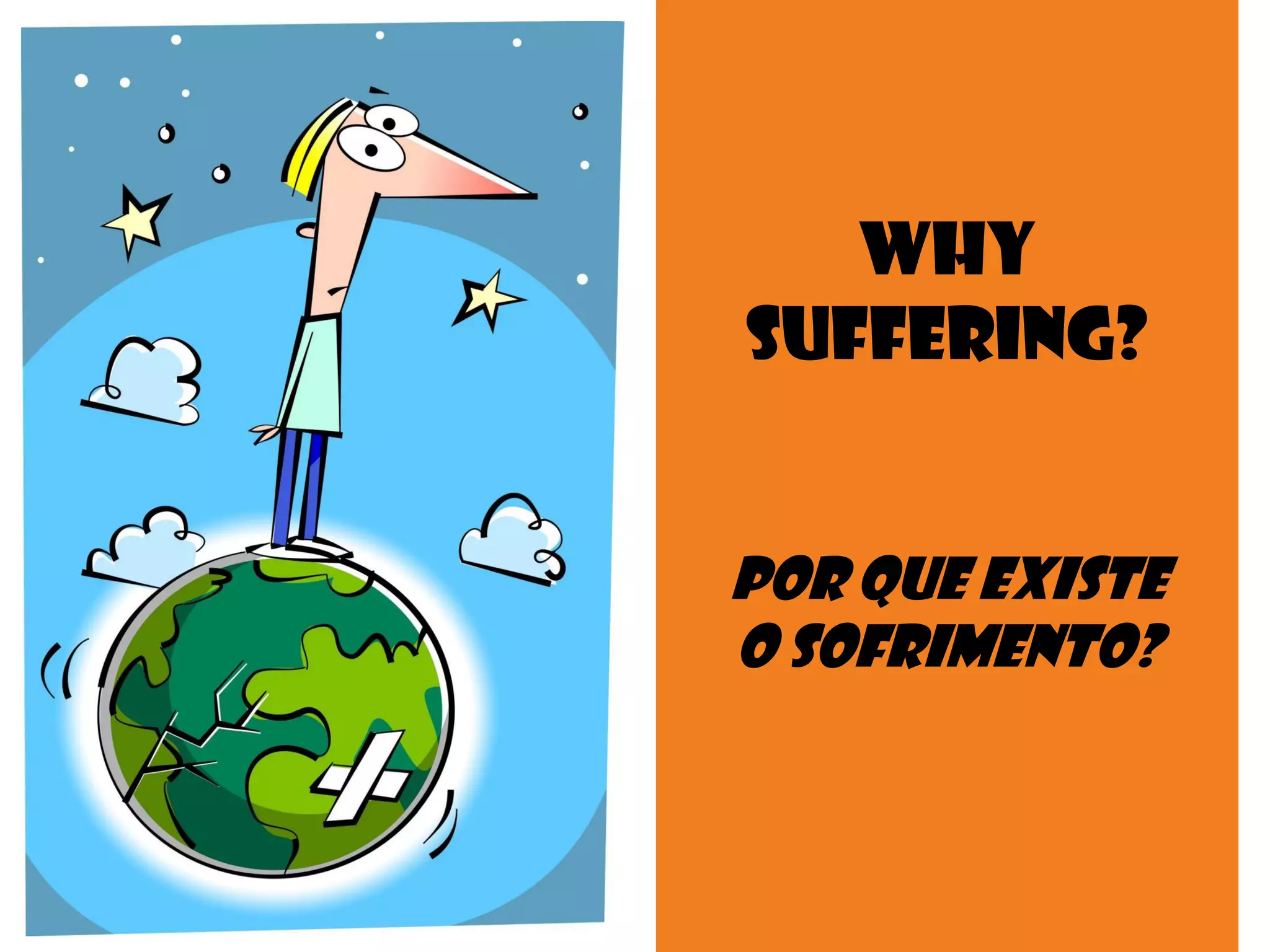
Why
Suffering?
por que existe
o sofrimento?
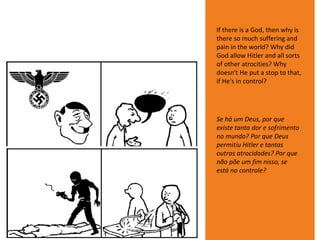
If there is a God, then why is
there so much suffering and
pain in the world? Why did
God allow Hitler and all sorts
of other atrocities? Why
doesn't He put a stop to that,
if He's in control?
Se há um Deus, por que
existe tanta dor e sofrimento
no mundo? Por que Deus
permitiu Hitler e tantas
outras atrocidades? Por que
não põe um fim nisso, se
está no controle?
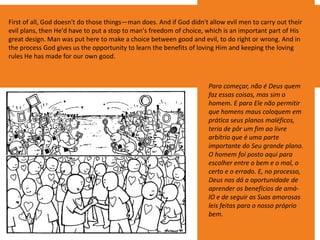
First of all, God doesn't do those things—man does. And if God didn't allow evil men to carry out their
evil plans, then He'd have to put a stop to man's freedom of choice, which is an important part of His
great design. Man was put here to make a choice between good and evil, to do right or wrong. And in
the process God gives us the opportunity to learn the benefits of loving Him and keeping the loving
rules He has made for our own good.
Para começar, não é Deus quem
faz essas coisas, mas sim o
homem. E para Ele não permitir
que homens maus coloquem em
prática seus planos maléficos,
teria de pôr um fim ao livre
arbítrio que é uma parte
importante do Seu grande plano.
O homem foi posto aqui para
escolher entre o bem e o mal, o
certo e o errado. E, no processo,
Deus nos dá a oportunidade de
aprender os benefícios de amá-
lO e de seguir as Suas amorosas
leis feitas para o nosso próprio
bem.
"In the world you will have tribulation," Jesus told
us. (John 16:33) In other words, troubles are more
of a guarantee than a stroke of bad luck.
Good and evil are both liberally distributed in
the world, with no distinction as to the religious
or moral inclinations of the individual. "[God]
makes His sun rise on the evil and on the good,
and sends rain on the just and on the unjust.“
(Matthew 5:45). God is not some kind of Santa
who only brings presents for the good children.
“No mundo tereis aflições”, avisa-nos Jesus.
(João 16:33) Em outras palavras, os problemas
não se resumem a uma onda de azar.
O bem e o mal são liberalmente distribuídos no
mundo, sem distinção das inclinações religiosas
ou morais dos indivíduos. “[Deus] faz que o Seu
sol se levante sobre maus e bons, e envia chuva
sobre justos e injustos.”(Mateus 5:45) Deus não é
algum tipo de Papai Noel que só traz presentes
para as crianças bem-comportadas.
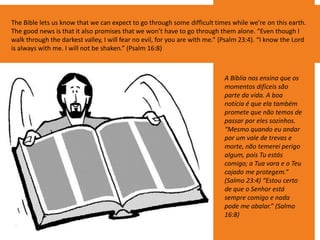
The Bible lets us know that we can expect to go through some difficult times while we’re on this earth.
The good news is that it also promises that we won’t have to go through them alone. “Even though I
walk through the darkest valley, I will fear no evil, for you are with me.” (Psalm 23:4). “I know the Lord
is always with me. I will not be shaken.” (Psalm 16:8)
A Bíblia nos ensina que os
momentos difíceis são
parte da vida. A boa
notícia é que ela também
promete que não temos de
passar por eles sozinhos.
“Mesmo quando eu andar
por um vale de trevas e
morte, não temerei perigo
algum, pois Tu estás
comigo; a Tua vara e o Teu
cajado me protegem.”
(Salmo 23:4) “Estou certo
de que o Senhor está
sempre comigo e nada
pode me abalar.” (Salmo
16:8)
Christ did not come to do away with suffering;
He did not come to explain it; He came to fill it
with His presence.
It is not a question of God allowing or not
allowing things to happen. It is part of living.
Our response to what happens is more
important than what happens. Here is a
mystery: one man's experience drives him to
curse God, while another man's identical
experience drives him to bless God. Your
response to what happens is more important
than what happens.
Text © Activated magazine; used by permission. Art (slightly adapted) © TFI. Presentation by www.freekidstories.org
Cristo não veio para desfazer o sofrimento nem
para explicá-lo, mas para enchê-lO com a Sua
presença.
A questão não é que Deus permita ou deixe de
permitir que as coisas aconteçam. É parte da vida.
Nossas reações ao que acontece são mais
importantes que os fatos em si. Eis um mistério:
uma experiência pode levar um homem a
amaldiçoar Deus, enquanto outro que passa por
algo idêntico é levado a bendizer Deus. A reação
ao que acontece é mais importante do que o fato
em si.

Por que existe o sofrimento - Why Suffering

  • 1.
  • 2.
    If there isa God, then why is there so much suffering and pain in the world? Why did God allow Hitler and all sorts of other atrocities? Why doesn't He put a stop to that, if He's in control? Se há um Deus, por que existe tanta dor e sofrimento no mundo? Por que Deus permitiu Hitler e tantas outras atrocidades? Por que não põe um fim nisso, se está no controle?
  • 3.
    First of all,God doesn't do those things—man does. And if God didn't allow evil men to carry out their evil plans, then He'd have to put a stop to man's freedom of choice, which is an important part of His great design. Man was put here to make a choice between good and evil, to do right or wrong. And in the process God gives us the opportunity to learn the benefits of loving Him and keeping the loving rules He has made for our own good. Para começar, não é Deus quem faz essas coisas, mas sim o homem. E para Ele não permitir que homens maus coloquem em prática seus planos maléficos, teria de pôr um fim ao livre arbítrio que é uma parte importante do Seu grande plano. O homem foi posto aqui para escolher entre o bem e o mal, o certo e o errado. E, no processo, Deus nos dá a oportunidade de aprender os benefícios de amá- lO e de seguir as Suas amorosas leis feitas para o nosso próprio bem.
  • 4.
    "In the worldyou will have tribulation," Jesus told us. (John 16:33) In other words, troubles are more of a guarantee than a stroke of bad luck. Good and evil are both liberally distributed in the world, with no distinction as to the religious or moral inclinations of the individual. "[God] makes His sun rise on the evil and on the good, and sends rain on the just and on the unjust.“ (Matthew 5:45). God is not some kind of Santa who only brings presents for the good children. “No mundo tereis aflições”, avisa-nos Jesus. (João 16:33) Em outras palavras, os problemas não se resumem a uma onda de azar. O bem e o mal são liberalmente distribuídos no mundo, sem distinção das inclinações religiosas ou morais dos indivíduos. “[Deus] faz que o Seu sol se levante sobre maus e bons, e envia chuva sobre justos e injustos.”(Mateus 5:45) Deus não é algum tipo de Papai Noel que só traz presentes para as crianças bem-comportadas.
  • 5.
    The Bible letsus know that we can expect to go through some difficult times while we’re on this earth. The good news is that it also promises that we won’t have to go through them alone. “Even though I walk through the darkest valley, I will fear no evil, for you are with me.” (Psalm 23:4). “I know the Lord is always with me. I will not be shaken.” (Psalm 16:8) A Bíblia nos ensina que os momentos difíceis são parte da vida. A boa notícia é que ela também promete que não temos de passar por eles sozinhos. “Mesmo quando eu andar por um vale de trevas e morte, não temerei perigo algum, pois Tu estás comigo; a Tua vara e o Teu cajado me protegem.” (Salmo 23:4) “Estou certo de que o Senhor está sempre comigo e nada pode me abalar.” (Salmo 16:8)
  • 6.
    Christ did notcome to do away with suffering; He did not come to explain it; He came to fill it with His presence. It is not a question of God allowing or not allowing things to happen. It is part of living. Our response to what happens is more important than what happens. Here is a mystery: one man's experience drives him to curse God, while another man's identical experience drives him to bless God. Your response to what happens is more important than what happens. Text © Activated magazine; used by permission. Art (slightly adapted) © TFI. Presentation by www.freekidstories.org Cristo não veio para desfazer o sofrimento nem para explicá-lo, mas para enchê-lO com a Sua presença. A questão não é que Deus permita ou deixe de permitir que as coisas aconteçam. É parte da vida. Nossas reações ao que acontece são mais importantes que os fatos em si. Eis um mistério: uma experiência pode levar um homem a amaldiçoar Deus, enquanto outro que passa por algo idêntico é levado a bendizer Deus. A reação ao que acontece é mais importante do que o fato em si.