OWASP AppSec                          The OWASP Foundation
Brazil 2010, Campinas, SP                  http://www.owasp.org


    Levantamento de Informação
    The Tao of Hacking - Detecção de vulnerabilidades
    em dispositivos de rede baseados em web
    Aditya K Sood , SecNiche Security
    (adi_ks@secniche.org)

    Mauro Risonho de Paula Assumpção
    (firebits@backtrack.com.br)
The OWASP Foundation
                                             http://www.owasp.org


AVISO LEGAL

 Todos os pontos de vista exclusivamente com base no trabalho
                          realizado pela
                      SecNiche Security.


     (C) SecNiche Security | http://www.secniche.org
        O conteúdo deve ser usado com a permissão do SecNiche
                                                                    2
Agenda

 •   Porque Levantar Informações?
 •   Padrões de Levantamento de Informações
 •   Web Network Devices – Casos Estudados
 •   Proxy e Serviços Anônimos
 •   Más Práticas de Design
 •   Free Web
 •   Conclusão


                                              3
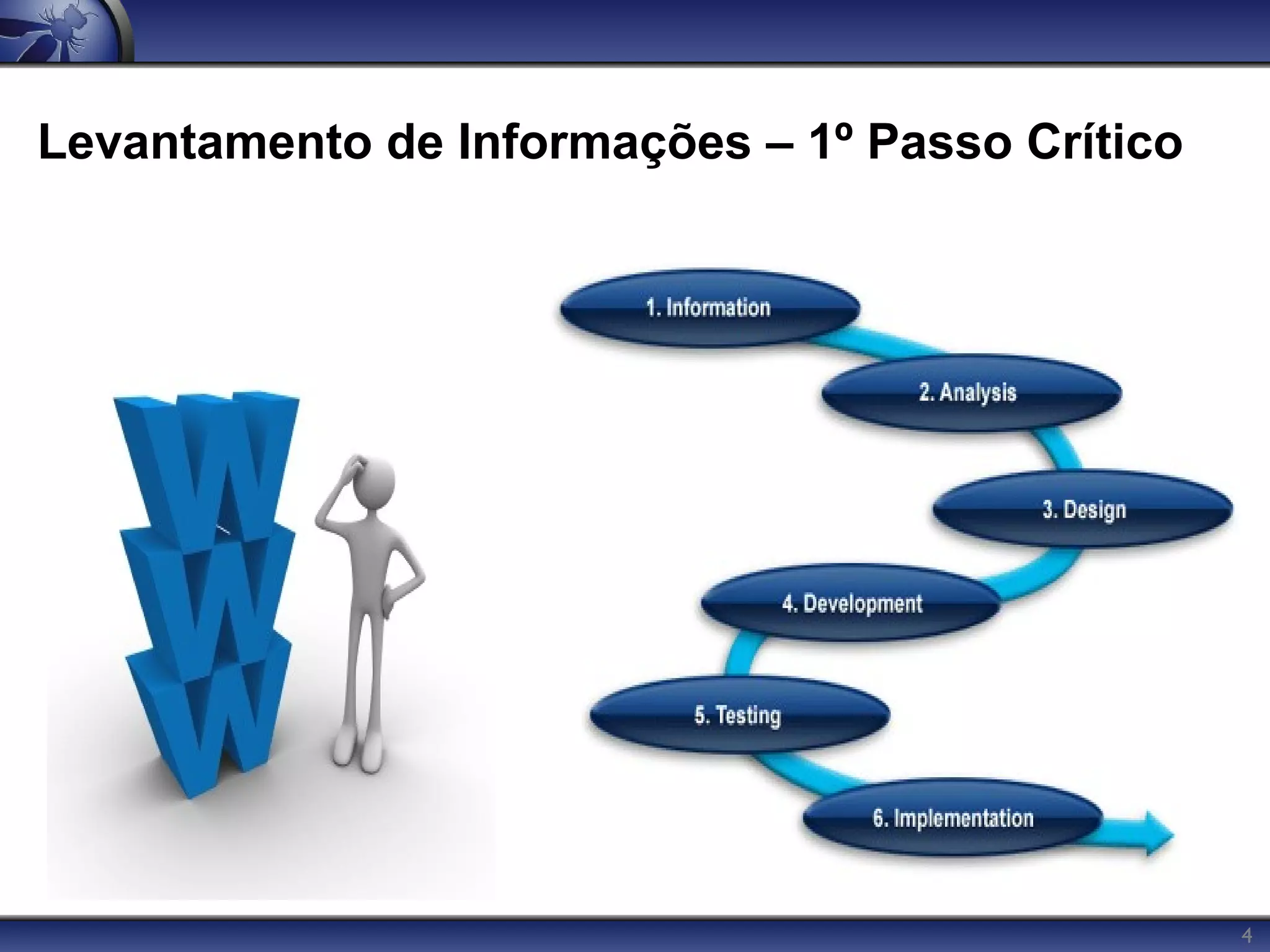
Levantamento de Informações – 1º Passo Crítico


                                                 4
Levantamento de Informações – Várias Faces na Web
 Redes Complexas na Web

 Periféricos e Dispositivos de Segurança na Web

 Claro, World Wide Web é totalmente randômica, dinâmica e
  muitas vezes fora de padrão.


                                                             5
Porque Levantamento de Informações?
 Determinação do Nível Crítico da estrutura interna .

 Parâmetros de requisições HTTP são manipulados.

 “301 movido permanentemente” é muitas vezes “código de
  resposta”.

 Os dispositivos usados podem ter seus IPs internos “spoofados”.

 Cada dispositivo tem seu próprio método de trabalho

 Usado para Set Cookie de uma maneira diferente .

 Usado para alterar o parâmetro de HTTP header.

 Analisar a mudança na HTTP headers.

                                                                    6
Padrões de informação na Web são importantes

    Porque ?
      •   Quando o cabeçalho "servidor" é removido das respostas
           •   A maioria das assinaturas de detecção “somem”
      •   Banner grabbing não fornece informações suficientes
      •   Headers revelam menos informação


                                                                   7
Funcionalidade de Dispositivos de Rede na Web


      •   Server Cloaking

      •   Setando parâmetros Set-Cookie com nomes exclusivos

      •   Manipulação de resposta do Header

      •   Diferentes combinações e sequência das respostas do
          HTTP


                                                                8
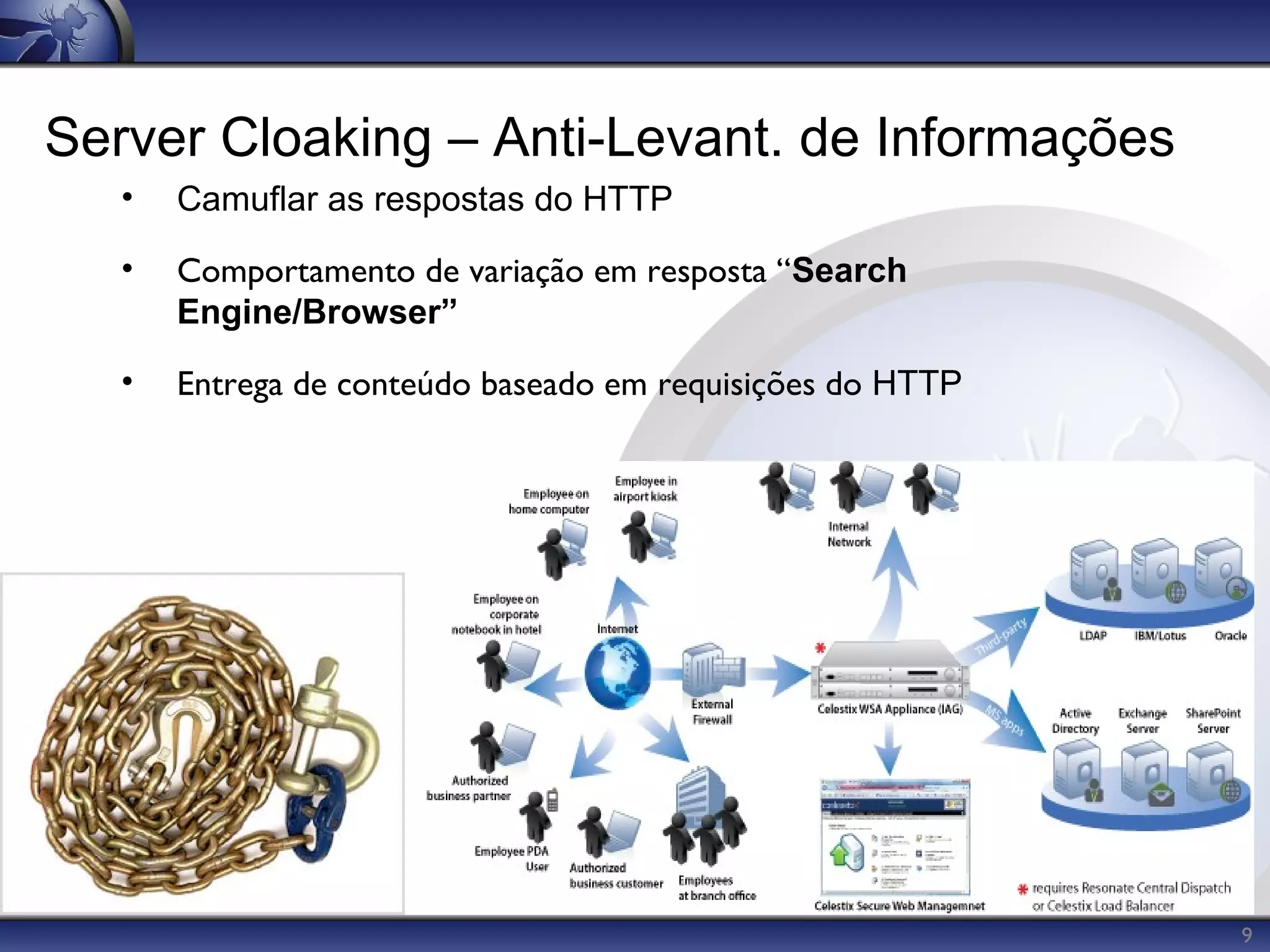
Server Cloaking – Anti-Levant. de Informações
   •   Camuflar as respostas do HTTP

   •   Comportamento de variação em resposta “Search
       Engine/Browser”

   •   Entrega de conteúdo baseado em requisições do HTTP


                                                            9
Casos Estudados

  Quase 80% das assinaturas novas para a
   detecção de vários dispositivos de rede
             baseados na web.

            Vamos mostrar alguns dos novos padrões


                                                     10
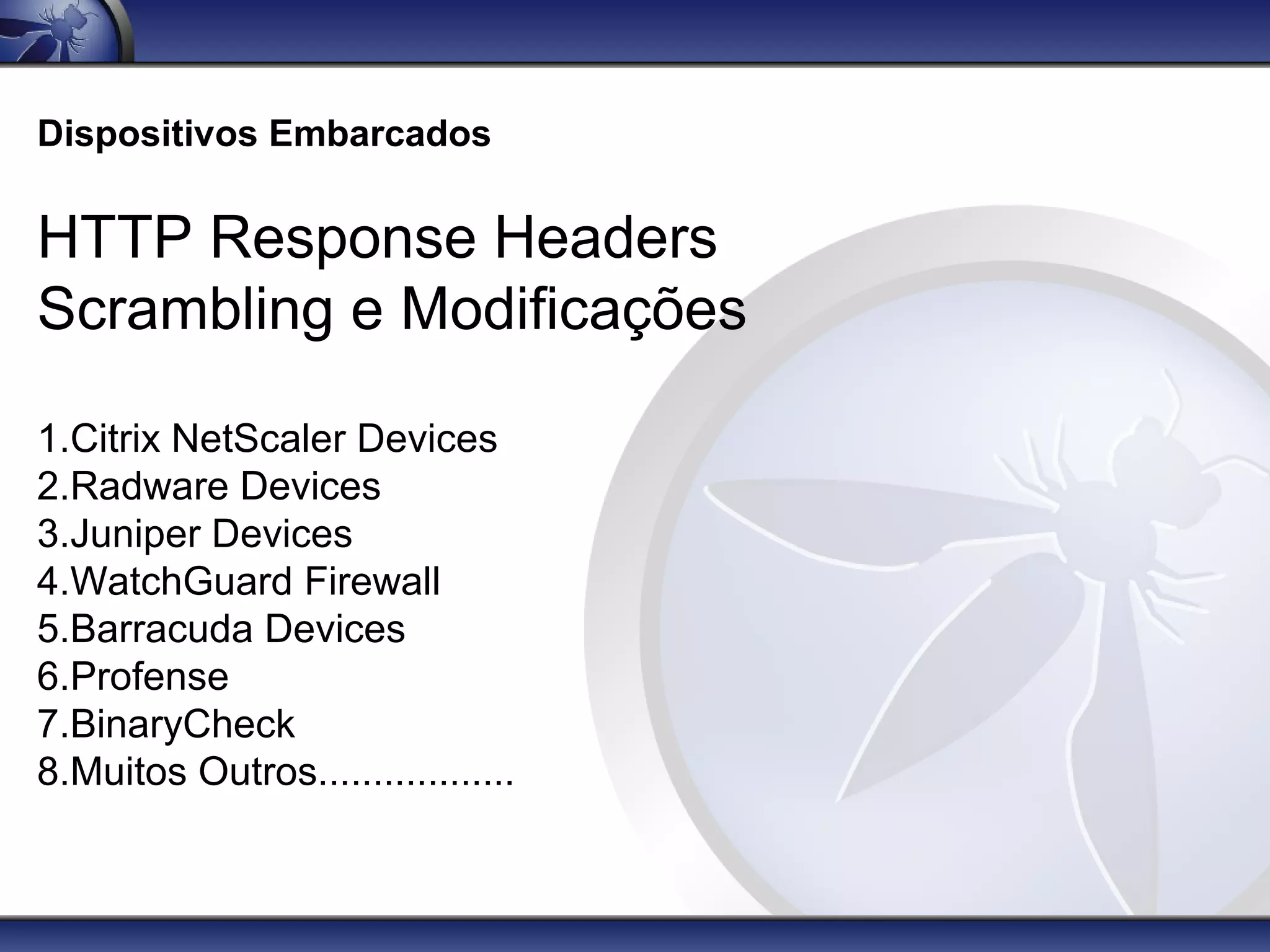
Dispositivos Embarcados


HTTP Response Headers
Scrambling e Modificações

1.Citrix NetScaler Devices
2.Radware Devices
3.Juniper Devices
4.WatchGuard Firewall
5.Barracuda Devices
6.Profense
7.BinaryCheck
8.Muitos Outros..................
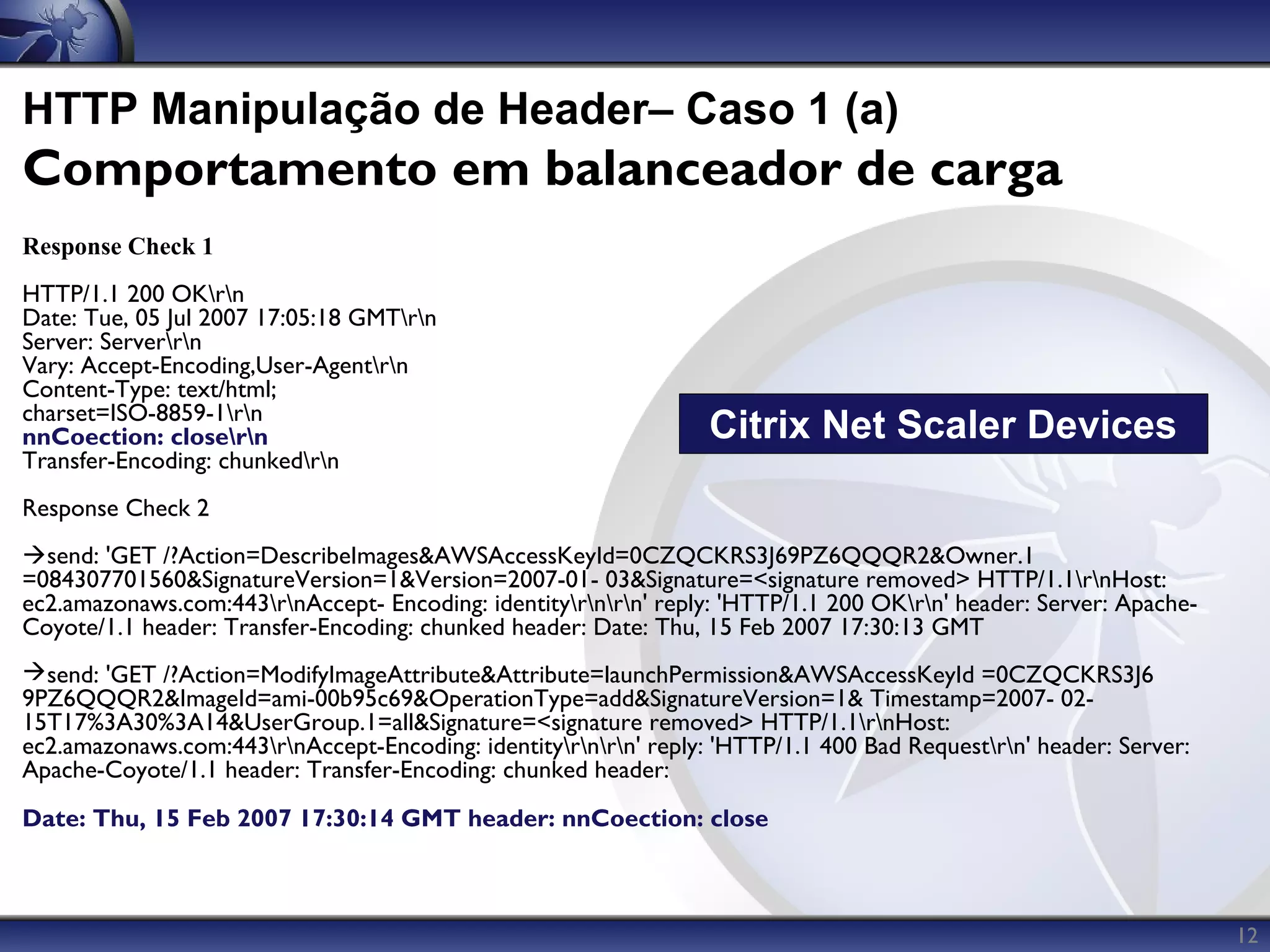
HTTP Manipulação de Header– Caso 1 (a)
Comportamento em balanceador de carga
Response Check 1
HTTP/1.1 200 OKrn
Date: Tue, 05 Jul 2007 17:05:18 GMTrn
Server: Serverrn
Vary: Accept-Encoding,User-Agentrn
Content-Type: text/html;
charset=ISO-8859-1rn
nnCoection: closern                                             Citrix Net Scaler Devices
Transfer-Encoding: chunkedrn
Response Check 2
send: 'GET /?Action=DescribeImages&AWSAccessKeyId=0CZQCKRS3J69PZ6QQQR2&Owner.1
=084307701560&SignatureVersion=1&Version=2007-01- 03&Signature=<signature removed> HTTP/1.1rnHost:
ec2.amazonaws.com:443rnAccept- Encoding: identityrnrn' reply: 'HTTP/1.1 200 OKrn' header: Server: Apache-
Coyote/1.1 header: Transfer-Encoding: chunked header: Date: Thu, 15 Feb 2007 17:30:13 GMT
send: 'GET /?Action=ModifyImageAttribute&Attribute=launchPermission&AWSAccessKeyId =0CZQCKRS3J6
9PZ6QQQR2&ImageId=ami-00b95c69&OperationType=add&SignatureVersion=1& Timestamp=2007- 02-
15T17%3A30%3A14&UserGroup.1=all&Signature=<signature removed> HTTP/1.1rnHost:
ec2.amazonaws.com:443rnAccept-Encoding: identityrnrn' reply: 'HTTP/1.1 400 Bad Requestrn' header: Server:
Apache-Coyote/1.1 header: Transfer-Encoding: chunked header:
Date: Thu, 15 Feb 2007 17:30:14 GMT header: nnCoection: close


                                                                                                                    12
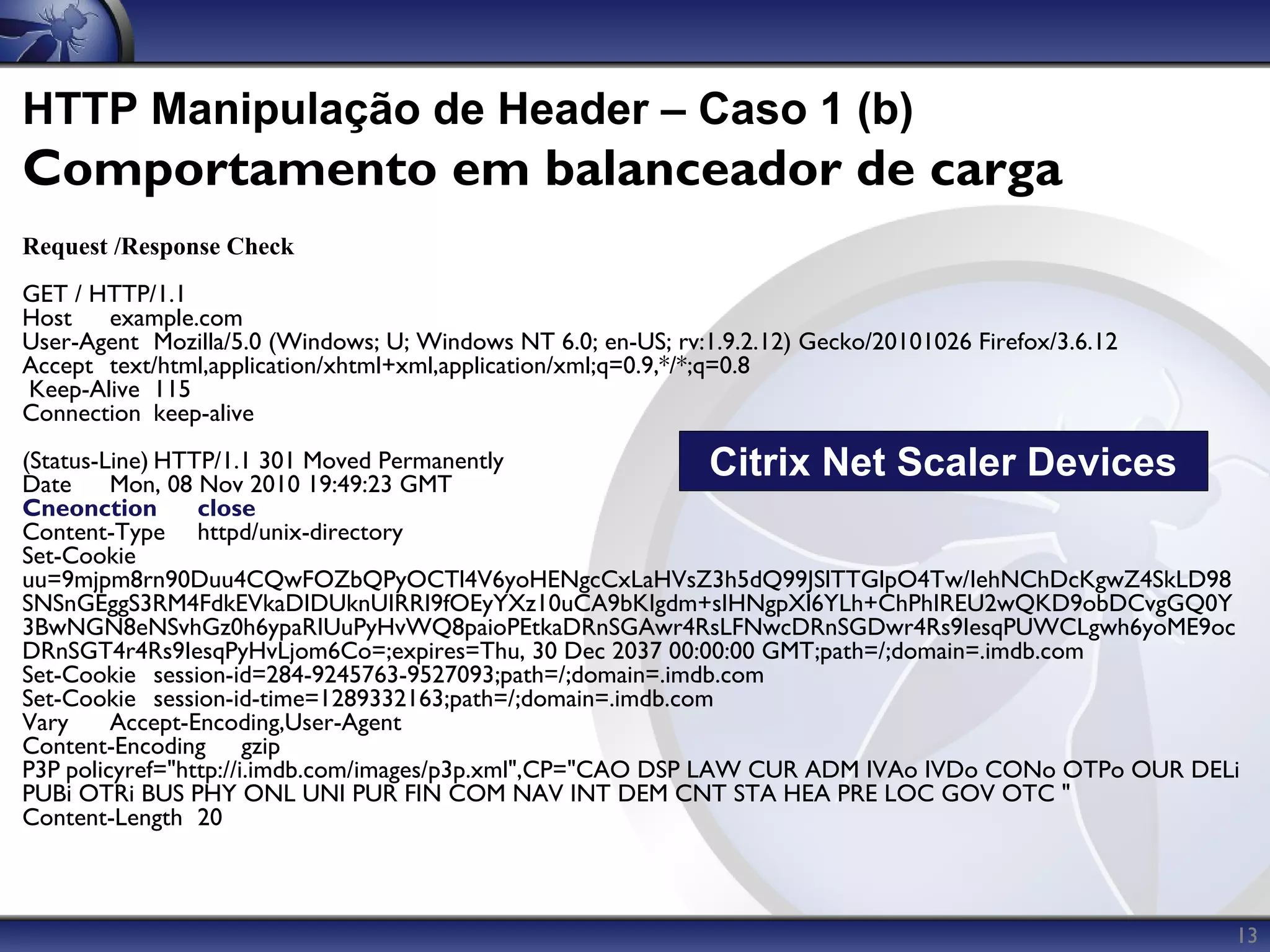
HTTP Manipulação de Header – Caso 1 (b)
Comportamento em balanceador de carga
Request /Response Check
GET / HTTP/1.1
Host   example.com
User-Agent Mozilla/5.0 (Windows; U; Windows NT 6.0; en-US; rv:1.9.2.12) Gecko/20101026 Firefox/3.6.12
Accept text/html,application/xhtml+xml,application/xml;q=0.9,*/*;q=0.8
Keep-Alive 115
Connection keep-alive
(Status-Line) HTTP/1.1 301 Moved Permanently
Date     Mon, 08 Nov 2010 19:49:23 GMT
                                                               Citrix Net Scaler Devices
Cneonction       close
Content-Type httpd/unix-directory
Set-Cookie
uu=9mjpm8rn90Duu4CQwFOZbQPyOCTl4V6yoHENgcCxLaHVsZ3h5dQ99JSlTTGlpO4Tw/IehNChDcKgwZ4SkLD98
SNSnGEggS3RM4FdkEVkaDIDUknUIRRI9fOEyYXz10uCA9bKIgdm+sIHNgpXl6YLh+ChPhIREU2wQKD9obDCvgGQ0Y
3BwNGN8eNSvhGz0h6ypaRIUuPyHvWQ8paioPEtkaDRnSGAwr4RsLFNwcDRnSGDwr4Rs9IesqPUWCLgwh6yoME9oc
DRnSGT4r4Rs9IesqPyHvLjom6Co=;expires=Thu, 30 Dec 2037 00:00:00 GMT;path=/;domain=.imdb.com
Set-Cookie session-id=284-9245763-9527093;path=/;domain=.imdb.com
Set-Cookie session-id-time=1289332163;path=/;domain=.imdb.com
Vary     Accept-Encoding,User-Agent
Content-Encoding gzip
P3P policyref="http://i.imdb.com/images/p3p.xml",CP="CAO DSP LAW CUR ADM IVAo IVDo CONo OTPo OUR DELi
PUBi OTRi BUS PHY ONL UNI PUR FIN COM NAV INT DEM CNT STA HEA PRE LOC GOV OTC "
Content-Length 20


                                                                                                        13
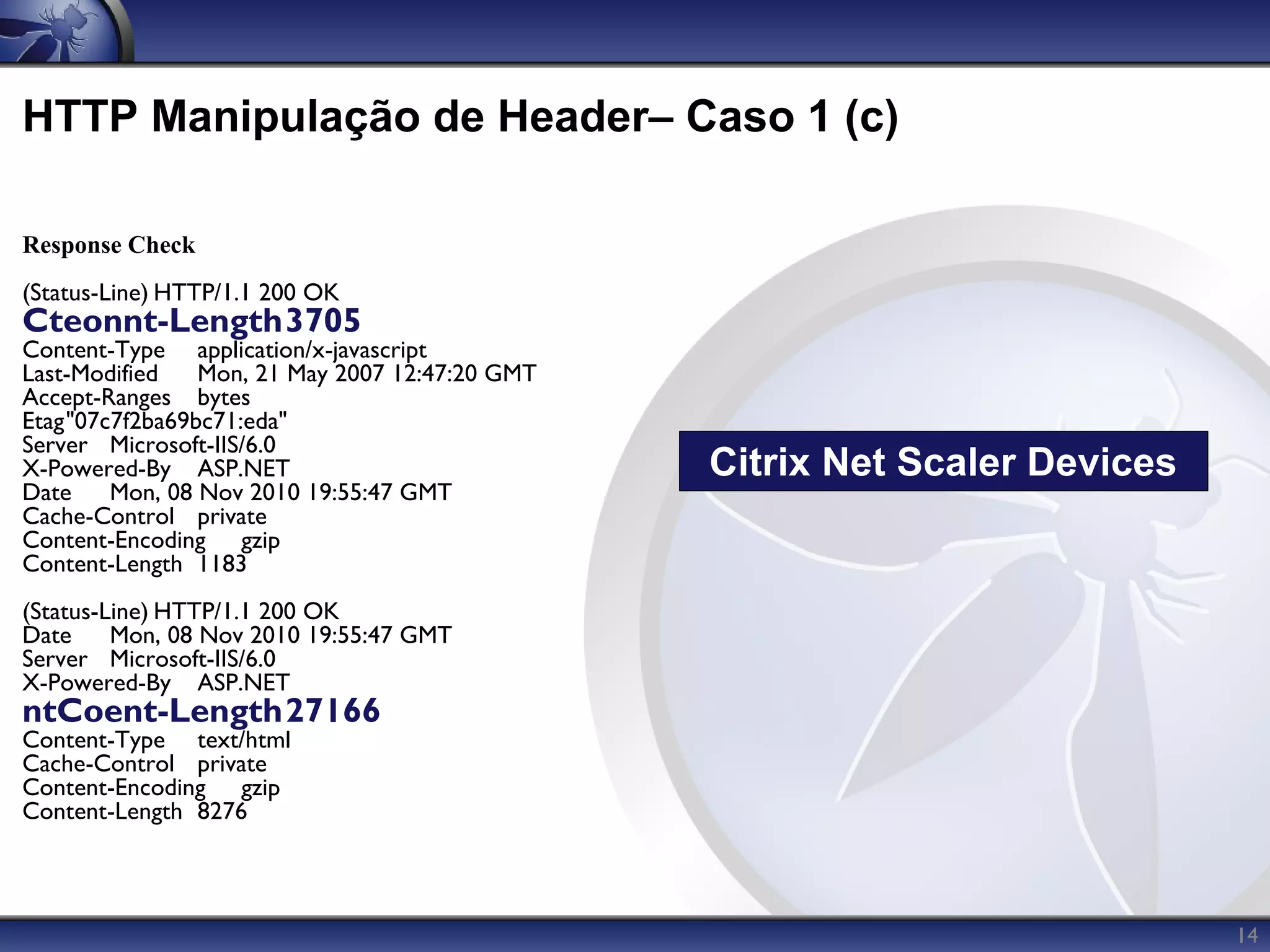
HTTP Manipulação de Header– Caso 1 (c)

Response Check
(Status-Line) HTTP/1.1 200 OK
Cteonnt-Length3705
Content-Type application/x-javascript
Last-Modified   Mon, 21 May 2007 12:47:20 GMT
Accept-Ranges bytes
Etag"07c7f2ba69bc71:eda"
Server Microsoft-IIS/6.0
X-Powered-By ASP.NET                            Citrix Net Scaler Devices
Date    Mon, 08 Nov 2010 19:55:47 GMT
Cache-Control private
Content-Encoding gzip
Content-Length 1183
(Status-Line) HTTP/1.1 200 OK
Date     Mon, 08 Nov 2010 19:55:47 GMT
Server Microsoft-IIS/6.0
X-Powered-By ASP.NET
ntCoent-Length27166
Content-Type text/html
Cache-Control private
Content-Encoding gzip
Content-Length 8276


                                                                            14
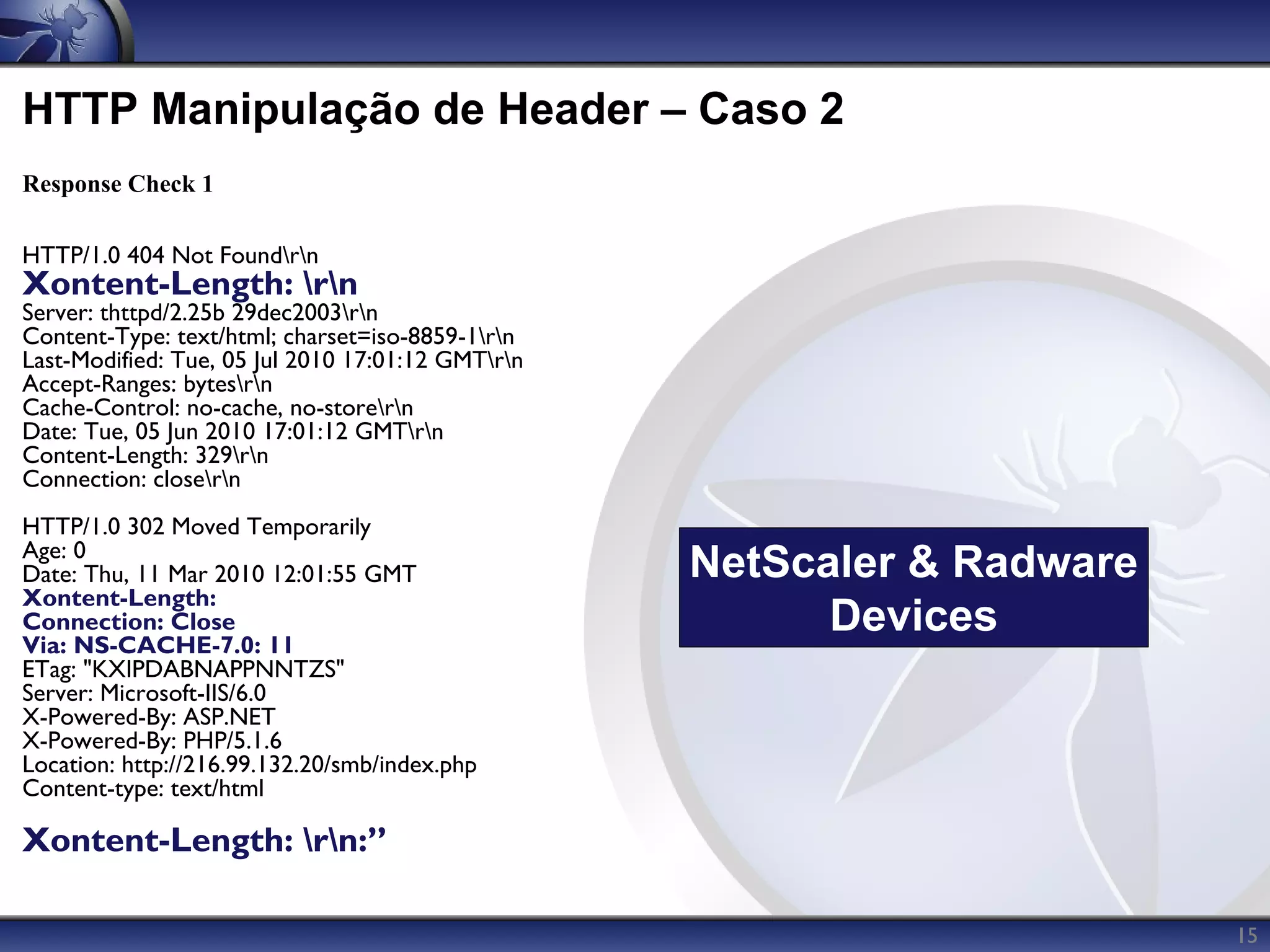
HTTP Manipulação de Header – Caso 2
Response Check 1

HTTP/1.0 404 Not Foundrn
Xontent-Length: rn
Server: thttpd/2.25b 29dec2003rn
Content-Type: text/html; charset=iso-8859-1rn
Last-Modified: Tue, 05 Jul 2010 17:01:12 GMTrn
Accept-Ranges: bytesrn
Cache-Control: no-cache, no-storern
Date: Tue, 05 Jun 2010 17:01:12 GMTrn
Content-Length: 329rn
Connection: closern
HTTP/1.0 302 Moved Temporarily
Age: 0
Date: Thu, 11 Mar 2010 12:01:55 GMT                NetScaler & Radware
Xontent-Length:
Connection: Close                                        Devices
Via: NS-CACHE-7.0: 11
ETag: "KXIPDABNAPPNNTZS"
Server: Microsoft-IIS/6.0
X-Powered-By: ASP.NET
X-Powered-By: PHP/5.1.6
Location: http://216.99.132.20/smb/index.php
Content-type: text/html

Xontent-Length: rn:”

                                                                         15
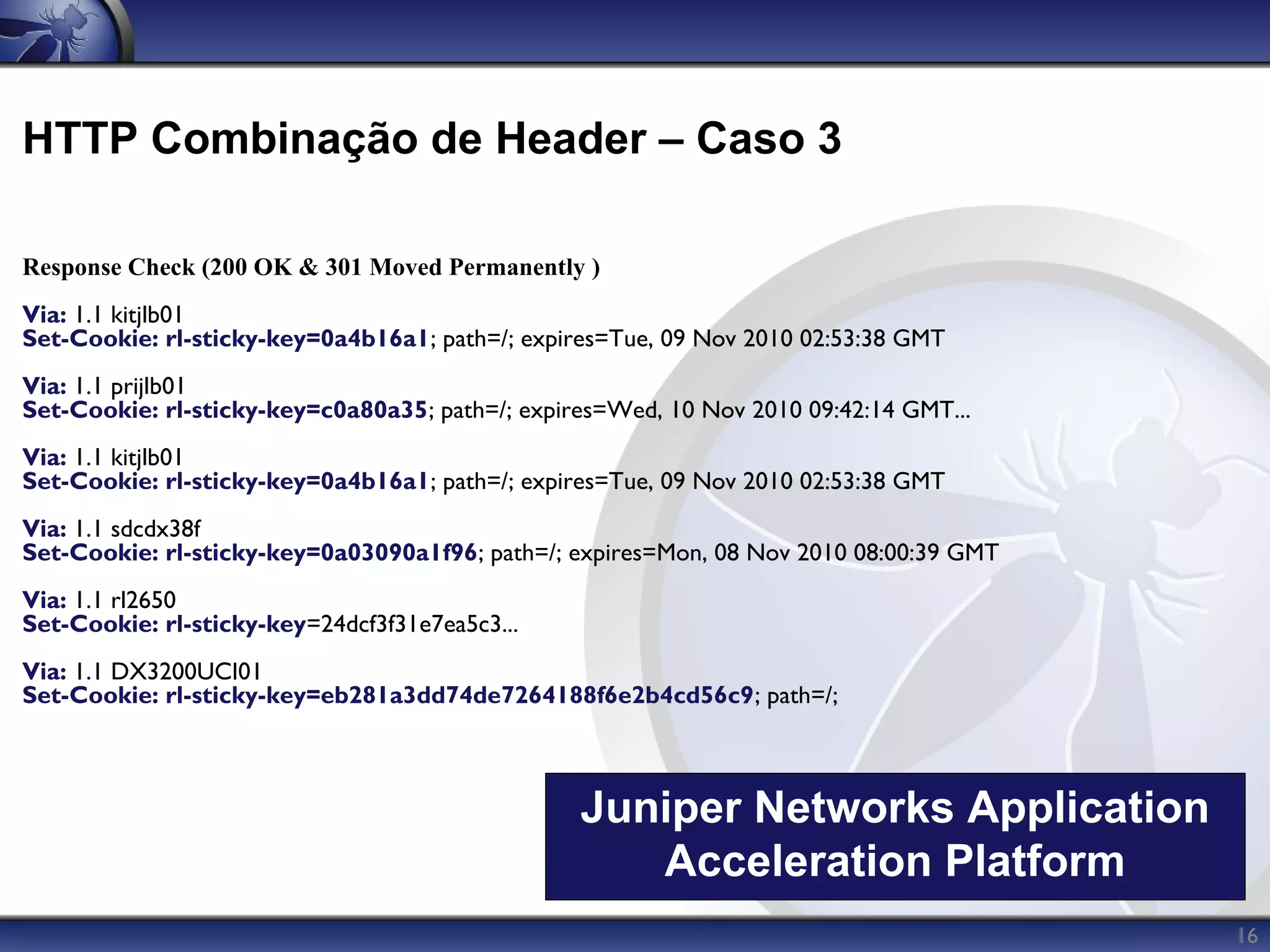
HTTP Combinação de Header – Caso 3

Response Check (200 OK & 301 Moved Permanently )
Via: 1.1 kitjlb01
Set-Cookie: rl-sticky-key=0a4b16a1; path=/; expires=Tue, 09 Nov 2010 02:53:38 GMT
Via: 1.1 prijlb01
Set-Cookie: rl-sticky-key=c0a80a35; path=/; expires=Wed, 10 Nov 2010 09:42:14 GMT...
Via: 1.1 kitjlb01
Set-Cookie: rl-sticky-key=0a4b16a1; path=/; expires=Tue, 09 Nov 2010 02:53:38 GMT
Via: 1.1 sdcdx38f
Set-Cookie: rl-sticky-key=0a03090a1f96; path=/; expires=Mon, 08 Nov 2010 08:00:39 GMT
Via: 1.1 rl2650
Set-Cookie: rl-sticky-key=24dcf3f31e7ea5c3...
Via: 1.1 DX3200UCI01
Set-Cookie: rl-sticky-key=eb281a3dd74de7264188f6e2b4cd56c9; path=/;


                                                 Juniper Networks Application
                                                    Acceleration Platform
                                                                                        16
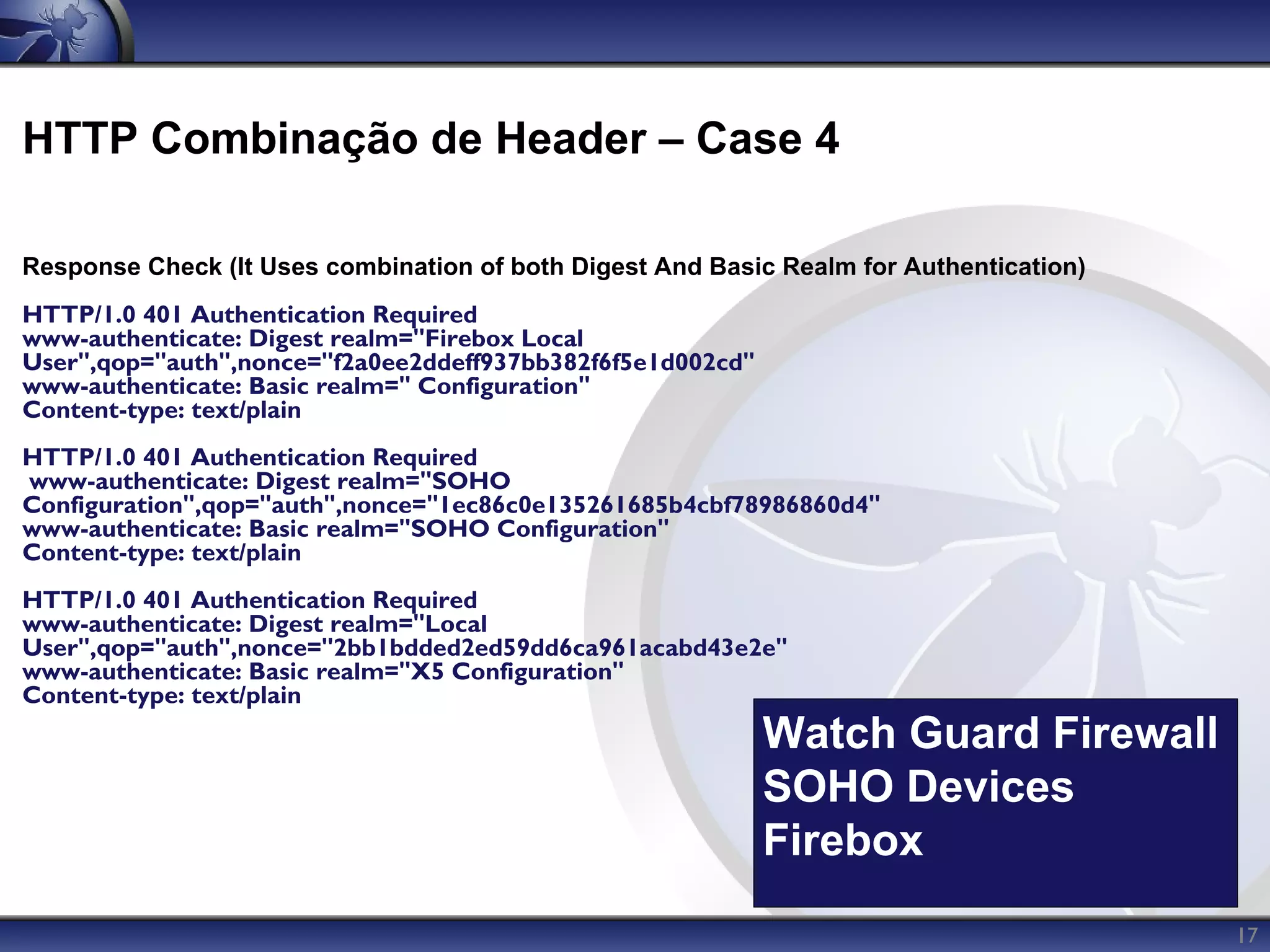
HTTP Combinação de Header – Case 4

Response Check (It Uses combination of both Digest And Basic Realm for Authentication)
HTTP/1.0 401 Authentication Required
www-authenticate: Digest realm="Firebox Local
User",qop="auth",nonce="f2a0ee2ddeff937bb382f6f5e1d002cd"
www-authenticate: Basic realm=" Configuration"
Content-type: text/plain
HTTP/1.0 401 Authentication Required
www-authenticate: Digest realm="SOHO
Configuration",qop="auth",nonce="1ec86c0e135261685b4cbf78986860d4"
www-authenticate: Basic realm="SOHO Configuration"
Content-type: text/plain
HTTP/1.0 401 Authentication Required
www-authenticate: Digest realm="Local
User",qop="auth",nonce="2bb1bdded2ed59dd6ca961acabd43e2e"
www-authenticate: Basic realm="X5 Configuration"
Content-type: text/plain
                                                            Watch Guard Firewall
                                                            SOHO Devices
                                                            Firebox
                                                                                         17
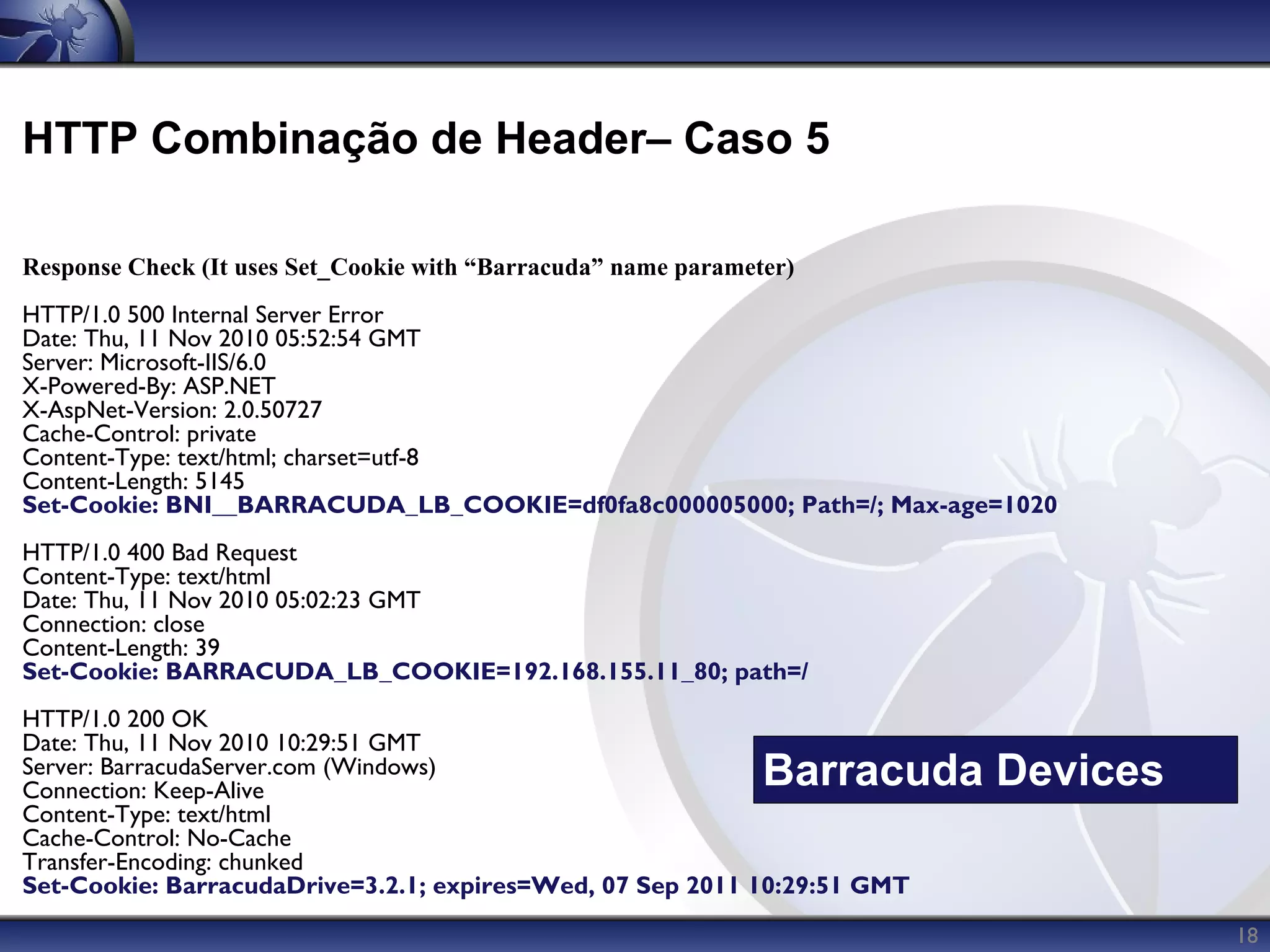
HTTP Combinação de Header– Caso 5

Response Check (It uses Set_Cookie with “Barracuda” name parameter)
HTTP/1.0 500 Internal Server Error
Date: Thu, 11 Nov 2010 05:52:54 GMT
Server: Microsoft-IIS/6.0
X-Powered-By: ASP.NET
X-AspNet-Version: 2.0.50727
Cache-Control: private
Content-Type: text/html; charset=utf-8
Content-Length: 5145
Set-Cookie: BNI__BARRACUDA_LB_COOKIE=df0fa8c000005000; Path=/; Max-age=1020
HTTP/1.0 400 Bad Request
Content-Type: text/html
Date: Thu, 11 Nov 2010 05:02:23 GMT
Connection: close
Content-Length: 39
Set-Cookie: BARRACUDA_LB_COOKIE=192.168.155.11_80; path=/
HTTP/1.0 200 OK
Date: Thu, 11 Nov 2010 10:29:51 GMT
Server: BarracudaServer.com (Windows)
Connection: Keep-Alive
                                                                Barracuda Devices
Content-Type: text/html
Cache-Control: No-Cache
Transfer-Encoding: chunked
Set-Cookie: BarracudaDrive=3.2.1; expires=Wed, 07 Sep 2011 10:29:51 GMT
                                                                                    18
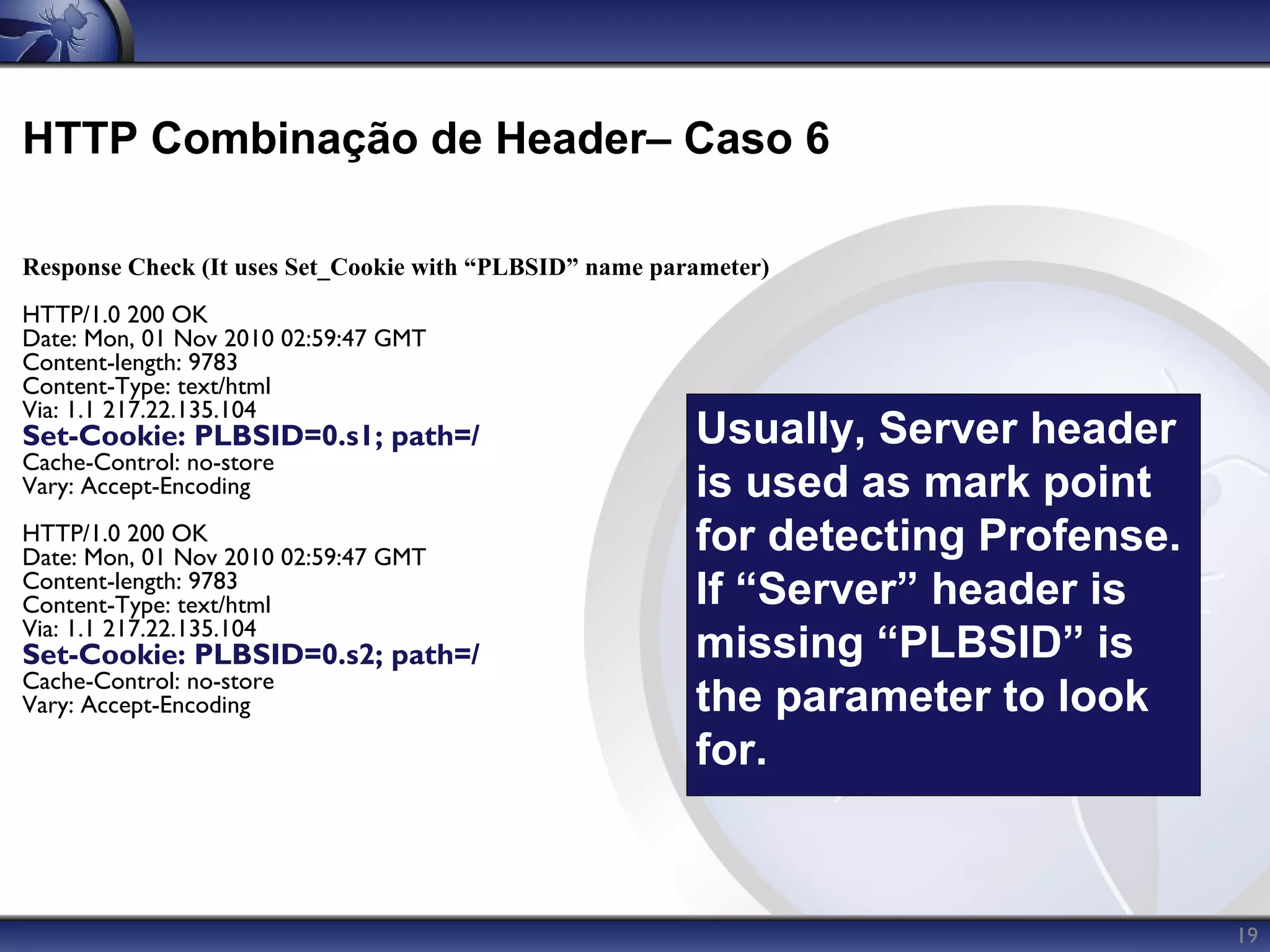
HTTP Combinação de Header– Caso 6

Response Check (It uses Set_Cookie with “PLBSID” name parameter)
HTTP/1.0 200 OK
Date: Mon, 01 Nov 2010 02:59:47 GMT
Content-length: 9783
Content-Type: text/html
Via: 1.1 217.22.135.104
Set-Cookie: PLBSID=0.s1; path=/                          Usually, Server header
Cache-Control: no-store
Vary: Accept-Encoding                                    is used as mark point
HTTP/1.0 200 OK
Date: Mon, 01 Nov 2010 02:59:47 GMT
                                                         for detecting Profense.
Content-length: 9783
Content-Type: text/html                                  If “Server” header is
Via: 1.1 217.22.135.104
Set-Cookie: PLBSID=0.s2; path=/                          missing “PLBSID” is
Cache-Control: no-store
Vary: Accept-Encoding                                    the parameter to look
                                                         for.


                                                                                   19
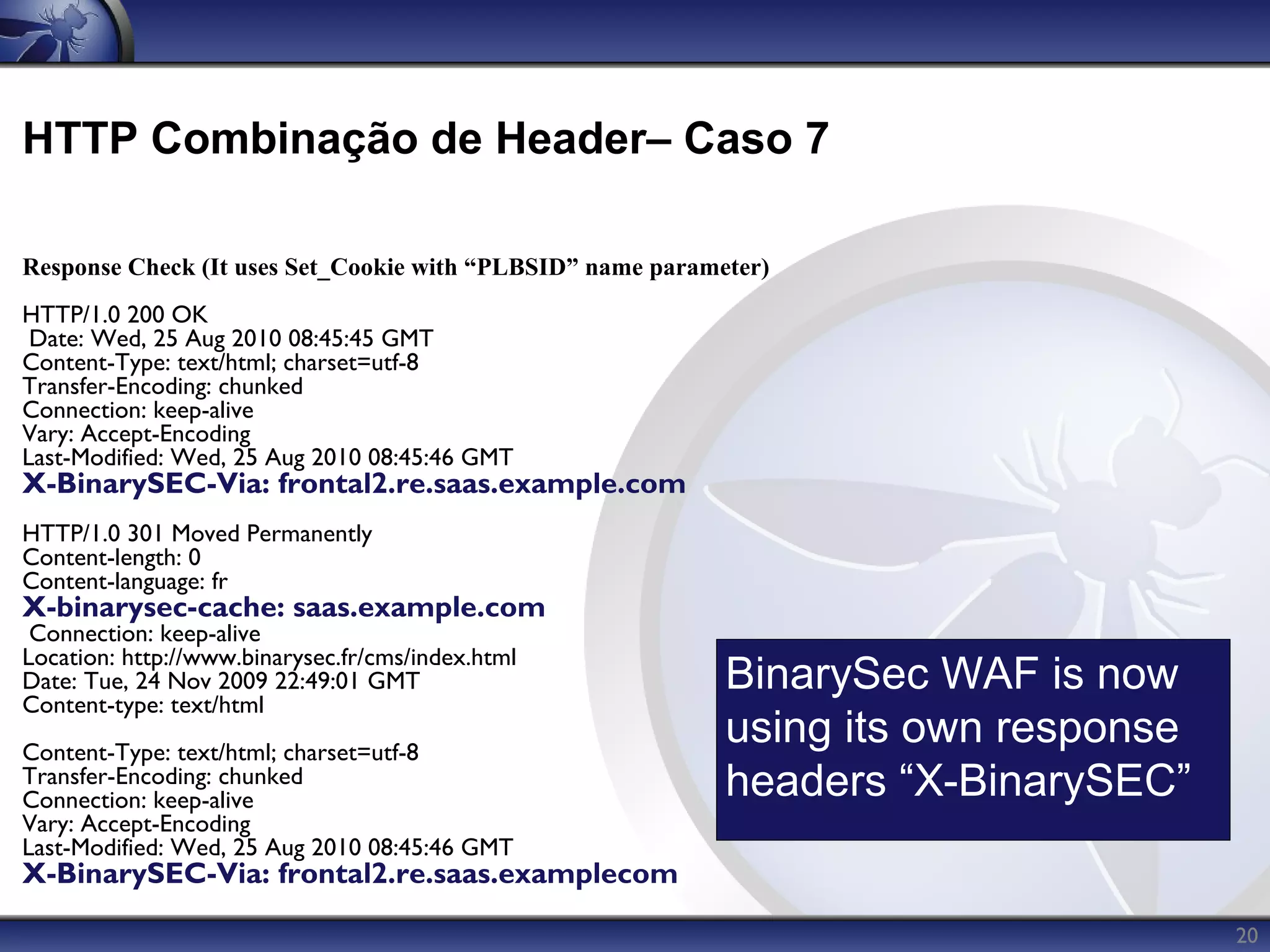
HTTP Combinação de Header– Caso 7

Response Check (It uses Set_Cookie with “PLBSID” name parameter)
HTTP/1.0 200 OK
 Date: Wed, 25 Aug 2010 08:45:45 GMT
Content-Type: text/html; charset=utf-8
Transfer-Encoding: chunked
Connection: keep-alive
Vary: Accept-Encoding
Last-Modified: Wed, 25 Aug 2010 08:45:46 GMT
X-BinarySEC-Via: frontal2.re.saas.example.com
HTTP/1.0 301 Moved Permanently
Content-length: 0
Content-language: fr
X-binarysec-cache: saas.example.com
 Connection: keep-alive
Location: http://www.binarysec.fr/cms/index.html
Date: Tue, 24 Nov 2009 22:49:01 GMT                         BinarySec WAF is now
Content-type: text/html
Content-Type: text/html; charset=utf-8
                                                            using its own response
Transfer-Encoding: chunked
Connection: keep-alive                                      headers “X-BinarySEC”
Vary: Accept-Encoding
Last-Modified: Wed, 25 Aug 2010 08:45:46 GMT
X-BinarySEC-Via: frontal2.re.saas.examplecom

                                                                                     20
Dispositivos Embarcados

Gerenciamento de Layout de
Cookies de Sessão e Truques

1.Big IP Server Devices
2.Juniper Devices
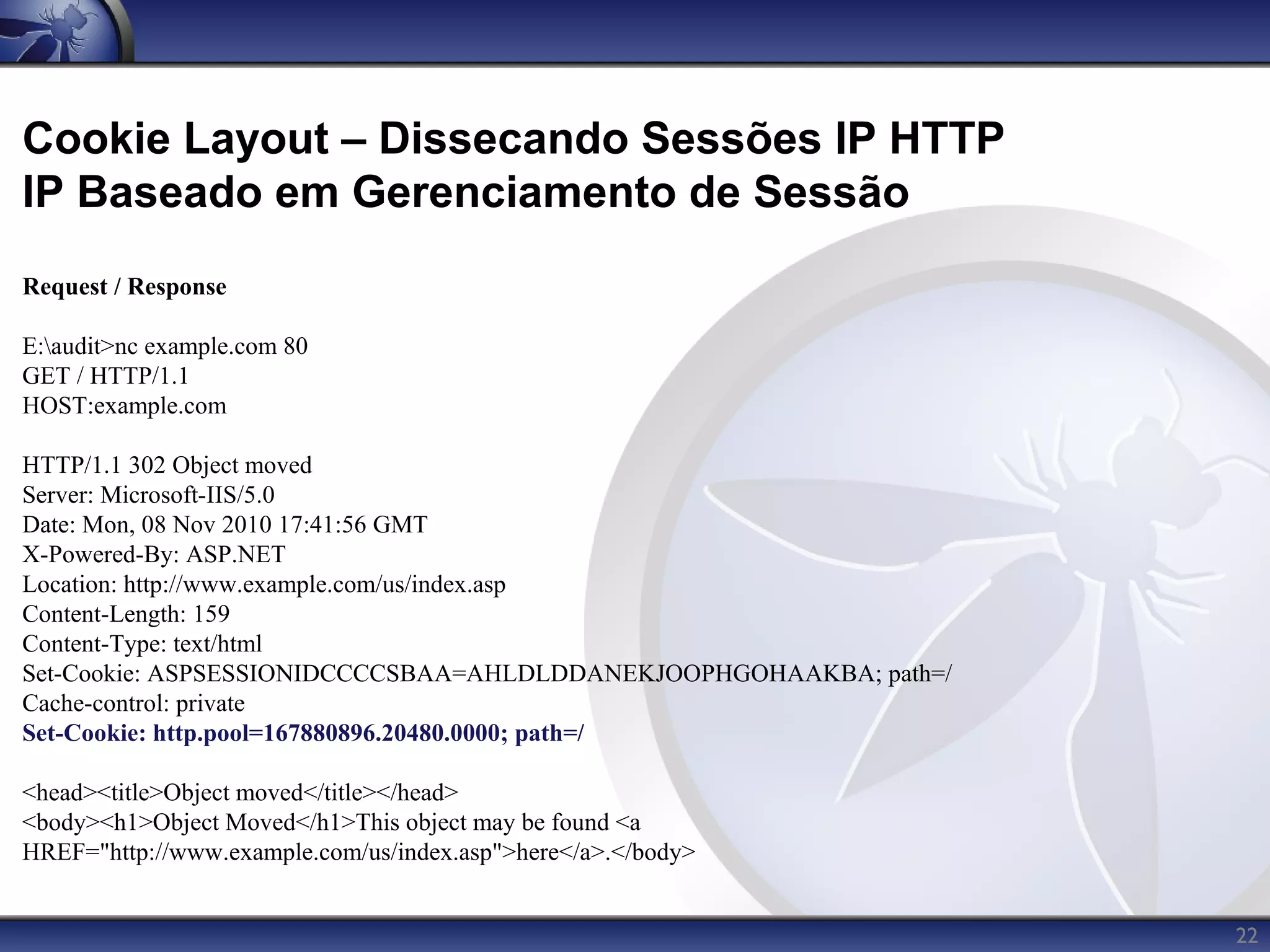
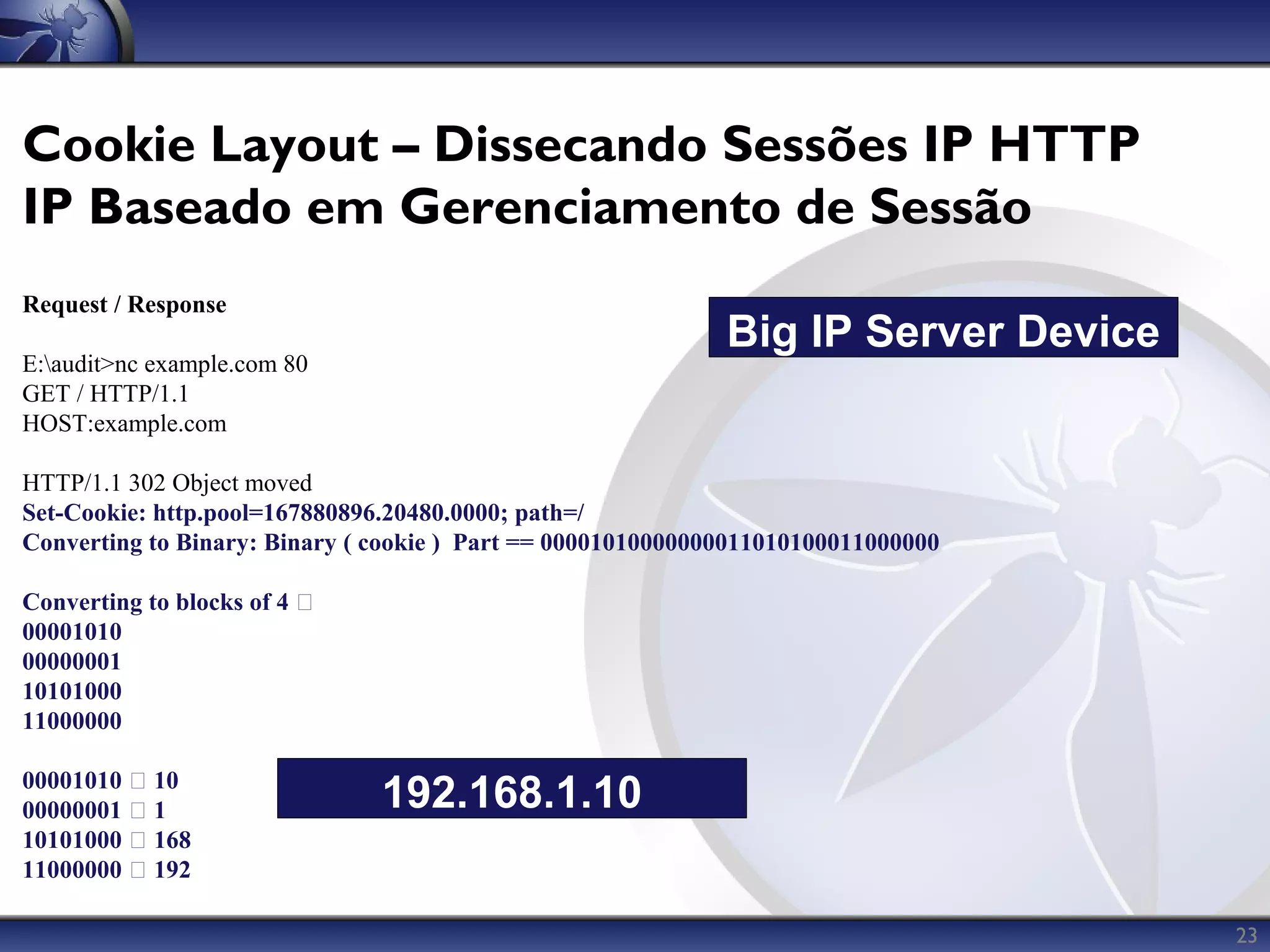
Cookie Layout – Dissecando Sessões IP HTTP
IP Baseado em Gerenciamento de Sessão
Request / Response

E:audit>nc example.com 80
GET / HTTP/1.1
HOST:example.com

HTTP/1.1 302 Object moved
Server: Microsoft-IIS/5.0
Date: Mon, 08 Nov 2010 17:41:56 GMT
X-Powered-By: ASP.NET
Location: http://www.example.com/us/index.asp
Content-Length: 159
Content-Type: text/html
Set-Cookie: ASPSESSIONIDCCCCSBAA=AHLDLDDANEKJOOPHGOHAAKBA; path=/
Cache-control: private
Set-Cookie: http.pool=167880896.20480.0000; path=/

<head><title>Object moved</title></head>
<body><h1>Object Moved</h1>This object may be found <a
HREF="http://www.example.com/us/index.asp">here</a>.</body>


                                                                    22
Cookie Layout – Dissecando Sessões IP HTTP
IP Baseado em Gerenciamento de Sessão
Request / Response
                                                             Big IP Server Device
E:audit>nc example.com 80
GET / HTTP/1.1
HOST:example.com

HTTP/1.1 302 Object moved
Set-Cookie: http.pool=167880896.20480.0000; path=/
Converting to Binary: Binary ( cookie ) Part == 00001010000000011010100011000000

Converting to blocks of 4 
00001010
00000001
10101000
11000000

00001010  10
00000001  1                   192.168.1.10
10101000  168
11000000  192

                                                                                    23
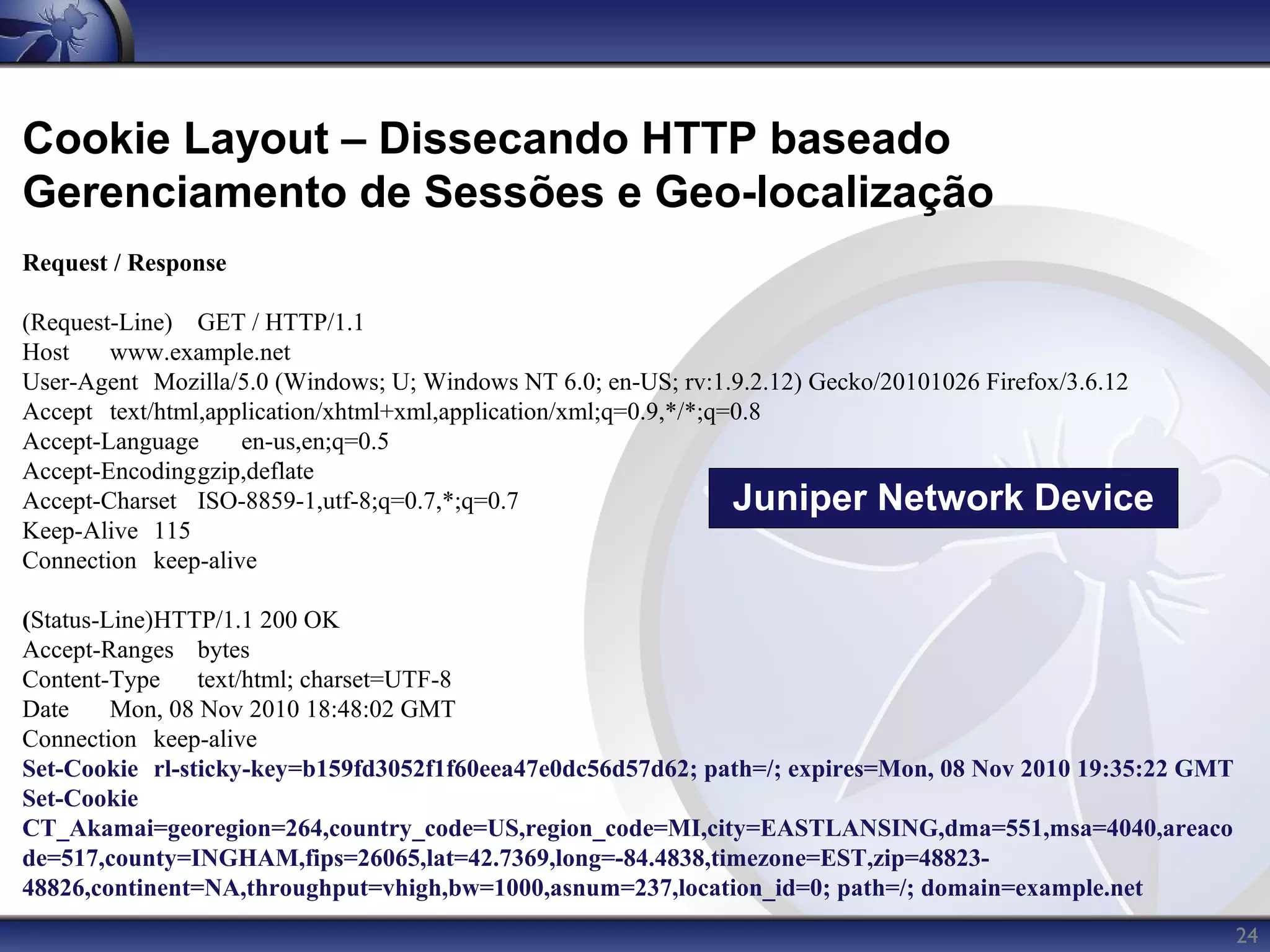
Cookie Layout – Dissecando HTTP baseado
Gerenciamento de Sessões e Geo-localização
Request / Response

(Request-Line) GET / HTTP/1.1
Host    www.example.net
User-Agent Mozilla/5.0 (Windows; U; Windows NT 6.0; en-US; rv:1.9.2.12) Gecko/20101026 Firefox/3.6.12
Accept text/html,application/xhtml+xml,application/xml;q=0.9,*/*;q=0.8
Accept-Language     en-us,en;q=0.5
Accept-Encodinggzip,deflate
Accept-Charset ISO-8859-1,utf-8;q=0.7,*;q=0.7                      Juniper Network Device
Keep-Alive 115
Connection keep-alive

(Status-Line)HTTP/1.1 200 OK
Accept-Ranges bytes
Content-Type     text/html; charset=UTF-8
Date     Mon, 08 Nov 2010 18:48:02 GMT
Connection keep-alive
Set-Cookie rl-sticky-key=b159fd3052f1f60eea47e0dc56d57d62; path=/; expires=Mon, 08 Nov 2010 19:35:22 GMT
Set-Cookie
CT_Akamai=georegion=264,country_code=US,region_code=MI,city=EASTLANSING,dma=551,msa=4040,areaco
de=517,county=INGHAM,fips=26065,lat=42.7369,long=-84.4838,timezone=EST,zip=48823-
48826,continent=NA,throughput=vhigh,bw=1000,asnum=237,location_id=0; path=/; domain=example.net
                                                                                                           24
Detecção de Proxy
1.Web Proxy Auto Detection Protocol – WPAD
2.Proxy Auto Configuration (PAC)
Walk Through - WPAD
 Protocolo usado para descoberta automática de proxy na rede.

 O arquivo de configuração contém endereços Intranet inerentemente .

 WPAD roda em DHCP Behavior. [DHCPINFORM Query]

 Não requer DNS lookup se DHCP emitir os pedidos

 DHCP Query through Uniform Resource Locator [URL]

 DNS Query through wpad.dat , o arquivo wpad está localizado do
  diretório do root.

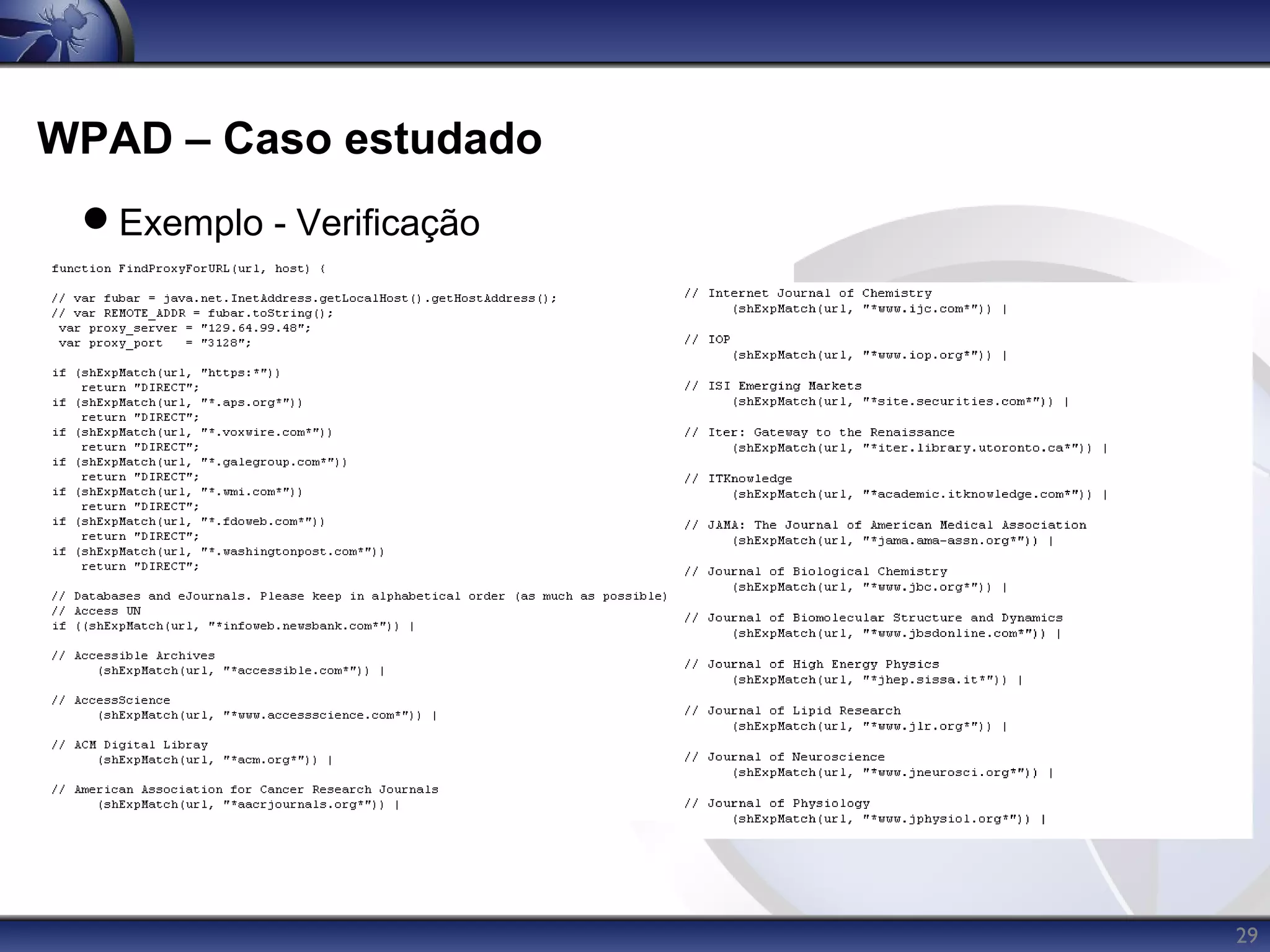
 Função FindProxyForURL()


                                                                        26
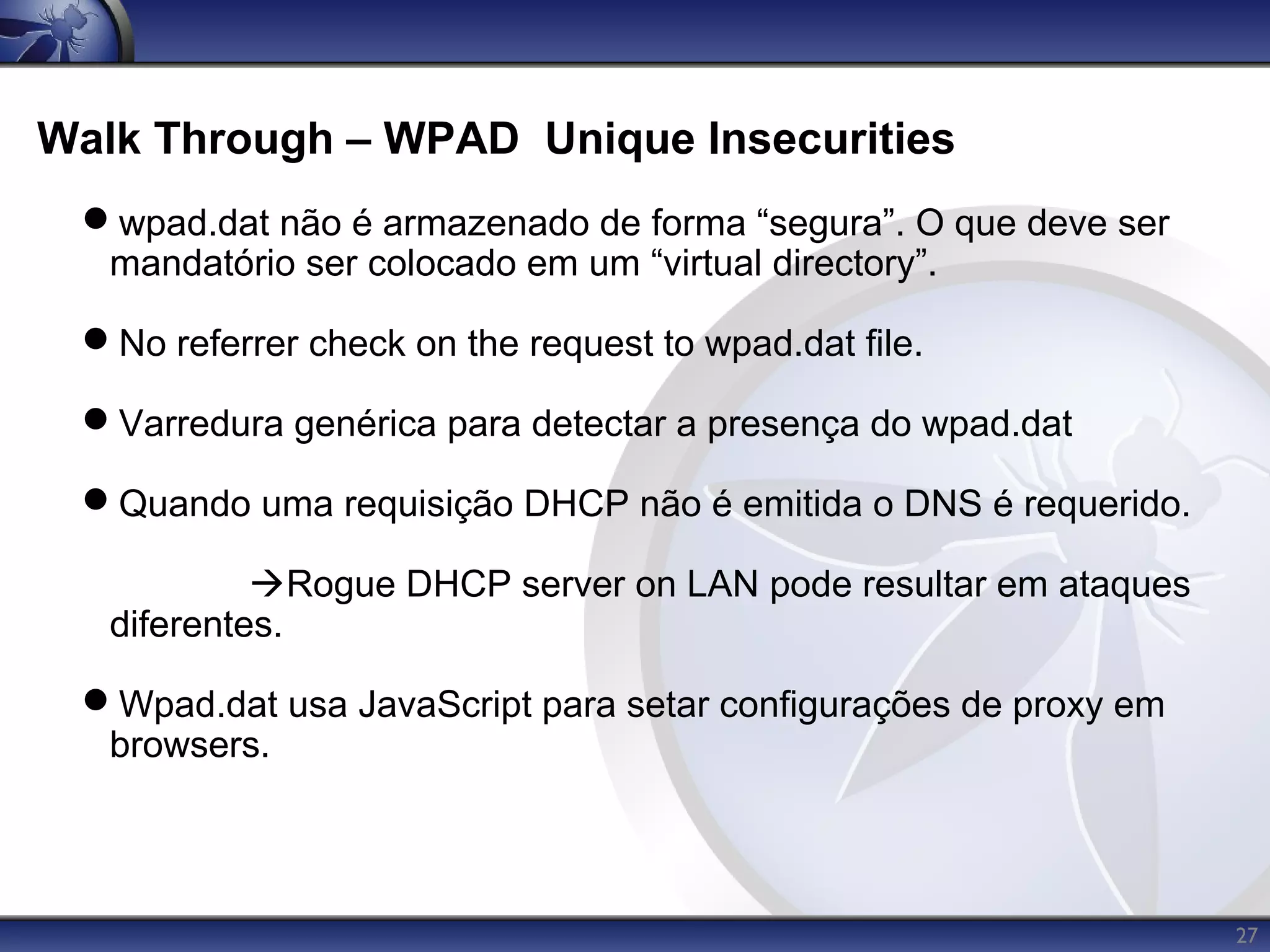
Walk Through – WPAD Unique Insecurities
 wpad.dat não é armazenado de forma “segura”. O que deve ser
  mandatório ser colocado em um “virtual directory”.

 No referrer check on the request to wpad.dat file.

 Varredura genérica para detectar a presença do wpad.dat

 Quando uma requisição DHCP não é emitida o DNS é requerido.

            Rogue DHCP server on LAN pode resultar em ataques
   diferentes.

 Wpad.dat usa JavaScript para setar configurações de proxy em
  browsers.


                                                                 27
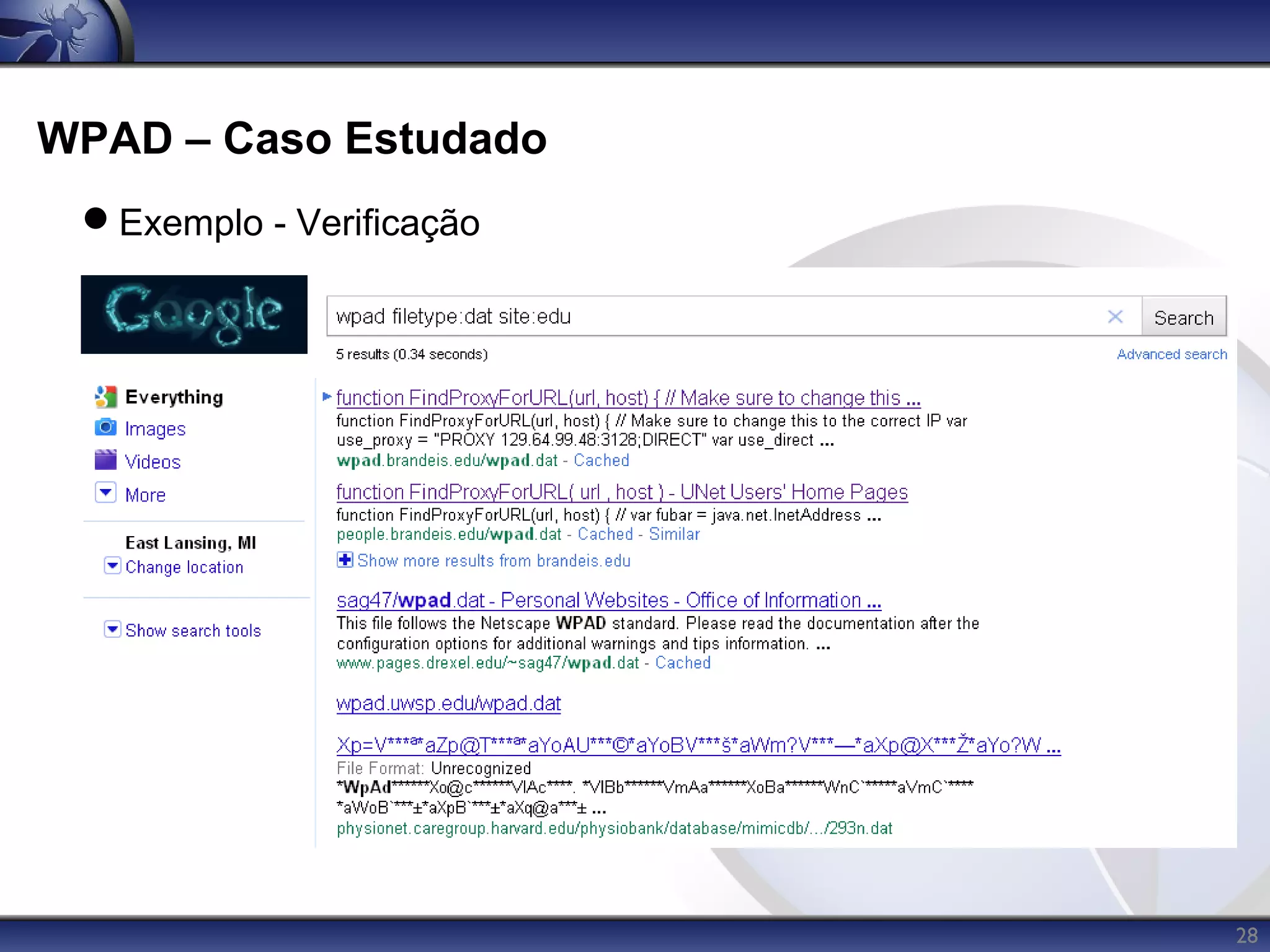
WPAD – Caso Estudado
 Exemplo - Verificação


                          28
WPAD – Caso estudado
 Exemplo - Verificação


                          29
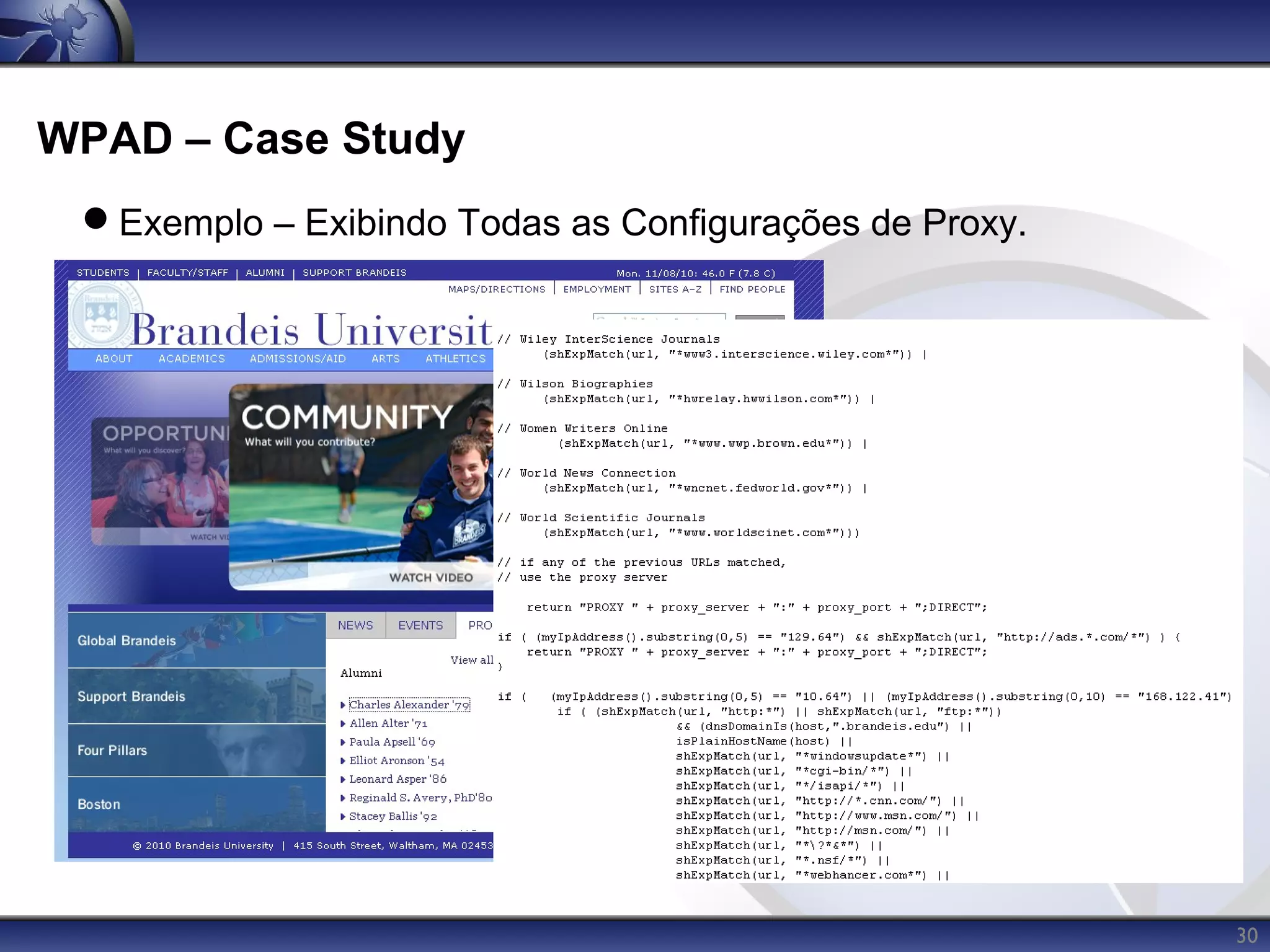
WPAD – Case Study
 Exemplo – Exibindo Todas as Configurações de Proxy.


                                                        30
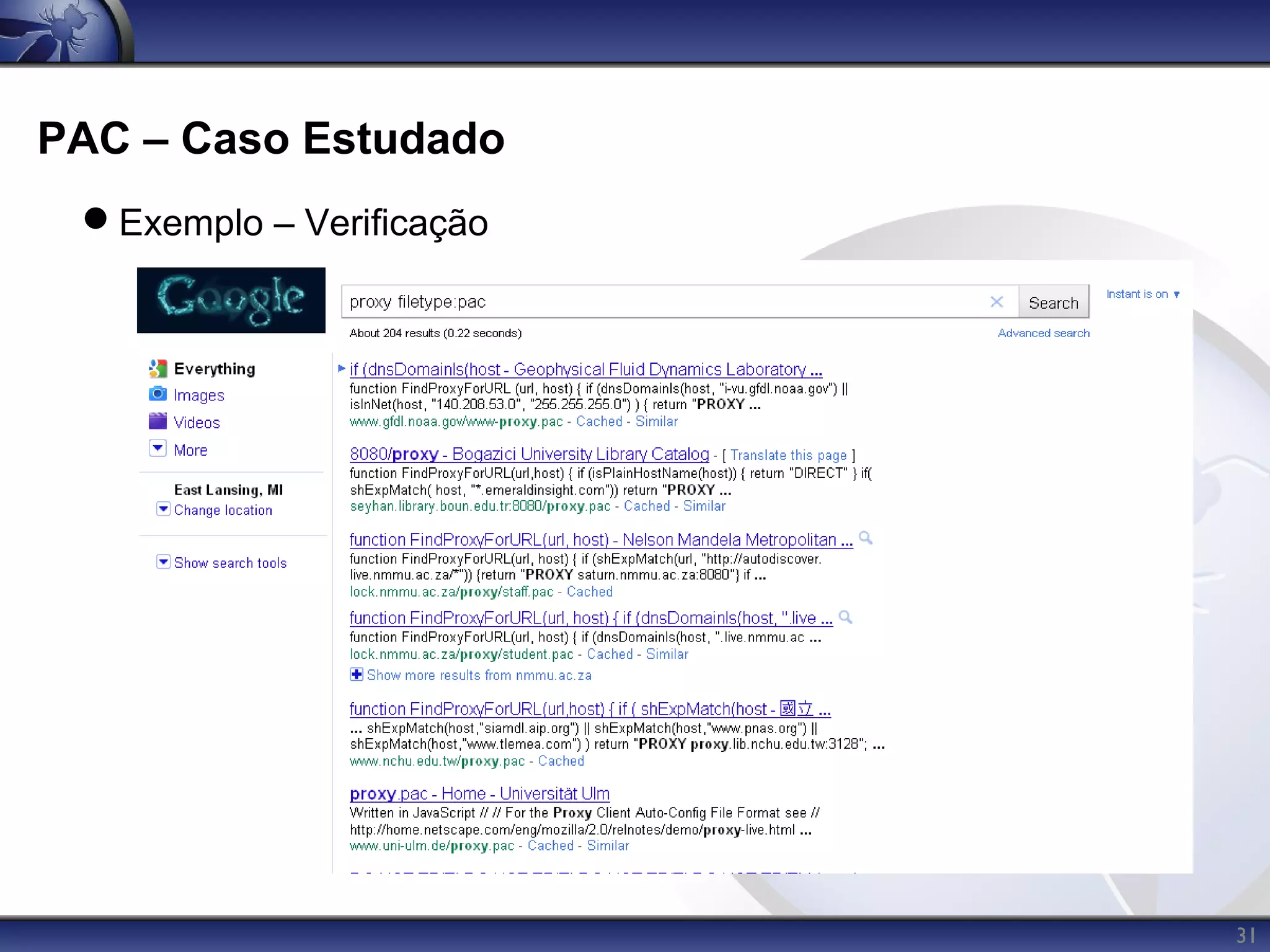
PAC – Caso Estudado
 Exemplo – Verificação


                          31
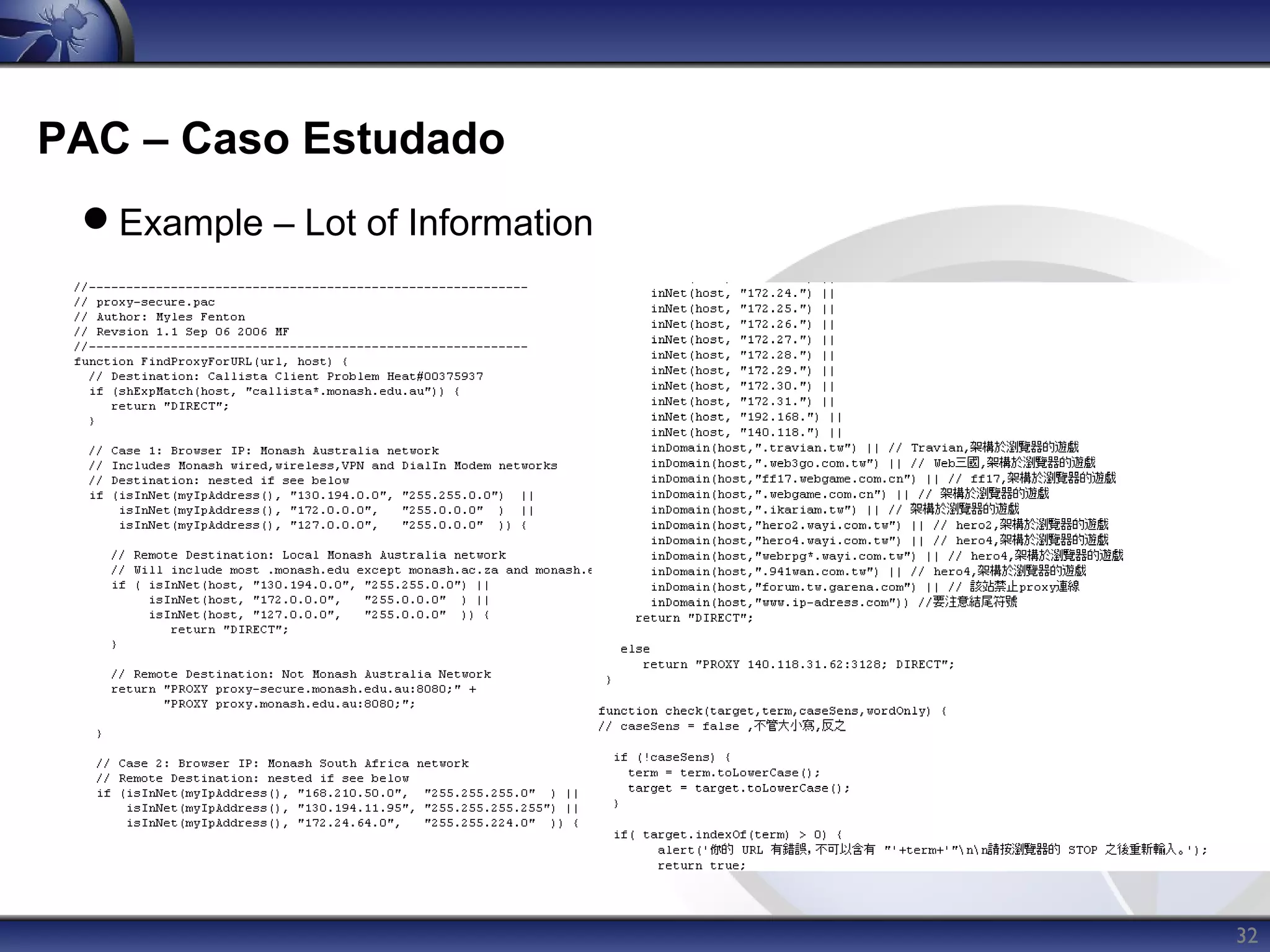
PAC – Caso Estudado
 Example – Lot of Information


                                 32
Serviços Anônimos
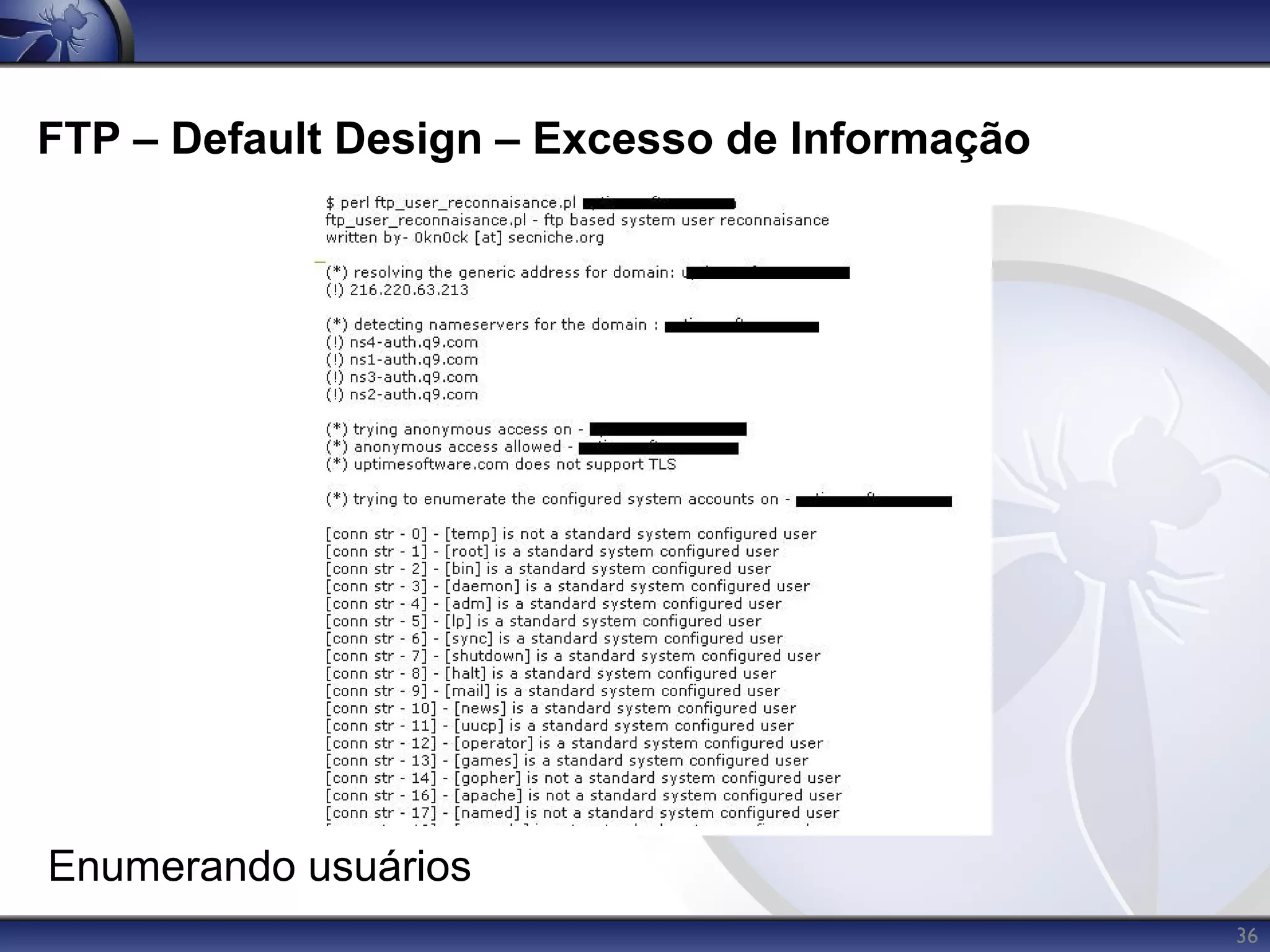
1.Enumerando Usuários “On the Fly”
2.Levantamento de Informações
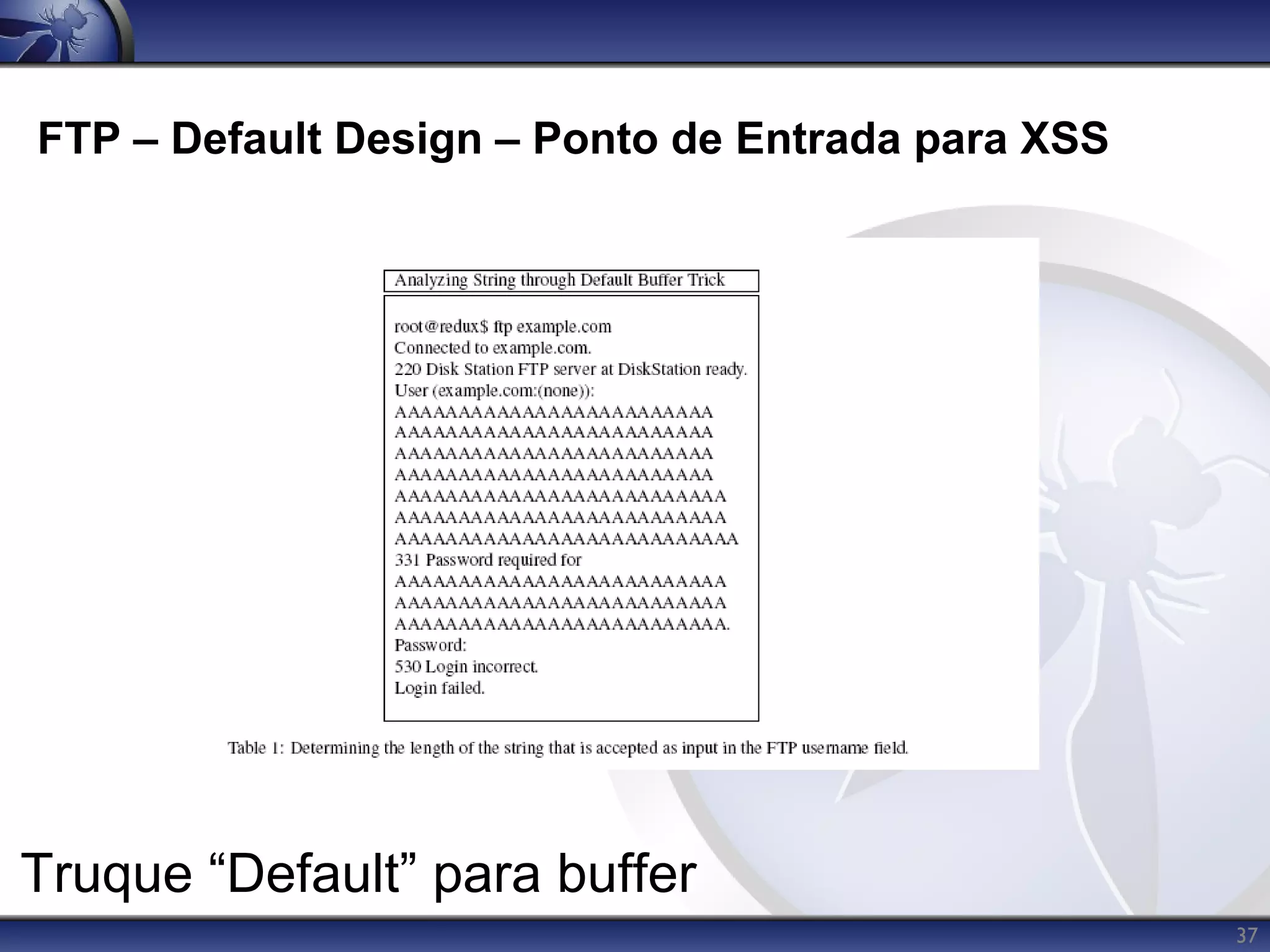
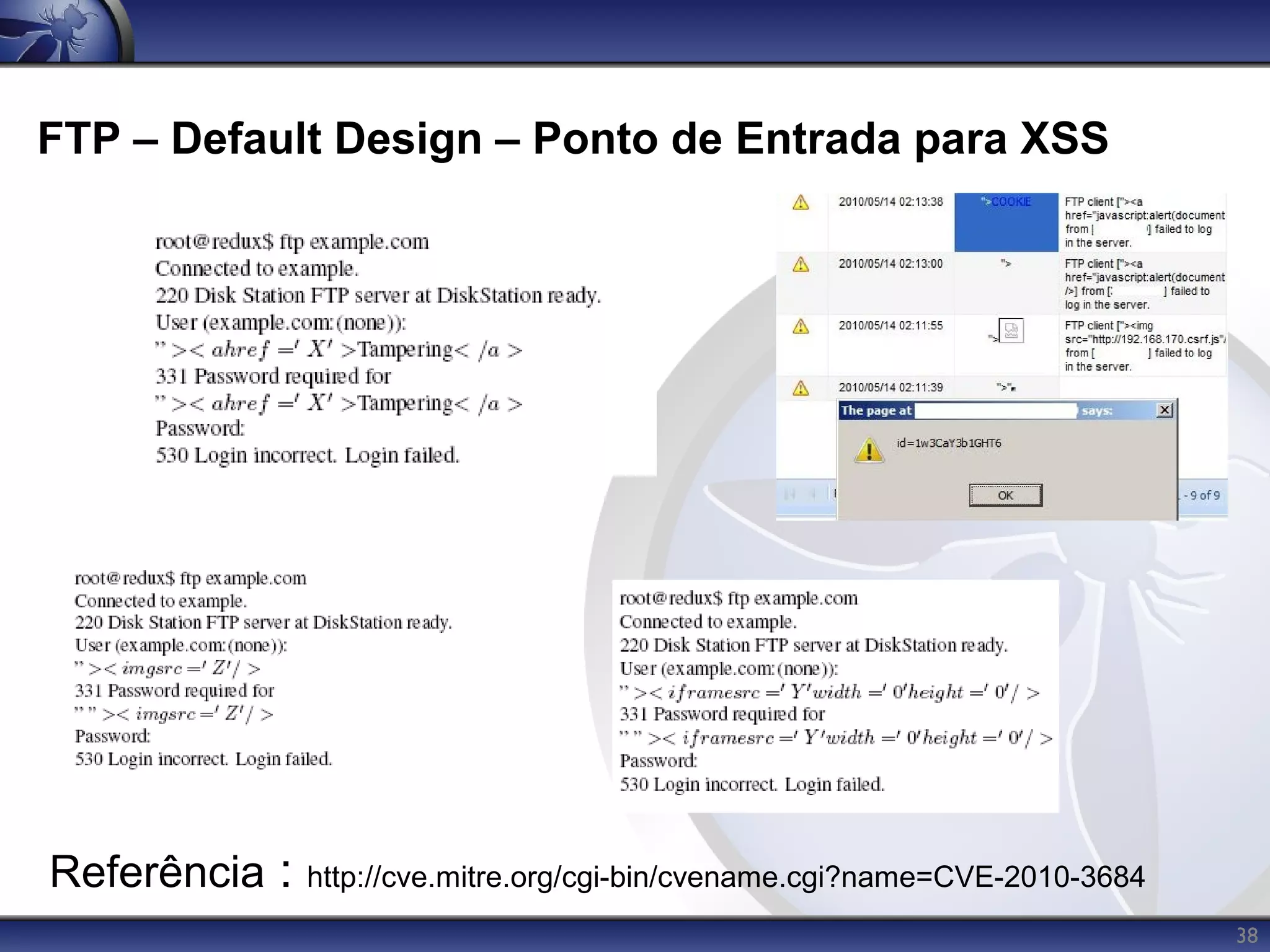
3.Ponto de Entrada para XSS em Dispositivos
Vulneráveis.
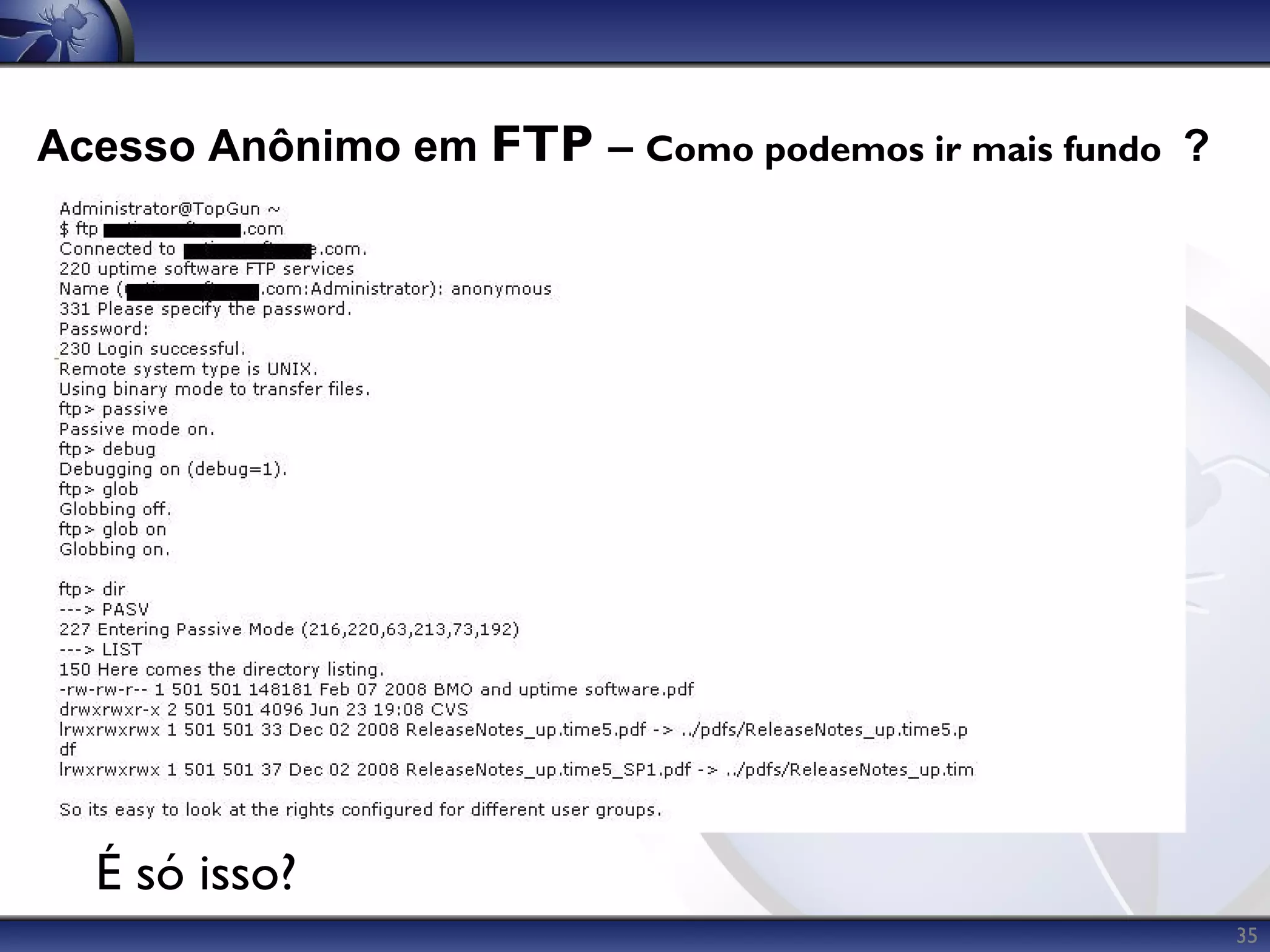
Serviços Abertos e Acessos Anôminos
 Open services such as FTP etc.

 Why open FTP? Why not a credential based access?

 Scrutinize the deployment strategy whether it has to be applied at
  internet or intranet.

 Why not to put these services on VPN considering the business
  need.

 Open services are tactically exploited to gain information and
  reconnaissance.

 These can be used to scan third party targets too.


                                                                       34
Acesso Anônimo em FTP – Como podemos ir mais fundo ?


  É só isso?
                                                       35
FTP – Default Design – Excesso de Informação


Enumerando usuários
                                               36
FTP – Default Design – Ponto de Entrada para XSS


Truque “Default” para buffer
                                                   37
FTP – Default Design – Ponto de Entrada para XSS


Referência :   http://cve.mitre.org/cgi-bin/cvename.cgi?name=CVE-2010-3684
                                                                             38
Piores Práticas de Design
1. URL Based Detection – Binary Control
2. Case Studies in the Wild
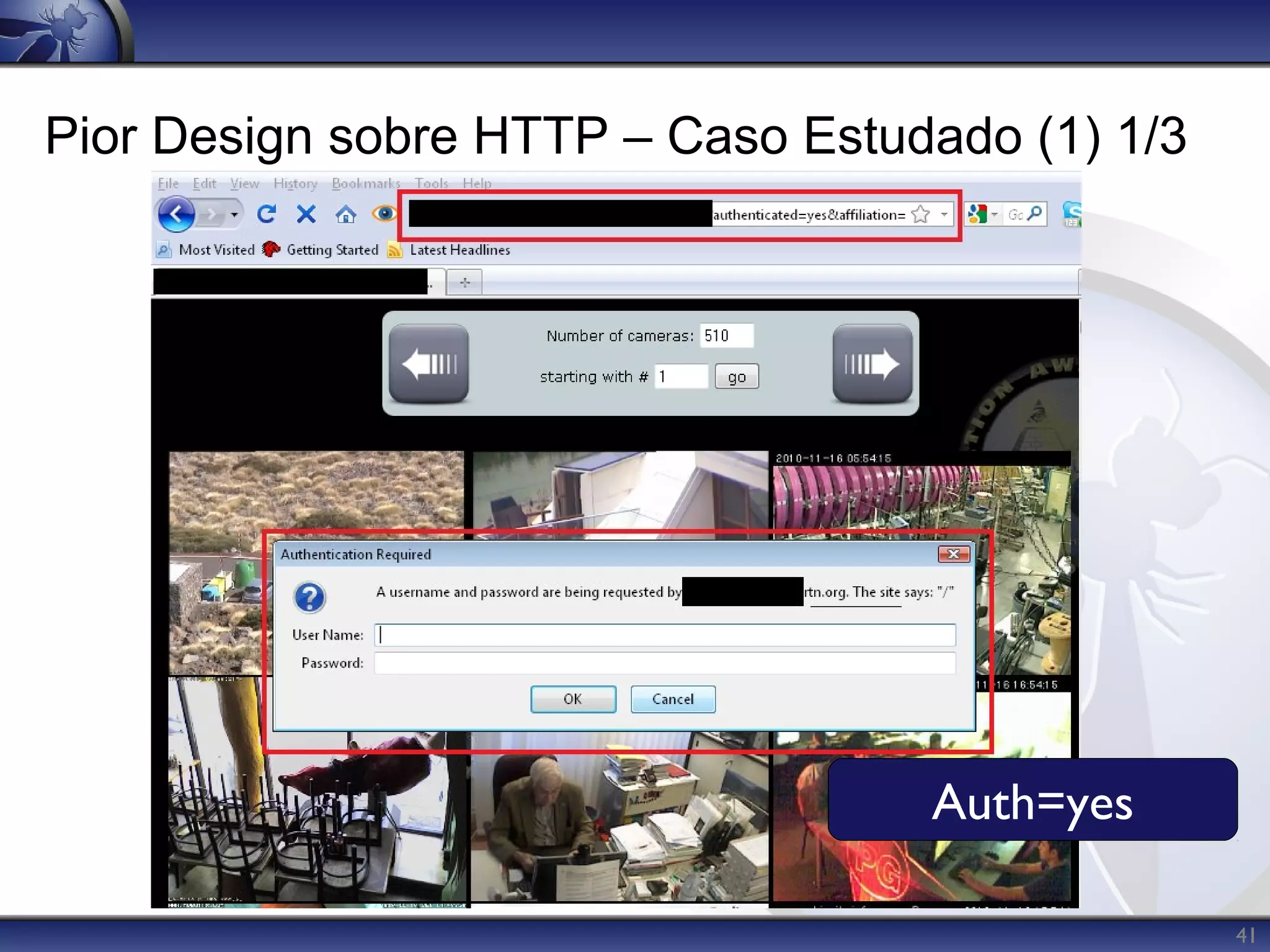
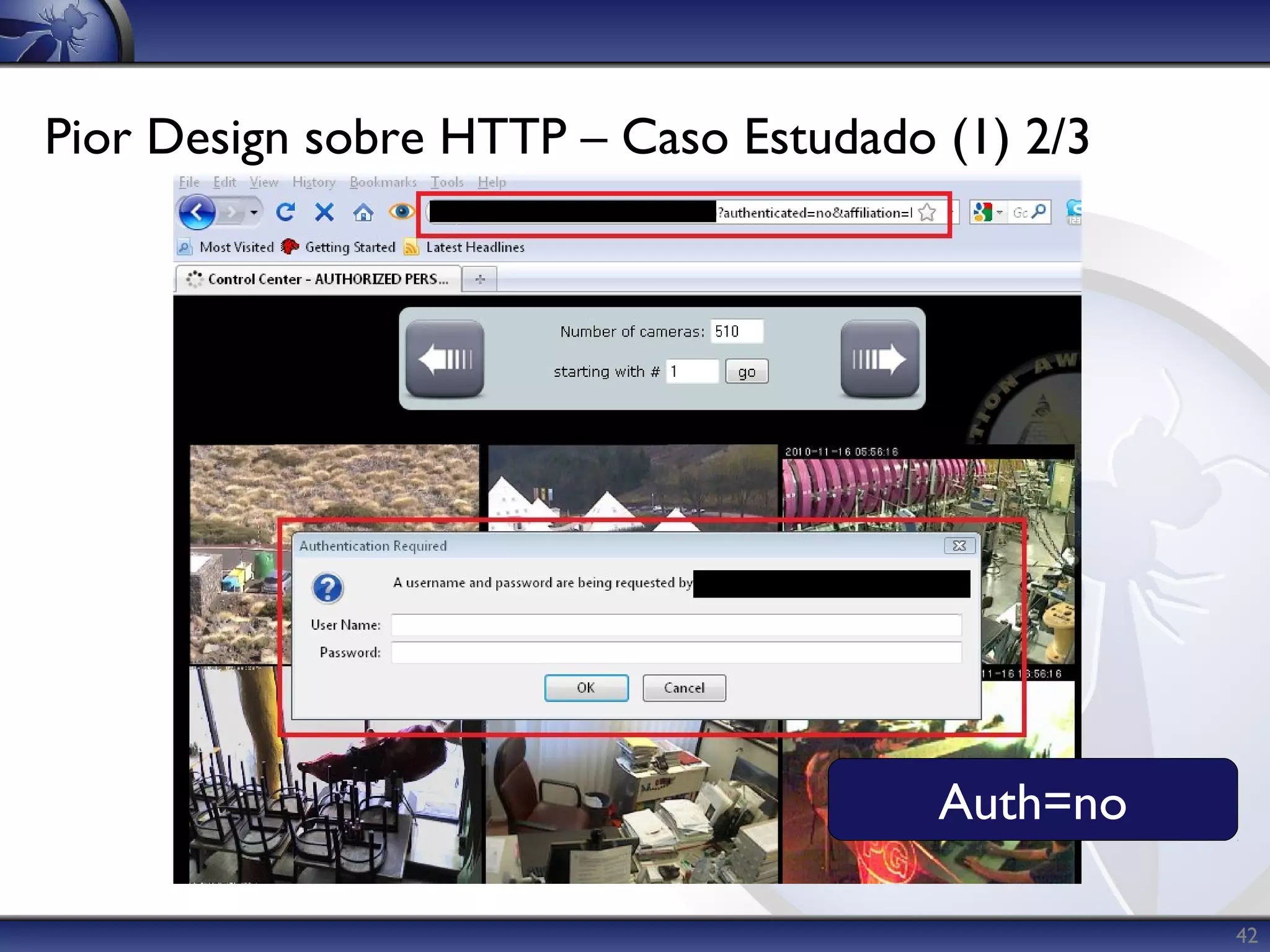
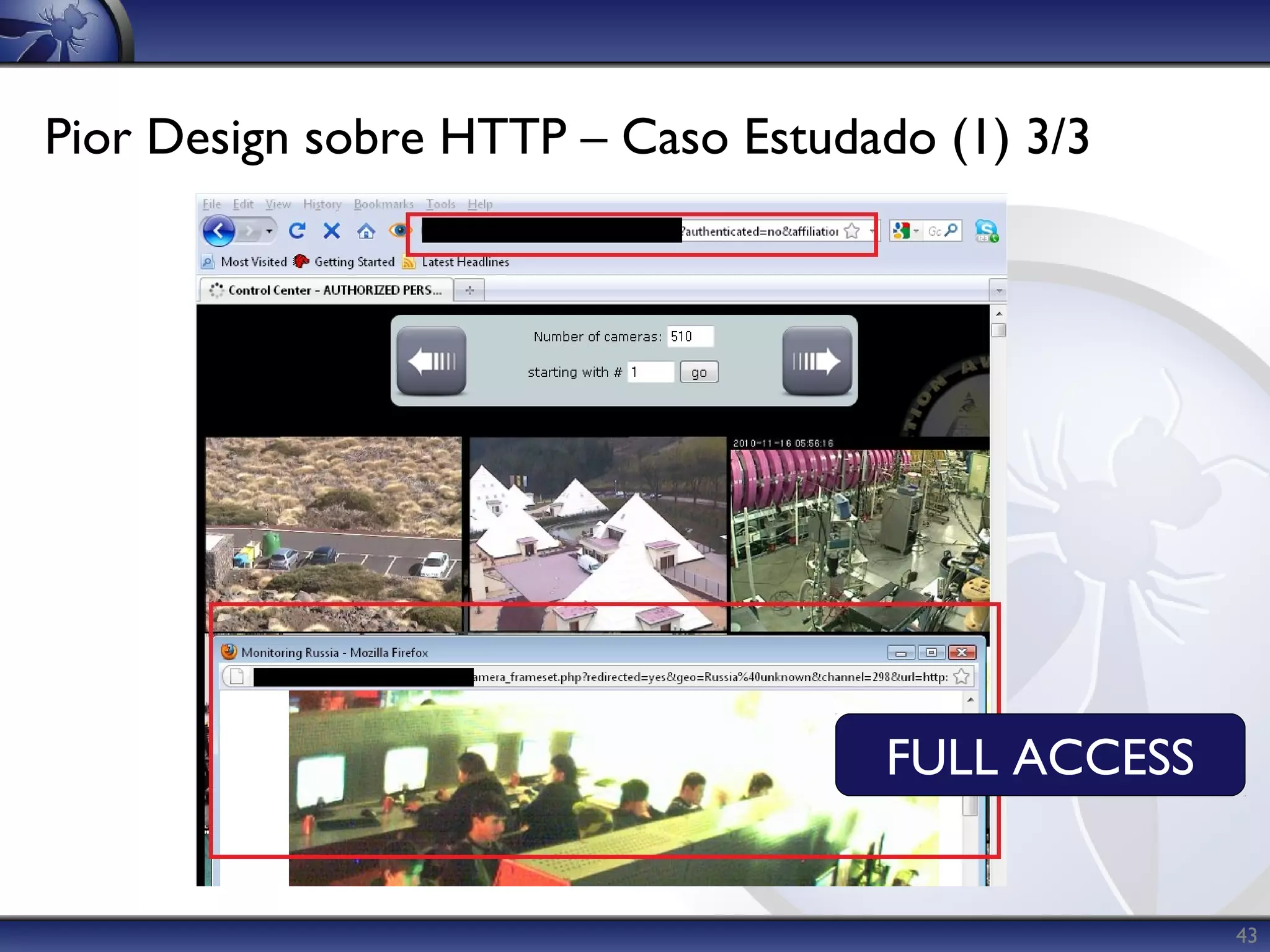
Pior Design sobre HTTP
  Porque ?
    •   Qualquer coisa está “aberta” na porta 80

         •   Facilmente rola “Firewall bypass”.

    •   URL patterns é uma forma crítica de regra

    •   Sequência de Controle Binário é usado nos dispositivos de rede

    •   [YES|NO] [0|1] – A maior parte dos dispostivos de rede aceitam
        bypass para autenticação

    Exemplos:

    •   http://router.ip/enblUpnp.cgi?enblUpnp=1 | 0

    •   http://192.168.1.1/application.cgi?authenticated=yes | no

                                                                         40
Pior Design sobre HTTP – Caso Estudado (1) 1/3


                                   Auth=yes

                                                 41
Pior Design sobre HTTP – Caso Estudado (1) 2/3


                                       Auth=no

                                                 42
Pior Design sobre HTTP – Caso Estudado (1) 3/3


                                    FULL ACCESS


                                                  43
Free Web – Verificar Dispositivos de Rede
1.Search engines como por exemplo Shodan
2.Google Dorks
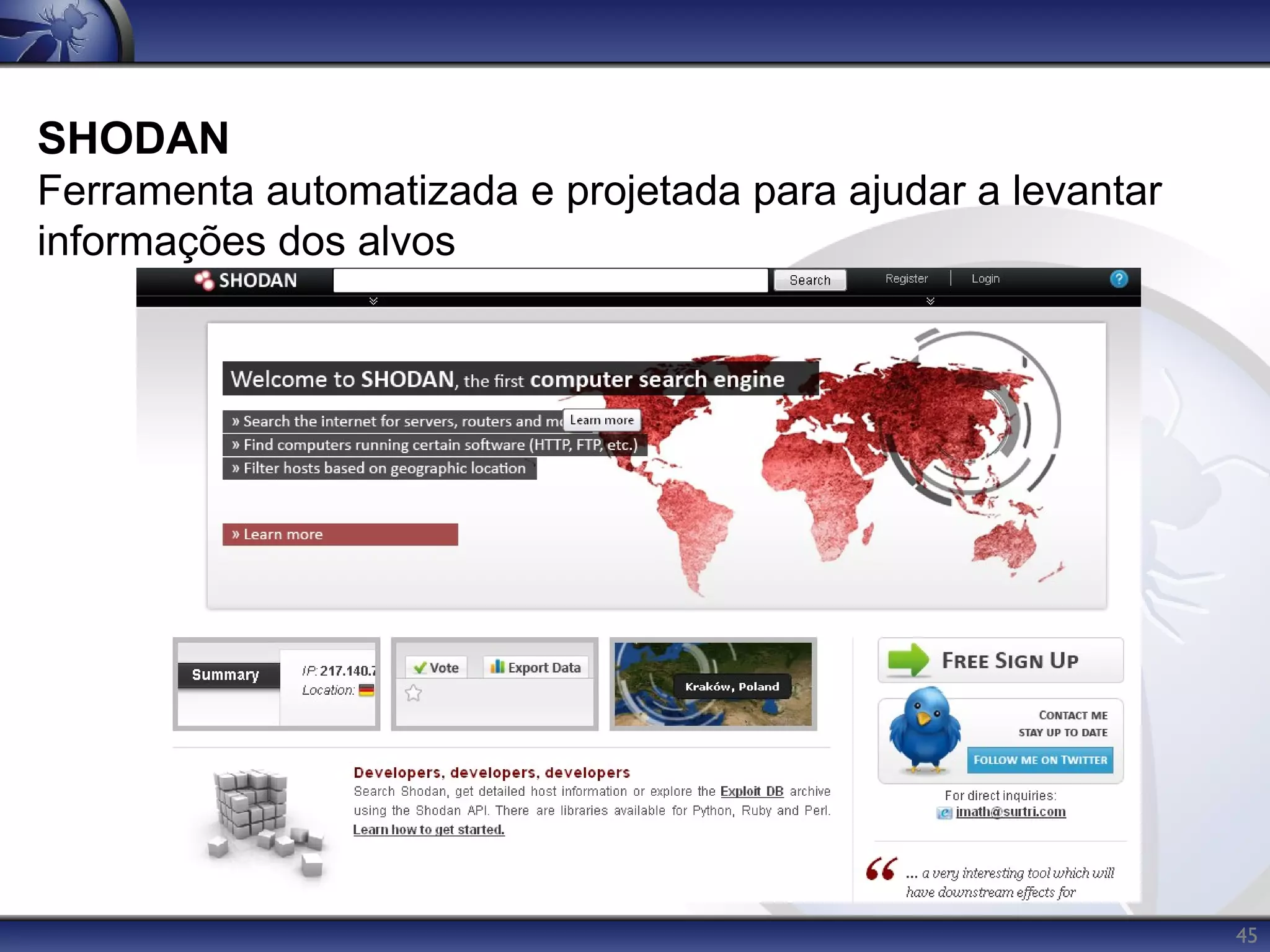
SHODAN
Ferramenta automatizada e projetada para ajudar a levantar
informações dos alvos


                                                             45
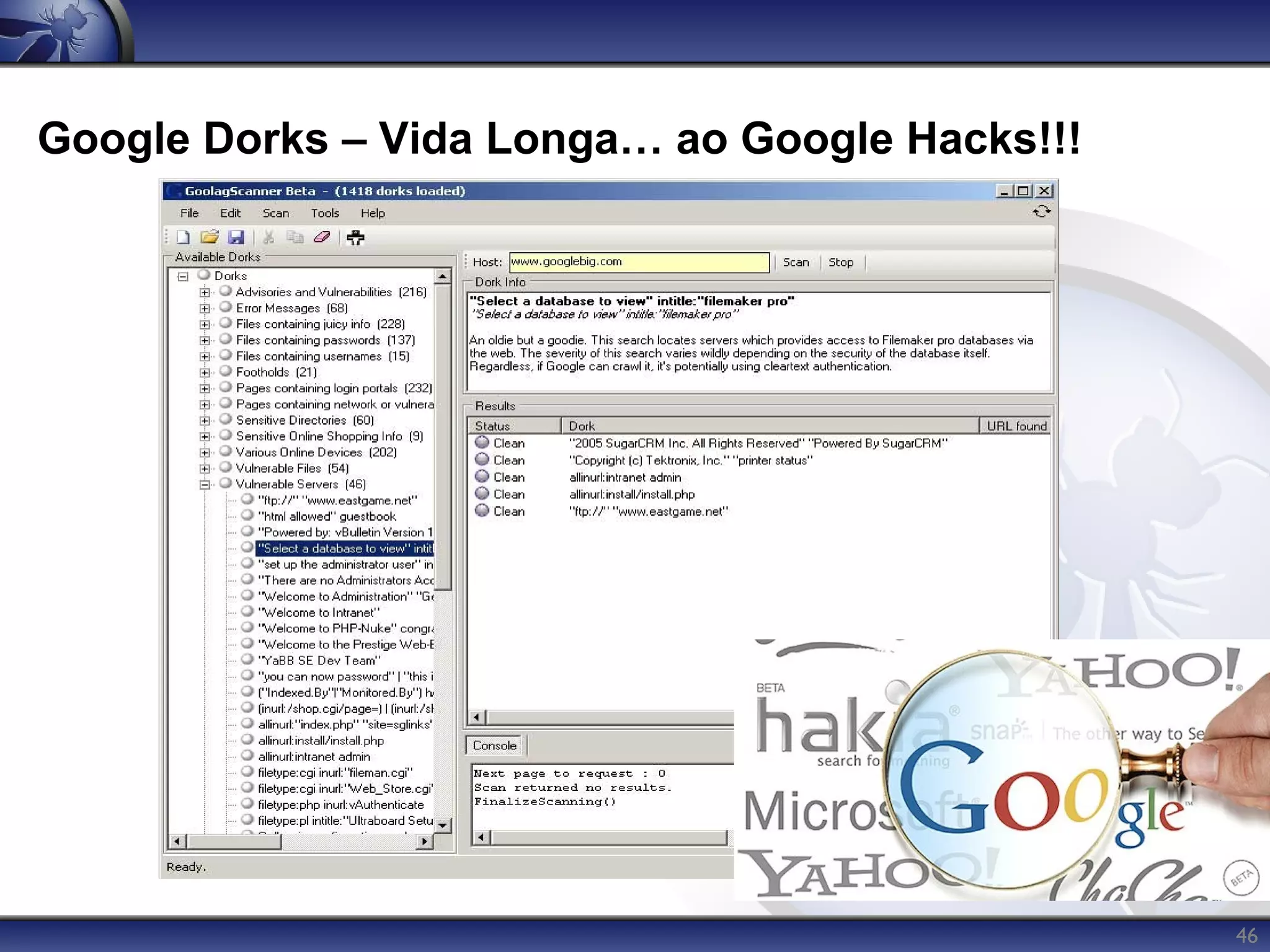
Google Dorks – Vida Longa… ao Google Hacks!!!


                                                46
Por último, existe muito mais do que isso na
World Wide Web.

Nós apresentamos apenas um vislumbre.
Conclusão

• Levantamento de Informações é a chave principal
• Assinaturas exclusivas para levar à detecção
• Variação de dispositivos de rede baseado em http
• Práticas de “Pior design” em uso


                                                     48
Obrigado
• OWASP Brazil
   http://www.owasp.org/index.php/AppSec_Brasil_2010_%28pt-br%29

• SecNiche Security
  http://www.secniche.org/

• Backtrack USA
   http://www.backtrack-linux.org

• Backtrack Brazil
   http://www.backtrack.com.br


                                                                   49

OWASP AppSec 2010 BRAZIL Information Extraction Art of Testing Network Peripheral Devices

  • 1.
    OWASP AppSec The OWASP Foundation Brazil 2010, Campinas, SP http://www.owasp.org Levantamento de Informação The Tao of Hacking - Detecção de vulnerabilidades em dispositivos de rede baseados em web Aditya K Sood , SecNiche Security (adi_ks@secniche.org) Mauro Risonho de Paula Assumpção (firebits@backtrack.com.br)
  • 2.
    The OWASP Foundation http://www.owasp.org AVISO LEGAL Todos os pontos de vista exclusivamente com base no trabalho realizado pela SecNiche Security. (C) SecNiche Security | http://www.secniche.org O conteúdo deve ser usado com a permissão do SecNiche 2
  • 3.
    Agenda • Porque Levantar Informações? • Padrões de Levantamento de Informações • Web Network Devices – Casos Estudados • Proxy e Serviços Anônimos • Más Práticas de Design • Free Web • Conclusão 3
  • 4.
    Levantamento de Informações– 1º Passo Crítico 4
  • 5.
    Levantamento de Informações– Várias Faces na Web Redes Complexas na Web Periféricos e Dispositivos de Segurança na Web Claro, World Wide Web é totalmente randômica, dinâmica e muitas vezes fora de padrão. 5
  • 6.
    Porque Levantamento deInformações? Determinação do Nível Crítico da estrutura interna . Parâmetros de requisições HTTP são manipulados. “301 movido permanentemente” é muitas vezes “código de resposta”. Os dispositivos usados podem ter seus IPs internos “spoofados”. Cada dispositivo tem seu próprio método de trabalho Usado para Set Cookie de uma maneira diferente . Usado para alterar o parâmetro de HTTP header. Analisar a mudança na HTTP headers. 6
  • 7.
    Padrões de informaçãona Web são importantes Porque ? • Quando o cabeçalho "servidor" é removido das respostas • A maioria das assinaturas de detecção “somem” • Banner grabbing não fornece informações suficientes • Headers revelam menos informação 7
  • 8.
    Funcionalidade de Dispositivosde Rede na Web • Server Cloaking • Setando parâmetros Set-Cookie com nomes exclusivos • Manipulação de resposta do Header • Diferentes combinações e sequência das respostas do HTTP 8
  • 9.
    Server Cloaking –Anti-Levant. de Informações • Camuflar as respostas do HTTP • Comportamento de variação em resposta “Search Engine/Browser” • Entrega de conteúdo baseado em requisições do HTTP 9
  • 10.
    Casos Estudados Quase 80% das assinaturas novas para a detecção de vários dispositivos de rede baseados na web. Vamos mostrar alguns dos novos padrões 10
  • 11.
    Dispositivos Embarcados HTTP ResponseHeaders Scrambling e Modificações 1.Citrix NetScaler Devices 2.Radware Devices 3.Juniper Devices 4.WatchGuard Firewall 5.Barracuda Devices 6.Profense 7.BinaryCheck 8.Muitos Outros..................
  • 12.
    HTTP Manipulação deHeader– Caso 1 (a) Comportamento em balanceador de carga Response Check 1 HTTP/1.1 200 OKrn Date: Tue, 05 Jul 2007 17:05:18 GMTrn Server: Serverrn Vary: Accept-Encoding,User-Agentrn Content-Type: text/html; charset=ISO-8859-1rn nnCoection: closern Citrix Net Scaler Devices Transfer-Encoding: chunkedrn Response Check 2 send: 'GET /?Action=DescribeImages&AWSAccessKeyId=0CZQCKRS3J69PZ6QQQR2&Owner.1 =084307701560&SignatureVersion=1&Version=2007-01- 03&Signature=<signature removed> HTTP/1.1rnHost: ec2.amazonaws.com:443rnAccept- Encoding: identityrnrn' reply: 'HTTP/1.1 200 OKrn' header: Server: Apache- Coyote/1.1 header: Transfer-Encoding: chunked header: Date: Thu, 15 Feb 2007 17:30:13 GMT send: 'GET /?Action=ModifyImageAttribute&Attribute=launchPermission&AWSAccessKeyId =0CZQCKRS3J6 9PZ6QQQR2&ImageId=ami-00b95c69&OperationType=add&SignatureVersion=1& Timestamp=2007- 02- 15T17%3A30%3A14&UserGroup.1=all&Signature=<signature removed> HTTP/1.1rnHost: ec2.amazonaws.com:443rnAccept-Encoding: identityrnrn' reply: 'HTTP/1.1 400 Bad Requestrn' header: Server: Apache-Coyote/1.1 header: Transfer-Encoding: chunked header: Date: Thu, 15 Feb 2007 17:30:14 GMT header: nnCoection: close 12
  • 13.
    HTTP Manipulação deHeader – Caso 1 (b) Comportamento em balanceador de carga Request /Response Check GET / HTTP/1.1 Host example.com User-Agent Mozilla/5.0 (Windows; U; Windows NT 6.0; en-US; rv:1.9.2.12) Gecko/20101026 Firefox/3.6.12 Accept text/html,application/xhtml+xml,application/xml;q=0.9,*/*;q=0.8 Keep-Alive 115 Connection keep-alive (Status-Line) HTTP/1.1 301 Moved Permanently Date Mon, 08 Nov 2010 19:49:23 GMT Citrix Net Scaler Devices Cneonction close Content-Type httpd/unix-directory Set-Cookie uu=9mjpm8rn90Duu4CQwFOZbQPyOCTl4V6yoHENgcCxLaHVsZ3h5dQ99JSlTTGlpO4Tw/IehNChDcKgwZ4SkLD98 SNSnGEggS3RM4FdkEVkaDIDUknUIRRI9fOEyYXz10uCA9bKIgdm+sIHNgpXl6YLh+ChPhIREU2wQKD9obDCvgGQ0Y 3BwNGN8eNSvhGz0h6ypaRIUuPyHvWQ8paioPEtkaDRnSGAwr4RsLFNwcDRnSGDwr4Rs9IesqPUWCLgwh6yoME9oc DRnSGT4r4Rs9IesqPyHvLjom6Co=;expires=Thu, 30 Dec 2037 00:00:00 GMT;path=/;domain=.imdb.com Set-Cookie session-id=284-9245763-9527093;path=/;domain=.imdb.com Set-Cookie session-id-time=1289332163;path=/;domain=.imdb.com Vary Accept-Encoding,User-Agent Content-Encoding gzip P3P policyref="http://i.imdb.com/images/p3p.xml",CP="CAO DSP LAW CUR ADM IVAo IVDo CONo OTPo OUR DELi PUBi OTRi BUS PHY ONL UNI PUR FIN COM NAV INT DEM CNT STA HEA PRE LOC GOV OTC " Content-Length 20 13
  • 14.
    HTTP Manipulação deHeader– Caso 1 (c) Response Check (Status-Line) HTTP/1.1 200 OK Cteonnt-Length3705 Content-Type application/x-javascript Last-Modified Mon, 21 May 2007 12:47:20 GMT Accept-Ranges bytes Etag"07c7f2ba69bc71:eda" Server Microsoft-IIS/6.0 X-Powered-By ASP.NET Citrix Net Scaler Devices Date Mon, 08 Nov 2010 19:55:47 GMT Cache-Control private Content-Encoding gzip Content-Length 1183 (Status-Line) HTTP/1.1 200 OK Date Mon, 08 Nov 2010 19:55:47 GMT Server Microsoft-IIS/6.0 X-Powered-By ASP.NET ntCoent-Length27166 Content-Type text/html Cache-Control private Content-Encoding gzip Content-Length 8276 14
  • 15.
    HTTP Manipulação deHeader – Caso 2 Response Check 1 HTTP/1.0 404 Not Foundrn Xontent-Length: rn Server: thttpd/2.25b 29dec2003rn Content-Type: text/html; charset=iso-8859-1rn Last-Modified: Tue, 05 Jul 2010 17:01:12 GMTrn Accept-Ranges: bytesrn Cache-Control: no-cache, no-storern Date: Tue, 05 Jun 2010 17:01:12 GMTrn Content-Length: 329rn Connection: closern HTTP/1.0 302 Moved Temporarily Age: 0 Date: Thu, 11 Mar 2010 12:01:55 GMT NetScaler & Radware Xontent-Length: Connection: Close Devices Via: NS-CACHE-7.0: 11 ETag: "KXIPDABNAPPNNTZS" Server: Microsoft-IIS/6.0 X-Powered-By: ASP.NET X-Powered-By: PHP/5.1.6 Location: http://216.99.132.20/smb/index.php Content-type: text/html Xontent-Length: rn:” 15
  • 16.
    HTTP Combinação deHeader – Caso 3 Response Check (200 OK & 301 Moved Permanently ) Via: 1.1 kitjlb01 Set-Cookie: rl-sticky-key=0a4b16a1; path=/; expires=Tue, 09 Nov 2010 02:53:38 GMT Via: 1.1 prijlb01 Set-Cookie: rl-sticky-key=c0a80a35; path=/; expires=Wed, 10 Nov 2010 09:42:14 GMT... Via: 1.1 kitjlb01 Set-Cookie: rl-sticky-key=0a4b16a1; path=/; expires=Tue, 09 Nov 2010 02:53:38 GMT Via: 1.1 sdcdx38f Set-Cookie: rl-sticky-key=0a03090a1f96; path=/; expires=Mon, 08 Nov 2010 08:00:39 GMT Via: 1.1 rl2650 Set-Cookie: rl-sticky-key=24dcf3f31e7ea5c3... Via: 1.1 DX3200UCI01 Set-Cookie: rl-sticky-key=eb281a3dd74de7264188f6e2b4cd56c9; path=/; Juniper Networks Application Acceleration Platform 16
  • 17.
    HTTP Combinação deHeader – Case 4 Response Check (It Uses combination of both Digest And Basic Realm for Authentication) HTTP/1.0 401 Authentication Required www-authenticate: Digest realm="Firebox Local User",qop="auth",nonce="f2a0ee2ddeff937bb382f6f5e1d002cd" www-authenticate: Basic realm=" Configuration" Content-type: text/plain HTTP/1.0 401 Authentication Required www-authenticate: Digest realm="SOHO Configuration",qop="auth",nonce="1ec86c0e135261685b4cbf78986860d4" www-authenticate: Basic realm="SOHO Configuration" Content-type: text/plain HTTP/1.0 401 Authentication Required www-authenticate: Digest realm="Local User",qop="auth",nonce="2bb1bdded2ed59dd6ca961acabd43e2e" www-authenticate: Basic realm="X5 Configuration" Content-type: text/plain Watch Guard Firewall SOHO Devices Firebox 17
  • 18.
    HTTP Combinação deHeader– Caso 5 Response Check (It uses Set_Cookie with “Barracuda” name parameter) HTTP/1.0 500 Internal Server Error Date: Thu, 11 Nov 2010 05:52:54 GMT Server: Microsoft-IIS/6.0 X-Powered-By: ASP.NET X-AspNet-Version: 2.0.50727 Cache-Control: private Content-Type: text/html; charset=utf-8 Content-Length: 5145 Set-Cookie: BNI__BARRACUDA_LB_COOKIE=df0fa8c000005000; Path=/; Max-age=1020 HTTP/1.0 400 Bad Request Content-Type: text/html Date: Thu, 11 Nov 2010 05:02:23 GMT Connection: close Content-Length: 39 Set-Cookie: BARRACUDA_LB_COOKIE=192.168.155.11_80; path=/ HTTP/1.0 200 OK Date: Thu, 11 Nov 2010 10:29:51 GMT Server: BarracudaServer.com (Windows) Connection: Keep-Alive Barracuda Devices Content-Type: text/html Cache-Control: No-Cache Transfer-Encoding: chunked Set-Cookie: BarracudaDrive=3.2.1; expires=Wed, 07 Sep 2011 10:29:51 GMT 18
  • 19.
    HTTP Combinação deHeader– Caso 6 Response Check (It uses Set_Cookie with “PLBSID” name parameter) HTTP/1.0 200 OK Date: Mon, 01 Nov 2010 02:59:47 GMT Content-length: 9783 Content-Type: text/html Via: 1.1 217.22.135.104 Set-Cookie: PLBSID=0.s1; path=/ Usually, Server header Cache-Control: no-store Vary: Accept-Encoding is used as mark point HTTP/1.0 200 OK Date: Mon, 01 Nov 2010 02:59:47 GMT for detecting Profense. Content-length: 9783 Content-Type: text/html If “Server” header is Via: 1.1 217.22.135.104 Set-Cookie: PLBSID=0.s2; path=/ missing “PLBSID” is Cache-Control: no-store Vary: Accept-Encoding the parameter to look for. 19
  • 20.
    HTTP Combinação deHeader– Caso 7 Response Check (It uses Set_Cookie with “PLBSID” name parameter) HTTP/1.0 200 OK Date: Wed, 25 Aug 2010 08:45:45 GMT Content-Type: text/html; charset=utf-8 Transfer-Encoding: chunked Connection: keep-alive Vary: Accept-Encoding Last-Modified: Wed, 25 Aug 2010 08:45:46 GMT X-BinarySEC-Via: frontal2.re.saas.example.com HTTP/1.0 301 Moved Permanently Content-length: 0 Content-language: fr X-binarysec-cache: saas.example.com Connection: keep-alive Location: http://www.binarysec.fr/cms/index.html Date: Tue, 24 Nov 2009 22:49:01 GMT BinarySec WAF is now Content-type: text/html Content-Type: text/html; charset=utf-8 using its own response Transfer-Encoding: chunked Connection: keep-alive headers “X-BinarySEC” Vary: Accept-Encoding Last-Modified: Wed, 25 Aug 2010 08:45:46 GMT X-BinarySEC-Via: frontal2.re.saas.examplecom 20
  • 21.
    Dispositivos Embarcados Gerenciamento deLayout de Cookies de Sessão e Truques 1.Big IP Server Devices 2.Juniper Devices
  • 22.
    Cookie Layout –Dissecando Sessões IP HTTP IP Baseado em Gerenciamento de Sessão Request / Response E:audit>nc example.com 80 GET / HTTP/1.1 HOST:example.com HTTP/1.1 302 Object moved Server: Microsoft-IIS/5.0 Date: Mon, 08 Nov 2010 17:41:56 GMT X-Powered-By: ASP.NET Location: http://www.example.com/us/index.asp Content-Length: 159 Content-Type: text/html Set-Cookie: ASPSESSIONIDCCCCSBAA=AHLDLDDANEKJOOPHGOHAAKBA; path=/ Cache-control: private Set-Cookie: http.pool=167880896.20480.0000; path=/ <head><title>Object moved</title></head> <body><h1>Object Moved</h1>This object may be found <a HREF="http://www.example.com/us/index.asp">here</a>.</body> 22
  • 23.
    Cookie Layout –Dissecando Sessões IP HTTP IP Baseado em Gerenciamento de Sessão Request / Response Big IP Server Device E:audit>nc example.com 80 GET / HTTP/1.1 HOST:example.com HTTP/1.1 302 Object moved Set-Cookie: http.pool=167880896.20480.0000; path=/ Converting to Binary: Binary ( cookie ) Part == 00001010000000011010100011000000 Converting to blocks of 4  00001010 00000001 10101000 11000000 00001010  10 00000001  1 192.168.1.10 10101000  168 11000000  192 23
  • 24.
    Cookie Layout –Dissecando HTTP baseado Gerenciamento de Sessões e Geo-localização Request / Response (Request-Line) GET / HTTP/1.1 Host www.example.net User-Agent Mozilla/5.0 (Windows; U; Windows NT 6.0; en-US; rv:1.9.2.12) Gecko/20101026 Firefox/3.6.12 Accept text/html,application/xhtml+xml,application/xml;q=0.9,*/*;q=0.8 Accept-Language en-us,en;q=0.5 Accept-Encodinggzip,deflate Accept-Charset ISO-8859-1,utf-8;q=0.7,*;q=0.7 Juniper Network Device Keep-Alive 115 Connection keep-alive (Status-Line)HTTP/1.1 200 OK Accept-Ranges bytes Content-Type text/html; charset=UTF-8 Date Mon, 08 Nov 2010 18:48:02 GMT Connection keep-alive Set-Cookie rl-sticky-key=b159fd3052f1f60eea47e0dc56d57d62; path=/; expires=Mon, 08 Nov 2010 19:35:22 GMT Set-Cookie CT_Akamai=georegion=264,country_code=US,region_code=MI,city=EASTLANSING,dma=551,msa=4040,areaco de=517,county=INGHAM,fips=26065,lat=42.7369,long=-84.4838,timezone=EST,zip=48823- 48826,continent=NA,throughput=vhigh,bw=1000,asnum=237,location_id=0; path=/; domain=example.net 24
  • 25.
    Detecção de Proxy 1.WebProxy Auto Detection Protocol – WPAD 2.Proxy Auto Configuration (PAC)
  • 26.
    Walk Through -WPAD Protocolo usado para descoberta automática de proxy na rede. O arquivo de configuração contém endereços Intranet inerentemente . WPAD roda em DHCP Behavior. [DHCPINFORM Query] Não requer DNS lookup se DHCP emitir os pedidos DHCP Query through Uniform Resource Locator [URL] DNS Query through wpad.dat , o arquivo wpad está localizado do diretório do root. Função FindProxyForURL() 26
  • 27.
    Walk Through –WPAD Unique Insecurities wpad.dat não é armazenado de forma “segura”. O que deve ser mandatório ser colocado em um “virtual directory”. No referrer check on the request to wpad.dat file. Varredura genérica para detectar a presença do wpad.dat Quando uma requisição DHCP não é emitida o DNS é requerido. Rogue DHCP server on LAN pode resultar em ataques diferentes. Wpad.dat usa JavaScript para setar configurações de proxy em browsers. 27
  • 28.
    WPAD – CasoEstudado Exemplo - Verificação 28
  • 29.
    WPAD – Casoestudado Exemplo - Verificação 29
  • 30.
    WPAD – CaseStudy Exemplo – Exibindo Todas as Configurações de Proxy. 30
  • 31.
    PAC – CasoEstudado Exemplo – Verificação 31
  • 32.
    PAC – CasoEstudado Example – Lot of Information 32
  • 33.
    Serviços Anônimos 1.Enumerando Usuários“On the Fly” 2.Levantamento de Informações 3.Ponto de Entrada para XSS em Dispositivos Vulneráveis.
  • 34.
    Serviços Abertos eAcessos Anôminos Open services such as FTP etc. Why open FTP? Why not a credential based access? Scrutinize the deployment strategy whether it has to be applied at internet or intranet. Why not to put these services on VPN considering the business need. Open services are tactically exploited to gain information and reconnaissance. These can be used to scan third party targets too. 34
  • 35.
    Acesso Anônimo emFTP – Como podemos ir mais fundo ? É só isso? 35
  • 36.
    FTP – DefaultDesign – Excesso de Informação Enumerando usuários 36
  • 37.
    FTP – DefaultDesign – Ponto de Entrada para XSS Truque “Default” para buffer 37
  • 38.
    FTP – DefaultDesign – Ponto de Entrada para XSS Referência : http://cve.mitre.org/cgi-bin/cvename.cgi?name=CVE-2010-3684 38
  • 39.
    Piores Práticas deDesign 1. URL Based Detection – Binary Control 2. Case Studies in the Wild
  • 40.
    Pior Design sobreHTTP Porque ? • Qualquer coisa está “aberta” na porta 80 • Facilmente rola “Firewall bypass”. • URL patterns é uma forma crítica de regra • Sequência de Controle Binário é usado nos dispositivos de rede • [YES|NO] [0|1] – A maior parte dos dispostivos de rede aceitam bypass para autenticação Exemplos: • http://router.ip/enblUpnp.cgi?enblUpnp=1 | 0 • http://192.168.1.1/application.cgi?authenticated=yes | no 40
  • 41.
    Pior Design sobreHTTP – Caso Estudado (1) 1/3 Auth=yes 41
  • 42.
    Pior Design sobreHTTP – Caso Estudado (1) 2/3 Auth=no 42
  • 43.
    Pior Design sobreHTTP – Caso Estudado (1) 3/3 FULL ACCESS 43
  • 44.
    Free Web –Verificar Dispositivos de Rede 1.Search engines como por exemplo Shodan 2.Google Dorks
  • 45.
    SHODAN Ferramenta automatizada eprojetada para ajudar a levantar informações dos alvos 45
  • 46.
    Google Dorks –Vida Longa… ao Google Hacks!!! 46
  • 47.
    Por último, existemuito mais do que isso na World Wide Web. Nós apresentamos apenas um vislumbre.
  • 48.
    Conclusão • Levantamento deInformações é a chave principal • Assinaturas exclusivas para levar à detecção • Variação de dispositivos de rede baseado em http • Práticas de “Pior design” em uso 48
  • 49.
    Obrigado • OWASP Brazil http://www.owasp.org/index.php/AppSec_Brasil_2010_%28pt-br%29 • SecNiche Security http://www.secniche.org/ • Backtrack USA http://www.backtrack-linux.org • Backtrack Brazil http://www.backtrack.com.br 49